Works III
FEBRUARY 22
2:30PM
Long Center for the
Performing Arts
Featuring: Varsity Band, Concert Band & Collegiate Band II
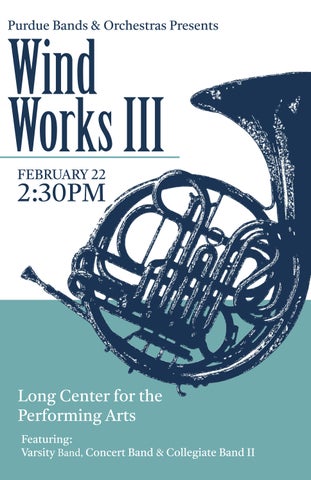
FEBRUARY 22
2:30PM
Long Center for the
Performing Arts
Featuring: Varsity Band, Concert Band & Collegiate Band II
Jay S. Gephart.....................................................................................................Director and AI G. Wright Chair
Matthew R. Conaway......................................Professor, Director of “All-American” Marching Band
Dr. Pamela J. Nave................................................................Associate Professor, Director of Percussion
Adam Bodony..........................................................................Associate Professor, Director of Orchestras
Bethany Robinson...............................................Clinical Assistant Professor, Director of Jazz Bands
Jarrard Harris..............................................................................................................Clinical Assistant Professor
Dr. David M. Blon.......................................................................................................Clinical Assistant Professor
Dr. Lucas H. Petersen.............................................................................................Clinical Assistant Professor
Douglas R. Fletcher.............................................................................................................Director of Operations
Amy Brandfonbrener................................................................................................Chamber Music Instructor
Esther Kirgiss........................................................................................................Director of External Relations
Caitlin Cotten........................................................................Manager of Recruitment & Student Success
Humza Nasir..............................................................................................................................Multimedia Designer
Susan Lipscomb.............................................................................................Senior Administrative Assistant
Kim Delks.........................................................................................................................................Business Assistant
Adisyn Nichols..................................................................................................................Student Office Assistant
Elora Ifeguni............................................................................................................................Graphic Design Intern
Udochukwu Akorah...................................................................................................Social Media Ambassador


Dr. David M. Blon, conductor
Down East Fanfare (2003)...........................................................................................................................................Jack Stamp (b. 1954)
Lincoln (2003)...............................................................................................................................................................John Williams (b. 1932) arr. Jay Bocook
From Tropic to Tropic (1898/1971).........................................................................................................Russell Alexander (1877-1915) arr. Glenn Cliffe Bainum
Noctalgia (2025).......................................................................................................................................Andrew David Perkins (b. 1978)
Dr. Adam V. Fontana, guest conductor Director of Bands, State University of New York - New Paltz
Seventh Night of July: Tanabata (1992).................................................................................................................Itaru Sakai (b. 1970)
Douglas R. Fletcher, conductor
Concert Variations (1977).............................................................................................................................Claude T. Smith (1935-1987)
Prelude, Siciliano, & Rondo (1969 /1979).............................................................................................Malcom Arnold (1921-2006) arr. John P. Paynter
Amazing Grace.........................................................................................................................................................John Newton (1725-1807) arr. William Himes
March from Suite for Variety Orchestra No. 1 (1956/2013).............................................Dmitri Shostakovich (1906-1975) arr. James Curnow
Ross Roy (1997)..........................................................................................................................................................Jacob de Haan (b. 1959)
Dr. David M. Blon, conductor
Fanfare, Hymn, and Finale (2018)...........................................................................................................................Peter Boyer (b. 1970)
The Engulfed Cathedral (1910/1993)......................................................................................................Claude Debussy (1862-1918) transc. Merlin Patterson
Dr. Adam V. Fontana, guest conductor
Alu Like March (1979)......................................................................................................................................Haunani Apoliona (b. 1948) arr. Byron Yasui & Todd Yukumoto
Candide Suite (1956/1993)....................................................................................................................Leonard Bernstein (1918-1990) arr. Clare Grundman & Joseph Kreines
I. The Best of All Possible Worlds
II. Westphalia Chorale and Battle Scene
III. Auto-da-fé
IV. Glitter and Be Gay
V. Make Our Garden Grow
Magellan’s Voyage to Unknown Continent (2005)............................................................................Masanori Taruya (b. 1978)
PICCOLO
Samuel Root
FLUTE
Carena Allen
Alissa Benge
Ashlie Beuter
Tucker Bremer
Stephanie Kulinski
Ryan Rose
Fiona Xie*
OBOE
Cody Hendrych-Bondra
Victoria Porter*
BASSOON
Sierra Hunnicutt
E b SOPRANO CLARINET
Caylee Michela
B b SOPRANO CLARINET
Maria Cesco
Mackenzie Deese
Reagan Ensminger
Kayla Fischer
Karina Hollis-Brau
Catherine Hummell
Alexander Kaufmann
Isaac Lublin*
Quinn Mitchell
Hikari Shiga
Bowen Zheng
B b BASS CLARINET
Addie Smock
ALTO SAXOPHONE
Michael Anzalotti
Elijah Bass
Riley Kirby
Elijah LeFavour
Claire Masters*
TENOR SAXOPHONE
Jackson Wittenberg
BARITONE SAXOPHONE
Owen Hawes
HORN
Mason Brindle
Mason Chamberlin
Annalise DeMange
Andrew Freuman*
Raelee Lance
Abigail Mackey
Noelle Schick
TRUMPET
Ben Fillmore
Andrew Gafford
MacKenzie Gall
Justin Gee
Scott Gowen
Evan Richards
Abby Shute
Peter Silvia
Katie Stockhausen
Kevin Ward*
TENOR TROMBONE
Carl Bravata
Abby Frerichs
Elena Gutierrez
Lucas Hertig
Gerrit Hostetter
Meredith Ward
BASS TROMBONE
James Strayhorn*
EUPHONIUM
Sam Ames
Quin Dumouchelle
Billie Gibson
Evan Wolfert*
TUBA
Olivia Hart
Lily Muetz
Aidan Willey*
Gavin Wilson
Harry Zheng
STRING BASS
Mr. Ben Foerster
PERCUSSION
Josie Gerlach
Philip Guglielmetti
Makayla Johnson*
Derek Larson
Jack Mathis
Izzy Swetland
This ensemble is listed alphabetically to reinforce the importance of each member to the group.
* Denotes Section Leader
PICCOLO
Ethan Pugh
FLUTE
Daph Boulac
Myla Cantrell
Sinjin Facchetti
Emily Fox
Adela Fuentes
Skylar Giffel
Emma Kostal
Kaylin Matthews
Alexandra Revivo
Alyssa Rizzardo
Katherine Schmelz
Sara Timmins
OBOE
Brittney Buchanan
Carly Burnet
Audrey Schuster
Luke Warren
ENGLISH HORN
Luke Warren
CLARINET
Avery Bartholomew
Alia Cherry
Amanda Dopps
Camden Fein
Noelle Hernandez
Inara Lair
Chloe Loboda
Alice Mayer
Kaydence Miller
Mary Niemeyer
Joshua Sanders
Norma Santiago Martinez
Sophia Smith
BASS CLARINET
Yousif Ahmed
Lexi Classen
ALTO SAXOPHONE
Nathan Abba
Antonio Arroyo
Brett Herrin
Claire Kaiser
Connor McGuire
Alanna Taylor
TENOR SAXOPHONE
Kellen Cason
Aidan Garlinger
Helen Koch
BARITONE SAXOPHONE
Carson Hearn
Jonathan Suresh
TRUMPET
Ethan Andrews
Jonathan Berg
Carolyn Casey
Rhett Deckard
Aidan Doyle
Dylan Eng
Hailey Graham
Ryan Guadagno
Casey Huhnke
Christopher Hycki
John Limberakis
Brooke Majchrowski
Keighra Michele
Ross Miller
Hannah Moss
Daniel Schomer
Logan Snyder
Benjamin Whitney
HORN
Fritz Aude
Delaney Blankenbuehler-Lee
Nicki Gieseke
Adele Kline
Jeremy Levine
Chloe McGuire
Owen Schlaudroff
TROMBONE
Megan Davies
William Dolan
Seth Fuhrman
Carson Krenz
Jolie Lai
Maria Simmons
Ethan Williams
Luke Yoder
EUPHONIUM
Daniel Groves
Tyler Lah
Anthony Mansour
Ian Ristad
TJ Sandor
Alexandra Wawrzyk
TUBA
Rich Ebner
Dan Islas
Trenton Langerman
Jacob Larrison
Eli Meyer
Esther Surburg
HARP
Ms. Melissa Gallant
PERCUSSION
Ethan Chace
John Gong
Jacob Grimm*
Evan Heath
Everett Nally
Rylen Shanholtz
Jayden Wijeyakulasuriya
PICCOLO
Henry Joyce
FLUTE
Dakota Carson
Molly Fahy
Wylie Gilbert
Hayden Harpley
Brenna Harris*
Zoe Noznesky
Sofia Weckerlin
OBOE/ENGLISH HORN
Amy Basca*
Elissa Weinrick
BASSOON
Rowan Brown*
Matthew Sinclair
E b SOPRANO CLARINET
Bri Baehl
B b SOPRANO CLARINET
Lauren Gawel
Liana Havanjian
Anna Mathis
Mason Moyle
Grace Park*
Mia Schecter
Addie Smock
Kate Thies
Sebin Yeom
BB BASS CLARINET
Morgan Fisher*
Elizabeth Hoppenrath
ALTO SAXOPHONE
Aaron Hershberger
Ruogu Lei
Gavin Michels*
Maura Smith
TENOR SAXOPHONE
Mark Kim
BARITONE SAXOPHONE
Matthew Lewis
HORN
Edward Culbertson*
Abby Jones
Kayli Kilzer
Sophie Wilcox
Jaret Willis
Audrey Wise
TRUMPET
Ellie Bailey*
Jacob Brink
Dawson Caton
Jacob Levin
Ben Manwell
Vance Reed
Eric Schreiber
Carter Westfall
David Westin
TENOR TROMBONE
Peter Arroyo*
Jamie Cridge
Zachary Knotts
Riley Stuelpe
Kodie Wilhite
BASS TROMBONE
Ella Vachon
EUPHONIUM
Gerald Ahlbrand
Michael Heger*
Jonah Rosner
TUBA
Jacob Della Rocco
Cody Dickin*
Eli Rodriguez
PIANO
Stephanie Kulinski
HARP
Ms. Melissa Gallant
STRING BASS
Mr. Ben Foerster
PERCUSSION
Oliver Bindewald
Miles Carpenter
Neil Gascon*
Joshua Gilbert
Colin McKay
Amaan Oliyath
Cadance Rose
Leo Silverman
This ensemble is listed alphabetically to reinforce the importance of each member to the group. * Denotes Section Leader
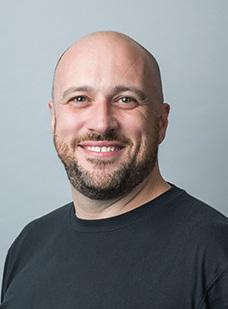
Dr. Adam V. Fontana is passionate about music education, the art of conducting, and the important role music plays in our society. He currently serves as Chair of the Department of Music, Director of Bands, and Associate Professor of Music at SUNY New Paltz where he conducts the Scratch Band, Symphonic Band, and Orchestra, and teaches courses in conducting.
As a conductor, Fontana frequently collaborates with living composers, having premiered and commissioned works by Stacey Barelos, Gala Flagello, Shuying Li, Narong Prangcharoen, David Stock, Jess Langston Turner, and Pulitzer Prize winner Zhou Long. Bands and orchestras under his leadership have performed at the College Band Directors National Association (CBDNA) Eastern Division Conference, the New York State School Music Association (NYSSMA) Winter Conference, and the Kansas Music Educators Association All-State Conference. He has recently appeared as a guest conductor with the Woodstock and Mid-Kansas Symphony Orchestras, wind ensembles at The Hartt School and the University of Nebraska-Omaha, and numerous high school honor bands and orchestras across seven states.
Fontana’s research focuses on conductor training and building community through interdisciplinary performance. He has presented at three CBDNA National Conventions, most recently discussing the benefits of Brazilian Jiu-Jitsu for conductors at the 2023 National Conference. He has also presented at the New York State Band Directors Association Symposium and at state music education conferences in Connecticut and Kansas. Fontana participated in the International Conductors Guild Frederick Fennell Memorial Masterclass at the Eastman School of Music and was selected as a Conducting Fellow at the inaugural Midwest International Band and Orchestra Clinic’s Reynolds Conducting Institute. As a clarinetist, he has performed with ensembles including the Juilliard Orchestra, UMKC Wind Symphony, Hartt Wind Ensemble, and the Mid-Kansas Symphony Orchestra.
Fontana holds a doctorate in conducting from the University of Missouri–Kansas City and degrees in music education and conducting from SUNY Potsdam, Columbia University–Teachers College, and the Hartt School. He studied conducting with Steven Davis, Glen Adsit, Dino Anagnost, and Timothy Topolewski, and clarinet with Alan Woy and Tom Scott. He has nine years of public school teaching experience in New York and Connecticut, spanning band, orchestra, choral, and general music.
In 2003, the Maine Music Educators Association celebrated the 50th anniversary of the Maine All-State Band. They commissioned Jack Stamp to compose a fanfare to honor the work of composer Martin Mailman, who was a professor of composition at the University of North Texas. The title of the work came from the nickname of an area in Maine where Stamp had wonderful musical experiences. With intricate rhythmic beats and energy, this piece was inspired by the opening of one of Dr. Mailman’s final compositions, Secular Litanies. Later that year, Stamp performed this piece at the Collegiate Band Directors’ National Association’s Eastern Conference with Dr. Mailman present.
Jack Stamp, an North American conductor and composer, has recently served as International Composer in Association to world-renowned Grimethorpe Colliery Brass Band. Stamp was a Professor of Music and Director of Band Studies, conducted the Wind Ensemble, and was the department chair at Indiana University of Pennsylvania for 25 years. Throughout Stamp’s lifetime of musical pursuits, he has composed approximately 60 compositions, commissioned, and performed by university bands and leading military all across the United States.
- Hikari Shiga, Collegiate Band II clarinet
Based on the film directed by Steven Spielberg, John Williams’ Lincoln highlights many of the themes from that stirring historical recreation. Some of the featured melodies are “The American Process,” “The People’s House,” and “With Malice Toward None.” With incredible range and depth of music as well as spirited parts of the piece, this piece is poignant and beautiful.
John Williams, who has just celebrated his 94th birthday, is one of the greatest American composers and conductors. He is best known for his scores in film history that impacted many over his seven decade career of composition. He has received numerous awards from 27 Grammy Awards, 5 Academy Awards, 4 Golden Globe Awards, and much more.
Jay Bocook, an professional and internationally recognized composer and arranger, is the Director of Athletic Bands at Furman University. His works have been performed in 1984 and 1996 Olympics games. He started his composing and arranging career after graduate school, have arranged for many Drum Corps International bands, and in 2009, he was inducted into DCI Hall of Fame.
- Hikari Shiga, Collegiate Band II clarinet
From Tropic to Tropic was dedicated to Hale A. Vandercook, who was a bandmaster for LaPearl’s shows from 1891 to 1897. Vandercook was a famous circus bandmaster, musician, and composer. The tropical reference in the title is exemplifying the temperature rise when the march is played at a circus tempo.
Russell Alexander was born in Nevada City, MO, in 1877 and was a euphonium player that began his career in circus bands. He later became the soloist in Barnum and Bailey’s Circus Band and was their primary composer and arranger for their European concert tour from 1897-1902. It was during this time that his work became world renown.
- Hikari Shiga, Collegiate Band II clarinet
Noctalgia was commissioned by the Warren Mott High School Band Alumni to commemorate the retirement of their band director, Mr. Erik Miller.
Astronomers have coined the term “noctalgia” or “night grief” to represent the feeling of loss as humanity slowly loses access to the night sky via light pollution. Through modern production of electricity that spills lights to every direction, the light illuminates the night sky, which relates to the loss of rich traditions in human cultural knowledge of constellations.
Andrew David Perkins, an American arranger, composer, and conductor, studied and earned his Master of Music degree from University of Michigan. He has served as a professor of Film Scoring at Madonna University and, currently, is the Director of Instrumental Music and Music Technology at Fenton High School as well as the Music Director and Conductor of the Fenton Community Orchestra.
- Hikari Shiga, Collegiate Band II clarinet
Seventh Night of July is a beautiful and joyful musical interpretation of a romantic legend in Japan, which focuses on a young man and a young woman, separated by the Milky Way and who can only see each other once each year on this very night. Tanabata is a Japanwide festival during which people write their wishes on colorful slips of paper and hang them on bamboo tree branches, praying for them to come true. According to the publisher, the alto saxophone and euphonium solos in the middle of the movement represent the two main themes of the legend.
Itaru Sakai composed Seventh Night of July while still a high school student. He studied composition and received an MA in musicology at the Conservatory of Osaka in 1996. Over the years, he has composed many works including for wind orchestra, chamber music, and solo pieces.
- Hikari Shiga, Collegiate Band II clarinet
Well known band composer Claude T. Smith was commissioned by Missouri’s Lambda chapter of Phi Beta Mu to compose his Concert Variations. The work was premiered in 1975 at the Missouri Music Educators’ State Convention. In his shortened life of just 55 years, Smith wrote over 110 compositions for wind band.
Prelude, Siciliano and Rondo was originally written for the brass bands for which England is well-known. It was titled Little Suite for Brass. John Paynter’s arrangement expands it to include woodwinds and additional percussion but faithfully retains the breezy effervescence of the original composition. All three movements are written in short, clear five-part song forms: The ABACA design will be instantly apparent to the listener while giving the imaginative melodies of Malcolm Arnold natural, almost folk-like setting.
The words to the spiritual, “Amazing Grace” were written by John Newton, a slave-ship captain who, after years of transporting slaves across the Atlantic Ocean to the New World, suddenly saw through divine grace the evilness of his acts. First published in 1779, “Amazing Grace” has grown to become one of the most beloved of all American spirituals. Today’s version was arranged by William Himes, former conductor of the Salvation Army Staff Band in Chicago.
Shostakovich’s Suite for Variety Orchestra (often mistakenly called Jazz Suite No. 2) is an eight-movement collection of light, satirical, and melodic music compiled around 1956–1959. Assembled from earlier film scores, theatre music, and ballets, it highlights his talent for popular idioms, featuring a large, eclectic orchestra including saxophones, accordion, guitars, and heavy percussion. The March is the first of eight movements in the suite.
Jacob de Haan’s Ross Roy is a vibrant concert piece commissioned by the St. Peters Wind Symphony in Brisbane, Australia. It uses the school’s historic 19th-century villa, “Ross Roy,” as a metaphor for formative school years, blending themes of discipline, nostalgia, and joy. The piece serves as a musical “overture” to life.
Fanfare, Hymn, and Finale is a concise, three-part work that exemplifies Peter Boyer’s direct, audience-focused style. Written to be immediately engaging and idiomatic for winds, the piece balances ceremonial brilliance with lyrical breadth and rhythmic drive. Each section of the piece is clearly defined, yet each flows into a cohesive, continuous arc.
The opening Fanfare establishes the character of the piece with bold brass statements and crisp rhythmic figures. Trumpets and horns dominate while percussion exemplifies the grandeur, giving the piece a confident and declarative quality.
The central Hymn establishes Boyer’s ability to create lyrical and emotionally accessible music, with a marked contrast in both tempo and color. This section emphasizes sustained phrasing, balance, and warmth of tone, while leaning toward consonant progressions with gentle suspensions. The hymn is a reflective pause between the brilliant phrasing of the outer sections.
The Finale energizes the work with a faster tempo and renewed rhythmic vitality. Motifs from the fanfare reappear, now being spread across all parts of the ensemble. Driving percussion creates a sense of accumulation and excitement. Brass once again becomes prominent, leading to a full, resonant climax. The piece concludes with emphatic cadences and a decisive final gesture, reinforcing its role as a triumphant start to our concert.
- Program Note by Matthew Lewis
Originally composed in 1910 as the tenth prelude from Préludes, Book I, The Engulfed Cathedral is one of Debussy’s most evocative writings. The piece is inspired by the Breton legend of the submerged cathedral of Ys, which is said to rise from the sea at dawn, its bells and chants heard faintly before it slowly sinks back beneath the water. Debussy translates this imagery into sound through texture, harmony, and gradual dynamic shaping.
The work begins in softness, built on widely spaced open fifths that suggest vastness and still water. As the cathedral “rises,” the texture thickens and dynamics expand, reinforced by low brass and sustained upper voices. Layered entrances build in careful stages, often moving from low voices upward, mirroring the visual ascent of towers from the sea. The central climax is marked by broad, organ-like sonorities, evoking the grandeur of a massive stone structure illuminated at full height. The Engulfed Cathedral offers a study in restraint, sonority, and imagery, an exploration of sound as architecture, and silence as depth.
- Matthew Lewis, Concert Band baritone saxophone
Alu Like March was composed in 1979 by Haunani Apoliona as a musical expression of cultural pride, unity, and forward movement during the Hawaiian Renaissance, a cultural movement focused on reclaiming Hawaiian language, history, and music. The Hawaiian phrase “alu like” translates roughly to “working together” or “moving forward together,” a concept that lies at the core of the march’s purpose and character.
Musically, the march features a clear, singable melody that remains at the forefront. Phrasing is balanced and symmetrical, reinforcing the sense of stability and unity. Moments of dynamic growth are carefully shaped, giving the impression of collective strength building as the march unfolds.
We are thrilled to be able to share this music with you today through the graciousness of The Royal Hawaiian Band. We send much love and aloha to Ms. Apoliona, Royal Hawaiian Bandmaster Clarke Bright, and arranger and saxophonist Todd Yukumoto for their assistance in obtaining this music.
- Matthew Lewis, Concert Band baritone saxophone
The Candide Suite is drawn from Bernstein’s 1956 operetta Candide, based on the satirical novella by Voltaire. Though the original stage production met with mixed success, its music quickly gained recognition for its brilliance, wit, and stylistic range. The suite distills some of the operetta’s most celebrated numbers into a concise concert work that showcases Bernstein’s theatrical energy and rhythmic vitality.
The Best of All Possible Worlds, opens with bright tempos, buoyant rhythms, and sparkling articulations to reflect exaggerated optimism. Syncopations and crisp brass interjections create an atmosphere of irony beneath the cheerful surface.
Westphalia Chorale and Battle Scene, begins with a stately chorale representing Candide’s sheltered homeland. Warm brass scoring and texture evoke stability and tradition. This calm is abruptly disrupted by the Battle Scene, where aggressive rhythms, accented brass figures, and driving percussion depict chaos and destruction. Sharp dynamic contrasts and tight rhythmic coordination intensify the dramatic shift from order to turmoil.
Auto-da-fé, portrays a public punishment staged as spectacle. Bernstein blends mock ceremony with dark humor through exaggerated rhythms and dance-like gestures. The music often alternates between pompous fanfares and sardonic melodic fragments.
Glitter and Be Gay, balances flamboyance with irony. Rapid woodwind passages and brilliant brass writing capture the dazzling surface character of the music. Beneath the sparkle lies emotional tension, reflected in sudden dynamic shifts and harmonic color changes.
Make our Garden Grow, concludes the suite with one of Bernstein’s most sincere and expansive melodies. Broad phrasing and gradual dynamic growth create a noble, affirming tone. Unlike the satire of earlier movements, this finale expresses genuine hope rooted in personal responsibility rather than naïve optimism.
Together, these movements form a compact dramatic arc. The suite showcases Bernstein’s fusion of Broadway energy, classical structure, and jazz-influenced rhythm.
- Matthew Lewis, Concert Band baritone saxophone
Magellan’s Voyage to the Unknown Continent is a dramatic and cinematic work that depicts the perilous journey of Portuguese explorer Ferdinand Magellan and his fleet as they ventured into uncharted waters in the early sixteenth century. Taruya’s compositional style blends strong melodic writing, vivid orchestration, and rhythmic drive to create a piece that is equal parts lyrical and exciting.
As the voyage begins, rhythmic energy increases. Driving ostinati in the low brass and percussion propel the music forward, while bold melodic statements in the upper winds evoke determination and ambition.
In the middle of the ocean, lyrical melodies and broad harmonic backdrops reflect the vast openness of the sea. These moments provide an emotional contrast before dramatic, violent storms attack the crew, depicted by rapid articulation, aggressive brass writing, and prominent percussion effects.
In the final section, themes from earlier in the piece return in a more triumphant form. Major tonalities and expanded orchestration suggest perseverance and discovery upon finding the unknown continent. The closing measures build to a decisive and celebratory climax with full ensemble support, showcasing Taruya’s strong writing style.
- Matthew Lewis, Concert Band baritone saxophone
22 | Wind Works IV | 7:00 PM | Long Center for the Performing Arts
Featuring the Wind Ensemble
22 | Jazz Swing Dance | 6:30 PM | Marriott Hall
27 | Orchestras | 7:30 PM | Long Center for the Performing Arts
Featuring Concert Orchestra and Philharmonic Orchestra
28 | Orchestras | 7:30 PM | Long Center for the Performing Arts
Featuring University Orchestra and Symphony Orchestra
2 | Jazz Bands | 7:30 PM | Loeb Playhouse
Featuring Purdue Jazz Band, AMRE, Concert Jazz II, and Jazz Lab II
3 | Jazz Bands | 7:30 PM | Loeb Playhouse
Featuring Tower of Power Band, Concert Jazz I, and Jazz Lab I
17 | Spring Showcase I | 7:30 PM | Elliott Hall of Music
Featuring Campus Band and Collegiate Band I
18 | Spring Showcase II | 2:30 PM | Elliott Hall of Music
Featuring Alumni Concert Band, University Band, and Collegiate Band II
18 | Spring Showcase III | 7:30 PM | Elliott Hall of Music
Featuring Varsity Band and Symphonic Band
19 | Spring Showcase IV | 2:00 PM | Elliott Hall of Music
Featuring McCutcheon HS Band, Purdue Concert Band, and Purdue Wind Ensemble
19 | Percussion Ensemble | 7:30 PM | Loeb Playhouse
21 | Chamber Recital I | 7:00 PM | St. John’s Episcopal Church
22 | Chamber Recital II | 7:00 PM | St. John’s Episcopal Church
23 | Chamber Recital III | 7:00 PM | St. John’s Episcopal Church
1 | Orchestras | 7:00 PM | Long Center for the Performing Arts
Featuring Concert Orchestra and Philharmonic Orchestra
2 | Orchestras | 7:00 PM | Long Center for the Performing Arts
Featuring University Orchestra and Symphony Orchestra
3 | Jazz on the Hill | 2:30 PM | Slayter Center of Performing Arts
Featuring all Purdue Jazz Ensembles

Scan the code or visit www.purdue.edu/bands/donate to support Purdue Bands & Orchestras today. Your generosity directly contributes to our students’ success through ensemble travel, scholarships, new instruments, and more! We would not be the program we are today without the ongoing support from alumni, family, and friends.








Scan the code or visit www.purdue.edu/bands/sponsorship to become a Purdue Bands & Orchestras corporate sponsor today! We offer a variety of sponsorship opportunities and enjoy creating ways to support your organization in return. When you become a corporate sponsor, you become part of the Bands & Orchestras family.