
Slice of


S WE ENTER OUR 5TH YEA r of bringing you the PULSE we reflect on the relationships that brought us to this point. A shout out to our GREAT Advertisers, Readers and Contributors. It is your loyalty, support and input that guides the entire PULSE TEAM
We have a new member to our awesome team of writers. Paul Sebastian. His article “THE SPIRITS ARE STILL WITH US” on pages 20 & 21.
Come join us at the VA Community Feast on March 11th, See Press Release on page 13 for more information.
We want to apologize to one of our advertisers, and the BEST Pizza in the High Desert, the CROSS EYED COW PIZZA, as we left their ad out of the last issue.
We encourage you to support our advertisers.












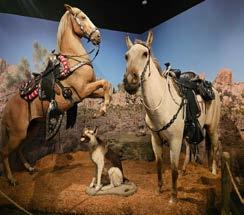
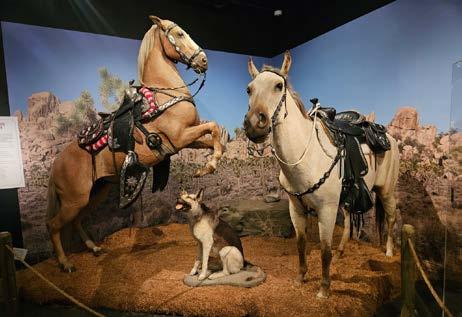
THREE OF ROY ROGERS ' and Dale Evans' sidekicks escaped once again from their home at the RFD Theatre in Branson, Missouri, and made a trip back to California to the delight of their loyal fans. Trigger, who started his museum period in 1967 at the Apple Valley Roy Rogers Museum on Highway 18, was joined by Buttermilk and Bullet at the Victorville Museum site in 1976, before all three relocated to the Midwest in 2003. And they certainly seem to be enjoying their retirement years. 2011 saw them riding down Pasadena Blvd. in the Rose Bowl Parade to celebrate Roy's Centennial. They are currently posing for
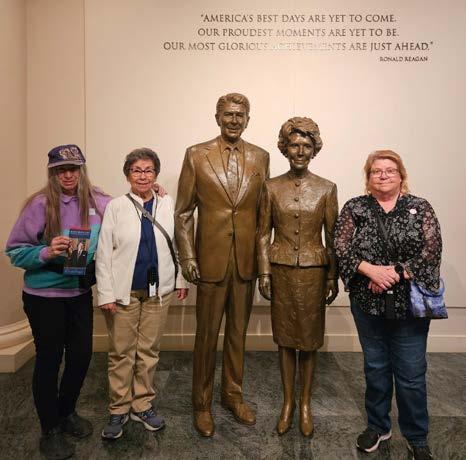
photos at the Ronald Reagan Presidential Library and Museum in Simi Valley, after completing a stint at the Gene Autry Museum in Griffith Park. I wonder if they ran into their old friend Champion there.
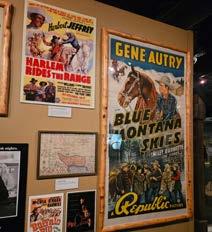
The entire "Cowboys: History and Hollywood" traveling exhibit, which was spread out over two levels, was educational and exciting. Who knew there could be so many different types of saddles and barbed wire? From riding the range, to competing in rodeos, to performing at Madison Square Gardens in New York, and the Buffalo Bill Wild West shows, to starring in singing cowboy movies, the cowboy's life was exciting, and a fascinating part of American history. It was a pleasant surprise to see Apple Valley represented by Herb Jeffries' two movies filmed in the Bell Mountain area: "Harlem Rides the Range" and "The Bronze Buckaroo." I was hoping to see Apple Valley's world famous trick riding cowgirl Jeanne Godshall and Oro Grande's trick riding cowboy Buck Abbott represented as well. Despite their omission, I truly enjoyed the exhibit of all things cowboy, as familiar tunes filled
VICTORVILLE ARTIST
VANESSA GOMEZ, also known as "Vee," has enhanced a number of High Desert cities with vibrant murals and art installations. I watched as she created the beautiful tribute mural to Colonel Felix Diaz in Old Town Victorville May of 2025. I was at the ribbon cutting at for the Grandstands mural opening day of the 2025 San Bernardino
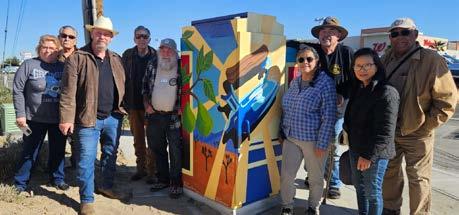
County Fair. Several Mohahve Historical Society fieldtrips took us to her Victorville and Apple Valley creations, and we plan to travel to her Hesperia masterpieces in April.
January was Adelanto utility box month, when we visited eight art installations stretching from Palmdale Road on the south to Chamberlain Way on the north, none too far from Highway 395. This is where History and Art collide, as Vee's creations tell the story of this interesting historic desert city. Here you can meet E. H. Richardson, inventor of the steam iron, and see colorful tributes to the pear and apple orchards, desert wildlife, and the iconic joshua tree. Youth sports are represented near an elementary school,
the air, including Roy singing "Tumbling Tumbleweeds," and Dale warning the girls "Don't Fall in Love with a Cowboy." (Too late, Dale. You already did!)
Yes, Ronald Reagan, like Roy Rogers, was really a cowboy. But the rest of his expansive museum was filled with permanent displays of other aspects of his life, and his political and Presidential career. A big attraction was the very first Air Force One, which visitors could tour. The building also included a nice restaurant and, of course, a gift shop. Our visit was (almost) worth the long drive and nervewracking traffic, and we did enjoy a nice picnic lunch on a warm beautiful California January day, before hitting the road back to Apple Valley. The cowboy exhibit will be there until March, so make plans to check it out.
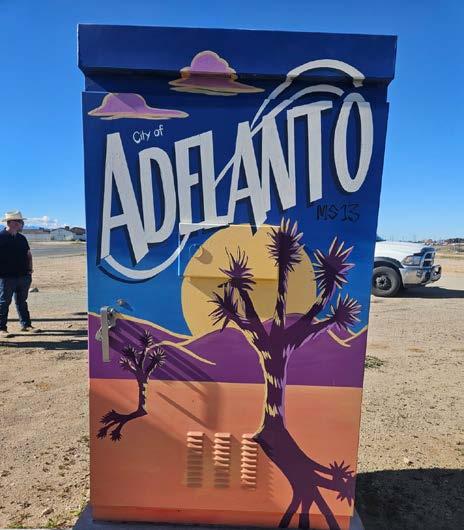
and neighborhood kids helped create handprint flowers at a local park. Probably the most meaningful creations are the one
honoring first responders, and another recognizing the military history of the city closest to George Air Force Base, originally Victorville Army Air Field.
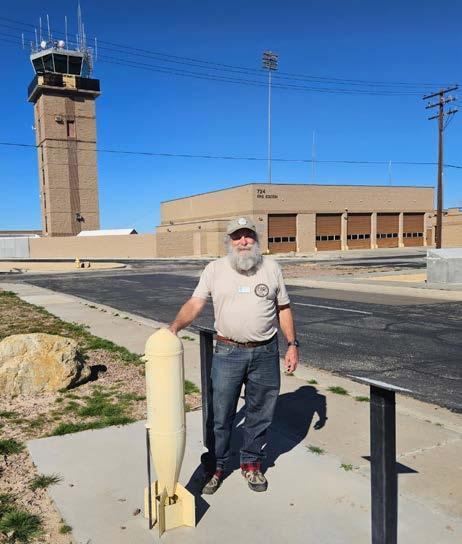
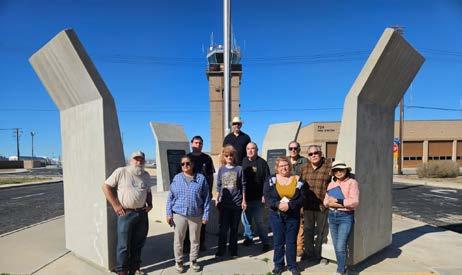
Part two of the fieldtrip took us to the closed base, now known as Southern California Logistics Airport. Here we learned the importance of the military installation where many High Desert residents once lived, worked, and attended school. A circle of monuments take the viewer through "The Early Years," "The Supersonic Years," and "The Final Years," with a fourth recognizing the many who contributed to the George Air Force Base Memorial Fund. Additional plaques in the area honor the Vietnam era Veterans who did not return home, and Brigadier General H. H. George, for whom the base is named. The early development of bombs during the World War II era is also represented, including a practice bomb of
the kind that can still be dug up in the open desert of Apple Valley and Lucerne Valley. What a great history lesson in just a few hours to learn more about one of our neighboring cities, and the importance of George Air Force Base to both the local economy and our nation's defense. It was time to head over to the Jet-Away Cafe for lunch, where we could browse the photos and displays in the lobby while waiting for our meals. The Base is closed, but its history lives on!
THERE WAS A PARTY going on Saturday, Feb. 7, at 14144 Greentree Blvd., the location of the brand new Victorville Library. Community members were all invited to come to the Grand Opening, and come they did! The line to enter stretched all the way down the sidewalk. People couldn't wait to get inside to enjoy the planned tours, activities, refreshments, and free give-aways.
The beautiful new facility, with its Jetsonish Space Age look, was full of surprises. Kids kicked back in circular reading nooks, and stared in wonder at the giant books with catchy Victorville related titles. My favorites were "Curious George Air Force Base," ""Little House on Route 66," "The
Very Thirsty Caterpillar," "The Coyote in the Hat," "The Velveteen Jackrabbit," and "The Giving Joshua Tree."
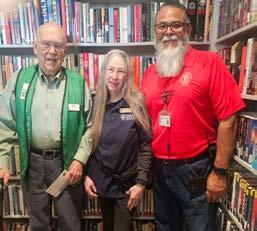
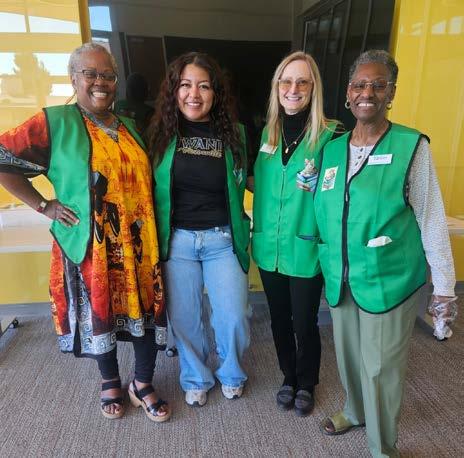
Although all staff members and volunteers were super busy catering to the many guests, members of the Friends of the Victorville Library took time out to pose for a photo, as did two important gentlemen,
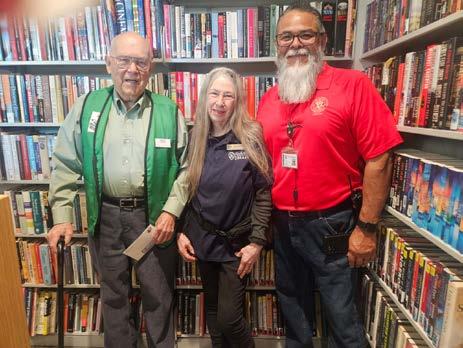

Head Librarian Arnold Castro and Friends President Bill Pyle. Our message from the Friends of the Apple Valley Library: "Congrats on your beautiful new building, and wishing you much success with future programs and activities you will provide to the fortunate members of the Victorville Community. With your enthusiasm and encouragement, many kids will become life-long readers and more successful adults." Keep up the good work.
CALIFORNIA RETIRED
TEACHERS ASSOCIATION, otherwise known as CalRTA Tumbleweed Division, is one organization that always recognizes Black History month. The High Desert has a diverse student population, so it doesn't hurt to be reminded that some students come from cultures and backgrounds unlike those of their teachers and other students.
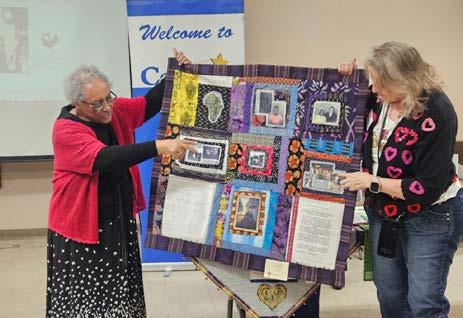
The speaker at the February 5 meeting was our own member Theresa Polly Shellcroft, for whom the word "retired" does not apply. She is not only still very involved with Victor Valley College, but never stops producing handmade quilts
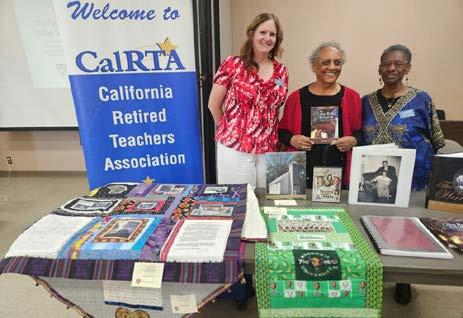
and other pieces of art that all have a story to tell. Theresa shared her family's story, pieced together over the years like her quilts, the inspiration for much of her artwork.
Her tale involves relatives born into slavery, some making the dangerous river crossing from Kentucky to Ohio, "The Promised Land." The Ohio River, also known as the River Jordan, is referenced in Negro spirituals. A grim chapter of the story involves the white slaveowner, Mr. Polly, giving the family their freedom upon his death. However, the documents were not recognized, resulting in seven young children, ranging in age from 2-15 years old, being sold into slavery again.
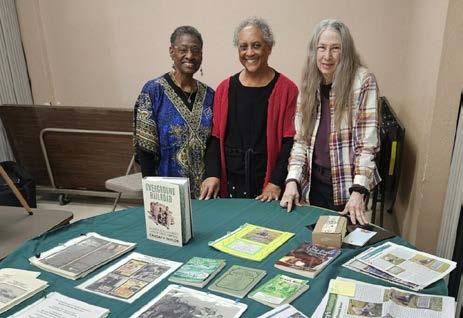
It was meaningful to those in attendance, to say the least, to have one of their own educated colleagues sharing her family's plight, rather than reading about some unknown people in a history book. Unfortunately, these shameful occurrences were not at all uncommon.
For the rest of the story, pick up a copy of "The Long Road to Freedom: The Story of the Enslaved Polly Children," written by James L. Hale, a relative, after extensive genealogical research. Thanks to Eloise Gibson, Programming Director, for arranging this important lesson, and to Theresa Polly Shellcroft for being willing to share.
HAPPY 100TH BIRTHDAY
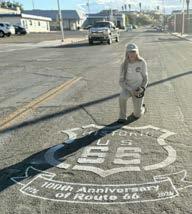
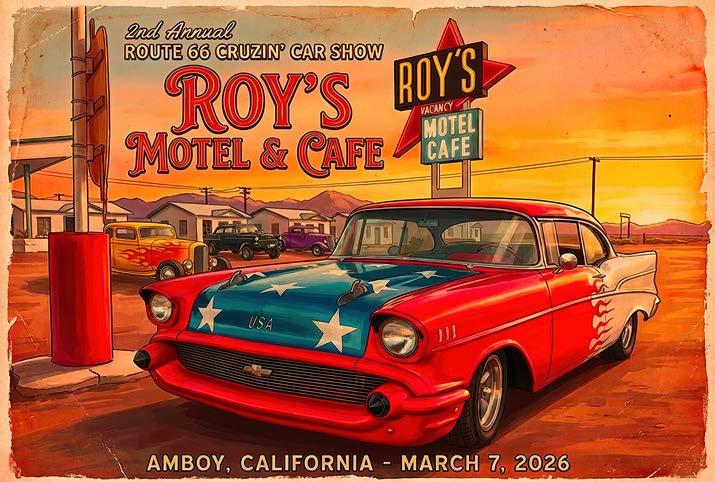
ROUTE 66 , AKA National Trails Highway. Travel and modes of transportation have certainly come a long way since 1926 when the road officially opened. Stretching from Chicago, Illinois, to Los Angeles, California, across eight states, the Mother Road has been by-passed by the interstate, in some cases covered over completely, but the nostalgia of driving the Route 66 has never been stamped out. Thanks to individuals and organizations determined to preserve the
history in their area, 2026 will be full of celebrations along the whole 2,448 miles.
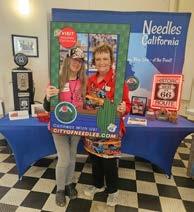
The Valentines Day event in Needles attracted locals, travelers, and history buffs to the El Garces Harvey House train station for a rollicking good time. On a beautiful warm February day, shiny antique and vintage vehicles lined Front and K Streets. The DJ pumped up the crowd with a nostalgic dose of rock and roll, as folks ooo-ed and awe-ed at what they were seeing. Snoopy's brother Spike welcomed visitors to the Needles Regional Museum, while the enthusiastic Needles Mayor invited folks to step inside the train station where the walls were lined with tables full of posters, postcards, maps, books, and Route 66 memorabilia.
Representatives from the City of Needles,
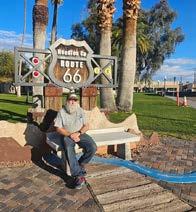
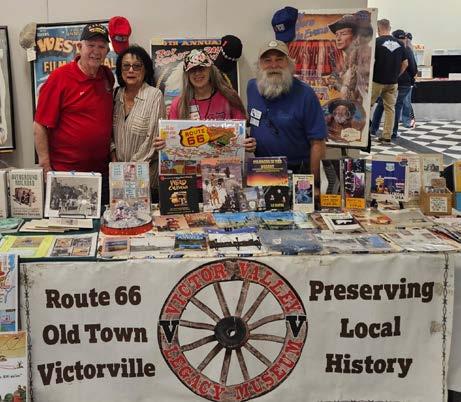
the California Route 66 Association, the Mohahve Historical Society, the Victor Valley Legacy Museum, the Bureau of Land Management, the Mojave Desert Heritage and Cultural Association, a local artist collective, the Newbery Springs Chamber of Commerce and Bagdad Cafe, the Oatman Historical Society, the Palo Verde College, the SB County Third District Supervisor's Office, as well as some independents were on hand to greet visitors, share history, and maybe sell a few keepsakes to remember the day. Meanwhile, guests could join a Harvey House tour, hear an informative presentation, or grab a bite to eat.
Every city should have a Mayor like Jan Jernigan, whose enthusiasm is contagious. Her brand of hospitality is over the top. Thank you, Jan and Needles, for once again inviting all of us to the "River City" for an outstanding and memorable event.





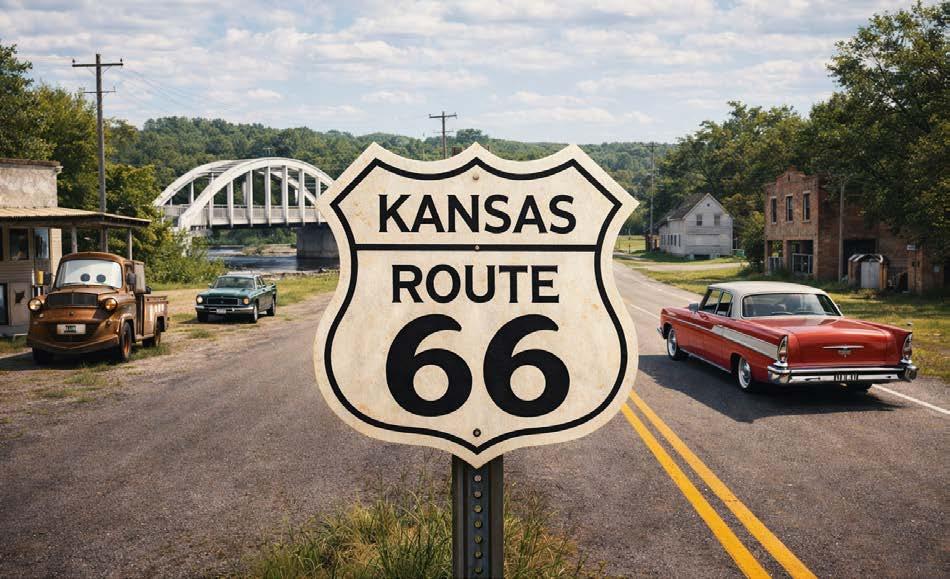
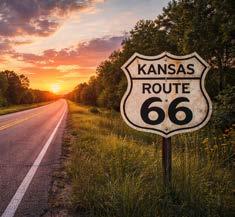
WHEN ROUTE 66 crosses from Missouri into Kansas, it does not announce itself loudly.
There are no towering skylines or dramatic desert landscapes. Instead, there are thirteen quiet miles that carry nearly a century of American movement, resilience, and memory.
Kansas holds the shortest stretch of Route 66 of any state. Just 13.2 miles separate Galena from Baxter Springs. Yet in those few miles lives a powerful reminder that the Mother Road was never about distance. It was about people.
Established in 1926, U.S. Route 66 connected Chicago to Santa Monica and became the backbone of American travel. It carried families west during the Dust Bowl. It carried soldiers home from war. It carried dreamers chasing opportunity and travelers chasing open skies.
By the time motorists reached Kansas, they had crossed the Mississippi River and officially left the Midwest behind. Kansas marked the beginning of the West. The land opened wider. The horizon stretched farther. The journey felt different.
Galena: A Town That Refused to Fade Galena was once a booming mining town built on lead and zinc. When Route 66 arrived, it brought steady traffic and
steady opportunity. Gas stations, diners, and motor courts lined Main Street.
When Interstate 44 eventually bypassed the town, the traffic slowed and the storefronts quieted. Many communities along Route 66 disappeared. Galena chose preservation instead.
Today, its Main Street still reflects the grit of mid century America. Brick buildings stand proudly. Vintage signs remain visible. The former Kan O Tex service station now known as Cars on the Route welcomes travelers with restored pumps and classic memorabilia. Parked outside is a weathered tow truck that locals say inspired a character in Pixar’s Cars, a reminder that even the smallest towns can shape culture far beyond their borders.
Galena is not polished for tourism. It is authentic. And that authenticity is what draws people back.
Just outside Riverton stands one of the most important structures on the Kansas stretch of Route 66. The Rainbow Bridge. Built in 1923, before Route 66 was formally designated, the concrete Marsh Arch bridge carried traffic over Brush Creek and later became part of the Mother Road. It remains one of the last surviving bridges of its kind along the entire Route 66 corridor.
Driving across it today feels intentional.
By Tiffanie Nicole – Pulse Media
The curve of the arch mirrors the curve of the road. Nearly a century of tires have crossed this same concrete. Families, migrants, truckers, tourists. The bridge stands as proof that infrastructure once built with craftsmanship can outlast generations.
Route 66’s final Kansas miles lead into Baxter Springs, a town whose story reaches back long before the highway existed.
This was frontier land. A Civil War battleground. A Native American trade route. When Route 66 arrived in the twentieth century, Baxter Springs became a service town for motorists pushing west
The restored Phillips 66 station still stands as a symbol of that era. Its classic red and white color scheme reflects a time when brand identity and roadside architecture shaped the American landscape. For travelers in the 1940s and 1950s, this station meant reliability. It meant the journey would continue.
Like many Route 66 towns, Baxter Springs faced economic decline when interstate highways redirected traffic. Yet community pride and preservation efforts kept its legacy alive.
Today, visitors do not rush through Kansas on Route 66. They slow down.
As Route 66 approaches its one hundredth anniversary in 2026, Kansas proves something essential.
The Mother Road was never about length. It was about connection. In thirteen miles, Kansas holds nearly every defining element of Route 66. Historic bridges. Mining town grit. Restored service stations. Preservation driven by local pride. Stories passed from one generation to the next.
Kansas reminds us that the spirit of Route 66 does not depend on scale. It depends on stewardship.
The stretch may be short.
The legacy is not.
Next in the Route 66 at 100 series, Oklahoma, where the highway stretches longer and the rhythm of the road grows stronger.













By J.P. Garner
"Consider it pure joy, my brothers and sisters, whenever you face trials of many kinds, because you know that the testing of your faith produces perseverance"
IT WAS A CRAZY IDEA AT FIRST , me writing a book about Barstow football. Heck, just the idea that I’d write a book in the first place was crazy. I had no idea what it would look like when I first approached Vince Williams, the Athletic Director at the high school, about the book. But—and this surprised me— he liked it even though I couldn’t describe what it would look like.
A coffee-table book I said, but only because that was the first thing that came to mind. I knew it wouldn’t be a novel or anything like that because I wanted a lot of pictures. Like a yearbook, but a yearbook with a story.
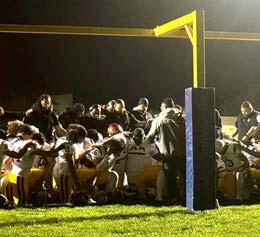
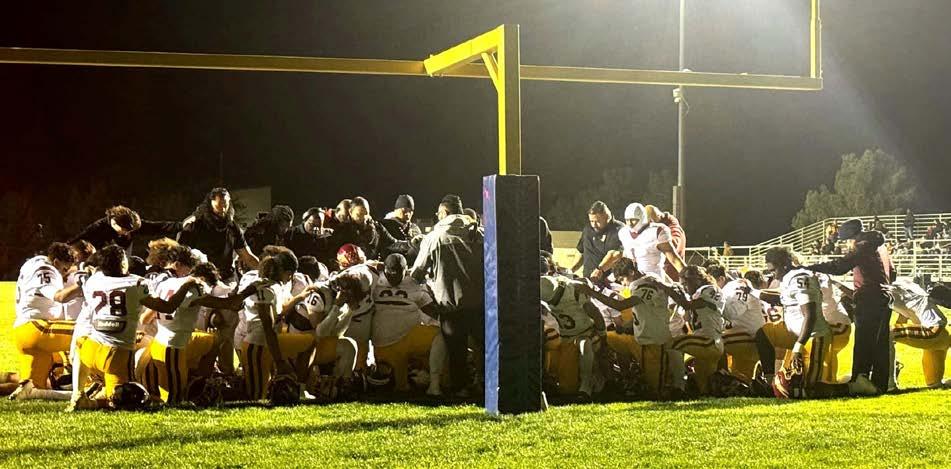
Little did any of us know that, eighteen weeks later, the story would be about a dream season . . . about how faith, family and football would make the small town that Hollywood loves to hate into a state champion.
Barstow is either an acquired taste or you were born here. It’s about to get bigger, but in the meantime it has more in common with Beirut than its neighbor Victorville. The city is worn out. The streets are cracked and dotted with boardedup buildings, and, if you wake early and get coffee at the Del Taco on Mountain View, you’ll see homeless asleep beneath blankets on the sidewalks. There’s this sense that the only things making the city relevant is the interstates, the second busiest McDonald’s in the world, and the
Outlet Center where tourist buses park at the front of the Coach store.
In truth, though, what insures we will remain a permanent fixture as the last big stop until you reach Vegas is the railroad and its grand plan to expand to 23,000 jobs. Because of the billions about to be invested in our city, we have been designated as BNSF’s HUB of the West.
That’s something… right?
The predictions are that, here soon, we’re going to grow-up and maybe get our own Target store. But none of that will likely stop Hollywood from disparaging us as a desolate and drug-riddled drive-thru town whose idea of fine dining and urban planning is having two Del Tacos on the same street.
(I hesitate to mention that Starbuck’s opened a second operation on Main Street, about a half-a-mile from the first. The one serves traffic going to Vegas, while the other serves the traffic coming back.)
The problem is that small towns can be cute, quaint, or even picture-perfect. Such towns are on postcards or the covers of travel magazines, but not Barstow. If it appears anywhere, it is generally because of Old Route 66, which pierces the center of our town and serves as its Main Street. And, then, there are the desert vistas surrounding us that are often the location for a TV commercial or a scene in a movie.
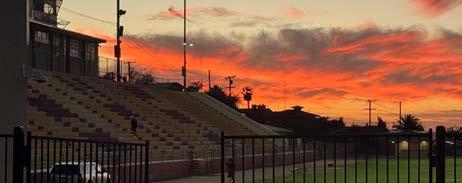
If there’s an exception to this general
perception of us, it is when clouds float through an evening sky and the sun is descending behind the San Gabriels some fifty miles away. On those occasions, the fading blue above us becomes a canvas on which sunsets are painted that rival any in the world.
Robin Hobb
But, the wonderful truth about most small towns is that it’s the people who make it good or bad. Only people give a town it’s heartbeat, from which a personality arises and is formed.
Barstow is full of good people.
They come in all sizes, shapes and colors. They can be found working the hourly jobs at the Del Tacos or the Starbucks, and Walmart, the only big-box store in the city. It is no different from supercenters elsewhere. It has the same look, the same feel, and the same things arrayed on their shelves and locked up behind glass every day.
It’s the people in the blue vests who are the exception.
Most are kind and thoughtful. They go out of their way to be helpful. Not because they must, but because it is, for the most part, who they are. Salt-of-the-earth types who like Jesus, the greeter most often seen at the entrance to our store’s Grocery side. He’s a proud grandfather who draws smiley faces on customer receipts and wishes everyone a blessed day.
And then there’s Irma who has worked at Walmart since the Ice Age, back when dino-saurs roamed the aisles at the smaller store and there was a McDonald’s at the entrance. She’s seen kids grow up and have kids of their own. She’s now most often seen at the Pharmacy side of the store, making people feel welcomed like family on their way in, and making them feel missed on their way out.
And, most often, that’s how it is in our town
The people in most cases are genuinely decent. They make our city special, from
the coaches in youth sports to the clerks and waiters who tend to customer needs.
Everyday people with everyday lives who assemble in one of our 50 churches on a Sunday morning or an evening Bible study on Wednesday. All are part of what became our Aztec family … the supporters of our team.
They added their hopes and dreams to ours and made us tougher to beat.
But of the comments made on Facebook after our win in the championship game, that which really warmed my heart was when I read the comment below from a Sutter High School fan about our team and possibly our fans as well.

Impressed … and congratulations?
I had to look twice to make sure I was reading a compliment. To see it on social media from the fan of an opponent is not only worth mentioning because praise is so rarely directed at us, but I’m hoping a little chest-pounding is allowed. After all, how often do we hear positive comments about our city from the outer world where the grass is always green, the sky blue, and scented flowers adorn the walkways of suburbia.
When travelers pause here briefly for gas, food, or lodging, the snapshot of us does not convey enough information, if any, to form a positive opinion. The visitors
are often in a hurry and, in most cases, could care less about us or our city, so they really have no interest in learning about the good people who actually live here.
So, when I was informed by Marseillus Chavez, the PIO at Barstow Unified, that the parking attendant at Buena Park High School was shocked by the number of people from Barstow that showed up for the championship game, I smiled because we are so often underestimated.
But Barstow is not your typical small town. It’s not connected to anything except two interstates and a railroad. It’s an island in a sea of sand, rather than an oasis, separated from its nearest neighbor by about 40 miles of bland and barren landscape that only an off-roader can love.
Main Street is also Route 66, which still draws a nostalgic and devoted following of tourists who favor the rock ‘n roll of Elvis Presley over the hip-hop of Snoop Dog.
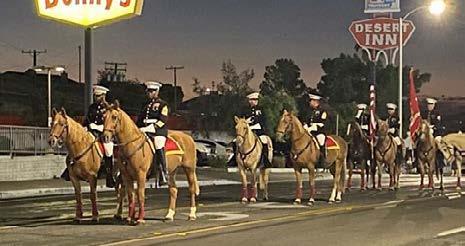
Every year there’s a classic car show in the Old Town section and a Mardi Gras parade whose principal attraction is the Marine’s Mounted Color Guard. They’re a very popular attraction at different venues like big-time rodeos and county fairs or holiday events through out the country like the Tournament of Roses Parade in Pasadena.
There are three times that Americans will for sure stand tall and swell with pride: the singing of the National Anthem at a Super Bowl, the beginning of an Army-Navy game, and when they see
Marines on parade in dress blues. Our little city out in the middle of nowhere is also home to the Del Taco franchise that operates throughout the western half of the 48. The operation got its start in Yermo, back in the 60’s, but the unique menu really took off once the founders moved it into Barstow where there are now 3 facilities whose original menu is still better than that of their 600 corporate counterparts.
Rough at the edges, but soft at its core, Barstow is also home to a shopping list of non-profits that shoulder the load of our poor and disadvantaged, but mostly the homeless. We get a lot of them because of the weather and the three major highways that converge here: the two interstates, the 15 and 40, and the state’s Highway 58.
Feeding them is the big thing. Several groups do that, and at different times. Some deliver the meals to where the homeless live in the streets. The volunteers who perform these missions of mercy rarely, if ever, seek or want attention drawn to them.
Doing God’s work, as one volunteer put it, is enough.
By Cindy Bostick
on February 19, 2026, the spirit of service and community was on full display as Southwest Gas selected Today’s Woman Foundation (TWF) as the nonprofit partner for a recent team building event. Through its Fuel for Life and BLUE (Building Lives Up Everywhere) initiatives, Southwest Gas employees rolled up their sleeves in support of TWF’s hallmark Bundles of Hope project — creating beautiful, handcrafted bracelets for women undergoing cancer treatment.
The Bundles of Hope project is designed to uplift and encourage women facing one of life’s most challenging experiences. Each bracelet serves as a tangible reminder that they are not alone — that their community stands beside them with compassion, strength, and hope.
Southwest Gas chose to partner with TWF for this meaningful team building experience, transforming a corporate
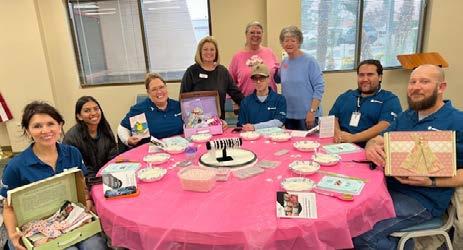
gathering into an opportunity for impact. Team members gathered around tables filled with beads, string, and inspiration, carefully crafting bracelets that will be included in Bundles of Hope distributed to women in treatment.
Special appreciation goes to Chris Blunk, bracelet-making guide and volunteer leader, who generously shared her time, materials, and expertise to lead the hands-on workshop. Her creativity and guidance ensured that each bracelet was not only beautiful, but made with intention and care.
Southwest Gas participants seated are Selva Montoya, Mumuksha Singla, Stephanie Soto, Andrew Webster, Sergio Flores de Real, and Andy Dakin Their enthusiasm and dedication reflected the company’s deep commitment to community engagement. TWF hosts standing are Millie Howard, Chris Blunk, and Diana Van Riel
Special appreciation is extended to Selva Montoya of Southwest Gas Public Affairs for coordinating this effort and cultivating this partnership.
“Partnerships like this demonstrate the power of collaboration,” said TWF Executive Director, Cindy Bostick. “When businesses and nonprofits come together with purpose, lives are touched in special ways.”
For more information about Today’s Woman Foundation and the Bundles of Hope project, please visit todayswomanfoundation.org.
By Jaylyn And John Earl www.thedesertway.com
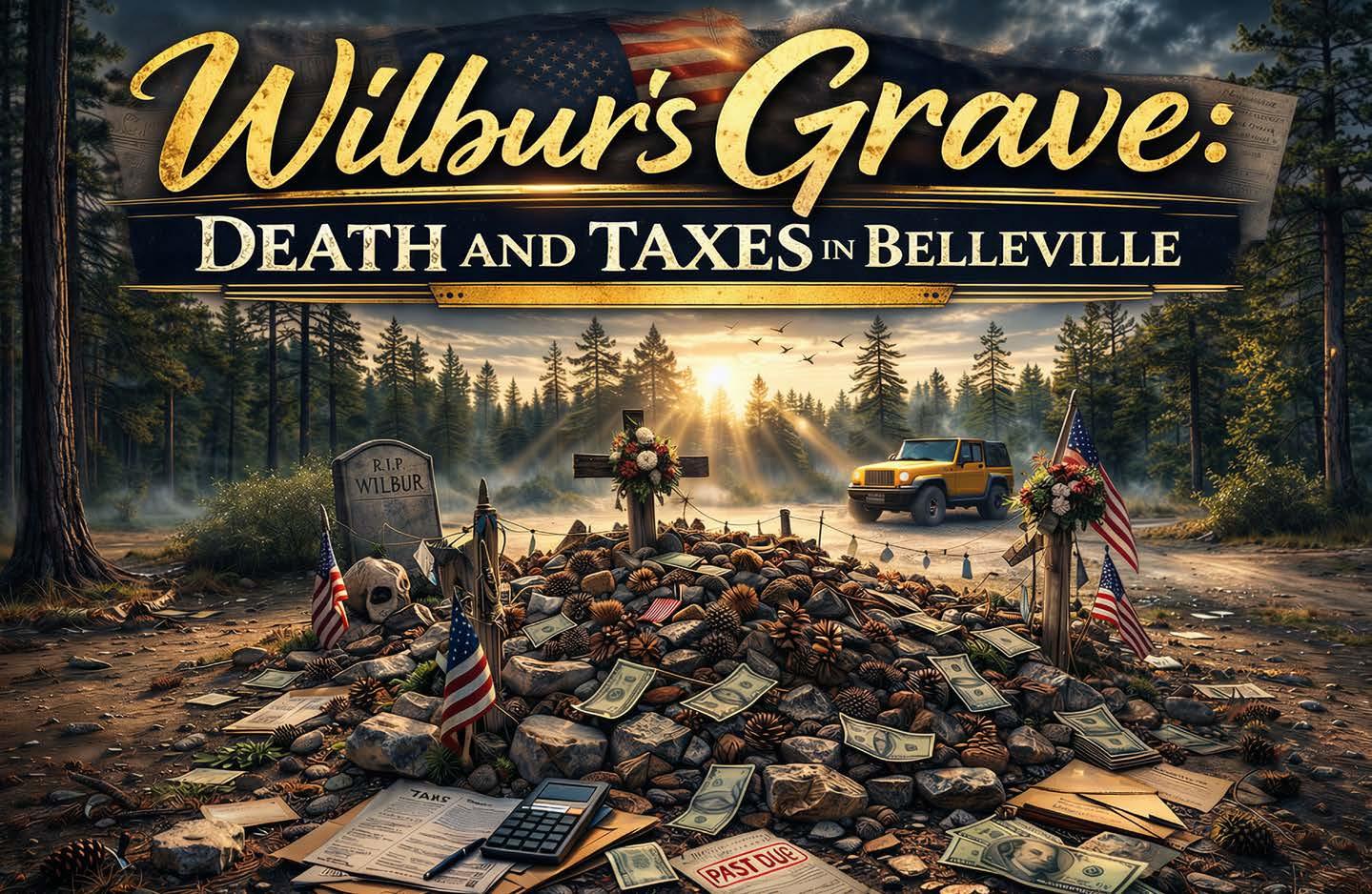
JUST NORTH OF BIG BEAR LAKE lies a fascinating historical area called Holcomb Valley. It was here, in 1859, that Bill Holcomb discovered what was to become the richest gold field in southern California. There you will find many interesting glimpses of history, including Wilbur’s Grave.
Charles Wilbur was the first tax assessor in San Bernardino County. He was also a gold placer miner who lived in the area around the mid to late 1800s.
He was well liked among his fellow miners who lived in the area and they voted for him to organize the miners in establishing boundary rock so they could
more accurately establish their claims.
Before he died he asked to be buried by his favorite pond, Wilbur’s Pond, and they did as he asked. The pond is directly across the dirt road from his grave.
News of Holcomb’s find spread quickly. By June over 300 men were at work in Holcomb’s Valley. By July, that number was up to about 500, and by September, there were over 1,000 men feverishly working gold claims hoping to strike it rich.
Within two months of Holcomb’s discovery, a town called Belleville sprang into existence at the entrance into Holcomb
Valley, near the upper part of Van Dusen Canyon. It had a collection of stores, saloons, dance halls, and blacksmith shops.
About that same time, two other towns also appeared in Holcomb Valley. There was Clapboard Town, located about a mile west of Belleville, near Polique Canyon. About two miles northeast was Uniontown, which later became known as Union Flat.
Holcomb Valley even had a brewery. The population of Holcomb Valley grew so fast that it was reported in the Star on September 1, 1860 that it looked like Holcomb Valley would decide election matters in San Bernardino County that year. Belleville residents felt strongly that the location should be right there, in Holcomb Valley.
When the ballots were rounded up after the election, the returns from one entire Belleville precinct were missing. As it turned out, the city San Bernardino was picked as the new county seat by only two votes. Go figure.
Life in the mining boomtown of Belleville was no joke. Harsh weather, hard manual labor, accidents, and fights over claims combined to make life fast, tough, and short for Belleville’s population.
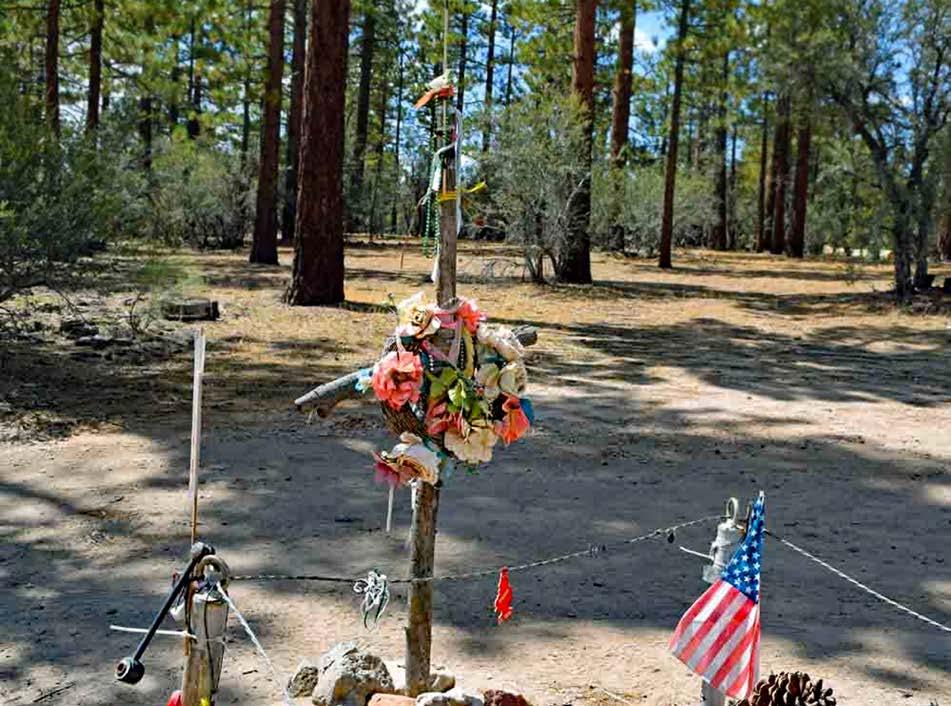
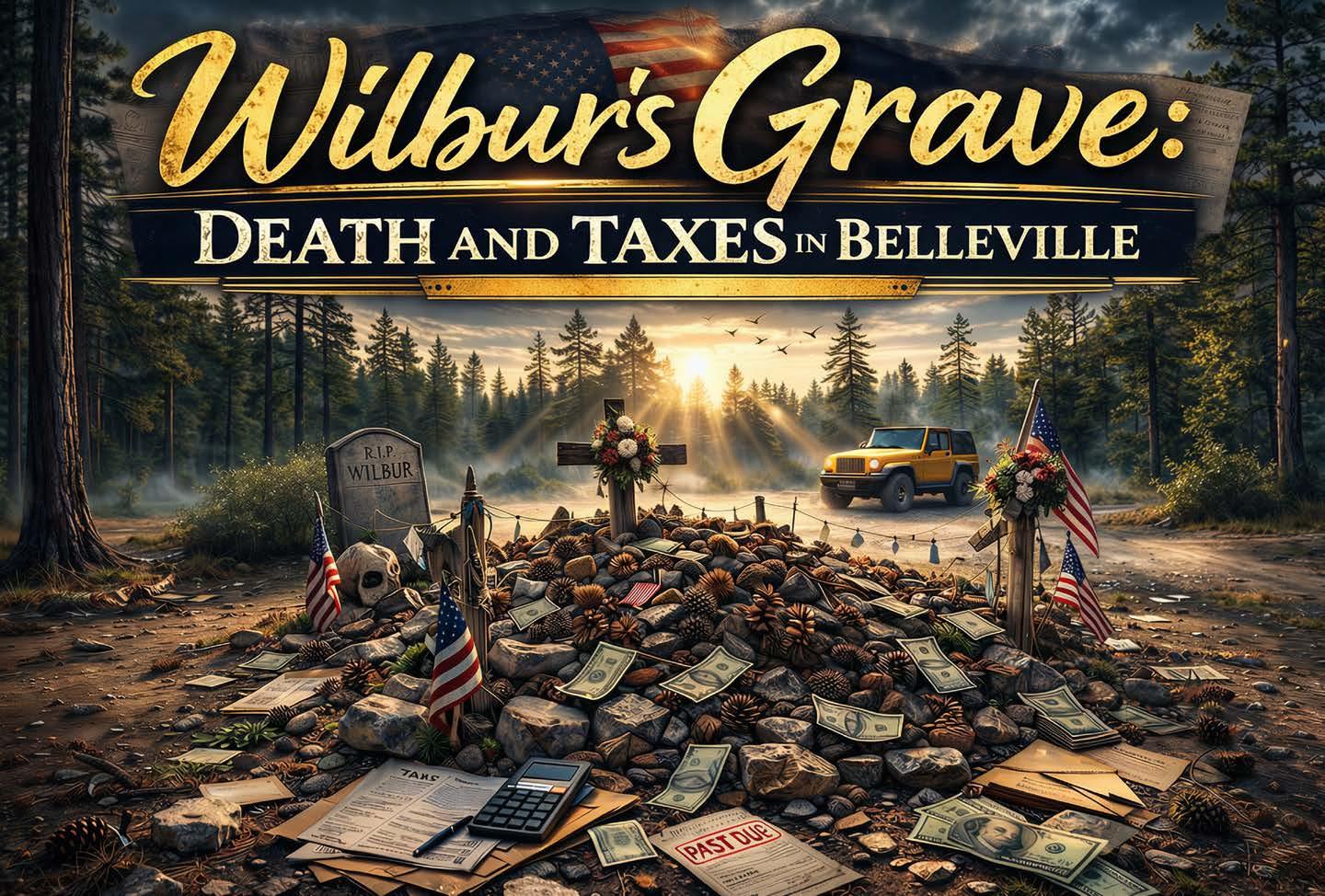
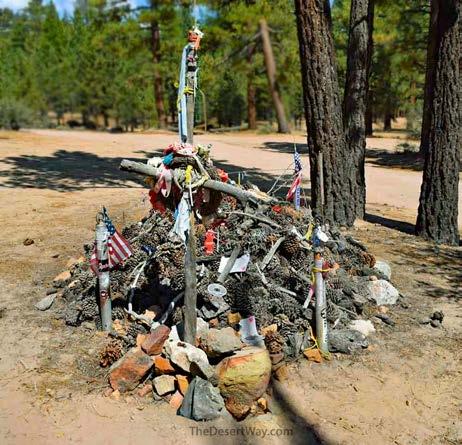
Wilbur’s grave is unique among the burial sites around Belleville, once slated to be the county seat: it’s marked by a mound of pine cones literally smack dab in the middle of the road.
The grave has become a local landmark to off-road adventurers, hikers, mountain bikers, trail runners and geocachers alike.
Wilbur’s Grave wasn’t always in the middle of the road. But people being what they are over the years have driven on both sides of the grave making the current road. Years ago the grave was off to the side and somewhat protected.
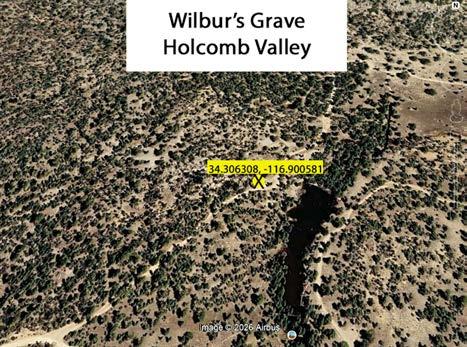
One mile west of the Big Bear Ranger Station is the Lighthouse Trailer Resort. Across the highway, Forest Road 2N09 heads north towards Holcomb Valley. At the junction of 3N16 you will be in the area of shallow placer workings and on a narrow dirt road to the left you can visit Wilbur’s Grave.
Wilbur’s Pond was lowered some time ago so it wouldn’t flood the road, and the road was raised. That spot used to catch people quite often trying to drive past. No one knows exactly how long that pond has been used. There is a small stone dam in the area.
Wilbur’s pond may contain water, depending on the time of the year. We went there during the Springtime and it was bubbling with tiny tadpoles. Be aware though, the shoreline is muddy hence slippery. Don’t ask me how I know.
There were about five miners who had a placer operation north of Wilbur‘s Pond. They had a shop loaded with tools and equipment on the site which lasted until the late 1960s.
North of Wilbur’s Pond there were two women that had a cabin with a mine tunnel behind it. They always were together, and
picked up their mail at the Big Bear City Post Office and bought groceries at Frank Jakobie’s Community Market. The original community market is now located at the Big Bear Museum.
About 1935, George Knudsen had the biggest mining operation in the valley. He used a bulldozer to push the surface gravel of Osborne Flat into a home built centrifugal machine that used an auto engine for power.
With the exception of Clapboard Town, the largest community in Holcomb was at Saragossa Springs where several old buildings made homes for a few families. These houses were all equipped with running water. They were the only ones in Holcomb Valley to have this luxury except the Hitchcock Ranch.
Surprisingly, in all of Holcomb Valley’s history, it never had an official Post Office. The Great Depression of the early 1930s found quite a few people back in Holcomb trying to make a living from working over ground.
One or two did better than just keep beans and coffee on the table, but for most of those people it was a meager existence at best.
Gold had been raised from $18 to $35 an ounce. If you had enough water, if you could find gravel running $4 a yard and if your back held out, you might make $3 to $4 dollars in a long hard day panning gold.
About a half mile down the road, you will come to the Hangman’s Tree. The verdicts rendered at the saloon were grimly fulfilled at this site. Like all mining camps, Holcomb Valley had its share of outlaws, claimjumpers and trouble makers.
In 1861 & 1862, Holcomb Valley recorded 40 to 50 murders and as many as four hangings at once on this tree. You
can count the number of hangings from this tree because after the outlaw was cut down, the branch from which the rope hung was chopped off.
Want to learn more? There are two museums in Big Bear. One is the Big Bear Discovery Center located at 40971 North Shore Drive, off Highway 18, in Fawnskin. They are open M,Th, Fri 9 a.m.-4:00 p.m, Sat, Sun 8:30 a.m. – 4:30 p.m. Closed Tuesdays & Wednesdays.
The Big Bear Discovery Center is comanaged by the non-profit Southern California Mountains Foundation and the U.S. Forest Service. Entrance is free and the facility is pet friendly.
Big Bear Historical Museum is located east of the airport at 800 Greenway Drive in Big Bear City, accessible via Highway 18, or Big Bear Boulevard. The museum is open Wednesdays, Saturdays and Sundays from 10 a.m.-4 p.m., May thru October.
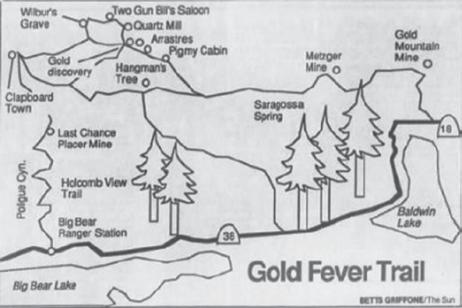
From Highway 18 in Fawnskin, take Polique Canyon Road to the main dirt road (3N16) and go east to Wilbur‘s Pond. There are other ways to get there, so check a map first to choose one. We have seen high clearance two-wheel vehicles using this road but we’ve also seen some in quite a jam. If you want to see other sights in the area such as the Holcomb Pinnacles to watch climbers, or take the scenic loop on the flyer offered by the museum, we recommend a 4X4 vehicle as some roads are more rugged than others.
Lat: 34.3058° (34° 18′ 20″)
Lon: -116.9003° (-116° 54′ 1″)
The Grizzly, “Bearly Remembered”, Sept. 11, 2002
http://www.bigbear.us/holcomb-valley-atbig-bear-lake/
http://www.bigbearhistory.org/mining.htm
http://www.mountainsfoundation.org/ programs/discovery-center
By John Wease
HEARD that this year is the centenial of the highway commonly known as Route 66. The iconic road is arguably the most famous highway in the world. The highly romanticized 2448 mile strip of asphalt has an almost cultlike following of “roadies” including many who travel from all over the world to “get their kicks” traveling the Mother Road. Celebrations are planned in all of the eight states it passed through, including “The Big Birthday Bash” sponsored by the Chamber of Commerce right here in Newberry Springs on May2, 2026.
Technically, the actual anniversary is November 11. In 1926, the federal government established the United States Numbered Highway System. The goal was to make some sense of the roads used by the growing number of motorists. In 1910, there were less than 500,000 cars registered nationally. By 1920, the number had grown to ten million. Prior to the numbered highways, privately run “trails associations” promoted routes. Funded by donations from cities and businesses, these routes often followed the routes that passed the largest donors rather than the shortest distance.
In 1912, the National Old Trails Road was established between Baltimore to Los Angeles. The later U.S. 66 incorporated most of the western portion of this “Coast to Coast Highway.” In 1913, the first highway designed for autos, and the first memorial to Abraham Lincoln, was established as the Lincoln Highway between New York City and San Francisco. In 1914, the Arrowhead Trail association was formed to promote the first all-weather connector between these two transcontinental highways.
The Arrowhead Highway was about 850 miles long and followed in part the Old Mormon Road between Salt Lake City and Goffs, California. Built between 1915 and 1916, it became U.S. Highway 91 in 1926
and was rerouted to incorporate part of the Old Spanish Trail and connected with U.S. 66 in Barstow. The road was not paved until much later. It is said it was possible to average eighteen miles in an hour driving through Utah.
If you were traveling to Salt Lake City in 1930, and you had a nice, new Model A, you might make it to Barstow in a day, if you got an early start. When you reached 1st Ave, you would turn north on U.S. 91. You would have been fortunate to find the new wood and steel bridge over the Santa Fe freight yard had just opened. Previously, cars waited a long time to drive through the freight yard or dangerously dodged trains.
If you wanted to spend the night, motor courts were available after crossing the Mojave River. The early motor courts were small individual cabins rather than the motels we are accustomed to now. Highway 91connected with the road we know as “Old Highway 58” and continued through Yermo. If your funds were limited, you could camp at the Auto Camp. The giant water tank still bears the Auto Camp sign. Camping was not that unusual when crossing the desert as lodging was not readily available. Driving down Yermo Road, it is easy to spot many buildings, now residences or ruins, that once were cafes or gas stations to serve the motorists passing through.
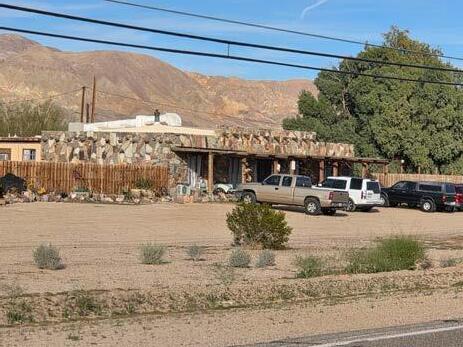
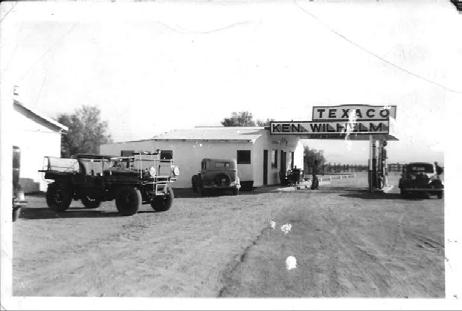
About eighteen miles from Yermo, you would have reached Manix Station. Owned by Ken and Mabel Wilhelm, it was an early-day travel center with a gas station, garage and café. It would have been a good place to fill up the gas tank, check the tires, and eat before heading on out into the desert to Baker. There was no air conditioning or electricity unless they ran their small generator. The road was later oiled and eventually paved. Manix was a
small community at a Union Pacific siding. It was where the Yermo Road pavement ends now. Nothing remains except a few foundations. The Texaco green foundations are those of Manix Station. Manix is gone and forgotten, much like U.S. 91.
Continuing north, you would have passed through the small farming community of Las Vegas. In 1931, construction of Boulder Dam, later renamed Hoover Dam, began. Thousands of construction workers were hired. Thousands of men with money to spend for entertainment. Casinos, brothels, and theaters of the dancing girls rather than Shakespeare variety sprouted in the fertile valley. When the dam was completed, there was enough electricity to light up the Las Vegas we know today.
The numbered highways, much like the old trails, were routed from town to town to boost the economy and help motorists in their travels. Even numbers ran east to west, odd numbers ran north to south. In the days before Rand McNalley or GPS, the motorist would at least know the general direction he was traveling. Traveling from town to town, necessary facilities could be found. The numbered highways were never direct travel routes. During World War II, the inefficient highway system resulted in using railroads for transporting men and supplies. President Eisenhower signed the FederalAid Highway Act in 1956 to connect major cities with high-speed interstate highways. The initial 41,000 miles planned grew over the years and continue to expand. The numbered highways were bypassed or incorporated into new interstates and finally decommissioned. Most of the old, numbered highways are, like U.S. 91, gone and forgotten. Remember on November 11 to wish a happy birthday to the 157,924 miles of American roads that once were part of the numbered highway system.
Monday March 9- 6:00 PM- NAACP Branch 1082 General membership meeting- Victorville Office- all are welcome
Tuesday March 10- 11:15 Friends of the Apple Valley LibraryDennis Hom "Growing Up in Old Town Victorville" Nonmembers welcome
Friday March 20- 10:00 Mohahve Historical Society Fieldtrip to Lucerne Valley Sites: Chimney Rock, Western Town, Outdoor Museum- Meet at Chimney Rock monuments Highway 18 and Rabbit Springs Rd.
Thursday March 26- Doors open 6:30 for 7:00 meetingMohahve Historical Society- Lone Wolf Colony - Chelsea LaGrange "Lucerne Valley Historical Sites"
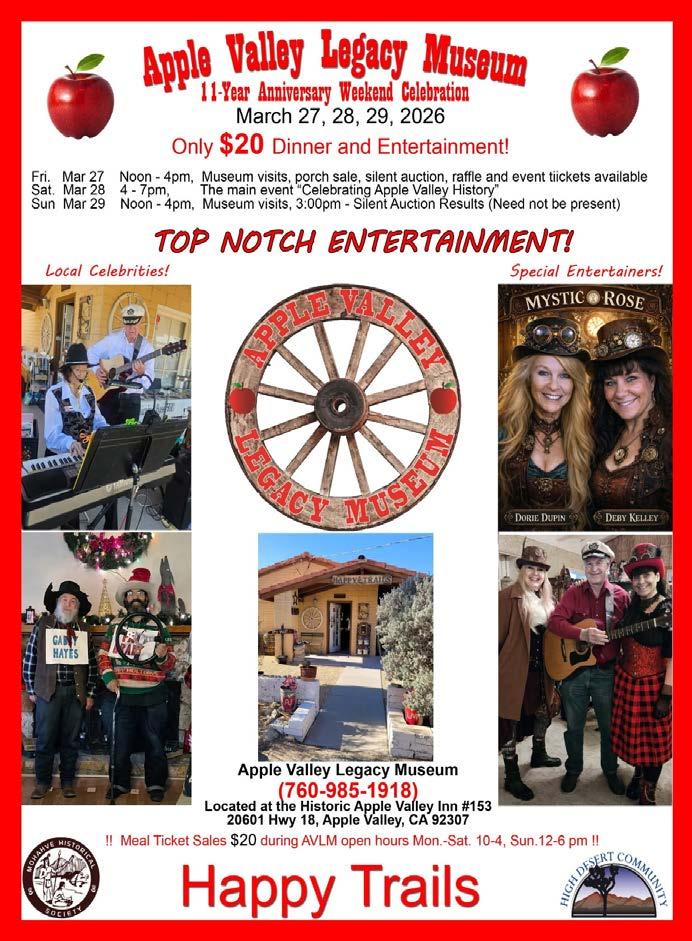
Friday March 27-Sunday March 29 -Apple Valley Legacy Museum 11th Anniversary weekend. 20601 Highway 18 Cottage 153 -Silent auction, museum displays, raffle of historic items, Sat. event
Saturday March 28- 4-7:00 "Celebrating Apple Valley History" Dinner and entertainment. (See flyer in this issue)

Friends of the Apple Valley Library
14901 Dale Evans Parkway - Apple Valley, CA 92307
Tuesday, March 10, 2026 - 11:15 AM
Speaker: Dennis Hom - " Growing Up In Victorville"

Come and meet new friends and enjoy a day at the Apple Valley Library. We are accepting donations of gently used books, CD's and DVD's.

SWIM Speakers March
March 5 911 Survivor
Michael Hingson
March 12 Women In War
Jack Barry
March 19 Traffic Safety
Corporal Dustin Whitson
March 26 Preservation of Land/Transition Habitat
Wendy Walker
Seniors With Inquiring Minds (SWIM) meets every Thursday from 1:00 – 3:30 pm in the Percy Bakker Center located at 9333 E Avenue in Hesperia, CA 92345



STORYTELLING, particularly ghost stories, was always one of the best things to look forward to when visiting my older relatives. These family storytellers magically transported you with images of missing heads, spirits of dread, and mystical creatures that ate little children. Their incantations of storytelling shredded the physical world and opened a trap door for us to fall into the waiting arms of wraiths, goblins, and evil beings bent on ripping flesh. We always fell into bed too terrified to sleep after hearing these tales but always returned to the midnight call of these lurid stories. The stories were enjoyed even more if the storyteller embellished the tale enough so that it excited our imagination and removed us further from the real world.
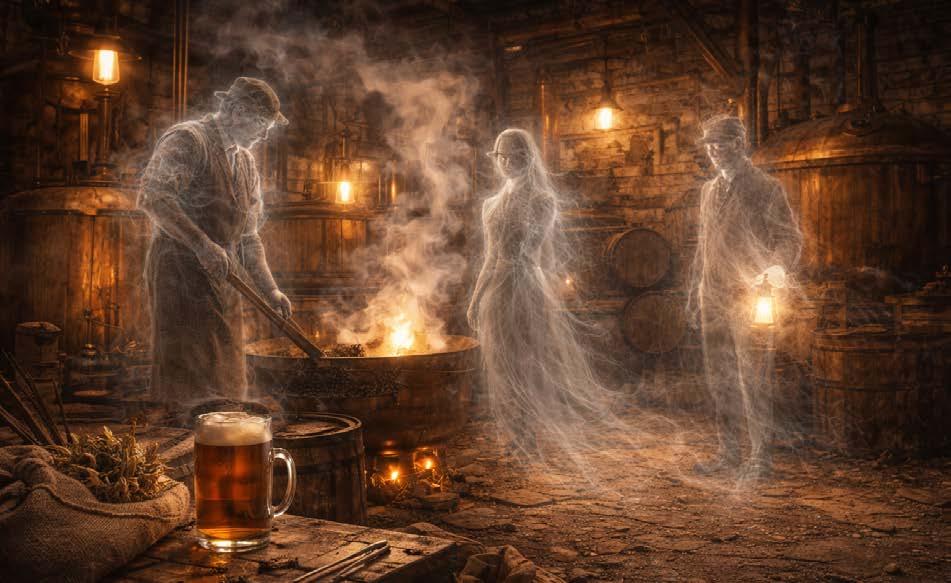
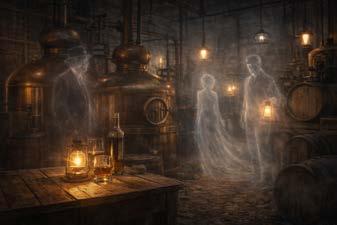
Likewise, whiskey distilleries are home to a restless spirit or an apparition that appears unexpectedly inside the distillery either to warn, wander, or resume the occupation they had at the time of their demise. Odd noises, muffled voices, screams, unseen touches or other such phenomena occur at these haunted sites and investigators have probed their dark warehouses and still houses looking for paranormal activity. When these lingering specters have appeared, they leave terror in their wake. I invite you now, at your own peril, to read these stories alone, in a dimly lit room close to midnight with nothing but
your own thoughts and see if there aren’t a few unnatural noises or mists. You may not want to look behind you for who knows what apparition you have awoken.
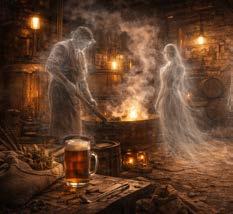
Buffalo Trace distillery in Kentucky is one of the largest and most respected distilleries in the country today. It has been operating on same site but under different names for about 200 years and is well known for its high quality of craftsmanship. This is because it has been led by many master distillers of note including one of distinction by the name of Albert Blanton. He was born in 1881 and at 16 began working in the distillery that he would later come to lead from 1921 until 1952 when he retired. He was an accomplished distiller and was known to always walk the floors of the distillery examining every detail and process of production. After his death in 1959, more than one sighting of a workman in stillhouse clothes bearing a resemblance to Blanton has been seen walking among the stills or inspecting the barrels. When anyone approaches the figure, they are overcome with fear when the phantom walks into the still or into the barrels and disappears. One tour guide, who was new to the distillery, felt his blood chill when he saw the figure do just that. As he walked back to the museum his heart nearly stopped when he saw the picture of Albert Blanton hanging there and recognized the ghost. The colonel’s former office has been the scene of
By Paul Sebastian
ghostly conferences discussing distillery business. Mysteriously, lights go on with no explanation in the gift shop. Workers wandering alone at night hear murmuring voices that come from areas where there are no people. So, if you’re visiting Buffalo Trace and you see a figure who is intent upon his work, I dare you to ask the colonel if he is just keeping tabs on his distillery and ensuring that good whiskey is still being produced.
In Cincinnati, Ohio there is more disturbing and frightening activity emanating from the nether world. The ground where the distillery is located is ominously close to a Native American burial site. The home was built in 1814, and it became the site of a doctor’s office and his wife’s general store. Sometime later, the stable where his carriage and horses were kept was the scene a stable boy’s accidental death from a horse’s kick. In 2018 the house was sold by the family to the current owners who started the distillery as well as a restaurant and bar. Distillery workers avoid being there alone late at night because of the bloodcurdling screams from a woman in agony. Several attempts to trace her whereabouts have led to empty rooms. Her tormented soul cries out frequently and has been heard by witnesses but to date, she has only made one appearance. She revealed herself to a restaurant worker who was locking up. She motioned to him to join her and without hesitation, he ran terrified and quit the next day. Restaurant managers say that oftentimes their glasses and silverware are moved around after they have departed for the night. All efforts to seek evidence of a burglary have turned empty. A small boy dressed as a stable boy suddenly appears out of nowhere and scurries behind the bar. Eyewitnesses claim he is around the age of 13. Voices are heard in rooms where there is only one access and when employees arrive to investigate, there are no people. These chilling incidents have deterred some patrons but have attracted those interested in ghostly activity. Whether it’s the influence of the burial ground or the restless souls of patients in anguish that keep these spirits earthbound no one can say, but I suspect that this site may have
a type of graveyard quicksand that has trapped so many different spirits. I must now impart one of my favorite distillery ghost stories because not only does it have a frightening character like the American ghost classic, The Legend of Sleepy Hollow, but it changed the etiquette when serving whisky to guests on the Scottish island of Islay. The Headless Horseman of Bowmore takes place on Islay on a night that seemed rife with evil spirits lurking in every shadow. A tenant farmer was returning home from his daily burdens and as he neared his cottage his footsteps became heavier with each step. The night seemed to close over him like a shroud and his legs seemed to be weighed down with the weight of fear and foreboding. The dread he felt increased the closer to home he got and it seemed as if he were walking towards the gallows and his doom. Even the very air hung with menace and his breath became short and his heart pounded so hard he could feel the impact of his heart against his chest. When he saw his home, he wrenched in terror at a hellish sight. His heart nearly stopped and his blood was as ice by the sight of a horrifying demon from some recess of Satan’s maw. A horseman with no head sitting astride a large black horse. His headless body was immense, and his muscular arms were sheathed in black gauntlets with wicked spikes. His chain mail and tunic were the color of impenetrable ebony, and his diabolic bearing seemed to pierce the farmer’s soul with sinister waves of fiendish intent that went deep into his soul. An eerie green light emanated from the cavity where the head should have been adding to the horrific sight. The farmer was shattered with terror and fell on his face trembling. He prayed to God for deliverance from this emissary of evil and that seemed to bring him strength enough to look up at his visitor. The horseman stared, paused for what seemed and eternity and then sped away with a piercing wail back to its lair. Shaken with fear, the Scotsman approached his threshold cautiously. Gingerly he opened the door and found an opened bottle of Bowmore whisky left on his table. The demon had enjoyed one dram and had left the open bottle for the farmer. Being a God-fearing man and not wanting to “share a dram” from the same bottle that the demon had cursed he threw the bottle out lest he bring down a devil’s curse upon himself. To this day in that part of Scotland any guest visiting any home is given a fresh unopened bottle of Bowmore whisky to drink. To do otherwise is to openly invite the demonic rider to return and finish it with him.
On the island of Jura there are two spirits that are seen or heard on the
distillery grounds making their presence felt. One is of an angry old woman and the other a kindly schoolteacher. In the early 1800’s a local city official named Archibald Campbell had outlawed whisky making at the town’s only distillery to the utter dismay of the residents. The arbitrary act fueled such local outrage that the ghost of an old woman who had been dead for years, suddenly appeared in the man’s bedroom and woke him from his sleep. She proceeded to launch such a voluminous tirade so venomously that he quickly repealed the statute and the first legal Jura distillery was built in 1810. Many years later the owners of the distillery were building a newer distillery nearby and had to demolish the older one. They remembered the tale of the Angry Granny and to soothe her restless spirit they buried a bottle of whisky for her to enjoy. The second ghost of Jura is that of Elizabeth Quinn, a schoolteacher who was known for her kindness and fondness for the children. Her spirit is known to wander in the lodge and whispers of “The children are alright” are heard in gentle but eerie tones.
Many distilleries boast of other worldly visitors with a need to be among us and several of these stories are quite compelling. One of my favorites is the Green Lady of the Balvenie who is believed to be the mistress of William Duff, the first Earl of Fife, who built the castle. Her name is unknown, but she was romantically involved with the Earl who was not known as a gentle soul. The original castle was demolished some years after her death, but that demolition, along with physical and emotional abuse, may be the overwhelming anchor for her spirit’s earthbound condition. The malting room was built over the remains of that grand estate and workers there speak of eerie whispers and ghostly caresses. When she is in less than a friendly mood, she creates loud and disturbing noises that are known to rattle the workers’ nerves. Many of the workmen hear her footsteps as they tarry in her realm and some refuse to turn their backs to the door lest they feel her unearthly presence. In defense, they play loud music to cover her noisy cacophony and there are several songs that were composed by the distillers to soothe her restless spirit. These seem to keep her spirit calm and less likely to intrude upon the living. So please speak kindly of our Green Lady at Balvenie or suffer her temper at your own peril. Further east, there is the great distillery of Glendronach who also boasts of the winsome blithe spirit more popularly known as the Spanish Lady. No one knows anything about her other than she appeared out of a sherry barrel that had
been shipped to Scotland from Spain in the 1970’s. At first the dock workers thought she was a stowaway; however, her dress belied a much more mysterious origin. Descriptions of her dress were reflective of Spain and she is described as enticingly beautiful in modern Scotland. She has been seen in all parts of the distillery and apparently monitors the distillation process. She also hovers in the warmer parts of the distillery such as the Glendronach room and the Glen House very close by. A young vivacious lass, she prefers the company of single young men who are alone and having a dram or two. When you hear her skirts rustle you may feel her touching your cheek and feel her bewitching presence. Even in the afterlife she desires the attention of a handsome lad. Be wary young man, it’s a sign the Iberian beauty has crossed the astral plain to assuage her loneliness.
Frank’s Place restaurant and bar, as it was called in prohibition days, is in Moss Beach, San Mateo County, California and is the haunt of a ghost known as “The Blue Lady”. She was a beautiful, spirited flapper who never knew a party, or man, she didn’t like. Known as a fashion plate of the “Lost Generation”, she was always adorned in blue colors of 1920’s fashion. While not an actual distillery, it’s now called Moss Beach Distillery, and it was a haven to bootleggers, speakeasies, and good time Charlies who flouted the law, their wives, and sobriety. Our young adventuress was often the guest of many seagoing moonshiners and booze smugglers where she was the model of an F. Scott Fitzgerald femme fatale. She herself was married to an unsuspecting man who seemed to be unaware that his wife was the life of the town and preferred her saloon life to the domestic life. She soon met her fate when she took a particular lover who played in the bar’s band but was known as a rather shady man with few scruples. While walking on the beach together they were
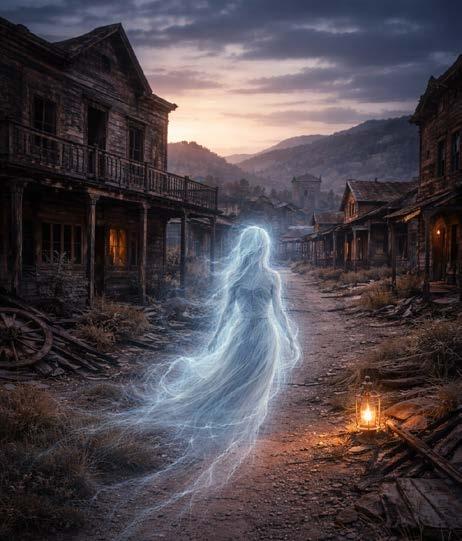
attacked by someone who only wounded him but succeeded in killing her. To this day the murder suspect is still a mystery, but it could have been anyone with a grudge against either of them. She has been seen walking along the beach as if she’s looking for someone. She is also seen at the current bar where ladies’ jewelry goes mysteriously missing. The bobbles are found later, hidden away as if in a thief’s horde. Customers receive further shocks as personal Items suddenly levitate and doors lock by themselves. A lonely specter unable to enjoy life as she once did. She most likely plays these pranks to relite the candle she once burned at both ends.
Southern Grace Distillery is nestled in Mt Pleasant, NC east of Charlotte. The site resembles a peaceful pastoral scene from the late 19th century and belies the true use of the grounds and the brutal events that occurred on the property. Originally it was a farm at the time of the Civil War, and the owner also owned several slaves that worked on the property including one young lady by the name of Lizzy. The farmer had children and Lizzy’s job was to look after them, including one little
Sources:
boy named Victor who was 2. Victor died unfortunately at 2 and Lizzy passed away at age 14. The causes of their deaths are not known by the owners of the distillery but it’s likely that a disease of some kind took them prematurely. The family sold the property to the state in the 1920’s, which built a maximum-security prison on the property in 1927 and soon hundreds of prisoners were housed within its walls. Prison records reveal that 20% of them were convicted of moonshining and smuggling illegal liquor. The brutality of the time was inhumane and sadistic, and many prisoners died because of the unsanitary conditions or punishments meted out by the guards. The state closed the facility in 2011, and the current distillery was set up there by the current owners in 2016. In the first years of operation the workers heard unexplained footsteps coming from areas that were empty. They also heard keys jingling and what sounded like someone running down the corridor. Later, they opened the stillhouse and maturation rooms for tours and several tourists also reported similar noises. On two separate occasions photos taken by
• 10 Haunted Whisky Distilleries/Whiskipedia/10/24/25
two different people showed a shadowy figure running or looking at the barrels. At night whispery voices seem to come from the dark with skin crawling comments that disturbed the still-house workers. Among the hardened criminals there are two other entities with distinctly childlike voices that laugh and speak to the people there. It is speculated that the youngest voice is Victor and Lizzy is still taking care of him. These nightly visits have become so frequent, that “haunted” tours are now regularly conducted to thrill tourists. The tours appear to keep the more disturbing elements to a minimum and acknowledge their presence. And what is the name of the bourbon produced there? Why “Conviction” of course.
We have now come to the end of our tales, and the world of specters has returned to the crypts from whence they came. If you find yourself alone at night and feel the presence of something not quite visible to the corporeal world, don’t worry. It may be only your imagination, but then again I would say a prayer to ward off any spirits that are still with us.
• Haunted Distilleries: Spirits of a different kind/ Julia Higgins/ Whisky Advocate/ 10/31/23
• The 7 most haunted distilleries in the US/ Kara Newman/ Wine Enthusiast/ 9/18/25
• 5 haunted Scotch whisky distilleries/ On the Sauce Again/ 10/13/23
• The World’s most haunted distilleries/ The Winerist/ 7/8/2018
• Southern Grace distillery/ paranormal investigations/ southerngracedistilleries.com/ 6/18/25
• Moss Beach Distillery/ mossbeachdistillery.com/history-ghost

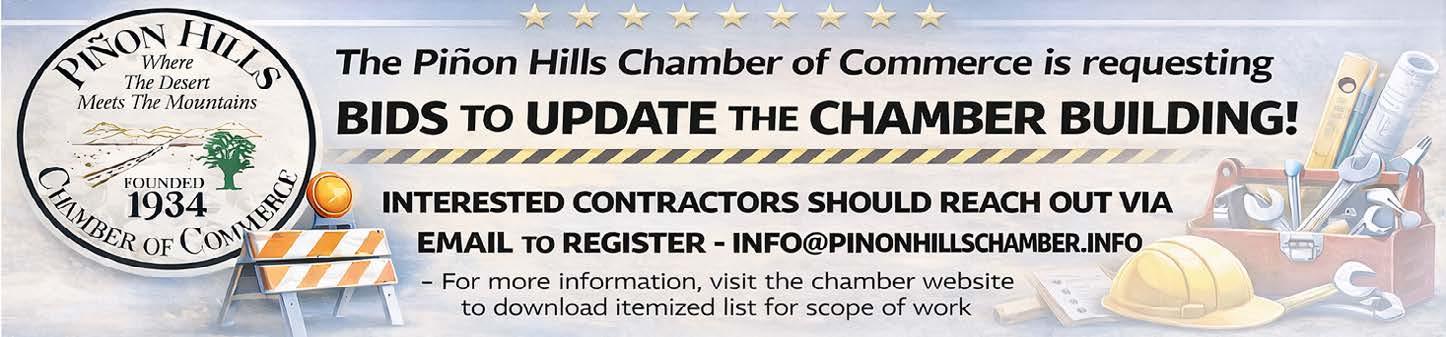
Networking during Chamber meetings, events and online - Be a
Join and Share your Ideas & Goals at a Membership Luncheon on the 3rd Tuesday of each month Where? – Mountain Top Cafe, 7637 CA-138, Phelan, CA - 11am to 1pm
Contact us for advertising space on our upcoming Business Directory.
More Information – reach us at 760-868-7191 or email us: info@pinonhillschamber.info





SITTING AROUND ONE
EVENING, a friend asked me if I had ever heard of the Mojave Megaphone.
I replied that I hadn’t, but I did remember the megaphone my high school football coach used on a regular basis. It was rather obnoxious, but so was our coach. Nope, never had heard of the Mojave Megaphone.
According to CampsitePhotos.com, the megaphone may have been used by the United States military during the 1940’s and 1950’s while conducting ‘secret’ and nasty types of chemical weapons tests, in the remoteness of the Mojave Desert. In agreement, according to in-the-desert. com, this mysterious object in the desert
was used as a siren. A siren for what? To warn people that the United States government was about to release lethal amounts of gas into the wastelands of the desert between the towns of Ludlow and Baker.
Obviously, more research would clearly be needed.
According to wehavenoidea.com, the object sat on top of a small hill in the Mohave Desert, and is simply: there. I called the CEO to learn if they had any further details on this enigma.
“No, we have no idea.”
“Really, such a mystery, I surely thought you’d have more information,” I pressed the issue.
“Once again, what is the title of our website?”
One more try with the google searches.
I found an article by Nathan Chandler, published on January 15th, 2021, which provided a bunch of other ideas on why this contraption was located in the middle of nowhere.
He had interviewed a number of people to get the low-down on this piece of metal sitting on top of a rocky hill.
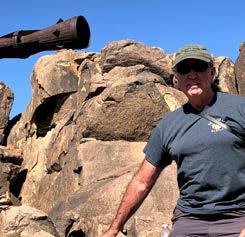
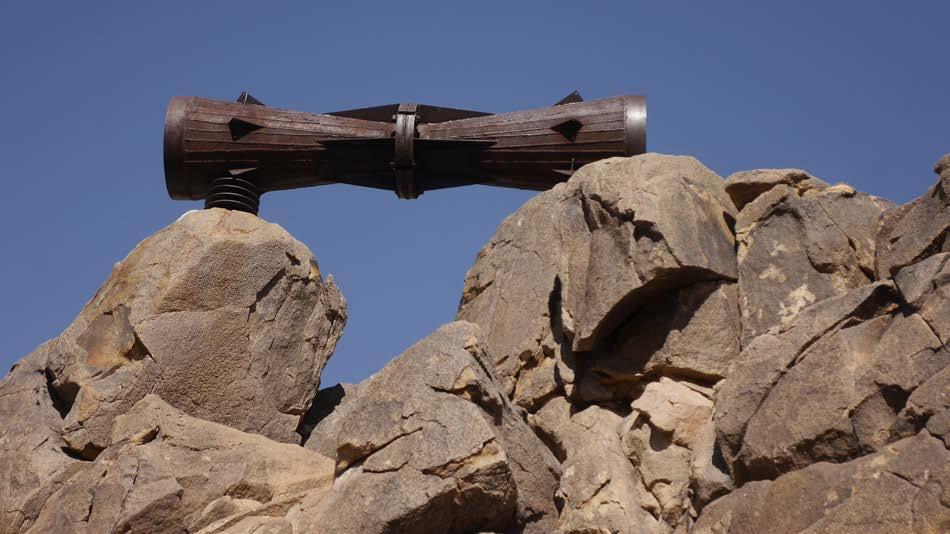
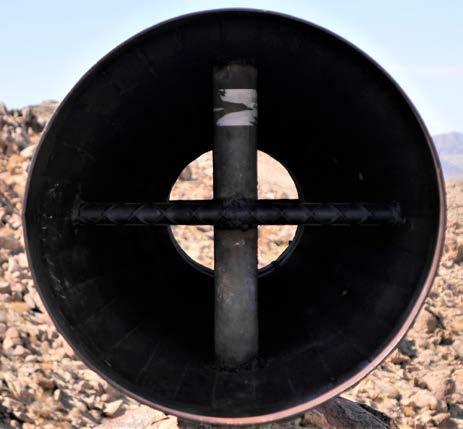
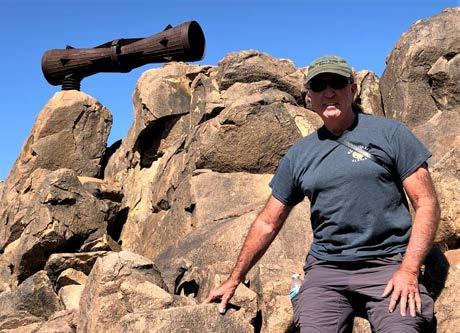
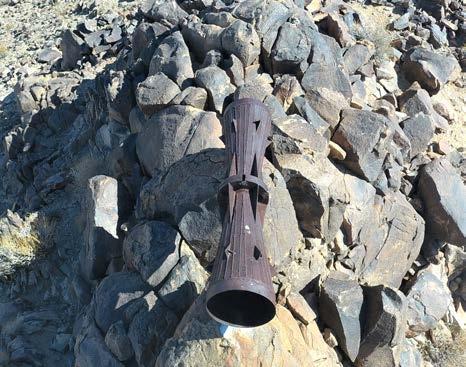
The megaphone is about eight feet long, weighs nearly six hundred pounds, and is hollow, narrow in the middle and wide at each end. The object is securely attached to two solid rocks with bolts drilled into those rocks.
By John Beyer
Chandler’s sources reported the megaphone could be thirty years old or more, and may have been a Venturi pipeline venture. Huh?
Had to look that up -
‘The principle behind the operation of the Venturi flowmeter is the Bernoulli effect. The Venturi measures a fluid's flowrate by reducing the cross sectional flow area in the flow path and generating a pressure difference.’
Okay – that explained everything to me.
According to Chandler’s article, the idea was, the United States Air Force was testing a lot of new types of aircraft back in the 1950’s and 1960’s, and the instrument was used to test shock or sound waves.
That makes more sense.
But, two of my favorites from the article are: the megaphone is pointing toward a huge cache of gold, or that aliens may have set it there.
“Humans will be puzzled by this thing,” Zoog announced.
“Doesn’t look much like a megaphone, to me,” Ryszig sneered in reply.
There was a mystery afoot, and I had to use my feet to solve it. Actually, my friend, Paul, and I took my Toyota FJ. Better than walking.
The directions to this wonder of wonders were easy to follow – no need to utilize the GPS, and risk ending up in Seattle.
We left at the crack of dawn, or probably
closer to nine in the morning, and headed east from Victorville toward the town of Ludlow, along Interstate 40. There is another route from Interstate 15, but since this is the way we went, that’s the one I will write about.
Taking Exit 50, or the exit which points to Ludlow, we turned left at the end of the exit and drove north along Crucero Road, passing the newly remodeled ‘DQ’, but didn’t stop – watching the waist at the moment.
With all safety in mind when driving on dirt roads in the desert, always be aware of the conditions of the road and the weather. Much of the land between Interstate 40 and north toward Interstate 15, have areas where the sand can build up causing a nightmare without a 4x4, and in inclement weather can cause mud or
torrents of water crossing the desert.
In other words, look at weather reports and make sure the vehicle you are driving is appropriate and prepared for offroading. Have fun, but be cognizant of the conditions under which you are traveling.
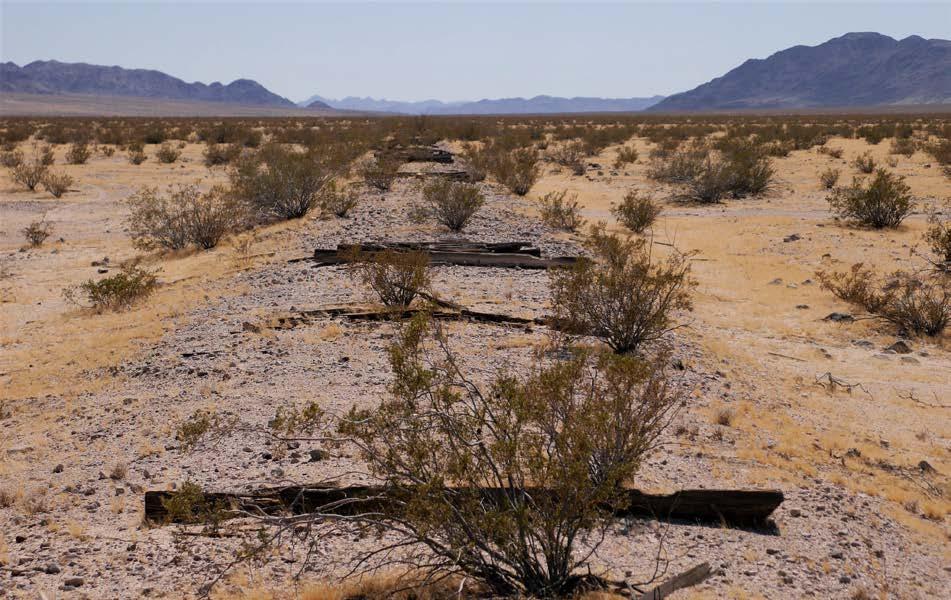
We drove along Crucero Road for about twenty-three miles, give or take a mile, and came across the remnants of a railroad track bed, just west of the road.
There weren’t any steel rail to be seen, but the railroad ties were still sitting in the afternoon sun, atop the track bed. The track bed was going straight as an arrow, due north from our location, toward some hills.
“Someone once was delivering something way out here?” Paul asked.
“Chemicals, for chemical tests?” I suggested.
“I have no idea,” he responded.
Seems to be the theme.
After a few photos, we moved on toward the rocky hills ahead of us. The road was pretty hard packed, with only a few patches of soft sand, so we never needed to engage the four-wheel drive.
One mile, two miles and no megaphone. It was supposed to be here.
“It has to be here,” Paul said, as he poured over some online photos of the area he had printed prior to our trip.
The issue was we hadn’t looked in the
rear view mirrors. There it was, sitting proudly atop of a hundred foot high rocky hill.
“Wouldn’t have missed it if we had headed south from the fifteen,” he stated. That was evidently true, as I looked up and realized that from one direction the megaphone would be hidden from view, but from the other it would be in plain sight.
The trek to the megaphone is not for the weak of heart. It’s not that high, but there are boulders to scramble over and is pretty steep.
I was sucking air, like I had forgotten how to breathe, by the time we reached the pinnacle. After a moment though, the effort had all been worth it.
The megaphone, is a large, rusting piece of welded metal solidly attached to the rocks, and just plain cool. Whoever had the fortitude to place it there was either a genius or crazy.
Paul pounded on the side, a low ring emitted from the megaphone, “This is awesome.”
I only nodded, it truly was.
Is the trip to the megaphone worth it? Yes, it is. Exploring the empty desert and marveling at the solitude and beauty, always is worth it. We speculated over its designer and its purpose, long into the evening until our campfire grew cold. And what better ending to a day, then to stumble upon a mystery bolted into the rocks in the middle of nowhere, and wonder why.
Perhaps one day some intrepid explorer will discover that horde of gold hidden away by some long forgotten miner.
John can be contacted at: beyersbyways@gmail.com

FOR MORE THAN 35 YEARS ,
Sterling Commons has been a trusted part of the Victorville community, supporting local families since opening its doors in 1988. As part of Koelsch Communities; a multigenerational, family-owned organization founded in 1958 by Emmett and Alice Koelsch, Sterling Commons continues to uphold a simple but powerful belief: every resident deserves to be treated with dignity, respect, and compassion.
That commitment is reflected in the remarkable longevity of the Sterling Commons team. Many staff members have served the community for more than 20 years. Families often share how comforting it is to see familiar faces each day and to know their loved ones are cared for by professionals who are not only experienced, but deeply devoted.
Life at Sterling Commons is about more than quality care; it’s about connection and purpose. Residents actively participate in programs designed around their interests and abilities, helping them remain engaged with the world around them. One of the most cherished traditions is the community’s partnership with local schools, including Joshua Circle Elementary. Residents create handmade Valentine cards, Easter crafts, and holiday gifts for students, building meaningful intergenerational relationships.
During a recent delivery of Easter bunny bags filled with treats, one resident shared, “Many students cheered us with singing and a poster board thanking us for their gifts.” Moments like these highlight the powerful impact of staying connected across generations; not only for the children, but for the residents as well.


By Finn Barnes
Giving back extends beyond the classroom. Many residents are veterans or hold deep respect for those who have served. Sterling Commons provides ongoing opportunities to honor that service, including monthly card-writing initiatives that send handwritten notes and holiday greetings to deployed service members overseas. Each year, the community partners with the Elk Lodge to host a Veterans Day ceremony recognizing resident veterans. Past events have welcomed local leaders, including Congressman Jay Obernolte, in a shared tribute to service and sacrifice. More than three decades after opening, the community remains focused on providing specialized support while fostering connection, purpose, and belonging for families throughout Victorville and the High Desert.