THE SKAGWAY NEWS.
THE SKAGWAY NEWS July 3, 2020
July 3, 2020
Sk a g w ay, A l a s k a
Shaving hair for charity
Elks benefit from the loss of locks PAGE 9
Skagway Traditional Council CARES funds available PAGE 5
Page 1
$1.50
North Words is alive with a virtual twist PAGE 4
Many apply for EAESP, impact business grants By Melinda Munson The Municipality of Skagway made international headlines when the Assembly voted in June to give $1,000 checks to qualified residents each month through December. The Emergency Assistance & Economic Stimulus Program (EAESP), funded through the CARES Act, is intended to help mitigate the $160 million Skagway will lose this summer with the demise of the 2020 cruise ship season due to COVID-19. The Municipality expected around 700 individuals to apply, based on the number of residents who applied for April’s Emergency Assistance Program which gave $400 to each applicant and $200 to their dependents. According to Heather Rodig, bureau treasurer, 899 individuals were approved for June checks, about 199 more than anticipated. The checks were mailed out on June 26. That same day, a line formed outside the post office and Skagway’s only bank as residents collected their first payment. Most of the community applied for the EAES, said Brad Ryan, borough manager. “You start talking $1,000, that’s an incentive,” Ryan said. He considers the first month of distributing CARES funds directly to residents a success. “I hear people talk about the spending that happened right after,” Ryan said. He is pleased so many Skagwegians were approved and believes the money will help see page THREE
Photos provided by Skagway Traditional Council
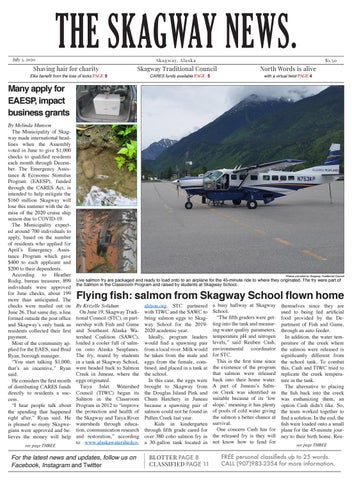
Live salmon fry are packaged and ready to load onto to an airplane for the 45-minute ride to where they originated. The fry were part of the Salmon in the Classroom Program and raised by students at Skagway School.
Flying fish: salmon from Skagway School flown home
By Krizelle Solidum On June 19, Skagway Traditional Council (STC), in partnership with Fish and Game and Southeast Alaska Watershed Coalition (SAWC), loaded a cooler full of salmon onto Alaska Seaplanes. The fry, reared by students in a tank at Skagway School, were headed back to Salmon Creek in Juneau, where the eggs originated. Taiya Inlet Watershed Council (TIWC) began its Salmon in the Classroom Program in 2012 to “improve the protection and health of the Skagway and Taiya River watersheds through education, communication research and restoration,” according to www.alaskawatershedco-
For the latest news and updates, follow us on Facebook, Instagram and Twitter
alition.org. STC partnered with TIWC and the SAWC to bring salmon eggs to Skagway School for the 20192020 academic year. Ideally, program leaders would find a spawning pair from a local river. Milk would be taken from the male and eggs from the female, combined, and placed in a tank at the school. In this case, the eggs were brought to Skagway from the Douglas Island Pink and Chum Hatchery in Juneau because a spawning pair of salmon could not be found in Pullen Creek last year. Kids in kindergarten through fifth grade cared for over 380 coho salmon fry in a 30-gallon tank located in
BLOTTER PAGE 8 CLASSIFIED PAGE 11
a busy hallway at Skagway School. “The fifth graders were getting into the tank and measuring water quality parameters, temperature pH and nitrogen levels,” said Reuben Cash, environmental coordinator for STC. This is the first time since the existence of the program that salmon were released back into their home water. A part of Juneau’s Salmon Creek was identified as suitable because of its ‘low slope,’ meaning it has plenty of pools of cold water giving the salmon a better chance at survival. One concern Cash has for the released fry is they will not know how to fend for
themselves since they are used to being fed artificial food provided by the Department of Fish and Game, through an auto feeder. In addition, the water temperature of the creek where the salmon were released is significantly different from the school tank. To combat this, Cash and TIWC tried to replicate the creek temperature in the tank. The alternative to placing the fish back into the creek was euthanizing them, an option Cash didn’t like. So, the team worked together to find a solution. In the end, the fish were loaded onto a small plane for the 45-minute journey to their birth home. Reusee page THREE
FREE personal classifieds up to 25 words. CALL (907)983-2354 for more information.