74
I N STAL LATI APARTAT O N P RO J E CT
dossier arquitectura / architecture
Application of Adhesives for the Installation of Ceramic Tiles TRADITIONAL LAYING TECHNIQUES USING MORTAR MADE OF SAND, CEMENT AND LIME AS A BONDING MATERIAL, WERE ABLE TO ACHIEVE GOOD RESULTS WHEN WORKING WITH HIGHLY ABSORBENT, SMALL FORMAT TILES AND STABLE SUBSTRATES
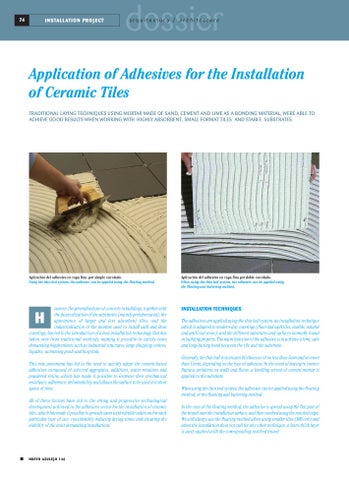
Aplicaci贸n del adhesivo en capa fina por simple encolado. Using the thin bed system, the adhesive can be applied using the floating method.
Aplicaci贸n del adhesivo en capa fina por doble encolado. When using the thin bed system, the adhesive can be applied using the floating and buttering method.
owever, the generalised use of concrete in buildings, together with the diversification of the substrates (mainly prefabricated), the appearance of larger and less absorbent tiles, and the industrialisation of the mortars used to install wall and floor coverings, has led to the introduction of a new installation technology that has taken over from traditional methods, making it possible to satisfy more demanding requirements such as industrial structures, large shopping centres, fa莽ades, swimming pools and hospitals.
INSTALLATION TECHNIQUES
H
This new panorama has led to the need to quickly adapt the cement-based adhesives composed of selected aggregates, additives, water retainers and powdered resins, which has made it possible to increase their mechanical resistance, adherence, deformability, and allows the surface to be used in a short space of time. All of these factors have led to the strong and progressive technological development achieved in the adhesives sector for the installation of ceramic tiles, which has made it possible to provide users with reliable solutions for each particular type of use, considerably reducing laying times and ensuring the viability of the most demanding installations.
N U EVO A Z U L E J O 146
The adhesives are applied using the thin bed system, an installation technique which is adapted to modern-day coverings (floor and wall tiles, marble, natural and artificial stone), and the different substrates and surfaces normally found in building projects. The main function of the adhesive is to achieve a firm, safe and long-lasting bond between the tile and the substrate. Generally, the thin bed system uses thicknesses of no less than 5mm and no more than 15mm, depending on the type of adhesive. In the event of having to correct flatness problems on walls and floors, a levelling screed of cement mortar is applied to the substrate. When using the thin bed system, the adhesive can be applied using the floating method, or the floating and buttering method. In the case of the floating method, the adhesive is spread using the flat part of the trowel over the installation surface, and then combed using the notched edge. We will always use the floating method when using smaller tiles (900 cm2) and when the installation does not call for any other technique; a 5mm-thick layer is used, applied with the corresponding notched trowel.