Directors: Chase Corbridge,Tony Fendick, Pete Paulus, Kathryn Rocha, Reade Roselles, NORTHWEST 1/4 COLORADO LAND SURVEYORS
President: Brian T. Kelly
Treasurer/VP, AJ Summers; Secretary, Walter Magill
Directors: Thomas H. Effinger, Gordon Dowling
Skidge Moon, Lloyd Powers, Michael Fraher, Tom Kelly, Bill Baker
Past President: Gordon Dowling
SOUTHERN COLORADO PROFESSIONAL LAND SURVEYORS
President: Don R. Hulsey
Vice President: Mark Johannes; Secretary: Secretary/Treasurer: Steven Parker
Directors: Joseph Alessi III, Dennis Craig, Steve Rutzen, Jon Tessin, Eric White, Honorable Lifetime: Nathan Lira, PLS
SOUTHWESTERN CHAPTER - PLSC, INC.
President: Brian Boniface
Vice President: Tim Barnett; Secretary: Robert Hinojosa; Treasurer: Justin Bonnell
WESTERN COLORADO LAND SURVEYORS
President: Sean Mullen
Vice President: David Holmes; Secretary-Treasurer: James Combs
Directors: Brian Bowker, Trent Howell, Ted Juntilla, Renee Parent, Kurt Shepherd, Alec Thomas, Tom Sylvester
Side Shots is the official publication of the Professional Land Surveyors of Colorado, Inc. and is published quarterly for the betterment of the surveying profession.
Brian Dennis President
For Editorial Correspondence, contact: Laine Landau sideshots@plsc.net
This publication is not copyrighted and articles may be reprinted with due credit. Statements made and opinions expressed are from the contributors and do not necessarily express the official views of the Professional Land Surveyors of Colorado, Inc. Deadlines for editorials, articles, pictures and advertising are January 1, April 1, July 1 and October 1. Publication is February, May, August, and November Material received after the current deadline will appear in the next issue of Side Shots.
We would like to invite anyone who is interested to advertise in Side Shots. Do you have something
BRIAN DENNIS PRESIDENT C: (719) 337-1262 president@plsc.net
DIRECTORS (2025-2026)
TOM SYLVESTER
O: (970) 255-7386
TODD JOHNSTON
O: (970) 769-8751
CHASE CORBRIDGE
O: 970-800-3300
RYAN SWINGLEY O: 317-306-0158
ROB TRUDEAUX O: 970-247-175 x01
DIRECTORS (2023-2026)
SCOTT THOMPSON O: (970) 244-1821
DENNIS MOULAND O: (928) 460-0230
STEVE PARKER C: (719) 641-3355
WFPS DELEGATES (2022-2023)
TODD BEERS (O): (303) 353-3528
RAFAEL BOMBACINI C: 719-440-3763
NSPS DIRECTOR (2022-2023)
TODD BEERS (O): (303) 353-3528
STEVE PARKER
Alternate
C: (719) 641-3355
PROFESSIONAL LAND SURVEYORS OF COLORADO, INC.
PO Box 441069, Aurora, CO 80044
AFFILIATE – NATIONAL SOCIETY OF PROFESSIONAL SURVEYORS MEMBER- WESTERN FEDERATION OF PROFESSIONAL SURVEYORS
OFFICERS (2025-2026)
HEATHER LASSNER VICE PRESIDENT C:970-310-4089 hmlassner@gmail.com
Fellow Members
RALPH PETTIT PAST PRESIDENT C: (720) 400-3723 ralph.pettit@denvergov.org
BECKY ROLAND EXECUTIVE DIRECTOR O: (303) 551-3266 broland@plsc.net
Soon, we will be in the grips of winter again. This year is going by so fast!
I have spoken with many surveyors, both 1-person companies and large and the theme is the same. They are Busy! That is always music to my ears. If we are busy, surveyors are making a good living including their staff and proof the public continues to see the value surveyors bring to the many things we touch. Let that never change!
I haven’t had many chances to stop this year and enjoy all of the great things that are happening with the PLSC. November 1st, 2025 is the initial day that Continuing Education Units (CEUs) begin. That means for your 2027 license renewal on October 31, 2027, you will need to have completed 30 contact hour credits. To some it sounds like a lot but remember, you have 2 years to complete. It is only a lot if you wait until the last minute. 20+ hours can be captured at the next Rocky Mountain Surveyors Summit in February in Colorado Springs, CO. That is more than half of the credits needed in one event. The PLSC, at the request of our members, has committed to make CEU credits available at the annual conference including holding additional workshops in between conferences to assist our members and non-members with this requirement for license renewal. We have also been requested to continue working with DORA and the AES Board if adjustments to the requirement are warranted. If you believe adjustments should be made, reach out to any PLSC Board member and let them know. It is best if you send it in writing so we can keep track of those thoughts. You can also send direct to the AES Board or attend their monthly meetings. I imagine they will appreciate the participation. I have been to the meetings and am typically surprised at the small number of folks that attend. For those of you that have attended, Thank you! Remember, Your voice counts but whispers don’t always get heard.
I wish everyone a safe and billable Winter!
Thank you
Brian Dennis, PLS PLSC President
FROM THE EDITORIAL COMMITTEE
This edition is the first to offer Continuing Education credits to authors for preparing articles. I hope the current round of submissions will encourage you to put your ideas down and submit them to Side Shots. Submittals could include book reviews, conference reviews, original research tips and tricks, best practices, specific court cases and their impacts on surveying practice in Colorado, interesting surveys and the issues raised and (hopefully) resolved. I am looking forward to a vibrant assortment of submissions which will make each edition a rewarding read.
The August edition, in particular the article on ILC by Hayley Young inspired follow up discussions with the most responses on a single article. Look for follow up articles in future editions based upon that exchange. Personally, I enjoyed learning that Earl Henderson, author of the enclosed
4th part article Where is Colorado? Episode 4-Four Corners is also an alum of the Regina Maris, a connection that we might have missed had neither of us engaged in writing articles for Side Shots
Education is a big part of our purpose as an organization and while Side Shots aims to provide education, it is also meant to serve as a connector. Try doing the new puzzle page created by Chase Corbridge with your staff and perhaps award a prize for the fastest solution. I’d love to see how you use this new page. Send me an update and I’ll include it in my next letter! Solutions will be posted in the February 2026 edition.
Laine Landau Chair, Editorial Committee
PLSC Call for Abstracts:
Did you know you can receive continuing education credit for teaching a course or seminar?
PLSC and its Chapters are looking for presenters for virtual and inperson presentations. Please share your knowledge and experiences with land survey professionals! Note: Presentations cannot be "sales pitches" or endorse any specific brand, services or company.
Submit your Abstract
Legislative Committee Report – September 30, 2025
The 2026 Colorado legislative session, also known as the Second Regular Session of the Seventy-fifth General Assembly, is scheduled to convene on Wednesday, January 14, 2026. The session is set to conclude on May 13, 2026. The PLSC proposed 3 items for consideration during this session, being:
1. Revise §38-50-103. Public Records – Require that monument records be submitted to DORA in an electronic format.
2 Revise §38-51-104 (3) (a) and §38-51-105 to allow setting of reference monuments or witness corners for corners in travelled roadways in public rights of way.
3. Revise §18-4-508 adding a clause establishing a significant fine ($2500) and penalty (replacement cost) for removal of a survey
Of these three proposals legislative sponsors have been found for Items 1 and 2. No legislators could be found willing to sponsor Item 3. Requiring enforcement, Item 3 requires a fiscal note, which the current mood in the legislature is not supportive of pursuing. This issue may be better addressed by an effort to educate those entities which without malice regularly destroy monuments with construction activities.
Items 1 and 2 are currently in drafting, where the proposed language will be “cleaned up” and made presentable for a bill. A bill title has been entered and co-sponsors in the Senate from both major parties are signed on. They are:
Senator Rich, Janice, Republican, 303-866-3077, janicerichsd7@gmail.com
Senator Snyder, Marc, Democrat, 303-866-4880, marc.snyder. senate@coleg.gov
Scott Thompson, P.L.S.
CHAPTER NEWS
CCPS
This year’s CCPS Golf Tournament was a resounding success, bringing together 76 enthusiastic participants across 19 teams. Many were familiar faces from previous years, but we were thrilled to welcome several newcomers—including teams from engineering firms, construction companies, and even a planner who joined the fun.
The competition was fierce, culminating in a nail-biting scorecard playoff between Aztec and LJA. After several deep dives into the scorecard, Aztec emerged victorious and claimed First Place honors.
Prizes & Highlights:
• Cash prizes were awarded to the top three teams, with a special consolation prize for the team finishing last.
• Hole competitions offered additional cash rewards, with prizes awarded to both male and female participants. Notably, our sole female entrant performed impressively and walked away with a win!
Thanks to generous support through entry fees, hole sponsorships, mulligan purchases, and raffle sales, the tournament raised approximately $4,500 for the CCPS bank account.
Looking Ahead: We’re excited to grow this event even more in the coming years. Next year’s event will take place on Sunday, June 7, at The Homestead Golf Course in Lakewood. If you’d like to join us and haven’t received any email updates, feel free to reach out to Tony Peall at tpeall@aztecconsultants.com.
With Continuing Education requirements starting in October, our Summer Seminar was postponed until January 2026, to take advantage of the continuing education hours earned by participants. John Stahl will be presenting, and the event will be held at Arapahoe Community College once again. Specific information will be available soon.
Jim Lynch, PLS 2025 CCPS President
Northern Chapter News
The Northern Chapter met September 3rd after our summer hiatus with a great turnout from northern Colorado PLSs! We discussed the continuing education credit (CE) requirements and how we will provide opportunities to earn these credits to our members at our monthly meetings. We agreed to offer at least 6 CE’s a year during our meeting presentations and are open to topic recommendations. Feel free to email presentation topic ideas to the email listed below or to get on our mailing list for meeting notifications. Some of our upcoming topics include City of Fort Collins Land Survey Catalog via GIS database, writing legal descriptions, and the NGS OPUS beta release. We will also be having our Eagles hockey ‘holiday’ party in December or January of 2026; watch your email for details (if you are on our Northern Chapter mailing list of course). Thank you to everyone who attended our meetings this year and we hope to see you at our upcoming meetings!
Fall has arrived in the Northwestern part of the State with all the brilliant colors. The NW1/4 technically had its last meeting in late Summer at the now reopened Creekside Cafe in Hayden, Colorado. While meeting, we had another election of officers and they are as follows: Brian Kelly, President; AJ Summers VP and Treasurer;Walter Magill as Secretary and Gordon Dowling, Skidge Moon, Michael Fraher, Tom Effinger, Tom Kelly, Lloyd Powers, Dave Ginther and Bill Baker as Directors. I hope I didn’t miss anyone and for that I apologize. The votes were unanimous.
There was considerable discussion regarding the Continuing Education Requirements that are now in place per State Statute and Regulations. Both the Rocky Mountain Summit and the annual Wyoming conference in Caspar are good options for CEH’s(Wyoming is close for many of us). Ride sharing and probable dates were included in these discussions. The importance of getting receipts and keeping record of the CEH’s was discussed as well as other ways to get those hours.
CHAPTER NEWS
We also discussed other changes to the statues, including the necessity of filing Plats with the County Surveyor when that individual surveyor is not the signatory to the Original Plat.
We are also hoping to have another meeting before winter sets in and makes even short travel at times interesting!
Respectfully submitted, Brian T. Kelly, President NW1/4 PLSC
WCLS
The most recent chapter meeting took place on July 9 at Grand Junction City Hall. Reports were presented by representatives from Mesa County, the City of Grand Junction, CDOT, and CMU Tech. Members also engaged in productive discussions surrounding continuing education and proposed amendments to the chapter’s Constitution and Bylaws. The chapter plans to vote on a simple amendment soon.
On August 22, WCLS hosted its annual Fall Seminar at the Grand Vista Hotel in Grand Junction. The event featured
informative presentations on water boundaries by Dennis Mouland and a related case study led by Tom Sylvester. These timely and relevant topics drew approximately 50 attendees, including students and land surveyors from outside the region. Participants enjoyed a day of learning, networking, and a catered light breakfast and lunch. Sincere thanks to our presenters, as well as David Holmes, James Combs, Brian Bowker, Trent Howell, Kurt Shepard, and Becky Roland for their contributions to the seminar’s success. We also appreciate the support of Frontier Precision and Vectors Inc. for their participation.
In other news, Vice President David Holmes has recently relocated to Kalispell, Montana. His enthusiasm and dedication have been greatly appreciated, and we wish him all the best in this new chapter.
Our next chapter meeting is scheduled for November— details to follow soon.
Respectfully submitted, Sean Mullen, WCLS President
Where is Colorado? Episode 4 – Four Corners
by Earl Henderson (Earl@ZenithLS.com
The determination of the location of the Four Corners deserves its own place in this series. After all, the Four Corners monument may be the most famous survey monument and is certainly the most famous in the United States. What other survey monument can claim that ±250,000 people visit it each year?
As I’m sure you will recall from Episode 3, the south line of Colorado was established by Ehud Darling, who surveyed the 37° North Latitude line/arc in 1868. Darling’s task was to establish that line to 32° West from Washington, DC, which he did and then some, extending the line beyond 32° West about 1 ½ miles. Darling made no attempt to precisely determine 32° West on his 37° North line, nor was he tasked to do so. That task was assigned to Chandler Robbins in 1875 as the point of beginning for his survey of the line between the New Mexico and Arizona territories.
The determination of longitude in the 1870’s was done using time signals via the telegraph lines. But in the wild west of that area, there were no telegraph lines. So, Robbins was directed to use a known position from a previous survey. Robbins’ notes say: “In the absence of available telegraphic
facilities for the determination of the longitude I was directed by the Hon. Commissioner of the General Land Office to adopt the Southwestern needle point or crestone, otherwise named Wilson’s Peak, situated in Township 11 North, Range 3 West of the Navajo Special Meridian.” The location of Wilson’s Peak had been established under the U. S. Geographical Surveys West of the 100th Meridian, led by First Lieutenant George Wheeler (one of the Great Surveys of the American West which also includes King’s survey of the 40th Parallel, Powell’s survey of the Grand Canyon Region and Hayden’s Geological and Geographical Survey of Colorado and Adjacent Territories). Wilson’s Peak has since been renamed to Ship Rock. See Figure 1. Robbins then describes the geographical position he was given for this point and how he ran a line due west after triangulating on Wilson’s Peak to establish 32°W. Then he ran due north and intersected “Darling’s Line” and established his initial point. He monumented his initial point with “a shaft of hard sand stone 7 feet long 12 inches wide and 6 inches thick; set 3 feet in the ground and marked on the N.E “Col, 37° N.L”, on the S.E “N. Mex 32° W.L”; on the SW “Arizona”; on the N.W “Utah 1875”. This is the original monument that established the location that would eventually become known as the Four Corners.
Figure 1
Since the Four Corners monument was set by Robbins in 1875, it has gone through several upgrades described in a circular titled Field Notes of the Remonumentation of the Corner Common to the States of Colorado, New Mexico, Arizona, and Utah, of the New Mexico Principal Meridian, Gila and Salt River Meridian, and Salt Lake Meridian” executed by Darryl A. Wilson, Supervisory Cadastral Surveyor for the BLM and dated October 17, 1992 (R-573). It went through an additional upgrade in 2010. In each instance, the location was monitored by the BLM/GLO and in 2010 also by the NSPS to be certain that it remains in its original location, as it should be, once the construction was completed. Additional information about the history of this monument and its location can be found at http://www.ngs.noaa.gov/INFO/fourcorners.shtml
You might think that’s the end of the story, but unfortunately it is not.
On April 19, 2009, a story made it onto the Associated Press that was picked up by almost every major news network indicating that the Four Corners monument isn’t in the correct location. It appears as though this story started with an article in the Deseret News of Salt Lake City, UT written by Lynn Arave. Lynn Arave makes some extravagant claims based on Google Earth measurements and Geocachers which should make every land surveyor feel insulted. I know I was. So much so that I wrote to Lynn Arave, but of course I received no reply.
I personally saw news broadcasts in Denver, CO featuring Randy Zanon, who was at that time the Chief Cadastral Surveyor for the BLM Denver Office. Randy, who has since retired, stated in no uncertain terms that the monument marked the very point of the intersection of the state lines, yet the local reporter insisted on trying to feed the flames of controversy at the end of the report, stating that the monument was still 1500’ off. Even after repeated attempts by me to contact the news desk at the local TV station, no one was interested in correcting their poor reporting of the story.
In addition to not understanding the concept of original monumentation the way land surveyors are supposed to, Lynn Arave didn’t do his homework. But then none of the reporters of this story did, they simply picked it off the wire and repeated it. The story claimed that the intended location for the monument was 109° west longitude and 37° north latitude. Neither of these is correct.
The corner was established “on the Darling Line” as mentioned above, regardless of if that location is precisely at 37° North Latitude. As you will recall from Episode 3, the Darling line is not precisely at 37° North Latitude.
The difference between 109° west longitude and 32° west longitude isn’t as immediately apparent other than the numbers being considerably different. The Greenwich Meridian, from which 109° is measured, was not accepted as the Prime Meridian by the United States until 1912 after the International Meridian Conference held in Washington, DC in 1884. Until that time each country established their own “prime meridian” from
Figure 2
which measurements were made within their borders. The Greenwich Meridian was chosen as the Prime Meridian at the conference because of the superiority of the British shipping and navigational charts which most countries had been using for decades, and which were all based on the Greenwich Meridian. So, Robbins’ monument predated the use of the G reenwich Meridian as the Prime Meridian. It was in fact based on the Washington, DC Prime Meridian. However, as it turns out, there have in fact been four prime meridians in DC.
The first prime meridian of the USA was proposed by Charles Pierre L’Enfant, the designer of DC, to go through “Congress’ House”. This meridian was never implemented. The second prime meridian of the USA, and the first to actually be put to use, was defined by Thomas Jefferson and established at the right angle point of the triangle with hypotenuse drawn between the White House and the Capitol Building. This point is currently marked by the “Jefferson Stone” just NW from the Washington monument. See Figure 2. The Jefferson Stone has a unique and interesting history that was fully described by Silvio Bedini in his wonderful book The Jefferson Stone. This USA Prime Meridian was used until 1850. At that time the US Naval Observatory (now called the Old US Naval Observatory and located near the west end of the mall in DC) was being used for making longitudinal measurements and apparently it was decided to move the USA Prime Meridian to the dome of the Old US Naval Observatory building for simplicity in reducing measurements. That USA Prime Meridian was used until the Greenwich Meridian was adopted by the USA in 1912. Sometime later the current US Naval Observatory was built and the USA Prime Meridian was moved there for measurement purposes even though all measurements were being converted to Greenwich.
So, the upshot is that Robbins’ monument was set based on the USA Prime Meridian (at the Old Naval Observatory) at 32° west longitude and that does NOT correspond to 109° West from Greenwich as Lynn Arave seemed to think. Of course, this is not the first time that someone has looked at a map and made that assumption. In fact, in an attempt to thwart just such a misunderstanding, Chandler Robbins himself published an article in the Santa Fe Daily New Mexican on November 1, 1875, just a few months after he set the monument, saying this: “It seems to have been the general impression that the line was the 109° of longitude west from Greenwich. Such is not the case, as the law makes it the 32° of longitude west from Washington, which corresponds to 109°2’59.25” west from Greenwich, and which places the line as a small fraction less than three miles farther west than would have been the case if it had been run as the 109° of longitude west from Greenwich.” Oddly enough, the very same newspaper, now called The Santa Fe New Mexican, published an article on February
26, 2010 fueling the flames of the controversy which doesn’t even exist. They indicated in that article that some New Mexico legislators may even have been considering claiming additional territory from Arizona based on the false information spread about the location of the Four Corners monument. Would that they had just done their research in their own newspaper. Attempted contacts with that newspaper at the time were not returned either.
Now as surveyors, we know that the Four Corners monument isn’t exactly where it was intended to be. No one can measure exactly, not even now, not even me. In fact, it’s about 1800’ from the intended location (by modern measurements), which is in the opposite direction, from the erroneous location reported by Mr. Arave. But given the instrumentation available at the time, the terrain, and the many other challenges to survey well in that area and era, the level of both precision and accuracy they were able to achieve is remarkable. But just as importantly, we as surveyors understand the concept of original monumentation better than the average reporter. Monumentation of land is so important that laws against moving or removing monumentation have been instituted since prior to the writing of The Bible and are included in The Bible. The removal of survey monumentation continues to be a criminal offence today. Retracement surveying, in which most of us participate, is by definition the reestablishment of corner monumentation in its original location, not where it was intended to be. Chief Justice Cooley wrote, “We all know that when purchasers (in this case States) take lands from the general government, they ascertain the boundaries by going upon the land and tracing out the lines and stakes. No one supposes that if an error shall chance to have occurred in the survey, he is liable to have the corner post removed, and perhaps the portion of his purchase, which he regarded as most valuable, taken from him by a resurvey.” (Thanks to Jeff Lucas for providing this quote.)
The Four Corners Monument marks the exact location of the point common to the four states, Colorado, New Mexico, Arizona and Utah. It has marked that location since it was set, before they even became states, and I expect and hope that it always will.
Be safe out there.
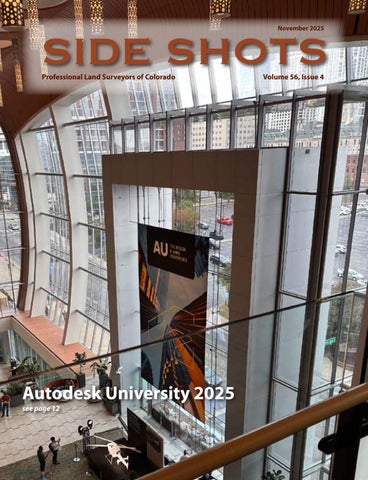
Autodesk University 2025
by Heather Lassner, PLS
I had the pleasure of attending Autodesk University 2025 (AU 2025) hosted at Nashville’s Music City Center, a high-end conference venue located next to the Country Music Hall of Fame in the heart of downtown Nashville. Its spacious layout set a refined tone from the moment I entered. The first evening was kicked off with a meetand-greet accented by appetizers and a local live band. Then early on Tuesday, the main event of the three-day conference opened with a keynote presentation led by Autodesk CEO Andrew Anagnost, who emphasized current constraints on the industry and showcased Autodesk’s AI and cloud-based platforms as an exciting new solution. Breakthroughs announced included demos of holistic tools like Forma, Fusion, and Flow, highlighting AI’s power in not just speeding up design but reshaping processes. The conference progressed with general sessions, breakout
rooms, and the expo hall. Everything was well mapped with an interactive app created by Autodesk which meant that navigating the event was easy but often overwhelming. The conference was attended by masses of individuals from all over the world.
AI was everywhere! It is the next big development coming in the very near future. AU 2025 integrated AI extensively into nearly every product demo and all the keynote presentations highlighted the upcoming changes. Demos ranged from Autodesk Assistant generating editable CAD geometry in Fusion to Forma processing Revit point cloud inputs and delivering real-time design and construction insights. Also, the conference highlighted the integration of AutoCAD Forma as a whole project management platform for storing documents, collaborating in real time with coworkers, and undertaking budget and procurement
estimates. Sessions showed Autodesk laying out the foundation for models tailored to professional use that were real, tangible previews of what’s coming. I honestly thought it was very exciting and can see the ways in which it is going to change and revolutionize our profession. Drafting will become faster, and the exchange of drawings and data will become much more streamlined.
The vendor hall was stacked with major tech vendors such as HP, Dell, NVIDIA, Lenovo, showcased high-end workstations, VR/AR tools, and hardware optimized for AI workflows. Themed zones focused on AI, cloud, and sustainability. I saw robotic scanners from NVIDIA and Leica, machine control from TopCon, and a robot that will do construction staking by HP. There were zones specifically highlighting Autodesk tools, AI and cloud-based platforms. As an aside, there was also a Lego building station that seemed especially popular amongs the engineers. There were some partner integrations of note such as Esri’s ArcGIS and its functionality within Autodesk’s Forma, demonstrating how geographic context can blend into architectural models.
Autodesk University 2025 was definitely a polished production. This conference was informing and entertaining. However, I found that there was virtually no focus on land surveying applications. There were many presentations highlighting the use of scan clouds, opensource data, and drone imagery. I only attended a single session in the three days that mentioned surveying and data collection at all. My biggest concern is that surveyors are going to be left behind as more reliable public data sources become available. It’s not a given, but as a profession it’s important to keep track of these coming updates so we don’t get left behind and understand where we can add the most value to our engineering and architecture clients. Overall, the conference was exciting, and the new possibilities are endless, but I think it will be extremely important to realize how to leverage the upcoming changes to our benefit and embrace the developments that Autodesk is presenting.
The whole event ended with a personalized concert for the AU attendees featuring a lineup of Trian and the Neon Trees. It was an extravagant end to an already extravagant event. Even though there wasn’t much specifically for surveyors, I would like to attend in the future. Not due to the extensive after-hour events or the borderline ridiculous extras, but because I believe it’s important for surveyors to understand the directions our clients are headed so we can better meet their changing needs.
CITY/COUNTY of DENVER CERTIFICATION: M/WBE, DBE, EBE, SBE
We pride ourselves in providing professional services in:
• Subsurface U�lity Engineering Locates
o ASCE Standard 38-02 Quality Levels D, C, B Locates
• Private U�lity Locates
o Residen�al and Commercial loca�ng for private u�li�es.
• Potholing (Quality Level A) & Core Drilling
o process of loca�ng u�li�es or pipelines (exposing them to daylight) to visually confirm exis�ng infrastructure.
• U�lity Mapping (Quality Level D)
• Drone Mapping Services
o Part 107 Cer�fied UAS Pilots – Commercial Drone Insurance
• Sanitary/Storm Camera Locates
o CATV Scoping & Locates of Sanita�on and Storm lines.
NAICS CODES:
561990 Loca�ng underground u�lity lines prior to digging.
238990 Special Trade Contractors (Potholing) –Nondestruc�ve excava�on using high-pressure water or air to expose u�li�es without damage. (Sani/Storm Scoping) – CCTV inspec�on of laterals, manholes, and pipelines
Tom Richardson – Sales/Es�mates/VP Opera�ons M: 303-356-2193 Tom@tomrichardsonllc.com
Brandon Francis – Sales/Potholing/Drone Informa�on M: 720-951-0418
Brandon@tomrichardsonllc.com
PLSC and NSPS at Hiring Our Heroes Events
On September 10 and 11, Todd Beers, NSPS Representative and Past President of PLSC, represented PLSC and NSPS at Hiring Our Heroes events at Buckley Space Force Base Career Summit and Fort Carson Amplify & Career Summit. Each in-person event was focused on connecting military community job seekers with American businesses that are hiring for opportunities in industries such as land surveying.
The event attendees included military spouses, military caregivers, transitioning service members and veterans who are ready to work now as well as those planning for the future.
Todd promoted the various opportunities available in the land surveying profession, along with information on the Certified Survey Technician credential.
Retracing Footsteps: Lessons from Surveying in the Black Hills
by Reade Roselles
If you gather a group of surveyors together with no deadlines looming and no emergencies waiting to erupt, you can count on the stories beginning to flow. They always do. Someone brings up that survey deep in the mountains, another recalls that old party chief who could run a traverse through a granite boulder field without breaking a sweat, and someone inevitably tells the story of the time a landowner introduced himself while holding a shotgun. But among all the tales that get traded around, there is one that resurfaces more than any other: how each of us first found our way into surveying.
For many in the profession, especially those from earlier generations, formal education was not the primary path into the field. Surveyors of my age and older often followed the experience-based route to licensure, earning their stripes through years of fieldwork rather than classroom time. Today, of course, things are different. The professional landscape has evolved, state boards have raised the bar, and surveying programs at colleges and universities have become essential to professional recognition. And rightfully so. If we want the public and partnering disciplines to recognize surveying as a profession on par with engineering or architecture, formal education plays an important role.
But even in a world where degrees matter, one truth has never changed: experience remains the backbone of the profession. The field has always been and will always be a place where apprenticeship, mentorship, and time spent solving real problems in rough terrain shape a surveyor’s judgment more than any textbook page. I think having had those experiences, I have a responsibility to train the next generation to approach the work with curiosity and critical thinking. It isn’t enough for young surveyors to simply follow instructions or be button pushers; they must learn to question what they see, question what they’re doing and investigate inconsistencies, and understand what the evidence tells them. Developing sound judgment requires more than teaching technical proficiency. It requires teaching them to trust, but also verify, research to find the evidence. In this way, we not only pass down skills, but also professional instincts.
A CRASH COURSE AND A NEW DIRECTION
My own entry into the profession began in the summer of 1991 in the Black Hills of South Dakota. I hadn’t planned on a career in surveying. In fact, I had fully intended to continue my education and pursue law school. But that summer, a friend asked if I wanted a job on a survey crew. The position required “some experience,” which I did not have, but my friend assured me that with a few beers and a Saturday afternoon of crash-course training, I could at least look like I knew what I was doing.
He showed me how to set up a total station, level the instrument, and set a backsight. I practiced until I could do it fluidly enough to fool a party chief for at least a day or two. And on Monday morning, I found myself in a truck driving into the Black Hills, totally unaware that the course of my life had just shifted.
That summer changed everything.
LEARNING TO SEE WHAT OTHERS MISS
My introduction to surveying wasn’t just about staking water lines or pounding hubs for curb and gutter. I got to be a part of retracing Forest Service boundaries, homestead entry surveys, and the GLO’s earliest work in the region. That summer, I learned not only how to break down a section but also how to follow the original GLO notes and plats the way surveyors before me had.
Some of the most memorable days were spent retracing surveys from the late 1800’s and early 1900’s, hunting for original stones and bearing trees. There is nothing quite like seeing a peculiar scar on a tree and look into the crevice of the scar to reveal the faint blaze of an original bearing tree, still legible after 120 years. Looking at those simple axe cuts made by a surveyor who might have been a thousand miles from home, braving long days, harsh winters, occasional Indian conflicts, and complete isolation was humbling.
Each time we found an original corner, history became tangible. I could almost picture the original surveyor
standing where I stood, perhaps exhausted, chiseling the marks on the stone, probably unaware that his work would guide people like me a century later.
And we didn’t always get lucky. There were days when we hiked for miles, only to discover a monument uprooted by time, fire, cattle, or man. But even those disappointments were lessons. They taught me patience, endurance, and how to build a picture of an old survey using the tried-and-true hierarchy of evidence, right out of every textbook I had read.
One particular project from that first summer still stays with me. We were tasked with retracing a homestead entry survey from the late 1800s. The notes described bearing trees and several blazed trees on the boundary lines. Even though the trees in the area had not been cut and were clearly of the correct age, we could not find any of the bearing trees or blazed trees. We decided that they made the notes up back at the bar. We then looked at the notes one last time and there it was. The date. The date was from late fall. The theory was that the area had received what I estimated to be several feet of snow because when we went back out to check, nearly every blazed pine in the vicinity was above head level and hardly noticeable up there!
Another time, we were searching for section corners in an area riddled with hundreds of stones, none fitting the description. We also did not find any bearing trees or other evidence. We went back to the office and told the Surveyor that oversaw the project, who had 40 years of experience by 1991, that we did not find anything that even resembled the dimensions that were in the notes. He was undeterred. He went out with us the next day, examined a few stones in an area and discovered a stone deeply embedded between two other stones. He carefully unearthed it, poured some water on it, rubbed some dirt on it and there it was. The hash marks and faint “1/4”. I was humbled that day.
EXPERIENCE, EDUCATION, AND THE LONG ROAD TO LICENSURE
My decision not to return to school that fall was immediate. A friend of mine once joked, “Land surveying isn’t law school—but at least it’s not law school,” and there’s truth in that humor. Surveying demanded something different of me. It required endurance, curiosity, and a deep appreciation for history, geography, and problem-solving. Even today, though I spend more time behind a desk than in the woods, I still feel connected to those early surveyors whose footsteps I retraced.
CARRYING THE TRADITION FORWARD
Surveying is more than a technical discipline; it is a tradition passed down through generations. Our work links us to those who came before and to those who will follow. When I look back on my early days in the Black Hills, and recall the blazes we found, the stones and brass caps we recovered, the lines we retraced, I feel connected to the profession’s heritage in a way no classroom could replicate.
That same sense of connection is something I strive to instill in my own crews today. We work in the eastern parts of Weld County and the remote parts of the Front Range. The same opportunity to follow in those footsteps exist today here in Colorado. We hold weekly training courses that bring field and office staff together to learn from real-world scenarios, reinforcing not only technical skill but the curiosity needed to follow in those surveyor’s footsteps. We encourage our staff to attend events like the PLSC Summit, where speakers highlight the connection between the monuments we set today and those placed a century and a half ago, reminding us that our work is part of a much larger story. Through mentorship programs at our office, younger surveyors regularly engage with experienced professionals who help them develop judgment, confidence, and pride in their role. These efforts ensure that the next generation doesn’t grow into mere technicians, but complete surveyors. Professionals who understand their place in the ongoing history of the land and for them to carry the tradition forward and teach the next generation after them.
We Want You! Not for the army, but for something just as vital to our communities, the profession of land surveying. Roads, bridges, schools, neighborhoods, and even the parks where our kids play all start with a surveyor. Yet behind every successful project is a challenge our industry can no longer ignore: we are running out of surveyors. The numbers tell the story. According to the Colorado Department of Regulatory Agencies (DORA), there are 3,988 Professional Licensed Surveyors (PLS) on record. Out of that total, only 1,666 have a status as active, and just 1,000 of the active PLSs have a Colorado address. Even more concerning, there are only 313 Land Survey Interns (LSI) in the entire state, the supposed pipeline of future professionals. (This data is as of September, 2025)
Now compare that to engineering: Colorado has 61,202 Professional Engineers (PE) on record, with 33,145 active and 16,701 with a Colorado address. Even more striking, there are 30,081 Engineer Interns (EIT), nearly one hundred times the number of LSIs.
There is something wrong with this picture. The imbalance is undeniable, surveying is not attracting, training, or retaining new professionals at anywhere near the rate of other technical fields. If we don’t act now, the gap will only widen, and critical projects in Colorado and beyond will face the consequences.
If nothing changes, Colorado, and the entire nation, risks reaching a point where there simply aren’t enough surveyors to support the demand for infrastructure, housing, and community development.
We Want You: Inspiring the Next Generation of Surveyors
Julian Sisneros, PLS
WHY SURVEYING MATTERS
Surveying is everywhere, though most people never notice it. That road you drove on this morning? A surveyor was there first. The school your children attend? A surveyor mapped it before a shovel touched the ground. Every new bridge, subdivision, utility corridor, and highway begins with a survey. Surveyors are the hidden backbone of development, the quiet professionals who set the foundation for the world we live in.
But surveying isn’t just about measuring land or setting property boundaries. Today’s surveyors operate hightech GPS systems, drones, 3D scanners, and sophisticated software. We combine fieldwork with cutting-edge technology, turning data into maps that engineers, architects, and construction crews rely on. For young people, surveying offers the best of both worlds: the adventure of working outdoors with the challenge of solving complex problems using the latest technology.
And it’s not just interesting work, it’s stable, well-paying work. As the need for new housing, roads, and utilities grows, the demand for surveyors grows with it. For students wondering what career paths are worth pursuing, surveying is a profession where jobs are waiting to be filled, and advancement opportunities are abundant.
THE RETIREMENT CLIFF AND JOB-HOPPING PROBLEM
The reality is stark: more licensed surveyors are retiring than entering the field. This is creating what many call the “retirement cliff,” and it’s already visible. According to multiple professional sources, the average age of a licensed surveyor in the United States is over 55 years old,
with estimates ranging from 57–58 years (NSPS and state associations) to as high as 65 in some industry reports. That means a large portion of today’s workforce is approaching retirement age.
The numbers tell the story: roughly 1,000 surveyors retire every year, while only about 500 new professionals enter the field. That is a net loss of 500 surveyors annually, and it doesn’t take long to see how dangerous that imbalance is for an industry that underpins every major infrastructure and development project.
Instead of welcoming new faces into the profession, the current workforce is largely made up of experienced surveyors who are switching companies and chasing the next salary bump. While higher pay is a reflection of demand, it’s a symptom of a deeper problem: there simply aren’t enough new surveyors coming up through the ranks to meet the workload.
This constant turnover doesn’t create growth, it creates instability. Companies may win the short-term battle of attracting a surveyor with a bigger paycheck, but the profession as a whole continues to shrink. Meanwhile, critical projects are delayed, workloads increase for the surveyors who remain, and burnout becomes a real risk. If we don’t address this trend head-on by expanding the pipeline and investing in training, we risk reaching a tipping point where there simply aren’t enough surveyors to keep up with demand.
The truth is, we cannot job-hop our way out of this problem. We can only mentor, train, and recruit our way out.
BREAKING THE CYCLE: MAKING TIME TO MENTOR
One of the biggest barriers our industry faces is the mentality of being “too busy” to train or mentor. Companies are overwhelmed with projects and deadlines, and many surveyors feel they can’t afford to slow down and teach a new hire. But the truth is, if we keep putting mentorship on the back burner, the problem will only grow worse.
As an industry, we have to stop making the excuse of “we’re too busy to train” and start making time. Bring in a new person, show them the ropes, and let them learn alongside seasoned professionals. Yes, training takes time, money and patience, but every seasoned surveyor once had someone take the time to teach them. Investing in mentorship is
investing in the future of the profession. The payoff isn’t just for the individual; it’s for the entire industry. A single new surveyor trained today can support projects for decades to come.
Mentorship also gives experienced surveyors the chance to pass down knowledge that can’t be found in textbooks; the judgment, problem-solving, and field savvy that only comes with years of experience. Too often, that wisdom is lost when a professional retires, leaving the next generation to relearn the same lessons the hard way. By mentoring, we preserve that knowledge and strengthen the profession as a whole.
Companies that build mentorship into their culture also see benefits beyond the immediate training. Retention improves because younger surveyors feel valued and supported. Productivity increases as trainees grow into competent contributors. And the industry as a whole benefits when every firm is doing its part to grow new talent instead of just competing for the same shrinking pool.
The bottom line is clear: mentorship isn’t a luxury, it’s a necessity. If we don’t make time to train now, we’ll all be paying the price later in missed deadlines, staff shortages, and stalled projects. But if we commit to mentoring today, we can build a sustainable, thriving profession for tomorrow.
BUILDING THE PIPELINE THROUGH EDUCATION AND MAKING SURVEYING VISIBLE AGAIN
The solution doesn’t stop with companies, it starts in the classroom. Too often, kids graduate from high school without ever knowing that surveying is a career option. If they don’t have a parent, friend or relative in the field, they may never even hear about it. That’s where outreach and education become critical.
Colorado already has some incredible programs that could be leveraged to introduce surveying to young people. Schools like Warren Tech in Jefferson County, Epic Campus in Littleton, and Emily Griffith Technical College in Denver are already some of the hubs for career and technical education. Imagine if surveying were a visible option alongside welding, automotive, or construction technology. These programs allow students to earn industry exposure, sometimes even certifications, before they graduate high school. By partnering with schools like these, we can open the door for students who love math, science, technology,
and the outdoors but haven’t yet discovered surveying.
Expanding surveying into high school programs across Colorado and beyond would expose thousands of students to a career they might otherwise overlook. Field trips, guest speakers, and hands-on demonstrations with drones, scanners, and GPS equipment could light a spark that grows into a lifelong career. This isn’t just recruitment; it’s about inspiring curiosity and showing students that surveying is more than “measuring land,” it’s building the future.
Industry organizations can play a big role here too. Local surveyor associations can partner with schools for “Day in the Life” presentations, sponsor STEM nights, or host surveying demonstrations at community events. Social media can also help us reach kids where they already spend time, showcasing the tech, the teamwork, and the impact of surveying projects.
When we make surveying visible again, we change the narrative. Instead of being the “mystery profession” behind the scenes, we become a career kids aspire to join. The spark can start with a single experience, and it’s up to us to provide that experience.
BUILDING A MORE DIVERSE PROFESSION
Another challenge our industry has faced for decades is a lack of diversity. Surveying has traditionally been dominated by men, and often without meaningful representation from minority communities. This lack of inclusion doesn’t just limit opportunities for individuals, it limits the growth and creativity of our entire profession.
If we want surveying to thrive, we must open the door wider and invite everyone in. That means making sure young women, students of color, and underrepresented communities see surveying as a career they belong in, not one they’re excluded from. It means actively recruiting in diverse schools, partnering with organizations that support minority students in STEM, and ensuring that when kids look at our profession, they see people who look like them.
Diversity isn’t just a moral obligation, it’s a competitive advantage. Different perspectives bring new ideas,
stronger problem-solving, and a workforce that better reflects the communities we serve. Surveying literally shapes neighborhoods, towns, and cities. Shouldn’t the professionals building that future reflect the diversity of the people who live there?
The industry has been slow to change, but that doesn’t mean we can’t change now. The next generation of surveyors can and should be more diverse, more inclusive, and more representative than ever before. It starts with us being intentional about who we reach, who we mentor, and who we invite to join the profession.
THE CALL TO ACTION
The future of our communities depends on the future of our profession. Surveying isn’t just about boundaries on a map, it’s about shaping the world around us. If we want that future to be strong, we must take action now.
So here’s the message: We Want You. We want young people to step into a career that blends technology, adventure, and purpose. We want companies to stop recycling the same shrinking workforce and start mentoring new surveyors. We want schools to make surveying a visible career option through technical programs and industry partnerships. We want parents, teachers, and community leaders to help us expose kids to this incredible profession. And We Want our industry to finally reflect the diversity of the communities we serve.
Because if we don’t invest in the next generation, surveying as we know it may not survive. But if we do, we can ensure that the next time a young person sees a “We Want You” poster, they’ll picture themselves standing on a job site, surveying rod in hand, ready to shape the future.
PROFESSIONAL LAND SURVEYORS OF COLORADO
SIDE SHOTS FALL 2025 EDITION -
General Instructions:
- Answer the following questions, to the best of your knowledge, experience and understanding - Solutions to be provided in next issue
Compute the area of the following figures, representing the four suits in a standard deck of cards:
A. Diamonds
C. Clubs
B. Hearts
D. Spades
ROCKY MOUNTAIN SURVEYORS SUMMIT
Professional Land Surveyors of Colorado
FEBRUARY 24-26, 2026
PRESENTATIONS
T u e s d a y - F e b r u a r y 2 4
7 : 3 0 A M - 1 1 : 3 0 A M
O r i g i n a l M o n u m e n t a t i o n , N o n - o r i g i n a l M o n u m e n t a t i o n , P i n c u s h i o n s
a n d P a p e r P i n c u s h i o n s , a n o p e n d i s c u s s i o n - E a r l H e n d e r s o n ( 3 . 7 5
h o u r s )
J o i n t h i s l i v e l y p r e s e n t a t i o n a n d d i s c u s s i o n ! E x a m p l e s , s t a t u t e s a n d
p r e c e d e n t s w i l l b e p r e s e n t e d f o r a t t e n d e e d i s c u s s i o n .
1 P M - 5 P M
L a n d T i t l e A s s o c i a t i o n o f C o l o r a d o P r e s e n t a t i o n - J o e B e l o n g i a ,
F i d e l i t y N a t i o n a l T i t l e ( 3 . 7 5 h o u r s )
D o y o u k n o w a l l t h e p i e c e s o f a l a n d t i t l e c o m m i t m e n t ? H o w a b o u t t h e
d i f f e r e n c e s b e t w e e n a r e p o r t , c o m m i t m e n t , a n d b i n d e r ? T h i s
p r e s e n t a t i o n w i l l r e v i e w t h e s e t o p i c s , p l u s s o m u c h m o r e .
7 : 3 0 A M - 5 P M
C F e d S a n d t h e P a r c e l F a b r i c - G l e n T h u r o w a n d T a s h a H u h t a ( 8 h o u r s
a n d a l s o e l i g i b l e f o r C F e d S C E c r e d i t )
T h e p a r c e l f a b r i c i s a r e c o r d - d r i v e n s y s t e m . T h e p a r c e l f a b r i c
o r g a n i z e s p a r c e l d a t a b a s e d o n t h e f o r m i n w h i c h i t w a s o r i g i n a l l y
r e c o r d e d . P a r c e l d a t a i s r e c o r d e d w i t h r e c o r d s s u c h a s p l a n s , p l a t s ,
d e e d s , a n d r e c o r d s o f s u r v e y . I t s o r i g i n a l f o u n d a t i o n i s d a t a f r o m t h e
G e o g r a p h i c C o o r d i n a t e D a t a B a s e ( G C D B ) .
T h i s C F e d S c o n t i n u i n g e d u c a t i o n c o u r s e w i l l e x p l o r e t h e b a s i c
f u n c t i o n a l i t y o f t h e s y s t e m a n d h o w C F e d S m a y u t i l i z e p a r c e l f a b r i c
i n f o r m a t i o n t o e n h a n c e t h e i r w o r k a n d s t r e a m l i n e f i e l d o p e r a t i o n s . T h e P a r c e l F a b r i c a n d i t s G C D B o r i g i n w i l l b e d i s c u s s e d .
PRESENTATIONS
W e d n e s d a y - F e b r u a r y 2 5
7 : 3 0 A M - 1 1 : 3 0 A M
5 0 W a y s t o M a k e Y o u r S u r v e y s B e t t e r a n d L i f e
E a s i e r - R i c h a r d E l g i n ( 3 . 7 5 h o u r s )
F r o m t h e o w n e r o f a s u c c e s s f u l s u r v e y i n g a n d
m a p p i n g - o n l y b u s i n e s s , h e l p f u l , t e s t e d o f f i c e ,
f i e l d a n d b u s i n e s s p r a c t i c e s : P r i c i n g , g e t t i n g
p a i d , Q A / Q C , m a r k e t i n g , g o a l s , e t c .
1 P M - 5 P M
W r i t i n g B o u n d a r y D e s c r i p t i o n s … R u l e s ,
S u g g e s t i o n s , S p e c i f i c a t i o n s a n d E x a m p l e s -
R i c h a r d E l g i n ( 3 . 7 5 h o u r s )
T h e b o u n d a r y d e s c r i p t i o n m u s t s u c c i n c t l y ,
c l e a r l y , w i t h s p e c i f i c i t y a n d c e r t a i n t y d e s c r i b e
o n l y o n e t r a c t t h a t n e i t h e r c a u s e s n o r c r e a t e s
g a p s o r o v e r l a p s . T h i s i s a h i g h s t a n d a r d . I n t h i s
p r e s e n t a t i o n t h e r u l e s , s u g g e s t i o n s ,
s p e c i f i c a t i o n s a n d b e s t p r a c t i c e s f o r b o u n d a r y
d e s c r i p t i o n s a r e g i v e n , a l o n g w i t h e x a m p l e s .
7 : 3 0 A M - 5 P M
C S T P r e p C o u r s e - M i k e M i n c i c , T r i s h a L u n d a n d
S t e v e P a r k e r ( 7 . 5 h o u r s )
T h i s c o u r s e w i l l h e l p w i t h p r e p a r i n g f o r t h e
C e r t i f i e d S u r v e y T e c h n i c i a n e x a m . C o u r s e w i l l
i n c l u d e c a l c u l a t i o n s , t e s t p r e p a r a t i o n a n d r e v i e w
o f t o p i c s i n c l u d e d i n e a c h C S T l e v e l .
T h u r s d a y - F e b r u a r y 2 6
7 : 3 0 A M - 1 1 : 3 0 A M
C i t y / C o u n t y S u r v e y o r P a n e l : R e s o u r c e s a n d
I n f o r m a t i o n f o r F i l i n g a n d R e s e a r c h - ( 3 . 7 5 h o u r s )
L e a r n a b o u t r e s o u r c e s a n d i n f o r m a t i o n a v a i l a b l e
f o r f i l i n g a n d r e s e a r c h . C u r r e n t P a n e l i s t s a r e M e s a
a n d A d a m s C o u n t y , w i t h m o r e p a n e l i s t s b e i n g
a n n o u n c e d s o o n .
1 P M - 5 P M
D O R A a n d C o n t i n u i n g E d u c a t i o n U p d a t e ( 3 . 7 5
h o u r s )
T h i s i s o n e o f t h e m o s t i n f o r m a t i v e a n d i m p o r t a n t
p r e s e n t a t i o n s o f t h e S u m m i t . H e a r d i r e c t l y f r o m
D O R A o n r e c e n t s t a t u t e a n d r u l e s u p d a t e s ,
i n c l u d i n g t h e n e w c o n t i n u i n g e d u c a t i o n
r e q u i r e m e n t f o r l i c e n s u r e r e n e w a l .
A d d i t i o n a l c l a s s e s c o m i n g s o o n !
D o u b l e T r e e b y H i l t o n C o l o r a d o S p r i n g s
1 7 7 5 E C h e y e n n e B l v d . , C o l o r a d o S p r i n g s
S p e c i a l R a t e : $ 1 3 4 / n i g h t
G o t o w w w . r o c k y m o u n t a i n s u m m i t . n e t a n d c l i c k o n
t h e h o t e l b o o k i n g l i n k .
NSPS Government Affairs Update
Prepared by Miller/Wenhold Government Affairs
NSPS Government Affairs Consultants, Advisors & Lobbyist
October 2025
This report, prepared for the October 2025 NSPS Board of Directors and Government Affairs Committee meetings, provides an update on issues and activities in the NSPS Government Affairs program, as authored by Miller/Wenhold Government Affairs, the NSPS government affairs consultants for the current 119th Congress, covering 2025-2026
Major NSPS Highlights Since March 2025
• As a result of the March 2025 NSPS Day on the Hill, Congressional action has been taken on each of the three issues: 1) DOD TAP workforce development amendment was offered for consideration before the House Rules Committee (September 8); 2) Sense of the Congress Resolution on professional licensure was introduced in the House (September 4); and 3) Monument Preservation language was included in the bipartisan FEMA Reform legislation adopted by the House Transportation and Infrastructure Committee (September 3).
• In April, NSPS joined 90 other organizations on a letter to President Trump and a letter to Congress, stating the groups urge the President “to work with the FCC to address the harm from Ligado's proposed terrestrial network to critical GPS, satellite communications, and weather forecasting services by staying the order, addressing the previously unavailable information contained in the NAS rep ort."
• On July 14, the House passed H.R. 900, the Sinkhole Mapping Act, by voice vote; NSPS worked with the bill sponsors to get the USGS 3DEP language to Section 2 of the bill language into the bill prior to introduction this Congress.
• On August 26, NSPS Federal Lobbyist John “JB” Byrd and NSPS Government Affairs Consultant John Palatiello met with staff of the Senate Energy and Natural Resources Committee to discuss DOI implementation of the FLAIR Act.
• On August 27, NSPS Federal Lobbyist John “JB” Byrd and NSPS Government Affairs Consultant John Palatiello participated in a COFPAES staff meeting with staff of the House Small Business Committee on expected Federal legislation and executive branch actions related to A&E (including surveying and mapping) procurement.
• On September 9, Reps. Troy Downing (R-MT) and Vicente Gonzalez (D-TX) introduced H.R. 5229, bipartisan legislation to provide mapping reforms to FEMA’s National Flood Insurance Program (NFIP). The “Improvement of Mapping, Addresses, Geography, Elevations, and Structures (IMAGES) Act of 2025” would require surveying and mapping data collected be made available to the public, which can be used in flood risk management, flood map appeals, infrastructure, water resources, aviation safety, fire prevention, and telecommunications, and more; NSPS directors Matt Morris of Montana and John Watson of Texas were quoted in the Congressional news release.
• On September 10, NSPS Federal Lobbyist John “JB” Byrd, working through the Business Coalition for Fair Competition (BCFC), of which NSPS is a member, met next door to The White House, with policy staff of the Office of Management and Budget (OMB) on reforms to federal policy impacting government contracting and use of the private sector; NSPS also took the opportunity to highlight the “yellow pages test” bill introduced earlier this year by Rep. Aaron Bean (R-FL). H.R. 1554, the "Freedom from Government Competition Act” (FFGCA), a bill long supported by NSPS.
• On September 30, COFPAES, of which NSPS is a member, submitted extensive comments and recommendations to the Office of Federal Procurement Policy/General Services Administration/Federal Acquisition Regulation (FAR) Council for its Revolutionary FAR Overhau l (RFO) on revisions to FAR
Part 36.6 and other sections of the FAR to strengthen and clarify the application and implementation of the Brooks Act’s qualifications based selection (QBS) process for architecture, engineering and related services, including surveying and mapping.
NSPS Government Affairs Issues
Appropriations/CR/Shutdown
On October 1, the Federal Government entered into a shutdown following the lack of funding legislation for FY 2026 being moved by Congress and enacted into law by the Administration.
Reconciliation
On July 4, President Trump signed into law the "One Big Beautiful Bill" ( H.R. 1), otherwise known as the Reconciliation Bill (P.L. 119-21), after narrowly passing the U.S. Senate and House of Representatives. The bill includes extension and expansion of the 2017 Jobs Creation and Tax Act (JCTA), increased spending for defense, new energy development and production initiatives, reductions in certain social programs to address improper payments and funding for resumption of construction of the border wall.
Department of Commerce
Artificial Intelligence
In January, President Donald Trump signed an executive order titled “Removing Barriers to American Leadership in AI,” which revokes former President Joe Biden’s 2023 executive order on AI. Biden focused on providing U.S. industry with guidance for oversight and safety tests of AI systems that pose risks to national security, the economy, or public health. Trump emphasizes eliminating regulatory obstacles to foster AI innovation, aiming to solidify the United States’ global position.
Broadband Mapping
On June 6, the National Telecommunications and Information Administration (NTIA) issued a 21-page Policy Notice instituting critical reforms to the Broadband Equity, Access, and Deployment (BEAD) program. Reforms will remove rules favoring particular technologies and eliminate unnecessary regulatory burdens.
Digital Coast
The current Digital Coast Act authorization expired on September 30. On June 30, Representatives Dave Min (D-CA) and Rob Wittman (R-VA) introduced legislation in the U.S. House of Representatives, H.R. 4256, to reauthorize NOAA's Digital Coast program through 2030. NSPS has been leading a coalition of stakeholders supporting the bill. A companion bill, S 2245, was introduced in the U.S. Senate on July 10 by Senators Tammy Baldwin (D-WI) and Lisa Murkowski (R-AK).
On September 17, the House version of the Digital Coast Reauthorization Act, H.R. 4256, was subject to a markup hearing in the House Natural Resources Committee and approved by the full committee. NSPS cosigned a coalition letter in August to Committee leadership requesting the hearing for the bill which now has 11 bipartisan cosponsors. The next step for the bill is floor consideration. The Senate bill, S. 2245, was scheduled for a markup in the Senate Commerce, Science, and Transportation Committee on October 8, but that hearing was postponed.
NSPS led the efforts to secure eleven bipartisan House members to cosign a House letter in May 2025 led by Reps. Kevin Mullin (D-CA) and Buddy Carter (R-GA) requesting the Appropriations Committees to “fully fund the Digital Coast Program” at $4 million, as authorized.
The Senate Appropriations Committee Report included this language for FY2026:
Digital Coast. The Committee provides $3,500,000 for the implementation of the Digital Coast Act (Public Law 116–223).
In January, NSPS participated in a presentation on "Digital Coast Act: Accomplishments and Reauthorization" at the NOAA Coastal GeoTools Conference in Wilmington, NC. NSPS is a member and leader of the Digital Coast Partnership Advocacy Coalition which supports NOAA's Digital Coast Pr ogram and the presentation by NSPS Government Affairs Consultant John Palatiello.
Great Lakes Mapping Act
On April 8, H.R. 2731, the “Great Lakes Mapping Act of 2025” was introduced by Reps. Lisa McClain (R -MI) and Debbie Dingell (D-MI), and now with 17 bipartisan cosponsors. Section 2 authorizes NOAA mapping for $50 Million through FY2029 while producing a high-resolution map of the lakebeds of the Great Lakes and collecting and processing high-resolution bathymetric data about the lakebeds of the Great Lakes. The bill also references Digital Coast Act and the Ocean and Coastal Mapping Integration Act.
Spectrum Policy
On September 10, NSPS Federal Lobbyist John “JB” Byrd attended the National Telecommunication and Information Administration’s (NTIA) 2025 Spectrum Policy Symposium in Washington, DC. Keynote speakers included U.S. Senator Ted Cruz (R-TX) and NTIA Administrator Arielle Roth, a former aide to Chairman Cruz when she served as a policy director on the Senate Commerce, Science, and Transportation Committee. Following her prepared remarks, Byrd briefly spoke with Administrator Roth and communicated the critical work that NTIA is doing to help and promote NOAA as part of national spectrum policy.
Department of Education
Workforce Development
NSPS has joined more than 600 other associations and professional societies in a coalition to support the "Freedom to Invest in Tomorrow's Workforce Act" . This bipartisan legislation would expand qualified expenses under 529 savings plans to include postsecondary training and credentialing programs, such as licenses and non-governmental certifications, and provide valuable tax -advantaged resources to more workers pursuing career growth, mid-career changes or alternative career pathways. In the 119th Congress, Rep. Rob Wittman (RVA) reintroduced the bill, H.R. 1151 with 202 bipartisan cosponsors. The “One Big Beautiful Bill Act," a reconciliation package signed into law on July 4, 2025, includes the "Freedom to Invest in Tomorrow's Workforce Act".
On July 15, the U.S. Department of Labor (DOL) and the U.S. Department of Education announced that they are implementing a workforce development partnership to create an integrated federal education and workforce system. DOL will take on a greater role in administering the adult education and family literacy programs funded under Workforce Innovation and Opportunity Act (WIOA) and Career and Technical Education (CTE) programs funded by the Carl D. Perkins Career and Technical Education Act. Administering Perkins V/WIOA through DOL will facilitate streamlined services for states and grante es, ultimately benefiting students and adult learners throughout America.
Department of Health and Human Services/FDA
In February, Rep. Jeff Van Drew (R-NJ) introduced H.R.1178, the Alpha-gal Allergen Inclusion Act to amend the Federal Food, Drug, and Cosmetic Act to add alpha-gal to the definition of "major food allergen”. Alphagal syndrome (AGS) is a potentially life-threatening allergic reaction to red meat or other products containing alpha-gal, impacting hundreds of thousands of Americans across the nation. The surveying profession is impacted by tick-borne diseases and NSPS has consulted with staff of the Congressma n. Alpha Gal Syndrome (AGS) is the meat allergy that develops from the Lone star Tick bite and there is no cure currently. Land
Surveyors across the country are at risk of this. Land surveyors get bit by ticks all the time. Alpha gal / mammal products are in almost every medicine but not listed to the public. Going to the pharmacy or grocery store with AGS is problematic. If a surveyor eats the wrong thing, then they may end up sick in bed for 1 to 6 days at a time. With 29 bipartisan cosponsors, the bill was subject to a July 9 hearing held by the House Energy and Commerce Committee.
Department of Homeland Security/FEMA
FEMA/NFIP Reform
On September 9, Reps. Troy Downing (R-MT) and Vicente Gonzalez (D-TX) introduced H.R. 5229, bipartisan legislation to provide mapping reforms to FEMA’s National Flood Insurance Program (NFIP). The “Improvement of Mapping, Addresses, Geography, Elevations, and Structures (IMAGES) Act of 2025” would require surveying and mapping data collected be made available to the public, which can be used in flood risk management, flood map appeals, infrastructure, water resources, aviation safety, fire prevention, and telecommunications, and more.
The House Appropriations Committee Report included this language for FY202 6:
Flood Hazard Mapping and Risk Analysis Program $312,750,000
Monument Preservation (NOTE: 2025 Day on the Hill Issue)
NSPS is requesting legislation to enable property owners impacted by a natural disaster (wildfire, hurricane, tornado, etc.) to be eligible for assistance to preserve and re -establish destroyed survey monumentation (e.g. property corners) that are destroyed by the disaster, in order to preserve their property rights, return to their home or business, and rebuild. While the primary agency impacted is FEMA within DHS, the Department of the Interior and the Department of Agriculture will also have roles to pl ay and especially as coordinating with Governors and other local stakeholders.
On September 3, the House Transportation and Infrastructure Committee advanced the Fixing Emergency Management for Americans (FEMA) Act of 2025 (H.R. 4669) . The bill streamlines the federal government’s disaster response and recovery programs while also making FEMA a cabinet -level agency once again that is directly accountable to the President. NSPS worked closely with Reps. Dusty Johnson (R-SD) and Sharice Davids (D-KS) as these lawmakers sponsored language found in Section 216 amending the Robert T. Staff ord Disaster Relief and Emergency Assistance Act by covering the cost of replacement through financial assistance for replacement of such residence for a total loss, including any necessary site preparation work such as land surveys.
Department of the Interior
3DEP
On March 31, H.R. 2250, the “National Landslide Preparedness Act Reauthorization Act of 2025” was introduced by Rep. Suzan DelBene (D-WA), and now with 8 bipartisan cosponsors. Section 3 reauthorizes USGS 3DEP for $40 Million through FY20230. The House Natural Resources Committee approved the bill via a markup session on June 25. On May 6, S. 1626, the “National Landslide Preparedness Act Reauthorization Act of 2025” was introduced by Sens. Lisa Murkowski (R -AK) and Maria Cantwell (D-WA). Section 3 reauthorizes USGS 3DEP for $40 Million through FY20230. The Senate Commerce Committee approved the bill via a markup session on May 21.
On August 4, NSPS Federal Lobbyist John “JB” Byrd attended on online meeting with the acting Office of Management and Budget (OMB) Budget Examiner for the U.S. Geological Survey (USGS) as part of the USGS 3DEP Coalition that NSPS coordinates to discuss the FY2027 USGS 3DEP Budget
On August 6, USGS hosted the annual webinar, which used to be known as the Broad Agency Announcement (BAA) for USGS 3DEP, now rebranded as the 3DNTM Data Collaboration Announcement ( DCA) to reflect how both USGS 3DEP and 3DHP serve as the underpinning of 3DTMN. The data acquisition partnerships for both the 3DEP) and the 3D Hydrography Program (3DHP) are included as part of the USGS 3D National Topography Model (3DNTM). The process for partnerships in 3DEP acquisition began in 2015 with the purpose to provide a fair and open means of cost -sharing between USGS and other stakeholders. The best practices established in the BAA are essential to and will be leveraged in the new DCA process.
NSPS has been a leader in efforts to ensure the program is fully funded at $146 million per year. In May 2025, NSPS led the efforts to secure twenty-five bipartisan House members to cosign a House letter, and nine Senators to cosign the Senate letter. The Senate letter was led by Sens. Maria Cantwell (D-WA) and Dan Sullivan (RAK), and the House letter was led by Reps. Susan DelBene (D-WA) and Jeff Crank (R-CO). The letters request “robust funding” from the Appropriations Committees.
The House Appropriations Committee Report included this language for FY202 6:
$43,905,000 for the 3D Elevation Program, which includes $6,000,000 for the coverage of Federal lands in the western States. Additionally, the Survey should expand collaboration and integration of hydrography data within 3DEP, including developing a detail ed plan and budget request for the 3D Hydrography Program (3DHP). Recognizing the importance of hydrography data, the recommendation includes $1,000,000 for 3DHP.
The Senate Appropriations Committee Report included this language for FY202 6:
Three-Dimension Elevation Program [3DEP] is maintained at the fiscal year 2024 enacted funding level. The Committee appreciates the progress made on 3DEP to allow for the integration of current elevation and hydrography data and expects this progress to co ntinue. The Committee recommends no less than $10,000,000 for the Alaska mapping and map modernization initiative, which includes modernizing Alaskan hydrography datasets. The National Geospatial Program will continue its role in advancing the goals, objectives, and approaches collaboratively developed as part of the AMEC Alaska Coastal Mapping Strategy, to include collection and distribution of topography and orthoimagery in coastal areas.
FLAIR Act
NSPS is now seeking Congressional oversight of Federal agencies responsible for implementing a major legislative victory in the 2022 enactment of the Federal Land Asset Inventory Reform (FLAIR) Act. This law provided for a current, accurate inventory (“cadastre”) of Federal land owned by the Department of the Interior as well as the U.S. Forest Service. Agencies failed to meet a deadline in the law for a report to Congress on its implementation The FLAIR Act, a top legislative priority for NSPS for several yea rs, will assist surveyors when doing survey records research or building a GIS by making such data access and integration much more efficient. In March, Miller/Wenhold sent a detailed letter to Interior Secretary Doug Bur gum urging prompt action on these now seriously overdue deliverables to Congress.
On August 26, NSPS Federal Lobbyist John “JB” Byrd and NSPS Government Affairs Consultant John Palatiello met with staff of the Senate Energy and Natural Resources Committee to discuss DOI implementation of the FLAIR Act.
Geospatial Governance COGO/FGDC/NGAC/GDA
OMB has determined that the Geospatial Data Act (GDA) guidance will be provided through a revision of Circular A-16. The National Geospatial Advisory Committee (NGAC) provides advice and recommendations on national geospatial policy and management issues, the development of the National Spatial Data Infrastructure (NSDI), and the implementation of the Geospatial Data Act of 2018. The NSDI promotes
geospatial data sharing across all levels of government, the private and non -profit sectors, and the academic community.
In October 2024, the Coalition of Geospatial Organizations (COGO), of which NSPS is a member, released its third Assessment from its ongoing review of the U.S. National Spatial Data Infrastructure (NSDI). This Assessment serves as a periodic evaluation of the condition of the nation's geospatial data infrastructure, (eight national Framework data themes: addresses, cadastral, elevation, geodetic control, governmental units, hydrography, orthoimagery and transportation), which, like other forms of public works, is essential for our economy, health, safety, and activities of daily life.
National GIS Day
In November 2024, then-Representative John Curtis (R-UT) and Representative Pete Aguilar (D-CA) introduced H. Res. 1583, expressing support for National GIS Day, November 20. In a news release announcing the resolution, Rep. Curtis recognized NSPS and incl uded a quote from NSPS President Davey Edwards.
Sinkhole Mapping
On July 14, the House passed H.R. 900, the Sinkhole Mapping Act, by voice vote; NSPS worked with the bill sponsors to get the USGS 3DEP language to Section 2 of the bill language into the bill prior to introduction this Congress. FSMS and NSPS provided letters and/or quotes in support of the bill.
Snowpack Mapping
On June 10, H.R 3857, the "Snow Water Supply Forecasting Reauthorization Act" was introduced by Representatives Jeff Hurd (R-CO) and Joe Neguse (D-CO) and a legislative hearing was held June 24 in the House Natural Resources Committee. Section 2 of the bill modernizes the pro gram to include commercial options for airborne laser altimetry; airborne imaging spectroscopy; integrated physics -based snowpack and hydrologic modeling; and other technologies that the Secretary determines are likely to provide more accurate or timely snowpack measurement data commensurate with operational water management needs. In late July, S. 2437, the “Snow Water Supply Forecasting Reauthorization Act” was introduced by Sens. John Hickenlooper (D-CO) and John Curtis (R-UT).
USGS & DOI Leadership
On October 7, the U.S. Senate confirmed Ned Mamula of Pennsylvania to be the Director of the U.S. Geological Survey by a vote of 51-47. In addition, on September 18, Andrea Travnicek was confirmed by the U.S. Senate as Assistant Secretary for Water and Science at the Department of Interior. Travnicek will once again serve under Doug Burgum, this time in the Interior Department. Travnicek served as Director of the North Dakota Department of Water Resources under then-Gov. Doug Burgum.
Department of Labor
Davis-Bacon
In June 2024, the U.S. District Court for the Northern District of Texas issued its decision on a lawsuit filed by the Association Builders and Contractors (ABC), granting a nationwide preliminary injunction that blocks some provisions in the U.S. Department of Labor's final rule expanding the Davis -Bacon Act. The ruling comes in response to a November 2023, complaint filed by the Association of Builders and Contractors ( ABC) challenging the controversial final rule released in August 2023 which made drastic revisions to the Davis -Bacon Act and Related Acts' regulations that apply to federal and federally assisted construction projects , along with a similar suit by the Associated General Contractors (AGC) . The complaint, on which ABC coordinated with NSPS, addressed the classification of survey crews as "laborers and mechanics" under the act's regulations. While the injunction did not specifically impact the survey crew provisions, it sets a precedent favo rable to the professional status of surveying. That decision is being appealed by the Biden Administration.
While the new rule continues to be very unclear and not definitive as to when members of survey crews are "laborers and mechanics," but it also rejects the NSPS request that rules follow the 1962 ruling by then -Secretary of Labor Arthur Goldberg, who served in the cabinet of President John F. Kennedy. Secretary Goldberg's ruling stated the act applies to members of survey crews only to the extent they "perform manual work, such as clearing brush and sharpening stakes," which he said "are not commonplace." The final rule also made disparaging comments about surveying not being a “profession” inasmuch as many states do not require a college degree for entry into the field and thus is not a “learned profession”.
On May 12, the SBA Office of Advocacy submitted public comments to the Office of Management and Budget (OMB) recommending repeal of the updated DBA Regulations:
Updating the Davis-Bacon and Related Acts Regulations. This rule updates regulations issued under the Davis-Bacon and Related Acts (DBRA). The rule impacts small businesses with federal construction contracts exceeding $2,000. The final rule expanded cove rage of the DBRA to additional industries and changed the calculation of prevailing wages which increased pay. Specifically, the DBRA coverage expanded to small businesses including prefabrication businesses, material suppliers, truck drivers, demolition companies, flaggers, surveyors, and green technology businesses. Advocacy is concerned that DOL underrepresented costs to small businesses in this rule by not accounting for administrative costs, increased wages, and changes in enforcement requirements on small businesses. This rule is currently in federal litigation and parts of it have been stayed. Advocacy recommends this rule be repealed.
Earlier this summer, Miller/Wenhold Capitol Strategies, on behalf of NSPS, wrote to the political leadership of the Department of Labor seeking a repeal of the survey crew provisions in the August 23, 2023 Biden -era Davis Bacon rules.
In 2013, the Obama Administration issued AAM 212 seeking Davis-Bacon Act expansion to more technicianlevel surveying activities, and the Trump Administration’s rescission of the Obama order, AAM 235, issued in 2020 after an extensive lobbying campaign by NSPS. The substance of AAM 212 was reintroduced in the Biden Administration rulemaking made final in August 2023.
Occupational Licensing (NOTE: 2025 Day on the Hill Issue)
On September 4, Rep. John Joyce (R-PA) reintroduced a “Sense of the Congress” resolution H.Con.Res. 47 on design professional licensure. The resolution was referred to the House Committee on Education and Workforce. Rep. Suzanne Bonamici (D-OR) is soon expected to be the lead Democrat on the resolution . This Congressional resolution distinguishes the important role licensing of design professionals plays in protecting the public health, safety, and welfare in the current debate over occupational licensing reform. The design professions include but are not limited to architecture, engineering, surv eying and mapping. The resolution, although non-binding, sends a signal to states that they should not affect these professions in occupational licensing reform. While the case for reform of licensing in some occupations is desirable, bills introduced in s ome state legislators are too broadly drafted and fail to exempt or recognize the importance of licensing of design professionals. The introduction of this resolution sends a strong message from Congress to the states that care should be taken to preserve the necessary and legitimate licensing of architects, engineers and surveyors. In August 2023, members of the Pennsylvania Society of Land Surveyors (PSLS) joined a meeting with Rep. Joyce, a member of the House Committee on Energy and Commerce Committee , hosted by Eric Gladhill, LS, at his firm’s office in Gettysburg, PA. Joyce discussed the benefit to the public of professional licensure for surveyors and engineers, and the NSPS issue paper on the topic. The Congressman’s father was a professional surveyor and engineer. NSPS Government Affairs Consultant John Palatiello and NSPS Federal Lobbyist John "JB" Byrd attended the meeting.
Department of Transportation
Comprehensive Infrastructure Legislation
In November 2021, President Biden signed into law H.R. 3684, the “Infrastructure Investment and Jobs Act (IIJA),” now Public Law 117-58, the $1.2 trillion bipartisan infrastructure bill. November 15, 2025 will be the 4th Anniversary of the bipartisan IIJA.
DBE
On October 3, USDOT issued an Interim Final Rule (IFR) removing long-standing race- and sex-based presumptions in the Disadvantaged Business Enterprise (DBE) program. Instead, all applicants must now provide individualized proof of social and economic disadvantage. This raises immediate questions about how certifications will be handled and how DBE participation will be tracked on new and existing state DOT federally funded contracts. This IFR does NOT affect small business set asides or goals. Key changes of the ruling include:
1) Re-certification Required: Every currently certified DBE must undergo reevaluation. Firms will be required to submit new documentation and personal narratives to establish eligibility.
2) Suspension of Goals and Counting: Until reevaluation is complete, recipients may not set DBE contract goals or count DBE participation toward existing goals. This could impact reporting on current projects.
3) Tracking Requirements Changed: Collection and reporting of race and sex data for bidders and DBE certifications will be eliminated.
4) Higher Documentation Burden: Firms must now submit individualized evidence of disadvantage, which may increase certification time and costs.
Drones
On August 7, the FAA posted the Notice of Proposed Rulemaking (NPRM) on the Beyond Visual Line of Sight. It proposed performance-based regulations to enable the design and operation of unmanned aircraft systems (UAS) at low altitudes beyond visual line of sight (BVLOS) and for third-party services, including UAS Traffic Management (UTM).
EV Charging Infrastructure
In February, the Federal Highway Administration announced the suspension of a Biden -era electric vehicle charging network.
LiDAR Restriction
On July 29, H.R. 4802, the “Securing Infrastructure from Adversaries Act” was introduced by Reps. Dusty Johnson (R-SD) and Julia Brownley (D-CA). The bill prohibits USDOT from using or procuring foreign adversary Light Detection and Ranging (LiDAR) digital mapping technology to create 3 -D maps with millimeter-level data of surrounding environments. The legislation does have exemptions for motor vehicles.
PHMSA
PHMSA’s most recent authorization expired on September 30, 2023. With the new Congress, three different committees in Congress will work on drafting and progressing legislation reauthorizing the Pipelines and Hazardous Materials Safety Administration (PHMSA) , including the Promoting Innovation in Pipeline Efficiency and Safety (PIPES) Act. The three Committees are: House Energy and Commerce Committee; Transportation and Infrastructure Committee; and the Senate Commerce, Science and Transportation Committee.
On July 22, the House Energy and Commerce Committee held a hearing on pipeline safety. Last Congress, that Committee approved the Pipeline Safety, Modernization and Expansion Act of 2024, H.R. 7655, to reauthorize the Pipelines and Hazardous Materials Safety Administration (PHMSA) for five years. On September 11, the House Transportation and Infrastructure Committee introduced the Promoting Innovation in Pipeline Efficiency and Safety (PIPES) Act of 2025, H.R. 5301, to reauthorize PHMSA for four years using $804 million overall. Section 16 requires a Geohazard Mitigation Study whereby the Government Accountability Office (GAO)
would study Federal and state requirements relating to geohazards, including seismicity, land subsidence, erosion, and other potential natural hazards that could impact pipeline safety. Section 18 highlights Excavation Damage Prevention by updating PHMSA’s assessment criteria for State Damage Prevention Programs and describes additional leading practices state one -call programs should consider implementing to prevent excavation damage to pipelines and other underground utilities. Section 19 authorizes an Integrity Management Study by the National Academies to understand the effectiveness of integrity management regulations and their impact on safety in high consequence areas. Section 24 establishes a Pipeline Safety Voluntary InformationSharing System to encourage the sharing of pipeline safety data and information and authorizes $31 million over four years for this purpose. H.R. 5301 approved by House T&I Committee yesterday, September 17. Eventually, the two House committees must reconcile their respective bills.
On October 6, the Senate Commerce Committee Leadership introduced S. 2975, the Pipeline Integrity, Protection, and Enhancement for Leveraging Investments in the Nation’s Energy to assure Safety, or PIPELINE Safety Act of 2025. The bill reauthorizes the PHMSA pipeline safety program for five years and authorizes $1.65 billion in funding. The legislation includes key measures to reduce pipeline -related fatalities and injuries, advance the development of new pipeline safety technologies, enhance safety inspect ions and enforcement efforts, and promote education for local communities on PHMSA’s work. Section 204 requires the Government Accountability Office (GAO) to submit a report to Congress on PHMSA’s management of the National Pipeline Mapping System (NPMS). This report would describe how and when PHMSA updates the high consequence area data contained in the NPMS, what sources of scientific data are used for those updates, and how such data is validated for accuracy. This section would also require PHMSA to in itiate a rulemaking within two years of enactment to ensure NPMS data that is submitted to the agency by pipeline operators has spatial accuracy within +/- 50 feet of a transmission pipeline. Section 211 would add several criteria to the minimum requiremen ts for state one-call damage prevention programs, which states must adopt to receive damage prevention grants. These criteria reflect best practices for one -call programs and are intended to reduce the number of excavation -related pipeline accidents and incidents. This section would also add criteria PHMSA must use to determine the effectiveness of state damage prevention programs. Section 212 would establish a confidential voluntary information-sharing system (VIS) program to encourage the sharing of pipel ine safety data and information to improve pipeline safety. The program would bring together members from relevant Federal and state pipeline safety agencies, pipeline operator representatives, and environmental, safety, and labor groups who will analyze information received and prepare reports addressing lessons learned, process improvements, new technologies and practices, and other relevant safety information. Section 214 would codify the existing PHMSA allowance for pipeline operators to utilize drones and satellites to conduct required visual inspections of pipeline rights -ofway. This section does not affect pipeline operators’ obligation to comply with other Federal laws addressing the operation of drones. This section would also codify that operators may use alternative methods of maintaining vegetation along pipeline rights -of-way by utilizing guidance issued by DOT or a relevant state agency, so long as they maintain an equal level of safety. In the absence of such guidance, operators may rely on industry best practices for such maintenance practices. Section 601 would prohibit PHMSA from operating or procuring drones from a “covered foreign country.” Any drone PHMSA uses would have to be manufactured in the United States. This section would require PHMSA to submit a report to Congress generally addressing the status of its drone use and any changes it has made to its drone program to comply with the requirements of this section. The Senate bill was scheduled for a markup hearing on October 9 in the Senate Commerce, Science, and Transportation Committee, but that hearing was postponed.
Railroad Abandonment
In March 2025, a NSPS delegation visited with professional staff of the House Transportation & Infrastructure Committee and the Senate Commerce, Science, and Transportation Committee as part of the NSPS Day on the Hill. Attendees included NSPS Past Presidents Bob Akins, of Ohio and Dr. Davey Edwards, of Texas, NSPS Directors Mike Zahner of Missouri and Joe Dolan of New Jersey, and NSPS Federal Lobbyist John “JB” Byrd. In January, NSPS hosted a zoom with representatives from the American Association of State Highway and Transportation Officials (AASHTO) to brainstorm on ways that they may be able to help find a solution to this issue.
Department of War
** (Department of Defense renamed by Executive Order on September 5, 2025) **
NDAA (NOTE: 2025 Day on the Hill Issue)
NSPS pursued a Workforce Development provision for the 2026 National Defense Authorization Act (NDAA) by adding language to the House NDAA that would create a pilot program within the DoD Transition Assistance Program (TAP) to spur certain categories and c lassifications of servicemen and women, with military experience in surveying, mapping and geospatial skills who are transitioning out of the military and into civilian life and careers and help them toward pursuing the surveying profession as the next ste p in their respective careers.
On September 8, the House Rules Committee considered an amendment (#348) to H.R. 3838 sponsored by Rep. Sheri Biggs (R-SC), and cosponsored by Rep. Rob Wittman (R -VA), that would create a pilot in DoD TAP to help match these transitioning service members with professional opportunities in the surveying profession should they have some surveying skillsets or training as part of their military service. Unfortunately, the Biggs’ amendment was not “made in order” for consideration and movement on the House floor.
WRDA
In January, President Biden signed into law S. 4367, the Thomas R. Carper Water Resources Development Act of 2024 (WRDA), or 2024 WRDA. Section 1123 authorizes USACE to carry out a national coastal mapping program, at $15 million per year, to provide recurring national coastal mapping along the coasts of t he United States to support USACE navigation, flood risk management, environmental restoration, and emergency operations missions.
Federal Communications Commission (FCC)
Broadband Mapping
Many of the broadband inventory maps previously produced following an initiative in the Obama -era stimulus bill, known as the American Recovery and Reinvestment Act of 2009, were found to be inaccurate. Complaints have been raised that many states expendin g ARRA funds, and the 2023 version of the National Broadband Map, failed to require supervision of the mapping by a licensed surveyor, were awarded to the low bidder rather than following qualifications based selection (QBS) laws, and/or were carried out b y government agencies, universities, or firms that did not have experience or expertise in such commercial map production services . Miller/Wenhold is seeking an investigation by the FCC Inspector General.
NSPS is pursuing introduction of the Broadband Asset Surety Enhancement (BASE) Mapping Act , and inclusion of this bill as part of the 2025 Farm Bill.
Congressional GPS Caucus
In February 2021, Rep. Mikie Sherrill (D -NJ) joined Rep. Don Bacon (R-NE) as bipartisan co-chairs of House GPS Caucus to promote the benefits of GPS technology. The Caucus endeavors to educate Members of Congress and their staff on the societal benefits of GPS technology including support of economic growt h, national security, and modernized infrastructure while advocating for the continuous availability, accuracy, reliability, and resiliency of the GPS constellation. The Senate GPS Caucus is co -chaired by Senators Tammy Duckworth (D-IL) and Joni Ernst (R-IA). NSPS has been in contact with these Congressional offices to offer the help of the Surveying Profession to the goals of the Caucus, and specifically to help with the messaging and counterbalancing the Ligado policy advocacy on Capitol Hill.
As an affiliate member of the GPS Innovation Alliance (GPSIA), NSPS was involved in a forum and reception on Capitol Hill in Washington, D.C. on November 14, 2023 celebrating the 50th anniversary of the Global Positioning System (GPS).
Ligado/LightSquared
NSPS is an active participant in coalitions seeking to prevent GPS spectrum interference. April 20 , , 2025 marked the fifth anniversary of the controversial approval of the Ligado order by the Federal Communications Commission (FCC), which studies show will likely cause harmful interference to GPS. NSPS opposed this action taken by the FCC and has repeatedly requested the FCC rescind and overturn or “stay” the order, including participating in a 2022 study by the National Academies of Science (NAS). In April 202 5, NSPS joined 90 other organizations on a letter to President Trump and a letter to Congress, stating the groups "urge you to work with the FCC to address the harm from Ligado's proposed terrestrial network to critical GPS, satellite communications, and weather forecasting services by staying the order, addressing the previously unavailable information contained in the NAS report."
Federal Trade Commission (FTC)
Privacy
In February, Congressman Brett Guthrie (R-KY), Chairman of the House Committee on Energy and Commerce, and Congressman John Joyce, M.D. (R-PA), Vice Chairman of the House Committee on Energy and Commerce, announced the establishment of a comprehensive data privacy working group. In April, Miller/Wenhold provided a response to their request for information (RFI) for feedback from stakeholders on a framework on data privacy and security. In August, NSPS Federal Lobbyist John “JB” Byrd met with staff of Rep. Joyce to discuss this issue in more detail as the Committee moves closer to drafting new legislation this Congress.
Office of Management and Budget (OMB)/General Services Administration (GSA)/Small Business Administration (SBA)
Brooks Act/COFPAES/CIPC
NSPS is a member of the Council on Federal Procurement of Architectural and Engineering Services (COFPAES), a coalition of design societies that works to defend and promote the qualifications based selection (QBS) process enacted in the Brooks Act (40 U.S.C. 1101 et seq). COFPAES has also been successful in working with agencies that advertise procurement solicitations that violate the Brooks Act and getting those procurements compliant with QBS, particularly when errant solicitations are raised by NSPS members. The COFPAES intervention protects the identity of any firm or individual who brings the solicitation to its attention. On August 27, NSPS Federal Lobbyist John “JB” Byrd and NSPS Government Affairs Consultant John Palatiello participated in a COFPAES staff meeting with staff of the House Small Business Committee on expected Federal legislation and executive branch actions related to A&E (including surveying and mapping) procurement.
On September 30, COFPAES, of which NSPS is a member, submitted extensive comments and recommendations to the Office of Federal Procurement Policy/General Services Administration/Federal Acquisition Regulation (FAR) Council for its Revolutionary FAR Overhau l (RFO) on revisions to FAR Part 36.6 and other sections of the FAR to strengthen and clarify the application and implementation of the Brooks Act’s qualifications based selection (QBS) process for architecture, engineering and related services, including surveying and mapping.
OMB Circular A-76
On September 10, NSPS Federal Lobbyist John “JB” Byrd, working through the Business Coalition for Fair Competition (BCFC), of which NSPS is a member, met next door to The White House, with policy staff of the Office of Management and Budget (OMB) on reforms to federal policy impacting government contracting and use of the private sector. NSPS also took the opportunity to highlight the “yellow pages test” bill introduced earlier this year by Rep. Aaron Bean (R -FL). H.R. 1554, the "Freedom from Government Competition Act” (FFGCA), a bill long supported by NSPS. The bill establishes a process by which Federal agencies analyze their commercial activities (those for which private sector providers can be found in the Yellow Pages of the phone book) to determine whether government employees or private companies are the most efficient and economical
provider of such services, thereby lifting the moratorium on OMB Circular A -76. Miller/Wenhold is looking for a Senate sponsor of companion legislation.
Regulatory Reform
In January, President Trump issued policy requiring that whenever an agency promulgates a new rule, regulation, or guidance, it must identify at least 10 existing rules, regulations, or guidance documents to be repealed.
Small Business Administration (SBA)
In October 2024, the Biden administration announced that the SBA launched MySBA Certifications to simplify and streamline certifications for small business Federal contractors. MySBA Certifications is a one -stop-shop that allows small business owners to apply for multip le certifications with a single application, rather than submitting separate applications for the HUBZone, 8(a), Women Owned, and Veteran Owned Small Business Certification programs.
Size Standards and NAICS Codes
The North American Industry Classification System (NAICS) is the standard used by Federal statistical agencies in classifying business establishments for the purpose of collecting, analyzing, and publishing statistical data related to the U.S. business eco nomy. NAICS was developed under the auspices of the Office of Management and Budget (OMB), and adopted in 1997 to replace the Standard Industrial Classification (SIC) system . It was developed jointly by the U.S. Economic Classification Policy Committee (ECPC) , Statistics Canada, and Mexico's Instituto Nacional de Estadistica y Geografia , to allow for a high level of comparability in business statistics among the North American countries.
On August 22, SBA published a proposed rule in the Federal Register proposing to revise monetary based size standards for businesses in various NAICS sectors. The proposed rule is part of the third 5 -year rolling review of small business size standards, as required under the Small Business Jobs Act of 2010 (Public Law No. 111240, sect. 1344, September 27, 2010). SBA proposed to increase 263 monetary based (259 receipts based and four assets based) industry size standards. SBA’s proposed revisions relied on its recently revised “ Size Standards Methodology.” Public comments may be submitted on this proposed rule on or before October 21.
While not subject to the SBA proposed rule, p er the Census, NAICS code 541370 represents Surveying and Mapping (except Geophysical) Services. This industry comprises establishments primarily engaged in performing surveying and mapping services of the surface of the earth, including the sea floor. These services may include surveying and mapping of areas above or below the surface of the earth, s uch as the creation of view easements or segregating rights in parcels of land by creating underground utility easements.
United States Department of the Interior
BUREAU OF LAND MANAGEMENT
Colorado State Office
Denver Federal Center, Building 40 Lakewood, Colorado 80225 www.blm.gov/colorado
In Reply Refer To: 9600 (CO-956) Colorado
September 25, 2025
Laine Landau, Side Shots Editorial Chair PO Box 441069 Aurora, Colorado 80044
Dear Ms. Landau:
This letter informs you of official BLM cadastral surveys in Colorado that have been accepted from March 7, 2025, through June 25, 2025, officially filed, and are now available in the Public Room, Bureau of Land Management, Colorado State Office, Denver Federal Center, Building 40, Lakewood, Colorado 80225. The surveys will also be available at https://glorecords.blm.gov.
The accepted surveys are listed below by township, range, meridian, group number, type, a cceptance date and number of plats.
Township
T. 4 N R. 61 W. Sixth 1809
& Notes 03/07/25 1 T. 34 S. R. 64 W. Sixth 1734
T. 4 S R. 64 W Sixth 1810 Plat & Notes 05/20/25 1
T. 2 S. R. 75 W Sixth 1779 Plat & Notes 06/09/25 1
T. 39 N. R. 12 E. NMPM 1783 Plat & Notes 06/25/25 1
As other surveys are completed, I will advise you of their acceptance. You may circulate this letter among the membership of the Professional Land Surveyors of Colorado.
Sincerely,
Digitally signed by DAVID GINTHER Date: 2025.09.25 05:45:46 -06'00'
David W. Ginther Chief Cadastral Surveyor
for Colorado
sustaining members
ALPINE NAVIGATION LLC
David Mollenberg
3070 I-70 Business Loop Unit B-1 Grand Junction, CO 81504 970-236-2307 dave@alpinenav.com
ASSURANCE RISK MANAGERS, INC.
Lisa Isom 10651 E. Bethany Drive, Suite 300 Aurora, CO 80014 303-454-9562 lisom@arm-i.com
CARLSON SOFTWARE
Jim Reinbold
Regional Sales Director 1412 W Powder Ct. Eagle, ID 83616 303-482-1836 jreinbold@carlsonsw.com
DIVERSIFIED UNDERGROUND INC.
Richard Chuapoco 2851 S. County Rd. 137 Bennett, CO 80102 720-490-1321 richard@diversifiedunderground.com
ECAD
Kelly Marrill 12130 N. Pennsylvania St. Thornton, CO 80241 303-427-2231 Kmarrill@cad-1.com
FLATIRONS SURVEYING, INC.
Tom Willis 3825 Iris Ave., Ste. 395 Boulder, CO 80301 303-443-7001 twillis@flatsurv.com
FRONTIER PRECISION INC.
Mel Philbrook 5480 W 60th Ave., Unit A Arvada, CO 80003 720-214-3500 mel@frontierprecision.com
GALLOWAY
Brian Dennis 1155 Kelly Johnson Blvd., Ste. 305 Colorado Springs, CO 80920 719-900-7220 briandennis@gallowayus.com
GEOSHACK
Thad King 7000 E 47th Ave., Ste. 900 Denver, CO 80216 303-853-0311 tking@geoshack.com
HIXON MFG. & SUPPLY CO.
Ken Perry 1001 Smithfield Dr. Fort Collins, CO 80524 970-482-0111 and 7154 Dillon Ct. Englewood, CO 80112 303-694-0012 ken@hixonmfg.com
INFINITY SOLUTIONS INC.
Joe Jimenez 10465 Melody Dr., Ste. 225 Northglenn, CO 80234 303-229-6885 jjimenez@infinitysurvey.net
JACOBS
Robert Boehm, 9191 S Jamaica St Englewood CO 80112 720.286.2914 robert.boehm@jacobs.com
EUGENE LYNNE HEATH HILDEBRAND PO Box 27691 Denver, CO 80227 720-361-2475 ahildebrand@eugenelynne.com
MERRICK & COMPANY
Todd Beers Survey Project Manager 8051 E. Maplewood Ave, Ste. 300 Greenwood Village, CO 80111 303-751-0741 todd.beers@merrick.com
RJM PRECISION INSTRUMENTS
David Moss
5007 Pacific Hwy. E, Ste. 19 Fife, WA 98424 602-462-3990 davidmoss@rjmprecision.com
SKLD INFORMATION SERVICES
Kelly Mulé
Sales Representative 9540 East Jewell Ave Suite A Denver, CO 80247 (303)695-3850 kmule@skld.com
SURVEYING AND MAPPING, LLC (SAM)
Mark Hall 555 Zang Street #210 Lakewood CO 80228 303-988-5852 Mark.hall@sam.biz
SYNERGY MAPPING, INC.
Travis Kent 11027 S Pikes Peak Dr. #203 Parker, CO 80138 303-663-4483 tgkent@synergymapping.com
TERRAMETRA RESOURCES
Lynn Patten 2919 Bryn Mawr Place Longmont, CO 80503 303-909-5106 terrmetra.lynn@gmail.com
TOM RICHARDSON LLC
41255 Dublin Dr. Parker, CO 80138
303-699-3524
Gwen@TomRichardsonLLC.com
TOPO MATTERS LLC
Brian Yohn 36508 County Rd. 371 Buena Vista, CO 81211 719-398-0020
Brian.yohn@topomatters.com
TOPOGRAPHIC LAND SURVEYORS
S. Erik Dumas 12265 W Bayaud Ave., Ste. 130 Lakewood, CO 80228 303-989-1461 erik.dumas@topographic.com
UNDERGROUND CONSULTING SOLUTIONS
Kelly Goff 2701 W. Oxford Ave., Suite 6 Englewood, CO 80110 303-904-7422 ucs@totalspeed.net
VECTORS, INC
Chuck Hutchins Sales 10670 E Bethany Dr. Bldg. 4 Aurora, CO 80014 303-283-0343
chuckh@vectorsinc.com
These firms support our organization. Please show them your appreciation with your patronage. To become a Sustaining Member, please contact Becky Roland at broland@plsc.net, or 303-551-3266.