
Phi Theta Kappa Honor Society is proud to present the 31st edition of Nota Bene, the nation’s only national literary anthology featuring excellence in writing among community college students. Once again, we are pleased to offer scholarships to outstanding Nota Bene authors.
This year’s Ewing Citation Scholarship has been awarded to Wiame Benzouina, a member of the Alpha Gamma Pi chapter, Austin Community College in Texas, for her essay “Bread.”
The 2025 International Poet Laureate Award goes to the author of the most outstanding poem, Farouk Elkaoukji of Connecticut State Community College in Connecticut, for “Roots and Wings.”
The authors of four other standout entries have been recognized as 2025 Reynolds Scholars. They are Jannatul Tapashi of Montgomery College in Maryland for “A Name That Travels,” Stella Elizabeth Cass-Johnson of Monroe Community College in New York for “little black girl,” Jessica Fisk of Yakima Valley College in Washington for “A Life Rewritten,” and Caroline McGowan of Lehigh Carbon Community College in Pennsylvania for “Paper Boats on a Stream.”
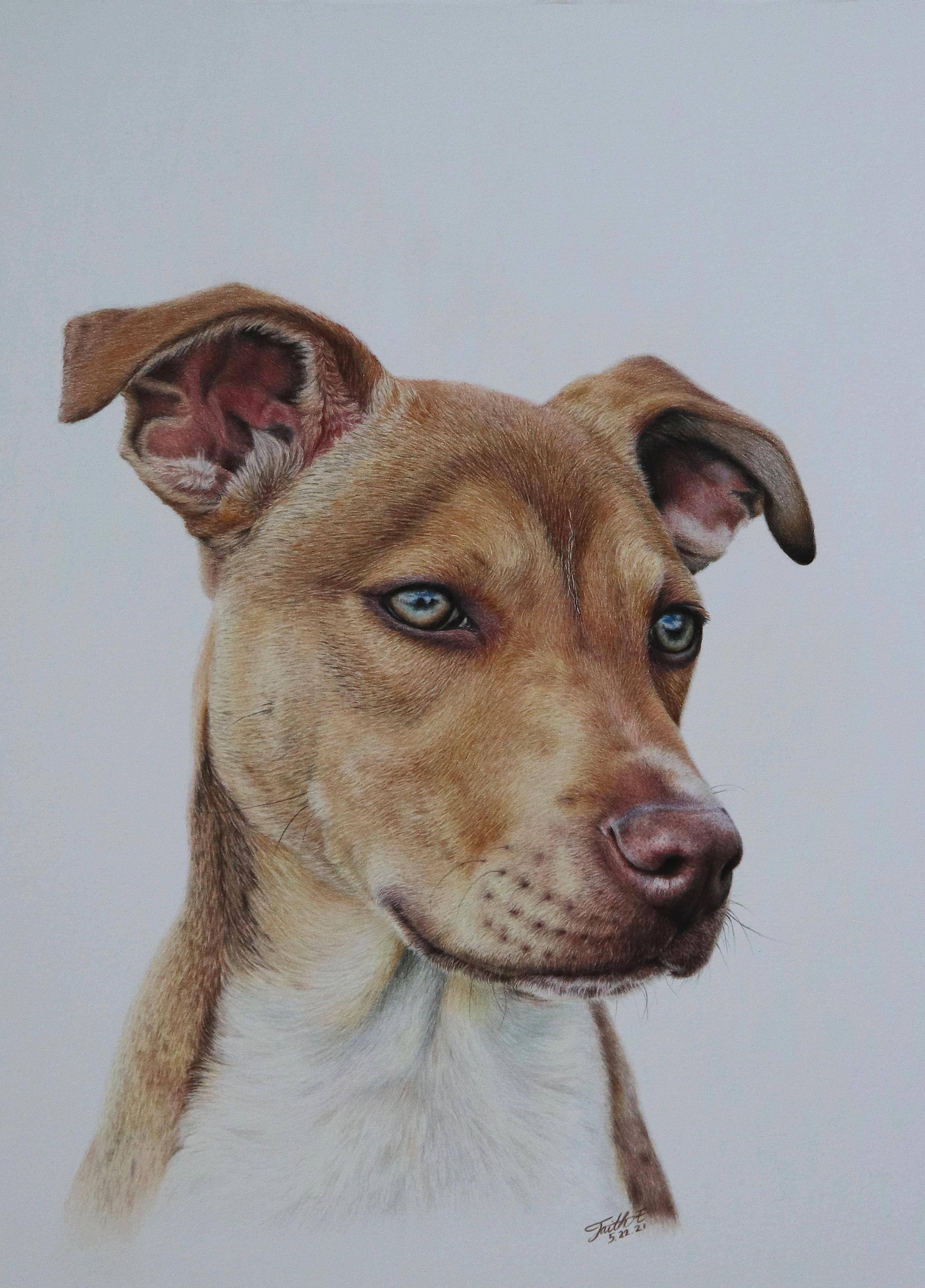
Two artists have been recognized with the 2025 Visual Arts Awards. They are Faith Etheridge of North Iowa Community College in Iowa for “Nala” and Jen Reneé Pellerin of Jefferson County Community & Technical College in Kentucky for “Kentucky Strip Mine Reclamation.”
When we first published Nota Bene in 1994, we were overwhelmed by the response from members who flooded our mailboxes with submissions, as well as from the audience who enthusiastically read the anthology. This year, we received 3,278 submissions in the literary and visual arts categories. Selection for publication remains a great source of pride. The entries of the 56 authors and artists whose work is included in the 31st edition of Nota Bene represent 1.7% of the total submissions. We are proud of all the work submitted by Phi Theta Kappa members and applaud the exceptional work of the authors and artists included in this anthology.
Nota Bene takes its name from the Latin expression for “note well.” We hope you will take note and be inspired by the work of these authors and artists. We are grateful for the continued opportunity to showcase the talents of Phi Theta Kappa members and to reaffirm our commitment to recognizing and promoting the academic excellence of students pursuing associate degrees and certificates.
Dr. Gisela Ables Advisor, Omega Sigma Chapter Houston Community College, Texas
Dr. Rosie Banks Advisor, Mu Pi Chapter Harold Washington College, Illinois
Dr. Kelly Kennedy Advisor, Beta Pi Theta Chapter Miami Dade College, Hialeah Campus, Florida
Dr. Dan Platt Advisor, Beta Epsilon Eta Capter Des Moines Area Community College, Ankeny Campus, Iowa
Dr. Terri Smith Ruckel Advisor, Beta Tau Gamma Chapter Pearl River Community College, Forrest County Center, Mississippi
Prof. Carlene Woodside Advisor, Beta Eta Alpha Chapter Southeastern Community College, Iowa
The Ewing Citation Scholarship Award of $1,000 is given to the author of the Nota Bene manuscript, considered the most outstanding of all entries. It is named in honor of the late Nell Ewing, a long-time Phi Theta Kappa staff member who was a driving force behind Nota Bene, beginning with its conceptual design and establishment. She retired in 2012 after serving 26 years with Phi Theta Kappa.
The International Poet Laureate Award of $1,000 is given to the author of the most outstanding poem. In addition to the scholarship award, the International Poet Laureate will be invited to present their poem during one of Phi Theta Kappa’s international events.
The Reynolds Scholarship Awards of $500 each are given to up to four authors whose manuscripts were deemed outstanding. These awards are endowed by the Donald W. Reynolds Foundation in Pine Bluff, Arkansas, and honor the memory of the late Donald W. Reynolds, founder of the Donrey Media Group (now Stephens Media Group).
The Visual Arts Awards of $500 each are given to up to two visual artists whose works were deemed outstanding.
Special thanks to the following Advisors, Advisors Emeriti, and Phi Theta Kappa staff or reviewing Nota Bene submissions:
Prof. Gigi Delk
Alpha Omicron Chapter Advisor Tyler Junior College, Texas
Barbara Ebert Alumna, Virginia
Prof. Jeff Edwards
Advisor Emeritus, Texas
Prof. David Elder
Advisor Emeritus, Illinois
Tammy Fuentez
Senior Director of Engagement, Division II
Phi Theta Kappa Honor Society
Prof. Sue Grove
Advisor Emerita, Minnesota
Dr. Patty Hall
Advisor Emerita, California
Prof. Mat Hermann
Honors Program Council Member, Arkansas
Prof. Connie LaMarca-Frankel
Advisor Emerita, Florida
Dr. Courtney Lange
Senior Director of Special Initiatives
Phi Theta Kappa Honor Society
Dr. Samantha Levy
Chief Engagement Officer
Phi Theta Kappa Honor Society
Dr. Lin Lin
Beta Gamma Xi Chapter Advisor CT State Community College, Middlesex, Connecticut
Prof. Kismet Loftin-Bell High Point University, North Carolina
Kristine Lowe Alumna, California
Dr. Jamie Mahlberg
Senior Director of Engagement, Division IV
Phi Theta Kappa Honor Society
Dr. Joy Moses-Hall
Honors Program Council Member, North Carolina
Dr. Dan Platt
Honors Program Council Member, Iowa
Prof. Julie Rancilio
Honors Program Council Member, Hawaii
Prof. Richard Rouillard
Advisor Emeritus, Oklahoma
Dr. Ryan Ruckel
Honors Program Council Member, Mississippi
Prof. Christine Solomon
Advisor Emerita, South Carolina
Jennifer Stanford
Senior Director of Student Leadership
Phi Theta Kappa Honor Society
Dr. Diego Tibaquirá
Honors Program Council Member, Florida
Dr. Keziah Tinkle-Williams
Alpha Sigma Nu Chapter Advisor
Chandler-Gilbert Community College, Arizona
Pattie Van Atter
Senior Director of Engagement, Division I
Phi Theta Kappa Honor Society
Dr. Nancy Weissmann
Honors Program Council Member, Ohio
Prof. Amy Winters
Honors Program Council Member, Nebraska
Advisors Emeritae are a select group of retired individuals who, after providing extraordinary leadership and achieving success at the international level of Phi Theta Kappa, are invited to continue their engagement and support of the Society based on their interests and expertise in the Society’s programs.
Dr. Susan Edwards
Senior Director of Honors Programs
Lori Brechtel
Creative Designer
Makayla Steede
Creative Content Manager
Tracee Walker
Senior Director of Student Experience
The opinions expressed in the Nota Bene articles are those of the authors and do not reflect the opinions of Phi Theta Kappa.
Copyright ©2026 by Phi Theta Kappa. All rights reserved. No part of this publication may be reproduced, stored in a retrieval system, or transmitted in any form or by any means electronic, mechanical, photocopying, recording, or otherwise, without the prior written permission of Phi Theta Kappa. Phi Theta Kappa has registered the name, logo, and various titles herein with the U.S. Patent Office.
Phi Theta Kappa is committed to the elimination of unlawful discrimination in connection with all employment relationships, business operations, and programs. Discrimination based on gender, family or marital status, race, color, national origin, military or veteran status, economic status, ethnic background, sexual orientation, gender identity, transgender status, genetic information or history, age, disability, political affiliation, and cultural and religious backgrounds is prohibited.
Wiame Benzouina
Alpha Gamma Pi Chapter
Austin Community College
Texas
Jen Reneé Pellerin
Alpha Upsilon Sigma Chapter
Jefferson Community & Technical College, Southwest Campus
Louisville, Kentucky
Roots and Wings
Farouk Elkaoukji
Alpha Iota Mu Chapter
CT State Community College
Norwalk, Connecticut
Nala
Faith Etheridge
Alpha Psi Beta Chapter
North Iowa Area Community College
Iowa
A Life Rewritten
Jessica Fisk
Alpha Omega Phi Chapter
Yakima Valley College Yakima, Washington
Stella Elizabeth Cass-Adams-Johnson
Alpha Theta Iota Chapter
Monroe Community College Rochester, New York
Caroline McGowan
Alpha Omicron Alpha
Lehigh Carbon Community College
Pennsylvania
Jannatul Tapashi
Kappa Omega Montgomery College
Emory Bless Robison
Alpha Gamma Omega Chapter Valencia College Orlando, Florida
Farouk Elkaoukji
Alpha Iota Mu Chapter
CT State Community College
Norwalk, Connecticut
Gianina
Alvin
Isaac
Mu
Emmanuel
Phi Lambda Chapter
Central Piedmont Community College
Charlotte, North Carolina
Binh Pham
Alpha Delta Delta Chapter
Tarrant County College,
Northwest Campus
Fort Worth, Texas
Kiersten M.
Beta Beta Zeta
Corning
Chyler
Zamzam
Beta
Junfeng Wang
Alpha Chi Beta Chapter
Green
Community College Auburn, Washington
Erica Nichole Record
Xi Zeta Chapter
Jefferson College
Hillsboro, Missouri
Robert Omahaboy
Alpha Omicron Alpha Chapter
Lehigh Carbon Community College
Schnecksville, Pennsylvania
Lauren Elsie Anderson
Tau Phi Chapter
Des Moines Area Community College Boone, Iowa
Lauryn Janelle Perez
Beta Nu Chapter
San Antonio College
San Antonio, Texas
Shelsy Stephany Rodriguez (Stephx)
Xi Alpha Chapter
Berkshire Community College
Pittsfield, Massachusetts
Angelina Gutierrez
Alpha Upsilon Chi Chapter
Central New Mexico Community College
Albuquerque, New Mexico
Ares
Chi Iota Chapter
Rowan College at Burlington County
Mount Laurel, New Jersey
Sydney
Valeria
Alpha
Tarrant
Eleanor
Alpha
Lake
Hanan
Tau
Prince
Alpha
Lillyan M. Johnson
Alpha Iota Pi Chapter
Flathead Valley Community College
Kalispell, Montana
Audrey Grizzaffi
Alpha Mu Tau Chapter
Collin College
McKinney, Texas
Reese Erin Caldo
Alpha Kappa Mu Chapter
Bunker
Community College Boston, Massachusetts
Rachael
Alpha Epsilon Tau Chapter Piedmont Virginia Community College
Charlottesville, Virginia
Laura Mikkelson
Rho Epsilon Chapter
The College of the Florida Keys
Key West, Florida
Haley
Tau Beta Chapter
Davidson-Davie Community College
Davidson, North Carolina
Andrea Reed
Alpha Tau Xi Chapter
Ivy Tech Community College
Fort Wayne, Indiana
Qynesha (Nesha) Kimble
Alpha Epsilon Sigma Chapter
Minneapolis College Minneapolis, Minnesota
61 Still Life with Twelve Sunflowers
Emily Ashley Garcia Villafana
Alpha Pi Epsilon Chapter
Southwestern College
Chula Vista, California
62 The Cage Below Deck
Nathan G. Throckmorton
Chi Nu Chapter
Eastern Florida State College
Melbourne, Florida
63 We are Paper, Paint, Stardust: Mixed Mediums of Being
Jamie (Florian) D. Woodall
Alpha Alpha Iota Chapter
York Technical College
Rock Hill, South Carolina
64 Still the World Spins
Rebecca E. Pringle
Chi Nu Chapter
Eastern Florida State College
Melbourne, Florida
65 Cirrus Vesper
Andy Paolo Mairena Amaya
Upsilon Rho Chapter
Angelina College
Lufkin, Texas
66 Eternal Echoes of Black Love
Milan Beauchamp
Beta Mu Omicron Chapter
Baton Rouge Community College
Baton Rouge, Louisiana
67 Galaxy of Light
Katelyn Mercedes Bruner
Alpha Zeta Eta Chapter
Dallas College, Cedar Valley Campus
Lancaster, Texas
68 Untitled
Lauren Elizabeth Klein
Pi Psi Chapter
Coastal Alabama Community College
Bay Minette, Alabama
69 The Journey to Success
Rithy Rung Rith
Tau Zeta Chapter
St. Petersburg College
Clearwater, Florida
71 Changing Leaves
Sonja Lei
Alpha Psi Zeta Chapter
Feather River College
Quincy, California
72 Lost in the Stars on Coney Mountain
Kevin Yang
Alpha Xi Sigma Chapter
Hudson Valley Community College
Troy, New York
73 The Fall of Onyeka
Rosemary Adio
Beta Delta Omicron Chapter
Tarrant County College
Arlington, Texas
75 Eye of the Nature
Rowan Chang
Alpha Lambda Xi Chapter
Lone Star College
Kingwood, Texas
77 The Train Station
Orian Ivie Gaston
Zeta Omicron Chapter
Navarro College
Corsicana, Texas
78 Echoes of Power: WWII Steam No. 4014
Kelly Irene Kokas
Pi Xi Chapter
Bucks County Community College
Newtown, Pennsylvania
I love bread!
Bread changed my life and my family’s life, and I believe that one day I will be able to change people’s lives because of bread.
In the vibrant streets of Marrakech, as the sun set behind the bustling markets and lively cafes, the heat of the day still lingered in the air, wrapping around me like a heavy blanket. I was just a child selling bread, trying to help my family make it to the next day. The sounds of laughter and chatter filled the streets, mixed with the distant calls of merchants advertising their goods. I can still feel the weight of the bread basket on my shoulders, the faint smell of fresh dough lingering as I navigated the colorful crowds, hoping to make enough sales to ease the burden my mother carried. The tourists would pass by, their curious gazes lingering on me, but I didn’t feel sorry for myself. I couldn’t. At eleven years old, I had already learned that there was no room for self-pity in survival. While my main focus was on school, I also took pride in my academic success while selling bread in the afternoons.
One evening, as the sun disappeared and the night air chilled, a French tourist approached me. He asked why I was out so late and handed me eighty euros, an amount I could never have imagined. His unexpected kindness took me by surprise, and I stood there momentarily speechless. He told me to go home, that I should be in bed at this hour. I walked home, my heart racing with a mix of joy and disbelief. But as soon as I saw my mom, reality sank in. Without hesitation, I placed the eighty euros in her hands and suggested that she bake more bread for the upcoming week. I knew it would mean more work for me, but I could hardly contain my enthusiasm. “Mom, this is our chance!” I urged, convinced that this money was more than just a gift; it was an investment that could potentially double our earnings. I’ll never forget the look on my mom’s face as tears glistened in her eyes. “Wiame,” she said, her voice shaking with emotion, “you’re the child I always asked God for.”
Yes, bread. I grew up with the smell of bread filling our home every day. Sometimes, when we couldn’t afford other meals, bread was all we had, bread with tea for breakfast, bread with olive oil for lunch, and just bread for dinner. Fortunately, my mom made the best bread in town.
People from other neighborhoods would come to try it, and soon she earned the title of “the best baker” in our small town. From a young age, I admired my parents' entrepreneurial spirit. My dad, who spoke five languages, often worked as a tourist guide. I loved his creative ideas and once asked him, “Why didn’t you open a business?” He replied, “Life is hard, and we don’t have the money to start one.” I didn’t fully understand, but I believed there had to be a way. I went to school that morning. I was constantly thinking about his words. When I returned home, I couldn’t sleep that night, thinking of how to help. At 5 a.m., I woke to the smell of my mom baking bread. That’s when it hit me: bread could be our business. I asked her to make extra bread that day, and she happily agreed. I took a basket of it to the city center, where locals and tourists gathered. Thanks to the languages my dad taught me and my natural communication skills, I easily connected with tourists. They were surprised when I spoke their languages, even just a few words. Many tipped me, impressed by my effort and stories. Soon, I had regulars who recommended
me to friends and family, and I became their go-to guide in Marrakech. By the end, I had two side hustles: selling bread after school and working as a tourist guide on weekends.
I always felt out of place in my small community. In a society where girls were expected to grow up, marry, and live a life dictated by tradition, I dreamed of something different. While the girls around me accepted their futures, I dedicated my Mondays and Wednesdays, after finishing my homework at school and not having to sell bread, to a local internet café. One of my mom’s loyal bread customers allowed me to use the computers in exchange for a loaf of bread. For an hour at a time, I explored a world far beyond my small town, desperately searching for a way to escape the life that seemed predetermined. That’s when I discovered the Diversity Visa Lottery. I went home and told my parents about the lottery, and though they were skeptical, I convinced them to apply. A year later, we won. In that moment, everything shifted. I could feel the chains of limitation breaking. When I arrived in America, the challenges didn’t stop. We faced financial struggles, cultural adjustments, and language barriers. But I kept pushing forward, knowing that I couldn’t let this opportunity slip away. I taught myself English, working through the confusion and frustration, finding joy in every word I learned. My grades suffered at first, but I refused to give up. I knew I was capable of more, and soon, I began to improve.
My journey has not been easy, but I wouldn’t change a single part of it. Every struggle, every moment of doubt, has made me stronger. I carry my past with me, not as a burden, but as a reminder of how far I’ve come.
Without bread, I wouldn’t be here today. I wouldn’t have met the tourists or discovered the Diversity Lottery at my mom’s bread customer’s café. I wouldn’t be here today, writing an essay for Nota Bene. I know this is just the beginning. I don’t know what the future holds, but one thing is certain: I was not born to settle. I was born to succeed, to create change, and to leave a legacy of hope for those who come after me.
Farouk Elkaoukji
I grew up between silence and chaos, Where the nights hummed with dreams too big for our small town. The sun painted shadows on cracked sidewalks, And I learned early that even broken things can bloom.
The kitchen smelled of stories untold, Bread rising with whispers of sacrifice. My mother’s hands, calloused yet tender, Taught me that love is often unspoken, And strength wears the face of quiet endurance.
I watched my father chase the horizon, His eyes a map of every hope he couldn’t hold. He built a life out of second chances, Teaching me that failure is a beginning in disguise.
But I, I was the child with restless feet, Who scribbled questions into margins of notebooks And sought answers in the wind. I didn’t want roots, not yet— I wanted wings.
I ran to the edges of what I knew, Where the sky kissed the earth in impossible blue. There, I found my own rhythm, My own heartbeat echoing in unfamiliar places. The world became a mosaic of colors, And I collected pieces of myself From every sunrise I dared to meet.
Now, I carry the roots with me still— A quiet anchor in this wild storm. But the wings, oh, the wings—they never stopped growing. They carry me back and forward, To a place where dreams bloom In the cracks of impossibility.
And when I return, feet touching familiar soil, I see now that roots and wings are not opposites. They are the balance of who I’ve become— The child, the dreamer, the seeker. The one who learned to rise, And still remembers where he began.
Faith Etheridge Alpha Psi Beta North Iowa Community College Mason, Iowa
Media: Colored Pencil on Paper
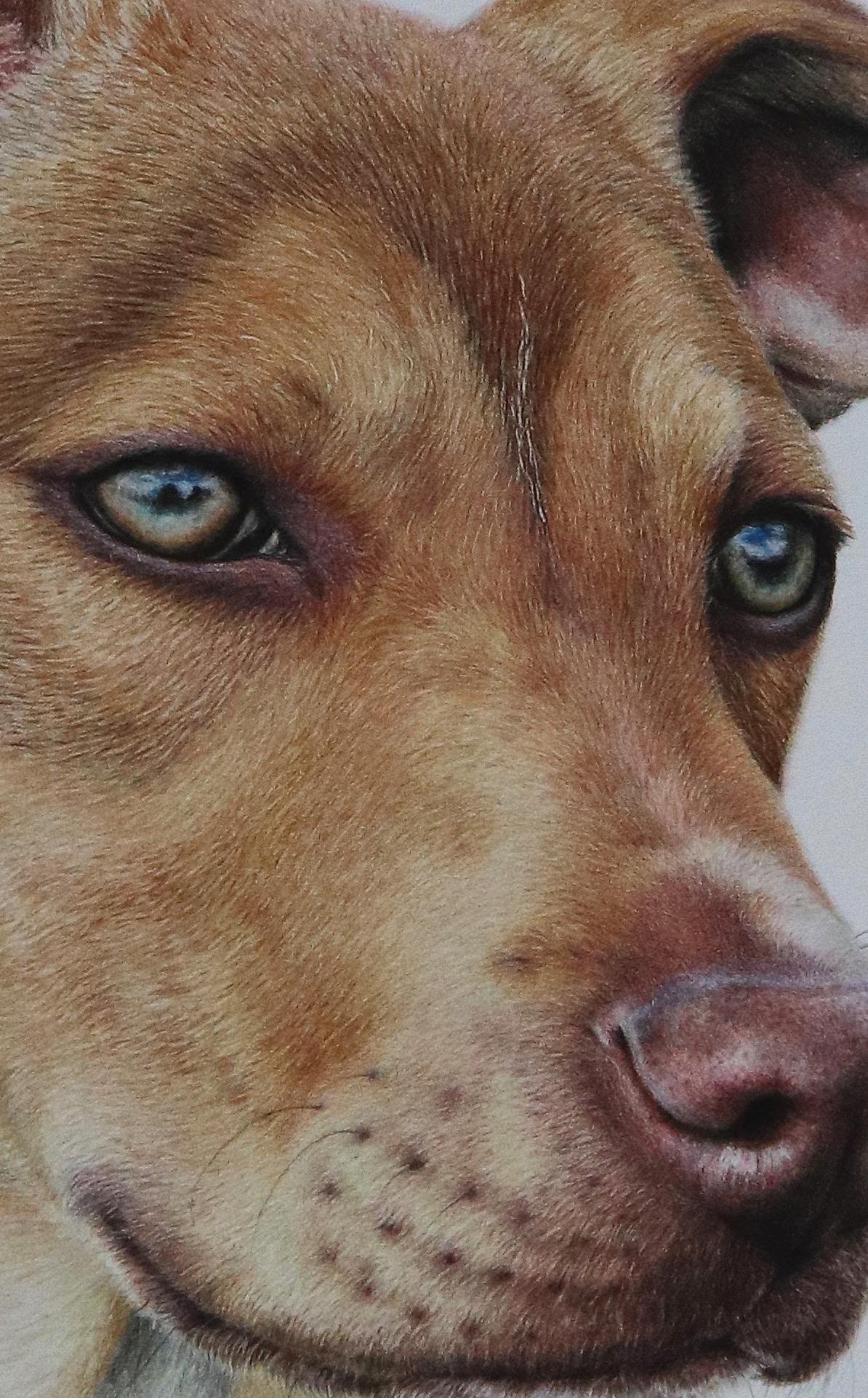
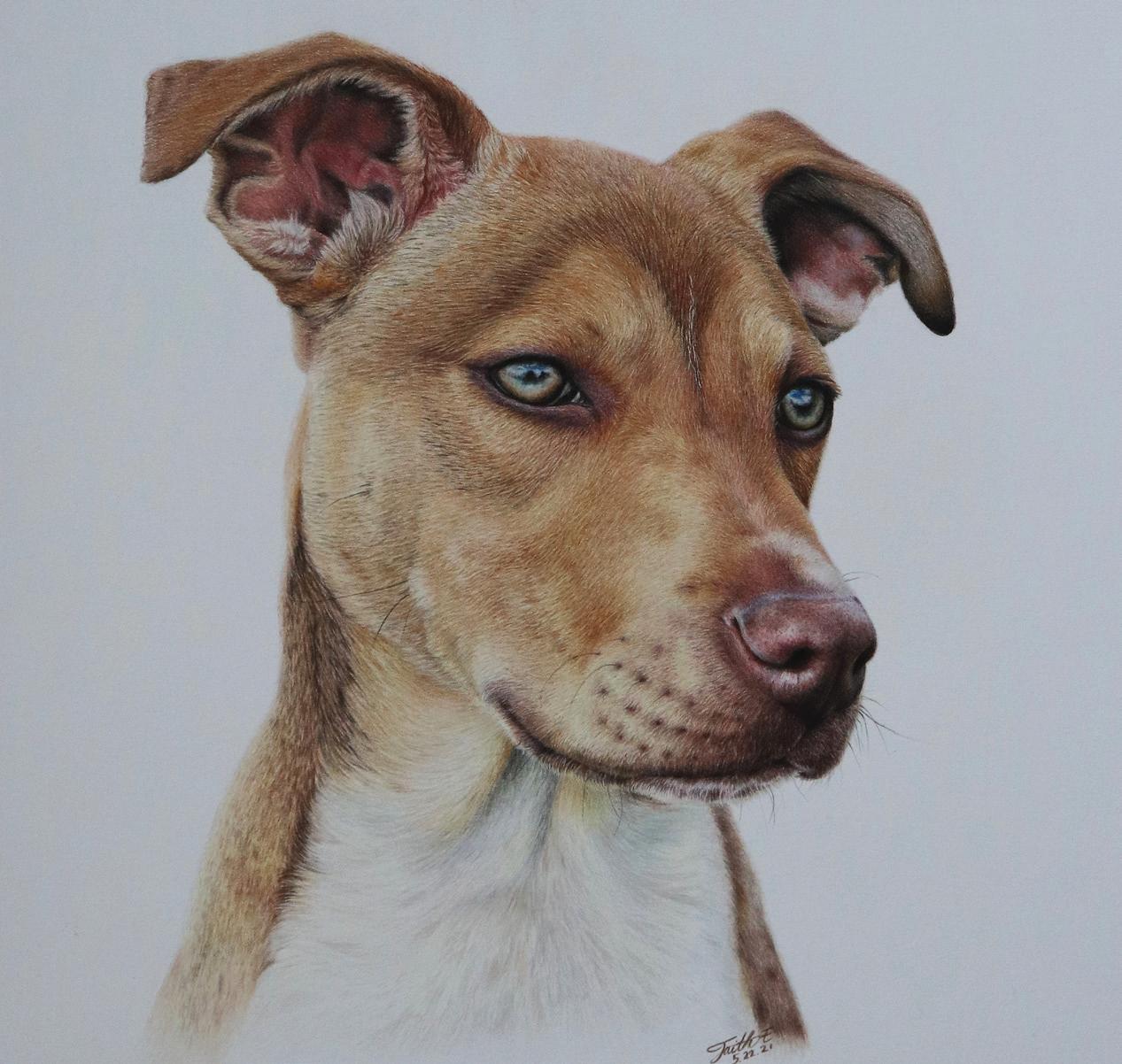
This is a colored pencil portrait of my dog, Nala. She’s a mix of breeds, but primarily Pit Bull Terrier and Greyhound. My family and I adopted her from a shelter as a puppy, and since then, she has brought so much joy into our lives. Even though I completed this portrait a few years ago, it remains a piece that I am immensely proud of as it truly pushed me to grow as an artist.
This piece was completed over a couple of months. I worked in sections, starting at the top-left corner and working toward the bottom-right corner. This ensured that the finished areas did not smudge as I worked on the other sections. I took care to gradually build up the layers of pigment to fill in the paper's grain and create depth in the fur. I then used a burnishing technique on the final layers to add deeper values and smooth out the layers beneath, before adding the last bits of detail, such as whiskers and the subtle shadows cast by individual hairs. I also lightly glazed on brighter tones to capture how her fur reflects the lighting around her, which, in my reference photo, was a field of green grass and dandelions. The shadows in her fur include subtle hints of pink, purple, and blue, while the highlights have warm green and yellow tones.
This piece is essential to me because there are so many unadopted pit bulls in shelters due to the negative stereotypes surrounding the breed. And yet, so many of them are as sweet as can be. It makes me so sad to think of all those who never find a home simply because people are afraid of them. Nala’s sweet nature is evidence that with a caring family, pit bulls can be wonderful companions, and I sought to emphasize this in her portrait through my use of color and each defining detail that creates a calm expressiveness in her eyes. The drawing reflects both my technical growth as an artist and my personal connection to the subject, demonstrating patience, attention to detail, and the ability to communicate emotion through realism.
Caroline McGowan
I fold my thoughts into paper boats, edges sharp, creases pressed clean. Set them loose on the slow-moving current, watch them drift where I cannot go.
Some cling to the bank, held fast by roots, others spin, caught in quiet surrender. A few cut straight through the shifting light, carried swift toward what waits unseen.
The river doesn’t ask where they came from, or if they will make it to open water. It only moves, and they move with it, until the paper softens, the ink runs, and they are lost to the tide.
Jannatul Tapashi
Kappa Omega Montgomery College Rockville, Maryland
The first time someone paused before saying my name, I knew I was different.
"Jannatul… Maria… Tapashi?" they would hesitate, eyes flicking up from the paper, waiting for me to confirm. I always smiled, nodding. It wasn’t just a name—it was an entire story, packed into three words.
Jannatul, rooted in Arabic, a name meaning "paradise." Maria, a Christian name, a quiet echo of my school years surrounded by hymns and prayers. Tapashi, drawn from Hindu tradition, a tribute to the heritage that shaped my family.
I used to wonder if my name confused people as much as it fascinated me. Some expected me to fit into one neat box, but I never could. I carried three cultures, three histories, and three worlds within me. I was Bangladeshi by birth, Christian-schooled by childhood, and globally curious by heart.
But having a unique name was only the first hurdle. The second was finding my voice in a world that didn’t always wait for me to catch up.
English was not my first language, but it was my bridge to the future. Every word spoken in class felt like stepping on a shaky rope, one misstep away from tumbling into silence. I had opinions, ideas, questions—but my tongue held them hostage, fearing the weight of an accent, the possibility of saying something "wrong."
Then, life tested me in ways I never expected. Just as I was ready to step forward, I had to stop. A medical condition, one that drained my energy but never my determination, forced me into a year-long pause. While others moved ahead, I stayed still, caught between frustration and quiet acceptance.
But stillness has a way of teaching lessons. I learned patience. I learned resilience. I learned that time doesn’t take away dreams—it just asks if you’re willing to wait for them.
When I returned to college, I was no longer the girl afraid of words. I spoke, I wrote, I engaged. I wanted to study International Business, not just to learn but to connect. To bridge cultures the way my name had always done. Jannatul Tapashi – A Name That Travels
Now, when someone hesitates before saying my name, I let them. Because my name is a journey. And just like my life, it’s still unfolding.
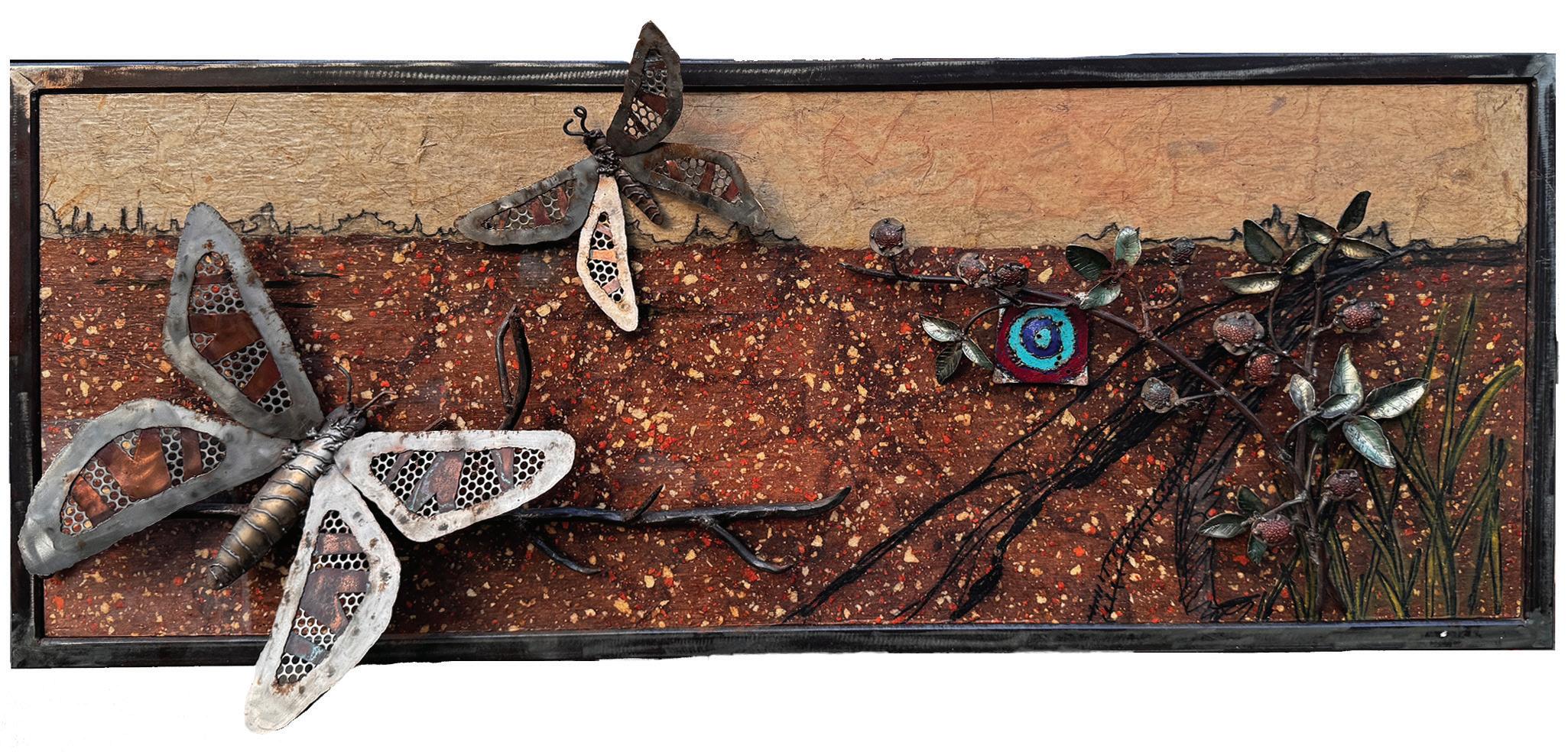
Kentucky Strip Mine Reclamation -2025
Hand worked and forged steel, stainless steel, copper and enamel on wood
I worked as a full-time artist/sculptor until March of 2020, when my studio (Steelskin Studio+Gallery) was forced to close due to the pandemic. I was unable to continue making a living as an artist in the years that followed, so I decided to return to school at Jefferson Community and Technical College to pursue a career as a Radiography Tech to feed my family. The metalworking techniques I had honed over twenty years have been set aside. I was invited to join Phi Theta Kappa this past fall and saw an opportunity to submit visual arts entries to Nota Bene. I thought it was a great opportunity to get back into the studio. This is the first of two works I completed.
As a native of Kentucky, I should always keep in mind to explore my environment and where it is now. I might, through this exploration, creatively express myself so others can recognize the need for change. Kentucky is known for its coal mining, past and present. While visiting the foothills of Eastern Kentucky, where my spouse was raised, I got a glimpse of what is left after the coal is gone. The strip mine, where the tops of the hills or mountains are taken of and the coal removed, is flattened, and shows the scars.
My work, “Kentucky Strip Mine Reclamation,” is an exploration of what is seen now. Cars abandoned there have their hoods used for target practice, blackberries are proliferating, insects and grasses are growing, and ATV trails are numerous and crisscross the flat surface of what is now just a large field. I drew a few sketches of the landscape, and then designed a wall sculpture with 3D elements. Some of the applied elements, such as branches and leaves, are hand-forged, using coal from the same area. The stainless steel and copper butterflies represent present-day uses of these materials in industry.
Jessica Fisk
I was a child raised by the law, Not in books, not in lessons, but in flashing lights, In boots kicking down doors, in sirens that howled Through the cold, sleepless nights.
SWAT, marshals, DEA, DOC— Names I learned before my ABCs. I watched them take my family away, One by one, like leaves torn from a dying tree.
I asked myself, When does it stop?
When do I wake up to something new?
Not the moving trucks, not the whispers in school, Not the looks that said, Stay away, we don’t trust you.
I longed for my mother, but she was lost— Drifting in a world of smoke and spoons, A place where love had no language, And time moved in highs and dooms.
No bedtime stories, no soft goodnight, No birthdays filled with candlelight. No sleepovers, no park swings in flight, Just the weight of a world that never felt right.
Anxiety curled up beside me at night, A shadow I learned to call my friend. Then came depression, soft and slow, Sinking in, whispering, This will never end.
Some days were golden, brief and bright, Trips that glittered like fool’s gold. But they weren’t vacations, not in the way That warm hands and laughter unfold.
We had money. We had things. A house that could rival the best.
But what is a home without love?
Just a roof and walls, nothing more, nothing less.
And so I learned, young and small, To be a spy, to watch, to crawl— Up to the window, eyes on the street, Reporting back, my voice discreet.
Below, in the cellar, where the fumes would rise, I’d gag, I’d blink, but never cry. Because this was normal, this was life, This was how we all survived.
And then the raids—again, again, Like a cycle that never broke. The lights, the voices, the cuffs, the chains, The smell of fear, the haze of smoke.
One day my mother asked me, Are you scared? And I only blinked, confused, Because how could I fear the air I breathed, The only life I ever knew?
I wasn’t scared, I was numb. Sad for the faces that vanished each time, But fear? No, that was long gone. This was routine, a familiar rhyme.
Then one day, I came home from school, And the silence felt too loud. No mother, no voices, no movement, no sound— Just emptiness stretching out.
I should’ve felt panic. I should’ve cried. But instead, a weight lifted inside. For the first time, I wasn’t holding my breath, Waiting for chaos, waiting for the next step.
I sold my things for my mother’s bail, Watched her walk free, then watched her fail. She was here, then she was gone again, A ghost drifting in and out of my hands.
And that was it—the spiral began. A freefall into darkened days, Lost in a world I never asked for, Searching for light in endless haze.
But something inside refused to break, Refused to end, refused to fade. I held on tight to something small, A spark, a whisper—I was made for more.
So here I stand, scarred but whole, A child of war who healed her soul. Not trapped in fumes, not bound in chains, Not a shadow swallowed by pain.
I walk the halls of knowledge now, With books in hand and dreams so loud. Chasing a future they never knew, Becoming everything they couldn’t do.
I am not my past, though it made me strong, I am not their choices, I write my own song. I am light where darkness grew, I am proof that hope breaks through.
No more hiding, no more fear, No more waiting for them to disappear. I have built a life they never could, And no one—no one—will take it away.
Stella Elizabeth Cass-Adams-Johnson
Alpha Theta Iota
Monroe Community College Rochester, New York
i have known racism since i was a little girl since i thought the word monkey meant cute and not primitive, not imperfect, not inhuman when i found out what it meant i spent the whole day crying and trying to explain how i felt because even at seven i knew how much hate this world held for people like me
little black girl, do you know how many stars how many universes came together to form you?
your brown eyes and tourmaline skin and i hate that they compare you to chocolate.
little black girl, how do i tell you this world has a place for you when i have not yet found it?
little black girl, how do i promise you a world that still hesitates to accept your skin built of tiger’s eye and smoky quartz and i hate that they compare you to chocolate
i hate that they call you chocolate and cocoa beans and brown sugar and treat you the same as those very foods and eat you up and spit you out and take all of you and give nothing back.
little black girl, you are more than skin you are beauty and strength and masculinity and femininity and you are important, oh, little black girl, you are so, so important.
little black girl, i am sorry that you face a punishment for a crime that you did not commit, for a crime that does not exist, because to live and be black is not a crime, and you are not at fault for doing so little black girl, i am so, so
proud of you.
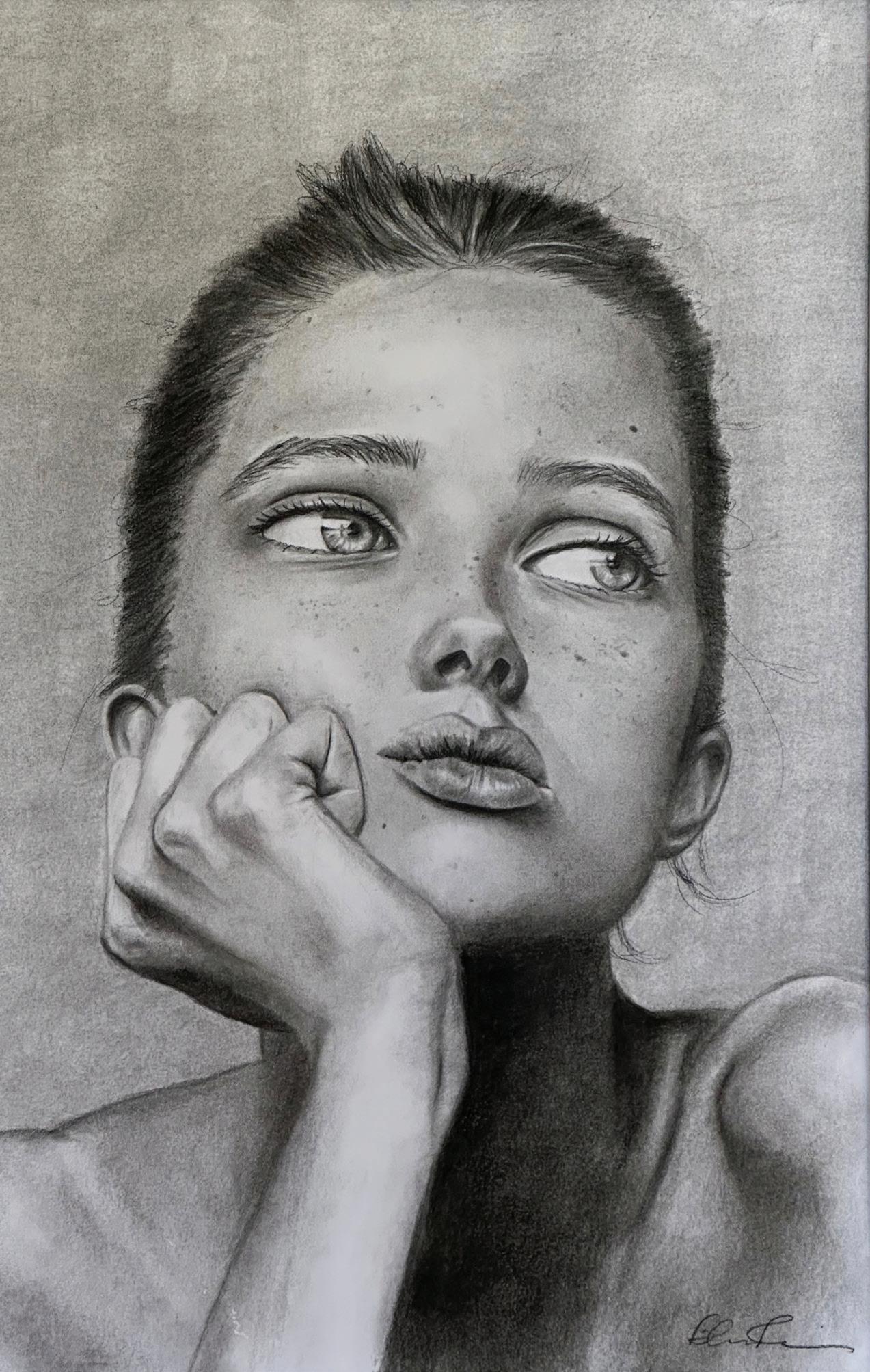
I created this portrait after seeing a photograph of a young girl. I wanted to challenge myself with a new perspective, and I liked the way her face rested in her hand. For the creation process, I used blending stumps, chamois, and a dry paintbrush to distribute the value. I also used a kneaded eraser and a Tombo Mono Zero eraser.
Farouk Elkaoukji
Alpha Iota Nu CT State Community College Norwalk, Connecticut
The sound of my mother’s prayers was the first melody I ever knew. It floated through the thin walls of our home, mixing with the creak of floorboards and the hum of an ancient refrigerator. Her voice was soft, steady, and unyielding, a quiet rebellion against a world that often turned its back on her.
We lived simply, with a fraying couch that sagged in the middle and a kitchen table that bore the marks of countless meals and hurried homework sessions. It wasn’t much, but it was ours. My father worked double shifts at the factory, his hands calloused and his eyes tired. He never complained, but I noticed the way he winced when he thought no one was looking, as though the weight of his sacrifices had settled into his bones.
I was twelve the first time I understood what it meant to carry the weight of quiet things. It was a rainy Tuesday, and the roof had sprung a leak. My father climbed a shaky ladder with a roll of duct tape, muttering under his breath about fixing it “properly” when payday came. My mother stood at the base, holding the ladder with both hands as though her grip alone could keep him safe. I wanted to help, but they told me to stay inside.
I sat at the window, watching the rain soak through my father’s jacket and drip from his chin. I wanted to believe he was invincible, that he could hold the world on his shoulders without faltering. But as I watched him wrestle with the stubborn patch of duct tape, I saw the truth. My father wasn’t a superhero. He was just a man an extraordinary, ordinary man who refused to let the storm win.
That night, as water dripped into a bucket in the corner, I lay awake and listened to the rhythm of my parents’ whispers. They were planning, strategizing, finding ways to make it all work. My mother’s voice was calm, my father’s resigned but determined. I didn’t understand all the words, but I understood the weight they carried the weight they carried for me.
Years later, when I left for college, my mother handed me a small notebook. Inside were her prayers written out in her careful, looping script. She told me they were for strength, for guidance, for hope. “For you,” she said simply, as though those two words explained everything. And they did.
Now, every time I face a challenge, I think of that rainy Tuesday, of my father on the ladder and my mother at its base. I think of the weight they carried so I could stand tall. I think of the quiet things the sacrifices, the prayers, the love that built the foundation of my life.
The world is loud, demanding, and often unfair. But I’ve learned that it’s in the quiet things, the small, unspoken acts of care and courage, that true strength resides. And it’s that strength that I carry with me, every step of the way.
Gianina Rockwell
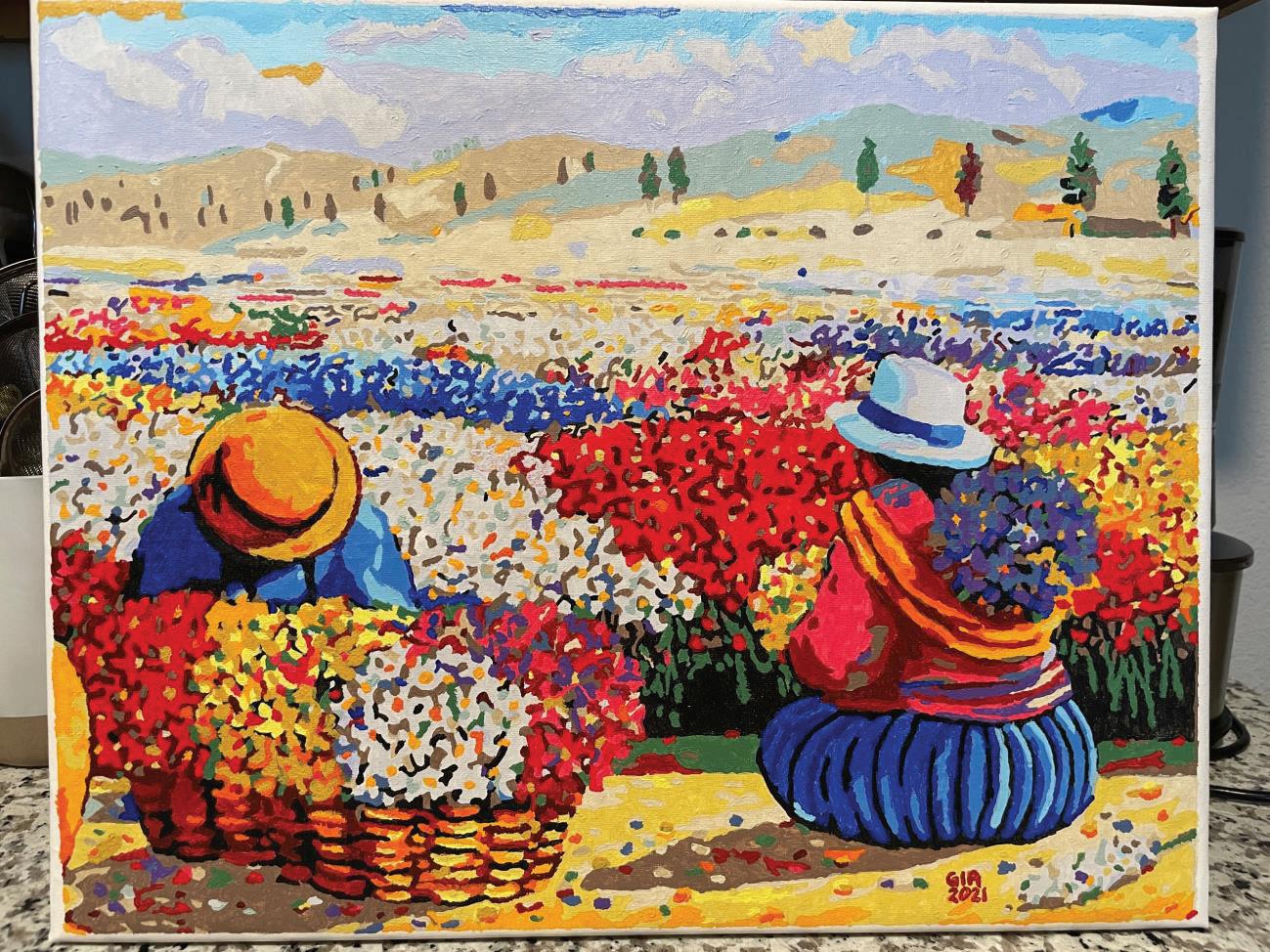
This painting of two laborers tending to a field of vibrant flowers resonates deeply with the immigrant experience. Like the figures in the painting, many migrants, including Filipinos, work tirelessly to build a better life, often in unfamiliar landscapes. The woman’s traditional attire symbolizes cultural heritage, carried with pride despite being in a foreign land. The endless rows of flowers represent opportunity—fields of dreams waiting to be cultivated. As a Filipino migrant, this piece reflects both the struggles and the beauty of hard work, perseverance, and the deep connection to one’s roots while forging a path in a new home.
Isaac Madalinski
Mu Nu Lake Michigan College Benton Harbor, Michigan
I have played baseball for as long as I can remember. When I was a little kid, it was more of a thing my parents forced me into doing. As I got older, however, it grew from something I was forced to do into something I held a great passion for. Baseball has transformed my life in multiple ways, even if it is a game at the end of the day. Throughout all of these life lessons baseball has taught me, I learned the most important one this summer during the National Travel-Ball Cedar Point Tournament.
I had never played travel ball before. I had always played for my school, and the idea of joining a club was weird to me. However, I wasn’t happy with my progress during High School ball the year before, and, wanting to prepare myself for varsity, I went on a search for the best travel ball team I could find. There were many travel teams available, and the hard part was picking the team that was the best fit for me. On top of this, there was always the possibility that the club could not want me, which made this process even harder.
Nevertheless, a month later, I found a club I was interested in. They called themselves Chaos, and, to say it frankly, they were one of the worst ball clubs I had ever seen. Coming back home after the first day of tryouts, I remember thinking about how sloppy the team was playing overall, and how badly Chaos would lose to more organized and professional clubs. Even with the drawback of losing games, I saw potential in a lot of the players, and the coaches really stood out to me. Along with this, I saw myself getting a lot of playing time (as Chaos was struggling to get new players). After the first tryout, the head coach texted me to offer me a spot on the club. I accepted right away.
A week later, my team and I took the field for our first game of the summer. The heat beat on our backs as sweat dripped down our faces as if we had just gotten out of a pool. We were playing the Warriors, one of the best teams in our league last year (they were undefeated). Even with this being said, our club had got some new players, and we were hopeful that we would stand a chance against them. This was true, at least at the start.
The first inning went by without any trouble. The Warriors' shortstop hit a soft grounder off the tip of his bat. The ball slowly hobbled down the field towards me like a little kid on a trampoline, trying to get higher but not having enough momentum to do so. I quickly fielded the ball and fired it over to our first baseman, abruptly ending the inning. This continued for a couple of innings before my team slowly began to break down.
Our ball-playing ability was equal to the Warriors', but it was clear our players lacked the confidence that the other club had. Along with this, none of us held the same team bond and relationships with each other, and you would regularly see our players fighting over the ball to the point where neither of them were able to get to it, resulting in the runner being safe.
After numerous hours of play, and after putting our blood, sweat, and tears on the field, it was clear that my club just couldn’t keep up with the Warriors. After the game, our coach sat us down as he held his hands over his face, not saying a word. “Anyone know what the score was?” He asked us finally. We all looked at each other and shook our heads. “Warriors-15, Chaos-0.” He spoke. The entire bench went silent. Our coach stared at the ground as he shook his head, sending small droplets of sweat flying off his face. He softly pounded his fist into an old first
baseman's glove, slowly hitting it harder and harder until he was punching it as hard as he could. It was clear he wanted to win.
Next practice, we left it all on the field. We worked on fielding, hitting, pitching, catching, running, and probably a hundred other things that I don’t even remember. Our coach took us to the brink of exhaustion. At first, we all thought it was just one bad practice. But then there was another after another. Our coach kept on working us hard, and, looking back on it, it didn’t really help us as a team. Within the month, we had lost to The Raptors, The Bandits, and The Aces. It seemed as if no matter how much work we put into practice as a team, none of it mattered. It was almost as if we were meant to lose.
Before we knew it, it was the end of July, and our travel season was coming to a close. We had only one tournament left in the season, and considering we were already 0-4, it wasn’t looking too good for us. Nevertheless, I was looking forward to it, as it was at least an excuse to drive all the way down to Cedar Point and go on rides with my teammates. It wasn’t until we got down there that I realized I didn’t really know any of my teammates that well. Yes, I might know what position they play, how good they are with their gloves, and how far they can hit a baseball, but I didn’t really know who they were as people. I didn’t know what they liked to do, what interested them, and overall what their personalities were like. So, I made it my goal to try and get as close as I could with my teammates, even if it was our last tournament.
Whether it was going on rides to the point of puking or ding-dong ditching different hotel rooms, my teammates and I had a blast. It was the most fun I had in a while, and I was so surprised that I had just now realized how chill and supportive my teammates actually were, and how I was so determined to win the games that I had lost focus on what really mattered, and that was having fun. With this mindset locked in my head, I went to bed early that night, preparing for the game ahead. If we wanted to stay in the tournament, we would have to beat our nemesis: The Warriors.
The sun beat down on us the whole game, making it impossible to concentrate. It was the bottom of the fifth, and I was up to bat. The bases were loaded, and this was our first chance in the game of scoring and getting closer to overtaking the Warriors 1-0 lead. I gripped my bat tightly as I stepped into the batter's box, legs shaking. I stared at the pitcher as he brought his leg up, preparing to rifle the ball into the catchers’ mitt. Timing him up, I loaded my hands back and let them fly as soon as the ball was close enough. I sent the ball zooming through the air with a crack of my bat. It went flying over the center-fielder's head as he turned and ran. My coach (who was half asleep on the sideline) suddenly jumped, as he watched the ball flying through the sky. A surge of energy filled him as his hands flew up into the air, signaling our runners to come home. Just like that, Chaos was winning 2-1, and we were all having the time of our lives. The bench erupted in the most noise I’ve heard all season as they began cheering on the people playing. For the first time ever, we felt like more than a team; we felt like a family.
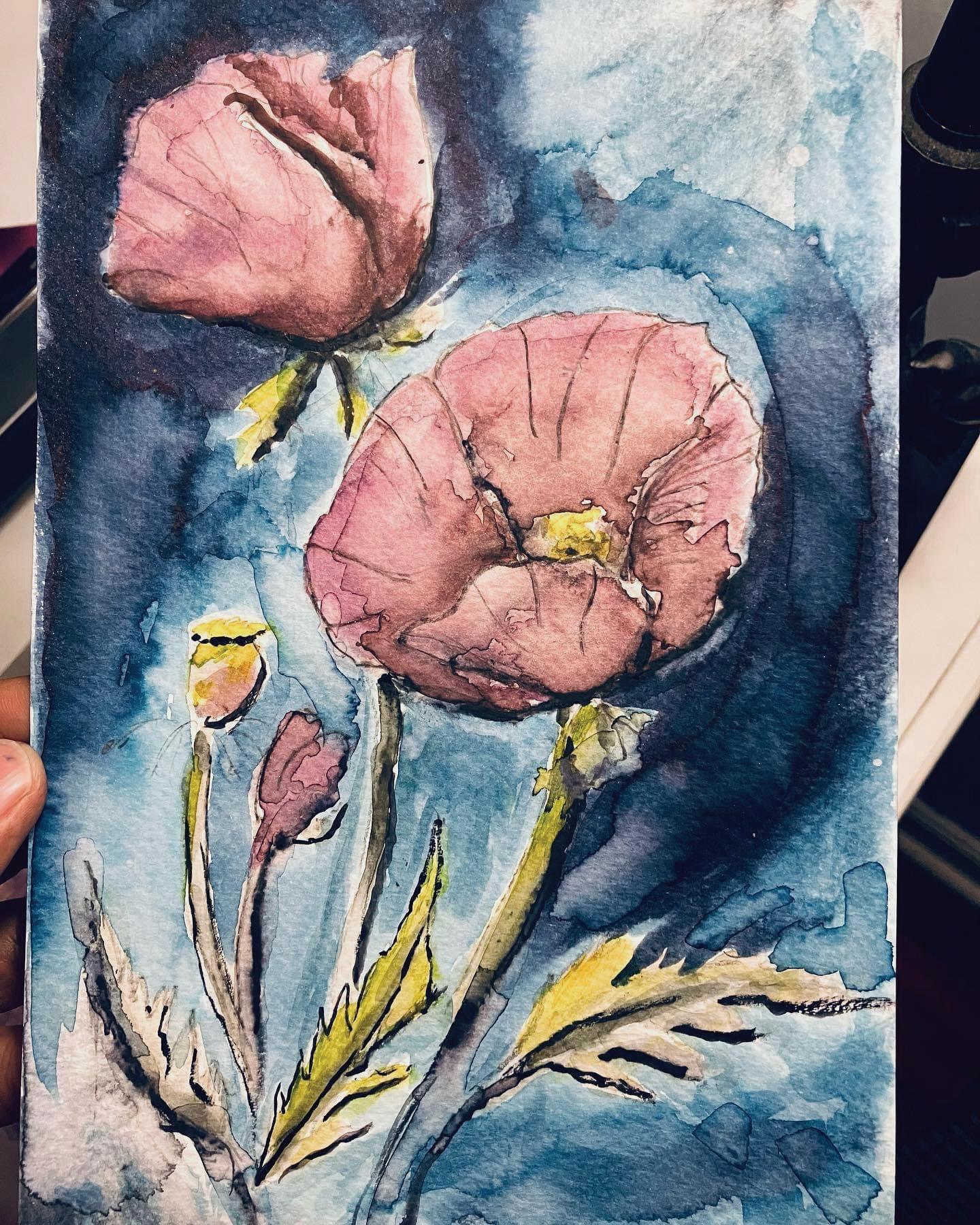
Media: Watercolor and Fountain Pen Ink on Watercolor Paper
I created this painting to show that there can be beauty within somberness and melancholy. To create this piece I sketched the poppy outline on watercolor paper. I used watercolor to fill in the flower's colors. I then used fountain pen ink to add depth to the poppy and provide some shimmer in the dark background.
Binh Pham
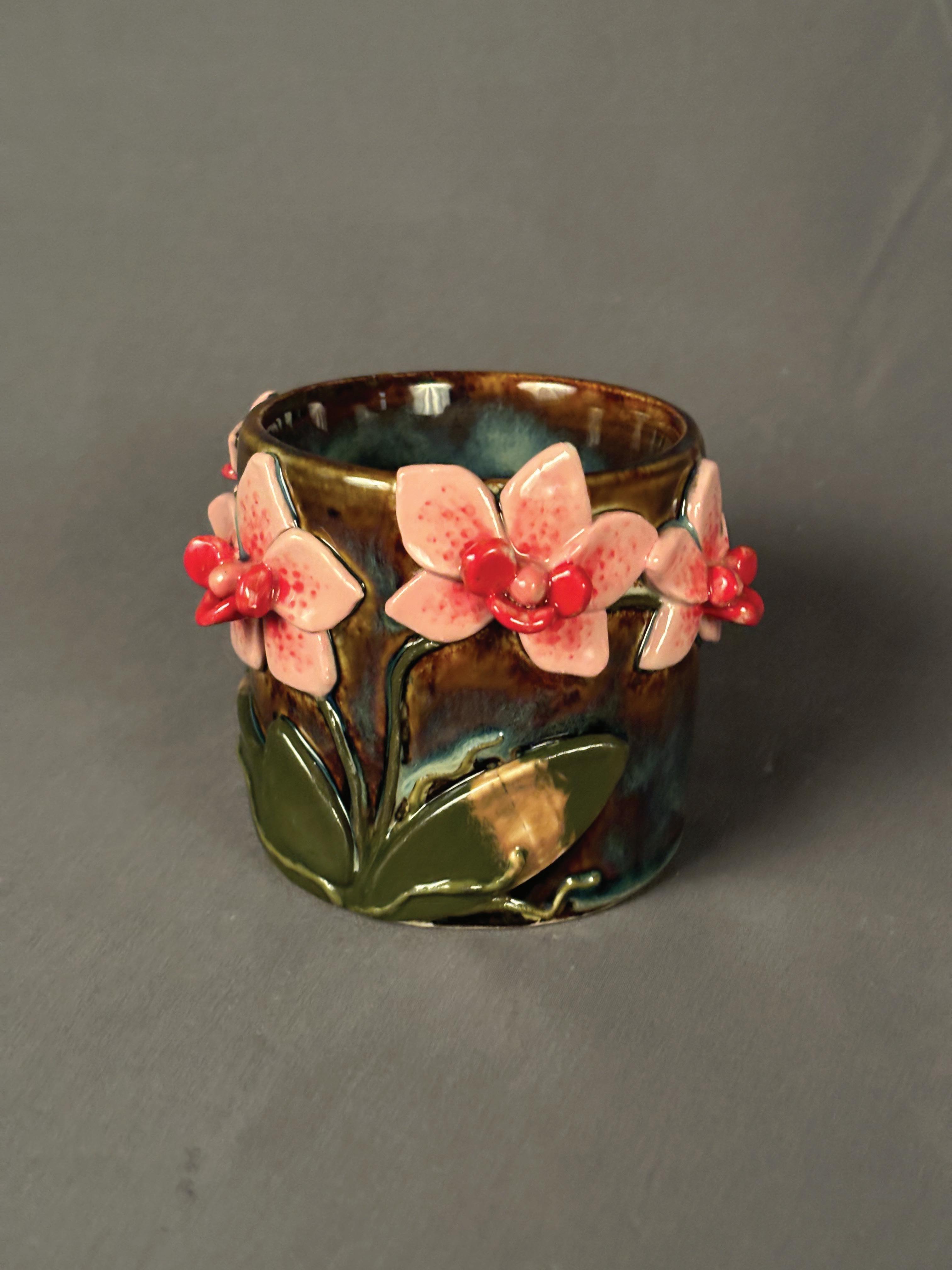
Clay, Ceramics/Sculpture
My love for nature has inspired me to capture and preserve its beauty through art. In particular, orchids have always caught my attention, and I want to create my own everlasting orchids.
For this piece, I threw 1.5 pounds of clay on the wheel to create the cylinder-shaped vessel. When it was dried to a leather-hard stage, I individually sculpted each petal and leaf to slip and score together. As for the stems, I used applicator bottles to create a slip trail to connect the flowers to the leaves. I then bisque-fired it at cone 05 and glazed each flower with underglaze to capture the details. I sealed the flowers and leaves with wax and put the overglaze it and fire it at cone 6 for the shiny look.
Kiersten M. Huffman
When you’re writing use your timing, Create a rhythm, a rhyme, a motion, a movement, give it tempo and time, repetition. So you can convey, your idea of the day. through not what you say, but how you relate to the time and the date. Now wait, sit, take the beauty of it, Tear it apart, bit by bit. What do you get? Elements of lit?
More like a dissected pile of bullshIT doesn’t make a difference. no one will understand your inference, except in that one instance: Where maybe There may be a person to see, Past the rhythm, the rhyme, the motion, the movement, past the tempo and time to recognition. Of the relevant relation within our reality between what our eyes read, and our minds see.
Acquiring empathy alludes to the accidental access of emotion.
An ocean, of faith, frustration and the fear of feeling, flood forward fusing within. Fixing forth for further examination a more detailed demonstration of the eerie relation between
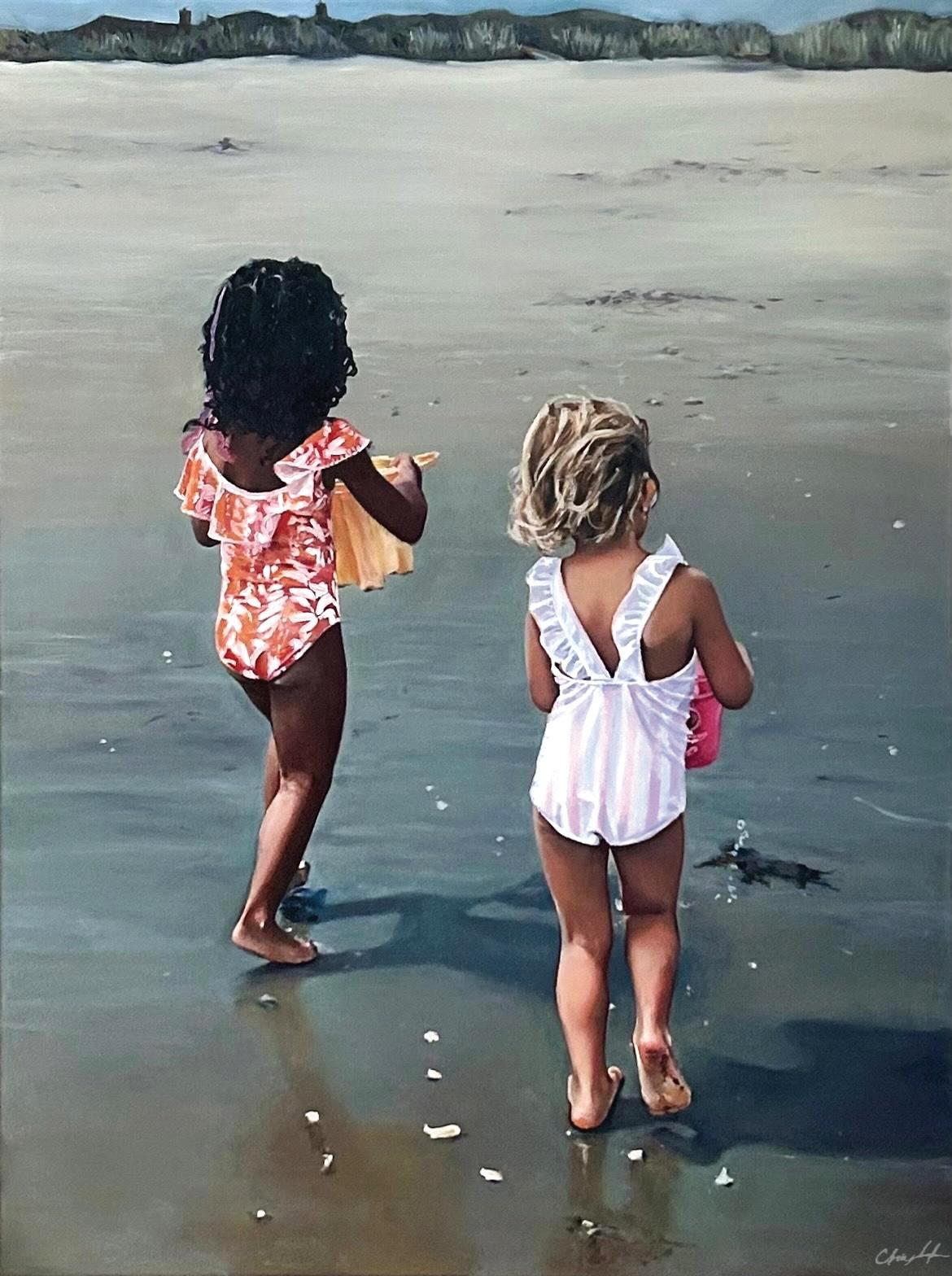
I created this painting as a commission from a woman who asked me to paint her grandchildren on the beach.
I sketched the image by holding my phone next to the part of the 30x40” canvas I was drawing on, zoomed in on the part of the image I was drawing. I then went over the sketch with a wash (paint thinner and orange oil paint) to create an underpainting. I then mixed my color palette and began painting from the darkest to the lightest areas, first the faces, then the bodies, then the background. However, I had to continuously repaint the water until I was happy with the blending of the water into the sand, trying to create the illusion of shallow water. Finally, after letting the paint dry, I added details with a fine-tipped brush to blend the subjects (the two girls and their buckets) into the background.
Zamzam Abdul Fadhil
Her eyes drawn, like the woody scented henna traced on her palms These intricate patterns lead her to the Nile where her gaze meets the yellowish sun And the golden rays embrace her
Her skin deep, like warm cinnamon—smooth and luminous, like creamy Shea Nilotica only grown in the Nile River Valley, a region she calls home
Her hair, coarse yet silky, like the soft evergreen leaves of an acacia tree that grows tall just like her
Her lips, full and prominent, curve like the delicate shoulders of her embroidered gomesi, a gown she wears with grace.
Her nails, smooth like the soft edges of an almond, and honed like the pointy tips of an almond.
As she looks to the side, her chin is carved, like her precious gap— a symbol of beauty in her culture, an heirloom of her ancestors, etched into her features.
Her cheeks warm like the smoky aroma of cardamom steeping in her brewed chai a warmth that comforts her long after the cup is empty.
Her head draped in a crimson shawl like reddish skies at early dawn in mbale and soroti
Her pigmented woven shawl, interwoven with all my memories. Of the reddish millet porridge served for breakfast And the red ground beneath my feet, adorned with vibrant beads on my sandals.
As I watch her unravel, each thread coming apart, I look closer and the more I see the more she looks like me
Am I like her?
She likes to eat ugali with savory smoked tilapia, savory like fish masala seasoning
I always prefer it with sweet steamed groundnut stew sweet like a creamy peanut butter spread
My vision is clear like the stream in Lake Victoria, but am I like her?
I wear the voice of my neighbor, the style of an influencer, and the attitude of a westerner.
But I do look like her: I wear the face of my mother, the hair and height of my grandmother, the nose of my cousin, the gap of my aunt, And the cheeks of my sister.
I’ll give birth to the language she never spoke, food she never cooked, dance she never learned, stories she was never told, songs she once sang.
I pray that she will see her story beyond her appearance, and recognize that she carries the face of her ancestors.
And I hope she finds it in her time, like I once yearned to.
Junfeng Wang
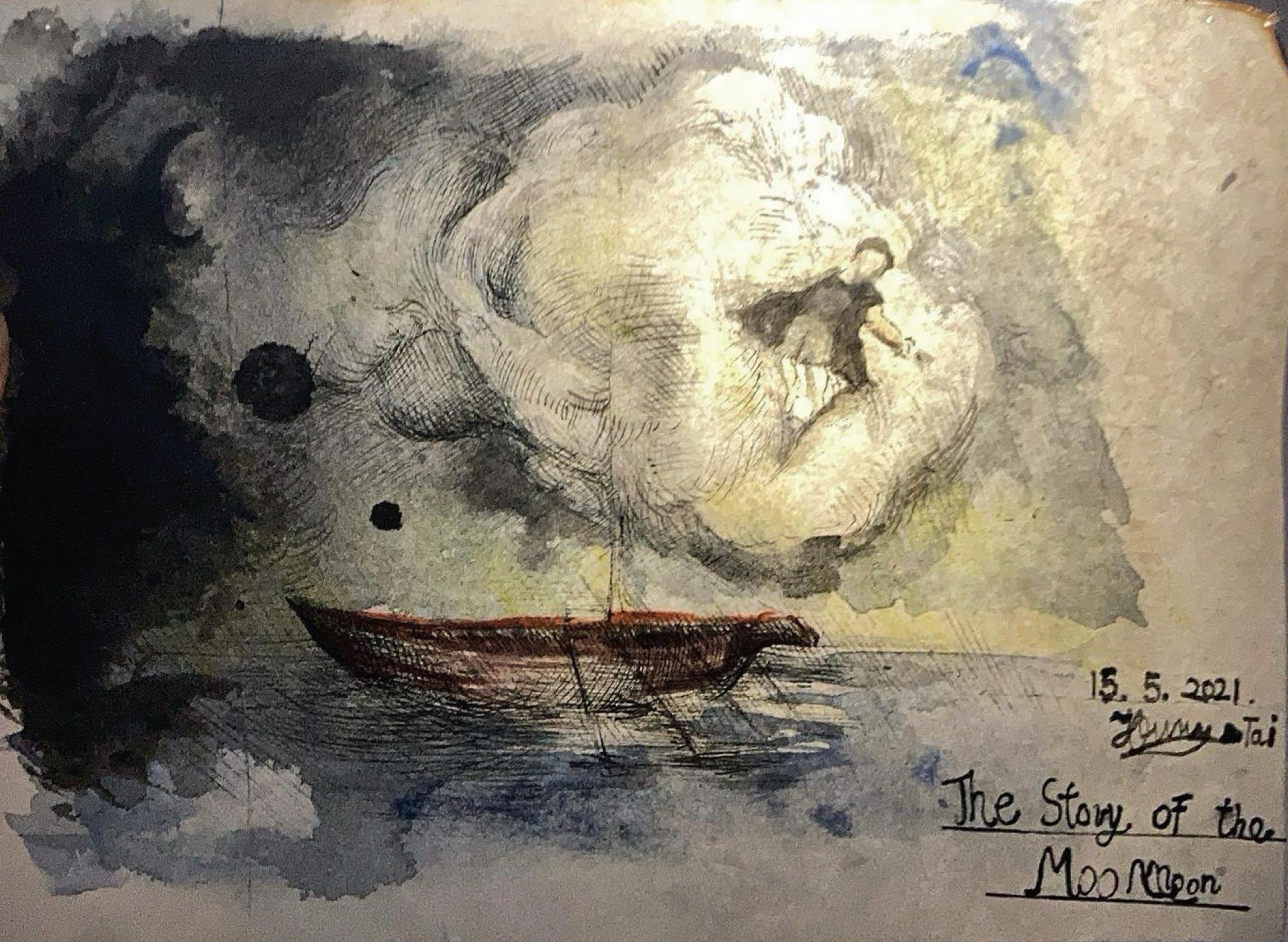
Most of the time, my family was busy with their business, often leaving me alone at home. Even when I spent time with friends, the moment I returned, the dead silence and overwhelming sense of loneliness would hit me. I didn’t fully understand this feeling until I came to the U.S., where I noticed that many people avoid ‘negative energy’—it’s uncommon for mainstream culture to embrace slow or melancholic music. But for me, those moments of sadness weren’t just about pain; they gave me strength. It wasn’t because I was trapped in negativity or beaten down by life. On the contrary, feeling the power of silence reminds me how brave and strong I am when I have been through it.
Erica Nichole Record
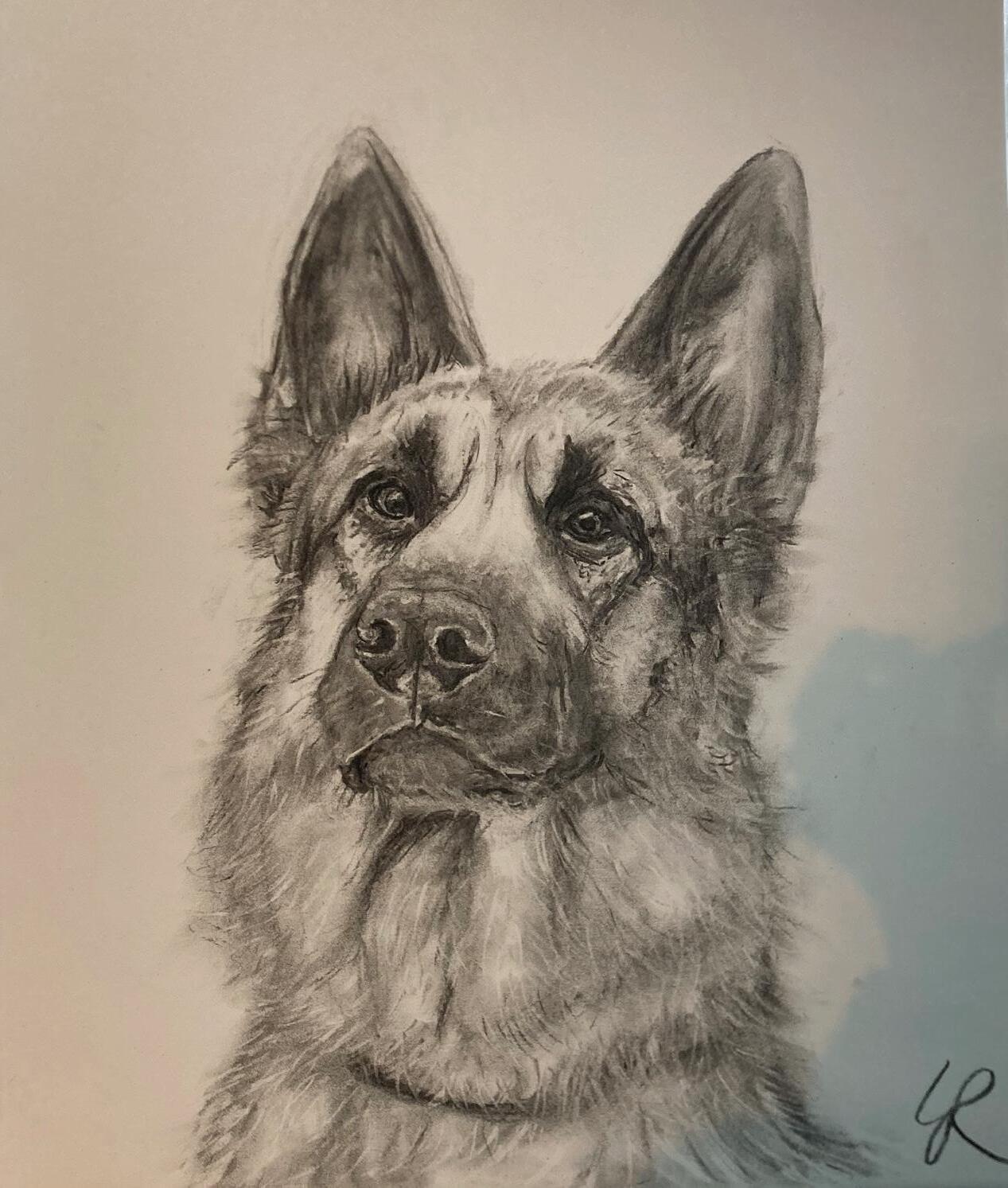
When I was little, I was captivated by animals. Drawing cats was one of my first experiences with art. I became wrapped up in art itself because of this desire to create a reality of what I saw. This German Sheppherd was drawn as a reflection of a colored sketch I had drawn before. I was commissioned to create this piece for someone who adored this specific breed of dogs, and I enjoyed every minute I spent on this piece.
Using Vine Charcoal and a large piece of sketching paper I created the basic forms of a German shepherd. After the forms were in place I began focusing on bigger details and large shadows. Using my finger, I created a smooth surface and continued molding more details into form. Once the main details, shadows, and proportions were correct I added the smallest details and blackest areas. Lastly, I created a sharp point out of a kneaded eraser, and I began pulling it in slow, small strokes all over the dog. This allowed me to create the illusion of tiny hairs with color variations.
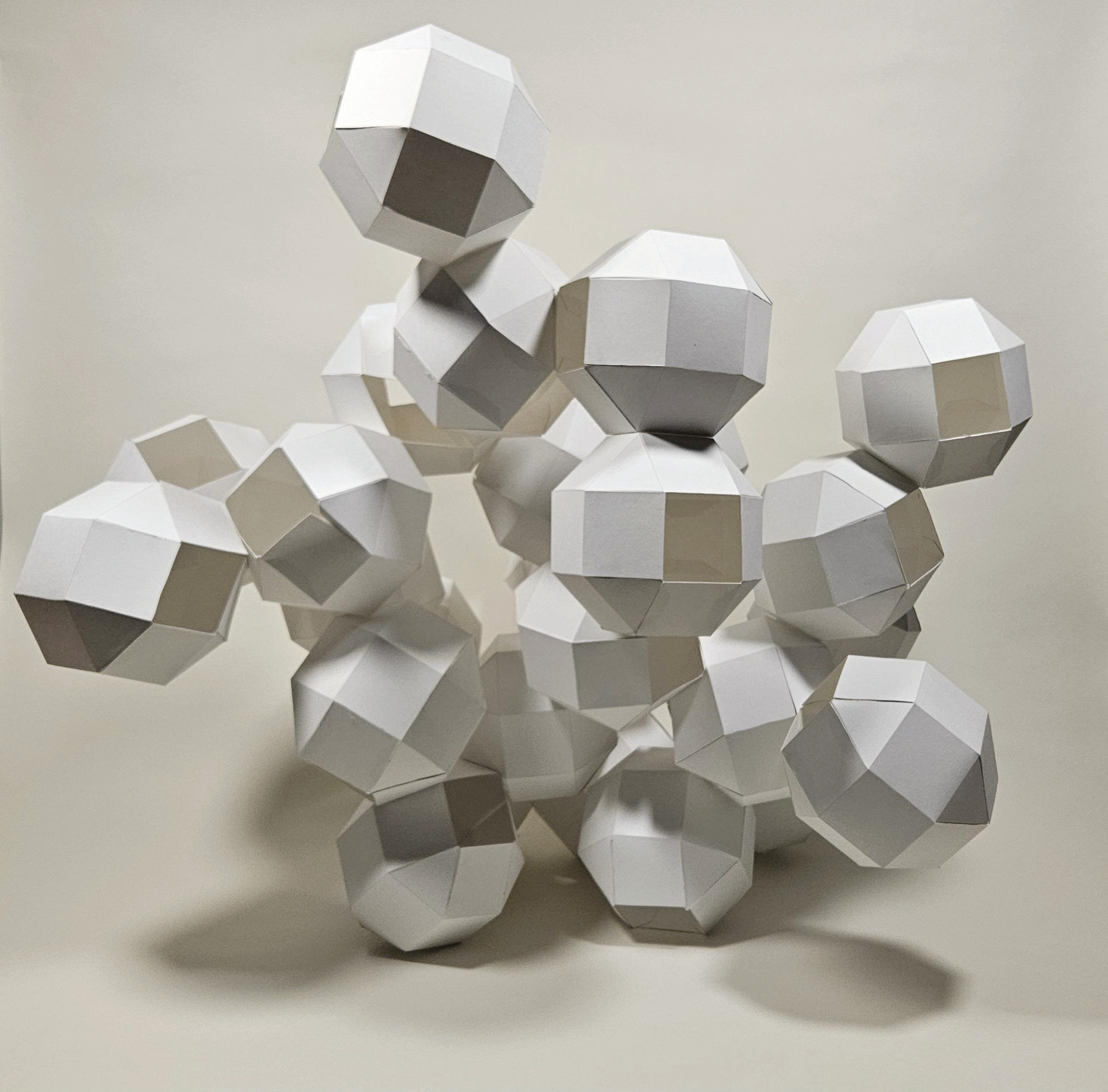
Media: Bristol Board
This piece was created for my Independent Sculpture Study, where I was tasked with using the repetition of a single geometric shape to create a visually interesting composition. The composition and shape reflect that of growing and invading cancer cells, spreading outward. It is confusing to find the start or end of the piece, and it reflects the thoughts, feelings, and emotions I experienced as my Aunt Amy lost her battle with ovarian cancer.
The process behind this piece started with creating a two-dimensional template for a complex three-dimensional shape. The template was then used to make thirty of the same design. The shapes were then scored, folded, and bound together with a strong adhesive to create the final three-dimensional shape. Once I had thirty of my shapes, I used hot glue to connect all the shapes together into their final composition.
Lauren Elsie Anderson
Tau Phi Des Moines Area Community College Boone, Iowa
I was three when he left, A soldier bound for distant lands, His promises wrapped in stillness Of letters written by steady hands. "Be strong," he'd whisper threw the screen, "Be proud of what I must do." But in the silence of his absence, I wondered how a heart could break in two. At fourteen he left once more, Another year spent far away, And though I knew what duty meant, I still longed for him day after day.
I was older now, more aware, Of the sacrifices made in his name, Of the strength it took to carry on, In a world where nothing stays the same.
His love for me, an unfelt hug, Woven through every good-bye, In every phone call, every tug, As time and distance passed me by. A soldier's duty is hard to spot, But his strength lives in me, In every choice, every battle fought, In the pride that no one else can see.
Now, as he prepares for one more year, To serve and sacrifice again, I stand tall, full of faith, And I know I'll wait for him.
For a soldier's daughter bears all the weight, Of love, of pride, of endless grace, And though he's far, he'll always be A part of me, no time or place.
So here I stand with an open heart, The daughter of a soldier true, And though the years may take their toll, I carry his courage all the way through.
Lauryn Janelle Perez
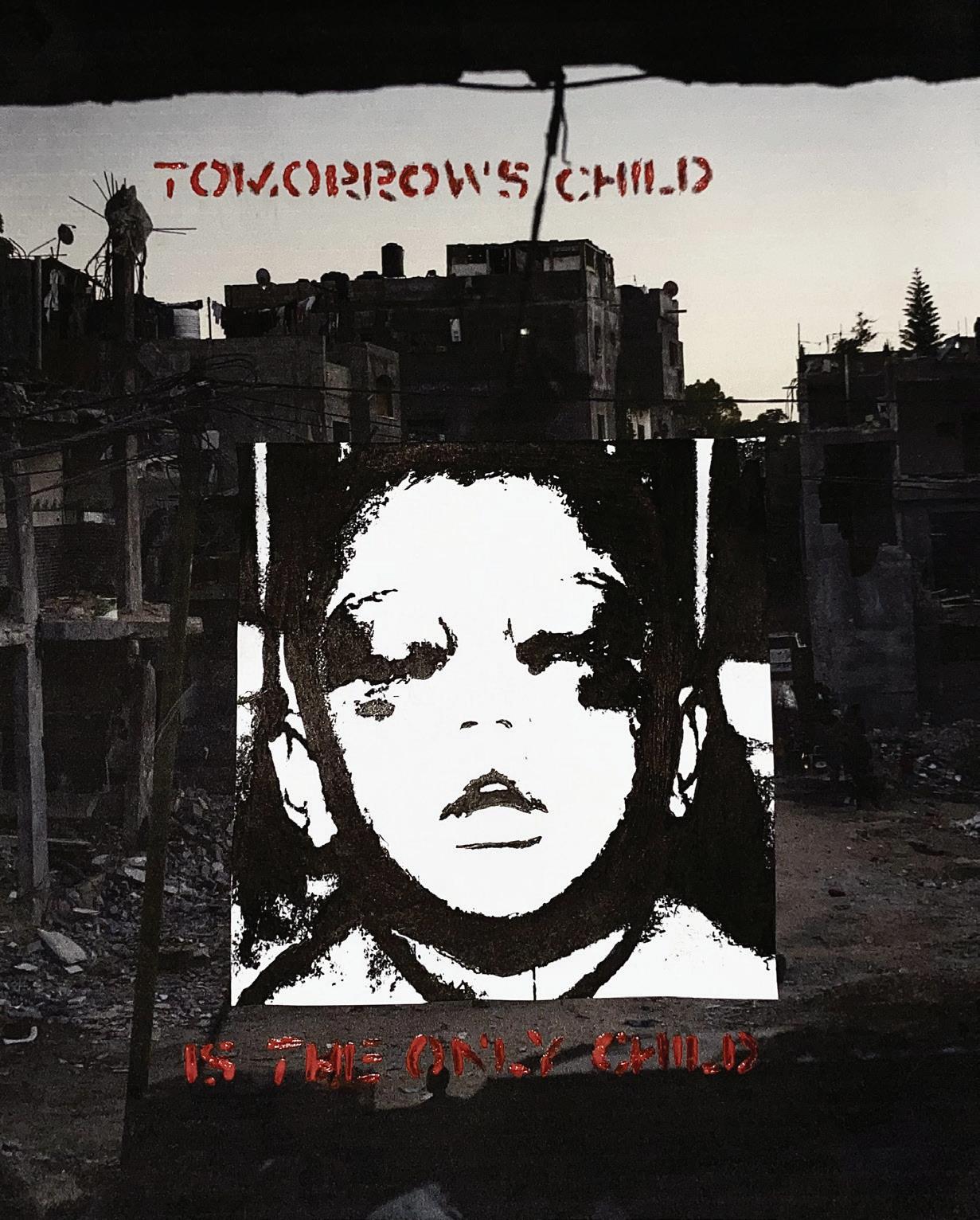
Media: Mixed
My work explores the detrimental effects that genocides and war have on children. Some may find the drawing I made in my work rather disturbing, though it is the reality of what many Palestinian children have been enduring. The ongoing conflicts in Gaza have consisted of countless heartbreaking tragedies that affect innocent lives. It is crucial to remember the human cost of war – families torn apart, children growing up amidst severe violence, and many communities struggling to find peace. To create this piece, I used red acrylic paint for the words displaying my message. The message “Tomorrow’s Child Is the Only Child” comes from the lyrics of a song that is dear to me, Severance by Dead Can Dance. Lisa Gerrard and Brendan Perry of Dead Can Dance have been a tremendous muse for me for this piece – in this song, they also state, “When all the leaves have fallen and turned to dust, will we remain entrenched within our ways?” When there is nothing left to cling to, will our society remain dismissive of the opportunities for peace? For background, I printed a picture of what remains of a community in Gaza after the destruction. For the image of the child, I simply used Sharpie pens and paper and drew what I believe represents exhaustion, trauma, and fear, in the face of a youthful victim of war. Without the ability to be a voice for those suffering, I would have merely no purpose. This work of mine has reminded me of the power art holds to inspire change and spread awareness.
Shelsy Stephany Rodriguez (Stephx)
Xi Alpha Berkshire Community College Pittsfield, Massachusetts
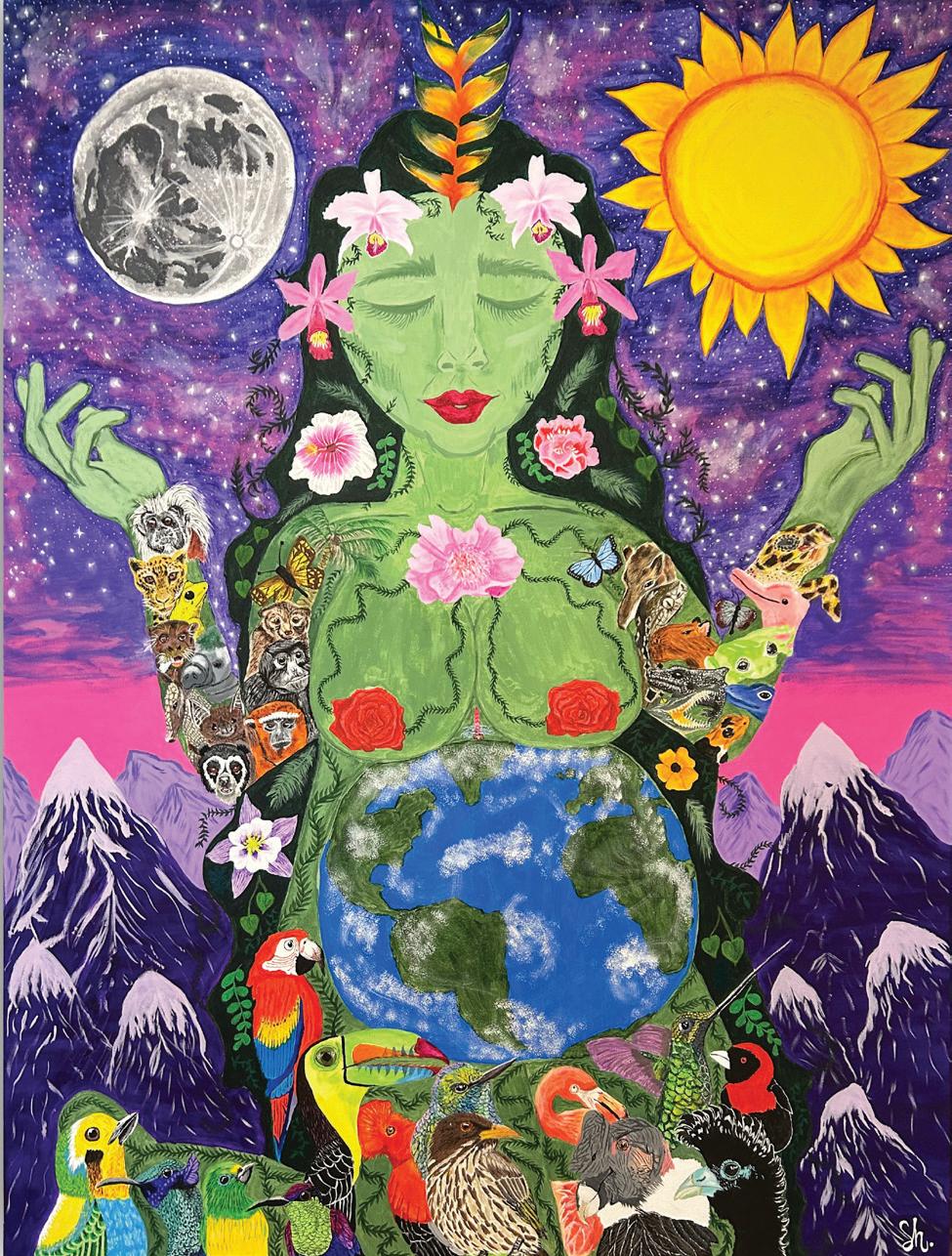
Media: Acrylics
I am a visual artist focused on painting and a student of environmental sciences. I come from Colombia, a place full of color, traditions, diversity, and life—a place where anyone can enjoy its nature and culture. My artwork is based on the self-expression of each brushstroke about the beauty I perceive when I admire my ancestral past, my cultural present, and the future we are committed to preserving and caring for through actions that support the ecological communities to which we are connected. I make art because it is the way we, as human beings, need to feel in union with our soul, our heart, and our perspective on life.
I use painting to raise awareness, so that when people see my art, they take with them the idea of the importance of connecting and thanking the past: our ancestors within the indigenous communities; the present: the culture that enriches us; the future: with nature that faces environmental problems that impact and worsen with each passing day.
I made this painting in honor of the word “Pachamama,” which in the Quechua language (the language used by my indigenous ancestors in South America, located in the mountains of the Andes) is Mother Earth, the giver of life and the connection between the sun, the moon, the water and the Earth. I wanted my representation of Pachamama to feature the limbs of species found in Colombia, my country of birth.
She carries endemic species that, in their pure and wild state, live free. She creates every living being on earth, each one is unique and unrepeatable. Their beauty lies in the ecological community in which they are found. The people who are most clear about this message are the indigenous communities. Still, unfortunately, every species painted in this picture is vulnerable or in danger of extinction due to problems caused by our species, like deforestation, pollution, global warming, and illegal wildlife trade.
I swore I’d be a beige mom— clean lines, muted tones, a world where everything matched, where chaos had no home.
Pink was never my color, not in ribbons or bows, not in ruffled little dresses or dolls in pretty clothes.
I hated the way the world tied pink to her name, as if a color could define what she’d grow to claim.
But then—her eyes. Blue as the sea, soft as lily petals yet radiant as can be.
Blue had always been a color reserved for certain things, but in her gaze, I saw no boundaries, just the light that freedom brings.
And suddenly, pink was not a rule, not an expectation, but a light spilling over the edges of my world.
It crept into her laughter, the way she twirled without care, how she found magic in moments I once thought were bare.
Pink wrapped itself around my heart, not just in her clothes or her toys, but in the life I built for her— a life where joy had a place to bloom.
I saw that pink is not one shade, but many—a spectrum hers alone, to wear with pride, to define in ways that are her own.
I wore pink without thinking, painted warmth into our space, not to match, not to style, but to make room for grace. Now, when I look, pink isn’t just hue, It dances in sunsets, a soft, glowing view. It’s in the warmth of the morning sun’s rise, A shade of affection that lights up the skies.
It’s the color of mornings we share in our home, Of whispered “I love you’s” when she’s never alone. I see it now, not just in the things, But in the joy that her love always brings.
Through her, I saw the girl I could have been— one raised in softness, one who knew love’s gentle hand.
Pink was never my color. But now— it is the color of her, the color of love.
And, somehow, pink looks good on me.
Ares Nguyen
For your protection
A soft pink blanket from the midwife
A crib with raised railing
My warm hand during your first steps
For your protection
For your protection
A jade Buddha necklace
A small bicycle helmet
Grandmother embrace
For your protection
For your protection
Your big brother's watchful gaze
A house with metal window bars
Isolation
For your protection
For your protection
Hospital stays
A gold-plated incantation necklace
A family placing down incense
For your protection
For your protection
Baskets of fruits and berries
A pendant blessed by the head monk
A bird out of its cage
For your protection
For my protection
A kept promise to you
My child smiling always
A mother’s eternal prayer
For your protection
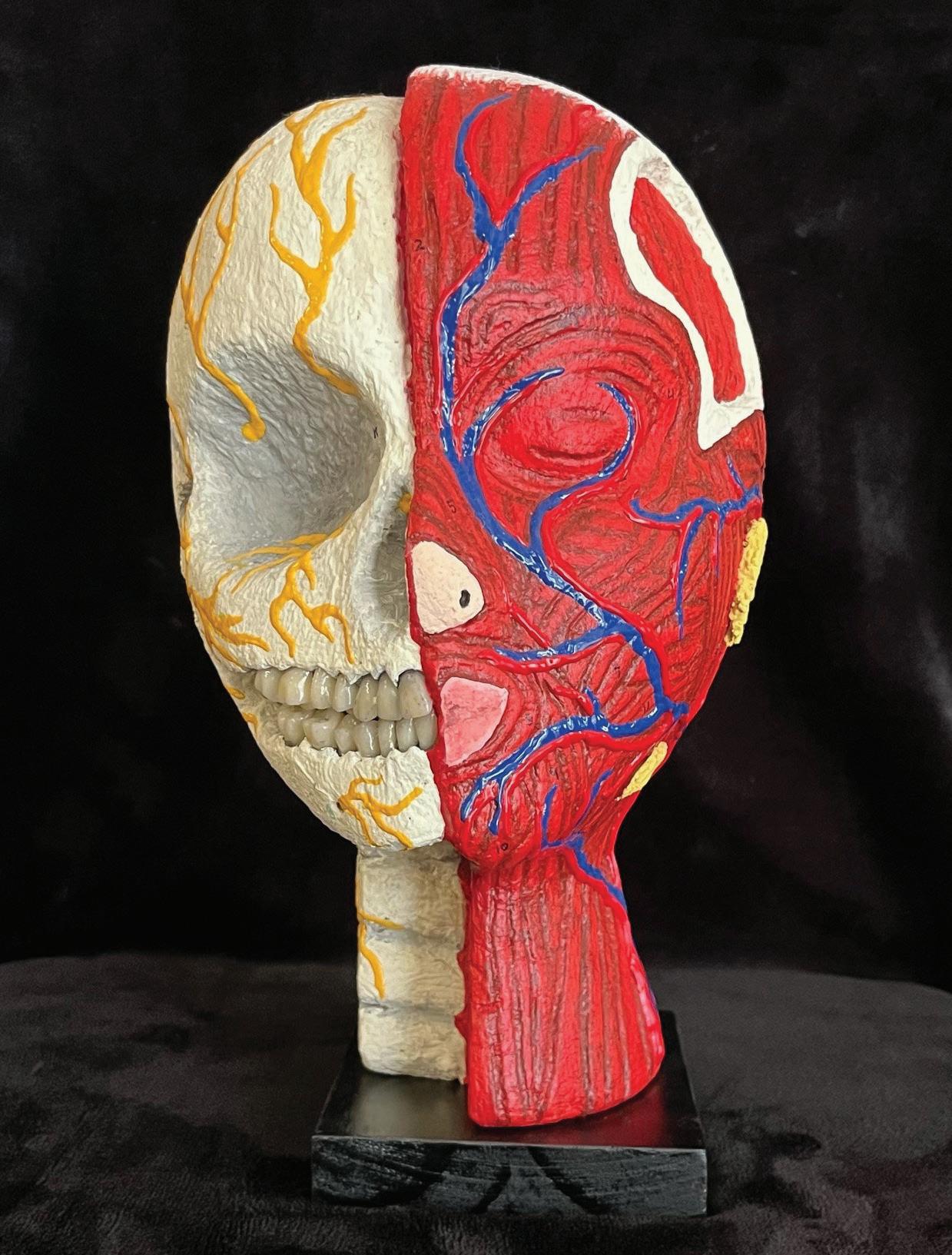
Media: Mixed
This piece was originally for an anatomy and physiology project. I intend to put it in my office for my patients to see when I start practicing.
I began by mapping out each muscle in the correct anatomical position on the styrofoam head. Using a candle for a flame and a screwdriver, I melted fine lines to create depth and striations in each individual muscle. I then carved the other half for the bones to make them three dimensional. Once the shape was complete, I covered the head in modge podge and toilet paper in a paper mache fashion. This was to smooth the styrofoam and create a better hold for my paint. I placed the plastic teeth into the alveolar bone of the maxilla and mandible in the correct Class I position with ideal occlusion on the bony half of the head. Once this was completed I began to paint the head in many layers to add shadows and highlights with acrylic paint. I then used puff paint to add the nerves (yellow), blood vessels (blue) and arteries (red). A sharpie was used to label each muscle, bone, salivary glands and other accessory structures. I then spray painted a piece of wood as a mount for the head, drilling it into place to provide support
Hana Tilksew
In the highlands of Ethiopia, a city sits at the center of history. She has seen the rise and fall of kings, the birth and destruction of empires, the virtues and pitfalls of men. Gondar was none of these things to me the summer I turned sixteen. Instead, she was a fantasy.
From the moment my father announced that we would be taking a summer trip to Ethiopia for the first time in years, my brother thought of the skyscraper-studded city of Addis Ababa, while my sister looked forward to riding a motorboat across Lake Tana. I, however, dreamt of Gondar.
I’d seen the city nicknamed the Camelot of Africa before, and I still remembered the smell of my grandmother’s house and the crows of her roosters. But our last trip to Ethiopia had been for the sake of family, with people to greet and cheeks to kiss. This time, we were going for what my father called “educational purposes,” which I understood as his excuse to show us as many landmarks as possible.
Gondar was the apple of my eye in the weeks leading up to the trip: something to look forward to amidst all the frenzied traffic and strange looks guaranteed to us, with our American hair and American jeans. This was the native land of my ancestors, where they had lived and died and worshipped; a portal to an age that no longer existed, the glory of which was now remembered only in old books and ardent lyrics.
It took seven days of trudging my feet and sighing loudly to get us to Gondar, but as I rolled up the famous hills sandwiched between my brother and my father in one of Ethiopia’s notorious bajaj1, shaking hands clutching the thin fabric of my tibeb dress, I knew that this was it.
As my father headed into the ticketing office to find us a tour guide, I surveyed the grounds, with buildings that seemed to glow and balconies that seemed to beckon. With our English-speaking guide in tow, I itched for all the stories I would tell my friends back home.
The tour began with Fasil Gemb, the main structure of the compound and onetime living quarters of the imperial family. We were shown the central castle with its reception hall, banquet hall, and royal chambers. We saw the guard towers, cramped little rooms with windows just thin enough to shoot a trespasser on sight. Every room seemed to come alive as we passed through it, whispering centuries of secrets it had witnessed.
Authentic relics remained, like the glasses that noblemen used to drink tej, Ethiopia’s famous honey wine, and the original hearth that connected the two dining rooms. Animal horns that had been attached to the walls for the purpose of holding meat were now dark and calcified. The balcony outside the emperor’s bedroom, once strong enough to support the weight of the King of Kings, was rotted and unstable.
I was in awe. What must it have been like to live here? To work here? To behold this place when it had cost lineage and a title to get in, instead of a few Ethiopian birr2? To revel in the glories of the old world, with no idea that it would ever pass away?
We then came to the library, and all thoughts of what a fairy tale this place must have been disappeared.
This crumpled hunk of stone, our guide explained, had long held some of the most precious manuscripts in the world, written in Ethiopia’s ancient language of Ge’ez. It had once been a center of majesty, but its current state of dilapidation was the work of thieves -- not the kind of petty criminals that the guard tower could have thwarted, but the kind that came as friends: first Great Britain, breaking the peace between the nations when it decided that hoarding Ethiopian currency sacred artifacts for its museums mattered more than integrity, and later Italy, when it decided that if it could not make Ethiopia a colony, it had to take something.
The castles of Gondar were no longer a compound, but a graveyard. The emperors that had walked these halls were ghosts of the past: ghosts that could not rest because they were trapped behind museum glass rather than buried in Ethiopian soil.
Today, Ge’ez classes are offered in England and Germany for European scholars who aim to decode holy texts stolen from their motherland. Everything about this is a trespass -- on a history, on a religion, on a people. And though Ethiopia is the only African state never to be colonized, it is not free from the stains of foreign imperialism. There are still the graveyards dedicated to monks murdered during the Italian occupation, the statues erected in honor of fallen generals, my own great-grandfather’s war medals that my grandmother wore until her final day.
Like many Ethiopian-Americans, I have always been first to speak of Ethiopia’s successes, her historic feats and unknown triumphs. The losses had never felt worthy of mention--why should they be, when they could only be a source of shame? But I know now that those losses are worth mentioning if for no other reason than recognizing what we had before it was taken, and appreciating everything our forefathers did to ensure that we never suffer the same defeats again. The ghosts of Gondar may haunt Ethiopia forever, but they will never break her.
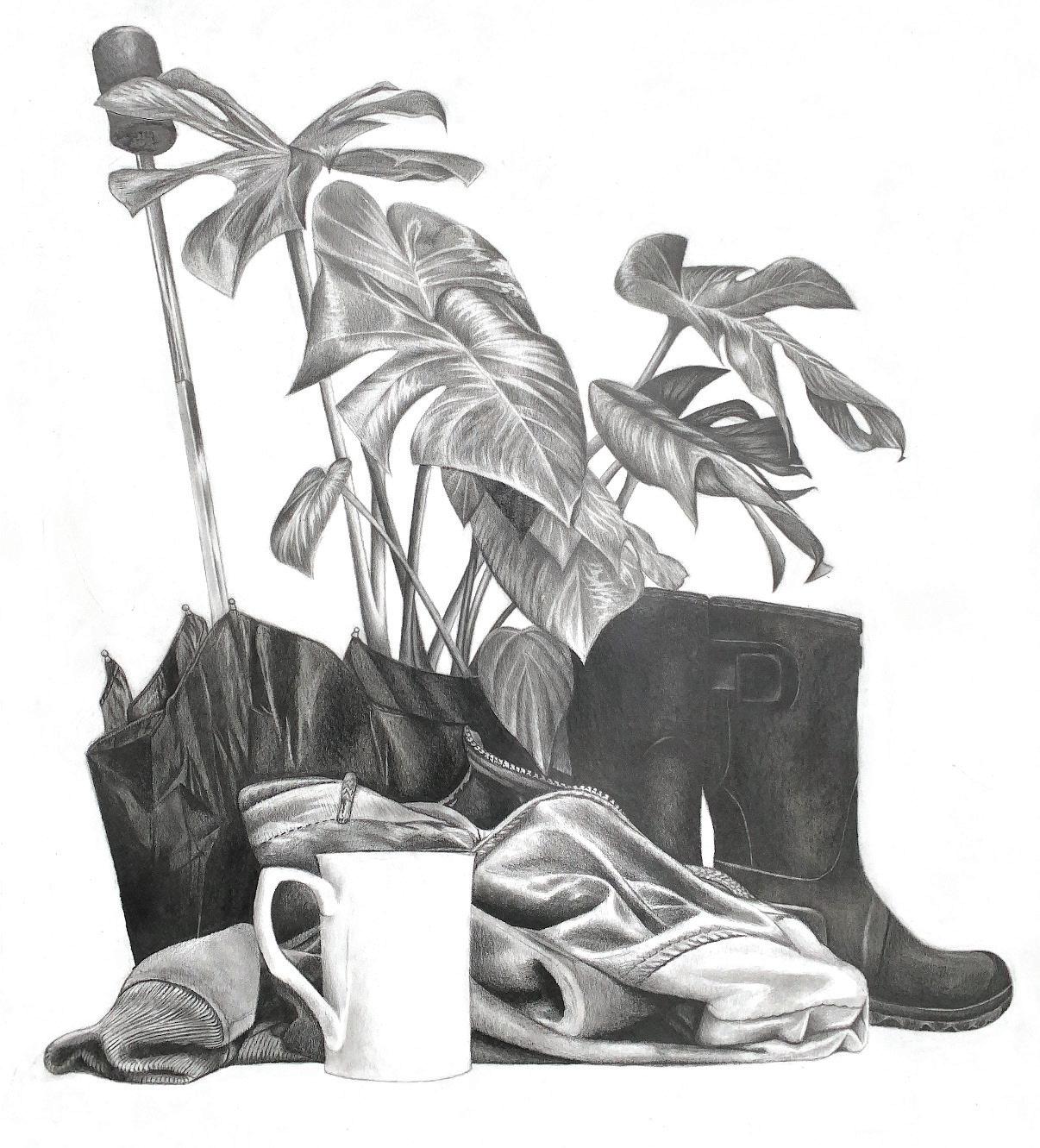
Media: Graphite
This piece is a still life portrait of my mother’s belongings during the wintertime. This artwork captures the objects that most remind me of her and the activities that best reflect who she is. She is a very nurturing person, and she shows that through her expertise in horticulture. Regardless of the weather, you can always see her beginning her day with a warm cup of tea.
Eleanor Baldwin
I stare upon my family tree
The female branches cut
The male ones sprawling endlessly
Into the sky they jut
Their names penned down in iron gall
Their life-long stories told But my foremothers’ ancestry
Forgot lest they be bold
The yew tree grows in the graveyard
Sprouted from ancient blood
Fruited from a rootless tree
Obscured by time’s own mud
Under rests Mrs. Weatherford
Of other names unknown
Immured within her husband’s tomb
Forever bone-to-bone
Here lies the fair Maid Marian
And a Princess of France
But ancestresses of common stock
Left blank by bitter chance
What life lead Eleanore de Pook?
Why does she bear my name?
Five hundred years separate us
And yet, we are the same
I stare upon my family tree
The female branches bare
Let die by ancient arborists
Without a drop of care
The men who author history
Forgot Ruthian limbs
So quick, they left the pages blank
Of our muliebral hymns
Hanan Sahin
The fish tank hums.
Warm laundry rests in neat piles. Mother hums too, a song with no words, Father’s voice rumbles from the kitchen. I build towers with my books, stacking them high, reaching for the sky— Latin on the spine, Chinese in the margins. The world is big, but this room is bigger.
“Tell me another word,” I say. Mother smiles, whispers something in Turkish, and just like that— a bridge appears.
The fish tank is gone.
The laundry sits in storage boxes, untouched. I sleep where the folded sheets used to be, between the echoes of what once was.
A notebook lies open beside me.
Russian vocabulary, Turkish translations, Latin roots stretching into something ancient. I study them like prayers, words that mean something more than their meaning, words that tether me to places I’ve never been and people I’ve lost.
It’s strange how everything changes. How a space once bursting with life becomes a quiet archive of the past. How a child playing on the floor becomes the one writing the story.
III. The Grandmother’s Chair – A Room Remembered
I have held them all.
The mother who sat with a book in her hands, the child curled up in her lap, the father, resting after a long day. Now, I sit still.
Now, dust settles where hands once smoothed fabric. I listen to the quiet—the kind that lingers.
But tonight, the child returns, not quite a child anymore. She whispers words in many languages, words her mother once spoke, words that ripple through time. And for a moment, the room breathes again.
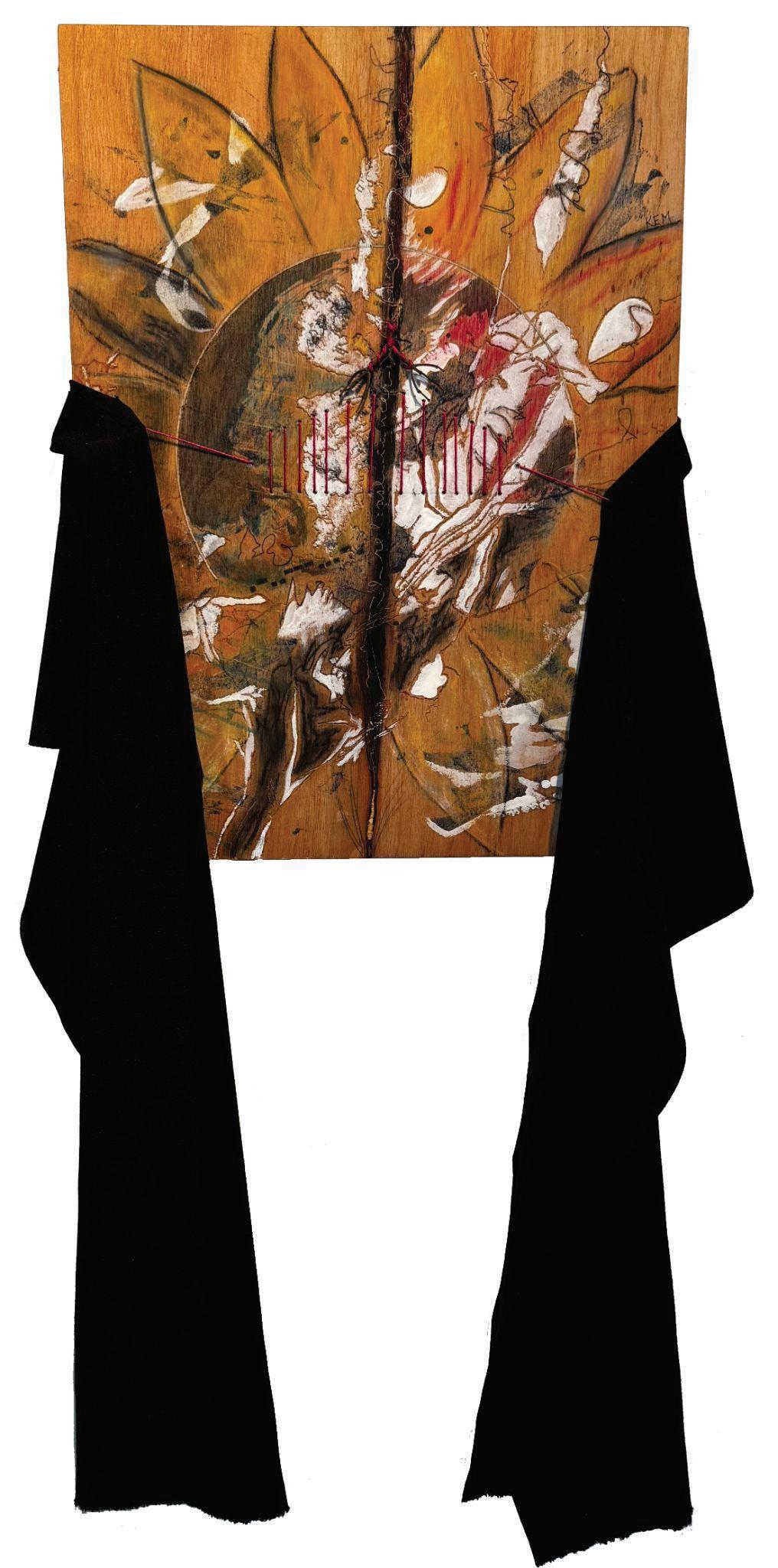
Media: Mixed
I create layered designs that connect people more deeply to their core selves. Made to symbolize the transformational healing journey my mother was undergoing during her immunosuppressive cancer therapy, “Release” was created using acrylic, pastels, stain, Sharpies, embroidery, and fabric. I intentionally brought interdisciplinary studies such as writing, dance, and art therapy throughout this process to help her mother through visualization, affirmation, and movement techniques that helped alongside her western medical treatments to bring forth further healing.
Cecilia Blackwood
The cold quiet embraces me like a mother’s whisper
While the falling snow calms the buzz of the city. Silence lurks between the buildings and the trees, And white blankets hush the busy streets.
My breath floats As glittering flecks dance across my face. I meander,
Content to feel the freezing nip at my nose, And the subtle crunch through the soles of my shoes.
Time hangs frozen.
Drained of its pulse and its warmth. The hours are stripped of vitality, And replaced with night’s sanctity. They only yearn for the comfort of sleep.
All will hibernate, Only to rebirth in the spring.
Celebrations will be held on the darkest day, And the feeling of forward momentum will build.
But for now;
Soft is the gentle slumbering of the world around me. Heavy is the weight of the dark sky above me.
Frigid is the unrelenting smothering of autumn’s culling.
And warm
Is the inviting light shining above my front door as I brush the flakes from my hair.
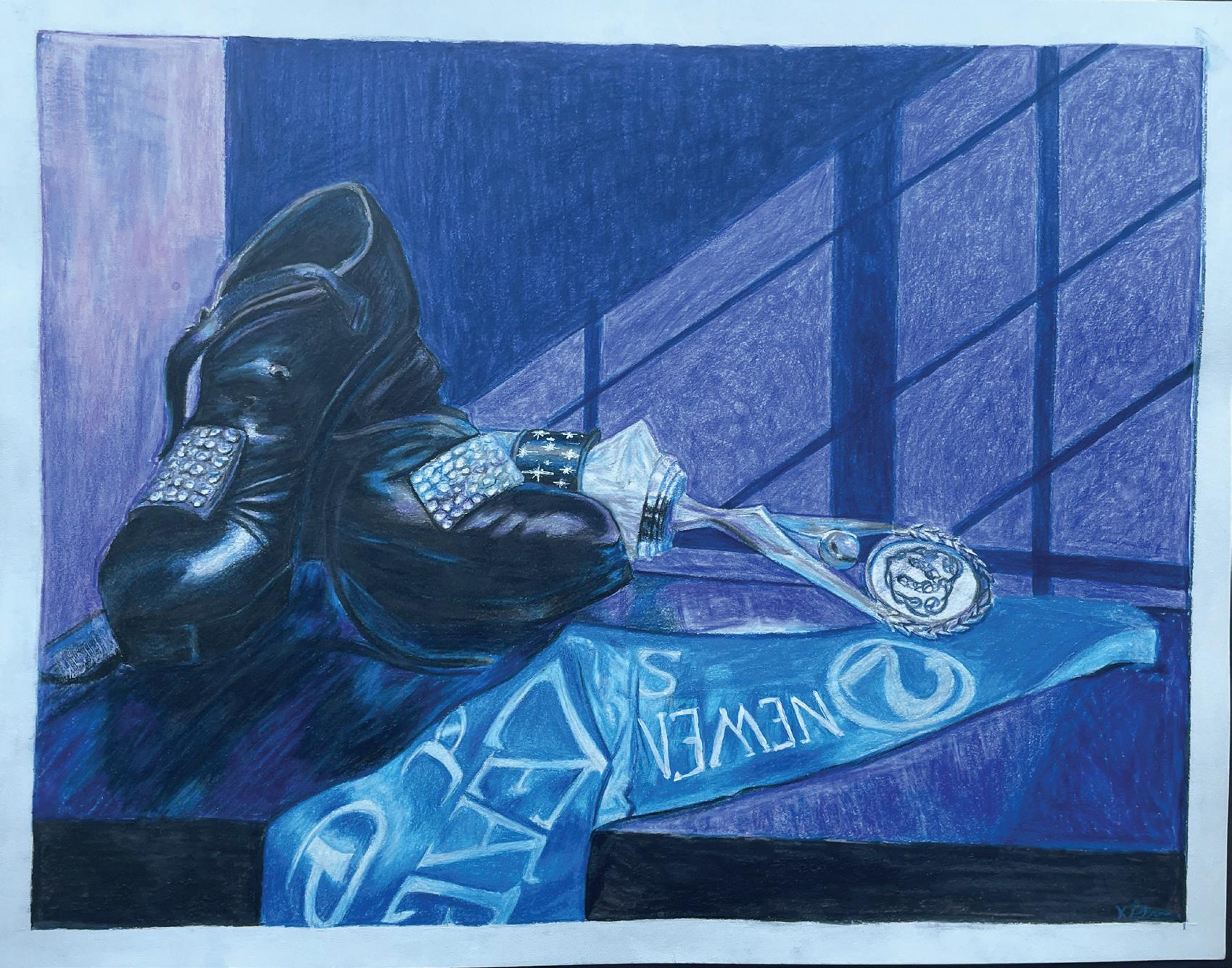
This work depicts a deeply personal exploration of my identity, ability, self-perception, and the quiet echoes of my ambition. This is a visual representation of how I relate to my “best self,” the version of me that is fully healthy, capable, and whole, with absolutely no injuries. I'm constantly changing that ideal me, measuring the current me against it. I am continually comparing who I am now to who I think I should be.
The composition brings a feeling of being cornered or left in the dust, which I feel when comparing myself. The worn dance shoes symbolize my dedication and hard work in dance. The worn leather shoes show how I’m changing, practicing, and reaching to become my ideal version. They show my current feelings of being fraudulent, like I'm falling short or faking my way through dance. The trophy and sash, marked with quiet pride and a subtle sting, becomes a symbol of my nearly there effort, never quite enough yet. It is not about competing with others but competing with myself. The blue hue cast a weight of melancholy, stillness, and longing for my art. I wanted to set the right feel, so I took my time, building a maker base and deliberately placing each stroke’s direction to add a swirling texture. Then I started building up more textures with colored pencils, blending out and defining my shapes. I built depth by intentionally accentuating the shadows, heightening the contrast to reflect the emotional weight of always coming second. I chose an analogous colored palette to cast a hue of stillness, longing, and my quiet pride.
This art captures the emotional dissonance, the gap between where I am and where I believe I belong. It is not about my physical performance or health, but how the longing, memory, and burden of self-expectation can shape my identity. This is not a declaration of defeat, but an honest portrait of feeling like an impostor, aspiring my ghost of ambition, measuring myself based on an internal standard, and the post keeps moving, leaving me always second.
Lillyan M. Johnson
Alpha Iota Pi Flathead Valley Community College Kalispell, Montana
I wasn’t sure what to do next. He had me trapped, and I had only two ways out. The first was sure to destroy me. The second, however, held a sliver of a chance at victory—but it was very risky. I heard a noise from nearby, and it drew my attention.
I was in a small, dimly lit classroom that was rarely used. The room smelled musty and was illuminated only by one small window to my left. There was a group of people huddled closely around my opponent and me. They were all silent, watching the scene before them with observing eyes. I turned my focus back to the battle. I was still unsure about the decision I was to make. I could take the risky way out and hope for the best, or just accept defeat. Those were my only options at this point, and the decision was agonizing. Unless …
I reached out and moved my bishop diagonally towards my opponent, trapping their piece. It was a risky move, but it was a way out that I had not seen earlier. And now I held the advantage.
My opponent was only my opponent for the battles we played against each other. He’s my friend—arguably my best friend. To the others, we were the club’s elite chess players. And so, of course, the club wanted us to play against each other. We had before, but never in front of an audience. So now we played for the entire club.
We chose to have the match in this classroom because it was so isolated. It used to be the storage room, which never was used anyway. Once we got permission to come in here during our lunches to play chess, my opponent and I have been coming ever since.
After I moved my bishop, I felt a collective pause in everyone’s breathing around me.
They had not seen it either, apparently. My opponent muttered a curse under his breath and resumed his thinking. He reached over the chessboard and moved his rook. It was a poor attempt at setting up a trap for my king—because I caught it.
The chessboard we were using was mine. It was a battered old thing, but in its bruised shell, it was a beautiful piece of art. It was probably my most prized possession. I got it so many years ago when I was very young. At the time, other kids my age were all getting toys and silly nonsense,
but I got this chessboard. Its dents, scratches, and scars were stories to me—and those stories were beautiful.
“Your move,” I heard through my thoughts. I cursed myself silently for losing focus.
Turning my attention back to reality, I considered my next move. If I could just move my rook, without him noticing my intentions, then I would be able to checkmate him the turn after. I decided it would be worth a shot. Reaching over the board, I moved it into place for my next turn.
As I moved my rook, someone next to me was snickering. They must have thought I was doing something else, something foolish.
I just hoped that if one person could misread my intentions, then perhaps my opponent would as well. But he seemed to pay no attention to the snickering fool. He reached his hand across the chessboard, paused, and as if in slow-motion, I saw his hand dip down towards the corner of the board. I quietly sucked in a breath and prayed to any chess gods that there was that he would not see through my plan.
In those seconds, I felt as if the world slowed. Everything around me blurred. My thoughts, firing one by one, ambushed me. All my different emotions were present, and I wasn’t sure which I was supposed to be believing. I didn’t necessarily care about winning this match, and I know neither did my opponent. Of course, both of us would like to be the one to win, but he and I never played for the title. We played because it was our shared understanding, our connection. For the enjoyment of the match. For the laughter that followed.
Time snapped back to reality, and his hand resumed motion, moving his pawn forward. I released my breath in relief, not even caring if others heard, because now I was safe and about to finish the game.
Nobody seemed to know what was about to happen. They were all frozen still, entirely focused on the board. I was about to move my piece and finish the game when I suddenly noticed a small figure, watching me closely, standing just behind my opponent and to the right. She couldn’t have been more than 8 years old, her green eyes wide, staring at the board. She then glanced at me, and our eyes met—hers full of amazement. I gave her a little smile and returned my gaze to the battle in front of me.
As my hand hovered over the chessboard, I saw my opponent’s eyes go wide. I heard a few gasps of realization ripple through the room. The satisfying thud of my knight hitting the wooden board rang out.
“Checkmate,” I declared, looking at my opponent, who had a smile on his face.
A brief silence followed my declaration, and then the room erupted with sound. Everyone in the room was smiling and clapping, laughter ringing throughout. I shook my best friend’s hand, both of us smiling. It’s not the victory that counts—it was these moments.
Audrey Gizzaffi
Alpha Mu Tau Collin College Frisco, Texas
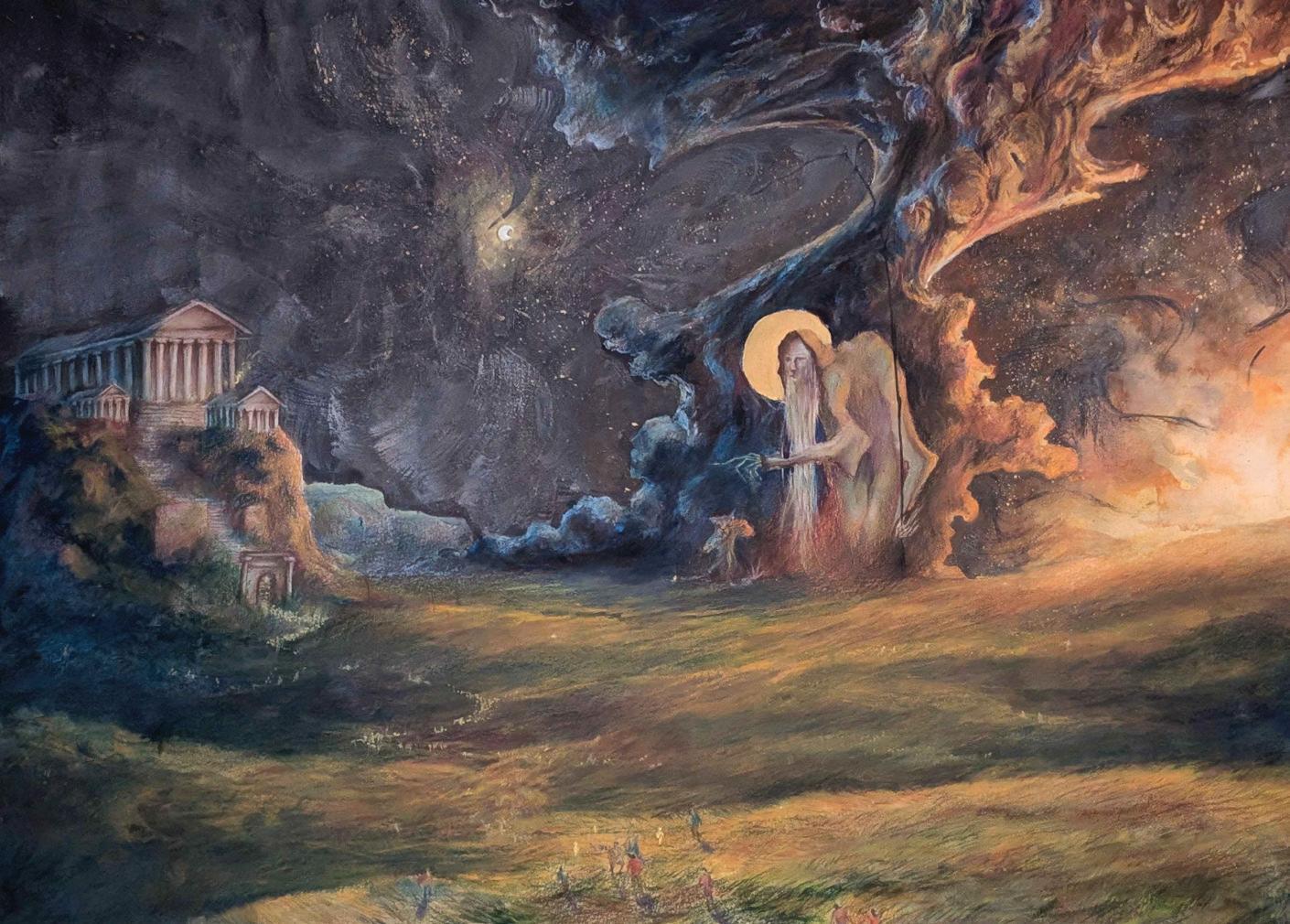
Media: Wax Pastels, Ink, White and Gold Gel Pens
This piece depicts the Greek afterlife, wherein you have three destinations; Elysium, for the peak of humanity, those who achieved greatness to live in paradise; Fields of Punishment, for those who lived despicable lives and will now spend an eternity suffering; Asphodel Meadows, for people who fall into neither category; they'll spend the rest of forever wandering the plains, husks of who they used to be. But, before you're sentenced to one of these "resting" places, you are required to have judgement passed upon you at Hades' palace.
This artwork was heavily inspired by my love of Greek mythology, and my hesitant belief in Christianity (a reference to old Christian iconography is the gold circle behind Charon), and my fear of the unknown. I will never know what death is like until I die, and that terrifies me. I have a good deal many things I'd like for the afterlife to be, but chances are is that there might be absolutely nothing. I close my eyes and that's all. On a more physical level, the process for this was rather long and complicated, and I carefully considered many alternatives to the final image. I created many miniature sketches before deciding what I wanted, and section by section I sketched. I filled every inch of this paper with depth, and meaning. Building the bubbling clouds, the wizened face, the skewed palace, the intense colors. I included many hidden details through the use of a gold gel pen, playing off of angles and light. In fact, most of the spirits on the trail can only be seen at a certain viewing position. Otherwise, the fields look empty.
This piece encouraged me to find meaning, to make it great even if it didn't look it. I utilized many techniques I was learning in parallel to this creation, such as two-point perspective, using lines and colors to draw the eye where you want it, composition, and more. I aimed high for the piece, and I believe myself to have succeeded. The lessons I learned still impact me today, and I take inspiration from it. Art isn't just a momentary viewing, or a few hours of work - it stays with you. It makes you think, to question what you know and see. It changes you. Creating this changed me, and I hope by viewing it, it changes you.
Reese Erin Caldo Alpha Kappa Mu Bunker Hill Community College Boston, Massachusetts
I’m from tropical heat and raging monsoons; always forgetting my umbrella at home; the feeling of sweat and rain on my skin
I’m from shoebox bedrooms covered in glow-in-the-dark stars and a mosquito net over my bed
I’m from jeepney rides to school and tricycle rides on the way back
I’m from my nanay and lolas and titas who braid my hair as they tell me stories of my childhood How I was the first daughter, niece, and granddaughter of a family legion yet to come
I’m from hopes and dreams and aspirations that can’t be achieved with just nostalgia and love so I learned to be from the overseas and pray that the stories I’ve learned carry me through I’m from slippery wet markets and street vendors where I buy char kway teow and kuih from the hawker center auntie; letting the salty and spicy and sweet flavors melt on my tongue
I’m from bike rides down the neighborhood ringing my bell as I pedal along dirty grass paths
I’m from worn-out flip-flops from running on asphalt chasing my friends in a game of “catching” I’m from cuts and scrapes from playing outside and the stains of grass dotted on all my clothes
I’ve finally found the place I’m from I carved my place, I made my mark, I know this is a place where I belong
But my dreams are bigger now, and I still want to grow and though it hurts to leave, I still have a journey yet to go
I’m from neither here nor there I’m from both rural and urban
I’m from cultures combined and experiences forged on an international landscape
Rachael Pond
Alpha Epsilon Piedmont Virginia Community College Charlottesville, Virginia
i am not Death but an intangible essence a traveling connoisseur of antiquities and i just so happen to collect tiny orbs with seething souls inside that all fit rather nicely in my pockets i trade with the dying owner their soul for a helping hand a one way ticket to the other side but i will not neglect the uniqueness of the orbs each soul within remarkable and distinct a different shine, hue, weight, substance plucked from simple corporeal flesh though not even i know where the orbs begin or exist besides my overflowing pockets and the archives of time
i met one soul not long ago that audibly hummed a tune a rare artifact to personally collect from a shoulder off of interstate 10 in Arizona where upon hot tar a human female lay a hitchhiker overtaken by too much sun her arms crossed angrily over her core glaring rebelliously through me
i’m not ready, she whispered and the humming of her soul grew louder as the orb lifted from her heart the soul within as ornate as her leather boots, textured of denim jeans, rough and tough a whirling soul of blue upon blue rising towards my open pockets only for the human to clasp the orb back to her chest
i had never witnessed such impossibility as this human clinging to life and yet as she inhaled fresh air, fresh life, fresh chance i felt not disappointment but rather exhilarating joy having discovered from where souls begin and exist in heart, in fervor, in this woman here i’m not ready, she repeated and i, for one, agreed
Laura Mikkelson
Rho Epsilon The College of the Florida Keys Key West, Florida
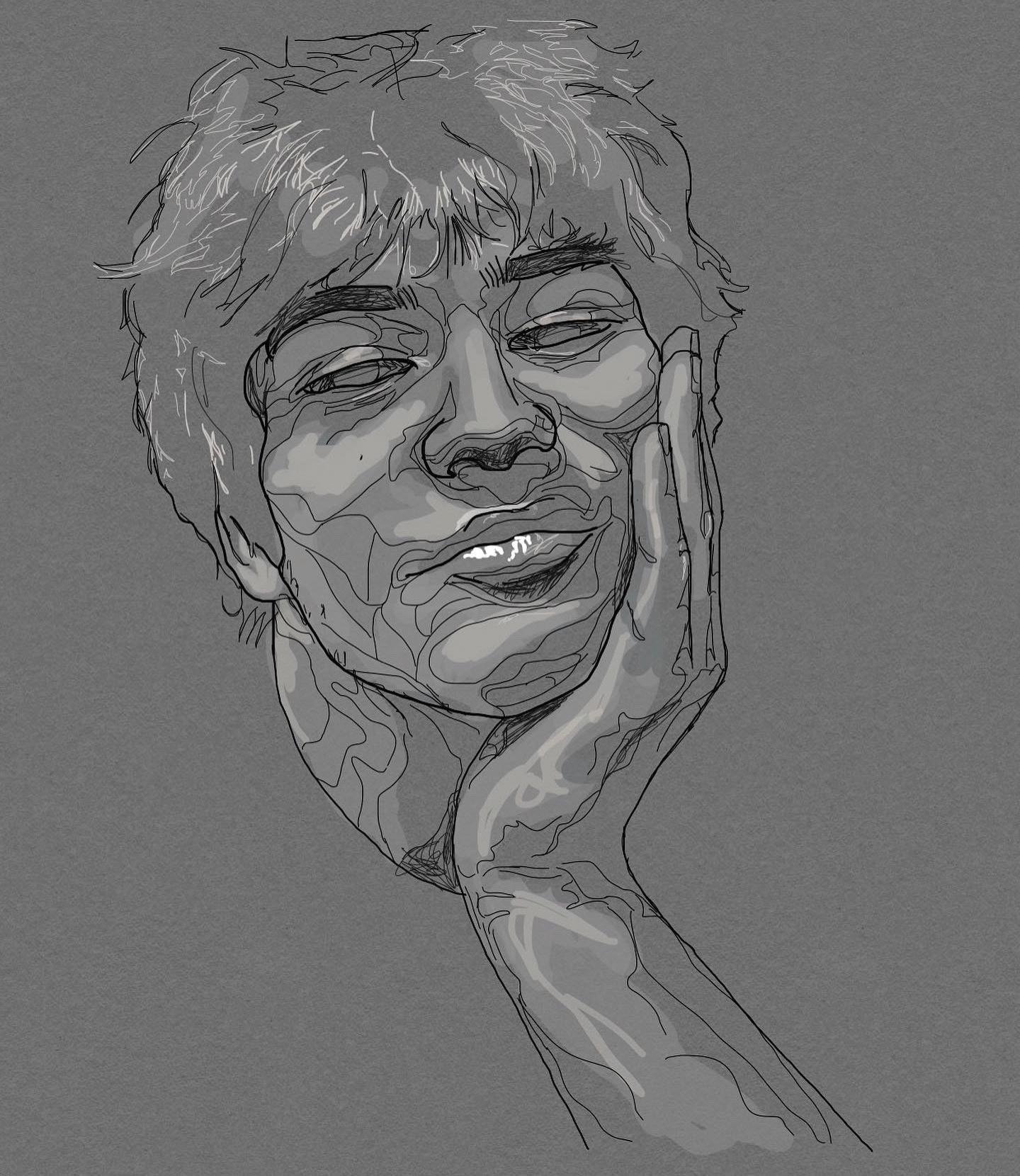
The person in this portrait is Myles. Myles is a man I loved deeply, someone who meant the world to me. But by the time I created this piece, we had recently split, and I was struggling to reconcile the warm, affectionate person I once knew with the emotional distance that had crept into our relationship toward the end. I had deleted all the photos of him I’d kept, trying to move on, but there was still a part of me aching to hold onto something. I didn’t have a clear plan when I started drawing, but my hands guided me through creating an image of him I could keep, even though he was no longer in my life. In this portrait, Myles looks loving, approachable, even warming; exactly how I remembered him. But the drawing's style, the emptiness in his features, perfectly captures the emotional distance I felt at that time. His eyes, once so full of warmth, now appear vacant and distant. In hindsight, this portrait served as a near-perfect reflection of the dissonance between how I once saw him and how I felt in that moment: someone I deeply cared for, yet who now felt out of reach.
Without a plan, what I drew came from memory and the lingering image of him on my phone screen for much of our relationship. I wasn’t sure how the piece would evolve, but I let my emotions guide me. In his face, I wanted to capture Myle’s gentle expression that in that moment, I so longed for. The process became less about drawing an accurate likeness and more about expressing the tension between the person I loved and the person I was grieving, the gap between perception and reality. I will never be from someplace or another, and ultimately that makes me who I am — a child raised by the world, ready for whatever adventure comes next.
Haley Kramer
Tau Beta Davidson-Davie Community College Davidson, North Carolina
i breathe, and i feel my lungs inflate and deflate you breathe, and i place my head on your chest i listen to your heart beat for a while and take pleasure in knowing that you are alive.
i do not fill every second with activity anymore. instead, i use the hours of my evening to write my essays and read books at my own pace. i think about the material i drink in the knowledge like water.
the sun takes an hour to set, i take an hour to watch it. i only get so many before my eyes no longer see. so i watch the colors appear, disappear, and reappear. and i observe the constellations in the sky. i learn them, i point them out, i admire them until my fingers and toes are frozen from the biting wind of winter. i watch movies with my friends and i pause them to chat about scenes. i only get so many conversations in a lifetime. i shut my eyes for a few minutes. i spend time listening to my surroundings, smelling the air around me, touching the chair i sit on with my fingertips, tracing the outlines of textures in the fabric. i let my cat sit on my lap when he pleases, since he doesn’t choose to very often and he won’t live forever. i let my homework wait. i have time.
instead i spend time kissing his ears and stroking his fur, prompting purrs from his sweet belly. i take a minute and i let the vibrations resonate he does this because he is happy and he deserves to be happy i won’t take that moment away from him.
i listen to my favorite song over and over again, even if it gets old because i like it and it makes me happy and i spend half an hour sitting in my car soaking in sunlight and music, allowing it to feed my soul. i let you kiss me slowly. i take time to remember how your lips feel against mine. i allow myself to take pleasure in it, not desiring more or less. just being content. i remove my clothes slowly, piece by piece. i take my time, for i have all night. i observe each dip and rise of muscle i run my fingers along each scar slowly, and notice how it is raised against the undamaged skin surrounding. i take time to remember how it got there, i take time to mourn the burdens of my past self. i take time to rejoice in the growth of my body and the beauty of womanhood. i decide i will wait an hour to go to sleep so that i can talk to you i don’t have to sleep right away, i can wait.
i sip my beverages, i savor the taste of it the warmth or cold of it against my tongue. i take little bites of my food i thank god for providing it and i thank the people that prepared it for me. all of this and i still get my homework done i still go to my job and i still love the people i love. and i take my time loving them i take my time appreciating them, and i take time to tell them of my affection.
Andrea Reed
Tau Xi Ivy Tech Community College Fort Wayne, Indiana
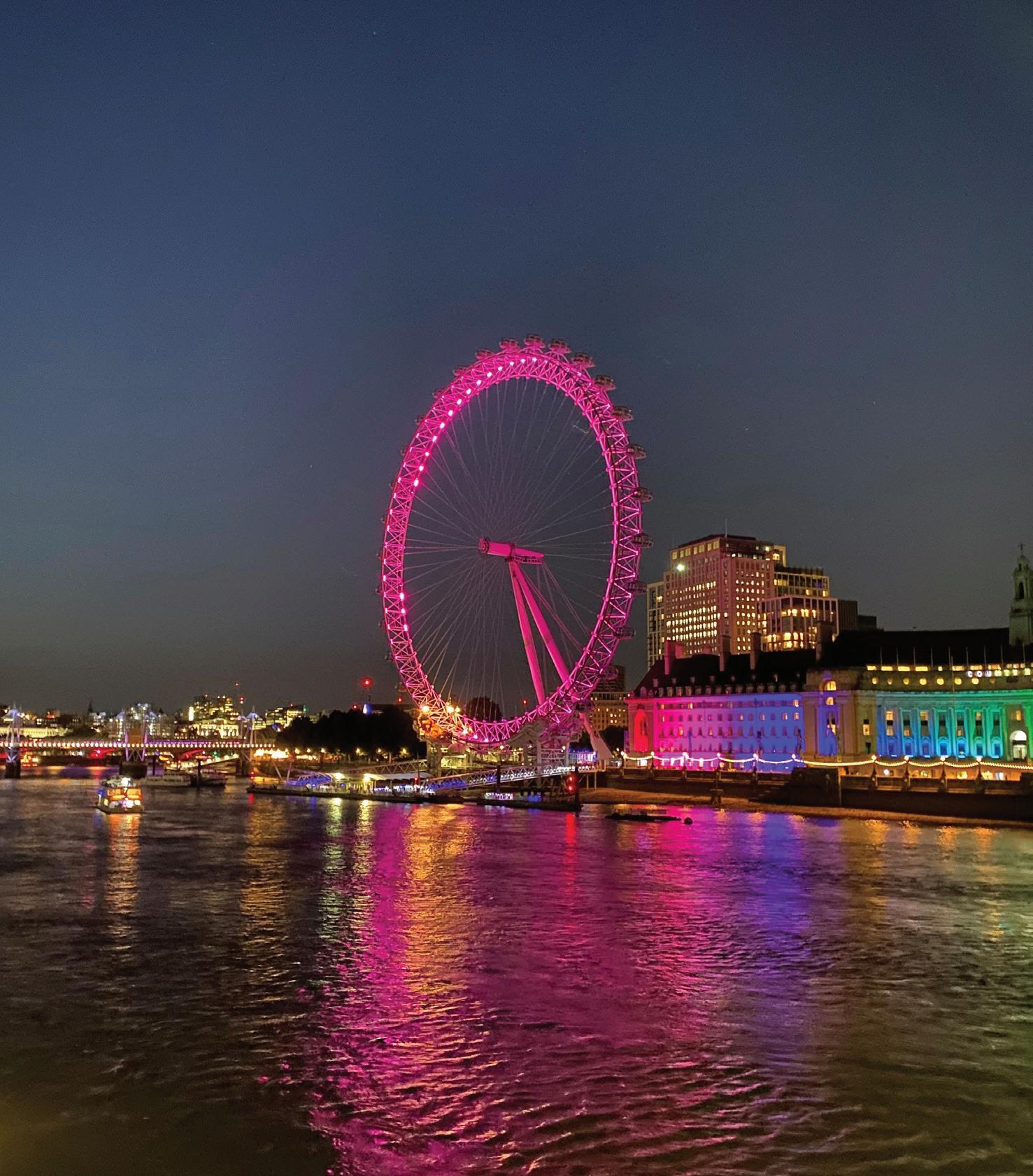
Media: Photography, 26 mm, f1.8 with a 12MP Camera
This iconic Ferris wheel is a well-known landmark in London, England. Often discussed as a “mustsee,” it can be challenging to capture the full color range during the day, and the viewpoint is often crowded with tourists during the evening.
A spur of the moment walk at dusk prompted this photo opportunity. Capturing the wheel as it was pink and not in transition to another color was a moment that presented me with a challenge as a photographer. The vibrancy of the colors and the placidness of the river were a striking contrast to the hustle and bustle of London.
Qynesha (Nesha) Kimble
Alpha Epsilon Sigma Minneapolis College Minneapolis, Minnesota
Dear Black Child, your mother probably should’ve warned you not to walk alone at night.. Or any other time of the day. Probably should have made sure your cell phone was charged and you looked approachable. Don’t sag, straighten up, no sudden movement, hands up, no back talk, smile child. She probably should’ve warned you of the dangers of the world, maybe made you stay home because now you’re just another number added to an unforgivable body count.
Dear Black Child, as your 15 year old soul flows out of your lifeless body, your freshly spilled blood is now dripping off the hands of another. He feels no remorse. He claims you were the attacker yet, you're the one unarmed and harmed.
Dear Black Child, your strained distorted voice echoed down the street and made your community fall to their knees. Your mother heard the sirens and prayed it wasn’t you but from the shattering of her heart she knew.
Dear Black Child, when you were young you learned your dark skin was a threat and your hair stood for rebellion. You learned that your tongue was a knife but they feared most was your intelligence. Afraid that you might grow up with power they had to stop the repopulation of fresh open minds.
Dear Black Child, your body fell to the ground and they cuffed you, said that your community already opened fire and it was true. Our words seemed to send shots. The sound rang out like an alarm clock and left them stunned. They were shocked we didn’t have to use a gun. And we all know it’s hard to accept the truth, especially when it’s aimed at you.
Dear Black Child, your body wasn’t covered and your name wasn’t called. They said you were evil, that you were failing school, that once upon a time you were caught with drugs and you had a record you couldn’t run from. So yes, they fired back and you were hurt in the crossfire, but it wasn’t just words that stung. It was their .40 caliber.
Emily Ashley Garcia Villafana
Alpha Phi Epsilon Southwestern College Chula Vista, California
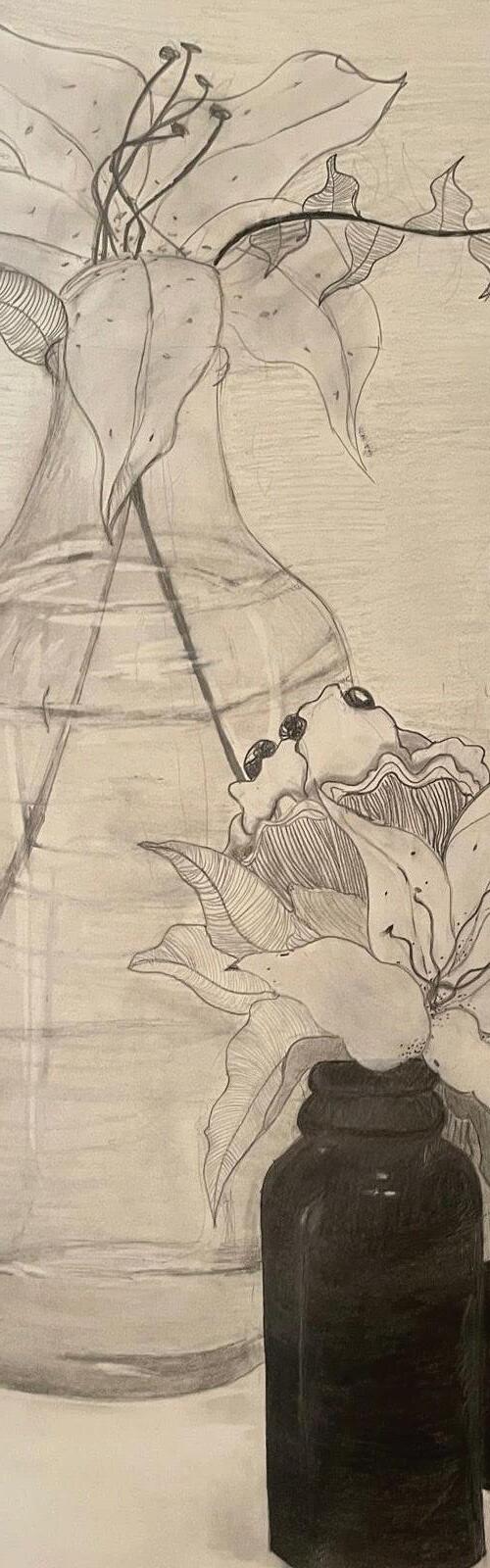
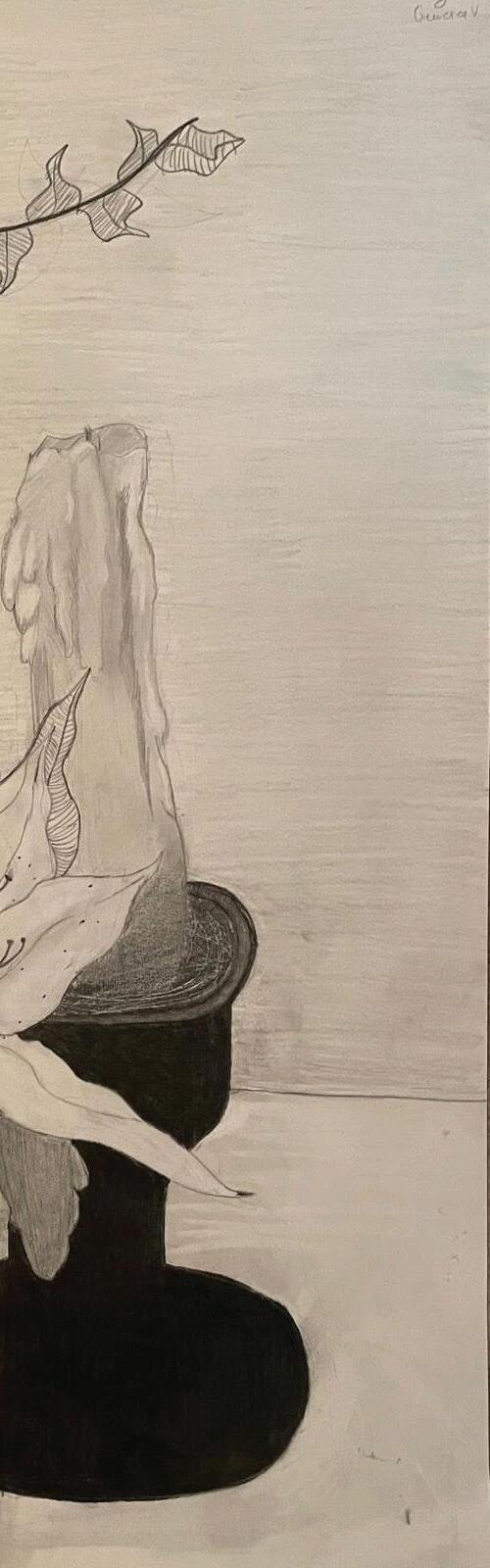
Media: Photography, 26 mm, f1.8 with a 12MP Camera
The artwork was created using graphite as the primary medium, with a touch of white pastel to add highlights and depth. My inspiration for creating this flower came from the movement of Impressionism and artists like Vincent van Gogh, particularly his painting “Still Life Vase with Twelve Sunflowers”. I wanted to capture the delicacy of the flowers and the strength of the vases I also wanted to create contrast and convey the sensation of an old painting. For the process, I first made a basic sketch to have a good view and ensure I stand, and the elements were positioned correctly to capture the essence. Then, using sandpaper, I rubbed my pencil to gather graphite dust and make the shadows easier to blend. With my finger, I blended every part, and with a 4B pencil, I added the details. For the darker areas, I used an 8B pencil. For example, the little bottle: I filled it with graphite, blended it, and repeated this process about four times to create the illusion of dark glass. The vase for the candle followed a similar process. Finally, for the highlights in the flowers and the large bottle, I used white pastel
Nathan G. Throckmorton
Chi Nu Eastern Florida State College Melbourne, Florida
In a hull of steel where salt air clings, I lived among the rust and rings A bird with clipped and tethered wings, Bound by vows and unseen strings.
The sky was never mine to roam, While others chased the light back home. I watched through portholes, wide and small, Their futures rise while I would stall.
My classmates danced through lecture halls, With cap and gown, while silence falls Like chains upon my feathered chest, Adrift at sea and far from rest.
The ship a cage with bolts and bars, A drifting prison under stars. Each wave a whisper, taunting fate: “You chose too soon. Now it’s too late.”
They tell you “Honor,” “Sacrifice,” But never mention the hidden price: Of watching dreams decay and dry, As time sails past and hope runs shy.
I roamed the decks like lions do In rings of smoke with nothing new. Just echoes down the iron throat Of orders barked and letters wrote.
I counted years in rusted beams, In sleepless nights and broken dreams. The future once a northern flame Now flickers low without a name.
And still I watch, behind the glass, The world above me racing past. The bird I was, still sings in vain, His song: a plea, a tethered chain.
Note: Without context, this might be hard to understand. While I was in the Navy, all I wanted was the chance to go to college and move forward in life while serving my country, but also grow as a person. Instead, I spent years constantly deployed at sea on a DDG (destroyer), with no time, resources, or stability to pursue anything beyond the mission. I watched as everyone I went to high school with earned their degrees, built careers, and started families. Meanwhile, I felt frozen in time, like I was trapped in a capsule drifting through the ocean, slowly being forgotten. This is the weight I feel.
Jamie (Florian) D. Woodall
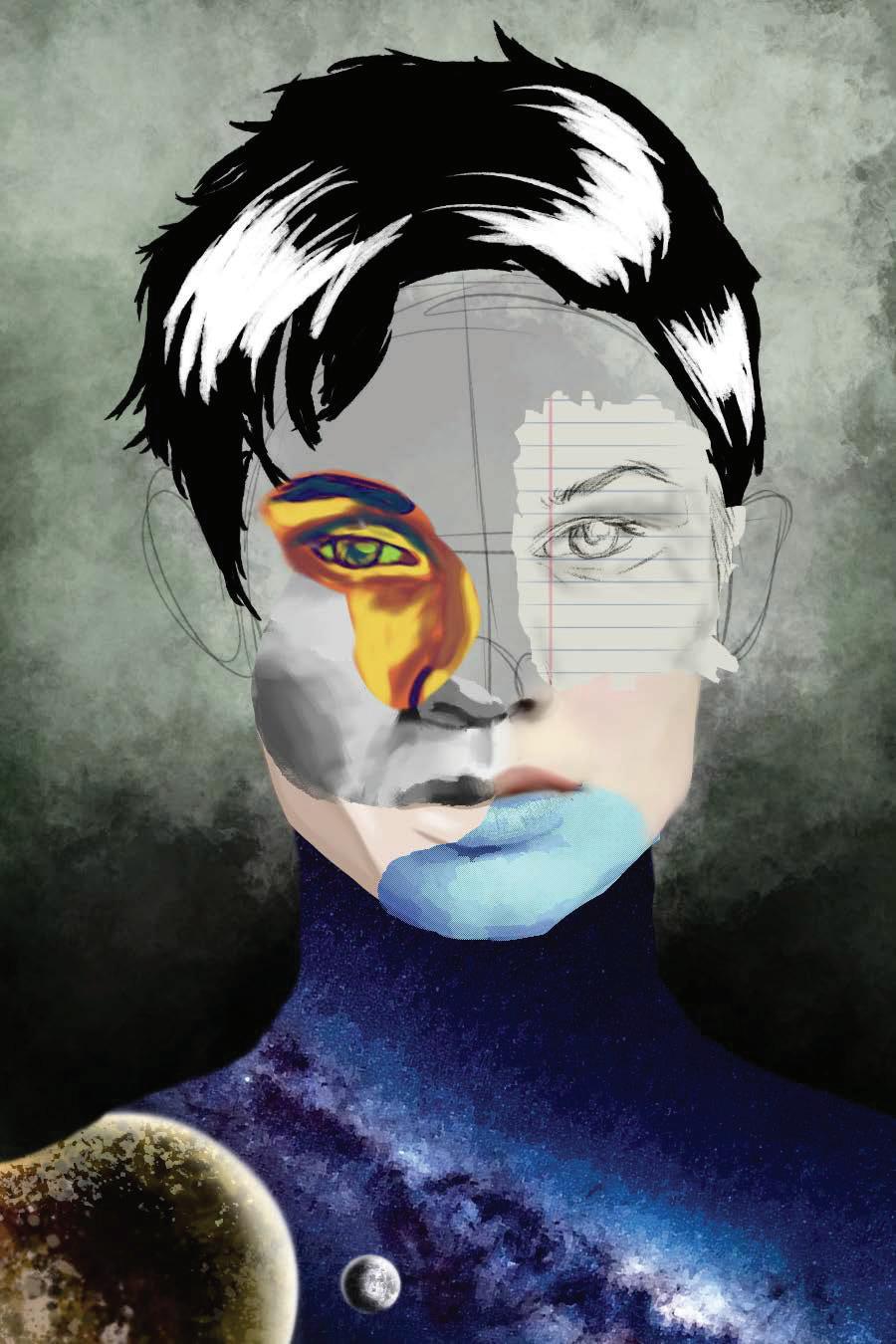
Media: Digital Art Created Using Krita
I wanted to show the many different ways people draw—especially when it comes to depicting humans. We are incredibly complex beings, and throughout history, we’ve been drawn to capturing one another through art. From the earliest drawings on cave walls to the digital pieces I now create on a drawing pad, that impulse has remained the same: to see and show each other through creative expression.
I also wanted to explore the idea of space as the body, because to me, art is infinite. It’s infinite in creativity, in the number of times it can happen, and in the endless ways it can be done. But people are infinite too—in our diversity, in our beauty, in the many ways we exist and express ourselves. This piece became a way to connect those ideas: the boundlessness of art and the boundlessness of humanity.
To create this piece, I first sketched out a human woman’s face. I then divided the face into separate areas, and in each section, I used a different drawing style. Some of these came from techniques I’ve used in my own practice, while others were inspired by artists and styles that have influenced me. Each piece of the woman reflects a unique approach, coming together to celebrate the variety and creativity found in both art and people.
Rebecca E. Pringle
Chi Nu Eastern Florida State College Melbourne, Florida
though we are so small we are moving at almost the speed of light and the universe is expanding and the streets are humming and the bustle of the crowd awakens something in me but the buzz of the fluorescent lights and the screams within my head echo endlessly never ceasing never stopping and the deadlines rapidly approaching while the loneliness eats away and the pressure rapidly growing while the tension builds and stars die while people are born and still the world spinsgive me a second to catch my breath.
Andy Paolo Mairena Amaya
Upsilon Rho
Angelina College Lufkin, Texas
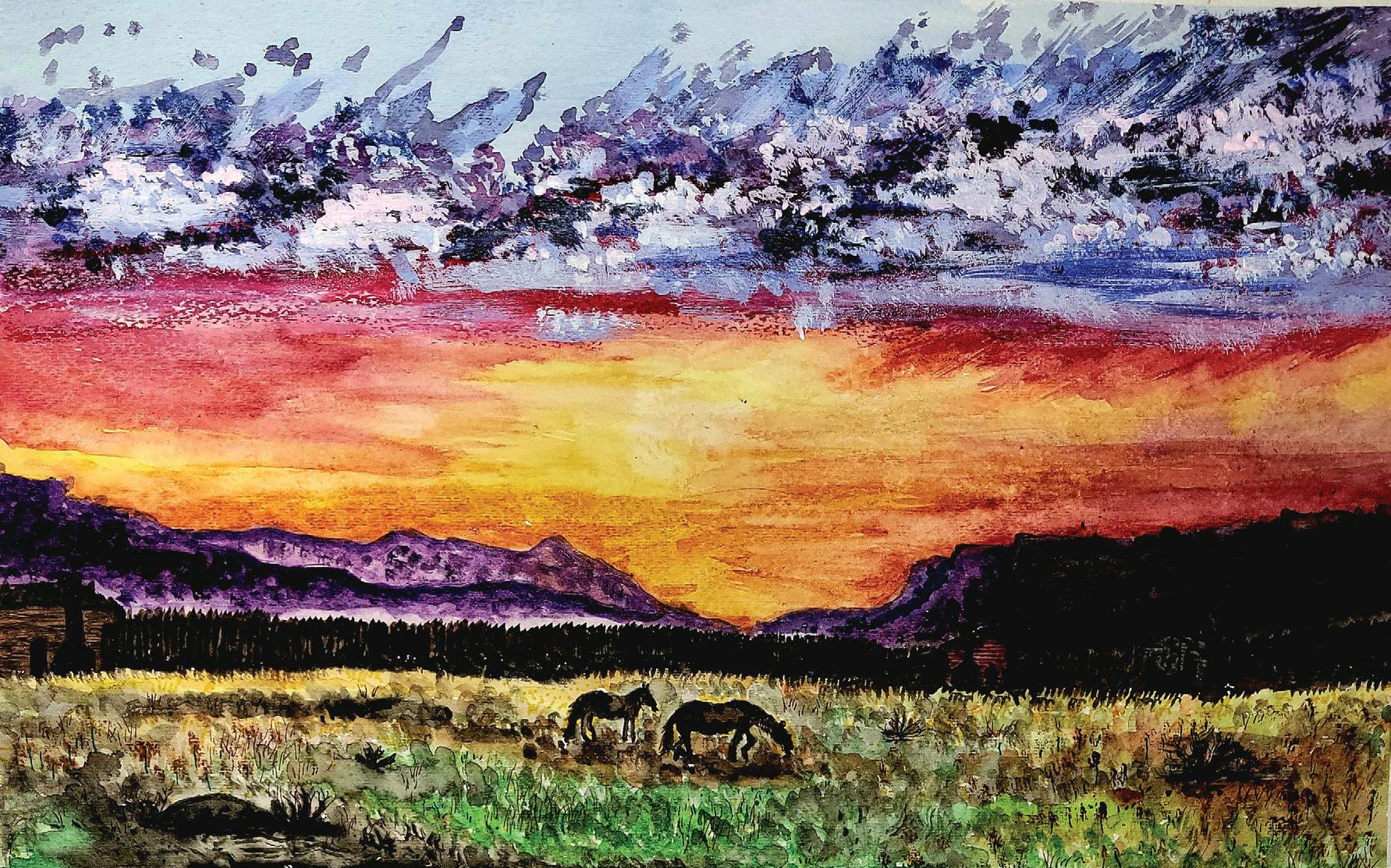
Media: Mixed
This was a Houston Livestock Show and Rodeo Art Contest Gold Medalist Piece.
The first step in creating my art piece was finding a flat wooden board to tape my watercolor paper to, creating a white frame perimeter and preventing my paper from deforming. Then I laid a thin layer of water and concentrated on my sunset colors. For the cirrus clouds, I layered white oil pastel so the water color could be repelled and white highlights would be visible. And with a thin marker, I layered on my fine grass details.
Milan Beauchamp
Beta Mu Omicron Baton Rouge Community College Baton Rouge, Louisiana
Black love is a hymn, a whispered prayer, A song passed down through braided hair. It is rhythm and blues in the marrow of bones, A heartbeat syncopated in ancestral tones. It is the hush of a mother’s embrace, A father’s firm grip, a lover’s safe place. It is hands that built, hands that heal, Fingers tracing history, making pain kneel.
Black love is a revolution wrapped in silk, Soft as shea butter, strong as guilt— The kind the world tried to break apart, Yet it stands, resilient in heart.
It is laughter beneath street lights dim, Dancing to jazz on a whim, It is Sunday dinners, voices high, The taste of sweet tea, the warmth of the sky.
Black love is a legacy, carved in stone, A love that thrives even when alone. It is the way we hold each other tight, Saying, “I got you,” even at night.
It is not just romance, not just touch, It is a force, a power, a crutch. It is the dream we dare to weave, A love unshaken, a love believed.
So let them stare, let them doubt, Our love is the sun—never burns out. Black love is eternal, bold, and true, A love that lives in me and you.
Katelyn Mercedes Bruner
Alpha Zeta Eta Dallas College, Cedar Valley Campus Lancaster, Texas

Galaxy of Light represents good shining in the darkness. Galaxy of Light is a digitally made piece that uses pictures of everyday objects such as balloons, hair, rocks, fabric, water, a flashlight, and other materials to convey a galaxy. I created this artwork to show people the importance of light. Light is what keeps us alive, light grows food, gives warmth, and brings joy on a cloudy day. To create this piece, I went through my camera roll and found pictures of objects that would give good texture to the planets. I cropped, zoomed in, and tinted the photos to better represent the planets. I took a picture of a flashlight to represent the sun and digitally painted the blue sky and starry night background. Then, I combined all the elements together using photo editing software. This process has fueled my love of digital design. I hope Galaxy of Light inspires you to shine bright like the sun.
Lauren Elizabeth Klein
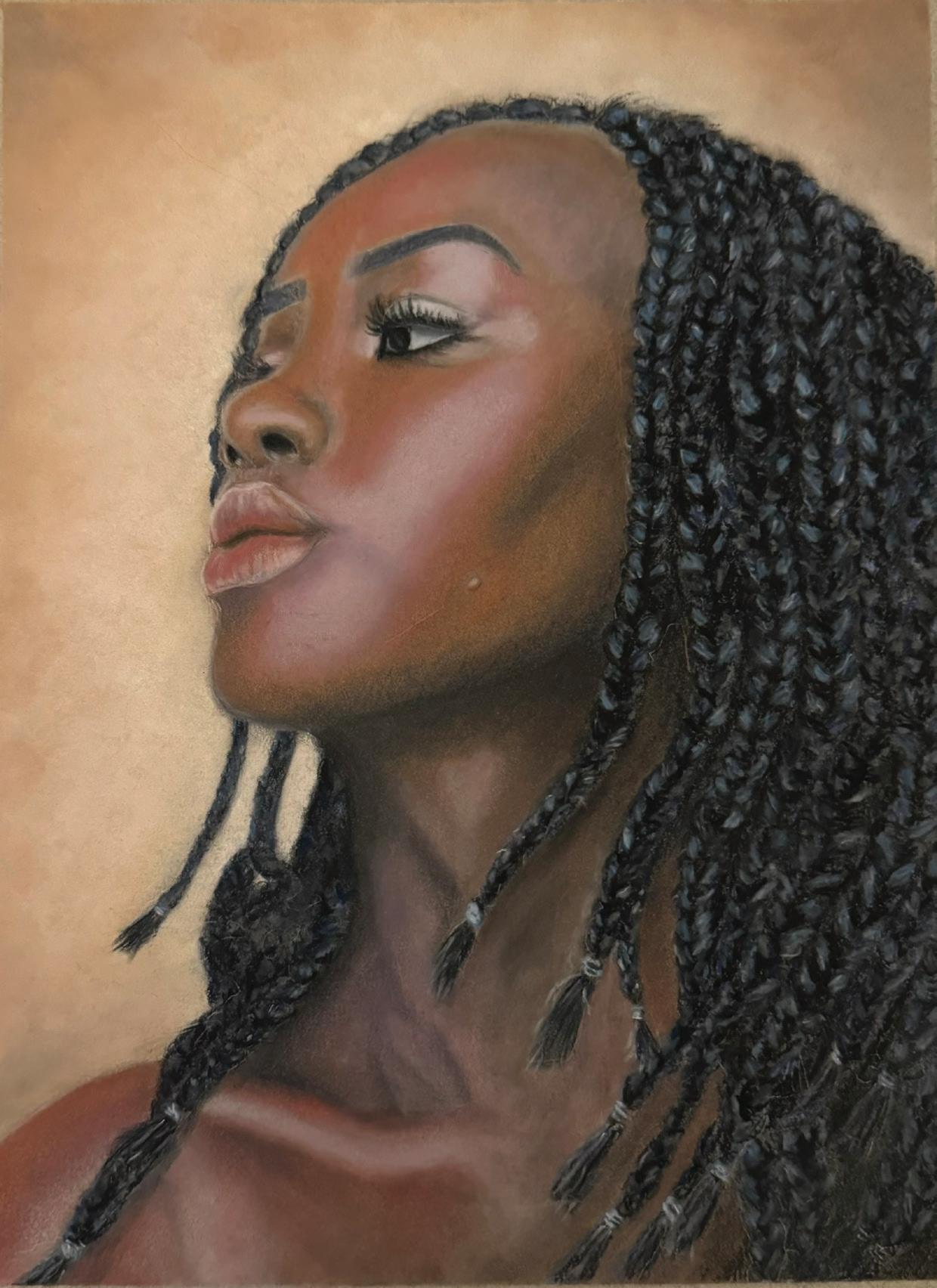
Media: Pan Pastels, Pencils
I created this art to practice my painting and drawing skills with chalk and pastel. I wanted to practice portrait drawings from another online class by Kirsty Rebecca Fine Art, a woman with braids, in Winter 2023.
On a 16x24 paper, I studied a photo of a woman from an online class by Kirsty Rebecca. I primed the paper with a neutral pan pastel color and slowly layered many color combinations to achieve this portrait.
Rithy Rung Rith
Tau Zeta St. Petersburg College Clearwater, Florida
In the bustling city of Phnom Penh, life hummed with energy. Motorbikes zipped through narrow streets, market vendors called out their prices, and children filled the air with laughter as they played in dusty alleys. Amid the commotion, in a modest home tucked away from the busier roads, sixteen-year-old Rith sat quietly, wrestling with both hope and worry. His dream of studying criminology abroad consumed his thoughts. It was a dream he had nurtured for years, but it often felt impossibly far away.
Rith’s journey had never been simple. His father, a customs officer, worked far from home and could visit only once a month. During those fleeting visits, the family found moments of warmth and joy, but most days the weight of responsibility rested on Rith and his mother, Noch. Noch was not only the backbone of their family but also a skilled HR professional at the bank. Her days were spent solving workplace challenges, handling employee concerns, and balancing payrolls. Her evenings, however, were devoted entirely to her son. Noch worked tirelessly to ensure that Rith had the tools he needed to chase his dreams, no matter how exhausted she was.
Rith admired his mother deeply. Her sacrifices were woven into the fabric of his life—the long hours she worked, the comforts she forewent, and the way she still managed to greet him with a smile, even after difficult days. “You have a future worth every effort, Rith,” she would tell him, her voice steady despite her fatigue. “Do not give up.”
Rith knew the road to his dream would be daunting. It took him an entire year to navigate the maze of school applications and the paperwork required for the visa. Noch stood by him throughout, helping him organize documents and rehearse his answers for the interview. But when the day of his first visa appointment arrived, it ended in heartbreak. His application was denied, and Rith could barely bring himself to face his mother.
She found him sitting quietly at their wooden table, staring blankly at his notes. Placing a gentle hand on his shoulder, she said, “This is not the end, my son. You will try again. And when you succeed, this setback will only make your victory greater.” Her words rekindled something within him—a determination that had momentarily faltered.
Rith applied again, pouring even more effort into preparing for the second interview. He practiced his English, refined his application materials, and rehearsed his responses until they felt natural. Noch was there every step of the way, offering encouragement, advice, and unwavering belief. On the day of the second interview, Rith wore his best shirt, meticulously ironed by Noch the night before. As he walked into the embassy, her words echoed in his mind: “Be honest, Rith. Speak from your heart.”
The moments inside were agonizing, but when the interviewer finally smiled and handed him the approval notice, relief flooded through him. He had done it. He had secured his chance to pursue his dreams. When he returned home, Noch was waiting at the door. For the first time, her composed demeanor broke, and she pulled him into a tight hug, tears streaming freely. “You did it, my son,” she whispered. “I always knew you could.”
Leaving Phnom Penh was bittersweet. At the airport, Noch held his hands tightly, her voice steady even as her emotions shimmered just beneath the surface. “Go and chase your dreams, Rith,” she said. “But never forget where you come from. Always remember, I am here.”
Rith promised her, his voice thick with emotion, “Mom, everything I do will be for you.”
Upon arriving in America, Rith found himself immersed in a world that felt both exciting and overwhelming. The streets, the faces, the rhythm of life—it was all so different from the familiar bustle of Phnom Penh. Yet, as he stood in this new country, thousands of miles away from home, Rith carried with him the unwavering determination instilled in him by his mother, Noch.
Rith’s journey as an international student was anything but easy. He navigated the demands of classes, the challenges of adapting to a foreign culture, and the ache of being far from his family. Every step forward was a test of his resilience. Yet, in those quiet moments of doubt, he would remind himself of the promise he had made to his mother—the promise to honor her sacrifices by chasing his dream of a criminology degree with relentless focus.
Each day was a new challenge, from managing assignments to finding balance between academic life and part-time work. Though the path ahead was far from simple, Rith’s determination never wavered. He had come to America with a purpose, and that purpose fueled his every decision, his every effort.
In the most difficult moments, Rith would look at the framed photograph he had brought with him—a picture of Noch and baby Rith together. On the back, he had inscribed the words: “For Mom, who taught me that setbacks are only a first step to greatness.” It was a reminder of the unbreakable bond they shared and the sacrifices that had paved the way for his journey.
With each passing day, Rith grew more confident and capable. He excelled in his criminology studies, knowing that every lecture attended, every exam passed, was not just for him but also for the woman who had believed in him when he felt unsure of himself. Together, across continents, their shared triumph was slowly taking shape—a testament to love, perseverance, and dreams that refused to fade.
Rith in the story is me, and this journey is my truth. It is the story of how my mother’s unwavering strength and belief gave me the courage to face setbacks and push forward. Together, we built this victory—a testament to resilience, love, and the power of dreams.
Sonja Lei
Alpha Psi Zeta Feather River College Quincy, California
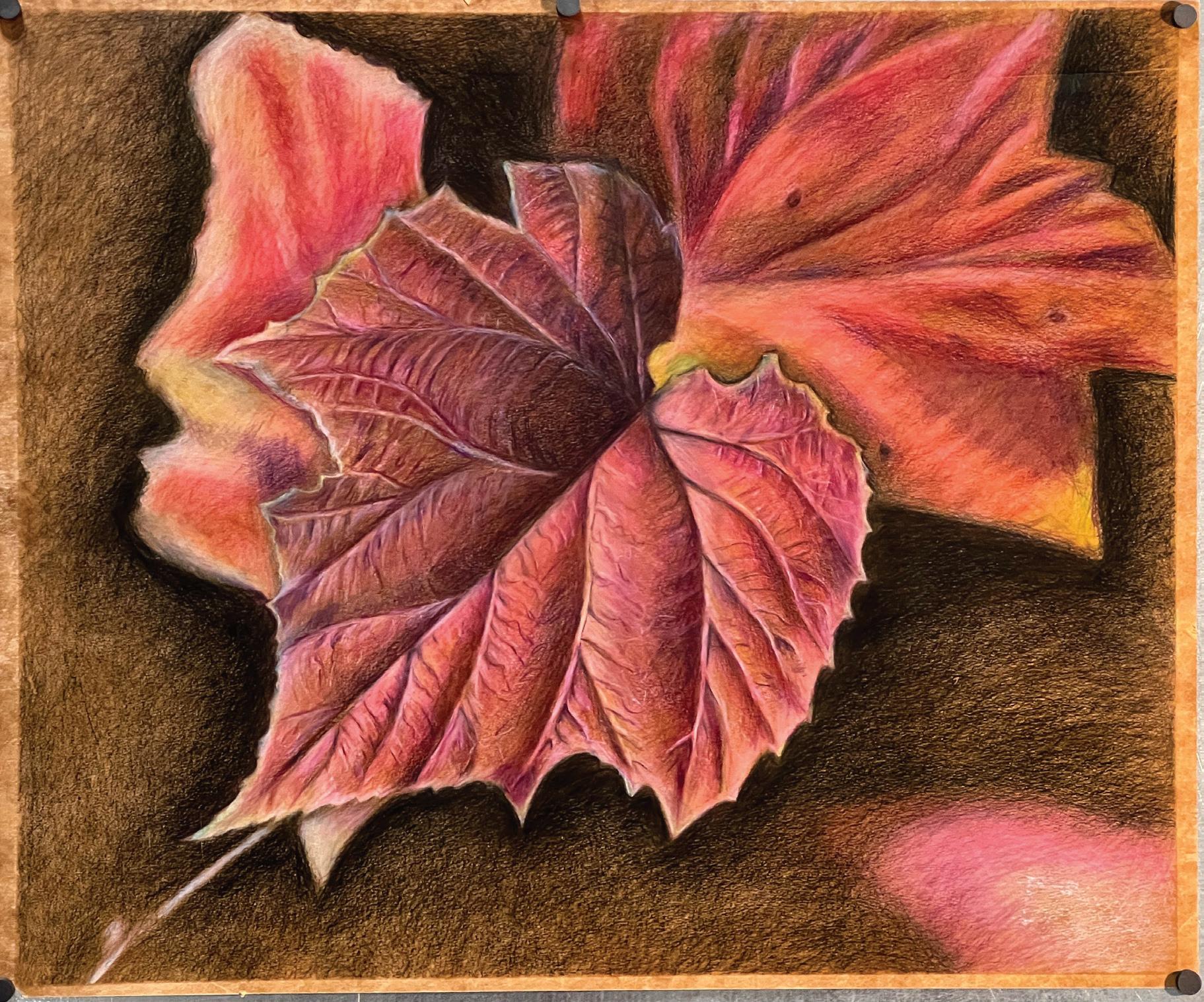
Media: Colored Pencil on Chipboard
I chose to create this image because the colorful leaf symbolizes the changes I am going through, like the autumn of life.
The image was created from a reference photo supplied by one of my online artist groups that provides royalty-free reference photos. The process of building the leaves' colors and details took many hours.
Kevin Yang

At 2,267 feet, Coney Mountain is one the darkest sites in NY with the summit sitting at an aphotic 21.89 mag/arcsec², just shy of the darkest possible night sky (22.00 mag/arcsec²). This places Coney Mountain in the darker end of Bortle Class 2, where the Milky Way is a truly beautiful sight. On this hazy night, the starlight scattered and diffused through the thin high clouds, causing each star to glow intensely, giving this panorama its iconic dreamy look. I hiked up the mountain around 1:00 AM and stargazed for an hour before starting my project on the summit. It was a truly tranquil and magnificent view of the Milky Way, untouched by light pollution, an experience that everyone should witness at least once in their lifetime.
I also wanted to point out that no human eye can see the Milky Way as colorful and detailed as this. Our eyes, unfortunately, do not have the low-light capabilities to observe the colorful details in the night skies. However, the Milky Way is still very much observable! Just not to the degree that a camera can capture during long exposures. Remember to practice Leave No Trace when visiting the Adirondacks
Rosemary
Adio
Beta Delta Omicron Tarrant County College Arlington, Texas
The stage is dimly lit. A grand, regal palace is depicted at the back of the stage. At the center, Onyeka sits on a large, ornate chair, holding a calabash filled with delicacies. His presence commands authority, yet there is a sense of unease in the air. Around him are various mysterious women who seem to come and go. The atmosphere is tense, filled with whispers.
Onyeka (monologue):
(sitting on his throne, looking around with satisfaction)
Who is greater than me? None. I have it all—wealth, power, women. I am Onyeka, and my head controls everything. No one dares question me, no one dares defy me. The world bows at my feet, and so should they.
(A woman enters with a basket of food and sets it by Onyeka’s side. Onyeka smiles, reaching for a delicacy.)
My lord, what of the people? They grow restless. They speak of your actions with fear and anger.
Onyeka (chuckling):
Fear, my dear, is what keeps them in check. And anger? It fades in the face of power. I am a god, and they are mere mortals.
(The woman exits quietly, leaving Onyeka to himself.)
The stage is dimmer, and a faint cry can be heard in the background. The goddess enters from the shadows, her presence calm and graceful. She walks toward the light, holding a bundle in her arms— her newborn child, Ogochukwu.
Goddess (softly to herself):
The gods have finally favored me. Ogochukwu, my son... you will be the light that outshines all darkness. You will grow strong and wise, for I will guide you, even in the face of this broken world.
(She pauses, listening to the faint cry. The cry grows louder, and she follows it down a dark alley. She sees something that causes her to freeze.)
Goddess (whispering):
(in shock) What is this?
(She sees Onyeka smiling strangely in the distance, as if knowing something she does not.)
Goddess:
What is he hiding? Why is he smiling?
(The goddess moves closer, but the door to a small room opens suddenly. The cries of a child are heard more clearly now.)
The stage is set for the public presentation of Ogochukwu. The people of the village gather. The goddess, holding her son, steps to the center of the stage. She is regal yet humble, a stark contrast to Onyeka’s overpowering presence. The people cheer, and Onyeka watches from the sidelines, his eyes gleaming with pride.
Goddess (speaking to the crowd):
Today, we celebrate my son—Ogochukwu—who brings with him the favor of the gods. He is our hope, our future. Let us rejoice in this new life.
(As she speaks, a woman—Oluchi—enters from the other side of the stage, walking confidently toward Onyeka. She is young, beautiful, and carries a quiet strength. Her eyes lock with Onyeka’s.)
Oluchi:
My lord Onyeka... you have not forgotten me, have you? I carry your child... I carry your love.
(A murmur spreads through the crowd. The goddess freezes, realizing who Oluchi is. Onyeka stands still, his face betraying a hint of guilt.)
The stage is darker now, a sense of foreboding fills the air. Ogochukwu enters from behind the crowd, his expression one of pure anger. He sees Oluchi and then his father, Onyeka, standing with her. His face hardens as he moves to confront them.
Ogochukwu (furiously):
So this is the truth? The man I called my father—the god I revered—betrays me with a woman who was promised to me?
Onyeka (laughing nervously):
My son, you are young. You do not understand... Love is fleeting, but power is eternal. Do not waste your time on this—
Ogochukwu:
Power?
(He steps forward, seething with rage.)
You have no power anymore, father. You took what was mine, and you dishonored my mother. You let your desires blind you. No longer will I call you my father...
(Ogochukwu’s eyes glow with anger, and the air crackles with tension. The goddess steps forward, her face solemn.)
Goddess:
(softly, almost to herself) What have you done, Onyeka?
(Ogochukwu steps toward Onyeka, his face hard with grief and anger. In one swift motion, he strikes his father down, bringing him to the ground.)
Ogochukwu:
I will not let this go unpunished.
The stage is chaotic. Villagers run about, talking in hushed voices. Some look to the goddess, while others whisper the curse that has been spoken.
(The traditionalist, Oluchi’s father, steps forward, raising his hands in the air. He is a tall figure, wrapped in ritual garb, his eyes filled with fury.)
Traditionalist (shouting):
For your complacency in the god’s wrongdoing, for not stopping him when you had the chance, I curse this land! No peace, no prosperity will come to those who allow such a vile act to go unpunished! The blood of the innocent will cry out from this day forth!
(The crowd falls silent, each person filled with fear as the curse sinks in.)
Goddess (calmly, to the people):
We are all complicit. But we must remember that love, not fear, is what will save us. We have lost our way, but it is not too late to find it again.
Scene 6: The Aftermath
The stage is dim, and the once-glorious palace of Onyeka now lies in ruins. The goddess, her face heavy with sorrow, stands alone, holding her son. Ogochukwu stands beside her, his eyes filled with both loss and resolve.
Goddess:
You have avenged the wrong done to you, my son. But we all must bear the consequences of our actions. The curse upon this land will not be lifted easily.
Ogochukwu:
(his voice solemn, but with a hint of strength)
I know. But it is time for a new beginning, mother. One where love and justice will lead us, not fear and betrayal.
(The lights fade as they walk offstage together, leaving the future uncertain but filled with the hope of change.)
Rowan Chang
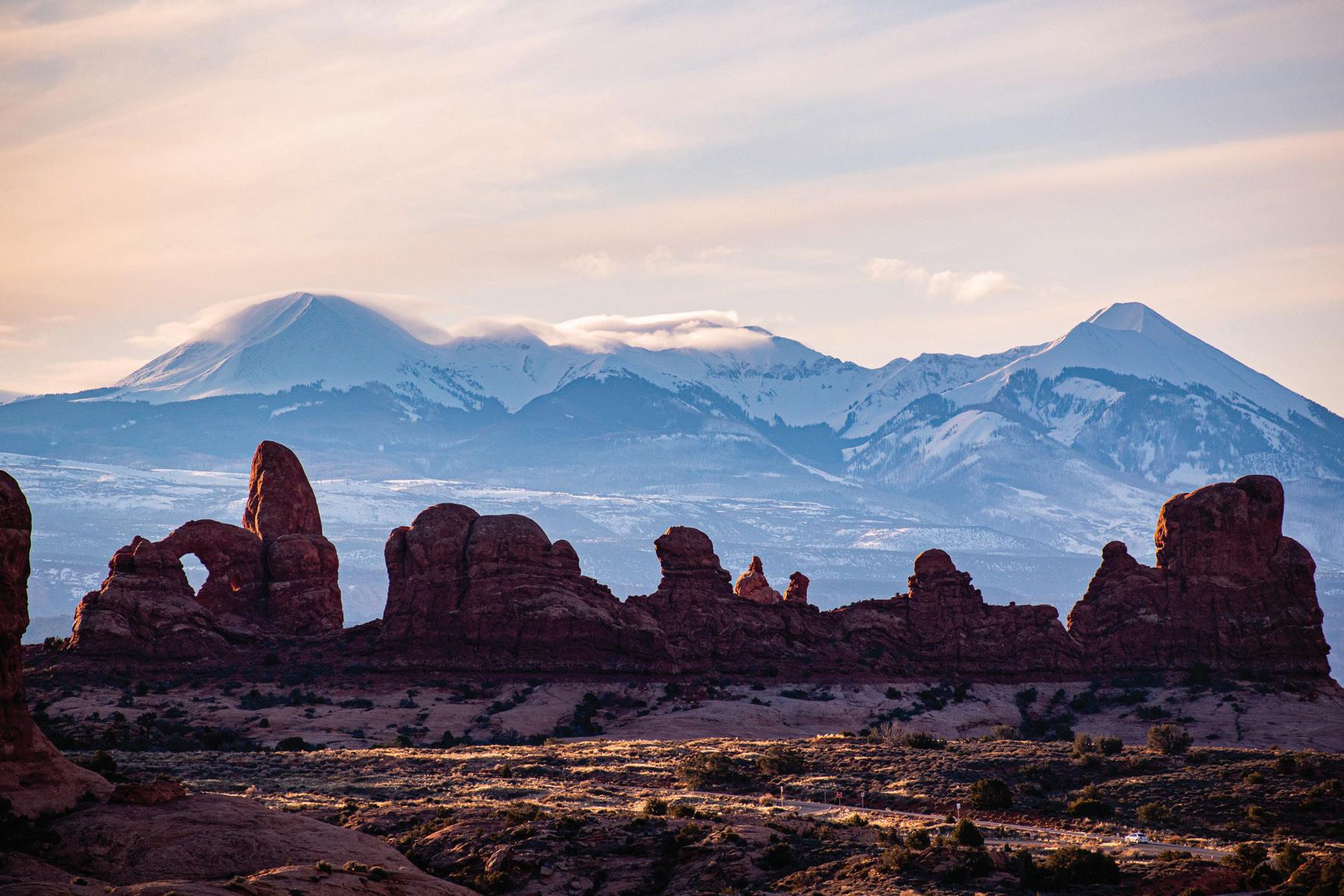
Media: Photography, DSLR, Nikon D5600
Natural beauty can always heal my soul. I love traveling around the world to explore nature's beauty. The photo was taken in Arches National Park during my spring break road trip to different national parks across the United States. It captures the breathtaking intersection of desert and alpine at sunrise. The ancient red rock formations rise like sentinels against the snow-capped La Sal Mountains. This moment, suspended between night and day, reveals the timeless majesty of Southwest America.
Orian Ivie Gaston
Zeta Omicron Navarro College Corsicana, Texas
The Train Station isn’t marked on any map. It’s more of a whispered rumor, a place that lives in the back of people’s minds as a final, foreboding destination. Nestled in the crags and shadows of a Wyoming canyon just past the Montana border, it’s known among certain circles as the Long Black Train. But don’t be fooled, there’s no real station, no ticket booth, and no whistle blowing as it passes by. Just a hollow, echoing gorge that swallows up those who have worn out their welcome in this world.
The way there isn’t easy. The path is rough, winding through sharp, rocky outcroppings that have seen the blood and sweat of more men than anyone would admit. The canyon looms, dark and endless, and the silence feels heavy, as if even the birds and insects know to stay away. To walk that path is to feel the weight of those who’ve come before and never walked back. A chill runs through the bones of even the hardest men here, a strange, unsettling feeling of a place built to erase, to remove any trace of what once was.
They say the canyon walls keep secrets. I’m inclined to believe it. People come here for one reason only to settle debts that can’t be paid in cash, to erase names that can’t be spoken anymore. It’s a place where even the wind carries an edge, as if it, too, knows it’s part of a ritual older than anyone can remember. The “Long Black Train” has become more than a legend; it’s an understanding among those who need it. A final, brutal option when words, money, or threats fail.
Those who make the journey to the Train Station do so with purpose, each step echoing with decisions they know can’t be undone. Maybe it’s the rival from across town who dug too far into their affairs. Maybe it’s an old friend whose loyalty faltered one time too many. Whatever the reason, by the time they arrive at the canyon, they’ve come to terms with the price to be paid.
Some say that if you’re quiet enough, you can still hear echoes of whispered threats and broken promises bouncing off the canyon walls, each rock and crevice a witness to the struggles played out there. The bones of the canyon run deep, a patchwork of lost men, their stories carved into the stone, unseen but never truly erased.
And when you leave the canyon, the weight lifts a little, like stepping out of a shadow that doesn’t belong in daylight. The world beyond the canyon feels sharper, more defined. But it’s a fleeting feeling, for once you’ve been to the Train Station, a part of you never truly leaves.
In the end, the Train Station is more than just a place. It’s a sentence, a reminder, and a lesson in the finality of certain choices. It’s the last stop for those who’ve crossed too many lines, where the silence of the canyon says what no one else dares to speak: some journeys don’t have a way back.
Kelly Irene Kokas
Pi Xi
County Community College Newtown, Pennsylvania

The artwork was created using a digital camera and enhanced through Adobe Lightroom, showcasing the powerful blend of photography and post-processing to bring out the image’s full artistic potential and beauty. The orange tones in the image add a sense of warmth and nostalgia, evoking the glow of a setting sun and the golden age of steam travel. It symbolizes both the fading legacy of a historic era and the enduring strength of locomotive 4014 and its sister trains of its time. The color draws the viewer’s eye, highlighting the power and detail of the train, while also creating a mood that feels timeless and reflective—honoring the past and growth of humanity, yet captured in the present.
This photo was captured during a spontaneous stop made by the artist and their family on the way to Cheyenne, Wyoming. Drawn by the rare sight of one of the last remaining World War II-era steam locomotives, No. 4014, they took the opportunity to document a powerful piece of living history. Using a digital camera, the moment was carefully framed to highlight the engine's strength and presence. Later, the image was edited in Adobe Lightroom to enhance the natural tones— especially the warm orange hues that evoke both nostalgia and reverence. The result is a striking tribute to the enduring legacy of steam and the memories forged along the journey of a lifetime.