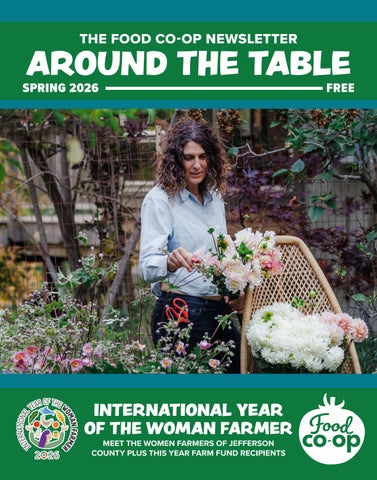
Around The Table Spring 2026

Page 1


General Manager

Kenna Eaton

Managing Editor

Andrea Stafford

Layout & Design

Christopher Bunch

Contributors

Kenna Eaton, Andrea Stafford, Amanda Millholland, NCG

Around The Table is published by The Food Co-op.

Cover Photo: Lexi Mara Design Photographed by Melissa Jentzsch If you are interested in contributing content for Around The Table, please contact marketing@foodcoop.coop to discuss your article idea. Articles

A SIGN OF SPRING & A CALL TO SERVE

This morning as I headed out the door, it was warm(ish) and rain was in the air, and I spied my first spring daffodil out on Landes Street. Seasonal change is upon us, although my head says it’s too early.

Another annual event that might feel like “it’s too early” is the Board of Directors election. Being a co-operative means that our members vote for who they believe will be the best people to help lead our Co-op, so it’s important to think about what the board does and why we need good folks like you to step up and throw the proverbial hat in the ring.

The Board of Directors provides us with a vision of where we are going and the guardrails to ensure we don’t misstep along the way. To achieve this outcome, they hire and supervise the general manager (that’s me), whose task is to run a great store while making progress on our Ends—that is, support local food systems, treat people well, and treat the planet well. We accomplish this by having clear, stated policies. I report to the board on a regular basis on what we are doing in relationship to those policies, so they—and you—know what we are doing. Annually I write a summary report on the Ends so our progress can be measured. The leadership and oversight the board provides are critical to our success. If you are interested in serving on the board, the requirements must be completed by April 28th, so you’ll need to act fast if you haven’t already begun. This year there are three seats available. Check out the requirements at www.foodcoop.coop under Board.

As 2026 is my last year, the board has embarked on a search for the next general manager. It is a BIG task to find a person who can oversee a complex store, provide great services to members, and follow the policies. Running a cooperative grocery store requires that you have experience in the grocery business and understand how a co-op is different from a conventional store. Hiring the new general manager is a tremendous responsibility for the board. Your responsibility as Co-op members is to vote thoughtfully.

Over the next few months, you’ll have opportunities to learn about the board candidates. Their bios and their answers to questions about the Co-op and the board’s job will be on the Co-op website and in the next newsletter. You will also have a chance to see the candidates in person at the “Cake with the Candidates” event on June 18th at the Co-op Annex from 5:30-7:00pm, where they will answer questions from members. Voting is a big responsibility, and it takes some work, but it is also super important – to the Co-op, to me, and to our community—and hey, it’s the last time I’m going to ask you!

Warmly, Kenna

2026 Farmer Fund Recipients

The Port Townsend Food Co-op is proud to announce the distribution of $83,844 in Farmer Fund Grants to thirteen farms/food producers across East Jefferson County. These grants will help local farmers invest in critical infrastructure, equipment, and projects that improve food security and sustainability in our community. Meet the recipients and learn more about their plans for 2026.

The Glendale Farm

Glendale Farm (est. 1857) is a historic farm being restored as a shared regenerative hub for small producers and community food access. It now hosts multiple independent farms and is rebuilding infrastructure and a farm stand, while the Farmer Fund Grant will add shared cold storage to expand production, storage, and distribution for partners.

Goosefoot Farm

Goosefoot Farm is an inclusive and free food farm in Chimacum run by young farmers who grow produce, herbs, and flowers for no-cost distribution to Jefferson County residents through local partners. The Farmer Fund grant will help purchase a walk-behind tractor to improve efficiency, protect soil health, and expand production for their free food program.

Chimalow Produce

Chimalow Produce grows nutrient-dense vegetables, herbs, and fruits from its permanent farm on West Valley Road in Chimacum, selling at the Port Townsend Farmers Market, local stores, restaurants, and the food bank, with a CSA planned for 2026. The Farmer Fund grant will help purchase a tractor-mounted power harrow to improve bed preparation efficiency, consistency, and sustainability.

UpHill Farmers

A two-person micro-farm raising small livestock—especially at-risk heritage poultry and waterfowl—with a focus on animal welfare, genetic diversity, and climate-resilient farming. The Farmer Fund grant will improve their rabbit shelter to prevent leaks, reduce repairs, and expand production.

Cold Snap Farm

Cold Snap Farm is a 20-acre farm north of Quilcene producing maple syrup from hundreds of coppiced bigleaf maples on a steep hillside, using an evolving gravity-fed sap system. The Farmer Fund grant will help cover essential new equipment—including an evaporator, reverse osmosis system, filter press, pump, and bottler—to replace a homemade setup, improve sustainability, and increase production toward a reliable income.

Chimacum Valley Grainery

Chimacum Valley Grainery is an organic family farm, stone mill, bakery, and microbrewery growing and milling heritage and landrace grains for flavor, nutrition, and climate resilience. The Farmer Fund grant will help purchase a delivery van to transport their bread and flour more efficiently, reducing trips and easing daily farm operations.

Shy Acre Farm

Shy Acre Farm, founded in 2019 by Celine and Adrianna Santiago, is an off-grid, small-scale farm demonstrating abundant productivity through permaculture, livestock, orchards, and community-focused programs. The Farmer Fund grant will purchase a two-door 54” refrigeration unit to expand storage and provide more fresh food for the community.

Solstice Family Farm

Solstice Family Farm spans 33 acres, growing vegetables, fruit, eggs, and meat using sustainable, organic practices. Farmers Jen and Sean are entering their 14th season of cultivating high-quality food for the local community. The Farmer Fund grant will support a professional inspection and priority repairs on their historic 15,000-sq. ft. barn, ensuring safe, sustainable use for housing animals, storing equipment, and daily operations.

Crust Bakery/Market Kitchen

Crust Bakery is a woman-owned bakery crafting hand pies and soups from local produce, meats, and grains, selling at farmers markets and local stores. It also operates Market Kitchen, a WSDAlicensed incubator for local food businesses. The Farmer Fund grant will repair the transmission of their 80-quart Hobart mixer, increasing efficiency and enabling greater food production for the community.

PC: Deja View

CoLab

Jefferson County Farm Collaboration is a partnership of three certified organic farms: Dharma Ridge Farm (80 acres of mixed vegetables, multi-generational, selling locally and regionally), Red Dog Farm (23 acres, over 100 vegetable varieties plus berries and tulips, year-round farmstand and CSA), and SpringRain Farm (26 acres, diversified crops, orchard fruits, eggs, poultry, and valueadded products). The Farmer Fund grant will purchase a Steamer to sanitize soil, reduce weeds and disease, and boost yields— supporting healthier crops and more high-quality produce for regional communities.

Saltwater Seeds

Saltwater Seeds is a small, worker-owned seed company growing and stewarding organic, open-pollinated seeds adapted to the Maritime Northwest. The Farmer Fund grant will purchase a Winnow Wizard to efficiently clean seeds, expand production, and make the equipment available for use by other local farmers.

Strait Up Shrooms

Strait Up Shrooms grows culinary and medicinal mushrooms in open-air beds, a greenhouse, and repurposed shipping containers, transforming local waste streams into nutrient-dense food and medicine. The Farmer Fund grant will purchase an autoclave to produce mushroom spawn on-site, reducing shipping costs and delays while increasing local production.

Stellar J Farm

Stellar J Farm is a 33-acre organic farm along Chimacum Creek, growing vegetables and blueberries and integrating poultry to enhance soil and reduce pests. The farm sells through the Co-op, CSA, and Port Townsend Farmers Market, while practicing land stewardship and habitat restoration. The Farmer Fund grant will purchase a Mini Barrel Washer to improve cleaning of root crops, reduce labor and water use, enhance product quality, and boost overall farm productivity.

In 2026, the United Nations has officially designated the International Year of the Woman Farmer, a global initiative recognizing the vital role women play across agrifood systems—from seed to harvest, market to table. Around the world, women are producing, processing, stewarding, and sharing the food that sustains families and economies, yet their contributions too often go unseen. This year calls for greater recognition, investment, and action to close gender gaps in access to land, education, financing, and leadership— because when women farmers thrive,communities thrive.

Here in Jefferson County, we don’t have to look far to see that impact in action. Our local women farmers are growing vegetables, grains, herbs, flowers, dairy, meat, and maple syrup—while building soil, strengthening community, mentoring the next generation, and reimagining what agriculture can look like. In honor of this global celebration, we asked some of the incredible women who help feed our region to share what they love, what challenges them, and what wisdom they’ve gathered along the way. Their responses— honest, joyful, gritty, and deeply rooted—speak for themselves.

Chimacum Valley Grainery - Crystie Kisler

What’s one thing you love most about farming or growing food here in our community?

Keith and I chose a farm life in order to live a grounded, land-based life and to feed our community wholesome, organic food. We love providing a local source of sustenance in a way that allows us to grow deep-rooted relationships with our community and with this place.

What keeps you motivated - the spark that gets you out into the fields each day?

As the ‘farmwife’ in the family, I don’t spend my days in the fields, but I do work at farmers markets and help with the admin, storytelling and education. What keeps me motivated is being a part of an endeavor that grows reconnection to the land and nourishes community in all the ways we can think about community— cultural, ecological, elemental, and beyond. The spark is the spark of life that we get to share with each other!

What are the biggest challenges you’ve faced being a woman in farming?

I think the industrial commodity agriculture system is an extension of a larger cultural system designed around entitlements to use and exploit the land, and the body. Our challenge is to reject that model and find ways to try to be in a more reverent and reciprocal relationships— with each other and the land. Here’s a curious question— does the land have rights? Does it consent to be farmed?

What’s one piece of wisdom you’d share with other local growers or gardeners?

Love your neighbor! I think rural farm communities have a unique opportunity and responsibility to live with and for each other. We can stay curious and caring about each other— despite different backgrounds or politics— because ultimately we need each other when the tractor is stuck or the cows get loose.

Red Dog Farm - Karen Williams

What’s one thing you love most about farming or growing food here in our community?

I love being a farmer in our community because of the immense support and love so many Jefferson County residents have for local farms. Ever since I first moved here in 2005, I felt I had been promoted to rock star status, simply by being a farmer. Nowhere else does a community love their farmers quite like they do here. And the community organizations supporting farming are astounding; Jefferson Land Trust, Organic Seed Alliance, WSU Extension, Conservation District- just to name a few- are all eager to help farmers succeed. Additionally, the farmer community is strong, collaborative and resilient. I am so thankful to count many local farmers as friends and find that there is infinitely more collaboration than competition amongst farmers even those of us doing very similar things. We share tools, supplies and resources; we talk shop, trade ideas and inspire one another; and we’re truly the only ones who know what each other are going through on a daily basis with farming in this place- long hours, weather, pests, employees, farmworker housing (or lack thereof), and all the other stressors particular to farming. I love this community- both the larger community and specifically the farming community- and feel lucky to be a part of it!

What keeps you motivated - the spark that gets you out into the fields each day?

It’s hard to explain why farming is so compelling to non-farmers, as it’s really pretty nonsensical. It feels like a compulsion. Must grow food. Must engage with seasons and nature. Must roll the dice. For me, there are all kinds of things I love about farming- working with the seasons, engaging with nature in an intimate way. I love the look and feel of vibrant, colorful produce. Building my skills, increasing the never-ending data sets of combinations of factors that make a season- or even one day- what it is. I love working at home, being with my dogs. I love watching my farm crew get inspired by growing food and sticking with it, gaining skills and context, and digging deeper into their resolve than they ever believed possible. But the real spark of what keeps me going is pretty magical- some combination of grit, sunrises, sense of accomplishment, muddy crew smiles and feeling deeply nourished.

What

are the biggest challenges you’ve faced being a woman in farming?

One challenge is being a mom and farming. Both are incredibly rewarding, and time-consuming. Balancing being present for my kid and doing my job- which happens in and around our home with often no boundaries around time or scheduling- is constantly challenging. There are of course tons of advantages of childhood on a farm, but there are also a lot of chores and practicing patience while mom does “just one more task”. Farming is a lifestyle that takes commitment- the farm is like a child that has very real needs and consequences if those needs are ignored. As the primary caregiver for both the farm and my child, sometimes I am stretched in uncomfortable ways.

PC:RODNEY JUST

There have been times when I didn’t feel I was treated as seriously because I was a woman. People assume my farm is micro-sized, or I don’t use tractors. Or they figure I am a part of a husband-wife farming team and I am only half the team (and possibly a lesser half). Many of the individuals I encounter in the agricultural field are men, from equipment dealers to bankers to other farmers. Being the sole owner of a farm as a woman doesn’t fit the mold of most people’s idea of what a farmer is. Luckily, I know many inspiring women farmers to draw guidance from.

I think there are a lot of advantages to being a woman farmer. For example, I’m really good at asking for help and knowing my physical limitations. I realized early on in my farming career that I would need to hire skilled employees, who had specialties far surpassing my own skill and knowledge. Having that awareness in mind made it easier for me to know the scale I needed to be at to be able to afford a dedicated mechanic, for example.

What’s one piece of wisdom you’d share with other local growers or gardeners?

Farming is about as much like gardening as owning a restaurant is like cooking dinner at home. For burgeoning farmers, I’d suggest they ask themselves if they really must farm, is it a compulsion and will they die trying to make it happen? If yes, then you’d better do it. Otherwise, probably find a different career. Farming will take everything out of you, especially in the first 10 years of establishing your farm.

If you’re a gardener, grow what you love! Growing food is really quite challenging. The reason carrots are hard for gardeners to pull off is not you, it’s hard! Farmers have layers of systems set up to achieve quality produce consistently. So don’t beat yourself up, but also keep trying if you want to. Have fun with it, and appreciate all that goes into getting those juicy carrots on the produce shelves every day of the year.

Chimacum Valley Dairy - Amy Rose

What’s one thing you love most about farming or growing food here in our community?

The evolving nexus of farmers in the Chimacum Valley. It brings great solemnity to see land being developed into working farms and attracting the next generation of farmers.

What keeps you motivated - the spark that gets you out into the fields each day?

Our land-based business offers a bucolic existence in tune with the seasons. When our cheese is a memorable part of locals or tourists experience here on The Quimper Peninsula.

What are the biggest challenges you’ve faced being a woman in farming?

Learning to be taken seriously. As a female co-owner and operator of a small dairy , the male oriented dairy equipment manufacturers and fabricators don’t excel at listening, they “mansplain”. Also, finding appropriately sized gloves!

What’s one piece of wisdom you’d share with other local growers or gardeners?

I’ve found having a focus on quality over quantity brings deeper satisfaction. The quest to have supply meet demand is one that I have surrendered to. As a marketing approach, “leave them wanting more or truly, as a way to keep sane. If I feel enjoyment in the production and process of our cheese, I achieve greater contentment .

Shy Acre Farm - Celine Santiago

What’s one thing you love most about farming or growing food here in our community?

My favorite thing about farming is this community is the connectedness: farmers helping farmer without the pressures of competition. We want to see each other succeed.

What keeps you motivated - the spark that gets you out into the fields each day?

Being at one with the earth brings a meditative and peaceful state of being. Nurturing the plants which in turn support our wellbeing brings great satisfaction and pride.

What are the biggest challenges you’ve faced being a woman in farming?

Our biggest challenge is in getting the financial support and resources to build a solid foundation so our small farm may thrive. It is a “fem”iliar story.

What’s one piece of wisdom you’d share with other local growers or gardeners?

Embrace change. Change is difficult and many times we want to dig our heals in and struggle to maintain our ways that are comfortable. With the ever-changing environment, pausing and considering “what could be, rather than what should be” has served us in having a positive impact. Nature is a great mentor.

Lexi Mara Design - Alexis Koch

What’s one thing you love most about farming or growing food here in our community?

Bringing bright, beautiful tulips into the homes of my community members in the cold, grey days of January brings me endless joy.

What keeps you motivated - the spark that gets you out into the fields each day?

I stay motivated by the generosity of the plants and the opportunity to learn from them.

What are the biggest challenges you’ve faced being a woman in farming?

In order to make it in this industry, I have to keep the hustle going almost all the time.

What’s one piece of wisdom you’d share with other local growers or gardeners?

Let the plants bring you outside every day. Just walking around admiring them feeds your soul and feeds theirs not to mention offers fresh air and a connection to the mood of each day.

PC: Melissa Jentzch

Hopscotch Farm & Cannery - Meghan Mix

What’s one thing you love most about farming or growing food here in our community?

I love how food connects us all. Everybody eats, and growing veggies and making pickles and jam for local folks makes me feel like I am giving back to the community in a meaningful way. Engaging with my customers is also rewarding - and the appreciation I get in return makes some of the harder aspects of farming (like the long hours and physically taxing work) totally worth it!

What keeps you motivated - the spark that gets you out into the fields each day?

Being outside all day gives me the opportunity to become more familiar with our bioregion - I love watching the first buds pop in the spring, the birds that visit the wetland in the summer, and the fruit that lingers on the trees in the fall. And while farming itself is inherently anthropocentric, I strive to create a regenerative growing system that focuses not only on nutrient dense produce, but also on soil and environmental health, ensuring that the land and ALL of its inhabitants can thrive. When I see that pay off, like how my farm’s soil has increased habitat for so many earthworms, newts, and frogs, it brings the whole circle together.

What are the biggest challenges you’ve faced being a woman in farming?

Our community is so supportive. I have encountered very little gender bias as a female farmer and business owner. My biggest challenge is doing the physical work; it is hard on the body!

What’s one piece of wisdom you’d share with other local growers or gardeners?

Farming is hard, but also rewarding. Don’t spread yourself too thin, and don’t feel pressure to expand beyond your means.

Mystery Bay Farm - Rachael Van Laanen

What’s one thing you love most about farming or growing food here in our community?

How many people are genuinely curious about how milk (cheese) are produced and are willing to support a small operation. Also, all the other farmers who share in friendship and overall support.

What keeps you motivated - the spark that gets you out into the fields each day?

I love making good, healthy and simple food for nourishing people. I believe dairy, done well and eaten in moderation is good for people, the animals and the planet. to learn from them.

What are the biggest challenges you’ve faced being a woman in farming?

Balancing all of life’s relationships with my farm responsibilities.

What’s one piece of wisdom you’d share with other local growers or gardeners?

Find bliss in the mundane.

One Straw Ranch - Charlotte Frederickson

What’s one thing you love most about farming or growing food here in our community?

I love that we can empower our customers to make positive changes in the world with their everyday food choices.

People are hungry for food they can trust. Food that’s not only healthy for their bodies, but also humane and good for the environment. That’s why we grow the best possible beef, pork and eggs - so our customers can nourish their bodies with food they actually feel good about.

What keeps you motivated - the spark that gets you out into the fields each day?

Our customers! Truly, you are the inspiration that keeps me going – and smiling. It is my joy to grow food for your table, and share our farm with you. Every time you tell me you made pork chops and everyone said they were the best they’ve had, or that you laughed at something I said in my farm email, my heart overflows.

What are the biggest challenges you’ve faced being a woman in farming?

My arm strength is paltry. Luckily, I have no problem asking for help. But seriously, I’ve never felt there was something I couldn’t do because I’m a woman. I have sincere gratitude to my parents who taught me to do ALL the things. I learned to sew on buttons and scramble an egg, but I also learned to swing a hammer and drive a tractor. And I’ve encountered nothing but encouragement in the farming community. Including and especially from my farmer-husband and business partner, Martin.

What’s

one piece of wisdom you’d share with other local growers or gardeners?

Keep a farm journal. Nothing fancy. Each morning, I take a few minutes to jot down what we did the day before – who, where, what - the good, the bad and the ugly. I can’t tell you how many times we’ve needed a piece of information and the only place it’s recorded is in my farm journal.

10 years in, it’s also inspiring (and entertaining) to look back and see how far we’ve come - and what we’ve overcome. There’s a lot of funny “I can’t believe we thought that was a good idea” moments and also inspiring “oh-my-gosh how did we survive that week” moments. Appreciating where you’ve been, and celebrating all aspects of your journey, gives perspective on your current problems and motivation to proceed into the unknown future.

Gray Fox Farm - Laurae Hughes

What’s one thing you love most about farming or growing food here in our community?

I love how appreciative our area is of the work that goes into bringing healthy and ethically grown food into our communities homes. Community engagement and support for local farms is the only way small producers (like me and many in our area) are able to be sustainable and allow the work we love to do to be able to support ourselves and our families.

What keeps you motivated - the spark that gets you out into the fields each day?

I thrive on accomplishment, and being able to see the fruits of my labor each day motivates me. Seeing new plants growing, healthy pruning, nice amounts of mulch to suppress weeds, dandelions pushing up from the dirt in late winter, birds singing in the trees, all these things give my heart joy. I am proud when I can share what I love with my community, and food is absolutely love-it shows care for the wellbeing of others, and being able to spend my life making food to bring to our community helps me feel I’m fulfilling my purpose.

What are the biggest challenges you’ve faced being a woman in farming?

Early on there were some stereotypes I would notice, like I should just raise the kids and leave the real work to a husband or partner, or I was really only running around in an apron gathering eggs and not doing any ‘real farming’, but thankfully stereotypes seem to be fading and I don’t feel that any of the challenges I’ve faced have been a direct result of being female. Farming takes a ton of work, to the extent of which can’t really be understated. Physically demanding, financially uncertain (at times), and absolutely exhausting. Some days I just feel like a big animal moving dirt from one spot to another, battling grass and racing the birds for berries, and I wouldn’t have it any other way. Perhaps if I was like Large Man of PT, amazing human capable of lifting insanely heavy objects, it would be a bit easier, but thankfully I was created with a stubborn streak a mile long (and I heal quick), and I enjoy the hard work. At times I feel every bit of 50 years old, creaking and cracking and making noise when I stand up and sit down, and then other times I’m so grateful to still be doing this work I surprise myself how well my skin suit is holding together.

What’s one piece of wisdom you’d share with other local growers or gardeners?

The wisest thing I could share with new farmers is to reach out to community, create relationships, and nurture friendships. The work is hard but rewarding, be patient with yourself. Celebrate your successes and learn from failures. I’ve had two mantras for the last 20+years, one is ‘Anything worth doing is worth doing well’ and ‘There isn’t anything I can’t do, only things I have not done yet’.

Cold Snap Farm - Daryl Dietrich

What’s one thing you love most about farming or growing food here in our community?

I love the enthusiasm our community has for local food. I often find myself talking with friends and neighbors about what we’re growing or what seasonal food we’re excited about. Having local support, especially for a budding industry like bigleaf maple syrup, is so heartwarming and meaningful for all of our farms.

What keeps you motivated - the spark that gets you out into the fields each day?

I am motivated by knowing that my work contributes to something greater than just my farm. Education and promoting sugaring on the west coast is deeply engrained into my business because it supports forest landowners and bigleaf maple conservation. Bigleaf maple trees are vital to our environment. Every part of the tree is edible, they provide shade and shelter for animals, birds and other plants. They’re riparian buffers, soil builders, carbon sequesters and their massive root systems help with erosion.

Equally significant is that sugaring is traditionally a family and community event: friends and neighbors get together to work outside in the forest or cook syrup down in the sugarhouse, getting exercise and enjoying the winter. I would love to help bring that culture to the west coast.

It’s not just about me and my farm, it’s about supporting the trees, community and the land.

What are the biggest challenges you’ve faced being a woman in farming?

It has been difficult to find other women to learn from in the maple industry. I spent several years making syrup before I met another sugarmaker in person, and it was even longer until I met women in the industry. I now have women to talk with and look up to and it has been really fulfilling to have that camaraderie. I am grateful and hopeful that I can be an example for future women in the sugaring industry.

What’s one piece of wisdom you’d share with other local growers or gardeners?

I have found it very fulfilling to network with other sugarmakers in my industry. Having face to face conversations has allowed me to forge friendships and mentorships, realize new opportunities, and go on adventures all over the country. I have thoroughly enjoyed visiting and working with all kinds of people in the maple industry. Through guidance and collaboration with others, my business has grown beyond anything I could have imagined. I would encourage any ambitious grower/gardener to engage with and try and learn from as many people as possible. The value I have found by putting myself out there has been insurmountable.

Chimalow Produce - Laura Llewellyn

What’s one thing you love most about farming or growing food here in our community?

To state the obvious – providing food for our community! Food is essential. Everyone has to eat. Growing vegetables in itself is pretty magical – seeds plus water, sun and good soil – and voila, you have delicious food! Being able to work together with a great crew to bring said magic to life and then in turn to our community – it’s a renewing and nourishing exchange.

We sell the majority of our produce at the farmers’ market in Port Townsend both on Wednesdays and Saturdays. I really appreciate the support I have felt from our customers at these markets. Generally, the most people we’ll see on a market day will come out on a sunny summer day. And yet the markets that really make my heart sing are those cold November and December Saturdays, when it could be blowing sideways and pouring rain, and folks still show up to buy our vegetables. We couldn’t do what we do without this support, and for that we are very grateful.

What keeps you motivated - the spark that gets you out into the fields each day?

I love watching the plants grow. You can see this most impressively around the summer solstice when our day length is the longest. I also love how resilient they are. They can handle a surprising variety of conditions, which results in a wide range of outcomes; but overall, they have such a strong will to live and are tougher (hopefully not literally) than we give them credit for.

What are the biggest challenges you’ve faced being a woman in farming?

I’ve been fortunate not to encounter many big, unworkable obstacles directly tied to my gender. But I am a pretty determined person. On occasion, people assume the farm is owned by a man—especially when I’m accompanied by a male employee or my husband—but it’s an assumption that’s easy to correct and move past.

What’s

one piece of wisdom you’d share with other local growers or gardeners?

Work smarter, not harder. Growing is always going to be hard work, but if you can work efficiently, with intention and put good systems in place, the work should become more sustainable over time.

Space Twins Provisions - Julia Spruill-Smith

What’s one thing you love most about farming or growing food here in our community?

I really love, and am continually moved by, the collective commitment to high quality foods in our community. It is incredibly validating to be a food producer in Jefferson County because I have received so much support from people/businesses who buy and enjoy our vegetables. Knowing that our produce is valued by the local community makes all the hard work of growing it worth it. I feel very honored to be a farmer contributing to the health and wellness of our local community.

What keeps you motivated - the spark that gets you out into the fields each day?

Gratitude. Waking up in Beaver Valley looking out across the pastures at White Lotus Farm, living with the seasons, working with my husband and friends to steward this beautiful parcel of land...it’s a dream. I feel very very lucky to be where I am, with the partners that I have, doing something that I find deeply meaningful. Even on the busiest of days, when I’ve passed the fourteen hour mark, when my back is killing me, when I have to wake up and do it all again, worried about this that or the other, I come back to gratitude for this amazing opportunity I have to be a part of this farm and community, and that always gets me moving.

What are the biggest challenges you’ve faced being a woman in farming?

Again, I feel lucky to be in a community where there are numerous women farmers that I can look to as role models, friends, and commiserators. In this way, I haven’t experienced many challenges or adversity. I generally feel respected and supported in my work as a farmer. The only thing I can think of here is the occasional encounter with a male who maybe hasn’t worked much around women and is either painfully awkward or comically condescending in their communication with me. I imagine any woman in any aspect of her life has experienced this on a few occasions. The other thing that comes to mind as a woman of child bearing age is the daunting prospect of becoming a mother while farming. I have enormous respect for women who take on motherhood while farming; to me, these women are superhuman. I know the physical toll that farming has on me personally, and the idea of going through pregnancy, delivery, and caring for an infant while farming seems impossibly difficult to me. So, at times trying to reconcile my love for farming with the potential of starting a family has been an existential challenge of varying intensity.

What’s

one piece of wisdom you’d share with other local growers or gardeners?

A mantra that I often rely on is “One day at a time.” It’s a simple platitude that grounds me in the present and reminds me that all I can do is all I can do in one day. It’s a mantra of grace, really, to remind myself that it’ll all get done somehow. Just gotta keep a steady pace and not take anything too seriously. I also can’t overstate the life-saving benefit of keeping lists. There’s a lot to keep track of in farming, and there’s just no way I would be able to keep it all straight if I didn’t keep copious lists. Plus, there’s nothing like the dopamine hit of crossing things off.

Mountain Spirit Herbs - Denise Joy

What’s one thing you love most about farming or growing food here in our community?

I think I love knowing where my food and herbs come from. I can share the creation of my products with my community. I like that I can feel safe about what I am offering. I am not certified organic, but I use organic practices and permaculture solutions. I love knowing that I am bringing healing products to our community that have been tended by me from seed or start all the way through harvest and formulation.

What keeps you motivated - the spark that gets you out into the fields each day?

When I am out on the land, especially in my gardens, this is the setting where I feel most at peace with my spirituality. It is my safe place. Working in the gardens helps me to stay and remain calm. When I am in my gardens, the plants talk to me as sentient beings. I feel honored to work with them and to share the special energy that they create.

What are the biggest challenges you’ve faced being a woman in farming?

Cultural attitudes that women don’t know how to farm. Despite women being the primary gardeners since time immemorial, modern farming practices have largely excluded them from the conversation. There are many folks in our community and the world at large working to change these perceptions.

What’s one piece of wisdom you’d share with other local growers or gardeners?

Understand your land; sit on it and observe where the sun is, walk barefoot and feel the soil beneath your feet. Take the time to see what it looks like and what is thriving in the existing environment before you begin to change it. Allow the plants to choose to live where they will thrive instead of where it is most convenient to your thinking. This is especially important with herbs.

PC: David Conklin
PC: David Conklin

THE REAL COST OF FOOD

Let’s talk about the elephant in the grocery aisle.

If you’ve felt a little sticker shock lately—at the Co-op, at the farmers market, or anywhere you shop—you’re not imagining it. Food prices have risen steadily over the past several years, and for many households in Jefferson County, that pinch is real. We feel it too. Since 2020, costs have risen across the entire food chain, including seeds, feed, fuel, packaging, insurance, utilities, transportation, and labor. Farmers are paying more to grow food. Producers and distributors are paying more to move it. Grocers are paying more to stock it. Those increases are real and they are unlikely to fully reverse.

It is also important to understand why food from smaller, local farms often costs more than food from large-scale industrial operations. Large commodity growers benefit from significant federal subsidies, especially for crops like corn and soy that are used in processed foods and conventional livestock feed. These subsidies, along with federally backed crop insurance programs and infrastructure support, help keep prices artificially low for factory-farmed products. Small and mid-sized farms, especially diversified, organic, and pasture-based farms, often do not receive the same level of subsidy support. They invest in soil health, crop rotation, humane animal care, and fair wages. They farm at a human scale, not an industrial one. That work is more labor-intensive and less subsidized, but it builds long-term resilience in our local food system.

When we talk about the real cost of food, we mean pricing that reflects fair pay for workers, responsible environmental practices, and community well-being. Cheap food often shifts hidden costs onto farmworkers, rural communities, and future generations.

As your community-owned grocery store, we are committed to keeping prices as low as we can without compromising our values. In order to achieve this goal we,

• Leverage our partnership with National Co+op Grocers to secure better pricing on everyday staples

• Continue to expand our Co-op Basics program to offer consistent value on key items

• Offer bulk options that reduce packaging and stretch budgets

• Invest in strong local supply chains that support small and mid-sized farms

• Provide stable jobs with fair wages and benefits

We are not here to maximize profits. We are here to nourish our community. We know grocery budgets can feel tight, so on the next few pages, we are offering some practical ways to think about saving this year while being aligned with your values.

THE MICROBES WHO MADE YOUR MEAL

Imagine yourself as a microorganism just hanging out in the soil right near a carrot. You’re hungry, so you shout up to your carotenoidproducing pal, “Hey, could you pass along some vittles?” The carrot replies, “You got it! Just toss me some nitrogen and phosphorus over there where I can reach, and it’s a deal!”

This microscopic barter system is happening beneath our feet every day. (Or we hope it is!) Plants and soil microbes are constantly negotiating, trading sugars, minerals, and chemical signals in a bustling underground gift economy. And here’s the thing: the better that relationship works, the more nutritious our food tends to be.

Healthy soil isn’t just dirt, it’s alive. Eek! Huh? Yes, a single teaspoon can contain billions of bacteria, miles of fungal networks, and a diverse cast of characters so teeny, you wouldn’t be able to see them if they were sitting atop your nose.

This soil microbiome functions a lot like our own gut microbiome (and you can even find the same families of bacteria in both places). Diversity matters. Balance matters. Keeping the less favorable bacteria at bay matters. And when the system is stressed by overuse of chemicals, monocropping, or erosion from extreme weather patterns, everything downstream suffers including not only wildlife and ecosystems but the actual nutrient richness of the food.

When farmers use practices (often called “regenerative” or “organic” or “agroecological”) that build soil health like cover cropping, reduced tillage, compost application, and diverse crop rotations, they’re not just being kind to the earth, they’re nourishing that underground microbial community. In return, microbes help plants access nutrients, defend themselves against stressors, pests and potential disease, and support their ability to produce a richer array of phytochemicals which have been shown to offer numerous health benefits. In other words: better soil biology can support better nutritional quality.

Think of it this way: if your gut microbiome were fed nothing but ultra-processed foods, it wouldn’t perform at its best. Plants are no different. Crops grown in depleted soils or via more conventional methods, may still look good, (and sometimes a little overly perfect) but they often lack the nutritional profile often found in those grown in living, wellcared-for soil with methods that don’t apply synthetic chemicals. Research increasingly suggests that soil health influences nutrient density: things like mineral content, antioxidant levels, and even the balance of proteins and carbohydrates in some foods.

This connection is especially exciting because it reframes agriculture as a potential public health intervention where we can all be advocates for our food and our farmers. When we support farming systems that prioritize soil life, we’re investing not just in environmental sustainability, but in also in better nutrition and resilience, not to mention

supporting the livelihoods of those producing our food. It’s one of those satisfying full-circle moments: a diverse set of soil microbes support plants, plants feed us, and our own gut microbes and bodies get to thrive on more nutrient-dense foods which supports our wellbeing.

While access and affordability are real issues, choosing foods grown with soil health in mind when possible is a way of participating in that underground conversation. It’s voting with your dollar and/or your voice for carrots that had better microbial friendships. And really, who wouldn’t want more of our meals to come from a place where cooperation, diversity, and mutual aid are all baked into the system?

Mary Purdy, MS, RDN, is an integrative eco-dietitian, working at the intersection of sustainable food systems, climate and human health. Currently she is the Managing Director of the Nutrient Density Initiative and Adjunct Faculty at The Culinary Institute of America’s Masters Program in Sustainable Food Systems.

Stronger Together Our Community Farmers Markets

Spring is just around the corner, and with it comes the opening of the 34th season of the Port Townsend Farmers Market (PTFM). Mark your calendars for our three Jefferson County Farmers Market opening dates this year: PTFM Opening April 4, Chimacum Farmers Market (CFM) opening May 3, and the Wednesday PTFM opening June 3. We are excited to share a few other updates for the season from uptown improvements to sustained market food access for shoppers with low incomes.

The nonprofit Jefferson County Farmers Market (JCFM) operates the PTFM and CFM with a mission to cultivate vibrant marketplaces that support local farmers and artisans, engage the community, and provide access to healthy food for all. From April through mid-December, the Saturday PTFM brings together 50 to 80 farm, artisan food, and arts businesses on Tyler Street, creating a welcoming space for community connection and opportunities for local small businesses to grow. Join us for the season opening of the PTFM on Saturday, April 4.

While traditions like the goat parade keep the PTFM rooted in community and connected to our agricultural heritage, JCFM also embraces change. This year, we’re continuing efforts to improve the PTFM and Uptown Port Townsend in partnership with the City of Port Townsend and the Port Townsend Main Street Association. Look for new bike parking and sidewalk planters, and a picnic table Uptown this spring. Stay tuned for more improvement updates by signing up for our weekly newsletter.

Healthy farms are essential to thriving markets. Last season, JCFM launched the Jefferson County Farmer Recovery grant program to support farmers during times of crisis. This spring, we’ll award our first recovery grant to Gray Fox Farm to help replace honeybees lost to wasps last fall. Farmer Recovery grants are available to JCFM farm businesses facing unexpected hardships such as crop loss, equipment or infrastructure damage, extreme weather events, or predator-related livestock losses.

JCFM is committed to ensuring people of all incomes can access fresh, locally grown food through our food assistance programs, including the Supplemental Nutrition Assistance Program (SNAP) Market Match, the Women Infants and Children (WIC) and Senior Farmers Market Nutrition programs, and VegRx. This year, state and federal SNAP Market Match funds were reduced by 60%. Thanks to community support, however, we’re able to continue offering a dollar-fordollar match this season. Visit the market information booth with your SNAP/EBT card to receive up to $25 in matching funds per market day—turning $25 into $50 to spend on fresh food at your farmers markets. Also, come by the booth for more information on WIC and senior benefits for families and elders with low incomes.

The CFM opens shortly after the PTFM, on Sunday, May 3, from 10am to 2pm on the grass at the Chimacum Corner Farmstand. In June, we’ll launch the second season of the midweek PTFM, held Wednesdays from 3 to 6pm. on Tyler Street. We invite you to help make this a strong market season by shopping directly with local growers and makers and inviting friends and family to meet you at the market. Your support creates local jobs, strengthens small businesses, and keeps dollars circulating in our community. We’re grateful to be growing together and look forward to a great year ahead.

Get Scrappy

Use vegetable trimmings and leftovers to make delicious meals while reducing food waste.

Start here to reduce waste: Not all foods are wasted equally, check out commonly discarded foods and how to save them.

Leftovers

Freeze one or two portions so you don’t get tired of eating a dish before it goes bad.

Bread Keep out what you can use in the next three to five days and freeze the rest.

Carrot Top and Pepita Spread

Serves 4. Total time: 15 minutes.

Carrot Top and Pepita Spread

Serves 4. Total time: 15 minutes.

1 cup carrot top leaves, packed

1 cup carrot top leaves, packed

1⁄2 cup pepitas (raw pumpkin seeds)

1⁄2 cup pepitas (raw pumpkin seeds)

1 large garlic clove

1 large garlic clove

1⁄2 teaspoon salt

1⁄2 teaspoon salt

1 tablespoon lemon juice

1 tablespoon lemon juice

3 tablespoons extra-virgin olive oil

3 tablespoons extra-virgin olive oil

1. Pick the leaves from the stems of the carrots, packing the leaves in a cup. Wash and spin dry or pat dry with a clean towel.

1. Pick the leaves from the stems of the carrots, packing the leaves in a cup. Wash and spin dry or pat dry with a clean towel.

2. Place the pumpkin seeds in a medium skillet and swirl over medium-high heat until the seeds start to smell toasty and pop. Transfer the seeds to a food processor bowl.

2. Place the pumpkin seeds in a medium skillet and swirl over medium-high heat until the seeds start to smell toasty and pop. Transfer the seeds to a food processor bowl.

3. Add the carrot leaves, garlic clove and salt and process until minced finely. Scrape and repeat. Add the lemon and olive oil and process until smooth.

4. Transfer to a storage jar and store in the refrigerator up to 4 days.

3. Add the carrot leaves, garlic clove and salt and process until minced finely. Scrape and repeat. Add the lemon and olive oil and process until smooth.

4. Transfer to a storage jar and store in the refrigerator up to 4 days.

Use this peppery, savory spread like a pesto on pizza, stir it into cooked rice or jazz up a simple sandwich.

Use this peppery, savory spread like a pesto on pizza, stir it into cooked rice or jazz up a simple sandwich.

Potatoes

Potatoes

Boiled and roasted potatoes freeze and reheat very well.

Boiled and roasted potatoes freeze and reheat very well. Got a potato on the verge? Make soup.

Got a potato on the verge? Make soup.

Milk

Veggie Trim Stock

Makes 6 cups. Total time: 1 hour; 10 minutes active.

8 cups veggie trimmings

8 cups veggie trimmings

8 cups water

1 bay leaf

8 cups water

1 bay leaf

1 teaspoon black peppercorn

1 teaspoon black peppercorn

1⁄2 teaspoon salt

1⁄2 teaspoon salt

3 dried mushrooms, optional

3 dried mushrooms, optional

1⁄4 cup white wine, optional

1⁄4 cup white wine, optional

1. Combine the veggies, water, bay leaf, peppercorns, salt and mushrooms and bring to a boil over high heat. Lower the heat immediately (boiling too long makes it bitter) and cover, to simmer very gently. Leave covered so the water will not boil away. Add wine, if desired.

1. Combine the veggies, water, bay leaf, peppercorns, salt and mushrooms and bring to a boil over high heat. Lower the heat immediately (boiling too long makes it bitter) and cover, to simmer very gently. Leave covered so the water will not boil away. Add wine, if desired.

2. Set a timer for 45 minutes.

2. Set a timer for 45 minutes.

3. At 45 minutes, strain the stock, and discard the veggies (they make great compost).

3. At 45 minutes, strain the stock, and discard the veggies (they make great compost).

4. Taste the stock; add seasonings as desired.

4. Taste the stock; add seasonings as desired.

5. Use as a base for soup or freeze for future use.

5. Use as a base for soup or freeze for future use.

Save onion skins, carrot peels and other trimmings in the freezer until you have enough to make stock.

Save onion skins, carrot peels and other trimmings in the freezer until you have enough to make stock.

Milk

Instead of buying a half-gallon, buy two quarts. The unopened one will keep longer.

Instead of buying a half-gallon, buy two quarts. The unopened one will keep longer.

Cheese

Cheese Firm cheeses freeze well; shred and freeze a pile for a future pizza.

Firm cheeses freeze well; shred and freeze a pile for a future pizza.

Greens! Get Your

Reprinted by permission from grocery.coop.

It’s no secret that green and leafy vegetables are good for you. But while a side of steamed broccoli is nutritious, it lacks … excitement. Even salads, with their endless potential for variety, can begin to feel too familiar.

Liven things up! To enjoy more of those glorious greens, start by making small additions to your daily diet: Snack on crunchy cucumbers and snap peas, or add a pop of flavor with fresh herbs. Toss leafy greens into any soup, smoothie, stir-fry or curry. Hungry for more ideas? Give these simple, green-themed recipes a try.

Baby Kale Stir Fry

Serves: 2. Prep time: 15 minutes.

1 tablespoon tamari

1 tablespoon rice vinegar

1 tablespoon honey

1 tablespoon avocado oil

1 small carrot, sliced diagonally

1 5-ounce package baby kale

1. In a small bowl, stir the tamari, rice vinegar and honey; set aside.

2. Place a wok or large saute pan over mediumhigh heat for a couple of seconds, then drizzle in the oil.

3. Add the carrot slices and stir for 1 minute, then add the kale and stir. As the kale starts to wilt, after about 1 minute, drizzle in the tamari mixture and stir to coat. Cook until kale is softened, about 1 minute longer.

4. Serve hot.

Nutrient-dense dark leafy greens like kale, spinach and collards are an excellent source of vitamins A, C and K, minerals, antioxidants and fiber.

Great Green Goddess Salad

Serves: 4. Prep time: 20 minutes.

1 clove garlic

1 small anchovy (optional)

1⁄2 cup lightly packed fresh parsley

2 medium scallions, white and green parts separated

1⁄2 teaspoon dried tarragon

1⁄4 cup plain Greek yogurt

2 tablespoons mayonnaise

1 tablespoon white wine vinegar

1⁄2 teaspoon salt

2 tablespoons olive oil

5 ounces baby spinach, washed and dried

1 medium cucumber, peeled and sliced

1 medium avocado, sliced

1. For the dressing, in the food processor, combine the garlic, anchovy (if using), parsley and the white parts of the scallions. Process to mince very finely. Scrape down and process again. Add the tarragon, yogurt, mayonnaise, vinegar and salt and process until smooth. With the machine running, drizzle in the olive oil until well mixed. Transfer to a pouring cup or jar; keeps for 4 days, tightly covered, in the refrigerator.

2. For the salad, spread the spinach on a platter or four small dinner plates. Cover with cucumber and avocado, and drizzle with dressing, then chop and sprinkle the scallion greens over the salads. Serve immediately.

Turn static files into dynamic content formats.

Create a flipbook