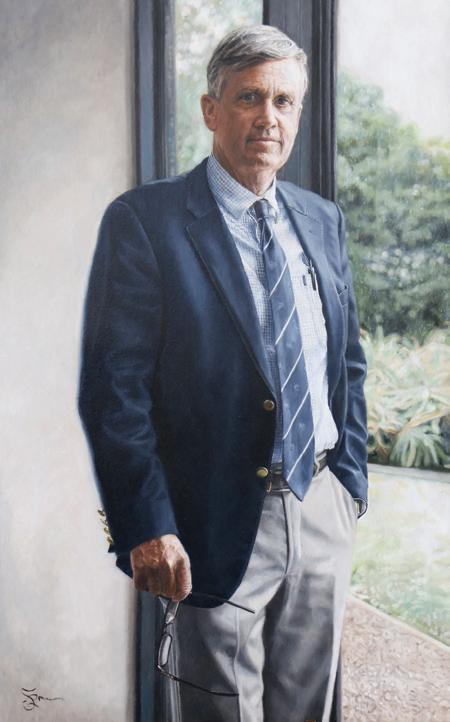
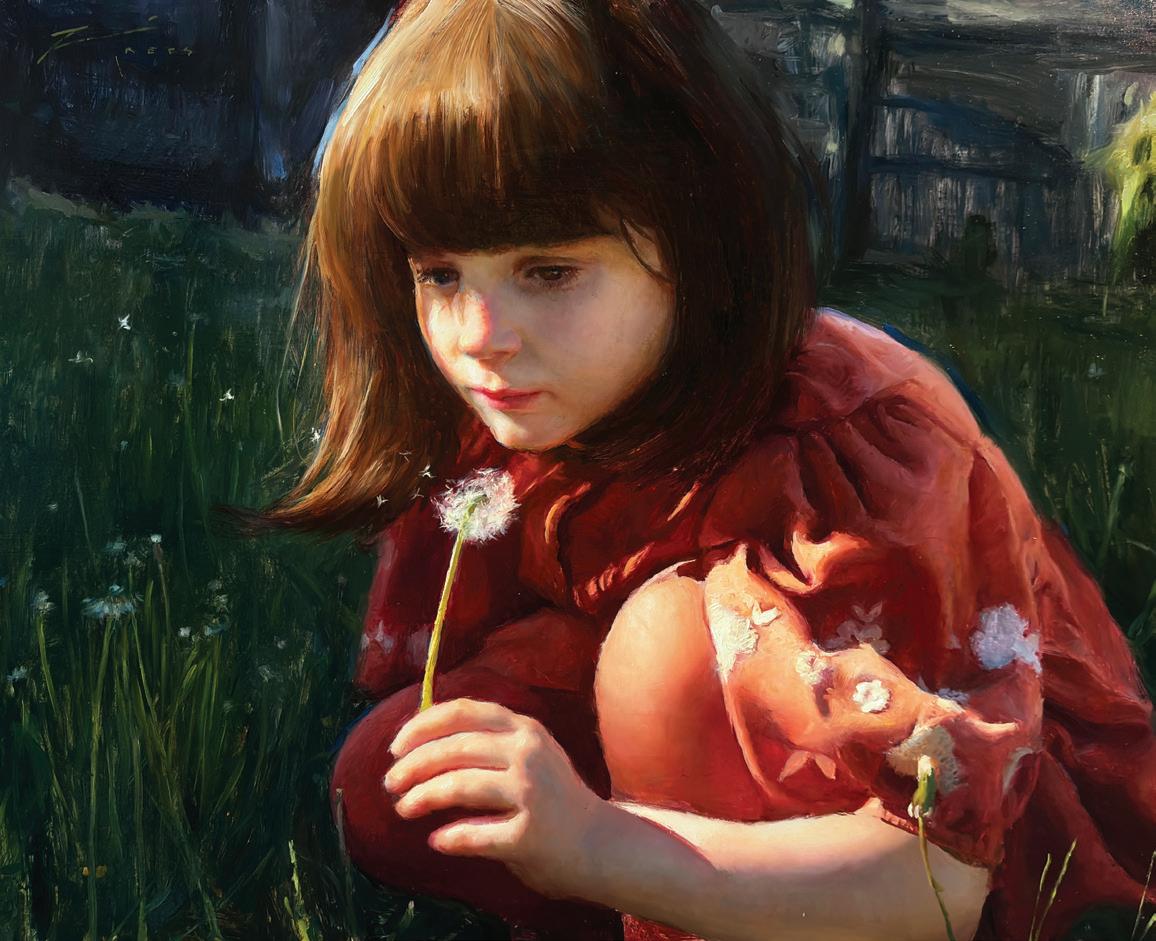
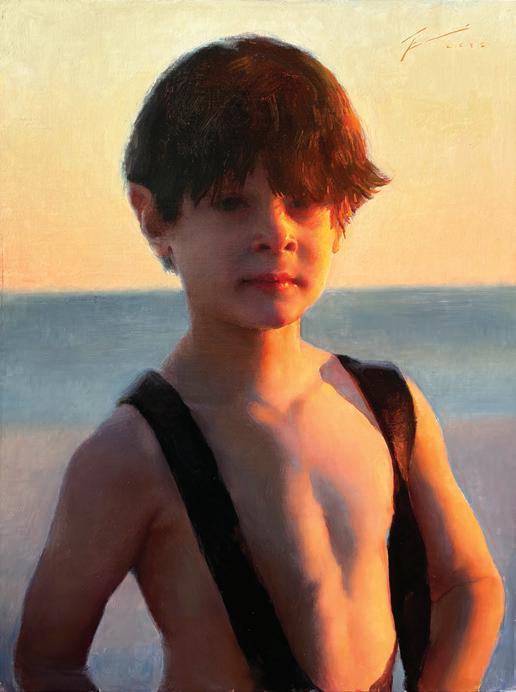
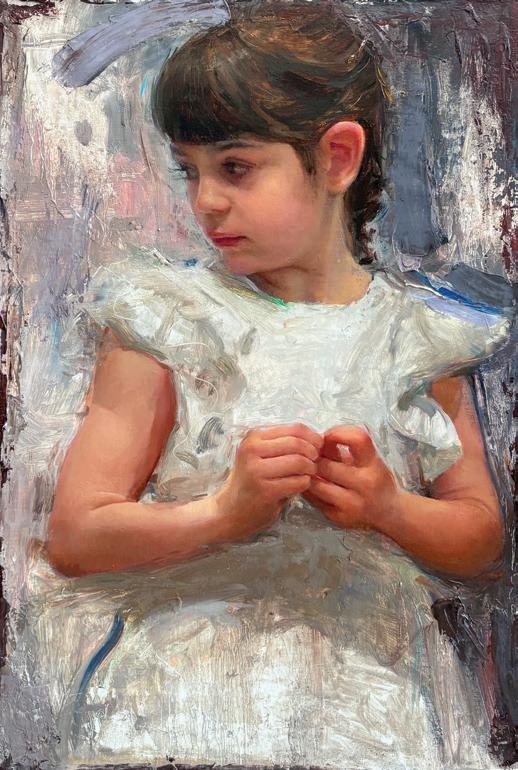
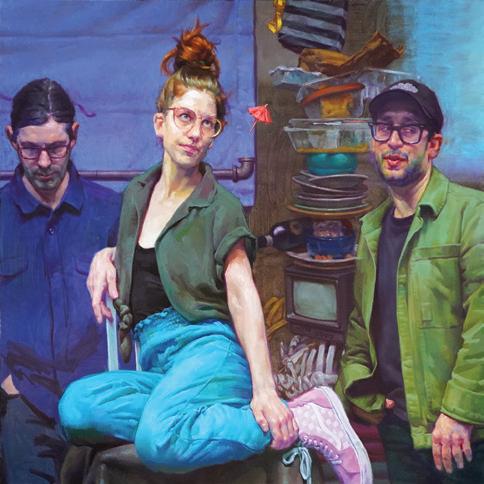
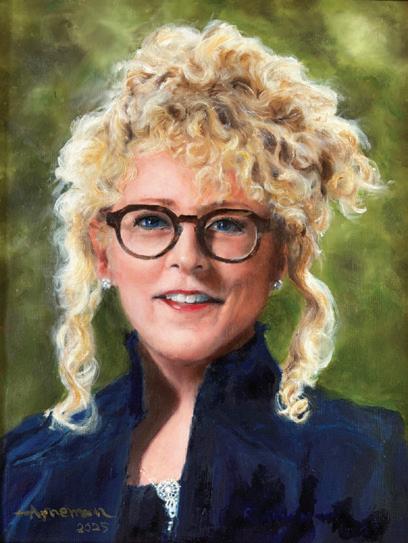
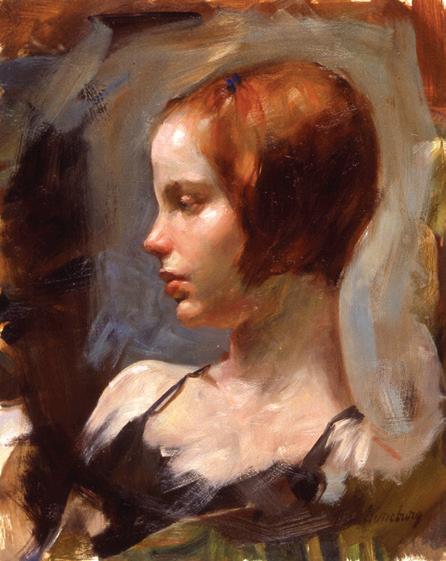
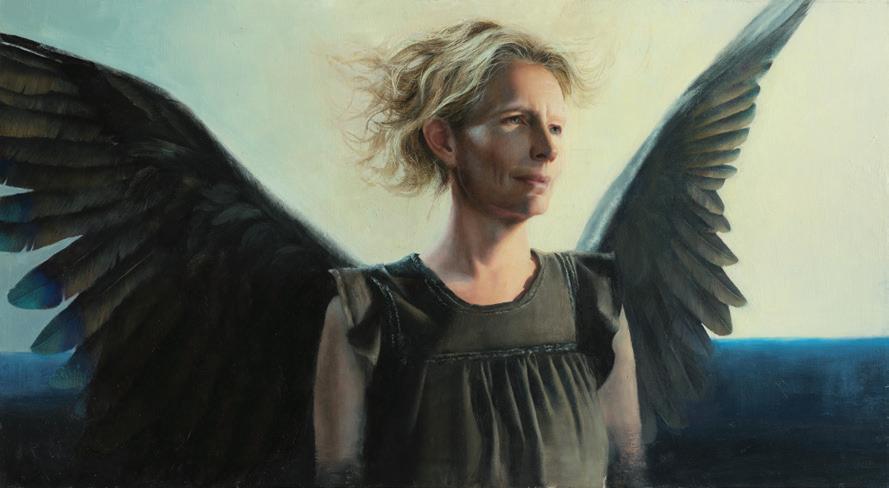
In this issue of the Portrait Society’s The Art of the Portrait Journal, we are proud to present the award recipients of the 6th annual The Future Generation Competition. With over 300 images submitted from around the world, the judges had a challenging task to narrow down their final selections.
Competitions like this offer young artists invaluable professional exposure, serving as a bridge to mentors, collectors, and peers who can inspire and guide their growth. Beyond individual recognition, supporting emerging artists sustains the broader profession of portraiture, ensuring it continues to evolve, remain relevant, and reflect the world around us.
The Future Generation Competition exemplifies how encouragement, visibility, and opportunity can nurture talent at a pivotal stage in an artist’s development. By instilling confidence and providing a platform for growth, programs like this help artists refine their skills while finding their voice within the tradition of portraiture.
Equally important, emerging artists bring fresh perspectives and innovative approaches that both honor portraiture’s history and push the boundaries of the medium. In this way, the art form not only endures but flourishes—enriched by the creativity and vision of those just beginning their journey.
Following the announcement of this year’s awardees, we spoke with the top four artists and were struck by several shared experiences. First, each had been drawn to art from an early age. For example, secondplace winner Yash Waman, raised in a farming family, discovered clay in childhood and began shaping his own toys from the earth around him. Second, each artist continually challenges themselves, seeking further training and holding themselves to ever-higher standards. Olivia Arts nearly gave up on finding rigorous instruction until she enrolled at the Charles H. Cecil Studios, where she is now a principal instructor of drawing and painting. That classical foundation has provided the bedrock of her career. Finally, each artist emphasized the importance of mentorship. Both Mattie Ree Neal and Katya Dennison spoke of the profound influence of established masters who guided their growth and artistic maturity.
Together, these stories remind us why initiatives like The Future Generation Competition matter so deeply. They celebrate the promise of young artists, honor the traditions that shape them, and ensure the future of portraiture remains vibrant and full of possibility.
Christine Egnoski, CEO
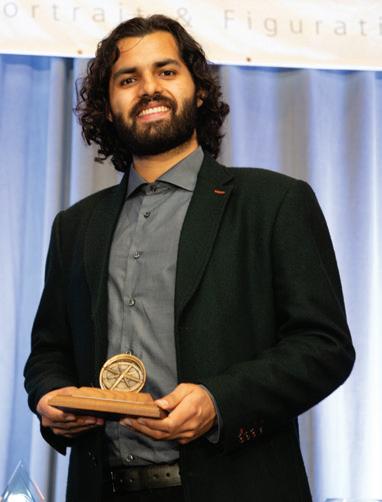
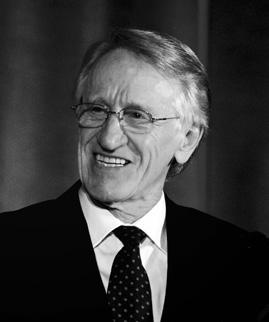
First-Place winner Ruben Astudillo was recognized at The Art of the Portrait conference, where he received the Future Generation medallion in an onstage presentation.
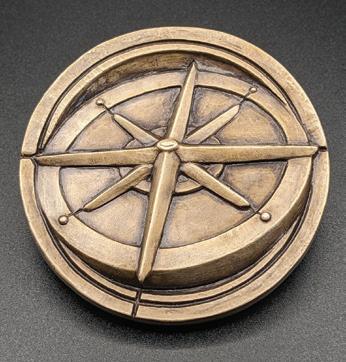
Along with a cash award, the Future Generation first-place winner receives a medallion sculpted by Alicia N. Ponzio, symbolizing the education and guidance that help illuminate a path toward a career in the arts.
Kerry Vosler, Writer, State Ambassador Coordinator
Scott Jones, Writer, Washington State Ambassador
Sargent Circle
Platinum Members
Susan Basham
Bryan and Alice Essary
Sandra Murzyn
Leslie Nordness
Michael Shane Neal
Sarah Perot
Brant and Joelle Phillips
Trish Savides
Henry Garth Smith, MD
Mary Whyte
Gold
Aida and Kevin Garrity
Hope and Billy Reis
Teresa Spinner
Louis and Jessica Sterchi
Silver
Melinda and Jeff Balsar
Peggy Kinstler
Jerry and Ernie William
Shelia Wolfe
Carol and Darryl Yochem
Mailing address:
Portrait Society of America P.O. Box 11272
Tallahassee, FL 32302
Shipping address: 1109 S. Magnolia Ave. Tallahassee, FL 32301
Toll free Telephone: 1-877-772-4321
Fax: 850-222-7890
Web: www.portraitsociety.org
The Art of the Portrait® Newsletter is published quarterly by the Portrait Society of America. All contents copyright Portrait Society (unless otherwise noted). No part or whole of this newsletter may be reproduced or transmitted in any form unless prior express consent has been given. Please send submissions to the editor at the Portrait Society.
Design
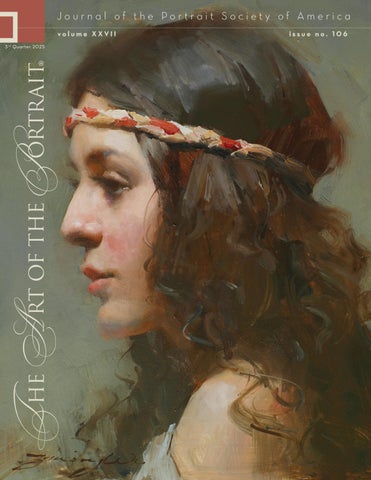
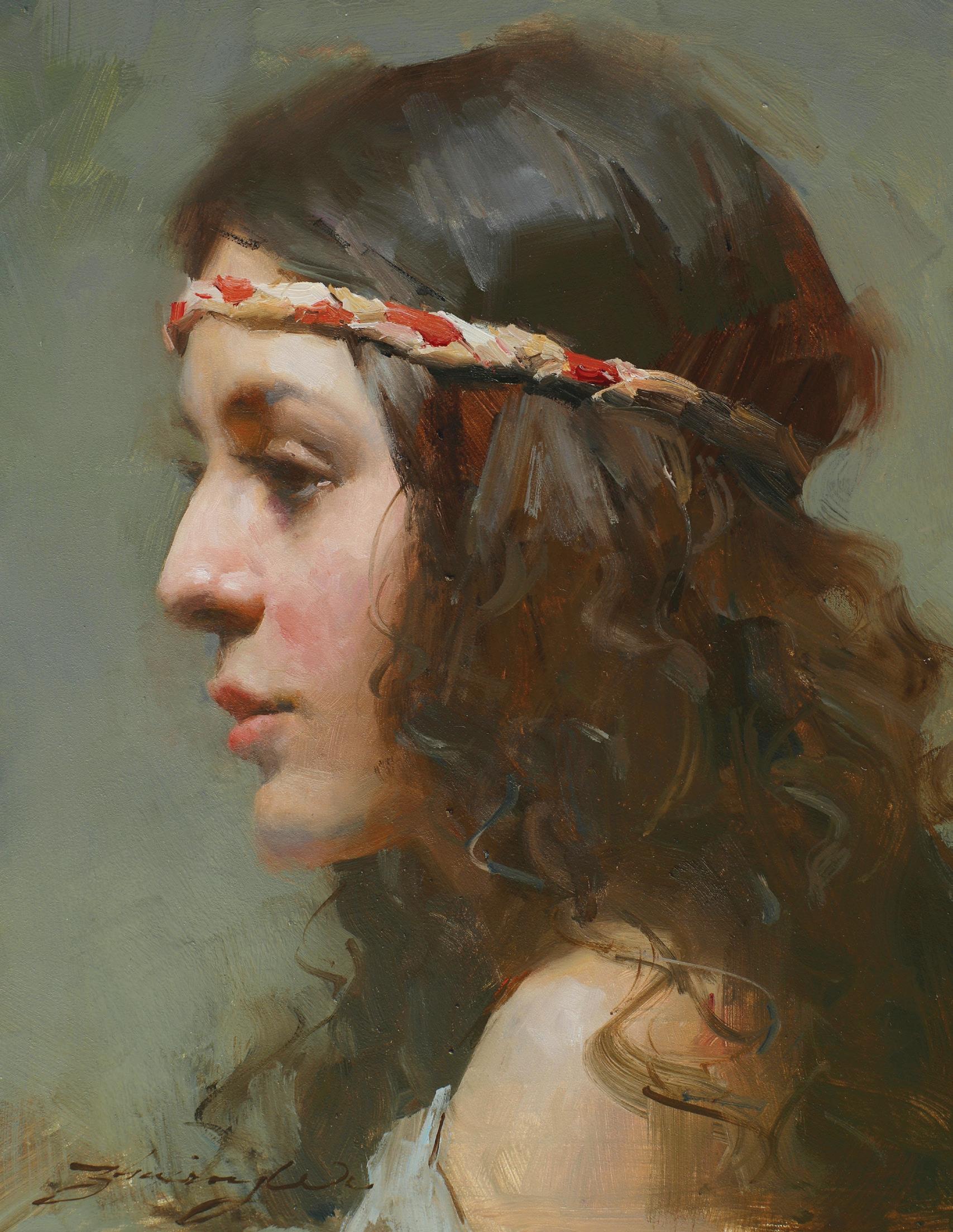
Cover:
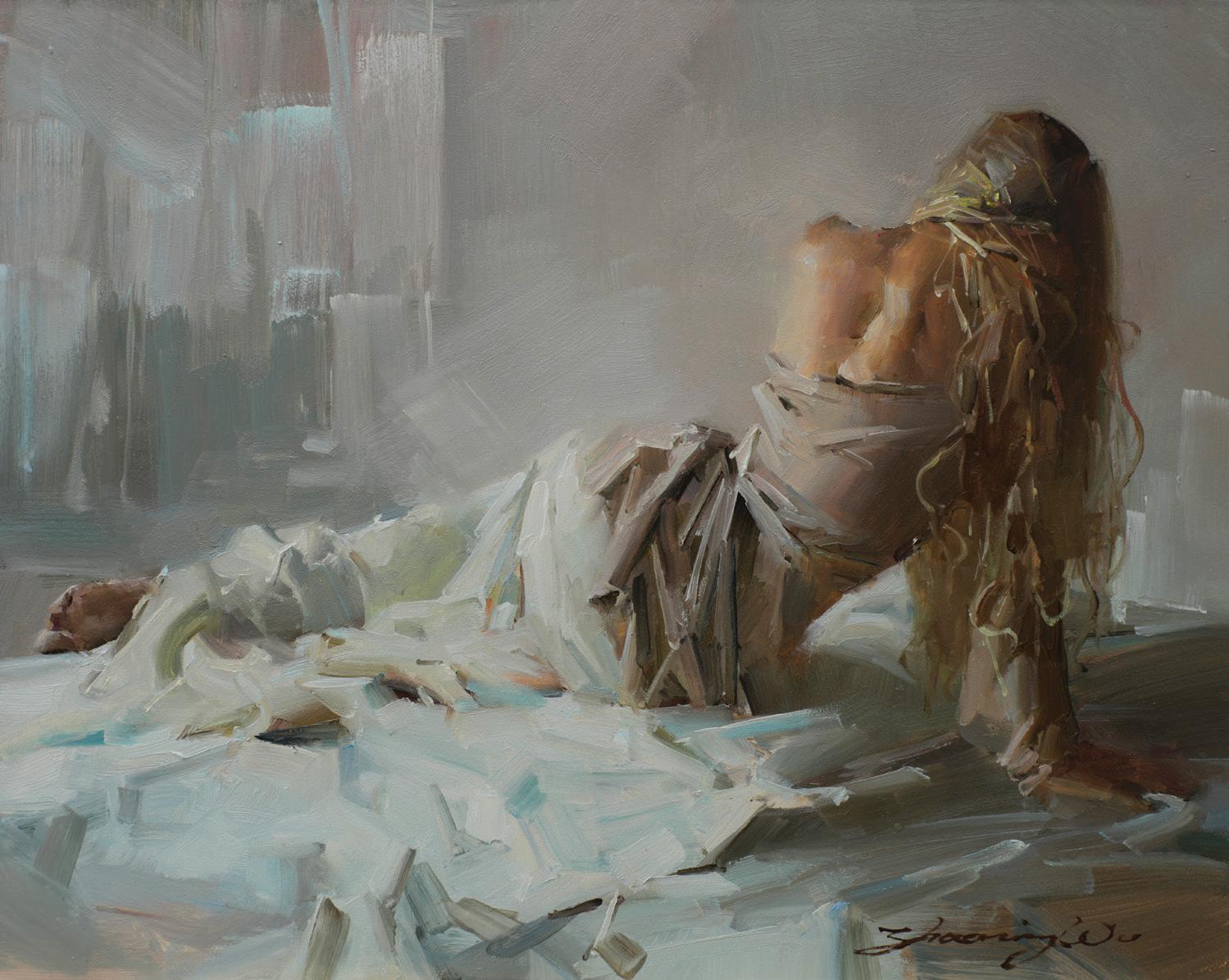
Zhaoming Wu, Italian Muse, 8x10”, oil
legacy and
JAQ GRANTFORD: SELF REFLECTION IN ART
I first met fellow Australian artist, Jaq Grantford, five years ago when we set up the DownUnder network for Australian and New Zealand members of the Portrait Society of America. At our first Zoom meeting, she gave a wonderful presentation of her art journey and impressed us with her superior technical skill, attention to detail and use of a desaturated palette. Her paintings are realistic, full of compassion and convey a strong message. I can still recall her quoting Charly Palmer, “Art should change the temperature in a room.”
1
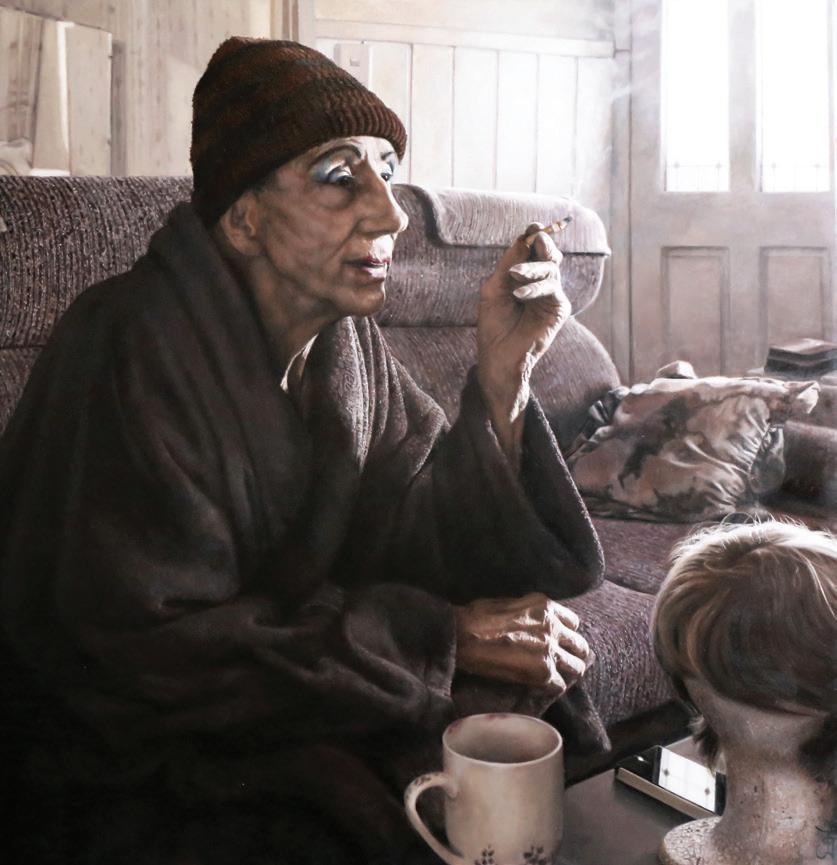
Since then, Grantford has been awarded the Kennedy Art Prize in 2019 (with Tootsie – a colourful Melbourne character jailed in the 1950s for being gay), followed by the National Portrait Gallery of Australia’s prestigious Darling Portrait Prize in 2022. In 2023, she took home the People’s Choice Award at Art Gallery of NSW’s Archibald Portrait Prize –Australia’s best-known exhibition – and has been selected as a finalist for the Archibald ever since.
Grantford’s personal commitments to social equality and the ethical treatment of animals strongly motivate her. She feels artists have a voice and should use their unique
By Janelle Hatherly
way of sharing information to make an impact. Her social conscience, Grantford says, makes her part of a movement that will change the portrait halls of white whiskers to portrait halls of diversity!
Grantford has been drawing for as long as she can remember. Her greatest pleasure came from creating realistic representations, and she developed a fascination with faces and the human form. She became obsessed with the nuances of individual features, and the more she studied, the more she came to appreciate the unique beauty of every person.
This accounts for the high degree of detail in Grantford’s artwork. That’s just how she loves to paint! She views realism
2
as more than just an accurate rendition of the subject; each piece is imbued with an empathetic interpretation.
Grantford works relatively quickly but is very patient, spending many hours immersed in the creative process. This is her happy space, where she finds solace in times of sadness and anxiety. While she’s very efficient in her art making, Grantford confesses to having a messy studio, being hard on brushes and not great at cleaning either of them.
Grantford’s journey as a professional artist began in children’s book illustration. There are constraints in
4 5
illustration that require artists to perform in a way that fits the author’s narrative vision. With portraiture, she finds out what makes her subjects tick and attempts to synthesise this into a single moment of expression.
Book illustrations are often busy and vividly-coloured. In contrast, Grantford paints her portraits with a desaturated pallet. She loves the way it looks – lots of subtle greys with a little bit of colour. Within each painting, that tint of colour is relevant to the subject.
One of Grantford’s favourite recipes for chromatic blacks and greys is created using varying amounts of Prussian blue, Alizarin crimson and Van Dyke brown.
After decades making her living teaching music and art in schools and establishing an affordable online art school for kids, Grantford now makes a living from her own art practice. She paints portrait commissions and family portraits in a traditional style to keep her grounded and then experiments with her own compositions.
“This painting is about the future and the responsibility given to our youth to protect the environment. I like to paint things that don’t come across as too didactic though. They have a message but can also be viewed as an artwork in their own right. I just want to keep making good art.” 3
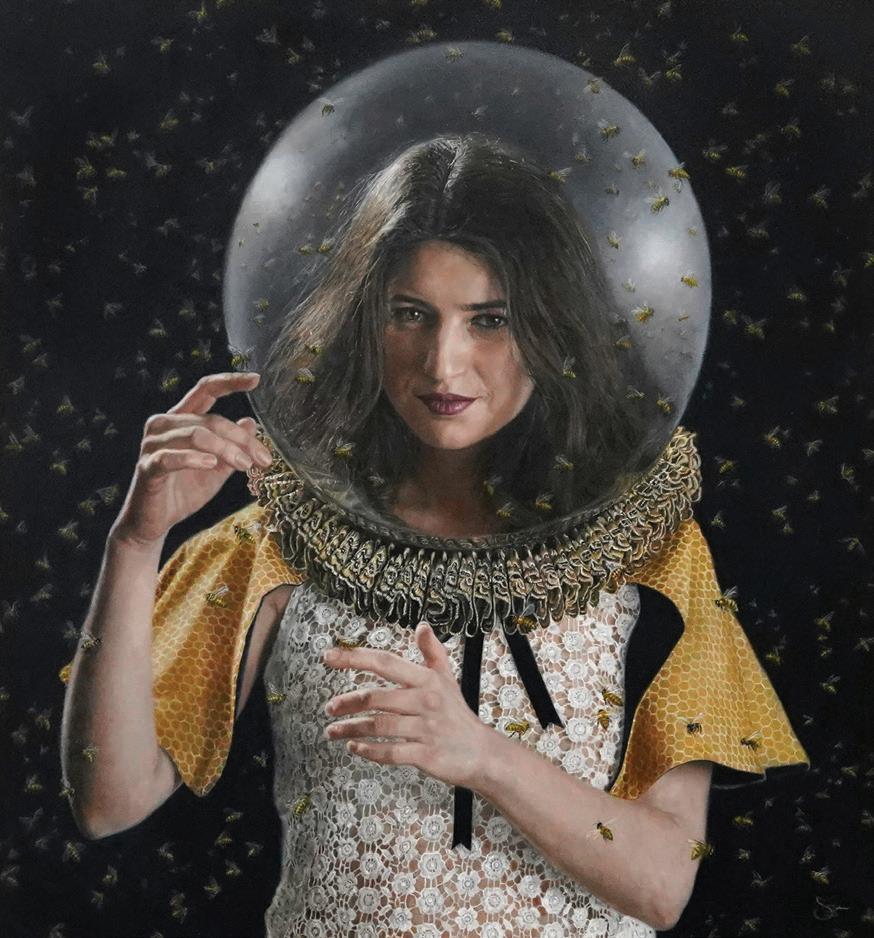
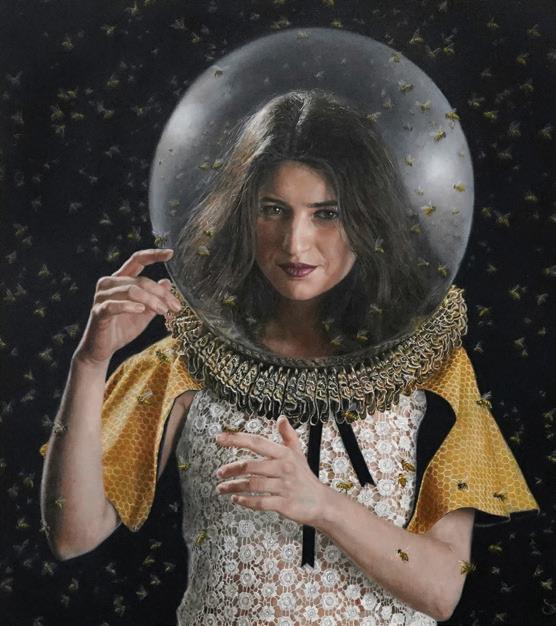
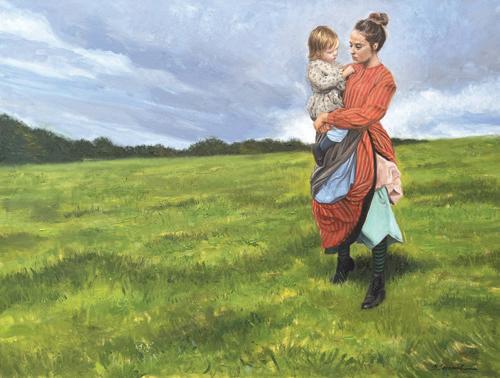
Her recent painting Generational Beekeeping is a good example of this. Grantford says:
“I had an idea of what I wanted it to look like. I ordered costumes online and had the model over and we played dress-up. It was a lot of fun!
“In terms of what it means, I can’t really say. It’s only after I’ve painted it that I can articulate what I was trying to convey. The emotion comes first, and then the understanding. This often comes when I’m required to write an artist statement to explain it all.
She has taken to adding a ‘C’ after her normal signature on commissioned pieces to differentiate her work. She started doing this after reviewing some past commissions which didn’t feel like a true representation of her own personal style, and that, to a degree, she had become the client’s paintbrush.
Grantford’s own creative ideas are often quirky and embrace magical realism. She takes a long time developing her ideas into reality, and upon completion finds their meaning isn’t always immediately apparent to her. Only after some distance can she look back and see a connection between the time she was going through and the nature of the work she created.
1. Just an Old Drag Queen, 120 x 120cm, oil on canvas, 2018
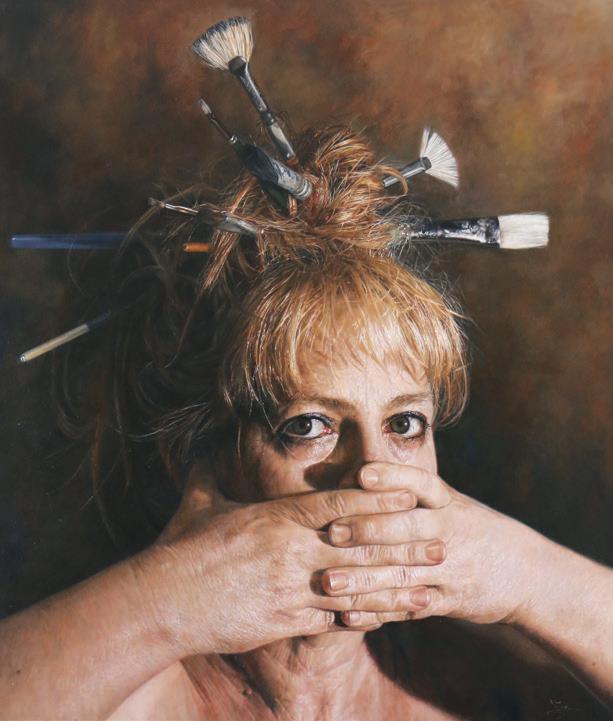
2 2020, 86 x 102 cm, oil on canvas, 2021
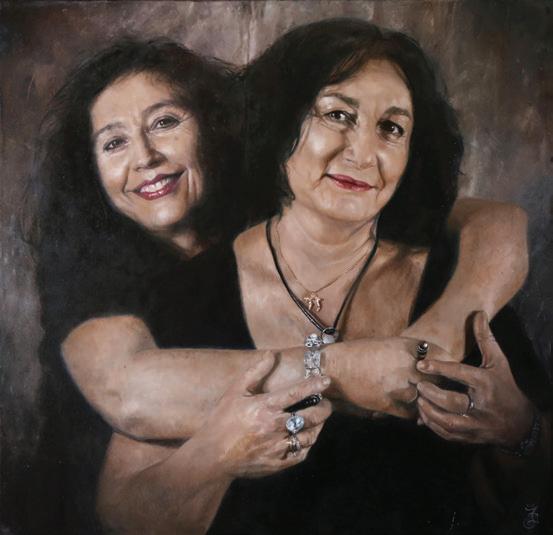
3. Sisters - Elena and Laura, 92 x 92 cm, oil on canvas, 2021
4 Dr Simon Livingston, 56 x 91cm, oil on linen, 2020
5. Generational Beekeeping, 28 x 28”, oil on canvas, 2024
competition winners
FUTURE GENERATION COMPETITION WINNERS
We recently had the pleasure of announcing the winners of the sixth annual The Future Generation Competition. This competition was created to acknowledge the work of talented, emerging artists who are 18 to 25 years old. Early recognition in art competitions can have an incredible and lasting impact on a young artist’s career, as it once did for John Singer Sargent, who, at the age of 23, won Honorable Mention at the Paris Salon for a portrait of his teacher, Carolus-Duran. Since the competition’s creation, we have seen a remarkable caliber of work submitted by the best and brightest the field has to offer.
This year, the selected panel of judges were Dawn Whitelaw, Chelsea Lang and Stephanie Paige Thomson. Together they reviewed over 300 images from young artists around the world, including Andorra, Armenia, Belgium, Canada, Chile, China, Colombia, Denmark, Germany, Hong Kong, India, Israel, Italy, Kazakhstan, Netherlands, Norway, Poland, Romania, Slovenia, Spain, Sweden, the United Kingdom, Zimbabwe, and the U.S. In their own words, the four top place winners, Oliva Arts, Yash Waman, Katya Dennison and Mattie Ree Neal, share their educational background, what drew them to the art field, and the inspiration behind their winning works.
1. FIRST PLACE WINNER:
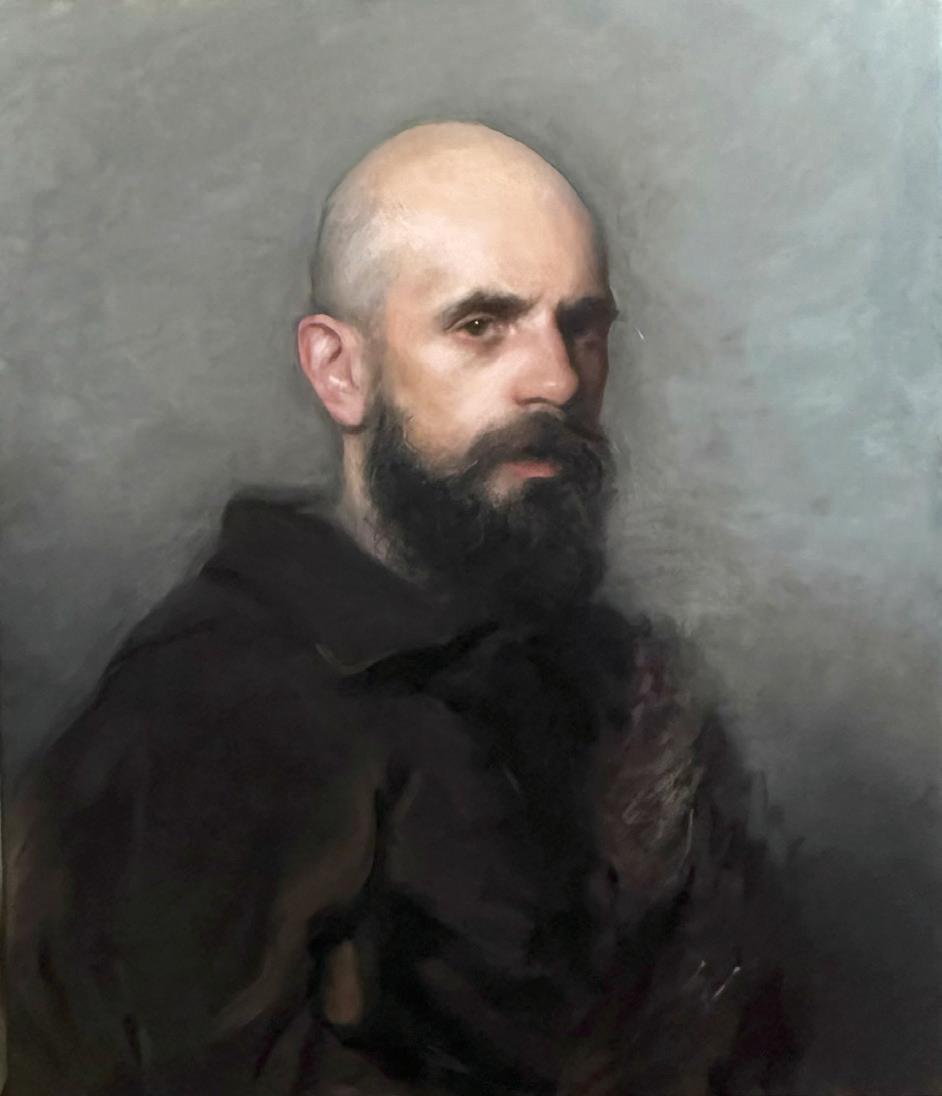
Olivia Arts, Donato Sambucco, 25.6x21.7”, oil
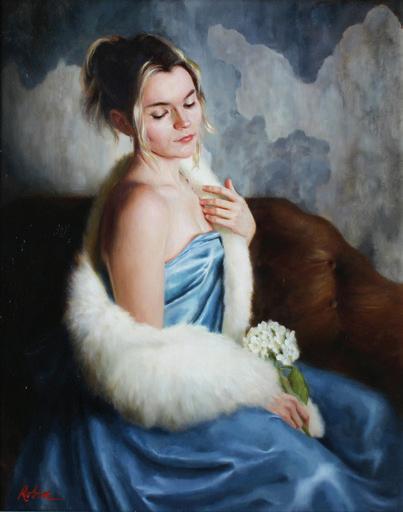
In our atelier in Florence, painting portraits from life is both the most instructive way for us to hone our skills and develop our practice in the complexity of painting in oils using traditional methods, and it is a process of human interaction–meeting different personalities, spending slow and silent time with them, and tapping into our shared humanity. Donato is a photographer from Tuscany who passed through the atelier many years ago and was painted by my partner. He returned to the scene last year, and I took the opportunity to paint my own interpretation.
I developed a keen interest in drawing from a young age. I draw inspiration from 17th century painters like Van Dyck and Velázquez as well as more recent 19th/20th century painters such as John Singer Sargent and those of the Boston School, particularly their mastery in capturing the essence of their subjects. All these painters used techniques deeply connected to my own training. They would draw and paint from life, something I am passionate about.
I was born in 2002 in Southampton. Initially I found limited artistic education in the UK, which left me feeling disillusioned with the art world. However, everything changed when I began my formal artistic training at Charles H. Cecil Studios at the age of 18. This marked a turning point in my journey. In 2020, I made Florence my home and now work as a principal instructor of drawing and painting at the renowned atelier, helping Charles and his colleagues to continue our mission of providing rigorous, classical training in drawing and painting from nature according to the methods of the Old Masters.
2. SECOND PLACE WINNER:
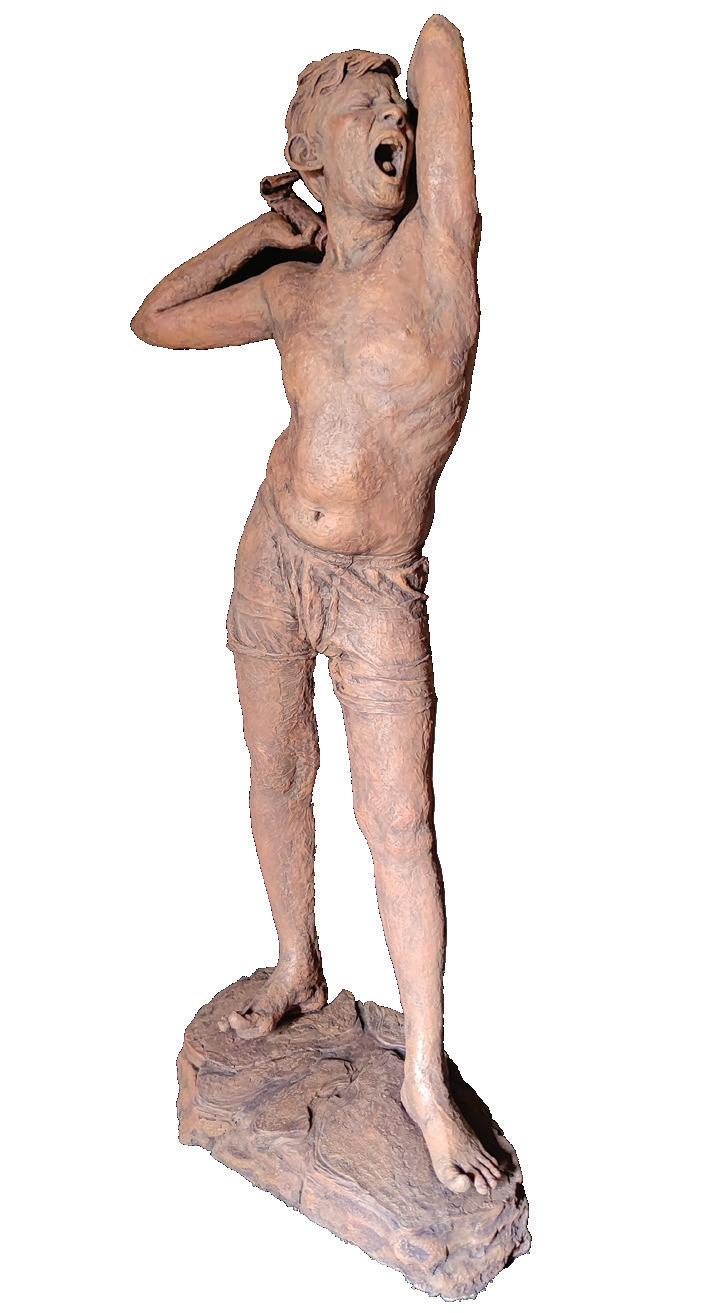
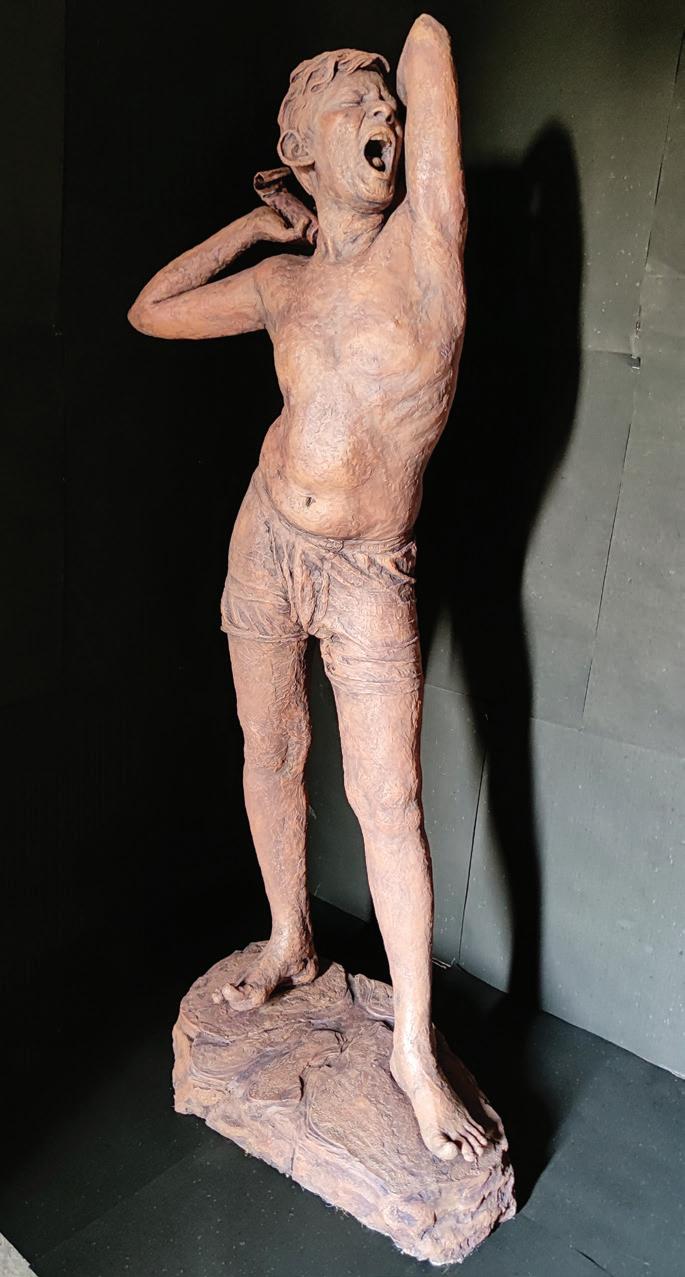
Yash Waman, Morning, 28x65”, resin
The little boy in the sculpture is my brother. I found the natural laziness that came over his body as he woke up in the morning and brushed his teeth very dramatic. This very beautiful expression was communicated through the many movements of his body. The expression of laziness on the little boy’s face and the intricate details on his body became a fascination. I have been watching this scene since childhood, and since I come from a farming family, standing on our brick road and watching this felt like childhood to me, so I realized this idea in sculpture.
I was born into a farming family. Because I was in the fields since childhood, I became friends with clay. I used to make my favorite toys from clay. I developed a passion for art, and I met a sculptor from our village. He suggested I study sculpture, so I came to the city to do just that. While studying sculpture, I was impressed by the works of many historical artists. My passion is deeply rooted in figurative sculpture
3
and the human form from living models. I find great joy in capturing the intricate nuances of anatomy. It is a journey that constantly challenges me to delve deeper into the moods, characters, and emotions of my subjects, always striving to create a vivid representation that resonates with the viewer. I have been trying to capture scenes from everyday life in my artwork since childhood.
I was looking a lot at Sargent and Fechin portrait drawings for this piece, specifically taking into account their line quality, economy of intuitive mark-making, and overall 2
Classical figurative sculptures from Italy and Europe serve as a guiding light for me, their timeless grandeur and exquisite craftsmanship inspiring me to emulate their grace and precision in my own creations. I am relentless in my pursuit of improving my technique, constantly seeking to broaden my understanding of this art form. For me, learning is a lifelong endeavor, which is why I eagerly embrace every opportunity to participate in workshops that promise to enhance my skills and broaden my artistic horizons. I believe that by immersing myself in the various methods, techniques, and disciplines of figurative modeling, I can open up new realms of creative possibilities and elevate my artwork even further. I have recently completed four years of sculpture studies from Sir JJ School of Art, Mumbai and am keen to pursue further art education.
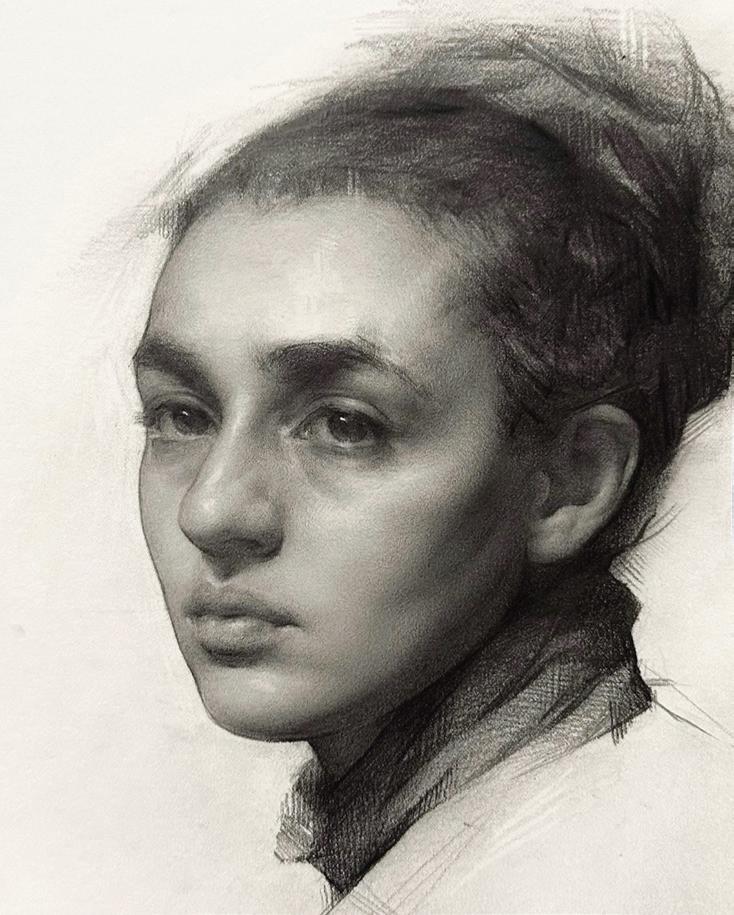
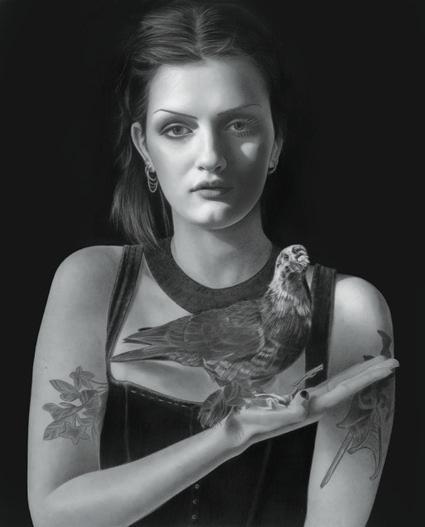
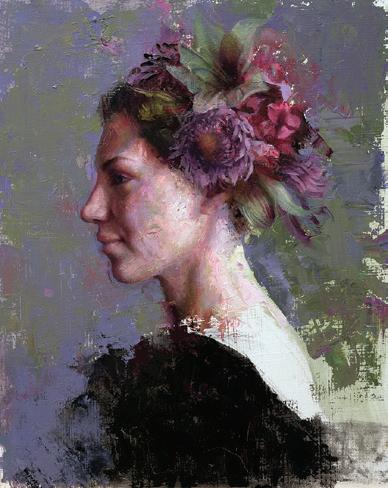
3. THIRD PLACE WINNER: Katya Dennison, Noor, 9x12”, graphite
gesture/sensitivity. This portrait was done from life, and working from nature is both an incredibly informative and complex process. In the midst of that, I try to find a balance between surrendering to what’s in front of me while also employing personal or historical aesthetic choices—like rendering the facial features tightly to retain likeness and meanwhile allowing line and abstraction of shapes to create more atmospheric gestures of hair and clothing. I wanted this portrait to serve the character of the model in both a tactile and emotional sense.
I have always been attracted to 19th-century naturalism and iconography, but figurative art is essentially totally inexhaustible with centuries of tradition to glean from. The rigor and skill involved in creating beautiful art has always felt like a truly honest effort, and I enjoy how rhythmic the whole process is. In the atelier community especially, there’s so much dedication to craftsmanship and refinement that’s one-of-a-kind.
I am currently studying at Grand Central Atelier in NYC, a school that specializes in teaching the fundamentals of traditional art practice. Previously, I graduated in 2023 with a Bachelor of Fine Arts degree from the University of Pennsylvania and the Pennsylvania Academy of the Fine Arts, with three minors in Classical Studies, Art History, and Cinema Studies.
4. FOURTH PLACE WINNER:
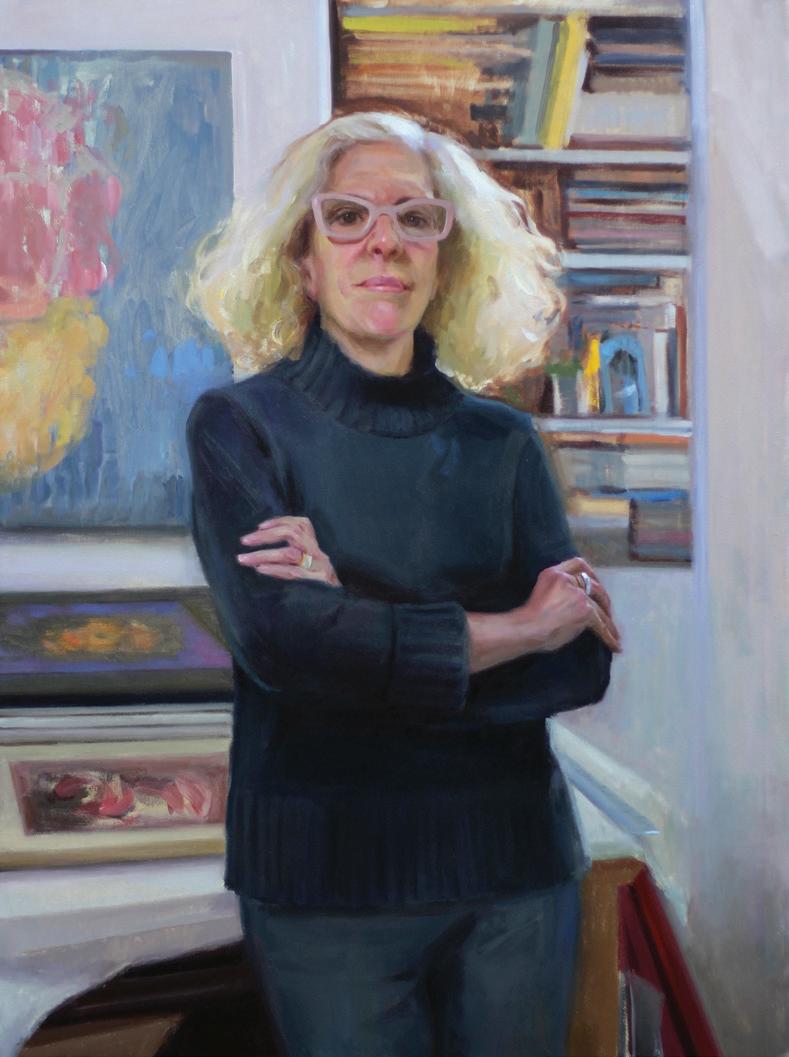
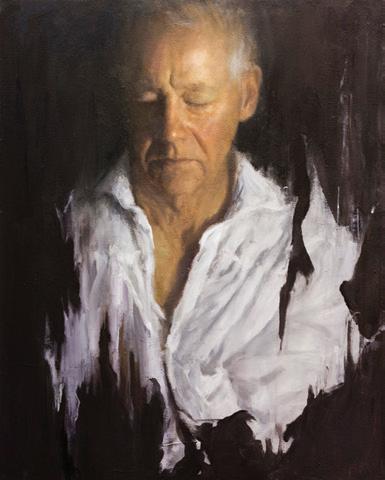
Mattie Ree Neal, The Artist, 30x40”, oil
This is a commissioned portrait of an abstract painter in her Long Island studio. I loved every minute spent with Isabel in our studios. It was delightful to discover how much we have in common as artists. Her work begins in realism and is then abstracted, and in a way, mine begins in abstraction and becomes realism! All commissioned work brings an element of collaboration with your client, and what a joy when your subject is an artist.
I have been blessed to be surrounded by great artists all my life. How could you want to do anything else? I was always encouraged and have been the recipient of immeasurable generosity. I attended my first Portrait Society conference when I was 8 years old. I wanted to come when I was 6, but my dad, Michael Shane Neal, said, “You can come when you are big!” “When will I be big?” I asked, to which he replied, “When you’re 8!” I held him to it. My father’s studio was my favorite place, and I thought he had the best job in the world. I grew up visiting his teacher, Everett Raymond Kinstler, every summer in Connecticut, and my training really began there at the breakfast table. I loved to draw and didn’t go anywhere without my sketchbook. I enjoyed painting everything but was most drawn to the challenge, joy, and stimulation of painting people.
I began oil painting when I was about 12. I knew that I wanted to work in a traditional, representational way and that I loved painting people. I began attending regular life sessions and traveling to take workshops when I was in high school. After graduating, I decided to study directly with master artists rather than enroll in a typical four-year art school. I travelled all over the world to seek this instruction by going into artists’ studios, taking classes, and registering for workshops. I was so fortunate to learn from today’s most prominent portrait painters, sculptors, western artists, landscape, animal, and still life painters. My dad, of course, is my primary teacher and the anchor that made it possible for me to study with artists varying in method and approach. I always wanted to paint portraits but have tried to follow Kinstler’s advice of being “an artist first.” John Singer Sargent once said that “the object of the student should be to acquire sufficient command over his material to do whatever nature presents to him.” I’m trying every day!
As you can see, there is no end to the variety and inventiveness of our ambassador program. Each state and country is unique both in its membership and location. Here are a few highlights from the third quarter of 2025. We are still seeking ambassadors for the following states: Arkansas, Iowa, Louisiana, Maine, Montana, North Dakota, Oregon, South Dakota, Vermont, West Virginia, Wyoming.
Lynita Motes (Alabama) said members met in Fairhope, AL for a Meet & Greet which turned out to be an enriching experience. More are planned in the coming future.
Donna Catotti (Alaska) hosted JaFang Lu who taught a Studio Incamminati Portrait Workshop in June. Another Studio Incamminati workshop is scheduled for next June 8-12, 2026, in Haines, AK with Natalie Italiano. Donna had an opportunity to teach the Art of the Portrait on a cruise ship where she introduced the Portrait Society of America and its programs to a grateful audience of over 50 participants.
Janelle Hatherly (Australia/New Zealand) produced her 10th Annual Portrait Society of America “Down Under” newsletter. Janelle and Andrea Steinbauer (European/UK Ambassador) have been collaborating on a new magazine design. Janelle also hosted two Zoom get-togethers this past quarter.
Fio Lombardi (Georgia) launched two newsletters consisting of upcoming workshops and exhibitions, competitions and other opportunities for members. She created a Facebook group page and Instagram page for Georgia State Members.
Kim Abbati (Illinois) said members will meet again on September 28th for a live model session at McCord Gallery and Cultural Center in Palos Park. Also, don’t miss the Portrait Artist of IL Member Show opening September 29-October 25 also at McCord Gallery.
Simona Buna (Indiana) continues to have success with her expanding Facebook page for Indiana Members.
Melanie Harding Bates (Kentucky) said gathered June 21st to socialize and view the “Brilliant Exiles: American Women in Paris, 1900-1939” exhibition at the Speed Museum in Louisville, KY. This show was organized by the National Portrait Gallery. Attendees learned a lot about each other as they viewed the works of art and discussed the importance of the show.
Eric Crenshaw (Maryland) shared upcoming events, member news, and a recap of the “What’s On My Easel” group in a recent newsletter to Maryland Members.
Kathleen Ericson and Robert Scudder (Michigan) spent the summer introducing the Portrait Society of America in various venues across the state.
Rachel Mindrup and Littleton Alston (Nebraska) are excited to report that Professor Alston is seeing a surge in interest in sculpture. Also, Rachel is hosting monthly open figure drawing sessions for Nebraska members.
Len DeAngelis (Rhode Island) said members continue to meet via Zoom to discuss current works of art and solve challenges.
Jennifer Wharton and Suzanne Viechnicki (South Carolina) are planning a live model class to go over the basics of starting a portrait for local high schools in the Bluffton, SC area. They are planning a group member show in 2027 and are looking for the perfect venue.
Betty Bullen (Tennessee) is currently preparing for their first Tennessee Members Exhibition at the Customs House Museum Gallery. Betty was instrumental in the coming workshop with PSOA and TAA members at the TAA’s Studio in Knoxville, TN.
Carol Fairlie (Texas/New Mexico) hosted a successful Plein Air paint-out in late August free of charge. Fifteen artists attended the five-day event at various locations. The event included both landscape and portrait. Carol will also be offering free lectures in the coming year on the “Art of the Portrait.”
Scott Jones (Washington) is working on a Washington State Portrait Society Members Show to include Oregon and British Columbia/Alberta. Scott also did a Zoom discussion with Nicole Troup in Pennsylvania for her members and included Washington State members on September 16th.
Kathie Wheeler (Wisconsin) is working with the Richeson Gallery and School to plan a Face Off event open to the public in conjunction with a show of WPSoA Artists’ Figurative work. Watch for this event in February/March 2026. In November, they will hold an open studio/lunch for Wisconsin members to gather and paint.
Kerry Vosler National Coordinator
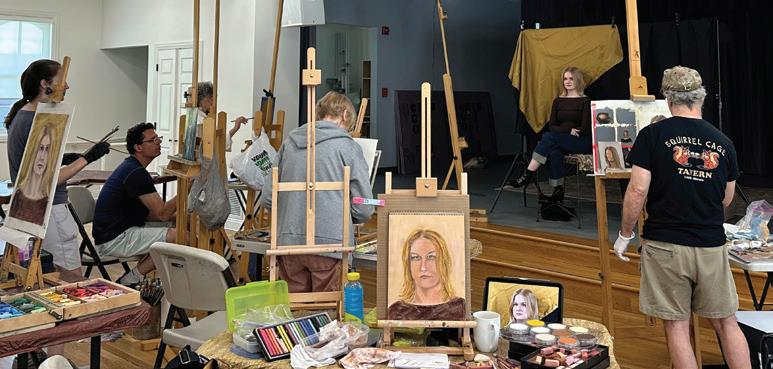
Illinois members met on June 28 for a live model session at McCord Gallery and Cultural Center in Palos Park, IL.
PAINTING THE SPACES BETWEEN: THE ART OF ZHAOMING WU
By Becka Darling
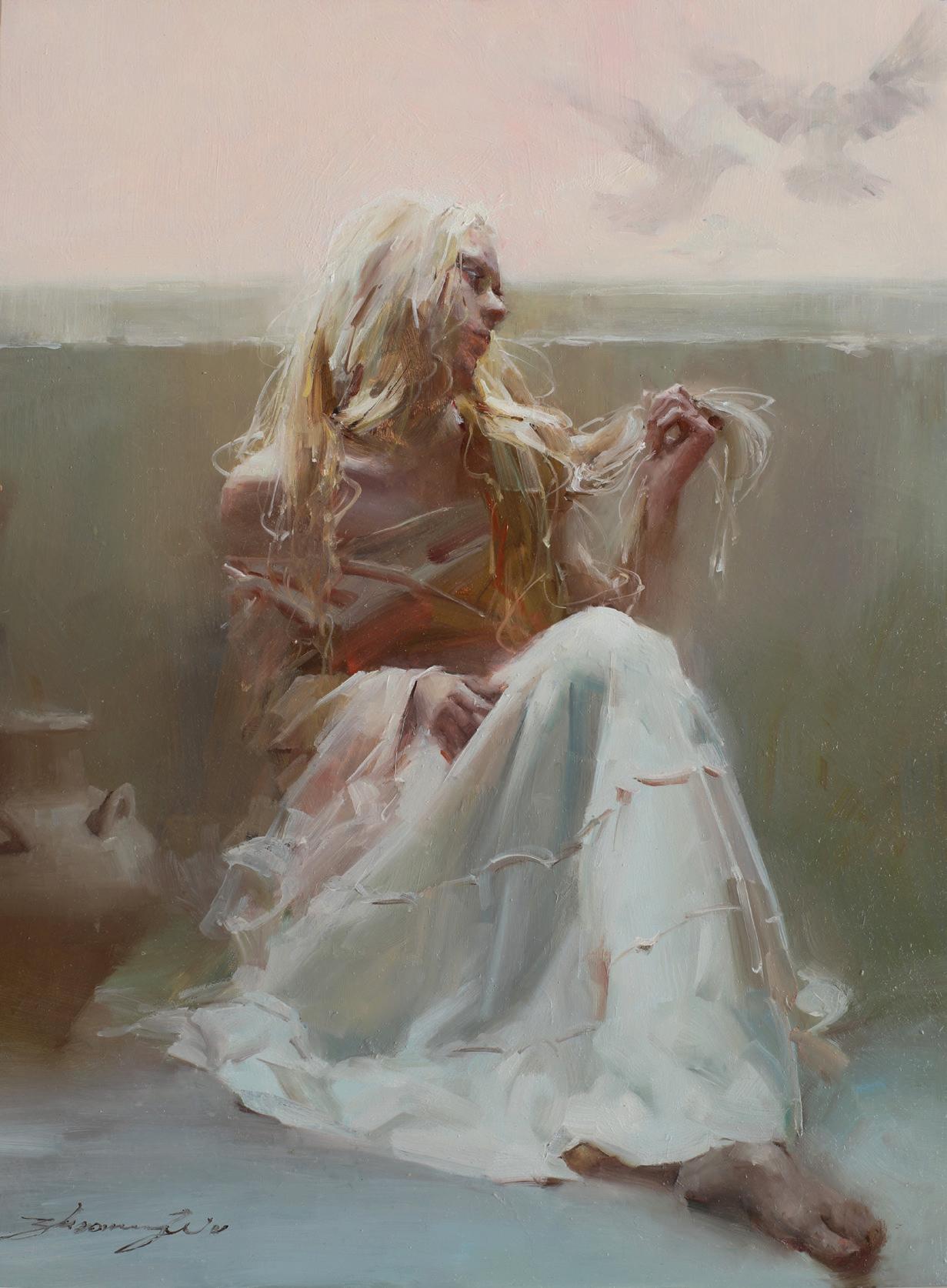
1. Pigeons, 16x12”, oil
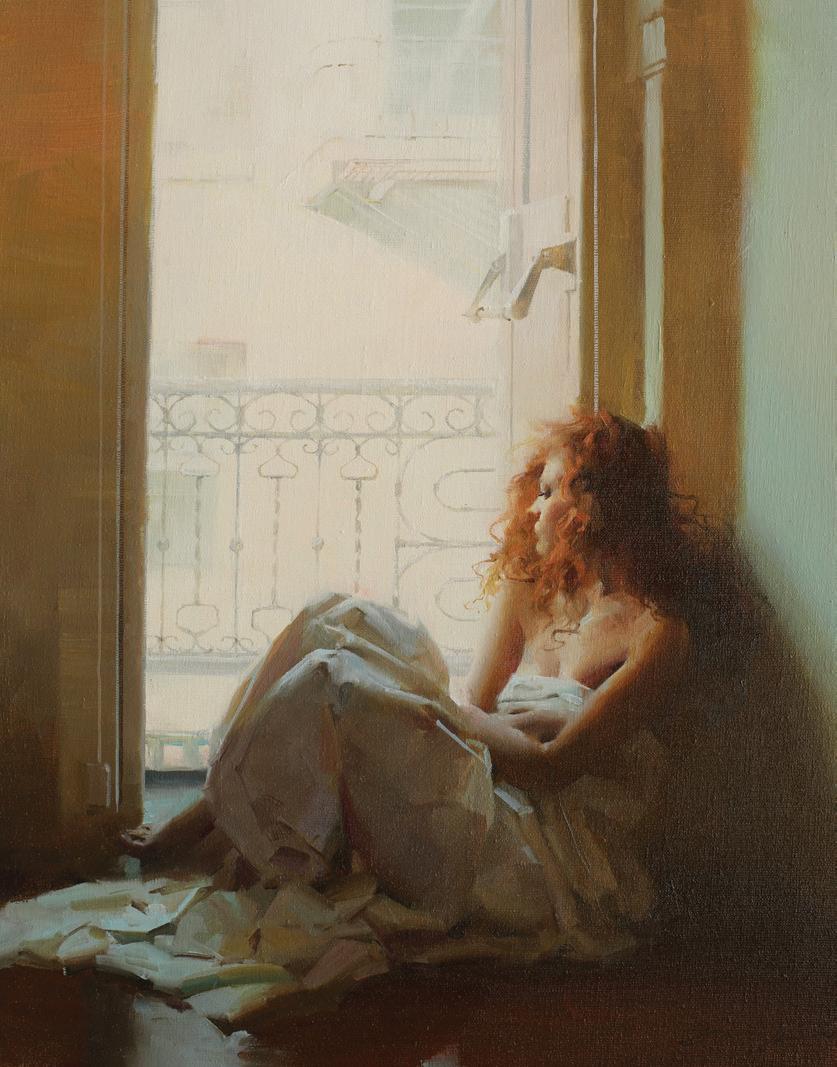
2. Balcony, 16x20”, oil
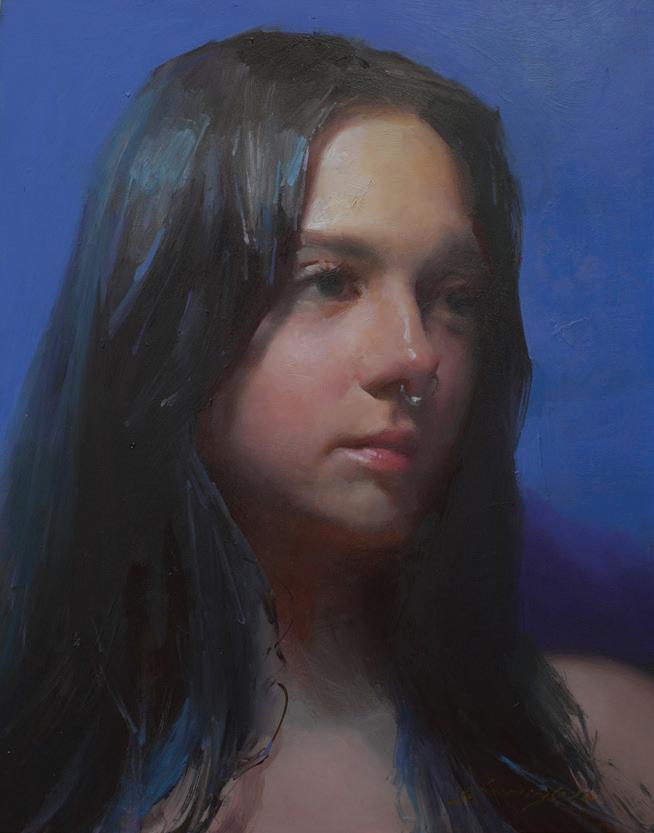
3. A Study in Blue, 11x14”, oil
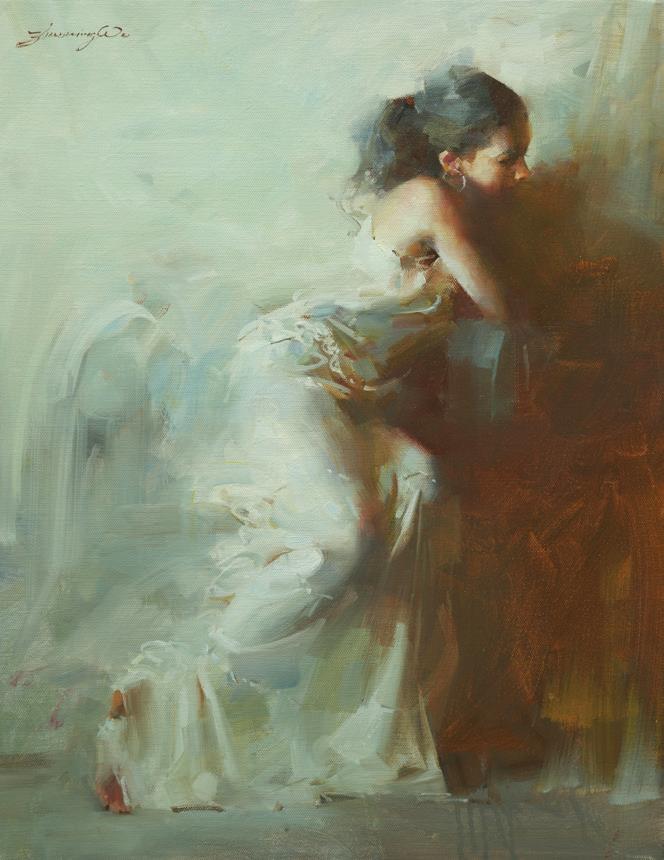
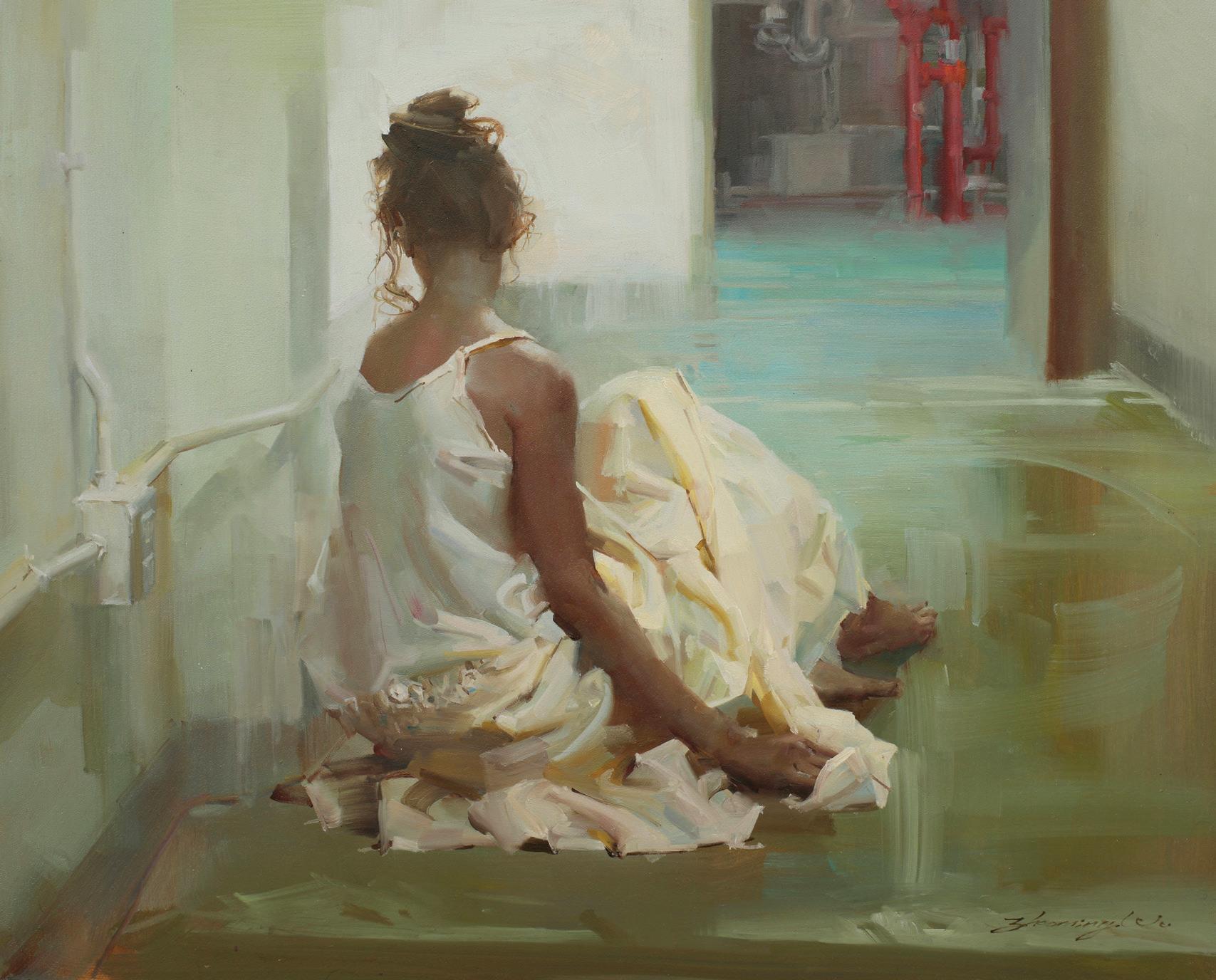
In the luminous strokes of Zhaoming Wu’s canvases, the boundaries between realism and dreamscape dissolve. Figures emerge with striking clarity, while surrounding spaces soften into washes of light and color. It is an intentional balance, one the artist describes as both skill and wisdom: “Depicting detail requires skill; knowing when to let go of it requires wisdom.” Some passages in his paintings are highly rendered, while others remain open, inviting the viewer’s imagination to wander. For Wu, painting is not only about what can be seen, but also about what can be felt.
For more than three decades, Zhaoming Wu has painted from life alongside his students. Teaching has kept him grounded in direct observation: quick studies, live demonstrations, canvases completed within the fleeting hours of a class session. In the studio, however, his process shifts toward reflection and structure, using reference photographs exclusively. “Before I begin,” Wu explains, “I take time to carefully analyze the photo to form a clear idea. I connect with the experience behind the image and begin reorganizing elements such as composition, value structure, edge relationships, visual movement, and the overall mood of the color palette.” He rarely starts without sketches and notes. These early marks are not just planning tools but acts of translation and ways of carrying an image from reference into the language of painting.
That instinct for structure has deep roots. Long before earning his bachelor’s and master’s degrees in fine art, Wu trained as a graphic designer. Those early studies, he says, never left him. “The foundation I gained in design has had a lasting impact on my painting practice.” Even now, his canvases bear evidence of that discipline: bold yet balanced compositions, clarity of form, and a deliberate orchestration of visual movement. Wu draws on design principles with the ease of someone fluent in two languages, slipping between the logic of layout and the expressiveness of brushstroke.
For many artists, teaching can feel like an interruption. For Wu, it has been a lifeline. Preparing lessons doubles as an act of self-clarification. Handouts and outlines meant for students often crystallize his own thoughts about painting. More than that, teaching has been a source of renewal. “Teaching young talents allows me to absorb fresh energy from my surroundings, which inspires and benefits my creative process.” Sitting at the easel alongside his students, Wu refines his craft in real time, turning classroom exercises into opportunities for growth. Each demonstration becomes both instruction and exploration.
When asked about his influences, Wu doesn’t hesitate. He lists them like a litany: European masters of the 18th and 19th centuries, the elegance of traditional Chinese ink painting, the radical shifts of Impressionism, the intensity of Romanticism, the nuanced realism of the Russian Peredvizhniki. The roster of individual artists is equally expansive: Ilya Repin, Diego Velázquez, Rembrandt, Antonio Mancini, Claude Monet, John Singer Sargent, Auguste Rodin, as well as American painters such as “The Ten,” Andrew Wyeth, and Richard Schmid. Each has left traces in his practice, whether in the fluidity of brushwork, the gravity of light, or the delicacy of atmosphere. This synthesis of East and West, past and present, theory and practice, informs his distinctive visual language.
For all his technical rigor, Wu is most concerned with atmosphere. His paintings are less about narrative than mood, i.e. less about telling stories than evoking states of being. “I
want my work to be a dreamscape,” he says, “a space that evokes a specific emotional atmosphere, allowing viewers to connect with it through their own experiences, memories, and interpretations.” It is an invitation not to decipher but to feel. The looseness of his backgrounds and the softness of his brushstrokes are deliberate, making space for the viewer’s imagination to enter the work.
Wu has had a long and diverse artistic journey. Born and raised in China, he pursued painting in an environment of intense competition. One defining moment came when he applied to one of the country’s top art schools. That year, around 4,000 applicants submitted their portfolios. A narrowed pool of 400 candidates was chosen to take the entrance exams, and ultimately, only 15 students were admitted. Against the odds, he was selected. “My life and career might have taken a different path if I hadn’t been accepted,” he reflects. Later,
while pursuing an MFA in the United States, Wu encountered another turning point. His thesis project in 1995 marked a breakthrough, expanding his aesthetics and introducing new subject matter and stylistic approaches. That body of work remains a cornerstone of his career.
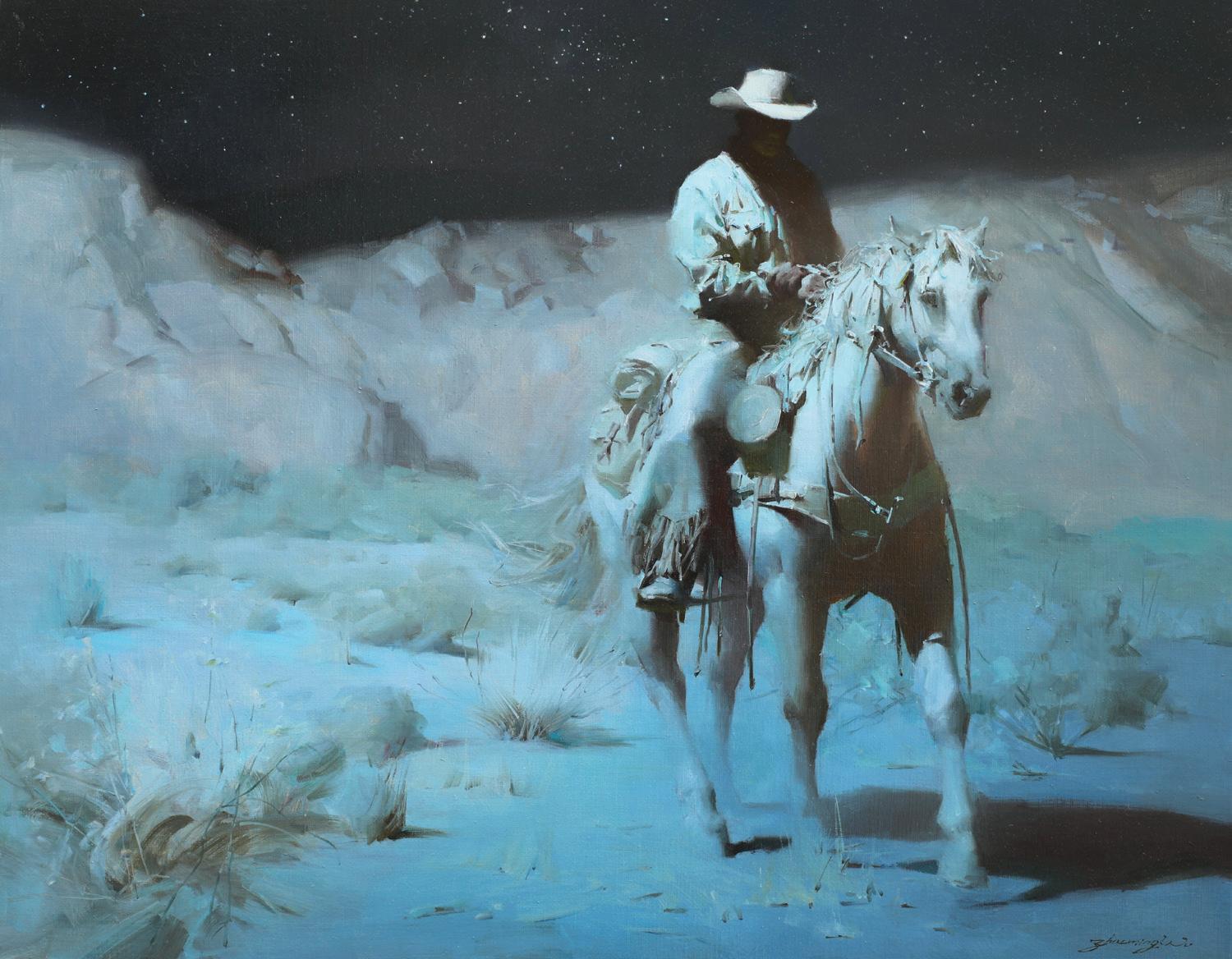
For much of his life as a painter, Wu has focused on the human figure, particularly female subjects, and portraits. In recent years, however, his work has opened outward. Western landscapes—vast skies, rolling cloudscapes, and mounted horsemen—now appear on his canvases. These paintings merge multiple genres: landscape, figure, animal, and still life. They are not stories in the literal sense, but layered atmospheres, rich in symbolism and mood. As he puts it: “I don’t completely consider my work narrative in the traditional sense. Rather, I use imagery to evoke emotion and mood, much like I do when painting the female figure.”
4. In Solitude, 8x10”, oil
5. Moonlit Land, 24x30”, oil
6. Simone in White, 8x10”, oil
Looking across his journey—from early design training to years of teaching, from China to the U.S., from intimate figurative studies to expansive dreamscapes—Wu has continually balanced precision with openness. His work is defined not only by what is painted, but also by what is left unsaid. On his canvases, viewers find both clarity and mystery, detail and suggestion, realism and dream. And perhaps that is the point: art as a space where structure and imagination coexist, where brushstrokes become portals, and where each painting offers not an answer but an atmosphere to inhabit.
Zhaoming Wu is a Chinese-born painter celebrated for his luminous figurative and landscape works that blend classical technique with contemporary impressionistic flair. Trained at the Guangzhou Academy of Fine Art and later a professor at the Academy of Art University in San Francisco, he is renowned for his mastery of light and atmosphere. His paintings have been exhibited internationally and are held in private and public collections worldwide.
7. The Hallway Venus, 16x20”, oil
FAILING FORWARD
I know many of you listen to podcasts (or music or audiobooks, etc.) while painting. I enjoy art podcasts and stumble across new ones all the time. I also enjoy Patreon subscriptions. I try not to think about the total monthly fees I pay for all my subscriptions. I was listening to Jeff Hein interview his guest Tiffanie Mang on The Undraped Artist recently, and I gleaned a new insight from her comments. She mentioned being taught by her parents the concept of “failing forward.” How refreshing and mind-expanding that thought is for me! I will admit that I have considered failure as a step back or, at a minimum, a pause, but upon reflection, I see many instances in my career and personal life when a failure catapulted me forward with the next idea or an adrenaline burst of activity. I had the pleasure of watching Tiffanie paint a demo at a gallery yesterday. We talked briefly about “failing forward” as she painted her first painting of flowers – pretty bold to paint something for the first time for an audience of artists and art enthusiasts. And no, she did not fail. It was a great demo! I noted her willingness to potentially fail forward each time she sprayed down parts of her gouache painting with water. She was rewarded with a stronger painting.
I was living vicariously this morning through the photos of Michelle Dunaway’s African safari, something I have yet to do. An African safari photography session is on my bucket list. Michelle is not only an amazing painter but also a photographer and writer. She wrote beautifully about her experiences, and tucked away inside her post was this jewel: “I only took a few pictures because it was such a special and moving experience I didn’t want the camera in between. I just wanted to breathe it in visually and be still in that moment of appreciation.” Now that is something I think any artist should live by! Maybe that is what puts “life” into your work as we have discussed before in these articles? I have a favorite movie that I have watched multiple times on overseas flights. It seems that as I fly over an ocean, The Secret Life of Walter Mitty always pops into my mind. It might be because of the scenery, the music, and/or the stories punctuated with memorable quotes on courage, fear, and living. If you have not seen the movie, skip to the next paragraph. Sean Penn plays the character Sean O’Connell, a renowned photographer. In one scene, Walter finds Sean high in the Himalayas in his pursuit of photographing the elusive Ghost Cat (snow leopard). When one appears, Walter asks, “When are you going to take [the photograph]?” Sean responds, “Sometimes I don’t. If I like a moment, for me, personally, I don’t like to have the distraction of the camera. I just want to stay in it.” I like to think that the art I personally respond to most is when the artist just stays in it! Sean also has another gem of a quote in the movie: “Beautiful things don’t ask for attention.”
Now onto business. I noticed something special on August 1st I received emailed newsletters from seventeen artists on that day, an unofficial record by my estimation. It took longer than I thought it would, but I just went through all my emails for August. I counted 188 newsletters received directly from artists, an average of six per day to enjoy. And this tally of emails does not include emails from galleries, art organizations, museums, art publications, art contests, ateliers, and a couple of universities.
By Scott Jones
Congratulations to all artists who reached out to your contacts in August. Yes, I have subscribed to hundreds of newsletters over the years – I have no idea how many – but there are still plenty of artists I have not heard from or rarely do. I do enjoy receiving these newsletters and then clicking on a link to their Instagram and/or their website to see more. Stick with it! I found myself purchasing two studies and a drawing from those August newsletters. Several artists shared success stories with me on their newsletters. Your followers and collectors will notice these repeat impressions, and those who do notice are the foundation for building your business success as an artist. I would like to sign up for even more newsletters. Feel free to send me an email at scottjonesfineart@gmail.com with a link to your newsletter sign-up, and I will happily do it. I suggest your newsletter has something available for purchase, something you are working on for the future, and something about you as a person that excites you.
Scott Jones has been a passionate art collector since the age of 16 and shifted his focus to selling art nearly 20 years ago. While having retired this year from the gallery world, he remains committed to the success of artists. He serves as State Ambassador of Washington for the Portrait Society.
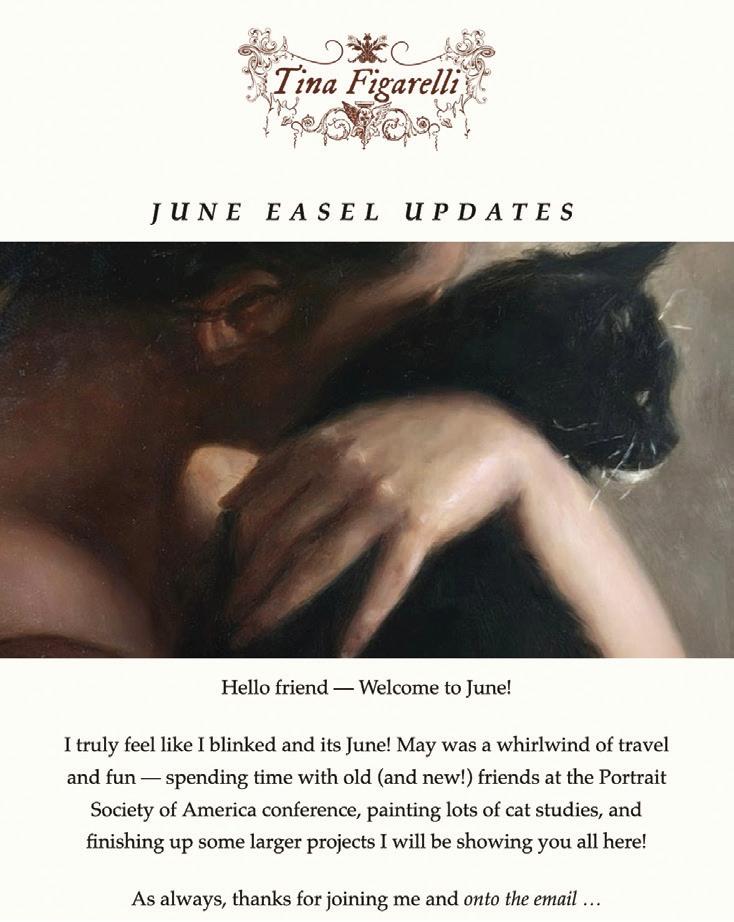
Tina Figarelli’s newsletter
A DAY IN THE LIFE WITH TIM REES
Winning the First Place Painting Award at the Portrait Society of America’s 2024 International competition, the piece titled Her Mother’s Locket exemplifies how far Tim Rees has come as a realistic artist. His technical mastery of the medium and ability to paint light and atmosphere convey the beauty and compassion of the human spirit.
Rees’s childhood was filled with drawing, reading and writing stories. In school, he excelled in both science and art. Uncertain of where his future lay, Rees undertook studies in animation and pre-medical science before realizing his destiny as a traditional fine art figure and portrait artist.
Relying on his love of learning, strong drawing skill and problem-solving ability, Rees progressed artistically on his own. Later, he would discover he also enjoyed teaching. From humble beginnings at the Palette and Chisel Academy in Chicago in 2009, he went on to create and deliver an academic curriculum for Scottsdale Artists’ School and then set up his own atelier in Mesa, Arizona.
In 2020, Rees and his young family moved to Maquoketa, Iowa where he focused on developing and marketing his own art practice. As life would have it, he separated from his muse and the mother of his children and returned to Scottsdale. He tells us how he manages juggling life as a single parent, breadwinner and professional painter.
By Janelle Hatherly
2
1
Can you walk us through a typical day in your studio? What does your daily routine look like?
After dropping the kids off at school, I arrive back in the studio by 8am. I find myself most energetic and creative in the morning, so this is when I think about designing or starting a new painting. Then I work on paintings I have going on, usually two or three at any given time. I try to do social media and catch up with correspondence during breaks. Longer emails I save for when the sun goes down, as my studio is primarily natural light.
How do you balance studio time with other aspects of your life, like family or personal commitments?
This is challenging as a single, full-time parent. I spend the morning getting my kids ready for school, then pick them up around 5pm and move directly into parent mode. After dinner, homework, baths and tidying up, it’s story time and off to bed. If I have energy, I move to administrative office work in the evening. I try to get between 5-6 hours of sleep a night.
Because I only paint while the children are in school, I must be diligent to make use of studio time. The kids go to afterschool care, so I have a clear day to work and commit all that time to being an artist.
Balance is largely achieved through a reliable routine. My wonderful kids (ages 10, 7 and 5) are articulate and well-
behaved with the usual amount of rowdiness. I try to have quality one-on-one time with each of them regularly and organize a babysitter for the occasional night out for myself.
Is there a time of day you feel most productive or inspired to create, and how do you make the most of that time?
I’m most productive in the morning, before spending hours at the easel. I find painting mentally exhausting, so anything that may require creativity and problem solving I try to do first thing in the morning after coffee.
How do you handle creative blocks or days when inspiration is harder to find?
It’s easy for me to paint pre-planned ideas when I’m not feeling inspired or in the mood. I pull out a painting I’m currently working on, put an interesting podcast or movie on in the background, and settle in. We all have low energy days, so I just make sure I have lots of straightforward work I can do on those days.
Are you currently teaching and how do you incorporate that into your schedule?
I teach a few workshops a year, with occasional mentoring or a Zoom class. We live near Scottsdale Artists’ School, so I might start some nightly classes now that the kids are older. In my early 30s, I could teach a 12-hour day, 4 or 5 days a week and paint during my teaching breaks. Now I can only operate at about 3/4 that capacity. It’s challenging to recognize that I’ve slowed down over the years.
What do you find most fulfilling about your day-to-day life as an artist?
The fact that I can side-bar and explore interesting things, even while working, is very fulfilling. I need to constantly remind myself that being an artist isn’t just a job, but a way of life. In the past, I’ve been so slavish to the idea of producing, that I haven’t enjoyed some of the most wonderful things about being an artist – exploring with curiosity and appreciating the aesthetics of life.
What projects are you currently working on?
My quicker alla prima vignettes sell well online and at workshops. I get bored doing the same thing for too long, so I am grateful the Bonner David Gallery in Scottsdale has given me free reign to produce 15-20 paintings for an upcoming solo exhibition in December.
I am currently creating figurative works that combine realism and abstraction. Exploring how we can harness the various experiences and challenges in life to become better people, I’m taking inspiration from Kintsugi: a Japanese art that repairs broken pottery with gold, rendering a new piece more exquisite than it was before, creating beauty in the broken places.
You say you love writing. How does writing influence your own art practice?
I write primarily for enjoyment these days. I’m currently writing a short, inspirational book that debunks myths preventing people from going into a career in art and provides some direction on how to move forward. It also helps me formulate my painting ideas more cohesively and think about the meaning or feeling I want to convey beyond just the visual.
What advice do you have for emerging artists who only come to art in later life?
The advice I give in that situation has changed over time. Ten years ago, running the atelier, I would tell you to hit the easel 4-10 hours a day to develop your craft. But experience with a variety of people and the contemporary art market itself has taught me that the level of technical proficiency required to be an artist, or even a great artist today, is not actually as high as we make it seem to be.
To enable you to skilfully tell your stories and life experiences, work out the style and artworks that appeal to you most. This will establish the technical goals you’re shooting for aesthetically in a painting and then dictate the type of training you should pursue. Do you want to paint like Bouguereau or Mary Cassatt? Do you need to practice drawing or focus more on color? Should you spend time doing master copies of your favourite artists? Understanding where you want to go and then amending your approach to training will get you where you want to go faster.
What makes a good teacher?
In a workshop, whatever subject we’re painting, I teach fundamental concepts I want everybody to walk away with. Additionally, early in the workshop, I go around and try to figure out where everyone is at in their art journey and what their actual goal is. Not everybody is shooting for the museums or supreme realism. Then, when I come around and critique, I can give them advice suited to the direction they want to go and not insist they “keep correcting that drawing of the hand.”
I started teaching early enough in my career to remember how I overcame the same challenges my students face. I’m a firm believer in Carl Sagan’s approach to science–if you truly understand something you can explain it clearly and simply. A good teacher understands and can articulate the concepts to meet every student at their level with simple language. Holding on to this approach, as I develop myself, means I can help students at many stages of their development. And the fun comes when a student isn’t immediately able to implement my suggestions, and I get to problem solve to work out how I can help them.
1. Last Wish, 16x20”, oil on linen
2. Boy, 16x12”, oil on linen panel
3. Hesitation, 24x16”, oil on linen panel (work in progress)
TEAM WORK
By Brian Neher
There are several factors that come into play when finishing a painting. While individual elements like drawing, value, color and edges play an important role by themselves, each of these separate parts must work together as a team in order to produce a timeless work of art. Getting everything to work as an entire unit when viewed as a whole involves some strategic planning on the part of the artist. Here are some lessons from my artistic playbook that I’ve used when painting commissioned portraits.
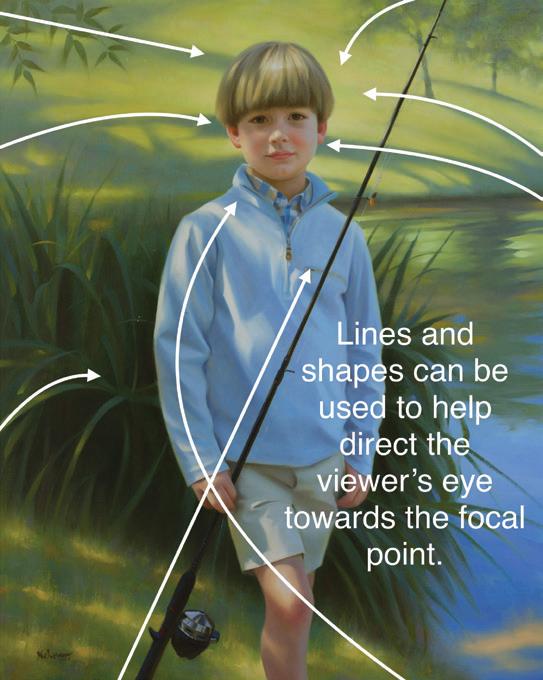
Design and Composition play an important role in painting to help guide the viewer’s eye towards the main focal point. This can be done through the use of lines, values, shapes and colors.
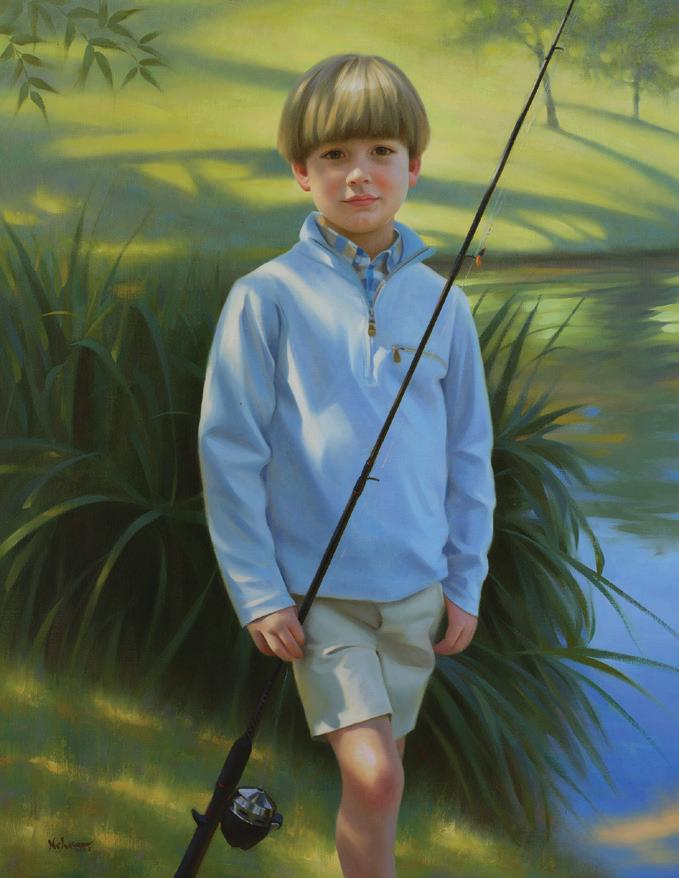
In this painting, the shapes of the shadows in the background direct the viewer’s attention towards the boy’s head, away from the sides and top corners of the canvas. Directional lines from the drawing of the pampas grass lead towards the figure, pushing the viewer’s attention to the center of the canvas.
Correct
Value
Relationships
and Color Temperature can help give the illusion of a particular lighting situation. Correct value relationships (how light or dark a color appears when compared to another color) are vital in order to achieve a three-dimensional look in your subject.
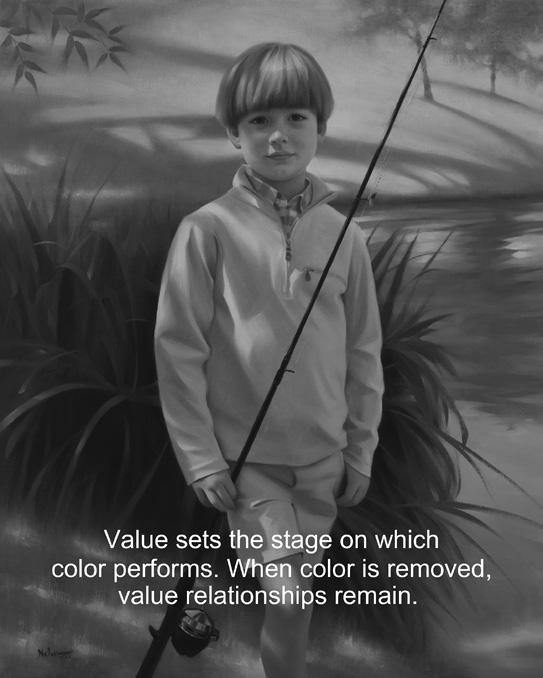
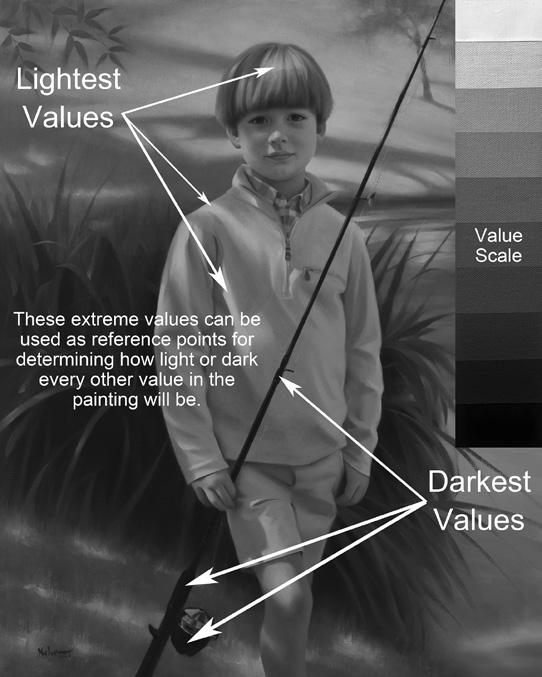
If your values aren’t correct, then your colors won’t be correct either. The reason that I say this is because value is the environment in which color exists. Every color on your palette will register somewhere on a value scale from black to white. To get the correct value relationships, I will use my darkest value as a reference point which I can judge all other values against. If I know where my darkest value in the painting occurs, then I also know that every other value in the painting cannot be as dark as that reference point.
When converting this portrait into a black and white image, all the color is removed, but the value relationships remain. There is still a sense of volume and form to the figure. To help simplify values when looking at my subject, I will half squint my eyes, limiting the amount of light that reaches them. As a result, values are more easily recognized as large shapes, and unnecessary details are no longer seen. The information that I’m seeing through squinted eyes is what I’m seeking to capture on canvas.
The placement of the lightest values in the boy’s clothing, hands and leg also serve as visual stepping stones, redirecting the eye back towards the lightest values in the head and hair.
The dark value and line of the fishing pole are diagonally placed to stop the viewer’s eye from moving too far to the right of the canvas, leading them back towards the darker values in the eyes.
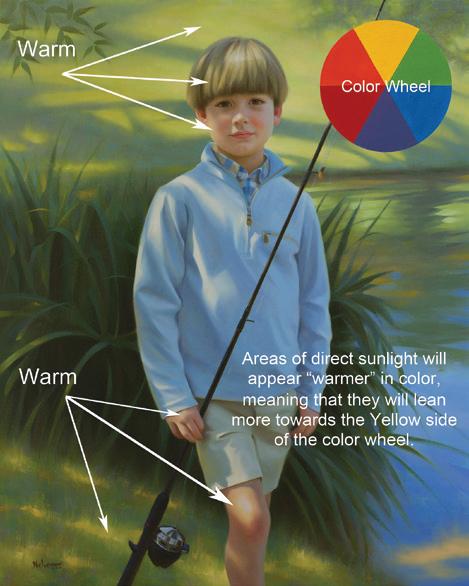
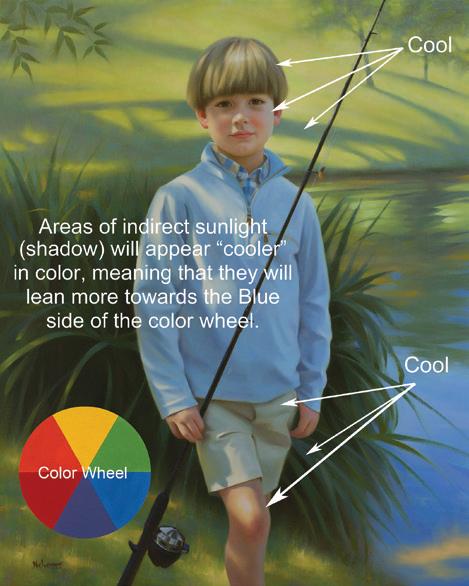
Color Temperature refers to how “warm” or “cool” a color appears when compared to another color. A warm color tends to lean more towards the yellow side of the color wheel while a cool color leans more towards the blue side of the color wheel. Each color family (red, orange, yellow, green, blue, purple) has a warm and cool version of itself. For example, a warm green (sap green) contains more yellow in its mixture than a cool green (viridian) which leans more towards the blue side of the color wheel.
The warm reds found in the flesh tones of the boy’s head, hands and leg are both a contrast and complement to the greens in the background. This difference in color temperature helps to draw further attention and distinction to the figure.
When trying to decide whether a color needs to be warm or cool, I will first determine the temperature of the light source (warm or cool). This is one of the greatest lessons that I learned from renowned portrait painter, Joe Bowler. He said that when it comes to painting, there is a warm and a cool side to everything. A warm light source tends to produce cooler shadows while a cool light source produces warmer shadows.
Because of the limited value range that artists must work with in paint, employing correctly placed warm and cool colors within the same value can help to further create the illusion of form. I will often do this by using complementary colors (located 180 degrees across from each other on the color wheel). For example, I’ve used a warmer orange in the reflected light that is bouncing back up into the boy’s blue jacket.
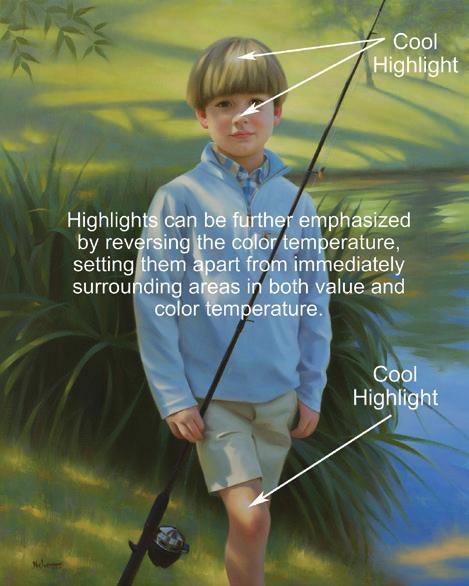
While predictable patterns in light can greatly help when determining where to place warm and cool colors in a painting, there are times when I will do the opposite in order to create a greater emphasis or effect in a painting. One example would be the extreme highlights in the focal point of my subject. I will often reverse the temperature of the highlight from that of the immediate, surrounding colors.
For example, the highlights on the boy’s hair, nose and knee are cooler in temperature than the warmer colors that are surrounding them.
One of the most challenging aspects of painting is getting everything to work together as a whole. Although each team member (drawing, value, color, edges) has a specific strength and skill set, they cannot be equal in importance. There has to be an overall sense of balance and teamwork in order to reach the finish line.
Brian Neher is a professional portrait painter based in Charlotte, North Carolina, with over 25 years’ experience creating commissioned oil portraits for both private and corporate clients. Neher earned a B.A. in commercial art from Pensacola Christian College, where he studied under Brian Jekel and later trained extensively with master portraitist Joe Bowler.
1. Tracy Frein’s drawing entitled SongBirds of a Different Feather was awarded the 2025 Best in Show/CIPPY Award, in the 33rd Annual Colored Pencil Society of America International Exhibition at Strathmore Gallery, Bethesda, MD.
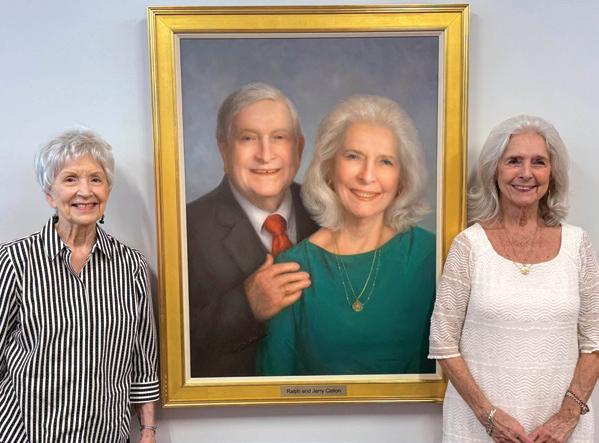
2. Jane Polkowski Levy was commissioned by Santa Fe College, Gainesville, FL, to paint a double portrait of Ralph and Jerry Cellon. There was a ribbon cutting on August 19, 2025, for the institute where her painting is displayed.
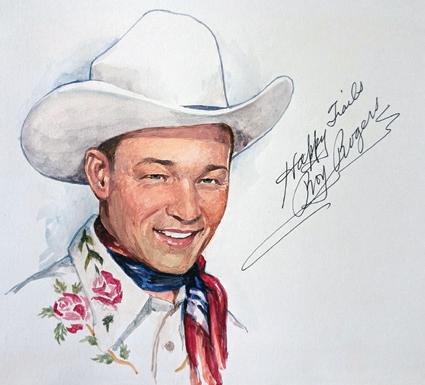
3. Craig Pursley has made a collection of more than 480 signatures on portraits he has made of notable people over the last 40 years. A book is now out called “Brushed with Greatness” showing some of the best of the collection, with foreword written by Michael Shane Neal.
4. Billy Seccombe’s painting October Sky is featured in the September issue of American Art Collector in a new article covering the upcoming fall exhibition of the 112th Allied Artists of America Prospectus at the Reading Public Museum in Reading, PA.
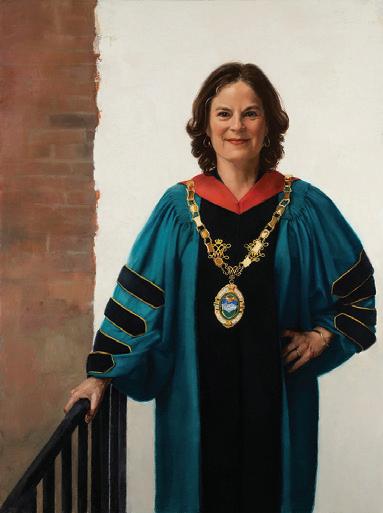
5. Sharon Sprung recently unveiled her latest portrait of Katherine Rowe, President of William & Mary College. Sharon said, “A scholar, teacher, athlete, and president, Katherine’s intellect and energy were a privilege to paint.”
6. Jen Starling’s portrait A Fleeting Glimpse (pictured) won the Overall 2nd place award in the Plein Air Salon competition for May 2025. In addition, her still life Before Dawn won Best Still Life.
7. Robin Williamson’s painting Satin and Fur won the Bronze Medal at the Oil Painters of America Western Regional Exhibition held at Illume West Gallery in Philipsburg, MT.
8. Rainny Zhao’s painting Echo No. 2 was awarded the Gold Medal Award in the 2025 Oil Painters of America Western Regional Exhibition.
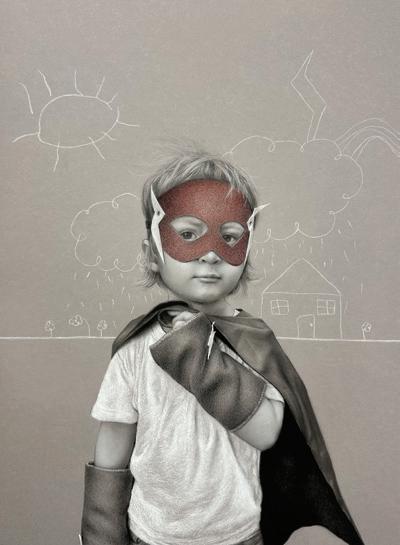
9. Wendi Zlamal’s drawing We Could Be Heroes won 3rd place in the 4th annual “Artists to Watch” international competition for Artists Magazine and will be showcased in the Nov/Dec 2025 issue with a write-up about her and her work. 1 2 3 4 5 6 7 8 9
exhibitions
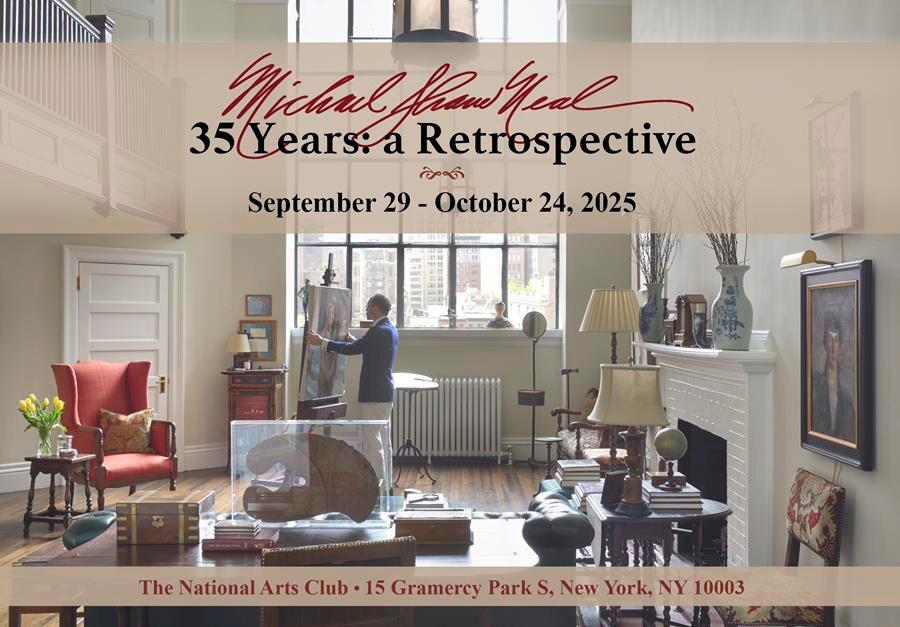
1. Michael Shane Neal’s “35 Years: a Retrospective” exhibit is opening September 29-October 24, 2025, at The National Arts Club in New York, NY. Learn more at www.nacnyc.org.
2. Linda Harris Reynolds received the Gold Medal of Honor from The Allied Artists of America for her painting 2025, 30x40”, oil on linen. This 112th Annual Exhibition will feature approximately 100 pieces from around the nation and the world, open through January 11, 2026 at The Reading Public Museum, Reading, PA.
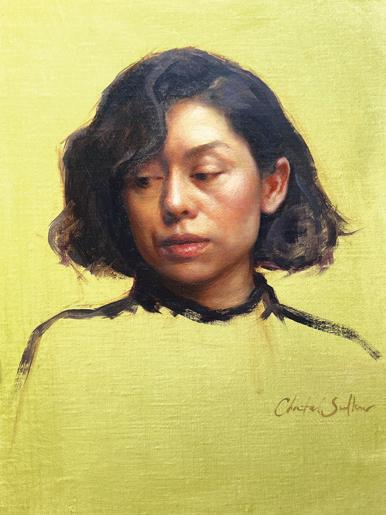
3. Chantal Sulkow’s painting Portrait of Monica is included in the American Artists Professional League’s “Timeless” exhibition in Old Lyme, CT, now through November 6, 2025. Learn more at aaplinc.org/upcomingshows.
workshops
5. Anna Rose Bain will be teaching a weeklong masterclass, The Portrait and Beyond, in Le Marche, Italy, from June 5-12, 2026. There are limited spaces available. Bring an artist friend or a non-painting partner! For more info on the venue and workshop, visit the Hotel Leone website, hotelleonemarche.com.
4. The Portrait Society’s Tennessee Members Exhibition is on view at the Customs House Museum in Clarksville, TN, October 22, 2025 through January 1, 2026. Please email Tennessee State Ambassador, Betty Bullen, at bullenart@aol. com for more information. Artwork pictured by Tennessee member Richard Arnemann. 1 2 3 4 5 6 7
6. Kerry Dunn is teaching an Alla Prima Portrait Painting workshop, May 10-16, 2026, in Rome, Italy as part of Rome Art Residencies. Participants will create a new portrait painting each day from a live model, working in the alla prima style. Learn more and register at www. romeartresidencies.com.
7. Max Ginsburg is teaching a Painting from Life workshop at Scottsdale Artists’ School, December 2-5, 2025. In this workshop, students will paint alla prima from a live model, painting realistically, carefully observing form, and being inspired by the Old Masters. Learn more at www. scottsdaleartschool.org
renewals & new members
RENEWING MEMBERS
A special THANK YOU to our renewing members in June, July, August
JUNE
Patron
Richard Abbott, CA
Sonny Abesamis, CA
Chantel Barber, TX
Donald Battles, IN
Timothy Beacham, GA
Judy Black, GA
Pam Carraway, WA
Mary Claire Coster, VA
Laura Era, MD
Connie Erickson, KY
Pierre Forest, Canada
Sara Hadley, MI
Richard Halstead, IL
Jacquelyn Hill, GA
Michael A. Hoskins, CA
Mary Lazar, NH
Pia Ledy, NY
Dodie Loewe-McPhie, OH
Nancy Mann, FL
Eric Marts, WA
Carol K. Mullen, VA
Paul Murphree, TX
Lyndsie Nash, UT
Fernand Poulin, NC
Gretchen Pravaz, FL
Tom Quaid, LA
Jami Nix Rahn, CO
Marianne Rose, NC
David Sierra, KY
Robert H. Way, NC
Cietha Wilson, CA
General
Coleen Barnhart, GA
John Barrows, CA
Teresa Bastian, NC
Carol Volz Begley, PA
Nathan Bertling, SC
Norma Binam, TX
Sarah Blumenfeld, MO
Mary Jane Bugh, OH
Daphne Johnson Clark, ND
Gina Marie Cohen, CA
Gary Cooley, NC
Joshua Cooper, FL
Renee Corwin, CA
Karen Coughlan, MD
Chris Crotty, SC
Jenny Davis, VA
Debra Destoppeleire, IL
Paul DiVito, DC
Jill Eberle, NC
Susan Edelheit, WA
Suzanne Edwards, NC
Bill Farnsworth, FL
Barbara Fox, NY
Clydetta Fulmer, AL
Margaret Ann Garrett, GA
Susan Goodmundson, CA
Nancy Griswold, VA
Peggy Hagler, AL
Catalina Harman, CA
Theresa Harris, GA
Julian Hartzog, FL
Hiroshi Hayakawa, OH
Aaron F. Henderson, GA
Lynn Hock-Napoli, CA
Joan Hoyle, NC
Carol Hungerford, CA
Margaret Hunt, SC
Gurmeet Jabbal, UT
Laurie Johnson, WV
Irina Kaplan, NY
Judithann Kelsen, VA
Hilda Kurtz, GA
Dennis Lake, SC
Jesse Lane, TX
Hannah Leach, SC
Judith R. Legg, NY
Robert Liles, LA
Michal Liske, GA
Ceci Luepnitz, TX
Jill Lundstrom, CO
Julia Maddalina, MI
Linda Marsh, MN
Jan Lorine Matthews, TX
Cathy McArthur, FL
Jean McClelland, OR
Barbara McClure, IL
Kathleen McKenna, OH
Krystii Melaine, WY
Rachel Mindrup, NE
Michelle Mishaan, AK
Sanjukta Mitra, MN
Diane Monday, MD
Richard Moure, MD
Patrick Neilson, PA
Lisa Newman, CA
Pamela Nichols, FL
Stan O’Dell, MS
Terri Otten, NC
Dale Owen, GA
Karen S. Paris, CO
Gary Parisi, TN
Kathi Parker, NM
Paula Parsons, NC
Samantha Penner, UT
David Philips, TX
Panji Pope, OH
Carol Prior, CA
John Procyk, NJ
Deb Putnam, MA
Debra Reid Jenkins, MI
Bethany Richard, VA
Jen Stallone Riddell, GA
Bryan Robinson, MD
Pauline Roche, CA
Fabiola Roquena, IL
Anne Ryan, FL
Katherine Schuber, GA
Mina Schultes, FL
Rena Selim, VA
Almerinda P. Silva, MA
Anita Simes, IL
Kathleen Simmons, IA
Andrew Paul Sjodin, MN
Hodges Soileau, FL
Sharon Sprung, NY
Laurette Stern, FL
Warren Stevens, WA
Ekaterina Stolyarova, NY
Scott Sullivan, MD
Michael Swann, AL
Robert Talbert, MD
Grace Tang, TX
Heather Thomas Olson, ND
Lynn Thompson, FL
James Thorne, TN
Nicole Troup, PA
Marcus Valdes, GA
Shelly Vandermeulen, FL
Jean Wagner, WA
Ning Wang, WA
Elaine Western, AL
Sharon White, VA
Pamela Wilde, MD
Robert Dale Williams, PA
Linda Williams, IL
Robin Williamson, TX
Maria Willison, TN
Trilby T. Wood, GA
Jackson Wrede, MI
International
Nayla Barnstead, Canada
Gillian Dunlop, Australia
Saskia Huitema, Netherlands
Pamela Leiper, Canada
Ann Morton, Australia
Elizabeth Ralph-Smith, New
Zealand
Dr. Guenter Schwarz, Austria
Brenda St. Hilaire, Canada
Jimmy van Geet, Australia
HongBin Zhang, China
JULY
Patron
John Armistead, MS
Toshiko K. Beeman, CA
Victoria C. Bell, CA
Neal R. Benham, FL
Travis Biller, TN
Doris Boudens, MA
Deborah Brown, UT
Lindy Bruggink, AL
Donna Carr, TN
Momir Cirovic, IL
Katherine Cook, FL
Tom Edgerton, NC
Lucille S. Fannin, FL
Klara B. Faulk, GA
Nina Fritz, FL
Jose Gonzalez-Mendez, AL
Larry Hall, GA
Marion Howard, TX
Marion Field Koch, TX
Gary Lang, FL
Lib Mason, NC
Herb A. Mays, MS
Palmyra McAllan, NJ
Elizabeth Morgan, LA
Sarah Pflasterer, NC
Claudia Pitts, GA
Timothy E. Rees, AZ
Diane Sakuta, MI
BT Shireman, NC
Elizabeth Swartz, VT
James W. Truitt, MD
Julie Williams, TX
Li Yue, NJ
General
Anthony Adcock, IL
Nila Jane Autry, UT
Jan Avery, CA
Dolores Barrett, TN
Kathy Batterton, ID
Bill Baykan, IL
BJ Beck, CA
Holly Bedrosian, TX
Sherron Belk, MS
Judith Bemis, MI
Cathy Berry, MI
June E. Blackstock, GA
Cynthia Blair, RI
Sue Blodgett, MT
Mike Brewer, VA
Susie Burch, GA
Don Burchett, KY
Olena Burykina, TN
Rodney Butler, TX
Kathleen Canterbury, IL
Glynn Cartledge, NV
Jamie Cassaboon, NY
Donna Catotti, AK
David Claudio, MO
Kathy Cupp, OR
Carole Dakake, NJ
Cynthia Davis, OH
Jean DeHaven, CO
Joanne Delmonico, RI
Nicole Desmond, NY
Crystal DeSpain, CO
Fran Di Giacomo, TX
Dianne Dillingham-Noggle, AR
Paul Dobbins, VA
Janie Emery, LA
Dr. Allen M. Fellows, FL
Gayle Isabelle Ford, VA
Amy Foster, MI
Dulce Garcia, NY
Karen Garnett, CA
Beverly Gleason, TN
Leeahd Goldberg, TX
Donna Grace, NJ
Margriet Grant, VA
Diane Greenberg, PA
Todd Groesbeck, MD
Erin Grover, GA
Jan Halsmer, KY
Lee Hardman, CA
Helen H. Harrison, CO
Janet R. Hawse, WA
Claude «Claudio»
Hennessey, VA
Phyllis Henson, AL
Bennie Higgins, WI
Maria Bennett Hock, NC
April Hopkins, TX
Mary Hull, TX
Chin-Cheng Hung, GA
Krista Johnson, MN
Ann Johnson, GA
Cary Jurriaans, WA
Jean Kalin, MO
Carolyn Karasek, IL
Gail Kindle, FL
Beatrice Ku, HI
Nichole Laizure, AZ
Lori Lamb, TX
Elizabeth Lambert, MA
Chelsea Lang, NC
Arlene Lawrence, CT
Ji Hoon Lee, WA
Joseph Licci, FL
Laurie Maddalina, NY
Rita Maggart, TN
Marinela Manastirli, WI
Sherrie McGraw, NM
Kathy Briggs Mere, LA
Lori Meyer, NC
Vana Meyers, FL
Elizabeth Miller, VA
R. Thorpe Moeckel, DE
Carol J. Mullen, CO
Connie Hargitt Nobbe, IN
Karl Nygard, WA
Melanie O’Keefe, AL
Joy S. Olney, WA
Carla Paine, WA
Gayle Patterson, OK
Susan Patton, MS
Victor A. Pisini, MA
Jane Polkowski Levy, FL
Alicia N. Ponzio, CA
Catherine Prescott, PA
Keeley Rae, VA
Michelle Recke, MN
Kris Rehring, AZ
Richard T. Reminger, FL
Kathy Render, AL
Megan Rieker, UT
Fernando Rodriguez, NY
Don Ryan, IL
Karen Schlanderer, MI
Deborah Schlossman, MA
Skeet Sirmons, KS
Shamim Sisson, VA
Donna Slade, NC
Kenneth W. Smith, OH
Charlotte Smith, LA
Gary Stavella, NJ
Nicole Stewart, MD
Joanne Townsend, NJ
Michael Van Zeyl, IL
Ann Kraft Walker, TX
Heather Wanamaker, SC
Caffy Whitney, MO
Jenny Windsor, VA
International
Wendy Cerin, Singapore
Chantal Graveline, Canada
Christopher Laffin, Canada
Keith MacPherson, Canada
Morna McIlraith, Australia
Meredith Nichols, Canada
Maliha Qureshi, United Kingdom
Sukhvinder Saggu, Australia
Denitsa Stachowski, Switzerland
Visionary
Lisa J. Betteridge, MA
Student
Audrey Mundell, VT
AUGUST
Patron
Leslie Adams, OH
Michelle Andrews, OH
Kevin Casey, PA
Lisa Egeli, MD
Sandy Gagon, UT
Debby Goodman, FL
Daphne Hammond, FL
James Head, VA
Kate Irby, LA
Brion Johnson, NC
Marcus Keene, WA
Wendy Kwasny, CA
Suzanne Lawson, WA
Setsuko LeCroix, OH
Lisa Manzo, CO
Michael Mentler, TX
George Newton, FL
Eloise Parker, NY
James Purdie, United Kingdom
Susan Scott, CA
Robert Scott, Australia
Lionel Sosa, TX
Thalia Stratton, CA
Margaret Taylor, Canada
David Terry, OR
Laura Vailati, FL
Dawn Whitelaw, TN
General
Valentine Aprile, MD
Kevin Arthur, FL
Deborah Ayres, VA
Lisa Bane, PA
Nathan Bartlett, MD
Herb Basik, VA
Lauren Bass, MA
Kathleen Beggerow, FL
Kelly Birkenruth, CT
Patricia Boes, NY
Keri Carnes, NC
Alberto Carol, FL
Jerrold Dwayne Castro, Guam
Donna Colleran, IL
Amy Collins, AL
Rylee Cook, CA
Elizabeth Curry, MA
Denise Dambrackas, CO
Laurie DeMatteo, PA
Lynn Denamur, WI
Donald Doheny, DE
Rochelle DuBoff, VT
Rita Earles, AR
Cathy Erdmann, UT
Karla Esley, NY
Janet Felts, TN
Lee Forbes, GA
Nanci France-Vaz, NJ
Stephanie Gaffney, LA
Laura Kemmerling, NY
Steve Ko, TX
Betina Fauvel FauvelOgden, Australia
David Goatley, Canada
Roberta Dobbins, VA
Bonnie H. Dolan, TN
Yuchen Zhan, NY
Rainny Zhao, WA
Claudette Gardner, MA
Manon Glassford, NH
George Hageman, OH
Johanna Harmon, AZ
Anthony Hedrick, SC
Cindy Hess, PA
Kaeti Hinck, DC
Judy Holt, GA
Dan House, FL
Dinah Jasensky, AZ
Mariah Kaminsky, CO
Sonja Kever, TX
Jean Kinney, WA
Dave Kupczyk, CA
Alison Landry, VA
Krisztina Lazar, CA
Jim Leach, MI
Sue Ann Leighty, NJ
Susan Lindsey, AK
Robin MacKillop, TN
Donna Magana, TX
Debra Mandel, NJ
Sherry McNamara, MI
Pushpa Mehta, CO
Arleen Merrill, AZ
Angela Mia, TX
Karin Milicevic, MI
Carly Milligan, UT
Lynita Motes, AL
Judith Myers, CO
Dorothy Parr, MS
Michael Patterson, TX
Carol Peebles, LA
Katie Pike-Werle, NC
Jayne Reed, OK
Barbara Rettig, AL
Ashley Robles, PA
Arkady Roytman, IN
David Salerno, TN
Leah Salerno, TN
Andrea-Lynn Saltzman, NY
Deborah Setser, TX
Sandhya Sharma, MD
Bob Sharpe, SC
Valerie Southwood, HI
Judy Steffens, IL
Dorothy Stevens, TN
Peggy Sullens, GA
Susan Swiderski, AK
Yan Tan, CA
Terry Tasche, CO
Elizabeth Thayer, UT
Elizabeth Thomas, CT
Lynn Thomas-Beckett, FL
Donna Townsend, OH
Emily Tremml, FL
Melanie Troutman-Williams, NC
Dana Trulock, AL
Eliner Tryon Elgin, MD
Eric Von Berg, CA
Karen Waller, VA
Michelle Wegler, MN
Leah Wiedemer, FL
Stephen Wierhake, FL
Ann Wildmon, GA
Joanne Willoughby, SC
Dorothy Woolbright, OK
Carol Zack, IL
International
Froydis Aarseth, Norway
Beatrice Curty-Golay, Switzerland
Lianne Gulka, Canada
Shuang Liu, China
Aurelia Liwag, Philippines
Swathi Madike, Australia
Jane Pestell-Litten, New Zealand
NEW MEMBERS
A WARM WELCOME to our new members that joined in June, July and August
JUNE
General
Caroline Dickerson Ceconi, CA
Kathy Corey, FL
Geraldine Dobos, NE
Julia Hopkins, NY
Rebekah Keener, VA
Kiki Martin, MI
Alva McNeal, GA
Marie Migliaccio, MA
Sherry Nelson, CO
Natalya Rowland, IL
Karen Sisk, GA
SatyaMa Teasley, WA
Constantia Thibaut, MA
David Thurwanger, WI
Janice Huckaby, TX
International
Dmitrii Klimenko, Canada
JULY
Patron
Nicole Duval, NY
Lee Holin, NY
Cindy Hung, CA
Sydnei Smith Jordan, NJ
Maryellen Sobin, VA
Raquel Tello, HI
General
Andrew Aviste, GA
Stacy Beam, TN
Marcia Blattenberger, TN
Brie Clymer, WA
Mongina Cole, ID
Laura Guerra, NY
Heidi Hall, FL
Colleen Harmon, CA
Jeff Haslock, MN
Ambareen Kazmi, CA
Paola Luther, CA
Kimberly Niehans, CA
Lisa Rainbird, NM
Corporate
Karen Spiro, OR
International
Sarah McBride, Australia
Mitchell Schneider, OH
Janine Strugo, France
Visionary
Thomas Knowles, MI
AUGUST
Patron
Stephen Buie, NC
Karen Fortier, VA
Helen Peter, TX
Deborah Pontious, IL
General
Anna Abramskaya, FL
Jo Adachi, PA
J. Aitken, MI
Jane Armstrong, PA
Viki Austin, NC
Katherine Bruner, UT
Anita Buschhof, CO
Haiqi Carr, GA
Elizabeth Chaney, CA
Kayley Dykman, CA
Elizabeth England, MN
Mardilan Georgio, CA
Chris Harmon, SC
Jan Heck, MO
Shaoli Huang, CA
Sandy Kaufman, NC
Ned Martin, NY
Sys Trier Morch, NY
Vicki Page, TN
Joan Popkin, FL
Elof Ricklund, CA
Faith Santos, TX
Danny Schreiber, WA
Sadeka Shahani, GA
Heather Stanley, TN
Derek Stroh, NV
Sean Wallis, UT
Barbara Wang, PA
International
Eric Drummond, Canada
Andreas Muscat, Malta
Jos Tam, Japan
Student
Grace Borell, GA
MENTORSHIP AND GRANT OPPORTUNITIES
Application Deadline: November 13, 2025
In 1998, the Portrait Society was formed as a national non-profit organization to increase aesthetic and technical knowledge of the practicing portrait artist, artist’s representatives, art students and the general public.
Twenty-seven years later, two of our founding members, Everett Raymond Kinstler and Edward Jonas, have left a legacy within the Portrait Society that we would like to honor. In their memories, we have created two memorial funds that will be used to assist portrait artists in achieving their goals.
We are pleased to announce the sixth year of the Everett Raymond Kinstler Mentorship Program and the Edward Jonas Grant Opportunity.
For more information and to apply, visit www.portraitsociety.org.
I am immeasurably honored and grateful for the opportunities afforded to me by The Portrait Society and The Edward Jonas Grant; the funding helped pay for workshops and classes throughout this past year. In the words of the master cellist Pablo Casals, when asked why he still practiced for hours daily in his nineties, he replied “I think I’m making progress.” —Chantal Sulkow, 2025 Jonas Grant recipient
Edward Jonas
Everett Raymond Kinstler
The Portrait Society of America
P.O. Box 11272
Tallahassee, FL 32302
Call for Entries
Participating in art competitions is a fantastic opportunity for artistic growth and offers numerous benefits, including global exposure, exhibitions, and the opportunity to measure your skills in the subject matter against other artists. The Portrait Society is hosting two upcoming competitions featuring cash prizes, awards, and worldwide recognition. Submit online at www.portraitsociety.org.
MEMBERS ONLY
Entry deadline: November 4, 2025
Finalist Outside the Box
Jen Starling, Permeability, 22x40”, oil on panel
INTERNATIONAL PORTRAIT COMPETITION
Entry deadline: February 2, 2026
First Place Painting
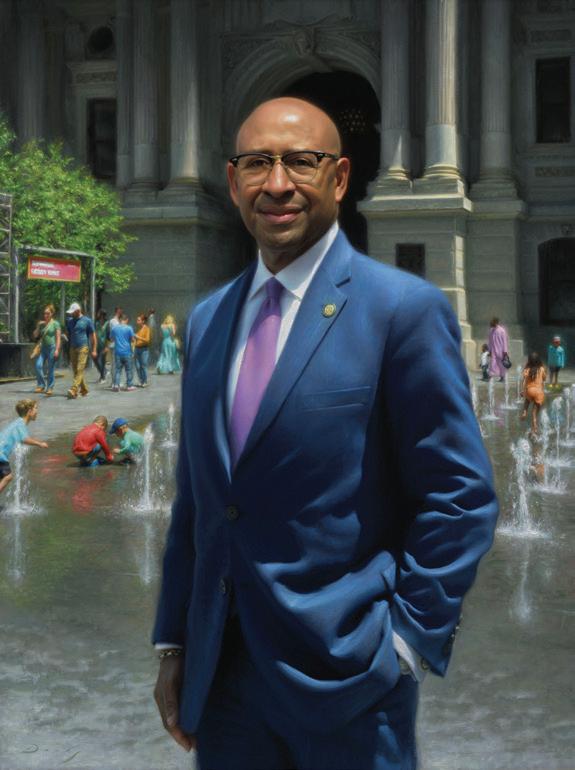
Joseph Daily, Mayor Michael A. Nutter, 39x52”, Oil