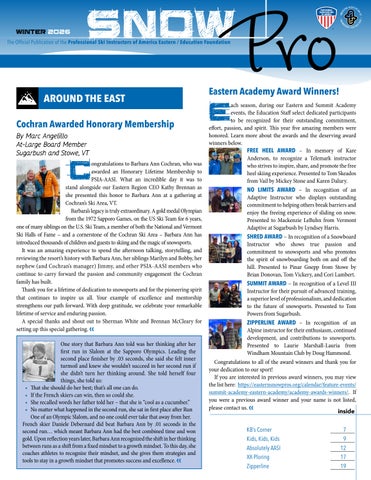
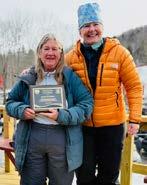
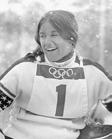
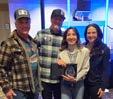
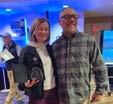
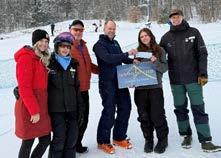
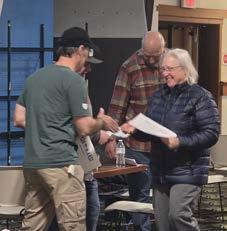
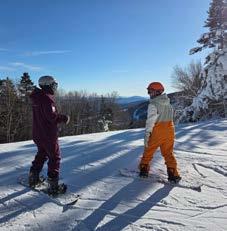
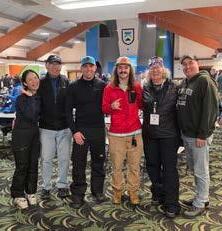
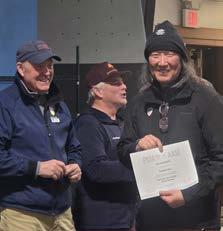
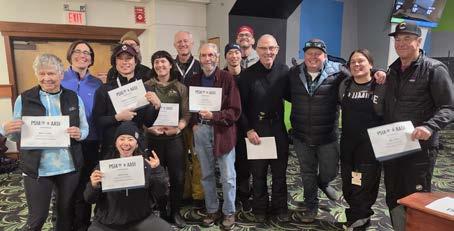
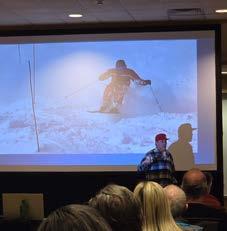
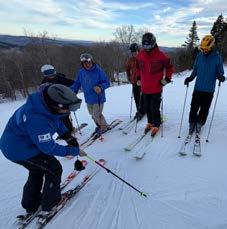
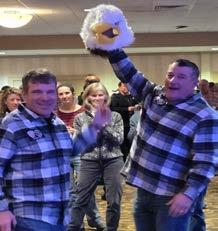
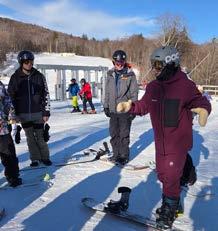
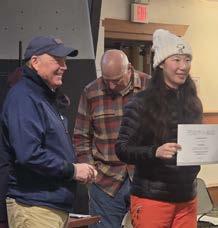
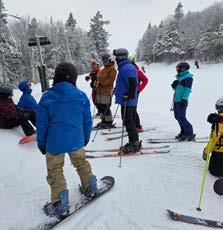
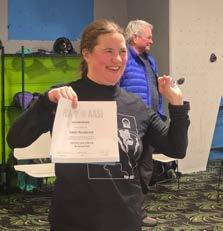
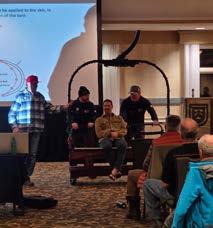
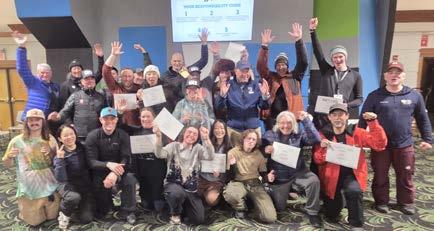
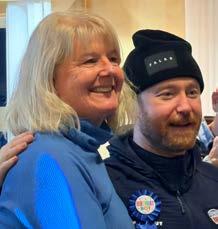
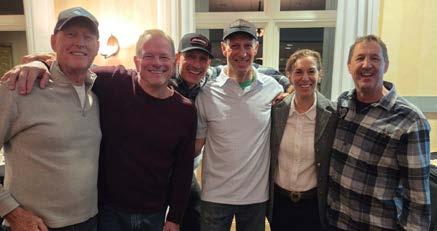
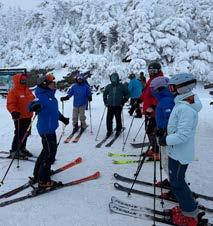
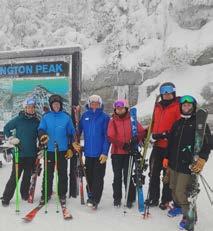
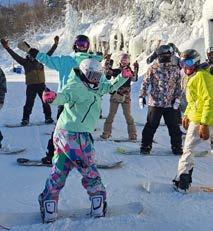
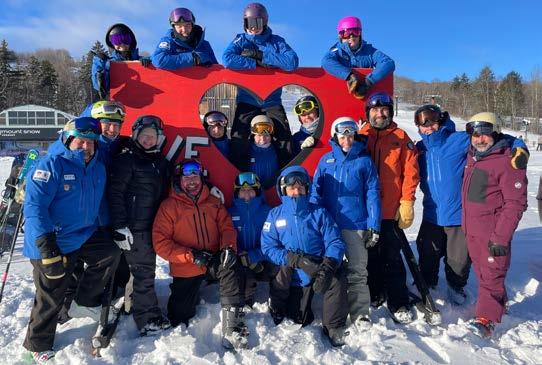
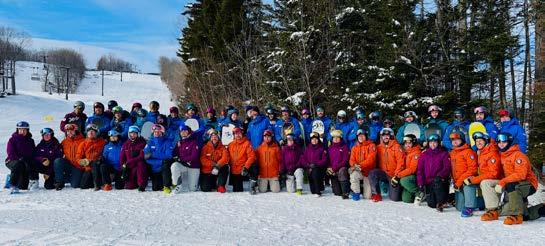
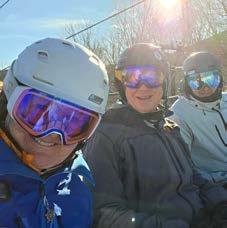
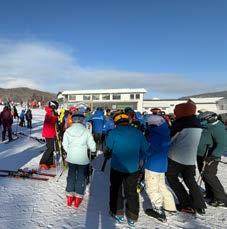
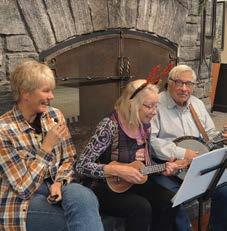
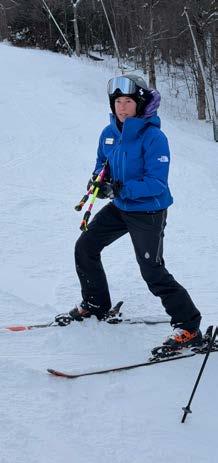
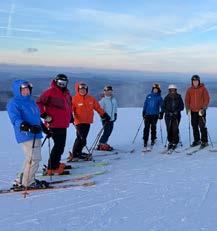
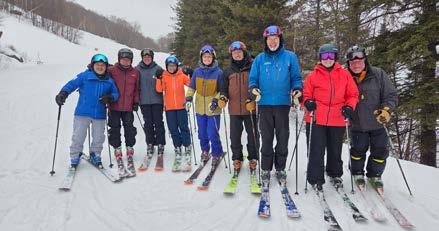
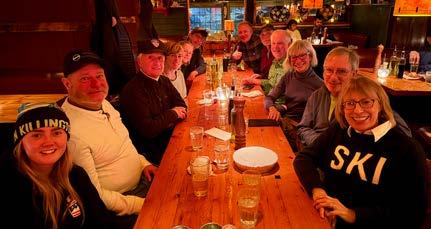
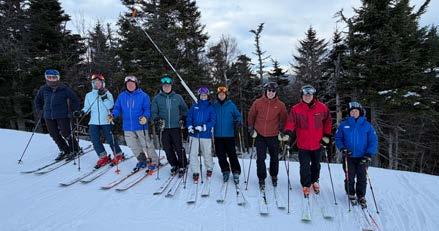
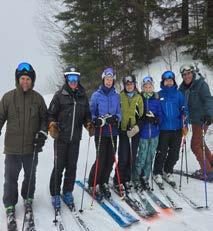
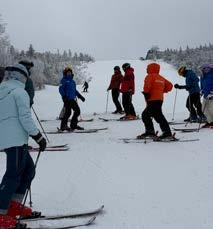
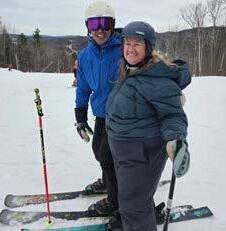
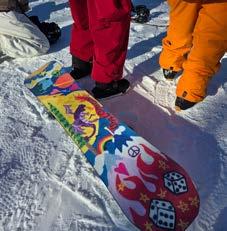
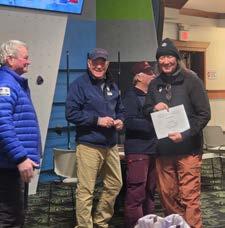
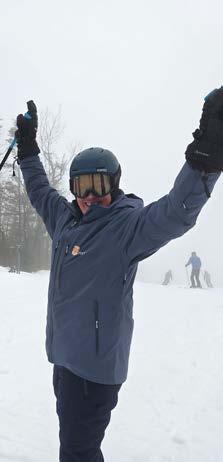
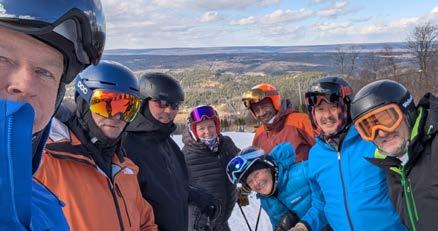
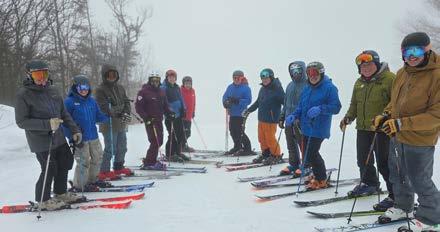
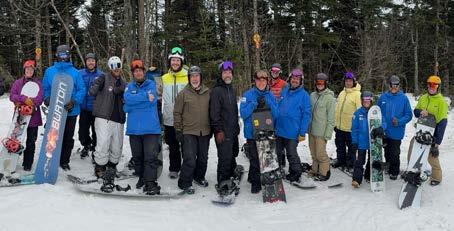
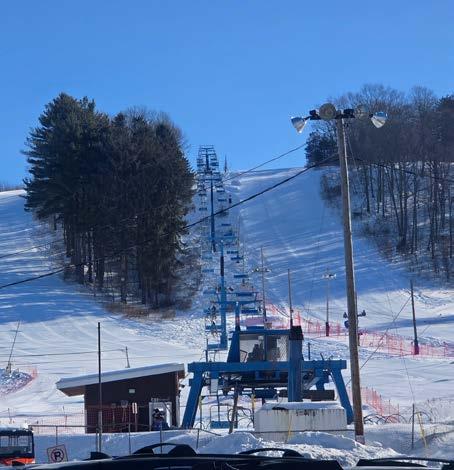
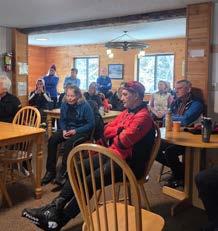
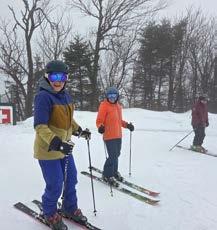
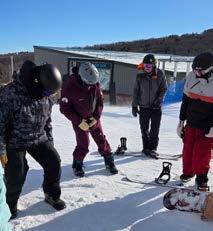
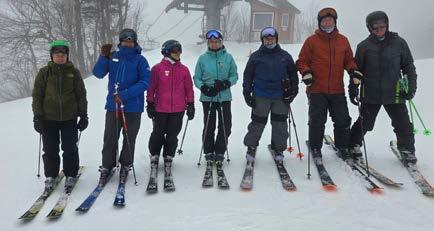
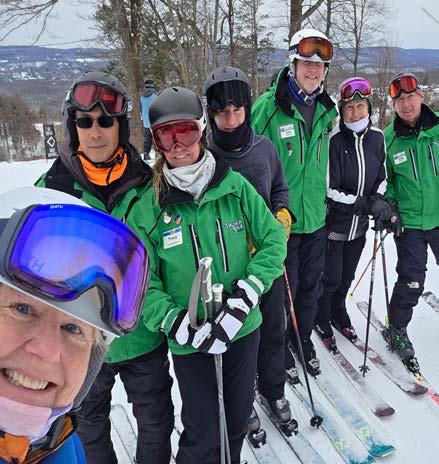
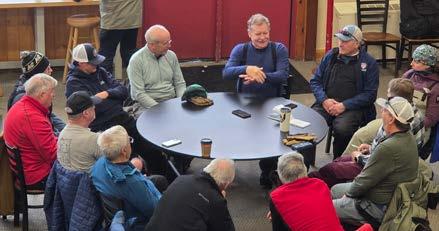
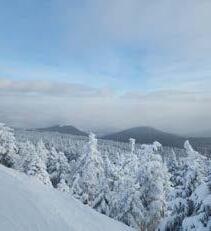
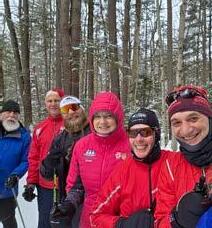
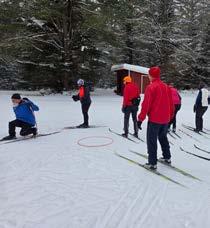
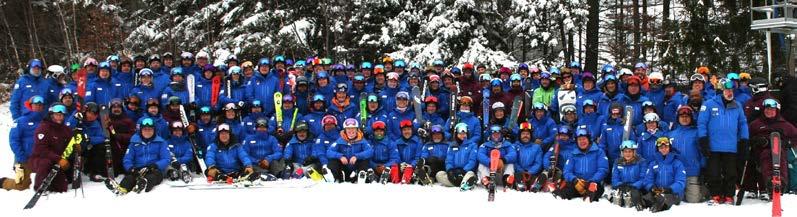
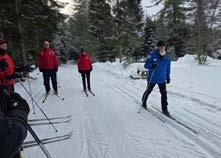
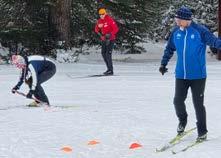
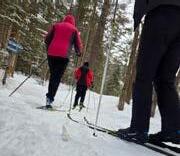
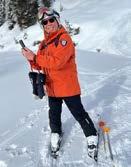
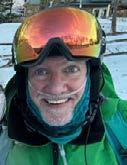
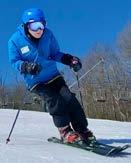
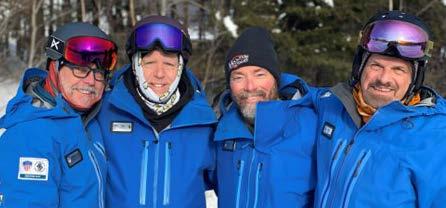
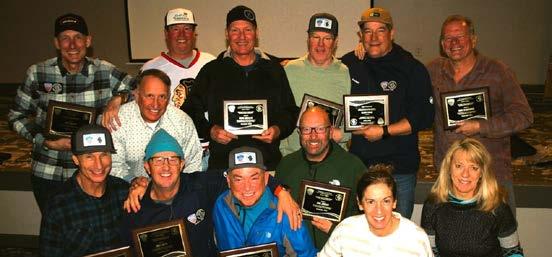
Congratulations to Barbara Ann Cochran, who was awarded an Honorary Lifetime Membership to PSIA-AASI. What an incredible day it was to stand alongside our Eastern Region CEO Kathy Brennan as she presented this honor to Barbara Ann at a gathering at Cochran’s Ski Area, VT.
Barbara’s legacy is truly extraordinary. A gold medal Olympian from the 1972 Sapporo Games, on the US Ski Team for 6 years, one of many siblings on the U.S. Ski Team, a member of both the National and Vermont Ski Halls of Fame – and a cornerstone of the Cochran Ski Area – Barbara Ann has introduced thousands of children and guests to skiing and the magic of snowsports. It was an amazing experience to spend the afternoon talking, storytelling, and reviewing the resort’s history with Barbara Ann, her siblings Marilyn and Bobby, her nephew (and Cochran’s manager) Jimmy, and other PSIA-AASI members who continue to carry forward the passion and community engagement the Cochran family has built.
Thank you for a lifetime of dedication to snowsports and for the pioneering spirit that continues to inspire us all. Your example of excellence and mentorship strengthens our path forward. With deep gratitude, we celebrate your remarkable lifetime of service and enduring passion.
A special thanks and shout out to Sherman White and Brennan McCleary for setting up this special gathering. <<
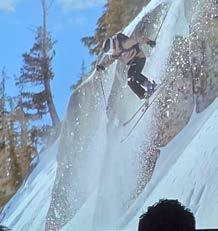
One story that Barbara Ann told was her thinking after her first run in Slalom at the Sapporo Olympics. Leading the second place finisher by .03 seconds, she said she felt inner turmoil and knew she wouldn’t succeed in her second run if she didn’t turn her thinking around. She told herself four things, she told us:
• That she should do her best; that’s all one can do.
• If the French skiers can win, then so could she.
• She recalled words her father told her – that she is “cool as a cucumber.”
• No matter what happened in the second run, she sat in first place after Run One of an Olympic Slalom, and no one could ever take that away from her. French skier Daniele Debernard did beat Barbara Ann by .01 seconds in the second run… which meant Barbara Ann had the best combined time and won gold. Upon reflection years later, Barbara Ann recognized the shift in her thinking between runs as a shift from a fixed mindset to a growth mindset. To this day, she coaches athletes to recognize their mindset, and she gives them strategies and tools to stay in a growth mindset that promotes success and excellence. <<
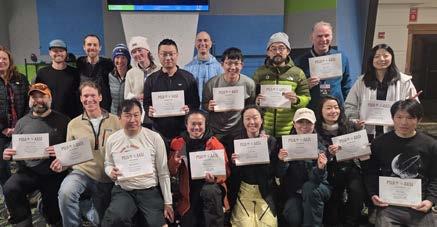
Eastern Academy Award Winners!
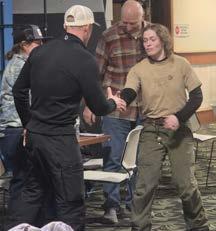
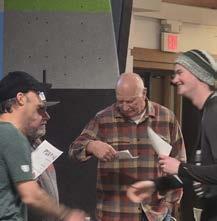
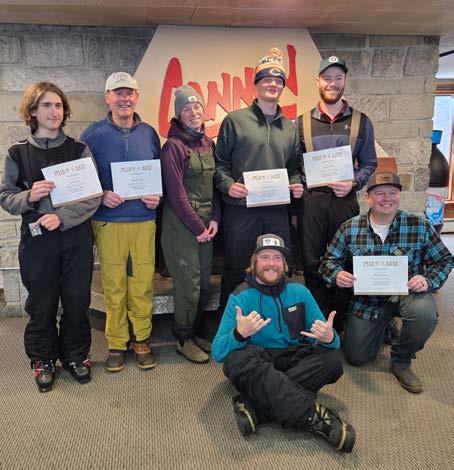
Each season, during our Eastern and Summit Academy events, the Education Staff select dedicated participants to be recognized for their outstanding commitment, effort, passion, and spirit. This year five amazing members were honored. Learn more about the awards and the deserving award winners below.
FREE HEEL AWARD – In memory of Kare Anderson, to recognize a Telemark instructor who strives to inspire, share, and promote the free heel skiing experience. Presented to Tom Skeados from Vail by Mickey Stone and Karen Dalury. NO LIMITS AWARD – In recognition of an Adaptive Instructor who displays outstanding commitment to helping others break barriers and enjoy the freeing experience of sliding on snow. Presented to Mackenzie LeBuhn from Vermont Adaptive at Sugarbush by Lyndsey Harris.
SHRED AWARD – In recognition of a Snowboard Instructor who shows true passion and commitment to snowsports and who promotes the spirit of snowboarding both on and off the hill. Presented to Pinar Gnepp from Stowe by Brian Donovan, Tom Vickery, and Cori Lambert.
SUMMIT AWARD – In recognition of a Level III Instructor for their pursuit of advanced training, a superior level of professionalism, and dedication to the future of snowsports. Presented to Tom Powers from Sugarbush.
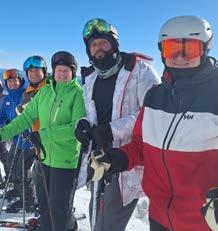
ZIPPERLINE AWARD – In recognition of an Alpine instructor for their enthusiasm, continued development, and contributions to snowsports. Presented to Laurie Marshall-Lauria from Windham Mountain Club by Doug Hammond. Congratulations to all of the award winners and thank you for your dedication to our sport!
If you are interested in previous award winners, you may view the list here: https://easternsnowpros.org/calendar/feature-events/ summit-academy-eastern-academy/academy-awards-winners/. If you were a previous award winner and your name is not listed, please contact us. << inside
Volume 52, Number 1
Kathy Brennan, Managing Editor
Karen Haringa, Assistant Editor
Mark Aiken, Assistant Editor
The official publication of the Professional Ski Instructors of America-Eastern Education Foundation 5 Columbia Circle Albany, NY 12203
Phone 518-452-6095
Fax 518-452-6099 easternsnowpros.org
General Information
Submission of articles, photos, or other items for publication is invited. Articles are not to exceed about 1000 words. Receipt of submissions will be confirmed to the writer. Upcoming deadlines are published in each issue of SnowPro. Material should be sent to “SnowPro Editor” at: contact@ easternsnowpros.org as an MS Word document attachment.
All submitted material is subject to editing and, possibly, a writing process. Its use, whether solicited or not, is at the discretion of the editorial staff. All published material becomes the property of PSIA-E/ EF. Articles are accepted on the condition that they may be released for publication in all National and Regional publications.
The SnowPro is published three times per year by the Professional Ski Instructors of America-Eastern Education Foundation. Permission is hereby given to all National and Regional publications to copy original material from this newsletter providing credit is given to PSIA-E/EF and the author, and the material is not altered. Articles that contain specific copyright notices may not be reprinted without written permission from the author.
Note: Material published in the SnowPro which has been provided by persons not writing in an official capacity, and for official purposes, is the responsibility of the author, and is not necessarily endorsed by the Association. PSIA-E/EF reserves the right to refuse or edit all advertising
VIEW FROM THE CHAIR
Winter Update
By Katie Brinton Eastern Board Chair, Alpine Examiner
Winter arrived strong in the East this year, and with it came that familiar surge of energy: snow guns firing, trails opening ahead of schedule, and early laps reminding us why we do this work. While much of the West was stuck waiting on colder temps in November and December, our region enjoyed a promising start – Whiteface, NY spinning in mid-November, Stowe, VT opening with an impressive 50 trails the weekend before Thanksgiving, and Cataloochee, NC dropping ropes before many of its northern neighbors in early November.
That momentum carried into another kind of season kickoff, too: snowsports instructor orientations At Okemo, Vt., where I train staff, we held new-hire and return-staff onboardings focusing on adaptability, meeting students where they are, and delivering the kind of studentcentered experiences our National assessment standards champion. Those same values – clarity, responsiveness, alignment – are exactly what your board continues to work to strengthen.
When the board met in Albany, NY, in October, our focus wasn’t simply on completing agenda items. It was on ensuring that every part of our governance process ultimately improves your experience as a member. One highlight was a training session with Policy Governance expert Brown Dog Consulting. The goal was to sharpen how we operate, refine how we evaluate ourselves, review how we monitor organizational performance, and shape how we plan our annual work cycle to build a more consistent and transparent framework for serving you.
We also reviewed operational updates from CEO Kathy Brennan, which underscored the tangible ways the office has been improving the member experience. The new self-cancellation feature in our Association Management System, for example, gives you more control over event registration changes and frees staff to support you in other meaningful ways. Investments in
two new coaches – Peter Novom (Alpine) for Freestyle and Brian Donovan (Snowboard) for the Eastern Team – strengthen our training pathways and bring more depth to our education staff leadership. Even the discussion about who should sign your assessment certificates, a small operational detail, was rooted in honoring the professionalism of your achievements and ensuring consistency. And while no one loves dues increases, the board approved a modest $1 adjustment for 2026–27 specifically because it protects long-term financial stability without creating burdens for members.
Committee work this fall followed that same thread. The Membership Communications Committee has been developing new strategies for member outreach, so you have more opportunities to connect with leadership and share what’s working – and what isn’t. The Finance Committee reviewed executive limitations and financial policies to ensure your dues and event fees are managed responsibly and transparently. The Governance Committee advanced updates to our policy manual that will help the board stay aligned and accountable as we tackle the year ahead. We also approved several award nominations – one of my favorite responsibilities, because celebrating the excellence in our membership is part of nurturing a strong, proud, and connected community.
As I wrote in my fall column, this role is, at its core, about serving you. Everything we do –every policy refinement, financial review, or training session – is an investment in making your professional life as a snowsports instructor clearer, smoother, and better supported.
This winter, we are looking to create opportunities for you to share your experiences and your hopes for the future of our region. I hope you’ll join those conversations. We’re listening, and your insights directly shape our long-term strategic direction.
For now, I hope your season is well underway. Whether you’re celebrating early-season powder or making the most of human-made surfaces, I’m grateful to share this community and this work with all of you. <<
Winter Report
By Eric Jordan Alpine Examiner
National Board Representative
It has certainly been a great start to the season here in the East, and we can only hope this momentum continues. Hopefully, you are taking advantage of your pro offers and supporting our sponsors while staying warm and dry out there on the hill.
The National Office in Lakewood has been extremely busy as we move into the heart of the season. Collaboration with the regions is at an all-time high, and we have made significant progress in several key areas. Information Technology remains a top priority, and we are excited to share that IT has now transitioned to being 100% in-house. This shift gives us full control over enhancement priorities and project timelines, allowing us to deliver updates on-time and on-budget for our regional partners. An added benefit of having our own IT staff in Lakewood is the ability to address website issues immediately, with minimal downtime. In short, outsourcing IT was costly and often slow to resolve issues, so we are thrilled to now have a dedicated in-house team of experts.
Interski 2027 is another major initiative currently underway at the National Office. We are incredibly fortunate to be working with outstanding partners such as Vail Resorts and the Town of Vail. Excitement is building worldwide as we prepare to showcase everything PSIA-AASI has to offer in 2027. There will be excellent opportunities for members to attend and participate, so please stay tuned – more information will be shared in the coming months. This truly will be a once-in-a-lifetime event, and we look forward to welcoming the world.
As always, please feel free to reach out with any questions or concerns. I can be reached at enj5050@ yahoo.com. Best wishes for a great year ahead! <<
Board Report, Zone 1
By Ben Debenedictis Alpine Examiner, CS2,
Zone 1 Representative Stowe, VT
Winter 2025-2026 hit northern Vermont historically hard in the early season, and by midwinter all of Zone 1 is enjoying a solid winter season.
Our PSIA events calendar is alive and well. Whether you have certification goals, personal and professional goals, or simply just get-your-CEU credit goals, check out the calendar for events near and far.
The PSIA-AASI East community is a unique, diverse, and awesome group. Feel free to reach out to me or any Board member with any questions, thoughts, or concerns. I hope everyone is enjoying a great winter! <<
At-Large Report
By Emily Spiker Alpine Level III, At-Large Board Member Whitetail, PA
We’re in the heart of our winter season –teaching skiing and snowboarding, completing assessments, and attending PSIA-AASI clinics.
Now is the perfect time to look around your ski and ride school and ask: who really stands out?
The Eastern Region has two awards to consider – the PSIA-AASI E Lifetime Membership recognizing long-term commitment and the Community Service Award recognizing special contributions. These awards are meant for the people who go above and beyond – unsung heroes who make a real difference on and off the snow. They deserve to be recognized. Nominations are open until May 1. If possible, have at least two people submit nominations for the same candidate – the more support, the better. Take a moment to think about the colleagues who quietly lead, support, and inspire. Let’s give them the recognition they have earned.
Member Award Nomination Form: https://fs9.formsite.com/PSIA-AASI-E/ Member-Award-Nomination/index
Zone 3 Report
By Aleks Smith
Eastern Life Membership
Nominees must be an active member for at least 10 consecutive years of membership in the PSIA-AASI Eastern Region. They should be widely known and respected throughout the Eastern Region and the broader snowsports industry for their longterm commitment to the Region and its members. This commitment may be demonstrated through education, publication, leadership, or volunteerism. To be considered, a nominee must receive a minimum of two separate nominations.
Community Recognition Award
Open to any certified member who has made a meaningful contribution to a particular region, discipline, community, or group and its members within the Eastern Region. This award recognizes their generosity to their peers and their community in a meaningful way. This includes giving of their time or knowledge. This nomination requires supporting documentation from a minimum of three sources (two of which should be outside their school). Each year, only one Community Recognition Award Recipient will be recognized per discipline and it is not a requirement for any Community Recognition Award Recipients to be chosen in any given year. <<
Zone 3 Board Member, Alpine Examiner, CS2, FS1 Whiteface, NY
Winter swept into the East, blanketing us with some of the best snow we’ve seen in years –just in time for the holidays. Whether you’re gearing up for winter events, preparing for exams, or already deep into your certification journey, remember: every step you take is part of a meaningful adventure. The process of earning your certification is just as rewarding as the achievement itself – so embrace the season, enjoy the journey, and celebrate your progress.
Board of Directors Focuses on Member Engagement. This fall, the Board of Directors (BOD) participated in an online training course on Policy Governance. The training reinforced our responsibility to connect with members and understand the values and priorities that matter most to our community.
New Initiative: Making the Board More Accessible. To strengthen communication, the Membership Communication Committee (MCC – a BOD subcommittee – has launched a new initiative: BOD members will be wearing name tags at events. This effort is designed to make board members more visible and approachable. We encourage you to say hello, share your thoughts, and learn more about the role the BOD plays under Policy Governance. If you see a board member wearing a name tag, please come talk to us!
As we immerse ourselves in the winter season and all the opportunities it brings, let’s continue to support one another – whether we’re pursuing certification, participating in events, or strengthening our community connections. The Board of Directors is committed to listening, learning, and making our organization more accessible. We encourage you to reach out, share your thoughts, and connect with us at upcoming events. Together, we can make this season – and our organization – more vibrant and rewarding for everyone. <<
Southern New England (Zone 2) and South (Zone 4) Board Elections Are Underway
By Kathy Brennan Eastern Region CEO
Elections are now live for two PSIA-AASI Eastern Board of Directors seats: Zone 2, Southern New England (CT, MA, RI) and Zone 4, Southern states (DE, MD, VA, WV, NC, SC, GA, FL, and Washington, DC). Each elected director will serve a three-year term beginning in spring 2026.
Eligible voters – those who live in the zones listed above or who have designated a snowsports school within those zones as their primary teaching affiliation – will receive an email in early February with a personal invitation and login instructions to vote. Members who believe they are eligible but did not receive voting credentials should contact Operations Director Jodi Bedson directly at jbedson@psia-e.org.
Partial candidate profiles appear below and are listed in alphabetical order on the election website and in reverse alphabetical order. Find their full profiles at easternsnowpros. org/about-us/governance/elections/candidates/
In the South Zone, one candidate – the incumbent – is standing for reelection; in accordance with our governance process, the election is being conducted to allow members to formally affirm their representative for a second term.
All candidates will also have the opportunity to share a brief statement at the conclusion of the Virtual Membership Meeting on February 11 (see page 5 for details). Voting for both zones closes on March 1, 2026.
Candidate Profiles
Southern New England Zone 2 Board Candidate: Babs Ryan
State of Residence: MA
Snowsports School Affiliation: Wildcat Resorts (Vail)
Certifications: Alpine Level I
Motivation for Board Service:
I am interested in serving on the PSIA-AASI Eastern Region Board because I believe the organization’s mission – to support and advance snowsports educators – ultimately succeeds or fails based on one core outcome: whether more people choose to ski and ride, and whether more of them choose to take lessons repeatedly over time. That outcome is shaped not by day-to-day operations, but by board-level strategy, prioritization, and long-term direction.
Within a Policy Governance framework, I view the Board’s role as setting clear strategic outcomes, defining value for members, safeguarding the organization’s future relevance, and holding management accountable for results – while resisting the temptation to solve problems operationally. My interest in board service is to contribute in three specific, non-overlapping areas where I believe I can add distinctive value.
First, driving demand for lessons by addressing the consumer problem.
We cannot fulfill PSIA-AASI’s mission if there are not enough skiers and riders on the slopes – and not enough choosing lessons. This is not just the job of Ikon/Epic and the properties/resorts. My experience as board director, instructor, and executive, including at Wildcat/Attitash, at Forrester Research, and as former CMO at Kawasaki UK, has consistently focused on increasing participation, usage, and lifetime engagement. As a board director at Workers Federal Credit Union, I helped guide a strategy that increased assets by 28% by redefining the value proposition – transforming branches into “private banking for all” through free financial coaching.
I see a direct parallel for PSIA-AASI. The industry already invests heavily in instructor excellence. The larger, more complex challenge that PSIAAASI has tried to solve is why consumers don’t take lessons, don’t repeat lessons, or never enter the system at all. I believe creating sustained, massive demand for lessons is the most effective way the Board can represent instructors and member schools. More lessons taken is the most tangible form of advocacy for snow pros. I believe my experience and creativity (I have many patents, one which generated 2.3 million new customers and $800M revenue, can help us explore strategies for success).
Second, strengthening board-level strategy to accelerate growth and transformation.
The Eastern Region benefits from deep, long-tenured teaching expertise at the board level – a real strength, not a gap. There is no gap in instructional credibility, training or credentialling. I bring extensive commercial governance experience focused on transformation, growth, research-based insights driving human purchase behavior, and external market dynamics. I bring a complementary perspective rooted in consumer behavior, brand value, and enterprise-level strategy – helping boards move from aspiration to deliberate, outcome-driven direction without diluting their core mission. Market growth dynamics will be even more important in a stressed economy.
Third, applying disciplined governance that drives prioritization and results.
Across nonprofit and for-profit boards, I am known for encouraging only the level of governance required to get results. In a Policy Governance model, that means helping the Board focus on a small number of highimpact priorities, making explicit strategic choices, defining success clearly, and ensuring accountability – rather than expanding agendas or drifting into operations. My board experience ranges from Board Director and Audit Committee Member in the highly regulated banking industry to a small private manufacturer to mission-based non-profits. I qualifying as an Audit Committee Financial Expert under Sarbanes-Oxley Act, NYSE, NASDAQ and Regulation S-K rules, and help with the board’s critical financial oversight.
I am motivated to serve because I believe PSIA-AASI Eastern Region can play a decisive role in growing the entire snowsports ecosystem. By governing for demand creation, long-term relevance, and member value, the Board can materially improve outcomes for instructors, schools, resorts, and the industry as a whole.
See the rest of Babs Ryan’s biography at this link: easternsnowpros.org/ about-us/governance/elections/candidates/
Southern New England Zone 2 Board Candidate:
Julianna Collins
State of Residence: MA
Snowsports School Affiliation:
Wachusett Mountain
Certifications:
Snowboard Level II
Motivation for Board Service:
I joined PSIA/AASI in 2011, but it wasn’t until 2014 that I truly fell in love with the organization. Serving the board would allow me to give back to the organization and fall more in love with PSIA/AASI. It would also very selfishly allow me a sense of accomplishment - I wish to be a part of an organization I so highly respect and contribute to the organization’s ongoing success and growth.
I see the board’s role as an essential part of ensuring long-term relevance and success within the snowsports industry. Achieved only by providing ongoing access to world-class trainers, clinicians, instructors, mentors, etc. A board seat will ensure oversight of performance by means of monitoring metrics and alignment of activities and mission. Long-term goals and direction involve identifying clear objectives and identifying risks. I also see serving the board as a partnership between the board and upper management which will safeguard a collaborative and effective relationship.
See the rest of Julianna Collins’ biography at this link: easternsnowpros. org/about-us/governance/elections/candidates/
South Zone 4 Board Candidate:
Landon Figg
State of Residence: VA
Snowsports School Affiliation:
Wintergreen Resort
Certifications:
Alpine Level II
Motivation for Board Service:
I have had the pleasure of working with the current board for the past three years, and I am genuinely impressed by the passion and dedication of each member. I hope to continue our work together over the next three years, as we have built a solid foundation in policy governance.
I am interested in serving on the Board because I am committed to the long-term success, integrity, and relevance of the organization for its members. I believe effective governance plays a critical role in ensuring that the organization remains financially sustainable, values-driven, and responsive to the evolving needs of its members and community. Serving on the Board is an opportunity to contribute strategic thinking, sound judgment, and a strong sense of accountability in support of that mission, rather than focusing on day-to-day operations.
Within a Policy Governance framework, I see the Board’s primary role as setting clear strategic direction and defining the organization’s outcomes on behalf of its members. This includes establishing and regularly reviewing the mission, vision, and long-term goals, as well as articulating policies that guide ethical behavior, risk tolerance, and executive authority. The Board should focus on what success looks like and why it matters to members, while leaving the how to management.
Equally important, the Board has a responsibility to provide strong oversight. This means monitoring performance against agreed-upon outcomes, ensuring prudent stewardship of resources, and holding the CEO accountable through clear expectations and evaluation. By maintaining a disciplined focus on strategy, member value, and governance – not operations – the Board can create clarity, stability, and trust, enabling management to operate effectively while ensuring the organization remains aligned with its purpose and accountable to those it serves.
See the rest of Landon Figg’s biography at this link: easternsnowpros. org/about-us/governance/elections/candidates/ <<
OFFICIAL NOTICE
PSIA-AASI Eastern Region Annual Virtual Membership Meeting
During this meeting, hear about the state of our organization and future plans from the CEO, Kathy Brennan, and representatives from the Board of Directors. Also, take this opportunity to ask a question or make a suggestion. At the finish of the call, Zone 2 and 4 Board Representative candidates will have the opportunity to make a brief statement.
Albany Ski Club Sponsors Royal Mountain Snowboard
Instructor, Maya Canton
Tim Jansen, President of the Albany Ski Club, is shown presenting a sponsorship check to Maya Canton in support of her pursuit of Snowboard Level I certification through PSIA-AASI.
Also pictured (L-R): Brooke Tennis (Co-Owner, Royal Mountain Ski Area), Kim Schaefer (Co-Director, Royal Mountain Snowsports Program), Jim Tunney (President, NY Capital District Ski Council and Director, Albany Ski Club), Tim Jansen (President, Albany Ski Club), Maya Canton (sponsorship recipient), and Mike Schaefer (Co-Director, Royal Mountain Snowsports).
The award was presented in memory of former Albany Ski Club Vice President Dory Alexander, who was deeply committed to introducing others to skiing.
Maya began skiing at age three and transitioned to snowboarding six years ago. She has been instructing for the past five years and shares, “I found genuine excitement in teaching others the sport.”
Albany Ski Club is a Non-Profit organization that offers Adventures Year-Round. <<
Learning Beyond Our Comfort Zone
By Kathy Brennan Eastern Region CEO
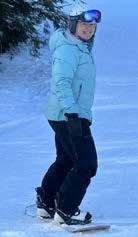
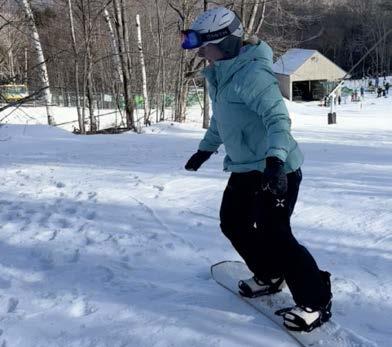
As anyone who follows me on social media may have noticed, this fall I treated myself to a new snowboard setup.
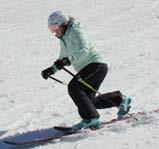
While I have not snowboarded in over 20 years, I firmly believe that as instructors it is both important and valuable to understand all the ways we can slide on snow. As someone who holds Alpine and Telemark certifications, has completed my Children’s Specialist, and is working on my Cross-Country skills, I felt it was time to get back on a board.
That experience quickly reminded me of the importance of empathy for anyone learning something new or trying to change ingrained movement patterns. I was amazed at how much I had forgotten, how unstable I felt, and how excited I was when, after an hour, I barely managed a toe-side falling leaf. It was a powerful reminder of what our students feel every day—the vulnerability, frustration, and joy that come with even the smallest progress.
One note, speaking of that vulnerability: at one point during my snowboard lesson, instructor Lisa Dutto, offered me her hand to hold. Even though I was barely touching it, the effect was immediate. I felt calmer, safer, more stable, and better balanced.
That simple gesture made sliding possible. It was a powerful reminder that learning is often shaped not by complex instruction, but by small physical or emotional inputs that build trust and confidence. As instructors, those subtle supports can make all the difference.
Stepping outside our primary discipline creates learning experiences that build skills in unexpected ways. Many of these experiences are transferable, expanding our bag of tricks and helping us find new ways to communicate how skis and boards slide on snow. They also create opportunities for near and far transfer—connections that help students become more successful learners across a wide range of situations.
A Game That Transfers Across Disciplines
Recounting this beginner snowboarding experience, reminds me of a session I attended at the 2023 Interski Congress in Levi, Finland titled “XC Skiing with Fun – Classical Technique for Kids and Youth” presented by the Czech Republic.
One activity was a creative variation of Freeze Tag that transformed a familiar game into an obstacle-course adventure. Teammates could be unfrozen by crawling through legs (tunnel tag), shuffling over a teammate (bridge tag), high-fiving, or completing other movement-based tasks. The activity promoted teamwork, spatial awareness, and dynamic movement— all while keeping us balanced and engaged on cross-country skis. What struck me most was how easily this activity could transfer to a beginner lesson in any discipline. The equipment may change, the obstacles may be different, or it might even be done with one ski on - but the learning outcomes remain the same: balance, movement in equilibrium, engagement, and fun.
Exploring Across Disciplines
Cross-discipline exploration sharpens our awareness of body movements as well. As movements become more autonomous (we often refer to this as muscle memory), it can be harder to feel the specific actions that create performance. Trying something different brings those subtleties back into focus and may lead to breakthroughs in our primary discipline.
For example, telemark skiing highlights how challenging it can be to manage pressure along the length of the ski when the heel is free. It draws attention to subtle ankle movements, how pressure is felt inside the boot, and the distinct roles of the leading and trailing feet.
When I return to alpine gear, those sensations stay with me. I’m more aware of how pressure develops, where it’s coming from, and the effort required to create ski performance. Exploring different equipment often sharpens awareness that carries directly back into our primary discipline.
Learning to slide on different equipment also reinforces just how similar our disciplines are. We know that teaching and people skills are universal. Stepping outside our primary discipline reinforces that truth—but it also challenges us to examine how committed we really are to the idea that technical fundamentals across disciplines are more similar than different.
Doing movement analysis on ourselves and others makes this clear. Even when equipment and stance differ, we are often looking for the same performance outcomes and using similar language to describe what we see.
Seeing Movement Outside Your Home Discipline
Observing and analyzing movements outside our home discipline can be both revealing and humbling, reinforcing the need for continued learning and confidence-building across all areas of instruction. For example, while watching snowboarders ride, I could identify differences in performance—such as carved arcs versus pivoted finishes—but I wasn’t fully confident in trusting my observations.
That experience reinforced an important lesson: recognizing movement is only part of the equation. Building confidence comes from understanding what learning experiences will help someone make a desired change. Cross-discipline observation strengthens both awareness and curiosity, even when we’re not the content expert.
Several years ago, I had the opportunity to work on a webinar with National Team members Keith Rodney and Brian Donovan exploring similarities in technical fundamentals across Alpine, Snowboard, and Telemark. One example we discussed was rotation. In all three disciplines, turns begin with the feet and legs, but what happens next is shaped by stance and equipment. Alpine skiing allows the pelvis to stay more aligned with the direction of travel, with the legs rotating beneath a stable upper body. In snowboarding, the board limits independent leg rotation, so turning depends more on coordinated whole-body movement, pressure control, and flexion and extension. In telemark skiing, the split stance limits the orientation of the pelvis, so equilibrium is maintained with separation occurring higher in the body through spinal alignment and a disciplined upper-body—even though the skis are still being guided by the feet and legs. Paying attention to these similarities and differences deepens our understanding of movement across all disciplines. A description of the webinar is on the next page.
continued on page 8 >>
Multi-Discipline Events
Does these sound intriguing? Are you looking to branch out? The Eastern Region offers several programs designed to help you make these connections firsthand. During the Crossover events, for example, participants use two different sets of equipment to directly experience both the similarities and the differences between disciplines. See below: Telemark/Alpine Crossover Gunstock 1/27-28/2026
Cross Country & Alpine Crossover Gunstock Waterville Valley
Learn to Tele:
Holiday Valley (NY)
Mount Abram (ME)
Massanutten Wachusett
Cross Country Instructor Training Course
Every Lesson Is Adaptive
2/11-12/2026
3/11-12/2026
1/13-14/2026
2/5-6/2026
2/7-8/2026
2/23-24/2026
Bretton Woods XC 1/31-2/1/2026
Another powerful way to expand perspective is through the Adaptive discipline. Adaptive education offers tremendous insight into fundamentals as they relate to cognitive processing and learning. Many of us have worked with guests of all ages who struggle with processing, confidence, or fear, or whose movements are shaped by injury, illness,
TECHNICAL FUNDAMENTALS
Alpine
• Control relationship of COM to BOS to direct pressure along length of skis
• Regulate magnitude of pressure created through ski/snow interaction.
• Control edge angles through a combination of inclination and angulation
• Control pressure from ski to ski and direct pressure toward the outside ski
• Control skis’ rotation with leg rotation, separate from upper body
aging, or lifelong differences. Adaptive programs deepen our ability to recognize those challenges and respond effectively. These skills benefit every instructor, regardless of discipline or equipment.
Adaptive Alpine Level 1 Assessment Prep
Sunday River Bromley
Massanutten
Timberline
HoliMont
Adaptive FUNdamentals of Adapting for Neurodiverse Athletes
All Lessons are Adaptive for All Disciplines
Sunday River Wachusett
Blue Mountain (PA)
HoliMont
Mount Snow
HoliMont Stowe
1/13/2026
1/31/2026
2/3/2026
2/23/2026
3/3/2026
1/14-15/2026
2/5-6/2026
2/11-12/2026
2/28 – 3/1/2026
3/9-10/2026
3/2-3/2026
3/10-11/2026
In closing, my snowboarding experiences leave me with this wisdom: never stop learning. Remember learning doesn’t have to mean chasing the next pin within your primary discipline. Exploring across all the ways we slide on snow can make your experience more engaging, more joyful, and more inspiring. It can open doors to new opportunities, strengthen your teaching, and ultimately enrich your journey as both a member and an instructor. <<
Watch the webinar: ExploringCommonMovements BetweenDisciplines (https://lms.thesnowpros.org/ product/exploring-commonmovements-between-disciplines1-ceu)
Exploring Common Movements Between Disciplines
1
CEU | $25
As demand for multi-discipline lessons grows, many instructors are looking for help understanding how technical fundamentals intersect across equipment. In this webinar, National Team Members Keith Rodney and Brian Donovan are joined by Eastern CEO Kathy Brennan to explore how our disciplines are more similar than different.
Using mixed-discipline video analysis, the panel focuses on common movements, shared performance outcomes, and discipline-specific nuances. The goal is to help instructors build confidence in recognizing desirable movements and understanding how those movements influence ski and board performance.
• Control relationship of COM to BOS to direct pressure along length of board
• Regulate magnitude of pressure created through board/surface interaction
• Control the board’s tilt through a combination of inclination and angulation
• Control relationship of COM to BOS to direct pressure across the width of the board
• Control board’s pivot through flexion/extension and rotation of body
• Control twist (torsional flex) of board through flexion/extension and rotation
• Control fore/aft relationship of COM to BOS to manage pressure along length of ski
• Regulate magnitude of pressure created through ski/snow interaction.
• Control edge angles through a combination of inclination and angulation
• Control lateral relationship of COM to BOS to manage pressure from ski to ski
• Control turning of skis with rotation of feet and legs in conjunction with discipline in upper body
• Control size, intensity, and timing of lead change
Snowboard
Telemark
CALLING ALL FUTURE PROS
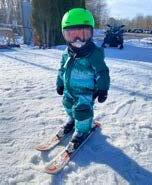
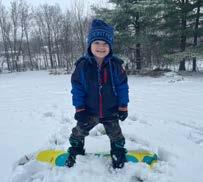
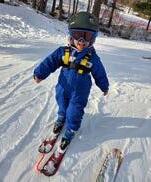
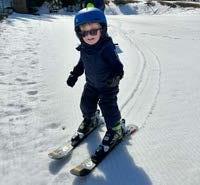
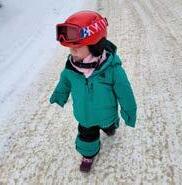
The SnowPro publication is featuring pictures of our Future Snow Pros. What did these future Snow Pros look like on the very first day they slid on snow?! Share their adventure!
Eli Brown, 13 years at Sugarloaf, ME
Share your child’s or grandchild’s very first day they ever slid on snow, submit their image: https://fs9.formsite.com/PSIA-AASI-E/FuturePro/index
Thank you to everyone who submitted a picture, we love seeing your future snowsports enthusiasts enjoying the very first day they have slid on snow.
George DeSerres 1.5 years
McIntyre, NH
Wyatt Kruger 2 years
Mechanicsburg, PA
Caleb Kravitz 3 years
Mount Southington, CT
Henry Lorraine 3 years Greek Peak, NY
Nellie Price 2 years Sugarloaf, ME
KIDS, KIDS, KIDS
Children’s Specialist Update
By Mark Aiken Eastern ACE Team Member, Alpine Development Team Member
At the annual early season education staff training, Eastern Region ACE Team members gathered to prepare for the season by planning for educational events and reviewing Children’s Specialist assessment events.
Educational events include:
• Children’s Focus Updates
- Liberty, PA, February 9-10
- Seven Springs, PA, February 23-24
- Crotched Mountain, NH, February 25-26
- Gore Mountain, NY, March 10-11
- Okemo, VT), March 19-20
• Ski the Field Guide with Mark Aiken
- Stowe, VT, March 18
• Children’s Instructor Spring Rally
- Stratton, VT, March 28-29
See the PSIA-AASI Eastern Region event calendar to choose from over 30 Children’s Specialist 1 and 2 assessments scheduled all over the region.
Regarding the two-day Children’s Specialist assessments, children’s education staffers on the ACE Team discussed minor changes to the assessments. As the eight regions of PSIA-AASI work towards aligning the certification and accreditation process nationally across all disciplines, the changes come from the Educational Leadership Council (ELC) and the National Children’s Task Force (NCTF).
The ELC deals with task forces from all disciplines. Eastern Region Education and Program Director Keri Reid represents the East on the ELC. Eastern Region alpine examiner Jeb Boyd also serves on the council in his role as National Team Head Coach.
The NCTF deals with all things children. National Team member and Eastern Region telemark and alpine examiner Keith Rodney serves as the chair of the NCTF and ACE Team Head Coach Bonnie Kolber serves as the Eastern Region’s representative. Bonnie regularly asks for input and feedback from the entire Eastern children’s education staff, so our region is well-represented on both the ELC and NCTF.
Members interested in going for their Children’s Specialist 1 or 2 should be aware of one takeaway from the ACE Team training: While the CS events have always been educational events and assessments events all at once, now more than ever, members should be prepared for the assessment component. Members should come to CS events prepared to demonstrate that the skills they bring meet the CS standards. Team members discussed the balance between assessing these skills at events and maintaining an informal, upbeat, and collaborative environment.
The ACE Team is all about having fun, learning best practices for educating young riders and skiers, and assessing members’ skills at assessment. We look forward to leading children’s educational events and assessments in 2026. See you there! <<
A Brief History of the ACE Team
By Bonnie Kolber
Eastern ACE Team Head Coach, Snowboard Examiner Member, PSIA-AASI National Children’s Task Force
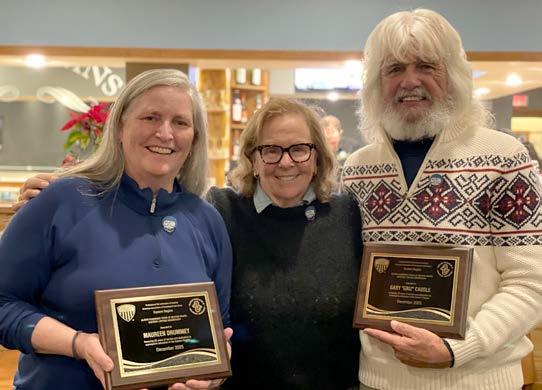
Every year, the PSIA-AASI Eastern Region education staff participates in pre-season training. The ACE team is no different. This year, the ACEs gathered at Mount Snow to review best practices for running children’s educational events, preparation events, and Children’s Specialist assessments. During the evening session of the two-day training, we honored longtime Children’s Education Staff members with Years of Service Awards. The awards recognized Mo Drummey and Gary “Griz” Caudle for their 25 years of Education Staff service. Starting this year, the award is known as the Alison Cummings Years of Service Award. You may wonder, who is Alison Cummings and what has she contributed to children’s education? And when and how exactly did the ACE team get its start?
Alison Cummings is a longtime Alpine Examiner with roots in the Children’s world. Ali was a member of the original Junior Education Team (JETS) – a national multi-discipline team of children’s instructors from each region in the country. Formed in 1989, the JETS created an event known as the National Children’s Symposium and helped develop content for PSIA-AASI members to enhance understanding of how teaching children is different from teaching adults.
According to Ali, the JETS created the playbook for children’s instruction, set up indoor and outdoor snowsports programs, and developed and wrote the original National Children’s Manual. They trained at the same time and in the same locations as the National Team and worked together for 11 years.
In the year 2000, the responsibility of furthering Children’s education was shifted to the regions. At this time, Ali was the Eastern Children’s Committee Chair and sat on the Board of Directors. In collaboration with Mickey Stone, National Nordic team member and Nordic chair at the time, they created a team to drive Eastern Region’s children’s education. The team became known as the Advanced Children’s Educators – the ACEs.
The JETS had created the CAP Model, an integral component for teaching children, that incorporated developmental and psychological models and theories in the Cognitive, Affective, and Physical/Psychomotor realms. In
other words, this model describes how we think (cognitive), how we feel (affective), and how we move and learn to move (physical/psychomotor). The CAP Model is still a foundational part of PSIA-AASI children’s education and to this day makes up the Technical Skills portion of the Children’s Specialist (CS) events.
After the JETS disbanded, the ACEs under Ali’s guidance established the Children’s Academy, a regional version of the National Children’s Symposium that drew on the team’s synergy and creativity. According to Ali, “The events were unique. There was typically a keynote speaker - topics varied but always relevant to building programs, teaching children, developmental theory, special needs, etc. The on-snow time was guided by the annual theme, and each ACE had their group for the event. Each Academy had some kind of crazy evening performance or festival that the whole group participated in. There was an abundance of fun and a lot of sharing and learning took place. These events were great.”
While the Children’s Academies no longer happen in the same form, the ACEs have continued the legacy of Children’s education in the East with the Eastern Children’s Academy, Children’s Spring Rally, Children’s Trainer Academy, and a variety of Children’s Focus events on the events calendar. The ACE Team is the same Children’s Education Staff that conducts the Children’s Specialist (CS) events. If you’re interested in teaching children to ski and ride, all these events are run by current ACE Team members and are the place to learn, grow, and get inspired alongside other children’s instructors.
I’ll leave you with a quote from each of the Alison Cummings Years of Service Award recipients.
Mo Drummey, a member of the original ACE team, says, “I think teaching skiing and riding have come a long way. Teaching children has always been where people were stuck when they started. It’s where they figured out how to teach. Now, we are seeing the value in making sure people have tools to do a good job teaching kids by teaching them how kids learn and the development of children (ages and stages) and how to make learning fun and enjoy the mountain playground.”
Gary “Griz” Caudle was the first snowboarder to make the ACE team, and says, “The original concept and start-up of the ACEs was conceived by Alison Cummings. The idea was to have a select group of really good (excellent) children’s instructors to enhance children’s ski and snowboard instruction.”
Thanks to Mo and Griz for your enduring contributions and congratulations on earning these awards! And a huge thank you to Ali for her inspiration and impact on children’s education in our organization, along with Mickey Stone and all those who were involved from the early days. We wouldn’t be here without you! <<
l-r, Mo Drummey, Alison Cummings, Gary “Griz” Caudle
Maureen “Mo” Drummey and Gary “Griz” Caudle were recognized with the Alison Cummings Award and Eastern Lifetime Membership for 25 years of outstanding service to snowsports education for instructors teaching children. Thank you, Mo and Griz!
Children’s educational staff, known as the ACE Team
NEXTCORE NEWS
Eastern Region’s Mentorship Program Will Continue!
By Matt Lyerly Alpine Level II, CS1, FS1 Massanutten Resort, VA
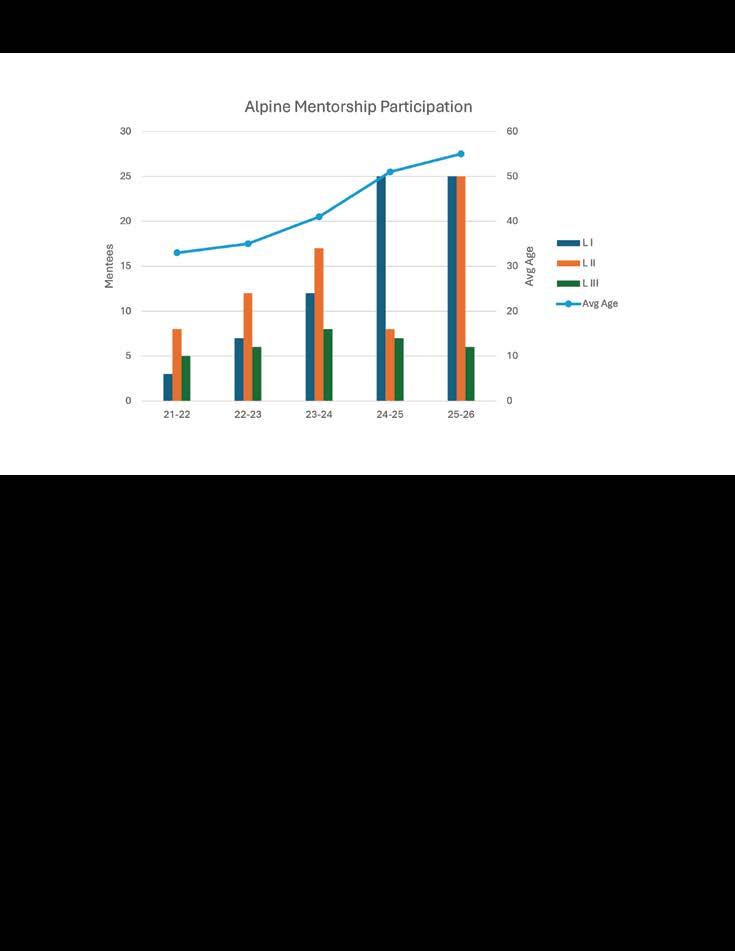
Ihope this Winter SnowPro finds you all well and off to a great start for the 2025-2026 season. As the coordinator of the region’s mentorship program, I wanted to share some updates about how the program has evolved over the past several years. I’ll start with two charts.
In this first chart, we see participation in the alpine side over the five years we have hosted the program. On the left side, you’ll see the number of mentees each year. The bars represent the levels of mentee certification. On the right side, you’ll see an age range and the line on the chart represents the average age each year of the program. Pretty obvious trend, right? The average age of mentees is increasing. Notice how the 2023-2024 season is circled in the chart. In this season, we decided to open the program up to the eastern membership as a whole and expand beyond just the next core age (16-39 years old). Notice also how the ratio of Level I, Level II, and Level III changes over time. What I think is happening is as the program has grown, we have started getting more participation from the weekend warrior crowd (of which I am one!). We are having greater participation across a wider range of snowsports backgrounds whereas in the first two years, we had only members of the
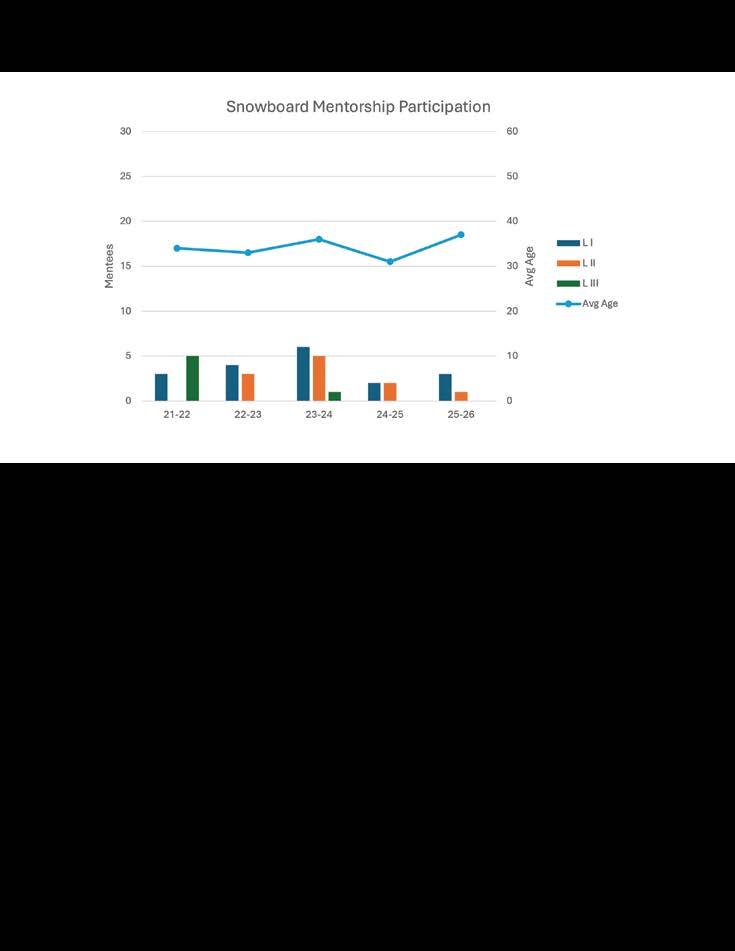
Moving on to snowboard participation…
There are some concerning trends in overall snowboard mentee participation. 2023-2024 appears to be our watermark year with the greatest number of mentees. It’s unclear why there has since been a decrease in participation, but we are trying to understand what appeals to a potential snowboard mentee. Like alpine, we saw our greatest concentration of Level III snowboard mentees early in the program.
Telemark and cross country member participation has grown over the past several seasons from one member in 2022-2023 and in 2023-2024 to two in 2024-2025 to now three in the current season. We had one cross country mentee in 2024-2025. This year, we had three adaptive mentees compared to one in 2024-2025.
Looking at our data set as a whole and trying to understand the evolving mentee participation is a tricky proposition because our data is imperfect and very factual. When recruiting mentees, we only ask objective questions about certification, home mountain, etc. Perhaps we should be asking different questions such as “What can a mentor provide you that someone at your home mountain can’t?” and “Why do you need a mentor at this point in your snow sports career?”
Additionally, it’s possible we developed the program with the wrong target audience in mind. Because this was a Next Core initiative, in the early years we chose to accept only those who fell within our age range. It’s possible this age range values other aspects of snowsports besides mentorship.
The mentorship will continue to evolve. Regardless of the cumulative trends, opening this program to the membership as a whole was a smart move. Any initiative that provides greater access to our amazing education staff is effort and energy well-spent. <<
Congratulations to new Alpine Examiners (L-R) Chris Setchell, Drew Miller, Amy Kizak, Meghan Kelsey, Evan Vomacka, Erroll O’Brien and Keagan Dewey! Your hard work and dedication have paid off. Welcome to your new roles!
ABSOLUTELY AASI
Winter Update
By Brian Donovan AASI-E Coordinator and Examiner
PSIA-AASI Snowboard National Team Member
Greetings AASI East Community! Well, it’s 2026, and by now you’ve likely logged days teaching lessons, riding with friends and coworkers, and continuing to build momentum and knocking off the rust at your home resorts. With the season in full swing, now is the perfect time to finalize your education and certification plans and take advantage of the many opportunities AASI has to offer you this winter.
As always, our goal is simple: to support you as professional snowboard instructors and help set you up for success, whether that means refining your teaching skills, progressing your riding, preparing for an assessment, or simply riding great terrain with a motivated group of peers. We’re here for you.
Winter Education Highlights
The AASI-E Event Schedule once again offers a wide range of clinics, camps, and assessment opportunities designed for wherever you are in your professional journey. From technical skill development to teaching improvement and freestyle progression, there are events this winter that will challenge, inspire, and support you on your journey.
Featured Events
Trees and Steeps Camps
• Stowe, VT January 26-27, 2026
• Jay Peak, VT February 23-24, 2026
Corduroy and Carving
• The Hermitage Club, VT February 12-13, 2026 Splitboard Camp
• The Hermitage Club, VT February 12-13, 2026 Learn to Ride Trees Camp
• Stratton, VT February 5-6, 2026 Women’s Freestyle Camp
• Mount Snow, VT February 2-3, 2026
Freestyle Camp
• Sugarbush, VT March 17-18, 2026
Dates and Locations for 2025-2026 Assessment Modules: Level II
• MA/TU – Killington, VT – January 12, 2026
• MA/TU – Blue Mtn, PA – January 28, 2026
• Teaching – Blue Mtn, PA – January 29, 2026
• Riding – Blue Mtn, PA – January 30, 2026
• Teaching – Killington, VT – February 9, 2026
• MA/TU – Jay Peak, VT – February 25, 2026
• Teaching – Jay Peak, VT – February 26, 2026
• Riding – Jay Peak, VT – February 27, 2026
• MA/TU – Holimont, NY February 28, 2026 – WEEKEND
• Teaching – Holimont, NY March 1, 2026 – WEEKEND
• Riding – Killington, VT March 9, 2026
Level III
• MA/TU – Killington, VT – January 12, 2026
• Riding – Killington, VT January 22, 2026
• Teaching – Killington, VT – February 9, 2026
• MA/TU – Stowe, VT – March 10, 2026
• Teaching – Stowe, VT – March 11, 2026
• Riding – Stowe, VT – March 12, 2026
If you’re looking for an immersive experience, consider attending events hosted at mountains you haven’t visited before. Exploring new terrain while riding with AASI peers is one of the best ways to expand your perspective, build connections, and keep your stoke high this season.
Certification Pathways & Assessment Planning
If you’re planning to attend a Level II or Level III Assessment this season or in the future, remember that one qualified prerequisite event is required. Choose from the following:
• Level II or Level III Assessment Prep events
• 2-Day Teaching Improvement events
• 2-Day Movement Analysis events
• 2-Day Riding Improvement events
• Member Customized Events (MCEs) focused on these topics
These events are intentionally selected because they best prepare candidates with the feedback, understanding, and experiences needed to succeed in an assessment environment. And remember – you do not need to be planning to take an assessment to attend a prep event. Many members participate simply to gain clarity, improve their skills, and better support colleagues at their home mountains.
Take Ownership of Your Learning
One of the strengths of the AASI education system is the range of ways you can stay engaged. In addition to on-snow events, members are encouraged to take advantage of:
• E-Learning courses and webinars available through thesnowpros.org
• Member Customized Events, which allow you to bring education directly to your home resort – Contact the Eastern Region Office at 518-452-6095 to schedule one now.
• Podcasts such as The PSIA-AASI First Chair or the unaffiliated All I Really Need to Know I Learned from Snowboarding podcast
• Staying connected through the AASI East Facebook group
Life happens – schedules change, injuries occur, and winters don’t always go as planned. Having multiple pathways to stay active, current, and connected ensures you can continue progressing no matter what your season looks like.
Snowboard Education Staff members pause for a photo with the Alpine Development Team and various Alpine Education Staff members.
Pro Tips
for a Great Event Experience
Do:
• Come prepared, rested, and ready to ride
• Communicate your goals with your AASI Education Staff member on Day 1
• Be open to feedback and new perspectives
• Try new event types or new host mountains
• Travel with friends, when possible, share lodging and food costs and build community
Don’t:
• Sign up for events solely based on location – choose events that align with your goals
• Attempt to shift an event’s focus away from its intended topic
• Forget that events are collaborative learning environments – everyone benefits when the group stays aligned
Be an AASI Ambassador at Your Home Mountain
Take time to connect with newer instructors at your resort. Ride with them, mentor them, and help them navigate the many opportunities AASI provides. Our strength as an organization comes from instructors supporting one another and sharing knowledge, experience, and stoke.
Closing Thoughts
Thank you for being part of the AASI community. Thank you for teaching snowboarding, for showing up for your students, and for continuing to invest in your own professional development. The AASI East Examiners and Education Staff are excited to ride with you this winter and support you on your personal and professional journeys in snowboarding. I can’t wait to see all of you very soon! <<
TEDUCATION FOUNDATION NEWS
he PSIA-E Education Foundation expresses its sincere appreciation to the following members who have contributed at least $20.00 to the Eastern Education Foundation through the annual dues “add-on” program and standalone donations from May 1, 2025, to January 21, 2026. Since no dues or program fees go to the EF, contributions are the primary source of support for the Foundation and its scholarships. Thank you! <<
Education Foundation Donors
Mark Absalom
William Adams
Ronald Adinolfi
Luca Arrigoni
Robert Bacon
F Michael Bannon
Terrence Barbour
Craig Baum
Jodi Bedson
Bruce Bennett
David Berger
Wayne Berthiaume
Tom Bird
Ross Boisvert
Douglas Boothroyd
Michael Bridgewater
Kathryn Brinton
Charles Brown
Paul Brown
Kurt Brynes
Paul Buccheri
Thessaly Bullard
Stephen Canter
Russell Carr
Mark Carvlin
Thomas Chase
Roland Chinatti
MaryLu Cianciolo
Pete Ciarrocca
Daniel Cole
Peter Comiski
Robbin Comiski
Eugene Connell
Daniel Cowdery
Kathryn Cowdery
Jennie & Ned Crossley
Gault Farrell
Dale Fox
Lisa Frantz
Craig Frey
Mario Furtado
Nicole Gakidis
Robert Gallo
Mark Gemmiti
Katherine Giannini
Todd Gill
Jocelyn Goldberg-Schaible
William Graham
David Greenleaf
Russell Greway
Richard Gunnell
Thomas Haas
Douglas Hammond
Don & Karen Haringa
Raymond Harwood
Eric Henderson
Michael Howe
Hudson Valley Ski Club, Inc
John Ineson
Walter Jaeger
Lynn Johnson
Murray Johnson
Kirk Jordan
Peter Keller
John Kennedy
Betsy Knapp
Richard Knight
Sue Kramer
Christopher Lauricella
Jeff Lavin
Keith Lawrence
Susan Lehnes
From Jay Peak, VT: Upon signing up for any event at Jay Peak this season, you will be offered a Discount Lodging code that gets you 35% off on-mountain lodging for you and your crew! This code can be redeemed by calling our resort reservations line at 1-800-451-4449 when booking your stay. Thanks to Jay and any other resorts that extend lodging discounts to members.
Recently, our national office shared information about upcoming changes to the Adaptive certification process. We have heard lots of questions and concerns about this process. I’d like to offer some perspective on the evolution of the AssessmentBased Certificate (ABC) model and how it stands to benefit not only the Adaptive community but our entire organization.
In the early days of Adaptive ski teaching –long before snowboarding became mainstream –our Adaptive certification process began to take shape. One of the pioneers of this movement in the Eastern Region, Gwen Allard, along with several others, fought hard for Adaptive instructors to have a recognized place within PSIA. At the time, Alpine certification was the only defined path toward leadership within the association, so our path to earning “a seat at the table” was the adaptive certification.
As Adaptive teaching expanded to serve a broad range of athletes with disabilities, innovative equipment emerged and teaching strategies evolved rapidly. Our collective understanding of how to teach people with diverse needs expanded exponentially. But with growth came a challenge: how could we recognize true expertise among Adaptive instructors without endlessly expanding and complicating the certification structure? Over time, the advancement pathway became unwieldy. Snowsports schools, regional and national leaders, and – most importantly – our members made it clear that the existing process took too long and cost too much.
Meanwhile, PSIA-AASI saw tremendous success with other education products, particularly the
Children’s Specialist and Freestyle Specialist programs. With those models in mind, the Education Leadership Council (ELC) examined the state of Adaptive certification and saw an opportunity. They presented the concept to the national Adaptive Task Force (ATF), of which I am the Eastern Adaptive Representative, granting generous creative latitude to reimagine the system. The result is the direction we are now moving in.
Like the Children’s and Freestyle programs, our new assessment-based structure will offer greater coaching latitude to the Assessor to enrich the assessment experience. Importantly, this does not mean our Adaptive standards, as outlined in the Performance Guides, will be relaxed. Candidates will still need to come thoroughly prepared, and the same assessment scale will determine success.
Depending on your personal goals, the new process may involve a similar number of steps, but many pathways will become more streamlined and flexible. For example, if you have no interest in tethering sit-skis, you could choose to focus on teaching neurodiverse students or students with visual impairments. Our tier two specialist would identify you within your traditional or Adaptive ski and ride school as a Cognitive specialist.
Our goal is to launch the ABC model for the 2027–28 season. All existing certifications will continue to be fully honored for the accomplishments they represent.
At its core, the Adaptive discipline is about helping people reach their potential. That philosophy applies to instructors just as much as our students. I am excited about this new direction and look forward to seeing the positive impact of the work we are doing. <<
PSIA-AASI Eastern
Board of Directors
Board Chair
Katie Brinton
Vice Chair
Stephen Gover
Treasurer & Audit/Investment Chair
Shannon Rucker
Secretary
Landon Figg
Members
Marc Angelillo
Ben DeBenedictis
Aleks Smith
Emily Spiker
Xusong (Terry) Xie
Past Chair
Peter Howard
PSIA-AASI Board Rep
Eric Jordan
CEO
Kathy Brennan
Committee Chairs & Coordinators
AASI Coordinator
Brian Donovan
Adaptive Coordinator
Ed Meltzer
Alpine Certification Committee
Chris Ericson
Area Rep Coordinator
Pat Doherty
Education Committee
Keri Reid
Mentorship Coordinator
Matt Lyerly
NextCore Coordinator
Justin Whalen
Nordic Coordinator
Mickey Stone
XC Assistant Coordinator
Mike Innes
Scholarship Committee
Emily Spiker
Snowsports School
Management Committee
Joey Carey
XX-PLORING
Nordic Winter Update
By Mickey Stone Nordic Coordinator
PSIA-E Nordic Examiner and ACE Team Member
It has been a great year for Nordic skiing, with early snow with cold temperatures and appreciable snowpack in the backcountry and offpiste areas near our downhill resorts. Over 100 inches of snow have fallen at Stowe and Jay Peak.
Multi-Discipline Events. The last few years we have been offering twoday events that spend one day in each of our disciplines. Gunstock, NH hosts Alpine and Cross Country Ski Experience on February 11-12. These events allow members to learn another discipline that they may not be comfortable with and allow them to transfer or cross over their skills and movements from one discipline to another that has some similarities. Gunstock has a very supportive Nordic center along with a downhill area close by.
Introductory Telemark Events. In order to continue to build our base of members we have offered “Learn-to” or “Intro to Telemark” events. These will continue in the future years because we will only be assessing in our upcoming Level I Assessment events next season. Thus, the need for beginner coaching clinics to get members up to speed in skiing, teaching, communication, technical and movement analysis skills. These events are at Holiday Valley Mtn NY on January 13-14, Masanutten, VA on February 7-8 and Wachusett, MA on February 23-24. Get out there and give tele a try.
Single-day Events. Another flexible clinic for our members is a new oneday event that you can just drive to locally and get 6 CEU credits without an overnight stay or back-to-back days. This may be easier and fits into your busy schedule. We will also include these events for the future. This year, the one-day events are at Whiteface, NY on January 29, Holimont, NY on February 26 and Pico, VT on March 1.
New Level I Assessment Format. In addition to the newer events, we will also be implementing the new Level I assessment which is strictly an assessment without personal coaching just like in a Level II or Level III assessment. Next season we will have numerous Level I assessments to cover our region geographically. This season, you’ll find a few Level I assessment only events at:
• Mt Abrahm, ME on February 5-6
• Timberline, WV on February 28- March 1
• Killington, VT on March 10-12
• Stratton on March 27-29 (as part of Spring Rally).
Note, the Killington and Stratton events are three days, giving our members a prep day, then the two-day assessment.
Certification and Professional Development Pathways. In connection with these new Level I assessments the PSIA-E office has created a “Certification and Professional Development Pathway” tab on the Eastern Region website easternsnowpros.org/education. This information will have links to resources, performance guides, assessment guides, and information that will allow a member to get the education they will need before they stride into a Telemark Level I Assessment.
Off-piste and performance clinics. Our off-Piste and performance clinics are also in our second half of the season.
• Trees and Steeps at Laurel Mountain, PA, January 21-22
• Southern Hoedown at Timberline and Whitegrass, WV, February 2-4
• Putting It All Together Backcountry series
- Mad River Glen, VT, January 31-February 1
- Mad River Glen, VT, February 26-27
- Bretton Woods NH, March 5-6
• Northern Hoedown at Gore, NY, March 17-19
• Spring Fling at Sugarbush, VT, March 22-23
• Spring Rally at Stratton, VT, March 28-29
Eastern Team Selection. The Eastern Region hosts our two-day Eastern Team tryout at 3/25-26 at Stowe, VT. We are looking for Level III pros and above to try out and see if they are selected to represent the Eastern Region at the 2028 National Team tryout. A lot of work, practice, speaking, filming and knowing your discipline inside and out in all ways is needed for this event. This is truly the best of the best from the East trying out to represent our region at the next National Team selection.
Telemark Assessments.
• Level II and Level III at Timberline, WV, February 28-March 1. This is a great hub for Nordic backcountry and telemark skiers for over three decades fueled by the Appalachian Telemark Association (ATA) based out of Seven Springs, PA and currently lead by Telemark examiner Kurt Byrnes.
• Level II and Level III at Killington, VT, March 11-12.
We have a diverse event schedule for the rest of the season with new one day events, Level I prep events, and the new next season Level I assessment as a test only. Feel free to comment on any ideas we have and enjoy the second half of the season with our great events and staff. <<
In Memoriam
Michael “Toons” Bridgewater
Michael “Toons” Bridgewater passed away surrounded by loved ones on December 5, 2025, after a courageous, years-long battle with lymphoma.
The son of a decorated 10th Mountain Division officer who fought throughout Italy in World War II, Mike grew up on the slopes – strapping into bear trap bindings and 7’ hickory skis on his grandparents’ New Hampshire farm. From the very beginning, skiing was his family’s greatest pursuit, and Mike’s dream was always to be a skier and dedicate his life to the industry.
While attending UVM, Mike spent seven summers working for the Appalachian Mountain Club (AMC) in the White Mountains hut system. During that time, he managed Tuckerman Ravine and the Lake of the Clouds Hut on Mount Washington. It was there he cut his teeth as a skier, making some of the most iconic turns on the East Coast – formative years that set the tone for the ski life he would go on to build. For Toons, Tuckerman became less of a job site and more of a personal playground, where he blended work, adventure, and passion in the way only he could.
After graduating from UVM, where he also played Division I soccer, Mike began ski patrolling in 1970 at Smugglers’ Notch (then known as Madonna Mountain). The following year he joined the Stowe patrol, became a National Ski Patrol member, and rose to ski and toboggan examiner. Around the same time, he began his long association with Rossignol as an area representative. It was at Stowe that he earned the nickname “Toons,” which would follow him through life. As a rookie patrolman, he showed up one day in bright yellow Astro-Slalom boots – the infamous “banana boots.” His patrol director exclaimed, “Bridgewater, where did you get those [bleeping] pontoons?” The name stuck, shortened to “Toons,” and became part of his identity.
In 1976, Toons moved to Sugarbush, where he patrolled until 1979 before joining the Sigi Grottendorf Ski School. Over the years he held nearly every role possible – staff trainer, race director, and eventually Ski School Director at Glen Ellen (now Sugarbush – Mount Ellen). In 1981, he joined PSIA and completed registered, associate, and full certification in a single year. By 1985 he was on the Education Staff and spent summers teaching at La Parva and Portillo in Chile. For nearly a decade, he worked full-time on the road for PSIA-E as a trainer and examiner.
In 1992, Toons and his family moved west to Aspen/Snowmass, where he quickly became a leader within the ski schools of Aspen and PSIA-RM. His influence in both divisions was lasting and far-reaching. Among his many proud accomplishments:
• Elected by peers as a Snowmass team leader in his second year
• Head trainer for all certification programs at Aspen Skiing Company (1994–2002)
• Six years of service on the Alpine Committee for RM
• Active RM Examiner and peer-elected peer evaluator (two terms)
• Seven consecutive years as Eastern Education Staff Chairman and Zone 2 representative for PSIA-E
Toons also played an instrumental role in shaping the industry’s adoption of shaped ski technology. Alongside Rossignol Product Manager Randy Graves, and in collaboration with Bill Irwin and Elan, he helped pioneer ski teaching methodology for shaped skis. His work took him to Japan, France, South America, and across North America, consulting with ski schools, training retailers and ski techs, and presenting at industry shows. He contributed to Snow Country, SKI Magazine, and 32 Degrees, and served as a multi-year ski and boot tester.
More than anything, Toons realized the life of his dreams: a 45+ year career as a ski teacher and life-long PSIA examiner. He capped his career with unforgettable heli-ski trips in the Canadian Rockies with close friends.
Reflecting on his journey, Toons said:
“PSIA has provided amazing challenges for growth and a monumental responsibility for giving back to the organization and its members, who have enriched my life so much.”
Toons was known for his contagious enthusiasm, his tireless work ethic, and his ability to inspire. He was always among the first on the hill and the last in the locker room. His teaching not only advanced skiing but also encouraged countless colleagues and students to grow personally through the craft.
He was a lifelong resident of Warren, Vermont, with his wife Helen, who survives him. Their daughter Galen, who lives in Alaska, was by his and Helen’s sides in his final days. Click this link to see Michael “Toons” Bridgewater’s online obituary. <<
Norm Snyder 1955-2025
For 45 years, Norm taught skiing on the weekends at both Hidden Valley and Seven Springs, PA. Norm first joined PSIA in 1978 and was a member for 48 years. He achieved his Alpine Level I Alpine in 1978, and Level II in 1989. Next, in 2008, he earned his Master Teacher Certification. Norm continued to train and advance his certifications as he earned his Telemark Level I in 2014 and his Children’s Specialist 1 in 2022. Norm enjoyed a long and rewarding ski teaching career during which time he passed his love of skiing to new skiers of all ages.
Norm battled Idiopathic Pulmonary Fibrosis (IPF) for 4 years. He fought the disease with a smile, a joke, and a positive attitude. To his doctors’ amazement, Norm continued to ski and teach with an oxygen tank on his back.
A celebration of life was held for Norm in early November. There were many photos reminiscent of the huge role that skiing played throughout his life. In addition to his family, friends, co-workers and neighbors, there were many ski instructors present who added their “Norm stories” to the afternoon. Norm will be long-remembered and missed both off and on the slopes of western PA. Click this link to see Norm Snyder’s complete obituary. <<
Lloyd Alexander 1930- 2026
An avid skier for more than 80 years, Lloyd was a lifetime member of the National Ski Patrol and a member of the Professional Ski Instructors of America for over 40 years at Kissing Bridge, NY. He was also a longtime member of the Glenwood Acres Ski Club. His love for the outdoors extended beyond skiing to camping, hiking, kayaking, golfing, mountain biking and traveling extensively across the country in a motor home with his family.
Lloyd’s legacy of service, adventure, and deep family devotion will be remembered and treasured by all who knew him.
Click easternsnowpros.org/inmemoriam to see Lloyd Alexander’s complete obituary.
ZIPPERLINE
Words Matter Updates to our Teaching Assessment Criteria
By Keri Reid, Eastern Director of Education and Programs Angelo Ross, National Education Development Manager
In our certification world, every word in an assessment criterion carries weight. It shapes how candidates prepare, how assessors evaluate, and ultimately how instructors show up for their students. For example, in the criterion Assess – Continually assess student motivations, performance, and understanding, what exactly does motivations mean? Does it refer to why the student wants to learn? Their engagement level? Their goals? Their emotional drivers? Their interest in skiing or riding that day?
The answer is yes… but needing to clarify it shows that the wording may not be enough to guide instructors toward what matters most: the student.
This example underscores why we made changes to the Teaching Assessment Criteria across Alpine, Snowboard, and Telemark. When the language isn’t clear, candidates end up interpreting intent instead of applying it. When clarity improves, teaching improves—because instructors can focus on meaningful, student-centered interactions rather than deciphering terminology.
The revisions were not about lowering expectations or removing content; they were about making sure the expectations are understandable, relevant, and aligned with what happens in lessons. Words matter because they influence what instructors pay attention to and ultimately, the experience they create.
What Changed?
For Alpine, Snowboard, and Telemark, the Teaching Assessment Criteria (AC) at all three certification levels were consolidated and updated to reduce redundant language and streamline the total number of ACs— from nine down to six. None of the original intent has been lost; this is best understood as a reorganization and clarification of information.
In the planning-focused criteria, Collaborate and Plan Lesson were combined. The driving belief was simple: an effective lesson plan cannot exist without meaningful collaboration with the student(s). At Level III, these two criteria became:
Plan – Create and manage a clear and relevant learning experience based on individual needs
In the implementation-focused criteria, Adapt and Manage Risk were combined. Risk management is inherently part of adapting the learning environment, so housing them together better reflects real teaching practice. At Level III, the resulting criterion reads:
Adapt – Adapt the learning environment to individual needs while proactively managing physical and emotional risk to enhance student engagement
The review-focused criteria saw two additional updates. Explore, Experiment, Play was rewritten for simplicity. At Level III, it now reads: Explore, Experiment, Play – Optimize movement, practice time, and terrain Lastly, Describe Change and Relate Change were recognized as inherently connected and were consolidated into:
Describe & Relate Change – Guide student reflection about their performance and how it relates to their skiing/riding goals
Why Was This Done?
Across stakeholder groups, there was consistent feedback that the Teaching AC needed to be more approachable and manageable. The intent behind the consolidation is straightforward: enable assessment candidates to focus on delivering authentic, high-quality instruction rather than worrying about checking nine separate boxes.
Clearer, streamlined language supports clearer, more intentional teaching. What Supporting Information Should Be Consulted?
Assessment forms provide a clean snapshot of expectations for each assessment, but the real MVPs are the Performance Guides. If you haven’t reviewed them yet, they are incredibly detailed road maps that outline the behaviors that support effective, student-centered instruction.
Performance Guides for People, Teaching, and Technical Skills are delineated by certification level and comprise tables of discrete observable behaviors categorized as Successful and Unsuccessful Performance Contributors that align with each AC. Successful Performance Contributors describe best practices in snowsports education. Performance Guides make explicit the actions associated with each facet of the Learning Connection Model, the framework that models the job of snowsports instruction according to the values of PSIA-AASI’s American Teaching System.
All certification documentation is available on thesnowpros.org, the hub for National resources. Additionally, the Education pages on easternsnowpros.org, the Eastern Region website, offer direct links to both National and Eastern resources, along with detailed outlines of certification steps and recommendations for each discipline—including regional assessment guides.
As collaboration continues across the Nation, future National assessment guides will evolve. In the meantime, it’s always helpful to cross-reference your regional website for details unique to your area. A shout-out must be made to the Teaching Task Force, comprised of leaders from across the country who have dedicated themselves tirelessly to the refinement of these documents. Thank you!
Why Does This Matter?
Our organization exists for a simple purpose: to equip members to deliver meaningful, effective education and experiences to skiers and riders. Assessments validate skill sets, but the real growth happens in the preparation – through training, events, self-study, and most importantly, through doing the job.
Every lesson is an opportunity for both student and instructor learning, given the right mindset. The Performance Guides offer a powerful framework for self-assessment and adjustment: cross-reference the lessons you’ve delivered with the contributing behaviors and use that insight to refine your craft.
Clear language supports clear teaching. And clear teaching supports better experiences for every student who shows up ready to learn. <<
What to Expect When You’re Expecting (To go to Alpine Level III)
As we move into the portion of the season when Certification Assessments begin to take place across the region, it is worth taking a closer look at several updates to this year’s Level III process. These details, outlined in the 2025 Eastern Alpine Assessment Guide beginning on page 27, reflect the continued evolution of our assessment framework. Note that this year the best resource for Eastern members regarding the setup of Level III Alpine assessments is the Eastern Alpine Assessment Guide. The structure described for Level III mirrors the national direction that will inform the redesigned Level II assessment beginning in 2026. Whether Level I will eventually transition to a threeday format remains to be determined, and we expect to solidify final decisions on all certification formats for the 2026 season.
At Alpine Level III, the Skiing Assessment day remains largely unchanged. Candidates rotate through a series of ten activities that are consistent across all groups, providing Examiners with a reliable crosssection of performances to evaluate against the National Assessment Criteria. These activities, all ten detailed in the Eastern Alpine Assessment Guide, follow the model that has been in place for several seasons.
The redesigned Teaching Assessment day introduces a notable shift. The day opens with a Student Assessment and Planning segment in which candidates ski with their peers—who serve as their students—within the advanced zone. Over the course of up to 60 minutes in an Examiner-led environment, candidates observe, inquire, and gather insight into the group’s preferences, motivations, performance characteristics, and understanding. Although instructors do not routinely teach fellow professionals, this model allows Examiners to observe authentic teaching behaviors and decision-making in a controlled but realistic setting. Examiners adjust the activity to reflect the advanced-zone technical standard, and candidates are expected to identify opportunities for meaningful skill development rooted in the peers’ stated goals.
Following this initial assessment, candidates meet privately with Examiners to articulate a learning outcome for their upcoming Teaching/ Learning Segment and to connect that outcome to what they learned during the morning. This brief conversation serves as the conceptual bridge between observed performance and intended progress. As the day unfolds and peer performance evolves, candidates may refine their learning outcomes to maintain relevance and alignment with student needs.
Each candidate then delivers a 30-minute Teaching/Learning Segment, during which they apply Teaching and People Skills to create an engaging, trust-based, and goal-oriented learning environment. The segment concludes with a brief period of follow-up questions designed to clarify reasoning and instructional choices.
Day Three is devoted to Movement Analysis and Technical Understanding, with a focus on both self-assessment and peer assessment. The learning outcomes for this day emphasize the candidate’s ability to identify and explain cause-and-effect relationships across all Technical Fundamentals and turn phases, leading to accurate and actionable prescriptions for change for skiers operating in the advanced zone.
The Technical/Movement Analysis day typically begins with free skiing and a warm-up before transitioning into Self-Assessment runs. Candidates complete two Examiner-selected activities—one from the Versatility category and one from the Integrated category. An Examiner will first ski the activity, to a designated distance, and candidates then ski to the Examiners for a focused discussion on their performance. This conversation includes both self-analysis and technical questioning aligned with the National Assessment Criteria, with each cycle lasting approximately eight minutes. The process is repeated with a second activity selected by the Examiners.
Peer Movement Analysis follows, again using two Examiner-selected activities drawn from the Versatility and Integrated categories. Candidates observe each other in this portion of the assessment, alternating roles as skier and observer. After each activity, pairs provide their analysis directly to the Examiners before regrouping into new pairings for the next task.
Together, these three days present a more holistic and contemporary assessment model—one designed to capture not only technical execution but also instructional insight, adaptability, and depth of understanding. The refinements introduced this season continue to position the Level III certification as a rigorous, thoughtful, and nationally aligned benchmark of professional skiing and teaching excellence. <<
Gordon Robbins Years of Service Award
Celebrating (L-R) Sean Cattanach, Jim Pearce, Terry Duffield and John Hobbs with the Gordon Robbins Years of Service Award and Eastern Lifetime Membership for 25 years of commitment and leadership in snowsports education across the Eastern Region. Congratulations and thank you for your service!
In December at Mount Snow, several Alpine Education Staff members were honored with the Joe Wood Years of Service Award and Eastern Lifetime Membership for 25 years of service and dedication to snowsports education in the Eastern Region.
Front Row: Brian Dolin, Matt Boyd, Matt Dembinski, Sue Kramer, Ellen Garrett
Middle Row: Charlie Knopp, Eric Jordan; Back Row: Troy Walsh, Erik Barnes, Mark Absalom, Dave Capron,Brian Smith, Dave Wisniewski; Not Pictured: Steve Cook, Josh Haagen, Jim Pottinger, Peter Weber
YOUR TURN
The Your Turn section is an opportunity for members’ voices to be heard. Submissions are welcomed and are subject to editing (and in some cases the opportunity for the author to workshop a piece with editorial staff). Opinions expressed may not reflect the views of PSIA-AASI or all of its members.
Universal Turns: Teaching Skiing Beyond Language
By Luca Arrigoni Alpine Development Team Member, CS2 Hunter Mountain, NY
One of the most distinctive aspects of teaching at a resort two hours away from New York City is being in contact with aspiring skiers from all over the world. Having already spent years perfecting my teaching style, (with frequent successes and just as many setbacks), I constantly search for new ways to improve. I didn’t imagine I’d have to reimagine everything in another language -- again. I am an immigrant myself; Italian is my native language. I have worked hard to learn English (and teach skiing in English) to the best of my ability. I’m also fortunate to have a “knack” for languages, which made it easier to learn some French during university and Spanish, once immersed in the New York hospitality world. Recently, however, I’ve found myself facing Brazilian students desperately searching for someone who spoke Portuguese. What can we do when we find ourselves in a situation where we are required to juggle information in different languages – especially if in a group lesson environment?
• First, address the situation without creating a “problem.” Reassure the students that they can enjoy a lesson tailored to them no matter what. And express that language won’t be an obstacle. In fact, PSIA’s Learning Connection Model places high importance on the student profile – student characteristics, background, past experiences, goals, values and beliefs, physical health, and fitness. And, yes, language would fall into this area. Read on to see how to get creative to establish a working Learning Partnership even if you don’t share a language.
• Start exploring which other languages (if any) they speak that can help communication: almost certainly they know at least a few words of English (somehow they were able to book the lesson, arrive at the resort, pick up rental equipment, and so forth), or they are accompanied by a friend/relative who does. In my case, a fun mix of English, Italian, and Spanish is the preferred way to
communicate. One of my favorite teaching strategies is to immediately reverse the teacher-student dynamic: I ask my Brazilian students to become my Portuguese teachers for a moment. Using a combination of their broken English, my languages, and a lot of hand gesturing, we’ll come up with phrases like”Muito Bom!” (very good!). This simple exchange does wonders for breaking the ice and establishing trust. Then we move on to the essential skiing vocabulary: “pés” (feet), “pernas” (legs), “direita” (right), “esquerda” (left), and crucially, “pare!” (stop!). This approach serves multiple purposes. First, it shows respect for their language and culture. Second, it puts students at ease by demonstrating that we’re all learners in some way. Third, it creates a fun, lighthearted atmosphere that helps reduce the anxiety many feel when trying a new sport, no matter what language they speak. Finally, it gives them confidence - if their instructor can attempt to learn Portuguese, they can certainly attempt to learn skiing!
• Technology is there for us in case we can’t communicate. I prepare an app (I use Google translator, but there are many others available) with the two vocabularies I intend to use and instantly translate key words (right, left, foot, leg, boot, toes...) and the most important concepts (gliding, edging, turning, steering...).
All these apps give the possibility to read the translation aloud, and so we’re almost speaking! I encourage students to reverse the process in case they have a question: they dictate it into the app and I get the instant translation. It might sound time consuming, but it is a matter of seconds.
Perhaps the most powerful tool in multilingual instruction isn’t technological or linguistic - it’s our hands. Hand gestures transcend all language barriers and cultural differences. When I demonstrate a simple “wedge” by wedging my hands, every student understands regardless of their native tongue. Pointing to the inside edge of the ski, tapping the outside knee, or “rolling to the pinkie toe” with my hands; these physical cues are immediately clear and universal.
Many resort employees come from abroad –and, at my mountain, this includes Brazil. We are
lucky to be surrounded by a lot of people coming from different parts of South America to spend the “other” winter with us: ask them for help! I knew that Maria, who scans tickets, manages corrals, runs lifts, comes from Brazil. I arranged with her a quick check-in at every chairlift run. She would ask the students if they had questions about what they had just learned, quickly check the general situation (cold, fatigue...) and translate for me the focus of the next run. A perfect collaboration. The students were free to express themselves clearly and understood that the success of their experience was my main objective. Teamwork always wins!
Remember, often, less is more: One of the most profound insights I’ve gained from teaching multilingual students is that language limitations can actually enhance instruction quality. I’m guilty of having spent too much time standing on the hill trying to “teach” via endless instructions and explanations. When teaching students with limited shared language, you’re forced to distill your instruction to its most essential elements using clear directives combined with accurate demonstrations, repetitions, and “one word” feedback. Imagine operating this way with all our students, regardless of language barriers.
Language barriers don’t need to be obstacles; they can be opportunities for connection. It’s like our approach to teaching skiing: what seems daunting at first can become a source of joy and accomplishment. Just as I collect words and phrases from my students, they collect small victories on the slopes – their first successful stop, their first linked turns, their first run completed without falling.
There’s something uniquely satisfying about hearing a mixed chorus of “Muito bom!”, “¡Muy bien!”, “Très bien!”, and “Molto bene!” at the bottom of a successfully completed run. It reminds me that while we may speak different languages, the joy of skiing is truly universal. <<
Student Retention
By Bill Aronson
Alpine Level I, Adaptive Level I, Children’s Specialist 1 Cannon Mountain, NH
The topic of retaining students is important for PSIA and AASI professionals. As a former professor of Sports Psychology, I wanted to share some important developmental psychology principles that can help us be more effective instructors. I will discuss components of the CAP
continued on page 22 >>
>> YOUR TURN, continued from page 21
Model and relevant theories and psychologists presented, including Piaget and Vygotsky. First, here are some sayings and tricks that I have utilized in my forty years of teaching sports (including skiing, tennis, and pickleball). One great indicator that a lesson was successful is the following: If the student comes back for another lesson, you have nailed it! Simple as that. Second, if the children are happy; then the parents are happy. Parents want a safe, fun, and healthy environment for a lesson. The language and technical terms are not important for most children and parents. Parents want their children to get outside, clear their minds, and stay away from their phones. Third, I call them “Mental Health Lessons.” During Covid and after for many years, children have been spending a great deal of time alone, at home, and with very limited interactions with friends and social support. Skiing and riding can provide that missing element. Finally, fourth, if you as the instructor are having a blast, then your students most likely are too. We all know it’s not a good sign when we are looking at our watches all the time. Your students will have fun when they see you laughing, joking, and having fun.
Swiss Psychologist Jean Piaget lived from 18961980. Piaget believed that all people pass through fixed stages of development. Piaget claimed that not only does the quality of information increase in each stage, but the quality of knowledge and understanding changes as well. Applying Piaget’s Stages of Development can make us all better Instructors for our students. Piaget called the stages Sensorimotor (Ages 0-2), Preoperational (Ages 2-6), Concrete Operational (Ages 6-11), and Formal Operational (Ages 11 and up).
Sensorimotor stage. One concept Piaget studied was “object permanence.” Learned around 8 months of age, object permanence is the understanding that objects or people continue to exist when they are no longer within sight or hearing. This is vital during lessons when children get anxious, cry, and miss Mom and Dad. I know many ski and schools do not allow parents to come in during ski school lunchtime. However, I recommend flexibility; each child is unique, and certain children have special circumstances.
Preoperational stage. This stage includes language and imagination (which involves symbolic thought). In this stage, children do not use logical operations (like learning pressure), but intelligence is no longer limited to senses and motor skills). Children view the world entirely from their own perspective and personal
experience, which Piaget called egocentrism. “If I am going through this experience, then everyone is.” Another component of preoperational thought is the concept of animism; the belief that noted objects and phenomenon are alive.
Concrete Operational stage. In this stage, children begin to understand and apply logical operations or principles to interpret and think objectively and rationally. Their thinking is limited to what they can personally see, hear, think, and experience. I love to use fun exercises and games for kids in both the preoperational and concrete operational phases. I came up years ago with a name that children could remember. I have gone by “Peanut Butter Bill’” for over 25 years on the ski slopes and tennis courts!
Formal Operational stage. This stage involves both adolescents and adults thinking about abstractions and hypothetical concepts and reason analytically and not just emotionally. They can be logical about things they have never experienced. Some people never reach this stage.
Lev Vygotsky, a theorist who lived from 1896 until 1934 developed the Socio-cultural theory. According to this theory, applicable to the adult learner, teens or children. Vygotsky’s sociocultural theory stated that cognitive development is a social process, shaped by culture, language, and interactions with MKO’s (that is, “more knowledgeable others”) like parents, teachers, coaches, and peers rather than just internal discovery. As stated by Vygotsky, people always learn in the same way, whether they are learning manual skill, a social custom, or language. This involves a mentor (like a parent, peer, or coach) who must find the learner’s zone of proximal development, which involves skills, knowledge, and concepts that the learner is close to acquiring but cannot yet master without help. Vygotsky believed that learning first happens socially; then becomes internalized; meaning we learn from others before we can do it alone. It is critical to consider cultural factors like parents wanting to be close to their children. We all need to be flexible in our approach.
Finally, PSIA-AASI does a wonderful job on the practical applications of the CAP Model for Skiing and Sliding in Teaching Children’s Snowsports: Alpine Field Guide. Cognitive development deals with how individuals think and perceive; affective development deals with how individuals react and socialize; and physical development deals with how individuals grow and learn movements. It is very helpful that snowsports pros, while teaching physical activities in the outdoors, understand the
emotional and psychological aspects and the unique stages of developments of all students. <<
My Philosphy for Instructing
By Taras Ferencevych Telemark Level II, Alpine Level I, CS1 Plattekill, NY
The ultimate goal of ski instruction is empowerment – helping students gain the skills and confidence to handle the mountain independently. Empowerment in skiing arises first from the exhilaration of mastering challenges and, more importantly, from realizing one’s ability to meet future challenges.
True teaching is not about producing flawless technique but nurturing self-authorship – guiding students to recognize how their choices, movements, and mindset shape their skiing. To foster this, instructors create opportunities for selfassessment, decision-making, and meaningful experiences with real consequences.
Five instructor competencies support this process: assessment, alignment, experience creation, reflection, and fostering intrinsic responsibility.
Assessment
Effective teaching begins with assessment –understanding the student as a whole person. This starts with the first encounter: observing how they carry their skis, assessing confidence, asking about experience, or noticing their stance on snow. These details reveal ability, fear thresholds, motivation, and learning style.
As John Dewey observed, the teacher must be “intelligently aware of the capacities, needs, and past experiences of those under instruction.” In skiing, this awareness is continuous. Conditions shift rapidly – snow texture, weather, terrain, and emotional energy all fluctuate. Instructors must constantly reassess progress, recognizing when to push and when to pause.
Great ski instructors embody curiosity and flexibility. They stay alert for teachable moments –a spontaneous question, a breakthrough turn, or a moment of hesitation. Each is a chance to adapt instruction, ensuring the student feels both safe and challenged.
Alignment
Alignment ensures that everything the instructor does – from terrain choice to language – serves both the immediate goal of skill development and the ultimate goal of empowerment.
Ski instruction happens in a nonlinear, everchanging environment. A successful lesson
depends on balancing countless variables: slope pitch, weather, student fatigue, and emotion. As Alfred North Whitehead wrote, teaching demands “a delicate adjustment of many variable factors.” The instructor must continually realign to maintain progress and confidence.
When alignment is achieved, learning feels fluid. Students experience the tipping point moments where movement suddenly feels natural, control effortless, and skiing becomes joy rather than effort. Such moments cannot be forced; they emerge from the instructor’s sensitivity to timing, readiness, and trust.
Experience Creation
At its heart, skiing is experiential learning. The instructor’s job is to design experiences that engage, challenge, and reward the student –blending dissonance and resonance.
Dissonance occurs when students step beyond comfort – tackling steeper terrain or faster speeds. These moments heighten awareness and spark growth. As Dewey wrote, the educator must arrange experiences that “do not repel the student, engage the student’s activities… since they promote desirable future experiences.” This discomfort must be carefully managed to ensure emotional and physical safety.
Resonance is what remains after the lesson –the echo of confidence, insight, and self-belief that endures beyond the slope. Instructors create resonance by making learning authentic: allowing students to lead a descent, make terrain choices, or reflect on their sensations. When students feel capable and needed, learning sticks.
Every well-designed skiing experience should leave students not only skiing better but feeling the lesson long after – in posture, mindset, and self-trust.
Reflection
Reflection transforms experience into lasting understanding. It is more than a post-run recap; it’s an intentional process of linking action to insight.
On the hill, reflection might occur during a lift ride or while catching breath at the trail’s edge. The key is guiding students to notice cause and effect: “What changed when you relaxed your ankles?” or “How did that terrain feel compared to the last run?”
Two techniques sharpen reflection: frontloading and reframing.
Frontloading sets focus before action. Asking, “What will you pay attention to this run?” primes awareness and intention. Reframing follows experience, helping students reinterpret challenges. A fall becomes feedback, not failure –
evidence of exploration and progress. Such reframing helps build resilience and fosters a growth mindset, vital not only in skiing but in life.
Through reflection, students develop the metacognitive skills to coach themselves – the first step toward autonomy on snow.
Fostering Intrinsic Responsibility
Ultimately, the goal of ski instruction is to cultivate independent, responsible skiers – people who can assess terrain, manage risk, and make sound decisions without external control. This sense of intrinsic responsibility grows when students are invited to take ownership of their learning.
This responsibility grows when instructors include students in the learning process: setting shared goals, choosing terrain, or defining what success means for them. Dewey cautioned that traditional education often fails to secure “the active cooperation of the pupil in construction of the purposes involved in his studying.” In skiing, the more students co-create their goals (“I want to link turns smoothly on blues”), the more committed and motivated they become.
As confidence builds, instructors can step back – offering space for students to self-assess and manage their experience while maintaining a protective presence. The result is empowerment rooted in trust and competence.
Challenges and Continuity
Empowerment-driven teaching takes time. Real growth on the slopes cannot occur in a single session; it develops through repeated exposure, consistent mentorship, and authentic care. Nel Noddings reminds us that meaningful relationships – the foundation of caring instruction –require time and continuity.
Ski instructors who commit to long-term development of their students – watching them progress from snowplow to carving, from fear to freedom – experience the true joy of teaching. Empowerment on snow mirrors empowerment in life: the belief that, no matter the slope ahead, one has the skills, courage, and creativity to navigate it.
The five competencies of assessment, alignment, experience creation, reflection, and fostering intrinsic responsibility together form the backbone of a thoughtful philosophy of ski instruction. These are not mechanical teaching steps but interwoven practices that nurture confidence, curiosity, and independence.
Ultimately, teaching skiing is not about producing perfect turns – it’s about guiding people toward discovering their own greatness on the mountain. When students leave the lesson not just skiing better but believing in their own
capacity to learn, adapt, and persevere – that is true empowerment.
References
• Dewey, J. (1938). Experience and Education. New York: Simon & Schuster.
• Noddings, N. (1992). The Challenge to Care in Schools. New York: Teachers College Press.
• Sakofs, M. (1996). Theory into Practice: The Pedagogy of Experience. Dubuque, IA: Kendall-Hunt Publishing.
• Whitehead, A. N. (in Cahn, 1997). Education and the Rhythm of Life.
• Prouty, D. (1998). Adventure Education Theory and Practice. <<
Blending Motor Patterns for Efficient Skiing
By Robert Gallo Alpine Examiner
Mount Peter, NY
Insights from a Golf Lesson: During a golf lesson last summer, the professional instructor emphasized the importance of motor learning in developing effective skills across all sports. The instructor pointed out that bad habits are not simply erased through effort; rather, they must be consciously replaced by new, more efficient patterns. This realization underscored how foundational motor learning is not only in golf, but in every physical activity.
Building Effective Motor Patterns
Developing long-term improvement in any sport relies on establishing effective motor patterns through repeated, purposeful practice. Being mindful and deliberate with each movement allows athletes to gradually rewire their muscle memory and adopt improved techniques. The process involves consistent effort, as old habits can only be replaced—not erased— by forming and reinforcing better patterns.
Application to Skiing
In skiing, mastering core motor patterns— such as balancing, edging, rotary, and pressure control movements—requires ongoing practice. These fundamental movements must be coordinated and blended to achieve proficient skiing. Progress is made through deliberate assessment activities between runs. If a skier makes turns they are happy with, it is beneficial to stop, step back, and restart the run, using assessment activities to further ingrain the new pattern. Conversely, if the turns are unsatisfactory, continued on page 24 >>
it is necessary to pause, reflect, and make appropriate adjustments before trying again.
A Series of Activities
This series of activities is designed to help skiers develop and blend the motor patterns— balance, edging, rotary, and pressure control— that underlie the Alpine Fundamentals. The goal is to refine movement awareness, timing, and flow so that skiing becomes more intuitive and efficient. The series could take place over several lessons or even an entire season.
The series begins with a short period of awareness and intent. At the top of an easy slope, participants stand quietly on their skis, noticing how their balance feels and where pressure is distributed on the soles of their feet. Subtle ankle movements help skiers sense their center of mass and the continuous adjustments that maintain balance. In her book Technical Skills for Alpine Skiing, Ellen Post Foster says, “Before we move, we listen. Feel the snow, your feet, your balance.” This opening moment establishes the balancing motor pattern as the foundation for all skiing movements.
The next phase explores balance and pressure direction, connecting directly to the first two skiing fundamentals. Skiers begin with simple fore–aft explorations, traversing while flexing and extending their ankles to feel how pressure moves along the ski length. This is followed by slow javelin turns, where the skier balances smoothly over the outside ski while lifting and crossing the inside tip. These movements encourage awareness of pressure transfer and balance over the base of support. The coaching reminder here is, “Let your feet receive the snow — not fight it.”
Once balance and pressure awareness are established, the focus turns to edging. Skiers practice gentle edge rolls on flat terrain, tipping skis from side to side with the ankles and knees while keeping the upper body quiet. They then move into garlands or half turns, building edge angles gradually rather than abruptly. The intent is to help skiers feel how the legs, not the torso, initiate edging movements. Let the edge angle grow like a dimmer switch, not a light switch. From edging, the clinic transitions into rotary control, focusing on the skier’s ability to turn the skis with the legs independently of the upper body. Participants begin with pivot slips, keeping the torso facing downhill while both legs rotate the skis side to side. Thousand-step turns follow, encouraging continuous stepping movements that reinforce leg steering and upper-lower body separation. This section
highlights the rotary motor pattern—refined, lower-body-driven steering. The key coaching cue: “Turn your legs beneath your body — not your body around your legs.”
With rotary control refined, the group moves on to managing the magnitude of pressure, addressing the fifth fundamental. Through flexand-extend turns, skiers learn to feel the buildup and release of ski pressure, matching flexion and extension to the forces of the turn. Terrain absorption drills follow on small rollers or uneven snow, helping skiers time their leg movements with the terrain’s rhythm. The guiding thought is, “Let the skis and legs dance together — move with the mountain.”
The final portion of the clinic focuses on integration and flow. Skiers take several free runs, each dedicated to one motor pattern—first balance, then edge angle, then pressure feel—and finally one full run blending all movements naturally. The goal is to help skiers feel how these patterns interact and support each other in dynamic skiing. “You’ve trained the movements,” the instructor reminds them. “Now let them blend. Trust the patterns.”
The clinic closes with a reflective discussion linking sensations back to the Fundamentals. Participants share what they felt, which motor patterns seemed most connected, and where their skiing felt most fluid. When movements become organized into patterns, skiing stops being about control and starts being about flow. Our job is to build those patterns—through awareness, timing, and feel—so they blend without thought. <<
Finding Inspiration
By Sophie Harteveldt Alpine Level I King Pine, NH
From the time I was old enough to stand, my parents would bundle me into my snow gear and set me loose on the beginner slopes. About three years ago, I landed my first job teaching children how to ski. I started teaching in December of 2022. There was a big learning curve, but I enjoyed it.
During February break of 2023, I was teaching a beginner ski lesson, when I felt a twist and a pop in my knee. I thought it was nothing, skied through the pain, and continued with my day teaching five more hour-long lessons. I taught five hour-long lessons the next day too before the Director of the Snowsports School, who could see that I was in pain, took me to get evaluated by Ski Patrol. I missed four weeks of skiing.
During this time, I was trying to decide if I should do my PSIA Alpine Level 1 Certification. At the end of March, I decided to pursue my certification. This decision was not made lightly, as the process was rigorous and demanding in technical proficiency, safety protocols, and teaching methods. I spent time reviewing my knowledge and many hours being mentored by a colleague.
The certification is a two-day assessment with 7 hours each day on snow. On Day One I looked around and noticed that everyone in my group was at least thirty years old; I was fifteen at the time. This made me nervous and intimidated. Did I belong? What was I doing? Was I crazy?
The certification included demonstrating ski skills that are taught in the beginner zone and discussing how to turn beginner skills into more complex skills. We needed to incorporate the Alpine Fundamentals into a lesson that we taught to our group to demonstrate our understanding. Can you imagine leading a group of people all of whom are at least twice your age?
At the conclusion of the event, I was nervous waiting to hear who received the certification. My name got called first, which I wasn’t ready for. I did it! I received the certification! I knew I was one of the youngest people to receive this certification.
Several people asked me why I pursued this certification so early on; this is due to my commitment to learning. I have dedicated much of my spare time to teaching children how to ski and wanted to further my knowledge and skills. It was simple: if I became a better instructor, my skiers would become better skiers.
Immediately following the event, I got injured again – another lateral knee injury, and I went through ten months of physical therapy and rehabilitation. The process was long and tiring. Spending two hours a week for ten months at the clinic, it became my second home.
Throughout that time, I connected with my physical therapist and learned more about what she does and her role in a person’s recovery. I learned about injury prevention and worked hard at the gym and at home to make a full recovery. While overcoming many obstacles, I persevered and discovered a new passion. The experience of working closely with my physical therapist not only alleviated my pain but also revealed to me the profound impact that dedicated care and expertise can have on a person›s recovery.
It is because of this experience with my physical therapist, that I decided that I wanted to become a physical therapist. I am currently a freshman at Springfield College in their 6-year Bachelor of
Science/Doctorate of Physical Therapy program. The most inspiring thing that my physical therapist did for me throughout my treatment was simply being there for me. I could count on her on my good days, and she was there on the not-so-good ones. She was always encouraging and pushed me when I needed it. Overall, she genuinely wanted me to get better. That’s exactly the type of person I want to be when I grow up. I want to be able to make that kind of difference in someone’s life.
I came to realize that the qualities that make an exceptional physical therapist are similar to the qualities that make successful ski instructors: patience, the ability to motivate someone through a difficult task, and the skill of breaking down a complex action into manageable steps. Whether teaching a child to navigate their first turn or working on a challenging recovery exercise with a patient, success depends on effective communication, building trust, and persistent encouragement.
Overall, the more work you put into something, the more you get out of it. When you step out of your comfort zone and face a challenge, you can really show yourself what you can achieve. I look forward to doing this in the future as I work towards becoming an impactful physical therapist. As I continue this next chapter in my life, I plan on remaining as a ski instructor because I love sharing my passion for snowsports with others. <<
Born This Way, Worn This Way
By Peter Howard Alpine Examiner
Sugarloaf,
ME
Movement Analysis (MA) is at the heart of what we do as snowsports educators. We need to know who and what to look at in order to provide the best advice for our customers. This has always been true, and, to that end, our Level III assessment process devotes a whole day to Movement Analysis (ski performance and body performance) and technical knowledge. This article explores a lesser traveled path of MA thought, body morphology, and body condition. All of these have big impacts on performance. I was born this way. I was worn this way. As individuals we all have differences of build, proportionality, and fitness. A tall person with short legs and long torso will move somewhat differently that a tall person with long legs and a short torso. There is a reason that competitive
gymnasts and swimmers are built differently. Age can also be a factor; as people age, range of motion, reaction time, and injuries may affect performance. Who we are and how we perform are all about physics, fitness, and conditioning.
Our “ideal” of modern skiing and riding are influenced by images of the National Team, a “detuned” version of race technique, and the written concepts developed by PSIA-AASI. Our “real” is how our bodies fly on snow.
People are born with anatomical proportions which cannot be changed or learned.
The proportionality and build of body segments, length and type of muscles, and the inertia of the segments affect technique. By nature, our technique will be influenced by personal motion optimization. Power, muscle make up and body segment length can produce very strong and very different athletic performances. Niam Suleymanoglu (nicknamed The Pocket Hercules) was four feet nine inches tall and was the first person to put three times his own body weight over his head. Ruth Chepngetich currently holds the women’s marathon record 2 hours 9 minutes 56 seconds. Niam and Ruth are optimized by genetics for their amazing performances. Their builds are as different as night and day.
Tall height and long body segments are generally indicative of strength. Long body segments have a higher inertia than short body segments. It takes more time to move longer segments through space; hence there are few 6-feet tall gymnasts. The generally short-bodied gymnasts and aerialists benefit from a build with qualities that include quickness, balance, and agility. A more heavyset person may prefer retraction movements and be less likely to use extension movements. A skier carrying excess weight causes the burden of higher force loads within a given turn. A spinning figure skater is slowed by extending the arms increasing inertia and thus slowing the spin. Skiers and riders with a short or smaller torso and long legs benefit from wider arm carriage reducing the likelihood of inadvertent rotation and torso stabilization so the legs can work more effectively. People of lighter builds are likely to show angles and upper lower body independence. People of stockier builds are likely to move more in line with their equipment. It is worth noting that the body is stronger when in line than when twisted. When we watch and judge body performance always watch the ski/ board performance. Is the personal motion optimization complimenting or compromising ski/board performance? A bit like the learning
styles and multiple intelligences, it takes awareness and practice to pick up on personal motion optimization.
People are worn by life’s minor and major declines and casualties. Usually if something isn’t stove up by the age of 50 you haven’t been playing that hard. Here again, the ideal and the real impact performance. Our cognitive peak is said to be between 40 and 68 years of age. It’s the CAP Model in reverse. Speed of mental processing, vision, hearing, strength, elasticity of tendons and ligaments, and regenerative capacities are in decline. Replacement surgeries, back issues, and physical decline cause a more cautious approach to situations. Loss of a clear sense of capabilities and limitations is also possible. I still think I’m great, and video tells me maybe I was once. I’m sending it into the bumps and the bumps say “return to sender.” Our inevitable aging impacts performance in many ways. Shorter duration runs, low impact activities, hydration, ego integrity, and threat awareness are aspects a coach should consider.
In summation, in-depth movement analysis should take into account personal movement optimization and CAP model considerations. We should know the “Ideal” and find out about the “real” person we are with. Happy coaching! <<
Applying LCM, Adaptive, CS1 Knowledge… and a Little CYIT
By Ed Mariani Adaptive Level I, CS1
Jack Frost, PA
I always used a combination of people, technical, and teaching skills at work. When I joined PSIA in 2020 (after skiing for decades), I enjoyed the Learning Connection Model (LCM) concept and how it aligned with my approach. Before joining PSIA, I volunteered at Mount Snow’s adaptive program from 2015 to 2020. This fantastic team exemplified the “Connection” in LCM between instructors and students. When I sold my place in Vermont, it was bittersweet. But in 2021, I joined the Jack Frost team, where I was able to help out with Adaptive and “Non-Adaptive” students. Like Mount Snow, the crew at Frost has been a blast to work with. I retired from my job in June 2023, allowing me to ski a lot more during the winter. 2023-24 was great, but 2024-25 would stick in my mind as one of the best I’ve had thus far.
In December, I attended the Children’s Specialist 1 College at my first Eastern Academy. Despite having taught skiing for several years, the thought of taking the assessment without a prep clinic scared the “piste” out of me. It proved to be an incredible experience and my CS1 group was awesome. We came from all over – Jack Frost (me), Blue Mountain (Adam), Greek Peak (Angel), Ragged (Scott), Okemo (Karen), The Hermitage (Margo), Hunter (Jerome), and as far away as Boston Mills/Brandywine, Ohio (Julie). We quickly bonded during the clinic phase, led by ACE Team head coach Bonnie Kolber. She did an amazing job of helping us review much of the CAP stages of development, as well as practicing movement analysis skills. She ensured we were ready for our assessment the last 2 days with children’s examiner Tina Buckley. While I didn’t know Bonnie prior to the event, I had heard lots of good things about Tina from fellow instructors at Frost, as well as Adam, who worked with her at Blue, so I knew it would be a great learning opportunity. It was fun and educational, and we finished with lots of great knowledge and new friends. Throughout the assessment, we supported each other, sharing experiences and insights, and subtly guiding a lesson demo if one was going a bit off the rails. It was a proud moment when we all got our “final roses” at the ceremony. After the week, our crew started an ongoing text chat to keep in touch, which led to a few reunions during the season.
Coming back, I immediately began using what I learned about teaching kids. Understanding more about CAP development across ages led to much better conversations with both students and parents – particularly when faced with unrealistic expectations (mostly by caretakers). I felt better able to explain what potential outcomes would be, based on “CAP-abilities” of the student. It greatly enhanced my skills, not only with kids, but with adults as well – especially beginners. In February, I had the pleasure of free-skiing with
Tina at Frost, and she was gracious in adding a few additional drills to my inventory!
In early March, I was up at Mount Snow for the week, and it happened to coincide with the Vermont Special Olympics at The Hermitage. I signed on to help and reconnected with several friends from at Mount Snow Adaptive, as well as Margo from our CS1. Although not a coach, I still helped many of the athletes to build their confidence for their runs. A few days later, I popped over to Okemo, where I met up with Karen from CS1 and – again – Margo.
As if that wasn’t fun enough, Angel had posted on our chat that Jay Peak was looking for additional instructors in mid-April to help with several hundred high school students coming in from the UK. Angel, Adam, Scott and I (that is, half of our CS1 group), along with my friend Bob from Mount Snow Adaptive interviewed, and we all were hired. It was one of the most outstanding experiences I’ve had on snow. Although instructors came from all over, there was an immediate synergy amongst us during the week as we strategized how to best position our students to optimize their safety, fun, and learning success. We came up with a plan, ran it by the Jay leads, and quickly implemented it. As for connecting with students, three of mine told me they started the week hating skiing, but by the end, they learned to love it, thanks to what and how I taught them. In fact, one of them who moved to a different group the last two days told me that she actually coached a few of her new peers. I recently read the article “Leveraging the Protégé Effect, a Best Practice in Teaching” by Angelo Ross. It made me smile, as that’s exactly what happened at Jay.
You may wonder what CYIT is. On New Year’s Day, Adam sent a “Happy New Years to the best CS1 ski instructors” text. This came the day after my roughest lesson ever with three 5-year-olds. “My last lesson made me rethink ever teaching kids again!” I jokingly replied. “But then I channeled my inner Tina and turned it around.”
Adam passed my note on to Tina, who got a kick
out of it. Months later in April, on our last day at Jay, we took a picture of us with a recap of our week with the kids and sent it to Tina. She simply replied, “CYIT.” It stumped us for awhile, until we realized it stood for “Channel Your Inner Tina.” Now, whenever we feel we’re having a rough lesson with kids, we just remember our CS training, apply our LCM skills… and add a little CYIT. <<
Choosing Your “Adult Voice” to Build Trust and Rapport?
By Philip Schwartz
Alpine Development Team Member
Gore Mountain and Maple Ridge, NY
In my work outside snowsports, where I lead communications and public outreach at a regional hospital, I’ve been exposed to a way of thinking that has reshaped how I approach trust — on the mountain and off. It’s the concept of the “adult voice” – in contrast to the “child voice” or the “parent voice.”
Thinking about these three distinct voices in our communications comes from a program called Bridges Out of Poverty, which is both a book by Dr. Ruby K. Payne and a training framework that radically embraces compassion in service to others.
Before I delve more deeply into Bridges and the adult, child and parent voices, allow me to share a story from a setting that’s very different from our lives in snowsports. After all, in my thinking, skiing informs life, and life informs skiing.
After birthing a child in our hospital, a young homeless woman told her nurses she has nowhere to go. The nurses connected her with a shelter and discharged her there with her new baby. Once in the homeless shelter, the first person the mom meets said: “I applaud you for speaking up, getting here, and putting your baby first.”
I heard this story from an employee at the shelter. What mattered most in that moment, she told me, was to offer a judgement-free message. Notably, the message was not, “Why did you have
Please take a moment to update your communication preferences, payment methods, addresses, and other member information on your account.
Thanks for being a member! If you want to add or edit your birthdate, change the email address you use to login, or if you need help updating your member profile, call (518) 452-6095 or email contact@easternsnowpros.org
a baby when you don’t have a home?” Not even the well-meaning, “Let’s get you on the right path.” Instead, the message was the affirming, “You’re doing the right thing.”
It was compassionate. It was respectful. It was empowering.
I realize this story is quite far from our snowsports lives. As instructors, we don’t often deal with such profound needs. But we do work with people in vulnerable situations — kids navigating fear, teens resisting help, adults frustrated by their perceived failures. And we have choices about how we respond.
In the story of the new mom, the shelter employee uses the adult voice — one of three ways people tend to communicate, especially under stress or when there’s a power-dynamic at play.
The Bridges framework describes these three primary voices:
• The child voice can be reactive, defensive, victimized, emotional: “This isn’t fair!” or “I don’t want to!” or “You made me do it.”
• The parent voice is often judgmental, demanding and controlling: “Do as I say” or “You know better than that.”
• The adult voice, by contrast, is respectful, collaborative, and focused on solutions: “Let’s figure this out” or “What are our choices here?” (This voice is also good for de-escalating.)
• If you teach kids, it’s possible the parent voice is familiar territory. It often feels like the quickest route to control a group: stern, directive, and threatening consequences. But when the goal is lasting change, learning, and trust, the adult voice is the one that creates space for growth and reflection.
This ties into the People Skills triangle of the Learning Connection Model: how we build trust, develop effective two-way communication, and adjust to our students’ evolving emotional states, needs and motivations. Our fundamentals in the People and Teaching spheres all point us to create safe and welcoming environments. Respect plays a big role, too.
This all lives inside adult-voice territory.
The adult voice doesn’t mean being soft or permissive. It means being clear without shaming, firm without power-tripping, kind without losing structure. It’s saying, “It’s OK to be scared. I’ll help you through it,” instead of “Come on, you’re fine.”
It’s asking, “What do you need to feel ready?” instead of, “You need to listen.”
The adult voice—opposed to the child or parent voices—is more conducive to promoting play, experimentation and exploration. It creates the trust necessary for trying something new, and the environment where failing is OK. It’s the voice that’s more likely to de-escalate negative emotions and positively influence the behaviors of the group.
By contrast, think about all those times students shut down when they felt judged. Or how quickly a group tunes out when they sense a power struggle.
Being aware of which voice you’re using isn’t just for lessons, either. This applies to how we speak to each other as colleagues: How we give feedback, receive criticism, handle miscommunication. Choosing the adult voice raises the standard for everyone.
I’ll even go out on a limb and make the case that your students will ski better when they feel respected, and when you’ve created an environment that’s safe enough to learn.
And if you’re wondering whether it’s working, listen closely: The feedback is in your students’ own voices. Kids can use the adult voice, too, and when you hear it from them, it’s a powerful sign of progress. If a student says, “I’m feeling kind of scared right now,” instead of “I don’t want to!” that’s more than vulnerability. It’s trust. And it’s the start of a meaningful breakthrough, both on the snow and beyond. <<