PENN STATE BEHREND SCHOOL OF HUMANITIES AND SOCIAL SCIENCES | 2026
DIRECTOR’S MESSAGE
The humanities and social sciences use analytic and critical methods to study the complexity of human beings—their behavior, cognition, emotions, social relationships, values, culture, artistic expression, and the unique ability of the human spirit to express itself. In this age of technological advancement, career readiness, productivity goals, and return on investment, the importance of the humanities and social sciences and their role as the core of our educational system can sometimes get lost. Yet, it is precisely at this moment that the humanities and social sciences are not only relevant but essential. What remains “AI-proof” are the capacities that define our humanity: the ability to interpret complexity, understand context, build meaningful relationships, navigate ambiguity, practice ethical judgment, and center the lived experiences of people.
Our disciplines remind us that progress is not measured by technological efficiency or economic output but by how well we honor human dignity, foster belonging, and elevate voices. Our fields strengthen the necessary competencies of interpreting cultural, historical, and social contexts, communication, empathy, rapport building, and inclusive dialogue.
As we prepare students for a world that will demand not only technical skill but also emotional intelligence, ethical reasoning, intercultural competence, and a commitment to justice, our programs remain central to that mission. The humanities and social sciences do more than prepare students for employment; they prepare them for citizenship, leadership, and meaningful lives. And in a time when the human experience can feel increasingly mediated by algorithms and automation, our work stands as a reminder that people—our stories, our challenges, our aspirations—must remain at the center of everything we do.
In Brief
FULBRIGHT PROJECT HUMANIZES HOLOCAUST STATISTICS
Dr. Amy Carney, associate professor of history, recently served as a senior Fulbright Scholar at Vienna’s International Research Center for Cultural Studies, where she researched two families whose lives were upended by the Nazi regime.
Her project, “Departing Deutschland,” traces the stories of Sue and Claude Corty, who as children fled Nazi persecution in 1938—Sue from Vienna, Claude from Cologne. Working from autobiographies the couple wrote in the 1990s, Carney is reconstructing their families’ experiences as middle-class Jews in interwar Austria and Germany, their harrowing emigration, and their new lives in the United States. Both lost relatives in the Holocaust.
“Their stories humanize the statistics,” Carney said. “They transform persecution from an abstract concept into concrete examples of the consequences of antisemitism.”
During her fellowship, Carney exchanged ideas with scholars across the arts, humanities, and social sciences and delivered a public lecture on her research.
Her visit took a poignant turn when the Jewish community of Komárno, Slovakia, invited her to visit their historic synagogue—built by an ancestor of one of her research subjects—and join them for Passover services and a Seder dinner.
NEW INTERDISCIPLINARY MAJOR
The School of Humanities and Social Sciences has partnered with the School of Science to offer a new bachelor of science degree in Biobehavioral Health.
Students in the program will examine the multifaceted nature of human health,
exploring how behavioral, psychological, sociocultural, and environmental factors influence illness and wellness. The curriculum includes courses in biology, anatomy and physiology, psychology, nutrition, and epidemiology, with electives in
Dr. Melanie D. Hetzel-Riggin
H&SS AMBASSADOR PROGRAM A WIN-WIN
EDUCATION PROGRAMS EVOLVING
As schools across the country are facing a teacher shortage, with critical needs in areas like math, special education, and elementary grades, Penn State Behrend is working to meet the demand for future educators. The college’s Elementary and Early Childhood Education and Secondary Education in Mathematics majors—both now housed in the School of Humanities and Social Sciences—are preparing graduates to make an impact in K-12 classrooms.
Behrend’s programs are also staying ahead of evolving education standards. Pennsylvania recently became one of a growing number of states that require trauma-informed education training for all educators—equipping teachers to understand how trauma affects learning and how to support students who have experienced it. This summer, Behrend will introduce a new Culturally and Linguistically Diverse Education certificate that meets those standards.
“Our curriculum aligns with these emerging standards, meaning our graduates will enter their careers prepared not just with strong teaching skills, but with the tools and compassion needed to help all students succeed, no matter where they teach,” said Dr. Melanie D. Hetzel-Riggin, director of the School of Humanities and Social Sciences.
Learn more at behrend.psu.edu/hss.
IN BIOBEHAVIORAL HEALTH
the sciences, social sciences, and behavioral health.
Graduates will be prepared for careers in clinical settings, pharmaceutical research, health advocacy and consulting, public health and education, epidemiology,
environmental health and safety, and human services. The program also provides a strong foundation for advanced study in health-care professions.
Learn more at behrend.psu.edu/ biobehavioral.
FACULTY & STAFF NEWS
ARRIVALS AND DEPARTURES
The school welcomed two new elementary and early childhood education faculty members: Dr. Mel Hardy-Skeberdis, assistant professor, and Melanie Mischler, lecturer.
George Looney, distinguished professor of English and creative writing, will retire in May. He has taught at Behrend since 1999.
HONORS, DISTINCTIONS, AND ACCOMPLISHMENTS
Dr. Lena Surzhko-Harned, associate teaching professor of political science, was named a scholarin-residence at the Jefferson Educational Society.
Three faculty members were promoted this year. Dr. Emily Cassano, music, theatre, and visual arts, and Dr. Joel Hunt, music and digital media, arts, and technology, were promoted to the rank of teaching professor. Evan Ringle advanced to the rank of associate teaching professor of English.
RESEARCH AND CREATIVE ACTIVITY
In the last year, faculty members published eightyfour articles and book chapters, presented more than 100 conference papers and posters, and were awarded more than forty research and travel grants worth over $5 million. Donors and sponsors include the Erie Arts & Culture regional arts agency, the Erie Community Foundation, and Snap-tite Hose. Faculty also published the following books:
Dr. Kilic Kanat, political science, Trump’s America (co-editor); Allies in Arms: The Evolution of USTurkey Defense Industry Relations; and The Longest Two Decades of the US: The Story of Four Crises.
Dr. Robert Speel, political science, The Same, Only Different: Understanding Canada and the United States (co-author).
Dr. Arpan Yagnik, media and communication, Finding your Creative DNA (co-author); Radioactive Flourishing: An Innovative Approach to Perpetual Behavioral Improvement; Unleashing Creative Thinking; and Creativity and Critical Pedagogy in Education (co-author).
▲ Dr. Ashley Sullivan, associate professor of early childhood education, leads a class discussion.
In Brief
TURNING THE PAGE ON SILENCE
A $5,000 grant from the American Library Association is helping Penn State Behrend create new resources for survivors of sexual assault and their allies.
Dr. Sarah Whitney, associate teaching professor of English and women’s studies, and Matt Ciszek, director of John M. Lilley Library, teamed up with students Amy Love (Clinical Psychology) and Ashlynn Allgeier (Digital Media, Arts, and Technology) to build a website featuring carefully selected young-adult books about sexual violence. This isn’t just a reading list, however: Each title includes trauma-informed annotations and links to support resources.
“We wanted survivors and allies to find books that speak to their experiences—and to know these materials are free and accessible,” Whitney said.
The grant also funded the purchase of new YA books for Lilley Library.
Learn more at sites.psu.edu/turningthepage.
NEW PROGRAMS EXPAND STUDENTS’ OPTIONS
The School of Humanities and Social Sciences continues to broaden its academic offerings with several new programs that reflect emerging fields and shifting professional landscapes.
New Behrend-created programs include an interdisciplinary Biobehavioral Health major (see story on page 2) and an Artificial Intelligence and Society certificate. The certificate program prepares students to evaluate AI technologies through cultural and moral lenses. The 15-credit certificate develops skills in critiquing AI systems and establishing ethical guidelines for their use across industries.
Additionally, the school now offers minors in French and Francophone Studies, Special Education, Digital Humanities, Legal Studies, Latin American Studies, Writing and Digital Media, and Theatre.
The Secondary Education in Mathematics B.S. has moved to H&SS from the School of Science, and the General Arts and Sciences B.A. has been renamed the Multidisciplinary Arts, Social Sciences, Sciences, and Humanities B.A. to better reflect the program’s breadth.
WHERE Brazilian Fulbright B
ibiana Mayer Steckel’s brother has always been her inspiration. Two years her senior, he lives with cerebral palsy and the mobility challenges it presents. Growing up together in Brazil, they found common ground in video games.
“When we were kids, video games were a way that we could connect and play together,” Steckel said. “In video games, we could run, jump, and kick—things that we couldn’t do in real life.”
That childhood connection planted seeds that would eventually grow into Steckel’s career as an occupational therapist specializing in treating children with autism, cerebral palsy, and sensory integration disorders. Now, as one of just twenty-five Brazilians selected for a Fulbright Scholar experience this year, she’s spending an academic year at Penn State Behrend, developing virtual reality tools that can transform how young patients receive therapy.
BRIDGING THE GEOGRAPHICAL GAP
Steckel runs a sensory integration clinic in Porto Alegre, a large city in southern Brazil. The clinic is wellequipped and serves many families, but she recognized a fundamental problem: Her patients often came from small cities and towns where such specialized resources didn’t exist. How could she bridge that geographical gap?
The answer, she realized, might lie in the same technology that once connected her with her brother—virtual worlds where physical limitations matter less.
“Why not use it in a remote way?” she said.
▲ From left, Dr. Sarah Whitney, associate teaching professor of English and women’s studies; Amy Love, student in the Clinical Psychology master’s program; and Matt Ciszek, director of Lilley Library.
GLOBAL MINDS CONNECT
Scholar collaborating with Behrend Virtual/Augmented Reality Lab
CHOOSING BEHREND
When evaluating U.S. universities for her Fulbright year, Steckel considered several prestigious institutions. She chose Behrend for a few reasons: the expertise of Dr. Chris Shelton, associate professor of clinical psychology and director of the Virtual/Augmented Reality Lab; his genuine enthusiasm for international collaboration; and the VAR Lab’s resources.
“I come from a small lab in a big city, and Behrend was a big lab in a small city,” she said.
She was impressed by the VAR Lab’s resources, equipment, and engaged student researchers—exactly what she needed to develop more sophisticated VR environments for her work back home. Her goal is to create virtual spaces that replicate the sensory integration clinic experience, making therapy more accessible to families who can’t travel to major cities in Brazil.
MEETING PATIENTS WHERE THEY ARE
There’s another crucial element: motivation. Children with autism often struggle to engage with traditional therapy, but VR offers something different. Steckel can design environments around a child’s specific interests and hyperfixations.
“The most common are animals, planets, and dinosaurs,” she said. “Using those in a VR environment encourages children to participate in therapeutic exercises.”
The approach isn’t about replacing human therapists. It’s about creating controlled,
customizable spaces where therapist and child can meet—spaces that might be less overwhelming and more exciting than traditional clinical settings, especially when tailored to each child’s needs.
SOLVING THE SENSORY PUZZLE
One might assume children with autism would resist wearing VR headsets, given their frequent sensitivity to textures and touch. Steckel has found the opposite to be true.
“There is a big difference between light and deep touch,” she said. “Deep touch is more accepted.” A weighted VR headset provides that deeper sensory input, making it more tolerable than an itchy sweater or gloves.
She recalls one patient who basically wouldn’t wear clothes due to light touch sensitivity but readily donned a VR headset
STECKEL ON LIFE IN ERIE
ON THE COLD: “I’m often in the lab with my snow jacket on. I’m warm-blooded! I do live in the coldest part of Brazil, but that’s 32 degrees Fahrenheit at worst. Erie is much more equipped to deal with cold, though. Everyone can handle it here!”
FIRST SNOW EXPERIENCE: “I woke up after a snowfall to find my car covered and had no idea what to do about it. What do I do with this? My
to virtually visit a zoo. “It was the way we bonded, and then I was able to work with him,” she said.
EEG AND 3D PRINTING
At Behrend, Steckel is working with Shelton and Dr. Erica Edwards, assistant teaching professor of psychology, using EEG technology to study which parts of the brain activate during VR simulations. The research could reveal why VR proves so effective for motivation and engagement.
The exchange benefits everyone involved. Steckel gains access to advanced equipment and expertise that are not available in Brazil, developing tools she’ll use to help her patients back home. Undergraduate and graduate students in the VAR Lab work alongside an international researcher. And the partnership between Steckel’s NERV Lab (Neuroscience and Virtual Reality Laboratory) in Brazil and Behrend’s VAR Lab creates lasting institutional connections.
WARM WELCOME IN A COLD CLIMATE
The Fulbright experience is Steckel’s second stretch of academic study in the U.S. As an undergraduate, she visited New York, where she was part of a cohort. She worried about coming alone this time, but those fears vanished after her arrival in August.
“I immediately felt welcome,” she said. “In Brazil it’s warm, but some people can be really cold. Here, it’s cold outside, but all the people that I have metare very warm and kind to me.”
friend at the VAR Lab had to tell me to brush the snow off and turn the heater on to melt it on the windshield.”
BIGGEST SURPRISE: “I’m so impressed by Walmart. I had no idea they were all the same and so big. I was walking around and was like, I can buy a BOAT here? This is crazy. There are so many options and it’s cheap. I love Walmart and Five Below because there are so many kids’ toys and things I can get for my clients for cheap.”
ON ERIE: “I really like Erie. It’s a small city, but it has everything I need.”
FIVE VENUES, ONE E
rica Pavlov’s paper planner is oldfashioned, but it works. So do her color-coded email flags and her evergrowing to-do lists. When you’re the director of marketing for Erie Events, overseeing strategy for five distinct venues—including UPMC Park, Warner Theatre, and Erie Insurance Arena—staying organized isn’t optional.
“You have to be able to set priorities,” said Pavlov, a 2016 graduate of the Communication program at Penn State Behrend. “What needs to be done now? I focus on that first.”
The job demands versatility: One day she’s collaborating with promoters on a concert at Erie Insurance Arena, and the next she’s helping design VIP experiences with specialty cocktails or analyzing ticket-sale data to understand why a show’s digital impressions didn’t convert.
Pavlov manages advertising, marketing, public relations, and promotions for Erie Events, which delivers programming to more than 650,000 fans annually. And since she arrived in April 2024, she’s led the organization through major upgrades to its email and ticketing systems.
The scope would overwhelm most people. But Pavlov has handled plenty on her own before.
Shortly after college, she worked as a marketing assistant for Scott Enterprises. Then she moved to the Erie Metropolitan Transit Authority, where she weathered the COVID-19 pandemic, handling crisis communications as routes shut down and uncertainty mounted. She also had marketing roles at Erie County Community College and Truck-Lite.
When Erie Events created a new position for a marketing director, Pavlov wasn’t intimidated. She was excited.
“I enjoy a challenge,” she said. “I was able to build out the department, figure out the strategy, and decide what to do.”
Erie Events now has a marketing budget for the first time, giving Pavlov real power to shape how the organization reaches audiences.
VISION
She has worked to build a unified brand identity across all five venues while preserving each property’s distinct personality—the colors in each venue’s logo mirror the Erie Events palette, and the tone of promotional materials stays consistent whether it’s a Broadway show at the Warner or the 8 Great Tuesdays concert series at the Rebich Investments Amphitheater.
As a lifelong Erie resident, Pavlov knows her market. Country concerts and Disney on Ice reliably sell.
Comedians do well here, rock concerts are still a draw, and up-and-coming acts like Teddy Swims bring multigenerational crowds.
When working with promoters, Pavlov develops appeals to household decision makers—typically women aged 35-50 within a 50- to 100-mile radius.
That local expertise—combined with her jack-of-all-trades skill set—makes her a great fit for Erie Events.
Like many college students, Pavlov assumed she would leave Erie after graduation. But opportunities kept appearing, and each role built her capacity for the next. Looking back, she credits her Communication degree with preparing her for all of it.
“I am artsy, social, and I like to talk to people,” she said. “Communication fit my strengths.”
The program’s hands-on approach—graphic design classes, video editing, PR case studies, crisis communication, and writing advertising plans—honed practical skills that she uses daily.
“I wanted a career where I could be creative, but I’m also interested in the business side of things,” she said. “With a communication degree, the sky’s the limit.”
Her career is evidence of that. In less than a decade, Pavlov has gone from entry-level roles to directing marketing for an organization that touches nearly every major entertainment and sports venue in the region. That footprint will soon grow even larger: This year, Erie Events will continue to develop the area on Presque Isle Bay known as Bayfront Landing, near Dobbins Landing, including the construction of a market house.
“There is a lot to be optimistic about the future here in Erie,” Pavlov said.
For someone who once planned to leave, she’s now helping to build something worth staying for.
ERICA (NOWAK) PAVLOV AT A GLANCE
Degree:
Communication, 2016
Certificates:
Advertising and Public Relations
Current Role:
Director of Marketing, Erie Events
What She Oversees:
Marketing, branding, advertising, public relations, and promotional activities for Erie Insurance Arena, Warner Theatre, UPMC Park, Bayfront Convention Center, and Rebich Investments Amphitheater.
Advice to Current Students:
“Don’t write Erie off. There are a ton of opportunities here.” Also: “Try new things. Pick up a minor or a certificate (or two).”
Personal Life:
Married to Nick. Has a five-year-old goldendoodle named Dutch.
Student Involvement:
Vice president, Lambda Pi Eta (the official honor society of the National Communication Association); radio DJ and webmaster, BVZ Radio; public relations chair, Greener Behrend.
Book Recommendation: Wild by Cheryl Strayed
Comfort Show: Seinfeld
Guilty Pleasure: Salt and vinegar chips
Favorite Erie Show:
“Anytime I’ve gone to a Broadway in Erie show, it has been amazing. Rent was my favorite.”
FROM WEDGES TO Honors course reveals
modern lessons in ancient scripts
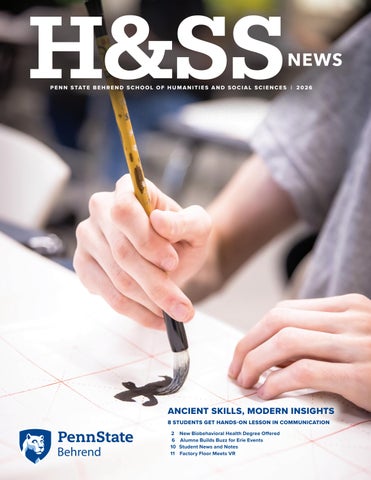
As Dr. Leigh-Ann Bedal, associate professor of anthropology, handed each student a bamboo brush, she instructed them to hold it perpendicular to the rice paper. The characters they would write required this vertical precision, with each stroke flowing from shoulder and wrist rather than just fingertips. But when the students touched their ink-filled brushes to the paper, they instinctively pinched the bristles like a pencil, struggling to adjust. In minutes, the struggle became the lesson.
This kind of hands-on experience defines CAMS 109Y: Writing Systems of the World. The honors course begins with picture writing pressed into clay tablets by ancient Mesopotamian scribes and ends with a presentation on emojis and digital communication. Along the way, students discover something unexpected: a profound connection between themselves and the inventors of the world’s first writing systems.
“Most students have never given the Latin alphabet they read and write every day much thought,” said Bedal, who taught the course at Behrend this past spring. “They’ve never learned its origin or history, nor that an alphabet is only one kind of writing system.”
LEARNING BY DOING
Bedal’s students don’t just study ancient writing—they recreate it. Students press wooden styli into clay, brush ink onto rice paper, and paint hieroglyphs on papyrus.
“I believe it is always more effective to learn by doing,” Bedal said. There’s a deeper reason Bedal structures the course this way. Ancient cultures used materials from their natural environment when creating their scripts—clay in Mesopotamia, papyrus in Egypt, and rice paper in China—and those materials directly shaped how the scripts developed. Working with these materials gives students a tactile sense of the challenges ancient scribes faced.
When students work with a clay tablet, they quickly discover that size, thickness, and hardness matter. A scribe holds the tablet firmly in one hand, which limits both its size and the amount of text it can contain. Drawing with a pointed stick creates ragged lines—something Mesopotamian scribes solved by pressing the stylus at an angle, forming small wedges that made up the script.
Ink on papyrus and rice paper reveals a striking contrast. These materials allow for fluid shapes and identifiable pictographs, demonstrating how the medium shapes the message in the most literal sense.
By the time students complete the course, which is offered every two to three years, they’ve physically inhabited the experiences of ancient scribes, working with the same materials and confronting the same challenges.
“Students better understand how ancient scribes needed to invent signs that were simple enough to compose documents in a timely manner, but distinct enough from each other to convey a variety of information,” Bedal said.
The course drew on expertise from across the college, including Dr. Qi Dunsworth, who taught the hands-on lesson on Chinese script. Having learned modern Chinese script as a child, Dunsworth, director of the Center for Pedagogical Advancement, shared techniques for proper brush handling and stroke order.
EMOJIS
OLD SKILLS, MODERN INSIGHTS
The course starts with cave paintings, as an example of visual communication, and covers ten different scripts as well as number systems, before ending with modern digital communication and emojis, bringing visual communication full circle to the present day.
For many scripts, students learn to write their own names—something familiar that helps them compare vastly different systems. The assignment seems simple until they attempt it. Bedal has noticed a consistent challenge: Students try to write too small, making their signs illegible.
“It’s hard for some to approach learning a new script as a kindergartener does—big, clear, legible letters,” she said.
When students complete their first cuneiform tablet or hieroglyphic text, Bedal sees something she treasures—pride in their accomplishment. That pride emerges from recognizing a tangible connection with ancient peoples who faced the same challenge to communicate ideas clearly and effectively.
“By learning to write ancient scripts and confronting the challenges of making signs legible, students gain a new respect for the care, skill, and thought behind all writing systems— including their own—and come to appreciate modern writing and digital communication as part of a long, creative tradition of visual expression,” Bedal said.
▲ Dr. Leigh-Ann Bedal works with student Jack Norton, who is drawing Chinese characters on rice paper.
▲ Egyptian hieroglyphics is one of the writing systems students study—and re-create—in the honors-level course.
STUDENT NEWS
DISNEY DREAMING: Students enrolled in the Maymester course HSS 197G: Disney Studies—Exploring Culture, Creativity, and Leadership traveled to Walt Disney World, where they went behind the scenes to study Walt Disney’s creative philosophy and design principles. Students learned about theme park design at the Magic Kingdom, immersive storytelling at Animal Kingdom, and leadership at Disney’s Imagination Campus at EPCOT. The course provided an engaging (and fun) way to explore complex concepts in creativity, culture, and leadership.
⊳ CREATING CONNECTIONS: Last fall, students in Dr. Ashley Sullivan’s ECE 353: Parent Involvement in Home, Center, and Classroom Instruction course hosted a Family Fun Night at a local elementary school. Each Behrend student designed an activity or craft and staffed their own table, creating hands-on learning experiences for children and families to enjoy together.
“Events like this give students an opportunity to plan, organize, and facilitate real-world learning experiences that prepare them for their future classrooms,” Sullivan said.
▲ LIT LOVERS
CONVENE: Students and faculty members from the college’s Creative Writing program and Lake Effect literary journal took part in the Lake Erie Literary Festival in Erie. Students staffed a table where they distributed copies of the journal and promoted the Creative Writing program. Additionally, four Creative Writing students took the main stage to share their original work with festival attendees.
⊳ MAKING MUSIC OUTDOORS: The Behrend Pep Band, led by Tess Jones, lecturer in music, performed during Parents, Families, and Alumni Weekend. The outdoor performance brought energy and school spirit to the popular campus event, which invites the college community to campus every fall. This year’s event is scheduled for October 16–18, 2026.
▲ AWARD-WINNING LEADERSHIP: Digital Media, Arts, and Technology major Sean Martin received the university-wide Jackson Lethbridge Tolerance Award, which honors students who promote diversity and civil respect within the Penn State community. Martin was recognized for his volunteer work, web design for community organizations, and leadership in fostering inclusive campus events.
STUDENTS CREATE VIRTUAL FACTORY TOUR
Penn State Behrend students recently completed a virtual reality project that brings a local manufacturer’s operations to life in an immersive digital format.
A team from the college’s Virtual and Augmented Reality (VAR) Lab developed a 3D/360° tour for Snap-tite Hose, a fire hose manufacturer with facilities in Erie and Union City. The project gives the company a modern way to showcase its Quality Assurance testing lab to prospective customers and industry partners, demonstrating what separates Snap-tite from competitors in a format that is more engaging than traditional brochures or flat video.
“Our goal was to help Snap-tite show, not just tell, what superior quality assurance looks like,” said Dr. Chris Shelton, associate professor of clinical psychology and director of the VAR Lab.
“They test above industry standards and make products with properties no competitor can match. The immersive tour builds customer confidence by letting people experience those rigorous processes firsthand. They didn’t want a simple tech demo; they wanted a functional tool they could use immediately.”
Remington Orange, a Digital Media, Arts, and Technology major, and Tyler Wenzel, a Mechanical Engineering Technology major, led the build, closely supported by Shelton. The structure allowed the team to move fast and turn partner feedback into practical updates on a tight three-month schedule.
“We prioritized stereoscopic depth and seamless VR navigation because credibility is the whole point of a partner-facing tour,” Shelton said.
Orange and Wenzel made multiple site visits to both Snap-tite locations to document the facility in detail. The resulting application allows users to navigate the QA lab by jumping between 3D/360° content and exploring the space in an interactive way.
“We integrated 3D models, instructional videos, and interactive user interface elements to create an immersive 3D tour,” Orange said. The team captured both traditional 2D video and 3D/360° footage of machinery in operation. Voice-over narration from Snap-tite staff guides users through each stage of the process.
“The immersive footage added depth,” Shelton said. “When it’s viewed on a VR headset, it feels much more immersive, like you are physically there, as opposed to a flat 360 image or video.”
The project exemplifies Behrend’s Open Lab model of learning, which positions the college as a “living laboratory” where students and faculty partner with industry to address realworld challenges.
“What the group delivered is something Snap-tite can rely on, and it reflects the kind of real-world work our students graduate ready to perform,” Shelton said.
▲ Dr. Christopher Shelton, director of the VAR Lab, center, and student researcher Remington Orange, right, discuss a virtual reality project with a Snap-tite Hose employee.
16–18
THIRTY
YEARS OF LAKE EFFECT
In 1996, faculty members at Penn State Behrend took a chance on an idea: that undergraduates could do editorial work usually reserved for MFA students and professional editors. Thirty years later, Lake Effect is still proving them right.
Students read submissions, debate which pieces fit, argue about structure and voice, and decide what gets published. It’s rare for undergraduates to have real editorial roles at a nationally recognized journal, and that hands-on experience shapes how they read and write, according to Aimee Pogson, an associate teaching professor of creative writing and English, and the editor of Lake Effect
Lake Effect also creates space for writers who work outside mainstream publishing, where there’s room to take risks. Over two decades, that has meant showcasing established voices alongside emerging ones, always looking for work that pushes boundaries.
Published by the School of Humanities and Social Sciences and supported by the Helen Thomas Kennedy Family Endowment, Lake Effect releases new editions every spring—fiction, creative nonfiction, and poetry that reflect what’s possible when you give writers and student editors room to experiment.