Choose the Original www.hewsaw.com
Choose the Original I n c o r p o r a t i n g A U S T R A L A S I A N F O R E S T L O G G E R & S AW M I L L E R
www.hewsaw.com
JUNE 2017 • P: (03) 9888 4834 • www.timberbiz.com.au
ASH's Heyfield Mill closure brought forward Burnie likely choice for new operational site
A
U S T R A L I A N SUSTAINABLE Hardwood's Heyfield mill will close earlier than expected. In fact, the close-down could start as soon as August. Then, it's only a matter of time before the next phase in the major timber processor's journey takes shape in the northern Tasmanian port city of Burnie.
The Hermal Group, owners of ASH, said the "forced closure of the mill will begin sooner than initially announced due to VicForests expected short supply of logs to the mill again this year". "While there are business and commercial issues around this failure by VicForests, the owners do note that VicForests has suffered losses of significant
¢
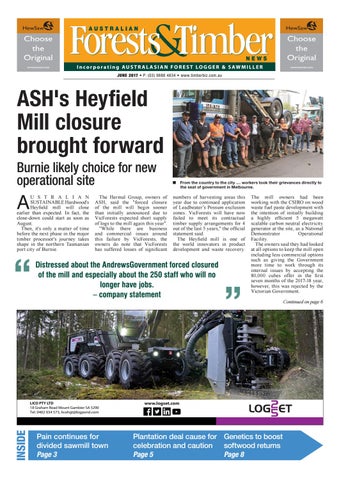
rom the country to the city .... workers took their grievances directly to F the seat of government in Melbourne.
numbers of harvesting areas this year due to continued application of Leadbeater’s Possum exclusion zones. VicForests will have now failed to meet its contractual timber supply arrangements for 4 out of the last 5 years," the official statement said. The Heyfield mill is one of the world innovators in product development and waste recovery.
Distressed about the AndrewsGovernment forced closured of the mill and especially about the 250 staff who will no longer have jobs. – company statement
LICO PTY LTD 18 Graham Road Mount Gambier SA 5290 Tel: 0402 034 573, licohgt@bigpond.com
INSIDE
LOGSET_PRINT_Australian Forests & Timber News_220 x 80 mm_201706.indd 1
ain continues for P divided sawmill town Page 3
The mill owners had been working with the CSIRO on wood waste fuel paste development with the intention of initially building a highly efficient 5 megawatt scalable carbon neutral electricity generator at the site, as a National Demonstrator Operational Facility. The owners said they had looked at all options to keep the mill open including less commercial options such as giving the Government more time to work through its internal issues by accepting the 80,000 cubes offer in the first seven months of the 2017-18 year, however, this was rejected by the Victorian Government. Continued on page 6
www.logset.com
Plantation deal cause for Genetics to boost celebration and caution softwood returns Page 5 Page 8
6/8/2017 8:31:10 AM
PONSSE ELEPHANTKING
WHEN YOU WANT TO DO MORE THAN JUST PULL THE SKIN OFF A RICE PUDDING! CONTACT US FOR MORE INFORMATION
RANDALLS EQUIPMENT COMPANY PTY LTD www.randalls.com.au Email: randalls@randalls.com.au Ph: 03 9369 8988 HEAD OFFICE VICTORIA 8 Wallace Avenue, Point Cook Victoria, 3030 Peter Randalls 0418 356 306 Davin Frankel 0437 541 154 WESTERN AUSTRALIA 9B Charles Street, Albany Western Australia, 6330 Kegan Powell 0437 059 477
THE PONSSE ELEPHANTKING forwarder really has what it takes to handle even the toughest jobs. Built from the ground up as a 20 tonner, the superb tractive force and robust drive components ensure that the 20-tonne carrying capacity is not just numbers on paper. Combine this with the most comfortable cabin, reliable frames and easy maintenance and you have the most productive, reliable and ergonomic forwarder in the market. PONSSE K100+ LOADER offers fast and smooth operating with superb lift and swing power. Highest quality materials combined with a design based on over 45 years of specialized experience guarantee the best quality and performance that only PONSSE can offer.
NEW SOUTH WALES 14 Wembley Place, Bathurst New South Wales, 2795 Jake Graham 0417 725 092 TASMANIA NTH 359 Tunnel Road, Lilydale Tasmania, 7268 Anthony Williams 0418 789 769 TASMANIA STH 17 Travers Court, Claremont Tasmania, 7011 Michael Williams 0448 057 083
A logger´s best friend www.ponsse.com
In the news
Pain continues for divided sawmill town
Plea for Fair Work Commission to help resolve pay dispute and end lockout THE MYRTLEFORD Carter Holt Harvey mill dispute, now in its third month, is in freefall after a vote by workers knocked back an offer from the company. More than one in five union members, against the union’s edict, voted to accept Carter Holt Harvey’s pay deal but it wasn’t enough to break the industrial deadlock. The final vote was 97-86 against the company’s pay deal. CHH salaried staff have also been told to take indefinite leave. CFMEU Assistant Secretary Andrew Vendramini said a loud and clear message had now been sent to the company. "They need to the right thing by the workers and the town of Myrtleford and end the lockout,” he said. “We have a hearing in Fair Work with Carter Holt Harvey over Morwell (scheduled to close at the end of August because of log supply problems; 160 workers to be out of a job) and we will approach them about a meeting on Myrtleford then. “We believe all our negotiations should be at a neutral venue from now on – having talks at the mill just hasn’t worked.” Enzo D’Andrea, who is representing the almost 60 workers who are not unionaligned, consulted with their solicitor as to the way forward. “Our guys are devastated, I’m personally gutted,” he said after the EBA vote. “I wasn’t surprised at the numbers, I expected a close vote, we just hoped it would go our way. “I’m genuinely concerned for the future of the mill – it’s an indefinite lockout, it's hard to imagine that even if we get back to work that there won’t be major changes, perhaps redundancies. “We already know that the mill has lost some of its customers because they couldn’t supply product. “Now that they have rejected our offer to negotiate as well we don’t know what happens next.” www.timberbiz.com.au
¢
Mill workers leave the picket line.
More than 50 workers and union officials marched under police escort from the mill lockout camp to the Myrtleford RSL on the first of two day’s voting on the disputed enterprise bargain agreement and its pay offer. Tempers flared when the group made its way through town with at least two business owners and a fellow, non-union, worker calling on them to go back to work. Security guards manned the entrance to the voting station with workers ushered in one at a time. Mr Vendramini made light of those calling on them to go back to work. “Rather than get angry at our members perhaps they should be targeting the company who has refused to budge, refused to accept that these workers were promised a meaningful pay rise at the previous EBA deal three years earlier. “Carter Holt Harvey it seems is just happy to sit back and watch this play out in the community.” Just prior to the vote CHH ran a full page letter in the Wangaratta Chronicle urging its workers to accept what it termed a fair and reasonable
offer and to seriously consider the commercial realities thje company faced. The CFMEU also used the columns of the Chronicle
to urge CHH to return to the negotiating table. The union said the "community had suffered enough" and sought help from the Fair
Work Commission to try and resolve the dispute. Police have denied there is an ongoing investigation into bullying and intimidation of workers involved in the ongoing pay dispute at Carter Holt Harvey, however, they have called for people to moderate their social media comments. “What I would say is that a lot of ill will is being generated through comments made on social media, comments that perhaps wouldn’t be made if it was a face-toface conversation,” said Myrtleford Sgt Paul Evans. “People need to think about their posts, understand that it will be there forever.” Australian Forest Industries established the mill in 1975 and Carter Holt Harvey bought it in 1995. The mill has made plywood since 1981. A $50 million upgrade of the Myrtleford site about six years ago made it Australia’s largest plywood mill.
Off the shelf solutions, customised for your mill For over 100 years, we’ve been engineering solutions for the timber industry. In that time, we’ve designed and built a range of equipment proven to improve mill productivity. But we’ve yet to meet a client who didn’t need some modifications to make even the best equipment fit their particular space and needs. Contact us for a quote to make your mill even more productive.
• manufacturing • sawmilling equipment • log carriages • resaws • multisaws and board edgers • automatic sorters and stackers • transfers and conveyors. Complete turnkey projects.
Australian Forests & Timber News
June 2017
From major start-ups to retro-fits, if you want professional service and advice, contact us.
AE Gibson & Sons Phone 02 6559 4001 Email: info@aegibsonman.com.au www.aegibsonman.com.au
3
In the news I n c o r p o r a t i n g A U S T R A L A S I A N F O R E S T L O G G E R & S AW M I L L E R
June 2017 Issue 4 Vol. 26 Established 1991 News
Realising the REAL value of natural assets
$2M PROJECT to help put a dollar value on forest and farmland environmental benefits
3-16
Head-Lines 17-21 Bio
23-25
Trucking
26-27
WoodTECH 28 Classifieds
30
Publisher and Chief Executive: Hartley Higgins General Manager: Elizabeth Bouzoudis Editor: John Hudswell j.hudswell@ryanmediapl.com.au Adelaide Office (08) 8369 9512 Advertising: Michael Dolphin m.dolphin@ryanmediapl.com.au Melbourne Office (03) 9888 4834 Production: Luke Westle Trader classified: m.dolphin @ryanmediapl.com.au Melbourne Office (03) 9888 4834 Subscriptions: subs@forestsandtimber.com.au Adelaide Office (08) 8369 9522 Subcription rates One-year (8 editions) $55 Two-years (16 editions) $95 Accounts: Adelaide Office (08) 8369 9555 Postal Address: 630 Regency Road, Broadview South Australia 5083 Phone: (08) 8369 9555 Fax: (08) 8369 9501 Melbourne Office: Suite 2262, 442 Auburn Rd, Hawthorn VIC 3122 Phone: (03) 9810 3262 Website www.timberbiz.com.au Printed by Lane Print, Adelaide, SA Conditions The opinions expressed in Australian Forests & Timber News are not necessarily the opinions of or endorsed by the editor or publisher unless otherwise stated. All articles submitted for publication become the property of the publisher. All material in Australian Forests & Timber News copyright © Ryan Media. All rights reserved. No part may be reproduced or copied in any form or by any means (graphic, electronic, or mechanical including information and retrieval systems) without written permission of the publisher. While every effort has been made to ensure the accuracy of information, the published will not accept responsibility for errors or omissions, or for any consequences arising from reliance on information published.
MEDIA
INDEPENDENT & AUSTRALIAN OWNED
4
¢
he three-year, $2 million project was launched in Wauchope by Deputy Prime Minister Barnaby Joyce and Dr David T Gillespie (Member for Lyne).
A
M U LT I - m i l l i o n dollar collaborative research project will soon help industries put an economic value on the environmental benefits they offer using a system known as Natural Capital Accounting. An initiative of Forest and Wood Products Australia (FWPA), the three-year, $2 million project was launched in Wauchope by Deputy Prime Minister Barnaby Joyce and Dr David Gillespie (Member for Lyne). Funded by Government and industry, the project will be spearheaded by CSIRO and also involves fishery and cotton industry groups. Natural Capital Accounting is an inter nationally-accepted way of valuing natural assets such as timber, fisheries, soil, air, biodiversity, land and water. Managing Director of FWPA, Ric Sinclair, said many of these were not included in economic measures such as GDP despite their undeniable importance. “Forests offer environmental services
including water quality improvements downstream, flora and fauna habitats and carbon storage,” he said. “By quantifying how we can value such services, we may be able to capitalise on them in new markets down the track, for example, with
are transparent, verifiable and auditable. “Financiers and shareholders are also likely to favour companies that can demonstrate that they are not reducing natural capital and are sustainable,” said Mr Sinclair.
This project will help these industries quantify and clearly demonstrate their environmental sustainability and clean and green credentials. agencies that have statutory obligations. “Natural Capital Accounting can also help companies in sustainability certification programs, and enable them to back up their environmental credentials in a market where customers increasingly expect companies to provide evidence, not just assertions. “The project will work with industry stakeholders directly, to establish tools that are evidence-based, useable and industryfriendly – with outputs that
Australian Forests & Timber News
The project is a collaboration between Research Agencies, led by the CSIRO and supported by the Bureau of Meteorology and Australian Bureau of Statistics; Rural development corporations, Forest and Wood Products Australia, Cotton R&DC and Fisheries R&DC; and industry. Forestry companies including HVP, OneFortyOne and VicForests have also contributed funding. “This project will not only help producers, like forestry businesses here in
June 2017
Wauchope, manage their natural resources well to increase productivity, it could also help them access cheaper finance, by giving them the tools they need to demonstrate best practice management of their natural assets. “It is one more example our commitment to delivering tangible productivity and profitability growth to primary producers,” said Dr Gillespie. “Australia’s forestry, cotton and fisheries industries are amongst the best managed and most sustainable in the world,” Dr Gillespie said. “However, public misconceptions about these industries unfortunately mean they often have to deal with challenges to their credentials as good environmental stewards. “This project will help these industries quantify and clearly demonstrate their environmental sustainability and clean and green credentials, which in turn will build consumer confidence and give them a competitive advantage in premium markets.”
www.timberbiz.com.au
In the news
Victorian Government plantation announcement cause for celebration and caution! THE RECENT announcement by the Victorian Government that it will spend $110 million on plantations is a great cause for celebration and shows great leadership for investment in a renewable resource, according to Rob de Fégely, Director of Margules Groome Consulting. "However, there is also a need for significant caution," he added. "Previous plantation development by governments and industry have been contentious and if ever the lessons of history are important they are absolutely critical with this announcement. "The establishment of softwood plantations ran into problems over clearing of natural forests in the 1980s Australiawide. When clearing it stopped in Victoria and the Government announced initiatives to buy cleared farmland for plantations the negative response from communities and farmers was so intense it resulted in the State Plantations Impact Study of 1990 which signalled the end of government funded softwood plantations in Victoria. There are lessons here for all governments," said Mr de Fégely. "The more recent initiatives to establish plantations with managed investment schemes were ultimately a disaster. "The industry must not repeat these mistakes and so, in my opinion, we must hasten cautiously," said Mr de Fégely. He said the idea of developing plantations sounded so very simple but it was actually quite difficult to achieve. "There are many challenges, including: • Location is critical but land use change cannot be forced without community and social impact • Government investment structures are also important but the current restriction under the www.timberbiz.com.au
¢
Rob de Fégely
Carbon Farming Initiative for planting above the 600mm rainfall zone is a massive disincentive. • Plantations have much higher inputs than natural production forests and so are more expensive to establish and manage • Plantations are monocultures and are less resilient to pests and disease than natural production forests • Planting scale is generally considered an imperative by industry but with today’s technology and systems I believe that this can be overcome. Future plantations need to be established in the right place for markets and at the right scale for the growers to manage and the community to accept. "Developing a long term view is also important and sadly this announcement will not help solve the current problems of sawlog supply to the Heyfield sawmill," Mr de Fégely said, "however, the development of a mixture of softwood and hardwood plantations could develop an enduring renewable resource that will create wealth for Victorians for many years to come." Mr de Fégely, who is also President of the Institute of Foresters of Australia, CoChair of the Commonwealth Governments Forest Industry Advisory Council and Chair of the board of Forestry Tasmania, says the obvious benefits for regional Victoria and the Latrobe Valley in particular will be significant and long lasting.
The development of a mixture of softwood and hardwood plantations could develop an enduring renewable resource that will create wealth for Victorians for many years to come "So, any government that is prepared to invest in renewable resources like wood should be wholeheartedly congratulated but it is critical that we do not repeat the mistakes of the past," Mr de Fégely said The Australian Forest Products Association
Australian Forests & Timber News
has given the Victorian Government plantation move the thumbs up, saying it welcomed the Victorian Government’s $110 million investment in the 201718 Budget to establish plantations in the Latrobe Valley. "This commitment is consistent with AFPA’s June 2017
strategic plan for the expansion of Australia’s plantation estate, which identified Morwell in the Latrobe Valley as an ideal region for a plantation hub," said AFPA CEO Ross Hampton. "AFPA has had preliminary discussions Continued on page 6 5
In the news
Victorian Government plantation announcement cause for celebration and caution! Continued from page 5
with the Victorian Government about how industry can be involved in the design and delivery of this significant investment, and we look forward to working with Minister Pulford to ensure that that this investment is directed towards projects that help grow our sustainable industry and the tens of thousands of regional jobs we support. "Softwood and hardwood plantations provide more than 80% of the wood fibre and timber for our national forest product industries, adding $778 million to the Victorian economy last year. However, despite
strong demand for wood fibre domestically and abroad, investment in new plantations in Australia has effectively come to a standstill," Mr Hampton said. One industry insider was also of the opinion that caution was definitely the key at the moment, and spoke of a number of failed government ventures in the past 20 years. One in particular was the Farm Forestry North East (FFORNE) project (partnered with land owners to set up plantations with owners paying $600700/ha and government establishing it for them).
About 1500 hectares was established between 199698 ... many of the FFORNE projects died or have been sitting with no market prospect and as a result many angry owners. Another was the Plantations for Salinity (which gave land owners $600-700/ha towards a plantation) when it was widely accepted that Gippsland had virtually no salinity problems. "I think that the government needs to step very carefully as it spends this $110 million." From the government side everything was being played close to the chest.
Australian Forests and Timber News put the following questions to the government: The possible site/s for expansion? Who will oversee this project? Does it mean a special taskforce will be required (if so, when will it be formed and what will the makeup be)? Will this come under the auspices of VicForests? What is the timeframe for the project? The response: "We are committed to supporting the long-term sustainability of local jobs in the timber and wood
ASH's Heyfield Mill closure brought forward The owners have also looked at importing sustainable plantation logs from Tasmania and Ash species from Chile but, sadly, none were able to be progressed. The company said it was distressed about the Andrews Government forced closured of the mill and especially about their 250 staff who will no longer have jobs, and the thousands of Victorian families, who will be adversely affected by the closure of this profitable and well managed business. They commend the CFMEU for their significant efforts to have Mr Andrews and his Government see basic common sense and keep people in work. The company said that since January this year they had seen many public comments by members of the Andrews Government including the Premier himself. "With the breach of the Agreement by the Government
¢ Jane Calvert
6
to allow the owners of the mill to advise their staff in March this year of the mill’s forced closure ahead of public comment, together with a media announced offer to buy the business, the owners have lost trust in the Andrews Government. "No fair commercial offer has
The Victorian Government maintains it has done all it can to keep the mill operating and claimed that the job losses were both unnecessary and avoidable. "The Andrews Labor Government has provided a fair and reasonable offer to the Hermal Group, which
would keep the Mill open and secure local jobs. This offer remains on the table," according Government spokesperson. "We call upon the Hermal Group to continue engaging with the Government so we can secure the future of the mill and protect its jobs," said the spokesperson. According to sources, the Government's offer of more than $20 million was based on multiple independent assessments of the business and standard commercial valuation benchmarks. However, the company said the offer fell well short of its true value. James Lantry, spokesperson for the Hermal Group, acknowledged that there had been negotiations with the Tasmanian Government and that Burnie was the most logical site to
Australian Forests & Timber News
June 2017
It can only be hoped that the lessons of the past have been learned!
Continued from page 1
The union understands that discussions between the Government and the company have not reached a conclusion, and we believe the company’s statement to be premature. – CFMEU been forthcoming from the Andrews Government and any suggestions that there has been any form of intense discussions or negotiations of any form with the Government are simply wrong," the company claimed. "Despite Daniel Andrews’ statements to the media earlier this year, it is now clear that his Government were neither serious about making a genuine offer for the mill nor were they ever serious about addressing either the supply level and contract tenure needed to operate this profitable high class facility. These political games by the Andrews Government has done nothing but make staff at the mill even more anxious. " Closure of the mill will now begin in August.
products industry and that's why we will invest $110 million to establish more plantations. "This is the first step towards expanding timber plantations in Gippsland. "The Government will work in conjunction with industry to expand Victoria’s plantation estate and increase the proportion of plantation-grown timber available to this important industry," ... all attributable to a Government spokesperson.
re-establish. "Logistically, supply, workforce and port availability, it's the most logical site," he said. Mr Lantry said initial discussions had ticked the boxes when it came to the availability and usability of plantation nitens in Tasmania. He said there was still "an enormous amount to be worked through" before the final investment decision is made. "We certainly wouldn't have a plant operating within 12 months from the time of an investment decision. However, you would want to be in production -- for commercial reasons with the wind-down of our Ash facility -- you would want to be in production after a final investment decision within an 18 month period. "Two years investment and investigation into making nitens work should give some indication of our level of motivation," he said. Despite talk of a Tasmanian move, the CFMEU maintains there is still hope for the Heyfield Mill. According to Jane Calvert (National President of the CFMEU Forestry, Furnishing, Building Products and Manufacturing Division) the union will leave no stone unturned to make sure this mill stays open for the workers and the community. "The union understands that discussions between the Government and the company have not reached a conclusion, and we believe the company’s statement to be premature. "We will continue to meet with the Government and the company to try and secure a future for Heyfield," she said. www.timberbiz.com.au
PRODUCT LINE UP HARVESTERS FOR ALL TRACKED CARRIERS
624 4x4
624C
625C
626 SERIES 2
623C
622C 4x4
622B
H290
618C
H415X
H480C
616C
HARVESTERS FOR ALL WHEELED CARRIERS
H290
H415X
H480C
H415
H215E
H414
H413
H412
H618C
H616
H215E
FL95 FIXED SAW
FL95 MOVING SAW
PURPOSE BUILT DEBARKING HARVESTERS
H290
FELLING HEAD RANGE
FL85 SERIES 2
FOR FURTHER INFORMATION CONTACT: Australian Sales Support 0438 445 550 www.waratah.net
In the news
Genetics to boost softwood returns
S
OFTWOOD FOREST growers are set to benefit from a new two-year research program with the potential to significantly increase wood quality. By improving genetic selection for wood quality factors such as timber stiffness, it could result in increases in returns of hundreds of dollars per hectare. The researchers will exploit emerging tools to measure wood quality nondestructively on young standing trees in radiata and southern pines, and will test tens of thousands of trees across many field trials. Traditionally, tree genetics programs have been mostly about growth, form and tree health, with only a subset of trees assessed for wood quality properties such as
timber stiffness which have been more expensive to test for. However, the technology for testing wood quality traits on large scale without destroying trees is advancing and becoming more cost-effective. FWPA has co-funded the Southern Tree Breeding Association and its industry collaborators to test the effectiveness of different wood quality assessment tools, including basic density, acoustic wave speed and resistograph (a tool which can provide quantitative sample data from resistance to a needlesized drill). The General Manager of the Southern Tree Breeding Association, Dr Tony McRae, said the commercial impacts of improving wood
quality genetics in breeding could be significant if the technology can be applied to young trees on large scale. He said the timing is right, with a wave of new generation genetic material coming on line. “Wood quality is a major determinant of economic value in softwood plantations,” he said. “A one unit (GPa) increase in timber stiffness for radiata pine is estimated to be worth on average almost $570 extra in net present value per hectare to an integrated enterprise growing and processing structural timber.” The data collected in the research will be incorporated into the industry-wide TREEPLAN evaluations for radiata and southern pines.
Cover It covers it perfectly with FOLS COVER IT Pty Ltd is the first harvesting contracting business in northern NSW to move all of its operators over to the FOLS Skills Verification Program. Cover It Pty Ltd is one of 18 NSW harvesting companies that has made the commitment to adopt FOLS, following a Forestry Corporation of NSW initiative. In February this year, Forestry Corporation of NSW, in their northern hardwood forests around Coffs Harbour, Wauchope and Grafton, asked its contractors to move all operators on to FOLS. Boyd Young, Owner of Cover It Pty Ltd, said moving their operators over to FOLS had been a smooth process. “It is going to be so easy to manage our employee credentials and training records now, as everything is housed in one place. “FOLS will be a useful tool for new employees especially, providing a simpler process for locating and filing people’s training records and determining the currency of peoples’ skills,” said Boyd. Diana Lloyd, General Manager of ForestWorks, said a new online system and mobile app for FOLS is only weeks away, and will provide further benefits to businesses looking for an easy way manage the skills of employees. “With the new FOLS app, you will be able to access and 8
demonstrate your portfolio of skills anytime and anywhere, so long as you have a mobile device on you,” said Diana. A summary of each operator’s FOLS endorsements will be utilised by Forestry Corporation of
¢
and Haulage Contractor and Procurement Manager Mark Hitchins said he expected the new system to make life easier for both Forestry Corporation and contractors. “We require all operators
Cover It operators (l-r) George Connor, Boyd Young, Jamie Young and Kelvin Young.
NSW to identify training gaps and a plan will be developed to address these. Forestry Corporation NSW will be reimbursing operators for a third of the cost of the 3 year FOLS once it is issued. Forestry Corporation’s Harvest
working in State forests to have certain skills and accreditations and we see FOLS as a one stop shop. FOLS allows us to quickly and easily confirm that our contractors and their staff have the necessary competencies and
Australian Forests & Timber News
June 2017
identify gaps where training is required,” said Mark. “Our contractors do a great job in maintaining high levels of skills and accreditation and the good news for our contractors is that they can also use this national program to swiftly verify the skills and training needs of new and existing staff, so it’s a real win-win.” The other contracting businesses in the process of moving their operators to FOLS are: Armfields Earthmoving & Logging Pty Ltd • Brian Smith Timber Transport Pty Ltd • Burgundy Heights Pty Ltd • C & E Logging Pty Ltd • Cooper Logging Pty Ltd • Davis Earthmoving and Quarrying Pty Ltd • DJ & JB Logging Pty Ltd • Greensill Bros Pty Ltd • Haulers & Fallers Pty Ltd • Hoffmans Haulage Pty Ltd • Hoffmans Timberline Pty Ltd • Newells Creek Sawmilling Pty Ltd • Pacific Contracting Pty Ltd • Tawmar Timbers Pty Ltd • Two Matt’s Pty Ltd • Warda Pty Ltd • Woodharvesters Pty Ltd FOLS is a national industry-led program, managed by ForestWorks. For more information about the FOLS Skills Verification Program, visit fols.forestworks.com.au www.timberbiz.com.au
In the news
Sustainability report highlights New Forests’ ethical approach Generating value for all stakeholders including investors, communities, and the environment.
N
EW FORESTS has released its fifth annual public sustainability report, which highlights progress the company has made under its Sustainable Landscape Investment framework. New Forests’ 2016 Sustainability Report describes environmental and social impacts across the company’s investment funds and their relationship to key issues such as climate change, biodiversity, and community engagement. “With each sustainability report New Forests publishes, we aim to ensure our sustainability reporting keeps up with the complexity and diversity of our growing investment portfolio and the changing needs of our clients,” New Forests’ CEO David Brand said of the report. “Throughout 2016 we saw increasing investor interest in understanding how portfolios align with the Sustainable Development Goals and action on climate change. Our 2016 Sustainability Report sheds light on these issues with quantitative data via the use of impact metrics as well as stories and insights into the people we work with, the communities where we operate, and the changing sustainability context of forestry investment.” “New Forests understands that environmental, social, and governance (ESG) information is not only vital for our business and our clients but also for other stakeholders, including local communities, our partners throughout the supply chain, and civil society,” said MaryKate
¢
David Brand
¢
Bullen, Associate Director, Sustainability & Communications, who authored the report. “We now have more than 3,600 people working in our investments spanning six countries and across 843,000 hectares,” she said. “This means that while our responsibility as a fiduciary starts with our clients, it also extends to a broad range of stakeholders. With this in mind we aim for transparency in our ESG disclosures and to make sure this information is relevant and accessible for those who are interested in and affected by our investment activities.” In 2016 New Forests launched an internal Sustainability Working Group responsible for the planning, development, and coordination of New Forests’ Sustainable Landscape Investment framework and shared value initiatives.
MaryKate Bullen.
The Sustainable Landscape Investment framework was designed to support investment performance through an integrated focus on the areas of productivity, ecosystem services, land use planning, shared prosperity, risk management, and governance. New Forests’ 2016 Sustainability Report is organised around these six ESG themes and uses impact reporting metrics and case studies from each of New Forests’ investment programs operating in Australia and New Zealand, Southeast Asia, and the United States. Highlights from the 2016 report include: • 843,000 hectares under management • 39% of all investments by area are managed for protection and conservation With more than 400,000 hectares of plantation
forests, 6.3 million tonnes of certified timber products were produced and/or processed by New Forests’ investments 96% of the timber sold was certified to thirdparty forest management standards The total number of people employed in investment operations was more than 3,600, including permanent and contract workers
New Forests also reports on its responsible investment activities on an annual basis through the reporting and assessment framework of the Principles for Responsible Investment (PRI). The company received an A+ rating in its 2016 PRI assessment, which is available on New Forests’ website. Brand concluded: “New Forests seeks to generate value for all stakeholders in our business, including investors, communities, and the environment. To realise this outcome, we know that we must continue to set targets, measure our performance, and be accountable for the outcomes and impacts of our business. We hope this 2016 Sustainability Report reflects these goals and furthers the growing dialogue around how institutional investment can respond to challenges such as forest conservation, climate change mitigation, maintenance of biodiversity, shared prosperity and poverty alleviation, and the imperative for sustainable development.”
FOLS Skills Verification Program
Your portfolio of skills For Operators FOLS verifies an operator has undertaken the required nationally recognised training and has kept their skills current through regular practice. For Contractors & Forest Managers A streamlined system to manage the skills of employees and improve safety in the workplace. New mobile app – available late 2017
New Forests seeks to generate value for all stakeholders in our business, including investors, communities, and the environment. www.timberbiz.com.au
Australian Forests & Timber News
fols.forestworks.com.au
1800 177 001
An industry-led program managed by ForestWorks
June 2017
9
ABARES REPORT
Record plantation log harvest worth $2.3 billion
A
U S T R A L I A’ S FOREST industry achieved a record plantation log harvest of more than 30 million cubic metres worth over $2.3 billion in 2015-16, according to the latest ABARES report, and Assistant Minister for Agriculture and Water Resources Senator Anne Ruston welcomed the result, saying it reflected growing demand for Australian timber in both domestic and international markets. The Australian Bureau of Agricultural and Resource Economics and Sciences (ABARES) report, Australian forest and wood products statistics: September and December quarters 2016, showed that both the volume and value of logs harvested in 2015 -16 had outstripped previous years. “Growth in demand for Australia’s sustainably managed timber and wood products has resulted in a
record harvest of softwood and hardwood plantation logs,” Minister Ruston said. “The Government recognises that our forests
provide significant benefits for Australians and we are committed to supporting this important sector that contributed more than
The forest industry is vital to our regional communities, employing more than 64,000 people.
$22.1 billion in total forest products manufacturing to the economy in 2014-15. “The forest industry is vital to our regional communities, employing more than 64,000 people. “The Australian Government remains committed to creating a stable and sustainable business environment that encourages innovation and investment in the future of the forestry sector.
“Australian timber is building its reputation as a world class product and this most recent growth is a reflection of strong demand. And it’s no wonder. Responsibly sourced wood is renewable, it stores carbon, it’s beautiful and sustainably managed forests can provide resources for both today and the future,” the Senator said.
Strong export wood product AS REPORTED in the November 2016 issue of Australian forest and wood products statistics, Based on the first six months of 2016–17, the strong export performance of Australia’s wood product industries has continued into the current financial year (Figure 1). Exports increased by 7.8% to $1.6 billion, from $1.5 billion in the corresponding quarters of 2015–16. The largest contributors to this improved export
All information is from Australian Bureau of Agricultural and Resource Economics and Sciences (ABAR 10
Australian Forests & Timber News
June 2017
www.timberbiz.com.au
ABARES REPORT
More plantations needed despite record log harvest
A
U S T R A L I A’ S SUSTA I NA BLE forest products industries had a record plantation log harvest in 2015-16, increasing in both value and volume, according to statistics from the Australian Bureau of Agricultural and Resource Economics and Sciences (ABARES). However, the need for more plantations remains. “ABARES’ latest figures underscore the need for government policies that incentivise and support new plantation investment and associated forest product industries,” said Ross Hampton, Australian Forest Products Association (AFPA) Chief Executive. “Demand for wood-fibre in the Asia-Pacific region continues to expand, creating huge potential for our sustainable forest industries. Australia is well placed to meet this demand for wood-fibre, if opportunities are grasped and our industries are supported. “All levels of government need to support new plantation investment. New plantings have been
going backwards due to continuing commercial pressures to not replant some areas. The good news is that if governments act now, it is not too late to support the establishment of new plantations, provide wood supply
New South Wales. Around 83 hectares of Australia’s plantation estate was converted to another land use. In 2015‒16 the total area of softwood plantations was 1,036,800 hectares, an increase of around
hectares), followed by New South Wales (394,400 hectares) and Western Australia (383,400 hectares). Western Australia accounted for the largest proportion of hardwood plantations (30%) and New South
Demand for wood-fibre in the Asia-Pacific region continues to expand, creating huge potential for our sustainable forest industries.
certainty to industry, and support regional jobs and investment,” Mr Hampton said. Australia’s total commercial plantation area was around 1,974,770 hectares in 2015‒16, an increase of 1,331 hectares (0.1 per cent) from 1,973,439 hectares in 2014‒15. The total area of new plantations established in 2015–16 was 1,415 hectares, comprised entirely of softwood (radiata pine) planted in
1,400 hectares from 2014‒15. Total hardwood plantation area remained relatively unchanged at around 928,300 hectares, a decrease of 66 hectares from 2014–15. Softwood plantations account for almost 53% of total commercial plantation area; hardwood plantations make up the remaining 47%. In 2015‒16 Victoria had the largest commercial plantation estate (423,000
Wales had the largest share of softwood plantations (30%). Gover n ment-owned plantations accounted for 98% of the new plantation establishment; the remaining 2% was funded by institutional investors. Private plantation ownership remained unchanged at 1,505,200 hectares in 2015‒16, representing 76.2% of the total plantation estate. Public plantation
performance of Australia’s industries continues performance were roundwood and woodchips. The value of roundwood log exports increased by 42% to $306 million in the first six months of 2016–17, compared with the corresponding quarters in 2015–16. Over the same timeframe, the value of woodchip exports increased by 6.1% to $558 million. These increases more than offset declines in paper and paperboard and recovered paper exports. In contrast to exports,
imports decreased by 6.4% to $2.7 billion in the first two quarters of 2016–17, compared with the corresponding quarters of 2015–16 (Figure 2). Declines were experienced in most import categories, in particular paper and paperboard which fell 8.4% to $1.1 billion. These declines were partially offset by an increase in imports of wood-based panels, which rose by 15% to $272 million.
ownership accounted for 20.2% and jointly owned (public and private) plantations represented the remaining 3.6% of the estate (Downham & Gavran 2017). Mr Hampton said the AFPA would continue to work closely with the Federal Government on new policy initiatives to support Australia’s renewable forestry industry, such as the National Institute for Forest Products Innovation and the development of a National Wood and Fibre Plan, and through ongoing efforts to have the forestry sector included in the Emissions Reduction Fund and the inclusion of bioenergy in renewable energy policy development. He also welcomed Assistant Minister for Agriculture and Water Resources Anne Ruston’s supportive statement (following the ABARES release) that the Government was committed to the forestry sector and recognised industry’s significant contribution to the environment, regional jobs, communities and economies.
¢
Figure 1 Quarterly value of wood product exports by product, March 2015 to December 2016 Note: Softwood woodchip export data from March 2016 is confidential and is not presented in this figure.
¢
Figure 2 Quarterly value of wood product imports by product, March 2015 to December 2016
RES) report, Australian forest and wood products statistics: September and December quarters 2016 www.timberbiz.com.au
Australian Forests & Timber News
June 2017
11
ABARES REPORT
Australia’s forestry sector continues to break records
A
U S T R A L I A’ S FORESTRY sector is continuing to enjoy some of the best conditions in its history, according to a report by the Australian Bureau of Agricultural and Resource Economics and Sciences (ABARES). The report, Australian forest and wood products statistics: September and December quarters 2016, showed that the volume and value of logs harvested reached record levels in 2015–16. ABARES acting Executive Director, Peter Gooday, said the figures show that Australia’s log harvest exceeded 30 million cubic metres for the first time in 2015–16, valued at over $2.3 billion. This growth was driven by
higher harvest of hardwood plantation pulplogs and a new record harvest of softwood plantation logs, reaching 16.3 million cubic
continued its strong performance into the first half of 2016–17, with higher roundwood and woodchip exports contributing to
output increased for the first time since 2012–13, and wood-based panels increased by over 7% in 2015–16. Paper and
This growth has been underpinned by continued strong export demand for our products, especially hardwood and softwood woodchips and roundwood logs. metres in 2015–16. “This growth has been underpinned by continued strong export demand for our products, especially hardwood and softwood woodchips and roundwood logs,” Mr Gooday said. Export demand has
an overall rise of 7.8%, compared to the first six months of 2015–16. The higher log harvest was backed up by production increases across most of Australia’s wood processing industries. Hardwood sawnwood
paperboard production was also strong over the year, with growth in output of all paper categories except for newsprint, which fell to its lowest level since 1981–82. “Consumption of wood products was also higher across most categories in
2015–16, with hardwood sawnwood consumption up 37% over the year, wood-based panels up 5.3% and aggregate paper consumption up 1.8%,” added Mr Gooday. However, in contrast to these positive trends, ABARES estimated softwood sawnwood production and consumption have slightly declined in 2015–16, driven by a modest decline in the number of detached dwellings commenced during the year. In the first half of 2016–17, overall import values have declined by 6.4% compared to the first six months of 2015–16, suggesting a potential softening of domestic demand for some products.
Plantation hardwood harvests up 160% in past decade TOTAL HARDWOOD log harvest increased by 11% to a record high of 13.7 million cubic metres in 2015–16, valued at almost $1.1 billion (mill door prices). This growth was driven by increases in the volume of plantation hardwood pulplogs harvested for woodchip exports (up 18%) and native hardwood sawlogs (up 10%). Plantation hardwood logs now comprise over 71% of total hardwood logs harvested in Australia. Softwood log harvest also grew strongly in 2015–16, with the volume harvested increasing by 9.5% to a record high of 16.3 million cubic metres. Growth in the softwood log harvest was driven primarily by increases in the volume of pulplogs harvested for woodchip exports, domestic woodbased panel and paper and paperboard production. The volume of softwood saw and veneer logs harvested also increased by 4.6% to over 10 million cubic metres in 2015–16. The value of softwood logs harvested reached a new record, increasing by 12% to $1.2 billion in 2015–16. Native forest log harvest increased slightly in the 2015–16 financial year but over the past decade the volume of native hardwood logs harvested in Australia has more than halved, from 8.6 million cubic metres in 2005–06
to 4.0 million cubic metres in 2015–16. The majority of this decline occurred in Tasmania, with more modest declines in New South Wales and Victoria (Figure 1). In contrast to the modest decline in the harvest of native hardwood logs, harvests of plantation hardwood increased strongly over the past decade, increasing by almost 160% to 9.8 million cubic metres in 2015– 16. Growth in plantation hardwood log volumes was strongest and most consistent in Victoria, South Australia and Western Australia over this period. Tasmania experienced the strongest year on year growth in hardwood plantation harvest for 2015– 16 up 57% to 2.0 million cubic metres. The softwood log harvest in Australia has fluctuated over the past decade, largely in response to changes in housing construction. Overall softwood log harvest has increased by 14% to 16.3 million cubic metres over the decade to 2015–16, with strong growth in South Australia, New South Wales and Queensland more than offsetting small declines in Victoria, Tasmania and Western Australia. In 2015–16 the largest increase in softwood log harvest volumes occurred in Queensland, up by 48%; South Australia also recorded an increase of 12% over the same period.
¢
Figure 1 (above) Log harvest by state, 2005–06 to 2015–16
¢
Figure 2 (right)Volume and value of logs harvested, 2005–06 to 2015–16
All information is from Australian Bureau of Agricultural and Resource Economics and Sciences (ABARES) report, Australian forest and wood products statistics: September and December quarters 2016 12
Australian Forests & Timber News
June 2017
www.timberbiz.com.au
MAXIMUM PERFORMANCE AND EFFICIENCY NEW H822D SERIES HARVESTERS
Tigercat has built unmatched fuel efficiency into the new H822D harvesters. The combination of Tigercat FPT power, refined hydraulics and advanced electronic controls result in superior performance and efficiency – all with the legendary reliability and longevity of a Tigercat carrier. Be confident you are achieving lowest cost per tonne harvesting, processing or debarking solutions with the Tigercat H822D series harvesters. Contact Onetrak today to find out more.
1300 727 520
WWW.ONETRAK.COM.AU
In the news
A seedling with opportunities to grow By Senator Anne Ruston Assistant Minister for Agriculture and Water Resources
I
WAS recently invited to plant a seedling to celebrate National Forestry Planting Day. National Forestry Planting Day, which has been initiated by the Australian Forest Products Association (AFPA), recognises the significant number of seedlings that are planted each year in our forest plantations to support Australia’s forest and wood products industries into the future. AFPA estimates that around 70 million seedlings will be planted in Australia this planting season to grow into tomorrow’s log resource.
producing traditional products, produces a variety of innovative and new products will require research and collaboration between researchers and industry.
Significant research work There is already significant research and innovation happening in Australia, but we need to work to bring these ideas together in order to collectively benefit. Building and maintaining relationships between the
2017‑18 and $1.659 million ongoing from 2018-19 to match industries voluntary contributions.
Innovation investigation Last year I announced that the Australian Government is contributing $4 million to support the establishment of a National Institute for Forest Products Innovation to investigate innovation in areas such as forest management, timber processing, wood fibre recovery, advanced manufacturing and the bio-
Emerging bio-economy offers opportunities to use all parts of the tree to create new products Alongside the planting of 70 million seedlings, the Australian Bureau of Agricultural and Resource Economics and Sciences (ABARES) recently reported that in 2015–16 Australia’s log harvest exceeded 30 million cubic metres for the first time. With the planting of the seedlings, to ensure logs for the future, and Australia’s record log harvest - this got me thinking about what we do with our logs and the products we produce. The Forest Industry Advisory Council (FIAC) recognised that there is a need to “Discover new and enhanced ways to use wood fibre” and that the emerging bio-economy offers opportunities to use all parts of the tree to create new products. Transforming Australia’s forest and wood products industry from one that produces traditional wood and timber products to one that, as well as 14
industry and researchers allows for practical innovation and is key to preserving and growing Australia’s forest and wood products industry. Alongside the Australian Government’s investments in research by CSIRO and the tertiary education sector, we are proud to directly support forest and wood products research and development through Forest and Wood Products Australia (FWPA). The Australian Government matches eligible research and development expenditure made by FWPA in support of the sector. Shortly after commencing with this portfolio, I was pleased to announce we would also match payments for eligible research and development expenditures from voluntary contributions to FWPA. The Australian Government is making available $1.382 million in
economy. The institute consists of regional hubs in Launceston, Tasmania and Mount Gambier, South Australia with each receiving $2 million each to fund innovative research. Moreover, in a show of national cooperation in support of the forest and wood products industry, each regional hub will also benefit from a $2 million matching commitment of funds from the Tasmanian and South Australian governments. The scope of the National Institute’s activities will cover the whole forest
industry, looking beyond the ‘traditional’ forest industry, and develop links with the disciplines that use or can potentially use forest products, increasing the demand for such products. It will have a strong focus on industry liaison and research commercialisation.
Positive future Once operations begin, later this year, the institute will fund innovation research and explore emerging opportunities. I expect these will be in wood processing, wood fibre recovery, bio-energy and a range of bio‑products, particularly those that offer a renewable substitute to more emissions-intensive materials. I say expect, because I intend that the lead role in deciding research priorities will be vested in industry, not government. As FIAC identified, “the research and development needs of Australia’s forestry industry are diverse and complex”. In recent years we have seen the evolution of multistorey timber buildings and the use of forestry waste to produce new and innovative chemical compounds. The research that is undertaken today will support the seedlings that are going into the ground this season become products that we possible can’t even envisage today. It’s a positive future.
More details on the research undertaken by FWPA is available on their website at http://www.fwpa.com.au/.
Australian Forests & Timber News
June 2017
www.timberbiz.com.au
In the news
National Forestry Planting Day By Tony Pasin Federal Member for Barker
I
HAVE written previously for this publication about the need to take the politics out of the forestry industry. The industry contributes over $22.2 billion of economic activity each year to the Australian economy and employs more than 64,000 people in the forest, logging and processing sectors. Accordingly policy makers must have a deep and objective understanding of the industry, an understanding informed by the commercial reality and one which avoids emotive mis-information or historical bias. Some fringes of the political spectrum deliberately seek to damage the reputation of the forestry industry by invoking these emotive and outdated perceptions to pressure policy makers to make decisions based on populist views rather than objective facts. This technique is both sophisticated and surprisingly successful because as with many things in this world, politics included, image is everything. Growing up in Mount Gambier I had an innate sense of how important the forestry industry was, not only to my local community but to the nation as a whole. As I have mentioned previously I was dismayed upon being elected to federal Parliament at the lack of understanding for and appreciation of the industry and its contribution to the national economy. I found that policy discussions impacting the industry seemed to centre around the traditional fault lines producing an ‘us against them’ mentality. Instead of engaging in meaningful policy debate that would benefit all stakeholders, debate was played out as a
www.timberbiz.com.au
Australian Forests & Timber News
I found that policy discussions impacting the industry seemed to centre around the traditional fault lines producing an ‘us against them’ mentality.
binary choice between those that supported the industry and those that wished to be perceived as supporting the environment. This false matrix created significant and in some cases intolerable sovereign risk that in no way reflected the nature of the industry. The forestry industry, despite its very nature, had and in significant part continues to carry an image inconsistent with environmental sustainability. The Australian forest and forest product industry is one recognised internationally as truly sustainable and managed to world-class standards, a renewable biological resource that contributes to long-term carbon emissions abatement. By recognising carbon storage in trees, wood and paper products and by supporting the development of new bio-products, Australia could achieve ambitious emissions reduction targets and significant new investment by recognising forestry sector carbon credits and supporting the use of renewable forest products, including bio-products, all while contributing to our economy and creating jobs. Much of this will require June 2017
policy changes but as I have said, in an environment where image is everything image change is important if you want to pursue policy change. In this vein I wish to congratulate the Australian Forestry Products Association who recently launched National Forestry Planting Day. This inaugural day is a brilliant example of raising awareness and changing perceptions, after all an industry that plants 70 million trees a year must be by its very nature an industry that supports our natural environment rather than one that harms it. The National Forest Planting Day gives us 70 million reasons to be proud of our industry and its commitment to the environment. Further information on the special day is on the AFPA website
15
In the news
OneFortyOne’s Nursery grows nearly 8 million trees ready for planting GROWING NEARLY 8 million trees for one season’s planting program is no mean feat, and staff and local contractor workers at OneFortyOne’s Glencoe Nursery have been working hard to deliver that amount of trees. Over the past 12 months, OneFortyOne has invested in both equipment and infrastructure at its Glencoe Nursery to improve safety for all workers on site. However, this investment has not only improved safety, but productivity too. It has enabled OneFortyOne’s
¢
staff to grow more than 5.2 million pine trees ready for planting on its own forests, and more than 2.6 million pine trees for other forest owners this year. This will be the third year in a row that OneFortyOne Plantations has grown such large numbers of trees to be used across its Green Triangle forests. By the end of this year’s planting season, OneFortyOne’s highly experienced Estate team and contractor partners will have planted more than 10,000 hectares of pine plantation in the region.
This year’s program is estimated to be just over 3,100 hectares at 31 different areas ranging from Noolook in the north through to Donovans in the south. OneFortyOne’s Estate Manager, Justin Jagger, said: “Our reestablishment process is vital to the sustainability of the forestry industry in this region, supporting jobs directly and indirectly in all areas from the growing, harvesting, and transporting through to the processing of the end product.” Staff on the ground are feeling excited and energised about
the winter work to be done. OneFortyOne’s Area Forester, Terry Higgins, said: “We do have another big planting program ahead of us for the next few months, but we are proud of what our team has achieved over the past 12 months to get the sites ready for this year’s planting. A lot of hard work goes in to re-establishment, but it is worth it when we see how important it is for the sustainability of our industry and region.”
OneFortyOne’s Glencoe Nursery. Photos courtesy Ockert Le Roux.
70 million reasons to celebrate THE PLANTING of around 70 million trees this winter officially started on 1 June with the official launch of National Forestry Planting Day to mark the start of the planting season for Australia’s forestry plantations. The Australian Forest Products Association (AFPA) launched the inaugural day to highlight the mammoth and unheralded task that the plantation industry undertakes every year of planting enough seedlings every winter to cover an area equivalent to 136,000 football fields, or more than 2 seedlings for every Australian. AFPA Chairman Greg McCormack said the annual event will be celebrated on 1 June (which also heralds the start of winter) every year to mark the start of the seedling planting season 16
Australian Forests & Timber News
June 2017
across Australia’s plantation estates. “Australia’s plantations provide more than 80% of the wood fibre and timber for our national forest products industries, which provides 120,000 direct jobs along the whole supply chain – many of them in regional Australia,” Mr McCormack said. “Every year, our plantation estates grow enough timber to build the equivalent of 60,000 new houses, and that’s only possible because of the massive re-planting exercise they undertake every winter.” Australia’s forest industries are recognised internationally as truly sustainable and managed to world-class standards. The forest products industry is based on a renewable biological resource that contributes to long-term carbon emissions abatement. www.timberbiz.com.au
A cut above SP 591 LX G3
High speed debarking for extreme jobs.
Purpose built for harvesting and debarking of Blue Gum, it has become renowned in Australia as the first choice when it comes to reliable and efficient debarking. It's an extremely tough harvesting head built to endure rough conditions, and its robust design in combination with lightning fast feed speed, unparalleled fuel efficiency and excellent handling of crooked trees makes it a perfect choice for harvesting Australian Blue Gum.
SP 761 LF
Compact, heavy duty and versatile. It’s high capacity in combination with a compact design gives the SP 761 LF superior ability to handle a variety of different harvesting applications with great performance either on excavator or purpose built carrier. Thanks to options like top saw, processing knives, find-end sensor or the ability to easily convert to a eucalyptus debarker, the SP 761 LF is right at home harvesting pine at the stump, processing out of a pile or debarking Blue Gum.
“CUSTOMER FIRST” Of course each SP head comes with Randalls renowned customer service. Our factory trained service team on the East and West Coast stand ready to support every head we sell including a full range of parts stocked in Melbourne and Albany.
Head Office Victoria
8 Wallace Avenue, Point Cook, Melbourne VIC Peter Randalls - 0418 356 306 Davin Frankel - 0437 541 154
Western Australia
9B Charles Street, Albany WA Kegan Powell - 0437 059 477
Tasmania Nth
359 Tunnel Road, Lilydale TAS Anthony Williams - 0418 789 769
New South Wales
14 Wembley Place, Bathurst NSW Jake Graham - 0417 725 092
Tasmania Sth
17 Travers Court, Claremont TAS Randalls Equipment Company Pty Ltd Michael Williams - 0448 057 083
HEAD-LINES
Focus on efficiency, durability and ease of maintenance
T
HE HISTORY of Ponsse harvester heads dates all the way back to the 1980s. At that time single-grip harvesters were extremely rare, but a clear vision was that more effective ways needed to be created for logging. Today, harvester heads are widely used on both wheeled and tracked base machines around the world. Ponsse’s extensive product range offers harvester head applications from first thinning to heavyduty regeneration felling, as well as models from debarking eucalyptus heads to processing from a pile. Strong head and tilt frames give excellent reliability in hard working conditions, and the Ponsse Opti control system offers modern adjustability and accuracy in an easy-to-use format. Thanks to easy adjustments, Ponsse harvester heads are suitable for various uses from thinning to final felling. Their high feed power and fast economical sawing result in extreme efficiency.
Specs at a glance H8 HD Weight
As each harvester head can be adjusted according to tree and base machine properties, working is easy and the harvester head has a long service life. Moreover, Ponsse’s Opti optimizing control system guarantees measurement accuracy in cutting. The PONSSE H10 is designed and built for heavy-duty processing work in hard conditions. A robust structure, strong grip and powerful feeding
guarantee high efficiency and reliability. The Ponsse H10 is specially designed to work effectively as both harvesting head and processing head. Wide geometry of feed rollers support even big trees from underneath which enables using lower knife pressures resulting in lower friction, higher feeding speed and lower fuel consumption. The H10 is designed for trackbased machines over 25-tonnes.
H10
1,650kg 2,600kg
Number of rollers 3
3
Topping saw
Yes
Yes
Saw pitch
404
3/4
Feeding force
36kN
43kN
Max opening
740mm 895mm
The PONSSE H8 HD is a completely new harvester head that was launched at Demo 2016 in Canada in the end of September. The new Ponsse H8 HD harvester head is specifically designed for harvesting and processing big timber in demanding conditions. It can be installed on the Ponsse Bear harvester and on over 24-tonne track-based machines. The new harvester head model offers a superior performance considering
its size. A powerful feed, combined with its geometry which firmly supports even the larger trees with feed rollers, guarantees extreme productivity and fuel economy. Each Ponsse harvester head model has been designed with focus on efficiency, durability and ease of maintenance. Each model is characterized by its simple and strong structure. Ponsse harvester heads are built for rough conditions.
Performance and support keys to continued success
RANDALLS EQUIPMENT Company was appointed the sole distributor for SP Maskiner harvesting heads in Australia in 2012. Since that time the 591 LX G3 debarker has become renowned for its quality and performance in blue gum debarking operations across Southern Australia from Albany to Orbost. Since the first SP 591 LX head was delivered to G&C Forestry, a total of 50 SP heads have been brought to Australia. “It’s always a challenge to convince a logger to go away from a brand that he has known and trusted for many years but from my experience when they do and they experience the performance of an SP head and the unmatched customer support provided by Randalls there is no going back. The numbers speak for themselves,” said Davin Frankel of Randalls Equipment Co. 18
¢
The SP Maskiner in the field
The SP591 LX G3 is proof of what happens when manufacturers listen and collaborate with customers and refine a product to do what it is designed to do at the lowest cost and highest efficiency possible. Anywhere you care to go in the world where Eucalyptus is harvested and debarked in the forest, you will see 591’s dominating the landscape. “The SP 591 LX G3 is great example of how we have managed
¢
to develop products specifically for markets that are both very remote and also very different from what you typically would see in Europe. “The fact that we have not tried to compromise and develop these products to suit both European and Southern Hemisphere conditions have definitely been the key to our success. By allowing our engineers to travel the world to make them understand the difference in market
Australian Forests & Timber News June 2017
Davin Frankel, Randall’s Sales and Service Manager, with the SP 591.
requirements and conditions has enabled us to design and build some pretty unique products with both brains and brawn,” said Anders Gannerud from SP Maskiner. SP Maskiner designed and presented the world’s first ever single grip harvester head in back in 1980 and continue to listen to their customers and develop products to suit specific regions in the world.
www.timberbiz.com.au
c motor c motor POWER 7,4 l engine POWER 7,4 l engine
HEAD-LINES
Euca seems to hold all the right cards!
L
OGSET HAS launched a new harvester head, the TH65 Euca and, as its name implies, it’s designed for harvesting and debarking mediumsized eucalyptus trees. It’s the third harvester head designed for harvesting eucalyptus in the TH-series. The TH65 Euca’s dimensions are similar to the Logset harvester head TH65. It weighs 1,100kg and can be mounted on a Logset 8H GT harvester or on track-based machines weighing 20-35 tons. “The Logset harvester heads have basically all the qualities needed for harvesting and debarking eucalyptus,” said Jonas Hedstrom, development manager. “Designing special harvester heads for eucalyptus was not a big step for us. In the TH65 Euca, the feeding wheels and delimbing knives are equipped with parallel feed, which means that the eucalyptus stems are well centred in the harvester head. The stem maintains this position even when moving through the
¢
harvester during debarking,” he explained. “The TH65 Euca was developed in tight collaboration with our dealers and end users to ensure that the product fulfills and exceeds the demands of this specialized field of forestry,” he said. Logset has been manufacturing harvesting heads for eucalyptus for more than 20 years, so eucalyptus debarking is nothing new or unknown for the company. “What’s new is that we have stepped down in size to the so-called middle sized segment. The reason is that this segment is the fastest growing today due to increased investments in pulp mills using eucalyptus as raw material especially in South America. “The process for developing the product has been about two years including design and field tests. In the project team are several members with over 10 years of hands-on experience from eucalyptus harvesting. “Jonas said that during the development process,
¢
Two year design/test project results in a head that excels in eucalypts.
one of the most important steps was producing an optimal debarking result during the first feeding. Another important quality was to make sure that the harvester head is kept clean of bark, so the work is not interrupted due to cleaning. “The demand for a medium-sized harvester head has grown among our customers who work with eucalyptus. Thanks to the TH65 Euca, I’m glad to say that we can now respond to this demand,” said vice-
Australian Logset distributor Hugh Gordon with the newly-launched Logset TH85.
www.timberbiz.com.au
president of sales Pascal Rety. Logset has another major workhorse in the ranks with the TH85, the second largest head in Logset´s TH series. Together with the Logset 12H GTE Hybrid harvester it takes productivity to a level never seen before. The head is designed for felling, feeding and cross cutting trees from 80cm down to 4cm diameter. Its three feeding wheels and four hydraulic motors provide an impressive feeding force, even in the most difficult trees. Its total weight of 2100kg ensure a reliable structure in terms of chassis, knifes, pivots and so more. The saw unit is available with both 0,404” or ¾” pitch saw chains and up to 1 metre saw bar. The TH85 has all the elements needed for great cut on timber with performance and efficiency. The Logset TH series is provided as standard with Logset TOC-MD measuring and control device. Ceaseless adjustments are available from the control such as proportional knife control, automatic cross cutting, feeding speed control. The TOC-MD provides seamless cooperation with the head to guarantee high productivity. This head, too, was developed as a response to customer needs and
Australian Forests & Timber News June 2017
demands. It can be mounted on the world’s biggest harvester - the Logset 12H GTE Hybrid harvester - or on track based machines weighing 25-30 tons. The ease of daily maintenance has been the key criterion during the development process. “We held on to our philosophy with the earlier heads — less is more. This head has less components and more steel. The point is to achieve minimum downtime and maximum productivity,” said Jonas, who had been in charge of the development process of the TH85. “In the beginning of April, we sent a Logset 12H GTE Hybrid harvester with a TH85 harvester head to Australia. This combination is a wheel based machine the market hasn’t seen before. Logset has 25 years of experience in making harvesters and harvester heads. The THseries has gone through a 10-year period of technical evolution, so we felt confident about introducing the product on a new market,” said Pascal. Further information is available is available at http://www.logset.com/ Harvester_heads
19
HEAD-LINES
Komatsu Forest harvesting heads working well….
K
OMATSU FOREST has an extensive range of harvesting heads consisting of 13 models including three models for debarking. Five of this range are sold in Australia with those being; S132, S172, C144, C202E & C283 with weights from 1,400kgs to 2,900kgs. Interestingly two of the heads sold in Australia being the C202E and C283 had much of their design concept, development, and testing carried out in Australia due to the local requirement for harvesting heads to handle heavier, tougher and rougher limbed trees. The forerunners to these two models were the 378E and 398 which have been very successful in Australia’s tough conditions. These two new model numbers now bring these into line with the other head products numbers.
New head for tough debarking Komatsu Forest released the C202E in June 2014, as mentioned above, previously known as the 378E, this large, high-quality, and highly-productive head, can be adapted for the
20
most demanding logging assignments. The E signifies debarking, making the head ideal for logging species such as eucalyptus. The new head's greatest advantages are its quality and durability, which together ensure high uptime. The
the operating bottom line. "We currently operate in pine clearfall," he explained. "We've got a 460XLT/398 which is working in mature pine clearfall, steep operations. It works behind at PC300-8FX/KF750 which falls and shovels depending
with the original 398 heads that were purchased approx four years ago, but we worked through these issues with Komatsu Forest and now these matters have been resolved. "Since then we've had no real issues and if any trouble
frame and the two saw units are sturdy, the hood and hose protection have been improved, and the hydraulics are very reliable. Servicing has also been made easier. All in all, this means a long service life with ease of maintenance. The MaxiXplorer control system provides the operator with improved functionality by allowing different switch positions via the computer, it automatically takes care of everything from the ADC feed wheel traction control, knife pressures, to length and diameter measurements. Ricky Leeson, General Manager of Leesons Logging and Cartage, knows full well the value of service and what it means to
on the terrain. It processes the wood either at roadside or CTL in the bush. "We've also have a 450XLT/398 which works as a CTL in both thinned and unthinned clearfall. It can work between steep going and flat. "Both these machines work in HVP Gippsland plantation where filed information is supplied daily using the Datapro system from Komatsu. Both heads are only 12 months old. The 450 was recently upgraded with a new 398 replacement head after we decided to trade one of our initial 398 heads. "The 460 is a brand new machine replacing one of our older 450XLT/398. Initially we had some teething issues
does arise we are able to have these sorted very quickly with the support of DMM based out of Warragul," Ricky said. "We chose these units because of the back-up support and willingness to trade machines and heads back within reason. Both of the machines are very reliable and have allowed us to meet our contract obligations. I don’t see any reason to change unless the environment or task changes," he said. In the hardwood Leesons are running a PC200-8/378E, a PC220-8/378E, a PC270-8/ C202E, and 430EXL/C202E. "All of these machines are working in small blue gum of yield around 110 tonne a hectare. They are reliable and do the job well.
Australian Forests & Timber News June 2017
"It is also easier with parts having all the same heads and for operators changing machines. Not only these but also with the clearfall and the three 941’s we have in our thinnings job. This is not only with the operating but also computer side of things. "Again, it’s the support from DMM as an agent for KF and from their head office which keeps us coming back to KF for equipment. "We have just ordered 1 PC270-8/C202E and 1 PC270-8HW/C202E," Ricky adds. "Komatsu Forest are a part of our business and want to add value to our business and it comes from Brett at the top through the sales team lead by Brenton with Nigel being our point of call. Paul Harrison is there for the back-up service along with their experienced parts team. "We look forward to continuing to work together with Komatsu Forest," he said.
A powerful head for the larger trees Komatsu Forest launched a new harvester head in 2016, the Komatsu C283, previously known as the 398, a sturdy head designed for heavier trees. This head is the largest in Komatsu's head line-up with a maximum opening of a full 800 mm. The Komatsu C283 is a robust head suitable for larger thinnings and final logging, as well as processing pre felled trees. The head is intended primarily for the American and Australian markets and is designed for mounting on a forestry excavator, 27 tonnes or bigger, or a purpose-built tracked forest machine. The head features a threewheel feed system, which means that the stem is both fed and lifted by the powerful feed rollers. The body of the head is fitted with an additional feed roller that helps reduce friction and contributes to even greater feed force and feed speed. The head has a powerful saw and is equipped with cutting control, which ensures a well-controlled cutting process. The head can www.timberbiz.com.au
HEAD-LINES Komatsu C283 Specifications Weight: 1,400 kg Height incl. rotator: 1,770 mm Opening knives lower: 800 mm Roller opening, max: 750 mm Feed speed: 0-5 m/s Gross feed force: 29,6 kN Feed wheel type: Steel Delimbing knives: 5 Delimbing knives, opening: 510 mm Saw bar: 82,5 cm Fell/Cut diam.max: 710 mm Max hydraulic flow: 320 l/min Max hydraulic pressure: 28 MPa
Komatsu C202E Specifications Weight: 2,010 kg Height incl. rotator: 1,995 mm Opening knives: 675 mm Roller opening, max: 650 mm Roller diameter: 460 mm (18.1”) Feed speed: Debarking: 0–6 m/s Gross feed force: Debarking: 26.6 kN - 35.5 kN Feed wheel type: Steel Delimbing knives: 4 Bar length: 88 cm Fell/Cut diam. Max: 650 mm Max hydraulic flow: 320 l/min Max hydraulic pressure: 30 MPa
also be equipped with a top saw. The number of delimbing knives on the standard model is three, with two moving and one fixed front delimbing knife. It's also possible to choose to fit two additional delimbing knives, mounted in the rear section of the head, one of which is hydraulically controlled while the other is fixed to the chassis. The length measuring wheel offers high precision and quality, sitting well protected in the body of the head. The measuring wheel is controlled by a unique hydraulic cylinder, designed to follow the stem as closely as possible. The result is highly accurate length measurement. As with all Komatsu Forest heads, the Komatsu C283 is equipped with EcoOiler, which is a unique system that enables effective control of the amount of lubricant fed to the chain and bar. In order to minimise leakage from hydraulic couplings, the Komatsu C283 is equipped with ORFS couplings. The head has www.timberbiz.com.au
several practical solutions that simplify service, such as a mount for the hose guard in the rotator designed to make hose replacement as quick and easy as possible. The head is controlled by the MaxiXplorer control system, an intuitive system that makes it easy to keep an eye on head performance and status. Tumut-based Rosin Developments have been using the 398 harvesting heads for five years now and have found the heads to be a good addition to their fleet . "We are currently in the process of purchasing another unit to complement our current three units," said Paul Rosin, Director. "The oldest unit has around 10000 hours on it and we have only had the normal issues with it such as knife edges and cylinder re-seals . We have had no major component failures or any computer issues -- e.g. the first unit has never had a head control unit failure," he added. "Some key points that I think have been useful to our company are:
• Cylinders are high quality with sealed grease bushes • All pins are taper lock to reduce wear of bosses in frame • Quality Parker control valve • Maxi control system with maxi fleet "Last is the fact that we are dealing with a factory-backed supplier and not a dealer and that means the support we receive from Komatsu Forest is second to none with our harvesting heads and our other Komatsu machines," he said. Another interesting new head entrant to the Australian market is the C144. It’s a new concept with 4 feed rollers and 4 hydraulically controlled knives and was released to the Nordic market at Elmia 2013 with resounding success. Several units have been trialled in Australia over the last twelve months with great results both in delimbing quality and production. The C144 can be fitted to the Komatsu 931 or 951. New head concept for demanding harvesting Komatsu Forest's new
Komatsu C144 head can handle the most demanding harvesting of heavy limbed trees, where the need for a powerful feed is great and measurement accuracy must be world class. The Komatsu C144 has a rapid feed thanks to its four hydraulic motors and feed rollers. These provide more points of contact between the trunk and the head, which ensures a strong feed. This is most noticeable with broad diameter trees and when processing crowns that are difficult to delimb. Another factor that contributes to the faster feed start is the 40-degree tilt angle. The Komatsu C144 length measurement system the advantage that the measuring wheel follows the trunk very closely. The system has few moving mechanical parts as the signal from the measuring wheel to the pulse sensor is transmitted via a magnetic field. The head has a new saw unit, saw motor, and bar mount. The saw motor has an integrated saw and bar feed valve, which provides
Australian Forests & Timber News June 2017
precise control over the saw's hydraulic needs and bar feed power. This means that the maximum chain speed never exceeds 130 feet per second (40 m/s) and that cutting is faster with reduced splitting. The Komatsu C144 has four hydraulically-controlled delimbing knives. The two forward knives have a new design for improved processing of trees that are difficult to delimb. What's more, there's a fixed vertical knife and a knife on the lower section of the head for delimbing when engaging the trunk. The new head is highly reliable and in order to make daily service faster, easier, and safer, all lubrication points have been centralized. It’s equipped with an actively controlled back pressure valve. The advantage is that the back pressure can be adjusted to the hydraulic functions currently being used, which contributes to the head's energy efficiency whilst protecting the relevant hydraulic components.
21
HARVESTERS
Tigercat’s big, new 1185 harvester on show at Elmia TIGERCAT UNVEILED its eight-wheel drive 1185 harvester at Sweden’s Elmia Wood in June. The 34-tonne machine is a robust, powerful, high production harvester well suited to extreme duty clear fell applications, steep slopes and tough terrain. The 1185 is amply powered by the Tigercat FPT N67 Tier 4f engine, rated at (230 kW) 308 hp. The drivetrain components — including the the pump drive, transmission and the hydraulically balanced bogie axles — are engineered and built by Tigercat for extreme forest duty, long life and high uptime. Tigercat’s unique WideRange® drive system increases working travel speed while delivering extremely powerful tractive effort for high performance in steep terrain and quick in-stand travel on good ground. The 1185 blends high performance with fuel efficiency through the use of advanced hydraulic circuits. Dedicated pumps power the drive, harvesting head, crane, fan and cooling circuit
functions. In addition, a closed loop drive system provides excellent performance and response on steep slopes. A pressure and flow controlled piston pump drives the cooling fan, maintaining optimal operating temperatures at the lowest possible fan speed. The crane features Tigercat’s efficient and operator-friendly ER® technology. The hooked profile of the main boom promotes excellent right-side visibility. Not only is the crane efficient but also simple in design, without external parallel linkages. There are two stick boom options — fixed or telescopic. With an extreme duty slew system and 360° continuous rotation, the cabin rotates with the crane. The cabin is spacious with excellent visibility and clear line-of-sight to the wheels. The curved windshield affords excellent upward visibility along with patent pending protective technology. Operators will find all the creature comforts including a comfortable and highly adjustable climate controlled seat with a four-
point harness and full Bluetooth connectivity.
¢
The Tigercat 1185 is a heavy duty, premium quality harvester designed for high production applications, extreme terrain and demanding operating conditions.
ENSIGN LOG FORKS AND LOG GRAPPLES CAN BE CUSTOM MADE TO SUIT CUSTOMERS REQUIREMENTS. CONTACT US TO DEVELOP A CUSTOMISED SOLUTION THAT WILL MEET YOUR NEEDS. EXCLUSIVE AUSTRALIAN AGENT & DISTRIBUTOR OF ENSIGN GRAPPLES & LOG FORKS
22log_grapple_hp_march.indd
1
For product and sales enquiries contact GB Forestry P: 03 8353 6655 E: office@gbforestry.com.au or visit us at... www.gbforestry.com.au
Australian Forests & Timber News June 2017
10/03/2017 11:18:36 AM www.timberbiz.com.au
BIO
Turning tree crisis into power for the people
I
N RESPONSE to California’s ongoing tree mortality crisis and increased wildfire threat, Pacific Gas and Electric Co. is working with local communities and power generators to dispose of dead tree debris and turn it into renewable energy. PG&E is operating sorting and chipping yards in eight counties hard hit by tree mortality to prepare the dead tree debris for use in biomass generation facilities. The two newest sites recently opened in Placer and Nevada counties. “It’s a unique opportunity to help our communities and our customers, and demonstrate our commitment to clean energy. By removing this fuel, we’re helping people to protect their homes, and enabling fire fighters access to their property and homes in the event of a wildfire,” said Kevin Dasso, PG&E vice president of Electric Asset Management. PG&E is offering free dead tree clean-up assistance to customers with trees felled by PG&E to protect power lines in 10 counties which have declared tree mortality emergencies. The company is hauling dead tree debris to sorting and chipping yards established in Fresno, Madera, Tuolumne, Calaveras, Amador, El
Dorado, Placer and Nevada counties. In 2016, PG&E removed about 236,000 dead or dying trees and delivered about 56,000 tons of dead tree debris to end-use facilities. So far in 2017, the company has removed 57,000 trees and delivered 52,000 tons of dead tree debris. PG&E crews and its contractors are actively removing dead and dying trees and managing wood debris. PG&E’s contractor, Phillips and Jordan, processes the debris into woodchips and delivers the chips for electricity generation to biomass facilities in Fresno, Sonora and Lincoln. In an agreement authorized by the California Public Utilities Commission, PG&E pays a contract price for the electricity that is below what it would expect to pay for replacement power. The energy company’s dead tree clean-up program is part of its comprehensive response to tree mortality in the state. The U.S. Forest Service announced late last year that the total number of dead trees in California has reached 102 million on 7.7 million acres.
Jet fuel project for old paper mill
Impressive Southwest Saw Milling and Production Enterprise
A MASSACHUSETTS-based company has launched a pilot project to make biofuels out of wood waste at a once-shuttered Old Town Paper Mill. Biofine is working with UMaine Researchers at UMaine’s Forest Bioproducts Research Institute and hopes to eventually launch a full-scale commercial operation that could help revive Maine’s Forest Products Industry. Keith Bowden is one of those workers who lost his job in 2014 when the Old Town Paper Mill Closed. Now he says he’s putting his expertise as a chemical engineer to good use again as a control room operator at the biorefinery pilot plant. It’s a temporary job, but one that could be permanent if a commercial scale plant is built. “It’s a rebirth for me to help this project for a month and a half,” he said. Hemant Pendse is the director of UMaine’s Forest BioProducts Research
For Sale $5,000,000 plus Log Adjustment
www.timberbiz.com.au
Institute which patented the technology used in the pilot plant to make jet fuel. “They will create new markets and new jobs,” Pendse said of UMaine’s partner in this project, Biofine The Plant right now can produce one ton of woody biomass per day. They can turn wood waste or even old cardboard into biochemicals through a process that breaks down the waste using acids. Those chemicals can be used to make things such as plastics, and biofuels. Stephen Fitzpatrick is a managing member of Biofine, based in Framingham, Massachusetts which is partnering with UMaine. He says his company is eyeing this location for a commercial scale plant, that could produce about 100 tons of biomass per day for chemical production. Fitzpatrick says there’s potential here due to the availability of wood waste, and an available steam power supply.
Massive opportunity to own a solid reputable business that has been established for 36 years. • Long term log supply contracts are in place with WA Forest Products Commission. • Solid Customer relationships are established. • Local, National customers. • International customers with contracts. • Multiple revenue streams. • Loyal and established workforce. • Solid operation in full production. • Limited completion in the market place. A business of this type and scale is something that will not be available often. This prosperous operation has afforded the current owners great success and profitability. All the hard work of establishing a business, sourcing supply contracts and creating markets has been done.
Patrick Williams 0407 990886 or Darren Pike 0488 429117 Business Broker & Commercial Sales Specialist
Australian Forests & Timber News June 2017
Licenced Real Estate Agents
23
BIO
Sustainability certificate for wood-based liquid biofuels
UPM BIOFUELS has again received a new acknowledgement of the sustainability of its value chain by receiving an RSB (The Roundtable on Sustainable Biomaterials) certificate for both UPM BioVerno renewable diesel and naphtha, as well as production sidestreams turpentine and pitch. RSB verifies the sustainability and reliability of feedstock sourcing and production. In RSB certification, the sustainability of biofuels is evaluated against 12 principles which have been approved by many stakeholders, including NGOs and UN agencies. In addition to the greenhouse gas savings compared to fossil fuels, the RSB principles cover biodiversity, human rights and environmental and social responsibility throughout the value chain. RSB is one of the European Commission’s
24
UPM Biofuels
UPM
UPM plans to become a major player in high quality, advanced biofuels for transport. Biofuels are an essential part of the Biofore strategy. The innovative woodbased biofuels developed by the company and their production technologies are part of a sustainable future. UPM’s biofuels are frontrunners in quality, usability and sustainability. They will significantly decrease greenhouse gas emissions and tailpipe emissions compared to fossil fuels.
Through the renewing of the bio and forest industries, UPM is building a sustainable future across six business areas: UPM Biorefining, UPM Energy, UPM Raflatac, UPM Paper Asia, UPM Paper Europe and North America and UPM Plywood. Our products are made of renewable raw materials and are recyclable. We serve our customers worldwide. The group employs around 19,600 people and annual sales are approximately EUR 10 billion. UPM shares are listed on NASDAQ OMX Helsinki.
approved voluntary schemes, which can be used to show compliance with the EU Renewable Energy Directive’s sustainability criteria. RSB certification can also be used to verify the sustainability of biomaterials for nonenergy applications. UPM Biofuels uses crude tall oil, a residue from pulp production, to produce both biofuels and biomaterials in its Biorefinery in Lappeenranta, Finland. “The RSB is proud to count UPM among the visionary biofuel producers that are RSB certified. Using residues, like those from pulp and paper production, to
produce energy helps to build a new world free of fossil fuels with minimal impact on nature and food production. This is the first certification of biofuel produced from woodbased feedstocks and RSB looks forward to working with UPM to promote this innovative solution for the bioeconomy,” comments Rolf Hogan, Executive Director of RSB. UPM Biofuels has previously received sustainability certificates under the Finnish National Sustainability Scheme, ISCC EU and ISCC PLUS (International Sustainability and Carbon Certification) schemes.
“RSB certification is a valuable addition to our current sustainability certifications and we see that it can lead to great new collaborations with RSB certified end users. RSB and ISCC are both considered strong sustainability certification schemes and both have their own strengths. We are the only biofuel producer able to show compliance with both voluntary schemes together with a national scheme. This is very strong evidence of sustainability in all UPM Biofuel operations,” says Maiju Helin, Head of Safety, Sustainability and Quality at UPM Biofuels.
Australian Forests & Timber News June 2017
Innovative renewable fuels from Finland UPM’s renewable fuels known as UPM BioVerno fuels are an innovation that reduces lifecycle greenhouse gas emissions by up to 80% when compared with fossil fuels. UPM BioVerno diesel, a high quality drop-in fuel, also reduces tailpipe emissions significantly. UPM BioVerno naphtha can be used as a biocomponent in gasoline or as renewable feedstock for bio-based applications, such as bioplastics. UPM’s renewable fuels are produced from a residue of UPM’s own pulp production, crude tall oil, with no edible materials being used. UPM started production of its wood-based renewable fuels in the UPM Lappeenranta Biorefinery in January 2015. The production capacity of the biorefinery is 120 million litres of renewable fuels annually.
www.timberbiz.com.au
BIO
It’s a Hog for the tough stuff!
M
ORBARK, LLC, a leading manufacturer of forestry, biomass, tree care, sawmill, and wood recycling equipment, debuted the revolutionary 3400XT Wood Hog horizontal grinder at this year’s CONEXPO show. “Morbark listened closely to customer feedback while developing the design for the 3400XT,” said Michael Stanton, Morbark Director of Industrial Sales. “The result is that we were able to provide the features our customers want and the versatility they need, while staying true to our proven technology.” One of the most important features of the 3400XT is its standard width of 8’4″ (2.53 m), making it within the legal transport width in any country, no matter what engine is used. This model accommodates engines from 540 to 800 horsepower (402 to 596 kW), so it is ideal for a broad range of applications in a wide variety of markets worldwide. Like all of Morbark Wood Hog models, the 3400XT also is available with electric power.
www.timberbiz.com.au
“The size of the 3400XT allows the same model, using a broad range of engines, to be configured for multiple applications and global markets without additional design considerations,” said Stanton.
New operator-friendly features Customer feedback also steered Morbark towards creating more operatorfriendly features on the Wood Hog. Key among these are the design of the infeed bed and the maintenance platform. The infeed bed is an additional 24 inches (60.96 cm) longer with sloped sides. This configuration improves operator sight lines for more efficient loading of material. Standard on the 3400XT is a removable infeed chain return floor, which allows excess material to fall away
to minimize the wear on the floor, bed chain and inserts, particularly useful in landclearing or other applications with dirty material. The variable-speed infeed system consists of one 34inch (86.36 cm) diameter top compression feed roll; a direct-driven internal planetary drive with no chains and sprockets for lower maintenance, more torque and better durability; and four strands of WDH120 chain in a staggered configuration. When maintenance is required, it’ll be quicker and easier to perform on the extended platform. The area between the hood and the engine has been reconfigured to provide an additional 12 inches (30.48 cm) of working space, for better access to components for general maintenance or to change screens.
Other key features Morbark’s proven and exclusive driveline protection system is standard on all Wood Hog models. The externally adjustable, break-away torque limiter helps to protect the driveline and hammermill from catastrophic damage caused by contaminants. The 3400XT is available with either Strickland or CAT undercarriage options. While the first unit built is a tracked unit, this model can be manufactured in a trailer or stationary unit as well (3400X). The remote-mounted radiator and oil cooler have independent reversing fans. The 3400XT is equipped with the Morbark Integrated Control System — or MICS. The ultimate diagnostics tool and control system,
Australian Forests & Timber News June 2017
this allows the operator to automatically adjust feed rates and monitor pressures and feed wheel position to maximize production and engine efficiency. New smart device apps allow you to connect to your machine using your phone or tablet’s Bluetooth or allow you to connect your machine directly to Morbark, so Morbark personnel will be able to view and edit your machine’s settings and program or send you updated programming. Other standard features include an 11-horsepower (8.2 kW) air compressor for general maintenance and changing inserts; the self-contained rod puller for changing rods in the hammermill; and a magnetized end pulley with collecting slide tray for removal of ferrous metals.
25
TRUCKING
CAVE-men using virtual reality to design engines
¢
I
V irtual reality is one tool Cummins uses to develop great ideas. Modeling and Simulation team members Sushant Dhiman (left), Bill Tuttle (center) and Mike Hughes (right) demonstrate the technology at the Cummins Technical Centre in Columbus, Indiana.
N SOME ways, the cave at the Cummins Technical Centre (CTC) in Columbus, Indiana (USA) is aptly named. Tucked away in the basement and dark much of the time, its inhabitants seem to prefer large, dark glasses, even when the lights are dim. But some pretty high tech stuff is happening in the CAVE and at similar locations across Cummins where engineers are using virtual reality to get a one-to-one perspective on engines and components, often before anything is built. “That can be really important for engine design,” said Mike Hughes, Manager – Modeling and Simulation Services for Corporate Research and Technology. “There are just some things you can’t see on a computer screen that can be very important when it comes to issues like ease of service. With virtual reality, our engineers can look at even Cummins’ largest engine, the QSK95, as if it was sitting right in front of them.” The CAVE stands
26
for the CTC Advanced Virtual-prototyping Environment. Providing computer-generated, threedimensional images of engines like the QSK95 is no small thing. In reality, that engine is 8 feet tall,
true scale, enabling you to make changes early in the design process. Team members Sushant Dhiman and Bill Tuttle guide visitors to the CAVE on all of virtual reality’s possible uses. Hughes is
engine uptime for customers. The CAVE has plastic devices users can hold that appear in their virtual reality goggles as human hands, wrenches and drills. They enable designers to see how hard
Making a big engine easy to service is extremely important to maximizing engine uptime for customers. 14 feet long and weighs thousands of pounds. It’s not like you could easily move one around the tech centre. Hughes uses the example of building a house to explain virtual reality’s benefits. A home builder can create prints or show on a computer screen what a house will look like. However, it’s typically not until after the home is built that customers can see areas they wish were dimensionally different. Virtual reality allows you to see the dimensions in
proud of the capabilities the team has built essentially from the ground up. In addition to design engineers at the tech center, the CAVE is a popular spot for customers who want to see how an engine will fit in their particular vehicles. Regulators also sometimes visit to learn more about how Cummins’ clean technology works. Virtual reality has even been used to help train service technicians. Making a big engine easy to service is extremely important to maximizing
or easy it will be to get to a particular section of an engine or a part. The technology can also identify potential ergonomic issues for technicians. A single part on a larger engine can weigh hundreds of pounds. Hughes says when Cummins first started investing in virtual reality several years ago, it was unclear how the technology would be adopted by the Cummins culture. But that changed quickly as various groups at the company began experimenting
Australian Forests & Timber News June 2017
with it. The future looks especially promising as software enables “WebEx” like experiences where individuals can quickly communicate between sites in a one-to-one scale. Just in the past few years virtual reality has significantly improved in quality while decreasing in price. Hughes says he thinks there will be a time in the not too distant future when every design team at Cummins has its own virtual reality system. For now, however, the CAVE team is plenty busy with tasks such as experimenting with scanners to produce increasingly more detailed models to work from. They lament when a team at Cummins occasionally still uses a tape measure, referring to the act as “blacksmithing.” “Virtual reality can be a really important tool to help us design the very best engines and components,” Hughes said. “It can produce critical insights to help us provide the power our customers need to succeed.”
www.timberbiz.com.au
TRUCKING
AFCA receives funding boost to deliver safety initiative THE AUSTRALIAN Forest Contractors Association (AFCA) has welcomed National Heavy Vehicle Regulator (NHVR) support for AFCA’s National Forestry Logistics Safety Program (NFLSP) to deliver safer roads as part of the next round of Heavy Vehicle Safety Initiative program. The Heavy Vehicle Safety Initiative called for implementable, valuefor-money initiatives that deliver significant heavy vehicle safety benefits. Stacey Gardiner, AFCA’s General Manager, said the initiative was one of 12 programs approved for a share of the $3.9
million funding by the NHVR, supported by the Federal Government. “The forest industry has been working collaboratively on forestry specific haulage challenges such as load restraint and managing truck rollover using static rollover threshold. The findings of this research inform how our industry complies with the Heavy Vehicle National Law,” she said. “The NFLSP will be delivered via a series of free regional forestry workshops across Australia specifically targeting forestry contracting businesses and transport operators and loaders.”
The workshops will provide an opportunity to hear about the testing and evaluation of recent research and consider how it can apply to individual businesses and industry more broadly. “It is important for our industry to continue to be the safest we can be and these workshops will assist in achieving this. “AFCA is pleased to be partnered with Engistics, who have had led the evaluation of log load restraint methods, and they will be assisting in developing the content and delivery of the workshops,” said Stacey. The Federal Minister
for Infrastructure and Transport, Darren Chester, said all 12 programs would provide road safety benefits. “These projects will help change lives and save lives,” Mr Chester said. “The Commonwealth Government is investing money in valuable road safety initiatives that have been called for by industry and are targeted to where they can make a real difference.” NHVR CEO Sal Petroccitto welcomed the partnership with the Australian Forest Contractors Association. “We don’t pretend to have all the answers, which is why we asked groups to harness their existing knowledge
¢
Stacey Gardiner, AFCA’s General Manager.
and deliver heavy vehicle safety outcomes,” Mr Petroccitto said. “We sought proposals for programs that can be delivered nationally to enhance safety across the heavy vehicle industry and therefore the safety of all road users.” For more information on funded programs visit www. nhvr.gov.au/hvsi
Trucking industry releases combination braking guide
T
HE ASSOCIATIONS representing Australian trucking operators, manufacturers and suppliers have released a comprehensive braking guide to assist industry members understanding of current braking combinations. “Understanding brake and stability ratings for truck and trailer combinations that have varying brake technologies is a key to achieving best practice in the trucking industry,”
the ATA’s Senior Advisor, Engineering, Chris Loose, said. The guide was developed by the ATA Industry Technical Council (ITC), the Australian Livestock and Rural Transporters Association, the Australian Road Transport Suppliers Association, the Commercial Vehicle Industry Association of Australia, Heavy Vehicle Industry Australia and the Truck Industry Council. “This guide is a product of many hours of hard work, and is based
SC SB SC SPECIAL COMPOUND
TYRE TRACKS
YEAR 5WARRANTY www.timberbiz.com.au
SC SC
STEEL SB SB BELTED
on the collective experience of operators, suppliers, regulators and industry groups. However, it does not replace, vary or modify existing laws and regulations,” Mr Loose said. “The guide aims to assist everyone in the Australian road and freight industries, but is specifically directed towards operators and suppliers of heavy vehicles. “It details valuable information on heavy vehicle combinations and the impact of varying braking and stability technology across
the combination, understanding the performance rating tables, trouble shooting, modification and settings for trailer braking, as well as a general background on braking and stability. “There are a lot of different kinds of vehicles and brake combinations on the Australian market and on our roads, and understanding their technicalities and limitations allows everyone to operate more safely and efficiently,” Mr Loose said.
SPECIALISED TYRES FOR FORESTRY APPLICATIONS
TYRE CHAIN
For More Information
Farm Tyres Call
alliancetyres.com.au 1800 788 688 Australian Forests & Timber News June 2017
27
WOODTECH
Sawmilling global tech series running in September
T
WO YEARS ago – over two weeks – the WoodTECH conference series run by the Forest Industry Engineering Association (FIEA) achieved a record turnout of sawmilling companies. They were drawn from throughout Australia and New Zealand. Over 350 delegates from all major sawmilling companies in the region in addition to leading technology providers from throughout Australasia, North America and Europe converged on Melbourne and Rotorua. Two years later, in September 2017, WoodTECH 2017 will again be attracting scanning and sawing technology specialists, innovators and leading practitioners from around the world to this region. The two-day independent program is going to provide New Zealand and Australian sawmills a unique opportunity to learn about the very latest in wood scanning, sawmilling, and mill optimisation technologies from around the globe. “This will be achieved through a series of tailored presentations and on-site exhibitions that have been set up with industry,” said FIEA Director, Brent Apthorp.
¢
28
Key providers Key companies involved in some of the longer tech presentations as part of the conference include: USNR, US/Canada, Autolog, Canada, HewSaw, Finland, MiCROTEC, Italy, ScanWare, Sweden and JoeScan, USA. Shorter updates by local and international tech suppliers are also being filled along with a series of exhibitions at both venues. “Again, it’s a who’s who of international saws and sawmilling technology that will be travelling into Australasia,” said Mr. Apthorp. “We already have more than 20 North American technology providers and a significant number of European suppliers who will be involved in WoodTECH 2017.” Key sawmilling tech providers involved in the September series outside of those presenting at this stage include; WoodEye, Sweden, ScanMeg, Canada, Linck, Germany, AKE, Germany, Optimil, USA, Grecon, Germany, Lucidyne Technologies, USA, DO2, Canada, Gilbert, Canada, Prinz, Austria, VAB Solutions, Canada, Carbotech International, Canada, LMI Technologies, Canada,
The control room at TimberLink.
Nicholson Manufacturing, Canada, Metriguard, USA, Holtec, KeyKnife/Braford Industries, Andritz Iggesund Tools, ILS, Supply Services, Thode Knife & Saw, Acora Reneco, Finlease (Australia), Saito, Checkmate, Kleentek, and Spraying Systems. “What makes 2017 special is the series of workshops that this time have been set up for local mills,” said Mr. Apthorp.
Workshops “For the first time in Australia and New Zealand, a series of practical troubleshooting workshops have been designed for a much wider cross section of sawmill production and operational staff. They’ll be providing a unique insight into how sawmills can extract the best performance out of their saws, their machine centres and sawing operations”.
¢
Tailored presentations and on-site exhibitions
Workshops of between 60120 minutes are being given on; quality & lumber size control, troubleshooting and improving band-mill, gang and board edger performance, selecting, operating and maintaining log carriage and optimiser (softwood and hardwood) operations and saw-guide selection, installation, operation and maintenance.
Sawmill teams “Based on discussions with local mills, we’ve rejigged the two-yearly update in both countries. The change in focus is to encourage sawmill teams – management, mill production, saw-doctors and maintenance staff – to take advantage of the line-up of world class international specialists being brought into the region to work alongside local mills,” said Mr Apthorp. “This will ensure that
teams can collectively put the practical learnings into practice once back on site”. Workshop presenters, who will be well-known to many working within the industry, include; Nick Barrett, President, SiCam Systems, Canada, Joe Shields, Machinery Support Technician, USNR, USA, Marv Bernhagen, Vice President, Lewis Controls, USA, Chuck Boaz, President, Corley Manufacturing, USA, Ralph Wijesinghe, (Author of the Bandmill Book), Canada, Josh Bergen, Owner, Precision Manufacturing, Canada and Udo Jahn, General Manager, Modern Engineering, Canada. Full details on the program in both countries and each of the workshops can be found on the event website, www.woodtech.events. It runs in Melbourne on 20-21 September and then again in Rotorua on 26-27 September
FIEA Director Brent Apthorp.
¢
Timber stack.
Australian Forests & Timber News June 2017
www.timberbiz.com.au
In the news
Planning forest plantations for the future By Steve Nicholson Director of Sustainability at Solaris Paper
T
IMBER IS one of the most versatile resources in the world. It is used for everything from housing to tools and even energy. This begs the question, can the demand for timber keep up with Earth’s natural forests? It is imperative that the forestry industry in Australia as well as locations such as Indonesia and Brazil, who rely heavily on forest as a resource, adapt to maximising smaller areas while still producing quality outputs. The development and management of forest plantations are unavoidable if we are to save natural forests and bring a halt to deforestation. It is important for the global forest industry to focus on how plantations are developed, sustained, and protected in order to keep the forestry industry as well as the natural forests protected.
with the main difference being the preparation of soil and the climate. For example, Eucalyptus plantations in Indonesia are always very high in productivity. This is because all the conditions necessary for a tree to grow are present - well distributed rain and hot temperatures throughout the year. These conditions are what makes Indonesia such a viable location for plantation development. In Australia, the winter season brings a sharp drop in temperature and during summer a dry period in which there are weeks without rain, slowing down the growth of trees. This is evident in the growth of Eucalyptus trees that take about five years to mature in Indonesia, whereas the same tree would take about seven years in Australia. Another aspect of the environment that can cause issues and damaging
With continued global demand for timber and products made from trees, the forestry industry remains integral. The development of forest plantations has positive effects in not only lowering the carbon count and providing more oxygen into the environment but, Eucalyptus Pellita plantations in Indonesia create renewable raw material which are used to produce pulp and energy. On top of that, Eucalyptus Pellita trees are of great value to the environment due to the efficient use of water. Plantations provide new natural spaces, recover degraded or unusable soils and enrich landscapes. Plantations in Australia are developed similarly to other regions in the Asia-Pacific www.timberbiz.com.au
impacts for forest plantations is forest fires. During the Australian summer, forest plantations suffer from extremely hot weather and little rain, the dry conditions make bush fires a common and dangerous reality. This threat is not only relevant in Australia but also in other forest regions such as Indonesia. In addition to natural climate causes such as El Nino conditions, “slash and burn” practices used in farming, land clearing, arson, and accidental fires are all concessions that relate to fires affecting forest plantations. These fires and the risk of future fires have forced the forestry industry
to take action. Prevention, detection, and suppression are three techniques that many forest plantations have adopted. With burn bans and the monitoring of plantations from above as well as from the ground is an important aspect of detecting fires before they get out of control. Asia Pulp & Paper Group (APP), in Indonesia, continuously research and trial technologies such as thermal cameras, infrared cameras and mini satellites that provide high level data in detecting fire “hot spots”. This gives firefighters the ability to take immediate action and sometimes stop a fire before it happens. Firefighters use different techniques, equipment, and training depending on the type of forest, the size of the fire and terrain. The pulp and paper industry’s most important raw material is pulpwood. APP, relies on the principles of sustainable forest management in managing pulpwood plantations to ensure continual production and growth within a healthy forest ecosystem. Companies strive to maximise their plantations and in doing so practice zero deforestation. As the world continues to gain a better understanding of the impact climate change and deforestation is having on the planet it is obvious that actions need to be taken. Organisations should strive to put policies in place which
Australian Forests & Timber News
commit to only developing areas that are not forested, as identified through independent assessments. Organisations also need to play their part in supporting private and government targets to reduce greenhouse gas emissions. With continued global demand for timber and products made from trees,
the forestry industry remains integral. It is imperative that the industry invests in sustainable practices within forest plantations. By strategically developing, protecting and managing plantations in a sustainable way, they can be the crutch for the forest industry to meet demands and support zero deforestation.
Manufactured to endure the most extreme & demanding terrains
Terra
Grouser
Rocky
Flotation
TXL
TXCL
Clark Tracks specialise in providing a wide range of forest machine tracks to suit numerous applications for the worldwide forestry market that we serve.
CLARK TRACKS high performance for maximum work life
www.clarktracks.com
June 2017
B.A. Viccars Pty. Ltd P. 61 (02) 4295 5881 Mobile: 0418 266 731 vchain@chainpro.com.au
Tasmania Chaffey’s Chains Mobile: 0428 140 466 admin@chaffeyschains.com.au
29
Log on Today! Visit www.timberbiz.com.au/dtn to sign up today.
FOR SALE Valon Kone 26M Debarker
Complete system including: • • • • • • •
FOR SALE
1 X WARATAH 624C
complete with Timberite system and Suregrip controls, VOAC valve and recent new frame fitted.
$60,000 +GST 1 X REAR AXLE
KARRAMASTER SAWMILL
complete 6000hrs to fit 630C Tigercat .
2012 Model
1 X NEW SLEW BEARING
Hydraulic log-centering Three strand log deck Log in-feed conveyor Log out-feed conveyor/sorter A/C control cab Remote control Bark conveyor
In good working order (barely used)
$40,000.00
CONTACT: Brett Jackman bwjackman@hotmail.com 0418771257
Contact: Peter Hillier hilliertimbers@bigpond.com 0421 752 088
FOR SALE
Four tungsten tip blades included Located: South East Queensland
$9000 +GST
Also complete grapple.
$7,500 +GST to suit all Cat/Timberking purpose built forestry machines also fits 325C, D & 329D.
$9,500 +GST
Contact: Malcom Warnock
RUBICON CABLE CO 0428 578 634
FOR SALE
Ex -Demonstration Waratah H215E Debarking Harvester.
$88,000.00 plus GST. Contact Brendon Satchwell 0438 445 550 or 03 9747 4200 brendon.satchwell@us.waratah.net
Waratah Forestry Attachments. 5 Collins Road Melton VIC 3337 PH 03 9747 4211
30
Australian Forests & Timber News June 2017
www.timberbiz.com.au
Classifieds
Sell your used equipment, advertise your tender, offer your real estate or find your next employee. For rates and deadlines call Michael Dolphin on (03) 9888 4834 or email: m.dolphin@ryanmediapl.com.au
For Sale Komatsu PC300/624
CLEARANCE
Milling & Processing Machinery
Waratah Harvester
Anthon 1.8m wide belt sander
Very heavy duty, high production machine. $15,000+GST
Loser - Dowell cut off machine x 2
$3,500+GST Each
No. 220
Loser - Dowell rod sander Rhinbold offcut chipper Very good condition.
Contact: Peter Randalls 0418 356 306 or Davin Frankel 0437 541 154
Forest Equipment Specialist 2628 TIMBERJACK Buncher $55,000 inc. GST
$4,000+GST $16,000+GST
Tilt Hoist pack destripper
with multi Bundle infeed and strip conveyor very good unit. $32,000+GST
Rex Planer
600x200, VG condition $35,000+GST
Randalls Equipment Co (Vic) Pty Ltd
Including 624 Waratah Head
T: 03 9369 8988
$203,500 inc. GST
MK Impianti
RF continuous laminated timber press line, (came out of Door component factory), good sound condition $42,000+GST
Austral Timber Group
D CE DU RE
Komatsu PC270-8 Harvester
Hitachi Zaxis 280L-3
$264,000 inc. GST
$132,000 inc. GST
Including head
$POA
Not including head
D CE DU RE
FIREWOOD MILLS
For Information, please, call 0419-536 804 or email your postal address to info@firewoodmills.com.au
$264,000 inc. GST D CE DU RE
Contact: Ken Baker 0438 643 992 or ken.baker@ubteam.com
Elphinstone Tri-Tri Easy Rider Trailer 2015 A Trailer 347,000km 2010 B Trailer 460,000km x2 Exte Winches and x1 Elphinstone Manual winch per bunk. Trailer in excellent condition, would suit new buyer.
Komatsu PC300-7
PC300-7
8 Wallace Avenue, Point Cook VIC 3030 | PO Box 87, Laverton VIC 3028
Caterpillar 320BLL
Valmet 445EXL Log Harvester
$71,500 inc. GST
$198,000 inc. GST
D CE DU RE
Including head
HYUNDAI R210LC-7 & Southstar Processor $181,500 inc. GST
Valmet 378 Processing Head 12,700 hours – in good working order. Complete with Maxi Computer System. Many spares including Hardwood and Pine Rollers.
$36,000 + GST
Rosin 395 Processing Head 3,400 Hours – 2012 Ex display model, it has only been worked for 2 years. Comes with DASA Computer.
$68,000 + GST
New model Easy50 available now!
Different sizes of mills with optional feeding table and drum cleaner. Tractor, Diesel Power Pack or Electric Power Pack driven models.
Contact: Kevin Muskett 0428 144 984 - Tasmania
If you are looking for a heavy-duty grapple that will sort, bunch and load all day, every day, then you need a Rotobec. Onetrak offers the complete range of Rotobec Bunching Grapples, Heavy-Duty Log Grapples and Multi-Stem Grapple Saws. Give us a call for more information.
FOR SALE Forest King F2 Tyres
750/55-26.5 size 24 Ply Rating Brand New Unused in forest environment 8 x available at: $4500.00 each www.timberbiz.com.au
BUNCHING GRAPPLES 1300 727 520
Contact:
www.onetrak.com.au
Glen Marley
Factory Sales Representative Tigercat Industries Inc.
P: 0428 481 238
Australian Forests & Timber News June 2017
31
THE GIANT A new era in a wheel harvester
A NEW ERA IN: SIZE PRODUCTIVITY OPERATOR ENVIRONMENT ECO-FRIENDLINESS MANOEUVRABILITY
Komatsu Forest Quality Wheel Harvester The new Komatsu 951 is the market’s largest wheel harvester with tons of new technology for increased production capacity, operater comfort and friendly to the ecology. Features such as; • New 3-pump hydraulics regulated with the engine for more power and work capacity. • New power-optimised transmission and bogie for improved climbing and crawling speeds. • New noise reducing cab with superb visibility, keyless system,media hub and auto level. • New Stage 4/Final engine with low emissions and fuel consumption. (Stage IIB for Aust & NZ). All do wonders for your profitability.
www.komatsuforest.com.au
Komatsu Forest Pty Ltd. 11/4 Avenue of Americas Newington NSW 2127 Australia T: +61 2 9647 3600 E: info.au@komatsuforest.com