Choose the Original
I n c o r p o r a t i n g A U S T R A L A S I A N F O R E S T L O G G E R & S AW M I L L E R NOVEMBER 2017 • www.timberbiz.com.au
www.hewsaw.com
Choose the Original www.hewsaw.com
Sawmillers invest $900m in industry future
¢
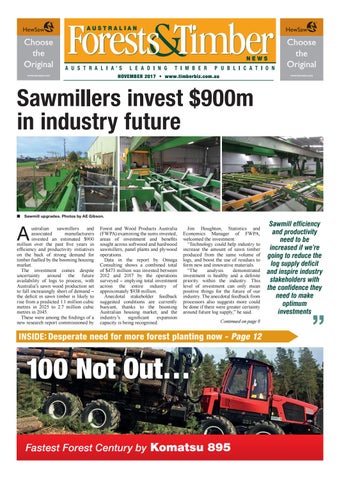
Sawmill upgrades. Photos by AE Gibson.
A
ustralian sawmillers and associated manufacturers invested an estimated $900 million over the past five years in efficiency and productivity initiatives on the back of strong demand for timber fuelled by the booming housing market. The investment comes despite uncertainty around the future availability of logs to process, with Australia’s sawn wood production set to fall increasingly short of demand – the deficit in sawn timber is likely to rise from a predicted 1.1 million cubic metres in 2025 to 2.7 million cubic metres in 2045. These were among the findings of a new research report commissioned by
Forest and Wood Products Australia (FWPA) examining the sums invested, areas of investment and benefits sought across softwood and hardwood sawmillers, panel plants and plywood operations. Data in the report by Omega Consulting shows a combined total of $473 million was invested between 2012 and 2017 by the operations surveyed – implying total investment across the entire industry of approximately $938 million. Anecdotal stakeholder feedback suggested conditions are currently buoyant, thanks to the booming Australian housing market, and the industry’s significant expansion capacity is being recognised.
Jim Houghton, Statistics and Economics Manager of FWPA, welcomed the investment. “Technology could help industry to increase the amount of sawn timber produced from the same volume of logs, and boost the use of residues to form new and innovative materials. “The analysis demonstrated investment is healthy and a definite priority within the industry. This level of investment can only mean positive things for the future of our industry. The anecdotal feedback from processors also suggests more could be done if there were greater certainty around future log supply,” he said. Continued on page 8
Desperate need for more forest planting now - Page 12
100 Not Out… Fastest Forest Century by Komatsu 895
Sawmill efficiency and productivity need to be increased if we’re going to reduce the log supply deficit and inspire industry stakeholders with the confidence they need to make optimum investments
GENUINE DURABILITY.
TOTAL CONFIDENCE.
Introducing New 600 Series Parts Warranty Terms Waratah heads are Built to Work™ and our competitively priced genuine Waratah parts are built to last – so we’ve doubled our 600 Series parts warranty terms to prove it. As a logger, you value uptime and know that using substandard parts can be costly. Only genuine Waratah parts are engineered with the exact fit, thoroughly tested and certified for your application, and backed by our unparalleled support — delivering the uptime performance you need. Now you can work with more confidence than ever using genuine Waratah parts. · New 180-day parts warranty coverage from the date of purchase. · Competitively priced parts, manufactured to exact tolerances with the right fit. · Durable, proven parts for maximum performance and productivity. · Backed by unparalleled Waratah support and a global dealer network. Talk to your local Waratah dealer today about the new 600 Series 180-day Parts Warranty terms. www.Waratah.com
Melbourne
24/7 Hotline 03 9747 4200
Bunbury WA
24/7 Hotline 08 9726 0411
www.waratah.net
In the news
Sawmillers invest $900m in industry future Continued on page 8 “The uncertainty over future log supply can be attributed to the limited expansion of the softwood plantation estate during the past 20 years and resultant static availability of softwood sawlogs. Concurrently, the availability of hardwood sawlogs has declined as access to the native forest has been reduced.” The CEO of Omega
Consulting, Peter Zed, said the predicted deficit in sawn wood was due to increasing demand driven by predicted population growth. “A whole-of-industry approach is needed to address supply issues, reduce the deficit, and help prevent it from causing a significant barrier to future investment,” he said. “Both sawmill efficiency
Significant differences between categories
A voluntary survey of selected production facilities was conducted to ascertain the total level of investment over the past five years, where that investment had occurred within the production sequence, what type of technologies were being targeted and what potential benefits were being sought. The selected operations represented approximately 90% of the softwood sawmilling industry, 45% of the hardwood sawmilling industry, 98% of the panels industry and 69% of the plywood industry. The final summary of data available for inclusion in the review represented 52% of the softwood sawmilling industry, 40% of the hardwood sawmilling industry, 58% of the panels industry and 42% of the plywood industry. The analysis on this data identified a total of $473 million had been invested by these operations over the past five years. It also identified significant differences between the various categories when the level of total investment was expressed as $/m³ of investment per annual log volume processed. The results of this analysis were that $33/ m³ had been invested within the softwood sawmilling category, $111/m³ had been invested within the hardwood sawmilling category, $153/m³ had been invested within the panel plants and $78/m³ had been invested within the plywood industry. The operations whose data was not available for inclusion within this survey represent a collection of more significant processors within the softwood sawmilling, panels and plywood categories and could be assumed to reflect a similar level of investment as those included. The hardwood sawmilling category has a large number of small operators whose investment profile is likely to be far less predictable. If it is assumed that all surveyed categories reflect the investment rate of the unsurveyed operations then the project total investment over the past five years would have been in the order of $938 million. The analysis of investment within the sawmilling categories unsurprisingly identified the green-milling process to be the most significant area of investment with in excess of 30% of all investment for both softwood and hardwood sawmills. However, dry-milling, kiln drying, re-manufacturing and storage differed in investment importance between hardwood and softwood for the operations surveyed. www.timberbiz.com.au
and productivity need to be increased if we’re going to reduce the log supply deficit and inspire industry stakeholders with the confidence they need to make optimum investments. “This can be achieved through an increased focus on product niche and dedicated R&D around technologies to increase recoveries.”
¢
Jim Houghton, FWPA Statistics and Economics Manager.
¢
Peter Zed CEO of Omega Consulting.
Sawmill numbers drastically reduced since 2000 Since 1999–2000 the number of hardwood sawmills has decreased by 79%, from 862 mills in 1999–2000 to 182 mills in 2015–16. The number of softwood and cypress sawmills has decreased by 72% over the same period, from 279 mills in 1999–2000 to 77 mills in 2015–16. Softwood sawmills in 2015–16 were larger on average than they were in 1999– 2000—one-third of softwood sawmills had a log input capacity greater than 100,000 cubic metres a year in 2015–16. In contrast, 96% of hardwood sawmills had a log input capacity of less than 45,000 cubic metres a year in 2015–16. In 2015–16 softwood sawmills produced an estimated 4.4 million cubic metres of sawnwood. Hardwood sawmills produced
an estimated 675,000 cubic metres of sawnwood. Hardwood sawmills predominantly use logs from public native forests. Smaller hardwood sawmills take a much larger proportion of their logs from private native forests than do larger hardwood sawmills. Softwood sawmills (excluding cypress mills) source almost all their logs from plantation forests. Cypress mills (which operate only in New South Wales and Queensland) source almost all their logs from public native forests. Other mills produce posts and poles, wood-based panels, pulp and paper, and export logs and woodchips. Source: ABARES. Australia’s forests at a glance 2017.
CUSTOMISED SOLUTIONS FOR YOUR MILL Over 100 years of timber engineering solutions for optimum mill productivity
• Manufacturing • Sawmilling Equipment • Log Carriages • Resaws • Multisaws and board edgers • Automatic Sorters and Stackers • Complete turnkey projects.
Australian Forests & Timber News
November 2017
From major start ups to retro fits contact: AE Gibson & Sons Ph: 02 6559 4001 E: johns@aegibsonman.com.au www.aegibsonman.com.au
3
In the news I n c o r p o r a t i n g A U S T R A L A S I A N F O R E S T L O G G E R & S AW M I L L E R
November 2017 Issue 7 Vol. 26 Established 1991 News 3-5 Gala Industry Dinner 6-7 Profile 8 Outlook Conference 11-13 Forest Machines 14-15 TCA 16 Bio 17 WoodTECH 18 Forwarders 20-25 Maintenanc 26 ForestTECH 28-31 Publisher and Chief Executive: Hartley Higgins General Manager: Elizabeth Bouzoudis Editor: John Hudswell j.hudswell@ryanmediapl.com.au Adelaide Office (08) 8369 9512 Advertising: Gavin de Almeida g.dealmeida@ryanmediapl.com.au Adelaide Office (08) 8369 9517 Production: Luke Westle Trader classified: g.dealmeida@ryanmediapl.com.au Adelaide Office (08) 8369 9517 Subscriptions: subs@forestsandtimber.com.au Adelaide Office (08) 8369 9522 Subcription rates One-year (8 editions) $55 Two-years (16 editions) $95 Accounts: Adelaide Office (08) 8369 9555 Postal Address: 630 Regency Road, Broadview South Australia 5083 Phone: (08) 8369 9555 Fax: (08) 8369 9501 Melbourne Office: Suite 2262, 442 Auburn Rd, Hawthorn VIC 3122 Phone: (03) 9810 3262 Website www.timberbiz.com.au Printed by Lane Print, Adelaide, SA Conditions The opinions expressed in Australian Forests & Timber News are not necessarily the opinions of or endorsed by the editor or publisher unless otherwise stated. All articles submitted for publication become the property of the publisher. All material in Australian Forests & Timber News copyright © Ryan Media. All rights reserved. No part may be reproduced or copied in any form or by any means (graphic, electronic, or mechanical including information and retrieval systems) without written permission of the publisher. While every effort has been made to ensure the accuracy of information, the published will not accept responsibility for errors or omissions, or for any consequences arising from reliance on information published.
Australian governments back ‘Transforming Australia’s forest products industry’ agenda By Senator Anne Ruston Assistant Minister for Agriculture and Water Resources
T
uesday 12 September was a red letter day for the relationship between Australia’s forestry industry and Australian governments. Federal, state and territory forestry ministers combined to release a joint statement of support and Prime Minister Malcolm Turnbull gave an address to the third biennial Australian Forest Products Association gala dinner, backing the industry and its 120,000 workers.
Ministerial Forestry Statement Following a meeting with my state and territory forestry minister colleagues I was proud to sign, on behalf of the Australian Government, an historic statement backing the Australian forestry industry and its workers. The statement backed the Forest Industry Advisory Council’s report, ‘Transforming Australia’s forest products industry’ and the future it envisions. “We, the Commonwealth, state and territory forestry ministers, strongly support Australia’s forestry industries. We believe that they have an economically, socially and environmentally sustainable and prosperous future. We collectively endorse the objectives of the Forest Industry Advisory Council’s report, ‘Transforming Australia’s forest products industry’. We strongly support its vision that the forestry industries will
lead the transition to a bio-economy of which Australians can be proud and the objectives of: • having the right trees in the right place at the right scale • producing bio-products using all parts of the tree to a cellular level • being environmentally friendly, socially responsible and valued by the community. We value the industries’ significant contribution to Australia’s wellbeing. The forestry industries provide jobs in regional economies across Australia. It is an innovative sector, providing new products and ongoing employment in regional Australia, today and into the future. We recognise that the industries source wood from sustainably managed forests. We support the sustainable management of Australia’s native forests, and through this, providing timber resources for industry while protecting high value native forests. We recognise that the forestry industries strive to balance their resource use with the maintenance of environmental and societal values. We believe that Australia’s forestry industries have an important role to play in transitioning to a lower carbon economy. Sustainable forest management and the use of emerging forest products and technologies will play an important role in
delivering this future for all Australians. We support collaboration and cooperation among all governments and industry to achieve shared outcomes. We commit to working together to ensure the ongoing future of Australia’s forestry industries.” The statement reaffirmed our strong support for the sector, and our ongoing commitment to work together to achieve certainty into the future for the industry.
Prime Minister’s address to 2017 gala industry dinner The Great Hall at Parliament House hosted the third biennial Australian Forest Products Association gala industry dinner. Prime Minister Turnbull expressed the Government’s strong support for industry plans to increase exports. “… in many respects its greatest resource is you and it’s wonderful that you’re so committed, you’re so inspired, you’re so determined to do more. The ambitions you’ve described of exporting more is so important. “We should be a forest industry international powerhouse. We have the trees, we have the great industry, we have the science …” In committing to help the industry the Prime Minister stated: “… tonight I am very pleased to announce that Anne Ruston to help us develop a new government plan that will underpin growth in the renewable timber and wood fibre industry”..
“Anne’s work and our new government plan will give you the vision and certainty you need. We’re committed to developing this industry as a growth engine for regional Australia”. I am deeply honoured to have been asked by the Prime Minister to lead the government’s efforts to develop a new plan and strategy for the forestry sector in Australia. The Forest Industry Advisory Council’s report ‘Transforming Australia’s forest products industry’ outlined a strategy ‘to triple the economic value of the forest industry by 2050’. Our new government plan will be developed with the goal of assisting the Australian forestry industry reach its potential over the coming decades. With the support of Australia’s federal and state and territory forestry ministers, the development of this new plan, and the innovations and changes that the forestry industry are already undertaking we can work collectively to achieve this important goal of tripling the value of the industry over the next 30 years. As the Assistant Minister with responsibility for forestry, I will continue to collaborate with anyone who shares the ideals of supporting Australia’s forestry industry and their significant contributions to Australia and our regional communities. This is an exciting time for forestry. Its industries will play an important role in delivering an innovative and prosperous future for all Australians.
MEDIA
INDEPENDENT & AUSTRALIAN OWNED
4
Australian Forests & Timber News
November 2017
www.timberbiz.com.au
In the news
Arson attacks in forests prompt secret camera surveillance
¢
Nationwide efforts to help combat fire potential
Bushfires .... the potential is high but nationwide efforts are being coordinated to be ready.
J
ust the mention of bushfire is generally enough to bring out a nervous twitch or two, but when there are deliberate attempts to start fires then the nervousness turns to unadulterated anger and dismay. Such has been the case in New South Wales. So much so that additional hidden cameras have been set up in State forests around Wauchope, Taree, the Hunter, Coffs and Casino areas and ranger patrols are being ramped up in all State forests to catch arsonists, following a spate of suspicious fires. Forestry Corporation’s Forest Protection Manager Karel Zejbrlik said many fires had been deliberately lit in north coast State forests and timber plantations, putting communities and forest visitors in danger. “It is sickening that anyone would recklessly endanger people’s lives by deliberately lighting a fire and we are pulling out all stops to catch the people responsible,” Mr Zejbrlik said. “We now have a total of 120 infra-red equipped cameras that can photograph faces and number plates hidden in strategic locations throughout north coast State forests and we will have additional rangers out in the forest every day looking for anything suspicious and recording the details of www.timberbiz.com.au
every number plate on every vehicle in the forest. “We are also urging members of the community to help us catch these criminals by contacting Crimestoppers on 1800 333 000 if they see anything suspicious. “Fire season has been declared early and with the forests and conditions as dry as they are, we are already on high bushfire alert, with additional fire fighters and equipment on standby. “So far we have managed to get these deliberately lit fires under control and we are doing whatever we can to put a stop to these arson attacks to prevent a deliberately lit fire taking hold and threatening local homes and communities.” Across the border in Victoria, communities in high-risk bushfire areas will be safer thanks to the government’s $750 million Powerline Bushfire Safety Program, burying powerlines to significantly reduce the risk to lives and property from bushfires. “We’re keeping the residents of Healesville and the surrounding areas safer from the risk of bushfires. These are not just words, it’s practical action,” said Minister for Energy, Environment and Climate Change, Lily D’Ambrosio. The program was established to deliver on recommendations made
by the Victorian Bushfires Royal Commission to reduce the risk of powerlines starting bushfires. The high voltage powerline replacement works in Healesville, due for completion in January 2018, are being accelerated for the coming summer season. This will see a total of 43km of bare-wire high voltage powerlines replaced with safer technology, ensuring residents will benefit from increased safety. “The risk this summer is very real and we’re working to ensure Victorians have the best possible protection against bushfires.” Healesville and the surrounding region will also benefit from other safety initiatives including: Installation of a new sophisticated protection device at the Woori Yallock zone sub-station protecting over 650 km of powerlines Installation of 60 adjustable automatic circuit reclosers The provision of three back-up generators in residential care facilities in Healesville and a further nine in residential care facilities in the Yarra Valley. “By burying these powerlines people in Healesville and surrounding areas will be safer if bushfires strike,” said Emergency Services Minister James Merlino. Fire authorities in all
Australian Forests & Timber News
states and territories have been warning of above normal fire potential this summer. Government departments and major forestry organisations have been working hand-in-hand to ensure everyone is as well prepared as possible. Lachlan Spencer, VicForests General Manager Stakeholders and Planning said: “The Victorian timber industry performs an important service in fire suppression. Our skilled staff, specialised
forest equipment and road maintenance activity provides significant firefighting resources. “There are 63 current employees at VicForests that are skilled and trained in dealing with bushfires and every year they work together with Forest Fire Management Victoria to help minimise the risks and devastation that major bushfires bring with them,” he said. The situation is similar throughout the nation.
FOLS Skills Verification Program
Your portfolio of skills For Operators FOLS verifies an operator has undertaken the required nationally recognised training and has kept their skills current through regular practice. For Contractors & Forest Managers A streamlined system to manage the skills of employees and improve safety in the workplace. New mobile app – available late 2017
fols.forestworks.com.au
1800 177 001
November 2017
An industry-led program managed by ForestWorks
5
FWPA Gala Industry Dinner
New national forest plan offers certainty for the future Recognition of major changes in industry
T
HE AFPA gala dinner in Canberra on September 12 would go down as a watershed moment for the forest industries in Australia, according to CEO Ross Hampton. He said Prime Minister Malcolm Turnbull’s comprehensive plan to support the growth and sustainability of the sector “has given us recognition at the highest level of government”. Addressing more than 500 guests at the dinner, Mr Turnbull said: “Tonight I am pleased to announce I am requesting Senator Anne Ruston to help us develop a new government plan that will underpin growth in the renewable timber and woodfibre industry and work to give you the vision and certainty you need. “We are committed to developing this industry as a growth engine for regional Australia.” An extra dimension was added to the event as industry stakeholders from all over Australia spent quality time with 40 to 50 MPs. Mr Hampton said policy settings, now a generation old, had been reset for the future. “These policies needed updating so the PM’s announcement will build on the good work of the Forest
¢
6
¢
Prime Minister Malcolm Turnball speaking at the AFPA gala dinner.
Industry Advisory Council with the government coming forward with a new full-blown forest industries plan for Australia in the 21st century,” he said. “We have reached a new state of healthy acknowledgement of the industry’s rightful place as one of the prime feeders of economic development in Australia, particularly in regional areas.
“The Turnbull government has reaffirmed its strong support for the sector and is committed to further collaboration to achieve certainty into the future.” AFPA chairman Greg McCormack enthusiastically welcomed the development of a forest industries plan. “The guiding policy documents used by government to frame responses to our industries
Ric Sinclair, managing director, Forest and Wood Products Australia, John Summers, general manager, sales, Timberlink Australia, Glen Rivers, chief forester, OneFortyOne Plantations, and David Brand, CEO and founder of New Forests.
¢
were both delivered last century – the 1992 National Forest Policy Statement and the 1997 Plantations Vision 2020 plan,” Mr McCormack said. “Our industries have changed dramatically since then and I am delighted the Prime Minister has recognised that it is vital that government and departments also update their approach.
“The new government national forest industries plan will, we trust, outline actions to support the industry to establish new plantations, increase investment and grasp opportunities in the emerging bio-economy to turbo-charge regional job creation and economic development.” The gala dinner was also an opportunity to celebrate the industry’s best and brightest, with the announcement of the winners of the inaugural 2017 Forest Industry Innovation Awards. The three award winners were: OneSafeGroup for innovation in safety; Timber Communities Australia for innovation in training; and AKD Softwoods for innovation in business. The winners in each category were presented with a $1000 cash prize and a special timber trophy. Finalists in each category were TABMA Australia (training), Hume Forests (safety); and SFM Hydrowood (business innovation). “The AFPA award for innovation in training has given deserved wider recognition of Timber Communities Australia, especially the value of young people – our young ambassadors and future industry leaders – in promoting the value of sustainable forests,” TCA
Ron Caddy, Lamcal Builders Supplies, Melbourne, Shane Vicary, AKD Softwoods, Colac, Vic, and Peter Alexander, Peuker and Alexander, Melbourne.
Australian Forests & Timber News
November 2017
www.timberbiz.com.au
FWPA Gala Industry Dinner national coordinator Helen Murray said. “The award also recognised the importance of a ‘voice’ for industry in regional areas to react and respond to arising issues relevant to the sector,” she said.
“ O n e Fo r t y O n e Plantations and its contract partners in the OneSafe Group, are honoured to have been awarded the Industry Innovation Award for Safety,” CEO Linda Sewell said. “In just 12 months, as a
¢
Professor Rod Keenan, school of ecosystem and forest sciences, University of Melbourne, and Alison Carmichael, manager, Agsafe Ltd, and director Australian Forestry Standard.
¢
Mick Theobald, marketing and operations manager, OneFortyOne Plantations, Mount Gambier, with Senator Ian Macdonald, who was Minister for Forestry and Conservation 2001-2002 and Minister for Fisheries, Forestry and Conservation 2002-2006 in the Howard government.
www.timberbiz.com.au
result of the intensive work and collaboration of the group, the collective injury incident rate has more than halved,” she said. “This award is testament to the foresight and focus of the group in improving safety, in a way that has
¢ Paul Groenhout, managing director, PF Olsen, Melbourne, with Linda Sewell, CEO, OneFortyOne Plantations.
¢
¢
The state’s biggest sawmilling company, AKD is the second largest in Australia with two sawmills processing about 630,000m3 a year. It draws on about 8000 ha of radiata plantations in Victoria and South Australia.
Sarah Paradice, CEO, Institute of Foresters, Canberra (centre) with daughter Lizzie and Suzette Weeding, general manager, forest development, Sustainable Timber Tasmania.
Peter Robinson, GM strategy and development, PNG Forest Products, Dave Gover, CEO, Engineered Wood Products Association of Australasia, and Stuart Toakley, sales and marketing manager, Borg Manufacturing, Sydney.
Australian Forests & Timber News
never been done before in the forestry industry.” Innovation in Business Award winner Associated Kiln Driers Pty Ltd operates integrated forestry and timber processing company based in southwest Victoria.
¢ Terry Edwards. CEO, Forest Industries Association of Tasmania (right) with Finlease representatives Mark O’Donoghue, group CEO and managing director, Sydney, James Brettnall, equipment finance broker, Melbourne, Alex Charilaou, senior finance broker, Melbourne, and Dale Archer, Finlease (Tas) Pty Ltd, Hobart.
November 2017
7
Profile
From the leafy suburbs of Melbourne to world champion wood chopper Laurence O’Toole sponsored by Komatsu Forest
F
rom a kid who grew up in the leafy eastern suburbs of Melbourne, Laurence O’Toole’s choice of hobby-turned-career was vastly different to most city dwellers. Instead of the norm of footy, cricket and the like, he chose wood chopping. “Wood chopping was pretty much a separate life to all my other friends and weekend activities. While they all played football I went chopping at country shows with my dad and from a really young age I knew that I wanted to try make a career out of it,” he said. And what a choice it was .... he is currently sponsored by Komatsu Forest and has competed against some of the best in the world, all around the world, and has been highly successful. His favourite discipline is the underhand chop. He ranks in the top three in the world in both underhand and standing block chops and is
current US Open Champion 15cm wide springboard Lumberjacking, is “more in both these events. platforms into the pockets of a part-time job for me than Now 196cm and 92kgs, Hot saw – the athlete uses a hobby. I practice a couple O’Toole said he has “been a customised chainsaw with times a week”, O’Toole said. chopping since I could walk, a modified engine, usually “I’m sponsored by and I’m 37 now”. taken from a personal Komatsu Forest and they He is a third generation watercraft or snowmobile want me to go everywhere I w o r l d can. I travel champion all over and learned I’m still based in Melbourne but I spend the E u r o p e , from his N o r t h majority of the winter months in America on America and father. These are Australia to the lumberjack circuit. the events compete.” Laurence His results competes so far this in: Single buck – the year are pretty impressive:Underhand chop – the lumberjack makes one cut Hotsaw elimination World competitor stands with feet through 50cm of white pine Championship in Webster apart on a 30-35cm white using a single man cross-cut WV USA pine log. At the signal, he saw. The competitor may USA triple crown begins to chop through the have a helper wedge his cut Underhand, Standing log with his racing axe. into the log to prevent the Block and Springboard at Standing springboard – saw teeth from sticking. the American Nationals in a discipline based on the The underhand chop Morgantown WV, USA need for old time loggers to is O’Toole’s speciality. Teams relay World establish a cutting platform While it looks potentially Champion, Canadian above the massive root bases dangerous, he said he only Underhand and Standing of old growth trees; the “cut my foot once when I winner. competitor uses an axe to was 7 doing what I had been Hotsaw World chop pockets into a 270cm told not to do, other than that Championship winner poplar pole and then place nothing”. at Powell River, British
Columbia, Canada Lumberjack World Championship Underhand winner at Hayward, Wisconsin, USA Overall, Laurence’s best USA summer yet, being the first Australian to win major Hotsaw races in America with his new Komatsu Forest Hotsaw all whilst driving 18,000 km across the country to participate in all events. August:- 1st @Brisbane Ekka 300mm standing block hard hitting Australian championship August:- 1st @Royal Adelaide show 300mm uh hard hitting Australian championship “I’m still based in Melbourne but I spend the majority of the winter months in America on the lumberjack circuit. “I like pretty much all outdoors stuff, fishing, wakeboarding and I love training in the gym,” he says.
Industry News Anytime, Anywhere, Anyhow.
I n c o r p o r a t i n g A U S T R A L A S I A N F O R E S T L O G G E R & S AW M I L L E R
w w w. t i m b e r b i z . c o m . a u 8
Australian Forests & Timber News
November 2017
www.timberbiz.com.au
TIMBERRITE™ H-16
NEXT-LEVEL PRODUCTIVITY.
Take productivity to the next level with Waratah’s new, next generation TimberRite H-16 measuring and control system. Having expanded features for improving user-friendliness, performance and adaptability, operators can get the most out of their day with this easy-to-use system. Stay connected to what’s going on in the woods and improve real-time information with new wireless data transfer options – and when coupled with TimberOffice™, optimize your operations and your productivity and know how it’s affecting your bottom line. It’s time for profitable precision and smart business decisions with TimberRite H-16. See your local Waratah dealer for more information. www.Waratah.com
For more information contact:
Waratah at 03 9747 4200
In the news
Heartwood – the art and science of growing trees for conservation and profit
A
fter almost 10 years of research and writing, Rowan Reid has teamed up with Melbourne Books to produce Heartwood: The art and science of growing trees for conservation and profit. It’s a relevant, reliable reference to all things agroforestry. As a forest scientist, he has been working with farmers for more than 30 years. Over the decades, he has watched as governments and industry offered farmers generous cash incentives and joint ventures. Still, the farming community remain largely disinterested and sceptical about commercial timber production. So, why does he persist? “In Heartwood: the art and science of growing trees for conservation and profit I argue that to engage the farming community it is forestry itself that must change, rather than farmers. The trees must first provide short to medium term values. Any wood produced by farmers will be a by-product of the management of forests that farmers need to support their agricultural production, control land degradation and
¢
Rowan Reid on his Bambra Agroforestry Farm ¢ (Photo Cormac Photography)
enhance the capital value of the primary asset, the land itself,” says Rowan. “On my own farm, we have planted thousands of trees of more than 50 different timber species including English Oak, Coast Redwood, Blackwood, Poplar, Sheoaks, Black Walnut, Australian Red Cedar, Silky Oak and, of course, many species of Eucalypt. “We planted trees for conservation, but then managed them for high quality timber. We continue to graze sheep between the trees to control the fire hazard, or plant an understorey for biodiversity. The result is more like a parkland than a
A table Rowan made from a 25-year-old Mountain Ash (Eucalyptus regnans) amongst 29-year-old high-pruned trees of the same species (Photo: Cormac Photography).
plantation. “After 30 years, we are now selectively harvesting sawlogs for on-farm milling and drying using a chainsaw, PTO-driven tractor logging winch, portable bandsaw and solar kiln. Our timber has been used in furniture and houses. Sliced veneer from our eucalypt harvested from our Landcare plantings was used in the new Australian Tax Office building in Dandenong,” he says. Every farm and every farming family is different. “In my region in the Otway Ranges, where we have been mentoring farmers for more than 25 years, the forests we see on farms are diverse and complex and are now
producing a variety of timber and non-wood products for both big and small industries. This diversity reduces the commercial and biological risks inherent in the production of timber and heralds a new future for the timber industry in Australia.” In Heartwood: the art and science of growing trees for conservation and
profit Rowan shares his own experience and that of other researchers, farmers and tree growers. The book explores the underlying principles of tree growth and wood production and the opportunities available for farmers to integrate timber production into their landscape for conservation and profit.
Heartwood: the art and science of growing trees for conservation and profit by Rowan Reid is available in good bookshops or directly from the author at www.agroforestry.net.au
AFS welcomes government support of forest management certification Australian Forestry Standard Ltd has welcomed the Federal Government’s assurance that forest certification continues to guarantee the legality of national domestic wood supply. Federal Minister responsible for forestry Senator Anne Ruston has announced that amendments to illegal logging legislation will streamline and simplify the importation and processing of timber products certified under Australian forest certification schemes. As Australia’s largest certification program for sustainable forest management with more than 24 million hectares certified, AFS is the Australian member of PEFC, the world’s largest forest certification system. “The government is to be congratulated on its continued tough stance on illegal logging and recognition that major forestry operations in Australia are 100% independently certified,” said AFS Chief Executive Officer Simon Dorries. “Government and public building authorities are placing greater emphasis on Australian standards in their regulations to ensure the sustainability, environmental security and legality of products used in the housing and construction industries,” he said. 10
“Chain of custody is especially suited to projects such as new-build commercial and office buildings, private and social housing projects, renovation and refurbishment schemes, and civil engineering projects.” Mr Dorries said the simple act of sourcing or purchasing an Australian-branded product could have far-reaching positive implications, not least in terms of sustainable consumption, arguing that improving the productivity and profitability of forests and trees was central to achieving sustainability across landscapes and livelihoods. Ross Hampton, Australian Forest Products Association (AFPA) Chief Executive Officer, said illegal logging regulations should be effective but not impose unnecessary red tape and compliance costs on Australian producers who were doing the right thing and already operated within a stringent legal and compliance framework for sustainable forest management. “Australian major forestry operations are 100% independently certified; nowhere is native forest or plantation management more sustainable,” Mr Hampton said.
Australian Forests & Timber News
¢
November 2017
Looking over HQPlantations’ operations at Beerburrum on Queensland’s Sunshine Coast are Michelle McAndrew (Sustainability Manager, HQP), Ross Garsden (BSI Australia), and Simon Dorries (CEO, AFS Ltd). AFS is the most widely used forest certification scheme in Australia.
www.timberbiz.com.au
FWPA / DANA Insights & Outlook Conference
Forestry has a strong future, Senator tells conference
“T
he ultimate challenge for your sector is being a large and crucial part of Australia’s renewable energy future” In Australia – where energy reliability, security and affordability are being affected by increasing reliance on intermittent renewable sources of energy and ageing coal-fired generators – wood fibre and biomass is a potential, transformative solution to a very modern challenge. That was the view expressed by Assistant Minister for Agriculture and Water Resources, Senator Anne Ruston in her keynote address to the Insights and Outlook Conference in Melbourne recently. “The sun doesn’t always shine and the wind doesn’t always blow, but you can always depend on trees! “They can be the source of the baseload energy we sorely need,” the Senator told delegates. “And while they’re all growing they can soak up billions of tonnes of carbon dioxide, turning it into wood and cellulose and oxygen with the aid of nothing more than some water and sunlight. “For me, this is the ultimate
challenge for your sector more than $23 billion to our adopting and applying new benefits was the XLam cross-- being a large and crucial economy, including more technologies. laminated timber factory at part of Australia’s renewable than $8 billion in trade. “And most of all, I love this Wodonga... which becoming energy future,” she said. “I love the agility of this sector’s potential for growth increasingly popular in Every part of the Senator’s sector: how it has adapted and its potential to transform Australia, being used in some address struck i n t o high-profile construction a chord with something projects around Australia. the 100-strong not only Her final message to the Trees are the ultimate renewable, crowd. different – conference was ...”You have recyclable source of energy and In her view but much a fine blueprint to work with. trees are greater. It sets your goals and your building materials. awesome; they “I also aspirations, but remember grow things we love how that this is the beginning of can eat; they provide shelter over the years to new forestry sector leaders are shaping the future, rather and shade; they’re a window operating environments; and embracing and following than the end. on the past. how it has countered threats through on this vision of the “The Australian “As I have said before, trees and addressed challenges. future,” she told delegates. Government thinks that are the ultimate renewable, “I love this sector’s She said she thought a great future is very bright, and we recyclable source of energy enthusiasm and capacity example of the industry’s look forward to helping you and building materials. for innovation, and for innovation and its broader achieve it.” “Of course that’s not new. That’s ancient. “People have been using wood as a source of energy and building materials ever since there have been people. “We still do,” the Senator said. “As a supporter and advocate for regional Australia, I love how the forestry and wood products sector supports the economic viability and sustainability of so many regional communities. “I love how it supports more than 64,000 Australian jobs, many of them in regional areas. ¢ S enator Ruston during her address to the Insights and Outlook Conference in Melbourne. “I love how it contributes
SC SB SC SPECIAL COMPOUND
TYRE TRACKS
YEAR 5WARRANTY www.timberbiz.com.au
SC SC
STEEL SB SB BELTED
SPECIALISED TYRES FOR FORESTRY APPLICATIONS
TYRE CHAIN
Switch to Alliance forestry tyres
Call Tyres4U
alliancetyres.com.au 1800 788 688 Australian Forests & Timber News
November 2017
11
FWPA / DANA Insights & Outlook Conference
Desperate need for more forestry planting now
M
ore trees in the ground generates more investment, and more confidence and can ultimately play a huge role in helping Australia overcome its acute housing shortage. That was one of the main take-away points from the FWPA/DANA/ ATIF convened Insights and Outlook Conference in Melbourne recently. Really, it was a day of positives and negatives .... Assistant Minister for Agriculture and Water Resources, Senator Anne Ruston, was exceptionally positive about the industry and its future. “The Australian Government thinks that your future is very bright, and we look forward to helping you achieve it,” she told the almost 100 delegates to the conference. However, she was quick to add ... “remember, you’re the leaders of this sector and its people will be looking to you to help set the shape and direction of that future. The Australian Government is a stakeholder in your sector, but it is not a leader of it. “We have a role to play of course, but it’s not a leadership role. That’s your role.
¢ Angelo Hrastov (Lonza) and Paul O'Keeffe (Timberlink).
More trees in the ground generates more investment, more confidence and helps Australia to achieve some of its housing goals.
¢ Dennis Neilson (Director, DANA) and conference convenor.
¢
¢
John Simon (FWPA Chairman).
¢ ( l-r) Warren McGregor (CEO prefabAus), Art Schmon (Partner, Forest Economic Advisors, Canada), Ian Tyson (CEO Timberlink Australia and New Zealand), Duncan Mayes (Vice President Group R&D & Innovation, Stora Enso, Finland), John Halkett (Managing Director, Forestlands).
The Australian Forest Products Association has long been a driver of the more of the right trees in the right places policy and unveiled a plantation/hub system some years ago. “We’ve heard today that
¢ Art Schmon (Partner, Forest Economic ¢ Advisors, Vancouver, Canada), Dennis Neilson (Director, DANA) and conference convenor, and James Malone (Wesbeam).
¢ Duncan Mayes (Stora Enso) and Paolo Lavisci (WoodSolutions).
12
“It’s up to you to determine and drive the Government’s role in your industry, not the other way around,” the Senator said of an industry that supports more than 64,000 Australian jobs and which contributes more than $23 billion to the Australian economy. On the less positive side was the fear that not enough has been done to bolster timber supplies within Australia. Most were of the opinion that it was now a case of more of the right species of trees in the right places ... and now! As John Halkett (Forestland Consulting), one of the co-convenors of the event, said -“Alarmingly, it’s the continuing story of the real shortage of log supply in Australia and there’s no doubt that unless we do something about putting trees in the ground we’re going to see a continuation of timber product imports. “The message here today was that, overall, we want to do something about that. “More trees in the ground generates more investment, more confidence and it helps Australia to achieve some of its housing goals,” said Mr Halkett.
Jodie Mason (FWPA, Forest Research Manager), Brad Barr (Wespine Industries) and Andrew Morton (Indufor).
Yoshi Shimoda (WAPRES) and Gavin Hao (RISI).
¢ Kenny Kinoshita (Mitsui Bussan Woodchip Oceania).
Australian Forests & Timber News
while we’re building about 200,000 houses a year we still have a shortfall of something in the vicinity of 200,000 to 300,000 houses that we need to catch up on. “Unless we can start to produce some more timber products in Australia then the only way we can build those houses is to import the timber. “And some of that timber is coming from areas where quite clearly the standards of forest management practice and compliance are less than they are in Australia,” he said, referring to a Ministerial release on illegal logging (see separate article). On the housing front, Mr Halkett said there was a “spate of innovation in the
¢ Shane Orchard (OneFortyOne Plantations) and David Bylund (WoodSolutions).
November 2017
housing design/construction area, which is important in Australia.” Robert Pradolin (a former general manager of Fraser’s Property Australia) also addressed the delegates on housing but he took aim at the crucial shortage of social housing. He suggested a possible plan to help ease the social housing shortage would be from investments from superannuation funds. Currently there is no incentive for the funds to invest in this sector in Australia. Legislative changes would be required before this could eventuate. “We need a paradigm shift in thinking,” he said, “we need to create an economic business case.” He said that in the US they call it multifamily housing and within its residency mix is social and affordable housing. That rental sector does not exist in Australia. “We need to create an investment environment where big institutional players, such as superfunds, invest their equity in creating tens of thousands of additional homes for rental,” he told the conference.
www.timberbiz.com.au
FWPA / DANA Insights & Outlook Conference Plantations of the future Based on surveys completed by plantation owners and managers, and assuming business-as-usual conditions over the period to 2059, ABARES estimates that availability of softwood plantation logs will increase slightly, and peak at around 18.9 million cubic metres per year by 2035–39. Almost all softwood plantations are managed for sawlog production in Australia. On average, between 2015–19 and 2055–59 around 17.2 million cubic metres of logs are projected to be available from softwood plantations each year, three-quarters of which are
expected to be sawlogs (including logs suitable for veneer and plywood manufacturing). New South Wales and Victoria are projected to have the largest volumes of softwood plantation sawlogs available over the period to 2055–59. The availability of softwood sawlogs is expected to increase most in Victoria and Queensland. Future hardwood plantation log availability is projected to be volatile over the forecast period because of assumptions around the harvesting and replanting of these plantations, Future log
A ndy Williams (HNRGA) and Margaret McCarthy (VicForests).
¢
S riniva Raghaven (New Horizon Enterprises) and Peter Carruthers (Lonza).
¢ Beth Wilden (ForestLearning, Program Manager).
¢
Michael Tsoutsouvas (Timerlink), Anne Geary (VicForests) and Phil Lloyd (Timberlink).
¢
¢
availability 59 ABARES Australia’s forests at a glance 2017 and is projected to peak in 2015–19 then decrease to the lowest level in 2045–49. Based on stakeholder discussions, ABARES has assumed that some existing hardwood plantations in some plantation regions will not be replanted after the first rotation because they are not considered commercially viable. In contrast to softwood plantations, the majority of hardwood plantations in Australia are managed for short-rotation pulplog production. On average, only around 7 per cent of projected logs
David Evans (New Forests Timber Products) and Tim Flemming (IWC).
¢
available from hardwood plantations over the period to 2055–59 are expected to be sawlogs. Tasmania is forecast to have the largest volume of hardwood plantation sawlogs available over the period to 2055–59. Hardwood plantation pulplog availability is projected to decline in all states and territories except for New South Wales and the Northern Territory, with the greatest decreases occurring in Victoria and Western Australia. Source: ABARES Australia’s Forests At A Glance 2017
¢ Rod Keenan (Melbourne University) and John Cornell (HVP Plantations).
S tephen Ryan (HVP Plantations), Jodie Mason (FWPA) and Ric Sinclair (FWPA, CEO).
¢
John Forster (South East Pine Sales) and Colin McKenzie (Porta).
¢ Michelle Lauder (Department of Agriculture & Water Resources) and Braden Jenkin (Sylva Systems).
Impressive Southwest Saw Milling and Production Enterprise
For Sale $5,000,000 plus Log Adjustment Massive opportunity to own a solid reputable business that has been established for 36 years. ¢ Clarence Tan (Tong Sim ¢ James Malone (Wesbeam). Wood Industries, Malaysia).
¢ David Bartlett (Sustainable Timber Tasmania).
• Long term log supply contracts are in place with WA Forest Products Commission. • Solid Customer relationships are established. • Local, National customers. • International customers with contracts. • Multiple revenue streams. • Loyal and established workforce. • Solid operation in full production. • Limited completion in the market place. A business of this type and scale is something that will not be available often. This prosperous operation has afforded the current owners great success and profitability. All the hard work of establishing a business, sourcing supply contracts and creating markets has been done.
¢
Troy Justice and Steven Koch (Lonza).
www.timberbiz.com.au
¢
Natalie Reynolds (TABMA), Simon Dorries (AFS, CEO) and Patrizia Torelli (Australian Furniture Association).
Australian Forests & Timber News
Patrick Williams 0407 990886 or Darren Pike 0488 429117 Business Broker & Commercial Sales Specialist
November 2017
Licenced Real Estate Agents
13
FOREST MACHINES
Sierra Forest Services puts new Cat machine to work
M
atthew Stoppa knows that service and support from a manufacturer and its dealers are critical for a company that operates heavy equipment in order to avoid downtime and to keep running. The owner and director of Sierra Forest Services, Matthew owns logging equipment from several manufacturers, but one company dominates: Caterpillar. “I’ve sort of leaned back towards the Cat® machines because the dealers are close by,” he said, and parts are readily available. “Just local support. That’s what we’re moving towards -all our suppliers just to be within driving distance for parts.” Downtime is costly in terms of lost production, he noted. Sierra Forest Services is based in Healesville,
about 65 kilometres east “It was more of a lifestyle into William Adams... of Melbourne and located thing,” said Matthew, to since I was that big,” said just west of Yarra Ranges focus on logging softwood. Matthew, gesturing with National Park. Matthew and Working in hardwood his hand to show how tall his company were working forests was more remote he was as a boy. recently in Starth Creek, and required more travel. Matthew has a mixed about 70 kilometres north “I didn’t see a future in it...I fleet of logging equipment, of Healesville, where he saw a future in plantation but most of his machines talked about his company’s logging.” -- four of the six -- are the operations and his His father has relied Cat brand. The company experience with is equipped Cat forestry with a equipment. Cat 545D We’re taking a whole movement out of Matthew(41) Skidder, the system. started working Cat 320C in logging and F o r e s t launched his Machine, own company in 2000. on Cat equipment in his Cat 320D Forest Machine, He previously worked in excavating business, and the latest addition, his father’s excavating Stoppa Excavations, for a new Cat 538 Forest business, helping to build more than 40 years, and Machine. roads for logging. He working for his father, Cat Forest Machines are transitioned into hardwood Matthew had plenty of versatile, purpose-built logging at first but has experience with the Cat machines on tracks that can focused on harvesting trees brand and Cat machines. be configured for general in softwood plantations His father has done business forestry (GF) operations or the past 13 years. “This over the years with the primarily for log loading year we’ve done a bit of William Adams Cat, the (LL) and log handling tasks. eucalyptus for the first dealership for Victoria and Those set up for general time,” he said. Tasmania. “I’ve been going forestry operations, for
example, can be equipped with harvesting, fellerbunching, or processing attachments for harvesting timber or processing the stems. Cat Forest Machines configured as LL machines can be used for shovel logging, handling and moving trees, stacking logs, and loading logs onto trucks. Sierra Forest Services employs about three or four other people, sometimes five. After the bushfires of 2009, the company had up to 20 people at work for it. The company performs tree-length logging operations. Track machines with harvesting attachments fell the timber. Other machines follow to shovel the trees to skid roads as needed, and the skidder picks up hitches of trees and drags them to a landing or deck. At the landing, a machine with
Old Media + New Media For 74% of Advertisers, It’s a Package Deal Let’s face it advertising media decisions are a constant challenge for SME’s, especially “new media” or digital options. A USA local advertising survey shows 74% of Advertiser’s believe combined digital and legacy media (TV, Radio and Press) works best. Only 3% of respondents surveyed said they are buying only digital media.*
So next time you are planning a new product or service marketing campaign, why not book the ideal Ryan Media marketing mix - PRINT + DIGITAL - with Australia’s leading forests and timber manufacturing magazines Australian Forests & Timber News and Australasian Timber, and the industry’s digital news digest Daily Timber News.
It’s not just sales and marketing insurance, it’s about getting results. Call us today for a PRINT + DIGITAL proposal that targets your market and best suits your budget. Contact Gavin de Almeida on +61 8 836 9517 or via email at g.dealmeida@ryanmediapl.com.au Kent Humphries on +61 8 836 9516 or via email at k.humphrys@ryanmediapl.com.au australasian
MEDIA
magazine
INDEPENDENT & AUSTRALIAN OWNED
Marketing solutions in PRINT & ONLINE! *Source: Borrell’s Annual Survey of local advertisers; April-June 2017
14
Australian Forests & Timber News November 2017
www.timberbiz.com.au
FOREST MACHINES
¢
Matthew Stoppa (in red jacket) and Anthony Watson (Caterpillar’s Forestry Industry Manager based in Tullamarine, Victoria) at the site in Starth Creek ,Victoria.
a processing attachment delimbs the trees and cuts them to length, and other machines sort and stack the logs and load them onto trucks. The new Cat 538 Forest Machine is set up for general forestry work. It is equipped with a LogMax
7000XT attachment for processing trees at the landing. Matthew wanted a track machine for working at the landing, he said, for its reach and other factors. His other Cat Forest Machines are used for shovelling or loading operations.
He considered other manufacturers, but he and his father have had good experience with Cat excavators and forestry machines over the years “and never had any drama to them”. Mathew has been doing business with Cat since he
has been in logging, and his connection through his father’s company goes back even longer. That experience has demonstrated that he can rely on Cat and its dealers for service and support. He has been particularly pleased with the Cat 538 Forest Machine for its fuel economy and quiet, stable operation. “Fuel economy is a big one,” said Matthew. He estimates he is saving 2-3 litres of fuel per hour. “It’s quiet,” he said, in the cab for the operator and outside as well. He has been impressed by the heavy-duty track system and purpose-built undercarriage. “Built stable, very stable.” Operator comfort is “really good,” he added. “It’s the best seat I’ve ever had in a machine.” He’s planning to buy another Cat Forest Machine in the near future, a Cat 558 LL. He owned Forwarders in the past but decided to sell them. “I moved away from forwarders because I wanted to get away from
double-handling wood,” he explained. With his approach, trucks are loaded directly at the decks. “We’re taking a whole movement out of the system. “That’s where a purposebuilt log loader works better,” he added, “stacking and loading.” Sierra Forest Services works in hilly and steep terrain at times. Logging on steep ground is “tough,” he acknowledged... “it’s interesting.” He is considering the use of cable-assisted harvesters for felling timber in steep terrain. Matthew enjoys travelling when he has the opportunity, and has visited the USA and Canada over the years to learn about logging methods in those countries and to see demonstrations of new equipment. He and his wife, who handles the administrative duties for the business, have two children, ages 10 and 13. The company is named for their daughter, Sierra.
ENSIGN LOG FORKS AND LOG GRAPPLES CAN BE CUSTOM MADE TO SUIT CUSTOMERS REQUIREMENTS. CONTACT US TO DEVELOP A CUSTOMISED SOLUTION THAT WILL MEET YOUR NEEDS. EXCLUSIVE AUSTRALIAN AGENT & DISTRIBUTOR OF ENSIGN GRAPPLES & LOG FORKS log_grapple_hp_march.indd 1
www.timberbiz.com.au
For product and sales enquiries contact GB Forestry P: 03 8353 6655 E: office@gbforestry.com.au or visit us at... www.gbforestry.com.au
Australian Forests & Timber News November 2017
10/03/2017 11:18:36 AM
15
TCA
The part people play in industry success By Helen Murray National Coordinator / Timber Communities Australia
T
he tag line used by Timber Communities Australia is healthy landscapes, healthy economies, healthy communities. Our members and other supporters are brought together by our common interest in sustainable forests which are treasured for their natural beauty, for the essential role they play for ecosystems, for biodiversity and for the wonderful renewable products they contain to sustain human society. We know it’s important to look after our forests. What about our people? This is the topic I’ve been moved to focus upon as I write this in Mental Health Month. As I type, it’s a beautiful spring day in the rural district where I live. A faithful little dog lies at my feet and blue wrens are hopping about the greenery beyond the window. Trees that shed their leaves during the long, cold winter are
turning shades of green. Poplars faint as faint, willow branches dancing greener every hour, whilst the elm and oak leaves are still to be coaxed along. It is good to be alive. Eucalypts shimmer blue on the hills. It’s a scene that never fails to rejuvenate the tiredest of souls.
So much to do But back to our industry. There’s so very much to do – isn’t there? Regional Forest Agreements to renew, government legislation to lobby for more of or less of, more trees needed in the right place at the right time, so much further to go to have enough wood supply for our own people, let alone growing populations to Australia’s north, illegal logging to stamp out, energy costs off the radar, new plantation areas to be found, new skills and workforce gaps to fill,
I think it is a fair call to acknowledge that there’s a lot of pressure in our industry, which causes stress and takes a toll on the health and wellbeing of our people.
I n c o r p o r a t i n g A U S T R A L A S I A N F O R E S T L O G G E R & S AW M I L L E R
schools to reach, messages to reinforce, roads to be upgraded, councils to be wrestled with, safety measures to upgrade, better business practices to achieve, deadlines to meet, finance and equipment to sort out, harvest protocols to manage, community engagement letters to send, meetings to be had, seedlings to grow or get in the ground, state governments treading water, new forest standards to understand, audits to be done, more funding to be raised, reports to be written, budgets to trim or exceed and plans, plans, plans - everywhere for everything. I think it is a fair call to acknowledge that there’s a lot of pressure in our industry, which causes stress and takes a toll on the health and wellbeing of our people.
There is no down time The wonderful benefits of the wireless age also mean we are available to everyone, all the time.
There is no down time, unless we enforce it for ourselves. In fact, sometimes I feel I am in technology overdose from being glued to screens of one size or another every day. To work, to bank, to shop, to communicate, to research things. With that environment so entrenched – it’s just so important to look after our own health and wellbeing. The Land newspaper in NSW just released its 6th Mental Health Glovebox Guide. It has top notch short articles, hints, personal experiences of rural people and expert resources in one place. It encourages us to recognise the health of our brain is as important as the rest of our body. It’s available online (of course it is!) and I commend it to you. The R U OK website is a great place for tips if you are worried about a someone – including a work colleague. It has down to earth tips to help connect and check in with someone who may be doing it tough, including an RU OK rural
and mateship manual. I was struck by this simple advice from www.ruok. org.au, “Got a niggling feeling that someone you know or care about it isn’t behaving as they normally would? … Trust that gut instinct and act on it. By starting a conversation and commenting on the changes you’ve noticed, you could help that family member, friend or workmate open up. If they say they are not ok, you can follow our conversation steps to show them they’re supported and help them find strategies to better manage the load. If they are ok, that person will know you’re someone who cares enough to ask.” Our industry work is motivating and important and demanding. Ultimately success depends on our people. Inspired by Mental Health Month, I’ve resolved to look after my own mental health a little more and look out for my colleagues a little more. Maybe you’d care to do so, too.
Essential reading for forest and logging industry professionals NOW AVAILABLE AS AN APP
Search the app store for North East Media or visit aftdigitaledition.com.au 630 Regency Road, Broadview, South Australia 5083
www.timberbiz.com.au
INDEPENDENT & AUSTRALIAN OWNED
16
Australian Forests & Timber News November 2017
www.timberbiz.com.au
BIO
The Beast takes many forms! The massive infeed widths on the Model 2680XP and 3680XP also mean these machines can handle the largest, widest trees possible.
M
atching the productivity of The Beast® horizontal grinder with the raw chipping power of a Bandit whole tree chipper is as easy as the optional whole tree chipper drum for The Beast. After the initial installation or retrofit, it’s a relatively straightforward swap – switch out the standard cuttermill on The Beast with a custom 5/10-knife, 4/8-knife or 20-knife drum, and add a specially designed stationary anvil spacer to the infeed. (The 5/10 knife drum is a 10-knife drum, but it can be run with half the knife pockets blocked off. The same goes for the 4/8 knife drum, and the 20-knife drum.) With a setup like that, there’s no need to trade production for chip quality. But to understand why The Beast with a chipping drum is such an elegant solution, you have to understand what makes Bandit’s horizontal grinders stand out among the crowd. It starts with the patented cuttermill. Bandit has engineered The Beast to have a downturning cuttermill, where most other horizontal grinders turn upward. This setup allows The Beast to cut against a one-piece infeed chain, which serves as a moving anvil – a tremendous advantage over the competition. When running with a chipper drum,
¢
The Beast cuts against a replaceable stationary anvil insert that sits at the end of the infeed, rather than the infeed chain. This setup ensures a higher quality chip. This helps prevent material from turning or rolling, which results in a better quality chip. The downward cutting action also is more aggressive than up-turning cutting systems, allowing the entire feed system to provide better control of the material as it’s being fed into the chipper. Bandit’s one-piece infeed chain also plays an important role in ensuring a higher chip quality. It does so by constantly advancing material into the feed wheel yoke and into the chipping drum. The heavy-duty construction on the infeed chain has proven to be far more effective and more reliable than the chains in other grinders, while helping to deliver a superior end product. A six-speed feed system slows the operator to match the conveyor speed to the size of the material desired. This keeps material from pushing against the chipping drum, causing a braking action that can rob horsepower and fuel economy. And it also prevents material from not reaching the drum fast enough, which can create splinters and fines. The sixspeed system can be further fine-tuned so you can create
the right-sized material on the first pass. The massive infeed widths on the Model 2680XP and 3680XP also mean these machines can handle the largest, widest trees possible. The 60-inch wide infeed allows for material to be spread out evenly along the infeed chain, giving logs, chunk wood, stumps, and even regrind mulch plenty of room. And all of the benefits of Bandit’s downturn mill still apply with a chipping drum. It’s easy to see why The Beast can be your best whole tree chipper. But you can process more than just wood products. The chipping drum option can offer a huge advantage when processing plastic materials, like heavy walled plastic pipe. Often outfitted with the 20-knife option, chipping hard walled plastic pipe creates uniform and perfectly sized plastic chips that are exactly what plastic recyclers are looking for. The 4/8 and the 5/10 knife drum, depending on if all the knives are utilized or if half of them are blocked off, can produce a 2” maxi chip for biomass boilers, a ¾” standard chip. A 20-knife drum can produce a ¼” to 3/8” microchip when all the knives are utilized. Blocking off half the knife pockets can produce a standard ¾” to 1” chip.
But perhaps the greatest advantage a chipping knife option The Beast is you’re not stuck with mill. You can swap your chipping drum back to the traditional cuttermill, and enjoy the advantages of nearly limitless tooth and raker options, giving operators that ability to pick and choose the correct hardware to process nearly anything from chunk wood down to branches and logging slash.
The Beast can change with the times – providing a product to meet the demands of the alwayschanging markets. And no matter how long The Beast has been in service, Bandit will stand by its product with free expert support only a phone call away. Bandit offers this service through the Bandit Backbone program.
Bandit's Beast in action.
www.timberbiz.com.au
Australian Forests & Timber News November 2017
17
WOODTECH
WoodTECH plans for 2018 dry-mill operations
A
fter an absence of years, FIEA will be running a WoodTECH program in September 2018, with the focus on dry-mill operations. It will run again in both New Zealand and Australia, and will include timber scanning and optimisation, plant design, automation, cross cutting and ripping, finger-jointing, timber gluing and laminating, timber machining, kiln drying and timber finishing technologies. “Already we have a listing of local and international companies who have expressed their interest in either exhibiting (space at WoodTECH 2017 SOLD OUT) or presenting at WoodTECH 2018,” said
Brent Apthorp, FIEA. The TECH events are run by the Forest Industry Engineering Association (FIEA). News of the 2018 plans followed highly successful WoodTECH on green mill operations this year. “It was certainly a full house – in both Australia and New Zealand. The 2017 technology series that focussed on sawmilling or green-mill operations drew in a record number of over 400 delegates,” said Brent. “It was the largest gathering yet seen of sawmilling companies, saw-doctors and technology providers from around the globe in Australasia. A comprehensive series of practical troubleshooting workshops were also run throughout the two days
¢
Jocelin Payeur (vice president FinScan) and Udo Jahn (Modern Engineering) on the Holtec stand
¢
Todd Kurle (sales and marketing) and Dan Uskoski (vice president sales) represented Metriguard at Wood TECH.
¢
Simone Bastick and Terry Parsons representing Keymatic Technologies and Braford Industries.
18
¢
in each country. They were specifically designed alongside industry for sawmill production and operational staff. They provided the opportunity for local sawmills to hear how they could extract the best performance out of their own saws, machine centres and sawing operations. The objective was to encourage sawmill teams – management, mill production, saw-doctors and maintenance staff – to take advantage of the line-up of international specialists being brought into the region. This ensured that teams from local mills were collectively able to put the practical learnings from the event into practice once back on their own work site. Workshops of between
Designer Ralph Wijesinghe (RID Resurfacer) with CheckMate sales and marketing manager Tony Ratcliffe with newly released Resurfacer that was demonstrated at WoodTECH.
¢
Terry Parsons, managing director Keymatic Technologies with his newly developed ...TBC
¢ John Wilby (western representative) and Benoit Carpentier (president) ScanMeg, Canada
¢
¢
S imon Brown, Otterson Associates representing GreCon.
60-120 minutes were given on; • Quality & lumber size control • Troubleshooting and improving band-mill, gang and board edger performance • Selecting, operating and
¢
A ndrea Campion (area sales manger from Microtec) and Norbert Oberaigner (senior sales, project integration management Springer)
¢
USNR representatives Joe Shields (machinery support technician and WoodTECH speaker) with Jason Clay (international account manager).
Sami Helminen (sales manager from Finland) and Peter Haintz (operations manager based at Geelong) were on hand for Hew Saw.
Australian Forests & Timber News November 2017
¢
¢
maintaining log carriage and optimiser (softwood and hardwood) operations • Saw-guide selection, installation, operation and maintenance
V isiting from Canada were Mike Hubbard (sales) and Ross Chapman (president) of Optimil.
¢
Frank Horstmann (project planning sales) was on hand for Linck, Germany
G reg Ennever (account manager from Kleentek Advanced Cleaning Technologies) demonstrated his products at WoodTECH.
www.timberbiz.com.au
IBC – INTELLIGENT BOOM CONTROL MORE TONNES WITH IBC
+ 1 MORE/DAY
+ 220 MORE/YEAR
+ TONNES/YEAR?
IBC and the automatically rotating and leveling cabin increase operator comfort and performance. IBC brings efficiency to loading work and can add as much as one extra load per day, loads that boost the profitability and competitiveness of your business.
FORWARDERS
John Deere’s newest Forwarder technology leads the way The unloading feature of the IBC is particularly clever as it reduces the amount that the extension boom comes out.
J
ohn Deere’s cut-toLength, Joensuu factory in Finland has produced in excess of 11, 000 John Deere-branded wheeled forestry harvesting machines and before that produced the globally renowned Timberjack wheeled Harvesters and Forwarders. In total the factory has manufactured well over 30,000 units. Today, the factory produces the full range E & G Series John Deere Forwarders of which two models are shipped to Australia and New Zealand, the 1510G and 1910E. Recently introduced to Australia is John Deere’s new Intelligent Boom Control (IBC), a milestone in Forwarder technology: child’s play to use, accurate, time-saving and considerably reducing the stress of the boom components. Once the Intelligent Boom Control has been switched on, you’ll never want to switch it off again! Hitachi Construction Machinery Australia Pty Ltd (HCA) sold the first IBC system in Australia to Merrett Logging in Penola, South Australia. Plant Manager John Merrett said it was clear from the start the direct benefits would be considerable. “We first heard about the IBC option on the 1910E when two representatives from John Deere Finland came around to our workshop to look at our operations. We had a Forwarder on order at the time and when they showed
20
us a 5 minute Youtube clip we decided there and then to cancel the order and put an order in direct from the factory even though we knew it would take an extra
there’s less requirement from the operator to move several functions at once to get the boom where they need it, the IBC simply does it for them,” said John.
production in this short space of time. Vernon Mansell is the operator on the machine, Vernon has had a long history in the forest industry and has done over 15000hrs
few months to receive the machine. From that one short clip it was evident that the advantages of the IBC would be significant,” he said. IBC makes it much easier to learn boom control, and enables speedy work – even for beginners. This is particularly handy for John’s business when starting a new operator on site. “The unloading feature of the IBC is particularly clever as it reduces the amount that the extension boom comes out. Our new operators seem to pick up the boom control even quicker with IBC as
Now it’s not the machine that sets the limits, but the operator. IBC has made Forwarding more relaxed and easier for the operators to learn the boom function decreasing training time and getting to higher productivity levels faster. The most convincing fact has been seen in the operator’s behavior: ever since the system has been introduced to them, they don’t switch it off – it stays on the entire time. “Our operator has only just put his first 250 hours on the machine last week and he is already ahead on
on our John Deere 1910E model forwarders already so for him to up his production practically overnight was a huge plus for our company. Vernon has said it feels very natural in the movements, an extension of your arm when picking up timber. He also said he generally feels fresher at the end of a shift as his movements are less when operating the boom,” said John. The best thing about the IBC system is that it controls the boom as a whole and the operator doesn’t have to think about each individual
Australian Forests & Timber News November 2017
movement separately. The boom functions smoothly as a complete entity without jerking, since the pump supply is automatically divided among the different movements. For example, driving and loading simultaneously is easier when you don’t have to put as much focus on controlling the boom. IBC also shows how the extension should actually be used. The system is great at dividing the pump flow among different movements. The boom is accurate and easy to operate. Operators have direct control of the boom tip instead of controlling independent boom joint movements. The system also considerably reduces the number of tuning parameters needed and increases durability of boom structures and hydraulic cylinders. Linked with the IBC all new John Deere E & G Series Forwarders now come with a whole suite of new technology including Smooth Boom Control, Cruuise Control, New Generation Headboard, New TimberMatic F-12, TimberOffice, JD Link, and Speed Boost Quick button. For more information, visit www.hcma.com.au or phone 1300 HITACHI to speak to a representative.
www.timberbiz.com.au
CONFIDENCE BY DESIGN EXTREME-DUTY, 1185 WHEEL HARVESTER
Characterized by bulletproof construction and unmatched durability, the Tigercat 1185 delivers superior performance that will last. Equipped with Tigercat built bogie axles and a powerful Tigercat crane, the premium quality 34-tonne 1185 wheel harvester sets a new standard for durability and productivity. Contact Onetrak today to learn more.
PHONE EMAIL
+1.519. 753.2000 comments@tigercat.com
WEBSITE
www.tigercat.com
SOCIAL
www.facebook.com/tigercat
1300 727 520
WWW.ONETRAK.COM.AU
FORWARDERS
Tried-and-true reputation
¢
Tigercat's 1075C Forwarder makes tough work look easy.
F
or a business that is currently celebrating its 60th birthday, Tumutbased G&J Groves certainly lives by the old saying triedand-true! And, it adopts the same approach when it comes to machinery. Back in 2003, the company opted for a Tigercat L830 with a Tigercat DT2000 series shear head. That machine was destined for a lot of hard work in steep country. “We thought it was best suited to that application,” says Andrew Groves. “We were pretty impressed with the build quality of that first machine, the undercarriage in particular,” he says. “It was 12 months later that we followed up with another L830, this time with a Waratah 622B processing head
22
“Again, it was about the “It’s more or less a big wood running Tigercat’s own tier reliability; the build quality machine,” says Andrew. II engine as well. so as far Fast forward a few years “I suppose the main point as service and backup goes and the company opted for was the construction of the it’s their complete machine,” two new Tigercat 1075C 20 crane, plus its Tigercat’s own says Andrew. tonne Forwarders & one so it’s built to their specs, as is “There are expectations LH855D tracked harvester… the rest of the machine. of fuel savings as well. We for not too believe there dissimilar will be some reasons. conomies The 1075C 20 tonne Forwarder is ideal ewith “We were the fuel f o r t u n a t e for high production jobs, around-theperfor mance enough to of the Tigercat win a contract clock operation and extreme terrain. engine.” with Forestry T h e Cor poration 1075CTigercat NSW. It was forwarders are primarily in large clearfall “And those specs on the built for tough applications stands. Forwarder suited our needs. and long term durability “We’re a harvest and haul The LH855D harvester is and uptime with strong operation so we do a lot working in front of both these frames, oversize pins and of truck loading. We just 1075C forwarders in the clear high quality cylinders. The thought that the Tigercat fall operation & is working heavy duty centre section is crane build seemed to be to expectations keeping both equipped with tapered roller far superior compared to its forwarders with plenty to do. bearings in the articulation competitors, as well as the “Another factor is that and oscillation joints. machine’s other capabilities. these three machines are With its stable and powerful with extreme duty wide-spread bogie axles, the 1075C 20 tonne Forwarder is ideal for high production jobs, around-the-clock operation and extreme terrain. Its excellent component layout and easy access to service points makes for quick and painless daily maintenance routines. The operating environment is expansive and comfortable with optimized sight lines and ergonomics. In-cabin sound levels are under 66 db at full 2,200 rpm engine speed. Lighting, operator controls and interface and the climate control systems are well engineered, contributing Australian Forests & Timber News November 2017
to high productivity and reduced operator fatigue during long shifts. Its low-wide™ bunk system gives improved visibility and decreases load/ unload cycles; the Tigercat hooked cranes are easier to operate and increase the working envelope; and the high capacity Tigercat FG43 and FG53 grapples do the job extremely well. There’s another plus that Andrew is quick to point out ... “we’ve got a Tigercat service agent in Tumut (Onetrak). We see this as a real benefit as well. They’ve got trained staff with the product and plenty of parts backup. The one thing we’ve noticed in the short time we have been involved is that they will get you going if there’s a problem. They do their level best to get you back working. “It’s a major base for them. It’s pretty well fitted out, with good service guys and the training is a big thing. Where it’s positioned is a definite plus. “It’s basically 10 minutes around the corner,” says Andrew. From a business started in 1957 by his dad Geoff (with a couple of trucks hauling timber and concrete for the Snowy Mountains project) the business has earned a good reputation. It’s been based in Tumut all that time and one of its main customers has always been Forestry Corporation NSW ... it’s definitely a business that is tried-and-true! www.timberbiz.com.au
FORWARDERS
Ponsse’s Elephant King flexes its muscles in Australia
P
onsse has always been renowned for building tough, reliable forestry machines. This point has been proven in Australia since the introduction of the 20T Elephant King Forwarder back in 2015. Since then, a good number of Australian contractors and their operators testify that the Elephant King really does pull its weight in regard to quality, reliability, operator comfort and performance. Starting inside the cabin, the layout is clean, quiet and ergonomic and provides the operator excellent visibility all around and above through the unique sloped rear screen. It has loads of storage space and enough room to comfortably accommodate two additional riders behind the operator. This space becomes particularly useful when training new operators. Fitted out with automatic climate control, handsfree telephone, bluetooth radio and a heated high back seat with neck and side rests, the cabin finish and comfort is likened to the quality of a luxury car. The crane, manufactured by Ponsse is strong and powerful. It is controlled via mini levers which are easily fine-tuned to suit the operators needs on Ponsse’s OPTI touch screen control system. This control system also helps operators understand all critical onboard systems while they are
in control of the machine. introduced to the Australian PONSSE 20T Elephant Getting its immense power market, some contractors like King standard inclusions for to the ground starts with a to stand back and see how both 2018 Tier 3 275hp Mercedes Benz, the machines and the dealer • Automatic fire suppression 6 cylinder engine. The use perform over the first couple system of this engine has helped of years in the Australian • Auto greasing system Ponsse’s customers in non- bush. With more than 20 • Electric hydraulic oil fill European Countries avoid the machines now in Australia, I • Electric tilting cabin and use of costly and troublesome encourage contractors to seek engine bonnet Ad Blu and after treatment testimony on the performance • Engine side front guard systems not required by of PONSSE machines and in • LED high performance Australian regulations. From particular, the performance lighting there power is transferred of Randalls in relation to • Horizontal and vertical through a hydrostatic our commitment to after hydraulic load gate t ransm ission • 700mm and German bunk extenders The Elephant King is a serious built NAF axles • Handsfree Forwarder that has all the comfort and bogies. b l u e t o o t h Ponsse pride telephone features that today’s professional themselves in • Heated operators want. manufacturing comfort seat with their own air brake frames, cabins, • F o o d cranes and electronic systems. sales customer support,” said heater and drinks fridge Unlike many manufacturers Davin Frankel of Randalls • Full tool kit today who outsource much of Equipment Company. • Compressor and air hose their manufacturing and then “The Elephant King is a simply assemble components serious Forwarder that has Ricky Leeson (Leesons to make a machine, all the comfort features that Logging) has given the Ponsse, through their own today’s professional operators thumbs up for his new manufacturing of major want. Attracting and keeping Elephant King. components and electrical operators is hard, so while “We bought it because systems have far greater keeping a lid on the price, we they had one available and control over the quality of have put together a package we needed one, plus we had their finished machine, and it that is very attractive to also been looking at the shows! operators,” he said. Ponsse equipment for some Randalls Equipment Based in Finland, Ponsse time and had dealt with Company, the Australian is the largest manufacturer Peter (Randalls) in the past distributor for Ponsse are of Forwarders and Wheel and have always had a good seeing growing interest in Harvesters in the world, relationship with him. the Elephant King and the with more than 70% of their “Ponsse also has a good range of Ponsse machines in machines exported outside reputation in the industry,” he general. Finland to countries such said. “Not surprisingly, when a as USA, Russia, Brazil and “We bought it to work new brand such as Ponsse is China. in pine thinnings but have
since moved it to the pine clearfall. The benefit has been it’s narrow enough for thinnings but you can expand the bolsters and it’s more than capable in clearfall operations. “It’s brought a different supplier into our orgainisation which has given us a chance to see what the support has been like and I must say I am very pleased. When we have needed parts or people Randalls have been great. Their main workshop is only 3.5 hours from us so it works well,” Ricky said. He said the Elephant King had performed well in the bush doing the job expected. “The operator thinks the vision and lighting set-up is better than anything he has driven before, along with the sliding headboard which is great for short wood. The cabin size is huge with him being able to stand upright at 6 feet tall. “Access to everything is easy and majority of it’s from the ground which limits the amount you have to climb around the machines. It also has a lot of storage room for tools and spare hoses which sometime is difficult in other machines. “Overall, we’re very happy with the machine and would definitely consider another Ponsse machine going forward,” Ricky said.
¢ The Ponsse Elephant King's vision is first class.
¢
Ponsse Elephant King works well in the bush.
www.timberbiz.com.au
Australian Forests & Timber News November 2017
23
FORWARDERS
Komatsu Forest scores another “ton” with the Komatsu 895 Forwarder
K
omatsu Forest recently scored another ton… its second century in Forwarder sales in Australia. The first ton was scored by the 890.3, with the second century being achieved in a little over four years. It’s certainly a milestone to celebrate and cements Komatsu’s dominant position in the Australian forwarder market. The Komatsu 895 Forwarder became a giant in the forestry world of professional loggers. With its 20-ton load capacity, unique powertrain with 28.5-inch bogie and wheels, and one of the market’s larger forwarder loaders, it is the preferred choice for heavy final logging in the world’s largest forestry markets of Sweden/Norway, Canada, Brazil, Australia and Russia. Komatsu Forest recently released the “New Generation 895” to follow on from the previous 895 with 11 units already being delivered into the Australia market. The new 895 has been further refined to improve productivity with an increased bunk area and improved crane operation.
The “New Generation 895” powertrain system provides far greater traction with the transmission being fitted with a larger hydrostatic pump and now all existing 895’s have been upgraded with the same transmission which provides improved control and performance. For the European and North American markets, this “New Generation “ 895 is equipped with a new engine installation with the latest in environmental engineering for diesel engines (Tier 4). In markets like Australia the 895 will be still fitted with Tier II engine where the emission control system (SCR technology) is deleted. Both engine variants are combined with the new hydraulic system which delivers low fuel consumption and a high power output at low engine speeds. The new engine produces even more engine power and torque than the current Komatsu 895.
New Komatsu 895 Specifications Load Capacity: 20,000 kg
Machine Weight: 23,800 kg
Engine Power: 193kW @ 1700rpm
Torque: 1100 Nm at 1200-1700rpm
Tractive Effort: 26,000 kp
Tyres Size (8WD): 780/50x28.5
New look
Load Gate: Telescopic
Load Area: 6.1m2
The new look of the machine gives smart appearance with numerous
Crane: Komatsu 165F
Reach: 8.5 m
Lift Torque: 165.2 kNm
Slew Torque: 43.4 kNm
Control System: MaxiXplorer
Retreev Timber Harvesting Contractors “They’ve taken a really good machine and made it better.” That’s the way Dean Venturoni (Retreev Timber Harvesting Contractors) sees the latest Komatsu Forwarder, the 895 NG (the new generation). In the space of four years the 895 has gone from strength to strength. In fact the delivery and commissioning of the 895 for Dean was the 100th in Australia! Dean’s connection with Komatsu Forest started back in early 2001 ... “It was still Partek then, I believe. My old man bought an 890.1; it was a change of colours for them which was a big thing. “The Forwarder was put to work in a lot of very challenging terrain up in the Otways, running tracks front and back all year round, all the wood being pushed uphill,” Dean recalled. “The backup and the support from that first machine out in the field was excellent to say the least, and was the main reason we kept going back. “Our relationship with KF has grown over the years along with the fleet of Forwarders and Harvesters. Bree and I started out on our own 24
Australian Forests & Timber News November 2017
in 2008 and our relationship with KF is still strong today. “We are still currently running a few 890.3s which have been very reliable and low maintenance machines,” said Dean. “We bought our first 895 a couple of years ago and put it to work on a HVP clearfall operation in North East Victoria. “It’s been an excellent machine. The operators love the room and layout in the cab, good bunk capacity, the boom is smooth to operate and has really good reach and lift. It’s just a really good package when combined with the after sales service and backup. “When it came time to update, the 895 NG was a pretty easy choice as the first one is doing exactly what we want. Brendan, who operates the new one is very happy with it. He gets out at the end of the day feeling a lot fresher; the cab’s quieter, it has a bit more drive, too. “There’s a lot of little improvements both for the operator and servicing. We’re really happy with it. They have taken a really good machine and made it better,” said Dean. www.timberbiz.com.au
FORWARDERS Shanbe Logging For Col and Jill Wescombe (Shanbe Logging) the deciding factor in going for the 895 was the carrying capacity of the bunks, and the savings that would result in less travelling back and forth into the bush. Shanbe received the 99th of the series (the new generation) sold in Australia. Their connection with Komatsu Forest started back in 2002 when they purchased a couple of second-hand machines from them. “Since that time we have had many dealings with them, our last purchase being a 951 wheeled Harvester fitted with a Komatsu C144 harvesting head and the 895 Forwarder,” said Jill. Both machines are working in Forest Corporation NSW first thinning blocks. “We also have a 951 wheeled Harvester fitted with a Komatsu S132 head coupled with another 895 Forwarder that we purchased about two years ago. They’re also working in Forest Corp first thinning blocks,” she said.
When asked about the standout points for the 895, Col replied: “We find that the bigger carrying capacity suits the combination with the 951 Harvester. The 951 definitely out-produces the tracked harvesters and the 895 is able to better keep up to the Harvester. “Operator comfort is another stand out point for the 895, as is reliability. “The maxi fleet computer configuration is also an added benefit as we can see on our computers in the office what the Forwarder and Harvesters are producing. It can also be paired with mapping features if we want,” said Col. “The combination of the 951 Harvester coupled with the 895 Forwarder means increased production with less operator fatigue. “Backup with servicing and maintenance is excellent as KF have a diesel mechanic stationed in nearby Tumut. Parts are normally available next day as well, so any downtime is minimal. The ProAct warranty is also another great KF feature,” he said.
Quality Softwood Harvesting Australia Some of the reasoning behind the purchase of the new generation 895 Forwarder for Quality Softwood Harvesting Australia included good traction in wet conditions, electric cab, good bonnet tilt, and one touch diff locks being easier to use. The business roots go back to 1981 when James and Patricia Crozier won one of the original ANM contracts. It’s still a family business involving Lyn McIntyre (daughter of J&P) Chris (Lyn’s son), Bonnie McIntyre (Lyn’s daughter), Sebastian Berg (Lyn’s son-in-law) and long standing employee Brett Caunt (Harvester operator in front of the new 895 [the 98th of the series delivered and commissioned in Australia] and also fills in the 895). The operation currently has seven machines producing about 220,000 tonnes a year in varied stands. The new 895 works in radiata for Forest Corporation NSW, currently in the Carabost/Coppabella area south of Tumbarumba, and is operated by Bonnie. improvements to make servicing the machine even easier. The new engine hood is electrically powered and can be used as a service platform in the open position. There are 8 service hatches in the chassis providing access where it is needed most and a drain valve under the engine makes it easy to replace the www.timberbiz.com.au
engine oil without spillages. There are easily accessible inspection points for oil in the engine, differentials and gearbox.
Upgraded cab The cab on the new Komatsu 895 has been upgraded as well. Improved operator protection is
provided by a sturdier cab framework and windows secured with bolts to enable simple replacement of worn windows. Some of the other upgraded features include a start button, central locking with a remote control key, and additional work lights. The Komatsu 895 is equipped with the market’s most modern control
Chris said the Komatsu Forest connection goes way back to when the Jones brothers started out. “Most of our contact now is with Nigel Howard and Jason McGuffie (Tumut/ Tumbarumba service technician). Brett Jones drops in for visit a few times a year. We have purchased a lot of equipment from KF since the start. “We have one of the first 895s which now has 6500 hours up, thanks to Jason McGuffie who went above and beyond to keep it going with minimal disturbance to production. It would seem most issues have been ironed out now. “The main reason for the purchase of the latest 895 is the service provided by Jason McGuffie and also the discount for buying two machines,” said Chris. Bonnie’s views on new 895: love the preheater; better load gate; good traction in wet conditions; electric cab; good bonnet tilt; one touch diff locks easier to use.
system, MaxiXplorer. It will be available with the fully-integrated crane scale Protec Scale in the very near future, which enables the load to be weighed automatically for production follow-ups and operational monitoring. The scale link is just as compact as a standard link and protects the hose routing for the
Australian Forests & Timber News November 2017
rotator. Production can be monitored back at the office in MaxiFleet, the world’s first fleet management system for forest machines. For more information, please contact your nearest Komatsu dealer or go to www.komatsu.com 25
MAINTENANCE
Tips on selecting and replacing hydraulic hose assemblies
T
he importance of selecting or replacing hydraulic hoses and fittings often gets overlooked until something goes wrong. Engineers must consider several factors before choosing hydraulic hose assemblies, to ensure that these critical parts are correct and fit for purpose. Here, Gates provides some key tips to bear in mind when you’re putting together your hydraulic assembly.
Hose and fitting basics Most hoses have three functional layers – the tube, reinforcements, and the cover. Hoses are built and tested according to industry specifications such as SAE and EN and each component is designed to resist the pressures it will encounter, like abrasion, permeation, bending and temperature changes. Engineers should be familiar with specifications related to equipment the hoses they design will go on. They provide guidelines for dimensions, material properties, and minimum performance characteristics for major types of hose and fittings. Fittings make leakfree connections to the hose (fitting end) and attach the hose to different components in the hydraulic system (termination end.) Most fittings have two parts, a stem and ferrule. The stem conveys the fluid, attaches to the hose, and provide a seal between the stem and hose. The ferrule attaches to the reinforcements and serves as a “weather seal” to protect the hose and fitting from the environment. Both are typically made of carbon or stainless steel and are sometimes plated or coated to improve chemical or corrosion resistance. The termination end forms a leak-free connection between the hose and a port, adapter, or another hose. There are many different types of 26
end connections specified by industry standards (such as SAE J516). Knowing how they fit together is key to selecting the best termination for an application.
Defining requirements Size: A hose’s two critical dimensions are inside diameter (ID) and overall length (OAL.) The ID must be sized to keep fluid velocities within recommended ranges. If the ID is too large or too small, it can change fluid flow and hurt machine performance by causing erosion, excessive pressure drop and power loss, too much turbulence (heat generation), pump cavitation, and noise. The OAL must be sized to provide proper routing. Too short and it puts excessive stress on the hose and fitting and prevents them from bending and stretching due to pressure impulses. If the hoses are too long, they can rub against each other or nearby components, or
get caught on something. When replacing a hose, you can determine the ID by checking the label. If it has been painted over or worn off, do not use the hose OD to identify the hose’s ID. Hose ODs vary according to construction and manufacturer and have no direct correlation to IDs. A better option is to cut the hose and measure the inside diameter. Remember to record the overall length and fitting orientation before cutting the hose. Temperature: It does not take much extra heat to shorten a hose’s service life. A good rule of thumb says that for every 10°C over a hose’s maximum temperature rating, it shortens the hose’s life by 50%. Be sure to choose hose with an upper limit well above the machine’s operating temperature. Hoses’ temperature ratings, both minimum and maximum, are usually listed in agency specifications, product catalogs, or technical pages. Most ratings are for
normal service conditions, but special ratings are sometimes listed for intermittent service. Plastic hose pressure ratings are often reduced by a temperature factor. Application: Engineers need to document anything special the machine they are designing is expected to do, including safety and environmental risks, and extreme conditions the hose will be expected to handle. If replacement hoses are being made, ask some questions rather than just duplicating the originals. How did the original hose fail? Does it show signs of cover abrasion or temperature cracks? Does the machine generate pressure surges, or is it more of a static application? Make sure to find a replacement hose that best matches the application requirements, not just the original part. It’s also a good idea to brush-up on new hose technologies. Over the past several years, some manufacturers have
Australian Forests & Timber News November 2017
developed hoses and fittings that far exceed the performance and construction capabilities of SAE specifications. Hoses that meet or exceed SAE performance specs but are smaller than standard hose can be good choices. Material: The most critical hose and fitting material consideration is chemical resistance, so confirm what fluids will run through the hose and what chemicals will touch the fitting bore, ferrule and termination. Always check the fluid’s compatibility not only with the tube, but with the reinforcements, cover, fittings and seals. Pressure: Working and burst pressures are the two most common pressure ratings for hoses. Working pressure helps select the correct hose based on the hydraulic pressure. System pressures should never exceed a hose’s working pressure. Burst pressure is the maximum pressure a hose can take before catastrophically rupturing. It also provides an estimate of design or safety factor. Burst pressure is usually four times the working pressure for most hoses. It is critical to know the full range of hydraulic pressures when choosing hose, including pressure spikes. Hoses‘ working pressures should be greater than or equal to the highest system pressure (including spikes.) Subjecting hose to pressures above its rated working pressure reduces its service life and increases the chances it will fail unexpectedly.
www.timberbiz.com.au
TCA PROFILE
Setting about lifting the industry’s image By Amanda Fisher
P
lanting 15,000 trees in three days is a remarkable achievement but with a troop of enthusiastic volunteers from around Australia keen to get their hands dirty, anything is possible, according to Michael Dent. Michael began his forestry career in a tree-planting and revegetation role with the Department of Environment, Water and Natural Resources in South Australia which involved working with school students and the broader community. Although Michael’s role has since developed to District Forester with HV Plantations in Gippsland, he is once again working with school students to educate and challenge perceptions about the forestry industry and promote career opportunities, as an alumnus of the Timber Communities Australia Young Ambassador Initiative, which he graduated from in 2016. Michael has hosted and presented to groups of school students from Mirboo North Secondary College, opening an opportunity for them to see first-hand what happens in local
To challenge perceptions, Michael has sought to engage with the media and community through the school visits.
tree plantations and promoting the positive social and environmental aspects of forestry. As Michael learnt about modern environmental practices, through work and study of forestry, he realised that public perception was right out of step with practice. This inspired him to join the Timber Communities Australia Young Ambassador program – partnered with the opportunity for professional development. “The perceptions and ideas the public has are not very accurate at all. As a young forester, I see this as part of the role to educate the public and change perceptions of our industry.” The benefits of Australian forestry according to Michael are planting trees, carbon storage and producing sustainable products. He hopes that positive initiatives such the work done by Planet Ark and the promotion of forest and wood products certification will expand, so there is awareness among the broader community of good environmental practices here in Australia, compared to some imported products from unsustainable forests overseas. To challenge perceptions, Michael has sought to engage with the media and community through the school visits. The TCA Initiative allowed him to gain skills in those areas. He feels that, “the promotion of the forestry industry to youth is critical for its future growth and sustainability”. When he grew up in Mt Gambier, South Australia, despite his father being a forester and mother working for the Department of Environment, he didn’t initially consider forestry as a career when he finished high school. Instead, he packed his bags
for the city to study his dream of architecture. As it turned out, architecture wasn’t the right fit for him and city life was even less appealing. He headed back home. Life took a different direction with a role in forestry and enrolling part-time in a forestry degree with Southern Cross University. Michael discovered the appeal of an outdoor lifestyle among the benefits of a forestry career, during the next eight years of study. His role at work involves overseeing plantation ‘cable’ forestry. This skilled technique is required in steep areas. He describes the role as 20 percent planning in the office and 80 per cent outdoors visiting sites and overseeing work and crews. The work involves planning environmental, health and safety practices for forestry and ‘audits’ to ensure that plans are followed by contractor crews. Usually he overseas three forestry crews and a road crew which establishes the essential road infrastructure prior to the beginning of works. He enjoys the variety and says that its constantly changing, with challenges of rain in winter and managing fire risk in summer. “Forestry is a carbon positive industry that provides a renewable and versatile resource. The industry plays an important part in the local economy, providing jobs on all levels of the value chain. In the past, our industry has been poor in promoting itself and this needs to change. I hope that by visiting local schools and educating young people on timber and the forestry industry we will be able to increase awareness and alleviate the false impressions some people have of the sector”.
¢
Michael Dent congratulated on his TCA Young Ambassador graduation by guest Diana Lloyd.
In Canberra with other TCA members at the gala industry dinner at Parliament House, in September, Michael said, “Winning the Innovation in Training award was great recognition for Timber Communities Australia’s effort to promote the timber industry through the Young Community Ambassadors Initiative.” With an eye to the future, Michael is studying an MBA externally and he hopes that will assist him towards a more senior role, when the outdoor lifestyle stops holding the same level of appeal. “I encourage young people to consider a career in our industry as there are lots of opportunities.” Michael loves living in a regional community with nature at his doorstep. He balances a busy job with his part-time studies but outof-hours he finds time to keep fit and follows his passion for martial arts in the form of Kyokushin, with training morning and night. He travels nationally and overseas, pursuing his competitive drive to achieve in martial arts.
Forestry Bill doomed to failure The Institute of Foresters of Australia has joined the chorus of concerns from all sectors of the scientific community with a scathing assessment of the NSW Government’s Draft Native Forestry Bill 2017. Recommendations from an Independent Biodiversity Legislation Review Panel commissioned by your Government have been ignored and the exposure draft of the Bill gave only a week for forestry experts to make comment. “Our members work across the full spectrum of forestry from parks and conservation management to timber production and processing as well as research and academia and as such we can provide authoritative www.timberbiz.com.au
and independent advice on forest science and management – if we are given the opportunity,” said National President of the Institute of Foresters of Australia Bob Gordon. “On this occasion, when we were given the time our comments were ignored and when we should have had the opportunity to review the draft Bill, our members were not even consulted. “The Institute has serious concerns about the Bill which includes discretionary clauses such as “…if the regulatory authority considers…” and “…for any reason the regulatory authority thinks appropriate…” and terms such as “material”, defined only as “not trivial”.
“The NSW Government has stated support for a sustainable native forest timber industry and flagged the importance of a viable private native forest resource in the future of that industry, but this draft Bill will achieve the exact opposite by laying red tape upon red tape backed up by thinly veiled threats of punitive fines to landholders. “We strongly make the point that any legislation covering private native forestry should treat it as a sustainable land use contributing to the environmental, social and economic wellbeing of both the rural and broader environment and community. The current draft treats forestry as land clearing and the proposed penalties reflect this.
Australian Forests & Timber News November 2017
¢
Bob Gordon
“This approach can only lead to further mistrust, undesirable land use practices and the avoidance of authorised forestry undertakings,” Bob said. 27
FORESTTECH 17
Big data is transforming forestry
F
orest machines are expensive and having them stand idle is even more costly. It is difficult to predict the conditions of forest work, because they are affected by the weather, season, soil properties, elevation differences and the developmental phases of tree species. If forest work is done at the wrong time, it causes unfortunate environmental damage. Heavy machines can easily sink into clay soil. The first step in preventing environmental damage is to understand the forest’s conditions and the changes that affect it. Here, big data and new ways of creating prediction models based on big data, are helpful. Big data means the collection and analysis of extremely large amounts of data. The prediction models being developed in an EFFORTE project indicate when and with what kind of equipment it is worth going to the forest with. “Prediction models are primarily a tool for planning forest work,” says Project Coordinator Jori Uusitalo. Going into forests with fine-grained loam and silt soils, as well as peat soils, is done during the dry time in high summer or winter.
During the rest of the year, the work is done on ground with high bearing capacity. “When the forest’s soil type and the properties of it can be assessed, work can be offered for forest machines all year round.” Big data has already been collected previously on the ground’s elevation changes,
learn to predict conditions more precisely. The data that accumulates alongside forest work will improve and flexibly alter prediction models as conditions change. Prediction models can be created on, for example, how ‘sinky’ the soil is or the quality of the forest’s trees. The tracks left on the
on the growth rate of the tree. The harvester calculates the diameter and length of the trunk as the pruning and cutting proceeds. The result is called a trunk profile. “The growth rate and trunk profile tell us about, for example, the wood’s density, firmness, moisture content and rottenness.
for example. The EFFORTE project aims to combine different big data archives. “For example, weather data combined with changes in elevation tells us where rainwater accumulates after a shower. Forest work can be planned more precisely with this information.” Big data tells us how the forest is feeling right now. Soon, research groups and companies doing development will not have to separately collect their data. As measurement systems and sensors develop, the data will accrue while the machines work in the forest. As measuring systems and sensors develop, systems will
ground by a forest machine tyre are an indicator of how much the heavy machine sinks into the soil. The depth of the track can be measured with the help of the engine power. ”The more the tyre sinks, the more power the machine needs to move forward,” says Uusitalo. The tracks, combined with weather measurements, let you know when it is a good time to head to the forest. The quality of wood can be predicted by examining other trees that have been cut down in the area. The logger takes a photo of the felled tree’s stem. Counting the annual rings provides information
The information helps us optimize what kind of products to make out of the wood.” Smart ways of measuring and analysing big data will ultimately lead to the forester getting to know the forest better. Different conditions require different procedures. “A forest hollow is humid, but the hillside is dry. A large forest is different in different corners,” Uusitalo explains. Precise information on a forest and its soil helps in targeting the work. This is called precision forestry. The work can already be optimized when saplings are planted. “Different tree species
thrive under different conditions, so the forest’s soil, dryness, humidity and elevation differences have to be taken into account. If a species of tree thrives in dry surroundings, dry tussocks are built for its saplings in waterlogged parts of the forest,”, says Uusitalo. Forestry is a chain containing many links, where each stage of work affects the costs of the next one. People may fail to notice certain details, which the prediction models are able to indicate in good time. ”When you understand the soil’s properties and growth potential, you are able to take into account the total costs and total return.” Luke is the National Resources Institute Finland. EFFORTE is a research and innovation project providing the European forestry sector with new knowledge and knowhow that will significantly improve the possibilities of forest enterprises to assemble and adopt novel technologies and procedures.
Keeping ahead of technology trends Ponsse and Epec are jointly establishing a product development unit in Tamperem Finland, for designing the software and automation of mobile work machines. The aim is to ensure the continued availability of top experts in the fields of software and automation. With the rapid development of technology, the importance of 28
software in forest machines is growing rapidly. Ponsse wants to remain at the forefront of development. Tampere was chosen as the location of the new product development unit, since the city has become a growth centre for the work machine industry. and automation. Engineers will be recruited for
the Tampere R&D unit to meet the needs of Ponsse’s subsidiary Epec also. Epec is actively seeking growth as a supplier of smart control system solutions. The R&D unit will be located in Kampusareena, which is a hub of science, research and technology located at the heart of the campus of Tampere University of Technology. Operations are
Australian Forests & Timber News November 2017
scheduled to begin before the end of the year. The product development unit will have approximately 20 employees by the end of next year. Ponsse Plc is a company specialising in the sales, manufacture, servicing and technology of cut-to-length method forest Machines.
www.timberbiz.com.au
FORESTTECH 17
Unlocking the true value of data Rotorua 15-16 November, Melbourne 21-22 November
T
he quality and quantity of data being collected through an array of new sensors and platforms has continued to skyrocket, so-much-so that the main task now being grappled with is how best to use the collected data and convert it into something usable for all stakeholders. New tools and technologies have been developed, in-forest trials by leading technology providers along with forestry companies have been completed and are being built into day-to-day forest planning and
operations. Numerous research projects have also been completed and are ready to be presented to local companies. ForestTECH 2017 will provide local forestry companies with a timely and independent overview of new data collection tools, systems for better measuring, managing and analysing this information and forestry apps that have been developed, are available, and can add value, both operationally and financially, to local forestry companies.
The focus for this year’s series will be on “unlocking the true value of data” for forest operations. Key themes for this year’s event include: • Storage, processing and management of “big data” • Analysing and using harvester data for inventory management • The practical application of automation, robotics and sensors by forest managers • Integrating virtual and augmented reality into forestry operations
Virtual Reality becoming more of a reality in forest management
Researchers from Australia and New Zealand are concluding a project linking forest inventory, data processing and Virtual Reality (VR). Dr Winyu Chinthammit, leading research scientist at the Human Interface Technology Laboratory at the University of Tasmania, believes that over the next few years the technology may change the concept with which we manage forestry operations Virtual Reality (VR) is a 3D human computer interface technology that enables users to be immersed in a computer generated virtual environment. VR has made possible applications, such as Telepresence, where users can perform tasks from remote locations. “In forestry, there are a number of essential tasks that currently are performed manually in timber plantations and native forests, such as tree and plot measurements for inventory assessments. The VR technology offers a unique opportunity to fundamentally change forest operation practices for which human perceptual skills are required,” he said. “We are currently investigating the potential of immersive VR www.timberbiz.com.au
environment in forest inventory, in particular an operation aiming to obtain both tree size measurements and stem quality assessments, such as branching and sweep required for accurate yield estimates. “We call this operation ‘cruising’.” The inventory plots are acquired/scanned with terrestrial or airborne platforms with photogrammetric or LiDAR technologies. The results are a set of dense point cloud data, which can be viewed with visualization software on a desktop platform. However users are required to operate through the small field of view of a conventional display screen. This is where VR and its 3D immersive rendering could be highly beneficial. The visualization of 3D spatial data such as structures of trees in a forest in a VR environment has advantages over a conventional desktop/laptop environment. The immersiveness of a VR interface allows users/operators to see the 3D scanning of the trees in a 1:1 scale with the real world environment, and therefore enables operators to perform the tasks (e.g. assessment) with their natural perceptual ability, very similar to physically being on location.
Dr Chinthammit and colleagues Dr Jon Osborn (Discipline of Geography and Spatial Sciences, University of Tasmania) and Dr Christine Stone (New South Wales Department of Industry – Lands & Forestry) are working on a project that is investigating how VR technology can be used for a remote assessment of individual Pinus radiata trees with dense point clouds. The project is still in its early stage, however, the current VR prototype has already received positive feedback from collaborating industry partners and the funding body, Forest and Wood Products Australia. It should be noted that success to this approach is dependent on the accuracy of the dense point clouds and adequate coverage over the features of interest such as tree stems. “This is currently being investigated in another part of our project,” he said. VR technology is just one of a myriad of like topics scheduled for discussion at ForestTECH 2017 (BayView Eden, Melbourne, 21-22 November; Distinction Rotorua Hotel, Rotorua, 15-16 November)
Australian Forests & Timber News November 2017
• Results and lessons from reconciling remote sensing data in the field • New innovations in mobile forest apps and collection tools • Mobile communications advances in more remote locations • Workflow solutions for data collected from airborne and UAV systems • Changing skill sets required by today’s forest resource managers. • New mapping and GIS applications
Extra LiDAR workshops added to ForestTECH 2017
In conjunction with the ForestTECH 2017 series this year, Interpine will be running their own introductory workshop for ForestTECH delegates the day after each event – Friday 17 November, Rotorua, and in Melbourne, Thursday 23 November. They’re designed to teach local forestry companies on how to manipulate, process and visualize LiDAR datasets, with a specific focus on forestry derived outputs. These include terrain and vegetation surfaces and vegetation related metrics. In New Zealand, the practical course includes hands-on labs and presentations and will be held at the computer facility at Toi Ohomai in Rotorua, just down the road from the ForestTECH 2017 venue. In Australia, participants will bring along their own computers. The workshop will be run at the ForestTECH 2017 conference venue in Melbourne. Presenters include Interpine team members and Dr Martin Isenburg, a presenter at the ForestTECH series. Dr Isenburg is an independent scientist, lecturer, and research consultant who has created a popular suite of LiDAR processing software modules called LAStools that is the flagship product of rapidlasso GmbH, Germany. Numbers for the workshops will be limited so it would be wise to register early. 29
FORESTTECH 17
ForestTECH Australian Program DAY ONE - Tuesday 21 November 2017 9.00am
DAY TWO - Wednesday 22 November 2017 Session 4: Optimising remotely acquired data for plantation inventories. Results & preliminary findings from recent R&D
Welcome - Brent Apthorp, FIEA Session 1: The age of disruptive innovation. Just how’s it changing the way we do and will be doing business?
9.10am
Transformative Technologies: What’s next for Analytics, AI and Automation? Brad Ryan, Managing Director - Intelligent Automation, Accenture Technology
9.45am
Advances in Automation, Robotics and Sensors. Insights on how they are used in the primary industry and potential for forestry Dr Christopher McCool, Senior Research Fellow, Robotics and Autonomous Systems, Queensland University of Technology
8.30am
Guidelines and a Costing Tool for Selecting Platforms and Sensors for Aerial Photography Recommendations from a project evaluating aerial photography as an alternative data source for forest inventories. Jon Osborn, Senior Lecturer, Surveying and Spatial Sciences Group, University of Tasmania, Australia
9.00am
Prediction Gains from Subplot Lidar Metrics Comparison of predictions of stand dimensions using standard and voxel-based LiDAR metrics. Dr Christine Stone, Leader Forestry Science, NSW Department of Industry, Lands & Forestry
9.30am
New Techniques for 3D Reconstruction and Extraction of Individual Tree Metrics using AeriallyAcquired Dense Point-cloud Data Dr Mitch Bryson, Lecturer, Australian Centre for Field Robotics, University of Sydney, Australia
10.15am Morning Tea + Networking Taking Control of Your Forest at any time and from anywhere 1. ForestHQ. Integrating forest information with real-time connections to inventory teams and harvesters. 10.45am 2. The “Internet of Trees”. Real-time analytics for tree growth. Enda Keane, CEO/ Garret Mullooly, Chief Operating Officer, Tree Metrics, Ireland Augmented and Virtual Reality - Developments and practical uses of 11.15am 3D visualisation Tobias Schubert, Senior Consultant – Government Solutions, Esri Australia 11.45am TECH Showcase: Short presentations on new product innovations 12.00pm Lunch + Networking Session 2: How can forest managers best harness improvements in mobile connectivity and satellite imagery? 1.00pm
Communication and Advances to Improve Connectivity in Remote Locations Tom Roets, Executive General Manager - New Developments, Wireless & Satellite, NBN Australia
1.30pm
Bringing Together Aerospace Technologies (satellite, high altitude solar powered UAV’s and drones) for Improved Resource Imagery Seyed Miri, Application Development, Regional Manager, Airbus Defence & Space
2.00pm
Practical Utilisation of Satellite Imagery for Resource and Operational Management David Herries, General Manager, Interpine & Forestry Company presenter Session 3: Effective storage, processing and management of “big data” being collected through remote sensing
2.30pm
Practical Utilisation of Satellite Imagery for Resource and Operational Management Pete Watt, Head of Resource Mapping, Indufor Asia Pacific, New Zealand
3.00pm
Afternoon Tea + Networking
3.30pm
Harnessing High-Performance Computing for Next Generation Geospatial Data Processing A New Platform for Handling Large Data Sets Bryan Graham, Science Leader, Forest Industry Informatics Scion, New Zealand
4.00pm
The Application of Virtual Reality Methods and Technologies to Forestry Interactive immersive visualisation of forest point cloud data using VR Dr Winyu Chinthammit, Human Interface Technology Laboratory Australia (HIT Lab AU)
4.30pm
TECH Showcase Short presentations on new product innovations.
5.00pm
Networking Drinks
6.30pm
Industry Dinner + After-Dinner Presentation Mobility Eats Everything - An educational and entertaining look into the true mobile innovations that are literally just around the corner. Randall Cameron, Managing Director Australia, Mobile Mentor
30
10.00am Morning Tea + Networking Point Cloud Visualisation. Web-based tools for interactive 10.30am 3D viewing of large LiDAR datasets by forest managers Dr Martin Isenburg, Director, rapidlasso GmbH, Germany Advanced Analytics and Data Visualisation in Forest Management and Planning Field Experience with Autonomous UAV Mapping and 11.00am Remote Sensing for Forest Plantation Management, Planning and Operations. E. Noli Sicad, PhD, Renewable Resource Management & Drone Services 11.30am
TECH Showcase Short presentations on new product innovations.
12.00pm Lunch + Networking Session 5: Practical collection and integration of field data into resource and forest management decisions 1.00pm
Effective Use of Harvester Production and Productivity Data Ian Wilson, Harvesting Services Manager, Interpine, New Zealand & Forestry Company presenter
1.30pm
Tech Advances in Ground-Based LiDAR Scanning Robert Kennedy, Director, CR Kennedy
2.00pm
Counting Trees from UAV Data Advancements in counting techniques for year one survival counts in Pine and Eucalyptus plantation forests James Rennie, Director, Australian UAV
2.30pm
Frontline Deployment of UAV’s into Australian Forestry Operations Pathways, recent adoption and lessons from the field Mike Sutton, Manager, Forest Information & Planning & Eric Smith, GIS/Information Officer, Forestry Corporation NSW
3.00pm
Conference Concludes
Australian Forests & Timber News November 2017
www.timberbiz.com.au
FORESTTECH 17
Technology reliance for forestry booming
T
he global forestry software market is expected to grow at an annual rate of more than 22% during the next five years. One of the major reasons for the market growth is the need to streamline forest operations like wood harvesting, silviculture, and forest improvement, according to the latest report on the global forestry software market by Technavio. Advances in technology have made it possible to better understand and utilize forest resources in a sustainable manner, according to the report that provides an analysis of the most important trends expected to impact the market outlook from 20172021. The implementation of forestry software among forestry companies and departments has radically changed the science of forest management.
“In some countries such as the U.S. and Canada, forest departments are required to submit regular formal reports on their activities and update their plans in response to the changing conditions and objectives. Forest departments that fail to comply with forest management plans face penalties, which leads to the increased adoption of forestry software,” said Amrita Choudhury, an industry expert in enterprise application sector. Technavio says the top three emerging trends driving the global forestry software are: • Rise in demand for integrated forestry software solutions • Accessibility to mobile applications • Forest departments going environment-friendly The report also notes that end-users prefer vendors that provide
integrated and converged software suites, as opting for different software may lead to integration issues. Integrated products and software suites from the same vendor have better integration ability and support other functions. As the increased complexity of network infrastructure has made integration an important buying criterion, solutions with better integration are finding higher adoption. “Trimble provides integrated forest, land, and fibre management software solutions that enable forest product companies, timberland investors, forest landowners, and state and federal departments to improve their productivity, quality, and operations. There is likely to be a steep increase in the number of players offering SaaSbased forestry software that is compatible with the
Advances in technology have made it possible to better understand and utilise forest resources. other applications,” said Choudhury. The increasing use of mobile devices such as smartphones and tablets is encouraging the vendors to launch mobile apps or mobilefriendly websites. As mobile devices have become an integral part of everyday life, employees are increasingly using them to access forest health and to create a sustainable forest plan. The growing use of mobile devices and smartphones for professional purposes is a key trend in the global forestry software market. Forestry consulting firms and forest landowners are increasingly focusing on adopting mobile forestry apps because they provide them the flexibility to access and share harvested timber data whenever and wherever needed.
Key vendors covered in the Technavio report are: Baywood Technologies, Mason, Bruce & Girard, Silvacom and Trimble.
Trimble Forestry - Delivering the Connected Forest
Logistics systems and services for timber haulage operations Trimble Forestry is one of the world’s largest providers of forestry logistics solutions in the world with demonstrable solutions for increasing productivity and maximising supply efficiency from timber harvesting. Trimble Forestry Logistics has been delivering over 50 million tonne annually to facilities all over the world, including in Australasia. Trimble Forestry’s Wood Supply Execution system (WSX) manages the planning and execution of the woodflow process for log harvest and haulage operations. In Australasia - Trimble Forestry Logistics is providing central dispatch services to a number of large forestry companies and haulage companies. This includes consortiums of haulage contractors that operate under a range of logistics models including Harvest and Haul, as well as comprehensive central dispatch services. Central Dispatch Management Systems allow contractors to plan, control, and manage operations in the following ways: Controlling uplift and delivery options, Providing a comprehensive web reporting platform with real time visibility of operating metrics, Mobile application for truck driver or loader operator on in-cab device, Paperless E-ticket solution that provides traceability for all users, integrates with their enterprise solutions and has a comprehensive reporting suite, Integrated In-cab Technology System (ICTS) and Chain of Responsibility support
www.timberbiz.com.au
Trimble Forestry offers land, forest, fibre and mill management solutions that improve productivity and enhance operations for internationally recognized integrated forest product companies, forest land owners, timberland investment, conservation and government departments. The Connected Forest portfolio manages the full raw materails lifecycle of planning, planting, growing, thinning, harvesting, transporting and manufacturing. WSX is a key component of the Connected Forest portfolio. For further information: E: forestrysales@trimble.com PH: + 64 7 348 0308
Australian Forests & Timber News November 2017
31
In the news
Coming Events 2-4 November 2017 11th International “Conference Wood Science and Engineering in the Third Millennium”. Brasov, Romania 4-6 November 2017 Timber & Working With Wood Show Canberra. Exhibition Park Canberra 7 November Tuesday Melbourne Cup Day Victoria 11 November 2017 Woodex Moscow. Russia 15 November 2017 Timber Queensland & AFCA 2017 Industry Dinner – Victoria Park Golf Club, Brisbane. “Harvesting the Future”. Tickets www. afca.asn.au/tickets-and-payments/afca-tq-industry-dinner 15-16 November 2017 ForestTECH, Rotorua, New Zealand. www.foresttech.events 15-17 November 2017 Criteria and Indicators for Sustainable Forest Management for Georgia. Tbilisi, Georgia 17 November 2017 VAFI Annual Industry Dinner. Level 17 RACV City Club, Melbourne. RSVP 3 November 20-23 November Bioenergy 2017 Annual Conference. Dockside, Cockle Bay Wharf, Sydney. 21-22 November 2017 ForestTECH, Melbourne, Australia. www.foresttech.events 23-25 November 2017 Master Builders Australia 2017 National Conference ‘Building Australia’, Hobart’s historic Princes Wharf 1 (PW1). 7 December 2017 Queensland WFTN networking breakfast 8am at Vagelis Café, 50 Racecourse Rd, Hamilton. For further details or to RSVP, contact Alicia Oelkers, State Manager at TABMA QLD, (07) 3254 3166. 25 December Christmas Day 26 December Boxing Day 13 March 2018 Expobois, the Wood Industry Exhibition. Paris, France 20-22 March 2018 Mass Timber Conference. Oregon Convention Centre. Portland, Oregon. 23 March 2018 Timber Transport Conference 2018. Inverness, Scotland. www.timbertransportforum.org.uk/latest/events/186conference-23rd-march-2018 11-13 April 2018 Expoforest 2018 - São Paulo state, Brazil. www.expoforest.com.br/en/homepage/
32
VicForests reports positive operating result
V
icForests has achieved a positive profit from operations before tax of $1.5 million in 2016/17, highlighting the continued demand for native timber in Victoria. “This is a good result considering the operational challenges we have faced.,” said VicForests Chief Executive Officer, Nathan Trushell. The company’s result after tax was a loss of $3.2 million, due to a decrease in the accounting valuation of the area of State forest available to be harvested for timber . Mr Trushell said he was pleased with the profit from operations, and that the loss after tax was the outcome of more forest being placed in reserves and not a reduction in demand for timber. “Due to an increase in conservation efforts, areas previously available to us have been excluded from timber harvesting over the past year. “So, while the value of the timber remains the same, there is less forest available to harvest and therefore the asset value is reduced. “This is not a reflection of the excellent work our staff have done this year, which has generated a profit from our operations. “VicForests has continued to strengthen our cash position and as a result of sales during the 2016/17 financial year we currently have no debt,” he said. Mr Trushell said that
despite the decrease in area available to be harvested, the demand for timber remained strong. “Demand for timber remains high in Victoria and Australia. The most recent report by Australian Forest and Wood Products Statistics indicates that Australia is importing more than $5 billion in wood products annually to meet the demand we are unable to supply locally. “The vast majority of Victoria’s native forests will never be harvested. Victoria has a truly world class forest parks and reserve system that covers an area the size of Tasmania. “However, the forest is a dynamic environment, and so we must continue to evolve the way we implement conservation measures. Our staff passionately care about forests, that is why they have chosen to undertaken specialist degrees and spend their life working in the forest. “We’re proud of the role our foresters play in helping to protect threatened species as part of managing a renewable resource for all Victorians,” he said. Mr Trushell said that the native timber industry continued to make a significant contribution to the Victorian economy. “Economic activity within
the timber industry and demand for native hardwood remains high underscoring our contribution to the Victorian economy. “The native timber industry contributes hundreds of millions of dollars and thousands of jobs to regional Victoria regional each year. A study released by Deloitte Access Economics last year reported that the native timber industry in Victoria generated $573 million in economic activity during 2013/14 in the Central Highlands region alone. “Beyond the impressive revenue number, native forestry supports the Victorian community by underpinning entire industries and many regional areas. The report found that native forestry in this region creates full-time employment for more than 2,100 people,” Mr Trushell said. Given the continued demand and positive developments in the sector, Mr Trushell was optimistic about the coming year. “Our staff are hard at work in revising our forest management practices to adapt to the currently available resources. We intend to focus on our longterm financial sustainability while continuing to contribute to the growing demand for timber products in Victoria,” he said. VicForests results are audited each year by the Victorian Auditor General’s Office.
AFCA AGM and dinner with Timber Queensland November is scheduled to be a big month for members of the Australian Forest Contractors Association (AFCA). Apart from a swag of general work, the organisation’s annual general meeting will be held on 15 November. That will be at noon at Sebel Quay West, 132 Alice Street, Brisbane. All nominations will be considered at the AGM. Generally, there are 6 - 8 Board meetings held annually with a mixture of phone conference and face-to-face meetings within forestry regions. Board members are not required to travel to all face-to-face meetings as we have
Australian Forests & Timber News
November 2017
technology to support conferencing. There is no remuneration associated with AFCA Board Director positions and they are voluntary. Later that same day AFCA members will join Timber Queensland for a combined dinner to be held at Victoria Park Golf Club, Herston. Drinks will be from 6pm with dinner starting at 6.45. The special dinner speaker will be Wayne Newton (Grains President, AgForce) covering the topic Queensland harvest and haulage issues from “across the fence” in grains.
www.timberbiz.com.au
Classifieds
Sell your used equipment, advertise your tender, offer your real estate or find your next employee. For rates and deadlines call Gavin de Almeida on (08) 8369 9517 or email: g.dealmeida@ryanmediapl.com.au
FOR SALE
CLEARANCE
Milling & Processing Machinery
Forest Equipment Specialist $POA
980mm tungsten tipped blade 45 kilowatt three phase motor Complete mill with switchboard $40,000 + GST
Very heavy duty, high production machine. $15,000+GST
Loser - Dowell cut off machine x 2
$3,500+GST Each
No. 220
DRESSTA TD20M
Karra Sawmill
Anthon 1.8m wide belt sander
Loser - Dowell rod sander Rhinbold offcut chipper Very good condition.
Firewood Docker
$4,000+GST
Cuts logs up to 600mm 0.404 harvester bar Fully Hydraulic with three phase powerpack Comes with log infeed deck and conveyer belt $22,000 + GST
$16,000+GST
Tilt Hoist pack destripper
with multi Bundle infeed and strip conveyor $32,000+GST very good unit.
Madill Feller Buncher $187,000 inc. GST
Mahoe Portable Sawmill
Rex Planer
G IN M N CO OO S
600x200, VG condition $35,000+GST
Twin Blade Sawmill 10 inch x 6 inch cut Four cylinder diesel engine with trailer $10,000 plus GST
Komatsu PC300-7
$264,000 inc. GST
MK Impianti
Volvo Log Forks
RF continuous laminated timber press line, (came out of Door component factory), good sound condition $42,000+GST
Rotobec Log Grapple RPA4570/RT1302
Tigercat 630B
$59,048 inc. GST
$121,000 inc. GST
With quick coupler to suit L70, L90, L120 $10,000 + GST Contact
Ramadal Pty Ltd
Austral Timber Group
Phone Ray on: 0407 049 939 PO BOX 83, Beaufort, VIC 3373
Contact: Ken Baker 0438 643 992 or ken.baker@dynagroup.com.au
Caterpillar 320BLL $71,500 inc. GST
2628 Timberjack Buncher $55,000 inc. GST
Hyundai R210LC-9 $POA
r ste ve dy r Ha rea
BUNCHING GRAPPLES
If you are looking for a heavy-duty grapple that will sort, bunch and load all day, every day, then you need a Rotobec. Onetrak offers the complete range of Rotobec Bunching Grapples, Heavy-Duty Log Grapples and Multi-Stem Grapple Saws. Give us a call for more information.
1300 727 520
www.onetrak.com.au
FOR SALE Following completion of contract we have following machines available for immediate sale.
• 2013 John Deere 1470 Harvester fitted with 290 head - 8700 hours • 2013 John Deere 1910 Forwarder - 9600 hours • 2010 Hitachi 240 loading machine - 6800 hours • 2008 Valmet 445 fitted with Waratah 622 Harvesting head. For further details, pricing or to arrange inspection at our Morwell Victoria depot please contact:
Ian Reid 0439345511 ianreid@austimber.net.au
www.timberbiz.com.au
Australian Forests & Timber News November 2017
33
Classifieds
Sell your used equipment, advertise your tender, offer your real estate or find your next employee. For rates and deadlines call Gavin de Almeida on (08) 8369 9517 or email: g.dealmeida@ryanmediapl.com.au
Waratah Forestry Equipment 5 Collins Road, Melton 3337 Melbourne, Victoria. 03 9747 4200
FL85 SERIES 2
Designed for 20-25 tonne carriers or where a mid-class size felling head can add value through not compromising larger carrier base stability and reach, such as tethered applications. Our FL85 series II has substantial cutting capacity together with auto-tension mainsaw which increases daily uptime and a low overall cost to run- and like all of our heads, when you put one to work, our Waratah support team goes to work – to get you going and keep you productive.
Waratah FL95
Price $69,000.00 + GST
For a Limited time,
BRAND NEW Waratah 616C debarking head from $110,000.00 +GST
HARDWOOD SAW MILL FOR LEASE $1200ex GST / WEEK
ELECTRICITY INCLUDED GUARANTEED INCOME AVAILABLE NOW SOUTH GRAFTON NSW CONTACT TEL: 02 6642 3597 or EMAIL: admin@krugers.com.au
FIREWOOD MILLS
For Information, please, call 0419-536 804 or email your postal address to info@firewoodmills.com.au
New model Easy50 available now!
Different sizes of mills with optional feeding table and drum cleaner. Tractor, Diesel Power Pack or Electric Power Pack driven models.
34
25-35 tonne carrier class felling head. The new Waratah FL95 is a heavy duty, fixed saw box directional felling head that is specifically designed for steep slope felling, handling oversized trees and shovel logging. With its massive 1580mm grapple opening and 45� mainsaw bar the FL95 is your felling head solution for all applications.
Price $85,000.00 + GST
Used Waratah 622B with approx. 6000 hours POA
Australian Forests & Timber
Classifieds Sell your used equipment, advertise your tender, offer your real estate or find your next employee. For rates and deadlines call Gavin de Almeida on (08) 8369 9517 or email: g.dealmeida@ryanmediapl.com.au
In PRINT & ONLINE Australian Forests & Timber News November 2017
www.timberbiz.com.au
Log on Today! Visit www.timberbiz.com.au/dtn to sign up today.
BUSINESS FOR SALE
John Deere 753JH 2013 model, 5200 hours Waratah 622B Located Hitachi Albury
$385,000.00 + GST
• Large existing customer base, specialising in retail/ trade treated pine posts, poles and sawn timber. • The business is ideally located in a high visibility site on the South Gippsland Highway, two minutes from the Korumburra CBD. • The site is 5 acres of land which includes quality offices and showrooms, shedding that house numerous timber machining equipment, large area of covered timber racks, timber treatment shed with 64 ft x 4 ft diameter treatment cylinder, Volvo loader and Kamatso folk lift. • There is huge potential for further growth to expand this long time established and well respected business. • Price $450,000 + stock
For information or a private viewing please email -
sales@albertontimber.com.au, call John on 0429 832 437, or Luke on 0429 832 434
Timbco 425E
2003 model, 12860 hours South Star 20” Located Hitachi Launceston
$120,000.00 + GST
Valmet 450FXL-1
Share your industry news.
If you have a news tip call John Hudswell on 08 8369 9512 or email j.hudswell@ryanmediapl.com.au
2010 model, 9300 hours Waratah H623C Located Hitachi Albury
$160,000.00 + GST
Hitachi Construction Machinery (Australia) Pty Ltd 1300 448 224 taylorc@hcma.com.au
The premier forest and timber industry web portal Latest industry news Buyers guide of industry suppliers
www.timberbiz.com.au
Australian Forests & Timber News November 2017
Industry event calendar Employment postings
35