Providence Classical School Nuntium | 25-26 Trimester 1
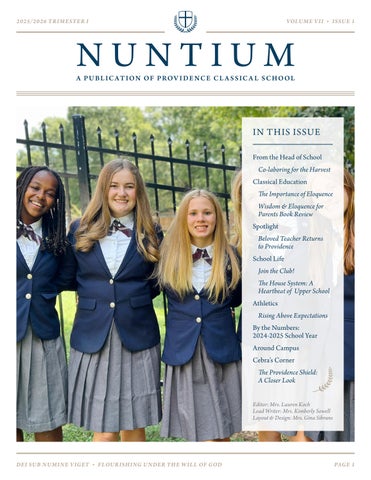
A PUBLICATION OF PROVIDENCE CLASSICAL SCHOOL
IN THIS ISSUE
From the Head of School
Co-laboring for the Harvest
Classical Education
The Importance of Eloquence
Wisdom & Eloquence for Parents Book Review
Spotlight
Beloved Teacher Returns to Providence
School Life
Join the Club!
The House System: A Heartbeat of Upper School
Athletics
Rising Above Expectations
By the Numbers: 2024-2025 School Year
Around Campus
Cebra’s Corner
The Providence Shield: A Closer Look
Editor: Mrs. Lauren Koch
Lead Writer: Mrs. Kimberly Sowell
Layout & Design: Mrs. Gina Sibrans
Co-laboring for the Harvest
by Mrs. Adrian Swain, Head of School
Have you ever stood in the produce section of the grocery store and all you can find are yellowish tomatoes, bruised apples or pale strawberries? How disappointing! We want our produce to be fresh, ripe, and have vibrant colors. Well-cultivated fruits and vegetables have a deeper flavor and provide us with more nutritional benefits. Good produce is given the right environment to grow, planted at the right time in the right way, cared for, managed, and harvested at the proper time. This process produces a high-quality crop that we all want to see in our stores.
Providence focuses on cultivation as well: cultivation of hearts and minds. We exist to cultivate students of wisdom and virtue by educating to the highest standards of the classical, Christian tradition for the glory of God. Our process begins with the end in mind. We labor to produce graduates who are faithful followers of Jesus, humble servants, passionate learners, self-disciplined and eloquent defenders of truth. Our graduates will enter a broken world prepared to overcome any challenges and confidently lead others through them as well.
As Christian parents, you have faithfully planted seeds of faith in your children’s hearts. Every day the balance of love and leadership you provide your children creates the right environment for them to grow. Your investment in a classical, Christian education supports your desire for formation of their heart and mind by what is good, true and beautiful. You have placed them in the right place at the right time to shape their affections. Each stage of their learning is tailored to how God has wired them. Teachers are removing the weeds of distraction, confusion, false ideas, and harmful habits. They are teaching the skills of language, math and music that every child needs to develop the powers of their minds and awaken their souls to God. Their guided study of the classics by Christian educators develops wisdom and virtue. In a Christ-centered environment, the responsibility and struggle to learn provides the healthy resistance needed to grow strong minds and hearts.
Farming is hard work! We cultivate day after day, not giving up, through grammar, logic, and rhetoric, and then we wait. Growth takes time. Hebrews tell us that cultivation isn’t always pleasant at the time, but later it produces a harvest of righteousness and peace (Hebrews 12:11). We labor faithfully, but God gives the increase (1 Corinthians 3:6-7). It is a joy to be co-laborers with you! May God bless the work of our hands and produce a harvest of wisdom and virtue in our students - thirty, sixty, one hundred times what was sown.
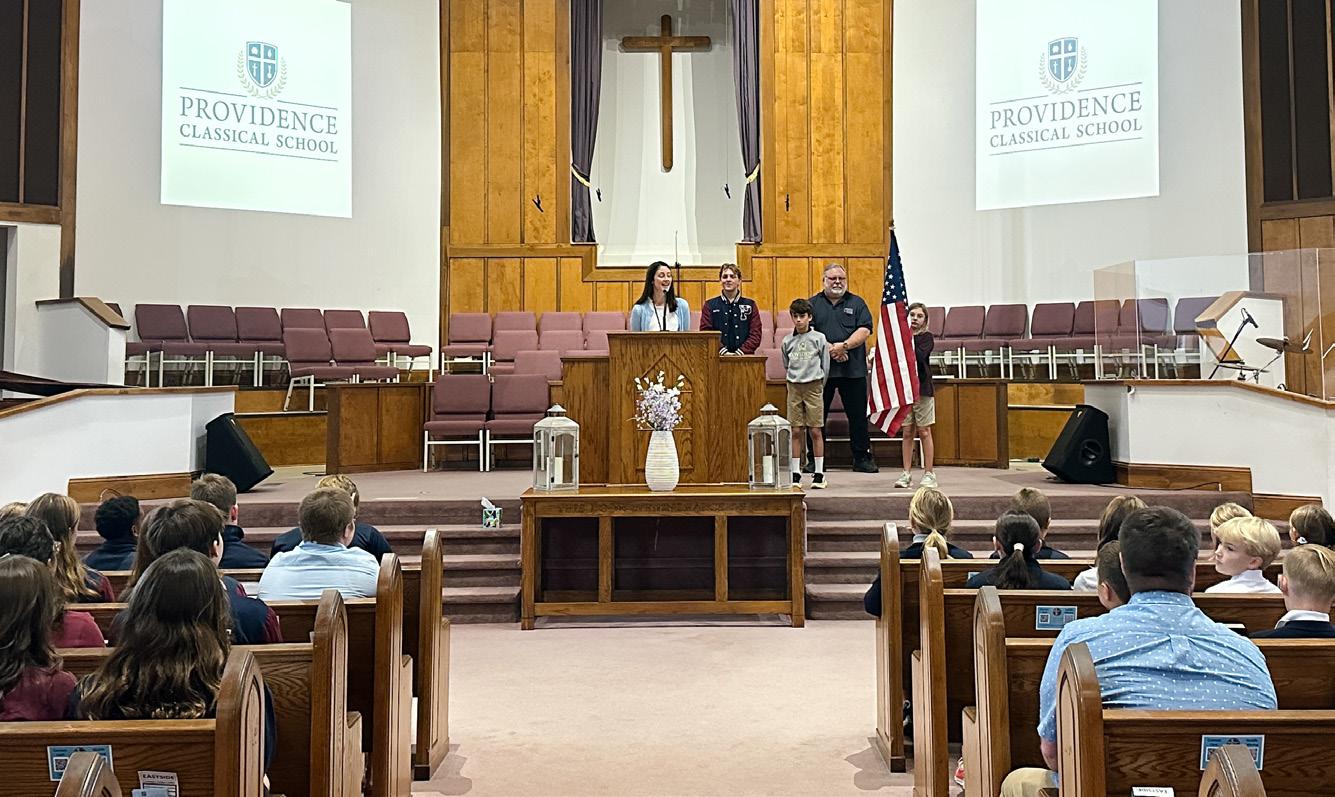
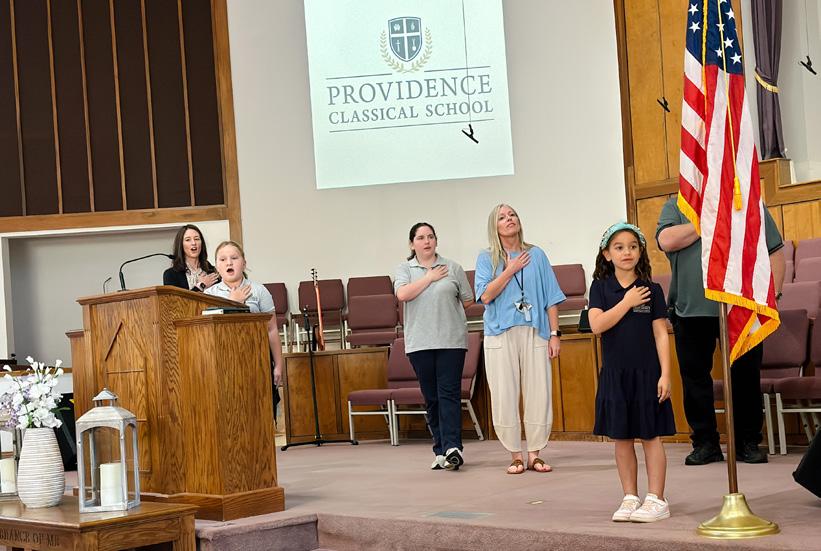
Tuesday Lauds is a new tradition this year that our students have grown to love. Every Tuesday morning, the whole school gathers in the sanctuary to begin the school week with prayer, worship, and a short message from Mrs. Swain. She spent the first few weeks of school explaining in depth the meaning of each of the icons that represent our student values found on our school shield: Faith, Humility, Learning, Self-Discipline, and Truth. Mrs. Swain is currently diving deeper into each of the four classical cardinal virtues: Prudence, Justice, Fortitude and Temperance.
Head of School From the
Mrs. Adrian Swain
Classical Education
The Importance of Eloquence
by Mrs. Susan Roberson, JD, Upper School Teacher & History Chair
I recently attended a meeting where a retired company president introduced himself. His impromptu speech was witty, personal, and eloquent. He had spoken many times throughout his career, and his speech was the fruit of a lifetime of practicing eloquence. Whether it is Patrick Henry persuading Revolutionaries with liberty or death, Abraham Lincoln calling for reconciliation of his divided nation with “malice toward none and charity for all,” or Ronald Reagan calling for Mr. Gorbachev to “tear down this wall,” eloquence persuades and leads people to change their course of action. As the great orator William Jennings Bryan said, “Eloquence may be defined as the speech of one who knows what he is talking about and means what he says – it is thought on fire.” In European History, we recently studied Christian humanists of the Renaissance. They looked to the classical orators, like Cicero, and believed that true eloquence requires not only style but also the pursuit of virtue, which leads to wisdom.
Each year in Logic class around this time, eighth-grade students craft and present their first arguments to prepare the students for later debates. For the most part, they choose their own topics in the hope that they are invested in their subject matter. Through the years, I have heard arguments about why 13-year-olds should be able to drive, why actual books are better than digital or audio books, why reading the Bible every day is essential for life, and why dino nuggets are the best chicken nuggets around. The students learn that speaking well combines logic, which is rightly ordered thinking, and rhetoric, which is the art of persuasion. Aristotle considered persuasion an art because, like learning to paint or play the piano, practice is required. Our eighth-graders are practicing eloquence. They are forming arguments, choosing their words, and hopefully presenting their arguments with “fire.”
Eloquence is honed through a lifetime of reading the great books, listening to moving speeches, and memorizing beautiful poems and Scripture. Great speeches, like those of Lincoln, are persuasive because Lincoln drew from the well-known King James Bible, classical literature and philosophy, and other great books. Without a lifetime of reading, reflecting, and synthesizing those materials to apply them to his own times and problems, his speeches would not have resonated with the American people and had such a profound impact on history.
Alongside a lifetime of cultivating the appreciation of words and ideas, the development of content is imperative. I once saw a probate hearing where an attorney forgot his file on the case. He put on a façade of eloquence before the judge, but his motion was denied. The lesson stuck with me: If there is no content to a speech, an audience can see right through it. If someone “forgets the file at the office,” it means that he or she did not prepare and cannot convey a meaningful message. Eloquence requires the speaker to know what he is talking about and mean what he says. Tied to this is ethical virtue and wisdom. As Cicero says, content should be wise, which can only come from being virtuous and having integrity. Someone of integrity would never leave his file at the office or be unwise enough to think he could give an eloquent speech anyway.
The saying goes that the best time to plant a tree was 20 years ago, and the second-best time is now. Our eighth-grade Logic students are getting an early start and, like a tree, will grow in eloquence. My hope is that one day, when they are a parent at a school meeting, a Sunday School teacher, or a company president, their lifetime of reading great books, their continuous cultivation of integrity and wisdom, and their practice and discipline in the art of rhetoric, will lead them to eloquence.
Mrs. Susan Roberson
Wisdom & Eloquence for Parents Book Review
by Mrs. Danielle Russo, Assistant Principal, Upper School and Teacher
The fact that Providence Classical School is a classical school is not the reason my husband and I decided to enroll our kids 5 years ago, but it is why we have stayed.
I was trained as a teacher through Winthrop University, one of the leading schools for educators, yet I had never been formally introduced to classical methodology until discovering Providence Classical School. The reigning pedagogy of the day was child-centered learning, and anything that deviated from that was unheard of and described as archaic and even cruel. In my experience trying to implement child centered learning in my middle school classroom, I grew exhausted by unrealistic expectations to trick or entertain students into learning. Now, 5 years into teaching at Providence Classical School, I have been amazed at the difference equipping students with the tools and resources to learn and work hard makes. Watching my own children learn, grow, and thrive under this methodology has been an absolute blessing. Reading Wisdom and Eloquence for Parents by Robert Littlejohn and Charles T. Evans has helped bridge some of the gaps in my knowledge about classical Christian education – and added fuel to my desire to contribute to our mission, and I believe it will do the same for you.
Learning the history of classical Christian education in Wisdom and Eloquence for Parents helped me see the significance of the longstanding tradition. Reading about how the classical Christian tradition builds on ideas from great minds like Augustine gave me insight into the solid foundation on which we build. Reading about the short and long term benefits of a classical Christian education, such as being 2.6 times more likely to pray alone or 6.7 times more likely to read, compared to students from other kinds of schools, encouraged me greatly.
It also helped open my eyes to the pervasiveness of current cultural thinking about education and children. It is hard to think outside of the “norm” in culture to see the shifts that have taken place as education has morphed into vocational training and developing leaders, or as Littlejohn calls them “shepherds,” into creating consumers. And an even bigger challenge is to consider the formative effects these shifts have had on us and our children. Reading and discussing this book will help all of us work together to cultivate students of wisdom and virtue through what we do at Providence Classical School - for God’s glory and the good of our world.
Wisdom and Eloquence for Parents is a fairly short book packed with a lot of great information that can lead to great conversations. Having a chance to discuss the book with other parents at Mrs. Swain’s Head of School book club earlier this month was very encouraging. Parents shared stories of how our students are growing and exemplifying the benefits discussed in the book. We noted the significance of the education our students are receiving and the ways it is preparing them for their future.
Discussing this book and our mission of classical Christian education will help our students experience a cohesive experience between school and home and strengthen what they learn in both places. I am grateful for the opportunity to learn with others. You can check out a copy of Wisdom and Eloquence for Parents from our Classical Library at school. Or, if you are like me and must write in a book to learn from it, you can purchase a copy for yourself through Classical Academic Press . The next book club discussion will be in January. I highly recommend participating.
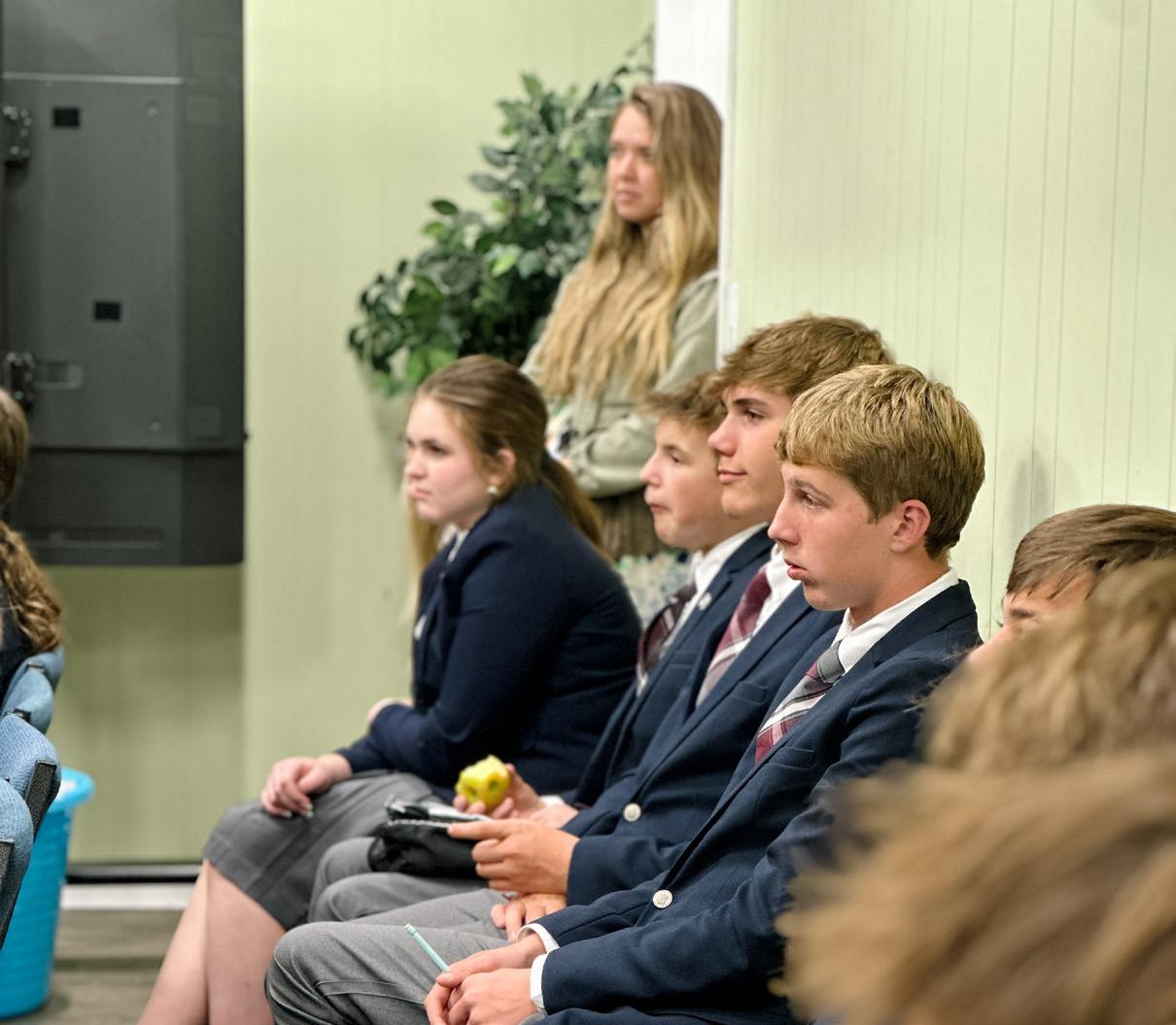
Head of School Book Club members discuss Wisdom & Eloquence for Parents.
Well-Loved Teacher Returns to Providence
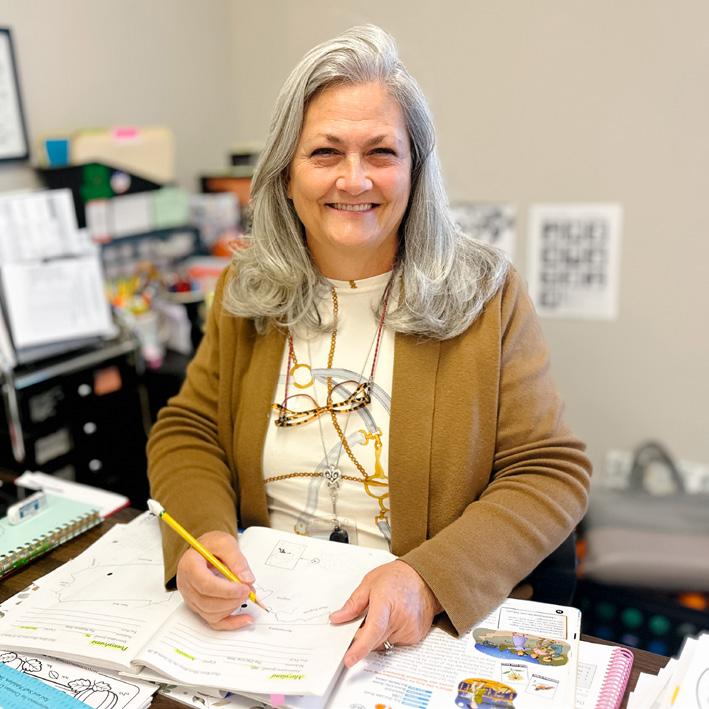
A familiar face has returned to the halls of Providence Classical School. Mrs. Valarie Hutto is once again teaching grammar school at Providence in her ninth year as a teacher, and her thirtieth year in education. Mrs. Hutto has taught first, second, and fifth grades in previous years, and this year she has begun a new journey exploring the true, good, and beautiful with her third-grade class. Her favorite aspect of teaching third grade is science and Greek Myths, though she also loves teaching Christian Studies. “The students are truly excited when I teach those three subjects. Honestly, I love all the subjects, and try to get the students excited about every subject,” shares Mrs. Hutto.
A unique blessing for Mrs. Hutto is having family members who are fellow members of the Providence faculty. Her son, upper school teacher Mr. Jacob Stiling, enjoys that some of his current students had his mother in grammar school, his sister Ms. Kassie Stiling as a teacher, and now him as a third member of the family. Occasionally, Mr. Stiling gets the opportunity to join his mom for lunch in the gym during the school day. Faculty and students also get to know Mrs. Hutto in a more personal way from the anecdotes Mr. and Ms. Stiling are willing to share about their mother; Ms. Stiling thinks that her mom’s beef pot roast is the best!
Mrs. Hutto is a big proponent of classical education, sharing, “(It) helps students of all backgrounds and all levels think more clearly and learn to think for themselves rather than learning to think what others want them to think. So many of the subjects all tie together.”
But for Mrs. Hutto, it is not only a love for classical education that brought her to Providence; it was also a love for the school. “Providence is a special place. Working here alongside such wonderful people is a true blessing. The students across all the grades are also very special, with each one being so unique and all are very kind. I couldn’t ask for a better place to work, and honestly, it doesn’t feel like work. Quite simply, I love teaching and I love Providence!”
Third grade teacher Mrs. Hutto prepares for an upcoming lesson during her planning period.
Join the Club!
Students are finding creative outlets and meaningful opportunities through Providence Classical School’s clubs. Whether it’s once a week or once a month, these gatherings allow students to build community with fellow students across school grades.
Debate Club: What adolescent gets the opportunity to sharpen his or her debate skills under the tutelage of a practicing attorney? Providence Debate Club members! Under the leadership of Providence Parent Keith Roberson, students in grades 6-12 meet to prepare for three to four competitions a year as members of the Calvin Cooledge Debate League. Providence club members typically excel each year, including students who have been promoted to compete on the national level.
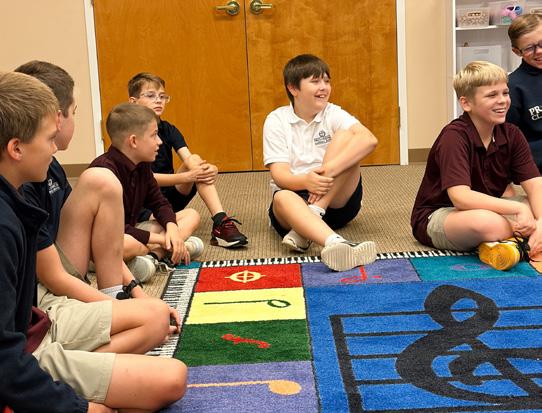
Grammar School Choir: Club members in grades 4-6 sing songs of praise one morning a week with their club leader, Ms. Virginia Kate Kirby, who has a spiritual goal in mind as she teaches the fundamentals of music. “I hope these students understand that their voices are a gift from God, and they grow as musicians together in community as they use their gifts to further His Kingdom,” shares Ms. Kirby.
Knitting and Crochet Club: Sophomore Addison Wall and Providence Parent Tara Bryant team up twice a month to assist club members with knitting or crochet projects. This club requires no experience. Members make projects and have lots of fun talking and sharing together.
Pickleball Club: This fast-growing sport has caught on at Providence. All skill levels are welcome to join for some enjoyable exercise with a touch of healthy competition.
Yearbook Club: Upper School students skilled in writing, photography, or creative design are invited to join Art Teacher Mrs. Gina Sibrans in the creation of the school yearbook. Meetings will begin soon.
Upper School Bible Study: These groups meet Friday mornings, grouped as boys grades 7-8, girls grades 7-8, boys grades 9-12, and girls grades 9-12. Teachers lead these studies, which always include student discussion and prayer. Upper School Bible Study is the highlight of the week for many students and faculty.
Parents and students are encouraged to look for additional information on our website as these and other opportunities take shape throughout the school year.
The House System at Providence A Heartbeat of Upper School
A hallmark of the classical tradition, the house system is a key component of the Providence Classical School Upper School community. On September 2, the Houses of Augustine, Mueller, and Edwards inducted a total of 29 new house members, including rising seventh graders and all new Upper School students. Inductees and current members alike sat with bated breath as each new member was announced by house; inductees looked forward to discovering their new house identity, while current members waited with anticipation to cheer on their new brothers and sisters and invite them to take their rightful seats amongst the house.
House induction is a much-anticipated rite of passage for Upper School students. For seventh-grader Juliette Rudolf, new inductee to the House of Augustine, the experience was one she had been looking forward to for years. “When I was inducted, it felt like I was growing up,” she shared with a smile.
The Providence house system fosters leadership development as students grow in the areas of character, accountability, and mutual respect. Student house leaders emphasize community and teamwork to their fellow classmates, always with the high calling of bringing glory to God. The House of Augustine, led by teacher Mrs. Paige Oliver, is named after Saint Augustine. The House of Mueller, led by teacher Ms. Kassie Stiling, is named in honor of the evangelist George Mueller. The House of Edwards, led by teacher Mr. Jacob Stiling, is named for the great theologian Jonathan Edwards.
The houses have begun their monthly meetings, and the competition for house points is underway. House points are earned through admirable conduct, displays of exceptional character, house competitions, and service. Students had the opportunity to participate in their first service project on October 18, helping to man the Eastside Fall Festival through face painting, serving snacks, and operating games. House members also enjoyed an all-house social in October, gathering for pizza, s’mores, and games at a bonfire fellowship. House members will enjoy more service projects and activities throughout the year, including House Wars on April 2.
The competition is fierce, the comradery is true, and the loyalty runs deep. Best wishes to each house!
Left: Debate Club member Elizabeth Roberson prepares for the upcoming Coolidge League Tournament.
Right: Grammar School Choir boys share a laugh during rehearsal; their joy and camaraderie shine through as they prepare for the spring Evening of the Arts.
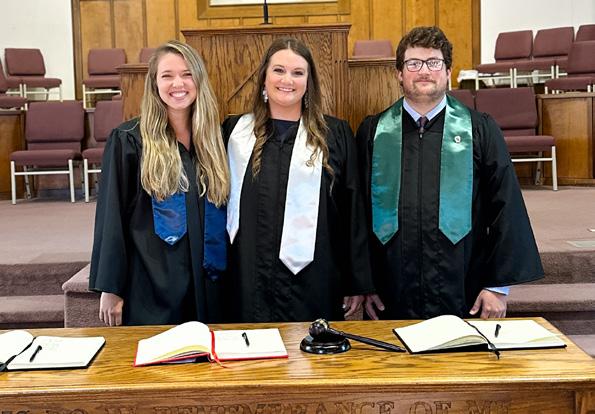
Left: Faculty House Advisors: Mrs. Paige Oliver, House of Augustine, Ms. Kassie Stiling, House of Mueller, and Mr. Jacob Stiling, House of Edwards.
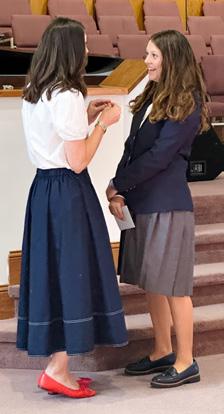
Right: Mrs. Swain pins 8th grader Caroline West as she joins the House of Mueller.
Athletics
Rising Above Expectations
Young Providence Cross Country and Volleyball Teams Excelled this Season
Athletic Director Brandon Eiff has only positive words to describe the student athletes who represented Providence Classical School this fall in Cross Country and Girls Volleyball. Despite the overall youth of each team, they each finished with a winning record, and more importantly, Mr. Eiff touted, “I often hear from other athletic directors that our athletes are the most respectful and polite of all the schools they compete against.”
The Cross Country Middle School Boys Team came in second for the regular season and were also the runners-up for the conference, while the Cross Country Middle School Girls Team placed first in the conference. The High School Coed Team finished as the conference runners-up, and to date they are preparing to compete in the state championship. “This was a good, young group of athletes who worked hard,” shared Mr. Eiff. “They started practicing in June.” Runners practiced at Winthrop Lake, Riverwalk, and Cherry Park. Eighth-grader Eden Bryant and seventh-grader Andrew Thomas both made the all conference team.
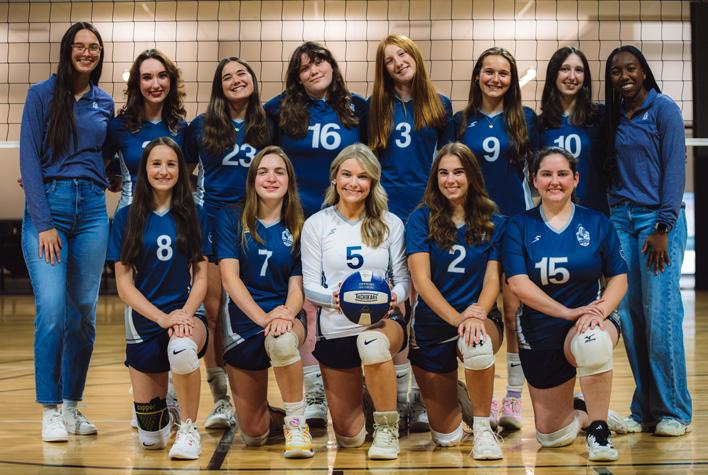
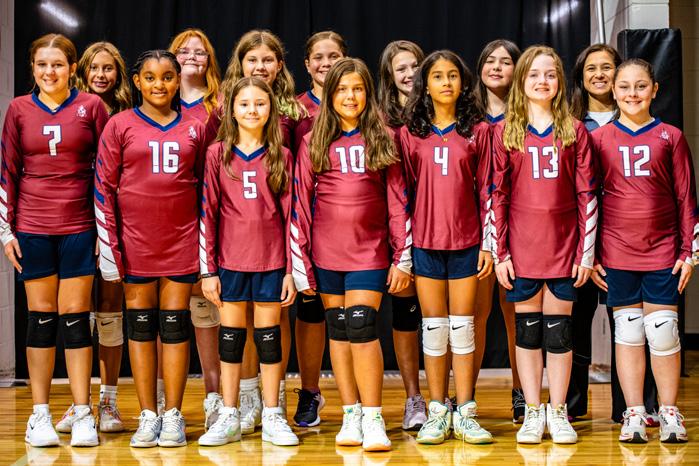
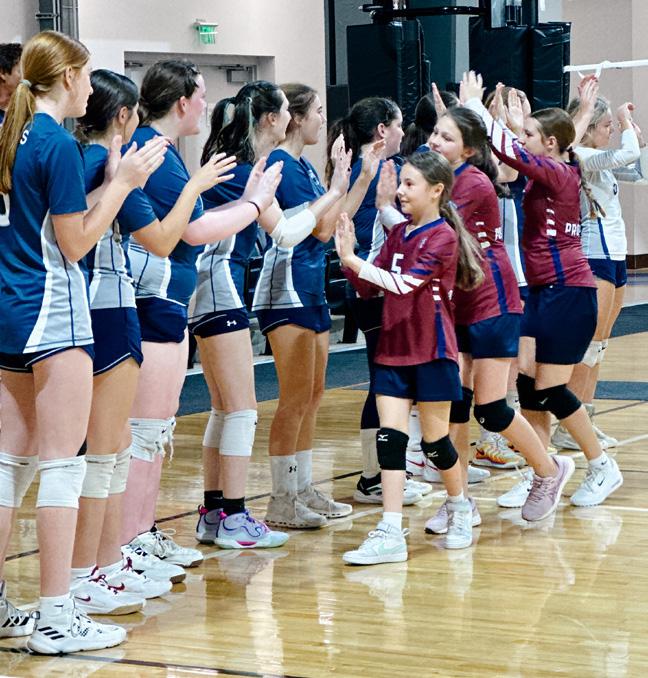
The JV and Varsity Volleyball Teams are preparing to date for SCAA, the state championship tournament. The JV performed well to finish with a winning record, especially considering this was Providence’s first year to have a JV team. Mr. Eiff noted that the Middle School Team, who will also enjoy a conference playoff experience, improved dramatically as their season progressed, and fifth-grader Harper Wade made all conference. The Varsity Team included four seniors who brought leadership to the otherwise young team. Senior Elizabeth Rahalewicz was one of fifteen players in the state named an all conference player.
2025 Cross Country Team
Andrew Thomas Avery Franey
2025 JV Volleyball Team
2025 Varsity Volleyball Team
2025 Middle School Volleyball Team
2024–2025 OPERATING BUDGET
$2 million FUNDS RAISED SCHOOL YEAR 10 th $85,424
4% CURRICULAR
3% CO-CURRICULAR
0.3% ADVANCEMENT DID YOU KNOW?
In 2024/2025, the tuition was $6,890 Lower School $7,210 Upper School
COLLEGE MATRICULATION among 2024 graduates 75% PERSONNEL 18% OPERATIONS
TUITION DISCOUNTS GIVEN STUDENT RETENTION 90% 100% $310,211
In 2024/2025, the cost to educate was $8,738* per student * Gap was covered by cash reserves and fundraising.
Around Campus
The Providence Shield: A Closer Look
by Mr. Richard Cebra, K-12 Principal
This school year Providence Classical School added two icons to our school shield that represent our student values. The Providence shield is divided into four quadrants and defined by the centrally located cross, the cross of faith. Within each of these quadrants is a meaningful symbol that represents the values we want our students to embody – the hands of humility, the flame of learning, the shovel of self-discipline, and the sword of truth.
Faith (Cross): We pray for our students to have a personal, growing faith in Jesus Christ. Following Jesus is the most important step in a child’s life. We want our students involved in a local church, studying Scripture, and praying. We look to Mark 11:22-24 – “And Jesus answered them, “Have faith in God. Truly, I say to you, whoever says to this mountain, ‘Be taken up and thrown into the sea,’ and does not doubt in his heart, but believes that what he says will come to pass, it will be done for him. Therefore I tell you, whatever you ask in prayer, believe that you have received it, and it will be yours.”
Humility (Servant hands): We teach our students to have the posture of a servant, to be teachable, thoughtful, other’s focused, serving God and their neighbors. We are instructed in James 4:10 “Humble yourselves before the Lord, and he will lift you up.”
Learning (Flame): We seek to nurture a life-long passion for learning, a wonder and curiosity at God’s creation and beauty, and joy as they grow in knowledge and wisdom. We look to the wisdom of Proverbs 18:15 “An intelligent heart acquires knowledge, and the ear of the wise seeks knowledge.”
Self-discipline (Shovel): We strive to instill personal responsibility, diligence, perseverance, and a strong work ethic. Students take an active role in their learning and pursuit of truth. Hebrews 12:11 explains to us the value of Self-discipline; “For the moment all discipline seems painful rather than pleasant, but later it yields the peaceful fruit of righteousness to those who have been trained by it.”
Truth (Sword): We teach that truth is absolute, found in Scripture and revealed in Christ. Students hide God’s Word in their hearts to nourish and protect their souls, equipping them to defend truth.
In Ephesians 6, the “sword of the Spirit” is the Word of God, representing the inspired Scriptures that the Holy Spirit wields as a spiritual weapon against the devil and for countering falsehoods. God’s truth is an active force that can be used both defensively to protect against lies and offensively to demolish spiritual strongholds, as it is described as sharper than any physical sword and able to penetrate the heart and soul. Speak the Word of God to others and apply it to your own life through study, prayer, and faith.
To make a tax-deductible gift to Providence Classical School, or to sponsor Nuntium, contact Mrs. Koch at lauren.koch@pcsrh.org.
For admissions inquiries, contact Mrs. Bridges at dee.bridges@pcsrh.org.
For employment opportunities, contact Mrs. Sibrans at gina.sibrans@pcsrh.org.