

By Connell Simkin-Watt, English Journalist
At the 2024 Grammys, Killer Mike won multiple awards, including Best Rap Song and Best Rap Album. The reaction on social media? A flood of comments such as: “Who tf is Killer Mike?”. For me, that moment was eye-opening. These fans were not dismissing rap, they were simply unaware of one of rap’s most respected figures.
That realization made me think about what I call the RapCaviar Bubble. Named after the world’s most influential rap playlist, it is a cultural echo chamber. Once you’re in it, it’s easy to stay there; the algorithms, editorial choices, and social dynamics all reinforce what you hear, like, and share. Stepping outside requires intentional curiosity.
The RapCaviar Bubble isn’t accidental—it is built by convenience, algorithms, and attention economics. Playlists like RapCaviar act as gatekeepers, giving exposure to certain songs while leaving others virtually invisible. Fans stick with it because it’s easy: one playlist provides a curated, “safe” selection of trending music.
Over time, this creates a loop. The playlist tells you what’s popular. You trust it, follow it, and share it. The more you rely on it, the less you feel the need to look beyond it.
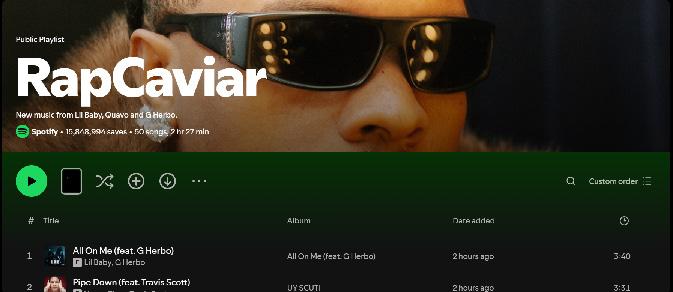
Suddenly, your understanding of rap is shaped by the hits that make the cut, while entire subgenres, regional styles, and underground movements remain invisible.
How I Escaped the RapCaviar Bubble
I found myself within the RapCaviar Bubble myself. Until 2020, I mostly listened to mainstream rap and rarely explored anything older than a few years. Then, during the pandemic, I started following rap-related Instagram accounts. People were talking about Alfredo by Freddie Gibbs, which had recently dropped at the time. Curious, I listened, and instantly fell in love.
From there, my exploration snowballed. I dove into Freddie Gibbs’ earlier work, then discovered Griselda, and eventually unlocked an entire universe of underground rap. That one album acted as a gateway into a world I didn’t know existed, showing me the diversity, depth, and artistry that mainstream playlists often overlook.
Why the RapCaviar Bubble Happens
The Bubble exists for several reasons:
• Algorithmic reinforcement: Streaming services reward popularity, meaning mainstream hits get pushed while underground gems remain hidden.
• Convenience and trust: Playlists like RapCaviar act as a shortcut, letting listeners feel “up to date” without actively exploring.
• Social signaling: Liking what everyone else likes can reinforce group identity, especially online.
• Content overload: With so much rap out there, it’s tempting to rely on curated hits rather than navigate the vast landscape yourself. The result? Many fans miss entire subgenres, regional styles, and influential artists, often without even realizing it.
Breaking free does not have to be intimidating. Here is a roadmap:
1. Follow independent rap accounts and blogs on Instagram, X (formerly Twitter), or TikTok—they often spotlight albums and artists outside the mainstream.
2. Explore subgenres intentionally: coke rap, pluggnb, experimental rap, regional underground scenes, etc.
3. Dive into older albums. Influential artists from the 2000s and 2010s often get skipped by modern playlists.
4. Listen actively, not passively. Play full albums, read lyrics, and pay attention to context.
5. Let curiosity lead: Start with one artist or album that intrigues you, then follow connections naturally.
(continued on page ...)
Editor In Chief/Rédactrice en chef
Christina Savoiardo
Layout Designer/Maquettiste
Cynthia Xie
Editorial Assistants/Assistants éditoriaux
Julia de Leon
Samir Ahmed
Bianca Anderson
Nicholas Duarte
English Editor/Rédactrice Anglaise
Destiny Chan
French Editor/Rédactrice Française
Leanne Eyre
English Journalists/Journalistes Anglais
Connell Simkin-Watt
Gabriella Maitland
French Journalist/Journaliste Française
Paige Lalonde
Bilingual Journalist/Journaliste Bilingue
Geneviève Stacey
Bonjour Glendon et bienvenue à notre 3e numéro!


As the semester’s end quickly creeps in, what better way to destress than to read another issue of Pro Tem. We know assignments are piling up and you might need a break, and we’ve got your back with an issue full of different perspectives and interesting reads.
Nous avons pleins d’articles à votre disposition. Du retour du Glendon African Network, du mois de novembre en tant que mois de sensibilisation de la santé mentale des hommes, et plus encore! Ce numéro est rempli de différents sujets qui vous attendent à être lus!
Next issue is our final issue of the semester, so if you are interested in being featured, please send us your contributions before November 23rd at 11:59pm. You can send us your recipes, your reviews, your poems, your opinion pieces, and much more!

bientôt!
Christina Savoiardo, Editor in Chief


Pro Tem is a unified organization that accepts and publishes articles from students, alumni, and community members. While we edit submissions for grammar and clarity, we stay true to each author’s voice and message. As an organization, we don’t endorse every viewpoint expressed; our goal is to amplify a wide range of perspectives within our community. Avis de non-responsabilité!
Pro Tem est une organisation unifiée qui accepte et publie des articles provenant des étudiants, des anciens élèves et des membres de la communauté. Bien que nous corrigeons les soumissions pour la grammaire et la clarté, nous restons fidèles à la voix et au message de chaque auteur. En tant qu’organisation, nous n’endossons pas nécessairement chaque point de vue exprimé; notre objectif est d’amplifier une diversité de perspectives au sein de notre communauté.

By Sirine Askri, Contributor
After a long wait, the Glendon African Network (GAN) is finally back. Initially founded in 2007 by Stephan Abara, the goal of the club is to promote key issues related to African culture, economy and politics. The founder’s initial objectives have been taken to the next level with his current role at the Commonwealth Society in Nigeria, as an Ambassador & Diaspora Representative. During its golden years, The GAN became Glendon College’s biggest club. However, during the COVID-19 pandemic, it was impossible to organize events and keep the club’s highly esteemed reputation. After the pandemic, a group of students decided to unofficially bring back the club. This revival was a success in terms of events, but did not last long due to internal issues linked to financial misconduct.
That brings us to this year. Due to the aforementioned issues, nobody wanted to bring back the club, and it was on the brink of disappearing. Thankfully, this year marks a new beginning. The new president, Youssef El Abed, and Vice-President, Sirine Askri, managed to gather a fresh, motivated team. The current vision for the 2025-2026 mandate is to “raise the club’s credibility”.
The exciting plans for this revival year will include networking events and partnerships with other universities, plenty of social events, February Black History Month events, as well as professional opportunities for the African community. With the long-awaited African Cup of Nations Football Tournament happening in Morocco this winter, stay tuned for fun watch parties to come. The rivalry is heating up, and the bets are already rolling in!
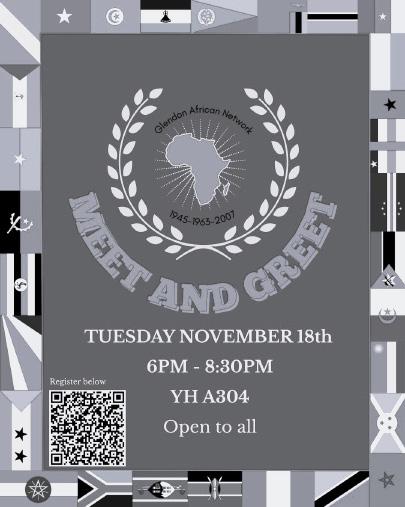
But GAN would like to hear from you! As such, they are planning a Meet & Greet event on November 18th at 6-8 pm in YH A304. Sign-up is open to anyone through the QR code on this page! It will provide a crucial opportunity to connect with others, meet new people and bond around African culture. Don’t miss out on the chance to be part of the community and follow us on Instagram to stay updated (@glendonafronetw)!
By Destiny Chan, English Editor
In Sweden, August 2025
As my tan fades
My browned skin
Bronzé
The skin my mother would scold and call chocolate
From head to toe
He said I was beautiful
De la tête aux pieds
But my dark skin
Will fade and fade
And turn lighter and lighter
Under jackets in the Canadian cold
Shedding inside by the heater
While the white snow covers the campus
Enveloping winter wonderland
Will it fade and fade
Like the memories of the summer we spent together?
Under the sanctifying sun
On the satisfying sand
In the mesmerizing salty sea
Will the memories fade and fade
Like my tan?
Forgetting how you loved my tan lines
How I couldn’t hold myself back
While you were climbing boulders by the river
All the times I fell asleep
And you watched me
Looked after me
Took care of me
Protected me
Guided me
Played with me
Like we were children in the French countryside playing tag
Our rings of stainless steel
Will it be enough to hold onto
As I see my body turn lighter and lighter
As it becomes farther and farther from you
The temperature here is 15° 17°
A few days ago, in Paris, it was 25° 26°
A week ago, in Montpellier, it was 36° 38°
The weather here
Reminds me of Canada
And I
Do not
Want to go
Back
By Anonymous
the sound of a cloud is an osprey's thing— footsteps in the rain, thunder when they march up the stairs worse than,
my mouth of sea salts to whisper something sour tugging my brother away to the sea
I saw him float to the white line between the sea and the sky, I saw the ospreys jumping to catch their fish, their simple fish
I sang a song of charity pity for my young yellow heart worse for my bones that still shake to the sounds of thunder, of sea that meets sky in an ease
I dream of such things things that ospreys leave behind, where was the sound of the floating moon burnt yellow from the touch of man one rat, two rats, three in sight—
I can’t get to bed tonight or any other night
By Anonymous
I saw that life was a burden to those around me especially when they had intelligence it seemed the greatest burden to bear I saw him on a Sunday I was working afternoons at the university cafeteria
he walked by delivering papers to a colleague I couldn’t quite believe that he was a teacher his youthfulness
a smile that brushed up against my cold chest walk towards the sun, she said I told her to stop the noise became louder that Sunday night
I starved to the finish of a revolution a burning a ponder that trickled into lust the Everglades were a mighty discovery dried up in the plaintiff's ash sweet rosemary gin my mind couldn’t stop the beating of words thumping into road bumps thumping thumping like a trunk hurdling suitcases
my chest couldn’t handle the irritation fallen snow— for the first time making snow angels look like fostered children that fell through the earth, quiet whispers get swept away into a soulful air
just watch my eyes, watch as they cave they talk down, they look down, they fade into darkness they submit
By Destiny Chan, English Editor
I’ll catch and catch and catch
Aim and aim and aim
High and High and High Climb and climb and climb
Till I reach the Tippity tippity tippity
Top Top Top
And then I’ll fall
And then I will Finally Be At Peace
By Leanne Eyre, French Editor
A part of me is dying
The piece I tried so hard to fit
The part I yearned to play
The part that had my heart
I memorized all the lines
Practiced to play the role
Only to be told
I could never be cast
I was sold a lie
Practice does not make perfect
Just all the more painful
To realize I will forever be a fraud
I can’t change how I was born
I can’t change how I talk
I can’t change who I am
I will always be a faux-cophone
So a part of me is dying
The part that wanted to be French
The part that dreamed it was possible
The part whose passion was pierced bent over
By Anonymous
I carried her divine feminine hands to this chest into my shoulders to hear sound; sold in my worn shoes to sell ideas of infancy, my hands were soft once before flesh, sinking into my skin flesh that bears the weight of bodies bodies of sounds and blood filling my bones with a wet cloth that drudges day after day, day after day, day after day,

Par Destiny Chan, Rédactrice anglaise
Ayant grandi dans un foyer de « collectionneurs compulsifs », la sensation d’être submergée par des montagnes d’objets prêtes à m’engloutir à tout moment a été difficile à surmonter. Des études montrent que les environnements encombrés augmentent le taux de cortisol, l’hormone du stress, et contribuent au chaos domestique, aux émotions négatives et aux difficultés de concentration. Les maisons encombrées entraînent également la procrastination, des disputes avec les personnes avec qui l’on vit, des problèmes de contrôle des impulsions, une baisse de la qualité de vie, du bien-être et bien plus encore.¹
Surtout en Amérique du Nord, où la surconsommation et l’obsolescence programmée sont monnaie courante, de nombreux foyers débordent d’objets inutilisés.
Nous connaissons tous cette sensation : des piles de vêtements que l’on ne porte pas, des papiers empilés sur le bureau, des tiroirs remplis d’objets « au cas où ». Le désordre s’installe discrètement, puis finit par nous submerger. Mais désencombrer n’a pas besoin d’être stressant ni chronophage. Avec un peu de pleine conscience et de structure, vous pouvez reprendre possession de votre espace — et de votre paix intérieure. Voici cinq étapes simples pour commencer.
1. Asseyez-vous et observez votre espace
Avant de commencer à tout jeter dans des bacs, prenez un moment pour simplement vous asseoir et observer. Comment vous sentez-vous dans cet espace ? Calme ou submergé ? Voyez-vous des objets qui n’ont pas leur place ? S’asseoir aide à ancrer le corps et l’esprit avant de commencer. Le désencombrement peut être étonnamment émotionnel, et cette position reposée aide à éviter la fatigue décisionnelle. Cette étape développe aussi la conscience : vous verrez votre maison d’un œil neuf et comprendrez ce qui mérite vraiment votre attention. Rester assis tout au long du processus permet à votre corps de rester calme pendant que votre esprit réfléchit et se libère.
2. Préparez des bacs de tri
Quand vous êtes prêt, créez quatre catégories simples : Garder, Donner, Jeter et Recycler. Il peut s’agir de boîtes, de sacs ou même de coins de pièce étiquetés. Avoir un système clair évite les hésitations et vous garde organisé. Lorsque vous prenez un objet, décidez immédiatement dans quel bac il va. Le but n’est pas la perfection, mais le progrès. Trier au fur et à mesure maintient votre élan et donne une destination précise à chaque objet.
3. “Faites une Marie Kondo”
Traitez vos objets par catégorie plutôt que par pièce : commencez par les vêtements, puis les livres, les papiers, les objets divers (comme ceux de la cuisine, de la salle de bain ou du garage), et enfin les objets sentimentaux. En triant, prenez chaque objet dans vos mains et demandez-vous : « Est-ce que cela m’apporte de la joie ? » Si ce n’est pas le cas, il est temps de le laisser partir. Cette simple question transforme la culpabilité (« Je devrais le garder, c’était un cadeau ») en gratitude (« Je l’apprécie, mais il ne me sert plus »). Dans son livre « La magie du rangement » , Marie Kondo explique que chaque objet a sa propre mission et son esprit. Même si vous n’avez jamais porté ce cardigan neuf, peut-être que sa mission n’était pas d’être porté, mais de vous révéler quelque chose sur votre style ou vos habitudes d’achat. Ce vêtement a donc rempli sa mission : il est temps de le laisser partir vers quelqu’un qui l’utilisera vraiment sans culpabilité ou remords de l'acheteur. Chaque fois que vous vous séparez d’un objet, placez-le dans le bon tas et dites-lui « merci et au revoir » pour reconnaître le souvenir qu’il porte, lui exprimer votre gratitude et lui offrir un doux adieu.
4. Évacuez immédiatement les bacs « indésirables » Une fois vos bacs « Donner », « Jeter » et « Recycler » remplis, ne les laissez pas traîner. Sortez-les de chez vous dès que possible. Plus ils restent, plus vous risquez de douter et de récupérer des objets dont vous aviez pourtant décidé de vous séparer. Les évacuer rapidement procure un soulagement visuel immédiat et renforce votre sentiment d’accomplissement. Vous verrez et sentirez le changement presque aussitôt : plus d’espace, plus de lumière, plus de calme.

5. Allez lentement et réfléchissez
Le désencombrement ne consiste pas seulement à nettoyer, mais à comprendre votre relation avec vos possessions, les souvenirs qu’elles portent et leur signification. Allez doucement, faites des pauses et observez ce qui surgit lorsque vous avez du mal à lâcher prise. Souvent, les objets incarnent des souvenirs ou des parts de nous-mêmes que nous ne sommes pas encore prêts à laisser partir. Réfléchir à ce processus transforme le désencombrement en un acte de soin émotionnel, et pas seulement en une tâche ménagère.
Ayant grandi avec des parents accumulant tout « au cas où », j’ai moimême adopté ces habitudes. Je gardais tout par peur — peur du gaspillage, du regret, ou de manquer plus tard. Au fil des années, cette peur s’est transformée en sacs remplis de vêtements d’enfance, d’étagères et de placards surchargés, d’objets me tombant dessus quand je cherchais quelque chose — des rappels lourds d’un esprit de rareté enraciné dans une enfance financièrement instable. En réaction, je suis devenue obsédée par le désencombrement. J’ai passé d’innombrables heures à tenir chaque objet dans mes mains, à faire des allers-retours aux centres de dons et de recyclage textile. J’ai regardé la série « L’art du rangement avec Marie Kondo » sur Netflix, lu son livre, visionné des vidéos avant/après sur YouTube et appris des astuces d’organisation. Une chaîne que je recommande est « A to Zen Life », animée par Melissa, une mère de deux enfants, qui a aidé des millions de personnes à retrouver un espace de vie apaisé grâce à des pratiques minimalistes et son histoire touchante.
Même si mes espaces se vidaient peu à peu, je voyais encore du désordre là où il n’y en avait plus, même les yeux fermés. Chaque fois que je retournais dans ma maison d’enfance, j’éprouvais le besoin urgent de désencombrer à nouveau. Et chaque fois que je rentrais chez moi, après un week-end ou un long voyage, j’étais immédiatement prête à me débarrasser de plus de choses. Heureusement, plus on pratique le désencombrement, plus cela devient facile : les décisions se prennent plus vite, et le « muscle du choix » se renforce.
Le désencombrement est devenu ma manière de faire face, de résister et de guérir. Chaque don, chaque surface dégagée, chaque boîte vidée était un acte de réécriture de mes anciens schémas. J’ai compris que lâcher prise ne signifie pas perdre, mais regagner le temps et l’énergie qu’aurait coûté le fait de conserver. Même si vous pensez en avoir besoin un jour, cet objet occupe déjà de la place et vous coûte de l’argent. Posséder, c’est une responsabilité. Moins vous avez de choses, moins vous avez à nettoyer, à réparer, à déplacer, et plus il est facile de déménager ou de vivre dans un espace plus petit. Le désencombrement m’a transformée, car je ne faisais pas que ranger — je créais un foyer paisible et accueillant pour respirer, me détendre, vivre, me sentir en sécurité et libre.
Même si vous ne désencombrez que 15 minutes par jour, vous remarquerez peu à peu une différence profonde : un bureau plus dégagé, une armoire plus légère et un cœur plus apaisé. Pas à pas, vous créez non seulement une maison plus ordonnée, mais aussi un espace qui reflète la personne que vous êtes aujourd’hui et celle que vous êtes en train de devenir.
¹ Fuller, Kristen. « Comment l’encombrement et la santé mentale sont liés. » Very Well Mind. Dernière mise à jour le 25 octobre 2025. https://www.verywellmind.com/decluttering-our-house-to-cleanse-our-minds-5101511.
By Gabriella Maitland, English Jouirnalist
November brings many things to mind. The cold, Christmas-time angst, and men’s mental health. Here are some things to think about regarding men’s mental health.
Why Movember?
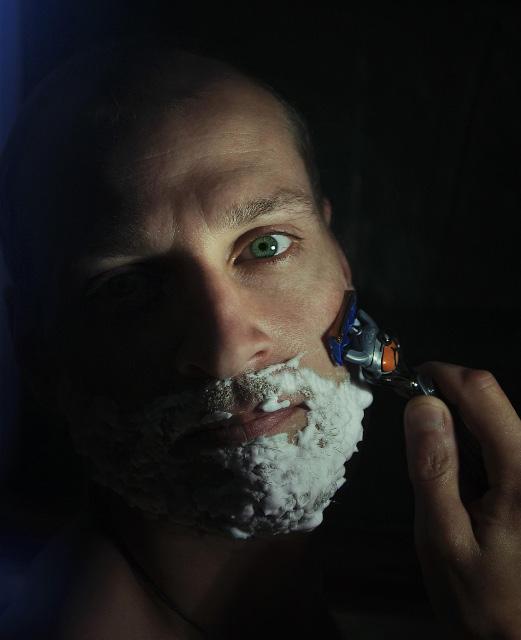
“Movember” was coined in 2003 by Travis Garone and Luke Slattery. They dared each other to bring moustaches back in fashion and grow out their facial hair for the month. Despite starting as a joke inspired by a breast cancer fundraiser, they turned Movember into a campaign that would support substantial issues men face every day. These include: mental health challenges, suicide, prostate cancer and testicular cancer. ¹
According to the CDC, the suicide rate among males in 2023 was approximately four times higher than the rate among females. Males make up 50% of the population, but nearly 80% of suicides. Also, it is the second leading cause of death among Canadian males aged 15–44 years. It is widely believed this is because men typically choose more ‘violent’ methods of ending their lives. In Canada, 3 out of 4 deaths by suicide are men, and men die on average 4 years earlier than women. Moreover, in terms of Prostate and Testicular Cancer, Testicular Cancer is the most commonly diagnosed cancer in young Canadian men, and 1 in 9 Canadian men will be diagnosed with prostate cancer in their lifetime.
Movember reminds us to support men’s mental and physical health, break stigmas around vulnerability, and encourage open, compassionate conversations year-round.
¹ “Czech & Speake Fragrance. “Movember: History, Hype and Rules.” Accessed November 6, 2025. https://www.czechandspeake.com/fragrance/journal-posts/movember/
² Centers for Disease Control and Prevention. “Suicide Data and Statistics.” CDC, March 26, 2025. https://www.cdc.gov/suicide/facts/data.html
³ Movember. “Movember.” Accessed November 6, 2025. https://uk.movember.com/about/cause.
By Paige Lalonde, Journaliste française
Dans le but de rendre le plus grand nombre possible de mes actions intentionnelles et orientées vers la décolonisation et la réconciliation, j'ai réfléchi à la raison pour laquelle nous faisons de la reconnaissance des terres. J'ai remarqué, en tant qu'auditeur fréquent de ces reconnaissances territoriales, qu'elles sont souvent placées au hasard et, à leur tour, n'ont aucun sens.
La raison pour laquelle nous prenons le temps de reconnaître les nations autochtones qui ont une histoire riche et une expérience vécue sur cette terre, c'est parce que l'endroit où nous vivons, ses histoires et le contexte dans lequel il existe aujourd'hui font partie intégrante de ce que nous sommes et de tout ce que nous faisons. Elle est inamovible, en particulier dans le domaine de la violence sexiste et sexuelle. La colonisation est un processus d'occupation non consensuelle; l'État canadien est autorisé à exister en tant que légitimation de cette violence non consexuelle, qui a chassé les peuples autochtones de leurs terres par la force et les a privés de l'expression de leur identité culturelle. Même dans les cas où la colonisation a été jugée légalement consensuelle, comme dans le cadre du Traité 13 qui couvre les terres de Toronto, ces accords ont été conclus avec des différences de pouvoir flagrantes; Les « achats » de terres ont été effectués dans le cadre d'un système qui rendait par la force le capital très précieux.
Je veux réfléchir aux raisons pour lesquelles la violence coloniale produit une plus grande vulnérabilité à la violence sexuelle et sexiste. Pourquoi une personne qui a été privée de ses droits fonciers et de son identité culturelle serait-elle plus susceptible de subir des préjudices oppressants? Comment la colonisation a-t-elle contribué à l'appauvrissement systémique des peuples autochtones, et comment cet appauvrissement contribue-t-il à la vulnérabilité à la violence fondée sur le genre? Comment les femmes autochtones et les personnes de diverses identités de genre sont-elles particulièrement touchées par la colonisation?
Les Autochtones sont victimes de violence de manière disproportionnée, en particulier de la violence fondée sur le sexe et de la violence sexuelle, comme nous le voyons avec la crise des femmes, des filles et des personnes bispirituelles autochtones disparues

et assassinées; comme nous l'avons vu dans le système des pensionnats, qui a exercé des violences culturelles, physiques et sexuelles contre les élèves dont il avait la charge; comme nous l'avons vu dans la rafle des années 60, qui a relogé de force des enfants et des adolescents autochtones dans des foyers blancs. Cette situation est renforcée par la crise culturelle imposée par la colonisation, qui prive les peuples autochtones de leurs pratiques culturelles et de leurs marqueurs identitaires forts qui auraient pu leur donner du pouvoir.
Le savoir autochtone peut servir de guide pour le travail que nous faisons ensemble, en tant qu'étudiants et en tant que membres de nos communautés. L'identité 2-Spirit, par exemple, qui a été presque effacée par le génocide culturel du Canada contre les pratiques spirituelles autochtones, est une façon de contribuer au démantèlement de l'hétéronormativité, qui contribue à la violence. Des groupes autochtones comme la Régie de la santé des Premières Nations de l'Université de la Colombie-Britannique préconisent également la naturalisation de l'expression sexuelle et une relation positive entre soi et le corps, une pratique sur laquelle nous pouvons compter pour aider à éliminer la honte sexuelle.
La culture du consentement ne peut se construire sans décolonisation. Je pense que nous devrions investir des efforts pour changer la culture de la reconnaissance des terres et passer du simple fait de cocher des cases. Il doit s'agir d'un acte de réflexion et d'une action en justice.
By Anonymous
Dear Glendon,
I was drawn to your charm and beauty—the French heard in the hallway, the bilingualism, the not-so-intimidating class sizes, the tranquil, historic campus…
My transition from high school to university was seamless. I felt safe, found connection, and thrived. Once I came to Glendon, I was told I would never leave. Three years ago, I believed it. I loved the campus, the community, and the program.
But you are changing… Courses are being cancelled. Response times are slowing down. Research funding is now limited to first-year students. Residences feel barren. And if the future forecasts come to pass, you may become unrecognizable — rewired, restructured, rebranded, and maybe even replaced.
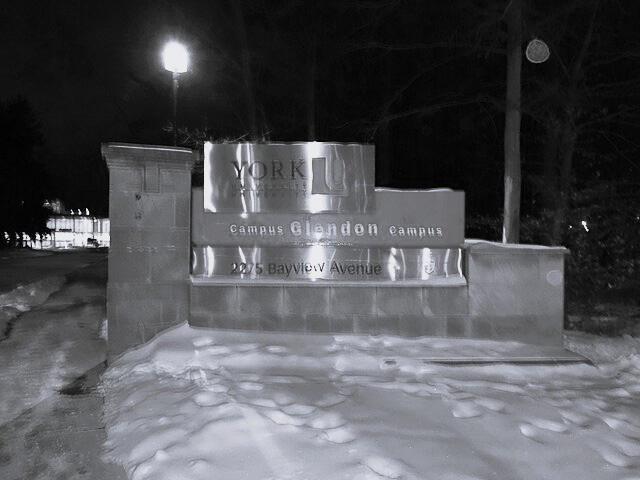
I know it’s not your fault. Life is slowly being sucked out of you with every course cancellation, program suspension, and funding cut. It’s not fair to students, to professors, and certainly not to you.
I consider myself a Glendon student: not a Keele student, not a York student. Yet I may be part of one of the last cohorts privileged to call myself a Glendon student. One of the last to fulfill my degree requirements without having to leave this beautiful campus.
I can only hope that amidst the restructuring, the essence of what makes Glendon Glendon will survive.
Sincerely, Your Student
By Connell Simkin-Watt, English Journalist
Getting Started on Your Underground Rap Journey
Here’s a cheat sheet to help you start exploring beyond the mainstream, with explanations of why these pairings work:
If you like: Kendrick Lamar → Try: Open Mike Eagle or Mick Jenkins
Both artists share Kendrick’s thoughtful lyricism, social commentary, and clever wordplay, though in smaller, more experimental or underground contexts.
If you like: Drake → Try: Eli Sostre or Saba
Eli Sostre blends rap and R&B in a way that is authentic and grounded, offering the melodic vibes Drake fans love without the commercial gloss. Saba brings introspection and smooth flows, balancing storytelling and melody.
If you like: J. Cole → Try: Kota the Friend or Reason
These artists focus on storytelling and reflective themes, echoing Cole’s approachable yet conscious style, but from an underground perspective.
If you like: Future → Try: Autumn! or Summrs
Both artists have melodic flows and hail from the South. Instead of trap, they lean into Pluggnb, giving a fresh, emotional, and internet-driven spin on Southern rap.
If you like: Travis Scott → Try: JPEGMAFIA or Danny Brown
Both artists experiment with sound and textures, pushing boundaries in ways that fans of Travis’ sonic innovation will appreciate, but in more challenging, less mainstream ways.
If you like: Megan Thee Stallion → Try: Chika or Tierra Whack
Fans of clever wordplay, punchy flows, and strong presence will enjoy these artists, who bring distinct personalities and underground vibes to their craft.
Subgenre essentials:
• Coke rap/street rap: Griselda, Freddie Gibbs, Benny the Butcher — gritty, lyrical storytelling with hard-hitting production.
• Pluggnb/melodic trap: Autumn!, Summrs — melodic, internet-driven, emotional energy.
• Experimental/avant-garde rap: JPEGMAFIA, Danny Brown — pushing limits of sound, flow, and creativity.
The RapCaviar Bubble isn’t inherently bad. In truth, it’s convenient, fun, and exposes fans to hits quickly. However, it’s also limiting. Beyond the mainstream lies a universe of rap filled with underground legends, experimental sounds, and culturally rich stories. Breaking out of the Bubble doesn’t mean abandoning your favourite artists; rather, it means expanding your musical world. The “Who tf is Killer Mike?” moment is proof that there is always more to explore, and the journey is worth it. Start with one artist, then let curiosity guide you. The underground rap world is massive, but it’s infinitely rewarding.
By Gabriella Maitland, English Journalist
“You wonder which is worse: the symptom or the cure.”
- “Aftershocks”, “Next to Normal”
While browsing Substack back in July, I stumbled upon a post by “Sh*t You Should Care About” titled “What You Lose When You Beat Depression.” ¹ In the article, the author described how they’ve never felt better since becoming medicated, and how it has transformed their life to such a degree that others have begun commenting on how different they are. Even so, the medication has several caveats, one of the greatest being the “numbness [that] makes you careless.”

At the end of the day, the medication leaves them wondering if they’re even human anymore. Sure, the pros outweigh the cons, but what good is healing if you no longer feel like yourself? You may be “better” now, but are you still the same person? In recent months, there has been an increase in beating what ails you (i.e., mental illness, niche hobbies, your personality) and becoming “normal.” But what exactly does it mean to be normal? According to Merriam-Webster, to be considered normal, one must “conform to a type, standard, or regular pattern.” ² However, in a society of 8 billion people, it can be imagined that achieving such ‘normalcy’ is not as easy as it sounds. So how is it done? Give people an ideal to strive to, tell them what to do, and claim that you possess a cure.
The belief that conformity is a necessity has plagued humanity since its inception. I believe it can largely be attributed to utilitarianism, more commonly known as the “greater good.” ³ Being a systemic part of normative ethics since the 18th century, utilitarianism tells us “an action (or type of action) is right if it tends to promote happiness or pleasure and wrong if it tends to produce unhappiness or pain.” ⁴ But with such binary thinking, when is the line drawn and when do we decide to draw it? If a person is chewing loudly and it bothers five individuals around them, are they ‘against’ them because they’re causing them unhappiness? By this logic, wouldn’t it be better for firefighters to sacrifice the life of one person in a burning building, rather than cause their own family potential pain? Nothing in life is this simple, nor should it be. Utilitarianism can be used to critique norms that don’t lead to overall well-being—which is highly subjective—but it can also enforce majoritarian norms leading to injustice and unfairness. This is because utilitarianism focuses on the sum of happiness, rather than its distribution. The Belgian statistician, Adolphe Quetelet, who proposed the concept of human normality as a science, is a prime example of this. Despite not explicitly identifying as utilitarian, Quetelet’s writings were influenced by utilitarians who used his theories to advance their social policies. ⁵ Quetelet once said, “The average man, indeed, is in a nation where the centre of gravity is in a body; it is by having that central point in view that we arrive at the apprehension of all the phenomena of equilibrium and motion.” ⁶ Essentially, he believed that the average man's qualities embodied the good that we should all strive for. Though this holds for many sciences, statistics in particular, deviation from the norm was not ideal. When applied to data sets, that’s understandable, but Quetelet and many who came after him did not stop there. In fact, Quetelet’s influence led to people being ranked based on their mental abilities, and in keeping with his ‘passion’ for normality, any deviation from the norm, particularly when relating to mental health, was seen as a monstrosity on par with criminality. To some extent, this still holds today.
¹ Unknown Author, “what you lose when you ‘beat’ depression”, shit you should care about, Unknown publishing organization, July 6th, 2025, https://shityoushouldcareabout.substack.com/p/what-you-lose-when-you-beat-depression.
² Unknown Author, “Normal,” Merriam-Webster, Encyclopædia Britannica Inc, November 5th, 2025, https://www.merriam-webster.com/dictionary/normal.
³ Duignan B. H.R. West, "Utilitarianism." Encyclopedia Britannica, October 11, 2025, https://www.britannica.com/topic/utilitarianism-philosophy.
⁴ Julia Driver, “The History of Utilitarianism”, Stanford Encyclopedia of Philosophy, Stanford University, March 27th, 2009, https://plato.stanford.edu/entries/utilitarianism-history/. ⁵Adolphe Quetelet, “Adolphe Quetelet, Treatise of Man and the Development of His Faculties”, goodreads, goodreads, unknown date, https://www.goodreads.com/quotes/1046189-the-determination-of-the-average-man-is-notmerely-a.
⁶ Unknown Author, “Adolphe Quetelet and the legacy of the “average man” in psychology”, APA PsycNet, American Psychological Association, 2021. https://psycnet.apa.org/doiLanding?doi=10.1037%2Fhop0000202.
By Gabriella Maitland, English Journalist
Mental health has been, and continues to be, highly stigmatized as a result of society’s emphasis on normalcy. Owing to this obsession and the fact that historically people have been treated differently, more than half of the population doesn’t receive treatment. This would be acceptable if it were purely their choice, but statistically, it has not been. As demonstrated by Aktion T4 in Nazi Germany, or in the Middle Ages, where “mental illness was often misattributed to demonic possession or a punishment from God.” ⁷ The core principle driving life on earth is survival, and historically, being forthcoming with one’s mental health has negatively impacted overall life in some way. However, at some point in history, things began to shift. In more modern times, people have realized that discussing and even sharing their mental health with friends, family, and professionals has helped deal with certain issues. Resultingly, not only is stigma gradually decreasing, but deviations in mental health are being more normalized. Although it’s great that people no longer have to suffer in silence, this poses an interesting question. Are people seeking help because they need it, or are they doing so because it’s now being normalized? Every day on social media, there’s a new wellness video or method to cleanse your mental palette. These days, it almost feels like de-stigmatizing mental health and illness is less about the help and more about not being deviant. For some, it’s a trend that can be summarized in five words: the aesthetic of being healed. Commence the “healing arc”.
We’ve probably all seen an abundance of videos about “being your best self” or “healing some part of you that you didn’t know was broken”. Whether those videos are formatted as “10 things I learned from therapy” on TikTok, or a video of someone dressed in white, while tears stream down their face, speaking about the importance of boundaries, is irrelevant. Sure, “these visuals are calming, [and even] aspirational. But they also quietly imply that healing should look a certain way.”
⁸
A more mainstream version of this expectation is Jinx, in season two of the League of Legends-based series, “Arcane”. Now that it’s been months since the show’s conclusion, many fans (including myself) can’t help but feel a bit disappointed about how some characters were portrayed in season two. In a few in-series months, Jinx transforms from this erratic, traumatized, “shoot-first” persona into a caretaker.
Years of deeply rooted trauma were erased. And all it took was a few months and a little girl? I’m not saying that connection and distractions (especially healthy ones) don’t go a long way in the process of healing, but mental illness and trauma don’t just go away—especially not at that rate. The way Jinx’s mental health was handled in season one was a big component of why so many rallied behind her in real life despite her clearly ‘villainous’ actions. As a result, to see them essentially throw that away felt like a slap in the face for many. When you search Arcane, Jinx’s face is almost always the first that you see. Thus, in keeping with the “art of giving the people what they want,” season two is largely centred on Jinx’s arc. But guess what? She’s “normal” now. Many argue that we did see brief declines in Jinx’s mental health for about 35 minutes during the 6-hour runtime that season two had, but that feels more like a curveball to prevent complaints that her mental complexity is almost completely gone. Arcane doesn’t exactly denigrate mental health, but the treatment of Jinx’s mental health in its second season almost feels like an oblique way of indicating that someone who struggles with mental health is not likely to be popular with all audiences. However, I would argue that if they had continued the more nuanced take on mental health shown in season 1, the show would have gone a long way in changing the perception of many when it comes to mental illness—but I digress.
Healing is never linear, despite what society and selfhelp media try to sell you. Being more aligned with social norms doesn’t make you more likable, and having mental health issues just makes you human.
Society essentially tells us that being normal is the way to go, but these ideals push the narrative that we are an extension of society, rather than the other way around. After all, uniqueness and human deviation are some of the best parts of society. For all Quetelet’s theories, he never would’ve been as well-known as he is without deviation; and as much as I chastise what feels like performative wellness, I can appreciate that it’s opening doors for those who would’ve never had the courage to walk through had it not been normalized. Still, normality is a road you should never enter. Most times, you’ll find that the “endless pursuit [of normality] doesn’t leave you feeling better. It leaves you feeling empty.” ⁹
⁸ Vishakha Punjabi, “How Gen Z Has Made Healing Into An Aesthetic”, Elle, Louis Hachette Group, May 22nd, 2025, https://elle.in/life-culture/how-gen-z-has-made-healing-intoan-aesthetic-9083741.
⁹ Christina Aaliyah, “Gen Z’s Wellness Obsession”,July 27th, 2025 Opinion Piece, 18:28, https://www.youtube.com/watch?v=NYbWfTqpJ80.
By Ambre Collignon, contributor
On October 15th, 2025, I went to Niagara Falls with three other exchange students. The trip was initiated by Misha, a German exchange student who had been planning to travel across Ontario during reading week. Her first planned stop was Niagara Falls, and she learned through Niki, a mutual friend, that there were three of us who wanted to go as well. Thus, at 9 a.m., Misha, Niki, Liyana, and I met up at the rental agency Sixt, on Wellington Street West, and began our journey towards the majestic falls.
It was a two-hour drive from Toronto to Niagara. We started the journey speaking English, but quickly switched to French as Misha wanted to practice her French with us francophones. A friend of Misha’s had recommended that we aim for Niagara-on-the-Lake as a first destination, then drive toward the falls along the Niagara River, so we followed that route.

I would suggest that route as well, especially at this time of year, as the colours were stunning. We soon arrived, and though I had been warned that it was a very strange city, I was astonished by the Disneyland vibe. After an overwhelming journey across the city, from the parking lot to the waterfront, we finally caught a glimpse of the falls. It was truly magical. For a second, we all remained speechless. Then, we took some pictures. As we stood before the falls, one of my friends shared how moved she was to see them with her own eyes, reflecting on where she’d come from. Afterwards, we struggled to find a place to eat for a decent amount of money. We ended up getting junk food, which we ate in front of the falls. I would recommend bringing your own food to avoid the overpriced junk food sold at restaurants. Soon after, two of us had to catch our bus, so we left our two other friends and took a 30-minute walk to reach the bus station.
In conclusion, I would say that Niagara Falls is a very touristic, weird and overwhelming place, but the falls themselves are truly worth the uncomfortable setting. Overall, if you’re with a good group of friends, then you should all be able to enjoy your time in Niagara Falls.
What gets smaller every time it takes a bath?
I'm not a blanket, yet I cover the ground; a crystal from heaven that doesn't make a sound. What am I?
I'm sweet and cold with a stick to hold; a treat on a hot day, worth more than gold. What am I?
What has a head but no brain?
Why do cats make good warriors?
I have a neck, but no head. I have two arms, but no hands. What am I?
What word contains 26 letters but only has three syllables?
What comes down but never goes up?
What five-letter word typed in all capital letters can be read the same upside down?
The more you take, the more you leave behind. What am I?
What is more useful when it is broken?
I am easy to lift, but hard to throw. What am I?
What goes up, but never comes down?
What has a neck but no head?
Good Housekeeping. ‘110 Riddles for Adults That Are Sure to Stump You’. 8 January 2025. https://www.goodhousekeeping.com/life/ a41779999/riddles-for-adults/.
Model Senate 2026: Application deadline is fast approaching
Do you know a post-secondary student who is passionate about Canadian politics? You need to tell them about Model Senate! Model Senate offers post-secondary students a unique opportunity to step into senators’ shoes for a weekend, gain valuable skills and network with like-minded young leaders. The next edition of the event will be hosted in-person at the Senate of Canada Building in Ottawa, from Thursday, May 7 to Saturday, May 9, 2026, and will once again feature a range of exciting activities! Applications close Monday, December 8, 2025: https://sencanada.ca/en/sengage/model-senate/application-process/?utm_medium=email&utm_campaign=SENgage_ModelSenate2026_Reminder&utm_source=SENgage&utm_term=Model-Senate-2026-%2F%2F-Simulation-du-S%C3%A9nat-2026
What can students expect from Model Senate?
• Gain a deeper understanding of how Canada’s Upper Chamber works and how senators serve Canadians in Parliament.
• Debate bills and policy issues during simulations of Senate sittings and committee meetings.
• Network with senators, Senate Administration staff and fellow participants through meet-and-greet opportunities.
• Receive training from experts in parliamentary procedure.
• Access career advice and inspiration.
To be considered for this event, applicants must:
• Be enrolled in a recognized Canadian university or college at the time of the event.
• Be between 18 and 30 years old as of May 7, 2026.
• Complete and submit the online application form and required documentation (CV, statement of intent, letter of support and proof of enrolment) by December 8, 2025.
Help us spread the word about this opportunity by:
1. Forwarding this information to eligible students and directing them to our website for more information.
2. Encouraging them to apply by the deadline — this incredible opportunity only happens once a year!
3. Following us on social media for the latest updates and sharing this opportunity with your network:
•