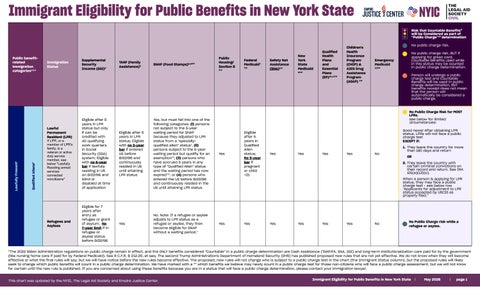
Immigrant Eligibility for Public Benefits in New York State

Risk that Countable Benefits* will be Considered as part of “Public Charge”13 determination
No public charge risk.
No public charge risk, BUT if applying for green card, Countable Benefits used while in this status may be counted in public charge determination.
Person will undergo a public charge test and Countable Benefits will be used in public charge determination, BUT benefits receipt does not mean that the person will automatically be considered a public charge.
Resident (LPR) If LPR, or a member of LPR's family, is a veteran or active duty service member, see below "Lawfully Residing armed services connected noncitizens"
Eligible after 5 years in LPR status but only if can be credited with 40 qualifying work quarters in Social Security (SSA) system; Eligible with no 5-year bar if lawfully residing in US on 8/22/96 and blind or disabled at time of application
Eligible after 5 years in LPR status; Eligible with no 5-year bar if entered US before 8/22/96 and continuously resided in US until attaining LPR status
Yes, but must fall into one of the following categories: (i) persons not subject to the 5-year waiting period for SNAP because they adjusted to LPR status from a "speciallyqualified alien" status† , (ii) persons subject to the 5-year waiting period but qualifiy for an exemption††; (3) persons who have accrued 5 years in any type of "Qualified Alien" status and the waiting period has now expired†††; or (4) persons who entered the US before 8/22/96 and continuously resided in the US until attaining LPR status.
Refugees and Asylees
Eligible for 7 years after entry as refugee or grant of asylum; No 7-year limit if in refugee or asylee status before 8/22/96
No. Note: If a refugee or asylee adjusts to LPR status as a refugee or asylee, they then become eligible for SNAP without a waiting period.†
Eligible after 5 years in Qualified Alien status; No 5-year bar if pregnant or child
No Public Charge Risk for MOST LPRs, see below for limited circumstances:
Good news! After obtaining LPR status, LPRs will not face a public charge test
EXCEPT if:
1. They leave the country for more than 180 days and return OR
2. They leave the country with certain criminal convictions on their record and return. See INA 101(a)(13)(c).
When a person is applying for LPR status, they may face a public charge test - see below row “Applicants for adjustment to LPR status accepted by USCIS as properly filed.”
No Public Charge risk while a refugee or asylee.
effective or what the final rules will say, but we will have notice before the new rules become
The proposed, new rules will not change who is subject to a public charge test in the chart (the Immigrant Status column), but the proposed rules will likely seek to change which public benefits will count in a public charge determination. We have marked with a ** which benefits we believe may newly count in a public charge test for those non-citizens who will face a public charge assessment, but we will not know for certain until the new rule is published. If you are concerned about using these benefits because you are in a status that will face a public charge determination, please contact your immigration lawyer.
2
Withholding (W/H) of Deportation or Removal under the INA14
Eligible for 7 years after granted withholding; No 7-year limit if granted W/H before 8/22/96 Yes
No. Note: If a person granted withholding of removal adjusts to LPR status, they then become eligible for SNAP without a waiting period.†
Battered
Spouses and Children of U.S. citizens or LPRs who have a prima facie determination or approved I-360 self-petition under VAWA or a pending or approved I-13015, 16
Eligible if lawfully present on 8/22/96 and disabled at time of application
Eligible if entered US before 8/22/96 and continuousl y resided in US until qualifying as battered immigrant; Eligible after 5 years in qualified status if entered US after 8/22/96
No. Note: If a Battered Spouse and/or Child adjusts to LPR status and the adult has accrrued 5 years in any Qualified Alien staus (including time spent as a Battered Spouse), then they are eliigble for SNAP; Battered Children are eligible for SNAP as soon as they adjust to LPR status.††
17
Eligible after 5 years in qualified status; No 5year bar if pregnant or child <21
Cuban/Haitian Entrant (C/H)18
Paroled for 1 Year or More
(Afghan/Ukrainian Nationals - see row below)
Eligible for 7 years after entering US in C/H status; No 7-year limit if entered before 8/22/96
Eligible if lawfully present in US on 8/22/96 AND currently in parole status AND disabled at time of application
Eligible after 5 years in parole status
No. Note: If an adult paroled for 1-year or more adjusts to LPR status and has accrued 5 years in any Qualfiied Alien status (including time spent as a person paroled for 1-year or more), then they are eligible for SNAP. Children paroled for oneyear or more are eligible for SNAP as soon as they adjust to LPR status.††
Eligible after 5 years in Qualified Alien status; No 5-year bar if pregnant or child <21
Iraq/Afghan SIV Holders and certain Afghan/ Ukranian humanitarian parolees
Lawfully residing armed services connected noncitizens (including veterans) and their dependents
Canadian Born Native Americans
Eligible for 7 years after entering US
Amerasian Immigrant
No. Note: If Iraq/Afghan SIV Holders adjust to LPR status, then they are eligible for SNAP without a waiting period.†
Ukranians granted parole between February 24, 2022 and September 30,2024 would be eligible for SNAP as soon as they adjust to LPR status.
Note: If lawfully residing armed services noncitizens adjust to LPR status, then they are eligible for SNAP without a waiting period.††
Note: If Canadian Born Native Americans adjust to LPR status, then they are eligible for SNAP without a waiting period.†
Eligible for 7 years after entering US; No 7-year limit if entered before 8/22/1996
Citizens of Micronesia, Palau, and Marshall Islands often referred to as
Note: If an Ameriasian immigrant adjusts to LPR status, they then become eligible for SNAP without a waiting period.†
Applicants for adjustment to LPR status accepted by USCIS as properly filed
of “Public Charge” determination
An applicant for adjustment of status (LPR status/green card) will face a public charge test unless they are adjusting from a status that is exempt from public charge. Statuses exempt from public charge include but are not limited to: asylee, refugee, U-visa, Tvisa, S-visa, Battered Spouses and Children ("VAWA"), SIJS, Registry, NACARA, HRIFA, Cuban Adjustment Act.
Note: Receipt of Countable Benefits does not automatically mean a person will be deemed a public charge.
Applicants for adjustment under NACARA, HRIFA, Cuban Adjustment Act or Registry (noncitizen who has continuosly resided in the US since before 1/1/1972)
Public Charge risk while an applicant for adjustment under NACARA, HRIFA, Cuban Adjustment Act or Registry.
As of July 1, 2026 persons with unexpired DACA will be transferred from Essential Plan to State
(but where DACA unexpired will only be eligible for
until July 1, 2026).
related immigration categories* 1,2,3 Immigration Status Supplemental Security Income (SSI)4 TANF (Family Assistance)5 SNAP (Food Stamps)5,6**
1. The categories of noncitizens included in the classification “lawfully present” depend to some degree on the particular federal benefit program involved. For example, the definition of “lawful presence” for the purpose of noncitizen eligibility for Social Security Disability and Retirement benefits is found at 8 C.F.R. § 1.3. As of November 1, 2024, HHS expanded the definition of “lawful presence” for the purpose of noncitizen eligibility under the ACA found at 45 C.F.R. § 152.2 to include DACA recipients. See 89 Fed. Reg. 39392, et seq. (May 8, 2024).
Housing/ Section 8 **
2. The immigrant categories included in the “Qualified Alien” classification are found at 8 U.S.C. § 1641 to describe noncitizen eligibility for federal “means tested benefit programs,” defined to include TANF, Federal Medicaid, SSI and SNAP ("Food Stamps").
3. “PRUCOL” stands for Persons Residing Under Color of Law. It was once an eligibility category for federal benefit programs but was eliminated by 1996 federal welfare reform. Since 1996, noncitizens considered PRUCOL are eligible only for New York state benefit programs. A person is considered residing “under color of law” if the federal government is aware of their presence in the U.S. and is not currently contemplating enforcing their removal. For a long time, NYS Office of Temporary and Disability Assistance (OTDA) and NYS Department of Health (DOH) defined differently which noncitizens were included in this category for the Safety Net program and the State Medicaid program, respectively. Litigation and changes in department policy eliminated most of these differences. For OTDA’s definition of PRUCOL for Safety Net eligibility, see GIS 23TA/DC039 (5/12/23). For the noncitizen categories that NYS DOH considers PRUCOL, see GIS 24 MA/06 (7/10/24).
4. For general information on immigrant eligibility for SSI, see SI 00502.100 Basic SSI Alien Eligibility Requirements: https://secure.ssa.gov/ apps10/poms.nsf/lnx/0500502100 For more information on eligibility for SSI for immigrants who were lawfully residing in the US before 8/22/96 and are blind or disabled, see SI 00502.142 Qualified Aliens Who Are Blind Or Disabled And Were Lawfully Residing in the U.S. On 8/22/96: https://secure.ssa.gov/apps10/poms.nsf/lnx/0500502142
5. For more information on immigrant eligibility for TANF, SNAP, and SNA, see Non-Citizen Eligibility Desk Aid, HRA-209 (6/1/2023): http:// onlineresources.wnylc.net/nychra/docs/pd__23-06-eli_1_.pdf Note: OTDA is in the process of updating its Non-Citizen Eligibility Desk Aid to reflect the SNAP eligibility changes.
6. For more information on immigrant eligibility for SNAP, see USDA FNS, Supplemtnal Nutrition Assistance Program (SNAP) Implementatoin of the One Big Beautiful Bill Act of 2025 -- Alien SNAP Eligibility https://drive.google.com/file/d/12Djp36vCN1ptrFCjLhaKWgdjTaYJyXHP/ view?usp=sharing. New applicants for SNAP will be subject to the changed rules. Current recipients of SNAP will have the new rules applied to them when their current period of certification ends. This means, formerly eligible categories like Asylees, Refugees, T-Visa holders, VAWA self-petitioners will not suddenly lose their SNAP. They will only lose SNAP when their current certification period ends.
7. Non-citizen eligibility changes for Federal Medicaid will become effective October 1, 2026. For information on current immigrant eligibility for Federal Medicaid and State Medicaid, and required documentation, see Documentation Guide for Citizen and Non-Citizen Eligibility for Health Insurance Coverage in New York State, OHIP-0046 (6/24) : https://www.health.ny.gov/health_care/medicaid/publications/docs/gis/ 24ma06_att1.pdf
8. For OTDA’s PRUCOL definition for Safety Net Assistance see, GIS 23TA/DC039 (5/12/23), https://otda.ny.gov/policy/gis/2023/23DC039.pdf
9. For DOH’s clarification of PRUCOL status for purposes of State Medicaid eligibility, see GIS 24 MA/06 (7/10/24): https://www.health.ny.gov/ health_care/medicaid/publications/docs/gis/24ma06.pdf This DOH GIS confirms that people who have had a pending request for immigration status/relief denied remain PRUCOL so long as the U.S. government has not initiated removal. Note: Who is eligible for State Medicaid will begin changing July 1, 2026.
10. For more information on what immigration statuses qualify for coverage in the healthcare marketplace, visit: https://www.healthcare.gov/ immigrants/immigration-status Note: Eligibility for qualified health plans and the Essential Plan will also be changing.
11. If a noncitizen covered by the Essential Plan is also financially eligible for Medicaid, and the Essential Plan does not cover a particular benefit that would be covered by State Medicaid, the insured immigrant will receive wraparound benefits funded by State Medicaid.
12. For noncitizens between the ages of 19-64 who are financially eligible for Federal Medicaid but do not have an eligible immigration status, Emergency Medicaid may be available. It is a federally funded program that provides healthcare coverage for residents of NY state ineligible for health insurance who are suffering from a condition that manifests itself by acute symptoms such that absence of immediate medical attention could put the individual in serious jeopardy or seriously impair bodily function or cause serious dysfunction to an organ or bodily part. Noncitizens who are 65+ and do not have any immigration status are now eligible for comprehensive State Medicaid.
13. Refers to public charge ground of inadmissibility, as outlined in the 2022 Final Rule, 87 FR 55427: https://www.federalregister.gov/ documents/2022/09/09/2022-18867/public-charge-ground-of-inadmissibility
14. Withholding of removal under the Immigration and Nationality Act (INA) is granted to those whose life or freedom would be threatened in their home country because of their race, religion, national origin, political opinion, or membership in a particular social group. Under the Convention Against Torture, Withholding of Removal may be granted to those who can prove they would be tortured, without regard as to whether such torture is based on a protected ground. The International Convention Against Torture (CAT) was ratified by the U.S. in 1998 through Public Law No. 105-277, div. G, Title XXI Section 2242. Some CAT beneficiaries, usually because of criminal or security issues, are
15. Also included in the broader definition of “VAWA Self-Petitioners” in Section 101(a)(5) of the INA are those with VAWA cancellation, and battered family members protected under NACARA, HRIFA and the Cuban Adjustment Act.
and
9**
16. Battered spouses and children’s eligibility for benefits. See 06-INF-14 Revised: http://onlineresources.wnylc.net/pb/docs/06-inf-14_revised.pdf
(EP)10,11** Children's Health Insurance Program (CHIP) & AIDS Drug Assistance Program (ADAP) ** Emergency Medicaid 12** Risk that Countable Benefits will be considered as part of “Public Charge” determination
17. Note that VAWA qualified immigrants are not listed in the federal housing law at 42 U.S.C. § 1436a as being in a qualifying status but HUD has acquiesced to their eligibility for government-subsidized housing since they are considered “qualified aliens” under federal immigration law.
18. Cuban/Haitian Entrants are defined in the Administration for Children and Families (ACF’s) Fact Sheet: https://www.acf.hhs.gov/sites/default/files/ documents/orr/orr_fact_sheet_cuban_haitian_entrant.pdf
19. SIJS awardee eligibility for Safety Net Assistance was established in 2021. See GIS 21 TA/DC059 (8/18/21): https://otda.ny.gov/policy/gis/ 2021/21DC059.pdf SIJS applicants have been eligible since May 12, 2023. See GIS 23TA/DC039 (5/12/23), https://otda.ny.gov/policy/gis/ 2023/23DC039.pdf
20. Note that under the "lawfully present" category, the individual has to actually file an application for permanent residence and provide the documents necessary to prove that he or she entered the US before January 1, 1972 and has lived in the US continuously since that time. The PRUCOL category does not require the individual to file an application with USCIS and the evidentiary showing is generally more relaxed with a benefits agency. For more guidance regarding documentation for proving PRUCOL status, see Documentation Guide: https://www.health.ny.gov/ health_care/medicaid/publications/docs/gis/24ma06_att1.pdf
21. On May 8, 2024, the Department of Health and Human Services published a Final Rule, with a target implementation date of November 1, 2024, making several changes in the eligibility of noncitizens for Marketplace programs. 89 Fed. Reg. 39392, 39392-39437. Most significant is the inclusion of DACA grantees in the category of noncitizens considered to be "lawfully present" and who thus become eligible for Qualified Health Plans and related subsidy programs. 89 Fed. Reg. 39392, at 39436. See 08 OHIP/INF-4 for details. The second Trump Administration has since reversed the extension of Marketplace eligibility to DACA recipients and those currently enrolled will lose their benefits as of July 26, 2026.
22. As of the publiciation of this chart, DED has been authorized by President Biden for Liberians, Palestinians, eligible Hong Kong residents and certain Lebanese nationals.
23. For TPS eligibility for Safety Net Assistance, see GIS 16 TA/DC053 (10/14/16): https://otda.ny.gov/policy/gis/2016/16DC053.pdf
24. For DACA applicant eligibility for Safety Net Assistance, see Non-citizens Recognized as Permanently Residing Under Color of Law (PRUCOL) for Safety Net Assistance (SNA) Eligibility, GIS 23TA/DC039 , (May 12, 2023): https://otda.ny.gov/policy/gis/2023/23DC039.pdf
25. For postpartum eligibility for State Medicaid, see New York State Medicaid Update, March 2023, Vol. 39, No. 6: https://health.ny.gov/health_care/ medicaid/program/update/2023/no06_2023-03.htm#postpartum
† Persons who have been designated by Congress to be "specially-qualified aliens" who are not subject to a 5-year waiting period for SNAP include people who adjusted to LPR status from the following statuses: persons granted asylum, persons who entered the U.S. as refugees, persons granted withholding of removal; survivors of trafficking; persons considered an Ameriasian immigrant; Cuban Haitian entrants; and persons granted Iraqi and Afghan Special Immigrant Visas.
†† LPRs in the following categories are considered exempt from the 5-year waiting period: (a) children under the age of 18; (b) persons in receipt of a disability-based public benefit; (c) persons who can be credited with 40 quaifing work quarters in the SSA system; (d) veterans, active duty military and their spouses and children; and (e) persons born before August 22, 1931 if they were lawfuly present in the U.S. on August 22, 1996.
††† This means all the time they have spent in any "Qualified Alien" status adds up to at least 5 years. Qualfiied Alien statuses include LPRs who did not adjust from a "specially-qualified status;" Battered Qualified Aliens, which includes VAWA selfpetitioners; and persons granted parole for more than a year. For example, if a person was granted parole for more than a year on January 1, 2021, and then adjusts to LPR status through a family member on February 1, 2023, once the time spent as a parolee (2 years) and the time as an LPR adds up to 5 full years, they have fullfiled the 5-year waiting period and become eligible for SNAP.