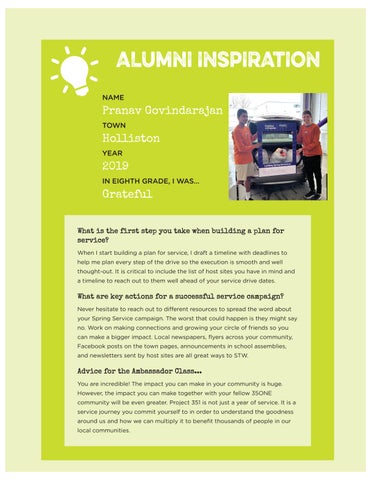
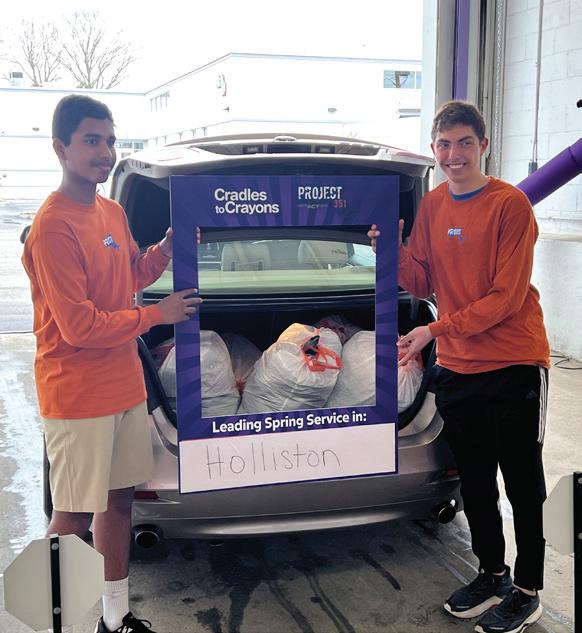
What is the frst step you take when building a plan for service?
When I start building a plan for service, I draft a timeline with deadlines to help me plan every step of the drive so the execution is smooth and well thought-out. It is critical to include the list of host sites you have in mind and a timeline to reach out to them well ahead of your service drive dates.
What are key actions for a successful service campaign?
Never hesitate to reach out to di!erent resources to spread the word about your Spring Service campaign. The worst that could happen is they might say no. Work on making connections and growing your circle of friends so you can make a bigger impact. Local newspapers, flyers across your community, Facebook posts on the town pages, announcements in school assemblies, and newsletters sent by host sites are all great ways to STW.
Advice for the Ambassador Class...
You are incredible! The impact you can make in your community is huge. However, the impact you can make together with your fellow 35ONE community will be even greater. Project 351 is not just a year of service. It is a service journey you commit yourself to in order to understand the goodness around us and how we can multiply it to benefit thousands of people in our local communities.
Building An Action Plan For Success
Leadership Goals
> >Capture your vision in a plan for action, teamwork, and success.
> Plan all aspects of your service with focus on clear goals, deadlines, positive energy, and accountability.
> >Inspire others by demonstrating that change is possible. You just need a strong Action Plan and a united team!
Creating an Action Plan
Creating an Action Plan is essential to the success of Spring Service. It will serve as a compass for big ideas, deadlines, safe service guidelines, important meetings, and opportunities to celebrate and appreciate those who served. To begin, it’s important to REFLECT SET GOALS
1. Your Role As a Leader
The first step for developing your Action Plan is reflection on your special gifts and interests as a leader.
Leadership Attributes
Project 351 Alumni have cited these skills & traits as essential to their success leading Spring Service. Take a moment to IDENTIFY your skills. What are you good at? What are your talents? What are your traits that bring special pride and joy?
2. Goal Setting
Setting goals creates a destination for your Action Plan. The end point for your planning, hard work, community engagement, and acts of kindness and generosity. The “Act” section of this chapter will provide you with a framework and prompting questions to set specific goals for your Leadership Team, your partnerships, and for yourself! The next chapter of the Toolkit will take you through the steps of recruiting and uniting your Leadership Team.
My Leadership Style
With the support of Project 351 and a caring adult, develop your Action Plan. Use this page to reflect upon your special gifts, interests, and resources as leader.
Experience (e.g. Project 351!, other service and leadership experiences)
Motivation (e.g. why do you want to support the children served by Cradles to Crayons?)
How will you use your special gifts and interests to create your plan for positive change?
The leadership skills I want to develop through Spring Service are:
Teamwork
Communication
Project Planning
Other Skills:
Confidence
How To Make A Di!erence
Inspiring Others To Act
Skills that I already have, but want to improve are:
My Spring Service training and experience can help strengthen these skills by:
Goal Setting
Spring Service relies on strong team work and partnerships. Help ensure your success by defining goals for each. When those goals are realized, everyone succeeds and more children are served!
Cradles to Crayons
How will your Spring Service create positive change for children a!ected by poverty and homelessness?
Your School/Community
How will participating in Spring Service have a positive impact on your school and community?
How can you build awareness of childhood poverty and homelessness in Massachusetts?
Your Leadership Team
How can your help your teammates gain skills and enthusiasm for service?
How will you motivate your Team to unite, act, lead for C2C?
How will you make your Team feel valued and appreciated?
You
Reflect upon the following questions and statements and reference them throughout planning as motivation for your service.
What does it mean to lead your school/community as an Ambassador?
Pick one of Project 351’s leadership values—kindness, compassion, humility, gratitude—and reflect upon how you will strengthen this value through service.
What actions will you take that reflect that value?
Your definition of “success” for Spring Service is:
Close your eyes and imagine a young child, living at a shelter, opening their C2C KidPack, filled with “like new” items they requested. Items donated by you and your community. How do you hope they feel?
3. Planning the Work
Your planning calendar at the front of this toolkit will record dates, actions, and milestones. It will guide your weekly “to do’s,” provide clarity for Leadership Team assignments, and give you important perspective on your e!orts to “Unite, Act, Lead.”
Over the next month your service will go through important stages of development. These stages are replicable for any service project you decide to pursue as you continue to change the world. You will use these to help complete your Action Plan.
Inspiration
Recruitment
Experiencing the power of the Ambassador community through Spring Service Leadership Academy
& Support Teams—Recruit teams for
My Spring Service Goals
Cradles to Crayons
Number of bags of donations:
I want the children we serve to feel:
School/Community
Number of donors/supporters:
I want my school/community to be positively impacted in the following ways:
Your Leadership Team
Skills I hope my teammates and I learn from one another:
On the final day of service—when all of our donations are delivered and counted— I want my team to feel:
My personal goals for Spring Service are:
4. How to Turn Your Plan Into Action!
An Action Plan is the blueprint to service success. Writing it is one thing, bringing your plan to life is another. And, a lot more fun!
Your Action Plan will include focus areas that will help ensure success—for example, advertising your service (which we call “Spread the Word” or STW). In addition to your Action Plan template, you will receive a worksheet to organize each focus areas. The template will provide space for your team to complete based on the tasks and dates YOU dream up and decide. It will break areas down in five categories to help you manage your plan and team for success.
WHAT?
WHO?
DEADLINE
TOOLS
WHY?
Focus area or set of tasks
Individual/team responsible for executing the focus area
Date when the task needs to be complete
Resources required for success (for example for STW—fliers, announcements, video)
What is the importance of this task, how will it contribute to successful service? As you lead, it’s important to communicate the connection between “action” and “results.” It will help motivate your team!
Your Spring Service Action Plan will feature the following focus areas:
Partnership Management: Your management of your Action Plan with your Host Site contact, Leadership Team, and Support Team.
Operations & Transportation: The essentials of service (collection bins, locations) and support for transportation to regional drop o! location.
Spread the Word: Plan and tools to communicate and build awareness of C2C, Project 351, and your Spring Service details.
Celebrate & Appreciate: Your vision for expressing gratitude and celebrating impact with those who made your Spring Service success possible!
TAKE FIVE
Finding your “Why” of Service
Stephen Spaloss, Senior Vice President, City Year
Your commitment to lead with compassion is an inspiration to me. The key to your integrity as a leader and e!ectiveness in service is to dig deep and understand the “why” behind your service. To connect intention to action. And, compassion to project planning. Every time you serve, find your “why”.
Here’s my Take Five on how to get to your “why”.
1. Start with your life experience. Are there people, places, events that first inspired your commitment to children facing homelessness or unfair economic challenges? Have you or someone you care for been the recipient of acts of kindness at a time of great challenge? Do you hope that your example of service inspires your friends and community to serve? Are there leadership skills you hope to gain through service?
2. Be a student of service The more knowledge you gain, the more powerful your “why”. So research Cradles to Crayons. Soak up the wisdom of this Toolkit. Ask your ALC and Service Hero teammates for advice and ideas. Go online to learn about the challenges children face in Massachusetts. Uncover the inequities and lack of resources that too many children experience. Understand how your service can help them reach their potential.
3. Use the power of reflection. How do you think about big ideas and decisions? Writing, poetry, conversations with a mentor, quiet time, motivational music. Leaders reflect, assess, and envision the change the lies ahead.
4. Respect the dignity of those you serve. At City Year and Project 351, we serve WITH not IN community. Central to our “why” is the understanding that every person, neighborhood, community has an abundance of gifts. Sometimes, they just lack the material means to make their goals and dreams possible. It’s more than just punching a clock when you serve. The act of service is a privilege. We enter community with humility and respect, to o!er our gifts of time, creativity, and commitment. Together—WITH community—we forge unity and uplift humanity.
5. Go big. You’re a Project 351 Ambassador! Dream big. Imagine the world you want to create. And, go build it!
Now, finish this sentence: “I serve because…”. Throw out the rules of grammar and just write down the words and phrases that reflect your motivation as Ambassador. Capture what gives your service greatest meaning. Your “I serve” statement doesn’t have to read like poetry. It just needs to be authentic and true.
Revisit your “I serve” statement throughout Spring Service for inspiration. Continue to revise until you’ve best captured your service motivation and intention. Once you have your personal “why”, embrace it as your North Star to help guide your way.
Write your final “I serve because” statement below, color it, decorate it, and post it to social media using the hashtags: #Project351 #UniteActLead
I SERVE
351 Reflection
An Action Plan reflects collaboration, a clear set of priorities, and your blueprint to make your service vision a reality—one step at a time.
Three most important skills required to manage your Action Plan: 1. 2. 3.
Five key Action Plan milestones that will ensure the success of your service: 1. 2. 3. 4. 5. One Action Plan date you’re most looking forward to is: 1. Why?
Ambassador Voice:
I believe that service creates meaningful change and strengthens communities. Through Pro ect 1, I’ve learned the importance of leadership and compassion. I’m leading Spring Service to help others while inspiring my peers to take action.
LI take great pride in giving back and know I m fortunate to be able to do so. I m motivated by other Ambassadors to keep going toward my dreams.
It’s such a tough time nowadays, with many people struggling to get by. I believe everybody deserves a good, healthy life, and if there’s anything I can do to make that possible for even one person I will.
LMy why...
ACTION STEPS
TAKE STOCK of your special gifts, interests, and resources as leader.
USE the framework in this Toolkit to set goals for each of your partnerships, your project, and yourself.
CREATE a project schedule provided by Project 351 and add your own important meetings and milestones. Your key dates may include:
Weekly Spring SLA Training Calls
Dates of Service
Meetings: Leadership Team, Host Site Contact, Countdown-to-Serve, Post-Service Team Debrief
Spread the Word Milestones
School or Community Events: Opportunities to incorporate as part of Spread the Word, or to use as collection sites.
Dates of Service
Dates for Quality Sort
INCORPORATE your goals and project schedule into your final Action Plan!
CREATE an outline for how you will present your Action Plan to your Leadership Team.
“ Education is the key. Application is the ignition. “
Jaylen Brown Boston Celtics
Recruit & Unite Your Team
Leadership Goals
> Recruit friends, family, teammates, and others to join your service.
> >Build a strong and united team by engaging their ideas and skills on specific project teams.
TAKE FIVE Leading a Team
Lisa Fortenberry Spaloss; Executive Director, Camp Harbor View
Project 351. One team. One community. Your strength lies in your shared e!orts towards a common goal. Leading change requires collaboration, communication, and the contributions of skill, talent, and ideas from many individuals. E!ective team management is essential to service success. And, this Spring, your service success translates into more donations in support of Cradles to Crayons. Let’s “Take Five” and reflect on team leadership...
1. Start with your team’s end goal in mind. Envision what success will look like, then work as a team to break down and plan the steps to get you there.
2. Lead with your authentic self. People recognize inauthenticity. So, be YOU! Share your enthusiasm, special skills, and why YOU’RE inspired to serve C2C.
3. Delegate and share leadership. People want to feel trusted and empowered, so let them share ideas, embrace responsibility, and take on important tasks. Give your teammates opportunities to demonstrate their ability to be e!ective.
4. When faced with a challenge or road block, have the courage and confidence to make di!cult decisions. People want to be led. Be a strong leader in times of challenge and when decisions have to be made.
5. Don’t be afraid to fail. When you face an obstacle, take time to step back, reflect, and learn. Future excellence is a product of trial and error.
Your Leadership Team
In Chapter 3, you reflected upon the special gifts, experiences, and interests that help make you a strong leader. Now, it’s time to do the same for friends, family, and your school/community. You know they’re special...and it would be great to convince them to share their unique attributes in service this Spring.
Think about the skills and talent you will need on your team. Some of these include: energy, creativity, teamwork, commitment to service, organization, and kindness. What are some other desired attributes of teammates?
What size Leadership Team should you build? In the past, Ambassadors have led teams between 3 to 30+ members. To decide, consider your service goals, scope of project, and how many people you hope to engage as donors to your service. A team of 10-12 members works well!
Goal for size of Leadership Team:
Brainstorm the friends, clubs, organizations, and caring adults who will make your service the best it can be.
Leading a Team
The privilege of serving others is a gift. Use this gift to make a positive di!erence for community AND to learn and grow as a leader. Open your mind, heart, and hands as you serve. Provide vision and direction, but be sure to listen, foster teamwork, and appreciate others. And, incorporate their ideas and skills. Leadership requires confidence, but also humility. Strive to lead your team and everyone you encounter in a manner that reflects your very best self. Demonstrate Project 351’s values: Kindness, Compassion, Humility, and Gratitude.
As you lead, you will learn about important issues, create new friendships, and discover a whole new set of special skills. These gifts of service will only strengthen as you continue to lead change. Use the following pages as a guide for leading a team!
Leadership Lesson
During team meetings, pause to ask for reaction, ideas, and questions. Demonstrate your respect for your LT by valuing and incorporating their ideas into your Action Plan.
1. RECRUIT
Friends/Classmates
Family/Neighbors
IMPACT
Clubs/Student Council/Teams
Educators/Caring Adults
2. MOBILIZE through “IDEAS”
IMPACT
Identify roles/committees
What kind of work needs to be done? How can you break up the work evenly among team members? (Please see the chart on the next page.)
Determine team size
How many people do you need on your team to be successful? How many team members will it take to perform each task? Can one person work on multiple committees/tasks?
Engage
Who has the necessary skills to complete each task? How will each team member’s talents and skills be valued and maximized? How will they feel successful?
Appreciate
How can you best motivate team members to stay excited about supporting Cradles to Crayons? What are some creative ways to demonstrate gratitude throughout service?
Summarize
What is the most e!ective way to communicate the Action Plan and progress each week? What is the best way to follow up with team members about tasks/ assignments? How can you communicate clearly and concisely?
3. DELEGATE
IMPACT
Build teams based on interest, skill, and talent. Spring Service will require at least three subcommittees or teams: Spread the Word, Operations & Transportation, and Celebrate & Appreciate.
FOCUS AREA
YOU!
RESPONSIBILITIES
1. Build and manage relationships with Host Site, Leadership Team, and other local partners in your Spring Service (e.g. Student Council).
2. Develop and track Action Plan to ensure success.
3. Build awareness and recruit support for Cradles to Crayons.
4. Build awareness for Project 351 and inspire others to embrace service.
5. Communicate impact; appreciate the support of school and community.
Operations & Transportation
Spread the Word
Celebrate & Appreciate
1.Identify and confirm “high tra!c” locations for collection bins.
2. Track and record donations on a daily basis.
3. Recruit and prepare materials for a successful Quality Sort.
4. Manage a successful Quality Sort to prepare donations for transportation for regional drop-o" location.
1. Develop creative strategies to advertise and build excitement for service.
2. Share mission and inspiration of Project 351 and C2C.
3. Build school spirit through friendly competitions or other creative ideas.
4. Maximize school and community events—including virtual events!—to promote
5. Get creative with social media and other communication tools.
1. Demonstrate gratitude to volunteers, Leadership Team, and caring adults (educators, family members, Alumni Team Leader).
2. Report and celebrate impact of service—local and as part of Project 351 statewide service.
TEAM MEMBERS
REQUIRED RESOURCESGOALS/DEADLINES
4. COMMUNICATE
Use your passion to support Cradles to Crayons and the information from Chapter 2 to inspire your team. Understanding the “why” (motivation/ need) before executing the “what” (service) is essential to success. Make it personal—your team will better respond to how much you know, when they understand how much you care. Lead a reflection exercise, so every member of the team is able to express what motivates their commitment to support C2C—and how much they care.
Share the C2C video and the Sunshine from Chapter 2!
The personal perspective on the impact your team will make will be motivating!
5. Impact
Establish weekly meeting times for the Leadership Team, and separate meetings for your subcommittees. Summarize meeting notes, action steps, and deadlines at each. Circulate weekly updates to the team to keep everyone focused and on task. As inspiration, feature a team member’s quotation on why they are committed to support C2C. You’ll thoughtfully demonstrate inclusion, and build the confidence and commitment of a teammate.
Share victories and milestones. Take time to celebrate the progress you’ve made!
The stronger your team, the greater the impact for Cradles to Crayons. And, an extra bonus—you’ll have fun creating change with friends and teammates.
Don’t forget—impact goes beyond numbers! As you’ll read in “Measuring Impact”, success is defined by a number of factors—children impacted, skills developed, and the hearts and minds you’ll inspire. Take time to appreciate the relationships you are building as you serve in support of Cradles to Crayons.
Your Team!
Your Leadership Team can number be from 3 to 30 members. How will you defne success for your team? What skills do you hope they learn?
Team management requires time, care, and attention. What challenges you most? How will you overcome this challenge?
What values will you promote and strengthen as you lead? How can you use these values to support and inspire your team throughout Spring Service?
Teamwork fosters strong friendship. How will you promote fun and friendship as you serve?
Weekly LT Meetings: Unity & Impact
You’ve recruited a great team -- inspired to serve and ready to follow your lead. Successful LT meetings will drive your success. Please follow these tips:
Confirm meeting date, time, and platform—in person, Zoom, Google Meet, FaceTime, phone, etc.—with LT members
Share a clear and strong vision of your service project and the mission of Cradles to Crayons.
Lead teambuilding activities to build unity and community
Create Project Teams for Operations, Spread the Word, and Celebrate & Appreciate Crew.
Review Action Plan and FINALIZE dates of service and Quality Sort, key deadlines, and Team Meeting schedule.
Build excitement, unite team, express appreciation.
THE SEVEN Components OF SUCCESSFUL MEETINGS
Use these tips and timetable to develop your meeting goals, and agenda for your first meeting. Always remember…the issue we address and impact we will make is serious and important. But, our service and teambuilding should be unifying, meaningful, and fun!
1: Preparation & Setup
10-20 minutes before meeting
For virtual meetings:
Make sure your camera is viewing a neat and organized background and that your face will be easily viewable and centered in the frame.
Get your links ready! Be ready to share: your meeting agenda document, C2C’s homepage, and any inspirational videos. Have your links organized in a handy place so that all you have to do is copy and paste.
For in-person meetings:
Set up desks and/or chairs in a circle.
Write your agenda on a chalkboard, white board or use a projector.
Have copies of your agenda, Spring Service FAQs, and other handouts for each member.
2: Welcome & Introduction
5 minutes
Have everyone sign in/add to the chat with email and cell phone numbers so you can build and distribute a team contact list.
Open with warmth and enthusiasm. Introduce yourself and express appreciation to attendees. Use an icebreaker as a way for team members to introduce themselves. See the following pages for icebreaker ideas.
Describe your role as a Project 351 Ambassador or Alumni and the purpose of Spring Service. If you wish, share your project dedication.
In advance of the meeting, recruit someone to serve as meeting note taker. The details they capture will be important for follow-up.
3: Sharing the Issue of Child Poverty & Homelessness and the Mission of Cradles To Crayons
5 minutes
Use the information provided by Project 351, the C2C video, and information from the Cradles to Crayons website to share why we serve, the impact we will make, and the importance of Cradles to Crayons’ mission. Share your personal commitment.
4: Spring Service Overview
10 minutes
Distribute your Action Plan by email/screen share and share the Spring Service Drive Roadmap from Chapter 1. Review highlights and general timeline.
Get feedback and ideas from the Team. Make sure they know that their leadership is essential to the success of service.
Review the focus for each of the three project teams and the respective responsibilities.
1. Operations & Transportation: securing the essentials of service (collection bins, locations, safe service) and support for transportation to regional drop o! location (April 12-13).
2.Spread the Word: communicating and advertising service; raising awareness of Cradles to Crayons, Project 351, and the ethic of service.
Skills: strong communicator (social media skill is a bonus!), creative, artistic, enthusiastic
3.Celebrate & Appreciate: appreciating the individuals and organizations that made service possible; celebrating service impact.
Skills: detail-oriented, creative, strong communication skills
Ask people to join specific teams based on their interests and skills.
Appreciate team members as they volunteer for their role.
5:
Team Discussions
20 minutes
Break into project teams. If virtual, use breakout rooms! Provide each team with a copy of their team responsibilities from the Leadership Team chart for their review and discussion.
Ask teams to create a materials list of items needed to achieve their goal. Have each team create a timeline with their goals and deadlines.
As team leader, visit every group to listen, learn, and answer questions.
6: Large Group Discussion & Planning
10 minutes
Reconvene the team and ask the breakout group reporters to summarize their plan of action.
Create two master lists on a shared screen or document. One for “Materials Needed” and the other for “Key Dates.” Gather input from each team. (After the meeting, you’ll update your Action Plan to reflect the teams’ dates.)
7: Conclusions, Questions, & Next Steps
10 minutes
Summarize meeting highlights and accomplishments and action steps.
Leave time for questions/answers and ideas for improvement.
Determine day, time and platform for weekly check in meetings.
Confirm how you will remind the Leadership Team about the meetings— email, text, or phone.
Make sure you have the necessary contact information for your team members.
Demonstrate gratitude to all your attendees and tell them when they should expect to hear from you next.
Team Building
Team building activities are interactive exercises to strengthen relationships. By building trust, communication, and friendship, your team gains unity and greater purpose. Whether serving in person or virtually, team building can help you strengthen these relationships and connections.
Adapt for online! If you’re leading team building exercises during a virtual gathering, just remember that your team members will need ways to determine who goes next—since you won’t be sitting in a circle! Consider asking each person to “pass it forward” to someone else in the group after their own turn. Or, you can randomly assign everyone in the group a number in the chat before you start these games—so they always know what order to follow!
What’s in a Name?: A lot,
you’ll discover! In this exercise, each person tells their middle name (if they have one) and the meaning, origin, or history of their name. If someone doesn’t have a middle name or doesn’t want to share it, they may use their first name, a nickname, or their chosen name instead.
Two Truths and a Lie: This requires some imagination and a straight face! Each member introduces themself with their name, role on the Leadership Team, and two truths and one less-than-true thing about themself. To be successful, the “truths” should be unique and special, and the lie should be clever but believable.
For example, “I am a triplet, I met the President of the United States, I’ve skydived.” After the “two truths and a lie” are shared, the group discusses and guesses the lie. (In this example, the “lie” is skydiving.)
Adjective Name Game: While sitting in a circle, the team leader explains that each person in the group should think of an adjective that describes an aspect of their personality. The adjective must begin with the same letter as their first initial. (Energetic Ella!) Go around until everyone has said his or her name. Movements may be used instead of adjectives (“Je",” he says, as he jumps!).
Best Friend Introductions: Ask each team member to answer the following questions—but to do so from the perspective of their best friend. How would their BFF describe them?
Their biggest talent is: They greatly value: Their biggest pet peeve is: In ten years, they would like to be:
Guiding Values to Strengthen Your Team
Be Respectful
Treat others well. Encourage one another. Listen and value opinions and ideas.
Be GRATEFUL
Express sincere appreciation. Build a culture of gratitude.
Be COOPERATIVE
Support one another. Go the extra mile for a teammate.
Be HuMBLE
Embrace every task—from largest to smallest—with pride and best e!ort.
Be RESPONSIBLE
Follow through on your actions. Be accountable and reliable.
Be AWARE
Speak, act, and engage with others in the manner that you wish to be treated.
Power Tools to Build Community
Power Tools are accountable, inclusive structures for building team and community. These techniques help build leadership skills, instill confidence and empower your Leadership Team.
Hands up: A tool for quieting a large, loud group, in order to begin a meeting or event, or to mobilize for action. Raise your hand, signaling all group members to respond with their hands raised and voices silent.
Strong Circles: A tool for mobilizing large and small groups, a “Strong Circle” is formed when participants stand in a circle—shoulder to shoulder—with “everybody in, and nobody out.” Strong Circles build unity by ensuring that each team member can see, hear, and acknowledge the contributions and ideas shared in the circle.
Spirit Break: A simple tool that connects people through a symbolic gesture and focused thought of inspiration. Form a Strong Circle and place one hand in the middle. Select one team member to select a “power word” to break on. The word should reflect your team, the task ahead, or a positive feeling. Count “1, 2, 3” and state your power word in unison. Now, let’s go serve!
Ripples & Joys: Inspired by the famous words of Robert F. Kennedy:
“Each time a man stands up for an ideal, or acts to improve the lot of others, or strikes out against injustice, he sends forth a tiny ripple of hope, and those ripples build a current which can sweep down the mightiest walls of oppression and resistance.”
Ripples & Joys can be the first agenda item of every meeting to provide inspiration and perspective on the importance of your service. The team leader asks all present to share a “ripple”—an act of courage and belief—or joyous news. A “ripple” could be that a business was inspired to donate to service because of a team member’s outreach.
TAKE FIVE The Fun (& Importance) of Team Building
Danielle West, Educator, Boston Public Schools, 2024 Service Hero
As an educator, I believe that connection is essential to the development of scholars and leaders, and contributes to the vibrancy and unity of a school. Community building is at the heart of how I engage my students.
My Take Five provides general guidelines for building friendships and elevating fun on your Leadership Team. Take time to “team build.” You’ll learn a lot about one another, strengthen bonds of friendship, and discover how to work as a stronger team.
1. Define Goals Before Your Begin. Have concrete goals, and a clear rationale for your activities. Let your team know why they should invest time in the activity, and what they will accomplish. For example, your Leadership Team may be partnering with your Class O!cers for Spring Service. Use team building to build unity and stronger communication between the two groups.
2. Be Inclusive. When developing your plan, be mindful of everyone’s abilities in the group. Lead activities that everyone can participate in.
3. Be Engaging. Select activities that keep your team members moving. Good energy and laughter are sure signs that your team is focused and engaged.
4. Move! Find ways to get your team moving, even in a virtual setting. Start with stretches, and incorporate move breaks to build energy and excitement.
5. Lead by example and have fun! Team building o"ers a break from the hard work of developing your service project. And, often requires participants to “step outside their comfort zone.” Set a tone for fun and don’t be afraid to show your silly side!
351 Reflection
Managing and motivating a team is a great skill to develop. Your passion for making a di!erence, knowledge of the need we’re addressing and values of kindness, respect, inclusion, and gratitude will contribute to your success as leader. Be sure to lean on Project 351, your ALC leaders, Host Site, family and friends as you mobilize your team for action. We believe in you and are here to support you!
Three skills or strengths you want to demonstrate as you lead your team:
3. Five people you want to recruit as members of your Leadership Team:
One priority you have for ensuring your team is motivated, united, and focused on Service Success:
Ambassador Voice:
At Pro ect 1, I’ve learned that service is not ust a me’ thing, it s a ’we’ thing . Together with my school, friends, and family, we can make a difference. I ll be proud even if we impact ust one person, because every life matters!
I’ve always thought it was so hard to make a difference by myself. ow, with an opportunity and people to help and guide me, I believe W can make a difference.
My community is important to me because...
ACTION STEPS
BRAINSTORM and develop a list of potential Leadership Team Members.
RECRUIT your LT!
MOBILIZE your team using IDEAS (p. 79).
SCHEDULE weekly LT meetings.
PLAN AND LEAD your first LT meeting using the outline provided in this chapter! Express gratitude to your team and to all who made your meeting possible (this could include your Host Site, janitorial sta!, educators, Ambassador Mentor, and family).
SUMMARIZE meeting notes, action steps, and team assignments and circulate to your LT. Include schedule of LT meetings through the end of Spring Service (date, time, platform) to ensure attendance.