Yardi provides insights from its Q3 2025 Canadian National Multifamily Report.
Increased Small Claims Court limit means more choices for rental property owners Amendment has implications for those seeking to recover larger debts.
EDITOR’S NOTES
Rental property owners never go on strike
Over the past few months (and still happening?), there have been (or are) strikes involving Canada Post, Air Canada flight attendants (stranding me in Paris for two extra days), Ontario college support workers, Alberta teachers, and BC’s public services employees. Did I miss any others? Probably. However, rental property owners never go on strike. Rain or shine, sickness or health, good economy or bad, they keep working to provide tenants with clean, safe, and comfortable homes. Yes, it’s your business to do so, but it matters to your tenants. Keep up the great work.
This issue of RHB Magazine features a review of CMHC’s analysis of private investment and development of rental housing in Canada. Aled ab Iorwerth, CMHC’s Deputy Chief Economist, expanded on this topic in an article entitled, “Accelerating rental supply: encouraging development while safeguarding tenants.” We discuss the results of the analysis, which includes an examination of three key issues commonly mentioned in opposition to private investment: rent control, REITs, and evictions.
The second article provides forecasting from Canadian rental housing association leaders on what to expect from the next federal budget. The federal government will be releasing Budget 2025 on November 4 (rather than in the spring). The third article discusses new legislation that increases monetary limits for Ontario Small Claims Court, which will affect rental property owners and the Landlord and Tenant Board.
Make sure to read CFAA’s newsletter, National Outlook , as well as the Regional Association Voice (the digital version has extra content). FRPO discusses the benefits of the RentSafeTO program for rental housing providers. Yardi Canada wraps up this issue by providing insights from the Q3 2025 Canadian National Multifamily Report, which examines national and regional trends and how they affect property managers.
We enjoy hearing from our readers, and we want to support twoway communication. If you have any comments or questions, send them to david@rentalhousingbusiness.ca. I look forward to your emails.
Publisher Nishant Rai nishant@rentalhousingbusiness.ca
Opinions expressed in articles are those of the authors and do not necessarily reflect the views and opinions of the RHC Board or management. RHC and RHB Inc. accept no liability for information contained herein. All rights reserved. Contents may not be reproduced without the written permission from the publisher. P.O. Box 696, Maple, ON L6A 1S7 416-236-7473
Yardi provides insights from its Q3 2025 Canadian National Multifamily Report.
PRESIDENT’S CORNER
This issue of National Outlook discusses recent announcements from the federal government on new investments in infrastructure and rental housing, as well as plans to cut development charges. It also includes a transcript of my interview with Vanessa Topple from CREBTV and an article from Yardi Canada on how rental property owners can stay competitive in a shifting rental market.
On October 14, Gregor Robertson, Minister of Housing and Infrastructure, announced the government’s first major investments in housing and infrastructure under Build Canada Homes, the new federal agency designed to build affordable housing at scale. Federal funding is being directed to upgrade Toronto’s Black Creek sewer infrastructure, which will help to support the construction of 63,000 new homes. The minister also stated there were active discussions on the Liberal government’s campaign promise to lower municipal development charges for multi-unit residential housing. See pages 35-38 to read about the new initiatives and other government announcements related to building more affordable housing.
On October 1, I sat down with Vanessa Topple, Anchor and Producer of CREBTV, to discuss the future of rental housing in Canada. We discussed the impact of the Build Canada Homes program, the importance of upgrading the aging housing supply, the recent cut in the Bank of Canada's interest rate, and engaging with Ottawa to ensure the industry’s voice is heard. See pages 38-39 to read an edited transcript of the interview.
By 2035, national policy is pushing for an ambitious 2 million new purpose-built rental units. The surge of new supply will hit a market where vacancy rates are already climbing to record highs, and with it comes more renter mobility, reshaping the landscape for years to come.
See pages 40-41 to read Yardi Canada’s advice to rental property owners on how
to stay competitive in Canada’s shifting rental market.
On October 29, 2025, the Bank of Canada reduced its target for the overnight rate by 0.25% to 2.25%, with the bank rate dropping to 2.50% and the deposit rate to 2.20%. This decision marks the second consecutive reduction in the interest rate since March 12, 2025, after the Bank trimmed the rate on September 17 from 2.75% to 2.50%.
If you are not already a direct member of Rental Housing Canada, please consider joining RHC as a Direct Rental Housing Provider Member or a Suppliers Council Member. Visit www.rentalhousingcanada.ca today.
Tony Irwin President and CEO, RHC
your Laundry from your Phone!day.
Experience our laundry payment solution that allows residents to pay using a mobile app.
them pay how they want to pay!
One App Does It All
More than just app payment, the mobile app makes the chore of laundry easier for residents. Depending on your specific tech bundle, you can select different modules for:
• Remote Monitoring
• Cycle Countdowns & Alerts
• Service Requests
• Laundry Education
• Refund Management
Enhanced User Experience
The ultimate benefit of a modern, digital laundry room is convenience with a variety of tools at your residents’ fingertips.
For more information contact us at:
In this issue of... NATIONAL OUTLOOK
35. Gregor Robertson, Minister of Housing and Infrastructure, announced the government’s first major investments in housing and infrastructure under Build Canada Homes.
38. Tony Irwin, President and CEO of RHC, sits down with Vanessa Topple, Anchor and Producer of CREBTV, to discuss the future of rental housing in Canada.
RHC Member Associations
Corporation des Propriétaires Immobiliers du Québec (CORPIQ) www.corpiq.com P: 514-748-1921
Federation of Rental-housing Providers of Ontario (FRPO) www.frpo.org P: 416-385-1100, 1-877-688-1960
Greater Toronto Apartment Association (GTAA) www.gtaaonline.com P: 416-385-3435
Hamilton & District Apartment Association (HDAA) www.hamiltonapartmentassociation.ca P: 905-632-4435
Investment Property Owners Association of Nova Scotia (IPOANS) www.ipoans.ns.ca P: 902-425-3572
LandlordBC www.landlordbc.ca P: 1-604-733-9440
Vancouver Office P: 604-733-9440
Victoria Office P: 250-382-6324
40. Yardi Canada provides advice to rental property owners on how to stay competitive in Canada’s shifting rental market.
To subscribe to RHC’s e-Newsletter, please send your email address to admin@rentalhousingcanada.ca.
Rental Housing Canada (RHC) (formerly the Canadian Federation of Apartment Associations (CFAA)) is the leading national voice for Canada’s rental housing sector representing owners, managers and builders of nearly one million residential rental units across Canada.
RHC advocates for policies that enable our members to grow, invest, manage and build purpose built rental housing which provides quality rental homes for more than 10 million Canadians. For more information about RHC itself, see www.rentalhousingcanada.ca or telephone 613-235-0101.
London Property Management Association (LPMA) www.lpma.ca P: 519-672-6999
New Brunswick Apartment Owners Association (NBAOA) www.nbaoa.ca jbrealsetate@nb.aibn.com
Manufactured Home Park Owners Alliance of British Columbia (MHPOA) www.mhpo.com P: 1-877-222-4560
Professional Property Managers’ Association (of Manitoba) (PPMA) www.ppmamanitoba.com
P: 204-957-1224
Saskatchewan Landlord Association Inc. (SKLA) www.skla.ca P: 306-653-7149
Waterloo Regional Apartment Management Association (WRAMA) www.wrama.com P: 519-748-0703
ExclusivE Pricing. Benefit from instant discounts and more. chargE accounts. In-house commercial financing*. DEDicatED sErvicE. In-store and on-site, our experts are here to help. a singlE sourcE for your ProDucts. From building supplies to interior finishing, cleaning products, tools and more, we've got you covered.
Contact national.agreement@rona.ca for more details.
Highest average rent for a 2-bedroom unit by province:
1 British Columbia - $1,981
2 Ontario - $1,758
3 Alberta - $1,616
4 Nova Scotia - $1,606
5 Manitoba - $1,448
6 Saskatchewan - $1,380
Your Trusted Partner for Property Maintenance, Repair & Operations
Reliable Supply. Responsive Service. Real Results.
H&S Building Supplies Ltd. offers a comprehensive range of MRO (Maintenance, Repair, and Operations) and renovation products to keep your buildings running smoothly and projects on schedule. With over 14,000 items in stock, we provide competitive pricing, dependable service, and prompt delivery.
Count on us for the supplies and support you need to maintain and improve your properties—every season, every project.
H&S Building Supplies Ltd.
Supplying quality products to
Balancing private investment and tenant protections increase rental construction
By David Gargaro
Canada has a severe shortage of affordable housing, and we lack the ability to build homes fast enough to meet growing demand. Boosting supply, rather than regulating demand, is the most effective way to address both housing availability and affordability. Private investment will help with achieving these goals. Everyone agrees Canada needs more rental housing stock. However, some housing critics have voiced concerns about the increased reliance on private sector involvement, claiming rents will increase and tenants will suffer. The federal government has taken measures to accelerate the development of new rental housing supply by pairing new development incentives for the private sector with policies that protect tenants’ rights.
The Canada Mortgage and Housing Corporation (CMHC) published research on three key factors related to the financialization of rental housing: rent control, real estate investment trusts (REITs), and evictions. The findings illustrate private sector investment in rental housing is required to help stabilize the supply shortage and improve housing affordability. CMHC’s Deputy Chief Economist, Aled ab Iorwerth, discussed CMHC’s findings in an article entitled, “Accelerating rental supply: encouraging development while safeguarding tenants.” To follow is an exploration of CMHC’s article, what it reveals about Canada’s rental housing market, and how the federal government can balance policies that accelerate new housing development while protecting tenants.
investment protections to construction
Canada’s rental housing deficit
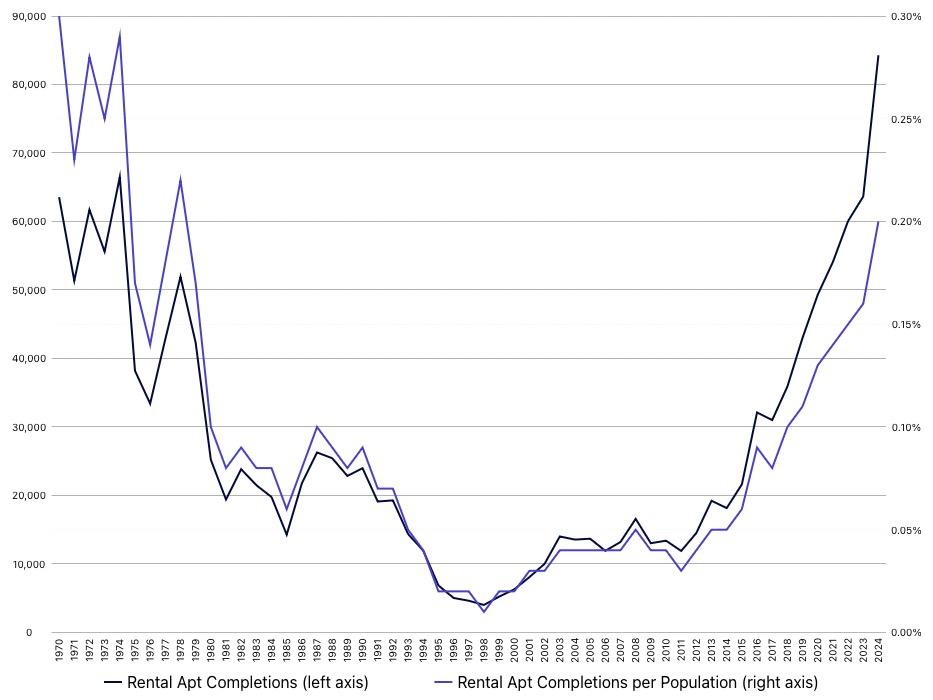
Over the last decade, rental housing construction has increased to approach levels achieved during the 1970s. This is a positive trend, as rental housing development rates had declined significantly, particularly during the late 1990s (see Figure 1). However, adjusting the data for population paints a different picture: the rate of rental construction is only half the rate achieved in the 1970s.
Note: Rental completions are based on privately initiated apartment structures in census metropolitan areas only; population is for all of Canada.
Sources: CMHC, Statistics Canada
Federal and provincial governments have attempted to increase Canada’s housing supply. However, the gap is much too large for the government to build enough housing to meet the country’s growing needs. According to CMHC data, Canada must build 3.5 million additional housing units on top of current projections to restore housing affordability by 2030. This means building an additional 500,000 new homes per year, on top of the 230,000 units currently projected. The government cannot achieve this goal alone. Private investment is required to make up the shortfall. However, encouraging the private sector to build more multifamily housing has been a challenge.
“Many projects are not viable due to high upfront costs and municipal development fees,” said Tony Irwin, President and CEO, Rental Housing Canada. “Due to prolonged construction timelines and ambiguous approvals, lenders and investors demand higher returns. Institutional investors will not commit to new projects in the absence of a stable, multi-year tax and regulatory environment, and small private owners will withdraw capital during downturns.”
Historically, private sector investment has been essential for meeting rental housing demand.
Over a 10-year period, the federal government has invested approximately $43 billion in building purpose-built rentals across the entire country. In the Toronto market alone, Statistics Canada estimates the value of condominiums owned by small investors to be approximately $40 billion in 2021. It is evident private investment exceeds the government’s investment in rental housing.
“Long-term capital is the only thing that can deliver housing at real scale,” said Adrian Rocca, CEO and Founder, Fitzrovia. “Institutional investors, such as pension funds, think in decades, not quarters. That’s what this sector needs. Purpose-built rental aligns perfectly with their mandates: stable, inflation-linked income and strong social impact.”
There’s a direct relationship between low construction levels and the lack of large real estate investors. Small investors have filled some of the rental housing supply in large Canadian cities. Toronto’s condo boom, which extended over two decades from the late 1990s, filled a significant portion of the city’s rental housing need. CMHC data indicates the share of condo apartments being rented approximately doubled over the last 15 years.
Figure 1: Canada’s rental apartment completions and supply per capita, 1970-2024
Trusted Advisors
Providing Expertise in Building Science and Structural Restoration
Garage & Balcony Assessment & Restoration
Building Cladding Design, Assessment & Remediation
Roofing System Design, Assessment & Remediation
Building Condition Assessments
Capital Planning
Building Renewal
Energy Audits and Modelling
Philip Sarvinis | Bill Gladu | Jeremy Horst | Michael Pond Duncan Rowe | Jack Albert Beau Gaudreau | James Cooper | Nigel Parker | Paul Fritze | Sohrab Karkhel
Q&A with Aled Ab Iorwerth, CMHC’s Deputy Chief Economist
RHB: What are the biggest bottlenecks to accelerating purpose-built rental supply in Canada?
Aled Ab Iorwerth: It depends on location with it generally being more difficult to build purposebuilt rental (PBR) in Toronto relative to say Edmonton. Regulation is easier in Edmonton and land costs are lower. With limited growth in rent, and some downward pressure because of macroeconomic uncertainty, ensuring construction costs are low is critical. This is difficult in areas with significant land costs and additional fees, such as development fees.
RHB: With respect to providing incentives for developers and tenant protections, how do you balance boosting supply quickly while ensuring tenant rights aren’t undermined?
Aled Ab Iorwerth: I don’t think there are major challenges in protecting tenants in new buildings. Boosting supply is the priority. I suspect that ensuring tenant rights is more important in older buildings where there are maintenance issues or need of renovation. In general, I think there should be more information to tenants on their rights, and more training for building mangers to identify and address problems.
RHB: How is CMHC’s modeling or forecasting evolving to capture new policy levers?
Aled Ab Iorwerth: This is a difficult task. Some areas, such as tax, can be relatively easily incorporated because there is transparency over numbers. It is more difficult with other parts that are less transparent, such as length of time for approvals. To this end, CMHC is examining redoing its survey of municipal regulations that was done in 2023.
RHB: Which jurisdictions having success in ramping up rental development that we should learn from?
Aled Ab Iorwerth: It seems clear that there is a lot of rental affordability and no rent control in Edmonton. I think we should take a closer look there.
RHB: What trade-offs or risks should policymakers watch out for when pushing aggressive supply strategies?
Aled Ab Iorwerth: There are several risks. The capacity of the residential construction industry to respond to large-scale increase in required supply is limited and would risk leading to cost increases. For example, the prices of cranes or trades would go up. The ultimate owners would likely need a long-term perspective to be able to withstand short-term overhangs of supply. It is possible that vacancy rates could spike temporarily as the market adjusts. Some effort should also be made to ensure that there is a more constant pattern of demand for new supply rather than the volatility that we’re seeing.
RHB: How do you see interest rates, construction costs, and land costs interacting with policy interventions to influence feasibility of rental projects?
Aled Ab Iorwerth: All these obviously interact and increases in them will lower feasibility. Interest rates are not set to address project feasibility, and construction costs and land costs are outside an individual builder’s control. Policy interventions could also contribute to lowering costs through lower development fees or other taxes. Over the long term, it is also possible policies could be introduced to improve productivity in the construction industry.
RHB: How can CMHC support municipalities and provinces to de-risk or catalyze more rental housing?
Aled Ab Iorwerth: A critical CMHC policy is the Housing Accelerator. The intent of this program is to provide federal resources to encourage streamlining of policies by municipal governments. For the rental construction industry, there are other CMHC programs to provide insurance, such as MLI Select, or provide funding, such as the Apartment Construction Loan Program.
There is now an oversupply of condo rental units, primarily due to declining demand. Between 2022 and 2025, total condo apartment sales dropped by 75 and 37 per cent in Toronto and Vancouver, respectively. Even though many projects have been cancelled over this time, there is still a large inventory of condos for sale and rent. This oversupply will help rental affordability in the short term, but it will impede incentives to build new purpose-built rental and affordable condo apartments over the long term. The decline in new construction means higher housing costs when population growth increases and the economy recovers.
“It typically takes at least 10 years for a rental development to become profitable, as opposed to traditional real estate, which can capture the full investment and profit upon the point of sale,” said Irwin. “Programs that pay by unit without checking whether a project can cover ongoing operating costs leave buildings with no money for maintenance.”
The government must make long-term plans to ensure consistent rental housing supply meets current housing needs and future demand. This means incentivizing large investors to develop rental housing and condo apartments.
“The single biggest lever is reducing soft costs,” said Rocca. “Today, about 30 per cent of every project in Toronto is made up of government fees, levies, and development charges. A full waiver of development charges for two years and a 20-year property tax abatement for purpose-built rental would make hundreds of projects immediately viable. Other complementary policies that would truly move the needle include expanded CMHC programs like the Apartment Construction Loan Program and housing-focused municipal bonds to fund infrastructure.”
Addressing concerns about private rental housing development
Some housing advocates have voiced concerns about private rental housing development and the financialization of housing (i.e., private ownership of rental buildings). The most cited issues include:
• Affordability: Tenants must have other affordable units available to choose from to deal with changes in their income or family status, as well as control rent increases in their own units.
• Stability: Affordable units are only desirable when there is no risk of being evicted to charge future tenants higher rents.
• Quality: Rental housing must be livable and in a good state of repair, which is not possible when private owners under-invest in their buildings. One way to prevent unscrupulous investors from charging higher-than-market rents and taking advantage of tenants is to increase supply. More housing means more competition for tenants,
which will keep rental rates competitive. Having more rental housing options also provides tenants with more choices when their situation changes and provides people with more affordable housing options.
“Unaffordability began decades ago with chronic underbuilding, restrictive zoning, and a tax system that penalized rental supply,” said Rocca. “Corporate landlords didn’t create that problem; we’re one of the few still building through it. If we want to tackle affordability, we need to make building viable again, not vilify those still doing it.
Incentives like full development charge waivers, property tax abatements, and faster approvals reward productivity and get shovels in the ground. When purpose-built rental becomes economically viable at scale, supply will follow and that will bring rents down over time.”
Other countries can serve as models of what happens when there is balance (or lack of balance) in the rental housing market. For example, Sweden has tight rent controls but long waiting lists for rental apartments. Conversely, Tokyo has limited rent control but more than sufficient rental housing supply and strong tenant protections.
Impacts of rent control and financialization of rental housing
Are the concerns about the private rental housing system legitimate? CHMC examined the evidence to determine what policy tools should be implemented to help protect tenants while encouraging increased development of rental housing. It’s also vital to avoid undermining incentives that would encourage investors to get involved in building more affordable housing.
“Tenant protections and supply aren’t opposing forces; they need to work in tandem,” said Rocca. “The issue isn’t protecting tenants from unfair treatment; it’s making sure protection doesn’t choke off new housing entirely. Data has shown that rent control exacerbates housing affordability. You don’t fix a housing shortage by punishing those still building homes.”
Rent control is one of the most cited policy tools to help prevent excessive rent increases. The goal is to ensure people can afford to purchase or rent housing and live where they need. Advocates often claim rent control is essential. But is it truly effective?
There is research that claims rent control does not achieve this purpose. For example, according to research on San Francisco’s rent control policies, the supply of rental units decreased by 15 per cent and city-wide rents increased by five per cent. Tenants were also more likely (20 per cent) to remain in their units in the medium term. While this helped to prevent displacement of low-income tenants, it also prevented some tenants from moving to units better suited to their needs or closer to their workplace.
Full-Service Laundry Room Management!
Let us take the hassle out of laundry for your Multifamily, Campus or Hospitality property, with no upfront costs.
CCL - Commercial Machine Sales!
From machine and parts sales to installation and service, we’ve got you covered.
This is one example of how rent control made the situation worse for tenants. However, CMHC conducted significant research on the impact of rent control, which examined the results of dozens of papers on rent control. As per their publication, “Rent control and the affordability of rental housing in Canada,” rent control reduces housing quality, decreases the overall supply, leads to less maintenance, and is of greater benefit to higher income households.
There are exceptions where rent control benefitted tenants. Rent control worked well when it maintained the incentives that support a healthy rental housing market. Quebec has this type of rent control environment, which has been able to balance tenant protections with the ability to increase rent supply. Rental housing in Quebec is as affordable as it is in Edmonton, which has no rent control.
The financialization of rental housing has been unfairly demonized, as far as the research goes. CMHC researched the relationship between REITs and rental prices, which they published in the report, “Are REITs behind higher rent prices?”
According to their findings, there is no direct relationship between REIT ownership of rental housing and rent prices. Rent prices in Montreal, Toronto, and Vancouver were essentially the same for REIT-owned and other types of rental properties. When rents were higher, they were tied to specific financial factors (e.g., newer buildings, larger rental units, utilities included in rent, more amenities).
Some rental housing advocates claim that private rental ownership leads to higher rates of eviction. According to data in the 2021 and 2022 Canadian Housing Surveys, the annual rate of evictions is one to three per cent. This range probably does not capture the total number of evictions. Illegal and improper evictions should be investigated. While evictions tend to capture significant media attention, the number of evictions is lower than some rental housing advocates suggest.
Different rental structures have different risks
Not all rental property owners and properties are the same. Even though they all operate within the same environment, there are differences in how they provide services.
To evaluate the rental housing system, consider the differences between “primary” and “secondary” rental structures:
• Primary refers to purpose-built rental properties. Units are designed with the goal of being rented. Rental structures are typically financed and owned by large investors.
• Secondary refers to condo apartments, townhouses, basement units, and other spaces rented out and owned (and often financed) by individual investors.
Condos are usually more affordable than homes and sometimes cost less to rent. As a result, renters often choose condo apartment as their first steps toward home ownership. This enables new tenants to rent more affordable properties. Both structures help to add density to cities, making more effective use of available land and infrastructure. However, as seen in many condos within the GTA, they don’t typically provide enough space to house large families.
According to CMHC’s research, the secondary rental system provides tenants with less tenure stability. As per the 2021 Canadian Housing Survey, almost two-thirds of evictions were due to the landlord either selling the property or wanting the space for their own purposes. These types of evictions do not happen in the primary rental system. The fear of evictions is more of an issue in the secondary rental system.
However, the government should not implement policies that interfere with a landlord’s right to evict tenants for failing to pay rent. Legislation must find a balance between protecting tenants against unwarranted evictions in the secondary rental market with the landlord’s right to an efficient eviction process when it is justified.
“RHC supports real, practical resident safeguards and agrees public funds should not go to bad actors,” said Irwin. “RHC is a partner between our members and government, not just an advocate. That means expanding and promoting standards that promote good management and resident care, so projects that meet those standards get priority for public programs.”
Conclusion
The federal government cannot build enough rental housing to meet demand. Private sector investment is necessary to help address Canada’s affordable housing shortage. Small investors are exiting the market, removing critical funding required for new construction. This also means the condo development model needs reconfiguration. Large-scale private and institutional investors are needed to help fill the gaps in the rental housing supply system. They will help to meet long-term housing needs while avoiding the fluctuations that affect smaller investors who depend on short-term capital gains.
The government should protect tenants against unscrupulous landlords. However, this can be achieved by strengthening tenant protections rather than implementing rent control and other policies that prevent private investors from building more purpose-built rentals. They can also incentivize landlords to improve their services and compete in serving tenants.
By David Gargaro
This content was written before the release of Budget 2025. Stay tuned to www.rentalhousingbusiness.ca for updates up to and after November 4.
About a month ago, Finance Minister François-Philippe Champagne announced the federal government would release Budget 2025 on November 4, 2025. Rather than putting out the new Budget in the spring, the government stated it wants to modernize the budget timeline to align with other Canadian sectors and industries. This means the federal government will release an economic and fiscal update the following spring.
RHB Magazine spoke with rental housing association leaders across Canada on what they expect to see, and what they would like to see, in Budget 2025, including:
• David Hutniak, CEO, Landlord BC
• Donna Monkhouse, Executive Director, Alberta Residential Landlord Association
• Tony Irwin, President and CEO, RHC and FRPO
Build Canada Homes
Build Canada Homes is a new federal agency that will build affordable housing at scale. It will provide access to public lands, offer flexible financial incentives, attract private capital, facilitate large portfolio projects, and support modern manufacturers in building homes more quickly.
One of Build Canada Homes’ first projects involves a $283 million investment (through the
Canada Housing Infrastructure Fund) to upgrade Toronto’s Black Creek sewer infrastructure, which will precede the construction of 63,000 new homes. The first housing development project will deliver 540 new homes at Arbo Downsview in Toronto, where at least 40 per cent of the units will be affordable, with a mix of studios, one-, two-, and three-bedroom homes. Other infrastructure investment
David Hutniak
Donna Monkhouse
Tony Irwin
Yes, we can!
Since MetCap Living established itself as a leader in property management, we have routinely been asked one, simple question; “Can you help us run our property more effectively?” And, for well over thirty years, the answer has remained — Yes, we can! Our managers are seasoned professionals, experienced in every detail of the day to day operations and maintenance of multi-unit rental properties. From marketing, leasing, finance and accounting, to actual physical, on-site management, we oversee everything.
Guaranteed vacancy reduction, revenue growth and net profitability — when you’re ready to discuss a better option; we’ll be there. You can count on it.
Kazi Shahnewaz Director, Business
Development
Office: 416.340.1600 x504
C. 647.887.5676
k.m.shahnewaz@metcap.com
www.metcap.com
announcements have followed, including $150 million combined for projects in Saskatchewan and Manitoba. The federal government has also made announcements that they will be funding the construction and repair of rental homes in numerous cities across Canada.
RHB: What specific measures would you like to see to encourage the development of new purpose-built rental housing?
Tony Irwin: The 2025 Liberal Party Platform includes a commitment to reduce municipal development charges by half for multi-unit residential housing over a five-year period, in partnership with provinces and territories to ensure municipalities remain financially whole. In Ontario, development charges have increased by over 900 per cent since 2004, averaging 14.3 per cent growth per year compared to a 2 per cent annual increase in property taxes. These rising charges, combined with additional fees, taxes, regulatory barriers, slow approval processes, and declining rents, have made it increasingly difficult for purpose-built rental projects to meet investor expectations and lender requirements. What’s needed right now are policies that will kickstart projects and get shovels in the ground. RHC is eager to see this measure introduced in the upcoming Fall Budget.
David Hutniak: These have been well-documented by the development community, namely the need to extract construction costs, with municipal fees and taxes of prime concern as well as low-cost capital. While we want supply, we are frankly more concerned about the state of the existing rental housing. We need strong tax policy and rebates/ incentives to support the huge capital investments required to maintain and improve existing rental, in particular the retrofitting of aging stock to improve energy efficiency and the reduction of GHG emissions. There has been very little support for the market rental sector on the retrofit front. In many respects, investing in the retrofitting of our aging rental stock is a nation-building exercise as it ensures affordable rental is maintained and protects renters especially lower income renters.
Donna Monkhouse: Canada’s rental housing sector needs federal support to help increase supply, improve affordability, and sustain private investment. Targeted funding, tax incentives, and accelerated approvals for purpose-built rentals are a must. Remove the GST/HST on new builds and continue to improve the Apartment Construction Loan program.
RHB: What would a “successful” federal budget look like from your association’s perspective?
Tony Irwin: From RHC’s perspective, a “successful” federal budget would deliver on key commitments that directly address the barriers to building and maintaining purpose-built rental housing in Canada.
David Hutniak: We are in a unique time and we want to see more support for our sector, which we believe will have direct positive impacts on renters. More broadly, we want to see the federal government to invest in big nation-building projects that will reduce our reliance on the U.S., expand our trading relationships, and enhance our security. Build Canada strong!
Lowering municipal development charges
During one of the initial announcements, Federal Housing Minister Robertson said there are “active” discussions on lowering municipal development charges for multi-unit residential housing for five years. During the federal election campaign, the Liberals stated they would fund 50 per cent of municipal infrastructure that would normally be covered by development charges. This will have a significant impact on the cost of building multiunit residential housing.
RHB: What are your overall expectations for the upcoming federal budget as it relates to Canada’s rental housing sector?
Tony Irwin: RHC was pleased to see several housing measures introduced in the 2025 Liberal Party Platform, including a 50 per cent reduction in municipal development charges over five years and the introduction of a modernized Multi-UnitRebate (MURB). We hope to see these measures implemented with clear timelines, funding details, and in partnership with provinces and municipalities in the upcoming 2025 Fall Budget.
David Hutniak: While we are encouraged by the focus on housing through Build Canada Homes, we are not convinced that there will be adequate focus on market rental housing.
Donna Monkhouse: A successful budget would be one that balance’s renter support such as portable housing benefits, further subsidies and public/private partnerships, fostering a stable environment for rental housing investment.
RHB: How should the federal government better coordinate with provinces and municipalities to accelerate housing approvals and construction?
Tony Irwin: The federal government should work closely with provinces and municipalities by aligning funding programs and incentives with clear targets for housing approvals and
Adding to
your
multi residential portfolio by taking advantage of existing land.
Join RHB and a panel of land use experts who will break down the strategies that work and don’t work!
From family owned to large developers, join Jason Birnboim, Jonathan Fleischer, and special guest Adrian Rocca, for a unique conference session on Thursday, December 4th as they show how to turn risk into opportunity. Understand the potential and optimize your properties land value as you navigate evolving industry policies for long-term success.
The conference session is Sponsored by Kingsgate Restoration and is part of the Buildings Week events.
Register for your spot today or make it part of your All Access Pass at PM Expo!
The conference session is Thursday, December 4th, 10:30 AM to 12:00 PM. at the Metro Toronto Convention Centre. Early bird pricing ends November 7th so be sure to register now!
Adrian Rocca CEO, Fitzovia
Jason Birnboim President, Beaux Properties International Inc.
Jonathan Fleischer COO, Equiton Living
Vanessa Topple Moderator
construction. This can include making federal funding for municipalities contingent on streamlining local approval processes, updating zoning bylaws to support higher-density and purpose-built rental developments, and reducing unnecessary regulatory barriers. Establishing joint task forces or working groups with all levels of government can help identify bottlenecks and share best practices.
David Hutniak: Build Canada Homes, on the basis of what we know so far, appears to recognize the need for collaboration with the provinces. BC is certainly keen to partner. I think municipalities are ultimately the primary barrier and the feds will need to take a more proactive approach on that front, similar to what BC has already started to do with municipalities in our province.
Donna Monkhouse: As a province with no rent controls, Alberta has fostered a rental market that encourages private investment and supply growth. We ask that the federal government respect provincial autonomy and avoid imposing any national measures that could discourage investment in rental housing. The federal government should support renters in a way that does not interfere with provincial jurisdiction.
Funding the development of new rental homes
Budget 2025 will include a new Capital Budgeting Framework, which is designed to provide more transparency on government spending. Specifically, the Budget will differentiate between capital investment and operational spending. The goal is to prioritize investments with longterm benefits, including major projects, housing, energy, and infrastructure.
The federal government made several announcements regarding funding the construction of new rental homes and the repair of existing rental stock in various cities across Canada. The projects would be funded by existing programs, including the Affordable Housing Fund (AHF), the Rapid Housing Initiative (RHI), and the Apartment Construction Loan Program (ACLP).
RHB: How could the federal government improve or expand on existing programs?
Tony Irwin: In 2024, the federal government introduced the Accelerated Capital Cost Allowance (CCA) to stimulate investment in new purposebuilt rental (PBR) housing. This measure allowed builders to claim a larger first-year tax deduction for depreciation, thereby encouraging new rental housing construction. RHC calls on the government to make this crucial program fully
permanent. Additionally, the government has also indicated interest in reintroducing a tax incentive similar to the Multi-Unit Rental Building (MURB) program from the 1970s, which was highly effective in increasing the supply of rental housing. Aligning the incentive with a modernized MURB program would significantly improve the effectiveness of these measures and support new rental housing development.
David Hutniak: There are two existing federal tax incentive programs: the Clean Technology Investment Tax Credit (CTITC) and the Accelerated Investment Incentive (AII). While we are encouraged that the federal government has acknowledged the need for these incentives, the programs are very complex to understand and apply for and restrictive in scope. Consequently, they are of nominal value to the vast majority of our sector. We need a simple, straightforward tax incentive program that will get retrofit projects off the ground now and fast.
RHB: How can the government support renters without discouraging private-sector investment in rental supply?
Tony Irwin: The government can support renters without discouraging private-sector investment by focusing on policies that make it easier to build and operate rental housing. All levels of government should prioritize measures that streamline approval processes, reduce unnecessary fees such as development charges, and ensure tax policies encourage new purposebuilt rental construction. Maintaining a stable and predictable regulatory environment will give private developers and owners the confidence to invest in new supply, which benefits all Canadian renters.
David Hutniak: We’ve always been strong proponents of portable housing benefits. We would like to see more supports of that nature for low-income renter families and seniors.
Increased Small Claims Court limit means more choices for rental property owners
By David Gargaro
Thanks to new legislation involving increased limits for Small Claims Court cases, Ontario’s rental property owners will have more flexibility, and potentially more power, when seeking unpaid rent or damages through the courts.
Effective October 1, 2025, due to amendments to Ontario Regulation 626/00, the monetary limit for Ontario’s Small Claims Court will increase from $35,000 to $50,000. This change also increases the appeal threshold from $3,500 to $5,000. This means fewer cases will automatically move up to Divisional Court.
Although the increase in the monetary limit does not seem significant, the amendment could have implications for rental property owners and property managers seeking to recover larger debts or damages that would normally take place through the more expensive and less efficient Superior Court process.
“The increased monetary jurisdiction does not change the process or timelines for applying under the LTB or filing orders with the Small Claims Court for enforcement purposes,” said Kristen Ley, Partner, Cohen Highley LLP. “Notably, it does not create or alter any of the specific methods of enforcement such as writs of seizure and sale of land or personal property and garnishments. Currently, the only change is that orders for larger amounts of money can be obtained before the LTB and enforced by the Small Claims Court.”
What this means for rental property owners
Small Claims Court is part of Ontario’s Superior Court of Justice. It is designed to help litigants resolve civil disputes quickly and cost effectively. Small Claims Court handles cases involving contracts, damages or unpaid debts. It also enforces orders from the Landlord and Tenant Board (LTB), such as garnishments and property seizures.
The Residential Tenancies Act (RTA) links the Small Claims Court’s limit to the limit set out for the LTB. Therefore, the monetary limit for the LTB also increases to $50,000. This means rental property owners can pursue larger claims for
unpaid rent, property damage or recovery of abandoned property directly through the Small Claims Court.
“Prior to October 1, 2025, if the landlord had a claim greater than $35,000, which is common especially in instances of higher monthly rent or substantial damage caused to a unit, they would have to choose between reducing their claim to fit within the LTB’s jurisdiction or pursuing their claim in the regular court system,” said Ley. “With the increased jurisdiction, there is a greater likelihood of full recovery in terms of the judgments that can be obtained and enforced from the LTB.”
The new limit provides rental property owners with more choices:
• File larger claims in Small Claims Court without incurring the higher costs of Superior Court
• Seek enforcement of unpaid LTB orders for larger sums
• Access quicker resolutions, as Small Claims Court tends to see faster resolutions than the Superior Court and the LTB
• Choose flexible representation, including paralegals, lawyers or self-representation
New procedures and opportunities
In addition to higher monetary limits, the amendments introduced new trial management rules that will help to make Small Claims Court more efficient through reduced timelines and lower costs. Rental property owners can also amend or transfer claims to take advantage of the new monetary limit.
For example, a rental property with an existing claim can increase the amount sought (up to $50,000) if it takes place at least 30 days before the trial date. It’s even possible to transfer a Superior Court case to Small Claims Court (if all parties agree to the move).
“Landlords need to assess whether judgment debtor tenants (i.e., tenants who have orders for
to collect on,” said Ley. “They may want to dedicate more resources to debt recovery efforts, including working with a firm experienced with enforcement procedures before the Small Claims Court.”
While higher limits might make larger arrears claims possible, rental property owners should not delay filing with the goal of reaching the $50,000 monetary limit. It should be noted that, at the LTB, higher arrears may mean longer payment plans or increased abatement claims pursued to help reduce high arrears.
“Just because the LTB now has the jurisdiction to issue judgments up to $50,000, landlords should not intentionally delay bringing unpaid rent before the LTB,” said Ley. “For claims that are strictly within the Small Claims jurisdiction to begin with, the cost consequences of higher value claims increase, being a percentage of the claim.”
Conclusion
Rental property owners should understand the amended legislation and higher monetary limit mean they now have a more efficient and affordable way to recover larger debts. Rather than being forced to reduce a claim or go through the Superior Court process, they can bring the
Impact concentrated in Ontario and BC
According to a 2024 report by RBC, Ontario and BC will see the largest reduction in study permits issued under the new caps. Based on our national rent report, key student destination cities in these provinces have also seen larger-than-average rent declines since student visa caps were announced in January of 2024.
A Turning Point for Student Rentals
Student housing demand in Canada surged post-pandemic, outpacing supply. However, early 2024 regulations for international students are shifting the landscape. Rentals.ca data near post-secondary institutions highlights emerging challenges for investors.
Student Neighbourhoods
Rentals.ca narrowed its data set to properties located within a 1.5 km radius of major post-secondary campuses to see the impact on the immediate area.
Areas around schools with a high proportion of international enrolment, such as McGill (30%), UBC (26%) and Dalhousie (23%), saw larger rent decreases from 2024 to 2025 than the city-wide averages.
Montreal
Lead Volume - An Early Indicator
In the area surrounding Conestoga College, where international students made up over 90% of enrolment in 2023, lead volume was down by 54% compared to 2023
Takeaways
1- International student inflows are decreasing, leading to reduced demand in the areas around post-secondary campuses with high international enrolment, particularly in Ontario and BC.
2- Reduced demand has led to outsized declines in rent prices and lead volumes in these areas, creating a more competitive environment for property investors.
3- RBC’s 2024 projections indicate that the downward trend in the international student population will continue into 2026.
4- Start planning now to position your student rental for next year. To attract quality, o er competitive pricing and appealing amenities like in-suite laundry and AC, which are top-valued features.
Federal government announces investments in infrastructure & rental housing, releases Housing Design Catalogue, and hints at cuts to development charges
By Tony Irwin, President and CEO, RHC
On October 14, 2025, Gregor Robertson, Minister of Housing and Infrastructure, announced investments in housing and infrastructure in Toronto. Federal funding will support upgrading Toronto’s Black Creek sewer infrastructure to catalyze the construction of 63,000 new homes. Through the Canada Housing Infrastructure Fund, the federal government will provide up to $283 million to expand capacity in Toronto’s Black Creek sewer system, which currently serves over 350,000 residents. The project is one of the first initiatives launched by Build Canada Homes, a new federal agency designed to build affordable housing at scale.
The new investment, in partnership with the municipality, will support the construction of 17 kilometres of new infrastructure. Once completed, the project will:
• Support the construction of up to 63,000 new homes in the Downsview area
• Reduce the risk of flooding and protect water quality
• Create immediate careers in construction and engineering
• Support an additional 130,400 residents and over 65,000 jobs
Build Canada Homes’ first housing development project will deliver 540 new homes at Arbo Downsview in Toronto. At least 40 per cent of the units will be affordable, with a mix of studios, one-, two-, and three-bedroom homes. Build Canada Homes will launch a Request for Qualifications (RFQ) to identify Design-Build teams with expertise in factory-built housing and other methods of construction, including prefabrication, modular building, and mass timber. Selected teams will also be required to prioritize Canadian resources. The City of Toronto will also invest more than $425 million toward the Black Creek Sanitary Trunk Sewer project.
On October 15, Federal Housing Minister Robertson announced the federal government is releasing the full technical design packages for the Housing Design Catalogue, which will help to streamline the building process and cut red tape.
NATIONAL OUTLOOK
These standardized housing designs for gentle density will support the construction of more homes. The Housing Design Catalogue reduces the time and cost of developing construction plans, which accelerates approvals and construction starts. The designs make it easier to add new housing options in existing neighbourhoods and prioritize wood-frame construction.
The design packages include detailed architectural and engineering drawings, energy reporting templates, a climate resiliency guide, building performance reports, cost estimate summaries, and a user guide. The catalogue features 50 standardized housing designs for rowhouses, fourplexes, sixplexes, and accessory dwelling units across Canada.
The Housing Design Catalogue is part of the federal government’s measures to double the rate of housing construction, restore affordability, and reduce homelessness. It supports standardization in the housing sector, with local governments serving as partners to help the potential. The designs consider different building requirements across Canada and were developed by regional architecture and engineering teams.
As of today, the following cities are pre-reviewing designs to help streamline approvals: Burnaby, Kelowna, Vancouver, Edmonton, Regina, Ajax, Kitchener, Mississauga, Ottawa, Toronto, Saint John, Halifax Regional Municipality, Whitehorse, and Yellowknife. The federal government is also encouraging other municipal governments to pre-review and support designs for their communities.
Through Build Canada Homes, the federal government will also provide access to federal lands, development expertise, and flexible financing to make it simpler and faster to get big projects off the ground. The agency will prioritize non-profit housing with the goal to double housing construction, restore affordability, and reduce homelessness.
On October 15, Jennifer McKelvie, Parliamentary Secretary to the Minister of Housing and Infrastructure, announced the federal government would be investing more than $291 million for the construction of 705 housing units in Toronto through the Apartment Loan Construction Program (ACLP) and the Affordable Housing Fund (AHF). This project will include 256 affordable units, with dedicated housing for women and children fleeing abuse, individuals with mental health or addiction challenges, and those with developmental disabilities. The development will include large indoor and outdoor amenity spaces, a licensed daycare, a community room, and retail. The announcement took place at the site of the 777 Victoria Park project and included Toronto Mayor Olivia Chow and other local politicians.
The federal government also announced more than $150 million in federal funding to strengthen community infrastructure in Saskatchewan and Manitoba. This includes $69.5 million in strategic infrastructure investments across 19 project categories for Saskatchewan (e.g., rehabilitation of the Circle Drive North Bridge) and $82 million in strategic infrastructure investments across 19 project categories for Manitoba (e.g., funding for 8.7 km of rural waterline extensions in Plum Coulee).
Federal government announces funding for construction and repair of rental homes across Canada
The federal government made a number of announcements regarding funding the construction of new rental homes and the repair of existing rental stock in various cities across Canada. The projects would be funded by the Affordable Housing Fund (AHF), the Rapid Housing Initiative (RHI), the Apartment Construction Loan Program (ACLP), and other programs.
Some of these include:
• 56 affordable rental homes to be renovated in Charlottetown, PEI
• 9 new affordable rental homes in Fredericton, NB
• 79 new rental housing units in Saint John, NB
OCTOBER 2025
• 47-unit affordable rental building to be repaired in Dollard-des-Ormeaux, QC
• 316 new rental housing units in Ottawa, ON
• 705 new rental housing units in Toronto, ON
• 42 affordable supportive homes in London, ON
• 738 affordable rental units to be repaired in Manitoba
• 162 new rental housing units in Saskatoon, SK
• 91 affordable rental homes in Edmonton, AB
• 150 social housing units to be repaired in Yellowknife, NWT
• 112 new affordable rental homes in Vancouver, BC
• 1,300 new rental housing units in Burnaby, BC
Federal government hints at cuts to development charges
During the October 14 announcement on funding the upgrade to the City of Toronto’s sewer infrastructure, Federal Housing Minister Robertson said there are “active” discussions with respect to the Liberal government’s promise to lower municipal development charges for multi-unit residential housing for five years. During the federal election campaign, the Liberals stated they would fund 50 per cent of municipal infrastructure that would normally be covered by development charges. More information on the initiative will be released in the weeks leading up to Budget 2025.
"Development charges are a significant challenge for the cost of building across Canada, and that's why we made a commitment to reduce those charges," said Robertson. "We initially were looking at 50 per cent reduction in partnership with provinces and territories. We're working through that process now across the country."
Tony Irwin discusses future of rental housing in Canada with CREBTV
On October 1, Vanessa Topple, Anchor and Producer of CREBTV, sat down with Tony Irwin, President and CEO of Rental Housing Canada (RHC), to discuss the future of rental housing in Canada. To follow is an edited transcript of the interview (CREBTV, Season 2, Episode 14).
Vanessa: There’s been a lot going on in the last few weeks with interest rate cuts and announcements. First off, we know that the federal government just announced there’s a $55 billion program: the Build Canada Homes program. Within that is the $1.5 billion Rental Protection Fund. Do you see this as a meaningful turning point in the industry?
Tony: I think it’s a very consequential announcement. We’ve been very supportive of the Rental Protection Fund. It was first announced in a budget last year or the year before. Its purpose is to provide federal support to non-profits to be able to purchase old units. We know we have aging rental housing stock in Canada. (It’s important) to be able to hopefully keep those units affordable. I say hopefully because they do require a lot of maintenance, obviously given their age. But the idea, and I think it is a good one, is to support those kinds of buildings being acquired by non-profits who can run them well and hopefully have enough financial strength to be able to do the maintenance on an ongoing basis. This allows those who are selling those units to be able to reinvest that capital into new housing. I think it’s a win-win. It’s an important initiative and we’re very supportive of it.
Vanessa: You have always been very vocal about the aging supply that that we need more supply built. Whi is this such a critical priority right now? And what role should Canada Build Homes have to help perpetuate this?
NATIONAL OUTLOOK
Tony: It’s a great question. We all look at the media. We have seen it is 11 months in a row now rents have been going down. I read that as much as everybody else. Vacancy rates have gone up in some markets. People say to me, “Tony, I guess it’s job done, mission accomplished.” And I say, “Not so fast.” We’ve seen record numbers of purpose-built rental units come online in the last couple of years. We know those are projects that have taken many years to get to this point. That’s been great for what it is, but I think we need to look at what’s coming in the next couple of years. The simple fact is we don’t have much coming in the next couple of years. Right now, I think the market’s doing what markets do, supply and demand is a thing. When different fundamentals change, you see impacts from that equally over the next couple of years. We’re not going to see construction happening under current circumstances unless we see policy interventions. I think the story here is what’s coming. What you’re seeing happen right now is not going to be the same in a couple of years. That’s what we all need to be talking about.
Vanessa: Recently there was an announcement about the interest rates that was cut by 25 basis points. How does the impact rental housing providers who are looking to finance future projects?
Tony: What is the environment to build right now? Not great. So not a lot is happening right now. That doesn’t mean nothing is happening, but there’s not a lot happening. There are a number of factors that go into why not a lot is happening right now. It’s about looking at what fundamentals can we see changing? Through government intervention or other changes will help use make the economics work for building purpose-built rental housing. Many of us were at the Canadian Department of Investment Conference, listening to Benjamin who’s coming to do a webinar with us in a few weeks. We listened to him very closely and he talked about what he sees happening over the next year, which is additional rate cuts. We know that would have happened already if it weren’t for President Trump. There was a pause to get inflation under control. We were very happy to see the reduction that came last week. It sounds like there might be one more before the end of the year, and then hopefully additional cuts will follow. That’s certainly positive, but I think you’ve probably talked to a lot of developers since that was made that say it helps. But one cut by itself is not super meaningful. A combination of things need to happen. It’s about trying to being back consumer confidence in the sector to be able to take risks again and build. It’s helpful but we need to see more.
Vanessa: One of the things you’ve been trying to do to help build up this confidence is to have a lot of engagement with Ottawa on the federal level. How are you helping to make sure the voice of the industry is heard in Ottawa?
Tony: It’s important that our industry be unified under one voice that’s strong, that can speak on behalf of purpose-built rental housing builders, owners, managers, and suppliers. We are a family that needs to have one strong voice, a voice that works with other voices and other associations who do other things but also have an interest in rental housing. But within our industry, we have been very busy and active. Like many who do this kind of work, we had to get through the early part of the Carney government post-election. Unless you were directly involved in infrastructure projects or industries that were affected by tariffs, you were not the priority. We understood that, but now that we’ve gotten through that, the priorities have broadened, and the message we’ve been bringing to all the people we’ve met in Ottawa, from Minister Robertson to officials in various ministries, housing, finance, and the Prime Minister’s Office, with all the economic uncertainty, our desire to become less dependent on the United States, housing has to stay at the top of the agenda. It is critically important. We need to continue to build more housing. We need to continue to build more purpose-build rental housing. We’ve been very active in the summer and into the fall, carrying messages from our members to Ottawa and doing it virtually. We’ll be going to Ottawa a couple of times over the next few months. A lot of work is going on to ensure our industry has a strong voice and that we’re being heard.
OCTOBER 2025
Reducing turnover to stay competitive in Canada’s shifting rental market
By Peter Altobelli, VP and General Manager, Yardi Canada Ltd.
By 2035, national policy is pushing for an ambitious 2 million new purpose-built rental units. We’re already seeing the fastest pace of construction since 2022 (Canada Mortgage and Housing Corporation), with a wave of completions on the horizon. That surge of new supply will hit a market where vacancy rates are already climbing to record highs, and with it comes more renter mobility, reshaping the landscape for years to come.
The challenge is clear: reducing unit turnover duration is no longer optional. It’s a critical strategy for maintaining cash flow, protecting asset value and standing out in a competitive market.
Why this matters for housing providers
Better marketing and smarter operations deliver measurable results. In one widely cited case study, Greystar reduced its average vacancy period by just five days, a modest improvement that translated into nearly $38,000 in additional annual revenue per property. Gains like these don’t come from a full rebrand or massive capital spend. They come from aligning operations, marketing and resident services to create a seamless leasing experience.
Reducing turnover duration means protecting cash flow
When a resident leaves, the unit often sits idle longer than necessary because processes and technology can be fragmented. These processes can create delays, which may result in revenue gaps that add up quickly across a portfolio.
Housing providers can shorten these gaps by:
• Gaining unit visibility. Access to lease details, maintenance history and move-out dates helps staff proactively prepare units, schedule services and start marketing on time.
• Accelerating turns. Automated work orders triggered by online form submissions and streamlined vendor management ensure repairs and payments happen quickly.
• Responding faster. Capture every interaction with an integrated CRM tool, and auto-generate leases pre-filled with critical details (unit, term, rent, move-in dates and more) for e-signature and a clean handoff to operations.
Every improvement shaves days off turnover, which means steadier cash flow.
Standing out in a crowded market
The wave of new purpose-built supply has created more choice for renters, especially in Quebec, Ontario, and Alberta (Canada Mortgage and Housing Corporation). In 2024, these provinces saw the highest levels of completions in decades, and more are on the way.
Meanwhile, mobility is shaping demand. Interprovincial movers represent a significant share of rental demand, with Alberta attracting tens of thousands of residents from other provinces between 2022 and 2024 (Statistics Canada). Ontario, in contrast, has seen more people leaving than arriving. For housing
Sign-up for RHC’s National Outlook e-newsletter to receive up-to-date news on what is happening across Canada, as well as industry insights and insider information on RHC happenings. Email admin@rentalhousingcanada.ca to start receiving RHC’s e-Newsletter today! WANT TO STAY UP TO DATE WITH NATIONAL OUTLOOK?
NATIONAL OUTLOOK
providers, this fluidity means prospect pools are broader but competition is fiercer.
With lease-over-lease demand softening, residents now hold greater negotiating power. Standing out requires a combination of visibility, trust and service:
• Stronger online presence. Renters expect accurate listings with real-time availability, virtual tours and quality visuals. With this information on a property website, providers can easily market units and attract qualified prospects.
• Smarter screening. Tools that verify identity and analyze fit reduce the risk of short-term tenancies, helping providers secure residents who are more likely to stay.
• User experience platforms. Portals and two-way communication channels make it easy for residents to pay rent, log maintenance requests and engage with property staff, amenities that boost satisfaction and renewal rates.
When service feels consistent and accessible, renters are more likely to renew, which directly reduces costly turnover.
Looking ahead
Housing providers are entering a new era defined by high vacancy, greater choice for renters and shorter tenancy cycles. While these shifts may feel daunting, they also create opportunity. By reducing turnover duration and enhancing visibility in the market, providers can protect revenue and strengthen long-term asset value.
Success will come from a balanced approach: operational efficiency behind the scenes, strong marketing out front, and resident-first tools that improve satisfaction. If you’re exploring practical ways to implement these tactics, visit yardibreeze.ca to learn more about the technology that can help.
We’ll keep your systems top of mind, so you don’t have to!
With over 65 years of industry experience, our team is dedicated to ensuring optimal performance, resident comfort, and budget control.
Work with Enercare for reliable home services tailored to your property’s unique needs, with dedicated support from your Client Success Manager. We offer energy-efficient upgrades for multi-residential properties, servicing low, mid, and high-rise dwellings to enhance comfort and sustainability. Our expert team ensures seamless installations that meet manufacturer standards, regulations and safety codes, along with comprehensive maintenance and repair services for all systems, including:
Why choose the Enercare Advantage® Program?
Enercare Advantage® offers a hassle-free, convenient solution for residents, eliminating concerns when it comes to upfront payments, costly repair service calls, and equipment replacement.* Below are additional benefits the Enercare Advantage® program provides to you and your residents:
Design & Install
Industry leading products. NEW energy efficient equipment to offset your carbon footprint.
Quality installations done right the first time.
Join us for exceptional
Service & Maintenance
HVAC maintenance to keep your equipment operating efficiently.* Service performed by fully licensed and insured technicians.
Potential utility rebates on eligible equipment.
Invest in other improvement projects.
Potential welcome incentive on eligible equipment.
CEO’s message: Looking ahead to a pivotal fall
As the summer season draws to a close, our focus at FRPO shifts to what we expect will be a busy fall. While the summer often provides a moment for pause and reflection, the underlying challenges of housing affordability and supply remain at the forefront of our agenda. With the return of both the federal Parliament on September 15 and the Ontario Legislature on October 20, we are gearing up for a pivotal fall session, ready to continue our vital advocacy work with governments at all levels.
Our message remains clear and consistent: the only sustainable solution to the housing crisis facing Ontarians and Canadians is to build more supply of all housing types, with a particular emphasis on purpose-built rentals. This is the message we continue to advance in every forum and opportunity.
This month, I was pleased to speak at RESCON's 5th Annual Housing Supply Summit on September 24, an event FRPO was proud to sponsor. This summit was a critical platform for dialogue, and I was pleased to share the stage with key industry leaders and policymakers, including Ontario’s Minister of Municipal Affairs and Housing, Rob Flack. It was also encouraging to see our members, such as Tricon and Fitzrovia, participating and adding their important voices to the conversation. Together, we reinforced the need for collaborative solutions and a supportive policy environment to get more rental housing built.
Our advocacy extends beyond direct government engagement and into the public conversation. Over the summer, we continued to shape the narrative through key media opportunities. I was pleased to share FRPO’s perspective in recent articles with the Toronto Sun, discussing Toronto's evolving rental housing landscape, and with Storeys, where we addressed the city’s new renoviction bylaw. In both instances, we emphasized that creating a policy framework that encourages, rather than hinders, the creation of new purpose-built rental supply is the most effective path toward improving housing affordability and stability for all.
As we move into this busy fall, please know that your voice and membership are the foundation of our efforts. We will continue to champion our industry, advocate for sensible policy, and work tirelessly to ensure the rental housing sector is recognized as a vital partner in building a prosperous future for Ontario.
Thank you for your continued support.
Tony Irwin, President and CEO, FRPO
LBO campaign update
As we enter the fall season, the Let’s Build Ontario campaign remains as focused as ever on our primary goal: ensuring a healthy and sustainable rental housing market for all Ontarians. This season often brings a renewed sense of purpose, and for us it’s a time to redouble our efforts in advocating for the policies that will support the creation of more purpose-built rental homes across the province.
The strength of the Let’s Build Ontario campaign— and sector—has always been rooted in the authentic experiences of members. Member stories have proven to be a powerful tool to illustrate the vital role our sector plays, and we continue to see increasing levels of member engagement with this initiative. As we continue to engage with policymakers and the public, we are once again calling on members to share their stories . Submit a resident initiative that you’re proud to spotlight to be featured in Member Story Mondays! Big or small, your stories help humanize our industry and showcase the deep commitment of our members.
To help us amplify the campaign, we’re continuing to encourage members to link to the Let’s Build Ontario campaign website from their own corporate sites. This simple action significantly boosts our campaign’s reach through search engine optimization, helping us connect with new audiences, grow our supporter base, and strengthen our collective voice in the digital sphere.
Recent reports of rents starting to stabilize in certain Ontario municipalities are welcome, and while this may offer some short-term relief, it does not change the fundamental challenge of housing affordability. The only way to ensure long-term stability and predictability for renters is to address the supply shortage head-on. As we move into the fall, campaign messaging will continue to focus on long-term solutions that promote and accelerate the development of new purpose-built rental housing.
There is also important work to be done in reframing the narrative around renting and the campaign looks to play an important role in shifting the way people think about it. Too often, renting is seen as just a temporary step before buying a house. But for many Ontarians, renting is a practical and smart long-term housing choice. Renting gives you flexibility and freedom from the costs and responsibilities of owning a home. It should be respected as a good housing option, not viewed as a compromise.
As we move into fall, the Let’s Build Ontario campaign will continue to play an important role in advocating for purpose-built rental housing supply and pushing all levels of government to ensure that the creation of new rental homes remains a top priority. Together, we can build a stronger and more affordable Ontario for everyone.
From best practice to regulation: How certification protects rental housing providers
This year, the City of Toronto approved a new colour-coded system under its RentSafeTO program, grading apartment buildings on their state of repair and management. Beginning in 2026, signs will be posted at building entrances: green for good repair, yellow for minor infractions, and red for serious health or safety violations. For housing providers, this is a reminder that transparency and accountability are no longer optional. Regulations are becoming more visible, more frequent, and more demanding. Certification programs such as the Canadian Certified Rental Building™ (CRB) Program help owners and managers stay ahead of these changes while delivering tangible business value.
Certification as risk management
CRB standards already align with many RentSafeTO requirements: fire safety, preventive maintenance, resident communication, and environmental management. Certified properties are subject to regular audits, ensuring these practices are consistently applied.
This proactive approach reduces:
• Legal risk from code or bylaw violations
• Reputational risk from public non-compliance scores
• Operational risk from costly service failures
When best practice becomes law
What begins as voluntary often becomes mandatory. Energy benchmarking, climate disclosures, and now public building grading all started as “best practices.” Certification helps providers anticipate these shifts by embedding accountability, sustainability, and service standards before regulations demand them.
Business value beyond compliance
Getting ahead of regulation isn’t only about avoiding penalties—it creates measurable value:
• Lower operating costs through energy and water efficiency
• Climate resilience that protects long-term asset performance
• Investor confidence with third-party verified ESG practices
Future-proofing portfolios
As public transparency increases, housing providers can’t afford to wait until regulations catch up. Certification ensures portfolios are managed at a level that exceeds minimum expectations, building trust with residents, assurance for investors, and stability for owners. By committing to certification, providers demonstrate that they are not reacting to regulation but leading the way. In an industry where today’s best practices are tomorrow’s legal requirements, certification is more than compliance—it’s a strategy for resilience and longterm success.
RentSafeTO at a glance
What it is: Toronto’s apartment building standards program for buildings with 3+ storeys and 10+ units
How it works: Owners register annually; City staff audit every 2 years
What’s changing:
Starting 2026, colour-coded signs at entrances:
• Green – Good repair
• Yellow – Minor issues
• Red – Serious violations
Heavier penalties and faster enforcement for highrisk or repeat offenders
Why it matters: Public grades increase reputational risk for poorly managed buildings
How CRB helps:
• Standards already align with RentSafeTO requirements.
• Regular audits keep properties prepared and compliant.
• Certification future-proofs members as voluntary practices evolve into regulations.
Past events
FRPO Fall Social & Anniversary Party
September 18, 2025
Last month, we came together with members, partners, and friends to celebrate 40 years of FRPO. This event was a moment to reflect on four decades of leadership—from advocating for fair policies to becoming the trusted voice for Ontario’s rental housing industry. FRPO has united members, driven meaningful change, and supported the growth of a strong rental housing sector. Our 40th anniversary celebrates the past and the important role we continue to play in shaping the future. Thank you to our sponsors, Wyse Meter Solutions Inc. and The Home Depot Canada and to everyone who joined us. Here’s to the next 40 years of building strong, sustainable rental housing in Ontario!
Future events
FRPO MAC Awards
December 4, 2025 | 5:00 pm – 9:30 pm
Save the date! For more than two decades, the MAC Awards has celebrated the leaders of Ontario’s rental housing industry, recognizing their unwavering dedication to providing top-notch rental accommodations. With their passionate teams and forward-thinking approaches, MAC Award winners transform their latest project endeavours and innovative ideas into reality. Award submission portal is NOW OPEN.
Ontario’s leading advocate for strong and stable rental housing.
FRPO is the largest association in Ontario representing those who own, manage, build and finance residential rental properties.
discusses upcoming changes Residential Tenancies Act , provides updates on recent municipal elections, and invites rental property owners to join the association. pg. 49
discusess how tenants' drug activity could lead to fines and jail time for landlords under Bill 10. pg. 53
discusses the Adequate Temperature By-law, takes a look inside the Barton-Tiffany temporary shelter, and provides an update on the Hamilton LRT. pg. 57
RHPNS discusses its fight with Halifax Water over rate hikes and the Province's plans to expand development in Halifax. pg. 61
Check out the digital version of RHB Magazine for news from RHSK and EOLO.
The Member Associations
EXECUTIVE DIRECTOR’S MESSAGE
The ARLA office is working on our Board election, our AGM and Christmas luncheon, and our final year events.
We continue to reach out to the City of Edmonton’s municipal candidates. In our monthly broadcast, we shared an interview with the mayoral candidates. Also, the Edmonton Chamber held a mayoral candidate debate with the top five candidates, which can also be viewed on their YouTube channel.
Looking ahead to the rest of 2025, we’re focused on delivering value for our 2026 schedule, providing more opportunities for members to connect, and publishing timely updates on the local, provincial, and federal issues that matter the most to Alberta landlords. We will continue to keep you informed, engaged, and empowered so you can maintain a thriving business in an ever-changing economic environment.
- Donna Monkhouse, Executive Director
Golf tournament
Our 2025 Golf Tournament was held at the Quarry. What a great day we had! We would like to thank our wonderful members and sponsors for making this day even better. We are looking forward to this event on September 4, 2026. Make sure to save the date.
What’s happening in Edmonton?
ARLA is continuing its efforts to improve the waste removal system with the City. We will continue to advocate to have waste removal put back into property managers’ hands. We will be bringing the issue forward once a new City of Edmonton council is in place.
Following the municipal election on October 20, the new mayor of Edmonton is Andrew Knack, who received 37.97 per cent of the vote (78,482 votes). Tim Cartwell finished second with 29.83 per cent (61,667 votes), while Michael Walters came in third with 11.9 per cent (24,589 votes). Previous mayor Amarjeet Sohi did not run for reelection.
What’s happening in Calgary?
Following the municipal election on October 20, the new mayor of Calgary is Jeremy Farkas, who received 26.1 per cent of the vote (91,071 votes). Sonya Sharp finished a close second with 26.0 per cent (90,488 votes), while previous mayor Jyoti Gondek finished third with 20.5 per cent (71,402). Sharp has requested a recount of the votes.
Upcoming changes to the RTA
Bill 38 has now passed and Section 57 (1) to (4) of the Residential Tenancies Act (RTA) has been updated on methods of delivery.
Methods of delivering notice (effective June 2025) A notice must be delivered in person or delivered by registered mail. Tenants should use the mailing address provided in the “notice of landlord.”
Landlords should use the mailing address of the residential rental premises. If the tenant is absent from the rental premises and/or evading service, the landlord may either:
Donna Monkhouse
• Give the notice to an adult who appears to live with the tenant
• Post the notice in plain sight on the residential rental premises
If a landlord or tenant cannot serve a notice as indicated above, the notice may be served by an electronic method if:
• The landlord or tenant, as applicable, has provided an electronic address as an address for service that can receive such notice
• The notice, order or document is sent to the landlord or tenant, as applicable, at the specified address and in a format that is usable for subsequent reference It is important to note how this language fits into the “hierarchy” of service under the RTA overall. At a high level, the RTA first requires that all service be effected by personal service (i.e., handing the notice to the tenant directly) or registered mail. In the event those forms of service are not possible, a landlord may post a notice in a conspicuous place on the rental premises. If a landlord cannot effect service by personal service, registered mail or by posting to the premises, then they can use an email that has been provided for the purpose of service.
Investing in Alberta's rental properties: Join ARLA for unmatched benefits
If you invest in rental properties in Alberta, consider joining the Alberta Residential Landlord Association (ARLA) for numerous compelling reasons. Your membership supports advocacy for the Alberta multifamily housing industry, education, and much more.
Alberta is one of three provinces in Canada without rent controls, and ARLA is dedicated to maintaining this status. We consistently advocate to ensure our voices on issues and solutions are heard. The absence of rent controls provides choices for tenants and keeps rents affordable. Despite Alberta experiencing one of the highest percentage rental increases in 2024, rents remain more affordable than in many other provinces, offering competitive rental prices. In 2024, ARLA published a research document on Alberta’s rental market dynamics and policy landscape, which is available on our website. Increased migration and demographic trends in Alberta have impacted rent prices due to supply constraints. Housing providers face higher costs for mortgages, utilities, property taxes, and maintenance, affecting profitability. Over the past decade, Edmonton has led with some of the lowest rent prices and smallest increases. Average rents in Alberta saw little to no increase from 2013 to late 2024. We invite you to read the report to learn more about Alberta’s rental market.
ARLA is a non-profit, membership-based association that educates and advocates for housing providers in Alberta. Established in 1994, we have a strong and growing membership. We provide all forms required to satisfy the Residential Tenancies Act (RTA) in Alberta. Our monthly seminars, webinars, and luncheons cover a range of relevant topics. We also have a network of reliable service providers for our landlord community.
Our networking events, such as the member appreciation BBQ and lawn bowling, offer many opportunities for connection. Members benefit from discounts on forms and services, including insurance, credit checks, and RTDRS representatives. We also offer an RTA workshop webinar three times a year and an online RTA course called SuiteSmarts.
We provide monthly updates on government issues, industry news, and market trends. With Edmonton’s municipal election approaching, we are preparing our issues for the candidates to help our members make informed decisions. We are collaborating with other associations on waste management issues in Edmonton to control contractor costs. We stay actively involved with government activities to ensure our voice is heard.
ARLA welcomes members from single-unit landlords to large-scale landlords and REITs, as well as not-for-profit groups. If your company is a member, all employees can participate in ARLA events and activities.
Discover the many benefits of ARLA membership by visiting our website at www.albertalandlord. org or contact us to learn how you can benefit from becoming a member.
SuiteSmarts Residential Tenancies Act course
SuiteSmarts is an online interactive learning tool designed to help Alberta landlords become better acquainted with Alberta’s Residential Tenancies Act (RTA). This is an excellent opportunity for people new to the rental industry to learn about the RTA, or for veteran landlords who would like to brush up on their knowledge of the legislation, in this user-friendly, self-paced learning format. SuiteSmarts consists of seven hours of online
learning, which is accessible 24/7, in nine training modules. ARLA members can take the course at a reduced rate of $19.95 (compared to $79.95 for non-ARLA members). Attendees receive a certificate of completion upon passing the exam. For more information and to sign up, please visit www.suitesmarts.ca.
Future events
October 10, 2025: RTA Fundamentals Workshop webinar 9:30 am – 12:30 pm This webinar is presented by Chrystal Skead, CPM, ARM, Clear Stone Asset Consulting, who has more than 30 years of experience in managing multifamily, condo, and mixed-use properties. This workshop empowers attendees and their teams with being compliant in their rental business by learning to navigate the Residential Tenancies Act . This workshop will cover:
• How to legally handle a security deposit
• How to screen new residents
• The rights and covenants of landlords and tenants
• The requirements for completing Premises Condition Inspection reports
• The difference between a fixed term, periodic, and implied periodic tenancy
• How to identify and handle non-tenants
• Legal entry of the premises by the landlord
• Laws restricting rent increases
• Assigning and sub-letting leases
• How tenancies may be terminated
• Different types of evictions, how they are issued, and use of the Dispute Resolution Service
• How to identify and handle an abandoned premises and goods
• Domestic violence updated legislation ARLA offers the RTA Fundamentals Workshop three times per year. Members pay $75.00 to attend; non-member pricing is $125.00 per person.
Other future events:
• October 22, 2025: Service Alberta presentation on residential tenancy fundamentals along with RTDRS, consumer investigations, and the utility advocate.
• November 14, 2025: AGM & Christmas luncheon at the Chateau Louis with Darren Lee, Elvis impersonator, performing.
For more information about becoming a member of the Alberta Residential Landlord Association (ARLA) please feel free to email donna@ albertalandlord.org or you can call our office directly and speak to us at 780 413 9773. Visit our website at www.albertalandlord.org to learn more about us!
OneVoice,OneMessage,OneMagazine!
PRESIDENT’S MESSAGE
Fall meetings showcase important bylaw, Fire Code updates
I would like to thank everyone who attended another successful LPMA golf tournament, this year in support of the London Children’s Museum. It was a great day for networking and enjoying some time in the sun with colleagues. My sincere thanks to the sponsors and volunteers who make these events possible.
With the arrival of fall, we’re focusing on member education. Our October 14 dinner meeting will feature Fire Prevention Inspector James Hind outlining recent updates to the Ontario Fire Code. On November 11, LPMA will host Mark Hefferton from the City of London to discuss the new air-conditioning bylaw. Lawyer Kristen Ley from Cohen Highley LLP will address Bill 10 and changes to the claim limit at the Landlord and Tenant Board. Both meetings will be held at the Highland Country Club. Register at info@lpma.ca.
Best regards,
- Tracy Norman, President, LPMA
TENANTS’ DRUG ACTIVITY COULD COST LANDLORDS HEFTY FINES, JAIL
TIME UNDER BILL 10
Ontario’s Bill 10 aims to bolster public safety by making landlords directly responsible for preventing drug-related activity in their rental properties. This means that instead of targeting perpetrators, the Bill is much more likely to ensnare small residential and commercial landlords.
Introduced on May 1, the Bill is known as the Protect Ontario Through Safer Streets and Stronger Communities Act, 2025. It has been given royal assent but hasn’t yet been proclaimed in force, the final step that would officially make it law.
London lawyer Joe Hoffer says Schedule 8 to Bill 10, the Measures Respecting Premises with Illegal Drug Activity Act, 2025, is of particular concern to housing providers. It contains two main prohibitions.
The first consists of knowingly permitting the production and trafficking of illicit drugs in rental properties. A statutory defence would allow landlords to avoid liability if they demonstrated that they took reasonable measures to prevent drug activity, Hoffer says. The province hasn’t yet defined “reasonable measures,” but is expected to provide more detail at a later date.
Subsections of the statute pose a risk for ordinary people who weren’t aware of the activity, but who happen to be landlords, Hoffer says.
“Essentially, this Bill imposes on any landlord, commercial or residential, a higher degree of vigilance over the activities of their tenants to make sure that their tenants aren’t engaged in drug activity.”
The second prohibition pertains to knowingly possessing the proceeds of an offence. Unlike the first prohibition, there is no reasonable measures defence. Consider the case of a landlord who rents out a unit that is then used for drug activity; police determine that the landlord should have reasonably known what was occurring in the unit. In the meantime, the landlord has received rent payments, which is tantamount to accepting the proceeds from the prohibited activity.
“The bank account becomes something capable of seizure so not only do you have the offence that you knowingly permitted (an offence), but you’ve also received money and you’ve used those profits by putting the money in a bank account or you’ve bought something with it,” Hoffer notes.
Tracy Norman
The Bill would grant law enforcement officers a range of powers, including seizing bank accounts and items linked to criminal activity. That would include confiscating goods purchased with rent payments and items that police believed could provide evidence, such as houses, cars, a computer or a cellphone. Although the owner of a cellphone or computer could apply to the court within 30 days of their seizure, they would have to appear in court and wait for their devices to be returned, Hoffer says.
If landlords discovered drug activity after accepting rent payments, Hoffer recommends they report their findings to police. That’s despite the fact that police could investigate and agree that there is illegal activity. Police could then demand that the landlord surrender their cellphone and computer to determine whether the landlord had, or should have had, prior knowledge of the activity.
Despite the risk to landlords, Hoffer says reporting to police is the safest route.
“Before you report, you may want to just make sure that you can show that you did have reasonable measures in place and make sure you can show that you didn’t know about this before you reported it.”
Hoffer says small landlords and commercial landlords are particularly susceptible due to the current rental housing market. For example, commercial landlords are delighted when they’re able to rent to an applicant who is willing to pay the market rent for a unit, especially given the high numbers of vacancies in commercial buildings. It’s also uncommon for commercial landlords to inspect units after tenants move in, making them even more vulnerable.
Small landlords often find themselves in similar situations because there are fewer tenants applying for a higher number of vacant units. That is also true of landlords who have bought condominiums on speculation and need tenants who will pay a sufficiently high rent to cover the expenses, including the purchase price, closing costs, taxes, and condo fees. As a result, landlords with empty units may not screen prospective tenants thoroughly when applicants are willing to pay the rent.
Hoffer believes the legislation will also discourage landlords from working with supportive housing providers or renting to unhoused individuals. According to the Canadian Mental Health Association, there are more than 80,000 unhoused persons in Ontario and, of those, 70 per cent have a current mental health and/or substance abuse disorder.
“There are landlords who actively will try to provide that kind of housing,” Hoffer says. “If they do, this creates an additional risk because now the landlord is expected to police the activities and basically to be continuously in a state of investigation to see whether or not those people are engaging in drug activity on site.”
Directors of corporations, voluntarily working with high-needs populations as private landlords, are also exposed to liability.
In general, Hoffer suggests that private landlords assess the strength of their rental application and screening practices. If it’s discovered that a tenant was involved in drug activity, police will ask the landlord about their screening procedures. The standard LPMA rental application covers that question and if the landlord called references, “then you’ve done your due diligence,” Hoffer says.
Many landlords Google applicants’ names to determine if they have been charged or involved in drug activity. Even if nothing negative emerges, they should keep a record of that search, Hoffer says.
“You can show that, at least when they came in, everything was fine,” he notes. Landlords can also request a record of offences, although many don’t because it’s an additional cost for the applicant.
If landlords rely on a realtor or leasing agent, they should set boundaries to ensure proper reference and credit checks are conducted, and to use a comprehensive rental application, Hoffer says.
Otherwise, the landlord and the agent could both be held liable.
Hoffer also recommends that landlords inspect a unit a few months after a tenant moves in and to place the inspection report in the tenant’s file. In addition, the onus is on the landlord to investigate if neighbours who live around the tenant complain of suspected drug activity, such as constant comings and goings from the unit.
Ignoring complaints jeopardizes the landlord because police may think the landlord knew about the activity, Hoffer says. Even when neighbours complain, police and the Landlord and Tenant Board (LTB) are reluctant to take action without evidence.
The legislation places landlords in a Catch-22 situation, Hoffer says. Without investigating their suspicions of a tenant’s drug activity, landlords could be found liable if they are correct and police catch the individual through an independent investigation. Alternatively, a landlord may file an application to the LTB to demonstrate they took action and were unable to terminate the activity because the adjudicator dismissed their application due to a lack of evidence.
“It’s potentially a very bizarre and absurd outcome where the landlord is found guilty of an offence and the tenant isn’t, even though they’re the
ones committing the offence,” Hoffer says. “In the meantime, the landlord has been through hell because they’ve had either their bank account seized or their phone or their computer while all of this was going on. These are all pitfalls for landlords.”
Installing security cameras can help landlords defend themselves against potential allegations that they knowingly permitted drug activity on the premises, Hoffer says. However, landlords don’t need them to meet their obligations. If housing providers decide to install security cameras, they should be pointed to common areas and signage should indicate that video surveillance is present. In addition, landlords should monitor the recordings from time to time.
If landlords were found guilty, judges could impose jail time for conduct perceived as being especially egregious, Hoffer says. Fines are up to $1 million for a corporation for a first conviction. For individuals, the fines could amount to $250,000 or imprisonment for a term of not more than two years, or both.
“The jail time is unusual. Typically, for regulatory offences, there are fines, but the fact that there is jail time really ratchets up the risk to landlords,” Hoffer says.
PRESIDENT’S MESSAGE
The end of the year is quickly approaching and 2025 has been a great year for the HDAA! We held two annual events, our Golf Tournament in June and our Trade Show in October, which were both a great success, and several informative dinner meetings with our last dinner meeting of the year set for November 12. There have been more by-laws introduced over the past year or two than we can count, which will make the rental housing industry a more challenging place for housing providers in Hamilton. We are set to hear about the rental licensing pilot project in November before the program ends on December 31. We are sending a call to action to all Hamilton housing providers to join us at City Hall and submit delegations or contact their councillors to help put an end to licensing in Hamilton. We are stronger when we are united and now is the time to make our voices heard.
- Daniel Chin, President, HDAA
Adequate Temperature By-law update
Hamilton landlords are already required under the Heat By-law (04-091) to maintain indoor temperatures of at least 20°C from September 15 to May 15. Now, City Council is turning its attention to summer cooling. Councillors recently voted unanimously to require landlords who already provide air conditioning to ensure it is in good working order and able to keep units below 26°C. This new regulation is set to be ratified by Council, and enforcement will fall to bylaw officers, who may issue repair orders or arrange the work themselves at the landlord’s expense if compliance is not met.
The larger change, an Adequate Temperature Bylaw for all rental units, is still pending. Originally slated for 2024, it has been delayed until spring 2026, despite growing pressure from tenant advocates who argue that extreme summer heat poses serious health risks. Councillors acknowledged frustration with the delays but indicated the by-law will be prioritized moving forward.
For landlords, the implications are significant. City staff have warned that enforcing a maximum temperature citywide could bring major challenges, including costly retrofits for older buildings, strain on electrical grids,
more noise complaints, and higher operating expenses, many of which could ultimately affect tenants. Still, momentum is building toward a standard requiring landlords to ensure summer temperatures do not exceed 26°C, similar to the winter heating rules already in place.
What landlords should do now: ensure any AC already provided is maintained, begin assessing the feasibility and costs of cooling upgrades in your buildings, contact your councillors, and share your thoughts and stay engaged with City consultations. These changes mark a shift toward regulating both heating and cooling in Hamilton rentals, and preparation will be key to minimizing disruption.
When Hamilton’s Barton-Tiffany temporary shelter site opened in early 2025, it represented one of the City’s most ambitious attempts to balance compassion with practicality. The low-barrier, modular housing project now accommodates around 80 residents in 40 climate-controlled cabins, providing 24/7 staffing, common areas, showers, laundry, and wraparound supports through Good Shepherd. It was built to move people directly from encampments into safer, managed environments, a cornerstone of Hamilton’s evolving homelessness strategy.
While many residents told CBC News the cabins were a welcome change from life in tents, the reality has been mixed. Residents describe rodent problems, poor washroom cleanliness, and unpleasant odours. Several residents also spoke about temporary lockouts when staff removed their keys, leaving them unable to access their cabins, or being moved around due to plumbing issues. Others mentioned feeling isolated or unsafe, especially at night, with reports of theft and drug use. These experiences reflect the dual nature of BartonTiffany: a project providing dignity and safety for many, but still struggling to meet expectations for consistent cleanliness, security, and maintenance.
Beyond individual experiences, Barton-Tiffany has sparked debate about the financial and policy trade-offs behind modular sheltering. Initially budgeted at $2.8 million, the project’s capital costs ballooned to nearly $7.9 million, driven by site remediation, infrastructure work, design modifications, and servicing upgrades. Operating costs are also steep, about $40,000 per bed annually, prompting concern that such models may not be sustainable over the long term.
Supporters argue that Barton-Tiffany fills an essential gap in Hamilton’s shelter system, offering a place for couples, pet owners, and those who can’t access traditional shelters. Critics, however, say the cost per bed is disproportionate compared to investing in permanent or supportive housing. Barton-Tiffany embodies both the progress and the limitations of Hamilton’s current approach to homelessness. On one hand, it represents a humane and immediate response, a physical space that offers safety, heat, and dignity. On the other, its shortcomings and expense highlight the challenges of treating modular shelters as a scalable or sustainable fix.
From a policy standpoint, the site underscores the need for clear exit strategies, consistent maintenance standards, and integration with long-term housing pathways. Without these, residents risk becoming stuck in limbo, no longer unhoused, but still far from secure. Going forward, the lessons from Barton-Tiffany can inform how future shelter sites are designed and managed. Involving residents in operational feedback, maintaining rigorous oversight, and ensuring direct connections to affordable housing will be key to ensuring that these temporary solutions do not become permanent stand-ins for true homes.
Hamilton LRT: Moving forward amid early works and planning changes
Hamilton’s long-awaited Light Rail Transit (LRT) project is steadily advancing, with visible progress now under way through a series of early infrastructure works. While major construction has yet to begin, the groundwork being completed across the 14-kilometre corridor marks a significant step toward realizing one of the City’s largest transit investments.
Over the past year, the City of Hamilton and Metrolinx have focused on enabling works, essential upgrades to underground infrastructure such as watermains, sewers, and utilities along the future LRT route. These efforts aim to minimize disruptions once full construction begins. Notable projects include large watermain relocations on Wentworth Street and Queenston Road, as well as bridge and intersection upgrades to prepare for the new transit line.
Procurement has also reached a major milestone. Four pre-qualified construction teams have been invited to submit proposals for the first phase of civil and utility work, which represents nearly half of the project’s total construction value. This stage will include major road reconstruction, bridge work, traffic signal installation, and utility coordination, laying the foundation for future track installation and station development.
In response to design and cost considerations, route adjustments have also been introduced. The revised alignment eliminates a previously planned flyover bridge between Main and King Streets, instead redirecting sections of the line along Dundurn Street. The changes are expected to simplify construction and reduce costs while maintaining the project’s 14-kilometre length and planned 17 stations.
As early works continue, Hamilton residents are eager for clearer timelines on when full construction will begin and how local businesses and neighbourhoods will be affected. The City and Metrolinx have emphasized that the LRT will ultimately transform mobility across Hamilton, from McMaster University to Eastgate Square, while catalyzing corridor renewal through improved streetscapes, utilities, and accessibility.
The coming months will be crucial, as the City announces the winning bidders for the civil works contract and releases updated timelines for major construction. Once complete, the Hamilton LRT promises to reshape how people move across the city and serve as a catalyst for long-term urban growth and investment.
Past events
October 8, 2025: HDAA Annual Trade
Show
The HDAA held another great Trade Show this year with dozens of suppliers to the industry attending as vendors, as well as a very informative and engaging keynote speaker panel. We are grateful to our many Trade Show sponsors.
Keynote & Trade Show sponsors:
• Home Depot
• Registon Building Restoration Ltd.
• Xcel Construction
Trade Show sponsors:
• Eco Steam Pest Control Food sponsors:
• Acumen Insurance Group Inc.
• Cohen Highley LLP
• SeeNo Pest Control
• Yardi Canada
The Trade Show began with our Keynote Speaker Event, where our panelists Jonathan Brimmell, Vice President, Operations, Equiton; Petar Guzina, Lawyer, Guzina Law; Theresa Lapensee, Vice President, Property Operations, MillDon Living; and Ivan Murgic, Director of Residential Operations (Property), Effort Trust discussed the biggest changes impacting landlords over the past year, from affordability and supply challenges to new legislation and tenant relations.
We look forward to holding another successful Trade Show next year and will send communications once we have secured a date!
Upcoming events
November 12, 2025: Dinner meeting
The HDAA will be holding our next dinner meeting on November 12. Make sure to mark your calendars and keep an eye out for our emails for more details.
January 14, 2026: Dinner meeting
The HDAA will be holding the first dinner meeting of the new year on January 14. Make sure to mark your calendars and keep an eye out for our emails for more details.
Hamilton & District Apartment Association
Since 1960, the Hamilton & District Apartment Association has grown significantly. Our members manage over 30,000 units throughout Hamilton, Burlington, Brantford, Guelph, Mississauga, Oakville, St. Catharines and into the Niagara Peninsula. The association is a highly respected organization, sought out regularly by government, industry, media and the public.
Interested? Call us or join online! Ph: 905-616-2058 Web: www.hamiltonapartmentassociation.ca
SHAPING THE FUTURE OF RENTAL HOUSING TOGETHER
Rental Housing Canada (formerly CFAA) is the leading national association representing Canada’s rental housing sector, directly serving owners, managers and builders of nearly one million residential rental suites nationwide
As the most comprehensive voice for rental housing providers, RHC has a proven track record of advancing practical solutions through decades of dedicated advocacy, strategic government relations, and active industry engagement with federal policymakers.
Our strength is rooted in collaboration and deep industry expertise. Members benefit from expert consulting, influential policy advocacy, valuable networking opportunities, and strategic partnerships all aimed at addressing Canada’s housing and affordability challenges by supporting the growth and sustainability of the rental housing sector.
Rental Housing Canada brings together the entire rental housing sector - owners, managers, investors, builders, and suppliers to advocate with one strong, united voice. Join RHC and be part of a national network driving smart policies and accelerating the development of much-needed rental housing across Canada.
OWNERS/MANAGERS: Annual dues are $250 plus $0 50 per rental unit you own or manage, an investment in protecting your business and shaping the future of rental housing in Canada
SUPPLIERS COUNCIL: Industry Suppliers are an important part of the rental housing industry as we work together to bring more housing to Canadians. Corporate membership is $2500 per year or $1250 for Associate
Affordability challenges, rising utility rates, and heightened scrutiny of the rental sector define today’s policy environment. RHPNS is responding with a renewed focus on advocacy, education, and engagement. By combining practical expertise with a strong public voice, we are ensuring members are represented with integrity and purpose, and that the vital role of rental housing providers is recognized in shaping Nova Scotia’s housing future.
- Kevin Russell, Executive Director
RentNS
Keeping water affordable: How RHPNS led the fight against Halifax Water’s rate hike
When Halifax Water announced its intention to raise rates by more than 36 per cent within a single year, the news hit Nova Scotia’s rental housing sector like a tidal wave. For multi-unit residential housing providers and their tenants, water isn’t a luxury; it’s an essential service and one of the largest fixed costs in building operations. A rate increase of this magnitude threatened not only to drive up operating expenses but also to undermine affordability for thousands of residents already struggling with housing costs.
That’s why Rental Housing Providers Nova Scotia (RHPNS) launched the Stop the Rate Hike campaign, a multi-pronged advocacy effort that combined grassroots mobilization, industry analysis, and regulatory intervention to ensure the voices of rental housing providers and tenants were heard at the Nova Scotia Regulatory and Appeals Board (NSRAB).
A campaign born from urgency RHPNS recognized early that the proposed increase was about more than just utility bills. It was a test of affordability policy in action, and whether decision-makers would consider the realworld impact on renters whose incomes lag far behind the provincial median.
The campaign moved quickly. Within weeks, more than 3,400 Haligonians signed on as supporters, generating over 31,000 emails to targeted decision-makers. Municipal councillors who also sit on the Halifax Water Board of Commissioners were pressed to justify their votes in favour of the
increase, while at the same time approving $70 million for bike lanes. Media outlets picked up the story, amplifying the voices of both housing providers and tenants.
In short, the Stop the Rate Hike campaign turned what could have been a quiet regulatory process into a province-wide conversation about fairness, affordability, and accountability.
Inside the NSRAB hearing room
Beyond public mobilization, RHPNS took its advocacy directly to the regulatory arena. As an intervenor at the NSRAB hearing, the association presented evidence, cross-examined Halifax Water’s witnesses, and introduced a perspective missing from the utility’s filing: the lived reality of multi-unit housing providers and their residents.
Halifax Water’s affordability test was based on a median household income of $87,000. RHPNS countered with Statistics Canada data showing that renter households in Nova Scotia earn closer to $45,000–$50,000, and many single renters earn far less. For these households, a 36.6 per cent increase in water rates wasn’t affordable. It was a path into arrears, higher rents or, in some cases, displacement.
RHPNS also challenged assumptions around bad-debt allowances and capital spending, questioning whether the burden was being fairly distributed across customer classes. By doing so, the association positioned itself not only as a defender of rental housing providers’ operational realities but also as a voice for tenants who would ultimately shoulder the costs.
Advocacy in action: From grassroots to policy
The strength of the Stop the Rate Hike campaign lay in its layered approach:
• Grassroots mobilization: Thousands of residents were given a direct channel to email the NSRAB, the Premier, municipal councillors, Halifax Water executives, and other key decision-makers. The message was simple but powerful: water is essential, and it must remain affordable.
• Policy analysis: RHPNS provided a fact-based counter-narrative to Halifax Water’s filing. By grounding its case in renter income data, industry cost structures, and the realities of housing affordability, RHPNS reframed the debate from one about utility revenue to one about fairness, affordability, and community impact.
• Communications strategy: Weekly newsletters, press releases, and consistent campaign branding ensured visibility and momentum.
The phrase “Stop the Rate Hike” became shorthand for a broader fight about affordability not just in Halifax, but across Nova Scotia, strengthening RHPNS’s credibility as a leading industry voice.
Shaping the settlement and beyond
As the NSRAB hearing progressed, the pressure generated by RHPNS’s campaign created space for negotiations and settlement proposals. While the regulatory process is complex and technical, RHPNS’s involvement ensured that affordability remained at the centre of the discussion.
Halifax Water’s decision to reject RHPNS’s proposed compromise—a phased 5 per cent annual increase over five years—was not lost on regulators, stakeholders, and the public. The refusal underscored how far apart the utility and housing providers remain on affordability.
But the campaign achieved more than influencing one docket. It demonstrated that a well-organized industry association can punch above its weight in regulatory proceedings. By blending grassroots energy with technical evidence, RHPNS set a precedent for how housing providers can engage in future affordability debates, whether on utilities, property taxes or other costs that ripple through to tenants.
Lessons for future advocacy
Several lessons emerged from the Stop the Rate Hike effort:
1. Data + stories = impact: Facts and figures are essential, but when paired with real-world consequences, they become powerful. By grounding its evidence in tenant incomes and rental housing operations, RHPNS made the abstract tangible.
2. Coalitions strengthen credibility: While RHPNS stood out for its tenant–housing provider perspective, the campaign also highlighted the value of aligning with other stakeholders, from consumer advocates to commercial and retail property owners and developers.
3. Consistency builds trust: Clear branding and messaging ensured supporters and decision-makers knew exactly what the campaign stood for.
4. Affordability is universal: Even though the campaign was rooted in the rental housing sector, the affordability message resonated broadly with tenants, homeowners, and policymakers alike.
Next steps
The battle over Halifax Water’s rates is not the last affordability challenge Nova Scotia will face. Rising property taxes, reassessments, and energy costs are all on the horizon. But the Stop the Rate Hike campaign has equipped RHPNS with a tested playbook: mobilize quickly, frame
the issue around fairness, and bring both technical expertise and grassroots voices to the table.
For rental housing providers, tenants, and the broader community, the message is clear: affordability isn’t a luxury, it’s a necessity. And as the NSRAB hearing showed, when industry leaders step up with data, strategy, and determination, they can make a measurable difference.
Province of Nova Scotia takes steps to expand development in Halifax Regional Municipality
The Province of Nova Scotia is accelerating housing development in the Halifax Regional Municipality (HRM) by introducing new interim planning orders and enabling key policy changes. Minister John Lohr has designated HRM as an interim planning area, triggering minimum planning requirements. They include permitting residential development in most zones, using gross (rather than net) density in some cases, removing unit-mix requirements, lifting on-site parking mandates in the urban service area, and allowing temporary and manufactured housing in residential zones.
A second order refines the Minimum Planning Requirement Regulations, clarifying zones where residential development is prohibited and extending flexibility through April 1, 2028.
Through the interim designation, select suburban growth policies from HRM’s Regional Plan are now in effect. Nine opportunity sites have been identified, such as Clayton Park, Lower Sackville, Spryfield, Bedford, and several Dartmouth locations, where new development and transitoriented growth may proceed under a smoother approval path.
The Province is collaborating with HRM to deliver a more resident-centred Regional Plan. These new orders aim to reduce barriers, expedite housing
supply, and support growth while the broader planning framework is finalized.
Education
From its modest beginnings, the RHPNS Residential Property Management (RPM) course has become the #1 property management training program in Nova Scotia. It now serves both new and experienced housing providers, as well as large property management companies seeking to professionalize their frontline staff. This fall’s session sold out in August, with all 20 seats filled.
Membership services
The RHPNS Annual Golf Tournament has become a must-attend networking event. This year’s edition drew nearly 200 participants, sold out once again with 44 teams competing, and featured 18-hole sponsors promoting their products and services against the stunning backdrop of Chester Golf Club’s oceanfront course.
In November, members can look forward to the Residential Tenancies Program Luncheon, hosted by senior hearing officers alongside the program’s Executive Director and Director. Attendance is already tracking toward 200 participants, reflecting the growing demand for direct dialogue with decision-makers.
Looking ahead
All eyes are on November, when the NSRAB is expected to release its decision on Halifax Water’s rate application. Did the Stop the Rate Hike campaign make an impact? During the hearing, the Board repeatedly referenced the more than 2,000 complaint letters submitted, many of which highlighted the severe hardship a 36.6 per cent increase would cause. Unequivocally, yes: the campaign shaped the debate. But the final proof will come when the ruling is announced.
In the meantime, for RHPNS, it is full steam ahead.
RHPNS is committed to being the Positive Voice of Landlords providing members Advocacy, Education and Membership Services Programs. RHPNS lobbies all levels of government and industry stakeholders to ensure a balanced and competitive rental market. RHPNS believes there is strength in numbers, when RHPNS speaks on industry issues stakeholders listen.
168 Hobsons Lake Drive, Suite 301, Halifax, Nova Scotia, B3S 0G4
Executive Director: Kevin Russell, Email: kevin@rhpns.ca T: 902-425-3572
We Are Legends
CEO’S MESSAGE
Advancing the industry through advocacy, education, and connection
Rental Housing Saskatchewan (RHSK) continues to serve as the leading voice for rental housing providers across the province. Our mission is to deliver knowledge, promote best practices, and advocate for a strong and resilient rental housing industry. We represent a dynamic and growing community of professionals who are committed to providing safe, high-quality rental homes for the people of Saskatchewan. Through strategic partnerships, educational programming, and a steadfast commitment to advocacy, RHSK has become a trusted resource for housing providers seeking to navigate the complexities of the rental market. Our work ensures that landlords, property managers, and investors are equipped with the tools and support they need to succeed in a rapidly evolving housing landscape.
- Landon Field, CEO
Fall Economic Update: Housing’s role in Saskatchewan’s economy
On October 7, RHSK Chief Executive Officer Landon Field participated in the Saskatoon Regional Economic Development Authority (SREDA) Fall Economic Update, held at The Alt Hotel. This annual event brought together 75 attendees, including industry leaders, business owners, and municipal delegates, all eager to gain insight into the economic forces shaping our province.
The program began with a 20-minute overview of the broader economy presented by SREDA’s Economic Intelligence Manager. This presentation provided a macroeconomic perspective on key trends affecting Saskatchewan, including employment, inflation, and investment activity. Following this, Landon Field joined Saskatchewan Realtors Association CEO Chris Gurette for a focused discussion on the housing market and its impact on the provincial economy. Their presentation highlighted emerging challenges, opportunities for growth, and the critical role rental housing plays in supporting economic stability and community development. This session reinforced RHSK’s commitment to being at the forefront of economic dialogue, ensuring that housing providers are not only informed but actively contributing to policy and planning discussions that shape the future of Saskatchewan.
RHSK hosts annual conference in Saskatoon
On October 8 and 9, RHSK proudly hosted the 2025 Saskatchewan Rental Housing Conference at the Saskatoon Inn and Conference Centre. This in-person event marked a vibrant reunion for members from across the province, offering two full days of learning, networking, and celebration. The conference was designed to meet the diverse needs of Saskatchewan’s rental housing community. Whether attendees were seasoned property managers, curious investors or new landlords, the event provided valuable insights and practical tools to support their professional growth. The program featured a wide range of sessions, including:
• Maintenance Repairs Workshop, offering hands-on training to improve property upkeep and reduce long-term costs
• Rental Rate Strategy, providing insights into pricing models, market trends, and tenant expectations
• Marketing Your Property: 45 Ideas in 45 Minutes, a fast-paced session packed with actionable tips
• Renting to Newcomers, exploring strategies for welcoming and supporting new Canadians in rental housing
• Selling Your Rental Property, covering legal and financial considerations for transitioning out of ownership
• Executive Insight Panel, a moderated discussion featuring industry leaders sharing their experiences and predictions
Landon Field, CEO
This year we offered a unique session for housing providers to learn a new way of navigating stress and unlocking relaxation, the 9D Breathwork Workshop led by Justine Marie Schlosser. This wellness-focused experience offered attendees a chance to reset and recharge, emphasizing the importance of mental clarity and resilience in the rental housing profession. The sold-out supplier tradeshow was another highlight, showcasing the latest products and services in property management and creating a space for innovation and connection.
Speaker highlights
This year’s speaker lineup was both diverse and dynamic, reflecting the broad scope of expertise within the rental housing sector. Key presenters included:
• Jacqueline Almedia of Alpha & Omega Strategies, who shared tools for cultivating a resilient mindset in today’s fast-paced environment
• Ron O’Neil from AI Intelligent Solutions, who explored how artificial intelligence is transforming property management, investment, and customer engagement
• Michael Mak of Canada Mortgage and Housing Corporation (CMHC), who provided a comprehensive overview of national housing trends and their implications for Saskatchewan In addition to these national voices, local leaders contributed valuable insights and on-the-ground perspectives, enriching the dialogue and ensuring relevance to the Saskatchewan context. Further sessions were led by Yardi, offering a deep dive into Western Canada’s rental market, and Home Depot, who presented on preventative maintenance strategies to extend the life of rental properties and reduce operational costs.
Social events and celebrations
The conference was not only a professional development opportunity but also a celebration of community. The opening night welcome reception at the Avenue Room featured live music, food, drinks, and a live program hosted by YouTube podcaster Ron Quaroni. This event created a relaxed and festive atmosphere, allowing attendees to connect in a meaningful and enjoyable setting.
A major highlight of the conference was the Rental Housing Awards Luncheon, presented by Yardi. This annual event celebrates excellence in the industry, recognizing individuals and teams who have made a significant impact over the past year. Award recipients were honoured for their leadership, innovation, and commitment to providing quality rental housing in Saskatchewan.
2025 Rental Housing Awards
This year was the association’s fifth annual Rental Housing Awards. There were 14 awards handed out at the Conference luncheon, the most ever. This event highlights the immense accomplishments of industry professionals, developments, and renovation projects. This year the awards included Customer Service Excellence, On-Site Employee of the Year, Off-Site Employee of the Year, Community Impact Award, Service Member of the Year, Crime Prevention and Tenant Safety Award, Rental Housing Provider of the Year, Property Manager of the Year, Property Management Company of the Year, Rental Development of the Year, Renovation Project of the Year, and our first ever Lifetime Achievement Award. The Lifetime Achievement Award was given to Bonnye Moncrief, one of the founders of the Saskatchewan Landlord Association in 1994. Her hard work and dedication to the industry paved the way for the association’s continued success today, 30 years later.
RHSK launches new Landlord Toolkit
In response to growing demand for practical resources, RHSK launched its first-ever Landlord Toolkit. This comprehensive bundle is designed to support housing providers in managing rentals with confidence, clarity, and compliance. Whether managing a single unit or an entire portfolio, the Landlord Toolkit offers essential tools to streamline operations, reduce legal risk, and foster positive tenant relationships. It is ideal for
both new landlords and experienced professionals seeking to enhance their practices.
Contents of the toolkit
• Customizable Lease Agreement Templates, including both Fixed-Term and Month-to-Month agreements, with clauses for pets, utilities, deposits, and more
• Move-In and Move-Out Checklist Forms, helping document property condition and ensure smooth transitions
• Official Notice of Rental Increase Templates, professionally formatted and compliant with local regulations
• Industry FAQs and Best Practices, offering guidance on common landlord questions such as handling late payments and navigating eviction procedures
• Smoke Detector Inspection Sheets, providing safety logs to track compliance with fire regulations
• Bonus Digital Resources, including exclusive downloads, expert tips, legal updates, and printable forms that evolve with changing needs
RHSK launches LEAP certificate program
Education is essential to professionalism, and RHSK is proud to introduce the Landlord Legal Education Assistance Program (LEAP). This online certificate program is the first of its kind in Saskatchewan, designed specifically for landlords, property managers, and rental housing providers. LEAP is a virtual and asynchronous course that allows individuals to learn at their own pace. It builds on existing skills and industry experience to ensure a baseline understanding of legal rights and responsibilities under provincial law. Program overview
• Understanding the Residential Tenancies Act , including landlord obligations and tenant rights
• Navigating the Eviction Process, with guidance on dispute resolution and enforcement
• Managing a Rental Property in Saskatchewan, covering compliance, communication, and operational best practices
Upcoming Business of Rental Housing Forum
Looking ahead, RHSK will host the Business of Rental Housing Forum Dinner in Saskatoon, followed by a luncheon in Regina this November. These events are designed to provide housing providers with valuable insights into the business side of rental ownership.
Featured speakers include:
• Riley McRae from Butler Byers Insurance, who will discuss the types of insurance landlords need and the realities behind rising rates
• Gavin Robinson of Virtus Group, who will explore the tax implications of rental income and offer strategies for financial planning
These forums will equip attendees with the knowledge needed to navigate the complexities of rental ownership, including risk management, taxation, and strategic planning. The events will also provide opportunities for networking and peer learning, reinforcing RHSK’s role as a hub for industry connection and collaboration.
RHSK defends free market principles and opposes rent control
Advocacy is a cornerstone of RHSK’s mission. In 2025, the organization continued to speak out against rent control policies, which can undermine the sustainability of the rental housing market and discourage investment in new housing supply.
RHSK advocates for a free-market approach that balances the tenant protections that already exist, with the need for fair returns on investment and proper protections for rental housing providers. We believe that housing affordability is best addressed through increased supply and targeted subsidies rather than artificial price caps that distort market dynamics.
Our advocacy efforts include regular engagement with policymakers, submission of position papers, and participation in public consultations. RHSK is committed to defending the rights of landlords while promoting housing solutions that are practical, effective, and sustainable.
As the voice of landlords in Saskatchewan, we deliver knowledge, promote best practices, and advocate for a healthy and resilient rental housing industry. We are the leading community of industry professionals who are proud to provide safe, high-quality rental homes for the people of Saskatchewan.
We work to ensure Saskatchewan’s rental housing industry meets the needs of renters, owners, and managers. Our team is dedicating to serving our members in any way that we can.
Landon Field, Chief Executive Officer
1705 McKercher Dr, Saskatoon, SK S7H 5N6
eo@skla.ca
SOLUTIONS FOR ALL YOUR PROPERTY NEEDS
HD Supply Offers Maintenance, Repair & Operations products and services. Everything you need. All in one place.
NATIONWIDE DELIVERY
Flexible delivery options, from next-day to scheduled drop-offs at your site.
Save time and money with customizable e-Procurement solutions built for your business needs.
EXPERT CUSTOMER SERVICE
Whether it’s routine maintenance and repairs, property upgrades, or suite turn renovations, our dedicated team is committed to delivering a seamless experience every step of the way.
EXTENSIVE PRODUCT OFFERING
Thousands of products in stock every day, plus access to thousands more we can source on your behalf. Essential categories available, including:
• Appliances
• Plumbing
• Tools
• Flooring
• Paint & Sundries
• Cleaning & Janitorial
• Grounds Maintenance
• Fire Safety
• Hardware
• Electrical
• Cabinetry
• HVAC
• Lighting
• Personal Protective Equipment
• And MORE!
Plus, Exclusive Brands that deliver quality, style & value.
Chair’s message
As reported in the last issue of Regional Association Voice (RAV), Ottawa City Council has adopted a four-year plan beginning in 2025, under which we should see multiresidential property taxes decreased each year until 2028. Unfortunately, the solid waste charges were increased significantly in 2025. The first article below explains the impacts of those changes in more detail.
The second article explains the City’s new Housing Acceleration Plan. Space permitting, future issues of RAV will address the City’s new plan to eliminate youth homelessness by 2030, and the review that is under way of a possible by-law to regulate renovations to try to eliminate illegitimate “renovictions.”
- John Dickie, Chair, Eastern Ontario Landlord Organization
Tax-driven rent reductions at December 31, 2025
Multi-residential properties are those with seven or more rental units on one assessment roll number, which were built before 2002. (Properties of that size built after 2001 are classified as “new multi-residential.” New multi-residential properties are taxed at the residential tax rate.)
Both currently and for many decades, multiresidential properties have been subject to a higher property tax rate than residential properties. According to the City of Ottawa’s current plan, that will end by 2028. (In most other Ontario municipalities, there is no plan to reduce or eliminate that unfair excess tax burden.)
In 1997, when the provincial government reformed property taxes to make the tax discrepancies visible, it also provided for tax decreases to be passed through to tenants automatically, without the need for any action by tenants. Therefore, the City of Ottawa’s property tax decreases will trigger automatic rent reductions for tenants at December 31 of each year from 2025 to 2028.
To make sure tenants are aware of their right to a rent reduction, the Residential Tenancies Act (RTA) requires the City to issue a notice of rent reduction to all rental units in multi-residential buildings. That should have gone to eligible tenants by the time you read this.
Unfortunately for everyone, that reduction is likely to be higher than the final reduction may be. The reduction given in the City’s notice will be based on an estimate, set by the RTA, of the ratio of the property taxes to the rent.
Experience has shown the RTA estimate is significantly higher than the ratio that currently applies in Ottawa. While it has been doing it slowly, Ottawa has been moving toward an equal tax rate for many years, whereas the RTA ratio has not been adjusted.
Landlords are entitled to apply to the Landlord and Tenant Board (LTB) to correct the rent reduction so that it matches the dollar tax decrease they have received. As an example, the City may issue a notice of a 0.90 per cent rent reduction ($9 for every $1,000 of rent, which would be $9,000 for $1,000,000 of rent). However, the taxes on the building may have decreased by $7,000 per year, while the garbage charge has increased by $4,000 per year so the actual decrease in the City’s total taxes and charges is only $3,000.
The property owner can apply to the LTB to correct the rent reduction so that it becomes $3,000 rather than $9,000. That will save the owner $6,000, while the tenants receive the full amount of the actual decrease in the City’s taxes and charges (with a rent reduction of 0.3 per cent instead of 0.9 per cent.)
The situation of individual buildings will vary according to which garbage charge they are subject to, and how much of the rent goes to pay the taxes. Those two factors determine what the final rent reduction percentage will be after the LTB has processed the application to vary.
The deadline for the application to vary is the end of March 2026. In the past, the LTB has processed those applications in writing. If that continues, it may help avoid delays much beyond one year. To take rent increases, notices of rent increase need to continue to be given, even though the amounts of rent will likely need to be adjusted downward if a successful application to vary is made.
Lawyers and consulting firms who make AGI applications for landlords are gearing up to act for landlords to make these “applications to vary rent reductions” to the LTB. Some property tax consultants are also preparing to make them.
EOLO is preparing to explain the situation to City Finance staff and to City Councillors, as well as to the media. Some tenants may be aggravated to receive notices from the City telling them they are entitled to a rent reduction of 0.90 per cent, then a letter from their landlord saying the reduction will be less, and finally an order from the LTB saying what the reduction will be X per cent (which may range from 0 to 0.40 per cent). In all cases, the rent reduction should pass through the entire decrease in City taxes and charges. In no application is made, the rent reduction will pass through more than that amount.
Conclusion
Despite the hassles of processing rent reductions (with or without correcting them), it is much better for landlords’ costs to decrease, enabling us to maintain our profit margins while providing lower rents to tenants. Better housing affordability is the City’s goal.
The rental industry and allied groups, such as tenants and some municipal councillors, have been seeking fairer property taxes on rental property for decades. If the Ottawa tax decrease program is fully implemented by 2028, Ottawa will join Markham and Vaughan as Ontario cities that are taxing multi-residential properties at the same rate as single-family homes and new multi-residential properties.
City of Ottawa Housing Acceleration Plan
On September 19, Ottawa Mayor Sutcliffe announced the launch of a new Housing Acceleration Plan as part of the City Action Plan to speed up homebuilding and make the City more housing friendly. The Housing Acceleration Plan has 53 actions across five broad objectives, aimed at removing barriers to development, cutting costs, and unlocking more homes, especially purpose-built rentals and affordable units.
The five action areas are:
1) Faster approvals and simpler rules: Streamlining site plan controls, design guidelines, and study requirements to shorten timelines.
2) Culture shift: Standardizing expectations and internal feedback so City processes move project approvals along more predictably and quickly.
3) “Fee flexibility”: Reducing community benefit charges for five years, deferring certain development charges until the occupancy stage (without interest), and reviewing parkland and permit fees.
4) Boosting affordable housing capacity: Creating a 10-year roadmap for City lands, waiving planning and permit fees for nonprofit projects, and enabling intensification on existing non-profit sites.
5) Unlocking infill development and development at transit stations: Using the new zoning by-law to encourage density near transit, waiving cash-in-lieu for office-toresidential conversions, and piloting preset building designs and accelerator programs.
The first three action areas will increase housing supply and reduce developer costs, which will tend to reduce rents and prices for new housing generally, while leaving developer returns and land values intact. Lower market rents for new housing should also result in somewhat lower market rents for existing older rental housing, and less demand for renovations and upgrades. Less demand for renovations and upgrades should help to keep the rents of existing rental units affordable, and may reduce illegitimate renovictions, remembering that some buildings badly need to be renovated.
The fourth action area is specifically directed at reducing costs and increasing the supply of affordable, subsidized housing. That should also take the pressure off regarding renovictions, especially if a priority for accessing the new housing can be given to people who need to relocate for renovations.
The fifth action area seeks to unlock more housing supply in specific areas. The ideas being advanced appear much better than the requirements for inclusionary zoning, which had been put forward in recent years.
The Acceleration Plan builds on the work of the Housing Innovation Task Force, which looked at practical things the City could do without giving up a lot of revenue. The plan was reviewed by the Finance and Corporate Services Committee, and the Planning and Housing Committee, meeting jointly on Wednesday, October 1, and then by City Council on October 8. Apparently, 20 of the measures can take effect immediately. Another 21 can apparently be adopted within the next six or eight months. The remaining 12 (long-term) measures require action by senior governments or decisions of the next City Council.
One long-term measure is to seek new ways to finance City infrastructure so that development charges can be reduced without throwing the burden of financing new City infrastructure onto property taxes.
If implemented quickly and consistently, the proposed changes should improve the economics of housing development projects, reduce delays (from approval to construction), and help rental housing providers and other developers deliver more homes for residents, while making those homes less expensive. In turn, that should reduce rent increases and house price increases across the housing markets throughout the City of Ottawa.
Moderating rents is obviously a good thing for tenants. It is also a good thing for landlords because rents that rise too much too quickly bring calls for tighter rent control (including the elimination of vacancy decontrol). Action on such calls would be much worse than moderation of rents, which will still leave room for increases on many units as they turn over.
BECOME AN EOLO MEMBER NOW!
EOLO invites Ottawa area landlords to join the organization. Have your interests and concerns heard, and benefit from EOLO’s support. As an EOLO member, you will be able to:
• Receive prompt emails of relevant City rule changes
• Attend two networking receptions a year
• Attend two free education events a year
• Receive all 6 annual issues of RHB Magazine with current developments, City and provincial funding programs, and landlord-tenant laws.
To apply for membership, go to www.eolo.ca, download the membership application form and send it to us at the contact info on that website.
By Peter Altobelli, Vice President and General Manager, Yardi Canada Ltd.
Canada’s multifamily housing market remains stable in 2025, but signs of cooling momentum are becoming more visible. National rent growth has slowed, turnover rates are edging higher and several major cities are seeing softer leasing activity. These changes point to a market that is still healthy, yet more competitive for housing providers.
Drawing on insights from the Q3 2025 Yardi Canadian National Multifamily Report, here’s a look at the national picture, regional standouts and what these shifts mean for property managers.
National overview: Stability with signs of moderation
In Q2 2025, the average in-place rent across Canada rose to $1,720, up $79 year-over-year, representing 4.8% annual growth . While still positive, this is a slower pace than earlier in the year. Lease-over-lease rent growth, often used as a real-time measure of momentum, fell to 2.8%, the lowest since tracking began in 2020.
The national vacancy rate inched up to 4.1%, 110 basis points higher than last year. Many CMAs posted year-over-year vacancy increases, with Calgary, Halifax and Edmonton seeing the largest jumps.
Several factors are influencing this moderation. The federal government’s cap on non-permanent residents is reducing population growth, with Q1 2025 marking Canada’s smallest quarterly increase since early 2020. Economic uncertainty, driven partly by U.S. tariff negotiations, is also affecting confidence. The Bank of Canada lowered its policy rate again to 2.25%, further balancing inflation risks with slower growth.
Key data highlights
Some cities are outperforming the national average for in-place rent growth. Edmonton led with a 6.6% increase, followed by Halifax (6.2%) and Saskatoon (6.1%). These markets are benefiting from affordability and strong inmigration.
Turnover is highest in Calgary (42.1%), followed by Saskatoon (39.8%) and Edmonton (36.7%). These elevated rates indicate more renter mobility and frequent unit turnover.
A new metric in the report, average length of stay, further illustrates this trend toward shorter tenancies, adding to operational pressures.
Regional spotlight: Where growth stands out Several cities are defying the national slowdown. In Ottawa, in-place rent climbed to $1,313, supported by new lease-over-lease growth at 5.7%. Montreal also posted strong annual rent gains alongside elevated turnover.
Alberta remains a demographic outlier. While Ontario, British Columbia and Quebec saw population declines in early 2025, Alberta added 20,500 residents, driven by interprovincial migration. This influx creates opportunities for housing providers to target movers from highercost provinces seeking more affordable rental options.
What this means for housing providers
The market remains sound, but leasing environments in many cities are becoming more competitive. Slowing lease-over-lease growth suggests renters have more choice and are taking longer to commit.
1. Prioritize tenant retention: Higher turnover raises costs, from marketing to maintenance. Proactive renewals, flexible lease terms and loyalty perks can help. Mobile-friendly communication also improves the resident experience.
2. Operate efficiently: With vacancy edging higher in some markets, efficiency is critical. Centralized communication, digital leasing and streamlined workflows help teams respond faster to leads and service requests.
3. Leverage market positioning: CMAs like Calgary, Saskatoon and Halifax can market affordability to prospects from higher-cost regions. Messaging that combines lifestyle benefits with cost savings can help convert interest into leases.
The road ahead
Canada’s multifamily housing market is entering a more balanced phase. Rent growth remains positive, but rising vacancy rates and shorter stays mean housing providers will need to focus on both attracting and retaining residents. By keeping a close eye on market data, adapting leasing strategies and delivering a strong resident experience, housing providers can turn today’s challenges into opportunities for long-term success.
To explore the full set of findings from the Q3 2025 report, visit: yardi.com/cndmultifamilyreport