Editors

Literature Serge Sulz (as Author, Editor, Publisher) New Publications 217

European Psychotherapy (online)
Scientific Journal for Psychotherapeutic Research and Practice
ISSN 2943-8659
Publisher: EUPEHS Research Centre
A peer reviewed journal/periodical costfree
Volume 16 2025
Special Topic:
Psychiatric and Psychological Short-Psychotherapy PKT
Editors: Christian Algermissen (Guest Editor), Serge K. D. Sulz
E-BOOK: ISBN 978-3-9827554-1-0
Editorial Board
Jürgen Kriz
Rainer Sachse
Scientific Council
Boothe, Brigitte, Professor, Zürich, Switzerland
Carta, Stefano, Professor, Cagliari, Italy
Cottraux, Jean, Professor, MD PhD, Lyon, France
Götestam, Gunnar, Professor, Trondheim, Norway
Grosclaude, Michèle, Dr., Strasbourg, France
Kryspin-Exner, Ilse, Professor, Vienna, Austria
Lenz,Gerhard, Professor, Vienna, Austria
Nardi, Bernardo, Professor, Ancona, Italy
Nestoros, Joannis, Professor, Heraklion, Greece
Öst, Lars-Göran, Professor, Stockholm, Sweden
Tringer, László, Professor, Budapest, Hungary
Verhofstadt-Denève, Professor, Gent, Belgium
Wells, Adrian, Professor, Manchester, Great Britain
Young, Robert, Professor, Sheffield, Great Britain
Zapkin, Professor, Moskow, Russia
E D I TO R I A L
European Psychotherapy is published in the 16th year now. It arose from surveys of psychotherapy organisa=ons of nearly all European states.
Christian Algermissen & Serge K. D. Sulz
This scientific journal for psychotherapy is published once a year, so it can also be described as a yearbook. Authors can contact the editorial team to submit an article for publication. Your contribution will undergo a peer review process and can then be published. As this is an online-only journal, there is no need to wait for a fixed publication date; articles are made available immediately. The journal is an open access publication that preserves the copyright of the authors but is available free of charge. Those who register will automatically receive the next issue/yearbook. Each year, the majority of invited publications focus on a specific topic. In 2024, the topic was Emotion and Mentalization Supporting Therapy (EMST), formerly known as Mentalization Supporting Therapy. However, the old name caused too much confusion with Mentalization Based Therapy (MBT) (Fonagy et al.). The new name also does justice to the actual weighting of the constructs and concepts and at the same time shows the big difference to MBT, which also identifies affect modification and affect regulation as the core of its therapeutic efforts, but is significantly less focused on the very personal and individual promotion of emotionality than EMST. The article by Lars Theßen, Christian Algermissen, and Serge Sulz, which bridges the gap between the topic of MST from 2024 and the topic of PKP (Psychiatric and Psychological Brief Psychotherapy), highlights this point succinctly. This particular emphasis on patient and sensitive support for momentary feelings and their triggers characterizes the intervention of “emotion tracking.” In addition, this article turns to group therapy – as EMST-G. This has many similarities with PKP-G, as practiced by Algermissen and his colleagues over many years and evaluated in almost 2000 patients.
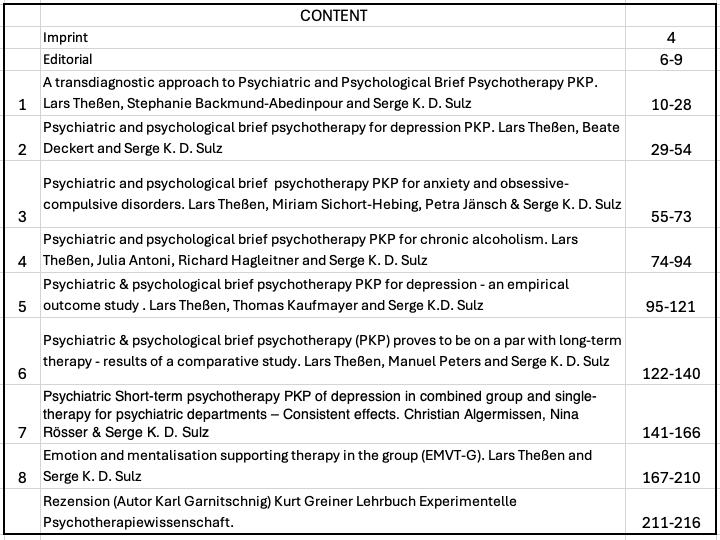
A?er this bridge we find an introduc=on and overview “ “A transdiagnostic approach to Psychiatric and Psychological Brief Psychotherapy PKP“ von Lars Theßen, Stephanie Backmund-Abedinpour and Serge K. D. Sulz . Der PKP-Ansatz wird zunächst im Allgemeinen vorgestellt, quasi als transdiagnostische Psychotherapie – noch bevor PKP sich den einzelnen Störungen zuwendet. Auf diese Weise wird deutlich, dass das Konzept auf quasi alle Achse-I-Störungen angewandt werden kann. Zunächst als Psychiatrische Psychotherapie im 25-Minuten-Setting konzipiert (Sprechstunde und Klinik-Visite) wurde PKP bald von Psychologischen PsychotherapeutInnen im 50-Minuten-Setting der Richtlinien-Psychotherapie angewandt, weshalb der Name sich um „Psychologisch“ erweiterte. Zugleich ist es eine Modulare Psychotherapie, die nicht einem starren
European Psychotherapy EP 2025 page 6-9
Therapiemanual folgt, sondern den individuellen Patienten mit seiner einmaligen Persönlichkeitsstruktur und Problemlage fokussiert, so dass eine auf ihn zugeschnittene Therapie erfolgt. Dies geschieht als individuelle Submodule im Rahmen der drei großen Module (Säulen) Sympomtherapie – Fertigkeitentraining / Emotions-Exposition und schemaanalytische Arbeit mit der dysfunktionalen Überlebensregel.
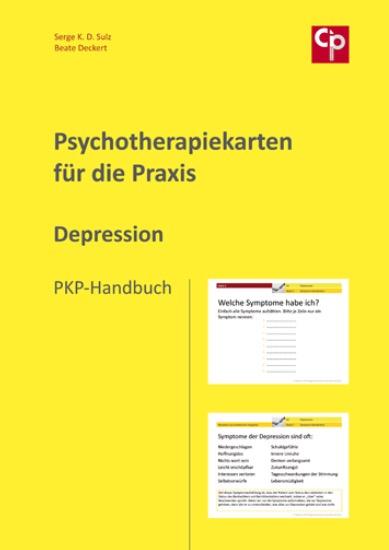
Die häufigste und am gründlchsten beforschte störungsspezifische PKP-Variante ist die Depressionsbehandlung: „Psychiatric and psychological brief psychotherapy for depression PKP“ (Lars Theßen, Beate Deckert and Serge K. D. Sulz). Hier wird insbesondere auf die Emotions-Vermeidungs-Funktion der Depression eingegangen. Depression ist ein Vermeidungsverhalten und durch Freude-, Angst-, Wut- und Trauer-Exposition wird dieses Vermeidungsvehalten reduziert, so dass der Patient immer weniger depressiv ist.
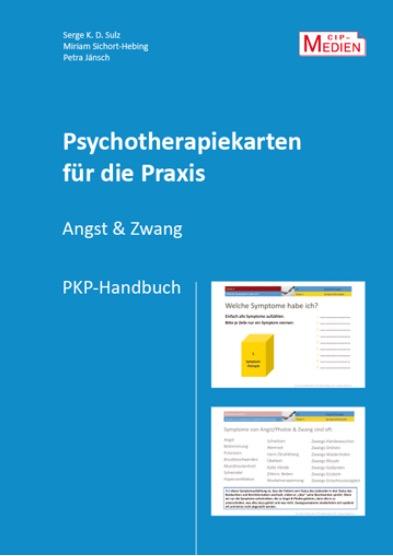
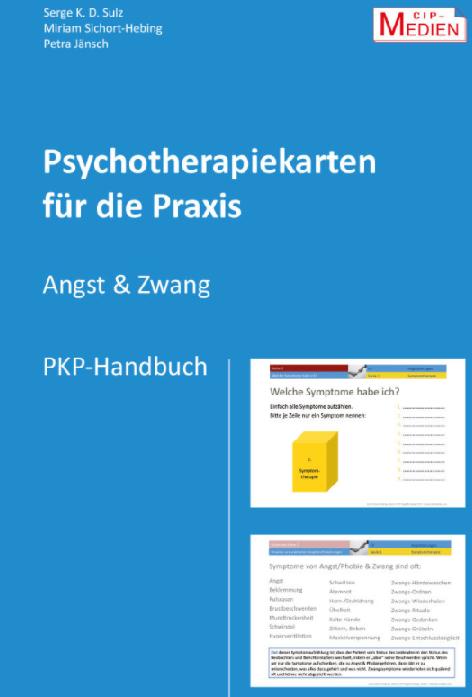
Es folgt eine umfassende Darstellung der Verhaltenstherapie von Angst und Zwang: „Psychiatric and psychological brief psychotherapy PKP for anxiety and obsessive-compulsive disorders“ (Lars Theßen, Miriam Sichort-Hebing, Petra Jänsch & Serge K. D. Sulz). Um alle wichtigen und häufigen Angstkrankheiten zu erfassen ist der störungsspezifische Teil der Symptomherapie besonders umfangreich. Lege artis-Behandlungen (evidenbasiert und leitlinienkonform) von Panikattacken, Agoraphobie, Generalisierter Angststörung, sozialer Phobie und Zwängen wird von der Zielformulierung, über die Therapieplanung bis zur Durchführung dargestellt.
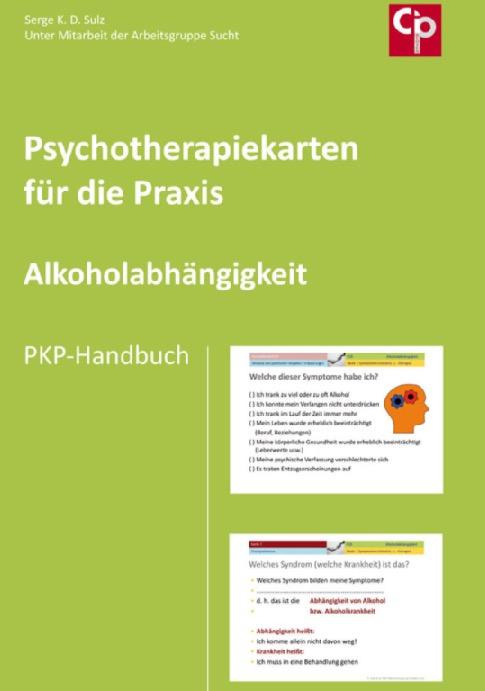
Mit die häufigste psychische Erkrankung ist der chronische Alkoholismus (Alkoholkrankheit). PKP stellt dafür ein mächtiges Therapieinstrument zur Verfügung „Psychiatric and psychological brief psychotherapy PKP for chronic alcoholism“ (Lars Theßen, Julia Antoni, Richard Hagleitner and Serge K. D. Sulz). Dem kaum zu stillenden Craving wird eine mühsame erarbeitete Abstinenzmotivation entgegengestellt und zugleich pathogene Lebens- und Beziehungsgestaltung reduziert, in die Fähigkeit mündend, sich helfen zu lassen und ein soziales Netzwerk aufzubauen.Daruntergelegt wird die Entwicklung der Affektregulierung und Selbstwirksamkeit.
Die erste Evaluationsstudie „Psychiatric & psychological brief psychotherapy PKP for depression - an empirical outcome study (Lars Theßen, Thomas Kaufmayer and Serge K.D. Sulz) zeigte im Vergleich zu einer Wartelistenkontrollgruppe hochsignifkante Abnahme der Depressivität bei hoher Effektstärke.
Die zweite Evaluationsstudie „Psychiatric & psychological brief psychotherapy (PKP) proves to be on a par with long-term therapy - results of a comparative study (Lars Theßen, Manuel Peters and Serge K. D. Sulz) verglich Kurzzeittherapie mit Langzeittherapie und bestätigte die Hypothese, dass Langzeittherapien oft nicht notwendig sind. Dies kann dazu führen, dass sorgfältigere Differentialindikationen eingeleitet werden.
Die dritte Evaluationsstudie „Psychiatric Short-term psychotherapy PKP of depression in combined group and single-therapy for psychiatric departments – Consistent effects.“ (Christian Algermissen, Nina Rösser & Serge K. D. Sulz) ist für die psychiatrische Versorgung von depressiven Menschen von größter Bedeutung. … v. Es handelt sich um die Übertragung von
Psychotherapy EP 2025 page 6-9
PKP in ein Gruppentherapiekonzept, das einerseits so einfach ist, dass es in jeder psychiatrischen Klinik angewandt werden kann und das andererseits zu hochsignifikante Verbesserungen bei hoher Effektstärke führt
.
And here an overview about the history of our EUROPEAN PSYCHOTHERAPY (source: Editorial EP 2024):
In the first issue in 2000 we introduced the most recent psychotherapeu=c developments of that =me (Dialec=c Behavior Therapy DBT, Acceptance and Commitment Therapy ACT, Func=onal Behavior Therapy FBT). It was followed by the consistent and radical accentua=on of Davanloo’s Short-term Dynamic Psychotherapy. In 2003 we dealt extensively with presen=ng the treatment of PosYrauma=c Stress Disorder as it was developed in the work with war vic=ms in the former Yugoslavia by Willi Butollo and coworkers. A?er this followed the Existen=al Analysis of Viktor Frankl, published by Alfried Längle, and Pesso Therapy PBSP which is on its way to become beYer-known in Europe only for a short =me. Also not so well-known has been that since the beginnings of the 90th a third wave therapy has developed in Europe: Strategic Brief Therapy SBT which puts the work with emo=ons and the development of personality in the foreground. From here it is only a small step to the Emo=on Focussed Therapy of Leslie Greenberg (2007) as a scien=fic further development of Gestalt Therapy and Client Centered Psychotherapy.
Next we had the pleasure to introduce Jeremy Holmes as a guest publisher. He is a topclass representa=ve of Psychoanalysis himself and he succeeded in gecng contribu=ons of real value about the presence and the future of Psychoanalysis from authors who ins=gate a lively development of Psychoanalysis. In his Editorial ‘towards a secure theore=cal and eviden=al base for psychoanaly=c psychotherapy’ he gives an introduc=on and an outline of this collec=on of psychoanaly=c wri=ngs which are not wriYen for psychoanalysts but for all psychotherapists who want to know more about today’s Psychoanalysis, who want to do no=onal steps towards it, maybe for to break with old prejudices, to become more open again for psychodynamic ideas or to ascertain similari=es that are much bigger then assumed un=l now. We as the publishers of this periodical had to see thereby that not only communica=on between the schools of therapy are essen=al but also communica=on between the na=onal groups of psychotherapists in Europe. And that exactly is our European project.
European Psychotherapy EP 2025 page 6-9
2010-2011, psychotherapists from all over Europe reported on psychotherapy training in their country:
Gerhard Lenz, Rafael Rabenstein, Vivian Görgen Austria
Mar:ne Bouvard France
Serge Sulz and Stefan Hagspiel Germany
Evrinomy Avdi Greece
Bernardo Nardi and Emidio Arimatea Italy
Susan van Hooren Netherlands
Andrzej Kokoszka Poland
Celia Avila Fernández Spain
Bo Erik Sigrell & Rolf Sandell Sweden and
Jan McGregor Hepburn Great Britain.
2012-2013, body psychotherapy became a topic. Concentra=ve Movement Therapy CMT (KBT) was used for this purpose - an evaluated Body Psychotherapy for psychosoma=c and psychic disorders.
2014-2015 topic, Austria – Home of the World’s Psychotherapy – most of the great psychotherapists in the early 20th century lived in Vienna or their career began there: Sigmund Freud, Melanie Klein, Michael Balint, Wilhelm Reich, Alfred Adler, Victor Frankl, Paul Watzlawick and Fred Kanfer.
2016-2017, Embodiment in Psychotherapy was topic (edited by Gernot Hauke) with absolutely innova=ve contribu=ons –looking in the future of psychotherapy:
Wolfgang Tschacher, Mario PfammaSer: Embodiment in psychotherapy – A necessary complement to the canon of common factors?
Marianne Eberhard-Kaechele: Emo:on is mo:on: Improving emo:on regula:on through movement interven:on
Rosemarie SamariSer and Helen Payne: Being moved: Kinaesthe:c reciproci:es in psychotherapeu:c interac:on and the development of enac:ve intersubjec:vity
European Psychotherapy EP 2025 page 6-9
Tania Pietrzak, Gernot Hauke, Chris:na Lohr: Connec:ng Couples Interven:on: Improving couples’ empathy and emo:onal regula:on using embodied empathy mechanisms.
Andrea Behrends, Sybille Müller, Isabel Dziobek: Dancing supports empathy: The poten:al of interac:onal movement and dance for psychotherapy
Susanne Bender: The meaning of movement rhythm in psychotherapy
Gernot Hauke, Chris:na Lohr, Tania Pietrzak: Moving the mind: Embodied cogni:on in Cogni:ve Behavioral Therapy (CBT)
Lily Mar:n, Valerie Pohlmann, Sabine C. Koch, Thomas Fuchs: Back into life: Effects of Embodied therapies on pa:ents with Schizophrenia.
And now 2023-2024, the latest integra=ve psychotherapeu=c development - first published in 2021 - has not yet entered the evidence-based evalua=on phase: Mentaliza=on Suppor=ng Therapy MST. That's exactly what it's about with EP: new important impulses, which of course only become evidence-based a few years a?er the approach was developed. Nevertheless, MST can build on a surprisingly broad empirical basis.
We can draw on more than thirty years of research tradi=on on the behavioral diagnos=c system, strategic brief therapy and strategic-behavioral therapy. Because MST is actually not a new therapeu=c approach. Similar to Fred Kanfer's selfmanagement approach, it is a variant of cogni=ve-behavioral therapy, consis=ng of the evidence-based interven=on strategies of behavioral therapy. However, the cogni=ve aspect focuses much more than Aaron T. Beck on metacogni=ons (thinking about thoughts, feelings and needs), so one can speak of metacogni=ve behavioral therapy. In addi=on, emo=ons have come to the fore. It's about the ability to regulate emo=ons - to be able to control one's emo=ons in such a way that they lead to stable and sa=sfying rela=onships. The third focus is needs orienta=on, based on John Bowlby's aYachment theory. Insecure aYachment in childhood as an elementary disposi=on for mental and psychosoma=c illnesses. And therefore the bond between pa=ent and therapist is an indispensable condi=on for successful psychotherapy.
European Psychotherapy EP 2025 page 6-9
The impetus for the development of MST came from Peter Fonagy and his working group with their Mentaliza=on Based Therapy MBT, whose perspec=ve Daniel Barth presents in the first ar=cle. This is followed by two ar=cles by Lars Theßen and Serge Sulz, in which they describe the theore=cal background, therapeu=c concep=on and prac=cal approach. The special type of emo=on exposure in MST (Emo=on Tracking), which was adopted by Albert Pesso, is described very clearly and impressively by Serge Sulz and Maria Schreiner.
This is followed by reports on previous research in the MST research laboratory by Lars Theßen, Serge Sulz and colleagues. Finally, there is an ar=cle by AnneYe Richter-Benedikt in which the use of MST in young people is described. All ar=cles are peer reviewed.
MST was only one example of innova=ve therapeu=c development that others will follow.
Chris=an Algermissen and Serge K. D. Sulz - Editors
Correspondencee Address
Dr. med. Christian Algermissen Klinik für Psychiatrie, Psychotherapie und Psychosomatik Harzklinikum Dorothea Christiane Erxleben GmbH Thiestraße 7–10 38889 Blankenburg Christian.Algermissen@harzklinikum.com
European Psychotherapy EP 2025 page 6-9
1.
1. A transdiagnostic approach to Psychiatric and Psychological Brief Psychotherapy PKP
Lars Theßen, Stephanie Backmund-Abedinpour and Serge K. D. Sulz
ABSTRACT
Based on an integrative behavioural and psychodynamic understanding of the case, PKP Brief Psychotherapy applies evidence-based, disorder-specific behavioural therapy interventions for anxiety, depression, alcohol dependence and chronic pain. In addition, a transdiagnostic intervention and baseline inventory is now available so that patients with less common diagnoses can also be treated across disorders. These will be discussed in this paper. Firstly, the development of the PKP project and its theoretical and conceptual background are described. The current state of research is briefly outlined.
Keywords
PKP brief psychotherapy, strategic brief therapy, survival rule, reaction chain to symptom, exposure therapy, PKP manual
1. Introduction
Psychological psychotherapists work with legally insured patients within the framework of the guidelines for psychotherapy. However, psychiatrists require a different format for the psychotherapeutic care of their patients during their consultation hours or in medical consultations during an inpatient stay than that offered by the guideline psychotherapy with 50-minute sessions.
Opinions differ on the question of whether a 20 to 25-minute setting is sufficient and whether the patient needs 50 minutes of attention. Those coming from a psychotherapy background cannot imagine that 25 minutes can be put to good use and may be sufficient. Those who come from acute care in psychiatric clinics and practices simply cannot afford the luxury of 50-minute sessions for reasons of care and make the unfeasible feasible for psychotherapists.
We have analysed this aspect thoroughly and have repeatedly found that 25 minutes is sufficient to carry out a relevant intervention well and effectively. However, a lot of time usually passes before therapist and patient have found a topic for the current session, as the therapist usually does not have a well-operationalised concept for the sequence of therapy content from session to session. In acute care, however, the content of the therapy is obvious and is agreed with the
patient immediately at the beginning of the session or even planned at the end of the previous session. It is therefore about the central theme of the therapy. Once this has been established and agreed, 25 minutes is very sufficient.
For seriously ill patients, 50 minutes is too much anyway, so this time frame is even counter-therapeutic. Problemorientated conversations are very stressful for them. In addition, their concentration is not sufficient for such a long conversation. Not only is the problem topic close to the patient, but there may also be too much closeness to the therapist, against which the patient cannot protect themselves for so long.
The only thing that remains is that the psychiatrist/therapist must have all the information available from the beginning of the session - about the case, the therapy concept, the last sessions and the current plan. They must therefore be well prepared. In general, the shorter the therapy, the better the preparation for the session must be. Just as short-term therapy is generally more demanding. Time is precious, not only financially but also conceptually. The therapist must be constantly alert, attentive and empathetic, confront in a well-dosed manner and provide resource-orientated impulses for change. But this also makes short-term therapy more satisfying.
It is a great relief when the therapist literally has the therapy concept and the current procedure in hand - in the form of our PKP manual for each individual mental disorder. Based on the original basic idea of the consultation cards in A5 format, each page of the PKP handbook has the front of the card at the top and the back at the bottom (what needs to be noted), with one page of the handbook forming the therapy concept for each 20 to 25-minute consultation. The front page tells you what to do and the back page tells you what is important and what to pay attention to. Some pages can be printed out as worksheets if the patient needs to fill something in or if the therapeutic explanations need to be illustrated with a picture. It is a joint task to work on the given topic and find a solution. The patient and therapist focus on this, both have the same goal and both stay on the topic until a solution is in sight. The patient does not sit back to be treated. Instead, they are part of the problem-solving team and therefore take on more responsibility and commitment. At least subjectively, it comes closer to working together as equals.
We have consistently found that patients react very positively to the worksheets in the PKP manual and find it pleasant to work with them. Therapists have the same experience once they have overcome their initial inhibitions about using paper.
It is often already clear where we will continue working next time. The topic is determined by the next pages of the manual, which build on those worked on today. Patient and therapist can prepare for this in advance.
However, the therapy programme is modular and does not have to be worked through in a linear fashion and at a set pace. Some pages can be skipped, others take twice or three times as much time. And of course you can also take a break to discuss current issues. However, this should soon be assigned to the therapy topics of the programme so that the current topic does not lead away, but leads back again (Kaufmayer & Sulz 2018).
1.1a Depression as avoidance behaviour
There is a genuinely behavioural approach to understanding depression that is usually neglected: the view of depression as instrumental behaviour that serves a purpose and is intended to achieve a goal. This goes well beyond the conventional loss-of-reinforcement and "thoughts make you depressed" paradigm. This makes us no less behavioural than these two simple disorder models, which too often do not do justice to the case. Instead, the frequent and powerful principle of negative reinforcement takes centre stage. This is because the "lack of reinforcement makes depressive" principle is purely causal and neglects the fact that the depressive syndrome is a bundle of behaviours, each of which is maintained by negative reinforcement. Today's functional-analytical approach to behaviour adds the teleological component to the causal component, i.e. the instrumental component of avoidance behaviour and symptom formation. What appears evident in other symptom formations is only hesitantly conceded to depression. However, it is not just a result, a final state. It is an unconscious strategy of the human psyche that is maintained by its intended effectiveness. Harmful or threatening things are kept away from conscious experience, even at the cost of distorting reality or even denying the facts.
1.1b Depression as a compromising solution to conflict
We assume that the symptom is a means of resolving a conflict that cannot be resolved using normal psychological mechanisms. If there are two possible solutions to a conflict, the one that would generate too much fear, shame or guilt is avoided. It is often the defensive defence of one's own interests that would trigger these feelings. However, as the second alternative - continuing to put up with everything - has become unbearable, it cannot be chosen without further ado. This is where the symptom helps as a compromise.
The term compromise is meant in such a way that although the decision against self-care and self-assertion is made, one does not yet remain completely in the adapted, compliant habitus. This is because the symptom makes it impossible to continue adapting or even submitting. Someone who is depressed cannot maintain their previous conformist social behaviour, but withdraws and can no longer do as much for others as before. However, the others can tolerate this, as
they are not shouted at "I don't want to do it any more", but rather a pained "I can't do it any more" is breathed in a weak voice. The caregivers only become angry after a very long delay - when they realise how much shared experience they have to do without.
1.2 The survival rule as a conflict resolution strategy
It is exhausting and unreliable to rely on your current feelings in every conflict situation. Our psyche works very economically and efficiently. In this case, it provides a rule of action that determines how to act in conflict situations. Long before we can think about it, the emotional decision has already been made. And if we do start to resist, fear, shame or guilt immediately arise so that we stay on the right path. Our behaviour is therefore not simply conditioned or biologically predetermined, but is largely guided by rules that arise from our experiences in the first years of life. In this sense, Hayes, Gregg & Wulfert (1998) speak of "rule governed behaviour" (cf. Sulz 2017a,b).
The rules begin early in life. Bowlby (1975, 1976) describes the infant's "inner working model" as the quintessence of the mother's attachment behaviour. From then on, the child behaves in such a way that the probability of receiving sufficient attachment is as high as possible with precisely this mother. This is a rule that enables the child to survive emotionally. This corresponds to the "basic assumptions" of Aaron T. Beck (1979, 2004), the upper plans of Grawe (1998), the survival conclusions of Fanita English (1986) and the "survival patterns" of Samual Slipp (1973). Annemarie Dührssen (1995) popularised this heuristic independently of attachment theory in depth psychology.
If, as is usual in the language of behavioural therapy, we distinguish only between body - emotion - cognition and action, then the survival rule is physical as well as emotive and cognitive. From the cognitive perspective, Aaron T. Beck (1979) categorised the child's implicit basic assumptions about how the world works as cognitive. These are the child's conclusions from his experiences, especially with his parents, which are made up of his world view and his self-image. These are causal statements that predict how parents will react to which child's behaviour. As these basic assumptions are also present in adults, often hardly changed, their predictions will be less and less accurate. So what was extremely helpful in childhood becomes a misleading behavioural rule for adults. For example: If you defend yourself, you will be rejected and excluded. The opposite is true if you are appropriately defensive. There is more consideration and greater appreciation.
By dealing with this, we express this rule linguistically. But infants and toddlers are not yet able to speak. It is therefore a preverbal system rule that guides the mental processes without any explicit thinking or language.
We have created a "survival rule" from the formulae of the authors mentioned (Sulz 1994), which, in addition to the commandments and prohibitions, also specifies the system target values, i.e. the basal and central needs of the child and the existential threats and fears (central anxieties). This makes it not only a prediction with instructions for action in an otherwise unknown system, but also a rudimentary description of this system. The human mental system follows the principle of homeostasis and endeavours to keep the target values necessary for survival largely constant. Numerous studies make it clear that the survival rule and the other constructs of PKP are empirically verifiable (Sulz & Müller 2000, Sulz & Tins 2000, Sulz & Maßun 2008, Sulz, Beste et al. 2009, Sulz, Arco et al. 2011, Sulz, Bischoff et al. 2011, Sulz, Gahr et al. 2011, Sulz, Heiss et al. 2011, Sulz 2014, 2017a-e).
2. Introduction to the practice: basics and practice guidelines
The therapist can start right away with the disorder-specific therapy for depression (Sulz & Deckert 2012a,b, anxiety Sulz, Sichort-Hebing & Jänsch 2015a,b, alcoholism (Sulz, Antoni et al. 2012a,b) or chronic pain (Schober 2018). However, the therapy is more likely to run smoothly if the steps described in the transdiagnostic PKP manual "PsychotherapieGrundkurs und Praxisleitfaden: Therapy Implementation in Clinic and Practice" (Sulz 2012) (problem, behaviour and goal analysis, modular therapy planning and the basic strategy of skills training and emotion exposure) are mastered beforehand. Then the individualising principle of modular psychotherapy can also be followed without further ado. So anyone who realises after using the disorder-specific PKP manuals for the first time, for example, that the general application of psychotherapy, especially behavioural therapy, has remained unclear, can gain more confidence with the help of these basics. Or acquire the complete behavioural therapy foundation (Sulz 2017a-d).
Implementation of PKP brief psychotherapy
PKP pursues a systematic therapy strategy using a series of interventions from the PKP manual pages as a continuation of short psychiatric and psychotherapeutic interventions. The conceptual basis is the 3-pillar model of Strategic Brief Therapy: symptom therapy (psychiatric), skills training (behavioural), personality development (psychodynamic). The manual pages contain short (10-25 minute) interventions that fulfil the current billing standards (EBM, GOÄ, OPS).
International classifications, guidelines and recognised evidence-based methods are taken into account. The application is very flexible:
• 20-minute consultation: one manual page
1. A transdiagnostic
• 50-minute therapy session: two manual pages
• 100-minute group session: two manual pages
The handbook pages can be edited by a single therapist or by a team (PKP logo: handover). They serve as a guide for patient contacts over several appointments, as well as documentation obligations, supervision and training through theoretical explanations on the back pages. They can be expanded as required with your own focal points by adding selfcreated worksheets. The manual pages enable the transparent integration of several therapists from the team treating the patient by working on different intervention series with self-contained units (modules or sub-modules, e.g. psychoeducation by medical staff and activity development by nursing staff) without losing the overall concept.
2.1 PKP practice - preparation and application
PKP is structured in such a way that the therapist is guided through all the important steps of diagnosis and treatment from the first encounter with the patient to the conclusion of the therapy. Even the initial contact can be structured by "newcomers to psychiatry and PT". After the initial consultation with anamnesis and psychopathological findings, the patient is reminded of the need to carry out psychological tests, draw up an emergency plan and provide information.
2.1.1 PKP problem analysis and situation and behaviour analysis
Even if it initially seems difficult to develop a systematic understanding of the development and maintenance of symptoms, it quickly becomes clear how valuable it is for the patient and therapist to be able to repeatedly refer back to this understanding (individual plausible disorder model) in order to maintain orientation in the modular therapy process and to follow an effective path to the therapy goal.
2.2 PKP therapy implementation
Pillar 1: Dealing with the symptom
The first pillar of therapy implementation focusses on the patient's main concern, i.e. getting their symptoms under control. This begins with understanding the symptoms and ends with relapse prevention:
- My disorder model: why my symptom arose and why it won't go away
- Reaction chain to the symptom: How I developed symptoms -
- Deciding at which link in the chain the therapy is most effective for the individual patient
- Relapse prevention as a component of symptom therapy (recognising situations that trigger relapse - recognising early relapse reactions - relapse prevention through lifestyle - relapse prevention through new relationship design)
2.3 PKP - therapy implementation Pillar 2: Skills training
The second pillar supports the development of skills on a cognitive, emotional and behavioural level. This module contains a selection of evidence-based interventions that can be used effectively for many mental disorders: Day planning, activity building - Relaxation training - Exercise and sport - Social skills - Communication skills in important relationships - Problem solving - practical approach - Cognitive training - Analysis of previous behaviour problem - Selfinstruction training - practical approach - Imaginations - practical application - Pleasure training - My feelings and dealing with my feelings - Independence training - Pampering and being pampered couples exercise - Empathy exercise. There are thus 14 sub-modules available for building skills. In terms of modular psychotherapy, the therapist decides which sub-modules should be used for the individual patient.
The aim is to make available to the patient precisely those abilities and skills that he or she has previously lacked and to enable him or her to master psychosocially difficult situations without developing symptoms.
2.4 PKP therapy implementation Pillar 3: Personality development/clarification of motives
The manual pages of the third pillar resolve the patient's motives that stand in the way of therapy and strengthen his motives for change. This involves working with the behaviour-controlling, central feelings (fear, anger, rage, sadness), central needs and dysfunctional personality traits. The personality trait's own survival rule (the master plan (Grawe 1998) of its life internalised since childhood) is developed on the basis of the learning history. The 3rd pillar ends with the patient's new experience of "living instead of surviving": the symptom loses its function through successful living.
2.5 PKP practical guide How to use the PKP manual
PKP attempts to reformat the therapy process of goal-orientated psychotherapy (in guideline psychotherapy with 50minute units) into shorter units of 20 to 25 minutes. These correspond to the usual EBM, GOÄ and OPS cycles. This has resulted in a series of consultations or ward rounds that allow you to stay on the ball and keep the thread in your hand. Every contact with the patient is a step forward on the way to achieving the goal. At the patient's next visit, work
continues (exactly) where it left off last time. This changes the relationship and the treatment for both the patient and the psychiatrist/psychotherapist. A goal emerges much more clearly than before, one that is worked on together: one that both work on, not just the therapist.
Most of the handbook pages serve as a template for the patient to copy. Depending on the topic, the patient fills in the card copied for him or her as required during the session or makes notes at home.
The reverse side of the therapy/consultation card contains explanations on how to work with this card in practice or notes on the theoretical background. It therefore supports training and supervision.
The therapy manual in A4 format contains the front of the therapy card at the top and the back at the bottom. This is very clear and the whole page can be photocopied and given to the patient - for understanding, consolidation and processing.
2.6 PKP practice guide Suggestion for the consultation/visit procedure
The PKP manual is placed on the therapist's desk.
The planned therapy session duration for PKP is 20 to 25 minutes. Every minute is precious - while the patient needs and wants a lot of time. Try to keep (strictly) to the time available to you and not to overrun by specifying the time frame available for the session at the beginning. The patient will quickly learn to adapt to this time. Anything that has been left out will be discussed the next time.
Suggest the therapeutic procedure with PKP to the patient during the initial consultation:
"I suggest that we see each other more closely for the time being. We can each have a 10 to 20-minute conversation, which is psychotherapy. We now know that psychotherapy is an essential treatment for almost all mental illnesses. Time is very short and we have to make good use of it. That's why we can't just stay with your acute complaints and problems, but must place them in the wider context of your illness. In each session, we will work on a therapeutic topic that is very important for overcoming the symptoms. It is useful to fill out project cards on the respective topic. This will give you mental clarity about your illness and the psychotherapy you need.
Even before our conversation here in the practice/visit begins, fill out a short report or copied CARD, e.g. a project card, on the current topic by recording everything worth mentioning from the past week/s or the current project. This will get you
in the mood for our conversation and give us a reliable overview so that we don't overlook anything important. At the end of our conversation, I will ask you to do something every day between our meetings that will help to replace the symptoms with effective behaviour. If you do nothing, nothing will happen. It may be tedious, but we need to tackle the things that will help to get your symptoms under control. Do you agree with this approach?"
If the patient agrees, a photocopy of card 2 "What symptoms do I have? (Simply list all the symptoms. Please name only one symptom per line ...) to take home.
So the patient has done his homework at the next appointments after the last lesson: he has filled out a short report on the events and activities of the last week at home/in the waiting room.
Normally, limit the time for the short report/HA to a few minutes. Some topics can be postponed until the next time.
The doctor/therapist opens the session: "Today's topic is ........................." He explains the topic (module/submodule) and discusses the content of the manual page for this topic with the patient. The therapist focusses on positive, nonsymptomatic statements made by the patient. In this way, a shared imagination can emerge that includes a helpful understanding of the topic and a plan for how the topic can be implemented in the patient's life. At the end of the consultation, homework is planned again so that the situation, people involved, day and time are determined as far as possible and the patient is asked to express their decision that they will tackle the project discussed, that it is their firm intention.
The patient deals with the topic until the next session, even if it is only to think about the topic for five minutes a day and recall the shared thoughts. If the topic on the therapy/ consultation card has not yet been completed, the patient continues to work on it in the next consultation, i.e. does not rush from card to card.
In this way, the patient is actively involved in the meantime - in thought and action, according to his or her limited possibilities due to the illness. He is required to make his contribution. They are mobilised emotionally, cognitively and actively and resistance is dealt with in the therapeutic relationship and used for relationship work.
3. PKP research
In addition to the continuous evaluation of process and outcome, in 2003 we began studies on the differential effectiveness of the concept of PKP brief psychotherapy. As the individual interventions come from the repertoire of cognitive behavioural therapy, which has been empirically investigated many times in controlled studies, the study was only concerned with examining the special characteristics of the PKP approach. However, it was not even necessary to investigate the short-term setting, as the duration of therapy in almost all studies in the Anglo-American language area was between twelve and twenty sessions. There, our total number of sessions (24 hours of weekly acute therapy plus six hours of monthly maintenance therapy) would possibly no longer be referred to as short-term therapy.
3.1 The Braunschweig PKP study (PKP groups in the clinic)
Christian Algermissen and his therapy team reformatted the original consultation cards into A4 group therapy cards and tested the effectiveness of the treatments using a sophisticated study design (Algermissen, del Pozo, Rösser 2017. Algermissen & Rösser 2019). They came to the following conclusion: "The contents of the PKP can be implemented as a combined group and individual therapeutic treatment concept in general psychiatric and psychotherapeutically orientated wards of a care clinic. The results of a scientific evaluation (n = 1196) of this innovative therapy concept in the Clinic for Psychiatry, Psychotherapy and Psychosomatics at the Braunschweig Clinical Centre allow a positive assessment. The therapy concept is effective, conserves resources and is highly accepted by patients. Cross-sector treatment paths can be implemented in cooperation with a psychiatric institute outpatient clinic or registered specialists." (op. cit. p. 113)
3.2 The Munich PKP study phase 1 (short-term outpatient therapy)
The study period ran from 2010 to 2014 and the therapy sessions lasted 50 minutes. The course of a therapy session was such that the patient reported for ten minutes and the homework was discussed. The core of the therapy consisted of twentyfive minutes of discussing and working on the planned therapy topic with the help of the next PKP manual pages. At the end, the upcoming homework was discussed for ten minutes and feedback was obtained for the therapy session. With 24 weekly sessions, the acute phase of the therapy lasted about six months. This was followed by approximately six months of maintenance therapy (one session every four weeks). After a further six months, the catamnesis session took place. It was agreed from the outset that the therapy would end after these thirty sessions.
Symptomatology (VDS14, VDS90, BDI II) did not reduce in the waiting list, but was highly significant in the therapy group with a very high effect size (Hedges g = 2.0). The global functional level only increased highly significantly in the treatment group, also
1. A transdiagnostic approach
with a large effect size (g = 1.7).
In this study, the influence of the dysfunctional survival rule decreased drastically over the course of therapy. For many patients, it could be replaced by a new permissive rule of life.
It is noteworthy that the depression values of the BDI II were still in the mildly depressive range at the end of the weekly acute therapy (14.1), fell into the non-clinical range after the monthly maintenance therapy (8.2) and fell further to 5.0 without any therapy after the catamnesis period. This means that the therapy does not have to be carried out until the depression has completely disappeared, but that the improvements continue afterwards until the patient is completely healthy.
3.3 The Munich PKP Study Phase 2 (short- and long-term outpatient therapy)
The second phase of the Munich PKP study consisted of the addition of long-term therapy for comparison. Peters and Sulz (2018) reported on this study. This was also conducted using the PKP concept, but the therapy topics were more indepth and there was more opportunity to practise.
The evaluation of the BDI II showed a superiority of short-term therapy after 24 sessions (significant at the 1-promill level). After 30 sessions (at the end of maintenance therapy), the short-term group was just as good as the long-term group. And at the catamnesis point, both groups also remained equally well, i.e. the depression score had significantly decreased to a non-clinical level in both groups (see Fig. 4.2).
The evaluation of the VDS90 total score (symptoms across all disorder areas, i.e. the patient's overall mental disorder analogue to SCL-R, cf. Sulz & Grethe 2005, Sulz, Beste, Kerber et al. 2009) showed the same results. The same effect was also shown in the VDS14 standardised interview to assess the psychological findings (Sulz, Hörmann, Zaudig, Hiller 2002 and Sulz, Hummel, Jänsch, Holzer 2011): highly significant improvements in depressive symptoms after therapy and no significant differences between CCT and CBT. Dysfunctional personality traits, which were recorded with the VDS30 personality questionnaire, decreased significantly in the same way in both short-term and long-term therapy (total score across all scales).
The Global Assessment of Functioning (GAF checklist in DSM IV, Saß, Wittchen, Zaudig & Houben, 2003), like all other measurement instruments, showed highly significant improvements with high effect sizes.
However, we can state that in a direct comparison of short-term and long-term therapy, the former did not show worse results at any time. Long-term therapy was not superior in our study. However, the question arises as to whether there are patients who require long-term therapy. This appears to be the case for patients with high dysfunctional personality traits or personality disorders and for patients who had a poor global functioning level GAF at the start of therapy, i.e. people whose illness meant that they had difficulty coping with the general demands of everyday life.
Literature
Algermissen C., del Pozo M. A. & Rösser N. (2017). Psychiatric Short-Term Group Psychotherapy. Vortrag auf dem WPA Weltkongress für Psychiatrie in Berlin (19.10.2017).
Algermissen C. und Rösser N. (2019). Psychiatrische Kurz-Psychotherapie von depressiven Störungen in kombinierter Gruppen- und Einzeltherapie – ein Behandlungskonzept für Versorgungskliniken. Psychotherapie 24-1, S. 113-13
Beck, A. T. (1979). Wahrnehmung der Wirklichkeit und Neurose. München: Pfeiffer.
Beck, A. T. (2004). Kognitive Therapie der Depression (3. Aufl.). Weinheim: Beltz.
Becker, E.; Margraf, J. (2007). Generalisierte Angststörung. Ein Therapieprogramm. Weinheim: Beltz
Becker, E., Nündel, B. (2003). Die Generalisierte Angststörung – State of the Art. Psychotherapie 8-1, 146-155.
Blanck, G.& Blanck, R. (1981). Angewandte Ich-Psychologie. Stuttgart: Klett-Cotta.
Blanck, G. & Blanck, R. (1991). Angewandte Ich-Psychologie. Teil 1. Stuttgart: Klett-Cotta.
Blanck, G.& Blanck, R. (1994). Ich-Psychologie II. Stuttgart: Klett-Cotta.
Bowlby, J. (1975). Bindung. München: Kindler.
Bowlby, J. (1976). Trennung. München: Kindler
Deutsche Gesellschaft für Psychiatrie Psychotherapie und Nervenheilkunde DGPPN, BÄK, KBV, AWMF (Hrsg., 2010): Nationale Versorgungs-Leitlinie. Unipolare Depression (S3 Praxisleitlinien in Psychiatrie und Psychotherapie), Springer, Berlin
de Jong-Meyer R., Hautzinger M., Kühner C., Schramm E., (Fachgruppe DGPs, Deutsche Gesellschaft für Psychologie, Hrsg. 2007): Evidenzbasierte Leitlinie zur Psychotherapie Affektiver Störungen. Hogrefe, Göttingen
Diclemente und Prochaska (1995): Changing for Good: A Revolutionary Six-Stage Program for Overcoming Bad Habits and Moving Your Life Positively Forward. New York: William Morrow
Dilling H., Mombour, W. & Schmidt, M.H. (2016). Internationale Klassifikation psychischer Störungen. ICD-10 Kapitel V (F). Klinisch-diagnostische Leitlinien. (10. überarbeitete Auflage). Göttingen: Hogrefe Verlag.
Dührssen, A. (1995). Dynamische Psychotherapie. Ein Leitfaden für den tiefenpsychologisch orientierten Umgang mit Patienten (2. Aufl.). Göttingen: Vandenhoeck & Ruprecht.
Dunn, J. D., & Tierney, J.G. (2006). A step therapy algorithm for the treatment and management of chronic depression. American Journal of Management Care, 12, 335 – 343.
Fonagy, P. (1997). Attachment and theory of mind: Overlapping constructs? Association for Child Psychology and Psychiatry, Occasional Papers, 14, 31-40.
Fonagy, P. & Bateman, A. (2008). Attachment, Mentalization and Borderline Personality. European Psychotherapy, 8, 3548.
Fonagy, P., Gergely, G., Jurist, E. L. & Target, M. (2008). Affektregulierung, Mentalisierung und die Entwicklung des Selbst (3. Aufl.). Suttgart: Klett-Cotta.
Fydrich T., Renneberg B. (2003). Soziale Phobie. In Leibing et al. (Hrsg.): Lehrbuch der Psychotherapie. Bd 3. S. 249-258.
Gerbershagen, H.U., Korb J., Nagel B. & Nilges P. DRK-Schmerz-Zentrum-Mainz: Das Mainzer Stadiensystem der Schmerzchronifizierung. Mainz Pain Staging System (MPSS). DRK Schmerz-Zentrum Mainz: Http: // www.drk-schmerzzentrum.de, abgerufen im Mai 2018
Graßl, S. & Artner, J. (2018). Medizinische Aspekte und Psychiatrisch Psychosomatisch Psychologische KurzPsychotherapie (PKP)bei chronischem Schmerz. Psychotherapie, 23 (1), 183-201. München: CIP-Medien.
Gräff, U. (1998). Lebensgeschichte und Persönlichkeit. Eine empirische Untersuchung des Anamnesefragebogens und der Persönlichkeitsskalen des Verhaltensdiagnostiksystems VDS. Med. Dissertation LMU München.
Gräff-Rudolph, U. & Sulz, S. K. D. (2017). Entwicklung reifer Empathie durch Entwicklung auf die zwischenmenschliche Stufe - bei Patienten. Psychotherapie, 22(2), 59-74.
Hautzinger M. (2013): Kognitive Verhaltenstherapie bei Depressionen: Behandlungsanleitungen und Materialien. BeltzPUV, Weinheim, 7. Auflage
Hayes S, Gregg J, Wulfert E: Akzeptanz- und Commitment-Therapie: Ein radikal behavioraler Ansatz. In: Sulz (Hrsg.): Kurz-Psychotherapien: Wege in die Zukunft der Psychotherapie. München: CIP- Medien, 1998, 143-162
Herpertz S., Caspar F., Mundt C. (Hrsg., 2008): Störungsorientierte Psychotherapie. Elsevier, München
Kanfer, F. H. & Karoly, P. (1972). Self-Control: A behavioristic excursion into the lions’ den. Behavior Therapy, 3, 398-416.
Hautzinger M. (2013): Kognitive Verhaltenstherapie bei Depressionen: Behandlungsanleitungen und Materialien. BeltzPUV, Weinheim, 7. Auflage
Hayes S, Gregg J, Wulfert E: Akzeptanz- und Commitment-Therapie: Ein radikal behavioraler Ansatz. In: Sulz (Hrsg.): Kurz-Psychotherapien: Wege in die Zukunft der Psychotherapie. München: CIP- Medien, 1998, 143-162
Kaufmayer T., Sulz S.K.D. (2018). Allgemeine und differentielle Wirksamkeit der Psych. Kurz- Psychotherapie (PKP) zur Behandlung depressiver Erkrankungen – eine empirische Studie im ambulanten Setting. Psychotherapie 23(1), S. 113133
Korff von, M., Ormel, J., Keefe, F.J., et al. (1992) Grading the severity of chronic pain. Pain, 50, 133-149. doi10.1016/0304-3959(92)90154-4.
Laux G, Dietmaier O. Praktische Psychopharmakotherapie. 7. Aufl. Elsevier Deutschland 2020
Lindenmeyer J. (2016). Lieber schlau als blau.9. Auflage. Weinheim: Beltz PVU
Mann K., Loeber S., Croissant B., Kiefer F. (2006): Qualifizierte Entzugsbehandlung von Alkoholabhängigen. Köln: Deutscher Ärzteverlag
Marlatt G, Gordon J. Determinants of relapse. Implications for the maintenance of behavior change. In: Davidson P, SM D, ed. Behavioral medicine. Changing health lifestyles. New York: Brunner Mazel, 1980:
Mathew, A.; Gelder, M.; Johnston, D. (1988).Agoraphobie. Berlin: Springer
McCullough J. (2007). Therapie von Chronischer Depression mit dem Cognitive Behavioral Analysis System of Psychotherapy (CBASP) – Trainingsmanual. München: CIP-Medien.
Mischel, W. (1972). Toward a cognitive social learning reconceptualization of personality. Psychological Review, 79, 433453.
Miller und Rollnick (2009): Motivierende Gesprächsführung. Freiburg: Lambertus
Mischel, W. (2004). Toward an integrative science of the person (Prefatory Chapter). Annual Review of Psychology, 55, 122.
Mischel, W. & Shoda, Y. (1995). A cognitive affective system theory of personality: reconceptualizing situations, dispositions, dynamics, and invariance in personality structure. Psychol. Rev., 102, 246–68.
Möller HJ, Laux G, Kapfhammer HP (Hrsg) Psychiatrie, Psychosomatik, Psychotherapie. 4 Bände, web-basiert. 5. Auflage, Springer Berlin Heidelberg 2017
Munsch S., Schneider S., Margraf J. (2003). Panikstörung und Agoraphobie. In Leibing E., Hiller W., Sulz S. (Hrsg.): Lehrbuch der Psychotherapie Band 3: Verhaltenstherapie. München: CIP-Medien S. 231-240
Peters, M. & Sulz, S. K. D. (2018). Wirksamkeit der Psychiatrischen Kurz-Psychotherapie (PKP) - Ist Kurzzeittherapie der Depression einer Langzeittherapie ebenbürtig? Eine vergleichende Studie. Psychotherapie, 23(1), 151-164.
Piaget, J. (1978). Das Weltbild des Kindes. München: dtv.
Piaget, J. (1995). Intelligenz und Affektivität in der Entwicklung des Kindes. Frankfurt: Suhrkamp.
Saß, H., Wittchen, H.-U., Zaudig, M. & Houben, I. (2003). Diagnostische Kriterien des Diagnostischen und Statistischen Manuals Psychischer Störungen. DSM- IV-TR. Göttingen: Hogrefe, 47-49.
Schober S. (2018). Psychotherapiekarten für die Praxis: Chronischer Schmerz. PKP-Handbuch. München: CIP-Medien
Slipp, S. (1973). The symbiotic survival pattern: A relational theory of schizophrenia. Family Process, 12, 377-398.
Sulz, S. K. D. (1993). Depression Ratgeber. Alles, was Sie für das Verständnis und den Umgang mit Krankheit und Kranken wissen sollten - für Betroffene, für Angehörige, für alle beruflichen Helfer. 1. Auflage. München: CIP-Medien.
Sulz, S. K. D. (1994). Strategische Kurzzeittherapie. Wege zur effizienten Psychotherapie. München: CIP-Medien.
Sulz S. (2007): Supervision, Intervision und Intravision. München: CIP-Medien
Sulz S. (2008a): Als Sisyphus seinen Stein losließ. München, CIP-Medien
Sulz, S. (2008b). VDS Verhaltensdiagnostik-Materialmappe. Das komplette Verhaltensdiagnostiksystem VDS als Kopiervorlage – Fragebögen und Interviewleitfäden mit Auswertungsanleitungen. München: CIP-Medien.
Sulz S. (2009): Praxismanual zur Veränderung des Erlebens und Verhaltens. München, CIP-Medien
Sulz, S. (2010). Mentalization and metacognition as paradigms for development and therapy in Strategic Behavioral Therapy. European Psychotherapy, 9, 191-208.
Sulz S. (2012): Psychotherapie-Grundkurs und Praxisleitfaden: Therapie-Durchführung in Klinik und Praxis. München: CIPMedien
Sulz, S. K. D. (2014). Wissenschaftliche Untersuchungen der Konstrukte, Konzepte und Interventionen des Strategischen Therapieansatzes (SKT, SBT, PKP und SJT). Psychotherapie in Psychiatrie, Psychotherapeutischer Medizin und Klinischer Psychologie, 19(2), 339-363.
Sulz S. K. D. (2017a). Gute Kurzzeittherapie in 12 plus 12 Stunden. Für PsychotherapeutInnen, die sich in Kurzzeittherapie einarbeiten wollen. München: CIP-Medien
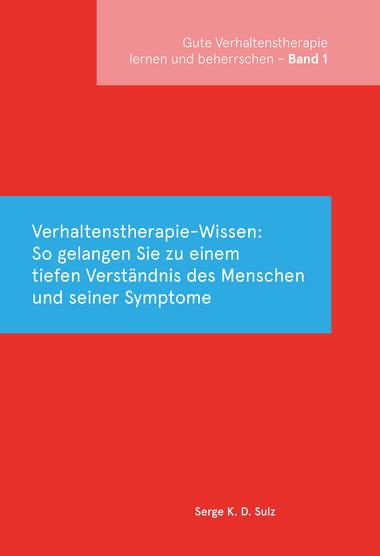
Sulz S. K. D. (2017b). Gute Verhaltenstherapie lernen und beherrschen - Band 1: Verhaltenstherapie-Wissen: So gelangen Sie zu einem tiefen Verständnis des Menschen und seiner Symptome. München: CIP-Medien
Sulz S. K. D. (2017c). Gute Verhaltenstherapie lernen und beherrschen - Band 2: Verhaltenstherapie-Praxis: Alles was Sie für eine gute Therapie brauchen. München: CIP-Medien
Sulz S. K. D. (2017d). Verhaltensdiagnostik und Fallkonzeption. Bericht an den Gutachter. München: CIP-Medien
Sulz, S. K. D. (2017e). Depression Ratgeber & Manual, für Betroffene, für Angehörige, für alle beruflichen Helfer. 4. Auflage. München: CIP-Medien. 2013 auch als e-book erschienen.
Sulz, S.K.D.. (2019a). Fallkonzeption des Individuums und der Familie. In Leibing, E., Hiller, W., Sulz, S.K.D. (Hrsg., 2019).
Lehrbuch der Psychotherapie. Band 3: Verhaltenstherapie. Gießen: Psychosozial-Verlag, S. 25-48
Sulz, S.K.D.. (2019b). Prozessuale und inhaltliche Therapiestrategien. In Leibing, E., Hiller, W., Sulz, S.K.D. (Hrsg., 2019).
Lehrbuch der Psychotherapie. Band 3: Verhaltenstherapie. Gießen: Psychosozial-Verlag, S. 105-124
Sulz S. K. D. (2021a). Mit Gefühlen umgehen - Praxis der Emotionsregulation in der Psychotherapie. Gießen: CIP-Medien im Psychosozial-Verlag
Sulz, S.K.D. (2021b). Mentalisierungsfördernde Verhaltenstherapie. Gießen: Psychosozialverlag.
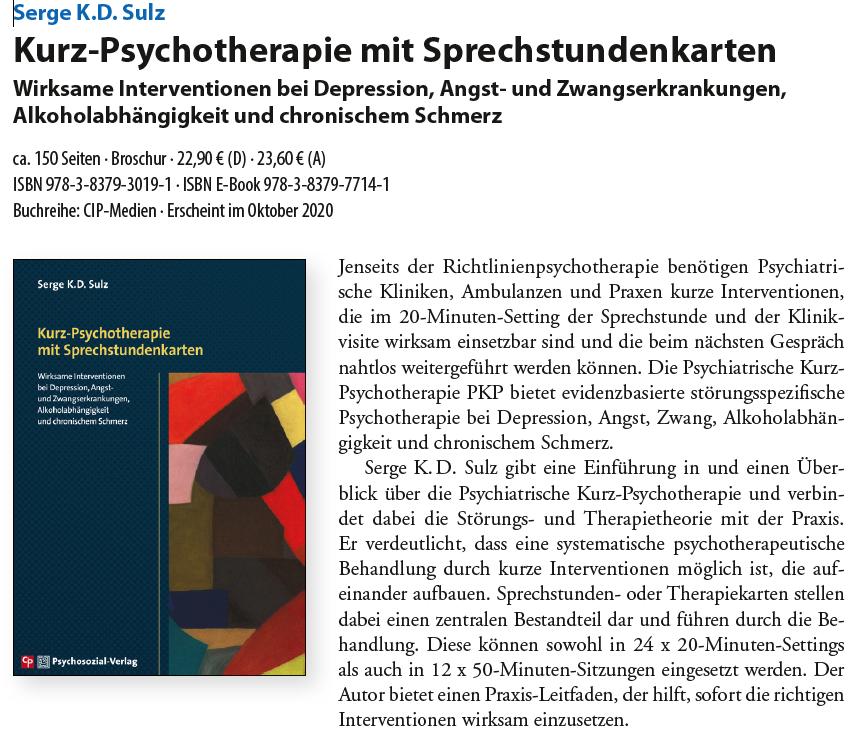
Sulz S. (2021c). Kurz-Psychotherapie mit Sprechstundenkarten. Wirksame Interventionen bei Depression, Angst- und Zwangskrankheiten, Alkoholabhängigkeit und chronischem Schmerz. Gießen: Psychosozial-Verlag
Sulz, S.K.D. (2022a). Heilung und Wachstum der verletzten Seele. Praxisleitfaden Mentalisierungsfördernde Verhaltenstherapie. Gießen: Psychosozial-Verlag
Sulz, S.K:D. (2022b): Praxismanual Mentalisierungsfördernde Verhaltenstherapie – Anleitung zur Therapiedurchführung. Gießen: Psychosozial-Verlag
Sulz, S.K.D. (2023). Die Emotion-Tracking-Studie zur Wirksamkeit von PBSP®-Interventionen (Studie 1). In Bachg, M., Sulz, S.K.D. (Hg.2023). Bühnen des Bewusstseins – Die Pesso-Therapie. Gießen: Psychosozial-Verlag S. 419ff
Sulz, S. K. D., Antoni, J., Hagleitner, r. & Spaan, L. (2012a). Psychotherapiekarten für die Praxis. Alkoholabhängigkeit. PKP- Handbuch. München: CIP-Medien.
Sulz, S. K. D., Antoni, J., Hagleitner, r. & Spaan, L. (2012b). Psychotherapiekarten für die Praxis. Alkoholabhängigkeit. Therapiekarten. München: CIP-Medien.
Sulz, S. K. D., Arco, K., Hummel, C., Jänsch, P., Richter-Benedikt, A., Hebing, M. & Hauke, G. (2011). Werte und Ressourcen in der Psychotherapiediagnostik und Therapiekonzeption VDS26-Ressourcenanalyse und VDS33Werteanalyse. Psychotherapie in Psychiatrie, Psychotherapeutischer Medizin und Klinischer Psychologie, 16(1), 113127.
Sulz S., Beste E., Kerber A.C., Rupp E., Scheuerer R., Schmidt A. (2009). Neue Beiträge zur Standarddiagnostik in Psychotherapie und Psychiatrie – Validität und Reliabilität der VDS90-Symptomliste und VDS30-Persönlichkeitsskalen. Psychotherapie in Psychiatrie, psychotherapeutischer Medizin und klinischer Psychologie. Bd. 14-2. - S. 215-234.
Sulz, S. K. D., Bischoff, C., Hebing, M. & Richter-Benedikt, A. (2011a). VDS23-Situationsanalyse - schwierige Situationen, die zur Symptombildung führen und Fokus therapeutischer Veränderung sind. Psychotherapie in Psychiatrie, Psychotherapeutischer Medizin und Klinischer Psychologie, 16(1), 104-111.
Sulz, S. K. D. & Deckert, B. (2012a). Psychotherapiekarten für die Praxis. Depression. PKP-Handbuch. München: CIPMedien.
Sulz, S. K. D. & Deckert, B. (2012b). Psychotherapiekarten für die Praxis. Depression. PKP-Therapiekarten. München: CIPMedien.
Sulz, S. K. D., Gahr, S., Manhart, C., Hebing, M. & Richter-Benedikt, A. (2011b). VDS36-Interaktionsanalyse zur Beziehungsdiagnostik in kognitiv-behavioralen Therapien. Psychotherapie in Psychiatrie, Psychotherapeutischer Medizin und Klinischer Psychologie, 16(1), 129-141.
Sulz, S.K.D. & Grethe, C. (2005). VDS90-SL - VDS90-Symptomliste (VDS90; Verhaltensdiagnostiksystem 90Symptomliste). PSYNDEX Tests Info. Psychotherapie, 10(1), 38-48.
Sulz, S. K. D., Hagspiel, S., Gerner, S., Hebing, M. & Hauke, G. (2011c). Lebens- und Krankheitsgeschichte: Der VDS1 Fragebogen in der klinischen und wissenschaftlichen Anwendung am Beispiel der Kindheit von Patienten mit Depression und Angstkrankheiten. Psychotherapie in Psychiatrie, Psychotherapeutischer Medizin und Klinischer Psychologie, 16(1), 93-102.
Sulz, S. K. D., Heiss, D., Linke, S., Nützel, A., Hebing, M. & Hauke, G. (2011d). Schemaanalyse und Funktionsanalyse in der Verhaltensdiagnostik: Eine empirische Studie zu Überlebensregel und Reaktionskette zum Symptom. Psychotherapie in Psychiatrie, Psychotherapeutischer Medizin und Klinischer Psychologie, 16(1), 143-157.
Sulz, S. K. D., Hörmann, I., Hiller, W. & Zaudig, M. (2002). Strukturierte Befunderhebung und Syndromdi- agnose in der psychotherapeutischen Praxis. Psychotherapie in Psychiatrie, Psychotherapeutischer Medizin und Klinischer Psychologie, 7(1), 6-16.
Sulz, S., Hummel, C., Jänsch, P., & Holzer, S. (2011). Standardisierte Erhebung des psychischen Befundes und Bestimmung der ICD-10-Diagnose: Vergleich von SKID I und VDS14-Befund-Interview. Psychotherapie in Psychiatrie, Psychotherapeutischer Medizin und Klinischer Psychologie, 16(2), 215–236.
Sulz, S. & Müller, S. (2000). Bedürfnisse, Angst und Wut als Komponenten der Persönlichkeit. Psychotherapie in Psychiatrie, Psychotherapeutischer Medizin und Klinischer Psychologie, 5(1), 22-37.
Sulz, S.K.D. & Schreiner, M. (2024). Emotion Tracking - Healing and Growth of the Wounded Soul. European Psychotherapy EP 2024 page 94-113
Sulz, S. K. D., Sichort-Hebing, M. & Jänsch, P. (2015). Psychotherapiekarten für die Praxis Angst & zwang. PKP-Handbuch. München: CIP-Medien.
Sulz, S. K. D., Sichort-Hebing, M. & Jänsch, P. (2015). Psychotherapiekarten für die Praxis Angst & zwang. Therapiekarten. München: CIP-Medien.
Sulz, S. & Maßun, M. (2008). Angst als steuerndes Prinzip in Beziehungen. Ergebnis einer qualitativen Analyse von Interviews. Psychotherapie in Psychiatrie, Psychotherapeutischer Medizin und Klinischer Psychologie, 13(1), 37-44.
Sulz, S. & Tins, A. (2000). Qualitative Analysis of Satisfaction and Frustration of Basic Needs in Childhood – an Empirical Study. European Psychotherapy, 1, 81-98.
Sulz, S. K. D. & Sichort-Hebing, M. (2018). Persönlichkeitsstil, dysfunktionaler Persönlichkeitszug und Persönlichkeitsstörung als limitierender Faktor bei Kurzzeittherapien. Psychotherapie, 23(1), 202-231.
Wagner P., P. Bräunig (2006): Psychoedukation bei bipolaren Störungen. Ein Therapiemanual für Gruppen. 2. Auflage. Schattauer, Stuttgart
Wittchen H.-U.,. Möller H.-J, Vossen A., Hautzinger M., Kasper S., Heuser I. (1995): Hexal-Ratgeber Depression, Wege aus der Krankheit. Karger, Basel
Zaudig, M., Hauke W., Hegerl U. (2002) Die Zwangsstörung, Diagnostik und Therapie. Stuttgart: Schattauer.
Zielke, M. Kopf-Mehnert C. (1978). Veränderungsfragebogen des Erlebens und Verhaltens VEV. Weinheim. Beltz-Test
Psychotherapy EP 2025 page 10-28
Correspondence Address
Dr Lars Theßen, MD
SBT-in-Berlin, Institute for Strategic Behavioural Therapy
Germanenstraße 93a, 12524 Berlin
thessen@sbt-in-berlin.de https://sbt-in-berlin.de
European Psychotherapy EP 2025 page 10-28
2. Psychiatric and psychological brief psychotherapy for
2. Psychiatric and psychological brief psychotherapy for depression PKP
Lars Theßen, Beate Deckert and Serge K. D. Sulz
Abstract
This work presents the Psychiatric and Psychological Brief Psychotherapy PKP for depression, which is based on the three pillars (modules) of symptom therapy (dealing with the symptom), skills training (exposure to joy, fear, anger and grief) and working with the dysfunctional survival rule (establishing a new life rule that gives permission). Originally working with consultation cards, a PKP manual for each disorder is now the guideline for the specific therapeutic procedure. The difference to conventional therapy manuals is the modular structure, which is aimed at personalised, individual therapy planning and implementation. This results in a flexible therapy concept that differs from patient to patient.
Key words
Behaviour therapy - short-term psychotherapy - symptom therapy - skills training - emotion exposure - anxiety exposurejoy exposure - anger exposure - grief exposure - modular psychotherapy - dysfunctional survival rule - permission-giving life rule
The three pillars of PKP depression therapy Pillar 1: Dealing with the symptom (Module 1)
The PKP manual for depression treatment consists of 61 instructions for pillars 1 and 2 and a further twelve for pillar 3. The first pillar is symptom therapy. These are supplemented by 14 instructions by Gerhard Laux, who provides a concise yet complete overview of antidepressants.
We start with the module on understanding and treating symptoms:
a) What symptoms do I have?
b) What is depression?
c) What is the difference between emotion and mood?
d) Depression avoids anger and sadness
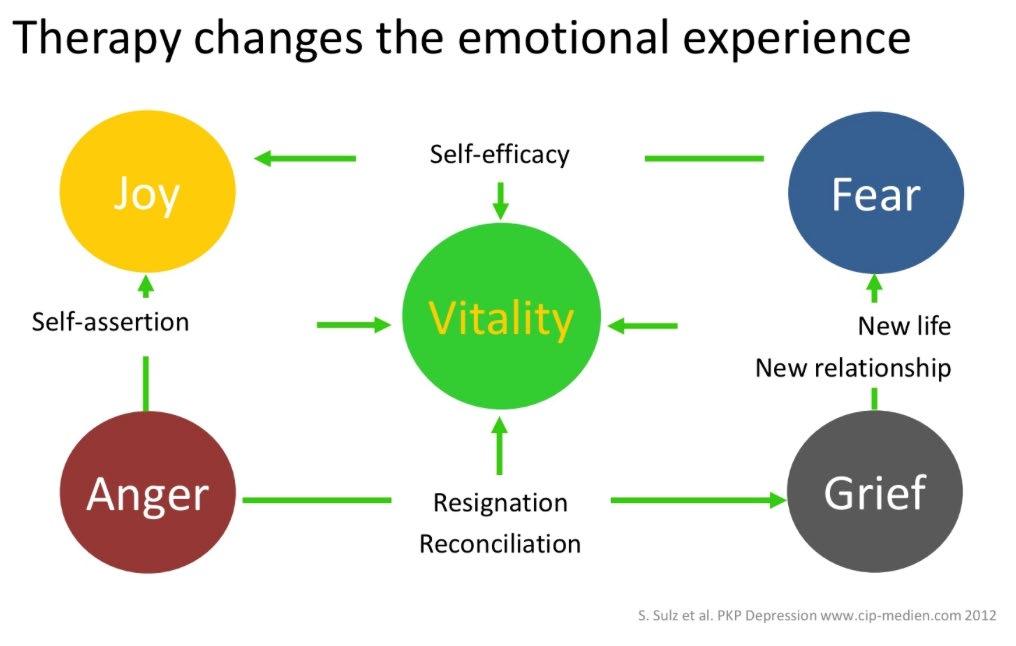
e) The emotional star: vital pendulum swings
2. Psychiatric and psychological brief psychotherapy for
f) Depression therapy = emotion instead of mood
Like all PKP manuals, this one also contains psychotherapeutic strategies and assumes that the psychiatrist has already initiated drug treatment. The subsequent instructions by Gerhard Laux are primarily used to check whether the pharmacotherapy that may be taking place in parallel is indicated and represents a harmonious combination of psychotherapy and psychopharmacotherapy for the patient in question. The first step is the joint psychoeducational development of basic knowledge about the patient's depressive illness. This ensures that the patient is not simply depressed, but that he looks at his depression and reflects on it (mentalises it in Fonagy's sense). He goes to a meta-level and metacognition takes place (thoughts about thoughts) and even this brief distancing makes the depressive suffering temporarily less intense.
Pillar 2: Skills training (Module 2)
The second pillar supports the development of skills on a cognitive, emotional and behavioural level with four skills modules: Joy Exposure, Anxiety Exposure, Anger Exposure and Grief Exposure. Each module contains a selection of evidence-based antidepressant interventions, e.g.
Joy exposure:.
a) Pleasure training
b) Building positive activities
c) Relaxation training
d) Pampering
e) Exercise and sport
Exposure to pleasure - the respective procedure is described in detail on the back of the consultation cards - allows the gain in direct experience of positive feelings to occur safely despite resistance typical of depression. The patient will reply that a positive activity is not fun, but only exhausting. Yes, it is exhausting because it is swimming against the depressive current. Only doing nothing would make the mood even more depressed. It's not really good, but it's not as depressive as doing nothing. The therapist must not let up. It's important to wring this effort out of the patient. Well-dosed, persistent.
This is followed by
Exposure to fear:
a) self-assertion training
b) Communication training
c) Independence training
d) pleasure instead of obligation training
Exposure to anxiety increases the patient's social radius. The patient regains the confidence to interact more with other people. If the patient has a dependent or insecure personality structure, you could stay with this topic for two years. However, as soon as he dares to do the activities discussed and carries them out and you manage to maintain a sufficient amount of practice, you should not fail to move on to anger exposure. Dealing with anger in a socially competent way is the centre of antidepressant therapy. This area of emotion regulation is a construction site that can rarely be completed during the entire therapy. Exposure to grief only occurs when a major loss has not been mourned.
Exposure to anger:
a) Perceiving anger and rage
b) Allowing intense anger/rage
c) Discriminating between feelings and actions and fantasy and reality
d) Expressing anger and rage
e) Checking the appropriateness of anger/rage
f) Constructive negotiation
Grief exposure:
a) Remembering the precious, loved one I lost
b) Feeling how much I need him/her
c) Visualising the moment of loss
d) Realising the pain, despair and grief
e) Leaving the feeling there until it has disappeared by itself
Looking back and looking ahead:
What I can do now, dare to do, let go and how I resist
Pillar 3: From the dysfunctional survival rule to the permission-giving rule of life (Module 3)
The instructions for action in Pillar 3 first explore the central needs for belonging and autonomy that arose in childhood, which were frustrated by the parents to such an extent that it was necessary to find out how the parents are nevertheless prepared to satisfy them. The resulting commandments ("Only if you always ...") and prohibitions ("And if you never ...") are a reflection of the emotional conditions of survival with these parents. They were retained into adulthood, even though they are no longer valid. This is why a new rule, which is no longer a survival rule but an affirmative rule of life, can replace them and remove powerful therapeutic resistance.
A mental model of depression - how depression can develop
The interaction between the parents with their parental behaviour and the child with its innate characteristics and temperament leads not only to satisfaction but also to frustration and threats, which permanently bring certain needs to the fore, e.g. the need for security or the need for attention. It also leads to a person permanently focussing on avoiding specific threats or fears and thus building up an individual profile of avoidance actions. Another important result of his childhood is the inhibition of his aggressive tendencies towards members of his social community. The content of the anger tendencies is characteristic of a person and is also the result of the interaction between parents and child or between the child and other important attachment figures (e.g. brother, sister, grandparents). The permanent blocking of the tendency to rage and attack is an important task of self-regulation. Many people go so far as to become insecure and anxious. Psychological homeostasis (a control loop that tries to keep everything in balance) can be understood as a set of rules and the most important rule is the one that ensures survival. The processes are preconscious, i.e. the arbitrary (conscious) psyche is unaware of these connections.
Relationships are mostly about emotional survival, i.e. preventing psychological damage. A survival rule that is optimally tailored to the social environment in childhood becomes unsuitable (dysfunctional) in adult life if it is not changed. Patients have dysfunctional survival rules that ensure that their experiences and behaviour do not lead to the desired results, i.e. are detrimental to the person concerned. They also prevent the relationships of their adult life from remaining supportive
and satisfying for both sides. In our observations, we are therefore initially concerned with the personality traits that prevent success. The survival rule and the sub-optimal experience and behavioural stereotypes defined by the personality restrict a person's active behavioural repertoire considerably in some cases. As a result, they are less able or unable to cope with difficult problems. The triggering life situation, for example, can only be responded to by the development of symptoms. Experiences and behaviours that would have led to mastering the problem are forbidden. They would violate the survival rule and jeopardise emotional survival. Which life situation leads to the formation of symptoms is therefore also determined by the personality of the person affected. Therapeutic modification of these personality traits and behaviours is therefore a high priority in psychotherapeutic goal definition and treatment planning.
How to use the instructions in the PKP manual
PKP offers the option of reformatting the therapy process of goal-orientated psychotherapy (in guideline psychotherapy with 50-minute units) into shorter units of 25 minutes. These correspond to the usual EBM, GOÄ, OPS clocking. This has resulted in a series of consultations or ward rounds that make it possible to stay on the ball and keep the red thread in hand. Every contact with the patient is a step forward on the way to achieving the goal. At the patient's next visit, work continues (exactly) where it left off last time. This changes the relationship and the treatment for both the patient and the psychiatrist. A goal emerges much more clearly than before, one that is worked on together: one that both work on, not just the doctor.
The PKP practice is modular and focussed on the individual patient. Exactly that and exactly as many interventions as are conducive to the individual therapy process.
At times, especially when understanding the illness, it may be possible to work on several instructions (one instruction corresponds to one page in the PKP manual) in one hour - if the patient can follow the statements quickly. Later it will be the other way round, that we would like to have several sessions for one topic. Some instructions are omitted because the therapist or the patient is not familiar with the topic or the way the topic is being worked through. Or simply because of time constraints. The categorisation with one page for each instruction facilitates a flexible approach. We can proceed in small steps with some patients and in larger steps with others and then need fewer instructions. Sometimes we realise that we have already covered the topic of an instruction sufficiently with the previous one. We therefore skip this one. If we persistently follow the individualised path of the modules and sub-modules at the same time, we are still taking an antidepressant path that is effective in the short and medium term. This work with the instructions is by no means
superficial. They ensure that the patient becomes more and more willing to discuss deeper issues with us. Intensive encounters with emotions and relationships take place - hopefully in a sufficiently effective way so that less depression remains.
Most of the instructions serve as a copy template for the patient. Depending on the topic, the patient fills in the page copied for him or her as required during the session or makes a record at home. The bottom half of the page contains explanations of the practical work or notes on the theoretical background. This gives the therapist confidence in the specific procedure (why and why am I carrying out this intervention?).
Suggestion for the course of the consultation/visit
The PKP manual is placed on the therapist's desk - as a shared workbook.
The duration of therapy sessions for PCP is 20 to 25 minutes in clinics and outpatient clinics as well as in psychiatric consultations, and 50 minutes in psychotherapeutic practices. In the 25-minute setting, every minute is precious - while the patient subjectively needs and wants a lot of time. Nevertheless, we try to (strictly) adhere to the time available to us and not overrun by specifying the time frame available for the conversation at the beginning. The patient quickly learns to adapt to this time. Anything that has been left out will be discussed the next time.
Suggest the therapeutic procedure with PKP to the patient in the initial consultation:
I suggest that we see each other more closely for the time being. We can each have a 20- to 25-minute conversation, which is psychotherapy for your depression. We now know that psychotherapy is an essential treatment for depression. Time is very short and we have to make good use of it. That's why we can't just stay with your acute complaints and problems, but must place them in a wider context of depression. In each session, we will work on a therapeutic topic that is very important for overcoming the depression. It is useful to fill out project cards on the respective topic. This will give you mental clarity about your depression and your depression therapy.
Even before our conversation here in the practice/visit begins, fill out a short report or handout (copy of a page from the PKP manual), e.g. a project card, on the current topic by recording everything worth mentioning from the past week/s or the current project. This will get you in the mood for our upcoming meeting and give us a reliable overview so that we don't overlook anything important. At the end of our conversation, I will ask you to do something about your depression every
day if possible between our meetings. If you do nothing, nothing will happen. It may be tedious, but we have to tackle the things that will help to get your depression under control. Do you agree with this approach?"
If the patient agrees, they can already be given a photocopy of instruction 2 "What symptoms do I have? (Simply list all the symptoms. Please name only one symptom per line ...) can be given to the patient to take home.
The patient has therefore completed his homework for the next appointments after the last lesson: he has filled in a short report at home about the events and activities of the last week or the photocopied instructions for action or the relevant project card for the topic.
We normally limit the time for the short homework report to a few minutes. Some topics can be postponed until the next time.
The therapist opens the work with the instruction: "Today's topic is ...." and explains which topic (module/submodule) is involved and discusses the content of the instructions for this topic with the patient. She focusses on positive, nondepressive statements made by the patient. In this way, a shared fantasy can emerge that includes a helpful understanding of the topic and a plan for how the topic can be implemented in the patient's life. At the end of the consultation/therapy session, homework is planned again so that the situation, people involved, day and time are determined as far as possible. The patient is asked to express their decision that they will tackle the project discussed, that it is their firm intention. The patient deals with the topic until the next session, even if it is only to think about the topic for five minutes a day and recall the shared thoughts. If the topic of the instruction has not yet been completed, the patient continues to work on it in the next consultation, i.e. does not simply rush on.
In the meantime, the patient is actively involved - in thought and action, in accordance with their limited possibilities due to their illness. They are required to make their contribution. They are mobilised emotionally, cognitively and actively and resistance is dealt with in the therapeutic relationship and used for relationship work.
Practical work with the modules
1. Symptom therapy pillar: Depressive symptoms (Module 1)
If the patient is not severely depressed, we can talk to them about their symptoms, their illness and its origins: Metacognitive contemplation or mentalising (for 15 minutes in a 25-minute setting),
- because we have already spent 5 minutes asking what has happened since the last appointment and - because we discuss with him for another 5 minutes what he will do until the next appointment.
In the 50-minute setting, we have 40 minutes to do this. However, it is not uncommon for two twenty-minute discussions of two topics/manual instructions to take place in these 40 minutes.
If the patient is so severely depressed that they cannot concentrate on exchanging thoughts in order to develop an understanding of the illness, an intervention must be started instead that guides their consciousness away from the depressive state. Resource-orientation is obvious: joy exposure, starting with simple positive activities (see module section on joy exposure).
Mentally organising your own symptoms (instruction 10)
The focus is not on remembering, but on thinking, differentiating and correctly categorising. The patient is given the impulse to briefly step out of the affective experience of depression and "expertly" sort their findings - according to thoughts, feelings, actions, etc.
Again, the aim is for the patient to look at themselves from a certain distance or from a bird's eye view, which automatically reduces the depressive symptoms somewhat. He moves from simple (depressive) cognition to (nondepressive) metacognition.
Depression is an affective disorder in which there is moodiness. We explain to the patient the difference between emotion and mood (instruction 13):
Feelings such as joy, anger relate to an event, relate to a person, are a reaction to their behaviour, start quickly and change rapidly, can become very intense and have a short duration (minutes).
Moods are the opposite of everything! They do not relate to any event or person, start and change slowly. Why do they do that? They are supposed to protect us from feelings and their consequences.
We can explain this to the patient (Card 16):
In terms of behavioural theory, depression is an operant or instrumental behaviour.
– It is maintained by its consequences.
– The consequence of depression is avoidance.
– To understand depression, we need to find out what exactly is being avoided.
The aim is for the patient to categorise the triggering situation in such a way that they should have been able to defend themselves, but the depression wants to prevent them from doing so (Card 18): Depression avoids fighting back effectively and the feelings associated with it. It is usually anger, pain or sadness.
2. Psychiatric and psychological brief
The aim is for the patient to accept the necessity of anger as the basis of a healthy defence. He is taught that he has a duty to his life to allow his anger to be felt so that he can defend himself. Those who do not defend themselves tempt others to become offenders. In social interaction, it is necessary to show the other person that they have crossed my boundaries and that I don't want them to. They need this feedback in order to return to good social behaviour.
When a loss leads to depression (card 22):
– Depression avoids the transition to the next phase of grief: letting go.
– What I don't let go of, I don't lose.
– Or: I can't live without it, so I can't let go in grief.
– Or: Letting go is so painful - I wouldn't be able to bear the pain.
The aim is for the patient to realise (if this is the case for them) that their depression is helping them to avoid grief, which they do not feel able to cope with. They are offered enough support so that they can face their grief later.
2. Pillar: Skills training: The emotional star = vital pendulum swings (Module 2)
We begin the psychoeducation on the emotional star by emphasising that every person needs these feelings to benefit their vitality (= life force). They help them to react to the world in the best possible way and to take care of their inner well-being (satisfying needs, reducing dangers, overcoming losses, resisting frustration).
The aim is for the patient to recognise the vital necessity of free access to their feelings. Feelings provide orientation, help to do what is necessary, etc.
Depression = upset instead of feeling
"When depression protects against unbearable or seemingly dangerous feelings and eliminates them, vitality is lost. Not only the emotional life is suffocated. Relationships can no longer be organised either. And everyday tasks become very difficult. This is too high a price to pay. There is a lack of motivation and strength to take control of one's life."
The aim is for the patient to be able to see the advantages and disadvantages for their psyche: "The protection was probably necessary, but the price is too high. There must be another way. Depression is like a black, leaden veil that consumes and crushes a person's vital feelings. You no longer have access to your feelings and your vital energy. You need help to be able to face your feelings again. You need exposure to joy, fear, anger and sadness."
2. Psychiatric and psychological
Depression therapy is therefore emotion exposure and Pillar 1 (symptom therapy) leads directly into Pillar 2 (skills training).
Joy exposure
a) Development of positive activities
Positive activities are activities that have a reinforcing effect. They brighten the mood or prevent depression. The steps are:
• Creating an individualised list of small, medium and large reinforcing activities
• Plan the next day's activities
• Log an activity as soon as possible after carrying it out
• Estimate the mood during the activity (0 - 10)
• In the evening, estimate the average mood of the day
• In future, plan activities that are associated with greater mood enhancement more often
b) Exercise and sport
Sport is one of the most important antidepressants.
It is therefore worth persevering and forcing the patient to make a compromise. Even if they don't have the strength at the moment, even if it is tiring, the reward of improving their mood will certainly come.
A type of sport should be chosen that can be practised daily (45 minutes of brisk walking (agree a destination: where to?), 20 minutes of jogging, 30 minutes of cycling). In addition, a real sport should be taken up, ideally a team sport such as volleyball, basketball or, if a partner is available, badminton, tennis. Otherwise swimming). The therapist should not let up, even if the resistance is difficult.
c) Relaxation training
Instruction in the method of progressive muscle relaxation.
Practise relaxation with the patient for several sessions during the therapy hour (initially 20 minutes, later 10 minutes). Give the patient a CD or an mp3 file on a stick, which they should use to relax twice a day. It is better if they can instruct themselves.
2. Psychiatric and psychological brief psychotherapy
Have the patient write a protocol with details of the relaxation effect (e.g. reduced from 70 % tension to 30 %) for each exercise. Show the patient how to use PMR in everyday life.
d) Pleasure training
Patient and therapist bring sensual objects to enjoy during the session. The objects and images are spread out. One sensory organ at a time - 5 minutes each:
Practise soothing visual, auditory, olfactory, gustatory and kinaesthetic perception (collect and expose reinforcing stimuli in all sensory modalities).
Conscious and focussed perception. What, how? What does it trigger in me? How does it make me feel?
Intentionally retain the memory of it - memorise it well and remember what is pleasant. Use more and more situations for this concentrated sensory experience. More and more often, direct your awareness away from brooding and towards perceiving the moment.
e) Indulge yourself
Arrange an hour (e.g. in the evening after dinner) with your carer (partner) as an hour of pampering. Make yourself comfortable in the shared living room.
The carer comes up with small gestures and gifts that have a pampering effect (a comfortable cushion, a drink, something to snack on, atmospheric lighting, pleasant music, a nice scent, a selection of interesting reading material, a massage (only with consent).
Concentrate on the pleasantness of the gesture or gift. Say that it is pleasant.
Finally, say thank you for the pampering.
Exposure to fear
a) Self-assertion training
Asserting yourself means two things: being able to say no and being able to make demands. Record everyday situations with these two topics.
2. Psychiatric and psychological
Carry out a situation and behaviour analysis.
Define the desired assertive behaviour.
Practise this in role play.
Determine when and where it will be performed for the first time.
Conclude a behaviour contract.
Record the result.
Discuss in the next lesson: Confirmation and/or modification of the behaviour. Continue practising until automation.
b) Communication training
Fear of unpleasant feelings or reactions from others prevents open discussion.
Learn the speaker role (first person, concrete, present tense).
Learn the role of listener (encourage speaking out, questions, repeating).
Learn conflict dialogue (feelings, wishes, willingness).
Discuss all important topics with the person concerned (practise difficult conversations in role play beforehand). Further conversations until the avoidance of communication becomes a joy of communication.
First try it out in the session with a current topic of dispute in which the patient has a concern.
c) Independence training
Those who do not allow anger are often afraid of losing love.
Those who do not allow grief are often afraid of being alone.
Those who do not allow mediocrity are afraid of nothingness.
Practise living without the highest good (e.g. partner, job, children, reputation, success) in order to no longer be dependent.
Build up your own circle of friends without your partner.
Develop your own hobby without your partner.
Develop your own taste.
Do things that others don't easily accept.
Hold an opinion that others don't share.
2. Psychiatric and psychological
Learning to be mediocre when I've been the best so far.
Daily practice is important.
d) Pleasure training instead of compulsory training
Those who previously only gained satisfaction/enhancement from performance and fulfilment of duties can now learn to forget duties.
Create a daily log of all the day's activities.
Ask for each activity: Did I do it out of duty? ( = P)
Ask for each activity: Did I do it for fun, for pleasure? (= L)
Plan the next day so that there are at least as many fun activities as compulsory activities. Cancel any surplus P activities. Instead of "out of obligation (P)" as often as possible "want out of responsibility (which is also L)":
Consciously decide for yourself: "Do I want to do this now?"
Grief exposure
Remembering the precious, beloved things I have lostà Daily remembrance
Grieving means visualising and remembering what you have lost.
This is the beginning of the grieving process.
Those who do not consciously deal with what was valuable, what was loved, do not enter into the process of mourning. When you lose someone, you remember what was loved. What you didn't like about this person doesn't need to be mourned.
All the memories of good times together are dredged up and looked at (either internal images or photos, videos, stories from contemporaries).
Our psyche automatically tries to quickly eliminate such an immeasurable feeling as the pain of separation. It has all kinds of strategies at its disposal: Great reason, having to take care of others, distraction, being overactive, falling in love again quickly.
Only if you manage to let the pain and grief be there until it dries up on its own will progress be made in the grieving process. Otherwise the process will be postponed again and again.
2. Psychiatric and psychological
We also find the opposite: that the psyche brings the grief back again and again in the course of a day in order to work through it in small, manageable doses. That is a good thing.
Exposure to anger
Recognising anger and rage
Realise the significance of the angry event.
Feel the feeling of anger.
Catch yourself fleeing (emotionally or cognitively) from the anger.
Try to get back to the anger.
If you notice that the anger disappears so quickly that you don't defend yourself, you have to get the anger back by becoming aware of what is annoying about the other person's behaviour.
b) Allowing anger
This is the actual exposure to anger.
Select the currently most upsetting situation with an important person.
Visualise the angry, outrageous behaviour of the other person.
Imagine the situation with your eyes closed and feel the feeling of anger.
Feel and allow your own anger to grow.
Imagine defending yourself full of anger, acting out of anger until the anger is gone.
3. Pillar from the dysfunctional survival rule to the permission -giving rule of life (Module 3)
The linchpin of the practical implementation of Psychiatric and Psychological Brief Psychotherapy PKP is the replacement of the dysfunctional survival rule, which conveys commands and prohibitions , with a new permission-giving rule of life. This is the only way to overcome the powerful therapeutic resistances that are part of depression. This module is entirely personal and individual and reaches depths that we are otherwise only familiar with from psychodynamic therapies. As in the development of Beck's (1979) basic assumptions, the starting point is the patient's learning history in the first four to five years of life. Which child behaviour ensures sufficient positive attention from the parents? And which behaviour significantly endangers it? The child is concerned with the adequate satisfaction of its central needs and the minimisation of central threats/fears. This results in the statement "Only if I am always friendly, for example ... and if I
2. Psychiatric and psychological brief psychotherapy for depression PKP
never show my anger, will I keep myself safe and loved and prevent the loss of parental love and being left alone." The survival rule corresponds to Bowlby's (1975) inner working model, which should primarily ensure sufficient attachment. The third pillar or third module of PKP was later adopted as the second module in another modular psychotherapy: Mentalisation Supporting Behaviour Therapy (MST= Mentalization Supporting Therapy - Sulz 2021). There, the survival rule is overcome in two steps. Firstly, by imagining an inner companion who is given the emotional authority to give permission to act against the dysfunctional survival rule. This permission is internalised so that the patient can finally give themselves this permission.
Review and outlook for depression therapy
At the end of the systematic therapy, therapist and patient look at the result together. No matter how far the emotional exposures have led, no matter how small or great the progress may be, something has moved. The sentences on the front of the card can therefore be completed individually. Reflection on a metacognitive level directs attention to the resource side. This creates confidence for the time ahead and satisfaction with what has been achieved.
Pharmacotherapy of depression (Gerhard Laux)
Gerd Laux has presented the accompanying pharmacotherapy very compactly and comprehensively enough in 14 instructions. This makes it very easy to gain an overview and ensure that all criteria are taken into account when selecting the right medication for the patient. The topics are
1. General information and mechanisms of action
2. Classification of antidepressants
3. Selection criteria
4. Tolerability
5. Preliminary examinations - compliance
6. Checklist before starting treatment
7. Dosage
8. Course of therapy
Psychiatric
9. Side effects
10. Contraindications
11. Control examinations
12. Recommendations
13. Special cases and bipolar depression
14. Pregnancy
Only a few aspects will be discussed here in brief.
General: The more severe the depressive syndrome, the more important the pharmacotherapy. Worldwide proof of efficacy compared to placebo.
Antidepressants increase the concentration of the neurotransmitters noradrenaline and/or serotonin in the synaptic cleft either by inhibiting reuptake or by inhibiting enzymatic degradation.
More recent studies show changes in the sensitivity of receptors as well as changes in signal transduction - an explanation for the effect latency.
Recently, activation of neuro-/synaptogenesis has been discussed as a mechanism of action (activation of BDNF etc.).
Classification of antidepressants: A distinction is mainly made between
1. non-selective, older so-called tricyclic antidepressants
2. selective antidepressants
a selective serotonin reuptake inhibitors (SSRIs)
b selective serotonin and noradrenaline reuptake inhibitors (SNRI)
3. Monoamine oxidase inhibitors (MAOH)
4. Herbal: St John's wort (hypericum extract)
Selection criteria:
• Previous response to the medication in question
• Acceptance by the patient
• Side effect profile
2. Psychiatric and psychological brief psychotherapy
• Risk factors of the patient
• Current clinical picture: main symptoms sleep disturbance, restlessness, listlessness, obsessive-compulsive symptoms
• Severity of the illness
Escitalopram, venlafaxine, sertraline and mirtazapine were found to have the best efficacy/acceptance/tolerability ratio in meta-analyses (e.g. Cipriani et al)
Preliminary examinations
• Physical status (weight; risk factors)
• Laboratory, ECG, pregnancy test if necessary (GP)
• EEG (older people, patients at risk)
Differential diagnosis: e.g. bipolar depression, schizoaffective psychosis, dementia; somatic diseases, hypothyroidism, anaemia, Parkinson's disease
Antidepressants only work after 2-3 weeks of regular use!
Generally only prescribe 1 antidepressant
Dosage
• The required dose may vary from person to person
• St John's wort Minimum dose 900 mg per day
• E.g. citalopram 20-40 mg, sertraline 50-200 mg, venlafaxine 75-225 mg, amitriptyline 50-150 mg, valdoxan 25-50 mg, mirtazapine 15-45 mg per day
• Generally lower doses for older people
Course of therapy
Acute treatment
• Individual symptoms such as disturbed sleep, restlessness should improve after a few days
• Return to the doctor after 10-14 days
European Psychotherapy EP2025 page 29-54
2. Psychiatric and
• If there is no improvement, change in therapy necessary - increase dose, change, combination
Maintenance therapy
• For initial illness for 6-12 months at full dose
• In case of several depressive phases, long-term treatment over years
Compliance: The central problem of long-term therapy is compliance! Approx. 50% of patients discontinue medication (usually without informing their doctor) within 3 months!
Duration of therapy depends on family history, duration and severity of the phases.
Studies show: Recurrence rate under antidepressants approx. 20-30% under placebo 40-60%
Side effects: In the case of older tricyclic antidepressants, dry mouth, constipation, blurred vision, dizziness, lowering of blood pressure, urination disorders in the foreground
With newer selective antidepressants such as the serotonin-selective antidepressants (SSRIs): nausea, restlessness, sexual dysfunction.
Mirtazapine: tiredness, weight gain
Side effects, especially at the beginning of treatment, usually subside during treatment.
Contraindications:
Antidepressants in general: Intoxication, acute urinary retention, mania, delirium
Tricyclics: pyloric stenosis, prostatic hypertrophy, ileus, myocardial infarction, glaucoma
SSRI, duloxetine, mirtazapine: MAO inhibitors, serotonergic substances
Bupropion, maprotiline: epilepsy
Agomelatine, duloxetine: liver diseases
Venlafaxine: cardiovascular diseases
Control tests
Check-ups of blood count, liver and kidney values, blood pressure.
Plasma level monitoring in the absence of effect, unexpected side effects.
Psychiatric
Fitness to drive may be impaired or cancelled in cases of severe depression. Successful pharmacotherapy usually restores fitness to drive.
Side effects relevant to driving are sedation, visual disturbances, main risk in combination with alcohol.
Special cases
Bipolar depression
Depression in the context of manic-depressive illness is primarily treated with mood stabilising medication (e.g. lithium). Antidepressants are only added in cases of severe depression.
à Best results in bipolar depression for lithium augmentation and quetiapine. Antidepressant only in addition, preferably SSRI (lower risk of switch to mania)
So-called. Treatment-resistant depression
Insufficient response to 2 different antidepressants in sufficient dosage and duration. Special procedure, e.g. combination treatment
à Best results with treatment-resistant depression (approx. 30%!):
Exclusion of pseudo-therapy resistance (e.g. non-compliance), dose adjustment for tricyclics and venlafaxine, best data for lithium augmentation
Pregnancy
• If pregnancy is planned, risk-benefit assessment, i.e. there is a relative risk of (severe) depression Taking an antidepressant at the lowest effective dose is indicated
• Frequently unplanned pregnancy. Psychopharmacotherapy is not an indication for termination of pregnancy, only if prenatal diagnostics provide clear indications of foetal damage
• There is no substantial evidence of a relevant risk for antidepressants, best data for amitriptyline, sertraline and citalopram.
• No abrupt discontinuation due to pregnancy
• No valproate or carbamazepine ! (mood stabilisers)
• Always discontinue antidepressants gradually in consultation with your doctor
• Sertraline, citalopram, amitriptyline are considered to be the drugs of first choice
• If a pregnant patient is stable on mirtazapine or venlafaxine, there are no arguments in favour of a switch
• Studies show only a slightly increased risk of an increase in the miscarriage rate
• Advice at embryotox.de
For more information see Sulz S. (2021c). Kurz-Psychotherapie mit Sprechstundenkarten. Wirksame Interventionen bei Depression, Angst- und Zwangskrankheiten, Alkoholabhängigkeit und chronischem Schmerz. Gießen: PsychosozialVerlag
Literature
Algermissen C., del Pozo M. A. & Rösser N. (2017). Psychiatric Short-Term Group Psychotherapy. Vortrag auf dem WPA Weltkongress für Psychiatrie in Berlin (19.10.2017).
Algermissen C. und Rösser N. (2019). Psychiatrische Kurz-Psychotherapie von depressiven Störungen in kombinierter Gruppen- und Einzeltherapie – ein Behandlungskonzept für Versorgungskliniken. Psychotherapie 24-1, S. 113-13
Beck, A. T. (1979). Wahrnehmung der Wirklichkeit und Neurose. München: Pfeiffer.
Beck, A. T. (2004). Kognitive Therapie der Depression (3. Aufl.). Weinheim: Beltz.
Becker, E.; Margraf, J. (2007). Generalisierte Angststörung. Ein Therapieprogramm. Weinheim: Beltz
Becker, E., Nündel, B. (2003). Die Generalisierte Angststörung – State of the Art. Psychotherapie 8-1, 146-155.
Blanck, G.& Blanck, R. (1981). Angewandte Ich-Psychologie. Stuttgart: Klett-Cotta.
Blanck, G. & Blanck, R. (1991). Angewandte Ich-Psychologie. Teil 1. Stuttgart: Klett-Cotta.
Blanck, G.& Blanck, R. (1994). Ich-Psychologie II. Stuttgart: Klett-Cotta.
Bowlby, J. (1975). Bindung. München: Kindler.
Bowlby, J. (1976). Trennung. München: Kindler
Deutsche Gesellschaft für Psychiatrie Psychotherapie und Nervenheilkunde DGPPN, BÄK, KBV, AWMF (Hrsg., 2010): Nationale Versorgungs-Leitlinie. Unipolare Depression (S3 Praxisleitlinien in Psychiatrie und Psychotherapie), Springer, Berlin
de Jong-Meyer R., Hautzinger M., Kühner C., Schramm E., (Fachgruppe DGPs, Deutsche Gesellschaft für Psychologie, Hrsg. 2007): Evidenzbasierte Leitlinie zur Psychotherapie Affektiver Störungen. Hogrefe, Göttingen
Diclemente und Prochaska (1995): Changing for Good: A Revolutionary Six-Stage Program for Overcoming Bad Habits and Moving Your Life Positively Forward. New York: William Morrow
European Psychotherapy EP2025 page 29-54
Dilling H., Mombour, W. & Schmidt, M.H. (2016). Internationale Klassifikation psychischer Störungen. ICD-10 Kapitel V (F). Klinisch-diagnostische Leitlinien. (10. überarbeitete Auflage). Göttingen: Hogrefe Verlag.
Dührssen, A. (1995). Dynamische Psychotherapie. Ein Leitfaden für den tiefenpsychologisch orientierten Umgang mit Patienten (2. Aufl.). Göttingen: Vandenhoeck & Ruprecht.
Dunn, J. D., & Tierney, J.G. (2006). A step therapy algorithm for the treatment and management of chronic depression. American Journal of Management Care, 12, 335 – 343.
Fonagy, P. (1997). Attachment and theory of mind: Overlapping constructs? Association for Child Psychology and Psychiatry, Occasional Papers, 14, 31-40.
Fonagy, P. & Bateman, A. (2008). Attachment, Mentalization and Borderline Personality. European Psychotherapy, 8, 3548.
Fonagy, P., Gergely, G., Jurist, E. L. & Target, M. (2008). Affektregulierung, Mentalisierung und die Entwicklung des Selbst (3. Aufl.). Suttgart: Klett-Cotta.
Fydrich T., Renneberg B. (2003). Soziale Phobie. In Leibing et al. (Hrsg.): Lehrbuch der Psychotherapie. Bd 3. S. 249-258.
Gerbershagen, H.U., Korb J., Nagel B. & Nilges P. DRK-Schmerz-Zentrum-Mainz: Das Mainzer Stadiensystem der Schmerzchronifizierung. Mainz Pain Staging System (MPSS). DRK Schmerz-Zentrum Mainz: Http: // www.drk-schmerzzentrum.de, abgerufen im Mai 2018
Graßl, S. & Artner, J. (2018). Medizinische Aspekte und Psychiatrisch Psychosomatisch Psychologische KurzPsychotherapie (PKP)bei chronischem Schmerz. Psychotherapie, 23 (1), 183-201. München: CIP-Medien.
Gräff, U. (1998). Lebensgeschichte und Persönlichkeit. Eine empirische Untersuchung des Anamnesefragebogens und der Persönlichkeitsskalen des Verhaltensdiagnostiksystems VDS. Med. Dissertation LMU München.
Gräff-Rudolph, U. & Sulz, S. K. D. (2017). Entwicklung reifer Empathie durch Entwicklung auf die zwischenmenschliche Stufe - bei Patienten.
Psychotherapie, 22(2), 59-74.
Hautzinger M. (2013): Kognitive Verhaltenstherapie bei Depressionen: Behandlungsanleitungen und Materialien. BeltzPUV, Weinheim, 7. Auflage
Hayes S, Gregg J, Wulfert E: Akzeptanz- und Commitment-Therapie: Ein radikal behavioraler Ansatz. In: Sulz (Hrsg.): Kurz-Psychotherapien: Wege in die Zukunft der Psychotherapie. München: CIP - Medien, 1998, 143162
Herpertz S., Caspar F., Mundt C. (Hrsg., 2008): Störungsorientierte Psychotherapie. Elsevier, München
European Psychotherapy EP2025 page 29-54
2. Psychiatric and psychological brief psychotherapy for depression PKP
Kanfer, F. H. & Karoly, P. (1972). Self-Control: A behavioristic excursion into the lions’ den. Behavior Therapy, 3, 398-416. Hautzinger M. (2013): Kognitive Verhaltenstherapie bei Depressionen: Behandlungsanleitungen und Materialien. BeltzPUV, Weinheim, 7. Auflage
Hayes S, Gregg J, Wulfert E: Akzeptanz- und Commitment-Therapie: Ein radikal behavioraler Ansatz. In: Sulz (Hrsg.): Kurz-Psychotherapien: Wege in die Zukunft der Psychotherapie. München: CIP - Medien, 1998, 143162
Kaufmayer T., Sulz S.K.D. (2018). Allgemeine und differentielle Wirksamkeit der Psych. Kurz- Psychotherapie (PKP) zur Behandlung depressiver Erkrankungen – eine empirische Studie im ambulanten Setting. Psychotherapie 23(1), S. 113133
Korff von, M., Ormel, J., Keefe, F.J., et al. (1992) Grading the severity of chronic pain. Pain, 50, 133-149. doi10.1016/03043959(92)90154-4.
Laux G, Dietmaier O. Praktische Psychopharmakotherapie. 7. Aufl. Elsevier Deutschland 2020
Lindenmeyer J. (2016). Lieber schlau als blau.9. Auflage. Weinheim: Beltz PVU
Mann K., Loeber S., Croissant B., Kiefer F. (2006): Qualifizierte Entzugsbehandlung von Alkoholabhängigen. Köln: Deutscher Ärzteverlag
Marlatt G, Gordon J. Determinants of relapse. Implications for the maintenance of behavior change. In: Davidson P, SM D, ed. Behavioral medicine. Changing health lifestyles. New York: Brunner Mazel, 1980:
Mathew, A.; Gelder, M.; Johnston, D. (1988).Agoraphobie. Berlin: Springer
McCullough J. (2007). Therapie von Chronischer Depression mit dem Cognitive Behavioral Analysis System of Psychotherapy (CBASP) – Trainingsmanual. München: CIP-Medien.
Mischel, W. (1972). Toward a cognitive social learning reconceptualization of personality. Psychological Review, 79, 433453.
Miller und Rollnick (2009): Motivierende Gesprächsführung. Freiburg: Lambertus
Mischel, W. (2004). Toward an integrative science of the person (Prefatory Chapter). Annual Review of Psychology, 55, 122.
Mischel, W. & Shoda, Y. (1995). A cognitive affective system theory of personality: reconceptualizing situations, dispositions, dynamics, and invariance in personality structure. Psychol. Rev., 102, 246–68.
Möller HJ, Laux G, Kapfhammer HP (Hrsg) Psychiatrie, Psychosomatik, Psychotherapie. 4 Bände, web-basiert. 5. Auflage, Springer Berlin Heidelberg 2017
European Psychotherapy EP2025 page 29-54
Munsch S., Schneider S., Margraf J. (2003). Panikstörung und Agoraphobie. In Leibing E., Hiller W., Sulz S. (Hrsg.): Lehrbuch der Psychotherapie Band 3: Verhaltenstherapie. München: CIP-Medien S. 231-240
Peters, M. & Sulz, S. K. D. (2018). Wirksamkeit der Psychiatrischen Kurz-Psychotherapie (PKP) - Ist Kurzzeittherapie der Depression einer Langzeittherapie ebenbürtig? Eine vergleichende Studie. Psychotherapie, 23(1), 151-164.
Piaget, J. (1978). Das Weltbild des Kindes. München: dtv.
Piaget, J. (1995). Intelligenz und Affektivität in der Entwicklung des Kindes. Frankfurt: Suhrkamp.
Saß, H., Wittchen, H.-U., Zaudig, M. & Houben, I. (2003). Diagnostische Kriterien des Diagnostischen und Statistischen Manuals Psychischer Störungen. DSM- IV-TR. Göttingen: Hogrefe, 47-49.
Schober S. (2018). Psychotherapiekarten für die Praxis: Chronischer Schmerz. PKP-Handbuch. München: CIP-Medien
Slipp, S. (1973). The symbiotic survival pattern: A relational theory of schizophrenia. Family Process, 12, 377-398.
Sulz, S. K. D. (1993). Depression Ratgeber. Alles, was Sie für das Verständnis und den Umgang mit Krankheit und Kranken wissen sollten - für Betroffene, für Angehörige, für alle beruflichen Helfer. 1. Auflage. München: CIP-Medien.
Sulz, S. K. D. (1994). Strategische Kurzzeittherapie. Wege zur effizienten Psychotherapie. München: CIP-Medien.
Sulz S. (2007): Supervision, Intervision und Intravision. München: CIP-Medien
Sulz S. (2008a): Als Sisyphus seinen Stein losließ. München, CIP-Medien
Sulz, S. (2008b). VDS Verhaltensdiagnostik-Materialmappe. Das komplette Verhaltensdiagnostiksystem VDS als Kopiervorlage – Fragebögen und Interviewleitfäden mit Auswertungsanleitungen. München: CIP-Medien.
Sulz S. (2009): Praxismanual zur Veränderung des Erlebens und Verhaltens. München, CIP-Medien
Sulz, S. (2010). Mentalization and metacognition as paradigms for development and therapy in Strategic Behavioral Therapy. European Psychotherapy, 9, 191-208.
Sulz S. (2012): Psychotherapie-Grundkurs und Praxisleitfaden: Therapie-Durchführung in Klinik und Praxis. München: CIPMedien
Sulz, S. K. D. (2014). Wissenschaftliche Untersuchungen der Konstrukte, Konzepte und Interventionen des Strategischen Therapieansatzes (SKT, SBT, PKP und SJT). Psychotherapie in Psychiatrie, Psychotherapeutischer Medizin und Klinischer Psychologie, 19(2), 339-363.
Sulz S. K. D. (2017a). Gute Kurzzeittherapie in 12 plus 12 Stunden. Für PsychotherapeutInnen, die sich in Kurzzeittherapie einarbeiten wollen. München: CIP-Medien
Sulz S. K. D. (2017b). Gute Verhaltenstherapie lernen und beherrschen - Band 1: Verhaltenstherapie-Wissen: So gelangen Sie zu einem tiefen Verständnis des Menschen und seiner Symptome. München: CIP-Medien
European Psychotherapy EP2025 page 29-54
Sulz S. K. D. (2017c). Gute Verhaltenstherapie lernen und beherrschen - Band 2: Verhaltenstherapie-Praxis: Alles was Sie für eine gute Therapie brauchen. München: CIP-Medien
Sulz S. K. D. (2017d). Verhaltensdiagnostik und Fallkonzeption. Bericht an den Gutachter. München: CIP-Medien
Sulz, S. K. D. (2017e). Depression Ratgeber & Manual, für Betroffene, für Angehörige, für alle beruflichen Helfer. 4. Auflage. München: CIP-Medien. 2013 auch als e-book erschienen.
Sulz, S.K.D.. (2019a). Fallkonzeption des Individuums und der Familie. In Leibing, E., Hiller, W., Sulz, S.K.D. (Hrsg., 2019).
Lehrbuch der Psychotherapie. Band 3: Verhaltenstherapie. Gießen: Psychosozial-Verlag, S. 25-48
Sulz, S.K.D.. (2019b). Prozessuale und inhaltliche Therapiestrategien. In Leibing, E., Hiller, W., Sulz, S.K.D. (Hrsg., 2019).
Lehrbuch der Psychotherapie. Band 3: Verhaltenstherapie. Gießen: Psychosozial-Verlag, S. 105-124
Sulz S. K. D. (2021a). Mit Gefühlen umgehen - Praxis der Emotionsregulation in der Psychotherapie. Gießen: CIP-Medien im Psychosozial-Verlag
Sulz, S.K.D. (2021b). Mentalisierungsfördernde Verhaltenstherapie. Gießen: Psychosozialverlag.
Sulz S. (2021c). Kurz-Psychotherapie mit Sprechstundenkarten. Wirksame Interventionen bei Depression, Angst- und Zwangskrankheiten, Alkoholabhängigkeit und chronischem Schmerz. Gießen: Psychosozial-Verlag
Sulz, S.K.D. (2022a). Heilung und Wachstum der verletzten Seele. Praxisleitfaden Mentalisierungsfördernde Verhaltenstherapie. Gießen: Psychosozial-Verlag
Sulz, S.K:D. (2022b): Praxismanual Mentalisierungsfördernde Verhaltenstherapie – Anleitung zur Therapiedurchführung. Gießen: Psychosozial-Verlag
Sulz, S.K.D. (2023). Die Emotion-Tracking-Studie zur Wirksamkeit von PBSP®-Interventionen (Studie 1). In Bachg, M., Sulz, S.K.D. (Hg.2023). Bühnen des Bewusstseins – Die Pesso-Therapie. Gießen: Psychosozial-Verlag S. 419ff
Sulz, S. K. D., Antoni, J., Hagleitner, r. & Spaan, L. (2012a). Psychotherapiekarten für die Praxis. Alkoholabhängigkeit. PKP- Handbuch. München: CIP-Medien.
Sulz, S. K. D., Antoni, J., Hagleitner, r. & Spaan, L. (2012b). Psychotherapiekarten für die Praxis. Alkoholabhängigkeit. Therapiekarten. München: CIP-Medien.
Sulz, S. K. D., Arco, K., Hummel, C., Jänsch, P., Richter-Benedikt, A., Hebing, M. & Hauke, G. (2011). Werte und Ressourcen in der Psychotherapiediagnostik und Therapiekonzeption VDS26-Ressourcenanalyse und VDS33Werteanalyse. Psychotherapie in Psychiatrie, Psychotherapeutischer Medizin und Klinischer Psychologie, 16(1), 113127.
European Psychotherapy EP2025 page 29-54
Sulz S., Beste E., Kerber A.C., Rupp E., Scheuerer R., Schmidt A. (2009). Neue Beiträge zur Standarddiagnostik in Psychotherapie und Psychiatrie – Validität und Reliabilität der VDS90-Symptomliste und VDS30-Persönlichkeitsskalen. Psychotherapie in Psychiatrie, psychotherapeutischer Medizin und klinischer Psychologie. Bd. 14-2. - S. 215-234.
Sulz, S. K. D., Bischoff, C., Hebing, M. & Richter-Benedikt, A. (2011a). VDS23-Situationsanalyse - schwierige Situationen, die zur Symptombildung führen und Fokus therapeutischer Veränderung sind. Psychotherapie in Psychiatrie, Psychotherapeutischer Medizin und Klinischer Psychologie, 16(1), 104-111.
Sulz, S. K. D. & Deckert, B. (2012a). Psychotherapiekarten für die Praxis. Depression. PKP-Handbuch. München: CIPMedien.
Sulz, S. K. D. & Deckert, B. (2012b). Psychotherapiekarten für die Praxis. Depression. PKP-Therapiekarten. München: CIPMedien.
Sulz, S. K. D., Gahr, S., Manhart, C., Hebing, M. & Richter-Benedikt, A. (2011b). VDS36-Interaktionsanalyse zur Beziehungsdiagnostik in kognitiv-behavioralen Therapien. Psychotherapie in Psychiatrie, Psychotherapeutischer Medizin und Klinischer Psychologie, 16(1), 129-141.
Sulz, S.K.D. & Grethe, C. (2005). VDS90-SL - VDS90-Symptomliste (VDS90; Verhaltensdiagnostiksystem 90Symptomliste). PSYNDEX Tests Info. Psychotherapie, 10(1), 38-48.
Sulz, S. K. D., Hagspiel, S., Gerner, S., Hebing, M. & Hauke, G. (2011c). Lebens- und Krankheitsgeschichte: Der VDS1 Fragebogen in der klinischen und wissenschaftlichen Anwendung am Beispiel der Kindheit von Patienten mit Depression und Angstkrankheiten. Psychotherapie in Psychiatrie, Psychotherapeutischer Medizin und Klinischer Psychologie, 16(1), 93-102.
Sulz, S. K. D., Heiss, D., Linke, S., Nützel, A., Hebing, M. & Hauke, G. (2011d). Schemaanalyse und Funktionsanalyse in der Verhaltensdiagnostik: Eine empirische Studie zu Überlebensregel und Reaktionskette zum Symptom. Psychotherapie in Psychiatrie, Psychotherapeutischer Medizin und Klinischer Psychologie, 16(1), 143-157.
Sulz, S. K. D., Hörmann, I., Hiller, W. & Zaudig, M. (2002). Strukturierte Befunderhebung und Syndromdi- agnose in der psychotherapeutischen Praxis. Psychotherapie in Psychiatrie, Psychotherapeutischer Medizin und Klinischer Psychologie, 7(1), 6-16.
Sulz, S., Hummel, C., Jänsch, P., & Holzer, S. (2011). Standardisierte Erhebung des psychischen Befundes und Bestimmung der ICD-10-Diagnose: Vergleich von SKID I und VDS14-Befund-Interview. Psychotherapie in Psychiatrie, Psychotherapeutischer Medizin und Klinischer Psychologie, 16(2), 215–236.
Psychotherapy EP2025 page 29-54
2. Psychiatric and psychological brief psychotherapy for depression PKP
Sulz, S. & Müller, S. (2000). Bedürfnisse, Angst und Wut als Komponenten der Persönlichkeit. Psychotherapie in Psychiatrie, Psychotherapeutischer Medizin und Klinischer Psychologie, 5(1), 22-37.
Sulz, S.K.D. & Schreiner, M. (2024). Emotion Tracking - Healing and Growth of the Wounded Soul. European Psychotherapy EP 2024 page 94-113
Sulz, S. K. D., Sichort-Hebing, M. & Jänsch, P. (2015). Psychotherapiekarten für die Praxis Angst & zwang. PKP-Handbuch. München: CIP-Medien.
Sulz, S. K. D., Sichort-Hebing, M. & Jänsch, P. (2015). Psychotherapiekarten für die Praxis Angst & zwang. Therapiekarten. München: CIP-Medien.
Sulz, S. & Maßun, M. (2008). Angst als steuerndes Prinzip in Beziehungen. Ergebnis einer qualitativen Analyse von Interviews. Psychotherapie in Psychiatrie, Psychotherapeutischer Medizin und Klinischer Psychologie, 13(1), 37-44.
Sulz, S. & Tins, A. (2000). Qualitative Analysis of Satisfaction and Frustration of Basic Needs in Childhood – an Empirical Study. European Psychotherapy, 1, 81-98.
Sulz, S. K. D. & Sichort-Hebing, M. (2018). Persönlichkeitsstil, dysfunktionaler Persönlichkeitszug und Persönlichkeitsstörung als limitierender Faktor bei Kurzzeittherapien. Psychotherapie, 23(1), 202-231.
Wagner P., P. Bräunig (2006): Psychoedukation bei bipolaren Störungen. Ein Therapiemanual für Gruppen. 2. Auflage. Schattauer, Stuttgart
Wittchen H.-U.,. Möller H.-J, Vossen A., Hautzinger M., Kasper S., Heuser I. (1995): Hexal-Ratgeber Depression, Wege aus der Krankheit. Karger, Basel
Zaudig, M., Hauke W., Hegerl U. (2002) Die Zwangsstörung, Diagnostik und Therapie. Stuttgart: Schattauer.
Zielke, M. Kopf-Mehnert C. (1978). Veränderungsfragebogen des Erlebens und Verhaltens VEV. Weinheim. Beltz-Test
Correspondence Address
Dr Lars Theßen, MD
SBT-in-Berlin, Institute for Strategic Behavioural Therapy
Germanenstraße 93a, 12524 Berlin thessen@sbt-in-berlin.de https://sbt-in-berlin.de
European Psychotherapy EP2025 page 29-54
3. Brief psychiatric and psychological psychotherapy PKP for anxiety and obsessive-compulsive disorders
Lars Theßen, Miriam Sichort-Hebing, Petra Jänsch & Serge K. D. Sulz
Abstract
Psychiatric and psychological brief psychotherapy PKP for anxiety and obsessive-compulsive disorders guides you safely through the specific therapeutic measures of evidence-based behavioural therapy. The therapy cards make it possible to go through the individual therapy steps directly with the patient, so that exactly what works takes place. There is a set of cards for all major anxiety disorders - on the front, what to do and on the back, what to bear in mind. Patients really enjoy working with the cards and therapists feel confident in using them. Even if the ring binder is used instead of the cards (with what to do at the top and what is important at the bottom), working with PKP works very well. It starts with a plausible disorder model for the patient, continues with self-observation, preparation of the intervention, its implementation and effectiveness testing
Keyword
behavioural therapy - anxiety therapy - obsessive-compulsive disorder - obsessive-compulsive treatment - brief psychiatric therapy PKP - agoraphobia - panic disorder - generalised anxiety disorder - social phobia - compulsive actionsobsessive thoughts - survival rule - reaction chain - AACES
Introduction
PKP Anxiety & Compulsion is a powerful, complex anxiety therapy tool (Sulz, Sichort-Hebing & Jänsch 2015a,b). At the same time, it makes anxiety and coercion therapy manageable and easy to use. The concept and practice are well
Psychotherapy EP2025 page 55-73
structured so that the overview is never lost. Transdiagnostic, i.e. cross-disorder (Sulz 2017a,b) and disorder-specific considerations and strategies (Herpertz, Caspar & Mundt 2008) complement each other in such a way that the therapy process is fluid. Joint reflection ensures that the patient is always involved and that no therapy decisions are made that they have not fully understood and agreed with. They are well prepared for the challenging passages of the expositions. The result is a modular, individualised psychotherapy for anxiety or obsessive-compulsive disorder.
As with the other PKP therapy sets (Sulz & Deckert 2012a,b, Sulz, Antoni et al. 2012a,b), only evidence-based interventions are used here, the effectiveness of which has been proven in many studies and which are, for example described in the third volume (Leibing, Hiller & Sulz 2014) of the textbook on psychotherapy (Munsch, Schneider & Margraf 2014, Aufdermauer & Reinecker 2014, Fydrich & Renneberg 2014, Zubrägel, Bär & Linden 2014, Lakatos 2014, Sulz 2014) and by Sulz (2017a,b).
After a careful diagnosis (Hoyer & Margraf 2003, Sulz 2017d, Zaudig, Hauke & Hegerl 2002) with the VDS90 symptom list (Sulz & Grethe 2005), the VDS14 diagnostic interview (Sulz, Hörmann, Hiller & Zaudig 2002) and the subsequent ICD classification (Sulz, Hummel, Jänsch & Holzer 2011), the treatment recommendations of the PKP manual are discussed.
Pillar 1: Dealing with the symptom
PKP Anxiety & Compulsion assumes that anxiety disorders are not treated with pharmacotherapy and primarily includes psychotherapeutic strategies. Psychopharmaceutical treatment is not discussed in PKP. We begin with the joint psychoeducational development of basic knowledge about anxiety and compulsion. This ensures that the patient does not simply have anxiety or obsessive-compulsive symptoms, but that they consider and reflect on their symptoms (mentalise them in Fonagy's sense). He goes to a meta-level and metacognition takes place (thoughts about thoughts) and even this brief distancing is the beginning of self-control ability.
Let's take a look at the PKP manual for the treatment of anxiety and compulsion, which consists of 116 instructions for action. The treatment is based on three pillars: symptom therapy, skills training and motivational clarification -
Psychotherapy EP2025 page 55-73
personality development. The first (and most important) pillar is symptom therapy. The therapy cards address the following topics:
Analysing the development of my anxiety or obsessive-compulsive disorder
When did the illness begin? Pathogenic life and relationship behaviour. And now I analyse how exactly it happened that I developed my anxiety-compulsion symptom. Triggering life conditions (S = situation) . Triggering life event. How the survival rule influences the reaction chain to the symptom.
Symptom therapy
First we learn how to deal with the symptom (the anxiety or the compulsion).
Learning to deal with my symptom: EXPOSURE
My own reaction chain to the symptom
Symptom therapy step by step
Acknowledge the primary emotion - Control the primary impulse - Achieve a realistic expectation of effectivenessDelete the secondary emotion - Establish masterful behaviour
What maintains the symptom? Consequences of alternatives to symptom formation
Relapse prevention: Recognising relapse-triggering situations - Recognising early relapse reactions - Relapse prevention through lifestyle - how, when, where? - Relapse prevention by organising relationships - how, when, where? - If a relapse has occurred - emergency card
Utilising the time between conversations My project/task card
Pillar 2: Skills training and Emotion Exposure
European Psychotherapy EP2025 page 55-73
The second pillar is skills training. It supports the development of skills on a cognitive, emotional and behavioural level. This module contains a selection of proven interventions for anxiety and compulsion: new behaviour (assertiveness, independence training, trying out new habits). New feelings and new regulation of feelings (Getting to know my feelingslearning to deal with my feelings - Model of emotion regulation in anxiety & compulsion - An emotion theory of anxiety & compulsion - Feelings help people ... - 43 feelings - My feelings of sadness - My feelings of joy - My feelings of fear - My feelings of anger - How I have dealt with my feelings so far - Disorders of emotion regulation - Moods and their functionExpressing feelings - Emotion communication - When a feeling determines my actions too much: Emotion exposureWhen an emotion is not/barely perceptible: emotion discovery - Functional handling of emotions). New relationships (Balance between self and relationship - Re-evaluation of difficult situations - Imagination exercise interaction problemSelf-acceptance according to my life story - Resource mobilisation - Decision to change - Letting go, saying goodbye, mourning the old - My future).
Pillar 3: Clarification of motives: from dysfunctional survival rule to functional pemission giving life Rule
The instructions for action in the third pillar resolve the patient's motives that stand in the way of therapy and strengthen his motives for change. This involves working with the central feelings (fear, anger, rage...), central needs and dysfunctional personality traits that control behaviour. The personality trait's own survival rule (the master plan (Grawe 1998) of its life internalised since childhood) is developed on the basis of the learning history. The 3rd pillar ends with the patient's new experience of "living instead of surviving": the symptom loses its function through successful living:
My (old) survival rule and my NEW permission-giving life rule:
Start by working out the survival rule: Central needs of a patient - The patient's central fear - Personality traits based on ICD-10 - Learning history - Formulating the survival rule - Contract: Acting against the survival rule - Living instead of surviving - My new life rule
A model for thinking about the development of anxiety and obsessive-compulsive disorders
Psychotherapy EP2025 page 55-73
There are very difficult life situations in which a conflict seems impossible to resolve. Some people react with psychological, psychosomatic or physical symptoms. Some simply experience stress without specific symptoms. And some are traumatised. Others, however, have sufficient inner and outer resources to help them cope with the situation unscathed.
Those who are unable to cope with the situation may have too few skills that would be necessary in this very special situation. Or they would have to resort to behaviour that their psyche forbids. In this case, they are caught up in an inner conflict in which they have no free choice. He cannot weigh up the advantages and disadvantages of one alternative or the other. Rather, he is fixed from the outset on a usually very unsatisfactory way of resolving the conflict. Since childhood, he has carried within him prohibitions and commandments that helped him as a child to deal with a difficult family situation. At that time, the child's emotional survival was at stake and an implicit survival rule had to be strictly adhered to. This rule often states that no anger should be shown and that it is best not to be recognised at all. Defensive assertion of one's own concerns is forbidden. Instead, they must adapt to the powerful others.
Or the survival rule wants to ensure that the bond with the parents is sufficiently secure. So the child must be careful not to lose sight of its mother and ideally be so well-behaved and lovable that she will never leave and will never send it away. Own wishes that do not correspond to those of the parents are best not felt at all. Defiance and self-will are not allowed. Later on, these are people who are not allowed to be independent so that they do not move too far away from their carer. Separation is the greatest threat to them.
In adulthood, these childhood imprints result in pathogenic relationships that contain a predetermined breaking point, so that exactly what should be prevented happens.
One day, a kind woman can no longer stand being in her golden cage, breaks out, realises that she now has no one to protect her and promptly develops agoraphobia or panic disorder.
Psychotherapy EP2025 page 55-73
A man who has always swallowed his anger is no longer able to do so one day, begins to fight back violently and promptly develops a social phobia.
Anyone who sees the world as potentially dangerous and now wants to start exploring or even conquering it anyway is alerted to dangers by phobic stimuli in such a way that from then on they have nothing else to do but fearfully avoid them (specific phobia).
When basic safety signals in life are increasingly lost, a state of being at the mercy of others develops, which can only be controlled by constant worry. New dangers are constantly looming, the future is so uncertain that it has to be virtually ploughed up by thoughts of worry. Again and again and always only briefly providing reassurance.
Security through organising, washing, checking and brooding also only lasts for a short time and has to be re-established again and again. Hundreds of times, without interruption, so that there is no room for normal life in between.
A look at PKP practice for anxiety and compulsion: practical work with the modules
As with PKP depression, we start by recording and analysing the symptoms.
Symptoms of anxiety/phobia & compulsion are often (Hoyer & Margraf 2003):
Anxiety, anxiety, rapid pulse, chest discomfort, dry mouth, dizziness, hyperventilation, sweating, shortness of breath, urge to urinate/stool , nausea, cold hands, trembling, tremor, muscle tension, compulsive hand washing, compulsive ordering, compulsive repetition, compulsive rituals, compulsive thoughts, compulsive rumination, compulsive lack of resolution.
The aim of this list of symptoms is for the patient to switch from the mode of the sufferer to the mode of the observer and reporter by talking "about" their complaints. If we only write down the symptoms that belong to anxiety & phobia,
Psychotherapy EP2025 page 55-73
then the patient practises distinguishing between what belongs and what does not belong. Obsessive-compulsive symptoms repeat themselves agonisingly often and cannot be stopped.
After collecting them, the next step is to mentally organise them:
Categorising the symptoms - examples of anxiety
Feelings of anxiety: fear, anxiety, insecurity; thoughts of anxiety: "Something bad is going to happen now"; perceptions of anxiety: e.g. a questioning look is perceived as criticism; memories of anxiety: I didn't make it last time either; fear actions: Fleeing, avoiding
Fear body processes: Shortness of breath, racing pulse, etc.
The aim of these questions is for the patient to step out of their anxious experience and reflect on their symptoms from a metacognitive perspective (mentalised), e.g. "I'm going to die!" Is this a feeling or a thought or is it reality?
Finally, the patient is assigned to an illness category according to ICD-10.
F 40.0 agoraphobia ( .00 without panic disorder, .01 with panic disorder), F 40.1 social phobia, F 40.2 specific phobia (animal phobia, exam anxiety, injection phobia, dentist phobia), F 41.0 panic disorder without agoraphobia: F 41.1 generalised anxiety disorder, F 42.0 predominantly obsessive thoughts or ruminations, F 42.1 predominantly obsessive actions (obsessive rituals), F 42.2 mixed obsessive thoughts and actions.
Clinical profiles of anxiety and obsessive-compulsive disorders
We orientate ourselves on "profiles" of the individual anxiety disorders.
Clinical profile of agoraphobia (Munsch, Schneider & Margraf 2003)
Fear of places and situations from which escape could be difficult or embarrassing. Fear of situations in which no help would be available in the event of a sudden panic attack. The fears may relate to going out unaccompanied, being away
European Psychotherapy EP2025 page 55-73
from familiar places, crowds of people of any kind, public places, etc. The feared situations are avoided or only endured with great fear or with company. The avoidance often extends to several situations until normal activities are largely hindered or even impossible.
Clinical profile of panic disorder (Munsch, Schneider & Margraf 2003)
Spontaneous occurrence of panic without real danger for a limited period of time (30 minutes). Usually triggered by stimuli internal to the body, more rarely by cognitive stimuli. Most common somatic symptoms: Palpitations, palpitations, shortness of breath, dizziness, sweating, chest pain, tightness in the chest, trembling, nausea. Most common cognitive symptoms: Interpretation of physical symptoms e.g. "fear of dying", "losing control". Most common behavioural symptom: help-seeking behaviour, escape behaviour.
Clinical profile of social phobia (Fydrich & Renneberg 2003)
Persistent, exaggerated fear of one or more social or performance situations in which one fears failing, being judged negatively or displaying embarrassing, humiliating behaviour. The confrontation/anticipation of the situation usually triggers physiological symptoms (e.g. blushing, trembling, nausea, urge to urinate or defecate), negative thoughts (about oneself and expected derogatory reactions from others) and/or avoidance behaviour. The anxiety has a significant impact on everyday professional and/or private life.
Clinical profile Specific (isolated) phobia (Aufdermauer & Reinecker 2003)
Clear fear or avoidance of a specific object or situation. Symptoms of a panic attack have occurred at least once since onset. Significant emotional distress due to symptoms or avoidance behaviour. Realisation that these are exaggerated and unreasonable.
Clinical profile of generalised anxiety disorder (Becker & Nündel 2003. Die Generalisierte Angststörung - State of the Art. Psychotherapy 8-1, p. 146)
European Psychotherapy EP2025 page 55-73
Excessive, generalised and multiple worries, fears and anxieties on most days. For at least several weeks. Not limited to specific situations. Experienced as difficult to control. Frequent symptoms in addition to worry: motor tension (physical restlessness, tension headache, trembling, inability to relax), -vegetative overexcitability (light-headedness, sweating, palpitations, dizziness, upper abdominal discomfort, dry mouth).
Clinical profile of compulsive behaviours - compulsive rituals (Zaudig, Hauke & Hegerl 2002) are repeatedly occurring behaviours (e.g. washing hands) or mental actions (e.g. counting) that the affected person feels compelled to perform, even though they may seem pointless or at least excessive. Frequently as washing and cleaning compulsions as well as control compulsions. Others are compulsions to organise, count, collect or repeat. They often serve to protect themselves and/or loved ones from danger. Resistance to compulsive behaviour is often unsuccessful and leads to severe feelings of guilt and shame.
Clinical profile of obsessive thoughts (Zaudig, Hauke & Hegerl 2002) are repeatedly occurring and persistent thoughts, impulses or imaginings that are perceived as pointless and disturbing and are associated with a great deal of suffering. People try in vain to defend themselves against these stereotypical thoughts. They are perceived as useless or even repulsive, they are perceived as their own thoughts. They are not experienced as coming from outside, as is the case with schizophrenia.
In the behavioural diagnostic interview (Sulz 2017d), we ask the following questions: Please describe your fears/compulsions, how does this occur? In which situations or moments does the anxiety/compulsion occur, what triggers it? How often and for how long do you deal with your anxiety/compulsion each day? What are you no longer able or willing to do because of your fears/compulsions? How are your family life, relationships, work and leisure time affected? How do you react to your fears/compulsions, how do you try to deal with them? When did your anxiety/compulsion symptom first occur? What was your life like then? Were there any stressful events or circumstances? How do you explain your anxiety/compulsions?
Psychotherapy EP2025 page 55-73
AACES: The immediate action in dealing with anxiety or compulsion (Sulz 2017d,Theßen, Theßen et al. 2024)
1. mindfulness: I pay attention to early anxiety signals/tension. 2. acceptance: I accept my anxiety/tension. 3. commitment - willingness: I decide to confront the situation, e.g. to think my worry thoughts through to the end. 4th exposure: I confront my anxiety without doing what it wants me to do (flee and avoid, neutralise, reassure). 5. self-affirmation: I then affirm myself for my correct handling of the fear/compulsion. This is followed by initial mindfulness exercises that should be maintained on a daily basis.
Reaction chain and maintaining consequences (Sulz 2017c)
The reaction chain from the symptom trigger in the situation to the development of the anxiety symptom is the hub for understanding and treating anxiety and compulsions.
A typical observable situation (e.g. one that is extremely frustrating) is selected. Then the six links of the reaction chain are identified: 1. the primary emotion in response to this situation (e.g. anger). 2. the primary impulse to act that results from this emotion (e.g. attack) 3. the thought: considering the consequences of my actions (e.g. then I will be rejected). 4. a counteracting secondary feeling (e.g. feeling of fear, guilt, powerlessness). 5. my observable behaviour (e.g. doing what my counterpart wants). 6. symptom formation (e.g. social anxiety).
If the patient can say that most other people in this situation would have been very angry and would have defended themselves, we can say: "Then let's write in the most natural feeling in such a frustration/injury as the primary emotion."
"Let's assume that you would actually also react with great anger/rage if you had had good experiences with showing anger from childhood, and imagine the anger was there. What would the anger want to do?" The answer could be: "Full of anger, saying that I don't want that." "What would happen if you said that?" Answer e.g. "There would be a big argument, irreconcilable enmity." "Then let's put that in here as your expectation of negative consequences. How do you feel when you visualise that?" The answer can be: "Powerless, helpless, inferior, weak, insecure and fearful" This answer is noted in the line "counteracting secondary feeling" or added as a supplement. Finally, the reaction chain leading up to the anxiety symptom is analysed together and it is established that the symptom can develop in this way (plausible model).
Psychotherapy EP2025 page 55-73
The patient is asked about the consequences of maintaining the symptom (functional analysis): What would someone who feels able to cope with the triggering situation have done instead of developing a symptom? These are often coping behaviours that put a slight strain on the relationship, but do not endanger it or even stabilise it. What would have been the consequences of such behaviour if you had acted in this way (taking into account central fear and central needs)? Here, too, fantasies of catastrophe and the end of the world regularly crop up. As the aim is to establish the actual state, the irrationality of these fantasies does not (yet) need to be dramatically demonstrated to the patient at this stage . Rather, the validation of his previous way of experiencing things is indicated, signalling confirmation, acceptance and understanding. So to what extent was the symptom help, protection, problem-solving and suffering the price you had to pay for it? This question aims to give the patient an understanding of their symptom and its functionality and a cognitive disorder model, a theory of illness that validates them and their psyche, removes the accusation of failure or guilt and also brings understanding for the symptom.
Explanations of the disorder-specific therapy system
After the diagnosis, we turn to the therapy.
Every anxiety or obsessive-compulsive disorder has special features that must be taken into account in therapy. Firstly, the specific disorder model, which allows us to understand how the disorder developed. Then self-observation with recording of the symptoms. The difficulty hierarchy categorises the symptom-triggering situations. The habitualisation model shows how the symptom diminishes through habituation. Then comes the preparation for therapy: Exposure I, II & sometimes also III. And finally the implementation of therapy: Exposure IV
Exposure for agoraphobia (Munsch, Schneider & Margraf 2014, Mathew & Gelder 1988, Schneider & Margraf 1998)
Patient and therapist go into the symptom-triggering situation (e.g. underground train).
Ask the patient how they are feeling in view of the exercises. Reinforce him and encourage him.
No surprises, always emphasise the patient's freedom of choice. During the exercise, continuously ask about the level of tension (scale 0-10).
European Psychotherapy EP2025 page 55-73
Explore physical symptoms, feelings and thoughts.
Keep focussing your attention on the here and now of the situation.
Only end the exercise when the tension has decreased (below 4).
The patient soon carries out the exposures alone.
The therapy appointments should be soon after the self-exposure or a short report on the telephone.
Feedback for behaviour during exposure and response prevention.
Clear reinforcement by therapist and self-reinforcement (praise and reward) for the really strong performance.
Review: Remembering, reflecting on and recognising this difficult action, agreeing further self-management.
Plan your own projects after the exposure therapy.
Exposure panic disorder (Munsch, Schneider & Margraf 2014)
Important: Correction of misinterpretations of physical symptoms with the help of cognitive restructuring and interoceptive exposures/behavioural experiments*:
• for palpitations, physical stress exercises such as stress posture, running, climbing stairs, squats, confrontation with own ECG, caffeine consumption
• Hyperventilation in case of breathlessness, request to stop breathing voluntarily
• turn on the spot if dizzy.
9 rules for dealing with panic (modified from Mathew, Gelder & Johnston 1988):
1. Remember: panic is just an exaggerated normal body reaction.
2. Feelings of panic are not harmful or dangerous - just very unpleasant
3. Pay attention only to what is happening here and now, not to what you fear might happen.
4. Concentrate on what you can hear, see, smell and touch.
5. Don't exacerbate the fear with anxiety-producing thoughts.
6. Wait and give the fear time to pass on its own.
7. Don't fight it, don't run away from it.
European Psychotherapy EP2025 page 55-73
8. Remember: every fear is an opportunity to practise and make progress.
9. Breathe calmly and slowly, but not too deeply.
10. When you are ready to move on, start slowly and calmly. There is no need to hurry.
Exposure for specific phobia (Aufdermauer & Reinecker 2014)
Clarification of physical illness: There are always physical illnesses that can trigger anxiety-like symptoms (e.g. thyroid disorders) or make therapy more difficult. The patient has usually become accustomed to a large number of subtle safety reactions in order to minimise the symptom. These must be identified and omitted during exposure. If not already done during the preparation of the anxiety protocol, an "anxiety thermometer" (1-10) is now introduced, defined as zero = no anxiety, 5 = moderate anxiety, 10 = maximum anxiety. By obtaining information about the phobic object, the patient becomes an expert and can learn to discriminate harmless situations from dangerous situations (It's very easy: wagging tail: Dog is happy, growling: dog feels threatened, ears pinned back: biting). Inform important caregivers which behaviour promotes avoidance on their part and which behaviour helps to confront fear. Make clear agreements (e.g. little is spoken during the exposure or the therapist will try to prevent the patient's avoidance/escape tendencies).
Therapeutic attitude: Complementary to the central need (safety), but without slipping into dysfunctional behaviour. Exposure initially accompanied by the therapist with therapist behaviour as a model.
Decision in favour of graduated or massaged approach:
Graduated: "Fight your fear one step at a time" - usually starting with medium difficulty.
Massaged: "Expose yourself to the most difficult situation until your fear has greatly diminished or disappeared" - this often takes 45 minutes.
Therapy for social phobia (exposure plus behavioural experiments) (Fydrich & Renneberg 2003, Ginzburg & Stangier 2012)
Exposure could also be used to treat social phobia, as with other anxiety disorders. However, it has been shown that the therapy outcome is better if a cognitive experience is added to the emotional experience of exposure:
Hypothesis: I previously expected a negative outcome to the situation. Without my safety behaviour, this would have happened.
Behavioural experiment: I compare the outcome of the situation when I encounter it once with and once without my safety behaviour.
Cognitive evaluation of the behavioural experiment: Even without safety behaviour, the feared outcome did not occur. I can therefore do without my safety behaviour in future.
This is how behavioural experiments are carried out:
The patient performs an exercise from the fear hierarchy. 1. with the safety behaviour (put on a jacket, press your arms against your body, draw attention to your own sweating). 2. without safety behaviour (do not put on a jacket, let your arms hang loosely, focus your attention on the content of the presentation and concentrate on the audience). The consequences are then reviewed.
Worry exposure for generalised anxiety disorder (Becker & Nündel 2003, Becker & Margraf 2007, Korn, Sipos & Schweiger 2012)
The various worries (e.g. the children could fall ill, mistakes happen at work, there is not enough money, etc.) are collected with the patient.
And categorised according to their difficulty on a scale from 0 % (no difficulty) to 100 % (currently insurmountable difficulty).
Five levels are usually sufficient, e.g. 20 %, 40 %, 60 %, 80 % and 100 %.
European Psychotherapy EP2025 page 55-73
The worries should be described in concrete terms so that all significant anxiety dimensions are defined in terms of their degree of difficulty
Execution of worry exposure in sensu: patient is asked to close their eyes; therapist presents the scene that was previously worked out together; therapist builds in longer pauses at the points where anxiety should occur; patient should give a signal (possibly raise their finger) if they are unable to keep the scene in front of their eyes; therapist then repeats the last sequence; exposure in sensu should last approx. 10-20 minutes; therapist ends the exercise by slowly counting backwards from 3 and the patient opens their eyes.
Exposure with reaction prevention for compulsive behaviour (Lakatos & Reinecker 2002)
Therapeutic approach: Complementary to the central need (safety), but without slipping into dysfunctional behaviour. Exposure initially accompanied by the therapist. Decision in favour of graduated or massaged approach (graduated: "Fight your fear one step at a time" - massaged: "Expose yourself to the situation until your fear has greatly diminished or disappeared" - this often takes 45 minutes).
Example of an exercise for control compulsions in the home environment
The exercise is discussed again in advance. It is important to reinforce the patient's personal responsibility ("What exactly would you like to practise with me today? What have we agreed, what are you going to do now?")
The patient switches on the electrical appliances one after the other (cooker, coffee machine, iron, toaster, etc., turns on the tap, opens a window, etc.)
The therapist uses the anxiety thermometer to assess the patient's level of anxiety and asks about physiological symptoms and cognitions.
The patient then switches off all electrical appliances, turns off the tap, closes the windows and refrains from checking anything. The therapist waits outside the door. They then leave the flat together. The therapist and patient discuss the tension on a park bench or in a café. The exercise is only ended when the tension has dropped to approx. 3 (scale 1-10). It must be ensured that the patient does not return home immediately.
Psychotherapy EP2025 page 55-73
Example of an exercise for purely obsessive thoughts
1. look for action correlates of the obsessive thoughts (e.g. if a woman is afraid of stabbing her child with a knife, she should handle the knife in the presence of the child. 2. write down the thought and say it out loud several times a day for 10 minutes ("I could stab my child, I could stab my child......). 3. confrontation with the obsessive thought in sensu: a script is created: "Imagine you have done it, you have stabbed your child, what happens then?"
Using the script, the patient is put into a state of mild relaxation and the therapist reads the script aloud: "Imagine you have stabbed your child, the police arrest you, everyone turns away from you, you will be alone in prison............"
The therapist confronts the patient with the consequences of their supposed impulses so that exposure to the underlying emotions becomes possible.
Conclusion
PKP Anxiety & Compulsion was developed for the psychotherapy of anxiety and obsessive-compulsive disorders in psychiatric practices and clinics. This made it possible to systematically and effectively treat patients with these disorders beyond the scope of standardised therapy. The approach has long since been discovered by psychological psychotherapists working in private practice or in a psychotherapeutic clinic and has been used to great benefit for therapists and patients. The question of application is not about WHAT (evidence-based interventions), but about HOW (disorder-specific treatment customised for the individual patient combined with transdiagnostic (cross-disorder) strategies). Both the consultation/therapy cards and the spiral handbook help to apply complex strategies in a way that is simple and acceptable to the patient. They are a guide that leads safely through the therapy.
For more information see Sulz S. (2021c). Kurz-Psychotherapie mit Sprechstundenkarten. Wirksame Interventionen bei Depression, Angst- und Zwangskrankheiten, Alkoholabhängigkeit und chronischem Schmerz. Gießen: Psychosozial-Verlag
European Psychotherapy EP2025 page 55-73
Literature
Althaus, D., Niedermeier, N., Niescken, S. (2008): Zwangsstörungen, Wenn die Sucht nach Sicherheit zur Krankheit wird.
München: C.H.Beck
Aufdermauer, N.; Reinecker, H. (2014). Spezifische Phobien. In Leibing, Hiller & Sulz (Hrsg.): Lehrbuch der Psychotherapie Band 3. S. 241-248
Becker, E.; Nündel, B. (2003). Die Generalisierte Angststörung – State oft he Art. Psychotherapie 8-1, 146-155
Fydrich T., Renneberg B. (2014). Soziale Phobie. In Leibing, Hiller & Sulz (Hrsg.): Lehrbuch der Psychotherapie Band 3. S. 249-258
Ginzburg, D.; Stangier, U. (2012). Kognitive Verhaltenstherapie bei Sozialer Phobie. Psychotherapie 17-1, 131-143
Herpertz S., Caspar F., Mundt C. (Hrsg., 2008): Störungsorientierte Psychotherapie. München: Elsevier
Hoffmann, Hofmann (2008): Exposition von Ängsten und Zwängen, Praxishandbuch. Weinheim: Beltz Verlag.
Hoyer, J.; Margraf, J. (2003). Angstdiagnostik. Berlin: Springer
Korn O.; Sipos, V.; Schweiger, U. (2012). Die Metakognitive Therapie der Generalisierten Angststörung. Psychotherapie 17-1, 119-130
Lakatos A. (2014). Zwangsstörungen. In Leibing, Hiller & Sulz (Hrsg.): Lehrbuch der Psychotherapie Band 3. S. 273-284
Lakatos A., Reinecker, H. (2001): Kognitive Verhaltenstherapie bei Zwangsstörungen, ein Therapiemanual. Göttingen: Hogrefe
Leibing, W., Hiller, W. und Sulz, S.K.D. (2014): Lehrbuch der Psychotherapie. Bd. 3, München: CIP-Medien
Mathew, A.; Gelder, M.; Johnston, D. (1988). Agoraphobie. Berlin: Springer
Munsch S., Schneider S., Margraf J. (2014). Panikstörungen und Agoraphobie. In Leibing, Hiller & Sulz (Hrsg.): Lehrbuch der Psychotherapie Band 3. S. 231-240
Schneider S., Margraf J. (1998). Agoraphobie und Panikstörung. Göttingen: Hogrefe
Sulz, S. K. D. (2014). Wissenschaftliche Untersuchungen der Konstrukte, Konzepte und Interventionen des Strategischen Therapieansatzes (SKT, SBT, PKP und SJT). Psychotherapie in Psychiatrie, Psychotherapeutischer Medizin und Klinischer Psychologie, 19(2), 339-363.
European Psychotherapy EP2025 page 55-73
Sulz S. K. D. (2017a). Gute Kurzzeittherapie in 12 plus 12 Stunden. Für PsychotherapeutInnen, die sich in Kurzzeittherapie einarbeiten wollen. München: CIP-Medien
Sulz S. K. D. (2017b). Gute Verhaltenstherapie lernen und beherrschen - Band 1: Verhaltenstherapie-Wissen: So gelangen Sie zu einem tiefen Verständnis des Menschen und seiner Symptome. München: CIP-Medien
Sulz S. K. D. (2017c). Gute Verhaltenstherapie lernen und beherrschen - Band 2: Verhaltenstherapie-Praxis: Alles was Sie für eine gute Therapie brauchen. München: CIP-Medien
Sulz S. K. D. (2017d). Verhaltensdiagnostik und Fallkonzeption. Bericht an den Gutachter. München: CIP-Medien
Sulz, S.K.D.. (2019a). Fallkonzeption des Individuums und der Familie. In Leibing, E., Hiller, W., Sulz, S.K.D. (Hrsg., 2019).
Lehrbuch der Psychotherapie. Band 3: Verhaltenstherapie. Gießen: Psychosozial-Verlag, S. 25-48
Sulz, S.K.D.. (2019b). Prozessuale und inhaltliche Therapiestrategien. In Leibing, E., Hiller, W., Sulz, S.K.D. (Hrsg., 2019).
Lehrbuch der Psychotherapie. Band 3: Verhaltenstherapie. Gießen: Psychosozial-Verlag, S. 105-124
Sulz S. K. D. (2021a). Mit Gefühlen umgehen - Praxis der Emotionsregulation in der Psychotherapie. Gießen: CIP-Medien im Psychosozial-Verlag
Sulz, S.K.D. (2021b). Mentalisierungsfördernde Verhaltenstherapie. Gießen: Psychosozialverlag.
Sulz S. (2021c). Kurz-Psychotherapie mit Sprechstundenkarten. Wirksame Interventionen bei Depression, Angst- und Zwangskrankheiten, Alkoholabhängigkeit und chronischem Schmerz. Gießen: Psychosozial-Verlag
Sulz, S.K.D. (2022a). Heilung und Wachstum der verletzten Seele. Praxisleitfaden Mentalisierungsfördernde
Verhaltenstherapie. Gießen: Psychosozial-Verlag
Sulz, S.K:D. (2022b): Praxismanual Mentalisierungsfördernde Verhaltenstherapie – Anleitung zur Therapiedurchführung. Gießen: Psychosozial-Verlag
Sulz, S.K.D. (2023). Die Emotion-Tracking-Studie zur Wirksamkeit von PBSP®-Interventionen (Studie 1). In Bachg, M., Sulz, S.K.D. (Hg.2023). Bühnen des Bewusstseins – Die Pesso-Therapie. Gießen: Psychosozial-Verlag S. 419ff
Sulz, S. K. D. & Deckert, B. (2012a). Psychotherapiekarten für die Praxis. Depression. PKP-Handbuch. München: CIPMedien.
Sulz, S. K. D. & Deckert, B. (2012b). Psychotherapiekarten für die Praxis. Depression. PKP-Therapiekarten. München: CIPMedien.
European Psychotherapy EP2025 page 55-73
Sulz, S.K.D. & Grethe, C. (2005). VDS90-SL - VDS90-Symptomliste (VDS90; Verhaltensdiagnostiksystem 90Symptomliste). PSYNDEX Tests Info. Psychotherapie, 10(1), 38-48.
Sulz, S. K. D., Hörmann, I., Hiller, W. & Zaudig, M. (2002). Strukturierte Befunderhebung und Syndromdiagnose in der psychotherapeutischen Praxis. Psychotherapie in Psychiatrie, Psychotherapeutischer Medizin und Klinischer Psychologie, 7(1), 6-16.
Sulz, S. K. D., Hummel, C., Jänsch, P. & Holzer, S. (2011). Standardisierte Erhebung des psychischen Befundes und Bestimmung der ICD-10-Diagnose: Vergleich von SKID I und VDS14-Befund-Interview.
Sulz, S. K. D. & Sichort-Hebing, M. (2018). Persönlichkeitsstil, dysfunktionaler Persönlichkeitszug und Persönlichkeitsstörung als limitierender Faktor bei Kurzzeittherapien. Psychotherapie, 23(1), 202-231.
Sulz, S. K. D., Antoni, J., Hagleitner, r. & Spaan, L. (2012a). Psychotherapiekarten für die Praxis. Alkoholabhängigkeit. PKP- Handbuch. München: CIP-Medien.
Sulz, S. K. D., Antoni, J., Hagleitner, r. & Spaan, L. (2012b). Psychotherapiekarten für die Praxis. Alkoholabhängigkeit. Therapiekarten. München: CIP-Medien.
Sulz, S. K. D., Sichort-Hebing, M. & Jänsch, P. (2015a). Psychotherapiekarten für die Praxis Angst & zwang. PKP-Handbuch. München: CIP-Medien.
Sulz, S. K. D., Sichort-Hebing, M. & Jänsch, P. (2015b). Psychotherapiekarten für die Praxis Angst & zwang. Therapiekarten. München: CIP-Medien.
Theßen, L., Sulz, S.K.D., Patsiaoura, M., Feder, L. (2024). AACES - MST evaluation study 3 on the effectiveness of mentalization-supporting therapy. European Psychotherapy EP 2024, 188-218
Zaudig, Hauke, Hegerl (2002): Die Zwangsstörung, Diagnostik und Therapie. Stuttgart: Schattauer.
Zubrägel D., Bär T., Linden M. (2014). Generalisierte Angststörung. In Leibing, Hiller & Sulz (Hrsg.): Lehrbuch der Psychotherapie Band 3. S. 261-272
Correspondence Address
Dr Lars Theßen, MD
SBT-in-Berlin, Institute for Strategic Behavioural Therapy
Germanenstraße 93a, 12524 Berlin thessen@sbt-in-berlin.de https://sbt-in-berlin.de
European Psychotherapy EP2025 page 55-73
4. Psychiatric and psychological brief psychotherapy for chronic alcoholism
Lars Theßen, Julia Antoni, Richard Hagleitner and Serge K. D. Sulz
Abstract
Brief Psychiatric Psychotherapy (PKP) for alcohol dependence covers all the important evidence-based therapeuHc strategies for treaHng alcoholism. It can be used in individual and group seJngs. The PKP manual is a safe guide that helps to master even difficult passages of treatment. The therapy consists of three pillars (modules) - symptom therapy, skills training and replacing the dysfuncHonal overriding rule with a new permission-giving rule of life as an elegant way of dealing with therapeuHc resistance in addicHon. The evaluaHon shows encouraging interim results.
Keywords
Alcoholism therapy - psychotherapy of alcohol dependence - craving - absHnence violaHon - relapse prevenHonsymptom therapy - skills training - survival rule - reacHon chain to the symptom - therapy moHvaHon - therapy goalstherapy plan - mentalisaHon support - emoHon regulaHon
The three pillars of PKP alcohol dependence
Pillar 1: Dealing with the symptom module
PKP primarily includes psychotherapeuHc strategies and assumes that detoxificaHon has already taken place. This is not addressed in PKP. It starts with the joint psychoeducaHonal development of basic knowledge about the paHent's alcohol dependence. This ensures that the paHent is not simply addicted, but that they consider and reflect on their addicHon (mentalise it in Fonagy's sense). He goes to a meta-level and metacogniHon takes place (thoughts about thoughts) and even this brief distancing is the beginning of self-control ability.
Let's take a look at the PKP manual for the treatment of alcohol dependence, which consists of 85 therapeuHc instrucHons. The first (and most important) pillar is the symptom therapy module:
Analysing the origins of my alcohol dependence
When did the disease begin? Pathogenic lifestyle and relaHonships. And now I analyse how exactly it happened that I became an alcoholic. Triggering life condiHons (S = situaHon) . Triggering life event. How the survival rule influences the reacHon chain to the symptom.
Symptom therapy
First we learn to deal with the symptom (craving): Learning to deal with my symptom: EXPOSITION
My own reacHon chain up to the symptom
Symptom therapy step by step: Recognising the primary emoHon. Control the primary impulse. Achieve a realisHc expectaHon of effecHveness. Delete the secondary emoHon. Build up masterful behaviour
What maintains the symptom? Consequences of alternaHves to symptom formaHon
Relapse prevenAon: Recognising relapse-triggering situaHons. Recognising early relapse reacHons. Relapse prevenHon through lifestyle - how, when, where? Relapse prevenHon by organising relaHonships - how, when, where? When an absHnence violaHon has occurred. Emergency card
UAlising the Ame between conversaAons
My project/task card
Energising rituals (in the group)
Final thanks at the end of a group evening
Pillar 2: EmoAon exposure and skills training module
The second pillar supports the development of skills on a cogniHve, emoHonal and behavioural level. This module contains a selecHon of proven intervenHons for alcohol dependence:
Clarifying the moAvaAonal stage
Where do I currently stand with my decision to abstain? MoHvaHon building: What makes it difficult for me to moHvate myself? MoHvaHon for and against. What are the advantages and disadvantages of drinking and absHnence? MoHvaHon building: helpful thoughts. What thoughts help me to moHvate myself? Building moHvaHon: Other people. What feedback helps me to moHvate myself?
UAlising offers of help from other people
Who can help me to stay absHnent? What sources of strength do I have? External sources of strength in your living environment. Inner sources of strength (qualiHes, abiliHes). How can people help me to stay absHnent? Who can help me HOW to stay absHnent? How can I say what help I need? How can I (re)gain friendships? How can I win (back) my partner? How can I regain my strength? How can I get my life in order?
Determine goal orientaAon and goal alignment every 3 months (weekly in the clinic): My personal goals - goal alignment - What am I doing to achieve my goals?
GeLng to know my feelings - learning to deal with my feelings
Model of emoHon regulaHon in addicHon disorders - An emoHon theory of alcohol addicHon. Feelings help people ... 43 Feelings. My feelings of sadness. My feelings of joy. My feelings of fear. My feelings of anger. How I have dealt with my feelings so far. Disorders of emoHon regulaHon. Moods and their funcHon. Expressing feelings. EmoHonal communicaHon. When a feeling completely determines my acHons: EmoHon exposure. If a feeling is not/hardly percepHble: feeling discovery. FuncHonal handling of feelings
Use the Ame between conversaAons
My project/task card. Energising rituals (in the group). Final thanks at the end of a group evening
Pillar 3: Module Working with the dysfuncAonal survival rule/moAve clarificaAon
The therapy instrucHons of the 3rd pillar dissolve the paHent's moHves that stand in the way of therapy and strengthen his moHves for change. This involves working with the central feelings that control behaviour (fear, anger, rage, etc.), central needs and dysfuncHonal personality traits. The personality trait's own survival rule (the master plan of his life internalised
since childhood) is developed on the basis of the learning history. The 3rd pillar ends with the paHent's new experience of "living instead of surviving": by pracHsing living, the symptom loses its funcHon.
We begin by working on the survival rule: the paHent's central needs - the paHent's central fear. His personality traits based on ICD-10. His learning history. Formulate his survival rule. Contract: Act against the survival rule. Living instead of surviving. My new rule of life.
A mental model of alcohol dependence - how alcohol dependence can develop.
The interacHon between the parents with their parental behaviour and the child with its innate characterisHcs and temperament leads not only to saHsfacHon but also to frustraHon and threats, which permanently bring certain needs to the fore, e.g. the need for security or the need for ahenHon. It also leads to a person permanently focussing on avoiding specific threats or fears and thus building up an individual profile of avoidance acHons. Another important result of his childhood is the inhibiHon of his feelings and aggressive tendencies towards members of his social community. The content of the anger tendencies is characterisHc of a person and is also the result of the interacHon between parents and child or between the child and other important ahachment figures (e.g. brother, sister, grandparents). The permanent blocking of the tendency to rage and ahack is an important task of self-regulaHon. Many people go so far as to become insecure and anxious. Psychological homeostasis (a control loop that tries to keep everything in balance) can be understood as a set of rules and the most important rule is the one that ensures survival. The processes are preconscious, i.e. the arbitrary (conscious) psyche is unaware of these connecHons.
RelaHonships are usually only about emoHonal survival, i.e. prevenHng psychological damage. A survival rule that is opHmally tailored to the social environment in childhood becomes unsuitable (dysfuncHonal) in adult life if it is not changed. PaHents have dysfuncHonal survival rules that ensure that their experiences and behaviour do not lead to the desired results, i.e. are detrimental to the person concerned. They also prevent the relaHonships of their adult life from remaining supporHve and saHsfying for both sides. In our observaHons, we are therefore iniHally concerned with the personality traits that prevent success. The survival rule and the sub-opHmal experience and behavioural stereotypes defined by the personality restrict a person's acHve behavioural repertoire considerably in some cases. As a result, they are less able or unable to cope with difficult problems. The triggering life situaHon, for example, can only be responded to by the development of symptoms. Experiences and behaviours that would have led to mastering the problem are forbidden. They would violate the survival rule and jeopardise emoHonal survival. Which life situaHon leads to the
formaHon of symptoms is therefore also determined by the personality of the person affected. TherapeuHc change of these personality traits and behaviours is therefore of great importance in the definiHon of psychotherapeuHc goals and treatment planning
How to use the PKP manual - A look into pracAce: PracAcal work with the PKP modules
Symptoms of alcohol dependence
Which of these symptoms do I have?
( ) I drank too much alcohol or too oien
( ) I could not suppress my craving
( ) I drank more and more over Hme
( ) My life was significantly affected (job, relaHonships)
( ) My physical health was significantly affected (liver values etc.)
( ) My mental health deteriorated
( ) Withdrawal symptoms appeared
Recognising that it is a disease
Both the paHent and those around him are convinced that his alcohol dependence is a weakness of character for which he himself is responsible.
It is therefore necessary to declare that it is an illness. Illness is not something you can cause yourself and is therefore not your fault. Illness can be treated and must be treated. However, treatment is only successful if the paHent acHvely cooperates.
Dependence means that you can't get away from it without outside help. You have to seek help. It is therefore your own responsibility to acHvely seek help.
Clarifying the moAvaAonal stage: from unintenAonal absAnence to resolute absAnence
It is not a waste of Hme to precisely analyse the paHent's current stage of moHvaHon for therapy. This is not about paying lip service, which we are quick to do ourselves.
Rather, it is about the emoHonal aJtude, the quesHon of whether there are already tangible energies that want to move away from the current state.
Although the paHent has already arrived at our therapy centre, their innermost being is oien not yet ready for change. Therapist and paHent need to realise this and accept it first. Only then can they work together to create willingness.
AnA-moAvaAons
Some paHents are not yet aware of their own addicHve behaviour. There is no reason for them to change it.
Others cogniHvely recognise that things can't go on like this, but this doesn't get through to their feelings. They do not feel affected.
SHll others are aware of the problem and are emoHonally affected, but there is no moHvaHonal force, no willingness to change.
A final group is aware of the problem, is affected and willing to change, but is so hopeless that any iniHal energy immediately dries up.
We follow the concept of the "moHvaHonal interview" by Miller and Rollnick (1991, 2009)*, by working out which thoughts help to build up moHvaHon to change:
A thought that builds awareness of the problem
A thought that helps to feel affected
A thought that expresses willingness to change
A thought that promotes confidence and self-confidence.
It is important that these are the paHent's own words, even if the therapist helps to develop ideas: "How would you say it?"
Who can help me stay absAnent?
Once detox has taken place, it is important to
- Maintain absHnence,
- and to do everything that contributes to this;
- First and foremost, mobilise helpers.
First and foremost, the specialised addicHon therapist is responsible, and the addicHon therapy group,
then the self-help group and finally the natural ahachment figures (family, circle of friends, profession) - even if the relaHonships have become highly ambivalent in the meanHme.
External
sources of strength in your living environment
What opportuniHes do you find in your living environment to do something that gives you strength, joy, self-confidence, relaxaHon, variety or recreaHon?
What do you sHll do?
What did you do unHl recently?
What did you do in the past and could you do it again?
What is on offer that you could easily try out?
What would you really like to do?
In general: Who can help me HOW to stay absAnent?
( ) By not drinking alcohol themselves
( ) By confirming my absHnence
( ) By being present
( ) By listening to me
( ) By showing me understanding
( ) By supporHng me in my endeavours
( ) By appreciaHng me
( ) By showing me that he/she likes me
( ) By being honest and open with me
How can I get my life in order?
If many areas of life are in a desolate state, there is no good basis for therapy. Therefore, they must be put in order - the problem must be turned into a resource. What needs to be done,
- so that the professional situaHon becomes stable?
- so that the marriage becomes supporHve again?
- so that the family gives more strength than it takes?
- so that the body is healthy and feels good?
- so that you feel a sense of belonging to your circle of friends?
- so that nice leisure acHviHes can be reported?
The S-O-R-C behavioural model
SituaHon S: How drinking occurs.
Organism O: Which person this happens to.
ReacHons R: The (ineffecHve) reacHons that preceded the symptom.
Symptom: The whole behaviour around the drinking.
Consequence C: what keeps the drinking going - why it doesn't stop.
How the survival rule influences the reacAon chain to the symptom
The symptom-triggering situaHon usually involves a severe frustraHon/hurt that leads to anger (primary emoHon) and the impulse to fight back (primary impulse).
However, the survival rule developed in childhood, which has become dysfuncHonal in adult life, prohibits this feeling and this impulse, so that an anHcipaHon of negaHve consequences of defensive acHon arises, which triggers fear or a feeling of guilt etc. (secondary feeling), which leads to compliant or capitulaHng behaviour. The dangerous residual anger is neutralised by the symptom so that the relaHonship with the person involved is spared.
Only a new rule of life that gives permission opens the door to the necessary resilience and social competence.
My own reacAon chain up to the symptom
A typical observable situaHon (which is extremely frustraHng, for example):
The primary emoHon in response to this situaHon (e.g. anger):
The primary impulse to act that results from this emoHon (e.g. ahack):
The thought: Considering the consequences of my acHons (e.g. Then I will be rejected):
A counteracHng secondary feeling (e.g. guilt, powerlessness):
My observable behaviour (e.g. doing what my counterpart wants):
Symptom formaHon (e.g. dejecHon : depressive syndrome):
Perceiving the primary emoAon
The therapist allows the paHent to experience the situaHon so that they can feel the emoHon as intensely as possible during the therapy session (if necessary, the situaHon and the other person's behaviour are exaggerated so that the emoHon becomes more tangible, e.g. "If the other person reacts even more inconsiderately and selfishly, what emoHon do you feel? How strong is the feeling now?"). If this is successful, you can ask whether the feeling is jusHfied. Is it permissible, is it right to feel this way at this moment? And: Am I already causing harm just by feeling it? The aim is for the paHent to give themselves permission to have this feeling. He should also be able to recognise and appreciate the important funcHon of this feeling. This feeling helps them to stand up for their interests.
Controlling the primary impulse
The primary impulse can be coping appropriate to the situaHon or an uncivilised impulse that really should not be acted out. Great anger can lead to the impulse to want to slap the other person or push them away or even kill them. It is absolutely necessary to allow these uncivilised impulses to become conscious, as they are there anyway and have a very strong effect on the paHent's psychological process. Only if I become aware of them can I learn to deal with them consciously. It is important for the paHent to realise that he is not the only one who has such impulses, but almost everyone. Then the sentence "I'd love to smack him against the wall!" is liberaHng for him. In the therapy session, trust should be built up that allowing the impulse does not automaHcally lead to it being carried out. The paHent experiences that they are a controlling enHty that can decide freely and responsibly which impulse to follow and which not.
Achieving a realisAc expectaAon of effecAveness
If, on the other hand, the primary impulse is appropriate to the situaHon and is only held back by irraHonal fears, the way must be cleared for the corresponding acHon. The unrealisHc anHcipaHons can be corrected through SocraHc quesHoning, so that in the paHent's new assessment the posiHve effects of his acHon outweigh the negaHve ones. He should also be able to realise that the posiHve consequences of his acHons are so important to him that he is prepared to accept the resulHng disadvantages.
As it is not enough to take this anHcipaHon ad absurdum just once, the paHent should regularly imagine their primary acHon and the overall favourable, saHsfying outcome of the situaHon - in the sense of mental training.
Delete the secondary feeling
The secondary counteracHng feeling wants to prevent the primary acHon (e.g. defensively asserHng a central concern) from being carried out. Even if this acHon is already being pracHsed, it sHll occurs, e.g. a feeling of guilt or shame. There is a high risk that the paHent will abandon their defensive behaviour as a result. Dealing with this secondary feeling should therefore be pracHsed separately. The moho - limited to the agreed situaHon - could be: "Do what makes you feel guilty unHl it no longer makes you feel guilty!" This includes refraining from behaviour that this secondary feeling would like me to do, e.g. giving in, apologising, hiding, making amends, etc.
The paHent exposes himself to the feeling unHl he has learned to let it go without showing the behaviour that ends the feeling.
Building masterful behaviour
If the primary impulse to act was appropriate to the situaHon, we already know what the mastering behaviour is in this situaHon. Role-playing can help to shape this behaviour and increase the likelihood that it will occur next Hme.
If, on the other hand, the primary impulse to act was inadequate, an adequate coping behaviour must first be sought and developed. When selecHng a behaviour that the paHent has found, the therapist makes sure that the behaviour is not sHll half an avoidance behaviour. On the other hand, a coping behaviour may be the most appropriate for the situaHon, but the paHent is not the kind of person who can manage to behave in this way in the long term.
In addiHon to the possibility of building up the paHent's situaHonal competence through skills training, consideraHon should be given to iniHally selecHng a behaviour from the paHent's current repertoire so that there is an immediate possibility of mastering the symptom-triggering situaHon.
What changes have occurred since the onset of symptoms?
What changes have occurred in the relaHonship to the various areas of life since the onset of symptoms? At work, e.g. an end to exploitaHon, with superiors.
Z. e.g. consideraHon, with colleagues e.g. a new willingness to help, in public e.g. complete withdrawal with avoidance of frightening encounters, with friends e.g. deeper friendship with those who have been through something similar, with
hobbies e.g. more Hme, with friends e.g. loving care, with relaHves e.g. end of recriminaHons, with family e.g. release from sins. e.g. leJng go of the scapegoat role, in marriage e.g. an end to the cold marital war, with children e.g. greater closeness, with yourself e.g. less self-criHcism, with your body e.g. less exhausHng performance, with the future e.g. leJng go of a goal that you have long since stopped longing for but thought you had to achieve.
My personal goals - what do I do to achieve them?
You can't achieve a goal without movement/change
We are on our way and we are moving on. Which steps are next for which goal?
A step - albeit a small one - is determined for each goal.
Easier to achieve goals create a quicker sense of achievement, which is urgently needed. This provides strength for more difficult goals that require more persistence.
Once the steps and acHviHes have been idenHfied, a contract is made with the paHent and the therapist about what is to be done when, how and in which situaHon with which people. This strengthens the will and promotes willingness.
Recognising typical relapse situaAons
InformaHon about dangerous external and internal situaHons should be collected throughout the therapy: Birthday parHes, company ouHngs, New Year's Eve, Christmas, weekends alone, contact with certain friends, holidays, the cigarehe machine right next to the former favourite pub, the host's home bar, failures, rejecHons, injusHce, feelings of guilt).
These are reacHon-triggering sHmuli in the sense of behavioural theory and they are dealt with through sHmulus control. If the sHmulus can be prevented or minimised, the risk of relapse is reduced. An agreement should be reached on how to deal with each situaHon. However, this is only the second step aier recognising the situaHon in the current field of vision (i.e. it is coming towards me and I may be unprepared).
If an absAnence violaAon has occurred
According to Marlah and Gordon (1980), the experienced absHnence violaHon effect leads to 1. the cogniHve dissonance between the self-image of having "managed to stay sober" and the relapse behaviour leads to an affecHve tension that is alleviated by conHnuing to drink.
2. in contrast to the "wet self-lie", the relapse is ahributed internally and evaluated as one's own inability to ever make it. This ends in a standard feeling of hopelessness that can only be endured under alcohol.
Emergency card
The use of the emergency card must be pracHsed, like first aid on a first aid course or a fire drill.
Regularly. Aier all, this emergency is much more likely to occur than an accident or a fire.
The emergency is simulated and the emergency behaviour is automated as much as possible.
The problem with this is that the simulaHon is performed by a sober brain and in an emergency the brain is alcoholised. It is also very important here to take into account the shame and distress of not wanHng/being able to show oneself drunk under any circumstances.
This requires self-instrucHons such as: "Showing my weakness is my greatest strength" or "I stand by my weakness, which ulHmately makes me strong."
EmoAon regulaAon
Recognising and expressing feelings
One of the most important steps towards drinking is escaping from unbearable feelings.
That's why we have to learn to endure even very bad feelings
This works beher if I allow, feel and express them
It doesn't get beher straight away, but gradually.
This is so important that every therapy session must be used to recognise and express feelings. With every thought that I express, I can menHon the feeling that I am currently experiencing.
This is why the therapist will very oien ask me:
"What feeling do you have at the moment?"
Feelings help people ...
Feelings help people
- recognise the meaning of situaHons for them and - mobilise them to find and show the behaviour that is right for them.
Every person has different feelings that belong to them. We recognise a person by their preferred emoHonal reacHons, among other things.
And you only really get to know yourself when you get to know your feelings: What feelings do I have frequently or intensely? What feelings do I have frequently or intensely, so that they are my companions and belong to me, even if they are unpleasant? Which feelings do I only have weakly or rarely?
EmoAonal communicaAon
Talk about your feelings by saying which aspect of the other person's behaviour triggered which feeling in you.
Talk about your feelings/thoughts by saying which aspect of the other person's behaviour has triggered which thoughts in you.
Talk about your hopes/wishes for the other person by saying what you want from your relaHonship with them, what you want from them now in this situaHon.
Talk about your fears by saying that it is not easy for you to express your feelings openly, what fear/worry makes it difficult for you to express your feelings openly.
Talking about feelings should be disHnguished from expressing stronger feelings. With the former, the other person should understand me; with the laher, my feelings should have an effect on them.
Using the Ame between conversaAons
Overcoming alcoholism does not happen in the therapy sessions, but between them. In other words, when the therapist is not present.
So you have to do all the therapy work yourself.
Only what you do between therapy sessions will move you forward.
This is why your "interval work" or your "project" - some also call it "homework" - is discussed well in advance during the therapy sessions. This also includes compleHng a project card.
My project/task card
Even if it is annoying to keep the project card, it helps you to stay on the ball.
It reminds you of your goal. And every Hme you read this line, you can say to yourself: Yes, that's what I want.
It defines the situaHon, so it's not so easy to let opportuniHes pass you by. And you focus on the person, usually the problem person, with or on whom you want to try out the new behaviour. Then there is the recording of the implementaHon of the acHvity, experiment or task. Your signature at the end creates a commitment that has a supporHve effect.
Energising rituals (in the group)
It may seem surprising that this topic has a place in such a raHonal therapy programme. However, we know that irraHonality has power and we are pragmaHc enough to uHlise this power, which we ourselves experience Hme and again.
Therapists should therefore overcome their inhibiHons and do what they and some paHents may find embarrassing. Stand in a circle in the group, shake hands and say these words in chorus, the thanks and the absHnence affirmaHon: I thank you
- for coming together
- for listening
- for the feedback
- for our common goal
- for the strength I take with me today
I am and will remain abs8nent! We are and will remain abs8nent!
For more informaAon see Sulz S. (2021c). Kurz-Psychotherapie mit Sprechstundenkarten. Wirksame IntervenHonen bei Depression, Angst- und Zwangskrankheiten, Alkoholabhängigkeit und chronischem Schmerz. Gießen: PsychosozialVerlag
Literature
Batra A.(Hrsg.): Praxisbuch Sucht: Therapie der Suchterkrankungen im Jugend--- und Erwachsenenalter. Stu gart: Thieme, 2011
Beck, A. T. (1979). Wahrnehmung der Wirklichkeit und Neurose. München: Pfeiffer.
Beck, A. T. (2004). KogniHve Therapie der Depression (3. Aufl.). Weinheim: Beltz.
Becker, E.; Margraf, J. (2007). Generalisierte Angststörung. Ein Therapieprogramm. Weinheim: Beltz
Becker, E., Nündel, B. (2003). Die Generalisierte Angststörung – State of the Art. Psychotherapie 8-1, 146-155.
Blanck, G.& Blanck, R. (1981). Angewandte Ich-Psychologie. Stuhgart: Kleh-Coha.
Blanck, G. & Blanck, R. (1991). Angewandte Ich-Psychologie. Teil 1. Stuhgart: Kleh-Coha.
Blanck, G.& Blanck, R. (1994). Ich-Psychologie II. Stuhgart: Kleh-Coha.
Bowlby, J. (1975). Bindung. München: Kindler.
Bowlby, J. (1976). Trennung. München: Kindler
Deutsche Gesellschai für Psychiatrie Psychotherapie und Nervenheilkunde DGPPN, BÄK, KBV, AWMF (Hrsg., 2010): NaHonale Versorgungs-Leitlinie. Unipolare Depression (S3 Praxisleitlinien in Psychiatrie und Psychotherapie), Springer, Berlin
de Jong-Meyer R., Hautzinger M., Kühner C., Schramm E., (Fachgruppe DGPs, Deutsche Gesellschai für Psychologie, Hrsg. 2007): Evidenzbasierte Leitlinie zur Psychotherapie AffekHver Störungen. Hogrefe, GöJngen
Diclemente und Prochaska (1995): Changing for Good: A RevoluHonary Six-Stage Program for Overcoming Bad Habits and Moving Your Life PosiHvely Forward. New York: William Morrow
Dilling H., Mombour, W. & Schmidt, M.H. (2016). InternaHonale KlassifikaHon psychischer Störungen. ICD-10 Kapitel V (F). Klinisch-diagnosHsche Leitlinien. (10. überarbeitete Auflage). GöJngen: Hogrefe Verlag.
Dührssen, A. (1995). Dynamische Psychotherapie. Ein Lei|aden für den Hefenpsychologisch orienHerten Umgang mit PaHenten (2. Aufl.). GöJngen: Vandenhoeck & Ruprecht.
Dunn, J. D., & Tierney, J.G. (2006). A step therapy algorithm for the treatment and management of chronic depression. American Journal of Management Care, 12, 335 – 343.
Fonagy, P. (1997). Ahachment and theory of mind: Overlapping constructs? AssociaHon for Child Psychology and Psychiatry, Occasional Papers, 14, 31-40.
Fonagy, P. & Bateman, A. (2008). Ahachment, MentalizaHon and Borderline Personality. European Psychotherapy, 8, 3548.
Fonagy, P., Gergely, G., Jurist, E. L. & Target, M. (2008). Affektregulierung, Mentalisierung und die Entwicklung des Selbst (3. Aufl.). Suhgart: Kleh-Coha.
Fydrich T., Renneberg B. (2003). Soziale Phobie. In Leibing et al. (Hrsg.): Lehrbuch der Psychotherapie. Bd 3. S. 249-258.
Gerbershagen, H.U., Korb J., Nagel B. & Nilges P. DRK-Schmerz-Zentrum-Mainz: Das Mainzer Stadiensystem der Schmerzchronifizierung. Mainz Pain Staging System (MPSS). DRK Schmerz-Zentrum Mainz: Hhp: // www.drk-schmerzzentrum.de, abgerufen im Mai 2018
Graßl, S. & Artner, J. (2018). Medizinische Aspekte und Psychiatrisch PsychosomaHsch Psychologische KurzPsychotherapie (PKP)bei chronischem Schmerz. Psychotherapie, 23 (1), 183-201. München: CIP-Medien.
Gräff, U. (1998). Lebensgeschichte und Persönlichkeit. Eine empirische Untersuchung des Anamnesefragebogens und der Persönlichkeitsskalen des VerhaltensdiagnosHksystems VDS. Med. DissertaHon LMU München.
Gräff-Rudolph, U. & Sulz, S. K. D. (2017). Entwicklung reifer Empathie durch Entwicklung auf die zwischenmenschliche Stufe - bei PaHenten.
Psychotherapie, 22(2), 59-74.
Hautzinger M. (2013): KogniHve Verhaltenstherapie bei Depressionen: Behandlungsanleitungen und Materialien. BeltzPUV, Weinheim, 7. Auflage
Hayes S, Gregg J, Wulfert E: Akzeptanz- und Commitment-Therapie: Ein radikal behavioraler Ansatz. In: Sulz (Hrsg.): Kurz-Psychotherapien: Wege in die Zukunft der Psychotherapie. München: CIP- Medien, 1998, 143162
Herpertz S., Caspar F., Mundt C. (Hrsg., 2008): StörungsorienHerte Psychotherapie. Elsevier, München
Kanfer, F. H. & Karoly, P. (1972). Self-Control: A behaviorisHc excursion into the lions’ den. Behavior Therapy, 3, 398-416.
Hautzinger M. (2013): KogniHve Verhaltenstherapie bei Depressionen: Behandlungsanleitungen und Materialien. BeltzPUV, Weinheim, 7. Auflage
Hayes S, Gregg J, Wulfert E: Akzeptanz- und Commitment-Therapie: Ein radikal behavioraler Ansatz. In: Sulz (Hrsg.): Kurz-Psychotherapien: Wege in die Zukunft der Psychotherapie. München: CIP- Medien, 1998, 143162
Kaufmayer T., Sulz S.K.D. (2018). Allgemeine und differenHelle Wirksamkeit der Psych. Kurz- Psychotherapie (PKP) zur Behandlung depressiver Erkrankungen – eine empirische Studie im ambulanten SeJng. Psychotherapie 23(1), S. 113133
Korff von, M., Ormel, J., Keefe, F.J., et al. (1992) Grading the severity of chronic pain. Pain, 50, 133-149. doi10.1016/03043959(92)90154-4.
Laux G, Dietmaier O. PrakHsche Psychopharmakotherapie. 7. Aufl. Elsevier Deutschland 2020
Lindenmeyer J. (2016). Lieber schlau als blau.9. Auflage. Weinheim: Beltz PVU
Mann K., Loeber S., Croissant B., Kiefer F. (2006): Qualifizierte Entzugsbehandlung von Alkoholabhängigen. Köln: Deutscher Ärzteverlag
Marlah G, Gordon J. Determinants of relapse. ImplicaHons for the maintenance of behavior change. In: Davidson P, SM D, ed. Behavioral medicine. Changing health lifestyles. New York: Brunner Mazel, 1980:
Mathew, A.; Gelder, M.; Johnston, D. (1988).Agoraphobie. Berlin: Springer
McCullough J. (2007). Therapie von Chronischer Depression mit dem CogniHve Behavioral Analysis System of Psychotherapy (CBASP) – Trainingsmanual. München: CIP-Medien.
Mischel, W. (1972). Toward a cogniHve social learning reconceptualizaHon of personality. Psychological Review, 79, 433453.
Miller und Rollnick (2009): MoHvierende Gesprächsführung. Freiburg: Lambertus
Mischel, W. (2004). Toward an integraHve science of the person (Prefatory Chapter). Annual Review of Psychology, 55, 122.
Mischel, W. & Shoda, Y. (1995). A cogniHve affecHve system theory of personality: reconceptualizing situaHons, disposiHons, dynamics, and invariance in personality structure. Psychol. Rev., 102, 246–68.
Möller HJ, Laux G, Kap ammer HP (Hrsg) Psychiatrie, PsychosomaHk, Psychotherapie. 4 Bände, web-basiert. 5. Auflage, Springer Berlin Heidelberg 2017
Munsch S., Schneider S., Margraf J. (2003). Panikstörung und Agoraphobie. In Leibing E., Hiller W., Sulz S. (Hrsg.): Lehrbuch der Psychotherapie Band 3: Verhaltenstherapie. München: CIP-Medien S. 231-240
Peters, M. & Sulz, S. K. D. (2018). Wirksamkeit der Psychiatrischen Kurz-Psychotherapie (PKP) - Ist Kurzzeihherapie der Depression einer Langzeihherapie ebenbürHg? Eine vergleichende Studie. Psychotherapie, 23(1), 151-164.
Piaget, J. (1978). Das Weltbild des Kindes. München: dtv.
Piaget, J. (1995). Intelligenz und AffekHvität in der Entwicklung des Kindes. Frankfurt: Suhrkamp.
Saß, H., Wihchen, H.-U., Zaudig, M. & Houben, I. (2003). DiagnosHsche Kriterien des DiagnosHschen und StaHsHschen Manuals Psychischer Störungen. DSM- IV-TR. GöJngen: Hogrefe, 47-49.
Schober S. (2018). Psychotherapiekarten für die Praxis: Chronischer Schmerz. PKP-Handbuch. München: CIP-Medien
Slipp, S. (1973). The symbioHc survival pahern: A relaHonal theory of schizophrenia. Family Process, 12, 377-398.
Sulz, S. K. D. (1993). Depression Ratgeber. Alles, was Sie für das Verständnis und den Umgang mit Krankheit und Kranken wissen sollten - für Betroffene, für Angehörige, für alle beruflichen Helfer. 1. Auflage. München: CIP-Medien.
Sulz, S. K. D. (1994). Strategische Kurzzeihherapie. Wege zur effizienten Psychotherapie. München: CIP-Medien.
Sulz S. (2007): Supervision, Intervision und Intravision. München: CIP-Medien
Sulz S. (2008a): Als Sisyphus seinen Stein losließ. München, CIP-Medien
Sulz, S. (2008b). VDS VerhaltensdiagnosHk-Materialmappe. Das komplehe VerhaltensdiagnosHksystem VDS als Kopiervorlage – Fragebögen und Interviewlei|äden mit Auswertungsanleitungen. München: CIP-Medien.
Sulz S. (2009): Praxismanual zur Veränderung des Erlebens und Verhaltens. München, CIP-Medien
Sulz, S. (2010). MentalizaHon and metacogniHon as paradigms for development and therapy in Strategic Behavioral Therapy. European Psychotherapy, 9, 191-208.
Sulz S. (2012): Psychotherapie-Grundkurs und Praxislei|aden: Therapie-Durchführung in Klinik und Praxis. München: CIPMedien
Sulz, S. K. D. (2014). Wissenschailiche Untersuchungen der Konstrukte, Konzepte und IntervenHonen des Strategischen Therapieansatzes (SKT, SBT, PKP und SJT). Psychotherapie in Psychiatrie, PsychotherapeuHscher Medizin und Klinischer Psychologie, 19(2), 339-363.
Sulz S. K. D. (2017a). Gute Kurzzeittherapie in 12 plus 12 Stunden. Für PsychotherapeutInnen, die sich in Kurzzeittherapie einarbeiten wollen. München: CIP-Medien
Sulz S. K. D. (2017b). Gute Verhaltenstherapie lernen und beherrschen - Band 1: Verhaltenstherapie-Wissen: So gelangen Sie zu einem tiefen Verständnis des Menschen und seiner Symptome. München: CIP-Medien
Sulz S. K. D. (2017c). Gute Verhaltenstherapie lernen und beherrschen - Band 2: Verhaltenstherapie-Praxis: Alles was Sie für eine gute Therapie brauchen. München: CIP-Medien
Sulz S. K. D. (2017d). Verhaltensdiagnostik und Fallkonzeption. Bericht an den Gutachter. München: CIP-Medien
Sulz, S. K. D. (2017e). Depression Ratgeber & Manual, für Betroffene, für Angehörige, für alle beruflichen Helfer. 4. Auflage. München: CIP-Medien. 2013 auch als e-book erschienen.
Sulz, S.K.D.. (2019a). FallkonzepHon des Individuums und der Familie. In Leibing, E., Hiller, W., Sulz, S.K.D. (Hrsg., 2019).
Lehrbuch der Psychotherapie. Band 3: Verhaltenstherapie. Gießen: Psychosozial-Verlag, S. 25-48
Sulz, S.K.D.. (2019b). Prozessuale und inhaltliche Therapiestrategien. In Leibing, E., Hiller, W., Sulz, S.K.D. (Hrsg., 2019).
Lehrbuch der Psychotherapie. Band 3: Verhaltenstherapie. Gießen: Psychosozial-Verlag, S. 105-124
Sulz S. K. D. (2021a). Mit Gefühlen umgehen - Praxis der EmoHonsregulaHon in der Psychotherapie. Gießen: CIP-Medien im Psychosozial-Verlag
Sulz, S.K.D. (2021b). Mentalisierungsfördernde Verhaltenstherapie. Gießen: Psychosozialverlag.
Sulz S. (2021c). Kurz-Psychotherapie mit Sprechstundenkarten. Wirksame IntervenHonen bei Depression, Angst- und Zwangskrankheiten, Alkoholabhängigkeit und chronischem Schmerz. Gießen: Psychosozial-Verlag
Sulz, S.K.D. (2022a). Heilung und Wachstum der verletzten Seele. Praxislei|aden Mentalisierungsfördernde Verhaltenstherapie. Gießen: Psychosozial-Verlag
Sulz, S.K:D. (2022b): Praxismanual Mentalisierungsfördernde Verhaltenstherapie – Anleitung zur Therapiedurchführung. Gießen: Psychosozial-Verlag
Sulz, S.K.D. (2023). Die EmoHon-Tracking-Studie zur Wirksamkeit von PBSP®-IntervenHonen (Studie 1). In Bachg, M., Sulz, S.K.D. (Hg.2023). Bühnen des Bewusstseins – Die Pesso-Therapie. Gießen: Psychosozial-Verlag S. 419ff
Sulz, S. K. D., Antoni, J., Hagleitner, r. & Spaan, L. (2012a). Psychotherapiekarten für die Praxis. Alkoholabhängigkeit.
PKP- Handbuch. München: CIP-Medien.
Sulz, S. K. D., Antoni, J., Hagleitner, r. & Spaan, L. (2012b). Psychotherapiekarten für die Praxis. Alkoholabhängigkeit. Therapiekarten. München: CIP-Medien.
Sulz, S.K.D., Antoni, J., Hagleitner, R. (2020). Ambulante und staHonäre Psychotherapie der Alkoholabhängigkeit im Einzelund GruppenseJng -ein integraHves Manual. Stuhgart: Kohlhammer
Sulz, S. K. D., Arco, K., Hummel, C., Jänsch, P., Richter-Benedikt, A., Hebing, M. & Hauke, G. (2011). Werte und Ressourcen in der PsychotherapiediagnosHk und TherapiekonzepHon VDS26-Ressourcenanalyse und VDS33Werteanalyse. Psychotherapie in Psychiatrie, PsychotherapeuHscher Medizin und Klinischer Psychologie, 16(1), 113127.
Sulz S., Beste E., Kerber A.C., Rupp E., Scheuerer R., Schmidt A. (2009). Neue Beiträge zur StandarddiagnosHk in Psychotherapie und Psychiatrie – Validität und Reliabilität der VDS90-Symptomliste und VDS30-Persönlichkeitsskalen. Psychotherapie in Psychiatrie, psychotherapeuHscher Medizin und klinischer Psychologie. Bd. 14-2. - S. 215-234.
Sulz, S. K. D., Bischoff, C., Hebing, M. & Richter-Benedikt, A. (2011a). VDS23-SituaHonsanalyse - schwierige SituaHonen, die zur Symptombildung führen und Fokus therapeuHscher Veränderung sind. Psychotherapie in Psychiatrie, PsychotherapeuHscher Medizin und Klinischer Psychologie, 16(1), 104-111.
Sulz, S. K. D. & Deckert, B. (2012a). Psychotherapiekarten für die Praxis. Depression. PKP-Handbuch. München: CIPMedien.
Sulz, S. K. D. & Deckert, B. (2012b). Psychotherapiekarten für die Praxis. Depression. PKP-Therapiekarten. München: CIPMedien.
Sulz, S. K. D., Gahr, S., Manhart, C., Hebing, M. & Richter-Benedikt, A. (2011b). VDS36-InterakHonsanalyse zur BeziehungsdiagnosHk in kogniHv-behavioralen Therapien. Psychotherapie in Psychiatrie, PsychotherapeuHscher Medizin und Klinischer Psychologie, 16(1), 129-141.
Sulz, S.K.D. & Grethe, C. (2005). VDS90-SL - VDS90-Symptomliste (VDS90; VerhaltensdiagnosHksystem 90 - Symptomliste). PSYNDEX Tests Info. Psychotherapie, 10(1), 38-48.
Sulz, S. K. D., Hagspiel, S., Gerner, S., Hebing, M. & Hauke, G. (2011c). Lebens- und Krankheitsgeschichte: Der VDS1 Fragebogen in der klinischen und wissenschailichen Anwendung am Beispiel der Kindheit von PaHenten mit Depression und Angstkrankheiten. Psychotherapie in Psychiatrie, PsychotherapeuHscher Medizin und Klinischer Psychologie, 16(1), 93-102.
Sulz, S. K. D., Heiss, D., Linke, S., Nützel, A., Hebing, M. & Hauke, G. (2011d). Schemaanalyse und FunkHonsanalyse in der VerhaltensdiagnosHk: Eine empirische Studie zu Überlebensregel und ReakHonskehe zum Symptom. Psychotherapie in Psychiatrie, PsychotherapeuHscher Medizin und Klinischer Psychologie, 16(1), 143-157.
Sulz, S. K. D., Hörmann, I., Hiller, W. & Zaudig, M. (2002). Strukturierte Befunderhebung und Syndromdi- agnose in der psychotherapeuHschen Praxis. Psychotherapie in Psychiatrie, PsychotherapeuHscher Medizin und Klinischer Psychologie, 7(1), 6-16.
Sulz, S., Hummel, C., Jänsch, P., & Holzer, S. (2011). Standardisierte Erhebung des psychischen Befundes und Bestimmung der ICD-10-Diagnose: Vergleich von SKID I und VDS14-Befund-Interview. Psychotherapie in Psychiatrie, Psychotherapeutischer Medizin und Klinischer Psychologie, 16(2), 215–236.
Sulz, S. & Müller, S. (2000). Bedürfnisse, Angst und Wut als Komponenten der Persönlichkeit. Psychotherapie in Psychiatrie, PsychotherapeuHscher Medizin und Klinischer Psychologie, 5(1), 22-37.
Sulz, S.K.D. & Schreiner, M. (2024). EmoHon Tracking - Healing and Growth of the Wounded Soul. European Psychotherapy EP 2024 page 94-113
Sulz, S. K. D., Sichort-Hebing, M. & Jänsch, P. (2015). Psychotherapiekarten für die Praxis Angst & zwang. PKP-Handbuch. München: CIP-Medien.
Sulz, S. K. D., Sichort-Hebing, M. & Jänsch, P. (2015). Psychotherapiekarten für die Praxis Angst & zwang. Therapiekarten. München: CIP-Medien.
Sulz, S. & Maßun, M. (2008). Angst als steuerndes Prinzip in Beziehungen. Ergebnis einer qualitaHven Analyse von Interviews. Psychotherapie in Psychiatrie, PsychotherapeuHscher Medizin und Klinischer Psychologie, 13(1), 37-44.
Sulz, S. & Tins, A. (2000). QualitaHve Analysis of SaHsfacHon and FrustraHon of Basic Needs in Childhood – an Empirical Study. European Psychotherapy, 1, 81-98.
Sulz, S. K. D. & Sichort-Hebing, M. (2018). PersönlichkeitssHl, dysfunkHonaler Persönlichkeitszug und Persönlichkeitsstörung als limiHerender Faktor bei Kurzzeihherapien. Psychotherapie, 23(1), 202-231.
Correspondence Address
Dr Lars Theßen, MD
SBT-in-Berlin, InsHtute for Strategic Behavioural Therapy Germanenstraße 93a, 12524 Berlin thessen@sbt-in-berlin.de hhps://sbt-in-berlin.de
5. Psychiatric & psychological brief psychotherapy PKP for depression - an empirical outcome study
Lars Theßen, Thomas Kaufmayer and Serge Sulz
Abstract
This paper reports on a field study comparing depression treatment with Psychiatric and Psychological Brief Psychotherapy (PKP) with a waiting list control group. The theoretical and research background of PKP is the assumption that psychological symptoms in general and depression in particular can be interpreted behaviourally as avoidance behaviour: In a very difficult interpersonal situation, people refrain from defensively asserting their own interests. In order for this avoidance to succeed, feelings such as anger, rage or sadness must be consistently suppressed. This is only possible with the help of symptom formation. The aim of therapy is therefore to make these feelings accessible again by carrying out emotion exposures. PKP is a modular psychotherapy in which the goal and approach are individually tailored to the personal problems of each patient. Work was carried out in 24 weekly sessions with consultation and therapy cards. The therapy culminated in 6 four-weekly maintenance therapy sessions. There were highly significant improvements with good to very good effect sizes. Only a few patients required conversion to long-term therapy. The catamnesis after a further 6 months showed stable therapeutic success.
Key words
Psychiatric-Psychological Brief Psychotherapy PKP - Strategic Brief Therapy SKT - Strategic-Behavioural Therapy SBTdysfunctional survival rule - behavioural therapy - consultation cards - therapy cards - depression treatment
Introduction
Depressive patients receive effective treatment far too rarely and far too late. One reason for this is that psychological psychotherapists have waiting times of up to a year. On the other hand, it is also due to the fact that psychiatrists have so far not seen any possibility of carrying out systematic psychotherapy in a short-term setting of 20 to 25 minutes in their
consultation hours, although guideline therapies are not limited to almost 50 minutes. We have therefore composed a cognitive behavioural therapy from evidence-based interventions that provides a clearly structured therapy session in a time frame that can also take place in inpatient treatment. The first focus is on cognitive and metacognitive therapy strategies that involve the reattribution of depressogenic and depressive thoughts.
Secondly, we focussed on emotions (Sulz & Lenz, 2000): Affective-Cognitive Behaviour Therapy ACBT (Woolfolk & Allen, 2013) and Strategic Brief Therapy (Sulz, 2012) assume that emotions lead to dysfunctional cognitions and that direct modification of feelings and coping with feelings is beneficial. This gave rise to the Psychiatric-Psychological Brief Psychotherapy PKP for depression (Sulz & Deckert, 2012a, b), which used consultation cards for psychiatric practices and clinics and therapy cards as psychological brief psychotherapy for psychotherapists - for psychiatric practices or hospital wards as a brief intervention in a 20 to 25-minute conversation format, for psychotherapeutic practices or clinics as 50minute individual conversations or as group sessions (Algermissen et al. 2017).
The premise is that depression is an avoidance behaviour that serves to prevent unmanageable or forbidden feelings (joy, fear, anger, sadness).
These prohibitions were already adopted as a survival rule in childhood, in line with Beck's (1979) basic assumptions and Bowlby's inner working model (1975, 1976).
The survival rule, which becomes dysfunctional in adulthood, leads to a chain of reactions in the situation that triggers the depression, culminating in the symptom: instead of defending oneself competently, one gives in and accepts the depression.
The treatment consists of three pillars (modules): The first pillar or module is symptom therapy. If this is not sufficient because skills are lacking, the second pillar follows with the second module, skills training. If the existing skills are not used because the inner prohibitions and commandments of the dysfunctional survival rule do not allow this, the third pillar, the third module, is used - replacing the survival rule with a new rule of life that gives permission (see also Sulz 2021a,b).
The skills training consists of a fourfold emotion exposure (joy, fear, anger and sadness exposure).
This intervention system keeps the psychotherapy short.
Methodology
1. study design
After screening for inclusion in the study and diagnosis, the patients were divided into a therapy group for the 6-month brief psychotherapy and a waiting list control group with a waiting period of 6 months.
The survey lasted four years, from the beginning of the first initial interview with the first patient to the end of the last catamnesis session with the last patient.
The therapy design was determined:
- The therapies take place in the outpatient clinic of the CIP Academy Munich.
- The therapy sessions there lasted 50 minutes in accordance with the therapy guidelines
- Structure of a therapy session: 10 minutes patient report and homework discussion, 25 minutes working on a new therapy topic using the PKP therapy cards, followed by 10 minutes preparing the homework and feedback for the session.
- Approximately 6 months duration, exactly 24 weekly sessions
- Followed by 6 months of maintenance therapy with one session per month
- Catamnesis session after a further 6 months.
It was agreed with the patients that this would be a short-term therapy with no possibility of extension.
The sixteen PKP-trained study therapists (13 female and 3 male) received weekly to fortnightly group supervision as well as occasional individual supervision.
The patients in the therapy group therefore did not have to put up with the usual 6-month waiting period, while the control group patients were placed on the waiting list with the assurance that they would be able to start their therapy in 6 months. They never met as a group during the waiting period. During this time, a contact person was available for them in the outpatient clinic. After the waiting period, they received regular psychotherapeutic treatment in the outpatient clinic. However, the further course of their treatment was then no longer recorded.
This means that one patient remained in the outpatient clinic for one and a half years (Figure 2).
We adopted the concept of maintenance treatment from Dunn and Tierney (2006), who showed that relapses are to be expected primarily in the first six months after the end of treatment.
The measurement points were:
- t0- initial survey, identical in the waiting group and experimental group
- t1- first follow-up measurement after the 8th therapy session, only in the therapy group
- t2- second follow-up measurement after the 16th therapy session, only in the therapy group
- t3- end of acute therapy at the 24th session, identical in the waiting group and experimental group
- t4- end of maintenance therapy at the 30th session, six months after the end of acute therapy (therapy group only)
- t5- catamnesis measurement, 31st session, six months after the end of maintenance therapy (therapy group only)
The inclusion criteria were
- mild to moderate depressive episode (F32.1), dysthymia (F34), adjustment disorder with depressive symptoms (F43.20 and F43.21). The diagnosis was made using the standardised VDS14 interview (Sulz, Hörmann, Hiller, Zaudig, 2002) and the VDS90 self-observation scale (Sulz et al., 2009).
- Patients should be between 18 and 75 years of age and have a relatively good knowledge of German. Patients who had been pre-medicated with a constant antidepressant medication for at least three months were also includedwith the requirement that this be maintained throughout the study. Comorbid disorders were recorded and not defined as an exclusion criterion.
The exclusion criteria were:
- Exclusion criteria: psychotic symptomatology, significant suicidal risk, a lifetime diagnosis of bipolar disorder, cyclothymia, psychoorganic brain syndrome, mental retardation, borderline personality disorder and eating disorders of any kind, unless they had been demonstrably remitted for one year. First diagnosis of panic disorder, generalised anxiety disorder, social phobia and post-traumatic stress disorder (i.e. if the depression was a secondary diagnosis). Additional exclusion criteria were self-harming behaviour, substance dependence or harmful abuse (except nicotine dependence). Non-response to electroconvulsive therapy or to three adequate attempts of different drug therapies with at least two different classes of antidepressants within three years prior to the start
5. Psychiatric & psychological brief psychotherapy PKP for depression - an empirical outcome study
of the study were also defined as exclusion criteria (i.e. no treatment-resistant depression). The same applied to non-response to two different psychological psychotherapies in empirically based procedures in the last three years. Patients with a serious somatic illness with unstable medication or an uncertain course of illness also had to be excluded from the study.
2. sample
77 patients were allocated to the therapy group (TG) and 54 patients to the waiting list control group (WG). There were no significant differences with regard to socio-demographic data:
Gender: 57.1 per cent were female in the TG; 59.3 per cent in the WG.
Age: 38.8 years old in the TG and 41.7 years old in the WG.
Educational level, professional and family situation were very similar in both groups.
20 per cent had a mild depressive episode (F32.0), around 30 per cent had a moderate depressive episode (F32.1) and around one third had a moderate recurrent depressive episode (F33.1).
Dropout rates
Dropouts in the therapy group: A total of five patients discontinued therapy, one of them during the acute therapy phase, one during maintenance therapy and three patients during the catamnesis phase. The reasons for dropping out were a change of residence (n = 2), utilisation of inpatient rehabilitation (n = 1), a new, unspecified crisis (n = 1) and taking a trip around the world (n = 1). Overall, the dropout rate in the intervention group is therefore 6.1 per cent.
Dropouts in the waiting list group: 33 patients (37.9 %) of the original 87 patients in the waiting list control group had to leave the group for various reasons. The reasons given were Change of residence (n=1), acute suicidal crisis (n=1), no time for therapy (n=1), approved psychosomatic stay (n=1), remission of symptoms (n=4), start of therapy outside the study (n=7), and no stated reasons (n=18).
3 Measuring instruments
Table 1 shows which measurement instruments were used before, after and during the course of the study.
Table 1: Diagnostic procedures and survey times
Time point Session number Patient selfassessment External assessment therapist External assessment by diagnostician,
t0: Initial assessment (by initial counsellor) Diagnostic s, 2 appointm ents BDI-II, QMP02, SEE, SF12, VDS14, GAF
1st-7th week 1-7 STEPP, FB-ÜR, reaction chain STEPT, therapy contract
t1: 8th week 8
9th-11th week 9-11
Week 12 12
13th-15th week 13-15
t2: 16 Week 16
STEPP, BDI-II, SEE STEPT
STEPP
STEPT
STEPP STEPT, QMP/T05
STEPP
STEPT
STEPP, BDI-II, SEE STEPT
Week 17-23 17-23 STEPP
24th week
t3End of acute therapy
(after approx. 6 months)
24 STEPP, BDI-II, QMP02, SF12, VEV, SEE, VDS90, FB-ÜR
25-47th week 25-29
48th week
t4End of maintenance therapy
(after approx. 1 year)
t5Catamnesis measurement
(6 months after the end of maintenance therapy)
Legend:
30
STEPP, BDI-II, QMP02, SF12, VEV, SEE, FB-ÜR
STEPT, QMP/T05, GAF, VDS14
STEPT, QMP/T05, GAF, VDS14
31 STEPP, BDI-II, QMP02, SF12, VEV, SEE, VDS90, FB-FOR
STEPT, QMP/T05, GAF, VDS14
BDI II = Beck Depression Inventory II (Hautzinger, Keller, & Kühner, 2006)
STEPP/STEPT = Time sheet for general and differential individual psychotherapy for patient and therapist
VDS35c = Questionnaire on the survival rule (Hebing, 2012, Sulz, 2017d)
GAF scale for global assessment of the level of functioning (Saß et al., 2003)
QMP02Ability to work and medical care needs (Sulz, 2005)
QMP/T05 Target Approach Scale (Sulz, 2005)
Reaction chain from the situation to the symptom (Sulz 2017, a,b,c)
5. Psychiatric & psychological brief psychotherapy PKP for depression - an empirical outcome study
RMET = Reading the Mind in the Eyes Test (Baren-Cohen, Weelwright, Hill, Raste, & Plumb, 2001)
SEE Scale for Experiencing Emotions (Behr & Becker, 2004)
SF12 = Short Form 12 Health Questionnaire (Morfeld, Kirchberger, & Bullinger, 2011)
VDS14 (Sulz, Hörmann, Hiller, & Zaudig, 2002, and Sulz, Hummel, Jänsch, & Holzer, 2011)
VDS90 (Sulz & Grethe, 2005, Sulz et al., 2009)
VEV change questionnaire on experience and behaviour (Ziehlke & Kopf-Mahnert, 1978)
4. statistical calculations
Preliminary remarks: A significance level of 5 % with two-sided testing was assumed. Correction of the cumulative alpha error was made so as not to falsely reject the null hypothesis.
The t-test was used as the significance test. In the t-test, the Hedges index is used as a measure of effect size. It is assumed that if there is a two-sided five per cent significance level and an effect size (Hedges g = 0.20), there is a sufficiently significant difference between the groups investigated (Table 2). The significance level was set at 5 % (twosided with alpha correction).
Table 2: the effect sizes used measurement
The Reliable Change Index (RCI) was used to test the differential effect of the reliable change in therapy.
According to Sulz and Grethe (2005), the individual severity of the illness or stress was categorised in gradations from 0 to 0.49 (no syndrome), 0.5 to 1.49 (mild syndrome), 1.5 to 2.49 (moderate syndrome) and 2.5 to 3 (severe syndrome).
With the RCI, patients could be categorised into groups according to the development of their symptoms:
Clinically significantly improved patients
This category includes those patients whose overall condition has improved significantly according to VDS90. For these patients, there were no longer any noticeable burdens in the measurements at the end of acute therapy (t3) , at the end of maintenance therapy (t4) or in the catamnesis (t5). Their values were in the range below 0.5 ("no syndrome"), so that they corresponded to those of the "healthy" population.
Improved patients
There was a significant change in these participants between the initial examination and the time points t3, t4and t5.
Nevertheless, the values at these three measurement points are still in the clinically relevant range.
Deteriorated patients
Patients whose values deteriorated significantly during the course of treatment and between the measurements were categorised here.
Unchanged patients
Patients in this group showed no changes in their values between the initial measurement and the three final measurements.
Some patients could not be categorised in this classification and must be assigned to a separate group. This is the "normal" category. These people had no abnormal values at the start of the study and there were no significant changes.
There was also a group of dropouts.
Results
5.1 Psychological findings (VDS14)
Table 3: VDS14, mean values and standard deviation in the therapy group
t(0) (before therapy) (n = 65)
Depressive syndrome
Anxiety syndrome
Symptomatology
total
M = 1,54 (SD = 0.64)
M = 0,65 (SD = 1.36)
M = 0,24 (SD = 0.22)
t(3) (after acute therapy) (n = 63)
M = 0,40 (SD = 0.73)
M = 0,13 (SD = 0.34)
M = 0,09 (SD = 0.15)
Legend: M: mean value; SD: standard deviation
t(4) (end of maintenance therapy) (n = 48)
M = 0,27 (SD = 0.49)
M = 0,13 (SD = 0.39)
M = 0,06 (SD = 0.12)
t(5) (catamnesis measurement) (n = 37)
M = 0,24 (SD = 0.44)
M = 0,08 (SD = 0.28)
M = 0,07 (SD = 0.16)
The t-test t0-t3 is significant for depressive syndrome at the 1-promill level, Hedges is 1.67 (very high effect), for overall symptoms Hedges is 0.78 (good effect), also significant at the 1-promill level (Tab. 3). However, there are no significant t0-t3 differences in the waiting group.
Figure 3a: Development of the mean values, VDS14 (external judgement)
The mean value comparison of the treatment and waiting list control group using the t-test results in a highly significant group difference (1-promill level) and a hedge of 2.07 (very high effect).
VDS90 Questionnaire
Figure 3b: Course of the mean values, VDS90 (self-evaluation questionnaire)
The calculations of the patient's self-assessment with the VDS90 yielded almost identical results. They are therefore not reproduced here.
5.2 Functional ability and performance (GAF)
The GAF produces corresponding results (Figure 4)
Figure 4: Development of the GAF value over time in the therapy group
Legend:
100-91 Optimal function in all areas
90-81 Good performance in all areas
80-71 At most slight impairments
70-61 Slight impairment
60-51 Moderately pronounced impairment
The change from t0 to t3 is highly significant with a very high effect size (Hedges 1.67). The mean value comparison of the two groups is highly significant with a very high effect size (Hedges 1.71).
5.3 Differential effectiveness
What about the differential effectiveness? Figure 5 shows the resulting groupings:
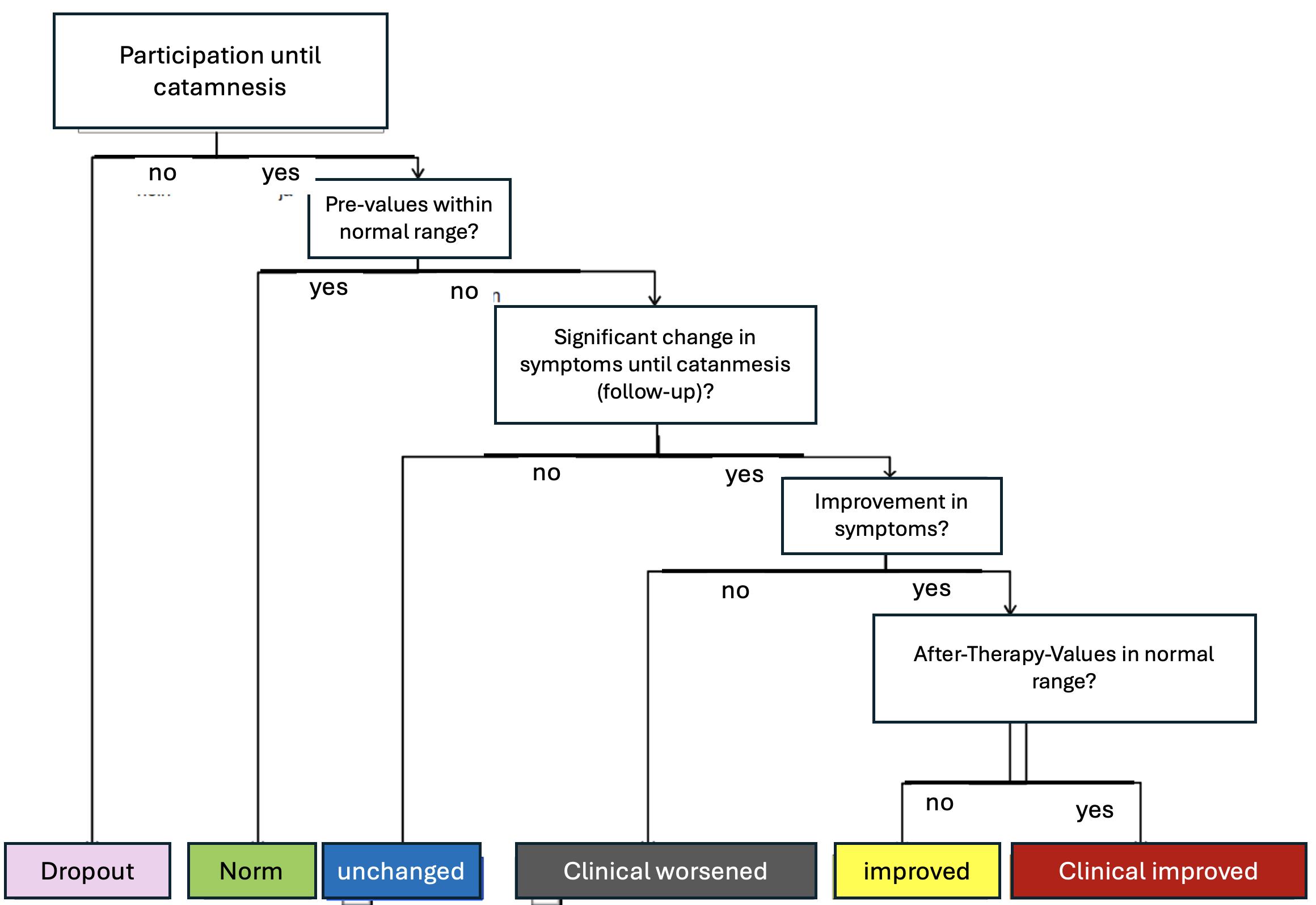
Figure 5: Categories of differential effectiveness (according to Hebing, 2012)
There are many significant improvements in depressive syndrome. If all comorbidities and non-specific symptoms are included, the treatment success is relativised, but still shows very good results.
Around one third (33.3 %) of patients showed a clinically significant improvement in symptoms by the end of acute therapy (n = 69) compared to the beginning of the study, and a further 40.6 % showed an improvement (Fig. 6). In 15.9% there was no change and in 10.1% of patients there were no abnormal values according to VDS90 (labelled "normal"). This results in a mathematical total of 105 % due to the inclusion of dropouts (5 %). The ratios would be incorrect if the constant number of dropouts were compared with the decreasing number of patients.
A clinically significant improvement was recorded in 34.5% of patients at the end of maintenance therapy (n= 58) and a fundamental improvement in 44.8%. In 13.8% there was no change and in 6.9% of participants there were no abnormal values at the beginning according to VDS90. In 37.2% of patients, there was a clinically significant improvement by the time of the catamnesis (n = 43) and in 39.5% there was a fundamental improvement. In 11.6 % there was no change and a further 11.6 % had no findings. Overall, there were no patients who could be assigned to the group of deteriorated patients.
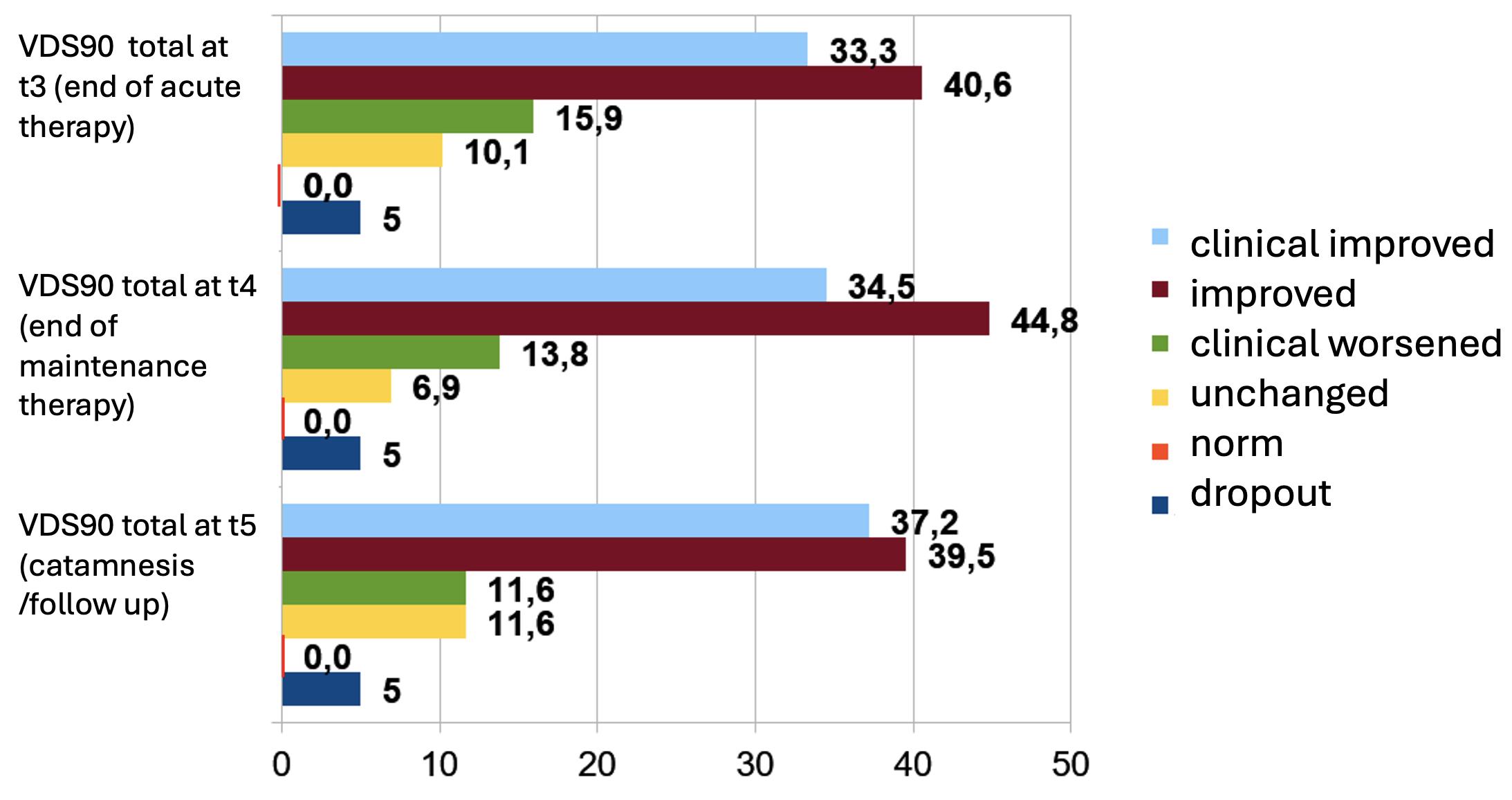
Figure 6: Statistical and clinical relevance of changes in the overall symptoms of the therapy group, percentage change , figures in per cent
In the attempt to find predictors for differential treatment success, only the current employment situation remained in the multiple regression equation with an explained variance share of 27%.
5.4 Replacing the dysfunctional survival rule with a new permissive life rule
We can use the VDS35c to assess very well how great the impact of the survival rule is on the patient's experience and behaviour. We ask the following questions (Fig. 7):
- How true was/is your previous rule of survival for you? How much did/do you believe in its correctness?
- How much did/does your survival rule determine your experience and behaviour?
- How much did/do you fear negative consequences if you broke your survival rule?
- How often did/do you act against your survival rule?
- How strong were/are the negative feelings when you broke your survival rule?
- How well did/do you manage to act against your survival rule?
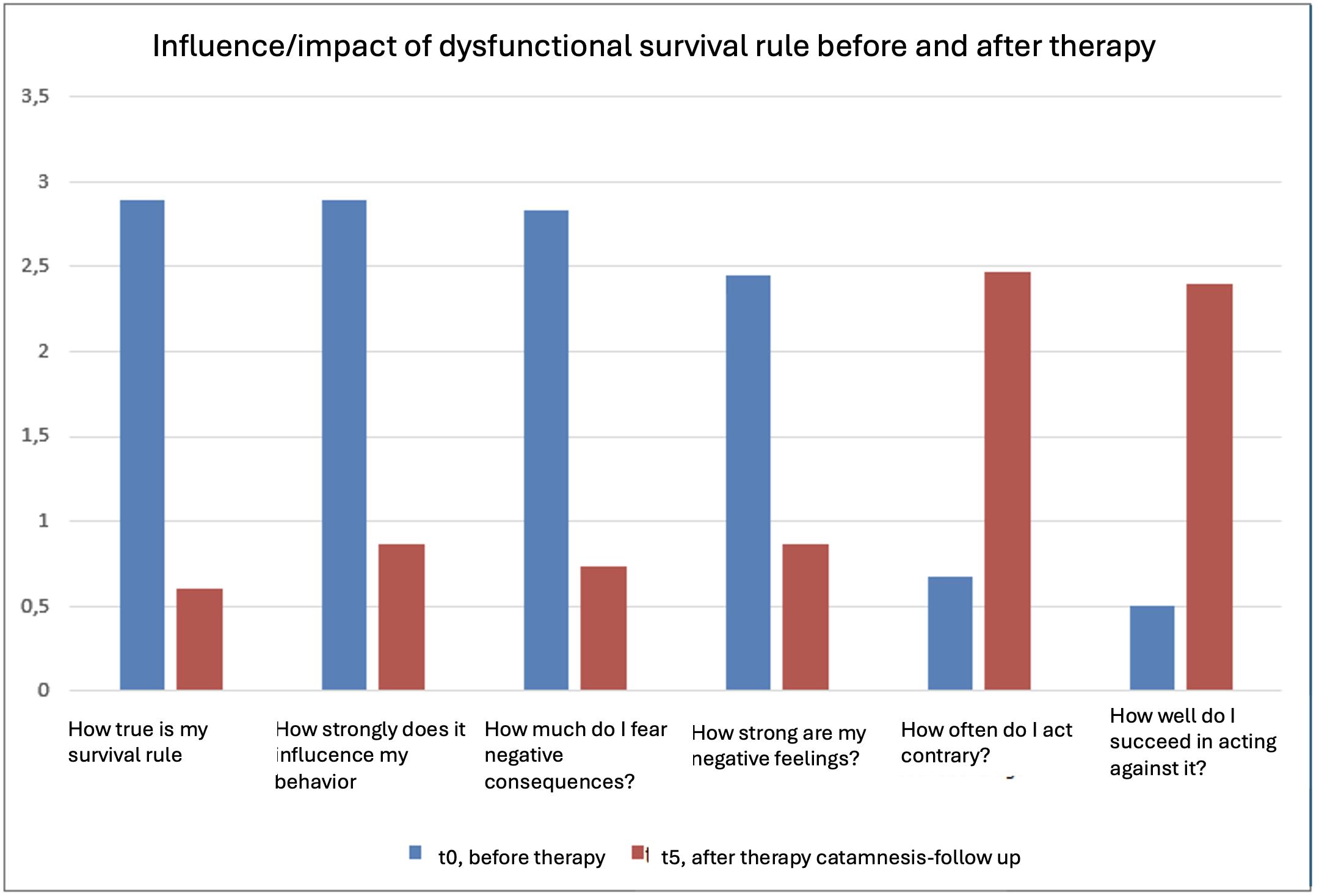
Figure 7: Influence of the survival rule before and after therapy
Across the different time points (t0 to t5), we can see in Table 4 that highly significant changes occurred. The effect sizes t0 to t3 (end of acute therapy) were the highest, but there were also further improvements after the end of acute therapy.
Table 4: Change in the flexibility of the survival rule
Truth of the survival rule
Pair
Influence of the survival rule
Fear of negative consequences
Pair
Acting against the survival rule Pair
Pair
)
Neg. Feelings in case of violation against the survival rule Pair
Success in acting against the survival rule
Pair
Legend: M: mean; SD: standard deviation; df: Degrees of freedom; t: t-value; Hedges g: Effect size
5.5 VEV: Subjective experience of the change in one's own experience and behaviour
The VEV is a direct measurement instrument that patients use to assess their own change. For this reason, no survey was carried out with this instrument at time t0.
The following values were determined for the therapy group at the measurement times t3, t4and t5(Fig. 8): At the end of acute therapy (t3) the VEV mean value was M = 211.19 (SD = 37.42), at the end of maintenance therapy (t4) M = 214.00 (SD = 38.99) and at catamnesis (t5) M = 228.68 (SD = 41.66). These values are shown below in the form of a bar chart.
Figure 8: Development of VEV values in the therapy group
According to Zielke and Kopf-Mehnert (1978 ), the significance limits of the instrument depend on the score achieved. They lie at the 0.1% level from 200 points . This means that the average change at all measurement points is significant in the therapy group.
5.6 SEE scale for experiencing emotions (Behr & Becker 2004)
TheSEE depicts the experience of emotions through two dimensions: Acceptance (which should increase over the course of therapy) and flooding (which should decrease). Expectations in this regard were confirmed (Figure 10).
Figure 10: Development of SEE values in the therapy group : Acceptance of feelings increases and flooding decreases
All changes are significant: the effect sizes are in the medium range. The group differences are significant: there are statistically significant differences between the groups at time t3both for the acceptance of own emotions (t = 2.76; df = 116; p = .007) and for the subjective emotional flooding (t = -2.56; df = 116; p = .012).
5.7 RMET: The ability to recognise feelings in the eyes of others
The RMET = Reading the Mind in the Eyes test (Baren-Cohen, Weelwright, Hill, Raste, & Plumb, 2001) was administered at four measurement points (only in the therapy group).
Figure 11: Development of RMET values in the therapy group
The overall values show (Fig. 11) that there is an improvement in emotional reading ability in the therapy group. Between the measurement times t0and t3with p = .057 and between t4and t5with p = .085, this is pronounced as a trend, while between t3and t4with p = .009 a statistically significant improvement in emotional reading ability was measurable. There were medium effect sizes.
Discussion and summary
The Psychiatric & Psychological Brief Psychotherapy PKP resulted in significant improvements in all relevant measurements. These were significantly higher than in the waiting list control group. It can therefore be assumed that the short-term setting is effective. Almost all patients did not require continuation and conversion to long-term therapy. Symptoms were quickly reduced in external (VDS14) and self-assessment (VDS90, BDI II). The global level of functioning (GAF) as a general indicator of the recovery process also showed significant improvements. Emotion regulation (dealing
with emotions SEE) also improved significantly (more acceptance and less flooding). The ability to recognise feelings in other people's faces improved significantly (RMET). Finally, the patients in the therapy group reported a clear positive change in experience and behaviour in VEV.
A more profound aspect is the rigidity and impact of the dysfunctional survival rule on the patient's current experience and behaviour. All previous studies that have applied SST or SBT (Hebing, 2012, Graßl, 2013, Hoy, 2014, Algermissen, del Pozo, & Rösser, 2017) have shown that clinical improvement also led to a flexibilisation of the survival rule, that it could often be replaced by a permission-giving life rule, so that its influence on behaviour became much less. This study also confirmed this. After therapy, patients believed less that the survival rule was correct and appropriate, were less afraid of violating it and also acted against it more often.
Limitations:
Random assignment was not possible within the given framework. Rather, assignment was based on the order of registration at the outpatient clinic. The therapy group was filled first, then the other patients were placed on the waiting list. It can be argued that this resulted in significantly greater external validity than random allocation. However, the high dropout of the waiting list control group is consistent with experience in other studies. Some patients came with a previous medication, which they were to keep unchanged during the study.
For more information see Sulz S. (2021c). Kurz-Psychotherapie mit Sprechstundenkarten. Wirksame Interventionen bei Depression, Angst- und Zwangskrankheiten, Alkoholabhängigkeit und chronischem Schmerz. Gießen: Psychosozial-Verlag
Literature
Algermissen, C., del Pozo, M. A. & Rösser, N. (2017). Psychiatric Short-Term Group Psychotherapy. Vortrag auf dem WPA Weltkongress für Psychiatrie in Berlin (19.10.2017).
Baron-Cohen, S., Wheelwright, S., Hill, J., Raste, Y. & Plumb, I. (2001). The Reading the Mind in the Eyes Test. Revised Version: A Study with Normal Adults, and Adults with Asperger Syndrome or High-functioning Autism. J. Child Psychol. Psychiat., Vol. 42, No. 2, S. 241-251.
Beck, A. T. (1979). Wahrnehmung der Wirklichkeit und Neurose. München: Pfeiffer.
Behr, M. & Becker, M. (2004). Skalen zum Erleben von Emotionen. Göttingen: Hogrefe Testzentrale.
Dunn, J. D. & Tierney, J. G. (2006). A step therapy algorithm for the treatment and management of chronic depression. Am J Manag Care., 12 (12 Suppl), S. 335-343.
Graßl, S. (2013). Analyse Impliziter und Expliziter Prozessfaktoren. München: CIP-Medien.
Hautzinger, M., Keller, F. & Kühner, C. (2006). Beck Depression Inventar Revision II. Göttingen: Hogrefe Testzentrale.
Hautzinger, M., Luka, U. & Trautmann, R.D. (2005). DAS Skala dysfunktionaler Einstellungen. Göttingen: Hogrefe Testzentrale.
Hebing, M. (2012). Evaluation und Prädiktion therapeutischer Veränderung im Rahmen der Strategisch-Behavioralen Therapie (SBT). München: CIP-Medien.
Hoy, V. U. (2014). Evaluation des strategisch-behavioralen Therapiemoduls „Entwicklung als Therapie" sowie deren Implikation für die Gesundheitspädagogik. Möglichkeiten der Spezifikation des Konzepts der Strategischen Kurzzeittherapie (SKT) auf Einzelfälle zur Optimierung individueller Therapieprozesse und -ergebnisse. München: CIPMedien.
Kaufmayer, T. (2018). Behandlungserfolg und Prädiktoren der therapeutischen Veränderung bei ambulanter Depressionsbehandlung mit Psychiatrischer Kurz-Psychotherapie (PKP). Dissertation Karl-Eberhard-Universität Tübingen.
Lewinsohn, P. M. (1974). Clinical and theoretical aspects of depression. In Calhoun, S., Adams, H. E., Mitchell, K. H. (Hrsg.), Innovative treatment methods in psychopathology, (S. 63-120). New York: Wiley.
Morfeld, M., Kirchberger, I. & Bullinger, M. (2011). SF-12 Fragebogen zum Gesundheitszustand. Kurzfassung des SF-36. Göttingen: Hogrefe Testzentrale.
Saß, H., Wittchen, H.-U., Zaudig, M. & Houben, I. (2003). Diagnostische Kriterien des Diagnostischen und Statistischen Manuals Psychischer Störungen DSM-IV-TR. Göttingen: Hogrefe.
Backmund-Abedinpour, S., Algermissen, C., Sichort-Hebing, M., Jänsch, P., Hagleitner, R., Antoni, J., Graßl, S., Deckert, B., Gräff-Rudolph, U. & Sulz, S. (2018). Psychiatrische Kurz-Psychotherapie PKP bei Angst, Zwang, Depression und Alkoholismus und chronischem Schmerz. In Höfling, S. & Sulz, S.K.D. (Hrsg.), Heilende Zeit - Zeitsensibilität in KurzzeitPsychotherapien. München: CIP-Medien (in diesem Band).
Sulz, S., Beste, E., Kerber, A.-C., Rupp, E., Scheuerer, R. & Schmidt, A. (2009). Neue Beiträge zur Standarddiagnostik in Psychotherapie und Psychiatrie - Validität und Reliabilität der VDS90-Symptomliste und VDS30-Persönlichkeitsskalen. Psychotherapie in Psychiatrie, Psychotherapeutischer Medizin und Klinischer Psychologie, 14(2), 215- 232.
Sulz, S.K.D. (2017a). Gute Kurzzeittherapie in 12 plus 12 Stunden. Für PsychotherapeutInnen, die sich in Kurzzeittherapie einarbeiten wollen. München: CIP-Medien.
Sulz, S. K. D. (2017b). Gute Verhaltenstherapie lernen und beherrschen - Band 1: Verhaltenstherapie-Wissen: So gelangen Sie zu einem tiefen Verständnis des Menschen und seiner Symptome. München: CIP-Medien.
Sulz, S. K. D. (2017c). Gute Verhaltenstherapie lernen und beherrschen - Band 2: Verhaltenstherapie-Praxis: Alles was Sie für eine gute Therapie brauchen. München: CIP-Medien.
Sulz, S. & Deckert, B. (2012a). Psychotherapiekarten für die Praxis. Depression. PKP-Handbuch. München: CIP-Medien.
Sulz, S. & Deckert, B. (2012b). Psychotherapiekarten für die Praxis. Depression. PKP-Therapiekarten. München: CIPMedien.
Sulz, S. & Lenz, G. (Hrsg.) (2000). Von der Kognition zur Emotion. Psychotherapie mit Gefühlen. München: CIP-Medien.
Sulz, S. (2012). Therapiebuch II - Strategische Kurzzeittherapie. Ebook (unveränderte ebook-Version von Sulz, 1994). München: CIP-Medien.
Sulz, S. K. D. & Sauer, S. (2003). Diagnose und Differenzialdiagnose von Persönlichkeitsstörungen. Psychotherapie in Psychiatrie, Psychotherapeutischer Medizin und Klinischer Psychologie, 8(1), S. 45-59.
Sulz, S. K. D. (2005). Internes Qualitätsmanagement in psychotherapeutischer Praxis und Ambulanz. Etablierung, Erweiterung und Kombination mit Qualitätszirkeln – mit Qualitätsmanagement-Handbuch nach DIN EN ISO 9001.
München: CIP-Medien.
Sulz, S. K. D. (2017d). Verhaltensdiagnostik und Fallkonzeption. Verhaltensanalyse – Zielanalyse – Therapieplan - Bericht an den Gutachter und Antragstellung. VDS-Handbuch (7. Aufl.). München: CIP-Medien.
Sulz, S. K. D., Gräff-Rudolph, U. & Jakob, C. (1998). Persönlichkeit und Persönlichkeitsstörung. Eine empirische Untersuchung der VDS-Persönlichkeitsskalen. Psychotherapie in Psychiatrie, Psychotherapeutischer Medizin und Klinischer Psychologie, 3(1), S. 46-56.
Sulz, S. K. D., Hörmann, I., Hiller, W. & Zaudig, M. (2002). Strukturierte Befunderhebung und Syndromdiagnose in der psychotherapeutischen Praxis. Psychotherapie in Psychiatrie, Psychotherapeutischer Medizin und Klinischer Psychologie, 7(1), S. 6-16.
Sulz, S. K. D., Hummel, C., Jänsch, P. & Holzer, S. (2011). Standardisierte Erhebung des psychischen Befundes und Bestimmung der ICD-10-Diagnose: Vergleich von SKID I und VDS14-Befund-Interview. Psychotherapie in Psychiatrie, Psychotherapeutischer Medizin und Klinischer Psychologie, 16(2), S. 215-236.
Sulz, S., Beste, E., Kerber, A.-C., Rupp, E., Scheuerer, R. & Schmidt, A. (2009). Neue Beiträge zur Standarddiagnostik in Psychotherapie und Psychiatrie - Validität und Reliabilität der VDS90-Symptomliste und VDS30-Persönlichkeitsskalen.
Psychotherapie in Psychiatrie, Psychotherapeutischer Medizin und Klinischer Psychologie, 14(2), S. 215-232.
Sulz, S.K.D. & Grethe, C. (2005). VDS90-SL - VDS90-Symptomliste (VDS90; Verhaltensdiagnostiksystem 90Symptomliste). PSYNDEX Tests Info. Psychotherapie, 10(1), S. 38-48.
Woolfolk, R. & Allen, L. A. (2013). Wirksame Behandlung von somatoformen Störungen und Somatisierungsstörungen.
München: CIP-Medien
Ziehlke und Kopf-Mahnert (1978). Veränderungsfragebogen zum Erleben und Verhalten. Göttingen: Hogrefe Testzentrale.
Correspondence Address
Dr Lars Theßen, MD
SBT-in-Berlin, Institute for Strategic Behavioural Therapy Germanenstraße 93a, 12524 Berlin thessen@sbt-in-berlin.de https://sbt-in-berlin.de
Psychotherapy EP2025 page 95-121
6. Psychiatric & psychological brief psychotherapy (PKP)
6. Psychiatric & psychological brief psychotherapy (PKP) proves to be on a par with long-term therapy - results of a comparative study
Lars Theßen, Manuel Peters and Serge Sulz
Abstract
This is the second study to evaluate Psychiatric and Psychological Brief Psychotherapy (PKP) for depression. Following the very good therapy results of the first study, the short-term therapy (24 weekly sessions, 6 four-weekly sessions as maintenance therapy) was compared with a long-term variant of PKP (44 weekly sessions without maintenance therapy). This corresponds to the current psychotherapy guidelines for patients with statutory health insurance, which provide for two times twelve sessions for short-term therapy and up to 36 additional sessions for long-term therapy.
PKP is a modular psychotherapy with the three modules of symptom therapy, emotion exposure and skills training as well as working with the dysfunctional survival rule as a maladaptive schema that prohibits, for example, anger and defensive assertion.
The short-term variant is on a par with the long-term variant: highly significant improvements with good to very good effect sizes. The decisive changes take place in the first 24 sessions. After that, there are only slight improvements. If these results can be replicated, the recommendation is to prioritise short-term therapies.
Keywords
Psychiatric and psychological short-term psychotherapy for depression, modular psychotherapy, symptom therapy, response chain to symptom, emotion exposure, skills training, dysfunctional survival rule, permission-giving life rule, maladaptive schema
Introduction
This paper reports on the second outpatient PKP study. While the first study was an outcome study comparing patients after six months of PKP treatment with a waiting list control group, this second study compares short-term and long-term therapy. At first glance, almost everyone would say that long-term therapy with almost twice as many therapy sessions is
European Psychotherapy EP2025 page 122-140
much more effective than short-term therapy. But what if the goals have already been achieved after short-term therapy? What needs to be improved? In any case, we have to differentiate between trial therapies, which usually have no more than 20 sessions (in the USA usually only 12), and therapies in the care of patients with statutory health insurance, in which short-term and long-term therapies are carried out roughly equally often. This also raises the question of the therapy goal. Should the therapy be continued until clinical depression is no longer present? Or only until the depression no longer interferes with the patient's lifestyle? Or until predisposing factors have been eliminated in such a way that depression is no longer to be expected? There is also the problem that the rule of thumb is that only one third of patients are symptomfree, one third are improved and one third are not improved. At present, we can assume that a large number of patients do not need long-term therapy. We can assume that there are more than just those who only receive short-term therapy.
What makes a therapy efficient or effective? When it achieves a set goal in a reasonable amount of time. In our modular psychotherapy approach, these are very personal goals for each patient that are appropriate to their individual problem situation.
If a patient's depression is aimed at avoiding grief, then the goal of therapy is to initiate grief work (through grief exposure). In short-term therapy, it will not progress as far as in long-term therapy. The aim is not to complete it, but to set it in motion and keep it going. If the depression serves to avoid anger, the aim is to be able to defend oneself in the future in difficult situations such as the one that triggered the depression by asserting oneself angrily. If you don't feel anger, you won't be able to defend yourself strongly enough. Exposure to anger and rage is indicated here as an intervention. Those who have previously dealt with relationships in a dependent manner, in which the other person determined what was to be done when and how, and did nothing on their own, will formulate independence as a therapy goal together with the therapist. Intervention is independence training.
In pursuing the goal, we can draw on numerous evidence-based cognitive-behavioural approaches (e.g. Lewinsohn, 1974; Beck, 1996; Grawe, 1998; Sulz, 1998a,b; Hayes, Strosahl & Wilson, 1999; McCullough, 2007; Gräff-Rudolph & Sulz, 2009; Wells, 2009; Sulz, 2011; Hebing, 2012). In the last twenty years, great importance has been attributed to emotions in symptom formation (e.g. Sulz & Hauke, 2010). This has been followed by intensive research into emotional processes in psychopathogenesis and psychotherapy (e.g. Elliott, Watson, Goldman & Greenberg, 2008; Greenberg, 2000; Sulz, 2000a, 2010; Sulz & Lenz, 2000; Sulz & Sulz, 2005). However, the treatment of people with depressive syndromes is still frequently
European Psychotherapy EP2025 page 122-140
Psychiatric & psychological brief psychotherapy (PKP) proves to be on a par with long-term therapy - results of a comparative study
inadequate or inappropriate (Kanter, Busch, Weeks & Landes, 2008; Deckert, 2014). One of the reasons for this is that therapists do not rely on the effectiveness of the available short-term therapies and opt for long-term therapies. In addition, therapists make too little use of confrontational methods that evoke intense feelings. This also contributes to perpetuating the lack of available short-term therapy places (Schwartz & Flowers, 2015).
The Psychiatric and Psychological Brief Psychotherapy for Depression (PKP; Sulz & Deckert, 2012a,b) attempts to increase the incentive for effective short-term therapies.
A topic or intervention can be carried out in fifteen minutes within a 20- to 25-minute visit or consultation setting with the help of an action instruction (or therapy card or consultation card). Two topics can therefore be dealt with in a 50-minute setting.
Based on the patient's individual problem situation, the interventions systematically build on each other - with a consistent therapy concept. Despite the name PKP manual, it is not what is conventionally referred to as a therapy manual - in this sense it is not a manualised therapy, but a personal modular psychotherapy. Because the therapy is more or less customised for the patient, it can remain short (it leaves out what does not apply to the patient). And it can be more effective because there is more time for the patient's personal problems.
As an extension to the disorder-specific PKP manuals, the transdiagnostic PKP manual (Sulz, 2012) is a guide that offers the range of goals and interventions and at the same time helps to progress towards a personalised approach.
It is based on Strategic Short-Term Therapy SKT (Sulz, 1994) and Strategic Behavioural Therapy SBT (Sulz, 2001; Sulz & Hauke, 2009 Hauke, 2012).
The treatment, which consists of three pillars (modules), begins with the first pillar, symptom therapy, with the question of the unconscious symptom strategy: What is the patient trying to achieve with the symptom? What is the function of the symptom? In the case of depressive syndromes, PKP assumes that the depressive mood is superimposed on intense, overwhelming emotions. The feeling of numbness results in helplessness in the organisation of relationships and life and social withdrawal. This withdrawal in turn results in negative reinforcement due to the elimination of potentially negative events such as conflicts, threats or loss. Ultimately, the depressive patient no longer has to deal with the impulses of their feelings and their stressful consequences, as the depression successfully suppresses the emotions. The strategy of depression treatment therefore consists of the reverse functionality: making the vital emotions available again.
European Psychotherapy EP2025 page 122-140
(PKP)
As the study was conducted in a naturalistic outpatient setting (field study), the results have a high external validity, but are also susceptible to sources of error that are difficult to control (e.g. holidays, sick leave, therapeutic compliance, additional treatments). Many of these sources of error are inherent and unavoidable in all outpatient naturalistic therapy studies. Nevertheless, this must be taken into account in the assessment. We have chosen to prioritise external validity so that the results can have the greatest possible clinical-practical significance.
Methodology
Research question
The decisive question deals with the efficiency of PKP, i.e. the question of when the maximum therapeutic effect is achieved (dose-effect relationship). This means that this question can only be answered by comparing short-term and long-term therapy. The hypothesis here is that the maximum therapeutic effect is achieved after short-term therapy and is not further increased in long-term therapy.
Design
The patients in this group received twenty-four 50-minute weekly therapy sessions (acute therapy) followed by six monthly therapy sessions (maintenance therapy). A final catamnesis session took place six months after the last maintenance therapy session.
The long-term therapy (LTT) group received forty-four 50-minute weekly therapy sessions and no subsequent maintenance therapy. Six months after the last therapy session, a final catamnesis session was also held here.
Sample
There were 77 patients in the CCT group (ICD-10 F32: 51%, F33: 35%, F34.1: 4%, F43.2: 9%) and 79 patients in the LZT group (F32: 37%, F33: 50%, F34.1: 1%, F43.2: 13%). In both groups, the proportion of patients who received antidepressant medication (and who were to remain on it unchanged) was 34%. The patients were treated by a total of 34 therapists in the outpatient clinic of the CIP Academy in Munich. The distribution of socio-economic status was statistically the same in both groups (female: 57%, age (MW): 39 (18-73), professional employment: 69% in the CCT, 72% in the CCT).
European Psychotherapy EP2025 page 122-140
Measuring instruments
The following instruments were used to measure the effectiveness of PCP: the Beck Depression Inventory (BDI-II; Hautzinger, Keller, & Kühner, 2009), the Behavioural Diagnostic System (VDS; Sulz, 1992, 2000b, 2008), the Global Assessment of Functioning (GAF; Saß, Wittchen, Zaudig & Houben, 2003) and the Change Questionnaire of Experience and Behaviour (VEV; Zielke & Kopf-Mehnert, 1978). The BDI-II, VDS90, VDS30 and VEV were self-assessment scales and the VDS14 and GAF were external assessment scales, which were completed by the treating therapists.
Statistical calculations
Single-factor ANOVAs with repeated measures were carried out for all measurement instruments. The between-group factor was the affiliation to the respective treatment group (CCT vs. LTC) and the measure used to assess the effectiveness of the PCP. The repeated measurement factor was the time of therapy (initial interview, end of short-term therapy, end of maintenance therapy or long-term therapy, catamnesis) and was used as a measure for assessing effectiveness. Eta squared (η²) was used to assess the effect size. Values less than .06 represent a small effect, values between .06 and .14 represent a medium effect and values greater than .14 represent a strong effect.
Results
Beck Depression Inventory (BDI-II)
Before the therapy, there were no significant differences between the two therapy groups with regard to depression, so that the prerequisite for comparability with regard to this parameter was met. The statistical calculation of the effectiveness of PKP resulted in a value of F(3) = 101.12 (p<.001), η² = .65. This indicates a very large effectiveness of PKP, i.e. a strong effect. The calculation of the efficiency showed no significant difference between the CCT group and the CCT group, F(1) = .36 (p>.05), η² = .01. This indicates that the treatment was just as efficient in the CCT as in the CCT. Table 1 and Figure 1 show the reported values in the BDI-II at the different measurement times.
European Psychotherapy EP2025 page 122-140
Table elle 1
Results in the BDI-II Initial
Notes. M: mean value; SD: standard deviation
European Psychotherapy EP2025 page 122-140
Even this first clear result is not expected by many and shows that short-term therapy is just as effective in treating depression as long-term therapy.
VDS90 - Depression
Before therapy, there were no significant differences in terms of depression. The statistical calculation of the effectiveness of PKP resulted in a value of F(3) = 87.69 (p<.001), η² = .62. This indicates a highly significant effectiveness of PKP with a strong effect. The calculation of efficiency showed no significant difference between the CCT group and the CCT group, F(1) = .3 (p>.05), η² = .01. This indicates that the treatment was as efficient in the CCT as in the CCT. Table 2 and Figure 2 show the reported values in the VDS90 - Depression at the different measurement times.
Table 2
Results of the VDS90 - Depression
Initial interview 24 30/44 Catamnesis
CCT
LZT
M = 1,51 (SD = 0.22)
M = 1,26 (SD = 0.25)
M = 0,42 (SD = 0.17)
M = 0,69 (SD = 0.19)
Notes. M: mean; SD: standard deviation
European Psychotherapy EP2025 page 122-140
M = 0,4 (SD = 0.13)
M = 0,38 (SD = 0.15)
M = 0,25 (SD = 0.16)
M = 0,45 (SD = 0.19)
KZT LZT
F(3)Time = 87.69*** η² = .62
F(1)Group = .3 η² = .01
Initial consultation 24 30/44 KAT
Figure 2: Point averages in the VDS90 - depression; ***p<0.001 (KZT = Shortterm Therapy, LZT= Longterm Therapy)
The second result also suggests that short-term therapy is just as effective as long-term therapy. It is an equally effective depression treatment.
VDS90 - total score
Before therapy, there were no significant differences in overall symptoms between the two therapy groups. The statistical calculation of the effectiveness of PKP resulted in a value of F(3) = 70.62 (p<.001), η² = .57. This indicates a highly significant effectiveness of PKP with a strong effect. The calculation of efficiency showed no significant difference between the CCT group and the CCT group, F(1) = .54 (p>.05), η² = .01. This indicates that the treatment was just as efficient in the CCT as in the CCT. Table 3 and Figure 3 show the reported values in the VDS90 total score at the different measurement times.
European Psychotherapy EP2025 page 122-140
Table 3
Results in the VDS90 - total score
Initial interview 24 30/44 Catamnesis CCT M = 0,66 (SD = 0.1)
= 0,25 (SD = 0.08)
= 0,62
SD = 0.12)
= 0.1)
Notes. M: mean value; SD: standard deviation
Figure 3: Point averages in the VDS90 - total score; ***p<0
0.08)
0.09)
= 0,23 (SD = 0.08)
0.1)
European Psychotherapy EP2025 page 122-140
6. Psychiatric & psychological brief psychotherapy (PKP) proves to be on a par with long-term therapy - results of a comparative study
VDS30 - Dysfunctional personality total score
Before therapy, there were no significant differences in terms of dysfunctional personality traits. The statistical calculation of the effectiveness of the PKP resulted in a value of F(3) = 43.11 (p<.001), η² = .47. This indicates a highly significant effectiveness of the PKP with a strong effect. The calculation of efficiency showed no significant difference between the CCT group and the LTC group, F(1) = .1 (p>.05), η² = 0, indicating that the treatment was as efficient in CCT as in LTC. Table 4 and Figure 4 show the reported values in the VDS30 personality at the different measurement times.
Table 4
Results of the VDS30 - Personality
Initial interview 24 30/44 Catamnesis
CCT
LZT
M = 0,81
(SD = 0.13)
M = 0,81 (SD = 0.16)
M = 0,57 (SD = 0.13)
M = 0,71 (SD = 0.15)
Notes. M: mean value; SD: standard deviation
M = 0,49 (SD = 0.1)
M = 0,37 (SD = 0.12)
M = 0,43 (SD = 0.12)
M = 0,39 (SD = 0.14)
European Psychotherapy EP2025 page 122-140
(3)Time = 43.11***
= .47
(1)Group = .01
Figure 4: Point averages in the VDS30 - Personality; ***p<0.001 (KZT = Shortterm Therapy, LZT= Longterm Therapy)
This result is even less expected than the equally good improvements in depression. It is widely believed that personality change requires long-term therapy. However, we have consistently found that these changes are also possible in a shortterm setting - and in this study are just as great as in long-term therapy.
Change in experience and behaviour questionnaire (VEV)
The VEV was not collected in the initial interview, as it only records the change after therapy has taken place. The statistical calculation of the effectiveness of PKP resulted in a value of F(3) = 3.77 (p<.05), η² = .07. This indicates a highly significant effectiveness of PKP with a medium effect. These results must be interpreted taking into account that the baseline is the measurement after the 24th hour. It is therefore advisable to interpret them on the basis of the absolute values. According to the authors (Zielke & Kopf-Mehnert, 1978), values above 200 are significant at the 0.1% level in the sense of a subjectively perceived change. The calculation of the efficiency showed no significant difference between the CCT group
European Psychotherapy EP2025 page 122-140
6. Psychiatric & psychological brief psychotherapy (PKP) proves to be on a par with long-term therapy - results of a comparative study
and the LTC group, F(1) = .64 (p>.05), η² = .01. This indicates that the treatment was just as efficient in the CCT as in the LTC. Table 5 and Figure 5 show the reported values in the VEV at the different measurement times.
Table 5
Results in the VEV
= 198,0 (SD = 14.3)
Notes. M: mean value; SD: standard deviation
F(2)Time = 3.77* η² = .07 F(1)Group = .64 η² = .01
Figure 5: Point averages in the VEV; *p<0.05 (KZT = Shortterm Therapy, LZT= Longterm Therapy)
European Psychotherapy EP2025 page 122-140
Patients' experience and behaviour in their everyday lives improved in the same way with short-term therapy as with longterm therapy.
VDS14 - Depression
Before therapy, there were no significant differences in terms of depression between the two therapy groups. The statistical calculation of the effectiveness of PKP resulted in a value of F(3) = 143.36 (p<.001), η² = .73. This indicates a highly significant effectiveness of PKP with a strong effect. The calculation of the efficiency showed a significant difference between the CCT group and the CCT group, F(1) = 7.18 (p<.05), η² = .12, indicating that the treatment was slightly more efficient in the CCT than in the CCT. Table 6 and Figure 6 show the reported values in the VDS14 - Depression at the different measurement times.
Table 6
Results of the VDS14 - Depression
Initial interview
M = 1,63 (SD = 0.21)
M = 0,33 (SD = 0.25)
M = 0,22 (SD = 0.14)
M = 0,26 (SD = 0.19) LZT
M = 2,01 (SD = 0.21) M = 0,97 (SD = 0.25) M = 0,16 (SD = 0.14)
Notes. M: mean value; SD: standard deviation
M = 0,27 (SD = 0.19)
Once again, we can conclude that short-term therapy reduces depressive symptoms (at least) as well as long-term therapy.
European Psychotherapy EP2025 page 122-140
F(3)Time = 143.36*** η² = .73
F(1)Group = 7.18* η² = .12
Figure 6: Point means in the VDS14 - depression; *p<0.05, ***p<0.001 (KZT = Shortterm Therapy, LZT= Longterm Therapy)
Global assessment of the level of functioning (GAF)
Before therapy, there were no significant differences in the level of functioning between the two therapy groups. The statistical calculation of the effectiveness of PKP resulted in a value of F(3) = 174.61 (p<.001), η² = .77. This indicates a highly significant effectiveness of PKP with a strong effect. The calculation of the efficiency showed a significant difference between the CCT group and the CCT group, F(1) = 8.34 (p<.01), η² = .14, indicating that the treatment was more efficient in the CCT than in the CCT. Table 7 and Figure 7 show the reported values in the GAF at the different measurement times.
European Psychotherapy EP2025 page 122-140
Table 7
Results in the GAF
Initial interview 24 30/44 Catamnesis CCT M = 59,94 (SD = 2.76) M = 77,42 (SD = 3.72) M = 83,39 (SD = 3.53) M = 84,39 (SD = 3.62)
= 54,17 (SD = 3.14)
= 68,46 (SD = 4.23)
Notes. M: mean value; SD: standard deviation
= 77,88 (SD = 4.01)
= 80,38 (SD = 4.12)
= .77
(1)Group = 8.34**
= .14
Figure 7: Point mean values in the GAF; **p<0.01, ***p<0.001 (KZT = Shortterm Therapy, LZT= Longterm Therapy)
European Psychotherapy EP2025 page 122-140
&
(PKP)
The extent to which the patient is still impaired in everyday life by their depression is a very important and indispensable indicator. Someone can be very depressed and still maintain their level of functioning. And someone can have a milder depression and no longer have their everyday functions available.
Discussion
Psychiatric and psychological brief psychotherapy PKP showed a strong effect in all areas recorded. This confirms the previous findings of Kaufmayer and Sulz (2018) and Algermissen, del Pozo & Rösser (2017). PKP appears to be suitable for successfully treating people with depressive syndromes. Both the patients themselves and the therapists agree with this. In the present study, it was of particular interest whether short-term therapy is on a par with long-term therapy. The assumption that CCT is sufficient if the functionality of depression (emotion avoidance) is consistently reversed through emotion exposure was confirmed. It is striking that the therapists rated the depression as more pronounced and the global level of functioning as lower in the LTC group after the 24th hour than in the CCT group. The discrepancy between the selfassessment and the external assessment is significant, but small. There could be an anchor bias: The therapists knew how many total therapy hours were available. This could have led the therapists in the LZT group to believe that their patients had not improved too much after the 24th therapy session, as the therapy goal would only be achieved after 20 further sessions.
This field study should be followed by further research, including randomisation of patients.
Summary
Brief psychiatric and psychological psychotherapy for depression appears to be an effective and efficient therapy method that can be used both in the outpatient therapy setting and in the inpatient therapy setting (Algermissen, del Pozo & Rösser, 2017). In the present study, it was shown that the short-term therapy variant of PKP is on a par with the long-term therapy variant. Consequently, a brief and emotion-exposing approach is recommended for the treatment of depressive syndromes. If these results can be replicated, it would be more than justified to carry out much more short-term therapy and much less long-term therapy. It is also important to note that there are quite a few patients who continue to make significant progress even after treatment has ended.
European Psychotherapy EP2025 page 122-140
For more information see Sulz S. (2021c). Kurz-Psychotherapie mit Sprechstundenkarten. Wirksame Interventionen bei Depression, Angst- und Zwangskrankheiten, Alkoholabhängigkeit und chronischem Schmerz. Gießen: Psychosozial-Verlag
Literature
Algermissen, C., del Pozo, M. A. & Rösser, N. (2017). Psychiatric Short-Term Group Psychotherapy. Vortrag auf dem WPA
Weltkongress für Psychiatrie in Berlin 19.10.2017
Backmund-Abedinpour, S., Algermissen, C., Sichort-Hebing, M., Jänsch, P., Hagleitner, R., Antoni. J., Graßl, S., Deckert, B., Gräff-Rudolph, U. & Sulz, S. K. D. (2018). Psychiatrische Kurz-Psychotherapie PKP bei Angst, Zwang, Depression und lkoholismus und chronischem Schmerz. In S. Höfling & S.K.D. Sulz (Hrsg.), Heilende Zeit – Zeitsensibilität in Kurzzeit-Psychotherapien. München: CIP-Medien.
Beck, A. T. (1996). Kognitive Therapie der Depression. Weinheim: Beltz.
Deckert, B. (2014). Psychiatrische Kurz-Psychotherapie (PKP) der Depression. In S. K. D. Sulz (Hrsg.), Strategische Therapien (S. 287- 304). München: CIP-Medien.
Elliott, R., Watson, J. C., Goldman, R. N. & Greenberg, L. S. (2008). Praxishandbuch der Emotionsfokussierten Therapie: Einführung in die prozess- und erlebnisorientierte Psychotherapie mit genauer Beschreibung der Vorgehensweise.
München: CIP-Medien.
Gräff-Rudolph, U. & Sulz, S. K. D. (2009). Strategische Depressionstherapie. Die Energie der Gefühle für befriedigende Beziehungen nutzen lernen. In S. K. D. Sulz & G. Hauke (Hrsg.), Strategisch-Behaviorale Therapie SBT – Theorie und Praxis eines innovativen Psychotherapieansatzes (S. 171-198). München: CIP-Medien.
Grawe, K. (1998). Psychologische Therapie. Göttingen: Hogrefe.
Greenberg, L. (2000). Von der Kognition zur Emotion in der Psychotherapie. In S. K. D. Sulz & G. Lenz (Hrsg.), Von der Kognition zur Emotion: Psychotherapie mit Gefühlen (S. 77-100). München: CIP-Medien.
Hauke, G. (2012). Strategisch Behaviorale Therapie (SBT): Emotionale Überlebensstrategien – Werte – Embodiment. Berlin: Springer.
Hautzinger, M., Keller, F. & Kühner, C. (2009). BDI-II: Beck-Depressions-Inventar Revision. Frankfurt: Pearson Assessment.
Hayes, S. C, Strosahl, K. D & Wilson, K. G. (1999). Acceptance and commitment therapy: An experiential approach to behavior change. New York: Guilford.
European Psychotherapy EP2025 page 122-140
Psychiatric & psychological brief psychotherapy (PKP) proves to be on a par with long-term therapy - results of a comparative study
Hebing, M. (2012). Evaluation und Prädiktion therapeutischer Veränderung im Rahmen der Strategisch-Behavioralen Therapie (SBT). München: CIP Medien.
Kanter, J. W., Busch, A. M., Weeks C. E. & Landes, S. J. (2008). The Nature of Clinical Depression: Symptoms, Syndromes, and Behavior Analysis. The Behavior Analyst. 31(1), 1-21.
Kaufmayer, T. & Sulz, S. K. D. (2018). Allgemeine und differentielle Wirksamkeit der Psych. Kurz-Psychotherapie PKP zur Behandlung depressiver Erkrankungen - eine empirische Studie im ambulanten Setting. In S. Höfling & S. K. D. Sulz (Hrsg.), Heilende Zeit – Zeitsensibilität in Kurzzeit-Psychotherapien. München: CIP-Medien
McCullough, J. (2007). Therapie von chronischer Depression mit dem Cognitive Behavioral Analysis System of Psychotherapy (CBASP) – Trainingsmanual. München: CIP-Medien.
Lewinsohn, P. M. (1974). A behavioral approach to depression. In R. J. Friedman & M. M. Katz (Hrsg.), Psychology of depression: Contemporary theory and research (S. 157–178). New York: Wiley.
Saß, H., Wittchen, H.-U., Zaudig, M. & Houben, I. (2003). Diagnostische Kriterien des Diagnostischen und Statistischen Manuals Psychischer Störungen. DSM-IV-TR. Göttingen: Hogrefe, 47-49.
Schwartz, B. & Flowers, J. V. (2015). Was Therapeuten falsch machen. Stuttgart: Klett-Cotta.
Sulz, S. K. D. (1992). Das Verhaltensdiagnostiksystem VDS: Von der Anamnese zum Therapieplan. München: CIPMedien.
Sulz, S. K. D. (1994). Strategische Kurzzeittherapie: Wege zur effizienten Psychotherapie. München: CIP-Medien.
Sulz, S. K. D. (1998a). Das Therapiebuch. München: CIP-Medien.
Sulz, S. K. D. (1998b). Depression: Ratgeber & Manual für Betroffene, für Angehörige, für alle beruflichen Helfer. München: CIP-Medien.
Sulz, S. K. D. (2000a). Lernen, mit Gefühlen umzugehen – Training der Emotionsregulation. In S. K. D. Sulz & G. Lenz (Hrsg.), Von der Kognition zur Emotion: Psychotherapie mit Gefühlen (S. 407-448). München: CIP-Medien.
Sulz, S. K. D. (2000b). Verhaltensdiagnostik und Fallkonzeption: Bericht an den Gutachter und Antragsstellung. München: CIP-Medien.
Sulz, S. K. D. (2001). Von der Strategie des Symptoms zur Strategie der Therapie: Planung und Gestaltung der Psychotherapie. München: CIP-Medien.
Sulz, S. K. D. (2008). VDS Verhaltensdiagnostik- und Therapieplanungsmappe: Das komplette Verhaltensdiagnostiksystem VDS als Kopiervorlage – Fragebögen und Interviewleitfäden mit Auswertungsanleitungen. München: CIPMedien.
European Psychotherapy EP2025 page 122-140
Sulz, S. K. D. (2010). Wut ist eine vitale Kraft, die durch Wutexposition in der Psychotherapie nutzbar wird. In T. Bronisch & S. K. D. Sulz (Hrsg.), Psychotherapie der Aggression: Keine Angst vor Wut (S. 176-189). München: CIP-Medien.
Sulz. S. K. D. (2011). Therapiebuch III: Von der Strategie des Symptoms zur Strategie der Therapie. München: CIP-Medien
Sulz, S. K. D. (2012). Psychiatrische Kurz-Psychotherapie – PKP. Psychotherapie-Grundkurs und Praxisleitfaden: TherapieDurchführung in Klinik und Praxis. PKP-Handbuch. München: CIP-Medien.
Sulz, S. K. D. & Deckert, B. (2012a). Psychiatrische Kurz-Psychotherapie PKP der Depression: Handbuch. München: CIPMedien.
Sulz, S. K. D. & Deckert, B. (2012b). Psychiatrische Kurz-Psychotherapie PKP der Depression: Sprechstundenkarten für die Praxis. München: CIP-Medien.
Sulz, S. K. D. & Hauke, G. (2009). Strategisch-Behaviorale Therapie SBT: Theorie und Praxis eines innovativen Psychotherapieansatzes. München: CIP-Medien.
Sulz, S. K. D. & Hauke, G. (2010). Was ist SBT? Und was war SKT? „3rd wave“-Therapie bzw. Kognitiv-Behaviorale Therapie (CBT) der dritten Generation. Psychotherapie, 15(1), 10-19.
Sulz, S. K. D. & Lenz, G. (2000). Von der Kognition zur Emotion: Psychotherapie mit Gefühlen. München: CIP-Medien.
Sulz, S. K. D. & Sulz, J. (2005). Emotionen: Gefühle erkennen, verstehen und handhaben. München: CIP-Medien.
Wells, A. (2009). Metacognitive Therapy for Anxiety and Depression. New York: Guilford
Zielke, M. & Kopf-Mehnert, C. (1978). VEV: Veränderungsfragebogen des Erlebens und Verhaltens. Göttingen: Hogrefe.
Correspondence Address
Dr Lars Theßen, MD
SBT-in-Berlin, Institute for Strategic Behavioural Therapy Germanenstraße 93a, 12524 Berlin thessen@sbt-in-berlin.de https://sbt-in-berlin.de
European Psychotherapy EP2025 page 122-140
7. Psychiatric Brief psychotherapy PKP of depression in combined group and single-therapy for psychiatric departmentsLooking back on 14 years PKP-Practice in hospital
Christian Algermissen, Nina Rösser & Serge K. D. Sulz
Abstract
As the length of stay of depressive patients in acute psychiatric inpatient treatment is usually only six weeks and individual treatments are not feasible for staffing reasons, it is necessary to use structured short-term treatments in a group setting on the hospital ward.
Psychiatric Brief Psychotherapy PKP is a variant of Strategic Brief Therapy adapted for psychiatric clinics and practices (Sulz, 2007, 2017a, Sulz et al., 2011). Established evidence-based cognitive and emotive treatment techniques are integrated (Sulz & Hauke, 2009). In particular, PKP uses brief interventions to develop a treatment strategy, which makes PKP particularly suitable for creating a completed therapy step during a consultation or clinic visit. PKP can be implemented as a combined group and individual therapeutic treatment concept in general psychiatric and psychotherapeutically orientated wards of a care clinic (Algermissen & Rösser, 2019, 2021). Our large therapy study shows the results of a scientific evaluation (n= 1196) of this innovative therapy concept (in the Clinic for Psychiatry, Psychotherapy and Psychosomatics at Braunschweig Hospital. PKP is effective and conserves resources - with high patient acceptance. In co-operation with a psychiatric outpatient clinic or psychotherapists in private practice, cross-sector treatment paths can be planned. A catamnestic examination shows a high level of consistency in the therapy results. This shows that far more systematic psychotherapies can be applied in psychiatric clinics without having more staff available. This could significantly increase the effectiveness of inpatient psychiatric treatment.
Keywords
Inpatient group therapy - PKP - brief psychiatric psychotherapy - modular psychotherapy - behavioural therapy - outcome study - three pillars of therapy - therapy modules - symptom therapy - skills training - emotion exposure - dysfunctional survival rule - permission-giving rule of life - affective-cognitive developmental theory of behaviour - psychiatric care clinic
7. Psychiatric Brief psychotherapy PKP of depression in combined group and single-therapy for psychiatric departments European Psychotherapy EP2025 page 141-166
Introduction
Anyone who has to be treated as an inpatient in a psychiatric clinic for depression will primarily receive medication. In the first week, there is no question of offering the patient 50 minutes of individual psychotherapy. However, more time than necessary passes before disorder-specific systematic psychotherapy begins (Sulz & Deckert 2012).
Around 40% of the patients treated rated "individual therapy sessions as the most important element, far ahead of all other therapy options" (Härter et al. 2004). However, a significant proportion of inpatients do not receive any disorderspecific therapy.
This dilemma of, on the one hand, available and effective psychotherapy approaches and, on the other hand, insufficient framework conditions for the implementation of special psychotherapy concepts in inpatient psychiatric care is something that the therapy method of Psychiatric Brief Psychotherapy (PKP) attempts to take into account and resolve as far as possible. The PKP treatment concept for depression is based on modular group and personalised individual therapy, which can be organised across professional groups in the inpatient therapy situation.
Brief psychiatric psychotherapy (PKP)
As a short form of strategic behavioural therapy (SBT) (Sulz & Hauke 2009, Sulz et al. 2011, Sulz 2017b,c), brief psychiatric psychotherapy (PKP) has a comprehensive background in disorder and therapy theory. PKP represents an optimisation of cognitive behavioural therapy. The overarching treatment strategy is derived from the affective-cognitive developmental theory of behaviour (Sulz 2017a,b), which is supported in particular by the theoretical concepts of self-regulation (Kanfer, Reinecker & Schmelzer 2006) and self-organisation (Haken & Schiepek 2005, Bischof 1993) as well as findings from cognitive developmental psychology (Piaget & Inhelder 1981, Kegan 1986) and integrates the constructivism of the Palo Alto group (Watzlawik 1981) and the "body-feeling theory" (Damasio 2003) as a modern neurobiological theory of emotion.
Fundamental to Strategic Behavioural Therapy (SBT) and therefore also determining for the therapeutic approach in Brief Psychiatric Therapy (PKP) is the assumption that the human psyche always strives for a stable state (homeostasis) and that a person's observable behaviour, thinking, inner experience and perceptions serve to restore this stable state through processes of self-regulation and self-organisation in the event of disturbances from the environment. If relevant
deficits in the available behavioural repertoire have arisen as a result of the individual's developmental history or if inadequate behavioural stereotypes and rigid behavioural patterns persist in adulthood, this has considerable medium to long-term disadvantages for successful control and the achievement of a stable mental state (homeostasis). "If the dysfunctional part of these behavioural stereotypes dominates, this leads to pathogenic life and relationship patterns", which overwhelm the homeostatic system of the psyche and "lead to the development of symptoms in a specific trigger situation" (Sulz & Hauke 2009).
Dysfunctional behavioural stereotypies, which correlate more with the person than with the situation, can on the one hand be linked to false cognitive "basic assumptions" (Beck et al. 1986 4) about the functioning of the self and the world. Equally relevant, however, behavioural stereotypes are determined on an emotional level by a person's biographically derived pattern of interpersonal needs and fears. These components of a behavioural pattern come together to form a survival rule for each person - just as a child tries to ensure emotional survival with its parents and family. The behaviourdetermining survival rule served to create a psychologically stable state (homeostasis) in the developmentally vulnerable childhood phase (predominantly the first to fifth year of life) in terms of the child's adaptive performance (e.g. emotional "survival" through diligence and obedience). However, this often very rigid emotional-cognitive schema leads to disadvantageous behaviour in adulthood if, in a specific life situation with the changed real requirements of adulthood (e.g. adult self-assertion instead of childish adaptation through diligence and obedience), the difficult-to-change, mostly unconscious survival rule becomes dysfunctional and contributes to the manifestation of depressive or anxious symptoms, for example.
The equal consideration of cognitions and emotions as therapeutic starting points, the application of the principles of mindfulness and acceptance and the concept of schema make Strategic Behavioural Therapy (SBT) and its short form, Brief Psychiatric Psychotherapy (PKP), clearly a treatment approach of the so-called 3rd wave of behavioural therapy. The unique feature of SBT/PKP is a (heuristic) psychological explanatory model for mental disorders that supplements the assumed multifactorial aetiology of a mental disorder with a developmental psychological perspective on the functionality of a symptom in the context of the homeostatic self-regulation of the psyche. This enables a distinctly personalised therapy strategy (see below).
Brief psychiatric psychotherapy for depressive disorders
Disorder-specific psychotherapy requires a hypothesis on the development of depression in order to justify specific therapeutic interventions. In many cases, cognitions represent a very favourable starting point for changing the depressive reaction chain (Beck 1979, Beck et al. 1986, Hautzinger 2013). In other cases, however, it is the direct modification of emotions or a change in behaviour in dealing with central needs and relationship issues that become the content of strategic depression treatment (Gräff-Rudolph, U. & Sulz 2009, Deckert 2014).
In Brief Psychiatric Therapy, the strategic-behavioural explanatory model with a focus on the functionality of depressive mood (not depression) is used in addition to the most important disorder models for depression (cf. Lewinsohn 1974, Seligman 1979, Beck et al. 1986). "Depressive mood can be considered in terms of its consequences for the human psyche.
... The consequences can be viewed probabilistically as a function of depression" (Gräff-Rudolph, U. & Sulz 2009). In contrast to emotions such as joy, anger, sadness or fear, which relate to an event, a person or as a reaction to their behaviour and can begin quickly, change rapidly, last for a short time, but in particular can become intense and threatening, moods such as depression have no direct reference to an event, a person or their behaviour. Moods do not arise and change quickly, but usually last longer and, above all, do not become as intense or threatening. If these differences are assessed as functional, the heuristic statement can be formulated: The function of a depressive mood is to avoid detrimental or threatening consequences of intense emotions or painful affects, e.g. anger and sadness and associated affective actions. The depressive mood is maintained by negative reinforcement, the avoidance of an aversive event (Gräff-Rudolph, U. & Sulz 2009, Sulz 1998). In this respect, this theory of depression is a simple model of behavioural theory that unfolds the functional analysis as a vertical behavioural analysis in the sense of Klaus Grawe (1998) on a macro level.
Strategic-behavioural intervention strategies can be derived from this functional explanatory model of depressive mood. "If the strategy of depression is to replace feelings with depression, the therapy strategy is to replace depression with feelings. This is done according to the principle of exposure" (Gräff-Rudolph, U. & Sulz 2009).
Exposure to emotions plays a central role in strategic behavioural depression treatment. In the first phase of treatment, the focus is on exposure to positive experiences ("joy exposure") through, for example, activity building or pleasure training, followed later in the course of therapy by exposure to fear, anger and sadness. "In a second step, the patient learns to deal with these feelings, usually through cognitive self-control and competent interaction and relationship management" (Gräff-Rudolph, U. & Sulz 2009). Strategic-behavioural depression treatment, or its abbreviated form PKP,
therefore has three focal points, very similar to Emotion and Mentalisation Enhancing Behaviour Therapy EMVT (Sulz 2021a,b).
- Emotion exposure
- Development of metacognitive self-control of feelings
- Building competent empathic interaction and relationship skills
Initially, a modular brief psychotherapy was developed on the basis of brief psychotherapeutic interventions for individual therapeutic work in the psychiatric consultation setting and orientated towards the guideline recommendations. The practical relevance was increased in particular by the introduction of around 60 disorder-specific therapy cards (called consultation cards in psychiatric practice) in card index box format (Sulz & Deckert, 2012a,b). Each therapy card provides the patient with the working material on the front and supports the therapist on the back by explaining the practical procedure or providing information on the theoretical background of the brief intervention. Each brief intervention is designed in "consultation hour format" for a period of 20 to 25 minutes. The therapy cards are divided into three groups according to the pillar architecture of strategic behavioural therapy, i.e. therapy cards for disorder-specific psychoeducation (1st pillar/module: symptom therapy), therapy cards for the sub-modules of various coping strategies (2nd pillar/module: skills training & emotion exposure), including for activity building and "joy exposure" as well as anxiety, anger and grief exposure and therapy cards for building social skills. 12 therapy cards guide the work on the personality level (3rd pillar/module), i.e. the development of personality-related motives and the resulting survival rules.
Inpatient PKP treatment concept at Braunschweig Hospital
All of these brief interventions for the treatment of depression form the basis for the inpatient treatment concept of Psychiatric Brief Psychotherapy PKP presented here. The treatment concept was developed, implemented and evaluated on an openly managed general psychiatric and psychotherapy ward with a total of 34 treatment places at the Clinic for Psychiatry, Psychotherapy and Psychosomatics at Braunschweig Hospital. There were no treatment specialisations for the two wards. Geriatric psychiatry and addiction
European Psychotherapy EP2025 page 141-166
therapy patients were preferentially treated on other, appropriately specialised wards of the clinic.
The main aim of the inpatient therapy concept is to take into account the specific situation at care clinics with limited personnel and financial resources. A realistic length of stay of four to six weeks is assumed for patients with depression. Within these limitations, we believe that only a combined group and individual therapy treatment concept is effective. A modular structure of group therapy enables individual therapy topics to be dealt with in closed group situations on the one hand, and the weekly inclusion of new patients in the fourweek group concept on the other. In addition, the therapy process is accompanied by individual therapy with a thematic reference to the PKP depression group. In particular, the cross-professional organisation of the inpatient treatment concept offered the opportunity to implement the contents of brief psychiatric psychotherapy in a resource-saving, synergistic and natural way in the inpatient therapy process.
Organisational form of the "PKP Depression Group"
The PKP depression group, which is central to the treatment concept, consists of modules 1-4, whereby modules 1 + 2 are organised in parallel as group A (psychoeducation/activity development) and module 3+ 4 as group B (emotion exposure/central behavioural scheme). Groups A and B are each led by a (psychological) group leader.
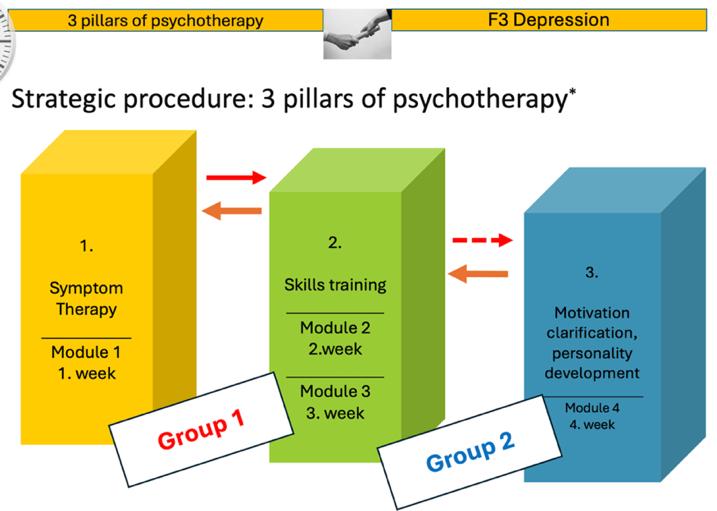
Each module consists of three therapy sessions of 75 minutes each, which take place within a week (e.g. Monday/Wednesday/Friday) and relate to each other. Each module deals with a therapy topic in the group to such an extent that further personalised treatment of the therapy topic can follow in individual psychotherapy. Accordingly, it takes a total of four weeks to complete all four modules, which involves attending 12 sessions.
All therapy materials (revised therapy cards) are digitised as worksheets in A4 format and stored centrally so that they can be printed out at any time from any PC in the clinic and are immediately available to the various professional groups and in different therapy situations.
For more than half of the patients admitted to the group concept, it is recommended that they switch from group A (10-12 participants) to group B (6-8 participants) after the first two weeks and after completing the first two modules (psychoeducation/activity development). Some patients end group therapy with participation in group A, as further emotion-focused work in modules 3 and 4 of group B (emotion exposure/central behavioural schema) is not indicated either at the time of therapy or, for example, due to predominantly biological factors accompanying the depressive disorder.
The different sequence of modules 1 and 2 or modules 3 and 4, which results from the different starting times of the participants, is of equal value, as all modules are self-contained.
For more information see Algermissen & Rösser (2019).
Therapy content of the "PKP depression group
Module 1 - Psychoeducation
An initial key objective in Module 1 is to correctly describe depressive symptoms within the group and to recognise them in oneself and other participants. Metacognitively recognising and naming one's own depressive symptoms and becoming aware that similar depressive symptoms are also experienced by others is often associated with a better understanding of the disorder "depression" and an initial psychological
relief. At the same time, the patient's theory of mind/mental theory is trained and elaborated in this way (Sulz 2021b). Using worksheets, the participants are asked to understand the diagnosis of depression for themselves and to "check" it with guidance in order to achieve an acceptance of the illness that is beneficial for the treatment. In addition, the group participants receive psychoeducational information about the "illness" of depression and learn about the various explanatory models for the development and maintenance of depression. Based on the vulnerability-stress model, the indication for (usually) combined psychopharmacological and psychotherapeutic treatment is explained. At the same time, the question about the functionality of depression ("What happened immediately before you became depressed?") opens up the perspective that the depressive mood may "protect" against intense and threatening emotions (emotion avoidance, see above). The relevance of the basic feelings of fear, anger and sadness for the development and maintenance of depression is clarified in the group discussion and the rationale for emotion exposure (in Module 3) and the conscious "handling of difficult feelings" is also presented. Depression therapy can aim to gradually replace the depressive mood with vital feelings, the intensity of which can be regulated again by the individual.This involves the corrective experience of self-efficacy (in coping with anxiety), self-assertion (in dealing with anger and resentment) and becoming open to new things (in overcoming grief).

2
Module 2 - Building positive activities
Behavioural activation and the use of reinforcers to build up positive activities is an effective component of all cognitive-behavioural therapy approaches for treating depression (Hautzinger, 2013). Pleasantly experienced activities can also be understood and "practised" as a planned "exposure" to positive emotions such as "joy" and "satisfaction". However, drive disorders, negative expectations and the experience of persistent and almost insurmountable joylessness make it difficult for depressed patients to take the initiative. Feelings of duty and responsibility often dominate behaviour and impair positive experiences. The aim of this module is therefore the joint search for activities that are likely to be enjoyable or meaningful in a group context and the concretisation of these individually suitable activities in the form of daily plans and implementation protocols. It is helpful to guide self-observation of mood changes, as gradual improvements in mood are often not noticed by depressed patients or are negatively distorted in their assessment. The importance of exercise and sport, relaxation training, pleasure exercises and sensory experiences as sources of positive experiences are developed and integrated into the planning of positive activities.
In this area in particular, the cross-professional organisation of therapy content is a significant advantage. Behavioural activation, e.g. through concrete planning of positive activities and guidance on self-observation, can be considerably intensified and efficiently supported by specialist psychiatric nursing. Exercise, sports and creative therapists can provide additional programmes to build up positive activities or open up sources of positive (sensory) experience.
Module 3 - Dealing with difficult feelings (exposure to emotions)
According to the strategic-behavioural disorder model (see above), depressive mood can have the function in a certain life situation of protecting against uncontrollably intense emotions such as existential fear, insurmountable grief or aggressive anger. In the reversal of the disorder model, the aim is to reduce the associated avoidance of emotions through interventions to expose emotions. By simultaneously learning to effectively regulate the threateningly intense emotion, it is possible to gradually process the emotion in therapy. The depressive mood is then no longer maintained by emotion avoidance. The healthy vitality of
emotions can be experienced anew as the depressive mood recedes.
Emotion-focussed therapy work in a group of 6-8 participants is challenging, but is possible in suitable inpatient settings and accompanied by in-depth individual psychotherapy. In many cases, the group context is also advantageous, e.g. through the multi-perspectivity and greater experiential knowledge of the group. The basic emotions of fear, sadness and anger/rage are each dealt with in a 75-minute therapy session. The respective emotion schema is activated with a "brainstorming session" about personal experiences with one of these basic emotions and the various physical perceptions in connection with an emotion. The basic function of the basic emotion being worked on (fear - recognising danger, sadness - letting go, anger/rageself-assertion) and typical trigger situations are worked out and the strategies already available to the group participants for dealing with the emotions of fear, sadness and anger are explored and, if necessary, evaluated in lists of pros and cons. This already reveals a he lpful repertoire of behaviour in the group.
Based on the group results, the specific antidepressant PKP interventions for the respective emotion exposure are described. In order to take into account the importance of interpersonal issues in the development of depression, the PKP therapy concept for anxiety exposure includes in particular brief interventions for self-assertion, communication and independence training, as well as a frequently important "pleasure instead of duty" exercise for depressed patients with high self-demands, a pronounced sense of responsibility, strong self-discipline and dysfunctional conscientiousness.
For anger/rage exposure, there are short interventions on recognising, allowing and expressing anger and rage, on adequacy and on "constructive negotiation" on the background of anger/rage. In particular, an exercise on discriminating between feelings and actions or fantasy and reality in connection with intense anger and rage is suitable for joint implementation in the group.
Carrying out a grief exposure in the context of a small group requires special attention for individual participants during and after the therapy session and, if necessary, a flexible organisation of the group situation. This is about remembering the precious/loved one that was lost and feeling how much it is missed and what the moment of loss felt like, what pain, despair and grief there was. It is about the willingness to allow the painful feelings of grief and loss instead of avoiding them. In the group context, an imagination exercise ("boat exercise") is used to approach a topic of grief. The brief interventions mentioned usually take place in a more intensive individual setting. The overriding aim of this module is to clarify for the patient
whether the avoidance of certain emotions is relevant to the development and maintenance of the depressive mood and the quality of the avoided emotion. The group participant should be motivated to continue emotion-focussed work in an individual therapy setting. The inpatient treatment setting generally offers a supportive and well-suited therapy situation for emotion exposure.
Module 4 - Survival rule as a central behavioural pattern
Certain life situations can trigger a depressive episode if essential behavioural options for coping with a stressful life situation (e.g. autonomy and independence in a relationship conflict) are lacking and cannot be learned directly by the person affected. In terms of developmental psychology, the diversity and variability of behavioural options in adulthood are related to the breadth of experience in the course of the individual's development and learning history in childhood (Piaget & Inhelder, 1981; Kegan, 1986; Sulz 2007b). Both emotionally threatening or frustrating experiences and often limited opportunities to satisfy central needs in early biographical relationships lead to the development of corresponding cognitive-emotional schemata and behavioural or relationship patterns (see above). The respective schema was promising in childhood to guarantee emotional "survival" and often represented a positive adaptive achievement. However, if these learned cognitive-emotional schemata persist in the changed adult situation, they also remain decisive for interpersonal behaviour and the adult's relationship design and often become dysfunctional in their rigidity and unconsciousness (see above).
The occurrence of strong (primary) emotions such as fear, anger or sadness activate these schemata and tend to always lead to the same (secondary) emotional reaction (e.g. feelings of helplessness and inferiority).
Recognising and describing the central emotional-cognitive schema, the so-called survival rule, is the aim of Module 4. The construct of the survival rule can be used to explain maladaptive behaviour in interpersonal relationships that perpetuates depression and can therefore be changed therapeutically. Based on the primary personality trait (e.g. "I am reserved and adapted") and the central needs and fears of a person, a personalised survival rule is developed, i.e. a conditional sentence is formulated:
"Only if I always ... (act according to my personality trait) and if I never ... (act contrary to my personality trait) do I preserve ... (the central need) and prevent ... (the central fear). In the case of a self-insecure-
dependent personality, the survival rule could be:
Survival rule - dependent personality trait
Only if I always think, feel and act according to the wishes of my carer, and if I never allow my own needs to be incompatible with theirs, I keep the protection, the warmth and the security and prevent being abandoned.
The development of survival rules in a group context is possible in a simplified initial form and should primarily encourage continued work on clarifying one's own behavioural motives relevant to the development of depression and further personality development. As a basis for therapeutic work, however, further differentiation and review of the survival rule is necessary. This concern is in turn delegated to individual PKP therapy. In the same way , a first "development rule" ("By no longer ... and instead ..., I become free ... for myself and for real relationships") is created in the group context and delegated to individual therapy for concrete elaboration. The "development rule" serves as a starting point for individual change projects and for the development of opposing or alternative behavioural options to the survival rule. This gives it a special significance in further individual therapy. The development of a less change-orientated self-acceptance, which includes self-compassion in the sense of Gilbert (2009), can also become the goal of brief psychiatric psychotherapy.
PKP individual therapy
PKP individual therapy is carried out in parallel to group therapy by the respective inpatient reference therapists. Initially, simple therapeutic support and supplementary explanations are required in addition to the group sessions, as the patients are still affected by depressive symptoms and reduced attention span. In the course of the therapy, however, the relevant therapy topics from the group therapy are taken up, continued in a personalised manner and deepened. The group therapy process provides multiple therapeutic starting points, the treatment of which can be weighted differently by the reference therapist and with different objectives and therapy strategies. Accordingly, the reference therapist must be familiar with the group concept and the therapeutic content of Brief Psychiatric Therapy and with the basic principles of
Strategic Behavioural Therapy, in particular with the techniques of emotion exposure and working with the survival rule. Completion of Modules 3 and 4 of the PKP therapy concept also marks the start of intensive individual therapy work on changing the dysfunctional survival rule and on personal development.
PKP therapist conference
A therapist conference is held every two weeks to intensify communication between group leaders and reference therapists and to discuss both individual cases and organisational issues in addition to the day-today exchange of case-related information.
Cross-sectoral organisation of brief psychiatric psychotherapy The PKP group concept, which is primarily designed for inpatients, can also be opened up to outpatients if individual PKP therapy is also available in an outpatient context, e.g. in the psychiatric institute outpatient clinic or by a qualified outpatient medical or psychological psychotherapist. The offer of further outpatient participation in the PKP depression group is also useful for patients who are discharged from inpatient treatment for various reasons during the PKP group therapy period and can also complete their depression treatment in this way on an outpatient basis.
PIA group to work on the survival rule
Project work to replace the dysfunctional commanding and forbidding survival rule with a new permissiongiving rule of life (not a survival rule), to improve one's own emotion regulation and personal development can also be continued as part of a special group programme in the psychiatric outpatient clinic.
Evaluation of the inpatient PKP treatment concept
The data from a multi-year evaluation of the PKP depression group between August 2011 and December 2016 provided clear evidence that this special therapy programme at Braunschweig Hospital is suitable for generating an effective treatment process for inpatients with depression on a general psychiatric and
psychotherapy ward.
Methods: Following a phase of concept implementation (8/2011-6/2012), the evaluation of the PKP treatment concept began in July 2012 and was carried out until December 2016 as a continuous quality assurance measure. Within the clinical routine, several measurement instruments (BDI-II; Hautzinger, Keller & Kühner, 2006; SCL-18; Franke, 2017; CGI-Scale; Guy, 2000) were used in parallel with the group intervention. The aim of this "clinical evaluation" was to determine the course of therapy during the group intervention. In addition, the participants' subjective assessments of the relevance of the developed survival rule were surveyed.
Results
In the period from the start of the PKP depression group in August 2011 to December 2016, a total of 1196 patients took part in the PKP depression group or the combined inpatient PKP treatment concept, predominantly patients from the general psychiatric and psychotherapy wards. More than half (58.2 %), i.e. 696 participants, completed the PKP depression group in full (modules 1-4). 206 participants (17.2%) in the group therapy ended the PKP depression group as planned after modules 1 and 2, e.g. because the indication for participation in group B (emotion exposure/survival rule) was not given (see above). For a further 118 group participants (9.86%), group participation ended during participation in group B (modules 3-4) and after completion of modules 1 and 2, e.g. due to early discharge. For 157 participants (13.1%), group therapy ended either after participation in only one module (114 patients) or after the first group sessions (43 patients). 14 patients (1.2 %) took part exclusively in Group B (emotion exposure/survival rule) after therapeutic consideration. Five participants in the depression group showed unsystematic participation (module 1/3, 1/4 or 2/3).
Of the 1196 participants, a total of 7 treatment cancellations (0.6%) were documented for specific reasons (updating trauma experience, acute mania, psychotic symptoms, etc.). 32 patients (2.6%) took part in the outpatient depression group via the psychiatric outpatient clinic.
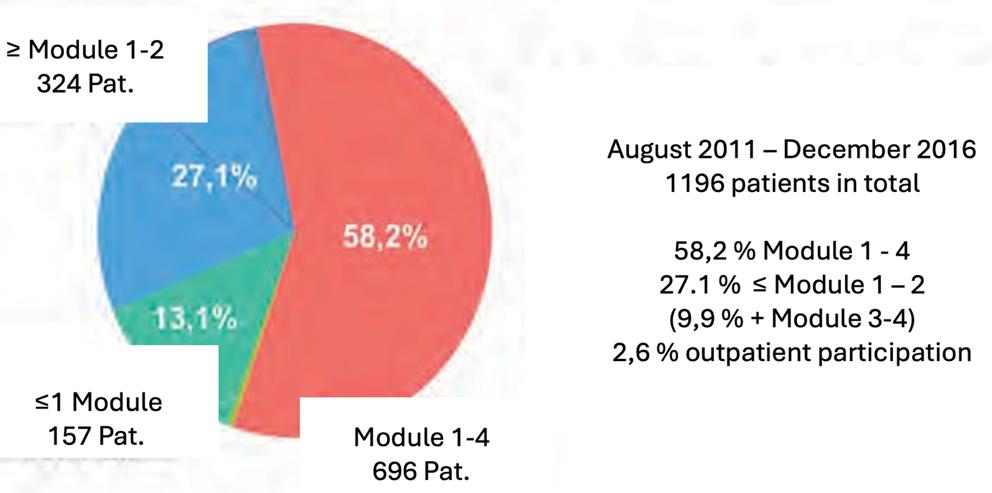
Figure 3 How many patients completed how many modules?
During the four-week PKP depression group, the scores on the Beck Depression Inventory (BDI-II; Hautzinger et al., 2006) decreased significantly (p< 0.001) and with a strong effect (d= 1.144) in the participants with full participation in the PKP therapy concept (n =696). The values for the suicide item in the BDI-II (p< 0.001, d= 0.626) also decreased.
At the same time, the participants received other therapies such as psychopharmacotherapy and complementary therapies to the standard treatment.
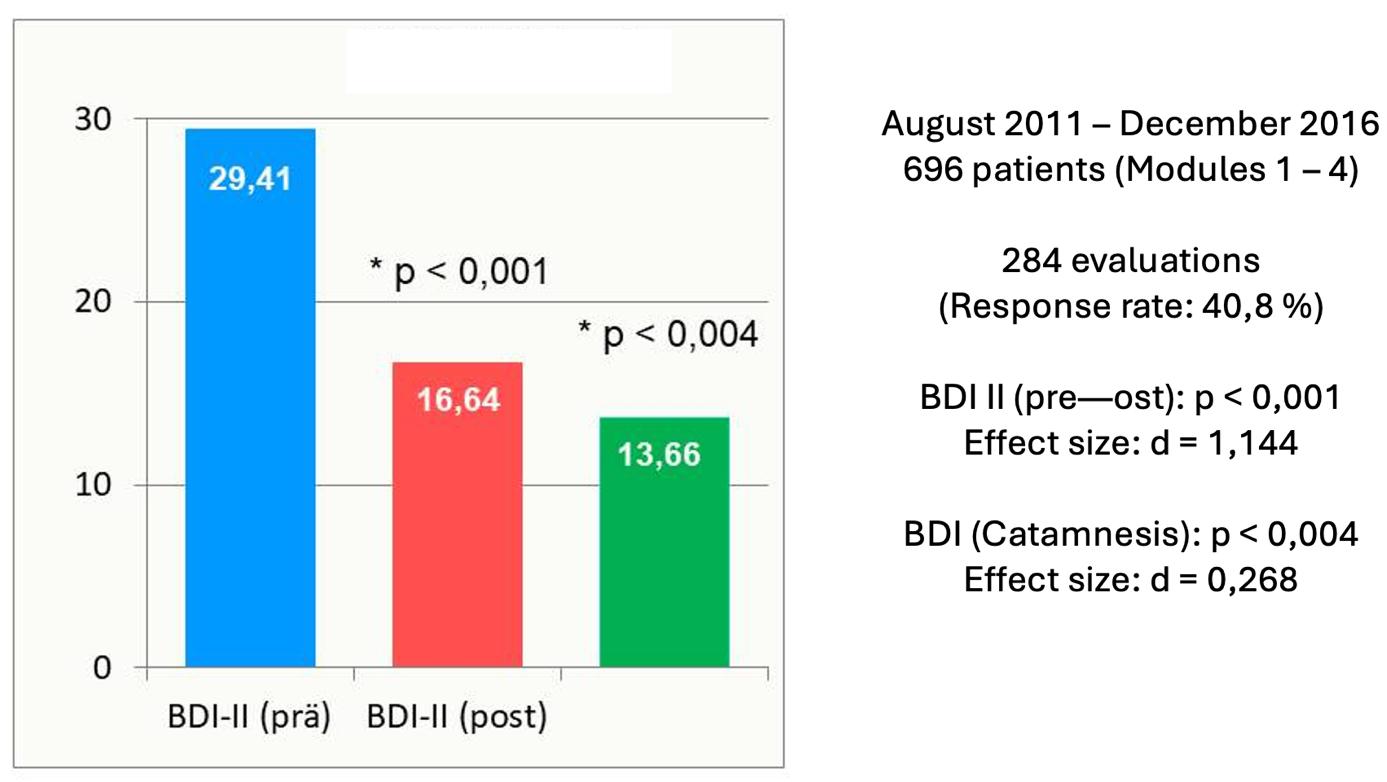
Figure 4 Beck Depression Inventory (II): Pre/post comparison
Starting in August 2012, the clinical evaluation was expanded to include the SCL-18 (Symptom Checklist, syn. Mini-SCL) and a scale for 'overall clinical impression'. The SCL-18 is a short form of the symptom checklist (SCL-90-S) that is well validated for psychotherapy patients, reduced to the 3 scales for somatisation, depressiveness and anxiety with 6 items each (Derogatis, 1977; Franke et al. 2011; Franke, 2014, 2017). The 'Clinical Global Impression' corresponds to the most commonly used international external assessment instrument, the Clinical Global Impression-Scale (CGI-Severity), in German translation (Guy, 2000; CIPS, 2005).
There were significant (p< 0.001) symptom reductions on all SCL-18 scales. The effect manifested itself most strongly on the depression scale (d= 1.067), followed by effects on the anxiety scale (d= 0.714) and the
somatisation scale (d= 0.641). The "Global Severity Index" (GSI) of the symptom checklist, which correlates well with clinical improvement, also showed a good effect size (d = 1.022), limited only by a low response rate of 39%. The external assessment using the Clinical Global Impression Scale (CGI-S) confirmed a significant psychological improvement (p < 0.001) in the statistical comparison of the pre/post raw scores (d = 1.166).
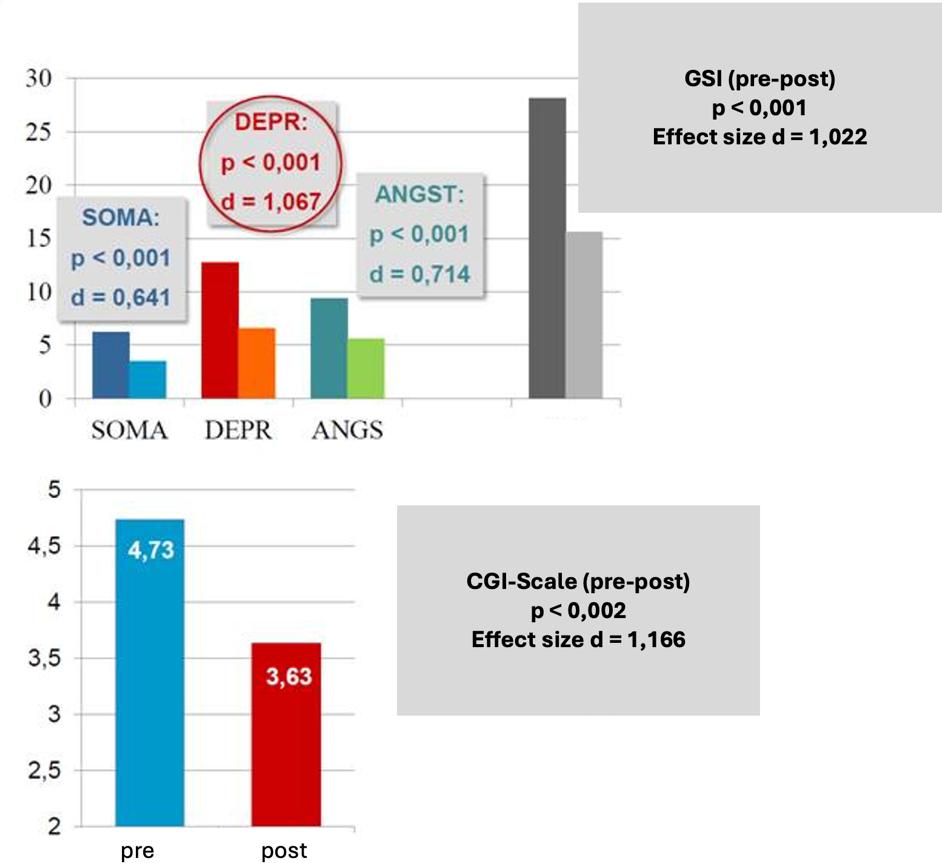
With the development of the survival rule in module 4, 79.5% of the group participants were motivated to continue working with the survival rule in therapy. 89.9% of participants rated the therapy topic of the survival rule as moderately to very relevant for them (response rate 41.9%).
The catamnestic survey clearly showed, in line with expectations, that the patients' experiences and behaviour in the post-inpatient course were less determined by the survival rule overall (p < 0.001, d = -0.635). Negative consequences were less feared in the event of a "violation of the survival rule" (p < 0.001, d = -0.6).
Although more negative feelings occurred in connection with "violations of the survival rule", these did not reach a significance level (p = 0.075). According to their own judgement, the patients surveyed in the catamnestic interviews were more successful overall in "acting against the survival rule" (p = 0.005, d = -0.336).
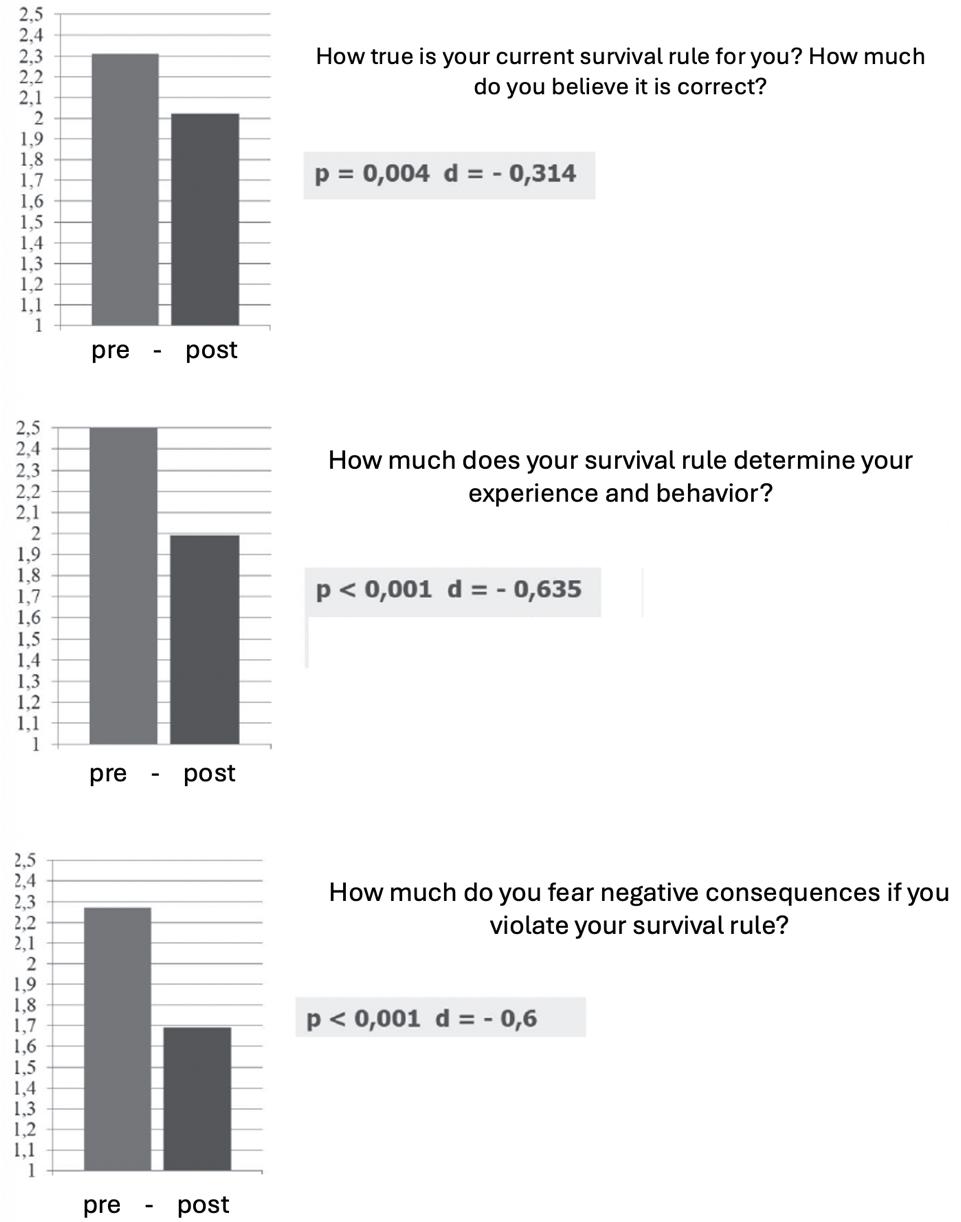
Figure 6 Impact of the dysfunctional survival rule before and after therapy
7. Psychiatric Brief psychotherapy PKP of depression in combined group and single-therapy for psychiatric departments European Psychotherapy EP2025 page 141-166
Discussion
As with field studies in general, this naturalistic study can be expected to have high external validity. This greater predictability for everyday psychiatric care compared to strictly controlled RCT studies conducted under laboratory conditions compensates somewhat for the lack of a control group. Research funding and research staff were not available. This makes the importance of consistently continuing treatment practice and evaluation for more than ten years all the greater. RCT studies usually have comparatively small samples (hardly more than 100 test subjects), whereas this study can report on the course and outcome of treatment in almost 1,200 patients. The reported significances and effect sizes show that effective therapies took place and clinically relevant improvements were achieved.
Brief interventions and the therapy technique of Psychiatric Brief Psychotherapy (PKP) formed the basis for a combined group and individual therapy with the primary aim of realising and testing a special psychotherapy for depression in an acute care clinic with typical limitations in terms of length of stay and personnel resources.
The new form of organisation with parallel groups in weekly changing composition has proven its worth. In practice, sufficiently homogeneous group atmospheres were also created for work with and the survival rule. The embedding of the treatment concept in two organisationally linked wards favoured the development of supportive group situations. The complexity of the treatment approach was sufficiently taken into account by the accompanying individual therapy. The development of therapeutic topics in the group context and the delegation of these topics for further processing in individual therapy represented an efficient organisational form of the strategic therapy process. In addition, positive group effects (e.g. reciprocal modelling, stimulation and feedback functions, conveying hope) could be used (Theßen, Algermissen & Sulz 2025, Fiedler 2005).
The organisational form of the PKP treatment concept also proved to be a good prerequisite for cross-sectoral treatment paths, provided that supplementary individual therapy was possible through further outpatient treatment in a psychiatric institute outpatient clinic or with a registered "PKP therapist" parallel to participation in the PKP depression group.
The results of the clinical evaluation document that within the first four-week period of the PKP treatment concept and with participation in the depression group, significant positive therapy effects and regression of depressive syndromes
can be seen or expected. The respective significance of the various therapeutic elements of inpatient depression treatment for clinical improvement, such as participation in brief psychiatric psychotherapy compared to the effectiveness of antidepressant psychopharmacotherapy or the complementary effects of other complementary therapies and inpatient environmental factors, cannot be determined on the basis of our evaluation. There was a lack of suitable control conditions for such statements. In addition, the unsatisfactory response rate in recording the impact of the survival rule, primarily due to the lack of scientific personnel, limited the validity of the clinical evaluation.
Overall, however, and above all due to the high number of cases (n = 1196), we believe that the clinical evaluation provided evidence that effective and effective inpatient depression treatment could be realised using the inpatient PKP treatment concept. The treatment concept has shown stability from 2011 to 2025, independent of the therapist.
The high relevance that participants attributed to the central construct of the PKP treatment concept, the survival rule, also indicates a high level of acceptance for the underlying functional disorder model of PKP. This was also our everyday experience.
In summary, the PKP treatment concept could be implemented well in the inpatient treatment programme of a mediumsized psychiatric care clinic. The reproduction of our results is essential for the positive verification of the inpatient PKP treatment concept. This article therefore also aims to facilitate the testing of the inpatient PCP treatment concept for depression elsewhere in a comparable form. Our therapy materials and measuring instruments for PKP evaluation can be made available free of charge.
In summary, this was a naturalistic outcome study to evaluate the new PKP treatment concept for the inpatient psychiatric-psychotherapeutic treatment of almost 1200 depressive patients. The highly structured setting made it possible for patients to be admitted at any time and receive psychotherapeutic treatment for the expected duration of their stay. The use of the staggered group setting, accompanied by individual therapies working according to the same approach, which could be continued in the same way as the groups after discharge from inpatient treatment, was central. While retaining and continuing the personalised modular psychotherapy concept, one patient could be handed over to the outpatient PKP therapist. The results of the evaluation are encouraging and show that new effective psychotherapy approaches can be implemented in psychiatric inpatient care. This could also be implemented for other mental disorders. Disorder-specific PKP is available for anxiety and obsessive-compulsive disorders, for chronic alcoholism and for pain disorders. In addition, PKP is available as a transdiagnostic modular psychotherapy approach (Sulz 2012), which can be used for a large number of other mental disorders. PKP can also be seen as a more
psychoeducational and disorder-specific arm of Strategic Behavioural Therapy SBT. This has been divided into the two therapy strands PKP and EMVT (Sulz 2021a,b, 2022a,b). Emotion and Mentalisation Enhancing Behaviour Therapy EMVT is the new transdiagnostic therapy approach for the treatment of Axis I disorders and Cluster C personality disorders first published in 2021. This is a modular psychotherapy that focuses entirely on the specifics of the individual patient. It consists of seven modules: attachment security, survival rule, mindfulness, emotion tracking, mentalisation/metacognition, development from the body and affect level to the thinking level and development from the thinking level to the empathy level. It is an ideal complement to PKP. Its use begins when the symptoms no longer determine thinking, feeling and behaviour, but when the patient wants to understand their illness and leave it behind them in the long term. In contrast to approaches such as MBT and schema therapy, which were developed for the treatment of clusters A and B (too much emotionality), EMVT can help the patient to find their feelings and use them to build a secure bond and a satisfying relationship.
Literature
Algermissen, C. & Rösser, N. (2019). Psychiatrische Kurz-Psychotherapie von depressiven Störungen in kombinierter Gruppen- und Einzeltherapie – ein Behandlungskonzept für Versorgungskliniken. Psychotherapie, 24(1), 113–135.
Beck, A. T. (1979). Wahrnehmung der Wirklichkeit und Neurose. München: Pfeiffer.
Beck, A.T., Rush, A.J., Shaw, B.F. & Emery, G. (1986). Kognitive Therapie der Depression. Weinheim: Beltz. Bischof, N. (1993). Untersuchungen zur Systemanalyse der sozialen Motivation: Die Regulation der sozialen Distanz – von der Feldtheorie zur Systemtheorie. Zeitschrift für Psychologie, 201, 5-43.
CIPS Collegium Internationale Psychiatriae Scalarum (2005). Internationale Skalen für Psychiatrie. Göttingen: Hogrefe.
Damasio, A. (2003). Der Spinoza-Effekt: Wie Gefühle unser Leben bestimmen. München: List. Deckert, B. (2014). Psychiatrische KurzPsychotherapie (PKP) der Depression. Psychotherapie, 19, 287-304.
Deckert, B. (2014). Psychiatrische Kurz-Psychotherapie (PKP) der Depression. Psychotherapie, 19(2), 287–304.
Derogatis, L.R. (1977). SCL-90-R, administration, scoring & procedures manual-I for the R(evised) version. John Hopkins University School of Medicin: Eigendruck.
DGPPN, BÄK, KBV, AWMF (2017). Nationale Versorgungsleitlinie Unipolare Depression. Heidelberg: Springer. Fiedler, P. (2005). Verhaltenstherapie in Gruppen: Psychologische Psychotherapie in der Praxis. Weinheim: Beltz.
Franke, G.H., Ankerhold, A., Haase, M., Jäger, S., Tögel, CH., Ulrich, C. & Frommer, J. (2011). Der Einsatz des Brief Symptom Inventory 18 (BSI-18) bei Psychotherapiepatienten. PPMP Psychotherapie Pychosomatik Medizinische Psychologie,61, 82-86.
Franke, G.H. (2014). SCL-90-S. Symptom-Checklist-90-Standard. Göttingen: Hogrefe (Testzentrale). Franke, G.H. (2017). Mini-SCL. Mini-Symptom-Checklist. Göttingen: Hogrefe (Testzentrale).
European Psychotherapy EP2025 page 141-166
Psychiatric Brief psychotherapy PKP of depression in combined group and single-therapy for psychiatric departments
Gilbert, P. (2009). Introducing compassion-focused therapy. BJPsych Advances in Psychiatric Treatment, 15, 199–208.
Gräff-Rudolph, U. & Sulz, S.K.D. (2009). Strategische Depressionstherapie: Die Energie der Gefühle für befriedigende Beziehungen nutzen lernen. In: S.K.D. Sulz & G. Hauke (Hrsg.), Strategisch- Behaviorale Therapie (SBT): Theorie und Praxis eines innovativen Psychotherapieansatzes. München: CIP Medien.
Grawe, K. (1998) Psychologische Therapie. Göttingen: Hogrefe.
Guy, W. (2000) Clinical Global Impressions (CGI) Scale, Modified. In: J.A. Rush (Hrsg.), Handbook of Psychiatric Measures. Washington DC: American Psychiatric Association.
Haken, H. & Schiepek, G. (2005). Synergetik in der Psychologie: Selbstorganisation verstehen und gestalten. Göttingen: Hogrefe. Härter, M., Sitta, P., Keller, F., Metzger, R., Wiegand, W., Schell, G., Stieglitz, R.-D., Wofersdorf, M., Felsenstein, M. & Berger, M. (2004). Stationäre psychiatrisch-psychotherapeutische Depressionsbehandlung. Nervenarzt , 75, 1083-1091.
Hautzinger, M., Keller, F. & Kühner, C. (2006). Beck Depressions-Inventar Revision. Göttingen: Hogrefe. Hautzinger, M. (2013).
Kognitive Verhaltenstherapie bei Depressionen. Weinheim: Beltz.
Hinsch, R. & Pfingsten, U. (2015). Gruppentraining sozialer Kompetenzen GSK. Weinheim: Beltz.
Kanfer, F.H., Reinecker, H. & Schmelzer, D. (2006). Selbstmanagement-Therapie. Heidelberg: Springer Medizin.
Kegan, R. (1986). Die Entwicklungsstufen des Selbst: Fortschritte und Krisen im menschlichen Leben. München: Kindt.
Klermann, G.L., Weissman, M.M., Rounsaville, B.J. & Chevron, E.S.M.S. (1984). Interpersonal Psychotherapy of Depression. New York: Basic Books.
Lewinsohn, P.M. (1974). A Behavioral Approach to Depression. In: R.J. Friedman & M.M. Katz (Hrsg.), The Psychology of Depression (S.194-209). New York: Wiley.
McCullough, J.P. (2006). Psychotherapie der chronischen Depression: Cognitive Behavioral Analysis System of PsychotherapyCBASP. München: Urban & Fischer.
Piaget, J. & Inhelder, B. (1981). Die Psychologie des Kindes. Frankfurt: Fischer.
Roediger, E. (2016). Schematherapie: Grundlagen, Modell und Praxis. Stuttgart: Schattauer.
Röttgers, H.-O. & Konrad, C. (2017). Praxis des Cognitive Behavioral Analysis System of Psychotherapy (CBASP). In: C. Konrad (Hrsg.), Therapie der Depression: Praxisbuch der Behandlungsmethoden (S.117-140). Berlin: Springer.
Schramm, E. (2010). Interpersonelle Psychotherapie. Stuttgart: Schattauer.
Seligman, M.E.P. (1992). Erlernte Hilflosigkeit. Weinheim: Beltz.
Statistisches Bundesamt (2017). Diagnosedaten der Krankenhäuser (Eckdaten der vollstationären Patienten und Patientinnen). http://www.gbe-bund.de/oowa921install/servlet/oowa/aw92/dboowasys921.xwdevkit/xwd_init?gbe.isgbetol/xs_start_neu/&p_aid=i&p_aid=43944074&nummer=815 &p_ sprache=D&p_indsp=-&p_aid=28380234
Sulz, S.K.D. (1998). Therapeutische Strategien bei Depression. In: S.K.D. Sulz (Hrsg.), Das Therapiebuch. München: CIP-Medien.
Sulz, S.K.D. (2007a). Die Schematherapie Jeffrey Youngs: ein integrativer Therapieansatz zur Behandlung von Persönlichkeitsstörungen. Psychotherapie, 12, 183-195.
European Psychotherapy EP2025 page 141-166
Sulz, S.K.D. (2007b). Entwicklung als Therapie: von Piaget Entwicklungstheorie zu McCulloughs CBASP und zur strategischen Kurzzeittherapie. Psychotherapie, 12, 60-76.
Sulz, S. (2012). Grundkurs und Praxisleitfaden: Therapiedurchführung in Klinik und Praxis. PKP-Handbuch. München: CIP-Medien.
Sulz S. K. D. (2017a). Gute Kurzzeittherapie in 12 plus 12 Stunden. Für PsychotherapeutInnen, die sich in Kurzzeittherapie einarbeiten wollen. München: CIP-Medien
Sulz S. K. D. (2017b). Gute Verhaltenstherapie lernen und beherrschen - Band 1: Verhaltenstherapie-Wissen: So gelangen Sie zu einem tiefen
Verständnis des Menschen und seiner Symptome. München: CIP-Medien
Sulz S. K. D. (2017c). Gute Verhaltenstherapie lernen und beherrschen - Band 2: Verhaltenstherapie-Praxis: Alles was Sie für eine gute Therapie brauchen. München: CIP-Medien
Sulz S. K. D. (2017d). Verhaltensdiagnostik und Fallkonzeption. Bericht an den Gutachter. München: CIP-Medien
Sulz, S. K. D. (2017e). Depression Ratgeber & Manual, für Betroffene, für Angehörige, für alle beruflichen Helfer. 4. Auflage. München: CIPMedien. 2013 auch als e-book erschienen.
Sulz, S.K.D.. (2019a). Fallkonzeption des Individuums und der Familie. In Leibing, E., Hiller, W., Sulz, S.K.D. (Hrsg., 2019). Lehrbuch der Psychotherapie. Band 3: Verhaltenstherapie. Gießen: Psychosozial-Verlag, S. 25-48
Sulz, S.K.D.. (2019b). Prozessuale und inhaltliche Therapiestrategien. In Leibing, E., Hiller, W., Sulz, S.K.D. (Hrsg., 2019). Lehrbuch der Psychotherapie. Band 3: Verhaltenstherapie. Gießen: Psychosozial-Verlag, S. 105-124
Sulz S. K. D. (2021a). Mit Gefühlen umgehen - Praxis der Emotionsregulation in der Psychotherapie. Gießen: CIP-Medien im Psychosozial-Verlag
Sulz, S.K.D. (2021b). Mentalisierungsfördernde Verhaltenstherapie. Gießen: Psychosozialverlag.
Sulz S. (2021c). Kurz-Psychotherapie mit Sprechstundenkarten. Wirksame Interventionen bei Depression, Angst- und Zwangskrankheiten, Alkoholabhängigkeit und chronischem Schmerz. Gießen: Psychosozial-Verlag
Sulz, S.K.D. (2022a). Heilung und Wachstum der verletzten Seele. Praxisleitfaden Mentalisierungsfördernde Verhaltenstherapie. Gießen: Psychosozial-Verlag
Sulz, S.K:D. (2022b): Praxismanual Mentalisierungsfördernde Verhaltenstherapie – Anleitung zur Therapiedurchführung. Gießen: PsychosozialVerlag
Sulz, S.K.D. & Deckert, B. (2012a). Psychiatrische Kurzzeittherapie PKP: Handbuch Depression. München: CIP Medien.
Sulz, S.K.D. & Deckert, B. (2012b). Psychiatrische Kurz-Psychotherapie: PKP – Depression-Therapiekarten. München: CIP-Medien.
Sulz, S.K.D., Deckert, B. & Gräff-Rudolph, U. (2011). Strategische Depressionstherapie als Psychiatrische Kurz-Psychotherapie (PKP): Arbeit mit Sprechstundenkarten. Psychotherapie,16, 324-330.
Sulz, S.K.D. & Hauke, G. (2009). Strategisch-Behaviorale Therapie (SBT): Theorie und Praxis eines innovativen Psychotherapieansatzes. München: CIP-Medien.
Theßen, L., Algermissen, C., Sulz, S.K.D. (2025). Emotion and mentalization-supporting behavioural therapy in the group (EMVT-G). European Psychotherapy EP 2025, Volume 16, 141-184
Theßen, L., Antoni, J., Hagleitner, R., Sulz, S.K.D. (2025). Psychiatric and psychological brief psychotherapy for chronic alcoholism. European Psychotherapy EP 2025, Volume 16, 74-94
European Psychotherapy EP2025 page 141-166
7. Psychiatric Brief psychotherapy PKP of depression in combined group and single-therapy for psychiatric departments
Theßen, L., Backmund-Abedinpour,S., Sulz, S.K.D. (2025). A transdiagnostic approach to Psychiatric and Psychological Brief Psychotherapy PKP. European Psychotherapy EP 2025, Volume 16, 10-28
Theßen, L., Deckert, B., Sulz, S.K.D. (2025).Psychiatric and psychological brief psychotherapy for depression PKP. European Psychotherapy EP 2025, Volume 16, 29-54
Theßen, L., Kaufmayer, T., Sulz, S.K.D. (2025). Psychiatric & psychological brief psychotherapy PKP for depression - an empirical outcome study . European Psychotherapy EP 2025, Volume 16, 95-121
Theßen, L., Peters, M., Sulz, S.K.D. (2025). Psychiatric & psychological brief psychotherapy (PKP) proves to be on a par with long-term therapyresults of a comparative study. European Psychotherapy EP 2025, Volume 16, 122-140
Theßen, L., Sichort-Hebing, M., Jänsch, P., Sulz, S.K.D. (2025). Brief psychiatric and psychological psychotherapy PKP for anxiety and obsessivecompulsive disorders. European Psychotherapy EP 2025, Volume 16, 55-73
Watzlawik, P. (1981). Die erfundene Wirklichkeit. München: Piper.
Wiegand, H.F., Saam, J., Marschall, U., Chmitorz, A., Kriston, L., Berger, M., Lieb, K: & Hölzel, L.P. (2020). Probleme beim Übergang von der stationären zur ambulanten Depressionsbehandlung. Analyse administrativer Versorgungsdaten einer großen deutschen Krankenkasse. Deutsches Ärzteblatt, 117(27 – 28), 472–478 u. I–IX.
Young, J.E., Klosko, J.S. & Weishaar, M.E. (2005). Schematherapie: Ein praxisorientiertes Handbuch. Paderborn: Junfermann.
Correspondencee Address
Dr. med. Christian Algermissen
Klinik fü r Psychiatrie, Psychotherapie und Psychosomatik
Harzklinikum Dorothea Christiane Erxleben GmbH
Thiestraße 7–10
38889 Blankenburg
Christian.Algermissen@harzklinikum.com
European Psychotherapy EP2025 page 141-166
8. Emo'on and mentalisa'on-promo'ng behavioural therapy in the group (EMVT-G)
8. Emo$on and mentalisa$on-promo$ng behavioural therapy in the group (EMVT-G)
Lars Theßen, Christian Algermissen & Serge K. D. Sulz
Abstract
Publications on the new therapy approach of Emotion and Mentalisation Enhancing Behavioural Therapy EMVT will be available from 2021. It is a modular psychotherapy that remains completely focussed on the individual patient in terms of goal formulation and treatment plan. In the first module, attachment security is established in the therapeutic relationship. The second module aims to replace the dysfunctional survival rule as a maladaptive schema with a new permission-giving rule of life in order to reduce therapeutic resistance. The third module promotes acceptance through mindfulness. The fourth module uses Emotion Tracking dialogue techniques to keep track of feelings. The fifth module serves to promote mentalisation or metacognition in order to elaborate the Theory of Mind (Tom). The sixth module uses Piaget's stage theory to help the patient develop from the affect stage (where feelings and needs determine every action) to the thinking stage, where causal thinking and goal-orientation become possible. Finally, in the seventh module, the development from the thinking stage to the empathy stage takes place, in which a change of perspective leads to empathy and compassion (also with oneself). There are particularly many therapeutic possibilities when the treatment is carried out in a group setting (EMVT-G). This article reports on this.
Key words
Cognitive behavioural therapy - metacognition - Theory of Mind ToM - mentalisation support - emotion tracking - body level - affect level - thinking level - empathy level - change of perspective - dysfunctional survival rule - secure attachment - mindfulness - acceptance - ideal parenting exercise - emotion exposure - anger exposure - grief exposure - anxiety exposure AACES - group psychotherapy
Introduction
The long name "Emotion and Mentalisation Enhancing Behavioural Therapy" already reveals the threefold origin of this new therapeutic approach: Emotive therapy with the aim of promoting the handling of feelings, needs and relationshipsmetacognitive therapy to promote the development of mentalisation skills - cognitive behavioural therapy with the aim of self-efficacy and relationship skills.
European Psychotherapy EP2025 page 167-210
8. Emo'on and mentalisa'on-promo'ng behavioural therapy in the group (EMVT-G)
The foundation is cognitive behavioural therapy in the special form of evidence-based strategic behavioural therapy SBT (Sulz & Hauke 2009). Body-oriented emotive therapy builds on this, in particular the microtracking of PBSP (PessoBoyden-System Psychomotor, see Bachg & Sulz 2022), which we call Emotion Tracking. It leads to the third floor of the therapy building, the metacognitive or mentalisation training to build a realistic Theory of Mind (ToM), which borrows a lot from MBT (mentalisation-based therapy according to Fonagy et al. 2008). The combination of these three approaches results in the Emotion and Mentalisation Enhancing Behavioural Therapy EMVT (Sulz 2021), the final name of which has only now been decided in 2025. The reason for the name extension is that the emotional therapy component of the treatment takes up at least as much space as mentalisation support. In this article, this is presented in its group form as EMVT-G.
1. Strategic behavioural therapy SBT
We start with the cognitive-behavioural foundation (Sulz 2017a-d), which is applied in practice as Strategic Behavioural Therapy SBT.
This is based on the affective-cognitive developmental theory of behaviour (Sulz 2017b, p. 86):
- Based on Grawe's (1998) theory of therapy, we assume that human self-regulation takes place through implicit homeostasis and homeodynamic processes, so that the psyche is constantly changing and at the same time constant enough for a stable identity to emerge.
- To this end, homeostatic target values of need fulfilment, relationship quality, inner norms and values are strived for.
- Encounters with people in the social environment initially take place through perception.
- It activates motivational schemata such as anger, fear and positive affection. These in turn generate reactions with feelings, thoughts and action components.
- These have an effect on the social environment, whose response is in turn perceived and compared with the target values.
- However, the interaction can also begin with the social environment mobilising desires and creating incentives.
- In the case of mental disorders, self-regulation is derailed so that a symptom must be added as an emergency measure.
- Psychotherapy attempts to restore the previous self-regulation in such a way that a symptom is no longer necessary.
"This is based on three assumptions:
8. Emo'on and mentalisa'on-promo'ng behavioural therapy in the group (EMVT-G)
1. The human psyche autonomously regulates human sensation, perception, feeling, thinking and action in the sense of homeostasis (self-regulation and self-organisation) (cf. Sulz, 1987; Bischof, 1995; Grawe, 1998). Autonomy means that consciousness, as an "arbitrary psyche", has no constant controlling influence on self-regulation (Kanfer, Reinecker & Schmelzer, 2012), but merely serves as a measurement and control variable in this control system in the sense of cybernetics. Behavioural goals are not only created by target values at higher system levels, but also bottom-up from the constitution of new patterns of order through the interaction of lower system levels.
2. Humans have an inherent tendency to develop their emotionality (Piaget & Inhelder, 1980) and their interpersonal relationships (Kegan, 1986) throughout their lives. This development takes place mainly before the onset of puberty, particularly at pre-school age. McCullough (2007) points out that people only develop partially. Their psyche operates at a lower level of development in difficult and important situations. However, development can be continued at any time, e.g. with the help of psychotherapy (Sulz, 2010, 2012). Development from one stage to the next follows the laws of self-organisation. The order parameter changes. A new attractor is formed.
3. Human life and relationships are shaped far more according to the principle of construction and self-organisation than according to that of causality. This is the hypothesis of constructivism of the Palo Alto school (Watzlawick et al., 1974). Strictly speaking, the homeostatic principle already contains this assumption in the sense of purposefulness and instrumentality and functionality (Sulz, 2012). However, new patterns of order emerge from the self-organisation of subordinate subsystems of the psyche, which also construct the external social world.
Re 1: In the first three years of life, human self-regulation functions as "somatopsychic" homeostasis, based on the primacy of somatic and then also psychological survival. A medium-term survival strategy is indicated for the child: "I have to get through my childhood reasonably well." This implies that the resulting considerable disadvantages must be accepted in adulthood. Adult psychotherapy has to deal with these disadvantages of a successful childhood survival strategy. These survival strategies also bring considerable advantages for adult life, and there are certainly quite a few people for whom the advantages outweigh the disadvantages - perhaps for life, but perhaps only until the end of an athlete's career, for example, or until the midlife crisis of the careerist who fails to make the breakthrough, or until the retirement of the truly successful professional.
One of the main damages to children's homeostasis is that they are forced into a "psychosocial" homeostasis far too early - the primary regulation of the well-being and satisfaction of their social environment, i.e. their parents and family. The child is far from being able to think and act in this way and must therefore regulate its own behaviour with the help
8. Emo'on and mentalisa'on-promo'ng behavioural therapy in the group (EMVT-G)
of aversive feelings such as fear, guilt, shame and disgust - not for its own good, but for the good of its social environment." (Sulz 2017b, p. 86f)
The first publications on the predecessor of SBT, namely Strategic Short-Term Therapy SKT (Sulz 2017a), were published from 1994 (Sulz 1994, 1995).
"Behavioural therapy was originally "the" short-term therapy. Today, not many therapists have mastered the art of brief therapy. More and more, behavioural therapy has become "depth-psychological" - not necessarily in the sense of Freud, but analysing the deeper motives such as needs, fears and interpersonal relationships. And that takes time. Strategic short-term therapy has shown that all of this can also be effectively addressed in a short-term setting.
The shorter the therapy, the more extensive and differentiated the therapy preparation, the more precise the diagnosis and the more actively the patient and therapist move through the therapy process (Sulz 2019a,b). We can observe something similar in the ever shorter inpatient stays in psychosomatic clinics.
Deep emotional experience occurs very early on in short-term therapy - based on a secure, trusting and sustainable therapeutic relationship (problem actualisation according to Grawe, 1998). If the process remains cognitive, it remains superficial and stagnates early on. In contrast, the emotional experience during the therapy session leads to a mental reflection on the causes and interactions of problem development, symptom formation and maintenance. The result is acceptance of one's own limitations and the motivation to change. This means that the active part played by the therapist has essentially already been achieved. Now the patient becomes the actor, accompanied by the therapistemotionally, mentally and relationally.
In order to control a short-term therapy confidently, the therapist must be aware of the process in addition to the two important aspects of relationship and therapy content. The therapy process consists of a cascade of therapy steps that recur implicitly or explicitly in every therapy, not rigidly like a staircase, but dynamically with an interchangeable sequence. Each step can harbour the opportunity for a decisive turnaround, but also the danger of getting stuck or failing." (Sulz 2017a, p. 11).
The term "strategic" is defined as follows: "Here, "strategic" is a synonym for "functional". In a systemic context, the function of a behaviour can refer to its function in the family system, for example, or to its function in emotion regulation and self-regulation as an individual. The subtitle of my book: "Therapiebuch III - von der Strategie des Symptoms zur Strategie der Therapie" (Sulz 2011) points to the actual meaning: The psyche, more precisely the autonomous psyche of
8. Emo'on and mentalisa'on-promo'ng behavioural therapy in the group (EMVT-G)
the human being (Sulz 1994) pursues a strategy of survival and uses a symptom to do so. This unconscious strategy is pursued with great energy. Like an Asian martial art, short-term strategic therapy takes up this strategy and its energy and turns it into a therapeutic strategy. It is not the therapist who invents and develops a strategy, but (unconsciously) the patient's psyche. The therapist only takes up this existing strategy and gives it a new direction. But she can only do this if she has understood the strategy of the symptom." (Sulz, 2017a, p. 12).
As quite a few patients have a longer road to recovery ahead of them, the long-term variant of SCT was developed as Strategic Behavioural Therapy (SBT) (Sulz & Hauke 2009), the evidence-based nature of which was demonstrated by Hebing (2012). It is a modular psychotherapy, starting with the "therapeutic relationship" module, followed by the "from the dysfunctional survival rule to the permission-giving rule of life" module, in turn followed by the "mindfulness and acceptance" module. This is followed by the "symptom therapy" module, in which all the disorder-specific interventions of behavioural therapy are applied. The "skills training" module helps the patient to have masterful behavioural patterns available in previously symptom-triggering situations so that symptom formation is no longer necessary. As behaviour is not primarily conditioned but developed, a "development" module follows, based on Piaget's theory (1978, 1995), which promotes the development from the affective-impulsive to the sovereign-cognitive level and also accompanies the further development to the interpersonal empathy level. Based on the frustrated needs and central fears caused by learning history, the survival rule, which becomes dysfunctional in adulthood and represents the core of therapeutic resistance, is developed. This is overcome by reformulating it into a new rule of life that gives permission.
2. Pessotherapy PBSP
Although the cognitive behavioural therapy practised with SBT is effective, as the evidence-based study by Hebing (2012) shows, there are quite a few patients for whom this method does not succeed in reaching the actual control points of human behaviour - the needs and emotions. Cognitive-behavioural interventions do not succeed in fulfilling Grawe's (1998) demand for problem actualisation (emotional immersion in the problem) in as many sessions as possible. If you look at humanistic therapies such as Gestalt therapy, client-centred psychotherapy, etc., you will only find two approaches that really enable this actualisation: Greenberg's emotion-focused therapy (2000, 2007) and Albert Pesso's pessotherapy (PBSP) (Bachg & Sulz 2022). The latter has the great advantage of a pronounced resource-orientation and extensive body-therapeutic interventions.
8. Emo'on and mentalisa'on-promo'ng behavioural therapy in the group (EMVT-G)
"Far ahead of his time, Al Pesso and Diane Pesso-Boyden developed a now generally recognised dual process theory of the human psyche with an emotional and a cognitive-control system (pilot) from 1961 onwards. Pesso had a simple theory of the human psyche that is generally recognised today: emotional system (limbic system) and reflective system (prefrontal cortex), which he called Pilot (President of the United States of the Human Psyche). Whereby our experience today is completely coloured by our memory, especially our memories from our childhood years. These memories are physical, pictorial, emotional, associative (similar things belong together). Our pilot, on the other hand, is cognitivelinguistic, thinking causally (cause and effect belong together).
In his profoundly humanistic view of man, Albert Pesso sees the four innate tendencies or strivings of man as joy in life, fulfilment of basic needs, meaning in life and connection with people. Human life leads from the fulfilment of the basic needs for space, food, support, protection and boundaries to the integration of polarities that would otherwise drift apart, to the development of consciousness in order to recognise the meaning of life, to the development of the pilot in order to act consciously and responsibly and to the realisation of our uniqueness and our potential for development.
Three phases of development are distinguished:
• Phase 1: Parents must satisfy basic needs in concrete interaction, e.g. setting up a real physical space for the child
• Phase 2: Parents must satisfy the basic needs symbolically, i.e. give the child a fixed place in their heart
• Phase 3: Only then is it the child's turn to give themselves what they received from their parents as a child. Selfcare needs a history of care in the relationship with and through the right caregivers at the right age. Only when this has happened can and should we move on to self-care. We now treat ourselves as well as our parents treated us.
In the Pesso structure (50-minute individual dialogue (individual work in the presence of the group), a "virtual symbolic stage" (Pesso, 2005, p. 307) is set up alongside the real here and now of the room in which the therapy takes place. This is located in the patient's past. It therefore has to do with the patient's memories, with events "that took place at different ages, in different places and with different people" (Pesso, 2005, p. 307). These are to be externalised and brought to life on the virtual stage. In this way, it also becomes visible how the neglect and violation of the child's needs
8. Emo'on and mentalisa'on-promo'ng behavioural therapy in the group (EMVT-G)
influences the present and disrupts the patient's actions and thoughts in the here and now. As mentioned above, the new synthetic and healing experiences should help the patient to positively balance the negative experiences of their own biography.
The trauma therapy concept is a speciality. The core of Pesso's trauma therapy is:
Trauma means
• Destruction of the protective shell that separates outside and inside.
• Powerful energy escapes to the outside without limits.
• Knees tremble, tend towards extreme opening,
• need limitation, to hold together.
• Unprotected seeking of help leads to repetition,
• as the "therapist" becomes directive and "the rapist".
• Instead, re-establish the pilot, not emotionally, but masterfully, controlling what is wanted and how, and where the boundaries are.
The play on words "therapist" verses "the rapist" is very drastically formulated. It points to the danger of repeating aspects of the trauma.
Bessel van der Kolk (2021) described pessotherapy as perhaps the most effective trauma therapy.
Before a structure can even be started, the therapist must first explain all the basic theoretical and practical principles of Pesso therapy to the group members. These include such concepts as form-fit, the basic developmental needs and their effects, the principle of accommodation and microtracking (cf. Schrenker, 2005, p. 347). At the end of the exercises, as at the end of a structure, there is a round of mutual sharing. The participants should report on the feelings they have experienced and not comment on or even interpret the exercises of the others (cf. Howe & Perquin, 2008, p. 147)". (from Sulz 2023, p. 419ff)
European Psychotherapy EP2025 page 167-210
8. Emo'on and mentalisa'on-promo'ng behavioural therapy in the group (EMVT-G)
3. Mentalisafon-based therapy MBT
Mentalisation is currently the hottest topic in psychotherapy. Peter Fonagy and colleagues (e.g. Fonagy et al. 2008, Schultz-Venrath 2021) developed MBT (mentalisation-based therapy) as a new psychotherapy for borderline patients, which can look back on the best results to date in the field of personality disorders. It is recommended as the first choice in the guidelines for borderline therapy. Application, research and publications spread explosively across the entire psychotherapy scene. In contrast, the hype surrounding dialectical behavioural therapy DBT (Linehan 2016a,b) and schema therapy (Young et al. 2005) was only a small fire.
However, what all these therapeutic approaches have in common is that they were initially only intended for borderline disorders. Although only a few psychotherapists worked with these patients to any significant extent, interest in the treatment of personality disorders was and remains huge. Perhaps because problems in dealing with emotions and close relationships affect us all and are therefore more exciting than depression or anxiety therapy. However, there are not yet many studies that show that these new borderline therapies are on a par with or even superior to the classic therapeutic approaches for Axis I disorders. The pioneering spirit and enthusiasm will certainly have an impact on the outcome results.
What is special about MBT is that it is a psychoanalytically based psychodynamic method of psychotherapy. However, it equally draws on Bowlby's attachment theory (1975, 1976). Psychotherapists who have no depth psychological or psychoanalytic training are explicitly encouraged to use MBT even without such training. This means that psychoanalytic metatheory and depth psychological therapy training are not required. Presumably this requires further in-depth discussion.
Following this invitation, I first turned to MBT and adopted the universal conception that applies to all therapies and all patients, in the sense that attachment theory became my theoretical basis and the therapeutic goal of mentalisation ability came first.
Another characteristic of MBT is that it is a group therapy (Schultz-Venrath & Felsberger 2016). It is also possible to help patients to mentalise more and more in individual sessions. But MBT as a method was intended for the group setting. Those who do not conduct group therapies were also invited to use the MBT concept for individual patients.
A final characteristic is that MBT was developed and recommended for day hospitals and outpatient clinics.
The clinical experience of many clinicians shows that MBT can be used for virtually all patients and all mental disorders in all settings (Sharp & Bevington 2024). Research results will not fail to materialise. While the core of MBT has remained, in
8. Emo'on and mentalisa'on-promo'ng behavioural therapy in the group (EMVT-G)
some respects it has developed in a similar way to, for example, schema therapy, which has greatly enriched its therapeutic repertoire by borrowing from other therapeutic approaches. When this development has progressed, it is difficult to draw boundaries. People then say: We do that too.
4. Integrafon: Emofon and mentalisafon-promofng behavioural therapy EMVT
The reason why we didn't completely turn to MBT, which we were very enthusiastic about, was because Serge Sulz had previously completed training in pessotherapy PBSP (Bachg & Sulz 2022) and had been working with its concept for twenty years. This is a body and emotion-orientated humanistic therapy whose basic attitude and view of humanity corresponds to Carl Rogers and John Bowlby. If MBT used this approach via emotions and the body, it would no longer be MBT. MBT cannot remain with the physical and purely emotional experience for so long and so extensively. Pessotherapy enables a lot of mentalising, but the ratio of going into the depths of feelings and needs and taking the external perspective (seeing oneself from the outside) is the opposite of MBT. In other words, 80 % deep emotional experience and 20 % understanding reflection. Why we didn't stick with pessotherapy is this disadvantage of many humanistic therapies such as Gestalt therapy: getting out of the emotional whirlpool in such a way that as much lasting understanding as possible is made possible. Classical MBT, on the other hand, lingers too briefly in the whirlpool. We try to achieve a 50:50 ratio with EMVT (Emotion and Mentalisation Enhancing Behavioural Therapy, Sulz 2021a,b, Richter-Benedikt, Schreiner, Sulz 2024).
EMVT is a variant of cognitive behavioural therapy (Sulz (2021a,b). In a similar way to how Fred Kanfer (2000) composed his self-management therapy, it orchestrates evidence-based behavioural interventions in such a way that optimal gains are possible for individual patients.
8. Emo'on and mentalisa'on-promo'ng behavioural therapy in the group (EMVT-G)
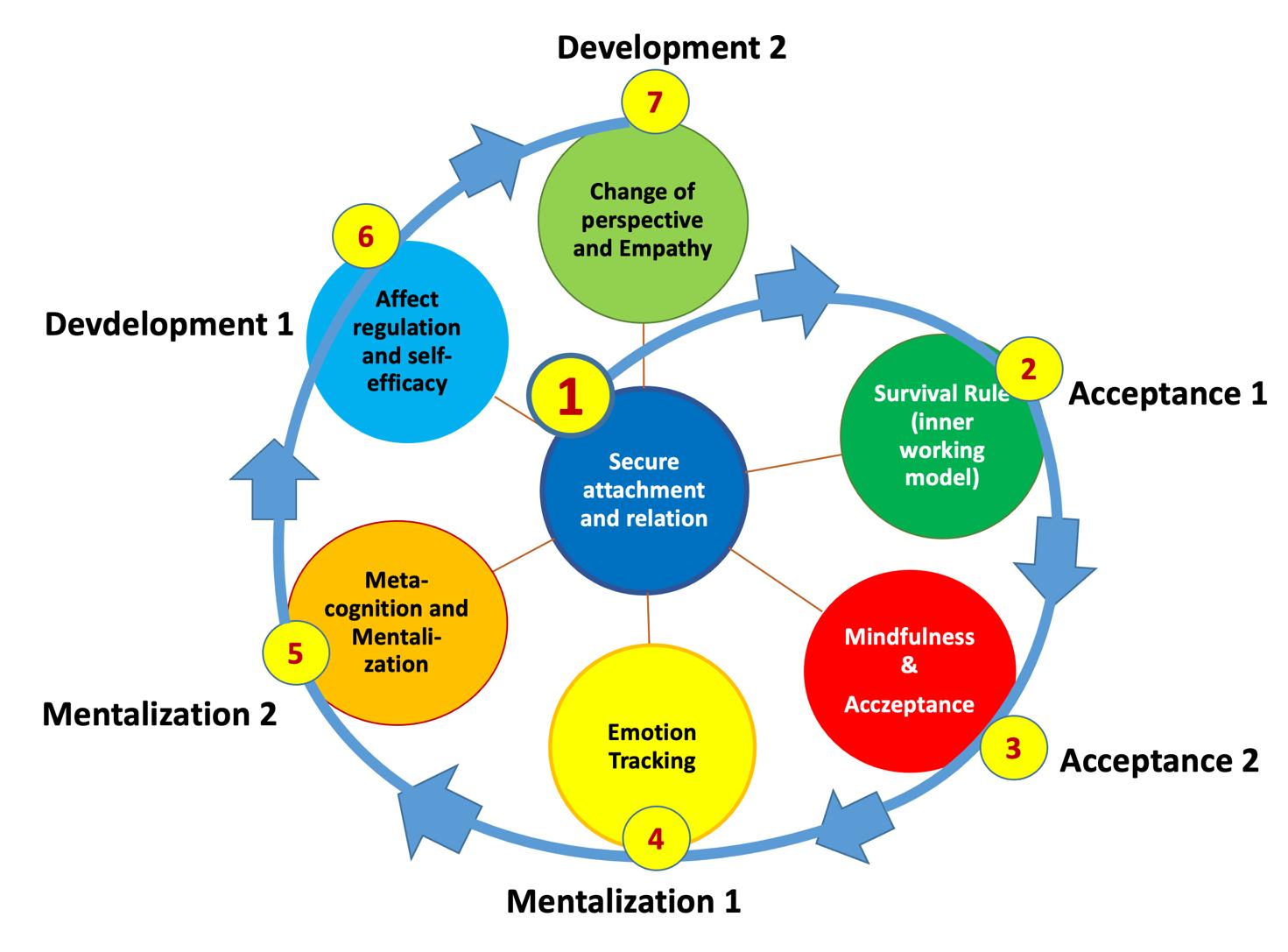
Figure 1 The 7 modules of Emotion and Mentalisation Enhancing Behaviour Therapy EMVT
EMVT consists of seven modules (Fig. 1), which are based on the patient's particular problem:
European Psychotherapy EP2025 page 167-210
8. Emo'on and mentalisa'on-promo'ng behavioural therapy in the group (EMVT-G)
1. Lack of attachment: NOBODY IS THERE! I am alone.
2. Dysfunctional survival rule (inner working model) I must not defend myself, claim ...
3. Mindfulness and acceptance: I am not aware of many things
4. Emotion tracking - deep emotional experience: NOBODY SEES what I feel - my pain
5. Mentalisation - metacognition: I don't recognise why people behave the way they do and not what my actions lead to
6. Development from the affect level to the thinking level (self-efficacy): I can't regulate my feelings - I can't find a solution to a problem
7. Development from the thinking level to the empathy level (empathy and compassion): I cannot empathise with others
The 7 therapy modules proceed accordingly:
1. Attachment security: secure attachment in therapy
2. From the dysfunctional survival rule (inner working model) to the permission-giving rule of life: making new permission the rule of life
3. Mindfulness and acceptance: creating awareness
4. Emotion tracking - deep emotional experience: becoming aware of feelings + understanding triggers
5. Mentalisation - metacognition: elaborating the theory of mind TOM - why and for what purpose people act
6. Development from the affect level to the thinking level (self-efficacy): Regulating affects and acting competently
7. Development from the thinking level to the empathy level (empathy and compassion) Empathic communication
Strategic Behavioural Therapy SBT (Sulz & Hauke 2009) is the predecessor of EMVT. It already contains the majority of these modules. Modules 4 and 5 are completely new. Module 4 is emotion tracking borrowed from Albert Pesso (Bachg & Sulz 2022), which he called microtracking. And Module 5 is the explicit mentalisation-promoting conversation technique. Working with Bowlby's inner working model (dysfunctional survival rule) and the two developmental therapy modules were already integrated into SBT.
As most therapists had not previously carried out group therapy, the EMVT concept was initially developed for individual therapy: a lot of psychoeducation, which was enriched with imaginations to enable emotional experience. Mindfulness
8. Emo'on and mentalisa'on-promo'ng behavioural therapy in the group (EMVT-G)
exercises to improve emotional awareness. Emotion tracking with chair exercises for anger exposure and with imagined ideal parents (possibly also Pessos Holes in Roles: ideal parents for the parents). However, the ideal way to deal with emotions is to work in groups, which is presented in the EMVT-G concept.
5. What characterises EMVT-G group therapy to promote emofon and mentalisafon?
EMVT-G is carried out with six to eight patients as modular psychotherapy. It is not intended for patients with personality disorders. Indications are Axis I disorders such as anxiety and obsessive-compulsive disorders, depression, somatoform disorders, etc. Approximately 20 sessions of two hours and 100 minutes each are planned.
In the first hour of an evening, an individual discussion takes place in the presence of the group: Emotion Tracking. The patient/protagonist reports on a current emotional problem and the therapist addresses it using the Emotion Tracking dialogue technique. The group members should adopt an empathic and compassionate attitude: go along with them emotionally. The therapist observes the body, especially the face, and addresses perceived feelings, which then become the common thread in the conversation. There may be exposure to grief or anger, which takes place in role play. Towards the end of the conversation, a constellation of ideal parents is made as an "antidote", which leads to very touching moments for the protagonist and the group. Finally, there is a debriefing using the conversation technique of mentalisation-promoting questions, so that a deeper understanding is achieved and the Theory of Mind ToM (Sodian 2007) is gradually elaborated more and more. In 20 sessions, each patient receives three individual counselling sessions.
The second hour of an evening is psychoeducational. There is a lot of work with paper and pencil and role play. Thematically, we proceed along the series of seven modules (about three sessions per module).
This description makes it clear that although MBT and EMVT-G have the same goals, they are fundamentally different in their approach. We can now move on to group practice.
8. Emo'on and mentalisa'on-promo'ng behavioural therapy in the group (EMVT-G)
6. The pracfce of EMVT-G groups
Prepara&on of the group leaders
You have an advanced or completed behavioural therapy training or further training. And if you want to bill your group therapy with the health insurance companies, you also have additional group therapy training (VT). This includes 48 hours of theory, 120 hours of leading your own group therapy sessions with 40 hours of supervision.
So far, however, I have had no problem finding self-payers for the group. The costs for the individual are not high. You can charge 30 or 40 euros per evening. If there are six participants, you then have a fee of 240 euros per evening.
Whether you have group therapy training or not. You should prepare yourself theoretically. If you have completed training in Strategic Behavioural Therapy SBT, you are well prepared theoretically. And perhaps read up again:
In my easy-to-read (also for patients) popular science reader "When Sisyphus let go of his stone. Or: Falling in love is crazy." - The chapters describing the 43 most important feelings, the 21 basic needs, the seven basic forms of fear and anger, the nine dysfunctional personality traits and the six developmental stages are the most important theoretical framework for EMVT group management.
You can read the same at a scientific level in:
Sulz, S.K.D. (2017a). Learning and mastering good behavioural therapy - Volume 1: Behavioural therapy knowledge: How to achieve a deep understanding of people and their symptoms. Giessen: Psychosozial-Verlag
Sulz, S.K.D. (2017b). Learning and mastering good behavioural therapy - Volume 2: Behavioural therapy practice: Everything you need for good therapy. Giessen: Psychosozial-Verlag
Once you have learnt the basics in this way, you should read the EMVT book:
Sulz, S.K.D. (2021b). Mentalisation-promoting behaviour therapy. Development of affect regulation, self-efficacy and empathy. Giessen: Psychosozial-Verlag.
Sulz, S.K.D. (2022a). Healing and growth of the wounded soul. The practice of mentalisation-promoting behaviour therapy. Giessen: Psychosozial-Verlag.
However, your preparation can be even more thorough and differentiated if you make use of the free YouTube lectures and PowerPoint presentations that are part of the EMVT training programme. I highly recommend them. In this way, you will soon lose the uncertainty of the beginner.
8. Emo'on and mentalisa'on-promo'ng behavioural therapy in the group (EMVT-G)
This is how you can proceed:
Go to the EMVT website and browse through the many EMVT offerings: https://eupehs.org/haupt/mentalisierungsfoerdernde-verhaltenstherapiEMVT/
Then get an overview of the extensive free pool of EMVT training courses, lectures, therapy videos, training materials and manuals:
https://eupehs.org/haupt/mentalisierungsfoerdernde-verhaltenstherapiEMVT/tetseite/
Now you can focus on EMVT training in therapist behaviour:
https://eupehs.org/haupt/mentalisierungsfoerdernde-verhaltenstherapiEMVT/uebungen-des-therapeutenverhaltens/
First you should practise learning to recognise feelings in the face of the person you are talking to. Then you can immediately do an exercise with photos of faces with a certain emotional expression, in which you practise mirroring the recognised emotion. The third essential exercise is the antidote exercise: you read a statement from a patient about an emotional problem. You give empathic feedback and tell them which need remained unmet and what they really needed.
This training provides you with the two core competences of EMVT:
a) Recognising and mirroring feelings in the face and naming the triggering context (promofng mentalisafon)
b) Empathically and compassionately reporfng back unmet needs, expressing their safsfacfon and thus creafng a click of closure (joyful anfcipafon and immediate visualisafon of safsfacfon)
The other exercises will also prepare you for emotion tracking:
- ET1a Mrs N Example conversafon Emofon tracking without embodiment
- ET1b Mr C Whole therapy session Emofon Tracking with explanafons
- E1c Ms N Example conversafon Emofon Tracking with embodiment (body signals)
- ET2a Exercise Recognising the 43 feelings with photo: Learning to see feelings
- ET2b Exercise Seeing feelings with context photo and naming and mirroring the triggers of the feeling
- ET2c RMET Reading the Mind in the Eyes Test: Here is the link:
- -hlps://www.as-l.de/assets/applets/Augentest_Erwachsene.pdf
- I can also send it to you on request.
- ET3 PracQsing empathy with many examples: You would have needed ... (AnQdote)
8. Emo'on and mentalisa'on-promo'ng behavioural therapy in the group (EMVT-G)
Prepara&on of the group sessions
Ideally, your group room should be 20 square metres in size. You will need 10 chairs for 8 participants (lightly upholstered - one extra for chair work). Some people like flip charts, I prefer to hand out worksheets that you can download and print out before the session. Your patients will need their own paper with writing pad and pen. If there are ideal parents in the role play and the child wants to cuddle up to them, a small cushioned landscape as a sofa would be good. If anger is to be expressed with all your might, a cushion to absorb the blows would be helpful.
In the first hour of the group evening, the chairs are arranged in a circle. When the emotion tracking begins (2nd hour), we divide the room into a stage for role play and constellations and a room for the observers. The observers sit in a semicircle around the group leader so that everyone can see the protagonist's face. A witness chosen by the protagonist can sit to the left or right for the emotion mirroring, but they only say exactly what the group leader has recognised, e.g. "I can see how sad you get when you remember that he didn't want to visit you."
After the emotion tracking, everyone sits in a circle again for the round of sharing and for the metacognitive reflection, which begins with a dialogue between the group leader and the protagonist that later opens up into a group round. The terms mentioned here will be explained later.
This is how emotion tracking typically works:
1. Patient: reports on emotionally stressful relationship
2. Therapist: listens empathically and observes the face
3. Therapist: "I can see how painful it feels. (Emotion Recognition)
4. Therapist: ... when you remember how he treated you." (metacognition/mentalisation)
5. Patient: agrees or corrects
6. Patient: continues the story based on this feeling
7. Therapist: empathically senses what the patient would have needed
8. Therapist: You would have needed someone to stand by you (antidote)
9. Patient: confirms or corrects
10. Patient: can see the fulfilment of needs in their mind's eye
11. Therapist: asks where, who and how and asks for a description
8. Emo'on and mentalisa'on-promo'ng behavioural therapy in the group (EMVT-G)
12. Therapist: asks what the satisfying person could say
13. Therapist: repeats this sentence and sees what feeling arises
14. Therapist: asks where, with whom and how this can be obtained today
15. Therapist: asks what the patient would have to do to get it
The basic aTtude of the group leader during emo&on tracking
We compare the basic attitude of the EMVT group leader in emotion tracking or in the mentalisation-promoting debriefing with conventional conversation in cognitive and psychodynamic therapies (Table 1). What is important is what we try not to do/say during emotion tracking (left column), compared with the behaviour we are aiming for (right column). The justification and discussion is recorded in the line below, starting with an asterisk (*).
Table 1 Basic attitude in emotion tracking - reasons for the approach (adapted from Sulz 2021, pp. 313-324)
What I don't do as a therapist during emotion tracking?
Instead, I will ...
1 Not: As a therapist, suggest a topic to the patient The patient brings in a topic themselves, based on their current emotional distress
It is almost always a relationship problem that has often culminated in a stressful event or an oppressive feeling regarding the relationship with an important attachment figure. The patient determines what we address. We approach it with a client-centred attitude. We follow them with our full attention and give the patient as much time as they need to communicate their concerns clearly. The patient is the actor and not me as the therapist. As we meet them at eye level, they don't have to feel small.
2 Not: Remain critically cool and objective warm-heartedly attentive
A secure attachment is an absolute prerequisite for immersing yourself in the complexity of your feelings and needs. The attachment system or security system as defined by Bischof (2001) should soon be able to calm down, feel secure and
8. Emo'on and mentalisa'on-promo'ng behavioural therapy in the group (EMVT-G)
make no further efforts to make the therapeutic relationship more secure. Otherwise, the patient is not so much concerned with the issue being addressed, but with getting me to form a secure bond with him as a new attachment figure. An objective, neutral to coldly analysing attitude as a therapist does justice to the issue, but not to the person. In the current situation, however, I can reach him through warm-heartedness. This gives the impression of being in good hands (security and protection). If this has been successful, the oxytocin level has increased in both patient and therapist.
3 Not: Being open without intention Interested and committed
As a therapist, I could be open, inviting and available, while remaining unintentional and not engaging - so that it would correspond to the attitude of mindfulness. I can therefore welcome the patient in a mindful and accepting way without actively engaging with the patient. This is the first big step. The patient can feel welcome. But the patient's need for connection demands more. I am there, but not just for him. So that they can feel that I am actively engaging with them and that I only mean them now. He needs to feel my interest and commitment, to feel how important the encounter with him is to me.
4 Not: Structuring the course of the conversation by asking questions
Leading the conversation
Follow all of the patient's statements and expressions
As a therapist, I deal with the interplay between leading and following very consciously and stick to following as long as the flow of the conversation allows. I leave out questions that create mental clarity and structure. This is because the choreography of emotion tracking already creates a high degree of structure. I pay close attention to the stories and the associative processes of consciousness they trigger - it is often inner images that trigger feelings whose somatic markers I recognise. I immediately reflect these in a marked way (much less agitated than the patient). I follow and accompany his feelings while I speak compassionately.
Psychotherapy EP2025 page 167-210
8. Emo'on and mentalisa'on-promo'ng behavioural therapy in the group (EMVT-G)
5 Don't: Stay completely with my empathy without paying attention to somatic markers
Both feeling empathy and seeing the somatic marker of the feeling*
*During a phone call, we should rely entirely on our listening and empathy. In a face-to-face conversation (as in a video call) we have two channels of information at our disposal: auditory and visual. Listening to the narrative involuntarily creates an inner image or a film of the reported scene and we put ourselves in the patient's shoes, feel with them, perceive our empathy and thus recognise the patient's feelings. This is the first channel of information. We concentrate just as much on the somatic markers in the patient's face and body. Our mirror neurones help us here. Our own facial muscles generate a pattern that corresponds to the patient's - with a lower intensity than the patient's, so that a labelled mirror reflection takes place. Our body signals this emotional state to us, which helps us to decode the patient's emotional state. On the one hand, I am empathising with the patient and on the other, I am with myself and my proprioception. This is also a somatic marker, barely visible to the patient, but clearly perceptible to me. So my first reaction is to empathise with the patient, then I feel myself and my own feelings, then I go back to the patient. This is how we manage to become more and more accurate after practising for a long time.
6 Not: Asking about the feeling that is there at the moment
See and express the patient's feeling*
*As long as we are not sure, we simply ask the patient what they are feeling. However, they first have to feel it again because they may not yet be aware of it. So it's not easy for the patient to answer my question clearly. He is happy, when I offer him my perception and he can compare it with his perception and confirm that we both perceive the same thing. However, we should increasingly dare to say what we see or suspect. So that we can leave our initial uncertainty behind us. We do no harm if we name the wrong feeling. This is part of our learning process of "emotion recognition". It is not only allowed, but even necessary.
8. Emo'on and mentalisa'on-promo'ng behavioural therapy in the group (EMVT-G)
With every correct mirroring, the patient feels seen, which promotes rapport and bonding so that they can feel more at ease with me.
7 Not: Mirroring a feeling without adding the context Always mirror the emotion with the triggering context - add the aspect of the situation that triggers the emotion*
*It is enough for the patient's emotional experience if, for example, I say compassionately, "That makes you very sad." He stays with his feeling and feels accompanied by me - he is not alone with it. I am there with him. I share his sadness with him to a certain extent. "I bring a small disturbance into the harmony by mirroring what he is feeling, i.e. by not being as sad as he is and thus returning the problem as manageable. But both being with him in his sadness and the fact that the pain that my marker signals can be limited alleviate the suffering and give hope. Now comes the second small disturbance. I do not leave the patient in a purely emotional experience, but express the contingent context. I add the trigger of the feeling: "It makes you very sad that he didn't come." I say that his feeling was triggered by the behaviour of his caregiver. More precisely, by the memory of their behaviour (not coming to him). The cause of his feeling is therefore the remembered behaviour of the other person. I am therefore making an if-then statement. This implies logical thinking, thinking in categories of cause and effect. The patient can only understand my statement if they activate their prefrontal cortex, which helps them to mentally comprehend what I have said. So in addition to the emotional processes in the limbic system, a metacognitive or mental process is set in motion in the cortex. The patient mentalises. This means that they think about their feeling and its cause. He realises what triggered the feeling. Adding the triggering context to the perceived and mirrored feeling is therefore a decisive step in the course of the patient's consciousness processes. I promote mentalisation. He practices mentalising. He elaborates his theory of mind, his theory of the mental. This helps him to attribute behaviour to inner causes." (Sulz 2021, p. 314)
8. Emo'on and mentalisa'on-promo'ng behavioural therapy in the group (EMVT-G)
8 Not: Repeat in my own words what the patient has said
Repeat the patient's statements in their own words, pick up on their language*
*We psychotherapists should listen more often to how much we use technical language that the patient has to try to translate into their own language. Technical terms, foreign words and a written rather than spoken language. To do this translation work, he has to switch from his feeling experience to thinking, i.e. from the limbic system to the prefrontal cortex. The thread of his emotional experience is already broken. That's why we should take up the patient's words as precisely as possible. To do this, I have to make the effort to memorise the words he has used as precisely as possible. In this way, we become an increasingly helpful companion.
9 Not: What we do automatically: Concentrate on following the patient's thoughts or their further narrative and thus overlook the feeling that is currently present
Prioritise staying with the feeling without letting the patient drift off into thoughts or following the rapid progression of their story*
*It's like knitting: don't skip a stitch. We have to slow down the storytelling. He wants to tell us his story. We, on the other hand, want to hold on to the feelings created by his story. In further rows, the feelings that have just flashed up quickly disappear again. Only if I interrupt the patient as soon as I notice a new feeling does it remain in his consciousness. We think we are rude, but the patient doesn't mind much. And so together we manage to recognise and understand the feeling and its meaning.
10 Not: Mirroring a strong emotion - a strong feeling unlabelled
When an intense feeling arises in us, we do not respond in a reflexively sympathetic way, but only mirror it in a labelled way (with less intensity)*.
*If the patient's story horrifies us, frightens us or makes us as angry as he is, we tend to spontaneously agree with him by expressing our great indignation. This can give him the feeling that he has won my support. But it's about the intensity of
8. Emo'on and mentalisa'on-promo'ng behavioural therapy in the group (EMVT-G)
my emotional expression. Am I suddenly caught up in this emotion like him? It helps if I only go in with one leg. My remaining leg helps us both to put what has happened into perspective and to be accessible for solutions.
11 Don't: Address the patient's unconscious bodily reactions that do not indicate an impulse for action that we want to focus on next
If we see a physical nervous or stress reaction, e.g. intense redness in the throat area, we do not speak about it. This is because we do not name the somatic marker, but the feeling that it indicates/marks*
*We can distinguish between two different bodily reactions. One is simply an expression or somatic component of the feeling. It is no help to the patient if we say that he is flushed or that he got red spots on his neck or that he started sweating. He even feels caught out or embarrassed. The second type of bodily reaction is movement impulses that may be held back. Clenching his fist, moving his legs as if he wanted to run, leaning forwards, leaning back, etc. We can address this: "You have become angry and clenched your fist a little." And we can add: "Pay attention and allow the movement that your body just started. Make it even clearer, even more so. As much as your feeling and your body want you to." The feeling intended an action that wants to become an interaction. "Your anger may want you to fight back. That's natural. You don't have to be afraid of automatically becoming violent if you let anger into your consciousness. But it is a clear signal of how angry you are about what you have just said."
12 Don't: Introduce the reflection of the emotion so abruptly or coldly analysing that the patient is no longer aware of their feelings
Carefully add mentalising reflection to the emotion so that the emotion can remain while the context is heard and understood*
*We empathically mirror the patient's feeling and relate it to their last statement. He often reports on the behaviour of his caregiver that triggered his feeling. We
8. Emo'on and mentalisa'on-promo'ng behavioural therapy in the group (EMVT-G)
refrain from a psychological analysis of the transaction and stay with the moment of the event in which the feeling arose. We name his feeling and only add the preceding behaviour of the other person very specifically. "You feel snubbed and angry when you remember that he simply left you standing there and turned to other people." In this way, he can keep the feeling in mind and also determine what exactly was so hurtful. We do not become matter-of-factly sober in our tone of voice, but remain empathetically compassionate.
13 Don't: Ask the patient what they would have needed in the difficult situation reported
After just a few sentences, we can compassionately sense the patient's need, what they would have needed in order to be freed from their distress. We express this, e.g. "You would have needed you to be so important to him that he would have turned his attention to you." Within a second, his face brightens if our statement is correct*
*The formulation of the antidote hypothesis is the dramaturgical climax of emotion tracking (antidote is antidote according to Albert Pesso, 2008a,b). What he experienced was poison for him. For example, his attachment figure humiliated him, let him down, attacked him aggressively etc. Often the opposite had been hoped for or even expected: that she would satisfy his central need, fulfil his great wish. The emotional damage caused to the patient was then even greater. At this point, our only task is to be empathic, to put ourselves in the patient's shoes in the situation described to such an extent that we can empathise with the need they had for the other person in this situation. At this moment, it is irrelevant if their expectations were deceptive. We listen until our compassion allows us to clearly state which need we empathise with. Sometimes the issue is obvious. Examples are: "You would have needed someone to protect you from his aggression" or "You would have needed your father to see how well you have succeeded" or "
8. Emo'on and mentalisa'on-promo'ng behavioural therapy in the group (EMVT-G)
You would have needed someone to take you by the hand and guide you on this difficult path" or "You would have needed your mother to stand up to your father" or "You would have needed your father to love you without you having to constantly perform at your best" or "You would have needed your parents to be loving to each other" etc.
Should we dare to voice our antidote hypothesis, even if we are not quite sure? If we are completely unsure, we ask. But even a wrong guess is not very disturbing. If our sympathy was accurate, his face brightens (as already mentioned). Because he imagines that he will get what he has missed so much. He creates an inner image of a scene in which he receives what he longs for. Neurobiological studies show that the insula area of the brain is the place where the vivid inner images are generated. The patient appears happy and relieved. But if he visibly thinks about whether he needs what we have said, then we were wrong. Albert Pesso (2008a) called this moment the "click of closure". It is an aha experience. The arc of tension is brought to a relaxing conclusion. And it is the subjunctive: "Yes, that would be nice!". It is always surprising that even the subjunctive makes you feel so good.
14 Don't: Start intervention steps without the patient's express consent
Once the patient has understood what is being done and why, ask whether they would like to accept the invitation*
*In emotion tracking, we always offer an intervention that makes the topic more vivid (e.g. a protective person stands between the patient and a person who predicts failure in life) or chair work (imagine e.g. the father sits on a chair opposite and is now told for the first time how much the patient feels let down) or an anger exposure. The aim of the exercise is explained to the patient and he is asked whether he can imagine doing it. If so, whether they decide to do it now.
15 Overcoming the patient's hesitation We address the hesitation and clarify its origin*
8. Emo'on and mentalisa'on-promo'ng behavioural therapy in the group (EMVT-G)
*The intervention we have just suggested to the patient is new and unfamiliar to them. We therefore describe the procedure and the goal in more detail. We say that we will accompany them through every step of the exercise. Then he can feel safe and will agree.
16 Don't: ignore the patient's doubts
We make room for doubt and let the patient explain what it is all about*
*Some patients have doubts as to whether the proposed exercise will be helpful for them. "What good will that do me? It feels uncomfortable." We ask about specific fears so that we can address them. "If I can't think of anything then!" is a common statement. "Then I'll help you" we say in a calm voice, signalling that we are a protective "mountain guide".
17 Don't: Override the patient's reluctance
If the patient resists, pause and withdraw the suggestion*
*We notice straight away if the patient is reluctant. "I don't want to do this. It's very unpleasant for me!" "Yes, I realise that you feel really uncomfortable at the thought of having to do that. I can understand that. You don't have to do it." We don't try to persuade the patient. They should be free to make their own decision. They should be able to express their wishes and needs in our relationship and experience that we take them very seriously. They should know that they can rely on us (epistemic trust). If it was just fear or uncertainty, we could still reach an agreement, but we firmly validate a clear 'no'.
18 Don't: Keep my thoughts to myself Think out loud*
*On the one hand, we keep back thoughts that are not good for the patient or are not good for them now. Also theoretical considerations and psychodynamic interpretations. This can happen in a primarily mentalisation-promoting session, but not during emotion tracking. Here, these thoughts also interfere with our own compassionate attitude. However, we speak out what comes to mind during the emotion tracking process and what belongs to it. I let such thoughts 'come out
8. Emo'on and mentalisa'on-promo'ng behavioural therapy in the group (EMVT-G)
loud' and share them with the patient. For example, "I don't know whether we should stay with your anger at your father or whether we should immediately look at what you would have needed instead of this frustration."
19 Not: Leaving my error uncorrected and covering it up immediately retract an error*
*If we say straight away when our assumption was wrong, this is still part of "thinking out loud". Especially if we have assumed a wrong intention. E.g.: "Aha, you didn't want to be the best. I was wrong about that. You just wanted him to see how hard you were trying to get his attention and appreciation."
20 Don't: Assume that my perception of his feelings is correct without the patient's agreement Obtain confirmation from the patient as to whether my perception is correct*
*We stay completely with the patient with our perception. We are not chasing a hypothesis, not looking for confirmation of our point of view. His face shows us immediately whether our mirroring of his affect was correct. A very subtle affirmative attitude. He feels seen, which we in turn can easily see. If instead we rush on to seek confirmation of our interpretation, we move away from the patient and do not realise that our mirroring was inaccurate. For example: "Then you got what you needed after all and he had to give it to you, albeit reluctantly." The patient might have corrected me and said. "I was just very sad. He realised that and then responded to me."
21 Don't: Express my psychodynamic interpretations It's best not to look for psychodynamic interpretations at all. They diminish perception in the here and now*
*You can recognise the psychodynamic background of a patient's reaction, even if you have no psychoanalytic training. Functional analysis in behavioural therapy leads to the recognition of an unconscious intention. Even if a patient's expression
8. Emo'on and mentalisa'on-promo'ng behavioural therapy in the group (EMVT-G)
of helplessness has a very appealing effect on me, I don't say "I really wanted him to realise how much you need his help". Emotion tracking is easier if psychodynamic interpretations are not taken up. For the patient, they are sometimes an invalidation or labelling that they cannot or cannot yet classify in their self-image.
22 Do not: Express a depth psychological interpretation Do not interpret*
*In an interpretation, an inner truth of the patient is expressed that is not accessible to their consciousness. If the patient still has to repress this fact because it contains a truth that is difficult to bear, an interpretation can cause damage. This is too often the case, which is why it has no place in the context of emotion tracking. For example, a great deal of jealousy can stem from one's own repressed desires for an extramarital adventure.
23 Not: Communicating a theory Only explain the purpose of what is happening*
*We explain what is happening in our conversation, why and for what purpose, without referring to the underlying disorder and therapy theory. Only what serves to understand what is happening at the moment is explained, not the underlying theory. "We can now introduce a protective person (in the imagination or in role play) so that you don't have to master this alone and experience how it works." I don't say: "Being able to protect myself requires the experience that my attachment figure was initially there to protect me and that I was able to experience that they protected me effectively and reliably. That I initially experienced the powerful defence and protection in a relationship as a substitute so that I could do the same later on. And that we are now gradually making up for this missing childhood experience in the expectation that the patient will have more self-assertion available with her in the future."
8. Emo'on and mentalisa'on-promo'ng behavioural therapy in the group (EMVT-G)
24 Not: Expressing my opinion on an issue raised by the patient
Do not express your own attitudes, opinions or comments*
* The patient absorbs the therapist's values and norms. When we express an opinion or attitude, this has a normative effect on the patient. They learn what we approve of and what we reject. In endeavouring to establish a good attachment relationship with me, he uses this knowledge to adapt to me better and thus achieve a better quality of attachment. In this way, he falls into a repetition of old relationship patterns. This creates a conflict with the granting, accepting, permission-giving attitude of emotion tracking.
25 Not: Expressing your own intense feeling If the patient's story triggers an intense feeling in us, we do not express this unfiltered, but speak "about" this feeling.
*As therapists, we do not have to hold back completely when dealing with our feelings. Because then we would be less authentic, less perceptible as a person and less of a relationship could develop. However, if intense feelings suddenly emerge on the therapist's side in a way that is unpredictable for the patient, this is very disturbing. So we will not give free rein to our emotional expression as we do in our private lives.
26 Not: Setting my own value orientation or moral stance as a guideline (possibly only subtly)
I realise when and that my values and morals evoke an affective reaction in me, without talking about it now*
* We don't have to hide our value orientation. It defines us as human beings. The patient uses fine antennae to sound out our values in order to gain orientation.
8. Emo'on and mentalisa'on-promo'ng behavioural therapy in the group (EMVT-G)
27 Not: Conveying the norms (commandments and prohibitions) of my own world view between the lines
If my own norms bring a commandment or prohibition into my consciousness and urge me to follow them, this remains my private process, which I do not allow to influence the therapy*
*At certain moments I allow him to do something that I would not allow myself to do. So it may be that in a certain situation it is necessary to shout out all his pain so loudly that "the whole world" hears it.
28 Not: Bringing my own still dysfunctional survival rule into the conversation as a behavioural maxim
Communicate a permission-giving attitude that helps to overcome the limitations of the survival rules*
*The patient adopts our own dysfunctional survival rule, even if it is not expressed. "He has long since established an introject of my personality as a psychological representation. He therefore not only communicates with me as a real counterpart, but also always with this introject. This helps him in many ways. But it would be better if it didn't contain my dysfunctional survival rule. The more I consciously confront my survival rule and catch myself following its guidelines again, the less danger there is of this happening." Sulz 2021, p. 321)
29 Not: Imposing your own very similar topic on the patient I differentiate between my topic and that of the patient and refrain from imposing projections*
*If I know a pafent's problem only too well from myself and it is sfll one of my "construcfon sites", I need to be extremely vigilant. The issue triggers my own feelings so much that I find it difficult to stay with the labelled mirror, which really only contains my own feelings (alenuated). The pafent will realise how painful this is for me and it is no longer a marker. In other words, it is no longer his feeling. He should learn to differenfate between what he is feeling and
8. Emo'on and mentalisa'on-promo'ng behavioural therapy in the group (EMVT-G)
what the alachment figure is feeling. This is necessary so that he can build up a realisfc theory of mind or theory of the mental." (Sulz 2021, 322)
30 Not: Being like an ideal father or mother to the patient
Remain a very attentive and sympathetic listener*
*We would like to alleviate the patient's suffering. And will be especially kind, patient and forgiving, a father or mother that he would have wished for (and that we would have needed ourselves?). This counter-transference is a completely natural process. It is our involuntary response to his transference. We catch ourselves without doing what we would prefer to do as a result of the countertransference. We remain listeners with a basic attitude that is warm-hearted and accepting, but which does not fulfil the transference need. The desired fulfilment of needs by an ideal father or mother takes place later in the ideal parent exercise with role-players.
31 Don't: Talk badly about the real parents
Do not express your own judgements about the parents*
*We often get angry with the patient's real parents. However, our words then say more about us than about the patient's father or mother. And if someone from the outside speaks badly about the parents, the patient wants to defend them.
32 Not: Expect or demand early understanding for the real parents
Do not suggest mitigating circumstances for the parents*
*If the patient's anger seems too great, we tend to defend the parents and try to make the patient understand them. For the time being, however, he should be able to stand up for himself completely, regardless of the neediness of the father or mother. The only thing that matters at first is what the father has done, for example, what heavy burden he has passed on to his son. We are completely on the patient's side in order to allow him his emotional energy, e.g. his anger. He can take his time in understanding his parents, he can keep his anger for a while longer.
8. Emo'on and mentalisa'on-promo'ng behavioural therapy in the group (EMVT-G)
33 Not: Putting myself above the patient I remain humble in my non-knowledgeable attitude and treat the patient with respect as an equal*
* We see ourselves as the knowledgeable and strong ones and feel superior to the patient. The patient feels this and feels inferior and weak. Our mindfulness helps us to allow this feeling to be there and then to return to humility and feel appreciation for the patient again.
34 Not: Exude the self-confidence that I am a very good therapist I remain the one who is in the process of learning from the patient and understanding something*
*Maybe it's good that our therapies don't often lead to the best results. We can therefore remain humble and see him as the one who knows much more about himself than we do. We learn from him, we try to understand him and his story and let him help us.
35 Not: pretending to be so knowledgeable that everything the patient tells me has long been familiar to me
Even if I have understood a lot, I remain in the non-knowing position (like Columbo)*.
*As therapists, we remain the potential non-knower who learns from the patientand remain authentic in the process. Being able to remain authentic is our most important therapeutic competence.
The basic aTtude of the group leader during the mentalisa&on-promo&ng conversa&on (e.g. metacogni&ve review in an emo&on tracking session)
"The MBT working group (Allen 2010) has formulated criteria that define mentalisation-promoting conversation very well. We can also apply these to behavioural therapy with a few modifications and reductions. They show how much the
8. Emo'on and mentalisa'on-promo'ng behavioural therapy in the group (EMVT-G)
nature of the conversation differs, for example, from a competent psychodynamic and also from a cognitive-behavioural style.
As this is very unfamiliar, it needs to be trained and practised.
Sufficiently effective mentalisation support can only be achieved if there is little deviation from these guidelines. Learning through insight is not enough. The process of mentalisation/metacognition must take place continuously, like a constant drop in the ocean, so that the necessary pathways can take place and remain in the brain." (Sulz 2022b, p. 217)
The 14 most important aspects of mental/metacognitive dialogue (Sulz 2022b, p. 218)
1. Creating security in the relationship
2. Close guidance of the reporting person's awareness processes
3. Structured and supportive approach
4. Question-answer dialogue instead of free conversation
5. Columbo questions: not knowing
6. Ask specifically about motives for behaviour
7. Appreciate mentalisation, question non-mentalisation
8. Offer alternative interpretations to non-mentalised statements
9. Interrupt pseudo-mentalising
10. Reflect together
11. Thinking aloud as an unfinished consideration
12. Saying when a thought was a mistake
13. Do not give metatheoretical explanations of what is happening
14. Do not impose your own hypotheses
A stage model of group development (Sulz 2011 , p. 406-416)
We can distinguish the following six stages in the development of a group from the beginning of treatment to the last group session: - Recepfve stage (orientafon, affiliation)
European Psychotherapy EP2025 page 167-210
- Impulsive stage (need fulfilment)
- Sovereign stage (influence, power)
- Interpersonal stage (cohesion)
- Insftufonal stage (rules)
- Supra-individual stage (integration)
Recepfon and orientation stage
a) Orientation:
8. Emo'on and mentalisa'on-promo'ng behavioural therapy in the group (EMVT-G) European Psychotherapy EP2025 page 167-210
The individual enters the group, which thus begins to exist. Everyone else is still a stranger to him, he does not yet have a feeling for the group and does not yet feel like a member. He hopes to be welcome, to belong. Everything he has learnt that could help him feel welcome and reduce his insecurity is done so carefully that he can take it back at any time. It is not actually purposeful action. Rather, action serves perception. It is a literal reaching out: contact through perception, seeing, hearing. Although there is hardly any physical contact, it is a sensing of others, a smelling and tasting - albeit with eyes and ears. In favourable cases, the alarm subsides and he does not feel endangered. I can be there, and the others can be there.
b) Recording:
If the perception has shown that no vigilance or mistrust is necessary, you can enter the receptive mode. The individual now assimilates the group and allows himself to be assimilated by the group by following his need to be welcome and to belong. To be among the others, to be indistinguishable from the others, to be inside, to be surrounded by the others. The group fills up with members like a belly with food or a sack of apples. There has not yet been any differentiation of the individuals and no structuring of parts of the group. It is still a set of individual parts whose boundaries tend to blur, so that individuality disappears. Joining together, fitting together, fitting in by giving up one's own contours, one's own profile.
Threat and fear is destruction. The group can break apart, then it no longer exists. Anger is destruction. Those who are hit by anger are threatened with annihilation. Or destructive rage
8. Emo'on and mentalisa'on-promo'ng behavioural therapy in the group (EMVT-G)
destroys the group.
Only tasks that are individual work and do not yet require group co-operation can be mastered. This stage can be disturbed by schizoid isolation of the members or by voracious incorporation of the group by individuals or by voracious incorporation of individuals by the group. Or through voracious consumption of external supplies. Or through anorexic refusal to incorporate and be incorporated.

Stage of impulses
The group is supposed to provide a sense of security, warmth, protection, safety and reliability and the members act like a flock of sheep by being close to each other. They are afraid of separation from the group. The group offers them a playground to satisfy these needs, it is a guardian, a shepherd, without making demands on the individual, without imposing duties. The individual can now move around in the group, can take and get something, can go to someone in the group, can live their feelings and impulses fully under the wings of the group. Laughing,
European Psychotherapy EP2025 page 167-210
8. Emo'on and mentalisa'on-promo'ng behavioural therapy in the group (EMVT-G) European Psychotherapy EP2025 page 167-210
being happy, being carefree is possible. The group is there to fulfil needs. It is assumed that the group will be available and accepting. The participants feel comfortable, safe and secure in the group. The individuality of each person has not yet awakened. They also do not yet have a sense of belonging to a group, they do not yet identify with the group. They are in the group and the group is there for them. Their fear is separation. When they are angry, they want to separate themselves from the group. The group fears that members will separate from it. Group anger is separation from the individual.
Everyone can be given a task, co-operation is not yet developed. Disruption can be caused by the threat of losing a member or by the tendency to separate aggressively from a member.


Stage of sovereignty, differenfafon and power struggles
Being different, having different opinions, having different needs make it difficult to assert one's own interests. It has to be fought for. Once the experience has been made that impulses can be safely lived in the group, the desire arises to do this even more for one's own benefit. The others are now discovered - as
8. Emo'on and mentalisa'on-promo'ng behavioural therapy in the group (EMVT-G)
competitors seeking their own advantage. Their behaviour must therefore be controlled, one's own behaviour must no longer follow momentary desires, but must be placed in the service of a strategy. I exert influence, I manipulate, I gain power. I gain a position in the group. I secure my domain in the group. Since less power is p ossible alone, people join forces. Like-minded people form cliques in order to better assert their common interests in the group. Less powerful people choose a powerful person as their leader and benefit from his strength. In return, they subordinate themselves to him.
Dissenters are fought against. Those who cannot be influenced ar e threatening and must also be fought against. This process of group structuring ends with the group finding and accepting its sovereign as leader. He must be so strong that identification with him is attractive. Identification with the sovereign leader en ds the narcissistic imbalance that has arisen because one's own position is not so powerful. As a group member, I do not experience myself as powerless, but as part of the powerfully led group.
The central need is for power, influence and control. The central fear or threat is loss of control. Anger is explosive or sadistically empowering.
Tasks can be taken on by homogeneous subgroups in a division of labour, provided they are not blocked by competition.
Disruptions arise from endless power struggles as long as no definitive leadership structure has been established. Only when everyone in the group has their fixed place and there is no longer any chance of improving their position in the short term, do these struggles subside. Some members only know two ways to survive - as a leader or as an outsider. They cannot integrate into the group as a simple member. If they do not succeed in gaining power, they remain outside. Because integration would be a loss of self and a surrender of the self. They prefer to wait outside for their chance to take power at the right moment. Their outsider status is also an opposition to the current leaders. They do not submit to their regime, which makes them less powerful.
Interpersonal stage (cohesion)


8. Emo'on and mentalisa'on-promo'ng behavioural therapy in the group (EMVT-G) European Psychotherapy EP2025 page 167-210
If the power structures have been in place long enough, the desire arises to satisfy one's need to belong through the group. Self-interest takes a back seat. The group becomes a social organism that is loved and whose love is needed. Identity becomes group identity. I am a member of the group. I do not feel my own needs, but I feel and satisfy the needs of the group. Harmony and affection are the central needs.
There is fear of rejection and loss of affection. Anger is expressed through withdrawal of affection, through rejection.
Tasks can be given to the whole group. Conflicts within the group are minimised - by setting aside self-interests.
Insftufonal stage




8. Emo'on and mentalisa'on-promo'ng behavioural therapy in the group (EMVT-G) European Psychotherapy EP2025 page 167-210
The needs directed at the group are significantly reduced. The group remains important as a cosmos and living or working space, the identity remains that of a group member. However, the pursuit of self-interest is no longer abandoned. The principle of fairness and norms of behaviour regulate the balancing of interests and also the duties of the individual. The smooth functioning of the group is important. This functioning is guaranteed by laws that must be observed by everyone. Friction is therefore just as low as in the previous stage. Individuals think for themselves in order to monitor the norms and to resolve conflicts through new rules and norms. The interaction is objective and less emotional. Benevolence is shown to those who obviously support the functioning of the group. The group is designed to function on a permanent basis and can go on like this for a long time.
The central need is for recognition and appreciation. The central threat is the destruction of this order, is chaos or, in the case of attacks, counter-aggression. Central anger is counteraggression.
8. Emo'on and mentalisa'on-promo'ng behavioural therapy in the group (EMVT-G)
Task-orientation is very high at this stage, group performance is very high when it comes to productivity, performance that is best when precise, smooth task allocation is required.
Disruptions can be: Individuals identify little with the group and increasing peer pressure must be exerted, i.e. stricter standards, higher penalties for violating standards. This can go so far as to create a quasi-police-state dictatorship with underground fighters and an underground organisation that focuses all its energy on disempowering the leadership. If the work continues to be constructive, this can consist of undermining the power of the powerful or boycotting the group's performance.


6: Institutional stage
Stage of supra-individuality (integrafon, balance between individual and group)
This group stage can only occur if the individuals themselves have reached a level of personal maturity that allows this. Otherwise, the institutional stage ends with a rebellion, with revolution and destruction of the group. Unless the previous stage is frozen. The group is now redefined. It is no longer the sole source of identity. There are no longer any rigid normative or tenacious emotional ties between the group and the individual. The
8. Emo'on and mentalisa'on-promo'ng behavioural therapy in the group (EMVT-G)
individual is left with self-responsibility, with considerable degrees of freedom in relation to the group. They can adjust their own balance between self and group. However, this is not a step towards individualism or a forced separation from the group. No energy is expended to separate oneself from others and from the group. Rather, this simply happens. It is a solution in both senses of the word. With the increased degrees of freedom, the cohesive moment has become the intrinsic value. The group is no longer a prerequisite for existence, a refuge of secure survival, an opportunity to distinguish oneself and gain power, an emotional need or a quasi-state structure with normative shackles. It has become a value. The individual has inner self-sufficiency and autonomy, is no longer dependent on this one group, but it is valuable to him in the sense of an individual value orientation. This value-orientation is what constitutes the step from the individual to the supra-individual. Without inner need and without external constraints, the group remains intact. It no longer serves to relieve anxiety, nor to satisfy, nor to dispose of aggressive energy. It is not set up for eternity, but with the freedom to change and also to end. This means that the group structure is not fixed. It is subject to a fluid equilibrium. The roles do not necessarily change, but if they do not change, this would be a sign that the group has not developed to this stage.
Group activity is driven by a shared vision. This vision is the motor that generates taskorientation.
Central needs and fears take a back seat. Instead, value orientation is the guiding principle. Individual motives and the group's motives are balanced, differently for everyone. This results in a group that is strongly characterised by the personalities of the individuals.
Work orientation is guaranteed by values. It can take time to harmonise these values and goals, so the group cannot be deployed as quickly and effectively as a well-trained police force. Negotiations and agreements lead to consensus and co-operation. Without this communication, there is no group performance.
8. Emo'on and mentalisa'on-promo'ng behavioural therapy in the group (EMVT-G) European Psychotherapy EP2025 page 167-210
Overall, there is an integration of group and individual concerns, a balancing of group and individual needs, a pursuit of both individual and group goals. The group and the individual benefit equally from the group process.
Disruptions can occur when there are no longer enough shared values and the group eventually disintegrates. Or value violations cause so much aggression that the group regresses to the institutional level. Or external circumstances demand a different mode of functioning in order to continue to exist as a group. A threatening state of emergency may require strictly hierarchical leadership, so that the group has to adopt the institutional mode or even that of sovereign leadership.


If the therapist is not the only one to reflect on the group stages/group levels, but also repeatedly explores with the group the question of where the group currently stands and what stage the group is at, then the patients get a much better sense of the fact that it is not just individuals who are changing, but the group as a whole. Also what significance this has for the development of the individual. And vice versa, how individual developments affect the group and its development.
8. Emo'on and mentalisa'on-promo'ng behavioural therapy in the group (EMVT-G)
7. Discussion
Group therapies have many advantages over individual sessions. The new therapy approach of EMVT (Emotion and Mentalisation Promoting Behaviour Therapy) in particular benefits greatly from the group setting. The individual work that takes place in the presence of the group (analogous to Pesso's structures) becomes an intense experience through role play and constellations, which achieve exactly what Grawe (1998) called problem actualisation or deep emotional experience in the sense of Greenberg (2020). The feedback from the group members in the round of sharing is invaluable. In addition, each group member, even if they remain in observer status, can take away new insights and deeper understanding for themselves and their own biography. From this perspective, the group is an intensive training in empathy and the elaboration of the Theory of Mind (ToM). The experience of attachment security in the group forms the basis for individual personality development. The group is the reference for the new permission-giving rule of life, which helps to loosen entrenched resistance to change. This allows emotional regulation to heal and relationships to become more sustainable in the future. The new way of dealing with anger and rage also leads to the experience of selfefficacy. The repeated metacognitive analysis of current group events serves to build up the ability to mentalise. An empirical study is currently being conducted to analyse the therapeutic effectiveness of EMVT groups.
For more information see Sulz, S.K:D. (2022b): Praxismanual Mentalisierungsfördernde Verhaltenstherapie – Anleitung zur Therapiedurchführung. Gießen: Psychosozial-Verlag
Literature
Allen, J.G. (2008). Mentalizing as a Conceptual Bridge from Psychodynamic to Cognitive-Behavioral Therapy. European Psychotherapy, 8, 103–122.
Bachg, M., Sulz, S.K.D. (2022) (Ed.). Bühnen des Bewusstseins – Die Pesso-Therapie. Gießen: Psychosozial-Verlag
Bischof, N. (1995). Struktur und Bedeutung. Eine Einführung in die Systemtheorie. Bern: Huber.
Bischof, N. (2001). Das Rätsel Ödipus. Die biologischen Wurzeln des Urkonflikts zwischen Intimität und Autonomie. 5. Aufl. München: Piper.
Bowlby, J. (1975). Bindung. Eine Analyse der Mutter-Kind-Beziehung. München: Kindler.
Bowlby, J. (1976). Trennung. Psychische Schäden als Folgen der Trennung von Mutter und Kind. München: Kindler.
8. Emo'on and mentalisa'on-promo'ng behavioural therapy in the group (EMVT-G)
Fonagy, P., Gergely, G., Jurist, E.L. & Target, M. (2008). Affektregulierung, Mentalisierung und die Entwicklung des Selbst. 3. Aufl. Stuttgart: Klett-Cotta.
Grawe, K. (1998). Psychologische Therapie. Göttingen: Hogrefe.
Greenberg, L. (2000). Von der Kognition zur Emotion in der Psychotherapie. In S. Sulz & G. Lenz (Hrsg.), Von der Kognition zur Emotion. Psychotherapie mit Gefühlen (S. 77 – 110). München: CIP-Medien.
Greenberg, L. (Hrsg.) (2007). EFT. Emotion Focused Therapy. European Psychotherapy, 7, 19-39.
Hebing, M. (2012). Evaluation und Prädiktion therapeutischer Veränderung im Rahmen der Strategisch-Behavioralen Therapie (SBT). München: CIP-Medien.
Howe, L. & Perquin, L. (2008). Die Übung der Idealen Eltern. In A. Pesso & L. Perquin (Hrsg.), Die Bühne des Bewusstsein Oder: Werden, wer wir wirklich sind. PBSP – ein ressourcenorientierter, neurobiologisch fundierter Ansatz der Körper, Emotions- und Familientherapie (S. 137–S. 148). München: CIP-Medien.
Kanfer, F. H. (2000). Self-Management Therapy: Orchestration of basic components for individual clients. European Psychotherapy, 1, 10-14.
Kanfer, F. H. Reinecker, H. & Schmelzer, D. (2012). Selbstmanagement-Therapie (5. Aufl.). Berlin: Springer.
Kegan, R. (1986). Die Entwicklungsstufen des Selbst - Fortschritte und Krisen im menschlichen Leben. München: Kindt.
Linehan, M. (2016a). Handbuch der Dialektisch-Behavioralen Therapie zur Behandlung aller psychischen Störungen. Band 1: DBT Skills Training Manual 2. Edition. München: CIP-Medien.
Linehan, M. (2016b). Handbuch der Dialektisch-Behavioralen Therapie zur Behandlung aller psychischen Störungen. Band 2: DBT Arbeitsbuch mit Handouts und Arbeitsblättern für TherapeutInnen und PatientInnen. München: CIP-Medien.
McCullough J. (2007). Therapie von Chronischer Depression mit dem Cognitive Behavioral Analysis System of Psychotherapy (CBASP) – Trainingsmanual. München: CIP-Medien.
Pesso, A. (2005). Die Bühne des Bewusstseins. In S.K.D. Sulz, L. Schrenker & Ch. Schricker (Hrsg.), Die Psychotherapie entdeckt den Körper oder: Keine Psychotherapie ohne Körperarbeit? (S. 303–314). München: CIP-Medien.
Pesso, A. (2008a). Einige Grundsatzfragen der Körperpsychotherapie. In A. Pesso & L. Perquin (Hrsg.), Die Bühne des Bewusstsein Oder: Werden, wer wir wirklich sind. PBSP – ein ressourcenorientierter, neurobiologisch fundierter Ansatz der Körper-, Emotions- und Familientherapie (S. 73–92). München: CIP-Medien.
Pesso, A. (2008b). Die Saat der Hoffnung kultivieren. In A. Pesso & L. Perquin (Hrsg.), Die Bühne des Bewusstsein Oder: Werden, wer wir wirklich sind. PBSP – ein ressourcenorientierter, neurobiologisch fundierter Ansatz der Körper-, Emotions- und Familientherapie (S. 93–111). München: CIP-Medien.
European Psychotherapy EP2025 page 167-210
Piaget, J. (1978). Das Weltbild des Kindes. München: dtv.
Piaget, J. (1995). Intelligenz und Affektivität in der Entwicklung des Kindes. Frankfurt: Suhrkamp.
Piaget, J. & Inhelder, B. (1980). Von der Logik des Kindes zur Logik des Heranwachsenden. Essay über die Ausformung der formal-operativen Strukturen. Stuttgart: Klett-Cotta.
Richter-Benedikt, A., Schreiner, M., Sulz, S.K.D. (2024). Special Issue: Mentalization Supporting Therapy MST. European Psychotherapy EP 2024, 250 Seiten
Schrenker, L. (2005). Der therapeutische Prozess in der Pesso-Therapie (PBSP). Rahmenbedingungen und Aufbau einer Pesso-Gruppe und die Darstellung einer Struktur im Prozess des Gruppengeschehens. In S.K.D. Sulz, L. Schrenker & Ch. Schricker (Hrsg.), Die Psychotherapie entdeckt den Körper oder: Keine Psychotherapie ohne Körperarbeit? (S. 337–373). München: CIP-Medien.
Schultz-Venrath, U. (2021). Mentalisieren des Körpers. Stuttgart: Klett-Cotta
Schultz-Venrath, U., Felsberger, H. (2016). Mentalisieren in Gruppen. Stuttgart: Klett-Cotta
Sharp C., Bevington, D. (2024). Mentalisieren in der Psychotherapie. Stuttgart: Kohlhammer
Sodian, B. (2007). Entwicklung der Theory of Mind in der Kindheit. In H. Förstl (Hrsg.), Theory of Mind. Neurobiologie und Psychologie sozialen Verhaltens (S. 44-56). Springer: Berlin.
Sulz, S. (1987). Psychotherapie in der Psychiatrie. Stuttgart: Thieme.
Sulz, S. (1994). Strategischen Kurzzeittherapie (1. Aufl.). München: CIP-Medien.
Sulz, S. (1995). Praxismanual zur Strategischen Kurzzeittherapie (1. Aufl.). München: CIP-Medien.
Sulz, S. (2010). Strategische Entwicklung – Therapiemodul der Strategisch-Behavioralen Therapie (SBT). In S. Sulz & S. Höfling (Hrsg.), … und er entwickelt sich doch! Entwicklung durch Therapie (S. 191-224). München: CIP-Medien
Sulz, S. (2011). Therapiebuch III – Von der Strategie des Symptoms zur Strategie der Therapie. München: CIP-Medien.
Sulz, S. (2020). Als Sisyphus seinen Stein losließ oder: Verlieben ist verrückt! Ein psychologisches Lesebuch über menschliche Überlebensformen und individuelle Entwicklungschancen (7. Aufl.). Gießen: Psychosozial-Verlag.
Sulz, S.K.D. (2017a). Gute Verhaltenstherapie lernen und beherrschen – Band 1: Verhaltenstherapie-Wissen: So gelangen Sie zu einem tiefen Verständnis des Menschen und seiner Symptome. Gießen: Psychosozial-Verlag
Sulz, S.K.D. (2017b). Gute Verhaltenstherapie lernen und beherrschen – Band 2: Verhaltenstherapie-Praxis: Alles was Sie für eine gute Therapie brauchen. Gießen: Psychosozial-Verlag
Sulz, S.K.D.. (2019a). Fallkonzeption des Individuums und der Familie. In Leibing, E., Hiller, W., Sulz, S.K.D. (Hrsg., 2019). Lehrbuch der Psychotherapie. Band 3: Verhaltenstherapie. Gießen: Psychosozial-Verlag, S. 25-48
8. Emo'on and mentalisa'on-promo'ng behavioural therapy in the group (EMVT-G) European Psychotherapy EP2025 page 167-210
8. Emo'on and mentalisa'on-promo'ng behavioural therapy in the group (EMVT-G)
Sulz, S.K.D.. (2019b). Prozessuale und inhaltliche Therapiestrategien. In Leibing, E., Hiller, W., Sulz, S.K.D. (Hrsg., 2019).
Lehrbuch der Psychotherapie. Band 3: Verhaltenstherapie. Gießen: Psychosozial-Verlag, S. 105-124
Sulz S. K. D. (2021a). Mit Gefühlen umgehen - Praxis der Emotionsregulation in der Psychotherapie. Gießen: CIP-Medien im Psychosozial-Verlag
Sulz, S.K.D. (2021b). Mentalisierungsfördernde Verhaltenstherapie. Gießen: Psychosozialverlag.
Sulz, S.K.D. (2022a). Heilung und Wachstum der verletzten Seele. Praxisleitfaden Mentalisierungsfördernde
Verhaltenstherapie. Gießen: Psychosozial-Verlag
Sulz, S.K:D. (2022b): Praxismanual Mentalisierungsfördernde Verhaltenstherapie – Anleitung zur Therapiedurchführung.
Gießen: Psychosozial-Verlag
Sulz, S.K.D. (2023). Die Emotion-Tracking-Studie zur Wirksamkeit von PBSP®-Interventionen (Studie 1). In Bachg, M., Sulz, S.K.D. (Hg.2023). Bühnen des Bewusstseins – Die Pesso-Therapie. Gießen: Psychosozial-Verlag S. 419ff
Sulz, S. & Hauke, G. (Hrsg.) (2009). Strategisch-Behaviorale Therapie SBT. Theorie und Praxis eines innovativen Ansatzes. München: CIP-Medien.
Sulz, S.K.D. & Schreiner, M. (2024). Emotion Tracking - Healing and Growth of the Wounded Soul. Psychotherapy 2024 van der Kolk, B. (2021). Verkörperter Schrecken. Traumaspuren in Gehirn, Geist und Körper und wie man sie heilen kann. Lichtenau: Probst
Watzlawick, P., Weakland, J. H. & Fisch, R. (1974). Lösungen. Zur Theorie und Praxis menschlichen Wandels ( 2. Aufl.). Bern: Huber.
Young J. E., Klosko, J. S. & Weishaar, M. E. (2005). Schematherapie – Ein praxisorientiertes Handbuch. Paderborn: Junfermann.
Correspondence Address
Dr Lars Theßen, MD
SBT-in-Berlin, Institute for Strategic Behavioural Therapy
Germanenstraße 93a, 12524 Berlin thessen@sbt-in-berlin.de https://sbt-in-berlin.de
Psychotherapy EP2025 page 167-210
Rezension (Autor Karl Garnitschnig) Kurt Greiner Lehrbuch Experimentelle Psychotherapiewissenschaft.
Innovative Therapieschulenforschung an der SFU Wien seit 2007.
Kurt Greiner (2024)
Hrsg. von Tamara M. Trebes. Sigmund Freud University Press
Deutsche Version:
Was die Herausgeberin Tamara M. Trebes im Vorwort schreibt, kann nur bestätigt werden: Das Buch stellt „ein methodisches Novum mit absolutem Alleinstellungsmerkmal“ (S. 11) dar. Kurt Greiner kreiert eine neue, Intuition nicht scheuende Psychotherapiewissenschaft. Zwar legt er sich schon am Anfang methodisch insofern fest als er seinen Ansatz als epistemologisch-hermeneutisch bezeichnet, aber sofort wieder relativiert als er sich gleich auf seine innovativen „experimental- und imaginativhermeneutischen Instrumentarien“ bezieht, die je nach dem Fokus der Forschung abgewandelt werden. Als Beispiele seien die methodische Erweiterung in der Arbeit von Harald Tichy im Rahmen seiner interkulturellen dialogexperimentellen Dissertation (S. 300 f.) und das Text-Puzzle-Experiment von Silvia Weigl (S. 319 f.) erwähnt.
Das Untersuchungsobjekt sind Texte von psychotherapeutischen Ansätzen in ihrer Vielheit. Insofern ist das Konzept der Grundlagenforschung verpflichtet, was erfordert, dass ihr wissenschaftsphilosophischer Ansatz klar herausgearbeitet wird, den Kurt Greiner im Konstruktiven Realismus findet. Er unterscheidet zwei Funktionsebenen von Wissenschaft: 1. die das Objekt der Wissenschaft klärende Ebene und 2. die Ebene, innerhalb welcher der Prozess des Begreifens nochmals reflektiert wird, sich auf einer Metaebene nochmals anschaut, um sich seines Tuns zu vergewissern. Erkanntes wird in einen neuen Kontext gestellt, einen neuen Zusammenhang, eine neue Perspektive, wodurch eine neue Sicht auf den Gegenstand herausgefordert ist, Irritation als Stachel für ein Umdenken, für eine neue Sicht der Zusammenhänge. Anstatt im Herkömmlichen stecken zu bleiben, ja, dieses zu perpetuieren, wird Intuition getriggert, Inspiration angestoßen. Greiner fragt also nicht nur nach Wissen, sondern reflektiert auch noch den Erkenntnisprozess selbst und wie er befördert werden kann. Er spricht in diesem Sinn von zwei Fundamentalniveaus: 1. der Technik und 2. der Technikreflexion. Technik ohne ihre Reflexion konstituiert noch keine Wissenschaft.
European Psychotherapy EP 2025 page 211-216
Greiner hängt aber auch nicht an der Fiktion der Annäherung „an die ,wahre Struktur der objektiven Wirklichkeit'“, sondern er strebt nach einem “Argumentationspluralismus“ und einer „Methodenheterogenität“ (S. 51), wobei er sehr erfinderisch ist, was er im zweiten Teil seines Lehrbuchs zeigt und im dritten Teil belegt. Die einzelnen Methoden sind genau beschrieben, so dass man sie hervorragend versteht und nachvollziehen kann.
Da, wie Greiner betont, Psychotherapie wie keine andere Einzelwissenschaft viele Ansätze kennt und ein „methodenheterogenes Erscheinungsbild“ aufweist (S. 40 f.), bietet sie sich in einer ausgezeichneten Weise als Forschungsfeld im genannten Sinn an. Die Wissenssysteme der verzweigten Psychotherapien kategorisiert Kurt Greiner zunächst nach jenen Richtungen, die nach dem österreichischen Psychotherapiegesetz anerkannt sind. Damit gewinnt man einmal einen guten Überblick über 23 juristisch anerkannte Psychotherapiemethoden. Durch diese systematische Kategorisierung wird auch deutlich, welche „Psychotherapiemodalitäten“ zugelassen sind und damit wie der transpersonale Cluster oder die Psychosynthese in der Forschung ausgeblendet werden. Kurt Greiner will aber alle Psychotherapiemodalitäten in das Forschungsfeld Psychotherapiewissenschaft aufnehmen, denn sie garantieren „Diversität, Heterogenität und Polymorphie im Denken, Handeln und Wirken“ (S. 56).
In linearen oder geschlossenen Systemen ist die Gefahr der Vereinfachung wohl immer gegeben. Wir brauchen daher Offenheit, innerhalb der es immer möglich ist, neue Paradigmen zu entwerfen, die neue Deutungen zulassen. Wir würden einige unserer wichtigsten Kompetenzen vernachlässigen: Phantasie, Kreativität, Intuition. Um dies zu demonstrieren zeichnet Greiner zehn psychotherapeutische Schulen stellvertretend für die zusammengefassten vier Cluster und den transpersonalen sowie holotropen Cluster nach.
Dann beginnt der zweite Teil, die Methodenlehre, die den Kern und das kreativ Neue des Lehrbuches bildet, die bisher vier Analyseprogramme der Experimentellen Psychotherapiewissenschaft; „… bisher“ deshalb, weil es nicht verwunderlich wäre, wenn Kurt Greiner nicht an der Phänomenologie oder an erweiterten Methoden der Hermeneutik im Sinne Hans GeorgGadamers oder Heinz-Joachim Heydorns oder der großartig ausformulierten Resonanztheorie Hartmut Rosas weiteres Analysepotential entdeckte. Momentan sind es drei Analyseprogramme, die Greiner penibel ausformulierte, und ein musikalisches Programm, das er unterstützte und von der Herausgeberin betreut wurde. Diese finden sich im zweiten Teil beginnend mit dem „Standardisierten Therapieschulendialog“, bei dem die Modelloperationen in anderen
Therapiesystemen gesucht werden, wodurch – wie das Modell schon zeigt – die Therapieschulen selbst über spezifische Transponate in einen Dialog gebracht werden, um sich wechselseitig zu befruchten. Die Wahl des Herkunfts- und Verfremdungskontextes soll dazu führen, dass es zu einer „Verfremdungsbewegung“ und damit zu einer Perspektivenverschiebung kommt, die eine „TransKontextualisation“, d. h. eine neue Sicht auf den Herkunftstext mit sich bringt.
Diese Methode wird in allen vier Analyseprogrammen mit dem Unterschied angewandt, dass diese sich spezifisch nur in der Wahl des Verfremdungskontextes ändern und überlässt so die Forscherin bzw. den Forscher je nach ihren bzw. seinen Vorlieben einem freien Spiel. Die Suche nach dem Verfremdungskontext müsste jeweils einen Bezug zu der zu lösenden Frage herstellen lassen. Dieser ist 1. im Psychotherapieschulendidalog in Texten anderer Psychotherapieschulen, 2. im Psycho-Text-Puzzle aus der unabsehbaren Menge literarischer Texte wie Märchen, Schwänke, Erzählungen, Romanen usw., 3. innerhalb der Psycho-Bild-Methoden in bildnerisch-künstlerischen Werken und 4. bei den Medien-Spiel-Techniken vorwiegend in Musikstücken zu finden. Die einzelnen Schritte der Verfahren werden so nachvollziehbar beschrieben, dass eine Evaluation implizit gegeben ist (S. 98-101). Exemplarische Anwendungen ergänzen zwar jeweils die Methoden, doch müsste zur gänzlichen Nachvollziehbarkeit da oder dort, wenn man Kurt Greiner nicht als Lehrer hatte, noch etwas nachgeschärft werden.
Man wünscht dem Lehrbuch viele Anwender/innen, dass die Psychotherapiewissenschaftler/innen offen in Dialog kommen und sich nicht scheuen, sich von jeweils anderen Therapieschulen aber auch den Künsten und Alltagserfahrungen undweisheiten befruchten zu lassen.
English version:
What the editor Tamara M. Trebes writes in the foreword can only be confirmed: The book represents “a methodological novelty with an absolutely unique selling point” (p. 11). Kurt Greiner creates a new psychotherapeutic research paradigm that does not shy away from intuition. Although he commits himself methodologically right at the beginning by describing
his approach as epistemological-hermeneutic, he immediately qualifies this when he refers to his innovative “experimental and imaginative-hermeneutic instruments”, which are modified depending on the focus of the research. Examples include the methodological expansion in Harald Tichy's work as part of his intercultural dialogical-experimental dissertation (p. 300 f.) and Silvia Weigl's text-puzzle experiment (p. 319 f.).
The object of investigation are texts of psychotherapeutic approaches in their diversity. In this respect, the concept is committed to basic research, which requires that its approach to the philosophy of science, which Kurt Greiner finds in constructive realism (Viennese version), be clearly elaborated. He distinguishes between two functional levels of science: 1. the level that clarifies the object of science and 2. the level within which the process of understanding is reflected upon again, looked at again on a meta-level in order to reassure oneself of one's actions. What is recognized is placed in a new context, a new perspective, which challenges a new view of the object, irritation as a sting for rethinking, for a new view of the connections. Instead of getting stuck in the conventional, even perpetuating it, intuition as well as inspiration are triggered. Greiner therefore not only asks for knowledge, but also reflects on the cognitive process itself and how it can be promoted. In this sense, he speaks of two fundamental levels: 1. technology and 2. reflection on technology. Technology without its reflection does not constitute science.
Greiner does not, however, cling to the fiction of an approximation “to the ‘true structure of objective reality’”, but rather strives for a “pluralism of argumentation” and a “heterogeneity of methods” (p. 51), whereby he is very inventive, which he shows in the second part of his textbook and proves it in the third part. The individual methods are described in detail so that they are easy to understand and comprehend.
Since, as Greiner emphasizes, psychotherapy knows many approaches like no other single science and has a “methodologically heterogeneous appearance” (p. 40 f.), it offers itself in an excellent way as a field of research in the sense mentioned. Kurt Greiner first categorizes the knowledge systems of the branched psychotherapies according to those directions that are recognized under the Austrian Psychotherapy Act. This provides a good overview of 23 legally recognized psychotherapy methods. This systematic categorization also makes it clear which “psychotherapy modalities” are approved and are therefore excluded from research, such as the transpersonal cluster or psychosynthesis. However, Kurt Greiner wants to include all psychotherapy modalities in the research field of psychotherapy science because they guarantee
“diversity, heterogeneity and polymorphism in thinking, acting and working” (p. 56).
In linear or closed systems, there is always a danger of simplification. We therefore need openness, within which it is always possible to create new paradigms that allow for new interpretations. We would be neglecting some of our most important skills: Imagination, creativity, intuition. To demonstrate this, Greiner traces ten psychotherapeutic schools or modalities representative of the four clusters summarized and the transpersonal and holotropic clusters.
Then begins the second part, the methodology, which forms the core and the creative novelty of the textbook, the four analysis programs of “psychotextology” (Experimentelle Psychotherapiewissenschaft) so far; “... so far” because it would not be surprising if Kurt Greiner did not discover further analysis potential in phenomenology or in extended methods of hermeneutics in the sense of Hans Georg-Gadamer or Heinz-Joachim Heydorn or Hartmut Rosa's magnificently formulated resonance theory. At the moment there are three analysis programs that Greiner meticulously formulated, and a musical program that he supported and was supervised by the editor. These can be found in the second part, beginning with the “Standardized Therapy School Dialogue”, in which the model operations are sought in other therapy systems, whereby - as the model already shows - the therapy schools themselves are brought into a dialogue via specific transpositions in order to mutually fertilize each other. The choice of the context of origin and alienation should lead to an “alienation movement” and thus to a shift in perspective, which entails a “trans-contextualization”, i.e. a new view of the text of origin.
This method is used in all four analysis programs with the difference that they only change specifically in the choice of alienation context, leaving the researcher free to play according to his or her preferences. The search for the context of alienation should in each case allow a reference to be made to the question to be solved. This can be found 1. in the therapy schools dialog in texts from other modalities of psychotherapy, 2. in the psycho-text puzzle from the incalculable number of literary texts such as fairy tales, tales, stories, novels, etc., 3. within the psycho-picture methods in visual-artistic works and 4. in the media-game techniques mainly in pieces of music. The individual steps of the methods are described in such a comprehensible way that an evaluation is implicitly given (pp. 98-101). Exemplary applications supplement the methods in each case, but if you did not have Kurt Greiner as a teacher, you would need to sharpen things up a bit here and there to make them completely comprehensible.
It is hoped that the textbook will find many users, that psychotherapy researchers will enter into an open dialogue and not be afraid to be inspired by other schools of psychotherapy, but also by the arts and everyday experiences and wisdom.
Karl Garnitschnig, Univ.-Prof. Dr. phil., is a pedagogue, psychotherapist and educational theorist in Vienna.