
CSF February 2026

Page 1


FEBRUARY 2026

Ministry

Archbishop: “Those who hope in the Lord will renew their strength.” (Is 40:31)

Ways to give: Let’s support the AAA

Catholic Quiz: How well do you know the Catholic faith?

Kindness and respect: San Franciscan of the yearSharon McCarthy Allen

Accompaniment: A calling within a calling - Hospital chaplains embody the archdiocese’s ministry of presence

Lifelong faith: Youth and young adult ministries - Helping young people remain authentically tied to their faith

Serving the faithful: The Metropolitan Tribunal - How canon law can help reconcile the divorced with the Church

Archdiocesan Annual Appeal: Your gifts change lives

Evangelization: St. Francis and the missions part 2Go and teach all nations

Hidden treasure: The voice of Christ and the ChurchPraying the Liturgy of the Hours

Trust but verify: Don’t be digitally duped - Five tips to spot and avoid AI-generated content

Family traditions: Lenten activities for Catholic

events: Save the dates! Come out and join us

ADVERTISING

PUBLISHER

Archbishop Salvatore J. Cordileone

CSF MAGAZINE

EDITORIAL ADVISORY BOARD

Fr. Patrick Summerhays

Vicar General & Moderator of the Curia

Peter Marlow (415) 614-5636 Communications

Ryan Mayer, Catholic Identity Assessment & Formation

Valerie Schmalz, Human Life & Dignity

Rod Linhares, Mission Advancement

Mary Powers (415) 614-5638 Communications

LEAD WRITER

Christina Gray

WRITER Francisco Valdez

PRODUCTION MANAGER / DESIGN SPECIALIST

Karessa McCartneyKavanaugh

PRODUCTION ASSISTANT Joel Carrico

BUSINESS MANAGER Chandra Kirtman

Phillip Monares (415) 614-5644

CIRCULATION

Diana Powell (415) 614-5576

COPY EDITOR Nancy O’Brien

Cover photo by Khunatornstock.adobe.com

SUBSCRIBE FOR BREAKING NEWS: sfarch.org/catholic-sf/ #Signup

CIRCULATION: circulation.csf@sfarch.org

Catholic San Francisco ISSN 15255298/PE 17934 is published 8 times yearly by the Archdiocese of San Francisco, at One Peter Yorke Way, San Francisco CA 94109, $35 a year anywhere in the United States. Periodicals postage paid at Burlingame CA 94010-9997 and additional mailing offices. Printed by Publication Printers Corp in Denver Colorado. POSTMASTER: Please send address changes to Catholic San Francisco, Circulation, One Peter Yorke Way, San Francisco, CA 94109

“Those who hope in the Lord will renew their strength.”

Isaiah 40:31

Dear Friend in Christ:

I hope you enjoyed a happy and holy Christmas with your family, and I wish you many blessings in 2026.

As Catholics, we use our gifts and talents to serve and assist others. In the Archdiocese of San Francisco, a primary way we do so is through the Archdiocesan Annual Appeal (AAA). The AAA enhances our ability to spread our Catholic faith, it reinforces our critical mission, and it impacts countless lives.

On behalf of everyone who depends on the ministries and services of the archdiocese, I thank you for your prior generosity to the AAA. Your gift is a tangible expression of your caring nature and your commitment to bring Christ to others.

I ask you to prayerfully consider supporting the Annual Appeal once again. Through the Annual Appeal, we support vital programs for youth and young adults, social ministries, and our retired priests, to name a few. We also support archdiocesan departments such as finance and human resources. Through some centralization of these services, the costs to parishes and the demands on our pastors are decreased.

The theme for this year’s Annual Appeal is “Those who hope in the Lord will renew their strength.” By hoping in the Lord and following the word of Christ, we pursue the path on which we demonstrate our faith. The following are a few ways we demonstrate our faith through the AAA:

• Our chaplain ministry - offered in hospitals and prisons, it supports individuals and their families during their times of greatest need.

• Youth and Young Adults - through leadership support, formation, partnerships, retreats and gatherings, our ministry walks with the young members of the Church to foster a real encounter with Christ. We help them know they belong in the Church, engage more fully in its life and become living witnesses of Christ’s love.

• Archdiocesan Tribunal - accompanies God’s people through their lives in the Church … helps ensure fidelity to canon law, particularly regarding a sacramental life… reviews cases, often involving marriage, and helps bring clarity and healing to people who often carry heavy burdens…safeguards the dignity and rights of the faithful as a reflection of Christ’s mercy.

Think about your impact on the people who benefit from your support of the AAA - the lives touched by our chaplains…the youth inspired by Christ’s message of love and hope. Now imagine the consequences if support from the AAA weren’t there – would the people in need of our chaplain ministry receive the holy sacraments? Would they find comfort in their time of need? The needs are ongoing and our mission continues, so I again ask you to support this year’s Archdiocesan Annual Appeal. You make a tremendous difference in many lives.

I pray God accompanies you throughout this year with many blessings of peace and happiness. With my prayerful best wishes, I am,

Archbishop of San Francisco

THE AAA

Only you can decide what gift amount is right for you in light of your circumstances and the blessings God has given you.

SCAN FOR MORE INFORMATION, or contact your parish or the Office of Mission Advancement at (415) 614-5580 or email: development@sfarch.org

You may make your contribution over the course of the year. Please see below.

ONLINE AT SFARCH.ORG/AAA

(by credit card or checking account):

Please note that you can take full advantage of the benefits offered by your credit card, such as bonus points and airline miles.

STOCKS, BONDS OR MUTUAL FUNDS:

Donations of stock offer a way to make a charitable gift without having to utilize cash funds. In addition, a stock donor may benefit from capital gains tax savings. For more information on how to donate stocks, bonds or mutual funds, contact the Office of Mission Advancement: (415) 614-5580, development@sfarch.org.

MATCHING GIFTS:

Many employers have matching gift programs that provide employees with the opportunity to enhance their charitable contributions. Please contact your company’s Human Resource professional to find out whether your company has a matching gift program.

SUGGESTED GIFT PLANS

How well do you know the Catholic faith?

Q&A excerpted with permission from at https://catholicquestions.com

Visit this website to submit your Catholic questions!

There are no trick questions, but there are questions that will trip you up if you fail to read carefully. An answer is counted as wrong if any part of it — such as a date or name — is wrong. Your goal is not to find the answer that is least wrong, but the one answer that is wholly correct. On average, most informed Catholics score 50%. How well did you do?

1. Lenten abstinence requirements in the United States prohibit eating which of the following?

a. eggs

b. chicken

c. condiments made from animal fat

d. all of the above

2. Lent ends on what day?

a. Holy Thursday

b. Good Friday

c. Holy Saturday

d. Easter Sunday

3. How many full days are there in the season of Lent?

a. 40

b. 42

c. 43

d. 50

4. Other than Sundays, how many holy days of obligation are there during the season of Lent in the United States?

a. 3

b. 2

c. 1

d. 0

5. Lenten fasting requirements in the United States require fasting by people age 18 through what age?

a. 58

b. 59

c. 60

d. 65

Answers can be found on page 37

SCAN THIS QR CODE FOR MORE CATHOLIC QUIZZES or visit http:// sfarch.org/catholic-quizzes

San Franciscan of the Year: Sharon McCarthy Allen

Catholic San Francisco interviewed Sharon McCarthy Allen about her recent recognition by the San Francisco Examiner as a “San Franciscan of the Year.”

Tell us a little about the award from the San Francisco Examiner that you received?

I’m honored that this is the first time a Catholic educator has been recognized by the San Francisco Examiner as a San Franciscan of the Year. I think educators play such a formative role, and this recognition doesn’t just shed light on me but on all educators and the work that they do for students.

Why did you elect to serve at St. Stephen School, and what do you see as the value of a Catholic education?

I’m a 4th-generation native San Franciscan, my children are 5th, my grandchildren are 6th, and I love being from this city—the city of St. Francis. I love the diversity, the people, the culture, and I love being a school principal. I’ve been in Catholic schools my whole life. I went to Catholic elementary school and high school in San Francisco, and then I went to a Jesuit university. After college, I came back to San Francisco and taught for 21 years and I have been a principal at St. Stephen School for 24 years. I was the first lay principal following 50 years of service by the Sisters of Mercy. I absolutely love working in Catholic schools. I love teaching about the faith. I love that our students have compassion for others. I love the fact that we understand that we are part of a global family. And when we do outreach in the community, we do

it not to give a “handout” but to give a “hand up.” Our children engage in so many service-learning projects because it is part of our faith tradition and part of who we are.

How is service different when you view these community projects through a Catholic lens?

It’s never about “will we do service”. It’s about “what service will we do?” It is how I was raised; it’s how the children coming here are raised. It is part of who we are. It’s integral to our faith which teaches us that we need to help our neighbor. That’s what we do, and we do it with great joy and respect for others.

How do you bring that Catholic way of seeing the world into the secular roles in which you participate as a volunteer?

I was raised in a Catholic family, the oldest of four children, and we sat down every night together for dinner. My dad, who spent more than 30 years in politics, always led

us in roundtable discussions during dinner. He would throw out different issues for us to discuss at a very young age, and this lasted through our high school years and even into college. We talked about current events, major issues impacting the community, social justice issues, things happening in the Church. We were taught that it is a privilege to serve and you should share your time, talent and treasure with others. Being raised in a family of faith and service, you bring that to whatever vocation, job, work environment or board you sit on because it is part of who you are.

In your many years of service in Catholic schools, you must have seen examples of student transformation due to the influence of a teacher, administrator, or even a service project that left a positive impression on a student. Will you share an example with us? I come to school every day with a smile on my face because the children make my day. I have the great blessing of working with this fantastic faculty and staff. We are a family. It is not a job, it’s a vocation. I am doing something that I love, and I feel like I make a difference, and what greater gift can there be? Before this interview, I just came back from kindergarten to touch base with the teacher and say hi to the class. Four different children came up to me with cards that they had made for me. That’s my day every day—being affirmed by these wonderful children, and hopefully I am affirming them every day as well. Last week, I was at a high school basketball game, and this darling girl

came up to me and said, “Mrs. Allen, do you remember me?” I hadn’t seen her for 35 years since she was in my 5th grade class. She asked me, “Do you still stand at the door every day and greet every student and tell them to have a great day?” I said “Yes.” She said, “Mrs. Allen, “I have never forgotten that every day you greeted me with a smile.”

It’s the little things in life that make a difference. I try to remind the students and myself daily that big things are wonderful, but it is the little things that we build on that can make a difference.

My guiding motto at school is to treat each other with kindness and respect, and I do feel it has helped to shape the culture of our school and the character of our students. If we make a difference in a small way with our children going out into the community, maybe that will have a ripple effect. ■

28TH BENEFIT PA RTY & SHOW

March 5, 2026, 6 pm

The Family

701 BUSH STREET, SAN FRANCISCO

Mrs. Allen and music teacher Mr. Francis Oliveira leading liturgical music with St. Stephen first graders.
Photo courtesy of St. Stephen School

Our senior sisters, brothers, and religious order priests need your help. Decades of caring for others with little or no pay have left many communities without sufficient retirement savings. Over 20,500 elderly religious depend on the Retirement Fund for Religious for health care, medication, and daily living expenses. Your gift helps ensure they receive the care they deserve. Please give back to those who have given a lifetime.

A calling within a calling

Hospital chaplains embody the archdiocese’s ministry of presence

As a boy growing up in rural Tanzania, Father Raphael Laizer admired the American priest who served his parish and spoke to the villagers in their native Swahili. When the Holy Ghost priest would bring sacraments to sick members of the farming community, 10-year-old Raphael, who was studying for confirmation at the time, often came with him.

“We visited to bring the sick people to greener pastures,” said Father Laizer about those early pastoral calls. The routine of bringing spiritual sustenance to the sick and their families cultivated his desire to become a priest, and later a trained hospital chaplain.

At St. Isabella Parish in San Rafael where he ostensibly splits his time “50/50” between roles as parochial vicar and local hospital chaplain, Father Laizer spoke with Catholic San Francisco about the importance and

demands of serving people “in their most vulnerable moments.”

“We get calls from the hospitals that these patients, our own parishioners, need Communion, they need Anointing of the Sick, a confession heard or a sick baby baptized,” he said. On some days, Father Laizer celebrates morning Mass and visits the bedsides of 25 or more patients. It is not uncommon for him to get a call at 1 or 2 a.m. that a priest is needed.

The hospital chaplaincy program is vital because it supports local parish priests whose day-to-day demands make meaningful pastoral presence to patients, families and hospital staff next to impossible. In addition to sacramental administration, hospital chaplains are often mediators between the patient and family, and health providers.

“We are doing the work of the archdiocese, of spreading the good news of Jesus Christ ›

We get calls from the hospitals that these patients, our own parishioners, need Communion, they need Anointing of the Sick, a confession heard or a sick baby baptized.”
FATHER RAPHAEL LAIZER

to those who are bedridden,” he said, emphasizing that his pastoral reach is not limited by parish boundaries.

“We don’t go to visit just our (St. Isabella) parishioners,” he said. “I go to anoint Catholics of any local parish and inform their pastor that I have given them their last rites.”

Ordained in Tanzania in 2008, Father Laizer was sent by his diocese in 2013 to UC San Francisco Medical Center, where he completed its clinical pastoral education program. The intensive fourunit program gives seminarians, priests, deacons and qualified laypeople from many faith traditions the skills to capably serve as hospital chaplains (separate from the sacramental role for Catholics).

Seminarians at St. Patrick’s Seminary & University are encouraged to complete at

least one unit of the program, said Father Laizer.

His early years as a full-time hospital chaplain were spent at Mission Bay Children’s Hospital in San Francisco and Sutter Health during and after the “pandemic years.” It was a role he split with his responsibilities as parochial vicar of St. Patrick Parish on Mission Street.

Seeing people dying alone without loved ones around them during that time was “heartbreaking,” he said. The fears and protocols surrounding COVID-19 at the time, though, galvanized his own faith and commitment to his calling as a hospital chaplain.

He found resolve and courage in the knowledge he was “an instrument God was using for His work.”

“I could not say no even if the human part of me might be fearful of COVID,” he said. “I just saw Jesus in the patients and heard Him saying, I am sick.”

After serving as parish administrator for St. Finn Barr Parish in 2024, Father Laizer was assigned to his current combined role at St. Isabella by the Office of the Vicar for Clergy in 2025.

The chaplaincy program (which includes police and fire chaplains) is underwritten in part by the gifts made in the Archdiocesan Annual Appeal. Father Laizer visits hospitals, emergency rooms, skilled nursing facilities, assisted care centers and sometimes patients’ homes in Central and Northern Marin County as an extension of the pastoral reach of local parishes.

Each patient is unique, he said, as must be the pastoral response. Words sometimes do not work, are unnecessary or even unwanted.

“A quiet presence and gentle touch can create the connection,” he said. He often finds his pastoral presence extending beyond the patient, to the family and the care staff, both of whom are “going through a lot.”

Being in a hospital and working in a hospital can be “emotionally draining,” he said.

He has been asked into labor and delivery rooms to baptize newborn babies that have less than a half hour to live. “That is very tough,” he said. “But I love what I do.”

The Archdiocese of San Francisco has more than two dozen chaplains serving the faithful across the three counties of Marin, San Francisco and San Mateo. ■

HOSPITAL CHAPLAINS

Fr. Emmanuel Adams, adams.emmanuel@sfarch.org

UCSF Medical Center - Mission Bay

Fr. Mario Blas, mario.blas@va.gov

VA Medical Center

Fr. Alejandro De Jesus, dejesus.alejandro@sfarch.org

VA Medical Center

Fr. Brian Henden, henden.brian@sfarch.org

San Francisco General Hospital

Fr. Paulinus Iwuji, iwuji.paulinus@sfarch.org VA Medical Center

Fr. Ernesto Jandonero, jandonero.ernesto@sfarch.org

Sequoia Hospital RWC

Kaiser RWC

Fr. Narcis Kabipi, kabipi.narcis@sfarch.org

UCSF Medical Center - Parnassus

Fr. Sajimon (Thomas) Kora-Pulpparayil, koratp@sutterhealth.org

CPMC - California Street Campus

Fr. Raphael Laizer, laizer.raphael@sfarch.org

Kaiser Hospital, San Rafael Novato Community Hospital

Fr. Richard Lopes, lopes.richard@sfarch.org

Veteran’s Hospital Palo Alto

Fr. Te Van Nguyen, nguyen.te@sfarch.org

UCSF Medical Center - Parnassus

Fr. Quoc Nguyen, nguyen.quoc@sfarch.org Laguna Honda Hospital

Fr. Linh Tien Nguyen nguyen.linh@sfarch.org

San Mateo Medical Clinic

St. Boniface parish priests, villafan.alberto@sfarch.org

Kaiser San Francisco

Kri8Tours

Join us on a life changing pilgrimage to the major Basilicas in Mexico, Peru, and Brazil featuring 2 world wonder: Machupicchu and Christ de Redeemer Rio de Janerio. May 17-30, 2026.

TRAVEL NOW, PAY LATER. Please call / text for information and details 1-323-875-8818 or email ruby@kri8tours.com

April 14 - 20, 2026 and June 3 - 15, 2026

Mexico, Peru and Brazil

Highlights: Our Lady of Guadalupe, St. Rose of Lime, St. Martin de Poress, Machupicchu, Our Lady of Aparecida, Christ the Reedemer and Iguaza Falls

May 18 - 29, 2026

Shrines of ItalyFeaturing Papal Audience with Pope Leo

VALLOMBROSA RETREAT CENTER

We are open for your spiritual renewal In a beautiful and peaceful park setting that includes many prayer and meditations spots*, we will host your group’s retreat or conference. You may also sign up for a private retreat. We especially invite you to attend one of our five-day silent retreats which are very powerful and reasonably priced. For group reservations or a private retreat: call 650-325-5614 Or email jaynie@vallombrosa.org. For our five-day retreat, call Deacon Dominick Peloso, (650) 269-6279

*The meditation spots available include: Lourdes, Fatima, St. Joseph, St. Mother Theresa, St. Francis, Spiritual Works, Corporal Works, Adoration Chapel, and (coming fall of 2024),

Youth and Young Adult Ministries

Helping young people remain authentically tied to their faith

It is not the foregone conclusion it once was that young people will follow in the faith tradition in which they were raised. Results of a 2025 Pew Research Center “Religious Landscape Study” revealed that more than one-third of U.S. adults said they have moved on from the religion they were raised in. The good news within the study, though, is that a majority (56%) still identify with their childhood faith tradition.

Helping bind young Catholics to their faith for life in an increasingly secular society is more important and more challenging than ever, according to the Youth and Young Adult Ministries coordinator for the Archdiocese of San Francisco.

“Young Catholics should never feel like they ‘aged out’ of the Church if we’ve done our job well of creating a collaborative, welcoming community where everyone is supported and included,” Remee Vargas told Catholic San Francisco. “They simply continue their journey with Christ into the next place where they can encounter Him more deeply.”

Vargas is in her second year in a role where the goal is nothing less than deepening the faith.

“As the coordinator of Youth and Young Adult Ministries, I work with all the ministries and leaders who walk with young people throughout their entire faith journey,” she said. The age range of her interest spans from 13 to 39 years old.

Vargas’ job is, in essence, helping create opportunities within individual parishes as well as at the archdiocesan level for young people to become “the person God meant them to be” through the Catholic Church.

A young man named Anthony whose family belongs to a local parish summed this up in a video made for the 2026 Archdiocesan Annual Appeal.

“It has really been a fun experience to be around other young people with different values and virtues that I share with them, and just celebrate my faith with other people my age,” he said. “It has really helped me grow as a person and as a Christian.”

Contributions to the AAA help support Vargas and the Youth and Young Adult Ministries office. Last November, Anthony participated along with more than 200 other young people from around the Archdiocese and Northern California in Youth Day @ SFARCH in San Mateo, where young people encountered and grew in their relationship with Jesus Christ. Through inspirational talks, music, games and prayer, young people experienced the Holy Spirit and connected to the larger church. Here, they felt Jesus calling them to be part of something bigger – the universal church!

It has really been a fun experience to be around other young people with different values and virtues that I share with them, and just celebrate my faith with other people my age. It has really helped me grow as a person and as a Christian.”
ANTHONY, Youth Day @ SFARCH participant

“Many of the kids say it is very important to them to see other young people unapologetically loving God and sharing the testimony of their faith,” Vargas said. Being a resource to parish-based youth and young adult groups as they form and grow is also a large part of her role.

“I see myself as a guide walking with them on their journey, helping them when and where they need it,” she said. She supports parish leaders, including pastors, who might be considering a new or revitalized youth or young adult ministry in their parish. Teens and young adults are in different ›

Young people should be integrated into the life of the parish so they can find their place within the larger Church. … A connected parish, one that truly lives the heart of Jesus, is a parish where young people will feel welcome, seen and find purpose.”
REMEE VARGAS, Youth and Young Adult Ministries coordinator

stages of life, she said, with different experiences, responsibilities and needs. Each parish also has a different set of demographics and resources at their disposal.

“The goal is to meet young people wherever they are and support them as they explore their faith,” she said. “How it gets done at every parish is different, but the goal is the same.”

Ignacio Palma Vasquez, a parishioner of Our Lady of the Pillar Parish in Half Moon Bay, formed “Esperanza Juvenil,” a youth group for teens aged 13-17, last fall with the support of Vargas and pastor Father Jose Corral. Vasquez said the vision is to create an environment where youths and young adults can “grow in their faith, connect with peers and serve our community.”

“Many of our young people think that they are somehow finished after they are confirmed,” he said. “We want them to know that they are just beginning.”

The group meets weekly and includes Bible study and organizing and training the group to participate personally in the celebration of the Mass. Members do readings, for example, pass the basket, participate in community service projects and make themselves available to help out at parish and community events.

“We aim to build strong relationships, share our faith and draw more adolescents into our church family,” Vasquez wrote in a letter to the pastor. The ministry will be formally installed with a parish ceremony in February, a step that Vasquez said he hopes will elevate the visibility of youth and their place within the parish.

At St. Patrick’s Parish in Larkspur, a new high school ministry called “The Upper Room” is taking shape. The Upper Room seeks to accompany teens in their faith journey through encounter, formation and mission, according to Francesca Previtali,

Photo courtesy of Ignacio Palma Vasquez
Our Lady of the Pillar’s new youth group, Esperanza Juvenil, was to be formally introduced to the parish community at a ceremony this month.

a local Catholic educator for 13 years and parish director of religious education.

“The ministry is rooted in the biblical Upper Room where Jesus gave disciples the Eucharist and where the Church was born at Pentecost,” said Previtali. She leads its leadership team along with a parent of teens and a parishioner who was a youth minister at his former parish in New York. It meets most Thursday nights.

Newly confirmed eighth graders are invited to the ministry as they enter high school. Previtali said that a challenge for the group is not a lack of interest; it’s that teens today are overbooked.

“Many show interest but are not free when we have meeting or events,” she said.

Vargas emphasized that youth and young adults need space within a parish that is truly their own, “where their voice matters, where they feel ownership and where they

Above, young people and leaders from around the Archdiocese and Northern California experiencing the joy of Youth Day @ SFARCH.

Inset, students participated in RISE (Rooted, Inspired, Strengthened and Empowered) a confirmation retreat at St. Timothy Parish last fall. The event included speakers, music, games, small group exercises, Mass and a Rite of Welcome.

have purpose.” But they are not meant to be silos. Creating intentional disciples of young people requires the collective intention of the entire faith community.

“Young people should be integrated into the life of the parish so they can find their place within the larger Church,” she said. A thriving youth or young adult ministry, she said, is no substitute for not being seen as a valuable part of the Church.

“A connected parish, one that truly lives the heart of Jesus, is a parish where young people will feel welcome, seen and find purpose,” said Vargas. “That is how young people will stay connected to their faith, the Church and to God.” ■

SCAN TO LEARN MORE ABOUT THE YOUTH AND YOUNG ADULT MINISTRY, or visit sfarch. org/ministries/youth-ministry.

Photos courtesy of Remee Vargas

The Metropolitan Tribunal How canon law can help reconcile the divorced with the Church

An unassuming set of offices on the first floor of the Archdiocese of San Francisco’s chancery building is home to what is known as the Metropolitan Tribunal. The purpose and function of the Tribunal office can be a bit of a mystery to those outside of it.

The word “tribunal” means “a court of justice.” The court in this case is an ecclesiastical court staffed by canon lawyers, priests, judges and lay persons steeped in the world of canon law, or church law.

The Tribunal is in service to San Francisco Archbishop Salvatore J. Cordileone (himself a canon lawyer). It answers the canonical conundrums of pastors and parish staff and protects the rights of the faithful. Fundamental among its purpose is adjudicating petitions made for declaring the canonical nullity of a marriage.

Tribunal manager Robert Graffio is a canon lawyer, ecclesiastical notary and longtime vice chancellor (guardian of sacramental records) for the Archdiocese of San Francisco. He described the role and value of the office in a video about this year’s Archdiocesan Annual Appeal Fund. The campaign helps support the Tribunal’s variety of judicial processes, including petitions made for a declaration of canonical nullity.

“The Tribunal accompanies God’s people through their lives in the Church, helping ensure fidelity to canon law particularly regarding a sacramental life,” Graffio said. “We review cases, often involving marriage, and help bring clarity and healing to people who often carry heavy burdens.”

The Tribunal also works with the parishes and marriage and family life office to ensure the marriage preparation process is complete and positions the couple for a Christ-centered and happy union.

“We understand that despite the best intentions of spouses to marry for life, sometimes those marriages end in divorce,” said Graffio. A couple can talk to their pastor about their situation. That may lead to one party being encouraged to file a petition for a declaration of canonical nullity with the Tribunal office. “This begins the process of having a failed marriage judicially examined to see whether the Church regards it as a valid or invalid marriage,” he said.

The person who files the petition is called the petitioner. Their spouse is the respondent.

Graffio said the Tribunal’s purpose is not simply to issue declarations of nullity, but to reconcile divorced Catholics with their faith and help them rebuild their lives through a process that can offer truth, acceptance and justice.

We take a compassionate approach, together with the parishes, of accompanying people who are divorced. The process that they’re going to be put through, which is a judicial process, will be challenging.”
ROBERT GRAFFIO, Tribunal manager

The Tribunal assists the faithful with questions of sacramental records, the marriage-preparation process and cases of annulments. The Tribunal also helps the faithful locate baptismal, first Communion, Confirmation or marriage certificates when these are required for canonical purposes.

Commonly misrepresented or misunderstood, the petition for declaring canonical nullity involves a rigorous examination of the conditions under which a marriage occurred as set forth in canon law. The Tribunal seeks not to undermine the validity of marriage bond for the convenience of the petitioner, but instead to defend and uphold it. It is an unflinching discovery process that eventually reveals the truth about the marriage and the people who entered it.

“We take a compassionate approach, together with the parishes, of accompanying people who are divorced,” said Graffio.

“The process that they’re going to be put through, which is a judicial process, will be challenging,” he said.

Graffio said the Tribunal processes about 100 petitions a year.

The Tribunal staff includes three priests, all canon lawyers and also pastors of local parishes. Father Armando Gutierrez is judicial vicar, as well as pastor of St. Finn Barr Parish in San Francisco. Father Roy Remo, a judge, is also pastor of St. Matthias/St. Charles parishes in San Mateo County. Father Thuan Hoang is defender of the bond and pastor of the Church of the Visitacion Parish in San Francisco. Krystyna Amborski serves as Tribunal judge;

Reina Parada and Claudia Atilano take the testimonies of petitioners, respondents and witnesses.

Father Gutierrez, who was appointed by Archbishop Cordileone last year, noted that the current Code of Canon Law enacted in 1983 placed a notable emphasis on the “good of the person.” It’s a guiding principle that softened the tone of canon law from disciplinary to pastoral.

The Tribunal process in a petition for the declaration of nullity is “meant to be a bridge” for the divorced person, he said. That bridge can lead to a valid new marriage, a joyful return to the Eucharist and a renewed practice of their faith.

Father Gutierrez noted that in some cases, the marital bond is upheld and a canonical declaration of nullity is not granted.

“Some people think that they make the application and payment for what they call the annulment, and they get the answer they want,” he said. “But no, we really have to dig into the parties that celebrated the marriage to determine whether we can uphold the bond.”

A defender of the bond reviews every case before a decision is rendered and is responsible for presenting all reasonable arguments in favor of the validity of marriage bond. Judges carefully study the documents and testimony ›

A defender of the bond reviews every case before a decision is rendered and is responsible for presenting all reasonable arguments in favor of the validity of marriage bond. Judges carefully study the documents and testimony that have been submitted.”

that have been submitted. They also examine the written observations of the defender of the bond, and the arguments of the advocates if they have been presented. In some cases, the judges may consult with a psychological expert.

If the judges reach moral certitude that nullity has been proven according to the law and jurisprudence of the Church, then the judges issue a declaration of nullity in writing, and the decision is shared with both parties.

If the judges conclude that the marriage is not proven to be null, then the validity of the marriage bond stands.

Annulment FAQ

WHAT IS CANON LAW?

Canon law is the Church’s own legal code derived from Scripture, papal decrees and tradition. The word “canon” means “rule” or measurement. Canon law provides the rules for how the Church runs itself.

WHAT DOES IT SAY ABOUT MARRIAGE?

Marriage, in the Catholic Church or outside of it, is an irrevocable, lifelong covenant between a man and a woman. The marriage is considered valid upon the consent of those entering into it, and must be upheld until death unless the contrary is proven.

WHAT IS A DECLARATION OF NULLITY?

It’s a judgment by an ecclesiastical court (Tribunal) following a rigorous investigation into the validity of a marital union. A declaration of nullity does not say that a marriage didn’t have a civil and social reality but that it was not a canonically valid marriage for specified reasons dictated by canon law.

WHO CAN PETITION FOR A DECLARATION OF NULLITY?

“What we are interested in as judges is seeing what really happened,” said Father Gutierrez. “We presume the bond always.”

Graffio said it was once more common for divorced parishioners to approach their pastors about the possibility of a Tribunal annulment case. Some divorced Catholics are not receiving the Eucharist, and others will fall away from parish life and the faith entirely.

“We hope that our parishes, and our pastors, especially, will help us identify those cases and send them to us,” Graffio said. ■

WHAT ARE SOME MISCONCEPTIONS ABOUT ANNULMENT?

As mentioned above, Tribunals are not irrelevant to non-Catholics. Sometimes they will need to bring their prior non-Catholic marriages before a Catholic Tribunal to be judged. The petitioning process for a declaration of nullity is not fast, easy or guaranteed. In many petition cases, the bond of marriage is upheld and annulment is denied.

WHAT ARE SOME OF THE REASONS FOR GRANTING AN ANNULMENT?

A declaration of nullity can be issued for many reasons that are established by Church law. Consent, since it is central to a binding marriage, is one of them. A declaration of nullity may be found because the consent of one or both parties was invalid at the time of the wedding. For example, a person may have been compelled by fear or force to consent to marriage as “the only way out.” Or a person may have feigned their consent for an ulterior motive. Also, psychological reasons may have compromised a person’s ability to give valid consent.

DOES A DECLARATION OF NULLITY AFFECT CHILDREN OR PROPERTY?

In the U.S., a declaration of nullity issued by the Tribunal does not affect the legitimacy or custody of

All previously married persons, baptized or nonbaptized, Catholic or non-Catholic, are eligible to petition for a declaration of nullity because the Church presumes that every marriage between a man and woman is valid and binding. Thus, even a non-Catholic who was previously married and now wishes to be legitimately married to a Catholic must petition for a declaration of nullity of their first marriage.

children, property rights, inheritance rights or names. These issues are under the jurisdiction of the civil courts. The main effect of a declaration of nullity is to determine whether a person is free to enter a future marriage in the Church.

HOW CAN THE ANNULMENT PROCESS RECONCILE DIVORCED CATHOLICS WITH THEIR FAITH?

A civil divorce by itself does not prohibit a Catholic from receiving the sacraments. However, if a divorced Catholic whose marriage is still viewed as valid by the Church enters a cohabiting relationship or a civil marriage, he or she may not receive Communion. The Church encourages divorced Catholics in such circumstances to meet with their priest to find out if a new marriage might be possible through a petition for a declaration of canonical nullity of their first marriage.

WHAT DOES A DECLARATION OF NULLITY

CASE COST?

The current standard fee for a formal annulment case is $600, a fraction of the actual cost to the archdiocese for the services and facilities of Tribunal priests, canon lawyers, judges, advocates and auditors. The full cost is subsidized by the faithful themselves through parish assessments and the Archdiocesan Annual Appeal Fund.

SCAN FOR MORE DETAILED ANSWERS TO THESE QUESTIONS ON THE TRIBUNAL PROCESS FOR A DECLARATION OF NULLITY, or visit sfarch.org/tribunal/#FAQ.

Those who hope in the Lord will renew their strength.

ISAIAH 40:31

YOUR GIFTS CHANGE LIVES

Your gift to the Archdiocesan Annual Appeal (AAA) allows us to provide ministries, programs and services that benefit parishes and people throughout the Archdiocese of San Francisco. The Annual Appeal is an opportunity for all in the Archdiocese to come together as one community to support one another and everyone we serve.

“For almost a quarter of a millennium, the Church in San Francisco has been a beacon of hope, spreading the light of Christ to all in our community. I ask you to be generous with your prayers and with your material support for the mission of the Church here in our archdiocese.” Archbishop Salvatore Cordileone

2026 GOAL: $6,450,000

Social Ministry

$1,484,040 (23%)

Parish Ministry & Schools

$1,635,082 (25%)

Clergy Support

$2,263,934 (35%)

$1,066,943 (17%)

PARISH MINISTRY & SCHOOLS

The archdiocese provides additional funding for its parish schools, varied educational programs and financial aid. Supported offices and ministries include: Department of Pastoral Ministry, Faith Formation, Youth & Young Adult, Office of Worship, Marriage and Family Life, Teacher Incentive Grants, Alliance for Mission District Schools and Child and Youth Protection.

22,950 Catholic School Students • 2,576 Teachers and Staff • 70 Teacher Incentive Grants • Premarital and Marriage Support • Office of Faith Formation • Office of Worship

SOCIAL MINISTRY

Through its variety of social ministries, the archdiocese is able to thoughtfully engage with its diverse communities. Supported offices and ministries include: Hospital Chaplains, the Tribunal, Youth and Young Adult Ministries, Human Life & Dignity, Prison Ministry, Ethnic Ministry, Chinese Ministry, Ministry for the Spanish Speaking, Filipino Ministry, Ecumenical and Interreligious Programs.

Hospital & Prison Chaplains • Office of Youth & Young Adult Ministries • Respect Life • Restorative Justice • Ecumenical and Interreligious Programs • Ministry Support in 22 Languages

CHANCERY BUDGET FOR 2026

SOURCES OF INCOME: $17,000,000

$10,550,000

CLERGY SUPPORT

Clergy support helps those who care for us. It supports priests, deacons and seminarians in their ministry. This ministry includes: Council of Priests, Vicar General, Vicar for Clergy, Clergy Education, Priests’ Education Fund, Permanent Diaconate, Diaconate Formation, Office of Consecrated Life, Office of Vocations, Priests’ Retirement Fund, Serra Clergy House and Priests’ Elder Care.

Active Priests’ Support • Retired Priests’ Support • Seminarian Formation • Diaconate Formation

UNIVERSAL CHURCH & COMMUNICATIONS

The universal Church supports the larger work of the California Conference of Catholic Bishops, the United States Conference of Catholic Bishops and the Holy See. The Office of Communications provides internal constituent communications and external communications that fund media relations, public information and special projects.

The Holy See • Catholic San Francisco • San Francisco Católico • SFArchdiocese.org and Social Media • California Catholic Conference of Bishops • U.S. Conference of Catholic Bishops

St. Francis and the missions part 2

Go and teach all nations: the friars as missionaries

In 2026, we mark the 250th anniversary of the founding of Mission San Francisco (Dolores) by St. Junipero Serra. In my previous article, I described how the missionary spirit impelled St. Francis to go to Egypt and preach to the sultan there. In this article we will explore how the saint’s example was followed by the friars of his order, down to St. Junipero Serra in Mallorca.

St. Francis’ desire not only to live the Gospel message, but also share it with others even beyond Christendom, was shared by those who followed him. The idea that at least some of the friars would preach “to Saracens and other nonbelievers” was written right into the Rule of the Friars Minor (Chapter XII), and many brothers did feel the inspiration to do such preaching.

The idea of religious being in the vanguard of evangelization was not unheard of in the history of the Church. Many of the early Christian missionaries were monks, such as St. Augustine of Canterbury and St. Boniface. Despite this, however, missionary endeavors were not part of the regular life of a monk, and so the majority of them did not leave the monastery to spread the Gospel. This was not so with the friars who appeared in the 13th century.

These friars, including both the Franciscans and Dominicans, had the mission of preaching and proclamation built right into their lives. This was especially true of the Friars Minor, who, as we have seen, were called to proclaim the Gospel, even in foreign lands, both by their

rule and perhaps more importantly because of the example of St. Francis and his early followers. In the earliest days of his order, St. Francis had sent the friars out two by two to the four corners of the world to preach about God.

Because of this, it is not surprising that many friars felt inspired to go from their homelands and familiar places to speak of Christ and the Gospel in foreign lands, especially among those who had never heard of Christ. This outreach by the members of his order began even before Francis’ own journey to Egypt and the Holy Land in 1219.

Two years earlier, in 1217, a group of five friars headed out for Morocco to preach the Gospel. They passed through Lisbon, where they met a young Augustinian named Fernando. In Morocco they preached so powerfully that they were eventually martyred. When their bodies passed through Lisbon, young Fernando was so moved he left his own community to become a Franciscan. He was known as Brother Anthony (later St. Anthony of Padua). It was his dream to be a missionary and preach in Africa. He never made it, but

Rector, National Shrine of St. Francis
St. Dominic and St. Francis by Angelo Lion.
Both the Franciscans and Dominicans had the mission of preaching and proclamation built right into their lives.”

many other friars shared his dreams and did go to preach in faraway places.

Of the many “foreign missions” adopted by the friars, the most important perhaps was in the Holy Land. Although their relationship with the Muslim authorities there was at times contentious, the Franciscans honored our Lord and the legacy of their founder by ministering to pilgrims in Jerusalem, Galilee and other sacred sites. This is a ministry they still fulfill today.

Franciscan friars were also among those who made the long trip to China when contact with the lands of Eastern Asia were developing. These included Friar Giovanni da Pian del Carpine, an emissary of Pope Innocent IV, and later Friar Giovanni di Montecorvino, who was named archbishop of Beijing in 1307.

Over the centuries wherever the Church encountered new peoples and cultures, Franciscan friars were among those who proclaimed the Gospel. “Franciscan missions have operated … in the midst of different

peoples, in the various cultures and religions existing on earth,” according to Brother Vicenzo Brocanelli in his book, “Franciscans without Frontiers.” The friars show up in India, Africa and various other places. Sometimes they ended up as martyrs, as happened in Japan in the 16th and 17th centuries.

A connection between exploration and evangelization was firmly established with the European discovery of the new world. Friars Minor, as well as Dominicans, Carmelites, Jesuits and other religious, were inspired by this discovery to dream not of silver and gold but of huge numbers of people who had never heard of Jesus Christ or his Gospel. From the voyages of Christopher Columbus on, there were Friars Minor involved in the relations between the Spanish and Portuguese and the indigenous people they encountered.

With friars from the different orders heading between the old and new worlds (including the recently founded Jesuits), there was a need to avoid unruly competition, and so the different ›

orders were eventually assigned their own territories. The Franciscans were involved in various regions of New Spain. One of the important places they came were the lands we now know as Mexico. In 1524 a group of 12 friars arrived there, dubbed by historians the “Twelve Apostles.”Among these was Fray Juan de Zumárraga. He was named the first bishop of what is now Mexico City, and it was to him in 1531 that St. Juan Diego was sent by Our Lady. Despite his understandable doubts when he first heard of her request to build a church at the hill of Tepeyac, Fray Juan was privileged to see the miracle of Our Lady’s portrait on Juan Diego’s tilma. He gladly oversaw construction of the first church in honor of Our Lady of Guadalupe.

The friars who were missionaries in these lands did not come unprepared. They received training, of course, in theology and Scripture, but also studied agriculture, architecture and other subjects they felt useful for their work among the people, as such work was not only about their spiritual care, but also their physical and social well–being. To help them in these efforts the friars founded “apostolic colleges “ in the Americas, to train and support missionaries who were sent to evangelize the huge geographical regions that were part of the Spanish and Portuguese possessions in the new world.

These colleges were always seeking new recruits. A new request came to Spain in the mid–1700s; the friars there were asked to

The

friars who were missionaries in these lands did not come unprepared. They received training, of course, in theology and Scripture, but also studied agriculture, architecture and other subjects they felt useful for their work among the people, as such work was not only about their spiritual care, but also their physical and social well–being.”

consider following in the footsteps of “the twelve apostles.” There was great excitement at the friary in Palma, Mallorca, especially when it was announced that one of those volunteering for the missions in the new world was one of the most esteemed members of the theology faculty, Fray Junipero Serra.

Fray Junipero was already 36 years old, a respected professor of theology and philosophy. He was much beloved by the friars and people of Mallorca, and could have continued a long and fruitful ministry there. But he prayed about it, and felt deep within himself that as a son of St. Francis he had to consider the many souls in America who had never heard the Gospel.

Fray Junipero left Mallorca and set sail from Spain with other friars answering the call in 1759. Before he ever came to California, he had a varied and fruitful ministry in Mexico. He preached the Gospel far and wide and actually founded a chain of missions in northern Mexico, in a region called the Sierra Gorda. Many of the churches he founded are still in use. He also continued a ministry of preaching and teaching at the Colegio de San Fernando in Mexico City.

Fray Junipero Serra, however, was never able to rest content with his accomplishments. He wanted to be always ready to move wherever God’s will called him (hence his famous motto: Siempre Adelante! Always move forward!) Thus, when he heard of a need for missionaries in an area on the fringe of the Spanish realms, he was among the first to volunteer to go to a land with the whimsical name of California. ■

St. Francis preaching by Benozzo Gozzoli.

Smith-Silvestri

Praying the Liturgy of the Hours The voice of Christ

Fr. Neu serves as an Assistant professor of sacred Scripture and director of liturgy. Prior to arrival at St. Patrick’s Seminary. Fr. Neu worked at Notre Dame Seminary in New Orleans, and previously ministered as a vocations director, campus minister chaplain, diocesan director of faith formation and parochial vicar.

In a recent address, Pope Leo XIV issued a compelling invitation to the universal Church. He explicitly urged pastors to promote the Liturgy of the Hours among the faithful. For many Catholics, the Liturgy of the Hours, often called the Divine Office or the breviary, remains a hidden treasure, perhaps perceived as the exclusive domain of clergy and religious orders.

The Holy Father’s exhortation, however, reminds us that this ancient prayer belongs to the entire body of Christ. It is the prayer of Christ Himself, given voice by the Mystical Body of Christ, sanctifying the day and uniting our voices with Christ’s perpetual dialogue with the Father in heaven. In order to familiarize ourselves with this ever ancient, ever new prayer of the Church, let us turn to the history, meaning and practice of this liturgy.

WHAT THE LITURGY OF THE HOURS IS

The Liturgy of the Hours is part of the official public prayer of the Catholic Church, distinct from private devotions such as the rosary or

the chaplet of Divine Mercy. While the Mass is the source and summit of the Christian life, the Liturgy of the Hours is designed to extend the Eucharistic mystery into the different hours of the day. As the General Instruction of the Liturgy of the Hours states, the purpose of the Liturgy of the Hours is the “sanctification of the day” (GILH, 10). It consists of a cycle of psalms, biblical readings, hymns and prayers, arranged to be prayed at specific times — morning, midday, evening and night — thereby consecrating the flow of time to God. The structure of the Divine Office hinges on two primary hours: morning prayer (“lauds”) and evening prayer (“vespers”). The Second Vatican Council described these two hours as the “chief hours” and mandated that they be celebrated as such (“Sacrosanctum Concilium,” 89). Morning prayer is a celebration of the Resurrection and a dedication of the day’s work to the Lord. Evening prayer is a sacrifice of praise and thanksgiving for the graces received during the day. By pausing to pray at these intervals, the faithful fulfill the apostolic command to “pray without ceasing” (1 Thes 5:17).

and the Church

HISTORY

The roots of the Liturgy of the Hours are found even in the Old Testament. The psalmist declares, “Seven times a day I praise you” (Ps 119:164). In the New Testament, we see the apostles continuing this practice, such as when Peter and John go up to the Temple “at the hour of prayer, the ninth hour” (Acts 3:1). As the early Church grew, these fixed times of prayer evolved into a structured liturgy involving the singing of psalms and the reading of Scripture.

Although in the early days many of the lay faithful participated in the Liturgy of the Hours, by the medieval period, the Liturgy of the Hours had largely become the responsibility of monks and clergy. The liturgical movement of the 19th and 20th

centuries sought to bring this prayer to the laity once again. Vatican II called for a revision of the Liturgy of the Hours to make it more accessible to the average Catholic, explicitly encouraging the laity to recite it, either with the clergy, among themselves or individually (“Sacrosanctum Concilium,” 100).

SIGNIFICANCE

The theological significance of the Liturgy of the Hours is profound. It is not merely a human activity; it is a participation in the prayer of Christ himself. The Catechism of the Catholic Church teaches that in this liturgy the “mystery of Christ ... permeates and transfigures the time of each day” (CCC, 1174). When we pray the psalms, we speak with the voice of Christ to the Father. ›

Morning prayer is a celebration of the Resurrection and a dedication of the day’s work to the Lord. Evening prayer is a sacrifice of praise and thanksgiving for the graces received during the day. By pausing to pray at these intervals, the faithful fulfill the apostolic command to ‘pray without ceasing.’”

When a person prays the Liturgy of the Hours, even if they are alone in their living room, they are praying with the entire Church militant, suffering and triumphant. The liturgy transforms the individual from a solitary believer into a conscious member of the mystical body, exercising the common priesthood of the baptized by offering a sacrifice of praise.”

The Liturgy of the Hours is also the voice of the Church, the bride, speaking to her bridegroom. Unlike private prayer, which is shaped by individual intention and preference, the liturgy is universal. When a person prays the Liturgy of the Hours, even if they are alone in their living room, they are praying with the entire Church militant, suffering and triumphant. The liturgy transforms the individual from a solitary believer into a conscious member of the mystical body, exercising the common

priesthood of the baptized by offering a sacrifice of praise.

HOW TO

Responding to Pope Leo’s call to integrate this prayer into daily life requires a gradual and practical approach. The Church does not expect the lay faithful to pray the entire Liturgy of the Hours every day, though the Church would not forbid it either! The best way to begin is to pray the “hinge” hours of morning and evening prayer.

To start, one should focus on establishing a habit of praying morning prayer, evening prayer or both. Consistency is more spiritually fruitful than ambition. The faithful can utilize the four-volume “Liturgy of the Hours” or the single-volume “Christian Prayer,” but for beginners, modern technology offers excellent accessibility. Apps such as iBreviary automatically format the psalms and readings for the correct day, removing the difficulty of navigating ribbons and rubrics.

Finally, the most authentic way to learn the Divine Office is to pray it communally, as the Pope suggested. The liturgy is inherently communal. Families can recite a form of evening prayer together, or parishioners can approach their pastors to inquire about organizing a public celebration of vespers, especially on Sundays and solemnities. By engaging the Liturgy of the Hours, we allow the rhythm of the Church’s prayer to shape our lives, joining our voices to the hymn of praise proclaimed eternally in heaven. ■

Buena Vista Manor House

DON’T BE DIGITALLY DUPED

“12 LAWS DELETED”

Pope Leo XIV Just CHANGED The Cathoic Church Forever: 12 Reforms That Will SHOCK YOU

13K views • 5 months ago

Financial Historicus

Pope Leo XIV Just CHANGED The Cathoic Church Forever: 12 Reforms That Will SHOCK YOU. The first reform. It’s called the …

Pope Leo XIV ACCUSE Bishop Barron of Heresy— His Reaction Leaves

Everyone Speechless

137K views • 5 months ago

Tales of Peace

When Pope Leo XIV publicly questions Bishop Barron’s theological teaching, what begins as a potential heresy …

Five tips to spot and avoid AI-generated content

In today’s digital age, vigilance is essential. Gone are the days when we could reasonably trust that every word read and video viewed online was made by a human being. Instead, the advent of artificial intelligence has made it very difficult for people to know if what they’re seeing is real or not.

For Catholics, this is especially troubling, as the rise of content designed to deceive is on a very rapid rise. Since Pope Leo XIV’s election in May, AI-generated videos of him speaking and saying uncharacteristic things have started to appear in spades on YouTube and across the internet. The same is true of other notable Catholic figures such as Father Mike Schmitz and Bishop Robert Barron, who have both issued warnings against these counterfeit videos.

As AI and its related technologies become more and more advanced at an alarming rate, the likelihood of being duped by these dastardly digital deceptions only increases. So how can we stay vigilant and be confident that the content we’re consuming online is indeed real and not created by AI? Here are five tips to help you stay free from being digitally duped.

CHECK FOR OFFICIAL BRANDING AND VERIFIED ACCOUNTS

The easiest way to confirm that a video you’re watching is legitimate and not AI-generated is to ensure that the branding of the video is consistent with other videos that are produced by that brand, and that the video is being posted from a verified account. For example, Word On Fire has a verified account on YouTube that they post from, and each of their videos has an identifiable look and feel to them. One red flag would be if you came across a video of Bishop Barron that was not posted by the official Word On Fire account or another trusted Catholic source. Similarly, legitimate videos of Pope Leo XIV delivering a homily or giving an address during a general audience will be posted via official channels such as Vatican News, EWTN News or Catholic News Service. Be wary of videos that are posted through other unverified or suspicious channels.

2

VERIFY AND CROSS-CHECK THE SOURCE

If you come across a video or an article that seems like the real deal but the message or content feels unusual, it’s a good idea to verify and cross-check what is being said with other trusted sources. Catholic news outlets such as National Catholic Register, The Pillar and Catholic News Agency are reliable and reputable sources when it comes to reporting what the Pope did or didn’t say; if you watch what you assume to be a real video where the Holy Father says something outlandish, a quick search on one of the aforementioned websites will usually confirm whether or not he actually said that. Although the digital age has its drawbacks (like AI-generated content), it also has its advantages, one of which is having access to a wealth of information and the means to find the truth. This principle also applies to written content as well as images. ›

PAY CLOSE ATTENTION TO UNUSUAL LANGUAGE, MOVEMENTS OR DISTORTIONS

As AI-generated content becomes more advanced, it is becoming harder and harder to spot. Even so, it still has certain qualities and adheres to certain patterns that can be identified by those with a keen eye. AI-generated videos are often imperfect when it comes to imitating the intricacies of human movement and behavior. This is especially true when it comes to facial expressions, eyes and hands. Any unnatural movements you notice are a tell-tale sign that the video was made by AI. For AI-generated images, there are very often distortions and inconsistent details that can be seen if you look close enough. AI has an especially hard time reproducing human hands. Last but not least, while AI-generated text can be difficult to discern, it oftentimes gives itself away through its use of repetitive phrasing, abrupt shifts in tone, excessive jargon and formulaic execution.

4

DON’T FALL FOR SENSATIONALISM

A good rule of thumb for spotting AI-generated content is if you scroll past something that seems excessively sensational or shocking, then the odds are pretty good it was made by AI. This is especially true when it comes to videos that feature public figures, such as the Pope. Clickbait is one of the unfortunate byproducts of the Internet age, and AI has only made it easier to create content that is meant to deceive and divide people. So, if a video pops up in your YouTube feed that appears to show Pope Leo XIV saying that the Church is changing its teaching on the sanctity of life, you can be sure that someone sinister is behind it, and they’re profiting off of your click and sowing division in the process. Don’t fall for it!

Lastly and most importantly, trust the intellect and common sense that God instilled in you. Our ability to distinguish what is true, good and beautiful is innate to our very being, and capable of being developed through the virtue of prudence or practical wisdom. With the advent of AI, it is more important than ever that we learn to rely on our God-given gut instincts to determine what is real — that is, what was made by human beings — and what was generated by a machine. If your gut is telling you that something was created by AI and is not real, trust it. Ask the Lord to give you eyes to see and appreciate the “work of human hands” anew, and use the reason he gave you as a means to prevent yourself from being digitally duped. ■ 3

TRUST YOUR GOD-GIVEN GUT

Garden Chapel

• Provide

• Keep

• Make

(415) 621-4567 SullivansFH.com

500 Westlake Avenue, Daly City (650) 756-4500 Duggans-Serra.com

DUGGAN’S SERRA MORTUARY

# pending Serra Burlingame FD 1098 100 El Camino Real, Suite 100, Burlingame (650) 395-9100 DuggansBurlingame.com

Duggan’s Serra Mortuary is proud to announce the opening of our Burlingame office to serve families in their time of need. Duggan’s is honored to serve families on the Peninsula and San Francisco since 1885 with kindness and compassion.

Please contact us for an appointment to speak with a counselor to preplan your services “My Funeral, My Cremation, My Way” ®. At Duggan’s Serra, we guide you through life’s most difficult moments with warmth and attention to detail. Our compassionate team at Duggan’s Serra Mortuary also offers services in Spanish, Chinese and Tagalog.

We take pride in providing a personal touch with every family we serve. Compare our most reasonable cost to corporate cemetery owned funeral homes and experience the family difference.

Matt, Dan & Joey Duggan Long-Time Residents of Burlingame

Lenten activities for Catholic families

Lent is the 40-day season of preparation for Jesus’ resurrection at Easter, a time to return to the Lord and examine our hearts. Through prayer, fasting and almsgiving, we are called to a conversion of heart to follow Christ more faithfully. Here are some traditions to bring to your family home this Lent:

STATIONS OF THE CROSS

Parishes across the archdiocese offer Stations of the Cross each Friday. This ancient tradition walks with Jesus on His way to Calvary, from Pilate condemning Jesus to death to Jesus’ burial in the tomb. You can also pray the Stations of the Cross at home as a family. You can find examples of prayers written by St. Alphonsus Liguori, St. Faustina or Archbishop Fulton J. Sheen online.

CROWN OF THORNS

Another tradition families can add to their Lenten journey illustrates the importance of service and acts of kindness. Families can weave a crown of thorns out of clay and put toothpicks into it for thorns. Then, over the course of Lent, when someone offers up a sacrifice or does an act of kindness, they can take a thorn out of the crown of thorns. The goal is to remove all the thorns by Easter Sunday. After Easter, you can paint the crown gold to turn it into a king’s crown ahead of the solemnity of the Ascension of the Lord.

The underlying message symbolized by the crown of thorns is that Jesus suffered because of our sins. Each time we offer up sacrifices or do good works for others, it alleviates His suffering and brings Him joy.

RICE BOWL

Many parishes and schools around the archdiocese participate in Catholic Relief Services’ Rice Bowl program. The Rice Bowl supports the work of CRS in more than 100 countries around the world, including ongoing programs in agriculture, education and other areas, as well as natural disasters and other emergencies. In addition, 25% of funds collected stay local, supporting programs that address hunger in our local communities. Look for the CRS Rice Bowl boxes at your parish and school to participate as an act of almsgiving this Lent.

TRIDUUM AT HOME

Make Holy Week sacred in your home.

On Holy Thursday, hold a special dinner with your family reading the Scriptures about the Passover. Readings can be from Exodus 12: 1-28 and Matthew 26: 17-35.

On Good Friday, spend the hours of noon to 3 p.m. in prayer by attending a Good Friday service at your parish, watching a movie on the passion of Jesus (“Jesus of Nazareth,” “The Passion of the Christ,” etc.), watching the Good Friday service at the Vatican or reading from the Bible or other books on the life of Jesus. Turning off distractions and focusing on Jesus’ passion, even for a short time, helps us to enter into the pascal mystery, preparing us for Easter Sunday.

On Holy Saturday, honor Mary by praying a rosary in the morning to reflect on Our Lady’s sorrow. Families can also prepare for Easter baking and cooking by bringing their food to be blessed at church on Holy Saturday. Find out if your parish offers this traditional blessing. ■

The life of the Holy Family

A light of hope for families and the world

February is the month dedicated to the Holy Family — a time when we reflect on the hidden life of Jesus, Mary and Joseph in Egypt and Nazareth. Their home was the ultimate domestic church, living intimately with God through the second person of the Trinity.

Often artistic portrayals of their life depict peaceful scenes of Joseph at work in his workshop with Jesus as Mary sews, quietly watching them work. Others portray their everyday life showing Mary washing clothes in a river with baby Jesus playing on the shore or Joseph showing Jesus how to carve beautiful objects out of wood.

Not shown is their daily life was most likely praying the psalms and other traditional daily prayers of the Jewish people. They probably spent time discussing the stories in the Old Testament and the words of the prophets, and praising the faithfulness of God since the Blessed Mother was raised in the Temple and Joseph was said to be well-versed in the Scriptures. Even though He was God, one can imagine that Jesus delighted in His parents’ love for each other, admired how they treated their neighbors and other virtues that they lived with Him in His youth. These experiences would shape His ministry and teaching.

While portrayed as a model for us all, the Holy Family’s life was not without its stresses. After Jesus was born, an angel warned Joseph in a dream to flee to Egypt to protect his family from the jealousy of Herod. Joseph obeyed and took Jesus and Mary to Egypt where they lived for many years. One might imagine how he had to restart his business in a foreign land. Mary took care of their home — making meals, washing dishes, shopping for the family, getting water from the well, doing laundry, all while caring for an infant and toddler. After Herod died, they traveled back to Nazareth where Jesus “advanced

(in) wisdom and age and favor before God and man.” (Lk 2:52)

The external pressures of the world and demands of family life were present just as they are for families today. The Holy Family accepted these challenges and still prioritized prayer, family time and formation in virtue. The Blessed Mother and St. Joseph were models of love in their marriage and in their relationship with their neighbors. Jesus was obedient to His parents, submitting to their authority and parental love. All this provides a guide for families today.

In his Angelus address on the feast of the Holy Family (Dec. 28, 2025), Pope Leo XIV encouraged families to “cherish the values of the Gospel: prayer, frequent reception of the sacraments — especially confession and Communion — healthy affections, sincere dialogue, fidelity and the simple and beautiful concreteness of everyday words and gestures.”

According to the Holy Father, families today can be a “light of hope for the places in which we live: a school of love and an instrument of salvation in God’s hands,” like the Holy Family before them. ■

Bartolomé Esteban Murillo‘s painting of the Holy Family with Bird, c. 1650.

CATHOLIC QUIZ ANSWERS

Church of the Nativity celebrates 30 years of perpetual adoration

On Jan. 6, the Church of the Nativity in Menlo Park celebrated 30 years of perpetual adoration with a special Mass celebrated by Archbishop Salvatore J. Cordileone and a dinner at Vallombrosa Retreat Center. At the dinner, Father Mark Doherty, pastor of Nativity parish, thanked Deacon Dominick Peloso and his wife, Mary Ellen, for starting the devotion at the parish and all those who have participated in Eucharistic Adoration over the years.

St.

Pius hosts 20th annual solemn vespers for the Week of Prayer for Christian Unity

The 20th anniversary of shared prayer between the Archdiocese of San Francisco and the Orthodox Metropolis of San Francisco was celebrated at St. Pius Catholic Church in Redwood City, bringing together members of both communities in observance of the Week of Prayer for Christian Unity. Archbishop Cordileone presided over solemn vespers and Metropolitan Gerasimos delivered the homily. The celebration was guided by the 2026 Week of Prayer for Christian Unity theme drawn from Ephesians 4:4, “There is one body and one spirit, just as you were called to the one hope of your calling,” underscoring the spirit of unity that marked the evening.

Thousands walk for life in San Francisco

On Jan. 24, thousands of people from across the West Coast traveled to San Francisco for the 21st annual Walk for Life West Coast. Archbishop Cordileone celebrated the Walk for Life Mass at the Cathedral of St. Mary of the Assumption in San Francisco. The church was at capacity with families and young people praying for a greater respect for the dignity of all human life.

The Walk for Life rally took place at Civic Center Plaza. This year’s speakers included Jason Jones, awardwinning film producer, author, humanitarian and the president of the Human-Rights Education and Relief Organization (H.E.R.O.), which leads the Vulnerable People Project and Movie to Movement; Glendie Loranger, executive director of Life Services, a pregnancy center in Spokane, Wash., and founder and co-host of the LIFE Renovation Podcast; and Elizabeth Barrett, a pro-choice agnostic who became a pro-life Christian through the miracles she experienced in her abortion pill reversal journey. The 2026 St. Gianna Molla Award was presented to Orthodox Bishop Vasily of San Francisco and the West.

After the rally, the joyful crowd walked down Market Street to the Ferry Building singing, praying, and witnessing to the beauty of life.

Read more at: sfarch.org

SCAN THIS QR CODE FOR MORE CATHOLIC QUIZZES or visit http:// sfarch.org/catholic-quizzes

1. Lenten abstinence requirements in the United States prohibit eating which of the following?

b. chicken

The law of abstinence forbids the use of meat, but not of eggs, the products of milk or condiments made of animal fat.

2. Lent ends on what day?

a. Holy Thursday

Lent begins on Ash Wednesday and ends at sundown on Holy Thursday.

3. How many full days are there in the season of Lent?

c. 43

While Lent is approximately 40 days long (including Sundays, which are part of Lent), it actually consists of 43 full days (the six weeks including Ash Wednesday through the Tuesday of Holy Week, plus the Wednesday of Holy Week). Lent also includes part of Holy Thursday, but only until the Mass of the Lord’s Supper when the Triduum begins. The summit of the liturgical year is the Easter Triduum — from the evening of Holy Thursday to the evening of Easter Sunday.

4. Other than Sundays, how many holy days of obligation are there during the season of Lent in the United States?

d. 0

In addition to Sundays, the USCCB canon law “Complementary Norms” set the following holy days of obligation for U.S. Latin-rite Catholics: Jan. 1, the solemnity of Mary, Mother of God; Thursday of the sixth week of Easter, the solemnity of the Ascension; Aug. 15, the solemnity of the Assumption of the Blessed Virgin Mary; Nov. 1, the solemnity of All Saints; Dec. 8, the solemnity of the Immaculate Conception; Dec. 25, the solemnity of the Nativity of Our Lord Jesus Christ. None of these days fall within the season of Lent.

5. Lenten fasting requirements in the United States require fasting by people age 18 through what age?

a. 58

The age of fasting is from the completion of the 18th year to the beginning of the 60th. The beginning of a person’s 60th year is on his or her 59th birthday, so fasting is no longer required for people aged 59 and older.

Vatican decree marks special jubilee year

800th anniversary of the death of St. Francis of Assisi

A new decree from Pope Leo XIV and the Apostolic Penitentiary on Jan. 10 created a Jubilee Year of St. Francis. Promulgated by the Conventual Franciscans, the decree also announced a special plenary indulgence for the Franciscan community and lay faithful.

“Our time is not very different from that in which Francis lived, and precisely in the light of this, his teaching is perhaps even more valid and understandable today,” according to the decree. “…This Year of St. Francis spurs all of us, each according to our possibilities, to imitate the poor man of Assisi...”

The plenary indulgence is granted under usual conditions to:

1. Members of the Franciscan order who observe the Rule of Francis or are inspired by his spirituality or in any form perpetuate his charism.

2. To all the faithful without distinction who, with a spirit detached from sin, will participate in the Year of St. Francis by visiting in the form of a pilgrimage any Franciscan conventual church, or place of worship in any part of the world named after St. Francis or connected to him for any reason, and

Pope Leo condemns ‘zeal for war,’ weak multilateralism in speech to diplomats

Pope Leo XIV condemned the weakening of international multilateralism and the increased use of force in a speech to diplomats at the Vatican Jan. 9.

He also said states should respect fundamental human rights, such as religious freedom and freedom of speech, and comply with international humanitarian law in the lengthiest speech to date of his pontificate.

“A diplomacy that promotes dialogue and seeks consensus among all parties is being replaced by a diplomacy based on force by either individuals or groups of allies. War is back in vogue, and a zeal for war is spreading,” he told ambassadors and other diplomatic representatives to the Holy See in the Apostolic Palace.

Read more: https://www.catholicnewsagency. com/news/268973/pope-leo-condemns-zeal-forwar-weak-multilateralism-in-speech-to-diplomats

there they will devoutly follow the jubilee rites or spend at least a suitable period of time in pious meditation.

3. The elderly, the sick and those who take care of them and all those who for serious reasons are unable to leave their homes, will also be able to obtain the plenary indulgence, provided that they are detached from any sin and intend to fulfill the three usual conditions as soon as possible, if they join spiritually in the jubilee celebrations of the Year of St. Francis, offering their prayers to the merciful God, the pains or sufferings of one’s life.

Read more: https://ofm.org/uploads/Decreto_ Giubileo_Francescono-EN.pdf

Bandits kill 42, kidnap women and children in attacks on villages in Nigerian diocese

At least 42 people were killed and an unknown number of women and children abducted following a series of coordinated attacks on villages located in Nigeria’s Kontagora Catholic Diocese.

In a statement issued Jan. 5, the director of social communications of the diocese, Father Matthew Stephen Kabirat, provided details about the attacks.

“A devastating attack occurred in Kasuwan Daji, a village in Agwara local government, Niger state, as bandits invaded early Sunday morning. The attack has left over 40 people killed and several others kidnapped,” Father Kabirat said. “Reports indicate the bandits operated for hours with no security presence.”

Read more: https://www.catholicnewsagency. com/news/268909/bandits-kill-42-kidnapwomen-and-children-in-attacks-on-villages-innigeria-diocese

Law Inc.

Elizabeth M. Button, Trust & Estate Attorney

Probates * Wills * Trusts Sensitive to those Struggling with Loss. Serving the Entire Bay Area Woman Owned & Operated

Free Initial Phone Consultation 1052 Filbert Street San Francisco, CA 94133 Call Today: (415) 874-9361 www.buttonlawsf.com

FENCES AND DECKS

JOHN SPILLANE FENCES & DECKS Lic. # 742961

Retaining Walls, Stairs, Gates, Dry Rot Senior & Parishioner Discounts 650-291-4303

REAL ESTATE APPRAISER

Appraisals for estate planning, gifting, private lending, dispute resolution, DoD valuations and estate settlement.

MICHAEL TOGNOTTI, PRINCIPAL APPRAISER 650-572-8258

Serving Select Bay Area Markets for over 37 years.

Trusted In-Home care. Hourly & 24 hr. Live-in. Hygiene assistance. Meal prep., housekeeping and errands/shopping. Low rates/free 1st day off. Bonded & insured. 415-960-7881 / 925-330-4760 / 650-580-6334

HELPLINES FOR CLERGY/CHURCH SEXUAL ABUSE VICTIMS

(415) 614-5506 This number is answered by Rocio Rodriguez, LMFT, Archdiocesan Pastoral Outreach Coordinator. This is a secured line and is answered only by Rocio Rodriguez.

(415) 614-5503 If you wish to speak to a non-archdiocesan employee please call this number. This is also a secured line and is answered only by a victim survivor.

(800) 276-1562 Report sexual abuse by a bishop or a bishop’s interference in a sexual abuse investigation to a confidential third party. www.reportbishopabuse.org $1595

SAVE THE DATES!

Come out and join us

SCAN TO SEE THE COMPREHENSIVE CALENDAR OF EVENTS or visit sfarch.org/events

Feb. 21:

Wedding Anniversary Mass

All married couples in the archdiocese are invited to attend and celebrate their sacramental wedding anniversaries at a Mass and reception with Archbishop Cordileone on Feb. 21 at 10 a.m. Those celebrating five-year anniversaries (5, 10, 15, 20, etc.) will be recognized during the Mass.

Feb. 21:

Converging Roads Conference on the future of human flourishing in medicine

Sponsored by the St. John Paul II Foundation, the Archdiocese of San Francisco, the Catholic Medical Association and St. Patrick’s Seminary, this bioethics conference offers continuing education credit. The focus will be on technology and artificial intelligence in medicine. To learn more, visit https://forlifeandfamily. org/events/cr26-sfca/

March 21: Men’s Conference

Men of the archdiocese are invited to attend the San Francisco Bay Area Catholic Men’s Conference on March 21 from 8:30 a.m. to 3:30 p.m. at St. Pius Catholic Church in Redwood City. Be inspired, challenged and encouraged by Archbishop Cordileone, outstanding speakers and your brother Catholic men. Learn

Feb. 28: Chinese New Year Mass

The Chinese Ministry of the Archdiocese of San Francisco invites you to its Chinese New Year Mass and celebration on Feb. 28 at the Cathedral of St. Mary of the Assumption. Mass begins at 2:30 p.m. and a dinner will follow with traditional Chinese food and entertainment.

more and register at: https:// sfarch.org/event/catholic-mensconference/

March 24:

Rosary prayer for the International Day of the Unborn Child & “Evangelium Vitae”

On March 24, the solemnity of the Annunciation of the Lord, the International Day of the Unborn Child is celebrated in more than a dozen countries. Join us in learning more about “Evangelium Vitae” and in praying the rosary! Pray for the spread of a culture of life to guarantee respect for human dignity in every situation. Register at: https://sfarch.org/ event/rosary-for-unborn-child/

March 26: Chrism Mass

The Archdiocese of San Francisco’s annual Chrism Mass

will take place on Thursday, March 26, at 4 p.m. at the Cathedral of St. Mary of the Assumption. Archbishop Cordileone will bless the sacred oils that each parish will use for the coming year. To learn more about the Chrism Mass visit: https://sfarch.org/what-isthe-chrism-mass/

March 30:

Salutations to the Holy Cross

Join Archbishop Cordileone and Metropolitan Gerasimos for the 20th annual Salutations to the Holy Cross at the Greek Orthodox Church of the Holy Cross in Belmont on March 30 at 7 p.m. This ecumenical service is an opportunity for Catholic and Orthodox communities to join together in prayer and to venerate a relic of the holy cross of our Lord.

Join us for a spectacular evening of celebration: our 28th annual Loaves & Fishes gala!

Yvonne and Angelo Sangiacomo Family 2026 Recipients of Catholic Charities San Francisco Faith in Action Award Friday, April 17, 2026 6:0 0 pm at the Julia Morgan Ballroom in San Francisco For Tickets, Sponsorship Opportunities, and more Event Information, visit CatholicCharitiesSF.org/LoavesandFishes

Turn static files into dynamic content formats.
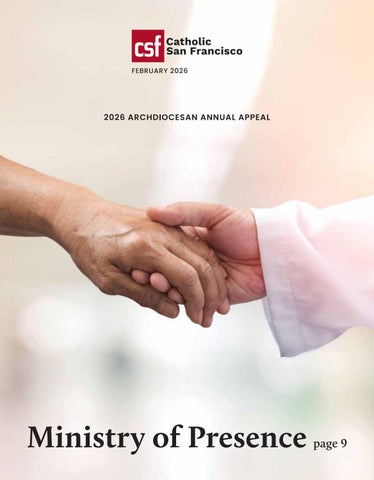
Create a flipbook