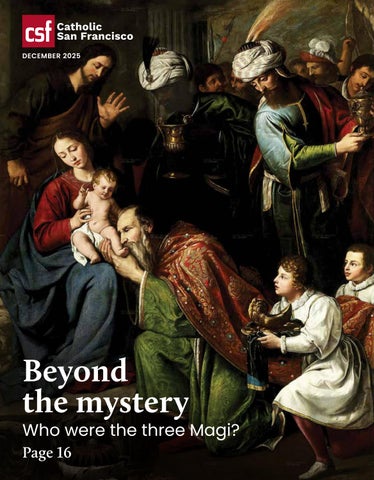
Beyond the
mystery
Who were the three Magi? Page 16


Catholic quiz: How well do you know
preparation: Advent traditions to bring to your home
or diplomats?: Beyond the mystery - Who were the three Magi of the Epiphany?
Vocations: A Goode life - Father Larry Goode reflects on his long, boots-on-the-ground ministry
175th jubilee: Dominicans in the West - The Western province took root 175 years ago
Obliged to serve: St. Francis and the missions part 1Making disciples of all
Saint stories: The “wild story” of St. Bartolo Longo
Seniors: “Do you know about Alma Via?” - Nondenominational assisted care blessed by proximity to SF parish
Collaboration: Raquel Seifert - Bringing a message of hope to immigrants


Salvatore J.
CSF MAGAZINE
ADVISORY BOARD Fr. Patrick Summerhays Vicar General & Moderator of the Curia
Peter Marlow (415) 614-5636 Communications
San Francisco ISSN
Ryan Mayer, Catholic Identity Assessment & Formation
Valerie Schmalz, Human Life & Dignity
Rod Linhares, Mission Advancement
Mary Powers (415) 614-5638 Communications
LEAD WRITER
Christina Gray
WRITER Francisco Valdez
PRODUCTION MANAGER / DESIGN SPECIALIST
Karessa McCartneyKavanaugh
PRODUCTION ASSISTANT Joel Carrico
BUSINESS MANAGER Chandra Kirtman
ADVERTISING Phillip Monares (415) 614-5644
CIRCULATION Diana Powell (415) 614-5576
COPY EDITOR Nancy O’Brien Cover photo: The Adoration of the Magi - The Collection - Museo Nacional del Prado
$35 a year anywhere in the United States. Periodicals postage paid at Burlingame CA 94010-9997 and
in Denver Colorado. POSTMASTER: Please send address changes to Catholic San Francisco, Circulation,
sfarch.org/signup
CIRCULATION: circulation.csf@sfarch.org
Looking East

Advent is a time we prepare for the celebration of a great mystery of our faith: the Son of God coming into our world, the Incarnation of the Second Person of the Most Holy Trinity in human flesh. We have been singing special Advent carols to mark the way. Among the many that we love to sing, I am reminded of this one in particular: “People, look east, the time is near of the crowning of the year. Make your house fair as you are able, trim the hearth and set the table. People, look east and sing today: Love, the Guest, is on the way.”
While the song’s melody comes from a traditional French carol, the words in English were written more recently, in the 1920s, by the English hymnist and author Eleanor Farjeon. In these lyrics, Farjeon uses a different image in each stanza to address the themes of the Advent and Christmas seasons. In this first verse, the image of looking east orients us toward the direction of the rising sun, the source of light, the direction of the coming of the Messiah. He is the light of God coming into the world to dispel darkness.
Christians from the very beginning have had this sensitivity of praying facing east, so much so that it endured for quite some time even within Protestant denominations. Farjeon was a Methodist. We can also think, for example, of the classic African American spiritual song “Let Us Break Bread Together on Our Knees”: “When I fall on my knees with my face to the rising sun, O Lord have mercy on me.” So deep in the Christian soul was this sensitivity of praying facing east in ancient times that, as Pope Benedict XVI explained to us, Christians used to put a cross on the wall on the east side of their home to know toward which direction they should pray.
helps us prepare to welcome the light of the world when He comes into our lives, “Love, the Guest,” who is on His way. It also explains why it has been the ancient and consistent practice of churches that trace their origins to the apostles to worship with priest and people together facing east (that is, in the same direction). While it has become much more common very recently in our own Church to worship with the priest facing the people, the Church has never repudiated the ancient principle of priest and people together looking toward the encounter with Christ the Light.
THE KINDS OF DARKNESS THAT THREATEN
All of this is to remind us where the source of our light comes from, or better yet, who that light is. There is much darkness in the world, and only He can cast it out. Such has it always been: “The people who walked in darkness have seen a great light; upon those who dwelt in the land of gloom a light has shone.” This prophecy from the prophet Isaiah came at a particular period in the history of the ancient people of Israel, when they were suffering oppression from the kingdom of Assyria, their powerful neighbor to the east. It was understood at that time as a prophecy of liberation from this oppression; the destruction of the symbols of oppression – the yoke, the pole and the rod – meant liberation, being brought into the light of freedom. This prophecy speaks of one form of darkness: political oppression. Sadly, it is a darkness common in every generation, and most especially our own, as everyone around the globe at this time senses a worrisome and urgent concern over wars and other conflicts that are threatening our way of life. Then there is the persecution of people because of their religious beliefs, and especially of Christians, all over the world: China, Nigeria, Ethiopia, Nicaragua, just to name a few. There is darkness that also takes the form of social oppression, the marginalization of people because of certain traits they have or ways of ARCHBISHOP
The east also reminds us of paradise: God put the garden in the east when He created the man and the woman to be in perfect harmony with Him, with each other and with all creation. Facing toward the direction of the light orients us toward the life of heaven and

thinking that do not conform to the accepted social norm of those in power.
Closer to home for us, there is the darkness that can envelop each one of us. We can sometimes feel very immersed in darkness, either because of things that happen to us beyond our control or because of things that we do to ourselves. This is when the idea of darkness is no longer an idea but a lived reality; it is not an abstract concept in the mind, but an angst we feel deep in our gut. We can begin to panic and despair. What is the way out?
CHRISTIAN AUDACITY
People, look east: whatever form darkness takes, it is always a manifestation of the great cosmic struggle between the kingdom of darkness and the kingdom of light. This world is a combination of both darkness and light: to Satan belongs the kingdom of darkness; he is the one who has the arrogant and foolish audacity to try to defeat God, the King of the kingdom of light. That, of course, is impossible! This is the good news we celebrate in the Advent and Christmas seasons. So let us not allow ourselves to be enveloped by ›
Children from Our Lady of Lebanon parish in Millbrae celebrate the Nativity of Jesus.
Photo by Peter Marlow


that darkness. How do we do that? “Make your house fair as you are able, trim the hearth and set the table.” We might say in more contemporary American English: “Clean up your act.” That is, live righteously. Or, as St. Paul puts it in his letter to Titus: “Live temperately, justly and devoutly in this age, as (you) await the blessed hope, the appearance of the glory of our great God and savior Jesus Christ.”
And this, really, is the meaning of Christmas. We even unconsciously acknowledge it in our secular celebrations when we hold gift exchanges. It is common for people, when exchanging gifts with another, to try to match or exceed the value of the gift they receive. God has given us the greatest gift imaginable, one that is impossible to match let alone exceed: the gift of His very own Son, come into our world in a human soul and body to offer His life on the cross to free us from the kingdom of darkness and bring us into His kingdom of light. That is God’s gift to us, a gift that cannot be outdone. But what is our gift back to God?
This is the audacity of the Christian, not to foolishly try to defeat God, but to engage in a gift exchange with Him, even though it
Members of the Dumlao family admire the Nativity scene at the Cathedral of St. Mary of the Assumption in San Francisco.
is impossible to come close to matching the value of the gift that He has given to us. But this is the mystery: it is in striving to please Him in every way, in striving to give back to Him the greatest gift that we possibly can, as paltry as that is in comparison, that will bring us and keep us in His kingdom of light. This is the way of love, the way He has taught us by His humiliation in dwelling among us in a human body, by subjecting Himself in obedience to earthly parents in a poor working-class family, by living as an itinerant preacher with no place to lay His head and by allowing Himself to be condemned as a subversive criminal though innocent. The story of His birth sets the pattern for all that will happen in the earthly life of the Godmade-man.
THE GIFT WORTH GIVING
People, look east: let us keep our eyes fixed on Christ. Do not divert your vision. Nothing else is worth it. It will only lead to mediocrity, loneliness, darkness. Live in His light, pleasing Him in all things, and you will know what it is to be loved by Him and to be loved in return. It is the one and only gift exchange that really matters! ■
Photo by Peter Marlow
Since 1899, it has been the pleasure of

Union Local
and its predecessor Locals to serve The Brother and Sister Carpenters of San Mateo County, and its honor to partner with the Archdiocese of San Francisco in all of its construction endeavors.
GRATEFULLY,

Martin Mendibles President
Edward Evans Senior Business Agent and Financial Secretary-Treasurer


Impacting lives
Our parishes impact lives in countless ways through vibrant, innovative outreach ministries.
As part of our ongoing series highlighting these efforts, in this issue we feature Immaculate Heart of Mary Parish in Belmont and St. Thomas More Parish in San Francisco. Knowing that all our parishes make a profound difference in their communities – and beyond – should be a tremendous source of inspiration and pride for all of us in the archdiocese.

IHM volunteers make nearly 150 lunches for each Sandwiches on Sunday event. In addition to a sandwich, the meals include fruit, drinks, chips, dessert and coffee. Socks are also distributed a few times per year.
IMMACULATE HEART OF MARY –SANDWICHES ON SUNDAY
The Sandwiches on Sunday program has been an integral part of Immaculate Heart of Mary’s vibrant outreach for more than 20 years. Conducted in conjunction with a variety of religious organizations, IHM’s Sandwiches on Sunday program provides
ST. THOMAS MORE - “OPERATION I DO”
In 2011, longtime St. Thomas More parishioner Joe Espinueva learned about the significant decline in Catholic weddings in the preceding 20 years.
Espinueva wondered, “What can we do to help?”
This simple question represented the beginning of “Operation I Do.” It was launched at the parish with a Mass and wedding celebration on the feast day of St. Thomas More, June 22. Msgr. Labib Kobti, of happy memory, offered the sanctuary and clergy resources at no cost. The event was a success, and today other archdiocesan parishes have their own “Operation I Do.”
The 14 years of being deep in the trenches of marriage preparation have helped the St. Thomas More clergy meet couples where they are and
lunch monthly at the Fair Oaks Community Center in Redwood City.
The people who are served often show great generosity toward each other. While this lunch may be the only meal of the day for some, they are often willing to share part of what they have received with someone who has shown up late to the distribution. It is inspiring to all those involved.
accompany them in their sacramental journeys. While many of us have become accustomed to sacramental life being defined by Baptism, Reconciliation, Eucharist and Confirmation, “Operation I Do” reminds us that Marriage is indeed one of the seven sacraments!
At St. Thomas More, an “Operation I Do” meeting takes place every Thursday evening. Deacon Abbie Nepomuceno and Father Rick Van De Water are ready for questions about marriage as a sacrament.

SCAN FOR MORE RESOURCES
SUPPORTING marriage and family life or visit: https://sfarch.org/ ministries/marriage-and-family-life/
Church of the Immaculate Heart of Mary


1040 Alameda de las Pulgas, Belmont, CA 94402 • (650) 593-6157 / www.ihmbelmont.org

PENANCE SERVICE
Wednesday, December 17 • 7:00pm
CHRISTMAS EVE MASS
Tuesday, December 24
Carols at 4:30pm, Mass 5:00pm
THE NATIVITY OF THE LORD CHRISTMAS MASSES
Wednesday, December 25 7:30am, 9:30am, 11:30am 4:00pm (Traditional Latin Mass)
VIGIL SOLEMNITY OF MARY, THE MOTHER OF GOD
Wednesday, December 31 5:00pm
SOLEMNITY OF MARY THE MOTHER OF GOD
Thursday, January 1, 2026 9:00am 12pm (Traditional Latin Mass)


Christmas Eve
Wednesday, December 24, 2025
Cathedral Closed during the day
5:00 PM Caroling by the Cathedral Choir School 5:30 PM - Christmas Vigil Mass
11:30 PM Caroling by the Cathedral Choir and Golden Gate Brass Quartet 12:00 AM - Midnight Mass
Christmas Day
Thursday, December 25, 2025
No 7:30 AM Mass
9:00 AM - Gregorian Chant Mass with Cathedral Schola Cantorum
11:00 AM - Solemn Mass with Cathedral Choir
1:00 PM - Misa en Español con el Coro Hispano
New Year’s Eve
Wednesday, December 31, 2025
8:00 AM - Morning Mass
New Year’s Day
Solemnity of Mary, Mother of God Thursday, January 1, 2026
HOLY DAY OF OBLIGATION
8:00 AM Morning Mass 12:10 PM Mass
The Solemnity of the Epiphany of the Lord Sunday, January 4, 2026
Regular Sunday Mass Schedule 7:30 AM, 9:00 AM, 11:00 AM and 1:00 PM (Español)
4:00 PM - Epiphany Lessons and Carols featuring the Cathedral Choir School and Golden Gate Boys Choir and Bellringers
How well do you know the Catholic faith?
InQUIZition:
Q&A for the Curious Catholic and the Catholic Curious


Q&A excerpted with permission and available for purchase from Holy Heroes, the official online store for Patrick Madrid products: https://holyheroes.com/collections/patrick-madrid

TBY PATRICK MADRID Catholic apologist, author
of numerous books on the faith, and host of the daily “Patrick Madrid Show” on Relevant Radio
here are no trick questions, but there are questions that will trip you up if you fail to read carefully. An answer is counted as wrong if any part of it — such as a date or name — is wrong. Your goal is not to find the answer that is least wrong, but the one answer that is wholly correct. On average, most informed Catholics score 50%. How well did you do?
1. The Magi brought baby Jesus in the manger gifts of gold, frankincense and?
a. Pampers
b. myrrh
c. nard
d. bitter herbs
e. hyssop
2. What was Jesus’ native language?
a. Hebrew
b. Aramaic
c. Arabic
d. Greek
e. Chaldean
3. In Hebrew, the word “Bethlehem” means:
a. City of David
b. Home of shepherds
c. Star of wonder
d. House of bread
e. Prince of peace
4. What does the name “Jesus” mean in Hebrew?
a. Messiah
b. God is with us
c. House of bread
d. The Lord Is salvation
e. Prince of peace
5. Which is the most theologically accurate answer to the question: “What does it mean that Jesus Christ is ‘true God and true man’?”
a. He is 100% God but in the form of a perfect man, similar to how angels sometimes appear in human form.
b. He is a highly exalted human person with many important attributes of God and is in-dwelled by God.
c. He is 50% divine and 50% human.
d. He is a 100% divine person and 100% human person with a divine and human nature.
e. He is a divine person with a divine nature and a human nature.
Answers can be found on page 46

SCAN THIS QR CODE FOR MORE CATHOLIC QUIZZES or visit http:// sfarch.org/catholic-quizzes


ST. DUNSTAN CATHOLIC CHURCH
2025 CHRISTMAS MASSES
December 24, Christmas Eve: 4:30 PM & 9:00 PM
December 25, Christmas Day: 7:00 AM, 10:00 AM & 11:30 AM 1133 Broadway, Millbrae, CA 94030


St. Brendan Catholic Church 2025-2026 Christmas Mass Schedule
Christmas Eve • Wednesday, December 24, 2025 4:00, 6:00 & 10:00 pm (our midnight Mass)
NaFvity of the Lord Thursday, December 25, 2025 • 7:30, 9:30 & 11:30 am
Holy Family of Jesus, Mary & Joseph Saturday, December 27, 2025 • 5:00pm Sunday, December 28, 2025 • 7:30, 9:30, & 11:30 am
Solemnity of Mary, the Holy Mother of God Thursday, January 1, 2026 • 7:30, 9:30, & 11:30 am

Advent traditions to bring to your home

BY MARY POWERS Assistant director of communications and media relations. Office
of Communications, Archdiocese of San Francisco
As the Church prepares for the birth of Jesus this Advent, bring the liturgical season into your home with these family traditions. Links to materials can be found by using the QR code at the end of the article.


ADVENT WREATH
Each Sunday in Advent, Catholics light Advent wreath candles at Mass representing the passing of each week in anticipation of the birth of Jesus at Christmas, the light of Christ coming into the world.
The Advent wreath tradition is rich in symbolism. The shape of the wreath symbolizes the eternity of God, while the evergreens symbolize new life and signs of hope. The four candles represent hope, love, joy and peace.
Bring this tradition into your home this year. It is an opportunity to bring the family together for prayer while lighting the Advent candles. You can buy wreaths and candles online and with new batterypowered candles, families can order flameless candles to avoid messy wax spills or other candle mishaps.


JESSE TREE
We all have family trees; why not honor the family tree of Jesus? The Jesse Tree is a tradition that follows biblical stories from creation to the birth of Jesus, showing His family tree and reminding us of the centuries of expectant hope the Jewish people had for the coming of the Savior. This tradition places ornaments on a Christmas tree, adding the story of salvation history to the traditional family Christmas ornaments. Make sure to have your Bible ready to read through each story as you go.

MARY ON THE MANTLE
Heard of Elf on the Shelf? Mary on the Mantle is a similar idea but is a Catholic approach to preparing for Christmas.
Walk with Mary and Joseph throughout Advent doing good works for others and learning about their journey to Bethlehem. Every day, you will choose a card containing a good deed or an act of kindness to perform. The box set also includes a Mary doll, a baby bump to place under Mary’s dress during Advent, a baby Jesus with a swaddling cloth for Christmas season and a map of the Holy Land. ›


ADVENT CALENDAR
Advent calendars help count down the days to Christmas. These calendars come in all shapes and sizes. Some hold tasty treats behind cardboard windows while others may be wooden or felt with Bible verses or endearing icons to add each day. Whichever you choose, Advent calendars are a fun reminder that we wait in joyful participation of the coming of Christ.


SETTING UP THE NATIVITY SCENE
Just as Mary and Joseph prepared for the arrival of Jesus, set up your Nativity set liturgically. Leave the manger empty until Christmas to await the coming of Jesus. And have the three kings travel across your home to make it to the creche by Jan. 6, feast of the Epiphany.


STRAW IN THE MANGER
Another idea to encourage good deeds and sacrifices during the penitential season is to gradually fill the manger with straw for Jesus by doing good works for others during Advent. Each time a member of the family does a corporal or spiritual work of mercy, he or she can add a piece of hay to the manger, so that Jesus has a comfy setting in which to lay when He is born. ›


ST. NICHOLAS DAY
St. Nicholas was a bishop from Myra in Turkey in the fourth century. Known for his many acts of charity and kindness, his story led to the creation of Santa Claus (originally “Holy Nicholas”). The tradition of gift giving originates with the story of St. Nicholas saving a family of young women from slavery by providing their father with a dowry so they could marry.
On St. Nicholas’ Dec. 6 feast day, celebrate this gift giving with your family. Leave shoes out the night before for St. Nicholas to fill with goodies such as oranges, chocolate gold coins or other treats. The saint also comes on the night of Dec. 6 if you forget to leave your shoes out. He is a generous saint. Candy canes can also be given out to celebrate St. Nicholas as a symbol of a bishop’s crosier.

ST. LUCY’S DAY
Celebrate this Sicilian martyr on Dec. 13. In Scandinavian countries, the oldest daughter of the family dresses in a white dress with a red sash, wearing a green wreath with candles on her head. The white dress symbolizes purity, the red sash symbolizes martyrdom, and the crown represents the eternal love of God. The candles represent light, the meaning of St. Lucy’s name. In the early morning, “St. Lucy” will bring treats to the family such as cinnamon rolls or other sweet pastries. The tradition originates in Sweden, partly to recognize the saint who with candles on her head to light the way brought food to Christians hiding in the catacombs. There is also a legend that she saved the country from famine in the Middle Ages. The people prayed to St. Lucy, and one night there was a ship that appeared with a bright light on board, bringing bread to the country, saving them from starvation. ■


SAINT ELIZABETH CHURCH
CHRISTMAS SCHEDULE 2025
Simbang Gabi Masses:
December 16 - 24
8:30 am
Christmas Eve Vigil:
Wednesday December 24, 2025 4:30 pm
Christmas Day:
Thursday December 25, 2025
8:30 am and 10:30 am
New Year’s Day:
Thursday January 1, 2026
9:00 am


Radiating the Joy of the Gospel in the Heart of the City
ADVENT RECONCILIATION SERVICE
WEDNESDAY, DECEMBER 10
12:00 p.m.: until 1:00 p.m.
ADVENT MERCY NIGHT
WEDNESDAY, DECEMBER 10
7:30 p.m.: Church Nave until 9:00 p.m.
7:30 p.m.: Confessions until 8:30 p.m.
LAS POSADAS PAGEANT AND FIESTA
SUNDAY, DECEMBER 14
3:15 p.m.: Church Nave and Parish Hall
CHRISTMAS CONCERT: A BAROQUE CHRISTMAS
MONDAY, DECEMBER 15
7:30 p.m.: Church Nave
MEDITATIONS ON THE GREAT ‘O’ ANTIPHONS
WEDNESDAY, DECEMBER 17
7:30 p.m.: Church Nave
CHRISTMAS EVE
WEDNESDAY, DECEMBER 24
4:00 p.m.: Christmas Eve Family Mass
6:00 p.m.: Christmas Eve Mass
11:15 p.m.: Carol Service followed by Mass at Midnight
CHRISTMAS DAY
THURSDAY, DECEMBER 25
12:00 a.m.: Solemn Christmas Mass at Midnight
8:30 a.m.: Family Mass with trumpet
11:00 a.m.: Solemn Choral Mass, Schola cantorum, and brass
No 5:00 p.m. Evening Prayer or 5:30 p.m. Mass this day No confessions this day. Parish Office is closed.
FEAST OF THE HOLY FAMILY
SUNDAY, DECEMBER 28
5:30 p.m.: Vigil Mass for Sunday, (Saturday, 12/27)
7:30 a.m.: Quiet Mass
9:30 a.m.: Family Mass
11:30 a.m.: Solemn Choral Mass
1:30 p.m.: Mass (in Spanish)
5:30 p.m.: Mass with Contemporary music
BLESSED VIRGIN MARY, THE HOLY MOTHER OF GOD
WEDNESDAY, DECEMBER 31, 2025
5:30 p.m.: Vigil Mass
11:00 p.m.: Novice Reflections and Mass
THURSDAY, JANUARY 1, 2026
8:30 a.m.: Morning Prayer
9:30 a.m.: Parish Mass
Visit our website: https://stdominics.org or call 415.567.7824
Beyond the mystery
Who were the three Magi of the Epiphany?

BY AARON LAMBERT
Writer from Denver
In the grand tale of salvation history, few figures are more mysterious than the three Magi who tracked a star to Bethlehem to give homage to a newborn king with their humble gifts of gold, frankincense and myrrh.
Despite the fact that they are part of virtually every retelling of the Nativity story, who the Magi actually were has been a source of debate for centuries. Were they princes? Were they kings? Were they actually wise? Or were they, as their name implies, magicians? For many years, biblical scholars dismissed their inclusion in the story as a fable. However, even though history has not been totally clear on who these men were, over time, through tradition, ancient writings and other clues, various theories about these three wise men and where they came from have emerged.
Curiously, the Magi only appear in Matthew’ s account of the Nativity. A prevailing theory for many years posited that the wise men were in fact kings, and they hailed from the Eastern regions of Ind, Chaldea and Persia. This theory originated in a 14th-century text called “Historia Trium Regum” (“History of the Three Kings”) written by John of Hildesheim, a Carmelite friar. The names that are traditionally associated with the three kings – Melchior, Balthazar and Caspar – find their origin in an eighth-century Greek manuscript, and they are referred to as such in the friar’s account.
In this version of the history, these three kings did not know each other but all were guided to Bethlehem independently by the star, a sign that the prophesied Messiah had been born — a prophecy they would have been very familiar

with. Their paths converged and they reached their destination — not on Christmas night, as many popular stories tell it, but more likely about a year after Jesus was born. As Matthew’s Gospel recounts, it was during the reign of Herod that the three kings arrived in Bethlehem, and shortly after their arrival, the Holy Family fled into Egypt.
Another interesting and more recent theory about the three Magi comes from Catholic author

“The Adoration of the Magi” (1894) by Edward Burne-Jones shows the three kings offering gifts to the infant Christ amid glowing color and intricate detail.
and speaker Father Dwight Longenecker. In his book, “The Mystery of the Magi,” Father Longenecker digs into the geography, ancient history, archeology, religion and culture of the Roman Empire at the time of the birth of Jesus and presents compelling evidence for who the Magi actually were.
Far from a mere myth, the history that Father Longenecker uncovered reveals that the Magi were likely diplomats from a neighboring region of Judea called Nabataea. They hailed from the city of Petra, and after hearing that a new heir to the Judean throne had been born, the Nabataean King Aretas IV sent them as ›
envoys to King Herod’s court to pay homage to the newborn king. The gifts they brought were customary of the Arabian kingdom from which they journeyed.
So, according to Father Longenecker’ s research, the Magi were not from Persia, but rather Arabia. And they weren’t kings or “wise men,” though clearly they were very wise to have been able to trace a star to Bethlehem, which Longenecker interprets as an astrological phenomenon. Nor were they magicians, but diplomats sent to establish a diplomatic alliance with King Herod. And their names probably weren’t Melchior, Balthazar and Caspar. Moreover, there is no evidence that there were only three Magi who traveled to Bethlehem; this number corresponds with the three gifts they brought with them, but as it indicates in the Gospel of Matthew, there were enough of them that they troubled all of Jerusalem (Mt 2:3).
Mystery solved. Or is it? Perhaps we’ll never know.
Regardless of the history and mystery surrounding these enigmatic figures, the three Magi remain a key piece of the Nativity story. The Church commemorates their arrival to Bethlehem each year on the feast of the Epiphany, a day where we, too, are invited to share in the Magi’s wonder and adoration of the Christ child. The Church has always held that the Magi represent Christ’s revelation to the gentiles, hence the word “Epiphany,” which means “divine revelation.”
In this same way, the Magi also represent us in the Nativity story. Though we might not have to physically travel thousands of miles to encounter Jesus, it is still a journey that our heart makes each Christmas.
During his Angelus address on the feast of the Epiphany in 2023, Pope Francis observed that “the Magi allowed themselves to be amazed and inconvenienced by the novelty of the star, and they set out on a journey toward the unknown. Educated and wise, they were fascinated more by what they did not know than by what they already knew. They opened themselves to what they did not know. They felt called to go beyond.”
As we reflect on the mystery of the Magi this Christmas, may we, too, feel the call to go “beyond” and encounter the newborn king anew in our hearts, falling prostrate before Him and offering the humble gift of ourselves, in imitation of the Magi. ■

The
Magi allowed themselves to be amazed and inconvenienced by the novelty of the star, and they set out on a journey toward the unknown. Educated and wise, they were fascinated more by what they did not know than by what they already knew. They opened themselves to what they did not know. They felt called to go beyond.”
POPE FRANCIS
Angelus address on the feast of the Epiphany in 2023
The Adoration of the Kings. Sebastiano Ricci. 1726.
VALLOMBROSA RETREAT CENTER
We are open for your spiritual renewal

In a beautiful and peaceful park setting that includes many prayer and meditations spots*, we will host your group’s retreat or conference. You may also sign up for a private retreat. We especially invite you to attend one of our five-day silent retreats which are very powerful and reasonably priced.
For group reservations or a private retreat: call 650-325-5614 Or email jaynie@vallombrosa.org.
For our five-day retreat, call Deacon Dominick Peloso, (650) 269-6279
*The meditation spots available include: Lourdes, Fatima, St. Joseph, St. Mother Theresa, St. Francis, Spiritual Works, Corporal Works, Adoration Chapel, and (coming fall of 2024), a large (50’ x 12’) crucifixion scene by Timothy Schmaiz.


Join us on a life changing pilgrimage to the major Basilicas in Mexico, Peru, and Brazil featuring 2 world wonder: Machupicchu and Christ de Redeemer Rio de Janerio. May 17-30, 2026.
TRAVEL NOW, PAY LATER. Please call / text for information and details 1-323-875-8818 or email ruby@kri8tours.com
April 14 - 20, 2026 and June 3 - 15, 2026
Mexico, Peru and Brazil
Highlights: Our Lady of Guadalupe, St. Rose of Lime, St. Martin de Poress, Machupicchu, Our Lady of Aparecida, Christ the Reedemer and Iguaza Falls
May 18 - 29, 2026
Shrines of ItalyFeaturing Papal Audience with Pope Leo

by Christina Gray

A Goode life Father
Larry Goode reflects on his long, boots-on-theground ministry


BY CHRISTINA GRAY Lead writer, Catholic San Francisco grayc@sfarch.org
Father Lawrence Goode was a fifth grader at Our Lady of Mount Carmel School in Redwood City when one of the Sisters of Notre Dame de Namur asked students what they wanted to be when they grew up.
“I had never really thought about it before,” said the longtime pastor of St. Francis of Assisi Parish in East Palo Alto, now ostensibly retired at age 86. “I was happy being a kid.”
If he had to grow up, his first choice was to be a baseball player. His second choice, he reasoned, had to be something “really good” though, “the very best thing you can be.” He wrote out the word “priest.”
“As I look back, I think I made the right choice,” Father Goode told Catholic San Francisco in the St. Anthony rectory in Novato where he is currently living in active retirement.
“If you want to do something really, really good in life, become a priest,” he said.
After concluding his 20-year assignment earlier this year as pastor at St. Francis of Assisi, Father Goode (pronounced Good-y) was provided residence at St. Anthony of Padua Parish in Menlo Park to help out while he
waited for a room to open up at Serra Clergy House, a retirement community for priests in San Mateo. Only a few months later he found himself “packing up my box” again for St. Anthony of Padua but this time for the parish in Marin County. He celebrates daily Mass, hears confessions, leads the rosary, works with local charities and is even helping the parish establish its first Legion of Mary chapter.
“I DIDN’T SEE MYSELF FITTING THE MOLD”
Lawrence Goode grew up in Redwood City in the same house in which his mom was born and raised. He and his brother sat in the same classrooms at Our Lady of Mount Carmel School that she once had. They both dutifully served as altar boys at Sunday Mass.
Though he admired the priests he knew, he shared his father’s view of priests as being “exalted, up on a pedestal, separate from the people.”
“I didn’t see myself fitting into the mold,” he said. The idea of “people looking up to me” made him deeply uncomfortable.
Despite doubts along the way about his perception of “what it means to be a priest,”
Photo
Father Goode said he didn’t overthink it.
“I just got on the path and just kept going,” he said. Father Goode was ordained in 1964 for Archdiocese of San Francisco (The Diocese of San Jose was created in 1981.)
PEACEKEEPER AND PROTECTOR
Father Goode’s pastoral cloth was cut by his experience at St. Mary’s Parish in Gilroy, his first assignment as a new priest. It was here that he developed a devotion to Our Lady of Guadalupe.
“The people there were very, very Catholic,” he said of the mostly Spanish-speaking parish. “They encouraged me in my faith.”
Along with the duties of associate pastor, he found himself helping his parishioners –the majority of whom were poor, immigrant farm-working families – in practical matters. He advocated and bargained for their rights and fair treatment from farm owners and landlords. He became bilingual along the way.
“In my first four years as a priest, I saw firsthand the way these people were treated, the housing they lived in,” he said. “So, it was natural for me to do as a priest.”
He was present at the picket lines with other priests to prevent altercations between the farmworkers, the landowners and the community.
“I was there to keep the peace,” said Father Goode.
“TAKING
BACK THE STREETS”
Father Goode was eventually assigned to St. Catherine Parish in suburban Burlingame. He subsequently served in a variety of pastoral positions at St. Matthias Parish in Redwood City, All Souls Parish in South San Francisco and Star of the Sea Parish in San Francisco. In 2003, he was assigned to St. Francis of Assisi Parish in East Palo Alto. The city flanking affluent Atherton, Menlo Park and Palo Alto had a reputation at that time as the “murder capital of the U.S.” It followed a period when the city had the highest reported per-capita murder rate in the nation.
“I remember a single day when I had to lead not one but two funerals – one for a 13-year-old and the other for a 17-year-old,” he said. Father Goode was determined to “take the streets back” by bringing the faith community out of hiding. He partnered with the African American pastors of other local churches to help turn down the fire on simmering feuds between Black and Latino residents. Street prayer vigils were held ›


From left, Dolores Meehan, Father Goode, Mike Meehan, pictured at the Clericus Classic basketball game, a fundraising match between seminarians and priests.
Photo courtesy of Dolores Meehan
Father Larry Goode is seated between his father to the left and Anthony Ryan on the right at Our Lady of Peace Church in Santa Clara. Father Goode was a young assistant priest there circa 1978.
Photo courtesy of Anthony Ryan, Ignatius Press

Father Lawrence Goode and then pastor of St. Francis Church in East Palo Alto, poses with a group of Tongan children who reenacted the life of St. Patrick on March 18, 2017.
as well as other visible, church-related events such as the Christmastime “Las Posadas” a traditional Mexican reenactment of the Nativity story, and Stations of the Cross during Lent.
“The streets belonged to the gangs at that time, so we were sending a message to them that we also had ownership of these streets,” he said.
I like what I’m doing and it fulfills me, work that nobody else can do or wants to do.”
Father Goode swapped money for weapons, collecting rifles, machetes, pistols and brass knuckles that he turned over to the local police.
A community organizer by nature, Father Goode also encouraged the local faith community to have a voice in the improvement of the city. He gathered church leaders of all stripes under one roof for Fellowship of Faith meetings to discuss ideas that were presented monthly to city officials.
“My goal was that our people would be at the
table where the decisions were being made,” said Father Goode.
LEGION OF MARY
Concurrently with nearly all of his more than 60 years of pastoral work, Father Goode served as the spiritual director and chaplain of the local chapter of the Legion of Mary, the largest lay apostolate of the Catholic Church. In a written documentary for the Legion of Mary’s 100th anniversary in 2024, Father Goode described how prayer once disarmed a man on the local streets.
“We had just finished saying the Legion prayers on the corner of Jones and Eddy,” he said. “This man was on his way to shoot someone when Our Lady touched his heart. I ended up with a pocketful of bullets.”
As far as his spot at Serra Clergy House is concerned, Father Goode is emphatically not in a hurry.
“I’m not at all interested in traveling and those kinds of things,” he said. “I like what I’m doing and it fulfills me, work that nobody else can or wants to do.” ■
Catholic San Francisco newspaper archive photo
Now open late on Thursdays to better fit your schedule. 9am-7pm
(510) 587-3000

2121 Harrison @ 21st St. • The Cathedral of Christ the Light

Wednesday, January 7, 2026
St. Raphael Church 1104 5th Avenue
San Rafael, CA 94901 7-9 p.m.
Wednesday, January 14, 2026 Archdioceses of San Francisco One Peter Yorke Way San Francisco, CA 94109 7-9 p.m.
Wednesday, January 21, 2026
St. Mark Catholic Church 325 Marine View Avenue Belmont, CA 94002 7-9 p.m.
Diaconate Formation Informational Evenings
The Office of Formation for the Permanent Diaconate will hold Informational Evenings for men considering the possibility of serving the Church as Permanent Deacons. The evening will include discussion of the ministry of the Deacon in the Church, the Formation program and the application process. Please join us.

Join the Challenge!
Dear SI Alums, Family Members and Friends, the St. Ignatius College Prep Class of 1976 is launching a fundraising campaign to support senior Jesuits living at the Jesuits West Province’s retirement community in Los Gatos.
Double your impact. Every dollar will be matched up to $200,000!
WHY NOW?
Jesuits West is solely responsible for the care of all senior Jesuits, and the number needing care has surged.
WHO ARE WE HELPING?
The “Old Guard” — Br. Douglas Draper, SJ, Fr. Ray Allender, SJ, and Fr. Mario Prietto, SJ, and nearly 80 others. Your gift ensures outstanding care for the men who taught us, coached us, counseled us, and gave their lives in service.
100% OF YOUR GIFT GOES DIRECTLY TO THEIR MEDICAL AND LIVING EXPENSES.


From its beginnings during the California Gold Rush, the territory of the Western Dominican province has been defined by evangelization and missionary activity.
The Dominican Friars of the Province of the Most Holy Name of Jesus preach, teach and serve in parish and campus ministries, religious education and more.
Dominican Sisters are women religious active in ministries that include missionary work, teaching and social work.
Photos courtesy of OP West


BY CHRISTINA GRAY
Dominicans in the West
The Western province took root 175 years ago
Lead writer, Catholic San Francisco grayc@sfarch.org
On the occasion of the 175th jubilee of the Dominican province of the Most Holy Name of Jesus, Catholic San Francisco offers a brief history of what is often referred to as the Western province. We’ll also look at other Dominican branches that have sprung from it and have collectively contributed to the Archdiocese of San Francisco. The Western province includes California, where the Order of Preachers took root in 1850, as well as Oregon, Washington, Montana, Nevada, Utah, Arizona, New Mexico, Alaska and Hawaii.
IT BEGAN IN SAN FRANCISCO
In 1845, two Dominican friars, Father Joseph Sadoc Alemany and Father Francis Sadoc Vilarrasa, arrived in the U.S. from Spain. In 1850, as California’s population boomed with gold prospectors, Pope Pius IX designated Father Alemany as the much-needed first bishop for the state of California. The pope famously told him, “Where others are drawn by gold, you must carry the cross.”
On Dec. 6 of that year, Bishop Alemany and Father Vilarrasa along with Belgian-born Mother Mary Goemaere, also a Dominican, arrived at the port of San Francisco intent on teaching and preaching for the salvation of souls in the American West. Thus began the Dominican Friars of the Province of the Most Holy Name of Jesus and California’s first order of women religious.
The Dominican Friars of the Most Holy Name of Jesus serve parishes and campus ministries, international missions, special ministries for evangelization, prayer, education, and service to the poor and sick. The Western province is also home to the Dominican School of Philosophy & Theology in Berkeley, which prepares religious, clerics and laity for academic and apostolic vocations. St. Albert’s Priory
in Oakland is the house of formation for Dominican friars studying for the priesthood at the Berkeley school and St. Dominic Priory in San Francisco is home to the novitiate of the Western Province.
DOMINICAN BY DEFINITION
We celebrate the 175th jubilee of the Dominican Friars of the Most Holy Name of Jesus by honoring its continuing influence within the Archdiocese of San Francisco. At the same time, we recognize the contributions of the other local Dominican branches that have evolved from it. Although separate in terms of governance, these branches share in the charism of preaching and are united under the Master of the Order of Preachers.
THE FRIARS
Friars include both priests and brothers. Both profess vows of poverty, chastity and obedience. While priests are ordained for the ministry of the sacraments, brothers minister according to their talents and abilities in other ways. Ministries among the friars include itinerant preaching, parish and campus ministry, teaching in schools and universities, catechetical formation, social work, health care, the arts, internal administration and much more. There are currently 140 friars in the Western province. They live communal lives in Dominican priories such as St. Dominic Priory in San Francisco houses like St. Raymond in Menlo Park, and St Albert’s in Oakland.
THE NUNS
The very first foundation by St. Dominic was a monastery of nuns in Prouille, France. Nuns are cloistered. Their days are marked by silence, the necessary climate for contemplation, and continuous prayer for the world and for the success of the friars’ preaching. Their days are also defined by the Liturgy of the Hours, Mass and devotions such as perpetual adoration. Nuns usually enter a ›
monastery and remain there for the rest of their lives. Like the friars, they profess the vow of obedience and embrace poverty and chastity. The Dominican Nuns of Corpus Christi Monastery, established in 1921, are a local example. Located minutes from Vallombrosa Retreat Center, the nuns support themselves by producing hosts for use at Mass, as well as vestments and other religious articles.
THE SISTERS
Dominican sisters are active, vowed religious women who are organized into individual congregations. The basis of their activity is the primary ministry of preaching, although it may manifest itself in many forms including teaching, missionary work and social work.
Mother Mary Goemaere, who also disembarked in San Francisco 175 years ago, was dedicated to the Catholic education of children in what then was a new and uncivilized part of the world. Dominican sisters have established communities and served at many schools and hospitals locally, including the now-closed St. Rose Academy (on the St. Dominic parish campus).
The Dominican Sisters of San Rafael founded Dominican College and St. Dominic School in Marin County (both now independently run). They continue their ministry today in schools and hospitals, parishes, social service agencies, day programs for those without homes, prisons and more. The Dominican Sisters of Mission San Jose, located in Fremont (originally part of the Archdiocese of San Francisco), were founded in 1876. Today, they serve the students of St. James and St. Anthony-Immaculate Conception


Above, Dominican laity engage in active ministries such as service to the poor, teaching, writing and spiritual counseling. Left, Dominican nuns usually live in cloistered monasteries. Their days are marked by silence and continuous prayer for the world and the success of the friars’ preaching.
Schools in the Mission District, as well as Immaculate Conception Academy-Cristo Rey.
The Dominican Sisters of Oakford arrived from South Africa in 1955 to work with the friars at St. Albert’s Priory in Oakland. The Dominican Sisters of Mary, Mother of the Eucharist from Michigan have been present as teachers and campus ministers at Marin Catholic High School since 2011.
Dominican sisters have established communities and served at many schools and hospitals locally, including
the now-closed St. Rose Academy (on the St. Dominic parish campus).”
THE DIOCESAN PRIESTS
The Priestly Fraternities of St. Dominic are made up of diocesan priests who are formally affiliated to the Order of Preachers through a rule of life they profess under the overall direction of the Dominican friars. The origins of the Dominican fraternities can be traced from the Dominican third order secular, which then included both priests and laypersons as members. The first member of the Third Order was Fr. Louis Lootens in 1860. With the cessation of terminological references to first, second and third orders in the Dominican order in 1968, there ensued the creation of separate rules for the laity and for the priests and their corresponding constitution as distinct fraternities. Now existing as a separate association from that of the laity, and with its own distinct rule to follow, the Priestly Fraternities of St. Dominic continue to be guided by the order in embracing the gift of the spirituality of St. Dominic in the unique context of the diocesan priesthood.
While the order provides them with these spiritual aids and directs them to their own sanctification, it leaves them free for the complete service of the local Church, under the jurisdiction of their own bishop.
THE DOMINICAN LAITY
Very early in the foundations of the order, groups of laypeople began to associate with the friars and nuns. These associations grew into what we now call the Dominican laity. There are 37 fraternities in the Western Province with two fraternities in the archdiocese. They are called to preach in the secular sphere, the marketplace or wherever their station in life finds them. They make promises to follow the rule and statutes of the Dominican laity, which include meeting on a regular basis, studying and praying the Liturgy of the Hours. They engage in active ministries such as service to the poor, teaching, writing and spiritual counseling. They endeavor to live lives of simplicity and generosity. ■


St. Francis and the missions part 1 Making disciples of all nations

BY FATHER BOBBY BARBATO, OFM CAP. Rector, National Shrine of St. Francis
In 2026 we celebrate not only the 800th anniversary of the death of St. Francis, but also the 250th anniversary of the founding of the church named after him, Mission San Francisco de Asís. The California missions are identified with the Franciscan order; St. Junípero Serra was a friar who wanted to honor the founder of his order by naming one of the missions after him. In this and subsequent reflections we will explore St. Francis’ own vocation as a missionary, the missionary work of his friars throughout the ages and the specific Franciscan role in the missions of California.
Very soon after Francis of Assisi experienced Christ’s call to follow Him, he was walking through the woods, singing. Some robbers confronted him and asked who he was. He told them, “I am the herald of the Great King.” They laughed and threw him into a ditch filled with snow. The young man got up, brushed off the snow and went on his way. The incident only strengthened Francis’ resolve to be a good messenger of his true king, Jesus Christ.
All his life, Francis had heard Jesus’ words to His apostles, “Go therefore and make disciples of all nations” (Mt. 28:19), and that He had told them: “You will receive power when the Holy Spirit comes upon you, and you will be my witnesses in Jerusalem, throughout Judea and Samaria, and to the ends of the earth” (Acts 1:8). A pivotal moment in Francis’ own search to find God’s will for him was discovering the Gospel passage where Jesus sends out the apostles without money or walking
stick to preach the good news in every town and village. (Mt 10:5 ff; Mk 6:7ff)
Francis not only treasured and reflected on Jesus’ words; he knew he had to put them into practice. The saint was convinced that Jesus’ commission to spread the good news was not only for the Church of ancient times; that commission applied to Francis personally. So, from the beginning of his religious life, preaching and proclamation were integral to Francis’ living out the Gospel. In a letter he wrote to all the faithful, he stated: “I am obliged to serve all and to administer the fragrant words of my Lord to them. …. I decided to offer you in this letter and message the words of our Lord Jesus Christ, who is the Word of the Father, and the words of the Holy Spirit, which are spirit and life.” (Letter to all the faithful II, 45).
Francis spent many years walking throughout Italy and other Christian lands, proclaiming the Gospel in towns and villages and urging his ›


“St.
Francis’ Vision of the Cross,” on Porto’s Capela das Almas, this 1929 blueand-white azulejo by Eduardo Leite depicts St. Francis bathed in divine light before the cross, a serene moment of revelation amid the city’s bustle.
Francis wanted his followers to live among the nonbelievers in a way that would witness to their Christian faith: ‘Let them not quarrel or argue or judge others… but let them be meek, peaceful, modest, gentle and humble, speaking to everyone courteously.’”
(RULE, III, 102)
brothers and sisters to live their faith. However, the poor man of Assisi was not content with speaking of Jesus just to his fellow Christians. He longed to share the same Lord’s words of life with those who did not believe in Christ, and who had perhaps not even heard of the Savior and His Gospel.
Because of this desire to evangelize beyond his own world, Francis made several attempts to leave Europe. He wanted to take his mission to the Muslims and others who did not believe. Although he knew such an undertaking would be dangerous, and perhaps even lead to martyrdom, Francis burned with zeal to let the whole world know the goodness of God. He had found the pearl of great price and wanted to tell others about it.
In 1219, Francis finally got his chance when he traveled to Egypt. Once there, he left the safety of the Crusaders’ camp to preach to the sultan, Al-Malik al-Kamil. He hoped to convert the ruler or perhaps be martyred for his faith. This did not happen, however, as Francis’ sincerity and Christian love impressed the sultan. Although he did not convert, he asked Francis to pray for him and allowed the saint and his companion to visit the Holy Land and venerate the places where Jesus had lived.

When Francis began to organize his followers, the Friars Minor, he decided to incorporate the Church’s mission of evangelization into their religious lives. He was sure that the Holy Spirit would inspire some of them to follow his own example and that of Christians throughout the ages and ask to go into mission lands. Because of this, he included in the Rule of the Friars Minor this important provision: “Let those brothers who wish by divine inspiration to go among the Saracens and other nonbelievers ask permission to go.” (Rule of the Friars Minor, Chapter XII, 106)
Francis had learned, however, that to preach the Gospel effectively, those who proclaimed it had first to show by their lives that it was truly “good news.” He told the friars going to live among the nonbelievers: “They can live spiritually among them in
two ways. One way is not to engage in arguments or disputes, but to be subject to every human creature for God’s sake and to acknowledge they are Christians.” (Earlier Rule, XVI, 74) Francis wanted his followers to live among the nonbelievers in a way that would witness to their Christian faith: “Let them not quarrel or argue or judge others … but let them be meek, peaceful, modest, gentle and humble, speaking to everyone courteously.” (Rule, III, 102)
Francis believed that once friars had witnessed to the truth of the Gospel by their lives, the Lord might then also call them to preach the Gospel in a clear and compelling way. He told the friars who were missionaries that they could “announce the Word of God when they see it pleases the Lord.” (Earlier Rule, XVI, 74) (By the way, this is probably the origin of the quote

In this 1929 azulejo (tiled-based art) of “The Death of St. Francis” by Eduardo Leite on Porto’s Capela das Almas, the saint lies peacefully surrounded by mourning friars, as angels rise above—an image of serene faith and transcendence rendered in luminous blue and white.
misattributed to St. Francis: “Preach the Gospel always; use words if necessary”).
It was St. Francis’ missionary zeal, along with that of his friend, St. Dominic, which inspired many of their followers, the Friars Minor (Franciscans) and Friars Preacher (Dominicans) to leave their homes and go to foreign lands to tell the good news. Many historians say this zeal helped revitalize the Church’s mission of evangelization, to carry the faith beyond the bounds of what was then “Christendom.” In our next reflection we shall see how the friars participated in this mission in many different foreign lands. ■

The ‘wild story’ of St. Bartolo Longo
Former satanic priest among the seven new saints canonized by Pope Leo

BY CHRISTINA GRAY Lead writer, Catholic San Francisco grayc@sfarch.org
The seven new saints canonized by Pope Leo XIV on Oct. 19 include St. Bartolo Longo, a satanic priest who disavowed the devil and returned to his Catholic faith after praying the rosary. He became a beloved proponent of the rosary, eventually building the Pontifical Shrine of Our Lady of the Rosary of Pompeii.
“He lived a very checkered life,” said Father Joseph-Anthony Kress, a Dominican friar of the Province of St. Joseph in a July 21 episode of “Ascension Presents,” a Catholic television program.
Father Kress and Father Mark-Mary Ames, a Franciscan Friar of the Renewal, discussed in a short clip what they called the “wild story” of St. Bartolo Longo. The clip was produced not long after the Vatican announced in June Pope Leo’s decision to elevate nine Blesseds to sainthood this year, including Longo.
The other new saints canonized with him include a martyred Armenian Catholic bishop; three Catholic sisters who served the poor and uneducated in Ecuador, Italy and Venezuela; a martyred lay catechist from Papua New Guinea and a Venezuelan medical doctor.
Father Ames and Father Kress described St. Bartolo Longo’s metamorphosis from devotion to the devil to devotion to Mary as “a dramatic testimony to the power of the rosary.”
St. Bartolo Longo, canonized Oct. 19, experienced a “radical conversion” as a young satanic priest and devoted the rest of his life to promoting the recitation of the rosary. He is the founder of Italy’s Pontifical Shrine of Our Lady of the Rosary of Pompeii.


‘APOSTLE OF THE ROSARY’
Bartolo Longo was born into a wealthy Catholic family in 1841. He went to the University of Naples to study law at a time of anti-papal sentiment in Europe and the rise of spiritualism and the occult. He followed the zeitgeist, visiting local mediums that drew him into the occult. His thirst for the supernatural led him into outright satanism, according to a biography at dominicanfriars.org. He was even consecrated a satanic priest and, for a time, presided over satanic services and preached boldly against God and the Church as the real evils.

Longo reportedly began suffering from dramatic physical and personality changes that one of his professors took notice of. Eventually even Longo himself could not deny his deterioration.
“His professor suggested he speak with one of his friends, who just happened to be a Dominican friar,” Father Kress said. After three weeks of meeting with the friar, Longo rejected satanic and occult practices. He went to confession, received absolution and feverishly prayed the rosary.
“It was a very radical conversion and a very gripping one,” said Father Kress. “In praying the rosary, Longo became very devoted to Our Lady and recognized that his redemption and path to salvation was through promoting the rosary.”
A lawyer by profession, Longo also became a third-order (lay) Dominican. He sought reparation for his scandalous past by holding up the rosary in his former satanist hangouts and publicly renouncing his former ways. Still, he despaired of salvation. He couldn’t forgive himself or see how God could ever forgive him for his past. He considered suicide.
ONE OF ITALY’S LARGEST MARIAN SHRINES
One day while Longo was on legal business in Pompeii, God helped him to see both how he could be saved and how he could spend his life saving others.
“I heard an echo in my ear of the voice of Friar Alberto (St. Albert the Great, a Dominican) repeating the words of the Blessed Virgin Mary: ‘One who propagates my rosary shall be saved.’”
Bartolo Longo spent the rest of his life propagating the rosary and imitating the mysteries it contained. Some called him the “apostle of the rosary.” He and his wife built the Pontifical Shrine of the Our Lady of the Rosary of Pompeii, today one of Italy’s most popular Marian shrines with 2 million visitors a year. Together, they built elementary schools and orphanages and started a print shop and technical school to give the children of convicted criminals the chance for a better life.
“For Blessed Bartolo, it wasn’t just an act of charity,” said Father Ames.
“It came so naturally because of how deeply his life was changed by our Lord, by our Lady and by the rosary.” ■
Seven new saints
Here are the seven saints canonized by Pope Leo XIV Oct. 19:
St. Luigia Poloni (1802–1855)
The co-founder of the Sisters of Mercy of Verona dedicated her life to caring for the sick, poor and marginalized.
St. Bartolo Longo (1841–1926)

St. José Gregorio Hernández (1864–1919)
A Venezuelan physician revered in Latin America as the “doctor of the poor,” he combined science and faith in treating the sick.
St. Ignatius Maloyan (1869–1915)
An Armenian Catholic archbishop martyred during the Armenian genocide for refusing to renounce his Christian faith.
St. Maria Troncatti (1883–1969)
The Salesian sister served as a nurse, missionary and educator in the Amazon rainforest of Ecuador.
St. Carmen Elena Rendiles Martínez (1903–1977)
Despite being born without a left arm, she founded the Servants of Jesus of Venezuela.
St. Peter To Rot (1912–1945)
The lay catechist from Papua New Guinea resisted the Japanese occupation’s ban on Christian worship during World War II.
Luigia Poloni


St.
St. José Gregorio Hernández St. Ignatius Maloyan
St. Maria Troncatti
St. Carmen Elena Rendiles Martínez
St. Peter To Rot


Auxiliary Bishop Ignatius C. Wang
Father Daniel McGuire

“Do you know about Alma Via?” Nondenominational assisted care blessed by proximity to SF parish

BY CHRISTINA GRAY Lead writer, Catholic San Francisco grayc@sfarch.org
Afew weeks after Catholic San Francisco featured a story on “Aging in Faith” in July, I received a call from Father Rick Van De Water, the pastor of St. Thomas More Church in San Francisco. He complimented me on the story and its resources for supporting aging Catholics.
My story lamented the closure of two longtime Catholicrun assisted care facilities – St. Anne’s Home in San Francisco earlier this year and Nazareth House in San Rafael four years ago. The closures seemed to mark the end of options for Catholic residential care for Catholic families,
at least within the Archdiocese of San Francisco. The story highlighted Catholic support for senior citizens offered by Catholic Charities of San Francisco.
“Do you know about Alma Via?” Father Van De Water inquired. I did know it was one of two assisted care facilities by that name offering continuing care within the boundaries of the Archdiocese of San Francisco: San Francisco and San Rafael. I had toured the San Rafael facility when I was considering my own mother’s care a few years ago. Both locations are run by Elder Care Alliance, a nonprofit built upon the legacy of care brought to the Bay Area by the Mercy Sisters in 1907.
What I did not know until Father Van De Water told me was that Alma Via San Francisco sits in close ›
Father Rick Van De Water, pastor of St. Thomas More Parish in San Francisco, celebrates the Mass twice a week for residents of Alma Via of San Francisco, a residential care facility.
Photos by Christina Gray

proximity to the entrance of his parish church. In many (unofficial) ways, Alma Via San Francisco has become a retirement destination for Catholics in San Francisco, including men and women religious, he said. A resident sister there organizes and leads a rosary group.
The proximity blurs the lines somewhat between the two facilities from a faith perspective. The multiethnic shrines ringing the perimeter of the church can be viewed from some windows in Alma Via. They are easily accessible to those Alma Via residents with a rolling walker.
Father Van De Water is not the spiritual adviser to Alma Via residents, but he celebrates Mass twice a week for its many Catholic residents. They include retired San Francisco Auxiliary Bishop Ignatius C. Wang, retired Santa Rosa Bishop Daniel F. Walsh, countless former pastors and several Presentation Sisters.
While not Catholic run, the “Alma Vias” prioritize spiritual well-being, according to spiritual adviser Bridget Casey.
“I’m here to support the spirituality of the residents,” she said. This can mean arranging for local priests, chaplains, ministers, rabbis, deacons, monks and others to support residents in their faith tradition in a variety of forms.
“A big part of why there are so many priests at Alma Via is that one or two in residence attract more,” said Rachel Alvelais, care manager for archdiocesan clergy and manager of Serra Clergy House. “They enjoy having meals together and being a community. Word gets out, and soon Alma Via becomes the place where retired priests live.”
I remember my own mother’s smile when she saw a chapel in the San Rafael location. I saw firsthand how the lack of access to their faith practices amplifies the
difficulties of aging for lifelong Catholics no longer able to drive or with limited mobility or independence. They are in many real ways separated from the faith that sustained them throughout their lives.
In our phone call, Father Van De Water invited me to come to a Mass at Alma Via to experience the community myself. I took him up on it, by complete coincidence, on Aug. 14, the feast day of St. Maximillian Kolbe, a Polish priest who offered his life in place of another man at the Auschwitz concentration camp during World War II. Before Mass began, Father Van De Water held up Catholic San Francisco magazine and introduced me as its lead writer. I recognized many of the faces that smiled back at me – some now from wheelchairs – from interviews I’d conducted over the past 13 years.
“We’re so happy that she can come and join us today and also encourage us as we gather together in the name of the Lord,” he said. “We are so happy you are here.”
Father Van De Water spoke about God’s plan in the story of St. Kolbe, noting that he was a journalist who in 1922 started a Catholic magazine, Knights of the Immaculata, a publication that exists to this day.
“This encourages us of course because we see that we are all in God’s hands,” he said. “Let us pray for this community of Alma Via and all communities likewise who gather together to worship the Lord and encourage one another in this journey of life.” ■

Father Rick Van De Water is pictured outside St. Thomas More Church, a multiethnic parish situated steps away from Alma Via of San Francisco.
Photo by Christina Gray
Buena Vista Manor House


399 Buena Vista Avenue East, San Francisco, CA 94117 415-863-1721
David R. Wall – Director Fifth generation San Franciscan

6201 Geary Blvd., San Francisco (415) 621-4567
SullivansFH.com


Westlake Avenue, Daly City (650) 756-4500
Duggans-Serra.com
Duggan’s Serra Mortuary is proud to announce the opening of our Burlingame office to serve families in their time of need. Duggan’s is honored to serve families on the Peninsula and San Francisco since 1885 with kindness and compassion.
Please contact us for an appointment to speak with a counselor to preplan your services “My Funeral, My Cremation, My Way” ®. At Duggan’s Serra, we guide you through life’s most difficult moments with warmth and attention to detail. Our compassionate team at Duggan’s Serra Mortuary also offers services in Spanish, Chinese and Tagalog.
We take pride in providing a personal touch with every family we serve. Compare our most reasonable cost to corporate cemetery owned funeral homes and experience the family difference.


DuggansBurlingame.com


Matt, Dan & Joey Duggan Long-Time Residents of Burlingame

Raquel Seifert
Bringing a message of hope to immigrants

BY VALERIE SCHMALZ Director of the Archdiocesan Office of Human Life & Dignity.
“What I really like is we bring a message of hope,” says Raquel Seifert, lead presenter for the Know Your Rights immigrant workshops at parishes around the Archdiocese of San Francisco.
“To be an immigrant is pretty dark right now,” said Seifert. With the workshops, she said, she tries to “just bring them some good news. Some way they can respond to all the rhetoric that immigrants are bad.”
Still, Seifert said, “I try to be understanding to both sides and bring a little bit of light.”
Seifert, the youngest of seven siblings and now a married mom of two college-age children, immigrated from Mexico City to the U.S. in 1998 after stops as an adventurous young adult in Germany, Texas, back to Germany and then again to the U.S. where she met her husband and eventually settled in Northern California.
She is the community outreach manager for archdiocesan Catholic Charities Immigration & Legal Support Services. Seifert and Saul

Archdiocese of San Francisco’s Saul Perez and Catholic Charities’ Raquel Seifert.
Photo by Office of Human Life & Dignity
Perez teamed up in the summer of 2024 soon after Perez started at the archdiocesan Office of Human Life & Dignity with a mandate to jump-start the immigration ministry.
Perez and Seifert have forged a friendship in their mutual work and commitment. Perez organizes the events and works with Seifert, who presents the nuts and bolts of U.S. law and regulations, from what rights immigrants have to different paths to legal residency.
Since the first Know Your Rights presentation at St. Francis of Assisi Parish in East Palo Alto, as of early November there have been 23 immigration information and support events organized by Perez, working with Catholic Charities and frequently with the University of San Francisco law school clinic led by USF law professor Bill Hing.
The work with parishes is extremely rewarding, Seifert said.
The immigrant community feels safe at the Spanish-speaking Mass.”
RAQUEL SEIFERT
Community outreach manager, Archdiocesan Catholic Charities Immigration & Legal Support Services
“We typically go to the Spanish-speaking Masses, where a strong sense of community provides a safe harbor for people who have left their family and culture behind. The immigrant community feels safe at the Spanish-speaking Mass,” where she talks to them about their rights. “That is a very nice thing to offer them.”
Unscrupulous lawyers are preying on immigrants, taking thousands of dollars and offering nothing in return, Seifert said, and the Know Your Rights workshops and one-on-one consultations offer genuine, low-cost or free information as an essential countermeasure.
Seifert said many immigrants have undergone tremendous hardship to get here. “Every immigrant could write a story. Their stories are so compelling, what they have gone through to get here.”
Seifert said the chance to serve the immigrant community is deeply fulfilling. “I feel like I am finally helping the community. That is what I want now at this time in my life.” ■

Faith, service and community

One year of the immigration ministry

BY SAUL PEREZ
It has been more than a year since I was hired to reboot the Archdiocese of San Francisco’s immigration ministry, as the country and the Bay Area were experiencing a flood of undocumented immigrants who needed help and during a bitter presidential campaign where immigrants and immigration were hotbutton issues.
Here is a brief reflection on what has been achieved with our partners, the impact it has had on the community and how it has shaped

my own growth as a young adult who stumbled upon this job posting right after leaving a job interview with a state legislative committee. At the time, I thought my master’s degree in public administration from George Washington University and some consulting were a good segue into a job for a nonprofit, a think tank or the government.
Instead, I am immersed in living my faith on the front lines as a Catholic advocate for immigrants. Since I started work in March
Above, immigration fair at St. Raphael in January 2025. Inset, Saul Perez, Raquel Seifert and Sister Trinitas at immigration fair at St. Francis of Assisi, East Palo, Alto in August 2024.
Social action and digital media coordinator of the Office of Human Life & Dignity, Archdiocese of San Francisco. perezsa@sfarch.org
Photos by Office of Human Life & Dignity

2024, the immigration ministry has hosted a total of 23 events and reached more than 1,000 families across San Francisco, San Mateo and Marin counties.
That includes four immigration fairs, numerous Know Your Rights workshops, listening sessions and free legal consultation from third-party specialists, along with a lecture on Catholic social teaching on migration and an online presentation to Catholic school administrators and priests on legal guidelines for undocumented immigrant students.
In the archdiocese, we rely on the support of Archbishop Salvatore J. Cordileone and the amazing work of priests, pastors and parishioners. Our collaboration with other organizations has been outstanding, particularly with Catholic Charities and the University of San Francisco School of Law. Catholic Charities’ Raquel Seifert is a community outreach manager and serves as the lead Know Your Rights presenter. USF law professor Bill Hing, who heads the USF Law Immigration and Deportation Clinic, provides excellent legal consultations.
I am immersed in living my faith on the front lines as a Catholic advocate for immigrants.”
I grew up primarily in San Mateo, and my parents are professionals who came to the United States initially as Mexican immigrants and are now citizens, so I bring lived experiences to the work.
The first Know Your Rights workshop in collaboration with Catholic Charities was in August 2024 at St. Francis of Assisi Parish in East Palo Alto. The Mass offered for all immigrants and the fair that followed as part of the Oct. 12 Rosary Rally drew a multiethnic crowd of more than 1,000.
An endearing memory at a March 2025 event was seeing St. Teresa of Avila pastor Carmelite Father Gregory Houck in the kitchen with parishioners providing a delicious spaghetti and garlic bread meal for those attending and volunteering at the St. Peter immigration fair.
Clear explanations of the law regarding immigrant cases are offered at all these events, and often there are no immediate avenues to ›


Parishes and locations for immigration events
St. Francis of Assisi, East Palo Alto
St. Anthony of Padua, Menlo Park
Cathedral of St. Mary of the Assumption, San Francisco
St. Raphael, San Rafael
Mission Dolores, San Francisco
St Paul of the Shipwreck, San Francisco
St. Dominic, San Francisco
St. Timothy, San Mateo
St Peter, San Francisco
Church of the Assumption, Tomales
Our Lady of the Pillar, Half Moon Bay
St Anthony of Padua, Novato
St Vicent De Paul Society, Multi-Service Center South homeless shelter
Parishes that have provided assistance … St. Matthew’s Social Action Ministry: assisted at St. Timothy and Our Lady of the Pillar immigration fairs.
St. Agnes Parish: hosts a monthly legal clinic in San Francisco, providing free legal consultations and guidance to local residents.
St. Timothy Parish: provided volunteers for the event, helped with set up and made sandwiches for the fair at the parish.
St. Bartholomew’s Social Action Ministry: assisted at Our Lady of the Pillar.
St. Raphael’s Social Action Ministry / Marin Organizing Committee: helped organize and manage consultations at the fair and the listening session in the parish and provided food.
St. Teresa of Avila Parish: sponsored the Immigration Fair at St. Peter parish, volunteered and prepared food.
Mission Dolores parish: volunteers helped set up the workshop and assisted at St. Peter’s fair.
St. Pius Parish: sponsored the fair at Our Lady of the Pillar.
Our Lady of the Pillar Parish: staff from the school and parish volunteers helped set up the event and promoted the fair within the parish.

legal residency. One of the most difficult parts of my work is hearing testimonies of fear and suffering.
One hopeful exchange with an undocumented Mexican immigrant mother sticks with me. She came to an immigration fair at Our Lady of the Pillar in Half Moon Bay. This mother had been deported many years ago, leaving behind her 5- and 3-year-old children. She made several attempts to return but was repeatedly deported. Once in the United States with her family, she fruitlessly sought legal help for years. But she was determined not to return to Mexico because of the violence in her hometown. During the immigration event, she told the consultants she had once been assaulted at work during a robbery. They said she might have grounds for a U visa. Her voice trembled, and with tears she thanked the consultants for this sliver of hope.
We welcomed about 60 immigrant families to the immigration fair in Half Moon Bay, which coincided with the Catholic Church’s World Day of Migrants and Refugees.
Volunteers included 20 USF law students and parishioners from St. Bartholomew, St. Matthew and Our Lady of the Pillar. They

From left, University of San Francisco law professor Bill Hing speaks with Saul Perez and Archbishop Salvatore J. Cordileone at the St. Peter immigration fair in March 2025.


What began as a simple ‘yes’ during a job interview has become a way to share the Church’s enduring commitment to walk with immigrant brothers and sisters.”
set up, cooked hot dogs and warmly greeted attendees. Other organizations represented at the immigration fair included the Mexican consulate, Coastside Hope, St. Vincent de Paul Society and Catholic Charities. What began as a simple “yes” during a job interview has become a way to share the Church’s enduring commitment to walk with immigrant brothers and sisters. The words of the grateful mother called to mind the words of a wise and not-so-old priest, archdiocesan vicar general Father Stephen Howell: “People will look back and say, ‘The Church did that for me.’” ■


Photo by Valerie Schmalz
Holy Name of Jesus parish marks 100 years with joyful centennial celebration
Holy Name of Jesus parish in San Francisco’s Sunset District recently marked a milestone – 100 years since the parish’s first Mass – with a two-day celebration.
The festivities began on Oct. 25 with a Centennial Gala dinner that brought together parishioners, alumni, clergy and religious sisters for an evening filled with laughter, stories and gratitude. The celebration continued Oct. 26 with a special Centennial Mass celebrated by Archbishop Salvatore J. Cordileone, exactly 100 years since the first Mass was offered for the parish community in 1925.
Read more here: https://sfarch.org/holy-nameof-jesus-parish-marks-100-years-with-joyfulcentennial-celebration/
Hundreds of pilgrims gather for the 2025 Rosary Rally on the solemnity of St. Francis
BY CATHOLIC SAN FRANCISCO
On the solemnity of St. Francis of Assisi, the patron saint of San Francisco, hundreds of faithful took part in the annual Rosary Rally, held as part of the Jubilee Year of Hope in the archdiocese. The day brought together
parish groups, families and religious communities in a public witness of faith and prayer.
The celebration began at St. Anthony of Padua Catholic Church in San Francisco, where pilgrims gathered in the morning for opening prayers before setting out on a Jubilee pilgrimage walk through the city. Along the way, participants prayed the rosary and sang hymns, offering their walk for their intentions.
The procession concluded at the Cathedral of St. Mary of the Assumption, where pilgrims were welcomed for a time of reflection on St. Francis and the Blessed Virgin Mary. Capuchin Franciscan Fathers Bobby Barbato and Alberto Villafan shared with pilgrims their thoughts on the life and spirituality of St. Francis and his deep devotion to Our Lady and to Jesus in the Eucharist.
The highlight of the day was the Mass celebrated by Archbishop Salvatore J. Cordileone. After Mass, Father Armando Gutierrez, pastor of St. Finn Barr parish and judicial vicar for the Archdiocese of San Francisco, led a Eucharistic procession around the Cathedral while praying the rosary.

SCAN TO READ MORE or visit https://sfarch. org/hundreds-of-pilgrims-gather-for-therosary-rally-on-the-solemnity-of-st-francis/

Sign up for weekly local news updates from Catholic San Francisco!
The Friday morning e-newsletter includes coverage of events at parishes, updates from archdiocesan Catholic Schools, messages from Archbishop Salvatore Cordileone, and Catholic news from the Vatican and around the world. Find out about upcoming events and what’s happening in the local Church.

SIGN UP TODAY!
https://sfarch.org/catholic-sf/#Signup

Nigerian Christians respond to Trump’s intervention on persecuted Christians
BY THOMAS EDWARDS
Nigerian Christians have responded to President Donald Trump ordering the American military to prepare for possible action in Nigeria to protect Christians from Islamist violence.
In a post on social media, Trump said he had directed the Department of War to ready for “possible action,” warning that unless Nigeria acted, the United States might “send the military into Nigeria, guns-a-blazing.”
He also threatened to cut all aid to what he called “the now disgraced country”, adding, “If we attack, it will be fast, vicious and sweet, just like the terrorist thugs attack our cherished Christians!”
Speaking to the The Catholic Herald, Orazagas Sov, who attends Full Gospel Revival Crusade in Benue State, generally considered to be the most dangerous state for Christians, said: “Christians are killed every day by Fulani jihadists, and the government isn’t doing anything about it. Trump should come for our rescue.”
Tersoo Anjila, also from Benue State, expressed similar sentiments.
“In villages, worshippers have been attacked in churches repeatedly, with thousands killed. There are times Christian communities are attacked and people are

The archbishop of Homs for the Syriac Catholics, Jacques Mourad, speaks with ACI MENA, CNA’s Arabic-language news partner, about the challenges to the Church in Syria

murdered in cold blood while asleep. In my state, Benue, over 300 people were massacred some five months ago by Fulani terrorists. I want to make it clear that this is jihad, it is an Islamist expansionist agenda. Any reason advanced for these killings is a lie. I am completely in support of any intervention that will bring an end to this.”
Read more from the Catholic Herald at: https:// thecatholicherald.com/article/nigerian-christiansrespond-to-trumps-intervention-on-persecutedchristians
Syrian bishop kidnapped by ISIS in 2015 explains challenges facing the Church in his country
BY ELIAS TURK
The archbishop of Homs for the Syriac Catholics, Jacques Mourad, said Islamic-Christian dialogue in Syria is facing a challenge arising from the official stance of Muslim sheikhs, who refuse to open the door to meeting and dialogue with other communities.
The sheikhs consider Sunni Islam, he said, to be the only true religion and the sole religion of the state while viewing others merely as guests.
In a recent interview with ACI MENA, CNA’s Arabiclanguage news partner, Archbishop Mourad explained that this attitude is adopted by some official Muslim religious authorities. He described this reality as both a test and a call for perseverance and continuity, affirming his reliance on Muslims and officials of goodwill to move forward together on the path of understanding.
Read more from Catholic News Agency at: https:// www.catholicnewsagency.com/news/267441/ syrian-bishop-kidnapped-by-isis-in-2015explains-challenges-facing-the-church-in-hiscountry
Photo Credit: ACI MENA

SCAN THIS QR CODE FOR MORE CATHOLIC QUIZZES or visit http:// sfarch.org/catholic-quizzes
1. The Magi brought baby Jesus in the manger gifts of gold, frankincense and?
b. Myrrh is mentioned 11 times in the Old Testament. Its Hebrew root word, “mor,” means “bitter.” It was often used as one of the spices for embalming the dead, which is why it contributes to the mystery of the gifts to the infant Jesus — gold for a king, frankincense for a holy sacrifice and myrrh for a burial.
2. What was Jesus’ native language?
b. Aramaic was the day-to-day language spoken by Jews in the land of Israel at that time, the language that developed because of the Babylonian captivity (see 1 Kgs 12 & 17, 2 Kgs 17, Neh 8 & 9). Hebrew was primarily the language of Scripture and Jesus was fluent in it (see Lk 4:17-21). Greek, which Jesus very likely spoke as well, was extremely widespread across the Mediterranean basin as the primary language of commerce and diplomacy, especially in Egypt and the lands east of Rome.
3. In Hebrew, the word “Bethlehem” means:
d. The significance of the name of the little town where Jesus was born cannot be underestimated. The “house of bread” motif is one of the fulfillments of prophecy concerning the coming Messiah: (Mi 5:2). It also signifies how Christ, particularly in the Eucharist, is the fulfillment of the miraculous bread from heaven, the manna in the desert (Ex 16) with which God fed the Israelites for a time as they wandered.
4. What does the name “Jesus” mean in Hebrew?
d. “Yehoshua” translated into English as Joshua (OT) and Jesus (NT). The Catholic Encyclopedia says, “The word Jesus is the Latin form of the Greek Ἰησοῦς (Iēsoûs), which in turn is the transliteration of the Hebrew Jeshua, or Joshua, or again Jehoshua, meaning “(God) is salvation.” Though, about the time of Christ, the name Jesus appears to have been fairly common (see Josephus, “Jewish Antiquities,” 15:9:2, 17:8:1; 20:9:1) it was imposed on our Lord by God’s express order (Lk 1:31; Mt 1:21), to (show) that child was destined to “save people from their sins” (vol. 8, p. 374).
5. Which is the most theologically accurate answer to the question: “What does it mean that Jesus Christ is ‘true God and true man’?”
e. The first two, which are incorrect choices, are versions of early Christological heresies – (a) monophysitism and (b) Nestorianism. The orthodox Catholic teaching is: “The unique and altogether singular event of the Incarnation of the Son of God does not mean that Jesus Christ is part God and part man, nor does it imply that He is the result of a confused mixture of the divine and the human. He became truly man while remaining truly God. Jesus Christ is true God and true man. During the first centuries, the Church had to defend and clarify this truth of faith against the heresies that falsified it” (Catechism of the Catholic Church, 464).

SUPPLE SENIOR CARE LLC


Probates * Wills * Trusts Sensitive to those Struggling with Loss. Serving the Entire Bay Area Woman Owned & Operated
Free Initial Phone Consultation 1052 Filbert Street San Francisco, CA 94133 Call Today: (415) 874-9361 www.buttonlawsf.com

Trusted In-Home

FENCES AND DECKS
JOHN SPILLANE FENCES & DECKS Lic. # 742961

Retaining Walls, Stairs, Gates, Dry Rot Senior & Parishioner Discounts 650-291-4303


Appraisals for estate planning, gifting, private lending, dispute resolution, DoD valuations and estate settlement. MICHAEL TOGNOTTI, PRINCIPAL APPRAISER 650-572-8258
Serving Select Bay Area Markets for over 37 years.


HELPLINES FOR CLERGY/CHURCH SEXUAL ABUSE VICTIMS
(415) 614-5506 This number is answered by Rocio Rodriguez, LMFT, Archdiocesan Pastoral Outreach Coordinator. This is a secured line and is answered only by Rocio Rodriguez.
(415) 614-5503 If you wish to speak to a non-archdiocesan employee please call this number. This is also a secured line and is answered only by a victim survivor.
(800) 276-1562 Report sexual abuse by a bishop or a bishop’s interference in a sexual abuse investigation to a confidential third party. www.reportbishopabuse.org
SAVE THE DATES! Come out and join us

SCAN TO SEE THE COMPREHENSIVE CALENDAR OF EVENTS or visit sfarch.org/events
Dec. 14: Very Marian Advent Prayer Service
The Benedict XVI Institute will host their annual Very Marian Advent Concert at Star of the Sea Catholic Church on Dec. 14 at 4 p.m. The prayer service will include two new hymns commissioned in anticipation of next year’s 250th anniversary of the founding of Mission Dolores (Misión San Francisco de Asís).
Dec. 17: Roráte Mass
Archbishop Cordileone will celebrate a Pontifical Low Roráte Mass at the Cathedral of St. Mary of the Assumption on Dec. 17 at 5:30 a.m. The Roráte Mass is a votive Mass in honor of the Virgin Mary for the season of Advent, lit only by candles. The Mass takes its title, Roráte, from the first words of the Introit, which are from Isaiah 45:8: “Drop down dew, ye heavens, from above, and let the clouds rain the Just One: Let the earth be opened and bud forth a Savior.”
Dec. 21: Christmas Angels event
The archdiocesan Restorative Justice Ministry’s Christmas Angels program is designed to support children affected by homicide or domestic violence and abuse or children with a parent in prison. With your support, we can bring extra joy into their lives during the Christmas season. The project will culminate with a family Christmas

SAVE THE DATES FOR 2026:
Jan. 23: Walk for Life Vigil Mass
The 2026 Walk for Life West Coast Vigil Mass will be held at St. Dominic Catholic Church beginning with evening prayer at 5 p.m., Mass at 5:30 p.m., followed by Eucharistic Adoration.
Jan. 23: Adoration for Life
Join Sts. Peter and Paul Catholic Church for Eucharistic Adoration the night before the Walk for Life from 8 p.m. to 10 p.m.
Jan. 24: Walk for Life Mass
Archbishop Cordileone will celebrate the Walk for Life Mass at 9:30 a.m. on Saturday, Jan. 24, at the Cathedral of St. Mary of the Assumption.
Jan. 24: Walk for Life rally and walk
The Walk for Life West Coast rally and walk will begin at noon at Civic Center Plaza and finish at the Ferry Building.
event Dec. 21 from noon to 4 p.m. at the Cathedral of St. Mary of the Assumption. At this festive event, the gifts will be distributed, food and drinks will be served, and
children will have the opportunity to get their photo taken with Santa. Email Julio Escobar for more information: escobarj@ sfarch.org.
2025 West Coast Walk for Life procession down Market Street
Photo by Jamil Dababneh/Walk for Life West Coast
ENCOUNTER CHRIST IN EVERY NEIGHBOR


A Franciscan Mission of Hope, Stability, and Renewal


At St. Anthony Foundation, we believe every person is created in the image of God and deserving of love, dignity, and care. In the heart of San Francisco’s Tenderloin, we walk alongside our neighbors in need, o ering nourishment for body and spirit — warm meals, medical and behavioral-health care, clothing, showers, recovery, and community.
For more than 75 years, our Franciscan mission has been a living expression of the Gospel: meeting Christ in those we serve and revealing God’s presence through humble acts of compassion.
Grounded in simplicity, joy, and respect for each person’s God-given worth, we invite parishes to join us in this ministry of encounter — where service becomes a form of prayer and love is made visible.


Invite your parish to serve with us. Contact our Manager of Parish Partnerships to learn how your faith community can walk alongside ours. (415) 592-2896 | mission@stanthonysf.org stanthonysf.org
Invite your parish to serve with us. Contact our Manager of Parish Partnerships to learn how your faith community can walk alongside ours. (415) 592-2896 | mission@stanthonysf.org