
A Renewed U.S. Playbook for Engagement with Egypt
Princeton School of Public and International Affairs
Policy Workshop Report
December 2025
Faculty Advisor
Ambassador (Ret.) Daniel C. Kurtzer
Authors
Aaheli Tarafdar | Aaron Yost
Alexander Sarti | Caroline Sager | Derek Hoot
Ian MacPherson | Joseph Shipley
Lexie Judd | Patrick McCabe
Acknowledgements
We are deeply grateful to the current and former government officials, scholars, journalists, and business leaders who generously contributed their time and expertise. Their thoughtful insights were essential to informing the analysis and conclusions in this report.
For more than four decades, the bilateral U.S.Egypt relationship has rested almost entirely on a single pillar: security. Since the Camp David Accords, Washington has provided $1.3 billion in annual Foreign Military Financing to Cairo, largely as the price of maintaining a stable strategic relationship. This long-standing arrangement enables access, interoperability, and diplomatic coordination, but is not an instrument of leverage. The United States is neither willing nor able to credibly threaten the security relationship – as it demonstrated by refusing to interrupt aid in 2013 – and Egypt counts on military aid as functionally guaranteed. Should that support be threatened, Cairo will likely prioritize independence over aid. The relationship is therefore narrow and brittle, dependent on a domain where U.S. influence is structurally constrained and increasingly encroached upon by other major powers.
Egypt remains strategically important, not only within the Middle East, but increasingly as a gateway to Africa. By 2050, Africa will account for a quarter of the world’s population and is rapidly transforming into a focal point of geopolitical competition as U.S. investment falls behind competing powers. Egypt sits at the nexus of the Mediterranean, Red Sea, and Sahel. It controls the Suez Canal, through which 12 percent of global trade passes, and serves as a logistics and energy hub for North and East Africa while expanding its financial influence across the Sub-Saharan region. Egypt’s demographic scale, as home to one quarter of the Arab world, combined with its labor force and infrastructure, positions it as a promising North African platform from which the United States can rebuild sustained commercial and strategic engagement across Africa and the Middle East. Even if Egypt’s political centrality has waned relative to the rising Gulf states, its relevance to the United States has shifted rather than diminished. For both U.S. regional priorities
and Africa’s emerging geopolitical significance, Egyptian engagement is unavoidable.
The U.S. lacks a broad economic foothold in Egypt. Mirroring broader continental trends, U.S. foreign direct investment–outside of oil and gas–remains limited, while Egypt’s economic relationships with Europe, the Gulf, China, and India have deepened. American firms face a difficult investment landscape deterred by military dominance in the economy, recurring foreign exchange crises, inconsistent commercial law, and political interference. As a result, Washington has ceded economic ground to other partners, remaining anchored to a security-first relationship that neither advances U.S. commercial interests nor builds durable influence.
This report argues the United States must rebalance the relationship by building out a second pillar: economic engagement. Economic cooperation should complement, not replace, security cooperation. More meaningful economic ties support American competitiveness in a region crowded with strategic rivals and strengthen constituencies inside Egypt aligned with transparent, stable economic governance. Most importantly, deeper economic engagement positions the United States to expand its reach into Africa by anchoring American firms in a country serving as a continental gateway.
This report begins with that reality and proceeds from a pragmatic theory of change: the United States must work within Egypt’s system while identifying practical avenues for expanding American economic engagement in mutually beneficial ways. Egypt’s challenges are substantial, but so are its opportunities: its large, skilled labor force; its emerging consumer base; its well-developed financial sector; and its role as a gateway to Africa. With strategic backing
from Washington, targeted investment tools, and a clear signal to U.S. firms Egypt is a priority market, American investment can expand where it has long lagged. To do so, Washington should adopt an approach that de-risks U.S. investment, expands American commercial presence, and strengthens the institutions that directly support business operations, while remaining attentive to Egypt’s political order.
The report offers three sets of recommendations. First, it proposes concrete mechanisms to build an economic pillar alongside the existing security relationship, including steps to reduce investment risk, strengthen commercial-law capacity, and create sectoral footholds where U.S. firms can compete. Second, it outlines necessary updates to the security partnership, ensuring that stability, counterterrorism cooperation, and regional crisis management remain effective without overshadowing U.S. economic objectives. Third, it advances recommendations to deepen diplomatic engagement, recognizing that enduring influence requires sustained, high-level political attention and institutional mechanisms that outlast individual administrations. While these steps will require initial investment from the U.S. government, these are investments in the stability of a key ally that will produce short- and long-term benefits to the American taxpayer –much like the recent bailout of Argentina.
Together, these recommendations outline a path to build the long-missing economic pillar of the U.S.-Egypt relationship. Doing so would strengthen American competitiveness, deepen a strategically vital partnership, and establish the foundation for sustained U.S. engagement across Africa.

For more than four decades, the bilateral U.S.-Egypt relationship has rested almost entirely on a single pillar: security.
This report argues that the United States must rebalance the relationship by building out a second pillar: economic engagement.
Doing so would strengthen American competitiveness, deepen a strategically vital partnership, and establish the foundation for sustained U.S. engagement across Africa.
This report proposes a concrete strategy to operationalize a multi-pillar approach to the U.S.–Egypt alliance: transforming a relationship currently defined by static security assistance into one anchored by dynamic economic and diplomatic engagement. By treating Egypt not merely as a Middle Eastern stabilizer but as the commercial gateway to Africa, the United States can secure a critical foothold in an emerging theater of global competition. This approach moves beyond aspirational rhetoric to identify pragmatic mechanisms, from financial de-risking to technical cooperation, that generate American leverage and secure strategic interests within the reality of Egypt’s political system.
U.S. interests in Egypt involve both minimizing downside by countering emerging risks, and maximizing upside by taking advantage of opportunities.
Underpinning stability in the Middle East. Egypt has long been a linchpin of stability, bordering Gaza, Libya, and Sudan, and serving as a hub for monitoring flows of people, money, and weapons. Its strategic location supports close U.S. intelligence and security cooperation, enhancing the tracking of regional terrorist networks and bolstering Egypt’s capacity to secure its borders and deny safe haven to militant groups. Egypt also views peace in Gaza as critical to its own security1 and is one of the most important players in the implementation of the 20-point plan for Gaza’s stabilization and reconstruction. As a result, stability in Egypt is critical not only for U.S. regional interests but also Israel’s long-term security.
Countering Chinese influence in Egyptian
critical infrastructure. The past decade is described as the “golden decade” in Egypt-China relations. While U.S. investment declined by 31 percent between 2017 and 20222, Chinese investment in logistics and infrastructure tripled.3 Beijing treats Egypt as a strategic node in the Belt and Road Initiative, anchored by projects including the Suez Economic and Trade Cooperation Zone. This is increasingly complemented by strategic and military cooperation, including joint military exercises and reported deployment of Chinese air defense systems.4 Continued U.S. retrenchment risks ceding influence over the Suez chokepoint and a critical gateway to Africa.
Capitalizing on Egypt’s economic potential. Egypt combines a young and growing population, abundant land and renewable energy sources, and a strategic geography positioning it as a gateway into Africa. Other major global powers have moved to capitalize on these advantages–notably China and the EU, which committed approximately $8.7 billion for 2024-20275–while U.S. businesses remain wary, leaving significant upside for American investment if the business environment is de-risked.
Building U.S. political and economic influence in Africa. Egypt is not only a market of nearly 120 million consumers but also the most viable platform for U.S. commercial expansion into Africa. As the continent’s population nears a quarter of the globe’s, and Egypt anchors key Mediterranean, Red Sea, and Sahel trade routes, targeted de-risking to promote U.S. investment would allow American firms to leverage Egypt’s skilled labor force and infrastructure to outcompete rivals across Africa. While Egypt is not the only gateway to the continent, it is the
one where the U.S. already holds a deep security architecture, offering a unique opportunity to convert existing strategic access into commercial connectivity.
Maximizing the effectiveness of the security relationship. U.S. military aid has underpinned Egypt’s security role since the 1979 Camp David Accords, but has yielded uneven returns in terms of Egyptian Armed Forces’ operational effectiveness. To improve the return on investment of American military aid, U.S. assistance should be recalibrated to emphasize increased capacity building, maintenance, and training, while more directly preparing Egyptian forces for the region’s evolving conflict dynamics.
Political, economic, and social stability are key to achieving the potential of a multi-pillar relationship and furthering U.S. interests in Egypt, but numerous obstacles to such stability persist. Egypt’s human rights record is poor, and the country regularly scores low on democracy indexes. Freedom House ranks Egypt an 18 out of 100 on its Global Freedom index.6 Crony capitalism and corruption are rampant in an economy dominated by the state and military apparatus. Unemployment averages approximately seven percent7 overall and nears 19 percent among youth aged 15-24.8 Our field research revealed public disaffection and concerns that the economic and political environment is unsustainable.
Our conversations with U.S. businesses also revealed that Egypt’s economic structure is a major obstacle to investment in Egypt. Although Egypt has shown a willingness to enact reforms – evidenced by the conditions attached to the 2024 International Monetary Fund (IMF) round of funding – sustained progress towards these reforms has been mixed. Thus, an Egypt with a more effectivelyrun economy is in the best interests of a U.S. administration keen to advance core American values and expand opportunities for American firms. Despite Egypt’s diversified trade and investment partners, the U.S. remains its ally of choice. As cooperation between the two becomes even more critical in the wake of the Gaza ceasefire deal, the administration has the unique opportunity to support Egypt’s transition to becoming a more reliable and productive economic partner.
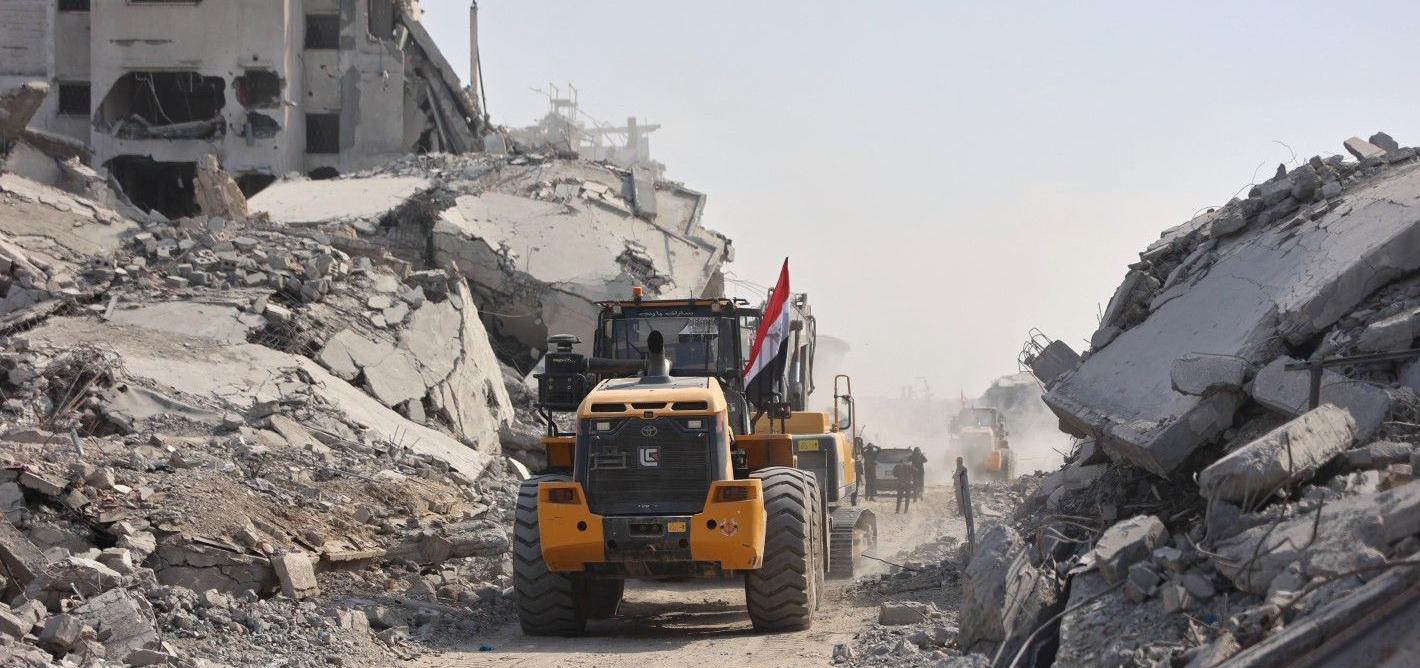
To operationalize this strategy, the United States must first confront the reality of its shrinking economic footprint. Although the U.S. is the second-largest source of FDI in Egypt, American companies are concentrated in the oil and gas sector and have comparatively small footprints in nonextractive industries.9 While the U.S. remains a top investor in Egypt’s energy sector, with 85 percent of total U.S. FDI concentrated in oil and gas, it has largely ceded non-extractive industries to global competitors. Today, U.S. firms face a landscape defined by state-led infrastructure projects and military dominance in the economy. Despite these structural distortions, Egypt’s macroeconomic reforms in 2024 and positioning as a logistics hub offer a narrow but vital window to re-engage, and the growing influence of competing powers in the region makes that an imperative.
The U.S. was Egypt’s second-largest source of foreign direct investment (FDI) inflows during the 2023/2024 fiscal year, with American companies investing $3 billion. American firms – including Apache Corporation, Chevron, and ExxonMobil – are major players in Egypt’s oil and gas sector, while non-petroleum U.S. investment reached $2.5 billion in 2025, spread across over 2,000 businesses in Egypt’s financial, manufacturing, and services sectors.10
Egypt’s 2025 National Narrative for Economic Development targets a seven percent annual growth rate by 2030, and an increase in investment to eighteen percent of GDP.11 The plan highlights the importance of developing a roadmap for high-priority sectors to attract the additional $30 billion in investment needed. However, the Egyptian state, and particularly its military institutions, commands nearly every major sector. Estimates vary, but in 2019, the Carnegie Endowment assessed the military controlled about 25 percent of Egypt’s economy through direct ownership, preferential contracting, and sprawling networks of stateowned enterprises.12 These include construction,
infrastructure, cement, steel, food production, and even tourism.13 The military’s role in Egypt’s economy is thought to have grown since 2014.14 Despite President El-Sisi’s efforts to present the military as an engine of modernization for the Egyptian economy, the IMF and private investors have repeatedly warned that unequal competition and limited transparency crowd out private firms.15,16 The World Bank notes that while the public investment boom has kept short-term growth positive, it has not generated a sustainable, broad-based private sector.
Since 1978, the U.S. has invested over $30 billion of economic development assistance in Egypt.17 While U.S. Agency for International Development (USAID) assistance initially focused on supporting large-scale infrastructure development across Egypt with an annual budget of approximately $815 million during the 1980s and 1990s, the U.S. gradually decreased assistance to approximately $250 million annually before the Arab Spring. USAID also increasingly shifted its focus to education, health, economic growth, and democracy and governance projects. Following 2013, the U.S.
further reduced Economic Support Funds (ESF) to approximately $125 million annually. While decreased funding reduced the influence of direct economic assistance in the bilateral relationship, USAID’s assistance continued playing a significant role in bolstering the private sector, supporting U.S. businesses seeking to navigate the local environment, advancing public education, improving public health services, and strengthening responsive government institutions. The closure of USAID in 2025 marked an end of direct U.S. economic assistance to Egypt, although significant funds that were in the USAID remain available for development assistance projects. The House 2026 appropriations bill introduced in July 2025 also includes $6.8 billion for foreign assistance through National Security Investment Programs with at least 15 percent earmarked for programs in Africa.18
In 1996, the U.S. Congress sought to stimulate
regional economic cooperation between Israel and Arab countries by developing Qualifying Industrial Zones (QIZ). Under the system, goods produced in QIZ industrial parks in Egypt, Jordan, and Palestinian territories could directly access U.S. markets without tariff or quota restrictions so long as the goods contained an agreed-upon amount of Israeli inputs. Egypt initially did not participate in the QIZ system, but it later chose to sign the QIZ Protocol in 2004, when the World Trade Organization phased out quantitative quotas on textiles and exposed Egyptian industry to global competition. Under the QIZ program, products exported to the United States must contain at least 35 percent qualifying content by value. For goods jointly produced by Egypt and Israel, this requirement can be met in one of two ways: either through minimum input shares from each country – nearly 12 percent from Egypt and approximately 11 percent from Israel – or by having each country contribute 20 percent of total production costs, with the remaining content sourced from an Egyptian QIZ, Israel, or the United States.
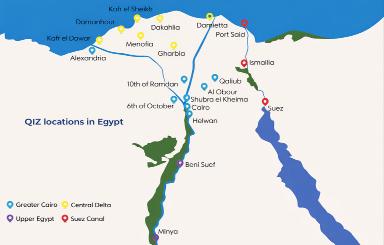
Egypt currently has six QIZs, primarily hosting firms in the textile industry.19 Of the 1,216 companies in Egypt’s QIZs in 2024, 80 percent produced apparel and 9 percent produced processed frozen food. Other sectors, including electrical equipment and appliances, remain well below one percent of exports. The QIZ system plays a major role in U.S.-Egypt trade, with QIZ-manufactured goods accounting for 52 percent of Egyptian exports to the U.S.20
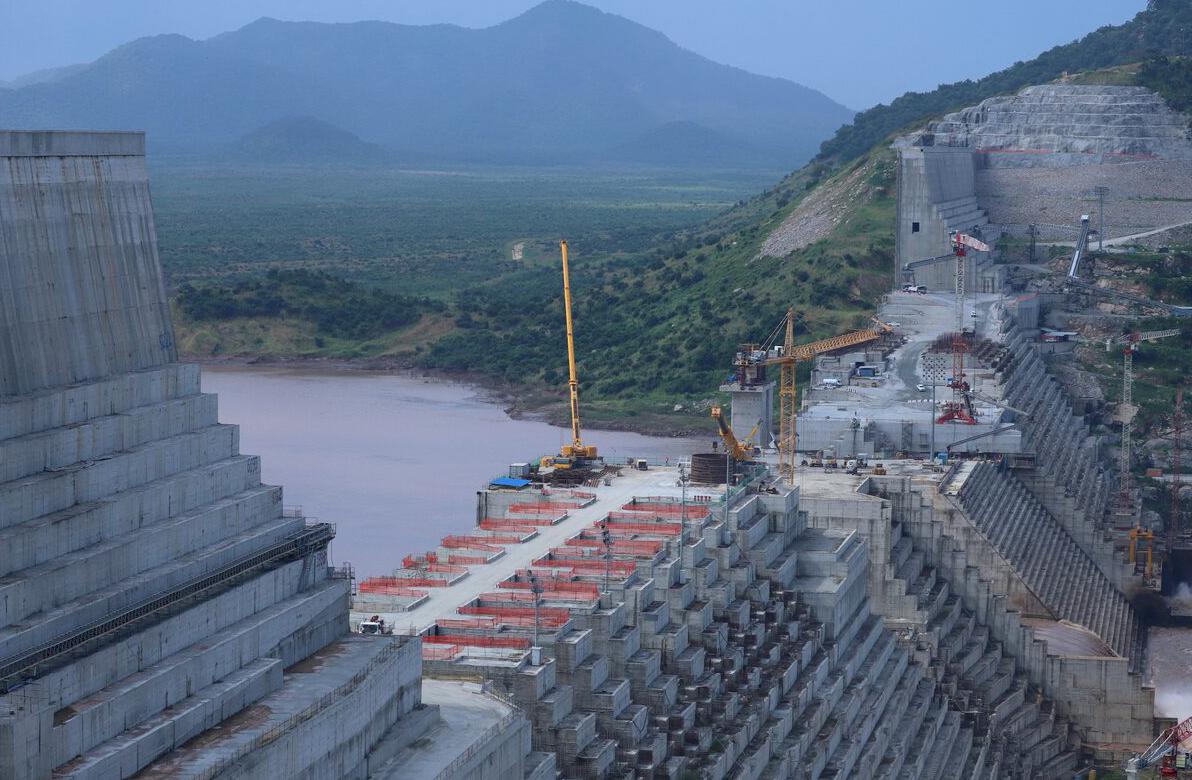
Ethiopia’s Grand Renaissance Dam is seen as it undergoes construction work on the river Nile in Guba Woreda, Benishangul Gumuz Region, Ethiopia, September 26, 2019. Reuters, 2019.
The U.S.-Egypt security pillar requires modernization. Since the Camp David Accords, the $1.3 billion annual FMF package has underwritten peace between Egypt and Israel and secured U.S. access for ongoing cooperation. The tumultuous transition from Mubarak to Morsi to el-Sisi (2011–2013) exposed the limits of U.S. influence as Washington struggled to balance democratic values with security interests. Today, the relationship remains transactional but vital. To maintain relevance as the broader relationship is expanded, U.S. security assistance must carefully evolve from a static ‘fee for access’ model into a tool that addresses modern shared threats, from Red Sea maritime security to the stabilization of Gaza.
Since the 1979 Egypt-Israel Peace Treaty, the U.S. has provided sustained financial and operational support to promote Egypt’s compliance with its security obligations and emergence as a security partner. The Treaty required Israel return the Sinai Peninsula to Egypt while establishing diplomatic, economic, and cultural relations between the countries, with limited-force zones
monitored by the Multinational Force and Observers (MFO), where U.S. troops form the largest contingent. The treaty also cemented U.S. financial support through Foreign Military Financing (FMF), which allows Egypt to procure U.S. equipment. Since 1987, Congress has appropriated $1.3 billion annually in FMF to Egypt.21 The U.S. and Egypt also participate in joint military exercises, including the biennial Bright Star exercise, which has become one of
the largest joint military exercises in the world.22 These initiatives have historically reinforced operational interoperability, facilitated U.S. access to Egyptian airspace and the Suez Canal, and demonstrated U.S. commitment to regional stability. In the Trump Administration’s 2025 90-day global aid review, notably, FMF to Egypt and Israel was explicitly exempted. Egypt’s FMF is subject to the Leahy Law, which restricts U.S. military assistance to specific units credibly implicated in human rights abuses. Separately, since 2012, annual appropriations bills included a provision conditioning $300 million of Egypt’s FMF on Cairo taking measurable steps toward advancing democracy and human rights. In theory, conditionality provides Congress and the Administration a legal mechanism to influence Egyptian military and political behavior without disrupting overall funding.23 In practice, however, the appropriations-based human rights conditions have frequently been waived on national security grounds, most recently by the Biden Administration in 2024, limiting their practical leverage.
U.S.-Egypt military cooperation faces increasing complexities as Cairo seeks to diversify its arms imports. It has acquired equipment from over twenty countries, including Russia, France, and China. In 2025, Egypt and China began their first ever joint air exercise, “Eagles of Civilization 2025,” indicating Cairo’s interest in hedging its strategic options and deepening ties with non-Western powers. Egypt has also attempted to acquire advanced systems like the Chinese J-10 or J-35 fighter jets; meanwhile, the U.S. sends older F-16s to Egypt rather than the advanced F-35s it supplies to Israel.24 In addition, Egypt’s military plays an active role in the Egyptian economy, with stateowned enterprises competing in multiple sectors. The military’s domestic footprint distorts resource allocation and has contributed to a shrinking private sector.
Egypt’s control of the Suez Canal, a vital waterway ferrying approximately twelve
percent of global trade and seven percent of global oil shipments annually, has made maritime security cooperation a central issue in U.S.-Egypt relations.25 The importance of this cooperation was cemented during the 1956 Suez Crisis, when the Eisenhower Administration intervened to prevent Britain, France, and Israel from seizing the Canal, shaping enduring expectations of U.S. support for Egyptian sovereignty.26 Egypt currently grants U.S. naval ships priority when transiting the Suez Canal27 and has permitted U.S. nuclear-powered ships to transit since 1984.28
The Canal’s strategic importance has been heightened by growing instability in the Red Sea. Since late 2023, Houthi attacks on commercial shipping have disrupted maritime traffic, redirected vessels away from the Red Sea route, and compounded Egypt’s economic crisis.29 These developments have elevated maritime security cooperation to a central priority in the bilateral relationship, requiring the U.S. to take steps to sustain security cooperation in the Red Sea and navigate sensitivities over sovereignty.
The Grand Ethiopian Renaissance Dam (GERD), an Ethiopian hydroelectric project initiated in 2011 and completed in 2025, has been a focal point of regional tension between Egypt, Ethiopia, and Sudan since its inception. Because the Nile underpins Egypt’s economy and food security, the GERD dispute has critical economic and strategic implications, and many Egyptians view it as an existential threat.30
The U.S. has intermittently played a mediating role in the GERD dispute. In 2019, the Trump Administration hosted Egypt, Ethiopia, and Sudan in Washington to negotiate a framework for filling and operating the GERD, known as the Washington Process. However, Ethiopia withdrew from the final round and Sudan declined to formally consent, leaving Egypt as the sole signatory for a proposed agreement.
Opposition to the agreement reflected concerns of U.S. bias toward Egypt and language reminiscent of colonial-era Nile treaties. President Trump made public statements in 2020 speculating Egypt may blow up the GERD and in 2025 condemning Ethiopia’s restrictions on Nile water flow, complicating the U.S. role as a neutral mediator.31,32 Nevertheless, as President Trump continues to claim the GERD dispute as one of the conflicts that he has resolved, the current U.S. Administration is incentivized to continue pushing all parties to reach a deal over Nile resources and prevent conflict between two of Africa’s largest countries now that the dam is complete.
Counterterrorism has been a central pillar of the U.S.-Egypt security partnership since the 1990s, when U.S. concerns about transnational terrorism prompted closer cooperation between Washington and Cairo on intelligence sharing, border security, and efforts to contain regional militant groups across the region. After the 2011 fall of Hosni Mubarak, security in Sinai deteriorated rapidly as militant groups, including the Islamic State affiliate Wilayat Sinai, exploited a vacuum of governance and longstanding grievances among Sinai’s marginalized Bedouin communities. Thus, security in the Sinai shifted from state-level deterrence to counter-insurgency.33 With Israeli agreement, Egypt mobilized the Treaty’s Agreed Activities Mechanism to expand its military footprint and launch major counterinsurgency operations. This has been supported indirectly by U.S. intelligence and coordination through the MFO. Egypt’s initial approach, which included widespread home demolitions, population displacement, and heavy restrictions on movement, drew persistent criticism from the United States and international human rights monitors.34,35 Conflict dynamics shifted in 2017 when Wilayat Sinai turned against local tribes, prompting clans to side with the state and enabling Egypt to launch Operation Sinai 2018, a more population-centric approach that contributed to a sharp decline in terrorist
activity.36 Despite these gains, allegations of human-rights abuses have continued to strain U.S.-Egypt relations. In this environment, U.S.-Egypt counterterrorism cooperation has become one of the most active, operationally significant, and politically sensitive components of the bilateral relationship. U.S. military aid, equipment, and guidance have bolstered Egyptian counterinsurgency efforts against ISIS’s Sinai Province and secured key strategic areas.
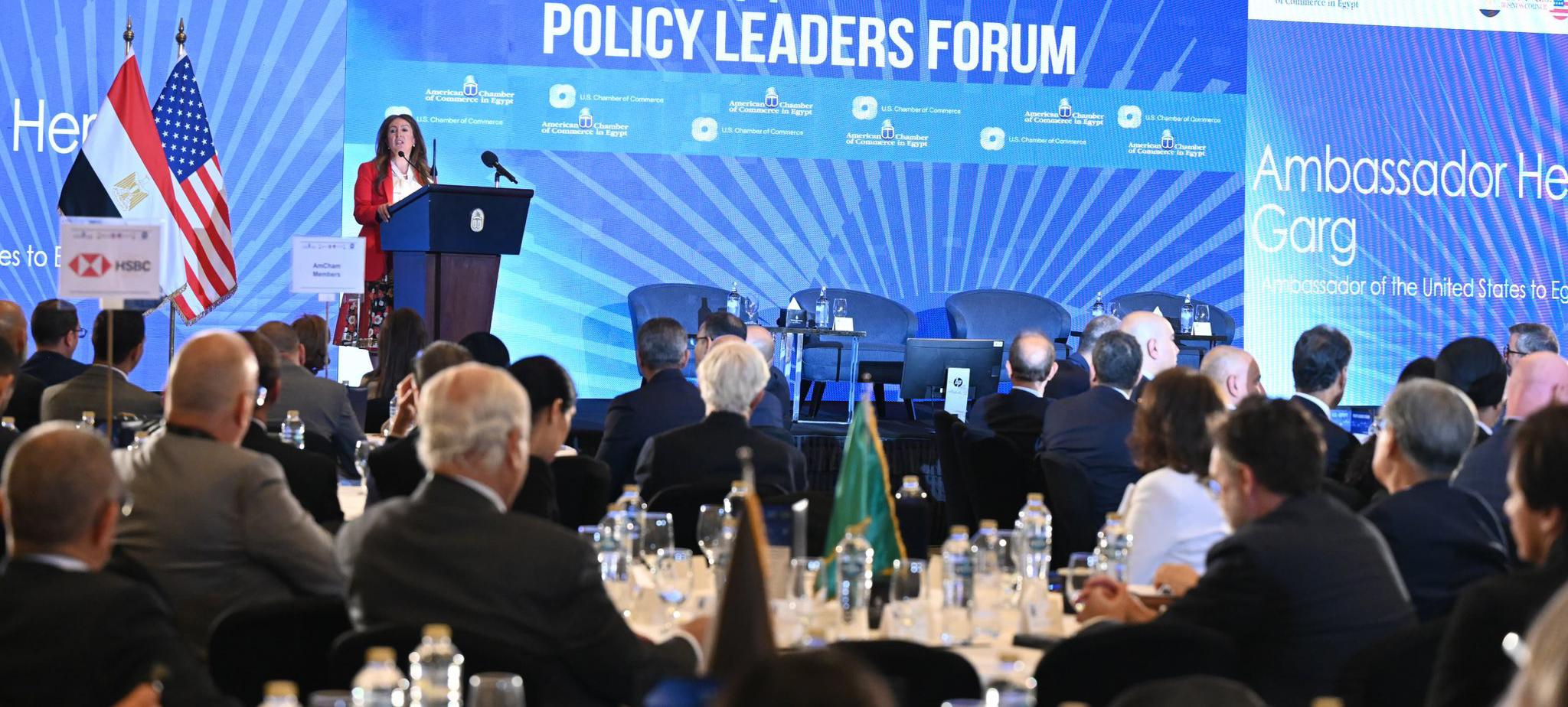
Cultural appreciation and people-to-people ties are critical for renewing the U.S.–Egypt relationship. A recalibrated diplomatic approach should build on the countries’ long-standing historical ties while remaining clear-eyed about governance and human-rights concerns in Egypt.
The U.S.-Egypt relationship is anchored by a profound mutual cultural fascination. For Americans, Egypt holds a unique place in the public imagination, defined by an enduring interest in its ancient heritage. For Egyptians, the United States remains a primary source of cultural influence and a beacon of educational and economic opportunity.
This organic bond is reinforced by a diaspora of approximately 300,000 Egyptians in the United States, including a vibrant Coptic Christian community, who serve as a vital bridge for commerce and values.37 Beyond these ties, the United States actively cultivates influence through robust academic programs; initiatives like Fulbright and the U.S.-Egypt Higher Education Initiative have provided scholarships and technical training to thousands of Egyptians.38 Complemented by heritage preservation efforts through the American Research Center in Egypt, these initiatives ensure the partnership extends beyond security corridors into the broader fabric of society.
The U.S. State Department’s 2024 Human Rights Review of Egypt found that “significant human rights issues included credible reports of: torture or cruel, inhuman, or degrading treatment or punishment; arbitrary arrest and detention; instances of transnational repression against individuals in another country; serious restrictions on freedom of expression and media freedom, including unjustified arrests or prosecutions of journalists and censorship; significant restrictions on workers’ freedom of association; and significant presence of some of the worst forms of child labor. The government’s failure to investigate or prosecute allegations of human rights abuses contributes to an environment of impunity.”39 The Egyptian government took an important step in September 2025, when President el-Sisi pardoned Alaa Abd El-Fattah, one of Egypt’s most high-profile political prisoners, who had spent most of the past 12 years in prison. However, the pardon was not matched with systemic changes to address underlying human rights challenges.
Egypt is a lower middle-income country which has long struggled to achieve sustained and broadbased economic growth. It occupies a unique position in the global economic order, as well as that of the Middle East and North Africa (MENA). Egypt is relatively labor-rich and resource-poor. With nearly 120 million people, Egypt is the largest Arab country by population—however, it lacks the scale of oil and natural gas reserves of neighbors like Saudi Arabia and Israel. As a result, it is unable to rely on its energy sector to drive economic growth.
Instead, Egypt’s economy has tried, with limited success, to diversify and define its niche. The current Egyptian economy relies on tourism, revenue from Suez Canal traffic, and a significant but rapidly weakening energy sector. The government has tried to reorient Egypt’s economy toward manufacturing and greater value-added exports with limited success. In all of these sectors, economic growth has been inhibited by Egypt’s macroeconomic fundamentals—including persistently high inflation, fiscal deficits, and an overvalued currency—a trend that repeated IMF reform programs have tried to fix. Egypt has yet to unlock its potential for economic growth, and American companies have thus far been reluctant to invest beyond Egypt’s energy sector. This is largely due to structural barriers to free enterprise, including undue military influence on the economy; macroeconomic volatility; institutional shortcomings in the rule of law; and low liquidity.
Egypt’s economic dysfunction represents a strategic vulnerability for the United States. Cairo’s reliance on state-led economics and external bailouts has created a brittle environment that deters American capital while inviting deeper influence from strategic competitors like China and the Gulf.
The United States should not wait for Egypt to reform its internal markets before engaging. Instead, this report offers recommendations on how to improve prospects for American businesses in Egypt, creating pro-U.S. constituencies, and using U.S. policy to encourage meaningful reforms in the long run. These recommendations are aimed at securing a U.S. commercial foothold that generates leverage, benefits both nations, and denies adversaries uncontested control over a global logistics chokepoint.

The Suez Canal, and the toll revenue it generates, is one of Egypt’s most important economic assets. Roughly twelve percent of global trade flows through the Suez Canal annually - but recent global events have eroded Suez Canal revenues.40 The Covid-19 pandemic, the war in Gaza, and ongoing Houthi attacks on shipping in the Red Sea have impeded trade through the region. Between 2023 and 2024, canal traffic dropped by nearly two-thirds in tonnage.41 Maritime insurance rates skyrocketed in response to Houthi missile attacks while major shipping companies rerouted their vessels around the Cape of Good Hope to avoid the Red Sea. Even more alarmingly for Egypt, toll revenue from the Canal fell from over $10 billion in 2023 to just under $4 billion in 2024.42 Initial signs indicate canal traffic and toll revenue are recovering in 2025 in the wake of the Sharm-elSheikh conference and the ceasefire in Gaza.43
The Suez Canal has particular significance for the United States not as an investment destination, but a vital artery for global trade. The Canal is a critical chokepoint for global shipping. Any disruption in the Canal causes worldwide ripple effects through supply chains and raises costs for American consumers. In part to mitigate these disruptions, the U.S. has led a multi-national military coalition against
the Houthis. To date, the campaign has produced mixed results, inflicting limited damage on Houthi military infrastructure while imposing costs of well over $1 billion on the United States as of July 2025.44 Notably, Egypt was not part of this coalition, raising questions of whether U.S. regional allies, including Egypt, are willing or able to shoulder more of the burden.
Egypt is facing a protracted energy crisis caused by the underperformance of its fossil fuel sector. Fueled by a growing population and rising industrial demand, Egypt’s energy needs have risen consistently over the last three decades. In order to meet domestic energy needs and to export and bolster Egypt’s foreign exchange reserves, Egypt’s government bet heavily on natural gas. But many of Egypt’s fossil fuel sources, most notably the gigantic Zohr gas field in the Mediterranean, have been far less productive than predicted. As of 2024, Egypt was running a record natural gas deficit of 400 billion cubic feet per year.46 To meet domestic needs, Egypt has had to import billions of dollars worth of natural gas, primarily from Israel. In December of 2025, Israel announced its approval of a $37 billion deal to export additional natural gas to Egypt – a deal that the Trump Administration reportedly pushed Israel to make.47 In the interim, Egypt continues to purchase liquified natural gas on the world market at higher prices than it pays to domestic or regional, including Israeli, suppliers.48 Egypt has gone from being a consistent exporter of natural gas to not meeting
domestic consumption needs.49 The government has resorted to imposing periodic blackouts when demand for electricity spikes or energy supplies are threatened by geopolitical events.50 These energy imports – primarily natural gas – strain Egypt’s balance of payments, eating into foreign currency reserves and hampering long-term investment in expanding domestic capacity.51
As Egypt’s domestic gas production falters, its energy mixture is a growing liability. Natural gas comprises 57 percent of its total energy supply, followed by oil at roughly a third.52 Renewable sources combined provide just 12 percent of the total.53 Natural gas dominates Egypt’s electricity generation, accounting for 76 percent of output, with oil a distant second at 11 percent and renewables supplying the remaining 13 percent.
Egypt has little choice but to transition away from fossil fuels and Cairo has publicly committed to an ambitious transition toward renewables. Egypt aims to generate 42 percent of its electricity from renewable sources by 2030, almost four times the current percentage.54 Solar and wind power are particularly promising sources of energy in the country. Egypt is home to
some of the sunniest accessible land in the world, with the deserts of western and southern Egypt receiving more than 3,500 hours of sunshine per year.55 Likewise, Egypt’s geography and natural resources are also remarkably favorable for wind energy projects. The Gulf of Suez and the Nile Valley both have consistently high wind speeds, and have attracted significant investment from Egyptian and foreign sources.56 Although many wind and solar projects in the country are owned or managed by the government’s New and Renewable Energy Authority, they are usually built by foreign companies. These companies hail almost exclusively from the EU (such as Norway’s Scatec or Germany’s Siemens) or from the UAE. Chinese involvement in the sector is also growing. In August of 2025, Egypt signed a $220 million agreement with investors from the UAE, Bahrain, and China to build a solar cell factory in the Suez Canal Zone.57
Egypt’s energy transition presents both a challenge and an opportunity for American companies. U.S. energy companies are heavily involved in Egypt’s fossil fuel sector, and risk losing their position in the country if its oil and gas production continues to stagnate. But Egypt is embarking on an ambitious plan to transition
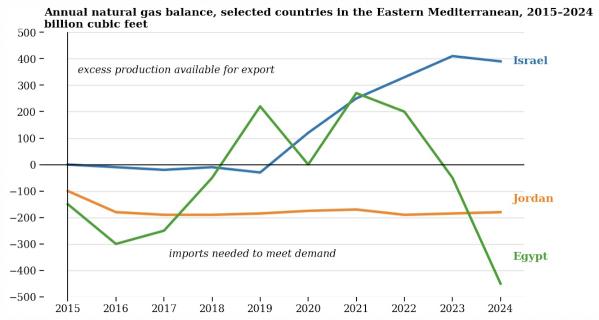
Egypt is facing a protracted energy crisis caused by the underperformance of its fossil fuel sector. Fueled by a growing population and rising industrial demand, Egypt’s energy needs have risen consistently over the last three decades. As of 2024, Egypt was running a record natural gas deficit of 400 billion cubic feet per year. To meet domestic needs, Egypt has had to import billions of dollars worth of natural gas, primarily from Israel.
toward renewable energy sources – a sector in which American companies have next to no presence. The Egyptian government is, for instance, modernizing 19 electrical distribution control centers. The contract for only one of these went to an American company (General Electric), while the rest went to European or Japanese providers.58
It is important to note that Egypt is not transitioning away from fossil fuels purely for environmental reasons. Domestic fossil fuel sources are quickly depleting, and a persistent energy deficit carries both economic and national security risks. Egypt has no choice but to increase the share of renewable energy in its economy. Firms from Europe, the Gulf, and China have realized this; American firms risk being left out as fossil fuel sources dwindle or become uncompetitive, while lucrative contracts focus on solar, wind, nuclear, and other sources of energy.
Egypt has long aspired to become a hub for manufacturing, with successive governments attempting – with mixed results – to jump-start domestic manufacturing through large stateowned enterprises and foreign investment. Special economic zones, particularly in the Suez Canal region, have been central to this strategy. More recently, Egypt’s government has taken aggressive action to improve its business climate. The 2024 exchange-rate reforms and a massive infusion of foreign currency from the UAE’s $35 billion Ras el-Hikma real estate deal eased investors’ macroeconomic concerns.59 Through these and other initiatives, the Egyptian government is trying to revive a long-stagnant manufacturing sector. In 2024, manufacturing accounted for roughly 14 percent of Egypt’s economy, continuing a decline that began in 2016.60 Value added in Egyptian manufacturing remains limited. The top industrial sectors –including fuels, chemicals, basic metals, food & beverages, and textiles – are largely extractive or low-tech.61 Manufacturing value added per capita stagnated over the first two decades of the
21st century. There are, however, some bright spots. Automotive industry production began to skyrocket in 2024, driven by partnerships with foreign car manufacturers62 including General Motors, which operates a large manufacturing facility in Giza. According to a GM Egypt representative, the Egyptian factory is one of the cheapest to operate in the world and benefits from a highly-skilled local labor pool. He credited government efforts to support manufacturing for the success of GM’s operations, but noted large, influential companies were better-poised to capitalize on these opportunities than smaller counterparts.
Several of our interlocutors noted how attractive a manufacturing destination Egypt seemed on paper - pointing to Egypt’s workforce potential and geographic advantage - and often expressed surprise that foreign companies seemed reluctant to invest in the country. The government has expressed interest in expanding the presence of foreign manufacturers and shown some willingness to pursue reforms to make the economy more competitive. Some American companies have already invested heavily in Egypt, and several of their representatives seemed confident that their investments were sound.
The U.S. has an interest in securing commercial opportunities for American companies abroad, while also protecting American workers from unfair competition. Egypt is positioning itself as a promising destination for American investment, and one that occupies a different rung in global value chains from U.S. businesses. As such, the United States should consider supporting American businesses as they capitalize on Egypt’s potential for growth.
Tourism has long been one of Egypt’s most reliable sources of revenue and foreign exchange. Its unique cultural heritage brings millions of visitors each year. 2024 was a recordbreaking year for Egyptian tourism, with the industry comprising roughly 9 percent of GDP
and 2.7 million jobs.63 Tourism in Egypt has largely recovered from its pandemic-era trough. Many expected the war in Gaza to deter tourists with safety concerns, travel restrictions, and infrastructure disruptions. However, several interlocutors noted the conflict had less impact on Egypt’s tourism economy than expected. As one former Egyptian official put it, Egypt “lost on Suez, but gained on tourism” as tourism revenues largely offset trade disruptions. Still, tourism’s volatility limits its ability to deliver sustained, inclusive growth over the long term. With heavy Gulf investment dominating the tourism industry – most notably in the United Arab Emirates’ $35 billion Ras el-Hikma real estate deal – there are few unrealized opportunities for American businesses in the sector.
Despite Egypt’s size and strategic location, its growth has failed to meaningfully increase per-capita income.64 U.S. business penetration is also low, accounting for 5.3 percent of FDI inflows in FY2023/2024.65 Economic analyses cite three core issues for Egypt’s lackluster growth: persistent overvaluation of the Egyptian Pound; an overreliance on aid; and deep-seated governance issues that limit private enterprise.66 The lack of liquid capital, and in particular the absence of U.S. financial institutions, also plays a role.
Egypt’s global economic position is fragile: it is dependent on imports, especially food, and perpetually short on foreign currency. As of 2025, Egypt runs a current account deficit of approximately six percent of GDP.67 Its balanceof-payments issues have worsened in recent years due to its energy slump and high wheat costs from Russia’s war in Ukraine. Egypt also relies heavily on remittances from citizens abroad for foreign currency. In the first nine months of 2024, Egyptians sent nearly $21 billion in remittances, equivalent to approximately seven percent of annual GDP.68
These problems are compounded by Egypt’s resistance to devaluing its currency. The Egyptian Pound, and its long-standing peg to the dollar, has made Egyptian exports uncompetitive and imports artificially cheap. This situation is unsustainable. Egypt has undergone repeated currency crises over the last decade, including in 2016, 2022, and 2024. But successive governments have devalued the Pound only when forced to by the IMF – largely out of fear of the social unrest that might arise due to inflation. Egypt’s currency instability has deterred foreign investors and worsened the country’s current account imablance.
Egypt’s pivotal position in global geopolitics has repeatedly triggered multilateral and bilateral aid during moments of crisis. This has created a moral hazard problem. Egypt’s leaders resist embarking on the core structural reforms needed to fundamentally transform the economy, anticipating continued external support based on the country’s perceived “too big to fail” status. Egypt’s critical role in the Israel-Palestine conflict has only lent more credence to the government’s hypothesis. Now more than ever, political stability is paramount and donors are unwilling to apply too much pressure.
The government and the military still play an outsized role in Egypt’s economy. In 2022, the private sector was responsible for less than 30 percent of all investment.77 Accurate estimates for military control of the economy are difficult to come by, as – in addition to directly owning enterprises – the Egyptian Armed Forces shape market access, land allocation, licensing, and contracting, making them a persistent veto player.78 Huge state-owned enterprises crowd out private investment, and overlapping layers of bureaucracy deter growth.
Deficiencies in the rule of law have also hampered foreign investment and economic growth. Courts often enforce laws inconsistently and give preferential treatment to militaryaligned entities.79 Even in a joint venture with such entities, the lack of separation between joint venture partner, regulator, and even customer adds uncertainty to the risk calculus. U.S. firms, which often operate with more stringent governance requirements, view this as a primary risk, particularly for capital-intensive or longtenor investments.
Egyptian intellectual property (IP) protections are insufficiently enforced domestically. U.S. companies typically prioritize IP protection, yet both China and India, now major players in Egypt, operate with greater tolerance for weak IP enforcement. Interviews with Egyptian privatesector actors reveal China wins contracts precisely because it does not demand high-IP protection environments, especially for infrastructure, industrial equipment, and energy technologies. This systematically disadvantages U.S. entrants in sectors where IP is crucial to value.
Finally, corruption remains an endemic issue. Transparency International’s Corruption Perceptions Index gives Egypt a score of 30 out of 100 and ranks it 130th of 180 countries. This score has remained largely unchanged since tracking
began in 2012. Businesses in Egypt run the risk of threats, extortion, bribery, or expropriation. It is, however, worth noting that despite this, there are genuine pockets of excellence in the Egyptian government. In particular, interviews cited the Ministry of Finance; the Ministry of Investment & Foreign Trade; and the Ministry of Planning, Economic Development & International Cooperation as exceptional and reform-minded ministries. There remains an appetite for changing the status quo among some at the highest levels of government.
Examining Egypt’s development pathway more broadly, it is clear that the structure of the economy remains a challenge. Egypt’s exports are dominated by low-complexity, low valueadded goods.80 Beyond their vulnerability to geopolitical headwinds, these sectors are generally low productivity and offer limited potential for sustained growth. In an economy with an unemployment rate of approximately 7 percent and – more concerningly – a youth unemployment rate of roughly 19 percent, low-productivity sectors are unlikely to offer a path to sustained growth. The infrastructure megaprojects favored by el-Sisi could offer an alternative source of employment, but persistent skills mismatches remain between the construction jobs being created and the university graduates who constitute a large share of Egypt’s unemployed. The potential positives are outweighed by the financial strain these projects place on the national budget, as well as the level of military involvement and corruption.
Egypt’s economic fundamentals cannot be assessed in isolation from its macroeconomic challenges and its strained relationship with the International Monetary Fund. As the IMF’s largest shareholder, the United States holds veto authority over major decisions, making U.S. support critical to the approval of IMF programs. Egypt has embarked on three IMF-led reform programs: in 1991, 2016, and 2022. Each time, IMF interventions have achieved short-term macroeconomic stabilization while failing
to address structural economic challenges, delivering durable reform, or protecting the poor from the impacts of austerity.
Egypt’s first IMF-sponsored reform program, the Economic Reform and Structural Adjustment Program (ERSAP), began in the early 1990s.81 By many accounts, the program succeeded in achieving macroeconomic stabilization: a 2000 African Development Bank evaluation found GDP growth exceeded targets, inflation fell from 22 percent to four percent, the budget deficit shrank from 20 percent to one percent, and private funding competed with public investment.82 However, the program failed to achieve the structural transformation required in the Egyptian economy. Egypt remained heavily dependent on external resources, rather than sustained domestic growth, exports, or investment. The ERSAP did not allow for the accumulation of domestic capital. The program’s social record was also mixed. Unemployment remained high while inequality and poverty deepened, giving rise to public narratives linking the IMF with negative social outcomes.83
Egypt’s second IMF-sponsored reform program played out similarly. President elSisi’s government signed a 3-year, $12 billion Extended Fund Facility (EFF) in November 2016. The conditionalities were similar to those in the ERSAP: floating the Egyptian Pound, cutting energy subsidies, imposing a value added tax, and tight monetary policy to curb inflation. The reform also included credit access for SMEs, measures to improve women’s economic participation, and the expansion of social welfare programs. The program’s results mirrored those from the 1990s – success on macroeconomic indicators, but weak underlying growth, limited private investment, persistent unemployment, and a sharp uptick in poverty.84
Another EFF was approved in December 2022, conditioned on adopting a permanently flexible exchange rate and a State Ownership Policy to encourage privatization.85 But the Egyptian government held on to its policy of overvaluing its currency and delayed plans to divest state assets.86 Parliament had originally approved
plans to sell thirty-five public enterprises – but ended up selling only minority stakes in five.87
In 2023, Egypt faced another major economic crisis. Inflation surpassed 30 percent, driven by a 68 percent increase in food and beverage prices. External debt hit $168 billion, up from $55.8 billion in 2016.88 Egypt’s credit rating fell, triggering a wave of foreign capital flight. The crisis was resolved by 2024, following the UAE’s $35 billion Ras el-Hikma real estate investment and the IMF’s approval of an additional $5 billion for Egypt’s EFF.89
It remains uncertain whether Egypt’s current IMF program will succeed where previous efforts failed. Early signs are promising, however: Egypt successfully adopted a floating exchange rate in March of 2024. That same month, the IMF completed its fourth review of Egypt’s progress and released another $1.2 billion in funding.90 However, Egypt remains susceptible to external shocks including the conflict in Gaza, trade disruptions in the Red Sea, or a fall in revenues from the Suez Canal. Nearly a third of the population remains below the poverty line. Unemployment is rampant. The inflation rate – though down from nearly 36 percent in 2024 – remains nearly 13 percent.
Egypt’s long-standing relationship with the IMF has implications for any foreign aid policy directed toward Cairo. Attaching the same conditionalities to subsequent rounds of funding is likely to have similar outcomes. The Egyptian government is clearly skilled at reining in public expenditure, temporarily floating its exchange rate, and taking steps to attract some level of private investment – but has struggled to do these in a way that maintains a robust social safety net, is sustainable, or addresses the underlying challenges with the Egyptian economy. Reiterating identical conditions across successive funding tranches has had limited impact on state behavior.
Egypt needs to address its underlying growth and productivity challenges – and the government appears to recognize this. The 2025 National Economic Development Narrative targets a 7
percent annual growth rate by 2030, and an 18 percent increase in investment. The plan highlights the importance of developing a roadmap for high-priority sectors that will be able to attract the additional $30 billion in investment needed. Any actions taken by the U.S. government should work within this framework rather than through the IMF.
A closer economic relationship with Egypt advances both American commercial and political interests. Commercially, Egypt has significant unrealized economic potential; it is the Middle East’s largest country, the world’s tenth-largest domestic market by population, a logistical hub between the Mediterranean and the Indian Ocean, and the gateway to Sub-Saharan Africa through its infrastructure, shipping, and financial connectivity. It hosts the Suez Canal, a structural chokepoint in the global economy. Removing obstacles to Egypt’s growth benefits both nations. Egypt is one of the United States’ closest partners in the region, but it is trapped in a cycle of crisis and partial reform that hinders both U.S. investment and Egyptian growth. This instability creates a vacuum which adversaries are eager to fill. If American companies can fill voids in its energy, manufacturing, and financial sectors, the United States gains a critical foothold in a pivotal state. In the long term, U.S. policy should encourage and assist Egypt in breaking this cycle and delivering for Egyptians and Americans alike. But in the meantime, the United States can take steps to expand the presence of American companies in the Egyptian market, and in doing so help create constituencies for reform.
The United States has a vested interest in an Egypt that avoids economic collapse, grows sustainably, and develops into a viable market for American goods and services. Crucially, the capacity to execute key points of the strategy outlined in this report is increasing greatly. The FY2026 National Defense Authorization Act (NDAA) raises the Development Finance Corporation’s (DFC) maximum contingent liability cap from $60 billion to $205 billion.91
A deeper economic partnership also has the potential to rebalance and strengthen the bilateral relationship. For decades, the U.S.-
Egypt relationship has rested almost entirely on its single security pillar. This includes military cooperation, defense financing, counterterrorism coordination, and access to the Suez Canal. While this has sustained the relationship through multiple regional shocks, it offers limited leverage. Washington is unwilling, and strategically unable, to meaningfully threaten withdrawal of support for the Egyptian Armed Forces. As a result, U.S. leverage over Egyptian action is limited: Cairo knows the security relationship is stable regardless of its economic governance choices, and should it be threatened, it will likely act to protect the sovereignty of its military, the center of Egypt’s political and governing system.
An economic pillar would rebalance that dynamic. A deeper U.S. economic presence would support American commercial interests; strengthen U.S. competitiveness vis-à-vis China, as well as other powers influencing the region such as the EU, the Gulf, and India; and create durable domestic constituencies inside Egypt aligned with stable, rules-based economic governance. Today, those non-Egyptian constituencies overwhelmingly align with European banks, Gulf sovereign entities, and rapidly growing Chinese lenders and contractors. In the absence of a U.S. economic presence, others have filled the vacuum.
Egypt possesses the fundamental assets to serve as a premier commercial gateway to Africa. Its geography at the nexus of the Mediterranean and the Red Sea, anchored by the Suez Canal, positions it as a critical global logistics node. It benefits from duty-free access across the continent through the African Continental Free Trade Area and the Common Market for Eastern and Southern Africa, as well as robust physical infrastructure, including the Cairo–Cape Town transport corridor and the Vic–Med shipping link.92 Finally, it has a large, growing, and skilled population base that provides both a massive domestic consumer market and labor base, offering an ideal platform for industrial expansion.
Other major global powers have identified this, investing heavily to lock in long-term influence. At the EU-Egypt Summit in October 2025, the EU agreed to a $8.7 billion investment package and officially inducted Egypt into Horizon Europe.93 Egypt is now one of only two African nations with full access to the EU’s massive research and innovation framework, effectively integrating Egyptian universities and firms into the European research and development supply chain.
While other nations offer entry points to the continent, Egypt stands apart as a uniquely advantageous gateway for the United States. Nations like Morocco and South Africa offer competitive, stable entry points to the West and South. Morocco is a staunch ally and active investor in West Africa, yet it lacks Egypt’s massive internal market and control over global logistics routes. South Africa boasts a sophisticated economy, but its growing geopolitical nonalignment limits its utility as a secure platform for U.S. interests. However, Egypt is not without significant liabilities, sitting at the epicenter of regional volatility with active or brewing conflicts in Gaza, Sudan, and Ethiopia. In spite of this, Egypt offers the combination of demographic scale, Suez centrality, deep security alignment. and collaborative relationship already in place. This existing foundation offers the U.S. a unique head start compared to other potential gateways, an opportunity to use its deep institutional access to navigate bureaucracy and de-risk investment in ways less available in other markets. Egypt is well positioned not just as a gateway to the African continent, but as the American Gateway to the continent.
To operationalize this advantage, the United States must confront the reality of its shrinking economic footprint in Egypt relative to other powers. While the U.S. remains a top investor in Egypt’s energy sector, with 85 percent of FDI directed toward oil and gas, it has largely ceded investment in non-extractive industries to global competitors. The strategic imperative is to reverse this trend by leveraging legacy security access to build a modern commercial platform that anchors American influence across the continent.
Our proposed recommendations approach this from two angles. First, we propose steps to create a more conducive environment for American economic interests to compete in Egypt. Then, we suggest ways to support Egypt’s long-term economic growth and stability, making it a better destination for future U.S. investment.
Create a more conducive environment for American economic interests in Egypt. Recommendations 1–4 outline near-term actions that would allow the United States to rapidly expand its economic foothold in Egypt and capitalize on the country’s potential.
1. Provides a clear entry point for private sector engagement in a well-developed Egyptian sector with low IP risk while reducing EU/ Gulf financial dominance
2. Improves visibility into Egypt’s financial system, FX flows, and macro risks affecting regional stability
3. Reduces friction for American firms through OFAC-aligned compliance, familiar banking partners, and structured-finance tool
4. Strengthens competitiveness against China, the Gulf, and Europe in a major regional market and logistics hub
Egypt maintains one of the oldest modern banking sectors in the Middle East, with the Bank of Egypt dating back to 1852. However, the US has no major banking presence in Egypt. Out of 37 banks in Egypt, 19 are foreign owned,94 but since 2015, the US maintains only specialized corporate banking in the country. Chase Manhattan helped establish Egypt’s Commercial International Bank (CIB), but sold its 49% stake in 1987. CIB in turn acquired Citibank Egypt with all of its branches and management in 2015, leaving no US retail presence. Meanwhile,
Egypt has made significant strides in liberalizing its banking sector, attracting foreign entrants from the EU (Intesa Sanpaolo, Crédit Agricole), Qatar (QNB), the UAE (Emirates NBD), and Kuwait (KFH). Without American banks on the ground, U.S. firms lack familiar partners for U.S. regulatory compliance, structured finance, risksharing, and local-currency operations. The gap marginally increases friction and signals U.S. disengagement.
The absence of U.S. financial institutions in Egypt leaves the landscape dominated by EU and Gulf banks. This reduces American visibility into Egypt’s financial system, marginally increases friction for U.S. companies entering the market, and cedes structural influence to competitors. The 2024 UAE “Mega-Deal” underscored how Gulf states, not the U.S., serve as Egypt’s stabilizing financiers, giving them disproportionate political and economic leverage.
Washington should encourage major U.S. banks and specialized non-banking financial institutions to establish a local foothold, either through a branch license or acquisition of a mid-sized Egyptian bank. This should be supported through both existing policy levers to de-risk capital entry, such as DFC political risk insurance and EXIM buyer-financing to reduce perceived instability, as well as clear signaling of U.S. strategic priorities. The U.S.
private sector, especially in financial and other services, have increasingly begun to position their organizations as intentional geopolitical actors, showing a willingness to align large investments with clear U.S. strategic needs.95 Well-defined U.S. government signaling that entry into Egypt aligns with strategic priorities
would provide these organizations with clear direction. It would further signal U.S. willingness to provide regulatory and diplomatic backing in negotiations with the Egyptian government. The U.S. Government could further encourage consortium-style entry, allowing multiple U.S. institutions to share risk.
Promote
1. Expands U.S. commercial presence in a 120-million-person market and gateway to Africa
2. Creates a U.S.-aligned business constituency inside Egypt that advances American economic and political interests
3. Counters Chinese and Indian commercial influence by enabling U.S. firms to enter sectors where they can scale
4. Reduces risk premiums for U.S. investors using DFC/EXIM tools, allowing U.S. firms to compete on equal footing
U.S. commercial investment in Egypt remains far below potential because firms face a series of deterrents: an unpredictable commercial judiciary, political interference, opaque contracting, and exposure to IP loss. These barriers have pushed U.S. firms to the sidelines while Gulf, European, and Asian actors fill the space. The result is a relationship overly anchored in security cooperation, denying the United States both economic leverage and a U.S.-aligned private-sector constituency inside Egypt. Attempts at broad governance reform or judicial restructuring tend to trigger regime defensiveness: Cairo views systemic rule-of-law initiatives as efforts to dilute military economic control that risk stimulating a politically
autonomous business class.
A more practical and politically acceptable approach is to focus on business-specific derisking, organized around three lines of effort.
First, the United States should signal clearly that expanding U.S. business activity in Egypt is a strategic priority. That means pairing traditional de-risking tools such as DFC and EXIM political-risk insurance, loan guarantees, and local-buyer financing, with diplomatic backing in negotiations, demonstrating to U.S. firms that they will not be left exposed when entering a complex market. This combination reduces both transaction risk and perceived political risk. The FY2026 NDAA has increased the feasibility of a renewed U.S. commercial push. The Act raises the DFC’s liability cap from $60 billion to $205 billion. Crucially, it authorizes a new $5 billion Equity Revolving Fund, allowing the DFC to take direct ownership stakes in projects rather than relying solely on debt insurance. Most importantly for Egypt, the legislation explicitly authorizes DFC investment in upper-middle-income countries for strategic competition purposes.
Second, while IP vulnerabilities in Egypt are real, centering U.S. engagement around IP protection places American firms at a structural disadvantage relative to competitors from China and India, whose firms face fewer political or commercial constraints. A more effective strategy is to prioritize sectoral entry points where IP risk is low and U.S. comparative advantages are high,
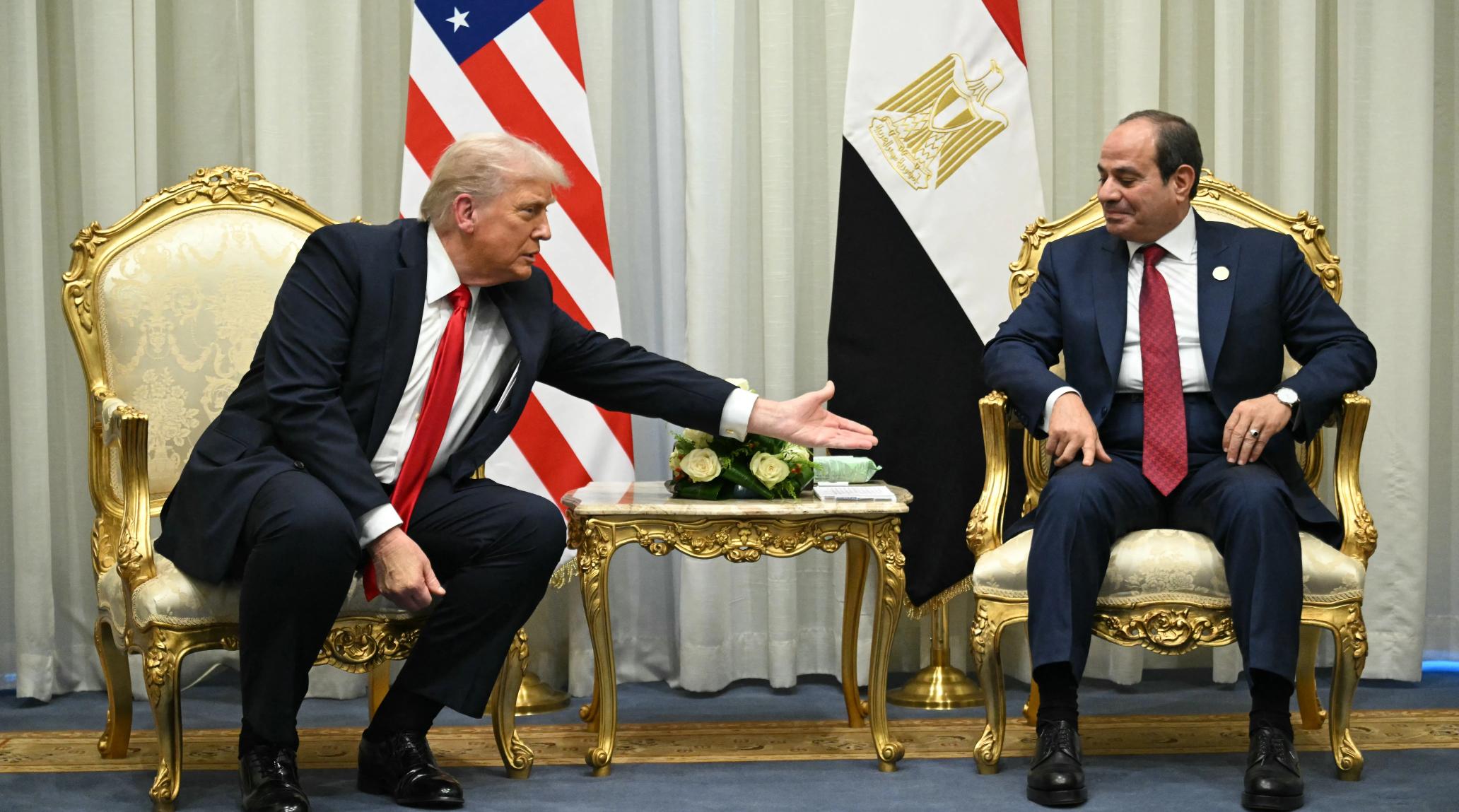
for example logistics, generic pharmaceuticals, solar and battery supply-chain inputs, agritech components, educational and financial services, and other areas where the technical IP exposure is minimal. Signaling these priorities can occur both formally, through sector-specific requests for proposals or investment initiatives, and informally through private-sector outreach via AmCham and targeted engagement with U.S. firms assessing African regional expansion through Egypt.
Third, Washington should pursue targeted commercial-law cooperation rather than sweeping political reform through programs such as ABA-style exchanges for commercial judges, technical assistance modeled on the Delaware Court of Chancery, and support for corporate, bankruptcy, and arbitration capacity. These measures directly benefit investors without intruding on Egypt’s broader political order.
1. Institutionalizes high-level economic engagement, shaping investment climate and regulatory decisions as implementation challenges arise
2. Opens structured pathways for U.S. firms to access priority Egyptian sectors
3. Supports U.S. technology leadership by offering alternatives to Chinese digital infrastructure and industrial partnerships
4. Builds durable economic ties that stabilize the bilateral relationship beyond the military channel
U.S. commercial engagement in Egypt remains far below potential, narrowing the relationship to security cooperation and allowing Gulf, European, Chinese, and Indian firms to shape Egypt’s economic orientation. Egypt’s investment climate, while improving in key sectors, still presents barriers for U.S. firms, and existing channels for addressing these issues are fragmented and low-level. A modern, investment-focused counterpart to the 1990s Gore-Mubarak Partnership would elevate U.S. priorities, expand opportunities for U.S. firms, and anchor a durable economic pillar in the bilateral relationship.
In the mid-1990s, the Gore–Mubarak Economic Partnership, also known as the U.S.–Egypt Partnership for Growth and Development, created an ambitious modern framework for bilateral economic cooperation. Through a VicePresidential to Presidential channel and the U.S.Egypt Presidents Council, it institutionalized economic dialogue, expanded private-sector engagement, supported Egypt’s shift toward market-oriented reforms, and helped lay the groundwork for later successes such as Trade and Investment Framework Agreement (1999) and the QIZ agreement (2004). Although the initiative did not produce broad-based economic gains or political reform, it proved that highlevel engagement paired with structured privatesector input can unlock investment, modernize key ministries, and surface regulatory obstacles that neither government can identify alone.
The U.S. should launch a U.S.-Egypt Partnership for Growth and Prosperity, modeled on the most successful elements of the GoreMubarak era but tailored to today’s strategic environment. The initiative should be framed explicitly around facilitating U.S. investment, improving private-sector collaboration, and identifying joint economic opportunities, without challenging Egypt’s political order or framing reform in politically sensitive terms. The renewed partnership should have four institutional pillars:
i. Establish a Presidents Council, managed by the U.S. Department of Commerce, composed of leading American and Egyptian private-sector executives. Membership should mirror U.S. practice by drawing from independent, competitive Egyptian firms rather than state-linked entities, justifying this limitation with the need for peer-to-peer discussion. The Council would identify investment opportunities, surface bottlenecks, and advise both governments on practical steps to enable U.S. market entry.
ii. Create a Joint Committee for Economic Growth that pairs Egyptian technocratic ministries with U.S. economic agencies. This body would focus on resolving investment barriers, facilitating regulatory clarity for U.S. firms, and coordinating sectorspecific initiatives in areas where American companies have strategic advantages.
iii. Form a Joint Technology Board to expand U.S. participation in digital infrastructure, logistics tech, energy technology, and other sectors where Chinese companies are rapidly increasing market share. The Board would map priority sectors, coordinate pilot projects, and highlight where U.S. firms can offer commercially competitive alternatives.
iv. Form a Joint Civil Governance Board to facilitate transfer of best regulatory practices and bilateral exchange programs for civil servants.
1. Maintains foreign markets for U.S. energy products in a fast-changing Egyptian energy market
2. Ensures deeper Egyptian integration with U.S. suppliers and limits exposure to U.S. strategic adversaries
Egypt faces a severe energy deficit, driven in part by stagnating oil and gas production.96 There is no easy remedy for this decline, which stems primarily from the maturation and deterioration of gas fields and has been compounded by periodic mismanagement by energy companies and regulators.97 As a result, Egypt’s heavy reliance on natural gas has become a growing liability for the broader economy.
From a resource and national security lens, Egypt has little choice but to transition away from fossil fuels. It cannot afford to continue relying on energy imports to meet its needs, and the most promising sources of domestic alternative energy are renewables – particularly wind and solar. The Egyptian government has already set aggressive targets for increasing renewable energy production: it aims to generate 42 percent of its electricity from renewable sources by 2030.98 Construction on large-scale wind and solar plants has begun around the country, often partnering with firms from Europe, the Gulf, or China, and a large Russian-built nuclear plant is scheduled to come online before 2030.
So far, U.S. companies have been largely absent from any part of Egypt’s renewable energy sector. American involvement may not come in the
form of U.S.-made solar panels or wind turbines, if they are not viable exports to Egypt. But U.S. companies are likely competitive in other parts of the sector, such as electrical infrastructure, power management, or software.
The U.S. Government can take steps to ensure that American companies are competitive bidders on these projects, and that they are not losing out due to a lack of support or advocacy from the Washington. By offering DFC or ExportImport Bank (EXIM) political risk insurance to American renewable energy companies bidding on Egyptian contracts, the U.S. Government can bolster American exports while keeping American companies at the center of Egypt’s energy infrastructure. This support would focus on the large-scale wind and solar projects that the Egyptian government has already shown it can build and manage.99 The World Bank has already sponsored $210 million in political risk insurance for investors in a successful Egyptian solar park, a strong indication of this approach’s viability.100 Political risk insurance has the obvious added benefit of only costing taxpayers money if something goes awry, and in all likelihood generating revenue through fees. The Egyptian government has already shown considerable commitment to following through on its energy transition, so risk is limited. But insurance would go a long way toward ensuring that American companies feel confident bidding on large contracts and establishing a foothold in the Egyptian market.
Further, the FY2026 NDAA authorizes a new Equity Revolving Fund, allowing the DFC to take direct ownership stakes in projects rather than just insuring debt. Washington should leverage this authority to co-invest directly with U.S. energy firms, effectively de-risking the initial
capital outlay and signaling to Cairo that the U.S. is a permanent stakeholder in its energy transition, not just a vendor.
From a purely economic standpoint, there is no reason that American companies should limit themselves to working in Egypt’s fossil fuel industry. The Trump Administration has made clear that it will continue to support American oil and gas companies; but in a country where oil and gas may be losing viability, we
recommend that the Administration consider advocating for U.S. companies and supporting them through political risk insurance as they bid on renewable projects. We also recommend that the federal government facilitate energy cooperation between U.S. states and the Egyptian government, since states would have the opportunity to advocate for their renewables providers and have significant experience in infrastructure and energy management.
Support Egypt’s long-term economic growth and stability, making it a better destination for future U.S. investment. Recommendations 5–6 outline larger-scale options that would lay the foundation for a more conducive long-term economic relationship.
1. Creates scope for more American companies to benefit from QIZs by expanding the scope of goods produced and increasing production in high-value sectors
2. Reduces economic and political risk in Egypt by helping to lower Egypt’s high unemployment rate and create economic opportunities for its citizens
3. Creates benefits for both Israel and Palestine, supporting the U.S.-led peace and reconstruction process and reducing the risk of escalating conflict in the Middle East
There are now six QIZs in Egypt with over 1,200 companies benefiting. While annual exports to the U.S. stand at approximately $1.5 billion, 90 percent of these are low-margin textiles, frozen foods, and accessories. Despite decades of operation, the Zones have not enabled Egypt to move into higher-value goods and services.
A majority of the Israeli imports used to make these products are similarly low-value packaging materials.
This presents an opportunity to reform the QIZ system, encouraging producers to move beyond textiles to instead invest in the production of higher value goods. The U.S. should spearhead a process to amend the 1996 law to allow for key services, such as software, to qualify toward content rules. The U.S. should also consider the feasibility of creating an additional QIZ in the Egyptian city of El-Arish near the border with Gaza. This QIZ could focus on producing household goods and construction materials needed for the reconstruction of Gaza and, over time, export to U.S. markets under the QIZ dutyfree framework. The amendments could allow daily employment of workers from Gaza to count toward the 35 percent local-content requirement in QIZ production.
Prioritize
1. Creates an English-speaking market for U.S. products and services, including cultural exports
2. Establishes economic opportunities in Egypt to help prevent extremism and limit push factors in mass migration to the United States
3. Reduces Egyptian reliance on aid, increases its effectiveness as an ally, and preempts demographic crises.
We frequently heard from Egyptian interlocutors about gaps in the education system, noting that many families spend a large share of their income on private tutors even though their children are enrolled in school. The additional cost of these tutors is a huge burden on Egyptian families.
Just as importantly, a young, growing, but poorly educated population with limited economic opportunities poses a serious risk to long-term stability and increases vulnerability to extremism. If the United States hopes to have a reliable ally in Egypt, it should prioritize programs contributing to sustainable economic growth in the country, and nothing offers a return on taxpayer investment like education. A population educated with American assistance and input will also strengthen demand for U.S. cultural exports and a long-term market for U.S. products. American non-military aid to Egypt should give taxpayers the best value for their money; it should bolster the image of the United States in the eyes of Egyptians; and it should further U.S. interests by cementing Egypt’s position as a reliable and effective ally. Educational aid has the best chance of achieving these goals.
If and when U.S.-sponsored educational programs resume, they should be tailored to Egyptian needs and address gaps in the domestic educational system. The American Chamber of Commerce noted how valuable previous U.S.-sponsored workforce development programs had been for American businesses. Educational programs, through English language training, skill development, and inculcation of American values serve Egyptians and Americans alike.
The U.S.-Egypt security relationship, anchored by the Camp David Accords and shared interests in maintaining free passage through the Suez Canal and countering malign non-state actors, remains a pillar of regional stability. However, the partnership is navigating a complex period of recalibration as Egypt moves away from a reliance on the U.S. to diversify its defense procurement with European and Chinese equipment. This shift, driven by a desire for strategic autonomy and a reaction to historic U.S. aid conditions, has created significant hurdles for interoperability and American influence. As the alliance faces new pressures, from the stabilization of Gaza and Red Sea maritime threats to the Nile water dispute, the U.S. must rebalance its approach to account for a more competitive geopolitical landscape. We argue that to sustain Egypt’s role as a reliable partner in promoting regional stability, the U.S. should pivot from a narrow focus on providing requested hardware toward deeper engagement in the human and procedural dimensions of military cooperation. On the immediate challenge of stabilizing and reconstructing Gaza, the U.S. and Egypt require a coordinated strategy that leverages Egypt’s regional leadership in Gaza’s reconstruction efforts while ensuring that security stabilization efforts, such as the International Stabilization Force (ISF) and the training of Palestinian police, are supported by clear diplomatic incentives.
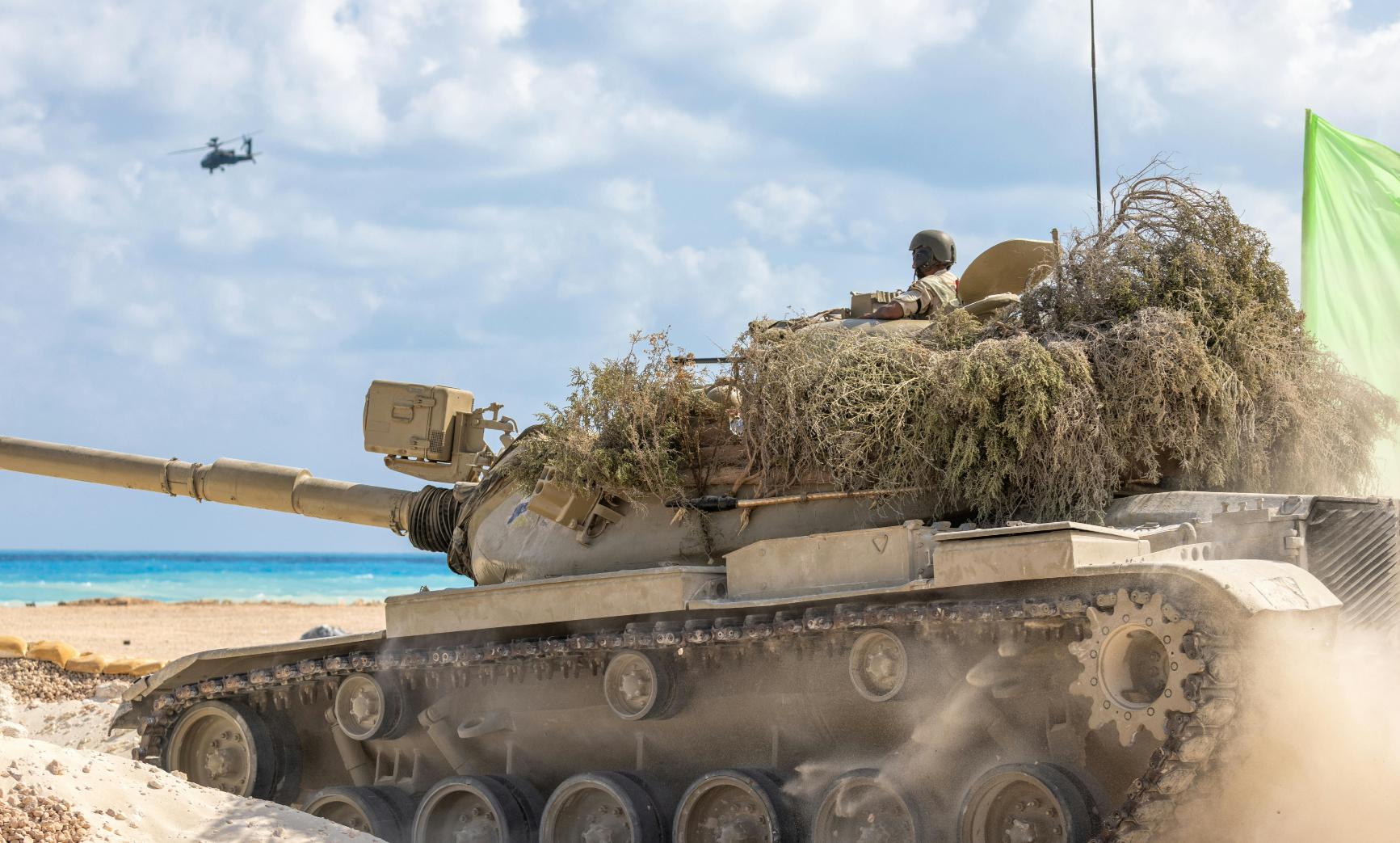
The Camp David Accords established Egypt as a key regional security partner and set it on a path to be officially designated an ally of the U.S. in 1989. While the Egypt-Israel Peace Treaty does not formally obligate U.S. aid, all sides understood the deal’s unwritten terms that Egypt and Israel would receive substantial military and economic support from Washington in exchange for peace.101
Since the late 1980s, Congress has allocated Egypt $1.3 billion in Foreign Military Financing annually.102 Immediately following the Camp David Accords, FMF was important for reequipping the Egyptian military with Americanmade systems and weaning it off Soviet-supplied equipment.103 FMF enables eligible foreign governments to purchase U.S. defense articles, services, and training, meaning that while Egypt benefits from increased military capacity, the FMF funds go directly to U.S. defense companies. While the Secretary of State determines which countries will receive FMF and the respective FMF amounts, the Secretary of Defense executes FMF programs and issues grants in accordance with the Arms Export Control Act.104
The Trump Administration appears committed to largely preserving the traditional aid framework for Egypt. In January 2025, Executive Order 14169 froze most foreign assistance programs, but it explicitly exempted military aid to Egypt and Israel.105 The President’s FY2026 budget request includes the standard $1.3 billion in FMF for Egypt, a figure already approved by the House Appropriations Committee and likely to pass into law.106
Since 2012, annual appropriations bills included a provision withholding roughly $300 million in
FMF unless Egypt takes measurable steps toward advancing democracy and human rights.107 While the State Department has often bypassed this requirement by invoking a national security waiver, some aid was partially delayed in FY2014 and FY2018. Under the Biden Administration, Secretary of State Antony Blinken went further and froze portions of the aid for three consecutive years.108 But in 2024, the U.S. dropped even those limited restrictions, likely to avoid jeopardizing Egypt’s role in mediating a Gaza ceasefire.109
The FY 2026 budget request and the appropriations bill removed the $300 million human rights restriction entirely, a clear indication that the Trump Administration views democracy promotion and human rights as obstacles to managing core relationships.110 The stated pressure is gone. Nevertheless, the $1.3 billion in FMF is still subject to section 620M of the Foreign Assistance Act, known as the Leahy Law, which restricts aid to specific units of a foreign country’s security forces found to be committing gross human rights violations.111
Annual military aid has become an expected and transactional piece of the U.S.-Egypt security relationship, but this does not exempt it from having to demonstrate clear benefits to U.S. taxpayers. As the Trump Administration reevaluates longstanding assistance programs, the U.S. Government may require that FMF demonstrates direct, short-term security benefits to justify its continuation. Elbridge Colby, the Under Secretary of Defense for Policy, noted in his response to the Senate Armed Services Committee during his nomination process that “U.S. support to Egypt should be evaluated in the context of our overall defense priorities, especially the pressing threat posed by China and the need to secure our interests in our own hemisphere.”112
By providing FMF to the Egyptian military, the United States has aimed to advance its regional security interests by building a reliable,
interoperable partner for joint operations, as demonstrated during the 1990 Gulf War. Joint U.S. military doctrine defines interoperability as “the ability to act together coherently, effectively, and efficiently to achieve tactical, operational, and strategic objectives.”113 Interoperability is key to execution of multinational operations, allowing multinational forces to generate more combat power by leveraging relative strengths and mitigating relative weaknesses.114
Egypt’s continued diversification of military equipment sources following President el-Sisi’s rise to power in 2013 indicates a trend away from pursuing interoperability with the U.S. ElSisi restored power to the military, which had waned under the leadership of Hosni Mubarak, and embarked on a campaign to build up the military and diversify equipment away from U.S. manufacturers.
From 2000 to 2009, 75 percent of Egypt’s imported weapons were from the U.S. However, from 2010-2019 this figure fell to 23 percent, much due to el-Sisi’s initiatives to diversify imports.115 Egypt’s military now relies on equipment from over 20 different countries.116 Part of el-Sisi’s motivation to diversify stems from discontent with restrictions on advanced weaponry from the U.S., opening an opportunity for China to increase arms sales to Egypt.
China’s policy on arms sales differs significantly from that of the United States. U.S. policy often places requirements and restrictions on sales to support human rights or protect technical advantages in sensitive domains. The U.S. generally does not provide Egypt with its most advanced weaponry, in part because U.S. law requires arms sales to the Middle East and North Africa to maintain Israel’s “qualitative military edge.”117 Conversely, China is willing to offer its versions of advanced systems with fewer conditions and often at lower prices.118
A shift away from the U.S.-Egypt military technical partnership and towards stronger relationships with adversaries like China reduces America’s ability to influence the region at large. NATO joint doctrine relies on a
framework of three dimensions to address the complexity of multinational operations: human, procedural, and technical.119 The U.S. must mitigate this risk by focusing on the human and procedural dimensions of interoperability to retain influence within the Egyptian Armed Forces. Simultaneously, the U.S. should maintain military equipment funding to Egypt with limited caveats to prevent adversarial nations from seizing a foothold in the technical dimension.
The technical dimension of interoperability is focused on the materiel and logistic functions required for a cohesive multinational force. This dimension is the most often-discussed aspect of the U.S.-Egypt alliance due to the significance of U.S. equipment in the Egyptian military inventory. Although using similar equipment may be the most tangible aspect of interoperability, it may not be the best to improve cohesion or influence Egyptian policies. First, strictly providing Egypt with U.S.-manufactured equipment does not ensure the Egyptian Armed Forces (EAF) will use and maintain the equipment properly. The EAF historically claims that only 30 percent of U.S. aid is allocated towards sustainment: a 20 percent deficit from the 50 percent recommended by U.S. logisticians.120 This is coupled with a relatively low utilization rate of the most advanced equipment. For instance, according to a Carnegie Endowment for Peace study, the average Egyptian F-16 flies fewer than half the number of missions per year as its U.S. counterpart.121 This lack of emphasis on maintenance and utilization places barriers to realizing interoperability despite using similar or equivalent equipment.
Using FMF has not proven to be an effective lever to change Egyptian domestic policies, particularly on adherence to human rights. While part of this may be due to a lack of consistency on enforcing FMF restrictions – for example, the Biden Administration’s willingness to forgo human rights conditions on the 2025 FMF allocation
there are other strategic factors rendering arms an ineffective lever. Most importantly, Egypt retains the ability to procure arms from other, potentially adversarial countries, even though it is widely believed to prefer U.S. military equipment. The U.S.-Egypt dynamic already suffers from a principal-agent problem, where Egypt’s current technical dependency on U.S. arms does not necessitate political alignment.
While any shift toward Chinese equipment would entail significant sunk costs given the volume of U.S. systems already in the EAF inventory, the addition of German, French, Chinese, and Russian equipment illustrates el-Sisi’s willingness to diversify Egypt’s military suppliers.122 Greater Egyptian reliance on Chinese arms would carry added risks for the United States. Beijing’s ability to position systems in Egypt provides critical data for improving Chinese-manufactured systems. For instance, a Chinese radar in the Sinai can monitor U.S. and Western movements and strikes in the region, accumulating critical data for future confrontations. Egypt actualized this threat in September of 2025 when it allowed the deployment of a Chinese HQ-9B Air Defense system in the Sinai Peninsula.123 This gave China the opportunity to develop data on Western capabilities without being actively involved in a confrontation. The constraints on interventions in the technical dimension of interoperability forces policymakers to look to the other dimensions to achieve progress.
The human dimension of interoperability focuses on building mutual understanding via commonalities in language, terminology, and training.124 This dimension demands interaction between partnered forces at all echelons of leadership. It relies on leaders and service members from across a multinational force who can build cohesion via deliberate opportunities for exchange and training. The U.S.-Egypt Bright Star exercise provides a critical venue to continued development in the human dimension. Bright Star began as a biennial,
bilateral maneuver exercise between the U.S. and Egypt following the Camp David Accords. The exercise grew to include a host of allies from Europe and the Gulf and is one of the largest joint military exercises in the world. The 2025 iteration included over 40 nations and aimed to “strengthen collective defense capabilities, improve regional security, and reinforce strategic partnerships.”125 However, Bright Star exercises are often diluted by an EAF trend of rote choreography in training events, in lieu of free thinking scenarios that incentivize problem solving.126 This type of training exacerbates the issues with highly centralized decision-making in the EAF and prevents empowerment of junior level leaders. Junior leaders seizing the initiative is a cornerstone of U.S. Mission Command doctrine; the EAFs lack of analogous perspective drives a wedge in potential interoperability. Thus, Bright Star exercises should be designed to emphasize free-play training that forces coalition leaders at each echelon to coordinate and make decisions without heavy oversight.
Another means of furthering the human dimension of interoperability is encouraging an increase in Egyptian International Military Education and Training (IMET) in the United States. IMET provides the opportunity to members of foreign militaries to train at U.S. military facilities.127 Not only does the program increase the competency of allied servicemembers, but it also serves as a means of exposing foreign soldiers to the values of the U.S. military. The U.S. funds Egyptian participation in IMET in conjunction with the annual FMF; however, IMET accounts for approximately $2 million of aid compared to the annual $1.3 billion budget for FMF.128 An increase in the allocation of IMET funding to Egypt provides an opportunity to influence the EAF throughout its ranks by socializing EAF personnel with U.S. military standards on the ethical treatment of civilians and prisoners. Any lasting benefits from the human dimension will require the establishment of more procedural commonalities.
The procedural dimension addresses the shared policies and doctrine required to build and sustain multinational formations.129 These processes are underpinned by each nation’s specific military doctrine. However, many procedures must be catered to specific task forces and are established by lower-level leaders. The Multinational Force of Observers (MFO) provides a venue to establish better procedures with the EAF.
Sustaining U.S. involvement in the MFO protects a valuable opportunity to codify procedures across the U.S. and Egyptian military. The MFO is a peacekeeping force comprised of countries from across the world that focuses on ensuring the adherence of the 1979 Egypt-Israel Treaty of Peace.130 The MFO is stationed in the Sinai Peninsula and is responsible for monitoring and ensuring peace within the region. While Egyptian Armed Forces are not technically part of the MFO, it gives U.S. personnel year-round placement and access to interact with EAF.
Ultimately, overreliance on the technical dimension of interoperability with Egypt risks undermining the U.S. role in regional stability. Instead, U.S. policymakers could apply more weight to advancements in the human and procedural dimensions while using the technical space to simply maintain the strong relationship with the EAF. A failure to do so risks relinquishment of military influence on Egypt to adversarial powers. The route towards sustained and improved interoperability with Egypt demands a balance between each dimension.
The terms of the 1979 Egypt-Israel Peace Treaty continue to shape regional security dynamics in the Sinai Peninsula and limited-force-zones around the international border. Annex 1 to the Treaty created four geographic limited-forcezones, which included Zones A, B, and C in Egypt and Zone D in Israel. Egypt was permitted to maintain one army division and 230 tanks in the western Sinai adjacent to the Suez Canal in Zone A and a border guard force with light weapons throughout the central Sinai in Zone B. In Zone C, along Egypt’s border with Israel and Gaza, the Treaty limited security personnel only to Egyptian civilian police units. In Zone D, covering the Israeli side of the international border, the Treaty permitted Israel to maintain four infantry battalions and 180 armored personnel vehicles but no tanks or artillery.131
The 1979 Treaty also required an international verification force to operate within Zones C and D on either side of the international border. While the Treaty envisioned a United Nations peacekeeping force for the role, the UN Security Council voted in 1981 against this provision. The U.S., Egypt, and Israel subsequently negotiated the creation of the MFO, an independent, international peacekeeping organization outside the framework of the UN. The U.S. contributes the most troops to MFO through its Task Force Sinai, and it is joined by 14 other countries contributing troops to the mission of verifying treaty compliance and conducting reconnaissance patrols of the border.132 Within MFO, a Civilian Observer Unit (COU) composed solely of American civilians conducts inspections of equipment and troop deployments throughout the four zones. MFO and COU reinforce the role of the U.S. as a physical and impartial guarantor of peace between Egypt and Israel.
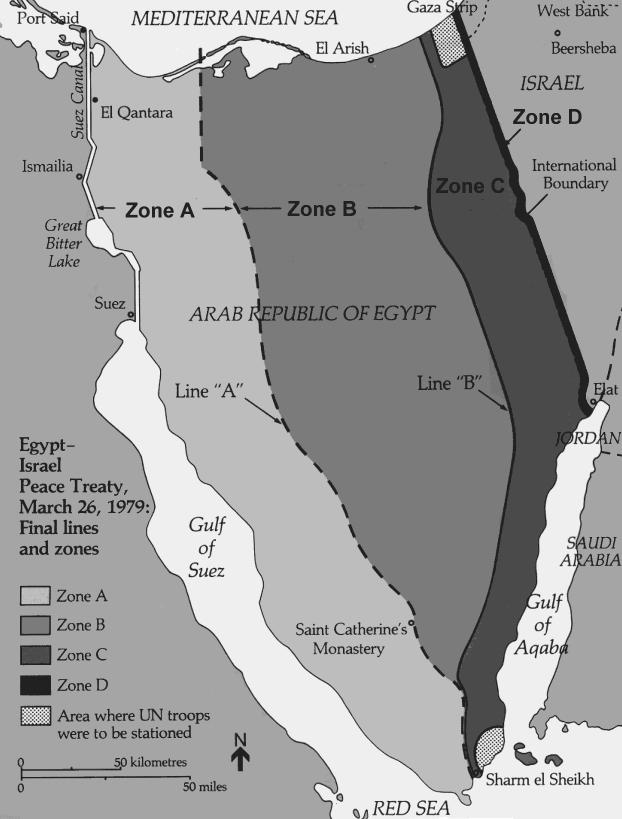
The 1979 Treaty of Peace between Egypt and Israel divided the Sinai peninsula into four limited force zones.133 PalestineInArabic, 2023.
The rapid deterioration of security in the Sinai and the rise of militant groups after the fall of Hosni Mubarak in 2011, however, led the focus of security in the Sinai to shift away from statelevel deterrence and instead towards counterinsurgency. Through the mutual agreement of Egypt and Israel, the two countries used the Treaty’s Agreed Activities Mechanism (AAM) to allow Egypt to deploy additional forces and heavy weaponry throughout the region and conduct the first large-scale military operation in the Sinai since the Camp David Accords. Egypt’s disproportionate tactics in fighting militants and extremist groups led analysts to describe the Egyptian military’s actions as a scorchedearth campaign in the Sinai.134 Media sources also reported that unmarked Israeli drones, helicopters, and jets carried out a covert air campaign against militant groups, conducting more than 100 airstrikes inside of Egypt with the approval of President el-Sisi.135 Despite security
cooperation between Egypt and Israel, alleged violations of the Treaty by either party remain a source of tension, especially as two years of war in Gaza have polarized public opinion and challenged prior security arrangements.
The Philadelphi Corridor is a 100-meter-wide strip of land established under the 1979 Treaty that runs 14 kilometers along the border between Gaza and Egypt. Following the Agreed Arrangements that Egypt signed with Israel in 2005, when Israeli forces withdrew from Gaza, 750 Egyptian border guards were responsible for operating on the Egyptian side of the Corridor to prevent smuggling.136 The U.S.-led MFO was additionally responsible for conducting thirdparty monitoring to ensure Egyptian and Israeli compliance.137 The Rafah Crossing is located along the corridor and serves as the sole transit point between Egypt and Gaza.
On May 6, 2024, Israeli troops invaded Rafah, a city in the south of Gaza which was sheltering an estimated 1.4 million people at the time.138 The operation continued despite President
Stretching from the Medditerrannean Sea to Karem Shalom, Israel, the Philadelphi Corridor is a buffer zone on the border of the Gaza Strip and Egypt secured by special arragements between Egypt and Israel since 1979. 139 Encyclopedia Brittanica, 2025.
Biden suggesting that an Israeli invasion of Rafah would cross a “red line.”140 During the Rafah offensive, the Israeli military took control of the Philadelphi Corridor and the Gazan side of the Rafah Crossing. Egypt responded by demanding that Israel withdraw from the Rafah Crossing and Philadelphi Corridor immediately.141 Egypt has since kept the Rafah Crossing closed, refusing an Israeli proposal for a limited reopening only to allow Palestinians to leave Gaza. Instead, Egypt insists that it will only accept a full reopening of the Rafah Crossing in which people and goods can move in and out of Gaza.142 Israel has resisted demands to withdraw from the Corridor, citing its need to prevent the creation of new tunnel networks like those Hamas historically built to smuggle weapons in via the Sinai.143 Egypt, meanwhile, argues that it can prevent tunnel construction on its own and stresses that Israel is violating the 1979 Treaty’s security annex, which limits the number of Israeli troops and prohibits Israeli tanks in Zone D.144 Under the ceasefire agreement signed in January 2025, Israel was required to withdraw from the Philadelphi Corridor at the end of phase one, but refused to follow through on the stipulation. Control over the Philadelphi Corridor and Rafah Crossing will remain major hurdles in any final agreement and will have significant repercussions on the Egypt-Israel relationship.145
Tensions over alleged violations of the 1979 Treaty have surged during the war in Gaza. In September 2025, Israeli officials raised concerns with the U.S. about an Egyptian buildup of military forces in the Sinai Peninsula. In a rare diplomatic move, U.S. Ambassador to Israel Mike Huckabee announced plans to travel to Egypt to address the tensions between the two countries over treaty violations before eventually delaying the trip indefinitely. The Egyptian government contends that it has not violated the treaty and argues that it is instead trying to protect Egypt’s borders against all threats.146 Almost immediately after the start of the conflict, Israeli Prime Minister Benjamin Netanyahu and his
governing coalition began a concerted effort to persuade first the European Union and then the United States to pressure Egypt to accept Palestinian refugees.147 Egypt has declared such a policy of forced displacement a “red line” that it will not cross, and has sought to increase its security presence along the border with Gaza throughout the conflict.
Egypt’s geographic position bordering Gaza, and large military and construction sectors, solidify it as an indispensable actor to stabilize and rebuild Gaza. Throughout the war, public demands from Egyptian citizens for their government to play a more active role in resolving the conflict have pushed the Egyptian government to take a significant, yet often opaque, leadership role in humanitarian assistance and peace mediation.148 Egypt unveiled its Gaza Recovery and Development Plan in March 2025, during an Extraordinary Arab League Summit held in Cairo. The plan was endorsed by Arab leaders attending the summit, demonstrating a collective regional rejection of the prior U.S. proposal put forward in February 2025, when President Trump suggested that Gaza’s approximately two million Palestinians be resettled in other countries, including Egypt and Jordan.149 Egypt publicly rejected this first Trump proposal based on its opposition to the forced displacement of Palestinians and national security concerns; Trump later reversed his stance on resettlement of Palestinians in other countries a month later.150
In September 2025, President Trump announced a 20-point framework for an agreement between Hamas and Israel, which led to a ceasefire that took effect on October 9. Egypt endorsed the plan, and on October 13 Presidents el-Sisi and Trump jointly convened the Sharm El-Sheikh Peace Summit, where they met with regional
leaders to sign a peace declaration supporting the agreement.151 On November 17, the United Nations Security Council adopted Resolution 2803, endorsing the Comprehensive Plan to End the Gaza Conflict. Resolution 2803 formalized the establishment of the Board of Peace, which Trump proposed as an international transitional body for Gaza led by himself. The Board of Peace will be responsible for overseeing the work of a technocratic, apolitical Palestinian committee responsible for day-to-day administration in Gaza. The UN also specifically granted the Board of Peace a mandate to establish operational entities for the reconstruction of Gaza and the delivery of public services and humanitarian assistance.152
UN Resolution 2803 does not, however, outline specific plans for Gaza’s reconstruction. Trump’s 20-point plan only makes limited references in point ten to convening a panel of experts to develop an economic development plan for Gaza and point eleven to establishing a special economic zone with preferred tariff and access rates. The absence of a comprehensive reconstruction plan in the UN resolution or 20-point plan means that Egypt has the opportunity to continue advancing its plan as a basis for developing timelines and reconstruction priorities. Egypt’s Gaza Recovery and Development Plan is structured around two phases over five years, with an estimated budget of $53 billion.153 Its official objectives emphasize addressing the humanitarian crisis, restoring essential services, and rebuilding Gaza in a manner that prevents displacement and ensures long-term stability. The plan stresses the importance of Palestinian ownership and leadership in reconstruction efforts, but also positions Egypt as a key regional actor in the stabilization of Gaza and its future trajectory.
Despite significant differences in security arrangements and oversight, there are clear areas of alignment between the U.S. 20-point plan and Egyptian plans for Gaza that could serve as a foundation for coordinated implementation. Officially, both plans prioritize non-displacement of Palestinians, large-scale humanitarian recovery, and eventual return of governance to the Palestinian Authority, and
both reject long-term foreign occupation of Gaza. Egypt’s attention to Palestinian dignity, sovereignty, and rebuilding Gaza in a way that restores basic services and infrastructure aligns with the U.S. vision for early recovery and phased reconstruction. Shared goals like rebuilding housing, repairing vital infrastructure, and revitalizing the local economy provide clear goals for technical, logistical, and financial cooperation, particularly in areas where U.S. resources and international networks complement Egypt’s regional leadership, access, and credibility on the ground. As the Trump Administration may prefer to officially launch its own reconstruction plan for Gaza, Egypt should engage closely with the U.S. to explain the core elements of the Egyptian reconstruction plan and find ways to collaborate on the technical and procedural designs of a U.S. plan.
A coordinated U.S. effort should also demonstrate a firm commitment to moving beyond the deal’s phase one ceasefire to guarantee that the full promises of a comprehensive peace plan in later phases becomes a reality. Aligning economic revitalization efforts could help attract investment and integrate Egypt’s regional networks with U.S.-backed economic planning. However, the quasi-monopoly of firms with close ties to Egyptian security services over the flow of reconstruction materials to Gaza will increase the costs of reconstruction and limit the participation of other private sector firms.154,155
Large-scale reconstruction in Gaza is unlikely to attract funding and support without first stabilizing the security environment and implementing the ceasefire’s security provisions. UN Resolution 2803 authorizes member states working with the Board of Peace to establish a temporary International Stabilization Force (ISF) in Gaza. The UN Security Council granted the ISF a mandate to work with Israel and Egypt to help secure border areas, protect civilians and humanitarian operations, and train and provide support to the Palestinian police forces. Additionally, the ISF is charged
with the complex mission of ensuring the process of demilitarizing Gaza and permanently decommissioning weapons from non-state armed groups.156
Both Egypt and the U.S. have a shared interest in disarming Hamas and maintaining the ceasefire agreement; however, the myriad challenges of disarmament have made countries hesitant to commit troops to the ISF. The U.S. is reportedly planning to appoint an American two-star general to command the ISF, but the U.S. continues to stress that there will be no American boots on the ground in Gaza.157 The U.S. has formally asked more than 70 countries for military or financial contributions to the ISF and seeks to create a force of up to 10,000 peacekeeping troops by the end of 2026. While over a dozen countries have signaled interest in working with the mission, no countries have committed troops, due in part to concerns that the mandate of the ISF could include directly disarming Hamas.158
Since March 2025, Egypt has trained hundreds of Palestinian police officers in Egypt with the aim of integrating 5,000 of them into a post-war security force in Gaza.159 During 2024 talks facilitated by Egypt, Palestinian factions agreed to a police force of approximately 10,000 Palestinians in Gaza, half of which would be trained by Egypt and paid by the Palestinian Authority, and the other half of which would come from the police force in Gaza, which has been under Hamas control since 2007. The agreement also called for a committee of technocrats to supervise the security force. In focusing on training police forces, Egypt has identified a way to apply its expertise as the third largest contributor of police to UN peacekeeping missions around the world. Nevertheless, as the U.S. continues to ask nations to join the ISF, Egypt will need to decide the extent to which it is willing to be involved in an international force in Gaza. Egypt has indicated its interest in supporting an ISF force that is temporary and transitional, aimed at consolidating the ceasefire and ensuring the delivery of aid. However, in November 2025, Egyptian Foreign Minister Badr Abdel-Atti stated that Egyptian participation in the force is not necessarily required, even if it publicly supports the deployment of the
ISF to Gaza.160 In order to secure full support and ISF troop commitments from interested countries, the U.S. will need to explicitly outline the responsibilities of the ISF under its UN mandate, including on whether and how it will be expected to disarm Hamas. An ISF only tasked to monitor the ceasefire and ensure safe passage for humanitarian assistance and civilians will likely receive widespread participation from nations such as Egypt. Meanwhile, a force tasked with confronting non-state actors and implementing disarmament would require substantial U.S. diplomatic and economic incentives to persuade potential partners to accept the attendant security and political risks.
Deteriorating security in the Red Sea has made the Suez Canal vulnerable to regional conflict dynamics. Houthi drone and missile attacks since 2023 have intensified threats to a critical global trade corridor. As a result, Suez Canal traffic has fallen by as much as sixty percent, and shipping companies remain hesitant to resume previous routes despite modest improvements in recent months.161
The U.S. and Egypt have cooperated since 2022 under the multinational Combined Task Force 153 (CTF-153), and Egypt has increased naval patrols, strengthened intelligence sharing, and expanded cooperation with U.S. forces through Combined Task Force 153.162 But the nature of conflict in the Red Sea has fundamentally changed. Egypt’s navy, though capable, lacks the specialized assets required for sustained counter-drone, counter-missile, and long-range interdiction missions that are now essential for safeguarding the Suez Canal. Maintaining the Suez Canal and Red Sea as secure passageways for global shipping is vital to Egypt’s economic stability and the health of the global economy. Strengthening Egypt’s capabilities and capacity is critical to protecting global supply chains, stabilizing energy markets, and supporting the country’s fragile economy. The threat of fuel, food, and consumer price shocks would also carry direct implications for the U.S. economy.
The security challenge is compounded by regional dynamics, including conflict in Yemen and U.S.-Iran tensions. These tensions were underscored in April 2025, when President Trump demanded that U.S. military and commercial vessels be granted free transit through the Suez Canal as compensation for U.S. operations against the Houthis.163 The proposal sparked outrage in Egypt, where exempting U.S. vessels from Canal fees was widely viewed as undermining sovereign control and setting a precedent reminiscent of the pre-1956 era. The incident highlighted the delicate balance the U.S. must strike between its security goals and Egypt’s political red lines.
Ethiopia officially inaugurated the Grand Ethiopian Renaissance Dam (GERD) in September 2025 as the largest hydroelectric plant in Africa. The dam has been subject to competing national priorities, including Ethiopia’s development needs and Sudan’s agricultural and water security requirements. Egypt, which relies on the Nile River for 97 percent of its water supply,164 has strongly objected to the GERD since Ethiopia initiated the project in 2011. Egyptian concerns center on the possibility that GERD operations could undermine the functioning of the High Aswan Dam (HAD), particularly during droughts, threatening agricultural production, water security, and flood control. Given the Nile’s centrality to Egypt’s economy and food security, many Egyptians view such developments as an existential threat.165 The dispute over Nile water rights has been a focal point of regional tension between Egypt, Ethiopia, and Sudan for over a decade, threatening conflict between some of the largest nations in Africa.
The U.S. has intermittently played a mediating role in the GERD dispute. In 2019, the Trump Administration hosted Egypt, Ethiopia, and Sudan in Washington to negotiate a framework for filling and operating the GERD. Ethiopia withdrew from the final round and Sudan declined to formally consent, leaving Egypt as the sole signatory for a proposed agreement. Objections to the agreement included a perceived U.S. bias toward Egypt and Ethiopia’s claim that the language was reminiscent of colonial-era Nile treaties. President Trump then made public statements in 2020 speculating that Egypt may blow up the GERD and in 2025 condemning Ethiopia’s restrictions on Nile water flow, complicating the U.S. role as a neutral mediator.166,167 Following Ethiopia’s exit from the Washington Process negotiations in 2020, the U.S. Treasury Department stated that “filling should not take place without an agreement.”168 Despite the GERD’s completion, the U.S. government has not yet publicly moved to relaunch negotiations.
Our proposed recommendations approach this from two angles. First, we propose steps to improve operational security through FMF reform and Red Sea engagement. Then, we suggest ways to more effectively engage with Egypt on regional crises to prevent escalations and fully implement the ceasefire plan in Gaza.
Improve operational security in the region. Recommendations 1 and 2 outline near-term actions that would allow the United States to improve operational security through FMF reform and cooperation on Red Sea security.
1. Maintains a large, reliable security partner in the Middle East and Africa capable of playing a stabilizing role in regional conflicts and keeping vital trade networks open
2. Incentivizes the use of American systems and ensures continued interoperability between militaries
3. Limits the presence of advanced weapons systems from geopolitical competitors in Egypt
The U.S. Government should plan to maintain the current amount of $1.3 billion in annual FMF for Egypt in the near term, given the significant role that the U.S. expects Egypt to play on shared security interests including the stabilization of Gaza. However, to maintain congressional support in the new U.S. foreign assistance environment, in which policymakers are less willing to accept indirect benefits from expensive programs, FMF must demonstrate direct security value to the U.S. To this end, the U.S. Government should exercise greater influence during annual U.S.-Egypt Military Cooperation
Committee meetings to steer FMF funds toward both equipment and training for shared security priorities in the Red Sea, Sinai, and Gaza. FMF steered towards developing an electronic surveillance system along the Philadelphi Corridor, for example, could address concerns around tunnel building and weapons smuggling that have complicated negotiations around Israel’s withdrawal while also advancing shared security needs.
While previous U.S. attempts to play a more involved role in influencing the kinds of military equipment Egypt purchases with FMF have failed in the face of stiff Egyptian opposition, the seismic shifts in U.S. foreign assistance can position the U.S. well to convince Egypt that a new compromise is necessary. By pushing for a narrow agreement emphasizing that equipment purchased through FMF must bolster Egyptian capabilities to take on the burden of a shared security interest, the U.S. can adapt FMF to match the new logic of U.S. foreign assistance. Furthermore, merely selling U.S. weapons to Egypt has not guaranteed continued interoperability between militaries. U.S. policymakers should, therefore, seek Egyptian guarantees that more training for its armed forces will be based on U.S. weapons systems to ensure the full adoption and integration of systems acquired through FMF.
U.S. Navy vessels like Maritime Expeditionary Squadron 8 provide security and force protection in Red Sea chokepoints like the Port of Djibouti. EURAFCENT, 2023.

1. Maximizes the utility of U.S. investment in the Egyptian military by strengthening a critical partner in the Red Sea
2. Supports the U.S. goal to safeguard freedom of navigation in the Red Sea by advancing the ability of CTF-153 to counter non-state threats, such as the Houthis
3. Limits the risk of conflict that could have a spillover effect on the region, potentially necessitating a more extensive U.S. intervention and causing economic shocks to Egyptian and U.S. consumers
The United States should continue partnering with Egypt through CTF-153 while expanding joint military exercises in the Red Sea focused on countering Houthi threats. To maximize their effectiveness, Egypt will need to invest in the equipment and training required for sustained Red Sea operations. This should include expanded joint training, intelligence sharing,
and capacity building in counter-drone defense, maritime interdiction, and infrastructure protection – addressing critical capacity gaps, reducing overreliance on U.S. naval forces, and sustaining U.S. leadership and credibility within the coalition. To overcome issues of overly-centralized decision-making, the new exercise should be designed to emphasize free-play training that forces coalition leaders at each echelon to coordinate and make decisions without heavy oversight. Offering enhanced exercises on capability improvements should incentivize Cairo to prioritize investments in military equipment aligned with shared strategic needs.
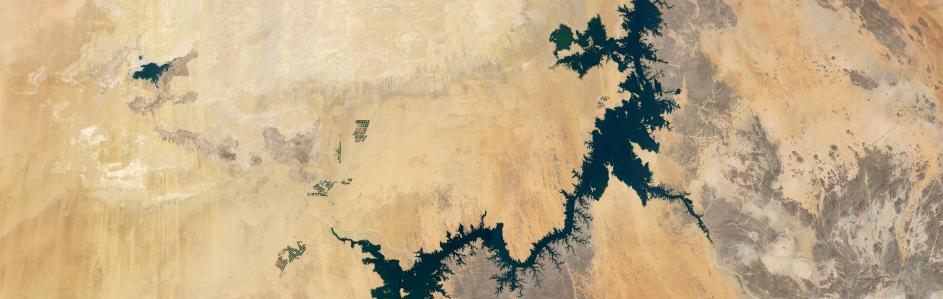
Support regional crisis managment. Recommendations 3, 4, and 5 suggest approaches that allow the U.S. to more effectively engage with Egypt on regional crises to prevent escalations and fully implement the ceasefire plan in Gaza.
1. Advances the Trump administration’s priority of securing deals that end or prevent costly international conflicts
2. Reduces the likelihood of catastrophic disasters that could require future costly U.S. humanitarian interventions
3. Promotes a balanced agreement that supports Egypt’s long-term food security while reducing overreliance on imported wheat that could undermine macroeconomic stability
Conflict between Egypt and Ethiopia over the Grand Ethiopian Renaissance Dam (GERD) presents a significant risk to Egyptian society and regional stability. Egypt views the dispute as an existential challenge,169 rendering U.S. diplomacy on the issue central to alliance credibility. U.S. mediation in 2019 brought the parties close to an agreement, but with the
GERD now operational and its reservoir full, the window for reaching a durable settlement is narrowing. Absent an agreement, future water shortages or flooding could trigger broader regional crises. Reflecting this assessment, Egypt’s foreign minister stated in December 2025 that Cairo viewed the negotiation track as having reached a dead end.170
The U.S. must play an active role in relaunching mediation efforts to further demonstrate its reliability as a partner. To maintain momentum toward a durable resolution, U.S. policymakers should convene an international working group to monitor the effects of the GERD and recommend technical options for addressing underlying water-use concerns. Such initiatives could include a joint water management strategy with inter-dam communication between the GERD and Aswan as well as droughtmanagement measures. The international working group could build on the model of the National Independent Research Group established between Egypt, Ethiopia, and Sudan in 2018, but be structured around engagement among independent scientists and researchers,
with a narrow mandate focused on assessing the GERD’s actual impacts on Nile flows.
The United States should also partner with Gulf countries already investing in the Egyptian and Ethiopian agricultural sectors to assemble an investment package offered as a peace dividend, contingent on the conclusion of a GERD agreement between Egypt and Ethiopia. Nile resilience investments could be jointly funded by applying a portion of remaining U.S. development funds with additional funding from Gulf countries. Such a project could include initiatives to repair and modernize
existing agricultural canals that suffer from significant water losses, as well as efforts to promote the adoption of water-efficient farming techniques. U.S. agricultural, farm equipment, and technology firms are well positioned to serve as major private-sector partners in this effort.
Despite the unwillingness of parties to accept a negotiated agreement, the U.S. has an interest in continuing to provide an effective forum for all parties to engage in dialogue. To underscore U.S. commitment to mediating a negotiated agreement, the U.S. should publicly state that it will only support a peaceful, diplomatic resolution to the conflict.
1. Facilitates the successful implementation of the U.S.-led ceasefire and peace plan by helping stabilize humanitarian conditions in Gaza
2. Mitigates humanitarian and security risks that would require additional U.S. resources and support if left unchecked
Egyptian construction firms are well positioned to support reconstruction efforts, offering both technical expertise and contextual knowledge suited to complex operating environments. However, the concentration of control over reconstruction materials in the hands of firms closely tied to Egyptian security services is likely to raise reconstruction costs and constrain broader private-sector participation.171,172 As director of the Board of Peace, President Trump and the U.S. government should spearhead an efficient reconstruction process in Gaza that is open to a broad range of capable Palestinian,
Egyptian, U.S., and international firms. The U.S. should develop an office within the Board of Peace responsible for monitoring barriers and non-competitive practices in the reconstruction process. Specifically, the U.S. should closely monitor and address reports that trucks entering Gaza through the Rafah crossing are charged significant access fees.173
The U.S. should prioritize keeping Egypt engaged in the reconstruction and stabilization of Gaza by deliberately building them into key mediating, peacekeeping, and reconstruction capacities. In line with point ten of Trump’s plan, calling for a panel of regional experts to lead Gaza’s economic revitalization, the U.S. should support the selection of Egyptian experts who can explain the details of Egypt’s reconstruction plan, which outlines a vision for sustainable development zones, job creation, and industrial growth. Constructive Egyptian engagement in transparent and efficient reconstruction efforts in Gaza should be met with corresponding U.S. attention to core Egyptian priorities, including opposing the displacement of Palestinians, negotiating Israeli withdrawal from the
Philadelphi Corridor, and supporting competitive access for Egyptian firms in reconstruction efforts.
1. Reduces costs for the U.S. by supporting the temporary and transitional nature of the ISF and enabling greater risk- and cost-sharing with Arab states and other international partners willing to contribute troops, police forces, and logistical support to both the ISF and Gaza reconstruction
2. Maintains U.S. national security and counterterrorism objectives and facilitates the flow of humanitarian supplies across the border by leveraging Egypt’s border security capabilities
3. Reinforces the integrity of the Camp David Accords by providing Cairo with a more institutionalized stake in security outcomes and enhancing the sustainability of a future comprehensive peace process
Egypt’s involvement in the International Stabilization Force (ISF) is important for the force’s credibility and U.S. efforts to sustain the ceasefire in Gaza, advance a sustainable peace plan, and uphold regional security. However, Egyptian officials have expressed concerns about the ISF’s terms, including the potential for an open-ended foreign presence in Gaza, likelihood of spillover violence into the Sinai, and risks of disarming Hamas.
Egyptian regional influence is key to securing local buy-in and reducing the perception that the ISF is a Western-imposed project. Egypt’s
geographic position, military, intelligence, and diplomatic networks provide border security and political transition capabilities the U.S. cannot supply alone, drawing in part on its experience containing ISIS in the Sinai.
Egypt’s initial concern that the ISF should operate under a UN-authorized mandate was addressed through UN Security Council Resolution 2803. To further respond to Egyptian priorities and strengthen prospects for stabilization, coordination on the ISF – particularly through the Civil-Military Coordination Center (CMCC) – should give sustained attention to core Egyptian interests. These include maintaining a temporary mission with clearly defined tasks and secure funding, preventing the forced displacement of Palestinians, negotiating the eventual return of the Philadelphi Corridor, and providing meaningful opportunities for Egyptian firms to participate in reconstruction efforts. Respecting these priorities will help incentivize meaningful Egyptian participation while strengthening the effectiveness, legitimacy, and sustainability of the ISF.
While the U.S. and Egypt share broad objectives in Gaza, Washington and Cairo diverge on certain security, transitional governance, and oversight strategies. The U.S. 20-point plan emphasizes strict security measures, including full demilitarization of Hamas and dismantling tunnels and weapons infrastructure. Egypt’s Gaza Reconstruction Plan emphasizes prioritizing a gradual transition with Palestinian self-governance, regional coordination, and political engagement with armed groups. These differences intersect with several unresolved
challenges facing any proposed ISF, including its mandate and capacity to disarm Hamas, the willingness of Egypt or other regional actors to commit forces under such a mandate, and the extent to which an ISF could credibly facilitate an Israeli withdrawal while Hamas remains armed. Although the transitional Board of Peace is pre-defined by the UNSC resolution, its composition and function may still be contentious, and, as one of the world’s largest troop- and police-contributing countries in international peacekeeping, the Egyptian buy-in is essential to ensuring their success in training Palestinian security forces and supporting eventual Palestinian self-governance.174 Egyptian concerns could therefore complicate coordination on disarmament, reconstruction, and governance. Navigating overlapping regional agendas, differing security philosophies, and logistical constraints will require sustained dialogue, negotiation, and careful consideration of Egyptian priorities to avoid undermining the ceasefire or destabilizing Gaza.
The U.S.-Egypt people-to-people relationship is rooted in deep cultural appreciation and longstanding programs that promote exchange, education, and the preservation of heritage. Egyptian migration to the United States has created a vibrant diaspora, including a significant Coptic Christian community that advocates for religious freedom and human rights. Bilateral academic and professional programs have fostered mutual understanding, strengthened institutional partnerships, and developed human capital. Cultural cooperation, through initiatives such as archaeological preservation and heritage protection, complements these educational ties. Subnational diplomacy, including engagement by universities, NGOs, and professional associations, further reinforces these connections. While the relationship thrives in people-to-people dimensions, challenges remain, particularly regarding human rights and democratic governance. Recent steps, such as the 2025 pardon of political prisoner Alaa Abd El-Fattah, mark incremental progress, but persistent restrictions on civil liberties and low political participation highlight the need for an approach that promotes stability through support for democratic development.
Egyptians in the United States began arriving in large numbers after World War II and the political upheavals of the 1950s, often as highly educated professionals or elites, while others came fleeing regional conflicts. Since the 1990s and later the 2011 Arab Spring, migration from Egypt has continued, driven largely by economic pressures. Recent estimates place the number of people in the United States who are of Egyptian ancestry or were born in Egypt at approximately 300,000, though community sources suggest the diaspora may be considerably larger.175 Additionally, Coptic Christians in the United States began immigrating in larger numbers after the 1952 Egyptian coup and continued through the 1960s due to political turmoil and economic nationalization under Nasser. There was another significant wave of migration to the U.S. following the 2011 Egyptian revolution amid increased sectarian violence. Some scholars now estimate that the population of the Copic Christians is over 500,000.176 Centered around the Coptic Orthodox Church, the community supports new immigrants, preserves cultural and religious identity, and plays an influential role in U.S.-Egypt relations through advocacy on religious freedom and human rights.
The United States supports a wide array of academic and professional exchanges that foster mutual understanding, strengthen ties, expand English-language skills, and build capacity. The U.S. State Department estimates that more than 20,000 Egyptians have participated in U.S. government exchange programs, with around 450 traveling annually for study or professional training.177 EducationUSA advising centers in Cairo and Alexandria – run by AMIDEAST – offer free guidance on U.S. higher education, while Americans likewise study and conduct research in Egypt, amplifying global understanding of Egyptian history and culture.178
Fulbright programs remain a cornerstone of academic exchange, complemented by initiatives such as the U.S.–Egypt Higher Education Initiative (HEI), launched in 2015 in partnership with USAID, the Egyptian government, and private-sector actors. HEI has provided scholarships, U.S. study opportunities, and intensive skills training to thousands of high-achieving Egyptians, particularly in STEM and other critical fields, while strengthening institutional partnerships between U.S. and Egyptian universities.179 Although some USAIDfunded components are currently suspended, Egyptian authorities stepped in to support affected students.180 Broader opportunities include the YES high school exchange, the Professional Fellows Program, the Cochran agricultural fellowship, and the Community Solutions Program.181 Cultural cooperation is equally robust: the American Research Center in Egypt advances archaeological research, while the U.S. Ambassadors Fund for Cultural Preservation has supported major conservation projects across Egypt’s Pharaonic, Coptic, Islamic, and Jewish heritage, and CPAIG grants help combat illicit trafficking of antiquities.
Subnational diplomacy further reinforces these ties. Universities, NGOs, professional associations, and Egypt’s consulates in major U.S. cities facilitate sustained, communitylevel engagement that complements federal diplomacy. Together, these educational, cultural, and community-driven initiatives form the backbone of a resilient and multifaceted U.S.-Egypt people-to-people relationship.
The U.S. State Department’s 2024 Human Rights Review found significant human rights issues in Egypt, and Freedom House determined in 2025 that Egypt was “Not Free.” Freedom House concluded that “meaningful political opposition is virtually nonexistent, as expressions of dissent can draw criminal prosecution and imprisonment. Civil liberties, including press freedom and freedom of assembly, are tightly
restricted. Security forces engage in human rights abuses and extrajudicial killing with impunity.”182
In Egypt’s closely-managed elections, voters have overwhelmingly signaled their apathy towards processes that do not offer them meaningful avenues for influencing politics. Official turnout in the August 2025 Egyptian Senate elections was 17 percent,183 a modest increase from the 14 percent turnout in 2020.184 The U.S. National Security Strategy (2025) de-emphasizes “imposing democracy” in favor of “organic reform” and “respect for tradition”.185 While this approach aligns with local sensitivities, neglecting democratic development can increase risks of radicalization and social unrest, which could threaten long-term U.S. interests. In Egypt, U.S. policy could balance stability with private engagement on implementing democratic reforms that the Egyptian government itself has already outlined, addressing underlying issues while respecting sovereignty and tradition.
1. Deepens the bilateral relationship beyond top-level government and security ties to include enduring subnational and people-to-people relationships that reflect a broader range of interests
2. Creates opportunities for U.S. businesses to build partnerships with Egyptian firms in relevant sectors
3. Promotes exchange of expertise and best practices on subnational responses to shared challenges such as resource management
U.S.–Egypt engagement is overly centralized at the national level, missing opportunities where U.S. states, cities, and local institutions could deliver faster, more specialized cooperation with Egyptian governorates and municipalities. By hosting the Egyptian national team during the 2026 FIFA World Cup, the U.S. cities of Los Angeles and Seattle have an opportunity to strengthen economic and cultural ties with Egyptian businesses and institutions.
The FIFA World Cup original trophy. Hosting the World Cup gives the U.S. an opportunity to engage in subnational diplomacy. AthalonSports.com, 2025.
The State Department should incentivize subnational partnerships by supporting U.S. states, cities, ports, and universities with specialized briefings on Egypt as well as assistance in formalizing memoranda of understanding with visiting Egyptian government and business delegations. Additionally, the State Department should encourage the American Chamber of Commerce in Egypt to organize a delegation of Egyptian business leaders to travel to the U.S. and meet with the Chambers of Commerce in Los Angeles and Seattle.
Los Angeles is particularly well-suited to develop partnerships with Egypt’s Ministry of Culture and Cultural Investment Holding Company, which announced a multi-pronged effort in 2025 to reposition cinema as a key pillar of Egypt’s cultural economy.186 Egypt is also making efforts to protect intellectual property rights and combat piracy, which has long deterred private investment in the Egyptian film industry. Los Angeles-based institutions could provide valuable support on intellectual property initiatives for media. Los Angeles should also seek to revitalize its sister city relationship with Giza by developing partnerships with the newly opened Grand Egyptian Museum. Finally, state and local authorities,

as well as academics from both California and Egypt, should develop partnerships around their shared attempts to develop solutions for water scarcity and drought challenges, sharing cost-effective best practices.
Seattle presents opportunities for subnational partnerships on resource management and technology innovations. Washington State University previously partnered with Alexandria University in Egypt and industry leaders to implement the $30 million, USAID-funded Alexandria Water Resilience Center of Excellence from 2019-2023.187
Following the end of USAID assistance, institutions from Washington State and Egypt should identify pathways to continue direct collaboration on resource management challenges. Seattle’s technology firms, including Microsoft and Amazon, should engage with Egyptian policy-
makers to identify investment opportunities in Egypt’s plans to develop smart cities as well as in integrating technology skills into Egypt’s education curriculum and workforce development plans. Finally, Seattle is well positioned to form a sister-city partnership with the Egyptian city of Port Said, a shipping logistics hub at the entrance to the Suez Canal that is at the forefront of Egypt’s efforts to become a regional leader in green hydrogen.188 A partnership between the Pacific Northwest Hydrogen Hub189 and Egyptian businesses and government institutions could develop mutually advantageous projects.
While each U.S. city should develop subnational diplomacy initiatives that build on its unique advantages, the State Department can engage with host cities to share expertise on the economic and political contexts in Egypt.
1. Makes the Egyptian government a more responsive, sustainable, and capable partner
2. Bolsters the rule of law throughout Egypt, making the country a more attractive place for U.S. companies to invest
Egypt is obligated by Article 180 of its 2014 Constitution to hold elections for local councils that, among other things, are responsible for creating, implementing, and monitoring development plans. President el-Sisi has repeatedly promised to hold elections for the approximately 50,000 local positions that have remained vacant since local councils were disbanded during the 2011 revolution.190
The United States should engage privately with the Egyptian government to encourage local
elections in the coming years. Private, high-level engagement would likely produce better results than any kind of public pressure campaign; interlocutors frequently noted public efforts aimed at changing Egyptian policy frequently backfire, with the Egyptian government extremely reluctant to be seen as doing U.S. bidding. Instead, American officials should make clear that the United States is watching for Egypt to hold local elections, fulfilling President el-Sisi’s promise.
Successfully holding local elections would allow U.S. businesses to engage directly with regional authorities to reduce barriers to investments. The State Department should identify U.S. businesses that would be willing to invest in new regions of Egypt if they believed that the political risk was lower, and emphasize the potential for economic growth while advocating for Egyptian policymakers to pass the Local Administration Law necessary to hold local elections.
The strategic logic underpinning a strong U.S.Egypt relationship remains as compelling today as it was at the signing of the Camp David Accords. From securing vital global trade networks and stabilizing a volatile region to serving as a launchpad for U.S. investment in Africa, Egypt is a necessary U.S. partner. However, policymakers shaping the bilateral relationship must address longstanding constraints to facilitate a partnership advancing each country’s diverse interests in a new geopolitical landscape. The adoption of a multi-pillar approach elevating economic engagement alongside security cooperation allows the U.S. and Egypt to develop a more agile partnership less dependent on the contentious dynamics of sustaining large military and economic aid programs.
U.S. policymakers face a choice between accepting a managed decline in the U.S.-Egypt alliance or pursuing strategic renewal anchored in meaningful economic engagement. Maintaining the status quo would allow the geopolitical relevance of the U.S.-Egypt relationship to steadily erode over the next decade. Although existing Foreign Military Financing and security cooperation would preserve a baseline level of engagement, the partnership would stagnate as Egypt deepens economic ties with other regional and global powers to meet its needs. At the same time, the United States would increasingly look elsewhere for geopolitical value, prioritizing relationships with Gulf Arab states or emerging African partners that offer the combined economic and security engagement a stagnant U.S.-Egypt relationship would no longer provide.
Alternatively, the U.S. could pursue necessary policy reforms, and deeper economic and diplomatic engagement. This would offer both the U.S. and Egypt a path toward a more resilient bilateral relationship grounded in mutual advan-
tage. The U.S. does not need to expect Egypt to change its longstanding preference for engaging with multiple global powers. By deepening economic integration and aligning security assistance around shared priorities, Washington can reinforce Egypt’s position as an indispensable ally and solidify the United States as its partner of choice. This evolution would give the United States multiple avenues to engage Cairo commercially, diplomatically, and militarily in pursuit of its interests, transforming a partnership currently brittle due to its reliance on a single security pillar into a more dynamic alliance capable of withstanding political change.
The recommendations outlined in this report call for urgent investments to evolve and deepen the relationship. By actively building the economic pillar and modernizing the security framework, the U.S. can secure a partner that is not only capable of maintaining regional stability but integral to American prosperity in the Middle East and Africa.
Aaheli Tarafdar is a second-year MPA candidate at Princeton, with an M.Eng. in Chemical Engineering from Imperial College London. She previously worked as a management consultant at the Boston Consulting Group in London, and has also held roles at the World Bank and ExxonMobil.
Aaron Yost is a Pickering Fellow and second-year MPA candidate at Princeton. He previously worked on foreign policy in Congressman Seth Moulton’s office and interned with the State Department’s Office of Iraq Affairs.
Alexander Sarti is a second-year MPA student at Princeton, with a B.S. in Telecommunications Engineering from the Politecnico di Milano in Italy. He previously worked at the U.S. Department of Defense on critical technology strategy and industrial policy.
Caroline Sager is a second-year MPA student at Princeton, with a B.A. in Linguistics and B.S. in International Relations from Appalachian State University. Prior to studying at Princeton, she worked with American Councils on cultural exchange and language training programs in Turkey and Azerbaijan.
Derek Hoot is a second-year MPA student at Princeton, with a B.A. in Political Science and Arabic from the University of Illinois. He previously worked as a contractor with the Virginia Department of Health and the International Committee of the Red Cross.
Ian MacPherson is a second-year MPA student at Princeton and graduate of the United States Military Academy at West Point. He is a mid-career Army Officer and will return to the military upon completion of his studies at Princeton.
Joe Shipley is an MPA candidate at Princeton University studying International Relations. He also received undergraduate degrees from Princeton in History as well as Russian Language and Culture before joining the Scholars in the Nation’s Service Initiative (SINSI), which placed him in roles at the U.S. Department of Transportation and U.S. Department of State.
Lexie Judd is a second-year MPA student at Princeton, with a B.A. in Economics from the University of Tennessee, Knoxville. She previously worked at the U.S. Treasury Department on European macroeconomic issues and held roles at the U.S. Embassy in Kuala Lumpur, the Center for Strategic and International Studies, and the U.S. House of Representatives.
Patrick McCabe is a second-year MPA student at Princeton, with a B.A. in Political Science and Arabic from the University of Notre Dame. He previously worked for the U.S. Agency for International Development’s Bureau for Humanitarian Assistance on humanitarian responses for Ukraine, Gaza, and Lebanon.
1 Amr Hamzawy. (2025, November 20). The Gaza Plan Just Hit a Crucial Juncture. Egypt Is Critical for Its Success. Carnegie Endowment for International Peace. https://carnegieendowment.org/emissary/2025/11/gazaun-security-council-plan-egypt-success?lang=en
2 Mohamed Maher, Mohamed Farid. (2023, April 27).
The Growth of Chinese Influence in Egypt: Signs and Consequences. The Washington Institute. https://www. washingtoninstitute.org/policy-analysis/growth-chineseinfluence-egypt-signs-and-consequences
3 Mohamed Maher, Mohamed Farid. (2023, April 27). The Growth of Chinese Influence in Egypt: Signs and Consequences. The Washington Institute. https://www. washingtoninstitute.org/policy-analysis/growth-chineseinfluence-egypt-signs-and-consequences
4 Mariam Wahba, Jack Burnham. (2025, July 16). Egypt’s Embrace of China Warrants a Harder U.S. Line on Military Aid. FDD. https://www.fdd.org/ analysis/2025/07/16/egypts-embrace-of-china-warrants-aharder-u-s-line-on-military-aid/
5 EU-Egypt summit. (2025, October 22). European Council. https://www.consilium.europa.eu/en/meetings/ international-summit/2025/10/22/
6 Egypt: Country Profile. (n.d.). Freedom House. Retrieved November 21, 2025, from https:// freedomhouse.org/country/egypt
7 World Economic Outlook (October 2025)— Unemployment rate. (n.d.). International Monetary Fund. Retrieved November 21, 2025, from https://www.imf.org/ external/datamapper/LUR@WEO
8 Youth Unemployment Rate for Egypt. (2025, April 16). Federal Reserve Bank of St. Louis. https://fred.stlouisfed. org/series/SLUEM1524ZSEGY
9 “Egypt-U.S. Business Relations,” in American Chamber of Commerce in Egypt, n.d., https://www.amcham.org. eg/information-resources/trade-resources/egypt-usrelations/us-investment-in-egypt.
10 “U.S. Investment in Egypt,” American Chamber of Commerce in Egypt, accessed December 19, 2025, https:// www.amcham.org.eg/information-resources/traderesources/egypt-us-relations/us-investment-in-egypt.
11 “Egypt Launches ‘National Economic Development Narrative,’ Aims for 7% Growth by 2030,” Daily News Egypt, September 7, 2025, https://www.dailynewsegypt. com/2025/09/07/egypt-launches-national-economicdevelopment-narrative-aims-for-7-growth-by-2030/.
12 Sayigh, Yezid. “Egypt’s Military Now Controls Much of Its Economy. Is This Wise?” Carnegie Endowment for International Peace, November 25, 2019.
13 Ibid.
14 Abdelhamid, Radwa. “The Growth of the Military Economy in Egypt Since 2014: The Impact on Investment Dynamics and Investor Rights.” Rowaq Arabi (Cairo Institute for Human Rights Studies), August 9, 2022.
15 Reuters. “IMF Says Egypt Makes Mixed Reform Progress, Cites State Dominance in Economy.” July 16, 2025.
16 Ashour, Omar. “The Second Republic: The Remaking of Egypt under Abdel Fattah El-Sisi.” Carnegie Endowment for International Peace, May 22, 2025.
17 U.S. Embassy in Egypt, “United States Announces $129 Million Investment in Egypt’s Development during U.S.Egypt Strategic Dialogue,” September 19, 2024, https:// eg.usembassy.gov/united-states-announces-129-millioninvestment-egypt-development/.
18 National Security, Department of State, and Related Programs Appropriations Act, 2026, H.R. 4779, 119th Cong. (2025). https://www.congress.gov/bill/119thcongress/house-bill/4779/text
19 Rock, Bader. “Israeli-Egyptian Trade: In-Depth Analysis.” Tony Blair Institute for Global Change, 15 Oct. 2018, https://institute.global/insights/geopolitics-andsecurity/israeli-egyptian-trade-depth-analysis.
20 https://www.amcham.org.eg/information-resources/ trade-resources/egypt-us-relations/qualifying-industrialzones
21 Witty, David M. The U.S.-Egypt Military Relationship: Complexities, Contradictions, and Challenges. Policy Focus no. 176. Washington, DC: Washington Institute for Near East Policy, 2022.
22 U.S. Embassy Cairo, “Joint Egyptian–U.S. Exercise ‘Bright Star 2025.’”
23 Sharp, Jeremy. “Egypt: Background and U.S. Relations.” U.S. Library of Congress, Congressional Research Service. June 12, 2025.
24 Fulton, “China-Egypt Air Force Joint Exercises Conclude.”
25 Sharp, Jeremy. “Egypt: Background and U.S. Relations.” U.S. Library of Congress, Congressional Research Service. June 12, 2025.
26 DC (ACW), Arab Center Washington. “The U.S.-Egypt Relationship Might Face a Reckoning.” Arab Center Washington DC, March 7, 2025. https://arabcenterdc. org/resource/the-us-egypt-relationship-might-face-areckoning/.
27 Mohammed Soliman, “There Is No Indo-Pacific Without Egypt and the Suez Canal,” Middle East Institute (blog), April 20, 2021, https://www.mei.edu/blog/thereno-indo-pacific-without-egypt-and-suez-canal.
28 Richard C. Gross, “Nuclear-powered warship cruises Suez Canal,” UPI, November 6, 1984, https://www.upi. com/Archives/1984/11/06/Nuclear-powered-warshipcruises-Suez-Canal/3776468565200/.
29 Sharp, Jeremy. “Egypt: Background and U.S. Relations.” U.S. Library of Congress, Congressional Research Service. June 12, 2025.
30 Nile Waters Conflict: The Grand Ethiopian Renaissance Dam. Princeton School of Public and International Affairs, 2022. https://issuu.com/ princetonspia/docs/nile_waters_conflict_the_grand_ ethiopian_renaissan?fr=sNDFiZTU0MzczNTQ.
31 “Trump comment on ‘blowing up’ Nile Dam angers Ethiopia” BBC, October 24, 2020, https://www.bbc.com/ news/world-africa-54674313.
32 Solomon Ekanem, “Ethiopia–Egypt Dispute Escalates after Trump’s Controversial Remarks on $5 Billion GERD Project,” Business Insider Africa, July 21, 2025, https:// africa.businessinsider.com/local/lifestyle/ethiopiaegyptdispute-escalates-after-trumps-controversial-remarks-ondollar5-billion/resfcsc.
33 Laub, Zachary. “Security in Egypt’s Sinai Peninsula.” Council on Foreign Relations, 11 December 2013, https:// www.cfr.org/backgrounder/security-egypts-sinaipeninsula.
34 Wahid Hanna, Michael. “How the Counter-Terrorism Imperative Has Warped U.S.-Egyptian Ties.” International Crisis Group, September 13, 2021. https://www. crisisgroup.org/middle-east-north-africa/egypt-united-
states/how-counter-terrorism-imperative-has-warped-usegyptian-ties.
35 2023 Country Reports on Human Rights Practices: Egypt. U.S. Department of State, n.d. https://www.state. gov/reports/2023-country-reports-on-human-rightspractices/egypt/.
36 Carnegie Endowment for International Peace. “The Egyptian Military’s Terrorism Containment Campaign in North Sinai.” Accessed December 18, 2025. https:// carnegieendowment.org/sada/2020/07/the-egyptianmilitarys-terrorism-containment-campaign-in-northsinai?lang=en.
37 Ellen Marrow and Jeanne Batalova, “Middle Eastern and North African Immigrants in the United States,” Migration Information Source, June 12, 2024, https:// www.migrationpolicy.org/article/middle-eastern-andnorth-african-immigrants-united-states.
38 U.S. Embassy in Egypt, “The U.S.-Egypt Relationship,” accessed December 18, 2025, https://eg.usembassy. gov/the-u-s-egypt-relationship/; EducationUSA, “EducationUSA Advising Center: AMIDEAST Alexandria,” U.S. Department of State, accessed December 18, 2025, https://educationusa.state.gov/centers/educationusaamideast-alexandria.
39 Bureau of Democracy, Human Rights, and Labor, 2024 Country Reports on Human Rights Practices: Egypt (Washington, DC: U.S. Department of State, 2024), https:// www.state.gov/reports/2024-country-reports-on-humanrights-practices/egypt.
40 Al-Riffai, Parrihan, and Racha Helwa. “A Lifeline Under Threat: Why the Suez Canal’s Security Matters for the World.” Atlantic Council, March 20, 2025. https:// www.atlanticcouncil.org/in-depth-research-reports/ issue-brief/a-lifeline-under-threat-why-the-suez-canalssecurity-matters-for-the-world/.
41 “SCA - Navigation Statistics.” Accessed November 24, 2025. https://www.suezcanal.gov.eg:443/English/ Navigation/Pages/NavigationStatistics.aspx.
42 AP News. “Egypt’s Revenue from the Suez Canal Plunged Sharply in 2024.” April 16, 2025. https://apnews. com/article/suez-canal-egypt-gaza-houthis-israel-5a5fe98 a74f64144f7aab9ceca9d87d3.
43 Reuters. “Egypt’s Suez Canal Revenues Rise 14% as Red Sea Tensions Ease.” Africa. November 4, 2025. https://www.reuters.com/world/africa/egypts-suez-canalrevenues-rise-14-red-sea-tensions-ease-2025-11-04/.
44 Matamis, Joaquin. “U.S. Airstrikes on Yemen: Tactical Wins, Strategic Setbacks.” Stimson Center, July 11, 2025. https://www.stimson.org/2025/us-airstrikes-on-yementactical-wins-strategic-setbacks/.
45 International Energy Agency. “Egypt.” https://www. iea.org/countries/egypt/energy-mix.
46 Today in Energy. “Growing Natural Gas Deficit Leads Egypt to Ramp up Natural Gas Imports.” Energy Information Administration, September 9, 2025. https:// www.eia.gov/todayinenergy/detail.php?id=66064.
47 Ephrat Livni and Johnatan Reiss, “Israel Approves $37 Billion Deal to Deliver Gas to Egypt,” The New York Times, December 17, 2025, https://www.nytimes. com/2025/12/17/world/middleeast/israel-gas-deal-egypt. html.
48 Bousso, “Mideast War Highlights Egypt’s Energy Weak Spot.”
49 Alternative Policy Solutions. “From Energy Shortages to Sustainability: Can Egypt Move Beyond Natural Gas?” American University in Cairo, March 24, 2025. https://aps. aucegypt.edu/en/articles/1479/from-energy-shortages-tosustainability-can-egypt-move-beyond-natural-gas.
50 Fangary, Farah. “Govt Imposes Country-Wide Power Rationing Plan after Complete Halt in Israeli Gas Supply.” Mada Masr, June 17, 2025. https://www.madamasr.com/ en/2025/06/17/news/u/govt-imposes-country-wide-powerrationing-plan-after-complete-halt-in-israeli-gas-supply/.
51 Moore, Malcolm, and Heba Saleh. “Egypt’s Journey from Gas Bonanza to Power Blackouts.” Financial Times, September 2, 2024. https://www.ft.com/content/b86c9f85715e-4b12-a19a-9776c6251c9e.
52 International Energy Agency, “Egypt.”
53 Reuters. “Egypt Reaffirms 42% Renewable Energy Goal for 2030, but Urges International Help.” Energy. November 13, 2024. https://www.reuters.com/business/ energy/egypt-reaffirms-42-renewable-energy-goal-2030urges-international-help-2024-11-12/.
54 International Energy Agency. “Egypt’s Economic Strategy for 2024-2030.” February 26, 2025. https:// www.iea.org/policies/18998-egypts-economic-strategyfor-2024-2030;
55 Cohen and Helwa, “The Green Gold Rush.”
56 Ibid.
57 Reuters. “Egypt Signs $220 Million Solar Project with UAE, China and Bahrain.” Energy. August 27, 2025. https://www.reuters.com/business/energy/ egypt-signs-220-million-solar-project-with-uae-chinabahrain-2025-08-27/.
58 Egypt Country Commercial Guide. “EgyptElectricity and Renewable Energy.” International Trade Administration, November 21, 2025. https://www.trade.
gov/country-commercial-guides/egypt-electricity-andrenewable-energy.
59 “Egypt Investment Climate Statement.” U.S. Department of State, September 2025. https://www.state. gov/wp-content/uploads/2025/09/638719_2025-EgyptInvestment-Climate-Statement.pdf.
60 World Bank Open Data. “Manufacturing, Value Added (% of GDP) - Egypt, Arab Rep.” The World Bank. Accessed November 26, 2025. https://data.worldbank.org.
61 Industrial Analytics Platform. “Egypt.” UNIDO. https://iap.unido.org/data/competitiveindustries?p=EGY&s=MYS&t=IDN.
62 Ibid.
63 “Travel & Tourism in Egypt Reaches Historic Milestones.” Accessed November 24, 2025. https://wttc. org/news/travel-and-tourism-in-egypt-reaches-historicmilestones.
64 World Bank Open Data. “GDP Per Capita Growth (Annual %) - Egypt, Arab Rep.” World Bank. https://data. worldbank.org.
65 “U.S. Investment in Egypt,” American Chamber of Commerce in Egypt, https://www.amcham.org. eg/information-resources/trade-resources/egypt-usrelations/us-investment-in-egypt
66 Ruchir Agarwal, Adnan Mazarei. “Egypt’s 2023-24 Economic Crisis: Will This Time Be Different? | PIIE.” August 5, 2024. https://www.piie.com/publications/policybriefs/2024/egypts-2023-24-economic-crisis-will-time-bedifferent.
67 FRED. “Current Account Balance for Egypt.” Federal Reserve Bank of St. Louis, November 6, 2024. https://fred. stlouisfed.org/series/EGYBCAGDPGDPPT.
68 Alternative Policy Solutions. “Egyptian Expat Engagement: Egypt’s Soft Power in Development Cooperation.” The American University in Cairo, December 25, 2024. https://aps.aucegypt.edu/”;undefined/ articles/1455/egyptian-expat-engagement-egypts-softpower-in-development-cooperation.
69 IMF. “IMF Executive Board Approves U.S.$12 Billion Extended Arrangement Under the Extended Fund Facility for Egypt.” November 12, 2016. https://www.imf.org/en/ news/articles/2016/11/11/pr16501-egypt-executive-boardapproves-12-billion-extended-arrangement.
70 IMF. “IMF Executive Board Approves U.S.$2.772 Billion in Emergency Support to Egypt to Address the COVID-19 Pandemic.” May 12, 2020. https://www.imf.org/ en/news/articles/2020/05/11/pr20215-egypt-imf-executiveboard-approves-us-2-772b-in-emergency-support-to-
71 IMF. “IMF Executive Board Approves 12-Month U.S.$5.2 Billion Stand-By Arrangement for Egypt.” June 27, 2020. https://www.imf.org/en/news/ articles/2020/06/26/pr20248-egypt-imf-executive-boardapproves-12-month-us-5-2billion-stand-by-arrangement.
72 IMF. “IMF Executive Board Approves 46-Month U.S.$3 Billion Extended Arrangement for Egypt.” December 17, 2022. https://www.imf.org/en/news/articles/2022/12/16/ pr22441-egypt-imf-executive-board-approves-46-monthusd3b-extended-arrangement.
73 Rashwan, Nada. “I.M.F. Agrees to Much Larger Rescue Package for Egypt.” World. The New York Times, March 6, 2024. https://www.nytimes.com/2024/03/06/ world/middleeast/egypt-imf-package-economy.html.
74 Magdy, Mirette. “World Bank Aid Pushes Global Egypt Bailout Over $50 Billion.” Bloomberg.Com, March 18, 2024. https://www.bloomberg.com/news/ articles/2024-03-18/world-bank-to-provide-egypt-withover-6-billion-in-support.
75 Magdy, Mirette. “Egypt to Get UK Budget Support to Top Off $57 Billion Global Aid.” Bloomberg.Com, April 22, 2024. https://www.bloomberg.com/news/ articles/2024-04-22/egypt-to-get-uk-budget-support-totop-off-57-billion-global-aid.
76 Werr, Patrick, and Karin Strohecker. “Egypt Announces $35 Billion UAE Investment on Mediterranean Coast.” Business. Reuters, February 23, 2024. https:// www.reuters.com/business/egypt-announces-multibillion-uae-investment-boost-forex-2024-02-23/.
77 Mirette F. Mabrouk. “Egypt Passes Its Fourth IMF Review.” Middle East Institute, August 25, 2025. https:// www.mei.edu/publications/egypt-passes-its-fourth-imfreview.
78 Yezid Sayigh, Owners of the Republic: An Anatomy of Egypt’s Military Economy (Washington, DC: Carnegie Middle East Center, 2019), 3–5
79 Yezid Sayigh, The Second Republic: The Military, the Presidency, and the Rebuilding of State Authority in Egypt (Beirut: Carnegie Middle East Center, 2021), 5.
80 Ghada Abuzaid. (2024, March 18). Who Owns the Future and How to Lead Economic Growth in Egypt? Harvard Kennedy School, Building State Capacity. https:// bsc.hks.harvard.edu/2024/03/18/who-owns-the-futureand-how-to-lead-economic-growth-in-egypt/
81 International Monetary Fund. “History of Lending Commitments: Egypt.” May 31, 2019. https://www.imf.org/external/np/fin/tad/extarr2. aspx?memberKey1=275&date1key=2019-05-31.
82 African Development Bank Group. (2000, May 15). Egypt: Economic Reform and Structural Adjustment Programme (Project Performance Evaluation Report)
83 Congressional Research Service. “Egypt and the IMF: Overview and Issues for Congress.” April 29, 2013. https:// www.everycrsreport.com/reports/R43053.html.
84 Hussein, Salma, Reem Abdelhaliem, Mohamed Ramadan, and Youssef Sharaf. “Egypt’s Successive Economic Crises: The IMF’s Impact and Pathways to Just Monetary, Food, and Social Policies.” Arab Reform Initiative, Arab Reform Initiative, April 12, 2024. https:// www.arab-reform.net/publication/egypts-successiveeconomic-crises-the-imfs-impact-and-pathways-to-justmonetary-food-and-social-policies/.
85 United States Department of State. “2023 Investment Climate Statements: Egypt.” July 26, 2023. https:// countrystudies.us/egypt/.
86 Lewis, Aidan. “Egypt Signs Expanded $8 Billion Loan Deal with IMF.” Markets. Reuters, March 6, 2024. https:// www.reuters.com/markets/egypt-signs-expanded-8billion-loan-deal-with-imf-2024-03-06/.
87 Ben Fishman. “Egypt’s Economic Reforms Must Continue.” The Washington Institute for Near East Policy, October 30, 2024. https://www.washingtoninstitute.org/ policy-analysis/egypts-economic-reforms-must-continue.
88 Reuters. “Egypt’s Foreign Debt Rises $3.5 Billion in Last Quarter of 2023.” Africa. May 9, 2024. https://www. reuters.com/world/africa/egypts-foreign-debt-rises-35billion-last-quarter-2023-2024-05-09/.
89 International Monetary Fund, “IMF Completes Fourth Review under the Extended Fund Facility Arrangement for the Arab Republic of Egypt, Concluding 2025 Article IV Consultation,” IMF Press Release No. 25/58, March 11, 2025.
90 Ibid.
91 National Defense Authorization Act for Fiscal Year 2026, S. 2296, 119th Cong., § 8701 (2025).
92 “Egypt Advances Phase 2 of Victoria–Mediterranean Water Corridor,” Ecofin Agency, November 20, 2025, https://www.ecofinagency.com/newsinfrastructures/2011-50664-egypt-advances-phase-2-ofvictoria-mediterranean-water-corridor.
93 “Egypt Becomes Second African Country to Join Horizon Europe,” European Commission, October 21, 2025, https://north-africa-middle-east-gulf.ec.europa. eu/news/egypt-becomes-second-african-country-joinhorizon-europe-2025-10-21_en.
94 U.S. Department of State, “2025 Investment Climate Statements: Egypt,” 2025, https://www.state.gov/
reports/2025-investment-climate-statements/egypt.
95 JPMorgan Chase & Co., “JPMorganChase Launches $1.5 Trillion Security and Resiliency Initiative to Boost Critical Industries,” press release, October 13, 2025, https://www.jpmorganchase.com/newsroom/pressreleases/2025/jpmc-security-resiliency-initiative.
96 Today in Energy. “Growing Natural Gas Deficit Leads Egypt to Ramp up Natural Gas Imports.” Energy Information Administration, September 9, 2025. https:// www.eia.gov/todayinenergy/detail.php?id=66064.
97 Reuters. “Egypt Petroleum Ministry Says Work Underway in Three New Wells in Zohr Gas Field.” Energy. August 26, 2025. https://www.reuters.com/business/ energy/egypt-petroleum-ministry-says-work-underwaythree-new-wells-zohr-gas-field-2025-08-26/.
98 International Energy Agency. “Egypt’s Economic Strategy for 2024-2030.” February 26, 2025. https:// www.iea.org/policies/18998-egypts-economic-strategyfor-2024-2030; Reuters, “Egypt Reaffirms 42% Renewable Energy Goal for 2030, but Urges International Help.”
99 IFC. “A New Solar Park Shines a Light on Egypt’s Energy Potential.” International Finance Corporation, October 2017. https://doi.org/10/benban-solar-parkegypt.; Hashim, Mostafa. “Egypt’s Energy Balance Map: A Geographical Perspective.” Scottish Geographical Journal 139, nos. 3–4 (2023): 488–510. https://doi.org/10.1 080/14702541.2023.2212654.
100 “Arab Republic of Egypt: Providing Affordable Clean Energy.” World Bank Group, n.d. https://documents1. worldbank.org/curated/en/308591523855887145/ pdf/125274-BRI-PUBLIC-13-4-2018-14-30-10MFDBriefEgyptEnergy.pdf.
101 Carter, Jimmy. “Letter to Six Congressional Committee Chairmen on the Egyptian-Israeli Peace Treaty, April 2, 1979.” Public Papers of the President. Jewish Virtual Library. https://www.jewishvirtuallibrary. org/president-carter-letter-to-six-congressionalcommittee-chairmen-on-the-egyptian-israeli-peacetreaty-march-1979
102 David Schenker, “Inside the Complex World of U.S. Military Assistance to Egypt,” The Washington Institute, September 4, 2013. https://www.washingtoninstitute. org/policy-analysis/inside-complex-world-us-militaryassistance-egypt.
103 Jeremy Sharp, “Egypt: Background and U.S. Relations,” Congressional Research Service, September 12, 2024. https://sgp.fas.org/crs/mideast/RL33003.pdf
104 “Defense Trade and Arms Transfers: Foreign Military Financing” Defense Security Cooperation Agency. https:// www.dsca.mil/Programs/Defense-Trade-and-Arms-
Transfers/Foreign-Military-Financing
105 “U.S. Issues Broad Freeze on Foreign Aid After Trump Orders Review,” Reuters, January 24, 2025. https:// www.reuters.com/world/us/trump-pause-applies-allforeign-aid-israel-egypt-get-waiver-says-state-deptmemo-2025-01-24/
106 “Congressional Budget Justification Fiscal Year 2026,” U.S. Department of State, 2025, https://www.state.gov/wpcontent/uploads/2025/05/FY-2026-State-CBJ-.pdf.
107 Sharp “Egypt: Background and U.S. Relations.”
108 Lara Jakes, “U.S. Blocks $130 Million in Aid for Egypt Over Rights Abuses,” The New York Times, January 28, 2022, https://www.nytimes.com/2022/01/28/us/politics/ egypt-us-human-rights.html.
109 “Egypt: U.S. Waives Human Rights Conditions on Military Aid,” Human Rights Watch, September 13, 2024. https://www.hrw.org/news/2024/09/13/egypt-us-waiveshuman-rights-conditions-military-aid.
110 H.R. 4779, National Security, Department of State, and Related Programs Appropriations Act, 2026, 119th Cong. (2025). Congress.gov. https://www.congress.gov/ bill/119th-congress/house-bill
111 Sharp, “Egypt: Background and U.S. Relations.”
112 Elbridge Colby, “Advance Policy Questions for Elbridge Colby, Nominee to be Deputy Assistant Secretary of Defense for Strategy and Force Development,” U.S. Senate Committee on Armed Services, accessed December 18, 2025, https://www.armed-services.senate. gov/imo/media/doc/colby_apq_responses1.pdf.
113 “Commander and Staff Guide to Multinational Interoperability.”
114 “Commander and Staff Guide to Multinational Interoperability,” 1.
115 Marina Ottaway, “Egypt and the Allure of Military Power,” Wilson Center, June 21, 2022. https://www. wilsoncenter.org/article/egypt-and-allure-military-power
116 “Warpower: Egypt Regional Defence Review 2025,” Warpower, October 2025, https://www.warpoweregypt. com
117 Josh Paul, “Does Israel’s Qualitative Military Edge Give the United States a Qualitative Disadvantage?,” Arab Center Washington DC, December 4, 2025, https:// arabcenterdc.org/resource/does-israels-qualitativemilitary-edge-give-the-united-states-a-qualitativedisadvantage/.
118 Daniel Darling, “The Bottom of the Barrel: Russia
and China’s Battle for the Lower-Tier Defense Export Market,” Defense Security Monitor, November 18, 2025, https://dsm.forecastinternational.com/2025/11/18/thebottom-of-the-barrel-russia-and-chinas-battle-for-thelower-tier-defense-export-market/.
119 “Allied Joint Doctrine.” https://www.coemed.org/ files/stanags/01_AJP/AJP-01_EDF_V1_E_(1)_2437.pdf.
120 Springborg and Williams, “The Egyptian Military.”
121 Springborg and Williams, “The Egyptian Military.”
122 al-Anani, “Egypt’s Counterterrorism Strategy in Sinai.”
123 Tiwari, “China’s HQ-9B AD System Bolsters Egypt’s Defenses In Sinai After Israel Pounds Hamas In Qatar.”
124 “Multinational Interoperability.”
125 U.S. Embassy Cairo, “Joint Egyptian–U.S. Exercise ‘Bright Star 2025.’”
126 Springborg and Williams, “The Egyptian Military.”
127 Joshua Kurlantzick, “Reforming the U.S. International Military Education and Training Program,” Council on Foreign Relations, June 2016, https://www. cfr.org/report/reforming-us-international-militaryeducation-and-training-program.
128 Schenker, “Inside the Complex World of U.S. Military Assistance to Egypt.”
129 “Multinational Interoperability,” 3.
130 “MFO - Home,” Multinational Force and Observers.
131 “Treaty of Peace between the Arab Republic of Egypt and the State of Israel,” March 26, 1979, https://treaties. un.org/doc/publication/unts/volume%201136/volume1136-i-17813-english.pdf.
132 “Origins.” Multinational Force & Observers, 2025, https://mfo.org/origins.
133 “Limited Forces Zones in Sinai according to Egyptian-Israeli Peace Treaty [Map],” Palestine in Arabic, accessed December 17, 2025, http://www. palestineinarabic.com/Maps/1973/1973_E/zones.gif.
134 Zachary Laub, “Security in Egypt’s Sinai Peninsula.” Council on Foreign Relations, December 11, 2013, https://www.cfr.org/backgrounder/security-egypts-sinaipeninsula.
135 David Kirkpatrick, “Secret Alliance: Israel Carries Out Airstrikes in Egypt, With Cairo’s O.K.” The New York Times, February 3, 2018, https://www.nytimes.
com/2018/02/03/world/middleeast/israel-airstrikes-sinaiegypt.html.
136 Matthew Bigg, “How a Corridor Separating Gaza and Egypt May Thwart Cease-Fire Talks.” The New York Times, September 4, 2024, https://www.nytimes.com/ article/what-is-philadelphi-corridor-gaza.html.
137 Brooke Neuman, “A New Reality on the EgyptGaza Border (Part I): Contents of the New IsraelEgypt Agreement,” The Washington Institute for Near East Policy, September 19, 2005, https://www. washingtoninstitute.org/policy-analysis/new-realityegypt-gaza-border-part-i-contents-new-israel-egyptagreement.
138 Ohad Zwigenberg, “Rafah is a dusty, rubble-strewn ghost town 2 months after Israel invaded to root out Hamas.” AP News, July 3, 2024, https://apnews.com/ article/gaza-hamas-israel-war-rafah-aid-war-a30f9f2fbad8 439be94e1b9f12ae9609.
139 Adam Zeidan, “Philadelphi Corridor,” Encyclopedia Britannica, last modified January 17, 2025, https://www. britannica.com/place/Philadelphi-Corridor.
140 Michael Gordon, “How Israel Avoided Biden’s Red Line in Gaza.” The Wall Street Journal, June 2, 2024, https://www.wsj.com/world/middle-east/how-israelavoided-bidens-red-line-ad715144.
141 “Egypt Demands Israel Withdraws from Rafah Crossing for It to Operate Again, Sources Say,” Reuters, June 2, 2024, https://www.reuters.com/world/middleeast/egypt-demands-israel-withdraws-rafah-crossing-itoperate-again-sources-say-2024-06-02/.
142 “SIS: Official Source Denies Coordination to Open Rafah Crossing,” State Information Service, December 3, 2025, https://sis.gov.eg/en/media-center/news/sis-officialsource-denies-coordination-to-open-rafah-crossing/.
143 Gianluca Pacchiani, “Egypt Demands That Israel Give up Control of Rafah Crossing in First Days of Possible Ceasefire – Report,” The Times of Israel, August 25, 2024, 11:27 am, https://www.timesofisrael.com/liveblog_entry/ egypt-demands-that-israel-give-up-control-of-rafahcrossing-in-first-days-of-possible-ceasefire-report/.
144 Amr Kandil, “Egypt Warns Israeli Retaking of Philadelphi Corridor Would Violate Peace Treaty,” AlAhram Online, January 15, 2024, https://english.ahram. org.eg/NewsContent/1/1234/515763/Egypt/ForeignAffairs/Egypt-warns-Israeli-retaking-of-PhiladelphiCorrid.aspx.
145 Nadine El-Bawab, “Israel to withdraw from Philadelphi Corridor as stipulated by ceasefire.” ABC News, February 27, 2025, https://abcnews.go.com/ International/israel-withdraw-philadelphi-corridorstipulated-ceasefire/story?id=119249232.
146 Natan Odenheimer, “U.S. Ambassador to Israel Mike Huckabee to Visit Egypt for Talks on Gaza War.” The New York Times, September 27, 2025, https://www. nytimes.com/2025/09/27/world/middleeast/ambassadorhuckabee-istael-egypt-travel.html.
147 Mirette Mabrouk, “Pressuring Egypt over Gaza will not work and is not in the U.S. interest.” Middle East Institute, April 7, 2025, https://www.mei.edu/ publications/pressuring-egypt-over-gaza-will-not-workand-not-us-interest.
148 Marc Español, “‘They Treat Us Like a Sack of Money’: The Opaque Network Charging Gazans Thousands of Dollars to Flee to Egypt,” El País, February 1, 2024, https:// english.elpais.com/international/2024-02-01/they-treatus-like-a-sack-of-money-the-opaque-network-charginggazans-thousands-of-dollars-to-flee-to-egypt.html.
149 Amr Hamzawy, “The Arab States’ Remarkable Moves to Push Peace in Gaza,” Carnegie Endowment for International Peace, March 6, 2025, https:// carnegieendowment.org/emissary/2025/03/ gaza-ceasefire-egypt-reconstruction-palestinesummit?lang=en
150 Rob Picheta, Ibrahim Dahman, and Kareem El Damanhoury, “Trump Says ‘Nobody Is Expelling Palestinians,’ Weeks after Saying They Should Be Moved to Arab States.” CNN, March 13, 2025. https://www.cnn. com/2025/03/13/middleeast/trump-gaza-relocationcomments-intl.
151 “Sharm El-Sheikh Peace Summit,” State Information Service, October 14, 2025, https://sis.gov.eg/en/mediacenter/events/sharm-el-sheikh-peace-summit/.
152 UN Security Council, Resolution 2803, S/ RES/2803, November 17, 2025, https://docs.un.org/en/s/ res/2803(2025.
153 “Gaza Recovery, Reconstruction & Development Plan” Embassy of Egypt, Washington, DC, March 4, 2025, https://egyptembassy.net/media/Gaza-RecoveryReconstruction-and-Development-Plan.pdf.
154 Felix Haschen and Stephan Roll, “How a Network of Entrepreneurs and Security Actors in Egypt Wants to Profit from the Reconstruction of Gaza,” Stiftung Wissenschaft und Politik, June 2024, https://www. swp-berlin.org/en/publication/how-a-network-ofentrepreneurs-and-security-actors-in-egypt-wants-toprofit-from-the-reconstruction-of-gaza.
155 Vivian Yee, Emad Mekay, and Adam Rasgon, “Who Is the Egyptian Tycoon Accused of Charging Palestinians to Escape Gaza?,” New York Times, June 20, 2024, https:// www.nytimes.com/2024/06/20/world/middleeast/egypttycoon-hala-palestinians-gaza.html.
156 UN Security Council, Resolution 2803.
157 Barak Ravid, “Trump Plans to Appoint U.S. General to Lead Gaza Security Force,” Axios, December 11, 2025, https://www.axios.com/2025/12/11/gaza-security-forcetrump-us-general.
158 Michael Gordon and Dion Nissenbaum, “U.S. Presses Other Countries to Send Troops to Gaza, but None Have Stepped Forward Yet,” Wall Street Journal, November 13, 2025, https://www.wsj.com/world/middle-east/u-spresses-other-countries-to-send-troops-to-gaza-but-nonehave-stepped-forward-yet-9c204999.
159 “Egypt Training Hundreds of Palestinians for Future Gaza Police Force,” Arab News, November 30, 2025, https://www.arabnews.com/node/2624456/middle-east.
160 “Political Insights (19): The Stance of Arab States on Joining the International Stabilization Force in Gaza Strip,” Al-Zaytouna Centre for Studies and Consultations, December 8, 2025, https://eng.alzaytouna.net/2025/12/08/ political-insights-19-the-stance-of-arab-states-on-joiningthe-international-stabilization-force-in-gaza-strip/.
161 Sharp “Egypt: Background and U.S. Relations.”
162 “CTF 153: Red Sea Maritime Security,” Combined Maritime Forces, accessed December 18, 2025, https:// combinedmaritimeforces.com/ctf-153-red-sea-maritimesecurity/.
163 DC (ACW), Arab Center Washington. “The U.S.-Egypt Relationship Might Face a Reckoning.” Arab Center Washington DC, March 7, 2025. https://arabcenterdc. org/resource/the-us-egypt-relationship-might-face-areckoning/.
164 Thomas Rijntalder, “The GERD Dispute: Lessons for Water Governance and the Future of the Nile Basin,” Foreign Policy Research Institute, October 29, 2025, https://www.fpri.org/article/2025/10/the-gerd-disputelessons-for-water-governance-and-the-future-of-the-nilebasin
165 Harrison Fuller et al., Nile Waters Conflict: The Grand Ethiopian Renaissance Dam, Faculty Advisor Daniel C. Kurtzer (Princeton, NJ: Princeton School of Public and International Affairs, 2023), https://issuu. com/princetonspia/docs/nile_waters_conflict_the_grand_ ethiopian_renaissan.
166 “Nile Dam Dispute: Ethiopia, Egypt and Sudan Agree to Resolve Row,” BBC News, October 24, 2020, https:// www.bbc.com/news/world-africa-54674313.
167 “Ethiopia-Egypt Dispute Escalates after Trump’s Controversial Remarks on $5 Billion Dam,” Business Insider Africa, October 24, 2020, https://africa. businessinsider.com/local/lifestyle/ethiopiaegypt-
dispute-escalates-after-trumps-controversial-remarks-ondollar5-billion/resfcsc.
168 “Statement by the Secretary of the Treasury on the Grand Ethiopian Renaissance Dam,” U.S. Department of the Treasury, February 28, 2020, https://home.treasury. gov/news/secretary-statements-remarks/statement-bythe-secretary-of-the-treasury-on-the-grand-ethiopianrenaissance-dam.
169 Thomas Rijntalder, “The GERD Dispute: Lessons for Water Governance and the Future of the Nile Basin,” Foreign Policy Research Institute, October 29, 2025, https://www.fpri.org/article/2025/10/the-gerd-disputelessons-for-water-governance-and-the-future-of-the-nilebasin/.
170 “GERD Is Illegitimate and Negotiations Are Over: Egypt’s Foreign Minister,” Egypt Independent, September 23, 2024, https://www.egyptindependent.com/gerd-isillegitimate-and-negotiations-are-over-egypts-foreignminister/.
171 Haschen anda Roll, “How a Network of Entrepreneurs and Security Actors in Egypt Wants to Profit from the Reconstruction of Gaza.”
172 Vivian Yee and Mona El-Naggar, “The Egyptian Tycoon Profiting From the Desperate Exodus From Gaza,” New York Times, June 20, 2024, https://www.nytimes. com/2024/06/20/world/middleeast/egypt-tycoon-halapalestinians-gaza.html.
173 “Egypt: Organi Firms Add to Gaza Woes, Charging Trucks Thousands in ‘Bribes’,” Middle East Eye, January 31, 2024, https://www.middleeasteye.net/news/egyptorgani-firms-add-gaza-woes-charging-trucks-thousandsbribes.
174 Giuseppe Morabito, “Rebalancing International Forces to Safely Carry Out Their Mission in Egypt’s Sinai,” MENASource (blog), Atlantic Council, July 12, 2021, https://www.atlanticcouncil.org/blogs/menasource/ rebalancing-international-forces-to-safely-carry-outtheir-mission-in-egypt-s-sinai/.
175 Ellen Marrow and Jeanne Batalova, “Middle Eastern and North African Immigrants in the United States,” Migration Information Source, June 12, 2024, https:// www.migrationpolicy.org/article/middle-eastern-andnorth-african-immigrants-united-states.
176 Elizabeth Dias, “The Coptic Church’s Precarious Position,” The Atlantic, March 14, 2018, https://www. theatlantic.com/politics/archive/2018/03/copticchurch/555515/.
177 U.S. Embassy in Egypt, “The U.S.-Egypt Relationship,” accessed December 18, 2025, https:// eg.usembassy.gov/the-u-s-egypt-relationship/.
178 EducationUSA, “EducationUSA Advising Center: AMIDEAST Alexandria,” U.S. Department of State, accessed December 18, 2025, https://educationusa.state. gov/centers/educationusa-amideast-alexandria.
179 AMIDEAST, “Higher Education Initiative (HEI) Public University Scholarships,” accessed December 18, 2025, https://www.amideast.org/egypt/advancingdevelopment-goals/workforce-development/hei.
180 Central Bank of Egypt, “CBE and Minister of Higher Education Sign Two Cooperation Protocols,” September 8, 2024, https://www.cbe.org.eg/en/news-publications/ news/2024/09/08/13/23/cbe-and-minister-of-highereducation-sign-two-cooperation-protocols.
181 U.S. Embassy in Egypt, “List of All Exchange Opportunities,” accessed December 18, 2025, https:// eg.usembassy.gov/education/list-of-all-exchangeopportunities/.
182 “Egypt: Freedom in the World 2024,” Freedom House, accessed December 18, 2025, https:// freedomhouse.org/country/egypt.
183 “Egypt: House of Representatives – Election Results 2025,” Parline: The IPU Data Platform, accessed December 18, 2025, http://data.ipu.org/parliament/EG/ EG-UC01/election/EG-UC01-E20250804/.
184 Khalil al-Anani, “Egyptian Democracy Is What Sisi Makes of It,” Arab Center Washington DC, August 28, 2024, https://arabcenterdc.org/resource/egyptiandemocracy-is-what-sisi-makes-of-it/.
185 “2025 National Security Strategy,” White House, December 2025, https://www.whitehouse.gov/wp-content/ uploads/2025/12/2025-National-Security-Strategy.pdf.
186 “Egypt unveils bold strategy to rebuild oncerenowned film industry,” The Arab Weekly, July 28, 2025, https://thearabweekly.com/egypt-unveils-bold-strategyrebuild-once-renowned-film-industry
187 “WRC helps develop Egyptian Center of Excellence for Water Resilience,” State of Washington Water Research Center, Washington State University, https:// wrc.wsu.edu/project/egyptian-coe-for-water-resilience/
188 “Egypt,” Green Hydrogen Organisation, https://gh2. org/countries/egypt
189 “Green hydrogen,” Port of Seattle, https://www. portseattle.org/page/green-hydrogen
190 “National dialogue lauds President Sisi’s response to proposal on extending full judicial supervision of elections,” State Information Service. April 1, 2023.
Ahmed, Ahmed A. “Back to Square One: Understanding the Role of the Egyptian Armed Forces.” CUNY, 2017. [https://academicworks.cuny.edu/cgi/ viewcontent.cgi?article=3100&context=gc_etds] (https://academicworks.cuny.edu/cgi/viewcontent. cgi?article=3100&context=gc_etds).
Ahram Online. [http://english.ahram.org.eg/](http:// english.ahram.org.eg/).
Al-Anani, Khalil. “Egypt’s Strategic Partnership with China: Opportunities and Implications.” The Arab Center, January 2023. [https://arabcenterdc.org/resource/ egypts-strategic-partnership-with-china-opportunitiesand-implications/](https://arabcenterdc.org/resource/ egypts-strategic-partnership-with-china-opportunitiesand-implications/).
Al-Zawawy, Muhammad Soliman. “Contemporary Trends in Egyptian Intellectual Movements.” In The Routledge International Handbook of Contemporary Muslim Socio-Political Thought, edited by Lutfi Sunar. London: Routledge, 2022.
Alterman, Jon. “Making Choices: The Future of the U.S.-Egyptian Relationship.” Center for Strategic and International Studies, August 2016. [https:// csis-website-prod.s3.amazonaws.com/s3fs-public/ publication/160802_Alterman_MakingChoices_Web.pdf] (https://csis-website-prod.s3.amazonaws.com/s3fs-public/ publication/160802_Alterman_MakingChoices_Web.pdf).
Anderson, Lisa. “The Promise of the Egyptian Plan for Gaza: How Cairo Can Make Peace—and Once Again Lead the Arab World.” Foreign Affairs, March 14, 2025. [https:// www.foreignaffairs.com/egypt/promise-egyptian-plangaza](https://www.foreignaffairs.com/egypt/promiseegyptian-plan-gaza).
Berman, Noah. “Can Egypt’s Economic Overhaul Stave Off Crisis?” Council on Foreign Relations, April 2024. [https://www.cfr.org/in-brief/can-egypts-economicoverhaul-stave-crisis](https://www.cfr.org/in-brief/canegypts-economic-overhaul-stave-crisis).
Blaydes, Lisa. “Challenges to Stability in Egypt.” Hoover Institution, April 22, 2019. [https://www.hoover.org/ research/challenges-stability-egypt](https://www.hoover. org/research/challenges-stability-egypt).
Chatham House. “Egypt.” [https://www.chathamhouse. org/regions/middle-east-and-north-africa/egypt](https:// www.chathamhouse.org/regions/middle-east-and-northafrica/egypt).
Cook, Steven. The Struggle for Egypt: From Nasser to Tahrir Square. Oxford: Oxford University Press, 2013.
Daily News Egypt. [http://www.dailynewsegypt.com/] (http://www.dailynewsegypt.com/).
El-Ghobashy, Mona. Bread and Freedom: Egypt’s Revolutionary Situation. Stanford, CA: Stanford University Press, 2022.
El-Hamalawy, Hossam. “Why Sisi Is Shaking Up Egypt’s Security Services.” Middle East Eye, October 18, 2024. [https://www.middleeasteye.net/opinion/ egypt-sisi-shaking-security-services-why](https://www. middleeasteye.net/opinion/egypt-sisi-shaking-securityservices-why).
Egypt Independent. [http://www.egyptindependent.com/] (http://www.egyptindependent.com/).
“Egypt: Events of 2024.” In World Report 2025. New York: Human Rights Watch, 2025. [https://www.hrw.org/worldreport/2025/country-chapters/egypt](https://www.hrw. org/world-report/2025/country-chapters/egypt).
“Egypt: Trends in Politics and Human Rights.” Video of hearing before the House Subcommittee on the Middle East, North Africa, and Terrorism. [https:// democrats-foreignaffairs.house.gov/2020/9/egypttrends-in-politics-economics-and-human-rights](https:// democrats-foreignaffairs.house.gov/2020/9/egypt-trendsin-politics-economics-and-human-rights).
Fishman, Ben. “Egypt’s Economic Reforms Must Continue.” PolicyWatch 3950. Washington Institute for Near East Policy, October 30, 2024. [https://www. washingtoninstitute.org/pdf/view/19040/en](https://www. washingtoninstitute.org/pdf/view/19040/en).
Gerges, Fawaz A. Making the Arab World: Nasser, Qutb, and the Clash That Shaped the Middle East. New Haven, CT: Yale University Press, 2018.
Goldschmidt, Arthur, Jr. Modern Egypt: The Formation of a Nation-State. 2nd ed. London: Routledge, 2019.
Harb, Shady ElGhazaly. “Will Egypt Be the Next Syria?” Journal of Democracy, March 2025. [https://www. journalofdemocracy.org/online-exclusive/will-egypt-bethe-next-syria/](https://www.journalofdemocracy.org/ online-exclusive/will-egypt-be-the-next-syria/).
Herrera, Linda. Revolution in the Age of Social Media: The Egyptian Popular Insurrection and the Internet. London: Verso, 2014.
Hugi, Jacky. “The Way Out of the War in Gaza Will Shape Israel–Egypt Relations for Years.” Middle East Institute, May 2024. [https://www.mei.edu/publications/way-outwar-gaza-will-shape-israel-egypt-relations-years](https:// www.mei.edu/publications/way-out-war-gaza-will-shapeisrael-egypt-relations-years).
International Monetary Fund. “Egypt.” [https://www. imf.org/en/Countries/EGY](https://www.imf.org/en/ Countries/EGY).
International Monetary Fund. “First and Second Reviews under the Extended Arrangement under the Extended Fund Facility.” March 2024. [https://www.imf.org/en/ Publications/CR/Issues/2024/04/26/Arab-Republic-ofEgypt-First-and-Second-Reviews-Under-the-ExtendedArrangement-Under-the-548335](https://www.imf.org/ en/Publications/CR/Issues/2024/04/26/Arab-Republic-ofEgypt-First-and-Second-Reviews-Under-the-ExtendedArrangement-Under-the-548335).
Jadaliyya. [http://www.jadaliyya.com/](http://www. jadaliyya.com/).
Kandil, Hazem. Soldiers, Spies and Statesmen: Egypt’s Road to Revolt. London: Verso, 2012.
Lippman, Thomas. Hero of the Crossing: How Anwar Sadat and the United States Brought Peace to the Middle East. Bloomington: Indiana University Press, 2016.
Mabrouk, Mirette, ed. Rethinking Egypt’s Economy. Middle East Institute Policy Paper. Washington, DC, October 2020. [https://www.mei.edu/sites/default/ files/2020-10/Rethinking%20Egypt%27s%20Economy. pdf](https://www.mei.edu/sites/default/files/2020-10/ Rethinking%20Egypt%27s%20Economy.pdf).
Mabrouk, Mirette. “Egypt’s Economy: Missed Opportunities and Flawed Priorities.” Strategic Sectors, 2023. [https://www.iemed.org/publication/egyptseconomy-missed-opportunities-and-flawed-priorities/] (https://www.iemed.org/publication/egypts-economymissed-opportunities-and-flawed-priorities/).
Mada Masr. [http://www.madamasr.com/](http://www. madamasr.com/).
Maher, Mohamed, and Mohamed Farid. “The Growth of Chinese Influence in Egypt: Signs and Consequences.”
Washington Institute for Near East Policy, April 2023. [https://www.washingtoninstitute.org/policyanalysis/growth-chinese-influence-egypt-signs-andconsequences](https://www.washingtoninstitute.org/ policy-analysis/growth-chinese-influence-egypt-signsand-consequences).
Mandour, Maged. Egypt under Sisi: A Nation on the Edge. London: Bloomsbury, 2024.
Mandour, Maged. “El-Sisi’s Silent Revolution: How Militarized State Capitalism Is Widening the Class Divide in Egypt.” Middle East Democracy Center, November 2024. [https://mideastdc.org/publication/el-sisissilent-revolution-how-militarized-state-capitalism-iswidening-class-divides-in-egypt/](https://mideastdc.org/ publication/el-sisis-silent-revolution-how-militarizedstate-capitalism-is-widening-class-divides-in-egypt/).
Mehrez, Samia, ed. Translating Egypt’s Revolution: The Language of Tahrir. Cairo: American University in Cairo Press, 2012.
Mitchell, Richard P. The Society of the Muslim Brothers. Oxford: Oxford University Press, 1993.
Osman, Tarek. Egypt on the Brink: From Nasser to the Muslim Brotherhood. New Haven, CT: Yale University Press, 2013.
Qutb, Sayyid. Milestones. Indianapolis: Islamic Book Service, 2006.
Sayigh, Yezid. Owners of the Republic: An Anatomy of Egypt’s Military Economy. Beirut: Carnegie Middle East Center, November 18, 2019. [https://carnegie-productionassets.s3.amazonaws.com/static/files/files__SayighEgypt_full_final2.pdf](https://carnegie-production-assets. s3.amazonaws.com/static/files/files__Sayigh-Egypt_full_ final2.pdf).
Sheehan, Edward. “Why Sadat Packed Off the Russians.” New York Times, August 6, 1972. [https://www. nytimes.com/1972/08/06/archives/why-sadat-packedoff-the-russians-egypt.html](https://www.nytimes. com/1972/08/06/archives/why-sadat-packed-off-therussians-egypt.html).
Sowers, Jeannie, and Chris Toensing, eds. The Journey to Tahrir: Revolution, Protest, and Social Change in Egypt. London: Verso, 2012.
Springborg, Robert, et al., eds. Routledge Handbook on Contemporary Egypt. London: Routledge, 2021.
Tadros, Samuel. Motherland Lost: The Egyptian and Coptic Quest for Modernity. Stanford, CA: Hoover Institution Press, 2013.
Trager, Eric. Arab Fall: How the Muslim Brotherhood
Won and Lost Egypt in 891 Days. Washington, DC: Georgetown University Press, 2016.
United States Institute of Peace. “Six Dilemmas Facing Egypt.” January 18, 2024.
Winter, Ofir, and Yafit Knimach. “Population Growth in Egypt: Threats, Responses and Opportunities.” Strategic Assessment 27, no. 2 (June 2024). [https://www.inss.org. il/wp-content/uploads/2024/10/Winter-Knimach.pdf] (https://www.inss.org.il/wp-content/uploads/2024/10/ Winter-Knimach.pdf).
World Bank. “Egypt – Country Partnership Framework for the Period FY2023–2027.” [https://documents. worldbank.org/en/publication/documentsreports/documentdetail/099213002272323100/ bosib0b6dd924c02e0ac3808676e3c4cb10](https:// documents.worldbank.org/en/publication/documentsreports/documentdetail/099213002272323100/ bosib0b6dd924c02e0ac3808676e3c4cb10).
World Bank. “The World Bank in Egypt.” [https:// www.worldbank.org/en/country/egypt](https://www. worldbank.org/en/country/egypt).
Ziada, Dalia. The Curious Case of the Three-Legged Wolf: Egypt—Military, Islamism, and Liberal Democracy. Cairo: Liberal Democracy Institute of Egypt, 2019.