Association News
By Cynthia Wirgau
The Association will again be awarding one purebred/commercial breeder in Manitoba and another in Saskatchewan. Nominations must be submitted by September 30, 2017 to Secretary, Cynthia Wirgau Box 25, Narcisse, MB R0C 2H0
We will be looking for sponsors for Manitoba Livestock Expo and Agribition, contact Cynthia Wirgau, Shayla Jasper or Trevor Burks if you are interested. Your support is greatly appreciated.
Please let us know of any youth in 4-H are showing a Gelbvieh influenced calf The Association will be giving each member a token
Sweetheart Classic will continue to be open to calves and bred females, and all will be judged together. Please contact Cynthia Wirgau or Shayla Jasper to get your membership. Memberships must be paid prior to Agribition.
Have a great summer everyone!
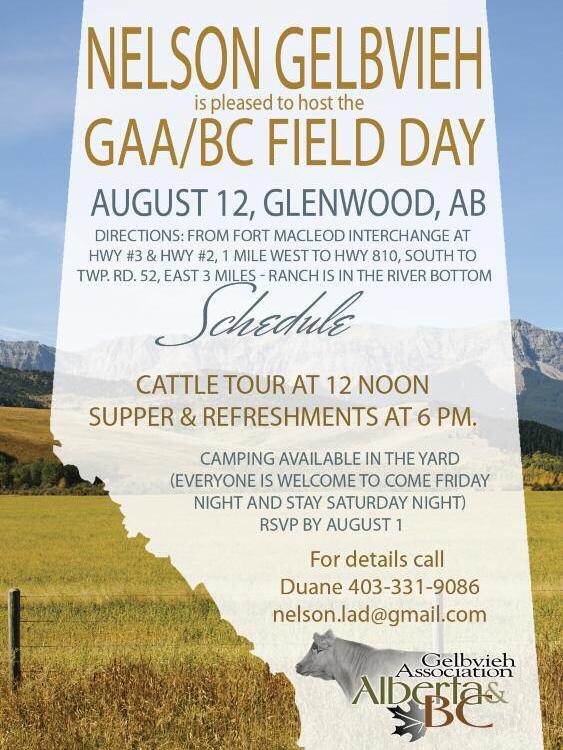
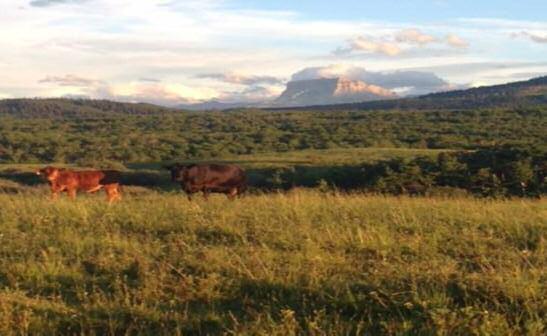
For generations, Southern Alberta has attracted cattlemen in search of a piece of ranching paradise. Nelson Gelbvieh at Glenwood, Alberta, north of the Blood Reserve, is one such place. This ranch is on the Belly River, and each year, from mid-July to mid-October, the approximately 90 pairs that make up the Nelson Gelbvieh herd go to lease land about 30 minutes away There, the landscape is nothing short of picturesque, with tree-covered foothills and the Rocky Mountains in the distance Summers are cooler on the ranch’s lease land, and Chief Mountain, a holy site for the Blackfeet people of Montana, stands guard across the line.
Here, Duane and Linda Nelson run their herd of more than 200 red and black Gelbvieh females, most of which are polled. The land shapes the way that the Nelsons run their ranch, as this terrain dictates the yearly movement of the herd. “I calve early for two reasons, ” Duane Nelson explains. “One, it’s easier to sell bigger bulls, and the earlier they ’ re born the bigger they are The other one is we ’ ve had numerous floods and they usually hit us in June, and if I had just really small calves, I probably wouldn’t be able to get them out as easy as I can with bigger calves So I try to move everything away from the ranch here in summer to summer pastures, and then we usually don’t bring them back until December.”
The roots of the Nelson ranch stretch back to the early 1970s, when Nelson’s father and two uncles decided to go into the cattle business together. One uncle, Jim Nelson, lived in Seattle, Washington, and was friends with Leness Hall, a geneticist with Carnation Genetics. “It was actually Leness that steered my uncle Jim onto the Gelbviehs,” Nelson explains “He’d travelled the world, basically, looking for top genetics for Carnation Genetics in the States, and he came across these Gelbviehs, and said that the longest bull he’d ever measured was a Gelbvieh bull ” While the brothers also tried different breeds, it was the Gelbvieh breed that made the top of their list
By Piper Whelan
They joined the number of breeders who imported Gelbvieh cattle from Germany, and they also bought half-blood females from the United States.
In the mid-1970s, a decline in the beef industry prompted the elder Nelsons to split up the business, and Nelson’s father started an outfitting business in the Northwest Territories It was after they family decided to step away from the cattle business that the next generation became involved Duane and Linda were married in 1975, and were living on the ranch as the original cattle left “Where we live there’s a lot of river bottom land that can’t be farmed, so we decided we should try to run a few cows, and my uncle gave me three threequarter blood heifers,” says Nelson. In time, the couple moved into raising purebred Gelbvieh cattle.
With some part-time help and occasional assistance from their adult children, the Nelsons run the ranch on their own. Linda was a “city girl who turned country,” her husband explains She is in charge of the ranch’s bookwork, and the couple works together closely as a team Nelson’s father, who is now 90, has taken a step back from the everyday chores, though his name remains on the registration papers “He helped more with the farming through the years, but he basically left the cows up to me, ” says Nelson. “I wanted to do it.”
Given his family ’ s positive experience in the breed in the 1970s, it’s no wonder that Nelson maintains his faith in the breed at the centre of their ranching operation. “I continue to use Gelbvieh because I believe in them. I don’t think you can find a better cow than a Gelbvieh cow, and they make great crosses with just about any breed that you could cross them with They seem to always improve them,” he says “I like their docility and their temperament, and they produce really rich milk, and I’m guessing that’s part of the reason their calves grow like they do ” When it comes to the continued success of their herd, the Nelsons’ formula is simple yet effective “I try to buy the best bulls I can, and try and match pedigrees and EPDs so that they ’ re a balanced group. I’ve tried to stress maternal, because if you don’t have a good cow, you have nothing,” Nelson states. This approach has paid off over the years, and is evident in the Canadian Gelbvieh Association Dam of Merit and Dam of Distinc-
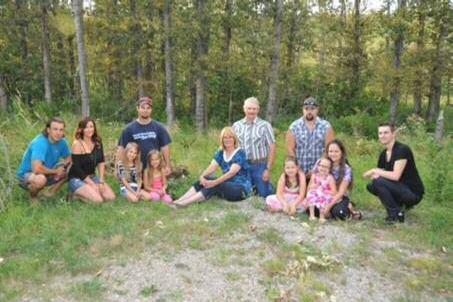
Family Photo above. L-R : Der rick Atkinson, K athy Nelson, Br ynlee Nelson, Jared Nelson, Harley Nelson, Linda & Duane Nelson, Nevaeh Nelson, Derek Nelson, K aren Nelson, Melissa Nelson & Logan Nelson
tion honors that have been awarded to a number of their females. The quality of their program was further recognized when one of their bulls captured the Canadian Peoples Choice Futurity Champion title in 2015. For Nelson, these achievements say a lot about their breeding program. “It should say that you ’ re doing something right if you ’ ve got dams that are continually producing and up at the top of the breed, so it’s a good feeling to know that you ’ ve got good cows, ” he says “Winning the futurity is part of a sign that you have cows that can raise highly-prized animals ”
In addition to producing quality Gelbvieh genetics, the Nelsons ran an outfitting business in the Northwest Territories for two decades. “My uncle started sending a few friends up to my dad and we’d take them elk hunting,” says Nelson, whose father has always been an avid hunter. “One of my dad’s friends said, ‘If you ’ re going to outfit, you might as well go up to the Northwest Territories where you can be a real outfitter.’” When the original ranching partnership dissolved, his father went north to check out land for an outfitting business
“In ’76, my dad wanted me and my wife to come up there We really bonded together that summer, and we decided we’d like our own outfit I went to work for a guy by the name of Rex Logan from Sundre in 1977, and we ended up buying his area and took over in ’78,” he continues. They ran this business until 1998. “We took mostly sheep, caribou and moose, and then we always threw in wolf and wolverine tags, and it was all horseback hunting.” Their season began in mid-July and ran until the end of September. “The hunters would fly in on day one and out on day 14, and we’d trail out on the second day of hunting We’d stay out for 11 sleeps and then come back and do it all over again,” he recalls
Nelson continues to work in outfitting closer to home during the autumn months “After we sold out in ’98, I ended up buying some mule deer tags here in southern Alberta, so I have 11 mule deer tags and four antelope tags, and half a dozen white tail tags,” he explains. “So my Septembers, Octobers (and) Novembers are still pretty busy.”
With a few helping hands, the Nelsons balance running both their ranch and outfitting business. “When we were up north, I used to try to find someone who would come look at the cows once a week,” says Nelson, who notes that their mischievous cattle would some-
times get out not long after they would leave for the Northwest Territories “It’s been kind of a balancing act, and I’ve had good neighbours and friends and family that chip in when I’m not around to do chores or fix fence or chase animals in or whatnot.”
Due to their busy outfitting schedule each fall, the Nelsons aren’t able to hit the show circuit the way other producers often do. However, a partnership with another Gelbvieh operation has been successful in bringing their cattle into the show ring. Rodney and Tanya Hollman of Royal Western Gelbvieh in Red Deer County, Alberta, collaborate with the Nelsons by assisting the latter with show prospect selection and preparation “We met them quite a few years ago, and Rodney liked the cows that he’d seen, and he said, ‘ You need to get your name out there and get your cattle out there and let people see them.’” They ’ ve also helped the Nelsons prepare sale animals for the Gelbvieh Association of Alberta and British Columbia’s annual Wish List Sale and Agribition’s National Gelbvieh Sale. “I’ve just kind of let (Rodney) pick whatever animals he thinks will do good, and we ’ ve done quite well,” says Nelson. “We’ve usually sold up close to the top or the top of the sale with our females that we ’ ve sold in the last four or five years ”
The two breeding programs have also partnered up on a number of Gelbvieh sires “We own several bulls together, and the idea behind that was we both breed at different times We breed early and Royal Western breeds late, so we thought that we could buy superior genetics if we pooled our resources, ” Nelson explains. “Also, the more offspring that you have, the quicker you can evaluate the sire potential of each bull, and so it’s kind of a win-win situation for both of us. ”
With a dynamic partnership and a commitment to quality genetics, the Nelsons are happy to continue raising cattle on the land they love “The longer the work, the longer you stay young, ” says Nelson “I’m still trying to improve by buying the best bulls and raising the best females I can ” They are confident that the Gelbvieh breed will continue to win over Canadian cattlemen with their impressive lineup of traits “I still think that they will continue to be a leader on the maternal side. As more guys come to use Gelbvieh and see the results of the females that they keep for replacements, I think that they ’ll become more and more popular,” Nelson continues. “To me … it’s not the people that promote the breed so much as the breed that’s promoted itself. Usually when people breed Gelbvieh, they like them and keep using them.”
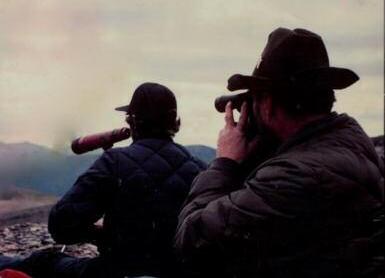
Duane and Dar rel in the early years in the NWT.
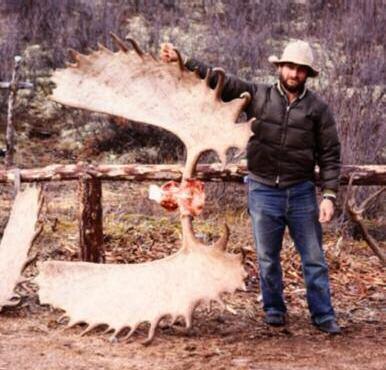
Duane displaying moose hor ns after a hunt
Their ranch is located in Glenwood, AB, a ver y picturesque par t of Souther n Alber ta
Jen-Ty Dynamite 18D Sold to Hillsdown Gelbvieh $16,000
Jen-Ty Dice 5D Sold to Winders Golden Gelbvieh
Jen-Ty Diesel 6D Sold to V&V Farms
Jen-Ty Decker 43D Sold to Jess & Michelle Hardstaff
Jen-Ty Dexter 9D Sold to Towerview Ranch
Jen-Ty Dino 10D Sold to Crimson Cattle Co
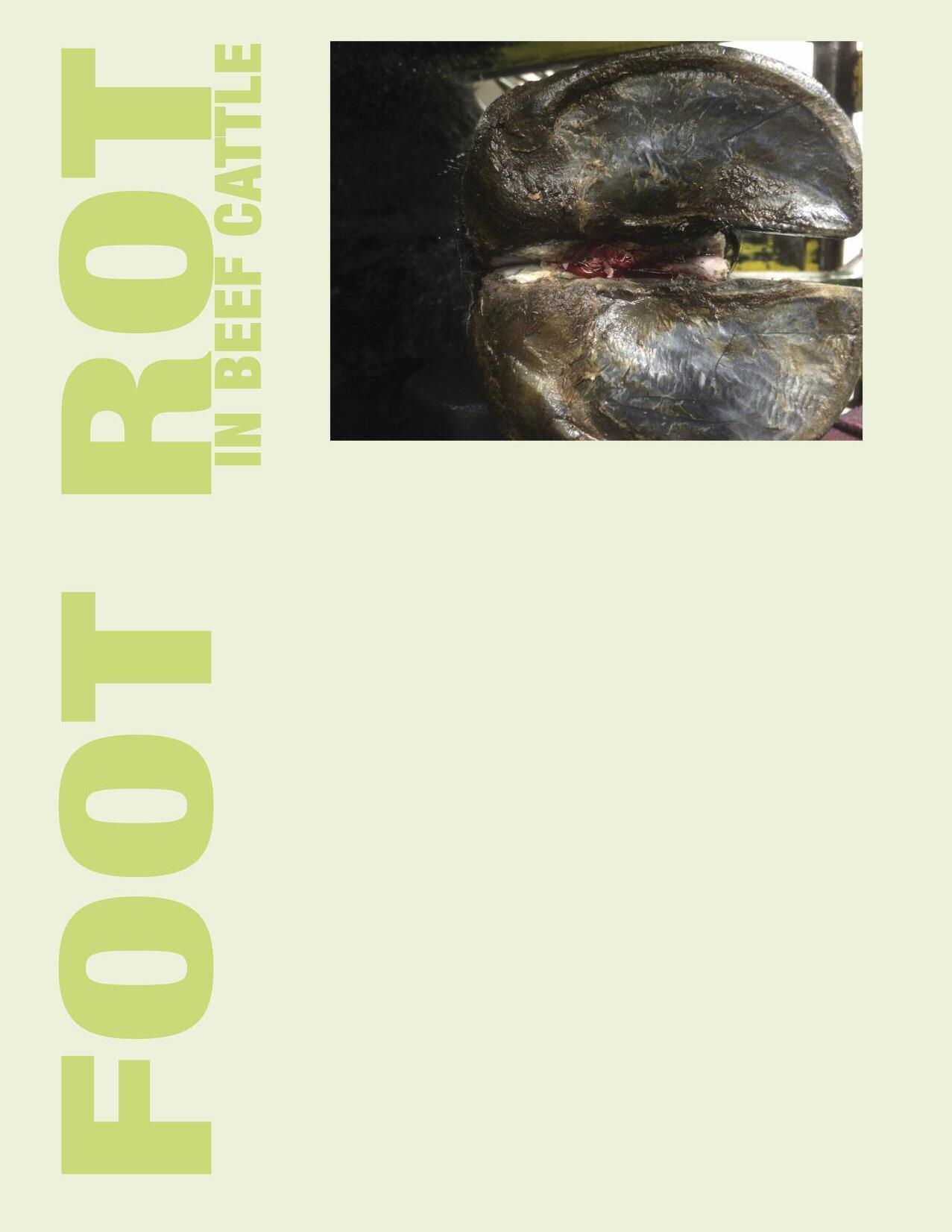
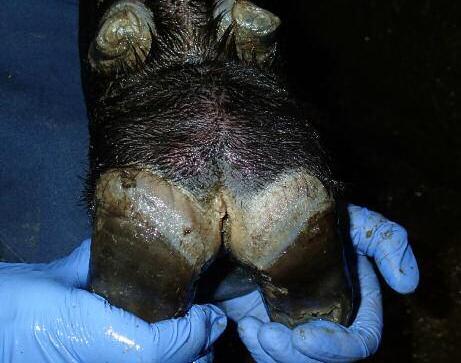
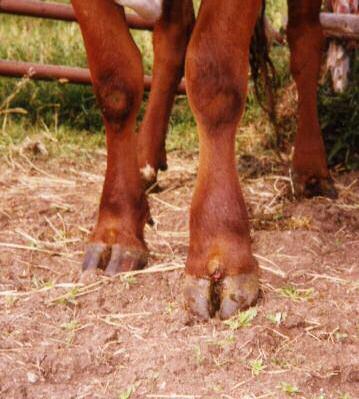
Foot rot is an infectious disease that causes swelling, pain, heat and inflammation in the foot, resulting in severe lameness that appears suddenly. The opportunistic pathogens are always present in the environment, but require a break in the skin to enter the foot.
Dr. Eugene Janzen, University of Calgary, says the important thing is a specific diagnosis before you treat a lame animal. You need to make sure it’s actually foot rot before you give antibiotics.
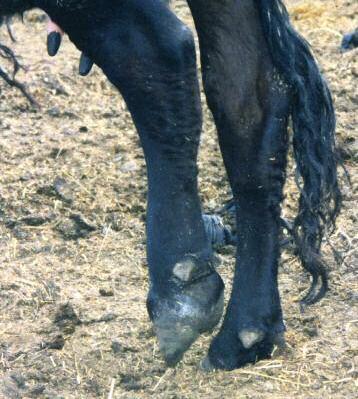
“It may be a problem with the hoof itself rather than an interdigital infection For range cattle, the common alternate diagnoses for lameness would be problems in the hoof such as a hoof crack, or an overgrown toe that’s broken off, or a hoof abscess.” Swelling above the hoof could also be due to a broken bone, a pulled tendon, or snakebite.
“The swelling from foot rot is below the fetlock, and just above the hoof The infection in the interdigital cleft may due to a variety of bacteria that are ubiquitous in the environment. The common one is Fusobacterium necophorum and this is the one for which a vaccine has been created. Other pathogens can be involved as well, and complicate the infection None of them, however, can produce foot rot on their own without a break in the skin. People who have tried to reproduce foot rot in experimental trials have all had to scarify the interdigital area, ” he says.
Cattle wading in mud around water holes are at risk for foot rot because of the bacteria in the mud/manure but they also must have a scrape or puncture “This could happen if they walk on gravel or anything else that might hurt that interdigital area. Thus you need two things for foot rot to occur the bacteria and the injury,” says Janzen
“In dairy cattle we often see foot rot in what dairy practitioners often call ‘ new barn syndrome’ which means that the cows have more interdigital injuries if the concrete hasn’t been worn off and smoothed yet. If cows are walking on an abrasive surface and also have to walk through a slurry of manure, this becomes a perfect combination for foot rot,” he says
“Ranchers in Alberta often talk about certain years being bad for foot rot. This depends a little on how much rain we ’ ve had. Some ranchers are fencing off the water holes and lifting water out of them with solar pumps to a trough on higher, dry ground Then cattle don’t have to go into the water holes to drink. The PFRA in Saskatchewan was instrumental in demonstrating to producers that cattle
preferred to drink from the troughs rather than have to wade in the filth and mud. Even the antelope and mule deer used the troughs rather than go into the water holes.”
Keeping cattle out of the mud and drinking clean water in troughs is also healthier in terms of biosecurity. “If some animals are shedding the bacteria that cause Johnes, this could be a concern as well,” he says
“The literature about foot rot states that incidence in range cattle is something between 1 and 4% but livestock people here in Alberta would probably argue that it’s higher, depending on the year ”
Some ranchers don’t check cattle on summer pastures often enough to see the ones with foot rot and may not treat them soon enough Long-standing cases may result in more serious complications like joint and tendon sheath infections. “Treating foot rot itself is simple, if you catch it early because almost any antibiotic will work But complications as the lesion progresses and invades the deeper structures of the foot are not so simple I would guess that about half the cows sold as culls because of lameness are suffering from complicated cases of foot rot. It’s very serious if the infection has got into the joint, and even worse if it’s into the tendon sheath because antimicrobials won’t get in there,” says Janzen.
There’s no economical way to treat that condition, in cattle “If it was a horse with an infected joint and you brought it into a veterinary clinic, for $2500 we could anesthetize the horse, put a drainage tube into the joint, put the lower limb in a cast, etc But these treatments are not feasible for a cow. Some dairy producers and their veterinarians will treat a serious infection by amputating the claw that is badly affected This has been done in beef cattle, as well, and as long as it is done correctly, this can be successful,” he says.
“For treating range cattle, sustained action antimicrobials that provide coverage for more than one day can work It doesn’t matter very much which one you choose but long-acting oxytetracycline is probably the most commonly used. It’s also probably best to use one like this, saving more modern drugs for when oxytet no longer works. Some pharmaceutical people have cautioned us about using the sustained-action antimicrobials that are more organ-specific such as the drugs that concentrate in mammary tissue or the lungs, for instance (for treating things like mastitis or pneumonia). Those drugs would not be our first choice for treating foot rot,” he says. The oxytetracycline works well enough and it’s also less expensive
“If the cow is at home in the yard where you can treat daily, you can use the oxytet that’s not long-lasting, or use trimethoprim sulfate. If you are not absolutely sure it’s foot rot, and it might be something else like a broken bone in that foot, and one of your alternatives might have to be slaughter, you should consider using Ceftiofur since it doesn’t have a withdrawal time, in Canada,” he says
“In the old days, before we had all these new drugs, we treated foot rot locally with an antiseptic or antimicrobial wrap around the foot. Research shows that if people properly clean the interdigital cleft with soap and water for 4 or 5 days in a row, the foot would heal just as
well as it would with antimicrobial treatment But no one wants to lift up a cow ’ s leg 5 days in a row to wash out the foot!”
Prevention involves trying to keep cattle out of mud and manure, and minimizing risk for abrasions and punctures of the skin between the claws. There is also a vaccine, but it is only effective against the one bacteria.
“If foot rot is caused by Fusobacterium necrophorum it will probably be protective--unless the infection is complicated by or caused by Bacterioides spp. In Canada, some producers who have large bull batteries give the bulls this vaccine when they do breeding soundness evaluation in the spring This may prevent some cases of foot rot, and since the bulls are going through the chute anyway, this is a good time to vaccinate them,” he says.
“When I was growing up, another thing that everyone believed would prevent foot rot is to feed organic iodine with the salt. Many ranchers still feed iodized salt, or salt blocks containing iodine, in an effort to prevent foot rot Whether it does prevent foot rot or not, is debatable The level at which you’d have to add iodine, or organic iodide, in the salt would likely be prohibited by the federal government regulations in Canada. Organic iodine has been withdrawn in Canada for that application,” says Janzen
“ You can put iodine in the salt today, but at such a low level that it’s very hard to tell if it helps. Some companies provide a micro-mix that enhances hoof health (containing the important trace minerals) and there is some evidence that this can help prevent hoof cracks or broken toes. Some companies attach these trace elements to something organic like an amino acid, to be more readily absorbed by the body. There is some evidence that this makes a difference in hoof health.”
“Another cause of lameness is digital dermatitis, or Mortellaro’s disease (also called hairy heel warts and strawberry foot rot) which has been endemic on many dairy farms for a long time. We are now seeing it in confined beef cattle, especially in feed yards that get calves from dairy farms This illustrates the importance of making an accurate diagnosis. Digital dermatitis is caused by a different organism that is very hard to kill and doesn’t respond very well to systemic antimicrobials In a dairy, the cows are treated with foot baths, wrapping the feet, and very intensive treatment,” he says.
Thus we need an accurate diagnosis when confronted with a lame animal, to be sure it’s not a broken leg, pulled tendon, fractured hoof, a foot abscess, or a nail in the foot, etc. Be sure of what you are dealing with, and treat accordingly.
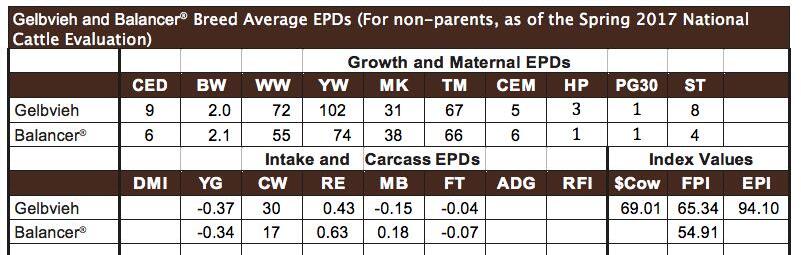
Expected progeny differences (EPDs) can be used to predict the average performance of a bull’s offspring compared to other calves in their contemporary group (a contemporary group being calves that were born in the same calving season, in the same year, herd, sex, and were managed similarly). EPDs are measured in the units of the trait, and show the differences in performance between animals
It is important to remember that this number is just a prediction of performance Actual performance depends on many factors such as environment, management, etc. This being said,
an EPD is by far the most reliable indicator of an animal’s genetic merit due to the amount of information incorporated into the calculation.
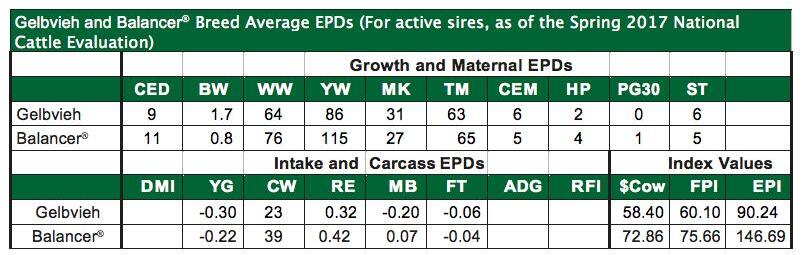
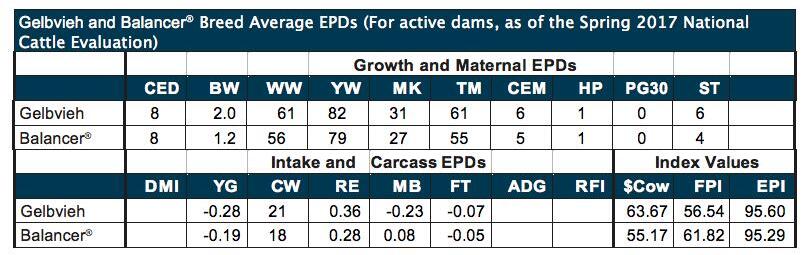
Expected Progeny Differences (EPD) breed averages and percentiles are available for active Gelbvieh sires, active Gelbvieh dams, Gelbvieh non-parent calves, active Balancer sires, active Balancer dams, and Balancer non-parent calves Below are the current EPD averages for each category along with definitions of each EPD and index value:
MATERNAL TRAITS
Calving ease direct (CED): Percent of unassisted births of a bull’s calves when he is used on heifers. A higher number is favorable, meaning better calving ease This EPD can be vital to a rancher looking to decrease the amount of calves pulled in his herd
Milk (Milk): The genetic ability of a sire’s daughters to produce milk expressed in pounds of weaning weight.
Calving ease maternal (CEM): Represented as percent of unassisted births in a sire’s first-calving daughters. A higher number represents more favorable calving ease This EPD is important to a rancher ’ s bottom line because it predicts which animals produce daughters with a genetic pre-disposition to calve unassisted as heifers.
Heifer pregnancy (HP): Predicts the probability that a bull’s daughters will become pregnant as first-calf heifers in a regular breeding season, expressed as a percent. A higher value of this EPD is favorable, meaning that a higher percentage of a sire’s daughters get pregnant as first calf heifers compared to other sires in his contemporary group.
30-month pregnancy (Pg30): Predicts the probability that a bull’s daughters will become pregnant and calve at three years of age, given that they calved as first-calf heifers. This EPD is
expressed as a percent, again, with a higher number being more favorable meaning a higher percentage of a sire’s daughters will calve at three years of age, given they calved as first-calf heifers.
Stayability (ST): Predicts the genetic difference, in terms of percent probability, that a bull’s daughters will stay productive within a herd to at least six year of age The stayability EPD is one of the best measures currently available to compare a bull’s ability to produce females with reproductive longevity
GROWTH TRAITS
Birth weight (BW): Predicts the difference, in pounds, for birth weight of the calf
Weaning weight (WW): Predicts the difference, in pounds, for weaning weight (adjusted to age of dam and a standard 205 days of age) This is an indicator of growth from birth to weaning.
Yearling weight (YW): Predicts the expected difference, in pounds, for yearling weight (adjusted to a standard 365 days of age) This is an indicator of growth from birth to yearling
CARCASS TRAITS
Yield grade (YG): Differences in yield grade score, which is
a predictor of percent retail product. Smaller values suggest that progeny will have a better lean to fat ratio
Carcass weight (CW): Differences in pounds of hot carcass weight, adjusted to an industry standard age endpoint.
Ribeye area (REA): Differences in ribeye area in inches between the 12th and 13th rib. Greater ribeye areas are preferable
Marbling (MB): Predicts the differences in the degree of marbling within the ribeye as expressed in marbling score units. Greater marbling numbers are preferable and are an indicator of higher carcass quality grades.
Fat (FT): Differences for fat thickness, in inches, for a carcass over the 12th rib, smaller numbers of fat thickness are preferable as excess fat can be detrimental to yield grade
EFFICIENCY TRAITS
Dry matter intake (DMI): Represents the average daily dry matter intake per day consumed in pounds. A negative, or lesser value, is more favorable. For example, Bull A has a DMI EPD of .15 and Bull B has a DMI EPD of -.20, so the progeny of Bull B consume, on average, .35 pound less dry matter per day than progeny from Bull A
INDEXES
Total maternal (TM): An index that combines growth and milk information as a prediction of the weaning weight performance of calves from a sire’s daughters. As an index, this
value is not reported with an accompanying accuracy. A greater TM value means a mother that returns comparatively higher weaning weights on her calves. TM Index = MK EPD + ½ WW EPD.
$Cow: Represents the genetic value in dollars of profit of an animal when retained as a replacement female relative to other animals in the herd. A higher number represents more profitable genetics for maternal productivity $Cow will serve producers in selecting bulls that will sire daughters with stayability and reproductive efficiency as well as other traits that lead to profitability in a production system, such as milk, calving ease, moderate mature weight and the ability of calves to gain. A female’s genetics also influence the performance of her calves in the feedlot and at slaughter, so traits such as feed efficiency and carcass value are also included in $Cow.
Efficiency profit index (EPI): An economic selection index developed to aid producers in selecting for more feed efficient cattle that still have acceptable amounts of gain The EPI provides slight negative pressure on intake, while keeping gain at a constant value By selecting on this index, producers will be able to find those animals that gain the same amount as their contemporaries while eating less
Feeder profit index (FPI): An economic selection index designed to aid producers in selecting sires whose progeny will perform in the feedlot and are sold on a grade and yield standpoint Well ranking sires for FPI have higher marbling and carcass weight than their contemporaries. As a terminal index, little emphasis is put on maternal traits such as stayability and calving ease.
AlberTA
Abel Farm
Murray Abel
RR# 5
Lacombe, AB T4L 2N5
Phone: 403/782-1009
403/872-0612
Email: me abel@xplornet ca
Prefix: AFL
Adams, David & Janice
Adamsgreen Gelbvieh
Box 2344
High Prairie, AB T0G 1E0
Phone: 780/524-5382
Email: admsgrn@telus.net
Prefix: ADA
Anderson, laine & Krista
Diamond A Farm
Box 20, RR #2, Site 1
Millet, AB T0C 1Z0
Phone: 780/389-2460
Prefix: DA
Anderson, ron & Gail
Bar GR Cattle
Box 1342
High Prairie, AB T0G 1E0
Phone: 780/523-2116,
780/523-8509
Fax: 780/523-2116
Email: gailanderson@hotmail com
Prefix: GR
Andruchow, Art & Marie
Limestone Stock Farms
Box 386
Andrew, AB T0B 0C0
Phone: 780/896-2352
Email: aandruchow@mcsnet ca
Prefix: AM
bahrynowski, Peter
Duke Cattle Company
Box 486
Wildwood, AB T0E 2M0
Phone: 780/325-2611
780/542-8500
Email: dukeccpeterb@gmail.com
Prefix: DUKE
barnert, Jeremiah
Pin To Point Gelbvieh
Box 4, Site 1, RR# 1
Okotoks, AB T1S 1A1
Phone: 403/617-3985
Fax: 403/938-8168
Email: jeremiahbarnert@gmail com
Prefix: JAB
beamish, Calvin & Donna
Beamish Land & Cattle Box 53
Jarvie, AB T0G 1H0
Phone: 780/954-2285
780/307-4842
Fax: 780/954-2671
Email: farmer56@mcsnet ca Prefix: BLC
beattie, bruce
West Hawk Farms Ltd. RR #2
Sundre, AB T0M 1X0
Phone: 403/638-3735
403/638-7896
Fax: 403/638-3747
Email: westhawk@airenet.com
birch, Aaron & barnett, Joe
Twin View Livestock Box 97
Parkbeg, SK S0H 3K0
Phone: 403/485-5518
Email: aaron@tbfarms ca Website:wwwtwinviewlivestock com
Prefix: AWB
birch, ron & Carol
Twin Bridge Farms Ltd. Box 192
Lomond, AB T0L 1G0
Phone: 403/792-2123
Fax: 403/792-2123
Email: aaron@tbfarms ca Website: www.tbfarms.ca
Prefix: SA
brittain, Kelly & Colleen
Brittain Farms
RR# 1
Falun, AB T0C 1H0
Phone: 780/352-0676
780/387-6446
Fax: 780/352-0676
Email: britt4@xplornet.com
www brittainfarms com
Prefix: CK
Cahoon, Corey
Black Is Gold
602 Blackfoot Terrace West
Lethbridge, AB T1K 7X6
Phone: 403/393-3027
Email: coreycahoon@hotmail com
Prefix: BIG
Carlson, lon T. & lorraine beaudin
Carlson Cattle Company Box 86
Magrath, AB T0K 1J0
Phone: 403/894-3413
Email: rstar91@yahoo ca
Website: www carlsoncattlecompany com
Prefix: CCC
Congdon, Cody
Rocky Top Gelbvieh Box 366
Bashaw, AB T0B 0H0
Phone: 403/350-5791
Email:
rockytopgelbvieh@hotmail com
Prefix: RTG
Davisson, ray & Anne
LC Ranch
Box 764
Stettler, AB T0C 2L0
Phone: 403/741-4488
Cell: 403/323-0233
Email: lcranch@xplornet com
Prefix: LCR
Dunford, Darren
Dusty Rose Cattle Co.
Box 22, Site 2, RR# 1
Dapp, AB T0G 0S0
Phone: 780/206-5918
Email: dunforddarren@gmail com
Prefix: DR
Fecho, larry & lynne
EYOT Valley Ranch
RR# 2
Millet, AB T0C 1Z0
Phone: 780/986-9705
780/718-5477
Fax: 780/986-9705
Email: perfecho@aol com
Prefix: EV
Gibson, Dr. Dale, Gail bower & ryder bower
Ryder Ridge Cattle Company
50260 RR 234
Leduc County, AB T4X 0L6
Phone: 780/504-9267
Email: bullmule7@hotmail com
Prefix: RRCC
Hickman, Darrell & leila
Stone Gate Farm
RR# 2
Vermilion, AB T9X 1Y7
Phone: 780/581-0077
780/581-4510, 780/581-4059
Fax: 780/853-8704
Email:
darrell hickman@lakelandcollege ca
Prefix: STON
Hoffman, ron
Box 819
Carstairs, AB T0M 0N0
Prefix: RRR
Hollman, brad & Nicole
BNH Livestock
35539 Rge Rd 270
Red Deer County, AB T4G 0M5
Phone: 403/352-0816
403/896-8851
Fax: 403/886-2813
Email: bnhollman@gmail.com
Prefix: NGC
Hollman, rodney & Tanya
Royal Western Gelbvieh
35347 Rge Rd 270
Red Deer County, AB T4G 0C9
Phone: 403/754-5499
403/588-8620
Fax: 403/886-2813
Email: rodscattle@platinum.ca
Website:
www royalwesterngelbvieh com
Prefix: RWG
Hollman, ryan
c/o Royal Western Gelbvieh
35347 Rge Rd 270
Red Deer County, AB T4G 0C9
Phone: 403/588-8620
Fax: 403/886-2813
Email: rodscattle@platinum ca
Prefix: RJH
Janzen, Jason & Agatha
Janzen Gelbvieh Box 1433
LaCrete, AB T0H 2H0
Phone: 780/928-2044
780/926-0156
Email: janzenj1978@gmail com
Prefix: JAJ
Keeping, Tom
Keeya Creek Farms Inc.
Box 4733
Taber, AB T1G 2E1
Phone: 403/586-4944
Email: keeyacreek@gmail.com
Prefix: KEE
Koziak, Olivia & Chad
Koziak Land & Cattle
RR #1
Star, AB T0B 4E0
Phone: 780/835-0264
Email: olivia koziak@outlook com
Prefix: KLC
Kulak, Tom
Hill Top Gelbvieh
4603 – 57 Avenue
Stony Plain, AB T7Z 1C6
Phone: 780/722-2150
Email: tkulak@live ca
Prefix: KFF
lightfoot, larry
Triple L Gelbvieh
712037 Range Road 52
County of Grande Prairie NO 1, AB T8X 4A5
Phone: 780/532-6633
780-402-9550
Email: lightfoot@gpnet.ca
Prefix: LL
litchfield, linden & randee
Box 1828
Cardston, AB T0K 0K0
Phone: 403/653-3919
403/317-4163
Email: linlitch@gmail com
Prefix: LCL
Marsman, Wanda
Widowewa Holdings Ltd./Hillsdown
Gelbvieh
25032 Twp Rd 374
Red Deer County, AB T0M 0V0
Phone: 403/749-3075
403-373-3075
Fax: 403/749-3056
Email: hillsdowngelbvieh@yahoo ca
Website: www hillsdownranch com
Prefix: HDG
Mason, Scott & Kristen
M Anchor Gelbvieh
Box 1686
Valleyview, AB T0H 3N0
Phone: 780/524-4304
Fax: 780/524-4339
Email: scooterkm@rocketmail.com
Prefix: SKM
Milne, Harold & bev.
Milne's Gelbvieh
Box 1573
Fairview, AB T0H 1L0
Phone: 780/835-2645
780/855-0365
Fax: 780/835-2645
Email: milneranch@live ca
Website: www milneranch com
Prefix: GCC
Milne, John & Jean
Dunvegan Cattle Co. Ltd.
Box 1209
Fairview, AB T0H 1L0
Phone:
780/835-4518
Fax: 780/835-4518
Email: milneranch@live ca
Prefix: DCC
Muhlbach, Jason
Jace Cattle Company
Box 299
Botha, AB T0C 0N0
Phone: 403/740-2526
Fax: 403/574-2189
Email: jacecattle@hotmail ca
Prefix: JM
Murphy, Andrew & Susan Crump
Red Dawn Ranch
Box 59, Site 5, RR #4
Lacombe, AB T4L 2N4
Phone: 403/782-4713
Fax: 403/782-4713
Email: susandy5556@gmail com
Prefix: RDR
Nelson, Darrell & Duane
Box 1144
Glenwood, AB T0K 2R0
Phone: 403/626-3279
403/331-9086
Fax: 403/626-3036
Email: nelson.lad@gmail.com
Prefix: DDN
Ness, Joe
Jonus Cattle
#74, 115 Bergen Rd NW
Calgary, AB T3K 1P2
Phone: 403/852-7332
Email:jonuscattle@gmail com
Prefix: JOE
Ness, Kert & Joe
Keriness Cattle Company Ltd.
Box 8, Site 7, RR# 1
Airdrie, AB T4B 2A3
Phone: 403/948-3282
403/860-4634
Fax: 403/948-2236
Email: kertness@shaw.ca
Prefix: KCC
Nielsen, Adam
39020A Rge Rd 21
Lacombe County, AB T4E 2M8
Phone: 403/588-9281
Email: adam@dayspringcattle com
Prefix: AJN
Nielsen, Dan & Marilyn
Dayspring Cattle
39020A Rge Rd 21
Lacombe County, AB T4E 2MB
Phone: 403/887-4971
Fax: 403/887-4971
Email: info@dayspringcattle.com
Website: www dayspringcattle com
Prefix: DSP
Okell, Don W & lorna
Jen-Ty Gelbvieh
Box 627
Duchess, AB T0J 0Z0
Phone: 403/378-4898
Don Cell:403/793-4549
Lorna Cell: 403/501-1019
Fax: 403/378-4894
Email: jenty@eidnet org
Website: www.jentygelbviehs.com
Prefix: DL
Pahl, Gary
Towerview Ranch
Box 331
Medicine Hat, AB T1A 7G1
Phone: 403/548-7150
403-528-0886
Fax: 403/548-7139
Email:
towerviewranch@outlook com
Website: www towerviewranch com
Prefix: TVR
Pancoast, Vern & Vivienne
V & V Farms
Box 37
Redcliff, AB T0J 2P0
Phone: 403/548-6678
403/580-9532
Fax: 403/548-6955
Email: vvfarms@xplornet com
Prefix: VV
Pearson, Jessica & Duncan
Pearson Farms Box 589
Calmar, AB T0C 0V0
Phone: 780/297-2352
Email: jessica.andruchow@yahoo.ca
Prefix: JNA
radomske, Dan
Valley Gelbvieh
26569 Twp. Rd. 350
Red Deer County, AB T4G 0M4
Phone: 403/505-2416
Fax: 403/227-1207
Prefix: VG
roy, Henry M.
HMR Gelbvieh
A-54319 HWY 748 N
Yellowhead County, AB T7E 3N6
Phone: 780/723-2361
780/712-1295
Prefix: HMR
Sayer, roger D. & Kim
Foursquare Gelbvieh
Box 15, Site 6, RR #2
Carstairs, AB T0M 0N0
Phone: 403/337-5847
403/875-8418
Fax: 403/337-5847
Email:
rogerandkimsayer@yahoo ca
Prefix: FRSQ
Schiestel, Steve & lisa
Silver Line Farm
Box 371
Eckville, AB T0M 0X0
Phone: 403/358-8259
403/318-7472
Email: silverlinefarms@gmail.com
Website: www silverlinefarms com
Prefix: SFL
Severtson, Scott & lisa
Severtson Land & Cattle
29061 Twp Rd 350
Red Deer County, AB T4G 0M6
Phone: 403/224-3756
403/358-4676
Fax: 403/224-3756
Email: slcgelb@xplornet com
Website: www severtsoncattle com
Prefix: SLC
Smithers, Graydon
Smithers Land & Livestock
Box 1599, 250049 Twp Rd 314
Three Hills, AB T0M 2A0
Phone: 403/443-7737
403/443-3303
Fax: 403/443-5280
Email:
smithers@wildroseinternet ca
Prefix: SLL
Thome, lorinda & rick
RLT Farms
Box 13, Site 3, RR# 1
Spirit River, AB T0H 3G0
Phone: 780/864-2961
Fax: 780/864-2785
Email: rltfarms@yahoo.ca
Website: www rltfarms com
Prefix: RLT
Tuplin, Merv
Henibrit Enterprises
4215 - 83rd Street NW Edmonton, AB T6K 1C8
Phone: 780/450-1280
Email: mervtuplin@gmail.com
Prefix: MJT
Unger, loren & Karen
Unger Land & Livestock
Box 14, Site 13, RR #1
Olds, AB T4H 1P2
Phone: 403/556-6499
403/994-1211
Fax: 403/556-6499
Email: lorenunger@gmail com
Prefix: ULL
Unger, Tim & Mallory
Lost N Found Livestock
Box 44, Site 11, RR 2
Thorsby, AB T0C 2P0
Phone: 780/387-1740
Email: timunger85@hotmail.com
Prefix: LNF
Vancuren, Darren
Sunberry Valley Ranch
Box 7, Site 16, RR# 2
Sundre, AB T0M 1X0
Phone: 403/638-4142
403/507-5424
Email: cdvancuren@gmaiil com
Prefix: SUN
Vander Velden, emylene
Rainbow’s Edge Gelbvieh
Box 5384
Lacombe, AB T4L 1X1
Phone: 403-506-9693
Fax: 403-782-6213
Email:
emylenevandervelden@hotmail com
Prefix: EMY
Williams, Chuck & Jennifer
Flatland Ranch
Box 1086
Hanna, AB T0J 1P0
Phone: 403-854-6270
Email: flatlandranching@gmail.com
Prefix: FLR
Winder, Con & Gail
Winder's Golden Gelbvieh
R R # 2
Camrose, AB T4V 2N1
Phone: 780/672-9950
Fax: 780/672-9950
Email: gwinder@syban.net
Prefix: WGG
briTiSH COlUMbiA
Clint ellis & Cordy Cox
Ellis Cattle Co./Dane Ranch
P O Box 53
Tatla Lake, BC V0L 1V0
Phone: 250/476-1221
250/709-8625
Fax: 250/476-1280
Email: cordy cox@hotmail com
Prefix: RAC
Dawson, Joyce
Gold Bar Gelbvieh
Box 3462
Anahim Lake, BC V0L 1C0
Phone: 778/417-0045
250/570-9179
Email: halfwayranch2000@hotmail.com
Prefix: JLD
Hogberg, ralf & Glenn
Hogberg Ranch
Box 29, Site 904, RR #1
Progress, BC V0C 2E0
Phone: 250/843-7653
Fax: 250/843-7653
Email: hogberg@pris ca
Prefix: HG
Kelly, brenda
3400 Willowbrook Rd
Oliver, BC V0H 1T5
Phone: 250/498-3432
Email:
brenda kelly@interiorhealth ca
Prefix: BPK
MacDougall, Steve & Ashley
MacDougall Ranch
Box 1333
Barriere, BC V0E 1E0
Phone: 250/672-9260
Email:
macdougallranch@gmail com
Prefix: SAM
Mader, barry & robin
B & R Ranch
RR #1, 2108 Duck Range Road
Pritchard, BC V0E 2P0
Phone: 250/577-3486
Fax: 250/577-3486
Email: b&r@telus net
Prefix: BRM
raven, Arne
Raven Gelbvieh
Box 344
Pritchard, BC V0E 2P0
Phone: 250/577-3486
Email: b&r@telus.net
Prefix: ARN
Spence, Wayne & Charlotte
Mountain Spring Farm
1636 Chase Falkland Road
Chase, BC V0E 1M0
Phone: 250/679-3744
Fax: 250/679-3744
Email:
mountainspringcattle@gmail com
Prefix: MSF
Stratuliak, brian
Kiskatinaw Gelbvieh
Site 13, Comp 16, RR #2
Dawson Creek, BC V1G 4E8
Phone:
250/759-4143
Fax: 250/759-4143
Email: kiskgelb@pris ca
Prefix: BES
Tuchlinski, barbara
Francois Lake Gelbvieh Box 1434
Burns Lake, BC V0J 1E0
Phone: 250/695-6620
Fax: 250/695-6620
Email: btuchlinski@hotmail com
Prefix: TL
MANiTObA
bonchuk, Amy
AJB Livestock
Box 239
Rossburn, MB R0J 1V0
Phone: 204/842-5231
204/773-6140
Fax: 204/842-3706
Email: abonchuck@mts.net
Prefix: AJBG
Grose, Patrick
Bluff Island Stock Farm
Box 126
Inwood, MB R0C 1P0
Phone: 204/278-3308
204/886-7950
Email: pgrose959@gmail.com
Prefix: BISF
Jasper, James & Shayla
JSJ Gelbvieh
Box 24
Hartney, MB R0M 0X0
Phone: 204/858-2476
204/741-0763
Email: jasper30@mymts.net
Prefix: JSJ
Overby, Neil
Overby Stock Farm
Box 815
St Rose Du Lac, MB R0L 1S0
Phone: 431/233-3505
Email: overbystockfarm@gmail.com
Prefix: OSF
richardson, Alan & Gail Johnson
A & G Richardson Box 301
Elm Creek, MB R0G 0N0
Phone: 204/436-2655
204/745-7718
Email: agrfarms@gmail com
Prefix: AGR
Wirgau, lee & Neal
Maple Grove Gelbvieh
Box 25
Narcisse, MB R0C 2H0
Phone: 204/278-3255
204/886-7588
Fax: 204/278-3255
Email: maplegrovegelbvieh@gmail com
Prefix: MGF
Wirgau, Neal
Box 317
Stony Mountain, MB R0C 3A0
Phone: Neal: 204/981-5996
Christine: 204/795-7936
Email: wirgauchristine hotmail ca
Prefix: NMGF
ONTAriO
biggelaar, Jake
Biggelaar Farms 5608 Line 34
Mitchell, ON N0K 1N0
Phone: 519/274-5262
Email: j biggelaar@hotmail ca
Duffin, Jim, Doug or Darcy
Triple D Farm Enterprises
20627 Fairview Rd., RR# 2
Thorndale, ON N0M 2P0
Phone: 519/461-1377
Fax: 519/461-0369
Email: duffin@gtn net
Prefix: TDF
Hurst, Jason
311 Auden Road
Guelph, ON M1E 6S4
Phone: 519/881-7929
Email: jasonhurst0@gmail com
Prefix: JPH
Klages, Mike
KLAtown Stock Farms
RR# 2, 056289 Con 12
Desboro, ON N0H 1K0
Phone: 519/363-6307
519/379-4603
Email: mikeklages@xplornet ca
Prefix: KLA
linton, David & Susan Ward
Killoran Creek Cattle Company
RR# 1, 12135 County Road 45 Hastings, ON K0L 1Y0
Phone: 705/927-0373
Email: dlinton678@gmail.com
Prefix: KC
raddatz, ron & Tracy
Maple Lane Farms
RR #3, 194 Breen Line
Eganville, ON K0J 1T0
Phone: 613/649-26836
Fax: 613/649-2686
Email: maplelane@nrtco.net
Prefix: MLF
Williamson, John
Memory Farm Gelbvieh
RR 1, 4145 Holmes Rd
Inverary, ON K0H 1X0
Phone: 613/353-7335
Cell: 613/539-2173
Fax: 613/353-7335
Email: willj@kos net
Prefix: MFG
PriNCe eDWArD iSlAND
Whalen, ron
O'Faelan Farms Inc
Avondale Cattle Company 165 Hermitage Road
Vernon River, PE C0A 2E0
Phone: 902/651-2006
Email: drrwhalen@yahoo.ca
Website: www ofaelanfarms ca
Prefix: OFI
NeW brUNSWiCH
budd, Kevin
Katahdin View Gelbvieh
20 Ivey Road
Limestone, NB E7N 2N2
Phone: 506/277-1082
Email: kvffarm@gmail com
Prefix: KVG
qUebeC
Dufour, Serge et Gilles
Ferme Dufour et Fils Enr
226 St. Hermel Sud
St Alexis de’Matapedia, QC
G0J 2E0
Phone: 418-299-1324
Fax: 418/299-3154
Email: sergedufour 1@hotmail com
Prefix: FDF
SASKATCHeWAN
bentz, blair & lorie
Goodview Gelbvieh
Box 430
Punnichy, SK S0A 3C0
Phone: 306/835-2748
306/746-8037
Fax: 306/835-2748
Email: blbentz@sasktel net
Prefix: BLB
bilokreli, ron & Sons
Vale Country Ranch Ltd
Box 14
Theodore, SK S0A 4C0
Phone: 306/647-2665
306/521-2266
Fax: 306/647-2665
Email: valecountry@imagewireless.ca
Prefix: VCR
burks, Trevor & Amber
Twisted T Gelbvieh
Box 11
Parry, SK S0H 3L0
Phone: 306-715-7476
Email: twistedtgelbvieh@gmail.com
Prefix: TTG
Davidson, Angus & Marlene
Box 385
Ponteix, SK S0N 1Z0
Phone: 306/785-4512
Prefix: AMD
Davidson, ross & Tara
Lonesome Dove Ranch
Box 147
Ponteix, SK S0N 1Z0
Phone: 306/625-3513
306/625-7045
Fax: 306/625-3782
Email: lonesomedoveranch@saskel.net
Website: ww lonesomedoveranch ca
Prefix: DRT
Davidson, Vernon & eileen
Davidson Gelbvieh
Box 681
Ponteix, SK S0N 1Z0
Phone: 306/625-3755
306/625-7863
Fax: 306/625-3524
Email: davidsongelbvieh@sasktel net
Website: www davidsongelbvieh com
Prefix: DVE
Davidson, Wade
Box 385
Ponteix, SK S0N 1Z0
Phone: 306/785-4512
Cell: 306/625-7820
Fax: 306/785-4533
Email: davidsonwade21@yahoo ca
Prefix: WDE
Davisson, barry & Chris Deroo-Davisson
LC Cattle Company Box 1443
Unity, SK S0K 4L0
Phone: 306/228-3048
306/228-7793
Email: bcdavisson@hotmail com
Prefix: LCD
egan, Phillip & Wendy
P-W Gelbvieh
Box 503
Moose Jaw, SK S6H 4P1
Phone: 306/693-6096
Email: p egan@sasktel net
Prefix: PW
Fladeland, Wayne, Delyle & Clinton
Fladeland Livestock Box 70
Gladmar, SK S0C 1A0
Phone: 306/969-4829
Del Cell: 306/869-8123
Clint Cell: 306/861-5654
Fax: 306/969-4834
Email: w fladeland@gmail com
cfladeland@matrix-solutions com
Website: www fladelandlivestock com
Prefix: FLAD
Gardiner, Simon G
Gardiner Gelbvieh Box 133
Quill Lake, SK S0A 3E0
Phone: 306/383-2736
Fax: 306/383-2736
Email: sgardiner@yourlink.ca
Prefix: SGG
Gavelin, David & Kim
Deep Sands Livestock
Box 149
Meyronne, SK S0H 3A0
Phone: 306/264-3635
Fax: 306/264-3665
Email: deepsands@outlook com
Prefix: DSL
Gray, robert J
Wascana Ridge Livestock
Box 348
Pilot Butte, SK S0G 3Z0
Phone: 306/531-5088
Email: robert gray@sasktel net
Prefix: WRL
Hansen, Jeff & Jodi
Double J Land & Cattle Company
Box 529
Springside, SK S0A 3V0
Phone: 306/621-0405
780/956-4552
Fax: 306/792-2042
Email: jeff.hansen@sasktel.net
Prefix: JJH
Hrebeniuk, Darcy
Fir River Livestock
Box 379
Hudson Bay, SK S0E 0Y0
Phone: 306/865-292
306/865-7859
Fax: 306/865-2860
Email: firriver@xplornet com
Website: www gelbviehworld com
Prefix: FRL
Hurlburt, Kirk & leigh Ann
Hurlburt Livestock Ltd.
Box 3, Site 206, RR# 2
Saskatoon, SK S7K 3J5
Phone: 306/931-2551
306/222-8210
Fax: 306/931-2827
Email:
hurlburtlivestock@sasktel.net
Prefix: HL
Johnson, Mark, levi & Garrett
Last Mountain Livestock
Box 368
Strasbourg, SK S0G 4V0
Phone: 306/725-4042
Prefix: LML
Knudson, James
Knudson Farms Gelbvieh
Box 386
Archerwill, SK S0E 0B0
Phone: 306/322-7158
Email: jrhknudson@gmail.com
Prefix: KFG
lawes, James & Judy
Double JL Gelbvieh
Box 355
Dinsmore, SK S0L 0T0
Phone: 306/846-4733
306/846-2052
Fax: 306/846-4733
Email: j2lawes@hotmail com
Prefix: JJL
lawes, Kevin & bonny
Lawes Gelbvieh
Box 176
Dinsmore, SK S0L 0T0
Kevin Cell: 306/831-7055
Bonny Cell: 306/867-7908
Email: crocus.ridge.cattle@gmail.com
Prefix: KJL
little, Glen & Kim
Little’s Country Farm
Box 116
Hazlet, SK S0N 1E0
Phone: 306/678-2044
Fax: 306/678/4532
Email: glkdl81@xplornet.ca
Prefix: LCF
little, Henry
Box 143
Hazlet, SK S0N 1E0
Phone: 306/678-4918
Email: elittle19@gmail com
Nakonechny, ryan
Box 262
Cupar, SK S0G 0Y0
Phone: 306/726-8302
Prefix: RRN
Nicholas, Gary J. & Chad
McCoy Cattle Company Ltd
Box 479
Milestone, SK S0G 3L0
Phone: 306/436-2086
306/436-7300
Fax: 306/436-4613
Email: cnicholas@mccoycattle com
Website: www mccoycattle com
Prefix: ZTM
Schrempp, Will
Morgan Tau Gelbvieh
Box 44, RR #1
Melville, SK S0A 2P0
Phone:
Email: eatfarmraisedbeef@hotmail ca Prefix: MTG
Selin, Wayne r. & lois
Selin's Gelbvieh
Box 97
Stockholm, SK S0A 3Y0
Phone: 306/793-4568
Fax: 306/793-4568
Email: loisselin@gmail com
Prefix: WRS
Sommerfeld, raymond & Pauline
Ryan & Michelle
RPS Gelbvieh
Box 7
Medstead, SK S0M 1W0
Phone: 306/342-4490
Ryan Cell: 306/342-7259
Fax: 306/342-4490
Email:
ryan.sommerfeld@xplornet.ca
Prefix: RPS
Spray, brett & brian
Triple S Cattle Company
Box 796
Preeceville, SK S0A 3B0
Phone: 306/547-2955
306/614-9025
Fax: 306/325-4540
Email: spray3scattle@sasktel net
Prefix: BJS
Thackeray, ian
Thackeray Land and Cattle Inc
Box 1002
Weyburn, SK S4H 2L2
Phone: 306/456-2555
306/861-7687
Fax: 306/456-2554
Email: tgfis@sasktel net
Prefix: TIP
Wick, Kendra-Shane
Krazy Woman Ranch Box 133
Lake Alma, SK S0C 1M0
Phone: 306/447-4403
306/869-6927
Email: k wick21@hotmail com
Prefix: KWR
UNiTeD STATeS
Dockter, Dwight & Christina
Golden Buckle Gelbvieh
4956 – 41 Street SE Medina, ND USA 58467
Phone: 701/486-3494
Email: gbgelb@daktel com
ADA Adamsgreen Gelbvieh, David & Janice Green
AFL Abel Farm, Murray Abel
AGR A & G Richardson
AJBG AJB Gelbvieh, Amy Bonchuck
AJN Adam Nielsen
AM Limestone Stock Farms, Art & Marie Andruchow
AMD Angus & Marlene Davidson
ARN Arne Raven
AWB Aaron Birch
BES Kiskatinaw Gelbvieh, Brian Stratuliak
BIG Cory Cahoon
BISF Bluff Island Stock Farms, Patrick Grose & Terry Bruce
BJS Triple S Cattle Company, Brett & Brian Spray
BLB Goodview Gelbvieh, Blair & Lorie Bentz
BLC Beamish Land & Cattle, Calvin & Donna Beamish
BPK Brenda Kelly
BRM B & R Ranch, Barry & Robin Mader
CCC Carlson Cattle Company, Lon Carlson
CFC T-Anchor Gelbvieh, Ted & Jo-Anne Cymbaluk
CK Brittain Farms, Kelly & Colleen Brittain
COX Dane Ranch, Dale Cox or Romacordelia Cox
CVF Crest View Farms, Barry & Vanessa Wiens
DCC Dunvegan Cattle Co Ltd , John Milne
DDN Darrell & Duane Nelson
DEV Turtle River Gelbvieh, Matthew & Nikki Devonald
DL Jen-Ty Gelbvieh, Don & Lorna Okell
DR Dusty Rose Cattle Co , Darren Dunford
DRT Lonesome Dove Ranch, Ross & Tara Davidson
DSL Deep Sands Gelbvieh, David & Kim Gavelin SK
DSP Dayspring Cattle, Dan & Marilyn Nielsen
DUKE Duke Cattle Company, Peter & Lisl Bahrynowski AB
DVE Davidson Gelbvieh, Vernon & Eileen Davidson SK
EMY Rainbow’s Edge Gelbvieh, Emylene Vander Velden
EV EYOT Valley Ranch, Larry & Lynne Fecho
EW Soperton Gelbvieh Farm, Ellery Wattie
FDF Ferme Dufour et Fils Enr , Serge et Gilles Dufour QC
FLAD Fladeland Livestock, Wayne, Delyle & Clinton Fladeland SK
FLR Flatland Ranch, Chuck & Jennifer Williams AB
FRL Fir River Livestock, Darcy Hrebeniuk SK
FRSQ Foursquare Gelbvieh, Roger & Kim Sayer AB
GCC Milne’s Gelbvieh, Harold & Bev Milne AB
GCG Gofflot Bar 2 Ranch, Camile Gofflot MB
GR Bar GR Cattle, Ron & Gail Anderson AB
GSW GSW Gelbvieh, Glynn Waterton ON
HDG Widowewa Holdings Ltd /Hillsdown Gelbvieh, Wanda Marsman AB
HG Hogberg Ranch, Glenn & Ralf Hogberg BC
HL Hurlburt Livestock Ltd , Kirk & Leigh Ann Hurlburt SK
HMR HMR Gelbvieh, Henry M Roy AB
JAB Pin To Point Gelbvieh, Jeremiah Barnert AB
JAJ Janzen Gelbvieh, Jason & Agatha Janzen AB
JJH Double J Land & Cattle Company, Jeff & Jodi Hansen SK
JJL Double JL Gelbvieh, James & Judy Lawes SK
JKL Jason & Kristie Lawes SK
JLD Gold Bar Gelbvieh, Joyce Dawson BC
JM Jace Cattle Company, Jason Muhlbach AB
JNA Jessica Pearson AB
JOE Jonus Cattle, Joe Ness AB
JPH Jason Hurst ON
JSJ JSJ Gelbvieh, James & Shayla Jasper MB
KC Killoran Creek Cattle Company, David Linton & Susan Ward ON
KCC Keriness Cattle Company Ltd , Kert & Joe Ness AB
KEE Keeya Creek Farms Inc , Tom Keeping AB
KFG Knudson Farms Gelbvieh, James Knudson SK
KJL Lawes Gelbvieh, Kevin & Bonny Lawes SK
KLA KLAtown Stock Farms, Mike Klages ON
KVG Katahdin View Gelbvieh NB
KWR Krazy Woman Ranch, Kendra-Shane Wick SK
LCD LC Cattle Company, Barry Davisson & Chris Deroo-Davisson SK
LCF Little’s Country Farm, Glen & Kim Little SK
LCL Litchfield, Linden & Randee AB
LCR LC Ranch, Ray & Anne Davisson AB
LL Triple L Gelbvieh, Larry Lightfoot AB
LNF Lost N Found Livestock, Tim Unger AB
LUDI Ferme Ludi, Luc et Diane Laroche QC
MFG Memory Farm Gelbvieh, John Williamson ON
MGF Maple Grove Gelbvieh, Lee & Neal Wirgau MB
MJT Henibrit Enterprises, Merv Tuplin AB
MSF Mountain Spring Farm, Wayne & Charlotte Spence BC
MTG Morgan Tau Gelbvieh, Will Schrempp SK
NGC BNH Livestock, Brad & Nicole Hollman AB
NMGF Neal Wirgau MB
NSH Nish Gelbvieh, Ben & Jody Nish AB
OFI O'Faelan Farms Inc , Ron Whalen PE
ORM Koziak Land & Cattle, Olivia Milne & Chad Koziak AB
OSF Overby Stock Farms, Neil Overby MB
PW P-W Gelbvieh, Phillip & Wendy Egan SK
RAC Ellis Cattle Co /Dane Ranch BC
RDR Red Dawn Ranch, Andrew Murphy & Susan Crump AB
RJH Hollman, Ryan AB
RLT RLT Farms, Lorinda & Rick Thome AB
RPS RPS Gelbvieh, Raymond & Pauline Sommerfeld SK
RRCC Ryder Ridge Cattle Co, Dr Dale Gibson, Gail Bower & Ryder Bower AB
RRN Ryan Nakonechny SK
RRR Ron Hoffman AB
RTG Rocky Top Gelbvieh, Cody Congdon AB
RTN Border Ridge Gelbvieh, Tom Neilson AB
RWG Royal Western Gelbvieh, Rodney & Tanya Hollman AB
SA Twin Bridge Farms Ltd , Ron & Carol Birch AB
SAM MacDougall Ranch, Steve & Ashley MacDougall BC
SFL Silver Line Farm, Steve & Lisa Schiestel AB
SGG Gardiner Gelbvieh, Simon G Gardiner SK
SKM M Anchor Gelbvieh, Scott & Kristen Mason AB
SLC Severtson Land & Cattle, Scott & Lisa Severtson AB
SLL Smithers Land & Livestock, Graydon Smithers AB
STON Stone Gate Farm, Darrell & Leila Hickman AB
SUN Sunberry Valley Ranch, Darren Vancuren AB
TDF Triple D Farm Enterprises, Jim, Doug or Darcy Duffin ON
TIP Thackeray Gelbvieh Farms, Ian Thackeray SK
TL Francois Lake Gelbvieh, Barbara Tuchlinski BC
TOM Milne’s Livestock, Tom Milne AB
TTG Twisted T Gelbvieh, Trevor & Amber Burks SK
TVR Towerview Ranch, Gary & Judy Pahl AB
ULL Unger Land & Livestock, Loren & Karen Unger AB
VCR Vale Country Ranch Ltd , Ron Bilokreli & Sons SK
VG Valley Gelbvieh, Dan Radomske AB
VV V & V Farms, Vern & Vivienne Pancoast AB
WDE Wade Davidson SK
WGG Winder ’s Golden Gelbvieh, Con & Gail Winder AB
WRL Wascana Ridge Livestock SK
WRS Selin’s Gelbvieh, Wayne R. & Lois Selin SK
ZTM McCoy Cattle Company Ltd , Gary J & Chad Nicholas SK
APPLICATION FOR MEMBERSHIP
The Canadian Gelbvieh Association invites you to be a part of the Association!
MEMBERSHIP NAME (Please Print) Note: This is the name that will print on the registration certificates.
NAME OF OWNER(S):
PHONE FAX #
STREET OR RURAL ADDRESS (Print)
I (We) hereby apply for:
EMAIL:
CITY/TOWN PROV. P-CODE
ANNUAL ($125.00 + Tax) Note: Includes membership to applicable Provincial Gelbvieh Association.
JUNIOR (Under 21 years of age) Birth date: ($10.00 Annual Activity Fee + Tax )
HERD IDENTIFICATION LETTERS ($30.00 + Tax)
Please allot HERD IDENTIFICATION LETTERS - (1st choice) (2nd choice) (3rd choice) for tattooing Gelbvieh Cattle. Herd letters can be two, three or four letter combinations: ie AB, ABC or ABCD. The correct method for Tattooing: first - Herd letters “ABC”, second - unique ID number of animal “24”, and last, - year of birth letter “B”. eg. Complete tattoo - “ABC 24B”.
HERD NAME ($25.00 + Tax)
Please register, as the Herd Name, for the exclusive use of this membership when naming animals. Please Note: The Herd Name must be acceptable to the CGA.
I undersigned hereby applies for membership in the Canadian Gelbvieh Association, a non-profit corporation, with all rights and privileges and subject to the obligations thereof, as fully set forth in the By-Laws of the Association.
I (We) agree to conform to the By-Laws and Regulations of the Canadian Gelbvieh Association. I (We) waive any claim against and grant an absolute release to the Canadian Gelbvieh Association, any member, employee or agent of the Association, for any act or omission in connection with the Association, including but not limited to, any enforcement of the rules and regulations presently in effect or hereafter adopted by the Association. I(We) further release any and all data submitted to the CGA for use in Breed Improvement Programs.
I do not wish for the CGA to use my personal contact information for business purposes it deems necessary.
Applicants Sign Here
Print Name Here
Applicants Sign Here
Print Name Here
This application must be signed by the individual, all members of the partnership or signing officer in the organization applying for membership
Canadian Gelbvieh Association, 5160 Skyline Way NE, Calgary, Alberta, Canada T2E 6V1
Phone: (403) 250-8640 • Fax: (403) 291-5624 • email: gelbvieh@gelbvieh ca • www gelbvieh ca
Memberships are due on or before Januar y 1st each year.
Only memberships paid up as of April 1st are included in this director y.
Phone: (403) 250-8640 Fax: (403) 291-5624
email: gelbvieh@gelbvieh.ca
Web Site: www.gelbvieh.ca
T w o T i e r S y s t e m
L E V E L # 1 - $ 4 0 0 M E M B E R S H I P L E V E L :
T h i s wo u l d p r ov i d e m e m b e r s 1 v o t i n g c a rd w i t h t h e ch a n c e t o w i n p o s s e s s i o n o f t h e
F u t u r i t y C h a m p i o n B u l l , a n d a l l d ra w d ow n p r i z e s . N o t e : T h i s wo u l d p r ov i d e b re e d e r s w h o d o n o t wa n t s e m e n t o b e p a r t o f t h e e v e n t a n d h av e t h e ch a n c e s o f w i n n i n g t h e C a n a d i a n P e o p l e s C h o i c e C h a m p i o n B u l l .
L E V E L # 2 - $ 6 0 0 M E M B E R S H I P L
R U L E S
- E l i g i b l e b u l l s m u s t b e b o r n f r o m J a n u a r y 1 s t f r o m p re v i o u s c a l e n d a r ye a r ( 2 0 1 6 ) a n d a l l c a l e n d a r ye a r b u l l s .
- M e m b e r s e n t e r i n g b u l l s m u s t b e t h e re g i s t e re d ow n e r o f t h e i r f u t u r i t y e n t r i e s by A u g u s t 1 , 2 0 1 7 .
- B u l l s w i l l o n l y b e a l l ow e d t o e n t e r o n c e.
- A l l b u l l s m u s t b e C G A o r A G A re g i s t e re d P C 8 8 o r P u re b re d / F u l l b l o o d b u l l s .
- A l l b u l l s m u s t h av e c o m p l e t e p a re n t v e r i f i c a t i o n o n f i l e w i t h t h e C G A o r A G A by T h u r s d a y N ov e m b e r 1 6 , 2 0 1 7 t o c o m p e t e ( F u t u r i t y w i l l g u a ra n t e e re s u l t s f o r a l l p r o p e r D N A s a m p l e s s u b m i t t e d t o C G A o r A G A p r i o r t o O c t o b e r 1 , 2 0 1 7 ) A l l s a m p l e s re c e i v e d a f t e r O c t o b e r 1 , 2 0 1 7 w i l l n o t h av e g u a ra n t e e d re s u l t s
- A l l b u l l s m u s t b e Ta t t o o C h e cke d , We i g h e d a n d S c r o t a l m e a s u re d t o c o m p e t e.
- A l l b u l l s w i l l b e v i d e o e d a t t h e e v e n t f a c i l i t y p re v i o u s t o t h e s t a r t o f f u t u r i t y a n d m a d e ava i l a b l e o n - l i n e.
- E x h i b i t o r o f t h e f u t u r i t y ch a m p i o n w i l l n o t b e e l i g i b l e t o w i n t h e i r ow n b u l l .
- M e m b e r s re c e i v e 1 v o t i n g c a rd p e r m e m b e r s h i p.
- O n - l i n e v o t i n g w i l l b e ava i l a b l e f o r m e m b e r s w h o a re u n a b l e t o a t t e n d t h e e v e n t , t h e re w i l l b e n o - p r o x y v o t i n g.
- C l i p p i n g o f f u t u r i t y b u l l s i s s u g g e s t e d a n d w i l l b e l e f t a t t h e d i s c re t i o n o f e a ch ow n e r T h e e v e n t w i l l b e a d r y b r u s h s h ow, z e r o t o l e ra n c e f o r g l u e s a n d p a i n t s
- F u t u r i t y C h a m p i o n w i l l re c e i v e u p t o a $ 2 0 , 0 0 0 p a y o u t .
- A l l b re e d e r s e n t e r i n g b u l l s w i l l b e re q u i re d t o s i g n f u t u r i t y c o n t ra c t s s t a t i n g t h a t t h e b u l l s a re v i rg i n b u l l s ( n e v e r b re d c ow s o r b e e n c o ll e c t e d ) . I n t h e e v e n t t h e i r b u l l w i n s t h e y a re w i l l i n g t o g i v e u p ow n e r s h i p ( f u l l p o s s e s s i o n a n d ½ s e m e n i n t e re s t ) t o t h e f u t u r i t y. - F u t u r i t y m e m b e r s w i l l f i l l o u t a n d s i g n a s e m e n u s e c o n t ra c t t h a t s t a t e s t h e y c a n n o t re - s e l l t h e s e m e n a n d t h e y w i l l h av e t h e r i g h t o f ref u s a l o f s e m e n f r o m f u t u r i t y ch a m p i o n s t h a t d o n ’ t m e e t t h e i r b re e d i n g p r o g ra m s n e e d s T h i s c o n t ra c t w i l l b e s e n t o u t v i a e - m a i l t o a l l m e mb e r s a f t e r t h e e v e n t a n d w i l l b e re q u i re d t o b e s e n t i n by J a n u a r y 1 5 , 2 0 1 8 A l s o a n y a d d i t i o n a l s e m e n p u rch a s e m u s t b e m a d e o f f i c i a l a t t h i s t i m e o n t h e c o n t ra c t a n d p a i d f o r i n f u l l . - F u t u r i t y ch a m p i o n w i l l f i r s t c o l l e c t t h e re q u i re d 1 0 u n i t s p e r m e m b e r s h i p a n d s e m e n w i l l b e re l e a s e d o n t h e s a m e d a t e. A d d i t i o n a l s e m e n re q u i re m e n t s w i l l b e m e t l a t e r, o n c e a l l a d d i t i o n a l s e m e n o rd e r s a re m e t , s e m e n w i l l b e re l e a s e d . ( N o t e a l l a d d i t i o n a l s e m e n o rd e r s w i l l b e p a i d t o t h e f u t u r i t y a n d p r o f i t a f t e r c o l l e c t i o n f e e s , w i l l b e s p l i t 5 0 / 5 0 w i t h t h e ex h i b i t o r o f t h e f u t u r i t y ch a m p i o n b u l l ) . - F u t u r i t y ch a m p i o n w i l l h av e u n t i l S e p t e m b e r 1 , 2 0 1 8 t o f i l l t h e m e m b e r s h i p 1 0 u n i t s . I f t h e F u t u r i t y C h a m p i o n i s u n a b l e t o c o l l e c t a n d f re e z e d u e t o a n y re a s o n ( d e a t h , s i ck n e s s , i n j u r y o r i n f e r t i l i t y ) t h e re q u i re d m e m b e r s h i p s e m e n , o n l y F u t u r i t y m e m b e r s w h o re q u e s t e d s e m e n w i l l b e g i v e n a s e m e n c re d i t ( 1 0 u n i t s ) t h a t c a n b e a p p l i e d t o t h e i r ch o i c e o f t h e n ex t t wo F u t u r i t y C h a m p i o n s A l l a d d i t i o n a l s e m e n p u rch a s e d w i l l b e re f u n d e d i n f u l l . )
- T h e D ra w D ow n w i n n e r o f t h e F u t u r i t y C h a m p i o n / P u rch a s e r i n t h e s a l e w i l l a l s o n e e d t o s i g n b u l l u s a g e a g re e m e n t c o n t ra c t i n re g a rd s t o z e r o s e m e n s a l e s f o r 3 ye a r s
- L o t # 1 i n t h e W i s h L i s t s a l e w i l l b e re s e r v e d f o r t h e F u t u r i t y C h a m p
- T h e F u t u r i t y w i l l s u p p l y s t a l l c a rd s t h a t m u s t b e d i s p l a ye d , a l l a d
s p o n s i b i l i t y a n d l e f t t o t h e d i s c re t i o n o f e a ch e n t r y.
Membership Form
t h e
N a m e o f F a r m
O w n e r ( s ) N a m e
A d d re s s
P h : ( ) F a x : ( )
E m a i l
Ti e r # 1 - $ 4 0 0 M e m b e r s h i p $
Ti e r # 2 - $ 6 0 0 M e m b e r s h i p $
A d d i t i o n a l B u l l E n t r y - $ 2 0 0 $
To t a l E n c l o s e d … … … … … … … … … $
M a s t e rc a rd V I S A C a rd # E x p :
S i g n a t u re
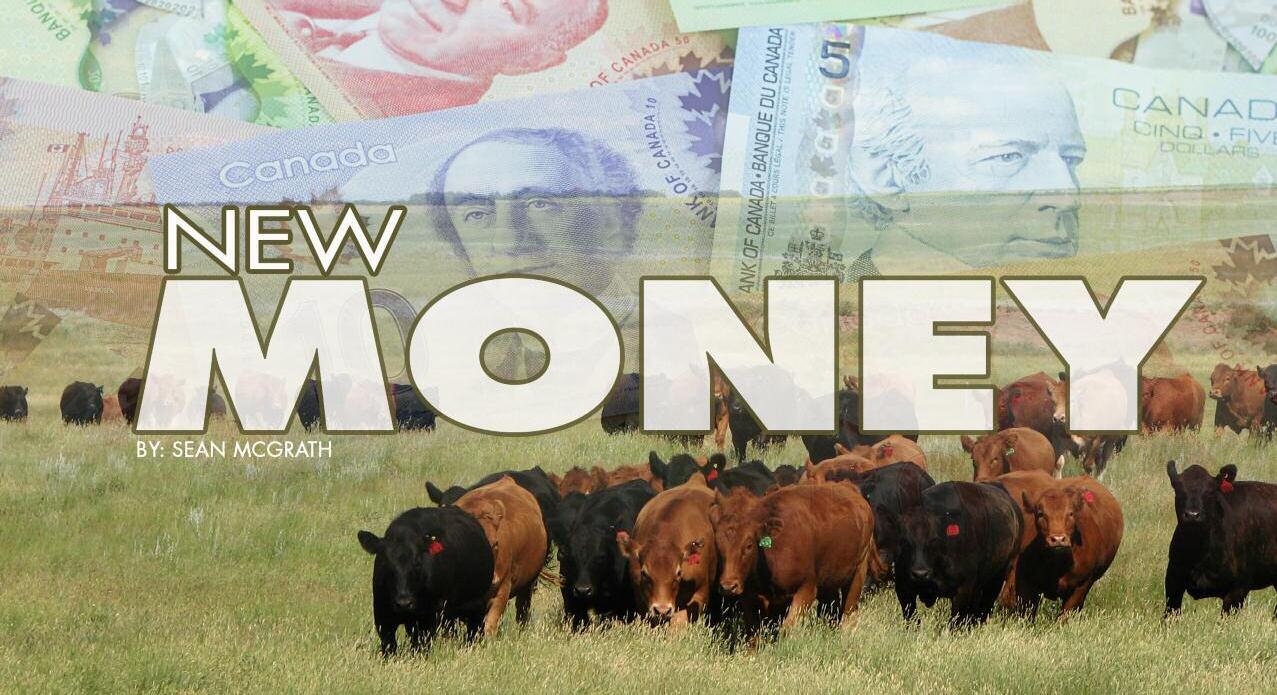
Spring has sprung, and retreated and resprung around here, and with it comes the thoughts of newness. New grass, new calves, and a new crop going into the ground make spring an exciting time As we wrap up bull sale season, it is a good time to think about old versus new revenue coming into the beef production chain. It is important for us to realize that the only truly new money that comes into the beef production chain comes from the end consumer of our product, beef While some operations may subsidize their production with outside revenue sources or invest to build and grow their operation with outside funds, the only new revenue generated in the chain comes from the sale of beef and byproducts.
When we take this thought process to completion, a lot of the money that was spent on bulls this spring, was generated from the sale of weaned calves last year, that won’t generate new revenue into the beef industry until later this year or even next. So what does this mean at a seedstock level?
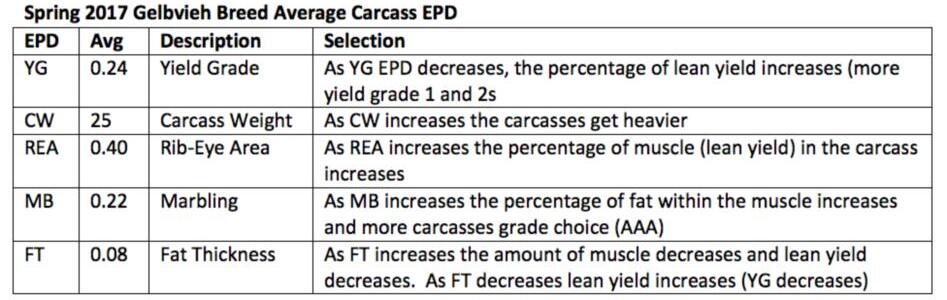
Perhaps the most obvious thing that following the money shows us, is that carcass quality is important. Carcass and meat quality can be a very involved and intimidating topic, but for the most part it can be simplified The amount of meat or yield in the carcass is an important consideration. In a simplified approach yield boils down to carcass size, rib-eye size and fat thickness. Carcass weight shows the overall weight of product. Rib-eye size is an indicator of overall muscle mass, so as the rib-eye size increases the percent of meat yield in the carcass increases. Fat has the opposite effect of rib-eye size. As fat thickness increases, the relative amount of muscle decreases. Fat has a much more significant affect on yield than muscle mass does, so in the yield grade calculation fat is weighted more heavily than rib-eye size
The second consideration in our grading system is the use of marbling as an indicator of quality. Marbling are the flecks of fat spread inside the muscle. Generally, this fat provides juiciness and flavour to the meat, but it also provides protection from the chef. More highly marbled cuts of meat tend to be able to handle a bit more abuse from inexperienced cooks. In our current grading system, marbling is used as something of a proxy for tenderness and flavour. This is why we see cuts labelled AAA, Choice or Prime costing more per pound than those with lower marbling levels.
THE CHALLENGE
It may not be readily apparent, but there are a couple of challenges in trying to generate new money into the beef chain. The first is that from the perspective of the end product we are paid more for less fat (yield) but also paid more for more fat (marbling). Without an investment in genetics it is very difficult to generate animals that deposit more of one type of fat, while reducing the deposition of another. The good news is that we can create genetic curve benders that do marble and yield more, and we can expand these genetics across the industry.
The second challenge and perhaps the biggest stumbling block of all is that for most commercial producers who control the cowherds, fertility and growth trump carcass merit in terms of overall profitability Work by Melton et al in 1995 showed that fertility is 10 times more important than carcass merit and growth is 2 times more important than carcass merit to overall profitability at the cow/calf level in a traditional production system where weaned calves are sold into a feedyard.
This means that your direct customer (bull buyer) may be looking for something quite different than what is generating
the new sources of income for the industry as a whole and long term success for everyone.
Fortunately there are some things that a seedstock producer can do. Investing in ultrasound is one important consideration This proven and non-invasive technology allows us to look inside our seedstock animals to identify those that combine yield and marbling into a genetic package. Further, putting some emphasis on carcass merit in a seedstock selection program can filter benefits out to the entire industry through the multiplication of those genetics in the commercial industry. This can be accomplished by familiarizing yourself with the carcass EPD available in the breed and using them in selection. Because the primary bull customer has their overall profit
largely driven by fertility some balance needs to be applied to this process, but progress can still be made. Another approach is to increase the emphasis on carcass merit for those sire that are entering a terminal situation (all calves are sold or marketed through the feeding industry)
For the seedstock industry investing in the future of the industry needs to involve the end consumer of our product. While several steps removed from this end of the chain, seedstock breeders are actually in the drivers seat of industry success.
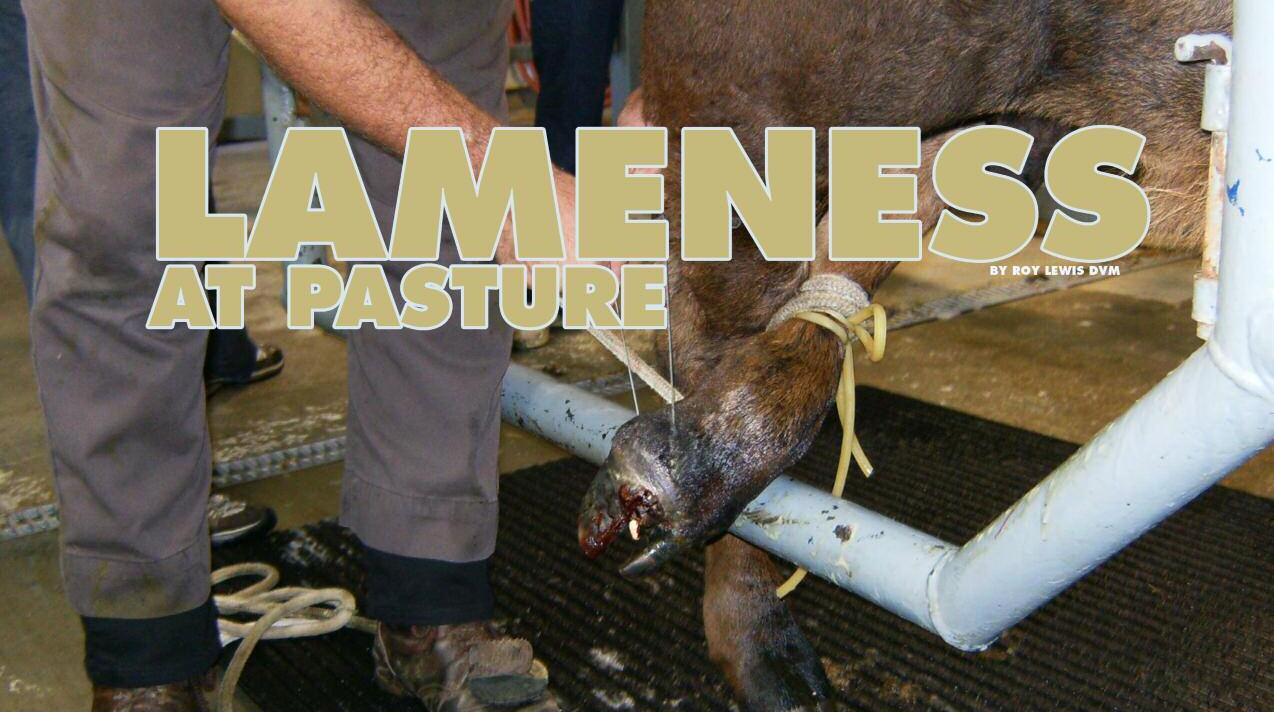
Over the course of the summer grazing period one of the most common conditions encountered in our beef cattle is lameness. Whether on calves, cows, yearlings or bulls purebred or commercial none are immune from developing some types of lameness. Surprisingly enough many really don’t require much for treatment yet many are treated! Producers often use the all-encompassing term of footrot yet most lameness at pasture is not caused by footrot This year (summer of 2017) could see a higher than normal incidence of footrot with all the extra snow and rainfall most areas are experiencing. This article will try and differentiate the many forms of lameness we see at pasture and the steps necessary to correct them Just as an example I supervised 90 dry cows at pasture several years ago and out of 12 lame animals I encountered (all on different cows) only one case was treated. All the rest cleared up uneventfully.
After lame livestock are spotted get up close to them which should not be difficult Visually or with some binoculars spend some time observing them. First determine which leg they are lame on. Look for signs of swelling, the degree of weight bearing on the affected leg and how they ambulate. With regards to the hoof evidence of cracks, the toes spread apart, corns, long hooves or curled toes may all cause pain in the foot Of course as with any condition or illness, record the description of the animal including color, ear tag and any other distinguishing features as this makes them easier to find on the recheck.
point here is if you have a true foot rot with swelling of the foot and in advanced cases the dead rotting flesh between the toes treatment should be very effective with antibiotics. Many different antibiotics are effective so you and your veterinarian will determine which is best suited to your situation. A number of the longacting products are very effective against foot rot and often one shot if caught early can be curative The treatment could even come in the form of a dart Some newer products need a veterinary prescription if used against footrot so together with your veterinarian find a course of action that works. I even recommended the footrot vaccine for either herd bulls at semen checking or in extreme cases where outbreaks of footrot in the breeding females have been reported
This year could see a higher than nor mal incidence of footrot with all the extra snow and rainfall most areas are experiencing. “ “
Many of the other lameness’s fall into two broad categories Those that need more involved procedures done and those which need to simply convalesce on their own with no further treatment. By more involved procedures the examples are broken legs which may need anything from emergency slaughter in larger animals to either casting or splint applications in younger ones. In young calves casts and splints depending on the location of the break have a very high success rate if found early before the bone has broken out through the skin.
Once the location and condition causing the lameness has been determined the course of action is determined My main
A couple other conditions which need further care are sole abscesses and septic arthritis With sole abscesses there is almost no weight bearing yet often no swelling is evident. These need to be brought home and a therapeutic foot trim performed by your veterinarian. The abscess is open up and drained. We often see this in association with bad feet or a crack in the wall which allows the infection to enter Because the infection is enclosed