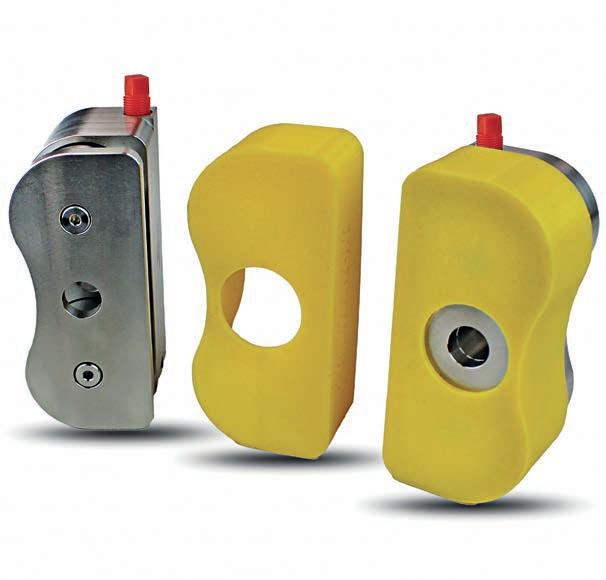
Geotab’s new all-in-one video telematics solution, the GO Focus Plus, automatically flags distracted driving, tailgating, hard braking and other serious events immediately, delivering instant in-cab voice feedback to enhance driver safety. For managers, patterns and urgent cases rise to the top for fast review and targeted coaching, all in one workflow that tracks follow-up and results. Spend less time searching and more time supporting every driver, addressing risk, encouraging improvement and recognising safer habits.
Ready to transform your fleet?
Visit www.geotab.com/au/ to learn how our telematics solutions can drive your business forward.
A big year with infrastructure in motion
Welcome to the rst 2026 edition of Utility magazine. As we settle into another transformative year, we re ect on the remarkable progress being made across Australia’s essential infrastructure – from water pipelines to energy super-grids – and the people working tirelessly to build resilience for our communities.
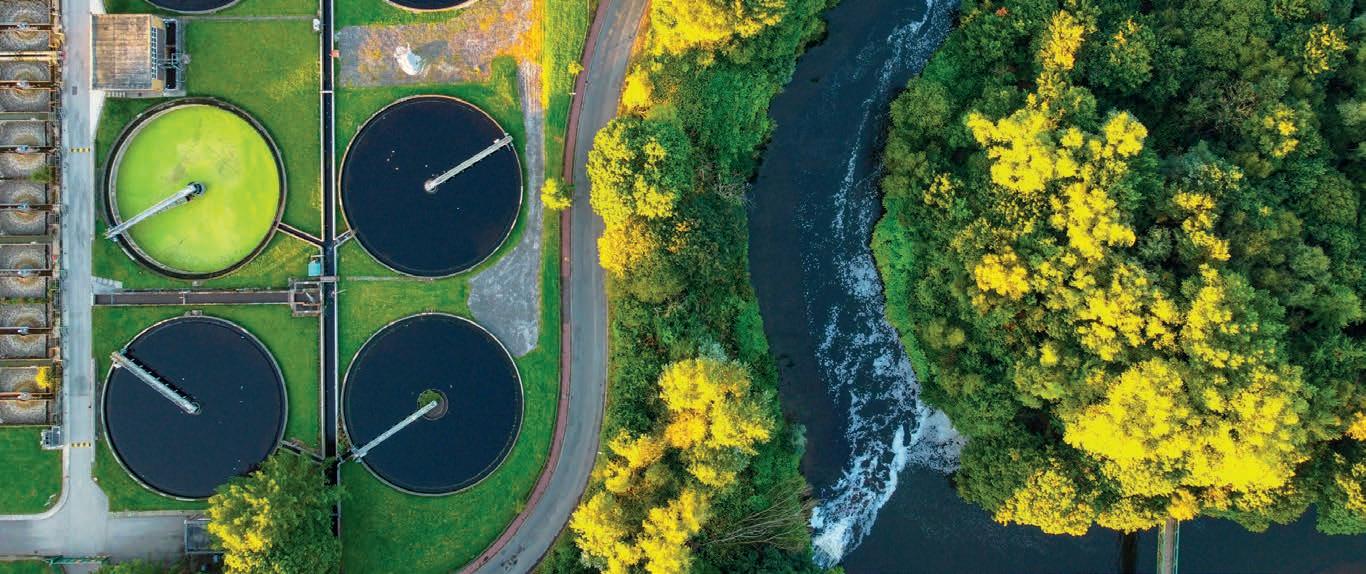
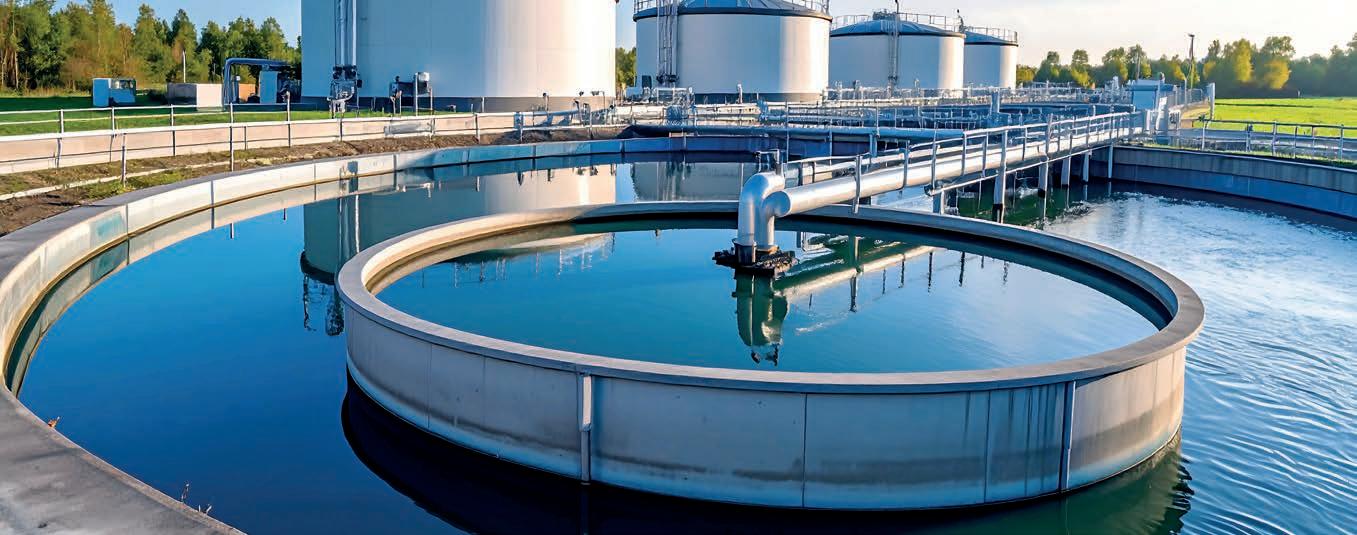
Protecting communities with real-time stormwater insight
e past year demonstrated the industry’s commitment not just to maintaining service but to rethinking and strengthening the networks Australians rely on. As climate change and extreme weather challenge our systems, utilities across the country are stepping up with practical innovation and long-term thinking.
is year, one of the most eagerly anticipated projects starts to take shape. Marinus Link - the undersea HVDC interconnector linking Tasmania and Victoria – moves from plan to execution. Stage 1 construction is expected to begin in 2026, with plans for undersea and underground cable works and converter-station builds activating a new era of power transfer and renewable integration across the Bass Strait.
HumeLink - a critical high-voltage transmission project connecting the expanded Snowy Hydro 2.0 scheme to the national grid – is also underway and will see further developments in the year ahead. Foundations are being laid, access tracks established, and 500 kV substations constructed, marking early yet decisive progress toward a grid designed for clean energy at scale.
On the water side, 2026 brings a milestone for Central Queensland. e Fitzroy to Gladstone Pipeline is expected to be completed this year, delivering a second water source to the industrial and residential networks of Gladstone.
For Greater Sydney, growth continues with the South West
Growth Area Drinking Water Program. New drinkingwater pipelines in Austral and Cecil Hills are slated to start construction in mid-2026 - part of a broader push to support population expansion and ensure a future-proof water supply.
ese projects re ect more than just physical infrastructure: they represent a shi in how Australia plans for climate resilience, energy security and sustainable growth.
With Marinus Link and HumeLink paving the way for large-scale renewable integration, and major water pipelines locking in supply for fast-growing communities, 2026 feels less like a transitional year and more like the launchpad of fundamental, long-term transformation.
Behind every digger, every excavated trench, and every transmission tower rising on regional ridgelines — there are real Australians. Workers building local resilience, companies building capacity, and regulators preparing frameworks that will guide decisions for decades to come.
As we move deeper into this quarter-century, we aren’t just constructing pipes and poles. We’re laying the foundation for a more resilient, a ordable, and sustainable Australia – together.
KATIE LIVINGSTON, EDITOR
Drop Katie a line at katherine.livingston@primecreative.com.au or feel free to call on 03 9690 8766 to let us know what you think. Don’t forget to follow Utility on social media – find us on LinkedIn, X and YouTube.
With Vocus Satellite – Starlink, private networks for critical infrastructure can now be extended via Starlink without travelling over the internet.
Remote utility sites can become part of a network with identical security protection as metro areas to support automation and advanced monitoring technologies.
Right sizing the energy transition
Networks remain Australia’s backbone. Energy Networks Australia CEO Dom van den Berg looks at how the AEMO confirms the need for a balanced approach.
The release of the Australian Energy Market Operator’s Dra 2026 Integrated System Plan (ISP) marks an important moment of clarity in Australia’s energy transition.
AEMO’s Dra ISP o ers a more accurate, balanced picture – one that aims to right-size the task ahead while reinforcing a message Energy Networks Australia has consistently championed: networks are the backbone of the future energy system.
One of the most signi cant updates is the revision of the projected new transmission build. For years commentary has suggested Australia might require up to 10,000 kilometres of new lines but this 2026 Dra ISP shows that it’s actually closer to 6,000 kilometres - still substantial, but more targeted and e cient. Notably, about 2,800 kilometres of this is already underway. is matters because right-sizing infrastructure is essential to keeping costs manageable for consumers. Build too late, and reliability su ers. Build too early or at unnecessary scale, and customers foot the bill.
Transmission remains the indispensable backbone of the system, and the Dra ISP is unequivocal about that.
As renewable generation zones take shape and storage technologies expand, transmission is the critical connective tissue enabling a secure, modernised system. Transmission investment represents around seven per cent of the future capital cost of the energy transition, while delivering substantial whole-of-system bene ts for consumers.
Crucially, this Dra ISP elevates the role of distribution networks in a more meaningful way than we’ve seen before. It acknowledges that a smarter, whole-of-system approach – one that captures the value of distributed energy resources and local network capability – is essential if we are to keep costs down and move quickly.
A standout example is the newly included “actionable” project centred on Dubbo. For the rst time, the ISP identi es a distribution-led project as actionable – an important evolution in national planning. is initiative aims to connect approximately 2.4 gigawatts of new generation capacity directly into the distribution network around Dubbo. It is a collaborative e ort involving Essential Energy, Transgrid and
EnergyCo, and it interacts closely with the Central-West Orana Renewable Energy Zone (CWO REZ).
By strategically leveraging the distribution grid, the project has the potential to fast-track new generation, reduce reliance on additional transmission lines, and deliver meaningful savings to consumers.
It demonstrates how transmission and distribution networks, working together, can unlock more e cient outcomes. It also signals that distribution networks - and the customer assets connected to them – are becoming central players in the design of the future grid. is matters because Australia leads the world in the uptake of roo op solar, and consumer-owned batteries and electric vehicles are becoming increasingly common. ese assets must be coordinated e ciently, not only to support system security but also to ensure all customers – including those unable to invest in new technologies – bene t from lower whole-of-system costs.
Finally, although the ISP is not a plan for gas, it reinforces the critical rming role gas plays in maintaining reliability. Unlocking gas supply constraints to the Southern markets prevents an over-build of new generation and storage,
and a reliance on diesel to keep the lights on, and puts downward pressure on wholesale prices.
A ordability remains the core challenge. Every part of the sector must stay focused on integrated planning and least-cost outcomes. e worst thing we could do now is treat individual pieces of the system in isolation. Transmission, distribution, generation, storage and consumer devices form an interconnected ecosystem. Success will depend on how well we optimise that ecosystem - not on any single project or technology.
Energy Networks Australia is committed to working with AEMO, governments, communities and our industry partners to implement the right mix of new infrastructure to deliver a reliable, a ordable and equitable net-zero energy system.
Targets, plans and projections mean little unless the sector continues to collaborate, innovate and maintain momentum.
e ISP provides the map. Now we must walk the path–steadily, thoughtfully and together. U
e roadmap to 2050: Page 50
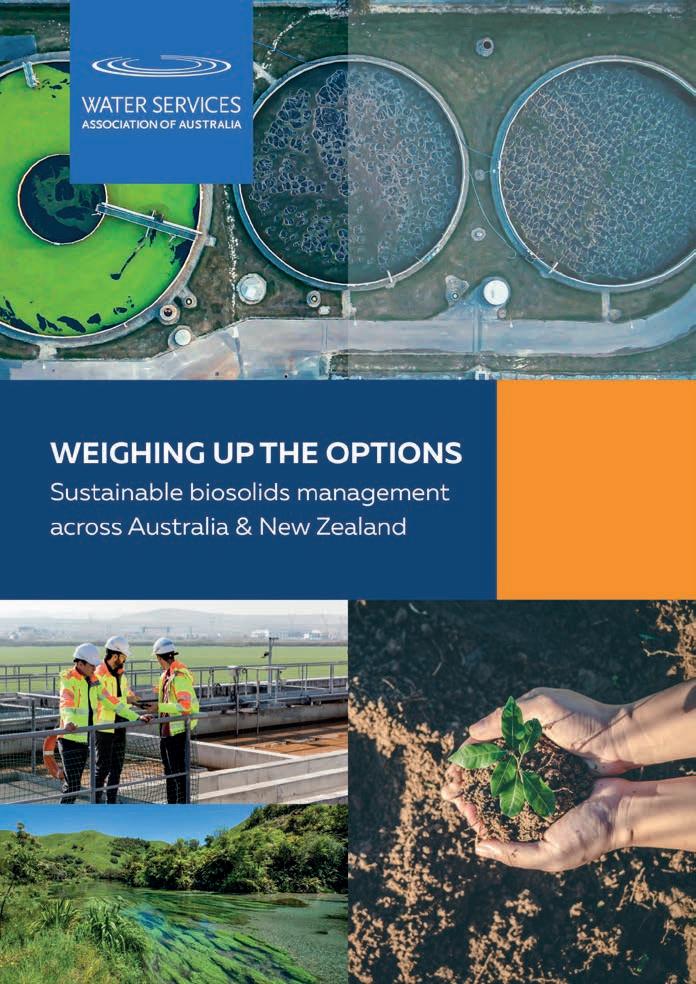
Weighing up the options
Sustainably managing biosolids in the water sector across Australia & New Zealand demands meeting several key benchmarks including safety. A new report outlines the options.
The water sector is committed to the provision of water and wastewater services that are safe and protective of public health and the environment. is extends beyond the provision of treating drinking water and managing sewage, to what we do with the by-products of these processes. One of the biggest by-products we have are biosolids. A nutrient, carbon-rich material that has provided signi cant bene t where it can be safely applied to agricultural, forestry and land rehabilitation. However, as biosolids are a by-product of wastewater treatment, we are becoming more aware of the growing risks of contaminants such as PFAS and microplastics.
T hese contaminants can be present in biosolids. Consequently, there is increasing regulatory requirements which are and may further limit biosolids to land. As a sector we need to act. e production of biosolids is not a tap we can simply turn-o . WSAA, in partnership with the ANZBP, engaged AtkinsRéalis to prepare a comprehensive overview and comparison of biosolids management options in Australia and New Zealand. WSAA has now released a public report on the deliverable of that project to improve the information available on biosolids management options for water utilities, customers and stakeholders. To support water utilities in planning for the future of biosolids management, the report presents the results of an assessment that evaluates 20 existing and emerging approaches for managing biosolids across Australia and New Zealand.
e way biosolids are managed in Australia and New Zealand has changed signi cantly over the last few decades, progressing from simple disposal, to more structured regulation and management, and now focusing on creating value and treating biosolids as a useful resource in a circular economy, while managing health and environmental risks.
Internationally, the water sector has been shi ing from a linear ‘once through’ process and value chain, to a far more circular and value-added process chain. Exciting opportunities in extraction of cellulose, biomethane, ammonia, heat and production of alternative products such as biochar and sustainable aviation fuel are ‘taking o ’. e report aims to stimulate discussion about current and future biosolids management, as utilities face increasing pressure to respond to known and emerging contaminants, impacts from climate variability, growing capital constraints, and shi ing community expectations. e report is a reference on the available options to managing biosolids and can help inform policy and regulatory decisions. By understanding what options are available, the report provides the con dence to embrace the next frontier in biosolids management. U
The new report details the advances in managing sustainable
Visibility
With net zero targets, rising energy costs, and tighter regulations, the challenge is clear: you can’t drive change without understanding your energy use.
NHP’s Socomec Digiware system delivers granular, comparable energy data. It turns the energy use of complex sites into clear, actionable insights so you can make confident decisions to reduce carbon, save energy, and protect critical assets.
▬ Pinpoint inefficiencies to help decarbonise
▬ Spot energy waste to cut costs
decarbonise
▬ Scalable and integrates with your existing network
▬ Cybersecure by design to safeguard your data
Get granular. Get visibility. Get Digiware. → nhp.com.au/digiware
Celebrating operational excellence in water
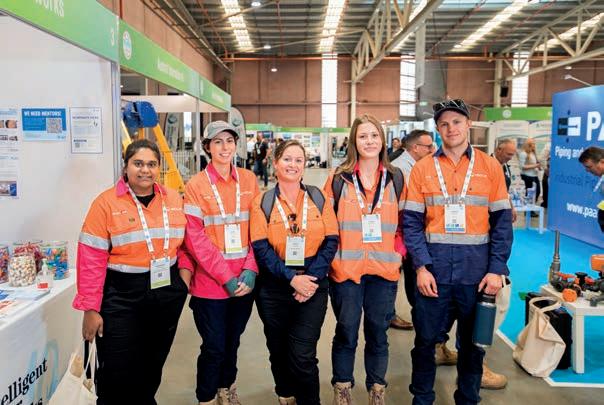
The not-to-be-missed 2026 Victorian Water Industry Operations Conference & Exhibition brings together hundreds of water professionals from across Victoria.
The Water Industry Operations Association of Australia (WIOA) will once again return to Bendigo for the 2026 Victorian Water Industry Operations Conference & Exhibition – its premier and largest event for operational professionals, innovators, and leaders shaping the future of the water industry.
Taking place on March 25–26 at the Bendigo Exhibition Centre, this annual gathering is more than a conference, it’s a celebration of the people behind the water pipes, pumps and processes in our communities.
e event will once again bring together hundreds of water professionals from across Victoria and beyond for two days of learning, networking, and solutiondriven knowledge sharing. Delegates can expect a strong technical program featuring practical case studies, real-world challenges, and the latest advances in water and wastewater operations, in an e ort to ‘bridging the knowledge gap in water operations’ – the theme for next year’s edition.
Honouring excellence
e event will recognise and reward excellence in operations through WIOA’s nationally respected awards program, which highlights the dedication, advancement and hard work of the operators who ensure water quality, reliability, and e ciency across the country.
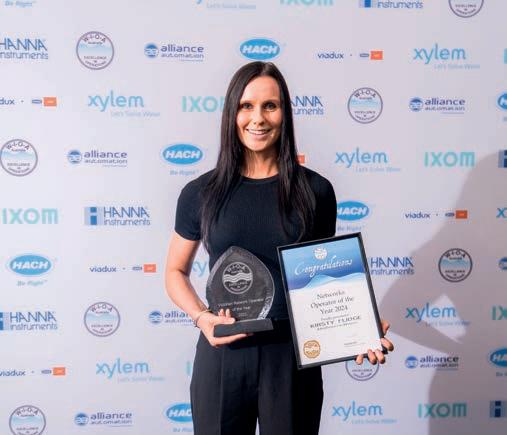
e Operator of the Year Award celebrates an individual who consistently demonstrates exceptional technical skill, leadership, and commitment to their role. is prestigious award acknowledges those who not only perform at the highest level but also mentor and inspire their peers to do the same.
e Team of the Year Award recognises collaboration
at its best, highlighting groups that have achieved outstanding results through innovation, communication, and teamwork. Whether it is tackling complex operational challenges or implementing creative e ciency improvements, these teams embody the power of collective expertise.
e PASS (Problem Accepted, Solution Supplied) Award encourages creative thinking by honouring individuals or teams who have identi ed an operational issue and developed a clever, practical solution to improve performance, safety, or sustainability.
e New Operator of the Year Award shines a light on the next generation of water professionals – those who are bringing fresh ideas, enthusiasm, and dedication to the sector. It’ s an opportunity to celebrate emerging talent and support the future of the industry.
Recognising excellence in knowledge sharing, the Best Paper by an Operator Award honours an operator who delivers the most outstanding technical presentation at the conference. is highlights the importance of communicating challenges and real-world insights to strengthen the water industry.
By championing these awards, WIOA continues to advocate for the water industry operations sector – ensuring that those on the frontline of water and wastewater management receive the recognition they deserve. Mark your calendar and join WIOA in Bendigo this March. Whether you’re presenting, networking, exhibiting, or cheering on your peers, the 2026 Victorian Water Industry Operations Conference & Exhibition is your chance to connect, celebrate, and shape the next wave of operational excellence in Australia’s water industry. U
WIOA Victoria celebrates the people behind the pipes, pumps and processes that deliver our most vital asset to our communities.
Victorian excellence will be recognised as part of WIOA’s awards program.
Images: WIOA
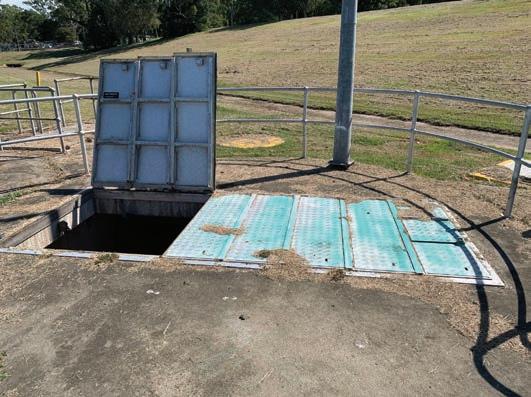
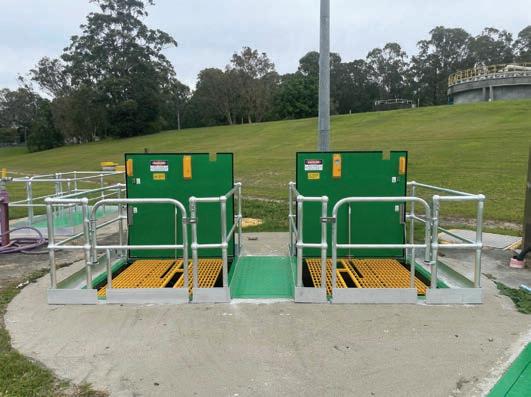
Ageing, compromised, or operationally dangerous assets?
Safe Access Audits
Safe Access Upgrades
Safe Access Design Engineering
Operator Safety Equipment
We simplify all the steps involved in accessing and maintaining assets across the network into a single streamlined process, ensuring operation is simple, safe, and efficient.
Anywhere AUS / NZ
A new norm in motor tech
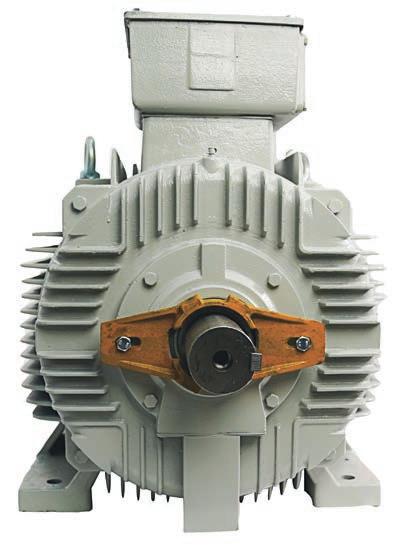
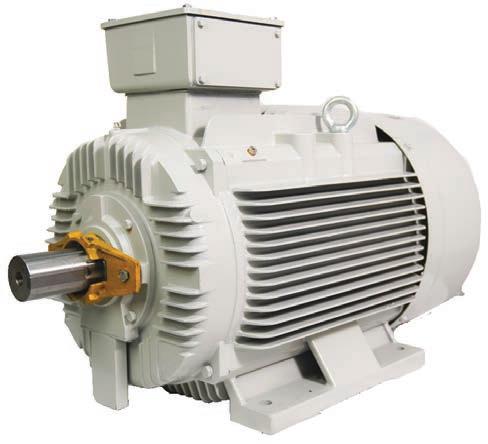
IE4 e ciency suitable for VSD, soft starter and direct-on-line operation make the TECO MAXeV4 a simple, reliable and cost-saving motor upgrade.
TECO is leading a new frontier in motor technology with the introduction of its new MAXeV4 IE4 Super Premium E ciency motor.
e motor, which can support a range of utility applications, doesn’t require a variable speed drive, something TECO Australia and New Zealand product manager – low voltage motors Atheer Yaseen Nashi said is a key di erentiator.
“Many competitor IE4 solutions rely on permanent magnet or synchronous reluctance motor technologies, which must be paired with a variable speed drive (VSD),” Nashi told Utility.
“ e TECO MAXeV4, on the other hand, delivers true IE4 e ciency without requiring a VSD.”
e direct-on-line (DOL) nature of the TECO MAXeV4 motor underpins optimised electromagnetic design for reduced losses, high reliability with mechanical robustness, and lower operating temperatures for longer bearing and insulation life.
“ is combination of super premium e ciency, exibility, and maintainability positions the TECO MAXeV4 uniquely in the market,” Nashi said.
e TECO MAXeV4 shares the common TECO footprint, meaning it can easily replace IE2 and IE3 motors in-situ, and while it is inherently designed without the need for a VSD, it can and will support both xed speed and VSD-driven systems.
e MAXeV4’s IE4 e ciency reduces energy loss and heat generation. is directly translates to lower power consumption and operating costs, improved motor life and reliability, reduced CO2 emissions and sustainability gains, plus better alignment with future regulatory and compliance frameworks.
Overall, upgrading to a TECO MAXeV4 motor can deliver up to 7.7 per cent energy savings over an IE2 motor, and up to 4 per cent over an IE3 motor, with a typical payback period being under 2–3 years.
“For utilities, where motors o en run continuously, the lifecycle savings can be signi cant, making IE4 e ciency one of the fastest cost-recovery investments in rotating equipment,” Nashi said.
Nashi sees motor technologies increasingly moving beyond IE2 and IE3 e ciencies as sustainability obligations heighten.
“With increasing regulatory pressure, rising energy prices, and growing ESG (environmental, social and governance) commitments, IE4 e ciency will rapidly shi from a premium option to a standard expectation,” he said.
“ e TECO MAXeV4 positions utilities and industry ahead of future compliance requirements, ensuring a smooth transition to super premium e ciency equipment without disruption.”
Equipment reliability is quintessential to the success
of any utility, especially in critical infrastructure environments where downtime is costly.
To mitigate operational headaches, the TECO MAXeV4 boasts conventional induction motor design to boost ease of maintenance. is ensures the machine is suited to both new installations and retro t environments.
e TECO MAXeV4 has been developed to support a range of utility applications, including water and wastewater pump stations, HVAC (heating, ventilation and cooling), aeration systems, irrigation and rural pumping, desalination systems and treatment plants, and remote or isolated networks where service access are limited.
“ e motor’s rugged, mechanical design and high e ciency make it especially well-suited to long-duty-cycle pumping operations typical in the utility sector,” Nashi said.
With a power range of 0.75kW – 315kW, the TECO MAXeV4 is available in 2, 4 and 6 pole options, has a protection rating of IP66, and is Class H insulated rated at 180°C (with maximum 80°C temperature rise).
Nashi sees the TECO MAXeV4 motor playing an important role moving forward.
“Utilities, industrial operators, and OEMs are now looking beyond compliance and towards long-term energy responsibility,” he said.
“ e TECO MAXeV4 was created to meet these demands – providing a high-e ciency solution that is simple to deploy, is cost-e ective over its lifetime, and can easily replace any IE2 or IE3 motor, bringing operators up to speed with modern e ciency standards.” U
TECO Australia and New Zealand product manager – low voltage motors Atheer Yaseen Nashi.
Images: TECO
The MAXeV4’s IE4 e ciency directly translates to lower power consumption and operating costs.
TECO MAXeV4
Super Premium Efficiency Electric Motors IE4 performance. Squirrel cage reliability. No redesign. No lock-in.
KEY FEATURES
• IE4 Super Premium Efficiency: Up to 4% over IE 3 and up to +7.7% over IE 2 — lower power bills, faster ROI.
• Drop-in IEC 60072-1 Retrofit Design: Direct replacement for IE2/IE3 motors — no shaft, flange or baseplate changes needed.
• IP66 Protection: Sealed against dust, water jets and heat — reliable in outdoor and washdown areas.
• Class H Insulation: Rated at 180°C for high ambient and high service factor applications.
• Squirrel Cage Rotor: Standard design, no magnets — fully serviceable by any qualified motor repairer.
• Works with DOL or VSD: No VSD lock-in — compatible with existing control setups.
• Flush Through Grease Relief System: Simplifies bearing maintenance — extends motor life.
• Local Stock + Custom ModShop Builds: Faster delivery, tailored paint systems, thermal protection, and specific site adaptations.
Efficiency should be simple. Upgrade to TECO MAXeV4 IE4 today! Scan the QR code for further information.
Smart charging infrastructure
NHP Electrical Engineering Products has developed Australia’s first pole-mounted 50kW DC charger, bringing fast electric vehicle charging to the kerbsid.
Electric vehicles have experienced a rapid rise across Australia in recent years, as drivers look to minimise their impact on the environment while eliminating their cost of fuel.
However, the rapid rise in demand has outpaced kerbside charging infrastructure, which remains limited for many EV drivers, such as urban residents who lack dedicated o -street parking, and in regional communities.
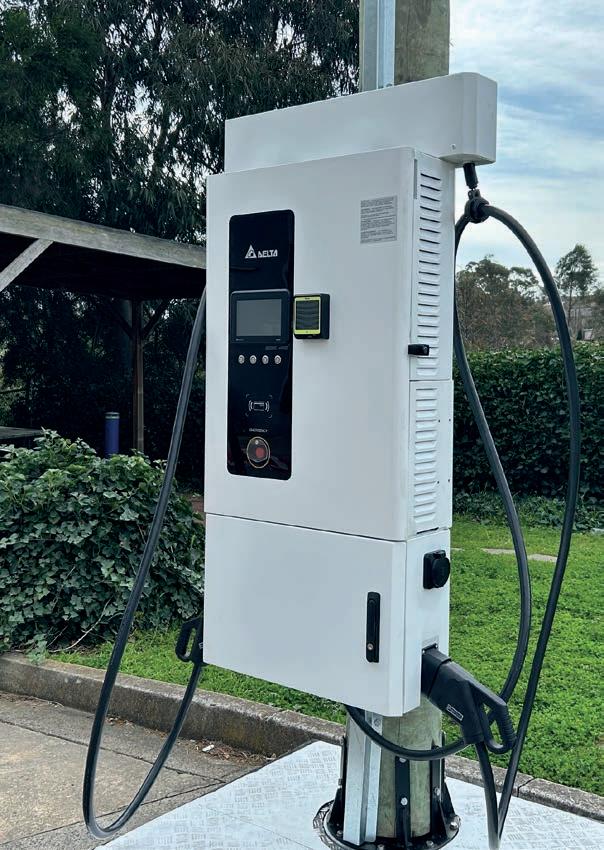
Leading provider of industrial electrical and automation solutions NHP has developed a solution to this, in collaboration with Delta Electronics and local distribution network service providers – Australia’s rst pole-mounted 50kW DC fast charger, the RapidPost 50. is breakthrough from NHP could not have come at a better time, with statistics from the Australian Automobile Associations quarterly EV Index for Q3 2025 nding full battery EVs took 9.7 per cent of all new vehicles, and these numbers continue to grow.
However, Australia’s charging infrastructure still trails
other parts of the world and remains an issue for many EV owners.
Research from Mitsubishi in 2025 found 62 per cent of respondents to say it was not easy to locate a charger.
Making the comparison with Norway – which has one of the highest EV uptakes in the world (80 per cent of new vehicles – it has a charger for every 250 people, while the research says Australia has a ratio of one charger to every 14,062 people.
Developed to make fast EV kerbside charging accessible to every Australian driver, RapidPost 50 connects directly to existing street-power poles – unlike traditional fastcharging sites that require extensive construction and space – and delivers up to 50kW of fast DC charging to a single vehicle, or shared output between two EVs via CCS2 connectors.
By simply mounting the fast charger to or beside existing suitable power poles, it eliminates the need for trenching, civil works or complex site approvals – signi cantly reducing installation time, costs and disruption to the community.
NHP national business development manager - EV Solutions, Malcolm Noyle says this enables local governments, councils and utilities to expand the deployment of public charging networks faster and more e ciently.
“ is is a genuine game-changer for Australia’s EV landscape,” he says.
“By reimagining how and where we deploy charging infrastructure, the RapidPost 50 brings fast, convenient charging to the kerbside. No digging, no drama, just clean energy where it’s needed the most.”
Meeting a demand
Featuring a steel-cased, weather-hardened design and an integrated credit card reader, the RapidPost 50 makes it easy for drivers to pay-on-the-spot and access fast charging instantly, without downloading a mobile app.
It can be deployed to EV drivers both in dense urban areas and in regional communities, which o en lack adequate kerbside charging infrastructure.
In regional communities, Noyle says the RapidPost 50 can be highly bene cial for EV drivers passing through towns, as they can stop to get lunch or look around while their car quickly re-charges, while also being an essential for those urban residents who don’t have dedicated ostreet parking.
While there are AC charging stations currently available, Noyle says EV drivers who get home late at the end of the day may struggle to nd a charger.
“If all the charging stations are occupied, how do you re-charge your vehicle,” he says.
“ e RapidPost 50 is a solution, especially for those living in apartments who don’t have access to a charger within the building.”
The RapidPost 50 is Australia’s fi rst pole-mounted 50kW DC fast charger
Images: NHP
In comparison to current AC charging stations, Noyle says the RapidPost 50’s DC variation is much more suited to local government and councils due to its faster charging capability.
“EV drivers using AC charging stations need to be parked for much longer compared to DC to get any meaningful charge,” he says.
“RapidPost 50 will charge every electric vehicle from 20 to 80 per cent in under an hour with only one vehicle plugged in, and under two hours if it’s got two vehicles plugged in.
“ ese are magical gures for local authorities, because they will usually have one or two-hour parking requirements.”
Noyle adds the quick and easy installation of the RapidPost 50 can also generate signi cant cost-savings and a greater return on investment.
“If you put a DC charger into the ground, you’re talking upwards of $20,000 worth of construction work,” he says.
“An AC charger on the other hand will typically cost up to $10,000 to get it mounted on a pole, and they can only charge one vehicle at a time at around 11 kilowatts an hour.
“On any given day, you may only get one or two
charging sessions out of it as a marginal pro t, because the drivers aren’t paying for the premium DC fast charging.
“Our solution to that is the DC charger where up to two vehicles can charge at a time, and with a one to two-hour timeframe, there could be up to six charging sessions at a higher pro t margin.”
Broader impact
While RapidPost 50 is addressing a key accessibility gap to fast EV charging, it can also have a ripple e ect on the adoption of EVs and sustainability.
By increasing the amount of reliable fast charging locations, there will be less infrastructure barriers for drivers considering switching to EVs, which will help support ongoing emission reduction targets.
“Society needs a greater rollout of EV charging, but not just any charging,” Noyle says.
“It has got to include the exibility between AC and DC charging, be compliant with local authority requirements and be able to be a business opportunity for charge points operators.
“ e principle behind RapidPost is compared to an AC charger, you could install a DC charger which will have a better return on investment and provide a valuable service to the community.” U
An example of what Rapid Post 50 could look like on a small urban roadside with existing poles.
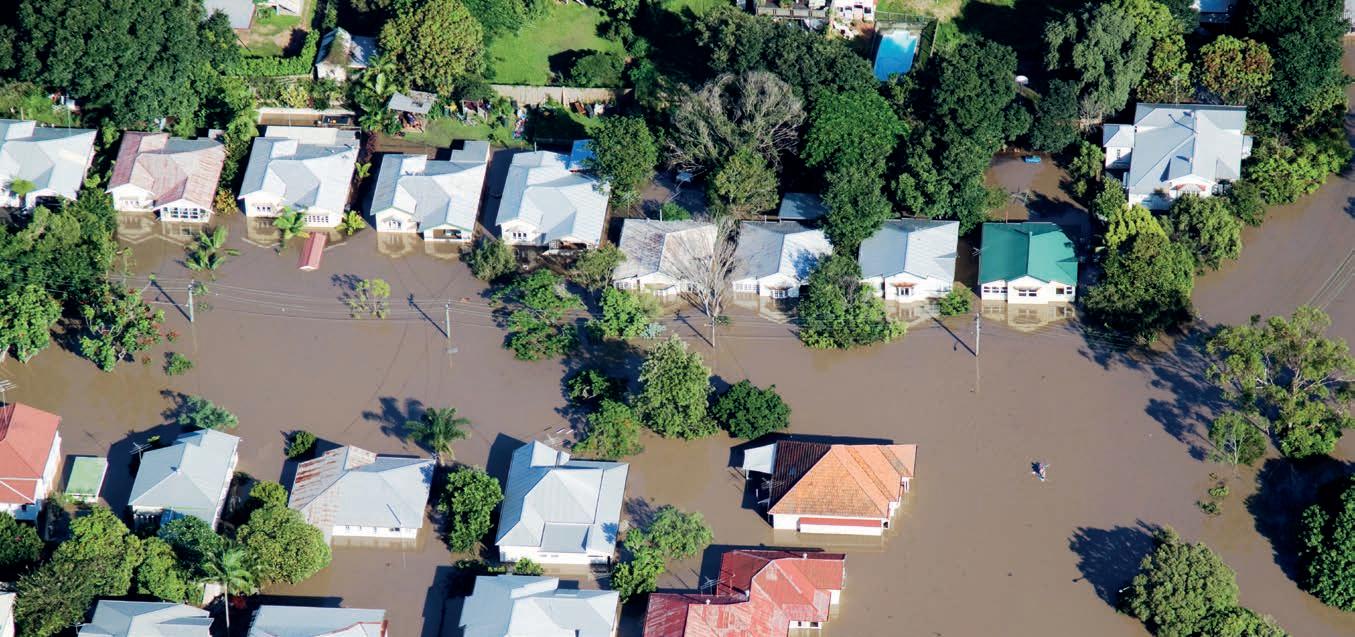
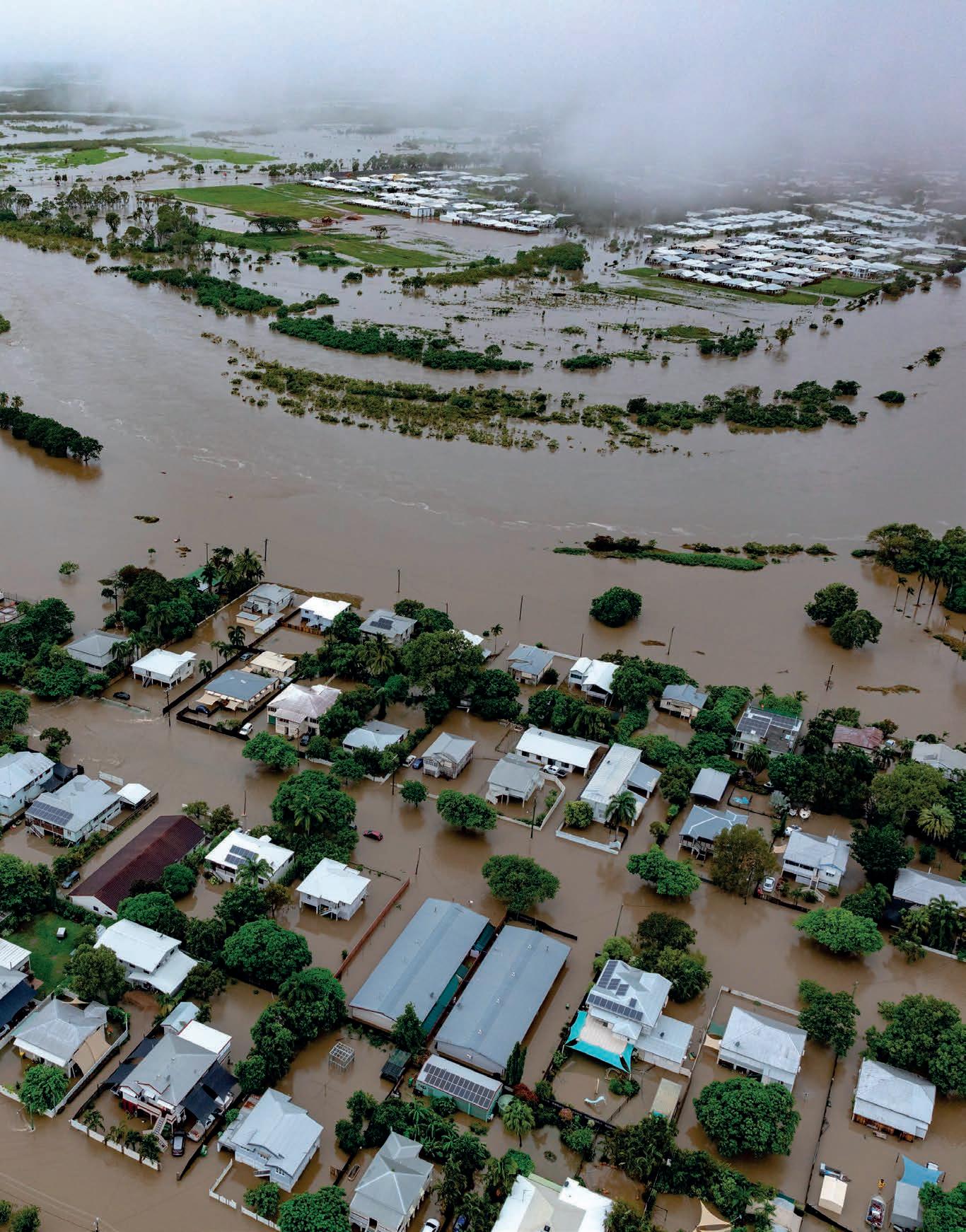
Mapping out a flood-prone future
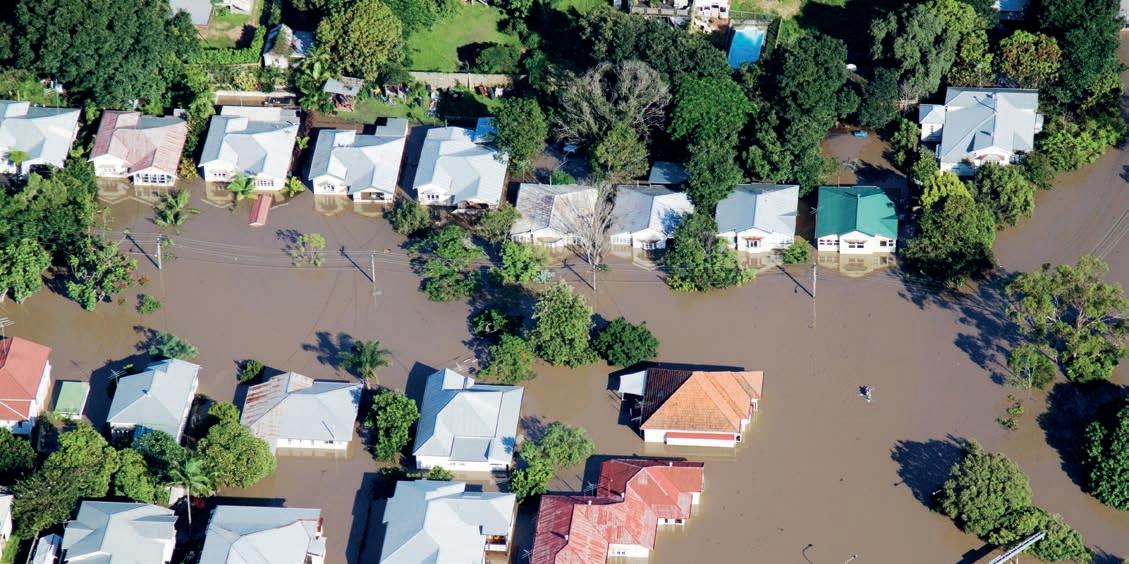
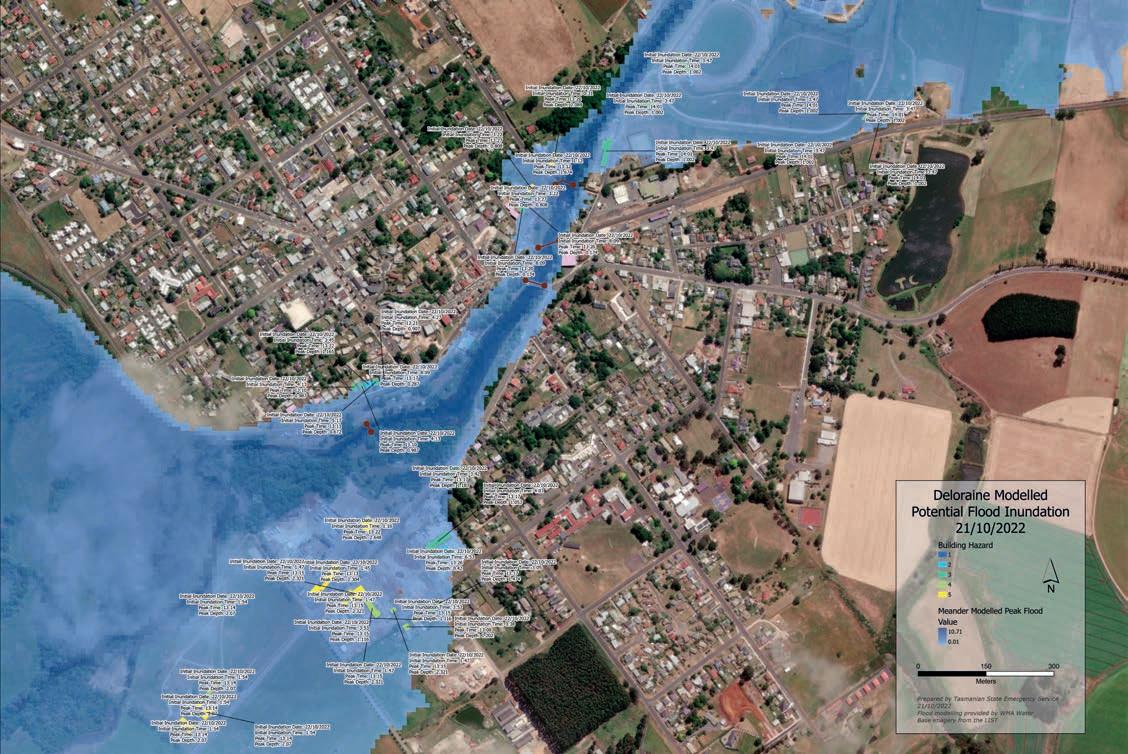
Across Australia, experts point to an increase in extreme weather, including heavy short-term rain events. Yet decision makers working in utilities, planning and infrastructure are often illequipped with outdated flood-risk mapping. Infoworks ICM is demonstating how it’s time to rethink the way Australia builds flood maps.
Since the beginning of 2025 alone, there have been 19 ood- or storm-related incidents in Australia. According to the CSIRO and Bureau of Meteorology’s biennial report on the State of the Climate, heavy short-term rainfall events are becoming more intense. e question is no longer whether severe ooding events will occur, but how prepared we are to handle them.
e release of the latest Australian Rainfall and Runo (ARR v4.2) climate-change guidance only ampli es the urgency of the task to modernise our ood protection e orts. It calls on practitioners to account for more frequent occurrence of extreme rainfall intensities and their implications for catchment ooding.
eir updated guidelines promote the use of advanced digital and computational tools for more accurate ood risk assessments, and the guidelines encourage modellers to move from uniform to variable rainfall adjustments.
Utilising the latest cloud-based technology
Yet, many of our advisory tools – like ood maps – are sorely outdated, leaving decision-makers underprepared for the challenges that lie ahead. e problem is not simply one of intent, but of capacity. Updating ood models to re ect current conditions, let alone the projected impacts of
climate change, has traditionally required signi cant time, resources, and computational e ort.
T his is where advances in technology are transforming what was once a monumental task into an achievable, scalable process. With the advent of cloud computing for hydraulic modeling in just the last few years alone, engineers can now use tools like InfoWorks ICM to build, calibrate, and run highly detailed hydrologic and hydraulic models much, much faster and more e ciently than ever before. What used to take days of computation can now be completed in hours or even minutes by running them parallel in the cloud.
e reality is the terrain and weather patterns we are trying to map are changing so rapidly that traditional modes of collecting and collating ood-related data can no longer keep up. And, these weather uctuations will continue. For example, CSIRO’s guidance on rainfall intensity in Australia varies drastically depending on future emissions, saying the intensity of daily rainfall with a one-in-20-year average recurrence may increase 4-10 per cent by 2050 for a low-emission scenario and 8-20 per cent by 2050 for a high-emission scenario.
To account for this future uncertainty and risk, as ood modellers we will need to model multiple scenarios – and
keep adjusting our models. We may even need to go even deeper to re ect the changing climate and rely on live models that can be adjusted quickly and e ciently with piped-in BOM weather data.
No matter what, we will need to create larger and larger models to capture true-and-accurate catchmentwide e ects, and we will need to present more and more options to our stakeholders so they can make the best, most data-informed decisions. All of this will require more computing power, which only the cloud may be able to provide.
Existing models put to the test
ese kinds of extra-large catchment models already exist, and they can serve as an example for Australians - for example, in neighboring Tasmania.
A er major oods swept through parts of Tasmania in 2016 and 2018, the Tasmanian government invested in a comprehensive ood-mapping project to better understand the statewide ood risk, and in doing so built resilience and support for future emergency response situations and recovery decision-making. Flood maps were updated using a strategic modelling environment based on RAFTS + InfoWorks ICM which used hydraulic and hydrodynamic models and collated a large volume of data on historic ood events to create a more accurate map - they built one of the largest ICM maps available in Australia today.
In 2022, this was put to the test as record ooding headed towards the state. As the weather pattern moved through Tasmania, the model was used to forecast rainfall data and deliver predictive impact maps 12 hours before the rain started to fall. is greatly assisted operational response strategies, as well as public information warnings.
Wading
through di cult waters
Obviously, the most important reason to update ood maps is to protect more lives and safeguard communities, and that was the big focus of the Tasmanian ood models. But there are other factors in the Australian ood equation - big nancial factors. Recent research suggests that oods have caused a drop of $42.2B in the value of Australian homes.
When ood maps get updated, developers change direction, cancelling projects in some locations and investing in new ones elsewhere. Insurance companies adjust rates. Residents who have lived in one place their entire lives may wake up to nd that their property now exists in a ood zone. ese are some of the unexpected and unfortunate e ects of climate change that governments and regulating bodies will have to increasingly grapple with – that they indeed are already struggling with.
Many of the arguments and considerations that come out of these struggles will hinge on nely-grained details of ood maps. erefore, these ood maps will need to be as scienti cally accurate as possible – and as defendable as possible. ey will need to rely on the most accurate data available. ey will also need to be easily and e ciently updated to consider multiple alternate scenarios. All of this can be made much easier by relying on high-tech tools that o er speedy, cloud-driven simulations.
Ultimately, modernising ood management in Australia requires a combination of updated science, forwardthinking policy, and the right technology. By embracing cloud-powered simulations and aligning with ARR’s climate change guidance, the industry has an opportunity to overcome the long-standing issue of outdated resources and deliver more resilient outcomes for communities. U
Comprehensive flood-mapping in Tasmania has helped better understand the statewide flood risk and build resilience and support for future emergency response. Image: Autodesk.
Keeping water flowing
Smarter sealing and maintenance technologies are helping utilities cut downtime and keep water flowing reliably.
Resilience, sustainability, and operational excellence are common talking points in the water sector. But at the heart of every treatment plant or pumping station lies a simpler reality: if pumps don’t run reliably, nothing else does.
Many of the pump maintenance practices still used today were designed for a di erent era, with fewer regulatory demands, lower safety expectations, and far less pressure on asset performance.
Across Australia and New Zealand, utilities face a familiar set of challenges: ageing infrastructure, rising energy costs, and the need to minimise downtime while protecting both workers and the environment. Balancing these pressures is no small task and nowhere is that tension more evident than in the maintenance of pumps.
Traditional packing has served the industry for more than a century, but its limitations are becoming harder to overlook. Frequent live adjustments, continuous leakage, and worker exposure to spray, heat, and pinch points are routine realities.
What begins as a leakage rate of 10–15 drops per minute can quickly escalate into litres, creating slip hazards, corroding plinths, and contributing to compliance issues.
ese are risks no modern utility should accept.
Mechanical seal replacement presents its own challenges. On large pumps, the process o en involves li ing heavy motors, disconnecting pipework, and working in con ned spaces. As utilities push towards safer and leaner operations, practices that require extensive disassembly feel increasingly out of step with today’s expectations.
Utilities are facing ageing infrastructure, rising energy costs, and the need to minimise downtime. Image: leungchopan/stock.adobe.com
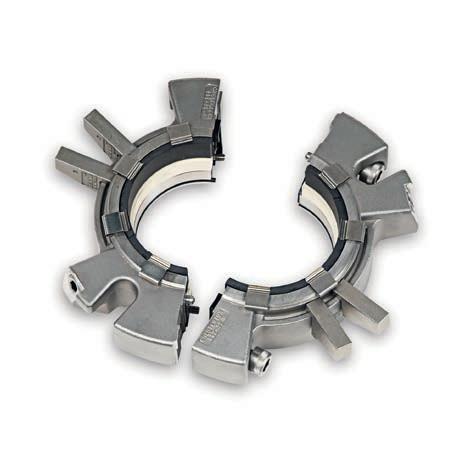
Fortunately, smarter options are now widely accessible through companies like Chesterton. Split mechanical seals allow teams to replace seals without dismantling equipment, cutting downtime from days to hours and signi cantly reducing manual handling.
For pumps that must remain packed, Chesterton’s AMPS (Automated Mechanical Packing System) actively controls gland pressure, eliminating the need for workers to reach into running equipment and sharply reducing water loss.
Chesterton’s ARC industrial coatings also add another dimension of improvement. By restoring worn pump internals and protecting against abrasion and corrosion, ARC coatings help recover lost e ciency while extending asset life.
Smart maintenance is no longer an upgrade, it is a strategic advantage. With Chesterton innovations improving safety, e ciency and asset life, utilities now have practical tools to meet the rising demands of modern water management. U
To learn more, download Chesterton’s free eBook at chestertoncustomseal.com.au/ebooks and explore the technologies helping water utilities modernise pump maintenance.
Split mechanical seals allow teams to replace seals without dismantling equipment.
DualPac® 2212 Multi-Purpose Packing
Engineering Australia’s water future
As ageing infrastructure meets an engineering skills shortage, Lanco Group is helping Australian utilities deliver the critical upgrades communities depend on.
Australia’s water utilities are caught in a harsh dilemma. On one side, decades-old infrastructure is reaching the end of its design life just as population growth and climate variability push demand to new extremes. On the other, a nationwide shortage of experienced engineers means fewer hands are available to design the renewals, upgrades and expansions that communities desperately need.
It’s a challenge that can’t wait for market forces to correct—and it’s one that Lanco Group has spent more than 27 years helping utility providers to navigate.
Capacity when it counts
e engineering skills shortage isn’t an abstract problem for water utilities in particular – it’s an immediate constraint on their ability to deliver critical infrastructure. When experienced engineers retire faster than new graduates enter the sector, utilities face di cult choices about which projects to prioritise and which to defer.
For Lanco Group general manager – infrastructure Adrian Ognenovski, this has meant evolving from a traditional consultancy into something more essential: a reliable extension of utility engineering teams.
“Utilities don’t just need project-based consultants anymore,” he said. “ ey need partners who can step in with proven capability, maintain delivery momentum, and bring the kind of practical eld experience that takes years to develop.” at capability spans the full project lifecycle: from initial hydraulic modelling and civil design through to contract administration and construction auditing. It’s a model that lets utilities proceed con dently with renewals and major capital works, regardless of internal workforce constraints.
Of course, Lanco Group o ers much more than simply the ability to ll gaps. e company has built its reputation on designs that are practical, compliant and, most critically, constructable. at nal quality matters more than ever as utilities face pressure to deliver projects on time and on budget.
Innovation in action
What sets Lanco Group apart is how it integrates advanced engineering methods into everyday utility projects. Digital
engineering and building information-enabled modelling have become standard practice, allowing the company to identify design clashes before construction begins and dramatically reduce on-site variations. For utilities, this translates directly to shorter delivery timeframes and fewer cost overruns.
“We’re seeing digital twins and scenario testing become essential tools for lifecycle planning,” Ognenovski said. “ ey help utilities make better investment decisions about renewals and understand how upgrades will perform before any ground is broken.”
e company’s hydraulic modelling capabilities include much more than the standard network analysis. Highresolution simulations allow utilities to test performance under various demand scenarios, particularly important as Australia faces both population growth and emerging loads from data centres and industrial development.
Combined with water sensitive urban design principles and recycled water integration, Lanco’s approach addresses both technical performance and community expectations around sustainability.
As Australia enters a critical period of water infrastructure renewal, the gap between what needs to be done and the engineering capacity available to do it continues to widen. Metropolitan and regional utilities alike are grappling with ageing assets that can’t be deferred much longer, even as workforce constraints make traditional delivery models increasingly unviable.
For Ognenovski, the solution lies in long-term partnerships rather than one-o or transactional consulting relationships.
“ e utilities that are succeeding are the ones who’ve built trusted relationships with partners who understand their systems, their constraints and their communities,” he said. “ at’s where real value gets created – when you’re working together over years, not just on individual projects.”
Lanco Group’s expansion from its Victorian base to a national presence re ects this partnership approach. As water infrastructure demands evolve – from climate adaptation to emerging industrial loads – the company continues to invest in both its people and its technical capabilities, positioning itself as a long-term partner in Australia’s water infrastructure future. U
Ensuring the skills of a new generation of utility engineers are available will be a vital part of keeping pace with the growth in demand for services. Image: markenko/stock.adobe.com
Why water networks are turning to kwik-ZIP
Why kwik-ZIP spacers and centralisers are a small but critical investment in long-term water infrastructure.
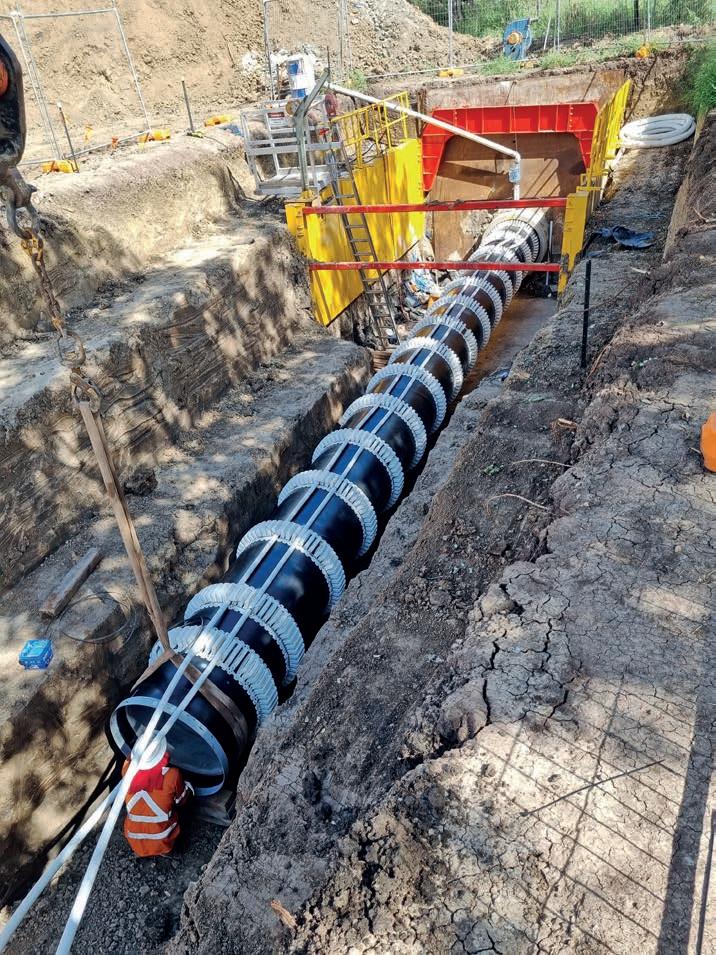
As Australia’s urban centres expand, many utility companies face a huge task: replacing or augmenting underground water and wastewater pipelines. Rather than digging open trenches through suburbs or under roads, engineers o en turn to trenchless methods such as slip-lining or cased crossings –approaches that minimise disruption to communities.
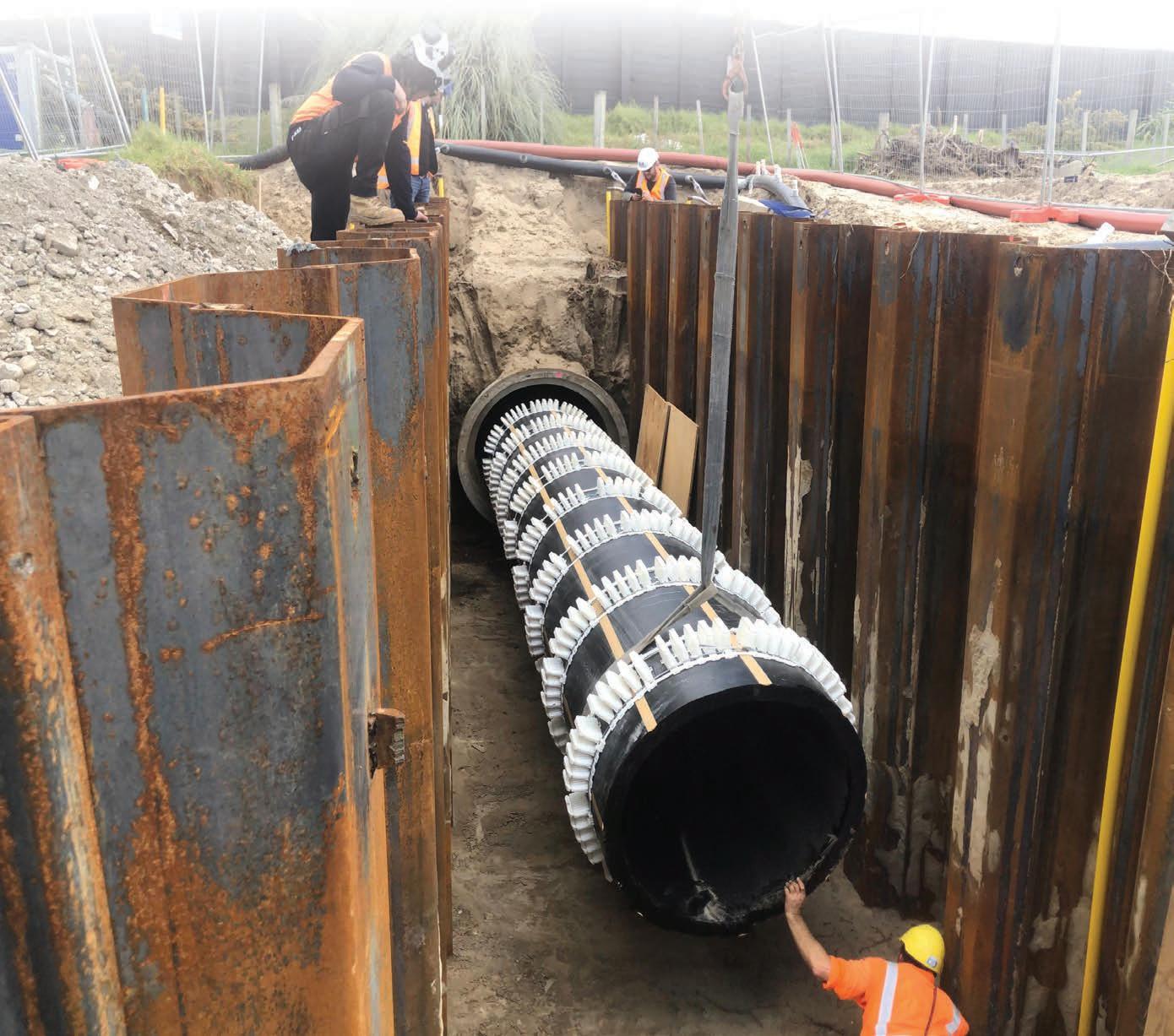
But slip-lining only works if the carrier pipe is carefully installed inside the casing. Without proper support and spacing, the pipe can be damaged during the installation process, which may cause issues especially over the long life expected of PE networks.
As demand for these durable, cost-e ective and corrosion-resistant pipelines grow, one Australian-born company is quietly becoming indispensable to the water industry: kwik-ZIP.
Headquartered in Western Australia but with a worldwide customer base, the company manufactures non-corroding, non-metallic casing spacers and centralisers designed speci cally for pipe-in-pipe applications including slip-lining, cased crossings, and other pipeline installation methods.
e kwik-ZIP product range, including the HD, HDX, and HDXT series, covers pipes from small diameters (about 100mm) to heavy-weight carrier pipes in excess of 1600mm OD. e spacers are moulded in a highperformance engineered thermoplastic blend, o ering excellent chemical resistance, abrasion resistance, low friction, and resistance to corrosion.
All kwik-ZIP spacers have been successfully appraised against the Water Services Association of Australia’s product speci cation for casing spacers (WSA PS-324). is standard covers casing spacers used to facilitate the insertion and protection of carrier pipes when installed inside encasement pipes. Additionally, all products are also certi ed by the Australian Water Quality Centre for use in contact with drinking water. ese features also make the products suitable for potable water projects.
Its products are also approved for use within many utilities’ infrastructure, including Melbourne Retail Water Association, South-East Queensland’s Infrastructure and Materials list, Sydney Water and the WA Water Corporation.
Because the spacers are non-metallic and inert, they won’t corrode or degrade, unlike metal spacers which risk transferring corrosion.
In terms of performance, kwik-ZIP spacers distribute the pipe’s weight across multiple runners, reducing point loading. is load-sharing suspension system cuts down on wear and stress, minimises the risk of pipe deformation or damage during insertion, and helps isolate the carrier pipe from vibrations or movements in the outer casing. kwik-ZIP’s spacers and centralisers have already proven themselves on major water infrastructure projects across Australia and the rest of the world, such as Water Corporation’s Alkimos seawater desalination plant project in WA.
When it comes to new water infrastructure, choosing the right spacer and centraliser system can determine whether a pipeline endures as intended, or succumbs early to wear, corrosion or misalignment. Installing a new main isn’t just about putting pipe in the ground. It’s about protecting that asset for decades – and kwik-ZIP helps make that protection real. U
kwik-ZIP spacers and centralisers can help extend a pipeline’s lifespan. Image: kwik-ZIP
The future of rural water access
With a driving philosophy of “dare to be di erent”, Abberfield Technology builds water filling stations that reliably supply water to regional users.
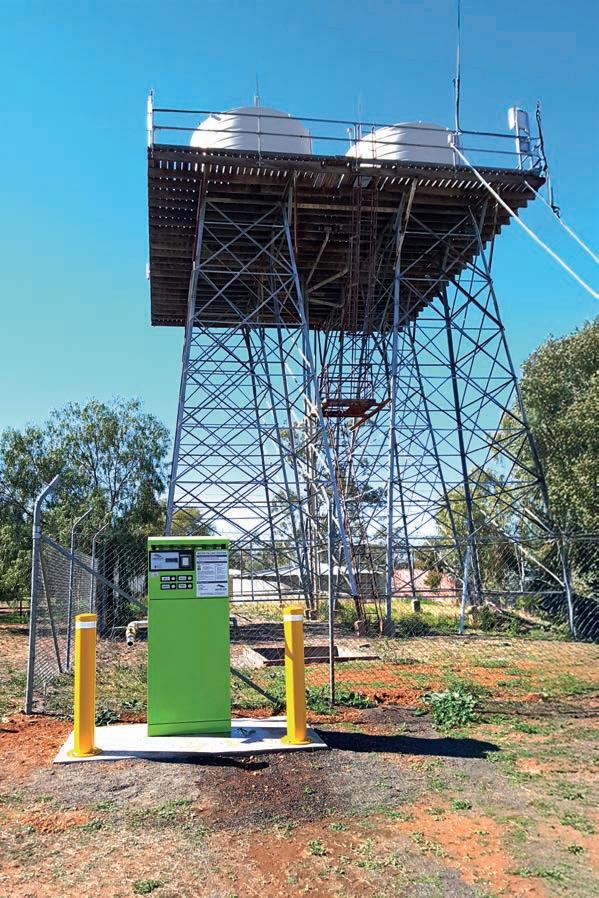
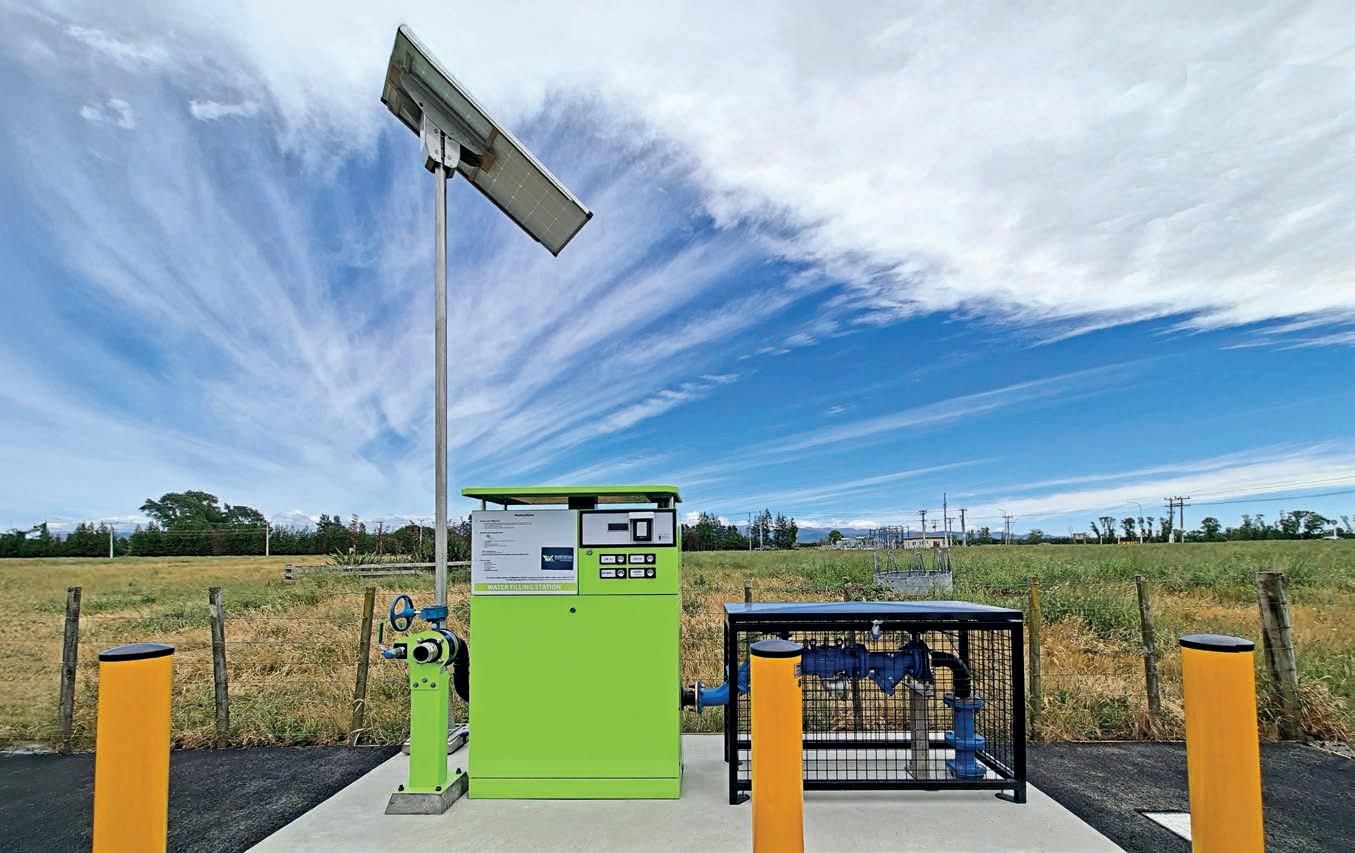
AAbberfield water fi lling stations are engineered specifically for Australian conditions.
cross the vast, sun-hardened landscapes of rural Australia, water infrastructure is desperately needed. It is the lifeblood that sustains families, farms, travellers, emergency services, and entire communities.
Yet, while others take a “sell and forget” approach, there remains one company that has chosen a di erent path entirely. A company founded in 1968, built on engineering integrity, Australian design and manufacturing, and a belief that rural communities deserve more than minimumstandard infrastructure. Being di erent isn’t a slogan. It is a philosophy. And it is the reason Abber eld water lling stations stand apart.
A legacy of Australian engineering
Abber eld’s water lling stations are engineered speci cally for Australian conditions. ey are designed to withstand temperature extremes of blistering heat and deep cold, as
well as sudden frosts, torrential rain, oods, dust, remote access challenges, and the heavy-handed wear that comes with real rural use.
ey operate through long stretches of overcast weather a ecting solar sites and unpredictable mains power – when it is available at all – including lightning strikes on rural transmission lines.
ey are installed at the roadside in direct sunlight and fully exposed to the elements. Of the more than 300 stations installed to date, not one has a sunshade or weather shelter.
Most Abber eld customers are local council plumbing departments. eir approach is simple: bury a pipe and forget about it for decades – and they treat Abber eld water lling stations the same way. Maintenance by customers is virtually non-existent but Abber eld machines are constructed with longevity as the starting point, not the a erthought.
What truly sets Abber eld apart is its design philosophy: don’t build to a price – build to last.
is philosophy leads to water lling stations capable of decades of service, with minimal maintenance. ey provide dependable performance, whether dispensing drinking water to ll a container in the back of a car or to a tanker.
Abber eld Technology continually develops new system enhancements that can be retro tted to existing stations whenever the opportunity arises. eir mobile workshop ensures they can support customers wherever they are. is allows Abber eld to o er conditional, no-cost, whole-of-life support that is e ectively a lifetime warranty.
Instead of cutting corners Abber eld invests in highquality components and rugged stainless-steel construction. e result is a superior long-term investment that won’t fail, corrode, or become obsolete.
Abber eld’s whole-of-life support ensures the water lling stations remain operational year a er year, reducing disruptions for the communities that depend on them and providing pro t for councils.
Abber eld systems last longer, perform better, and have the lowest whole of life cost. Most infrastructure suppliers chase volume, low cost, and fast turnover. ey build equipment to a price, outsource manufacturing overseas, and rely on third-party delivery services. Once the product is delivered, the relationship ends – and customers are le to fend for themselves.
Abber eld does what others can’t – and what many simply won’t. Abber eld’s is a business model built on respect for rural Australia and an unwavering belief that communities deserve better. In a throwaway society, this refusal to compromise is not simply unusual – it is revolutionary.
Proven and awarded technology
Proudly Australian-made, Abber eld’s reputation extends beyond national borders, with equipment exported worldwide. And its engineering excellence has also been recognised nationally, including receiving the Australian
Images: Abberfi
Technology Showcase Award for product design – a signi cant achievement that highlights its commitment to innovation and quality.
Being di erent doesn’t just set Abber eld apart in Australia. It sets it apart on the world stage.
Technology that can’t be matched
Abber eld’s leading-edge technology re ects decades of innovation, including:
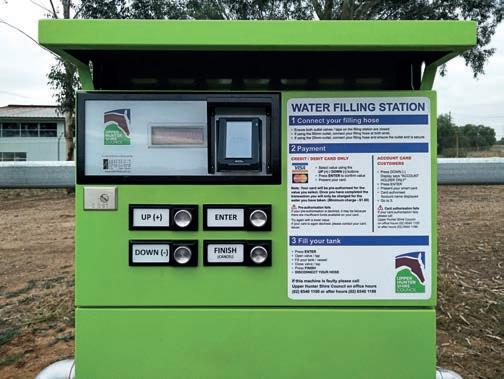
• Account card – post and prepaid
• Credit/debit card – open use or preregistered
• Drought relief options
• Separate public and tanker pricing
• Potable and raw water capability e result is intelligent, exible, future-proof infrastructure that adapts to the evolving needs of rural communities.
While councils and authorities o en focus on population centres, many remote communities, farms, stations, and outlying districts remain underserved – or not serviced at all.
Abber eld’s equipment can ll that gap.
Its water lling stations are designed to provide dependable, equitable water access in locations where traditional municipal infrastructure either doesn’t exist or cannot be justi ed by population size. is includes travellers re lling recreational vehicles, farmers sourcing non-potable water, contractors supporting roadworks, vehicle washdowns to reduce pest and seed transmission, bush re brigades and water carters lling tankers, and residents relying on weekly allocations during droughts.
Where others overlook these regions, Abber eld’s water lling stations and support can step in. Being di erent means believing access to clean water is a right, not a privilege.
Personalised support that puts customers first
While infrastructure suppliers rely on websites, brochures, and contractors, Abber eld believes nothing replaces being there. Its personalised support includes:
• Pre-sale site demonstrations, using real equipment in real conditions
• Delivery to Australia’s east coast by Abber eld sta , not contractors or external freight companies
• On-site installation guidance
• Post-installation commissioning to ensure peak performance from day one
• Mobile Field Support – two customised motorhomes tted-out with parts storage, and o ce facilities
• Whole-of-Life support, ensuring continuity even decades into the future
• Service Team contactable by mobile phone 24/7 is support model is not typical – because it isn’t designed for convenience or cost savings. It is designed for customers. As well as a water lling station, Abber eld delivers a relationship. e future of rural water access: Abber eld Dare to be Di erent. U
Abberfield systems last longer, perform better, and have an extremelly low whole of life cost.
Abberfield equipment is built to last. Its stations are capable of decades of service, with minimal maintenance.
Purpose, place and opportunity
Women are thriving in the water industry. A conversation with two women within Interflow reveals a powerful sense of purpose and confidence in the fact that you don’t have to be an engineer to shape the future of water.
As she knocked on the door of an elderly lady’s house, Interflow’s community relations manager Joanna Rodd had no idea that she was about to experience a memorable moment that clarified the purpose of her role.
“This lady was 94,” Rodd said. “She had lived in her home for 60 years and was lonely and was nervous around project teams on her property. But she sat and had a cup of tea with me and quickly understood that the work we were doing was vital and for her community’s good.”
Rodd had never expected to find her calling in the water infrastructure sector. She originally thought the sector would be a male-dominated space prioritising engineers
and tradespeople. However, after three years in her role, she said the experience has been nothing less than transformative.
“Interflow has been phenomenal for me,” she said. “The support I have received here has been nothing short of amazing.”
Interflow chief financial officer Tracy Black said women are well represented at every level of Interflow. Three of eight executive positions are held by women. Around 24 per cent of all project managers are women, too.
That visible female leadership, the very tangible nature of careers for women in a water infrastructure business like Interflow, is an important signifier of future organisational
Women can find transformative roles in water utilities like Interflow. Images: Interflow
success. It’s also essential for women in the business to see visible examples of where they could progress, Black said.
“When I look at companies, I always look at their executive team,” Black said, who joined the Interflow leadership team in 2022. “For me, it’s a major red flag when I see organisations without any women on their executive team.”
Companies that focus on inclusion and diversity are also more likely to have a welcoming culture that enables people to be their true selves at work. People who have permission to be authentic are happier at work and, therefore, also more productive. They enjoy their work, Black said, and so they do it well.
At Interflow, she said, there has been a conscious and well-designed effort to shift the balance. That has included diversity and inclusion strategies, regular leadership training programs open to all team members, and a gender pay gap that was measured as minus five per cent.
Black said part of the attraction of the water sector is the fact that the results of the work are extremely tangible.
“I’ve worked for businesses where you can’t touch the product,” she said. “But with water, it’s tangible. You know that it’s essential, and people here feel that. There’s a sense of pride that’s contagious.
“So, to young women, I’d say go into a sector where you see people like you succeeding. Then lean into your strengths, always be collaborative and curious, and most importantly, always be yourself.” U
Interflow Chief Financial Officer Tracy Black says it is essential for women to see visible examples of where their careers can progress.
Community Relations Manager
Joanna Rodd said interacting with the community can bring new insights in to the purpose of her role.
Cleaner, safer sewers
Utilities have an obligation to provide safe workplaces and better environmental outcomes. To meet these goals, James Cummings can help utilities to select the most e ective activated carbon technology for their operating environment.
As ESG shi s from aspiration to obligation across Australia’s water and wastewater industries, James Cumming is emerging as a critical partner in helping utilities to meet these accelerating expectations. With decades of experience in water, wastewater and air treatment, the company is proactively aligning its operations, technologies and services with the environmental, social and governance standards now reshaping the sector.
Across Australia, utilities are facing an intensifying climate forcing a re-examination of how water resources are managed. Environmental responsibilities now demand long-term climate adaptation, carbon reduction and more e cient, sustainable treatment practices. For wastewater management this includes the critical area of emissions control.
Communities are also calling for greater transparency and stronger public health outcomes from utilities.
ese utilities must fundamentally rethink how their services are planned, delivered and monitored. is is where the innovation of a company like James Cumming has practical and evidence-based solutions to ongoing challenges like emissions and vapours.
James Cumming’s experience and expertise with extruded activated carbon is a leading example of how innovation is meeting some of the ongoing challenges of the industry. e reduction of hydrogen sulphide (H2S) and volatile organic compounds emissions in sewer networks is an active example of how the company can work with utilities to work towards safe and healthy working conditions and better emissions outcomes.
Extrusion enhancing reactivity
Hydrogen sulphide (H2S) and volatile organic compounds (VOCs) remain two of the most persistent operational
challenges in wastewater networks. Rising mains, pump stations, inlet works and anaerobic catchments all create the conditions that drive biological sulphate production –and with it, corrosive, odorous and potentially hazardous gas emissions.
While utilities have long relied on activated carbon to mitigate these emissions, advances in extruded activated carbons (EAC) – particularly those chemically impregnated to enhance reactivity – have reshaped the landscape of what’s possible in odour and gas-phase contaminant control.
According to James Cumming this begins with an understanding of how chemisorption works and why impregnants matter.
Chemisorption — the foundation of modern odour control
Odour and gas-phase contaminants are removed from air streams through two fundamental mechanisms:
1. Physical adsorption is is the mechanism behind standard granular activated carbon (GAC) and unimpregnated extruded carbon.
• Gas molecules adhere to the carbon’s internal pore structure via van der Waals forces
• e process is reversible, meaning high humidity or temperature changes can reduce capacity
• Ideal for low-molecular-weight compounds and general VOC polishing
While physical adsorption is simple and cost-e ective, it is not well suited to reactive gases like H2S at elevated concentrations. ese compounds tend to saturate pores quickly or pass straight through without meaningful retention.
Through the process of chemisorption impregnates in the extruded activated carbon such as potassium hydroxide, sodium hydroxide, potassium iodide, or copper oxide react with the hydrogen sulphide and form stable, non-volatile solid salts. Image: JC&S
2. Chemical adsorption (Chemisorption)
Chemisorption is the mechanism that underpins impregnated extruded activated carbons, and it is essential for treating H2S and other reactive sulphur species.
In chemisorption:
• e gas reacts chemically with impregnates such as potassium hydroxide (KOH), sodium hydroxide (NaOH), potassium iodide (KI), or copper oxide (CuO)
• e reaction is irreversible, forming stable, non-volatile solid salts
• Breakthrough capacity is far higher, even under high humidity conditions
• Heat is generated as a by-product of the reaction, an indicator of conversion rather than mere adsorption.
Chemisorption e ectively transforms H2S into benign compounds, preventing re-release and allowing utilities to manage periods of extreme loading without immediate media change-out.
Why extruded activated carbon has become the utility standard
Traditional GAC beds remain useful in polishing applications – especially where VOCs or siloxanes dominate – but for most sewage odour control and rising main applications, EAC now provides clearer advantages.
1. Uniform pellet geometry
Extruded carbon is manufactured as cylindrical pellets (typically 3–4 mm), giving:
• Lower pressure drop
• Higher bed uniformity
• Reduced channelling
• Deeper penetration pro les
For enclosed vessels at pump stations and rising mains, where con ned-space entry is common, this stability improves safety and asset longevity.
2. Higher bulk density = Higher working capacity
Extruded pellets pack more carbon mass per cubic metre compared with many GAC grades.
In chemisorption applications where the limiting factor is reaction capacity per volume, EAC delivers materially higher life between change-outs, depending on the operating conditions.
3. Lower dust and improved handling
Pellets generate less dust during loading/unloading, reducing safety risks and improving on-site visibility during con ned-space carbon change-outs.
Evaluating the technology options — GAC vs EAC vs impregnated EAC
Utilities today have four primary carbon media pathways. Each is suited to di erent operating contexts.
1. Granular activated carbon (GAC)
Best for: VOC polishing, very low-H2S environments, dual-use air + water treatment applications.
Strengths:
• Lower cost
• High surface area
• E ective for many VOCs and organic odours
Limitations:
• Poor if ine ective reactivity with H2S
• Sensitive to humidity
• Breakthrough is unpredictable and o en sudden GAC is a poor choice for most rising mains for H2S removal on their own.
2. Unimpregnated extruded activated carbon Best for: Siloxane removal, certain VOCs, land ll gas polishing, mixed contaminant streams.
Strengths:
• Higher density than GAC
• Lower pressure drop
• More uniform performance
Limitations:
• Still dependent on physical adsorption
• Very limited H2S reactivity compared to impregnated media
Commonly used in land ll gas and biogas applications where siloxanes rather than H2S dominate.
Ideal for: Sewer pump stations and rising mains with variable loading.
Copper Oxide (CuO)
• Highly reactive to H2S
• E ective at removing mercaptans and organic sulphur compounds
• O en used in industrial wastewater gas streams
Ideal for: Industrial networks or mixed industrial–municipal catchments.
4. Alkaline impregnated EAC (NaOH, KOH)
Best for: High-load H2S conditions, emergency odour events, networks with extreme anaerobic conditions.
Sodium hydroxide (NaOH)
• Higher reactivity than KI
• Extremely fast H2S conversion
• Less expensive than KOH
• More stable in humid environments compared with potassium hydroxide.
Potassium hydroxide (KOH)
• Highly reactive base
• Fastest chemisorption kinetics
• More sensitive to moisture than NaOH ese media types excel in peak-load environments but require careful vessel ventilation and temperature monitoring due to exothermic reaction potential.
Why impregnants matter — matching chemistry to the network
Choosing the wrong impregnant is one of the most common issues seen across utility odour control systems. A network dominated by biodegradable organics behaves very di erently from one with a signi cant industrial component.
Key decision criteria include:
1. Humidity level
• High humidity → choose KI or NaOH
• Very dry gas streams → unimpregnated carbon may su ce
2. Contaminant mix
• Predominantly H2S → KI or NaOH
• Mercaptans and organic sulphur → CuO
• VOC-dominant streams → GAC or unimpregnated EAC
3. Required bed life
Utilities must balance:
• Cost per change-out
• Vessel access requirements
• Downstream disruption
• Climate variables
4. Safety & temperature considerations
• Chemisorption generates heat
Proper vessel design and air ow are essential to prevent hotspots.
Designing a carbon odour unit for modern utility conditions
A well-designed system considers:
• Pre-feeding air dilution and ow balancing
• Moisture control and condensate separation
• Avoiding channelling via proper distributor plate design
• Using staged beds for catastrophic loading events
• Monitoring pressure drop to predict carbon exhaustion
• Selecting carbon based on breakthrough curves, not price lists
e most successful utilities increasingly lean on performance-based procurement, evaluating cost per kg of contaminant removed rather than cost per cubic metre of carbon purchased.
Looking Ahead — The Next Generation of Activated Carbon Odour Control
Driven by tightening environmental regulations and community expectations, utilities are increasingly prioritising:
• Predictable breakthrough performance
• Lower maintenance requirements
• Safer con ned-space entry
• Resilience under extreme weather patterns
• Australian-made supply chain security
Extruded and impregnated activated carbons are at the centre of this shi , o ering utilities a more controllable, more predictable, and more chemistry-aligned solution for managing H2S, VOCs and associated emissions.
Vacuum lifting done right
Global Pipeline Equipment is redefining how Australia’s utilities handle heavy pipe, delivering safer, more reliable lifting in the harshest conditions.
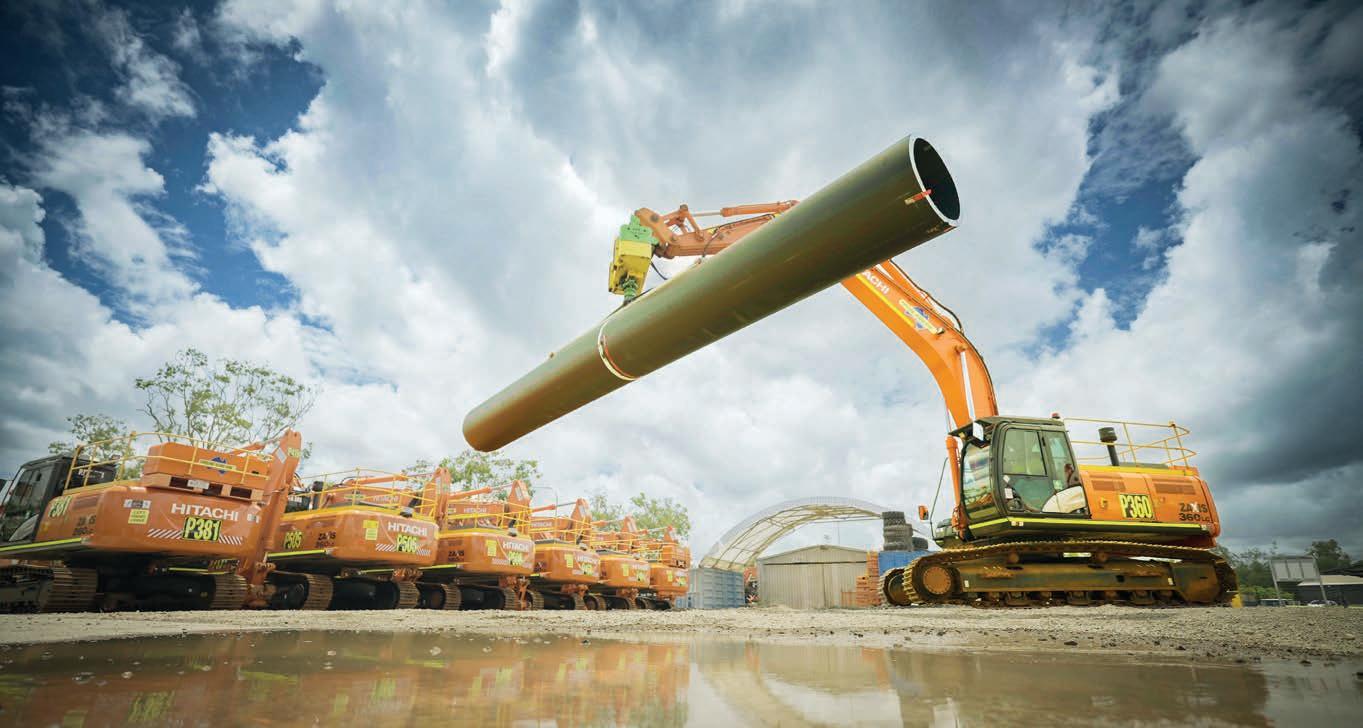
When Australia’s coal seam gas boom accelerated more than a decade ago, the pipeline sector faced a challenge it had not seen before. Hundreds of kilometres of HDPE pipe were arriving at remote work fronts with almost no specialised equipment to move them. Crews were slinging pipe with chains, dragging lengths through dust and heat, and working far too close to heavy machinery. Out of this gap came Global Pipeline Equipment, a company that would go on to rede ne how pipelines are built in some of the country’s harshest conditions.
Managing Director Matt Dridan remembers the moment the problem became impossible to ignore.
“ ere was no equipment there to handle it,” he said. “You had guys chasing diggers in the desert, slinging pipes in the dust and danger, and dragging them to the poly welders.”
ose early scenes convinced him that the industry needed a safer and more e cient way to move pipe, and it needed it quickly.
Designing equipment for real-world pressures
e rst breakthroughs came from people working directly on site. One operator contacted Dridan with an idea that leveraged unused space beside an excavator cab and the hydraulic power already available on the machine.
“He called me and I had something sketched up that day to t in beside that eight and a half tonne excavator,” Dridan said. “ e designs blossomed from there.”
e team began developing suction pads, spreader bars, and full-li ing systems that met the speci c demands of pipeline construction. As diameters increased and pipeline
projects grew longer, the need for reliable and versatile equipment intensi ed.
“ ere were gures like 10,000 kilometres of HDPE that went into Queensland alone, and almost all of it was installed with our machines,” Dridan said.
at rapid growth shaped an approach that prioritised robust engineering, operator safety and the practicality needed for remote work sites.
One of the most important decisions the company made early on was to move away from diesel-powered vacuum li s. Instead, they chose to engineer systems that ran entirely on the excavator’s auxiliary hydraulics. at choice transformed the capability of vacuum li ing technology.
“Earlier engine-driven machines were noisy and unreliable,” Dridan said. “ e guys on the ground cannot hear each other because they rattle all day.”
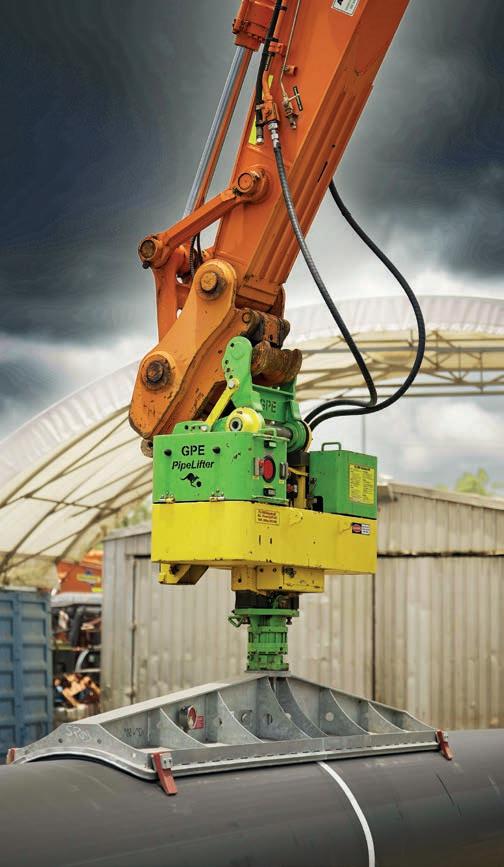
Connecting the li directly to the excavator eliminated the need for an extra engine, reducing servicing requirements and eliminating a signi cant failure point in remote operations. e hydraulic system also enabled better weight distribution, allowing contractors to downsize machinery without compromising li performance.
“It becomes part of the counterweight instead of hanging all that weight o the end of the stick,” Dridan explained. e cumulative result is lower fuel use, simpler maintenance and far fewer interruptions during critical unloading or welding tasks.
Built for a country of extremes
Working across Australia has meant engineering equipment for a range of environments that few countries
can match. From the high dust loads of inland haul roads to the mud and humidity of wet season regions, pipeline equipment must endure constant punishment. Dridan said durability was a lesson learned early.
“ ese devices do not just get damaged on projects. ey can get damaged in transport and handling, so from the moment it leaves our factory, it needs to be robust.”
One of the company’s de ning choices was to fully galvanise the bulk of its assets. Imported li s o en rusted within a year or two, which compromised structural integrity. By contrast, GPE’s galvanised shoes and frames remain sound a er years in the eld.
“ ey are as good and sound as the day we built them,” Dridan said.
Temperature extremes required similar attention. Batteries and electronics are placed alongside valve banks to maintain stable temperatures, while thermal fans help keep the system cool in high heat. Even the vacuum ltration systems are engineered for real conditions.
Dridan said he has seen trucks arrive with “a foot of dust on top of the pipes”, so ltration must protect both the vacuum intake and release sides to avoid machine failure. But above all, safety has been the foundation of the company’s design philosophy.
“Everyone knows someone who has been injured in the traditional handling of pipes,” Dridan said. “I do not know anyone with so much as a paper cut from handling loads with a vacuum li because they have an exclusion zone.”
By removing ground crews from the li ing area and limiting exposure to dust and suspended loads, vacuum li s signi cantly reduce risks that have long been accepted as part of pipeline construction.
E ciency, labour savings and better project outcomes
While safety is the priority, e ciency improvements have also driven widespread adoption. Vacuum li s allow crews to load, unload, and position pipe far faster than chains and slings can. is speed becomes essential on large projects where hundreds of trucks may arrive each week. e equipment’s versatility helps contractors optimise their eets. Vacuum li s can be tted to excavators, wheel loaders, forkli s or specialised material handlers, allowing teams to use what they already have rather than bringing in dedicated machinery. In many cases, this exibility avoids the need to transport large excavators over long distances.
“ ey do not want to pay tens of thousands to ship an excavator halfway across the country when they already have machines on site,” Dridan said.
Range has also been a major area of improvement. Early imported pads had xed, narrow diameter tolerances that forced projects to buy multiple units. By redesigning pads to span proportional ranges, GPE now covers a much wider range of pipe sizes with fewer tools. is allows
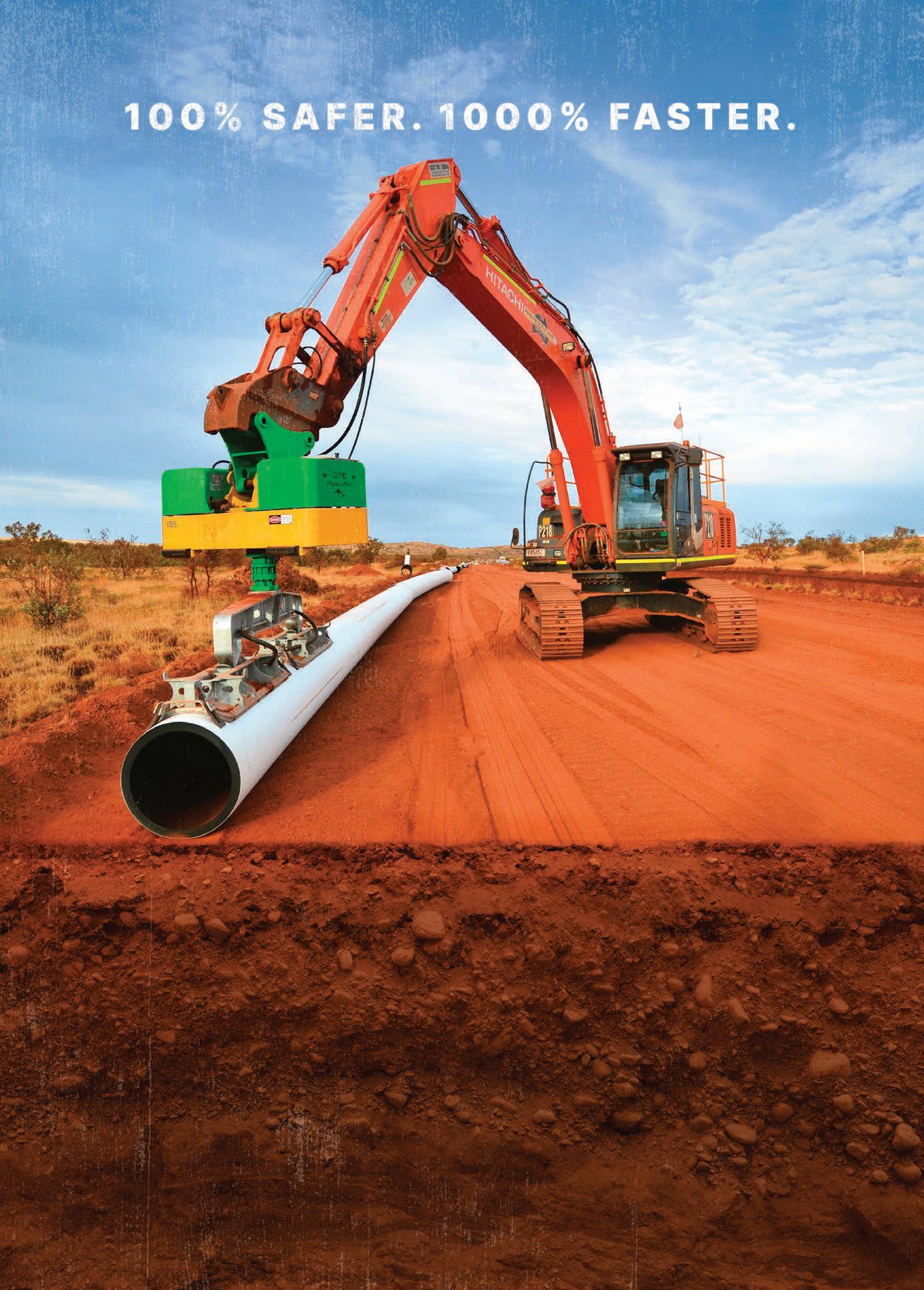
The pipelifter works with any material, any surface, any diameter.
faster changeovers, better handling of coated pipe and even complete pipe assembly without trench entry on suitable projects.
Across all this, operator support remains central. Every machine leaves the factory with a direct contact number.
“ at phone is on night and day,” Dridan said. “ ere is no substitute for backup when people are trying to work out what to do.”
Looking ahead to global opportunities
With more than a decade of experience, Global Pipeline Equipment is preparing to expand internationally. e company believes its equipment has been proven under conditions tougher than many northern hemisphere markets will ever face.
“Australia has been a fantastic proving ground for us,” Dridan said. “Our equipment has been on the ground for more than 10 years. It has done the hard yards here, and it is ready to be taken to the rest of the world.”
As utilities seek safer, cleaner and more e cient work sites, Dridan believes the case for vacuum li ing technology is stronger than ever. And for him, the message is straightforward.
“ e mathematics are you use vacuum li s or your project runs at a loss, simple as that.” U
For more information, visit globalpipelineequipment.com
Cost e ective
As Australia reshapes its energy generation networks, costs remain one of the key balancing factors. The CSIRO looks at the relative benefits in its new report.
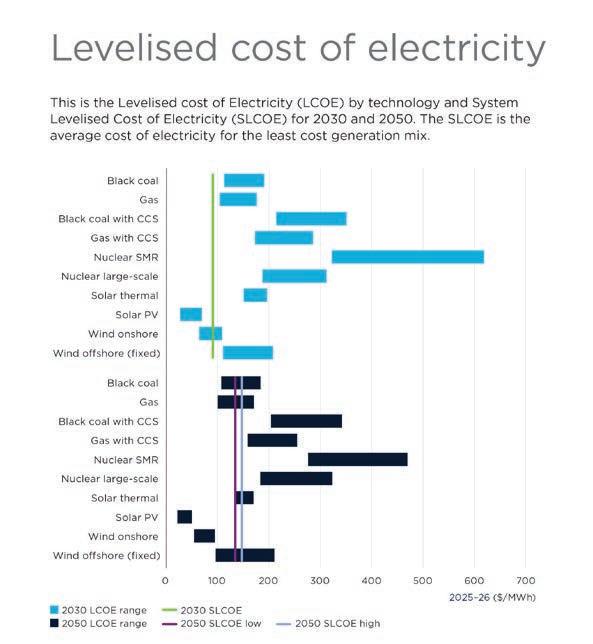
Solar PV and onshore wind are Australia’s lowest-cost generation options in 2030 and 2050 energy scenarios, a new report has found.
e dra GenCost 2025–26 report, delivered by CSIRO in partnership with the Australian Energy Market Operator (AEMO), details the costs of building new electricity generation through the lens of renewable energy, nuclear, coal and gas methods.
Capital cost analysis nds signi cant cost reductions in battery technologies, the rst cost rise in three years for large-scale solar, and tentative signs of stabilising in onshore winds costs.
Future projections are more telling, with the capital costs of building renewables far more a ordable than building coal and nuclear operations.
While two-hour battery storage capital costs equated to $525/kWh in 2025, if current policies continue, they are expected to drop to $484/kWh in 2030 and $358/kWh in 2050.
If Australia was to adopt policies aligned with the International Energy Agency’s global net-zero emissions by 2050 outlook (Global NZE by 2050), which poses strong climate policy to maintain temperature increases of 1.5°C, two-hour battery storage capital costs would decrease from $525/kWh today to $295/kWh by 2030 and as low as $219/ kWh by 2050. If current policies continue, the capital costs of large-scale solar PV would drop from $1621/kW today to $1239/kW in 2030 and $851/kW in 2050, while roo op solar capital costs would drop from $1216/kW to $1135/kW
in 2030 and $1091/kW in 2050. Large-scale solar sees a 54.16 per cent capital cost decrease by 2030 under Global NZE by 2050 policies, with roo op solar’s drop more marginal.
Onshore wind capital costs decrease from $3248/kW today to $2697/kW in 2030 if current policies continue, and down to $2609/kW under Global NZE by 2050 policies.
Other generation methods such as coal, large-scale opencycle gas and large-scale nuclear will also see capital cost decreases, however, coal and nuclear are coming from a much higher mark – black coal and brown coal capital costs are $6946/kW and $10,725/kW today, respectively; and large-scale nuclear capital costs are $10,332/kW today.
e dra GenCost report details an electricity cost of $91/ mWh (transmission included) if Australia was to meet its target of 82 per cent renewables by 2030, and $81/mWh (transmission not included).
e lowest-cost large-scale generation mix consistent with achieving 82 per cent renewables by 2030 comprises six per cent hydro, 41 per cent wind, 31 per cent solar PV, four per cent gas, and 18 per cent coal.
CSIRO and AEMO estimate the electricity sector emissions intensity to be 0.02–0.05 tCO2e/MWh to deliver net zero by 2050 (current levels are around 0.5tCO2e/ MWh). It was found eliminating electricity sector emissions would be more costly than reducing emissions elsewhere in the economy.
e dra GenCost report implements a more comprehensive method to scrutinise capital costs against various electricity emission abatement scenarios to 2050, called the system levelised cost of electricity (SLCOE) method.
is is di erent from the levelised cost of electricity (LCOE) metric used in the past, which simply compared costs of individual technologies.
CSIRO makes this applicable to data scientists, engineers and academics through its new Simple Electricity Model (SEM).
“GenCost has evolved from delivering veri able cost data on individual technologies to now also providing system modelling of the future generation mix and average cost of wholesale electricity,” CSIRO chief energy economist and GenCost project leader Paul Graham said.
“Electricity systems will always require a diversity of resources to deliver all their functions and so no single technology will meet all the system’s needs regardless of its relative cost position.”
CSIRO energy director Dr Dietmar Tourbier detailed the value of GenCost.
“ rough updating and publishing its data, its modelling and its cost projections every year, GenCost re ects the best available data in the most transparent way to help guide the electricity component of Australia’s energy transition journey.”
e dra GenCost report is open for formal consultation until February 2, 2026. U
The PL1500 is a gamechanger for pipeline construction. The unique, quick-hitch, vacuum lifter attaches to your existing excavator, reducing your machine hire cost and getting things moving fast. Capable of safely lifting 15,000kg, the heavy-duty, self-contained unit can handle all types and lengths of pipe. It integrates seamlessly with the host excavator, using the main controls and hydraulics to operate the vacuum lifter. Plus, built-in smart tech ensures it’ll only pick up or put down a pipe on a solid surface. That’s safer than many other vacuum lifters on the market. To find out more, speak to the Pipeline Plant Hire team today.
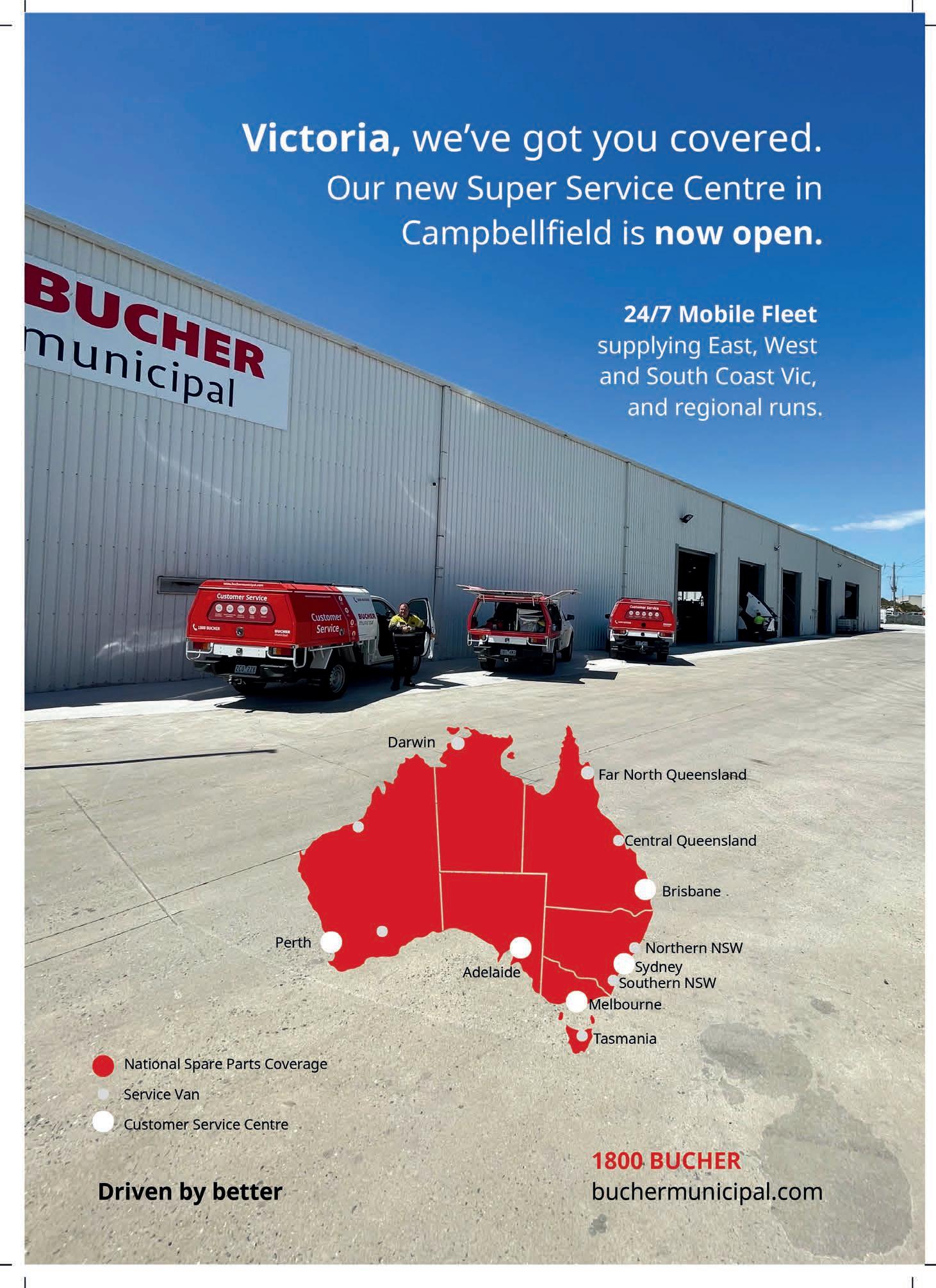
Super Service Centre
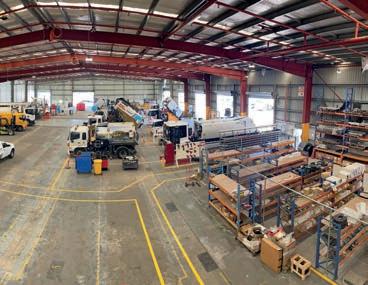
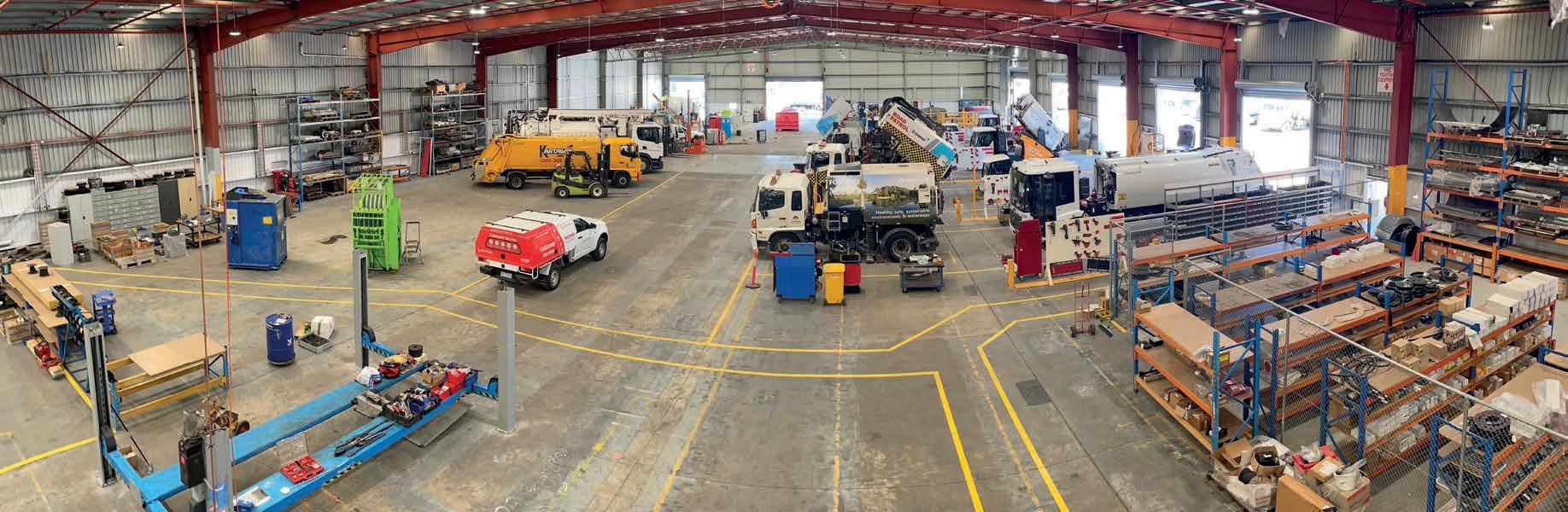
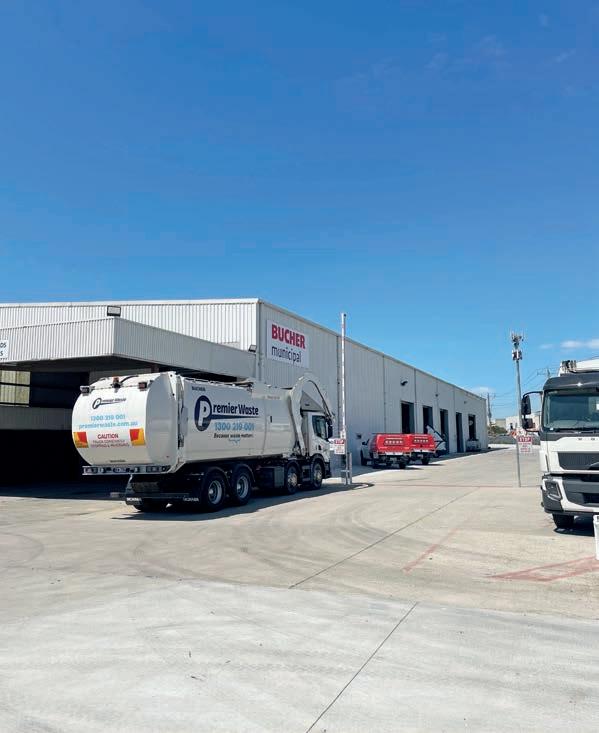
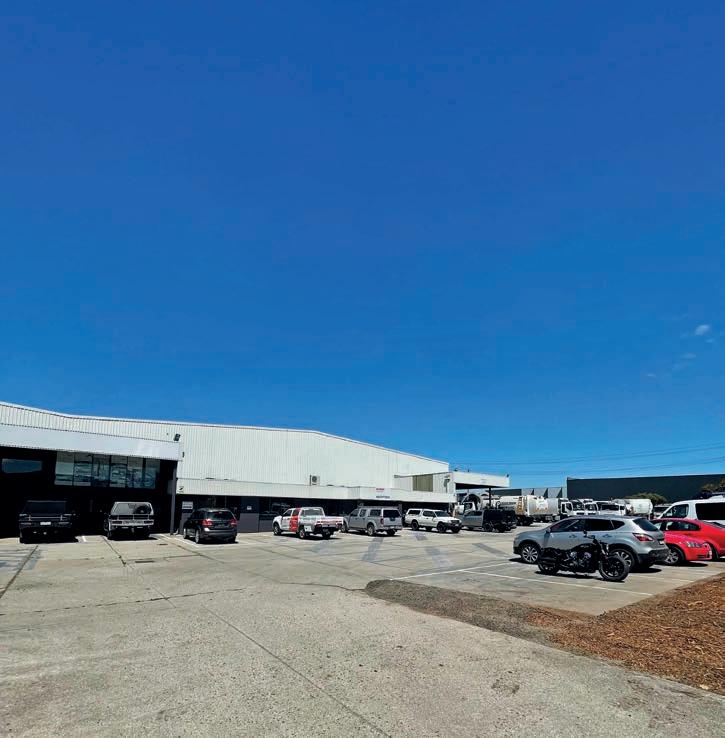
Bucher Municipal’s new Super Service Centre in Campbellfield brings expanded capacity, stronger mobile support and full refurbishment capability, delivering a boost to vehicle uptime and aftersales service for utility operators across Victoria.
For operators of waste, sweepers and sewer cleaning equipment, vehicle uptime is everything. When assets are out of action, essential community services slow down.
Bucher Municipal has long recognised the role that a ersales service plays in keeping eets running e ciently. e company’s new Super Service Centre in Campbell eld represents a major investment in that mission, bringing enhanced capacity, improved access and expanded support for customers across Victoria and beyond.
Daniel Sampson, Bucher’s A ersales Manager for the East Coast, said the heart of e ective a ersales support is simple.
“It is around vehicle uptime. Maintaining the customer’s trucks – whether that be from a general service or if there is a breakdown or an accident – it’s all about keeping their trucks on road and enabling the customer to best utilise their asset.”
Sampson explained that the Campbell eld facility is designed to strengthen Bucher’s ability to do exactly that.
With previous Victorian service operations split between Sunshine West and Clayton, Bucher saw an opportunity to consolidate teams, streamline processes and build a t-for-purpose facility that meets the needs of a growing customer base.
e new site was selected a er a review of customer distribution and access requirements. It has already begun supporting customers through a staged transition that started in September 2025.
The Campbellfield centre brings expanded capacity and full refurbishment capability to vital utility fl eets.
Enhanced capacity and improved mobility
Sampson said the scale of the new Super Service Centre immediately sets it apart.
“ e workshop is probably double the size of the previous workshops,” he said.
“Something people do not think about unless you are in the industry is the amount of hard stand you need. Trucks are quite big, so it is a signi cant amount of hard stand too.”
He said the combination of increased workshop oor space and expanded outdoor storage has allowed Bucher to li throughput and reduce bottlenecks. Both were ongoing limitations at the former sites. e extra space also positions the Campbell eld centre to accommodate more complex refurbishment and repair tasks.
A major advantage of the new centre is a strengthened mobile eld service. With the Clayton site closing, Bucher has ensured continuous coverage for customers across the southeast by expanding its mobile eet and reorganising technician roles.
“We continue to support our customers across Vic & Tas with our expert eld service team,” Sampson said. e company is introducing a dedicated scheduler to improve the allocation and coordination of eld jobs, and some workshop technicians have transitioned into eld service roles, creating a more agile workforce that can respond faster to customers wherever they operate.
“We are still maintaining contact with customers, whether it is in Braeside or Dandenong or Frankston or wherever it is. e new centre gives the business a chance to reset and push into that eld service a bit better.”
Building a full-service destination
Beyond servicing and repairs, the Campbell eld centre is being developed into a comprehensive refurbishment hub. Sampson said that several key upgrades are underway so the centre can o er end-to-end support.
Once complete, the facility will provide the kind of onestop support that utility operators value, particularly when
maintaining specialised eet assets.
“We are in the process of setting up our sandblast and paint shop. You’ll be able to come to our Campbell eld site and get anything from a service to a full refurbishment of a vehicle, including blasting and paint,” Sampson said.
e service centre also incorporates cranes and other heavy duty workshop infrastructure suited to Bucher’s broad range of municipal vehicles. ese additions will enable Bucher to keep more work in-house, shorten turnaround times and maintain tighter quality control.
Sampson said the team is focused on nalising these installations and bedding down operations.
While the immediate priority is completing the Campbell eld rollout and recruiting additional technicians, Bucher is keeping an eye on future opportunities.
Sampson said there are no interstate expansions planned right now, but the company remains open to growth when the time is right.
A stronger service partner for utilities
For asset intensive organisations such as councils, water authorities and waste contractors, servicing capability is a crucial part of the equipment value proposition.
Sampson said Bucher’s investment in Campbell eld re ects a broader industry trend toward integrated lifecycle support and faster response times.
By centralising operations, expanding mobile coverage and building the infrastructure for large-scale refurbishment, Bucher has delivered a service hub that matches the demands of modern eet operators.
With the team now rmly established in the new facility, Sampson said customers can expect improved access, increased capacity and a more responsive relationship. U
The location was chosen with customer access and proximity in mind.
Australian-built DC power systems
Century Yuasa, with its expertise in DC solutions, is powering the utility network Australia will rely on next.
As climate volatility increases and energy networks modernise, the performance and reliability of DC power systems have become central to utility resilience.
For more than 30 years, Century Yuasa has engineered integrated DC solutions that support the continuity of Australia’s most critical assets. Today, its Intelepower DC Systems deliver locally built, fully configured power infrastructure tailored for the realities of the modern grid.
e Yuasa name has long stood for reliability across Australia’s utility and industrial sectors. at legacy underpins Century Yuasa’s Intelepower DC Systems – locally engineered, fully integrated power solutions designed for the environmental, operational and regulatory conditions shaping today’s grid.
Each Intelepower system is engineered, assembled and validated as a complete unit. Chargers, switchboards, battery banks and controllers are designed to operate together, reducing commissioning complexity, ensuring predictable performance and supporting longer asset life. is whole-of-system approach provides a critical advantage as utilities manage multi-generation infrastructure portfolios that are expanding, digitalising and ageing at the same time.
Fewer variables mean fewer unknowns
Supply chain delays can quickly become operational risks in the utility sector. But with Century Yuasa, local manufacturing is strengthened by national engineering and service support. Century Yuasa teams understand the demands of Australian networks and respond wherever system-critical support is needed: metropolitan load centres, regional substations, transport corridors,
communications shelters or remote switching sites operating at the edge of the grid.
What truly di erentiates Intelepower in the eld is its environment-speci c con guration. Every location carries a di erent risk pro le: corrosive coastal environments exposed to salt fog; inland sites facing heat soak, dust ingress and extreme temperature swings; and transport or rail environments subject to vibration, electrical noise and uctuating loads.
rough detailed environmental assessments and rigorous on-site testing – aligned to compliance, climate and operational needs – Century Yuasa ensures each Intelepower system is con gured correctly from day one. is reduces integration risk, strengthens long-term performance and helps assure reliable operation across the asset’s full-service life.
Compliance that evolves with the grid
Intelepower Systems incorporate AS 4044:2024 compliance as standard, ISO 9001:2015 certi ed manufacturing, rigorous testing at installation, and comprehensive traceability and documentation. Before delivery, each system must pass a full factory acceptance test with complete documentation set. is provides asset managers with clear evidence of con guration, performance and readiness, supporting lifecycle planning, audits and long-term system assurance.
National coverage and true end-to-end support
With engineering and service teams operating across metropolitan, regional and remote networks, Century Yuasa provides utilities with comprehensive support from design through end-of-life.
is includes site audits; system design and con guration; installation and commissioning; asset management programs; condition monitoring; lifecycle replacement; and decommissioning and recycling.
For utilities responsible for geographically dispersed networks, this uni ed service model simpli es procurement, strengthens operational oversight and supports consistent performance across the entire asset eet.
As energy networks modernise, decentralise and scale, the importance of resilient DC power systems continues to grow. Intelepower delivers the reliability required to protect operations in this shi ing landscape – built in Australia, supported nationally and validated across some of the country’s most demanding environments. U
Local expertise. National reliability. Built for Australia’s grid. Image: Century Yuasa
Engineered, manufactured and tested in Brisbane for the demands of Australia’s utility networks.
Intelepower DC Systems deliver fully integrated, locally built power infrastructure engineered for harsh environments, strict compliance requirements and the demands of modern grid assets. Each system is assembled and factory-tested as a complete unit to ensure reliable, consistent performance throughout its lifecycle.
Australian Designed & Manufactured
AS 4044:2024 Compliant
Fully Integrated Architecture
Environment-Specific Configuration
National Support Network
Built for Australia’s grid. Supported nationwide.
Scan the QR code to visit www.intelepower.com.au
A blind spot in valve monitoring
Often overlooked, manual valves hold critical performance data that boosts reliability and prevents shutdowns. Enter Modec.
By understanding market demands, Modec has pioneered a monitoring solution aligned with Industry 4.0 and IoT technologies.
e system can be seamlessly integrated, enabling a smart sensor to connect to Modec actuators without requiring modi cations to the existing installation. is ensures a hassle-free setup, providing an easy upgrade to the user’s system.
e monitoring solution transmits critical information such as torque, speed, and rotation data through Bluetooth to a secure mobile and web application, enabling easy analysis and real-time tracking.
Users can be assigned with varying access levels to boost team organisation and optimise operational e ciency. is ensures that only authorised personnel can access speci c data and functions, streamlining work ow.
Valve insights are also available on-the-go, enabling users to input and access important valve data anytime and anywhere, providing exibility and ensuring informed decision-making in real time.
Modec Connect o ers two distinct modes for measuring valve performance. In Free Mode, it provides real-time
data on torque, speed, and revolutions, o ering instant feedback on valve operation.
Guided Mode, on the other hand, helps users conduct a comparative analysis of valve conditions over time by providing step-by-step instructions for more detailed insights. is combination of modes ensures both immediate and long-term monitoring of valve performance.
For advanced reporting, Modec Connect enables the export of PDF reports, allowing users to share valuable insights and maintain thorough operational records. e system also simpli es performance analysis with visualised curves, making it easier to track and identify trends.
e LTN67 Sensor within Modec Connect measures torque and speed, sending real-time data directly to a mobile app via Bluetooth. Compatible with all Modec actuators, this lightweight sensor enhances monitoring of manual valve networks, streamlining maintenance and operational decision-making.
While industries continue to digitise their automatic valves and processes to streamline data collection, improve maintenance, and reduce costs, another critical component o en remains unmonitored with little to no data: manual valves.
Modac outlines four reasons why manual valves should also be monitored:
Reduction of unexpected shutdowns: by monitoring valve performance and condition, maintenance and repairs can be carried out and planned according to actual needs, rather than by assumption or routine schedules. is avoids unnecessary parts replacements and interventions, reduces costs, and improves overall process control, ensuring smooth and e cient equipment operation without unexpected disruptions.
Extended equipment lifespan: through non-intrusive installations, valves can be regularly monitored without disrupting operations, allowing early detection of the rst signs of wear. is extends equipment lifecycles and avoids costly breakdowns or premature replacements.
Track your work: by storing operational valve data, it becomes easier to share information with your team, facilitating performance veri cation and problem identi cation. is speeds up troubleshooting but also improves team collaboration and makes training new sta more e ective.
Preparing for tomorrow’s innovations: by collecting data today, operators lay the groundwork for future tools and technologies, such as AI, which is rapidly entering the industrial sector. e more data you collect now, the more accurate and insightful future analyses will be, enabling smarter decision-making and predictive maintenance.
Field Machine Tools is the Australian distributor partner of Modec pneumatic motors and portable valve actuators. U
Driving towards tomorrow
Geotab’s GO Focus Plus All-in-One video telematics solution powered by AI delivers real-time in-cab coaching to improve fleet safety and map a more e cient future.
The Australian transport industry is currently navigating one of its most challenging stretches in recent history, and the data paints a concerning picture.
According to the Bureau of Infrastructure, Transport and Regional Economics, serious road trauma incidents are on the rise in Australia compared to the previous year.
For eet operators, and this includes the diverse range of utility companies with teams constantly in the eld, this growing risk is an ongoing concern. A recent survey indicated that 34 per cent of drivers had considered leaving the profession in the last year alone, citing long hours and unpredictable conditions. Clearly, something must change.
Enter Geotab, a global leader in connected vehicle solutions, which has just launched a technology that attempts to bridge the gap between corporate oversight and driver well-being.
e eet management solutions company, which helps businesses electronically collect data from their commercial vehicles, has launched the GO Focus Plus Allin-One video telematics solution powered by AI. e road and driver facing dash cam is designed to address a critical industry need by delivering proactive voice support that helps drivers adjust risky driving habits in real time.
“With the GO Focus Plus , Geotab is combining connected-vehicle insights with intelligent in-cab coaching to give drivers instant support exactly when they need it,” Geotab’s Vice President, Global Markets, Sean Killen said.
“At the same time, eet managers get the tools to foster a culture of safety that feels supportive rather than punitive, turning every alert into an opportunity for learning.”
Rather than a eet manager reviewing footage of a nearmiss three days later, the system uses Edge AI to process events directly on the device as they occur.
e AI detects hazardous behaviours, such as distracted driving, drowsiness , or tailgating, and issues an instant verbal alert.
e cutting-edge on-device processing eliminates the days-long delay of legacy systems. By analysing the road and cabin environment in milliseconds, the technology operates more like a co-pilot than a camera. It e ectively reads the road to identify dangers that a distracted driver
KEY FEATURES OF THE GO FOCUS PLUS
Proactive Driver Coaching: Video telematics powered by AI provides instant, in-cab voice prompts to drivers when risky behaviours like distracted driving (e.g., phone use, drowsiness) or tailgating, are detected, helping them correct habits.
Targeted Fleet Management: AI-driven video intelligence surfaces the most urgent risks and repeat patterns for quick review, eliminating the need for fl eet managers to sort through extensive footage. Each alert includes video and contextual data, enabling targeted and e ective coaching.
Seamless Workflow and Safety Culture: The MyGeotab platform allows for a seamless workfl ow, including the assignment, tracking, and recognition of progress, reinforcing a strong culture of safety within the fl eet.
A fleet management system must incorporate tools to foster a safety culture for all sta . Image: arda/stock. adobe.com
might miss and provides a verbal nudge that can prevent a momentary lapse from becoming a major incident. It also supports and absolves drivers in instances where they are not at fault, which is one area that outgoing employees have cited as a reason for leaving the industry.
e results from early pilots are signi cant. Geotab reports that the voice coaching functionality helped reduce tailgating in pilot programs by 90 per cent and phone use by a staggering 95 per cent. While traditional telematics has o en su ered from a perception problem, dubbed the “Big Brother” e ect, the GO Focus Plus positions itself more as a co-pilot that supports driver safety, rather than a monitoring device.
To achieve this, the new video intelligence platform, natively integrated into the MyGeotab platform, is designed to streamline managers’ workloads. Businesses can track location, speed, fuel consumption, and braking habits through a single-pane-of-glass work ow that surfaces only the most urgent risks. Instead of drowning in data, managers are presented with a curated feed of high-priority coaching moments that require intervention, cutting time from trawling through hours of routine driving footage.
is focus on exception-based reporting extends to positive reinforcement as well. Future iterations of the platform aim to highlight defensive driving wins, such as a driver avoiding a collision caused by another motorist, which allows companies to reward skill just as o en as they correct errors. is shi towards gami cation is seen as essential for improving morale and retaining talent in a sector facing chronic labour shortages.
By reducing false alerts and focusing on genuine skillbuilding opportunities, the technology aims to heighten trust between drivers and the back o ce.
“ is is about more than technology, it’s about making sure every driver gets home safe at the end of the day, while helping businesses stay resilient and competitive in a challenging industry,” Killen said.
Geotab believes it is a big step towards safer eets, healthier drivers, and improve con dence behind the wheel, which ultimately bene ts everyone on the road. U
As the Australian Water Association prepares to host Connected by Water 2026 in Western Australia, the national water community will gather in Perth to explore shared challenges, cross-sector insights and the diverse ways water shapes communities and industries across the country.
Western Australia sits a long way from the eastern states, and Peter Spencer knows the distance better than most. As a senior gure at Water Corporation and past President of the Australian Water Association’s Western Australian Branch, he has spent years working across both sides of the nation’s water community. at sense of overcoming physical and professional distance forms the backdrop to Connected by Water 2026, which will be held from February 25 to 26 at the Perth Convention and Exhibition Centre.
For Spencer, bringing a national event to Western Australia is not simply about showcasing local projects. It is about connection and exchange at a continental scale.
“We are a long way from the east coast, so it is a good chance for us to get the east coast industry over here. We can hear what they are doing, and they can see what we are doing,” Spencer said.
At its core, Connected by Water is designed to bring sectors together that o en operate in parallel rather than in partnership. e municipal water sector will be joined by representatives from mining, agriculture, horticulture, irrigation, food processing and a wide range of industries that use, move or treat large volumes of water. For Spencer, Western Australia o ers a natural case study for that kind of cross-sector conversation.
“One of the key objectives is getting a connection from the municipal water sector to all other sectors that rely on water. WA makes a good case study because we are an economy that is so reliant on mining,” Spencer said.
In Western Australia, those industries have traditionally managed water independently from the city-led municipal systems. Mining companies, for example, have built and operated their own treatment assets for decades. Spencer believes the time is right to bridge that divide so that sectors can learn from one another.
“At the moment, it all feels quite separate. ere is a lot of opportunity to share across sectors, because ultimately the water is the same for everyone,” he said.
What Connected by Water o ers
With delegates expected from across Australia and overseas, Spencer is conscious that Connected by Water 2026 must re ect a national conversation rather than a state-based one. e programme has been built with that in mind.
Over two days of sessions, workshops, and knowledgesharing events, leaders from utilities, government, regulation, research, and industry will explore themes that cut across regional and sector boundaries. Spencer said the programme is intentionally broad.
“We have a mix of presentations and workshops. It is not meant to be an exposé of what we are doing in Western Australia. ere will be an equal mix of presenters from WA telling the WA story, and presenters from elsewhere telling stories from elsewhere,” he said.
Environmental and hydrogeological diversity also plays a role.
Much of Western Australia’s water management is anchored in groundwater, while eastern states rely more heavily on surface water. Spencer expects that di erence to create strong discussion, particularly around storage, recycling and environmental management.
e programme also includes three pre-conference site tours, o ering a practical look at research, technology and large-scale desalination. Two visits will focus on research and advanced technology, while a third will take delegates to a major desalination plant.
“For us, large-scale desal is business as usual. We have been doing it for over 20 years, but many visitors have not had to deal with it at this scale,” Spencer said.
Exploring how technologies work
Spencer emphasised the event is not a technical showcase. Instead, the focus sits on how technologies actually work inside organisations, communities and regulatory frameworks.
“It is not a leading-edge technical conference. What you
will get is how you make a technology like reverse osmosis work in your sector or industry. How do you get it built, regulated and operated, and how do you build a business case?” he said.
ose questions are becoming increasingly important as industries look to supply more of their water needs in-house. In Perth, Water Corporation supplies roughly half the city’s total demand. Industry, irrigation and commercial operators source the other half.
“A lot of industry sectors are looking at self-supply. ere is a really big economy of self-supply in Perth, and those people need to understand what it is to nd water, source it, treat it and deliver it,” Spencer said.
Western Australia’s hydrogeological conditions also make it a valuable location for testing and re ning treatment technologies.
“We have every challenge you could have with reverse osmosis. Highly saline seawaters through to lowsalinity brackish waters, and groundwaters with nitrate, radionuclides, and silica. We are a good test bed,” he said.
Why national water connections
Spencer sees Connected by Water as the starting point for relationships that continue long a er the event ends. While the conference provides the focal point, the broader AWA community o ers the structure for ongoing collaboration through specialist networks, webinars and other events.
“We are quite collegiate in the water sector. You keep
connections, and you keep sharing what you are doing and what you are learning,” Spencer said.
He believes other sectors, particularly mining, will bene t from adopting that collegiate approach.
“In mining, someone at one company will not ring someone at another company to ask how they are dealing with a challenge. But when it comes to water, they are relying on the same technologies and the same regulators, so why wouldn’t they share?” he said.
A place for discovery
For Spencer, the event’s greatest value lies in discovery.
“O en I will look through a programme and think there are a couple of interesting things, but nothing that really grabs me. en I get there and start talking with people and discover what is really going on,” he said.
He sees particular value for young water professionals, who can enter the AWA’s national network in an accessible, informal setting.
“You cannot beat that face-to-face connection. For young professionals, being able to rub shoulders more informally with senior people is so valuable,” Spencer said.
As AWA prepares to welcome Australia’s water community to Western Australia in 2026, Spencer hopes delegates arrive with curiosity and an open mind.
“ is conference is about extending your networks beyond the municipal sector and into other industries that use water. ere is so much to learn when you look beyond your own sector,” he said. U
An international hub for innovation
International No-Dig events bring together the leading global thinkers and ideas in trenchless technology that are shaping the future world of utility rehabilitation and construction. Premium positions are selling out fast for International No-Dig Auckland 2026.
International No-Dig Auckland 2026 will be held at the New Zealand International Convention Centre on 28–29 October 2026, marking the rst time the International Society for Trenchless Technology (ISTT) will bring its agship No-Dig conference and expo to New Zealand. e decision to host it in Auckland re ects growing recognition of New Zealand’s unique underground infrastructure needs and its increasing leadership in sustainable, trenchless-method solutions. e country’s terrain, environmental ethos and growing investments in sewage, water and utility infrastructure make no-dig technologies like microtunnelling, horizontal directional drilling and modern pipeline rehab particularly relevant.
“Auckland provides the ideal setting for the next chapter of trenchless innovation,” General Manager – Events at Prime Creative Media Siobhan Rocks said.
“New Zealand’s recent achievements in underground construction show the world how sustainability and
The event will give exhibitors the chance to showcase their ideas, technologies and innovations.
Images: Prime Creative Media
New Zealand has become a driving force in the use of trenchless technology in handling utility projects and the expo will highlight the best.
We’re Creating the Future of Water for people, communities and the environment
technology can come together to shape the cities of the future.”
Already, a strong line-up of global trenchless rms have locked in as exhibitors and sponsors, signalling serious demand and high expectations even before the full program has been released.
Attendees can look forward to meeting global heavyweights such as Pipe Core, Herrenknecht, IMS Robotics, Creg / Wirth, Norditube / Pipeworks, Inrock, Kaiser, TRACTO, Denson, OptionX, GN Solids / Trenchmate, Channeline International and more. eir early commitment highlights the appetite for cutting-edge solutions, live demonstrations and deep technical expertise across the world’s underground infrastructure sector.
“Exhibition space is lling up fast, and we’re seeing lots of companies keen to get in early,” Rocks said.
“With so many top players already on board, the 2026 show is shaping up to be one of the biggest and most exciting trenchless events in the world. If you want to get in front of the right people and make the most of the buzz, now’s the time to lock in your stand.”
With thousands of trenchless professionals expected to attend, International No-Dig Auckland 2026 o ers a concentrated platform for solution providers looking to scale their presence. Early exhibitors are already positioning themselves to connect with engineers, utilities, councils, contractors, and project leaders shaping the pipeline and infrastructure landscape.
e plan for 2026 is ambitious: over two days, attendees will see a world-class exhibition of the latest undergroundinfrastructure technology, get access to technical sessions, case studies, research presentations and design innovations, and be able to network with a global community of engineers, contractors, utilities, suppliers and planners. e event aims to deliver not just business leads and equipment showcases, but real insights into future-proof underground infrastructure systems.
e timing and location couldn’t be more tting, because New Zealand is already seeing major trenchless-enabled infrastructure projects in motion. It means the show won’t be purely theoretical: many of the techniques and products on display are already being used in real-world projects, under real-world constraints.
International No-Dig Auckland 2026 represents a convergence of market demand, technological maturity, environmental sensibility and global collaboration. Companies wanting to be part of this global gathering are encouraged to secure their stand while premium spaces remain. U
For more information, visit no-dignz.com/get-involved
The world-class conference program will spotlight top international speakers and industry leaders. No Dig events are a hub for leading thinking and equipment in the growing trenchless sector.
The global stage for trenchless innovation
New Zealand International Convention Centre, Auckland 28 – 29 October 2026
EXHIBIT NOW
An energy roadmap to 2050
Australia’s energy mix is changing rapidly but demand is still growing. The market regulator lays out the plan for investment to meet it by 2050.
120 gigawatts of wind and solar, 32 GW grid-scale batteries and 14 GW of exible gas, along with 6,000 km of new transmission lines; are all part of a $128 billion proposed investment needed to meet 2050 targets, the energy market regulator has found.
e Australian Energy Market Operator published its Dra 2026 Integrated System Plan (ISP) with an aim to establish the lowest cost plan for generation, storage and transmission infrastructure in the National Electricity Market (NEM) to supply secure and reliable electricity, and meet government policies by 2050.
e AEMO says it has shaped a plan in consultation with industry and other stakeholders that balances consumer needs, industry investment and government policy.
AEMO CEO Daniel Westerman said the roadmap re ects investments and momentum underway, and what’s needed as Australia’s remaining coal power stations become less reliable and withdraw.
“Extensive stakeholder consultation and modelling of thousands of potential investment combinations has identi ed the least-cost option,” Westerman said.
“Renewable energy, rmed with storage, backed up by gas and connected with upgraded networks remains the leastcost roadmap to meet Australia’s energy needs. is aligns with consumer, industry and government investments already underway,” he said.
Electricity consumption is expected to nearly double by 2050, driven by electri cation of transport, expansion of data centres and industry shi ing from gas to electricity.
It predicts two-thirds of the remaining coal eet would close by 2035, in many cases earlier than publicly announced closure dates, with all due to retire by 2049.
e least-cost optimal development path proposed includes adding a total of 120 gigawatts (GW) of grid-scale wind and solar, 32 GW grid-scale batteries, 14 GW of exible gas and 12 GW of pumped hydro.
6,000 km of new transmission lines will also need to be added to the existing 44,000 km network.
e report noted these transmission investments of around $9 billion, are expected to repay their costs, save consumers an additional $22 billion in avoided costs and deliver emissions reductions valued at $2 billion.
e AEMO says roof top solar and home batteries would continue to play a big part with an expected growth of 87 GW of small-scale solar, 27 GW of behind-the-meter batteries and 9 GW of storage from electric vehicles by 2050.
“Australian consumers are world leaders in roo op solar and are now adding home batteries and electric vehicles. If those consumer devices can respond to market signals through their retailers, it will result in a lower cost power system for everyone,” Westerman said.
Westerman notes that the momentum for investment must continue to lower risk and reduce potential increased costs to consumers.
“While momentum in investment and delivery continues to build, challenges remain in delivering essential infrastructure at the pace required. Slower progress will erode bene ts to consumers and present risks to reliability,” Westerman said.
Reactions
e energy sector was quick to respond with many a rming the need for investment in new transmission infrastructure to provide consumers access to lower cost energy.
Energy Networks Australia has said the plan highlights the importance of the networks in the transition but that it has also “right-sized the task ahead”.
It notes the report has decreased earlier speculations that up to 10,000 kilometres of new transmission lines would be needed by 2050 to a target of 6000km.
e ENA notes that of this new target almost half, about 2,800 kilometres in projects, is already underway.
Energy Networks Australia CEO Dom van den Berg said the Dra ISP brings welcome clarity to the national conversation about networks.
“ e ISP makes clear that networks are not an optional add-on - they are the backbone that allows new generation, storage and customer-owned resources to operate as a reliable, integrated system,” van den Berg said.
“It also con rms that transmission investment represents around seven per cent of the future capital cost of the energy transition, while delivering substantial whole of system bene ts for consumers.”
e ISP appropriately highlights the need for the entire sector to remain focused on total system costs, not individual components in isolation, van den Berg said.
“Industry, policy makers and regulators must stay eyeswide-open on the a ordability challenge and work together to keep costs down across the whole system,” she said.
e Dra ISP also begins to more fully recognise the role of distribution networks in enabling the transition, including through innovative approaches that reduce the need for transmission investment.
Investment call
Transgrid CEO Brett Redman said major transmission projects remain critical as NSW enters the ‘deep transition’, which will take the state from 40 per cent to 90 per cent renewables over the next decade.
“Old coal- red generators are closing and we need to ensure new clean generation can connect e ciently to the grid.
“AEMO has con rmed the vital role of new transmission infrastructure in putting downward pressure on consumers’ energy bills, by moving renewable energy from highresource areas to the industries, cities and towns that need it,” Redman said.
“Transgrid is committed to delivering the major transmission investments that will unlock these bene ts for NSW consumers, such as the nationcritical EnergyConnect interconnector – one of the rst committed projects in the ISP – which has now achieved 95 per cent construction completion.
“When it is commissioned, EnergyConnect will increase renewable energy sharing between NSW, Victoria and South Australia, adding reliability and stability to electricity supply across the National Energy Market and enabling consumers to access the lowest cost generation available.
“In addition, we have commenced construction on the nation-building HumeLink project, which will unlock the full capacity of Snowy 2.0 and other new renewable energy generators.”
Transgrid’s EnergyConnect and HumeLink are among seven transmission projects identi ed as committed and anticipated, while Sydney South Ring, Sydney North Ring (Hunter Transmission Project), VNI West and QNI Connect have been maintained as actionable.
Redman welcomed the rst ever inclusion of distribution network investments such as the Dubbo distribution project, which will export generation and storage to supply the Sydney, Newcastle and Wollongong load centres.
“ e entire industry must work together if NSW is to best navigate the next phase of its transition from coal power to renewables,” he said.
“ Transgrid also welcomes AEMO’s emphasis on the need for cooperative action on social licence issues to nurture trust with regional communities.
“Early and genuine engagement with communities is critical to the e cient planning and delivery of infrastructure investment over the next decade.”
Big projects with big reductions
e joint proponents of Project Marinus – Marinus Link Pty Ltd (MLPL) and TasNetworks also welcomed the ISP a rmation that renewable energy, connected by transmission and distribution investment presented the least-cost way to supply secure and reliable electricity to consumers through to 2050.
It is forecast to save consumers $22 billion in avoided costs and deliver emissions reductions valued at $2 billion.
Project Marinus Stage 1 says the undersea cable connecting Victoria and Tasmania is among three projects that have advanced since the 2024 ISP to now be listed as committed and anticipated transmission projects the report notes.
Marinus Link Pty Ltd CEO Stephanie McGregor said the report recognises the pivotal year of progress on Marinus Link and rea rms the project’s value to consumers.
“Marinus Link Stage 1 is now fully funded, we have primary Commonwealth and Victorian environmental approvals, a dra regulatory decision and almost all major contracts in place,” McGregor said.
Marinus Link is essential infrastructure for grid reliability, resilience, and the e cient use of energy resources, which ultimately ows through to consumers,” she said.
“With Marinus Link in place, Tasmania and Victoria can share much more electricity, pairing Victoria’s wind and solar with Tasmania’s exible hydropower system and geographically diverse wind.
TasNetworks CEO, Seán Mc Goldrick, pointed to AEMO’s recent Transition Plan for System Security, (see page 56) which concludes the switch to clean energy will bring power prices down over the next ve years.
But he also noted the report revealed they will dri higher in the 2030s unless clean energy rolls out quickly enough.
“We have a duty to start building NWTD early next year for Tasmanians who want and need the lowest possible future prices,” Mc Goldrick said.
“Simple supply and demand: abundant energy equals lower prices. And we can only have abundant clean energy with transmission projects like NWTD, which carry necessary up-front cost.
e report also listed Project Marinus Stage 2 as likely to remain actionable, a signal of the project’s important and ongoing role in providing a secure and stable energy grid.
e AEMO’s Dra ISP will be open for consultation, ahead of the nal 2026 ISP that will be released in June this year.
For more information go to: aemo.com.au/majorpublications U
Strength and resilience
Water is one of the most powerful forces on earth and when it comes to wearing down utility equipment, salt water can be merciless. This is why a Tassie innovation has benefits right down the line.
Hydro Tasmania has built two new turbine relief valves that can better withstand harsh saltwater corrosion at Trevallyn Power Station in Launceston.
Hydro Tasmania has partnered with Australian manufacturer VEEM to build a relief valve that is expected to last up to three times longer than the original.
Cast from duplex stainless steel, the utility says the newly built valves are estimated to last 10-15 years before refurbishment, compared to the current relief valves’ fouryear lifespan.
Prior to the development of the new valves, a rotating spare was used to replace one relief valve every four years.
e removed relief valve would then become the next rotating spare to be refurbished, at signi cant cost to the business.
Hydro Tasmania executive general manager of assets and infrastructure Jesse Clark said getting to this stage had been many years in the making.
“ e new relief valves are the summation of around 30
years of work, from using a rotating spare, to designing out issues and nally completely redesigning them,” Clark said. “It shows fantastic problem solving and innovation from the team and we have a stronger and more resilient piece of machinery as a result.”
Trevallyn Power Station has four turbines – two with relief valves and two that had their relief valves removed and instead use a slower shutdown function.
e turbine relief valves are a critical part of the power station’s infrastructure. ey relieve water pressure and protect the 3.2-kilometre tunnel and penstock that delivers water to the power station from water hammer, which can damage the tunnel and penstock.
e relief valves themselves also need protecting from the corrosive saltwater in the Tamar River.
e old valves had a protective coating to combat corrosion, but once this had worn o , the corrosion would accelerate. is meant Hydro Tasmania’s new valves needed to be built using a more durable material.
“Duplex steel isn’t new, but it’s not commonly used in power stations because it can be di cult to work with,” Clark said.
“But its improved mechanical and corrosion properties made it the best t for our project.”
Commissioned in 1955, Trevallyn Power Station is an important part of the South Esk Catchment with an output of 94MW.
“We have 30 power stations and they are all unique, requiring innovative and custom solutions.”
“It’s important that we adapt our infrastructure and solve problems that are impacting our power stations so they can continue to provide for future generations.”
Hydro Tasmania’s Cambridge Workshop assembled and tested the valves, and managed the interfacing, ensuring the new valves can be installed and tested on site. e rst valve will be installed and fully tested this summer. U
Australia’s hydropower heartland
Keeping things running in Tasmania for Hydro Tasmania, is more than just operational e ciency, the utility recognises the island state’s key role in the national electricity network.
Hydro Tasmania’s network has 54 major dams and 30 hydro stations with 2,290 MW of capacity, producing 8,800–9,000 GWh annually depending on in ows. is supports local demand and exports via Basslink, and will play an even more crucial role when Marinus Link is completed.
Tasmania’s great advantage is water and its latent energy stored in a network of dams, particularly through the use of pumped hydro that can make best use of market demands. When demand and prices are low—o en when solar is abundant—electricity pumps water uphill from lower reservoirs; when demand peaks or wind and solar dip, the plant generates by releasing water downhill, delivering long-duration, high-capacity rming.
Nor is the state sitting still, but adapting to meet the growing demand of the NEM. Hydro Tasmania’s Tarraleah redevelopment is planned to double capacity and modernise assets for exible operation. e proposed Cethana pumped hydro would add about 750 MW and up to 20 hours deep storage to anchor Battery of the Nation, contingent on market and interconnection. ese projects also help meet AEMO’s Integrated System Plan focus on deep storage and Tasmania’s role as an exporter of power. e latest ISP also con rms hydro’s role in “least-cost path” to deliver secure and reliable electricity supply.
Hydro Tasmania CEO Rachel Watson said the ISP con rmed that long duration storage is essential, with hydro and pumped hydro central to Australia’s grid reliability.
Watson said the ISP had also identi ed that extended renewable lulls (when the wind isn’t blowing and the sun isn’t shining) are a reality and harder to predict in duration and intensity.
“We are planning for this climate variability and modelling for various scenarios. Tasmania’s deep hydro storages are uniquely suited to help rm Australia’s grid through these lulls over days, weeks and seasons,” Ms Watson said.
Watson said it was pleasing to see Marinus Link and North West Transmission Development identi ed as playing an essential role in unlocking Tasmania’s potential in rming for the National Electricity Market (NEM).
“Project Marinus will allow Hydro Tasmania to strategically manage water levels in our dams.
“We can import surplus low-cost solar and wind from the mainland and export when it bene ts Tasmania.”
Watson said this investment in Tasmania’s hydropower portfolio would help meet growing Tasmanian demand and provide critical exible capacity to support the transition of the NEM, while increasing revenue returns to bolster the Tasmanian budget.
“ e future revenue potential for Hydro Tasmania is very strong. ese projects will bring bene ts to Tasmania through jobs, local investment, growing industries and greater revenue potential returned as dividends to support the Tasmanian community.” U
Details of the valve at Launceston that will last up to three times as long.
Crossing oceans
One
of Australia’s key projects in revamping the energy grid can expect a big year in 2026 as construction gets underway.
In late 2025 Marinus Link achieved a key Tasmanian milestone to add to its Victorian and Federal approvals from earlier in the year.
e Environment Protection Authority (EPA) handed down Environmental Assessment Reports (EAR) for the two Tasmanian components of the Marinus Link – the Heybridge shore crossing and Heybridge converter station. is marks the nal step under the Environmental Management and Pollution Control (EMPC) Act 1994 and enables Marinus Link to progress to detailed planning and construction, with a goal of commencing construction on the 1500MW interconnector in 2026.
e shore crossing will see horizontal directional drilling and cable from the Heybridge converter station extend out across Bass Strait to connect with Victoria. A large converter station complex including two converter stations and a switching station will be built at a cleared site near Minna Road, Heybridge.
“ is is another positive step in our environment and planning process, following our primary Commonwealth and Victorian approvals earlier in the year,” Marinus Link chief executive o cer Stephanie McGregor said.
“We’re mobilising our team to commence construction – these approvals are some of the nal steps in that process.”
is is the culmination of an EPA assessment process that began in early 2022, something which Tasmanian Minister for the Environment Madeleine Ogilvie lauded.
“ e decision is a testament to the rigorous assessment process undertaken by the EPA, ensuring environmental safeguards meet the highest standards,” McGregor said.
Tasmanian minister for energy and renewables Nick Duigan also highlight the bene ts of Marinus Link.
“Marinus will deliver lower power prices, create more than 2000 jobs in Tasmania, generate huge economic stimulus, and deliver intergenerational energy infrastructure,” he said.
“It is estimated an additional $470 million will be added to the state’s bottom line each year on average, ensuring we can invest more in hospitals, schools, roads and keep power prices low.”
The project in one glance
Marinus Link is a 1,500 MW high-voltage direct current (HVDC) electricity and data interconnector to be built under Bass Strait and underground in Victoria, delivered in two 750 MW stages. It will run from a converter station at Heybridge (near Burnie) to Hazelwood in the Latrobe Valley, via ~255 km of submarine HVDC cable and ~90 km of underground HVDC cable. e link also incorporates major optical- bre capacity to strengthen telecommunications between Tasmania and Victoria.
Stage 1 uses Hitachi Energy’s HVDC Light converter technology and Prysmian Powerlink cables – an Australiarst deployment of voltage-source converters at both ends, enabling dynamic two-way power ows and the reliable integration of large-scale renewables. In parallel, Tasmania’s North West Transmission Developments (NWTD) will upgrade the onshore AC network to support new interconnection and generation as part of the broader Project Marinus.
In the year to come Marinus will enter the construction phase, with detailed design nalised, civil packages mobilising and early works progressing along the Victorian land route and at Heybridge. e move from planning to physical delivery becomes the de ning milestone of the year.
Why Marinus Link matters
National energy planning has consistently identi ed Marinus Link as urgent and essential to a least-cost decarbonisation pathway. With coal exits accelerating–potentially up to 90 per cent of the National Electricity Market (NEM) capacity retiring by 2035–interconnection and storage are critical for system reliability and a ordability.
Hydro Tasmania’s Battery of the Nation vision, including developed hydro and pumped-hydro projects such as Lake Cethana (750 MW/20 h), relies on stronger interconnection. Marinus’ two-way HVDC capability
Construction works will begin in 2026 on the vital link including, the Tasmanian converter station at Heybridge. Images: Marinus Link
allows Tasmania to import surplus daytime solar, conserve water, and export renewable hydro into evening peaks, turning geographic diversity and long-duration storage into rm, nation-wide reliability.
In 2026, the long-term regulatory work will converge and convert into action. e AER’s nal decision is expected early in 2026 closing the remaining approvals required for construction and cost recovery. ese decisions will help solidify Marinus Link’s role in the future NEM.
Consumer and market benefits
Updated modelling from EY Parthenon and FTI Consulting indicates increased market and consumer bene ts, including wholesale price reductions across the NEM once Project Marinus is operating. MLPL notes expected household bill savings of $25–$36 per year on average a er accounting for network costs and concessional nance – gures aligned with submissions to AEMO’s 2025 IASR.
In the year to come these bene ts move from modelling to implementation planning, as procurement, contracting and construction activity lock in cost and schedule certainty, giving regulators and governments clearer visibility of the future consumer impacts.
Regional uplift
As Marinus moves into large-scale manufacturing and civil works, governments and industry forecast billions of dollars of investment and thousands of jobs across
Gippsland and North West Tasmania. e Clean Energy Council has highlighted CEFC’s funding as a catalyst for accelerating wind development, enabling two-way energy trade, and boosting regional digital connectivity through expanded bre infrastructure.
In 2026, this upli becomes tangible, with workforce mobilisation, early-works employment and supply-chain activity beginning in both states – marking the rst year of visible economic acceleration linked to Project Marinus.
Toward 2030
With nancing, environmental approvals and major contracts secured, MLPL is preparing for full construction mobilisation in 2026. Works include detailed design, early site establishment at Heybridge, shore-crossing HDD preparations, and progress along the Waratah Bay–Latrobe Valley route. NWTD enabling works in Tasmania are also being advanced to align with HVDC commissioning.
Stage 1 delivery by 2030 positions Marinus Link to coincide with major coal retirements, maximising the bene ts of inter-regional transfer and long-duration storage. Stage 2 remains within scope subject to future market conditions, regulatory steps and funding, with technology and bre arrangements already structured to support a two-stage build.
e transition from planning to construction becomes the crucial step that ensures the 2030 delivery target remains achievable, anchoring the national energy transformation timeline. U
The huge and complex project across Bass Strait will move energy where and when it is needed.
Australia has a rapid countdown toward net zero from energy generation, but as the AEMO points out, action is needed to ensure it is both reliable and secure.
The Australian Energy Market Operator (AEMO) has outlined key urgent steps to secure the power grid as Australia transitions to renewables and more ageing coal re plants close.
e AEMO’s 2025 Transition Plan for System Security, a key document that combines numerous other reports, reiterates its strategy is to ensure energy security is a high priority during the transition with closures of major assets like Eraring, scheduled as early as 2027.
AEMO CEO Daniel Westerman highlights the overarching aims of the strategy as the National Electricity Market transitions away from coal.
“To be reliable, there must be enough generation to meet consumer needs at any point in time,” Westerman points out in his introduction to the report.
“To be secure, the power system must operate safely within its de ned technical limits, withstand disturbances, and be able to restart in the event of a widespread outage.”
He also highlights Australia’s reliance on coal for this security goes back decades and that system security services are a by-product of coal- red power generation.
“As these aging generators withdraw and retire, replacement services must be delivered on time to support higher levels of renewable energy produced by residential roo ops and commercial scale generators.”
e report identi es the key transition points in the power system, the required investments and collaborative actions for the energy sector to navigate the next decade of the energy transition.
“System security is a shared responsibility, and this Transition Plan for System Security has been developed in collaboration with industry, governments and consumer representatives.”
But the report also brings a degree of urgency to the transition and this collaboration, noting that assets aimed at adding system strength will not be operational in time for this retirement.
It outlines that options to handle Queensland’s minimum system load, due as early as 2026, were also unresolved.
e closure of coal red power station at Yallourn in Victoria in 2028 was listed as in “moderate readiness” with VicGrid undertaking actions to mitigate the risks from interim de cit as well as overloading risks into Melbourne once it is closed.
Key technology and key steps to meeting the challenges
e report from the market operator has detailed three key technologies that require investment ahead of the closure of baseload coal plants such as Eraring and Yallourn in the years to come.
AEMO suggests synchronous condensers tted with ywheels will play a critical role, providing both “system strength and inertia”. Synchronous condensers mimic the grid-stabilising role of coal generators, either absorbing or supplying reactive power to regulate voltage.
e market operator also encourages investment in gas turbines tted with clutches, enabling them to act as synchronous condensers, while grid-forming BESS (battery energy storage systems) will be increasingly important, providing “frequency control, voltage stability and some aspects of system strength”. System strength and inertia solutions must be delivered in tandem, AEMO said, and investments are necessary sooner rather than later for various reasons.
e report notes that the system strength requirements will be particularly important for the replacement of Eraring Power Station and were identi ed by AEMO since 2021. Transgrid is progressing the procurement of new synchronous condensers. But it warns there are also market and potential consumer consequences if these transition dates are not met.
“ e decommitment of Eraring before these synchronous condensers are operational would result in the activation of Transgrid system security contracts (where available). If security contracts are unavailable, operational intervention may be required by AEMO up to 30 per cent of the time, at signi cant cost to consumers, to avoid potential consequences of greater severity,” the report says.
“Furthermore, without these synchronous condensers the New South Wales power system could face periods where there may not be enough large synchronous units available for AEMO to direct online for system strength, creating a plausible risk of last-resort operational actions.”
“Many assets capable of providing system security services are progressing but have long lead times ( ve or more years) for approvals, procurement and installation,” the market operator said.
“Readiness is required for when coal generators commercially implement more exible operating pro les such as going o ine during the middle of the day or seasonally, which may occur many years before retirement.”
Queensland also poses a challenge in its need for increased emergency distributed PV backstop capacity. is will maintain system security and avoid widespread customer impacts in possible operating conditions such as signi cant load outages, network outages, and/or islanded regions. e backstop capacity will be needed in addition to work being done on storage and increase daytime demand.
In Victoria, synchronous condensers will also play a vital role in the planned metro grid reinforcement projects, aimed at managing system strength and improve transfer capacity into metropolitan Melbourne following the exit of Yallourn Power Station later this decade.
“AEMO expects to rely on system security contracts and directions to existing synchronous plant to maintain system strength, until delivery of new synchronous condensers, with risks of there being limited available assets to direct. If gas generators needed to be directed online to maintain system strength, adequate fuel supplies would be essential.”
e report also highlighted the planned exit of Gladstone Power Station in March 2029 that would require delivery of the Gladstone Priority Transmission Investment project, along with other system strength investments.
CER
e market operator also acknowledged the increased role of consumer energy resources (CER) but said greater stability measures are required to contain the rise of roo op solar.
AEMO said it was monitoring minimum system load (MSL) conditions created by higher roo op solar contributions, with the need to ensure “supply-demand balance across all elements of the power system”, while
Battery energy storage systems along with gas turbines fi tted with clutches, enabling them to act as synchronous condensers will be important in a secure transition. Image: Desi/stock.adobe.com
warning of the potential of emergency backstop situations. “In the near term, if replacement sources of system security services are delivered on time, the system can continue to support higher contributions of roo op solar, and emergency backstop capability, which pauses or restricts roo op solar exports to the grid, will remain rare,” AEMO said. “If delayed, costs and interventions (including the possibility of using emergency backstop mechanisms) are likely to rise.”
Market response
AEMO said industry and governments were “already acting to resolve risks”, including Transgrid progressing the procurement of new synchronous condensers to provide support once the Eraring coal- red power station closes in 2027.
e market operator agged that if synchronous condensers aren’t operational in time, there are circumstances where it could operationally intervene “30 per cent of the time, at signi cant cost to consumers, to avoid potential consequences of greater severity”.
e New South Wales power system could face “lastresort operational actions” as a result.
Queensland requires increased emergency distributed PV backstop capacity to support system security, while Victoria also requires synchronous condensers with the closure of the Yallourn power station coming in mid-2028.
“If gas generators need to be directed online to maintain system strength (in Victoria), adequate fuel supplies would be essential,” the reports outlines.
AEMO’s Transition Plan for System Security clearly details the action points for each state and their respective utilities on page 9, while the market operator has indicated the 2026 edition of the report will include “greater detail on future system restart requirements, grid-forming inverter capability, and integration of CER”.
AEMO is says it is also committed to working with international peers to future-proof the National Electricity Market, acknowledging the importance of coordinated action. U
Industry movements
Utility notes some of the key appointments in the sector that wrapped up 2025.
Plico
Clean energy company Plico announced the appointment of Alan Reid as its new Chief Operations O cer.
Reid is based in Canberra and will lead operations as Plico scales its successful Western Australian model across Australia. His remit includes strengthening installation, service and customer experience systems to support growth and uphold safety, reliability and member satisfaction.
“I was drawn to Plico because it represents what the future of energy should look like; local, renewable, and community-owned,” said Reid. “Plico is demonstrating that households and businesses can take control of their energy and contribute to Australia’s clean energy transition. e organisation’s combination of innovation, strong member focus, and genuine environmental purpose makes it a rare opportunity to create lasting impact at scale.”
e company said Reid’s has focused much of his career on technologies and business models, including previous positions at Reposit Power & ActewAGL, that unlock the value of distributed energy resources for everyday Australians.
Going into 2026, Reid will embed operational excellence and scalability across the business, optimising end-toend processes from installation to member care, ensuring high-quality experiences, and supporting safe, consistent delivery as Plico grows nationally.
AEC
e Australian Energy Council’s Board appointed Origin Energy Chief Executive O cer, Frank Calabria, as its new Chair.
He is supported by Hydro Tasmania Executive General Manager Strategy, Erin van Maanen, who was elected Deputy Chair of the peak body for energy retailers and generators.
Australian Energy Council Chief Executive, Louisa Kinnear, welcomed the appointments and said: “Frank Calabria is widely and highly regarded and is committed to our work to support the energy transition and meet the evolving needs of households and businesses.
“Frank and Erin present strong leadership of our Board at a time of major change for the energy sector.
“ eir extensive experience means the Board will be able to make important contributions to the work of our members who are at the forefront of the energy transformation.
“I would also like to thank AGL Energy Managing Director, Damien Nicks, who steps down as Chair, and EDL Chief Executive O cer, James Harman, who steps down as his deputy for their support and contributions over the last two years. I’m pleased both Mr Nicks and Mr Harman will remain on our Board and I look forward to their ongoing contribution.”
e AEC Board also welcomed newly appointed Director Andrea Bernard of ENGIE, and Non-Voting Representatives Libby Hawker from Shell Energy Australia, and Catrina Cresswell from Snowy Hydro.
EWON
e Energy & Water Ombudsman NSW (EWON) appointed a new Industry Director to its Board.
Essential Energy Head of Customer, Mike Cole, was appointed to the Energy & Water Ombudsman NSW (EWON) Board as an Industry Director (Energy Networks) for the next four years.
Cole brings more than 15 years of senior leadership experience, including seven years in the Australian energy sector. He currently chairs the Industry Working group and serves on the Board Strategic Governance SubCommittee of e Energy Charter.
He is passionate about integrating consumer energy resources and renewable infrastructure and has a strong understanding of the regional challenges presented by the energy transition.
“I’m committed to supporting EWON’s mission of providing high-quality, independent dispute resolution and to helping raise customer service standards in the energy and water industries,” he said.
Cole succeeds Rob Amphlett Lewis (Ausgrid) who has completed two terms on the EWON Board with the board thanking him for his signi cant contribution and service. U
Protecting communities with real-time stormwater insight
InfoWorks ICM brings live network data into your flood models so you can plan, predict and respond faster— when it matters most.