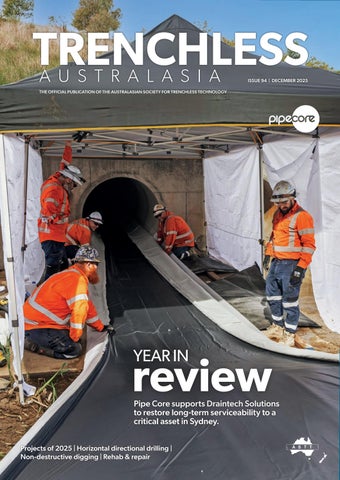
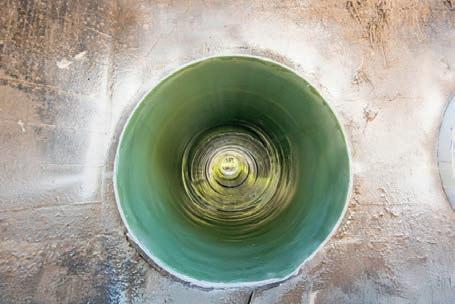
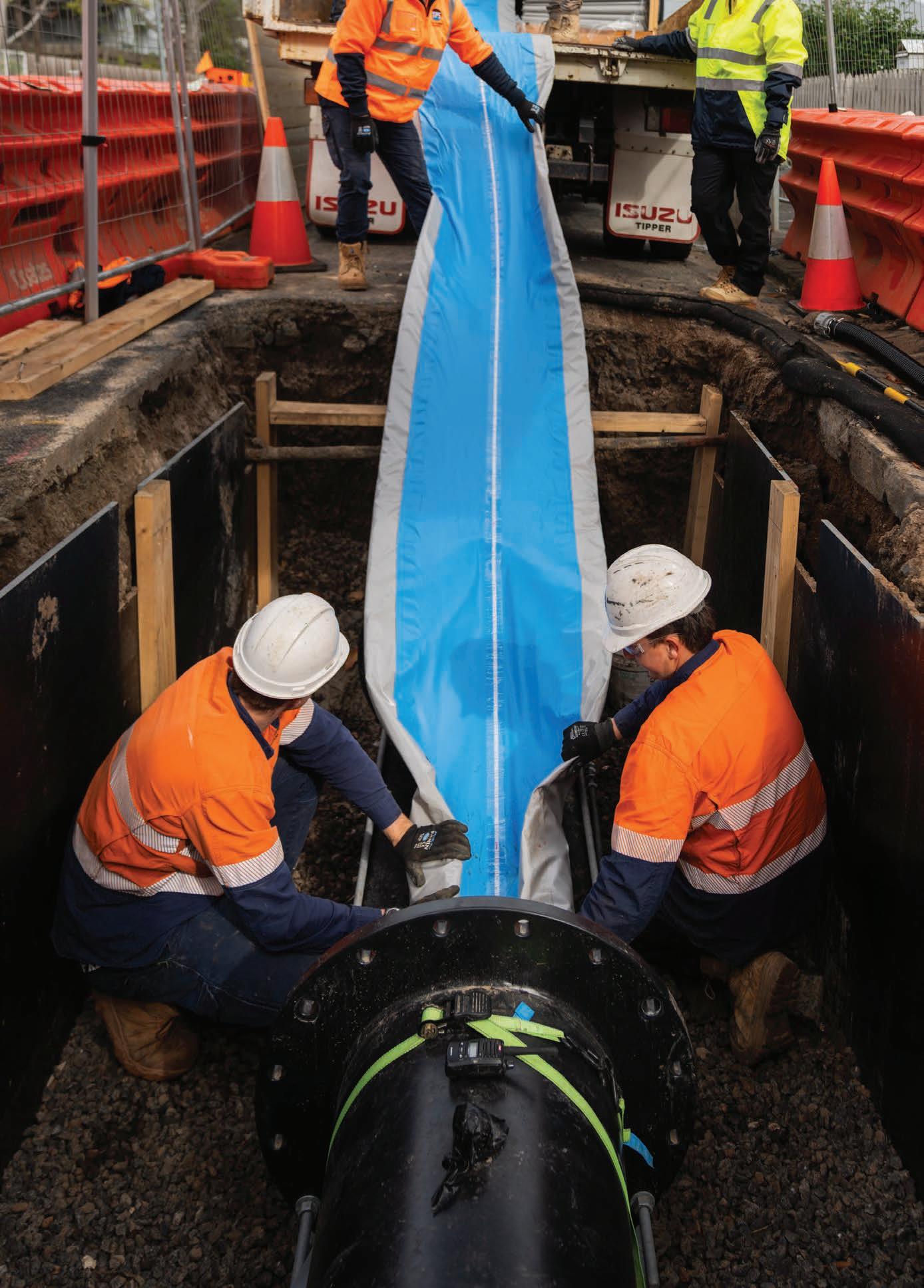
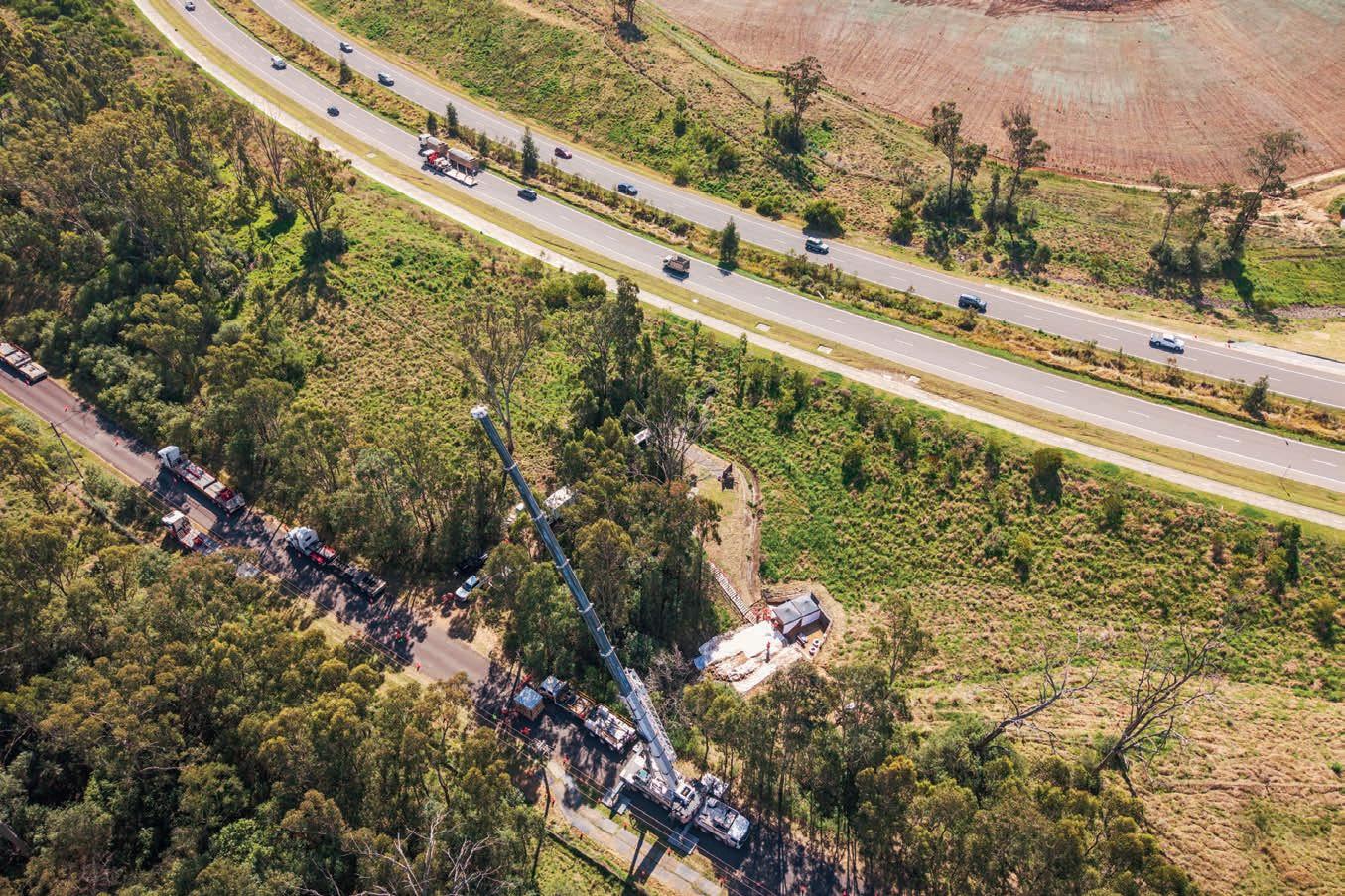
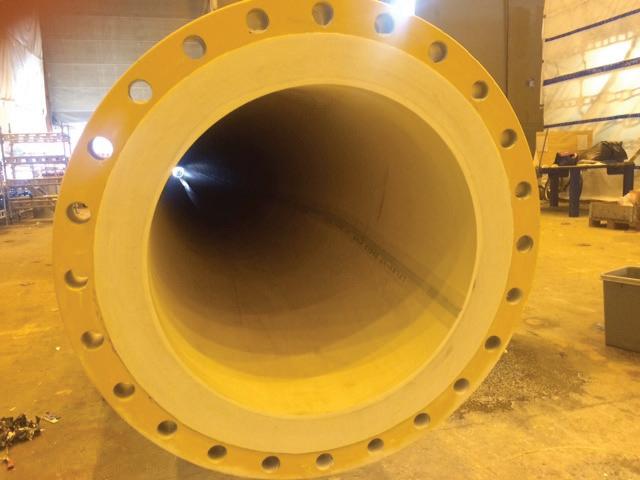
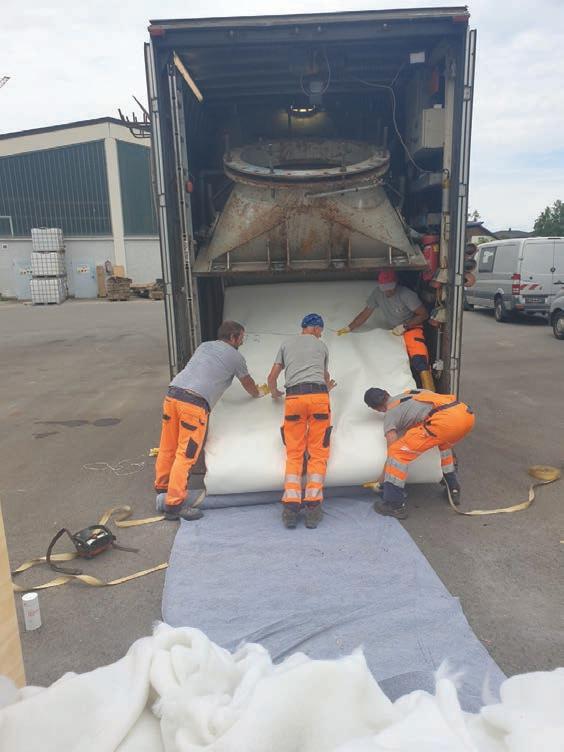
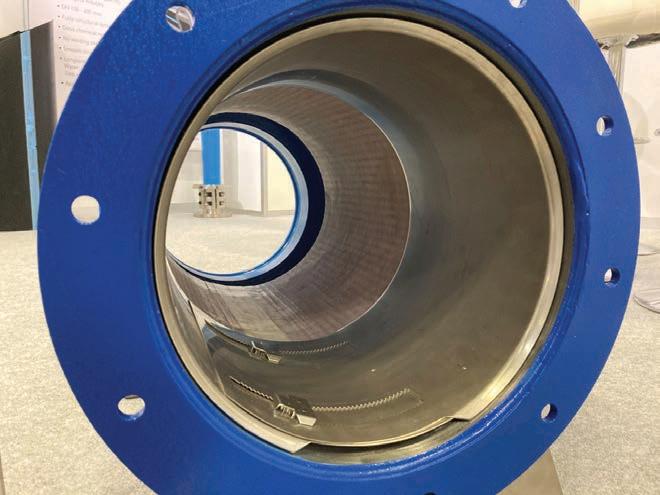
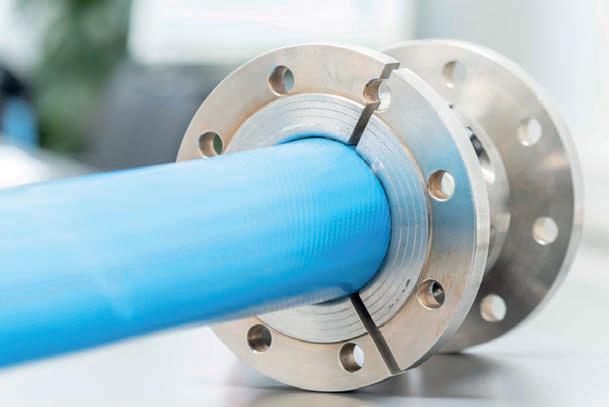
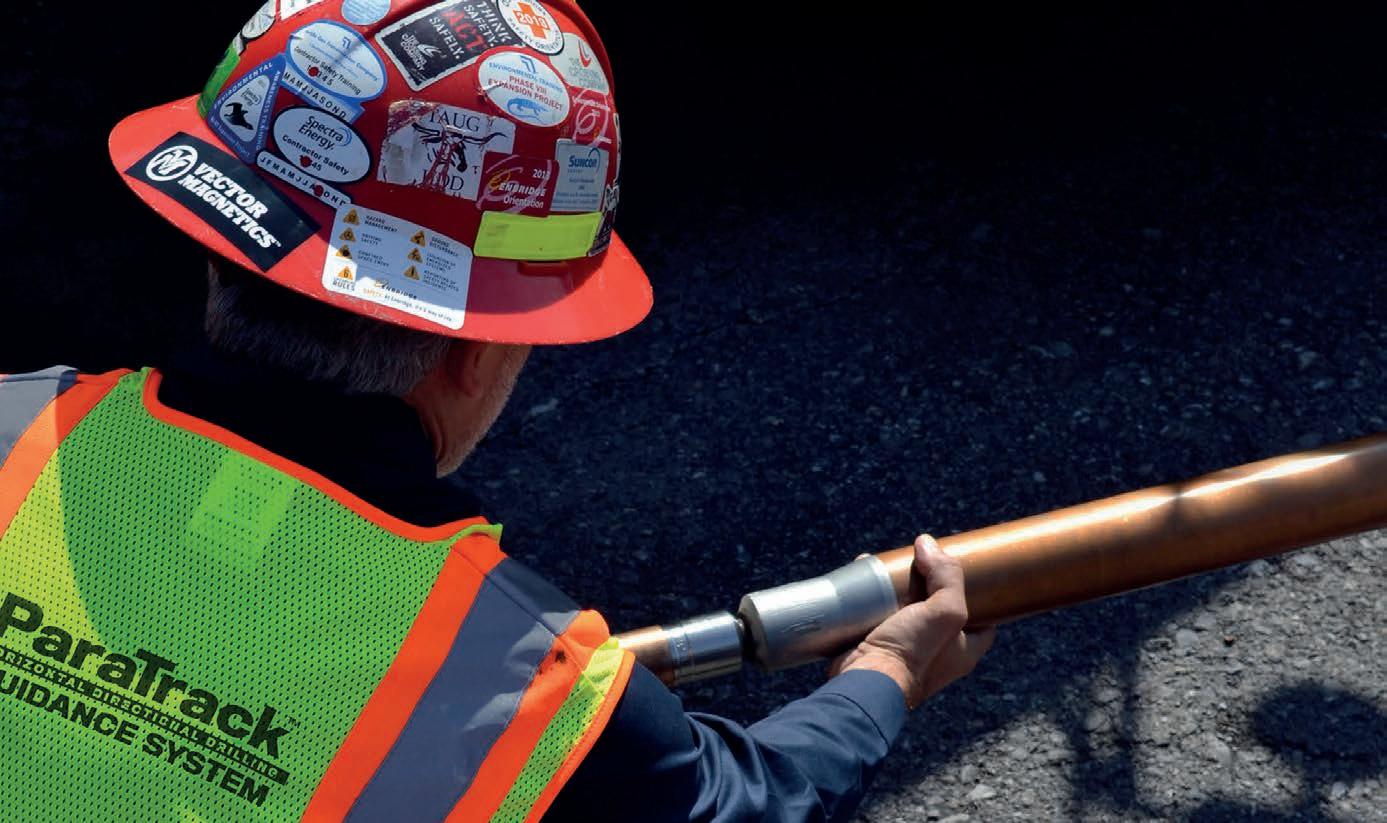
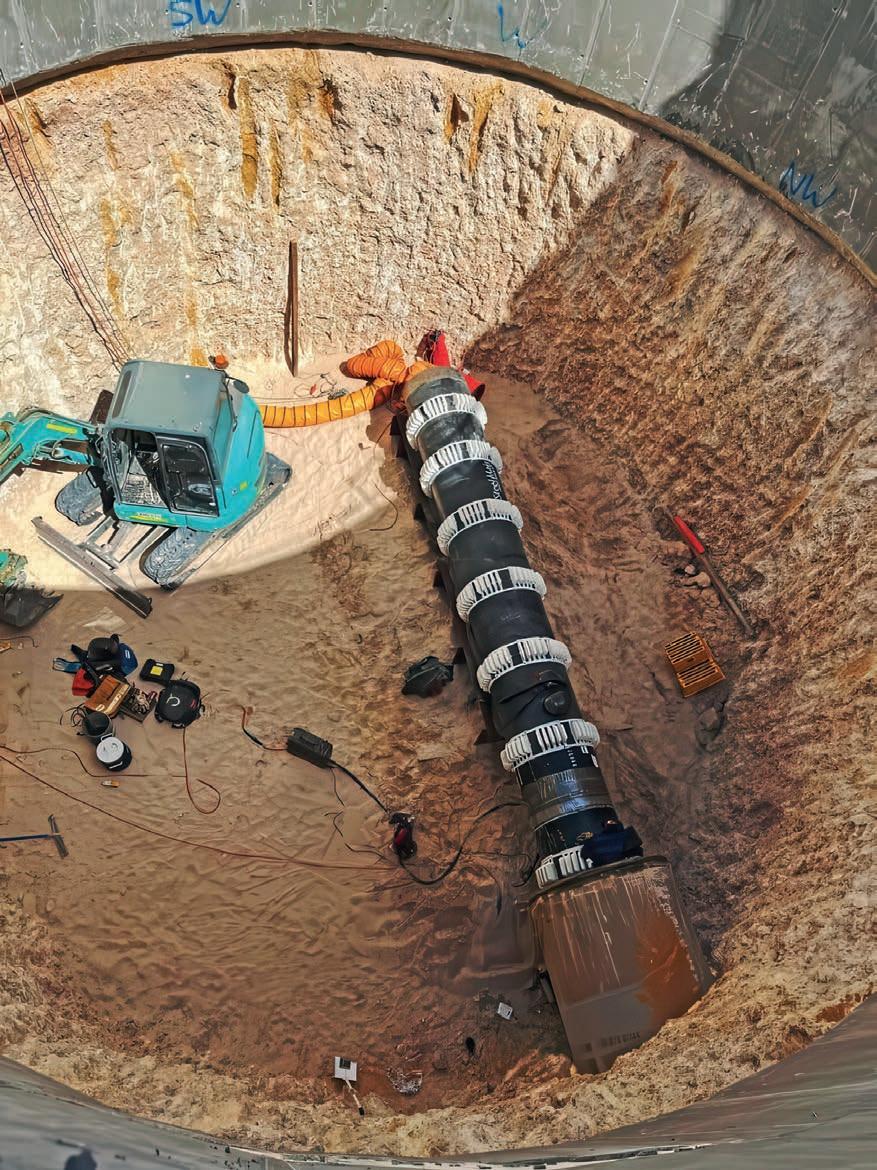
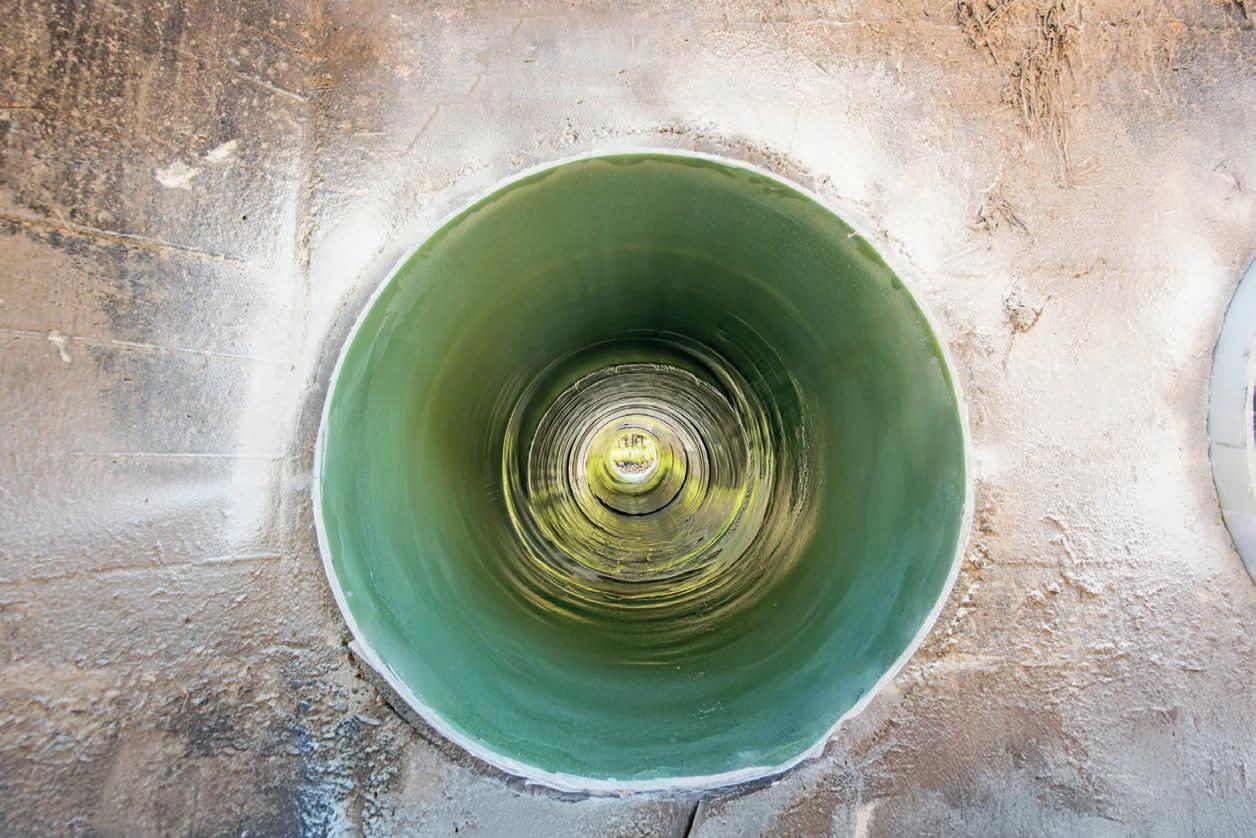
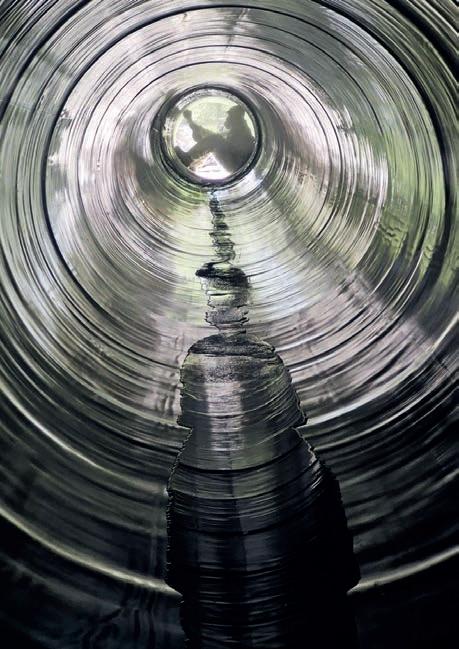
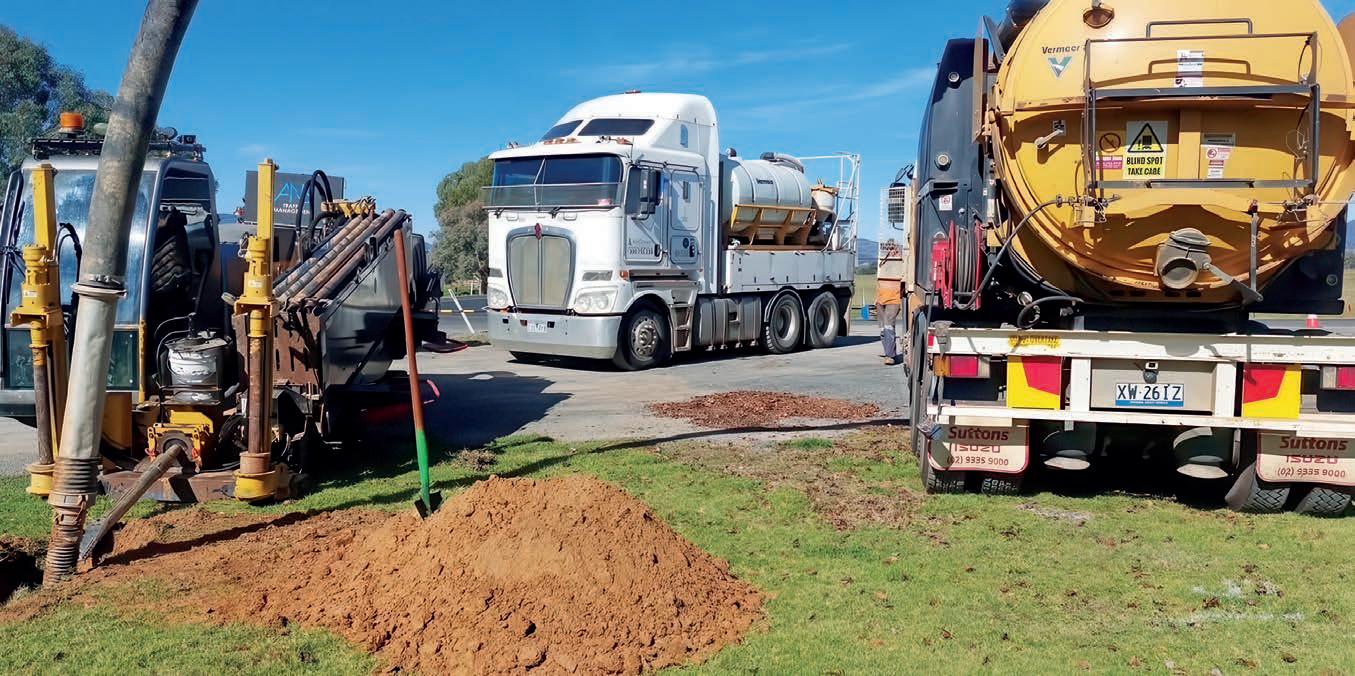
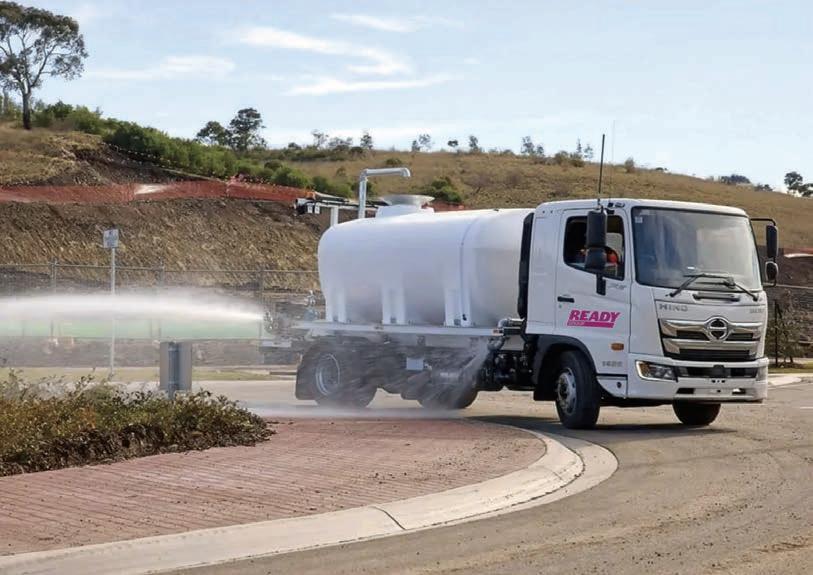
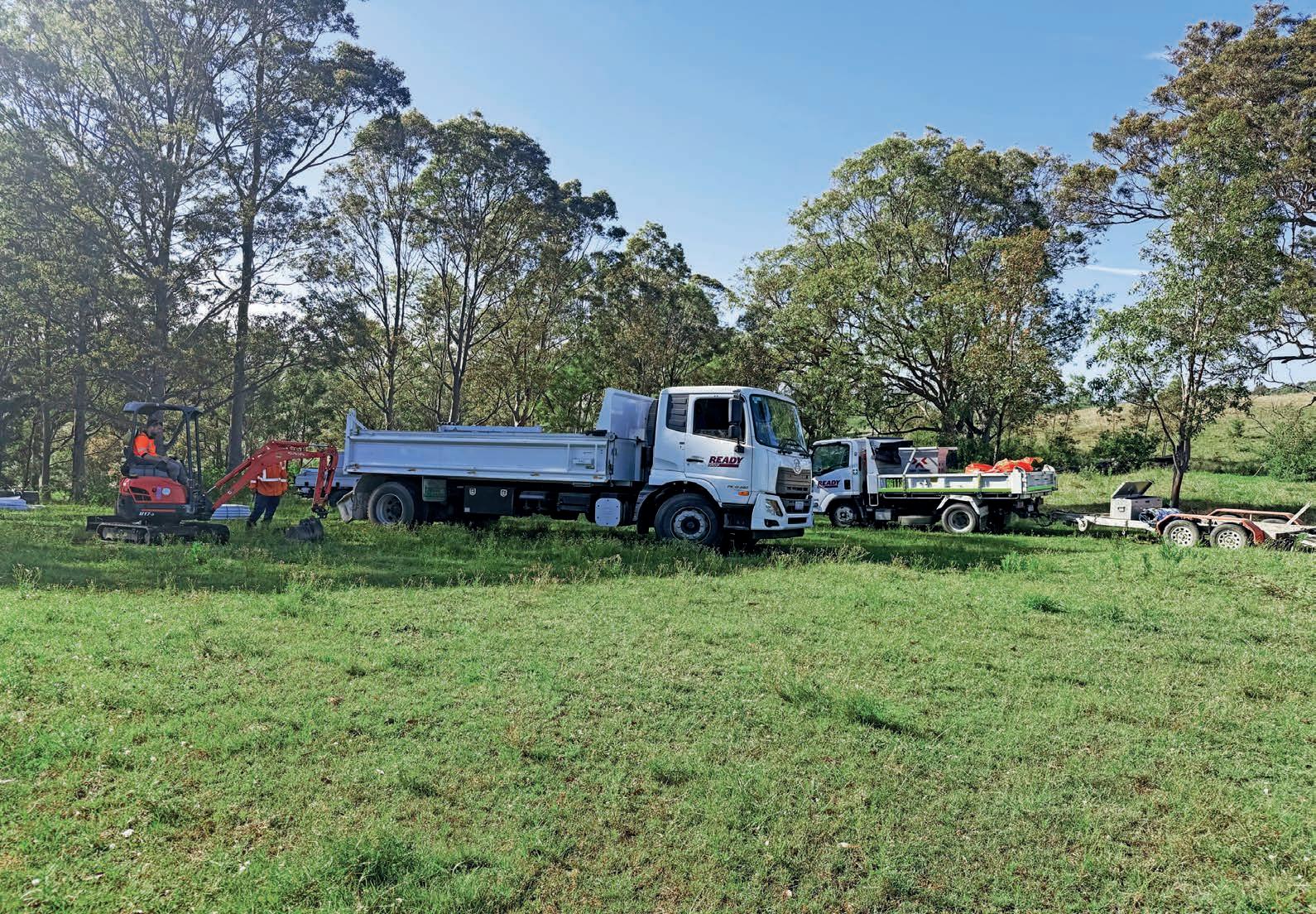
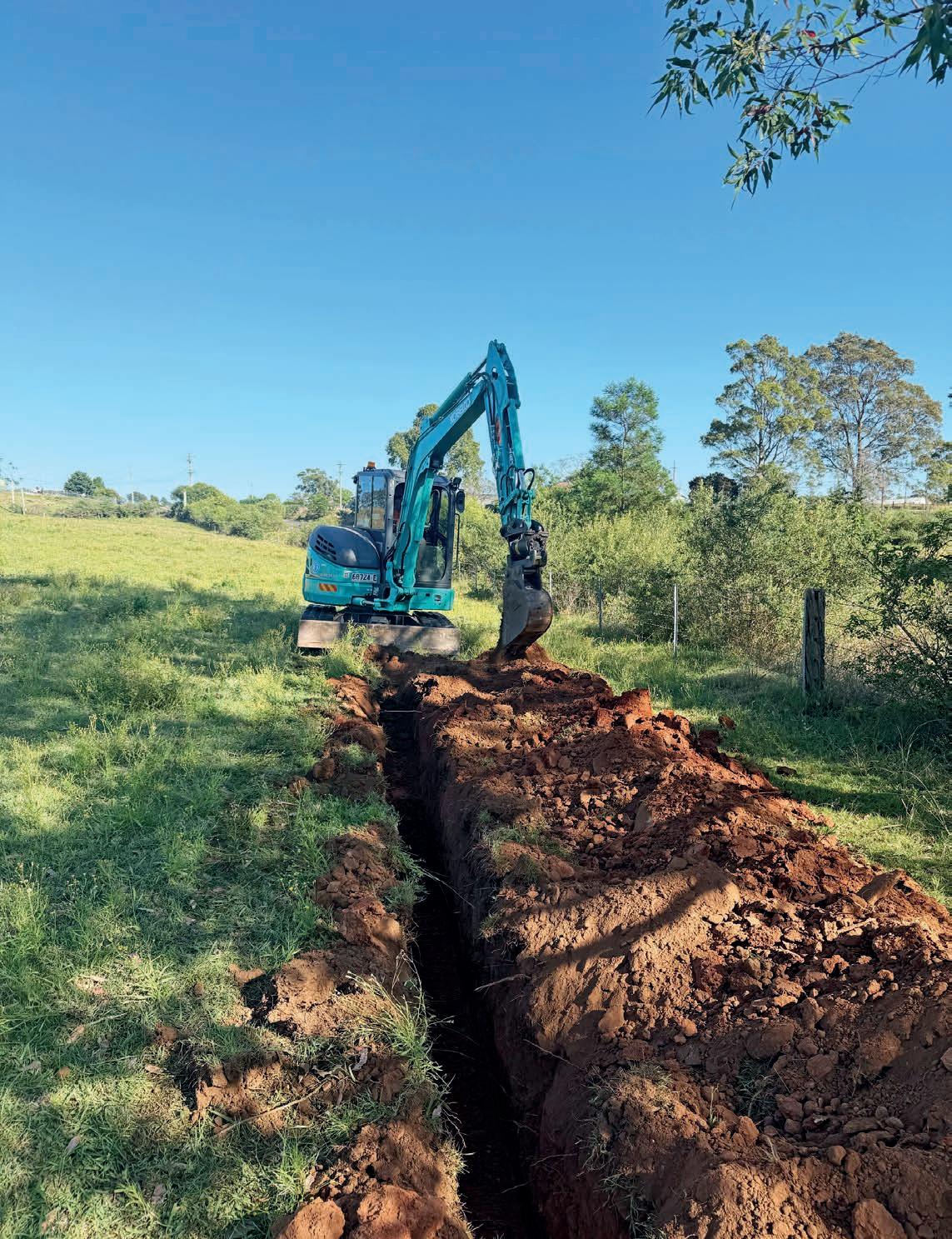
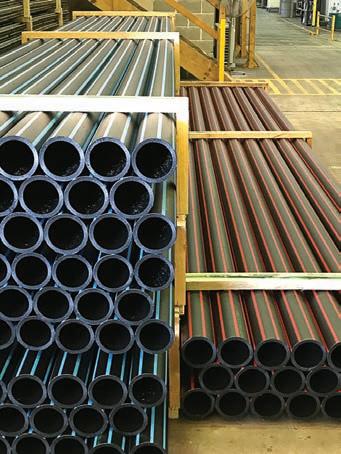
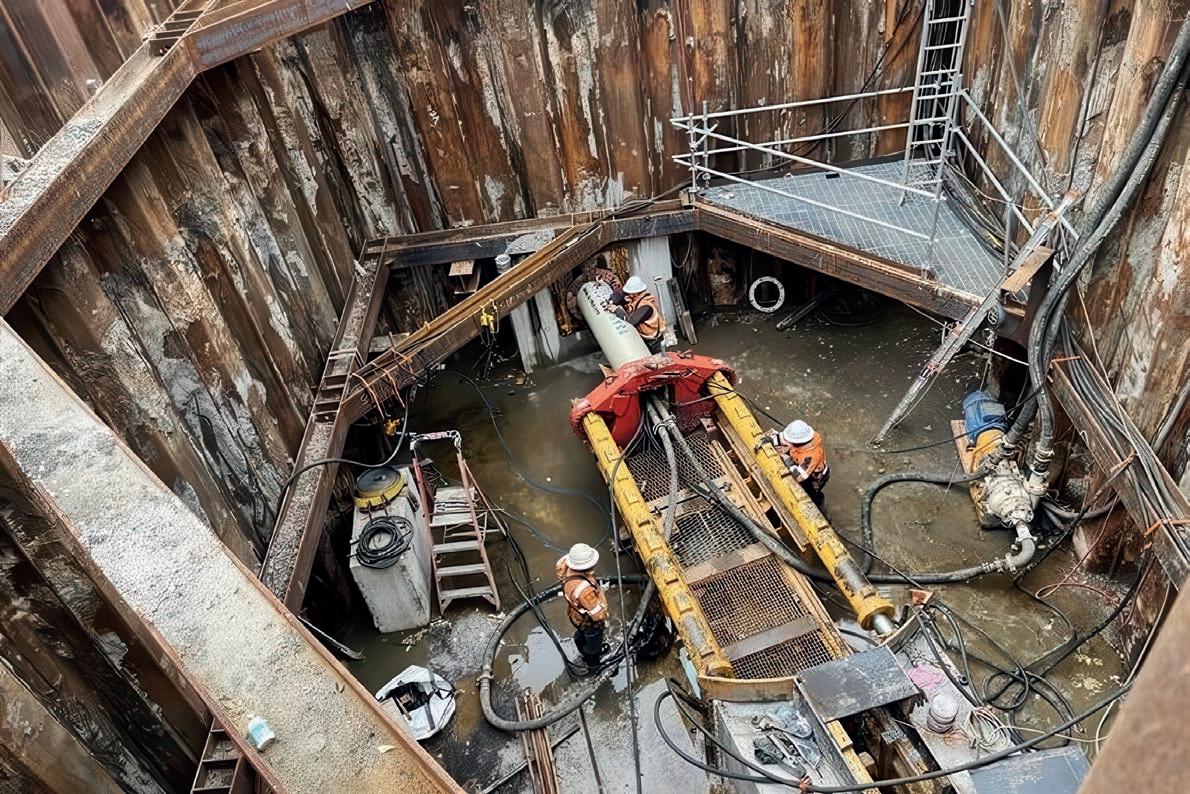
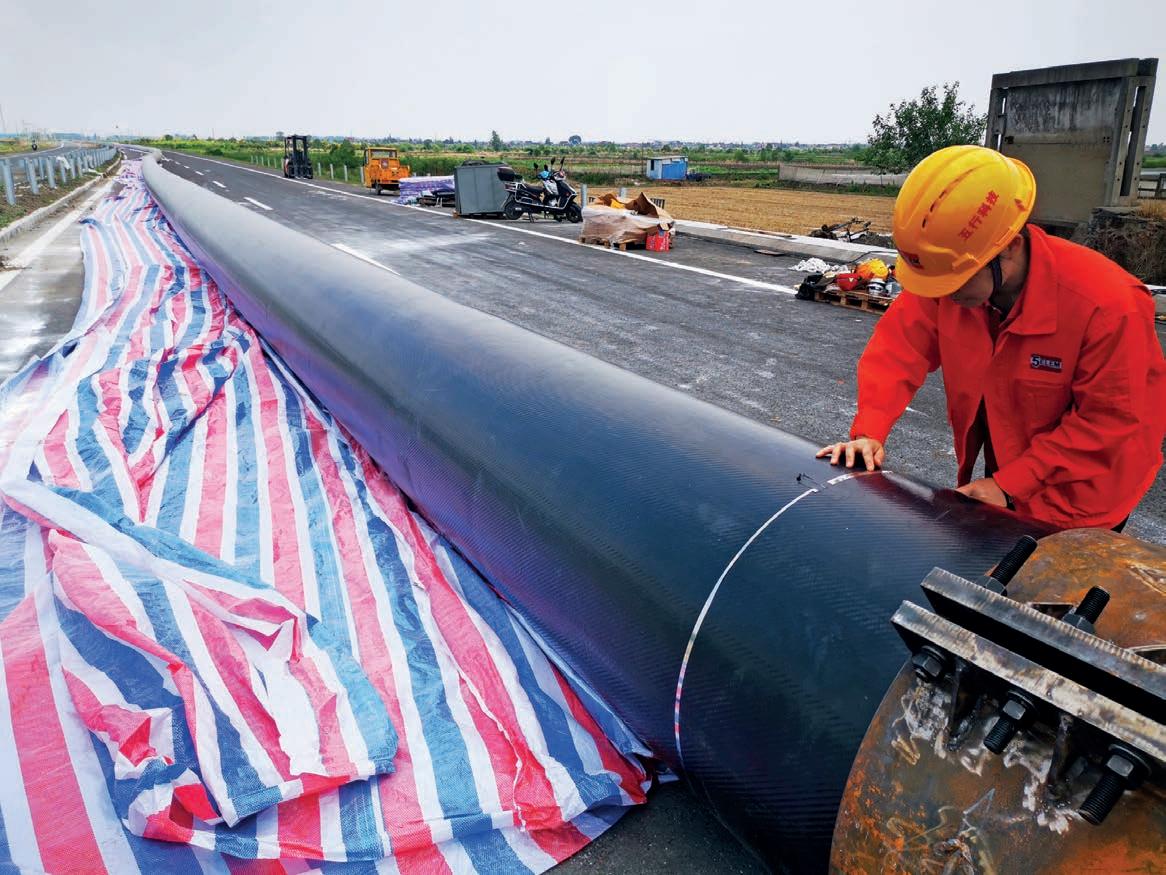
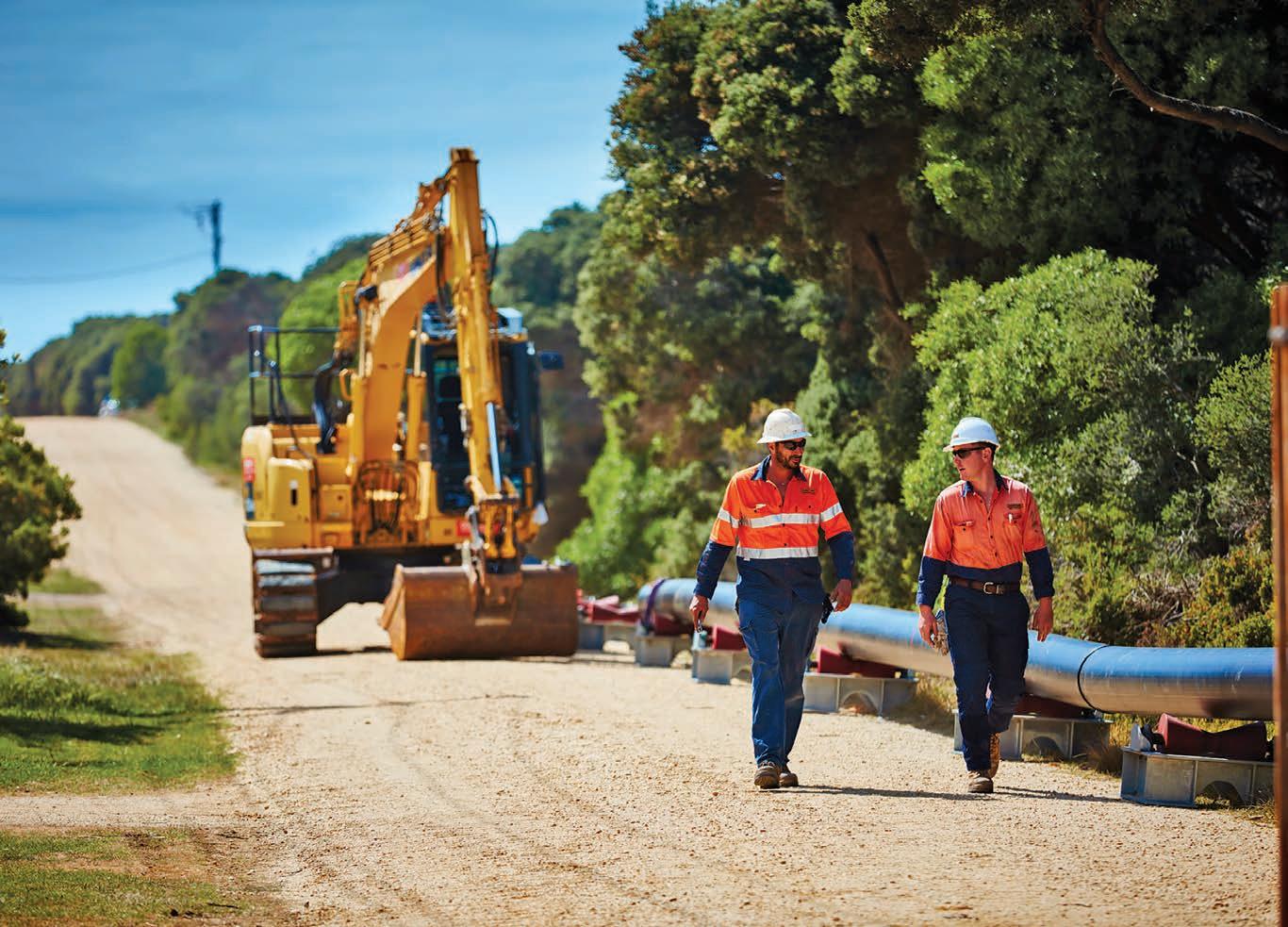
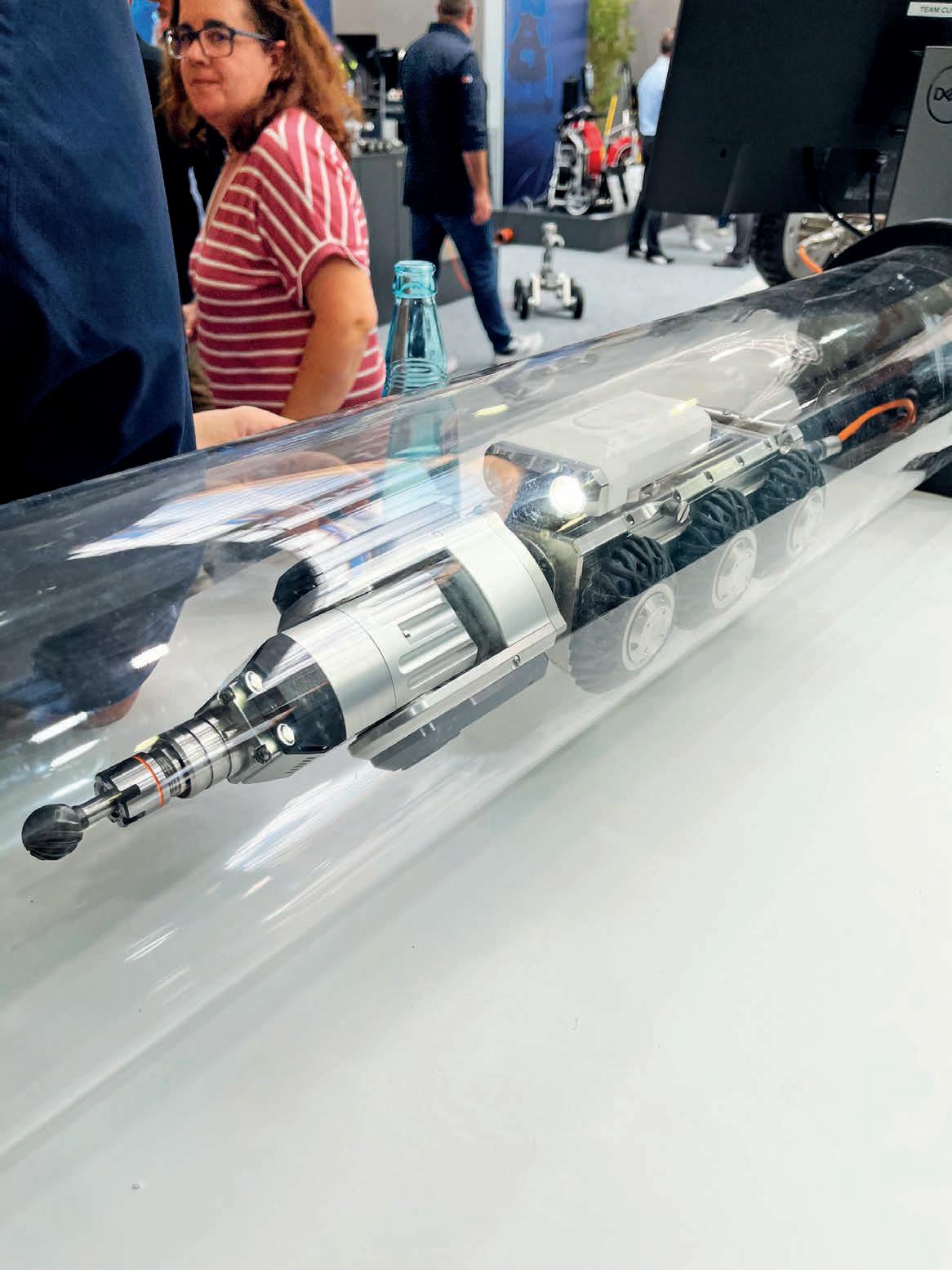
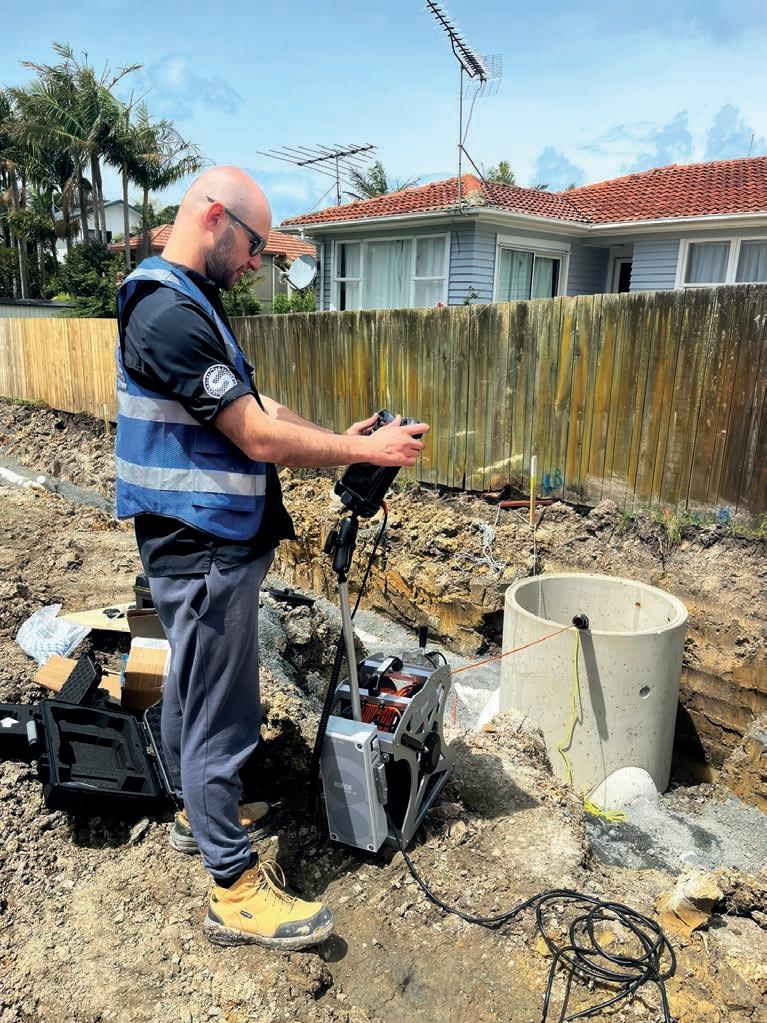
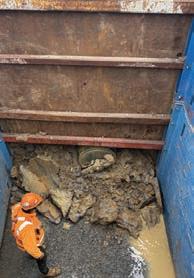
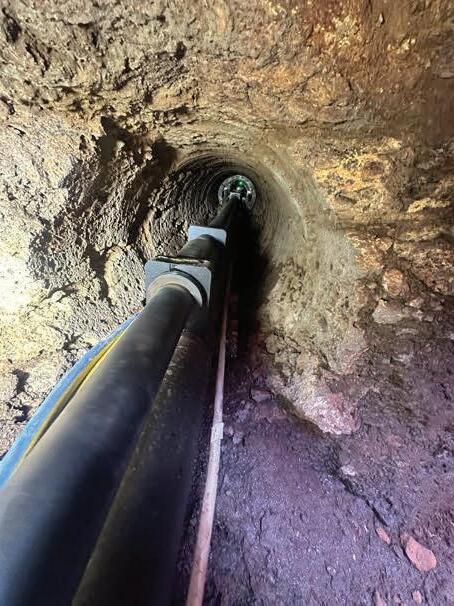
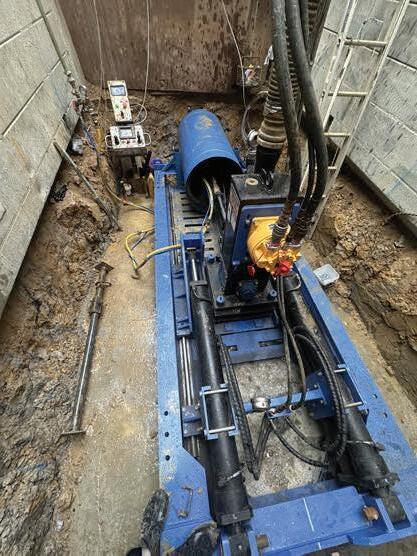
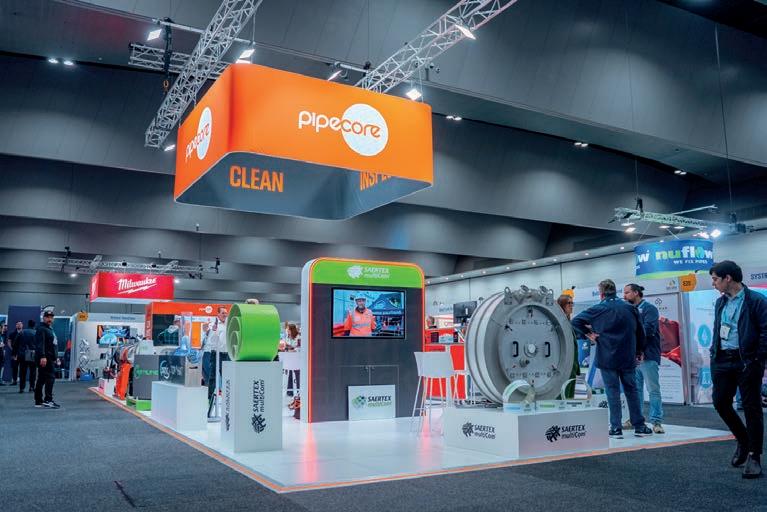
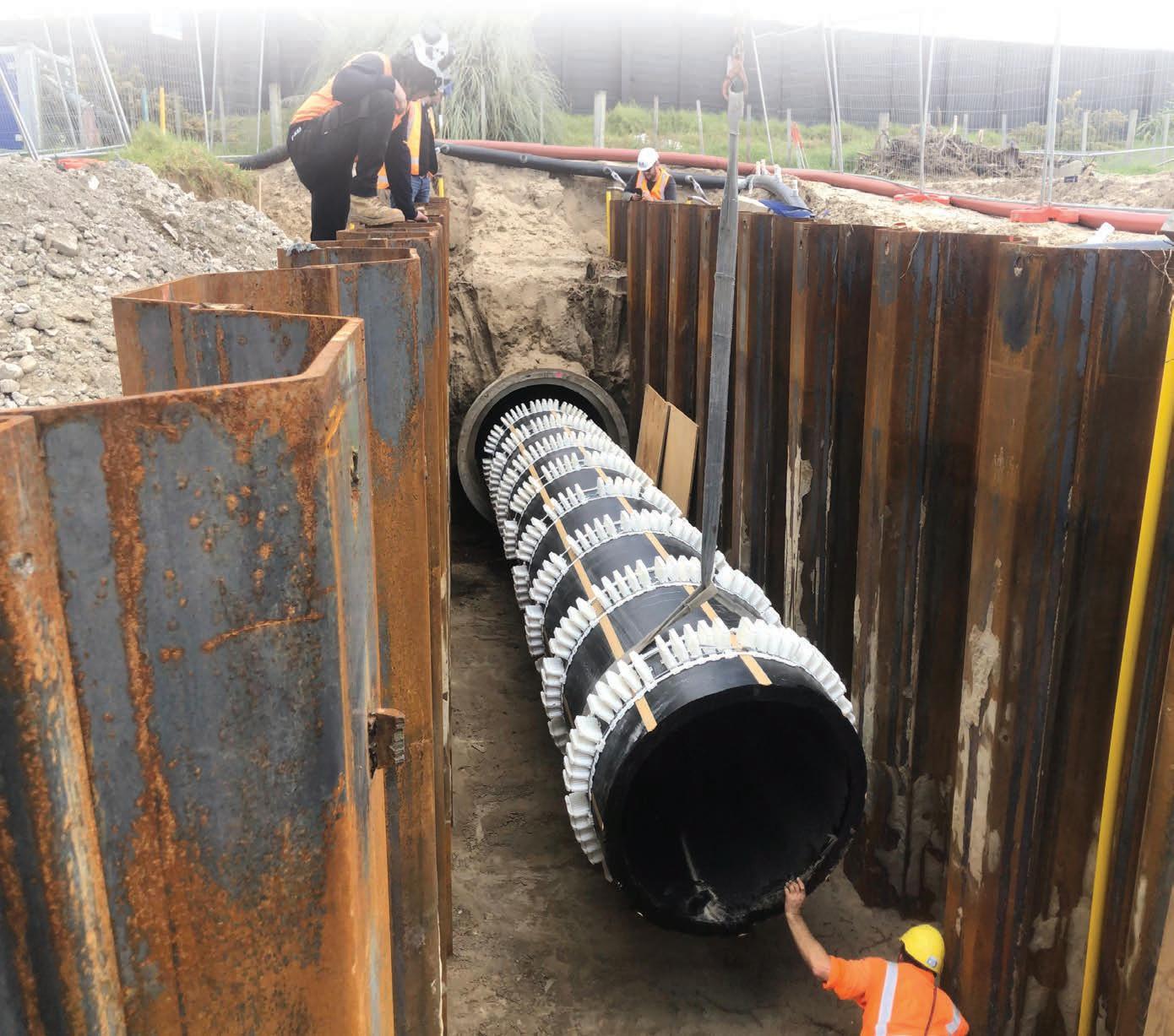
Pipe Core supports Draintech Solutions to restore long-term serviceability to a critical asset in Sydney.
We’re Creating the Future of Water for people and communities, for generations to come
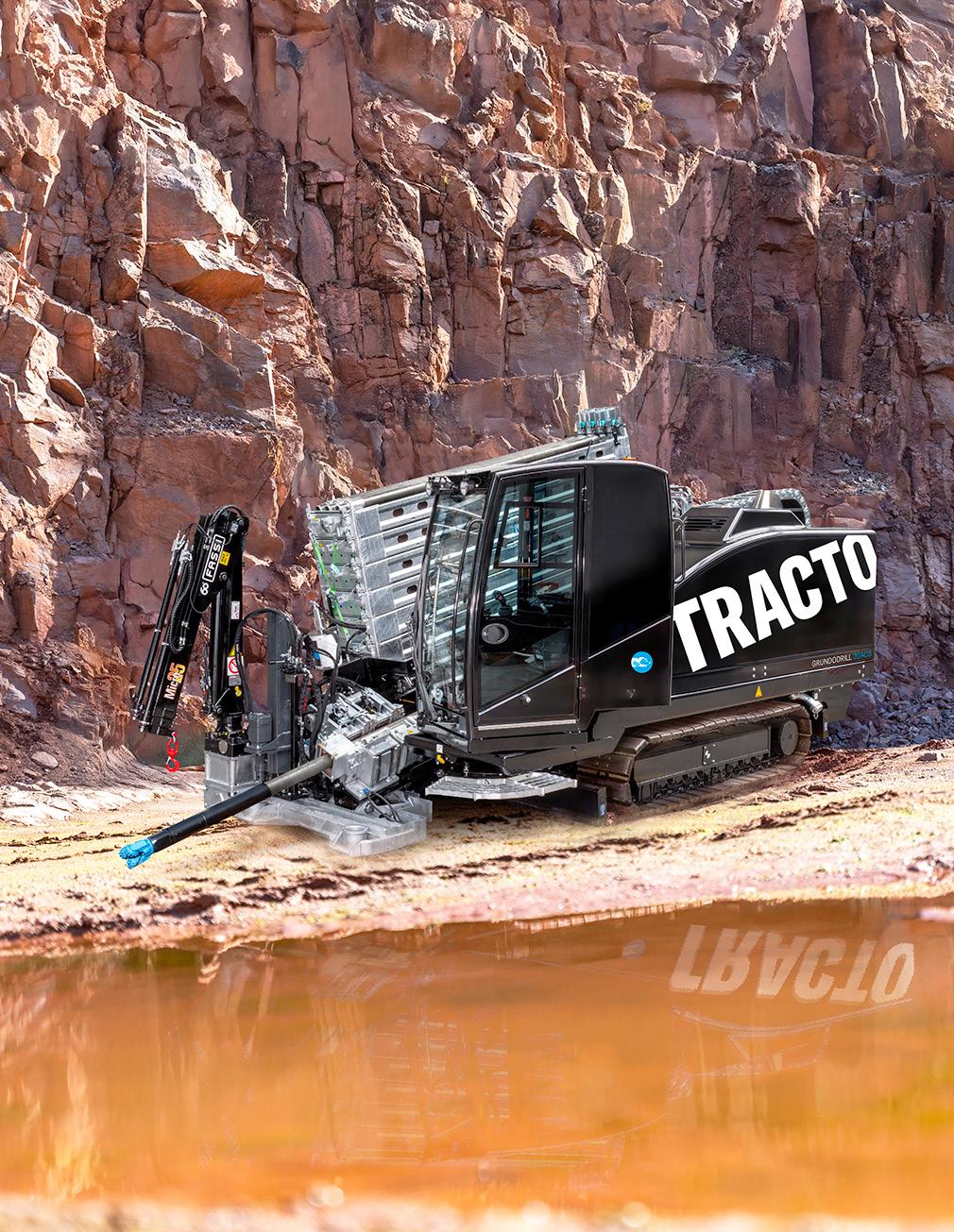
More flexibility, productivity, safety and operator comfort for your drilling projects. That’s the GRUNDODRILL 20ACS from TRACTO.
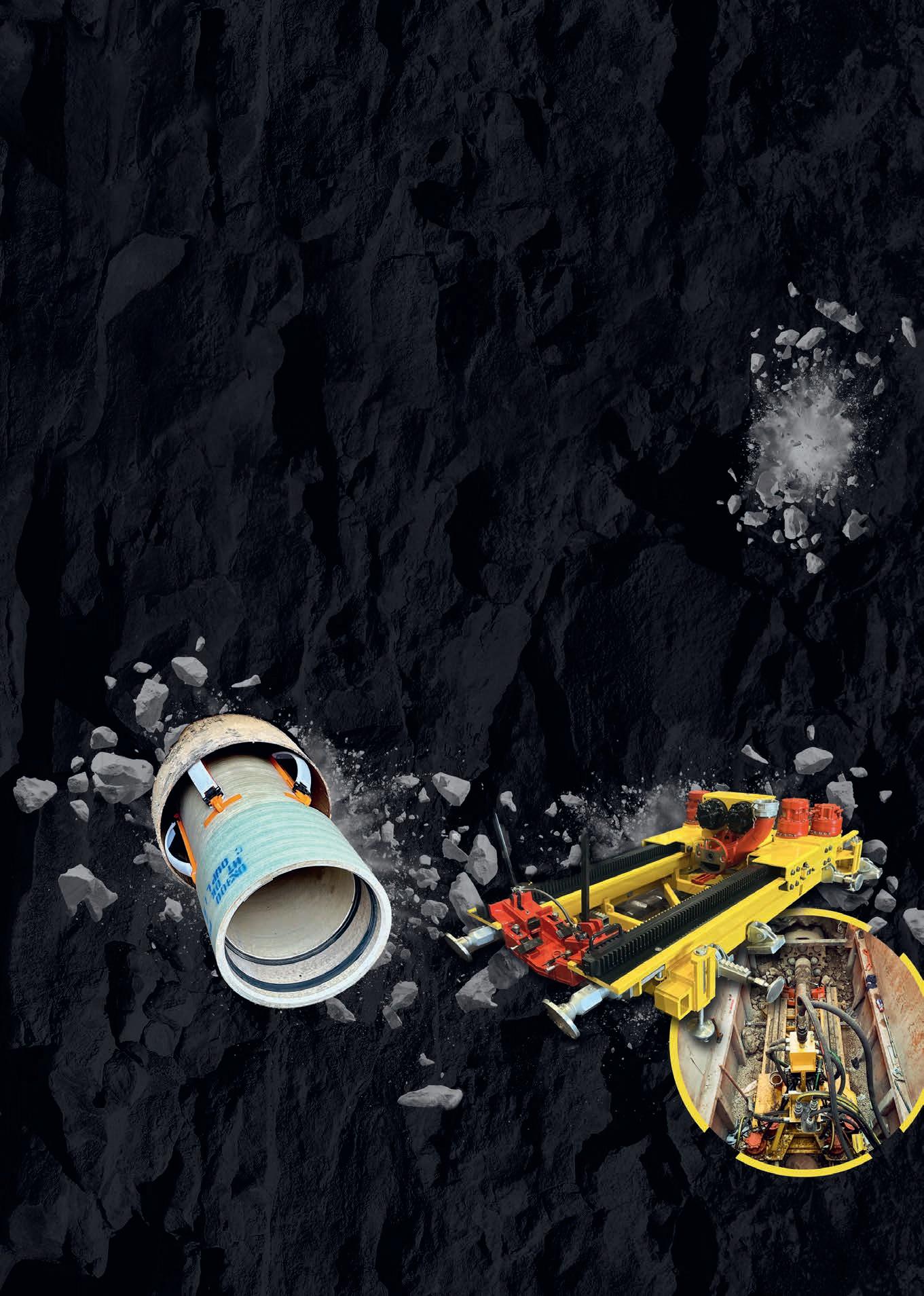
Combining the proven ‘All Condition System’ concept with the latest in automation and top-of-the-range ergonomics, this 200 kN drilling rig can handle even the most complex drilling projects in changing ground conditions, including rock.
To find out more about the 20ACS and our customised financing and service solutions, please get in touch: T + 61 7 3420 5455 E info-au@tracto.com
This magazine is the official journal of the Australasian Society for Trenchless Technology (ASTT) and is distributed to members and other interested parties throughout Australia and the Asia-Pacific. It is also available on subscription. The publishers welcome editorial contributions from interested parties. However, neither the publishers nor the ASTT accept responsibility for the content of these contributions and the views contained therein are not necessarily the views of the publishers or the ASTT. Neither the publishers nor the ASTT accept responsibility for any claims made by advertisers. All communications should be directed to the publishers.
Unless explicitly stated otherwise in writing, by providing editorial material to Prime Creative Media (PCM), including text and images, you are providing permission for that material to be subsequently used by PCM, whole or in part, edited or unchanged, alone or in combination with other material in any publication or format in
or
or howsoever distributed, whether
by
and its agents and
or
and Pipe Core
CHAIRMAN
John Murphy
CEO
Christine Clancy
christine.clancy@primecreative.com.au
MANAGING EDITOR
Eugene Duffy
eugene.duffy@primecreative.com.au
EDITORIAL
Tim Bond
tim.bond@primecreative.com.au
BUSINESS DEVELOPMENT
Nick Lovering nick.lovering@primecreative.com.au
HEAD OF DESIGN
Blake Storey
blake.storey@primecreative.com.au
DESIGNER
Apostolos Topatsis
COPYRIGHT
Trenchless Australasia is owned by Prime Creative Media and published by John Murphy. All material in Trenchless Australasia is copyright and no part may be reproduced or copied in any form or by any means (graphic, electronic or mechanical including information and retrieval systems) without written permission of the publisher. The Editor welcomes contributions but reserves the right to accept or reject any material. While every effort has been made to ensure the accuracy of information, Prime Creative Media will not accept responsibility for errors or omissions or for any consequences arising from reliance on information published. The opinions expressed in Trenchless Australasia are not necessarily the opinions of, or endorsed by the publisher unless otherwise stated.
All articles submitted for publication become the property of the publisher. The Editor reserves the right to adjust any article to conform with the magazine format.
Sydney Office Suite 11.01, Level 11, 201 Miller St, North Sydney, 2060
From the editor
Eugene Duffy
In the final edition of Trenchless Australasia for 2025, we have introduced a new feature providing an opportunity to reflect on the successes of the past 12 months, share standout projects and achievements with the wider no-dig community.
Pipe Core takes the front cover in this edition, shedding light on its exciting rehabilitation project with Transport for NSW. OptionX discusses a bumper project in South Australia which demonstrated the prowess of its trenchless technology over conventional means. And Michels Trenchless does some heavy lifting at the Snowy 2.0 pumped hydro project.
Elsewhere, we take a look at what’s going on in the market for horizontal directional drilling and microtunnelling. All this and much more in the December edition of Trenchless Australasia Happy reading.
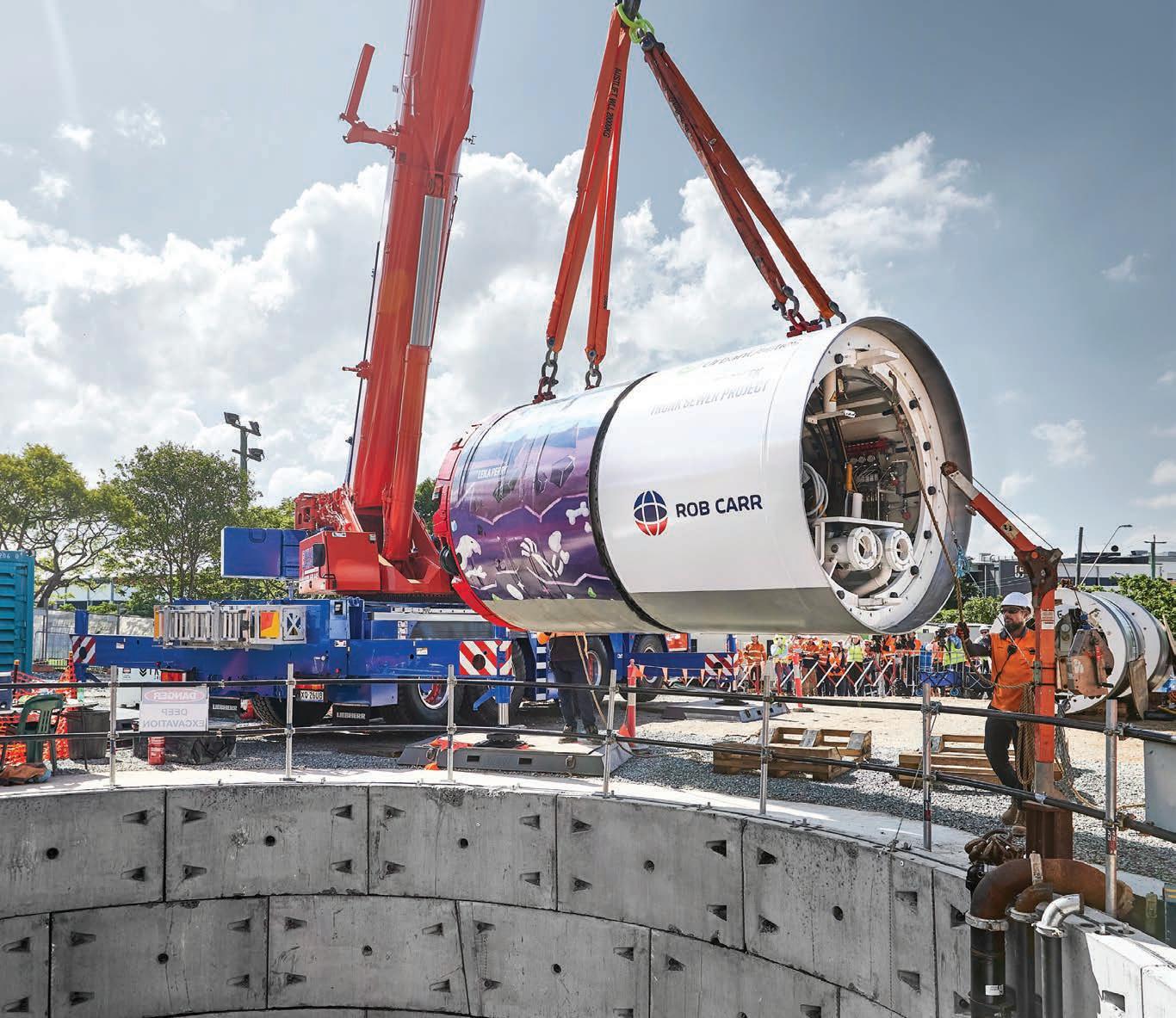
Excellence in tunneling for water, wastewater and energy infrastructure.
With a focus on safety, innovation and collaborative delivery over the last 35 years, Rob Carr has achieved outstanding outcomes in water, wastewater and energy infrastructure projects in both Australia and overseas. Rob Carr is part of Soletanche Bachy a world leader in foundation and soil technologies and subsidiary of VINCI, a global player in construction across more than 100 countries. With outstanding capabilities to manage the complexities of any project, Rob Carr has the people, knowledge and experience to deliver success.
THE AUSTRALASIAN SOCIETY FOR TRENCHLESS TECHNOLOGY
ABN 43 893 870 966
P.O. Box 2242, MALAGA
LPO WA 6944
www.astt.com.au
President: Ben Crosby
Secretary: Trevor Gosatti
Vice President: Blair Telfer
COUNCILLORS
Western Australia: Aizezi Jiang
Queensland: Ben Crosby
New South Wales: Jason Marshal
Victoria: Ash Hamer
South Australia: Shaun Melville
New Zealand: Blair Telfer
Northern Territory: Luke Woodward
Tasmania: Vacant
From the President
Ben Crosby
As we wrap up an extraordinary year in trenchless innovation, I’m delighted to welcome you to the final 2025 edition of Trenchless Australasia. This issue offers us a moment to pause, reflect with pride, and celebrate the incredible progress our community has made during a year of genuine milestones.
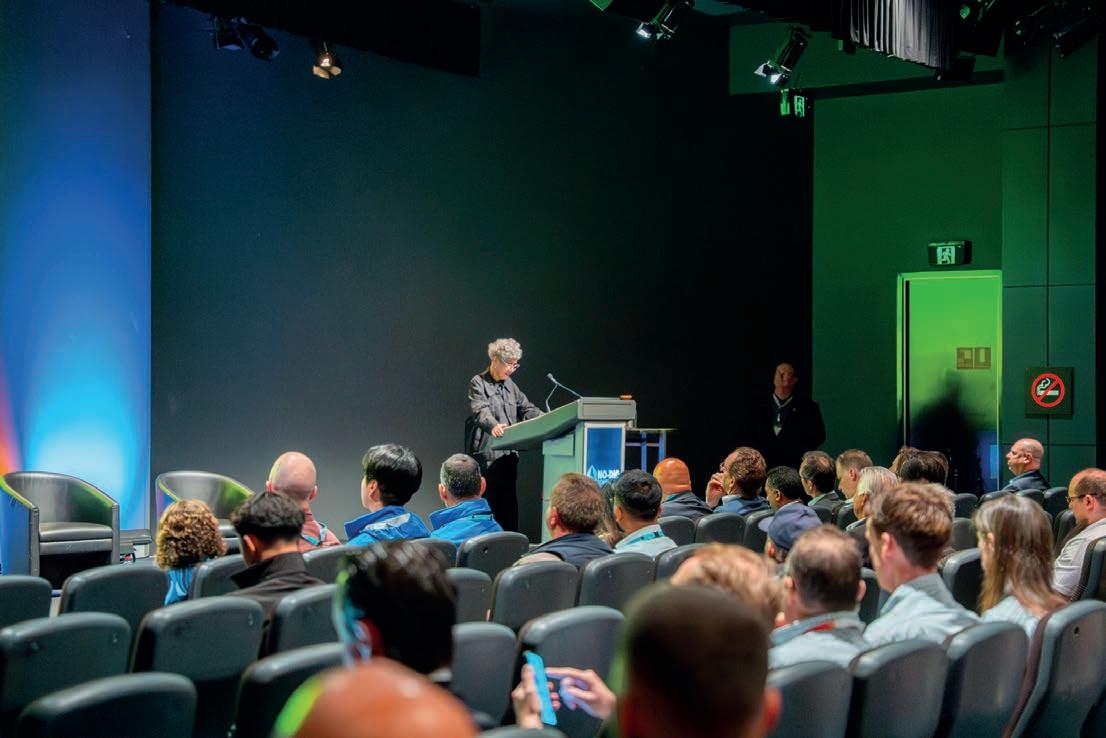
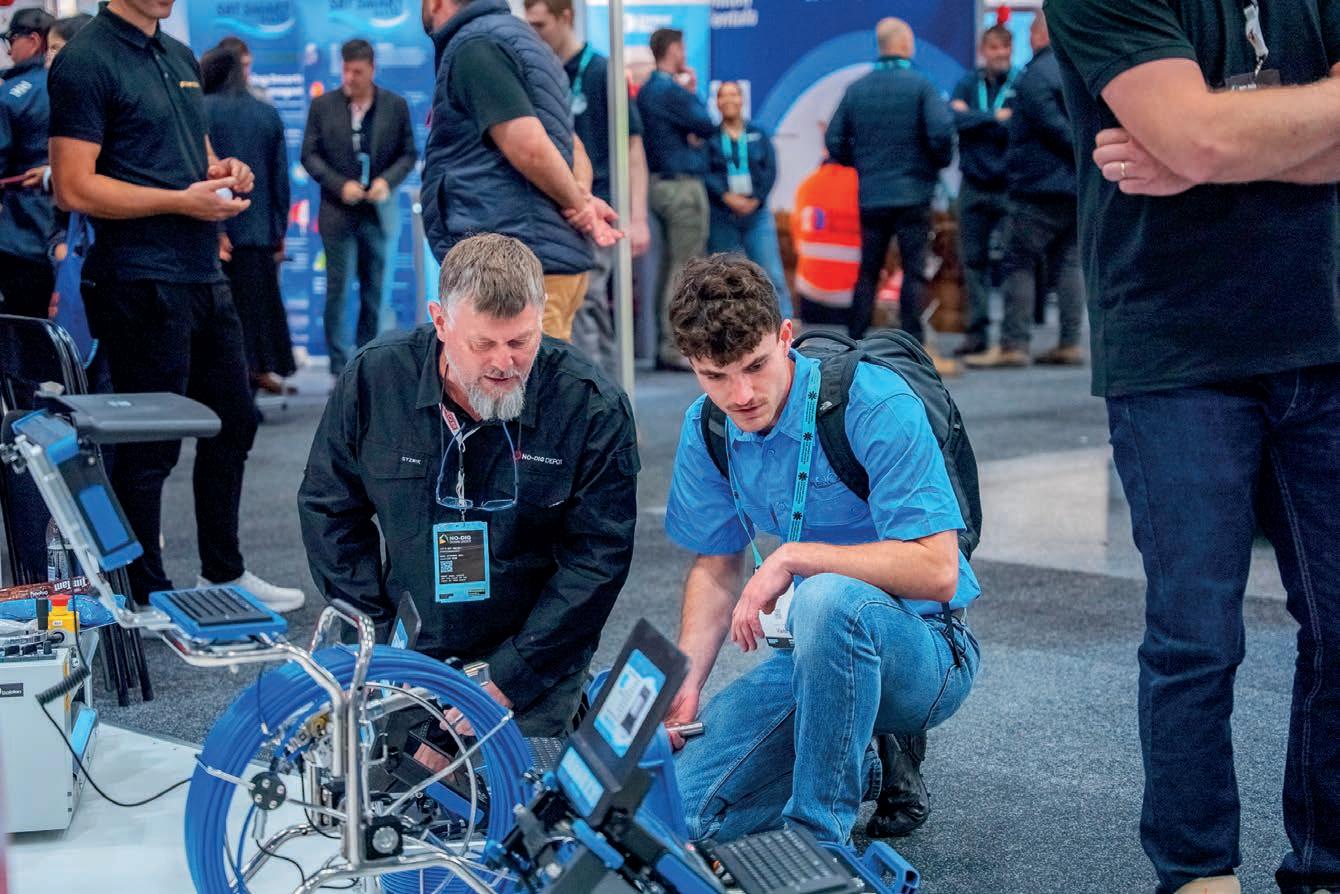
One of the standout moments of 2025 was undoubtedly No-Dig Down Under in Melbourne. This year’s conference was excellent, with more than 2000 delegates –an all-time record attendance – gathering to exchange ideas, learn, and forge new partnerships. The energy and ambition on display reaffirmed why this event is the Southern Hemisphere’s premier gathering for our trenchless community.
I am grateful that we were able to host and attend a conference to celebrate our industry such as No-Dig. Thank you to our sponsors and exhibitors for continuing to believe in the vision of No-Dig Down Under and supporting the event.
This edition of the magazine looks back to reflect on some of the critical projects which took place this year. From advanced HDD crossings through challenging terrain to microtunnelling drives in difficult geology − and rehabilitation projects breathing new life into aging pipelines − the real-world examples presented are nothing short of inspiring.
In HDD, we saw projects that not only demonstrated technical excellence but also delivered sustainable infrastructure solutions. These HDD achievements are vital, particularly as we continue to prioritise low-impact, environmentally respectful construction.
On the microtunnelling front, 2025 proved to be a landmark year. Many projects navigated complex ground conditions with laser-guided precision, demonstrating how microtunnelling remains a powerful tool for building beneath cities, roads, and other sensitive zones. The innovation and control we witnessed elevate our confidence in delivering robust infrastructure below ground more efficiently than ever.
And of course, pipe rehabilitation – a cornerstone of what we do – featured prominently in case studies throughout the year. Whether through liner technologies, UV-cured systems, or robotic solutions, our industry continued to extend the life of assets, reduce disruption to communities, and deliver cost-effective rehabilitation.
As we look forward to 2026, let us carry the momentum of this year’s achievements into new challenges and projects. We now stand stronger, with more knowledge, deeper connections, and a clearer vision for how trenchless technology can support sustainable growth and infrastructure renewal across Australasia.
Congratulations to everyone who’s contributed to this journey – you should be enormously proud of what we’ve accomplished together.
Also on the horizon for 2026 is International No-Dig New Zealand, which the ASTT is hosting on behalf of the ISTT. It promises to be another excellent and memorable event in our industry.
Here’s to an even more ground-breaking year ahead.
Ben Crosby President, ASTT
UV-CIPP LINER SUPPLIER OF
PRODUCTS
Pro Line supplies UV-CIPP liner from DN150 – DN2400 and is suitable for the following host pipes:
• Gravity
• Pressure
• Potable Water
CONTACT US TODAY
by actively partnering with local community groups and creating employment opportunities that support the growth and sustainability of the communities we serve. By partnering with community groups and Aboriginal businesses, we not only deliver innovative pipeline solutions but also help build a stronger, more resilient future for generations to come.
Partner with Pro Line for unmatched support across every stage of your UV-CIPP projects. For more information, visit www.prolinetrenchless.com
Secretary’s corner OCTOBER 2025
New Members
On behalf of the ASTT, I extend a warm welcome to the following new members:
Gold Corporate Members (24 month) – New Zealand
• Utilities Infrastructure (Harley Haywood)
• GHD Pty Ltd (Catherine Sherry)
Silver Corporate Members – Australia
• Subterra Civil (Christopher Noone)
Silver Corporate Members (24 month) – Australia
• Pro Line (Jay Sheehan)
Asset Owners Members – Australia
• APA Group (Tony Scorgie)
Individual Members – Australia
• Matt Clough from VTI
• Alistair Xeros from Xeros Piccolo Consulting Engineers
• Adnan Obeid from Stantec Australia
• Josh Hewett from Bothar Boring & Tunnelling
ISTT International Council Meeting in Vancouver, Canada
The ISTT held its International Council Meeting (incorporating the AGM) in Vancouver, Canada on the the 26th October 2025 just prior to the International No Dig & No Dig North Conference and Exhibition that was being held there.
• A number of matters occurred at the meeting including:
• ISTT Chair Keh-Jian (Albert) Shou’s 3 year term was completed and he stepped down to become ISTT Past Chair.
• Current Vice Chair Mark André Haebler nominated for the position of ISTT Chair and was declared the new ISTT Chair.
• ISTT Past Chair Jari Kaukonen steps down from the ISTT Board having served his term.
• The election of ISTT Board member, Carlos Andres Munera from LASTT to the position of Vice Chair. Sam Efrat from SASTT remains in the second Vice Chair position.
• The election of two ISTT Board members
• Wing Chan (re-elected for second term)
• Jan Borje Persson (new Board member)
2025 ISTT International No Dig/No Dig North in Vancouver, Canada
At the conclusion of the International Council meeting a successful conference and exhibition was held over two days combining the host NASTT No Dig North event and the ISTT International No Dig.
The ISTT Awards were announced during the Gala Dinner held on October 28, 2025, at the Vancouver Convention Centre. The recognition of excellence and innovation within the industry is always a highlight of our annual gathering. Congratulations to all our 2025 award recipients as detailed below:
Award Winners
• Student Paper Award – Inshik Park, University of Alberta, Canada (Title: Probabilistic Hydraulic Fracture Analysis in HDD)
• New Technology Award – Shenzhen University, China (Title: Close-fit, twintunnel pipe jacking technology for subway station construction)
• Project Award (New Installation) – Michels Trenchless Pty Ltd, Australia (Title: Snowy 2.0 – Marica Road West HDD: Innovation in Extreme Terrain)
The ISTT were honored to recognize five individuals for their extraordinary and long-term contributions to ISTT and the trenchless industry. Their dedication has been
instrumental in advancing our field. The winners were:
• Russell Fairhurst (UKSTT, UK)
• Norman Howell (UKSTT, UK)
• Declan Downey (UKSTT, UK)
• Jens Hoelterhoff (GSTT, Germany)
• Jari Kaukonen (FiSTT, Finland)
2026 ISTT International No Dig in New Zealand
Now that the International No Dig in Vancouver is completed, planning for the International No-Dig 2026 Auckland in New Zealand to be held from October 28-29, 2026, at the newly built New Zealand International Convention Centre in Auckland is full speed ahead.
The ASTT is hosting this event on behalf of the International Society for Trenchless Technology and it promises to be a popular event for international visitors.
There is a lot of interest already for this international event that will provide local New Zealand and Australian members to experience a great event at a fantastic location.
A reminder to save the new date in your calendar and start planning for next year!
Trevor Gosatti Secretary, ASTT
No-Dig Down Under 2025.
Trevor Gosatti
What’s cooking in Queensland?
Trenchless Australasia takes a look at a handful of trenchless projects on the go in the sunshine state.
Horizontal directional drilling underneath the Bruce Highway are showing once again how trenchless technology boosts major projects but minimises disruption.
The Queensland works are part of a major new intersection on the key arterial and the drilling will help prepare for future lighting and telecommunications connections.
Works are taking place in the northbound and southbound lanes, starting near the Dohles Rocks Rd exit and will move progressively north to Anzac Ave.
Queensland Transport and Main Roads (TMR) has urged motorists to be warned of the nightworks between the hours of 7pm and 5am.
The project team will be drilling under the highway, using horizontal directional drilling (HDD) to install conduits underground without digging up and damaging the roads.
By avoiding open trenches, HDD reduces ground disturbance and vegetation clearing, shortens time on site and limits traffic disruption.
TMR said every effort will be made to “minimise disruption” and thanks and thanks road users in advance for their patience.
Logan river works continue
Queensland based utility Logan Water is continuing to work hard on its latest water main project, which is relying on trenchless technology to kept disruptions to a minimum.
The Travis Road Reservoir Trunk Water Main project involves a 7.6km, 600mm diameter water main that will connect the Southern Regional Water Pipeline (SRWP) to the Travis Road reservoir in Logan Village.
Maxibor Australia commenced pipe pull back for the OD800 Logan River bore on Friday 31 January, working hard over the weekend, and completing the pull back by Sunday afternoon.
The project commenced late last year, and began with detailed design, incorporating innovative methods including horizontal directional drilling (HDD) to tunnel under Camp Cable Road and the Logan River, minimising public disruption during construction. The team successfully used HDD to complete 422.8m space needed for the new pipeline beneath the Logan River.
HDD was also chosen at Kenny Road to reduce community impacts and avoid risks posed by nearby powerlines.
The 531.5m of drilling is complete, and final preparations for pulling the pipe are on track for the coming weeks.
The team are also well prepared and planned with 90 per cent of the DN800 HDPE prewelded ready for pipe pulling.
Additionally, a total of 970m of DN180 HDPE pipe has already been welded, tested and installed.
These milestones mark major progress in creating a reliable, high-capacity water supply network to support Logan’s future growth.
Major wastewater rehaul for Moreton Bay
Unitywater crews are relining four wastewater pipes a day as part of a $400 million replacements and renewals program to improve water and wastewater assets over the next five years.
In the past two years, the utility has relined 53km of wastewater pipeline and 317 maintenance holes across Moreton Bay, the Sunshine Coast and Noosa to reduce odour, improve network efficiency and operability and avoid overflows and impacts to residents.
In the Sunshine Coast and Noosa regions, 25km of pipe – the equivalent distance from
Brisbane, Queensland.
Peregian Beach to Maroochydore – have been relined and 219 maintenance holes renewed.
One of the jobs was in Buderim, where 60m of pipe was relined, and another in Noosa Heads, where 81m was relined.
Across the Moreton Bay region, 26km of pipes – the equivalent distance from Morayfield to Redcliffe – have been relined and 91 maintenance holes renewed.
One of the jobs was in Deception Bay, where 74.3m of pipe was relined, and another in Eatons Hill, where 29.8m was relined.
Unitywater Executive Manager Sustainable Infrastructure Solutions Mike Basterfield said two innovative methods were used to reline the assets which delivered customer and cost benefits.
“Wastewater mains on average are about 2m deep and some are as deep as 4m below ground, so to be able to line the inside of existing pipes and not excavate and replace the entire pipe is much more cost-effective and less disruptive to the community,” he said.
“Our teams use spiral relining with a PVC plastic and a ‘cured-in-place’ solution which is a polymer UV liner that is cured and sealed to the inside of the existing pipe.”
Basterfield said hydrogen sulphide, the gas produced in wastewater, could be corrosive and over time deteriorated infrastructure.
“Our Network Programs team has a comprehensive, proactive program to identify which of our assets need to be renewed, including cleaning programs and jet blasting to clear debris build-up and blockages, CCTV to clearly see any issues inside our pipes and
removal of tree roots – one of the biggest culprits causing blockages and subsequent overflows,” he said.
“They assess the age of the asset, the material it’s constructed with and the current condition. Some maintenance holes are located on private properties and we work with our customers to rectify any issues.”
Basterfield said as part of the program, maintenance holes may be identified to be raised to avoid infiltration during large rain events.
“Stormwater and wastewater are two separate systems that shouldn’t mix and when large volumes of stormwater enter the wastewater network, it is inundated. If we didn’t carry out these important works, overflows would occur inside private properties and in the environment,” he said.
OMTECH nails road crossing projects
With its newly equipped 5X GRUNDODRILL, OMTECH has completed a successful trenchless road crossing project in Brisbane, installing underground utilities beneath a busy urban roadway with minimal disturbance to traffic and surrounding infrastructure.
OMTECH purchased its drill from TRACTO Australia, one of the leader’s in horizontal directional drills.
The project began with precise drill path planning to avoid existing utilities and ensure a safe work environment.
Drilling methods were adapted to local soil conditions, allowing for optimal performance and smooth progress despite varying ground types.
Through efficient installation techniques, the team stayed on schedule and minimised restoration needs, keeping costs and disruptions low.
To reduce surface impact, open trench excavation was avoided, helping preserve roadways and nearby public spaces.
The crossing was completed quickly and safely, with minimal disruption to the community.
The project also showcased the flexibility and reliability of our new equipment, which performed exceptionally well in demanding conditions.
“Looking ahead, we’re ready to take on bigger, more complex challenges and partner with clients who value quality, reliability, and innovation,” the company said in a statement.
Pipe relining market could hit $US5 billion by 2031
In a sign that the positive impacts of trenchless technology are catching on around the world, one analyst has predicted the pipe relining market will grow by at least six per cent by 2031.
A new report from The Insight Partners; “Trenchless Pipe Relining Market” highlights
the growth as a direct response to the widespread need for infrastructure renewal and for projects to minimise disruption.
It has highlighted that ageing pipeline networks are demanding more attention from utility companies and governments and trenchless solutions and relining programs
are generating the interest due to the ability to deliver smart and sustainable solution with lower disruption rates and improved safety.
The report predicted the market will climb to $US3164.24 million by 2031 for the dedicated trenchless pipe relining segment.
This incorporates an annual growth rate of six to seven percent per year with the broader pipe relining market expected to top $US5 billion by the same time.
The report also highlights that while trenchless technology is strong in developed countries this could also see an emerging opportunity in emerging-regions as these economies upgrade infrastructure.
It notes that North America currently leads the market for trenchless pipe relining, driven by extensive ageing infrastructure and significant public-sector investment while the EU is also on a growth trajectory with ageing pipelines and strong regulatory frameworks and sustainability goals driving growth.
In other areas like the Asia-Pacific region rapid urbanisation and demands for water and sewer network upgrades are driving the growth potential in the trenchless pipe relining market.
In other areas of the globe like the Middle East & Africa and South & Central America it notes demand is smaller but growing infrastructure investment in water, wastewater along with the oil & gas sectors are offering growth opportunities.
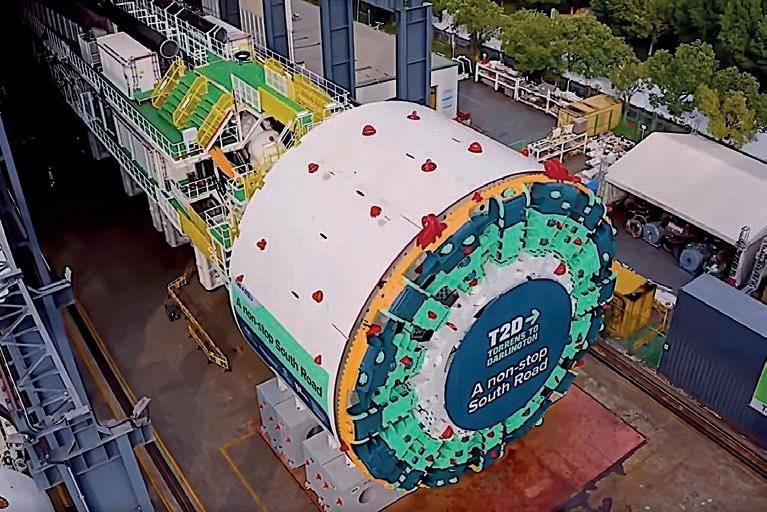
TBMs arriving for T2D
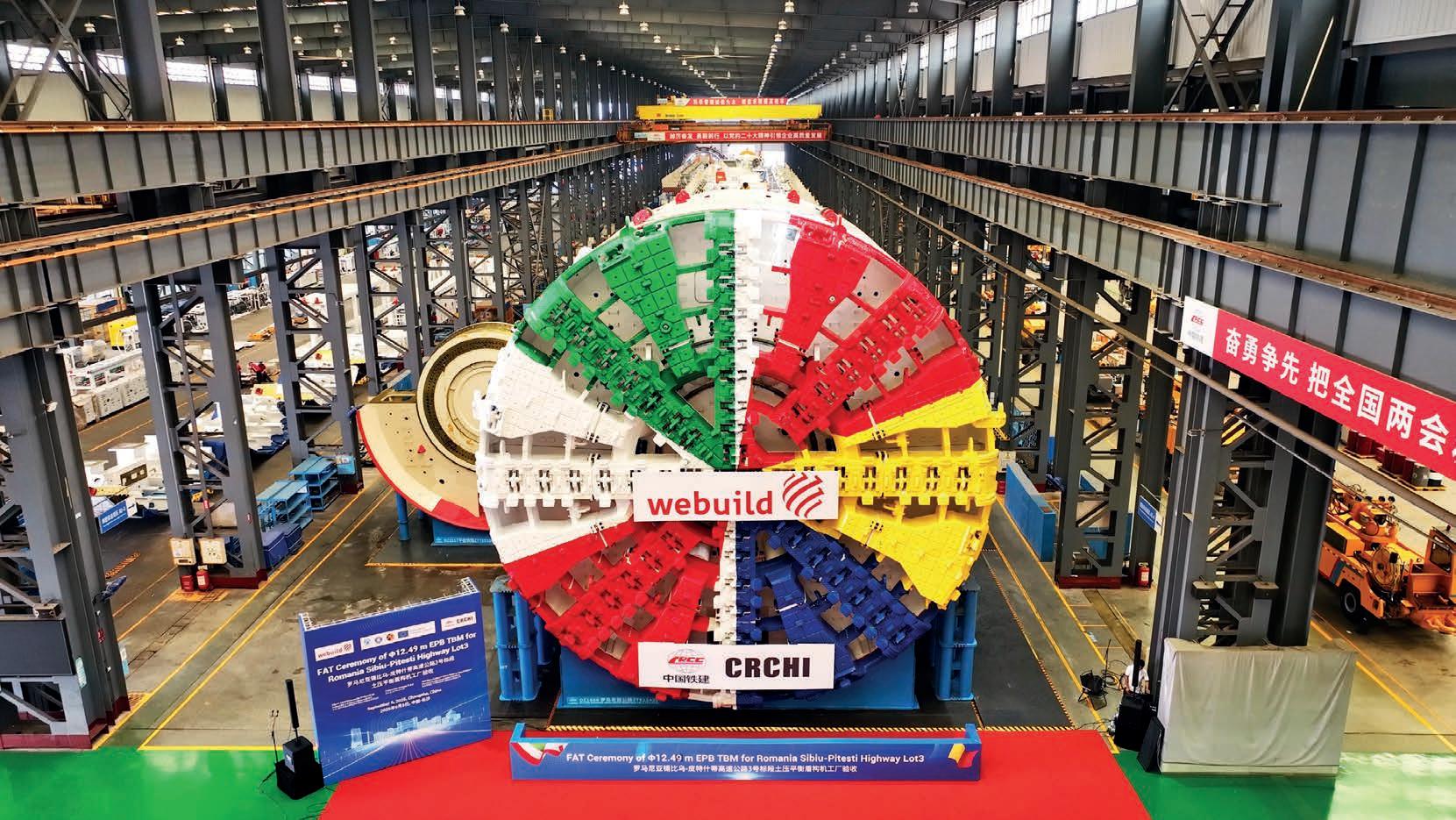
The journey to deliver a non-stop South Road has taken a significant step forward, with the first of three tunnel boring machines now en route to Adelaide to commence work on the Torrens to Darlington Project.
The tunnel boring machines (TBMs) are being delivered by leading infrastructure transport company John Holland.
Following successful factory acceptance testing in China, the first TBM has been cleared for shipment with all components undergoing rigorous testing to ensure all systems meet operational standards.
Once in Adelaide, the TBM will be assembled and commissioned at the Torrens to Darlington (T2D) Project’s Southern Precinct in Clovelly Park. It will be one of two TBMs constructing the 4.5km Southern Tunnels, connecting Darlington to just south of Anzac Highway. A third TBM will launch from Richmond to build the Project’s twin 2.2km Northern Tunnels.
“The T2D Alliance is delivering the Project on behalf of the South Australian and Australia, Jacobs and Ventia, along with the Department for Infrastructure and Transport for their continued collaboration and support,”
Experts are predicting an annual growth rate of six to seven percent per year in the relining market.
TBMs arriving for T2D.
Image: John Holland
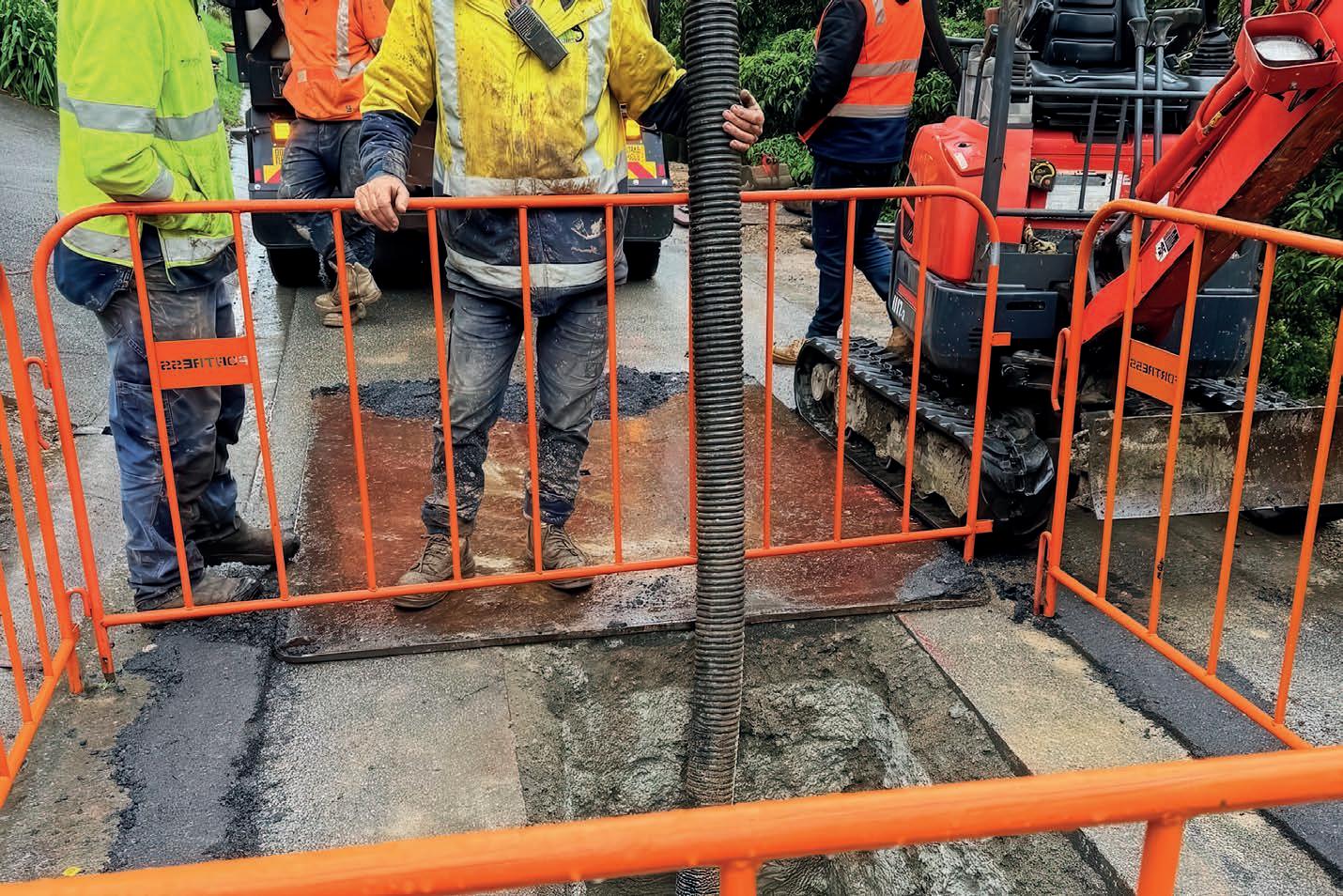
Trenchless technology delivers sewerage upgrade in Lilydale
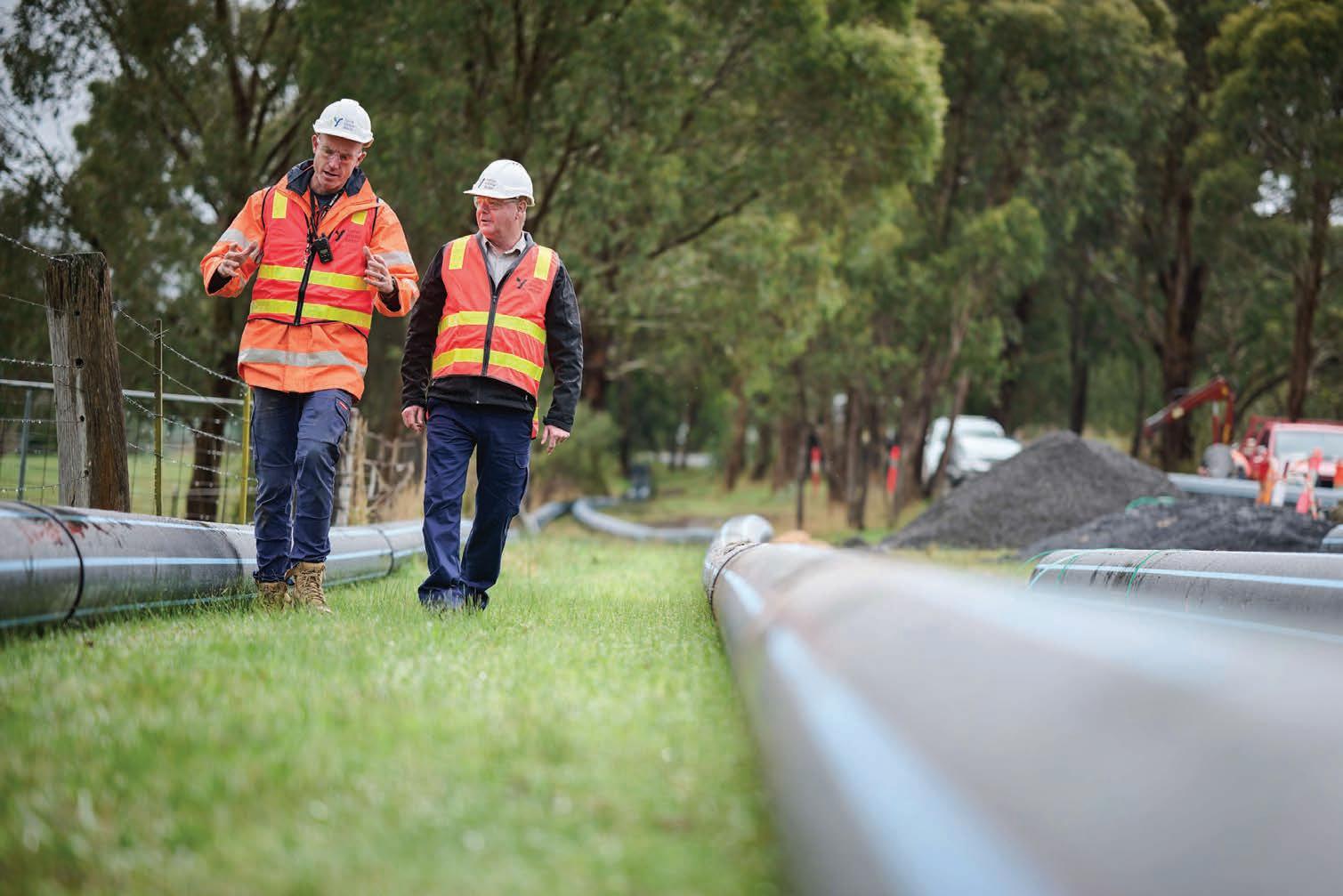
Almost 200 households in Lilydale can now connect to a modern piped sewerage system thanks to work delivered by Yarra Valley Water using trenchless construction methods.
The project is part of the organisation’s Community Sewerage Program, which is progressively providing properties in Melbourne’s outer northern and eastern suburbs with the option to move off ageing septic tanks and onto a piped system.
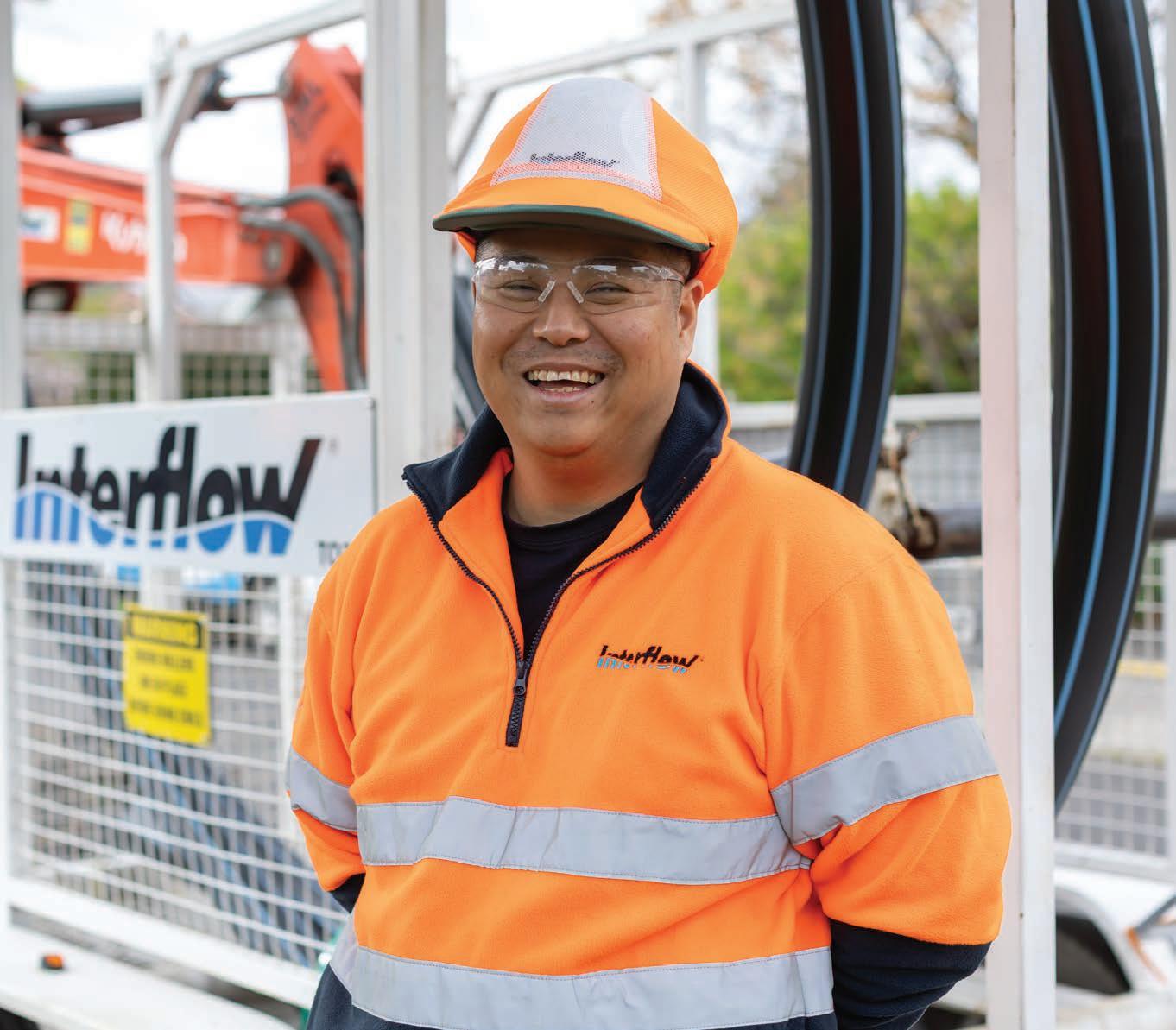
Delivering the Lilydale upgrade was particularly complex, given the suburb’s steep topography, narrow roads and established tree canopy. To minimise environmental and community impacts, Yarra Valley Water and contractor Interflow relied on horizontal directional drilling (HDD) rather than traditional open trenching.
Technology in focus
Through HDD, crews were able to install pipes up to 5 metres below ground level with minimal surface disturbance. The method uses a specialised drilling rig to bore
an underground path before pulling the new sewer pipe through.
Detailed geotechnical scans were carried out prior to construction, helping Interflow select the right equipment for each location. Interflow also deployed recycled water in a hydro-excavation process, blasting highpressure streams into the ground to verify the location of any existing services that scanning alone might have missed.
Yarra Valley Water Project Manager Nova Irawati said the approach ensured accuracy and efficiency.
“By combining HDD with extensive pre-surveying, we were able to preserve Lilydale’s streetscapes, avoid service clashes and complete the project with minimal disruption. In fact, only three trees were removed across the entire alignment,” she said.
Minimising risks, maximising outcomes
The trenchless method also reduced the risk of interfering with underground utility networks carrying gas, electricity,
telecommunications and drinking water.
Yarra Valley Water General Manager Asset Services Bridie Fennessy said the project was a technical success with clear community benefits.
“Trenchless delivery allows us to overcome significant site constraints while achieving a great outcome for households,” she said.
“Managing septic tanks can often be a hassle. When tanks are too small or aren’t maintained, they can create unpleasant smells and can even leak waste onto other properties or into waterways.
“Connecting to sewerage is more convenient for property owners and better for the environment. While people still need to be mindful of what goes down the drain and maintain their household plumbing, sewerage offers a far cleaner and more reliable alternative to managing an aging septic system.
“We’re very pleased more people have the option to connect to sewerage now that we’ve completed the works in Lilydale.”
Image: Yarra Valley Water
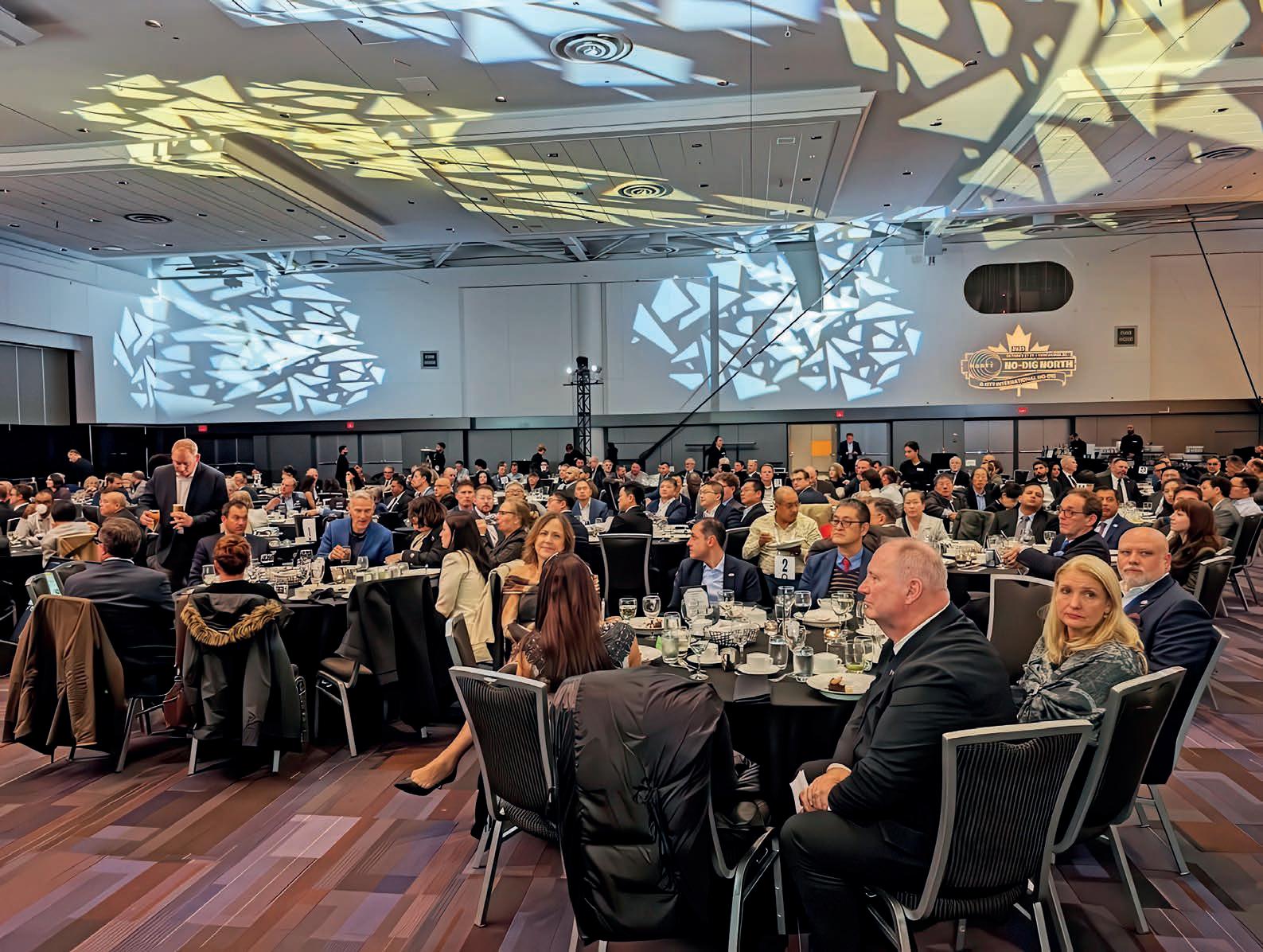
Celebrating excellence at No-Dig North
The International Society for Trenchless Technology (ISTT) was honoured to celebrate innovation and achievement in trenchless technology during the Gala Dinner at the 2025 International No-Dig / No-Dig North Conference, held in Hall A of the Vancouver Convention Centre.
The evening brought together trenchless professionals and experts from around the world to recognise outstanding contributions through the ISTT No-Dig Award and the Lifetime Service Award.
No-Dig Award Winners:
• Student Paper Award: Inshik Park, University of Alberta, Canada, Probabilistic Hydraulic Fracture Analysis in HDD.
• New Technology Award: Shenzhen University, China, Close-fit, twin-tunnel pipe jacking technology for subway station construction
• Proje ct Award (New Installation): Michels Trenchless Pty Ltd, Australia, Snowy 2.0
– Marica Road West HDD: Innovation in Extreme Terrain
• Lifetime S ervice Award winners:
• Russell Fairhurst – UKSTT (UK)
• Norman Howell – UKSTT (United Kingdom)
• Declan Downey – UKSTT (United Kingdom)
• Jens Ho elterhoff – GSTT (Germany)
• Jari K aukonen – FiSTT (Finland)
ISTT expresses its sincere gratitude to the NASTT team for their outstanding hospitality and support, and for making this year’s Gala Dinner a truly memorable event.
The 2025 No-Dig North.
Image: ISTT
Above. Beyond. Below.
Michels in Motion: Between March 2023 and February 2025, Michels completed 3 record-breaking HDDs in New South Wales. The 2,250-metre HDDs included elevation changes of 590 metres.
Michels
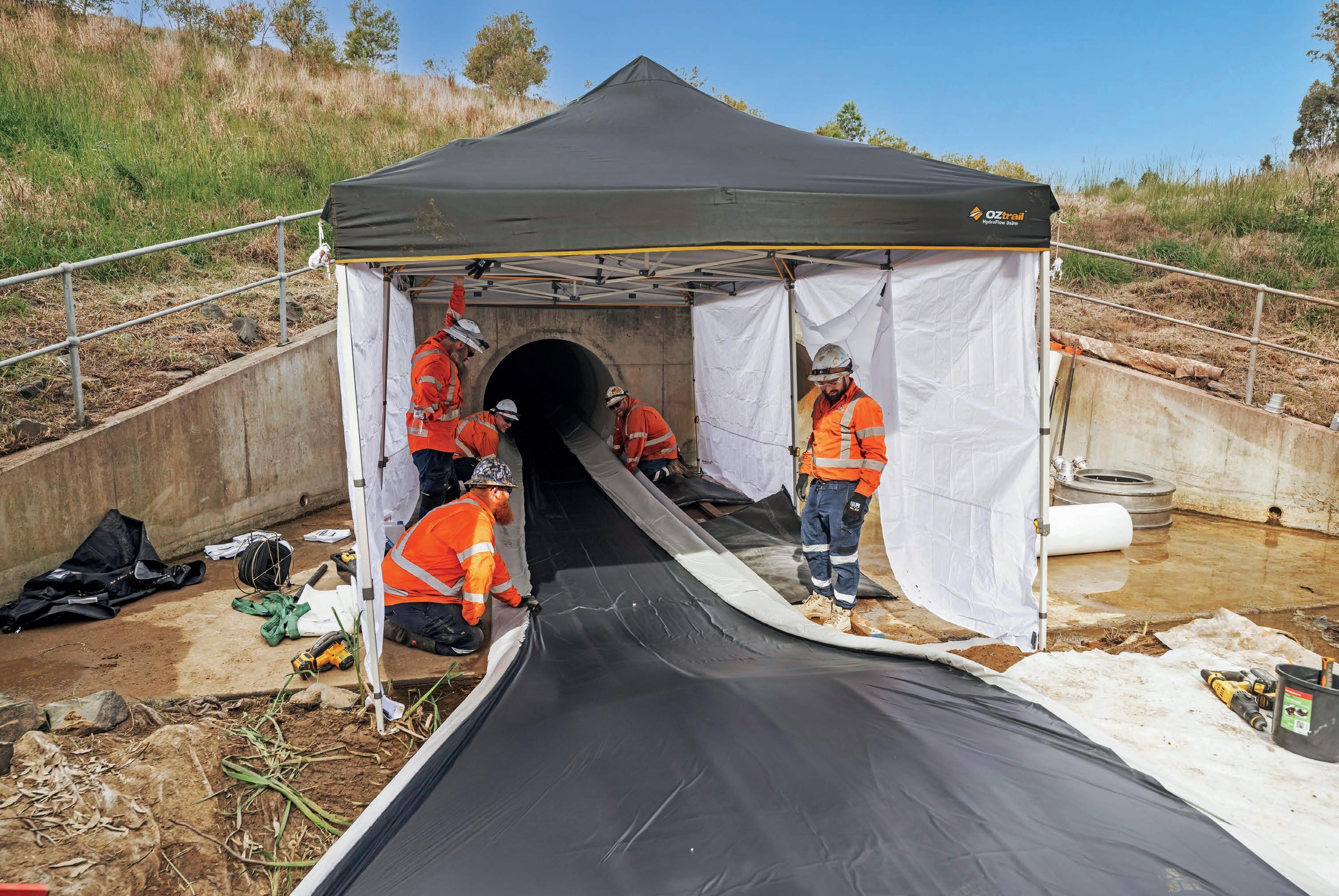
Draintech Solutions restores long-term serviceability to a critical asset
Draintech Solutions brought the full breadth of its capability to a difficult culvert rehabilitation, delivering quality, safety and minimal environmental impact from planning through to completion.
Draintech Solutions has carved a strong reputation in trenchless delivery, specialising in innovative underground pipe remediation. Its latest project on a major Sydney road corridor showcases the team’s depth of experience and the trust it holds with asset owners across Australia.
Draintech Solutions was engaged by Transport for NSW to rehabilitate twin-cell stormwater culverts beneath a key route in Western Sydney. Located in a gully and buried under significant cover, the assets remained serviceable but required proactive remediation to secure long-term performance and a 100year technical service life. The works formed part of broader upgrades on The Northern Road, a government project improving infrastructure across the region.
From day one, Draintech Solutions led a methodical site plan.
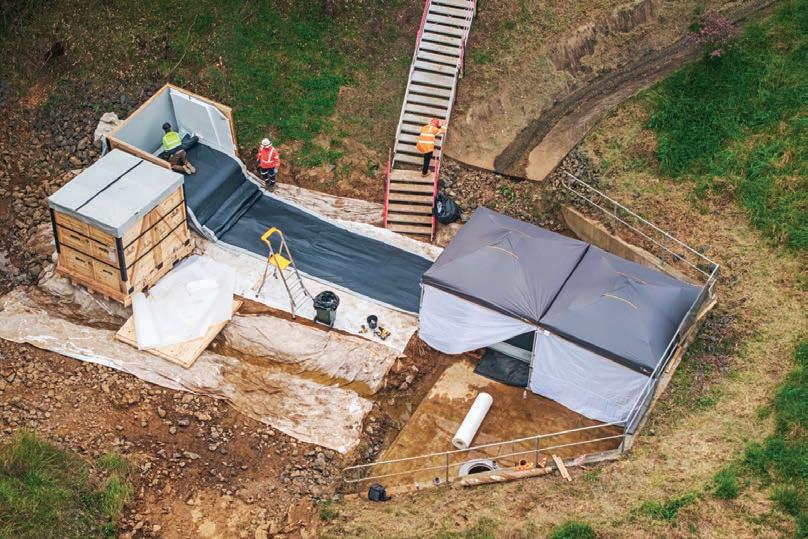
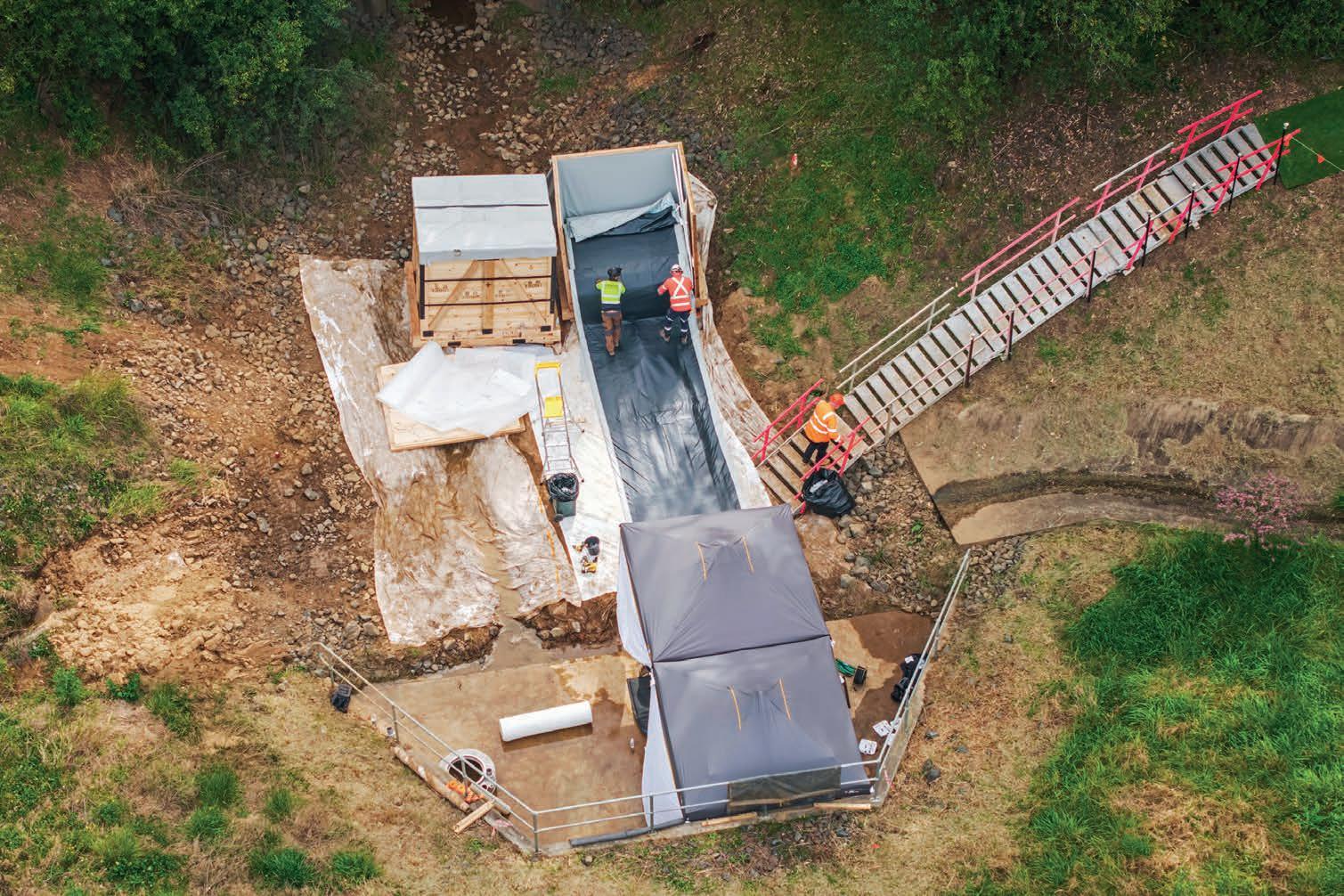
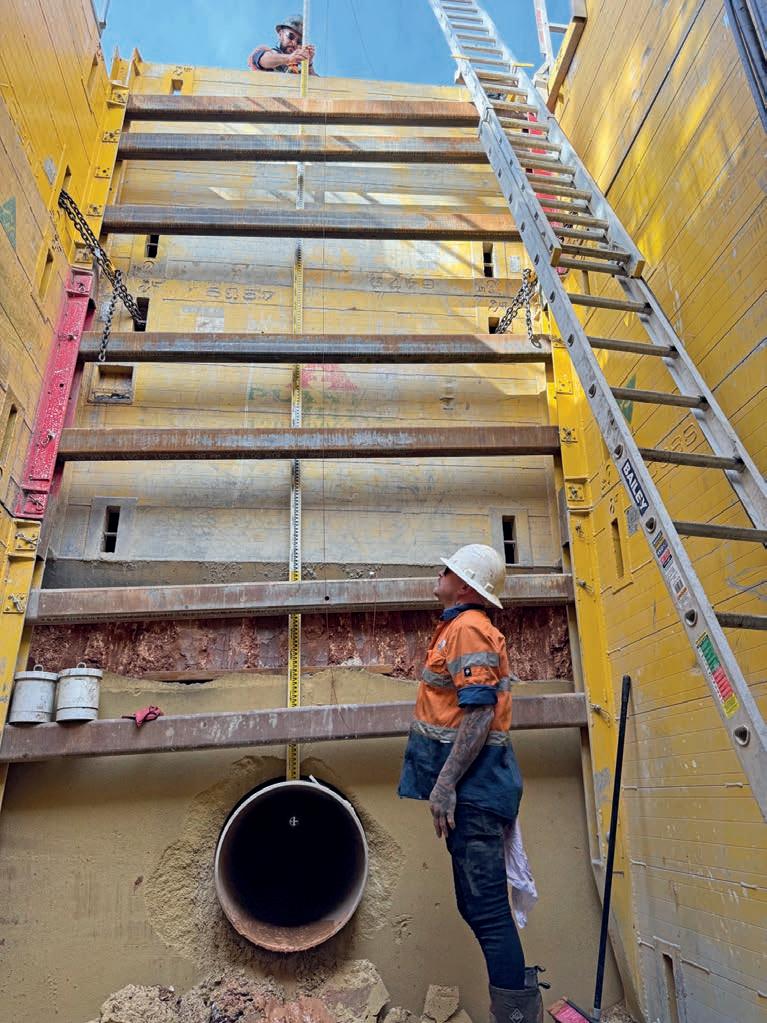
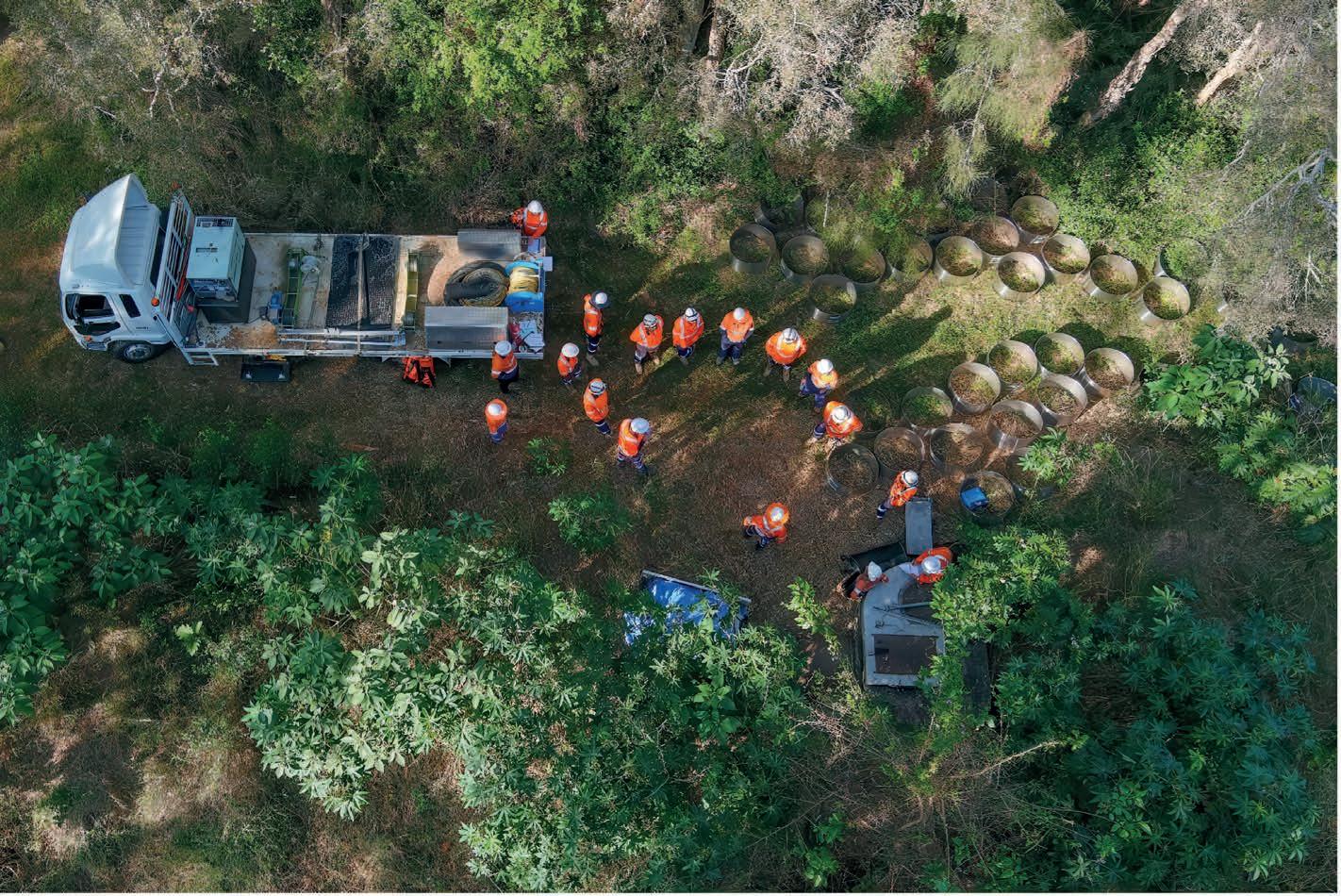
“We commenced with civil works to open up safe access to both portals, with pedestrian tracks, dedicated vehicle routes and temporary stairs established to protect crews,” said Mathew Mather, Director at Draintech Solutions.
An important part of the project planning involved inspecting the culvert to ensure no bat colonies were present. An ecologist was engaged to undertake the inspection and confirm the
absence of bats prior to commencing works. To prevent the possibility of future colonisation during the construction period, bat flaps were installed, and weekly inspections were carried
Drone footage captures the Draintech Solutions crew working on the culvert rehabilitation site.
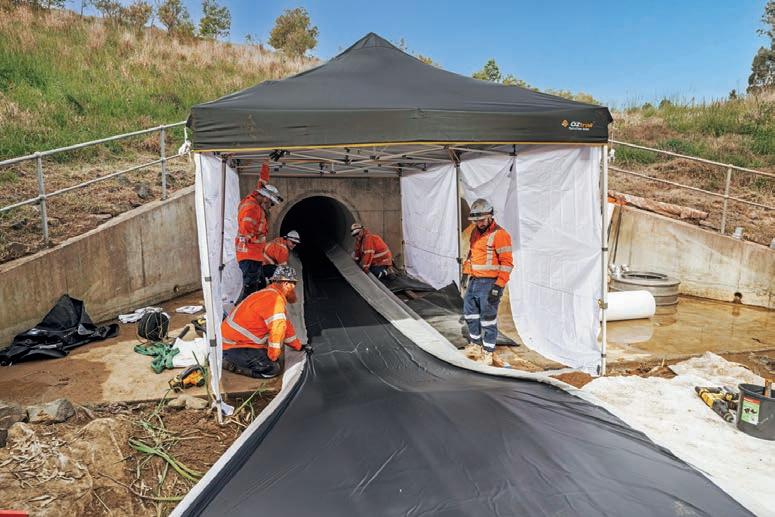
Carefully planned access allowed the crew to work safely around the live corridor.
Images: Pipe Core
out to monitor and maintain compliance with environmental safeguards.
Methodology was adjusted to protect the adjacent woodland, preserving root zones and limiting the site footprint. Flow from the upstream catchment was controlled through pre-cleaning and staging so lining could proceed without compromising water management or environmental values.
Design workshops with the Draintech Solutions engineering team refined the plan for two 146m cells – DN1460 and DN1495 – balancing structural assurance with a safe, efficient installation window. For the lining scope, the specification called for SAERTEXLINER® MULTI Type S+ Standard from SAERTEX multiCom®, a glass-fibre reinforced, UV-cured CIPP liner selected for structural integrity, durability and long-term performance in stormwater service.
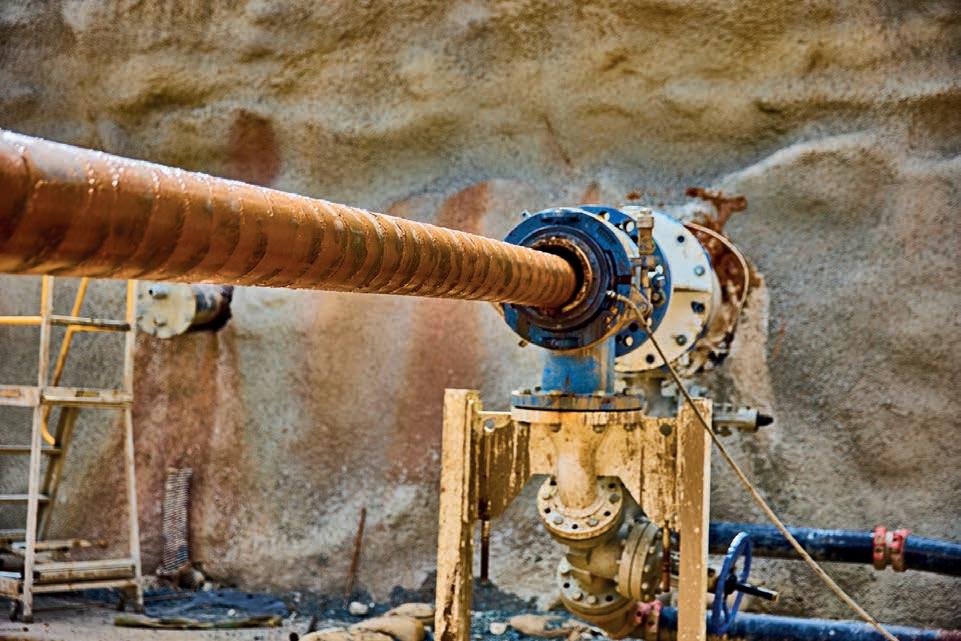
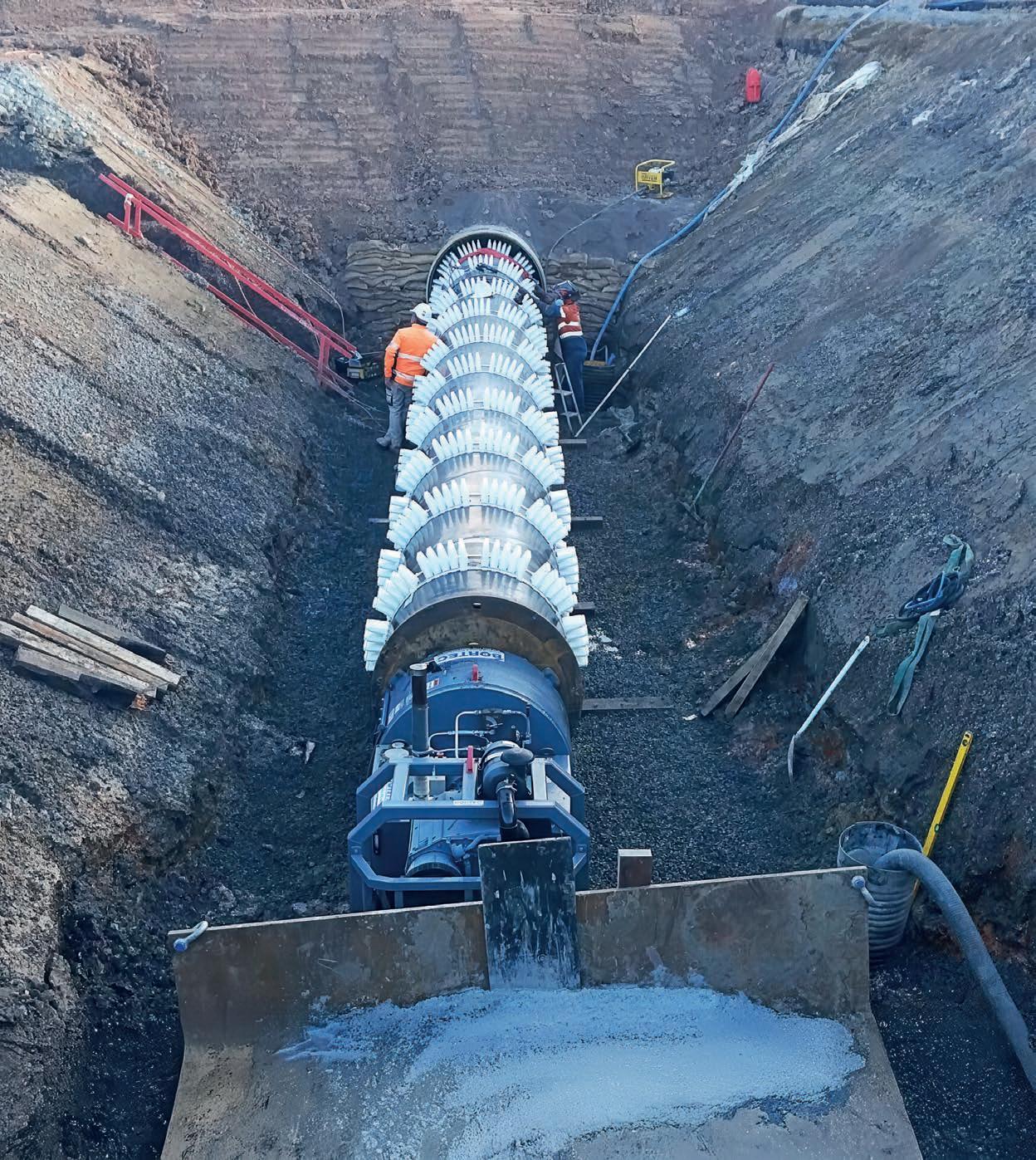
To meet program certainty on large-diameter installations, Draintech Solutions utilised the Rausch Rehab RRcure 1500 UV curing platform, supplied and supported locally by Pipe Core. The RRcure 1500 was selected for its consistent, controllable output and ability to significantly reduce curing times on long, large bore runs. Curing operations were carried out using a dedicated relining rig equipped for this platform, with the process closely monitored to ensure precision and quality throughout installation.
Pipe Core also coordinated with SAERTEX multiCom to provide on-site technical assurance, with an Application Engineer from SAERTEX multiCom attending to strengthen QA and support knowledge transfer between crews.
The project benefited from Draintech Solutions’ SAERTEX Certified Installer Training in gravity and pressure systems, coordinated through Pipe Core, and from lessons learned on an innovative DN300 pressurised sewer upgrade using SAERTEXLINER, where a pressure liner was installed to extend service life and improve water security and reliability. The crew also drew on extensive
Tier One and Transport for NSW experience. Logistics were carefully choreographed.
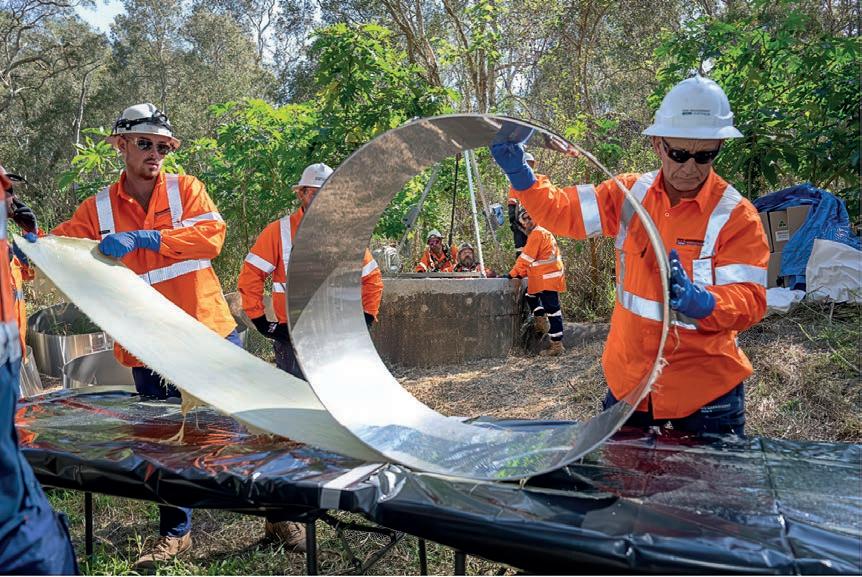
“We had a 300-tonne crane negotiate a steep embankment to position materials, including the gliding foil, SAERTEX-LINER, SAERTEX-PACKER® and the UV light train,” Mather said.
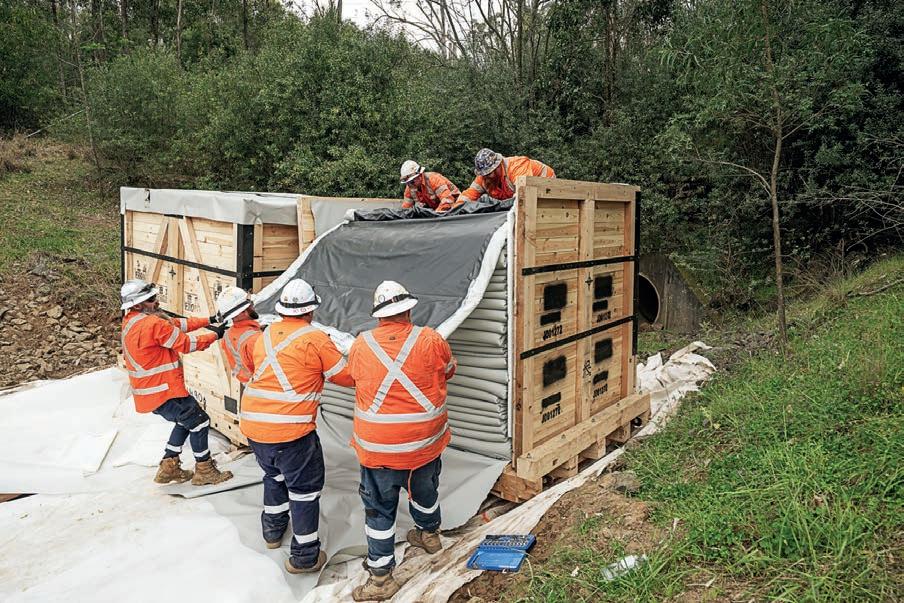
With semi-trailers limited to 24-tonne loads, the liner was split into two 40-foot containers,
including 14-tonne liner boxes, and staged precisely at the portals. Every movement advanced the program without escalating surface impacts.
Safety remained non-negotiable throughout the install.
“We clearly marked crew routes and exclusion zones, kept snake kits on hand, controlled traffic interfaces and maintained disciplined communications,” Mather said.
Months of pre-planning paid off when the installation phase finished in five days.
“We were also aided by favourable weather and a workflow that left little to chance.”
The project delivered exactly what it set out to achieve, a disciplined plan executed safely, high-quality materials paired with proven curing technology, careful environmental management and true collaboration.
Led by Draintech Solutions on site, supported by technical expertise from SAERTEX multiCom and Pipe Core as distributor, the team rehabilitated two critical assets with minimal surface impact.
“The result is long-term serviceability for Transport for NSW, underpinned by calibration and curing data logs, and a liner system with a technical service life of 100-years,” Mather said.
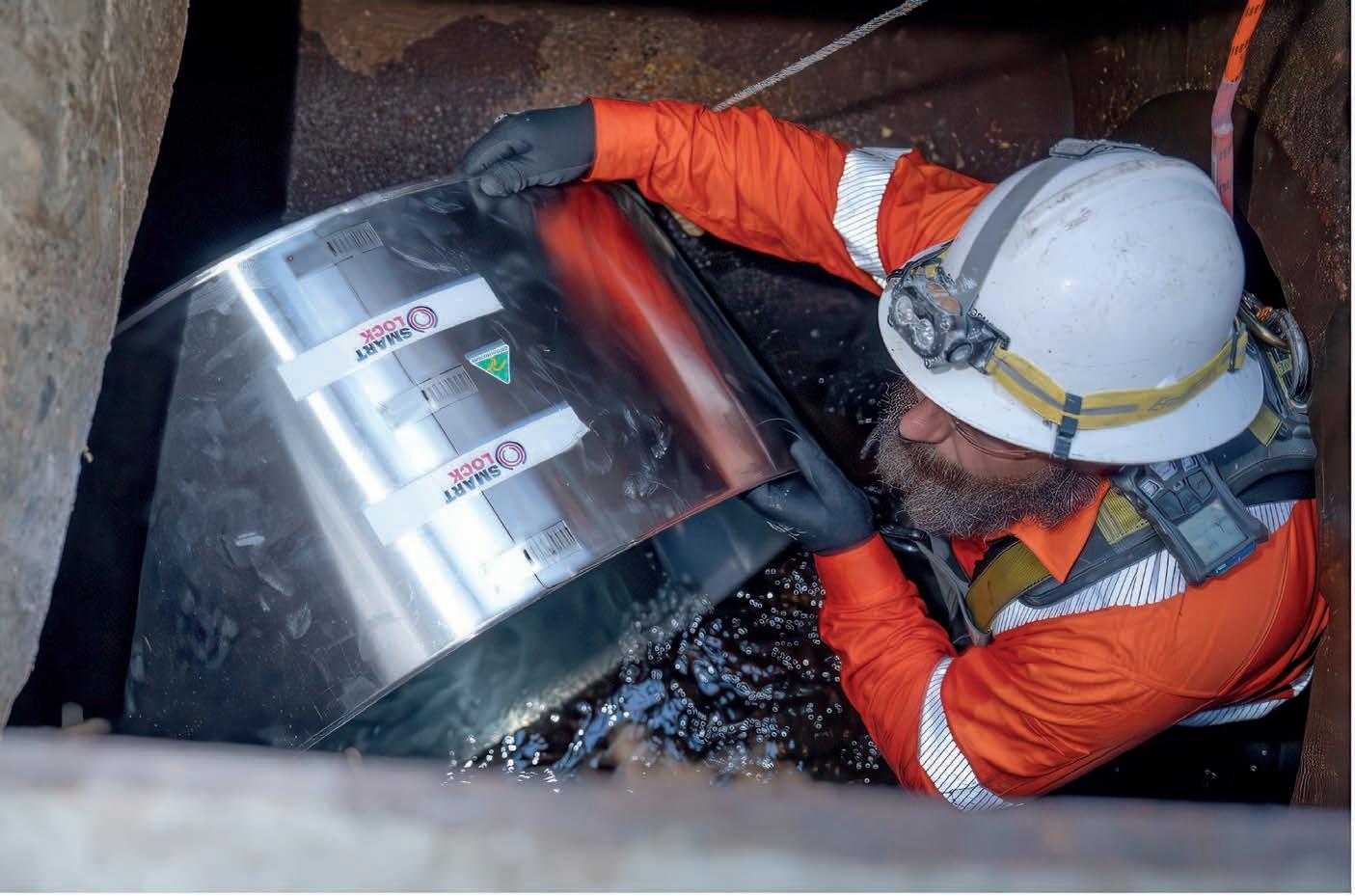
The Draintech Solutions team works together to guide the liner into the twin-cell culverts.
Safe access was a key focus for Mathew and his crew throughout the project.
Underground excellence
When a critical main interceptor sewer ran into severe structural problems, the local government turned to Channeline for help.
Channeline’s bespoke structural glass reinforced plastic (GRP) lining system has played a key role in the rehabilitation of Lakewood’s main interceptor sewer in Ohio, US.
The Lakewood main interceptor sewer is an almost 6km tunnel that collects sewer and stormwater run-off for most of the city and sends it to the local wastewater treatment plant. It’s the backbone of the community’s wastewater treatment system – without it, runoff would flow into the local lake.
Some sections are over 100 years old and had begun to breakdown, which prompted a major rehabilitation project. It was determined early on that a full sewer replacement was out of the question, being far too costly and disruptive to the community. Instead, slip-lining was selected as the ideal method, and Channeline’s GRP liner as the silver bullet.
“Every liner we produce is fully structural: once installed, the liner essentially becomes a new pipe inside the old one, with the strength to handle everything the system will face in the future,” explained Nick Walters, Director at Channeline. “That means that clients can keep costs and disruption down while still providing an effective solution that’s proven to last for generations to come.”
This fully structural lining solution is suitable for the rehabilitation of sewers, tunnels, culverts, stormwater and other buried structures. Thanks to Channeline’s custom
design and manufacturing processes, largediameters, non-circular profiles and complex curves are no problem for these liners. As well as the customisable qualities of the liners, the material also offers excellent durability thanks to its resistance to extreme temperatures,
ultraviolet radiation, and chemical exposure. And, critically, the liners are lightweight, significantly reducing manual handling risks for contractors.
“An off-the-shelf product would never be a precise fit within the original structure at Lakewood, especially with it being an eggshaped sewer,”Walters said. “Channeline is unique in that we can precisely match any shape and any size maximising flow efficiency of the rehabilitated structure.”
Even with this impressive technology under their belt, contractors delivering the works still had a lofty goal ahead of them. The depth of the tunnel from the surface ranged between 6–30m, which needed to be excavated at roughly a dozen small access sites across the city. And that’s when the work really began.
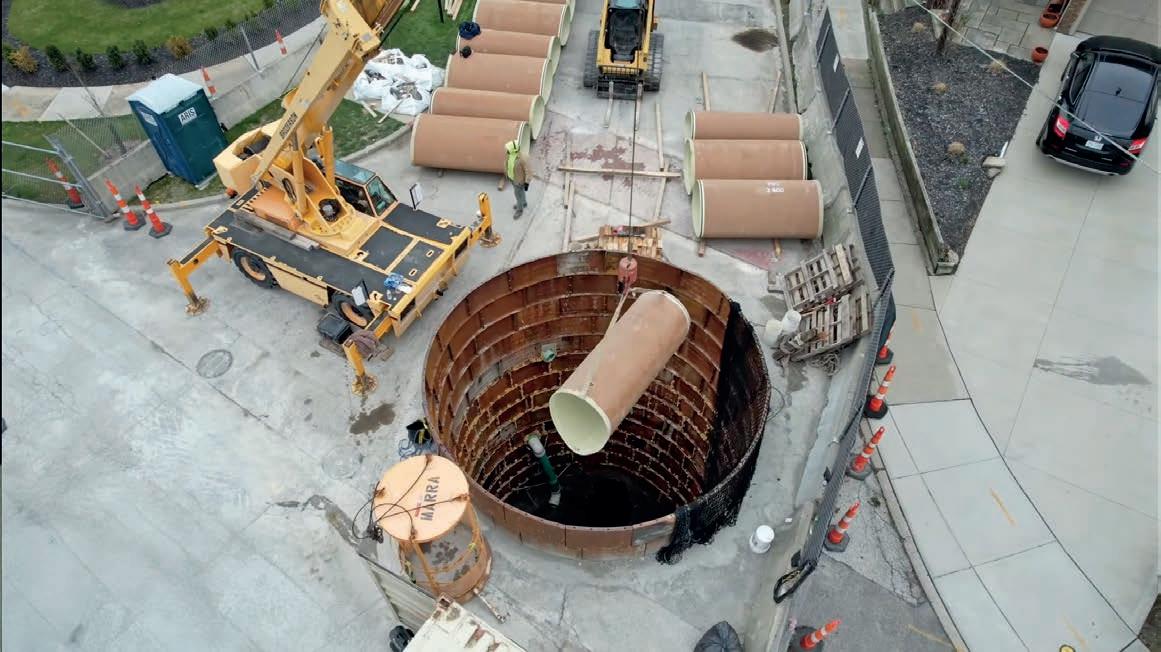
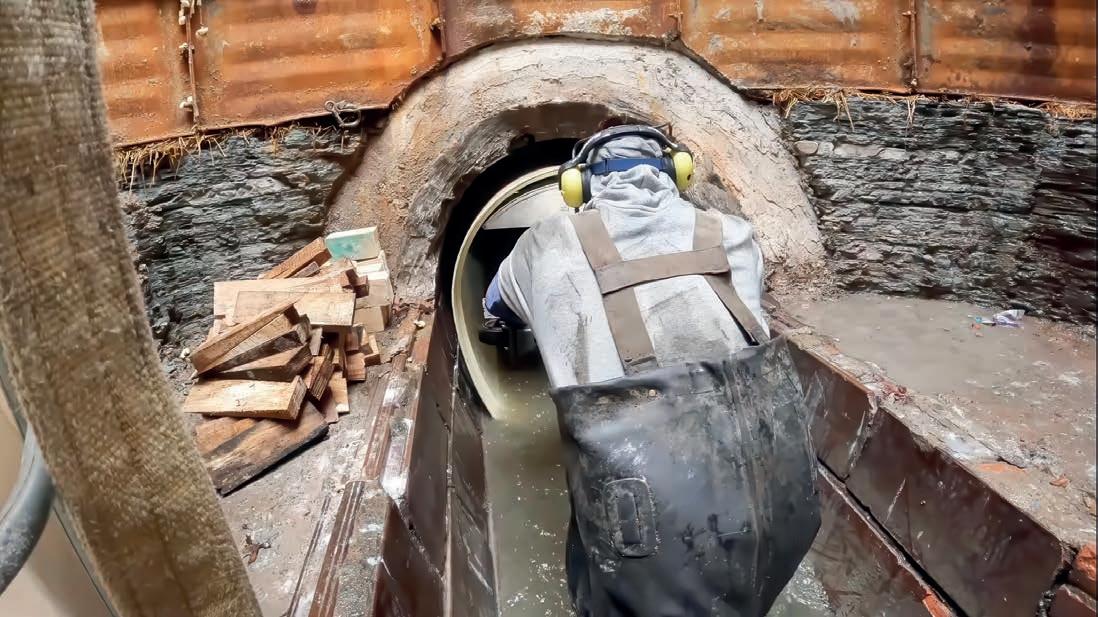
Using a crane, a specialised cart, and sheer human grit, the egg-shaped GRP liners were lowered into the access points, where they were smoothly carted into the old sewer for installation – all in live flow conditions. Each segment was easily locked into place, owing to its careful, intentional design. As Channeline’s GRP liners are fully structural, only a basic grouting was needed to fill the small space between the old sewer wall and the new lining. When all was said and done, the new sewer was water-tight, passed every test, and will now serve the Lakewood community many decades into the future.
Channeline GRP liner being lowered into the worksite.
Images: Marra Services
Installing liners in the sewer.
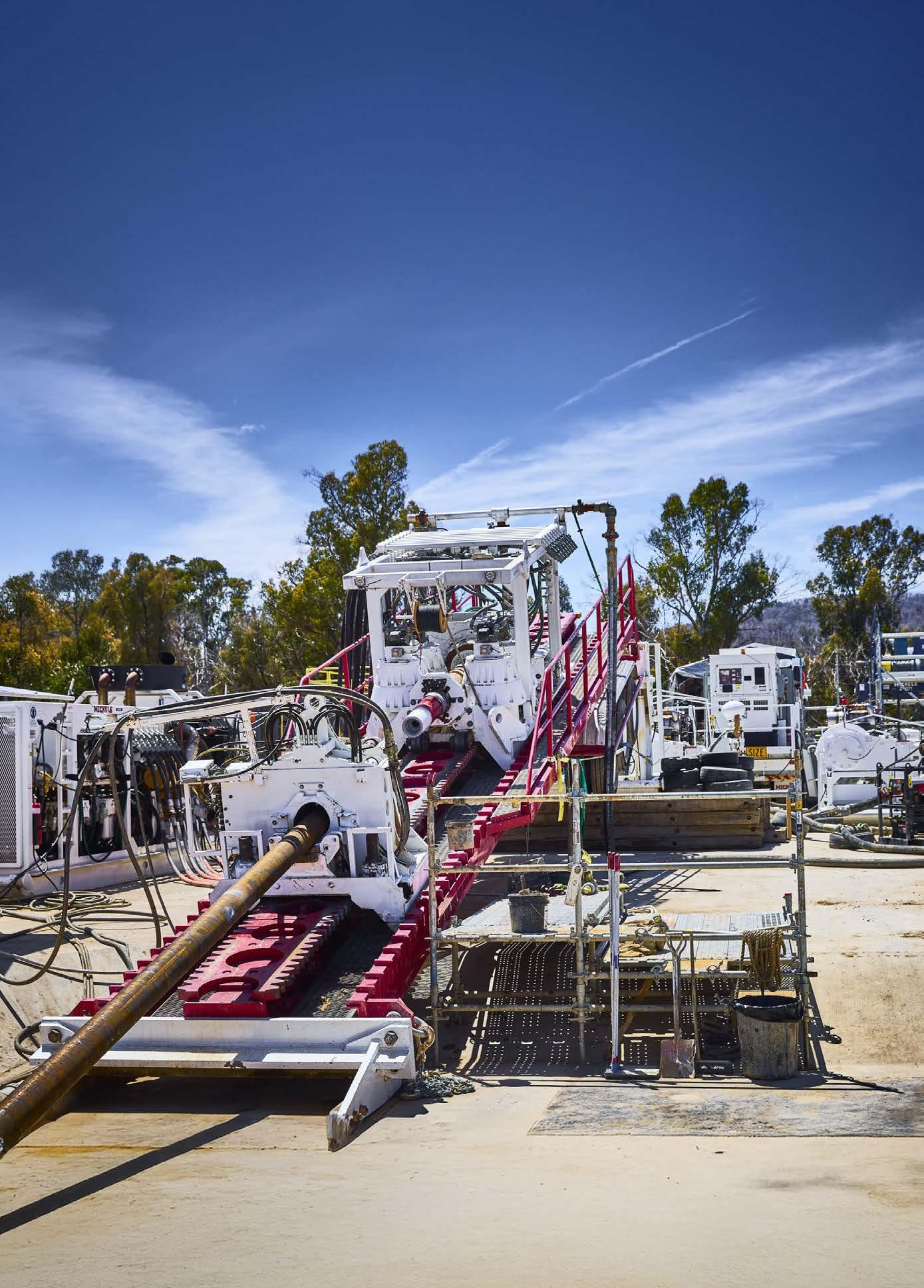
Marica Road HDD expands the possibilities of trenchless technology
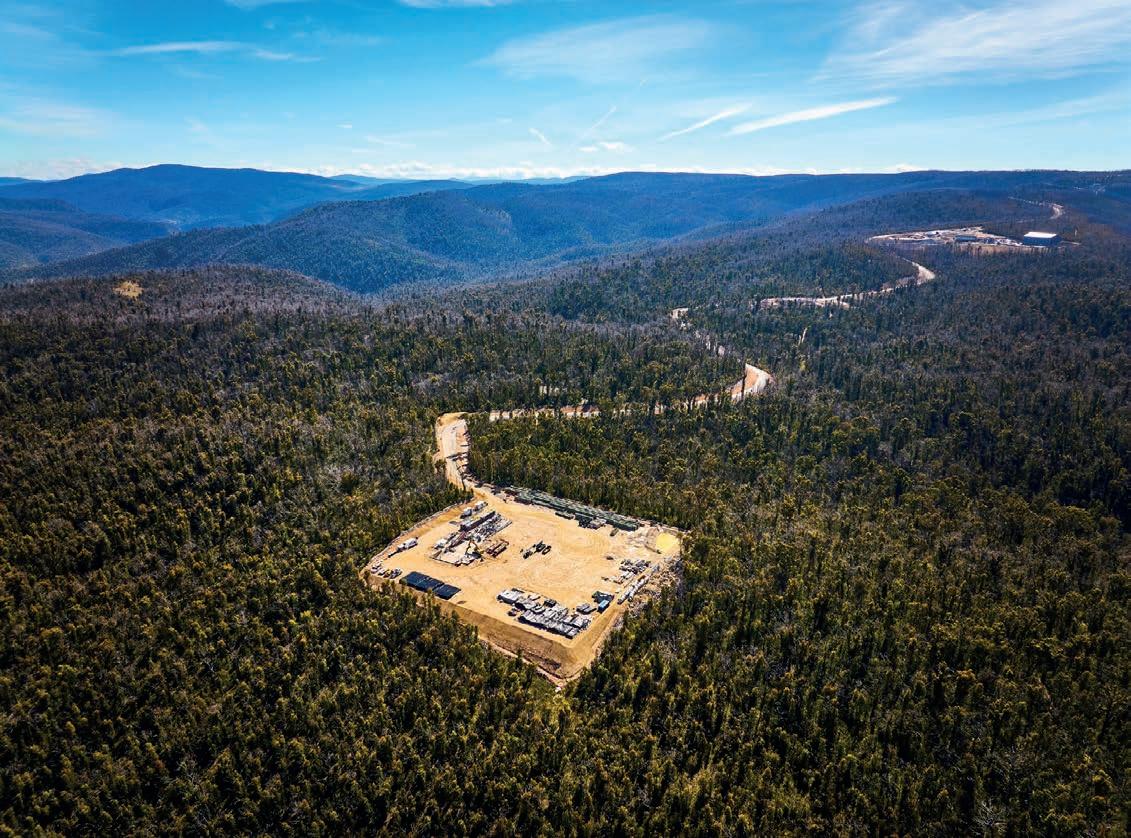
As 2025 draws to a close, we look back on the growth of the trenchless industry and the innovation to complete projects that were once deemed unattainable. Michels Trenchless performed three extremely complex horizontal directional drills (HDDs) for the Snowy 2.0 Pumped Hydro Project in New South Wales, Australia. Stretching from Lobs Hole to Marica, the HDDs are 2248m long. While this length is impressive, but not exceptional, for an HDD project, the difference in elevation measured 563m from the low side to the high side – a feat never previously accomplished by the industry.
In standard HDD profiles, elevation changes of about 50m between entry and exit locations are considered significant. Although the differential was considered too risky – and even impossible – by many in the industry, the Marica Road HDD was critical for the installation of electrical power, water, and fiber optic cables required to build and operate Snowy 2.0, the largest renewable energy project in Australia. With support from the US-based industry leader Michels Trenchless, it was determined that an HDD was the most effective approach to eliminate the need for 5km of roads and cuts through steep terrain in the environmentally sensitive area of
National Park. Michels drilled from the bottom of the hill to the top.
The significant change in elevation also posed a challenge in maintaining the drilling fluid “mud” pressure and flow due to the natural effects of gravity when drilling uphill. Forces are reverted to the drilling equipment due to gravity and friction from the dry bore hole. As fluid is pumped through the hole to lubricate and cool the drilling head and remove chipped rock and dirt that the drilling cutter head breaks up, the chipped rock and dirt are suspended in the liquid. This allows it to flow back out of the hole into the pit by the rig. For this elevation, maintaining the
Kosciuszko
Michels Trenchless reflects on a milestone 2025 project.
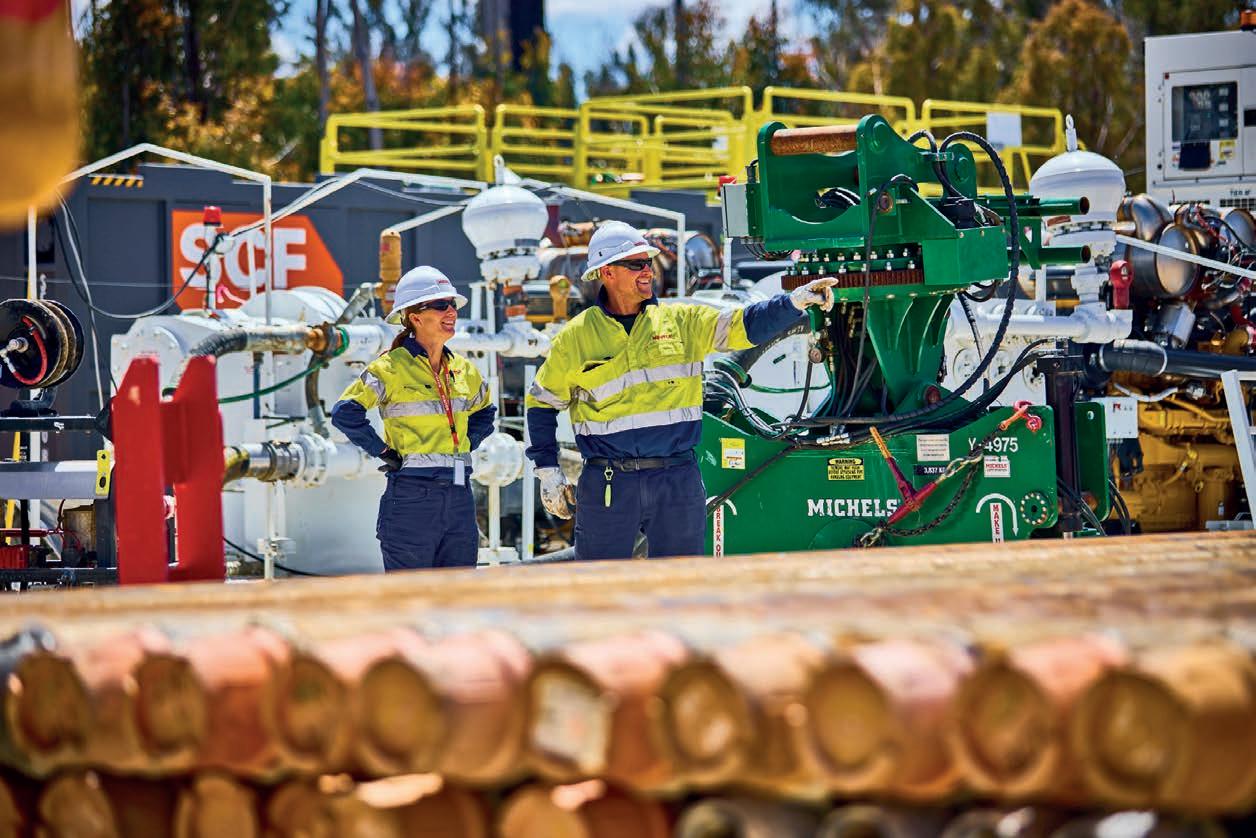
The project was incredibly complex, and required precise planning and execution.
Images: Michels
pressure and flow is difficult. To address these concerns, the project team installed a valveclosed rotary diverter on the lower entry side to direct the return flow cuttings and drilling fluids to a concrete containment pit where they are directed to a fluid separation plant for treatment.
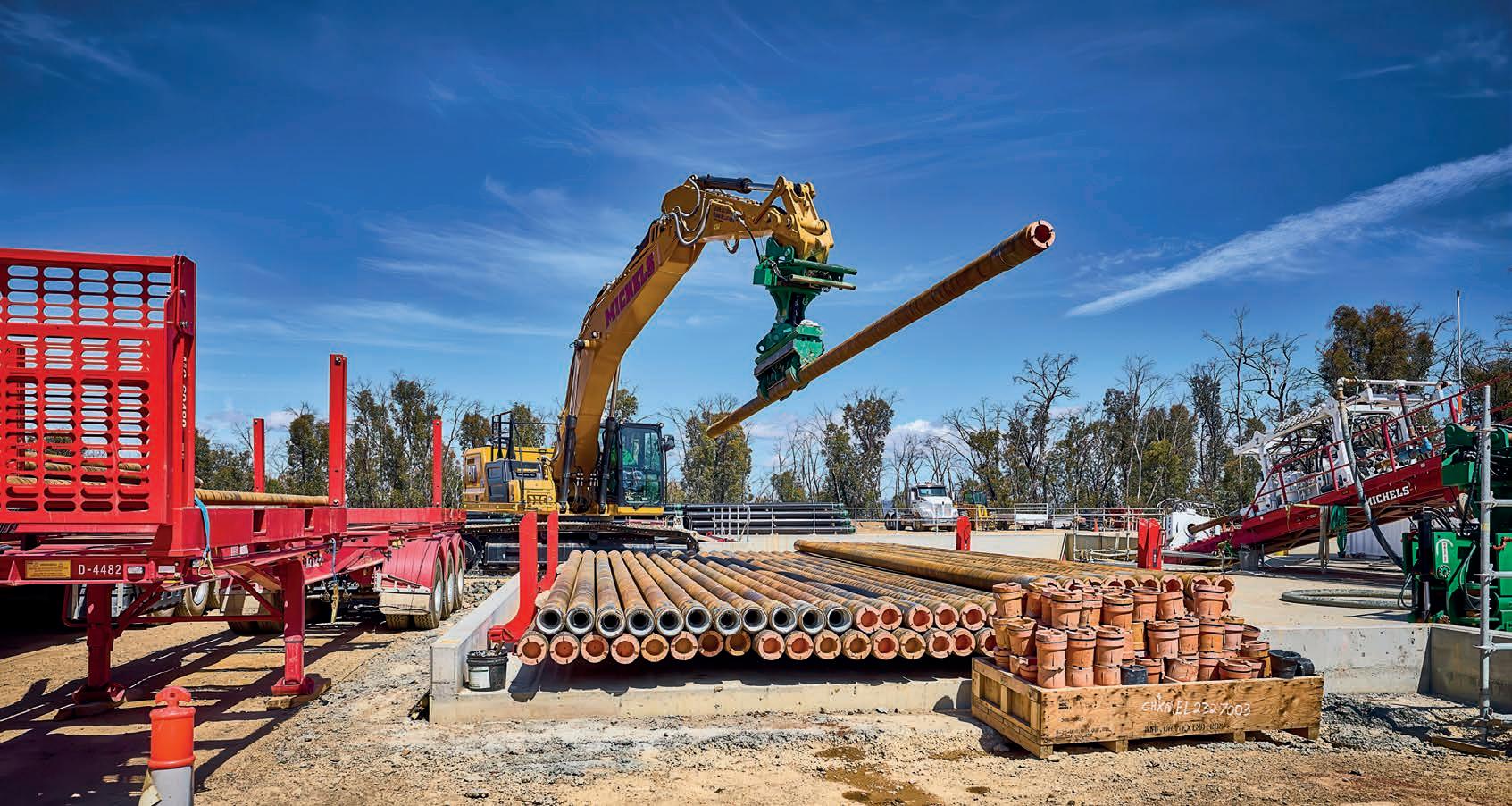
Michels designed and fabricated two drill rigs, each with nearly 400 tonnes of push/pull force. Using the pilot hole intersect method wherein one rig drills from the entry side and the other from the exit side, the drill rigs meet in the middle at a predetermined location along the alignment. The pilot hole intersect method was selected over a traditional one-rig pilot hole method for its unique advantages for the project, including fluid pressure management, reduced risk of inadvertent returns, and steerability through hard rock present at the park.
Kosciuszko National Park is known for its unique, scenic landscapes and recreational and heritage values. Strict restrictions and environmental mandates were placed on how the work could be performed. In accordance with these rules, both rigs were set up inside large, engineered concrete pits to keep the drilling fluids separated from the ground. A gyroscopic combined with a magnetic tracking system allowed the project team to keep drilling operations on the necessary alignment and minimise human interaction with the forest between the entry and exit areas. Crews laid out coil wire in the straightest path to the centerline without removing vegetation.
The work site’s remote location posed logistical challenges to the transportation of parts and supplies, particularly specialised
HDD tooling. Extensive planning was required to ensure all needed equipment, as well as any equipment or supplies that may be needed should unforeseen circumstances arise, was available on-site.
The project team collaborated with the project owner Snowy Hydro Limited and Future Generation Joint Venture to develop a safe, technically solid and constructable solution.
By developing executable plans to resolve extensive challenges without causing harm to individuals or the environment, the awardwinning Marica Road West HDD project broadens the potential use of HDD to build and expand energy pipeline infrastructure in circumstances that may be considered undesirable.
For more information, visit michels.us
Michels performed three HDDs for the Snowy 2.0 project.
Michels designed and fabricated two drill rigs as part of the project. Part of the project.
Putting people first
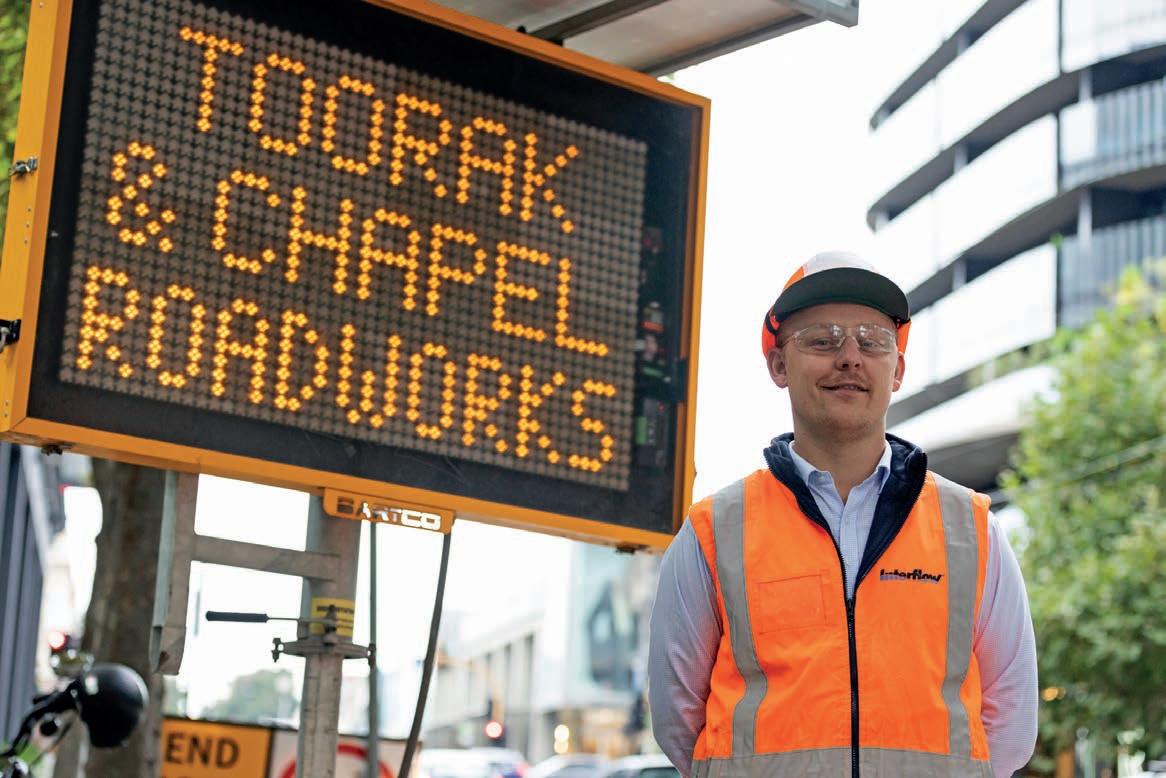
When ageing water mains in the heart of Melbourne needed attention, new ways of working were needed to deliver a low impact, cost effective renewal.
Along South Yarra’s busy Chapel Street ran two cast iron cement lined water mains dating back to the early 1920s. A burst on one of the mains put it in a highrisk category and it was flagged for renewal.
Delivery partner Interflow was engaged by South East Water to renew both mains to ensure certainty of supply for their customers into the future.
What followed was an award-winning project that demonstrates what can be achieved for our communities and our networks when the status quo is challenged.
South Yarra is vibrant inner-city suburb of Melbourne, south-east of the city’s main business district.
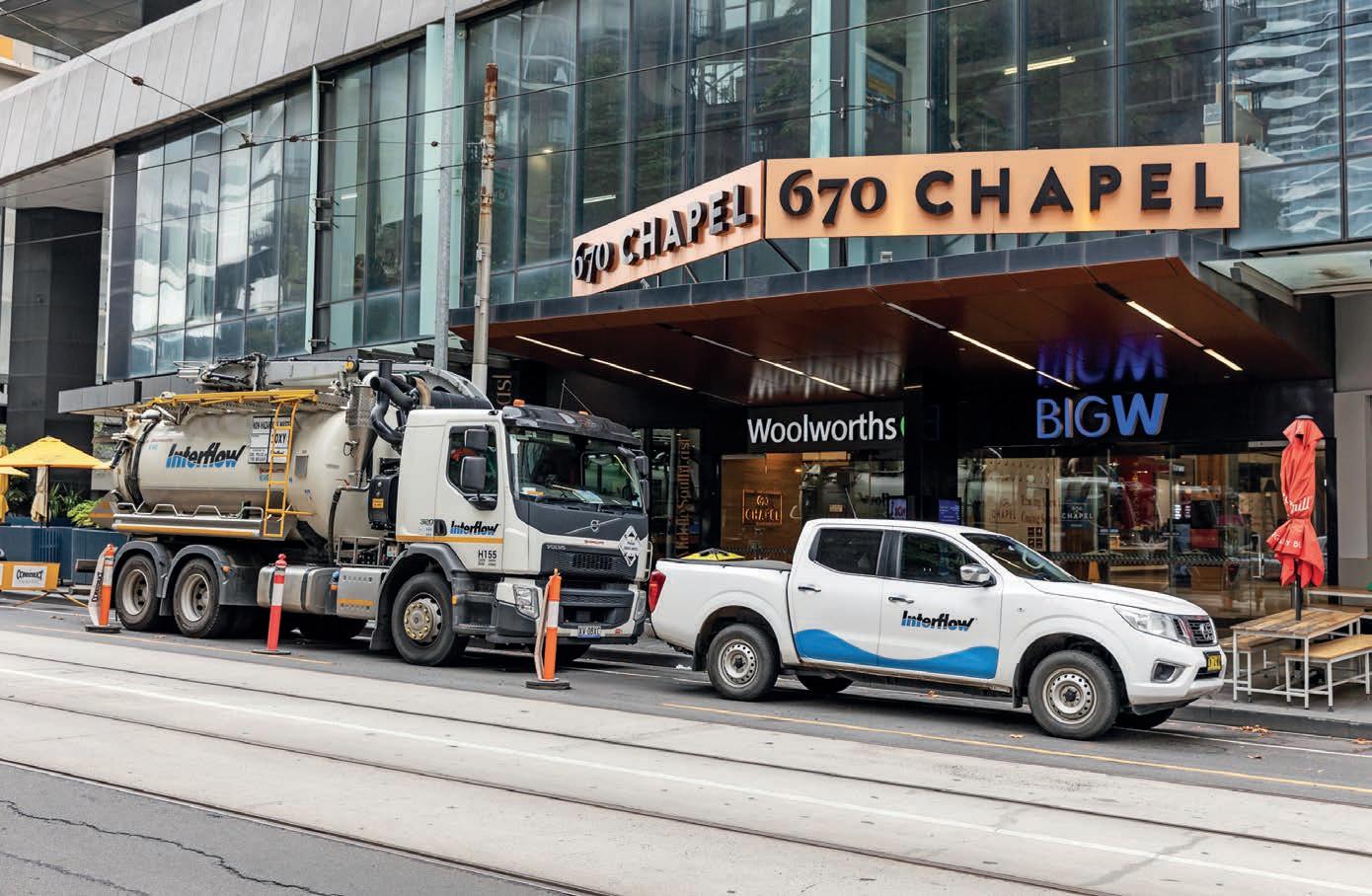
The area surrounding the work zones has seen extensive development in recent years. The street is a mix of shops, cafés and businesses at street level, with apartment buildings towering overhead.
On paper this was a straightforward project. Both mains could be renewed by digging them up and replacing them, working at night to reduce the impact on traffic.
Interflow and South East Water understood that the real marker of success was the impact
works had on the 12,000 people and businesses that rely on Chapel Street’s water mains for their supply.
At the time of tender, Interflow submitted an alternate proposal designed to leverage the benefits of trenchless renewal technologies to reduce the impact of the renewal works on residents and the business community.
The two organisations collaborated closely during the project to ensure any proposed solutions balanced community and network needs.
“Our goal is always to deliver a better, more sustainable water network for our customers and community, while minimising disruption,” shared Matthew Snell, General Manager Liveable Water Solutions.
“Through our partnership with Interflow we were able find new, innovative ways to safely deliver this important project and provide ongoing reliability for the South Yarra community and business owners.”
While there are many examples of proactive problem solving during the Chapel Street renewal project, two were key to delivering exceptional customer outcomes.
Enabling a trenchless approach
The west-side 100mm main was to be renewed with a 150mm pipe (to meet growth demands) and the 300mm east-side main with a like-forlike size.
Interflow identified an opportunity to renew the larger eastern water main using a low impact trenchless approach. The challenge: the cast iron pipe had been lined with cement in the late 1970s, reducing its diameter such that preferred methods like slip lining weren’t practical.
“There just wouldn’t have been enough capacity to support the network,” Interflow Project Manager Reece Paulzen explained. “But if we could figure out a way to remove the cement liner, then slip lining would become a viable option”
The inspiration for a bespoke cement liner removal process came from a different part of Interflow’s operations.
“High-pressure water jetting is a normal part of our wastewater services,” said Paulzen. “It’s used to clear significant blockages in sewer pipes, like tree roots, or to grind down junctions that will get in the way of lining.”
“We understood that in theory it should
Images: Interflow
Chapel Street is a four-lane road with trams operating in both directions and a clearway during peak times.
be possible to break down a cement liner in a water pipe too.”
With South East Water’s support, Interflow began trials in their Scoresby yard. The delivery team used some cast iron cement lined pipe removed on another project to test their idea.
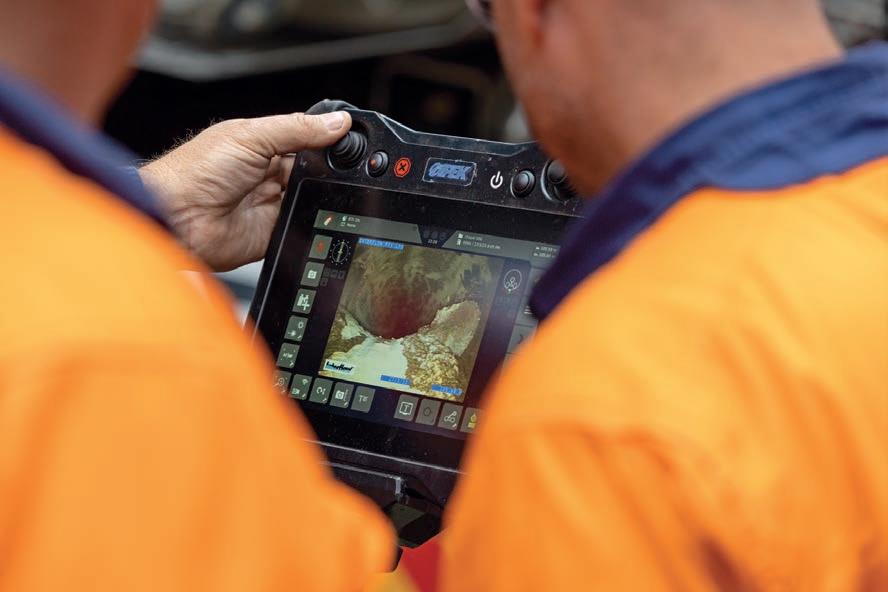
What resulted was a process that used ultrahigh-pressure water (up to 15,000psi) and custom cleaning heads to pulverise the cement liner. The cement, along with the water, was flushed through removed using a hydro truck.
Afterwards, all 485m of the eastern water main was slip lined with a 280mm (outer diameter) HDPE water pipe.
A revolutionary working window
Chapel Street is a four-lane road with trams operating in both directions and a clearway during peak times. 20,000 vehicles use it daily.
Nightworks are effective for managing traffic impacts, however in this case the effect of noise on residents was a greater concern.
The delivery team realised that by challenging the norm, they could reduce the chance of community fatigue brought on by long project timelines and disruptive works.
Working with the Department of Transport, the team secured a 7am to 10pm working window with permission to occupy the clearway with a site compound outside these times. The process was uncharted territory for both Interflow and South East Water and took 6 months to obtain.
The permit eliminated almost all nightworks and allowed two back-to-back shifts each workday, which were beneficial to both the community and the construction program. Significant time was saved by avoiding the need to establish and demobilise the site at every shift.
Benefits beyond Chapel Street
A long-term collaborative relationship between Interflow and South East Water was the foundation for success on Chapel Street. By putting community needs first and actively problem solving, the desired outcomes were achieved with minimal impact.
“The Chapel Street renewal project has mitigated the risk presented by an ageing asset,” said Snell. “Now that the project is complete, our customers can be confident that their community will benefit from reliable, highquality water infrastructure well into the future.”
Innovation brings benefits beyond the
problem they are created to solve. For asset owners across the country, the project shows that trenchless solutions can be designed for the most challenging conditions.
Investing upfront in developing these solutions saved South East Water time and money. However, on Chapel Street, it was the community that came out on top.
“We’re all about improving lives,” said Paulzen. “Knowing we made people’s lives easier while we were working, that’s the real win.”
Interflow mobilised to site.
Inspecting one of the water mains.
An Edge in the field
Edge Underground has played a driving role in a major South Australia infrastructure project.
In the rapidly growing northern suburbs of Adelaide, a bold wastewater infrastructure project is taking shape. Roughly 10km of new infrastructure is being delivered by Fulton Hogan, leaning heavily on Edge Underground’s vacuum microtunnelling technology – a choice that not only accelerates delivery, but also mitigates disruption in a highly serviced, highdensity urban environment.
From the outset, Fulton Hogan’s project team recognised that conventional opencut methods would be prohibitively complicated in many zones. As Fulton Hogan Civil Senior Project Engineer Li Dong said, even though parts of the alignment cross relatively underdeveloped areas, the presence of existing services – water, gas, electricity – made relocation difficult, risky, and costly. Trenchless microtunnelling offered a smarter solution, reducing reinstatement costs, limiting the traffic footprint, and significantly lessening the impact on the local community.
Edge Underground was initially awarded approximately half of the 10km package but was later called upon to utilise its upgraded equipment featuring AdaptX technology to complete several bores where conventional systems used by other contractors had encountered challenges.
Fulton Hogan Utilities Senior Project Manager Jithu John explained.
“There were some areas in our initial design concept that were to be done by open trenching, but when we encountered additional services that required relocation (with no commitment from the service providers), then we made the risk-based delivery-driven call that is was easier to go with microtunnelling,” he said.
“It shows that it’s not just the ground condition that determines the technology. It’s also the hindrances you are dealing with, and how challenging it is to get around them.”
Edge Underground’s parent company, OptionX Group, is led by CEO Stuart Harrison, who is acutely aware of the inherent risks involved in sewer pipeline works. His understanding comes not only from decades in the trenchless industry, but from his own family’s history in traditional trenching.
“There are risks on multiple levels – the safety of construction workers, the protection of underground infrastructure, the surrounding environment, and the well-being of the community as a whole. This goes to the very heart of why we continue to advance AdaptX technology. Our goal is to deliver the essential infrastructure the world needs, without the historical risks that open trenching brings.”
Two Edge Underground crews, in addition to a third microtunnelling contractor, were deployed on the project. Edge Underground’s advanced vacuum microtunnelling technology was able to easily handle the challenging clay ground conditions, allowing Fulton Hogan to compress its schedule significantly.
“What we observed is that Edge’s methodology and technology has better consistency and efficiency. Edge delivered consistent six-day sections, whereas the other contractor took roughly 10-11 days per section,” Li Dong said.
“They have been pretty consistent and always ahead of program.”
One of the most outstanding technical requirements of the job is the ultra-flat grade: just 0.13 percent, or 0.13 mm per metre. That level of precision is rare, even in microtunnelling projects, but Edge Underground’s system, powered by the AdaptX platform, delivered consistently.
This high degree of accuracy, paired with impressive performance even in tough ground conditions, allows Edge Underground to deliver tangible productivity benefits.
“They’re very consistent in their timing, and that consistency has cost benefits to it,” Jithu John said.
“For Edge to do its work, our team has to prepare the launch and receiver shafts for them. Doing this too early means greater disruption to the community, and increased costs. If you’re digging these shafts weeks in advance, then you’re just burning money.
“With Edge’s system, planning these digs becomes more accurate and predictable.”
Tshepo Molatedi, Fulton Hogan’s Senior Estimator – Utilities, said working with Edge Underground has been refreshingly collaborative.
“They are very good to work with – there has been continual communication and support from them,” he said.
That spirit of partnership, Tshepo believes, has helped to contribute to the success of the overall project.
“We want contractors who are willing to work together and prioritise the outcome of the project. Edge Underground is very collaborative,” he said.
Across all fronts – technical, operational, and interpersonal – Edge Underground is delivering excellence. The team’s microtunnelling works are expected to be completed in March 2026, contributing to the quality of life for north Adelaide residents for decades to come.
Image: OptionX Group
Edge Underground delivers accurate, safe and highly efficient microtunnelling.
Locked in for success
Smart Lock Group has played a pivotal role in rehabilitating Unitywater’s Redcliffe sewage treatment plant outfall line.
Pipe Management Australia (PMA), in partnership with Moody Civil & Pipe and Smart Lock Group, has delivered a challenging rehabilitation project for Unitywater’s Redcliffe sewage treatment plant (STP) outfall line. The works demonstrated how Smart Lock’s stainless-steel sleeve system provides a fast, durable, and low-disruption solution for structural joint repairs in largediameter pipelines.
In the aftermath of former Tropical Cyclone Alfred, Unitywater identified signs of potential leakage and joint failure along a DN950 concrete outfall line connected to the Redcliffe STP. The pipeline is a vital piece of infrastructure, carrying treated effluent from the treatment plant to the outfall under continuous operation.
Given the importance of the asset, any investigation or repair required an approach that would maintain service continuity and environmental compliance throughout the project and deliver a long-lasting, structural solution.
Unitywater engaged PMA to deliver an end-to-end rehabilitation, from inspection and condition assessment through to structural repair and relining. The goal was to restore the asset’s integrity quickly and safely, without disrupting plant operations. PMA began with a live-flow inspection using its in-house
RACER technology to gather condition data and confirm the source of infiltration. The inspection was completed in a single night shift and provided the information needed to plan a targeted rehabilitation.
The findings revealed multiple leaking joints and signs of structural degradation. Based on this, PMA recommended a staged trenchless solution incorporating Smart Lock sectional repairs to restore the joints, followed by spiral-wound PVC lining for long-term structural renewal.
To prepare for installation of the Smart Lock repairs, PMA and Moody Civil & Pipe implemented a 2.6km bypass system to enable access to the asset while the repairs were completed.
Smart Lock: a structural solution for live systems
At the heart of the Redcliffe rehabilitation was Smart Lock, a stainless-steel sleeve system with a resin-impregnated liner that bonds the sleeve to the host pipe upon installation.
The mechanical expansion of the sleeve presses the liner firmly into the pipe wall, sealing infiltration and restoring joint strength.
Unlike conventional patching technologies, which require long curing times and limit productivity, Smart Lock allows multiple repairs to be completed in quick succession.
The resin cures in place behind the stainlesssteel sleeve, enabling crews to move immediately to the next repair, significantly reducing overall project time.
For the Redcliffe outfall, PMA installed 74 Smart Lock repairs within the DN950 line, each under live-flow conditions. The installation of each sleeve took only minutes, providing immediate structural reinforcement and watertight sealing.
This approach was particularly well-suited to the project’s requirements, allowing rehabilitation to proceed safely, efficiently, and without costly excavation or extended bypass operations.
“Smart Lock’s design gave us the speed and confidence we needed to rehabilitate the outfall under continuous flow,” Pipe Management Australia CEO and Director Justin Johansen said. “We were able to complete dozens of sectional repairs without waiting for individual patches to cure, and each one delivered a longlasting, watertight seal.”
The Smart Lock portion of the project involved seven PMA team members, supported by Smart Lock and Moody Civil & Pipe personnel and was completed in two days.
Integration with Broader Rehabilitation
The earlier Smart Lock installations played a critical role in stabilising the host pipe,
preventing further infiltration and providing a reliable substrate for relining.
Over 367m of DN950 pipeline were subsequently relined using Expanda Pipe, extending the service life of the asset and delivering a fully sealed system from joint to joint.
Throughout the process, PMA’s teams maintained full operational control, ensuring the project was delivered on time, within Unitywater’s budget, and with zero disruption to the treatment plant’s operations.
• Rapid installation: Each Smart Lock sleeve was installed in minutes, with no need to wait for curing between repairs.
• Structural strength: The stainless-steel sleeve and resin liner combination restored joint integrity and eliminated infiltration.
• Live-flow capability: Installation under full flow conditions avoided costly shutdowns or large-scale bypass pumping during repair works.
permanent, corrosion-resistant solution that supports future lining or relining works.
For Unitywater, this approach offered a proven and repeatable model for addressing similar challenges across its network.
“This project demonstrated how Smart Lock can deliver structural repairs quickly and safely in high-risk environments,” Johansen said. “It’s a technology that brings measurable value not only to utilities but also to their contractors, by streamlining delivery without compromising quality.”
A benchmark for future works
The success of the Redcliffe project was built on strong collaboration between PMA, Unitywater, Moody Civil & Pipe, and Smart Lock Group. Each partner contributed technical expertise to ensure the works were completed safely, efficiently, and to the highest standard.
Unitywater’s Redcliffe Outfall project stands as a clear example of how mechanical point repair systems like Smart Lock can be deployed to deliver rapid, durable results.
By combining accurate condition assessment, targeted sectional repairs, and comprehensive relining, PMA provided Unitywater with a fully rehabilitated pipeline, all completed under live-flow conditions and without interruption to operations.
By integrating Smart Lock into the rehabilitation design, PMA achieved significant time, cost, and safety benefits:
• Safety and efficiency: Reduced confinedspace entries, less heavy plant movement, and minimal site disturbance improved safety outcomes.
• Long-term value: The system provides a
The outcome is a strengthened, watertight system that will serve reliably for decades to come, setting a new benchmark for trenchless rehabilitation across Australia’s wastewater networks. For
A Smart Lock being installed.
The integration of Smart Lock within PMA’s full-service trenchless delivery model shows how modern trenchless solutions can address complex infrastructure challenges.
Images: PMA
kwik-ZIP soars through 2025
kwik-ZIP ticked off several major projects in 2025.
In 2025 kwik-ZIP celebrated 25 years of operation and matched that landmark with impressive performance across key infrastructure projects. The company began the year with a clear focus on delivering quality, reliability and value in its spacer and centraliser systems and ended it ready for the next chapter. For a quarter of a century, kwik-ZIP has been at the forefront of engineering innovation, transforming the way centralisers and pipeline spacers are designed and delivered across the globe. Over the last five years alone, more than three million kwik-ZIP units – spanning a range of sizes – have rolled out from precision injection molds, destined for projects on every continent.
This milestone year afforded the company a chance to reflect on its journey from a local Australian manufacturer into a global supplier of thermoplastic spacer and centraliser systems. During 2025 the company translated this foundational strength into tangible contributions on major infrastructure jobs all over the globe.
Down Under
In Western Australia, one of kwik-ZIP’s customers utilised HDXT-103 spacers with load inserts to facilitate the slip-lining of a 914mm Sintakote® mild steel cement lined (MSCL) carrier pipe into a 1399mm reinforced concrete jacking pipe casing, as well as a
1422mm Sintakote MSCL carrier pipe into a 1708mm casing for a rail crossing in Yanchep.
This installation was part of the of the larger Water Corporation Alkimos seawater desalination plant project, which will ultimately supply up to 50 billion litres of clean drinking water to millions of Western Australians each year.
In New South Wales, kwik-ZIP’s HDXT153 spacers played a role in an important infrastructure upgrade. Here, contractor Vaughan Civil deployed the spacers to facilitate the slip-lining of two water main runs as part of the M1 Pacific Motorway extension project.
The M1 Pacific Motorway extension is a $2.1 billion project funded by the Federal and
At the heart of kwik-ZIP’s success lies a commitment to integrity and excellence in product design and manufacturing.
Images: kwik-ZIP
New South Wales Governments that, once complete, will feature a 15km extension of the Sydney–Newcastle motorway, along with the removal of five sets of traffic lights.
Vaughn Civil worked on runs of 62m and 127m and involving 1219mm outside diameter (OD) Sintakote Steel MSCL carrier pipes into 1574mm internal diameter (ID) GRP casing. Thanks to a unique load-sharing design, kwikZIP’s HDXT-153 spacers were used to centre and support the carrier pipe inside the host pipe during the slip lining process.
Europe
In the United Kingdom, kwik-ZIP demonstrated its prowess at the A465 Heads of the Valley project, which involved the extension and widening of a major transport corridor in Wales.
As part of this infrastructure upgrade, existing utility services required diversion. To this end, four new pipe crossings were installed through precast concrete tunnels beneath the roadway at Hirwaun. To ensure safe and efficient installation of the carrier pipes within these tunnels, kwik-ZIP HDXT-153 casing spacers were utilised across all four crossings.
The four crossings comprised of two crossings of 35m and 47.5m each of 711mm OD pipe into 1050mm ID casing, and two crossings of 35m and 47.5m each of 1118mm OD into 1500mm ID casing.
The use of kwik-ZIP HDXT-153 spacers ensured proper alignment and centralisation of the pipes within the tunnels, reducing friction during installation and protecting pipe coatings. The modular design of the HDXT153 provided a reliable, corrosion-resistant, and load-bearing solution suitable for the project’s demanding conditions.
These are just a handful of many such infrastructure projects successfully executed in 2025 thanks to the guiding hand of kwik-ZIP.
With established distributors in Australia, New Zealand, the United States and Great Britain, and countless runs on the board, it’s easy to see why kwik-ZIP has become a go-to infrastructure partner for pipeline projects around the world.
With its eyes fixed on further growth in 2026, kwik-ZIP’s 25-year-old story is one to keep watching.
For more information, visit kwikzip.com
Drill with Confidence
kwik-ZIP’s HDXT, HDX, and HD Series spacers have been successfully appraised by the Water Services Association of Australia.
A year of expansion for Pro Line
Pro Line accelerates national growth and launches its new Melbourne warehouse.
From breakthrough projects to expanding its national footprint, Pro Line looks back on a year that showcased its commitment to innovation, quality, and strengthening trenchless capability across Australia and New Zealand.
Pro Line closes out 2025 having delivered one of its most influential years to date – marked by landmark projects, strategic expansion, and key developments that further cemented its position as a marketleading manufacturer of UV-CIPP trenchless technology across Australia and New Zealand.
Across every state and sector, the company continued to demonstrate the hallmarks that have driven its success: technical excellence, reliable delivery, and a strong commitment to supporting contractors with industry-leading products, systems, and training.
A major highlight of the year was the establishment of Pro Line’s new Melbourne Warehouse, which has quickly become one of Australia’s leading hub for trenchless technology. Established to strengthen local capability, the facility plays a central role in supporting contractors and asset owners across the region. It functions as:
• a fully stocked warehouse for UV-CIPP liner, consumables, and trenchless equipment
• a dedicated venue for technical training, hands-on demonstrations, and contractor development
• a central point for rapid supply, technical support, and product expertise.
Pro Line Sales and Technical Director Kevin Woolf said the new facility represents a major investment in building capability across Australia and New Zealand.
“We’re extremely excited to open what is now the region’s leading trenchless hub,” Woolf said. “It’s a space for asset owners and contractors across Australia and New Zealand to access the industry’s most advanced UVCIPP liner, hands-on training, demonstrations, and genuine technical support. We’re proud to be stocking liner that will rehabilitate assets for another 100 years, giving our clients the confidence to take on any rehabilitation challenge with absolute certainty.”
Beyond its expansion, the year also saw the successful delivery of several milestone projects, each demonstrating Pro Line’s capacity to support complex trenchless solutions across diverse environments.
Among the most notable achievements was the Northern Territory’s first ever UVCIPP project – marking a major geographic milestone and proving Pro Line’s ability to mobilise high-quality trenchless systems in remote and challenging locations.
Equally significant was Pro Line’s involvement in a series of rail culvert rehabilitation projects, where fully structural 100-year UV relining was essential to
maintaining safety and protecting critical transport corridors. These works reinforced the reliability and performance of Pro Line’s liner in high-risk, high-compliance settings.
The company also reached new territory with the first ever installation of a UV-CIPP liner within an offshore oil pipeline. This milestone project showcased the durability and structural performance of Pro Line’s technology, reinforcing confidence in its ability to operate under extreme environmental and operational conditions.
Reflecting on the year, the Pro Line team views 2025 as a pivotal chapter – one defined by growth, innovation, and meaningful contribution to the trenchless industry.
As the company moves into 2026, its focus remains clear: to continue strengthening its national support network, ensuring customers benefit from on-site technical guidance and training, dedicated UV specialists, and a team committed to raising contractor capability across the UV-CIPP sector. These initiatives reflect Pro Line’s broader mission to champion high standards and help contractors and asset owners achieve consistent, highquality outcomes.
For more information, visit prolinetrenchless.com
Earlier this year one of Pro Line’s delivery partners rehabilitated this DN900 culvert.
One of 2025’s milestone UVCIPP projects saw Pro Line selected for a challenging DN1050-1200 transitional liner under a busy highway.
Image:
Pro Line
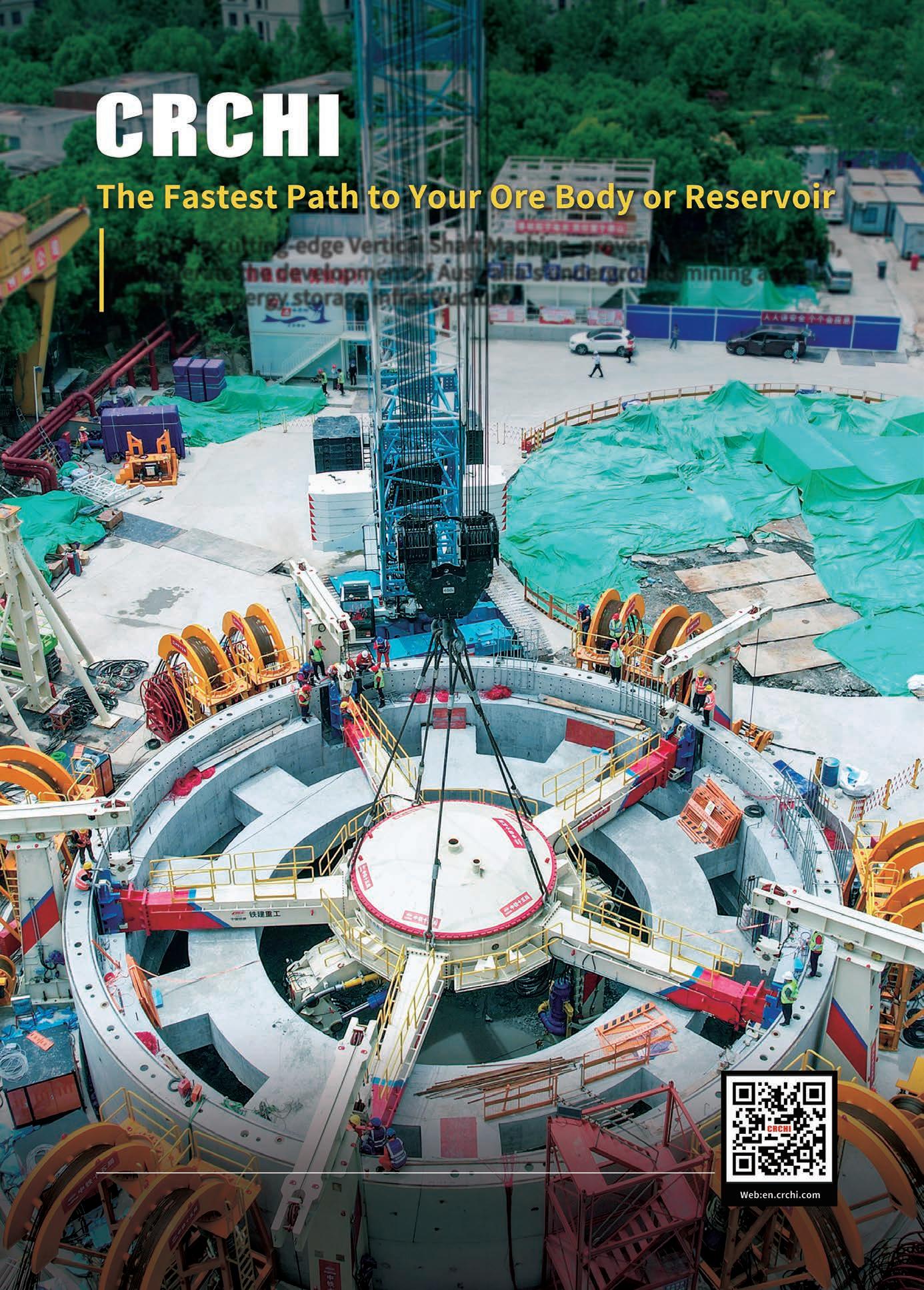
Deploy the cutting-edge Vertical Shaft Machine, proven in scale and depth, to accelerate the development of Australia's underground mining as well as pumped energy storage infrastructure.
China Railway Construction Heavy Industry Corporation
Multiple GRUNDODRILLS gives HDD contractor edge
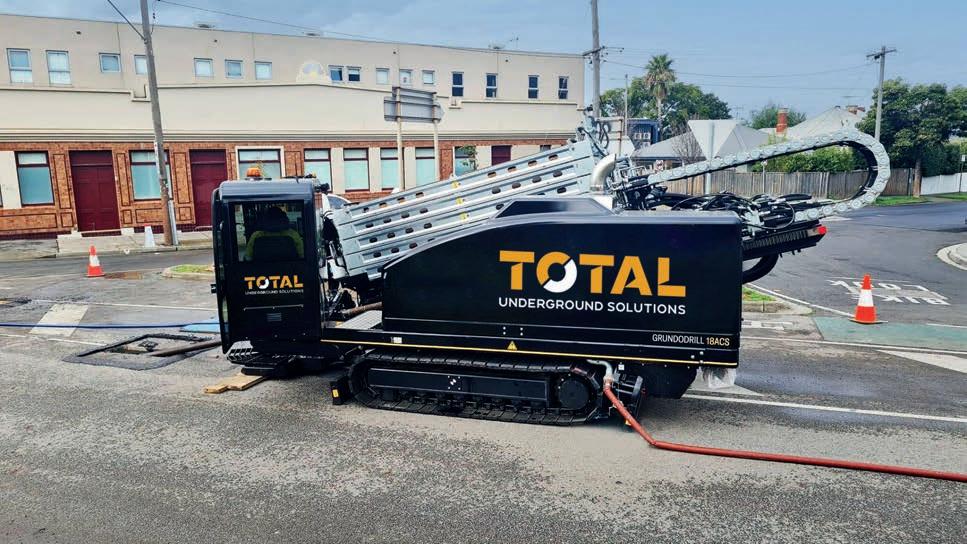
A leading Victorian HDD contractor has acquired its second TRACTO GRUNDODRILL 18ACS and associated MA07 mixing system, giving it two spreads and the capacity to meet growing demand for its services from the energy sector.
Established in 1996, Total Underground Solutions (TUS) is renowned for being one of the most reliable horizontal direction drilling (HDD) contractors operating in and around Melbourne. It has worked across a range of different industries over the past 30 years, including utilities and communications; however, it has found a niche delivering trenchless construction for the energy sector, working on projects for the likes of Zinfra, Citipower, Powercor, Jemena and United Energy.
In 2023, TUS purchased its first 18ACS to complement and replace an ageing HDD rig. The company settled on the TRACTO machine because it would be capable of faster and more efficient drilling, as well as its ability to cut through the tough hard rock which is common under Victoria.
The 18ACS has been specifically engineered to perform in hard rock, combining high torque with precise steering control to maintain accuracy in the difficult geology. The machine’s power and robust build quality allow crews to complete challenging rock bores efficiently, safely and with minimal wear on the machine and its tools.
In addition to the 18ACS machine, TUS also acquired a second MA07 mixing system, meaning it now has access to two complete
spreads. This gives the contractor increased flexibility across a number of factors, including running multiple drills at the same time –on the same or different projects essentially doubling output.
It also means TUS can diversify the setup of each spread to different geologies or site footprints, ensuring the machine is customised for each specific bore.
The MA07 mixing system delivers consistent, high-quality drilling fluid. The compact and robust design ensures reliable mud production on HDD job sites, while keeping setup and maintenance simple for crews.
After seeing the performance of the first machine over the past couple of years, TUS Utilities Manager Kevin Toohey said the company invested in a second 18ACS to capitalise on the growing demand for its HDD capabilities, specifically in the energy sector.
“Our drilling operations have increased over the last year and the company is in a growth period,” he said.
“We already had the TRACTO machine in our fleet, so decided to purchase another one to cater for that workload, effectively doubling out capacity.”
A lot of this growth is a result of an increase in energy projects in Victoria, including
renewable energy developments, transmission and grid work, as well as data centres – which are usually collocated next to largescale battery, wind and solar farms.
“Adding this second machine to our fleet opens up new opportunities for us, allowing us to tender on bigger projects, run two crews simultaneously and expand our offering,” he said.
“There’s huge demand for our HDD services in the energy sector, specifically connecting battery storage systems and data centres to the grid. All these new sources of energy require the construction of new substations or, if an associated substation is at capacity, needs to be rebuilt or extended.
“In some cases the substation might be a few kilometres away, which is when we can utilise HDD for the tie-in.”
He said the 18ACS continues to perform as advertised in challenging conditions, giving them an edge in a competitive market.
“There’s a lot of rock in Melbourne and in the areas that we’re working, and the TRACTO machines are very good in those environmental conditions. We’re impressed the performance of the machine and believe it gives us a competitive edge in the marketplace,” he said.
“What might have taken our older drilling two weeks to complete, the 18ACS can complete in a week.”
Operation and maintenance of the machine is supported by TRACTO Australia and the company’s factory in Germany, as well as locally through a service agreement in Victoria with Mech-N-Air Construction and Access Equipment.
“TRACTO, and by extension Mech-NAir, have provided high levels of customer service to support the operation of both drills,” said Toohey.
“Our crews on site have great access to troubleshoot any issues quickly, limiting downtime.
“TRACTO’s customer service is far greater than we expected. Generally, once a supplier has delivered a machine you don’t hear from them again and it can be difficult to get back in touch with them when you encounter issues.
“But TRACTO and Mech-N-Air have been proactive, offering training support, troubleshooting, or using their online systems. The customer is always front and centre.”
For more information, visit www.tracto.com/au
The company is seeing large demand for its HDD services in the energy sector.
Image: TRACTO
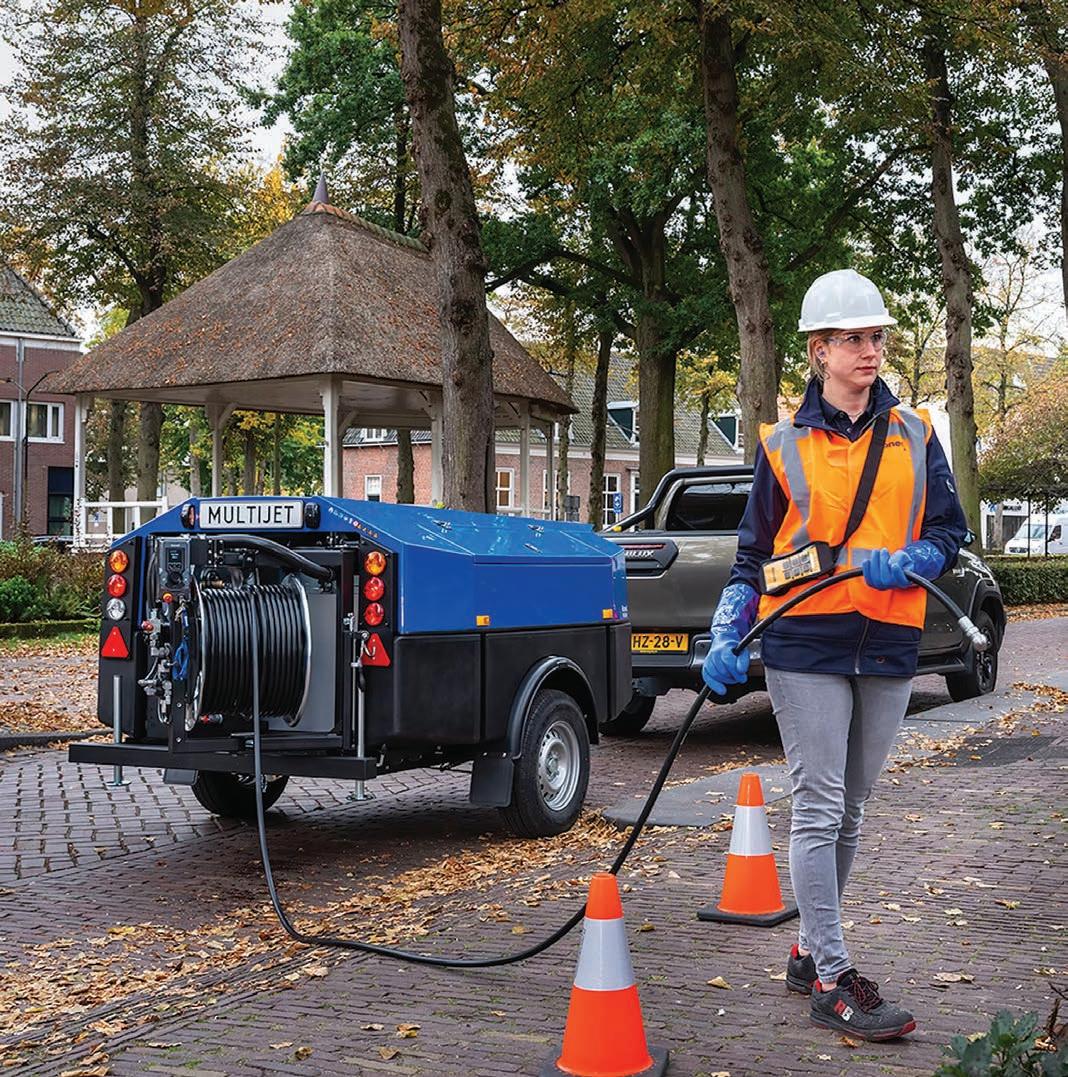
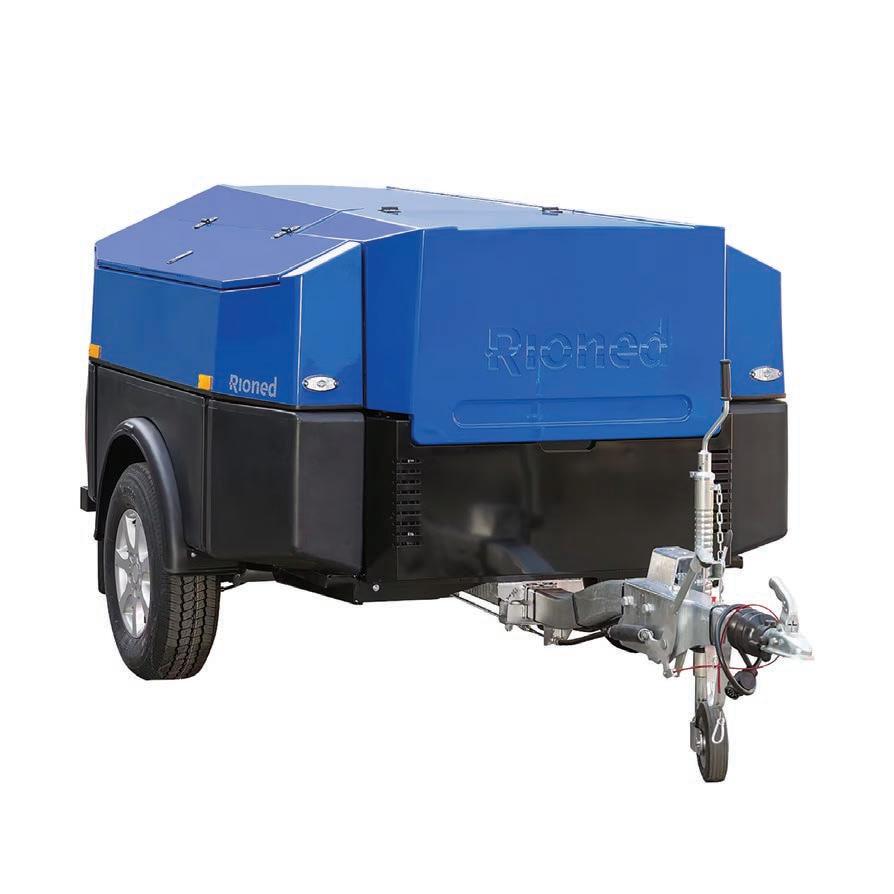
It’s easy to use
180-degree pivoting hose reel
Built in toolboxes
Light and easy to tow
Variable pressure output
Minimum pressure loss
Remote control operation
Hose meter counter
It’s reliable
European designed and manufactured
Kubota diesel engine
Robust and durable
Easy to service
It improves safety
Increased stability
Maximum visibility
Compact power
Australia’s diverse and challenging ground conditions mean power, precision and reliability are fundamental to any directional drill on the market.
When the rock gets tough, operators don’t want to be slowed down, instead, they want a machine that breaks through.
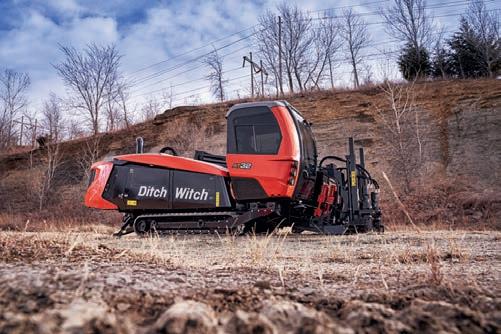
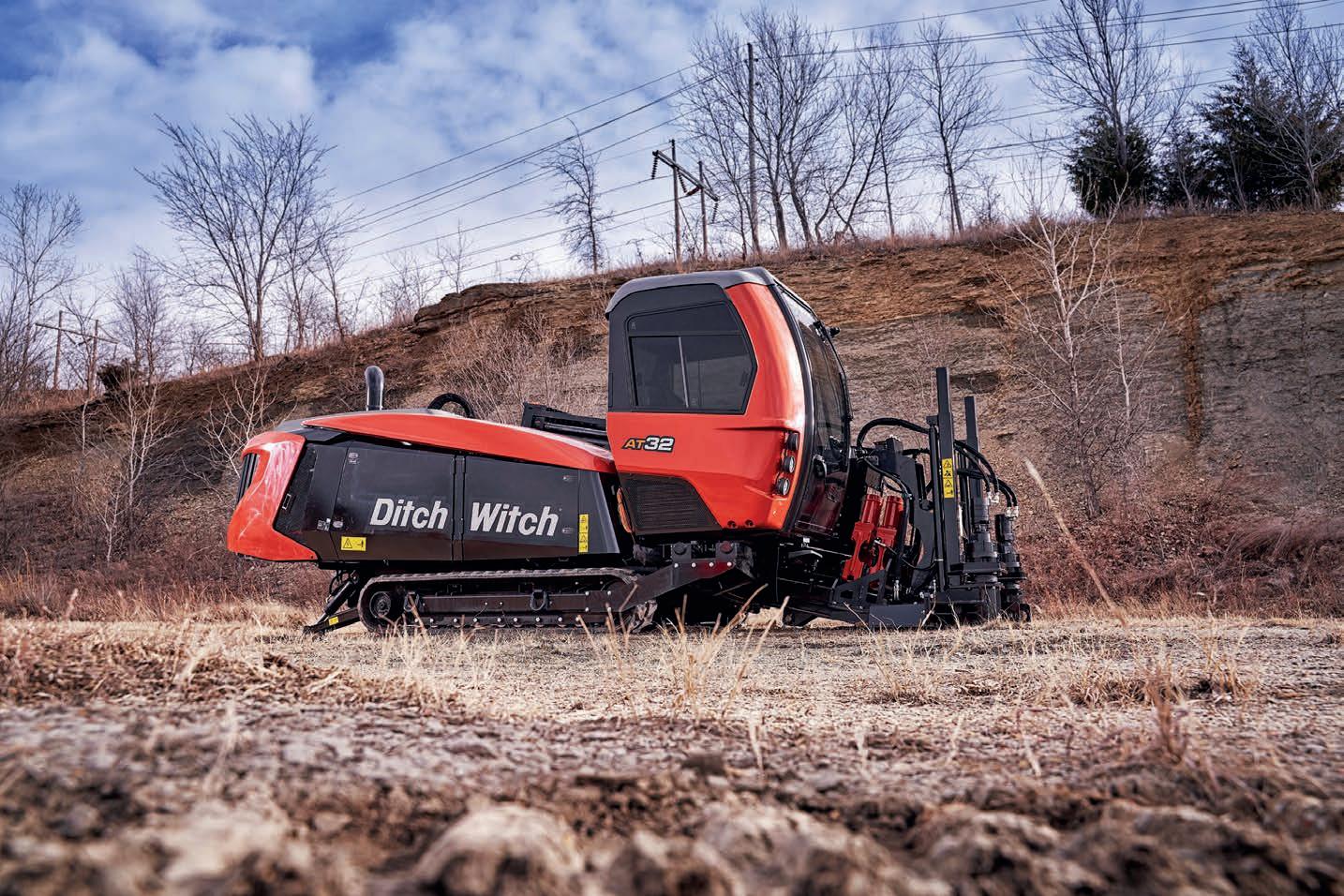
The Ditch Witch AT32 all-terrain directional drill is an ideal solution, bursting at the seams with power in a compact and operator-focused package.
Beneath its sleek 8.4-tonne frame lies a Cummins 155hp (114kW) engine, delivering the performance required of this demanding industry with reduced emissions.
Featuring 32,000 pounds (lbs) of thrust and pullback, the AT32 has the muscle to push through the hardest soils and rock formations with ease. Add 4,200-foot pounds of rotational torque and 1,200-foot pounds of inner torque, and this drill doesn’t just meet expectations, it exceeds them.
Whether the operator is drilling through solid rock or dense clay, the AT32 helps maintain consistent productivity and drilling accuracy in the toughest conditions.
The 70 GPM (at 1000 PSI) high-capacity pump delivers an abundance of drilling fluid to keep the bore clean, cool, and efficient. This powerful combination of torque, thrust, and fluid capacity translates to faster bore times and greater jobsite profitability.
Raw power isn’t the be all and end all though, a unique add-a-pipe design is the result
of smart engineering, allowing operators to manually add pipe when running low, keeping the crew moving and downtime to a minimum.
Pair this with the SwitchBack horizontal directional drilling (HDD) Tooling system, and changing tooling becomes faster and easier, reducing costly interruptions and helping maximise daily production.
Built for the operator
Built from direct customer feedback, Ditch Witch has placed user comfort and control at the forefront of its design, making it an operator’s dream.
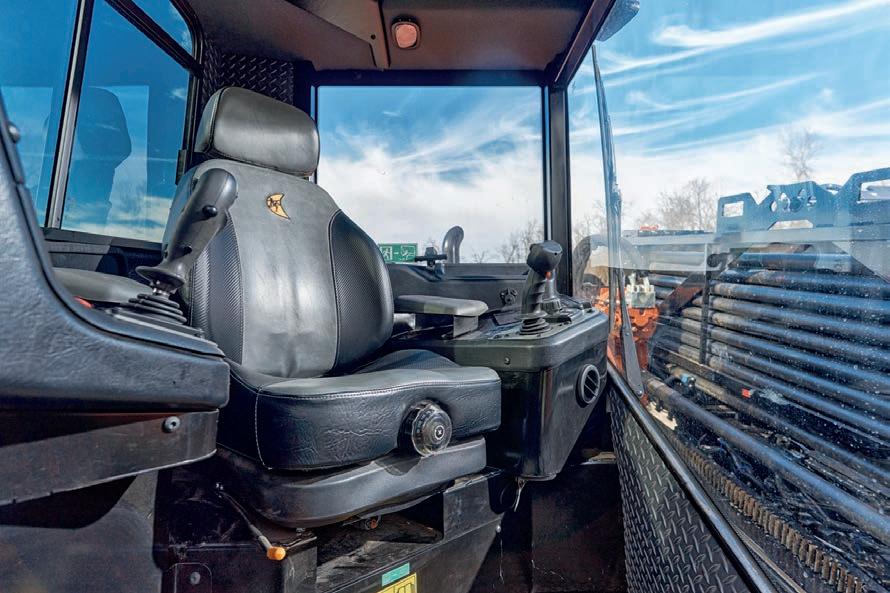
The best-in-class HDD cabin features 360-degree visibility, giving the operator a clear line of sight to every critical point – from the
Ditch Witch CEA’s AT32 all-terrain directional drill has been built for the operator, with direct user feedback integrated into the design of the machine.
The HDD cabin features 360-degree visibility and an adjustable heated suspension seat, among other operator features.
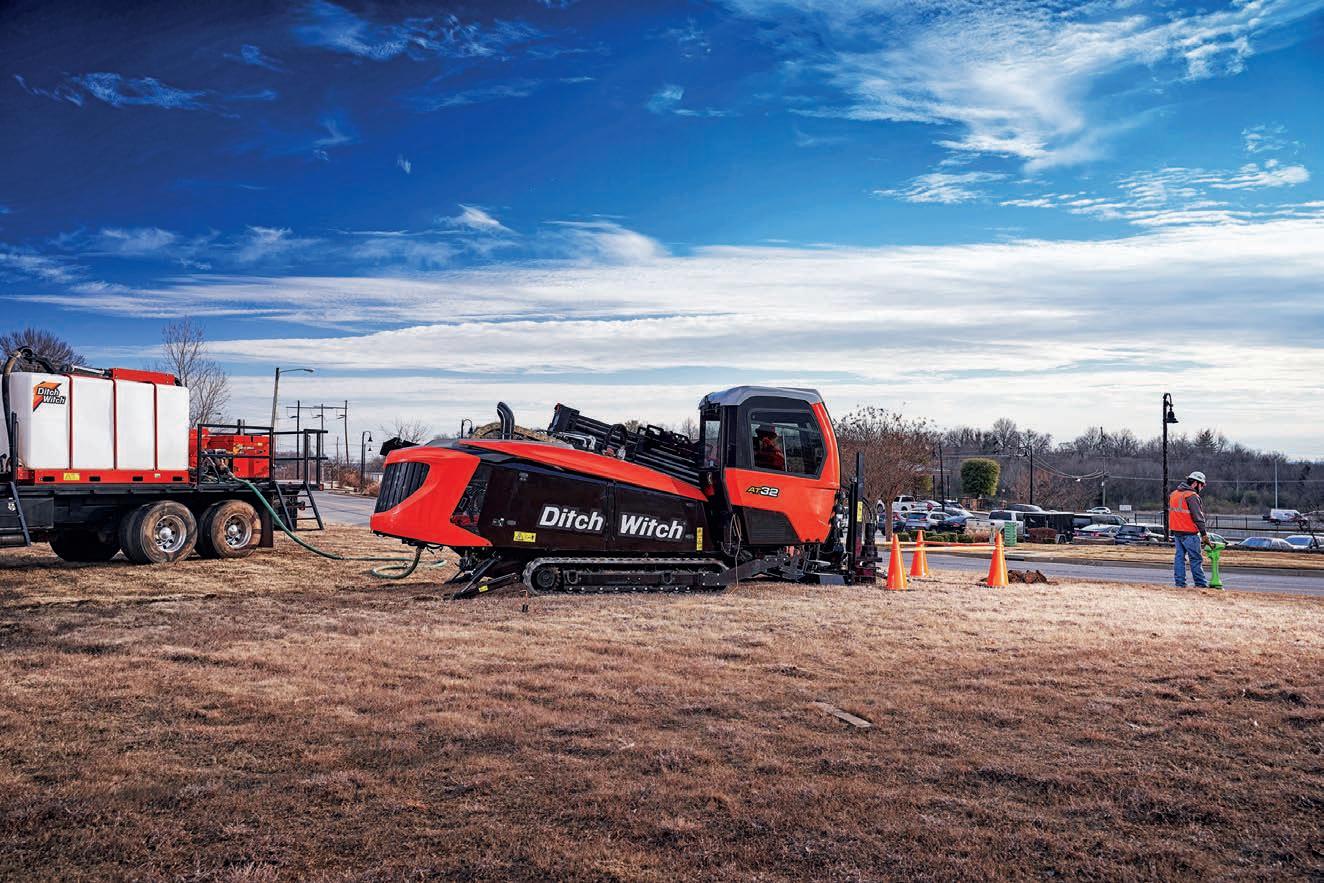
The compact footprint of the AT32 gives it the manoeuvrability to navigate tight applications.
Images: Ditch Witch CEA
ground entrance and wrenches to the shuttle retract and rear connection.
An ergonomic operator station maximises comfort with features such as an adjustable heated suspension seat, increased legroom, and dual LED display screens – providing real-time operational data – while a real-time carriageposition indicator ensures optimal productivity by enhancing accuracy and efficiency with every push and pull.
Despite its power, the AT32 keeps noise to a minimum with an operator sound-level of only
dBA, not only reducing user fatigue but also making the machine ideal for noise-compliant urban jobsites.
Ready for anything
At just 6.5m in length, the Ditch Witch AT32’s compact footprint gives it the manoeuvrability to navigate tight city streets and confined worksites with confidence.
It’s built for real-world conditions from bustling urban environments to remote rocky terrain.
thanks to swing-out, lift-off service doors that provide easy access to all major components – reducing service times and maximising machine uptime.
The Ditch Witch AT32 blends advanced engineering, operator comfort, and unmatched performance into one formidable package. It’s the perfect combination of size and strength for contractors who refuse to let challenging conditions slow them down.
For more information, visit
Ditch Witch CEA’s AT32 all-terrain directional drill boasts 32,000 pounds (lbs) of thrust and pullback.
A partnership to serve the east coast
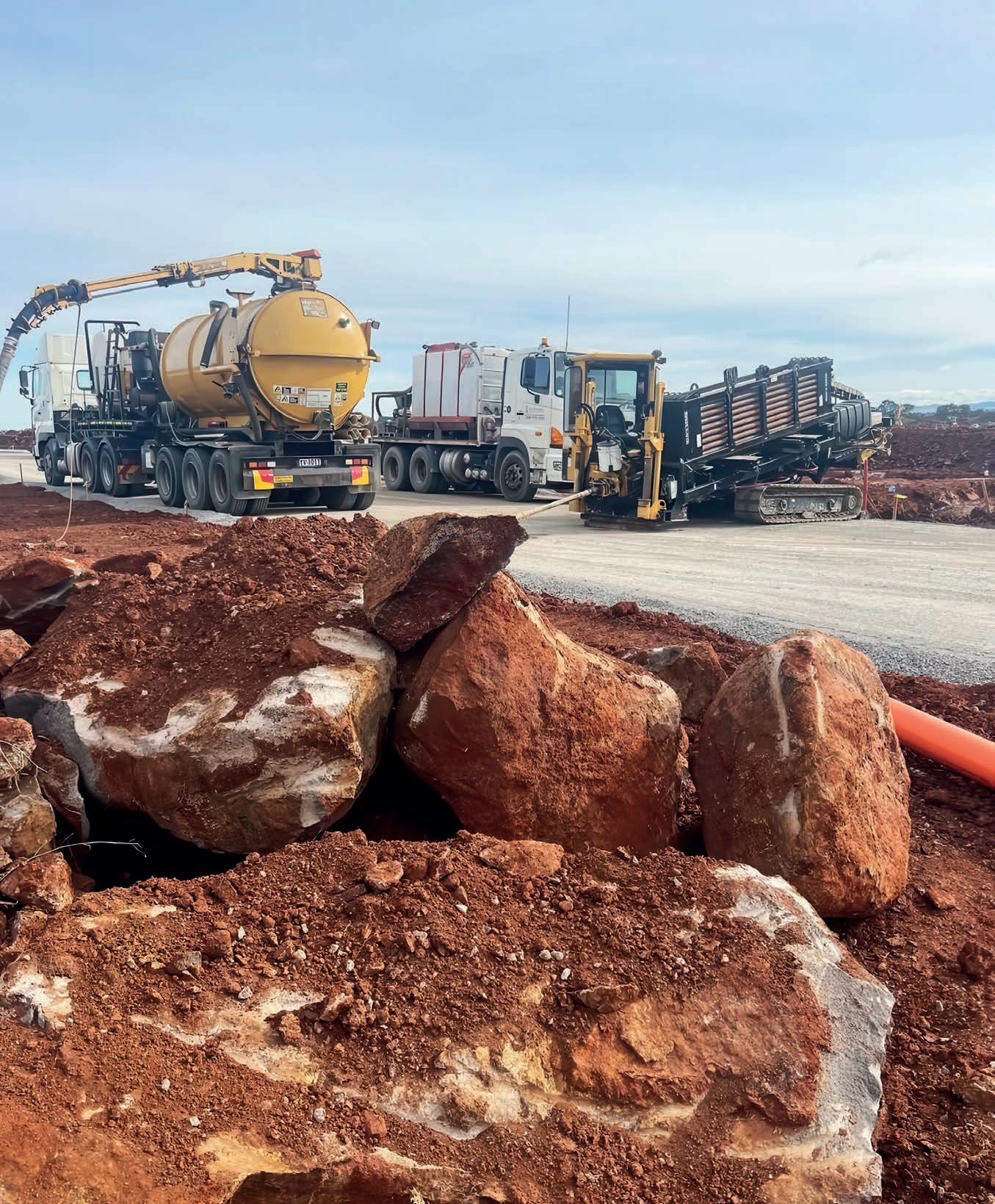
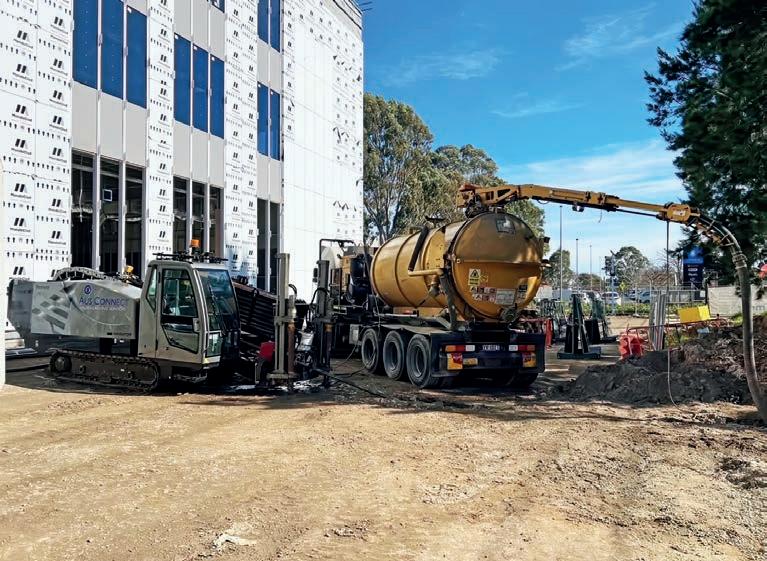
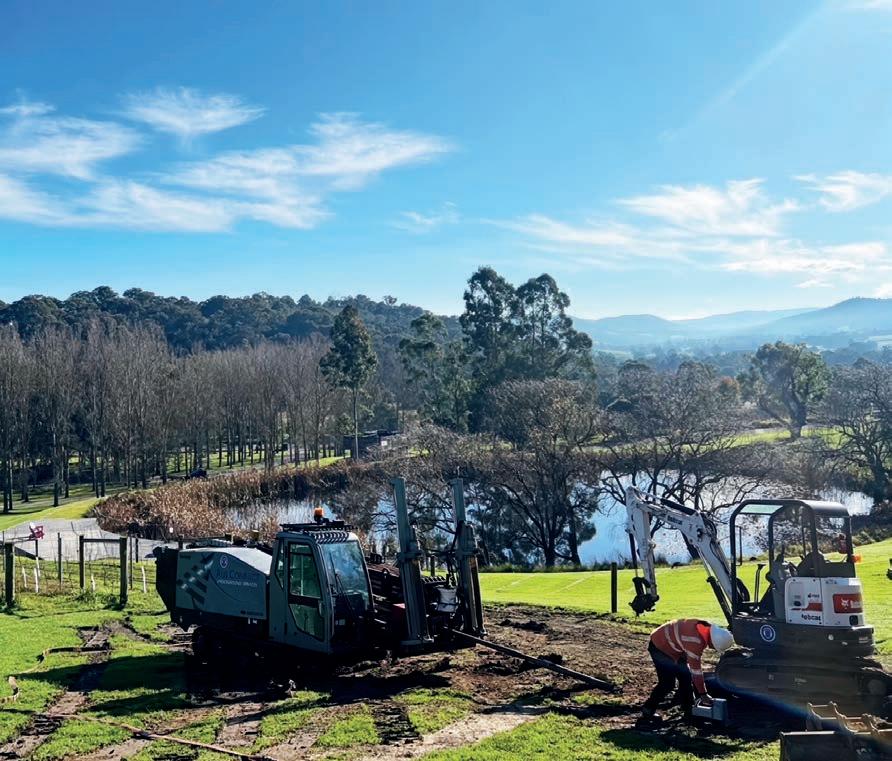
AusConnect’s impressive growth in the civil and underground infrastructure services industry is down to hard work and making meaningful connections.
Co-founded by brothers Ben and Dave Collins in 2012, AusConnect began with a single Vermeer 20x22 drill and a shared vision to build a company that set new standards in safety, performance, and reliability.
“We initially had family ties to the industry, as our dad had been involved in it for many years,” Ben Collins said. “We were focused and driven to start something of our own, while also carrying forward the values and lessons he taught us – both within the industry and outside of it – building on those foundations with our own approach and ideas.”
That first step came through a timely opportunity. “We purchased our first drill from Rob at BNR Boring. Rob was retiring at the time and liked seeing a couple of young blokes having a go. He wanted to make sure his long-term clients were still looked after, so he introduced us to them and encouraged us to continue his work,” Collins said.
“That was a huge bonus for us and gave AusConnect a great start, but from there, it was all about proving ourselves and building a reputation on quality delivery. It was just the two of us at the beginning, and that’s how we ran things for quite a while.”
From those early days, growth came quickly. By 2014, AusConnect had expanded to a 12-person crew with multiple Vermeer drills in operation. The company continued to invest in new technology, equipment, and training
to support a growing pipeline of work. By 2017, AusConnect had secured a 20-acre property in Pearcedale, Victoria, and grown its drill fleet to ten. As demand for trenchless delivery increased, the business set its sights
The company’s ability to scale while maintaining its standards has been a defining factor in its success.
In addition to drills, AusConnect also runs around six Vermeer vacuum excavators
Images: AusConnect
on expansion across the eastern states. “We’d always seen opportunity beyond Victoria. Queensland was a natural next step for us, the infrastructure pipeline was strong, and we wanted to bring our experience and systems to new regions.”
When Ben and his family moved to South east Queensland, the timing couldn’t have been better. “It made perfect sense to broaden our footprint and formally establish operations in Queensland. It allowed us to build a strong local presence while still keeping our Victorian operations running smoothly,” he said.
In 2019, AusConnect formally established its Queensland division, which quickly grew from a single drill to four within a year. The company’s ability to scale while maintaining its standards has been a defining factor in its success.
Then in 2025, AusConnect acquired L&M Trenchless to strengthen its presence in New South Wales, establishing a new depot with two drills and dedicated local management to support ongoing operations.
“We’ve also been lucky to have great people around us. Adrian Greed from Vermeer Australia has always been our go-to for service, parts, or breakdown support. Having that level of reliability and expertise behind us allows our teams to stay focused on delivering projects safely and efficiently.”
“Vermeer has always been our first choice. Their machines are the best on the market, and their aftersales support is second to none.”
In addition to drills, AusConnect also runs around six Vermeer vacuum excavators across its various operations.
The company recently completed the Gig State rollout – a $15 million program involving eight drills – and continues to deliver major projects for clients such as Ventia and Service Stream.
To support its expanding footprint, AusConnect has invested heavily in technology and systems that drive efficiency, safety, and
compliance across every project. The company models its operations on Tier 1 companies, striving to deliver the same level of structure, discipline, and performance across all aspects of the business.
AusConnect utilises platforms such as Arrow Flow for digital pre-starts, safety checks, and scheduling, ensuring complete consistency and control across operations.
With a strong culture, proven leadership, and a growing national presence, AusConnect Underground Services continues to
set benchmarks for trenchless delivery across Australia.
“Growth has always been a team effort. We’re proud of how far we’ve come — and we’re just getting started,” Ben said. With a presence now firmly established as a true multi-state operator across Victoria, Queensland and New South Wales, AusConnect is well-positioned for further growth with Vermeer by its side.
For more information, visit vermeeeraustralia.com.au
AusConnect acquired L&M Trenchless to strengthen its presence in New South Wales.
More than ready
Ready Group has diversified its capabilities to better support major infrastructure projects across New South Wales, with additions such as pit and pipe works, water carts and road sweepers.
Ready Group is a name that’s synonymous in the New South Wales trenchless industry for its vacuum excavation, liquid waste management, jetting and drain cleaning, as well as civil services, but company growth is always going to be essential to continue actively meeting the needs of its clients.
Facing an increased demand for ancillary services beyond its core vacuum truck services, Ready Group has expanded its capacity to provide ‘pit and pipe’ works, venturing into previously unfamiliar territory.
So far this scope of works has involved working for drillers contracted to install underground components for the National Broadband Network.
Ready Group Business Development Manager Shane Holt said the company is currently conducting these works to contribute to a new major NBN connection with a pipeline running from Penrith, Sydney to Canberra.
“It’s our first foray into that direct work that doesn’t necessarily involve a vacuum truck,” he said.
“We’re working with the directional drillers to install the pits and pipes, backfill and then reinstate.”
Equipment additions
Beyond this, Ready Group has expanded its civil offering over the past year with the introduction of water carts and road sweepers, showcasing the diverse nature of the business and its commitment to supporting Tier 1 clients with resources they often required onsite.
Offering wet hire services of this equipment, Ready Group aims to be a trusted solutions partner for its clients when it comes to safety and environmental obligations.
Airborne dust is often a significant problem onsite, but it can be suppressed by employing a Ready Group water cart, which will keep dirt surfaces damp.
Another issue which Tier 1 projects may face is trucks tracking excess waste – such as mud and other debris – onto roadways.
This can be a contamination risk for stormwater drains and water systems, however, Ready Group’s fleet of road sweepers with high pressure washers can mitigate this by keeping the roadways clean.
Valuable bins
Liquid waste management is another Ready Group core business unit which has expanded with onsite solutions.
While Ready Group’s vacuum trucks would typically be transported offsite to empty the waste sucked up from excavation, the company can now instead offer onsite waste and mud bins, helping to boost productivity.
“When the trucks are full, the waste can be tipped into these onsite bins rather than
travelling offsite, increasing onsite productivity for our clients,” Holt said.
“It also means that multiple trucks can tip into the one bin, increasing productivity further. This is an important consideration for drillers as well, because their waste can go in these bins, without the need for a vacuum truck to suck it up.”
A Ready Group water cart can be used to suppress dust.
Images: Ready Made
The company has expanded its capacity to provide ‘pit and pipe’ works.
Tailored offering
Ready Group’s name quite literally reflects its readiness to help support and build the future of its client’s infrastructure projects, evidenced by a strong team of more than 40 employees and a comprehensive fleet of equipment.
Among its long-term objectives, one remains especially significant: to continue growing and
developing to meet its clients’ needs – and with the diversification of Ready Group’s services, the company is right on track. The ability to provide tailor-made solutions depending on the specific client only enhances this.
“We’re taking advantage of the civil assets in our yard, including excavators and tipper trucks available for wet hire, which can be
Manufacturing Quality PE100 Pipes
Delivering Customer Satisfaction with Quality Products and Service
Since 2004, Australian Custom Pipes (ACP) has been providing conventional piping systems, custom pipes, injection moulding and fabrication to the Gas, Water, Fire, Electrical and Communications pipeline construction industries
pieced together with whatever solution our clients are looking for,” Holt said.
“Ready Group has such a comprehensive fleet and team with civil backgrounds, so we’ve got a range of resources, skills and experience that will allow us to tap into new markets.”
For more information, visit readygroup.au
If it’s quality products and service you’re after give ACP the opportunity to impress. 02 9722 0500
Ready Group has seen an increased demand for ancillary services beyond its core vacuum truck services.
Leaving a legacy
Microtunnelling expert Rob Carr has been recognised for its stellar performance throughout 2025.
In 2025, Rob Carr has reaffirmed itself as one of Australia’s premier infrastructure and trenchless construction contractors, with a series of achievements underpinning its success.
This year, Rob Carr’s delivery across complex urban projects has been acknowledged with multiple top-tier awards. Two landmark wins in particular illustrate the scale, sophistication and collaborative approach that now define the company’s business model.
At the Civil Contractors Federation Victoria awards night, Rob Carr was crowned the winner of the 2025 Earth Award for Project Excellence in the $10 million to $30 million category, along with Greater Western Water.
The team was recognised for the Elizabeth Street Sewer Upgrade as part of stage three of the CBD Sewer Augmentation Program for Greater Western Water. The work involved designing and constructing a new 730m sewer through variable ground conditions, a mix of existing underground utilities, dealing with an adjacent heritage brick drain and operating near active tram lines only 1m away along the alignment. Community engagement was a key focus, collaborating with local residents, businesses, and stakeholders to ensure
Rob Carr said the success couldn’t have been achieved without a dedicated construction team led by Matthew Robinson, with support from its client team Dwayne Deprez and Allison Newland.
“A big shout out to the wider construction team in Michael Dolan, Aditya Reddy Janga, Claudia Correa and Alex Austin, and design partners in SMEC, Bedi Consulting and Adra Group on a fantastic and technically challenging project,” Rob Carr General Manager Angelo Soumboulidis said.
“This award recognises our collective innovation, collaboration, and commitment to delivering sustainable infrastructure.”
Shortly after the Victoria win, Rob Carr clinched another top honour at the Civil Contractors Federation WA awards: the 2025 Earth Award for Project Excellence in the $5 million to $10 million category. In partnership with NEWest Alliance, the company was recognised for its work on the Anaconda Drive Sewer Pressure Main Realignment – a key upgrade improving wastewater reliability while enabling the Thornlie–Cockburn Link.
The NEWest Alliance is comprised of CPB Contractors, DT Infrastructure and Public
The works replaced a section of DN900 sewer pressure main via microtunnelling beneath live rail, requiring precise planning to maintain service to 29 catchment areas.
Deep shafts, complex temporary works, and interfaces with Western Power assets and asbestos-coated infrastructure were safely managed through strong collaboration and technical excellence.
“The delivery of such highly technical works could not have been achieved without a dedicated construction team led by Marie Piette and comprising of the wider construction team in Declan Cawley, Carl Haloun, Meadhbh Moloney and Jason Caird and client team Jiang Aizezi and Waqas Tariq,” Soumboulidis said.
These achievements reinforce what Rob Carr has been articulating all year: a maturity in project delivery that marries advanced trenchless techniques with stakeholder and community-centric execution. In an industry where project delivery is no longer about simply laying pipe but delivering value in context, Rob Carr is showing how it’s done.
The Rob Carr team at the Civil Contractors Federation VIC awards.
Image:
Rob Carr
Introducing the all-new JT21 directional drill from Ditch Witch, a compact powerhouse engineered to boost productivity and conquer tight job sites. Whether you’re installing fibre, gas lines, or tackling other underground utilities, the JT21 is designed to help you drill faster, smarter, and more efficiently than ever before. Prepare to experience the next level of directional drilling.
35% faster than any drill in its class—and up to 40% more downhole horsepower than its predecessor, the all new JT21 has the speed and the power you need to get the job done, keeping you ahead of schedule and ready for whatever comes next.
Like to know more?
Thinking big
A12.49m diameter earth pressure balance shield tunnel boring machine (TBM), manufactured by China Railway Construction Heavy Industry Corporation Limited (CRCHI), has successfully passed its factory acceptance test (FAT) at the company’s Changsha No.2 Industrial Park in September. This machine, the largest diameter TBM ever exported to Europe by CRCHI, is destined for a pivotal role in constructing the challenging Lot 3 section of the Sibiu-Pitesti Highway in Romania.
The TBM will be deployed on the 37.4km Lot 3, the most complex segment of the future highway, which crosses the Carpathian Mountains between Cornetu and Tigveni. Awarded to a consortium of Webuild (90 per cent) and Tancrad (10 per cent) by the Romanian Road Authority (CNAIR) under a contract exceeding €1 billion ($AU1.78 billion), this section features significant engineering works. These include 12.5km of bridges and viaducts, and a 1.7km-long twintube tunnel – the Poiana Tunnel, which is set
to become Romania’s longest highway tunnel.
This delivery marks the third TBM supplied by CRCHI to Romania. The machine has been specifically engineered to tackle the demanding geological conditions of the route, which include navigating through clay, silty clay, and sandy cobble strata. To ensure high performance, efficiency, and safety in these challenging ground and hydrological conditions, CRCHI’s technical team integrated internationally advanced TBM design concepts. Key innovations include permanent magnet drive systems and rapid assembly/ relocation designs. The machine also features enhanced visual maintenance and intelligent alert systems, boosting overall operational efficiency, safety, and operator comfort.
In a crucial step for European market entry, the TBM is fully equipped with integrated systems – including gas detection, ventilation, emergency lighting, communications, and power supply – that comply with relevant European directives. This comprehensive approach effectively ensured the machine
successfully attained CE certification.
The Sibiu-Pitesti Highway project, 85 per cent co-financed by the European Union, is a critical component of the Trans-European Transport Network (TEN-T), specifically the Rhine-Danube Corridor. Upon completion of its five sections, the over 122km highway will significantly improve connectivity between central and western Romania and the wider European motorway network, alleviating congestion on existing national roads.
CRCHI’s tunnelling equipment have now been exported to more than 50 countries and regions worldwide, including Italy, Switzerland, Poland, Singapore, Serbia, Chile, and Saudi Arabia. The company has stated its commitment to deepening global collaboration, continuing to provide highquality products and services, and offering robust Chinese solutions and expertise for worldwide infrastructure development.
For more information, contact tangzhongwu@crchi.com
TBM passes FAT at CRCHI Changsha Factory.
Image:
CRCHI
Any shape, any size
Channeline’s bespoke GRP lining systems can precisely fit any existing structure, offering a fullystructural trenchless solution to improve performance and extend infrastructure life for 150 years.
channeline.com
Essential upgrades in Melbourne’s north
the
More than 7000 homes across these suburbs will benefit. The project is designed to improve water reliability for 2800 existing houses in the Olivine Estate, while also providing drinking water, sewerage, and recycled water services for 4500 future homes planned for the area.
At the heart of the works lies the installation of 2.2 km of new drinking water mains, 2.2 km of recycled water mains, and 1.2 km of new sewer mains. These pipelines run through the Cameron Street reserve and are being built with both open cut excavation and trenchless tunnelling techniques. In sensitive areas such as beneath Merri Creek, railway lines, and zones of cultural significance, trenchless construction ensures minimal disruption, preserving the local environment and heritage.
Bridie Fennessy, Yarra Valley Water’s General Manager of Asset Services, said that this isn’t just about keeping up with a population surge – it’s about building sustainably. By connecting new developments to recycled water wherever possible, the utility aims to reduce reliance on drinking water for non potable uses and thereby conserve precious drinking supplies. This dual pipe approach provides future
residents with a climate resilient system that supports toilets, gardens and other lower-risk water uses without tapping into drinking water reserves.
Construction began in October 2025 and is expected to take roughly two years. Over that time, crews will balance heavy engineering with care for the local landscape, ensuring the project respects both community and environmental needs. The tunnelling component in particular is seen as a smart solution, allowing infrastructure to be built under sensitive zones without disturbing creek beds or cultural sites.
The scale of this investment reflects Yarra Valley Water’s long-term vision. As Donnybrook, Kalkallo and surrounding estates swell, future residents will demand more than just houses — they will need reliable, sustainable services. This infrastructure will form a backbone for the emerging community, delivering not only dependable water supply, but also modern sewerage and recycled-water capacity.
Beyond the immediate benefits to new homes, the upgraded water and sewer networks will significantly improve service for existing residents in Olivine Estate.
Better water pressure, reduced risk of outages, and access to high-quality recycled water will enhance quality of life. And by building now, Yarra Valley Water is helping ensure the system won’t be overwhelmed by demand as the region grows. This effort is part of a broader strategy. Yarra Valley Water is coordinating with local councils and other agencies to deliver an integrated water management network that will support projected growth for decades. The company’s planning isn’t limited to just pipes — it’s aligning with long-term recycled-water strategies, sewer expansion, and environmental protection measures. Melbourne’s northern corridor is one of the fastest-growing in the country, and the infrastructure being installed today is designed to serve not just the next few years, but the next generation of residents.
Ultimately, the Cameron Street works represent more than a construction project. They’re a commitment to building a sustainable, resilient future in Melbourne’s outer north. With careful engineering, forwardthinking water design, and a dedication to environmental stewardship, Yarra Valley Water is laying the foundations for a thriving, well-serviced, and water-wise community.
Yarra Valley Water is undertaking a major infrastructure upgrade to meet
demands of Melbourne’s booming northern growth corridor, specifically in Donnybrook and Kalkallo.
Works on the project are now underway.
Image:
Yarra Valley Water
The global stage for trenchless innovation
New Zealand International Convention Centre, Auckland 28 – 29 October 2026
EXHIBIT NOW
Keeping Port Melbourne moving
South East Water is undertaking a huge sewer upgrade project.
Amajor upgrade to parts of the Port Melbourne sewer network is underway, as South East Water looks to support population growth as part of Australia’s largest urban renewal project, Fishermans Bend.
The $40 million critical infrastructure works involve extending the current sewer network to facilitate the future relocation of a major sewer pump station on Salmon Street, Port Melbourne.
The crews are using innovative methods like microtunnelling to install new pipes deep underground, minimising community disruption and keeping traffic flowing above while we work below.
This three-stage project includes relocating a 100-year-old pump station currently sitting in a traffic island and extending the sewer network to support over 80,000 future residents by 2050.
South East Water’s industry partner Beca, Fulton Hogan, and Interflow Joint Venture (BFHI) is undertaking the works which will be delivered in three stages.
Stage 1 is nearing completion with the installation of new sewerage pipes.
South East Water General Manager Charlie Littlefair said the upgrades were essential to keep up with future demand on the sewerage network in the area.
“By 2050, Fishermans Bend is expected to house around 80,000 people, so renewal projects are essential to increase the capacity of the sewerage system to take away more waste for more people.
“Our crews are now excavating shafts and installing pipes using a process called microtunnelling.
“The machine is lifted into the ground and pushes so slowly that it can barely be seen to be moving – all while Salmon Street traffic is flowing above.”
South East Water expects Stage 1 to be complete in early 2026.
Stage 2, which includes building the new pump station, is in the design phase. Stage 3 will involve decommissioning the old infrastructure.
The Salmon Street project will continue into 2027 when the current pump station is decommissioned.
Salmon Street, Port Melbourne.
The project will help support Melbourne’s growing population.
Image: South East Water Image:
BE SEEN. BE HEARD.
Partner with the new voice of the international no-dig industry
Launched in partnership with the International Society for Trenchless Technology (ISTT) in 2024, Global Trenchless is the new voice for the global trenchless sector, covering the latest news, projects and information in the space.
Partnering with Global Trenchless connects brands with a highly targeted audience of trenchless professionals across the world, delivering measurable marketing opportunities, strengthening brand awareness and connecting brands with decisions makers.
Comprehensive pipe rehabilitation
NordiTube discusses its rehabilitation portfolio for various industry applications.
NordiTube has more than 40 years experience as a global manufacturer of
NordiTube Technologies has established a global position as a technology provider for trenchless pipe rehabilitation systems, especially for pressure applications for the industry like mining, gas and water networks, refineries and power plants ,and has been producing CIPP liners for 40 years with its production sites in Europa, Asia and US.
In the 1980’s, NordiTube developed the Tubetex liner, the first pressure pipe rehabilitation technology matching European water and gas pipe networks standards.
New products followed, like the fully structural Nordiflow pressure system, the Nordiwall gravity system, the Nordiliner Inserted Hose system for long transmission pipelines.
Pipe networks have to be designed for individual project requirements, which define the pipe’s dimensions, materials and technical standards. It can be challenging for pipeline operators to keep an overview of the possible rehabilitation systems for those pipes. NordiTube Australia, with offices in Adelaide and Sydney, supports operators to identify the right product and to design the projects.
NORDIFLOW
Nordiflow products are used for more than 25 years for potable water pipes, industrial pressure pipes, and sewer pressure / rising mains.
The cured NORDIFLOW liner is considered
a fully structural CIPP system that can be designed to resist not only the internal pressure but also external loads and negative pressure. The system is classified as Class A according to ISO 11295.
TUBETEX
TUBETEX has established itself worldwide as a cost-effective solution for pressure pipe rehabilitation. The TUBETEX system is an interactive system relying on adhesion with the host pipe and is classified as Class C according to ISO 11295. A significant advantage, especially for repair and service works, is an easy and safe reconnection to the existing pipe network. TUBETEX are used since more than 40 years for potable water pipes, industrial pressure pipes, and gas and oil pipes.
NORDILINER IH LINER
The IH liner is an inserted hose according to ISO 11295 and is rated as an independent pressure liner.
The inner layer of the liner is selected depending on the transported medium, such as gas, oil, steam or water. The liner has the AS/NZS 4020 drinking water certificate. The middle layer is designed to provide high flexibility and high-pressure resistance. The outer cover protects the fiber reinforced layer and prevents the liner from elongation or shrinking.
The diameter range from DN50 up to DN1200, and the long potential insertion length of over 1km in one pull, in combination with the Nordiliner connectors provide economical rehabilitation solutions for most of the existing transmission pipelines.
NORDILINER LITE BYPASS SYSTEM
The Nordiliner Lite Bypass is a composite robust hose used around the world as a highly effective flow bypassing solution. Our group is the largest manufacturer of firehoses, fracking hoses and other composite type hoses in the USA, EU, Scandinavia and Middle East so our hoses have an excellent track record of proven usage. As a result of the global experience in all kind of Industry applications, the Nordiliner Lite Bypass with it’s specially developed TPU material provides excellent inside abrasion when pumping suspended solids, has excellent chemical resistance, temperature resistance, and UV resistance. The easy installation technology makes it suitable for emergency situation as well.
The NordiTube offices in Adelaide and Sydney provide asset owners and installers with detailed design planing and installation training for the NordiTube products. During the installation process local supervisor can support the installation company.
For more information, visit norditube.com
rehabilitation solutions.
Image: NordiTube
SECA at the forefront of pipe inspection
With new technologies making pipe inspection and maintenance quicker and easier, SECA is continuing to expand its offering for a growing market.
It has been a strong year of growth for Sewer Equipment Company Australia (SECA) – Australia’s leading equipment supplier for the cleaning, testing, inspection and rehabilitation of pipes, sewers and drains.
With a move of its Brisbane office to the Gold Coast and an addition of a further two full-time technicians, SECA is continuing to expand its presence in Australia and forge a path to make sewer and pipe maintenance faster and safer than ever.
WinCan can display inspection data on a GIS map, allowing assets and observations to be easily selected.
The newest development from WinCan is WinCan Enterprise. This is the ultimate cloudbased solution for digitising and managing sewer inspection and maintenance processes. It connects all stakeholders – including service providers, municipalities, engineers, and rehabilitation firms – ensuring seamless data flow and efficient collaboration. With WinCan Enterprise, every step of the workflow is integrated: from work order creation and sewer cleaning to pre- and post-rehabilitation inspections and long-term maintenance planning.
consistency across different projects and greater visibility and control of data from and to contractors via the Cloud. GIS integration ensures faster and more accurate data collection.”
“The demand for our easy-to-use WinCan embedded HD inspection systems from contractors, local governments and water authorities has exceeded our expectations.
“There is a real need for equipment to not only do the job, but is easy to use. Users are looking for simple workflows that allow data to be shared via Cloud, which is why we are seeing rapid adoption of WinCan as it’s a gamechanger in this field.”
At the heart of this approach is WinCan, the CCTV pipe inspection software that SECA has been selling and supporting since 1999. WinCan helps asset owners and contractors collect, manage and analyse data about a pipe network.
Now with WinCan WebFlex, data hosting, project creation, generating and exporting reports and a host of other functions are available via a browser, with team members being able to log in and access what they need from the office or remotely on mobile devices –ensuring staff in the field have the relevant data at their fingertips.
By eliminating data loss and manual data exchange, WinCan Enterprise simplifies workflows and keeps all essential information centrally accessible.
“There are now five government agencies managing work processes, workflows and data through WinCan Enterprise,” SECA Managing Director Mark Quealy said.
“This provides project management
An exciting development in the area of pipe inspections is the use of AI, with WinCan WebFlex using this technology to scan CCTV footage captured by an operator and identify defects – speeding up the process of locating issues.
“We have a number of customers already utilising WinCan’s AI tool to help them get consistent survey results, improve efficiencies and get a quick assessment of a pipe,” Quealy said.
SECA showcased a prototype of an electric cutter being developed by iPEK at No-Dig Down Under.
customers, time, money and flexibility on jobs.”
Quealy explains that the cutter is by no means a replacement for a full dedicated cutting system, but will be ideal for handling those smaller jobs where calling a full cutter truck to site is not cost effective.
“We are looking forward to extensively testing this product soon in Australia, in Australian conditions and pipes prior to releasing it for the Australian market,” he added.
Rise of trenchless methods
With SECA positioning itself at the forefront of a growing market in trenchless technologies and methods, Quealy said that with continuously expanding water and wastewater infrastructure needing to be managed, having access to less invasive and costly services that can extend asset life is vital.
“Defects, infiltration and water ingress in pipes is a major issue which asset owner are constantly trying to manage, and rehabilitation is the main method for solving these issues rather than outright replacement,” Quealy said.
“AI is a major focus area moving forward, as we remain true to our values of innovation leadership.”
Cutter prototype
At the trenchless exhibition No-Dig Down Under, which took place in Melbourne in September, SECA took the opportunity to showcase a prototype of an electric cutter being developed by iPEK.
The cutter is an attachment for pipeline inspection crawler systems and is expected to be released next year.
“The cutter connects to our existing
Rovion tractor system without the need for any additional cables or hoses, expanding the system’s already extensive capabilities,” Quealy said.
“Most cutter systems on the market today are a stand-alone product, which are costly and take up a lot of real estate – they often come in its own truck and with a separate operator. Therefore, having the same operating system and controls as the camera system it will make for easier training and staff onboarding.
“By switching the head from a camera to a cutter without any additional cable reels, hoses or control units will save many Rovion
“Depending on the application this could be via a Trelleborg patch liner system, Quicklock mechanical seals that camera operators drive into place with the inspection crawler or completely relining the pipe.
“There is also growth in the number of inspections of new assets and pipelines in new developments, with requirements to patch these before the system is in use.
“Overall, there are significant environmental benefits from trenchless technologies, with reduced waste, less disruption and sustainability gains from data-driven rehabilitation.”
For more information, visit seca.com.au
• Specialising in free boring, sleeve boring and pipe jacking
• Size ranging from 350mm > 750mm in most ground conditions
At L&D Micro Tunnelling we specialize in laser guided boring. Our Tunnel bore machines use a vacuum extraction system where all spoil is sucked into interceptor tanks for easy disposal with no mess. All our heads are hydraulically driven and guided by a high accuracy laser to achieve precision over long distances.
• Drill up to 120 meters with a +/- 10mm tolerance
• 30 years experience in the drainage industry
When it comes to infrastructure, having access to less invasive and costly services that can extend asset life is vital.
Don’t miss International No-Dig Auckland
International No-Dig Auckland is shaping up to be a landmark moment for trenchless innovation.
Running from 28–29 October 2026 at the New Zealand International Convention Centre, the conference and exhibition will mark the first time the International Society for Trenchless Technology (ISTT) brings its flagship International No-Dig event to New Zealand. As the preeminent global authority on trenchless methods, the ISTT unites national societies and experts around the world to advance innovation in underground infrastructure.
International No-Dig Auckland offers an unparalleled opportunity to connect with the global trenchless technology industry. Held each year in a different country, the conference is a powerful showcase of worldwide innovation, bringing together the very best advancements in trenchless methods. This year, Auckland becomes the centre of the trenchless world, drawing engineers, researchers, contractors and directors from sectors as diverse as water, sewerage, gas, electricity and telecom.
New Zealand’s geography, environmental consciousness and growing investment in essential infrastructure make it the perfect stage for this gathering. The country has become a driving force in trenchless advancement
– from advanced microtunnelling and horizontal directional drilling to state-of-theart pipeline rehabilitation and sustainable wastewater management. These techniques are transforming how the country delivers utilities, enabling major projects with minimal surface disruption and reduced environmental impact.
Perhaps the most iconic example is the Central Interceptor, New Zealand’s largest wastewater tunnel. A flagship of ecosensitive engineering, the Central Interceptor demonstrates how trenchless technology can deliver world-class infrastructure while safeguarding communities and reducing carbon
The event will give exhibitors the chance to showcase their ideas, technologies and innovations.
No-Dig Down Under 2025.
Images: Prime Creative Media
emissions. Such innovations illustrate precisely why International No-Dig Auckland is not just another conference – it’s a gathering of a truly active and committed community.
Over the course of two days, delegates will be immersed in a world-class exhibition that highlights cutting-edge machinery, materials and digital tools. Exhibitors from around the globe will present world-first solutions in trenchless installation, rehabilitation and construction, drawing attention to how their innovations address the sector’s toughest challenges. It’s an opportunity to connect directly with suppliers and to witness live demonstrations of how trenchless applications are applied in real-world projects.
The conference program will feature highcalibre international speakers and industry leaders delivering in-depth sessions on research breakthroughs, engineering case studies and design innovations. Delegates can expect rich discussion around topics such as climate resilience, lifecycle planning, carbon reduction strategies, and how digital tools are reshaping project planning and asset management. These conversations will equip attendees with the insights needed to shape future infrastructure delivery.
But International No-Dig Auckland is more than an exhibition or a technical conference –it’s a global networking arena. As a gathering point for trenchless professionals from Europe, Asia, North America and Australasia, it allows participants to forge meaningful relationships and develop cross-border business opportunities. Engineers, directors and contractors will be able to meet not only peers from their own sectors but also collaborators
from different disciplines, building connections that will fuel future innovation.
This event is tailor-made for a wide-ranging audience including engineers, contractors, researchers, and industry leaders. Because of its international scale, International NoDig Auckland gives every delegate a chance
to position their brand or practice on a global stage.
Hosting the conference in Auckland is emblematic of how trenchless technology is evolving. New Zealand’s infrastructure landscape demands creative, minimally invasive solutions and trenchless methods are answering that call. By gathering in this setting, the conference underlines how sustainability and technology can come together to shape future cities.
“Auckland provides the ideal setting for the next chapter of trenchless innovation,” General Manager – Events at Prime Creative Media Siobhan Rocks said.
“New Zealand’s recent achievements in underground construction show the world how sustainability and technology can come together to shape the cities of the future.”
International No-Dig Auckland is set to define the future of underground infrastructure. Whether you are an engineer pushing the boundaries of innovation, a contractor delivering complex utility works, a researcher developing new technologies, or a director seeking global connections – this is your chance to be part of something transformative.
The world’s trenchless community is coming to Auckland – and for those who care about sustainable, efficient, and visionary underground infrastructure, there’s no better place to be.
For more information, visit no-dignz.com/get-involved/
The world-class conference program will spotlight top international speakers and industry leaders.
New Zealand has become a driving force in trenchless advancement.
Corporate Members
Gold Corporate Members
DirectBor Australia
GHD Pty Ltd
Herrenknecht AG
J&R Contracting Limited
Kellogg Brown & Root
Michels Trenchless Pty. Ltd.
Silver Corporate Members
Aaro Group
Abergeldie Rehabilitation Pty Ltd
ACP Australian Custom Pipes
AECOM New Zealand Limited
AHD Trenchless
Applied Felts
Aqua Assets
AQUATEK Fluid Systems
Atteris Pty Ltd
Aurecon
Australian Pipeline Management Pty Ltd
Austunnel Pty Ltd
BG Risk Solutions
Blick Group
Bortec Laser Bore Pty Ltd
Boss Attachments NZ Ltd
BRP Corporation Pty Ltd
Bullseye Boring
CC Group
CDS New Zealand Ltd
Channeline International
David Moss Group
D.J. Mac Cormick Contractors
DCS Manufacturing Pty Ltd
Derby Rubber Products
Digital Control - Australia
Diversified Services Australia
Dormway Pty Ltd
Draintech Solutions
Drillers World Australia
Dunstans
E&CC
Edge Underground
ELB Equipment Pty Ltd
Empire Infrastructure
FJA Consulting Engineers
Fulton Hogan
Fulton Hogan Construction Pty Ltd
Future-Proof Solutions
Asset Owners
APA Group
Auckland Council
Barwon Water
OptionX Group
Orion Consulting
Rangedale Rehabilitation and Renewals Pty Ltd
Systra Bamser
GCE Contractors Pty Ltd
GN Solids Control
Golder
Hard Metals Australia Pty Limited
HDI Lucas
Holcim (Australia) Pty Ltd
Hynds Pipe Systems Ltd
IMPREG (AUSTRALIA) PTY LTD
Independent Sewer
Consulting Services Pty Ltd
Insituform
Insituform Pacific Pty Ltd
Interflow Pty Ltd
JB Trenchless Pty Ltd
kwik-ZIP Spacers
Kynection
L P Pipe Civil
LKL International Pty Ltd
March Cato Ltd
Matamata Directional Drilling
Maxibor Australia Pty Limited
McBerns Innovative Solutions
McConnell Dowell
Constructors (Aust) Pty Ltd
McElroy Manufacturing Inc.
McMillen Jacobs Associates (NZ)
Metrocorp Technologies
Mudex
Mullane Trenchless Pipeline Solutions Pty Ltd
NEWest Alliance
NordiTube AUS Pty Ltd
Nu Flow Technologies 2000 Pty Ltd
Pezzimenti Trenchless Pty Ltd
Pezzimenti Tunnelbore Pty Ltd.
Pipe Core Pty Ltd
Pipe Doctor Australia Pty Ltd
Pipe Technologies Ltd
Pipe Tek
Pipeline Drillers Group
Watercare Services Ltd
Greater Western Water
Tunnelling Solutions
Utilities Infrastructure
Veolia
WSP New Zealand Ltd
Water Corporation
Pipe Pro Drilling PipeWorks
PLUMBLOGIC
Prime Creative Media
Prime Horizontal Pty Ltd
Qalchek Pty Ltd
Qenos Pty Ltd
R & R McClure Excavations
Raedlinger Primus Line Pty Ltd
Ravago NZ Ltd
RBM Plumbing and Drainage Pty Ltd
Ready Group Pty Ltd
Rob Carr Pty Ltd
Rose Atkins Rimmer (Infrastructure) Pty Ltd
RPC Pipe Systems
SA Water
SASTTI Joint Venture
SEKISUI Rib Loc Australia Pty Ltd
Sewer Equipment Company (Aust)
Smythe Contractors Limited
STRABAG
Subterra Civil
Sydney Water
TDG Environmental (NZ)
TDM Pipeline Solutions
TRACTO-TECHNIK Australia Pty Ltd
Trenchless Advisor Pty Ltd
UEA Pty Ltd
Vacvator
Vector Magnetics
Vermeer Australia
Vertical Horizonz Australia
Veolia (NZ)
Vinidex Pty Limited
Warren Smith & Partners
Yarra Valley Water
Zhangzhou Anyue Advanced
Materials Technology Co. Ltd
Knox City Council
Rottnest Island Authority
About the ASTT
The Australasian Society for Trenchless Technology (ASTT) is a non-profit organisation comprising of members throughout Australia and New Zealand.
The successful establishment of the trenchless industry in Australasia has been supported and promoted by the peak industry organisation, the ASTT, since it was founded in 1991.
The society works tirelessly to promote the use of trenchless technology in Australasia, lobbying government and client organisations to highlight the advantages of using trenchless technology and the benefits of training for industry.
Membership is open to all who are concerned with the provision of gas, water, sewerage, drainage, roads, telecommunications and electrical services.
ASTT membership provides trenchless professionals the tools and services they need to be better informed and better connected in this industry.
The ASTT is part of the International Society for Trenchless Technology (ISTT), an affiliation of societies in more than 30 countries worldwide.
Membership applications
The ASTT currently offers seven levels of membership available to residents of Australia
and New Zealand or anyone who is also a financial member of an existing ISTTaffiliated society.
The benefits of membership depending upon category
Up to 10 people from your organisation may be included in your membership and are entitled to receive the below benefits:
• Acknowledgment of your company in every edition of the Trenchless Australasia magazine
• An annual subscription to Trenchless Australasia magazine (six issues per year)
• An annual subscription to ISTT’s Trenchless Works
• A company listing in the Australasian Trenchless Directory (print and digital)
• The opportunity to promote your membership of the association by including the ASTT logo on your business communications and website
• Access to guidelines and standards
• Discount rates (normally 10 per cent) at national conferences and exhibitions
• Discount rates (normally 10 per cent) at international conferences and exhibitions
• Discount rates (normally 10 per cent) at trenchless forums
• The opportunity to become involved in our Special Interest Groups, which are technical divisions of the ASTT representing specific trenchless sectors
• Special offers and links with international organisations, including the ISTT
• The opportunity to nominate for ASTT and ISTT awards
• Free access to ISTT past conference proceedings
• A communication network to keep abreast of the advancement of the science and practices of trenchless technology throughout the world
• Discounted rates at international NoDigs and national events, including NoDig Down Under
How to apply
Visit the ASTT website on www.astt.com.au and check out the membership benefits that apply for each category. Membership requests will be emailed to the ASTT for processing. You will receive an invoice based on the information you supply. Acceptance does not take effect until payment is received in full.
For more information, visit impreg-australia.com
(The rates shown above exclude GST)
People on the move
Trenchless Australasia is tracking new appointments in the Australia and New Zealand trenchless industries. Read all about the latest people moves.
The ISTT has announced Mark André Haebler from Austria will take up the role as the new Chair of the Society after an International Council Meeting in Vancouver.
Mark is the Vice-Chairman of the AATT and a member since 2015. He’s an active member of an Austrian education and training program called ÖWAV-certified consultant for sewer rehabilitation. He has been involved in trenchless since 2003 holding management positions with several trenchless suppliers. He is currently responsible for international sales and development with Uhrig Kanaltechnik GmbH, Germany; is a member of the ÖWAV rules and standards working group; and a speaker as a certified consultant for sewer rehabilitation since 2013.
Darren Cleary will be the new CEO of Sydney Water, ushering in a new era of strategic planning and delivery for the organisation.
With proven success in operational excellence and environmental stewardship, Cleary emerged as the clear candidate to lead Sydney Water. Cleary brings decades of experiences in the water utility sector, including more than ten years in executive leadership.
As CEO of Hunter Water since 2020, Cleary successfully improved water security for the region through investment in the Belmont Desalination plant, creation of the Lower Hunter Water Security Plan and delivery of a $1 billion capital program.
Cleary commenced his new role on 17 November.
Carlos Andres Munera Vice Chair International Society for Trenchless Technology
Carlos Andres Munera has been appointed as the new Vice Chair of ISTT. Munera is the Chair of the board of directors at Latin American Society for Trenchless Technologies and the Co-Chair of the NASSCO International Relations Committee since 2012 and Chair Since 2020.
Munera has more than 15 years of experience introducing trenchless technologies for maintenance, inspection, and rehabilitation in the Central and South American region, more than 10 years of experience in water and wastewater industry consulting, and more than 10 years of experience in the direction of projects for pipeline condition assessment in the water and wastewater industry. He was elected to the ISTT Board of Directors in November 2020.
If your company has recently employed a new person within your business you would like profiled in ‘People on the move’, send details of the career news alongside a high-res photo to Tim Bond at tim.bond@primecreative.com.au
Image: Mark André Haebler
Image: Darren Cleary
Image: Carlos Andres Munera
REDESIGNED HERE. TO DO EVEN MORE OUT THERE.
AUSTRALIA’S NEWEST HDD WORKHORSE.
Now available in Australia: the Vermeer D24Gx40 Directional Drill. A compact, high-powered solution for precision horizontal drilling in urban and tight-access environments. With 24,000 lbs of thrust/pullback and 4,200 ft-lbs of rotational torque, the D24G delivers serious performance in a streamlined package. Designed for reliability, control, and immediate productivity, the D24G is ready to hit the ground running from day one. Get in touch with your local HDD specialists today.