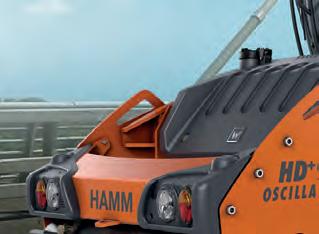
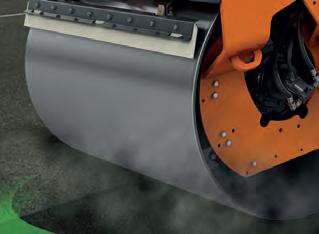
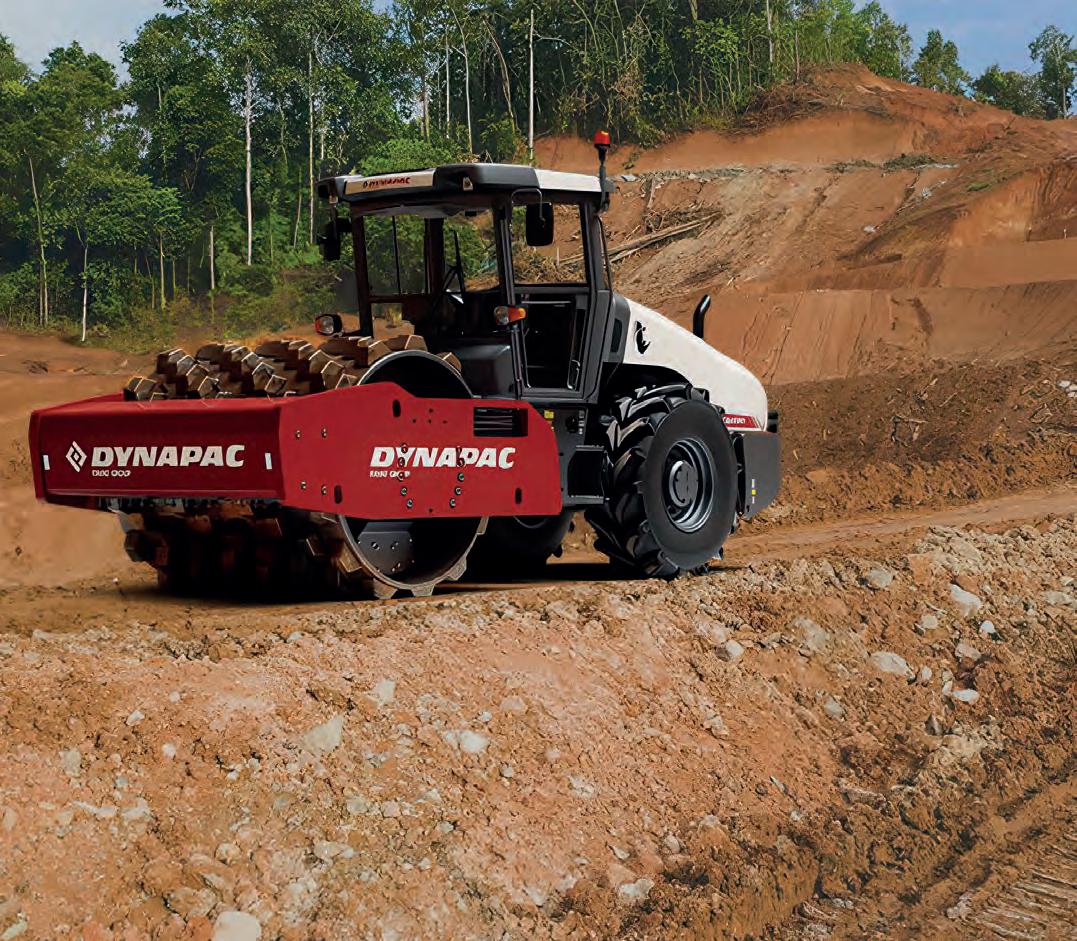
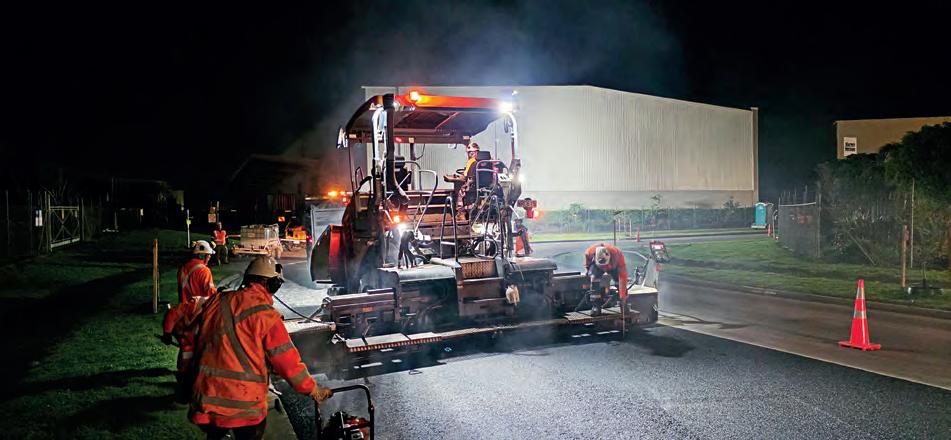
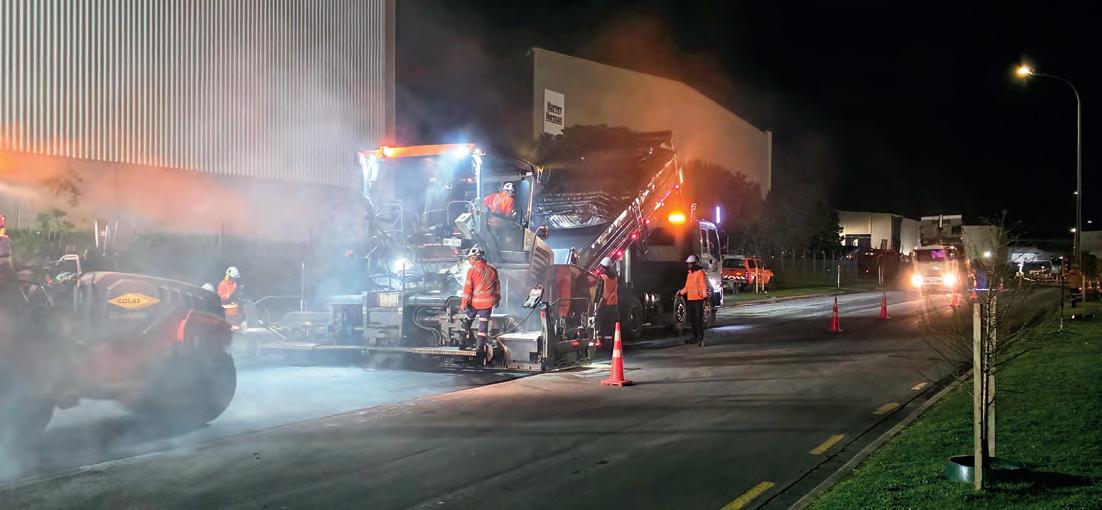
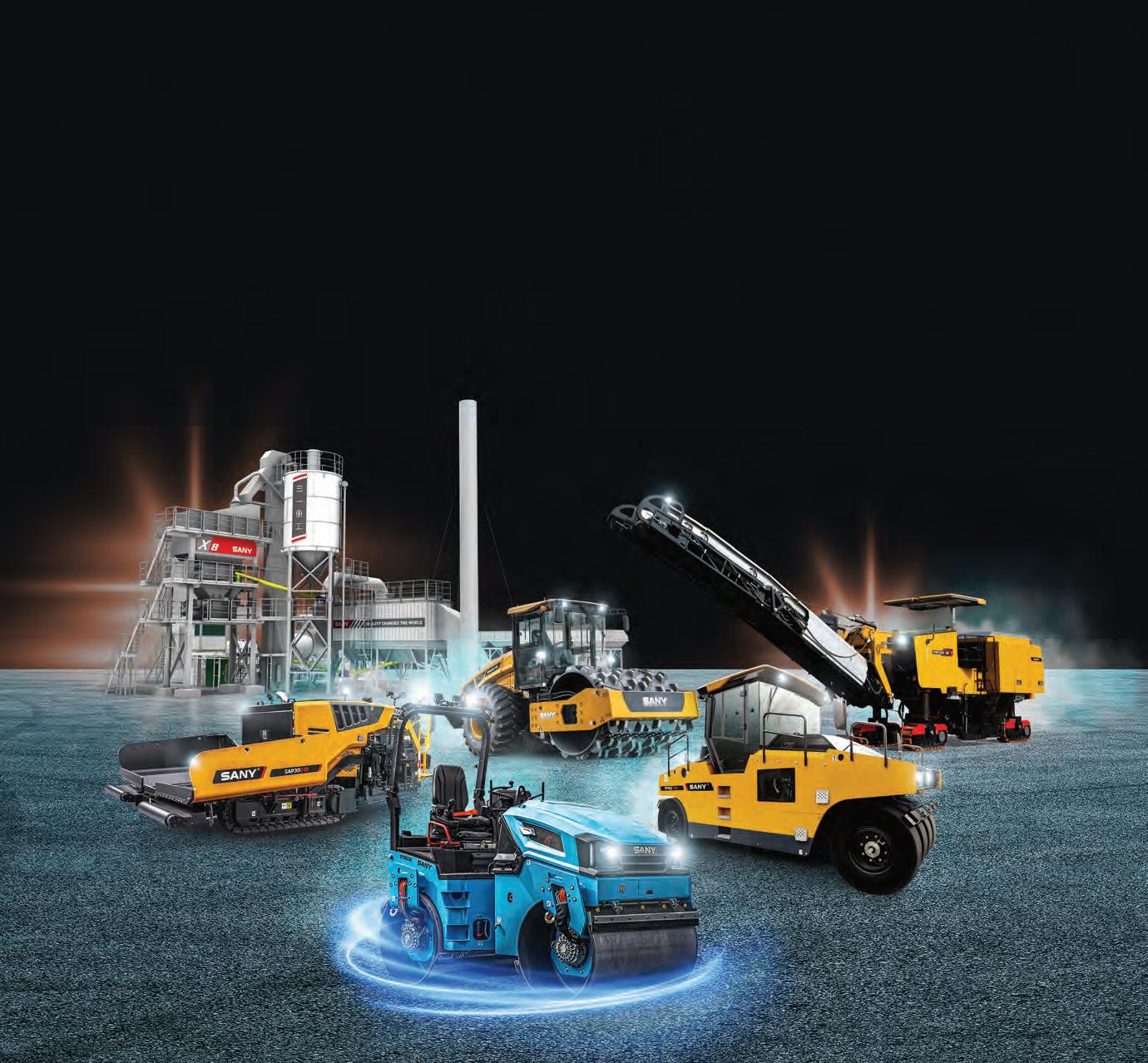
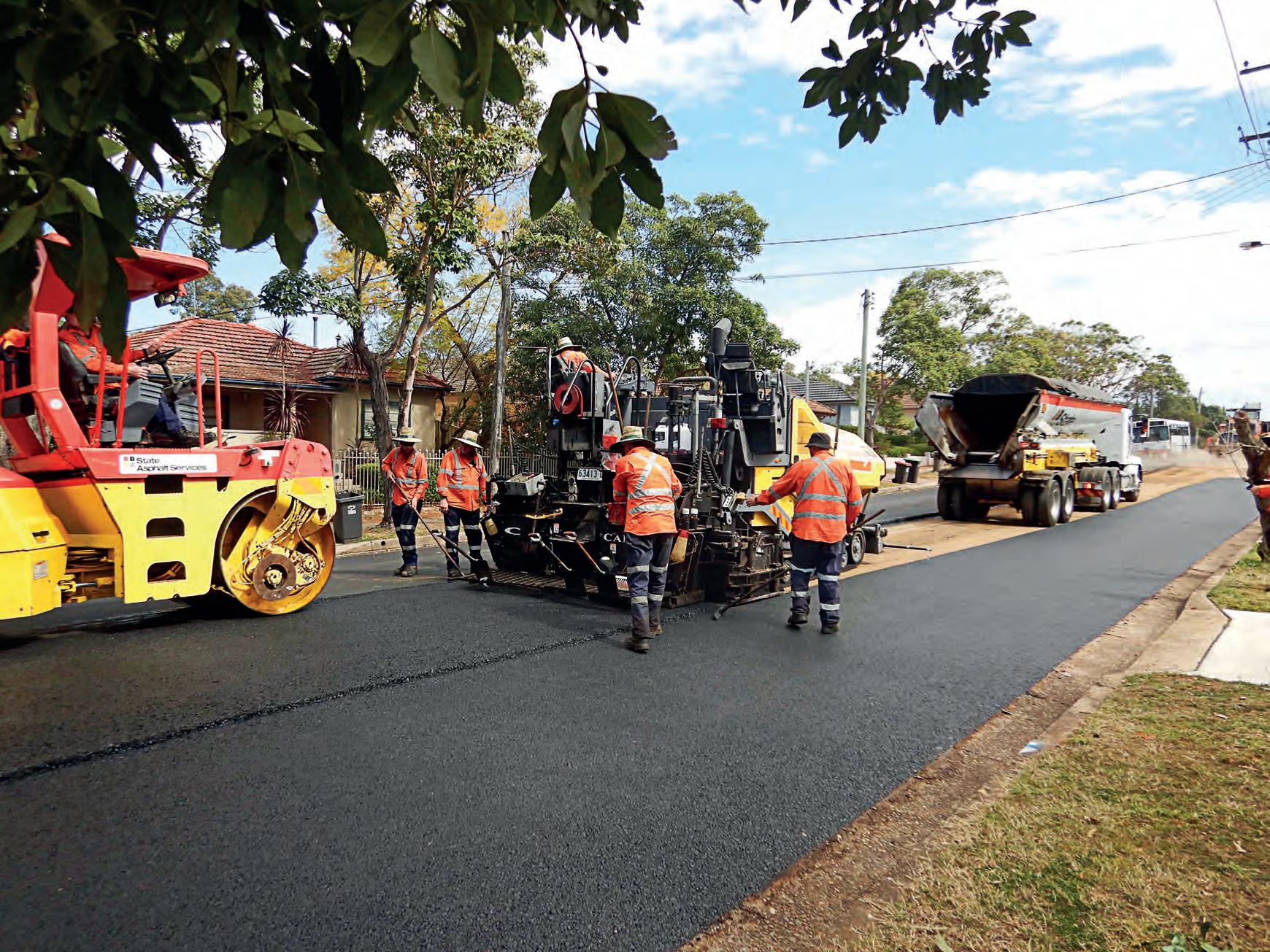
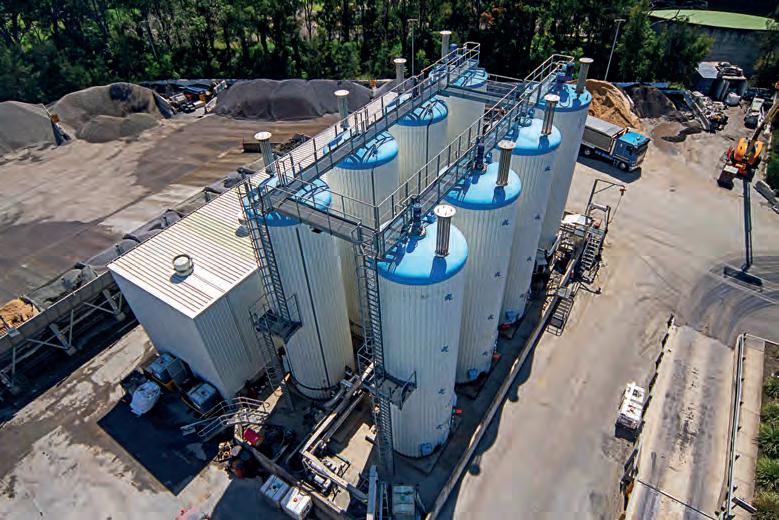
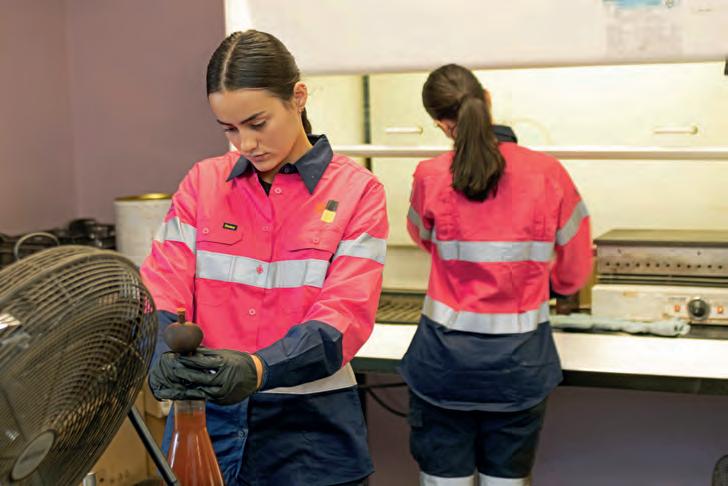
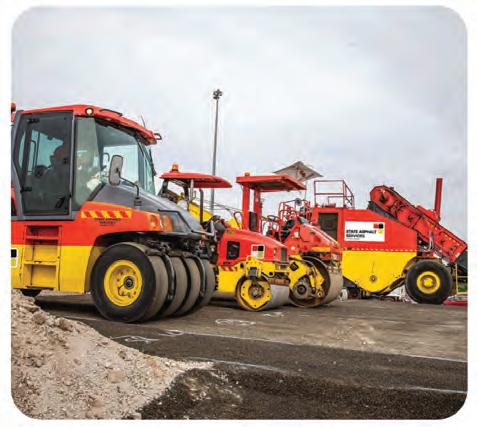
CLOSE TO OUR CUSTOMERS. For decades, HAMM oscillation has been the go-to compaction method for quality results on sensitive asphalt mixes like SMA and EME-2, especially around vibration sensitive assets like pipelines, bridge decks and buildings. Now HAMM has introduced Smart Compact Pro - another breakthrough in compaction efficiency that incorporates real-time density on the fly. Do you want to be known for producing quality pavements, quickly and with less re-work? Let Hamm help.
COVER STORY
14 Building piece by piece Putzmeister Oceania has grown from a German pioneer to a global construction giant.
ROADS REVIEW
17 Roads Review
This month, we asked the industry’s decisionmakers, ‘How can sustainable thinking transform infrastructure and transport projects, beyond the obvious environmental benefits?’
PROJECT SPOTLIGHT
18 Sustainably safe and sound Kyriacou Architects and BKK Architects have collaborated to develop a unique recycled plastic formulation, which has been integrated into Victoria’s North East Link project.
SUSTAINABILITY
22 Crumb Rubber in Roads: Proven dustainability, delivered at scale
The sustainability of crumb rubber road surfacing on Australia’s national road network is explored.
25 Setting a national precedent
The SAMIGreen polymer has helped create a new standard for environmentally-friendly additive use in New Zealand.
Outstanding sustainability, safety and efficiency outcomes for the sector are front and centre in this edition of Roads & Infrastructure magazine.
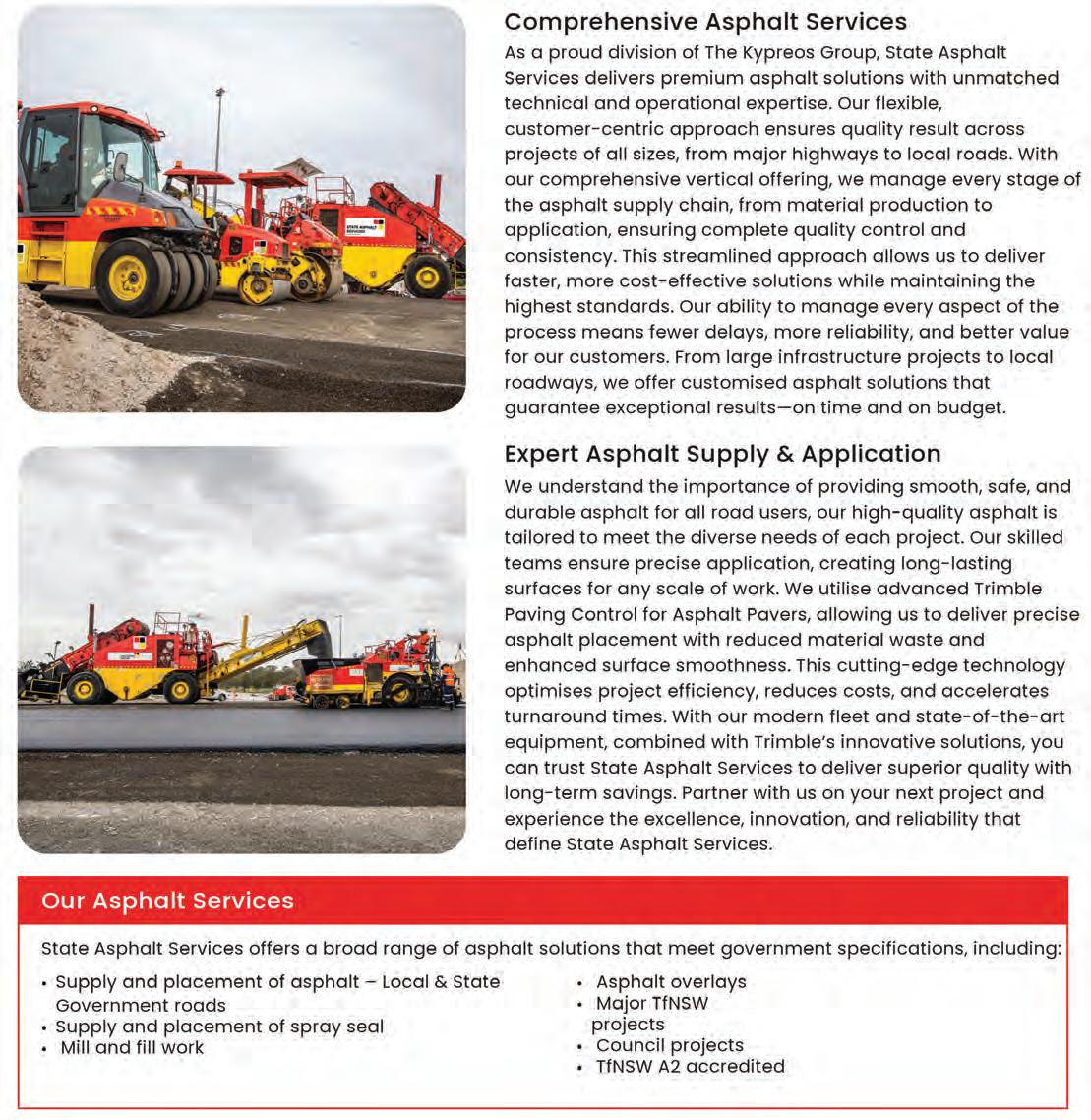
28 In the wheelhouse State Asphalts NSW is making a change to help develop a new generation of bitumen binders.
INNOVATION
31 Unprecedented insight
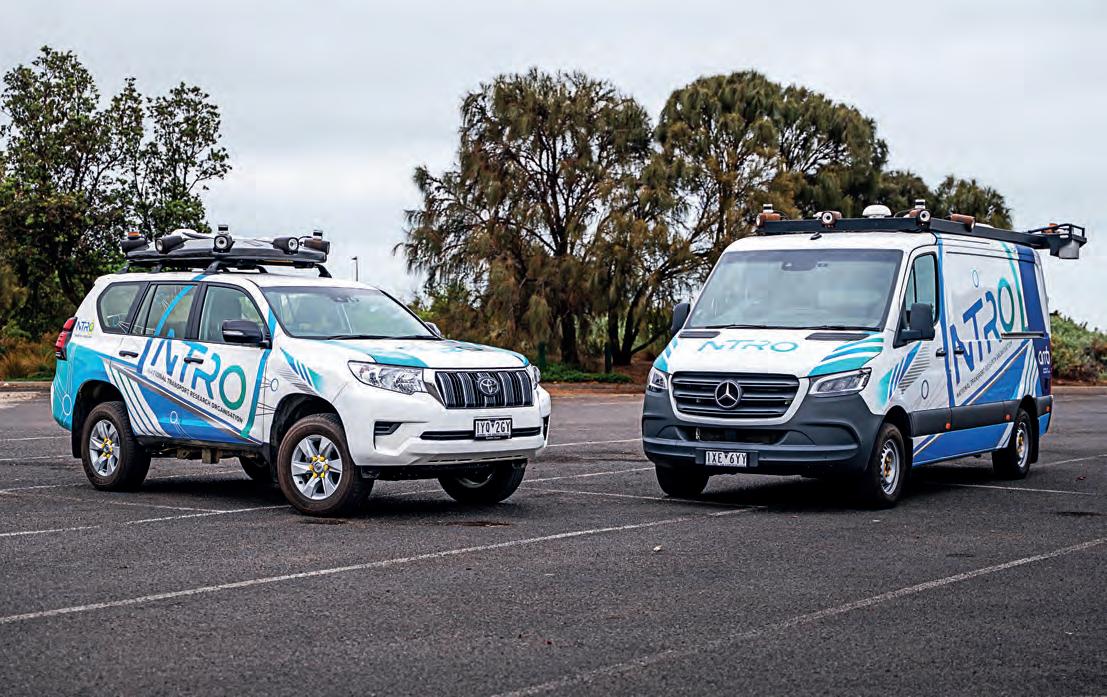
The National Transport Research Organisation is upgrading and expanding its-state-of-theart fleet.
TECHNOLOGY
34 A consistent presence Specalised Roading Equipment’s commitment to customer service is helping shape its current offerings.
MACHINERY & EQUIPMENT
36 Putting Australia first ‘Australian Made’ products, parts, designs and staff are helping to keep production local.
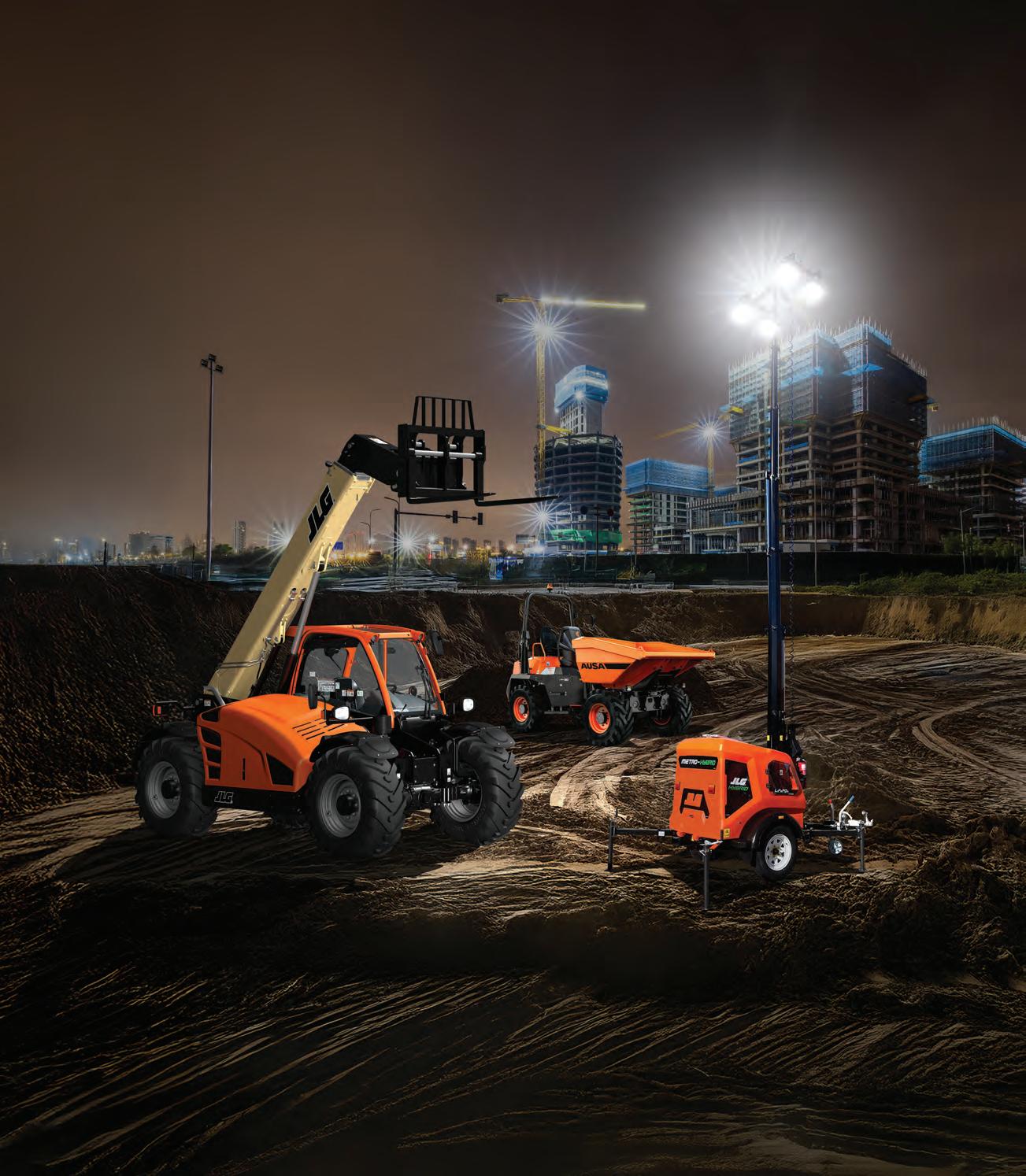
39 One-stop-shop for roads and infrastructure JLG provides a comprehensive customer service experience with its access equipment capabilities.
42 New path to stabilisation
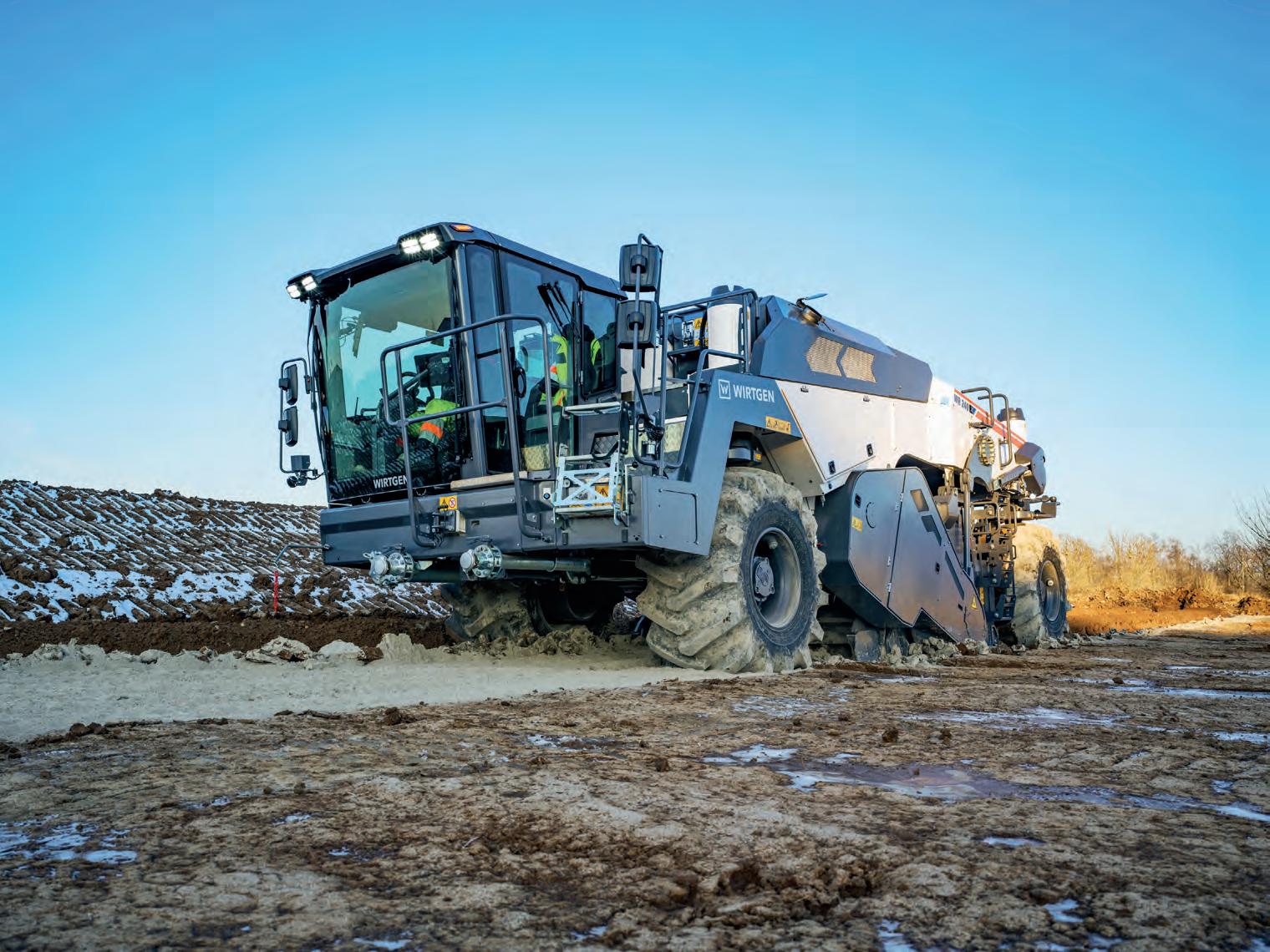
Wirtgen’s newest generation of WR series stabilisers marks a new era for cold recycling and stabilisation applications in the country.
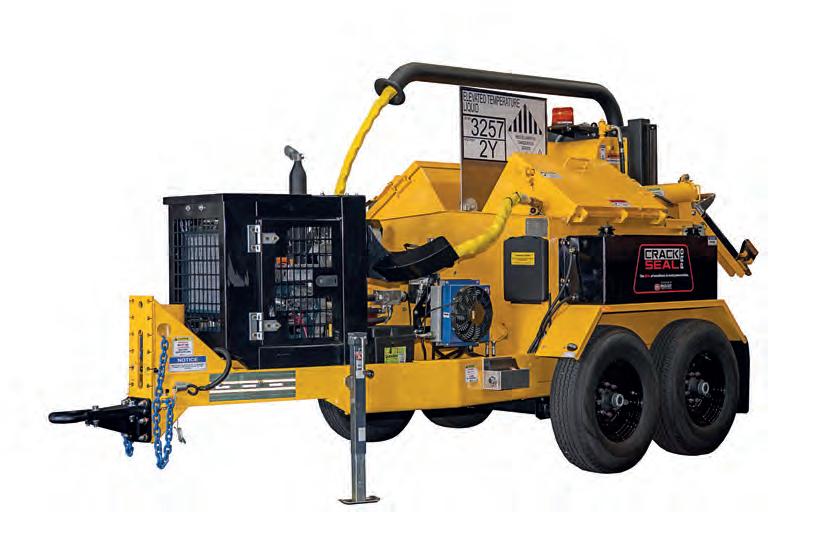
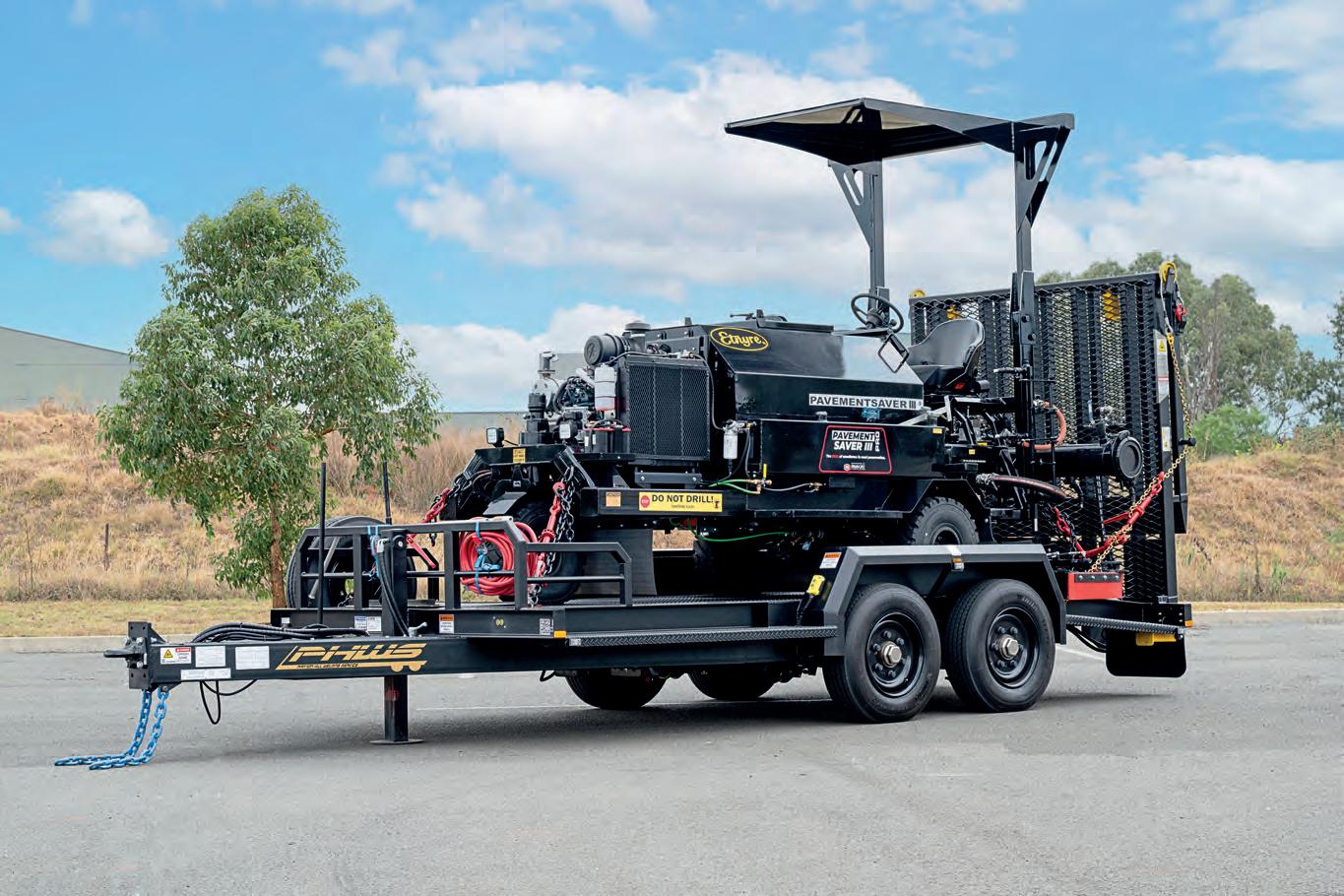
44 Not growth, but progress Muscat Trailers’ new product range is ushering in a new era for the business.
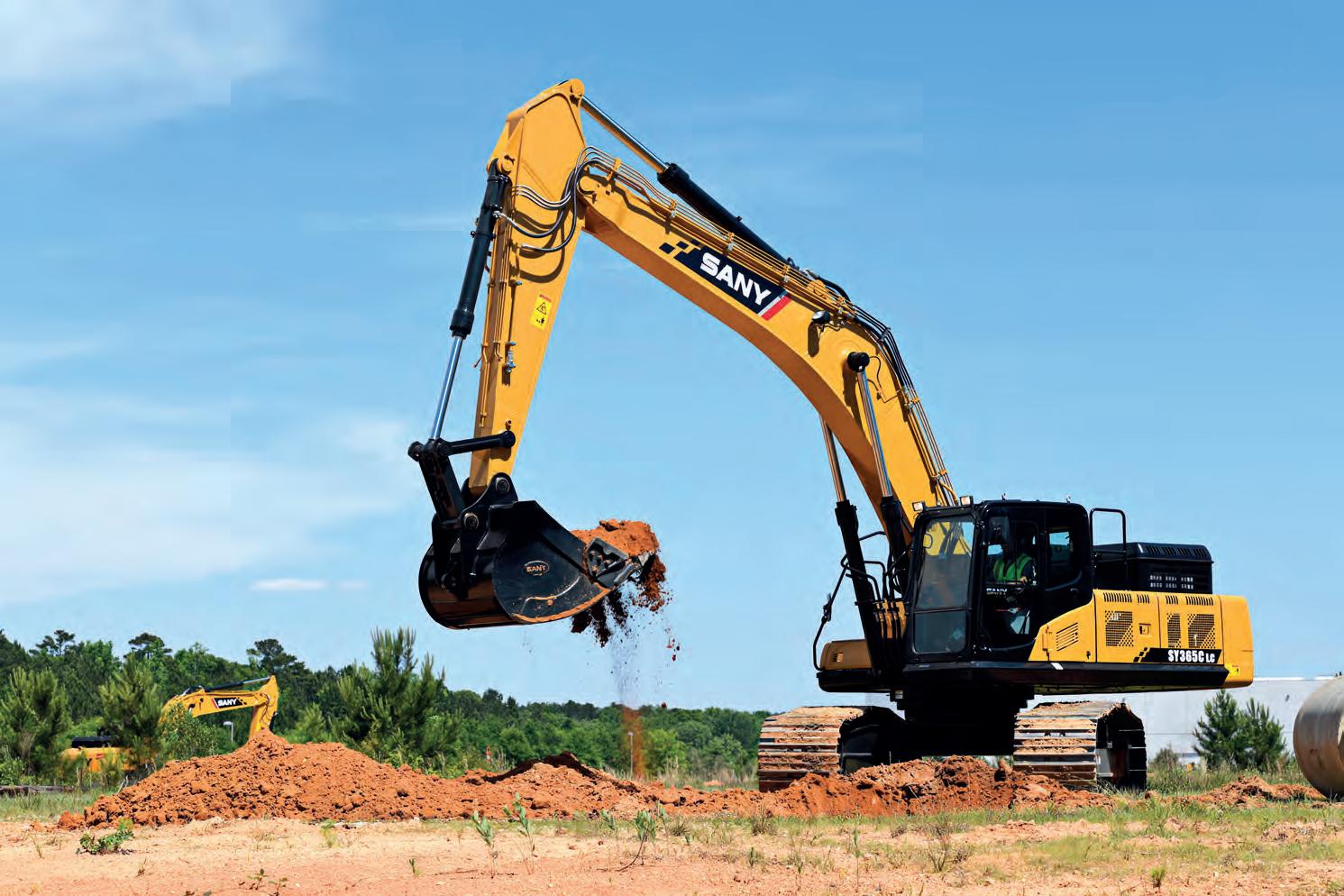
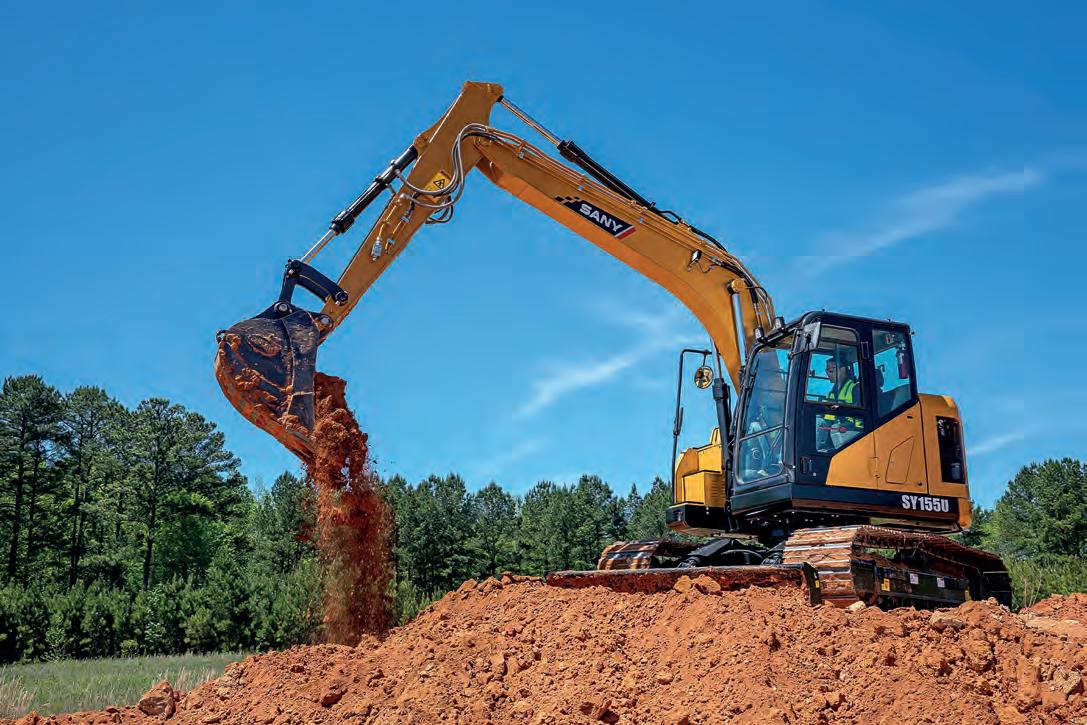
46 Spreading the love CEA has amplified its range of heavy equipment through a distribution partnership with SANY.
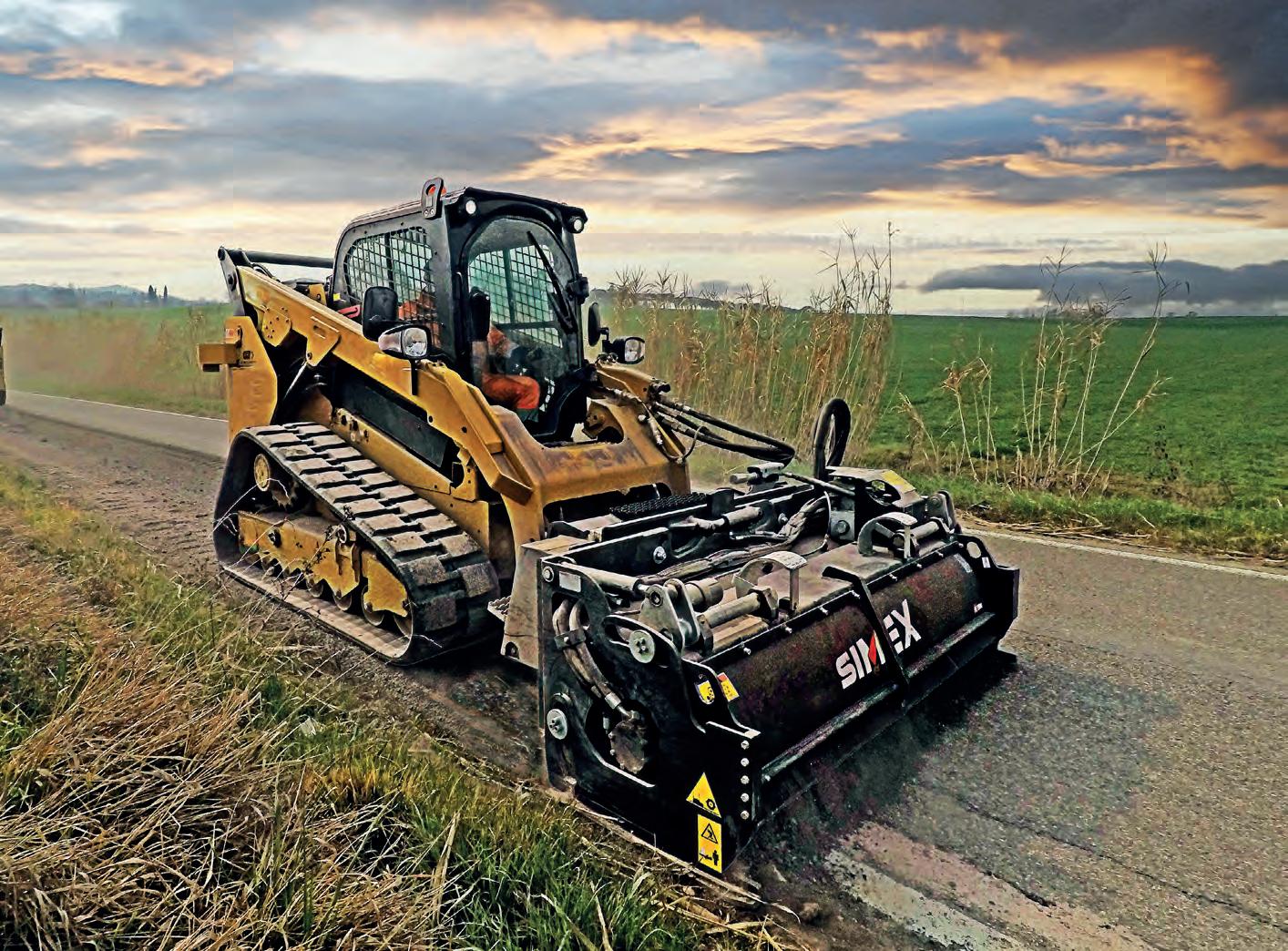
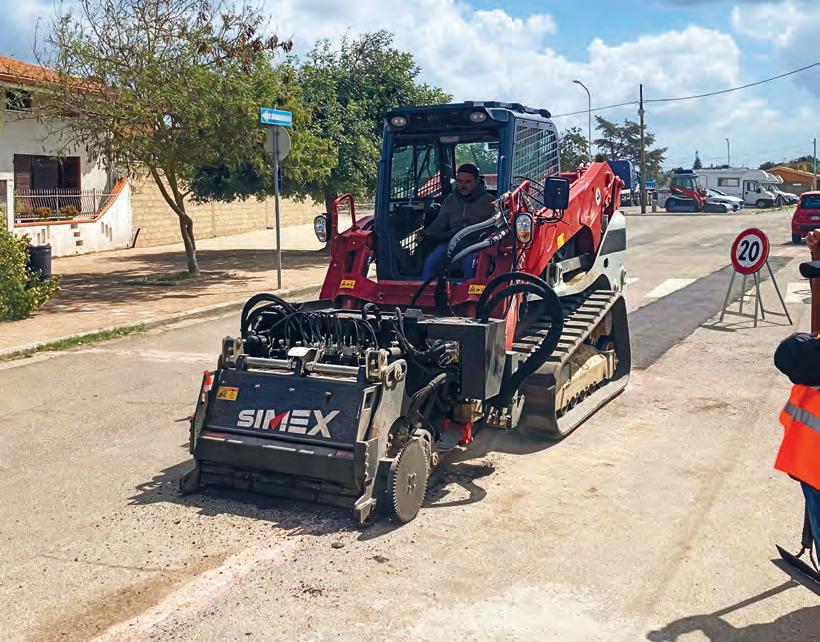
48 Peas in a pod SIMEX’s PL2000 and ART 1000 products are turning heads for their effective road work capabilities.
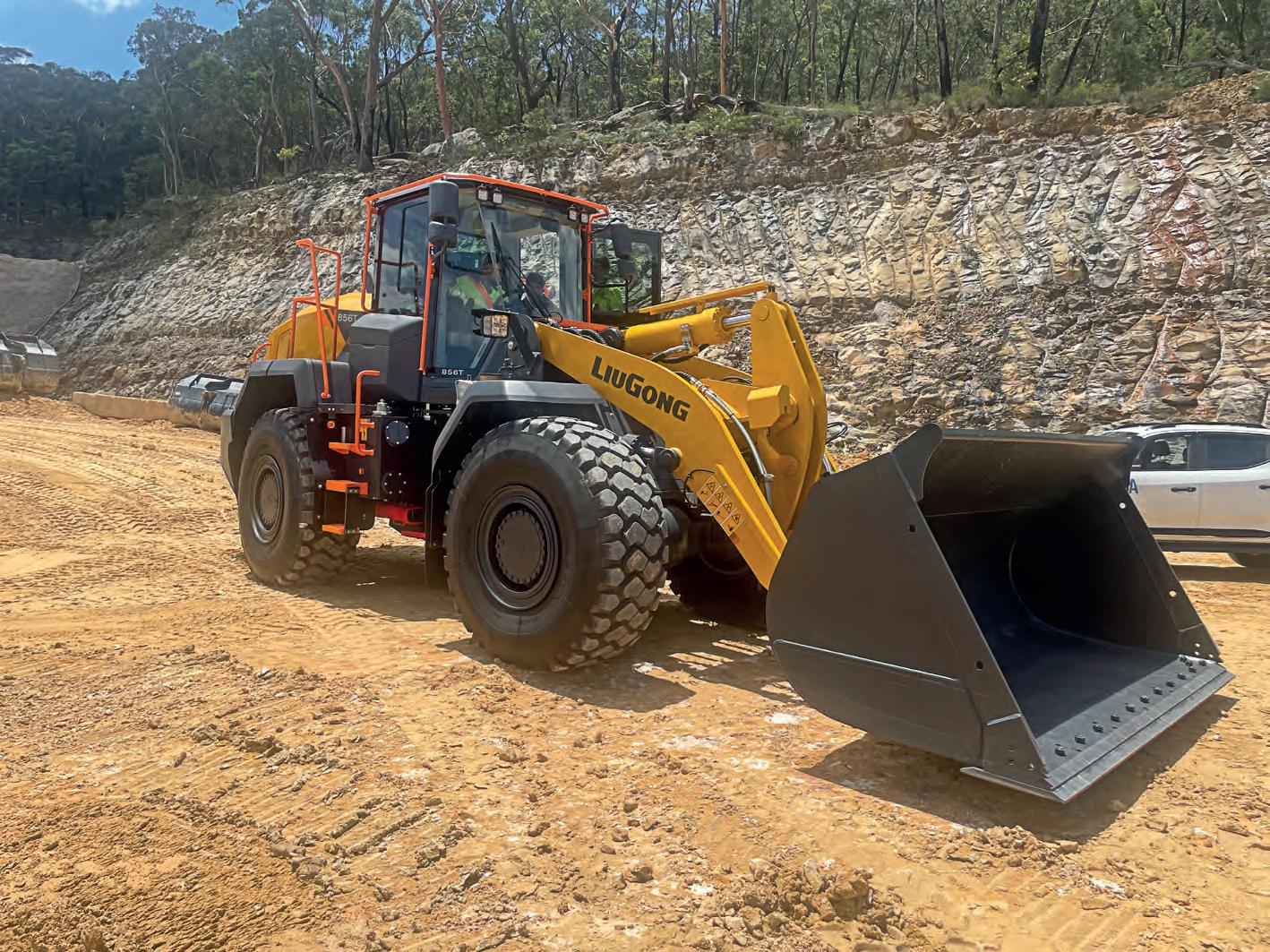
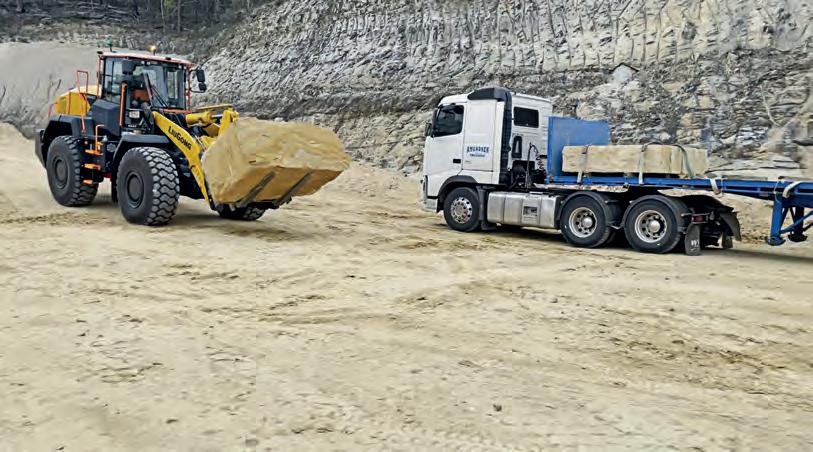
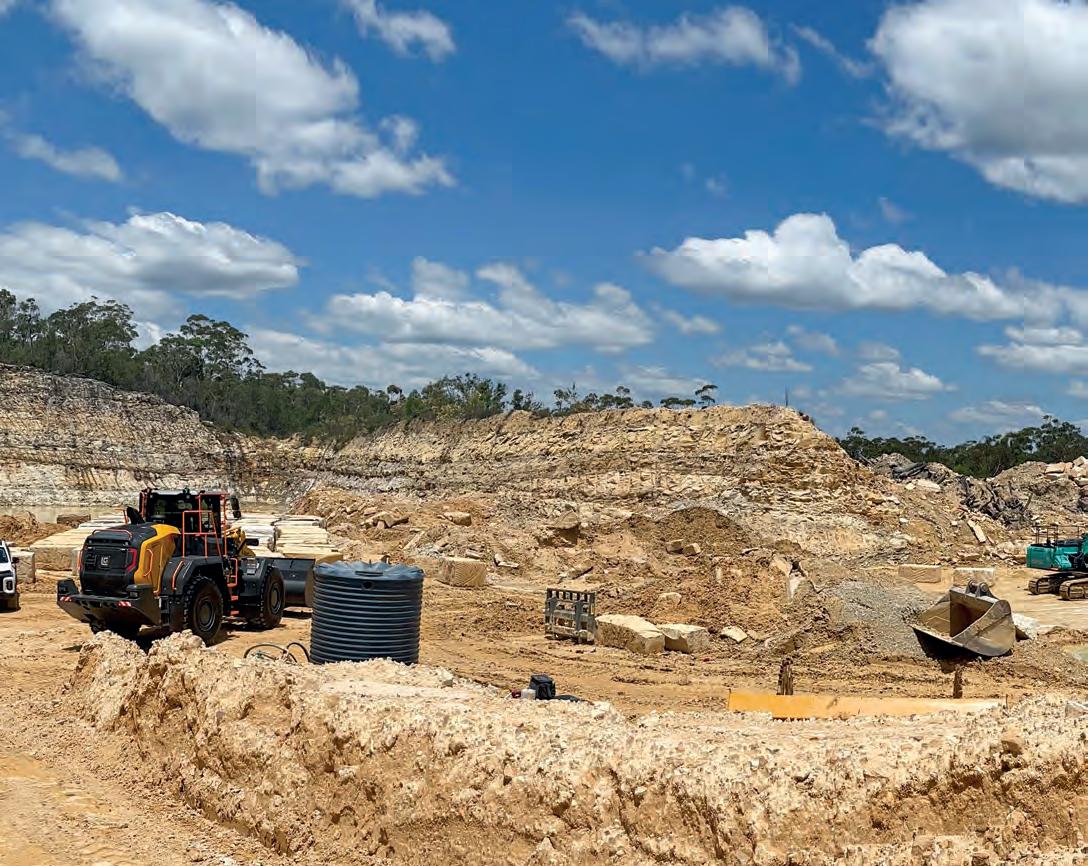
50 The chosen one LiuGong’s eminent 856T Wheel Loader has proven ideal for the demanding operations of New South Wales quarry operator, Australian Sandstone Merchants.
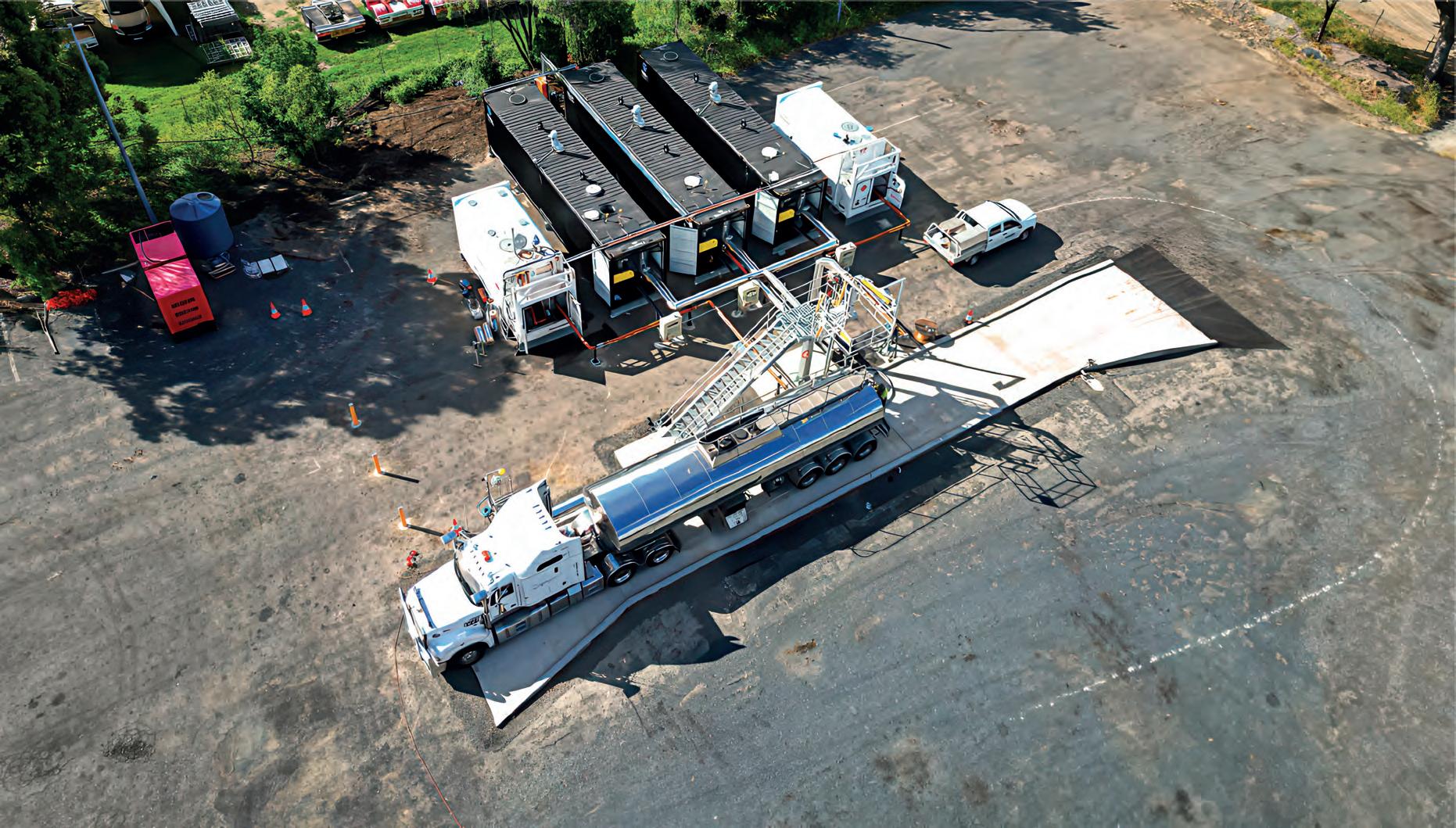
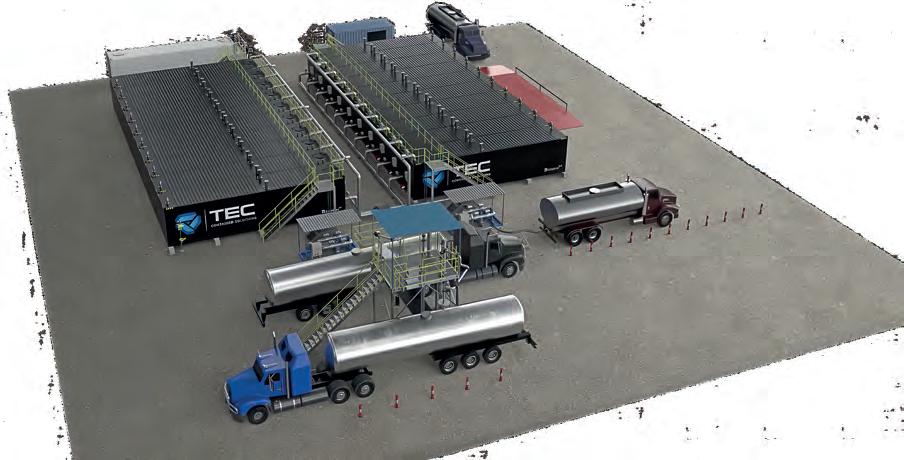
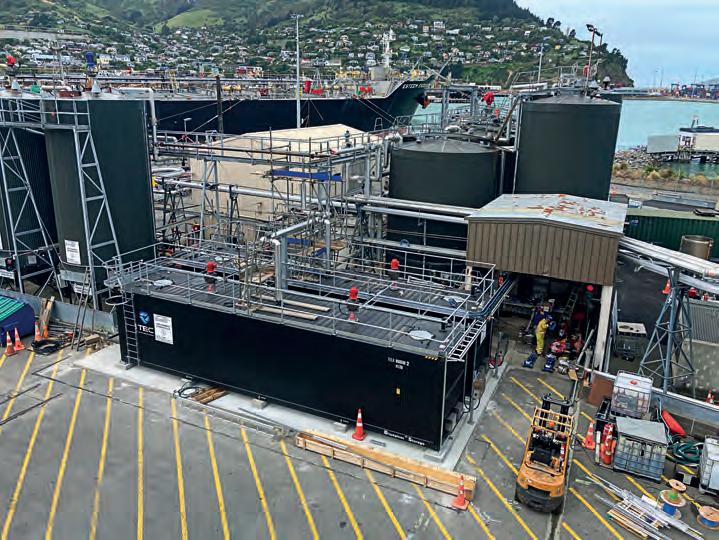
52 Paving the way TEC Container Solutions supports bitumen transport and storage with an iconic product line and unique solutions.
ASSOCIATION SECTION
54 Designing asphalt for circularity and long-term performance AfPA Projects Technical Advisor Trevor Distin discusses how Australia’s asphalt sector is constructing lower-carbon pavements.
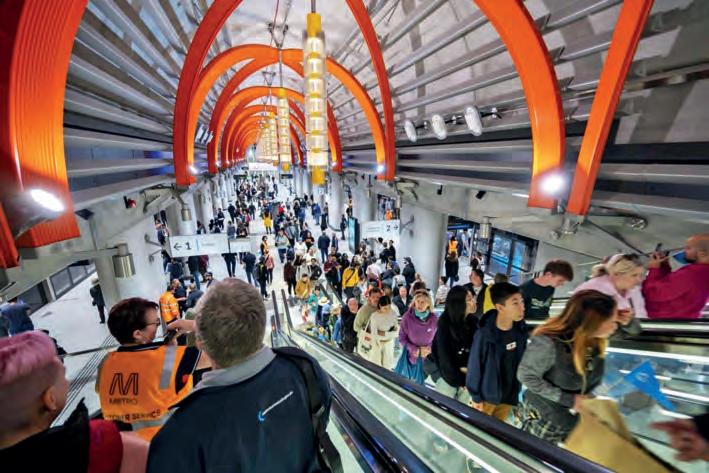
57 Precision in motion: Record-breaking precast for Sydney Metro West ACCIONA and project partner Ferrovial have achieved an extraordinary feat in engineering, automation and efficiency at the Eastern Creek precast facility.
Roads & Infrastructure Australia is available by subscription from the publisher. The rights of refusal are reserved by the publisher.
ARTICLES
All articles submitted for publication become the property of the publisher. The Editor reserves the right to adjust any article to conform with the magazine format.
COVER IMAGE
Putzmeister
COPYRIGHT
Roads & Infrastructure Australia is owned and published by Prime Creative Media. All material in Roads & Infrastructure Australia is copyright and no part may be reproduced or copied in any form or by any means (graphic, electronic or mechanical including information and retrieval systems) without the written permission of the publisher. The Editor welcomes contributions but reserves the right to accept or reject any material. While every effort has been made to ensure the accuracy of information, Prime Creative Media will not accept responsibility for errors or omissions or for any consequences arising from reliance on information published. The opinions expressed in Roads & Infrastructure Australia are not necessarily the opinions of, or endorsed by the publisher unless otherwise stated.
SUSTAINABILITY FRONT AND CENTRE
AND JUST LIKE THAT, we’re a quarter of the way through 2026. Don’t be too shocked though, working in a sector as dynamic, innovative and jam-packed as the roads and infrastructure segments tends to make time fly!
Our focus for the March 2026 edition of Roads & Infrastructure magazine is once again sustainability, and looking back to our previous sustainability theme, the advancement and progress made between then and now is astounding. Each change and improvement may seem micro, but together, the industry can unite to make a concentrated and macro change to the way projects are fundamentally delivered. Sustainability is everyone’s responsibility.
In this edition, sustainable binders and road construction methods are front and centre. SAMI Bitumen Technologies has supported its sister company COLAS New Zealand to deliver one of the nation’s first road projects incorporating a low carbon intensive asphalt binder. While State Asphalts NSW is moving in a slightly new direction, using its vast industry expertise and connections to develop a new line of ultra-low carbon binder designs for industry.
Likewise, Muscat Trailers has created a brand-new arm of the business to focus exclusively on road preservation methods. “By preserving rather than replacing, these solutions reduce waste, lower emissions, and support more sustainable outcomes for the communities we serve,” says Troy Azzopardi, General Manager, who’s continuing his father’s legacy of innovation.
Tyre Stewardship Australia also has a key voice in this edition. As one of the country’s longest-standing and strongest supporters of sustainable material use, Tyre Stewardship Australia has played a major role in accelerating implementation of environmentally friendly products.
Stabilisation is yet another method helping to reduce material and fuel, while also reducing costs and delays caused by potential roadwork. Wirtgen’s newest entry in this space, the WR 240 X, represents the next generation of stabilisation potential across Australia.
Finally, we touch base with some of the industry’s experts to hear how sustainable thinking can transform projects, beyond the obvious environmental benefits.
Happy reading!
Tom O’Keane
TOM O’KEANE – EDITOR
AUSTRALASIAN RAILWAY ASSOCIATION PUBLISHES PROJECT RECOMMENDATIONS
The Australasian Railway Association has released a fresh series of recommendations regarding the financial support of state and territory infrastructure projects.
Among these submissions, which outlined the industry’s growth in revenue, job opportunity and other metrics, are a series of key recommendations that were provided to guide the success of future sector projects.
The submission first suggested that the Federal Government require all federal funded rail infrastructure projects to demonstrate clear alignment with integrated transport, land-use and urban settlement planning frameworks.
Commonwealth infrastructure was also recommended to be provided on a conditional basis, in order to support nationally consistent rail interoperability standards, digital systems, and modern construction and procurement practices.
Recommendations highlighted the need for the Federal Government to establish and maintain a sequenced, multi-year national rail infrastructure pipeline to improve transparency, reduce investment volatility, and moderate cost escalation across the sector.
Additionally, the submission expressed
that infrastructure funding allocations should be transparently linked to population growth, regional development needs, and nationally significant freight and passenger corridors.
It was also recommended that all state and territory rail projects seeking federal funding should now be supported by independently assessed business cases that consider network-wide benefits, interoperability, whole-of-life costs, and the impact of delivery days.
Governments were recommended to seek bipartisan support for major rail infrastructure projects with delivery timeframes extending beyond a single electoral cycle, to minimise project disruption and cost inefficiencies.
Meanwhile, the submission suggested that digital rail upgrades, signalling modernisation, network optimisation and climate resilience works be explicitly recognised as eligible infrastructure investments for federal funding.
Project assessment frameworks should now need to apply clear and consistent criteria that evaluates economic, social, environmental, cultural and community impacts, including alignment with national Net Zero emissions targets.
According to the submission, Federal Government funding decisions should prioritise whole-of-life value and longterm performance outcomes over lowest upfront capital cost.
It has also been recommended that the Federal Government should look to strengthen federal oversight and public reporting requirements for federally funded rail projects, including cost, schedule, scope and benefit realisation metrics.
Finally, the Federal Government is being pushed to establish a national, publicly accessible infrastructure lessons-learned repository, modelled on international best practice, to improve governance and delivery outcomes across jurisdictions.
“RECOMMENDATIONS HIGHLIGHTED THE NEED FOR THE FEDERAL GOVERNMENT TO ESTABLISH AND MAINTAIN A SEQUENCED, MULTI-YEAR NATIONAL RAIL INFRASTRUCTURE PIPELINE TO IMPROVE T RANSPARENCY, REDUCE INVESTMENT VOLATILITY, AND MODERATE COST ESCALATION ACROSS THE SECTOR.”
The Australasian Railway Association’s recommendations highlight potential amendments to the development process of state and territory infrastructure projects. Image: The Australasian Railway Association
$148M BRIDGE DUPLICATION SECTION OPEN TO TRAFFIC
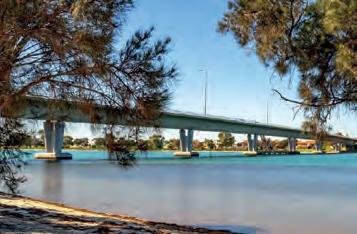
The $148.8 million Mandurah Estuary Bridge Duplication has reached a major milestone, with an upgraded structure now enabling westbound traffic to flow, as works continue on the project in Western Australia.
The existing Mandurah Estuary Bridge provides traffic access to and from southern Mandurah and is currently used by more than 33,000 vehicles every day.
A permanent switch of westbound traffic has taken place from the existing bridge structure, across to what will be the new, upgraded and expanded Mandurah Estuary Bridge.
Eastbound traffic will remain as one lane across the old Mandurah Estuary Bridge while new asphalt is laid and other critical maintenance is undertaken, with traffic
already permanently shifted to two lanes since early March.
The entire Mandurah Estuary Bridge Duplication Project is on track for completion by the end of March, with
other major construction works progressing. These works include a new four-metrewide shared path under the new westbound estuary bridge, upgrades to the existing path under the old bridge, a new universally accessible fishing platform under the new bridge, three kilometres of noise walls and more amenity walls, vibrant coloured feature lighting; and yarning circles on the east and west foreshores under the bridges. By opening a second, two-lane bridge on the south side of the existing Mandurah Estuary Bridge, the duplication will slash congestion in Mandurah and Dawesville.
The $148.8 million Mandurah Estuary Bridge project is being jointly funded by the Federal and Western Australian governments.
ONE MILLION TRIPS COMPLETED ON THE WEST GATE TUNNEL
More than one million trips have now been taken through Victoria’s West Gate Tunnel since its opening in December, 2025.
Over 20 per cent of these trips have been completed by trucks, taking heavy vehicles off local roads and out of residential streets across the city’s inner west.
Congestion has been reduced in suburbs including Footscray, Seddon, Yarraville,
Spotswood and Altona North as a result of the tunnel’s direct underground freight route to the Port of Melbourne.
Traffic volume is expected to grow further as drivers and trucks continue to adapt to the new route.
The Victorian Government recommends motorists heading to the Melbourne CBD, Docklands, or the northern suburbs should take the left lanes into the tunnel, which also provide access to the Millers and Williamstown Road exits.
Above: The Mandurah Estuary Bridge Duplication is nearing completion. Image: Western Australian Government More
For access to south-east suburbs, drivers are advised to take the right express lanes to the West Gate Bridge.
Motorists can also use the West Gate Tunnel to bypass the West Gate Bridge during incidents by taking the lanes to the tunnel, exiting at Wurundjeri Way and then using Flinders Street and Montague Street to re-enter the freeway before CityLink’s Burnley Tunnel.
ROAD UPGRADES ANNOUNCED FOR KEY VIC INTERSECTION
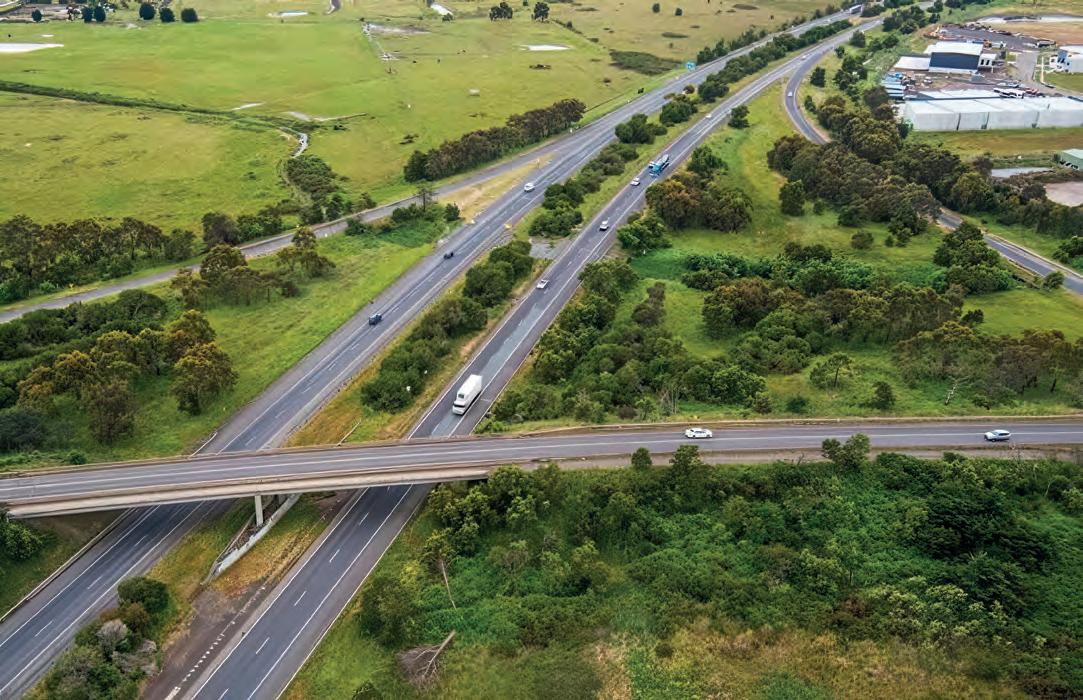
The Federal and Victorian governments have announced an upgrade to the intersection of Northern Highway (High Street) and Watson Street in Wallan, to improve travel times and increase safety for drivers in Melbourne’s north.
The Northern Highway Intersection Upgrade will see additional lanes built on the Northern Highway in both directions at the intersection of High Street and Watson Street, in addition to a second right-turn lane from Watson Street into the Wallan township.
These works will make navigating the area easier for drivers.
This project is part of the larger Watson Street Interchange Upgrade, which will deliver new entry and exit ramps to create a full diamond interchange where Watson Street meets the Hume Freeway.
The ramps will give locals new connections to the Hume Freeway, helping them avoid congestion where the Northern Highway intersects the Hume Highway further south.
The new ramps at the Hume Highway south of Watson Street and now the intersection upgrade at Watson Street and the Northern Highway will also significantly improve access for people
NEW ELECTRIC BUS DEPOT OPENS IN VIC
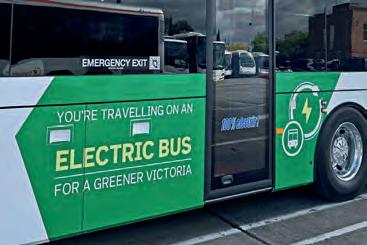
The Victorian Government has opened a new electric bus depot in Preston, accelerating the state’s transition from diesel buses to Zero-Emission Buses (ZEBs).
The Preston depot features a Victorianfirst overhead gantry charging system that increases space and capacity for the new ZEB fleet to support the state’s journey to reach net zero emissions by 2045.
The ZEBs will phase out some older diesel buses which are currently moving thousands of passengers each day.
The Preston facility is also supporting the training of five additional workers – helping to transition bus maintainers to more modern and sustainable technology.
Up to 58 electric buses will operate out of the Preston depot, travelling more than 2.8 million kilometres each year across Melbourne’s northern suburbs.
The modern buses and Preston’s fully electric bus depot are part of the new Metropolitan ZEB Franchise contracts, designed to fully transition a third of the metropolitan bus fleet to ZEBs by 2035, accounting for 600 diesel buses and saving an estimated 45,000 tonnes of carbon emissions annually.
Later this year, the State Government will begin ZEB trials in regional Victoria, helping small and medium-sized regional bus operators prepare for the transition.
Improving the bus network is a key focus of Victoria’s Bus Plan, which aims to meet growing demand,
travelling in, out of and around Wallan.
Pedestrians and cyclists will also benefit from the upgrade, with the existing shared-use path along Watson Street upgraded, and new street lighting and signage to be installed.
Early works on the Northern Highway Intersection will be delivered by Ace Infrastructure, and are scheduled to begin next month.
Major construction on this intersection is expected to start in April.
This announcement comes as major works begin this week for the larger Watson Street Interchange Upgrade.
boost accessibility and performance for passengers.
Since its launch, the plan has upgraded more than 126 bus networks and added over 11,000 extra weekly services, giving Victorians more reliable and convenient public transport.
Above: The new electric bus depot in Preston will expedite Victoria’s transition from diesel buses to Zero-Emission Buses. Image: Victorian Government
Road upgrades will be delivered to a critical intersection in Victoria. Image: Victorian Government
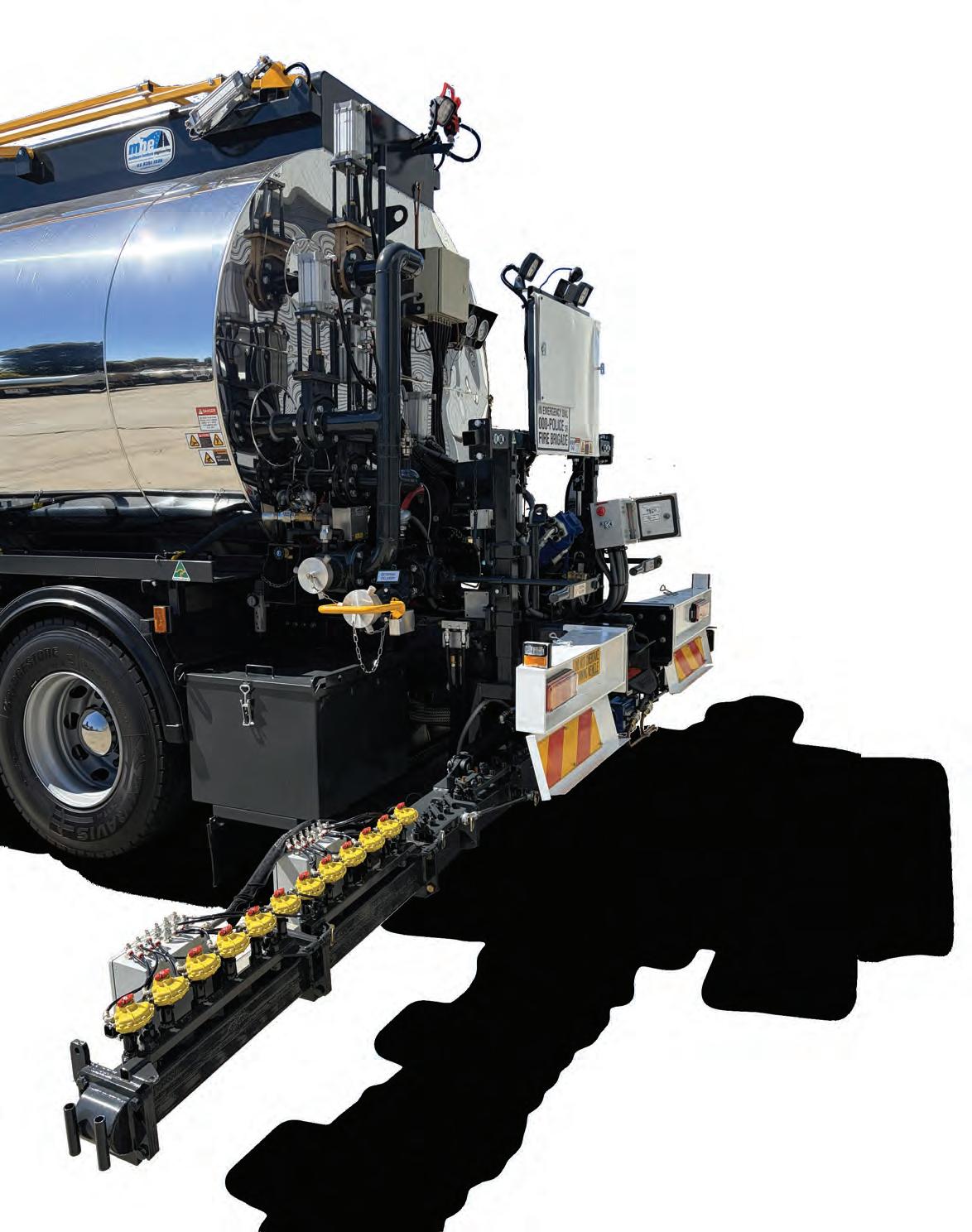
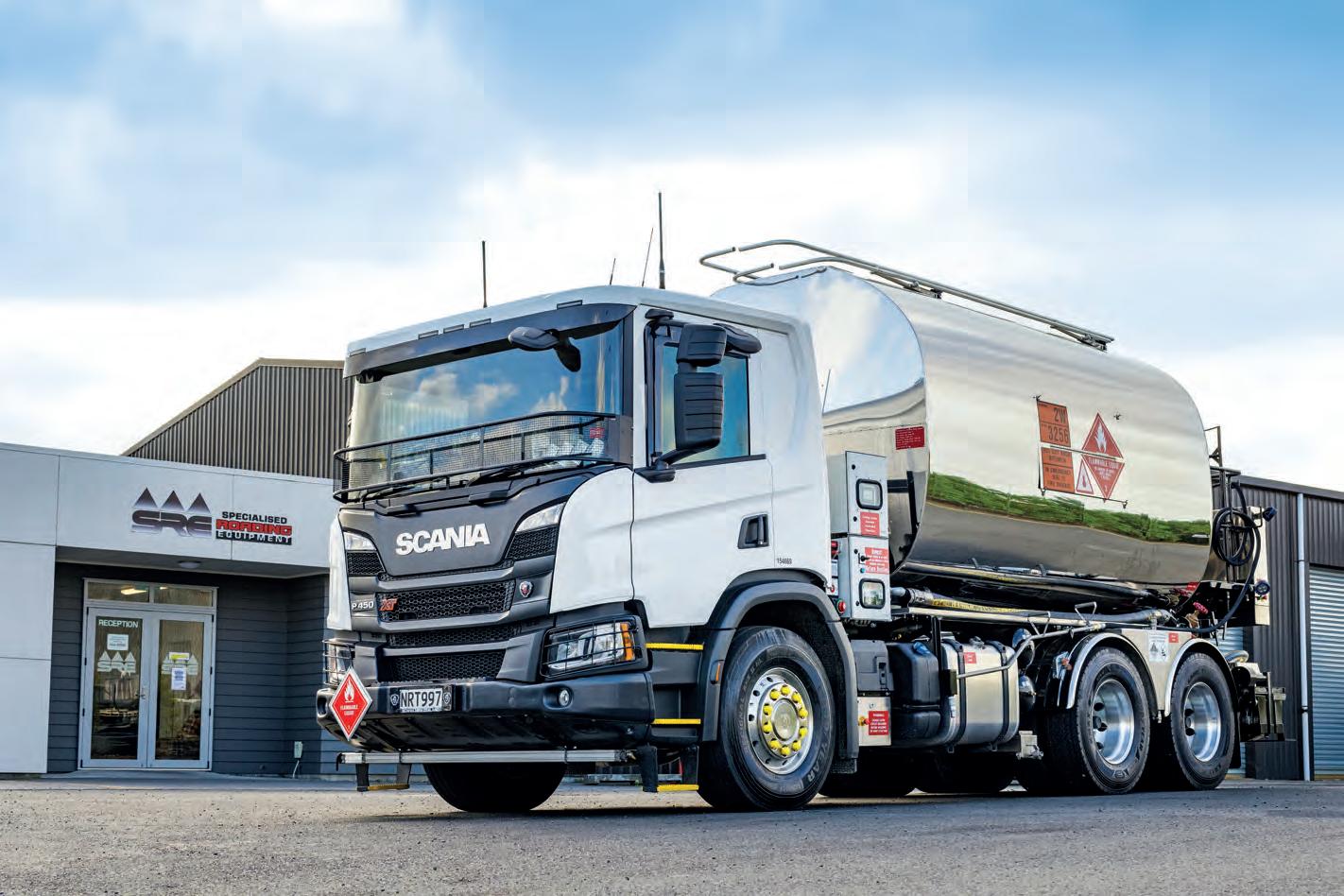
SRE’s telescopic bitumen sprayers or our newly developed 8m fixed wing bitumen sprayers are available for early 2027 delivery.
Fully compliant with all Australian regulations our sprayers meet all Austroads performance requirements for bitumen sprayers and are ready to go straight to work.
GREEN LIGHT FOR NEXT PARAMATTA LIGHT RAIL STAGE
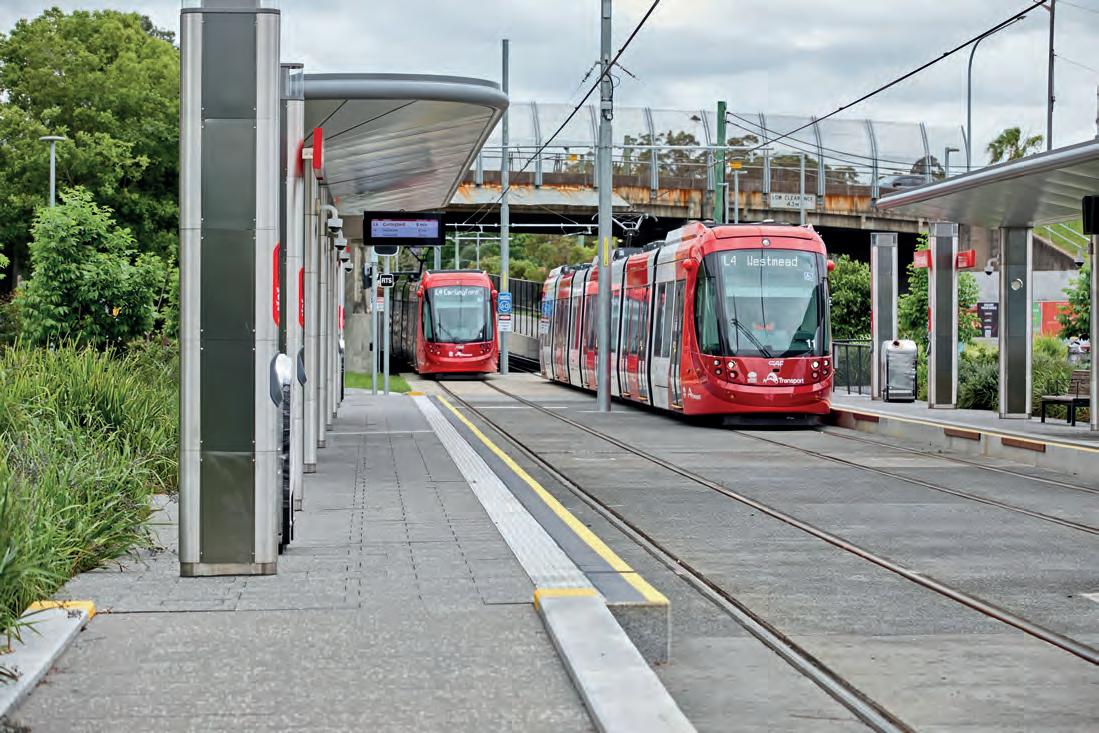
The second stage of the Parramatta Light Rail project in New South Wales has received the green light for main works to begin, marking a significant milestone on the project.
Construction is expected to get underway in early 2027 on the 10-kilometre route, which will connect Camellia, Rydalmere, Ermington, Melrose Park, Wentworth Point and Olympic Park over 14 light rail stops.
Main works on the project will deliver 4.5 kilometres of new track, nine new stops, additional light rail vehicles, an expanded
stabling and maintenance facility, as well as a new bridge linking Camellia and Rydalmere.
With funding to date of $3 billion, Stage Two will link to the existing Parramatta Light Rail system which carries up to 90,000 passengers a week.
Major construction is already underway on the first phase – the enabling works for Stage Two, which includes the construction of piles that will hold the first new public and active transport bridge crossing of the Parramatta River in
more than three and a half decades. Procurement will soon begin on the next phase of construction works, known as Stage 2A. This is in addition to the procurement of the Main Works contract.
The project will now focus on early works, site investigations, detailed utility designs, and commencement of property acquisitions.
Stage One of the Parramatta Light Rail opened in December 2024, providing a 12-kilometre line with 16 stops, connecting Westmead to Carlingford.
VIC COMPLETES METRO TUNNEL INTEGRATION WITH THE BIG SWITCH
The Victorian Government’s ‘Big Switch’ has been completed on the Metro Tunnel, adding more than 1200 new weekly train services to the state’s public transport system, along with new regional services and bus timetables.
For many train lines, such as the Sunbury, Cranbourne and Pakenham lines, service frequency has increased to every three minutes between Dandenong and West Footscray.
Outside these peaks, trains on these lines will run at least every 10 minutes as part of a ‘turn-up-and-go’ network between the city and Watergardens from 6am to 9pm, while running in similar intervals between the city and Dandenong from 6am to midnight.
The Werribee and Williamstown lines will temporarily run directly to Flinders Street Station, before connecting with the Sandringham Line later in the year to form a new cross-city service.
Regional passengers will benefit from
many additional services – 18 on the Traralgon line, 10 along the Seymour line and four on the Echuca line.
The Big Switch is the first instalment of new services that will be added to Victoria’s public transport network.
More frequent services will be added later in the year, including on the Werribee, Sandringham, Craigieburn and Upfield lines.
More than 800,000 passengers have visited the new Metro Tunnel stations since the project opened last November.
The ‘Big Switch’ will add new weekly train services to the state’s public transport system.
The first stage of the Parramatta Light Rail is already in operation.
Image: New South Wales Government
Image: Victorian Government
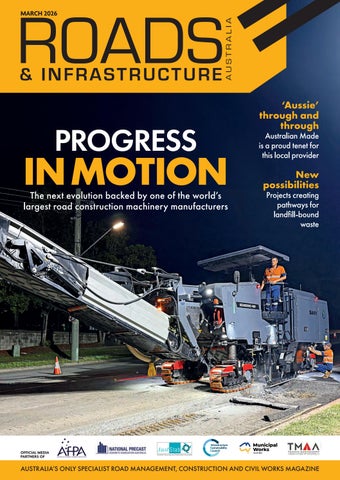
IN MOTION PROGRESS
PUTZMEISTER OCEANIA’S SANY ROAD MACHINERY DIVISION HAS EMERGED AS A MAJOR GROWTH FOCUS OVER THE PAST YEAR, ACCELERATING AS THE COMPANY BUILDS CAPABILITY AND PRODUCT DEPTH. GUIDED BY HEAD OF ROAD CONSTRUCTION, RYAN VAN DEN BROEK, THE MOMENTUM IS CLEAR – AND THIS IS ONLY THE BEGINNING.
For more than 40 years, Putzmeister Oceania has been a trusted name in Australia’s concrete pumping sector. A subsidiary of the German‑based Putzmeister Group and part of the wider SANY Group, the company expanded its local offering in late 2023, becoming the Australian distributor for SANY construction equipment, supplied through a national dealer network.
Built on decades of experience adapting global concrete pumping equipment to
Australia’s stringent standards, regulations and operating conditions, Putzmeister Oceania brings proven capability in localising machinery for the Australian market – a discipline now being applied to road machinery. Following the successful introduction of SANY’s construction equipment range, the business has made road machinery its next major growth focus. Leveraging SANY’s global product portfolio, Putzmeister Oceania has rapidly built capability, product depth
and local support for Australia’s road construction sector.
Backed by its long‑standing local presence and the engineering heritage of both Putzmeister and SANY, the company now provides local sales, service and technical support for a broad SANY road machinery range. This foundation has enabled the establishment of a purpose‑built road machinery division, developed over the past year under the leadership of industry veteran Ryan Van Den Broek. Drawing on
Putzmeister Oceania is increasing its foothold in the Australian market, with aggressive growth setting the company up for success.
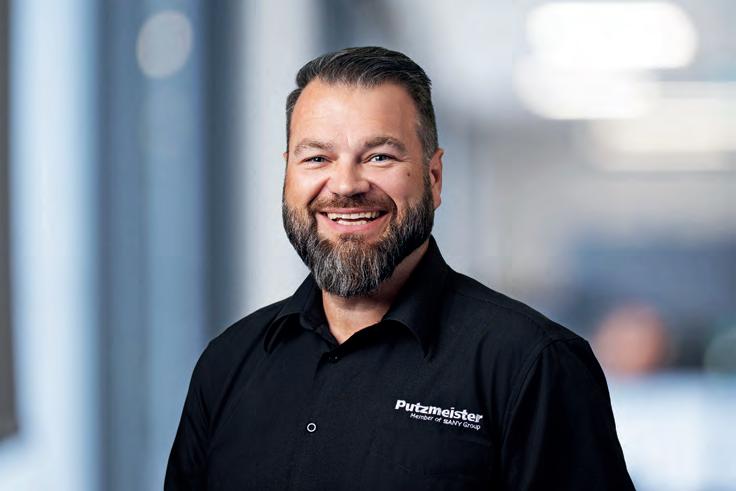
Ryan Van Den Broek, Head of Road Construction –Putzmeister Oceania.
more than 27 years in the asphalt sector, Van Den Broek has played a central role in shaping the division’s early direction, helping translate Putzmeister Oceania’s global capability into a locally focused road machinery offering that is already gaining traction in the Australian market.
In fact, it was this growth potential that caught Van Den Broek’s eye in the first place, as he explains.
“I’ve been lucky enough to be a part of the asphalt industry for 27 years. Coming from a mechanical background and service point of view, there’s been plenty of conversations with operators, service staff and a consistent perspective on how to make machinery better for the end user,” he says.
“Putzmeister Oceania had previously not had a major impact on the Australian market when it comes to road construction machinery. So, it was an area they were looking to grow and develop. They were also looking for someone who knew the lay of the land, and someone who could grab the division and run with it.”
Van Den Broek now oversees the development of Putzmeister Oceania’s entire domestic road construction division, while also contributing to engineering changes for machinery globally.
“For me, it’s a great opportunity to be a part of something lasting. The chance to redesign and re-evaluate existing machinery in the Putzmeister Oceania range, to make it more applicable to the western market, is really rewarding,” Van Den Broek says.
“We run very much a customer-first type of business model, and that’s the theme that I try and run through the whole division, because we need to look after our customers first and foremost. It’s as simple as that.”
COUNTRY STRONG
While Australian conditions present a challenge for machinery, so do Australia’s national specifications for new equipment.
“Australia has some of the strictest regulations, as well as some of the harshest environments that really put machinery to the test,” Van Den Broek says.
Whether it’s electrical systems and voltage, emissions, engines, safety features and more, adapting for the western market has required thorough examination of each unit and its capabilities.
As Van Den Broek explains, the main aim has been satisfying and surpassing
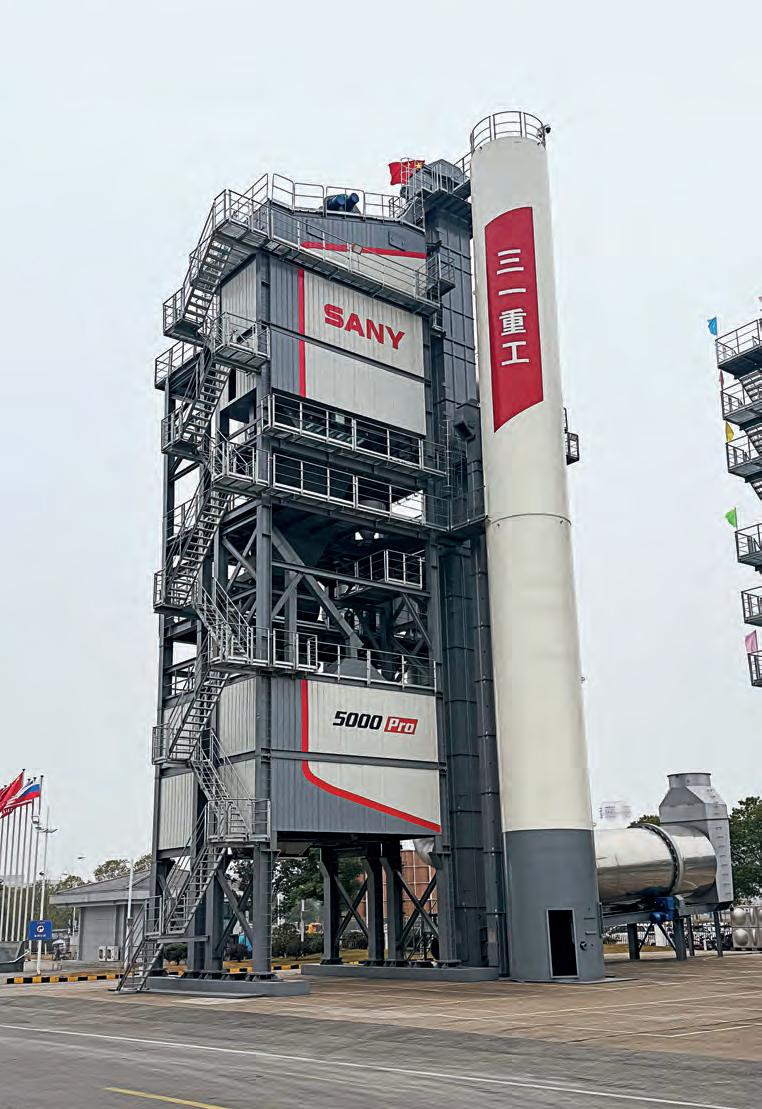
The equipment range, such as the company’s line of modular asphalt batch plants, continues to grow.
expectations around quality, compliance and user experience. This has also involved collaboration and discussions with Putzmeister’s international teams, as well as factory visits for face-to-face interactions with engineers.
“We’ve got higher standards than virtually anyone else in the world,” Van Den Broek says. “That means for us, it’s a mindset of ‘if we satisfy Australian regulations, we could satisfy requirements in a multitude of other places in the world. It’s about putting compatibility, usability and ease of use to the forefront.”
VAST RANGE
Putzmeister Oceania’s variety of machinery for the road construction industry was traditionally limited to rollers, but now
includes asphalt plants, asphalt pavers, profilers, wheel loaders and more.
One of the standout units from this vast range is the SAP 30C-10 paver. Fully adapted to meet Australian standards, this smaller paver model features a maximum paving thickness of 25 centimetres, as well as a paving width between 1.2 and 3.2 metres.
The SAP 30C-10 is also built tough, with its wear parts manufactured with thickened and wear-resistant steel plates, further supported by the double layer anti-twist beams featured on the high strength screed.
“We’ve already put seven of these units into play in the past 12 months, which is quite the feat, considering how we were placed not too long ago in the Australian market,” Van Den Broek says.
Images:
Putzmeister Oceania
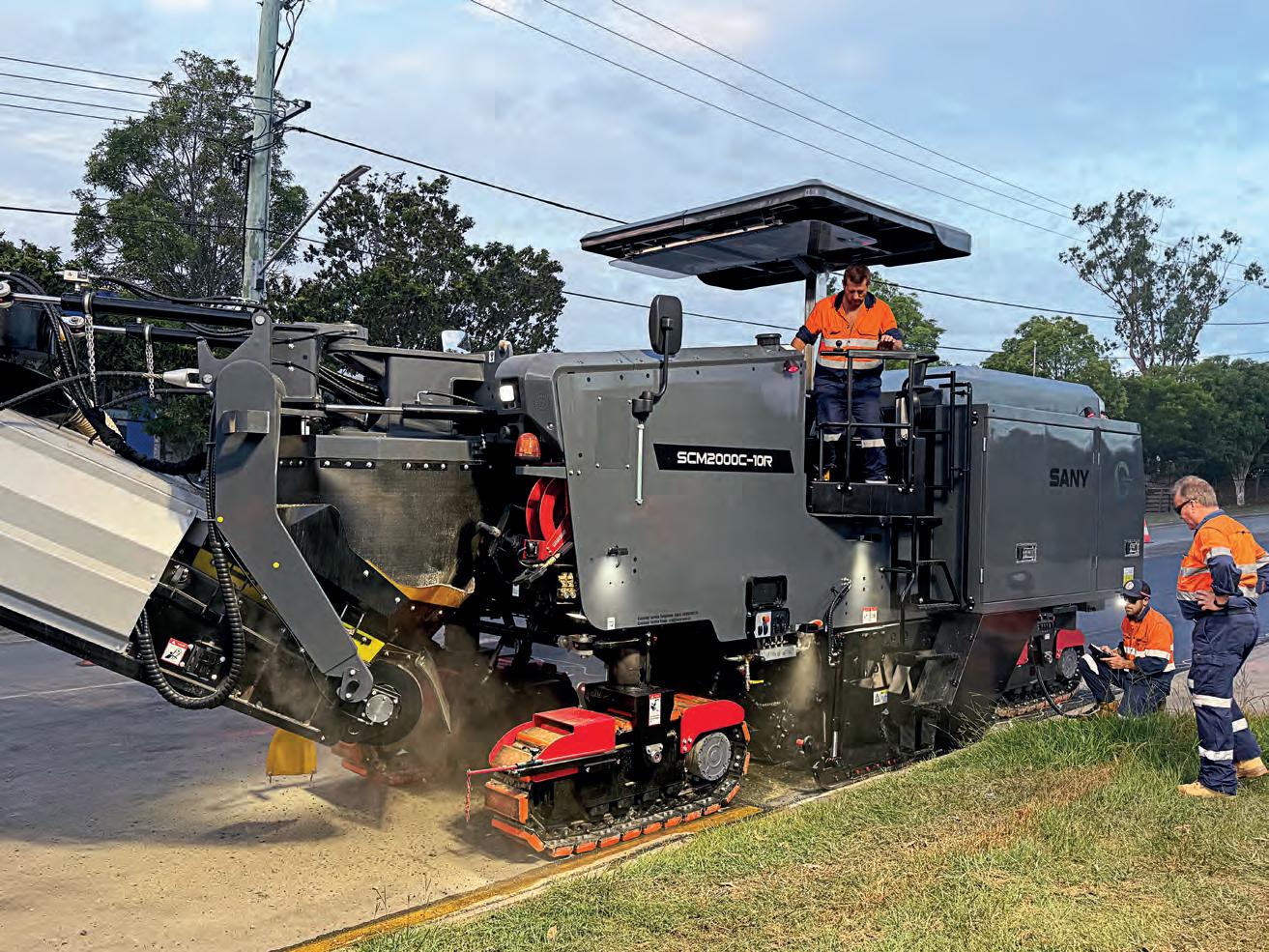
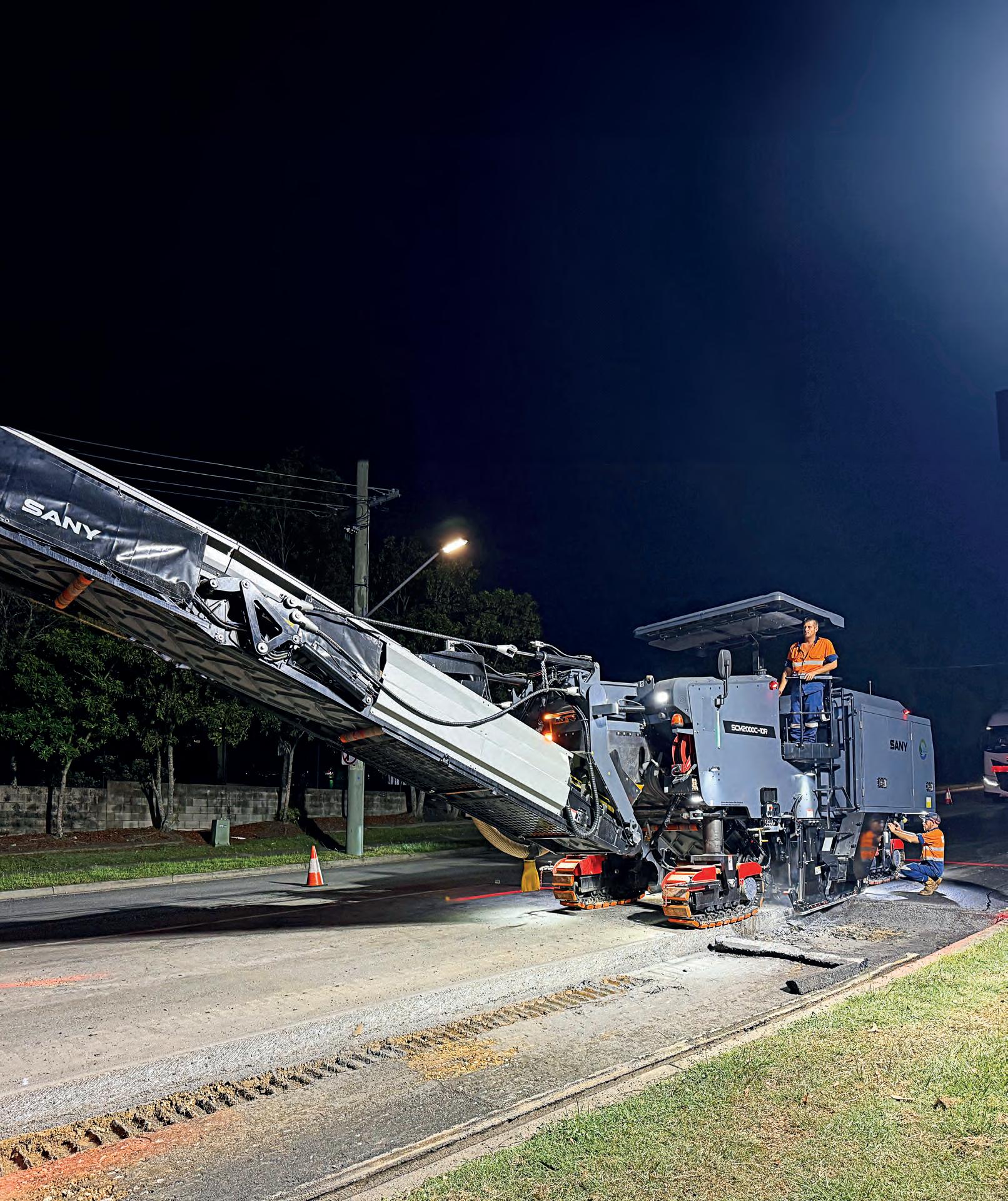
Another unit of note is the SCM 2000-10R, a two-metre profiler. Van Den Broek refers to this machine as one of his ‘babies’. Under Van Den Broek and his team’s influence, the unit has undergone positive improvements.
“Like some of our other machines, picking the right parts, engine and emission-saving capabilities were all things that came into play,” he says.
The SCM 2000-10R features a maximum milling depth and width of 330 and 2000 millimetres, respectively. The milling depth enables operators to finish milling on the surface, structure and basic layers with a single pass.
With a 563-kilowatt US Cummins engine – that enables high efficiency over a long machinery lifetime – the SCM 2000-10R also supports high output, thanks to a 500-millimetre ultra-wide conveyor, increasing material conveying capacity.
Other notable units include the 12 tonne, SSR 120 soil compaction roller and the STR 80 – eight tonne asphalt rollers.
Putzmeister Oceania is also entering the batch asphalt plant market, with its flagship SLB 2000 model’s modular design making it easy to transport, assemble, and scale for different projects.
NATIONAL NETWORK
Putzmeister Oceania’s entrenched network of SANY construction and road machinery dealers now services the majority of
right through to veteran contractors and users.
For what is still a growing company and offering, Putzmeister Oceania’s national network, development process and expertise, as well as strong support services are helping to cement its legacy in Australia’s construction machinery sector, as Van Den Broek explains.
“IT’S QUITE A NEW WORLD AT TIMES, LAUNCHING A PRODUCT INTO AUSTRALIA AND DEVELOPING AND GROWING THAT MACHINE INTO A COMPETITIVE UNIT. IT’S A REALLY EXCITING TIME AND PROCESS.”
Australia and beyond, providing customers local access to sales, service and parts.
So much so, that every dealer in each territory stocks parts specific to the machines sold and used in the region.
Beyond these services, Putzmeister Oceania also supports customers through an assortment of training offerings, for new customers and inexperienced operators,
“It’s quite a new world at times, launching a product into Australia and developing and growing that machine into a competitive unit. It’s a really exciting time and process,” he says.
“Last year was a hectic year of development and working closely with engineering groups. After seeing the start we’ve had this year, I can tell you that we’re only just beginning.”
ROADS REVIEW
THIS MONTH, WE ASKED THE INDUSTRY’S DECISION-MAKERS, ‘HOW CAN SUSTAINABLE THINKING TRANSFORM INFRASTRUCTURE AND TRANSPORT PROJECTS, BEYOND THE OBVIOUS ENVIRONMENTAL BENEFITS?’
GRAHAM HENDERSON – EXECUTIVE DIRECTOR VIC TAS & WA, NATIONAL SUSTAINABILITY DIRECTOR – AUSTRALIAN FLEXIBLE PAVEMENT ASSOCIATION
To encourage greater collaboration and innovation in 2026, the roads sector will need to embrace practical changes alongside cultural leadership. This includes earlier and more genuine industry engagement, commercial models that reward collaboration and innovation rather than the transfer of risk, and clearer pathways to trial new ideas at scale. Leaders must also encourage the creation of safe environments for teams to test, learn and adapt, rather than simply defaulting to established approaches. Where projects create a collaborative and innovative culture, improved safety, productivity and value for money outcomes will follow.
Image: AfPA
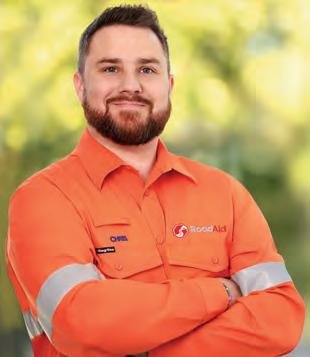
CHRIS COULDREY, DIRECTOR – E.B MANAGEMENT GROUP (ROADAID)
In roads and tunnels, sustainable thinking goes beyond environmental outcomes to how infrastructure is delivered, operated and maintained over its full life. It shapes constructability, safety and maintainability from the outset, reducing rework, unplanned closures and whole-of-life costs. Designing with operations and maintenance in mind leads to safer works, more reliable systems and predictable asset performance. This approach supports stronger commercial outcomes, improved network availability and infrastructure that can adapt to changing operational demands long after construction is complete.
Image: RoadAid
MARCUS IERACI, ASSOCIATE – KYRIACOU ARCHITECTS
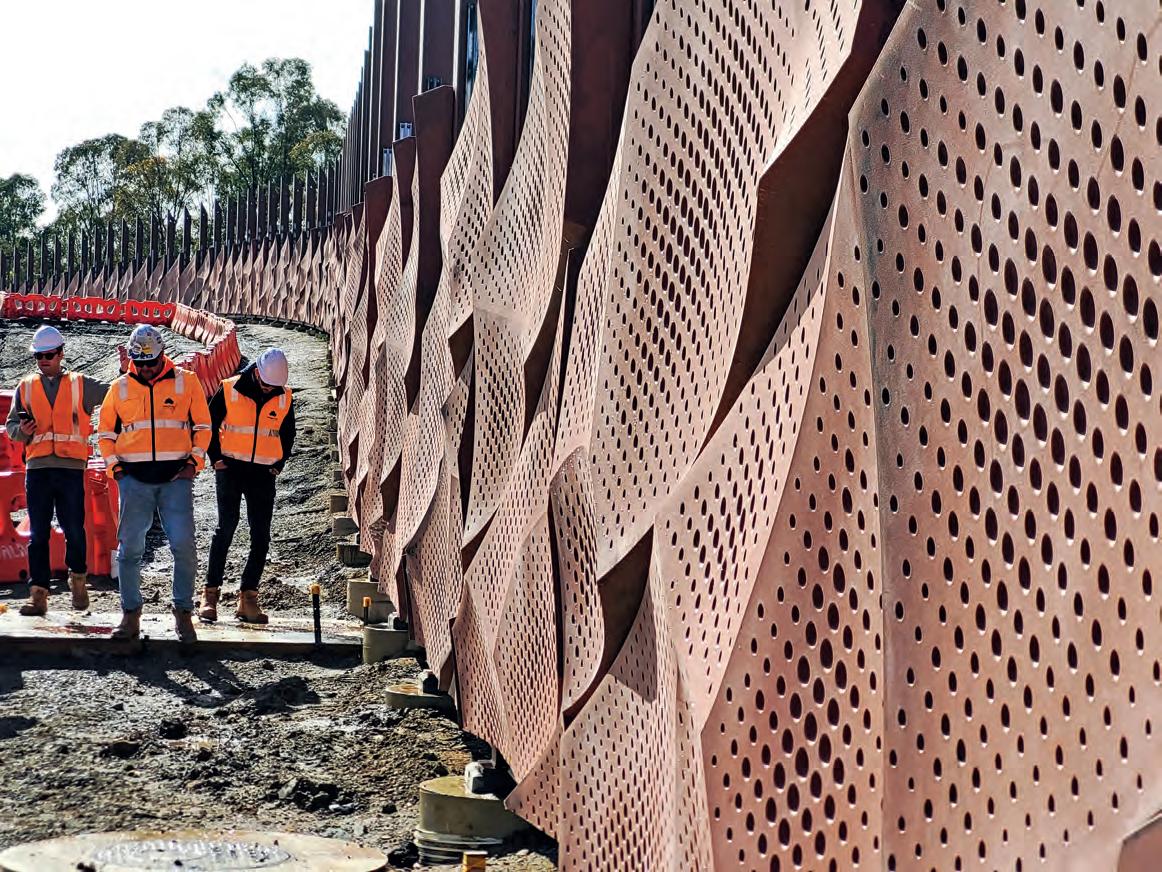
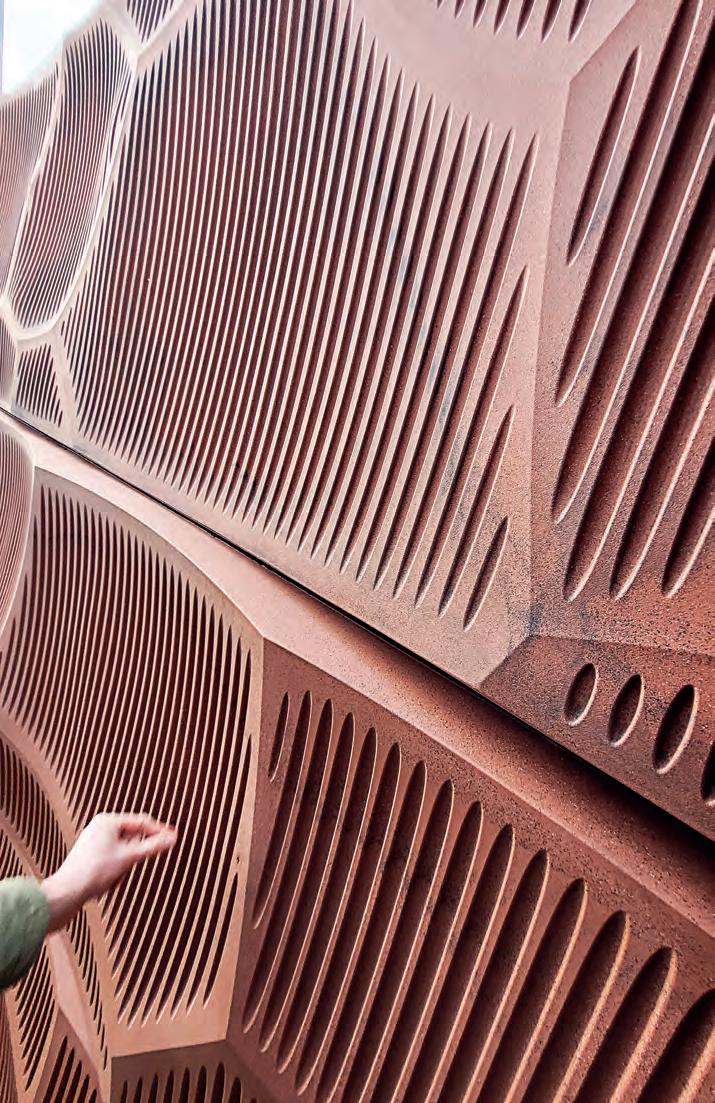
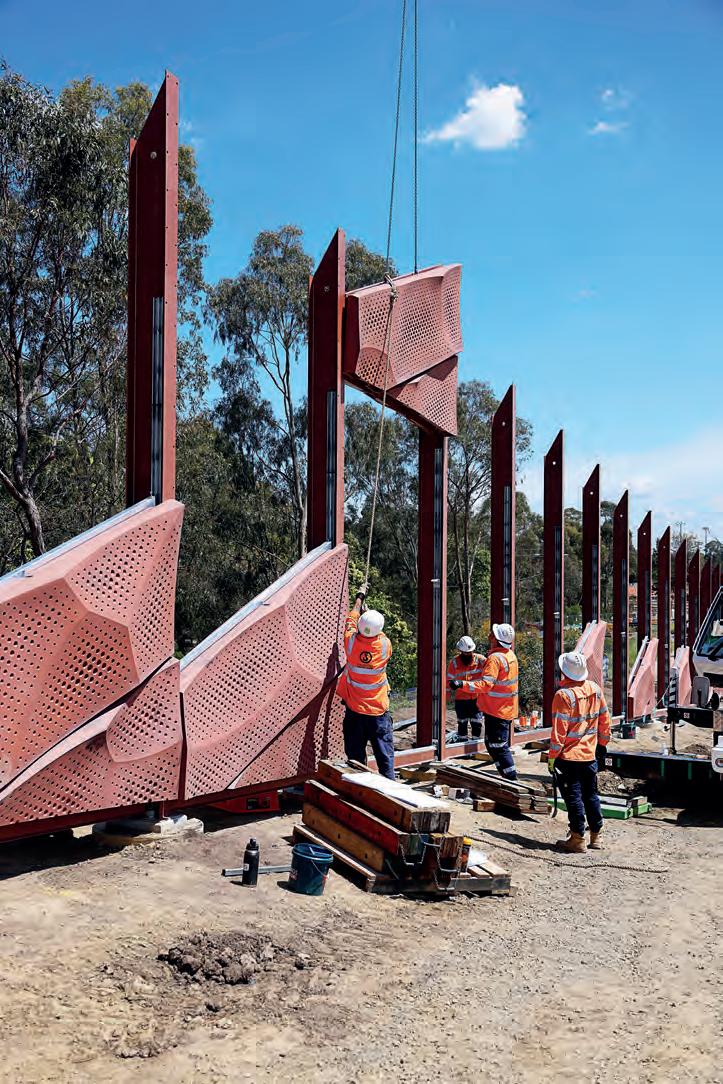
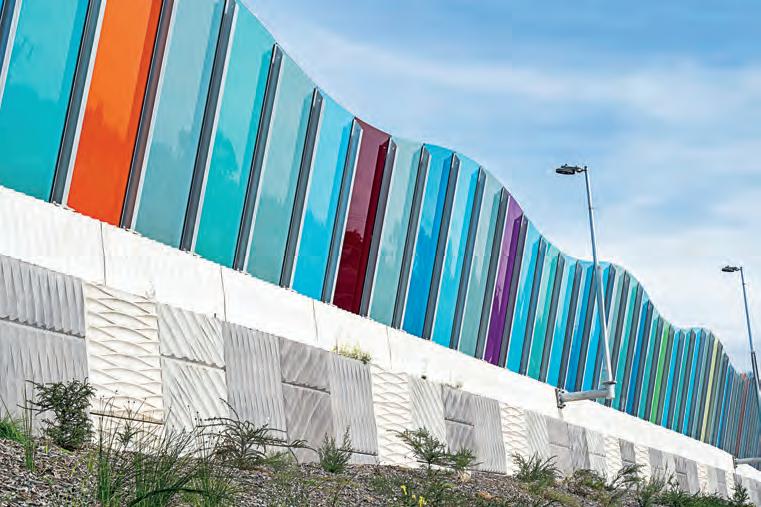
As new sustainability innovations prompt a rethink of established processes, they also create opportunities for additional benefits – often with significant cost savings. In the Southern Package of the North East Link, recycled plastic panels were used for the noise walls. These panels enabled sculptural, expressive patterns that aren’t achievable with traditional materials such as concrete or steel. Their inherent rigidity reduced the need for extensive secondary structures, while still supporting an urban design outcome aligned with key strategic frameworks. Likewise, the recycled plastic better represented co-design outcomes undertaken with First Nations partners.
Image: Kyriacou Architects
CADELL TAYE, CHIEF EXECUTIVE OFFICER – NATIONAL PRECAST CONCRETE ASSOCIATION AUSTRALIA Sustainable thinking can fundamentally reshape infrastructure and transport projects by improving how they are planned, delivered and operated, not just their environmental footprint. When sustainability is embedded early, it drives efficiency across the full project lifecycle, optimising material use, extending asset life and lowering long-term maintenance costs through smarter design, prefabrication and standardisation. It also encourages innovation and closer collaboration across supply chains, breaking down silos between designers, manufacturers and constructors. The result is safer, more resilient infrastructure that performs better over time, delivers stronger economic value, supports local skills and capability, and creates lasting social benefits alongside environmental gains.
Image: National Precast
ANNIE KESSELL, ACTING CEO – CIVIL CONTRACTORS FEDERATION VICTORIA
Through materials selection, circular construction practice and efficient project sequencing, sustainable approaches reduce rework, lower lifecycle costs and improve asset performance. That translates directly into better value for taxpayers and commercially viable projects for industry. Sustainable thinking enhances our sector’s resilience to changing economic conditions, supply chain pressures and climate risks; and should be viewed, not as an abstract concept, but as a practical enabler of productivity, safety and economic growth.
As Victoria enters an election year, sustainable infrastructure must be treated as a core economic strategy that delivers investment certainty, whilst building capacity and creating lasting benefits for communities in this state.
Image: Civil Contractors Federation Victoria
If you or someone at your organisation is an industry leader and would like to be a part of this monthly column in 2026, please get in touch with Editor, Tom O’Keane: tom.okeane@primecreative.com.au
Kyriacou Architects and BKK Architects’ collaboration helped to combine design and delivery expertise for the project’s benefit.
SUSTAINABLY SAFE AND SOUND
A SIGNIFICANT COLLABORATION BETWEEN KYRIACOU ARCHITECTS AND BKK
ARCHITECTS HAS HELPED TO CREATE NEW POSSIBILITIES FOR A UNIQUE RECYCLED PLASTIC FORMULATION, WHICH HAS BEEN USED FOR MORE THAN 10 KILOMETRES OF NOISE WALLS FOR VICTORIA’S NORTH EAST LINK PROJECT.
Sustainable construction has been a key aim and requirement for infrastructure development for some time, spurred on by national carbon emission targets, as well as a growing need for solutions to problematic waste streams.
Despite sustainability becoming a more common practice and focus, strict regulations and guidelines around environmentally friendly materials and methods have predominantly been introduced in the past two decades.
Take Victoria for example.
Despite some tools and incentives already existing, it wasn’t until the inception of the Victorian Government’s Recycled First Policy, as well as the
creation of the State Government’s ecologiq initiative – in 2020 and 2019 respectively – that industry accelerated its use of sustainable construction methods and materials statewide.
Both of these initiatives helped to support several milestone projects in the years following. Among them was the state and world’s first use of recycled plastic waste in noise walls. Constructed using 75 per cent recycled kerbside plastic waste, 32,000 square metres of noise walls were delivered for the Mordialloc Freeway project in 2021.
This project was among several that set a precedent for what could be achieved when a circular economy strategy was
adopted and prioritised. Fast forward to 2026 and Kyriacou Architects, in partnership with BKK Architects are helping to expand Victoria’s sustainable project legacy, this time on the North East Link – one of the largest infrastructure undertakings in the state’s history.
START OF SOMETHING SPECIAL
Close to four years ago, Kyriacou Architects, together with BKK Architects, were engaged by the Victorian Government to deliver close to 11 kilometres of noise walls, for a sevenkilometre section of the North East Link project in Melbourne.
Engaged by Laing O’Rourke for the North East Link South Package, Kyriacou and BKK are highly specialised architecture practices with expertise in the design and delivery of complex transport infrastructure.
Through the Eastern Freeway –Burke to Tram Alliance (EBTA), this multidisciplinary team has collaboratively navigated the complex stakeholder environment to deliver a design that balances technical excellence with meaningful urban integration, ensuring the project leaves a lasting, positive legacy for Melbourne. Other successful collaborations include the recently completed Mooroolbark, Lilydale and Merinda Park train stations.
Right from the outset, sustainability drivers and requirements surfaced for Kyriacou and BKK, prompting a consideration of implementing alternative materials, as Troy Thirlwell, Principal, Kyriacou, explains.
“We’d gone through a TOC (Target Outturn Cost) phase to reach an agreed design with the client. That’s where feedback came back around sustainability measures and also innovation, as well as the potential for the project to become a test case,” he says.
“Part of that push was prompted by the State Government. For Kyriacou, it was seen as a natural progression, as we’d previously used alternative materials in a number of other projects, so had BKK [Architects], which have featured recycled components being used for noise attenuation.”
As Tim Black, Principal, BKK, adds, the aforementioned Victorian Government initiatives, as well as tools established by the Infrastructure Sustainability Council, provided industry with a benchmark for material reuse.
“Plastics have a history of experimental use in Victoria,” he says. “There’s been many attempts to develop circular economy industries. One of the most notable examples was the unfortunate collapse of the REDcycle recycling program, leaving Australia with significant stockpiles of post-industrial soft plastics, much of which comprises high density polyethylene (HDPE).
“As it turns out, HDPE is particularly well suited to run reuse in a rotationally moulded large format, such as
Kyriacou Architects and BKK
Architects together landed on a 75 per cent recycled HDPE and 25 per cent virgin HDPE design for the noise wall composition.
A key component and differentiator of this project was the decision to develop, and trial dedicated plastic mould designs, rather than adapt existing concrete wall designs, as Marcus Ieraci, Associate, Kyriacou, explains.
“There’s been cases where the design of the panels was not purposely developed for plastic. What I mean by that is often there’s been designs
plastic acts very differently to concrete. The biggest difference of course being that it’s a hollow, rotationally moulded material,” he says.
“With extremities in weather, these cases have presented deformation in the plastic, and that’s a bit of an unfair assessment, because if plastic is purposely designed, like what we’ve done in this project, we can design in rigidity through patination so that it better holds its form.”
Thirwell adds that establishing a deliberate prototyping pathway was a key initial step.
Images: Kyriacou Architects
The aesthetic and visual impact of the structure were both high priority considerations for the project team.
in Melbourne.
“That was instrumental in giving us a better understanding of the limitations and strengths of the product, then a chance to refine the design to overcome any potential misgivings that could’ve appeared.”
The final formulation saw the recycled HDPE being used on the outer and majority of the wall thickness, with the thinner virgin layer on the inside providing additional structural rigidity and guard. This design aims to prevent long‑term issues, such as micro‑cracking, which can occur due to expansion and contraction in the panels themselves.
The design aims to ensure that the noise wall doesn’t stand out in a negative fashion, but instead blends into the rest of the project.
Furthermore, if a section has been damaged by an impact, individual panels can be re moulded and replaced. Another important factor that was considered was the driver and user experience, as Ieraci explains.
“We invested a significant amount of time thinking about what it meant to experience these walls from a motorist’s, cyclist’s and pedestrians’ perspective,” he says. “There’s this concept of slow and fast, ‘how do we design these walls to provide a meaningful experience?’”
Colour, pattern and arrangement were used strategically to make sure that different sections of the corridor felt distinct, helping users to understand where they are along the route rather than experiencing it as one continuous, monotonous barrier.
At the same time, a coherent language had to be maintained per request of the client, to ensure that the corridor still read as one unified project, instead of a series of unrelated components.
Equally important was respecting and celebrating community.
“‘How can we provide a sense of place for the communities that this project runs through?’ That was the challenge,” Black says. “These walls were just one of several components
“WE INVESTED A SIGNIFICANT AMOUNT OF TIME THINKING ABOUT WHAT IT MEANT TO EXPERIENCE THESE WALLS FROM A MOTORIST’S, CYCLIST’S AND PEDESTRIANS’ PERSPECTIVE.”
– in terms of carbon emission reduction, reduced kerbside plastic being sent to landfill, and providing a solution for a problematic waste stream – the innovative noise walls have also been designed with long term performance, maintenance, aesthetic and community impact in mind.
Each panel has been designed to ensure that its mass and construction provide equivalent acoustic performance to conventional concrete walls. The UV (ultraviolet radiation) stabilised HDPE and purpose‑designed panels have also been moulded to resist brittleness, warping and surface degradation over time.
that were developed through an Indigenous led design process. These walls very significantly tell important Wurundjeri stories that we hope will then be embraced and appreciated by the local community and ultimately bring the community together.”
Thirlwell says that such stories help to provide a narrative and educational dimension to an essential infrastructure component.
“That’s been an important collaboration that was completed in a prior process and the design is much richer for it,” he says.
“It’s sophistication, not only on a technical level, but on a cultural level as well.”
A BLUEPRINT FOR ROAD DURABILITY
AS THE TRANSPORT AND INFRASTRUCTURE SECTORS LOOKS TO CUT EMISSIONS WITHOUT COMPROMISING PERFORMANCE, CRUMB RUBBER IS EMERGING AS A PROVEN SOLUTION. RECENT PROJECTS PROVIDE A TEMPLATE FOR UNLOCKING BROADER ADOPTION ACROSS AUSTRALIA’S ROAD NETWORKS.
Crumb rubber has been part of Australia’s road surfacing landscape for decades. What is changing now is not the material itself, but government and industry confidence around its specification, procurement and routine delivery at scale.
Produced from end-of-life tyres and blended into bitumen to create rubbermodified binders, crumb rubber delivers measurable engineering benefits: Improved elasticity, enhanced resistance to cracking, fatigue and oxidative ageing, and longerlasting pavement service life.
In practical terms, longer-lasting surfaces reduce the frequency of interventions, lower material consumption, and cut lifecycle emissions associated with resurfacing and traffic disruption.
The performance and sustainability of crumb rubber use is reinforced by a series of recent industry research and insights.
Released by Tyre Stewardship Australia (TSA), The Benefits of Surfacing Roads with Tyre Derived Crumb Rubber (September 2024), quantifies greenhouse gas reductions at the binder level and models emissions savings from extended pavement life, positioning crumb rubber as a sustainability solution.
Also released by TSA, Leading the Way: How Main Roads WA Transformed End of Life Tyres into Sustainable Road Infrastructure (November 2025), demonstrates how crumb rubber has been embedded at scale in Western Australia through phased rollout, defined binder classes and robust quality controls.
Tyre Stewardship Australia is reemphasising the benefits and successful trials of crumb rubber across the country, such as recent works in Western Australia.
Complementing this, Australian Flexible Pavement Association (AfPA) released Crumb Rubber Modified Dense Graded Asphalt Model Specification – Light to Medium Duty Roads (October 2025), which provides a nationally consistent framework that confirms crumb rubber asphalt is ready to move beyond trials to routine delivery.
Together, these findings confirm that crumb rubber is no longer a niche or trial material. It is a specification-backed, performance-verified input ready for broader national uptake across Australia’s roads and infrastructure.
Western Australia, as well as Queensland provide the clearest proof point that crumb rubber can become embedded national practice.
FROM CONCEPT TO CONSISTENCY
Fulton Hogan, a champion of crumb rubber use, has long implemented the alternative material into a number of its projects.
Only recently, end-of-life tyres sourced from TSA Accredited recyclers were used across a three year project term, which included the design and fabrication of a mobile Bitumen Crumb Rubber blending plant to service markets in north Queensland.
Chris Lange, Technical Manager
Infrastructure Services – Northern Region at Fulton Hogan, explains that the result was not a one-off success.
“Crumb rubber modified binders have a strong track record internationally, particularly in the United States and South Africa,” Lange says.
“In Australia, they have been used for many years in spray seals, and are widely adopted in Western Australia and Victoria.”
He notes that asphalt uptake is now accelerating as the durability benefits are better understood.
“These benefits include improved resistance
to cracking, enhanced fatigue performance, greater durability and service life, and increased binder viscosity, which allows a thicker film of bitumen on the aggregate and contributes to longer-lasting pavements.”
Similarly, Main Roads Western Australia has approached crumb rubber with a long-term, performance-first mindset. Rather than mandating recycled content in isolation, the agency invested in research through the Western Australian Road Research and Innovation Program (WARRIP), developed defined binder products such as A18R and A10R, and implemented phased resurfacing targets that progressively increased adoption.
These attributes have been validated through operational resurfacing works, not limited trials. Defined quality standards, storage controls and construction tolerances have ensured that performance expectations translated into delivery outcomes. By the fifth year of the WARRIP rollout, crumb rubber applications had replaced previous specifications as business as usual.
The measurable sustainability impact follows from that consistency. Longer-lasting surfaces mean fewer interventions, reduced embodied emissions and lower disruption across the network. The circular economy outcome of diverting end-of-life tyres from landfill and stockpiles is achieved as a byproduct of performance-driven procurement.
SPECIFICATION AS THE ENABLER OF SCALE
Historically, crumb rubber’s expansion was constrained less by engineering uncertainty and more by procurement friction.
Specifications written for heavy-duty state highways were often applied to local networks, creating unnecessary complexity and limiting uptake.
Melissa Lyons, Executive Director Technology at AfPA, says the new CRM DGA model specification addresses that gap directly.
“Local governments need durable, sustainable asphalt solutions that can be delivered at scale and aligned to the realities of their networks,” Lyons says.
“Most existing crumb rubber specifications were developed for high-traffic, statecontrolled roads. That approach does not reflect the dominant deterioration mechanisms on local roads, which are driven far more by surface ageing, oxidation and environmental exposure. It provides a fit-forpurpose, nationally consistent framework specifically designed for light-to-medium duty applications.
“In practical terms, it helps shift crumb rubber asphalt from being treated as a oneoff innovation or trial product to a businessas-usual pavement option. It reduces uncertainty, supports reliable pricing and enables more consistent delivery outcomes.”
For asset managers, this is significant. Delivery confidence reduces risk premiums and encourages repeat use. Consistency in mix design, binder handling and compaction standards ensures that sustainability outcomes are supported by engineering rigour.
SUPPLY CONFIDENCE AND PROCUREMENT
Scaling crumb rubber also depends on supply certainty, particularly in regional markets.
Tammie Miller, Head of Market Development at Tyre Stewardship Australia, says reliability is central to broader uptake.
“Crumb rubber isn’t new. It’s been used in Australian roads since the 1970s. What’s changing now is how reliably and routinely it can be supplied and used,” Miller says.
TSA’s work with delivery partners to strengthen blending capability in regional areas reflects that focus on repeatability.
“Our role is to remove barriers and build confidence so crumb rubber can be used more consistently and at scale,” Miller says. However, she makes it clear that voluntary adoption alone will not maximise widespread uptake across the sector.
“TSA’s modelling shows that if crumb rubber were mandated in road construction and maintenance where it is technically and economically feasible, around 159,000 tonnes of crumb rubber could be used annually, treating more than 26 million
end-of-life tyres,” Miller says.
She adds that stronger procurement signals would align sustainability targets with performance-based specification, reinforcing the model nationally.
FROM PROOF POINT TO PATHWAY
The convergence of evidence and national specification work suggests that the roads and infrastructure sector is at an inflection point.
The Western Australian and Queensland projects have demonstrated that crumb rubber can deliver improved road performance and measurable sustainability outcomes when embedded within a disciplined specification and quality framework.
TSA’s research quantifies the lifecycle benefits. AfPA’s model specification provides the template for consistent local government adoption.
The emphasis is no longer on proving that crumb rubber can work. It is on ensuring that it works reliably, repeatedly and at scale.
For the roads and infrastructure sector, that shift matters. Sustainability in pavement construction is increasingly assessed through whole-of-life performance, not isolated recycled content percentages. Materials that extend asset life while reducing emissions and supporting domestic recycling markets align directly with that objective.
Projects have already shown that crumb rubber can meet that test. The national frameworks now in place indicate the industry is prepared to replicate it.
The question now is not whether crumb rubber is viable. It is how quickly delivery confidence, specification alignment and procurement leadership will translate readiness into nationwide standard practice.
Images: Tyre Stewardship Australia
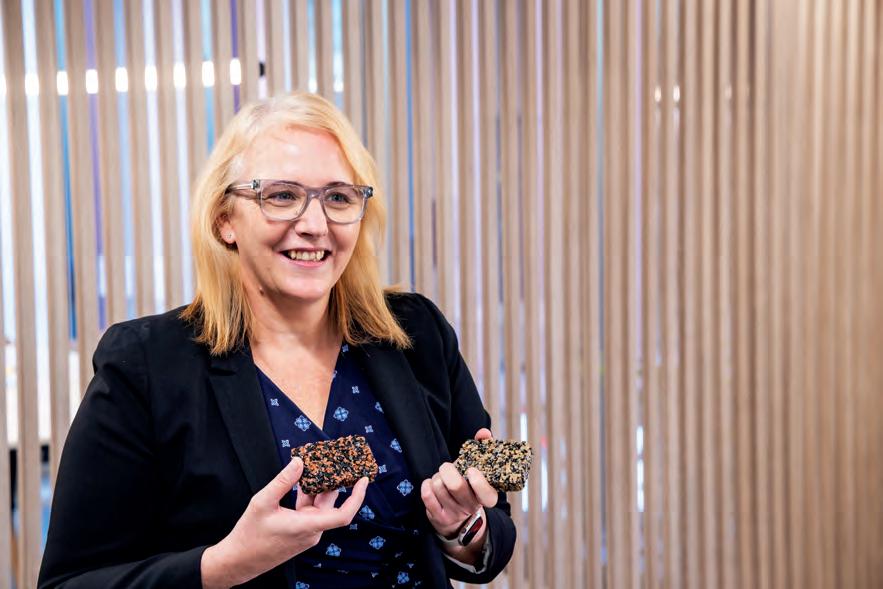
Tammie Miller, Market and Business Development Manager at Tyre Stewardship Australia.
KEEP ROADWORKS
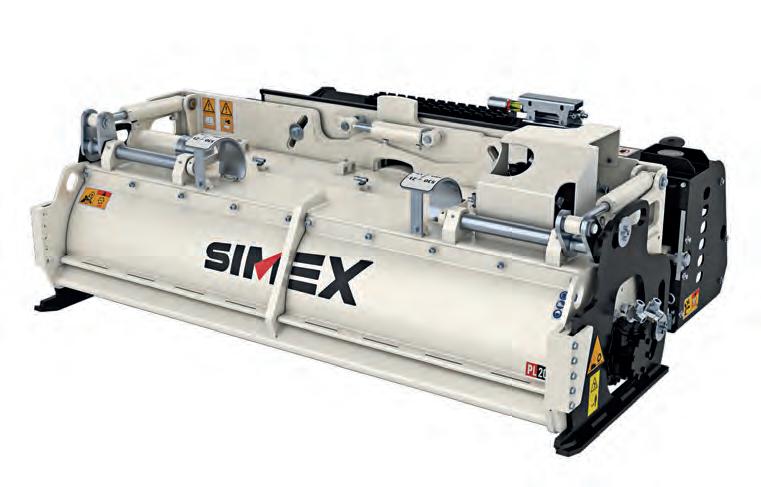
TIME AND TRAFFIC MOVING PL2000 COLD PLANER
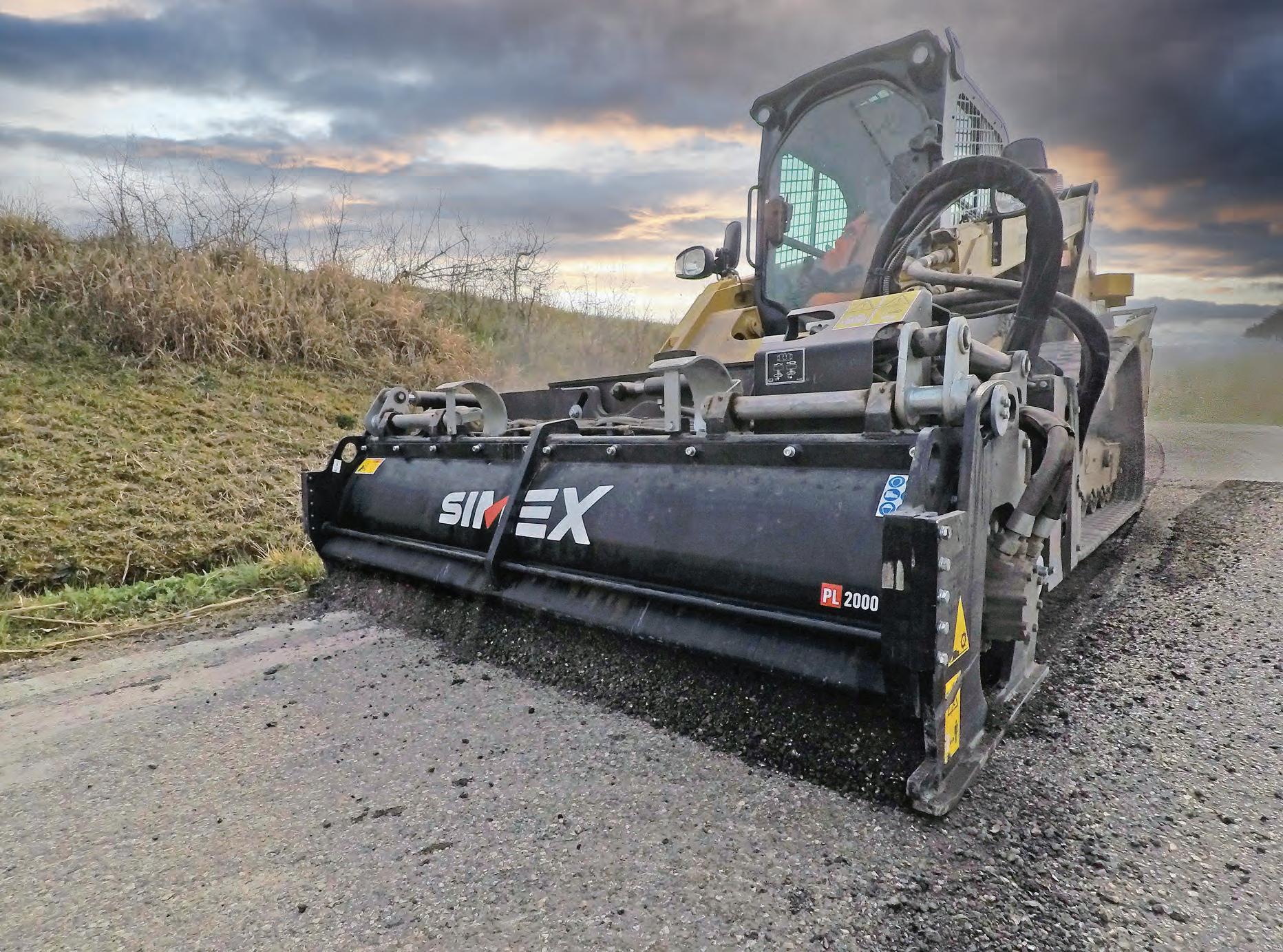
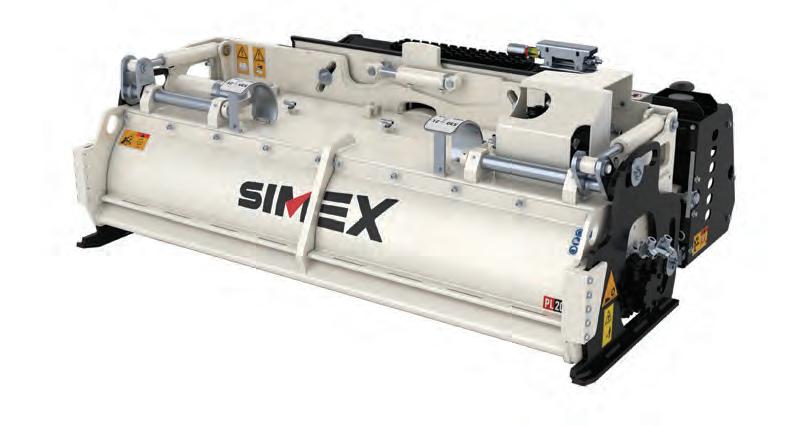
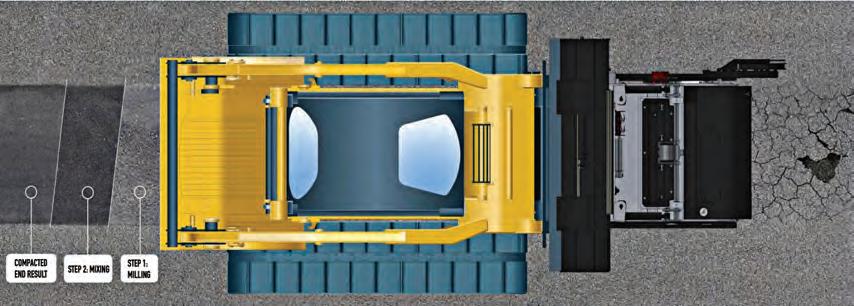
The SIMEX PL2000 is the largest road cold planer for compact skidsteer loaders, featuring a 2000mm milling drum - the widest on the market.
Built for speed and accuracy, it removes deteriorated asphalt or cement layers efficiently, preparing surfaces for resealing or trenching while enabling reuse of milled material for sustainable backfilling.
UNIQUE ADVANCED FEATURES:
• Constant milling depth, always
• Cut up to and against kerbs
• Stability, no vibrations
• Hydraulic side shift
• Independent RH-LH depth adjustment
• Integrated dust suppression with large onboard water tank
BUILT FOR PRODUCTIVITY ON SITE
SIMEX PL2000 contains the patented self-leveling system for consistent milling depth regardless of ground conditions, delivers perfectly flat surfaces and is also equipped with hydraulic side shift for precise milling flush to walls and sidewalks.
Part of SIMEX’s self-levelling planer range, the PL2000 is ideal for council roads, car parks, forecourts and urban works where efficiency, precision and minimal downtime are critical.
Width up to 2,000mm
Depth up to 350mm
Scan for Simex dealer locations in Australia: QLD | NSW | VIC | SA | WA | TAS | NT or visit attachmentspecialists.com.au/simex
“We’re in contact almost every two days, as we’re a major supplier of their binders, not only SAMIGreen. There was close communication when it came to the mix design, laboratory checks and generally providing support where we could.”
Another key aspect was proof of performance. Binder property testing, asphalt mix design lab testing, as well as onsite laydown trials were all conducted, with all test results submitted to AT to represent full compliance with specifications.
As Greg Arnold, Technical Services and Development Manager – COLAS New Zealand explains: “What made this project so ideal was that the road was long enough that we could use our standard asphalt for half the job, then SAMIGreen for the remainder. That provides a trial that can be monitored into the future, with a
clear side-by-side comparison between a conventional design and SAMIGreen, with both facing the same loading and traffic.”
To evaluate the aesthetic and smell differences between the binders, management also withheld the knowledge that two different binders were being used from the project team. This was an aspect that wasn’t identified by the crew –exactly the result COLAS New Zealand was hoping for.
“That’s what we wanted, and it’s a testament to SAMIGreen’s purpose – to act as a true substitute, rather than an alternative,” Barry Blunt, Managing Director – COLAS New Zealand says. “We want there to be absolutely no change in the way you mix it, transport it, lay it, any of that. The only change is that you’re saving 32 per cent carbon at the end of the day.”
GEARING UP FOR FUTURE USE
The approved and successful application of SAMIGreen marked the first AT project to incorporate a low carbon asphalt mix, opening the door for future potential use on projects not only for AT, but also nationally.
“The feedback has been nothing but positive and we achieved all of our compacted air voids and results on site,”
Arnold says.
Beyond collaboration with SAMI Bitumen Technologies, Blunt also attributes the success of the project to AT.
“They played a huge part in getting this product in use for the first time, and the project across the line,” he says.
“Their involvement and approval holds a lot of weight, which gives sustainable products like this plenty of potential for future use.”
Alan Wallace, Group Manager Road Maintenance – AT says he’s delighted to have been involved in this trial and has been impressed by the professionalism of all involved.
“We consider the trial to be a great success and expect to make more use of SAMIGreen in the future,” he says.
Sahebzamani says there’s now many projects in the pipeline, with COLAS’ globally connected network actively working on new grades to enhance the performance of the binder.
He adds: “We’ve even had some major organisations consider switching all of their binders to SAMIGreen, to fully gain the environmental benefits.”
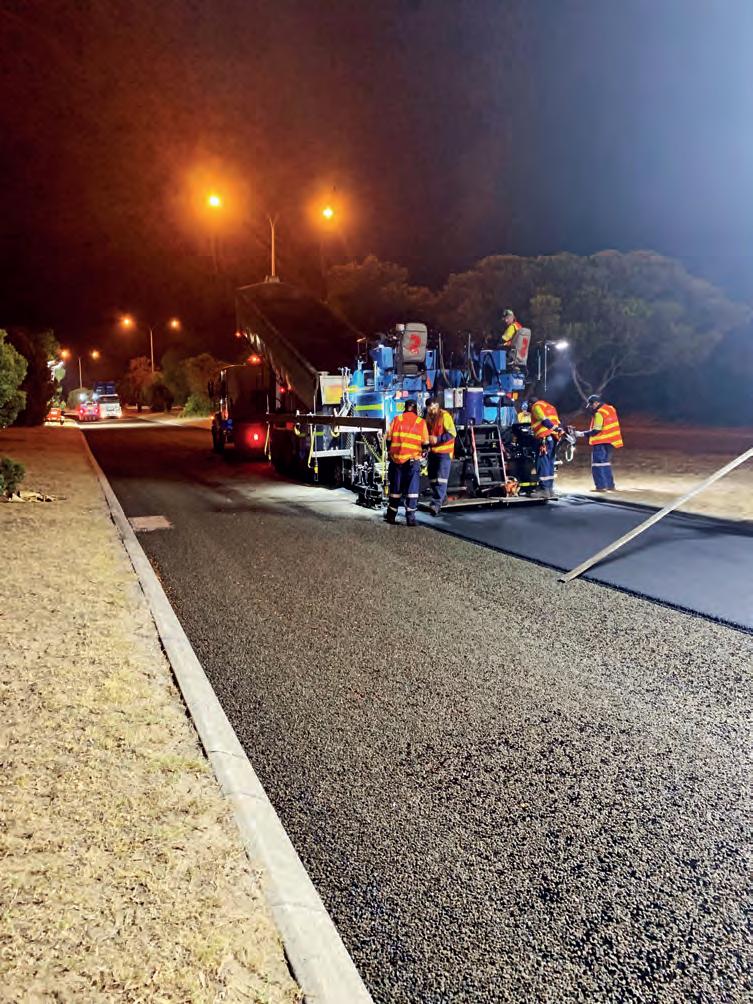
Half of the road surface was delivered with SAMIGreen, with the other half comprising of conventional pavement.
COLAS New Zealand’s crews were unable to tell the difference between the two binders, a testament to SAMIGreen’s performance.
IN THE WHEELHOUSE
STATE ASPHALTS NSW IS CHANGING DIRECTION AND PACE, USING ITS VAST INDUSTRY KNOWLEDGE AND EXPERTISE TO HELP DEVELOP THE NEXT GENERATION OF BITUMEN BINDERS. BUT WHAT’S THE STATE ASPHALTS NSW DIFFERENCE? ROADS & INFRASTRUCTURE FINDS OUT.
State Asphalts NSW has come a long way since its foundation 56 years ago.
Once a premier provider of asphalt and aggregate – both carbon intensive materials – State Asphalts NSW has sought to prevent further environmental damage by becoming a specialist in sustainable and high-performance materials.
Its recent works, including resurfacing one of the first concrete pavements that the company originally built in 1988-89, symbolise its willingness to reflect, expand and improve on its existing services.
State Asphalts NSW’s latest venture into binders within the road construction segment is yet another example.
This decision was far from left of field for the company, which had already built decades of experience and relationships across the industry off the back of its long-term supply of asphalt and paving products. Just one of these flagship designs is PakPave, a fibre that helps to
transform recycled materials – such as coffee cups – into roads.
After the successful establishment of this product line, John Kypreos, Managing Director – Kypreos Group and his team began to evaluate future opportunities that could grow the company’s sustainable offerings.
“The biggest factor in many carbon emission calculations are binders,” Kypreos says. “If we can reduce our binder usage, or replace it with something else, there’s massive carbon savings to be had.”
Just as it did with PakPave, State Asphalts NSW’s team of in-house lab technicians and researchers began a process of asphalt design, trials and performance validation to see what would work best.
Despite crumb rubber already having an existing legacy in the sector, the State Asphalts NSW team saw an opportunity for improvement. One of the key differentiators for this design was to go with a wet mix rather than dry.
“Wet blending sees us digest the crumb rubber from both car and truck tyres directly into the binder,” Kypreos says. “This allows some of the elastic components in the used tyres to migrate into the bitumen phase.”
This process provides a more elastic and resilient binder, better resistance to reflective cracking and overall, a longerlasting pavement.
The benefits of wet over dry mixing also extend far beyond just performance.
“Other things like odour were nowhere near as bad – there was definitely a lot less fuming when compared to dry mixing as well,” Kypreos says.
It wasn’t long after landing on a formulation that State Asphalts NSW went headfirst into the binder space in 2023. In only 12 months, the company commissioned its own polymer modified bitumen (PMB) plant, then soon after began crumb rubber binder trials with some of the largest councils in New South Wales.
Known as the Southern Sydney Regional Organisation of Councils (SSROC), this entity spans 11 different municipalities from across the region. SSROC put out a tender to learn what was available in the market, with State Asphalts NSW answering the call.
State Asphalts NSW has experience in introducing and supporting new innovations, such as its highly successful Pack-Pave product.
With a fully commissioned plant and successful trials in its arsenal, State Asphalts NSW is gearing up for a big 2026.
“It was great for us to demonstrate our technology against others in the industry, and see how they performed,” Kypreos says.
Additional trials, all within the same 12-month period, also took place on the M4 and Hume Highway, both among the most frequented connections in the state.
Across these several projects, State Asphalts NSW has already helped to divert approximately 8500 tyres from landfill in just over two and a half years, with the company’s journey in the binder space only just getting started.
THE NEXT GENERATION
For Kypreos, as well as the continued development of State Asphalts NSW’s binder product range, another shining light has been the growth and improvement of the company’s young research team.
He says that holding additional roles, such as the Chair of the Australian Flexible Pavements Association’s National Sustainability Committee, has reemphasised the need to facilitate intergenerational knowledge exchange for the industry’s benefit.
Under the guidance of John Arvanitidis, Technical Manager Binders, “This research that we’ve done has provided great scope
for ultra-low carbon binders that will be market ready sooner rather than later,” Kypreos says. “We’ll start to see a carbon reduction compared to traditional PMB of about 80 per cent.
“What’s really stood out is the enthusiasm of the young team of researchers that we’ve got, some being technicians with PhDs as well as their Masters. Those that haven’t stayed with us have gone on to start their own product lines and businesses, which is just fantastic.”
One of the potential barriers to such development has been the risk-averse
nature of the industry, an aspect that Kypreos fully understands.
“There’s still some pushback from the design houses, some of which are so used to specifications that can be 60 years old. That’s what we’re hoping to change, to justify and encourage any perception of ‘risk.’
“Our researchers are constantly questioning and pushing the ‘norm’. They ask – ‘How can we do this job differently?’ ‘Is this the right choice of product, or would we be better using something else?’ It’s always a negotiation.”
Images:
State Asphalts NSW
The company has made significant strides with its binder designs in the past 12 months alone, aided by its youthful and innovative research team.
UNPRECEDENTED INSIGHT
THE NATIONAL TRANSPORT RESEARCH ORGANISATION (NTRO) IS UPGRADING AND EXPANDING ITS STATE-OF-THE-ART FLEET OF SURVEY VEHICLES, WITH SOME IMPROVEMENTS REPRESENTING WORLD FIRSTS FOR THE TRANSPORT SECTOR. WE SIT DOWN WITH RUSSELL GALLAGHER, CHIEF TECHNOLOGY OFFICER – NTRO, THE ARCHITECT BEHIND THIS ADVANCEMENT.
The National Transport Research Organisation (NTRO) has long been held in high stead for its development and contributions to road infrastructure measurement tools.
In this decade alone, the NTRO has led the acceleration of tools capable of measuring both structural and functional pavement conditions, guided by its highly technical and knowledgeable team.
Within this talented group are individuals such as Russell Gallagher, Chief Technology Officer – NTRO, whose focus and endeavours are driven by a simple yet motivating question, ‘how can we do better?’
“A few years ago, I began the development of a strategy called ‘data reform’, and the idea of data reform is to rethink our collection, processing, storage and maintenance of our data,” he says.
Gallagher proceeded by mapping out the NTRO’s entire process, from route creation, through to survey and processing, and all the way to client delivery, to understand how things worked.
Under the previous process, data analytics and infrastructure measurement teams would manually create a “road list”: a set of
roads and routes the client wanted surveyed. For each route, the team would determine which roads to include and the direction of travel, as well as the lanes that needed to be captured.
Manual in‑vehicle capture was then conducted, with operators pressing buttons and at times recording details manually. This data was then recorded and physically shipped via hard drives back to the office, where another team manually processed significant data sets over one to three months, checking for errors.
If problems were found late, vehicles would sometimes be sent back across the country to recapture sections, delaying the process further.
“The number one request that we were getting from the market and wider industry was that they needed their data faster,” Gallagher says. “Our clients rely on this data to drive their maintenance planning, budget planning and importantly, their general reactivity to known issues on their road network.
“The faster they get their data, the better. So that quickly became a central focus for us –‘how do we speed up this process?’”
UPGRADING KIT
After identifying potential inefficiencies and bottlenecks, Gallagher and his team saw significant potential – not only in increasing the quality and speed of delivery, but also in reducing the end cost for clients.
Once executive buy in was secured, the next steps in the data reform strategy were identified. Among these was the need to establish a re engineered fleet, tailored to differing client needs.
The only question being, did the existing infrastructure and fleet have the capability to support such an ambition?
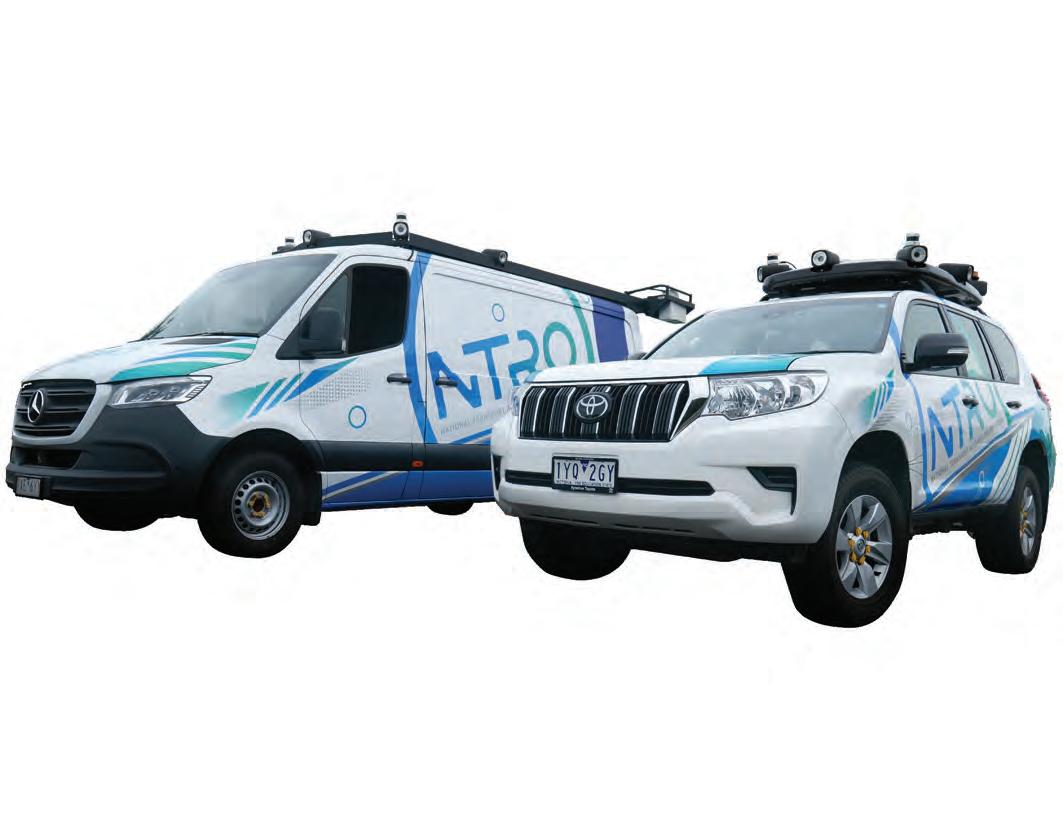
“Our internal NTRO team, along with a few key external contractors, have now engineered six vehicles, supporting four different platforms,” Gallagher says.
The biggest of these is the iPAVE, a semi trailer truck. Equipped with high end pavement measurement sensors, the iPAVE delivers network level, high spec surveys for state road authorities and larger metropolitan areas.
Next up is the Automated Crack Detection (ACD) vehicle, which is equipped with a Pavemetrics LCMS2 (Laser Crack Measurement System) sensor, as well as
The NTRO has again upgraded and improved its fleet of pavement survey vehicles.
PRESENCE A CONSISTENT
SPECIALISED ROADING EQUIPMENT’S
(SRE) CUSTOMER SERVICE KNOWS NO BOUNDS, WITH THE COMPANY CONSTANTLY PUSHING TO IMPROVE ITS CURRENT OFFERINGS. CHRIS KAELIN, BUSINESS DEVELOPMENT MANAGER –SRE TOUCHES ON THE COMMON REQUESTS AND QUESTIONS FROM INDUSTRY.
In addition to its high quality, innovative and purpose-built road construction and maintenance machinery, Specialised Roading Equipment’s (SRE) customer support and after sales service has emerged as a major contributor to the company’s growth.
This expansion has seen the New Zealand (NZ)-based manufacturer establish a meaningful foothold in the Australian market in a relatively short period, with its brand recognition growing with each machinery delivery.
Despite all of its units being designed and manufactured in-house – in its state-ofthe-art facility in Hamilton, NZ – questions around the company’s ability to adequately provide support remotely for its Australian customers remained.
As Chris Kaelin, Business Development Manager – SRE explains, the company’s
proactive approach established a foundation for the company’s support services to flourish.
“It really starts with training,” he says, “and typically the training for a new sprayer starts at calibration. The calibration ultimately runs through most of the functions of the sprayer anyway.
“It’s ideal because importantly, it’s a lowpressure environment. You’re repeating and going over the same process again and again, so it’s a great way to start the training side of things.”
Kaelin is frequently on the ground with Australian customers, not only to assist in calibration and training, but also to stand by for inevitable questions around operation.
During these interactions, he says a number of inquiries often pop up.
Namely questions around particular functionality, reminders on how to optimise
features, as well as how in-person and remote training is delivered.
Just some examples include the use of specific modes – which may not be frequently activated – such as wheel track mode, right wing taper mode or measuring flush.
Other questions begin earlier in the process, such as seeking expertise to select machinery that’s most compatible to environment, region and also material compatibility.
Close interactions with customers also provide invaluable insight into potential changes or improvements, based on industry feedback.
Just one example has been requests being tabled for aluminium or bronze bitumen couplings. Other requests can require additional resourcing and adjustment, an aspect that SRE is more than happy to deliver wherever feasible.
Specialised Roading Equipment’s after sales and support services have been improved and expanded over time.
“We’re finding that quite a few operators are looking more at those artificial intelligence and digital add-ons,” Kaelin says. “That includes systems around driver fatigue management, the fitting of additional cameras and more.
“A recent request focused on a particular suite of telematics, something that can vary from one customer to another.”
As Kaelin reiterates, such suggestions have the potential to become a permanent configuration on offer for future customers, depending on demand.
“What we’ve been doing is, if a customer’s asked for something, we’re now looking at it and going, ‘yeah, we can see other people may want that.’ That’s when it becomes an option, which has seen our options list grow over the past six months,” he says.
“Mark (Wansbrough, Managing Director – SRE) has also done some travel to our Australian customers, getting a feeling of what people wanted. That’s what really pushed us towards introducing a fixed-wing option, after hearing that there was still a big market for it.”
When it comes to maintenance and audits, SRE can once again offer full in-person or remote packages, depending on the in-house capabilities of the customer.
every three years,” Kaelin says. “For those remote customers who are doing the larger three-year services, we’ll typically ship over pre-packaged service kits ahead of time. These include full instructions and parts that they’ll need, and we’re here ready to help over a call.”
CONTINUED IMPROVEMENT
“We’ve got a pretty comprehensive service schedule, ‘what needs to be checked annually?’ And then ‘what needs to be replaced?’. Typically, those larger checks occur
SRE is steadily upgrading the tools it gives operators. Recognising that paper manuals are often ignored in favour of a quick phone call, the SRE team is working on electronic operator resources and short, step-by-step videos that break down key instructions into digestible segments.
These on-screen and smartphone-friendly guides are designed to reflect how modern operators learn, especially younger drivers who move naturally between touchscreens and automation.
Parallel to that, SRE is building its stock in its Sydney warehouse, carefully deciding which parts should be held locally and which can be moved quickly from New Zealand, balancing speed, cost, and reliability.
All of this reflects a broader mindset: SRE is not just supplying machinery, but continually refining its support, training, and product options so that operators and fleet managers feel heard, equipped, and confident over the full life of the sprayer.
Images: SRE
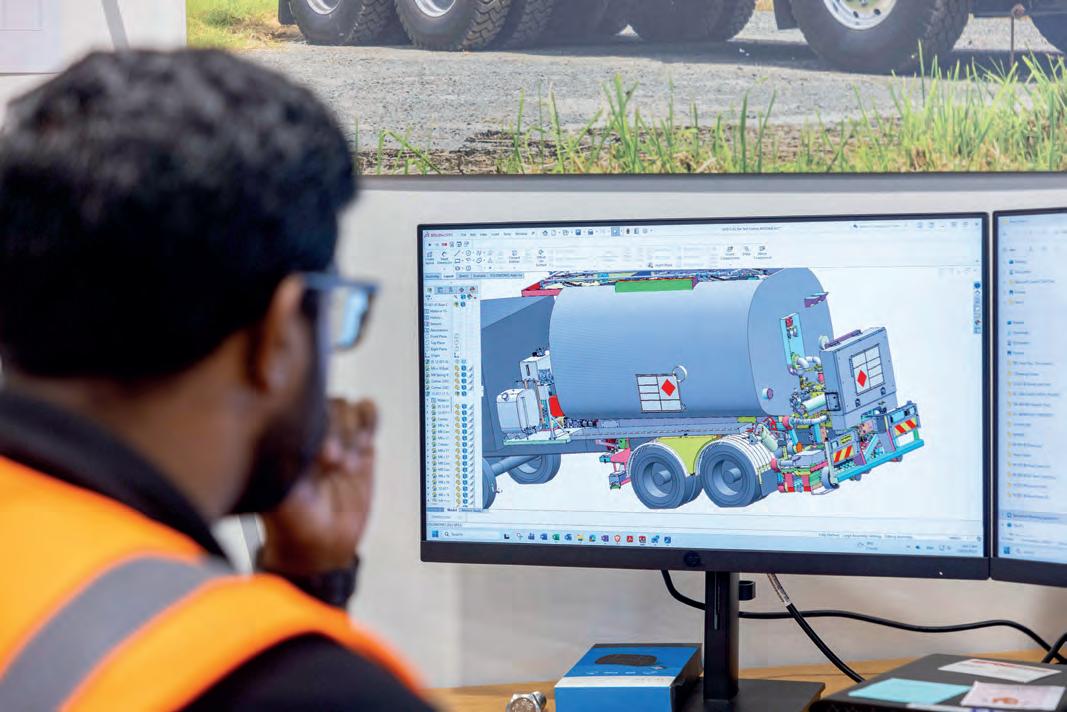
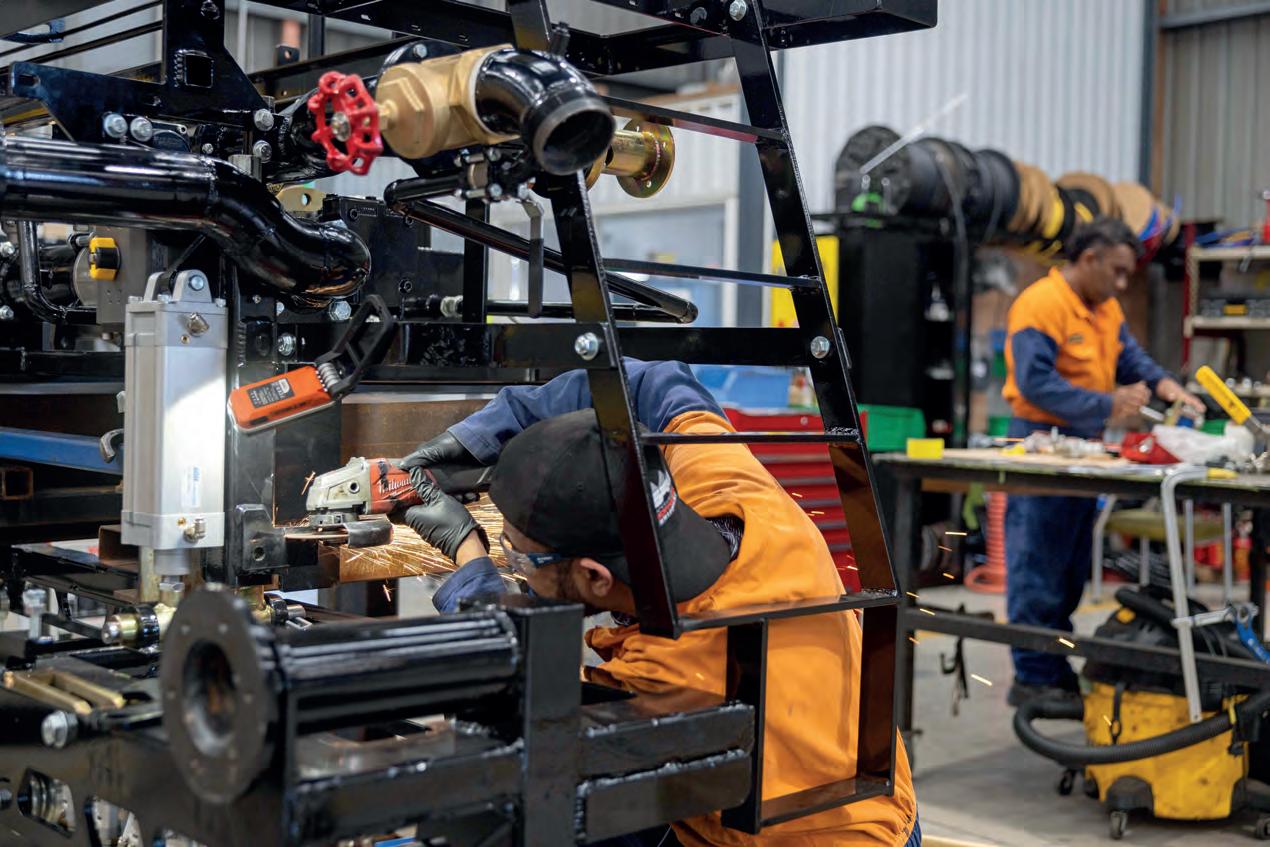
Changes to customisation options and configurations in the workshop are commonly inspired by customer feedback.
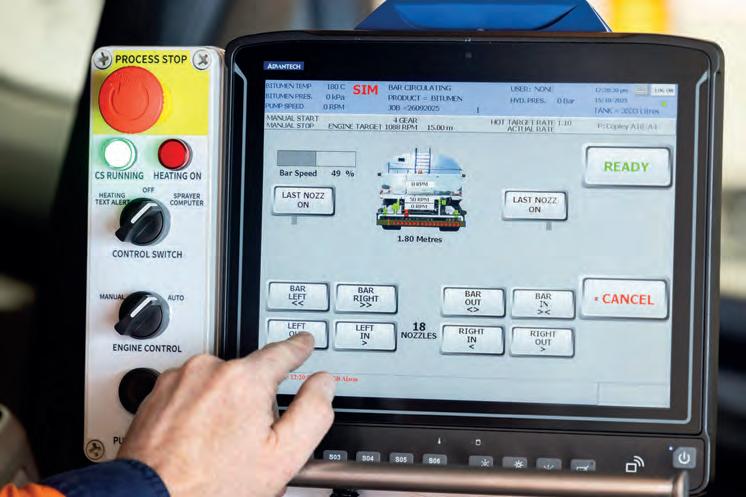
The high-tech nature of Specialised Roading Equipment’s systems allow for major servicing and fixes to be conducted remotely.
PUTTING AUSTRALIA FIRST
EVER SINCE ITS INCEPTION, MATTHEWS BROTHERS ENGINEERING HAS FAVOURED AND PRIORITISED ‘AUSTRALIAN MADE’ PRODUCTS, PARTS, DESIGNS AND STAFF. THIS ETHOS REMAINS UNCHANGED, DESPITE THE INTER-GENERATIONAL CHANGES IN THE BUSINESS’ LEADERSHIP, AS ROADS & INFRASTRUCTURE LEARNS.
For Richard Bailey, General Manager – Matthews Brothers Engineering, supporting Australian entities and people is all he’s ever known throughout his ongoing tenure with the company.
A dual citizen of Australia and England, Bailey says that while an entrenched support of local services and purchases is shared across both countries, he believes it’s more prevalent in Australia.
“When I came to Australia, I quickly noticed the ‘Australian Made’ logo and recall thinking, it was clear that there’s a lot more emphasis and importance around that,” he says. “Even just when talking with my wife, she’d say the same. She loves how Australians prioritise buying from their own and supporting their own economy, and, you know, putting food on their own plates instead of all the money going overseas.”
Fortunately for Bailey, it wasn’t long after landing in Australia that he began
his now close-to-ten-year tenure at Matthews Brothers Engineering.
It’d be far from hyperbole to say that ‘Australian Made’ is in Matthews Brothers Engineering’s DNA.
The Australian-owned and operated business, founded by Roy Matthews and Victor Bradley in 1921, laid its roots through the tough business of mining and transporting bluestone.
Years later, the company was tasked with producing mortar bombs and torpedo nose casings for Australia’s campaign in World War Two.
Under the leadership of Roy Matthews’ sons Noel and Ray, Matthews Brothers Engineering commenced its current era of delivering specialised and custom roadmaking machinery in the 1970s, including but not limited to bitumen sprayers, and dog trailer tankers. Paul Matthews now represents the third generation of the Matthews lineage at the company.
Despite staff turnover and changes, Matthews Brothers Engineering has never lost sight of its proud Australian roots.
Bailey says Matthews Brothers Engineering’s default position – where financially viable – is to always back local.
“If there’s an avenue for us to buy Australian, we do it on every occasion,” he says.
The business hasn’t always been able to produce and source every single component domestically. But where this wasn’t possible, the company has sought to ‘re-patriate’ processes wherever and whenever viable.
“There has been the odd thing that we were sourcing from overseas, that’s now been brought back. For example, some of our casting had gone overseas due to pricing, that’s since been brought back and now all the foundries we use are ‘Aussie’ foundries,” Bailey says.
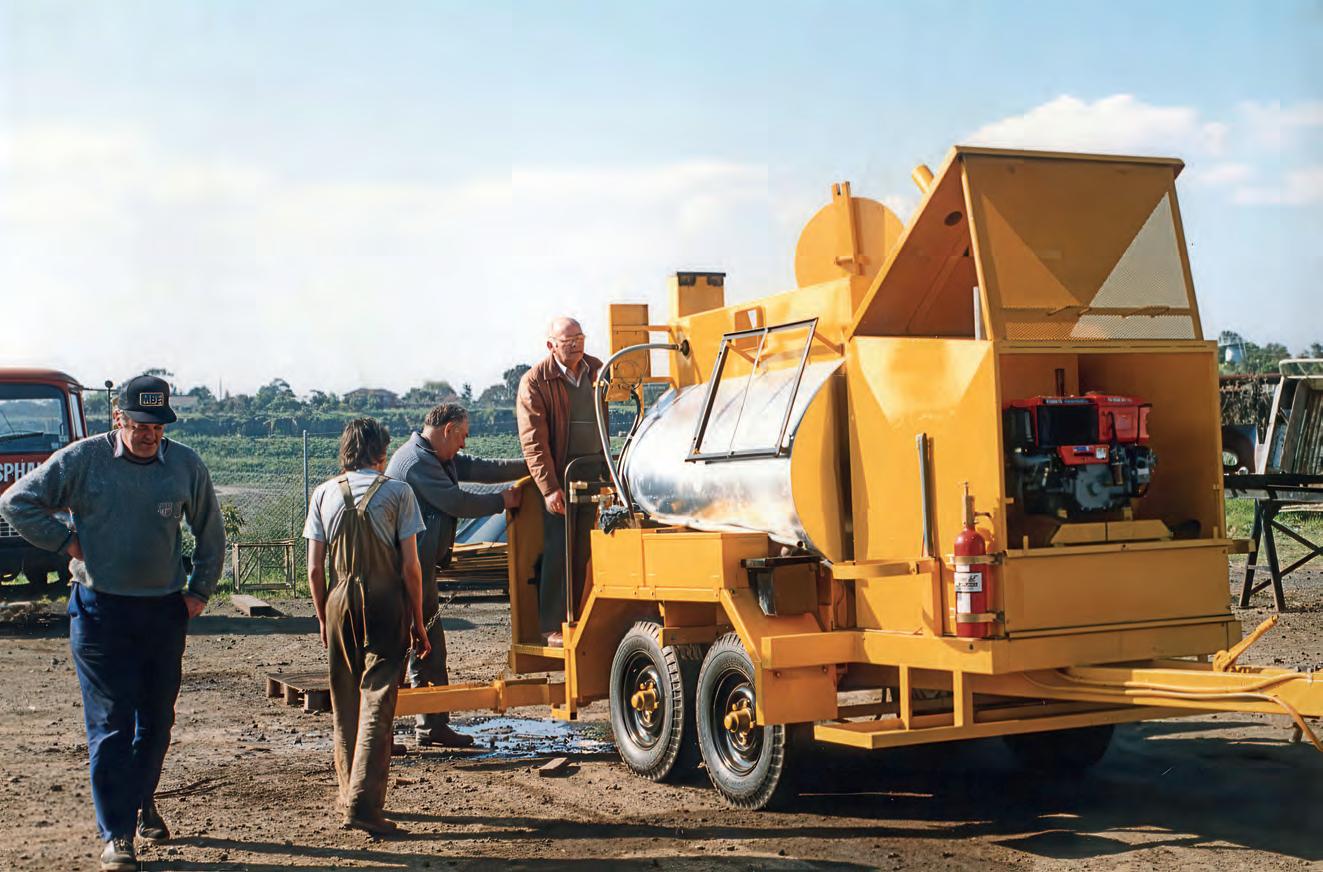
The Matthews name represents more than just a business, it represents a proud history and heritage in Australian manufacturing.
CAPABILITIES SHOWCASE
A GO TO RESOURCE FOR FINDING CONTRACTORS
ALL CONTRACTORS ARE INVITED TO LIST THEIR BUSINESS. SCAN THE QR CODE TO LIST YOUR BUSINESS FOR FREE
NEW PATH TO STABILISATION
WIRTGEN HAS RELEASED ITS NEWEST GENERATION OF WR SERIES STABILISERS, MARKING THE BEGINNING OF A NEW ERA FOR COLD RECYCLING AND STABILISATION APPLICATIONS AUSTRALIA-WIDE. BRETT FERRIS, PRODUCT SUPPORT MANAGER – WIRTGEN TAKES ROADS & INFRASTRUCTURE INSIDE THESE NEW UNITS.
Building on one of the industry’s favourite stabiliser ranges, with smarter efficiency, built-in operator support and a sharper focus on in-situ recycling, is no mean feat.
Launched at bauma 2025, Wirtgen’s latest generation WR series stabilisers – the WR 200 X, WR 240 X and WR 250 X – have been specifically designed to satisfy modern road construction or rehabilitation requirements across the globe.
Despite each unit presenting unique capabilities of differing scale and output, all have been upgraded and updated with the latest technology, ergonomics and efficiency.
As Brett Ferris, Product Support Manager – Wirtgen explains, the WR 240 X has already emerged as an industry favourite nationally.
“In Australia, the WR 240, and now the WR240 X is our go-to stabiliser. It hits the sweet spot on power, versatility and cost, which is why it makes up virtually all of our fleet,” Ferris says. “Australian contractors keep coming back to the WR 240 because it does everything they need. It’s versatile enough for most jobs, powerful without being overkill, and efficient enough that it stacks up economically on every project.”
The WR 240 X operates at a 2.4 metre cut width, with up to 510
millimetres of depth, providing strong production capability.
Compared to previous models, the WR 240 X enables greater production while still being manageable on cost and fuel, with United States Tier Three and Four engines both available.
A major step-change is the operator support and training built into the machine.
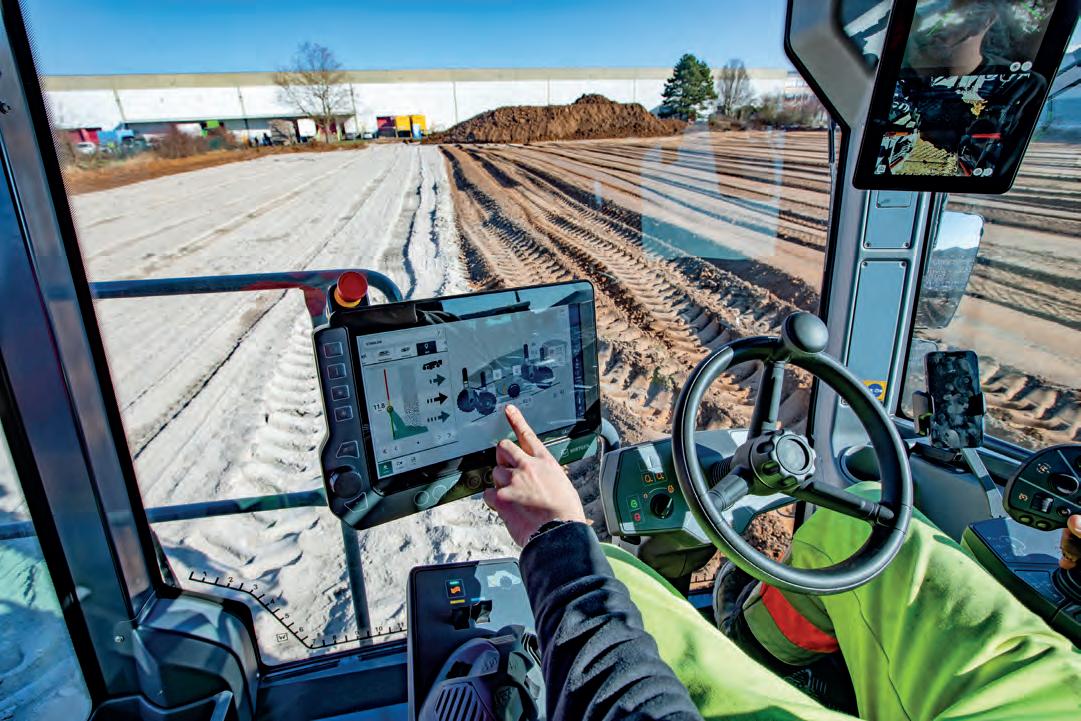
Wirtgen ‘Co-Pilot’ gives operators step - by-step instructions on how to run the machine. This includes instructional videos and interactive step by step guidance for the start of cut, end of cut, as well as how to use systems like water and more.
Wirtgen’s new WR 240 X represents the next generation of stabilisers for the global manufacturer and distributor.
“The cabin is now essentially a mobile classroom,” Ferris says.
Compared to its predecessor, the WR 240 X sports an entirely new control environment.
Control panels and displays have been redesigned, with multiple large touch screens providing oversight through the main machine display, multiple camera views, as well as an ‘Auto Trac’ display – a feature that keeps the machine on a set line for cuts and mixes. Features of which are highly customisable.
Multiple configuration fields provide slots for data to be permanently fixed. For those who like a simple layout, such slots can be left clear, helping to “declutter” the display.
Up to nine operator profiles can be loaded onto the unit, each with their own preferred visual setup.
These profiles also enable setting changes for Mix-Assist, a new built-in automation and support feature that helps the operator set up and run the mixing process correctly and consistently. Mix-Assist works together with Auto Track, water dosing and rotor controls, so the machine can apply the right amount of water and additives, maintain the
correct cutting and mix conditions, and help to achieve a homogenous mix through the full depth.
It’s features like this that help to improve what was already a renowned machinery range, Ferris says.
“The WR 240 was already the pinnacle of technology and a market leader for a reason,” he says.
“Now we’ve stepped it up again to a much, much higher level. The machine itself looks very similar from the outside, but the technology behind it makes the operation that much better, easier and more efficient.
“You could technically, with the push of a button, drop into the cut, turn your water on, have your full width and drive with one button push.”
A COMPANY MISSION
Beyond delivering higher mixing performance and quality, the WR 240 X also emphasises Wirtgen’s objective to support the acceleration of sustainable project outcomes across the sector.
Stabilisation itself is of course a more sustainable practice, making the WR 240 X effectively a recycler. It does
this by reusing existing material in-situ, rather than milling out old pavement, trucking material away and mixing in a pugmill off site.
Reducing re-work is another box ticked. More consistent mixes and output leads to longer- l asting pavements, less rework and fewer repeat interventions, again reducing lifetime material, trucking and fuel use.
“With those features, the WR 240 X is up to 15 per cent more efficient than the predecessor, which was already quite efficient,” Ferris says.
And there’s more on the way, with Wirtgen carefully incorporating and evaluating customer feedback, with potential changes to be delivered through live service updates.
“If there’s a potential fix or improvement spotted by Wirtgen teams and customers across the globe, it’s as simple as loading it into the next software update,” Ferris says.
“As more and more customers get their hands on this model, they’ll find their own ways of operation, and determine what works best for them. Seeing new possibilities through that optimisation is really what excites me for the future.”
Images: Wirtgen
The cab and controls have been reworked, offering unprecedented customisation and configuration for a Wirtgen stabiliser.
NOT GROWTH, BUT PROGRESS
MUSCAT TRAILERS IS LAUNCHING A BRAND-NEW PRODUCT RANGE, SET TO TARGET A SPECIFIC AND INCREASING DEMAND FROM CUSTOMERS IN THE SECTOR. TROY AZZOPARDI, MANAGING DIRECTOR – MUSCAT TRAILERS EXPLAINS WHAT THIS ENTITY HAS IN STORE.
Muscat Trailers has been a major player in Australia’s industrial space for over 10 decades.
Troy Azzopardi, Managing Director –Muscat Trailers and son of Founder Maurice says a core component of this growth has been diversifying and developing wherever possible.
It’s one of the many reasons why the company is now moving further into the road construction and transport space, particularly road preservation products.
Over the next five to 10 years in Australia, it’s Muscat Trailers’ belief that demand and reliance will increase for road preservation methods such as reseals, surface treatments, preventative maintenance and targeted road rehabilitation. This could be driven in part by a mix of asset condition, funding pressure, climate impacts, and freight growth.
Azzopardi adds that this direction complements the company’s core business while also supporting the long-term sustainability of the industry it serves. “While these products sit beyond our traditional
offering, they align with our commitment to smarter infrastructure, reduced environmental impact, and extending the life of existing roads,” he says.
“By preserving rather than replacing, these solutions reduce waste, lower emissions, and support more sustainable outcomes for the communities we serve. This expansion reflects our ongoing investment in responsible growth and forward-thinking solutions for the transport and infrastructure industries. It’s not just growth, it’s progress.”
This diversification aims to support the entire infrastructure industry, from Tier One contractors and government bodies right through to regional operators and singleasset owners.
A BETTER OPTION
Muscat Trailer’s road preservation vision is to provide an alternative to traditional rip-andreplace methodologies.
When cracking, potholes, and severe deterioration appears, the usual response would previously have been to repave or
fully reconstruct – an often expensive, disruptive and resource-intensive approach.
Two key alternatives to these conventional methods – crack sealing and seal coating – help to drastically reduce the closure of roads, as well as the use of heavy machinery and new materials. Significant labour and traffic interruptions are also avoided.
Crack sealing fills and seals surface cracks with elastic, waterproof materials that close gaps in the pavement structure. Cracks allow water and incompressible debris to penetrate the pavement, weakening the base, accelerating potholes, and leading to larger structural failure.
By sealing cracks when they first appear, crack sealers block moisture and harmful intrusion, slowing the rate of deterioration dramatically and extending pavement life.
Meanwhile seal coating applies a protective surface layer over the asphalt, acting like a shield to guard against environmental damage that can be caused by UV (ultraviolet) rays, oxidation, oils, and water. This helps to stop minor surface cracks from worsening, while helping to slow oxidation and brittleness.
“Our focus is on equipment that enables earlier intervention, smarter treatment selection, and greater efficiency, helping asset owners extend pavement life while reducing material usage, waste, and
Images: Muscat Trailers
Troy Azzopardi, Managing Director – Muscat Trailers.
The Crack Seal Pro helps to maintain pavement strength and longevity.
carbon intensity,” Azzopardi says. “By supporting preventative maintenance over reactive reconstruction, these solutions deliver meaningful environmental benefits, including lower emissions, reduced resource consumption, and less disruption to communities.”
EXPANDING RANGE
In what will be an extension of the Muscat Trailers business, the road preservation arm of the organisation will utilise the company’s decade-long relationship with Etnyre International.
This expansion of Muscat Trailers represents the next evolution of the ongoing partnership with Etnyre, which represents over 125 years of road preservation expertise.
Muscat Trailers is the exclusive distributor of a number of Etnyre International’s road preservation models.
One such model is the Crack Seal Pro. This machine places specialised materials into prepared cracks to prevent moisture intrusion into the cracks and underlying pavement layers, maintaining pavement strength and longevity.
The unit’s closed indirect heating system helps to deliver faster heat-up times, even temperature distribution, and greater fuel efficiency. An enclosed high-pressure burner with auto ignition ensures reliable flame
starts and consistent performance, even in cool or variable conditions.
Another product new to the range is the Pavement Saver Pro, designed to apply high-quality sealcoat evenly and efficiently on asphalt surfaces. With precise sealcoat application, high output and fast coverage, this unit is capable of delivering for small to mid-sized projects, all without the need for a full sealcoating truck.
Not to mention the machine’s easy
“ULTIMATELY,
“The emphasis will be on equipment that improves productivity, consistency, and safety, while delivering measurable lifecycle value for asset owners.”
Muscat Trailers is now working through market education, local suitability and adoption cycles: all requirements to ensure that each unit is fully suited to Australian conditions and markets.
Despite it still being early days, Azzopardi and the rest of the Muscat Trailers team have
OUR AIM IS TO SHIFT THE INDUSTRY FORWARD BY CHAMPIONING PROACTIVE ROAD PRESERVATION AS THE SMARTER, MORE SUSTAINABLE WAY TO PROTECT AUSTRALIA’S ROAD ASSETS FOR GENERATIONS TO COME.”
operator control, enabling consistent accuracy and performance on every job and pass.
It’s products like this that will help Muscat Trailers to deliver on its long-term vision of redefining how road preservation is delivered in Australia.
“From a product perspective, the focus will be on building a complementary range of proven road preservation and asphalt equipment, starting with established technologies and progressively expanding based on market demand and local validation,” Azzopardi says.
high hopes and expectations for the future – not only for this particular range, but also the potential improvements available to the industry across the board.
“Nationally, the vision is to build a strong, trusted presence across Australia, working closely with councils, contractors, and road authorities to support long-term preservation programs,” Azzopardi says.
“Ultimately, our aim is to shift the industry forward by championing proactive road preservation as the smarter, more sustainable way to protect Australia’s road assets for generations to come.”
The expansion of its business reflects a renewed push towards sustainable solutions for Muscat Trailers.
SANY has developed a wide product portfolio of machinery throughout its 40 years of operation.
SPREADING THE LOVE
CEA’S ROLE AS A TRUSTED HEAVY EQUIPMENT SUPPLIER HAS BEEN REINFORCED THROUGH A CRITICAL DISTRIBUTION PARTNERSHIP WITH SANY.
CEA’s role as a market leader has been more than four decades in the making. The heavy equipment distributor recently reached consumers across five metropolitan locations, before adding in regional facilities in Mackay and Rockhampton in Queensland. Now, from these seven sites, CEA supplies a wide variety of machinery across various industries.
According to CEA Brand Manager, Deon Cope, growing to this size had long been a major company goal.
“We distribute all types of civil construction equipment,” he says. “We hold everything from wheel loaders and material handlers to excavators and more. For a long time, our mission was to distribute multiple pieces of equipment to every working
site in Australia, and I believe we’ve achieved that.
“When we grow as a company, we have a greater capacity to support consumers by bringing high-quality product options to them.”
As part of this commitment to leading the market, CEA recently constructed a number of multi-million dollar facilities around Australia, purpose-built to support a new wave of high-quality equipment for consumers. This new wave is SANY. The China-based manufacturer has made a name for itself in the sector by rapidly building a wide product portfolio of concrete machinery, road machinery, cranes and more.
“SANY is a manufacturer to watch,” Cope says. “It has become so huge while still being relatively young in
the space. The company comes from private ownership – a small group of entrepreneurs who developed it from nothing to where it is now. It’s similar to our background in that way.”
Within SANY’s substantial production offering is its line of excavators, for which CEA received full Australian distribution rights for Queensland, New South Wales and South Australia.
Gaining access to these rights is a crucial step for CEA’s own development, as the deal will provide the company with access to some of SANY’s larger machines. This will enable CEA to enter new markets for heavier plant and equipment, expanding its own product line immensely.
“The addition of SANY products to our portfolio will strengthen our lineup
with an extensive range of excavators, from one to 90 tonnes,” says CEA Chief Executive Officer Hylton Taylor.
“For CEA, it was critical that we partnered with a brand which understood the customer segment, could deliver quality products, and had a strong focus on future industry needs, ensuring the machines of tomorrow can meet the ever-growing demands of the core customer base.”
SANY also stands to benefit greatly from this partnership, gaining its own access to CEA’s trusted position in Australia’s heavy plant and equipment space. By being well acquainted with the local industry, CEA will be able to greatly assist SANY in building brand awareness and trust among Australian buyers.
“SANY is proud to partner with an Australian-owned business that has the size and scale of CEA,” says Putzmeister Asia Pacific CEO Michael SchmidLindenmayer, part of the wider SANY company team. “CEA’s extensive history in the market offers a strong sales channel, with local insights and market knowledge that will be critical to the long-term success of the SANY brand.
“SANY is firmly focused on delivering high-quality, market competitive products to established markets
like Australia. The brand’s focus on delivering innovative solutions ensures we are prepared for market demands and look forward to supporting CEA as they target the many opportunities available in each location.”
But ultimately, CEA’s distribution of SANY products is a victory for Australian consumers, as the Chinese manufacturer’s products are distinguished in the industry for their efficient production, high standard of quality and overall reliability.
“SANY’s hydraulic control and
large scale through highly automated building processes in its factories, earning them the name of ‘lighthouse factories’. According to the World Economic Forum, these types of factories represent innovation which can lead to wider industry efficiency.
CEA has already started distributing SANY excavators to consumers – an effort that also includes responsibility for product servicing and warranties. CEA has embraced its role as a destination for all SANY customer needs.
“THE ADDITION OF SANY PRODUCTS TO OUR PORTFOLIO WILL STRENGTHEN OUR LINEUP WITH AN EXTENSIVE RANGE OF EXCAVATORS RANGING FROM ONE TO 90 TONNES.”
accuracy are impressive,” Cope says. “The design of their hydraulic systems stood out to us immediately. The machines are world-class, which make them ideal for Australian businesses.
“SANY is no stranger to the global stage, and being a consistent supplier to a consumer base that big is a great sign of quality. Being able to bring these machines to our local market is exciting.”
SANY produces its equipment on a
And, while this distribution deal is still in its infancy, current feedback has been positive.
“From what we’ve heard, our existing clients have responded really well to how we’ve been handling the SANY brand so far,” Cope says. “These products are just what the market needs, and the timing is perfect.
“There’s a lot of opportunity here, and things are going to get much bigger.”
CEA has already started distributing SANY excavators to consumers, in addition to overseeing product servicing and warranties.
planers and stabilisers, offering milling widths from 250 millimetres to 2000 millimetres with its 2000-millimetrewide milling drum – the largest currently available on the market – in addition to depths of up to 350 millimetres. Because of these capabilities, the PL2000 road planers are ideally suited for small and medium-sized works, particularly in tight spaces, around potholes or near kerbs to ensure a safe and more efficient milling operation.
Alongside this road planer, SIMEX has also developed the ART 1000 –an innovative asphalt regeneration technology attachment that restores road surfaces sustainably, without the need for new materials.
Such repairs often require a rapid turnaround – such as alligator cracking, surface bumps, potholes and joint gaps. The ART 1000 performs milling, regeneration, granulation and mixing on these roads in a single pass, reducing the need for additional equipment or personnel on a civil construction site. These efficiencies make the ART 1000 a critical asset.
The ART 1000 attachment also provides full integration to the cabin.
“The full integration of the ART 1000 with the cabin allows the operator to adjust parameter settings with ease,” Drew says. “There’s also a detection wheel on the side, which measures the correct dosage of the rejuvenator, which is then blended in and is based on speed. That speed has an LED indicator, which tells the operator whether or not they’re at the appropriate speed. It’s full on-board control, in coordination with the operator.”
Other benefits of the SIMEX ART 1000 include an operating depth of between zero and 100 millimetres, making the attachment ideal for functional maintenance and surface restoration.
“SIMEX’S PREMIUM PRODUCTS ARE RECOGNISED AS THE INDUSTRY STANDARD THROUGHOUT THE COUNTRY.”
Roads can be reopened to traffic immediately after receiving ART 1000 treatment and is compacted using standard tools like rollers or vibrating plates. The regenerated surface delivers long-lasting results with significantly reduced resource demand. Due to its recency in the market and efficient applications, the ART 1000 has stirred market interest in Australia.
“The ART 1000 is a second-generation product, so it’s quite new,” Drew says. “A lot of contractors recognise this attachment for the new capabilities it brings to the sector, and have started to figure out how they can apply that
to their own business and contracts.”
According to Drew, the renowned mechanical qualities of SIMEX’s products is the result of the company’s steadfast commitment to innovation, often informed by listening to what the market really needs.
“SIMEX’s strong research and development capabilities are dedicated to figuring out how to turn its findings into solutions, and integrate them into physical machinery,” Drew says.
“The company speaks to the end-users to help develop different solutions and technologies to ultimately increase productivity in the industry. The PL2000 and ART 1000 are no exception.”
Contact details for authorised SIMEX dealers in Australia are available at: attachmentspecialists.com.au/simex
Images: Total Rockbreaking Solutions
Above: SIMEX products are made available thanks to a national and connected distribution network.
The SIMEX ART 1000 attached to a track loader.
An illustration of the SIMEX PL 2000.
THE CHOSEN ONE
LIUGONG’S 856T WHEEL LOADER HAS PROVEN TO BE THE IDEAL MACHINE FOR THE DEMANDING OPERATIONS OF NEW SOUTH WALES-BASED QUARRY O PERATOR, AUSTRALIAN SANDSTONE MERCHANTS.
LiuGong has been making waves in the heavy construction and mining equipment markets since 1958. Since its inception, the wheel loader has been LiuGong’s flagship product, and has continued to be, across decades of operations and a plethora of international markets, including Australia for more than 20 years.
Here, LiuGong has manufactured heavy vehicles for a variety of customers seeking high quality and reliability, such as Australian Sandstone Merchants.
The New South Wales-based familyowned business has acted as a major supplier of sandstone to the Australian market for more than 40 years.
The use of high-performing machinery to quarry, crush and screen stones comes
with the territory, particularly as the company specialises in removing large six-tonne sandstone blocks which must be transported to a processing plant.
With this demanding application in mind, Australian Sandstone Merchants’ Tony Francis felt there was only one option –the LiuGong 856T Wheel Loader.
“I needed a real workhorse,” he says, “something with the power to lift heavy sandstone blocks day in, day out, while still being reliable. We looked at other machines and had demos, but the LiuGong won out.”
Built with a robust design and proven drivetrain, the 856T Wheel Loader is suitable for heavy-duty applications where consistent performance is essential, such as the quarrying operations of Australian
Sandstone Merchants, and even other spaces such as extractive industries and bulk material handling. Key specifications of LiuGong’s 856T Wheel Loader include its 19,500-kilogram operating weight, its 228-horsepower Cummins engine, single-pump hydraulic flow system, and a loader arm with an attached 3.5-cubicmetre bucket.
Additionally, the machine includes a liquid-drive, air-in type cooling system as well as a European-styled cab interior, touchscreen operating system, multiadjustable arm rest, joystick, and airsuspension seat for ultimate operator convenience and comfort while on the job.
“It’s got the power we need to move large sandstone blocks, but it’s also
The LiuGong 856T Wheel Loader.
very responsive,” Francis explains. “The loader is smooth to operate, and our operators have also commented on how comfortable it is to drive. It handles tight spaces better than we expected for a machine of this size.”
The 856T Wheel Loader is also a safe machine, equipped with 360-degree surround handrails and anti-slip steps, making it easier for operators to get in and out of the cab. The machine’s safety is bolstered by curved, panoramic glass windows and an optional rear-view camera that combines to increase visibility by 15 per cent when compared to normal view.
Seeing the LiuGong 856T Wheel Loader operate in real working conditions was a key factor in Francis’ purchasing decision. He took delivery of the machine in January 2026 following a successful on-site demonstration in December 2025.
This demonstration was organised by Construction Distribution Australia (CDA) Sydney, an equipment distributor that is part of LiuGong’s Australian dealer network, and allowed Francis and his team
to assess the machine’s performance within their own quarry environment rather than relying solely on specifications or off-site demos.
“We looked at other machines and had demos, but the LiuGong won out,” he says. “The demo was very well organised and allowed us to see the machine doing the exact work we needed it for.”
Francis celebrates three key members of CDA Sydney’s team – James Lipman, Tyson Hatton, and Liam McCormick – for their collective professional approach and strong communication throughout the entire purchasing process. From early discussions and initial correspondence, the CDA Sydney team took the time to understand Francis’ operation and the specific requirements of working in a quarry environment.
“The very first conversation through to delivery has been a great experience,” he says.
“They really listened to what we needed from a wheel loader and made sure the machine was the right fit for our application. Communication was clear and consistent the whole way through.”
With the LiuGong 856T Wheel Loader now fully and successfully integrated
“SOMETHING WITH THE POWER TO LIFT HEAVY SANDSTONE BLOCKS DAY IN, DAY OUT, WHILE STILL BEING RELIABLE. WE LOOKED AT OTHER MACHINES AND HAD DEMOS, BUT THE LIUGONG WON OUT.”
Being able to trial the machine under real production conditions helped confirm that the 856T had the required lifting capacity, stability, and control for the job at hand.
“We were able to move large sandstone blocks and see how the machine handled the terrain, the space, and the workload,” Francis says.
“That gave us confidence in the final decision.”
into daily operations, Australian Sandstone Merchants has now expressed interest in increasing the number of LiuGong machines in its fleet.
“Overall, the support and service provided by CDA has been outstanding, and we’re very happy with the outcome,” Francis says. “I wouldn’t hesitate to recommend them to anyone looking for reliable equipment and professional service.”
Images:
LiuGong
The LiuGong 85T Wheel Loader moving sandstone.
The LiuGong 856T Wheel Loader working in the quarry.
PAVING THE WAY
TEC CONTAINER SOLUTIONS LEADS THE CHARGE IN BITUMEN TRANSPORT AND STORAGE WITH AN ICONIC PRODUCT LINE AND UNIQUE SOLUTIONS.
Bitumen is an essential component in the construction of roads, highways, and pavements. The material, a thick liquid, acts as a binding agent to connect other substances, which then form asphalt. Given bitumen’s critical role in construction, its handling, storage and transport are equally important. This is where TEC Container Solutions, or TEC for short, comes in.
TEC was founded in the late 1990s as the collective brainchild of a few tank container engineers in Worthing, England. They noticed that at the time, bitumen handlers were frequently moving and storing the material in drums – an inefficient method given bitumen’s viscous and temperaturesensitive qualities.
“Back then, handling bitumen in drums was very messy and labour-intensive,” says TEC Managing Director Jon Whittall. “The engineers who founded TEC tried to solve this problem by using standard ISO tanks instead, but that still didn’t accommodate the material’s more challenging requirements. So, they created their own solution.”
TEC’s flagship product, the ‘Bitutainer™’, was born. The special container range’s fundamental design boasts a 29,000-litre holding capacity across 20 feet and features a double-walled build to keep bitumen contained effectively and at a constant temperature during transport. In the years since its debut, the Bitutainer™ product line has been widely embraced by the sector.
“Our product has been well established in the industry for a long time,” Whittall says. “We have worked hard to stay at the
forefront of the space, moving from strength to strength as leaders of this niche market.”
The Bitutainer™ product line’s positive reception has also been frequently bolstered by TEC’s ongoing commitment to product improvement by working directly with suppliers and end-users to meet their needs.
“One thing that separates us from our competition is our dedication and commitment to bitumen as a prime focus,” Whittall says. “While other players in the industry are general container manufacturers who look to add bitumen tanks to their range, bitumen is our key focus and we invest time and energy into understanding both the
industry and the material itself to ensure we deliver the best solutions. To do that we use our extensive hands on experience as well as most importantly by constantly communicating and collaborating with the market. As a result, our solutions are known to be efficient, reliable and deliver unrivalled longevity.”
While TEC’s foundational Bitutainer™ design continues to be immensely popular, the company’s value proposition has more recently been divided between two types of bitumen handling – transport and storage. According to Whittall, these markets typically demand different
A schematic of one of TEC’s Bitutainer™ storage sites.
container solutions, which has pushed TEC to innovate further.
“We have found in the bitumen transport space, our customers generally want their units to do the same thing as they’ve always done, in the best possible way,” Whittall explains. “We have refined and developed the transport Bitutainer™ design over time, but its skeleton has largely remained the same.”
“The storage side of bitumen handling has been the catalyst for more bespoke solutions in our business, which we pride ourselves in our ability to offer.”
This shift is the result of more types of bitumen becoming available on the market in recent years. New offshoots of the material vary in holding temperature and composition.
“The science in bitumen itself is changing,” Whittall says. “There has been a rise in the use of speciality bitumens, such as emulsions, PMB’s, crumb-rubber modified binders and others, which has led to more of our customers expressing the need for unique container solutions that complement the properties of what they are storing.”
TEC’s storage Bitutainer range has expanded greatly in response. The range includes various designs offering anywhere from 45,000 to 65,000 litres of bitumen storage, options for heat retention, and storage farm solutions created by linking individual tanks into larger storage infrastructure. Among
these options is TEC’s Mobile Equipped Storage Tank (MEST) Bitutainer line, featuring a modular design for scalable setups. This storage solution has been the prime choice for a key TEC customer demographic –asphalt plant suppliers.
TEC’s MEST Bitutainers include a wealth of safety and compliance systems, so they can be easily integrated into an asphalt plant’s operations and securely hold bitumen at an ideal temperature. In this way, TEC’s services alleviate pressure off these plants, which would otherwise not have the facilities to store many kinds of bitumen properly.
operate in tough conditions or inaccessible areas,” Whittall says. “In parts of Australia, for example, some mobile asphalt plants are required to build roads in the middle of big, uninhabited spaces, and they need bitumen to make it there and stay there without being compromised. Our storage tanks are vital to this process and can be easily relocated at the end of the project along with the mobile plant.”
This philosophy of leaving certain processes to be completed by their corresponding experts continues to guide TEC’s operations, leading the company to
“MANY ASPHALT PLANTS NEED OUR RELOCATABLE STORAGE BITUTAINER™ OPTIONS BECAUSE THEY OPERATE IN TOUGH CONDITIONS OR INACCESSIBLE AREAS.”
“Asphalt plant suppliers aren’t going to create bespoke storage tanks for each of their customers, as it is not their core business and it demands time and focus” Whittall says. “But that’s a service we can provide. When we collaborate with asphalt plant suppliers and end users, we’re able to ensure that bitumen is stored in the best way possible for that application, while they can ensure the asphalt creation is completed to the highest quality.”
Additionally, the mobile aspect of the Bitutainer™ is equally valuable, as some asphalt plant operations occur in more remote locations, and require bitumen to be temporarily stored in a variety of spots.
“Many asphalt plants need our relocatable Storage Bitutainer™ options because they
more success in the market as its services are required.
“One aspect of this industry that I enjoy is the mindset of creating a product by having different contributors focus solely on the parts that they do best,” Whittall says. “It’s a mindset that is present across asphalt suppliers, equipment suppliers, bitumen suppliers, our customers and our own team. We are seeing a real rise in collaboration and willingness to share information, which in our business means we are able to integrate our storage solutions into existing plant systems smoothly and efficiently.
“This approach promotes high quality, collaboration, and trust within the process, ensuring the best possible result for all stakeholders.”
One of TEC’s Mobile Equipped Storage Tank facilities in action.
TEC continues to expand its range of solutions. Images:
The 2026 AfPA Industry Awards are now open for nominations. Put your people, teams, and projects on the pedestal they’ve earned — before the industry’s brightest night passes them by.
Every year, someone in our industry does something extraordinary. They make worksites safer. Deliver smarter, faster, better results. Out-think the challenges of tomorrow.
The 2026 AfPA Industry Awards shine a spotlight on real achievements, real impact, real leadership, and give the winners recognition they deserve. Don’t let their excellence stay hidden. Make them the talk of the industry — today.
Awards include the Safety Initiative Award for those who make worksites safer for everyone, the Emerging Leader Award, for young professionals who are shaping the future, the Field Worker Award, for the on-site heroes delivering excellence every day, and the Graduate / Cadet Award, for the rising stars making a difference early in their careers.
Nominations are open, but deadlines are approaching. Submission deadlines from 3 July 2026.
ADVANCING LOW CARBON CONCRETE IN AUSTRALIAN INFRASTRUCTURE
An Australian infrastructure milestone has been reached with the approval of a 60 per cent Supplementary Cementitious Material (SCM) concrete mix for use on road and transport projects across Victoria.
The low carbon concrete mix has now been formally approved by VicRoads, marking a significant step forward in reducing the embodied carbon of concrete used in road and bridge construction, while maintaining the performance requirements expected of critical infrastructure assets
REDUCING CARBON WITHOUT COMPROMISING PERFORMANCE
Developed in collaboration with Heidelberg, the approved mix replaces 60 per cent of traditional Portland cement with SCMs, including slag. This substantial reduction in cement content delivers a meaningful decrease in embodied carbon, while continuing to meet structural performance, durability and longevity standards required for long life infrastructure applications
The approval demonstrates that sustainability outcomes can be achieved without compromising engineering performance, addressing one of the key challenges facing the infrastructure sector as it works to reduce emissions across the construction supply chain.
INDUSTRY FIRST APPROVAL FOR VICTORIAN INFRASTRUCTURE
The VicRoads approval enables the
supply of 60 per cent SCM concrete mixes to both government and private infrastructure projects throughout Victoria. It reflects growing momentum across the sector to adopt lower carbon materials that align with government sustainability targets and evolving procurement frameworks.
“This approval represents dedicated research and innovation by our team,” says Matthew Sheridan, Eastern Region Precast Concrete Manager at Geoquest Australia, a National Precast member.
“Our goal has always been to provide high performance solutions that meet engineering standards while supporting the industry’s transition to a more sustainable future”
BUILDING ON EARLIER LOW CARBON MILESTONES
The approval builds on earlier low carbon concrete applications delivered using 50 per cent SCM mixes, including the Ison Road Overpass in Victoria. That project exceeded sustainability targets and demonstrated the practical, realworld application of high SCM concrete in infrastructure environments.
Subsequent projects incorporating similar reduced carbon mixes have further reinforced the viability of SCM concrete across a range of precast and civil applications.
SUPPORTING THE TRANSITION TO GREENER INFRASTRUCTURE
With the VicRoads approval now in place, the 60 per cent SCM concrete mix represents another step forward in reducing the carbon footprint of infrastructure construction, while maintaining the durability and performance required for long life assets.
As infrastructure owners, designers and contractors continue to prioritise sustainability outcomes, approvals such as this provide a clear and practical pathway for the broader adoption of low carbon concrete across Australia’s road and transport networks.
The project has seen the use of an innovative concrete mix to optimise sustainable outcomes.
Geoquest Australia has vast experience in delivering sustainable outcomes for projects of all sizes.
CONTRACTS IN BRIEF
ROADS & INFRASTRUCTURE PROVIDES AN UPDATE ON SOME OF THE CONTRACTS AND
TENDERS RECENTLY AWARDED OR PUT TO MARKET ACROSS THE AUSTRALIAN INFRASTRUCTURE SECTOR.
VICTORIA
Two major VIC road intersection projects underway
The Victorian Government is moving forward on two critical road intersection projects, with a new contract awarded, and separate works set to get underway just outside of Melbourne. The contract for the Henderson Road and Ferntree Gully Road Intersection Upgrade in Knoxfield has now been awarded to construction company Fulton Hogan. This project is scheduled to begin in March, and is expected to deliver targeted improvements to ease congestion and bolster safety. Planned works include construction of a new left-turn slip lane from Henderson Road onto Ferntree Gully Road, extending the existing right-turn lane into the intersection, and adding an additional right-turn lane into the intersection. The existing right-turn lane into St Laurent Rise from Ferntree Gully Road will also be extended. Additionally, the State Government is commencing works on the Ballan Road Intersection Upgrade in Wyndham Vale. The existing congested roundabout at Ballan Road, Greens Road and McGrath Road north is set to be replaced with a new traffic light intersection and new lanes. These works will similarly improve traffic flow, reduce congestion and deliver safer outcomes for drivers, transport users, pedestrians and cyclists. Work will begin with the demolition of the existing roundabout and the installation of concrete safety barriers to separate traffic from the work zone. A temporary signalised pedestrian crossing will be installed on Ballan Road near the medical centre, while the existing school crossing on Ballan Road north of the roundabout will be relocated further from the construction area. Right turns from Ballan Road into the shop precincts north and south of Ballan Road will be removed to support safety and traffic flow. As construction moves into the more significant stage one and two works, McGrath Road north will be closed at Ballan Road until late 2026. Signed detours via Ballan and Bolton roads will be in place, with drivers advised to allow an extra 20 minutes of travel time. Road works will continue behind barriers on the northern side of Ballan Road through to late 2026, before shifting to the southern side of the intersection later in the year.
WESTERN AUSTRALIA
Contract awarded for second port stage
Pilbara Ports has announced the successful contractor for the second stage of works on the Dampier Link Bridge in Western Australia. Dampier Link Bridge will enhance direct shipping services in the Pilbara by providing seamless connectivity by connecting the new Dampier Bulk Handling Facility and existing cargo wharf. The project will also allow existing trade to continue at the Port of Dampier, enable concurrent repairs on the Dampier Cargo Wharf, provide additional functionality to support trade growth and increase throughput capacity and efficiency at the Port of Dampier. NRW Pty Ltd and Brady Marine and Civil Pty Ltd (NBJV) won the contract and will design and build a new 57-metre-long link bridge that will connect the existing Dampier Cargo Wharf to the Dampier Bulk Handling Facility. Construction of the Dampier Bulk Handling Facility is well under way with demolition works, dredging, drilling and blasting complete, and wharf construction in progress. This facility is on track for completion in the first half of this year, with the link bridge scheduled to be fully operational by late 2026. The Federal Government has committed $115 million for the Port of Dampier.
Contract awarded for Westport infrastructure works
The Worley Arcadis Joint Venture (JV) has been awarded the contract to deliver marine technical advisory services, which will be essential in the delivery of Westport, in Western Australia. Westport is one of the largest infrastructure programs ever undertaken in Western Australia. Driven by the State Government, this project will aim to investigate, plan and build a future port in Kwinana, which will also integrate road and rail transport networks. This program sets out to break down potential barriers presented by Western Australia’s future container trade constraints, by relocating a portion of container trade from Fremantle to this new site in Kwinana. The technical advisory services – to be delivered by the JV – will play an essential role in the definition and design of Westport. The scope will support current definition activities including completion
of reference designs and optimisation of infrastructure planning for the new port facilities, along with approvals, construction planning, and reliable costing ahead of final investment decisions. A Westport Business Case was previously completed, showing significant risk to the Western Australian economy from future constraints on container trade if Westport was not built by the time Fremantle Port reaches capacity at the end of the 2030s. The business case found inaction to address constraints on trade could cost WA’s economy $244 billion over coming decades – an average of $5 billion per year – driving significant increases in the costs of everyday household goods and for the State’s businesses.
TASMANIA Procurement stage opens for TAS scheme
The first phase of the construction tender for the Tarraleah hydropower scheme has been announced by the Tasmanian Government, marking the commencement of the next stage of the project. The proposed Tarraleah Redevelopment Project would increase the capacity of the Tarraleah Hydropower Scheme from 90 megawatts (MW) to approximately 190 MW and increase its operational flexibility and efficiency, by providing a direct pressurised connection between the scheme’s headwater and a new power station. The existing Tarraleah Hydropower Scheme is located in the Central Highlands of Tasmania and is part of Hydro Tasmania’s Derwent Hydropower Scheme. The scheme was first commissioned in 1938, with most of its assets nearing the end of their operational life. The project aims to increase capacity and better prepare for future power demand. The Request for Proposal on the project includes seeking engineering, procurement and construction contractors to deliver the next stage.
ATLAS COPCO
MS SOLAR LIGHTING TOWER RANGE
SUSTAINABLE ILLUMINATION
• Up to 5,278m2 Light Coverage
• 420Wp solar panel
• Compact design
• Robust HardHat® canopy
secure your stock today with our exclusive introductory offer!
The new MS Solar Light Tower range delivers powerful, reliable illumination with zero emissions and minimal noise. Eliminate fuel dependencies and enjoy reliable lighting, regardless of grid access.
Perfect for construction sites, events, and remote locations. Experience significant cost savings and reduced environmental impact. Exclusively available through Atlas CEA, contact the team today to learn how solar power can light up your operations.
LIKE TO KNOW MORE? SPEAK TO OUR TEAM TODAY PH: 1800 733 782 www.atlascea.com.au
PROVIDING UNMATCHED COMPACTION POWER
• Mask down feature as standard TIME TO
REPLACE YOUR CURRENT ROLLER WITH A NEW ONE AT A GREAT PRICE TODAY!
Speak to your nearest Dynapac CEA branch today and secure a great deal on current inventory.
WHY UPGRADE?
• Improved compaction performance
• Lower operating and maintenance costs
• Increased reliability and uptime
• Modern operator comfort and safety
• Competitive pricing on new equipment
HURRY STOCK IS LIMITED!
Our low carbon polymer-modified binder contains biogenic materials and exhibits more than 50% less carbon footprint than conventional PMB, signaling a significant reduction in the carbon footprint of asphalt and sprayed seal projects. SAMIGreen can be produced in any grade and has identical engineering characteristics to conventional PMBs such as A10E, A15E, S25E, and S20E.