Roads & Infrastructure Dec 2025

Page 1


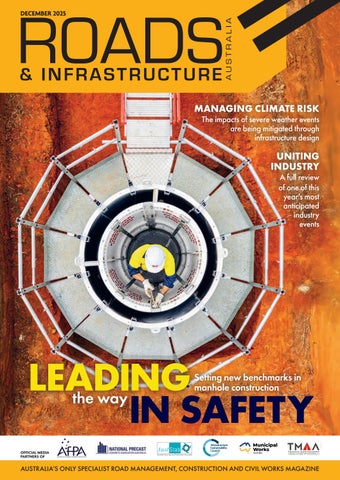
LEADING

MANAGING CLIMATE RISK

The impacts of severe weather events are being mitigated through infrastructure design

UNITING INDUSTRY

A full review of one of this year’s most anticipated industry events

Setting new benchmarks in manhole construction

the way IN SAFETY

CLOSE TO OUR CUSTOMERS. For decades, HAMM oscillation has been the go-to compaction method for quality results on sensitive asphalt mixes like SMA and EME-2, especially around vibration sensitive assets like pipelines, bridge decks and buildings. Now HAMM has introduced Smart Compact Pro - another breakthrough in compaction efficiency that incorporates real-time density on the fly. Do you want to be known for producing quality pavements, quickly and with less re-work? Let Hamm help.

COVER STORY

14 Safer manholes. Smarter solutions

How Manhole Form Hire’s latest innovations are again lifting industry standards and driving new levels of safety, efficiency, and performance on worksites across Australia.

ROADS REVIEW

18 Roads Review

This month, we asked the industry’s decision-makers, ‘What fills you with optimism moving into 2026?’

TECHNOLOGY

20 Data delivering for community GBM Konect has become a fundamental tool with the location-based data collection and asset management tool ensuring the efficient delivery of essential services that residents depend on.

INNOVATION

22 Perfecting the bond

Utilising its vast global experience in polymer modified bitumen blends, Sripath has developed a brand-new product for the market, which aims to tackle a legacy industry pain-point.

25 If it ‘ain’t’ broke…

Sealants & Pavement Adhesives’ product offering has endured for decades, with t wo key product ranges forming the bedrock of the company’s growth and success in the market.

28 Decades ahead

The innovation and design of Geoquest Australia’s products are helping to minimise the impacts of weather events on infrastructure, with turn-key solutions emerging as a potential solution.

PROJECT REPORT

31 Here to stay RoadAid’s works on a major project signify the next phase of growth for the company, which is now setting its sights on interstate projects.

MACHINERY AND EQUIPMENT

34 Expanding what’s proven Specialised Roading Equipment’s first ever Australian fixed wing sprayer has made shore, aiming to offer an improved and increasingly accessible, safe and smart option for operators.

37 Constructing the future

Komatsu is navigating a shifting construction landscape by balancing innovation and training, launching new flagship machines, and advancing smart, safe, and sustainable growth across Australia and the region.

40 A safer skid steer

As construction sites continue to prioritise safety and efficiency, JCB has redefined the traditional skid steer design with innovative engineering that enhances visibility, comfort, and overall site safety.

ASSOCIATION SECTION

42 Streamlined precast delivery

The Sydney Metro Viaduct is a pivotal link in the city’s largest public transport project.

44 Remarkable transformation recognised

Municipal Works Australia’s nomination for the Most Improved Association category in the prestigious 2025 Associations Forum Awards signifies five years of extraordinary growth, reform, and renewed purpose.

46 Deeper knowledge builds better roads

A well-built road is more than just a smooth black surface – it’s a testament to engineering, teamwork, and understanding.

48 Lighting the path forward

The 20th International Conference of the Australian Flexible Pavement Association has united industry to address challenges and optimise opportunities for the sector’s betterment.

EVENTS

50 Driving Innovation, Sustaining the Planet

Roads & Infrastructure breaks down SAMI Bitumen Technologies’ recent attendance and exhibitor booth from the latest International Flexible Pavement Conference.

52 The stage is set

As preparations get underway for International No-Dig 2026, Prime Creative Media reflects on the host nation’s current trenchless landscape.

54 Turning bulk problems into big wins Bulk Expo 2026 brings Australia’s bulk handling industry together to solve problems, share solutions, and turn ideas into action.

Roads & Infrastructure provides an update on some of the contracts and tenders recently awarded or put to market across the Australian infrastructure sector. The concluding issue of Roads & Infrastructure magazine for 2025 marks

56 Nominations now open for the 2026 Endeavour Awards

N ominations are now open for the 2026 Endeavour Awards, Australia’s premier celebration of excellence and innovation in manufacturing.

CONTRACTS AND TENDERS

58 Contracts in brief

CEO

Christine Clancy

christine.clancy@primecreative.com.au

PUBLISHER

Sarah Baker

sarah.baker@primecreative.com.au

MANAGING EDITOR

Lisa Korycki

lisa.korycki@primecreative.com.au

EDITOR

Tom O’Keane tom.okeane@primecreative.com.au

JOURNALIST

Jennifer Pittorino jennifer.pittorino@primecreative.com.au

HEAD OF DESIGN

Blake Storey

ART DIRECTOR

Bea Barthelson

BUSINESS DEVELOPMENT MANAGER

Loren Katie Logan lorenkatie.logan@primecreative.com.au

CLIENT SUCCESS MANAGER

Sabrina Zor sabrina.zor@primecreative.com.au

HEAD OFFICE

Prime Creative Pty Ltd

379 Docklands Drive, Docklands VIC 3008 Australia p: +61 3 9690 8766 info@primecreative.com.au www.roadsonline.com.au

SUBSCRIPTIONS

+61 3 9690 8766 subscriptions@primecreative.com.au

Roads & Infrastructure Australia is available by subscription from the publisher. The rights of refusal are reserved by the publisher.

ARTICLES

All articles submitted for publication become the property of the publisher. The Editor reserves the right to adjust any article to conform with the magazine format.

COVER IMAGE

Noble Joe Productions

COPYRIGHT

Roads & Infrastructure Australia is owned and published by Prime Creative Media. All material in Roads & Infrastructure Australia is copyright and no part may be reproduced or copied in any form or by any means (graphic, electronic or mechanical including information and retrieval systems) without the written permission of the publisher. The Editor welcomes contributions but reserves the right to accept or reject any material. While every effort has been made to ensure the accuracy of information, Prime Creative Media will not accept responsibility for errors or omissions or for any consequences arising from reliance on information published. The opinions expressed in Roads & Infrastructure Australia are not necessarily the opinions of, or endorsed by the publisher unless otherwise stated.

WHAT A YEAR!

WE’VE REACHED THE END OF 2025, and what a year it’s been for the sector. Ongoing challenges from the past few years persist, but despite this, industry has achieved so much in the past 12 months.

Melbourne’s Metro and West Gate tunnels will open, the METRONET Byford Rail Extension and first permanent section of the North East Link are already open, and that’s just a small taste.

Tasmania’s largest ever infrastructure project, the $786 million Bridgewater Bridge also opened, as did the $165 million Tiger Brennan Drive Overpass in the Northern Territory. Not to mention the $1.46 billion Wilman Wadandi Highway –the largest ever road project delivered in the South West region – which is now open in Western Australia.

Major works also continue to power on for some of Australia’s largest ever infrastructure investments, including the $3.4 billion infrastructure pipeline for the Brisbane 2032 Olympic and Paralympic Games, the multi-state Inland Rail Project, as well as the River Torrens to Darlington Project in South Australia, just to name a few.

It’s great to see momentum building toward and into 2026.

For the last cover story of 2025, the Roads & Infrastructure team was fortunate to sit down with Manhole Form Hire. What started as a literal backyard operation grew into a successful business because Founder and master concreter Cliff Rae-Smith introduced a previously unheard-of level of precision, saving time and improving outcomes on worksites. Make sure to check out what is a great story, about what it takes to reach and maintain a position of preference in the sector.

Also in this edition, we provide a full recap of the recent 20th International Conference of the Australian Flexible Pavement Association, which featured a mix of presentations, networking events and keynotes, all geared towards influencing advancement and improvement within the industry.

We also hear from thought leaders in the industry, regarding their hopes and wishes for next year.

Thanks for reading and supporting the publication in 2025. From the team at Roads & Infrastructure magazine, we hope you have a great Christmas and new year’s break, and we’ll see you in 2026.

Happy reading!

TOM O’KEANE – EDITOR

Precision Built-in: 3DMG + Payload Tech Bundle -

Komatsu’s first-fit tech bundle installed at the point of purchase –no third-party installs, no retrofit delays. Just accurate, productive earthworks from day one.

Available on all new 13–50t excavators, this game-changing bundle includes:

• 3DMG + Payload – Real-time 3D Machine Guidance + load monitoring

• Smart Construction Fleet Lite – Payload reporting from the jobsite

• Smart Construction Remote – Remote access and updates

• 12-Month Gold Support – Dedicated support

• 48-month / 8,000-hour warranty – Peace of mind built in This is genuine Komatsu technology – built, fitted and supported by Komatsu.

NATIONAL ROAD TRANSPORT TECHNOLOGY STRATEGY RELEASED

The Federal Government, on behalf of Australia’s infrastructure and transport ministers, has released the National Road Transport Technology Strategy

With the automotive industry changing with greater vehicle connectivity and automated driving technologies, the strategy will support the responsible adoption of these road transport technologies and set out a nationally consistent approach to technology deployment and adoption in the road transport sector. The strategy outlines the policy, regulatory and investment roles

of governments in supporting new road transport technologies and provides a set of nine principles to guide nationally consistent decision-making across all jurisdictions.

level of government will work on through to 2027.

This includes continuing work to develop a national regulatory framework for the safe operation of automated vehicles.

Through the strategy and action plan, the federal, state and territory governments are working together to ensure the community gets the best out of these technologies and the risks are managed.

The 2024-27 National Connected and Automated Vehicle Action Plan, which is being released alongside the strategy, sets out the national priority actions that each

WORLD-FIRST IN TUNNEL CONSTRUCTION ON SYDNEY METRO WEST

The strategy also supports the rollout of connected road infrastructure that can ‘talk’ to vehicles and other road users by developing a national Cooperative Intelligent Transport Systems (C-ITS) roadmap.

Sydney Metro West has achieved a worldfirst in tunnel construction with a Lining Erector Machine (LEM) successfully being used to line the mined service tunnels that connect to the future stabling and

maintenance facility at Clyde. The LEM is approximately 55 metres long and six metres wide and has been customdesigned to line the two 700-metre service tunnels with precast segments, which were

This strategy was endorsed through the Infrastructure and Transport Ministers’ Meeting (ITMM).

manufactured at the project’s Eastern Creek precast yard.

Traditionally, tunnels excavated by roadheaders require cast-in-situ lining. This is unlike tunnels built using tunnel boring machines (TBMs), which have the capability to both excavate and install tunnel segments to line the tunnel walls as they move.

Lining the service tunnels in the usual way would have involved assembling large formwork sections, pumping concrete from the surface, and staging multiple pours.

Instead, project engineers adapted the LEM while on the job, enabling it to complete an entire tunnel ring, built by piecing together four segments.

Weighing 310 tonnes, the LEM has installed 3438 segments and takes around 60 minutes to build a complete ring (four segments). It took two months to line the final service tunnel, which measures 762 metres in length and six metres in diameter.

Sydney Metro West has achieved a world-first in tunnel construction by using a robotic Lining Erector Machine (LEM) to line the service tunnels at Clyde. Image: stock.adobe.com/chitsanupong
The strategy will guide the rollout of new road transport technologies in Australia to help make road transport safer, more productive, sustainable and accessible. Image: stock. adobe.com/dudlajzov

TBM DELIVERY UNDERWAY FOR T2D PROJECT

The first of the Tunnel Boring Machine (TBM) components for South Australia’s biggest infrastructure project have arrived in Adelaide.

The shipment of a TBM cutterhead, delivered in five pieces, marks a milestone in the delivery of the $15.4 billion NorthSouth Corridor project.

The largest and heaviest centre section weighs around 175 tonnes, measuring nine metres in diameter.

Once assembled it is approximately 15 metres in diameter.

The components will be transported from Port Adelaide to the River Torrens to Darlington (T2D) Project Southern

Precinct in Clovelly Park. They will then be reassembled and commissioned ahead of tunnelling works starting in

REVIEW CONDUCTED INTO TUNNELLING CODE OF PRACTICE

The New South Wales Government has released an updated tunnelling code, aiming to keep workers safe from dust diseases.

Tunnelling can pose multiple risks to workers including silica dust exposure from the rock and sandstone being tunnelled through.

Prior to the review, the existing Tunnels Under Construction Code of Practice hasn’t been reviewed since 2006.

Since January 2024 to present, SafeWork NSW has conducted over 100 site inspections in tunnelling sites in the Sydney metro area.

Since 2017, there have been 516 cases of silicosis and 36 deaths due to the disease in New South Wales.

The draft updated code of practice has been developed in consultation with an industry and social partners working group, and covers many aspects of tunnel construction.

Proposed updates to the code include managing silica risks using appropriate controls, with a strong focus on the use engineering controls including adequate ventilation. As well as the inclusion of ventilation officers and certified occupational hygienists in tunnelling as best practice measures. This inclusion is consistent with recommendations from the 2024 Review of the Dust Diseases scheme.

It also highlights managing psychosocial hazards such as remote working which

is often a feature of tunnelling. As well as tunnel boring machine content to account for changing industry practice and the move away from using explosives to tunnel.

The New South Wales Government will analyse contributions and continue to consult with industry and unions before finalising the new code.

Other initiatives outlined in the code include leading the ban on engineered stone benchtops, panels and slabs containing one per cent or greater crystalline silica. This included a national ban on its importation from January 1, 2025.

The state is establishing the Silica Worker Register to monitor and track the health of

the second half of 2026. The T2D Project is jointly funded by the Federal and South Australian governments and is expected to support about 5500 jobs per year during construction.

In total, three large-scale TBMs, each more than 100 metres long, will be used to construct the twin 4.5-kilometre Southern Tunnels and twin 2.2-kilometre Northern Tunnels, as part of the $15.4 billion build.

Two TBMs will launch from the project’s Southern Precinct in Clovelly Park, while the third is set to launch from the Central North Precinct at Richmond, making the T2D Project an Australian-first of three TBMs operating at the same time.

workers undertaking high-risk processing of crystalline silica substances (CSS). It will also establish a Tunnelling Dust Safety Taskforce to help address silica-related health risks in tunnelling projects.

The Taskforce is made up of government, medical, industry and union representatives and provides expert guidance on the prevention of silica and other dust-related diseases, associated with tunnelling projects in New South Wales.

It also includes the establishment of a dedicated silica unit within SafeWork NSW which includes a Silica Compliance Team to enforce strengthened regulations, including proactive visits to sites conducting high-risk CSS processing.

The state has also committed $5 million in funding for silicosis research and a patient support program, to protect workers from dust diseases.

Above: The first TBM components arrived in Adelaide in late October. Image: stock.adobe/seanheatley

The revamped centre features a large digital screen wall, drone pilot stations for rapid incident response, more workspaces, and upgraded communication technology. Image: stock.adobe.com/ suharti

REVAMPED TRANSPORT MANAGEMENT CENTRE REOPENS

The New South Wales’ Transport Management Centre (TMC) has reopened after a $10 million revamp to boost its capability to manage traffic flow and incident response.

The TMC opened in 1999 ahead of the 2000 Sydney Olympics and managed 70 incidents a day.

Following the ten-month project, the Eveleigh facility has the capacity to handle upwards of 700 incidents by coordinating rapid response across roads, the transport network, using traffic lights, a network of cameras, variable message

DESIGNS RELEASED FOR TASMAN BRIDGE PATHWAY UPGRADES

New designs have been released for upgrades to the Tasman Bridge’s pathways in Tasmania.

The upgrades are part of the Federal and Tasmanian governments’ $130 million shared commitment to the Tasman Bridge Upgrade project, which aims to make journeys safer for people who walk and ride across the bridge.

The upgrades will include higher barriers on both pathways, added width at handlebar and waist height, addition of safety handrails, improved

signs, traffic response crews and tow trucks. It also coordinates replacement services and major events transport.

The new TMC includes a 23-metre-long digital screen wall streaming live feeds from across the state, allowing the TMC team to display more content, including live CCTV feeds, network data and analytics and other content.

Drone pilot stations with beyondvisual-line-of-sight capability allow crews to direct an immediate response to major incidents in any part of the state. The upgrades also included a 55

per cent increase in workspaces in the main operations room, ensuring there is sufficient space for 24/7 operations. It also included upgraded communications technology for faster public and media updates, and improved lighting, amenities and facilities.

An expanded control room will allow for the recruitment of new team members to add to its current 123 on-site staff, ahead of the opening of Western Sydney International Airport in 2026. A further 320 staff are based across the state.

sight lines, three new passing bays for safer overtaking on each pathway, and improved pathway connections. The designs were developed following

Upgrades include installing three-metre-high waterside barriers and raising roadside barriers to 1.2 metres. Image: stock.adobe.com/tktktk

consultation with key stakeholders and based on extensive technical assessments. They’re now also available for viewing.

ReLIXER® - A Bio-Oil Based Asphalt Rejuvenator

PGXpand® - A Bitumen-Friendly Polymeric-Additive

PHALANX® - Environmentally Friendly Warm Mix Additive

ButaPhalt® - An Innovative Crosslinking Additive

- A Bio-Oil

Bitumen

Contact our Sripath Asia-Pac team at ravi@sripathapc.com or 1800 191 799 Learn more about our products at sripath.com

WALKING AND CYCLING BRIDGE OPENS AS PART OF WEST GATE TUNNEL PROJECT

A new dedicated walking and cycling bridge is now open along Dynon Road, as part of the West Gate Tunnel Project in Victoria.

The new bridge has been designed to provide a safer and more accessible way to travel between the Moonee Ponds Creek Trail, across the rail yards, into the North Melbourne Station precinct and onto the city.

Spanning 440 metres across the rail yards near North Melbourne Station,

the new bridge separates bike riders and pedestrians from vehicles.

At three metres wide, the bridge accommodates a range of active transport – including walkers, runners, bike riders as well as mobility scooters, wheelchairs and prams.

The new path gives bike riders from the west two direct routes into the city. One via the Footscray Road path, offering direct access to Docklands and central Melbourne’s broader cycling network,

and another via Dynon Road, providing a link to North Melbourne, Carlton, and nearby suburbs.

The bridge also provides a safer and more convenient alternative to crossing busy arterial roads, giving people a protected route between North Melbourne and the Moonee Ponds Creek Trail and will connect with the recently opened green bridge across Footscray Road and Waterfront Way and the future veloway.

$200 MILLION ROAD MAINTENANCE BLITZ ACROSS GREATER SYDNEY

The New South Wales Government has fast-tracked $200 million to deliver pothole and road maintenance across some of Sydney’s busiest corridors.

With more than 5100 potholes already repaired across Sydney’s roads this past August and September, the new funding aims to further improve the safety, reliability, and resilience of the network by ensuring faster repairs, fewer potholes, and reduced vehicle damage.

Work under the program will be prioritised based on traffic volumes, the location and severity of the pothole, and the road’s importance for freight, bus services, and emergency access.

In 2024, 1.57 million hours of maintenance work were completed across Sydney’s roads, resulting in 10,879 potholes repaired, nearly one million square metres of road resurfaced and 344,000 linear metres of new line markings installed.

This bridge provides a safer, more direct connection for pedestrians and cyclists between the city, the Moonee Ponds Creek Trail, and suburbs in the west. Image: Victorian Government

SMARTER SOLUTIONS SAFER MANHOLES.

ROADS & INFRASTRUCTURE LEARNS HOW MANHOLE FORM HIRE’S LATEST INNOVATIONS ARE ONCE AGAIN LIF TING INDUSTRY STANDARDS AND DRIVING NEW LEVELS OF SAFETY, EFFICIENCY, AND PERFORMANCE ON WORKSITES ACROSS AUSTRALIA.

Since its beginnings in 1994, Manhole Form Hire has built a reputation as a trusted name in civil construction, delivering certified and patented in-situ forms known for their reliability and strength.

The company was founded by master concreter Cliff Rae-Smith, whose ingenuity in building his own manhole forms in his backyard sparked an industry shift. Rae-Smith’s early designs allowed chambers to be cast in-situ, with precision that was previously unheard of, saving time and improving outcomes on work sites across Queensland.

Today, Manhole Form Hire operates out of Brisbane, Sydney, Melbourne, and the Sunshine Coast – a remarkable expansion from its early days as a small Queensland operation. The company’s steady growth reflects not only increasing demand for its trusted systems but also a reputation built on precision, safety, and reliability.

“It’s been incredible to see how far we’ve come,” says Managing Director, Barry Kuster.

“Demand has continued to grow year after year, and expanding into these regions allows us to better support contractors working further afield. We’re proud to now offer the same trusted service and reliability to projects across a much broader footprint.

DRIVEN BY INNOVATION AND SAFETY

“From the very start, we’ve looked at how to make the process easier for crews on the ground,” says Kuster. “We’re not just supplying gear; we’re creating solutions that make jobs safer and more efficient.”

That mindset has led to a string of innovations that are now industry benchmarks. The latest include improvements to Manhole Form Hire’s patented scaffold system, designed to make working at height during pours safer and more efficient. The full scaffold is quick to assemble, straightforward to use, and makes working at height simple and secure.

After listening to customer feedback, the team developed a half-scaffold, ideal for sites with limited space or where a shoring box is in place. Customers asked, and Manhole Form

Left: The new stair system provides safe, stable access to scaffolding and in-situ forms.

Every form is meticulously cleaned and treated to ensure it’s delivered to site in optimal condition, ready for the next pour.

Hire delivered a solution that keeps the same safety assurances while fitting into tighter conditions.

Building on this success, the scaffold arms have been redesigned to allow secure clearance for stairs supplied by Safe Smart Access. Manhole Form Hire has recently added these stairs to its hire fleet, providing a safer and more stable alternative to ladders. Designed with integrated lifting points, the stairs can be positioned with an excavator, eliminating manual handling and improving onsite efficiency.

This upgrade enhances accessibility and ensures crews can work securely and

productively. Fully certified to Australian Standards and engineered for real-world site conditions, it reflects Manhole Form Hire’s ongoing commitment to smarter, safer, and more practical designs.

At the core of Manhole Form Hire’s operations are its certified inner and outer drums, offered in the largest range of sizes in the industry. Inner drums span from 900 millimetres (mm) to five metres (m), while outer drums range from 1150mm to 5.7m. This versatility

allows contractors to complete projects to exact specifications, whether they’re dealing with smaller pits or large-scale chambers with thicker walls.

Kuster explains, “We know every project is different. By offering such a wide range, we give contractors flexibility. They can complete their work

“WE’RE NOT JUST SUPPLYING GEAR; WE’RE CREATING SOLUTIONS THAT MAKE JOBS SAFER AND MORE EFFICIENT.”

Designed for confined sites, the half-scaffold improves mobility and safety, with the backdrop form ensuring a clean pipe exit at the base.

without compromise, knowing we can supply the right forms for the job.”

Manhole Form Hire has also refined the tools that make the process smoother. Pour boards, for example, were developed to allow concrete to be poured directly from an agitator truck while keeping the inner shaft free from excess material. This not only reduces waste but also helps crews achieve a neater, safer, and faster pour.

The company’s heavy-duty boxes are another standout innovation. Designed for large square or rectangular boxes, the panels can be configured into L-shapes or T-shapes simply by reversing the corners.

Kuster explains that they’re “easy to assemble, adaptable, and perfect for custom requirements.”

Manhole Form Hire’s heavy duty panels were the first of their kind in

Above: Damaged forms are carefully repaired and refinished in-house, maintaining the reliability and performance that customers depend on.

Heavy-duty panels and corners easily configure into L-shapes for flexibility on-site.

the industry and remain unmatched for flexibility and ease of use. The panels range from 150mm to 2100mm and can be configured to suit customers’ exact needs.

Another safety advancement is the introduction of patented lifting lugs, designed to enhance the structural integrity of each form. These make the handling of heavy components far simpler, allowing crews to move them with confidence and efficiency while maintaining strict safety standards.

Together, these innovations form a complete system that has transformed how manholes are poured on site. Crews can now work faster, with less physical strain, fewer hazards, and more predictable results.

“Safety has always been at the heart of what we do,” Kuster says. “If we can reduce risk for the crew while also saving them time, then we’ve achieved what we set out to do.”

SUPPORT THAT DELIVERS

For Manhole Form Hire, innovation doesn’t end with the equipment itself.

The company prides itself on offering comprehensive support to every customer, from helping select the right forms for a job to answering questions about assembly and setup.

“Our gear is straightforward to use, but sometimes customers like the reassurance of having us pop out to site and walk them through it,” Kuster explains. “It’s that extra bit of support that gives crews confidence and keeps jobs running smoothly.”

This customer-first mindset has cemented strong relationships with

contractors across the country. It has also contributed to the company’s reputation as a trusted partner rather than just a supplier.

Kuster emphasises that this approach comes from the company’s roots.

“Cliff built this business on reliability. If he said he’d deliver, he delivered. That’s something we’ve kept front and centre to this day,” he says.

The legacy of Cliff Rae-Smith continues to shape the company’s direction. His eye for detail and passion for innovation still inspire the team, while Kuster’s own leadership has added new layers of inventiveness and efficiency.

Having joined the company in 2002, Kuster has been instrumental in driving quality control, developing new patents, and overseeing the national expansion. His ability to solve problems quickly has earned him the respect of colleagues and customers alike.

Under his stewardship, Manhole Form Hire has become not only a provider of forms but also a driver of industry standards.

Each new piece of equipment introduced is carefully considered, tested, and certified before being released to the market.

This focus on quality has allowed the company to stay ahead, even in a competitive environment. While others may attempt to replicate

Manhole Form Hire’s elongated drum demonstrates on-site versatility, the freedom only in-situ construction can provide.

their designs, Manhole Form Hire continues to lead through originality and reliability.

Looking to the future, Kuster sees plenty of opportunities for further innovation.

”We’ll keep investing in smarter, safer equipment,” he says. “The industry is evolving, and our goal is to make sure crews always have access to the best solutions available.”

For contractors, this means more than just efficiency, it’s the assurance that every pour will be backed by equipment that has been designed with safety and practicality in mind.

It also means knowing that behind every piece of equipment is a team committed to support, service, and continuous improvement.

That combination of innovation, certification, and customer service has made Manhole Form Hire a leader in its field, a position it has held for over three decades. From a backyard vision to a nationwide operation,

the company has never lost sight of its founding values. Precision. Reliability. Innovation.

And with each new system developed, each form delivered, and each chamber poured, those values

continue to shape the future of civil construction.“We’ve got some exciting new complementary products in development, innovations the industry hasn’t seen before. Watch this space,” Kuster says.

Engineered solutions are setting the benchmark for manhole construction across Australia.

ROADS REVIEW

THIS MONTH, WE ASKED THE INDUSTRY’S DECISION-MAKERS, ‘WHAT FILLS YOU WITH OPTIMISM MOVING INTO 2026?’

DAVID LIGHTFOOT, QLD DELIVERY COORDINATOR – ROADAID

What gives me optimism heading into 2026 is the change in our industry culture. There is a growing appreciation for the people who keep our infrastructure running, and more emphasis on building strong, capable teams. I am encouraged to see real conversations about career development, wellbeing, and creating workplaces where everyone feels valued. At RoadAid, we have a team that takes pride in what they do and genuinely care about each other’s safety and success. That sense of unity and purpose across the industry gives me confidence that we are moving in the right direction.

Image: RoadAid

MATTHEW BERENI, CHIEF EXECUTIVE OFFICER – TRAFFIC MANAGEMENT ASSOCIATION OF AUSTRALIA

What fills me with optimism moving into 2026 is the momentum across our industry. We’re seeing collaboration at unprecedented levels between government, industry, and technology partners, all focused on improving safety, sustainability, and workforce capability. The shift toward innovation in traffic management, through smart infrastructure, data-driven decision-making, and stronger national standards, means we’re not just managing roads, we’re shaping safer communities. The energy, passion, and professionalism I see in our members every day make me confident that together we’ll keep driving positive change for Australia’s road users and workers.

Image: Traffic Management Association of Australia

CADELL TAYE, CHIEF EXECUTIVE OFFICER – NATIONAL PRECAST CONCRETE ASSOCIATION OF AUSTRALIA

Moving into 2026, I’m optimistic about the growing recognition of precast as a smarter, safer, and more sustainable way to build. Advances in digital design, automation, and AI are transforming how we plan, produce, and deliver precast elements, improving efficiency and quality while reducing waste. The industry’s increasing focus on lowcarbon concrete, circular materials, and factory-controlled, production aligns perfectly with Australia’s sustainability goals. I’m encouraged by stronger collaboration across the supply chain and greater investment in skills and innovation. With these shifts, precast is positioned not just as an alternative construction method, but as a leader in shaping a safer, greener built environment.

Image: National Precast Concrete Association of Australia

KRISHNA SRINIVASAN, PRESIDENT – SRIPATH TECHNOLOGIES

As we move into 2026, I’m filled with optimism about the momentum across our industry. We’re seeing unprecedented innovation in asphalt technologies with solutions that enhance performance while also advancing global sustainability goals. At Sripath, this progress inspires us daily. Our product portfolio is expanding, and our collaborations worldwide are driving measurable impact. In the past five years, Sripath Asia-Pac has made great strides in Australia and New Zealand, forming valuable partnerships across the asphalt industry. As we prepare to celebrate Sripath Technologies’ 20th anniversary next year, I’m proud of how far we’ve come and energised by the opportunities ahead to build more high-performing, sustainable roads.

Image: Sripath Technologies

HORROCKS, DIRECTOR MEMBERSHIP, COMMUNICATIONS AND STAKEHOLDER ENGAGEMENT – AUSTRALIAN FLEXIBLE PAVEMENT ASSOCIATION

Starting in this role at AfPA, I’ve had the chance to meet members from across Australia and every corner of the industry. What’s struck me most is how open people are; sharing ideas, challenges, and a genuine drive to improve how we build and maintain roads. There’s real energy right now, conversations are shifting from ‘why’ to ‘how’ and whether it’s safety, sustainability, standards, or skills, the industry is innovating solutions and getting on with it, and AfPA’s role is to back that momentum, and I’m excited to play my part.

Image: AfPA

If you or someone at your organisation is an industry leader and would like to be a part of this monthly column in 2026, please get in touch with Editor, Tom O’Keane: tom.okeane@primecreative.com.au

SRE’s telescopic bitumen sprayers or our newly developed 8m fixed wing bitumen sprayers are available for late 2026 delivery.

Fully compliant with all Australian regulations our sprayers meet all Austroads performance requirements for bitumen sprayers and are ready to go straight to work.

FOR COMMUNITY DATA DELIVERING

GBM KONECT HAS BECOME A FUNDAMENTAL TOOL FOR MELBOURNE’S BANYULE CITY COUNCIL, WITH THE LOCATION-BASED DATA COLLECTION AND ASSET MAINTENANCE TOOL ENSURING THE EFFICIENT DELIVERY OF ESSENTIAL SERVICES THAT RESIDENTS DEPEND ON.

Located in Melbourne’s north-eastern suburbs, the City of Banyule oversees the delivery of community services for a population greater than 130,000.

Spanning 21 suburbs, the area is known for its parklands, as well as its key industries in construction, education, and health care.

Some years ago – to better support its delivery of community services – Banyule City Council began using GBM Mobile – a previous iteration of GBM’s offering, helping to increase the safety, efficiency and delivery speed of council responsibilities. It was primarily used for data collection, tree management and proactive RMP (Road Management Plan) inspections

It was this journey that would eventually lead the council to connect with locationbased data collection application GBM Konect – a relationship that has blossomed ever since.

Banyule City Council transitioned to GBM Konect shortly after its release, with the initial and enhanced capabilities, such as real-time collaboration among multiple field operators, easier data management, and the ability to tailor use to its needs, a major attraction.

Scott Nutt, Spatial and Property Systems Analyst – Banyule City Council says this migration allowed the council to move from a manual desktop-based data download/ upload process to a modern, field-friendly, real-time solution.

“Konect opened us up to a wider world, given the fact that it’s not plug in and download-driven, like other platforms were at the time,” he says.

“We’ve used the platform ever since to manage our RMP inspections, as well as maintenance works on our footpaths, roads and a whole lot more.”

In fact, Konect’s use has now spread to council’s operations and parks depots, covering roles such as street sweepers, gardeners, mowing crews, drain cleaners, as well as those involved in parks and sports field maintenance.

Nutt attributes this to the flexibility and adaptability provided by the platform.

“The beauty of Konect is its tailor-ability. You can make it as simple, or as complex as you need,” he says.

Council can tailor forms, workflows, data views, and even visual styles to the specific needs of different roles and departments, all without requiring coding or technical expertise.

Nutt says this capability is a fundamental requirement, with the nature of council operations involving a multitude of external parties and contractors.

Tasks, defects, and data entries are automatically routed to the appropriate crews or contractors based on set rules, minimising administrative intervention.

“Whether they’re external, or it’s a Council department, once the workflow is set there is no need for them to deal with me. They’ll enter the platform with their own log-in, only see the fields that they need to see, then they can complete the necessary fields to record the required data,” Nutt says.

“For road and footpath defects, our evidence base is always solid, because we’ve got before and after pictures for each job. All of this in just three fields: changing the job status, adding a photo, then selecting which person or contractor did the job. It’s all seamless.”

Nutt adds that Konect’s customisation has also enabled an improved transition for computer-averse staff.

“It’s all just tap the screen. With Konect, we can tailor the view to show only what that particular person needs to see, which removes any confusion,” he says. “Even for those who aren’t as computer-embracing as office workers have taken to it, no problem.

“If someone’s got red-green colour

Banyule City Council oversees municipal services for more than 20 suburbs.

blindness for example, we could make the interface black and white and stylise the data a particular way for a particular user.

“One of the many strengths of GBM Konect is that you don’t need to engage with them once you’ve learned the system. If you’ve done that, then the tools are at your disposal. You don’t need to know code. You don’t have to be a computer head. The interface is very simple.”

IN THE FIELD

Just one example of the council’s use of Konect has been its management of potholes and footpath defects.

As part of its delivery of services, council gets external contractors to conduct comprehensive inspections across the road and footpath network, recording issues such as potholes, displacements, line marking problems, sign issues, and pit lid issues directly into Konect. Tasks, defects, and data entries are also automatically routed to the appropriate crews or contractors based on set rules, speeding up response time.

Konect integrates with corporate Geographic Information Systems (GIS), ensuring all teams and stakeholders access upto-date and consistent information.

“Konect’s inherent spatial capabilities make data collection easier. For example, from an operator point of view, they don’t have to know what road section they’re on when they’re collecting the data, because it’s spatially enabled it can automatically add that data to the record being collected,” Nutt says. When a pothole is recorded, the defect is instantly routed to the asphalt crew’s dashboard in Konect. The crews check their dashboards daily for new work, and as repairs are completed, those issues disappear from their map in real time.

Multiple operators can work simultaneously in the field on the same data set, allowing updates and information to be shared instantly, eliminating any potential for duplication and ensuring everyone is working with the latest available data.

Nutt says this “single source of truth” has equally been as effective as part of council’s environmental monitoring responsibilities, an important responsibility that forms part of the effective planning and delivery of community infrastructure.

Council’s environmental team uses Konect, paired with a Trimble device, to track endangered Eltham Copper Butterfly larvae with sub-metre accuracy in parks. The team can pinpoint larvae clusters with high

Banyule

positive or negative impacts of tree planting or other remedial works on the butterfly population. Nutt adds that the ability to adapt management efforts based on realtime, spatially accurate information has been a huge help in reporting, planning, and justifying

you build what you want’. We’ve given our people the power to create and edit data in a controlled fashion and, as a software administrator, being able to do all of that with little to no coding experience makes it an even more powerful tool,” he says.

Image:
GBM
Konect
GBM Konect now plays a key role in the delivery of maintenance and upkeep, under the council’s road management plan.
City Council’s transition and adoption of GBM Konect was straightforward, thanks to the versatility and accessibility of the platform.
Image:
Banyule City Council

PERFECTING THE BOND

UTILISING ITS VAST GLOBAL EXPERIENCE IN POLYMER MODIFIED BITUMEN (PMB) BLENDS, SRIPATH HAS DEVELOPED A BRAND-NEW PRODUCT FOR THE MARKET, WHICH AIMS TO TACKLE A LEGACY INDUSTRY PAIN-POINT.

Polymer modified bitumen (PMB) has played an essential role in ensuring the robustness, performance, and longevity of transport infrastructure across the country.

That being said, PMB hasn’t done this alone. Several additives and methods, used in conjunction with the application of PMB, have helped to further future-proof major intersections, urban roads, and bus lanes. All of which are subjected to heavy traffic, straining and fatiguing pavement surfaces which can result in them rutting, ravelling or suffering other failures.

Crosslinking is just one method that’s been used to strengthen the bond between polymers and bitumen during the PMB production process to enhance durability, elasticity, and resistance to rutting.

Crosslinking bonds polymer chains with bitumen to form a connected network. These bonds, created between polymer and bitumen molecules, have proven to be essential in extending pavement life and delivering performance.

Traditionally, sulfur has been used as a crosslinking agent. But sulfur has its drawbacks, says Deepak Madan, Chief Operating Officer –Sripath Technologies.

Crosslinking agents can vary greatly in chemistry, reactivity, and dosage requirements, but the vast majority contain sulfur powder, a component that can prove to be counter-intuitive due to dustiness, handling difficulties, poor PMB thermal stability, and the release of hazardous H₂S (hydrogen sulfide) emissions.

For these reasons, Sripath created a new product designed to overcome these issues by improving PMB performance, increasing efficiency, reducing emissions, and offering safer handling.

Above, L to R: ButaPhalt is one of Sripath’s newest and most innovative additives; The unique formulation of ButaPhalt greatly increases crosslinking connectivity, as well as production efficiency.

THE BIRTH OF BUTAPHALT®

In May 2025, Sripath Technologies acquired ButaPhalt Products and the related Buta Business.

crosslinking reaction more effective. It ties up the sulfur very quickly in the reaction, that way it’s not hanging around to create high levels of H₂S.”

Part of this portfolio was the ButaPhalt patent, an innovative crosslinking additive specifically engineered to improve performance by allowing sulfur to more effectively crosslink with the polymer during the production of PMB.

Madan says it’s important to note that Sripath’s ButaPhalt does not exclude sulfur. Instead, it’s a formulation that greatly improves upon productivity and provides better thermal stability compared to traditional crosslinkers.

He says ButaPhalt expands on proven methodology, while improving the downfalls of conventional products.

“We went out there to look for different additives that could be part of this formulation. We reached out to different sectors and industries to see what knowledge existed, and how we could bring that into this technology,” he says.

“In addition to sulfur, we’ve added other ingredients that actually make the

“As an additional benefit, you can get a much higher performance for a PMB, as well as increased productivity. All of this can help contribute to lower operating costs.”

Ravi Rajagopalan, General Manager –Sripath Asia-Pac, adds that ButaPhalt also improves productivity and provides better PMB thermal stability compared to traditional crosslinkers.

“There’s tremendous opportunity across Australia and the Asia-Pacific region for a new generation of crosslinkers. Producers here are looking for solutions that move beyond the limitations of traditional sulfur systems, such as materials that can improve PMB stability, streamline production, and boost productivity without compromising performance,” he says.

“ButaPhalt delivers on all three, giving producers the flexibility they need to meet regional demands and evolving performance standards.”

This is in addition to glaring safety and sustainability benefits. By reducing the concentration, emission and “nasty odour” of H₂S, ButaPhalt provides reduced environmental, health, and safety impacts across the board.

Such performance capabilities were recently put to the test. H₂S emissions were measured during the production of PMB using FH58 binder plus 3.5 per cent SBS (styrene-butadiene-styrene) and 0.15 per cent crosslinking additives.

When sulfur was used as the crosslinker, H₂S levels rose sharply within the first 50 minutes and reached a cumulative emission of approximately 1261 ppm (parts per million). In contrast, a conventional crosslinker generated moderately lower emissions (≈ 919 ppm).

ButaPhalt stood above the rest, demonstrating a substantial reduction in total cumulative H₂S emissions, limited to about 430 ppm.

Such trials validate ButaPhalt’s ability to minimise hydrogen sulfide release during PMB manufacture, helping to improve workplace safety and environmental performance compared to traditional sulfur-based systems.

Additional trials have also compared the reaction kinetics of PMB blends prepared with sulfur and ButaPhalt as crosslinking agents.

Using PG64 binder with five per cent SBS and 0.1 per cent crosslinker additive, the parameter Jnr 3.2 (kPa-¹), an indicator of resistance to permanent deformation at high temperatures and traffic loads, was monitored over 25 hours.

ButaPhalt modified blend reached the target Jnr specification (Jnr 3.2 ≤ 0.5 kPa-¹) more rapidly than the sulfurbased systems.

ButaPhalt demonstrated faster reaction completion and improved productivity, pointing towards its enhanced PMB reaction kinetics, allowing reduced processing time and potentially lower manufacturing costs.

Jill McConaghie, Marketing Specialist –Sripath Technologies, says the product is one of many innovations, that – since leaving Sripath’s doors – have helped to establish a new standard across industry.

“At Sripath, our mission has always been to tackle the evolving challenges of the asphalt industry with practical, science-driven solutions,” she says. “ButaPhalt exemplifies this approach,

Assessments have verified the elastic recovery and performance of ButaPhalt.

A visualisation detailing BituPhalt’s H₂S emissions during production, compared to conventional crosslinking methodologies.

“AT SRIPATH, OUR MISSION HAS ALWAYS BEEN TO TACKLE THE EVOLVING CHALLENGES OF THE ASPHALT INDUSTRY WITH PRACTICAL, SCIENCE-DRIVEN SOLUTIONS.”

helping to enhance pavement performance while supporting more efficient, safer production. It’s a key part of how we are blending innovation and sustainability to help contractors, suppliers, and communities meet their goals.”

McConaghie further explained the traction ButaPhalt is experiencing, saying, “ButaPhalt was recently designated as one of the ‘Top 15 Products of 2025’ by AsphaltPro Magazine, a USAbased publication.”

Despite launching under the Sripath’s banner in September 2025, ButaPhalt’s track record can be traced back nearly two decades, having been used by PMB manufacturers in North America since 2007.

Dennis Krivohlavek, Business Development Specialist – Sripath Technologies, believes ButaPhalt will become a preferred crosslinking agent for decades to come.

“As polymer modified bitumen formulations continue to evolve, producers face growing challenges balancing performance, safety, and sustainability,” he says.

“ButaPhalt was developed to meet those challenges by offering reliable crosslinking performance while simplifying production and reducing H₂S emissions.”

“ We believe this technology will help our customers achieve higher performance and greater efficiency for their PMB blends.”

Images:
Sripath

• Reinforced backfill applications

• Soil-structure interaction

• Precast concrete solutions

• Geosynthetics

• Environmental hazard protection

www.geoquest-group.com.au

IF IT ‘AIN’T’ BROKE…

SEALANTS & PAVEMENT ADHESIVES’ PRODUCT OFFERING HAS ENDURED FOR DECADES, WITH TWO KEY PRODUCT RANGES FORMING THE BEDROCK OF THE COMPANY’S GROWTH AND SUCCESS IN THE MARKET. ROADS & INFRASTRUCTURE TAKES A PEEK BEHIND THE CURTAIN TO LEARN MORE.

Sealants & Pavement Adhesives was built on the principal that customers deserve to have all their requirements satisfied from a single location.

A national distribution agreement with Crafco has enabled the company to supply both the sealant, as well as compatible equipment, meaning customers can rely on and benefit from a single solutions provider.

Sales Manager Kevin De-Simone believes supplying both the sealant and the application machine grants customers much more than just peace of mind. This approach has built trust between Sealants & Pavement Adhesives and the industry,

leading to the company’s solutions being deployed by both new and longstanding customers – some for more than two decades.

This trust is further strengthened by the partnership between Crafco and Sealants & Pavement Adhesives.

The Super Shot range of crack sealing machinery is a shining example. Having been in production and use since 1996, the Super Shot 60 and Super Shot 125 represent some of Crafco’s oldest offerings and they are still going strong.

“It just goes to show how reliable they are,” De-Simone says. “Despite being some of Crafco’s oldest types of machines, they’re still the primary option in this

space. I know for a fact that one of the earliest models from the 2000s is still in use in Australia.”

The Super Shot 60 (230-litre tank) and the Super Shot 125 (500-litre tank) series of crack sealing machinery have become well known for their safety, reliability and ease of use.

The former is thanks to its design. The Super Shot range features a nonpressurised system, reducing the risks of pipe blowouts and other hazards. Splash risk is further mitigated, with material required to be loaded through a hatch that halts the agitator.

“On the wand itself, these units also have a safety lock. That way, when it’s

Images:
Sealants & Pavement Adhesives
Sealants & Pavement Adhesives product range has remained consistent, a testament to the trust and support between the company and supplier Crafco.
“A ‘PUMP ON DEMAND’ FEATURE – A RARITY AMONG UNITS SUCH AS THIS – MEANS THE PUMP ONLY OPERATES WHEN THE TRIGGER IS PRESSED, REDUCING WEAR, ENERGY USE, AND POTENTIAL FOR BLOCKAGES.”

not being used, the trigger is unable to be activated on accident, therefore also removing the risk of material flowing out unintentionally,” De-Simone says.

When it comes to operation, De-Simone adds that an innovative control system helps to increase accessibility, accuracy and efficiency for operators of all experience levels.

“It’s all operated from one control box,” De-Simone says. “Once you set your preferences, you’re good to go. You don’t need to have someone standing over you to make sure it’s still configured.”

A “pump on demand” feature – a rarity among units such as this – means the pump only operates when the trigger is pressed, reducing wear, energy use, and potential for blockages. The fully electric hose and wand also keep material hot throughout delivery, further cutting down on blockages and maintenance needs.

Automatic temperature adjustments and burner control further simplify operations.

The Super Shot range can also be used for other applications such as applying road markers and adhesives. Each unit

has also been designed to cater for skid mounts, meaning they can be mounted to different types of trailers or trucks to fit user needs.

BEST OF BOTH

Sealants & Pavement Adhesives’ ability to provide both the sealant and compatible machinery continues to be a source of pride for De-Simone. As does supplying the best sealants currently available.

While Crafco offers a wide variety of sealant options, one in particular has emerged as a national favourite.

“Crafco makes about 20 different types of sealant. The Polyflex Type Three Crack Sealant is the one that we’ve chosen, based on its performance and suitability for Australian conditions,” De-Simone says.

Specifically selected and formulated for Australian climates and a wide range of road temperatures, the Polyflex Type Three Crack Sealant features an asphaltbased composition, suitable for use on both asphalt and concrete surfaces.

One of the standout qualities of this offering is the meltable packaging, which

disperses within one to two seconds of contact with the hot sealant, with no adverse effect on product quality.

Thanks to this unique packaging, blocks can be thrown directly into the melter, saving time and simplifying the process. It also helps to reduce potential impacts on the environment, with only the pallet and shrink wrap needing disposal – a far cry from boxed products.

“The sealant is made for the Super Shot range, and the machines are made for the sealant,” De-Simone says. “Customers can come to us and receive the best of both, all from the one place.”

Support is also offered, with each of Sealants & Pavement Adhesives’ machines featuring a detailed operating manual, including a comprehensive troubleshooting guide for resolving most issues.

If a problem cannot be solved locally, help is provided through direct contact with Crafco, De-Simone says.

“We always find a way to get a solution, either through me or Crafco directly working with the customer.”

The Super Shot is a premier crack sealing machinery range that’s capable of completing jobs of varying scale and conditions.

ASPHALT PAVING ESSENTIALS WORKSHOP

up-to 18 CPD hours

February 2026

Melbourne

High-quality asphalt pavements require technical ex pertise, precise planning, and expert onsite management.

From compaction and joint construction to mix handling and paving sequence planning, every step ensures smooth, durable roads.

REGISTER NOW: FEBRUARY 2026 | MELBOURNE

DECADES AHEAD

THE INNOVATION AND DESIGN OF GEOQUEST AUSTRALIA’S PRODUCTS ARE HELPING TO BUILD RESILIENCE AND MINIMISE THE IMPACTS OF GEO RISKS AND WEATHER EVENTS ON INFRASTRUCTURE, WITH TURN-KEY SOLUTIONS EMERGING AS A POTENTIAL SOLUTION.

Rising sea levels, increased rainfall intensity and duration, extreme fire weather and extreme heat events are just some of the everyday realities of the world’s changing climate.

Of growing concern is the potential impact that such weather events will pose to public and private infrastructure. Intensifying rainfall, flooding, and landslide activity are placing unprecedented pressure on these structures, from road and rail corridors, to embankments, bridges, and retaining structures.

Geoquest Australia is just one of few companies at the forefront of strengthening and increasing resiliency in critical

infrastructure. Its expertise in integrating geotechnical engineering design and components has seen it influence some of the most complex and at-risk infrastructure structures globally.

The company also has a rich history in Australia, emerging as a key thought leader in climate preparedness.

As Riccardo Musella, Managing Director explains, Geoquest Australia has lent its hand to support the local industry’s bid to mitigate climate risk and manage uncertainty.

“The native flexibility of our systems, as well as our ability to provide holistic design capabilities, gives us the opportunity to address issues that cannot be addressed on a stock-standard basis,” he says.

“Sometimes, these systems need to be

Above: Geoquest Australia is employing sustainable production practices, helping to reduce its impact, while also minimising the impact of weather events on infrastructure.
ArmaLynk is an ultra-high performance PET geogrid, which ensures reliable ground reinforcement in challenging site conditions.

looked at in more detail and be customised and contextualised on a project-toproject basis.”

RESILIENCE IN DESIGN

Geoquest Australia’s product range and services vary across foundation performance, drainage, erosion control, and structural integrity across road, rail, and mining infrastructure.

Drawing on more than 60 years of global expertise, Geoquest provides fully integrated geotechnical and structural systems that build resilience into every layer of civil and transport infrastructure.

Whether stabilising soft soils and embankments, reducing erosion, flood, and rockfall risks, or delivering MSE (Mechanically Stabilised Earth) retaining walls, tunnels, overpasses, bridge abutments, and optimised drainage, Geoquest’s connected solutions ensure long-term performance and protection of vital assets.

Rockfall protection and slope stabilisation remain among the most visible elements of climate resilience, and a key aspect of Geoquest’s capability.

“These systems from part of what we call the environmental product line, which includes three key categories – rockfall protection, erosion control and water management,” Musella says.

In Erosion control, Geoquest Australia designs and supports implementation of systems like revetments and drainage solutions aimed at managing water flow, protecting against flooding, and minimising soil loss.

Rockfall and landslide prevention comprises mesh systems and other solutions that prevent or stabilise landslides, particularly in areas prone to heavy rainfall or water events.

The aforementioned MSE retaining walls are yet another key offering within Geoquest Australia’s range.

“Something that’s inherent in these systems is the flexibility of the structure and design of the mechanically stabilised earth walls. There’s two reasons for that,” Musella says.

“The first is the segmental nature of our walls, that allows movement between the panels, compared to conventional designs that are more rigid and therefore prone to cracking if there’s ground movement.

“The second factor is that we employ soil reinforcement, which is particularly efficient and effective under movement and stress.”

Rockfall protection systems are just one design that can help to mitigate geohazard risks.

Geoquest’s MSE wall solutions have demonstrated strong real-world performance in New Zealand and Japan, showing resilience even after significant earthquakes.

FULLY INTERCONNECTED

Beyond unpredictable ground conditions, supply chain disruptions and delivery risks are now central considerations for major projects.

That’s why Geoquest Australia provides a fully integrated, turn-key approach which combines design, manufacture, supply, and installation.

It’s this approach that’s emerged as one of the most effective ways to mitigate geo and climate risk and manage uncertainty, particularly for projects of large scale.

Musella says end-to-end project capability has also become a defining factor in both cost control and resilience outcomes.

“Fragmentation in project delivery can add risk, both technical and commercial. Our model at Geoquest allows clients to engage one partner from concept through to delivery, ensuring design intent is preserved, logistics are streamlined, and site challenges are addressed and managed holistically

in real time,” he says.

This integrated approach ensures that engineering responses adapt comprehensively to on-site conditions, a critical advantage in geotechnically complex or weather-sensitive environments.

“It’s not a case of us looking at the problem, handing over the product and saying ‘use it’. We get to the bottom of the issue, ‘what’s the challenge? What’s the best design’. Then we can customise the solution to fit that problem,” Musella says.

This oversight, granted by manufacturing and designing in-house, also enables Geoquest Australia to implement sustainable materials and methods during production.

“Material innovation and lifecycle performance are central to resilience,” Musella says. “By optimising material use and designing for durability, we help reduce embodied carbon while extending asset life, a direct contribution to sustainability and cost efficiency.”

“Resilience isn’t just about building stronger. It’s about designing smarter, integrating systems, reducing interfaces with turn-key solutions, and using innovation to deliver safety, durability, and value under increasingly uncertain conditions.”

Images: Geoquest Australia

CAPABILITIES SHOWCASE

A GO TO RESOURCE FOR FINDING CONTRACTORS

ALL CONTRACTORS ARE INVITED TO LIST THEIR BUSINESS. SCAN THE QR CODE TO LIST YOUR BUSINESS FOR FREE

HERE TO STAY

ROADAID’S WORK ON CRITICAL INFRASTRUCTURE MARKS THE NEXT PHASE OF GROWTH FOR THE COMPANY, WHICH IS NOW SETTING ITS SIGHTS ON INTERSTATE PROJECTS. ROADS & INFRASTRUCTURE LEARNS WHAT SETS ROADAID’S MAINTENANCE AND LABOUR HIRE SERVICES APART.

Through its proactive approach and a commitment to nurturing positive on-site culture, RoadAid has built a reputation for quality, trust, and a vision for continued growth into new markets across Australia.

The company’s recent work on a tunnel in Melbourne – one of the state’s most significant transport infrastructure projects –is a standout example.

RoadAid supported a major infrastructure provider with works to replace low-voltage cables on the project.

To minimise impacts on traffic and the local community, works were conducted in a live tunnel environment, with one lane remaining open to traffic. This required flexible crew sizes, with the works being conducted over the course of about eight months.

Safety was the highest priority, requiring an experienced and coordinated maintenance partner capable of maintaining constant oversight and safe worksite parameters.

It was these requirements that led the contractor to RoadAid, as Director Chris Couldrey explains.

“After our Queensland team supported our client on a project and delivered the works safely, without incident, and beyond expectations, our details were shared with the Project Team in Melbourne. They recognised that we provide a reliable and professional service,” Couldrey says.

“Having worked on this asset for over a decade, I was in a unique position to support the project delivery and help answer some

of the more technical questions. We’ve got strong expertise, we know the assets, we know how to transit and operate very well. It’s just a smooth process, essentially.”

RoadAid provides project support and skilled labour for major infrastructure projects, with a particular focus on environments like live tunnels and roadways where safety and flexibility are essential.

Its services include supplying EWP (Elevated Work Platform) operators and spotters, Confined Space Spotters, general and skilled labourers, and crews for tasks such as cable upgrades, maintenance works, and other support roles.

A fundamental aspect of its service is safety.

Shannon Tutin, People and Culture Manager – RoadAid explains that safety isn’t just a benefit of service, it’s a factor that’s embedded within the company’s DNA.

“Safety is the core of our operations. Everything we do relies on the safety and wellbeing of our team and those working alongside us,” she says.

“We empower our team to speak up when it comes to safety. We ensure they’re comfortable, confident, and competent with all the plant and infrastructure they’ll be using or spotting.

“We ensure safety is spoken about daily and we are always conducting 360 degree reviews to see where we might be able to improve.”

A number of guiding principles shape every decision and behaviour on site. Thorough risk assessments are conducted, the ground and

Images: RoadAid
Recent works on a major project have emplified RoadAid’s ability to cater for large scale infrastructure works.

work environment are continually monitored, and if hazards arise, such as dust or changes in conditions, team members reposition themselves to maintain safety.

Recruitment also plays a part. Every team member is selected not only for their skills but for their safety mindset and cultural fit. Each is trained never to turn their back to traffic, and unsafe conditions are immediately called out and reported, reflecting RoadAid’s strong safety culture and alignment with client expectations.

“Looking back on the work that was completed within the Tunnel, it’s clear that we were able to create a team of like-minded team members who all had a focus on safety that never wavered,” Tutin says.

“We were able to create a team of workers, not just 8-10 individual people doing a task, but a RoadAid team who became a positive extension of the brand that we were aiding, as well as the project.

“ Their pains became our pains, and their wins became our wins. This quantified our ability to seamlessly join a project and other teams to be task focused and motivated.”

It’s Couldrey’s belief that – apart from safety – reliability has become a shining quality that’s leading to RoadAid becoming a preferred provider.

“Our clients can call and say, ‘we need 10 people tomorrow,’ and we make it happen,” he says.

“Within the hour, we can come back with a full list of names, qualifications, and everything needed for permits and access requirements. That reliability is what our clients know us for.”

“We pull everything together, all the key details, permits, and contacts, so nothing’s left to chance,” he says. “And when it’s a major project, we go further by developing a tailored project plan that maps out the scope of works, key contacts, emergency procedures, and site maps. It means our team walks onsite fully prepared, and our clients know from day one that we’re there to make their project a success.”

This approach, combined with a shared sense of purpose, has seen RoadAid continue to grow steadily, positioning itself for larger and more complex opportunities.

“RoadAid is at a wonderful stage of its journey,” Tutin says.

“Over the past few years, we’ve built our name through word of mouth, strengthened our culture, and stayed true to our vision of safety for all. Now that we’ve established a solid foundation, we’re ready to take on those bigger projects.”

Beyond its project delivery, RoadAid’s leadership is focused on shaping the broader industry culture.

The company has become a corporate member of several professional associations, including NAWIC, and has introduced an internal Employee Assistance Program (EAP)

Safety is always front of mind for RoadAid’s crews, with it being a key tenet of the organisation.

Every second counts in those situations and effective training can make the difference in preventing or minimising secondary incidents.”

“Every second counts in such situations, and effective training can make the difference in preventing or minimising secondary incidents.”

September 2026

EXHIBIT IN 2026. BE SEEN. BE HEARD. BE CHOSEN.

EXPANDING WHAT’S PROVEN

SPECIALISED ROADING EQUIPMENT’S (SRE) FIRST EVER AUSTRALIAN FIXED WING SPRAYER HAS MADE SHORE, AIMING TO OFFER AN IMPROVED AND INCREASINGLY ACCESSIBLE, SAFE AND SMART OPTION FOR OPERATORS.

Specialised Roading Equipment’s (SRE) history is rich with innovation and creativity. Founded by a spraying operator who became disenchanted by the lack of variety available at the time, SRE has emerged as a pioneer in the design and delivery of bitumen sprayer equipment.

That’s why it came as no surprise that the company’s newest innovation was heavily inspired by industry consultation and response.

“It came about initially from some discussions with a couple of customers, who were frustrated around the lead times and lack of response in the Australian market,” says Mark Wansbrough, Managing Director – Specialised Roading Equipment. “They asked if we would consider doing

a fixed wing sprayer for Australia. At the time, we were more focused on our telescopic sprayer solution. Ultimately, we took a step back and saw that there was an opportunity to help out those customers – whether due to preference or their projects – where a fixed wing was the preferred option.”

“We needed to be able to give our customers a choice between telescopic or fixed wing, depending on their operational needs.”

SRE’s telescopic sprayer is still one of the company’s primary spraying solutions, being the preferred iteration for jobs in SRE’s homeland of New Zealand.

Upon hearing industry feedback and identifying the opportunity in the Australian market, SRE set out to develop

an Australian fixed wing sprayer that could deliver on several key criteria.

One of the prevalent factors was the possibility of such equipment being used on extended deployments, in some of the harshest conditions that Australia has to offer. Chris Kaelin, Business Development Manager – SRE explains.

“The telescopic sprayer has its place and offers some very real advantages, but there are situations where you’d need to send a sprayer up north for at least a month at a time,” he says.

“That’s why we wanted to create a simple machine that can go out and complete those long runs, when you don’t need the telescopic functionality, but instead need to be able to spray the whole width of a road in one hit.”

As such, durability, ease-of-maintenance and strong support were non-negotiables.

Another, Wansbrough adds, was “smarts”.

“When we’ve visited our Australian customers’ depots, they might have three sprayers that are all from the same supplier. All three would’ve been purchased over the course of 25 years, and there’d be literally no innovation and barely any changes,” he says.

“We’ve looked at what works best and what doesn’t, to deliver on smarts that relate to accessibility, operation and safety.”

SRE’s also implemented technologies and features that have proven to be popular within its telescopic sprayer iterations.

Pumps, pneumatics, and the spray bar have been made simpler and safer to access from ground level, removing the need for confined space permits while also making maintenance easier. They’re

For the first time ever, SRE has delivered a fixed wing sprayer designed directly for the Australian market.

just a few changes that have been directly informed by feedback from users of the telescopic sprayer.

“It’s now really easy to access the pneumatics to change your pressures and whatnot, also to complete your servicing,” Kaelin says.

Actions that previously required the operator to be at the back of the sprayer, a hot and potentially dangerous area of the machine, can now be done from within the cab. There are also automated heating controls, a standard feature in New Zealand that’s been brought across to the Australian model.

Four-inch pipework allows for higher flow rates, while operators also have the chance to pick from full manual, or individually controlled pneumatic valves.

Existing SRE customers can also benefit from their knowledge of sprayer components, with the chassis, tanks and hydraulic systems all remaining the same across the telescopic and fixed wing range. Not only does this make maintenance and seeking spare parts easier, for SRE it also accounts for faster production and assembly.

with additional orders and expressions of interest already tabled for 2026.

Such interest, on top of existing orders for SRE’s popular telescopic models across both Australia and New Zealand will be the beneficiary of the company’s new production and assembly site.

In fact, it’s taken just 11 months to go from concept to delivery. A major achievement, considering average wait times for spraying equipment surpass the one-year mark.

With a spray width of up to eight metres, 12,000 or 14,000 litre tank options, as well as full Austroads compliancy, SRE’s first Fixed Wing Sprayer has been delivered to a long-term customer in Western Australia,

“We’ve created a modular production process, that’s been aided by using the same chassis, tanks, pumps and more. As we get more orders, we’ll be able to assemble much quicker. It doesn’t matter if it’s telescopic or fixed wing, we’ll be able to react to what the market wants,” Kaelin says.

“To give a better example of that, a month ago, we had both a six-metre telescopic

“WE NEEDED TO BE ABLE TO GIVE OUR CUSTOMERS A CHOICE BETWEEN TELESCOPIC OR FIXED WING, DEPENDING ON THEIR OPERATIONAL NEEDS.”

and a fixed wing sprayer shipped on the same date, on the same boat for Australia, with one going to Brisbane, and the other to Perth.

“We had the two units sitting side by side for most of their build. The new site that we have now really gives the ability to work on both as they get pushed through the line.”

When reflecting on what has been a year of significant growth for SRE, Wansbrough says the move to a new facility has really set up the business for the future.

“It’s also been fantastic to see [Kaelin] and his team put a massive amount of work in to get our first fixed wing to Australia.

“To be going from just a conversation to delivery within 11 months is incredible. It’s yet another sign of the momentum that’s been made in a market that’s responding really well to us.”

Chris Kaelin, Business Development Manager – SRE has been a key figure in the development of the brand new Australian fixed wing sprayer.
Australian customers now have access to both fixed and telescopic spray variants, both of which are highly suited to domestic conditions and projects.

The global stage for trenchless innovation

New Zealand International Convention Centre, Auckland 28 – 29 October 2026

EXHIBIT NOW

Komatsu’s Smart Construction ecosystem allows people to visualise their job sites and use equipment more productively.

THE FUTURE CONSTRUCTING

OVER THE PAST YEAR, KOMATSU HAS NAVIGATED A SHIFTING CONSTRUCTION LANDSCAPE BY BALANCING INNOVATION AND TRAINING, LAUNCHING NEW FLAGSHIP MACHINES, AND ADVANCING SMART, SAFE, AND SUSTAINABLE GROWTH ACROSS AUSTRALIA AND THE REGION.

After several years of bustling activity in the construction industry, the Australian sector is entering a new phase, one marked by recalibration, technological maturity, and measured optimism.

For Komatsu, one of the industry’s key machinery suppliers, the current environment represents a challenge and an opportunity.

David Small, Executive General Manager of Komatsu, says the business has come off the peaks of the past three to four years, which were COVID and stimulus inspired.

“The market is definitely down, but it’s down from probably the highest point I’ve seen in 20 years. If you look back historically, we’re still in a very good market,” he says.

Nationally, Small says the picture is not uniform. Queensland and Western Australia remain hubs of activity due to resource-driven projects and major public infrastructure works.

“Queensland, in particular, has been extremely strong for us,” he says. “Western

Australia has remained solid, while Victoria and New South Wales are much slower.

“South Australia has been ticking along nicely, with projects like River Torrens to Darlington giving that state real momentum.”

Small says government spending continues to play a stabilising role, but headwinds persist, especially around labour and housing.

“There’s a massive backlog in residential housing, which flows through to infrastructure that supports those developments across roads and civil works,” he says.

“We simply haven’t kept up with the housing demands of the existing population, let alone the additional demand created by immigration.”

For Komatsu, changing market conditions have altered customer behaviour and required careful management of supply and inventory.

“We’re seeing customers who ordered machines earlier now take a little longer to collect them,” says Small.

“Because of this we need to be mindful of what we’re building, how we prioritise production, and where we hold inventory.”

Small says balancing supply across regions is critical.

While some markets have softened, others, particularly cement, aggregate, and renewable energy, remain strong.

“The cement and aggregate side of the business is storming along,” he says.

“That’s directly tied to both public infrastructure and housing. We also see strong demand from renewable projects, especially wind farms in Queensland.”

POST PANDEMIC FINDINGS

The pandemic’s disruptions prompted widespread reflection across the construction industry.

Now, several years on, Small says the sector is displaying greater maturity in supply chain management, workforce development, and technological adoption.

“The Australian market has always been an early adopter of technology,” he says.

Images: Komatsu

“There’s now a much greater understanding of smart construction, machine guidance, machine control, and what those tools can do. It’s helping good operators become great, and new operators become highly skilled much faster.”

For Komatsu, this technological shift is integral to its long-term vision. The company’s Smart Construction ecosystem continues to drive digital transformation across job sites nationwide.

By integrating data, sensors, and precision tools, it enables contractors to visualise worksites, enhance accuracy, and maximise productivity.

“It allows people to visualise their job sites and use equipment much more productively,” Small says.

“Customers are able to complete jobs faster and with greater precision. It helps them get the most out of their investment, and it makes their businesses more attractive to employees who want to work with the latest technology.”

THIS YEAR WRAPPED

Komatsu’s highlights for 2025 reflect a balance of innovation and human investment.

The company has continued to grow its business while placing strong emphasis on training and career development.

“We want Komatsu to be a place where people can comfortably work, learn, and grow,” Small says.

“Our apprenticeship and graduate programs give people opportunities to build careers not just in Australia, but across New Zealand, New Caledonia, and Papua New Guinea.”

This year also saw the launch of new flagship products, including the PC950 excavator and WA700 wheel loader, alongside the Dash-12 excavator, Komatsu’s latest model.

Each incorporates advanced machine control, efficiency, and safety features aligned with the company’s sustainability and productivity goals.

A standout internal initiative has been Komatsu’s Boots On training event, held in the Hunter Valley.

“We bring a large range of equipment to a live site and spend a week giving our salespeople hands-on operating experience,” Small explains.

Left: Komatsu’s Boots On training event, held in the Hunter Valley, was one of the company’s highlights for the year.

“It’s a significant investment, but it means our people can confidently talk to customers because they’ve operated the machines themselves. It builds capability and pride.”

Safety remains at the heart of Komatsu’s innovation strategy. From intelligent machine control that removes workers from high-risk areas to advanced telematics and proximity detection, the company continues to integrate safety by design.

“Machine guidance and our intelligent control systems reduce the need for people outside the cabin, so we’re moving people out of the line of fire,” Small says.

“We’re also introducing proximity alarms that detect people or objects within a certain envelope around the machine. It’s all about enhancing visibility and awareness.”

Small says improved maintenance intervals and reliability further support safe, efficient operations.

“A lot of our customers have safety as a primary focus, and we want our people to be just as safe when they’re on-site.”

For Komatsu, and for the broader construction and infrastructure community the coming years represent a new era, not one of slowdown, but of smart, sustainable growth built on experience, innovation, and resilience.

“MACHINE GUIDANCE AND OUR INTELLIGENT CONTROL SYSTEMS REDUCE THE NEED FOR PEOPLE OUTSIDE THE CABIN, SO WE’RE MOVING PEOPLE OUT OF THE LINE OF FIRE.”
This year saw the launch of the PC950 excavator and WA700 wheel loader, alongside the Dash-12 excavator.

A SAFER SKID STEER

AS CONSTRUCTION SITES CONTINUE TO PRIORITISE SAFETY AND EFFICIENCY, JCB HAS REDEFINED THE TRADITIONAL SKID STEER DESIGN WITH INNOVATIVE ENGINEERING THAT ENHANCES VISIBILITY, COMFORT, AND OVERALL SITE SAFETY.

Commonly used in construction and infrastructure projects for their agility and power, skid steer loaders are capable of performing a wide variety of tasks.

As with all machinery, safety remains paramount for operators purchasing machines and for equipment manufacturers like JCB CEA.

A significant proportion of on-site injuries involving skid steers stem from one design feature, the way operators enter and exit the cab.

Recognising this long-standing issue, JCB has reimagined the conventional skid steer with its side-entry Powerboom design. This is a configuration that not only enhances operator comfort and visibility of the working environment but, more importantly, eliminates several of the most common crush and slip hazards associated with traditional models.

In most skid steers, operators must climb over attachments and lift their arms to reach the cab, a process that has been linked to serious safety incidents. This area, known for its high potential for pinning or

crushing injuries, has been one of the industry’s most persistent safety challenges.

Phil Withell, Project Lead for JCB CEA, says the key feature of JCB’s Skid Steer Loader prevents operator injuries.

“The standout feature of the side entry machine allows the operator to enter and exit the cab without having to climb over large attachments or under an unsupported boom,” he says. “Traditional front-entry skid steers require the operator to enter and exit through the front area, near the moving lift arms and bucket, an area known for pinning or crushing incidents.

“The side-entry system completely bypasses this hazardous zone.”

Withell says most importantly, the boom position does not dictate when an operator can exit the cab.

On conventional skid steers, the operator’s exit from the cab is restricted when the two-arm boom is elevated, in some cases requiring the attachment to be removed before they can exit.

Withell says common incidents that occur from front entry machines include crushing or shearing injuries.

“JCB’s design aligns with Work Health and Safety guidelines, eliminating the need for the operator to climb under or over the active work zone,” he says.

“Even if administrative controls fail, the JCB design inherently makes entry and exit safer as the side door is completely outside the boom’s operational path.”

By moving the point of access to the side of the machine, JCB’s engineers have removed the need for operators to step into the high-risk operational zone, a small change with enormous implications for workplace safety.

This design is more than a comfort feature, it represents a major shift in how equipment manufacturers can engineer out hazards rather than simply manage them with administrative controls or operator training.

SAFETY ALL-ROUNDER

The single Powerboom design provides 270-degree visibility around the machine, compared to a more restricted view of conventional twin-arm designs.

This near-panoramic visibility gives operators a clearer view of their

Images:
JCB CEA
JCB’s Skid Steer loader has been designed to prevent operator injuries.

“Maximising these sightlines minimises the need for risky manoeuvres or reliance on guesswork, ultimately providing the operator with the essential information needed to safely and efficiently navigate the site and prevent accidents,” says Withell.

He adds that the machine can also provide peace of mind in emergency situations, with a large front windshield emergency exit.

“This is more accessible than the small

“JCB’s single-arm Powerboom design has given us the freedom to create a larger, more comfortable cab, something operators will appreciate over long shifts,” he says.

“The single-arm design is integral to the side-entry system, allowing for a fundamentally different cab structure that prioritises space and comfort.”

Withell says the side entry means a JCB Skid Steer operator does not have to rotate his torso 180 degrees to be seated behind

another way JCB CEA is helping the construction sector progress toward zero harm goals.

Beyond daily operation, safety extends to routine inspections and maintenance, times when operators and technicians often find themselves in vulnerable positions.

“The side-entry layout of the JCB skid steer significantly improves access for inspections and servicing and reduces the likelihood of injury during routine checks,” says Withell.

“Operators performing pre-start or daily visual checks no longer have to climb over large attachments like a bucket or forks or under an unsupported boom to get into the cab.”

This allows them to do so without navigating the moving parts or control interlocks of the front working area.

Withell says behind the innovation lies rigorous engineering.

“The Powerboom is designed with 20 per cent more steel than other twin-arm designs and includes internal baffle plates for added structural strength and rigidity,” he says.

JCB ensures reliability through rigorous quality control processes which test structural strength and durability under extreme stress.

“Each cab is ISO-Certified ROPS (RollOver Protective Structure) and FOPS (Falling

The Powerboom is designed with 20 per cent more steel than other twin-arm designs.
The boom position does not dictate when an operator can enter or exit the cab.

Precast has formed part of what is a vital connection for the Sydney Metro project.

PROJECT SNAPSHOT

PROJECT: Sydney Metro Viaduct

LOCATION: Western Sydney, NSW

NATIONAL PRECAST MEMBER: Ozcast

CLIENT: CPB–United Joint Venture

STREAMLINED PRECAST DELIVERY

The Sydney Metro Viaduct is a pivotal link in the city’s largest public transport project, connecting Orchard Hills to Luddenham via a 3.2-kilometre elevated structure.

Traversing floodplains and major pipelines, the viaduct will carry the new Metro line directly to Western Sydney International Airport, unlocking faster, more efficient travel and boosting economic growth across the region.

Delivered by the CPB–United Joint Venture, the project relied heavily on precast and required precision engineering, sustained production output, and seamless coordination with onsite works to keep Australia’s largest public transport project moving on schedule.

COMPLEX SCOPE, DEMANDING CONDITIONS

National Precast member Ozcast was engaged to manufacture and supply 2500 precast concrete parapets for the viaduct. Essential to both the structure’s durability and commuter safety, quality and consistency could not be compromised.

While the project benefited from generous lead times, production still had to be meticulously scheduled to align with staged construction. Any delay in parapet supply could have a knockon effect, disrupting viaduct assembly and slowing the broader Sydney Metro program.

PRECISION PLANNING, HIGH-VOLUME OUTPUT

In preparation for precast manufacturing works, Ozcast developed 15 high-

Below: The viaduct component of the project required the manufacture and assembly of 2500 precast units.

quality custom moulds ahead of the production ramp-up. This investment in tooling enabled rapid, repeatable casting while maintaining tight tolerances across all 2500 units.

As construction works progressed and throughout manufacture of the units, close collaboration with the joint venture was critical. Advanced 3D modelling allowed for design refinements in real time, while weekly progress meetings ensured any shift in site requirements was immediately factored into the production schedule. This approach reduced the risk of storage bottlenecks and ensured every parapet was delivered exactly when needed.

A SINGLE SOURCE OF TRUTH

Clear and consistent communication underpinned the project’s success. “Maintaining a regular, open dialogue meant we could adapt instantly to changes without impacting output or quality,” says Ozcast Precast Manager, Barry Lindsay. “Having a single point of contact within the JV kept decisionmaking fast and focused.”

BUILT FOR TODAY, READY FOR TOMORROW

The Sydney Metro Viaduct is the precaster’s largest project to date, manufacturing elements that will soon help move millions of passengers efficiently across Western Sydney.

According to National Precast Executive Advisor Sarah Bachmann, the project is testament to Ozcast’s ability to deliver high-volume, safety-critical precast components for complex, long-term infrastructure. It also exemplifies collaborative delivery in Australia’s transport future, reaping the rewards from involving the precaster early in the process.

“Projects of this scale demand suppliers who can match high-volume capability with precision and reliability,” Bachmann says.

“Ozcast’s performance on the Sydney Metro Viaduct is a clear example of how our members bring both technical skill and operational discipline to Australia’s most important builds.”

These high pressure works required high quality precast components, with timely delivery and assembly.

VOLUME, HIGH STANDARDS

Tasked with producing 2500 parapets for one of Sydney’s largest transport projects, Ozcast leveraged long lead times, advanced moulding techniques and close client collaboration to deliver quality at scale on time, every time.

Archer Guard SYSTEM

Archer Guard SYSTEM

Archer Guard SYSTEM

Passed MASH TL1, TL2 & TL3

Certified performance up to 100 km/h

Certified performance up to 100 km/h

Certified performance up to 100 km/h

Compact safety zone — stopping distance from just 7.5 m

Compact safety zone — stopping distance from just 7.5 m

Single-person deployment for rapid setup

Single-person deployment for rapid setup

Single-person deployment for rapid setup

Reusable after impact

Reusable after impact

Reusable after impact

Proven reliability across all test levels

Proven reliability across all test levels

Proven reliability across all test levels

Compact safety zone — stopping distance from just 7.5 m

The Archer Guard captures the vehicle and brings it to a controlled stop without harming the driver and occupants of the vehicle.

The Archer Guard captures the vehicle and brings it to a controlled stop without harming the driver and occupants of the vehicle.

The Archer Guard captures the vehicle and brings it to a controlled stop without harming the driver and occupants of the vehicle.

Scan to see the Archer Guard in action!
Modular work zone barriers to protect workers.

REMARKABLE TRANSFORMATION RECOGNISED

MUNICIPAL WORKS AUSTRALIA’S NOMINATION FOR THE MOST IMPROVED ASSOCIATION CATEGORY IN THE PRESTIGIOUS 2025 ASSOCIATIONS FORUM AWARDS SIGNIFIES FIVE YEARS OF EXTRAORDINARY GROWTH, REFORM, AND RENEWED PURPOSE.

The past few years have transformed Municipal Works Australia (MWA) into one of Australia’s most dynamic and forwardlooking member associations.

MWA’s journey of improvement began with the development of a new strategic plan in 2020, redefining its mission, purpose, and vision. The plan not only re-energised the association but also established a three-year action framework that was fully implemented in just 18 months.

Building on this success, updated plans followed in 2022 and 2024, each expanding the organisation’s ambitions and operational maturity.

These plans have been more than paper exercises; they’ve guided measurable action and accountability.

As MWA Chief Executive Officer Peter Ali explains, “The strategic plan has been our compass. It clarified who we are, what we stand for, and how we deliver value to our members.”

At the heart of MWA’s transformation lies a commitment to strong governance. Following the 2020 strategic review, the association undertook an extensive consultation process that led to the adoption of a new constitution in 2022, passed with an overwhelming 98 per cent member approval.

Over the next two years, the Board introduced ten new procedural documents, creating a governance framework that supports transparency, accountability, and longterm sustainability.

This new structure has positioned MWA as a model for other associations

seeking to balance growth with sound governance.

MEMBERSHIP GROWTH

The numbers tell a powerful story of improvement. MWA’s financial equity has more than tripled, rising from $141,114 in June 2020 to $436,841 in June 2025. This financial strength has allowed the association to reinvest in member services, training programs, and event innovation.

Membership growth has been equally impressive. Local government membership has surged from 587 in 2021 to 1415 in 2025, while corporate membership has grown from 77 to 127 over the same period. Such growth reflects MWA’s strengthened reputation and the tangible value it delivers to both councils and industry partners. One of MWA’s standout achievements

has been the transformation of its education and events portfolio. The association launched a leadership development program tailored specifically for local government operational staff, a unique initiative that has reached professionals across both metropolitan and regional Australia. In parallel, the launch of Municipal Works Learning, an online training platform, has made accessible education a core part of MWA’s mission.

Events have flourished, too. The

Australia’s membership continues to increase, with strong retention and access benefitting member councils.

Municipal Works Australia’s growth has been driven by its strong influence and advocacy, as well as events, such as the annual Municipal Works and Engineering Conference.
Municipal Works

National Conference has grown from 345 attendees in 2021 to 965 in 2025, while the innovative Field Day concept has brought engagement directly to regional communities. The Moama Field Day, for example, attracted 450 local government staff and 45 exhibitors, offering practical demonstrations, networking, and on-theground learning.

ADVOCACY AND AWARENESS

In policy and advocacy, MWA has made significant progress through its

active membership in the Victorian Civil Construction Industry Alliance (VCCIA). This collaboration has amplified the association’s voice in shaping policy outcomes and strengthened its relationships with government ministers and decision-makers. The collective advocacy efforts have led to a stronger, more unified civil construction sector.

Public and sector awareness of MWA has also increased dramatically through direct engagement initiatives, including ambassador-led visits to local councils

and comprehensive communication strategies. Between 2021 and 2025, MWA’s social media following expanded from 276 to 1896, reflecting its growing influence and visibility across the sector.

Perhaps the most profound transformation has occurred within MWA’s own culture.

The association has focused on building leadership diversity and capability, welcoming two new Board members in 2025 whose skills, perspectives, and demographic profiles align with the diversity goals outlined in the 2024 Strategic Plan. This cultural evolution has strengthened MWA’s identity as a modern, inclusive, and forward-thinking organisation.

MWA’s nomination for a Most Improved Association award is not just a recognition of progress, it’s a testament to the power of vision, collaboration, and sustained effort. From governance reform and strategic renewal to financial stability and sector leadership, MWA has redefined what a contemporary association can achieve.

Municipal Works Australia has emerged as a winner through transformation, resilience, and a relentless commitment to serving its members.

DEEPER KNOWLEDGE BUILDS BETTER ROADS

A WELL-BUILT ROAD IS MORE THAN JUST A SMOOTH BLACK SURFACE –IT’S A TESTAMENT TO ENGINEERING, TEAMWORK, AND UNDERSTANDING. AS THE AUSTRALIAN FLEXIBLE PAVEMENT ASSOCIATION WRITES.

Every kilometre of asphalt pavement represents a complex balance of design intent, material science, equipment precision, and human judgment. And at the heart of it all lies one crucial factor: getting the asphalt mat right. The quality of that mat determines everything that follows, from the ride quality and durability to the safety and sustainability of the finished surface. When it’s done well, the mat performs seamlessly for decades. When it’s not, defects begin to show long before the paint dries.

FOUNDATION OF PERFORMANCE

The asphalt mat is the working face of the pavement. It’s the interface between design and reality, where plans and specifications become infrastructure. The mat’s thickness, density, and uniformity dictate how the road will perform under heavy loads, changing temperatures, and environmental wear. If the mat cools too quickly before compaction, density suffers. If segregation occurs during placement, weak spots emerge. If joints aren’t properly constructed, moisture infiltration begins the slow process of deterioration.

Each of these factors – often invisible to the casual observer – can shorten pavement life dramatically. For asset owners, that means more frequent maintenance, higher costs, and frustrated road users. For contractors and supervisors, it can mean rework, reputational damage, and lost efficiency.

Achieving consistent mat quality requires

Left: AfPA is calling on industry to invest in education and training to upskill the current and next generation of thought leaders.

every member of the team to understand not just what to do, but why it matters.

BEYOND THE MACHINERY

Modern paving machinery is more advanced than ever. Automated grade controls, material transfer vehicles, and intelligent compaction systems have revolutionised how asphalt is laid. But even with all this technology, the success of a job still depends on the crew’s collective knowledge.

The paver operator needs to understand how head-of-material pressure affects mat texture. The roller driver must know how to time passes based on mix temperature and thickness. The supervisor must read the surface, monitor environmental changes, and coordinate adjustments on the fly.

Too often, training focuses on operation, how to run the equipment, without delving into the principles that govern good paving outcomes. But asphalt paving is a process, not a single action. It involves an intricate chain of decisions and observations that, when understood and managed correctly, deliver a quality result every time.

This deeper understanding enables crews to identify and correct problems before they become defects. It transforms operators into technicians, supervisors into quality managers, and organisations into true stewards of pavement performance.

BRIDGING PRACTICE AND DESIGN

Civil and asset management professionals play a critical role in defining the performance expectations of asphalt surfaces. They specify the materials, set density targets, and ensure compliance with standards. But there is often a disconnect between the design office and the job site between what’s written on paper and what’s achievable in practice.

Bridging that gap requires shared understanding. When field crews understand the design rationale – why a certain binder was selected, or why air voids must be

controlled within tight limits – they can better meet those expectations. Likewise, when engineers and asset managers appreciate the operational challenges of paving – traffic control, haul distances, temperature loss – they can specify more achievable requirements and plan for realistic outcomes.

Quality paving depends on communication and collaboration across disciplines. It’s not about one team or another; it’s about aligning everyone toward the same performance goals.

SAFETY AND QUALITY

The safety of road workers and the quality of the pavement they produce are inherently linked. Safe worksites are organised, wellcoordinated, and attentive to detail, the same attributes that lead to high-quality outcomes.

Paving environments are dynamic: hot materials, heavy equipment, and live traffic all demand vigilance. When crews are welltrained, they not only protect themselves and their colleagues, but also deliver work that meets design standards and reduces risk to road users.

A smooth, dense asphalt mat provides better skid resistance, prevents water ingress, and reduces the likelihood of surface failures. It’s a product of safe, disciplined practice, one that benefits everyone from the paving crew to the driving public.

BUILDING FOR THE LONG-TERM

Across Australia, governments and industry leaders are placing greater emphasis on sustainability in infrastructure. The asphalt sector has been at the forefront of this shift, with innovations such as reclaimed asphalt pavement (RAP), warm mix technologies, and polymer-modified binders that extend pavement life while reducing emissions. Yet, the success of these sustainable solutions still depends on correct application in the field. Using recycled materials or lower-temperature mixes requires precise control of compaction and temperature to achieve the same strength and durability as conventional asphalt.

That means sustainability isn’t just a matter of material selection, it’s a matter of knowledge. Crews, engineers, and asset managers all need to understand how these technologies behave in real-world conditions and what adjustments are needed to ensure performance.

In this sense, sustainability and technical excellence go hand in hand. Both rely on informed professionals who can make confident, evidence-based decisions throughout the paving process.

INVESTING IN KNOWLEDGE,

The asphalt industry has long recognised that equipment investment delivers measurable returns, efficiency, productivity, and precision. But in today’s environment, investing in people yields equally important benefits.

Skilled, knowledgeable crews deliver better quality control, fewer defects, and longerlasting pavements. Engineers who understand construction realities make better design and asset management decisions. Contractors who invest in education strengthen their reputation for reliability and innovation.

Continuous learning is no longer optional, it’s essential. As infrastructure networks expand and sustainability expectations rise, every stakeholder in the paving chain

must deepen their technical understanding and adapt to new technologies, materials, and standards.

A NEW OPPORTUNITY

Recognising this industry-wide need, a new three-day Asphalt Paving Essentials Workshop has been developed to help close the gap between equipment operation and technical mastery.

This comprehensive training program has been designed for contractors, asphalt supervisors, civil engineers, and state and local government professionals who want to strengthen their understanding of what truly makes a high-performing asphalt mat.

Participants explore the fundamentals of mix design, temperature control, compaction strategy, joint construction, and sustainable paving practices, all with a focus on connecting field application to engineering principles. By bringing together professionals from across the sector, the workshop fosters collaboration, knowledge exchange, and shared commitment to quality outcomes. Ultimately, the aim is simple: to empower the people who build and manage roads to deliver pavements that are safe, durable, and sustainable, for communities today and for generations to come.

There’s hope that deeper knowledge will, in part, contribute to the lengthening of pavement life and increased sustainability.

FUTURE READY ROADS

THE 20TH INTERNATIONAL CONFERENCE OF THE AUSTRALIAN FLEXIBLE PAVEMENT ASSOCIATION (AFPA) UNITED NATIONAL AND INTERNATIONAL DELEGATES TO ADDRESS EMERGING CHALLENGES AND EXPLORE THE OPPORTUNITIES DRIVING THE FUTURE OF THE FLEXIBLE PAVEMENTS SECTOR.

Held on October 28-30 at the Adelaide Convention Centre, the three-day event featured more than 50 speakers, 40 exhibitors and over 400 delegates. The program delivered keynote plenaries, technical sessions, a poster exhibition, exhibitor presentations, and networking events, each focused-on capability, collaboration and innovation across the industry. The event’s title, ‘Future Ready Roads’, served as the core theme, and one that drove the majority of conversations, reflecting the sector’s collective commitment to delivering a resilient, sustainable, costeffective and high-performing road network.

The first day of the conference program featured two major forums, focused on safety, and sustainability. The National Safety Forum aimed to address critical challenges, specifically bitumen fume monitoring, exclusion zones, AI-driven safety innovations and more, to increase national road worker safety. Likewise, the National Sustainability Forum discussed points of action and collaboration required to further support Australia’s mission towards achieving net zero greenhouse gas emissions by 2050.

Day two kicked off with the AfPA Young Leaders Breakfast Networking Forum, sponsored by Boral, connecting emerging professionals with senior industry representatives. This forum provided a platform for the sectors next generation to build the necessary connections and gain valuable insights into flexible pavement career pathways from established industry leaders.

Jon Whelan, Chief Executive, Department for Infrastructure and Transport, delivered the conference welcome on day two, noting the importance of the ongoing partnership between industry and government, a theme continued by Mia Barnard, Transport Decarbonisation Lead at GHD who reframed procurement as the single greatest lever for progress and change. Throughout her address, Barnard showcased examples of how Roads Australia and industry partners are embedding carbon reduction targets into the procurement process to accelerate progress toward net zero.

Another major theme of the conference was encapsulated by Neil Scales OBE, Former Director-General of Transport and Main Roads Queensland, who reinforced the criticality of maintaining Australia’s largest public asset. Scales’ message to delegates was unequivocal: deferred maintenance is not a saving; it is a cost multiplier.

In his session, Scales presented a compelling case as to why preventative maintenance must become a national priority to avoid reactive, high-cost fixes and extend network life. As Scales demonstrated why a shift in approach is imperative, Associate Professor at the University of Palermo, Davide Lo Presti, turned to how industry can achieve it in practice. In a technically rich session, Lo Presti examined decarbonisation pathways through digitisation, lifecycle assessment and sustainability rating systems. He challenged delegates to assess sustainability and resilience in terms of both economic performance and social impact. Lo Presti

also demonstrated how connected vehicles can operate as a distributed sensing system to monitor network condition, support predictive maintenance and inform future investment decisions.

These insights provided a strong foundation as the program transitioned into the first of 32 technical presentations, each offering a deeper look at the projects, innovations and policy work shaping the sector. These technical sessions were complemented by an engaging poster Q&A, featuring 24 posters highlighting recent industry innovations, including the AfPA State Industry Safety and Innovation Award winners.

The Asphalt Arena was co-located within the main exhibition hall which hosted 42 exhibitors, showcasing the latest machinery, bitumen additive and infrastructure providers from a around the world. This included Viva Energy Australia, Downer, Fulton Hogan, SAMI Bitumen Technologies, ASTEC, Wirtgen Group, PFX Group, iNFORCE, Tyrecycle, and Altus just to name a few.

Additional to the technical sessions and exhibitions, the three-day conference ensured delegates had ample opportunities to connect and engage across industry.

From afternoon drinks and live music by the Torrens River, to the AfPA Young Leaders Networking Forum and the engaging Poster Sip & Learn session, every event was designed to foster collaboration and community. So was the launch of the Bitumen Bolt – a five kilometre fun run around the River Torrens, raising money for the Little Heroes Foundation and proudly supported by CarbonBind.

Several networking events encouraged connection and engagement across industry. Image: AfPA
A variety of plenary and technical sessions explored the latest innovations.
Above: The 20th International Flexible Pavement Conference, opened by Jon Whelan CEO DIT SA, brought together industry experts to discuss what the future may have in store.

The event’s exhibitor hall housed some of the world’s largest machinery, additives, infrastructure delivery companies and more.

AFPA NATIONAL GALA DINNER AND INDUSTRY AWARDS

The event concluded with the AfPA National Gala Dinner and Industry Awards, sponsored by Viva Energy Australia, at Adelaide Oval’s William Magarey Room. The evening recognised and celebrated outstanding industry projects, innovations and individuals and was attended by nearly 400 guests,

including the Hon. Emily Bourke, MLC, Minister for Infrastructure and Transport, and Minister for Autism; Jon Whelan, Chief Executive, Department for Infrastructure and Transport; Madeleine McManus OAM, Chief Executive Officer, Centre for Pavement Engineering Education; and Michael Caltabiano, Chief Executive Officer, NTRO, just to name a few.

Seal Cracks Smarter with Crafco Polyflex

A FULL LIST OF AWARD RECIPIENTS

Outstanding Project greater than $10 million – Boral (West Gate Tunnel Project)

Outstanding Project less than $10 million – Alex Fraser and SAMI Bitumen Technologies (Altona North Toll Road Upgrade Project)

Industry Leader Award (Male) – Jonathan Hoffman, COLAS Australia Group

Industry Leader Award (Female) –Noriko Wood, Fulton Hogan

Safety Initiative Award – Altus Group (Workzone Digitisation)

Innovation Award in Asphalt–Downer (Re-engineered Deep Lift Asphalt Mix Solution)

Innovation Award in Spray Seal –SprayLine Road Service (Large-scale Field Implementation of Robust 20/7/7 Triple Seal)

Crafco Polyflex is a hot­applied crack sealant trusted worldwide for long­lasting road repairs. Now available in meltable packaging, you save time and eliminate waste — no box removal, no mess, just melt and pour.

Ideal for Australian road conditions

Ideal for councils, road authorities, and contractors

Shipped Australia­wide from Melbourne and Brisbane

Crafco, leading pavement preservation since 1976.

Extend the life of your asphalt. Get Polyflex now!

DRIVING INNOVATION, SUSTAINING THE PLANET

ROADS & INFRASTRUCTURE BREAKS DOWN SAMI BITUMEN TECHNOLOGIES’ RECENT ATTENDANCE AND

EXHIBITOR BOOTH FROM THE LATEST AUSTRALIAN FLEXIBLE PAVEMENT ASSOCIATION INTERNATIONAL FLEXIBLE PAVEMENT CONFERENCE.

TFlexible Pavement Association) International Flexible Pavement Conference, themed “Future-Ready Roads”, brought together the road industry’s leading professionals to Adelaide Convention Centre.

SAMI Bitumen Technologies stood out as a Gold Sponsor, showcasing its leadership through an interactive booth, four poster presentations, one oral paper, and multiple award nominations culminating in state and national award wins. The company’s vibrant presence reflected a unified commitment from the SAMI team to support the conference’s vision of sustainability and performance in modern road construction.

Under the motto “Driving Innovation and Sustaining the Planet”, SAMI reaffirmed its core principle – innovation as a path to sustainability. For SAMI, sustainability is not merely about lowering initial carbon emissions but also about designing pavements that last longer, perform better, and require less maintenance.

As R&D and Technical Support Manager Dr Hamidreza Sahebzamani explained, “The most sustainable road is the most

SAMI’s R&D direction in developing low-carbon, high-performance binders, emulsions, and asphalt technologies that balance environmental responsibility with engineering resilience.

RESEARCH, THE HEART OF SUSTAINABILITY

Among the technical highlights of the conference was Hamidreza Sahebzamani’s paper “The Effect of Biogenic and Recycled Oils on Binder Durability.” The study compared the effects of biogenic oils (derived from biogenic feedstocks)

Dr. Hamidreza Sahebzamani, R&D and Technical Support Manager

– SAMI Bitumen Technologies.

and re-refined engine oil bottoms (REOB) on the long-term performance of bituminous binders.

This work aligns with SAMI’s ongoing mission to understand how alternative feedstocks can be used responsibly, where recycled materials reduce waste and bio-based components capture carbon, without compromising performance.

ΔTC — A MEASURE OF DURABILITY

ΔTc (Delta Tc) parameter now recognised globally as an indicator of binder relaxation and cracking resistance after aging. Derived from Bending Beam Rheometer (BBR) tests, ΔTc is the temperature difference between the binder’s stiffness failure (Ts) and relaxation failure (Tm).

In practice, ΔTc quantifies how well a binder can relieve stress and resist brittle cracking after long-term oxidation. Generally a ΔTc value higher than -5°C indicates good durability; values more negative than -5°C suggest brittleness and poor long-term flexibility, however this limit is different in various jurisdictions.

This parameter has been proven to correlate closely with field cracking

Left: SAMI Bitumen Technologies showcased a number of its solutions as a gold sponsor of the latest International Flexible Pavement Conference.

Driving Innovation and Sustaining the Planet” was the motto for SAMI’s booth presentation.

linking laboratory data directly to pavement performance.

BIOGENIC OILS VS. REOB

The research revealed a contrast between the two additive types. Binders modified with REOB, even at low levels, showed a drop in ΔTc to below -5°C after aging, indicating loss of stress-relief capacity and higher cracking potential.

Conversely, biogenic binders maintained or improved their ΔTc values even after 40 hours of aging, reflecting better durability and oxidation resistance. In

made with biogenic binders displayed excellent fatigue life, rutting resistance, and moisture stability all while offering a significantly lower carbon footprint and full recyclability.

EMULSION BEHAVIOUR — A PRACTICAL TEST OF COMPATIBILITY

Another key outcome came from SAMI’s emulsion testing. While bio-based binders emulsified easily, maintaining stability over several weeks, REOBmodified binders failed even at two per cent concentration, with emulsions

separating within days of storage.

This confirmed that REOB hinders emulsification, whereas biogenic oils integrate seamlessly into spray seal and cold-mix applications.

RECOGNITION, COLLABORATION, AND THE ROAD AHEAD

SAMI’s scientific achievements at AfPA 2025 were complemented by national recognition for outstanding project, innovation and safety. The company’s ongoing investments in research and development, including the SAMI Technical Centre in Sydney, ensure that future generations of binders and asphalts are designed around performance-based durability and carbon-aware materials science.

Through collaboration with partners across Australia, SAMI continues to help lead the industry toward sustainable, circular, and future-ready roads.

FUTURE-READY ROADS THROUGH SCIENCE AND STEWARDSHIP

As the pavement industry evolves toward net-zero and circular construction, SAMI’s work exemplifies how scientific research and industrial practice can merge to create tangible progress.

By focusing on materials that not only reduce emissions but also extend pavement life, SAMI is proving that the path to sustainability is paved with durability, responsibility, and innovation truly Driving Innovation and Sustaining the Planet.

THE STAGE IS SET

AS PREPARATIONS GET UNDERWAY FOR INTERNATIONAL NO-DIG 2026, PRIME CREATIVE MEDIA REFLECTS ON THE HOST NATION’S CURRENT TRENCHLESS LANDSCAPE.

The world’s trenchless community is set to gather in Auckland in 2026 for International No-Dig Auckland, a global celebration of innovation in underground infrastructure.

Taking place at the New Zealand International Convention Centre from 28–29 October 2026, the event marks the

nation’s complex geography, environmental awareness, and growing investment in critical infrastructure.

From advanced micro tunnelling and horizontal directional drilling to stateof-the-art pipeline rehabilitation and sustainable wastewater management, trenchless methods are transforming how the country delivers essential utilities.

The Central Interceptor project, New Zealand’s largest wastewater tunnel, stands as a testament to the nation’s capability and commitment to environmentally

The two-day event will feature a world-class exhibition showcasing equipment, emerging technologies, and project insights.

responsible infrastructure. These innovations are reducing carbon emissions, minimising community disruption, and setting new benchmarks for underground construction in the region.

“Auckland provides the ideal setting for the next chapter of trenchless innovation,” says Siobhan Rocks, General Manager of Events at Prime Creative Media.

“New Zealand’s recent achievements in underground construction show the world how sustainability and technology can come together to shape the cities of the future.”

Over two days, delegates will experience a world-class exhibition showcasing cutting-edge equipment, emerging technologies, and project insights from international experts.

A comprehensive technical conference program will dive deep into the latest research, case studies, and design innovations, while the prestigious Awards Gala will celebrate excellence across the trenchless community.

Delegates will also have the opportunity to engage with project leaders and see first-hand how trenchless methods are being applied across the country to enhance resilience, protect the environment, and future-proof essential networks.

“The ISTT truly excels at bringing the world’s leading trenchless minds together in one place,” Rocks says.

“From Europe to Asia, North America to Australasia, the trenchless community continues to grow, and Auckland will be where it all connects.

International No-Dig 2026 is set to hit Auckland, New Zealand.

“This event reflects the strength and global reach of the industry, and the shared goal of building better, more sustainable cities.”

Beyond hosting the event, New Zealand has been steadily positioning itself as a regional leader in trenchless innovation. With a growing portfolio of projects designed to protect sensitive environments and extend the life of ageing infrastructure, local councils and utility providers have embraced “no-dig” solutions as a cornerstone of sustainable development.

Wellington Water has implemented trenchless rehabilitation techniques to renew critical pipelines beneath the capital’s streets, while Christchurch continues to apply directional drilling to

strengthen networks rebuilt after the 2011 earthquakes. Research institutions such as the University of Auckland’s Infrastructure Systems Group are also advancing trenchless design, investigating how digital twins, ground-penetrating radar, and AI (artificial intelligence)-driven inspection tools can improve accuracy and reduce maintenance costs.

International No-Dig Auckland 2026 will not only showcase global successes but also inspire new collaborations, ensuring the momentum continues well beyond the conference floor.

This will be the first time the International Society for Trenchless Technology’s (ISTT) flagship conference has been held in New Zealand.
Right: Included with the event will be a prestigious Awards Gala to celebrate excellence across the trenchless community.

TURNING BULK PROBLEMS INTO BIG WINS

BULK EXPO 2026 BRINGS AUSTRALIA’S BULK HANDLING INDUSTRY TOGETHER TO SOLVE PROBLEMS, SHARE SOLUTIONS, AND TURN IDEAS INTO ACTION.

For an industry that moves mountains of material every week, from grain, ore, cement, fertilisers and powders, 2025 feels like a year of steady demand wrapped in a squeeze.

Australia’s bulk solids handling sector continues to be driven by mining and agriculture, while grappling with capacity bottlenecks at ports, tighter health and environmental rules, rising input costs, and a fast-paced wave of dust-control and automation technology.

Australia’s exporters continue to push large volumes of bulk commodities.

Grain handlers and terminal operators report meaningful available capacity across multiple ports, but shipping and landside handling remain pressure points after recent bumper harvests and global shipping constraints.

That combination keeps operators busy while forcing short-term tactical responses such as mobile ship loaders and expanded berth handling to clear queues.

At the same time, ongoing infrastructure investment, new materials handling facilities and terminal upgrades

For all its challenges, the bulk solids handling industry thrives on collaboration and problem-solving. That’s what makes the Bulk Handling Technical Conference and Expo such a pivotal event for 2026.

New in 2026, the Bulk Handling Technical Conference will run alongside the Bulk Handling Expo, delivering a

Bulk Expo is where operators, engineers, and decision-makers come together to troubleshoot, innovate, and strike deals that move the sector forward.

Across the exhibition floor, suppliers will be face-to-face with the people who matter most, the engineers tasked with improving plant performance, the

The Bulk Handling Technical Conference & Expo is Australia’s only dedicated exhibition and conference for the bulk solids handling industry.
Bulk Expo will be returning to Melbourne in September 2026.

Past exhibitors have reported tangible returns, quality leads that translated into follow-up meetings, new contracts, and long-term relationships.

For companies investing in this space, the event delivers a clear return on investment, access to a highly targeted audience of motivated buyers, all looking for practical solutions to shared industry pain points.

On the conference stage, the technical program dives into the core mechanics of the industry.

Key themes explore every element of bulk solids handling, from the flow properties and behaviour of bulk materials to the design of bins, hoppers, and storage systems, and the latest in pneumatic and mechanical conveying solutions.

Dust mitigation, wear management, process optimisation, and advanced modelling are all on the agenda, alongside real-world case studies drawn from mining, agriculture, ports, and manufacturing.

This mix of theory and field experience helps bridge the gap between research and reality, giving attendees knowledge they can immediately apply, and exhibitors’ insight into the evolving challenges operators face.

Tiarna Condren, Marketing Coordinator – Events for Prime Creative Media, says from flow challenges to dust control, every part of the supply chain is evolving.

“The industry’s next big breakthroughs will come from collaboration, and Bulk Expo is where that collaboration begins,” says Condren.

“The strength of this sector has always been its ability to innovate under pressure.

“The Bulk Handling Technical Conference and Expo gives that innovation a platform and gives businesses the chance to turn expertise into real ROI.”

In an industry that’s under pressure to cut emissions, control dust, improve flow, and boost reliability, the Bulk Handling Technical Conference and Expo offers a rare opportunity to align expertise, equipment, and opportunity. It’s where ideas are tested, solutions are found, and introductions turn into contracts.

The event will be held at the Melbourne Convention & Exhibition Centre from the 16-17 September 2026.

Images: Prime Creative Media
New in 2026, the Bulk Handling Technical Conference will run alongside the Bulk Handling Expo.
The conference is expected to attract senior engineers, researchers, consultants, and global specialists.
Attendees will have the chance to discover clean technologies, energy-efficient systems, and advanced dust control innovations.

2026 ENDEAVOUR AWARDS NOMINATIONS NOW OPEN FOR THE

NOMINATIONS ARE NOW OPEN FOR THE 2026 ENDEAVOUR AWARDS, AUSTRALIA’S PREMIER CELEBRATION OF EXCELLENCE AND INNOVATION IN MANUFACTURING.

Presented annually by Manufacturers’ Monthly, and held in collaboration with Australian Manufacturing Week, the Endeavour Awards honour the achievements of individuals and organisations who are driving Australian manufacturing forward.

The annual gala dinner will take place on May 13, 2026, during Australian Manufacturing Week in Brisbane, with the venue to be announced soon.

Recognised as the manufacturing industry’s night of nights, the Endeavour Awards bring together leaders, innovators, and rising stars to celebrate success, share stories, and connect with peers shaping the future of Australian manufacturing.

Awards will be presented across the following categories:

• Technology Application Award – Sponsored by Weld Australia

Recognising a technology or smart solution designed to enhance manufacturing processes.

• Advanced Manufacturing Excellence Award

Celebrates outstanding achievement in precision engineering, automation, or digital manufacturing technologies.

• Innovation in Aerospace

Celebrating advancements in aerospace technology, this category is for companies driving innovation in aircraft, space, and defence aircraft manufacturing.

• Innovation in Health Technology

Recognising technologies that improve healthcare and medical manufacturing.

• Innovation in Food & Beverage Manufacturing

Recognising advancements that enhance food and beverage production, this

category is open to businesses developing innovative processing, packaging, automation, or sustainability solutions for the industry.

• Innovation in Transport

Highlighting innovation in transport, this category is for businesses enhancing vehicle manufacturing, public transport, or sustainable mobility solutions.

• Outstanding Start-Up Award

Recognising an Australian manufacturing start-up that has introduced a new product to market, filling a market gap.

• Leader of the Year –Sponsored by BDO Australia

A leader who holds a senior position (executive, manager, director, or equivalent) in a private, not-for-profit, or government organisation who has effectively shaped their business’ success, delivered financial growth, significantly and positively impacted the business’ culture, and championed the industry widely.

• Manufacturer of the Year Manufacturer of the Year is chosen from the winners of the other awards categories. This category is not open for nomination.

For the first time in the event’s history, the Endeavour Awards will feature an Innovation in Food Manufacturing Award, recognising businesses driving advancements in food and beverage production through new or significantly improved solutions in processing, packaging, automation, or sustainability introduced within the past two years.

The awards will also feature the new Advanced Manufacturing Excellence Award, celebrating outstanding achievement in precision engineering, automation, or digital manufacturing technologies.

Companies and individuals from across the sector are invited to submit their nominations and showcase the projects, technologies, and people making an impact on the industry’s growth and resilience. Nominations are now open. Go to endeavourawards.com.au to learn more.

The awards will showcase innovations and people that are shaping the future of manufacturing.
Image: Prime Creative Media

YEAR IN REVIEW

Successful

Successful contractor: John Holland

Scheduled for completion 2027

Successful contractor: Decmil

Successful

CONTRACTS IN BRIEF

ROADS & INFRASTRUCTURE PROVIDES AN UPDATE ON SOME OF THE CONTRACTS AND TENDERS RECENTLY AWARDED OR PUT TO MARKET ACROSS THE AUSTRALIAN INFRASTRUCTURE SECTOR.

VICTORIA Contract awarded for Melton Line Upgrade

A contract to deliver the Melton Line Upgrade has been awarded, with early works set to start next month. John Holland, Kellogg Brown and Root (KBR), Metro Trains Melbourne and V/Line have been awarded the contract to deliver the $650 million project, which is jointly funded by the Federal and Victorian governments. The Melton Line Upgrade aims to boost passenger capacity along the Melton Line by 50 per cent and ensure that from 2027, modern and accessible nine-car VLocity trains will be running. The project will extend platforms at Cobblebank, Rockbank, Caroline Springs and Deer Park stations, allowing the longer trains to park at the stations. A new train stabling yard at Cobblebank will be constructed, with site establishment works already underway. The Cobblebank stabling yard will allow the new nine-car VLocity trains to start from first service to the city. Additionally, the Melton Level Crossing Removals project is removing four dangerous and congested level crossings in Melton and Truganina, and is constructing a new Melton Station, which will open next year. Melton Station’s four new platforms will accommodate Ballarat services and provide dedicated platforms for new Melton services, including the nine-carriage trains. These upgrades will ensure the fast-growing community can benefit from improved and more reliable train services as soon as the project is complete.

Contract awarded for Point Cook Road and Central Avenue Intersection Upgrade

A contract has been awarded for the Point Cook Road and Central Avenue Intersection Upgrade in Victoria. Australian-owned and operated company BMD Constructions has been awarded the contract to deliver the project. The upgrade will remove the existing roundabout and replace it with a new traffic light intersection to improve traffic flow on Point Cook Road, Central Avenue and for traffic coming off the Princes Freeway. As well as add new lanes on Point Cook Road and Central Avenue, near the intersection and add pedestrian crossings and upgrade footpaths at the intersection. A site compound has been set up on Central Avenue to serve as the base for construction activities. Planning work completed includes traffic modelling, social studies and environmental investigations. These have helped the Victorian Government to understand environmental and social impacts, develop design options, and confirm scope and

costs of different options. Preliminary works are now underway, with major construction to begin in January 2026 and completion expected in 2027.

Contract awarded for Ballan Road intersection upgrade

The contract to deliver the $83.5 million Ballan Road intersection upgrade in Melbourne’s west has been awarded, with the project aiming to improve traffic flow, ease congestion, and make it safer to drive, walk and cycle through the surrounding region. Symal has been appointed the works to deliver the upgrade, which will deliver new pedestrian crossings, and a bus priority lane on Ballan Road to improve public transport reliability, making it safer and easier to move between home, schools, services and local businesses. The upgrade will remove one of Wyndham Vale’s busiest roundabouts, replacing it with new traffic lights at the intersection of Ballan, Greens and McGrath roads. It will also fully signalise the existing intersection at Ballan and McGrath (south) roads. The project will deliver new pedestrian crossings, and a bus priority lane on Ballan Road to improve public transport reliability, making it safer and easier to move between home, schools, services and local businesses. About 800 metres of new walking and cycling paths will be built around the intersection, offering safer travel options for the community. Crews will begin utility relocations and site establishment works this month, paving the way for major construction to begin in early 2026.

QUEENSLAND

Contract awarded for $1.9B

Bruce Highway project

The design and construct contract for the Gateway to Bruce Upgrade (G2BU) project in Queensland has been awarded to a joint venture, containing some of Australia’s largest tier one contractors. The project will upgrade one of Southeast Queensland’s most critical transport links, the connection between the Gateway and Bruce Highways, improving safety, efficiency and travel reliability for motorists while supporting hundreds of local jobs and businesses. With significant population growth driving increased travel demand, traffic volumes through this corridor are expected to rise by around 50 per cent by 2041. The contract has been awarded to Gateway Connect Joint Venture (GCJV) – a partnership between CPB, BMD and Georgiou, with designers GHD and BG&E. The G2BU project combines the delivery of the $1 billion Gateway Motorway, Bracken Ridge to Pine River upgrade and the $948 million Bruce Highway (Brisbane – Gympie)

Gateway Motorway to Dohles Rocks Road upgrade (Stage One). The upgrade involves providing additional lanes on the Gateway Motorway, improving the motorway curve at Bracken Ridge and upgrades to the Bruce Highway interchange with Gateway Motorway and Gympie Arterial Road, south of the Pine River. Works will also deliver shared active transport pathways, construction of a new Wyampa Road to increase local connectivity, as well as wildlife protection fencing and underpasses, all to be delivered in staged improvements to minimise disruptions. Work on the G2BU Project is expected to commence in the second half of 2026.

NEW SOUTH WALES

Design, construction contracts awarded for

$744M upgrade

Contracts have been awarded for the delivery of both design and construction for the $744 million upgrade of Richmond Road, in New South Wales. As one of the major gateways to Sydney’s north-west, nearly four kilometres of Richmond Road will undergo a range of improvements including adding additional lanes, installing shared paths, boosting flood resilience and providing better access to growing suburbs. The design and construction contracts for the Richmond Road upgrade was awarded to Star Peak Construction & General Maintenance Limited, Yake Construction, Malekula Timber Construction, and Kellen Construction. Works will be delivered across three key projects. The first includes a $520 million M7 Motorway to Townson Road upgrade. The second project that will be undertaken is the $150 million Elara Boulevard to Heritage Road upgrade, with the final works taking the form of the $74 million Richmond Road Planning project, which will investigate further investment opportunities along the corridor. The M7 Motorway to Townson Road Upgrade will widen Richmond Road between Colebee and Marsden Park to ease congestion, improve safety and support future housing, development and connectivity of communities across Sydney’s north-west. Richmond Road currently supports 70,000 motorists daily, with this volume expected to increase significantly in the coming years.

ATLAS COPCO

MS SOLAR LIGHTING TOWER RANGE

SUSTAINABLE ILLUMINATION

• Up to 5,278m2 Light Coverage

• 420Wp solar panel

• Compact design

• Robust HardHat® canopy

secure your stock today with our exclusive introductory offer!

• Mask down feature as standard

The new MS Solar Light Tower range delivers powerful, reliable illumination with zero emissions and minimal noise. Eliminate fuel dependencies and enjoy reliable lighting, regardless of grid access.

Perfect for construction sites, events, and remote locations. Experience significant cost savings and reduced environmental impact. Exclusively available through Atlas CEA, contact the team today to learn how solar power can light up your operations.

LIKE TO KNOW MORE? SPEAK TO OUR TEAM TODAY

PH: 1800 733 782 www.atlascea.com.au

DYNAPAC PAVERS

Dynapac offers a comprehensive range of pavers, engineered with meet every job site challenge, big or small.

Delivering efficiency and high-quality results the range is ideal projects to major highway works. Dynapac pavers deliver advan including high-performance, free-floating screeds and smooth, no material flow systems, ensuring a consistent and impeccable mat benefit from features like the intuitive PaveManager 2.0 interfa and the fuel-saving Eco-Mode or VarioSpeed hydraulics, while fleet managers can utilise the Dyn@Link telematics system for enhanced operati and minimal downtime, delivering a superior return on investmen long-term pavement durability.

Like to know more? www.dynapaccea.com.au 1300 788 757

DRIVING INNOVATION SUSTAINING OUR PLANET

From our pioneering technologies to our people-centric approach, SAMI Bitumen Technologies is dedicated to shaping a sustainable future. Our latest investments and visionary outlook reflect our unwavering commitment to Australia’s roads and the environment.

Turn static files into dynamic content formats.

Create a flipbook
Issuu converts static files into: digital portfolios, online yearbooks, online catalogs, digital photo albums and more. Sign up and create your flipbook.