It’s been more than three decades since Kim Woods started Bondwoods Transport, with the Queensland family operator now excelling courtesy of a larger fleet and a flourishing partnership with Hendrickson
23
LEADING THE WAY
This May 2026 edition of OwnerDriver is the 400th issue of the publication. From its foundations in 1992, we chart the history of the magazine and pay tribute to those who forged the beloved industry publication
24 THE DIESEL DEBATE
As global conflict caused diesel prices to spike for all transport businesses in Australia, the federal government moved to introduce relief measures. However, operators and associations say more must be done to keep operators afloat
28
DOUG’S DREAM JOB
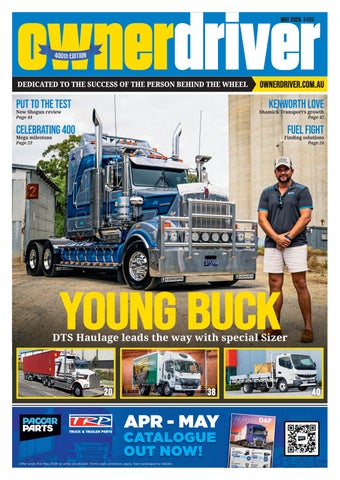
In an industry often dominated by the old timer, Doug Sizer, owner of DTS Haulage, is an example of what the future holds for truckies. His limited edition Kenworth T950 is a prime example of a young enthusiast enjoying a beautiful truck
38
HITTING THE SWISS SPOT
Since the turn of the 21st century, Victorian Freight Specialists has grown its reputation as an agile and flexible metro and regional operator. Its latest Isuzu trucks allow the ‘jack of all trades’ to carry more freight and keep its drivers happier than ever
42
GARGANTUAN GOALS
Melbourne-based Shamick Transport has steadily grown as an over-mass and over-dimensional operator. The recent delivery of new Kenworths is allowing the enthusiasts to continue reaching for the stars
44
SHAKING DOWN THE SHOGUN
Warren Aitken recently got to put FUSO’s latest Shogun model to the test, heading out west from Melbourne to see how the truck performed along hills and highways
Image: Warren Aitken
GET A HEAD START WITH FREIGHTLINER CASCADIA.
Get three months on us up to $20,000 when you finance a Freightliner Cascadia with Daimler Truck Financial Services. Experience the benefits of Guaranteed Buy Back and three years of servicing at no extra cost.
Talk to your Freightliner dealer today to find out how you can take advantage of Cascadia’s remarkable fuel efficiency, advanced safety and superior comfort - Underestimate At Your Own Cost.
3 MONTHS OF REPAYMENTS ON
NOTHING TO SPEND SERVICING FOR 3 YEARS / 450,000KM. GUARANTEED BUY BACK. WE PAY YOUR FIRST 3 MONTHS, UP TO $20,000.
EDITORIAL
Editor Sean Mortell
E-mail Sean.Mortell@primecreative.com.au
Phone 0468 577 166
Contributors Warren Aitken, Frank Black, Sarah Marinovic, Rod Hannifey, Simon Smith
Cartoonist John Allison
PRODUCTION
Art Director Bea Barthelson
Print IVE Print
ADVERTISING
Business Development Manager Tosan Popo
Phone 0481 260 352
E-mail Tosan.Popo@primecreative.com.au
SUBSCRIPTIONS
www.ownerdriver.com.au/subscribe
Phone +61 (0)3 9690 8766
Mon-Fri 8am-4.30pm (EST)
Email subscriptions@primecreative.com.au
Mail 379 Docklands Drive, Docklands, VIC 3008 Australia
EXECUTIVE GROUP
Chairman John Murphy
CEO Christine Clancy
Publisher Sarah Baker
Operations Manager Regina Fellner
Sales Manager – South Danny Hernandez
Reflecting on a legacy
The latest challenges facing the nation’s array of owner-drivers is proof of the importance of industry publications as OwnerDriver celebrates a special milestone
To say it’s been a whirlwind of a time in the Australian trucking industry as of late is an obvious understatement. In the past month alone, the rising price of diesel has offered a fresh challenge to the local road transport industry. From large-scale fleets to the nation’s legion of ownerdrivers and small transport outfits, the increased fuel prices have had an impact on everyone and led to a large parliamentary movement to protect vulnerable operators, from the wide expanses of Western Australia’s regions to inner-city hubs along the eastern seaboard.
In the case of weeks, transport associations put out daily announcements calling for help before both the federal and state and territory governments responded with an array of
“For all of the truckies reading this at the numerous stops across Australia, thank you for the role you’ve played in allowing OwnerDriver to thrive for 400 editions.”
solutions. From the federal government halving the fuel excise for three months to its Western Australian counterpart permitting larger road train combinations on a key arterial, there have been a range of fixes instilled in a bid to make life slightly easier for operators.
“Truckies, freight companies – and fuel and fertiliser producers. These firms are not just being affected by this global crisis, they are essential to Australia getting through this crisis,” Prime Minister Anthony Albanese said upon launching $1 billion in interest-free loans while forgoing increased GST revenue on fuel transactions.
“So our government will extend their credit to help them, and the farmers and producers who rely on these supply chains, to weather the storm. This is just another way we are acting to get ahead of issues.”
But is this all currently helping ownerdrivers and small to medium tier operators around Australia? This is what OwnerDriver investigated ahead of the May edition. From page 24, check out the impact the fuel price rise is having on operators across the country and how the latest solutions are changing the daily life of running trucks.
This major industry challenge comes at a monumental moment for OwnerDriver as we celebrate our 400th edition. After being first funded in 1992 by Andrew Stewart courtesy of Publishing Services Australia (PSA), this publication has evolved over the years while still focusing on what matters most – the drivers and the role you play in keeping this country running each and every day.
Upon reflecting on this milestone, the value of the title is reflected in our current crop of contributors and their longevity – the likes of Rod Hannifey and cartoonist John Allison are examples of industry members who continue to pave the way for owner-drivers around the nation and fight for their rights.
Outside of these special features, OwnerDriver also has another cracking Truck of the Month entrant from Warren Aitken from page 28, while we chat to major manufacturers like, Isuzu (page 38), Daimler (page 40) and Kenworth (page 42) about their latest stories and developments. Throw in a special truck review from Warren on page 44 and there’s a wider variety than ever before across this month’s pages.
For all of the truckies reading this at the numerous stops across Australia, thank you for the role you’ve played in allowing OwnerDriver to thrive for 400 editions. Stay safe and we raise a glass to many more editions in the future. Cheers and rest in peace Andrew Stewart.
The all-new Ready-to-Work range.
The workhorse redefined.
Is your workhorse pulling its weight? If youʼre still driving a ute, nowʼs the perfect time for an upgrade. The all-new Isuzu Ready-to-Work range tows and carries more than your average ute. It also comes with a sleek new cab design, more advanced safety features and car-like comfort. With a wide choice of factory-built bodies designed to our exact specifications, Isuzu Ready-to-Work trucks are ready to get the job done. Are you ready to step up to a redefined workhorse? Head to isuzu.com.au or visit your nearest Isuzu Trucks Dealer today.
The Goods NEWS FROM THE HIGHWAY AND BEYOND
What’s new on the roads
New contracts are open to upgrade the Bruce Highway while final works on the Sturt Highway are now underway near the CBD of Wagga Wagga
The town of Wagga Wagga is preparing for the final stage of $13.9 million works on the Sturt Highway to be completed with work now underway near the CBD, while 22 new contracts have been released to intensify works on the Bruce Highway.
BRUCE BOOST PUSHES ON
The federal and Queensland governments have announced a new sweep of contracts released under the $9 billion safety upgrade program along the Bruce Highway.
The upgrades are continuing ahead, with 22 new contracts released as part of the historic safety program.
The package of works include five construction procurement and 17 design contracts to accelerate the delivery of safety works along priority stretches of the highway between Gympie and Cairns.
To date, eight projects have been completed, with 17 underway and another 13 set to roll out this year.
The 22 new contracts include more than 100 kilometres of wide centre line treatments, 50 kilometres of pavement strengthening and new overtaking lanes, five narrow bridge upgrades, road widening and audio-tactile line marking improvements, resurfacing works and upgrades to multiple intersections and rest areas.
Federal transport and infrastructure minister Catherine King says the latest round of contracts showed progress in making the Bruce Highway safer.
“This latest activity signals significant progress in delivering the Bruce Highway Targeted Safety Program,” King says.
“The Australian government is proud to be funding 80 per cent of this $9 billion program, because improving safety on the Bruce Highway will help save lives and support the communities and industries that rely on this critical route.”
Queensland transport and main roads minister Brent Mickelberg says the Crisafulli government is getting on with the job and delivering a plan for Queensland’s future.
“We’re keeping the momentum up with 22 new contracts moving
to market to boost safety along the Bruce Highway,” he says.
“We told Queenslanders we are committed to fixing the Bruce and works are already making a real difference for motorists, regional communities and freight operators between Gympie and Cairns.”
Assistant regional development minister Anthony Chisholm says record investment was being delivered for the Bruce Highway.
“The Albanese government is delivering record investment to build a better Bruce Highway for Queenslanders,” he says.
“From here in Burdekin and all the way up to Cairns, we are accelerating the delivery of intersection upgrades, rest area improvements, wide centre line treatments and pavement strengthening.
“These works will make a real difference for drivers, freight operators and regional Queenslanders, and form part of a long-term pipeline of upgrades that will squarely benefit the people who live here.”
FINAL STURT HIGHWAY
STRETCH UNDERWAY
The New South Wales government has announced the final stage of $13.9 million upgrades on the Sturt Highway are underway.
Work started on March 23 on the second and final stage of the upgrade to a 1.8 kilometre section of the highway on the eastern approach to Wagga Wagga’s CBD.
This final stage of the upgrade
– from east of Blaxland Road to Stuart Road – is expected to be completed by the end of June.
While some informal parking will go from the eastbound road shoulder, a three-metre shoulder on the westbound lanes will be available for parking.
This final stage of upgrades to the Sturt Highway follows delivery of the first stage of the project – from Tasman Road to Blaxland Road – in May 2025.
“It is wonderful to see the final stage of these important upgrades is ready to get underway to improve road safety and efficiency through the heart of Wagga Wagga,” NSW agriculture minister Tara Moriarty says.
“This latest stage of upgrades is just one part of the significant investment being made to improve journeys on the Sturt Highway, which is a strategic freight and access link from Sydney via the Hume Highway to Mildura in Victoria and on to Adelaide in South Australia.”
Work will include completely rebuilding the road with a new surface and new kerb and guttering, lane widening and configuration changes to provide dedicated right turning lanes for eastbound traffic accessing properties on the southern side.
Large trees will be removed from both sides of the highway to allow for the re-alignment of the road.
The removal of some trees to improve road safety has the
support of the Country Women’s Association, who planted the trees in honour of the road’s namesake Mrs Dorothy Hammond.
This location is a high traffic area and Transport for NSW plans to carry out work with as few impacts as possible. All work will be carried out under traffic control with lane closures and reduced speed limits in place. Work will take place between 7am and 6pm, with some night work between 7pm and 6am also planned.
Detours will be in place as required and Transport will remain in contact with impacted businesses and residents throughout the work to minimise noise and property access impacts as much as possible.
“We understand the impact these upgrades and the work underway on Marshalls Creek Bridge are having on people moving in and around Wagga Wagga,” Member for Wagga Wagga Dr Joe McGirr says.
“These improvements are happening at a time when there are a lot of changes to traffic movements across the road network from other projects, and we thank the community for their patience.
“This work will not only provide a smoother surface that is less prone to road damage and potholes but also provide a safer and more comfortable journey for all road users now and into the future.”
NHVR names new chair
A former South Australian minister has been named as the new chair of the NHVR’s board after Duncan Gay stepped down
The National Heavy Vehicle Regulator has announced the appointment of a new chair and two new board members after its existing chair has stood down.
Former South Australian minister Patrick Conlon will take the reigns as chair through to 2028 following Duncan Gay stepping down after seven years in the role.
Conlon has served on the NHVR board since 2022, and during his tenure as a South Australian minister held several critical portfolios including transport, industry, police and energy.
Transport Australia chair Aneetha de Silva and former NSW MLC Michael Veitch have also been appointed to the NHVR board.
“Mr Conlon, Ms de Silva and Mr Veitch each bring significant experience and leadership, and I look forward to working together to continue strengthening Australia’s heavy vehicle safety and regulatory framework,” NHVR CEO Nicole Rosie says.
“I would also like to thank Mr Gay for his valuable commitment and dedication during his seven-year tenure as chair of the NHVR.
“His stewardship has been critical in driving
forward the NHVR agenda of regulatory reform for the Australian heavy vehicle industry.”
Conlon says the opportunity to serve as chair and support the organisation’s ongoing work to improve safety, productivity and sustainability across the sector was a privilege.
“The heavy vehicle industry plays a vital role in keeping Australia moving,” he says.
“The heavy vehicle sector plays a critical role in connecting communities, supporting businesses, and strengthening our national economy,” he says.
“The collaboration between industry, jurisdictions and the Regulator has been central to the progress we’ve achieved together.
“The collaboration between industry, jurisdictions and the Regulator has been central to the progress we’ve achieved together.”
“I look forward to continuing to work closely with the board and the NHVR leadership team to deliver outcomes that matter for industry and the community.”
Gay said he wanted to “thank the heavy vehicle industry, our government partners, and the dedicated team at the NHVR”.
“I warmly welcome our incoming chair Mr Conlon and new board members Ms de Silva and Mr Veitch.
“The NHVR is well positioned for its next chapter, and I know it will continue to evolve and deliver value for industry and the community.”
OwnerDriver pays tribute to founding editor
OwnerDriver is paying tribute to founding editor and original owner of the publication Andrew Stewart after his unfortunate passing in late February.
Glasshouse Country & Maleny News editor Mitch Gaynor paid tribute to Stewart in early March following a vehicle accident at his Sandy Creek farm.
As a publisher and journalist, Stewart started OwnerDriver in September 1992 under the banner of small independent Brisbane-based
newspaper and magazine company Publishing Services Australia (PSA).
While PSA already had Australasian Transport News (ATN) in its portfolio of publications, it recognised the need for a monthly newspaper recognising the pride, professionalism and concerns of the men and women who represented the industry from behind the wheel.
Stewart said the newspaper’s agenda was to highlight the “professional owner drivers and the way they do things as an example to
the whole road transport industry”.
“It’s all designed to help owner-drivers know the facts affecting their industry, pick up a few tips to save a dollar or make life easier, and to feel pride in the tough job they do,” Stewart said.
Stewart sold OwnerDriver and PSA to Australian Consolidated Press in March 2007. The magazine has been owned by several businesses over the years, before landing with Prime Creative Media on 1 July 2021.
“There’s a sense of frustration that
they aren’t taken seriously,” Stewart said at the time.
“If they had the same investment in a shop or a real estate agency, they’d be considered ‘real businessmen’.”
As the publication publishes its 400th edition, the team at OwnerDriver pays tribute to Andrew Stewart and his incredible effort in starting a publication that has become a pivotal part of the nation’s road transport industry.
Rest in peace Andrew Stewart.
Image: Warren Aitken
NSW allows larger trucks to fi ght fuel costs
NSW has introduced temporary freight measures that include adjusted load limits for bigger and longer freight combinations
The New South Wales government has introduced temporary freight measures to keep goods moving and help ease fuel pressure.
The state government is working under the new National Fuel Security Plan, introducing changes that increase access to the road network for larger trucks that can carry more goods in a single trip and ease restrictions on operating hours.
The NSW government says this will help move more goods with fewer trips and less fuel, keeping vital supply routes running across NSW, especially to regional communities.
“The conflict in the Middle East is disrupting global fuel supply and driving up prices, and that’s being felt here in NSW,” NSW Premier Chris Minns says.
“By allowing larger trucks and extending operating hours, we can
move more goods around the state with fewer trips and less fuel.
“This is about acting early, working with the industry and making sure our supply chains stay strong.”
New measures include adjusting load limits to freight to allow for bigger and longer freight to travel on our road network and where applicable to allow more freight to travel, load and unload at night
while providing for flexibility for hours of operation and curfews.
The state government says these longer trucks will use at least 18 per cent less diesel per tonne of payload and can carry 33 per cent more additional freight.
Efforts to monitor, forecast and manage fuel shortages are ongoing at the Liquid Fuel Emergency Operations Centre in Parramatta, in collaboration with industry
partners and national stakeholders.
“These changes are about keeping goods moving across NSW, especially to regional communities,” NSW transport minister John Graham says.
“By allowing larger trucks and extending operating hours, we can move more with less fuel. It’s a practical step to support supply chains and ease pressure on the system.”
MADE FOR YOUR TRUCK. MADE IN AUSTRALIA
Alliance Cleaning Range provides
First fully electric Sydney to Canberra truck run complete
The new-age trucking company is now planning to begin daily Sydney to Canberra electric heavy vehicle runs from later in the year
New Energy Transport has announced it has completed Australia’s first fully electric end-to-end delivery from Sydney to Canberra.
In partnership with ANC, New Energy Transport (NET) delivered essential household goods for customer Who Gives A Crap from its distribution centre in Sydney to Canberra with a Windrose prime mover on a single charge.
Once reaching its cross-docking facility in Canberra, New Energy Transport’s partner ANC Delivers then completed the delivery to end customers with electric delivery vans.
NET co-CEO Dan Bleakley says now is the time to accelerate the transition to electric trucks.
“Australia must act now and seize this moment to decouple from diesel,” he says.
“Australia’s major transport buyers, including our supermarket chains who depend on diesel-based trucking to deliver food to millions, have a responsibility to accelerate the transition to resilient road freight.
“Governments at all levels also have a major role to play. By co-investing in charging infrastructure and making electric prime movers more affordable through targeted subsidies and incentives, they can catalyse industry adoption and unlock long-term economic, productivity and energy security benefits for Australia.”
Who Gives A Crap co-founder and CEO Simon Griffiths says decarbonising its supply chains is one of the most impactful steps any business can take for the planet.
“We are proving that the transition to electric vehicle fleets isn’t just a future goal – it’s possible right now. By integrating EV freight into our own operations, we’re demonstrating that the solutions are ready and effective for Australian commerce,” he says.
“Our goal is to help shape the future of zero-emission freight in Australia. We know that as more businesses make the switch to electric, we create the collective momentum needed to transform our national logistics network.
“We’re proud to be leading the
“We’re proud to be leading the charge with partners like New Energy Transport and ANC, and we’re calling on other businesses to join us in making sustainable, electric shipping the new standard.”
charge with partners like New Energy Transport and ANC, and we’re calling on other businesses to join us in making sustainable, electric shipping the new standard.”
With a fleet of more than 100 electric last-mile delivery vans and trucks, ANC CEO Joe Sofra says the brand is excited by the new end-to-end capability enabled by NET.
“ANC is proud to partner with New Energy Transport and Who Gives A Crap to establish a green corridor from Sydney to Canberra,” Sofra says.
“While driven by a shared vision to accelerate zero-emissions transport, this initiative also demonstrates what’s possible in delivering enhanced energy resilience amid ongoing fuel volatility and
supply uncertainty.”
ANC and New Energy Transport will commence daily Sydney to Canberra electric B-double operations in the third quarter of this year. From there, the companies plan to scale zero-emission end-to-end operations along the Sydney to Canberra corridor and expand to other major freight routes along the eastern seaboard.
Manheim to sell Gold Tiger vehicles
Just a couple of months after the operator closed its doors, a major fleet of high quality equipment will go under the hammer
Industrial equipment auctioneer
Manheim Auctioneer has been entrusted to sell a large fleet of trucks and trailers owned by Gold Tiger Logistics Solutions following the operator’s closure in late February.
The sales campaign comprises around 230 assets including prime movers and rigid trucks, as well as a range of trailers including B-doubles and B-triples, from leading brands like Volvo, Isuzu, Vawdrey and Barker. Workshop and ancillary equipment will also be included.
Assets will be located for viewing across Manheim’s facilities in Melbourne (Altona North), Brisbane (Eagle Farm) and Newcastle, with items subject to an expression of interest campaign.
“Manheim Australia places a strong emphasis on truly understanding our clients’ commercial and operational needs. In situations like these, our role goes beyond that of a trusted adviser — we work as a genuine partner, invested in delivering the optimal strategy and outcome,” Manheim Australia head of advisory Aiden Hsu says.
“Gold Tiger Logistics fleet stands out as one of the best maintained fleets to be offered to the market in recent years, and that quality is reflected in early buyer engagement.
“At Manheim, our ability to value large and complex fleets rapidly and accurately, headed up by Gavin Dempsey and supported by a nationwide team of accredited valuers, allows us to service major centres and the most remote regions with equal efficiency.”
What’s up for grabs includes:
• 54 Volvo prime movers, around half of which were built from
2018 to 2024 and have full Volvo service histories.
• 55 A Trailers and 64 B Trailers (Curtainsiders) largely made by Vawdrey, with a small number of Barker, Freighter, Krueger, Maxitrans, Southern Cross and Topstart assets.
• 28 rigid trucks (GVM between 4495kg and 24,000kg), around half made by Isuzu and the remainder being Hinos, Mitsubishis and UDs.
Importantly, a majority of the late-model Volvo prime movers (post-2018) benefitted from the Volvo Trucks Gold Service Package covering vehicles up to
1.2 million kilometres.
The program provides manufacturer-managed servicing and repairs including scheduled maintenance, mechanical repairs, and replacement of most wear-and-tear components, carried out through the Volvo dealer network, supported by remote vehicle monitoring. Additionally, all trailers in the fleet have completed a C Service since July 2025. This is a comprehensive major maintenance service typically including inspection and servicing of brakes, suspension, wheel bearings, hubs, air
systems, lighting, chassis and structural components, along with lubrication and replacement of worn components where required.
Gold Tiger was established in 2006 by Imad El Masri with a single truck, turning into a business with more than $55 million annual turnover; a wholly owned fleet of prime movers, trailers and delivery trucks; and a workforce numbering more than 350 people. At the time of going to print Manheim was working through expressions of interest for the sale of the fleet.
“Gold Tiger Logistics fleet stands out as one of the best maintained fleets to be offered to the market in recent years, and that quality is reflected in early buyer engagement.”
Images: Manheim Australia
With fuel prices and operating costs climbing, running a trucking business has never been tougher.
NatRoad gives operators a stronger voice with government, practical support and tools when it matters, and the community you need to keep moving forward.
Membership starts from just $26.95 per month^ and includes:
Industry-leading discounts
Save on fuel, tyres, insurance and more. With savings like up to 9.5cpl off Ampol fuel using your AmpolCard*, membership can quickly pay for itself.
Expert business support
Get tailored advice on HR, legal and compliance issues, so you can focus on running your business.
Business resources
Access exclusive checklists, templates, fuel calculators and tools any time via the NatRoad Member Portal.
Community and advocacy
Join a network of like-minded operators. We advocate directly with all levels of government, representing operator interests on the issues that matter to you.
LIVING THE DREAM
It’s been more than three decades since Kim Woods started Bondwoods Transport, with the Queensland family operator now excelling courtesy of a larger fleet and a flourishing partnership with Hendrickson
Kim Woods started his business like many other Australian owner-drivers have over the years – with one truck and a dream. A devoted partner willing to sacrifice. A deep motivation to dedicate hours upon hours to driving, administrating and networking.
To take this leap of faith is a brave decision in itself, but to forge a career and succeed in the venture is another case entirely. Just over 30 years since deciding to form Bondwoods Transport with a mate in 1994, Kim is a shining success story in Australia’s road transport sector.
“We’ve been going for nearly 35 years – we initially grew from just the one truck to having nearly 150 pieces of equipment in our fleet nowadays,” Kim told OwnerDriver
“I’ve been in and around trucks my whole life, ever since I was a kid. I had trucks back in the ‘80s and decided to turn it into something bigger when I moved to Queensland in 1988.”
The Brisbane-based operation started with Kim and his mate running 48 foot boxes for Cubico. For the best part of 15 years, the pair built a reputation in the local areas, with the fleet pushing to six trucks before Bondwoods Transport was changed forever.
In 2008, Kim bought out his partner, turning the operator into a one-family business that now involves sons Chris and Jamie. While it should’ve been a time for celebration, the ownership change came at a challenging time for not just the road freight
industry, but the entire world.
“The biggest issue to rock us was the Global Financial Crisis in the late 2000s,” Chris told OwnerDriver
“That forced us to lay drivers off and sell trucks to survive. We scaled back to three trucks and concentrated on the work we had. Luckily we were able to come out the other side – as the world got going again, so did we.”
To succeed as a transport business in Australia, plenty has to go right. When a financial crisis occurs in the midst of large-scale company changes, it takes a strong network. While the Woods family used their own internal resolve to persevere through the GFC storm, other partnerships have proven critical to their success. This is where running their growing fleet of trailers on Hendrickson gear has been an important part of Bondwoods Transport’s evolution.
“We started working with Hendrickson roughly 15 years ago,” Chris says.
“We were exporting fruit out of central Queensland and we started buying some new Krueger skel trailers. We then started spec’ing them our own way and putting Hendrickson suspensions on them.
“Over time we progressively put Hendrickson on more vehicles to the point where nowadays, anything new we buy is on Hendrickson.
Currently, the Bondwoods Transport fleet is far larger than when Kim and his mate used to run up to six trucks on the roads. Chris says there’s around 55 trucks sitting alongside roughly 90 trailers in the fleet. When it comes to trailers, he says any vehicles bought brand new come with Hendrickson gear.
“We’ve never bought anything else – Hendrickson has always done the job for us, so we’ve never questioned using their gear,” he says.
This loyalty is centred around numerous factors. When it comes to running a combination of general freight and container services along the east coast of Australia as far north as Cairns, as well as the occasional trips out west to Perth, reliability is a
Images:
key requirement. Whether it be the original OE product or aftermarket parts supply, Kim says Bondwoods Transport has never had an issue with a Hendrickson product.
“Since the first day, Hendrickson products have been high quality, reliable and easily available,” he says.
“We’ve never had any trouble and we simply can’t fault the product, the supply or the service.”
This sentiment extends to a variety of Hendrickson equipment, with Bondwoods Transport’s trailer fleet filled with Hendrickson products. The INTRAAX® suspension is a popular part of the trailer fleet that runs out of Brisbane’s Park Ridge – the integrated one piece module suits the family operation by focusing on total cost of ownership benefits for transport outfits. With a locally optimised air suspension, no U-bolts and superior weight to durability, these features all combine for a product that is directly fuelling the operator’s recent growth.
“For starters, INTRAAX® is incredibly lightweight – in fact it’s one of the lightest on the market for a suspension and axle kit,” Chris says.
“This is important for us as we load for weight. With our skel trailers, we run on a Mass Export Management Scheme (MEMS) permit, meaning we can run up to 46 tonnes on a single, so it’s crucial that we are as lightweight as possible.
“For both the AAT250 wide bush and AANT230 narrow bush variants, Hendrickson INTRAAX® is a major reason why we can run lighter and grow our operations.”
Bondwoods Transport also runs Hendrickson’s HXL7 wheelend system, backed by a five-year or 1.2 million-kilometre warranty. Using semi-fluid grease and ultra-precise bearing adjustment, the system is designed to maximise durability and minimise maintenance. With a non-vented hubcap and a patented axle filter and venting system, both the HXL7® and the earlier HXL5® have steadily become favourites across the Woods family’s fleet.
“The HXL product is all about reliability – it’s the driving force behind our fleet’s uptime and has never given us any grief,” Chris says.
“As they say – ‘if it ain’t broke, don’t fix it’.”
While the majority of Bondwoods Transport’s trailers run on Hendrickson gear, Chris says the business may consider introducing suspension products to its truck fleet in the future if the operator branches out to more long haul work.
“Currently our trucks are only rated to 90 tonnes, so if we evolve and need to carry heavier loads, we’ll be looking at introducing PRIMAAX® air suspensions onto our truck fleet too,” he says.
Throughout all of these products, reliability is a common theme. Much like how an operator needs to deliver freight on time, every time, running gear needs to continue working under heavy duress and in a variety of locations. Chris says Hendrickson’s equipment has always passed these tests along Australia’s eastern seaboard with flying colours, making it an obvious choice for any future Bondwoods Transport vehicles that they add to the fleet in future.
This dependability has allowed the family business to reduce its downtime and maintenance costs while running an increasing number of services around the country, providing a raft of total benefits.
“With the trailers we run on Hendrickson, the cost factor is pretty minimal. Other than the usual one million kilometre’s
“There’s
Opposite: Bondwoods Transport has evolved into a flourishing Brisbane operation
Top: Currently Bondwoods Transport runs with trucks rated to 90 tonnes
Below: Regardless of the requirements, the operator says running on Hendrickson has been simple and reliable
service, we haven’t had to do any other maintenance,” Chris says.
“There’s been no dramas. With Hendrickson, everything is available, and you can trust that it’ll just keep running.”
In a current transport landscape that is offering challenges not too distant from the GFC nearly 20 years ago, Kim, Jamie and Chris Woods are intent on maintaining the Bondwoods Transport legacy. With an evolved fleet and a strong identity on Australia’s east coast, Kim says the operator’s equipment will be a driving force for its future aspirations.
“We have one more trailer on Hendrickson gear coming soon, but then that’ll do us for a while in terms of new vehicles,” Kim says.
“While current circumstances in the industry have the potential to be dangerous for many operators, with our current fleet, we’re confident that we can continue excelling in the transport sector.”
HENDRICKSON AUSTRALIA
LEADING THE WAY
This May 2026 edition of OwnerDriver is the 400th issue of the publication. From its foundations in 1992, we chart the history of the magazine and pay tribute to those who forged the beloved industry publication
The year was 1992 when the notice was first issued to the Australian road transport industry. In August of that year, small independent Brisbane-based newspaper and magazine company Publishing Services Australia (PSA) announced the impending launch of a new publication.
The business already owned Australasian Transport News (ATN) in its portfolio, but now it wanted to recognise the pride, professionalism and concerns of the men and women who represented the industry from behind the wheel. Thus OwnerDriver was launched in September 1992.
Now, the publication is celebrating 400 editions of bringing the latest industry news, truck reviews, investigative features and beautiful truck photos to the local sector. It’s a far cry from 1992 when founding editor Andrew Stewart, who sadly passed away in February this year, said the newspaper’s agenda was to highlight professional owner drivers and the way they do things as an “example to the whole road transport industry”.
“It’s all designed to help owner-drivers know the facts affecting their industry, pick up a few tips to save a dollar or make life easier, and to feel pride in the tough job they do,” he said at the time.
Stewart said one of the reasons PSA started the paper was that “so many owner-drivers are embarrassed by the image portrayed by self-proclaimed, big rig driving loudmouths supposedly acting for the industry”.
“There’s a sense of frustration that they aren’t taken seriously,” Stewart.
“If they had the same investment in a shop or a real estate agency, they’d be considered ‘real businessmen’.”
From its first issue, OwnerDriver started a tradition of tackling the big issues relevant to owner drivers. In particularly at the time was the rising price of diesel, inconsistencies with road enforcement and government strategies to extract revenue from the industry’s most vulnerable sector. It’s funny how little has changed, particularly to start 2026.
Featuring in that first issue on page 17 was a column by Ken Wilkie – ‘Wilkie’s Watch’. Ken remained a regular contributor to the magazine
until only recently, helping grow the legacy of OwnerDriver across the driving cohort.
“As I approach my 52nd year as an owner driver, I have to congratulate OwnerDriver in achieving 400 editions,” he told the publication.
“I took great pleasure in contributing for 25 years and only stopped because I felt my comments were becoming irrelevant. The then-owner of the magazine at the time invited me to contribute after I became the first owner driver elected to the board of the then-named Road Transport Forum – now known as the Australian Trucking Association.
“While there are many issues presented in the industry nowadays, I have no intention of stepping away from the industry through my own choice. It has been a great and satisfying occupation.”
A couple of months after the publication was launched, cartoonist John Allison introduced his artistic wit to OwnerDriver, starting with a clever swipe at the Pacific Highway. In 1991 he left his job at VicRoads (he stresses he was an admin officer, not an enforcement officer) and began freelance cartooning after accumulating clients over the years.
Not long after setting up his home office, he saw the very first edition of OwnerDriver and contacted Andrew Stewart to offer his services. It started a partnership with the publication that is ongoing to this day, 400 editions in.
“To cut a long story short, I’m still drawing for OwnerDriver and it’s been a thoroughly enjoyable ride,” Allison told the publication.
“I’ve always been interested in trucks – for a while during my early youth, my Dad was a driver in Gippsland, Victoria. It has been a rewarding and interesting journey and I’ve gained a huge insight into what is involved in hauling large loads around the country.
“Congratulations to OwnerDriver on its 400th edition. It’s proof that the original editorial team in Queensland all those years ago were certainly on the ball when the opted to target owner drivers. I’m now looking forward to the next 400 issues.”
Other contributions over the years came from Bob McMillan, the Transport Workers Union, ‘Shirty’ On The Hume, the ‘Mystery Operator’, Pam McMillan, the Australian Trucking Association and Rod Hannifey. Rod joined the team in 2001 and has been submitting his ‘Eyes On The Road’ column and other features ever since.
“When I won the ATA National Professional Driver of the Year award in 2001, Andrew Stewart asked me if I’d like to write a column for the magazine – at the time I thought it would be just for the following year,” Rod told OwnerDriver
“That was now nearly 26 years ago and I have only missed one column when I had pneumonia – I thought that was a reasonable excuse at the time.”
Rod says that although the title suggests it’s only for owner drivers, the publication has a far wider audience around Australia that means each and every edition is well read by many around the country’s truck stops.
“Thank you and my condolences to the family of
Andrew Stewart, a man who gave me a chance to have a voice,” he says.
Stewart eventually sold PSA to Trader Classifieds (part of Australian Consolidated Press) in early 2007, before ACP was sold to Bauer Media a few years later. OwnerDriver was part of titles bought by Mercury Capital in 2020 before Prime Creative Media bought the industry magazine in 2021 and has owned it since.
Throughout these years, Greg Bush, or ‘Bushy’, was the figurehead of the publication. As editor, he remembers how OwnerDriver transitioned from a newsprint newspaper to an all-gloss magazine.
“It started as a newsprint paper before adding a gloss section – years later I managed to convince management to turn it into an all-gloss magazine,” Bushy told OwnerDriver.
“There were a few editors before me, notably Pete Armstrong, who went on to become Prime Mover’s inaugural editor in 2007.
“Back in the day we had some great and innovative feature stories like Clash of the Titans (including videos). The Highway 31 feature was another.”
It all sums up the rich history of OwnerDriver as we celebrate 400 editions of the publication. This milestone issue includes features on issues that still impact the sector all these years later, including rising diesel costs. We hope you enjoy this special edition of OwnerDriver and thank all of you for playing your part in these 400 issues. Now onto the next one!
RIP Andrew Stewart
Above: OwnerDriver’s first issue was published in September 1992
THE DIESEL DEBATE
As global conflict caused diesel prices to spike for all transport businesses in Australia, the federal government moved to introduce relief measures. However, operators and associations say more must be done to keep operators afloat
Ross Transport isn’t averse to tough times. As a proudly family owned and operated transport business since 1975, the Illawarra-based outfit has lived and steadily grown through peaks and troughs, through the Razorback Blockade, the Global Financial Crisis and then the COVID pandemic, before coming out the other side stronger and more resilient.
Family member and business manager True Ross says the operator is now fighting another major industry issue in the recent rising fuel and diesel prices caused by conflict in the Middle East.
“For us, the struggle has been real and brutal,” she told OwnerDriver
“It cost us about an extra $550,000 alone through the month of March. It’s meant we’ve spent more time than usual handling small spot fires each and every day, so it’s time we see immediate relief.”
The New South Wales based business is one of thousands who have grappled with rising fuel prices across Australia as supply at service stations also wavered in March.
When the USA and Israel ignited conflict with Iran in late February, it triggered a domino effect that saw the Strait of Hormuz disrupted.
To put it into perspective, the Strait that sits between the Persian Gulf and Gulf of Oman sees roughly 20 to 21 million barrels of oil pass through daily – approximately 20 to 30 per cent of the world’s total daily oil consumption. The impact to this crucial oil trade gateway has rippled across the world, with Australia’s fuel security waning as diesel prices shot to above $3 per litre and some service stations ran out of supply.
For an industry reliant on diesel, the road transport sector has been hit hard. By the end of March, a national Cabinet meeting was held, with the federal government announcing on March 30 numerous measures to help operators struggling to keep up with the rising cost of fuel.
From April 1, Prime Minister Anthony Albanese
confirmed the fuel excise on petrol and diesel would be halved to approximately 26 cents a litre for three months, while the road user charge was also removed for the same time period.
“We’re announcing the Commonwealth government will halve the fuel excise on petrol and diesel for three months. We’re making fuel cheaper today because we understand that Australians are under serious pressure,” Albanese said.
“We also want to encourage Australians who can to take public transport to help save fuel for the areas and industry that need it. Obviously, the less fuel we use in the cities, the more we can direct to regional areas that are under pressure.”
Days later, Albanese confirmed Australia would provide up to $1 billion in interest-free loans to critical businesses, including transport operators and fertiliser producers, with further measures revealed.
The announcement was widely praised by Australia’s trucking associations, particularly since several bodies had been calling for these changes to be introduced for weeks. The National Road Transport Association (NatRoad), alongside the Australian Trucking Association (ATA), were quick to praise the twin measures.
“These are very welcome measures and a clear sign the government is listening to the concerns of our industry,” NatRoad CEO Warren Clark said.
“Ensuring reliable fuel supply is essential, because without trucks, Australia stops. Improving coordination and securing fuel supply gives confidence to operators who are doing it tough right now.
“At a time like this, stability in the system is incredibly important.”
The two changes for cost relief came as part of a wider National Fuel Security Plan that the federal government unveiled in late March. At the same time, the Fairer Fuel Bill was passed through the Senate, allowing the industry to introduce an emergency contract chain order application for cost recovery on fuel.
ATA chair Mark Parry said both of these decisions would quickly deliver immediate tax relief to the nation’s trucking businesses.
“Trucking businesses will save 26.3 cents per litre at the pump when they fill up. Their fuel tax credits will increase from 20.2 to 26.3 cents per litre, which they’ll get as usual after they lodge their business activity statement at the end of the month or quarter,” Parry said.
“In total, the decision will save trucking operators 32.4 cents per litre. It is the lifeline that small trucking businesses needed.
“These two measures are the outcome of strong and effective advocacy from the ATA and its member associations. I thank and congratulate them on their commitment to getting results for trucking businesses everywhere.”
But not everyone agreed with the associations on these measures being a crucial respite for struggling operators. For the likes of True and her family at Ross Transport, the relief comes later than they had hoped.
“We’re not going to see any of that money flowing back to us until during the middle of May,” True says.
“The fuel levy only covers a portion of the cost –our fuel has gone up by nearly 99 per cent. I believe both the fuel levy and road user charge changes should’ve been retrospective over the past month, and potentially the past three months, so that us operators could access this financial relief sooner.”
While the road user charge and fuel excise changes seem incredibly beneficial on the surface, True says there are plenty of flow-on effects that make the measures more complex than initially expected.
For Ross Transport, it has already had to carry the burden individually of rising fuel costs throughout March. For one customer, the operator advocated to get the fuel levy increased, but they refused to do so until fuel relief measures were introduced in April. It left Ross Transport dipping directly into its bottom line to cover the fuel cost inflation.
When a single round truck trip between Ross Transport’s home in Port Kembla and Melbourne rose in cost from roughly $1,800 to now $4,000, it leaves a lot of money to make up. Add in True’s growing concern over continual price gouging at service stations and customers asking to get fuel levies removed in the wake of the excise and road user charge changes and it’s a cacophony of issues for operators to still navigate.
“I’m worried that fuel could drop in price one day but then climb again a week later – we have no way of knowing whether the price will drop or price gouging will continue,” she says.
“We also have customers now asking us to get the fuel levy removed because we get a discount, and we have to explain to them all that fuel is still incredibly high, so we need that levy to function.”
It’s these factors that have pushed True and the Ross Transport team to call for further help. A primary focus is for the federal government to make the road user charge cut retrospective for March rather than starting from April 1 onwards, while True has also joined certain associations in calling for a moratorium on equipment loan repayments. She also wants to see emergency disaster funding made available to operators, creating a triumvirate of options to make life easier for transport businesses. The latter point was reflected in the federal government offering interest-free loans to critical businesses including trucking operators.
“It’s important to note that this emergency financial relief can’t be just for small transport businesses,” true says.
“As a medium operator, I feel that we get left out a lot, but we differ largely from the buying power of larger businesses. We’re susceptible to these issues just like smaller operators, so we need help too.”
One association has joined the chorus with the likes of Ross Transport in calling for these extra considerations to be implemented before it’s too late for operators. The National Road Freighters
Association (NRFA) zigged while other bodies zagged, with president Glyn Castanelli saying the road user charge and fuel excise measures don’t offer a “significant outcome” for the industry.
“When the fuel tax credit adjustments are taken into account, the net benefit to industry is approximately six cents per litre, and this is only realised later through Business Activity Statements (BAS),” Castanelli says.
“While there is a headline saving of approximately 26 cents per litre at the pump, this does not translate into a true benefit for most transport businesses. For operators who already have fuel levy mechanisms in place, this saving is passed directly through to customers as a reduction in fuel surcharges. For those without a fuel recovery mechanism, this saving simply reduces the extent to which they are currently subsidising their customers’ freight costs.”
Castanelli says the NRFA is concerned the measures may send an “unintended signal” to customers that freight rates should decrease when in fact fuel prices remain volatile. He says if the measures were retrospectively applied for the March quarter, it could’ve offered an “immediate and proportionate” cash injection into transport businesses.
“That opportunity has now passed, and the immediate pressure on operators remains,” he says.
“The most important outcome for industry remains the Fairer Fuel Bill. This reform creates the pathway for enforceable cost recovery through the supply chain, ensuring that fuel costs are carried by those
at the top, rather than being absorbed by operators at the bottom.
“This legislation provides the mechanism for the Fair Work Commission to act quickly through Contract Chain Orders, enabling the industry to move toward genuine fuel cost recovery across the supply chain. This is a critical reform in responding to the current fuel spike.
“This is a step forward, but it is not a complete solution. Without further action to address immediate cash flow pressures, transport capacity will continue to decline, placing Australia’s supply chains at risk.
The NRFA stands ready to continue working with government and industry to deliver both immediate relief and long-term reform.”
At the time of publication, no further measures had been announced, leaving operators like Ross Transport impatiently awaiting financial relief for April’s operations. Having survived through tough times over the decades, True is hopeful the family business can continue serving the Illawarra region and Australia as a whole. All she needs, like many other operators around the nation, is more help.
“My sympathy is with every trucking company in the industry right now. I know a lot are facing this and have been struggling for 12-18 months, so I hope we can all make it through,” she says.
“The current measures may not be our saving grace right now, so my fingers are crossed we can receive more immediate measures in the next 30 to 60 days.”
NHVR Paul Daly
Changing times
The NHVR’s Paul Daly breaks down the
latest
heavy vehicle accreditation changes coming into effect this year and what it means for operators
If you’re an owner driver, a small fleet operator, a long-haul operator running interstate or using heavy vehicles to support farming or construction work, accreditation is not just paperwork – it’s part of how you keep your business moving.
From mid-2026, the National Heavy Vehicle Accreditation Scheme (NHVAS) will transition to the new Heavy Vehicle Accreditation (HVA) scheme as part of changes to the Heavy Vehicle National Law (HVNL). While the official commencement date of the amended legislation remains subject to Ministerial approval, the NHVR is working towards being implementation ready by July 1, 2026.
What matters most for industry is this: you will not have to immediately switch to the new scheme as soon as the amended law comes into effect.
A PHASED TRANSITION
One of the strongest messages I want to share is that this is a phased transition. Existing NHVAS accreditations will remain valid until their expiry date. The current NHVAS and the new HVA scheme will operate concurrently during a transition period (although you can only be accredited in one scheme at a time).
In practical terms, that means time to plan, time to prepare and time to move across when it suits your accreditation cycle.
If your NHVAS accreditation expires before mid-2026, you’ll be contacted and invited to submit a maintain application – including your compliance audit –before June 12, 2026. Doing so will give you a further two-year accreditation period, creating breathing space to transition.
Operators with expiry dates shortly after commencement will also be contacted and given the opportunity to renew early under existing rules. For businesses with later expiry dates, Safety Management System (SMS) tools and guidance will be rolled out to support preparation. Where necessary, extensions can be considered on a caseby-case basis.
The aim is simple: keep your business operating without unnecessary disruption.
WHAT’S ACTUALLY CHANGING?
Under the NHVAS, you’re accredited in separate modules – Mass, Maintenance and Fatigue. Under the new HVA scheme,
the structure shifts to a framework built around General Safety Accreditation (GSA) and Alternative Compliance Accreditation (ACA).
Here’s what that means in plain terms. First, you’ll need GSA. This involves a whole-of-business SMS audit. Instead of looking at mass or fatigue in isolation, the focus is on how your overall business manages safety risks.
GSA on its own doesn’t give regulatory concessions – it confirms that your safety systems are in place and operating effectively.
Within GSA, operators can also access the GSA Maintenance Assurance Program (MAP) by meeting additional maintenance management requirements.
If you need access to alternative compliance options – such as Higher Mass Limits (HML), Performance Based
“Our focus is clear: strong safety, fair regulation and minimal disruption to the businesses that keep Australia moving.”
Standards (PBS), or fatigue flexibility – you can then apply for Alternative Compliance Accreditation (ACA) relevant to those areas.
It’s a more integrated model, but for operators already running structured systems, it shouldn’t feel foreign. In many cases, you’re already doing the work – this formalises it under a single safety framework.
MASS: A PRACTICAL WIN FOR MANY
One significant change will affect Mass Management. General Mass Limits (GML) will increase to align with current Concessional Mass Limits (CML). In essence, this means accreditation will no longer be required to access CML weights.
For many operators – particularly smaller businesses – this removes an accreditation requirement that was
previously necessary just to access CML. However, if you operate under notices or schemes such as Higher Mass Limits (HML) or PBS, you will still require alternative compliance for Mass under the new HVA scheme. A clear list of notices and schemes requiring accreditation will be provided so operators can plan accordingly.
MAINTENANCE: STEADY AND FAMILIAR
For Maintenance accreditation holders, there is no change to the concessions themselves. Exemptions from annual vehicle inspections (in Queensland and New South Wales) will continue. You will transition to the HVA framework, but the practical benefit remains the same.
Fatigue management moves from Basic Fatigue Management (BFM) and Advanced Fatigue Management (AFM) to a single, performance-based fatigue model. Operators will be able to select work and rest hours that suit their business within prescribed limits.
Templated hour tables are being developed, including BFM equivalents and common AFM equivalents, to streamline applications. If your business needs something more tailored – for example seasonal farming work or specific freight tasks – bespoke options will remain available, provided the risk is properly assessed and managed. The intent is flexibility with accountability –not a reduction in safety standards.
A STRONGER, MORE CONSISTENT AUDIT APPROACH
Another key change is the introduction of the National Audit Standard (NAS). Under the HVA scheme, audits will follow nationally consistent criteria and reporting requirements. Auditors will assess your SMS using the Present, Suitable, Operating and Effective (PSOE) model.
At entry audit stage, you must show your systems are Present and Suitable – documented and appropriate for your business. At later audits, the focus shifts to whether those systems are operating and effective in practice.
For operators, this should provide greater clarity about what is expected and greater consistency in how audits are conducted across jurisdictions.
Importantly, the overall audit cycle remains familiar – generally a two-year accreditation period, with an entry audit, an initial compliance audit at six to seven months and a compliance audit prior to expiry.
COMMUNICATION AND SUPPORT
We recognise that any reform raises questions. Direct communication with NHVAS operators has already commenced, and guidance and support material is being developed to explain the process clearly and practically. If you have questions, the NHVR Contact Centre can be reached on 13 NHVR (13 64 87).
LOOKING AHEAD
There is time to plan, and practical guidance will help you through the process. Our focus is clear: strong safety, fair regulation and minimal disruption to the businesses that keep Australia moving. Read more on the NHVR website.
Paul Daly is the NHVR’s Director of Strategic Policy
NATROAD Warren Clark
Shared responsibility
NatRoad’s
Warren Clark looks at ways to improve road safety across the country as Australia’s road toll continues to increase
Most trucking operators work hard to run safe, compliant businesses, managing fatigue under some of the world’s toughest regulatory frameworks, investing heavily in maintaining equipment and taking pride in operating professionally on Australia’s roads.
Like every other road user, trucking operators simply want to finish the job safely and get themselves and their drivers home at the end of the day.
Unfortunately enforcement and compliance data shows road safety cannot be taken for granted. Australia’s road toll increased in 2025 (by 1.7 per cent) to 1,314 fatalities, according to the latest figures from the National Transport Commission (NTC). Thousands of offences, including speeding, drink-driving and drugdriving, continue to be detected during targeted police operations. This indicates unsafe behaviour remains widespread across all road users, not just heavy vehicles.
Public discussions about road safety often place the spotlight on trucks. When we look more closely at the data, the picture is more complex. Research from the National Truck Accident Research Centre (NTARC) in the 2025
Major Incident Investigation Report found in more than half of the fatal crashes involving a truck and a car, the light vehicle driver was primarily at fault.
Most truck drivers have experienced it: cars cutting in too close, sitting in blind spots, tailgating, overtaking without leaving enough room or misjudging the gap in front of a heavy vehicle. It is imperative other road users are educated about heavy vehicle stopping distances and how to share the road safely.
Fatigue management is one area where the trucking industry already operates under far tighter oversight than most motorists. Operators must comply with strict fatigue rules, work diary requirements and NHVR
enforcement, and recent compliance campaigns continue to highlight the importance of strong fatigue management practices.
Operators also have a clear role to play in maintaining safety on the road – ensuring vehicles are properly maintained, drivers are trained and fit for duty, and risks are actively managed across their business.
Upcoming reforms to the Heavy Vehicle National Law (HVNL) will reinforce this approach, requiring operators to demonstrate they are proactively managing safety risks through effective safety management systems rather than relying on paperwork alone.
Of course, governments at every level have an important role to play.
As an example, infrastructure is a major part of the safety equation –freight volumes continue to grow across Australia, yet investment in key freight corridors has not always kept pace. Poorly planned and deteriorating roads not only bring their inherent safety risk, they also mean higher maintenance costs, more wear on equipment and greater stress on drivers.
NatRoad continues to advocate for lifting AUSRAP safety ratings across major freight routes, with research showing that improving a road’s safety rating by just one star can reduce fatalities by up to 50 per cent. Rest areas are also critical. If governments expect drivers to comply with fatigue laws, there must be safe and accessible places for truck drivers
“Most truck drivers have experienced it: cars cutting in too close, sitting in blind spots, tailgating, overtaking without leaving enough room or misjudging the gap in front of a heavy vehicle.”
to pull over and rest.
Improving safety outcomes requires a balanced conversation. All road users need to understand how to drive safely around heavy vehicles. Governments need to invest in safer roads and consistent licensing standards, while protecting the viability and sustainability of our industry, essential in the supply chain. And the industry must continue to focus on strong safety culture, proper training and well-maintained fleets.
Road safety improves when responsibility is shared, not shifted. Professional truck drivers are doing their part. Improving safety across Australia’s road network will require the same commitment from all road users.
WARREN CLARK is CEO of the National Road Transport Association (NatRoad).
BELOW: Warren Clark says more focus must be put on road safety
Image: NatRoad
DOUG’S DREAM JOB
In an industry often dominated by the old timer, Doug Sizer, owner of DTS Haulage, is an example of what the future holds for truckies. His limited edition Kenworth T950 is a prime example of a young enthusiast enjoying a beautiful truck, Warren Aitken reports
One of the great things about trucking is how easy it is to slip into the ‘Peter Pan Syndrome’ – that affliction where you kind of forget how old you are. It enables us to rock out like Australian Idol entrants to every song on the radio. It encourages us to spend the little time we have off, polishing every part of our pride and joy and it allows us to stretch our days out well beyond the average office worker.
Snapping out of that syndrome can be as easy as jumping off a sidestep and feeling it in every bone and joint for the next three days, or attempting to read the delivery address on your manifest without reaching for your glasses. Or in my case recently, sitting down to interview a young owner operator and realising my responses to his approach and attitude is more of a proud parent than an understanding equal. It is not always fun being reminded that you are not as young as you think you are, unless of course that feeling is inspired by a sense of admiration for the
next generation of truckie. The man responsible for this little internal introspective session I had is Doug Sizer, owner of DTS Haulage, a small family company originating from Millmerran, Queensland.
While he has the name of a much more senior player, Doug most likely has no idea how to load a cassette player, nor has he smacked a TV to improve the rabbit ear reception. Being born in 1994, he has never even experienced life without text messages or a Sony PlayStation. What he does have though is an incredible family that has taught him skills, a formidable attitude and an envious work ethic, all of which has led to him being able to purchase and rebuild this incredible Kenworth T950. So where do we start – the truck or the owner? Why am I asking you? I’m the one writing this. The owner it is.
While I did reference Doug’s age in relation to the life cycle of the Sony PlayStation, the truth is right from day dot being stuck inside playing video games was never an option for young Doug.
“I never sat inside, never played video games, I just loved being outside,” he admits.
That outside life was enabled by both Doug’s mother and father who ran a menagerie of machinery, from fertiliser plants to trucks of all sizes, as well as Doug’s uncle Greg who, along with a collection of trucks, also ran and taught Doug how to operate a variety of earthmoving equipment.
“We were a really close family, Uncle Greg was like second to me old man, we spent so much time together,” Doug recalls.
“From about 12 or 13, we’d be out there with him when we could drive the scrapers and stuff.”
Before you go ’12,13 – why the late start?’, hold your horses folks. Let me transcribe another tale straight from the work horse’s mouth.
“I remember when I was a kid, Mum had a fertiliser business, she had about three silos at home and there would be trucks there up to about 10 or 11 at night tipping onto augers. One night when I was about 10, Mum came and woke me up so I could go and back this B-double onto the auger for a guy who couldn’t back a B-double,” Doug laughs.
“I don’t remember how long it took me, but I got it on there, then went back to bed ready for school the next day.”
Trucking, working and learning have been part of Doug’s DNA since he was old enough to lace up the work boots.
“I would annoy the s**t out of Dad with all the questions I would ask – why this, why that, can I drive? I learnt a lot from Dad, he was only 21 years old when he bought his first truck and he had to learn it all for himself, as Grandad didn’t have trucks. So, Dad has made sure I learn things for myself as well.”
However, not all of his lessons have been advantageous. Sometimes learning to do things the old school ways have their disadvantages and again, I shall let Doug confess this story – bear in mind that Doug grew up in the small town of Millmerran, so small town rules apply.
“When I went to get my HR licence, I used a mate’s 4800 Western Star tipper, but I never learnt how to change gears with a clutch in a truck. I’d been taught how to listen to the engine, feel it, don’t grind it, just slot it in smoothly,” he says.
“So I’ve gone for the test and Dad says what are you gonna do? I said I didn’t know. Anyway, I drove the truck into town. When the instructor got in, we drove around and I just made the motion with my leg like I was using the clutch. He said to me ‘you’re not using the clutch!’ – I told him honestly that I didn’t know how to, that I’d never learnt to.”
Now spare a thought for the poor instructor. He could see this kid knew how to drive, but by law he admitted to Doug that he was going to have to fail him.
“He said he had to fail me, but he would spend some time teaching me. So, the rest of the drive he showed me, and I just started using the clutch. We drove around a heap more, he kept saying to me ‘see, isn’t it easier?’, ‘it’s better on the gear’ and ‘it’s better for fuel economy’ and I was just agreeing with him,
“When I went to get my HR licence, I used a mate’s 4800 Western Star tipper, but I never learnt how to change gears with a clutch in a truck.”
telling him I could see why you do stuff like that,” Doug recalls.
By the time they got back to the police station, the instructor was so impressed he agreed to grant him the licence on the condition Doug would attest that he would keep his left foot busy in the cab from then on. I am pretty sure the instructor believed Doug and was happy with his decision, right up until the point where he was waving Doug goodbye and thought to ask him where the person was that drove him down there. Doug gave him the smilingly honest reply that he drove it down himself.
One of the best things about country folk is the tales they tell – I’d happily let Doug share more, but we do have this story to tell. Ok, let’s just tell one more. Another licence story, purely because I reckon many of us could relate.
“I got an early exemption to get my MC and did that through a driving school in Ipswich,” Doug tells.
“I had to help the instructor out unhooking airlines and stuff and then when we did the driving test, he’s directed us down this kind of cul de sac and he’s panicked, telling us we’ve gone down the wrong street. I said it’s all good and I backed it back out and
Right: As this story goes to print, I am still trying to find out exactly what makes this impressive T950 a limited edition, but it is badged up as one; Night Train marked a turning point and major move in Jason Aldean’s career and as such it seemed an appropriate name for Doug’s T950
around the corner. He rang the office and just told them we’re coming back, sign this bloke off, he doesn’t need to be here.”
As I said, there are plenty of other tales we could crack a beer for, but I will try and get back on task with Doug’s trajectory. Working, driving and learning has been Doug’s life since he was knee high to a grasshopper. Whereas most of us had Matchbox and Tonka toys to spur on our passion, Doug grew up around the 1:1 scale variety – scrapers, diggers, stock trucks, general freight trucks – he had access and experience with them all.
Driving was always the first option. However, like a lot of offspring of truckers, Doug was instructed to gain a trade before he followed his fancy. He chose the auto electrician arena and was soon picking up the tools at Rocklea Truck Electrical.
“I did my first couple of years working for Kim and Brock at RTE and loved it, and now I get a lot of my trucks fitted out by them,” Doug says with a grin.
“The only thing was I’m not a city boy, so I hated Brisbane. I loved working at RTE but I hated Brisbane.”
After the first two years of his apprenticeship, Doug found himself chasing the country life again and took a job with Ostwald Brothers in Dalby.
Finishing his apprenticeship out west meant Doug gathered plenty of experience working on all manner of machinery, not just trucks. Once he was fully signed off as an auto electrician, Doug spent two more years behind the tools, but his heart was still behind the wheel. It was the role that occupied any spare time Doug had, and it was the role he wanted to get into.
“Dad knew all I wanted to do was go driving, he said he had a truck there for me, so I went working for him for about two and a half years,” Doug says, adding that there was no nepotism shown. In fact, it was pretty much the opposite.
“I got most of the s**t – I was the boss’ son, but he also said this is how you learn, by doing the s**t work.”
As cliché as it sounds, it was character building and, if anything, it further flamed Doug’s passion for trucking.
There was a slight deviation in Doug’s trucking career when he handed in the keys in order to spend a bit more time at home rather than on the road. It was a three year hiatus where he started his own auto electrical business and was pretty happy and successful at it. But we all know it is never easy to ditch the diesel dream and, while Doug was rewiring, repowering and lighting up the world, he had a call from his father.
“Dad had always had his eye on a V8 Mack Valueliner of Dave Morgan’s up in Townsville and when Dave decided to sell it he rang the old man,” Doug recalls.
“Dad asked what I thought, because the engine was stuffed and it had been parked up. I asked if I could go halves in it and we ended up buying it.”
That was technically Doug’s first truck – a Mack older than he was. It needed a lot of work, so Doug and his dad did a fair bit themselves. They got the maestro of Mack motors, Dean Conway of DC
Mechanical, out and he gave the Valueliner’s heart a full makeover, and soon enough the old dog was all cleaned up and prepared to work. Doug took some time away from his contract auto electrical work and did a few weeks of the 2020 harvest with the old girl.
That was the turning point – a sharper turning point than the old Valueliner, that’s for sure.
“I loved it and decided I wanted to have my own truck and eventually get into carting grain,” Doug says.
“Dad sat me down and went through all the pros and cons and the realities of owning a truck.”
That reality check, the acknowledgment of the sacrifices that would be needed, didn’t scare Doug. In fact, like the work he got as a wages driver, it solidified his resolve.
The only sacrifice Doug struggled with was realising he’d need to sell his half of the Valueliner to get off the ground.
“Mum and Dad were great but Dad also made it
clear if I wanted to do it I would need to stand on my own two feet, like he had had to do,” Doug states.
“I had some savings behind me but needed more – it wasn’t just the buying the truck, I needed cashflow to keep the truck moving.”
His first truck was a V8 Mack. His childhood had been spent around Western Stars, but it was actually a Kenworth T659 courtesy of the King of Creations himself, Jon Kelly, that kicked off DTS Haulage. The reason for the switch to Kenworth was pretty simple – one of Doug’s good mates ran a long wheelbase T659, with near identical features to the truck Doug was looking at and that truck was a dream to drive, so it would be a great starter for Doug.
While that first purchase from Jon Kelly ties Doug to the Kenworth badge and would eventually lead to this stunning T950 before you, Jon plays a more pivotal role in the importance of this 950 than simply the badge. Jon was the one who stumped Doug with the question of ‘have you thought about a name for the truck?’.
“I’d never really thought about it,” Doug says.
“Jon asked if I had any favourite artists or bands or anything and immediately I went with my favourite artist, Jason Aldean. So, the first truck got named The Only Way I Know.”
Once Jon had gotten the T659 repainted, it was silver and green – and green was just not Doug’s colour – he put the big girl to work.
“I was subbing to Mum and Dad, pulling their trailers. I was doing general freight all over the country,” Doug says.
“I really didn’t like general freight.”
His heart was always in the country and getting into the grain scene was the motivation for Doug. By 2021 he was able to order his first A-double set of grain tippers and ventured into the line of work that he really loved.
“I loved the grain side of things, loved working with the farmers and doing all that kind of thing,” he says.
Things progressed well for DTS Haulage – in 2022 Doug was able to order his first ever brand-new truck. Straight out of Bayswater came a new T909 named ‘My Kind of Party’ – another Jason Aldean song. By this stage, Doug had already had a driver in his original 659 and Doug was back helping his dad run his trucks up in Townsville. Once he picked up the new T909 though, he ventured back down to the Toowoomba area and got behind the wheel again.
The goal for Doug was never to run a massive fleet – it was all about a couple of cool trucks, providing a solid service to the growers and farmers in his local region. Over the next couple of years he added a couple more trucks, but that was more out of necessity by his customers than a desire to build an empire. Then in late 2024, Facebook Marketplace stuck its nose in and changed things.
“I was doing harvest in the new 659 I had bought and was on Facebook when this thing came up,” Doug admits with a dose of guilty pleasure.
“I instantly fell in love with it. It was my dream truck. A 950, six-metre wheelbase, C15, this thing was cool.”
The truck had been a single operator its entire life. Run by Phil Whittam under the WRT banner, the big rig had been a very fast truck in its day.
“I spoke to Phil a lot and he gave me the full rundown. The truck had six million kilometres on the chassis. They used to do three Sydney-Adelaide runs a week with it, so 9,000 kilometres a week,” Doug says as he smiles while recalling the day in late 2024 that he flew down to Adelaide and picked it up.
“I was like a kid in a candy store, I remember thinking how am I, at 30 years old, driving home in one of the rarest T950s in the country?”
Oh, that’s the other thing. It is not just a standard T950. It comes fully equipped with a limited-edition badge. Now exactly why I am still trying to find out, but as Doug tells it, he’s also not sure.
“Phil was a bit vague about it. Apparently, there were only 10 made like this and it might have something to do the C15, the wheelbase and the tank set up, but I’m not sure,” he says.
I do have a few Kenworth gurus investigating, but if this paragraph makes it to print then obviously I’ve had no success tracking down more information. Once Doug got it home, it needed the DTS overhaul.
“I wanted to show respect to Phil when I repainted it. I changed it to my colours but the stripes on it are still Phil’s –silver and blue rather than his red and white.”
The paint job was done by Gavin and his team at Spray King Restorations in Allora – a small country town close enough to Doug that he could, and did, frequently call in for consultations.
Once that was done, it was sent down to Brock and Kim at Rocklea Truck Electrical for a shiny side spruce up. All new steps around the truck, exhaust shrouds, road train guards, taillight bar, walk plates, the dovetail, lights, all the stainless – the list wasn’t quite endless as Doug was adamant he wasn’t building a show truck. This thing was built to work, but by God it would look good doing it. The attention to detail however, is exactly what you expect from a RTE project. Look closely at the steps, the grooves are all painted to match the painted fuel tanks.
Anyone with an appreciative eye will recognise the steady hand of Damo from MasterArt in the lines and scroll work that adjourns the big 950 and credit for the back wall falls at the brush of Damian Gormley from Zealous Airbrush Studio, Damo’s go-to artist.
“I’ve never had any artwork on my trucks, but a couple of years ago when Jason was on his Highway Desperado Tour, that image was the one they used for his tour photo,” Doug says.
“I thought that would be so cool to put on the back of a truck. When I bought this thing, this was my special truck, so I thought ‘bugger it’, I’ll put a mural on it.”
Fixing up the interior like the bunk air, fridge, microwave –
Above: There is something very staunch about the front-end view of a Kenworth T950
Left: Another impressive Rocklea Truck Electrical customisation was this tidy set-up
Opposite top: Doug Sizer with his dream truck – part of the small family fleet he runs out of the Toowoomba area
Opposite bottom: Equipped with stunning Pearl Craft gearstick and steering well, the T950’s interior has the classic Kenworth appeal to it
“I wanted to show respect to Phil when I repainted it. I changed it to my colours but the stripes on it are still Phil’s – silver and blue rather than his red and white.”
all the essentials for a harvest season away from home – were completed by the team at Pittsworth Fleet Maintenance in Pittsworth, but that came about a few months after the cosmetic overhaul.
“I had to put it to work for a bit before I got to do the inside, everything cost money,” Doug laughs.
“But I made sure I did the inside before the next harvest started.”
If we excuse the dropped liner and fuel blockage issues that haunted Doug when he first got the truck, his dream ride really is his dream ride. With five trucks on the road now, life is a lot busier, but he is still the only pilot of his big T950 and he couldn’t ask for anything more from it. Or could he?
“When I heard Jason Aldean was preforming at the Sunburnt Country Festival in Toowoomba, I went big on social media trying to get him to sign the truck for me,” Doug says.
It turns out going viral on social media isn’t that easy. In the end, like his T950, Doug went old school, parking the truck up outside the performer’s entrance to the show (in a two minute park, mind you). He explained to the security guard about the truck and that he wanted Jason to sign it, the guard said if he saw him, he would let him know and see what happens.
No sooner had Doug gotten changed, grabbed a beer and settled in to enjoy the show, he got a call from the security guard. Doug did his best impression of Usain Bolt with Bali Belly heading for a Portaloo and arrived minutes later to find his idol Jason Aldean looking on in awe at Doug’s rig.
“He was such a great guy, we spoke for ages. He asked all about the truck and said he has seen heaps of trucks but none as cool as this one,” Doug recalls with pride.
“I was very star-struck, but he was so cool. His minders kept pointing to the time, but he just hung around and chatted.: And yes, Doug did get his pride and joy signed by the man himself. And that is how you end a story. You can’t ask for more than that.
Top: The rear end has been freshly revamped and customised for Doug by the Rocklea Truck Electrical team, swapping out the truck’s original stainless guards for road train guards and a custom rear bar
Above: The man himself, Jason Aldean, after signing the back of Doug’s Kenworth T950
Left: The T950 in its original form. Single owner WRT put over six million k’s on the big girl, and it still looked
“Please watch the road”
Act on the most urgent risks in seconds.
Geotab’s new all-in-one video telematics solution, the GO Focus Plus, automatically flags distracted driving, tailgating, hard braking and other serious events immediately, delivering instant in-cab voice feedback to enhance driver safety. For managers, patterns and urgent cases rise to the top for fast review and targeted coaching, all in one workflow that tracks follow-up and results. Spend less time searching and more time supporting every driver, addressing risk, encouraging improvement and recognising safer habits.
Ready to transform your fleet?
Visit www.geotab.com/au/ to learn how our telematics solutions can drive your business forward.
Video Telematics Powered by AI
SHIFTING UP A GEAR truck technology
With new DAF trucks recently unveiled in the Australian market, PACCAR Parts’ growing prowess is providing the ideal support for the growing brand
There’s nothing quite like a fresh range of trucks being unveiled in the local heavy vehicle market. Rumours swirl, expectations rise and pressure builds until the first details of the models are released. With milestone moments such as these comes hours, weeks and months of hard work behind the scenes to provide a parts system that supports the latest technology.
“PACCAR Parts has spent the past two years ramping up our level of support for DAF’s new Euro 6 model trucks and latest XG models,” PACCAR Parts product marketing manager Niels Holm told OwnerDriver.
“Last year alone, PACCAR Parts invested almost $1 million in additional parts inventory into our distribution centres to prepare for the new range throughout our local dealer network.”
The evolution of the DAF brand in Australia took its next step in the past year with the launch of the new generation XG and XG+. These latest heavy-duty trucks have been designed for long haul applications, whether it be interstate distribution, general freight or even tankers.
“Our role is to support the new models coming into the PACCAR network in Australia while ensuring parts are maintained for existing models in the market,” Niels says.
“We’ve been getting closer to customers to understand their needs and any specific usage requirements they have for their DAF vehicles. We’ve maintained this close communication with customers and our dealer groups to identify any gaps in our stock and fill them.”
Niels won’t forget a key example of this approach paying off. The year was 2016 and he was in Wagga Wagga on a regular visit to dealers in the region. While there, a DAF customer ordered a part not available in Australia, thus putting the wheels in motion for a grand display of PACCAR Parts’ capabilities.
“The part was ordered at midday on Monday and arrived by the Thursday morning from Europe,” Niels recalls.
“It was dispatched in Eindhoven in the Netherlands overnight on the Monday and was delivered via air freight straight to Wagga, it all happened so seamlessly.
“It’s become a trademark part of our offering –if the part isn’t available in Australia, customers
can order a part before a 2pm cut-off and it’ll be processed by the next day, and often delivered in a matter of days.”
It’s real-life examples like this that have led to an important marker of PACCAR Parts’ prowess. Currently, DAF Parts have an availability of 98.4 per cent throughout PACCAR’s Australian distribution centres and dealer network.
“This has been one of the industry leading parameters we’ve strived to achieve, and is a benchmark in the market for parts availabilities,” Niels says.
“Our end goal is to ensure customers have parts available whenever or wherever they may need them. We’ve ensured we have high volume maintenance parts in all of our dealerships, supported through mandatory stocking lists, whether they be fuel, oil, air filters, panels, mirrors or headlights.
“A unique part of DAF’s trucks in Australia is that the drivelines have been engineered to cope with local conditions, meaning we have parts on our shelves that support these specific trucks and their applications.”
PACCAR Parts’ extensive level of DAF parts across the wider Australian network has been expanded to new technology, with the latest innovations allowing the brand to offer dealer stocking lists for all dealerships selling DAF trucks. Whether they be existing or newly released DAF models, PACCAR Parts is ensuring the right parts are available across
TOP: PACCAR Parts is enhancing its capabilities to match the growing DAF brand in Australia
BELOW: Fast-paced and extensive parts delivery is all part of the DAF package
the nation to maintain uptime for all Australian customers.
“We’re using technology such as PACCAR Connect to understand where DAF vehicles are located across Australia and then devise our DAF dealer stocking lists accordingly,” Niels says.
“These are designed so we have our parts in the right areas to service both day-to-day operational requirements at our dealerships and specialist requirements in certain applications.
“It’s allowed us to provide regular support for the whole gambit of PACCAR Parts products across both the DAF and Kenworth platforms. We’re often meeting as a team to minimise any parts shortages across the country and ensure all parts are competitively priced.”
Niels says this focus has been all about letting the local market know that the DAF brand is growing in Australia’s truck landscape. While the Kenworth name is synonymous across the country, DAF is fast emerging as a popular part of the industry, taking up more and more space in PACCAR Parts’ catalogues.
This growing range of DAF trucks and parts is housed at PACCAR Parts’ general distribution centres, providing a mega headquarters for the brand’s increasing stock inventory. Able to hold up to 250,000 parts at any time, DAF’s range at the centre include a significant portion of DAF genuine parts that have been designed at DAF’s European headquarters specifically for the local range.
“Whilst we stock most parts in the general distribution centre and across our dealerships, any small percentage of parts not available locally can be flown over from DAF’s Eindhoven headquarters within three days,” PACCAR Parts DAF senior product manager Shaji Abraham told OwnerDriver
Central to this parts support will be DAF’s Repair and Maintenance Information (RMI) database, which compiles all information of DAF trucks sold and operating in Australia. All DAF dealers are able to securely log onto the platform to check out every single piece of parts and servicing information on a certain model, ensuring all preventative maintenance can be easily completed.
“If a dealer wants to look up a particular part or item for a DAF truck, they can use the RMI to do so,” Shaji says.
“The RMI also includes all warranty and maintenance information, as well as registration and parts. It’s a complete one-stop shop for DAF trucks in Australia.”
The database is incredibly extensive – Shaji walked me through an example of an XG cab, with a range of diagrams allowing owners to check out every single aspect of the truck. From sealing rubbers to panel clips, spring clips to cabin brackets, every detail you could imagine of the truck is tracked and updated to keep these trucks running at their very best every single day.
“Dealers can see this information for each particular truck in real time, it’s world class,” he says.
Recent DAF accessories launched include stone guards, bullbars, light bars and reflectors. However, Shaji says the DAF bullbar has quickly become a primary focus for local customers.
Created specifically for Australian conditions, the DAF product is the only bullbar available in the local market designed, tested and certified for compatibility with the vehicle’s airbags and other integrated safety systems.
While these parts in themselves are an evolution of DAF’s product range, Niels says PACCAR Parts’ backend service for the new-look DAF trucks makes for a formidable force that is driving the brand’s future in Australia.
“Our goal is to get to the 100 per cent availability for DAF parts in Australia,” he says.
“And in the event that a part is not in stock, our global strength and coordination ensures that we can air freight in the parts needed from Europe within days. This is all part of an overall package that is putting DAF and PACCAR Parts at the cutting edge of international and local truck innovation.”
HITTING THE SWISS SPOT
Since the turn of the 21st century, Victorian Freight Specialists has grown its reputation as an agile and flexible metro and regional operator. Its latest Isuzu trucks allow the ‘jack of all trades’ to carry more freight and keep its drivers happier than ever
The Swiss Army Knife is perhaps one of the most popular tools in the world. It was way back in the 1880s when Swiss fighters bought a new folding pocket knife that could open canned food while simultaneously maintaining the Swiss service rifle. By the late 19th century, Karl Elsener had created and patented the famous knife, with the multi-pronged war weapon evolving over the decades into the common everyday item that it is today.
It also has another crucial meaning, with modern Swiss Army Knives referring to those who are versatile, a ‘jack of all trades’. It’s the perfect descriptor of Victorian Freight Specialists (VFS), which has been a dependable and flexible regional Victorian and New South Wales transport operator for the best part of three decades.
In the high-stakes world of road freight, success boils down to moving goods reliably, efficiently and safely. As a premier carrier servicing every corner of Victoria, and also regions of southern NSW, VFS has excelled in the road transport game by being a Swiss Army Knife style carrier.
Based in Dandenong in Melbourne’s east, VFS also runs out of Altona and Wodonga, moving everything from pharmaceutical products and automotive parts to hardware and general freight across both metropolitan and regional Victoria.
With a fleet of 150 company vehicles and over 200 subcontractors, operations director Chris Collins describes the work of hitting tight deadlines, especially in strict sectors like healthcare, as “full on”.
“Our specialty is regional country Victoria,” Chris says.
“We carry to all parts, including the nooks and crannies. Getting freight to those far-reaching areas is challenging, but that’s where we really excel.”
This commitment to blanket, statewide coverage demands a variety of factors to be equal parts versatile, reliable and compliant. In a tight labour market, the trucks is only one part of the equation.
This is where VFS’ most critical asset becomes the drivers, with the operator pouring in countless hours and effort to develop attraction and retention strategies that can be woven into their operational fabric.
“Quality people is probably the key factor for us,” Chris acknowledges.
To overcome the current skilled worker challenges present both globally and in Australia, VFS is leveraging its reputation as a long-standing,
family-oriented business. Drivers deal directly with owners and they form part of a team known for its attention to detail. By being part of a closeknit operator with rigid compliance and reliability, the drivers form the core function of VFS’ Swiss Army Knife approach.
VFS recognises this by investing in driver comfort and satisfaction, with equipment that promotes a safe, happy and dedicated approach being critical. This is where Isuzu trucks comes into the equation.
VFS and Isuzu Trucks have constructed a partnership over many years, with the operator dealing with Isuzu Trucks’ Dealer of the Year award winners Ballarat Isuzu often. This close relationship has become a cornerstone of the operator’s stability and driver-centric approach.
“Ballarat Isuzu has an in-depth understanding of my business,” Chris says.
“I can lean on them, put pressure on them when I need equipment, and I know they’re going to be there. It’s a great relationship and a great partnership.”
VFS fleet manager Glenn Haines is another vocal supporter of the partnership and how it has allowed the business to focus on its driver cohort. His role encompasses procuring new vehicles, fitting and managing telematics data and ensuring maintenance across the fleet. He says Isuzu’s extensive model range continues to directly support VFS’s diverse operational needs.
“We probably have 30 Isuzu trucks overall,” Glenn notes.
“As our customer base grew, we had a growing need for smaller trucks, so we’ve gone from the 6 to 8-tonne, right up to the bigger models. Their massive range really does help with what we do here.”
The most recent workhorse added in the fleet is the all-new Isuzu NQR 88/80-190 bodied with a Pantech van and tail-lift – a light-duty unit that embodies the efficiency, safety and driver comfort that VFS demands. With a Gross Vehicle Mass (GVM) of 8.8 tonnes (or an optional eight tonnes for the 190 PS variant) and a GCM of 12.3 tonnes, the NQR offers payload flexibility for regional and metro deliveries alike. This vehicle approach mirrors VFS’s own goals of being an adaptable business for its customers.
Power is distributed by Isuzu’s newly devised 4HK1-TCC Euro VI engine, delivering 140 kW and 513 Nm of torque. For VFS, the integrated safety and comfort technology of the N Series is another major asset for driver management and retention. The MY25 NQR comes equipped with a raft of safety aids, including Isuzu’s Advanced Emergency Braking (AEB), Electronic Stability Control (ESC),
Images: Isuzu Australia
Lane Departure Warning (LDW) and a Driver Attention Alert System, plus many more. The idea behind the upgraded safety suite is to promote driver and road user safety while reducing stress and fatigue.
“We’ve noticed in the past two to three years all the safety features coming in,” Glenn says.
“Isuzu has a lot of that safety stuff in there, which helps the drivers immensely.”
Glenn says VFS also actively seeks and acts upon driver feedback when it comes to supplying the best quality fleet possible. This provides another opportunity for the Isuzu trucks to receive a tick.
“Our drivers are really happy with the Isuzus,” Glenn says.
“If the drivers need something for their country runs, we make sure they have it. Things like seat covers, cameras, comforts in the cab.”
This proactive approach to driver needs, backed by the modern, safe and comfortable environment of the Isuzu cab, is a tangible part of VFS’s retention strategy. The partnership extends into ongoing support well after the sale, with VFS utilising Isuzu’s Victorian dealer network in Geelong, Ballarat and Wodonga to maintain strict compliance and uptime.
This support allows VFS to focus on its core mission –delivering excellent service and supporting its team while transporting a diverse range of goods around Victoria and southern NSW. The future will see the operator continue to focus on its Swiss Army Knife style of operational excellence, improving its services across the state instead of looking to grow quickly.
Chris says the brand will focus first on improving regional depot partnerships and customer service standards.
“We stay with what we’re good at,” he says.
GARGANTUAN GOALS
Melbourne-based Shamick Transport has steadily grown as an over-mass and over-dimensional operator. A recent delivery of new Kenworths is allowing the enthusiasts to continue reaching for the stars
There are plenty of Kenworth enthusiasts around Australia, and for that matter, the world. Think of the truck lovers who search eager eyed for older models and crystal clear photos of the iconic badge. The social media pages dedicated to showing off the very best Kenworth trucks, and debating the ins and outs of the brand’s evolving technology over time.
What many may forget in these circles is that there are plenty of transport companies that are also filled with Kenworth diehards. Melbournebased outfit Shamick Transport is one of these. Since its foundations in 2009, the operator has remained loyal to Kenworth to the point that its 18 trucks in the fleet all sport the popular logo.
“I haven’t been at Shamick Transport for
that long, but already the love for Kenworth is clear,” operations manager Cameron Smith told OwnerDriver
“We do all sorts of stuff from rigid trucks to heavy platform work all across Australia – all of our fleet is Kenworth.”
It’s worth noting that Shamick Transport isn’t your standard transport operator. For more than 15 years, the business has been providing overmass and over-dimensional load transport, general cartage and pilot services solutions, meaning the Kenworths it runs have to be sturdy and strong.
Cameron says Shamick’s growth over the years has been steady, with the brand’s commitment to safe and reliable transport being critical. The business has also been strategic – it runs out of a facility in Laverton North in Melbourne’s western
suburbs, giving it close and easy access to the West Gate Freeway, the Port of Melbourne and major arterial routes. When working around the clock, this unlocks opportunities for growing the number of over-dimensional and over-mass runs it can deliver across the country.
“Included in our scope is a lot of overdimensional freight being transported all around Australia,” Cameron says.
“What we specialise in is transporting for local suppliers and completing local work.”
Central to this growing operation is Kenworth – the 18-truck fleet includes two new Kenworths that were recently delivered to Shamick’s Laverton North base. The delivery of two C509s that are rated at 250 tonnes each has bolstered the fleet and added new grunt to Shamick Transport.
Cameron says the C509s are proof of Kenworth’s durability and reliability, continuing the brand’s tradition of supplying sturdy trucks to Shamick Transport.
“With Kenworths, we love that they’re designed to Australian standards to meet requirements for local applications,” he says.
“They’re rugged and built to last, and they’ve been hassle free for us. We have a range of automatics and other models in the fleet that suit different applications and drivers. In our fleet currently we have a variety of trucks, from K220s to C509s to T909s.
“We have a range of Kenworths from conventional trucks to cabovers, including the K220s with the new shape. All of them perform very well and are loved by our drivers for their comfort. It’s great to have a fleet that ranges from short wheelbase trucks to the larger C509 model.”
How does one grow a transport company that has its fingers in so many different pies? From Cameron’s perspective, the idea of evolution is best achieved by revelling in what the business does
best – covering a wide scope of operations across the trucking sector.
Whether it be along the wharfs at the Port of Melbourne or transporting over-dimensional and over-mass freight across Australia’s many regional freeways, Cameron is confident that the growing number of Kenworths in Shamick’s fleet will inspire the operator onto greater heights in the upcoming years.
“Our goal is to grow to about 30 prime movers in the fleet –that should be enough to become a headache for us,” he says with a laugh.
“Our first aim is to get to 20 prime movers by the end of 2027 and we’ll keep going from there. There’s not much that’s certain in our game, but one thing that is certain is that our fleet will continue to be Kenworth as we grow.”
TOP: Shamick Transport’s fleet is all Kenworth
RIGHT: Over-mass and over-dimensional transport is the name of the game
BELOW: Shamick Transport runs out of its Laverton North base
OPPSOITE MIDDLE: From port to depot, Shamick Transport covers plenty of ground
“WE DO ALL SORTS OF STUFF FROM RIGID TRUCKS TO HEAVY PLATFORM WORK ALL ACROSS AUSTRALIA – ALL OF OUR FLEET IS KENWORTH.”
Images: Shamick Transport
truck technology
UPGRADED RANGE
Daimler Truck Australia Pacific has released an updated version of the Fuso Canter, featuring engine and interior upgrades
Fuso has launched an updated Canter range with a refreshed engine, new seats and extra interior features. There is also a new Built Ready Alloy Tray option for the popular 515 model.
The revisions have not taken away the payload advantage Fuso says that almost every model in the Canter range has over its competitors.
The revised three-litre four-cylinder engine is still as efficient as ever, but now meets Euro 6 engine emission requirements. The 110kW version also gains 30Nm more torque.
The Fuso Rosa has had a Euro 6 version of this engine in operation in the Fuso Rosa bus locally since 2020, so it has had plenty of real-world experience with the new technology that cleans up the exhaust emissions.
The most noticeable upgrade inside is the addition of new ISRI driver and passenger seats, which offer a high level of support and comfort, for all models except Crew Cabs.
Another interior upgrade is the Auto mode for the airconditioning.
Fuso upgraded the exterior design two years ago, so there was no need for any change, although it did take the opportunity to add fog-lights a standard, as well as new LED tail-lights.
Customers of the 515 can also get to work straight away with a Built Ready option that features a new tough Alloy Tray with a raft of upgraded features.
These include a gap along the length of the tray that allows for load straps to run under the tray sides (and is protected by a rubber weather seal). This means you don’t have to run the strap down over the sides of the tray, which can ultimately bend them.
There are also heavy-duty side rails, handy steps, grab handles and a load-barrier. The tail-lights are also protected with an
aluminium frame, which doesn’t sound like a big deal but prevents annoying damage.
The Canter’s 3.0-litre 4P10 engine now features Selectric Catalytic Reduction and uses AdBlue for its Diesel Particulate Filter. It is available with two different power and torque outputs, including 110kW and 400Nm and 129kW and 430Nm.
Canter is still available with a six-speed Dual Clutch Automated Manual Transmission (AMT) for those who want the ease of a two-pedal experience, as well as a traditional five-speed manual gearbox. Interestingly, the manual take-up is down to about 10 per cent.
Daimler Truck Australia Pacific Vice President Sales, Marketing and Operations, Andrew Assimo says the Canter upgrades further add to its appeal.
“The latest evolution of the Canter adds to the recent upgrades across the range and make this a truly formidable offering,” he says.
“The new comfort and performance upgrades, combined with the Canter’s payload, advantages, its efficiency and 30,000km service intervals mean it is simply an unbeatable tool for business.”
ABOVE: The model features a revised three-litre four-cylinder engine
LEFT: New ISRI seats make for extra comfort
All Canter models can be specified to be driven on a car licence.
Customers can choose from a vast range of models, including single cab and crew cab, Wide Cab and the slender City Cab. There are many different weight classes and also a 4x4 Canter model with low-range as well as two different factory tippers.
TOP: A raft of engine and interior upgrades have been made to the Canter
Image: Daimler
REVITALISED RANGE
Daimler Truck Australia Pacific is enhancing vehicle care with a revitalised Alliance cleaning range, providing premium Australian-made solutions for trucks, workshops and fleets
Customers can now choose from a wide range of Australian made high-quality cleaning products for their trucks with the launch of an enhanced Alliance Truck Parts cleaning range.
Available at authorised Daimler Truck dealerships across Australia, the updated product line is non-acidic, biodegradable and corrosion-inhibiting, offering operators and workshops a dependable and environmentally responsible solution full of value.
The Alliance Truck Parts cleaning products are Australian made and formulated.
Daimler Truck Australia Pacific Aftersales and Network Operations Vice President, Antonio Briceño
says the company was determined to offer its customers an extensive range of quality Australianmade cleaning products at an affordable price.
“Just like all of Alliance Truck Parts, our new cleaning range has been developed to deliver superior quality and finish without compromise,” he says.
“From routine servicing to detailed cleaning, customers can rely on these great-value solutions to maintain their vehicles in optimal condition.”
The expanded range addresses all aspects of truck care, including Truck Wash, Wash and Wax, as well as Degreaser, available in 5L, 20L, and 200L workshop sizes. For heavy-duty applications, a 200L Engine Cleaner is designed to effectively remove stubborn grease and grime. Specialised cleaning needs are also supported with targeted products such as Glass Cleaner, Windscreen Additive and Tyre Shine, available in 5L and 20L formats – ensuring precision and consistency across all cleaning tasks.
Exclusively available through Daimler Truck’s authorised dealer network, the Alliance Truck Parts range delivers exceptional value at competitive price
Rising fuel costs weighing on you?
You’re not alone.
Healthy Heads in Trucks & Sheds has pulled together free, confidential support, practical tools and next steps to help you feel clearer, calmer and more in control.
points, making high-quality maintenance solutions accessible to operators of all sizes.
Complementing the core cleaning portfolio, the brand has introduced Auto Klene products tailored for both workshop environments and driver convenience. The range includes Metal Polish (1L and 5L) and Citrus Hand Cleaner (500ml and 5L), ideal for maintaining cleanliness in the workshop and cabin.
For interior detailing, the Snake Skin Cockpit range offers products designed to clean, protect and sanitise cabin surfaces. Available in four distinctive fragrances – Black Mamba (Ice), Taipan (Watermelon), Venom (Vanilla) and Copperhead (New Car) – the range enhances both hygiene and driver comfort. Matching Snake Skin air fresheners are also available, alongside three 750ml detailing solutions: Prime Shine, Interior Protectant and Glass Cleaner, ensuring interiors can be maintained to a professional, showroom-quality finish.
For further information, visit alliancetruckparts. com.au or consult your local authorised Daimler Truck dealership.
SHAKING DOWN THE SHOGUN
Warren
Aitken recently got to put FUSO’s latest Shogun model
to the test,
heading out west from Melbourne to see how the truck performed along hills and highways
1997. That was the last time I was anywhere near a FUSO truck, that’s 29 years ago. 29 years is a very long time – to put it into perspective, it is 156,000 viewings of Smokey and the Bandit,138,000 viewings of Convoy or if you happen to be that way inclined, it’s 157,000 viewings of Maximum Overdrive. Back then it was all about the old FV433J model, the Twin Turbo Intercooler Version Shogun, with the mighty 8DC9 engine, putting out a whopping 430hp and around 1,500Nm of torque. Yes, admittedly I reckon with the old manual gearbox and my intermediate skills back then I may have left a few gear teeth on the side of the road, but I really did enjoy the challenge of driving that truck. So, getting the invite to have a play in FUSO’s newest release, I thought who wouldn’t want to see what’s changed in nearly 30 years?
FUSO was already leading the Japanese heavy duty truck market when it came to high horsepower with
its 510hp Shogun, but its latest release now solidifies and extends its lead. The Shogun FV84, with the latest iteration of its 13 litre (12.8 litre if you want to be precise) 6R30 engine, now peaks at 530hp at 1,600 rpm, and 2,600Nm of torque at 1,100rpm, putting it around 50hp and 400Nm higher than its closest Japanese competitor. The state-of-the-art twin turbo 6-cylinder engine hasn’t just upped its numbers, it has also doubled down on its efficiency with word of a three per cent improvement in fuel economy. Oh, and we can’t forget the 70-tonne Gross Combination Mass rating, meaning this little Japanese rocket can be hooked up to a B-double and set off to work, which is exactly what I aimed to do with it – well, aside from the actual work side.
While a warm sunny day in Melbourne may sound like a bit of an oxymoron, it is exactly what greeted me as I jumped off the big tin taxi and caught an Uber to the Daimler Trucks dealership in Laverton, Melbourne. Upon arrival I was greeted with the big silver smile of the redesigned FUSO Shogun front grill. Parked prominently before the dealership doors, the fresh design of the FUSO has seen the composite plastic shaped into an unintentional smile directly below the FUSO badging. It has a bit of a toothless grin look to it when you get up close however, with quite a sizable gab in the middle of the grill. I did question that, seeing as you can put your arm all the way through to the radiator, and I was dutifully informed that our Kiwi whanau (who have
had the new Shogun for a few months already) have already designed a protective guard for that area and it will likely end up on the Aussie variants as well.
The other thing you notice is how much more of the front façade is covered compared to the previous model. The designers have also moved the FUSO branding down. Where it used to sit directly below the window, it has moved lower, which opens up more area for company logos on the front of the new model. I’m not sure if that was deliberate, but it is a bonus for branding. There have been a few other cosmetic improvements as well in the new model, most are very subtle but extremely effective, like the entrance steps. Previous models had them pretty much stacked up and down, whereas now you can see each step is stepped out a little. It’s nothing glaringly obvious, but enough to just make entering the truck safer and easier. I was a big fan of how the designers have integrated the compulsory radar sensors into the design of the vehicle. The 270-degree system that helps with all the new safety requirements on vehicles features multiple sensors around the truck. Check out the images and you can see how unintrusive they are.
The Japanese have never led the market in sex appeal when it comes to their trucks and there’s no sugar coating that. What they do focus on is practical, built for purpose trucks and that is exactly what the Shogun FV84 is. There is no laundry list of build options when it comes to the FUSO range. Basically, they have designed only a handful of set ups and configurations for specific roles, roles their trucks are perfectly suited for. Be it in a 6x2, 6x4 or 8x4 configuration, varied among their Shogun 360, 400, 460 or 530 range, FUSO have focused on keeping their costs competitive by building what they are good at and attracting customers that
“FUSO was already leading the Japanese heavy duty truck market when it came to high horsepower with its 510hp Shogun, but its latest release now solidifies and extends its lead.”
require set ups FUSO are dedicatedly designed to perform in.
As I mentioned, my test drive was to be in the flagship, the 530hp 6x4 model. While the truck had been hooked up and showing off with a single trailer behind it, with a bit of sweet talking and the promise that I would hook it all up, I got the go-ahead to throw and A-trailer on and see how the Japanese 530hp would go with a full load behind it.
I would do a terrible job if I was required to list my turns and streets on the two hour test drive – I don’t know Melbourne that well and am happy not to get too acquainted. Suffice to say, we left the Laverton depot and headed in the direction of Ballarat. The first thing you do notice with the FUSO is the heaviness of the steering. It’s not old school pre power steering heavy, but you aren’t spinning the wheel with a finger. Personally, at the slower speeds, I was a fan. You get a real feel for your turn when you can actually feel your turn, and the FUSO really could turn. With an empty single I reckon you could flick the unit round in a Coles carpark, but with a fully loaded B-double I wasn’t aiming to peel any tyres off the rims. The spec sheet lists the kerb to kerb turning as an impressive 13.2 metres.
The FUSO G330-12 12-speed automated manual box did a pretty good job on the flat roads around Laverton, pulling out of the lights and negotiating corners, it did its job well. It did
Images: Warren Aitken
Top, L to R: I was determined not to give the 530hp Shogun an easy ride, so I hooked up the full Daimler Truck B-double set for the test drive; Access to the FUSO cab has been improved with the redesign of the entry steps
Below: There’s plenty of storage inside the
Opposite: It might just be my seating preference, but the Active Attention Assist camera access is limited in some ways, although no warnings came up when it couldn’t see my eyes on the road; A bit of a throwback to the old school truck design, adding ashtrays to the door
struggle a little more with its choices when you were pulling out from an upward off ramp or the likes – a couple of times it jumped too early in the choices and had to work to pull itself out or, in one case, second guessed itself and went back down. But on highway and after the take off changes, it seemed pretty much solid. On the uphill climbs it partnered very well with the
“The latest FUSO Shogun is built for that close proximity pickup and delivery role and a bit of intra-state work at a stretch, but at full load weights when needed, and it has nailed its market with the new Shogun.”
engine and utilised the full torque curve.
Before we get to my nit picking, we should focus on the highlights, starting with the upgraded 12.8 litre engine that is putting out the 530hp numbers. Lighter, more efficient, higher horsepower, bigger torque – all that stuff you can read in the brochures. I wanted to know if the engine felt like it was living up to any of the glitz and glamour and, seeing as we were heading towards Ballarat, Pentland Hills offered the best place to test out the big Japanese powerhouse.
I have to be fair here – in a world where 600hp is the norm, and 780hp is the benchmark, it would be easy to be a little unenthused by 530hp. But FUSO isn’t in the market to compete against the big linehaul express trucks. It has its targeted demographic and what it wants is a 530hp engine that performs and performs economically for that demographic. The latest FUSO Shogun is built for that close proximity pickup and delivery role and a bit of intra-state work at a stretch, but at full load weights when needed, and it has nailed its market with the new Shogun.
As I mentioned, I took the opportunity to slap a fully loaded B-double in behind the new FUSO just to see how it would go under its maximum, and I must say it held its own pretty well.
Pentland Hill is the big test for trucks heading out of Melbourne on their way west – it’s a very long pull that gave me a good chance to see how the Shogun pulled. The first part of the climb I let the automated gearbox do its thing and it was pretty seamless, lugging down to around 1050rpm before making the change. On the final big pull however, I put the box in manual and really let the engine get to work. There is something about a fully loaded truck holding its own at around 900rpm, with the crest almost broken. It was impressive and I reckon my co-pilot was wrong. He swore it would struggle after 1000rpm, but the Shogun was really showing off and I reckon it would have held the final 15 metres before the peak. But I adhered to the professional’s advice, dropped it one gear and off we went. I was still pretty impressed. No, we weren’t breaking any land speed records, but again, that’s not the market FUSO is aiming for.
Coming back down, I again went back to manual for my own comfort. I dropped the box down into 10th and proceeded to roll downhill without once needing the foot brake. This, I must admit, surprised me – last time I drove a FUSO you were holding your lunchbox out the window to help with the downhill braking.
While the engine performance was ticking all the positive boxes, the comfort was the ying to the yang of the FUSO. Driving around town, through the industrial estate and local areas, you were more than comfortable and you could solely concentrate on the joys of driving. But head out onto the highway and the short wheelbase is evident by the bouncy ride. Sure, a fair bit of
Above: New LED headlight technology means better driver visibility at night
Right: The front façade looks a lot bigger with the move of the FUSO brand down to the grill
FUSO
that credit goes to the state of the Victorian roads, and it wasn’t helped with a B-double loaded for weight, not weight distribution, but you certainly felt more bumps than you didn’t, and you couldn’t relax your attention from the wheel. You were in constant correction mode.
Inside the cab there has been a raft of new changes and upgrades, from all new trim to a plethora of storage lockers and, for some reason, a square drinks holder. I’m not sure who did that one. The information cluster and multimedia system has been upgraded, with Apple and Android Carplay part of the fun now. All the new Shogun models come factory equipped with Truckonnect telematics, which provides real-time information to fleet operators. FUSO is also kindly including a five-year subscription to this service as well.
One of the more alluring additions to the spec sheet is the new ISRI driver’s seat, now standard in all FUSOs, with the top of the range getting the leather version. They are an extremely comfortable seat, though for the bigger driver like me it would be nice to be able to push the set back a little more for a more satisfying seating position. The truck is definitely designed with the smaller Japanese driver in mind (another glaring example of this is the factory cigarette lighter and ashtrays in the doors) – I also found when adjusting the steering wheel to my comfortable position I ended up blocking out the factory build AAA, or Active Attention Assist, program. It’s basically an inbuilt seeing eye system. The new look cab comes packed with all the modern safety features that we’ve all come to expect. Every possible acronym, ABA – Active Brake Assist, ASGA – Active Side Guard Assist, IHC – Intelligent Headlight Control, PD – Pedestrian Detection, along with plenty more. In the redesign of the cab, they’ve added brighter full LED headlights as well as LED taillights.
If you are looking at the FUSO for exactly the kind of work it is designed for then the important parts are there. It is an extremely easy and pleasant truck to drive, it is economical, powerful and manoeuvrable. FUSO has backed it all up with a five year or 500,000km warranty on its powertrain and more impressively 50,000km or 12 months service intervals. So, you’re saving on fuel, doing the hard work easier and spending less time with the truck in the workshop. All of that makes the newest FUSO Shogun range a very appealing option.
GUIDING LIGHT truck technology
From new lens technology to trailer plug evolutions, recent updates to Narva’s product range is benefitting more and more heavy vehicle operators around Australia
For many truck drivers around both Australia and the world, lighting is something taken for granted. The evolution of lighting products in market means piloting a heavy vehicle is seldom done in darkness nowadays, improving the safety of many in the wider transport sector. While many are quick to jump at the latest innovations in trailers, axles, suspension or engines, lighting is a pivotal part of modern day trucking safety.
Within this sector, Narva has been a popular member of the Australian market since being established by Brown & Watson International. The name – an anagram devised from the various materials and processes originally required to develop a quality globe (Nitrogen, Argon and Vacuum) – has become commonly associated with vision and lighting innovations in the local heavy vehicle industry.
Despite this reputation, it’s not just a lighting and electrical solution provider. Despite its product line being headlined by trailer plugs, tail lamps and head lamps, Narva nowadays supplies a full solution tested to OE standards.
“We make our products for major OE companies in Australia as well as testing our aftermarket products to OE standard,” Narva senior brand manager James Pearson told OwnerDriver
“We really focus on designing our products for the applications they work on. For many years we used polycarbonate lenses on our tail lamps, but we’ve evolved over time to offer a new solution that caters to a wider range of applications in the local transport game.”
This switch from polycarbonate lenses to Grilamid®, a revolutionary optical grade Polyamide from Switzerland, was all about allowing more operators and drivers to access Narva’s leading products. The brand heard from the market that polycarbonate lenses were unsuitable in some applications, so they moved to Grilamid®, creating a more durable option for livestock and cement truck operators needing a sturdier light.
“We often had prime movers with Narva all over it, but then the trailer had nothing,” James says.
“However, we can now provide everything for the truck from the front to back and everything in-between. We want to provide a solution to the whole problem, not just part of it.”
This has shone through on the 80 Series range, with Narva revamping its well-known tail lamp model to feature the latest lighting technology. The newest version of the tail lamp is a culmination of years of designing products specifically for heavy haulage and commercial applications across the country, with the model being designed, engineered, manufactured and tested in-house in its South Korean facility.
“By introducing Grilamid®, we’re now using the toughest material for our side markers and indicators. It’s also chemically protected, so it won’t have any issues with truck washes or animal waste. In the past we’ve heard from livestock operators that animal urine can cause polycarbonate lamps to fail and crack, but this won’t happen with Grilamid® lenses.”
The new 80 Series lamps were also designed for easy installation and retrofitting on trailers. James says the entire package isn’t just a technological upgrade for operators – it also has its financial benefits.
“We’re making a far better product for a lower cost, while we’re also providing Narva’s first lifetime warranty. Anything with the Grilamid® lens comes with a warranty for the life of the trailer or truck that it’s mounted to,” he says.
“The product has been in the market for roughly a year now, and it’s been well received due to the high quality manufacturing level. Everyone knows Narva sells reliable gear, so we’re taking it to another level ahead of this winter.”
Another product that encompasses Narva’s latest product evolution is the latest iteration of the Ultima driving lights and light bars. On its third update, the newest platform improves on the historic quality of the light to become one of the most durable lamps on the market.
James says Narva designed the third edition of the Ultima range with drivers in mind, having spoken to truck dealers, owners and drivers who used previous versions to adjust lighting options.
“The main feedback we received was that sometimes the lights were too bright, so what we did was add our Connect+ technology, allowing users to control the dim and strength of the lights from the driver’s cabin,” he says.
“The controller is mounted in the cabin and can dim the lights in 25 per cent increments. This limits any reflections off of signs, then once drivers get into the outback they can benefit from the insane light output that’s built into the product.”
The latest Ultima has an increased performance of around 30 per cent – James says it’s the “brightest and most powerful driving light in the world”. It’s high praise, but James is willing to back the third generation of the Ultima for its strong lighting capabilities and even beams that promote a strong field of division despite any vibrations or shadows that may occur.
“We also considered the installation process with this update – often it can cost just as much to fit the lights as it does to buy the actual product,” he says.
“We created a transport harness to make installation quicker and easier, reducing the installation time by about half from seven hours to roughly three-and-a-half.”
A version of the Narva harness is designed specifically for the latest Ultima lamps, while a smart harness with the Connect+ system included is also available through the Ultima truck kit.
Another crucial bit of feedback was the need for more distance, catering for the extra space drivers need to stop. A new spot lamp offers up to 250 metres of additional distance, allowing drivers to see up to nearly 1.5 kilometres up the road.
“Our kit includes a pair of hybrid beams, traditional beam patterns, a pair of spot beams, the smart harness, controller and lens cutters, meaning users can independently control their lights and tweak them if needed,” James says.
“We also introduced an extra lens cover, using a selective yellow lens to replace the traditional amber colour. When driving in poor conditions, the selective yellow works the same as amber, but the lens cover can stay on at all times without impacting light performance.”
These products have a 10-year warranty with a no-fault claim available, making the warranty process simple and painless for operators around the country.
A staple Narva product range is the brand’s trailer connectors and Suzi coils. Narva scours the planet for the best trailer plug, the best coil and the best other end of the plug before pulling them together to create one super product.
ABOVE:
Narva is continuing to enhance its leading lighting products
The concept behind the re-worked 80 Series was to combine safety with the highest quality durability, keeping lamps intact and functional in the face of stones, gravel and any other debris.
“We did a lot of testing of the lamp to ensure we had the best lighting performance possible – this means the best visibility from all angles, safety and durability,” James says.
“An example of these minor changes was the introduction of a combo side marker light and indicator, so an installer can have the entire side of their truck flashing an indicator rather than just having it flash on certain points of the truck.
“We selected the best individual components from three different countries and engineered them into a single product suited for Australian conditions,” James says.
“The final product is manufactured together locally, meaning we aren’t skimping on any part of the technology. We’ve picked three parts that are market-leading in their own right.”
Much like its lighting products, Narva has seen this side of the business succeed as its technological evolution progresses.
“Our lighting products are designed and tested in Melbourne to OE standards specifically within Australia,” James says.
“Whether it be a trailer plug, a driving light or a tail lamp, we’ve put in the same effort across the board to ensure Narva helps more trucks safely operate around the country.”
Images: Brown & Watson International
HIGHWAY ADVOCATES Rodney Boyd
The invisible weight
The Highway Advocates discuss why a ‘not guilty’ verdict is only half the battle
For a professional driver, the cabin isn’t just an office; it is a place of immense responsibility. But sometimes, despite your best efforts to watch out for everyone else, the unthinkable happens. When it does, the legal system can move with a crushing weight that threatens a driver’s home, their work and their family’s future.
At Highway Advocates, we recently represented a driver in a high stakes District Court matter that serves as a stark reminder of why we do what we do. While we have omitted names to protect privacy, the lessons from this case are vital for every operator.
Imagine travelling a major highway at midnight, hauling a heavy load. You are alert, checking your mirrors and listening to the UHF for updates. Suddenly, a situation unfolds that no amount of training can fully prepare you for.
In this particular matter, a motorbike was operating on a high speed motorway despite being unable to reach the speed limit. It had very dull lighting that made it nearly invisible against the pitch black surroundings and the lights reflecting off the windscreen. Other heavy vehicle drivers had even reported taking emergency evasive action just to miss it.
Our client took proactive steps to avoid a collision, such as turning down his music to listen to radio warnings and scanning his mirrors, and yet, tragically he was involved in a fatal collision with the motor cycle. Despite the driver’s proactive steps, he was charged with “driving in a manner dangerous occasioning death”.
The impact of such a charge on a driver is devastating. Beyond the terrifying prospect of a 10-year prison sentence, there is a heavy personal toll:
• The Emotional Burden: Living with the memory of a fatal accident while being labelled a dangerous driver by the Crown.
• Professional Paralysis: The constant threat of losing a heavy vehicle licence and the ability to provide for one’s family.
• Financial Strain: The cost of a multi-day District Court trial is enormous, requiring private representation for a fair fight.
In this case, the prosecution pushed forward even though the evidence failed to even meet the lower legal standard of negligent driving. Our client had to stand before a jury to defend his character and his entire future.
The jury eventually returned a “not guilty” verdict, and the Judge cleared the driver of all remaining charges. But at Highway Advocates, we know that being cleared doesn’t automatically fix everything.
We were granted a Costs Order under the Costs in Criminal Cases Act 1967. This is a specific legal remedy for people who have been put through a trial that, quite frankly, should never have been launched.
The law asks a hypothetical question: if the prosecution had looked at all the facts, such as the poor lighting of the other vehicle, the dark conditions and the driver’s attentive behaviour, would it have been reasonable to charge him? We argued it wouldn’t have been. A professional driver should not be treated as a criminal for an unavoidable tragedy.
This case proves that the system is not infallible and that the relevant facts aren’t always given the weight they deserve at the outset. When you need a professional defence that you can rely on, call Highway Advocates on 0488 01 01 01.
ENGINE EDUCATION
Icepack discusses how its ES model can save Australian truckies more than $13,000 a year in diesel without breaking a sweat
It’s 11pm at a roadhouse somewhere between Toowoomba and Roma. The mercury’s still sitting at 34 degrees, and your truck is idling in the car park burning fuel so you can sleep in something other than a sauna. You’ll wake up six hours later, pull the key and keep driving.
It’s just what you do. But have you ever actually sat down and worked out what that’s costing you?
The numbers don’t lie.
When a heavy truck sits at idle to run its cab air conditioning, it burns through approximately 3.2 litres of diesel per hour. That’s the engine running flat out, cooling a single sleeper cab, going nowhere. The Icepack ES runs its own Kubota OC60 engine. Purpose-built, compact and optimised for exactly this job. Its fuel consumption is 0.44 litres per hour.
The difference is 2.76 litres every single hour you’re parked up. It doesn’t sound catastrophic in isolation, but let’s do the annual maths.
A YEAR ON THE ROAD
Say you’re away from home 200 nights a year – not unusual for a long-haul driver – you’re running your air conditioning for around eight hours each night. That’s 1,600 hours of A/C use over a 12-month period.
At 3.2 litres per hour idling, your main engine burns through 5,120 litres of diesel just keeping you cool while you sleep. At current pump prices sitting around $3 per litre, that’s $15,360 in fuel, and you haven’t moved a centimetre. Switch to the Icepack ES, and those same 1,600 hours cost you 704 litres. That’s $2,112 for the year. The saving: $13,248 annually. Per truck.
For a small fleet running five trucks, that’s over $66,000 a year in diesel that doesn’t need to be purchased. That’s a wage. That’s a truck payment. That’s real money.
But diesel isn’t the only thing idling costs you. The fuel number alone is compelling, but it doesn’t tell the whole story. Every hour your main engine idles, you’re burning engine hours. You’re accelerating oil degradation. You’re adding wear to an engine that costs tens of thousands of dollars to overhaul. Icepack doesn’t touch any of that, it runs entirely independently.
The Icepack ES also runs a 1,000-hour service interval, the longest of any unit in its class. That means fewer service stops, less downtime and lower maintenance costs stacked on top of the fuel savings.
Icepack has been making sleeper cab air conditioning in Queensland for more than 30 years. The ES is the product of three decades of feedback from drivers who do this for a living – refined, strengthened and improved with every generation. It’s not a compromise. It’s not an add-on. It’s a dedicated system that does one job properly, so your main engine doesn’t have to.
If your truck is idling through summer nights, you’re spending money that you don’t have to spend. The maths has been sitting there the whole time.
For more information on the Icepack ES, visit www.icepack.com.au or call 1800 625 746.
ABOVE AND LEFT: Icepack technology can allow for plenty of diesel savings
BELOW: The Icepack range is built for efficiency
Image: Icepack
BUILDING BACK
The Australian truck sales market has enjoyed a stronger March as it wraps up the first quarter of 2026 with improved sales numbers across the board
Australia’s truck sales has enjoyed a little rise in March, with the latest Truck Industry Council (TIC) T-Mark data revealing an improved effort across the board in the third month of 2026. Following 3,003 total truck and van sales being made in February, there were 3,665 recorded in March, bringing the first quarter total numbers to 9,132 sales. Despite a stronger effort in March, it’s still lower numbers compared to the 4,125 sales made in March last year.
Total trucks
Despite not reaching the dominant heights of last year, Isuzu is still clearly the most powerful force in Australia’s truck market. With a further 781 sales made in March, Isuzu solidified top spot, with Hino rising to finish in second spot with 428 sales for the month. Fuso (294) fell just below the 300 mark, while Kenworth (240) kept just ahead of Volvo (231) in the overall battle. IVECO had a strong March with 178 sales, while Mercedes-Benz edged out Fiat by a single sale – 115 v 114. Scania fell one short of the century, while DAF (61), Mack (60) and UD Trucks (55) all stayed close together in a competitive month.
Heavy duty
An improved heavy duty market saw 1,240 sales made compared to 977 in February and 788 in January. Leading the way was Kenworth, who maintained its leading position with 240 sales compared to Volvo’s 221. Isuzu finished in third with 174 sales, with Scania’s 99 ensuring it secured fourth spot. Mercedes-Benz (78) stayed three ahead of Hino (75) in the heavy duty battle, while Fuso (63) did the same with Mack (60). Trailing them were DAF (59), UD Trucks (53), IVECO (46) and Dennis Eagle (30), while Freightliner (18), Western Star (14) and MAN (10) brought home the market.
Medium duty
Isuzu was once again the leading force in the medium duty market, recording 228 out of a total of 419 sales in March. Hino was the next best in a diverse market through 88 sales, while Fuso (61) held a comfortable lead over the next best brands in IVECO (15) and Volvo (10). From there it was all single figure sales as seven brands shared the final 14 sales for March.
Light duty
The light duty market had a strong March, bolstering its 796 February sales to reach 1,131 in March. Isuzu
was a key reason for this resurgence with its 379 sales, as was Hino with 265. Fuso finished third with 170 March sales, while IVECO (117) and Fiat (114) were the final two brands to reach triple figures. From there, Mercedes-Benz recorded 34 sales, while Foton Mobility shot up the rankings with 25 ahead of Hyundai (13) and LDV (10).
Vans
The van sales market shifted again, with a new leader emerging out of the 875 sales made in March. LDV shot to the top with 233 March sales, finishing ahead of Mercedes-Benz with 207. Renault made up third spot with 128 sales, ahead of Ford (105) and Fiat (101), while Volkswagen (65), IVECO (31) and Peugeot (five) wrapped up a constantly evolving sector.
Image: Isuzu
KEEPING TRUCKIES HEALTHY -
Healthy Heads
Better outcomes
Healthy Heads discusses how its partnership with WFR and its evolving Road Show is helping improve health outcomes across the transport industry
Since launching the Road Show initiative in 2022, Healthy Heads in Trucks & Sheds (Healthy Heads) has visited 139 locations, made more than 8,700 connections and provided 1,129 health screenings. That’s a lot of people reached and it shows just how much this industry needs support when it comes to looking after your health.
The real insights, though, come from the health screening data. About 72 per cent of the people who took part were men, most aged between 35 and 50, a stage of life when health challenges can start creeping in. The checks, mostly carried out by WFR, a leading provider of workplace wellbeing solutions, also flagged some common issues, like high blood pressure and early warning signs of diabetes.
These results highlight just how tough life on the road can be, with long hauls, tight schedules and fatigue making it hard to grab a healthy meal or fit in any exercise. We know the job isn’t easy, which is why keeping tabs on your health, both physical and mental, isn’t just a ‘nice to have’ – it’s essential. Staying aware of your health helps you stay safer on the road, perform at your best and feel better day to day.
That’s where Healthy Heads comes in. Since 2020, we’ve been working alongside the transport and logistics
industry to raise awareness of mental health and wellbeing, providing practical support that workers can actually use. Our goal is simple: help people stay healthy, safe and able to do their jobs at their best.
In 2024, Healthy Heads partnered with WFR to take a more complete approach to health. As mentioned, WFR is an expert provider of workplace health services, and as part of this partnership, have joined the Road Show many times to provide on-site physical health checks alongside our mental health and wellbeing support. Physical and mental health go hand in hand, and this approach ensures that workers get support for the whole picture, not just one side of it.
After seeing the difference this partnership made for drivers, warehouse workers and business teams, WFR became a supporting partner of Healthy Heads in early 2025. Together, Healthy Heads and WFR are helping businesses and individuals access practical tools and advice to stay healthy, safer and able to perform at their best every day.
A big part of why the Road Show works is that we meet people where they are. Depots, sheds, warehouses, yards and service centres are where workers spend their days, and we bring support straight to the job site. This makes it easier to access, more practical and directly
relevant to the realities of working life in transport and logistics. You don’t have to go out of your way to get support; it comes to you.
The results we highlighted earlier aren’t surprising, given the nature of the work, but they serve as an important reminder: staying on top of your health matters. Early detection of issues like high blood pressure, diabetes risk or fatigue can make a big difference over time. Health isn’t just about how you feel, it affects how you work. Fatigue, poor focus and ongoing health problems can put you and others at risk, whether you’re behind the wheel or on site. Understanding your health is one of the best ways to stay safe and perform at your best.
Health checks are just the beginning. Healthy Heads is committed to building on this work, getting out to more locations, deepening partnerships with organisations like WFR, and providing tools and resources that are simple to use and fit into busy workdays. The goal is straightforward: make it easier for people in this industry to take care of themselves, both on the job and off.
The Healthy Heads Road Show shows what’s possible when support comes directly to the workforce. By combining mental health support with WFR’S physical health checks, the initiative helps build a safer, stronger and more resilient industry.
To see where the Road Show is heading next, check out the Healthy Heads website at www.healthyheads.org.au and stay tuned for updates. For more details on the services offered by WFR, visit www.wfr.com.au.
“We know the job isn’t easy, which is why keeping tabs on your health, both physical and mental, isn’t just a ‘nice to have’ –it’s essential.”
Healthy Heads in Trucks & Sheds is dedicated to improving mental health and physical wellbeing in Australia’s road transport, warehousing and logistics sectors.
ABOVE RIGHT: Healthy Heads focuses on both physical and mental health
BELOW: Healthy Heads’ Road Show is all about helping
Images: Healthy Heads
TRAILER TREASURE truck technology
Purple Industrial has started supplying a new self-contained trailer that is revolutionising how operators can refuel trucks with AdBlue on the go
In recent history, there’s been a range of novel inventions that have emanated from Australia. Wi-Fi. The black box flight recorder. The cochlear implant. Spray-on skin. Polymer banknotes. Google Maps.
Within the transport industry, there’s the likes of the ute that has been devised and made popular in Australia. It’s a proud history that the local sector carries on. Now, Purple Industrial is carrying on this grand tradition with its latest trailer design.
“Our new trailer is a first-of-its-kind in the sector – I haven’t seen it anywhere before,” Purple Industrial’s Andy Kassing told OwnerDriver
“It started when I noticed that farmers might travel great distances within their own property and paddocks to refuel equipment – I thought there must be an easier way for farmers and transport operators to do this for both fuel and AdBlue.”
This thought led to the creation of Purple Industrial’s new trailer. Designed to hold a single Intermediate Bulk Container (IBC) of AdBlue, the trailer comes with a pump, batteries and solar panel to build a selfincluded product for refuelling. The unit is ideal for farmers, but also truck operators wanting an easy refuelling product to keep vehicles topped up and running.
“It’s perfect for truck drivers who need a mobile AdBlue pumping station,” Kassing says.
“I noticed that truckies and farmers might go and work in a certain area that’s far from a fuel depot, meaning they’ll need to carry out a 5,000 litre container with them to keep the equipment going. With AdBlue this isn’t easy to move, so by using this trailer, it’s much simpler for someone to take AdBlue with them without having to take it out of the drum.
“The trailer is flexible and can also be changed to make it a diesel carrier too. In future I’m looking at producing a double axle trailer that can hold two IBCs, or up to 2,000 litres, of either AdBlue or diesel.”
Kassing, like all great inventors, has the infrastructure ready to supply these novel
trailers. He says it takes him only a week to build the models, so he’s got one ready to go already for any interested truck drivers or operators wanting to simplify their operations.
“One company is currently using the product to run it off a generator and make it easier to fuel up its trucks,” he says.
“By being self-contained, the trailer makes both refuelling diesel and AdBlue a less stressful task. It can also be used on machinery out on job sites for excavators, dozers and so on.”
The wheels are already in motion to grow the product offering, with Kassing setting up
customers with 2,000 litre pumping stations in Brisbane. While this is currently only available in Brisbane, Kassing says the set-up allows customers to tie in the storage with a bulk delivery rate that makes the pumping stations free. On Kassing’s side, Purple Industrial supplies the station and bulk delivery, making it cheaper to run and supply AdBlue compared to buying it by the IBC.
It’s all grand ideas in the transport space for Kassing, who is looking to be the next wave of famous Australian inventors creating handy products that benefit many.
“The industry hasn’t seen anything like it with a self-sufficient trailer that can easily attach to machines and fuel up as they go,” he says.
“We’re open to sending the trailers to anywhere in Australia, we’ll see where the journey takes us!”
To learn more, contact Andy at 0448 847 133.
filled
BELOW: The unique AdBlue Industrial trailer revolutionises the way equipment and vehicles can be
Images: Purple Industrial
NRFA Dave Carter
Covering costs
NRFA board member Dave Carter looks at the many factors putting pressure on operators and drivers across the country
Given what’s going on in the world at the moment, and the way freight moves, whether it’s sea, air or road, you can’t escape hearing about fuel prices and what it costs to run transport. But the reality is, we’re only hearing part of the story.
What’s coming from government and media doesn’t always reflect what’s happening on the ground, especially for small operators. So when I talk about this, I’m talking about the owner-driver or small operator running one or two trucks, maybe a handful at most.
To put things in the right perspective, not all trucking is the same. A lot of people think a truck is just a little rigid running around town doing deliveries and heading back to the depot at the end of the day, that’s all they see. But that’s not where the real pressure is. They don’t see the interstate trucks, the heavy combinations out there doing the hard yards, mostly at night. It’s out there in the real world where the pressure is really being felt on the open road, in the longhaul work, both local and interstate.
That’s where operators are dealing with long distances, limited rest stops, rising costs and very little room for error, and in some cases, even dwindling fuel supplies at roadhouses along the way. And here’s another thing that’s not being talked about as much as it should be.
There’s a lot of talk from politicians, media and others about making sure farmers have enough diesel to plant crops and feed stock – and yes, all of that’s important. But they can grow all the crops they like, and raise all the cattle and sheep they want – if there’s no diesel in the trucks to move it, it doesn’t go anywhere.
DAVE CARTER is a regional NSW-based truck driver, mechanic and small business owner with more than 50 years of experience in the Australian transport industry. Holding a heavy vehicle licence since the age of 19, he brings extensive hands-on knowledge, including road train operations. Dave runs a licensed mechanical workshop authorised for both heavy and light vehicle inspections, and has contributed to numerous transport and regional development committees, as well as local council. He is also the driving force behind the ‘Fair Go for Truckies’ petition, advocating for fairer treatment, safer systems, and practical, real-world input from working drivers and small operators.
Truckies are the link in the chain that keeps everything moving and right now that link is under real pressure.
These are the people who built this industry, and in many ways helped build this country, and they’re still out there today keeping it moving. But we are the ones being hit the hardest. Fuel’s only part of it. Everything’s gone up.
Tyres, servicing, parts, insurance, rego, compliance and don’t forget the fines. And when something breaks, it’s not just the repair bill, it’s the downtime that really hits home.
Big companies can spread that risk. Small operators can’t. They wear it themselves. And that’s where the pressure is building.
We’re seeing more and more small operators disappear – not because they don’t want to work, but because the numbers just don’t cut it anymore.
At the same time, expectations around compliance, safety and doing the right thing keep increasing, along with the penalties. Most drivers support safety, there’s no argument there. But when the cost of compliance becomes too much, and there’s no room to move – when the wallets are near empty and the cupboards getting bare, people are left with very few options.
And sometimes that option is to shut the doors. Right now, that cost is being carried by the person behind the wheel. If we don’t start recognising that and addressing it properly, we risk losing the backbone of this industry. And once they’re gone, they’re not coming back.
CONTAINER REPOSITIONING
Decades after starting in Mackay, Tradecorp International is calling for truck drivers to work with and maximise shipping container loads across the country
The Australian truck industry is highly regarded for the variety of long-standing families that constitute the sector. Whether it’s a large-scale fleet or a smaller outfit of ownerdrivers, many families paint the tapestry of a local industry with decades of history. In the shipping container sector, Tradecorp International is a popular example of this, having been family owned and operated for more than 35 years.
As one of Asia’s largest container trading companies, Tradecorp International started when the group’s founder and CEO got involved within his highly successful family company that was founded in 1990. To this day, Tradecorp International continues to reposition containers in a variety of regions through one-way moves to Australia, Papua New Guinea and the Pacific Islands. The company started in Mackay, Queensland and is still based in the region via its full fleet of shipping freight containers for sale or to rent at affordable prices.
After its foundations, Tradecorp has grown exponentially to operate globally via its Brisbane head office and presence in other major cities.
Specialising in container hire, sales, modifications and repositioning, Tradecorp’s strong national footprint sees containers moved across metro, regional and remote Australia every day. Globally it can offer one way SOCs from most locations into Australia, Papua New Guinea and the Pacific Islands. Globally the group can supply and design shipping containers for a broad spectrum of industries – it says the possibilities are boundless across its key markets. As a business built on practical logistics and long-standing industry relationships, Tradecorp in Australia continues to grow its transport reach across the nation.
As demand continues to increase across Australia’s transport and logistics sectors, Tradecorp is now focusing on expanding its transport network while working closer with operators on the ground. This means the brand is actively looking to connect with truck drivers running empty legs across Australia in a bid to maximise loads and reduce downtime. For example, it is looking for truck drivers running north from Melbourne and Sydney to the likes of Brisbane and Darwin, as well as to key ports in North Queensland like Rockhampton, Mackay, Townsville, Mt Isa and Cairns on a one-way basis.
This isn’t just a push to benefit Tradecorp – it says truck drivers across the country also have a prime opportunity to boost their own productivity across operations while using Tradecorp’s containers for free or a nominal fee.
Purple
INDUSTRY LEADERS TO TAKE CENTRE STAGE
A collection of industry leaders will lead expansive discussions at the upcoming MegaTrans 2026 conference in September
MegaTrans is set to return to the Melbourne Convention & Exhibition Centre in September with a conference program built around the real-world pressures and opportunities reshaping Australia’s freight and logistics sector.
Reflecting an industry in transition, the program will explore the key challenges shaping the future of supply chains, from decarbonisation and automation to workforce pressures and infrastructure planning.
A standout session, Beyond Diesel: The Best Way Forward, will feature Andrew Newman, Director of Policy and Strategy at Freight Victoria, and Heather Bone, Director of Sustainability at Team Global Express. Joined by a panel of industry experts, the session will explore practical pathways beyond diesel as the sector works toward a loweremissions future.
Innovation across the freight task will be explored in Automate All Avenues: Driving All Modes Forward, featuring Bruno Porchietto, CEO of Victoria International Container Terminal Melbourne, and Gren John Britto, Amazon Australia DSP Country Leader. Together with fellow panellists, the discussion will examine how automation is transforming operations across ports, road and beyond.
Mid-tier operators, often the backbone of the sector, will be the focus of Reinvigorating MidTier Logistics, featuring Steven Ballerini, CEO of the Australasian Supply Chain & Logistics
Association. The session will bring together a range of perspectives on how these businesses are under growing pressure from rising costs, tight margins and long payment terms, and how to overcome these challenges. Strategic infrastructure planning will take centre stage in Location, Location, Location: Establishing DCs for the Future, featuring Hermione Parsons, CEO and Managing Director of the Australian Logistics Council. Alongside other industry representatives, the session will unpack the tip and tricks needed to find the right space and how
to fit it out to meet the evolving needs of the sector.
Sustainability will remain a key theme throughout the program. In Greener By Design: Manufacturing Driving Sustainability Across the Supply Chain, Scott Edwards, Associate Director Sustainability at Coca-Cola Europacific Partners Australia, will join fellow panellists to explore how sustainability is being embedded across the supply chain.
Workforce challenges will also be addressed in Recruiting Right: Overcoming Staff Shortages, featuring Tony Mellick, CEO of Hi-Trans Express. Together with
other industry voices, the session will focus on practical strategies to attract and retain talent in a competitive labour market.
These sessions form part of a broader conference program that brings together a diverse lineup of speakers from across the supply chain, ensuring a wide range of perspectives and real-world insights.
Head of Marketing - Events at Prime Creative Media Molly Hancock says the 2026 program reflects both the urgency and opportunity facing the sector.
“Freight and logistics are under real pressure right now, and that’s
“We’ve built it around the conversations the industry is already having on the ground and brought together the people who can speak to what’s actually changing and what comes next.”
exactly why this program matters,” she says.
“ We’ve built it around the conversations the industry is already having on the ground and brought together the people who can speak to what’s actually changing and what comes next.”
With more speakers and sessions to be announced, the MegaTrans 2026 program is shaping up to give businesses practical ideas, sharper insight and a clearer path forward in a fast-changing freight and logistics landscape.
Free registrations are now open: https://megatrans.com.au/attend/
EYES ON THE ROAD Rod Hannifey
Paying tribute
Rod Hannifey reflects on a special milestone for OwnerDriver while also pushing ahead on his Knights
of the Road program
Goodaye all, well first up congratulations to OwnerDriver magazine for the 400th edition – a long innings so far. It is still good to be able to grab a copy and read at your leisure and many copies you see in roadhouses have obviously been read more than once. With all the fake news you get online, I think having the facts in print is still and, perhaps now, even more important.
Andrew Stewart, who very sadly passed away just recently in a farm accident, was the original owner of this magazine and others. When I won the ATA National Professional Driver of the Year Award in 2000, Andrew asked me if I would like to write a column for the magazine and, at the time I thought it would be for the following year. That was now 26 years ago and I have only missed one column when I had pneumonia and thought that was a reasonable excuse at the time.
Andrew eventually sold all the magazines and remained involved with road transport right up until his death. There are still drivers who occasionally say, “that is only for owner drivers”, as per the title, but it is far wider in audience and, where I can without taking the last few from a truck stop, when each month comes
out, I carry a few spare copies and give to our customers or drivers I speak with along the way who have been unable to get a copy. You can subscribe and there are some newsagents which carry the magazine, but I still find drivers at times who are unaware of this. Thank you and my condolences to the family of Andrew Stewart, a man who gave me a chance to have a voice.
As you read this, Truck Week 2026 should be well underway. Yes, we had it many years ago, but it faded away, then I asked the ATA to consider bringing it back and they did for a couple of years and then it disappeared again. The HVIA did so well with it as part of the Brisbane Truck Show that they have decided to run it in the off years as well. I hope you know of it and that some of you will get behind it, whether as an individual, or hopefully some employers will as well, maybe with an open day to try and get some more staff or drivers, or even just a barbeque for staff.
There are a range of suggestions for events and ideas and, of course, the truck show will be on again next year and I hope from there it will continue to grow. I am sure you will agree that the public, outside of convoys and truck shows, don’t really interact with us, they don’t recognise what we do as a job and we certainly don’t teach
them to share the road with us. I had hoped to have my last set of TIV curtains ready, but maybe not, so I will be putting my efforts into the ‘Knights of the Road’ group to try and get that going. Yes I still want you all to consider joining an association and, with the fuel issue now, they need your membership and input to push the government to give us a fair go. I think the NRFA best represents owner drivers and company drivers not in a union, but I don’t care if you join more than one or, if you’re in the union, still join your state transport association or another. They need your numbers to get heard.
ROD HANNIFEY, a transport safety advocate, has been involved in raising the profile of the industry, conducting highway truck audits, the Blue Reflector Trial for informal parking bays on the Newell, the ‘Truckies on Road Code’, the national 1800 number for road repairs proposal, and the Better Roadside Rest Areas Group. Rod is the current president of the NRFA. Contact Rod on 0428 120 560, e-mail rod.hannifey@bigpond. com or visit www.truckright.com.au.
With the ‘Knights of the Road’ there will be two tiers – those who have already been recognised winning an industry association award and then those who simply do a good job and should be recognised for such. We have contacted most of the associations for lists of names and once those are received, we will ask if any of them would like to be involved. The aim is to have a group who can advise, answer questions and assist if someone wants to learn or seek advice. Once they are in place, then we will take the next step towards getting others to nominate drivers and how best to do that. We had lots of initial interest – many wanted to join the Facebook page and perhaps we didn’t have that set up perfectly at first. Many joined the page, thinking they then became a Knight of the Road, but they were just joining the page and, while you were asked to agree to abide by the code, most did not, so then we had to rejig.
Many then commented ‘why have the page when it was not all set up?’, but you can’t just launch something without finding out what people think and most agree with the concept and the intent, so it will happen and we now know there is genuine support. Like anything, you can’t please all the people all the time, but it will get going properly soon and, once we have the top tier in place – that has taken longer than hoped for a number of reasons – then we will seek nominations. But again, if you don’t like the code we will put up or don’t agree to abide by it, then you won’t become a Knight of the Road, because that is the aim – not to control, not to dictate, but to have something to aim for, something to seek to improve. It’s about how we are seen by the public and, to do that, we have to try and do the right thing most of the time, not once in a blue moon! Safe travels, Rod Hannifey.
“That was now 26 years ago and I have only missed one column when I had pneumonia and thought that was a reasonable excuse at the time.”
Rocking the Roads Simon Smith
Heavy metal May
May is a busy time for Australian music dates, with a range of historic musical superstars being celebrated this month
May is always a jampacked month for music across the globe. There’s plenty of new releases, gigs and anniversaries to keep music lovers happy, particularly in Australia. Here is Australian Truck Radio’s Rock’N’Roll Diary for the month of May, featuring a mix of Aussie and international legends.
MAY 2
1950: It was on this day that Louis Andrew Grammatico, known professionally as Lou Gramm, was born. The American singer and songwriter is best known as the co-founder and original frontman of rock band Foreigner from 1976 to 1990, then again from 1992 to 2003.
MAY 3
2005: Well-known American rock band Fall Out Boy released popular album ‘From Under the Cork Tree’ on this day, featuring lead singles such as ‘Sugar, We’re Going Down’ and ‘Dance, Dance’.
2005: On the exact same day, American industrial rock band Nine Inch Nails released their fourth studio album ‘With Teeth’. Lead singles included ‘The Hand That Feeds’ and ‘Only’.
MAY 4
2015: Fast forward a decade and American rock band Turnover unveiled second studio album ‘Peripheral Vision’.
MAY 6
1977: Take it back to the ‘70s, with The Steve Miller Band releasing album ‘Book of Dreams’ on this day, featuring songs such as ‘Jet Airliner’ and ‘Jungle Love’.
2003: Fall Out Boy clearly liked May – on this day more than 20 years ago the band’s debut studio album ‘Take This To Your Grave’ was put out.
MAY 10
1960: It was 66 years ago to the day that the lead singer of U2, Bono, was born. Paul David Hewson was born in Dublin on this day, becoming a founding member, lead vocalist and primary lyricist of the rock band.
MAY 15
1986: English rock band The Cure unveiled its greatest hits album ‘Standing on a Beach’ on this day in the US, marking a decade since the band was formed.
MAY 17
2015: Alt crossover smash album ‘Blurryface’ was released on this day. The album was the fourth studio release from American musical duo Twenty One Pilots and included hit single ‘Stressed Out’.
MAY 20
1946: American singer and actress Cher was born on this day. Nicknamed the ‘Goddess of Pop’, Cher is best known for her androgynous contralto voice, bold fashion and for being one of the best-selling music artists in history.
SIMON SMITH is the manager and producer of Australian Truck Radio. He has been in the radio game for 44 years and has been customising playlists for truckies for at least 20 of those. For great tunes 24 hours a day, 7 days a week, download the digital app for your phone at www. australiantruckradio.com. au.
MAY 22
1959: Back on this day, the revered lead singer of The Smiths, Morrissey, was born. The English and songwriter rose to prominence as the frontman and lyricist of the rock band, before pursuing his own successful solo career.
MAY 26
1948: Another rock music icon was born in May, this time it was Stevie Nicks. The American singer-songwriter may have her own flourishing solo career now, but she’s best known for her work with Fleetwood Mac.
MAY 28
1968: It’s superb timing to celebrate the birthday of Kylie Minogue. The Aussie pop star, having recently been announced as the entertainment for the 2026 AFL Grand Final, was born on this day in Melbourne – she’s now known as the ‘Princess of Pop’. Enough said.
“There’s plenty of new releases, gigs and anniversaries to keep music lovers happy, particularly in Australia.”
WHAT’S ON upcoming events
TRUCKSHOWX (TSX26)
May 18-19, 2026
HUNTER VALLEY, NSW
TruckShowX (HVIA’s technical/trade event) is pitched at industry professionals and focuses on technology, safety, decarbonisation, drive-day opportunities and the capability/technology expo. It combines an industry conference with opportunities to drive latest trucks and see manufacturer displays. For more information go to https://truckshowx.com.au
SCENIC RIM TRUCK SHOW
May 30, 2026
JIMBOOMBA, QLD
Come along to the Scenic Rim Truck Show, where passion for trucking meets the power of
Held annually in the breathtaking Jimboomba area, this event is more than just
chance to make a difference.
The show features a stunning array of trucks, from state-of-the-art haulers
story to tell.
RODS RIDES AND RIGS NNL
May 30, 2026
LOGANHOLME, QLD
Rods Rides and Rigs in Loganholme is a dedicated model car and miniature vehicle show featuring detailed, scratch-built and customised models from local builders. The event is a family-friendly, community-focused gathering held at Fitzy’s Loganholme Function Centre.
ANNUAL VINTAGE MACHINERY DISPLAY
May 30-31, 2026
CABOOLTURE, QLD
There will be stationary engines, trucks and cars and tractors working displays all weekend with a grand parade each day. There will be burgers, a sausage sizzle and tea and coffee available over the weekend. Come and join in the fun and see some of our history being preserved.
TRUCKING AUSTRALIA – ATA – 2026
June 3-5, 2026
HAMILTON ISLAND, QLD
Trucking Australia (presented by the Australian Trucking Association) is a major industry conference that alternates locations. This event is strongly focused on industry policy, awards, networking, and conference sessions aimed at fleet owners, senior managers and industry stakeholders. For more information call 02 6253 6900 or go to the event page at new.truck.net.au/ta/
ALEXANDRA TRUCK SHOW
June 7, 2026
ALEXANDRA, VIC
Alexandra hosts over 300 trucks of all descriptions, log trucks, tippers, vintage and tow trucks. There are Utes on display, including B&S utes, working utes, town utes and more. Don’t forget the hot rods on display, and a great line up of bands playing on the back of a truck in the main street.
NORTH COAST PETROLEUM CASINO TRUCK SHOW
July 31 to August 1
CASINO CBD, NSW
The Casino Truck Show is one of Australia’s largest truck shows with a large parade through the CBD, Friday Night Lights, hundreds of trucks on display, trade stalls, live music and family entertainment. The show attracts tens of thousands of visitors and several hundred trucks (500+ trucks in recent years). For truck registrations, exhibitor packs and sponsorship, check the official site/contact forms when registrations open. For more information, look for @casinotruckshow on Facebook or Instagram or go to https://casinotruckshow.com.au/
ADVERSE PUBLICITY ORDER
DPP v ONKAR GROUP PTY. LTD. & MANINDER SINGH NAGI
1. On 17 August 2022, Rohullah Khashee, a 27 year old delivery driver, was killed when the delivery van he was driving drifted across double white lines and collided with an oncoming truck on the Goulburn Valley Highway near Shepparton.
2. Mr Khashee was conducting deliveries for Onkar Group Pty Ltd (Onkar), trading as Bakeology. Onkar’s company director is Maninder Singh Nagi. Onkar engaged Mr Khashee to deliver baked goods to various locations overnight, starting in Melbourne and travelling throughout Victoria to Albury on a route known as the Albury Route. Onkar provided a delivery van and required deliveries to be carried out 7 days a week.
3. The circumstances surrounding the collision were investigated by WorkSafe. WorkSafe identified that Mr Khashee had undertaken the Albury Run every day between 1 July 2022 and 17 August 2022, without adequate breaks or time to rest and recover between shifts.
4. WorkSafe issued charges contrary to the Occupational Health and Safety Act 2004 (OHS Act) against Onkar and Mr Nagi personally, as company director of Onkar.
Onkar and Mr Nagi pleaded guilty to the following charges:
a) Onkar recklessly placed, or may have placed, Mr Khashee in danger due to fatigue by failing to ensure he worked with appropriate rest breaks contrary to section 32 of the OHS Act (Charge 1);
b) Onkar failed to provide or maintain a system of work in relation to Onkar’s shift schedule and Onkar failed to provide the necessary information, instruction and training to Khashee in relation to fatigue, contrary to section 21(1) of the OHS Act (Charges 2, 3);
c) Mr Nagi was charged on the basis that Onkar’s failure to provide or maintain a system of work and failure to provide information, instruction and training were attributable to his failure to take reasonable care, contrary to section 144(1) of the OHS Act (Charges 4, 5).
5. Onkar and Nagi pleaded guilty to the respective charges. In doing so, they each acknowledged Mr Khashee was exposed to a risk of serious injury or death due to slower reaction times, lapses in attention or falling asleep while driving as a result of fatigue.
They accepted:
a) it was reasonably practicable for Onkar to provide or maintain a system of work that allowed for rest breaks as set out in the National Heavy Vehicle Regulator Standard Hours, readily available at www.nhvr.gov. au; and
b) it was necessary to provide Mr Khashee with information in relation to fatigue, instruction in relation to mitigating the risks of fatigue and training in these matters.
6. The failure to implement these measures caused Mr Khashee’s death.
7. Following the incident Onkar assigned two drivers to share the driving for the Albury Route and installed a GPS vehicle tracking management program to monitor driver fatigue.
8. On 11 September 2025, the County Court of Victoria convicted and fined Onkar an aggregate of $1,350,000. Mr Nagi was convicted and fined an aggregate amount of $80,000. The Court ordered Onkar and Nagi to publicised the offence and penalty imposed in the form of this notice.
FOR THE OWNER-DRIVER Frank Black
Driver crisis
Frank Black looks to answer the question ‘why can’t the industry attract and retain drivers anymore?’
Acouple of months ago, I wrote about the commercial pressures crushing small operators. This month, let’s tackle the question everyone pretends to ask but no one wants to answer: why can’t we attract and retain drivers?
In my opinion the truth isn’t mysterious. It’s not generational. It’s not cultural. It’s structural, and we built it.
Being an owner driver today demands more skill, more compliance and more responsibility than ever before, yet the financial return hasn’t kept pace. When a job carries enormous risk but shrinking reward, people walk away. Drivers manage fatigue, navigate complex freight systems, handle loads worth hundreds of thousands, absorb rising operating costs and comply with layers of regulation. But we are not
paid as professionals. We are paid as if we are disposable.
And the lifestyle? It’s chaos. Transport is one of the last industries where you can’t plan your life. Start times shift daily. Hours blow out. Fatigue rules clash with commercial pressure. You can’t commit to family events, sport or even a regular sleep pattern. Younger workers look at this and walk the other way, and who could blame them?
Even getting into the industry has become a barrier course. A new owner driver faces steep costs for licence upgrades, medicals, training insurance and cost of equipment. It’s a closed loop that keeps new blood out. Those who do get in face long hours, unpredictable income and a culture that still treats drivers and owner drivers as the bottom rung.
Then there’s enforcement, the part no one outside the industry believes until they see it. Drivers are penalised for minor administrative slip ups like a missing odometer entry from months earlier or exceeding hours by minutes. They endure cab searches as if they’re criminals. Some even face inspectors turning up at their homes to hunt for documentation and turn up logbook pages with minor errors. No other industry treats its workforce this way. And here’s the kicker: we were told it would change. Under former NHVR CEO Sal Petroccitto, the regulator publicly stated it would stop pursuing nitpicking offences that offer no real safety benefit. That commitment mattered – it acknowledged that enforcement should target genuine risk, not paperwork trivia.
But under the current CEO, the NHVR appears to be drifting backwards. Drivers are again being pinged for technicalities that have nothing to do with safety. This is the same organisation that claims it is competent enough to administer the fitness to drive laws. Should they really be trusted with that responsibility when they can’t distinguish genuine safety issues from clerical errors? It’s hard to attract people to an industry where the regulator seems more interested in catching you out than keeping you safe.
The contracting chain is another slow burn disaster. Owner drivers sit at the end of a chain now crowded with freight forwarders, brokers, digital platforms, subcontractors and sub subcontractors. Every layer takes a slice and pushes down pressure, but only one layer – the last in line – carries the risk. Until the chain is cleaned up, nitpicking offences are removed and responsibility is shared fairly, retention will remain a fantasy.
Meanwhile, costs explode while rates stand still. Fuel, tyres, insurance, maintenance and registration have all gone up. Rates haven’t. Owner drivers are expected to absorb cost increases indefinitely. Employees see their real wages going backwards. No one stays in a job where the numbers don’t add up.
“We’ve relied on the same generation for decades, and they’re retiring faster than we’re replacing them.”
And the workforce is ageing out. The average Australian truck driver is pushing 60. We’ve relied on the same generation for decades, and they’re retiring faster than we’re replacing them. This isn’t a labour shortage. It’s a succession crisis.
Underpinning all of this is a lack of respect. Drivers today are monitored, tracked, audited and scrutinised more than ever, yet still treated as if they’re unskilled. You can’t attract people to a profession that refuses to see itself as one. You can’t retain people you penalise for the smallest of errors. And before anyone waves the safety flag, remember: drivers care more about safety than anyone else in the supply chain.
So where does that leave us? We can’t attract or retain drivers because the job has become harder, riskier and more expensive, while the rewards have become smaller, slower and less reliable.
If we want people to choose this industry, we need to fix payment terms, rate structures, training pathways, contracting chains, work life balance and, above all, the way we value the people who keep the country moving. Until then, the driver shortage won’t be a mystery. It will be the predictable result of an industry and lawmakers that refuse to value the people at its core.
FRANK BLACK has been a long distance ownerdriver for more than 30 years. He is a former long-term owner-driver representative on the ATA Council.
“Australian
ASH ANDERSON TRUCK INSTRUCTOR, DYNAMIC TRUCK SCHOOL