The compact, lightweight PX-15 660hp engine delivers higher torque, superior payload and increased uptime. Combined with a locally calibrated 16-speed TraXon transmission, the DAF XG maximises fuel efficiency and comfort, setting a new standard in long-haul performance for Australian fleets. Start the future with the DAF XG. DAF.COM.AU/XG
Start the Future More Load. More Power. More Efficiency.
Contents #399
18
CEMENTING SUCCESS
Out in the great expanses of Western Australia, Pilbara Cement Supplies has forged a bumper fleet transporting to major mine sites around the state
20
PERFECTING THE REPLICA
While Emerald Springs Roadhouse is notorious for a particularly beloved truckie meal option, it also served as the birthplace of Jon Kelly’s love for trucks and a particular model he has since replicated
26
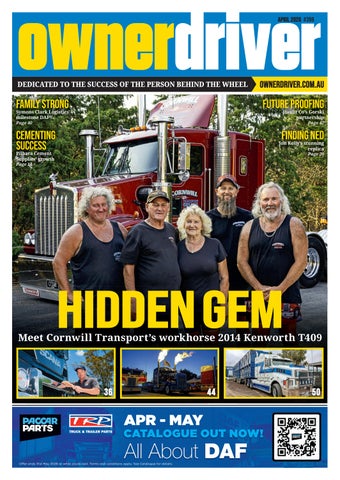
WONDERFUL WORKHORSE
Cornwill Transport is a fabled name in the recent history of the Australian truck industry. Warren Aitken headed to Victoria to sit down with the transport family and pick which of their truck show winning heroes was ideal for April’s Truck of the Month
36
DREAM MACHINE
In his twilight years as an ownerdriver, Chris Bonnitcha has bought a customised Scania truck that is demanding attention at every turn
40
FAMILY POWERHOUSE
Port Adelaide-based family logistics outfit Symons Clark Logistics recently found a special way of celebrating a major milestone as the operator continues to excel in the South Australian transport game
42
OLD STYLE SERVICE
Having recently built a truck and trailer fleet to match Haulit Co’s building nous, James Drever’s growth can be attributed to an expanding partnership with Gorski Engineering
44
BACK TO THE WELL
Warren Aitken was back on the tin taxi this month, heading to Florida for the second running of the Road to Wishes Truck Show
Image: Warren Aitken
EDITORIAL
Editor Sean Mortell
E-mail Sean.Mortell@primecreative.com.au
Phone 0468 577 166
Contributors Warren Aitken, Frank Black, Sarah Marinovic, Rod Hannifey, Simon Smith
Cartoonist John Allison
PRODUCTION
Art Director Bea Barthelson
Print IVE Print
ADVERTISING
Business Development Manager Tosan Popo
Phone 0481 260 352
E-mail Tosan.Popo@primecreative.com.au
SUBSCRIPTIONS
www.ownerdriver.com.au/subscribe
Phone +61 (0)3 9690 8766
Mon-Fri 8am-4.30pm (EST)
Email subscriptions@primecreative.com.au
Mail 379 Docklands Drive, Docklands, VIC 3008 Australia
EXECUTIVE GROUP
Chairman John Murphy
CEO Christine Clancy
Publisher Sarah Baker
Operations Manager Regina Fellner
Sales Manager – South Danny Hernandez
Staying afloat
As the year gets into full swing, the industry is doing all it can to keep its head above the water. But should it be this way for operators?
Times are tough. There’s no denying it. Being a truck driver, and even more so, an owner-driver, takes lots of courage, plenty of luck and a big old tablespoon of commitment. When a growing list of regulatory requirements, rising costs due to inflation and the ever-present danger of safety dramas on the roads is mixed in, it creates a potent cocktail of issues that makes being an owner-driver harder than ever before in Australia.
What can be done to fix this? So far this year we’ve seen industry leaders turn their focus to sham contracting, pushing the likes of the Australian Taxation Office to pick up the fight against operators working in the shadow economy. Now, a new problem has arisen in
“For transport operators, this is not just another inconvenience, it is another crippling cost added to an already overwhelming list. Fuel is one of our single biggest operating expenses.”
the form of fuel and diesel prices once again skyrocketing, as international conflict means fuel supply and security is in the spotlight.
As tensions escalated in the Middle East to start March, the fuel supplies in Australia became a dominant issue for the road freight industry. When federal energy minister Chris Bowen said in Parliament that the nation has only 36 days of petrol supply, 34 days of diesel and 32 days of jet fuel in reserve on shore, it struck a chord with many. The international benchmark, according to the International Energy Agency obligations for member nations (of which Australia is one), is 90 days, meaning we’re behind where we need to be in the case of a global emergency.
It quickly led operators to raising the issue alongside like associations including the Australian Trucking Association (ATA).
“For transport operators, this is not just another inconvenience, it is another crippling cost added to an already overwhelming list. Fuel is one of our single biggest operating expenses,” Ross Transport said.
“When prices spike without warning, there is no buffer. No margin. No room to absorb it. This increase to fuel will cost our business approximately an extra $15,000 in fuel costs per day. This cost will increase the more the price of diesel increases.”
For ATA CEO Mathew Munro, he explained that fuel is one of the top three costs of a trucking business, meaning the price rise is a major issue.
“Trucking businesses cannot be expected to absorb the cost of increased fuel prices. Our industry is already under extreme pressure, with one in every 12 businesses closing in the 12 months to November 2025,” Munro said.
It’s a scary time, with more and more operators struggling to stay level with rising costs and pressures. To break up this doubt, this edition of OwnerDriver strikes a balance between covering the latest topics and threats to owner-drivers, as well as celebrating the very best in truck technology and owner-driver stories.
Nothing supports the point of the latter better than Cornwill Transport. The well-known family operator is popular for its exquisite range of trucks that grace many shows around the country. Warren Aitken was finally able to pin them down for a chat and photoshoot, with a unique model taking out the latest Truck of the Month, as can be seen on page 26.
Drivers are the heartbeat of our industry, and Chris Bonnitcha exemplifies this. Featuring his story of his latest customised Scania that will see him into retirement, as can be seen on page 36, is all part of the power of transport.
This is just a sliver of what you can expect in the pages before you. Throw in our usual array of columns, event recaps, truck technology reviews and features, ranging from profiling drivers to a special replica truck that can be viewed from page 20, and there’s plenty of positivity in this edition of OwnerDriver to contrast the current issues. We hope you enjoy the read, and stay safe on the roads.
What’s new on the roads The Goods NEWS FROM THE HIGHWAY AND BEYOND
Major freight routes across New South Wales are receiving safety upgrades this year while new technology is paying off in Victoria
Across the vast expanses of regional New South Wales, major safety upgrades have been announced in a busy month for road works in Australia. Throw in some heavy vehicle movement technology being put to the test in Victoria and there’s plenty to be aware of heading into April.
SNOWY MOUNTAINS WORKS FORGES ON
The federal and New South Wales governments have announced the next stage of the $36 million Snowy Mountains Highway safety upgrades are now underway, with works commencing.
The suite of safety upgrades stretches for almost the full 330-kilometre length of the highway and is jointly funded by the two governments.
The latest work includes the installation of new safety barriers, a widened centreline and audio tactile line marking, also known as rumble strips, on various sections of the highway between Adaminaby and the intersection with the Princes Highway near Bega.
Work will be carried out on weekdays, between 6am and 6pm, for up to three months, weather permitting.
“The Snowy Mountains Highway is an important freight and tourism link, connecting regional NSW with the South Coast, and the local timber industry with the Hume Highway and ports of Sydney and Melbourne,” federal regional development minister Kristy McBain says.
“This $36 million investment shows our commitment reducing road trauma because we want everyone to reach their destination safely and without incident.
“I know these improvements will be welcomed by everyone in the community.”
Upgrades currently underway at the intersection with Black Creek Road near Adelong, as well as safety barrier installation between Yarrongobilly and the Hume Highway, are progressing well, with work expected to be completed by May 2026.
Transport for NSW is also preparing to install 150 kilometres of rumble strips at various sections on the highway and this work will be carried out in stages until the end of the project.
Single lane closures, traffic control and a reduced speed limit of 40 km/h will be in place for the safety of workers and motorists.
The delivery of the entire $36 million in road safety upgrades is expected to be completed by the end of the year.
“Safety is our number one priority. The NSW government is continuing to roll out practical, lifesaving upgrades right along the Snowy Mountains Highway,” NSW roads minister Jenny Aitchison says.
“Since announcing this package in April last year, we have already delivered 40 kilometres of new safety barrier and 144 kilometres of widened centreline marking, with more on the way.”
FREIGHT TECHNOLOGY PUT TO THE TEST IN VICTORIA
The Victorian government has revealed a trial of real-time road monitoring technology on a key arterial has completed to keep bridges and road strong.
The Bridge Weigh-In-Motion system, or BWIM, was tested last year along the Western Freeway between Melton and Ballan, using cutting-edge sensors to track how heavy vehicles travel.
By collecting live data of heavy vehicle movements without disrupting traffic, the system is giving engineers insight into how the bridges are being used daily.
With clearer, road specific data, the state government says it can better understand how bridges and roads cope with heavy vehicle movements.
‘’The new technology is a game changer giving bridge engineers
precise information on bridge use – right down to the weight applied by individual axles of individual trucks,” Victorian ports and freight minister Melissa Horne says.
“This initiative marks a significant step in data-driven infrastructure management and supports our commitment to maintaining a safe, efficient and sustainable transport network.’’
The technology complements the existing weigh-in-motion network for a better understanding of a vehicle’s location or onboard mass.
The system is portable, which means a single equipment set can be applied across multiple sites without the need for permanent infrastructure.
The two week installation involved attaching sensors under the bridge, along with a roadside camera and a small solar power unit to monitor loads and heavy vehicles using the bridges.
The 12-month trial was a collaboration between the Department of Transport and Planning, Slovenian technology company CESTEL and local contractor Fulton Hogan.
This trial is the first time this technology has been used in Australia following the successful deployment on key infrastructure throughout Europe, Asia, North and South America.
KAMILAROI HIGHWAY WORKS BEGIN
New South Wales’ Kamilaroi Highway is set to receive a major safety and resilience boost as rehabilitation works get underway.
A vital stretch of the highway west of Burren Junction will begin
receiving significant works as the state government aims to deliver long-term improvements to one of the state’s most important road corridors.
Work will fully rehabilitate a three-kilometre section between Walgett and Cryon, near the Goangra-Beanbri intersection, where pavement has continued to deteriorate despite routine and heavy patching.
Rather than temporary fixes, crews will carry out a full pavement rehabilitation to rebuild and restore the road surface, improving ride quality and strengthening the highway for the long term.
Work is expected to take around four months to complete, weather permitting. Transport for NSW says single-lane closures and temporary traffic lights will be in place during construction, with work carried out between be 6am to 6pm on weekdays and every second weekend.
“This rehabilitation work is about delivering long-term solutions for communities who depend on this highway day in, day out,” NSW roads minister Jenny Aitchison says.
“The Kamilaroi Highway is a lifeline for freight, farming and families across north-west NSW — and this upgrade will make it stronger, safer and more reliable.
“We know this section has been impacted by flooding and repeated damage. Rather than continuing with temporary fixes, we’re rebuilding it properly so it can better withstand the conditions and serve the community for the long haul.”
Visit nhvr.gov.au/go
Operators raise alarm over fuel hikes
One operator says “every time fuel jumps dramatically, it pushes small family businesses closer to the edge”
Operators around the country are having to deal with the latest fuel price hike caused by ongoing tensions and conflict in the Middle East.
Following the US resuming operations in Iran and across the Middle East, fuel security issues have led diesel and fuel prices across Australia to jump up to 60c per litre at a time.
Ross Transport raised the alarm over the changes, especially with more increases expected.
“For transport operators, this is not just another inconvenience, it is another crippling cost added to an already overwhelming list. Fuel is one of our single biggest operating expenses,” Ross Transport says.
“When prices spike without warning, there is no buffer. No margin. No room to absorb it. This increase to fuel will cost our business approximately an extra $15,000 in fuel costs per day. This cost will increase the more the price of diesel increases.”
The operator says the industry is already struggling with rising insurance premiums, registration increases, compliance costs, tolls, maintenance expenses, dodgy contracting arrangements causing rate cuts and ongoing workforce shortages.
“Contracts are tight. Margins are razor thin. Many operators are locked into fixed rates that don’t allow for sudden cost blowouts like this,” the operator says.
“Every time fuel jumps dramatically, it pushes small family businesses closer to the edge. It impacts owner-drivers, fleet operators, and ultimately the entire supply chain – because when transport hurts, everything hurts.
“This is unsustainable. The government and the ACCC must step in and urgently address these price spikes. Our industry cannot continue to absorb hit after hit while being expected to keep Australia moving.”
The Australian Trucking Association (ATA) says consumers and businesses must be ready to pay more as the price of diesel rises.
ATA CEO Mathew Munro says the market price for diesel has risen from $130 on February 27 to almost $220 per barrel in early March,
rising almost 19 cents per litre in a few days for retail diesel.
“Fuel is typically one of the top three costs for a trucking business. Any increase in fuel prices has a big impact,” he says.
“Some trucking businesses have fuel levies that automatically adjust their invoices as the price of fuel changes. Others depend on periodic rate reviews or don’t have rate review provisions in their contracts at all.
“Trucking businesses need to review their costs and, if necessary, have open conversations with their customers about the need bring forward the next fuel levy adjustment or rate review.
established the current national fuel reserve.
“Under its minimum stockholding obligation rules, fuel importers and refiners are required to hold baseline levels of fuel.
“About three billion litres of diesel are held under the MSO, enough to last 33 days. The fuel is in Australia or on ships nearby. Our total oil stocks are equivalent to 50 days of net imports in IEA terms.
“The Australian government has made progress on Australia’s fuel security, but it’s been a problem for many years. Australia needs to have the 90 days of net import cover that we signed up to hold.”
He says the rise in the price of diesel showed
“This increase to fuel will cost our business approximately an extra $15,000 in fuel costs per day. This cost will increase the more the price of diesel increases.”
“Operators also need to plan for delays in filling fuel orders because of the increased demand.
“Trucking businesses cannot be expected to absorb the cost of increased fuel prices. Our industry is already under extreme pressure, with one in every 12 businesses closing in the 12 months to November 2025,.”
Munro says the ATA and its members had campaigned since 2014 to strengthen Australia’s fuel security. As a member of the International Energy Agency (IEA), Australia is required to hold oil stocks equivalent to 90 days of net imports.
“The ATA pushed back against the previous government’s plan to store Australia’s fuel reserves in the United States, on the other side of a very wide ocean,” he says.
“We also worked with the industry department on the 2021 legislation that
the importance of the ATA’s submission to the Fair Work Commission about the contractual chain order it is considering. The FWC has the power to issue orders covering the whole of the road transport contract chain.
“In our submission, we supported a requirement for yearly rate reviews, but with more frequent reviews of the price of fuel unless a contract already includes a fuel levy mechanism,” he says.
“Those requirements won’t come into force until late 2027 at the absolute earliest. The solution for now is for trucking companies to monitor their costs and talk to their customers.
“For our part, the ATA will continue talking to the government and fuel suppliers to understand how we’re placed and to emphasise the critical importance of road freight transport to everyone in Australia.”
GET A HEAD START WITH FREIGHTLINER CASCADIA.
Get three months on us up to $20,000 when you finance a Freightliner Cascadia with Daimler Truck Financial Services. Experience the benefits of Guaranteed Buy Back and three years of servicing at no extra cost.
Talk to your Freightliner dealer today to find out how you can take advantage of Cascadia’s remarkable fuel efficiency, advanced safety and superior comfort - Underestimate At Your Own Cost.
3 MONTHS OF REPAYMENTS ON
NOTHING TO SPEND SERVICING FOR 3 YEARS / 450,000KM. GUARANTEED BUY BACK. WE PAY YOUR FIRST 3 MONTHS, UP TO $20,000.
Hino expands regional footprint
The new $8 million, 17,000sqm facility is situated in Victoria’s Goulburn Valley and will be run by an award winning group
Hino Australia has announced it has expanded its regional footprint in the country with the opening of a new dealership in Shepparton, Victoria.
The new state-of-the-art dealership has been built courtesy of an $8 million investment, with the 17,000sqm facility featuring a modern showroom, five truck work bays, dedicated Hino technicians and a purpose-built parts storage facility.
The new site will host nine separate businesses with Hino as the flagship brand, occupying nearly half of the site, while other onsite businesses include two motorcycle dealerships and a Hertz branch.
When the brand was looking to expand into Shepparton and Victoria’s Goulburn Valley, president and CEO Richard Emery says the Jacob Group, which has operated Jacob Hino in Wodonga for 25 years, was the “logical choice”.
“Shepparton is the heart of Victoria’s fruit and dairy industries, and we see strong growth opportunities here, particularly for our 700 Series heavy-duty trucks, and we are really excited to have a
permanent presence,” he says.
“This is a greenfield project built from the ground up. It’s not just about trucks – it’s about investing in Shepparton, creating local jobs and
Sydney operator closes doors
The founder of the Sydney based logistics outfit says he’ll be closing the business to focus on his “health, wellbeing and family”
supporting the industries that keep Victoria moving.”
Jacob Hino dealer principal Neville Jacob says the new dealership represents an opportunity for the
Australian transport company
Gold Tiger Logistics Solutions has announced it will be closing.
After 20 years in business, founder Imad El Masri announced he will be “closing this chapter of the company’s journey”.
El Masri says he has made the “deeply personal decision” to step away from the transport industry to focus on his health, wellbeing and family.
“Gold Tiger has been my life’s work for 20 years,” he says.
“I’m incredibly proud of what we’ve
built, but it’s time to prioritise my family and my health. That’s the most important investment I can make now.”
As part of this transition, Gold Tiger’s fleet and equipment will be sold through Pickles, who has been a long-standing partner to the business from its earliest days.
“Loyalty matters to me. I bought my first truck through Pickles, so it felt right to finish this journey where it started,” he says.
Gold Tiger was first established in 2006 when El Masri, at 19 years
old, bought his first truck to begin operating as an owner and driver.
This led to a national logistics business that moved more than 250,000 tonnes of freight annually across the country.
Under El Masri’s leadership, Gold Tiger built relationships across industries including FMCG, manufacturing, retail and healthcare, with a focus on quality service, strong partnerships and accountability.
The founder says he’ll now focus on property development projects, which he has been involved in alongside the
family-run business to better service the local community, while also creating at least 25 new jobs.
“The Hertz business will allow us to provide our fruit-picking customers with purpose-built 12 pallet rental vehicles that can be used while their vehicle is being serviced,” he says.
Additional features include an electric vehicle charging station, Hino handover bay and an additional onsite area dedicated to individual customer handovers while sustainability measures include solar power and energy-efficient lighting.
Jacob expects the new dealership to cater to a wide range of customers.
“The heavy-duty Hino 700 Series will support both interstate and intrastate haulage operators, particularly those in the fruit, dairy and agricultural sectors,” he says.
“For tradies and small business operators, the 300 Series will provide practical and reliable solutions.”
Jacob added that the new development continues the strong tradition of a family business established in 1931.
business in recent years.
“This is one of the hardest decisions I’ve ever had to make. I started Gold Tiger when I was 19 years old with one truck, a lot of ambition and a passion for the transport industry. Over the last 20 years, that one truck became a national fleet, a team of incredible people and relationships that I will always value,” El Masri says.
“Gold Tiger has truly been my baby. But building and running a business at this scale for so long comes with sacrifices. The long hours, the pressure and the responsibility have taken a toll on my health and wellbeing over time. Eventually I had to be honest with myself about what matters most. My family has supported me through everything – and now it’s my turn to be present for them.
“Walking away is not easy. I feel proud, grateful and emotional all at the same time. But I also feel confident that it’s the right decision for this stage of my life. I want to thank every employee, customer, supplier and partner who has been part of this journey. You helped build something special.
“And to Pickles – thank you for being part of the journey from the very beginning. From my first truck to my last, loyalty matters. I’m proud of what we built. Now it’s time to focus on what matters most. This isn’t the end for me – just the start of a new chapter.”
Image: Hino Australia
Image: Gold Tiger Logistics Solutions
NHVR targets driver fatigue
The regulator will crack down on fatigue after
nearly
5,000 fatigue-related breaches were detected last year
The National Heavy Vehicle Regulator (NHVR) has announced the launch of a new national operation that will combat heavy vehicle driver fatigue.
In the wake of nearly 5,000 fatigue-related breaches detected last year, the regulator will conduct Operation Ambit across the country to focus on drivers who take unsafe risks with their work and rest requirements.
“Fatigue is one of the biggest risks for heavy vehicle crashes across Australia,” NHVR chief operations officer Paul Salvati says.
“Australia’s heavy vehicle industry is vital to our nation, but it is also demanding, high-stakes work which requires skill, focus and resilience every day.
“That’s why managing fatigue isn’t optional and staying rested is critical. Every alert driver helps keep our roads, industry and communities moving safely.”
Salvati says a similar operation conducted by the NHVR last year revealed alarming levels of non-compliance among drivers.
“The number of fatigue-related breaches detected was the highest
we’ve ever recorded during a national operation,” he says.
“Almost 5,000 fatigue offences were found by the NHVR in 2025 alone – equivalent to nearly 100 drivers every week taking unsafe
New charges model open for feedback
The NTC has proposed a new forward-looking cost base model to set heavy vehicle charges from 2027-28 onwards, with the industry now able to provide feedback
The National Transport Commission (NTC) has opened public consultation on proposals to develop a forwardlooking cost base for setting heavy vehicle charges in Australia.
The Consultation Regulatory Impact Statement on the charges proposal was requested by infrastructure and transport ministers.
The consultation is seeking feedback on the proposed forward-looking cost base model and a range of implementation options that could be used to set heavy
risks that endanger themselves and other road users.
“We understand heavy vehicle driving is a challenging task, and some drivers may face pressures to meet tight deadline, but safety must always come first.
“That’s why the NHVR also operates a Heavy Vehicle Confidential Reporting Line, where drivers can report inadequate fatigue management, falsified records, unrealistic schedules, or pressure to drive.”
Salvati says even when operating within legal work and rest limits, drivers are reminded they should never drive if they feel tired or show signs of fatigue.
In 2025, fatigue was one of the top offences for heavy vehicle operators nationwide, accounting for more than 23 per cent of all detected breaches.
During the operation, NHVR Safety and Compliance Officers will conduct vehicle intercepts, including vehicle inspections, work diary checks and licence and registration checks, while some jurisdictions will also see police partner with the NHVR to ensure a coordinated national approach to fatigue compliance.
“Collaboration with police and other regulatory partners is key to using our resources effectively and keeping roads safer,” Salvati says.
vehicle charges from 2027-28 onwards, subject to ministerial approval.
Heavy vehicle charges are currently set under the PAYGO model, with the NTC saying increases in government road expenditure have outpaced revenue from charges, causing a widening gap between costs and recovery.
The new proposed cost base model is an alternative approach that would see the cost of road construction and maintenance spread over the life of road assets rather than recovering costs in-year.
The aim of the new model is to improve stability and predictability in charges over time to align more closely with approaches used in other regulated infrastructure sectors.
The NTC has made it clear that the new model would only be used to set charges from 2027-28 onwards if ministers fully endorse the model and decide to adopt it.
The impact statement, which can be found here, outlines the proposed model, with consultation closing on May 21 this year.
The NTC will also run information sessions to provide an overview of the proposed model and implementation options, while supporting materials will be made available.
Image: NHVR
We went BIG in the 80s. Big hair, big suits, big phones and, starting in 1982, the first big FUSO heavy-duty truck. Now it’s time to go even bigger with the new FUSO Shogun 530, a 13-litre hauler with the biggest power figure of any Japanese truck – 530 horsepower. It can haul big weights too, up to 70 tonne GCM, and comes packed with advanced safety systems.* FUSO Shogun 530. Because bigger has always been better.
Learn more at your authorised FUSO dealer or visit fuso.com.au/shogun
Isuzu crowns leading dealers
The awards night, held on the Gold Coast, saw a Victorian dealership take home the ultimate award among the brand’s 70 dealer sites
Isuzu Australia has recognised the very best of its national dealer network, crowning the winner of its annual Dealer of the Year awards.
Against a backdrop of softer market conditions and the introduction of Isuzu’s all-new model line-up, Isuzu Australia says its dealers once again demonstrated their commitment to customer service and aftersales support.
With more than 70 dealer sites nationwide, Isuzu held the awards on the Gold Coast to recognise excellence across all areas of dealership operations, including new vehicle sales, customer care, staff training, inventory management, service performance and parts support.
Each category contributes to the overall Dealer of the Year title, with metro and regional dealerships judged equally, ensuring a level playing field across the national network.
Melbourne-based Westar Truck Centre, part of the Patterson Cheney Group, was named the overall Isuzu dealer of the year for 2025.
“This award is a reflection of the dedication of our entire team both Westar Derrimut and Westar Campbellfield. This really is for them,” dealer principal Adrian Harding says.
“Throughout a year of significant change, we stayed focused on supporting our customers and ensuring they had complete confidence in both our products and our people.
“The new model introduction prompted plenty of activity across the business, but our priority never shifted from delivering the highest standard of service and support.”
Fraser Coast Isuzu took home the Isuzu parts dealer of the year award as well as the sales dealer of the year, while Ballarat Isuzu won the service dealer of the year award.
Isuzu Australia director and chief operating officer Andrew Harbison says the 2025 awards carried particular significance given the operating environment.
“This has been a year that tested every part of the industry,” he says.
“With the transition to our all-new model range and softer overall market conditions in some weight categories, our dealers have shown tremendous resilience and professionalism.
“These awards recognise those
NSW expands camera capabilities
While no new cameras will be added to the network, the capabilities of current cameras are set to be improved
The New South Wales government has made changes to its camera detection program, with full capability of bi-directional coverage being implemented on single lane roads.
The changes, which came into place on March 1, improve previous coverage where only up to two lanes of traffic travelling in one direction were checked by cameras.
Now, Transport for NSW’s 10 transportable mobile phone and seatbelt detection cameras have full capability of bi-directional coverage on single lane roads.
Transport for NSW secretary
Josh Murray says there will be no new cameras operating on the network. Instead, he says extending the existing units’ capability will help meet the increase in the number of registered vehicles on the roads since the program started in 2019.
“When we switched on mobile phone detection cameras almost seven years ago, the target was to be able to check each registered vehicle in NSW an average of at least 20 times a year,” he says.
“Since then, the number of registered vehicles in NSW has jumped almost 12 per cent, from 6.7 million to 7.5 million.
who have pursued customer service and support excellence with firm determination, ensuring Isuzu customers remain productive and confident in their investment.
“The strength of the Isuzu network has always been one of our greatest advantages. From metropolitan centres through to regional and remote communities, our dealers continue to set the benchmark for truck sales expertise and aftersales care.”
Harbison says the successful rollout of the new model range was a whole-of-network effort.
“The preparation, training and investment required to support a full model changeover is significant,” he says.
“Our dealers embraced that challenge, upskilling their teams and enhancing their facilities to ensure a seamless transition for customers.
“It is particularly pleasing
“At the same time, the mobile phone camera program has made a significant impact in the road safety space, with seatbelt offences added in 2024.
“One in just under every 1,300 vehicles checked by these cameras in 2025 had someone breaking seatbelt laws while around one in every 1,200 were caught using their mobile phone illegally,
to see dealerships delivering such strong performance in a more competitive and measured market. It reinforces the depth of capability across the network and the shared commitment to continuous improvement.”
Harbison also acknowledged the broader dealer body for its collective contribution to the brand’s performance.
“While we celebrate individual categories and overall winners, the standard across the entire Isuzu dealer network remains exceptionally high,” he says.
“That consistent focus on customer support, reliability and long-term partnership is what underpins the Isuzu brand in Australia.
“We congratulate this year’s winners and thank every dealership across the country for their ongoing dedication to our customers and to the Isuzu Trucks brand.”
compared to as many as one in every 400 cars when we first started camera enforcement of mobile phone offences.
“We know lives have been saved as people change their behaviours in response to awareness and education with seatbelt use and distractions through phone use featuring as key contributors to the road toll.
“We need to ensure our program continues to check the appropriate number of vehicles, and we use our technology to its full effect.
“The expansion of the transportable cameras began in March and will take six months to roll-out. Fixed mobile phone and seatbelt cameras will not change. As is the case with all camera infringements, all fines go towards funding more road safety programs.”
Image: Isuzu Australia
Image: Transport for NSW
Volvo ups horsepower on new models
The latest range of horsepower ratings for its Euro 6 engine platform spans a variety of
Volvo Trucks Australia has announced a new range of horsepower ratings for its Euro 6 13-litre engine platform used on the FM range.
The latest horsepower options range from 380hp and 1,850Nm to 420hp and 2,100Nm, with a 460hp and 2,300Nm variant also available.
The updated range is intended to provide robust and efficient powertrain options across various transport applications, with the new low horsepower range also seeing increased torque being introduced across a broader, lower rpm torque band.
The peak torque starts at 905Nm and stretches to 1,400Nm across the three new variants.
Another feature of the new engine variants is improved engine brake performance, with power braking power increased by 70Kw over comparable 11-litre options.
The Volvo FM can operate at a GCM of up to 90 tonnes and is available with six different cab variants, ranging from day cab (low and high), to sleeper (low and high), Globetrotter and crew cab.
“This new offering is designed to support FM customers with potential gains in efficiency and performance for lightweight and rigid applications,” Volvo Trucks Australia vice president sales and marketing Tom Chapman says.
“We remain committed to
delivering
CEMENTING SUCCESS
Out in the great expanses of Western Australia, Pilbara Cement Supplies has forged a bumper fleet transporting to major mine sites around the state
Western Australia is no small area for truck drivers to cover.
Spanning a third of mainland Australia, the western state is the world’s second largest sub-national state and is more than 10 times the size of the United Kingdom.
Throw in sweltering deserts and a litany of distant towns and mining sites, as well as one of the most remote cities in the world in Perth, and hauling supplies around the state is notoriously one of the toughest jobs possible.
To make a name for one’s self in the Western Australian game requires dedication, experience and supreme organisation.
It’s these pillars that have allowed Pilbara Cement Supplies to excel over the decades as a trusted transport operator.
“I came from a family where my father and uncles had log trucks, so trucks have always been in my blood,” Pilbara Cement Supplies owner Mark Pilatti told OwnerDriver
“I grew up with them – after doing my
apprenticeship I convinced my father to let me trade in an old farm truck and buy my first truck, and it progressed from there. After becoming a Readymix concrete agent in 1992, it expanded from there until I bought my first cement tanker and continued growing.”
After starting Pilbara Cement Supplies in Port Hedland, Mark and his team, including operations manager of maintenance and site Matt Italiano, who has been with the business for nearly 25 years, bought their first three cement tankers and began transporting concrete to the Telfer gold, copper and silver mine in WA’s Great Sandy Desert.
“I started with the business as a fabricator apprentice and then transitioned into driving,” Matt told OwnerDriver.
“I got my MC licence and never looked back, doing general freight runs to mines in Collie and back to Perth before moving to runs in WA’s northwest.”
Nowadays Matt oversees all the workshops under the Pilbara Cement Supplies brand, putting
his extensive experience to the test in demanding conditions. The operator moves product all over the state, from the Nova mine near Kalgoorlie to Port Hedland.
These operations are as remote as they come for trucks and trailers. Traversing the wide plains and deserts of Western Australia calls for more than just organisation, good employees and experience – Matt says quality equipment is pivotal to leading a successful operation out west. This is where running on Hendrickson gear has become a major part of Pilbara Cement Supplies’ ongoing growth.
“Our partnership with Hendrickson started one day out of the blue when a new tanker turned up from Jamieson Sales and Service that had a Hendrickson set on them,” Matt recalls.
“We quickly discovered the Hendrickson product was terrific and offered us real benefits. From that point on, we’ve since purchased many trailers fitted with Hendrickson gear.”
For Matt and his workshop teams, longevity and durability are crucial factors to running effective concrete transport runs to mining sites across WA. This is where Hendrickson’s quality products come to the fore, excelling in the harshest of conditions due to being well-made and bulletproof.
These aren’t just claims – Matt recently took one trailer fitted with Hendrickson’s INTRAAX® integrated axle and air suspension system off the road after it had completed one million kilometres.
The Hendrickson gear was still in nearperfect condition, proving the lower total cost of ownership and real savings that their locally optimised air suspension can deliver for operators.
“It was even more impressive when you consider that this trailer hadn’t been out of action for servicing outside of general maintenance for
the entirety of the one million kilometres,” Matt says.
“We’ve been running Hendrickson products since 2017 and have never once done a wheel bearing. Every general check we do shows the gear in pristine condition.”
While the lack of downtime and maintenance costs are key benefits that Pilbara Cement Supplies has been enjoying on its trucks and trailers running Hendrickson, the overall reliability is even more valuable.
Due to the unique conditions presented across WA, including a mixture of sealed and off-road sections, having gear that can be trusted to stay dependable under heavy duress provides plenty of comfort to the business.
“We run our trucks and trailers to the Tropicana Gold Mine
“We’ve run Hendrickson gear out there fulltime without having any issues at all.”
just out of Kalgoorlie, which is notorious for being one of the worst roads to drive in Australia,” Matt says.
“We’ve run Hendrickson gear out there full-time without having any issues at all. In particular, the newer generations of Hendrickson equipment, such as the INTRAAX®, never need to be replaced or fixed, they’re just quality.
“Coming out of Perth, it may be bitumen for 80 per cent, or 1,000 kilometres, of the way, but the last 100 to 200 kilometres may be on bad dirt. This is where you have to rely on your equipment the most to get home, as there are no workshops on the dirt and a vehicle can’t get looked at until it gets back to Perth. This is where Hendrickson shines.
“This high quality and reliability then allows us to have very little downtime on any of our trailers running on Hendrickson, while maintenance needs have decreased and the overall ownership and operating costs are much lower.”
Outside of this strength and security, Matt says the Hendrickson suspension makes for a comfortable ride, even in harsh off-road areas.
It’s led to Hendrickson being prevalent in all three of Pilbara Cement Supplies’ major branches across the state, including the Perth base as well as the Kalgoorlie site and the Port Hedland branch.
On the truck side, the operator has a Kenworth T620 in local build that’s fitted with Hendrickson’s PRIMAAX® severe-duty rear air suspension, which is designed specifically for the rigorous demands of heavy haulage in WA.
Matt says PRIMAAX® EX offers “the best ride and comfort possible” for drivers, as well as true weight savings for the truck, translating directly into reduced operational costs.
During the specification phase of its latest fleet expansion, Pilbara Cmenet Supplies conducted a rigorous comparative analysis alongside the CJD Kenworth Perth sales team.
The data confirmed that Hendrickson’s suspension systems offered a superior weight to performance ratio and cost efficiency profile, significantly outperforming alternative configurations in both tare weight reduction and operational capability.
“We focus heavily on length, as all combinations have to be within the 27.5 metre regulation to run a pocket road train out of Perth. Hendrickson gear allows us to have a shorter spread that still steers really well while falling within this length limit. The leading benefits of running Hendrickson on our trucks is the length and weight we can have.”
In short, Matt’s decision to use Hendrickson gear on Pilbara Cement Supplies’ trucks and trailers has certainly been justified.
A range of truck and trailer combinations feature the Hendrickson badge, with the operator ready to receive more Kenworth trucks with Hendrickson fitted.
“Hendrickson is key for us – downtime costs money and we experience no downtime with Hendrickson,” Matt says.
“Our trailers go back and forth every day – they come into the workshop for their major service every four months.”
It’s here that Matt and his team see another benefit of Hendrickson gear with the reduction in servicing time, which can be up to six hours.
As Pilbara Cement Supplies continues to expand its fleet and operations across the vast reaches of Western Australia, quality equipment will be central.
Matt says Hendrickson has a major role to play in continuing to reduce downtime and boost operational savings across the business for years to come.
“They simply perform, are dependable and offer us peaceof-mind. It helps us service the remote areas that we do efficiently and consistently each and every day,” he says.
HENDRICKSON AUSTRALIA
Hendrickson
Top: Hendrickson gear has been a crucial part of the fleet’s recent operations
Below: Pilbara Cement Supplies is continuing to introduce Kenworth and Hendrickson vehicles to its fleet
Images: Pilbara Cement Supplies
PERFECTING THE REPLICA
While Emerald Springs Roadhouse is notorious for a particularly beloved truckie meal option, it also served as the birthplace of Jon Kelly’s love for trucks and a particular model he has since replicated, Warren Aitken reports
The chicken parmy is an iconic Australian meal. It’s a stable of many roadhouses, pub meals and has even been attempted by McDonalds. Finding the perfect chicken parmy is obviously very personal, we all have different expectations. But I can attest, and I reckon I would have the backing of every truckie that has passed there, that the Emerald Springs Roadhouse in the Northern Territory made arguably the best chicken parmy ever. Perfect pounded boneless chicken breast, fresh enough you’d believe it had only recently walked in from the coop, run through a rigorous three step breading procedure of flour, eggs and then the most delicious crisp breadcrumbs. Precisely pan fried to perfection then topped with a true Italian inspired tomato sauce, covered in just the right amount of mozzarella cheese and grilled into ecstasy, oh my mouth is watering at the memory already.
The three-day drive to the tiny territory establishment was always worth it and I’ll admit there were tears when the parking bays were full. But why am I decorating these pages with pictures of a perfect replica of Australian trucking history and waffling on about the gift from the gods of the perfect parmy? Because I am trying to establish the
extreme importance of a childhood memory that has motivated the enormous amounts of time and money that has led us to this truck. I am trying to lay the platform for the sacrifice a young Jon Kelly made that would decades later motivate him to build a replica of that moment in time.
The year was 1989, the location was the aforementioned Emerald Springs Roadhouse, home to the world’s best chicken parmy meal – perfect pounded boneless – oh wait I’m getting distracted again. It might be better if I let Jon tell the story.
“Ned Kelly was always the pinnacle truck for me, I remember seeing it as a kid pull up at Emerald Springs,” Jon recalls.
“I was doing a trip with my grandad in the old R700, and we pulled up next to it.
“I was about eight or nine, we were sweating our ring out, peeling ourselves off the vinyl seats and we watched Jack Taylor walk out of the bunk, out of the full length door and I just thought ‘what the F is this?’ I couldn’t believe it.
“He let me look in the bunk, look in the cab. I couldn’t believe this truck; it was beyond belief.” Now to tie all this back to my opening diatribe, you need to appreciate Jon’s next admission.
“Jack and Smiler (Jon’s Grandad) went in the
roadhouse and got on the piss for 10 hours and I reckon I sat in that driver’s seat until they came back out and shoed me away. I was happy to sit in there and not have dinner,” he says.
For a young man to sacrifice the world’s greatest chicken parmy just to spend time in a truck – I don’t fully comprehend that level – but it was the birth of an obsession that wouldn’t be fulfilled for another 30-odd years.
To understand that almost OCD addiction of an eight-year-old, you really need to understand the preceding years, as well as the years that have passed since. Jon Kelly is a name synonymous with Australian transport. He is an easy target for many keyboard warriors as much as he is a source of invaluable Australian trucking history to those that need it. He has built some of the most well-known and recognisable custom trucks and he has been involved in some of the biggest and loftiest heavy haulage moves in Australia. He is an ironically private man that lives a life out in the open, through the likes of social media and multiple TV shows. And most of all, he is an extremely passionate trucking man.
“I was really lucky that I got to grow up in a time of really cool old trucks,” he says.
“What I want to do now is help preserve our history through trucks.”
Jon grew up on his grandfather’s boot laces, Frank ‘Smiler’ Nilon. Smiler was a legend of Australian transport; he was one of the first drivers to ever cart machinery into the Mary K uranium mine – eight hours in an old Foden to cover just 45 miles is a sign of a patient professional. By the time Jon was on the scene and old enough to reach the passenger seat (five years old, for the record), Smiler had his own Mack and was building his long-standing relationship with Hasting Deering and forging the heavy haulage pathway between Brisbane and Darwin.
Every opportunity Jon could get, he was accompanying his grandfather out on the road, sitting in the passenger seat of the various Macks that Smiler progressed through. From the Flintstone to the R700, the Super-Liners, Value-Liners and even the CLs, Jon learned the ropes, the skills and the loads.
By the time he was 10 or 11, Jon was more than equipped to drive the loads. I’m not sure what the statute of limitations is on child labour, so we’ll all just pretend he wasn’t ever ‘actually driving’ in those days.
It wasn’t just his grandad’s trucks that fascinated the young Jon – it was all the big boppers that ran those western highways back in the day. With an almost Rain Man like ability, Jon could pick out the trucks coming down the road and the history with them. Retaining that nostalgia is what drives him now with his Heavy Haulage Assets business. Finding old trucks that he encountered, experienced and sometimes just admired. Bringing life back to them and restoring memories.
Even from the early days, Jon’s drive and focus was on having his own truck and doing the big jobs. Meeting Jack Taylor and having that time in Ned Kelly turned that truck into not just an idol for Jon, but a goal as well.
During the ‘90s and Jon’s teenage years, he absorbed himself in trucks and trucking. While the rest of us were slacking off in school, enjoying MC Hammer music videos and figuring out how to replace the bourbon in the liquor cabinet with cold tea, Jon was helping his grandad with pricing out and submitting quotes for massive moves, planning said moves, perfecting the patient art of heavy haulage and competing with Smiler to perfect the gear change.
By the time he hit 19, Jon had saved up enough to purchase his very first truck in a 1988 Mack Super-Liner out of Melbourne. I would love to tell you it was a truck that would hold a very
for
Top, above: There is just something extremely familiar and reassuring about the interior of a classic Mack Super-Liner; Rebuilding and reupholstering the interior of these one-of-a-kind sleepers was one of the longest parts of the rebuild. Getting the bunk as close as legally possible, plus scouring the world for that distinctive crushed green velour, was worth it in the end
Below: Jon is fortunate enough to have a shed full of resurrected memories, which includes Ned Kelly and several others that bring back plenty of childhood memories
special place in Jon’s heart, but truth be told, he had it for a month, did a month-long spruce up on it and before he even got it back up to Brisbane, he had sold it for a very good profit. What made that first truck so memorable, however, was the fact that the cash he got for selling it allowed him to be in the right position at the right time to purchase Kingsford Smith. The sixth Mack Bicentennial off the line.
“Kingsford Smith was my first official working truck – the first that I registered and went to work with,” Jon says.
“A normal Super-Liner was around $80,000 back then and I got Kingsford Smith for $110,000. Nobody really understood how important they would be in transport history.”
It is fair to say starting your transport career with a Bicentennial Mack Super-Liner as a kid is pretty fulfilling, and more so for a kid whose memory was still in the driver’s seat of Ned Kelly back in Emerald Springs. I do say kid as well, because at this stage Jon was only old enough to have a couple of years’ experience walking legally into a pub. He was a kid.
From that first working truck, over the next few decades Jon learnt and grew. Many trucks have seen the HHA touch, and many have been refurbed and passed on to customers. Jon’s passion for trucks and for heavy haulage became widespread. All you have to do is mentioned names like Gangsters Paradise, J-Cash, The Majestic or Bandit-1 and people know.
Throughout all the ups and downs of Jon’s career, there was always that lingering itch, that ‘missing out on the chicken parmy for this one truck’ feeling.
“After that moment when I was eight or nine, I was always like ‘can we get a bicentennial’, ‘can we get a bicentennial’, ‘can we got one’ – I was like those kids screaming are we there yet,” Jon laughs as he recalls how frustrating he must have been.
“Even when I bought Kingsford Smith, that was really cool, it was a great truck, but it wasn’t Ned Kelly.”
That itch never faded for Jon and over the years as he bought and sold other trucks, when he found himself flush, he made several attempts to purchase the original Ned Kelly. Jon came close a couple of times to getting his hands on it, but timing meant it just never quite lined up.
Jump to 2018 and Jon was pretty much out of the heavy
Opposite top: He’s a long way from the eight-year-old that first sat in the original Ned Kelly, but it is still the same level of excitement
Jon
Images: Warren Aitken
haulage game – his focus had moved into the truck sales side of things. This involved some refurbs and rolling the trucks out the door to new owners. It also allowed Jon to start purchasing and restoring to original a lot of the big bangers he had admired and idolised as a young fella from the passenger seat of Smiler’s trucks. The crew of experts he had assembled to assist and organise some monumental overhauls meant Jon had the skills on hand to maybe undertake a massive emotional project in building a Ned Kelly Bicentennial Replica.
“I had just purchased a 1988 Mack Super-Liner off Grant Angel up in Mataranka, and I was driving it home and just thought ‘you know what, I reckon I could make this a Bicentennial’,” Jon admits.
Now replicas are nothing new in the automobile world. In cars, the 1967-1968 Shelby Cobra is the most replicated car in the world. Chances are if you see one it is almost guaranteed to be a replica. In Australia, believe it or not, the A9X Torana is the most popular replica, closely followed by the XB Couple. As far as trucks go, more often than not they are classed as ‘tribute’ trucks, like the amount of Optimus Prime inspired trucks you see on the roads, but replicas is something not really attempted in our world.
“I just wanted to do it for me and for my boys,” Jon says.
“If they can do it with the GT Falcons, I can do it with a Super-Liner. Plus, no one has done a Bicentennial Super-Liner back to 100 per cent
“No one has done a Bicentennial SuperLiner back to 100 per cent brochure perfect, with the exhaust, the gold rims, the quarter guards, the straight up and down bullbar and the original KAB seats.”
brochure perfect, with the exhaust, the gold rims, the quarter guards, the straight up and down bullbar and the original KAB seats. That was my vision. It took me seven or eight years, but I have gotten it done.”
While the timeline was extensive, a lot of that was purely due to life getting in the way. The project began with a hiss and a roar, dealing with the biggest and most exclusive part of the Bicentennial Super-Liners – the bunk.
“A Super-Liner is a Super-Liner regardless of what it is, the biggest intricate thing for the Bicentennials is the sleeper,” he says.
“They were unique to them, they were 48’, they were high rise, they had the full-length walk-in door. They were the only factory fitted 48’ sleeper that Mack ever offered in that Super-Liner.
“The bunk itself was a standard Mack 36’ sleeper that was blown out to 48’ and had 11’ in the roof.”
Now for all Jon’s attempts to be 100 per cent brochure perfect, unfortunately legal reasons trump a childhood memory of skipping a parmy for a seat in a truck.
“For copyright reasons I had to get Joe Bradley to make a 50’ version instead of 48’. He put 11’ in the roof but I had to get the flat name plate bit and the bit up the top where the boomerang aerial goes done by my fibreglasser,” he says.
It was a 12-month project just getting the bunk done alone, then you had all the time spent on everything else, like setting the chassis up, overhauling the engine and diffs and even adding the chrome tapper covers that were pretty unique back in 1988. Jon’s drive to be 100 per cent brochure perfect, or at least within two inches, meant it would take time. I mean, you can’t exactly pop down to Carpet Court for a roll of crushed green velour interior carpet, can you? For the record, that was another challenge, but they did find some in Belgium of all places.
Some things came a little easier than others.
Brisbane’s Seats R Us somehow managed to have a couple of the original KAB seats they’d restored, while items like the ‘hounds tooth door entry handle’ became the bane of Mick McCormack’s (one of Jon’s fabricators) existence as he had to handmake perfect replicas of a now non-existent part.
“By the time we had it finished for the Casino Truck Show last year, it was nut and bolt perfect,” Jon admits.
“We built it so it can be used, the best feeling was hooking a double up to take it down to Casino and then we hooked a triple up to take it to Alice Springs as well.”
That trip was even more emotional as his son
James took the opportunity to replicate his father’s actions and pull his first triple across the Barkley.
There are plenty of people that Jon wants to credit for assisting with this momentous build. There’s probably too many to remember, but special shout outs go to the likes of Gary Rose, his head of the refurb team, Mick McCormack, driver Dave and Jon’s son James, who pushed pretty hard to keep this project rolling. Huge appreciation to Glenn and Richard Graeme who own Bicentennial No.1, Ludwig Leichhardt. They had their truck accosted by Jon on several occasions to measure up templates and cross check references. Big shout out to PJs for the painting of the truck and a special thank you to the Britannica of Bicentennials himself, Ernie Hastas, who kept Jon on task for ensuring the little details like lines and colours were also 100 per cent accurate.
There is no doubt countless others involved in this project that deserve a shout out, they have all played a part in bringing memories and history back to life and they all get to share in the massive smile that Jon sports as he enters the vicinity of his replica Ned Kelly. But I think Jon summed up his appreciation and motivation the best.
“What I do, and how I do it these days, is to freeze those amazing moments and memories of my life through the trucks I build and bring back. Most importantly, let others hear and understand those moments and live a little of that glory with me,” he says.
Personally, I am torn, seeing as I hear Emerald Springs Roadhouse has closed. I still kind of hold it against Jon for missing out on a chicken parmy that day. But then, as I photograph this amazing replica, knowing it’s not just a reflection of history but also a reflection of the truck that fanned the flames of Jon’s trucking passion, I reckon I can let the parmy go.
Opposite from top: 50’ or 48’, you can’t really tell. What the side view does show is just how cool the Bicentennials are. Big bonnet, big tanks, big bunk. Big truck
Opposite middle: Even from the rear, the Bicentennial Macks have an iconic look, including the curve on those stacks
Opposite bottom, L to R: A very important part was getting the badging right.
The original Ned Kelly was one of two Bicentennials sold to RTA in the Northern Territory; Another iconic piece of Mack history is the old fuel caps. They just seem a perfect representation of a golden era in trucking
Right: It is one of the most distinct trucks and nothing beats a front-on view of a Mack Super-Liner
Reduces Maintenance
Your Say
Letters to the Editor need to be typed or clearly handwritten and be no more than 500 words. Letters should include name, title (e.g. owner-driver, manager) and city for publication, unless otherwise requested. Letters may be edited for clarity or space. Please be concise, so we can offer more people an opportunity to express themselves.
SEND YOUR LETTERS TO: sean.mortell@primecreative.com.au or 379 Docklands Drive, Docklands, VIC 3008
We prefer letters by e-mail, but handwritten letters will be accorded the same opportunity to be published.
Selwyn Sinfield – Tasmania
I am a retired heavy vehicle driver after doing 57 years in road transport in Tasmania. In my time working this industry I have experienced highs and lows in the industry. In my early days, starting in 1962, I was a 19 year old driving semi-trailers for Port Phillip Returned Soldiers and Sailors Stevedoring, known as Port Phillip RS&SS – a Melbourne based company moving mainly fruit and vegetables across Bass Strait when the roll on roll off shipping trade between Tasmania and Melbourne was introduced around 1959.
Austin prime movers (about 110hp) with 18 and 20 foot single axle trailers were the norm for us back then. The 186 mile journey from Devonport to Hobart central took from seven to 7.5 hours driving time. The old Bass and Midland Highways back then had many hills and twists and turns that today’s high horsepower trucks don’t have to deal with. Today that journey with a full load on a B-double at around 75 tonne all up takes around 3.5 hours to drive. The Austins’ all up weights were around 22 to 24 tonnes and we averaged around 40km/h for the whole trip.
At least two nights a week we had three truck/ trailers do that trip and all was hand unloaded in Hobart. When ships were a bit late arriving, that meant we three drivers had little to no sleep that night. Our loads were sorted into customer orders on the dock and we no sooner finished that task and the fruiterers were arriving from 5am onwards to collect their loads.
Once they got their loads and left, we left for the return trip north to Launceston, where we would collect loads of dressed building timbers already on trailers previously left at that business. We would then take two (or three loads if time allowed) from there to Bell Bay port for another roll on roll off ship to go to Melbourne, then one load from Launceston back to Devonport. Having started the day before at 8am, we often ended the following day around 6pm to 9pm with no sleep at all during that period. If or when there was some sleep, it was mainly slumped over the steering wheel for 10 minutes or so. In my 6.5 years doing that job, not one of the seven drivers left the road nor had an accident of any kind.
My point is we managed out fatigue back in those days without the need for a logbook to tell us when to rest. We had work in front of us to be done and we kept going until the job was done. We had different ways of keeping alert when drowsiness crept in (no taking of pills or drugs). Having to do manual work often brightened us up.
It is almost impossible to compare then to now. We had less traffic sharing the roads with us. We had no power and no speed. We had vacuum brake assist which was basically non-existent. We all, when starting in the industry, listened to the older blokes and learned how to do it the right way, not just any way we thought be ok, as people do today.
Today they don’t listen. They don’t want to drive lesser powered trucks. They get straight into 600-plus horsepower after a few days so
called ‘training’. They drive when they should be resting and they stop when they don’t need to. Some of that is they see a mate at a roadhouse, so they stop then and try to make up time. They’re often given a time frame to do the job. We had none of that. The job was done when it was done back then.
After explaining all that, which you likely have heard from other similar stories, I think the idea of trying to manage fatigue has been approached from the wrong end, as what we see is something devised by people who work in government jobs. Some in those jobs are ex-unionists and should know better, but as usual they have been promoted to higher positions within unions, often becoming an elected member of Parliament, all without ever having done the work of the truck driver as many of us oldies have done, and from that they get the bull by the tail. They have no idea.
To try and manage fatigue by regulating 1.04 per cent of licence holders in Australia while allowing the other 98.96 per cent to have a free ride with no fatigue management of any kind is and will always be trying to fix it by hanging onto the savage bull by the tail.
1.04 per cent is 200,000 known heavy vehicle drivers, according to the 2022 government – 19.4 million people in total held a driver’s licence in 2022, meaning 98.96 per cent is 19.2 million smaller vehicle licence holders.
I had communication with a chap at Austroads last year. I made this very point to him as just quoted here. I asked why do we not have some way to test fatigue and suggested the only real way to manage fatigue is to have every driver, no matter the size of the vehicle they drive, face the same laws around fatigue. He agreed with my thinking of some form of roadside test like they do for alcohol and drugs, which all drivers are subject to, and said there is already a test available for one part of testing fatigue. They are now working on perfecting the follow up test to prove the existence of fatigue.
He said they have the roadside part done, but
now have to develop a way to prove fatigue was present at time of that test. It seems they will, if this is perfected, use something like a breath test at roadside – if readings are above certain levels they then proceed to blood testing to confirm the presence of fatigue.
If such can be perfected, we then need to administer that testing across all drivers, not just a select few, as we see happen now for fatigue. The current form is not a test, it is purely an assumption and that is so very wrong as that can be mistaken in so many forms – in the same way some have been pursued for drink driving based on the officer’s experience of communication with said person and said person has slurred their words while talking, only to find there is no alcohol in the person’s system. My daughter has a mental illness and to manage life, the medications she takes has her often slurring her words, but her mental capacity is still normal.
Until there is a better way to test fatigue, I believe that component should be removed from the HVNL. I believe if all drivers were subject to fatigue laws around driving vehicles, that would see a drop in serious accidents.
A mate of mine now retired lives in Queensland and was stopped by a police officer for checks to their logbook. All was ok, but in conversation the driver asked the officer if his day was done or had just started. The officer replied almost done and was looking forward to getting home, hooking up the caravan and heading north for the weekend holiday. That officer had done his eight hour shift and would have been out of bed maybe 2.5 hours before starting – so out of bed for 10 to 11 hours. Throw in another hour or two getting home hooking up the van and getting on the road. He told the truck driver he was heading north and that destination was an eight-plus hour drive. Why are officers and car drivers not regulated but truck drivers are? That officer should have known better given he writes tickets for the same thing he was about to do. It’s criminal activity in my view.
Sad examples
The
TWU points to recent
tragedies as examples of why it is pushing hard this year for large-scale enterprise agreement change in the transport industry
Iwant to tell you about a man named Rohallah Khashee. He was a driver working for McDonald’s and had gruelling shifts, 800km runs taking up to 13 hours, for up to 17 days in a row. He was killed on the road while returning home from one of his runs. Now the company Rohallah worked for, and who won the contract from the fastfood chain, is filing for liquidation after being handed a million-dollar fine.
These stories are still far too common in road transport. And with the gig economy continuing to reach into this industry, standards are under further threat.
Recently Amazon and Harris Farm announced a new partnership. Again we’re seeing a major extension of the gig economy into transport, another corporate giant tapping into the market to reap massive profits, while exploiting drivers.
Drivers for Amazon Flex are often using their own family cars and stuffing them full of packages, pushed to deliver as many of them as possible as quickly as possible, all while being paid next to nothing. The only difference here is their cars will be crammed with fruit and vegetables.
Stories like these paint a picture of how our transport industry desperately needs fixing. With new laws to improve the industry, and a fight coming up this year to increase standards, we’ve got the best opportunity we’ve ever had to really make change.
As it stands right now, road transport simply does not serve the needs of our workers, our communities, our drivers, our transport operators – the ones who use our infrastructure the most. It has been decimated by CEOs, executives and giant corporations, and they are the ones still calling all the shots.
We also know there is a lot of change coming to transport. Not only do we have to repair what’s already broken, now we need to consider the transition towards AI, automation and net zero, and it’s crucial the industry plays a role in that.
It’s time for road transport to serve our drivers and operators. 2026 is a big year for the Transport Workers’ Union, we’re about to set our plan in motion that’s been decades in the making and has taken massive effort from our drivers.
More than 200 enterprise agreements which have set the pay and working
conditions for employees across aviation and transport are about to expire. This presents us with the opportunity of a lifetime to push for sector-wide changes and lift standards from the bottom of the supply chain right to the very top.
That’s a lot of ground to cover but this gives us the bargaining power we need for thousands of workers to take action and make the corporate class, who are raking in record profits, pay what they owe. This is the best chance for drivers and operators like you, to have the wages and working conditions you deserve, while keeping Australia running. That’s one big piece of the puzzle.
In the meantime, our applications to lift standards across the board in road transport are getting closer to making real improvements in the industry. Consultation for our first three applications – for maximum 30-day payment terms, and for standards in food and parcel delivery to stop the rampant undercutting – is complete.
We brought the big banks and retailers to the table in our application calling on them to properly fund cash transport. Most recently we called on Boral and the construction giants to pay up for fair conditions in concrete transport, instead of the company threatening to terminate drivers’ contracts if they didn’t agree to be paid less.
These are also pieces of the puzzle. We’ve got more than 200 agreements lined up, giving us enormous power to take the fight to transport clients around the country. We’ve got applications to lift standards industry-wide. We’ve got new rights against unfair contract terminations for owner drivers, as well as for Uber workers whose accounts are deactivated.
the Transport
Union of Australia. Contact Michael at: NSW Transport Workers Union, Transport House, 188-390 Sussex Street, Sydney, NSW 2000. twu@twu.com.au.
I mentioned in my last column Mohammad Shareef Hotak, a driver for Uber, who had a huge win in the Fair Work Commission. He was kicked off the app because passengers made false claims of being threatened by Mohammad – the real story was that Mohammad had told them to stop doing drugs in his car, and he’d been assaulted by them. He made a police report and told Uber about it – instead of supporting him, they deactivated his account. The Commission ruled he was unfairly deactivated, and slammed Uber for its practices.
This might seem like a victory only for rideshare workers, but it means more than that. It marks a major change for everyone in transport and a victory for the small business owners against the corporate giants.
The transport reforms we’ve fought so hard to achieve are starting to turn the tide against those who seek to silence their workers, who think they can pursue any means to drive up profits while underpaying workers and operators, and driving down safety standards. There are many more wins for drivers against those sorts of companies to come.
Those sorts of victories will not only send a message to the executives and shareholders – it puts a spotlight up for everyone to see just how much of a crisis the transport industry is in. Tragic examples like Rohallah and the pressures drivers like him are put through show us just how far the road ahead is to fixing our industry.
These pressures will only increase with the rapid expansion of the gig economy if we don’t act as an industry to stop the tsunami. Corporations are acting as heat-seeking missiles to find any loophole or means to undercut the competition, so they can extract as much profit as possible – hoarding it from those who do all the heavy lifting. It’s why we’ve have worked so hard to prepare for what’s to come this year. With the combined strength of 60,000 members across the roads and skies, and an industry as united as it has ever been, we are ready to take the fight to the clients and make them pay. We are ready to push for better standards for drivers and transport operators.
Because as we’ve proven again and again over the years, when we fight together, we win. But the more of us there are joined in this fight, the harder it will be for us to be ignored. Join the TWU here to be part of it: www.twu.com.au/join.
MICHAEL KAINE is the national secretary of
Workers
WONDERFUL
Cornwill Transport is a fabled name in the recent history of the Australian truck industry. Warren Aitken headed to Victoria to sit down with the transport family and pick which of their truck show winning heroes was ideal for April’s Truck of the Month
Just to bring you all up to date as you start reading this story, I am now onto my 15th opening paragraph and I am hoping to get through the introduction and get into the story this time around. This isn’t a story that is hard to tell, and it isn’t a story with nothing to say. The problem is this is a story that really needs due diligence. Yes, I do have an outstanding truck to focus on – just look at the images of this incredible 409 before you –the problem is trying to do justice to the family behind this incredible truck and the rest of their outstanding fleet.
They are not a family that chases the limelight, even though everyone knows their name. They are not a family that flashes their success, even though every truck in the fleet gleams with pride and passion. And they are not a family that holds themselves in any kind of inflated importance, even though they are all some of the warmest and most welcoming folks that you can meet. It was such an honour for me to receive an invitation to join the Cornwill family at their home base down in Bannockburn, Victoria recently and get the opportunity to photograph a couple of their trucks. I had butterflies in my stomach when I accepted the invite and felt honoured to sit down with Kevin and Wendy, as well as their sons Wayne, Troy and Rick Cornwill, and share some of their story.
You may ask why I was nervous accepting an invite to the truck lovers’ paradise that is Cornwill Transport. The Cornwill name holds massive weight around Victoria, both in transport in general and in the truck show scene. For several years now, there has almost been an admiring resignation from fellow entrants when the Cornwills rolled in to any show. There is hardly an award that their incredible 2008 Kenworth T908, named ‘Paradise’, hasn’t picked up on the Victorian circuit and, then with the release of the Kenworth Legend SAR the Cornwill family built
All of those involved in refurbing this tidy little T409 deserve accolades. The end result is a tribute to the
a
WORKHORSE
Images: Warren Aitken
Left:
old Kenworth SARs, wrapped around
much more modern truck
“Obviously ‘Dynamite’ is the multi-award-winning show piece of the Cornwill brothers’ skills.”
in ‘Dynamite’, they have another truck that has not only cleaned up at every regional show it entered, but also went on to claim the inaugural National Show’n’Shine Championship at last year’s Brisbane Truck Show. It is the benchmark for builds when it comes to custom trucks and as such, I was a bit nervous popping in to visit a family held in such high esteem in our industry.
cooked meal. I left late in the evening with my Dictaphone maxed out and a whole new appreciation for the dedication and work ethic of the Cornwill family. Oh, and Wendy’s baking – that’s enough for me to fake the need to return for at least three or four follow-up interviews.
Above: It was such a privilege to share the afternoon and evening with this extremely generous family – Wayne, Kevin, Wendy, Rick and Troy Cornwill
Below: A lot of people see the Cornwill trucks at shows and refuse to believe they actually work. They do and no one works harder than the little T409
Opposite: The onterior may be a lot more modern than an old school SAR, but check out the steering wheel and gear stick –just a touch of historical value there; It is only the small bunk option for this little working rig, but it is all driver Hill Bill needs. The truck is rarely away overnight, and the parcel tray bunk is more for the waiting times than the overnighters
But I soon learned the family team responsible for these exquisite trucks is as down to earth and modest as anyone you will ever meet. My ‘quick interview’ turned into a full afternoon event that was wrapped up with a lovely home
I learnt how integral Kevin’s ethos has been to the success of their sons and how Wendy’s attention to detail and thoroughness has influenced them as well. I learnt how old school values form the basis of Cornwill Transport’s business success and how the adage ‘how you do anything is how you do everything’ has seen these young men setting new standards in truck show preparation. I also learnt that, to give the Cornwill story full justice, this would be a multi-issue spread – this sadly can’t be done, so let me try and get to the crux of the story. Firstly, though we are going to deal with the elephant in the room, I am sure many are asking ‘why have I not focused on the amazing work of art that is Cornwill’s Legend SAR’? Quite simply, I wanted to focus on this impressive 2014 T409 that joined the family back in 2019, the reason being I think it epitomises their achievements
more. Obviously ‘Dynamite’ is the multi-awardwinning show piece of the Cornwill brothers’ skills. The whole truck has been modified and customised by the boys themselves, getting in the experts when needed, but turning out a masterpiece from their own workshop.
But Dynamite is a sunny day work truck. In time it will do more, but at the moment it only gets employed when there’s guaranteed good weather and no gravel roads. Then there is ‘Paradise’, which has done its time as the flagship workhorse. Wayne drove this five to six days a week for the company, but it has paid its dues and now leads a content truck show life. These are two very impressive rides equally deserving of our attention – I have chosen the little T409 because not only is it still earning its keep, but it came into Cornwill Transport as a second hand truck and has since been given the full makeover experience. As it approaches one million kilometres on the dial, it is still turning heads and picking up trophies when sitting next to its more applauded big brothers.
The Cornwill Transport team are a small tight family operation operating competitively among the big boys and their little T409 epitomises that same struggle. Wayne and Troy Cornwill were the brothers that began Cornwill Transport back in 1995 and were joined by younger brother Rick when he was old enough to fit a pair of steel caps. However, to understand the passion that built the company, we need to go back to the ‘60s when their father Kevin first started driving, unlicenced of course.
“Well, they didn’t actually ask if I had a licence when I went for the job,” Kevin confesses with a smile, recalling his first job down in Victoria.
We won’t focus on the how and why as much as we will focus on the drive and determination that Kevin took to work with him.
“If you want something you have to go out and work for it. You have to make sacrifices in order to get the things you want,” he says.
Yes, these are the kind of things you read on the cheesy motivational posters plastered in the school guidance counsellor’s office, but they are true mantras for Kevin and his family.
During his tenure behind the wheel, Kevin was determined to build a life for his family. His approach to every job he had was to give it 110 per cent and then a bit more on the weekend. It is a work ethic that is now evident in his boys, but Kevin is also the first to divert the accolades to his lovely wife Wendy.
“I do think the credit for the boys goes to Mum because I was always away working,” he admits.
“She was the one at home raising the boys and keeping the house going. I also think their obsession and standards of cleaning come from her as well.”
As you would expect, Wendy shies away from the compliments but admits the boys used to follow her around when she was cleaning and were happy to get the rags out and point out when she missed a spot.
Kevin found his groove when he got a job driving for Ron Hovey OAM in one of Hovey’s Transport’s old Louisvilles. Working for the Geelong Cats great was regarded as prime employment back in the day, with great gear, high expectations and a welcoming environment. It was the place where Kevin and his approach to work really shone. It was also a great family atmosphere for Kevin’s first two boys to experience the trucking life they were chasing.
I have mentioned Kevin’s tendency to live life
“Troy and I wanted a Kenworth; we’d always talked about getting an SAR because they were the cool trucks we saw growing up.”
via motivational posters, right? Well, another one of those philosophies that Kevin was teaching his boys was ‘live to your means’. It was Kevin’s way of teaching the boys some financial responsibility. Having grown up around trucks, spending their childhood helping Dad, driving well before their time, helping repair maintain and customise, as well as working part-time jobs washing trucks, Wayne and Troy had made the decision all young truck lovers make: we will buy our own truck, make it cool and go trucking. Dad, however, made it clear that if they wanted to succeed, they needed to own their first truck and they needed to have some money behind them before they got started. It is a great attitude to teach your kids and, in the Cornwill case, it was absolutely spot on.
Neither Wayne nor Troy had much appreciation for school and, with their focus being on saving enough money to buy a truck, they were out the school door quicker than you can say ‘where the hell are those Cornwill boys?’. Wayne picked up work at Coles and would end up doing a 10-year stint with the company. Troy went in a very different direction and took an apprenticeship in furniture making. This didn’t mean they abandoned trucking – no, it just meant they were determined to earn money to buy their truck. The two of them also reflected their Dad’s work habits with second and third jobs. No rest for the motivated.
Their truck fund was quite literally a beanie stuffed with cash that they kept in their bedroom. The boys believed in themselves and the lessons they’d learnt from Mum and Dad – getting the money together and doing it off their own back was how they would succeed. In 1992 the beanie got emptied and the boys bought their first truck. Wayne was 23, Troy was 20 and suddenly the family home in Geelong had a bloody great Kenworth Aerodyne stacked in the driveway.
“When the boys bought the Aerodyne, they brought it home and honestly we had nowhere to put it,” Kevin laughs.
“They put it in the driveway – it wrecked my concrete and ruined Mum’s gardens. Most people won’t believe it, but where that truck was refurbished was in the driveway of our place in Bell Post Hill.”
Above:
Opposite
The purchase of their first truck had six degrees of separation linked to the decision 22 years later to purchase this cool T409 that you see before you now.
“Troy and I wanted a Kenworth; we’d always talked about getting an SAR because they were the cool trucks we saw growing up. But then we took one for a test drive, it was just a bit too small for us,” Wayne recalls.
Top, L to R: Check out the custom work on this old schoolchool SAR – stainless – and these awesome rear lights have all been done by the team at Thorpe Custom Trucks; Nothing fancy, just straight shiny stainless and period piece LEDs on the side, keeping the look for the Cornwill T409
Looking for that throwback to the old SARs, the rear end of the T409 has also been heavily modified
top: I couldn’t spend time at the Cornwill headquarters and not snap a quick shot of their latest masterpiece in the inaugural National Show’n’Shine winner ‘Dynamite’
Opposite bottom: The truck that started it all, Wayne and Troy’s first purchase, the 1980 Kenworth ‘Penthouse’
The boys had big plans for when they got their truck, hoping that they could get work towing for Hovey’s alongside their father. They were adamant they were going to work their rig as much as possible, so they needed a truck big enough to accommodate the two of them. Enter the 1980 Kenworth K123, which would become known as ‘Penthouse’. The boys picked up the Ex-Apex Club of Australia raffle truck for about $43,000 in 1992. They spent more than double that refurbing it from their Mum and Dad’s shed and, in late 1994, they debuted their masterpiece
at the Castlemaine Truck Show before turning the wheels in anger early in 1995.
It wasn’t an easy start to Cornwill Trucking. The boys were working like men possessed, with day work towing for Hovey’s and night work for a landscaping outfit that saw the truck pushed hard. During the first couple of years, they ended with a couple of rebuild invoices, the second one most likely caused by inferior work on the first rebuild. Regardless of the reasoning, it wasn’t easy for the young men trying to follow their dreams, but having good family support as
well as great companies they were working for ensured those first couple of years didn’t break them.
Quitting or even half-arsing things just isn’t in the Cornwill DNA. The boys persevered and, even through the sellout of Hovey’s Transport to Linfox that saw the loss of the subby work as more and more subbies joined the ranks, the boys just kept working. They found other ways to keep the wheels turning and they kept building their reputation. Admittedly it was helped by the pristine presentation of their Penthouse. Customers and truckies alike noticed the big girl looking spot on every day.
There are so many stories to tell between that first legendary rig and where the Cornwills are today, and if I could convince my editor to turn this into a book, I could share them all. The boys ebbed and flowed through the late ‘90s and early 2000s. Dad came to drive for them and their younger brother Rick would also graduate from cleaning crew to full time driver as well. There was a cacophony of trucks that joined the fleet. Louisvilles, Macks and of course more Kenworths. In 2003 the company purchased their first new truck in a Kenworth T401T.
Throughout all their growth and changes, there were several things that remained resolute. It was a family company, they worked for everything they got and the trucks must remain immaculate. In 2008 the purchase of Paradise and the job sheet for the Thorpe team that put it together was monumental for Cornwill Transport. This was, until Dynamite arrived, their flagship truck. It was a truck that allowed the boys to exemplify their approach to trucking on both fronts. One, it worked its butt off – with Wayne behind the wheel, that truck was rarely rested. Second, somehow, the family managed
“In 12 months, it got completely resprayed, every worn-out piece was replaced and changes were made to bring the old-style SAR to a modern rig.”
Above: The Cornwill trucks are all very neat and subtly done and the T409 is no exception. Smooth stainless covers for everything, matching the clean colours of the company
Below: Even among the dirtiest days, the old ‘Paradise’ held the Cornwill standards, looking impressive
to keep that truck looking show-ready every day of the week, then stepped it up again on the weekends.
Now we will skip over a few more of the trials and tribulations and get to August 2019. By now, a lot of the Cornwill work was focused on steel and steel cartage.
The boys needed another truck, a perfect little pocket rocket for trusted driver Hill Bill. The boys still had the original urges for an old school cool truck like a SAR.
Seeing as they weren’t going to have to squeeze into it this time, and also keeping in mind it was still a couple
of years away from Kenworth announcing the Legend SARs, Rick, Troy and Wayne went looking for a truck that they could fashion into an old school looking SAR. It turned out Neil Wright in Kilmore had the perfect platform for the boys to work with in a 2014 Kenworth T409.
The truck went into the boys’ shed and was stripped back to bare bones for a major Cornwill upgrade. In 12 months, it got completely resprayed, every worn-out piece was replaced and changes were made to bring the old-style SAR to a modern rig. There are obvious parts, like the ‘80s style scoop on the roof, and not so subtle parts like moving the battery box under the cab. Most of the work was done by the boys themselves, with the likes of TFI being brought in to paint the cab and bonnet.
Spend a bit of time checking out the photos and you will get to see all the extras the boys introduced to bring this modern mover back to the previous decades’ appearance, all while ensuring it would be practical to work and maintain the Cornwill reputation.
Don’t be fooled, this truck definitely works. It had around 380,000km on it when it rolled into the Cornwill shed and is now fast approaching the big one million mark. Like everything the Cornwills do, they have shown care and respect to this little workhorse and that is exactly why I snubbed their more famous big brothers, Paradise and Dynamite, and focused on the 409.
I do believe this little workhorse symbolises this small-town family the most. It’s not the biggest, but it works bloody hard. It is a truck that can and will do anything, much like the family itself. It isn’t the newest nor flashiest, but the Cornwills care for it like it’s the only truck on earth. And, most of all, like the Cornwill family themselves, everybody loves this little truck.
Although I could go on forever, I hope I have been able to give you a little taste of the family behind the Cornwill name. They do reflect the best sides of our industry. They are willing and eager to help and assist anyone. They are dedicated to working hard and earning their keep and they have a pride and passion in their trucks that is quite frankly the envy of many.
I promise I will return with a few more photos of the big brothers, Paradise and Dynamite. I am just waiting on Wendy to do a bit more baking before I head back down.
“Please watch the road”
Act on the most urgent risks in seconds.
Geotab’s new all-in-one video telematics solution, the GO Focus Plus, automatically flags distracted driving, tailgating, hard braking and other serious events immediately, delivering instant in-cab voice feedback to enhance driver safety. For managers, patterns and urgent cases rise to the top for fast review and targeted coaching, all in one workflow that tracks follow-up and results. Spend less time searching and more time supporting every driver, addressing risk, encouraging improvement and recognising safer habits.
Ready to transform your fleet?
Visit www.geotab.com/au/ to learn how our telematics solutions can drive your business forward.
Video Telematics Powered by AI
DREAM MACHINE
In his twilight years as an owner-driver, Chris Bonnitcha has bought a customised Scania truck that is demanding attention at every turn
Chris Bonnitcha’s new truck turns heads every time he turns a wheel. The Sunbury-based owner-driver regularly pulls a refrigerated B-double set carrying fresh or frozen produce for Southern Refrigerated from Melbourne to Brisbane. Having been running interstate on and off since 1998 while also working as a diesel mechanic, the 61-year-old decided to go out under his own name on the road in 2021 and hasn’t looked back.
A new customised and accessorised Scania truck is now allowing him to run across the eastern seaboard in an eye-catching model.
“Compared with working as a mechanic, as a driver you’re sitting down all day, you don’t get dirty, it’s not hard and no one is looking over your shoulder asking if the job’s done yet,” he says.
“My previous truck did 1.7 million kilometres and it was good to me, but I was sick of changing gears manually and the rough ride, and I always had my heart set on a Scania.
“The difference is very noticeable. I reckon I have about five years left behind the wheel so I thought now was the time to make the change.”
The customised truck that allows Chris to ride off into the sunset in style draws on inspiration from
European Scania owners who enjoy personalising their rigs. The Scania R 620 V8 sure is a head-turner courtesy of a Mountain Grey paint job, scroll work and lashings of stainless steel.
Chris says he wanted to build a stand-out V8 that would match the best Scania models seen traversing roads overseas. This saw Chris transition from American trucks to a 16.4-litre V8 Scania, with the benefits extending beyond appearance.
“The fuel consumption is much better, and that’s critical with the price of fuel,” he says.
“Running between 55-65 tonnes, I’m seeing an average of around 2.3-2.4 kilometres per litre which is about half a kilometre more than I had from the old truck. That’s a significant saving for the kilometres I cover year-on-year.
“The lowest fuel consumption I have seen was 1.9 km/l coming from Brisbane to Melbourne at 65-tonnes gross, and the best I have had is 2.8 km/l at 31-tonnes. I guarantee anyone who buys a Scania that you’ll get two kilometres to a litre without even trying.
“The motor has so much torque, it’s a huge difference, it just digs in and pulls. As the motor has clocked up more kilometres it has improved, and now after around 140,000 kilometres it just powers up the hills as if there’s no weight on the back. It’s almost as
if the engine reaches milestones and something opens up. It’s like you just twist the fuel pump and it’s got a bit more power. I’m going up hills now in one gear higher as the kilometres increase.”
Chris’ findings are backed by plenty of experiments. He’s tried driving at 95km/h instead of at 100 to see there’s considerable fuel savings possible, with there being a negligible difference in journey time despite the slower speed.
“I bought the Scania for fuel economy, it’s money in my pocket,” he says.
Chris is a fan of the Scania Eco Roll function that, when on a downhill, allows the truck to roll out of gear, but then reengages when the throttle is reapplied, helping to save fuel.
“I’ve seen Erskine Park to Tarcutta driving at 95 km/h reduces my fuel use to 143 litres for just over 400 kilometres,” he says, explaining that he was running empty at the time at a GCM of 31 tonnes.
“The gearbox is beautiful, it’s very, very smooth, you don’t even know you’re changing gears. The extra torque and the gearbox give you marginally better journey times because you’re quicker up the hills, but critically when you get to the end of the day you’re not stuffed.
“It’s a much more relaxed drive, and entry and exit from the cab is much easier too. I also don’t bump my head on the doorway like I did in the other truck.”
Chris has also pointed to the stability of the truck as another bonus. Outside of the appealing visuals, he says the stability of the truck at speed leads to “fantastic” steering. He says he can go into bends without backing off like he previously has, with there being no body roll.
“The mirrors are really good for reversing and they are moved away from the body, so you get good vision at intersections. The cab is really comfortable to live in, day-in, day-out, and I am away in the truck for extended period,” he says.
In the back is a TV, a 24-volt oven and a fridge, while a freezer is under the bunk and a 15-litre Brass Monkey freezer is mounted under the cab. The only thing Chris didn’t want was a microwave, with the extra freezer and oven being more than enough to cook for himself.
“Sometimes I can be away for a month at a time, but when I pull into Melbourne, my wife will come by to restock the freezer if I don’t have time to come home,” he says.
“It’s not the biggest bunk out in the market, but unless you’re King Kong, there’s plenty of room in there. And like I was always told, the bunk is there for sleeping, you spend most of your time driving, that is where you want the comfort. Driving is where you want the ability to enjoy yourself, sit back and enjoy the ride.
“Quite often a truck’s pulled up next to me at the truck stop with an ice pack running right outside my bunk, and I didn’t even know it was there until I opened the door the next morning. You couldn’t hear his bunk cooler running, that’s how good they are.”
Chris says he’s impressed by the free servicing package that came with his truck for the first 500,000 kilometres (or five years, whichever comes first). When it comes to servicing, he receives a message from Scania, contacts them back and books it in to drop off at Scania’s Campbellfield site. For an owner-driver, it’s one less thing to worry about compared to previously servicing the old truck himself.
From the outside, Chris’ grey dream machine looks fully customised, but as ever with these passion projects, there’s always a little more to do to get the truck looking spot on.
“I have a little bit more to go,” Chris concedes.
“I’ve done the stainless wings on the back with the lights, the tank skirts and the (very expensive) rear hubcaps, and wheel covers for the fronts. I’ve got stainless mirror covers, load lights and bullets and shiny horns on top of the roof and the big sun visor. The visor came from a Dutch company that has opened up in New Zealand.
“I fitted most of this stuff myself, but if you come back in
six months you’ll see a lot more done to it. I’ve got a vision for the truck, but it has to be tasteful. TFI did the paint for me and they did a great job. The stripe is my design, I looked at some European trucks and I liked that, it’s different.”
Chris points out a well-known fact that the majority of Scanias on Australian roads are white. He’s only seen one that’s very similar to his, with the pair sometimes parking next to each other in Canberra while on the road.
The truck wasn’t just a highlight for Chris – Scania account manager for Western Victoria Dave Whyte says Chris and the V8 truck were his first customer since joining the brand.
“I have been a fan of Scanias for quite a long time, and so for my first truck to be this standout unit was a thrill,” he says.
“We worked with Chris to make sure the specification matched his requirements to bring his dream truck to life, and even after delivery we were able to tweak some of the electronics to get the truck set up to drive just how Chris wanted. He’s been getting excellent fuel results and is constantly texting me images of his results off the dashboard.
“In these days of volatile and high fuel prices, to be able to achieve 2.8 km/l from a V8 B-double set even on a back run with no load is impressive, and his adoption of Eco Roll to save fuel on downhill runs, has also made a difference.
“Most of all though, Chris’ enthusiasm for the driving and ownership experience is very rewarding for me, as is how the truck looks after its customisation. With great results and great looks, Chris is definitely having his cake and eating it.”
Below: Chris opted to go with something outside of the usual white colour scheme
Opposite: The fuel economy of the Scania is one of many impressive features
Above, L to R: Chris’ unique Scania has plenty of space, and comfort
Images:
FABULOUS FIVE
TRP’s newly unveiled range of oils and grease is firming as an ideal option for many truck owners and drivers around the country
There’s plenty of names for wonderful things that come in collectives. Famous trios, fantastic fours, the magnificent seven – the list goes on. But is there much out there for a group of five?
TRP is throwing its hat into the ring when it comes to the conversation of fives, having recently launched five new TRP-branded oils and greases to make the basics more affordable and reliable for truck drivers and operators around Australia and New Zealand.
“For the range, we targeted five of the most common oils and greases that are used,” PACCAR Parts product manager Theresa Weymouth told OwnerDriver
“These are five of the most widely used
lubricants, so we saw this as a great opportunity to create our own range of TRP branded lubricants”
Roughly a year ago, TRP started the process of developing its own range of oils and greases for the local market. The range was developed in partnership with Castrol, who is a long-term business partner of PACCAR, as well as the first-fill oil supplier of all Kenworth and DAF trucks built in Australia.
The end result is five different heavy-duty products carrying the TRP badge – a transmission oil, hydraulic oil, grease, engine oil and axle oil. Weymouth says a major benefit of these five additions is that they are produced to meet or exceed all major industry and engine manufacturer specifications.
The axle oil meets API GL-5/MT-1 and SAE J2360 specifications, while the multi-purpose engine oil fulfils SAE 15W-40, ACEA E9/11 and API CK-4 requirements and the grease meets NLGI 2 guidelines. The TRP hydraulic oil is ISO Viscosity Grade 68 and the transmission oil, which suits Eaton transmissions, is SAE 50 compliant.
“The main engine oil is equivalent quality to other engine oils from major brands carrying the same approvals and meeting the same specifications,” Weymouth says.
“It’s a budget, more price friendly version that meets all specifications to keep engines running smoothly.
“Our TRP Heavy Duty Engine Oil is a multipurpose oil, suitable for use in all diesel engines and meets major engine specifications such as Cummins CES 20086.
“For the oils, it’s important that they all meet the various standards and specifications, which the TRP oil range does.”
Outside of the four main oils, the heavy duty grease is a premium, multipurpose option.
With a high load carrying capacity and good water resistance, this makes TRP grease ideal for many applications.
While Weymouth and the TRP team are humble about it, the new range includes five excellent options for modern trucks and their parts. In a world where there is no obvious candidate for a fabulous five, TRP’s new oils and grease may be leading the way to receive the honour in no time.
“Simply, the range meets all specifications and is a price friendly option for all truck owners and drivers,” Weymouth says.
“The grease has become a really popular option, and we’re lucky to have partnerships with the likes of Castrol to showcase the industry-wide trust we have in this range.”
The range is available exclusively at PACCAR Parts and TRP stores across Australia and New Zealand.
Images:
FAMILY POWERHOUSE
Port Adelaide-based family logistics outfit
Symons Clark Logistics recently found a special way of celebrating a major milestone as the operator continues to excel in the South Australian transport game
How does one celebrate a 150 year anniversary? While many people and businesses have had experience over the years paying homage to decades, half-centuries or the full century mark, 150 years is a rarer feat to achieve. With that comes the need to find an extra special way of recognising the many moments that goes into achieving 150 consecutive years of success.
When the 150 year anniversary began looming on the horizon for operator Symons Clark Logistics last year, James Clark sat down with cousin and CEO Jason Clark to brainstorm a different celebration. An expanding partnership with a growing international truck brand proved the catalyst for the assets and facilities manager’s plans.
“We thought we should do something special that not many had done before,” James told OwnerDriver.
“We hadn’t ever put unique stickers on any of our DAF trucks in our fleet, so we chatted to the team at Panagraphix about unique designs we could put on some new DAFs.
“When sitting down with Jason, I thought why not try and get the name of everyone who has ever worked for the business onto the truck? It’s definitely unique.”
Over 150 years, there have been a hell of a lot of people to walk through the doors of the Port Adelaide-based operator. Roughly 1,100 names were uncovered as part of the project, with the result being DAFs bearing the names of all people to have worked for Symons Clark Logistics over the past 150 years.
“Once we brought it to the yard, everyone
gravitated to the truck to see if they could find their name or someone in their family,” James says.
“When driving past the truck on the road, it really stands out and you can see it coming.”
For James, the celebration was personal. His grandfather Alby, with the unwavering support of wife Loraine, bought the business off of the Symons family in November 1981. Instead of completely rebranding the business to suit the Clark family, Alby blended the names together to create Symons Clark Logistics.
“The Clarks have been running the business for nearly 50 years after we bought it off the Symons family, who used to run the operations with horse and cart back in the day,” James says.
“When my grandfather was in his 40s, he put his money on the line and the family took a big risk. He bought the business off of his accountant and thought it would be a good idea to keep the Symons name as it was well known in the Adelaide market.”
Before the Clarks took over, the business was a transport operator that had emerged since Thomas Symons founded a small blacksmith shop in Rosewater near Port Adelaide back in 1875. The business expanded, with Thomas and his son George launching Thomas Symons and Sons Carriers in 1916 to transport grain, timber and flour. Another son,
Jack, joined the operator, with the sons rebranding the business to JT Symons Carriers after Thomas sadly passed away and moving to Lipson Street in the heart of Port Adelaide’s wharf district. Jack and his daughter Jan ran the business until the Clarks came along and took a well-known family business to the next level.
“My grandfather started with one or two trucks and didn’t own a brand new truck for at least the first 10 years,” James says.
“My father David and uncle Ricky, Alby’s two sons, then came into the business. My father was a diesel mechanic and did his apprenticeship before joining, while Ricky was a sparky by trade and got more into the transport side.”
From a staff of seven drivers, one secretary and a timber yard supervisor, Symons Clark Logistics expanded in the Port Adelaide district to the point that it had outgrown its Lipson Street homes by the early ‘90s. Alby found an old timber yard on 100,000sqm on the nearby Francis Street to shift the business to.
“Alby brought his two boys down to the yard and asked them what they thought – they said he was crazy and would never fill the yard, but Grandpa was a big thinker and had a vision.
“However, they still bought the property and built the business with mainly container transport work. It was our bread and butter then and still is a significant part of our business today.”
The Francis Street location is still the home of the massive logistics business, with the 28 acre depot conveniently located near South Australia’s major shipping and intermodal hubs while also remaining close to Adelaide Airport. When Alby unfortunately passed away in 2014, the second generation of Ricky and David took over the business, with third generation members Jason and James soon joining.
“Jason came in a touch earlier than me after working as a chartered accountant for a few years outside of the business,” James recalls.
“He’s now our CEO and has taken the business to a completely new level with the backing of David and Ricky. He took a punt at the bulk haulage sector and started our tipper transport game, buying Bee Jays Haulage.”
While the business quickly gained traction, James says many long-term employees still work with the company. He says one employee in particular has been at the operator nearly as long as Ricky, having worked for the business for nearly 50 years due to being good friends with Alby.
Nowadays, Symons Clark Logistics has around 50 sets of tippers and a major truck and trailer fleet that works across a variety of applications. The container business is still the brand’s primary focus, controlling nearly a quarter of wharf movements at Port Adelaide and holding anywhere from 2,500 to 3,500 containers in its yard at once. Recent additions has seen Symons Clark Logistics expand its container capabilities, completing unpacking, packing, fumigation and repair for Border Force, as well as complete relines and resprays for customers.
“We also have a big warehousing sector for general warehousing like barrels and cans to solar panels depending on customer requirements,” James says.
“We also have our own auger onsite to load our own bulk bags of cement that we put into our own pneumatic tankers.”
Recent contract wins has seen the family business increase its demand for vehicles. After securing the contract last year with BHP and Aurizon to support the state’s copper operations for the next decade, the operator brings copper in before packing it into its own containers and moving them to where they need to go.
“It’s been a successful start to a long-term partnership with Aurizon and BHP. We’ve continued to develop the structure and safety systems as the business grows.
“Initial wins allowed us to tender for the larger contract with Aurizon and BHP last year that involved 45 new prime movers and around 160 new trailers. We won and had to then hire
“The Clarks have been running the business for nearly 50 years after we bought it off the Symons family, who used to run the operations with horse and cart back in the day.”
more than 100 employees to cater for this new business.”
Being both the first and last point of contact for the copper trade has seen Symons Clark Logistics expand its capabilities in Port Adelaide. Combine this with a linehaul business division that has grown rapidly and the family business has needed plenty of new trucks added to the fleet in recent years. This is where the Clark family turned to DAF.
“We were previously biased towards getting Kenworths, but we were lucky enough to test a new DAF XG in Australia,” James says.
“The fuel data was really impressive and our drivers loved it – the truck was quite roomy and comfortable, like driving a car. It also packed a fair bit of torque, so we didn’t hesitate at buying two straight off the bat.
“It was instant – once they got on the road, the fuel savings and comfort shone. Old drivers who hadn’t driven DAFs before really took to them.”
James says the business loves DAFs to the point that they would consider replacing their main wharf carriers with a fleet from the European OEM. It’s this infatuation with the badge that led James and Jason to turn to DAF when it came to celebrating the business’ 150th anniversary.
Below:
The 150 years DAF follows in the business’ footsteps of producing special trucks for milestones. An old SAR Legend has been done up in original Symons Clark colours, while two trucks are still running and paying tribute to Alby and Loraine. The two bulk haulage tippers have their own unique designs – Loraine’s is a blue and grey colour, while Alby’s is red and grey. It’s clear the logistics giant is still all about family.
“We’re a proud family and we’re still very family orientated as a business to this day,” he says.
“There’s not many businesses where you can walk in the door and speak to a director, but our family thrives on that. We want to do our grandfather proud – we wish Alby could see how much it’s grown.”
With roughly 400 employees, the goal is to continue growing from its Port Adelaide base. With contract wins and milestone trucks comes a drive for the Clark family to continue partnering with DAF to expand the family empire in the coming years.
“We’re thankful to be able to carry on our grandfather’s legacy, and growing a business honours that.
“It’s not about being the biggest – we want to be known as the best in our field that puts our people and customers first and we won’t stop in our pursuit of that.”
Opposite top: A special design for a special milestone
Above: The cousins created a beauty for the 150th anniversary celebrations
The modern truck is filled with the latest features
OLD STYLE SERVICE
Having built a truck and trailer fleet to match Haulit Co’s building nous, James Drever’s recent growth can be attributed to an expanding partnership with Gorski Engineering
James Drever was in a pickle. The transport operator, through Haulit Co, had a small issue with one of his trailers. Nothing substantial, but still needing attention.
When he reached out to the local Gorski Engineering team on the Gold Coast, he was confronted with the rare issue of the site being extremely busy. As James prepared for the dreaded wait to get his product seen to, Gorski instead flicked him the phone number of a Gorski team member down in Melbourne to call.
“I didn’t know who it was, so I called the number and it was Paul Baker (Gorski general manager) who picked up,” James told OwnerDriver.
“Even though it was a public holiday in Melbourne, he said it wasn’t a drama and he helped me out immediately so that I quickly had everything back on the road in no time.”
At this point in time, James was already satisfied with the Gorski product. After returning to the transport game roughly a year prior, he needed new equipment, and Gorski was soon the answer for the emerging operator.
“I fell in love with the product the first time I saw it,” he says.
“Then, when I received that ‘old school era’ level of service from Paul, where he honoured and directly handled the product with me, I was sold and I’ve never looked back since with Gorski.
“For someone of Paul’s standing to happily take phone calls directly from customers and help, I respect it more than anything. I now look at him as a friend. The product is already so good, but that level of customer service means so much.”
The phone call with Paul laid the foundations for what is now an ever-expanding partnership. Soon after the fated conversation, James’ business was ready to grow again, meaning another three trucks were needed. James was quick to turn to Gorski for the trailers, while he
says he’s now on the hunt for another two trucks that will also come with Gorski trailers.
“I’m not even looking at other suppliers now, as I can’t praise the Gorski team enough,” he says.
“You don’t get that level of service and partnership anywhere else – it’s truly special.”
Finding a trusted supplier partner in Gorski has brought a sense of security and continuity to Haulit Co as James continues growing in the transport game. Having been in the building industry since he was 17, James had been part of the transport sector on and off since the age of 21 before he decided to recommit to the market last year. When he did make the leap back into trucking, he noticed trailer prices had
are chasing major contracts, James is adamant he’ll continue to work with smaller businesses to forge long-lasting connections.
“When business booms, everyone tends to forget about the smaller guys, but I only concern myself with supporting these businesses and people,” he says.
“I’m all about customer service and standing by people in both tough and good times – it’s this focus on key relationships that sees Gorski’s approach resonate with me.
“I remember seeing the Global Financial Crisis hit when I was younger and the way it destroyed people and the building industry, so I’m always going to stand by people and build relationships that endure beyond the good years.”
“WE HAVE STEADILY USED MORE AND MORE TRUCKS IN OUR DEVELOPMENTS, SO WE NEED A REPUTABLE TRAILER SUPPLIER, AS WE HAVE THE WORK AND THE TRUCKS.”
been dramatically impacted since the COVID pandemic.
This uncertainty was soon squashed by the arrival of Gorski and its dedicated offerings and service that allowed James to switch his focus to growing Haulit Co’s capabilities.
“I always loved machines and building and I wanted to combine the two together,” he says.
“We have steadily used more and more trucks in our developments, so we need a reputable trailer supplier, as we have the work and the trucks. The building industry is in a massive growth period in Queensland as we get closer to the Olympics, so there’s opportunity.”
It’s in this boom that James has grown the business, with Haulit Co working in a very similar fashion to Gorski. Instead of the many building suppliers and haulers in the region who
The way James speaks about Queensland’s building industry in the lead-up to the Olympics mirrors Gorski’s approach to the transport market in recent years. With both sectors seeing business soar, both Gorski and Haulit Co have instead focused on their root values of being accountable and offering unparalleled service to long-term partners.
Much like when he turned to Gorski for help and chatted to Paul on the phone, James says he’ll always be happy to help customers within the hour and provide the high level of service that they deserve.
“When it comes to trucking in Queensland, there’s so much infrastructure that needs upgrading ahead of the Olympics, but I won’t be dropping any smaller customers to secure a massive contract,” he says.
“There may be tough times and struggles that emerge after this boom, so I’ll stand by the smaller businesses that keep Australia running.”
A major part of this mission has involved growing the trucking side to provide a one-stop shop of building supplies to Queensland businesses. James says he got to a point where he wanted to inspire his young family and leave a legacy that they could be proud of. The centrepiece of it revolved around building a truck and trailer fleet.
“I aspire to want to grow and achieve more for my kids, I want to hand something down to them,” he says.
“I started with one truck and then added some more quickly, now I’m looking at more again. I’ll grow the fleet to a point I’m comfortable with. Alongside the trucks, I want to hire good people and keep the business at a size where I don’t lose touch with the staff.
“I don’t want 50 to 100 trucks, I want to know every person I service and take on more only when it’s benefitting my customers.”
Pivotal to James’ goals is his partnership with Gorski. He says if it wasn’t for that chance phone call with Paul and the rest of the Gorski family, he wouldn’t have been as confident in expanding his fleet so rapidly to meet the needs of his customers. Now, with a reliable partner at his back, James is hopeful the sky is the limit for Haulit Co.
“Without Gorski’s partnership, I wouldn’t be able to grow the fleet the way I have,” he says.
“I could call them tomorrow and say I need another trailer for some new work and they’d drop everything to ensure we get it through as quick as possible.
“Relationships are fundamental – if I don’t have Gorski, I don’t have anything. Everyone thinks of money and forgets how business and relationships are formed. Gorski is all about people and it creates a family who love the brand.”
LEFT: Haulit Co’s partnership with Gorski has been critical to its recent growth
Image: Gorski
truck show
BACK TO THE WELL
Warren Aitken was back on the tin taxi this month, heading to Florida for the second running of the Road to Wishes Truck Show
Imay be beating a bit of a drum with my opening remarks today, but I don’t think you guys realise the torturous conditions I put myself through just to share new and hopefully exciting experiences with you all. I would just like you all to take a minute to appreciate the literal discomfort I put myself through. See, when I chase down new truck shows, it often involves a bit of travel and those of you that know me know I am not built for confined spaces. When I chase down shows in the far off land of large cars (America), I don’t get the cappuccino and caviar end of the plane. I’m at the bottled water and peanuts end. Don’t get me wrong, I’m willing to bite that
stale peanut for the sake of a story, but this new show I volunteered to chase down is at the end of one of the biggest tin taxi trips on the table. A 14 hour 40-minute flight to Dallas, followed by a two hour 20-minute flight to Tampa. I am not going to even describe the trip home – we’re talking binge watching all of Yellowstone – damn head winds. So, what did I venture all this way for? It was the second ever Raney’s Road to Wishes Truck Show in Ocala, Florida, a show run by amazing people for an amazing cause.
With my grovelling for appreciation done, let’s get down to the nitty gritty of why I endured a ‘truckies’ logbook’ day of travel. Florida, while unofficially
recognised as the theme park capital of the world, is often more known for its alligator population and a reputation for retirement villages with epic STD records. Among us truckies, however, it is more commonly associated with the well-known 75 Chrome Shop and its yearly eye-catching large car assembly. As keen as I am to catch that show though, Qantas was keener to give me extremely cheap flights in February – I’m talking $1,300 return. That price didn’t fit with the 75 Chrome Shop Show, but it did fit in with a new and upcoming charity event in the Raney’s Road to Wishes Truck Show.
For those who are will-powered enough not to be buying shiny truck parts off the internet, you may not have heard of Raney’s, the US company that has family roots in supplying truck parts all the way back to the ‘50s. It’s now a major player in the online truck parts world, especially when it comes to chrome and accessories.
Joel Raney is the young man in charge of both Raney’s LLC and the Road to Wishes Truck Show. While anyone younger than me is a ‘young man’, Joel is even more so. Barely breaking in his 30s, he began Raney’s LLC around 2010 when his old man asked for a bit of a hand selling off excess parts from his store Raney’s Truck Parts. Being a bit more tech savvy than his elders, Joel and his cousin found a lot of success in the digital world and became one of the first outfits focused solely on the online sales of truck parts. Initially it was just selling off his old man’s excess stock, but it gradually progressed to sourcing and supplying specific parts for customers.
Like most new tech companies, they grew at Monfort Speed, but unlike the majority of tech companies, they actually kept their doors open and ended up growing stronger as they expanded. They soon outgrew the old man’s shed that they had been working in and, by the time Joel had the reins to
himself, the old Commodore 64 was out the window and he was opening a massive storage facility to keep up with all the orders.
In 2019, Joel and his staff of over 100 people were operating out of a massive warehouse and opened up a huge 11,00sqm showroom and retail store with a massive parking lot just off the 75. Basically it’s a huge truckers toy store that you could pull your big rig into and empty your wallet all in one go.
Now that’s the story behind the people behind the show, let’s get to the show. The idea behind the show was fairly simple –Joel and his team love their trucks, they love the products they sell and they wanted to help raise money for a very special cause in the Make a Wish Foundation.
The Make a Wish Foundation is a massive world-wide non-profit group that helps arrange special wishes for kids with critical and life altering illnesses. It has been doing this for over 40 years and grants nearly 30,000 wishes globally per year. It is a massive venture and involves wishes from toy store shopping sprees and room makeovers all the way to meeting celebrities or attending events like the Super Bowl.
When you meet Joel, you will understand why he is the sort of person that will organise an event like the Roads to Wishes Truck Show for a cause that he has thankfully never had to have
his own kids affiliated with. But if you are wanting to know exactly why he chose Make a Wish as the charity of choice, I will let him tell you exactly why.
“I was flying out of Orlando and sitting at the airport, I saw this young girl and her family. The girl had a Make a Wish shirt on and was dancing around all happy and excited. She had obviously just been to Disneyland or somewhere and was very excited,” Joel recalls.
“I sat down next to this lady, and we were talking about the girl, we were on the same flight and kept talking. When we got on board, the girl’s family actually moved so I could keep talking to her. We are now married with two kids.”
It’s a little bit American rom-com, but a very cool and motivating story behind this new show. Speaking of which, let’s get onto the show. As you know, I try not to sugarcoat too much – I will call a spade a shovel when necessary. I do want you to keep in mind this is only the second year of this show, so my one-word verdict for this show would be ‘whelming’.
Let me explain – building a show legacy is never easy. Trying to establish its Bonafide under the looming shadow of a fast-approaching Mid America Truck Show and in the doorstep of the long running 75 Chrome Shop show is a challenge, no
Opposite top: Part of the package is the Friday night light show – I can’t wait to see this show grow
Opposite bottom: Joel and Jennifer Raney with their boys. The centre of the team that have put this family show together
Top, L to R: Clifton Parsley with his 2024 389 Peterbilt. The big girl has a 50T Miller Rotator packed in the back and runs out of Cave City in Kentucky; Winner of Kids’ Choice was this highly customised Peterbilt, aptly named DANGER
Left, and far left: There was a great compromise between young and old when it came to entrants at the second Road to Wishes Truck Show. One of my favourites was this cool 1958 B-61 Mack ute; This just shows the lengths the Raney family goes to for their show, even dressing up the rubbish bins
Below, L to R: It is all about the big bonnets over the ditch and boy do they know how to do big bonnets; I am not being prejudiced but the Americans need a few lessons from our Aussie bred Bullet Burnout Truck on how to entertain the crowd. The truck looked cool, but the effort was 5/10; This was a first for me, carpet covers for the tyres. It worked
Images: Warren Aitken
Top: One of the coolest little set ups was this Smokey and the Bandit combo. The replica Trans Am owned by self-confessed Smokey Dork, Bo Durban and the Snowman replica was the first official replica built in America and now belongs to Jim Rymes. I was lucky enough to organise a photoshoot with these two icons after the show
Above: The early morning cold kept the crowds away early but there was still a few avid enthusiasts that rocked up
Right: Another big American tow truck and another massive flag –seriously where do they shop for these?
Opposite, clockwise from top left: This show is all about fundraising but there are still a few prizes on offer. I am sure the awards will grow as the show does, but hopefully they keep these very impressive looking trophies; John and Amy Dafoe from Michigan in front of their 1986 Marmon, alongside Ryan and Cindy Wishtner with their 1982 P110 Marmon; Brian Kohl with his Autism tribute Kenworth T680 that he pilots for RDH Haulage; The top trophy on the schedule is the Kids’ Choice award – this year it went to Alex and Daniel Garcia and the crew from A&A Stainless with their one-of-a-kind DANGER truck; Ralph Borwegen drove 1,250 miles to get his 1997 362 Peterbilt to the second Road to Wishes Truck Show
matter how good the cause is. I believe the Roads to Wishes Truck Show will definitely be a major player on the US show calendar as it grows. It has a fantastic location, it has ample parking, it is packed with local support and entertainment, and it is being run for all the right reasons.
My ‘whelming’ rating comes from the expectation graph I have quietly concocted with no officiality. There are shows you attend and you can be completely ‘underwhelmed’ by and conversely you can get to a show and be completely ‘overwhelmed’. In its infancy I found the Roads to Wishes sat happily in the middle – perfectly ‘whelmed’. There was a solid entry list, I think there was around 75 in total. The standard of 90 per cent of them was American Truck Show perfect, but there was plenty of space available for this show to grow and expand.
There is a good mix of bobtail setups, working combos (that’s American truck show for tractor unit and single trailer) as well as a few non-road legal custom trucks. There were some state-of-the-art brand-new rigs, like the latest Peterbilt 589s and a few of the last W900s being build. There was also a big turn-out from the historic truck lovers with some beautifully restored relics.
I would happily slap an ‘overwhelming’ banner on at least a couple of the half dozen food trucks; the Yanks know how to master a BBQ, and a big shout out to the Cuban crew for some homemade brisket as well. That was divine.
If I was one of the kids, then I’d definitely add an ‘overwhelming’ banner on the kids’ corner for entertainment. It was fantastic to see so many activities that didn’t need a screen and a power outlet – bouncy castles, slides, rides and numerous amenities that allowed you to throw things and other things. Footballs, inflatable axes, you name it, the Yanks love throwing it.
When it comes to the adult entertainment, I need to wave the ‘underwhelming’ flag. The live band were pretty good, but having seen the mighty Laurie Williams entertain the crowds with the Bullet Burnout truck, it was very deflating to see a souped up, stunning Mack Super-Liner perform burnouts that could be bettered by a Brisbane hoon on an E-bike. A couple of the folk on hand were more focused on the video I was showing of the Bullet Burnout truck in action than the actual live event.
I’m not waving any flag when you look at the passion and pride of those that did turn up for the second show. When it comes to passion for their pride and joy, you cannot fault the Yanks there. There were a couple of exceptional – old Marmons that were restored better than the original. There were some pristine historic rides that looked like they’d never turned a wheel in anger and then there was a Smokey and the Bandit display that I swear looked like it had just rolled off the movie set. The iconic Smokey and the Bandit Kenworth on display was actually the first Snowman tribute truck built and is one of only four genuine ones in America. I will gloat about the fact that the owner of BANONE, the Bandits Trans-am, even gifted me a 10-inch nail that he’d personally pulled from the bridge that Bandit jumped in the movie 50 years ago (fingers crossed I make it through Customs with it still in my possession).
I think it was great that this is a two-day event as well. Friday morning sees many of the trucks starting to roll in and get prepping. There is a plethora of polishing teams selling their wares and shining up all the contenders and, best of all, the Friday night lights up the local area with a high-powered light show from all those already staged up.
Where I think this show will shine in the future is the commitment and care that Joel and his team put into this growing event, from the fact they made-up custom Roads to Wishes tea cosies to beautify the trash bins to the fact that inside the warehouse the companies smoko room had been opened up to drivers and their families with food and drink on offer for everyone to partake in, as well as some comfy seating and a pool table if you felt like dropping some balls.
The show has a very strong family and community feel to it and that can be felt over both Friday and Saturday. While I am still awaiting this year’s fundraising tally. the inaugural event last year raised $90,000, and the goal this year was to beat that. The community also gets right behind this event, with displays put on by the likes of the Marion County Sheriff’s Office and the Ocala Fire Rescue crew. It also helps that the weather in Florida is just right at this time of year – the perfect Goldilocks bowl, you could say. Not too hot and not too cold.
In summary, don’t be put off by ‘whelming’ – it is a good show, and I definitely believe as its popularity and attendance
grows, so will my review score.
Thankfully I wrote most of this review before I jumped back in the tin taxi for what would turn out to be a 50 hour return leg rather than an already excessive 26 hour trip. A deviation into Fiji because the fuel guy in Dallas holstered the pump after the first click meant we were running low and, as such, we got benched at the beach for a day, all that may have altered my views on whether this ordeal was worth it. Thankfully instead I got to come home and upload all these photos you see and by then all the discomfort was washed away in the happy memories. Hence go look at them, have a think about a cruise to Florida next February and check out the Raney’s Road to Wishes Truck Show.
focus
SAFETY DRIVING GROWTH
In a local transport market where fleet management technology is continuing to evolve, Geotab has made recent moves to position operators ahead of the curve
In early 2026, the Australian transport landscape is defined by vast distances, isolated routes and a heavy reliance on road freight. For Geotab, a global leader in telematics, this unique environment represents the company’s premier international growth opportunity. While the industry has historically relied on paper logs and manual oversight, a shift toward digital accountability is accelerating.
This transformation is being powered by strategic acquisitions, the integration of advanced video hardware and a wave of government regulation designed to make Australian roads safer. Central to Geotab’s recent expansion is the acquisition of Verizon Connect’s fleet business in Australia. Verizon had built a significant footprint in the region, encompassing roughly 5,000 customers and nearly 100,000 subscribers.
This move alters Geotab’s market reach, bridging the gap between enterprise-level logistics and the small and medium business
(SMB) segments that form the backbone of the Australian economy.
“The Verizon business is primarily focused on the small and medium business segments, meaning fleets under 25 vehicles, as well as enterprise customers,” Geotab senior vice president of growth markets Sean Killen says.
“Geotab’s existing business in Australia has typically targeted much larger fleet sizes, working with major partners such as Santos where remote safety is a primary concern.
Verizon was a specialist in supporting small fleets alongside enterprise customers, setting up a model that is very complementary to ours.
“Our existing customers won’t even notice the change, but many small operators who would not have been offered Geotab previously will now have the opportunity to access our technology.”
Beyond simple tracking, Geotab is prioritising video telematics as the new industry standard. In North America, the market has shifted to a point where telematics
deals rarely occur without a video component.
Geotab is now bringing this “all-in-one” approach to Australia via the Geotab GO Focus family of Artificial Intelligence-powered video telematics. This system combines engine data with real-time driver monitoring to address fatigue and distraction – critical issues for a nation where land trains and heavy trucks dominate the highways.
“Video will almost be mandatory because the market will make it so,” Killen says.
“If you don’t have both the vehicle data and the safety data on the driver, you don’t have a complete solution.
“You have to be able to capture in real time if someone is on their phone, smoking or not doing what they are supposed to be doing.
Australia is run by heavy trucks because we don’t have a lot of rail, and those vehicles are too big and too dangerous to have a driver falling asleep at the wheel.
“Parliament is getting to a point where new regulations on fatigue and hours of service will soon require the level of sophistication that only a few companies can provide.”
For many Australian companies, the primary barrier to adoption remains the perceived cost of hardware. However, Killen says this hesitation ignores the substantial hidden costs of operating without data. He says inefficient maintenance, excessive fuel consumption and the catastrophic financial toll of a single major accident far outweigh the subscription price of a telematics platform.
Killen suggests that many Australian operators have “skipped the first generation” of telematics and are now realising the massive return on investment (ROI) that comes with modern, high-end systems.
The role of Original Equipment Manufacturers (OEMs) is also a key growth pillar. Geotab currently manages 40 to 50 OEM partnerships globally, acting as a “translator” for disparate data signals from brands such as Toyota, Volvo and Kenworth.
As more vehicles ship to Australia with embedded modems, Geotab’s strategy focuses on data unification – normalising multi-OEM signals into a single, workable platform for the fleet operator.
“OEMs are starting to approach us now for the Australian market,” Killen says.
“In two or three years, you’re going to see half of the Australian fleet with embedded modems, but we will provide the common use case by OEM so it makes sense at the operator level.
“We sit in the middle to translate all of that into something workable, because a fleet operator isn’t a software company. They need a user interface that brings it all together, regardless of whether the data comes from our hardware or the vehicle’s built-in modem.”
Looking toward 2030, Killen says the trajectory of the industry is clear: more
LEFT: Geotab systems like Ace are allowing the brand to continue growing in the local transport space
sensors, more data and more AI-powered predictive insights.
Future systems will monetise predictive driver risk and maintenance analytics, identifying high-risk drivers before an accident occurs or predicting mechanical failures months in advance.
While the transition may be challenging for small operators used to “off the books” hours, the end result will be a more professional and profitable industry.
“I think Australia is incredibly exciting because you have more than 500,000 heavy trucks on the road, and I bet only 20 per cent are currently on telematics,” Killen says.
“The government eventually will regulate, because those days of running on paper logs are coming to an end. The industry will realign itself to who can survive in that environment, but everyone will be digital.
“When that happens, Australians will be way safer, and despite the adoption hurdles, these businesses will eventually find they are saving more money and getting their drivers home to their families.”
“IN TWO OR THREE YEARS, YOU’RE GOING TO SEE HALF OF THE AUSTRALIAN FLEET WITH EMBEDDED MODEMS, BUT WE WILL PROVIDE THE COMMON USE CASE BY OEM SO IT MAKES SENSE AT THE OPERATOR LEVEL.
Geotab senior vice president of growth markets Sean Killen
KEEPING IT MOVING
At the heart of Gunn Freight Transport’s fleet is a beloved International Transtar that the operator, with the help of Cummins, recently gave a new lease of life
For more than 30 years, Gunn Freight Transport has been a trusted name in specialised machinery transport across Australia. With a fleet of around 15 trucks, and with all but two powered by Cummins, the business has built its reputation on reliability, long-term partnerships and a thorough understanding of the agricultural sector.
Today, that reputation continues to grow, powered by a recent Cummins repower that has breathed new life into one of Shannon Gunn’s most treasured trucks.
The Gunn Freight story began in the 1980s when Shannon’s father first secured part of a transport contract with CNH Transport that would later shape the company’s future. In 2009, encouraged by his father, Shannon tendered for the Australiawide CNH Transport agreement and won.
Seventeen years on, CNH remains Gunn Freight’s core customer, and the business now specialises in transporting agricultural and industrial machinery from ports, manufacturing facilities and showrooms to dealerships and customers across the country.
“Wherever it’s green on the map, that’s where we go,” Shannon explains.
“From east to west, north to south – if there’s farming to be done, Gunn Freight is there to support it.”
Like many operators, Gunn Freight once ran a mix of engine brands. But as the business grew and moved heavily into Kenworth product, Cummins became the powerplant of choice.
“Cummins has always been good to us,” Shannon says.
“I can count on one hand the times we’ve been on the hook for engine problems.”
Strong nationwide support and the proximity of the Cummins Laverton branch have further strengthened that confidence. For a business running Australia-wide, dependable back up matters.
Among the fleet is a truck that holds special meaning, Shannon’s International Transtar.
Originally a day cab, the truck was purchased 15 years ago and progressively rebuilt, stretched and
fitted with a modular bunk and replacement cab. It now plays more of a supporting role in the fleet.
“It doesn’t do a great deal, but it’s the truck I like to drive when I get time,” Shannon says.
When the N14 Celect Plus engine began showing its age, with uncertain kilometres and mounting repair considerations, Shannon initially approached Cummins for injector replacement quotes. Conversations quickly turned into something bigger. After exploring options including sourcing another N14, the Cummins team
“IF IT IS SOMETHING YOU LOVE AND YOU WANT TO KEEP, THE COST OF THE REPOWER VERSUS THAT OF A NEW TRUCK, ESPECIALLY NOW, IT’S PRETTY WELL A NO-BRAINER.”
suggested a modern alternative – installing an X15 Euro III.
“I didn’t actually consider a repower at the time until the boys came to me and said, ‘What do you think about putting an X15 in?’ And I thought, well, that sounds like a good idea, let’s do it,” Shannon recalls.
Shannon approached the project with realistic expectations – repowering an older truck is not without its challenges and timelines can evolve. But because the Transtar isn’t relied upon daily, the priority was simple.
“I would rather it just be done right and properly. And the support and the communication from the guys was great, every step of the way,” he says.
The result is a truck that retains its classic character with modern performance.
“It’s much nicer to drive. It’s a lot more responsive. It’s better on fuel. It’s quieter. It’s everything it should be,” Shannon says.
“It’s got the heart of a young truck in an old body.”
Beyond performance, the two-year warranty and extended warranty options provided added peace of mind, something Shannon says was a significant advantage over reinstalling an older engine. With new truck prices continuing to rise, Shannon believes repowering can be a compelling option for operators who want to hold on to a trusted asset.
“If it is something you love and you want to keep, the cost
of the repower versus that of a new truck, especially now, it’s pretty well a no-brainer,” he says.
“I would definitely recommend it to guys who have got an older truck that they don’t want to part with.”
Nowadays Gunn Freight continues to move agricultural machinery across Australia, supported by a fleet that reflects three decades of practical decision making and long-term thinking. Sitting proudly among those trucks, is a Transtar with a new lease on life, acting as proof that sometimes the smartest investment is not replacing a truck but giving it a new heart.
For Gunn Freight and for Shannon Gunn personally, Cummins remains at the centre of that journey, keeping agriculture moving, wherever it’s green on the map.
OPPOSITE:
ABOVE: The operation has recently considered repowering its fleet
Gunn Freight Transport’s fleet includes a special International Transtar
Images:
EXPANDING THE RANGE truck technology
Moore Truck Parts is once again preparing to evolve and expand its catalogue of trusted truck parts to cater to the modern market in 2026 and beyond
In the fast-paced world of Australian logistics, every minute a truck spends off the road is a hit to the bottom line.
Whether it’s a delivery in the tight lanes of Sydney’s CBD or a heavy prime mover hauling B-doubles across the Hay Plain, reliability is the only currency that matters. For over 45 years, Moore Truck Parts (MTP) has consistently stood at the intersection of quality and value for Australian operators.
From its humble beginnings in 1980 to becoming one of the nation’s largest suppliers of aftermarket body panels and lighting, MTP has built its reputation on a simple promise: providing high-quality alternatives to expensive OEM parts without compromising on fitment or durability.
MTP is a 100 per cent Australian-owned family business, currently led by father-and-son team Peter and Luke Moore. What sets MTP apart from many generalist parts importers is the technical pedigree of its leadership. Both Peter and Luke are qualified panel beaters by trade, meaning they don’t just sell parts – they understand quality, the geometry and the practical challenges of fitting them.
This ‘hands-on’ background has fuelled the company’s strict quality control measures. With more than four decades of established relationships with global manufacturers, MTP has been able to bridge the gap between affordable and reliable.
Today, MTP’s modern warehouse in Smeaton Grange, NSW, serves as the central hub for a nationwide distribution network that supports everyone from major fleet managers to individual owner-drivers.
MTP has long been the go-to specialist for Japanese and European truck makes. Its wide inventory covers the ‘big eight’ of the Australian market: Isuzu, Hino, Mitsubishi Fuso, UD, Volvo, Scania, Mercedes-Benz and IVECO.
Its core offering focuses on the parts most susceptible to damage and wear, including body panels (whether it be front panels, corner vanes, doors and guards), lighting (headlamps, tail lamps and indicators ranging from traditional halogen to modern LED units) and visibility (mirrors and mirror-arms, including specialised components for modern digital camera systems). It also focuses on chassis protection through bumper bars (in steel, plastic and chrome finishes) and step panels.
A significant differentiator for MTP in the market is a standout policy of offering lifetime replacement warranties on all new body MTP panels. In an industry where road debris, wildlife and tight loading docks take a constant toll, this warranty offers peace of mind.
Moving through 2026, MTP is undergoing one of its most significant inventory expansions to date. Recognising the shifting landscape of the Australian fleet, MTP has introduced several new lines designed for the latest-generation high-tech trucks.
The first is support for Advanced Driver Assistance Systems, or ADAS. Modern trucks are smarter than ever, but that intelligence makes repair work more complex. The new 2026
range includes bumper corners and front panels specifically engineered for ‘radar sensors’. For the Mercedes-Benz Actros MP5 and the Hino 500/700 Series, MTP now stocks components that accommodate Sideguard Assist and front-facing radar sensors, ensuring that safety systems remain functional after a repair.
The next is premium cabin protection through a new customfit floor mat range. While Moore Truck Parts has been a leader in exterior protection, 2026 marks a major expansion into cabin longevity. MTP has introduced a new range of heavyduty, custom-fit floor mats designed specifically for the rugged Australian environment. These aren’t ‘one-size-fits-all’ generics; they are precision-moulded for the most popular models on our roads.
By providing a perfect seal against the red dust, mud and grime of Australian job sites, these mats do more than just look good. This move into interior protection completes the MTP ‘full-circle’ strategy, providing the parts that keep a truck looking showroom-ready, from the bumper bar to the driver’s footwell.
The ‘next gen’ Scania and Volvo range is another feature of MTP’s expansion, having recently added comprehensive body kits for the Scania NTG (P, G, R and S Series) and the latest Volvo FM/FH models. This includes everything from the aerodynamic ‘StreamSpace’ sun visors to the heavy-duty three-piece steel bumpers required for construction-spec vehicles like the Volvo FMX.
Lastly, premium chrome and ‘Shogun’ enhancements are now available for drivers who take ultimate pride in their rig. MTP has expanded its range of custom-designed chrome bumper bars and grilles. Specifically, the new Mitsubishi Fuso Shogun chrome kits have become instant best-sellers, offering a prestige look with the durability required for Australian conditions.
A strength of Moore Truck Parts is its refusal to be just a warehouse, with the brand’s presence at major events like the Brisbane Truck Show and the Collision Repair Expo highlighting a commitment to the industry’s future.
Its philosophy is built on a ‘service first’ mentality, where if a part isn’t in its listing inventory of more than 7,500 parts, the team is known for going the extra mile and searching its extended network or pointing the customer in the right direction to ensure the truck gets back to work.
As fuel costs and operational overheads continue to challenge the transport industry in 2026 and beyond, MTP is providing a vital middle ground that keeps the wheels turning. By combining the technical knowledge of qualified tradesmen with a forwardlooking inventory that embraces the latest in LED and radar technology, MTP isn’t just selling a part – it’s selling a solution. For the workshop manager, the fleet operator or the driver who lives in the cab, Moore Truck Parts remains a trusted partner on the Australian road. As Peter Moore often says: “We are here to help, not just sell.” In 2026, that help is more valuable than ever.
TOP & RIGHT: MTP is stocking a wider range of truck parts than ever before
Images: Moore Truck Parts
KEEPING TRUCKIES HEALTHY - Healthy Heads
Checking in
Healthy Heads has partnered to launch a new workplace survey aimed at improving the mental health of those in the transport and logistics sectors
If you work in road transport, warehousing and logistics, you know the pressures. Long hours, tight deadlines, rising costs, time away from family and the responsibility of keeping freight and services moving are part of everyday life. Now there is a chance to speak up about what that life is really like.
Healthy Heads in Trucks & Sheds, in partnership with SuperFriend and supported by GT Insurance, has launched the Thriving Workplace Index survey. We want to hear directly from drivers, owner drivers, warehouse staff, supervisors, managers and business owners. This is your opportunity to have your say, so future programs and support reflect the realities of the job.
The reason this matters is simple. Decisions about mental health support in our industry should not be made without input from the people on the frontline. Data from SuperFriend shows transport and logistics ranks lowest out of 19 industries in Australia for workplace
mental health. Ongoing pressure builds stress, contributes to burnout and sees good people leave. That does not just affect individuals. It affects families, businesses and safety on the road.
In October 2025, Healthy Heads and SuperFriend brought together drivers, warehouse staff, managers and wellbeing experts for an Industry Think Tank. The message was clear. People want better mental health support, stronger connection at work, capable leadership and practical solutions. Real change has to fit the day-to-day reality of long shifts, tight margins and the pressures of running a business or keeping freight moving.
The Thriving Workplace Index survey is the next step. It moves from conversation to evidence, helping the industry understand what is working, what is missing and what actions will make the biggest difference. The stronger the response, the harder it is to ignore what people in the industry are actually experiencing. Participation
“The survey is completely anonymous. No names, identifying details or tracking are collected, and individual responses cannot be traced back to you.”
gives you a genuine opportunity to influence change.
The survey is straightforward. It takes seven to 10 minutes and is open to everyone in the sector. You will be asked about how safe you feel at work, whether you feel treated fairly, your workload, the support you receive from management and how work is affecting your mental health. The questions are clear and focused on capturing your everyday experience.
Your privacy is protected. The survey is completely anonymous. No names, identifying details or tracking are collected, and individual responses cannot be traced back to you. All answers are combined and reported in summary form only, so you can be honest without worrying about consequences.
This is not just another survey. The results will directly shape programs, tools and support for transport, warehousing and logistics workplaces, including small businesses and owner drivers. That means more targeted resources, leadership support that makes sense in operational environments and initiatives that reflect the real pressures our people are facing. Every individual response helps build a clearer picture of our sector and drive better outcomes.
Take the time to have your say, then share it with your mates and other drivers in your network. When thousands of people take part, it becomes a powerful voice for change.
To complete the survey, visit: www. surveymonkey.com/r/HHTS1.
Healthy Heads has also created a Marketing Kit to help workplaces share the survey and encourage participation. The Kit is available for download via the resource library on the Healthy Heads website.
If you want to see stronger, more practical mental health support in this industry, this is one simple step that really counts. Real change starts with real voices. This time, we are asking for yours.
Healthy Heads in Trucks & Sheds is dedicated to improving mental health and physical wellbeing in Australia’s road transport, warehousing and logistics sectors.
NRFA Jaswinder Boparai
Kilometre by kilometre
The NRFA’s Jaswinder Boparai tells the tale of his life as an immigrant truck driver in Australia and how the industry has treated him as he pursues his passion
Igrew up in a small village in Punjab where life doesn’t offer many options. My grandfather fought in World War II in the British Indian Army. My father owned two trucks until they were burned by a religious mob in 1984. He never complained. He left for the Gulf and drove trucks there for 35 years so we could survive.
I was supposed to take a different path. I studied hard and dreamt of becoming a sailor. After a year of struggle in Mumbai, I finally secured a position with a shipping company — only to see it handed to someone who paid a bribe. That was my first real lesson in life: sometimes merit isn’t enough.
In 2008, I arrived in Australia believing things would be different. I believed hard work meant something here. I cleaned buildings. Worked security. Washed dishes. Drove taxis at night. But every time a big Australian truck rolled past, something stirred inside me. Those machines represented strength, discipline, independence. I didn’t just want a job — I wanted to earn my place behind that wheel.
In 2011, I got my HR licence. I thought that was the hard part. It wasn’t.
“No experience.”
“Too young.”
“Not a permanent resident.”
Then came a Gumtree ad promising training. For five weeks I delivered washing machines — carrying them up staircases, into apartments, into houses. I barely drove. Then I was told I wasn’t efficient enough. Later, I realised it was a system: use hopeful drivers for labour, pay little or nothing, replace them with the next one chasing a start.
The next job paid $18 an hour on ABN for night grocery runs. I took it because it was an entry point. When I secured a better opportunity and tried to leave, my boss threatened to withhold my wages unless I stayed three more months. By the time I walked away, the new job was gone.
Then came 17 hour days in
JASWINDER BOPARAI is an owner driver small fleet operator and current board member of the NRFA. Jaswinder strives for respect, fairness and viability in the transport industry for all operators no matter where they come from.
furniture removals — paid only while lifting, never while waiting. Eventually, I found a decent employer driving a semi. For the first time, I felt like a professional. For 18 months, I was treated fairly. I thought I had finally found solid ground. Then came the two-up B-double run: Brisbane to Perth. No proper induction. No route briefing. No warnings about blackspots or dead zones. After Adelaide, our phones lost signal. We missed roadhouses. We pulled over in unsafe roadside areas just to comply with fatigue breaks. We learned the Nullarbor not through training — but through survival.
We were paid 40 cents per kilometre in a two-up team. Six months later, the company collapsed. One full month of wages vanished. Fair Work told us the banks would decide who gets paid. Drivers rarely win those decisions. Later, I would hear people say migrant drivers lower standards. That we work for peanuts. But they never ask why. They don’t see the employers who won’t hire you because you’re not yet a citizen — even with full working rights. They don’t see the desperation of a young driver trying to build experience. They don’t see the silent exploitation. They see the rate. They don’t see the cost.
The problem isn’t where a driver comes from. The problem is who trains them, who supervises them and who exploits them. Sending two rookie drivers across the Nullarbor without guidance isn’t resilience — it’s negligence. Paying below award and hiding behind complicated arrangements isn’t business — it’s exploitation. Blaming migrant drivers while ignoring dodgy
“They don’t see the desperation of a young driver trying to build experience. They don’t see the silent exploitation. They see the rate. They don’t see the cost.”
operators is convenient. But it avoids accountability.
If we want safer highways, we need structured mentoring. Proper route briefings. Stronger enforcement against wage theft. Hiring based on skill — not passport status.
I wasn’t asking for special treatment. I was asking for fairness. I started with MR, then HR, then HC, then MC — the way everyone says you should. I worked the bad shifts. I carried the weight. I drove the long miles. Not because I was desperate. But because I loved trucks. And that love cost me wages, sleep and dignity before it gave me stability.
This is my story. But it is also the story of almost every migrant truck driver trying to build a future on Australian highways. I didn’t come here to undercut the industry. I came here to earn my place in it. And I paid for it — kilometre by kilometre.
ENDURING LEGACY truck technology
Nearly 40 years since its foundation, Prolube Lubricants is continuing to evolve its product range to serve Australia’s transport industry
For drivers across Australia, the road is more than a workplace. It’s a livelihood, a lifestyle, and often the backbone of a family business built over generations. Keeping trucks moving across long distances, through tough conditions and tight schedules, requires reliability at every level, from the engine to the products that protect it.
As Prolube Lubricants approaches four decades in the industry, the Australian-owned company reflects a similar story of endurance, resilience and steady performance. Established in 1988 and blending its products in Queensland, Prolube has built a reputation for delivering lubrication solutions engineered for the realities of Australian transport, agriculture and industry.
It’s a legacy built on consistent, reliable results. Across highways, regional freight routes and remote job sites, lubricants play a vital role in protecting equipment that works hard every day. Modern heavy-duty diesel engines demand oils capable of managing heat, soot, extended operating hours and increasingly complex emissions systems.
This is where Prolube’s ULTRAPLUS CK-4 15W-40 engine oil steps in. Engineered for modern heavyduty four-stroke diesel engines, including those fitted with EGR, DPF and SCR systems, ULTRAPLUS CK-4 15W-40 delivers the kind of protection that fleets and independent operators rely on. With excellent soot control, anti-wear performance and strong oil consumption control, the formulation helps maintain engine cleanliness and durability across long operating intervals.
The product also carries OEM approvals including Cummins CES 20086, Volvo VDS4.5, Mack EO-S 4.5 and Detroit DFS 93K222 as well as the API CK-4, CJ-4 and CI-4 PLUS, ensuring compatibility with many of the engines powering Australia’s freight industry.
But Prolube’s story extends beyond a single product. From engine oils and transmission fluids to gear oils, hydraulic fluids, greases, coolants and specialty lubricants, the company provides a full range designed to support vehicles not only on the job, but also in the moments that make the work worthwhile.
For many hardworking Australians, the truck doesn’t just carry freight, it supports a way of life and making the most of time off the road. When the week’s work is done and attention
turns to the shed, the paddock and weekend pursuits, Prolube products help keep machinery, tools and toys performing at their best.
As Prolube approaches its 40-year milestone, that understanding continues to shape the brand, providing lubrication solutions designed not only for the demands of heavy transport, but for the machinery and equipment that support work and play beyond the highway. Because when the engine is protected and performing at its best, the road ahead stays open. Proven protection. Powerful performance.
For more information about ULTRAPLUS CK-4 15W-40 or to find your nearest distributor contact sales@prolube. com.au 07 3881 1733 www.prolube.com.au.
TOP: Prolube’s range helps the nation’s fleet continue carrying freight effectively
BELOW: Prolube’s products are engineered to perform in Australia’s toughest environments
Image: Prolube Lubricants
OPERATOR MOMENTUM
MegaTrans is continuing to build momentum with its maiden Operator Hub as more major transport operators have come onboard
MegaTrans is set to shine a brighter spotlight on Australia’s transport and logistics operators, with the new Operator Hub – presented by Geotab, quickly filling up ahead of the event.
Making its debut at MegaTrans, the Operator Hub – presented by Geotab places operators front and centre on the show floor, creating a dedicated space where some of the country’s largest transport and logistics companies will connect directly with industry peers.
Household names including Amazon, DP World, UPS, Maersk, Centurion, Wettenhalls, Cold Xpress, Hi-Trans Express, Aramex and SGS Logistics have already confirmed their involvement, bringing their teams along to meet attendees, share insights and talk candidly about the realities of keeping freight moving across Australia.
“We are happy to confirm Maersk’s participation in the Operators Hub at MegaTrans 2026,” a Maersk representative says.
“This platform is a pivotal industry gathering, and we see it as the perfect venue to engage in meaningful, face-
events
to-face dialogue with our partners and customers. We are excited to share our vision for integrated logistics and collaborate on building more resilient and sustainable supply chains for the future.
“MegaTrans represents a key moment for the sector, and we look forward to being at the heart of the conversation.”
Designed specifically for fleet managers, transport companies and owner-operators, the Operator Hub offers a rare opportunity to engage with the people behind the operations. From day-to-day challenges to long-term strategies, the Hub is all about practical experience, real conversations and
meaningful connections.
Hi-Trans Express CEO Tony Mellick says the event will provide a valuable platform to connect with industry peers.
“The Operator Hub at MegaTrans will provide Hi-Trans Express with the opportunity to connect face-toface with the industry,” Mellick says.
“We’re eager to be part of the 2026 event.”
The Operator Hub experience will extend beyond the exhibition floor, with operator representatives also stepping onto the MegaTrans conference stage.
Attendees can expect firsthand stories, lessons from the road and honest discussions around
challenges, innovation and the future of transport and logistics.
“Having these major operators involved gives attendees direct access to the decision makers shaping Australia’s transport networks,”
Prime Creative Media general manager – events Siobhan Rocks says.
“It means real conversations about contracts, partnerships, efficiency and future planning, straight from the businesses moving freight at scale every day.
“For anyone looking to grow, adapt or sharpen their operation, the Operator Hub delivers insight you can take straight back to the business.”
With strong interest continuing to build, the Operator Hub is shaping up to be a must-visit feature at MegaTrans 2026 and a genuine pulse check on the Australian transport and logistics industry.
Want to put your brand in front of decision makers? Get involved here: https://megatrans.com.au/getinvolved/
Simply want to come and take a look? Register for free here: https:// megatrans.com.au/attend/
ENDEAVOUR AWARDS WELCOMES SPONSORS
The 2026 Endeavour Awards has added two new platinum sponsors to its program ahead of this year’s awards night
The Endeavour Awards 2026 is proud to announce the addition of two new platinum sponsors: the Manufacturing Industry Skills Alliance and RSM Australia. This partnership shows a shared commitment to celebrating excellence and driving innovation across Australia’s manufacturing industry.
Manufacturing Industry Skills Alliance (MISA) is an industryowned and industry-led organisation dedicated to equipping Australia’s manufacturing workforce with the skills needed for a modern, innovative
and globally competitive future.
The organisation plays a pivotal role in shaping workforce planning, training product development, and fostering strong partnerships between industry, employers, unions and training providers across Australia.
Also joining in 2026 as a platinum sponsor is RSM Australia, a leading provider of assurance, tax, consulting and business advisory services. RSM Australia delivers tailored solutions that help organisations manage risk, optimise performance and drive sustainable growth.
RSM Australia’s sponsorship reflects its ongoing commitment to supporting
innovation and excellence within the Australian manufacturing industry.
“The addition of these sponsors is the perfect fit for the 2026 Awards.
The shared passion for industry growth and success will elevate the Awards program by creating more opportunities for connection, relationship building and support for manufacturing businesses and individuals,” Prime Creative Media head of marketing – events Molly Hancock says.
For more information about the Endeavour Awards 2026 and sponsorship opportunities visit the website.
EYES ON THE ROAD Rod Hannifey
Constructive conference
Rod Hannifey recaps the recent NRFA conference and how the industry is banding together
to tackle current issues
Goodaye all, well the NRFA Conference held in Wollongong on February 21 was well attended, informative and a good day out for all I spoke with. Speakers ranged from Dave Murphy about his Euroliners and their efficiencies through to Shane Pendergast and the issues affecting EBS systems, with some trailer data that had some scary stuff, including the fact that should an event occur down the track and the trailers get downloaded, the company could get more than just a please explain. Many of you may not know that not just the truck collects data and, if you have been driving around with a trailer ABS fault light on and done nothing to fix it, you could be in deep trouble.
The NSW assistant commissioner commander traffic and Highway Patrol Dave Driver attended and, after I invited him for a trip in the truck, I asked what he would ask us to do to help road safety.
“Concentrate on what you are doing –driving a vehicle down the road should be all you are focused on to avoid incidents,” he said.
Dave also had facts and figures to support much of the work of the Highway Patrol and of concern is the growing number of positive drug tests. Recently I heard on radio that drug offences are now overtaking drink driving and that should be a worry for all.
Paul Daly from the NHVR covered some of the upcoming HVNL 2. They have a lot of work to get through for this to happen and there will be two options – you can opt for an early audit and continue on for up to the next three years under the current law or transition to the new regime. Please look into this if you have not yet done so, there are some big and serious changes coming and not knowing will not cut it.
True Ross, one of the many Wollongong business people to attend, spoke of the current issues and Paul Fellows discussed TRUCKSAFE and its aim to help particularly smaller fleets to be compliant with the new laws. Safety Management Systems will be a big part of the new law and not just having one, but being able to prove you are
ROD HANNIFEY, a transport safety advocate, has been involved in raising the profile of the industry, conducting highway truck audits, the Blue Reflector Trial for informal parking bays on the Newell, the ‘Truckies on Road Code’, the national 1800 number for road repairs proposal, and the Better Roadside Rest Areas Group. Rod is the former president of the NRFA. Contact Rod on 0428 120 560, e-mail rod.hannifey@bigpond. com or visit www.truckright.com.au.
continuously updating it, will be crucial. NSW roads and regional transport minister Jenny Aitchison spoke to the crowd about work being done, including $400 million being brought forward for roadworks and repairs. One fairly persistent gent asked about changes to NSW law regarding truck licenses for those over 70, with NSW being a lot harsher than all other states. She, of course, has to balance the risk and with data showing an increase in crashes for those over 70, she has to manage the road safety of all. However, I have been in discussion with the LBRCA who are seeking some change and suggested to them that if you have a good record and a supportive boss and therefore job, showing you are current and competent, that would be a start point for keeping your B-double license to at least 75 without yearly testing, as is required now.
As it was the start of National Fatigue Week, Andrea from Power Nap was there doing a presentation along with a Divall’s tipper out the front with the POWER NAP logos on and many other issues were included under the theme of ‘Safe, Sustainable and Viable’ for the conference. We had attendees from the ATA, NatRoad, Road Freight NSW, Senator Glenn Sterle, sponsors and members as well.
A good dinner and music set the scene for the NRFA Lifetime Membership award to go to Mark Brown for his enduring support of the NRFA, while the Noel Porter Award went to Andy Divall and Terrie Bradley awards went to both Jenny Fellows and Collette Forsyth – all well earned. A short auction followed and I was off to be picked up by my son who I stayed with for the rest of the weekend.
A newcomer to both the NRFA and therefore a first-time conference attendee, when I asked what his first impression was, said it was informative and he was glad he came. There is much more to do, many issues we continue to grapple with and, as I have said many times, you can try and do it alone or you can join an association and help them to make a difference.
The video with Luke Bona coming for a bit of a ride with me in the truck is up on Instagram and to those of you who drive trucks, it will be as boring as hell. But after five years on the “Nightshift” show with Luke before Triple M axed the show and booted Luke, I hope it goes to a much wider audience – my association with that show gave me access to an audience we simply don’t seem to reach.
I had a number of discussions with people at the conference about some of the issues we have still in front of us and yes, they are many and varied. But I can’t fix them and, no offence, I doubt you can either! Until the government acts, for example the ATO taking on the sham contractors, who seem to be invisible to them currently, we will continue to lose family businesses who have given their lives to road transport, only to find they can’t compete with those who cheat the system and get away with it. But God forbid if you drive 15 minutes too long to get to a toilet, shower, meal or roadhouse – go figure! Safe Travelling, Rod Hannifey.
Rocking the Roads Simon Smith
Amping up April
With summer now done and dusted to start 2026, Australian Truck Radio lists leading music history dates in April and previews what’s to come
Summer is officially gone now, meaning we head into some prime time Autumn classic dates in Australia’s rock music history. Australian Truck Radio is back with another month of music history highlights from the Rock’N’Roll diary, spanning famous Aussie acts to international moments of wonder.
APRIL 1
1975: The John Butler Trio’s leader John Butler was born on this day. His band has since become a prominent name in the Australian music scene.
APRIL 5
1950: It was on this day that ABBA vocalist Agnetha Fältskog was born,
emerging as a key piece of the quarter that took over the pop world.
1994: A tragic day for the global music community as Kurt Cobain passed away. As the front man, primary songwriter, guitarist and founding member of Nirvana, Cobain became a defining rock icon of the 1990s before his passing.
APRIL 7
1964: This is a much closer international birthday to home, and something a bit different. Kiwi actor and film director Russell Crowe was born on this day, but did you know he also dabbled in music?
The Gladiator and A Beautiful Mind star also formed an Aussie rock band ’30 Odd Foot of Grunts’ in the 1980s, with Crowe the front man.
THE LEGAL VIEW Sarah Marinovic
State lines
Sarah
Marinovic discusses
SIMON SMITH is the manager and producer of Australian Truck Radio. He has been in the radio game for 44 years and has been customising playlists for truckies for at least 20 of those. For great tunes 24 hours a day, 7 days a week, download the digital app for your phone at www. australiantruckradio.com. au.
what owners and drivers need
to be aware of when choosing lawyers for any regulatory issues
My law firm and practice is based in NSW, however I often receive calls from drivers and operators about offences that happened interstate. When this happens, I explain the importance of having a lawyer who is familiar with the jurisdiction that the case is going to be heard in.
This might seem strange given we’re operating under the uniform Heavy Vehicle National Law (HVNL). You’d think that the rules and process would be the same across all the participating states. But that’s not quite right.
Although the HVNL means we have consistency in the trucking laws across borders (i.e. the same mass limits and
fatigue rules apply), those laws sit and operate within the specific legal systems of their home state.
Each state has their own laws about the powers their courts have and the procedures they follow. While there’s a lot of similarity, there can be some big differences. For example, in some states the courts can make orders that would avoid demerit points for an offence, while in others their courts have no power to impact demerit points.
It’s important that people are aware of this, because knowing what a court can and can’t do is a valuable part of preparing your case. Putting your efforts into a result the court can’t give means you might end up with a worse result. It can also mean making mistakes or less
APRIL 9
1932: Another international birthday takes us to American country guitarist Carl Perkins, who was born on this day. Perkins is known as a country rock pioneer, but he’s also renowned for writing and recording Blue Suede Shows, a song made famous by Elvis Presley.
APRIL 10
1970: More sad news but in a different way as Paul McCartney publicly announced on this day that he would be leaving The Beatles. The move all but brought the world’s biggest band to an end.
APRIL 11
1980: It was on this day that the sixth studio album by English heavy metal band Judas Priest, titled ‘British Steel’, was released. It featured hit singles ‘Breaking the Law’ and ‘Living After Midnight’.
APRIL 16
1953: Peter Garrett, an Australian musician and political figure, was born in Sydney, New South Wales. He is best known as the lead vocalist for Midnight Oil, as well as for his political career in the aftermath.
APRIL 17
1977: Phil Jamieson, an Australian musician and lead vocalist for Grinspoon, was born.
APRIL 27
1970: Australian musician and bassist John Collins was born. From 1989 onwards he has been the bassist for Powderfinger, being one of the founding members of the band.
than ideal choices along the way. The other part of each state being its own separate jurisdiction is that you can’t transfer cases across borders. So for example, if you’re charged in regional NSW and live in Sydney, you can often move the case to a court closer to your home. But if you were charged in Queensland, it has to be heard in a Queensland court – you couldn’t move it to NSW.
So, what should you be looking for when choosing a lawyer for your heavy vehicle case?
• Knowledge of the state laws – make sure you choose someone who is familiar with the jurisdiction your case is going to be heard in. They’ll make sure you’re aiming for the right outcomes and don’t fall into any traps.
SARAH MARINOVIC is a principal solicitor at Ainsley Law – a firm dedicated to traffic and heavy vehicle law. She has focused on this expertise for over a decade, having started her career prosecuting for the RMS, and then using that experience as a defence lawyer helping professional drivers and truck owners. For more information email Sarah at sarah@ainsleylaw. com.au or phone 0416 224 601.
• Local knowledge – it’s even better if you can find a lawyer who regularly works in the court your case is going to be heard at. Knowing the local magistrates and how they like things done makes your case go much smoother.
• Heavy vehicle law experience –heavy vehicle law is a niche area. It’s important to choose someone who knows it well, can guide you to the right choices and will present your strongest arguments.
If you are going to represent yourself at court, the key thing is making sure your information comes from resources referring to the state your case is going to be heard in. If you have any questions our team at Ainsley Law is happy to help.
“Australian
ASH ANDERSON TRUCK INSTRUCTOR, DYNAMIC TRUCK SCHOOL
May
June
ALEXANDRA,
the hot roads and a great line-up of bands playing on the back of a truck in the main street.
NORTH COAST PETROLEUM CASINO TRUCK SHOW
July 31 – August 1, 2026
CASINO CBD, NSW
As one of Australia’s largest truck shows, Casino will welcome the event once again this year. Starting with a large parage through the CBD and the Friday Night Lights, hundreds of trucks will be on display alongside trade stalls, live music and family entertainment. The show attracts tens of thousands of visitors and several hundred trucks, so don’t miss out on the chance to attend this classic show!
GOLDEN OLDIES TRUCK, TRACTOR, BUS AND QUILT SHOW
August 1-2, 2026
DUBBO SHOWGROUNDS, NSW
There’s a whole heap going on in Dubbo in August, with the best looking golden oldies
The
and various trade stands.
LOWOOD TRUCK SHOW
August 15, 2026
LOWOOD SHOWGROUNDS, QLD
The Lowood Truck Show is expected to make its return this year, with the industry warned to stay tuned for more details. With the show set to make its return at Queensland’s Lowood Showgrounds, organisers are keen to make it the biggest edition of the show yet in its history!
THALLON TRUCK PULL
August 29, 2026
THALLON, QLD
The good ol’ country family fun will be back in late August at its finest, with loads on offer for everyone. At the heart of the event is a spirited competition of strength and skill as crews of six take on the challenge of pulling a 12-tonne prime mover over 25 metres in the fastest time. Each crew will get three attempts, with the fastest time taking home the chcolates for 2026!
FOR THE OWNER-DRIVER Frank Black
The quiet divide
Frank Black discusses racism on Australia’s roads and why the local road transport industry can’t afford to continue letting it happen
Australia’s road transport industry prides itself on toughness, resilience and mateship. We call it the backbone of the economy, the sector that keeps supermarket shelves stocked, construction sites moving and exports flowing. But there is an uncomfortable truth running alongside our highways – racism remains a persistent and largely unspoken problem within parts of the industry. It doesn’t always appear in dramatic headlines or official complaints. More often, it exists in coded language, depot banter and sometimes straightout abuse. It shows up in assumptions about competence, communication skills or ‘cultural fit’. For many drivers, particularly migrants and Australians from diverse backgrounds, it becomes just another burden to carry in an already demanding profession.
Australia’s freight sector has long relied on migrant labour. From postwar European drivers to more recent arrivals from South Asia, the Middle East, Africa and the Pacific, migrant workers have filled chronic labour shortages and kept freight moving.
Yet despite this reliance, equal treatment has not always followed. New arrivals are often pushed into the most insecure arrangements – subcontracting structures or informal work where protections are weaker and speaking up carries greater risk. Language barriers and visa dependencies can compound vulnerability, making some drivers reluctant to raise concerns for fear of losing income or opportunity.
In a sector already grappling with thin
margins and intense competition, that vulnerability can be exploited by others within the chain and, more often than we care to admit, by those who should simply be considered workmates.
Racism in transport is rarely as overt as it once was. It is rarely a sign on a door. Instead, it may look like receiving lower rates for equivalent tasks, being allocated less favourable shifts or routes, facing stereotypes about driving ability, safety or reliability, or tolerating racially charged jokes framed as ‘just banter’.
These behaviours are often dismissed as harmless or part of the culture. They are not. Over time, they create division, resentment and isolation in an industry that depends on cooperation and mutual respect.
Racism is not just a moral issue – it is a practical one. An industry already struggling with driver shortages cannot afford to alienate capable people.
Low morale, fractured workplaces and mistrust on the ground reduce productivity and increase safety risks.
Clear communication is critical in transport. When respect breaks down, so does communication, and that can have real consequences on the road.
Transport doesn’t operate in
isolation. It forms part of a broader national supply chain that increasingly values fairness and accountability. Discriminatory behaviour damages confidence in the industry as a whole. Addressing racism in transport requires more than statements of principle. It demands practical action like clear, confidential pathways to raise concerns, industry wide education on cultural awareness and professional conduct and stronger enforcement of anti-discrimination laws. On top of this, it also needs peer leadership that sets expectations on and off the road, drivers speaking up when they see abuse and making it clear it isn’t acceptable, helping and advising each other rather than tearing each other down and ensuring all drivers are properly trained, supported and competent so that assumptions can be replaced with professionalism.
Culture is shaped daily in dispatch areas, at loading docks, on the road and over UHF radios. The Australian transport industry is diverse, whether we acknowledge it or not. Walk through any major freight depot in Melbourne, Sydney or Brisbane and you will hear multiple languages and accents. That diversity is not a weakness. It is one of the industry’s greatest strengths.
Freight does not move because of one culture or one background. It moves because thousands of drivers, mechanics, schedulers and small operators from every corner of the world show up and do the job.
Minor mistakes can happen to anyone and are usually resolved with a simple ‘sorry, mate’. But language barriers can sometimes hinder that response. That does not mean an action was intentional. Patience matters. Respect matters. You never know when your turn will come. If we truly believe transport is the backbone of the economy, then it must reflect the fairness and respect we claim as national values. Racism, whether open or subtle, weakens that backbone. At the end of the day, every driver shares the same highway.
“If we truly believe transport is the backbone of the economy, then it must reflect the fairness and respect we claim as national values.”
FRANK BLACK has been a long distance ownerdriver for more than 30 years. He is a former long-term owner-driver representative on the ATA Council.
endeavourawards.com.au
DETROIT, SETS THE BAR.
The industry-leading manufacturer of state-of-the-art engines and transmissions, Detroit sets the bar.
Specifically designed for integrated, optimised performance and efficiency inside Freightliner and Western Star trucks, the Detroit product portfolio has expanded to include advanced safety systems and telematics, delivering a total trucking solution.
Detroit – it’s loved by Aussies and trusted globally.
New emissions laws are here!
Rely on the platform that’s been trusted to meet them since 2019.