UNLEASH THE POWER OF INNOVATION: SAVE FUEL, BOOST EFFICIENCY
WHY CHOOSE G® LUBRICANT?
Introducing G® Lubricant, the cutting-edge graphene-based additive transforming the diesel and gasoline engine industry. Verified by the prestigious University of Queensland, this revolutionary lubricant delivers up to 8.4% fuel savings under high-load conditions, offering optimised performance and cost efficiency.
• Exceptional Fuel Savings: Achieve up to 8.4% improvement in fuel efficiency, even under demanding conditions.
• Minimal Concentration, Maximum Impact: Just 1:10,000 graphene-to-engine-oil ratio ensures safety and compatibility with any internal combustion engine and Group I,II,III and IV engine oil, not suitable for Group V oils. Suggest use in engines out of warranty.
• Proven Results: Backed by four years of advanced testing.
HOW IT WORKS
Graphene, a carbon wonder material known for its strength and low friction properties, enhances lubrication at a molecular level. When added to your engine oil, it reduces internal friction especially around the pistons, optimizing performance and fuel economy without compromising engine integrity.
• Eco-Friendly Solution: Reduce fuel consumption and emissions while saving money.
BE PART OF THE
FUTURE
Don’t get left behind in the race for efficiency. Upgrade your engine oil with G® Lubricant today and experience the graphene revolution firsthand!
• Industrial operators aiming for sustainable energy savings.
KEY ADVANTAGES
• Significant cost savings.
• Improved Fuel Efficiency & Performance.
• Safe for all diesel and petrol engines - suggest use in engines out of warranty.
Order now and join the global movement toward smarter, greener, and more cost-effective engine solutions.
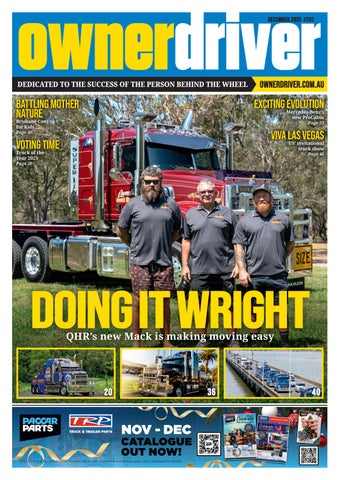
Contents #395
DECEMBER 2025
20
TIME TO VOTE
Voting is now open for the 2025 Truck of the Year, with OwnerDriver providing the very best 12 trucks from a wonderful year of stories, images and rigs
23
NEXT LEVEL TECH
Warren Aitken was back to test out Mercedes-Benz’s latest Actros ProCabin model, taking it for a spin to check out the redesigns and newest features to grace the vehicle
28
SQUEEZING THE BULLDOG
While Warren Aitken was already left impressed by Queensland House Removals’ latest Mack in the fleet, the complex moving job he got to witness in Brisbane highlighted the bulldog’s brilliance
36
SPREADING THE LIGHT
Lazer Lamps’ flagship LED spotlight is now more accessible than ever thanks to a sharper new RRP on the Sentinel 9” standard model
40
BATTLING BRISBANE
The 2025 iteration of Brisbane’s Convoy for Kids saw thousands battle wild weather, all in the name of charity and helping those in need
45
REPOWERING FORWARD
Mercedes-Benz Trucks’ various RePOWER program options are providing local truck customers with plenty of options for their fleet’s future
46
VIBRANT VEGAS
Warren Aitken took some time out from his usual driving jobs to head to the US for a special invitational truck show in Vegas
52 KNOW WHERE TO GO
NRFA president Glyn Castanelli discusses the ways in which truckies of the past learnt the trade and what the industry can take from this to solve current issues
The all-new Ready-to-Work range.
The workhorse redefined.
Is your workhorse pulling its weight? If youʼre still driving a ute, nowʼs the perfect time for an upgrade. The all-new Isuzu Ready-to-Work range tows and carries more than your average ute. It also comes with a sleek new cab design, more advanced safety features and car-like comfort. With a wide choice of factory-built bodies designed to our exact specifications, Isuzu Ready-to-Work trucks are ready to get the job done. Are you ready to step up to a redefined workhorse? Head to isuzu.com.au or visit your nearest Isuzu Trucks Dealer today.
EDITORIAL
Editor Sean Mortell
E-mail Sean.Mortell@primecreative.com.au
Phone 0468 577 166
Contributors Warren Aitken, Frank Black, Sarah Marinovic, Rod Hannifey, Paul Salvati, Warren Clark, Simon Smith, Glyn Castanelli
Cartoonist John Allison
PRODUCTION
Art Director Bea Barthelson
Print IVE Print
ADVERTISING
Business Development Manager Tosan Popo
Phone 0481 260 352
E-mail Tosan.Popo@primecreative.com.au
SUBSCRIPTIONS
www.ownerdriver.com.au/subscribe
Phone +61 (0)3 9690 8766
Mon-Fri 8am-4.30pm (EST)
Email subscriptions@primecreative.com.au
Mail 379 Docklands Drive, Docklands, VIC 3008 Australia
EXECUTIVE GROUP
Chairman John Murphy
CEO Christine Clancy
Publisher Sarah Baker
Operations Manager Regina Fellner
Sales Manager – South Danny Hernandez
BEHIND THE WHEEL Sean Mortell
All about safety
As we prepare to bid farewell to another year, it’s important to go above and beyond this holiday period to keep our trucking fraternity safe on the roads
It’s this time of the year where nerves rise that little bit more. Where partners check the clock a few more times, biting their lip with anxiety. It’s when the nightmares may be more frequent, or the panging in the heart gets that little bit heavier as the long nights on the road take their toll.
The Australian trucking industry is never one to stop, but it’s at times like now, in the busy holiday season, where one may wish it could pause for just a couple of weeks. To let the drivers return to their families and be there on Christmas morning, witnessing the smiles and laughter as the tinsel goes everywhere and the presents are opened. To bask in the sunshine with a cold beverage, taking in the warm summer months. To see long-lost friends and feel utterly refreshed, watching the waves serenely lap over the rocks that surround Australia.
While it’s difficult for truck drivers around the nation to have to spend the idyllic summer months each year behind the wheel, ensuring the goods keep moving 24/7, the hardest part about this period in our industry is the safety dangers that are presented. More cars hit the road, many of which tend to be piloted by drivers who aren’t used to heavy vehicles surrounding them. Longer
days and tighter deadlines. Warmer afternoons and more difficult conditions. It all combines for one harrowing concoction that means drivers have to be at their very best to ensure they can be home to indulge in some of the summer fun.
This is reflected in the messaging coming from our beloved columnists in this final edition of OwnerDriver for 2025. It has been a quick year, full of highlights, news and rapid developments. Most importantly, it’s been productive. Now, the focus for the industry is to ensure all the hard yards done throughout the past 12 months result in safer roads and all of the nation’s truck drivers getting the job done safely and soundly before returning home to loved ones.
For all in our OwnerDriver community, please focus on safety this summer. Don’t take risks and hopefully general motorists also do the same. In the meantime, 2026 promises to be another milestone year in shaping our trucking scene. There are multiple regulatory landmarks on the horizon, both from a government and union perspective, and a suite of major road projects are set to be opened to traffic, hopefully making freight just that bit smoother around the country.
This final edition of OwnerDriver for 2025 encapsulates some of the best parts of our industry
“This final edition of OwnerDriver for 2025 encapsulates some of the best parts of our industry – beautiful shows, heartwarming tales and the very latest and most intriguing truck technology.”
– beautiful shows, heartwarming tales and the very latest and most intriguing truck technology. Starting with our Truck of the Month from page 28, Warren Aitken had a wonderful day and night out witnessing Queensland House Removals’ new Mack perform an incredibly complex move. Luckily his superb photography skills were on full display to capture the slow moving load.
He also provided some bittersweet coverage of the Brisbane Convoy for Kids – despite the impact that weather had on the event, his photos from page 40 showcased an important event still delivering the goods for those in need.
Whether it be in Las Vegas or behind the wheel of the new Mercedes-Benz Actros ProCabin along the east coast (page 23), there’s plenty else for readers to soak up in this December edition. Don’t miss Lazer Lamps’ intriguing technology and razorsharp deal, as well as the latest events coming in early 2026.
I hope you enjoy the read, and remember to stay safe this summer period.
Image: Warren Aitken
RePOWER WITH MERCEDES-BENZ TRUCKS.
Mercedes-Benz Trucks understands that down time is not an option. That’s why we created Mercedes-Benz Trucks RePOWER.
RePOWER gives your truck a new lease on life. By refreshing key components, you have the flexibility to choose what is right for you, saving you money in the long run, and keeping your operations running smoothly - all backed by the quality and reliability of MercedesBenz Trucks Genuine Parts.
What is Mercedes-Benz RePOWER?
Available on 13L and 16L Mercedes-Benz Trucks, RePOWER has been developed to extend the operational life of your truck by providing you with five different options to overhaul the truck’s key driving components.
With RePOWER you can have the reassuring certainty of continuing to operate the Mercedes-Benz truck you own today, with a re-powered version. For added peace of mind, our Mercedes-Benz Trucks two-year parts warranty1 is included for any parts fitted under any of the RePOWER packs (provided that the works are carried out at an authorised Daimler Truck dealership).
What are the RePOWER options?
With five RePOWER options to choose from, you’ve got the flexibility to choose a pack that’s right for you.
The Goods
NEWS FROM THE HIGHWAY AND BEYOND
What’s new on the roads
Milestone bypasses are being built and opened as roads begin to prepare for a busy summer period
It’s all about the east in December, with the headline road news being the opening of Melbourne’s first CBD bypass in 25 years. Up north, a bypass on the Central Coast is underway, while another important highway upgrade has also started.
MILESTONE CBD BYPASS OPENS
The Victorian government has revealed that Melbourne’s first CBD bypass in 25 years is now open to traffic.
The new Wurundjeri Way extension is now providing a direct link into Docklands and the Marvel Stadium precinct to create a safer, faster and more reliable connection between Dynon Road and Flinders Street.
The road opened to traffic on October 27, allowing freight vehicles to avoid the CBD when travelling from one side of the city to the other.
Heavy vehicles coming from Footscray can get to the Docklands or across the city without needing to use Spencer or King street, with the toll-free road easing congestion.
“The new Wurundjeri Way extension will make getting around our city easier – providing another connection for Melbourne’s west to the CBD, and the first new CBD bypass in a quarter of a century,” Victorian Premier Jacinta Allan says.
The Wurundjeri Way extension will add much-needed capacity to the road network, taking up to 5,000 vehicles a day off some of the city’s busiest thoroughfares.
“The Wurundjeri Way extension will transform travel across the city and western suburbs –while easing traffic on busy city thoroughfares like Spencer and King,” Victorian transport minister Gabrielle Williams says.
Importantly, the West Gate Tunnel Project’s Wurundjeri Way extension becomes a crucial new inner-city connection that will allow traffic to flow more freely for the more than 73,000 people who work in Docklands and its 17,500 residents.
Once open, the state government says the West Gate Tunnel will deliver a vital alternative to the West Gate Bridge – providing a safer, more efficient second river crossing and removing more than 9,000 trucks from local roads.
WORK STARTS ON PACIFIC HIGHWAY INTERCHANGE
The New South Wales government has revealed safer access is on the way for Pacific Highway users, with early work beginning on a crucial intersection upgrade.
Transport for NSW assistant executive director of partnerships and integration Greg Collins says the work is underway for the Pacific Highway-Harrington Road intersection upgrade.
Collins says the federal and NSW governments are investing $60 million in an interchange with an overpass that connects Harrington and Coopernook roads over the Pacific Highway.
“Linking Wurundjeri Way to Dynon Road and CityLink will reduce CBD congestion and give Melbourne more ways to move in and out of Docklands,” Victorian roads minister Melissa Horne says.
CENTRAL COAST BYPASS WORK BEGINS
The New South Wales government has revealed construction is now underway on a critical heavy vehicle bypass upgrade along the Central Coast.
The first stage of the $40 million Gosford Bypass upgrade has started, marking the start of a series of projects designed to bust bottlenecks and get traffic moving for the 30,000 motorists who use the corridor daily, including freight traffic.
The first stage of the project will prioritise the Manns Road and Stockyard Place intersection at West Gosford.
“The Gosford Bypass is a vital north–south link for locals, freight and visitors, and we’re getting on with the job of improving safety and reliability for every road user,” NSW roads minister Jenny Aitchison says.
“This investment will make a real difference for thousands of motorists, cyclists and pedestrians who rely on this corridor every day.”
The upgrade will deliver extended southbound lanes north
of the intersection, improvements to the right-turn lane into Stockyard Place, smoother and safer roads with line markings and a relocated northbound bus stop.
Work is expected to take about six weeks to complete, with construction carried out at night between 7pm and 4am to minimise disruption on locals.
Some lane closures will be required, and a reduced speed limit of 40km/h will apply as work is completed.
The Gosford Bypass program is being delivered in stages, combining short-term congestion-busting improvements with planning for future major upgrades along the corridor.
Two further projects are currently in design and expected to be finalised in early 2026, including the Pacific Highway and Parsons Road intersection and along the Pacific Highway between Newling Street and Kathleen Morreau Road.
“Progressing this region-enhancing project is a major win for the Central Coast,” Central Coast minister David Harris says.
“The Gosford Bypass upgrades will cut travel times, reduce congestion and make our roads safer for drivers, cyclists, and pedestrians alike.
“It’s exactly the kind of infrastructure our growing region needs and deserves.”
“The project will improve road safety by removing the right hand turns on and off the highway, while also upgrading accessibility and connectivity to the Pacific Highway for local communities, visitors and freight operators,” he says.
Early work activities are underway to address the soft soil foundations. The project is undertaking a key component, known as preloading, which stabilises the ground before the road is built.
“Soft soils are often found in floodplain areas and are characterised by high water content and low strength,” Collins says.
“They add complexities to road design and construction because they compress easily and are susceptible to movement, soft soil treatments reduce the expected amount of settlement once the road is open.
“Initial pre-loading at the project site has already been carried out over a number of years. The embankment will be topped up with the final pre-load and surplus fill material to compress the soil and squeeze out the water before construction starts.”
Other work to be carried out includes installation of project signage, site establishment, vegetation clearing and boundary fencing as well as installation of erosion and sedimentation controls.
Early work will take around 16 weeks to complete, with major work on the interchange expected to start in 2027.
Associations slam illegal practice
One association says current enforcement is “like telling an Olympic team steroids aren’t allowed then never testing them”
Multiple associations have joined forces at an industry roundtable with the federal government to raise the alarm about an illegal practice that is harming Australia’s trucking sector.
The National Road Freight Transport Association (NatRoad), alongside the Queensland Trucking Association (QTA), have both called on the federal government to urgently crack down on rampant illegal employment practices that are crippling Australia’s road transport operators.
NatRoad CEO Warren Clark told the government roundtable that sham contracting, a systemic illegal practice, has become so widespread that transport companies are now openly advertising for “employee drivers with ABNs” on major job platforms like Seek, labelling government enforcement as “essentially non-existent”.
He says widespread sham contracting is costing legitimate operators 20 to 30 per cent in competitive advantage while billions in tax revenue are lost.
“There is systemic manipulation in the road freight transport industry happening right now, not being detected by government agencies,” Clark says.
“By allowing widespread illegal activity to flourish unchecked, we’ve created a system where lawbreakers prosper while legitimate businesses are punished for doing the right thing.”
Sham contracting involves transport operators classifying employee drivers as independent contractors through Australian Business Numbers
(ABNs), allowing them to evade employment law obligations, payroll tax, Superannuation payments, GST registration requirements and workers’ compensation insurance.
This creates an artificial cost advantage of 20-30 per cent over compliant operators, fundamentally distorting market competition.
“Multiple transport operators report being approached by drivers demanding ABN payment arrangements, openly admitting ‘this is how other transport companies operate’,” Clark says.
QTA CEO Gary Mahon emphasises the industry’s long-standing commitment to fairness, safety and excellence, underpinned by a tripartite compact between employers, unions and government.
However, he warns of the “perpetual rise of ABN-based employment”, where workers are treated as contractors, denying them basic entitlements and circumventing employee protections.
“This illegal activity not only erodes workers’ rights but destabilises the entire supply chain, creating a two-tier system that favours cost-cutting over safety and fairness,” he says.
NatRoad has identified increasingly sophisticated structures that are designed to disguise employment relationships, including labour hire façades or ‘agencies’ that are established solely to convert employees into ABN holders, with some managing more than 100 individuals who drive company trucks.
The structures also include ABN sharing rings where one driver then employs themselves or shares
with others to avoid tax and GST registrations.
“They can set up and shut down in a moment. If you need immediate money, this is a great way to make a quick buck with no obligations to anyone,” Clark says.
He says the cost-cutting pressure is forcing drivers into dangerous situations.
“Drivers end up being pushed into ‘contracts’ on low pay, or businesses must drop their contract prices so low to win work, they end up breaking the rules to make up for the shortfall,” Clark says.
“Sham contracting is bringing the road freight transport industry into disrepute and results in legitimate hard-working people losing their livelihood, taking all their skill and experience out of the industry when we desperately need them.”
Mahon is urging all fleets to take proactive steps to combat this illegal practice.
“Fleets can help eradicate sham contracting by undertaking thorough due diligence with the subcontractors they engage and by questioning how those subcontractors are engaging their workers,” he says.
He also underscores the illegality of businesses supplying trucks and equipment while using contractors for labour only.
Mahon is calling for urgent action to address weaknesses in the Closing the Loopholes Amendments, particularly concerning the “Barn Door size” loophole in the reasonable belief defence within the Fair Work Act 2009.
He says the supply chain faces unprecedented strain, with rising costs, insolvencies and legal evasions threatening safety and industry stability.
“Fleets that survive will simply be those who can weather bad terms and unfair practices the longest,” Mahon says.
NatRoad has identified multiple enforcements failures, including a lack of audits being conducted, penalties failing to deter, underresourced agencies and legitimate business facing more scrutiny than fraudulent operators.
“This is like telling an Olympic team steroids aren’t allowed then never testing them. Once a couple of people know they can get away with it, many more start following,” Clark says.
NatRoad is demanding the government to immediately launch industry audits, impose personal liability on directors facilitating these schemes, disqualify non-compliant companies from government contracts, follow up on whistleblower reports and realign the Shadow Economy Taskforce to focus on transport.
“Until government treats this as the systemic problem it is, compliant businesses will continue to be disadvantaged, workers will be exploited, and billions in public revenue will be stolen by those who know how to work the system,” Clark says.
“The message right now is clear: breaking the law is more profitable than following it. That has to change.”
The Fifth Wheel That Holds It All Together
Between truck and trailer lies a single point of trust, the fifth wheel…
Forged in solid cast steel, SAMPA Fifth Wheels carry the weight of countless journeys, binding power and precision in one seamless connection.
Its wear-resistant collar withstands time.
Its adjustable locking system ensures perfect coupling, time after time.
Its high stiffness tames the vibration of the roughest roads.
Every kilometer begins with this connection, strong, tested, and made to endure.
Discover the full range at sampa.com now
Followmont welcomes new fl eet
The growing operator has reinvigorated
its regional network
with the addition of eight new prime movers that have already received “fantastic” feedback
Followmont Transport has announced it has invested in its regional fleet, introducing a new range of Sitrak prime movers to strengthen its network and driver capability.
Followmont has invested in eight new Sitrak C7H 6×4 prime movers through City Fleet to enhance its fleet and reinforce its commitment to reliable service across its network.
Followmont managing director Mark Tobin says the decision to move forward with the new units was made with full confidence after witnessing Sitrak’s manufacturing capability and vision firsthand.
“Once I saw their assembly line, I was sold,” he says.
“The way these vehicles are built and the vision for the future made it a no-brainer, I literally signed the deal on a napkin.
“We tested the vehicles with our drivers, and the feedback was fantastic, they absolutely loved them.
“Reliability and consistency are everything in our business, and these units give our people the tools to perform at their best while ensuring we deliver certainty to our customers.”
Tobin says the partnership with City Fleet played a key role in Followmont’s decision.
“When I met the team from City Fleet, it was clear this was about two businesses growing together with shared values and a genuine commitment to service,” he says.
“In a tight operating market, this purchase is the right decision for our business. The quick lead-time is also a major advantage, allowing
us to respond to customer demand and increase capacity where it’s needed most.”
Followmont CEO Ross Longmire says Sitrak and City Fleet have demonstrated a strong understanding of Followmont’s operational requirements and long-term network strategy.
“Sitrak has taken the time to understand our business and the environments we operate in. Its responsiveness and ability to tailor solutions have made this a positive partnership, and we look forward to continuing to grow together,” he says.
The Sitrak C7H prime movers have been selected to meet the specific demands of Followmont’s regional and metro network, providing the right combination of power, safety and driver comfort to support consistent performance across long-haul and multi-stop routes.
By investing in modern equipment, Followmont continues to ensure its people have the right tools to deliver on service expectations while enhancing the overall driving experience.
Sitrak Australia general manager Queensland Brock McGarity says the partnership reinforces Sitrak’s commitment to delivering vehicles that aren’t just built to specification, but built to perform in real-world Australian transport conditions.
“This is a very exciting partnership for the Sitrak brand, as we align with such a respected business and group of people,” he says.
“Prior to the full rollout, we underwent a trial phase with
Followmont’s experienced operators.
“The feedback was overwhelmingly positive, highlighting the trucks’ comfort, responsiveness and fuel efficiency – attributes that add real value to both drivers and fleet operations.
“Our dealer partner, City Fleet Sitrak, has provided a tailored solution that meets the specific requirements of Followmont Transport, forming a partnership that combines Sitrak’s reliability with City Fleet’s service network and Followmont’s operational excellence.”
The new vehicles will be strategically deployed across Queensland to meet customer
requirements and support key freight corridors.
Three units will be based in Townsville to service routes to Mareeba, Cairns, Bowen and Mackay, supporting critical regional and agricultural industries.
The remaining five units will operate from Brisbane to service established routes including Ballina, Grafton, Bundaberg, Chinchilla and local metropolitan freight.
As Followmont continues to grow its fleet, this investment underscores its long-term commitment to delivering dependable, personalised service backed by quality equipment and strong partnerships.
Images: Jonathan Wood Photography
Isuzu extends new model intervals
The OEM has taken a bold step in backing its new truck models as it extends its service intervals for the MY25 range
Isuzu Australia has announced a significant enhancement to its customer value proposition, with service intervals for its MY25 model range extended from 20,000 to 25,000 kilometres.
The strategic update is a direct result of continuous engineering improvement and is underpinned by the exceptional durability and reliability of Isuzu’s newly released powertrain technology line-up.
The move is set to deliver tangible reductions in operating costs and increased uptime for Australian businesses across the country.
Isuzu Australia national service business manager Glenn Jones says the decision reinforces Isuzu’s commitment to leading the industry when it comes to the total cost of ownership (TCO) equation and provides clear efficiency benefits for owners.
“This is a meaningful change, one that directly addresses the operational priorities of our customers. When we talk about TCO, we’re looking at the entire picture – the cost of fuel, tyres, maintenance and, critically, vehicle availability or uptime,” he says.
“Every hour a truck is in the workshop is an hour it’s not generating revenue. This decision directly attacks that cost, improving the profitability of our customers’ operations.”
“Extending our service interval to 25,000 kilometres isn’t a decision we took lightly. It’s a confident step, yes, but it’s backed by rigorous testing.
“It means less time off the road for maintenance and more time earning for our customers, which in today’s economic environment is a critical advantage.”
Jones elaborated on the direct impact of the total cost of ownership equation.
“For a customer running a five-truck fleet over five years, this change could result in approximately 20 fewer scheduled services across the fleet,” he says.
“This translates into significant savings on labour, parts and consumables such as fluids, but the greater value is often in the greatly reduced downtime.
“Every hour a truck is in the workshop is an hour it’s
not generating revenue. This decision directly attacks that cost, improving the profitability of our customers’ operations.”
The lengthened service intervals have been enabled by key innovations in Isuzu’s MY25 range’s core systems and the use of high-performance fluids.
Key features of the new model line-up, including enhancements to a range of powertrain technology for optimal efficiency and the latest generation of Isuzu’s Advanced Driver Assistance System, contribute to the vehicle’s overall robustness and reliability.
Jones says the extended interval is a natural evolution of Isuzu’s engineering philosophy and a key part of the product’s inherent value.
“The integrity of every Isuzu truck is designed and built-in from the ground up. The MY25
range represents the pinnacle of this approach, with refinements across the board that allow for this increased service efficiency without compromising on performance or longevity,” he says.
“This announcement is a clear demonstration of how Isuzu’s product development is intrinsically linked to reducing our customers’ operating costs.
“It’s about delivering a smarter, more efficient ownership experience, allowing them to focus on their business with the peace of mind that their Isuzu is engineered to work harder, for longer, and at a lower total cost.”
The new 25,000-kilometre service interval will be integrated into Isuzu’s acclaimed Service Agreement program, ensuring cost certainty and protection against inflation for the duration of the available aftersales packages.
Image: Isuzu Australia
Novel hydrogen truck heads to auction
The nation’s very first hydrogen tilt tray truck to go under the hammer has been made available to buyers
History was made in Australia’s renewable transport industry, with the nation’s first hydrogenpowered tilt tray truck going to auction in October.
From October 21-23, Pickles auctioned a 2024 Hyzon fuel cell tilt tray, featuring a fuel cell system that converts hydrogen into electricity while an onboard battery provides external charging.
“This is an exciting moment for Pickles and for the heavy transport sector,” Pickles national manager of trucks and machinery Hugh Rainger says.
“We’ve never sold anything like this before. Pickles has already established itself as Australia’s largest reseller of used EVs, and now we’re stepping forward again by supporting vendors and buyers in the hydrogen space.
“This auction offered a one-off opportunity for fleets to trial hydrogen technology and
accelerate their journey to decarbonisation.”
With a driving range of 400km, the HyMax TT7 also includes an automatic gearbox, air-suspended cab and advanced safety features like lane departure warning and adaptive cruise control.
Refuelling takes around 15
minutes, making it highly practical for fleet operators looking to minimise downtime. The truck also incorporates hydrogen safety systems including leak detection and pressure relief, designed to meet international standards.
“This was a unique chance for fleet operators and logistics
companies to get hands-on with hydrogen technology,” Rainger says.
“It’s a milestone that underlines our role as a trusted partner for vendors growing in the renewables space, and as a market leader in alternative energy assets.”
Images:
Pickles
THE GOODS NEWS FROM THE HIGHWAY AND BEYOND
Combo sees SA productivity gains
The South Australian heavy vehicle industry is set to enjoy more productivity benefits through recent red tape amendments
Newly announced reforms are set to see South Australia’s heavy vehicle industry enjoy further productivity gains via cut red tape, pre-approved route opening and faster outcomes.
The National Heavy Vehicle Regulator (NHVR) is pushing on in delivering a critical set of heavy vehicle productivity initiatives alongside the South Australian Department for Infrastructure and Transport (DIT) and local governments to support safer and more efficient heavy vehicle movements.
The development of these access reforms was informed by heavy vehicle access permit data and contributes to the South Australian government’s request to the NHVR to transition heavy vehicle access permits to notices.
Significant work has progressed on introducing new notices to enhance the safe and efficient movements of cranes across the state, along with initiatives to expand the eligible combinations under the Livestock Transport Notice.
Oversize Overmass notices introduced have replaced the need for the heavy vehicle industry to apply for permits on key routes, with the ongoing access reforms already expected to slash the number of road manager consents needed by more than 1,000.
SA transport and infrastructure minister Emily Bourke says the
extensive collaboration efforts were focused on “ensuring safer, smarter and more efficient freight movements across South Australia”.
“These reforms represent a major step forward in modernising the way heavy vehicle access is managed in South Australia,” Bourke says.
“They are a win for industry with clearer, more reliable access; a win for government by cutting repeat permits; and a win for
provides new network access to eligible vehicles. Notably, B-doubles are now eligible to operate under the notice.
However, the NHVR says it is also important for operators to be aware that rigid trucks towing two dog trailers and BA-triples are no longer eligible under this new notice.
Eligible vehicles under the notice will operate on the newly developed set of South Australian networks on the NHVR National Network Map.
Extensive work has progressed and continues on the ongoing access reforms, which ultimately will aim to streamline operations by providing network access under notice and reducing administrative burdens.
Operators are reminded to review the “Heavy Vehicle – Road Operations Access Map (HV-ROAM)” and that travelling with an Oversize Overmass vehicle and load in South Australia is in accordance with
“These reforms represent a major step forward in modernising the way heavy vehicle access is managed in South Australia.”
the community through more productive freight that helps keep the cost of goods down.”
On August 29, the South Australia Class 3 Specified Routes Dimension Exemption Notice 2025 (notice) was also published, replacing the South Australia Class 3 Road Train (North of Port Augusta) Dimension Exemption Notice 2024. The notice is a key development in supporting industries transporting loads, including transportable buildings.
The new notice has substantially expanded existing networks and
“These notices are another milestone in aligning smart regulation with safer, more sustainable freight outcomes,” NHVR CEO Nicole Rosie says.
“By expanding notice access, we are cutting red tape and making it easier for operators to plan their journeys with confidence.
“We’ve worked closely with the South Australian government to ensure these expanded networks meet real-world operational needs, while maintaining strong safety standards.”
the document titled “Escorting Guidelines for oversize and overmass vehicles and loads in South Australia”.
Operators are also reminded to review the Specified Road Manager Network Requirements, contained within the Operator’s Guide for each notice, ahead of travel.
For comprehensive information, including access conditions and details on the routes, operators are strongly encouraged to consult the notices and the accompanying Operator Guides.
Logistics leader announces departure
The company’s CEO and managing director has revealed he is exiting the business after 16 years at the operator
The CEO and managing director of Victorian based Tasman Logistics Services has announced he is stepping down from the role and leaving the business.
After 16 years spent at the operator, Ivan Vanis revealed he has exited the company, saying “it’s time for a new challenge”.
“My time at Tasman has been amazing in building a great business backed by a sensational team,” Vanis says in a social media post.
“I have learnt a lot over this time and am proud of what I’ve achieved in conjunction with great people!”
Under Vanis, the company has experienced recent growth both in its staff and fleet. The former leader
says it’s his time to move on and “pursue other opportunities” that kept presenting themselves, while also spending more time with his family.
“Thank you to the amazing team
at Tasman for the support over the years and for allowing me to push them to their limits to be their best,” Vanis says.
“I will miss everyone, but I’m only a phone call away!”
THE GOODS NEWS FROM THE HIGHWAY AND BEYOND
27th local TRP store opens
The latest TRP store to open in Australia is providing brand-new truck and trailer parts from a rural South Australian town
PACCAR Parts has announced a new TRP® store has opened in a rural South Australian town, becoming the 27th store to open in Australia and New Zealand.
The 356th TRP outlet around the globe is based in the town of Renmark, with the brand-new truck and trailer parts store under the globally successful brand.
The store opened on September 1 and is owned and operated by the Leake Group.
The TRP brand, is positioned as an affordable all makes supplier of high-quality parts for prime movers, rigid trucks and all types of trailers. The store stocks well-known brand consumables for all major truck brands and all TRP branded parts, which come with a minimum 12-month warranty.
“Our business has been operating for almost 75 years, and we are very proud to now have a local presence in South Australia to support our
long-standing customers,” general manager Anthony Dal Farra says.
“Our Renmark location further strengthens our coverage along the key Adelaide – Sydney freight corridor via the Sturt Highway, complementing our existing operations in Mildura.
“We are deeply grateful for the overwhelming support we have
received, not only from local transport operators and stakeholders, but also from the wider community.
“Supporting the industries that drive the Riverland is in our business’ DNA — from wine grapes and citrus to almonds and broadacre crops.
Across our broader network, our sites already serve these same industries, so we understand their seasonality
and ensure additional parts are readily available throughout harvest and other peak periods.”
The TRP Renmark store is located at 267 Renmark Avenue RENMARK, South Australia and is open 8am to 5pm Monday to Friday and 8am to 12pm on Saturdays with a dedicated 24-hour afterhours call-out service involved at 08 7552 5021.
ATA crowns award winners
The association’s three premier awards have been handed out for 2025 in a gala event held at Melbourne’s San Remo Ballroom
The Australian Trucking Association has announced the 2025 winners of its National Training Excellence Award and its two technical awards at a gala event in Melbourne.
The awards ceremony included crowning the winners of the Craig Roseneder Award for Technical and Maintenance Excellence and the Castrol Industry Achievement Award.
The central region director at the National Heavy Vehicle Regulator Brett Patterson presented Divall’s Earthmoving and Bulk Haulage of Goulburn, NSW with the 2025 National Training Excellence Award.
The award recognises transport operators that have a strong and demonstrated commitment to training and development, thereby improving safety for all.
Divall’s will receive a $7,000 prize package to be used towards staff training initiatives or a business services package with a training consultancy.
At the core of Divall’s training program is a forward-thinking approach that combines education and career engagement with local primary schools, training, mentorship and continuous development.
Known for its long-standing outreach to local youth through career fairs and taster days, Divall’s also provides training, re-skilling, work and job readiness opportunities to young people connected with the Police
Citizens Youth Club, NSW Corrective Services as well as individuals with special needs.
With more than 40 apprentices and trainees actively developing their skills, Divall’s has invested in growing career pathways within quarry operations, plant operations, engineering, civil construction and more.
The winner of the 2025 Craig Roseneder Award is Scott Gardiner of Australia Post.
The Craig Roseneder Award recognises technical and maintenance excellence in the trucking industry’s workshops.
Scott will receive a prize trip to attend the 2026 US Technology and Maintenance Council Annual Meeting and Transportation Technology Exhibition in Nashville, Tennessee. The prize includes full conference registration, return airfares, accommodation and $1,500 spending money.
The prize also includes complimentary registration to the 2026 Australian Trucking Association Technology and Maintenance Conference.
With more than 30 years in the Australian transport industry, Scott Gardiner has built a career defined by hands-on experience, leadership, and innovation. Starting on the workshop floor, he rose through the ranks to become StarTrack’s National Multihaul Manager, and now serves as National
Fleet & Equipment Policy, Regulatory Compliance & Reporting Manager for both StarTrack and Australia Post.
Scott has led major advances in fleet safety and sustainability, including the rollout of PBS vehicles, DriveCam technology and underrun protection. He also led the rollout of UBCO electric motorcycles at Australia Post. Scott has supported the growth of countless industry professionals and is widely respected for his approachable and values-driven leadership.
The winner of the 2025 Castrol Industry Achievement Award is heavy vehicle engineer and industry advocate Chris Loose.
Chris held senior roles at Mercedes-Benz and Freightliner before working for the ATA and the Truck Industry Council.
The Castrol Industry Achievement Award honours technical innovation
and accomplishments in the Australian trucking sector.
Chris first joined the ATA in 2015, contributing to TAPs and safety alerts on issues like premature brake actuator failures and air fitting mismatches. Later, at the Truck Industry Council, he worked on direct and indirect vision standards and wide single tyre testing.
Since 2023, Chris has led a major update of the ATA’s Technical Advisory Procedures (TAPs), including new guidance on conspicuity marking, side underrun protection, low voltage electrical wiring, and certified load restraint curtain systems – critical documents that fill gaps in regulation with clear best practices.
The winners were announced at the 2025 Castrol Awards Dinner at the San Remo Ballroom, Melbourne. The dinner was part of the 2025 Technology and Maintenance Conference.
Image:
ATA
Part
COULD WIN BIG!
Tso we don’t envy the job ahead of you! Read on to find out how to vote, and what you can win for your efforts!
HOW IT WORKS
To be eligible, trucks must have appeared as a Truck of the Month in OwnerDriver magazine over the past 12 months.
The outright winner will be decided by popular vote – with the winner featured in the March 2026 issue of OwnerDriver magazine as well as online at OwnerDriver.com.au!
YOU CAN WIN TOO
he 2025 Truck of the Year Award marks the latest instalment of the highly-popular Truck of the Month feature in OwnerDriver
The team here at OwnerDriver has chosen the 12 finalists, but the responsibility of selecting the winner is now turned over to you – our valued readers. Among the nominees are some amazing trucks –
THE CONTENDERS - VOTE NOW
Not only does your vote count towards your favourite truck getting the gong, but it also puts you in the counting vote to win a prize courtesy of Geotab.
HOW TO VOTE
Simply jump online and head to OwnerDriver.com.au/TOTY, follow the prompts to the promotion entry page and complete the entry form (including your full name, mailing address, telephone number and valid email address), and vote for your favourite truck.
Voting commences on December 1, 2025 and closes at 11:59PM on January 31, 2026.
To help you make your choice, you’ll also be able to view the original feature stories on all 12 finalists on the site. You can only vote once, so make it count!
Vesey’s special tribute Mack
Tesch’s new Kenworth K220
After successfully launching AKV Haulage and persevering through floods and COVID, Aaron and Krystal Vesey have found a bittersweet tribute to Aaron’s late father that takes him back to his childhood.
Warren Aitken was able to track down a stunning new Kenworth K220 owned by Craig Tesch and Morgans Long Distance Transport. He soon learnt the truck was just a small part of a wonderful family tale.
Mick’s Mack
Matt James Haulage has overcome recent tragedy to produce a poignant restored Mack that honours one of the family’s greatest members.
Laurie Williams’ retirement rig
Laurie Williams is a well-known industry name, but Warren Aitken found out his latest ‘retirement role’ is an incredibly impressive Western Star tow truck.
THE CONTENDERS - VOTE NOW
Schaeffers’ brand new beauty
Warren Aitken catches up with the family at the heart of Schaeffers Transport to learn the interesting tale of the operator’s first brand new truck.
Jamesy’s milestone Mack
Andrew ‘Jamesy’ James has been in his fair share of heavy vehicles throughout his illustrious career. A special Mack truck delivered to him on his 60th birthday was enough to impress.
McNaughts Transport’s special Visor
This month sees us head down to the NSW and Victorian border to find a special Scania with a Visor that sits in McNaughts Transport’s growing fleet.
Keams’ perfectly constructed Mack
After a recent pivot into harvest work, Luke Keams decided to concoct the perfect Mack to suit his growing list of wishes, resulting in this August beauty.
Cahal Carey’s Gaelic glory
In the 20 years since Cahal Carey made the move from the Emerald Isle to Australia, he’s managed to succeed in the heavy haulage game. Checks out his flagship Volvo that caps off two decades of hard work and success.
BWC’s anniversary Super-Liner
For the 40th anniversary of Boulder Wall Construction, Gavin Turner’s sons found the perfect Super-Liner for the occasion. Learn more about this well constructed beauty and the special man behind it.
Father-son duo’s beautiful Benz
While trucking may not be in the blood for Ben and Joe Muscat, the father-son pairing at CCL Specialised is developing a love for Mercedes-Benz that is seeing them succeed in the game.
QHR’s marvellous Mack
While Warren Aitken was already left impressed by Queensland House Removals’ latest Mack in the fleet, the complex moving job he got to witness in Brisbane highlighted the bulldog’s brilliance.
E44482907)80(T
NEXT LEVEL TECH
Warren Aitken was back to test out Mercedes-Benz’s latest Actros ProCabin model, taking it for a spin to check out the redesigns and newest features that grace the vehicle
First things first, this is not an electric truck. I am putting that out there because it definitely has that electric look and some have made that comment, and I will put my hand up here and admit, when I first saw the Mercedes ‘ProCabin’ at the Brisbane Truck Show in March, I looked from a distance and murmured to myself ‘actually that doesn’t look too bad for an electric vehicle’. But that truck on display wasn’t an electric vehicle, and this one that I had the privilege of test driving recently
also wasn’t an electric vehicle. What it is, is the unveiling of Mercedes-Benz’s new Actros ProCabin. Before we get into a run down of my Albury to Laverton morning escapades in the new ProCabin, let’s just fill in the gaps as to the ‘what’ and ‘why’ of this all-new design. The ProCabin is a predominately exterior redesign of Mercedes’ 2.5m cabs. The roots of change lay with the European Union and their constantly changing weights and dimensions directives. Sound complicated? Well, I’m not going to break them all down. Suffice to say, amendments
have recently been made that allow European manufacturers an additional 80-90 mm out the front for vehicles that feature improved aerodynamic, vision and safety. What those amendments meant for Mercedes was that they could redesign their whole 2.5 cab range with an even stronger emphasis on aerodynamics. The goal with any cabover vehicle has always been to move air over the truck, around the truck and under the truck as smoothly as possible, making them as aerodynamically efficient as a big brick can
Pictured: It is from the front where you really appreciate the aerodynamic curvature that creates the efficiency of the new ProCabin
Top: In the early morning sunshine, the GigaSpace ProCabin casts an impressive shadow with its aerodynamic excesses
Above L to R: The new Matrix LED headlights offer even better lighting performance than the already impressive Mercedes range. Can you spot the radar incorporated within the new design?; Checking all the lights with a push of a button – maybe it’s my laziness, but it was one of the winning perks for me; The plethora of radars that run the Gen 6 safety features are extremely well incorporated into the Mercedes design
Opposite: Bullbars are not a regular feature over in Europe, so it has been up to the Aussies to design a whole new set-up. Keeping the angular efficiency of the ProCabin, as well as allowing space for the many radars to do their work, was a challenge, but Hilton Manufacturing’s Durabar nailed it
be. With the new Euro regulations, some white coat wearing brainiacs at Mercedes headquarters have been able to do exactly that with the new ProCabin.
The most obvious example of change is the massive front grill, or technically the front façade would be more accurate as there doesn’t appear to be anything we’d identify as a front grill now.
The front panel now extends basically down to the bottom third of the truck. Along with this, the Mercedes geniuses have also sealed the cab to the chassis. I don’t mean you can flip the cap, but when you do, the front guards and wheel arches will remain fixed. Yes, I questioned how the mechanics will feel about that as well, it seems we can’t keep everyone happy.
The plus side of this redesign is that it prevents air from getting in and around underneath the cab and creating aerodynamically draining turbulence, which in the real world leads to increased fuel savings. Add in a redesign on the aero kit and an additional spoiler to assist the roof kit. Along with the spoiler underneath the cab there is talk of around a three per cent fuel efficiency saving just from the aerodynamics.
Seeing as I am not an aerodynamics engineer, but I do drive trucks, and I spend a lot of time driving in and around Queensland, my queries tended to be around ‘doesn’t all that smooth, aerodynamic, flat facing façade effect the cooling?’. Colour me surprised but no, it doesn’t. This is where the EU’s generous gift of an 80mm growth spurt to cabovers has paid dividends.
It isn’t quite as glaring as the front façade, but it is because of that added 80mm that the design engineers have been able to round out and cover up the majority of the front end. It’s all wind tunnel numbers and airflow results, but the dumbed down version is angling the front allows and encourages uninterrupted airflow. Not only has it allowed the engineers to redirect air more efficiently, but it has also allowed them to make better use of the air flow around the radiator. Compared to the previous Actros iteration, the direct airflow to the radiator has significantly improved with the new ProCabin models.
Mercedes has been testing and evaluating the new design under Australian conditions since the first ProCabin arrived in March. While that may not seem enough to establish itself in the
testing Aussie conditions, it is worth noting that the ProCabin has been put through very thorough testing throughout South Africa and the Middle East, with loads very much on par with what the Mercedes is marketed for here in our hot desolate driving arena.
Aerodynamics are pretty much the whole selling point of the new ProCabin, but the cab layout, including the excess of interior luxury and all the bells and whistles you expect of a modern-day Mercedes, are still at the five-star level the manufacturer is renown for. However, the other upgrade you will get with the introduction of the new cab range is a move to Mercedes’ next generation of safety and emergency braking in Gen 6.
With Mercedes’ current Active Brake 5 system, it was focused on vehicles and pedestrians around the truck and would safely brake to 100 per cent up until 50km/h. Now with the sixth generation of this system, it can detect and implement safety features when cyclists are detected as well. It has also increased its speed settings to 60km/h. It is a continual evolution of the cutting-edge safety standards Mercedes are known for. The technology is aimed more for the distribution domain where the current generation of cyclists and pedestrians seem to be diminishing their own spatial awareness, so having trucks that can allow for that makes all our jobs easier.
All of these safety awareness features come courtesy of the multitude of radars around the truck capable of detecting more than we’ll ever need. What Mercedes has done well is to incorporate them into the truck’s designs, especially the side guard assist radars, which are compulsory now due to regulations over in the EU again. We’ve seen them starting to appear on other vehicles, but Mercedes has done a fantastic job of integrating them into the aesthetics of the new ProCabin. There are also short range radars that offer a wider spread and long-range radars that can cover the length of the vehicle, offering almost an impenetrable awareness. These systems have stemmed from the tightening safety regulations over in Europe, which in turn pays dividends for us here as manufacturers like Mercedes who supply the top of the range safety platforms to all their trucks worldwide.
After a quick walk around with my Daimler Truck representative Noel, where he proceeded to catch me up on all the technical advances the new ProCabin has to offer, we undertook a standard prestart check where I found one of my favourite features of the ProCabin Actros. Spoiler, it’s the light check function on the key fob. No more walking to the cab and back to switch indicators on and off, it’s all done at the push of a button these days. Anyway, after a prestart and a gander at the goods, I filled out the work diary and we pulled out of Albury and headed down Sesame Street on route to Daimler Trucks’ massive Laverton workshop.
I am not going to bore you all with a step-by-step guide of our journey. Very little has changed inside or under your feet from the current Actros offerings. The big GigaSpace we were piloting has Mercedes’ state-of-the-art OM 473 engine, with a very comfortable 625hp and a very comfortable 3000Nm. When you jump into a truck like this, you know what you are
expecting and the Mercedes delivers.
If anything, the smoothed-out façade of the ProCabin seems like it has made the big GigaSpace even quieter but not to the point where you don’t appreciate the 15.6 litre engine humming away below your feet. For me that is always a big plus. Nothing has changed in the running gear and as such you get that silky smooth feel you are used to with a European king pin like Mercedes. Our 345-kilometre trip flew by in an instant, the truck rode beautifully and even at 55 tonne we were hardly bothered by any of the undulations that the Hume Highway supplies.
When it comes to this part of the test drive, where you are evaluating the biggest pros of the new ProCabin, I think it’s a role best suited to those with ties and computers than trucker’s caps and work diaries.
As a driver I can enjoy the comforts of the Mercedes’ new ProCabin all day long, but it’s on the balance sheet that the ProCabin will really start to
shine. It is a truck designed to do the sort of east coast linehaul work that we got a small taste of. Open roads, full loads, plenty of room to coast up the hills, a few decent climbs to keep the motor working. When you factor in the aerodynamic improvements of the ProCabin it will be the office workers inputting the fuel figures that will get a better feel for how productive the new models are.
Claims from the factory in Germany of a three per cent increase in fuel efficiency are great, from the driver’s seat however I can only report how I found the ride and the figures I was getting. We had a full
load of concrete block chained down in the B-double, sitting at a total of 55 tonne. It was a 345km journey, with rolling hills, a couple of steepish pinches, a decent amount of annoying traffic and one quick stop for a ham and cheese toasty. By the time we rolled into Laverton, the trip computer was reading an impressive 2.3km/l. Considering our test drive ProCabin hadn’t even cracked 5,000km yet, that’s not too bad for a fresh engine. The ProCabin has been designed to be as fuel efficient and aerodynamically smooth as possible, and it definitely seems to be ticking that box.
TWU Michael Kaine
Important win
The TWU recently scored a massive victory when Mohammad Shareef Hotak won an unfair deactivation case, with it serving as a prime example for owner drivers around
Australia
Recently an Uber driver had a first-time win in the Fair Work Commission. This might not seem relevant if you’re a truck driver or a transport operator, but in fact it’s highly relevant, not just because it’s a huge win against big companies turning more frequently to AI and automation, but because of the similar protections extended to owner drivers.
The driver’s name is Mohammad Shareef Hotak. He supports his mother and brother, works as both an Uber driver and doing security work up to 70 hours a week.
What we know is that 55 per cent of gig workers in Australia have experienced threatening or abusive behaviour. It’s a difficult job, with longer hours than ever because of successive rate cuts by Uber. That means driver often have to work late at night and increasingly are targets of alcohol-fuelled violence.
Mohammad was one of these victims one night – he told his passengers to stop using drugs in his car and they assaulted him. He did all the right things. He made a police report, he reported the incident to Uber. But instead of getting assistance or
any support, he was deactivated from Uber – kicked off the app, because the passengers made false complaints that he’d threatened them with a baseball bat. He was out of work for two months before Uber reactivated him – as it has done with many others to avoid any closer scrutiny.
The TWU took his case and argued that Uber should have to pay him for the time he was unable to access the app. And in a landmark victory the Fair Work Commission agreed, saying “the experience of being deactivated left Mr Hotak feeling extremely stressed, anxious and unsupported. Mr Hotak suffered a significant loss of income and financial hardship” and that his deactivation “was plainly unfair”.
It criticised Uber’s practices as well, saying “Uber’s construction would produce unjust consequences” because it could just reactivate workers whenever it liked while there was a case on foot, and “deny meaningful redress for unfair deactivation”.
You can see how Uber’s version of things would lead to injustice. It would be able to continue doing what it’s always done: deactivate and reactivate workers whenever it wanted, without having to provide a valid reason, and
is the national
of the Transport Workers Union of Australia. Contact Michael at: NSW Transport Workers Union, Transport House, 188-390 Sussex Street, Sydney, NSW 2000. twu@twu.com. au.
without that worker being able to do absolutely anything about it. Without even the ability to speak to a human about their deactivation.
It was a landmark victory, the first of its kind, because of the strong TWU legal representation Mohammad had on his side. Behind the scenes the TWU legal team has been working to reactivate dozens of workers before reaching court. But where other workers without representation didn’t succeed in the Fair Work Commission, Mohammad had the backing of his union.
The laws won by this industry have turned back the tide against AI-fuelled systems, and this is a significant win in that fight. Owner drivers have similar protections now.
This didn’t happen by accident –when we fought for road transport reform, we knew this was going to be a crucial part of it, to ensure that when owner driver small businesses were calling for better standards, they couldn’t just have their contracts terminated in retribution.
Road transport businesses must now follow a Road Transport Industry Termination Code before they can terminate an owner driver’s contract. They can’t just arbitrarily end your contract to pay someone else cheaper.
These are important pieces of the puzzle. Mohammad Shareef Hotak’s win is an important win in the broader scheme of things, because it shows gig behemoths like Uber that now there are consequences – the laws have caught up and it cannot keep changing its practices to skirt our laws.
What we also know is that gig work is increasingly moving into areas like last mile delivery – Aldi has partnered with DoorDash, Uber workers are delivering groceries. That’s why another crucial piece of the puzzle is our ability, through the new laws, to create sets of standards to capture gig workers, and stop the race to the bottom. We’re doing that through two avenues: food delivery and last mile.
The laws passed by the Albanese government and fought for by the road transport industry have come just in the nick of time. The consultation phase of our first round of applications is over – before long we may have a new set of standards that even the biggest behemoths like Amazon must comply with.
And in the meantime, we’re getting to work with employers, industry associations and employer groups to work on the next round of applications. Because what’s clear is that there’s a lot to fix.
But Mohammad Shareef Hotak’s win shows us that we’ve got the tools now to chip away at the significant issues facing our industry, and if there are enough of us standing up for fairer road transport we can get there.
Mohammad won because he was a TWU member, with the backing of 60,000 others, including 20,000 owner driver small businesses.
Owner drivers now have strong rights to contest unfair contract terminations now too. Join the TWU here to be part of it: www.twu.com.au/ join.
MICHAEL KAINE
secretary
NATROAD Warren Clark
Long road ahead
NatRoad’s Warren Clark discusses the ongoing HVNL review and what the association wants to see included in future reforms
Incremental amendments to the Heavy Vehicle National Law (HVNL) have been endorsed by the Queensland State Development, Infrastructure and Works Committee, following six years of extensive industry consultation and review by the National Transport Commission (NTC). It is disheartening only a limited number of industry recommendations have been endorsed, resulting only in minor tweaks.
NatRoad is pleased to see several of the findings and positions taken in the committee’s report align with the recommendations we made in our submission to the inquiry. These include ensuring productivity gains and genuine safety improvements are central to the introduction of new codes, regulations and standards; and providing education and support to help operators understand and comply with their obligations under the new regime. This is particularly important
for the small, family-run businesses that make up a large proportion of operators.
However, the committee’s report does diverge from our recommendations in some key areas, and we are concerned this could result in a revised HVNL law that won’t fully achieve the review’s primary aims of improving productivity and simplifying compliance for road transport operators.
One of the key differences is in relation to access permits. For some time NatRoad has advocated for the elimination of at least 90 per cent of access permits by 2028 to unlock productivity gains. As noted in NatRoad’s Road to 2028 reform agenda, the number of heavy vehicle road access permits issued by the NHVR has more than doubled in the last decade, bringing a significant administrative burden with it.
Unfortunately, while the committee acknowledged the productivity benefits, its report fails to adopt a specific target
for the reduction of permits. NatRoad maintains the costly, time consuming and onerous access permit system is a key factor holding back productivity. In our future interactions with the NHVR, we will continue to advocate to have the quantity significantly reduced.
We were also disappointed to see the committee’s report doesn’t include a forward work plan. NatRoad recommended creating a plan with measurable KPIs as a key measure to ensure accountability and progress. While the committee agreed monitoring and scanning for future reforms is important, failing to adopt a formal Forward Work Plan or KPI framework would risk hampering progress on the reforms we all want to see.
This is a process that began back in 2018, and we believe measurable KPIs and processes aimed at maintaining accountability for all parties involved will be key to achieving the aims of the review.
NatRoad communications are intended to provide commentary and general information. They should not be relied upon as legal advice. Our advisers are available to clarify any questions you have and provide the right advice for your business and workforce. Contact NatRoad on (02) 6295 3000.
NatRoad maintains one of the keys to achieving outcomes is ensuring adequate consultation with the industry on all elements of the proposed reforms. This is most important in relation to the proposed changes to the way driver fatigue is managed, and the planned introduction of the Safety Management System, or SMS.
In theory an SMS places the focus on proactive prevention measures rather than reactive enforcement. NatRoad supports the SMS concept, however the benefits of any change must outweigh the risks. The SMS must be practical and scalable, and developed in consultation with operators to ensure it improves safety outcomes without unfairly disadvantaging smaller businesses. By doing this, we can avoid the experiences of previous accreditation schemes, where heavy audit costs were often imposed without significant safety gains.
There also needs to be adequate incentives to encourage operators to adopt the SMS measures, otherwise it runs the risk of being regarded as yet another compliance burden for operators.
Clearly there is still a lot of work to be done to achieve real and lasting reform. While we welcome the progress that has been made, we will keep working to make sure the best outcome for all parties involved.
NatRoad looks forward to continuing its positive working relationship with the NHVR and will engage on a regular basis to determine what the changes brought about by the review will mean for all road freight operators.
“There also needs to be adequate incentives to encourage operators to adopt the SMS measures, otherwise it runs the risk of being regarded as yet another compliance burden for operators.”
WARREN CLARK is CEO of the National Road Transport Association (NatRoad).
THE SQUEEZING
While Warren Aitken was already left impressed by Queensland House Removals’ latest Mack in the fleet, the complex moving job he got to witness in Brisbane highlighted the bulldog’s brilliance
BULLDOG
Hot damn, did I have some fun constructing this story. Seriously, I chased down this story because I happened to catch a glimpse of this impressive looking Mack getting a fit out at the Bling HQ headquarters in Hatton Vale, Queensland. My natural Mack admiration was peaked when I saw the not-so-subtle 780HP badges on the side. My inquisitiveness was peaked when I noticed the Super-Liner’s sleeper which seemed to be inversely proportional to the big badges on the side. My intrigue levels were peaked when I saw a hydraulic turn table concoction on the back that left me scratching my head and looking like a dog learning algebra. And then the crescendo of my curiosity was reached when Ryan from Bling HQ pointed out the inside of the truck, which was fitted out with more computer systems than my son’s bedroom.
It was all the ingredients I needed to put together an interesting article. I just needed to learn a little about the truck, meet the owner and fingers crossed catch the big girl in action. Let’s start with the big Mack itself and those impressive badges on the side.
Queensland House Removals’ newest Mack is sporting the latest and greatest in Mack Australia ingenuity – the new MP11 motor. Currently the most powerful powerhouse in the trucking world, the 17-litre MP11 can be specced from 600hp, all the way to 780hp. As indicated by the badges I saw on the side of this beauty, we’re dealing with the 780hp spec. The Euro 6 big block is charting a peak torque output of 2,800 ft/lb, or 3,800 Nm if you prefer your information that way. The MP11 is paired with the latest iteration of Mack’s monstrous mDRIVE transmission and is setting the bar for power and efficiency.
Along with the mammoth motor under its bonnet, the big Mack is sporting some other rather distinct extras. First thing you may notice is the diminutive 28’ bunk behind the big cab.
“We don’t do a lot of long-distance stuff,” Queensland House Removals owner John Wright says.
“So a big bunk isn’t needed. We needed a shorter wheelbase for manoeuvrability and the low roof because of where the truck has to get into.”
While it may not have a big canvas to deck out, John has always taken pride in his ride, and this new truck is no exception.
“I’ve always loved trucks and love them to look good. Ours have always been painted up and with the new ones now we send them to Ryan at BlingHQ to add the extras,” John says.
“I let Ryan do what he thinks, he’s very good at what he does. He’s not the cheapest but you know the quality of work that you are getting.”
There is plenty to rabbit on about with this truck, and in particular the performance of the mighty Mack engine, but we should move on and focus on the next part of this story. For the fact is, the mighty maroon Mack is impressive with all the right numbers and all the best performance. But it’s the company that has put this big rig to work that we need to focus on next, and the fun I had joining them as they put the Mack through its very slow paces.
Images: Warren Aitken
Queensland House Removals is a habitat for the bulldog brand – John has had barking bulldogs in his veins since very early in his house-moving days. And those days go back.
“I’ve been doing this for a while. I think you
Left: John’s first new generation Super-Liner was purchased on impulse, not as job spec’d as the new truck but it still gets the job done. Here it is loaded up with the second half of the house, ready for my big adventure
are born into it really,” he admits.
“I’ve probably moved at least two houses a week for the last 30-odd years.”
His apprenticeship of relocation came about under his father’s wing, although that in itself was a result of miscommunication.
“We shifted over here from England in about 1972. When we got here, my Dad had applied for a job moving houses and when he got to work and saw the trailers he thought, ‘that seems a bit strange for carting furniture’,” John laughingly informs me.
Yes, Eddy, John’s Dad, had assumed ‘House Removalist’ was lifted boxes and washing machines, not actual house removals.
But he took to the work like a Pommy takes to whinging (honestly that’ll be the last Pommy joke, well aside from their League team) – within six years Eddy started his own house removal company.
“I was about 10 when Dad went out on his own. Dad had old GMCs and old Army Blitzs. I used to drive them all around when I was young, with the dog hitch on the front, pushing trailers under houses,” John recalls.
“I left school at 13, I’d already been working for Dad and that’s what I wanted to do. I was just doing general labouring work, but was kind of driving from about 14 or 15.”
John recalls with reluctant admiration the first truck he drove.
“It was an old AEC Leyland, 100hp downhill with a tail wind I reckon. It was horribly slow,” he says.
“It had a 6V light system so you couldn’t see in the dark, which was no good for our work.”
But the GMCs and even the Leylands pretty soon made way for the bulldogs with the introduction
“I’ve probably moved at least two houses a week for the last 30-odd years.”
of some B-models into the company colours. The B-models were an integral acquisition for Eddy in the formative years – their strength and manoeuvrability helping to make the bigger and bigger shifts more manageable. John cut his teeth on the Macks, along with a few other manufacturers, but those formative bulldog years would lead John back to the brand when he decided to branch out on his own.
“I took off by myself around ‘95 or ’97,” he says.
“I was actually hiring a truck and trailer off another guy to get me started. The first truck I bought was a bit later, it was a N12 Volvo.”
John’s experience soon led to rapid expansion and massively increased workload. He bought his first new trailer in 2003, but because of his Mack passion, it was a while before he purchased a brand new truck.
“The older trucks are perfect for what we do, I had a couple of older CH Macks and still have them now actually,” he admits.
“They are running 18 speeds with two speed joeys behind them. That allows us to get the gearing right down, because it is slow moving most of the time.”
That need for the lower ratios was the driving factor behind Queensland House Removals’ accumulation of the older, gearstick equipped bulldogs. It has only been with Mack’s introduction of the 13 and 14 speed mDRIVE option that has allowed John to look at the newer equipment, including his new 780hp Super-Liner.
“The new 14 speed boxes are just too good,” John remarks with certainty.
“You can get 13 or 14 speed boxes and the 14 speed is lower than my 18 speed with a two speed joey, it’s incredible.”
John also points out that while the houses he moves don’t come fully furnished, they still pack some weight, so having that extra horsepower is a huge bonus over the older trucks.
“Plus the new trailers we have are getting heavier as well. My original trailer was around 11 tonne; this
new one is around 25 to 26 tonne,” he says.
“Macks have always been a big thing for us. The old B-models were what sold us all originally, then we had several R models and the CHs. We have one here that’s about 20 years old, we’ve had it since new. It’s done about 600,000km.
“They don’t rack up the kms, but there’s lots of idle time, lots of slow work. The CHs have been a great truck; we ran those until the new 14 speeds came out.”
This leads us up to Christmas last year, where John
was finding he was in need of another solid machine for his increasing workload.
“I went looking about the same time the 780s had been announced but I didn’t know about them,” he says.
“I was just talking to Steve Helms, and he told me they were just changing to the MP11. We needed the horsepower and the low gearing. We are normally around the 55t with a house on, and we are so stop-start. Over one kilometre we could stop a dozen times for all sorts of reasons, so the extra horsepower would be useful.”
As mentioned earlier, the tight pick up and drop off areas means the smallest truck with the most power becomes the goal for a house removalist. John achieved that with the short wheelbase and very conservative sleeper.
It’s worth noting the 780’s older brother, purchased a year previously, does not pack the same work efficient criteria. The MP10 powered 685hp Mack has the big bunk, high roof and a more generous wheelbase.
Above, L to R: Now this set up got me – turntable fitted to a massive Hydraulic ram allows the team to either push the trailer, or the truck when needed. The guys get into some pretty boggy spots and with ideas like this, they get out of some pretty boggy spots as well; The house removal world is a world of inches, and after a six hour drive, the team have the two wide loads perched perfectly in place
Right: The big screen and controller mounted in the centre of the Mack floor controls everything Clayton needs for the trailer. He can raise lower, steer and everything else needed to make the most of the state-of-theart trailer
Below: Watching the skill and precision of the team was quite incredible. Having the right tools definitely helps – the Mack SuperLiner and the MTE trailer were impressive in their actions
Opposite: Massive accolades and appreciation to this team for allowing me to document their day and watch the masters at work.
From L-R: Conner, Harvey, Adam, Clayton, Jayden, Hodgy and Gav; Ryan from BlingHQ added just enough personalised bling
“With that one, I just bought that because it looked good. I couldn’t say no when Steve drove it around to show me, I just like trucks too much,” he says.
Now, we’ve had a little run down on what the big Mack is packing – big power in a very practical persona. You have skimmed the surface of the man responsible for the acquisition of this amazing ride and behind the massive moves it makes. Now let me fill you in on the evening I had experiencing how perfect this practical truck is for its role and how next-level the Wrights and their team are when operating this big Mack.
This for me was the highlight of this story. I was invited along on a move to attempt to grab some photos – I say attempt because any photographer will know how difficult night shots of moving vehicles are. The evening began around 9pm where I was introduced to John’s three sons Adam, Brendon and Jayden and the driver of the big 780hp Super-Liner – long-time QHR legend Clayton. Along with a team of highly experienced operators, they who would be driving the trucks, organising and overseeing two nine-metre buildings from North Brisbane all the way to Ferny Glen in the foothills of Lamington National Park. It was a distance of around 150km that would take the best part of six hours to complete.
What makes these moves possible is not just the impressive Mack powering away out the front, but the trailer investment sitting in behind the trucks.
“The trailers come from New Zealand and are the best part of one million dollars each,” John says.
“Most of our trailers are made by MTE, Modern Transport Engineers, over the ditch. The Kiwis make the best house moving trailers.”
The trailers Queensland House Removals use basically come with their own doctorate in moving. They are modular set ups, they can raise and lower to unreal heights, they can steer all the axles, they can walk them sideways and it can all be done by the computer systems installed in the trucks, even on the go.
Watching and listening to the teams negotiate roadworks, lane closures and even a hazardous spill accident on the Gateway Motorway was impressive, but the real skill became obvious as the teams left the three lane motorways and embarked onto the very poorly lit back roads.
Much thanks should be awarded to both the drivers, their pilots and the police escorts as they accommodated me and
“The modern equipment gives us so many more options in this line of work now.”
Top: Getting off the motorway sees the challenges increase for the team
Above, L to R: The setup of the 780 Super-Liner pays dividends with its manoeuvrability on the tight jobs. There wasn’t much room to work with on this shift, and I can testify it was all done in one swoop; It is amazing to see the manoeuvrability of the MTE trailers
my attempts to document their travels. I aimed to grab shots wherever there was any ambient light and enough room for me to get back around the nine-metre wide convoy. Eventually though, as we approached the back of Coomera and closed in on the drop off, I packed the cameras away and followed the maps to exactly where the building would be dropped and restored to one single dwelling.
I had a good 30 minutes at least on the wide loads and thought I would scope out any vantage points for final shots. I am not kidding when I tell you I was livid. I got to the ‘location’ and firmly believed I had been given incorrect info, or Google Maps was just toying with me. A single lane road, with a sharp 90-degree right hander onto a narrow bridge, at the bottom of a steep 10-15m pinch, that was surrounded by massive trees and huge bushes. Nope, can’t be done. Wrong address.
I even went back out and spoke to the pilot coming in.
“This can’t be the place, there’s no way they are getting in there, nope not going to happen,” I said, to which the pilot smirked and replied, “You’ll be surprised”.
Well, a couple of hours later I am sitting watching these guys park up in a vacant lot, awaiting sunlight to position the building and remove the trucks. There’s a bit of a shout out here to John’s
younger brother Simon who is another integral cog in the team. Along with all his other skills, one of his roles is to organise and scout out the moves, including this one. Where I saw an impossibility, Simon had already seen it, analysed it and worked out how to Tetris the load in. Even with the move complete, I was still denying it could be done. Watching the Queensland House Removals team deal with an American Ninja style obstacle course, all while staying calm, communicating with precision and caring for their loads like it was their own child, I was a little lost for words.
Back to the big rig for a moment, that pinch out of the single lane bridge emphasised how spot on the purchase of the 780hp Mack was for the company. Being able to inch its way up a steep incline while lowering and raising the trailer to manoeuvre around the trees, it was poetry in very slow motion.
The big Mack was on par with the Queensland House Removals team, working with the precision of a Swiss clock and the temperament of a chilled-out yoga instructor.
“The modern equipment gives us so many more options in this line of work now,” John says about the modern Mack and MTE trailer.
“If we can get an inch either side, we’ll get in or out.”
And that is not just a figure of speech, as I watched John’s team work with mere inches to spare.
A big thank you to Adam, Brendon, Jayden and all their team. It was a massive privilege to see Mack’s top of the line power train at work, and seeing it used to its fullest potential by such a skilled specialised group. It still puts a smile on my face.
Hot damn, I had fun constructing this story.
Take your fleet operations to the next level with Geotab, the industry leader in telematics. Our advanced solution combines real-time vehicle data, powerful analytics and intuitive dashboards, empowering you to make smarter, faster decisions that keep your fleet on the road.
DEPARTURE DURATION
9:10 AM
SPREADING THE LIGHT
Lazer Lamps’ flagship LED spotlight is now more accessible than ever thanks to a sharper new RRP on the Sentinel 9” standard model
When the sun goes down, visibility becomes everything. For overnight or long distance truckies, lamps and lighting form a critical part of a truck. It can be the difference between life and death or running early or late.
That’s where Lazer Lamps comes in. Since its founding in 2010, the UK-based manufacturer has led the way in LED technology, building some of the most advanced and durable lighting systems available on the market. Every Lazer product is designed, engineered and manufactured in-house at its UK headquarters, giving it full control over the entire product build process and meaning it can ensure its lights have the highest levels of quality, performance and reliability.
After establishing itself as the number one premium choice for fleets across Europe, Lazer officially launched in Australia and New Zealand in 2020. It’s now backed by a national dealer network, local sales office in Adelaide, warehousing in Canberra and an on-the-ground sales support team.
At the core of that success and expansion is the Sentinel range – a premium series of round highperformance LED spotlights, available in 7” and 9”
sizes, with black, white or chrome finishes and a choice between Standard and Elite models. A pair of Sentinel 9” Standard lights emit 19,058 raw lumens and deliver one lux of light up to one kilometre away. Not only do operators get incredible distance, but what really takes these lamps’ performance to the next level is their left-to-right spread of light, with an expansive 52-degree horizontal beam spread to fully light up the sides of the road. The colour temperature of the lights has also been precision engineered to sit at 5000K, which is as close to natural daylight as possible, helping reduce eye fatigue during long overnight state-to-state hauls while also minimising hash reflections from road signs. But the real proof comes from those who’ve put the Sentinels to the test out on the open road.
“As an ex-driver with over 20 years of full-time driving under my belt, I can easily say that the Sentinel range from Lazer are the best driving lights I’ve ever sat behind,” Johnstons Truck Mildura sales manager Matthew Manning says.
As a former truckie with two decades on the road, Matthew knows what matters for truck lights to succeed.
“Simply brilliant lights! A great wide spread of light
and extremely powerful. For us they tick all the boxes,” he says.
While lighting performance is key, the other crucial consideration for truckies is durability. The Australian outback is notorious for its relentless heat, dust, salt and water, offering no second chances to trucks running sub-par gear. With this in mind, the Sentinel range is engineered with durability at its core. Each light features an ‘unbreakable’ polycarbonate lens with a lifetime guarantee, a corrosion-resistant anodised and automotive grade power-coated housing, and sealed electronics protected by a robust thermal management system. Furthermore, each product is put through rigorous testing, from thermal cycling and salt spray to vibration and solar load.
This level of build quality is to ensure the Sentinel products perform in even the harshest conditions, lighting the way for drivers traversing the freezing thaw and ice of the arctic circle, all the way to the relentless heat and dust of the Australian Outback. With this level of engineering expertise in mind, Lazer’s products do sit at the higher end of the market in terms of price. However, Lazer Lamps Australia has now announced the new and reduced RRP of its Sentinel 9” Standard model – from $645 down to just $495.
The Sentinel standard 9” product offers a high level of lighting performance and the exact same level of build quality and durability of the elite products, but at a much more accessible price point.
What does this mean for drivers? In practical terms, the significant price cut opens the door to premium lighting for a broader range of users, particularly fleets outfitting several vehicles or owner-drivers with multi-light set ups on their rig.
The new RRP of the Sentinel 9” puts the light in a lane of its own as a true high-performance upgrade over entry-level alternatives, and is now accessible to buyers who may have previously viewed both the standard and elite models as out of reach.
“THE LAZER LAMPS SENTINEL RANGE STANDS OUT AS THE BEST WIDEANGLE LIGHT OUTPUT I’VE EVER USED IN A 9” ROUND LIGHT.”
It’s also worth noting, thanks to their quality, that Lazer lamps hold their value incredibly well over time. When it eventually comes time to upgrade or sell a truck, customers can take the lamps with them or easily resell them to fund their next lighting setup, making them not only a high-performance upgrade, but also a smart investment.
“After 25 years in the lighting game, I’ve seen a lot of change, from Halogen to HID, and now the latest generation of highoutput LEDs paired with precision reflector technology,” Lazer national sales manager for Australia and New Zealand Jason Pridham says.
“The Lazer Lamps Sentinel range stands out as the best wideangle light output I’ve ever used in a 9” round light. The 5000K colour temperature, combined with a wide-form reflector, delivers massive spread and clarity, without the harsh reflections from road signs that you often get with cheaper brands. After all, it’s not what’s one kilometre down the road that catches you out, it’s what’s coming from the side!
TOP: Lazer Lampshas announced a deal for its Sentinel product range
OPPOSITE: Want lighting quality? Look no further than Lazer Lamps
“When your truck is your livelihood, and it represents you and your business, it deserves the best. Time and time again I hear from new Lazer Lamps owners: “Wow, your lights are amazing!”
“If you rely on your truck, trust lighting that’s built for professionals, made to perform when it matters most, night after night, job after job, year after year.”
Images: Lazer Lamps
NHVR Paul Salvati
Working together
The NHVR discusses the various ways it is working to build a safer bus industry in Australia
At the National Heavy Vehicle Regulator (NHVR), we are unwavering in our commitment to fostering collaboration with industry stakeholders to enhance safety standards and address key risks identified through intelligence and risk analysis.
Partnership-driven solutions are pivotal to achieving safer outcomes for all road users.
Earlier this year, a significant NHVR compliance operation involving the bus industry underscored the need for enhanced education and support in managing critical safety risks.
These risks, including driver fatigue, vehicle maintenance and adherence to safety protocols, can have devastating consequences if not effectively managed.
Operation Solstice, conducted in response to a concerning rise in tragic bus crashes, revealed areas that require immediate and sustained attention.
In the wake of these findings, the NHVR has been working closely with the Bus Industry Confederation to enhance education efforts to raise industry awareness and improve compliance.
These initiatives aim to provide operators, drivers and other parties within the supply chain with the knowledge and tools needed to meet their safety obligations.
There are a number of critical areas to consider when working towards a safer bus industry.
FATIGUE MANAGEMENT
Fatigue management is a fundamental aspect of safety under the Heavy Vehicle National Law (HVNL).
For buses with a gross vehicle mass (GVM) exceeding 4.5 tonnes, operators and other relevant parties are subject to Chain of Responsibility (CoR) provisions, which require systems to effectively manage fatigue risks.
This goes beyond simply meeting minimum work and rest hour standards; it involves implementing robust processes to identify, monitor and mitigate fatigue risks to ensure fitness for duty.
Subcontracting transport services does not absolve parties of their CoR obligations. Whether directly operating services or subcontracting, operators must maintain oversight and ensure all involved comply with fatigue management requirements. Fatigue risks encompass not only driving activities but also associated tasks like loading luggage or assisting passengers.
Additionally, secondary employment
can undermine a driver’s ability to manage fatigue, making it essential to review and update fatigue management measures regularly. Ultimately, managing fatigue is a shared responsibility that requires the collective efforts of everyone in the Chain of Responsibility.
The wellbeing of drivers, passengers and other road users relies on proactive and comprehensive fatigue management strategies. Driving a bus is very different to driving a car, and it’s important that nominated drivers are aware of the safety and legal requirements.
MECHANICAL SAFETY
Beyond fatigue management, ensuring the mechanical safety of buses is equally critical in preventing incidents. A wellmaintained bus supports safe operations and helps mitigate risks to passengers and other road users.
Drivers and operators are reminded to conduct thorough pre-departure and post-departure safety checks. These checks should include verifying that seatbelts (if fitted) are functional and accessible and that loose objects within the bus are secured to avoid hazards during travel.
Regular inspections of key mechanical components, such as brakes, tyres and lights, are essential to identify and address any deficiencies. Operators should also ensure there are no active
warning or malfunction indicators on the vehicle dashboard and that any signs of fluid leaks are promptly addressed.
These relatively simple yet critical measures reflect a proactive commitment to safety, helping to safeguard lives and maintain compliance with safety standards.
ROADSIDE INSPECTIONS –WHAT TO EXPECT
To uphold safety and compliance, NHVR Safety and Compliance Officers (SCOs) may conduct roadside inspections to identify defects or violations. If a bus carrying passengers is found to have a defect or non-compliance issue – such as an incomplete work diary – SCOs will assess the situation based on the severity of the issue.
In cases where the defect does not pose an immediate safety risk, the journey may be allowed to continue, with instructions for the operator to address the issue promptly. However, if the defect or non-compliance represents a serious risk, SCOs will coordinate alternative safe transport arrangements to ensure the safety of all passengers.
The NHVR’s priority is clear: unsafe vehicles or drivers will not be permitted to transport passengers. Officers will, however, work collaboratively with operators and drivers to minimise disruptions and ensure passengers complete their journeys safely. Maintaining high safety standards in the bus industry is not optional – it is an essential responsibility.
Transporting passengers in heavy vehicles is a complex and challenging task, and the NHVR acknowledges the efforts of the vast majority of operators and drivers who meet and often exceed compliance requirements. Every day, thousands of Australians rely on buses to reach their destinations. At the NHVR, our mission is simple: to ensure the safety of every one of these passengers, drivers and road users.
By working together, we can build a safer bus industry and ensure everyone reaches their destination without incident.
“Operation Solstice, conducted in response to a concerning rise in tragic bus crashes, revealed areas that require immediate and sustained attention.”
NHVR PAUL SALVATI –Chief Operations Officer.
DETROIT, SETS THE BAR.
The industry-leading manufacturer of state-of-the-art engines and transmissions, Detroit sets the bar.
Specifically designed for integrated, optimised performance and efficiency inside Freightliner and Western Star trucks, the Detroit product portfolio has expanded to include advanced safety systems and telematics, delivering a total trucking solution.
Detroit – it’s loved by Aussies and trusted globally.
New emissions laws are here!
Rely on the platform that’s been trusted to meet them since 2019.
truck show
BATTLING BRISBANE
The 2025 iteration of Brisbane’s Convoy for Kids saw thousands battle wild weather, all in the name of charity and helping those in need
Isn’t mother nature a mother… actually never mind, we can’t print that. We’ll try again.
Damn you mother nature and your fickle ways. That’s a lot more printable but still seems underwhelming for the role mother nature played in this year’s Brisbane Convoy for Kids. The truth is on Saturday November 1 and the preceding week, mother nature threw down a cornucopia of conditions that managed to draw out just as many mixed emotions from the thousands of truck drivers, happy volunteers, reluctant volunteers, general public and avid enthusiasts alike.
In the preparation days leading up to this year’s event, mother nature waved the naughty stick with massive thunderstorms, torrential rain, baseball sized hailstones and even some gail force winds. Then on the day of the convoy, she threatened to crack the whip again first thing in the morning – she didn’t, but she did tangle a few moisture makers as folks were preparing to leave Larapinta for the 60-odd kilometre drive across town to the sacred home of the Brisbane Convoy for Kids – Redcliffe Showgrounds. In the end though, she was all hat and no cattle, leaving the 700-plus trucks to traverse the motorways in splendid sunshine and allowing the hundreds and hundreds of roadside supporters near-perfect viewing conditions. Then just as everyone was getting ready to kick it up a gear with some local entertainment and a bit of fast talk charity auction action, mother nature threw all her toys out
of the bag and pelted Redcliffe with rain, hail, lightning and thunder, drenching the hundreds of trucks and trucking fans that had decided to call mother nature’s bluff. It turned the packed Saturday afternoon event into a moderately attended makeshift water-world. No one begrudged those that had slipped out ahead of time, getting their vehicles home safe and dry, or the crowds who whisked the kids off before they floated their way home. Sure, the timing couldn’t have been worse. The hugely successful charity auction had just gotten underway, and the award winners had yet to be tallied.
But all of these interruptions, inconveniences and straight up annoyances added to the day. They will soon become part of the folklore that makes this event so special.
Everyone knew mother nature was going to play a part, everyone knew they risked getting their pride and joy slick with road spray before they made the north side of town. Did it deter anyone? No. The numbers were just as high as ever and from the scores of truckies I spoke to at both ends of the convoy, they were all just happy to be out supporting such a worthy cause.
That cause, in case you were not aware, is Hummingbird House. The Brisbane Convoy for Kids has been a longtime advocate of this amazing charity. Hummingbird House is Queensland’s only children’s hospice. They offer specialised palliative care for children with life-limiting conditions as well as offering support and assistance to their families.
According to their website, there are over 5,700 Queensland families loving and caring for a child with a life-limiting condition and, for nearly a decade now, Hummingbird House has been helping to support those families. As I sadly mentioned earlier, they are the only facility in Queensland, and one of only three in the entire country, doing what they do. Hummingbird House relies on support from the local government and community charity events like the Brisbane Convoy for Kids to be able to keep supporting Queensland families.
crossing over into Redcliffe; I’m not sure what to say about this, other than cudos for the effort; Jim Bellingham, with his wife Lyn, were piloting Polytec’s lead truck after raising over $100 000 this year
While the waterworks may have delayed many of the fundraising events of this year’s Convoy for Kids, it has by no means dampened the proceeding. In fact, before a wheel had even been turned or an umbrella opened, the Convoy for Kids team had raised a whopping $208,279.17, all of which came about through the lead truck auction that has become a highly competitive feature of the recent Convoy for Kids.
This year the winning bid, a massive $100,025, went to the team from Polytec. The Aussie company supplies cabinet doors, benchtop, laminates and all those sorts of products. It runs a fleet of delivery trucks around Brisbane and really stepped up to the plate this year with a massive donation. I am curious about the $25 though – $100,000 would still have gotten that lead truck banner, was the $25 just a buffer? Second place went to local legend Chris McSweeney who raised $35,313 from Northern Rivers Cold Freight and that
Above, L to R: Tracey and Steve Armstrong were happy to donate their rig for this year’s trailer of hope and man does the T610 truck and dog set up look the part; It seems everyone around Redcliffe was out to watch this year’s Convoy for Kids; Before the rain came there was time to catch the hundreds of trucks getting into the showgrounds
Images: Warren Aitken
allowed his cool Western Star into second spot.
The lead truck live auction has become quite the online event now in the days leading up to the show. The Brisbane Convoy for Kids committee do a fantastic job of building the intrigue and pushing the fundraising ferocity, all for a great cause of course.
I will wrap this up and allow you all a bit of time to go and digest the photos from the day, hopefully before we go to print the committee will have worked out a way to finish off the judging, auction off the remaining charity donations and tally up all the information from the day.
Before you go, I would recommend however checking out their Facebook page, Brisbane Convoy for Kids. You will see the unwavering commitment of not just the committee but also the supporters that persevered through mother nature’s tantrum. You will enjoy the impromptu water sports invented in the name of entertainment and you will appreciate the good old Aussie tenacity that saw the bar moved, the concerts resume and, once the rain departed, the fun times commence.
Top, L to R: Another massive team effort came from the Bondwoods team with over 20 trucks in this year’s convoy; You can never count out the Hop To It Crew when it comes to putting on a show for the kids; The Team Transport & Logistics crew turned out in force, even putting on a BBQ as they awaited departure; Another of the lead truck winners was Tony and Shirley Telford from Boomaroo Flyer Transport. That’s Shirley under the mask chasing the best dressed title this year
Above, L to R: Dawsons Haulage with its well decorated Kenworth; Brisbane-based CNC Cartage had its stunning new Mercedes and the boss’ project truck leading its 40 odd truck fleet in this year’s convoy; CNC Cartage had an impress collection of trucks at this year’s event, surely in line for the largest fleet; There is always one, and the crowds always love that one
Above Left: Oversize seems an understatement for this big Mercedes
Left: As the sunbrellas and sunglasses walked the grounds taking in all the amazing rigs, its hard to picture how quickly mother nature turned it around
REPOWERING FORWARD truck technology
Mercedes-Benz
Trucks’
various
RePOWER program
options are providing local
truck
customers with plenty of choices for their fleet’s future
Mercedes-Benz Trucks understands downtime is not an option. That’s why it has launched a range of refresh packs to keep your truck running in its prime condition.
The new RePOWER range is not a one-sizefits-all offering. Instead, RePOWER offers a range of different bundles allowing you to refresh key components you need depending on your specific application requirements.
Designed to give your truck a new lease of life and keep your operation running smoothly, the RePOWER packages come with the assurance of the highest quality and workmanship of Mercedes-Benz Trucks Genuine Parts.
There are five different offers available for both 13-litre and 16-litre Mercedes-Benz truck models. They have been developed to extend the operational life of your truck by providing you with different options to overhaul the key driving components.
The RePOWER program means you can have the reassuring certainty of continuing to operate the Mercedes-Benz truck you own today, with a re-powered version.
All RePOWER packs are covered by a twoyear parts warranty, as long as the work is carried out at an authorised Daimler Trucks dealership.
Daimler Truck Australia Pacific Aftersales
“WE WENT AWAY AND CAME UP WITH THE REPOWER RANGE, WHICH GIVES CUSTOMERS THE CHOICE TO REFRESH THE COMPONENTS OF THE TRUCK THAT BEST SUITS THEM AND THEIR APPLICATION TO MAXIMISE UPTIME AND KEEP THEIR BUSINESS RUNNING SMOOTHLY.”
and Network Operations Vice President, Antonio Briceño, says the RePOWER program came about after discussions with customers.
“Our customers told us they want refresh packs in order to keep their Mercedes-Benz trucks running in top condition and keeping operating costs low, but they weren’t after a one-size-fits-all solution,” he says.
“We went away and came up with the RePOWER range, which gives customers the choice to refresh the components of the truck that best suits them and their application to maximise uptime and keep their business running smoothly.”
With five RePOWER options to choose from, you’ve got the flexibility to choose a pack that’s right for your application. The options include:
• Cooling Pack: Water pump, radiator, belt, tensioner and a fan hub/viscous fan clutch.
• Electrical Pack: Starter motor, alternator and batteries.
• Air-Conditioning Pack: A/C pack, which includes, an air-conditioning compressor, condenser and receiver drier.
• Engine Pack: Complete reman’ engine, engine mounts and DPF.
• Transmission Pack: Complete reman’ transmission, clutch and clutch actuator. Get in touch with your nearest Daimler Trucks dealership to discuss these RePOWER packages and how your truck can benefit. The dealership can advise on fitment costs. By having the work done at an authorised dealer, you ensure that your truck is being worked on by factory-trained technicians.
Image:
Mercedes-Benz Trucks
truck show
VIBRANT VEGAS
Iam going to start with a heartfelt request to forgive me for any typos in this rundown. I am currently squashed into the middle seat of a less than eloquent aeroplane, enduring a 14-hour return journey back to Australia. I won’t mention the airline but my Google review will fill in the gaps later on.
For now, I have finished my cliché ‘I’m sorry what was that’ airline meal. Washed it down with a plastic cup half full of a very budget bourbon and readjusted my seating to allow for the seat in front of me to encroach on my personal space while a seven-year-old watches what seems to be a Sponge Bob marathon. Forgive me if all of this seems a little on the negative side, I am happy to take the punishment, I am asking for leniency in my typos as my elbows are glued to my sides and my typing is a fraction over the one finger minimum required. I could hold off, take another whiskey and pretend I can sleep on a plane, but I have opted instead to try and get this story down while the bright lights and booming sounds are still throbbing in my head. Today
Warren Aitken took some time out from his usual driving jobs to head to the US for a special invitational truck show in Vegas
I break the cardinal rule, the age-old adage that we all hold dear. Today the advertising slogan that came to define many an adventurous trip gets overruled. ‘What happens in Vegas stays in Vegas’ no longer. I am cramped up conversing with you to share my tale of a relatively new show on the American truck scene, a show that incorporates big rigs, fast cars, 15’ hot dogs and the best kept secret in Las Vegas. Welcome to the third running of the Vegas Large Car Invitational. The event itself is the project child of Sheri Goldstrom and her team. I wish I could get into Sheri’s story and share with you what an avid automotive addict this lady is, but to do her story justice I would fill several books, incorporating Sheri and her family. I do recommend you take the time to look up Sheri, and her parents Art and Shirley Goldstrom. The working-class family are responsible for literally shaping Las Vegas, over the decades they have been responsible for creating thousands of jobs in sin city, play vital roles in the reshaping of Vegas through its gestation and now operate a museum that has been dubbed ‘the best kept secret in Las Vegas’. I will get to
that after the mid-flight movie, for now let’s stick with the show itself.
The Vegas Large Car Invitational is the brainchild of Sheri Goldstrom. It came about because of the avid automotive fan that she is, as well as a huge supporter of charities and fundraising. Sheri found herself on the board of the Las Vegas branch of the Speedway Children’s Charity and that has led to this event.
“I wanted to do something to different to raise funds for the Speedway Children’s Charity because I know where the money goes. It goes straight to kids; it’s not going to administrative fees and stuff like that. It goes to the kids,” Sheri says.
“We do different shows all year long, we do car shows, we do a golf tournament, we do lots of events, but this is the only truck show. All up I think last year we raised around $500,000.”
What makes this event even more special is exactly what makes this event unique. First is the fact the event is tied into the South Point 400, one of two huge Nascar events held at the Las Vegas Motorsport Speedway each year. The show takes place within
the fan zone on the outside of the enormous track, meaning motorsport fans get the chance to envelope themselves into the trucking world and trucking fans get to envelope themselves in the high-octane world of Nascar.
The second aspect of this show that adds to its prestige is in its name – the Vegas Large Car Invitational – the event is by invite only.
“We made it invitational so that each year we will have different trucks. We are limited by space here, so we had 60 trucks invited this year,” Sheri says.
I’d say 60 is hard to choose when there were nearly 500 trucks putting their hands up for an invite.
“Eventually we’d like to have more but we don’t have the space. The first year we were separated (around the speedway) and it wasn’t as good. We really have to keep them together,” Sheri says.
Keeping the event all together means sticking to that limited number, although the exclusivity of that just adds to the distinction of an invite.
What this also means is that Sheri’s team are very thorough with their selections and extremely precise with their parking, knowing which bobtail and combos are coming means parking is measured to the mm (technically in America it’s measured by feet and inches). Selection is the best of the best.
“It is a very hard process; we want nothing but the best here,” Sheri admits, very humbly adding that to her, everyone’s truck is the best. Sheri’s love of all things big rig shines through in
“We are limited by space here, so we had 60 trucks invited this year.”
Top, L to R: It may be a small selection squeezed into the Las Vegas Speedway, but the diversity among them is incredible; While not a massive Nascar fan, the experience was still worth it. The noise is second to none; Peterbilts and Kenworths – the kings of the American Shows
Above: At nighttime the crowds still remain and enjoy the light show that these stunning rigs share
Left: Nighttime is the right time at the Vegas Large Car Invitational
Images: Warren Aitken
Clockwise from top left: The Americans love their trucks and not just the outside – interiors are just as custom as exteriors; Check out the cool Vegas Large Car trophies that each recipient received at this year’s show; Another toy from the Nostalgia Street Rods Collection; PJ Brink and his driver Aaron Puterbaugh from South Dakota and their amazing W900s; Look who I found over in Vegas –Auswide Transport Solutions’ very own Damian Toms. Of course he is back to his best, cleaning a truck; The lovely matriarch of this show, Sheri Goldstrom, has her own ride at the show as well in this beautiful old Peterbilt; Strangely, over in the States, air brushing isn’t a common site, but the artwork on this Peterbilt was incredible; A few of the highlights from inside Vegas’s best kept secret – the Nostalgia Street Rods Museum
Opposite top: The Vegas Large Car Invitational may be a small show, but the quality is still absolutely on point
Opposite middle: The main crew of the Vegas Large Car Invitational, Sheri Goldstrom and her right hand men, husband Pat and Brady Jensen; They take their cleaning to the next level at the American shows, and yes this is a working trailer
Opposite bottom: One of my favourites was this beautiful Peterbilt, all the way from Alberta, Canada
her unabated enthusiasm, going on to spill in detail some of the amazing rigs I’d already had the pleasure of seeing roll into the event. My host for the weekend, Kim Jaikes of 10/4 Magazine, also pointed out to me the truck that Sheri herself drove when working behind the wheel.
The entry fee for the show is $250, but with that the entrants are getting nearly $1,500 worth of Nascar tickets, entry into the Neon Garage (the inner sanctum of the Las Vegas Speedway) as well as a dinner invite to Sheri’s place on the Saturday night. Again, all the money raised goes to the Speedway Children’s Charity.
“Before anyone had even rocked up this year, we had raised $31,500,” Sheri admits with pride.
“We are on track to raise the most ever at for this show.”
With entry fees, a charity auction and a few other fundraisers, the team closed the book around $43,000. That’s closer to $70,000 Aussie dollars for the record.
With the ‘how’, ‘why’ and ‘where’ laid out, let’s get down to the ‘should I book tickets to next year’s event’ argument. The short answer is yes, with conditions.
The Vegas Large Car Invitational is a fantastic show with an extremely high-quality cavalcade of incredible 18 wheelers. But if you are purely a truck nut with no interest in Nascar or motorsport in general, travelling just for the show, you are limited with entertainment. The rationed parking area allowed for the show means you don’t get the usual truckers merchandise areas or extended entertainment. They could squeeze more trucks in, but thankfully they choose to keep some distance, which allows for better viewing and appreciation of the stunning semis on site.
If you are a truck loving motorsport fan and have always wanted to experience the grandstand shaking growl of 40-odd V8s dispersing nearly 700hp each around an enclosed oval track
“The entry fee for the show is $250, but with that the entrants are getting nearly $1,500 worth of Nascar tickets and entry into the Neon Garage (the inner sanctum of the Las Vegas Speedway).”
with 20 degree banked corners, then pack your noise cancelling headphones and book it. Getting to mix the adrenaline of race cars hitting 200mph around a 1.5-mile tri-oval track, with the quiet revelry of an elite level truck show means you have hit automotive Nirvana with this show.
My advice is, make this show part of an all-round Vegas package. The great thing about Las Vegas is it has something for everyone. Definitely factor this amazing show into your plans. Take the opportunity to experience Nascar at the same time. Wander the grounds and see the parochialism of the Nascar fans, buy yourself a $35AU 15’ dagwood dog or a $27 pineapple soft serve ice cream. Actually, cancel those last two. I didn’t understand why so many Nascar fans came accompanied by their own eskies until I went to buy food at a Nascar event – it makes an airport sandwich look like a bargain meal.
Back to making this show a part of a larger plan. You also need to include Sheri’s family museum. Dubbed ‘the best kept secret in Vegas’, you can get guided tours through the multiple building and, trust me, you want this. Everything from the pink slip Marilyn Monroe got when she was fired from Playboy to jail cells from Las Vegas’ original woman prison is in there. There’s one of the original Coca Cola delivery trucks, in yellow and red as well as a 1976 Peterbilt sporting a 900hp V12 Detroit.
Inside the many sheds you will find a priceless collection of hot rods, rat rods, custom builds and champion creations. There’s a burnout spec’d Zamboni (those slow machines used to clean the ice in stadiums). There’s a 1932 Ford Roadster that clocked an incredible 253mph on the Bonneville Salt Flats, or my personal favourite from the entire museum – a 1927 Mack Truck ‘Beer Wagon’. This was the custom hot rod that even led to Matchbox and Monogram models being made of it.
As the lights are getting turned off in cattle class here, the seven-year-old in the seat beside me is sound asleep with Bluey now adorning the screen. My elbows are starting to cramp, and I’m in need of some whiskey and a melatonin to help me sleep. I want to wrap up this wrap up.
Make the Vegas Large Car Invitational part of your plans. Stunning trucks, surrounded by stunning trucks, overseen by sensational people, all of whom are so happy to engage and tell you all about their rides. Yes, it is on at the same time as the great race here in Australia, but Sheri informed me on the last day that Nascar have invited her to conduct the show at the summer race as well, meaning you can plan to incorporate March or October in your Vegas holiday now.
Make the Vegas Large Car Invitational part of the perfect Vegas package. Especially if you include the Nostalgia Street Rods Museum, as well as getting tickets to the Sphere, some time at the Shelby Centre and, trust me when I say, finish up with a visit to Braud’s Funnel Cake Café.
EYES ON THE ROAD Rod Hannifey
Industry issues
Rod Hannifey looks at how the industry can address its challenges while also providing an update on his latest road safety movements
Goodaye all, well another year drawing to a close and the problems seem to be nearly insurmountable in some ways. Too many people have got in without enough training and or proper testing and not only do we have incidents and crashes and injuries and deaths, we have the public looking at us worse than I can recall for many years.
The gate was left open and the horse has well and truly bolted and unless the government goes down the US path and recalls all the licenses of those who slipped through (and how do you really do that now), we are stuck with the situation we are in now.
Who really knows how many of those who should not have been given a license, however it was done, I still have no clue? Let’s hope the majority will learn from their mistakes and that it does not cost too many lives and that in the end, with the current path of hopefully an apprenticeship scheme and changes to the licensing process, that will eliminate any getting through who should not. Hopefully it means we will see change for safety and perhaps some sanity in the next couple of years.
The biggest hurdle I see to that is both the lack of assimilation – many of the new overseas drivers have and, yes, we are somewhat to blame for the way some are treated, but when the few of them who simply do not care it seems about anyone else’s life and continue to do such stupid and dangerous things on the roads – no
wonder we have such a problem with that attitude!
Then there are the roads. I have some real concerns here. I know the constraints and the excuses and, as I have said already too many times with little or no take up or response, until we get better value for the money spent and the work done, we will have every council, local and state government pleading poor, saying we will have to pay more to have our workplace safe.
Of course it is only our lives, not important to many if any others, so stop whinging and just get on with delivering everything to everyone, so they can all have a nice life, while we risk ours daily with the idiots on our roads who have never been taught to share them with us and see us as simply someone in their way.
I have now rang VicRoads four times about one thing, the drop off at the Creightons Creek bridge southbound and south of Euroa. It is only the Hume with just a few trucks on it, so why bother fixing it? Someone else has even painted a name there? I do not ring about every small divot
ROD HANNIFEY, a transport safety advocate, has been involved in raising the profile of the industry, conducting highway truck audits, the Blue Reflector Trial for informal parking bays on the Newell, the ‘Truckies on Road Code’, the national 1800 number for road repairs proposal, and the Better Roadside Rest Areas Group. Rod is the current president of the NRFA. Contact Rod on 0428 120 560, e-mail rod.hannifey@bigpond. com or visit www.truckright.com.au.
– there would not be enough time, but funnily enough, VicRoads must think the magic road repair fairy will finally come and fix this savage drop, hopefully before someone breaks something and crashes or dies!
Then there is the culvert about 40km north of Dubbo on the Newell. I rang and have listed it before as well and got a call from a road inspector. He was actually standing at the site, having even waited for me to return his call while I was loading and yes, he had watched some trucks go over it, yes it was bad, no the heavy patching crew were not due anywhere near there for some months, but he agreed it was a problem, he would escalate the repair and would push for urgent repair by the minor crew who should be able to improve it with some work. Oh good, thanks for the call and the effort, he even stood up the guide post (with the three green reflectors on it) that had been hit by a truck who had swerved off the road, most likely from the impact from the failed culvert.
So a couple of months on, nothing has changed, it is still there destroying truck and trailer parts, loads and the like as the few trucks on the Newell hit it every hour. So I rang the inspector and this is where I have to be careful.
He told me, “they are not going to fix it, unless they get more complaints”, and I said, “well here is one more, how many do they need?” and this may well be the point where I get into a lot of trouble, as his next comment was, “they won’t fix it until someone dies there!”. Now this may be his personal view and when it gets back to those who I will now be emailing, not only will I suggest this is not good enough, but that should I hear of such an incident, I will be making sure those involved know it had been reported and nothing was done! Some in road authorities may have even heard of ‘duty of care’ and the legal ramifications of it. Let’s see! Some years
“So please, have a ‘trucking’ good Christmas, All the best for the New Year and I will keep trying, but what will you do, watch or act?”
ago, a driver called me up and asked why I did not call those in authority all the names under the sun like some other industry columnists did? I explained that if I called him a dickhead, for example, would he be then likely to help me later, if not bag me out to others and then make my life even harder than it needs to be. There were a few moments where it seems he did think on this, but I then explained, “do you really think anyone will fix a road, build a rest area or even listen to me, after I abuse them?”, and of course he then responded, “probably not”. So while I may seem to many of you to be soft on some things, I will get nothing done and quite possibly much less, if I simply abuse people in print or on the radio. What do you think?
So please, have a ‘trucking’ good Christmas, All the best for the New Year and I will keep trying, but what will you do, watch or act? Safe travelling, Rod Hannifey.
THE LEGAL VIEW Sarah
Marinovic
That extra point
Sarah Marinovic details the professional driver extra demerit point rule and how it works for truckies in NSW
In New South Wales, professional drivers are eligible for one extra demerit point. I’ve spoken to a few drivers recently who weren’t aware of this, so I thought it worthwhile flagging in the hopes it might help some of our readers.
Before I dive into the ins and outs, I want to acknowledge that one extra point isn’t a lot given how much more time professional drivers spend on the road compared to the average driver. It would be nice if the rules gave a bit more leeway. But while the rules are as they are, it’s handy to understand how the extra point works in the event you might need it one day.
WHO CAN GET THE EXTRA POINT?
The extra point is available to NSW unrestricted licence holders who are professional drivers, meaning people who either drive a vehicle to transport goods or drive a bus, taxi or hire car under the Passenger Transport Act 1990. To qualify you must be paid for the work and ordinarily driving for over 20 hours a week.
The rules are strict and there’s quite a few professions who rely on their licence who are not eligible, including tow truck operators, people whose main job is driving machinery (like bull dozers) and salespeople. The Service NSW website includes a more detailed list.
The extra point only helps if you’ve incurred exactly 13 demerit points. If you’ve reached 14 or more points, even with the professional driver point, you’d still be over the limit.
HOW TO GET THE EXTRA POINT
You only need to apply for the professional driver point once you’ve gone over your demerit point limit and received a notice of suspension.
When your suspension letter arrives, you need to attend a Service NSW registry in person. You will need to bring your suspension letter with you. At the registry they will ask you to fill in a Professional Driver Declaration form, which will ask details of your employment.
It’s important that you apply for the professional driver point before the suspension period is due to begin. If you
SARAH MARINOVIC is a principal solicitor at Ainsley Law – a firm dedicated to traffic and heavy vehicle law. She has focused on this expertise for over a decade, having started her career prosecuting for the RMS, and then using that experience as a defence lawyer helping professional drivers and truck owners. For more information email Sarah at sarah@ainsleylaw. com.au or phone 0416 224 601.
miss the deadline, then it will be too late to apply.
Once you’ve submitted the forms, Transport for NSW will assess the application. They might contact your employer to verify the information and ask you for further evidence.
If you are successful, Transport for NSW will notify you and cancel the suspension letter. The demerit points still remain active on your licence, so you’ll need to be careful!
WHAT ARE MY OPTIONS IF I CAN’T GET THE EXTRA POINT?
If you don’t qualify for the extra point, or if you’ve incurred 14 or more demerit points, then we will need to consider some other options.
You may still be eligible for a Good Behaviour Licence period. That’s where you are given one demerit point for 12 months. If you successfully complete the period, then the suspension is cancelled and the points are used up. But if you get two or more points, the original suspension period is doubled.
One important thing to know is that you need to apply for the Good Behaviour Licence before the suspension is due to start. It’s a good idea to apply for the professional driver point ASAP to make sure you’ve got time to apply for the Good Behaviour Licence if needed.
FINAL THOUGHTS
As you can see, the rules and deadlines to apply for a professional driver point and then Good Behaviour Licence are quite strict.
It’s a good idea to get some legal advice as soon as the fine arrives. That way you can make sure in advance that your application is likely to succeed or consider other options, like contesting the fine in court or asking for a review.
If you’d like more help, our team of lawyers at Ainsley Law are always happy to chat with OwnerDriver readers.
“If you are successful Transport for NSW will notify you and cancel the suspension letter. The demerit points still remain active on your licence, so you’ll need to be careful!”
NRFA
Glyn Castanelli
How to know where to go
NRFA
president Glyn
Castanelli discusses the ways in which truckies of the past learnt the trade and what the industry can take from this to solve current issues
Every one of us who’s been around long enough has had to work it out, where we could go, what roads we could use and how to make sure we stayed legal doing it. We didn’t have GPS or route-planning apps that did the thinking for us. We were taught to plan our routes properly, to check the gazetted heavy vehicle networks before we headed somewhere new, and to make sure we weren’t wandering off an approved route.
That was part of being a professional driver. You learned how to think, how to read a map and how to check the details before you hit the road. You knew that if you went somewhere you shouldn’t, it was on you, so you made sure you didn’t.
In those days, operators wouldn’t give you a go unless you could prove you’d done the hard yards. Experience wasn’t optional. You earned your place through skill and attitude, not just by showing up with a licence.
In a recent NRFA board discussion, this topic came up again. Every one of us on the board have had to work things out the hard way and we all remember how important that process was to becoming a capable, confident driver.
We all started the same way – by learning from the people around us. You asked questions, watched, listened and learned. That’s how knowledge was built. You didn’t get told where to go, you figured it out before you left.
Now we’re seeing too many drivers put straight into trucks with none of that grounding. They’re given an address and just told to follow an app. And when it goes wrong, everyone stands around wondering why. The answer is simple; we stopped teaching people how to plan for themselves.
Technology’s great, but it’s no substitute for experience. The problem is that when drivers are relying solely on apps, they lose the ability to question what they’re being told. There’s no context, no awareness, no professional judgement being developed.
Drivers need guidance, not just navigation. They need to be mentored by experienced operators who can show them how to read the job, plan ahead and make the right decisions.
GLYN CASTANELLI is the president of the NRFA.
Mentoring isn’t just about driving technique; it’s about building professional thinking. It’s about teaching the next generation to take responsibility for their work and to understand the bigger picture.
When you don’t have that mentoring, you end up with drivers who are technically licensed but practically unprepared. That’s where we’re failing as an industry.
Under the Heavy Vehicle National Law, section 26C spells it out clearly – every party in the chain of responsibility has a primary duty to ensure safety. That means making
sure drivers are competent to do the work they’re sent to do.
But somewhere along the way, too many people started treating a licence as proof of competence. It’s not. A licence only proves that you can operate a vehicle, it doesn’t prove you can plan a route, manage fatigue or handle the real-world demands of the transport industry.
Our industry is made up of dozens of different segments – oversize, livestock, tankers, tippers, DG, mail, interstate linehaul, construction and more. Each of them demands a different skillset. Assuming a licence makes someone competent across all of them is not just naïve, it’s dangerous.
When we as an industry ignore that, we set drivers up to fail. And when they do, we all look bad as an industry.
The update of the National Heavy Vehicle Driver Competency Framework (NHVDCF) is a step in the right direction, but it’s only the beginning. It gives us a baseline for licencing, but it can’t possibly cover every variation of work across all heavy vehicle drivers.
The framework might ensure a driver can operate a vehicle, but it won’t make them capable of handling real-world work. It won’t teach them how to know where to go. That knowledge still has to come from industry, from operators, trainers and experienced drivers who pass on the knowledge.
That’s where mentoring comes in.
It’s not about adding more regulation, it’s about restoring the culture of professionalism that’s been lost.
Every one of us on the NRFA board had someone who showed us the ropes. We were lucky to come through an era where experience was respected, and where you didn’t get a start until you’d proven you could handle it.
The next generation deserves that same guidance. If we don’t pass it on, we can’t complain when new drivers make mistakes.
As a board, we’ve talked openly about how to fix this, how to rebuild the mentoring culture and make sure new entrants are given the tools
That mindset built a generation of capable, professional drivers. It’s time we passed that on again.
Drivers need to know how to plan their routes, check gazetted networks and understand the rules before they turn a wheel. They need to be shown how to think, not told to just follow an app.
And operators have their part to play too. It’s not enough to hand out a job by text with nothing more than an address. Operators need to make sure their drivers are competent and properly supported. That means ensuring they understand the route, the delivery site and the
“So as 2025 comes to a close, I want to thank every driver, operator and supporter who continues to stand up for fairness and professionalism in our industry.”
to succeed, not just the responsibility to comply. We’ve got drivers with decades of experience who are ready to help guide others, and we want that to become the norm again, not the exception.
Because if we don’t get back to that, we’ll keep seeing the same headlines and the same mistakes. And every one of them chips away at the reputation of our industry.
We were taught to plan, to prepare and to take pride in knowing how to do things right.
limitations of the vehicle they’re operating. If a driver is being sent somewhere new, they should be given the tools, information and backup to do it safely and legally.
Because if we want to call ourselves a professional industry, we need to act like one, from the driver’s seat to the scheduler’s desk. We learned to plan our trips and check the networks before we left the yard. That knowledge is what kept us safe and compliant. The next generation deserves that same start,
but it’s up to us, as experienced operators and mentors, to give it to them.
If we don’t, we’ll keep sending people out blind and then blaming them for not seeing.
REFORM, RENEWAL AND THE ROAD AHEAD
As we move into 2026, reform is going to hit the road. After years of consultation and talk, 2026 will be the year when major reforms begin to take effect. The Heavy Vehicle National Law amendments, the rollout of the National Heavy Vehicle Driver Competency Framework and the next steps in establishing minimum standards will all start shaping how our industry operates.
That’s why the NRFA Annual Conference in Wollongong on Saturday February 21, 2026 will be such an important milestone. It’s where the industry will come together to set our direction for the next stage of reform, not government talking at us, but drivers and operators leading the conversation on how these changes should work in the real world.
The conference theme is simple: safe, sustainable and viable. Three words that sum up what the NRFA stands for and what we’ll be fighting for as reform moves from paper to practice.
So as 2025 comes to a close, I want to thank every driver, operator and supporter who continues to stand up for fairness and professionalism in our industry. Take time this Christmas to be with your family, recharge and get ready, because 2026 is shaping up to be a defining year for Australian road transport.
From all of us at the NRFA, I wish you a Merry Christmas and a safe, sustainable and viable 2026.
HIGHWAY ADVOCATES Rodney Boyd
Double demerits
Highway Advocates’ Rodney Boyd provides some tips on how to prevent holiday fines from making drivers park their licence
The holiday season is fast approaching – and so are double demerits. Across Australia, double demerit periods operate over key holiday dates like Christmas, New Year and Easter. They’re designed to discourage risky driving during peak travel times, but for professional drivers, they can turn one small mistake into a licence-losing disaster.
At Highway Advocates, we regularly see truck drivers caught out by simple errors that snowball into devastating consequences once double demerits apply. A single slip-up can cost not only your licence, but your livelihood. When your livelihood depends on your licence, every point matters. Losing too many points can mean months off the road – and for truck drivers that can be devastating.
COMMON HOLIDAY OFFENCES
During double demerit periods, we see the same mistakes again and again. Some of the most common include:
• Speeding: especially in areas where limits change quickly – through regional towns, near schools or at roadworks.
• Seatbelt offences: NSW, QLD, VIC, WA and TAS all utilise seatbelt detection cameras. More and more we are seeing drivers fined for
their passengers not having their seatbelts
• Mobile phone use: touching your phone is considered using your phone
Often double demerits can lead to a loss of licence which means the loss of your whole livelihood.
WHAT YOU CAN DO
The good news? Many of these matters can be challenged. Mistakes happen – prosecutors make mistakes, that is a fact. Our team has successfully contested hundreds of fines, reducing or eliminating penalties altogether. If you receive a notice this holiday period, don’t just pay it straight away. Get advice first. What might seem like an open and shut case may have defences available that you’re not aware of. We fight for our clients every step of the way.
Here are some recent examples of matters we elected to have heard in court in order to save demerit points:
• Speeding more than 30 km/h over the limit – saved five demerit points
• Using a mobile phone while driving – saved five demerit points
• Travelling too close to a long vehicle ahead in an average-speed zone (two offences) – saved eight demerit points
• Passenger not wearing a seatbelt –saved three demerit points
• Not keep left of dividing lane in average speed zone (three offences) – saved 12 demerit points
• Drive heavy vehicle with number plates covered (two offences) –saved eight demerit points
At Highway Advocates, we specialise in representing heavy vehicle drivers and transport operators across Australia. We understand what’s at stake – your licence, your income and your livelihood. We deal with these matters every day, and we know how to navigate the complex traffic and Heavy Vehicle National Law system to help you stay on the road.
So this holiday season, keep your licence. Drive safely, take breaks and if you do get caught up with a double demerit issue, reach out before taking any action.
CONVOY FOR KIDS GOULBURN
The Highway Advocates team recently had the privilege of attending Convoy for Kids Goulburn – and what a fantastic event it was.
Convoy for Kids brings together the heart of the Australian transport industry – truck drivers, operators and their families and supporters, to raise funds for local children’s charities. Watching 100 or so sparkling big rigs roll into Goulburn, horns blaring and families waving from the roadside, was a sight to behold. Almost more impressive though were the hundreds of volunteers helping out to make sure the day ran smoothly.
We were proud to be witness to such an inspiring day, surrounded by people who keep Australia moving –the men and women of the transport industry. Events like this remind us that driving trucks is so much more than just running up and down the Hume. It’s a way of life. It’s about community, mateship and generosity. And it was all on show at the Convoy for Kids In Goulburn. Just fantastic. We aren’t sure exactly how much money was raised but by all reports it was a cracking success and we will definitely be back next year!
These events also highlight something we see every day in our work – that professional drivers are the backbone of this country. Whether you’re hauling interstate, running regional routes or delivering locally, you’re part of a workforce that literally drives Australia, so thank you.
From everyone here at Highway Advocates, hats off to all of you who keep our roads and supply chains running smoothly all year-round. We wish all our clients, supporters, and the broader transport community a safe and happy Christmas. Drive safe, look out for one another – and if you do find yourself needing legal help, remember: we’re here to keep you on the road where you belong. Highway Advocates – keeping you on the road where you belong. For advice or representation, call 0488 01 01 01 or visit highwayadvocates.com.au.
ABOVE: Highway Advocates is continuing to help the trucking community in numerous ways
LEFT: The team were recently at the Convoy for Kids Goulburn
KEEPING
TRUCKIES
HEALTHY - Healthy Heads
Back for Season 2
The popular truck industry based podcast is back, with a well-known Aussie comedian leading the show yet again
The wait is over! The much-loved How Ya Travellin’? podcast from Healthy Heads in Trucks & Sheds (Healthy Heads) returns for its highly anticipated second season. Australian actor, entertainer and Healthy Heads Ambassador Shane Jacobson is back in the driver’s seat, sitting down for real, honest conversations with the people who keep Australia moving. With his trademark warmth and humour, Shane explores what life is really like across transport and logistics: the long hours, tough conditions and immense pride that come with keeping the country supplied and connected. This season goes deep once again, uncovering stories of resilience, transformation and the power of checking in.
Through genuine, down-to-earth chats, How Ya Travellin’? gives a voice to the drivers, mechanics and business owners who make up the backbone of Australia’s freight network. Each episode highlights a different side of the industry, showing the grit, skill and good humour that define the people working hard behind the wheel and under the cab.
One story follows a long-time truckie who lived the full-tilt lifestyle until his health and wellbeing finally hit the wall. With the right help, better nutrition and daily movement, he turned things around, losing 35 kilos and regaining balance in both body and mind.
Another episode shines a light on a trailblazing mechanic who began her apprenticeship as a teenager, pushing through barriers in a male-dominated trade. Behind her achievements were moments of burnout, bullying and self-doubt, but also courage and growth. Now, she’s mentoring others, helping the next generation of diesel mechanics back themselves.
Listeners also meet a regional operator who has spent nearly 30 years building a family business rooted in care and community. Working alongside her husband and local drivers, she’s turned her operation into a model of safety and wellbeing, creating school programs to educate young drivers and champion kindness across an industry that needs more of it.
In another conversation, Shane talks to a workshop leader who started with a simple set of spanners and turned his passion into one of Australia’s largest independent truck-
maintenance businesses. His journey wasn’t smooth, as years of pressure and burnout would take a serious toll, but learning to reach out for help changed everything.
The season closes with a Queensland driver whose story captures the pride, pressure and mateship of trucking life.
Balancing long hauls, family and a growing online following, he’s learned to stay grounded through simple daily habits. His reflections on fatigue, resilience and the job’s emotional toll offer an honest look at how small steps make a big difference.
Like Season 1, How Ya Travellin’? keeps one message front and centre: your mental health matters just as much as your load, your tools or your truck. In an industry that never stops, Shane and his guests remind listeners that checking in with yourself and your mates should be as normal as a pretrip inspection. It doesn’t have to be heavy, just real.
We know that life on the road or in the shed or workshop can be isolating. Long hours, shift work and time away from family make it easy to feel disconnected, even when surrounded by people. That’s why How Ya Travellin’? is so important, as it creates an open space for familiar voices and shared experiences that remind us that we’re all in this together.
Season 2 continues to push the Healthy Heads mission to build safer, more supportive and better-connected workplaces across transport, warehousing and logistics. By starting conversations about mental health, the podcast helps make wellbeing part of everyday work, something everyone can play a part in, whether you’re behind the wheel, on the tools or managing a team. It’s about creating a culture where looking out for each other is part of the job, and where talking about what is really going on is seen as a strength, not a weakness.
So, if you’re ready to hear real stories from real people, start listening to How Ya Travellin’? Season 2 today, on either the Healthy Heads App or wherever you get your podcasts.
“Like Season 1, How Ya Travellin’? keeps one message front and centre: your mental health matters just as much as your load, your tools or your truck.”
Healthy Heads in Trucks & Sheds is dedicated to improving mental health and physical wellbeing in Australia’s road transport, warehousing and logistics sectors.
MEGATRANS 2026 CONFERENCE SCHEDULE REVEALED
Just under a year until the event returns to Melbourne, the conference schedule includes a variety of topics exploring the future of freight, logistics, warehousing and transport
The MegaTrans 2026 Conference schedule has officially landed and it’s shaping up to be our biggest and boldest yet.
Taking place on September 16-17, 2026 at the Melbourne Convention & Exhibition Centre, next year’s conference dives deep into the ideas, innovations and disruptions transforming freight, logistics and the wider supply chain.
From decarbonisation and alternative fuels to AI, automation and digital transformation, MegaTrans 2026 will bring together the thinkers and doers who are driving the industry toward a smarter, cleaner and more connected future.
Key discussion themes will explore how the sector can:
WHAT’S ON upcoming events
HVIA AWARDS GALA DINNER
December 4
Brisbane Convention and Exhibition Centre, QLD At the Plaza Ballroom, HVIA will celebrate the industry with 10th Anniversary National Awards Gala Dinner. The awards program will feature an expanded suite of categories celebrating excellence, leadership and innovation across all sectors of the industry, including suppliers, operators and employees.
FIRST
ANNUAL CHRISTMAS TRUCK SHOW
December 6
Cypress St, Pittsworth
Bring your truck, light it up, and show it off! There will be awards, live entertainment, food, and fun for the whole family. Spots are limited – book your truck in now to secure your place! Let’s make this Christmas unforgettable – with trucks, lights, and festive cheer!
TOORADIN TRACTOR PULL AND TRUCK SHOW
January 17
Rutter Park Reserve, Tooradin, VIC
An annual event since 1998, the Tooradin Tractor Pull and Truck Show returns. Gates open at 10am, with the main event taking place at 3pm. This non-profi t event is run by a committee of locals, with all proceeds going back into local clubs, schools and various charities. As well as the vintage tractor pull and truck display, there will be amusements, catering and more.
TWIN CITY’S SHOW N SHINE CONVOY FOR KIDS
January 18
Albury Showgrounds, NSW
The Convoy starts at the Barnawartha BP and fi nishes at the Albury Showgrounds. Almost 300 trucks took part in the convoy at the last event, travelling the Hume in support of Country Hope, which raises money for kids with cancer and other life threatening illnesses. Following the Convoy, there will be a Show N Shine where trucks, cars and bikes go head to head across a range of categories. Organisers are hoping to make the convoy even bigger and better in 2026 by getting more trucks involved, with a goal of raising $100,000 for Country Hope.
• Transition fleets and networks to cleaner energy sources.
• Harness automation, robotics and AI to boost efficiency and resilience.
• Build future-proof supply chains that adapt to market shifts and disruptions.
• Strengthen cybersecurity and data trust in connected operations.
• Plan and design next-generation distribution centres and logistics infrastructure.
• Secure contracts, attract talent and grow capabilities for long-term success.
Each session is designed to deliver fresh insights and real-world strategies from leaders at the forefront of transport, logistics, manufacturing and retail. Expect high-energy keynotes, packed-out panels and the kind of conversations that spark collaboration and business opportunities long after the event wraps.
Don’t just attend the conversation, own it. View the full conference schedule now at megatrans.com. au/main-stage-schedule.
weather was moody at the 2025
DARNUM HERITAGE DISPLAY
February 6, 2025
Darnum Historical Complex Grounds, VIC
There’s been a change of venue! The ‘Heritage Vehicle and Machinery Display’ is now the ‘Darnum Heritage Display’. The committee decided has moved the event to the Darnum Historical Complex Grounds in Darnum. This will be on the same fi rst weekend in February – 7 and 8, 2026. This venue is less than one kilometre from the Princes Freeway in Darnum.
The change of venue has meant a change of name to refl ect this, so it will now be called – ‘The Darnum Heritage Display’. This event will be bigger, better, and easier to move around than previously.
NRFA ANNUAL CONFERENCE
February 21
Wollongong, NSW
The NRFA Annual Conference will feature a program that’s jam-packed with industry updates from a variety of key speakers. Connect with industry experts, learn about the latest transport trends, and gain valuable knowledge to advance your career!
The
edition of the Tooradin Tractor Pull and Truck Show. Image: Warren Aitken
Rocking the Roads Simon Smith
Defining December
December is full of tragic losses, new beginnings and iconic milestones that shape both Australian and international rock music history
At the year’s end, December shapes as a defining month in rock music history for both Australia and the world.
Whether it be new beginnings, losses or notable milestones, the month is brimming with important dates. Enjoy these key events that have shaped the Aussie and international rock music scene from the month of December from the Australian Truck Radio Rock’N’Roll Diary:
DECEMBER 1
1973: The very first day of December back in the ‘70s saw Black Sabbath release landmark heavy metal record ‘Sabbath Bloody Sabbath’.
1975: In the aftermath of its live performances in Australia this summer, head back to the mid ‘70s when the band released ‘T.N.T’ exclusively in Australia, containing early classics like ‘It’s a Long Way to the Top’ and ‘High Voltage’.
DECEMBER 3
1948: The very own Ozzy Osbourne was born on this day, becoming one of metal music’s founding fathers as the ‘Prince of Darkness’ from Black Sabbath.
DECEMBER 8
1943: Iconic frontman of The Doors, Jim Morrison was born on this day. He was
SIMON SMITH is the manager and producer of Australian Truck Radio. He has been in the radio game for 44 years and has been customising playlists for truckies for at least 20 of those. For great tunes 24 hours a day, 7 days a week, download the digital app for your phone at www. australiantruckradio.com.au.
also a poet and symbol of the 1960’s rock rebellion before his passing in 1971.
1980: This marks one of the world’s great tragedies in the death of John Lennon. The former The Beatles front man was shot in New York City, with his influence on rock and popular music remaining unmatched.
DECEMBER 10
2007: Moving forward to the mid 2000s and a bittersweet moment occurred in London’s O2 Arena on this date when Led Zeppelin performed its final concert with John Bonham.
DECEMBER 23
1956: Iron Maiden guitarist Dave Murray was born on this day. The musician was best known for his melodic twin-lead style that shaped British heavy metal.
1964: On this day, Eddie Vedder from Pearl Jam was born.
DECEMBER
31
1973: AC/DC played its first official show on this day at Sydney’s Chequers Nightclub.
In summary, December is a month rich with rock milestones, with beginnings such as AC/DC’s first gig and formation, farewells and losses in John Lennon and co and the birthdays of several of rock’s greatest figures headlining. It’s a month reflecting the spirit, tragedy and legacy of rock music both in Australia and globally.
MAINTAINING PACE
The truck market is continuing to recover in the back end of the year after another productive month of vehicle sales
The steady trajectory of slow growth is continuing in Australia’s heavy vehicle sales, as October’s truck sales continue to build on recent months.
The latest Truck Industry Council (TIC) T-Mark truck sales data for October has seen 3,921 new vehicle sales made. It’s a slight rise from the 3,878 sales made in September and up from the 3,538 trucks sold in October last year.
Total trucks
In total, 3,921 truck sales were made across the major market segments in October, bringing the total for the year to date to 37,648 vehicles. The October figures saw Isuzu once again dominate in most markets, amassing 1,130 sales for the month. It was nearly triple ahead of Hino in second spot with 438 sales, while Kenworth (320) narrowly beat Fuso (307) to claim third. Volvo had the 218 sales while Mercedes-Benz had 136, with Scania (93) and IVECO (87) both closing in on triple figures.
Heavy duty
A total of 1,226 heavy duty sales were made in October, staying just ahead of the 1,221 recorded in September. Kenworth continued to lead the way in this space with 320 sales, with Volvo’s 217 sales proving enough to claim second ahead of Isuzu with 174. Scania neared the ton with 93 sales, while MercedesBenz (74) kept just in front of Fuso (69), DAF (63), Hino (62) and Mack (55).
Medium duty
The one market not experiencing similar increases is the medium duty sector, which recorded only the 487 sales in October compared to 508 in September. Isuzu still led the way with 241 sales, with Hino (137) the only other brand to reach triple figures. Fuso was a comfortable third with 79 sales, with Hyundai (10) leading a final pack that featured MAN (seven), Mercedes-Benz (five), IVECO (four), UD Trucks (three) and Volvo (one).
Light duty
A total of 1,353 light duty sales were made in October, up from the 1,283 made in September and the 1,190 in August. Isuzu’s 715 sales saw it sit well and truly atop the leaderboard after nearly tripling the next best Hino with 239. Fuso was in third with 159 sales while IVECO (68) stayed clear of Mercedes-Benz (57), Fiat (46) and Renault (33).
Vans
Above:
The van sector recorded 855 sales in October, narrowly behind September’s 866. Leading the way was Mercedes-Benz this time around with 237 sales, with LDV just scraping past Ford to claim second – 196 to 188. Renault was fourth with the 84 sales, while Fiat had the 68, Volkswagen 56 and IVECO 25, while Peugeot recorded the sole sale.
Available in New IBC’s, Refurbished or try our exchange program and Save! We also sell Pumps 240V, 12V or gravity feed hose and trigger.
contains 32.5% technical grade urea and 67.5% deionized water (Pure water).
Image:
® = registered trading name of Verband der Automobilindustrie e. V. (VDA)
SEASONS GREETINGS
It’s hard to believe, but it’s Christmas time!
OwnerDriver has you covered with some wonderful (or so we think) jokes to impress friends and family during the holiday season.
Let’s kick off with one of the best parts of the Christmas holiday period – seasonal jokes. Before you get into your meals on December 25, don’t be afraid to try a few of these gags out on your nearest and dearest to get a laugh or a sigh of disappointment!
A man went to a restaurant and ordered eggs benedict. The waiter brought it on a hubcap instead of a plate. The man asked why his eggs benedict was served on a
hubcap and the waiter replied, “There’s no plate like chrome for the hollandaise”.
How did the reindeer learn to play piano? They were elf-taught!
What does Santa suffer from if he gets stuck in a chimney? Claus-trophobia!
What happened to the man who stole an Advent Calendar? He got 25 days!
What kind of motorbike does Santa ride? A Holly Davidson!
What does Santa do when his elves misbehave? He gives them the sack!
What’s the difference between Santa Clause and a knight?
One slays a dragon, the other drags a sleigh! “
FOR THE OWNER-DRIVER Frank Black
Know your worth
Frank Black provides some tips on how and why owner-drivers should be quoting with confidence in the modern market
In the fast-paced world of freight logistics, owner-drivers and small fleet operators often find ourselves navigating a marketplace that feels stacked against us. Online load boards and freight platforms promise opportunity, but too often they deliver a race to the bottom where price trumps quality and experience is undervalued. It’s time to shift the mindset. If you’re an operator, especially an owner-driver, we need to understand the nature of the loads advertised and why quoting appropriately isn’t just fair it’s essential.
Let’s be honest: the majority of loads posted on these platforms aren’t the cream of the crop. They’re not the high-paying, time-sensitive contracts that large logistics firms fight over. Instead, they’re often the leftovers jobs that bigger companies have passed on due to low margins, awkward timing, or remote pickup and delivery locations. In other cases, they’re posted by shippers who are fishing for the cheapest possible rate, hoping to snag a desperate driver willing to undercut the market.
These platforms are not necessarily a bad thing. These loads still need to move, and they represent real opportunities for smaller operators. But it’s crucial to recognise what you’re dealing with. If a load is unattractive to the big players, it’s likely because it doesn’t meet their profitability thresholds. That doesn’t mean you should accept it for peanuts, it means you should quote based on what it’s actually worth to you to be able to perform the task safely and sustainably.
There’s a dangerous misconception that just because a load is listed with a low budget in mind, it must be easy or quick. In reality, many of these jobs involve long wait times, difficult access or tight delivery windows. Some require specialised equipment or handling. Others come with vague instructions and poor communication from the shipper. These are “cheap” jobs they’re simply undervalued and the shipper hoping to get it done for next to nothing.
As an owner-driver, you carry the full weight of your business on your shoulders. You’re responsible for your vehicle, your fuel, your maintenance, your insurance, your time, your safety
and your sanity. Every job you take should reflect the true cost of doing business. If a shipper wants quality service, they should expect to pay a fair rate. And if they’re not willing to do that, you’re under no obligation to accept the load.
Too many operators fear that quoting a realistic price will scare off potential clients. But quoting appropriately is not the same as overcharging. It’s about understanding your costs, valuing your time and protecting your business. If you quote too low, you’re not just losing money – you’re setting a precedent that hurts the entire industry.
Think of it this way: every time an owner-driver or operator accepts a load for less than it’s worth, it reinforces the idea that transport is
cheap and disposable. It encourages shippers to keep pushing rates down, and it makes it harder for everyone to earn a living. But when we consistently quote fair prices, it sends a message: quality service costs money, and that’s okay.
Before you quote, do the math. What’s your cost per kilometre? How much time will the job take, including loading, unloading and potential delays? What’s the wear and tear on your vehicle? Are there tolls, fuel surcharges or other hidden costs? Once you’ve calculated your baseline, add a margin that reflects your expertise and reliability.
Remember, you’re not just moving freight you’re providing peace of mind. You’re showing up on time, handling goods with care, communicating clearly and solving problems on the fly. That’s worth something. Don’t let anyone tell you otherwise.
One of the biggest mistakes ownerdrivers make is trying to compete with large fleets on price. You can’t – and you shouldn’t. Big companies have economies of scale, bulk fuel discounts and dedicated dispatch teams. Some are willing to take lowermargin jobs because they make it up in volume. You, on the other hand, are a specialist. You offer flexibility, personal service and local knowledge. That’s your edge.
Instead of trying to beat the big guys at their game, play your own. Focus on jobs that suit your strengths. Build relationships with shippers who value reliability over rock-bottom rates. And
“Think of it this way: every time an owner-driver or operator accepts a load for less than it’s worth, it reinforces the idea that transport is cheap and disposable.”
when you quote, do it with confidence. We are not just drivers, we are business owners.
Not every load is worth taking. If the rate doesn’t make sense, walk away. If the shipper won’t budge, let them find someone else. There will always be another job, another opportunity, another client who understands the value of good service. Saying no isn’t weakness, it’s strategy.
So next time you see a load posted, take a moment. Ask yourself: what’s this really worth? What will it cost me in time, fuel and stress? And what’s the minimum I need to make it worthwhile? Then quote accordingly. You might not win every job, but the ones you do will be worth it.
You’re not just moving freight. You’re moving your business forward. Quote like it.
Wishing you all a very Merry Christmas and safe travels, remember to keep it viable but above all, keep it safe – your family is waiting for you at home.
FRANK BLACK has been a long distance ownerdriver for more than 30 years. He is a former long-term owner-driver representative on the ATA Council.