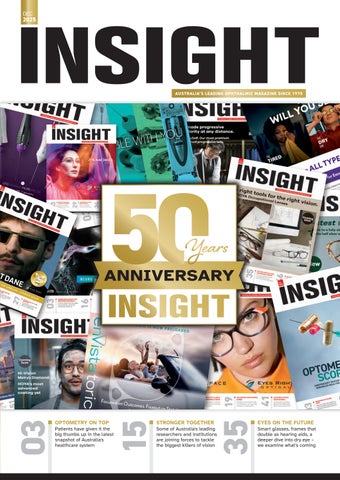
DEC 2025
AUSTRALIA’S LEADING OPHTHALMIC MAGAZINE SINCE 1975
Patients have given it the big thumbs up in the latest snapshot of Australia's healthcare system
35
STRONGER TOGETHER
EYES ON THE FUTURE
Some of Australia's leading researchers and institutions are joining forces to tackle the biggest killers of vision
Smart glasses, frames that double as hearing aids, a deeper dive into dry eye – we examine what's coming
15
WWW.INSIGHTNEWS.COM.AU
03
DECEMBER 2025
OPTOMETRY ON TOP
Proudly Ranked
#4 in Australia’s Best Workplaces™ 2025 Specsavers has officially been named the 4th Best Workplace in Australia by Great Place To Work® – a testament to our vibrant, inclusive, and people-first culture. This recognition reflects our ongoing commitment to delivering exceptional eyecare while creating a workplace where everyone feels valued, supported, and inspired to grow. Join a team that’s setting the standard – in eyecare and in culture. Explore careers at spectrum-anz.com/careers-at-specsavers
DEC 2025
AUSTRALIA’S LEADING OPHTHALMIC MAGAZINE SINCE 1975
OPTOMETRY TOPS ‘SATISFACTION’ HEALTH STATS Optometry has performed the best of all health disciplines in a national snapshot of consumer satisfaction with healthcare in Australia. It performed well in a number of other areas as well, including access, affordability, communication and use of easy-to-understand language, and the quality of the practice environment. That meant that clients were less likely to switch optometrists, with just 4% of those surveyed saying they had done that in the past few years. That is despite a downturn in attitudes towards the health system in general, as revealed in the 2025-26 Health Insights Special Report (Part 2), the 14th annual survey commissioned by NAB bank. In his introduction to the survey results, NAB Health and Medfin Australia executive Mr John Avent said the country’s health
system was “widely regarded as one of the world’s best, supported by a range of highly qualified health practitioners who provide safe, reliable and quality care”. He said that while there were some ongoing areas of concern, including access to services in rural and remote areas, there were also a number of encouraging ‘green shoots’ in this year’s report, suggesting real improvements had been made in the patient experience. Those included wait times for mental health support falling, visitation up for many practitioner groups, particularly GPs, and ‘value’ being scored higher for almost all groups. Also, patients were reporting it was easier to see most health practitioners and they felt more listened to and better understood, which meant switching rates had eased a little.
Optometry has performed well in the latest Health Insights Special Report. Image: pressmaster/stock. adobe.com.
Despite those improvements, the survey revealed that overall levels of dissatisfaction with healthcare were up. It showed that Australians rated their satisfaction with the health-system at an average of around 6.4 out of 10, slightly down from 6.5 in both 2023 and 2024. Only 34 % of respondents rated their satisfaction as “very high” (score 8+). That too was a drop from 36-37 % in the two years previously.
That satisfaction varied by geography, age, gender and income. Those living in capital cities rated the healthcare system at 6.5, while it was 6.4 for regional residents and 6.2 for those living in Australia’s rural centres. Older Australians (65+) tended to rate the system higher at 6.8, with those aged 25-34 giving it 6.6 and 45 to 54-year-olds just 6.0. Lower-income groups’ satisfaction improved to 6.4, but it fell to 6.5 for those on higher incomes. The results showed that men tended to be happier with the system than women. On average, men gave it 6.6, with women landing on 6.3. Concerns remained about access to healthcare. The survey demonstrated that Australians still broadly report continued page 8
Optometry Australia (OA) has revealed it is again discussing plans for a restructure. In a release on its website, OA said it was “actively” talking with its five state organisations about a proposal to “enhance services for members and reduce member fees”. It said the options included reducing its number of legal entities and organisations. “We believe changing how we are structured will allow us to amplify our voice, reduce duplication, and deliver even greater value to every member with lower membership fees.” Currently, OA is a federated, not-for-profit organisation comprised of a national organisation that collaborates
with five state divisions. This latest move follows previous attempts to merge with certain state bodies, and the urgings of an outgoing OA president in 2021 to keep a reorganisation “firmly on the agenda”. It was also highlighted in the organisation’s strategic plan 2024-27, which sought to “strengthen the organisation, ensure organisational sustainability”. “The final pillar aims to ensure the sustainable provision of high-value services for optometry members,” it said. Strategies included “increasing efficiency and effectiveness across all organisational domains”, and “promoting efforts
to reduce the environmental footprint of the organisation and the optometry sector”. In 2023, the boards of state organisations Optometry Victoria South Australia (OV/SA) and Optometry Tasmania (OTas) announced talks about a possible merger with OA. Members were told it was about increasing efficiency, streamlining services, and enhancing value for members by aligning state and national services more closely. After continued discussions, rather than a total merge of the three organisations, OV/SA and OTas decided on operational integration with OA and continued page 8
Image: Face à Face.
OPTOMETRY AUSTRALIA CONSIDERING CUT IN ENTITIES IN REORGANISATION
Facing up to 30 The Face à Face eyewear brand has just turned 30 and it’s still looking sharp. But rather than look back, it’s marking the milestone with bold new designs, creative collaborations and a renewed commitment to bolder and even more expressive designs.
page 38
Setting the pace in digital visualisation
NEW ZEISS ARTEVO 850
Discover the benefits:
ZEISS AU: 1300 365 470 med.au@zeiss.com
• Customisable 3D digital visualisation • Integration following your efficiency demands • Intuitive navigation and productivity zeiss.com/artevo850
Carl Zeiss Pty Ltd, NSW 2113 AUSTRALIA.
Working at the forefront of ophthalmic surgery demands an advanced surgical microscope, that provides a variety of visualisation options and a smooth surgical workflow.
Carl Zeiss Pty Ltd, NSW 2113 AUSTRALIA.
IN THIS ISSUE DECEMBER 2025
EDITORIAL
FEATURES
A GOLDEN MILESTONE
18
Skye’s the limit
31
The year that was
Outgoing CEO Skye Cappuccio reflects on a period of change at Optometry Australia.
A look back on another year of great change and progress for the Australian ophthalmic sector.
20
Golden years
40
Partnership pathway
Insight magazine celebrates a half-century of publishing and the great stories and innovations since 1975.
We talk to three young people whose careers in optometry have been crowned with ownership.
EVERY ISSUE 07 UPFRONT
54 MANAGEMENT
09 NEWS THIS MONTH
55 SOAPBOX
51 ORTHOPTICS
56 CALENDAR
53 OPTICAL DISPENSING
58 PEOPLE ON THE MOVE
As you tore the envelope on this edition, the gold trim may have hinted we’re marking a special milestone: 50 years of Insight. Trade media might not always take centre stage, but this feels fitting as we mark five decades of documenting Australia’s eyecare community – highlighting innovation, sharing best practice and facilitating debate. This has been Insight’s function since 1975, starting out as a tabloid-style newspaper before evolving into a magazine and digital brand. The combative Insight of old may contrast with its ethos today, but its core role remains unchanged. Reaching 50 years speaks to the strength of this sector – we don’t survive unless our readers and advertisers prosper. It’s also a nod to the magazine’s ability to adapt and stay relevant. I still remember being offered the Insight journalist role almost seven years ago. Suddenly, I was in the world of B2B media, learning fast and meeting brilliant people. My first assignment was CooperVision’s MiSight data – a topic that continues to cross my desk today. Soon after, I became editor, a role that has instilled a resilience I’ll be forever grateful for and reshaped how I even value my own health. In that time, I’ve had a front-row seat to some remarkable developments: the rise of EDOF IOLs and MIGS, Australia’s first in-human gene therapy (for inherited eye disease), our first Indigenous ophthalmologist, mainstream adoption of myopia management, and an explosion in dry eye care. There’s been a closer alignment with audiology, prompting the launch of Insight’s sister publication, Hearing Practitioner Australia, in 2024. As we reflect, it’s also time to look ahead. With this issue, I hand over the editorship to Mr Rob Mitchell, our assistant editor for the past 18 months. I’ll continue supporting Insight in the background while overseeing more titles within our parent company, Prime Creative Media. Thank you for your support, insights, and passion for this industry. And for generously carrying me through many interviews! Here’s to the next 50 years of Insight. MYLES HUME Group Managing Editor
December 2025 INSIGHT
5
The new RayOne Galaxy spiral IOL delivers a full range of vision with minimised dysphotopsia like an enhanced monofocal — achieved through a non-diffractive spiral optic for 0% light loss, that progressively elongates focus*. Available immediately in toric powers.
Discover more at rayner.com/Galaxy
*Rayner, 2024 — R&D data on file. Users must refer to the product ‘instructions for use’ in all cases — www.rayner.com/ifu. ©2024 Rayner, all rights reserved. Rayner, RayOne and Galaxy are proprietary marks of Rayner. Rayner, 10 Dominion Way, Worthing, West Sussex, BN14 8AQ. Registered in England: 615539. EC 2024-133 08/25
UPFRONT Just as Insight went to print, SPECSAVERS announced it had launched advanced dry eye treatment services in its 100th store, meaning it has achieved its target of 100 stores in 100 days. The century was notched up at Specsavers Northam in Western Australia. That store, like many others, now has low-level light therapy (LLLT) alongside intense pulsed light (IPL), part of a major rollout of such treatments in Australia and New Zealand. That followed a successful IPL pilot in a small number of stores. The rollout marks a significant evolution in Specsavers’ clinical model, which aims to improve access to advanced dry eye care for patients experiencing meibomian gland dysfunction and other forms of dry eye disease. IN OTHER NEWS, Fiji has eliminated the eye disease trachoma as a public health problem. Its success was announced by the
STAT
Image: methaphum/stock.adobe.com
WEIRD Amazon has developed its own smart glasses, known internally as Amelia, to help delivery drivers be quicker and more efficient in getting parcels to customers’ doors. The Seattle-based company recently showed off the eyewear which, paired with robots and artificial intelligence, were part of the company’s ongoing drive to speed up deliveries. The glasses have a small screen that gives turn-by-turn directions, scans package codes and takes photos for proof of delivery.
World Health Organisation and welcomed by the Fred Hollows Foundation which, along with other groups, played an important role in eradicating the disease. Trachoma is the world’s leading infectious cause of blindness and is classified as a Neglected Tropical Disease. The latest news follows success in Papua New Guinea earlier this year, which also managed to eliminate trachoma. FINALLY, Australia now has two treatments for geographic atrophy (GA) after the Therapeutic Goods Administration (TGA) gave its consent to IZERVAY (avacincaptad pegol), from Astellas Pharma Australia. That follows the approval of Syfovre earlier this year. At the time, macular disease expert Professor Robyn Guymer said that was a “historic moment” and a “significant milestone” for GA sufferers in Australia. More than 75,000 Australians are living with GA, an advanced form of AMD and leading cause of blindness worldwide.
WACKY Pickleball, the seemingly quirky paddle pastime once beloved by retirees, is now a fast-growing sport bringing a surge in eye injuries. A study published in JAMA Ophthalmology shows that it’s not just the number of participants that is growing rapidly, with an estimated 20 million in the US trying their hand at the sport in 2024. Researchers found that pickleball-related eye injuries more than doubled between 2021 and 2024, to more than 400 cases annually in the US.
Published by:
379 Docklands Drive, Docklands VIC 3008 T: 03 9690 8766 www.primecreative.com.au Chief Executive Officer Christine Clancy christine.clancy@primecreative.com.au Publisher Sarah Baker sarah.baker@primecreative.com.au Group Managing Editor Myles Hume myles.hume@primecreative.com.au Editor Rob Mitchell rob.mitchell@primecreative.com.au Senior Journalist Rhiannon Bowman rhiannon.bowman@primecreative.com.au Commissioning Editor, Healthcare Education Jeff Megahan Business Development Manager Luke Ronca luke.ronca@primecreative.com.au
WONDERFUL A new national initiative is set to transform support for Australians living with low vision, addressing the often-overlooked emotional and mental health challenges that accompany vision loss. Launched by Guide Dogs NSW/ACT, SeeWay is a free, confidential service offering counselling, lifestyle guidance, and digital skills training to individuals and families affected by low vision. SeeWay aims to bridge the gap between clinical care and the lived experience of vision impairment for the more than 70,000 Australians who may not qualify for governmentfunded services.
insightnews.com.au
Client Success Manager Karyssa Arendt karyssa.arendt@primecreative.com.au Head of Design Blake Storey Art Director Bea Barthelson Subscriptions T: 03 9690 8766 subscriptions@primecreative.com.au
Smoke gets in your eyes Despite smoking rates continuing to decrease over time, about 1.8 million Australians still smoke every day. Page 47
WHAT'S ON
Complete calendar page 56
THIS MONTH
NEXT MONTH
18TH CONGRESS OF THE APVRS
MIDO
12 – 14 Dec Under the title Retina 360, the event will focus on learning, application, transformation and synergy in the sector.
More than 1200 exhibits from 50 countries will attract visitors from more than 160 nations to Milan, Italy, for the annual celebration of the entire sector to be run over seven pavilions and eight exhibition areas.
2025.apvrs.org
mido.com
31 Jan – 2 Feb
The Publisher reserves the right to alter or omit any article or advertisement submitted and requires indemnity from the advertisers and contributors against damages or liabilities that arise from material published. © Copyright – No part of this publication can be reproduced, stored in a retrieval system or transmitted in any means electronic, mechanical, photocopying, recording or otherwise without the permission of the publisher.
December 2025 INSIGHT
7
NEWS
PATIENTS KEEN TO RECOMMEND THEIR OPTOMETRIST continued from page 3
being able to access care, but waiting times and difficulties seeing certain practitioners (especially in rural/ remote areas) remain. Optometrists scored highly on access. Their 8.5 out of 10 was up on 2024’s 8.3 and second only to pharmacists, whose score was unchanged on 8.7. The ease of seeing a specialist doctor, including ophthalmologists, was rated at 6.9, up on the 6.5 in the previous year. Optometry scored highly in other areas as well. It scored the highest in general satisfaction of all health disciplines at 8.4, although that was a slight drop on the 8.5 scored last year. The survey said 35% of Australians had visited an optometrist in the survey period, which was up from 28% in 2022. And those who visited were largely happy with the affordability of the interaction, with the average rating being 7.5. Of the people surveyed, 54% said they had noticed price increases at their optometrist practice, compared with 49% the year before. Only public hospitals scored lower. Three-quarters of those using a
vet reported price increases, with psychiatrists and psychologists next at 68%, followed by osteopaths, physios and chiropractors on 65%. All of that meant optometrists were seen as value for money, even more so than public hospitals. They came out on top of the health disciplines covered at 8.2, a jump on the previous year’s 8.0, with pharmacies second on 8 and public hospitals on 7.7. Specialist doctors also scored 7.7. Optometrists excelled in other areas, with the rating of 8.5 for their communication and use of language easily understood by patients up on the previous year’s 8.2 and second only to chiropractors, osteopaths and physios on 8.6. Specialist doctors performed well, with their rating at 8. Optometrists were second again to chiropractors, osteopaths and physios in the rating of their practice environments. The former improved from 7.9 the previous year to 8.1, with the latter just ahead on 8.2 in 2025. Those positive numbers meant few clients were likely to switch optometrists, with only about 4% of patients changing practices in the past two to three years. That compared favourably to other disciplines, including
Patients saw a visit to their optometrist as good value for money. Image: Graphicroyalty/ stock.adobe.com.
pharmacies and specialist doctors. GPs were the most impacted by patients switching, with 17% reporting they had made the move in the past two to three years. For the first time, respondents were also asked how likely they were to recommend the health practitioner they visited most frequently to a friend or colleague. That was used to devise a net promoter score (NPS), with 0 considered good, above 20 being favourable, more than 50 excellent and above 80 world-class. Chiropractors, osteopaths and physiotherapists came out on top with an NPS of 31, followed by vets (28), specialists including ophthalmologists (27), optometrists (25), pharmacy and private hospitals (21), dentists (19), GPs (17), public hospitals (10) and psychologists/psychiatrists (9). In 2025, the survey also revealed that almost one in two (45%) Australians were extremely likely to recommend their specialist doctor, and around four in 10 their vet (42%), chiropractor, osteopath or physiotherapist (41%), optometrist (39%), dentist (39%), GP (38%), private hospital (38%). This fell to around one in three for psychologists or psychiatrists (32%) and public hospitals (35%).
RESTRUCTURE URGED BY PREVIOUS OA LEADER continued from page 3
formally completed that process on 1 November 2023. “The model under development will see each state board remaining as the respective representatives for Victorian, South Australian and Tasmanian members, with all services delivered by OA and monitored by the respective state board for its jurisdiction,” OA said at the time. “The new model will see OA continuing to provide members nationally with access to its full range of member services. The new, integrated structure will also deliver local member engagement, face-to-face CPD, advocacy and stakeholder engagement in Victoria, South Australia and Tasmania.” A restructure of OA was top of mind in late 2021 as well, when Mr Darrell Baker stepped down after three years as its national president. At the time he said he was grateful for the opportunity to serve the 8
INSIGHT December 2025
organisation’s members, but he hadn’t completed all that he started and had hoped to achieve. That included structural reform, a key goal in numerous strategic plans. Baker said back then that the national board was in ongoing discussions with the five state-level bodies about this “critical and challenging issue”. “While we did start the conversation with divisional presidents on structural reform, it’s a dialogue that has not been finalised,” he said. “I urge the presidents and the divisional boards to keep this firmly on the agenda as we owe it to the members and the profession to ensure we have the best possible structure to serve them now and into the future.” In announcing its latest plans for reorganisation, OA said key considerations were: •M aintaining and enhancing strong local connections so the needs in every state and territory continue to be heard and addressed.
Optometry Australia is discussing a restructure of the organisation. Image: Starmarpro/ stock.adobe.com.
•D elivering cost-effective and high-value services. •P roviding members with a direct and democratic voice in director elections. •E nsuring the profession is positioned for future success. It said discussions were in their early stages and no decisions had been made. Members would have the chance to provide feedback and vote on any next steps. Any plans that emerge from that voting would need to be implemented by a new CEO. Ms Skye Cappuccio is stepping down from the top job and OA is yet to announce a successor.
ORAL PRESCRIPTION REFORMS CLOSER FOR OPTOMETRY AS PLANS SET FOR FEEDBACK Optometrists in Australia have moved one step closer to being able to prescribe oral medicines with key changes to the current system now open for public consultation. In a move welcomed by Optometry Australia (OA), the Optometry Board of Australia (OBA) is seeking public input on its review of the Registration standard: Endorsement for scheduled medicines and Guidelines for use of scheduled medicines. Submissions close on December 24. The Australian Health Practitioner Regulation Agency (Ahpra) recently updated the National Prescribing Competencies Framework for the Federal Government. In a media release, the OBA said there were more than 7000 registered optometrists in Australia, and almost 80% of general registrants had an endorsement to prescribe scheduled medicines. Under the changes, that endorsement would extend to oral medicines from an approved list published on the OBA website and
subject to ongoing review to reflect contemporary eye health practices. Patients would be able to receive treatment from optometrists for eye conditions that require oral medicines, instead of having to see multiple practitioners. It said the changes supported the National Medicines Policy and the National Strategy for Quality Use of Medicines to make the best possible use of medicines to improve health outcomes for all Australians. The move would provide greater access for patients, particularly in rural and remote areas where
The public now gets the chance to comment on policy around prescriptions. Image: Viewfinder/ stock.adobe.com.
people may have difficulty accessing a GP or ophthalmologist for a prescription, it said. In urgent cases, being able to access oral medicines without delay could prevent vision loss. “Giving people with eye conditions timely access to the right treatment, under the care of qualified professionals, could make a real difference to people’s eye health,” OBA chair Mr Stuart Aamodt said. OA welcomed the “long-awaited step after more than a decade of advocacy”. It said the consultation was an opportunity for increased recognition of the profession’s critical role in Australia’s health workforce and marked a pivotal moment for the profession and their patients. “Optometrists already carry the responsibility for identification and diagnosis of eye conditions, and this reform gives them the authority to complete management,” said Ms Skye Cappuccio, CEO of Optometry Australia.
1.76
WORLD’S T H I N N EST L E N S Crafted by Japan’s Optical Pioneers Since 1939
S I N C E 19 3 9
Available with fashion and sunglasses tint up to 85% in darkness Available with Tokai Lutina Photochromic and Transitions
18 0 0 8 6 4 8 8 6 to a . o r d e r s @ to k ai o p t . c o . jp W W W.TO K A I . C O M
NEWS
IN BRIEF AWARD WINNERS Retina Australia has announced the recipients of its first-ever Retina Australia Awards, recognising Professor Michael Kalloniatis and Dr Sena Gocuk. The 2025 Retina Australia Hall of Fame Award to Prof Kalloniatis acknowledged more than three decades of pioneering work that has advanced understanding and treatment of inherited retinal diseases and improved the lives of countless Australians affected by vision loss. The 2025 Retina Australia Emerging Scientist Award to Dr Gocuk, an optometrist and postdoctoral research fellow at the Centre for Eye Research Australia (CERA) and The University of Melbourne, recognised her excellence in research, leadership, and advocacy in the field of inherited retinal diseases.
TRIAL SUCCESS South Australia research institute CMAX has announced success with a potential new treatment for retinitis pigmentosa (RP), a devastating condition that causes progressive vision loss and, ultimately, blindness. There is no cure and limited treatment options. The Adelaide-based facility said achievement in an early-phase clinical trial it ran would give hope to those sufferers around the world. CMAX principal investigator Professor Sepehr Shakib said the first-ever human trial of NPI-001, a potential new treatment, showed that photoreceptor loss could be slowed by more than 50% over two years. The randomised, placebo-controlled, multi-centre trial was conducted at four clinical sites in Australia.
BACK IN THE FOLD Melbourne-based optical wholesaler Good Optical Services, which was recently sold to Mr Aaron McColl, has rejoined national independent optometry network ProVision. McColl, CEO of The McColl Group, bought the well-established Aussie business earlier this year from founders Mr Rick and Ms Marissa Good. The company is a popular supplier to optometrists, opticians, ophthalmologists, hospitals, and universities across Australia and New Zealand, offering therapeutic products and optical supplies. Mr Rob Boelen, merchandise manager at ProVision, said: “We’re thrilled to welcome Good Optical Services back into the ProVision family. Their deep industry knowledge and commitment to quality make them an ideal partner for our members.”
10
INSIGHT December 2025
NEW CALL FOR CHANGES TO PRAC PAYMENTS Australia’s leading union for health workers is renewing its call for the Commonwealth Prac Payment to be broadened, saying exclusion of allied health disciplines is unjust and unsustainable. The Health Services Union (HSU) has publicly urged the Federal Government to cover allied health students doing mandatory clinical placements. Under current arrangements, only students in disciplines such as teaching, nursing, midwifery and social work are eligible for the $331 weekly stipend. In contrast, students in other allied health – including optometry – receive no equivalent assistance while undertaking unpaid placements. HSU national secretary Mr Lloyd Williams warned that many allied health students were under severe financial strain. “Students are completing thousands of hours of placements and taking time off their casual jobs without receiving a cent to help them keep their heads above water,” Williams said. HSU is also calling for the inclusion of speech pathology, occupational therapy, physiotherapy, podiatry and pharmacy under the eligibility criteria. These students, like those
Prac payment changes could help optometry students better afford placement. Image: Stock 4 you/stock. adobe.com.
in optometry, often must travel or relocate to complete placements, adding travel, accommodation and living costs on top of their regular study expenses. Optometry students face particular hardships when placements require regional relocation. As reported in Insight’s recent coverage of ‘placement poverty’, many optometry students are performing long clinical rotations away from home with little or no income. These pressures disproportionately affect students from lower socioeconomic or rural backgrounds, raising serious concerns about equity and access within the profession. The risk is that students may choose other disciplines over optometry – not because of aptitude or interest, but due to financial necessity.
NOMINATIONS NOW OPEN FOR 2026 ENDEAVOUR AWARDS Nominations are now open for the 2026 Endeavour Awards, Australia’s premier celebration of excellence and innovation in manufacturing. Presented annually by Manufacturers’ Monthly, and held in collaboration with Australian Manufacturing Week, the Endeavour Awards honour the achievements of individuals and organisations who are driving Australian manufacturing forward. The annual gala dinner will take place on 13 May, 2026, during Australian Manufacturing Week in Brisbane, with the venue to be announced soon. Recognised as the manufacturing industry’s night of nights, the Endeavour Awards bring together leaders, innovators, and rising stars to celebrate success, share stories, and connect with peers shaping the future of Australian manufacturing. Awards will be presented across numerous categories, including:
• Innovation in Health Technology Recognising technologies that improve healthcare and medical manufacturing. • Leader of the Year A leader in a private, not-for-profit, or government organisation who has effectively shaped their business’ success, delivered financial growth, significantly and positively impacted the business’ culture, and championed the industry widely. • Manufacturer of the Year Manufacturer of the Year is chosen from the winners of the other Awards categories. This category is not open for nomination. Companies and individuals from across the sector are invited to submit their nominations and showcase the projects, technologies, and people making an impact on the industry’s growth and resilience. Nominations are now open. Visit the website endeavourawards.com.au to learn more and submit your entry.
optomap® 875mm2 retinal area FOV | RETINAL AREA
133° 460mm2 90° 430mm2 45° 128mm2
optomap , the ONLY single-capture, 200° ultra-widefield retinal image ®
YOUR PASSION, YOUR EXPERTISE Unleash your full potential with OPSM. With our unwavering support and experience, you have the freedom to pursue an area of expertise and practice full-scope optometry. Choose the field you love and thrive with OPSM.
ACCELERATE YOUR CAREER ASPIRATIONS WITH OPSM. Visit opsm.com.au/careers today.
NEWS
PUSH FOR UNIVERSAL EYE SCREENING FOR CHILDREN
RAYNER SECURES FDA APPROVAL FOR EMV TORIC IOL Rayner has announced that the US Food and Drug Administration (FDA) has approved its RayOne EMV Toric intraocular lens (IOL). In a media release it said the approval followed the successful completion of a pivotal Investigational Device Exemption (IDE) study. The lens is now available to US surgeons seeking to deliver high-quality visual outcomes for patients with astigmatism. Rayner said the lens was engineered for exceptional rotational stability and refractive precision. It was developed in collaboration with world-renowned Australian ophthalmic surgeon Professor Graham Barrett. Since its launch in 2020, lenses from the EMV family had been shipped to more than 75 countries, including the US. The multi-centre, randomised, active-controlled FDA trial enrolled 238 patients who received either the RayOne EMV Toric or the control monofocal IOL (RayOne Aspheric). •A t day 1-2 post-op, RayOne EMV Toric demonstrated an absolute mean rotation of just 0.9°. •A t month 6, RayOne EMV Toric showed absolute mean lens alignment of only 3.5°, with at least 99% of eyes rotating ≤5°, exceeding FDA requirements. The RayOne EMV platform is built on a patented non-diffractive optic design that uses controlled positive spherical aberration; it does not use light splitting technology like many IOLs which increase depth of focus. Rayner said this optical design delivered high-quality vision with monofocal levels of contrast sensitivity, and low dysphotopsia. Rayner CEO Mr Tim Clover added: “The long-awaited FDA approval of RayOne EMV Toric is a major milestone in our mission to expand global access to advanced IOL technologies.” The Rayner EMV intraocular lens has hit a new milestone. Image: Rayner.
Cassandra Haines says every child deserves the chance to see and learn clearly. Image: OA.
Ms Cassandra Haines, South Australia state lead at Optometry Australia (OA), and ophthalmologist Dr Joanna Black are calling on the South Australia Government to commit to a universal pre-school vision screening program for all four-year-olds in South Australia, delivered through kindergartens and long day-care centres. In a media release, they said the program would have to include robust referral and follow-up pathways, connecting families with SA Health services and community optometrists as appropriate. Haines said that every child deserved the chance to see and learn clearly from the start. “Universal pre-school vision screening is a simple, evidence-based program that would deliver real outcomes for South Australian children,” she said. “Too often, vision problems go undetected until they start affecting a child’s learning, development and confidence. By investing in early detection, we can make sure children are not held back by something as treatable as poor vision. “This is an opportunity for the South Australian Government to lead with
policy that builds strong foundations, so every child is ready to thrive at school and in life.” Research by Flinders University (2021–2023) found that 17% of Year 3 children failed a vision screening due to an undiagnosed vision condition, most commonly refractive error. Correcting children’s vision was also one of the most cost-effective health interventions available, it said. At present, South Australia did not provide universal pre-school vision screening. While vision checks were included in the Child and Family Health Service (CaFHS) health and development check for 4–5-year-olds, only an estimated 40% of children accessed this service, and follow-up care was inconsistent, OA said. This meant too many children were starting school without essential vision problems being identified and addressed. A universal vision screening program would bring South Australia in line with other mainland states and territories, such as New South Wales, Western Australia and Queensland, that already have, or are implementing, universal vision screening.
STUDY: NEW LASIK TECHNOLOGY OUTPERFORMS SMILE PRO
A new form of LASIK surgery creates a 3D model of the eye. Image: Vadim/stock.adobe. com.
An advanced form of LASIK eye surgery that uses a virtual 3D model of an eye to deliver more personalised treatment has been shown to achieve better visual outcomes than the SMILE Pro laser vision correction technique, according to a study. The research, presented at the recent annual meeting of the American Academy of Ophthalmology, involved 60 patients who received the new technique, known as wavelight plus, in one eye, and SMILE Pro in the other. Wavelight plus uses more than 100,000 data points from each patient’s eye to create a more personalised treatment. Those data points create a “digital twin” of the patient’s eye, a three-dimensional version that helps surgeons customise corrections with greater precision. The study showed that, three months after surgery, the differences between the
patients’ eyes were marked. Ninety-eight per cent of patients achieved 20/12.5 vision or better with wavelight plus, compared with 82% with SMILE Pro. Also, every eye treated with wavelight plus was within a quarter-diopter of the target prescription, while SMILE Pro achieved this level of precision in about three-quarters of cases. More than 80% of eyes treated with wavelight plus gained an additional line of vision beyond their baseline, compared with fewer than one-third of eyes receiving SMILE Pro. “The wavelight plus results are particularly encouraging for the future of the field,” said lead researcher, Professor A. John Kanellopoulos, MD, at New York University medical school. “We found that ray-tracing LASIK not only effectively corrected refractive error, but also improved visual performance at higher percentages than SMILE Pro.” December 2025 INSIGHT
13
1800 637 654 INSIGHT MAGAZINE AD'S 2025 - NEW TEMPLATE.indd 2
@eyesrightoptical 29/10/2025 5:07:08 PM
07:08 PM
RESEARCH
Newest research alliance eyes Usher syndrome
“This is about harnessing the power of what we already have in ophthalmology research, particularly in Melbourne, but hopefully beyond that,” Prof Martin says. “We can achieve more by organising ourselves more effectively than we have in the past.” BIGGER, SMARTER COLLABORATION Until now, much of Australia’s vision science excellence has been spread across multiple departments and institutes, often working independently. Prof Martin says that while that model produced strong individual results, it wasn’t always the most efficient way to address major diseases. “Even within Melbourne, vision research happens in pockets – within CERA, the university’s departments of optometry, surgery, anatomy, population health, and Indigenous eye health,” he says. “But it’s not really joined up. The alliance allows us to tackle problems from a range of perspectives in a more co-ordinated way.” To achieve that, a steering committee – chaired by Prof Martin – will guide project selection and governance, with each partner having a seat at the table. “The discussion starts with one question,” he says. “Is there something about the alliance that makes this project more feasible or more likely to succeed? If the answer is yes, that’s where we focus our efforts.” This approach echoes broader shifts in global research. “The world’s changed,” says Mr Tim Fricke, director of research and education at the ACO. “The discoveries now come out of bigger data, bigger collaborations – it’s not one person in a lab. The alliance is recognition that we needed to get out of our silos.” VSIA is not designed to replace existing research programs. Each partner continues to run its own studies and projects. Rather, it serves as a vehicle for major, multi-institutional efforts, the ones too ambitious for
Above: Usher syndrome, often identified in children, can lead to vision and hearing loss.
any single organisation to tackle alone. For researchers, Prof Martin says the model is also about practicality. “We want to make it easier, not harder, for our partners,” he says. “Multi-institutional projects can be complicated, so we’re creating what I call a ‘researcher passport’ – an overarching agreement that lets researchers access facilities and resources across the alliance more flexibly.” That, in turn, helps attract funding from industry, philanthropy, and government. “When we go to government or funders with a unified story, it’s much more compelling,” he says. “We can show we’ve already brought together the best expertise. We’re not going cap-in-hand; we’re saying, ‘here’s a partnership ready to deliver’.” The Victorian Government has already shown strong support. “They see this as a model of what’s possible when world-class institutions collaborate,” Prof Martin says. “We’ve had great engagement from the ministers – Image: Anna Carlile, CERA.
W
hen it comes to health, Australia has long punched above its weight – from pioneering the cochlear implant that transformed hearing loss, to world-class ophthalmic research and patient care. Now, a new alliance of leading institutions aims to harness that same collaborative spirit to tackle some of the biggest challenges in vision science, starting with one of the most debilitating of all: Usher syndrome. This rare genetic condition causes both hearing loss and blindness, often identified in childhood. “It’s a devastating condition for families,” says Professor Keith Martin, managing director of the Centre for Eye Research Australia (CERA) and head of ophthalmology at the University of Melbourne. “Children are often diagnosed because of the hearing loss, and then you have to tell parents that their child will also go blind.” For Prof Martin, Usher syndrome is the perfect example of why this new partnership, the Vision Science Innovation Alliance (VSIA), was created. “The hearing part of Usher syndrome has been addressed very effectively by the cochlear implant – an Australian-developed technology,” he says. “Now we want to do the same for the eyes. We want to be the ‘cochlear implant for the eye’ – not necessarily in terms of the device itself, but in developing an effective therapeutic strategy that addresses vision loss.” The alliance brings together the University of Melbourne, CERA, the Australian College of Optometry (ACO), the Royal Victorian Eye and Ear Hospital and other partners to co-ordinate research strengths across basic science, clinical trials, community implementation, and commercialisation. It represents a fundamental shift in how major eye research will be done – larger in scale, more co-ordinated, and better equipped to attract national and global funding.
Image: Emilio/stock.adobe.com.
For a new eye health research partnership, the plan is to maximise the sum of its many already successful parts, and tackle the kind of debilitating eye conditions that would have been beyond their reach individually.
Prof Keith Martin is chair of the alliance steering committee.
December 2025 INSIGHT
15
Image: University of Melbourne.
RESEARCH
Above: Representatives of the new research alliance at its Melbourne launch are (from left) Prof Mike McGuckin, University of Melbourne; Prof Keith Martin, CERA; Duncan Peppercorn, CERA; Prof Lauren Ayton, CERA; Pete Haydon, Australian College of Optometry; Emily Shepard, Usher Kids Australia; Dr Adele Hosseini, Cerulea Clinical Trials; Danny Pearson; Melanie Eagle, Royal Victorian Eye and Ear Hospital; and Louis Shepard, Usher Kids Australia.
Tim Fricke ACO
they understand that we can create both medical and economic value for Victoria.” THE FIRST FLAGSHIP PROJECT Usher syndrome is proving an ideal starting point – a condition bringing together every strand of the alliance’s expertise – genetics, clinical care, audiology, and patient advocacy. “There’s a really strong patient group, UsherKids, who are incredibly organised and vocal,” Prof Martin says. “That helps push the research forward. And we have local expertise – world leaders in RNA and gene editing, and clinicians experienced in inherited retinal disease. It’s a problem where Melbourne can genuinely lead.” At the ACO, Fricke and his team are already contributing through their inherited retinal disease clinic, a collaboration involving optometry, audiology, ophthalmology, and support networks. “We started that clinic to generate better care in the first instance,” Fricke says. “But it’s also about building the foundations for future research and funding that can improve things longer term.” He adds that the ACO’s public health focus brings a unique dimension to VSIA’s capabilities. “In terms of equity, diversity, and complex communities, no one brings what we bring,” he says. “We can broaden the reach of research and make it more applicable to the communities of Victoria and beyond.” While Usher syndrome is the first target, the alliance is designed for longevity – a platform to tackle other major causes of 16
INSIGHT December 2025
blindness such as diabetic retinopathy, glaucoma, and macular degeneration. “These are the diseases that matter most,” Prof Martin says. “Two conditions blind older people – glaucoma and macular degeneration – and two blind the working-age population – diabetic retinopathy and inherited retinal disease. Over time, we want to have a presence in each.” Some of this work is already under way. Prof Martin points to CERA’s Cerulea Clinical Trials, now one of the largest of its kind globally, supported by a $10 million investment from Breakthrough Victoria. “That’s infrastructure we can leverage for alliance projects,” he says. “It allows us to bring new treatments to Victorian patients first – often at no cost to the health system.” THE NEW RULES OF RESEARCH Both Prof Martin and Fricke agree the alliance reflects a wider evolution in how research is done – and funded. “Funding bodies want to see scale and collaboration,” Fricke explains. “They want to see buy-in from community organisations, diversity of thought, and engagement with real-world patient needs. If you go as a single, ivory-tower researcher, that model doesn’t work anymore.” Prof Martin puts it more bluntly: “The landscape is incredibly competitive. Less than 10% of projects get funded. So, when something does get through that filter, it should be funded properly – not at a level that leaves us scrambling to fill the gaps.
A COLLABORATIVE VISION Both men are clear-eyed about the challenges ahead. Building and maintaining collaboration across multiple institutions isn’t simple. “Everyone comes with their own processes and agendas,” Prof Martin admits. “But the way we’ve set it up – through consensus, through focusing on where the real value lies – gives it the best chance of lasting.” If it works, the VSIA could mark a turning point in how Australia approaches medical research, and perhaps deliver a new national success story to rival the cochlear implant. “We’ve got the talent, the technology, and the patient need,” Prof Martin says. “By bringing it all together, we can do something extraordinary.”
DV1545-0425
“The discoveries now come out of bigger data, bigger collaborations – it’s not one person in a lab. The alliance is recognition that we needed to get out of our silos.”
That’s one of the policy changes we’re advocating for.” He also sees the alliance as a training ground for future talent. “The ability for students and researchers to move between institutions – that’s a big selling point,” he says. “It’s great for students to be exposed to clinical trials or genetic engineering. It’s good for recruitment and career development. Everyone benefits.” Ultimately, the alliance’s success will be measured not just in publications, but in patient outcomes. “The purpose of any project we do is to improve vision-related quality of life,” Prof Martin says. “That’s measurable – whether it’s how well someone can navigate in low light, or their ability to keep working despite a chronic eye condition.” For Fricke, it’s also about ensuring that breakthroughs reach those who need them most. “We have deep relationships with communities – homeless groups, Indigenous organisations, aged-care providers,” he says. “That means our research is informed by, and connected to, the people it’s meant to help.”
2025 09 I
From Eye to Insight
™ VIVINEX TORIC From From Eye to EyeInsight to Insight THE SECURE CHOICE FOR ASTIGMATISM CORRECTION
Our monofocal toric IOL – designed to advance patients’ vision Proveo 8x 3D Digital Microscope
MULTIPLY YOUR POSSIBILITIES
> Real-time 3D imaging powered by Leica camera technology > Multiple visualization possibilities: binocular-based, 3D monitors, and MyVeo surgical headset > Flexible visualization setup for comfortable working position
Scan to access the digital future with Proveo 8x
Proveo 8x
Not all products or services are approved or offered in every market and approved labeling and instructions may vary between countries. Please contact your local Leica representative for details.
3D Digital Microscope
MULTIPLY YOUR POSSIBILITIES
Proveo 8x
Delivered in the Vivinex™ iSert® injector 3Dpreloaded Digital Microscope > Real-time 3D imaging powered by Leica MULTIPLY YOUR POSSIBILITIES camera technology
HOYA Vivinex™ Toric This product is intended for implantation into the capsular bag of the eye after cataract removal. This product is not available for purchase by the general public.
DV1545-0425
Distributed by:
> Multiple visualization possibilities: binocular-based, Get in touch 3D monitors, and MyVeo surgical headset 1800 225 307 enquiries@dfv.com.au dfv.com.au
> Flexible visualization setup for > Real-time 3D imaging powered bycomfortable Leica position cameraworking technology
2025 09 Insight adverts Sept a4 Advert.indd 2
16/12/2025 3:20:04 PM
OPTOMETRY
A decade of transformation As CEO SKYE CAPPUCCIO prepares to step down after more than a decade with Optometry Australia, she reflects on a period of profound change – from strengthening the profession’s voice and unity to addressing workforce supply and conditions, and opening new pathways for optometrists to grow and specialise.
F
ew professions have mapped their future as deliberately as optometry. For Optometry Australia CEO Skye Cappuccio, steering that vision – and ensuring it translated into real programs and policy reform – has defined her decade with the organisation. Cappuccio was appointed CEO a little over three years ago, leading the now Optometry Australia (OA) through a period of structural reform and renewed focus on professional recognition. Among her proudest achievements is work stemming from the Optometry 2040 project – a long-term strategic initiative first developed in 2018 to help the profession define and pursue its preferred future. “We worked with members to identify the kind of future they wanted to see for optometry, and the steps needed to make that a reality,” Cappuccio explains. “It was also about avoiding the more dystopian futures, making sure we were actively shaping where we wanted to go.” That work was revisited in 2023 to account for the shifts brought on by the pandemic. While many changes were less radical than initially anticipated, she says the refresh provided the foundation for new programs that are already reshaping professional practice. Chief among them is the Advanced Practice Recognition Program, designed to recognise optometrists with significant expertise in specialised areas. “The program is about supporting more people to work to the full scope of their practice, while recognising those with advanced skills,” she says. “It also enables ophthalmologists and patients to understand who those people are, and helps create a system where we have both generalist optometrists and those practising in more specialised areas.” The first area of recognition – glaucoma – has already been piloted and completed its first round. It was oversubscribed, reflecting strong member demand. “Members are clearly keen. The next area is already in development and will launch in about 18 months, with the same level of rigour around competency standards and expert design,” Cappuccio says. BUILDING STRENGTH Beyond professional recognition, Cappuccio has presided over a major organisational shift – the integration of several state divisions into the national
18
INSIGHT December 2025
Skye Cappuccio was appointed CEO at Optometry Australia in 2022.
body. Over the past three years, the operations of Optometry Victoria South Australia (OV/SA), Optometry Tasmania, and Optometry Queensland Northern Territory have been brought into the Optometry Australia fold. “That integration has delivered efficiencies for members and allowed us to provide more cohesive, national
“When I joined, OA didn’t offer continuing professional development at the national level,” she says. “Now we’re the largest CPD provider for optometrists in the country, predominantly in the online space. It’s made quality CPD accessible from anywhere.” OA’s Institute of Excellence has become a cornerstone for member learning and upskilling, particularly as clinical technology and diagnostics evolve. “It’s about making sure optometrists can access the latest knowledge easily, without geographic barriers,” Cappuccio says. She also points to one of the profession’s most significant advocacy wins during her early days with Optometry Australia – the removal of the cap on Medicare fees. “It used to be that you couldn’t charge above the scheduled fee for Medicare items,” she explains. “The change gave optometrists the ability to determine their own fees, which is particularly important as we move further into disease management.” For Cappuccio, each of these milestones reflects OA’s core mission: to support its members and strengthen the profession. “I’m really proud of what we’ve built – not just programs, but people,” she says. “We have a fantastic team. We’ve grown, but we’ve also kept that sense of purpose and collaboration that makes the organisation special.” That collaboration now extends
“WE WORKED WITH MEMBERS TO IMAGINE THE FUTURE THEY WANTED FOR OPTOMETRY – AND THEN PUT THE STEPS IN PLACE TO MAKE IT HAPPEN.” services,” she says. “It’s been particularly powerful in advocacy – sharing learnings more easily and aligning state and national efforts.” Cappuccio highlights several other milestones that mark her decade with the organisation. One is the expansion of direct, one-on-one member support, an area she says has transformed since her early days. “When I started, we had just one person providing that service. Now we have a help desk of optometrists whose job is to deliver that support,” she explains. “Last year alone, they handled 1,800 member consultations. That’s been a deliberate and valuable investment.” Professional development is another area that has grown exponentially, she says.
beyond the traditional office. Following the pandemic, OA moved to a fully virtual workforce, closing its South Melbourne premises. “We focus on hiring the best people, wherever they are. We’ve got six team members in Adelaide, four in Queensland, and a shared space in Carlton through our partnership with OV/SA.” THE CHALLENGES AHEAD As she prepares to hand over the reins, Cappuccio is realistic about the challenges that remain for the profession. Chief among them is workforce balance. “Right now, optometry is in oversupply, which puts pressure on the profession,” she says. “At the same time, there are concerns about workplace conditions
Skye Cappuccio (right) in 2019 at the Close the Gap for Vision by 2020: Strengthen and Sustain National Conference with other representatives from Optometry Australia.
Images: Optometry Australia.
for employed optometrists, particularly where their clinical autonomy might be under pressure.” Managing that balance requires both urgency and caution, she says. “We need to confront it directly and astutely, because these are complex issues. Other health professions have swung from oversupply to undersupply within a decade, and we don’t want to repeat that cycle.” Another major challenge is the ongoing evolution of clinical technology and diagnostics – particularly artificial intelligence. “Optometry has always been an early adopter of technology,” Cappuccio notes. “We’ve seen a lot of AI-based diagnostics come to market, especially using retinal imaging. While uptake has been gradual, the potential is huge – not just for eye health but for identifying conditions like heart disease or chronic obstructive pulmonary disease through ocular data.” Rather than a revolution, she believes AI will bring “a fast-moving evolution” to clinical practice. “Optometry’s already been playing in this space for longer than many other health professions. What we’re seeing now is just that evolution accelerating.” Cappuccio is also pleased to see progress on oral therapeutics after many years of advocacy. “Australia is behind New Zealand, the UK and the US in this area. Expanding scope of practice is fundamental to enabling optometrists to use their full skill set,” she says. Despite these hurdles, Cappuccio remains optimistic about the profession’s direction and is proud of the collective efforts that have advanced it. “The profession is full of passionate, capable people who really care,” she
Skye Cappuccio (from left), Ged Kearney MP, and Optometry Australia director Jenny Mikakos. Advocacy at the political level on behalf of optometry was a key role for the CEO.
says. “That makes it a fantastic community to work with and for.” As Insight celebrates its 50th issue, Cappuccio also reflects on the vital role of industry media in connecting that community. “Good industry media keeps people informed and helps promote the great things happening across optometry,” she says. “It shares interesting models
of practice, celebrates innovation, and connects people across the sector. That sense of being part of something bigger – a profession that’s constantly evolving – is important.” LOOKING FORWARD After more than a decade with Optometry Australia – including three years at the helm – Cappuccio’s next chapter begins with a pause. “I’ll be with OA until the end of the year, then spending January at the beach,” she says with a smile. “After that, we’ll see what happens.” Her decision to step back comes with gratitude for the opportunities the role has provided. “It’s been a delight,” she says. “I’ve been given so many opportunities and worked with so many brilliant people. I’m proud of what we’ve achieved together, and I’m confident the organisation and the profession are in a strong place for the future.” As the OA board prepares to announce her successor, Cappuccio leaves a legacy of collaboration, foresight, and quiet determination – one shaped by a decade spent helping optometry define its future. “The profession is doing important work for the community,” she says. “That passion and purpose – that’s what makes it so rewarding.” December 2025 INSIGHT
19
Images: AI-generated|Adobe Firefly
PUBLISHING
Golden years of Insight Insight magazine is 50 years old in 2025. We talk to several well-known players in the ophthalmic and publishing sectors about the impact of the publication in their own lives and careers, and others about the influence it continues to have in a fast-changing industry.
M
r Tony Cosentino knows a great deal about the history of Insight magazine. That’s because the rise of the publication, which is celebrating 50 years in 2025 as Australia’s leading ophthalmic magazine, matches his own ascent from delivery boy to managing director of BOC Instruments, an important supplier in the sector. In fact, it was Insight that helped lift his own profile in the industry and set his company on its path to success. Cosentino was making his first steps into that business in the early 1970s, when Maroubra, NSW, optometrist Mr Ralph Lewis first published Optical World. A “mail boy” for American Optical, at the time one of the biggest optical companies in the world making its own first steps into the Aussie market, Cosentino would hop on a bus or train to deliver lenses to optometrists around Sydney. As his own role evolved and Cosentino moved from the mail-room floor to a new lens lab set up in Beaconsfield, NSW, the
20
INSIGHT December 2025
publication also took a new direction. In 1975, Mr Neil Forbes, a young sports-loving, jazz trumpet-playing surfer who had trained as an optometrist but saw more interest in the stories behind the storefront, purchased the publication and changed its name to Insight. “Right from day one he tried to be a journalist more than anything else, and went probing for different stories,” says Cosentino. “There was a lot of tension in those days between ophthalmology and optometry; American Optical had come in and had disrupted a lot of things. “There was fixed pricing or handshakes on lab work, but in regards to optometry, there were people setting up their own little co-ops, and it was sort of an exciting time, so lots of news to report.” Not that everyone was thrilled with the way Forbes went about getting those stories. “At times there was angst amongst the optometrists, or at board level anyway,
because I don’t think they liked the way he reported things,” says Cosentino. “He enjoyed the fights that he had with the governing bodies.” Although, they clearly made up. “He was given an award by ophthalmology for his services and the way that he reported things and the innovation that was happening.” In much the same approach that current Insight owner Prime Creative Media would take decades later, Forbes used a marketing background to lift the advertising in the publication – then a tabloid-size newspaper – and its profile in the ophthalmic sector. That in turn helped boost the profiles of many businesses in the sector. Including Cosentino’s. He had moved from work in the lab as an optical mechanic and technician to learn optical dispensing and also mechanical engineering. So when American Optical decided to bring its instrument range Down Under, Cosentino became a
Image: Tony
Cosentino.
Image: Tony Cosentino.
The rise of Tony Cosentino and his career was matched by the rise of Insight and its important role in covering the ophthalmic sector.
Tony Cosentino’s six-week trek was around Australia t. covered by Insigh
It was an unprecedented tour for the industry and Insight covered the trip in the publication, raising the profile of not only American Optical but also Cosentino. “We got a really, really good response to it,” he says. “It’s one of the things that helped make my name in the optical industry.” That relationship has continued many decades later. Insight is still covering the news, innovations and goings-on in the ophthalmic sector, and BOC Instruments is still supplying quality equipment and devices to the industry. In 2020, the magazine marked BOC’s own 100-year milestone and its transition from British Optical to what it is today. Cosentino says Insight’s own milestone is an impressive feat, and one that continues to benefit the industry.
Image: Tony Cos
technician doing installations and repairs and then product manager. Then, following a series of acquisitions and industry shake-ups, he found himself still standing, firstly as the head of British Optical in Australia but eventually at the top of his own company, BOC Instruments. The one constant through all of that change and upheaval was an industry publication produced by a sports-loving surfer, self-taught in journalism and practically every other aspect of publishing. Like it does 50 years on, Insight kept the industry up-to-date on those acquisitions and their implications, but also the waves of innovation beginning to reach Australia’s shores. Contributors like now-retired optometrist Mr Lewis Williams documented key ophthalmic conferences like ODMA Fair, RANZCO Congresses and AUSCRS for several years, with the publication continuing to have a strong presence at these events. “It reported things like when OPSM first went into optometry, after always being associated with dispensing and ophthalmology,” says Cosentino, “and the big changes, when optometry was able to get into Medibank (now Medicare), because prior to that optometrists had to charge for their consultation.” Insight was there for Cosentino’s own big changes as well. When American Optical wanted a national exhibition in 1979, he was tasked with driving a 3.5-ton truck two-thirds of the way around Australia, for 26 events over six weeks displaying the company’s wares to optometrists and ophthalmologists.
entino.
Right: In January 1997, Insight, in its 21st year, was a tabloid newspaper.
“Any professional industry at large should have a form of outlet, to get stories. And an independent voice. “A lot of the media today is totally different. It seems like there’s LinkedIn and Facebook and all of that, but it's important that you can still get it as a magazine, read it, put it down and pick it up later on. “If it's in a practice, all of the staff can have access to it . . . and I think the magazine itself is still something that is treasured.” THE OPHTHALMOLOGIST About the same time that Cosentino and Forbes were making their marks in the ophthalmic sector, a young Mr Bill Glasson was taking his first steps of what would become a successful career as an ophthalmologist. December 2025 INSIGHT
21
PUBLISHING
Image: RANZCO.
Neil Forbes founded Insight and was honoured by RANZCO in 2015 for his work to highlight the industry.
Not that this was front of mind for the then medical student. “We had a great time in life . . . doing some study and doing enough to pass exams, but basically having a bloody good time at parties.” When he put down the rum and cokes and finished his studies to eventually become Dr Glasson, it was the days of intracapsular cataract extension, cryoprobes and large stitches. In pretty quick time the industry was moving to extracapsular cataract extraction and implants, which were not regarded highly at the time. He recalls the reaction to their use by Cairns eye surgeon Dr Jim Peters. “He was putting these things called implants in, and the college took a very dim view of it; he nearly got sanctioned for doing a procedure that had no evidence,” says Dr Glasson. “It was, you know, ‘intraocular lenses are never going to have a future’.” If change was a constant, so was a magazine keeping Dr Glasson and others up to date with what that change looked like and what it would mean for the sector. “It sat on the kitchen table, on the theatre tables, on the tearoom tables; it was something you always picked up,” he says. “It was very informative in terms of what’s new on the market – sort of Insight by name, insight by nature. “It gave you insight into what was actually happening in the profession, both optometry and ophthalmology.” As they did with Cosentino, Forbes and his team tracked the rise of the young, up-and-coming Dr Glasson as he ascended to lead the Royal Australia and New Zealand College of Ophthalmologists (RANZCO) – now recognising the value and efficacy of implants – and also the Australian Medical Association, as president. In those roles he reached out to journalists at Insight, which remains a 22
INSIGHT December 2025
forum for decision-makers and thought leaders in the ophthalmic sector. The magazine helped lift his own profile and the work he was doing to a more targeted audience. That’s important in a sector where change and innovation are near-constant, he says. “We go to our national meetings and we get lots of presentations from people about, say, a lens or a product – somebody's selling something,” says Dr Glasson. “Insight, I think, allows a much more objective approach to what is out there in the market compared with their different products, which is important.” That information was not easy to find in other mainstream media looking elsewhere for news. “There’s no other media outlet that we can access that will give us the day-to-day and, in a dynamic way, the changes that are occurring around products and procedures,” he says. “I think that's why Insight's always been at the leading edge.” He sees no reason why it shouldn’t remain that way. “As long as it’s meeting the readers’ needs and people find it relevant to their profession, and it’s providing new information, confirming information, changing ideas.” THE PUBLISHER That will be music to the ears of Mr John Murphy. Milestones are on his mind as he sits down to talk about Insight’s golden commemoration. He’s preparing to celebrate his own silver anniversary with wife Tanya, but the chair, former CEO and founder of Prime Creative Media (PCM) is more than happy to also acknowledge the 50th birthday of one of their “babies”. That ‘baby’ was already pretty well grown
when PCM took on the title in September 2019, one of two publications bundled up in the acquisition of Gunnamatta Media. Forbes, his health deteriorating, had sold Insight to Gunnamatta, headed by Mr Coleby Nicholson, just a few years earlier. Forbes died, aged 76, in January 2019. At the time of its sale to Nicholson, Forbes hoped Gunnamatta would bring a “newfound energy to Insight and the wider eyecare industry”. Murphy is proud that PCM has honoured those wishes and kept the publication relevant to the sector and its participants while successfully bringing it into the 21st Century and expanding its reach and impact. “You need a multi-platform offering,” he says. “You need to provide information as people want to read it and how they want to access it. “We developed Insight’s online offering and invested in the journalism side of it. “We've got a market that is hungry for more information about these industries, these niches, these specialised industries, and we provide that through our great editorial and these great stories.” Forbes’ style may have been confrontational at times, especially for the sector’s leading institutions and individuals, and PCM has adapted the magazine to its own style of supporting the industry. “We talk to our suppliers and the industry as genuine partners,” says Murphy. “It’s about growing individuals, organisations and industries. I think these business-to-business magazines are a vital communication link for people to learn about the industries, but also to give them a platform to grow them. “It's all about giving a platform for these providers, these service companies, these manufacturers or dealers in these businesses to sell product, to talk about the latest developments and how they can Prime Creative Media chair John Murphy says Insight gives a platform for the industry.
AN INDUSTRY WELL COVERED Mr James Gibbins is a human exclamation point. The optical dispenser, teacher, and co-founder of the Australasian College of Optical Dispensing (ACOD) with Mr Chedy Kalach is loudly, proudly passionate about his industry and the college’s role within it. And he’s equally enthusiastic about the legacy of Insight and its contribution to the sector over 50 years. He has been an avid reader and contributor since he entered the industry in 1983, just a few years after Neil Forbes took the plunge on a then little-known trade title. He even admits to regularly having the latest copy on his bedside table. As his own career progressed and he crossed paths with Forbes, he grew to become friends with the magazine’s founder and long-time editor. “He was, at times, a cantankerous, polarising figure, which is why I quite liked him,” says Gibbins. His earliest memory of Insight was its Pluvius columns, written by Forbes with a dry and sometimes cutting wit. “It was his back page,” he says. “It was extremely opinionated, pokey towards optometrists, which I found funny, and very politically aligned to hard, left-wing politics inappropriate for an industry magazine.”
Dr Bill Glasson and his daughter, Nicola, who has followed him into ophthalmology.
Image: Bill Glasson.
make a difference to these companies.” Like other magazines in the PCM stable, Insight gives the industry “a voice to tell their stories”. Murphy is proud as well that it also supports professional development within the ophthalmic sector, having introduced regular CPD articles and educational pieces. Forbes would have been proud to see his own baby not only survive but thrive into adulthood and beyond, in a media sector where print can often fail. At PCM, digital channels are important, but print is still the premier product, says Murphy. It’s where he started his own career, taking a small Melbourne-based publishing company with one title and effectively one staff member – himself – to become what is believed to be the country’s biggest business-to-business publisher with more than 50 titles, 200 staff and offices across Australia and England. And he’s hungry for more, right after that anniversary brunch with Tanya. “We don't look back too often,” he says. “We're always looking to ensure that the company survives, ensuring that it keeps delivering and adding value to the industries. “But when you do have opportunities like this, Insight turning 50, well it is pretty amazing.”
“Insight will have international conference information, feedback, what people are doing overseas, etc. It’s always been there.” James Gibbins Australasian College of Optical Dispensing
The magazine might not be as provocative as it once was, but Gibbins says that, under current editor Mr Myles Hume, it is no less influential in supporting his work, optical dispensing in general, and the sector as a whole. “The first couple of years, ACOD didn't seem to get much traction, but we've now got traction,” he says. “Now, I can visit any tiny, little practice, anywhere in Australia or New Zealand, and I walk in the door and people go, ‘you're the college guy, aren't you?’. “That's a really privileged, wonderful position that we've come to now, and there's no doubt Insight has helped that along.” Industry members frequently access the publication’s content in print and online, keen to know more about sector changes and product launches. “The new frame range is out, it's going to be there. Then if there's a technical article along the lines of that product launch – even better. “It comments on international things. We in our industry, we're a pretty quiet, sleepy, inward-looking industry compared to others. “Insight will have international conference information, feedback, what people are doing overseas, etc.” That access to information, from an independent source that supports the sector, is important, says Gibbins. It’s why he believes Insight will continue to cover the industry beyond
50 years and be successful. “We are a smallish industry, but we're passionate, and the passionate members are going to jump onto media and share,” he says. “It's always been there.” Ms Skye Cappuccio agrees. “Reaching 50 years in print is a significant achievement in any field,” says the CEO at Optometry Australia. “It speaks to Insight’s ability to evolve and remain relevant. As the way we share information continues to change, there will always be value in credible, thoughtful journalism that brings people together and keeps the profession informed and inspired.” Insight publishes regular CPD articles helping optometrists and others advance their clinical and practice knowledge, and build their own profiles and businesses. "I think that what the great industry media we have in optometry does really well for optometry is it helps keep people up-to-date on things happening across the sector,” she says. “As the optometry profession continues to grow and refine its role within Australia’s health system, independent, well-informed journalism will remain essential to capturing that progress and helping shape what comes next. “I think that's a really important part of people feeling on top of information and connected to their profession and their sector and part of the broader community." December 2025 INSIGHT
23
VISCOTE ARS
®
Trusted for 25+ Years. Recommended every day. The proven solution for Dry Eye.
PBS LISTED
VISCOTEARS® EYE GEL 10G TUBE
VISCOTEARS® GEL PF 30 × 0.6G SINGLE-DOSE UNITS
Soothing, long lasting relief for sore, gritty dry eyes
Provides a moistening and wetting effect on the eyes1
PBS Listed
Preservative-free PBS Listed
Recommend with confidence. Choose Viscotears.
®
For more information, contact your Bausch + Lomb Territory Manager or Bausch + Lomb Customer Service 1800 251 150 Material was prepared in April 2025 References: 1. Viscotears Gel PF IFU. © 2025 Bausch & Lomb Incorporated. ®/TM are trademarks of Bausch & Lomb Incorporated or its affiliates. Bausch & Lomb (Australia) Pty Ltd. ABN 88 000 222 408. Level 2, 12 Help Street, Chatswood NSW 2067 Australia. (Ph 1800 251 150) VIS.0004.AU.25
50 YEARS
Images: ACO & EssilorLuxottica.
. L to R: Australian optometrists at a CPD event in the 1970s; A historic OPSM store.
HALF A CENTURY OF AUSTRALIAN EYECARE
1970s
Image: Robyn Mackenzie/Shutterstock.com.
As Insight magazine celebrates 50 years of publication, it’s fitting to reflect on the extraordinary transformation of Australia’s ophthalmic landscape over that period. Since 1975, optometry has evolved from a largely refraction-based service to a complex, technology-driven field integral to the nation’s health system. The inclusion of optometry in Medicare, the expansion of therapeutic prescribing rights, and major advances in diagnostics have reshaped how Australians access and experience eyecare. In ophthalmology, from the first foldable IOLs and laser surgeries to today’s AI-assisted imaging and gene therapies, each milestone tells a story of innovation, advocacy, and collaboration – and Insight has been there to report it every step of the way. • 1 980s – Expansion of university-based optometry education and research programs across Australian universities. • 1 982 – Australian Society of Ophthalmologists forms. • 1 983 – Professor Graham Barrett helps develop the world’s first foldable IOL, the first of his several cataract innovations including the Barrett Universal formula first published in 1993.
1983
• 1975 – Medibank (later Medicare) includes optometry services. • 1970s–80s – State optometrist registration boards modernised (varied by state) and optometric associations strengthened.
1990s • 1 990s – Australian researchers Prof Brien Holden, Prof Debbie Sweeney, Prof Mark Willcox, Dr Carol Morris, Prof Klaus Schindhelm and Prof Eric Papas played an integral part in the development and commercialisation of the silicon hydrogel contact lens. • 1 991 – David Huang, James Fujimoto, and Eric Swanson (pictured below receiving a prize from US president Mr Joe Biden in 2023) report the first successful demonstration of OCT, with first commercial instrument released by ZEISS five years later.
1991
1980s • Early–mid 1980s – Modern excimer-laser research and PRK (photorefractive keratectomy) internationally begins to reach clinicians (foundation for later refractive surgery adoption in Australia).
Image: Graham Barrett.
• 1987 – Johnson & Johnson's Vistakon division launches the first disposable soft contact lens, Acuvue, altering consumer behaviour and practitioner prescribing habits.
OCT founders receiving an award in 2023. Image: Ryan K. Morris/National Science and Technology Medals Foundation.
December 2025 INSIGHT
25
50 YEARS
Image: The Eye Piece & ACO.
L to R: Modern Sydney independent practice The Eye Piece; An optometry consulting room in the 1980s.
• 1991 – PRK appears in Australian practice; refractive laser surgery begins to be more broadly offered in the 1990s, including LASIK.
• 1995 – Australasian Society of Cataract and Refractive Surgeons (AUSCRS) forms, launching its popular annual event.
2001
Image: VEI.
• 1992 – The Fred Hollows Foundation is founded, only five months before Professor Hollows himself passed away from metastatic renal cancer.
Amanda Cranage was an orthoptist at Vision Eye Institute at its inception, and is the CEO today.
2000s Image: Michael-Amendolia/The-Fred-Hollows Foundation.
Above: Specsavers founders Doug Perkins CBE and Dame Mary Perkins.
• 1992-2000 – formation of a trans-Tasman ophthalmology college, with RANZCO adopting its current name in 2000.
• 2000–2003 – First practical therapeutic prescribing rollouts for optometrists: VIC, TAS, NSW and QLD begin implementing therapeutic endorsement frameworks.
RANZCO continues to oversee ophthalmology training and development in ANZ, alongside scientific meetings and advocacy.
INSIGHT December 2025
Image: RossHelen/Shutterstock.com.
• 2 000s – Expansion of community optometry practice models, corporate optical chains scale up, including Luxottica’s OPSM acquisition in 2003, and Specsavers entering market in 2008.
Image: RANZCO.
• 1992-1994 – Landmark Blue Mountains Eye Study released, being Australia's first large, population-based assessment of visual impairment and common eye diseases in an older population, providing prevalence benchmarks still referenced today.
1992
26
Image: Specsavers.
1992
• 2001 – Vision Eye Institute (then known as Vision Group) incorporated, becoming the world’s first publicly listed ophthalmic company and one of the earliest publicly listed group medical practices. • 2002 onward – Tasmania and then other jurisdictions begin formal implementation of therapeutic endorsements for optometrists. • 2003–2008 – Anti-VEGF era begins internationally; in 2007 ranibizumab (Lucentis) becomes first PBS-subsidised therapy of its kind in Australia for neovascular AMD.
2010s • 2009 – The Australian Society of Ophthalmologists' "Grandma's Not Happy" campaign prevents government cuts to the Medicare rebate for cataract surgery. • 2010 – National Registration: optometrists regulated under the national registration scheme and national boards (Ahpra); registration and national standards harmonised. • 2010s – Intraocular lens (IOL) technology advances (multifocal, EDOF lenses) become more routine in Australian cataract surgery.
Image: Optometry Australia.
Image: Warren Scherer/Shutterstock.com.
• 2010s – Corneal cross-linking (CXL) introduced and becomes available for keratoconus management in Australia (clinical adoption over 2010s).
• 2016 – In 2016, Brien Holden Vision Institute publishes a landmark study predicting half the world's population would be myopic by 2050.
• 2012 onward – Aflibercept (Eylea) lists on the PBS, with anti-VEGF therapies becoming routine and increasingly accessible in Australians for nAMD and other macular diseases.
2016
Image: George & Matilda.
Image: Hule/Shutterstock.com.
• 2021 – World Council of Optometry releases new standard of care for myopia, shifting focus from correcting vision to slowing progression through education on lifestyle factors, monitoring, and evidence-based interventions.
2020
• 2016 – George & Matilda Eyecare network launches. • 2017 – TFOS DEWS II released, providing a global, evidence-based consensus on dry eye disease.
• 2020s – PBS and public funding decisions for new retinal drugs, including faricimab Vabysmo in 2023, and higher dose 8g aflibercept (Eylea HD) in 2024. • 2022 – Optical Dispensers Australia forms, helping re-organise the profession several years after deregulation.
• 2014 – Optometry Board of Australia (OBA) re-thinks guidelines, after a decision to let optometrists independently manage patients with glaucoma sparks a high-profile legal stoush with ophthalmology and medical bodies.
Image: ODA.
2022
Image: wisely/Shutterstock.com.
Year 1
• 2021 – University of Western Australia launches optometry school, Australia’s seventh (and latest) course.
• 2020s – TGA approves Australia’s first true gene therapy, Luxturna, indicated for a rare form of inherited retinal disease.
2012
2014
Image: UWA.
2021
2016
Image: Dragon Claws/Shutterstock.com.
2010
Year 3
2020s
• 27 Jan 2025 – TGA approves SYFOVRE (pegcetacoplan) – the first treatment in Australia for geographic atrophy (GA) secondary to AMD.
Year 5
2025
Image: James Muecke.
• 2020 – South Australian ophthalmologist Dr James Muecke AM named Australian of the Year • 2020 – Telehealth/tele-optometry adoption accelerates during COVID-19, paving way for new remote consultations model (OPSM).
Image: CERA.
• 2016 – RANZCO releases first referral guidelines, the glaucoma management pathway, improving collaborative eyecare between optometrists and ophthalmologists, with frameworks for diabetic retinopathy and AMD following after.
December 2025 INSIGHT
27
Download for iOS Download for Android
Please note: The availability of the products and features may differ in your country. Specifications and design are subject to change. Please contact your local distributor for details. Sterile blister package contents: single-use reduction lens, thumbscrew cover, two drive belts for motorized BIOM® and BIOM® Versa HD Disposable Lens.
OCULUS BIOM® Versa Optic Set – The perfect view in every case • Uniquely shaped lens design
Smaller footprint, which allows more spacial access for surgical instruments
• Excellent depth of field
Full-field clarity for decreased scleral depressing and panretinal laser
• Ideal for myopic and pediatric patients No refocusing or transition – all in one lens!
www.oculussurgical.com +49 641 2005-298
Insight Asia Illu BIOM Versa Optic Set Surgical e A4 10.25 v2.indd 1
855-SDI-BIOM (Toll Free, US Only)
03.11.2025 13:45:36
13:45:36
Image: Generated by Gemeni AI.
RETROSPECTIVE
Year in Review Therapeutic breakthroughs, workforce reckoning, and the rise of integrated sensory health – 2025 reshaped Australia’s eyecare landscape and shed new light on some longstanding issues. focus. Data revealed widespread strain from rising KPIs and little time for follow up appointments, while a national survey placed optical dispenser pay and recognition firmly in the spotlight. Corporate optometry continued its evolution, expanding into advanced dry eye treatment with light-based therapies and enhanced diagnostic capability. The year also saw the growing convergence of vision and hearing care, as audiology moved under Ahpra’s regulatory umbrella and another major optical chain introduced in-store hearing services nationwide.
JANUARY The year began with historic clinical progress for Australian patients with GA, a late-stage form of age-related macular degeneration (AMD). The Therapeutic Goods Administration (TGA) granted approval for Syfovre (pegcetacoplan), the first-ever treatment for GA to be made available in Australia. Advocates and clinicians hailed the decision as a “historic moment” that provided long-awaited hope for patients previously without therapeutic options. The drug, developed by Apellis Pharmaceuticals, works by targeting excessive complement activation that leads to retinal cell death, with dosing flexibility expected to enhance patient adherence. Meanwhile, academic excellence was recognised when Professor Lauren Ayton, an internationally respected clinician-scientist from the University of Melbourne, was named in the 2025 Australia Day Honours list for her contributions to vision science and translational research.
Image: Lauren Ayton.
T
he year 2025 will be remembered in many ways for Australia’s ophthalmic sector – as a time of long-awaited therapeutic breakthroughs, renewed scrutiny of workforce conditions, and bold steps toward more integrated models of care. Clinically, it marked a historic shift with the first-ever approvals for geographic atrophy (GA) treatments, transforming hope into reality for patients living with advanced macular disease. At the same time, long-standing workforce pressures came into sharper
Right: Prof Lauren Ayton AM was named in the 2025 Australia Day Honours list.
December 2025 INSIGHT
31
RETROSPECTIVE
Images: Cylite & JHVEPhoto/Shutterstock.com.
FEBRUARY February brought significant industry developments spanning technology, workforce pressures, and medical education. Ophthalmic industry heavyweight Alcon acquired the HP-OCT – with impressive anterior segment imaging capability – from Melbourne manufacturer Cylite. The fact this technology was acquired wasn’t as surprising as the news that Alcon would no longer commercialise the HP-OCT as a standalone machine. Optometry Australia renewed its call for urgent workplace reform after a survey it commissioned lamented the “squeezing in” of follow up appointments and “moral distress” caused by KPIs and other pressures. The professional body said such pressures were contributing to burnout and reduced clinical autonomy, reinforcing the need for a sector-wide rethink on productivity expectations and work-life balance in optometry practice. A separate report from the Medical Training Survey 2024 placed a spotlight on the working hours of RANZCO trainees. Results showed ophthalmology trainees worked among the highest weekly hours across medical specialties (52.2 hours). When asked to rate their workload, 58% said it was heavy (38% nationally), and 11% (9% nationally) very heavy, reigniting discussion around trainee wellbeing, supervision, and safe workload limits. Right: Alcon acquired the Melbourne-manufactured HP-OCT.
Image: ASO.
MARCH March was marked by major health system agreements and more developments in macular disease treatment. The Australian Health Service Alliance and Healthscope announced a new agreement to maintain access to private hospital services across Australia, resolving concerns about potential disruptions for insured patients. In research, a strong Australian link emerged in a global breakthrough for macular telangiectasia type 2 (MacTel). The US Food and Drug Administration approved ENCELTO, a novel treatment co-developed through decades of international collaboration that included key contributions from Australian researcher Professor Mark Gillies. Policy discussions also intensified around the Federal Government’s decision to defer the reclassification of intravitreal injections within private health insurance. The move, welcomed by the Australian Society of Ophthalmologists (ASO), aimed to protect patients from potential out-of-pocket increases while allowing time for further consultation. However, there was disappointment for Melbourne-based biotech Opthea after its Phase 3 trial for a wet AMD therapy failed to meet its primary endpoints, triggering solvency concerns. The month concluded with a leadership milestone when the ASO appointed Ms Katrina Ronne as its first female CEO. Right: The new ASO chief executive Katrina Ronne (right) with former CEO Kerry Gallagher.
Right: Prof Keith Martin (left), Prof Jonathan Crowston and Prof Helen Danesh-Meyer.
MAY Workplace culture and political continuity dominated the conversation in May. A grassroots movement dubbed “Phoropter-Free Fridays” emerged, representing a growing call to unionise the Australian optometry workforce. At the political level, Prime Minister Anthony Albanese’s re-election had industry bodies anticipating continuity in Medicare reform, workforce policy, and support for preventive health initiatives. His re-election may also signal the end of non-compete clauses that are standard in many optometry employment contracts, and restrict practitioners from working for nearby competing practices for periods of time. Separately, the Australian Health Practitioner Regulation Agency announced major reforms that would see sexual misconduct findings permanently recorded on the national register. The change, aimed at increasing transparency and protecting patient safety, drew widespread support across health professions, including ophthalmology. Right: Around 1.5 million sole traders were expected to benefit from the government’s income tax reductions.
Images: Juergen Nowak/Shutterstock.com & PeopleImages.com - Yuri A/Shutterstock.com.
April’s headlines focused on workforce realities and professional recognition. A new workforce projections report – undertaken by the Centre for the Business and Economics of Health at The University of Queensland and backed by Optometry Australia – fuelled the debate over whether Australia already has enough optometrists. It revealed that without targeted reform, supply-demand imbalances may emerge by 2040, with regional shortages. The findings highlighted the need for innovative workforce planning, including incentives for rural practice. Meanwhile, new data showed complaints against Australian optometrists had reached a five-year high, though overall incidence remained low compared to other healthcare professions. George & Matilda Eyecare continued to evolve, with a partnership with Eyescan in Toorak, Melbourne – an innovative practice known for its combination of ophthalmology, optometry, and optical dispensing, all under one roof. On the recognition front, Melbourne’s Professor Keith Martin, Sydney’s Professor Jonathan Crowston, and Auckland’s Professor Helen Danesh-Meyer featured in the annual list of the world’s top 50 ophthalmologists, compiled by The Ophthalmologist magazine.
Images: CERA, University of Sydney & Helen Danesh-Meyer.
APRIL
In June, the ASO responded strongly to the Grattan Institute’s report raising “red flags” over the way people access ophthalmology services. It drew the conclusion that patients who need to see an ophthalmologist often face “a painful dilemma” – pay privately out-of-pocket, sometimes double or triple the Medicare schedule fee, or join the queue for an appointment in the public sector. While the report attempts to confront long-standing issues in the sector, the ASO said it missed some key points, potentially obscuring more fundamental problems within Australia’s healthcare system. New research into orthoptic student placements found that negative behaviours and “acts of incivility” were significantly impacting training experiences, prompting calls for universities and workplaces to strengthen support and address cultural challenges. As the month ended, Insight reported on growing concern around practitioner welfare. Allegations, investigations, and online commentary were taking a toll on mental health within the profession, reinforcing calls for greater institutional support and civility in professional discourse. Right: A pioneering Australian study into the plight of orthoptic students revealed almost all surveyed experienced at least one negative act during their clinical placement.
32
INSIGHT December 2025
Image: buritora/Shutterstock.com.
JUNE
JULY
Image: ODMA.
Education, innovation, and major events dominated July. A proposal to establish a new optometry school at James Cook University in Queensland drew both interest and opposition. Supporters cited workforce demand and regional service needs, while critics warned of oversupply and dilution of graduate opportunities without a clear national workforce strategy. Pharmaceutical progress continued with the Pharmaceutical Benefits Advisory Committee recommending Tepezza (teprotumumab) for listing on the Pharmaceutical Benefits Scheme (PBS) for thyroid eye disease. The listing would make the high-cost biologic more accessible to patients, following strong advocacy from endocrinology and ophthalmology specialists. The industry came together in Sydney for ODMAFair25, which exceeded attendance expectations and celebrated innovation across eyewear, equipment, and practice solutions. Also that month in Darwin, prominent Sydney cataract surgeon Professor Gerard Sutton held his final meeting of the Australian Society of Cataract and Refractive Surgeons (AUSCRS) as co-president. Dr Jacqueline Beltz will stay on as president, with Dr Andrea Ang, a consultant ophthalmologist at Lions Eye Institute, named as vice-president. Right: The return of ODMAFair25 exceeded expectations, with organisers stating more than 3,500 visits from people working in optical practices across Australia, New Zealand and internationally.
August revealed deep concerns about pay and conditions across the optical dispensing workforce. A national survey from Optical Dispensers Australia (ODA) found widespread dissatisfaction among optical dispensers regarding wages, workload, and recognition. The survey – that garnered a significant 451 responses – revealed the most common wage bracket was $25-30 per hour (35%) for optical dispensers and other practice support staff, with 31% paid $30-35 per hour. One of the most striking outcomes, according to ODA, was that more than 70% of dispensers felt they are not being fairly compensated. Regulatory matters also featured prominently as the ophthalmic sector responded to candid remarks by the new Ahpra CEO, Mr Justin Untersteiner, about public trust and practitioner accountability. Industry representatives broadly welcomed the transparency and emphasis on constructive reform. Meanwhile, Specsavers continued its upward trajectory as a major Australian employer, ranking fourth on the 2025 Best Workplaces list. Right: Ophthalmic leaders welcomed a candid, reform-focused message from Ahpra’s new CEO Justin Untersteiner.
Image: Ahpra.
AUGUST
September saw significant leadership and regulatory announcements. Optometry Australia announced CEO Ms Skye Cappuccio will step down from her role at the end of 2025 after more than a decade of service to the organisation, including the past three years as chief executive. A major regulatory development followed, with confirmation that audiologists would be brought under Ahpra’s national registration scheme alongside optometrists. The move will be of interest to the eyecare sector, with optometry networks increasingly branching out into hearing care and employing audiologists within their practices. The sector backed new calls for an immediate expansion of the Commonwealth Prac Payment (CPP) and the inclusion of all allied health professions in the program, including training optometrists. The payment of $331.65 per week started on 1 July 2025 for eligible nursing, midwifery, teaching and social work students to recognise the significant unpaid workload of placements and the disproportionate impact that can have on many students. Optometrists weren’t included even though students must buy their own clinical equipment for placements, costing around $7000. Right: A major regulatory change was announced for audiologists, seeing the profession regulated in a similar way to optometrists by Ahpra.
Image: Laurentiu Iordache/stock.adobe.com.
SEPTEMBER
This month was marked by technology, medical milestones, and further convergence between vision and hearing care. Specsavers began rolling out its new advanced dry eye management strategy by introducing low-level light therapy (LLLT) across Australia and New Zealand, adding to its suite of in-store diagnostic and therapeutic tools. In surgical innovation, the global ophthalmic community recorded its world-first cataract procedure using a fully robotic, AI-assisted platform. The milestone underscored the rapid integration of robotics and automation in ophthalmic surgery, positioning the specialty at the forefront of clinical technology. The TGA approved a second treatment for geographic atrophy, IZERVAY (avacincaptad pegol) from Astellas Pharma Australia, further expanding therapeutic choice for patients with advanced AMD following the earlier approval of Syfovre. Rounding out the month, OPSM announced that audiology services were now available in nine of its Australian stores, with more rollouts planned. The initiative reflected the growing alignment between optical and hearing services within major retail networks, highlighting a shift toward holistic sensory health offerings. Right: Specsavers launched low-level light therapy alongside intense pulsed light as part of a major rollout of advanced dry eye treatments.
Image: Specsavers.
OCTOBER
In November, several key industry developments shaped Australia’s optical sector. Optometry Australia announced it is exploring a potential organisational restructure to strengthen national alignment and better serve members across its state divisions, with consultation now underway. Melbourne-based wholesaler Good Optical Services rejoined the ProVision network after its acquisition by Aaron McColl, CEO of The McColl Group. The partnership will deliver exclusive product offers and promotions for independent optometrists. In research, the Royal Victorian Eye and Ear Hospital and Centre for Eye Research Australia revealed plans for the inaugural Collaborative Ocular Oncology Research Day in Melbourne, bringing together leading clinicians and scientists to advance eye cancer treatment. Additionally, BOC Instruments became the exclusive Australian supplier of Frey diagnostic products, expanding access to advanced perimetry and visual field analysis technology for eyecare professionals. Right: Optometry Australia, under CEO Skye Cappuccio, is looking at a number of options as it considers a restructure of the organisation.
Image: Optometry Australia.
NOVEMBER
December 2025 INSIGHT
33
It’s the feeling
of being the best (again!)
We’re One of Australia’s Best Workplaces™ – Again! Specsavers has been ranked 4th in the Top 10 Best Workplaces™ by Great Place To Work®. Even more exciting? We’ve made the Top 10 for the third year in a row, continuing to climb as a standout organisation where people love to work. We’re committed to delivering world-class eyecare while creating a workplace that’s inclusive, energetic, and empowering. Want to love where you work? Explore opportunities at spectrum-anz.com/careers-at-specsavers
Image: Irina/stock.adobe.com.
SPECIAL REPORT: FUTURE OF OPTOMETRY
A lens on the future
From AI smart glasses to frames that help the hard of hearing, and from the expansion into audiology and more clinical business models to increased medical management, optometry seems poised for an exciting future of innovation and diversification. and speakers to help people with mild to moderate hearing loss. But the company is not just investing in wearables and consumer technology. At time of writing, EssilorLuxottica had just appointed its first in-practice audiologist and it plans to take on many more as it expands the service in Australia and New Zealand. It is also rolling out advanced dry eye services, reflecting a wider commitment to advancing clinical optometry. Shaping the future was the theme of the company’s eyewear immersion roadshow that toured Australia and New Zealand in September and October. That future included dry eye treatment and management, with optometrists getting their hands on the low-level light therapy (LLLT) and intense pulsed
light (IPL) devices built by Espansione, the Italian company acquired by EssilorLuxottica late last year. Other recent acquisitions signal the group’s expansion beyond eyewear and further into eye health, including partnerships with high-end OCT manufacturer Heidelberg Engineering; Belgian firm Automation & Robotics, which designs and manufactures automated systems for optical lens quality control; and Optegra, which operates a network of more than 70 eye hospitals and diagnostic facilities across Europe. IT’S ALL ABOUT DIVERSIFICATION Others also see the potential in additional service and product streams, such as audiology, and advanced eyewear. Specsavers may not have the optical AI
Optometrists at EssilorLuxottica’s recent immersion events were excited to try on its AI smart glasses.
Image: EssilorLuxottica.
T
wo important things happened in the optical sector during the past couple of months. Firstly, Mr Francesco Milleri, chairman and CEO of the biggest optical companies on the planet, made what seemed at the time an ambitious statement. In October, the head of EssilorLuxottica told Bloomberg’s Italian-language podcast Quello Che i Soldi Non Dicono, that he could foresee “in the near future hundreds of millions of smart glasses interconnected with each other, and with the people who wear them creating huge communities”. He went further. AI glasses – like the company’s Ray-Ban Meta or Oakley smart glasses – were “poised to become the central device in people’s lives, possibly replacing smartphones”. Given how prevalent those are in our society, it’s a future that’s difficult to imagine. Then EssilorLuxottica reinforced Milleri’s thought-provoking words with persuasive figures. The group’s revenue jumped by 11.7% in the third quarter to a record Euro 6.86 billion (AU$12.4 billion). In a media release, Milleri said it was the group’s “best quarter ever”. That was further backed by the market, with shares in EssilorLuxottica rising 14% soon after those results were announced, adding nearly AU$30 billion to the company’s value. The company did not publicise the figures for its sales of AI-supported products but it did say this: “The exponential growth of wearables provided an extra-boost to the top line performance.” Those wearables, now available in Australia, also include the Nuance Audio glasses, with cleverly placed microphones
December 2025 INSIGHT
35
SPECIAL REPORT: FUTURE OF OPTOMETRY
of that. At time of writing, audiology was available in 325 of Specsavers’ 395 Australian practices and 49 of its 61 New Zealand stores. “We have many plans in the audiology business,” says Dr Ashby. Mr Tom Craw, the company’s managing director of audiology ANZ says the plan is to have the services in all Specsavers stores.
wearables portfolio but, as the company’s ANZ clinical services director Dr Ben Ashby points out, it does have plans. “We are actively exploring how we can make a great value offer for customers in this space,” he says. What it does offer is audiology in more than 300 locations and, in another nod to future trends, it is flexing its clinical muscles with many stores now offering advanced treatment of dry eye as part of a growing focus on medical management, with more than 55,000 Specsavers patients now in some form of medical management already according to Dr Ashby. By the time you read this, Specsavers will have more than 100 stores offering dry eye services, including LLLT and IPL treatments. At the recent Specsavers Clinical Conference (SCC) in Melbourne, Dr Ashby said it had treated more than 2,000 patients with dry eye, and many more were to come. “We are going as fast as we can on this one – 30% of patients want it and 15% are asking for it without an optometrist mentioning it first,” he told 1000 optometrists at the venue and online. Dr Ashby says Specsavers had long wanted to provide a “structured treatment service for patients with dry eye”. He says about 1.5 million Specsavers patients suffer from its symptoms, with 80% of those having evaporative dry eye that could benefit from IPL or LLLT. “Our optometrists are already trained in diagnosis and management of dry eye and we are calling it out as an area of interest that could really make a difference for patients.” To do that, Specsavers is rapidly expanding its offering of those advanced treatments. “We’ve got a long and growing list of practices keen to launch the service and we’re working swiftly to train and 36
INSIGHT December 2025
support our teams to ensure a smooth and successful roll-out.” Having spent the past two five-year plans dedicated to enhancing patient health outcomes through earlier detection, improved access to eye care and the launch of audiology, the company is working on what the next five will look like. Judging by Dr Ashby’s presentation at SCC, that is likely to include an expansion of its dry eye services and a growing footprint in medical management, as well as audiology. “We anticipate publicly launching the key ambitions of our five-year plan at the Specsavers Clinical Conference in September 2026, on the Gold Coast,” he says. “I can’t give away anything yet, but the next five years at Specsavers will continue to focus on accessible and affordable eyecare that harnesses the latest technology to drive the best eye health outcomes possible.” He says it is “always investigating more ways of improving eye health outcomes for patients”. “Our optometrists look after the eyecare services for most patients in Australia and New Zealand, so we see it as our responsibility to take the lead in doing all we can to shift the trends and protect vision.” It was always investigating and testing new technology and identifying better ways to provide care to patients. Specsavers’ audiology offering is part
BRIGHT FUTURE FOR INDEPENDENTS A greater focus on medical management. An expansion of advanced dry eye treatment and more clinical optometry. Independent optometrists and practices are noting that expansion as they continue shaping their own futures. Many independents see that future as an even deeper dive into clinical offerings, often abandoning the traditional retail trade of frames and lenses. At practices run by Ms Jennifer Rayner and Ms Liz Barrett, you won’t find a single pair on sale. They have created successful standalone clinics that specialise in the diagnosis, treatment and management of dry eye disease. So successful is Barrett’s business that she has eight clinics around Australia. In 2026, she plans to open others in Brisbane, Canberra, as well as internationally in Dublin and London. That’s one future path for the industry, says Kiwi optometrist Mr Alex Petty. Like Rayner, Holland and Barrett, the optometrist and owner of Bay Eye Care in Tauranga, New Zealand, doesn’t sell frames. He doesn’t need to because he’s building a successful, sustainable business by offering clinical optometry. “We're not centred around selling items, but providing service,” he says. That service involves more “specialty elements and medical-based optometry, doing things that perhaps a standard optometry practice wouldn't have the technology or expertise or desire to do because it takes more time and effort, in helping some of those trickier eyes”. “I went down this route because I'd been working in a clinic that did a lot of optical care that didn't involve selling glasses, that included a lot of specialty contact lens work, a lot of ocular disease and dry eye management, a lot of orthokeratology and using tools for
"Practitioners are focusing on areas where they can make the greatest difference for patients and are establishing clear niche markets.” Philip Rose Eyecare Plus
Image: Eyecare Plus.
Image: Katie Cox/Bay Eye Care.
At his NZ practice, optometrist Alex Petty sells clinical services, not frames.
Image: EssilorLuxottica.
Devices like this that offer advanced dry eye treatment are going into OPSM stores around Australia.
At the recent Specsavers Clinical Conference, Dr Ben Ashby talked about its dry eye services and rise in medical management.
Image: Specsavers.
myopia management.” He’s not against frames and eyewear. “There's definitely a role for frames and lenses, and that will still be a massive underpinning of what's important in an optometry consult for a patient,” he says. “Glasses are amazing; what they can do, they're very versatile.” Since Insight profiled Petty and his ‘alternate optometry universe’ earlier in the year, he has had a lot of feedback from professionals in Australia and New Zealand. “It's still something that people struggle to get their heads around,” he says. “That sort of surprised me, that there's still this very preconceived notion of what an optometry practice should be, what's involved.” But he believes his practice not only represents one realistic future for the industry, it’s what most optometrists should be doing. “No one goes to optometry school to sell something; they go to be health professionals, to offer care to help their patients. “I think if you ask any optometrist, sort of hand on heart, would you like a scenario where you didn't have to sell something to be a profitable practice, they would absolutely say yes.” Petty is too cautious to pronounce this as the future of optometry. “But I think a good portion of the industry will be going down that clinical care model.” He says there will always be a place for a good “dispensing-type” practice, but Australia might follow the model in Canada, where dispensing is very separate from the clinical side of the business. Like Petty, Mr Philip Rose is also a little cautious. The general manager of national independent optometry network Eyecare Plus has seen the reports on what
constitutes the future of optometry, and he’s not entirely convinced. Smart glasses, hearing and vision aided by AI frames and lenses . . . yes, he’s noted their arrival and rise in the industry. And independent practices are already selling these as part of their normal business. But he’s not as excited as others about their influence on the future of the sector. “The growth in audiology and AI-driven wearables is interesting and will present some additional retail opportunities,” he says. "But it’s not central to the optometry profession, which will always be the clinical eyecare our independent optometrists are committed to. “While embracing technology and new opportunities, we can’t lose sight of the fact our central mission is clinical optometric care.” Neither is Rose too swayed by Petty’s particular business model and the complete separation of retail and clinical aspects of an optometry practice. “Optometry is no longer one-size-fitsall,” he says. “We’re seeing ongoing growth in niche areas such as paediatric care, myopia management, orthokeratology, and dry eye clinics. “Practitioners are focusing on areas where they can make the greatest difference for patients and are establishing clear niche markets. “We can see growing opportunities in niche clinical services, but given retail represents up to 80% of revenue and is critical to funding eyecare, we should be very careful about making changes to a system that is currently serving patients well.” That did not diminish the importance of clinical optometry to independent practices. Corporate counterparts might be pushing further into that area and expanding their influence, but Rose
believes they can maintain their ground with the extra time they are able to devote to patients. “I think independents are already ahead right now, because they've already established themselves in a lot of these specialties where corporates are just entering now. “Advances in diagnostic technology are expanding what optometrists can do, making it possible to manage more eye disease cases that were traditionally referred to ophthalmologists. “This allows patients to receive earlier intervention and more accessible care. "It’s an exciting new frontier for optometry.” The future for independent optometry, the key to staying ahead in an increasingly competitive and congested market came down to one word: quality. “Quality is clinical care,” he says, “quality is product that is being sold.” “And maybe the ratio of retail to clinical will reduce over time, but I still think that quality will sell the independent space.” Far from daunted by the challenge, Rose sees a “renaissance” of independent optometry, driven by the rise of young professionals and practice owners and the retirement of the industry’s thin grey line. “There's a lot of practices that are coming on to the market because there's a lot of owners heading into retirement,” he says. Many of those were being bought by young optometrists keen to make their mark, develop their clinical offerings and own a business. “We're seeing it in our group. “I'm enjoying the young people coming in, buying our practices and much more open to marketing, more brand aware.” As Rose, Petty, Dr Ashby and others point out, optometry’s future appears to be made of many paths. That future is not set; the only certainty appears to be that it will be a bright one – for patient and practitioner. December 2025 INSIGHT
37
EYEWEAR
Images: Face à Face.
Left: Paris-born label Face à Face has celebrated its 30th anniversary.
Era 3.0 loading … The Face à Face eyewear brand has just turned 30, and is marking the milestone with bold new designs, creative collaborations and a renewed commitment to bolder and more expressive designs.
F
ew eyewear brands have shaped the Australian market’s appetite for colour, geometry and personality quite like Face à Face. For three decades, the Paris-born label has been a beacon for independent optical practices seeking frames that dare without alienating, innovate without compromising wearability, and bring artistic flair to beautiful eyewear. In Australia, it has become a centrepiece of a premium offering thanks to Eyes Right Optical, the family-owned Australian distributor of Face à Face that has a long and successful 30-year relationship with the brand and Design Eyewear Group (DEG), which acquired the brand in 2014. The Eyes Right Optical-DEG alliance involves several other brands too, brands known for giving independents an edge and diversity in their frames range. In the case of Face à Face, the brand has become famous for beautiful colorways and adventurous styles. It’s avant-garde while remaining saleable for largely style-driven and boutique independents. The frames are all handmade in France, Italy and Japan, with a production and
38
INSIGHT December 2025
finishing centre in the French Jura region – a unique selling point. In 2025, that legacy reached an important milestone: the brand’s 30-year anniversary. Face à Face has been using the moment as a springboard, marking its evolution not by basking in nostalgia, but with fresh creativity and a symbolic re-launch dubbed “3.0”. “What excites us most is that this isn’t a retrospective birthday,” says Ms Claire Ferreira, the designer and creative manager for Face à Face in its Paris studio. “It’s a moment to open a new chapter. We are taking the strong foundations we built,
and pushing them forward.” Founded in 1995, the Face à Face brand grew out of a passion for architecture shared by a small group of eyewear enthusiasts. Among them were Mr Pascal Jaulent and his partner Ms Nadine Roth, who sold the business to DEG in 2014, which now counts Face à Face among its brand portfolio. The unique alliance between French style and flair (Face à Face) and Danish commercial acumen (DEG) gave the brand a second birth – and today it is distributed in more than 80 countries. Ferreira says it's been “three inspiring decades of creativity and passion”. To honour the brand’s evolution, Face à Face released FACES, a limited-edition sunglass concept. The design features two ‘Fs’ that face one another to represent both the brand’s foundations and its forward-thinking vision. “This anniversary has been celebrated all year long, with festivities starting back in March with a party at LOFT in New York City where we presented the FACES concept,” she says. “We collaborated with artist Jessica Poundstone on a global window campaign – displays, banners, counter cards, giveaways – and then celebrated with a beautiful party on a boat in front of the Eiffel Tower during SILMO Paris with our partners, manufacturers and customers. “And the cherry on top: we received a SILMO d’Or as a birthday present.” Together, it makes for a memorable 30th, with SILMO Paris – considered the world's biggest optical trade event that takes place in September – considered a high point. Ferreira was at the show where the brand also launched its F Collection. The F stands for festival, future, and France. This energy is felt throughout the new optical and sun collection. Every model in the collection starts with the signature letter: Faces, Framed, Fold and Futur. “We have always worked with an artistic and conceptual approach,” Ferreira says. “This year, it became more intuitive. We pushed our empirical approach with model-making, not to stick to what our brain thinks – but always being open to
Flare by Face à Face won the SILMO d'Or for Sunglasses Eyewear Designer.
new ideas experimentation brings – that’s serendipity. We work closely to our feelings, emotions, more spontaneously. “People will find the collection is freer, bolder and more expressive.” Face à Face boundary-pushing efforts were perhaps best recognised through the coveted SILMO d’Or awards. This was for the Sunglass – Eyewear Design category, with its FLARE model. “FLARE perfectly embodies this new creative direction. It plays with ‘perfect imbalance’ – a radical design with controlled asymmetry that still feels natural,” Ferreira says. “Like a sunbeam, the shades cut across the frame, blurring the boundary between lens and acetate. Through a sophisticated lamination process, our exclusive striped acetate creates an Op’Art effect, with horizontal and vertical lines interacting inside an iconic rectangular shape.” COMFORT OR ADVENTURE During Paris Design Week – shortly before SILMO – Face à Face unveiled a special collaboration with designer Mr Valentin Lebigot, who created an artistic installation in the brand’s DEGree concept store in the heart of Paris. He staged 3D printed objects in unexpected positions, creating interplays of shapes and colours to highlight Face à Face’s new sun collection.
Face à Face is well known for fashion and flair.
“It was amazing to see,” Ferreira says. “Showing one frame at a time, giving it space to breathe, creating a micro-environment around it – sometimes matching colours, sometimes contrasting.” While the bright lights of Paris may seem a world away for Australian independents, there was a little lesson for frame display curation. “It works very well to keep it simple and not try to showcase too much, instead it’s better to have a harmonious window with a couple of well-displayed frames to attract the eye,” Ferreira says. So, what comes next? With three decades behind it, Face à Face will continue to forge its own path. According to Ferreira, two main consumer trends are emerging. “There is a desire for reassurance –
something calming, comforting, homely,” she says. “And there is also the opposite: a wish to discover, to have fun, to choose something different and refreshing, outside the everyday path. “I see Face à Face being even more surprising and upfront. With lots of exciting new projects and collaborations.” Eyes Right Optical has played a pivotal role in building Face à Face’s strong Australian presence and following, positioning it among the most distinctive and in-demand brands in the independent market. For many practices, Face à Face is bridging the gap between avant garde eyewear and everyday luxury while still pushing creative boundaries. As Face à Face steps into its “3.0” era, DEG will continue paying homage to the brand’s essence that Jaulent and Roth devised three decades ago, while taking the brand to exciting and unexplored places. Ferreira says the brand’s future will continue to be powered by its community of independent optical practices and wearers worldwide, including Australia. “We are very thankful for Australia’s passion for Face a Face,” she says. “You bring such a strong eye for beautiful design and a joyful spirit to eyewear. We hope to keep surprising you for the next 30 years – and beyond.”
OPTOMETRY
Owning the vision – pathways to partnership Image: Holly Cafe.
Three dispensing and retail directors tell Insight how they made their way to investing in an optometry practice – sometimes in pretty quick order – and how their partnership with Specsavers helped make it happen.
Holly Cafe worked her way through nearly every role on the retail side during her journey to partnership.
F
or many in the eyecare industry, the idea of owning a practice can seem like a distant dream – something achievable only after decades of experience or with daunting financial risk. At Specsavers, that dream is built into the structure of the organisation itself. Through its well-established Pathway Program, the company offers optometrists, dispensers and other retail professionals a clear, supported route to partnership, with extensive mentoring, business training and ongoing professional development. Partnership at Specsavers isn’t a leap into the unknown. New partners are supported not only through the store launch and set-up, but also in the months and years that follow – from marketing and operations to training of staff, leadership development and clinical excellence. And with the launch of seven new stores across Australia and New Zealand during the past 12 months, collectively providing 10,000 additional sight tests throughout
40
INSIGHT December 2025
the year – the opportunities for partnership keep coming. New partners – Mr Brenden Clark in Inverell (NSW) and Ms Holly Cafe in Swan Hill (VIC) – are among them, with the journey to ownership proving both transformative and deeply rewarding. There’s also Ms Tess Thompson who – at only 30-years-of-age – has a stake in three practices in Toowoomba (QLD) with more than 70 staff. Each has brought their own energy and vision to their communities, with the trio showing that Specsavers’ partnership model can empower professionals from diverse backgrounds to thrive as business owners and community leaders. BRENDEN CLARK – SPECSAVERS INVERELL, NSW Ten years ago, Mr Clark was searching for a career that would stick. He had jumped from trade to trade – “mechanics, boilermaking, you name it”. “I was lucky enough to get a job in Maryborough Specsavers and that was my
first stepping stone,” he says. That job, as an optical assistant, turned out to be a turning point. “It was the first time I felt genuinely excited about work,” he says. “Every day was different. You got to help people, see the impact of better vision, and be part of a great team.” Clark worked his way up through store management before completing Specsavers’ Pathway Program, a structured leadership course that prepares future partners for ownership. With strong mentoring from senior partners and head office, he was ready when the chance came to open his own store – Specsavers Inverell, which launched in July 2025. “The support from Specsavers was incredible,” he says. “They made the whole process seamless – from finance and recruitment to training a brand-new team. Other directors even opened their stores to us so our staff could train hands-on before launch.”
HOLLY CAFE – SPECSAVERS SWAN HILL, VIC For Ms Cafe, becoming a partner wasn’t simply a career move – it was the culmination of more than a decade of growth and genuine passion for helping others. “I started with Specsavers in 2012,” she says. “It was my first full-time job, and I thought I’d stay for a little while. But it grabbed me in the heart.” Like Clark, she worked her way through nearly every role on the retail side – from optical assistant to in-store trainer and manager – completing the Career Development Program (now the Specsavers Learning Journey) at the beginning of her career. When the opportunity arose to become retail partner at Specsavers Swan Hill, in regional Victoria, she jumped at it. “Opening the store was a rollercoaster – and I don’t usually like rollercoasters,” she laughs. “But the support from Specsavers was next-level. From regional managers to the state director and local marketing teams, they were with us every step.” One highlight was spending time in another established store before opening day. “The Sunbury team opened their doors to us so our new staff could see what a real Specsavers culture looks like. That was invaluable.”
The Swan Hill community, which has previously faced long trips for affordable eyecare, has embraced the store enthusiastically. “Before we opened, people had to travel two hours for an appointment,” Cafe says. “When we announced we were coming, our post reached hundreds of locals – our books were full for three weeks before opening.” Today, she and her team of 10 are embedded in the community. They sponsor local sports clubs and charity events, and focus on building lasting relationships. “We’re not just here to sell glasses. We live here, shop here, and raise our families here,” she says. That sense of connection fuels her outlook on the future. “With Specsavers’ ongoing support – leadership programs, mentoring, constant communication – I feel confident to keep growing and evolving. Partnership is a big step, but you’re never on your own.” TESS THOMPSON – SPECSAVERS TOOWOOMBA, QLD At just 29, Mrs Thompson oversees three bustling Specsavers stores in Toowoomba – including her newest, at Toowoomba Plaza, which opened only a month ago. “It’s been full-on, but I love it,” she says. “I’ve got an amazing team of around 70 people across all sites, and no two days are the same.” Thompson joined Specsavers in 2015, hired by one of her now-business partners. “I started as an assistant, became an in-store trainer, and then a manager,” she says. “I even took a short break to work in accounting, but then was asked back in a management role.” Returning to Specsavers reignited her career ambitions. She completed the Pathway Program before stepping into partnership two years ago. Her latest challenge has been launching the new store – transforming a former pharmacy into a modern optometry and hearing space. “Support office handled everything
Image: Brenden Clark.
Ten years ago he was searching for a career. Today Brenden Clark’s a partner in his own business.
Image: Tess Thompson.
Running the Inverell store has already been “an amazing experience”, Clark says, noting that local demand for affordable eyecare has been huge. “People used to travel hours to see an optometrist. In just a few months, we’ve already identified conditions like glaucoma, cataracts and even strokes – issues that might have gone undetected otherwise.” With a new optometry partner joining in November and a growing team, he is looking to strengthen the store’s community ties. “I want to raise awareness about regular eye health checks. If we can improve even one person’s quality of life each day, that’s a win.”
Tess Thompson on the opening day of her store.
– design, IT, marketing, even fixing last-minute hiccups. It was incredibly well organised,” she says. Thompson thrives on leadership and people development. “I’m the people person in our partnership,” she says. “My passion is coaching others to be their best – building up junior dispensers, mentoring managers, and creating strong teams.” That support is reinforced by Specsavers’ national structure. “We have a regional manager who oversees our area, trainers who focus on team development, and constant communication from state and national directors. It’s a very connected network.” Looking ahead, like the others she is focused on cementing the new store’s place in the community. “Ultimately, I want it to be known as a store of excellence – a pillar of the community for eye health and customer care.” SHARED VISION While their journeys differ, Clark, Cafe and Thompson share the same underlying motivation: to make a tangible difference in their communities while building thriving, values-driven businesses. Each speaks of the sense of belonging that Specsavers fosters – a culture that doesn’t end with partnership, but deepens through it. As Cafe puts it, “They don’t hand you the keys and walk away.” And for Specsavers’ growing network of partners, that ongoing support is what turns ambition into ownership, and ownership into impact. December 2025 INSIGHT
41
EQUIPMENT
Seeing in true colour Silverstone RGB is Optos’ first ultra-widefield system combining red, green and blue laser channels with swept source OCT, giving clinicians 4-in-1 colour depth imaging and providing vital clinical data from the retinal surface through the choroid. Insight talks to an American specialist who was one of the first clinicians to use the device.
Image: Steven Bloom.
TRUE COLOUR, REAL CONFIDENCE Dr Bloom helps lead one of the largest ophthalmology practices in the US
Dr Steven Bloom believes the Silverstone RGB makes him a better clinician.
42
INSIGHT December 2025
Image: Optos.
W
hen Kentucky-based retinal specialist Dr Steve Bloom first began using Optos technology, he knew ultra-widefield imaging represented a step forward. But it wasn’t until the arrival of the Silverstone RGB – which the company describes as its most advanced ultra-widefield imaging system yet – how big of a step that would be. “The ability to see so much at once makes you realise how bad a clinician you were before,” Dr Bloom says. “We used to think we were seeing everything through traditional examination and older imaging systems, but once you start using true-colour, ultra-widefield images, you understand what you were missing.” That shift has reshaped both Dr Bloom’s diagnostic accuracy and his confidence in managing patients. The Silverstone RGB, which made its Australian debut at November’s 2025 RANZCO Congress in Melbourne, combines true-colour RGB SLO technology with ultra-widefield and swept source OCT imaging in a single platform. Now available for Australian ophthalmology and optometry practices, it’s designed to deliver new capabilities and operational efficiency that are hallmarks of Optos technology.
This image shows a retinal detachment captured on Silverstone RGB with true colour optomap ultra-widefield imaging (left) and SS-OCT (right).
Midwest, based in Louisville, Kentucky, with over 20 doctors and about 200 technicians across multiple sites. Handling a broad range of retinal diseases, his team depends on consistency, speed and clarity in every image they capture. “I personally see 80 to 90 patients a day, so efficiency and image quality are critical,” he explains. “Our technicians are cross trained in OCT and photography, and having a system that’s intuitive, consistent and fast to use really matters.” Bloom has been using Optos technology since 2018, first adopting the California platform, then moving to Silverstone and, most recently, the pre-release Silverstone RGB. He was one of the first clinicians to use the new system and contributed images from over 50 patients for Optos’ internal validation ahead of its US launch. What differentiates the RGB system is its use of red, green and blue laser channels, producing images that replicate the natural colour tones seen in direct clinical observation. “The older ultra-widefield images have a greenish tint,” Dr Bloom says. “Once I started using the RGB system, I realised how much more intuitive it was. “The images are true colour – what you see on screen exactly replicates what you see on biomicroscopy.” That fidelity is more than aesthetic. Subtle hue differences can help clinicians distinguish between pathologies that appear similar on conventional imaging. Dr Bloom recalls one patient referred
with a suspected choroidal melanoma, a potentially life-threatening diagnosis. “The Optos RG image revealed a pigmented tumor suggesting a uveal melanoma” he said. “When we imaged the eye with the Silverstone RGB, the true-colour image told a completely different story, revealing an orange-red lesion consistent with a choroidal hemangioma.” “The colour tone and texture confirmed it wasn’t malignant. That changed the management plan entirely.” Such cases highlight how true-colour imaging can directly influence diagnostic decisions and patient outcomes. WORKFLOW, SPEED AND MULTI-MODALITY The Silverstone RGB isn’t only about image quality, it’s about efficiency. It integrates nine imaging modalities, including ultra-widefield colour, autofluorescence, angiography and swept source OCT. In other words, it offers the broadest spectrum of retinal imaging capabilities available on an Optos platform, enabling clinicians to capture, visualise, and analyse pathology across every layer of the retina. It means clinicians can capture all the necessary data in one sitting, without moving the patient between machines. “We can get all the data we need in one scan,” Bloom says. “For tumours or choroidal lesions, I can get the ultra-widefield photo and OCT cross-section together. It’s a no-brainer.” Its built-in AreaAssist tool further
RAISING THE BAR IN RETINAL CARE For Dr Bloom, the evolution from conventional fundus photography to ultra-widefield RGB imaging feels like moving from a “black-and-white television to high-definition colour.” “These aren’t just prettier pictures, they’re clinically meaningful,” he says. “The red and green channels still provide
depth information, but the overall image now looks natural and immediately understandable to both the doctor and patient.” The true-colour capability also brings new appreciation for peripheral pathology. “Before Optos, I thought I was a good clinician,” he laughs. “Then I saw how much we’d been missing, especially in the mid to far periphery. With the RGB, you can toggle between channels and see things like retinal breaks and neovascularisation in diabetic retinopathy just pop out.” In one striking case, a patient presented with a rhegmatogenous retinal detachment. The Silverstone RGB’s ultra-widefield photo and OCT clearly revealed both the retinal break and associated corrugations in a single view. “Having all that information in one place – colour photo, OCT slice, widefield context – simplifies everything,” he says. “It’s better for the clinician, and better for the patient.” He believes such technology sets a new standard for modern retinal care. “If you’re buying an Optos device today, you’d be foolish not to get the RGB version,” he says. “It’s the same core platform, but with true-colour capability
Image: Optos.
streamlines analysis by allowing clinicians to measure specific areas of interest, tracking changes over time, which is ideal for conditions such as geographic atrophy or progressive diabetic retinopathy. The workflow is designed for speed. “The technician doesn’t need to choose which laser channel to use, it’s all automatic,” Dr Bloom explains. “Then, on review, you can toggle between the red, green, blue or composite image depending on what you’re analysing.” That simplicity translates into faster training, consistent image quality, and smoother operation across large clinical teams. “It’s almost hard not to get a great image,” he says. “The automation and field of view mean technicians can capture publication-quality photos quickly, which helps us see more patients without compromising quality.”
The Silverstone RGB was on display at RANZCO 2025.
that fundamentally changes how you see and interpret disease.” “Ultimately,” he says, “the goal is simple: better vision and better outcomes.” “Patients deserve the most accurate diagnosis we can give. When you see the retina as it truly looks, you make better decisions. That’s what the Silverstone RGB gives you – clarity, confidence, and the feeling that you’re finally seeing the full picture.”
KEEP KIDS
UNSTOPPABLE With ACUVUE® Abiliti® 1-Day Soft Therapeutic Lenses for Myopia Management
~65%
of children’s eyes wearing ACUVUE® Abiliti® 1-Day Lenses showed little to no myopia progression* over 2 years.1
*Change in Spherical Equivalent of Cycloplegic Auto Refraction ≥-0.25 D 1. JJV Data on file, 2021. Efficacy of ACUVUE® Abiliti® 1-Day Soft Therapeutic Lenses for Myopia Management: Comparative Claims vs. Single-Vision and Dual Focus Lenses. Johnson & Johnson Vision Care (Australia) Pty Ltd. Phone: 1800 736 912 Email: support@acuvue.com.au Web: https://www.acuvue.com/en-au/ ©Johnson & Johnson 2025, 2025PP13705
BECOME ACCREDITED
Image: silver bug/stock.adobe.com.
OPHTHALMOLOGY
Bausch + Lomb has 16 different formulations in its Minims eyedrops range.
Getting the maximum out of Minims Ophthalmologist Dr CHANDRA BALARATNASINGAM talks about why he uses Bausch + Lomb’s Minims range and how it helps him achieve better outcomes with his patients.
44
phenylephrine to dilate the pupil, we use one ampoule for that one patient. There’s no cross-contamination risk, and it’s safer for everyone.” For clinics that see a high patient volume or run concurrent operating sessions, that simplicity brings peace of mind. The disposable format not only ensures sterility but also saves staff from constantly tracking expiry dates or bottle usage times. In theatres, where time and precision matter most, it’s one less variable to worry about. GENTLE, PRESERVATIVE-FREE CARE A key advantage of the Minims range is its preservative-free formulation, Image: Chandra Balaratnasingam.
W
hen running a busy surgical or clinical practice, every small detail that improves precision, workflow and patient comfort counts. For many ophthalmologists, Bausch + Lomb’s Minims range of single-use, preservative-free eye drops has become one of those quiet yet indispensable tools – a simple innovation that streamlines daily procedures while helping protect delicate eyes. At the Lions Eye Institute in Western Australia, consultant ophthalmologist and medical director Dr Chandra Balaratnasingam has been using Bausch + Lomb products for more than 20 years. Over that time, he’s seen the Minims range play an increasingly central role in both diagnostic and surgical care. “They’re accessible, easy to use, and there’s little risk of contamination,” says Dr Balaratnasingam. “In the clinic and operating theatre, that makes a real difference. And because you can get preservative-free versions, they’re ideal for patients with allergies or sensitivities – it’s a much gentler experience for them.” In the era of optimisation, the smallest efficiencies can translate into safer, smoother procedures – particularly in ophthalmology. Minims, individually packaged, sterile, single-dose ampoules, are designed precisely for this purpose. They eliminate the need to open multi-use bottles that can sit on benches or trolleys throughout the day, reducing the risk of cross-contamination between patients. “We use a single Minims ampoule per patient,” Dr Balaratnasingam explains. “Instead of opening an entire bottle of, say,
Dr Chandra Balaratnasingam has been using Bausch + Lomb products for more than 20 years.
available across its solutions. Preservatives are used in multi-dose bottles to prevent microbial growth, but they can irritate or inflame the ocular surface, particularly in patients with allergies, dry eye, or those recovering from surgery. “In my experience, Minims are more tolerable and reduce inflammation post-surgery,” says Dr Balaratnasingam. “Because they’re preservative-free, they’re gentler on the eye. That’s really important after an operation, when the eye is already inflamed.” Patients who are sensitive to traditional eye drops often notice the difference immediately. “We see it quite often,” he adds. “If someone doesn’t tolerate the standard drops, switching them to Minims usually solves the problem. They’re happier, more comfortable, and there’s less ocular surface irritation. It’s not an uncommon scenario at all.” For this reason, Dr Balaratnasingam and his colleagues often reserve Minims for patients known to have sensitivities or allergies, or those who have previously reacted to preservatives in standard eye drops. There are 16 products in the range that are across miotics, mydriatics and cycloplegics, local anaesthetics, stains, and ophthalmic antibiotics and corticosteroids. Among the most commonly used formulations: • Minims Phenylephrine – for pupil dilation during diagnostic or surgical procedures. • Minims Tropicamide – also used for dilation, particularly in eye examinations. • Minims Amethocaine – a local
E
T
INSIGHT December 2025
251029_
anaesthetic that numbs the eye for minor procedures. • Minims Prednisolone – a corticosteroid for treating non-infectious inflammation. • Minims Fluorescein – a diagnostic dye used in tonometry and corneal assessments. In Dr Balaratnasingam’s practice, these products support every phase of the clinical pathway. “In theatre we use the dilating drops; in clinic, the anaesthetic drops,” he says. “Post-operatively, we’ll use antibiotic or steroid drops when needed for anti-inflammatory effect, especially in patients with allergies. “The nice thing is you can access everything you need within the same product family.” That consistency also makes staff training and inventory management easier. “It works well, and the patients tolerate it – those are the two most important things,” he says. “You have access to the entire range you need to run the clinic or the operating theatre. It ticks all the boxes.” WORKFLOW AND ACCESSIBILITY Ease of use extends beyond the clinician. Because Minims ampoules are pre-measured, ancillary staff can confidently prepare or administer them without complex dosing calculations.
“Our nurses usually put the drops in before I see the patient,” says Dr Balaratnasingam. “It’s very straightforward – the single-use format is ideal for the workflow.” The packaging also means the drops are quick to access and store. In large multidisciplinary centres like the Lions Eye Institute, where patient lists can vary from day to day, that flexibility is invaluable. “They’re very accessible, and they work well,” says Dr Balaratnasingam. “That’s probably why I’ve been using them for two decades.” While Minims are slightly more expensive than standard bottled drops, he considers the investment worthwhile, especially for sensitive patients or when sterility is critical. “The cost is a little higher, but it’s worth it,” he says. “You get fewer patients coming back with issues, and in our field, that’s always the priority.” Interestingly, Dr Balaratnasingam notes that some patients are now aware of preservative-free options and even request Minims by name. “It does happen,” he says. “Often, these are patients we’ve looked after for years who already know they’re sensitive to certain drops. They’ll ask for the preservative-free option straight away – and Minims makes that easy.” This growing awareness mirrors broader
consumer trends toward preservative-free and single-use healthcare products. A LEGACY OF RELIABILITY Bausch + Lomb has been a cornerstone of global eye care for more than 170 years, and its Minims line exemplifies the brand’s focus on combining innovation with practicality. Originally introduced to bring sterile, single-dose convenience to hospital and clinic environments, Minims have evolved into an essential component of daily ophthalmic practice – trusted for their reliability, range and consistent quality. For specialists like Dr Balaratnasingam, that reliability underpins his long association with the brand. “Bausch + Lomb has always provided high-quality products – from surgical lenses to pharmaceuticals like Minims,” he says. “They’ve played an important role in ophthalmology for a long time.” Ultimately, what keeps Minims in steady use across clinics and operating theatres is their balance of clinical precision and patient comfort. For ophthalmologists, they simplify processes, reduce infection risk and support consistent outcomes, says Dr Balaratnasingam. For patients – particularly those with sensitivities or complex eye conditions – they provide a gentler, safer experience that supports healing and satisfaction.
ELARA 900 The slit lamp. Reinvented.
World Renowned Haag-Streit optics
Innovative projector illumination
Efficient documentation
Optional 3D image and video capture
Powerful “presets”
Optimised viewing angle
Spacious headrest
Optimised control layout
1300 DEVICE (338 423)
251029_OPT_Industry_Ad_210x144mm_v3.indd 1
customers@device.com.au
device.com.au
RA: 03112025JO
THIS PRODUCT IS NOT AVAILABLE FOR PURCHASE BY THE GENERAL PUBLIC
4/11/2025 12:30 pm
Discover the full range of vision IOL that launches a new era of confidence with enviable outcomes.* * Data on File. enVista Envy US Clinical Study. © 2025 Bausch & Lomb Incorporated. ®/TM denote trademarks of Bausch & Lomb Incorporated and its affiliates. Bausch & Lomb (Australia) Pty Ltd. ABN 88 000 222 408. Level 2, 12 Help Street, Chatswood NSW 2067 Australia. (Ph 1800 251 150) New Zealand Distributor: Toomac Ophthalmic. 32D Poland Road, Glenfield 0627 Auckland New Zealand (Ph 0508 443 5347) EVE.0001.AU.25
CPD
The ocular impacts of smoking and vaping When the new year begins, many people will resolve to quit smoking or vaping. Optometrists can support this goal by explaining how smoking and/or vaping affect eye health, providing brief advice, and connecting patients with Quitline and pharmacotherapy options. In doing so, they will play an important role in helping patients safeguard their vision and their overall health.
Nicola Martin Health systems manager Quit Victoria
Sabine Ostrowski State manager Quit Victoria
CLINICAL CPD HOURS This activity meets the OBA registration standards for CPD
T
HOW EYE HEALTH PROFESSIONALS CAN SUPPORT CESSATION A visit to a health professional is an ideal opportunity for all people who smoke or vape to receive best practice care to quit. Research has shown that smoking cessation interventions delivered by more than one type of health professional can increase quitting and readiness to quit.3 An appointment with an eye health professional who can provide fast, simple and effective cessation care might be the catalyst for a quit attempt or support the patient on their quitting journey. Despite smoking rates continuing to
decrease over time, about 1.8 million Australians still smoke every day.6 The number of people who use vapes tripled over four years from 2019, and dual use of both tobacco and vapes also increased.6 Landmark vaping reforms introduced in 2024 encourage cautious optimism as vaping rates started to plateau among young people in December 2024 after rising sharply from 2020 to their peak in 2023.7 While a small number of people who smoke may use vapes to help quit smoking, dual use does not appreciably reduce the harms of smoking. Furthermore, vapes can potentially introduce independent or additive health risks.7 Most Australians who smoke have a general understanding there are health risks associated with smoking, however, the majority lack a thorough understanding of smoking-related disease.8 While lung cancer, emphysema and heart disease are more commonly identified as caused by smoking, an Australian study showed less than 10% of people who smoke spontaneously identified stroke, eye problems and oral cancers as smoking-related diseases.8 A representative survey of smokers in Victoria conducted by Cancer Council Victoria found only 5.2% of people who smoke had unprompted recall of smoking causing eye problems and 1.1% unprompted recall of smoking causing blindness. Coupled with emerging evidence about the physical risks of eye damage from exploding vaping devices9 and ocular Image: © wavebreakmedia / Shutterstock
ABOUT THE AUTHORS:
obacco use is one of the leading causes of preventable disease and death in Australia.1 Most people who smoke and vape want to stop, and studies show many people who smoke are interested in smoking cessation support from a health professional. 2,3 The use of nicotine vaping products (vapes), also known as e-cigarettes, has increased rapidly since their introduction to markets around 2004. Vapes are battery-operated devices that work by heating a liquid vaping substance until it becomes an aerosol that users inhale.4 A series of legislative changes commenced in Australia in October 2021, eventually restricting consumer access to nicotine vapes for therapeutic use only.5 Evidence on the effects of vapes is diverse and quickly evolving, however, these relatively new products are considered to have substantial public health impacts.4
LEARNING OBJECTIVES: At the completion of this article, the reader should be able to… • Describe current trends in tobacco smoking and vape use in Australia and across populations. • Recognise the health harms of smoking tobacco and vaping, including nicotine dependence. • Describe how to provide fast, simple and effective brief advice in a supportive and non-judgmental manner. • Highlight the important role of multi-session behavioural intervention and referral pathways, including Quitline. • Identify additional resources and supports available for health professionals to support patients on their quitting journey. FIGURE 1. Visualising the impact: Smoking and/or vaping can accelerate conditions like AMD, cataracts, and dry eye.
December 2025 INSIGHT
47
CPD
exposures to vape liquid,10 every clinical interaction focused on eye health is an opportunity to educate patients about the many risks of both smoking and vaping in a non-judgemental and supportive way. Smoking prevalence among Aboriginal and Torres Strait Islander people has progressively decreased over time and the majority of Aboriginal and Torres Strait Islander people who smoke report wanting to quit.11 Even brief advice from health professionals has been identified as a significant motivating factor for Aboriginal and Torres Strait Islander people to quit smoking and ‘should affirm the importance of such conversations for health professionals.’11 Other populations with higher smoking prevalence also demonstrate motivation to quit, including people with mental illness and those from low socio-economic groups.12,13 Like smoking, many people who vape report wanting to quit, including adolescents and adults.4 THE AAH MODEL The ‘Ask, Advise, Help’ (AAH) brief advice model is a streamlined way to have a conversation with your patient about smoking and vaping, and to connect them to best practice cessation support. •A sk: ‘Can I ask, do you smoke or vape?’ •A dvise: Advise all patients who smoke and / or vape of the benefits of quitting in a clear, non-confrontational and personalised way… ‘I need to let you know that smoking increases your risk of some serious eye diseases and there is also evidence that vaping poses risks for the eyes. Smoking (and / or vaping) could be worsening your dry eyes / making your cataracts grow faster / is a risk factor because you have diabetes, etc. I really recommend you have a go at quitting. By using some stop smoking medications from your GP or pharmacist, together with coaching from Quitline your chances of quitting really improve.’ •H elp: ‘Would you like me to get Quitline to give you a call to chat about how they can help you? This model only takes a few minutes to deliver and supports the patient on their quitting journey. By linking smoking or vaping to their clinical risk and providing support to seek help, this approach reduces stigma the patient may feel around their cigarette or vape use. Some patients may refuse the offer of help either because they are not interested in quitting or it may not be the right time for them. In these situations, it is recommended to offer the patient written quitting information, let them know you will check in about their smoking and vaping next visit and reiterate you are available to support them whenever they are ready to quit. RANZCO recommends that eyecare professionals consider implementing systems to track smoking status and provision of offers of support, including referral to Quitline and GPs.15 For patients who are willing to accept
48
INSIGHT December 2025
ABOVE: FIGURE 3. Practical guidance: Ask, Advise, Help – a simple framework to support patients on their quitting journey.
help, eye health professionals should advise people who smoke or vape to visit their GP or pharmacist for support to access appropriate pharmacotherapy which may be NRT or other medications. It is strongly recommended that health professionals actively make a referral to Quitline with their patient’s consent via the online form or fax (https://www.quit.org.au/ referral-form). Quitline is a free service and proactive referral leads to substantially higher rates of engagement than simply advising someone to call.13 Quitline counsellors provide professional behavioural counselling, which is confidential, non-judgemental and tailored to the individual. They also provide tailored youth and LGBTIQA+ counselling, interpreters for languages other than English and a dedicated Aboriginal Quitline for Aboriginal and Tores Strait Islander Communities. Quit offers brief advice online training modules, with extended learning for eye health professionals and other resources available.
FIGURE 4. Current vaping and current smoking in the Australian population aged 14+ years (2018 – 2024). Tabbakh T, Haynes A, Durkin S. May 2025. Centre for Behavioural Research in Cancer. Prepared for the Department of Health, Ageing and Disability.
HOW SMOKING AND VAPING IMPACT EYE HEALTH It is now known that smoking damages the eye and has a dose-response impact on eye health.14 Smoking cigarettes has been proven to increase the risk of numerous common and serious eye conditions, including glaucoma, age-related macular degeneration (AMD), cataracts and dry eye disease.14 AMD is a leading cause of blindness and the risk of developing advanced AMD increases with the number of years smoked and is also linked to passive smoking.15 People who smoke have a 3-5 fold increased risk of developing advanced AMD and smoking is also a modifiable risk factor for the progression of age-related AMD and neovascular (wet) AMD.15,16 The good news is that quitting smoking has been shown to protect against AMD, and stopping smoking before treatment of wet AMD gives outcomes almost equivalent to those for non-smokers.15 Several studies have also observed an increased risk among people who smoke for developing the ocular complications of Grave’s disease.1 While the effects of smoking on diabetic retinopathy are yet to be clearly demonstrated, smoking is a cause of diabetes and a risk factor for developing central retinal and branch retinal vein occlusions.1,15 Cigarette smoke also contains a complex mix of harmful constituents, that travel in the bloodstream and affect ocular tissues, potentially inducing oxidative stress and inflammation which impact ocular health.14 Smoking cessation delivered by eye health professionals is important to improve the overall health and mortality of patients, while lessening the burden of smoking-related ocular illnesses for which smoking is a modifiable risk factor.14,15,17
Image: © PeopleImages/Shutterstock.
FIGURE 2. Every appointment counts: Optometrists can provide brief, personalised advice to support quitting efforts.
Evidence continues to emerge about health harms of vapes and their potential impact on health outcomes, including effects on the ocular surface. Vape liquid may or may not contain nicotine as labelling of these liquids in Australia is a poor indicator of the contents, and nicotine is often present even when not listed or when the product is labelled as ‘nicotine free’. Vapes have a negative impact on the stability and quality of the tear film, which may lead to an increase in dry eye disease among people who vape.18 There are other potential dangers from vapes which users may not have considered, including corneoscleral laceration and ocular burns from exploding devices, or vape liquid containers being mistaken for eye drops.9,10,18 Due to the potential carcinogenic effects of some vape ingredients, people who vape should be informed of the potential risks of ocular-related conditions to support them to make an informed decision about their vape use.18 Although a clear causal link has yet to be established, vaping has been linked to an increased risk of the same ocular diseases as smoking: cataract, AMD, glaucoma and Graves’ disease complications.19 UNDERSTANDING NICOTINE DEPENDENCE Nicotine is one of thousands of compounds released from burning tobacco, however it is the major addictive substance in cigarettes and one of the most addictive substances known.20 Non-therapeutic vapes can deliver nicotine in concentrations similar to, or in excess of, those delivered by tobacco cigarettes and people who vape report withdrawal when they abstain.4 Nicotine is assessed as a drug of addiction, with the main features including withdrawal, tolerance and cravings. 20 People who want to quit vaping report similar motivations to people who smoke, including health, financial and social reasons.4
There are instances where nicotine vapes are prescribed for people to quit smoking tobacco when they have been unsuccessful with first-line cessation therapy (behavioural counselling and pharmacotherapy). It is recommended that people who use vapes for this purpose switch completely from smoking to vaping for the short term and are then supported to stop vaping.5 HOW EYECARE PROFESSIONALS CAN HELP Nicotine dependence is a clinical issue and like any other chronic disease or addiction it needs to be considered as part of holistic care. The Royal Australian and New Zealand College of Ophthalmologists (RANZCO) recommends smoking and vaping cessation treatment is integrated into standard clinical care using the best practice three-step brief advice model.15 Brief advice is a simple, fast and effective way to promote cessation and to connect patients with best practice treatment – a combination of multi-session behavioural intervention (Quitline) plus smoking cessation pharmacotherapy such as prescribed tablets or nicotine replacement therapy (NRT). Brief advice should be offered to all people who smoke or vape, regardless of their interest in quitting.12 There is currently limited research on interventions that specifically target vaping cessation; however, strategies that have been shown to be effective for smoking are considered appropriate to support vaping cessation.5 A visit to an eye health professional is a key opportunity to have a conversation about quitting, and this should be considered as part of routine care. Most patients who smoke or vape want to quit, and equipping health professionals with the knowledge, skills and confidence to provide cessation support is an important component of a patient-centred approach. Supporting patients to quit is a step toward improving their overall health as well as their eye health.
References: 1. Winstanley MH, Winnall WR, Hanley-Jones S, Scollo M, Greenhalgh EM. 3.0 Tobacco—a leading preventable cause of death and disease. In: Scollo MM, Winstanley MH, editors. Tobacco in Australia: Facts and issues. Melbourne: Cancer Council Victoria; 2025. Available from: https://www. tobaccoinaustralia.org.au/chapter-3-health-effects/3-0-background 2. Thomas D, Abramson MJ, Bonevski B, et al. Quitting experiences and preferences for a future quit attempt: a study among inpatient smokers. BMJ Open. 2015;5:e006959. doi:10.1136/bmjopen-2014-006959 3. An LC, Foldes SS, Alesci NL, Bluhm JH, Bland PC, et al. The impact of smoking-cessation intervention by multiple health professionals. Am J Prev Med. 2008;34(1):54–60. Available from: https://www.ncbi.nlm.nih.gov/pubmed/18083451 4. Greenhalgh EM, Scollo MM. Chapter 18 E-cigarettes and other alternative nicotine products. In: Greenhalgh EM, Scollo MM, Winstanley MH, editors. Tobacco in Australia: Facts and issues. Melbourne: Cancer Council Victoria; 2022. Available from: https://www.tobaccoinaustralia.org.au/chapter-18-e-cigarettes/18-10-policies-and-programs-to-reduce-e-cigaretteuse-among-young-people-and-non-smokers 5. Royal Australian College of General Practitioners. Supporting smoking & vaping cessation: A guide for health professionals. Guidance on smoking and vaping cessation support related to changes to Australia’s vaping regulation. Available from: RACGP-NVP-and-Vaping-Cessation-September-2024.pdf. aspx 6. Australian Institute of Health and Welfare. Tobacco smoking in the NDSHS [Internet]. Canberra: AIHW; 2024 [cited 2025 Aug 13]. Available from: https://www.aihw.gov.au/reports/ smoking/tobacco-smoking-ndshs 7. Tabbakh T, Haynes A, Durkin S. Current vaping and current smoking in the Australian population aged 14+ years: 2018-2024. Melbourne: Cancer Council Victoria; 2025. Available from: https://www.health.gov.au/sites/default/ files/2025-07/current-vaping-and-current-smoking-in-theaustralian-population-aged-14-years-2018-2024.pdf 8. Greenhalgh EM, Hanley-Jones S, Purcell K, Winstanley MH. 3.34 Public perceptions of tobacco as a drug, and knowledge and beliefs about the health consequences of smoking. In: Greenhalgh EM, Scollo MM, Winstanley MH, editors. Tobacco in Australia: Facts and issues. Melbourne: Cancer Council Victoria; 2024. Available from: https://www.tobaccoinaustralia. org.au/chapter-3-health-effects/3-34-public-perceptions-oftobacco-as-a-drug-and-k 9. Paley GL, Echalier E, Eck TW, Hong AR, Farooq AV, Gregory DG, Lubniewski AJ. Corneoscleral laceration and ocular burns caused by electronic cigarette explosions. Cornea. 2016 Jul;35(7):1015–8. doi:10.1097/ICO.0000000000000881 10. Wang B, Liu ST, Johnson MA, Trigger S. Trends and characteristics of ocular exposures related to e-cigarettes and e-liquids reported to Poison Control Centers in the United States, 2010–2019. Clin Toxicol (Phila). 2022 Mar;60(3):279–85. doi:10.1080/15563650.2021.1951284 11. Nicholson AK, Borland R, Davey ME, Stevens M, Thomas DP. Predictors of wanting to quit in a national sample of Aboriginal and Torres Strait Islander smokers. Med J Aust [Internet]. 2015 June 1 [cited October 2025]; 202 (10): S26-S32. Available from: 10.5694/mja15.00199 12. Stockings E, Bowman J, McElwaine K, Baker A, Terry M, Clancy R, et al. Readiness to quit smoking and quit attempts among Australian mental health inpatients. Nicotine Tob Res. 2013 May;15(5):942–9. doi:10.1093/ntr/nts206 13. Greenhalgh EM, Jenkins S, Stillman S, Ford C. 7.2 Quitting intentions, attempts and success among people who smoke. In: Greenhalgh EM, Scollo MM, Winstanley MH, editors. Tobacco in Australia: Facts and issues. Melbourne: Cancer Council Victoria; 2025. Available from: https://www. tobaccoinaustralia.org.au/chapter-7-cessation/7-2-quitting-activity 14. Kulkarni A, Banait S. Through the smoke: an in-depth review on cigarette smoking and its impact on ocular health. Cureus. 2023 Oct 27;15(10):e47779. doi:10.7759/cureus 15. Royal Australian and New Zealand College of Ophthalmologists. RANZCO Position Statement: Smoking Cessation as a protective factor against eye disease and vision loss – 2025 [Internet]. Available from: https://ranzco. edu/wp-content/uploads/2021/07/RANZCO-Position-Statement_Smoking-Cessation-as-a-protective-factor-againsteye-disease_2025.pdf 16. Pugazhendhi A, Hubbell M, Jairam P, Ambati B. Neovascular macular degeneration: a review of etiology, risk factors, and recent advances in research and therapy. Int J Mol Sci. 2021 Jan 25;22(3):1170. doi:10.3390/ijms22031170 17. Optometry Australia. Clinical Guideline - Examination and management of patients with diabetes [Internet]. Victoria: Optometry Australia; revised 2018 [cited 2025 Sept 1]. Available from: https://www.optometry.org.au/wp-content/ uploads/Professional_support/Guidelines/clinical_guideline_ diabetes_revised_sept_2018_final_designed.pdf 18. Bandara NA, Burgos-Blasco B, Zhou XR, Khaira A, Iovieno A, Matsubara JA, Yeung SN. The impact of vaping on the ocular surface: a systematic review of the literature. J Clin Med. 2024;13(9):2619. doi:10.3390/jcm13092619 19. Makrynioti D, Zagoriti Z, Koutsojannis C, Morgan P, Lagoumintzis G. Ocular conditions and dry eye due to traditional and new forms of smoking: a review. Contact Lens Anterior Eye. 2020 Jun;43(3):277–84. doi:10.1016/j. clae.2020.02.009 20. Christensen D. 6.1 Defining nicotine as a drug of addiction. In: Winstanley MH, Scollo MM, Greenhalgh EM, editors. Tobacco in Australia: Facts and issues. Melbourne: Cancer Council Victoria; 2018. Available from: https://www.tobaccoinaustralia. org.au/chapter-6-addiction/6-1-defining-nicotine-as-a-drugof-addiction
NOTE: Insight readers can scan the QR code or visit insightnews.com.au/cpd/ to access a link to this article to include in their own CPD log book.
December 2025 INSIGHT
49
T H E POW E R O F 3
The Beginning of the Interventional Glaucoma Revolution
infinite possibilities Brought to you by the founder of MIGS, iStent infinite® is built on the #1 MIGS platform worldwide and is designed
to provide powerful technology that delivers foundational, 24/7, long-term IOP control in glaucoma patients on
ocular hypertensive medications, including those who have failed prior medical and surgical intervention1. iStent infinite® can be performed in combination with cataract surgery or as a standalone procedure.
REFERENCE 1. Glaukos Data on File. IMPORTANT SAFETY INFORMATION INDICATION FOR USE. The iStent infinite® Trabecular Micro-Bypass System Model iS3 is intended to reduce intraocular pressure in adult patients diagnosed with primary open-angle glaucoma (POAG) currently treated with ocular hypertensive medication. The device can be implanted with or without cataract surgery. CONTRAINDICATIONS. The iStent infinite System is contraindicated under the following circumstances or conditions: In eyes with primary angle closure glaucoma, or secondary angle-closure glaucoma, including neovascular glaucoma, because the device would not be expected to work in such situations; In patients with retrobulbar tumor, thyroid eye disease, Sturge-Weber Syndrome or any other type of condition that may cause elevated episcleral venous pressure. WARNINGS. Gonioscopy should be performed prior to surgery to exclude congenital anomalies of the angle, PAS, rubeosis, or conditions that would prohibit adequate visualisation that could lead to improper placement of the stent and pose a hazard. MRI INFORMATION. The iStent infinite is MR-Conditional, i.e., the device is safe for use in a specified MR environment under specified conditions; please see Directions for Use (DFU) label for details. PRECAUTIONS. The surgeon should monitor the patient postoperatively for proper maintenance of IOP. Three out of 61 participants (4.9%) in the pivotal clinical trial were phakic. Therefore, there is insufficient evidence to determine whether the clinical performance of the device may be different in those who are phakic versus in those who are pseudophakic. ADVERSE EVENTS. The most common postoperative adverse events reported in the iStent infinite pivotal trial included IOP increase ≥ 10 mmHg vs. baseline IOP (8.2%), loss of BSCVA ≥ 2 lines (11.5%), ocular surface disease (11.5%), perioperative inflammation (6.6%) and visual field loss ≥ 2.5 dB (6.6%). CAUTION. Please see DFU for a complete list of contraindications, warnings, precautions, and adverse events. © 2024 Glaukos Corporation. Glaukos® and iStent infinite® are registered trademarks of Glaukos Corporation. All rights reserved. PM-AU-0262
SPARKING CHANGE IN THE DIGITAL HEALTH SPHERE Orthoptists, along with many thousands of other allied health workers, can play a key role in creating a common language across Australia and harnessing the power of data to support a world-class health system, says WENDY LIANG.
T "THE END GOAL IS IMPROVING PATIENT OUTCOMES AND WORKPLACE EFFICIENCY BY MAKING IT EASIER FOR PROFESSIONALS AND PATIENTS TO SHARE INFORMATION."
Much of Australia’s health information is still fragmented across different systems that can’t talk to each other.
Image: Deemerwha studio/stock.adobe.com.
WENDY LIANG
o most people the iconic sound of a fax machine is a relic from the past, but in many practices it is still used for sending and receiving important information, be it a referral, progress notes or test results. For a sector that has achieved so many ground-breaking technologies in improving health it is somewhat ironic that we still rely on such outdated technology. It hints at a deeper problem, that despite steady progress in digital health, much of Australia’s health information is still quite fragmented across different systems that can’t talk to each other. The result is duplication, delay, and at times, clinical risk. We often spend valuable time chasing reports, retrieving blood test results and re-entering data while our patients get frustrated with repeating their history to multiple providers and keeping track of their physical letters and referrals. To be able to have effective information sharing between providers isn’t just convenient, it’s essential. The solution lies in true digital interoperability, the ability to have data move securely and meaningfully between providers regardless of the software they use or the type of care setting. Recognising this, the Australian Government committed $15.7 million in the 2023–2024 Federal Budget to drive progress in this space. Sparked is a community-driven initiative led by CSIRO’s Australian e-Health Research Centre, in partnership with the Australian Digital Health Agency, the Department of Health and Aged Care, and HL7 Australia.
The aim is to accelerate the development and adoption of Fast Healthcare Interoperability Resources (FHIR), which is a global standard for structuring and sharing healthcare data electronically. Sparked localises that standard for the Australian context, building a foundation for secure, consistent, and interoperable information exchange between systems through a collaboration of clinicians, software vendors, government agencies, health organisations and standards bodies. In short, making sure all the different stakeholders are using a common health “language”, even if they have differing origins and systems. The latest Program Status report from September 2025 showed there were over 1,372 community members who have put in at least 23,485 hrs of work across 25 in-person workshops and 169 online meetings and webinars. The project is still in its developmental stage but some of the key branches include: Australian Core Data for Interoperability (AUCDI) – a collection of data models and groups that define clinical information and terminology. For example, the term “refraction” unless clarified could potentially mean “subjective refraction”, “autorefraction”, “cycloplegic refraction” or even “retinoscopy” to some. AUCDI helps make sure that when we enter a term like “refraction” it can only be understood in one of the defined ways or it prompts us to choose a more specific term so there is no ambiguity. This ensures that no matter the software used, the term can be interpreted as data and transferred to another software system and mean the same thing for the next user. AU Core / Patient Summary FHIR Implementation Guide – establishes minimum expectations and standardises coding for how a system should record, update, search, and access digital health and administrative information linked to a patient so that there is data consistency across systems.
Australian eRequesting Data for Interoperability (AUeReqDI) – complements and builds upon AUCDI but focuses on the use of electronic pathology and diagnostic imaging requests. Allied health professionals number between 20,000 and 30,000 across Australia and are the second largest group in our health workforce, behind nurses and midwives. We frequently bridge the gap between acute care and community health yet can sometimes be overlooked when it comes to key decision-making in healthcare planning, which is often medically focused. Hence it is imperative for allied health to be part of this project as a reflection of the diversity of our workforce. Orthoptics Australia submitted over 650 terms related to diagnosis and procedures as part of this project, of which at least 200 terms were identified as gaps, that is terms not yet registered in the current datasets. It is encouraging to be part of the solution and to ensure the terminology orthoptists use is reflected in the standards being built. The end goal is improving patient outcomes and workplace efficiency by making it easier for professionals and patients to share information in order to support truly holistic multidisciplinary care. If you no longer want to rely on your fax machine then consider joining one of the Sparked Design Working Groups. Participation is voluntary through virtual workshops and occasional in-person workshops across the country. Participants can contribute feedback or clinical examples to help shape datasets and guides. Visit sparked.csiro.au and navigate to “Get Involved” for more information. With every added voice we are lighting the path towards a world-class health system. ABOUT THE AUTHOR: Wendy Liang is an orthoptist at the Children’s Eye Centre in Sydney and a practitioner teacher at the University of Technology Sydney.
ORTHOPTICS AUSTRALIA is the national peak body representing orthoptists in Australia. OA’s Vision is to support orthoptists to provide excellence and equity in eye health care. Visit: orthoptics.org.au
December 2025 INSIGHT
51
SEEING BEYOND THE PRESCRIPTION Name: Sujata Naicker Position: Qualified dispensing optician Location: Specsavers Hamilton Years in industry: 11
1. What inspired you to pursue an optical dispensing career, and how has your perspective changed over time? The optical industry is a unique blend of health and fashion. The impact it has on people’s lives is incredibly rewarding. I love helping someone see clearly, making a difference in their life, and helping them feel confident in how they look. Learning how to understand customer needs, read prescriptions, recommend lenses, and ensure the perfect frame fit requires both skill and empathy. It’s important to listen and offer solutions that fit each person’s lifestyle and personality. As I’ve gained experience at Specsavers through workshops and webinars, I’ve begun to appreciate the deeper impact of the role. It’s not just about handing over glasses – it’s about accuracy, trust, and tailoring solutions to each patient. The most rewarding part is when people now come in specifically to see me. It shows they trust not just my skills but also the care I provide. Every day, that trust reminds me how powerful communication and connection can be in creating a positive experience. 2. What are the most influential moments and people that led you to this point? My former employer saw potential in me and encouraged me to specialise in optics to support his vision of expanding his medical practice. Motivated by his trust and leadership, I trained in China, where I became an optical assistant and lab technician, specialising in lens edging and fitting. That experience not only deepened my technical expertise but also strengthened my confidence and sense of responsibility. It taught me to value human connection – being present, listening, caring, and building trust. 3. What’s something you know now that you wished you understood at the start of your career? I’ve learned never to be afraid to explore new opportunities or challenges. Growth
4. Can you share a moment where you made a significant impact on a patient’s life? Nine years ago, a memory that still holds a special place in my heart began when a five-year-old boy with ADHD came into the store with his grandmother. He was crying and scared. I approached him gently, complimented his cartoon shirt, and saw a spark of joy return to his eyes. We started chatting about his favourite colours and toys, and he soon asked if I could go with him to his eye exam. I stayed by his side through the pre-test and examination, offering comfort and support. Afterwards, we chose his first pair of glasses together. Over the years, he kept visiting with his grandmother. Today, he’s 14, and every time he walks in, he gives me a big hug. It’s a beautiful reminder of how patience, understanding, and connection can make a lasting impact. 5. What innovations in eyewear or technology are you most excited about, and why? I’m particularly excited about: •A nti-reflective coatings, which reduce glare from screens, headlights, and sunlight. Images: Sujata Naicker.
DISPENSER DETAILS
happens outside your comfort zone. When I was first encouraged to train in optics, it was completely new to me, but I chose to stay positive. That decision opened doors I never imagined and gave me skills that are now central to my career. Staying open to development – professionally and personally – has been key.
Sujata Naicker trained in China, where she became an optical dispenser and lab technician, specialising in lens edging and fitting.
• Polarised lenses, which enhance clarity and contrast. • MiyoSmart lenses, designed to slow myopia progression in children. It’s exciting to share these advances with patients and help them understand how new technology supports their vision and wellbeing. These innovations don’t just improve sight – they improve comfort and quality of life. 6. What skills or qualities do you believe are most important for an optical dispenser to thrive in today’s market? • A deep understanding of product knowledge, especially lens options and benefits. • Strong teamwork with receptionists, optometrists, and dispensers to ensure a smooth customer journey. • Professionalism, punctuality, and clear communication to build trust and confidence. • Staying calm under pressure and handling information responsibly. • A commitment to continuous learning – through webinars, in-store resources, and workshops – to keep up with new products and promotions. 7. How do you ensure your skills and knowledge stay up to date and current in such a fast-moving industry? I regularly attend in-house training sessions, webinars, and workshops to stay current with new lens technologies and frame designs. I also connect with optometrists and senior team members to share knowledge and insights. Setting personal goals for growth, listening to customer feedback, and learning from every experience ensures I continue to deliver the best service possible. 8. Why did you become a member of ODA, and what value do you see in the organisation? I joined the ODA after being inspired by former teachers who are now part of the team. Since becoming a member, I’ve appreciated the group’s diversity and the opportunity to learn from others. It’s helped me gain confidence, share my own skills, and feel more connected to the profession. One highlight was volunteering with ODA in Fiji. It was a great challenge and an incredibly rewarding experience that strengthened both my professional and personal growth. The lessons I learned from that trip continue to shape how I approach my work and my life.
Founded in 2022, Optical Dispensers Australia’s mission is to transform the optical dispensing industry by creating a community where optical dispensers and their associates can feel supported and inspired through education, events, networking, and employment advice, plus more. Visit: www.odamembers.com.au
52
INSIGHT December 2025
OPTICAL DISPENSING
ENSURING GROWTH THROUGH DEVELOPMENT Image: Bonnie Eason.
With a nationwide shortage of experienced optical dispensers, investing in the growth, product knowledge and confidence of new recruits is vital for business success, writes BONNIE EASON.
BONNIE EASON “EVERY INTERACTION IS AN OPPORTUNITY TO PROVIDE A BETTER SOLUTION.”
Image: bernatets photo/Shutterstock.com.
Experienced optical dispensers are hard to come by.
W
ith a growing shortage of experienced optical dispensers, the industry is increasingly relying on new entrants to deliver outstanding client experiences and maintain business profitability. For practice managers, the challenge lies in preparing new dispensers to meet client expectations without compromising short-term sales performance. As a practice manager with new dispensing staff on my team, I often weigh the tension between development and revenue. Experienced staff tend to generate higher income through premium product sales, yet new dispensers need real-world opportunities to grow. Striking the right balance between short-term profitability and long-term development is key to a sustainable, successful practice. I’ve found that the foundations of success lie in three key areas: building strong product knowledge, encouraging innovation over repetition, and ensuring consistent, ongoing support. PRODUCT KNOWLEDGE BUILDS CONFIDENCE AND TRUST The first priority for trainee and new dispensers should be to gain as much product knowledge as possible about the store’s offerings. They need to understand the difference between premium and value frame ranges and be familiar with the practice’s full lens portfolio – particularly the most commonly recommended or high-performing products. While the Certificate IV in Optical Dispensing provides essential technical knowledge, product expertise is built in-practice. Understanding frame materials,
lens designs and manufacturing differences gives new staff the confidence to make strong recommendations – and clients can sense that confidence. When customers feel their individual needs are being met with informed advice, it builds trust and fosters loyalty. Exceeding expectations begins with understanding the client’s lifestyle. Asking open-ended and reflective questions uncovers not just what they want, but what they need. This creates a connection and positions the dispenser as a trusted advisor. When a customer trusts the dispenser’s recommendations, they’re more likely to follow advice, feel satisfied with their purchase, and return in the future. MOVING BEYOND REPETITION New dispensers can easily fall into the trap of repeating previous sales – offering customers the same frame or lens they bought last time. It’s a natural fallback while confidence and product knowledge are still developing. But this approach limits both the customer experience and sales potential. Instead, new staff should be encouraged to ask, “Can we do better this time?” or “How can we improve the customer’s experience?” Every interaction is an opportunity to provide a better solution, even if that means suggesting an upgrade or a different product that better suits the client’s needs. For example, when comparing two titanium frames – one priced at $349 and the other at $749 – customers will inevitably ask, “What’s the difference?” This is where deep product knowledge becomes invaluable. Understanding that one is crafted from high-grade Japanese titanium, while the other uses standard materials, allows the dispenser to explain the difference in craftsmanship and durability. Such detail builds credibility and helps clients make confident, informed decisions that align with their needs and budget. LEARNING FROM EXPERIENCE AND COLLABORATION Another effective way to fast-track development is to leverage the expertise already available within the business. Experienced
dispensers are valuable mentors who can model best practice, guide customer interactions, and share insights about product features and client preferences. Sales representatives are another underused resource. When reps visit, managers should ensure dedicated time for new dispensers to learn about product ranges, brand stories and technological innovations. These sessions not only expand product knowledge but also build enthusiasm and confidence – qualities that directly translate into improved customer engagement and sales performance. Providing consistent feedback, celebrating small wins, and reinforcing a culture of curiosity all contribute to steady, confident growth among new dispensers. Over time, these early investments pay dividends through stronger customer relationships, higher-value sales, and increased staff retention. BALANCING GROWTH AND PROFITABILITY Preparing new dispensers to meet client expectations while maintaining profitability requires deliberate balance. Focusing solely on short-term sales can stunt development, but neglecting sales performance can strain the business. The most effective approach prioritises structured learning alongside performance goals, ensuring that new staff can grow without compromising financial outcomes. By equipping new team members with strong product knowledge, fostering a mindset of continuous improvement, and making use of experienced mentors and supplier expertise, practices can develop dispensers who consistently exceed customer expectations. In doing so, we not only strengthen our teams and our businesses but also raise the standard of service across the profession – ensuring that every customer leaves with confidence, satisfaction and a reason to return.
ABOUT THE AUTHOR: Bonnie Eason is a qualified optical dispenser and practice manager at Evolve Optometry, NSW.
December 2025 INSIGHT
53
MANAGEMENT
DON’T FLY BLIND ON MEDICAL RECORDS Patients may have understandable reasons to want medical records altered, but the rules for practitioners are pretty clear, and are in place for good reasons.
Image: Ruanne Brell
54
INSIGHT December 2025
Image: Graini/stock.adobe.com.
A
nna has been your patient for several years. During a recent routine check-up, she mentioned her plans to become a student pilot and she may need to request a medical certificate for her aviation medical examination. She also casually notes she had eyelid surgery overseas several RUANNE BRELL years ago, which resulted in mild lid malposition and chronic dryness, although she reports no lasting "YOU CAN BE problems. EMPATHETIC AND The next day, she returns visibly REASSURING anxious. After discovering her WITHOUT history might affect her ability to COMPROMISING obtain a student pilot licence, she YOUR asks you to remove all mention of PROFESSIONAL OR LEGAL the surgery from her medical record. RESPONSIBILITIES." Situations like these, where patients request the removal of information from their records, can be difficult to navigate. However, there are clear guidelines health practitioners should follow. Under the Australian Privacy Principles (APPs), patients have a right to request corrections to their health information. However, this doesn’t mean you’re obligated to remove clinically relevant information simply because a patient regrets disclosing it. APP 10 requires that records are accurate, up to date, and not misleading. APP 13 outlines your obligation to correct records only when the information is incorrect, not when it’s merely inconvenient or uncomfortable for the patient. In addition to the privacy law requirements, you also have obligations under legislation in some states and territories to keep complete and contemporaneous records. Removing information could create inconsistencies in the patient’s health information and may pose risks in the future if documentation is later needed for continuity of care or a medico-legal review. Professional codes also reinforce these obligations. The Medical Board of Australia’s Code of Conduct and the National Boards’ Shared Code of Conduct clearly state all practitioners must ensure records are comprehensive and clinically relevant to facilitate continuity of care. In Anna’s case, a history of eyelid surgery, particularly one affecting
Practitioners must ensure their records are accurate, up to date, and not misleading.
her lid function, may be directly relevant to her ongoing eyecare and even her fitness for aviation duties. Omitting this information could compromise clinical safety or mislead others involved in her care. Accurate information is also in the patients’ best interests. If future symptoms develop or another doctor needs to understand their history, those details ensure safe, informed care. So keeping clear documentation supports both patient safety and your professional responsibilities. WHAT SHOULD YOU DO? • Don’t delete: Never delete or alter medical records to remove clinically relevant information. In some jurisdictions, deletion is explicitly prohibited. If you made an entry in error, strike through it while ensuring it remains readable, and document why the correction was made. • Add context: If a patient disputes information in their record but you disagree, document their concerns and the date of the discussion without removing the original entry. This demonstrates transparency and protects both patient and practitioner. • Limit access if appropriate: Most practice software allows
you to mark progress notes as confidential. You can reassure patients sensitive information will only be accessed by practitioners with a genuine clinical need. • Be clear in your privacy policy: Your privacy policy must explain how patients can request corrections to their information, as required under the APPs. This is both a legal obligation and good practice. KEY TAKEAWAYS It’s natural that patients worry about how sensitive information might affect their future, especially when pursuing important goals in their lives – like Anna’s pilot licence. But as a clinician, your role is to maintain accurate, complete and up-to-date records that support safe care, while complying with your legal obligations. You can be empathetic and reassuring without compromising your professional or legal responsibilities. When in doubt, document the request, explain your obligations and keep the original record intact.
ABOUT THE AUTHOR: Ruanne Brell BA, LLB (Hons) is a senior legal advisor – advocacy, education and research.
SOAPBOX
BY DAVID FORESTO
W
hen I die, my only wish is that my coffin be shaped like a giant spectacle case with my practice name printed on the top. I’d also appreciate an extra large microfiber blanket please. In reality though, I do have a specific request on my departure. It’s that my corneas only get transplanted to a person with keratoconus if they were given the opportunity to try contact lenses first. Corneal transplants can be wonderful and there are emerging treatments such as CAIRS which are exciting. In Brisbane, where I practice, we are fortunate to have some amazingly talented and caring surgeons. If I had keratoconus with corneal scarring, or lacked the ability to wear contact lenses, I would happily refer myself and I would be forever grateful to the surgeon, and most importantly to the donor. But in some states in Australia at least, there are a group of patients who never get the chance to find out whether they actually need surgery or whether they in fact could just wear contact lenses to achieve good vision. In these states there is no publicly accessible funding for contact lenses. Which means that if you have keratoconus and no money, you are stuck between living a blurry life or seeking publicly funded corneal transplants, and there is no certainty that transplants will lead to clear vision with spectacles. Not only does this
go against all evidence-based protocols, but it also puts public hospital ophthalmologists in the difficult position of only being able to offer funded surgery, and nothing else. Access to clear vision should be equitable. Patients can access means-tested glasses, hearing aids and prosthetics, but not contact lenses. A person with uncorrected keratoconus may not be able to work, drive or see their children’s faces and that apparently is acceptable. For decision-makers to decline to fund vision correction because that person suffers a condition not correctable with glasses can only be considered discriminatory. In our practice, we fit custom contact lenses all day long. They are an exceptionally effective and low risk form of vision correction. Yes, even though I love contact lenses, and see happy and successful lens wearers every day, I will admit that a small percentage of people can’t wear them. But that is the exception and not the norm. The Global Consensus on Keratoconus and Ectatic Diseases describes that “surgery should be considered when patients were not fully satisfied with nonsurgical treatments”. So then why isn’t the option of contact lenses made available to all patients in this category? Because this problem requires a solution at a public health level and cannot be solved at a private practice level. In our practice we have tried many things to help patients with keratoconus who cannot afford even basic lenses. Following the cessation of the last form of contact lens funding in Queensland, we trialed a program of very heavily discounted lenses and bulk billed appointments for needy patients. This was an abject failure. Unfortunately, most people either have some money for medical expenses or they have none. And for those who have none, a loss-to-thepractice half price contact lens still isn’t an option. Patients with vision conditions
Images: David Foresto.
GETTING IN CONTACT WITH GOOD VISION
requiring contact lens correction need our help. They need practitioner and patient associations to make strong representations on their behalf. They need to know that whilst surgery can be great, it isn’t a globally recommended first line form of vision correction for people with keratoconus. And organ donors need to know that the organs they leave will be used judiciously. At some point in the future, there will be a non-invasive permanent cure for keratoconus. And when that day comes, I will happily pack up my topographer and celebrate with the many patients who will benefit. But until then, all global protocols are clear that spectacles and contact lenses are the best first line forms of vision correction. If I die and my corneas find their way into eyes which could easily have been wearing contact lenses instead, I will haunt the policy-makers. Not in spooky or scary ways, but in super annoying ways. I will use my supernatural powers to change their wifi passwords. And every time they self-scan an item at Coles I will place an unexpected item in the bagging area. And worst of all I will leave selfies of myself everywhere they go, so that they know what a life with ghost images everywhere is really like. ABOUT THE AUTHOR: Name: David Foresto Qualifications: Optometrist specialising in contact lenses Job title: Principal optometrist Location: Brisbane CBD and a lecturer at QUT
Above, L to R: David Foresto; Patients should be given the choice of using contact lenses to fix their vision issues.
“Patients with vision conditions requiring contact lens correction need our help. They need practitioner and patient associations to make strong representations on their behalf.”
December 2025 INSIGHT
55
EVENTS CALENDAR
Image: a_medvedkov/stock.adobe.com.
To li s t a n e ve n t i n o u r c a l e n d a r e m a i l : my l e s . h u m e @ p r i m e c r e at i v e . c o m . a u
DECEMBER 2025 18TH CONGRESS OF THE ASIA-PACIFIC VITRO-RETINA SOCIETY Manila, Philippines 12 – 14 December 2025.apvrs.org
JANUARY 2026 MIDO Milan, Italy 31 January – 2 February mido.com
FEBRUARY 2026
Image: RANZCO.
Manila, Philippines will host this month’s 18th Congress of the Asia-Pacific Vitro-Retinal Society.
OWA WAVE 2026 CONFERENCE Fremantle, Australia 21 – 22 March optometry.org.au 4TH INTERNATIONAL OPHTHALMOLOGY CONFERENCE (IOC2026) Singapore 23 – 26 March ophthalmology.magnusconferences.com
MAY 2026 OPTOMETRY NSW/ACT SUPER SUNDAY Sydney 24 May optometry.org.au
Global eye health and the prevention of blindness will be the focus at a RANZCO event in Hobart in March.
AUGUST 2026 O-SHOW 2026 Melbourne, Australia 16 – 17 August o-show.com.au Image: BOJOShop/stock.adobe.com.
34TH ANZ GLAUCOMA SOCIETY CONGRESS Sydney, NSW 15 – 16 February anzgsconference.com 100% OPTICAL London, UK 28 February – 2 March 100percentoptical.com
MARCH 2026 RANZCO GLOBAL EYE HEALTH & INTERNATIONAL AGENCY FOR PREVENTION OF BLINDNESS CONFERENCE Hobart, Australia 6 – 8 March conferences.com.au/2026ranzco/ 56
INSIGHT December 2025
Visitors to Milan for MIDO early next year will get to see the future of eyewear.
SPECSAVERS STORIES: ANAS MUJTABA
CHANGING LIVES THROUGH BETTER SIGHT AND HEARING
WHY DID YOU PURSUE AN OPTOMETRY CAREER, AND HOW DID YOU ENTER THE PROFESSION? I was drawn to optometry because it combines real-world problem-solving with meaningful community care. My interest began early, when a close family member was diagnosed with Stargardt’s disease. That experience led my family to participate in genetic testing and clinical trials, and it opened my eyes to the vital role optometrists play. It left a lasting impression and inspired me to pursue the field. I went on to study optometry at UNSW, where clinical placements gave me hands-on experience and confirmed how rewarding patient care can be. HOW DID YOU COME TO WORK AT SPECSAVERS, AND WHAT ATTRACTED YOU TO THE BUSINESS? My first experience with Specsavers was during a final-year placement, at the very store where I now work as a graduate optometrist. What stood out immediately were the values at the heart of the business: improving access and changing lives through better vision. As the child of first-generation immigrants, I’ve seen how crucial it is to have equal access to healthcare. Specsavers’ mission deeply resonated with me. During my placement, I saw the breadth of care offered. It was clear this was the right environment to grow as a clinician and make a meaningful impact.
SPECSAVERS STATS Name: Anas Mujtaba Current position: Graduate optometrist Location: Specsavers Nowra Years within the business: 1 year 8 months
early in my career. Through the graduate program, I’ve attended clinical workshops and professional development events. I’ve led projects like the IPL pilot rollout in the Shoalhaven region, represented my peers as a NSW/ACT graduate advisor, and served as a Specsavers ambassador at university and community events. CAN YOU OUTLINE YOUR TOP CAREER HIGHLIGHTS SINCE JOINING SPECSAVERS? Winning the Graduate Optometry Excellence Award for ANZ at the Specsavers Clinical Conference was a standout. Leading the IPL pilot project and winning the Year 2 Project for NSW/ACT was another. And representing my peers as the NSW/ACT graduate advisor has been incredibly rewarding. Growing from a new graduate into a confident clinician with leadership aspirations and mentoring students on placement has been a full-circle moment. TELL US ABOUT SOMETHING YOU’VE ACHIEVED IN YOUR TIME WITH SPECSAVERS THAT YOU FEEL PARTICULARLY PROUD OF? Winning both the Graduate Optometry Excellence Award and the Year 2 Graduate Project Award. They reflect not just my personal growth, but the incredible support I’ve had from my team and mentors.
WHAT EXCITES YOU MOST ABOUT TURNING UP FOR WORK EACH DAY? WHAT WAS YOUR FIRST ROLE WITHIN THE Working in a regional location means we’re often BUSINESS, AND WHAT DID IT ENTAIL? the first point of contact for complex cases, and I love the variety – no two days are the same. Every I started as a graduate optometrist, and the patient interaction is a chance to make a real program has given me a strong foundation to build difference. I’m also lucky to work with a passionate, my clinical experience. It’s been a great balance of independence and structured support. I’ve focused driven team that inspires me to grow as a clinician on learning as much as I can and becoming a better and as a person. clinician every day. At Nowra, I felt confident and HOW MANY YEARS HAVE YOU BEEN WITH supported thanks to the guidance of my mentors. SPECSAVERS? SINCE THEN, WHAT GROWTH I’m nearing the end of my graduate program, OPPORTUNITIES HAVE PRESENTED with 20 months of experience at Specsavers. I’m THEMSELVES? excited for what’s next and ready to take on new I’m incredibly grateful for the opportunities I’ve had challenges!
Specsavers YOUR CAREER, NO LIMITS
SO LET’S TALK! In a few short years, Specsavers has achieved market leadership in Australia and New Zealand with more people choosing to have their eyes tested and buy their prescription eyewear from Specsavers than any other optometrist. To learn more about these roles, or to put your hand up for other roles as they emerge, please contact us today: Joint Venture Partnership opportunities enquiries: Kimberley Forbes on +61 (0) 429 566 846 or E kimberley.forbes@specsavers.com Optometrist employment enquiries: Specsavers Recruitment Services – anz.srsdepartment@specsavers.com Locum employment enquiries: ANZ.locumteam@specsavers.com Graduate employment enquiries: apac.graduateteam@specsavers.com
Visit spectrum-anz.com
ALL SPECSAVERS STORES NOW WITH OCT Designate Partnership Opportunity in Sale with potential to earn up to $250,000!
Specsavers Sale is offering an exciting opportunity for an experienced Optometrist to join our store on a 2-year Designate Partner program with no upfront investment and the chance to experience partnership before making a long-term commitment. You’ll be supported by a highly skilled retail dispensing team and work in a modern, spacious store featuring three test rooms, a dedicated Audiology room, and six dispense points. Located in the beautiful Gippsland region of Victoria, this role offers flexible rostering to support a great work-life balance, the potential to earn up to $250,000, and the option to transition to a Joint Venture Partnership at a discounted share price.
Optometrist Joint Venture Partnership Opportunity – New Stores in Parkes & Mudgee, NSW!
Specsavers is inviting expressions of interest from passionate Optometrists keen to become Joint Venture Partners at two brand-new stores opening in Parkes and Mudgee, NSW. Set in vibrant regional towns, these opportunities offer not only career growth but also a meaningful lifestyle change. As a Joint Venture Partner, you’ll enjoy a guaranteed salary, a share in dividends, and the chance to build and lead your own team. Both stores will feature modern fit-outs with OCT, digital displays, and the latest equipment. With accessible financial support through Specsavers’ loan program, and full back-office support including payroll, accounts, and BAS, you’ll be set up for success from day one.
Full-Time Experienced Optometrist – Nowra, NSW
Join a high-performing, award-winning optometry team earning up to $130,000 + super + bonuses. This full-time role (including one weekend day) is based in a modern 8-test-room store, working alongside 8 experienced Optometrists. The team were a proud recipient of the 2025 Doug Perkins Award for Clinical Excellence and home to the 2025. You’ll benefit from strong support through a collaborative network of sister practices in Nowra and Ulladulla. Serve a diverse patient base across a wide geographic area, with high pathology exposure, perfect for those seeking clinical development in a dynamic, supportive environment.
Graduate Opportunities
Looking at starting your career with a dedicated mentor to support your development as you step into the Optometry world? Specsavers still have exciting positions available across Australia with some extra incentives in place to help kick start your career. To discuss these opportunities and find out more, please contact your Graduate Recruitment Consultant or email anz.graduateoptometry@specsavers.com.
CAREER
People
on the move
Image: Sujan Hong.
Image: World Council of Optometry.
Image: Vision Australia.
INSIGHT'S MONTHLY BULLETIN TO KEEP THE AUSTRALIAN OPHTHALMIC SECTOR UPDATED ON NEW APPOINTMENTS AND PERSONNEL CHANGES, NATIONALLY AND GLOBALLY.
Dr Cindy Tromans from the UK was formally installed as president of the World Council of Optometry (WCO) during WCO’s 2025 Virtual General Assembly on 30 September. This transition marks the conclusion of her term as president-elect, a position to which she was elected in July 2023, and the beginning of her leadership as WCO president. Dr Sandra Block (WCO president 2023-2025) will continue to serve on the WCO board of directors for the next two years as the immediate past president.
The Vision Australia board has announced Mr David Williamson as the new CEO for the organisation. Mr Williamson was recently chief operating officer of Villa Maria Catholic Homes, and has leadership experience across the disability, aged care, and health sectors. He started his career as an occupational therapist, which the board said it believes will help him understand the practicalities of Vision Australia’s service delivery model, engage with frontline service providers, and ensure our clients continue to receive the high quality services they deserve. Mr Williamson commenced the role in October and is based at the organisation’s Melbourne headquarters.
Ms Sujan Hong has been appointed advanced surgical glaucoma trainer for Australia and New Zealand at Alcon. She previously served as surgical glaucoma specialist overseeing surgeon training and sales in southern New South Wales. Her new role will include surgeon training and sales support across New Zealand. She brings a diverse background to the role, including her previous position at Alcon Vision Care as professional education and development manager, where she led training programs for optometrists and allied health professionals in dry eye management and contact lenses. Ms Hong has recently taken on the role of president of the Cornea & Contact Lens Society of Australia NSW Chapter for 2026.
Image: Moreton Eye Group.
SUJAN HONG TAKES ON NEW ROLE AT ALCON
Image: Moreton Eye Group.
NEW CEO APPOINTED FOR LOW VISION PATIENT SUPPORT BODY
Image: ASO.
NEW PRESIDENTIAL TERM BEGINS FOR WORLD COUNCIL OF OPTOMETRY
ASO’S NEW MEDIA AND COMMUNICATIONS COORDINATOR
CORNEAL SPECIALIST JOINS EXPANDING QUEENSLAND CLINIC
MORETON EYE GROUP WELCOMES DR ANKITA KOTHARI
Ms Ellie Fink is the media and communications coordinator at the Australian Society of Ophthalmologists (ASO), where she drives member communications, advocacy campaigns, and public engagement initiatives. With a background in journalism and media, Ms Fink brings a storytelling lens to the society’s work, amplifying ophthalmologists’ voices and raising awareness of critical eye health issues. She said she is passionate about connecting practitioners, patients, and policymakers, ensuring the ASO’s advocacy and programs remain visible, impactful, and aligned with its mission.
Dr Jim McAlister has joined Southeast Queensland’s Moreton Eye Group, bringing expertise in cornea, refractive surgery, and ocular surface disease. He will continue consulting through EyesMatter Clinics across Queensland and see patients at Moreton Eye Group’s North Lakes clinic, operating from Moreton Day Hospital. Trained in corneal and refractive surgery at Moorfields Eye Hospital, he also spent three years researching corneal gene therapy at University College London and Harvard, with early gene therapy trials informing his approach to corneal treatment. Specialising in keratoconus management, Dr McAlister uses corneal cross-linking and laser reshaping to restore vision.
Moreton Eye Group in Southeast Queensland welcomes Dr Ankita Kothari, who will provide comprehensive eyecare including cataract surgery, minimally invasive glaucoma procedures, pterygium management and medical retina treatment. Dr Kothari completed her ophthalmology residency at Lions Eye Hospital, India, in 2013. After moving to Australia in 2020, she undertook a paediatric ophthalmology fellowship at Perth Children’s Hospital and further subspecialty training at the Royal Brisbane and Women’s Hospital, earning her RANZCO fellowship in 2024. She will consult across Moreton Eye Group’s Redcliffe, Caboolture and North Lakes clinics.
DO YOU HAVE CAREER NEWS TO SHARE?
Email editor Myles Hume at myles.hume@primecreative.com.au to be featured 58
INSIGHT December 2025
NO MORE COMPROMISE Historically, choice of contact lenses has been about compromise: comfort or breathability1,2 Comfort
Traditional Hydrogel HEMA1
Breathability
+
Silicone Hydrogel1,2
Comfort3-6 + Breathability†7-9
=
Water Surface*3,4,10
Comfort is a top priority for contact lens wearers11,12
®
DAILY DISPOSABLE
~ 100% water at the surface ™ ~ 100% water at the surface PRECISION1
TOTAL1™
≥ 80% water at the surface ®
®
>80% water at the surface3 – for comfortable wear, even at 16 hours13-15
~100% water at the surface4 – for a lens that feels like nothing‡4 %
~ 100 water at the surface
~ 100% water at the surface
REUSABLE
~ 100% water at the surface ™ ~ 100% water at the surface TOTAL30
~ 100% water at the surface
~ 100% water at the surface ™ ™ Traditional PRECISION1 PRECISION1 TOTAL30 Traditional TOTAL30 contact lenses contact lenses contact lenses contact lenses SiHy SiHy
Traditional Traditional SiHy SiHy
®
~ 100% water at DISPOSABLE the surface DAILY
of lapsed wearers state discomfort is the main reason to drop out12 TOTAL1 TOTAL1
%
contact lenses contact lenses
Up to 58%
of contact lens wearers experience ~ 100 water at the surface contact lens discomfort11 symptomatic
™ ™ Traditional Traditional PRECISION1 PRECISION1 contact lenses contact lenses SiHy SiHy
®
®
contact lenses contact lenses
TOTAL30 TOTAL30
®
®
TOTAL1 TOTAL1
contact lenses contact lenses
85%
~100% water at the surface§10,16 – for a lens that feels like nothing, ≥ 80% water at the surface even at day 30¶5 ≥ 80% water at the surface
Switch to Alcon’s Water Surface Lenses*3,4,10 today and transform your patients’ contact lens wearing experience. ≥ 80 water at the surface %
*Water content approaches >80% at the lens outer surface.3,4,10 ≥ 80% ™water at the surface TOTAL30™ Sphere Dk/t @3.00D = 154; TOTAL1™ Sphere Dk/t @3.00D = 156; PRECISION1 Sphere Dk/t @3.00D = 100. ‡ Based on 90% of wearers agreeing with the statement, “while wearing my lenses, I sometimes forget I have them on.” § Based on in vitro measurements of unworn lenses. ¶ Based on more than 70% of wearers agreed with the statements ‘These lenses were so comfortable I didn’t feel anything’ and ‘I did not have to think about my contact lenses today’, n=66.
†
ALWAYS READ THE LABEL AND FOLLOW THE DIRECTIONS FOR USE.
©2025 Alcon Laboratories Pty Ltd. AUS: 1800 224 153; Auckland NZ: 0800 101 106. ALC2501 09/25 ANZ-T30-VCL-2500001
Scan QR code for references
Meet Tom Ford BMedSc(VisSc) MOptom AdvCertGlauc FAAO
No need to travel to Milan! Meet Tom Ford, our new partner optometrist at George & Matilda Eyecare, Griffith, NSW. Tell us about your optometry journey so far? “Optometry was an attractive career path given the ability to directly translate clinical knowledge into practice, helping people with one of their most important senses—sight. Having completed work experience with a local optometrist during high school, this solidified my desire to become one myself. I went on to complete optometry studies at Flinders University, which has a focus on regional students returning to practice in the regions. I’m proud to have completed this journey and love how I can help to preserve or restore vision on a daily basis.
“Being a partner allows me to influence business decisions and provide a hyperlocal approach to eye care.”
DECEMBER 2025
Big-Name, Small-Town Care – Tom Ford Has Your Eyes Covered!
Having grown up in Shepparton, I understand the challenges that regional patients face in accessing local, high quality and affordable care. Now practising in Griffith, I am proud that our local residents don’t have to travel excessive distances to access world-class eye care. Our practice features OCT with a new Optos ultra-widefield machine on the way, allowing us to offer comprehensive glaucoma care and to co-manage complex patients with visiting ophthalmologists, who travel here once a month.” Why did you become a partner and what are the benefits? “Having experienced first-hand the benefits of being a George and Matilda Eyecare optometrist, I jumped at the opportunity to become a partner this year. Compared to other companies, G&M definitely ‘walks the talk’ when it comes to delivering world-class eye care, where I am empowered to spend more time with patients while providing a personal and local touch. George & Matilda lives the independent value where an optometrists’ clinical judgment and knowledge is respected and valued”. “In terms of advantages, G&M’s partnership model provided an affordable way for me to be an owner, where I can have more influence on day-to-day operations. From a personal perspective, I have found this experience very rewarding, where I am continuously learning and growing. With the support of the wider business, I have more time to spend mentoring my team and more time to spend with my patients” What are your plans for the future? “I’m excited to build upon the success of our practice, which has a remarkable 42-year history of serving the Griffith community. I am especially passionate about building our reputation in children’s vision care. This allows us to provide family-centric eye care across the lifespan. Not many people can say that they have patients spanning the ages from 2 to 102!”
REAL STORIES. REAL PEOPLE. REAL OUTCOMES
WWW.INSIGHTNEWS.COM.AU
SCAN TO LEARN MORE
Let’s Connect Contact Cassie Gersbach, General Manager of Partnerships at cassie.gersbach@georgeandmatilda.com.au