
Denmark’s path to circular resilience
By Inside Waste
It began with an image that has become a symbol of transformation. A little boy sits alone on a toy truck in the middle of a Danish highway. The photograph was taken during the 1970’s oil crisis, when Denmark introduced car-free Sundays to conserve fuel. The country, which at the time imported more than 90 per cent of its oil, was suddenly brought to a standstill. For many Danes, those empty roads were a moment of reckoning; a realisation that energy security was not simply about access to resources but about resilience and independence.
“It was clearly, when you look back today, the turning point of how we did our energy policies in Denmark,” said Denmark’s Ambassador to Australia, Ingrid Dahl Madsen, speaking at the recent Waste Expo Australia held in Melbourne. “It taught us that energy security is not just about resources. It’s about resilience. It’s about independence.”
The oil shock of the early 1970s forced Denmark to look
inward, to rethink its reliance on external supplies, and to build a model based on innovation and collaboration. The quiet Sundays of 1973 became the starting point of a long journey towards what is now one of the world’s most advanced circular economies.
“When preparing this talk, my team asked me what I remembered from 1973,” she said. “And first, I was a little offended, because I wasn’t born until 1976. It was the impact that was significant, also for the generations that followed.
“You never left a room without turning off the lights. You never left the water running when you were doing dishes. It was just integrated in how we were and how we grew up. As kids, we all learnt about the value and the importance of saving our resources.”
From that point, Denmark began to diversify and innovate. The transition from fossil fuel dependency to renewable energy was not only a technical revolution but also a cultural one.
(Continued on page 6)
20 Waste to Energy - future directions
28 WIRA winners
46 New battery depot
What a difference good EPR makes
By Helen Millicer
A quiet but effective European revolution is catching on and spreading across the world – Extended Producer Responsibility (EPR). A robust EPR will soon materialise in Australia; now it’s a matter of when and whether we put in place the essential guardrails and work together to achieve excellence.
Over 30 years, EPR and Producer Responsibility Organisations (PROs) have evolved, introducing new measures like eco-modulation in fees incentivising improvements in design, and investing in expanded collections and recycling. Effective EPR and PROs are so valuable that EPR is becoming central to governments and industry sector strategies for circular materials and products, stronger industry sectors, local jobs, higher economic productivity, improved trade balance and lower harmful emissions.
Many of us may have seen the consequences of good EPR and PROs in our travels without noticing. From the smart design of attached caps and recyclable labels on bottles, to expanded kerbside collections and accessible, free drop-off points in stores for all types of products including electronic goods and batteries.
Origins and mandating responsibility
Germany and France first introduced EPR for packaging in early 1990s, and now every EU nation has EPR for packaging. And all have passed laws making it mandatory for producers to be responsible for the life cycle of their packaging. Others that have followed suit on mandatory packaging EPR and PROs include Norway, Ireland, Israel, Canada, Columbia, Chile and South Africa.
(Continued on page 12)
Image: Pandora Pictures/shutterstock.com



Follow the leader
Nobody likes being told what to do, even when the advice is sound. Call it ego, arrogance, hubris, or even naivety combined with ignorance, trying to change the way something is done is not something that comes easy to those in leadership roles. Which brings me to Denmark. That little Nordic country is nestled just north of Germany about two-thirds the size of Tasmania and just over one-quarter the population of Australia. What could a small country more known for its toy bricks, Vikings and Hans Christian Andersen teach a leviathan like Australia about the waste industry? Plenty.
Listening to the Danish Ambassador at Waste Expo Australia 2025 recently in Melbourne, it was easy to see why our corner of the world causes bewilderment for those trying to do business here. Why does the Danish system work so well? In a word – collaboration. There might be some quizzical thoughts going through a lot of readers heads at the brief statement. “We have lots of collaborations with both local and international partners”, I hear a lot of you saying. I’m sure you do. But where it really works in Denmark, is the collaboration between business and government. Back
Chief Executive Officer
Christine Clancy christine.clancy@primecreative.com.au
Managing Editor Mike Wheeler mike.wheeler@primecreative.com.au
Brand Manager
Chelsea Daniel chelsea.daniel@primecreative.com.au
Designer Laura Drinkwater
Client Success Manager
Head Office
Prime Creative Pty Ltd 379 Docklands Drive Docklands VIC 3008 Australia p: +61 3 9690 8766 info@primecreative.com.au www.insidewaste.com.au
Subscriptions +61 3 9690 8766 subscriptions@primecreative.com.au
Inside Waste is available by subscription from the publisher.
SHAPE TH E FUTURE OF RECYCLING WITH ACOR
Australia’s recycling sector is a powerhouse, diverting waste and creating valuable resources, closing the loop in a circular economy. As a collective force, it contributes almost $19 billion to the economy, supporting over 94,000 jobs. The Australian Council of Recycling (ACOR) is the peak industry body for this crucial sector. We represent a diverse membership, encompassing all aspects of resource recovery, recycling, and remanufacturing. From MRFs and CDS operators, to C&D and metal recovery, to tyre, battery and textile recyclers, to glass, plastic, and paper remanufacturers, ACOR brings the entire industry together.
during the 1973 Oil Crisis Denmark’s motorways and byways were empty. Nobody could afford to run a car, but that led businesses and government to realise there needed to be a better way of doing things when it came to energy supplies. And that led to a whole slew of laws and innovations that give the country one of the best resource recovery sectors in the world – whether it be energy from waste, or bin collections. Am I optimistic that Australia can do the same? About the industry itself bringing innovation and common sense to some of these issues? Absolutely. They’ve been doing so longer than Inside Waste been a magazine. The industry isn’t the problem. As pointed out in a recent SMH piece titled Overgoverned, overtaxed and overcomplicated: How Australia was set up to fail, it highlighted how there was too much bureaucracy, too many differing laws in different states relating to the same issues, and a reign of confusion for anybody trying to navigate their way around trying to get things done. Sound familiar? Is there hope? Possibly. But it won’t be bureaucrats leading the charge.
Articles
All articles submitted for publication become the property of the publisher. The Editor reserves the right to adjust any article to conform with the magazine format.
Copyright Inside Waste is owned by Prime Creative Media and published by John Murphy.
All material in Inside Waste is copyright and no part may be reproduced or copied in any form or by any means (graphic, electronic or mechanical including

The Editor welcomes contributions but reserves the right to accept or reject any material. While every effort has been made to ensure the accuracy of information, Prime Creative Media will not accept responsibility for errors or omissions or for any consequences arising from reliance on information published. The opinions expressed in Inside Waste are not necessarily the opinions of, or endorsed by the publisher unless otherwise stated.

Join a network of industry leaders
ACOR fosters collaboration and thought leadership among its members. Whether you’re in metal reprocessing, e-waste recovery, or plastic recycling, ACOR connects you with a network of committed enterprises working towards a common goal: a thriving circular economy.
Make your voice count
ACOR is a powerful advocate for the recycling industry, actively shaping government policy and regulations. As a member, you’ll have a direct impact on ACOR’s policy agenda, helping to shape the future of Australian recycling.



Onetrak
(Continued from the Cover)
WIND ENERGY EMERGED as a national symbol of independence, while investment in efficiency and bioenergy set the foundation for a new economic identity.
“We diversified, we innovated, we took control of our energy story,” Madsen said. “We didn’t just change our energy mix. We changed our mindset from dependence to determination, from prices to creativity.”
Today, more than 80 per cent of Denmark’s electricity comes from renewable sources, primarily wind, solar, and biomass. The country is on track to reach 100 per cent green electricity by 2027. The long-term targets are equally ambitious: a 70 per cent reduction in carbon emissions by 2030 and climate neutrality by 2050.
“Behind every percentage are citizens, companies, communities, and political leadership who turned ambition into action,” Madsen said. “And still, even when we feel proud, our resource consumption remains too high. The challenge for us now is not just to lead in producing clean energy but also by consuming less and by consuming more sustainably.”
A culture of reuse and resourcefulness
Circularity has been part of Denmark’s national mindset for decades. Denmark was the first country in the world to introduce a recycling law, in 1978, requiring at least 50 per cent of beverage packaging and paper to be recycled. This early legislation laid the groundwork for a society where waste is seen as a resource, not a burden.
“There’s already a lot of good collaboration taking place within that partnership”


Denmark was the first country in the world to introduce a recycling law. Image: Alexanderstock23/shutterstock.com
For Madsen, the principles of the circular economy are deeply personal. She grew up in a small town in Denmark called Skanderborg. Each August, there was a music festival that came to the town. She said that every child in the town knew they would be earning some good money collecting beer bottles. That same system still works today. Denmark’s deposit return scheme, operated by a non-profit organisation, has a 93 per cent return rate for beverage containers and a 99.7 per cent closed-loop recycling rate. The success of this model lies in its simplicity and social acceptance, as it is not just policy but practice, woven into daily life. But Denmark still has a way to go, she said.
“I was quite surprised when I learnt recently that Denmark’s economy is only four per cent circular,” she said. “And Australia, I believe, comes out at 4.3 per cent. That was shocking when I thought about what I know about the circular economy in Denmark.”
S he explained that the low score reflects Denmark’s high consumption of virgin materials, which is around 24.5 tonnes per person annually, compared to 31 tonnes in Australia. This doesn’t
mean the remaining 96 per cent of materials are unused or wasted, she said. Denmark does a lot of sorting, and almost half of the materials in the country’s economy are utilised.
Sorting, she added, has become almost a national sport. Danes separate household waste into ten fractions: food, glass, paper, metals, textiles and more, and go to recycling stations for the rest. Only one to two per cent of household waste goes to landfill. Even its landfills are marked in such a way that the waste can be dug up again when the technology to recycle it has been developed.
Turning waste into value
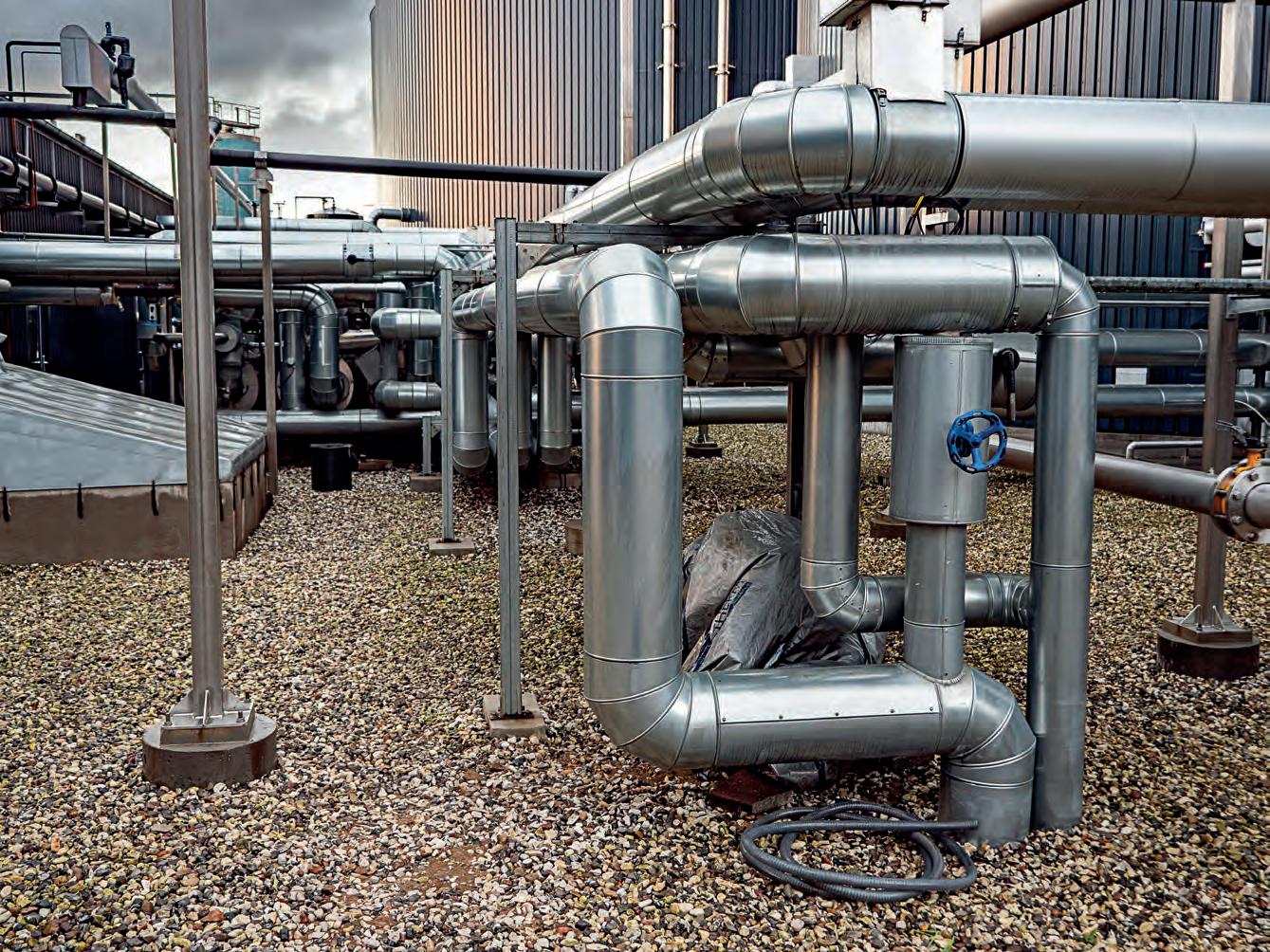
Madsen described Denmark’s circular achievements as visible not only in statistics but also in the built environment itself. One of the clearest examples is Copenhagen’s waste-to-energy plant, CopenHill, which supplies electricity and heating to 150,000 households while doubling as a public recreation site. With its 80-metre ski slope, hiking trail and Europe’s highest climbing wall, it has become a symbol of how sustainability and urban life can coexist.
“Municipalities in Denmark have become so
from neighbouring countries,” she said. “Denmark imports about a million tonnes of waste from the UK and Germany to run this plant. It’s right in the middle of Copenhagen, across from where our king

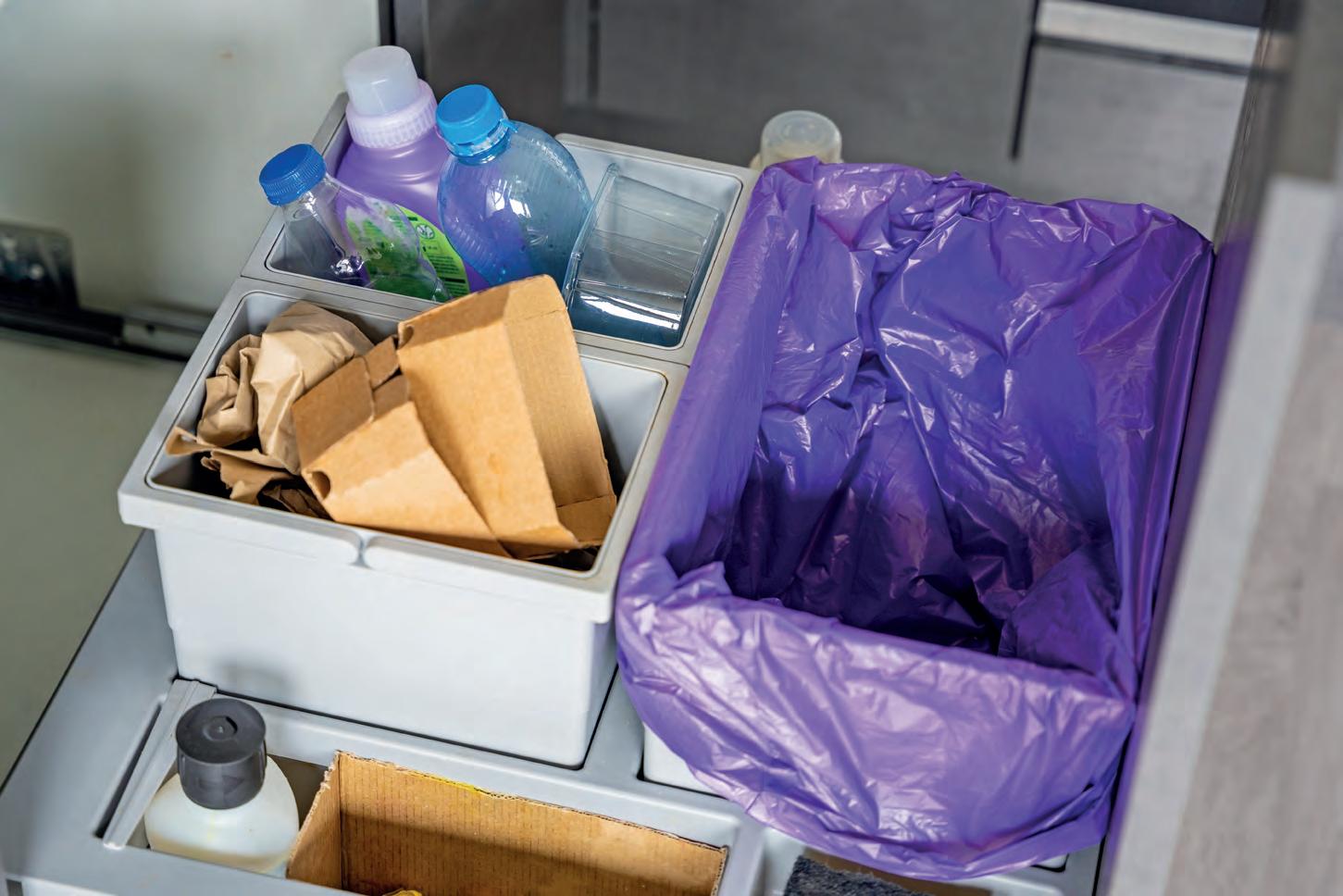
Sorting has become almost a national past time. Image: Tatiana Diuvbanova/ shutterstock.com
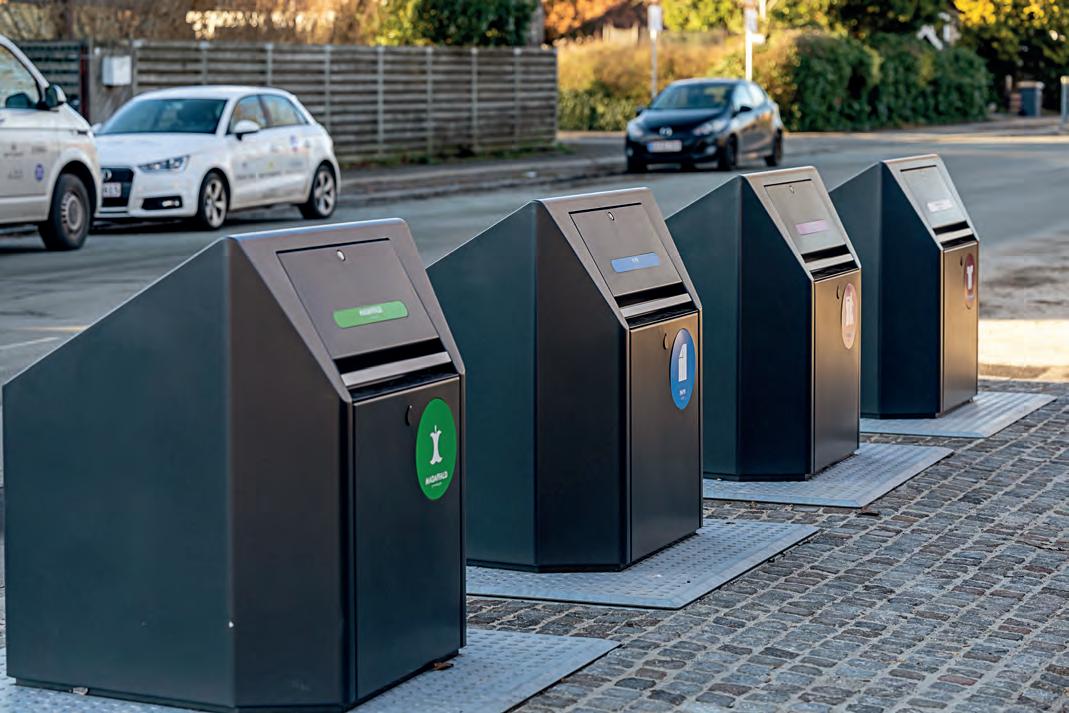
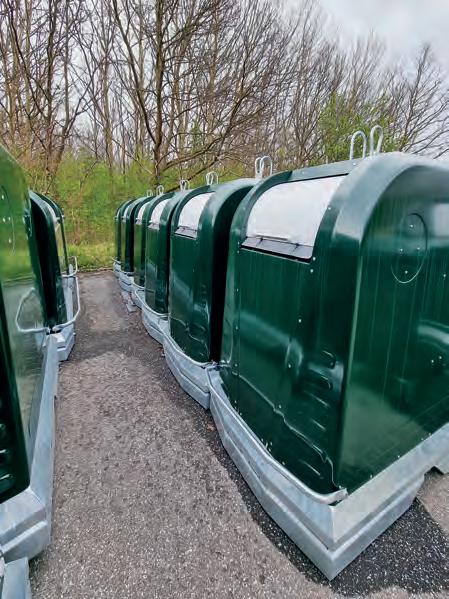
Green garbage recycling containers in Denmark. Image: dba87/shutterstock.com

and queen live. The confidence in terms of the safety and usefulness of this is quite broadly accepted.”
Another example, she said, is Avedøre Power Station, one of Denmark’s largest plants. It runs 100 per cent on sustainable biomass, and by 2026 it will capture biogenic CO₂ for storage in Norway and for use in methanol production.
Industrial symbiosis also plays a key role. Kalundborg Symbiosis is a partnership between 17 public and private companies in Kalundborg and is driving industrial decarbonisation.
It is focused on waste resources, energy efficiency and water management. The company’s waste gets reused elsewhere, and the integrated system has achieved a carbon-neutral local energy supply.
C ircularity is not limited to infrastructure. Madsen pointed to Sydney’s Quay Quarter Tower, designed by Danish firm 3XN, as an example of Danish circular design abroad.
“It’s the world’s first upcycled skyscraper,” she
said. “From the original building, 65 per cent of the existing structure and 95 per cent of its core were retained. That resulted in embodied carbon savings of 12,000 tonnes, which is the equivalent of 35,000 flights between Sydney and Melbourne.”
Collaboration across borders
Madsen said Denmark’s progress has been built on collaboration. Public/private partnerships have driven the green transition at every level, from municipal initiatives to national strategies. In 2019, the country launched 14 climate partnerships – one for each major sector – to co-design pathways toward its 70 per cent emissions reduction target for 2030. These partnerships generated more than 400 recommendations, forming the foundation for what is now the Green Tripartite Agreement.
“In Denmark, collaboration has really led the way,” she said. “The Green Tripartite Agreement is a political agreement between the Danish government, the agriculture industry and
environmental organisations. It includes the world’s first agricultural climate tax on livestock emissions and aims to reduce nitrogen pollution, restore peatlands and promote sustainable land use.”
Collaboration, she added, doesn’t stop at the borders of Denmark. She said that Denmark and Australia have a long-standing strategic partnership that grew stronger in 2023 when Prime Ministers Mette Frederiksen and Anthony Albanese signed a new agreement focusing on climate action and the green transition.
“There’s already a lot of good collaboration taking place within that partnership,” she said. “We’ve heard about the importance of partnerships in supporting circularity. Collaboration has really been what has pushed the green transition in Denmark.
“A circular economy requires all hands on deck –government, industry, environmental organisations and all of us – to push it forward, both nationally and internationally.”
Invest in the Best Tramp Metal Protection
With more than 80 years of magnetic expertise behind them, Eriez Suspended Electromagnets offer peace of mind, knowing your processes are protected against tramp metal. Eriez. Always the Right Choice.
Protect your downstream crushers, mills, and pulverizers from damage caused by stray digger teeth, tools, and other ferrous metals.
What a difference good EPR makes
(Continued from the Cover)
FOLLOWING IMPRESSIVE RESULTS in managing packaging, EPR and PROs are now being formed for other product categories. In Belgium, for example, there are accredited PROs for electronics, batteries, oil, tyres, mattresses, PV panels and end-of-life vehicles. The French were first in forming the first PRO in 2007 for clothing/footwear/linens, proving to other nations and the European Commission that positive action can be taken to wrangle this growing product category toward a more circular future.
These priority product categories are familiar to us in Australia as almost all sit on our Minister’s Priority List for the formation of a PRO to manage a scheme. We are now ready for the next steps.
What is good EPR, and an effective PRO?
Typically, a PRO starts with industry leaders banding together to voluntarily fund the formation of a scheme in partnership with the central government. Typically, within three to four years the central government has passed legislation requiring all related producers to follow suit and take responsibility by a) either joining a scheme or b) taking back their own packaging/product and providing same level of coverage and service.
Because there is no delay, these nations avoid the ‘zombie zone’ of limping ‘half-alive’ voluntary schemes that we have in Australia that must coax producers to stay for an indefinite period with ‘best as they can muster’ services. Timely and good legislation can also prevent formation of competing for-profit schemes that race to attract members with low levies, minimal services and progress.
Timely legislation and smart regulation provide clarity for producers, enables planning, PRO contracts and investments to be formed on services and processing for quality material for markets.
Across six months in Europe earlier this year, I met many PROs from across Europe and Canada, with most covering off on packaging while others were in electronic products and textiles. It was notable that not one country has voluntary schemes. It was useful to learn how, in such countries, PROs and regulators manage the thousands of liable producers who pay the levies and pursue those comparatively few who try to dodge taking responsibility.
The difference between our voluntary and their mandatory schemes was pronounced in the budgets, capacity and internal resourcing allocations. In
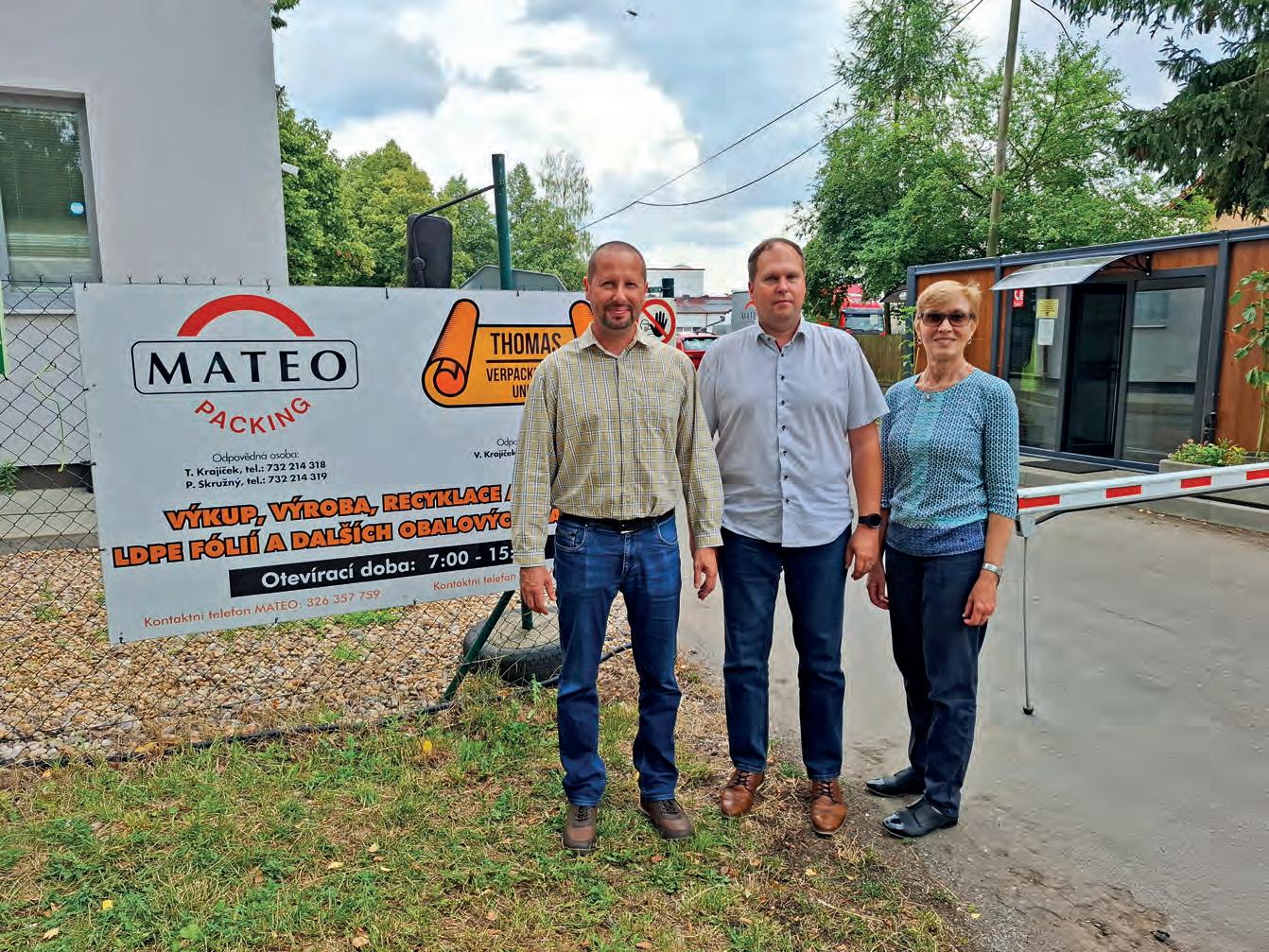
Helen Millcer (right) at the Mateo Packing processing facility, Czechia, with Tadeas Hnatek (left), Head of Logistics, Mateo Packing, and Pavel Jiracek, Secondary Raw Materials Manager at EkoKom PRO. Image: Helen Millicer





Belgium’s packaging PRO, Fost Plus, ‘free riders’ are only around 15 per cent of producers, meaning 85 per cent of producers financially contribute to coordination and investments. In Australia only 15 per
cent of producers have voluntarily signed up to Soft Plastics Stewardship Australia.
Representatives of governments, PROs and industry alike politely shrugged at our voluntary approach in Australia wondering how we see this as fair, socially and environmentally responsible, economically viable or useful. They offered to help.
Brits and Germans admit mistake
At conferences, I often heard Germans and Britons say they wished they had designed their schemes as not for profit instead of for-profit schemes, and single scheme not competing PROs. They admit others got it right (like the French, Dutch, Belgians, Spaniards and Czechs). In the heady days of 1990s neo-liberalism in Germany and England, it was thought competing and for-profit schemes would deliver lower costs and greater efficiencies for producers and public.
There have been studies into the comparative differences between schemes that vary in their services and levies between countries. However, the clearest evidence of the challenges of competing for-profit schemes is that both Germany and England are passing additional laws and installing an overarching special NFP reporting entity, like a data clearing declaration centre, to receive and reconcile confidential data on quantities and obligations from for-profit producers, recyclers and schemes. There are too many blind spots, likely gaming of systems and an inability for these nations to go to the next level in circularity. I was struck by the bureaucratic complexity and duplication of the systems in these two countries and the ramifications for producers and governments,
particularly when the alternative is a single NFP PRO that delivers a beneficial service under contractual agreement and in partnership with governments.
Good governance for success
During this visit to the EU, I was keen to understand governance structures and how governments and PROs engage. There are two models for government oversight of compliance; the regulator may be within a national government department, or a separate national entity.
In Czechia and Austria, the regulator is a national government department. In Norway, Estonia, and Denmark, all PROs are overseen by the national EPA. Spain and Poland use a national Registry. In Belgium, regulation is handled by the Interregional Packaging Commission, created soon after the country’s
EPR grew out of the European environmental movement in the 1980s to make real the principle of ‘polluter pays’ for negative externalities associated with products. It was understood that g overnments and taxpayers could not continue to carry all costs and responsibility, such as managing all collections and building recycling infrastructure. Governments, communities and leading companies agreed that a levy upon products sold could be held by a Producer Responsibility Organisation (PRO) and used to f und coordination of the supply chain, particularly collections and recycling in cooperation with local councils and businesses in providing households and industry access to expanded services.

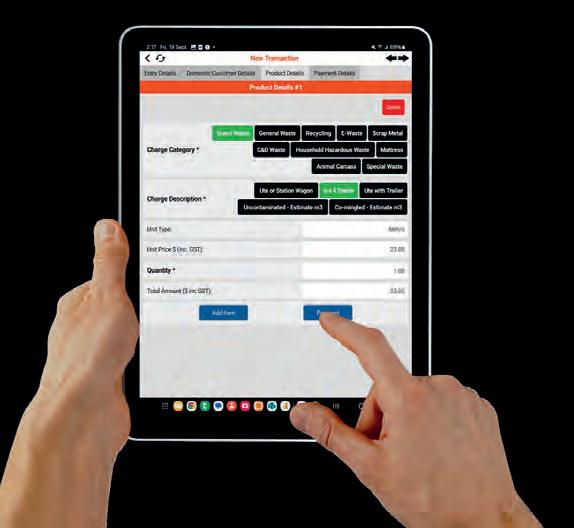
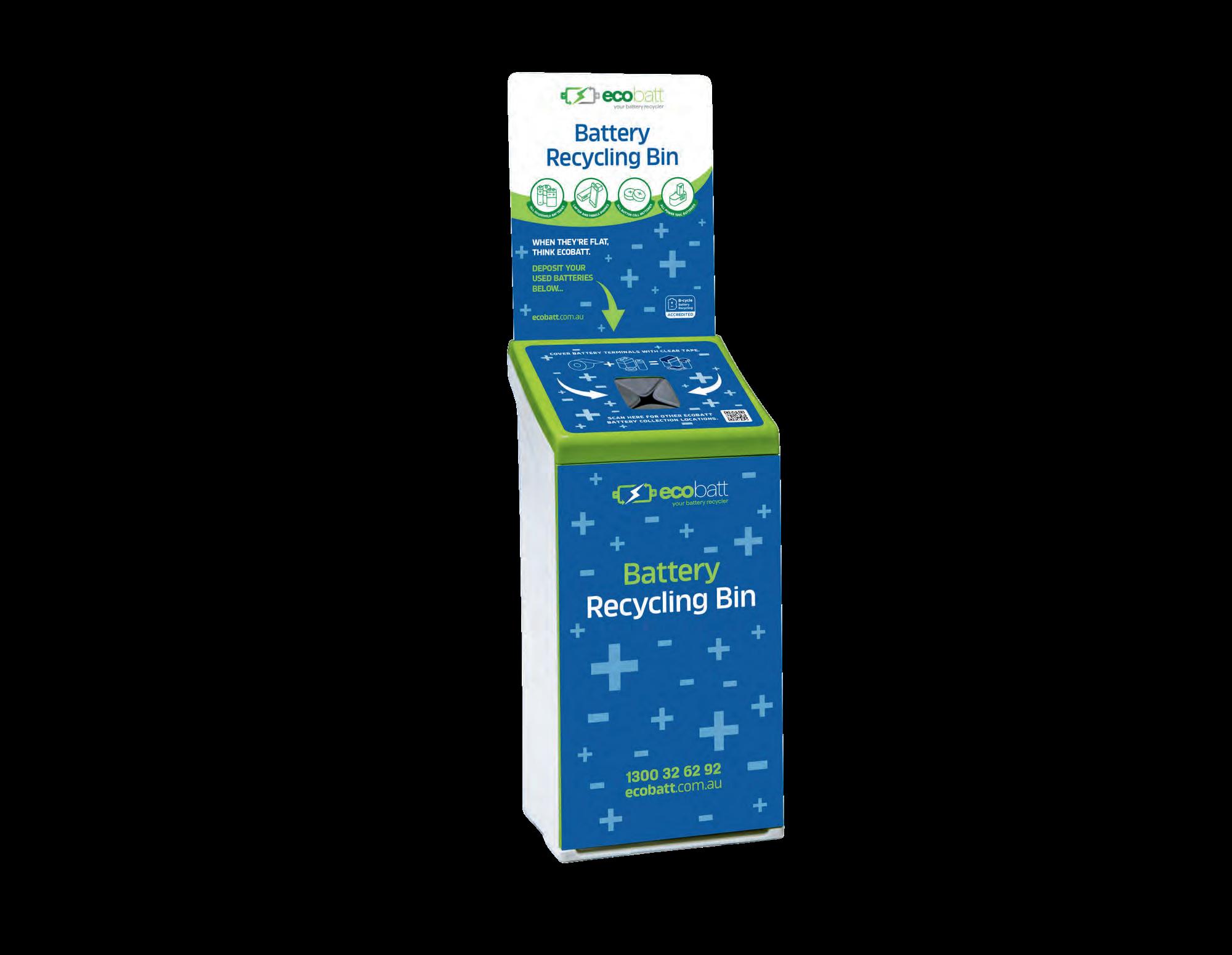


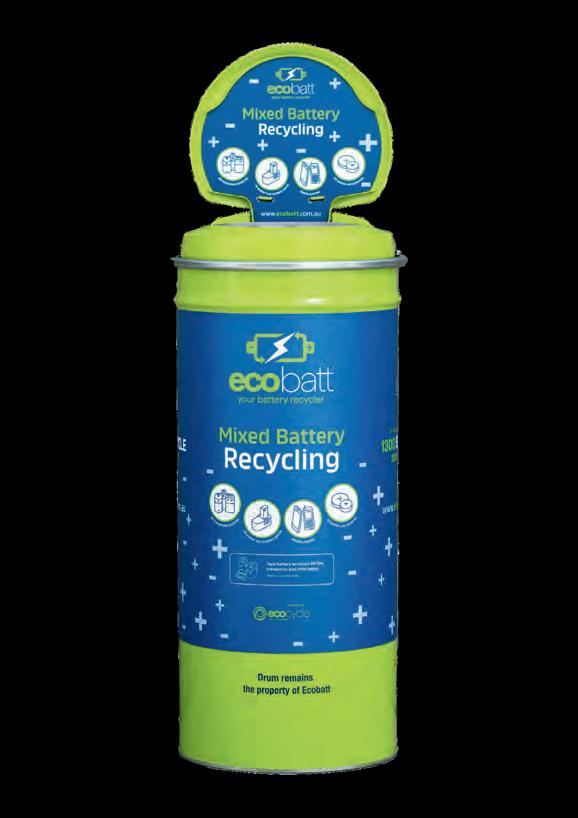
At EcoBatt, we are driving real change through our nationwide Battery Collection Service, which is designed to significantly reduce the number of batteries ending up in landfill. With over 7,000 collection units located across Australia in partnership with major retailers, we are making battery recycling more convenient and accessible than ever before.
Improper battery disposal can have serious consequences. From fires in waste trucks and landfill sites to toxic chemicals leaking into soil and waterways, the risks to our environment, wildlife and community health are far-reaching.
Recycling batteries correctly is a simple yet powerful way to protect what matters. By working together, we can create a cleaner, safer future and preserve valuable resources for generations to come.





packaging law and PRO. Its small expert team interprets policy and legislation, drafts and supervises agreements and the PRO, renews accreditation every five years, and pursues non-compliant producers.
The Commission ensures the PRO meets its Agreement obligations and requires that contracts with local authorities and service providers align with it. Like an EPA, it has a board representing Belgium’s three regional governments responsible for waste policy. Reflecting its importance and success, the Commission is now being restructured to receive responsibility for managing all other product PROs from government departments.
Given the federal structure of Australia, the number of ready schemes and evolving sophistication of their obligations and operations (eco-modulation, design assessment and supply chain contract management) Belgium’s Commission may be a good model for Australia, or it may be a role taken up by Australia’s national EPA. Australia already has examples of effective independent commissions/agencies like the ACCC, Clean Energy Regulator, for implementation of regulations and supervision of liable parties.
Next frontier – improving design of legislation, PROs and Products
Since their inception, European EPR and PROs have evolved more than their Australian counterparts. No one left me in any doubt that light-touch EPR legislation and NFP PROs, as opposed to prescribed legislation and for-profit PROs, has enabled practical government/industry collaboration on achieving progressively ambitious environmental and economic goals and plans.
While Australian schemes are either rigid or impoverished, Europe’s PROs are flexible and innovative. High-performing NFP PROs respond to evolving policies, product design, and markets,
IMPACT OF GOOD EPR AND PROS
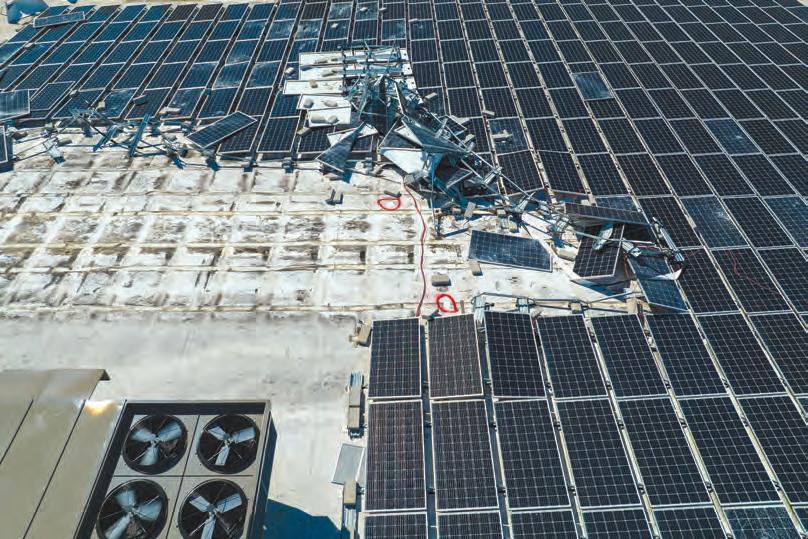
expanding scope as approved by governments. PROs can flex their levies and uphold their responsibilities; they consistently safeguard program/supply chain solvency while serving members and the public. Having being at the coal-face, seeing the impact of China Sword in 2018-19 on Victorian councils, businesses and communities, including costly government bailouts, I know that this flexibility for PROs to manage and balance the supply chain is essential.
Notably, it was only the NFP sole-national PROs that developed and introduced eco-modulated fee structures, because they had the backing and
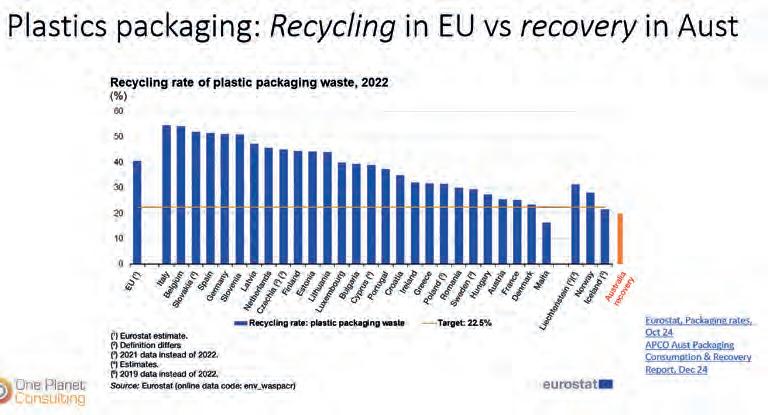
The impact of good EPR and PROs is perhaps best illustrated by this diagram on the recycling of plastic packaging. Over years, PROs in EU countries have methodically expanded collections, processing and enabled markets for recycled content. Their plastic packaging recycling rates are as high as 52 per cent, with quality secondary raw plastics sold into local and international markets. Australia, without a PRO and a regulator to manage compliance, has languished only collecting 19 per cent of plastic packaging.
flexibility of producers and governments. This has accelerated the race toward recyclable packaging in EU since 2018, and now their current focus is investing in supply chain collaboration for reusable packaging and incentivising recycled content.
Again, these innovations by NFP packaging PROs are being adopted by other product category PROs. During my stay in the Netherlands in May, the Dutch WEEE PRO CEO expressed interest in introducing eco-modulated levies to promote durable, repairable, and recyclable product design in the electronic good sector.
With such excellent EPR and PRO partnerships, governments can move decisively on key goals, and their populations gain more efficient and circular products.
Caution and encouragement
It’s important to end with a caution: advancing producer responsibility and a capable regulator in Australia will meet resistance, both from producers unwilling to pay levies and from waste operators prioritising market share over transparency or environmental outcomes.
This article sets out the roadmap for success; preparing businesses for a PRO-charged future, demonstrating benefits to new audiences, and urging governments and stakeholders to unite swiftly on reforms.
The way ahead
The path forward for Australia involves a suite of measures, from levies and bans to incentives, better carbon accounting and regulations. One of our largest underutilised levers is EPR and good PROs.
Helen Millicer, GAICD is a Churchill Fellow, CEO of One Planet Consulting and Board Director for Solving Plastic Waste CRC. She has written a report for the Australian Government on measures for eco-design of products, and advised on the formation of Soft Plastic Stewardship Australia since 2022.
Figure 1 Plastics packaging: Recycling in EU vs Recovery in Australia

From the CEO’s desk
Australia’s circular crossroads: progress, paralysis, and the power of regulation

Environment Ministers will meet for the second time this year on 7 December, following the first 2018 Meeting of Environment Ministers (MEM) in April, which was in part a response to the import restrictions driven by China’s National Sword Policy and the effects this policy has had across the Australian waste and resource recovery (WARR) industry. Key decisions derived from the April MEM
the transformation we need on their own. That’s why we need the other levers: policies that attract capital, build reprocessing plants, and create markets for remanufactured goods.
•Reducing waste generation, endorsing a target of 100% of Australian packaging being recyclable, compostable or reusable by 2025, and developing
• Increasing Australia’s domestic recycling capacity.
To make Australia’s WARR system work, regulation must ensure that what comes out of the bin goes somewhere productive — and back into circulation through products, packaging, and manufacturing here at home. That means mandatory recycled content requirements to create guaranteed demand for recovered materials; design standards and stewardship obligations in order that products are built for reuse and recovery from the start; and procurement rules that make recycled content the default, not the exception.
• Exploring opportunities to advance waste-to-energy and waste-to-biofuels.
•Updating the 2009 Waste Strategy by year end, which will include circular
It is time to take stock and examine what has been achieved since these decisions were announced. Now, seven (7) months may not seem like a long time, however in that time we have seen further markets close (Malaysia, Indonesia, Vietnam) and if you are an operator under continued financial stress, seven (7) months could
years yet on the waste and resource recovery calendar – arguably the most pivotal since China’s National Sword policy jolted 2018. Ironically, much of the busyness stems not from unbridled progress, but from the constant need to stop ourselves sliding backwards.
Let’s be frank: the last term of the Federal Government left the WARR industry disappointed and frustrated. The early rhetoric was strong; promises to regulate, to expand stewardship; and to fix the broken parts of the system that leave materials stranded onshore without markets. There was talk of stewardship schemes for packaging and textiles, eco-modulation to reward better design, and national regulatory consistency to attract investment. However, by the end of the term, most of that ambition had dissolved into silence. The promised regulations never materialised. Stewardship schemes were left hanging. Investment pipelines stalled.
Following the April MEM, we have had three (3) states step in with varying degrees of financial assistance for industry (councils and operators). This should be expected considering almost all states (except Queensland and Tasmania) have access to significant waste levy income each year. On the eastern seaboard, Victoria has approximately $600 million in waste levy reserves in the Sustainability Fund and NSW raises more than $700 million per annum from the waste levy. There is certainly no lack of funds that can be reinvested into our essential industry.
remanufacturing says the same thing: clarity and consistency matter.
industry however the Queensland Government has embarked on the development of a waste management strategy underpinned by a waste disposal levy to increase recycling and recovery and create new jobs. The State will re-introduce a $70/ tonne landfill levy in March 2019. There are also strong attempts to use policy levers (levy discounts and exemptions) to incentivise the use of recycled material and make it cost competitive with virgin material. However, little has been done establish new markets and Government has not taken the lead in the procurement of recycled material. There are grants available for resource recovery operations in Queensland although no monies have been allocated to assist in 2018. This troubling as Queensland rolled out its Container Refund Scheme on 1 November, which will likely impact the cost and revenue models of the State’s MRFs – as have seen most recently in NSW.
WESTERN AUSTRALIA
Doubling material circularity by 2035 in Australia will not happen by chance. It will happen when regulation, markets, and investment work together, and when governments show the courage to make the tough calls that create certainty and unlock the capital needed to build Australia’s recycling and reprocessing capacity. There is hope on the horizon. The Recycling and Waste Reduction (RAWR) Act 2020 review presents the Federal Government’s best opportunity in years to finally put these levers to work. Done properly, it could deliver the coherent national framework we have been calling for – one that links design, stewardship, and recovery in a unified system. It could unlock the regulatory certainty the supply chain needs to invest in reprocessing, remanufacturing, and advanced recycling.
Amid federal uncertainty, some states are leading the charge. New South Wales stands out, with the first chapter of its Waste and Circular Infrastructure Plan released in October 2025, regulatory frameworks for battery-powered items underway, an expansion of the CDS, a RIS to explore stewardship for PV panels, and regulations mandating the separation of organics by 2030 (MSW and some commercial and industrial premises too!). While a review of the waste levy is still needed, it’s heartening to see multiple levers being pulled by a reforming minister. NSW shows that the circular economy is not simply a theory, it’s a practical, job-creating reality when the rules are clear and direction consistent.
Funding helps but as we know, the money goes a much longer way with Government support and leadership, as well as appropriate policy levers.
VICTORIA
And inevitably, confidence wavered. When manufacturers and investors do not see the promised follow-through, why would they commit? When government procurement and policy fail to prioritise recycled content, orders for recovered materials dry up. The result is a circular economy in name only. As industry has said many times, Australia cannot recycle its way out of this challenge with goodwill alone.
SOUTH AUSTRALIA
We need rules that reward responsibility, regulation that drives design, and markets that pull recovered materials through the system.
COMMONWEALTH
However, time is ticking. The review has been slow, opaque, and worryingly quiet. With new export restrictions taking effect in mid-2026, we cannot afford drift. Without clear direction, Australia risks losing the gains made through the Recycling Modernisation Fund and the National Waste Policy Action Plan (NWPAP), which, while imperfect, at least got federal and state governments talking about waste and materials strategies in a way we had not seen for almost a decade.
Victoria has arguably been the most active and earnest in supporting the industry post-China, with two (2) relief packages announced to support the recycling industry, valued at a total of $37 million. The Victorian Government has also gone above and beyond all others states by announcing it would take a leadership role in creating market demand for recycled products.
Government announced a $12.4 million support package comprising $2 million of additional expenditure, $5 million additional funding for a loan scheme, together with targeted funding from the Green Industries SA budget. The Government has also offered grants for recycling infrastructure.
NEW SOUTH WALES
Like every other industry, WARR needs income, investment, and a clear regulatory framework to thrive. Levies play an important role in signalling that landfilling valuable materials should not be the cheapest option and that waste material has real economic value. But levies alone are blunt tools; they often sit far from those generating the waste and are unable to deliver
At first glance, New South Wales’ eye-watering $47 million recycling support package was heralded as the spark of hope industry needed. However, on closer inspection, the bulk of this package that was funded via the Waste Less, Recycle More initiative and therefore the waste levy, was not new, making it very difficult for stakeholders, including local government, to utilise the funds as they were already committed to other activities. Some of the criteria proposed by the NSW EPA also made it challenging for industry to apply to these grants. On the plus side, efforts are being made by the NSW Government to stimulate demand for
The Western Australian Government set up a Waste Taskforce in direct response the China National Sword. As part of this announcement, the State Government urged all local councils to begin the utilisation of a three (3)-bin system - red general waste, yellow for recyclables and green for organic waste - over the coming years to reduce contamination. While this taskforce is a step in the right direction, we are yet to see any tangible results from it or any funding for industry. In October, the WA Waste Authority released its draft Waste Strategy to 2030, which comprises a comprehensive and detailed roadmap towards the State’s shared vision becoming a sustainable, low-waste, circular economy.
Sadly, that level of leadership is not uniform. In Queensland, the Local Government Association’s (LGAQ) push to abolish the so-called “bin tax” is a backwards step. Rather than building on the existing framework to grow markets and processing capacity, it risks undermining the economic and environmental foundations of the system. What’s needed is not another political soundbite, but a coordinated policy that supports recycling and remanufacturing, especially in regional Australia. Without regulation to drive design and end-market demand, we are not creating circularity; we are simply moving waste around, sometimes literally across state borders. We wait to see if the impending Queensland Waste Strategy delivers this.
Following the MEM in April, Australia now has a new Federal Environment Minister, Melissa Price, who in October reiterated to media MEM’s commitment to explore waste to energy as part of the solution to the impacts of China’s National Sword, which is troubling (EfW is not a solution to recycling). The Commonwealth also backed the Australian Recycling Label and endorsed the National Packaging Targets developed by the Australian Packaging Covenant Organisation (APCO), which has to date, failed to incorporate industry feedback in the development of these targets. To the Commonwealth’s credit, there has been significant coordination in reviewing the National Waste Policy, with the Department Environment bringing together industry players and States during the review process.
While it appears that the NWPAP has been placed on the backburner, the reality is that we already have a forum capable of driving real change across Australia: the Heads of EPA (HEPA). In many ways, this group does not need to wait for Canberra given the majority of regulation occurs at the state level. HEPA can and should be making a tangible difference by aligning standards across jurisdictions and addressing long-standing regulatory gaps that block investment.
AHEAD OF MEM 2
So… will 2026 become the defining year for Australia’s circular economy? Hopefully if we get clear air after the reforms to the Environment Protection and Biodiversity Conservation Act 1999, the Federal Government must follow through with regulatory action. We already have the levers, the industry capability, and the public support. To truly shift the dial, Australia must deliver a strong RAWR Act review with enforceable stewardship and design obligations; mandate recycled content and eco-design standards to drive demand; empower HEPA to deliver national regulatory consistency; and support investment in remanufacturing, not just collection and sorting.

The updated Policy will now go before Environment Ministers on 7 December. Commonwealth can play a key role – one that goes beyond the development of National Waste Policy. WMAA is supportive of the Federal Government maximising the levers it has, including taxation and importation powers, to maintain a strong, sustainable waste and resource recovery industry.
Take organics, for instance. Australia has a national target to halve organics to landfill by 2030, yet we still lack consistent national standards for testing, sampling, or contamination limits. These inconsistencies add risk, delay investment, and stifle progress. The same applies to emerging contaminants like PFAS, where coordinated national guidance remains elusive. HEPA could show genuine leadership by setting nationally consistent standards that reduce uncertainty and support investment. Every investor in recycling and
There may be movement across Australia, with some states doing better than others, but the consensus is, progress is still taking way too long. It is evident that there are funds available in almost all States to assist with developing secondary manufacturing infrastructure, however the only way that this will really happen if there is government leadership around mandating recycled content in Australia now, not later.
If we want jobs, investment, and materials that stay in circulation, we need a policy ecosystem that values both sides of the equation – recovery and reuse, supply and demand, collection and creation. Australia doesn’t lack ambition. What we lack is regulatory courage. We already know what works: clear standards, enforceable schemes, strong procurement, and stable markets. The countries that lead in circularity don’t rely on voluntary measures or good intentions, they regulate for success.
The circular economy is not a slogan. It’s a system. And systems need structure.
Let’s stop circling the same conversations and start building the framework that will keep materials, and our industry, in motion.
Voluntary schemes like the Used Packaging NEPM, under which APCO is auspiced, are not working. We have 1.6million tonnes of packaging waste in Australia, which needs to be used as an input back into packaging. Barriers to using recycled content in civil infrastructure must be identified and removed, and Government must lead in this field and prefer and purchase recycled material. A tax on virgin material should also be imposed as it is overseas. MEM must show strong leadership on issue. Ministers have, since April, dealt directly with operators and councils that are under stress and we have a chance to create jobs and investment in Australia
development increase
$70/ policy material done to procurement operations
This is November, we response to Government for coming direction, October, comprises vision of Minister, explore Sword, has Packaging (APCO), development significant Department of review
The the maximising strong, than that secondary happen is Australia auspiced, which content lead material this that Australia
MegaTrans is Australia’s largest logistics conference and exhibition, uniting industry leaders and cutting-edge technology to drive a smarter, more sustainable supply chain. Be
Towards a cleaner waste to energy future
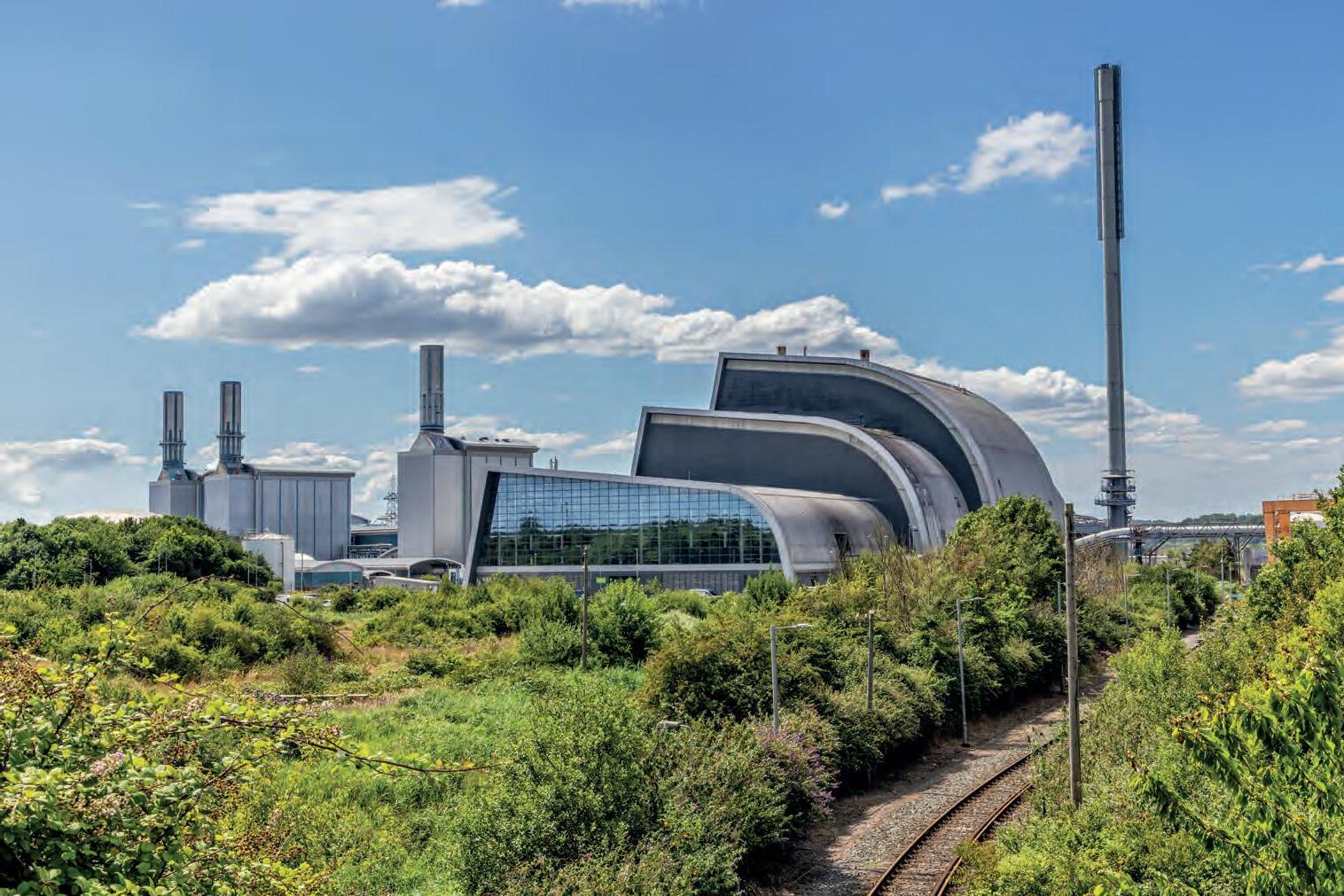
ASHLEIGH JONES , Director of Regulation and Oversight at Recycling Victoria, recently spoke at the Waste Expo Australia held in Melbourne, about the state’s progress and future direction under its waste to energy scheme. Addressing delegates, she reflected on the transformation that had taken place over the past year. When she last presented, the cap licensing process had not even begun. Now, the first round of licences has been issued, marking a milestone in Victoria’s journey towards a circular economy.
Part of her team’s responsibilities includes leading the cap licensing process, overseeing service standards for household waste and recycling, and managing the broader regulation and operations functions within Recycling Victoria. Jones said it was encouraging to see how far the program had advanced, even though there was still a long journey ahead.
“It is incredible to think that when I last stood here, we were still preparing to launch the cap licensing process,” she said. “A year later, we’ve issued our first licences, and the scheme is now operational. That represents a real step forward in how we manage residual waste in Victoria.”
The role of waste to energy in a circular economy
Jones explained that waste to energy occupies a critical place within Victoria’s transition to a circular economy. Its purpose, she said, is to extract the last possible value from resources that would otherwise be sent to landfill. This complements the state’s other circular economy initiatives, which focus on waste reduction, reuse and recycling.
“In a circular economy, our goal is to use materials as efficiently as possible and to reduce the overall material footprint,” she said. “We want to make sure we’re reusing, repairing and recycling wherever we can. Waste to energy is about what happens to that
small portion of waste that can’t be recovered any other way.”
Jones said the process not only creates energy but also recovers valuable materials such as aggregates and metals. By capturing these and avoiding landfill, waste to energy provides environmental benefits and supports a cleaner, more resource-efficient system.
She described the technology as proven, with strong regulatory oversight and less off-site impacts such as odour when compared to landfills. The need for such facilities, she said, was becoming increasingly urgent. Victoria’s landfills are running out of capacity, and constraints are expected to appear from the mid-2030s. Without investment in the process, the state would need to plan for new landfill capacity far sooner than desired.
“Waste to energy sits right at the end of the waste hierarchy,” Jones said. “It ensures we’re making full use of materials before final disposal, and it helps us manage residual waste in a responsible and efficient way.”
Planning for future capacity
Turning to projections, Jones discussed the findings from the Victorian Recycling Infrastructure Plan, launched at the previous Waste Expo. The plan assessed the state’s waste infrastructure needs and future demand. She said Victoria currently has around 150 million square metres of available landfill airspace with planning and EPA approvals in place. Although this might sound extensive, it is a limited and finite resource that will be depleted over time.
By 2053, Victoria is expected to generate around nine million tonnes of residual waste each year. This estimate takes into account population growth and the expected impact of reforms designed to reduce and recover more waste. Based on this analysis, landfill throughput capacity is likely to begin running
out in the mid-2030s. Jones explained that as existing landfills reach capacity and begin to close, waste will need to be diverted either to other landfills or to alternative facilities such as waste to energy plants.
She noted that reforms to recycling will certainly help, but they alone will not solve the problem.
“We can’t afford to wait,” she said. “The lead time on these projects is long, and we need facilities ready before our existing landfills reach capacity.”
A regulated and transparent scheme
Jones explained that the waste to energy scheme was created under the Circular Economy Act to ensure that the technology plays its proper role in Victoria’s circular economy. The scheme is designed to prevent waste to energy investment from undermining recycling and recovery efforts, while still reducing pressure on landfills. It also supports the state’s broader goal of diverting 80 per cent of waste from landfill.
The scheme operates by setting a cap on the amount and type of waste that can be treated through thermal processes each year. This cap is managed through a competitive licensing process, ensuring the market remains diverse, fair and transparent. Initially, the cap was set at two million tonnes. After a public consultation and a regulatory impact assessment, it was increased to 2.5 million tonnes in July, allowing Recycling Victoria to allocate licences.
Jones said this figure was based on long-term waste forecasts and represented a balance between diverting sufficient waste from landfill and avoiding over-investment in waste to energy. The increase also reflected the Victorian Government’s support for sustainable infrastructure investment. To process waste within that 2.5-million-tonne limit, proponents are required to obtain a cap licence from Recycling Victoria.
Waste to energy technology has strong government oversight.
Image: John Corry/shutterstock.com
She said Recycling Victoria’s role under the Circular Economy Act encompasses three main areas: licensing, oversight and strategic planning. Her team licenses both existing operators and new projects that have received cap allocations. It also provides ongoing oversight of licence holders, ensuring compliance with licence conditions and verifying that facilities process only the permitted types and quantities of waste.
Jones explained that Recycling Victoria works closely with regulatory partners such as the Environment Protection Authority and planning authorities. These agencies continue to assess projects for human health, environmental protection and local planning considerations. Recycling Victoria’s oversight therefore complements rather than replaces other regulators’ roles, ensuring the sector operates transparently and in the best interests of the state.
Building a sustainable and accountable industry
Recycling Victoria has now completed both stages of the licensing process. The first covered existing operators with EPA or planning approvals before November 2021. Jones noted that one such facility is already operating, and is processing paper and cardboard to improve energy efficiency and manage contaminants. The second phase was the competitive cap licensing process, open to both new and existing operators.
She described the assessment as rigorous and detailed. The licences issued reflect a balance between proven technologies and more innovative projects,
licensed facility demonstrated that it would achieve a net reduction in greenhouse gas emissions compared with landfill and fossil fuel alternatives over the life of the facility.
Jones said the projects collectively represent about $8 billion in infrastructure investment and are expected to recover around $50 million of materials each year that would otherwise be lost to landfill. They will also create an estimated 2,500 construction jobs and 650 ongoing roles.
“For most proponents, the journey is only
are central to Victoria’s long-term sustainability.”
She concluded by noting that Recycling Victoria’s oversight will continue as projects progress. Licence holders must meet milestones and operational deadlines, and her team will engage with industry, government and communities to ensure the successful establishment of facilities. Timely delivery of waste to energy infrastructure, she said, is critical to achieving Victoria’s circular economy ambitions and to ensuring a sustainable waste management system for decades to come.




Designing finance to enable circular transition
FINANCE PLAYS A CRUCIAL ROLE in enabling the transition to a circular economy, but so does thoughtful design. At a recent seminar, a panel explored how well-conceived projects and initiatives can gain support from financial institutions by prioritising sustainability. Even the most innovative designs require funding, robust business models, and economic incentives to achieve scale.
The discussion began with Dr Simran Talwar, programme lead for resource stewardship and research director at the University of Technology Sydney. She argued that the path to circularity cannot be added at the end of a process but must be present from the beginning.
“If you want a product to be reused, if you want it to be dismantled or recycled, you have to think about that in the first sketches,” she said.

Talwar stressed the significance of repairability, the use of non-hazardous materials, and designing for disassembly as building blocks of a system that can adapt to the challenges of limited resources. The framing of design as a discipline that anticipates change, rather than reacts to it, created a foundation for the conversation. Talwar pointed out that businesses that ignore these principles face higher risks in the long term. The costs of waste disposal, the liabilities of hazardous substances, and the challenges of customer demand for greener products all accumulate when design is shortsighted.
David Simmons, executive director of sustainable finance at ANZ Bank, followed by emphasising the scale of his institution’s commitment.
“We’ve set ourselves the goal of funding $100 billion worth of social and environmental activities by 2030, and we’re already at $60 billion,” he said.
His comment underlined the appetite in finance for projects that align with sustainability but also revealed that banks are selective. According
to Simmons, strong design principles that make products and systems durable and adaptable increase investor confidence.
Jo-ann Kellock, chief executive officer of the Design Institute of Australia, placed the conversation in the context of the challenges faced by smaller players. She believes that for small businesses the ideas are there, but the finance is not. Too often the language of design doesn’t match the language of banking. Her comment illustrated the barrier between creative thinking and financial assessment.
Kellock noted that banks often look for certainty in terms of revenue streams and return on investment, while designers talk about creativity, innovation, and user experience. Without translation between these worlds, many projects stall. She stressed the need for design institutes to help bridge that gap by showing how circular design is not only environmentally sound but also economically rational.
Talwar returned to the theme by highlighting how investors look for predictability – something that design can provide if implemented correctly.
“If a product is built to be repaired, its useful life is longer. That means less risk for investors,” she said.
Her point illustrated the intersection of design and finance: when design extends a product’s life, financial models benefit from reduced exposure to sudden obsolescence.
The ANZ Bank has set itself the goal of funding $100 billion worth of social and environmental activities by 2030. Image: ArDanMe/Shutterstock
Industry schemes to drive systemic change
Danielle Kent, general manager for industry transformation at Seamless, Australia’s national clothing stewardship scheme, offered an example of how these ideas translate into practical action. She described the clothing stewardship scheme introduced by her organisation.
“Every garment is levied at four cents, but if it is eco-designed, the levy drops to three cents,” she explained. “This structure creates a direct incentive for manufacturers to consider sustainability at the design stage.”
Kent expanded on how the levy accumulates across the industry to create a pool of resources that can be invested in recycling infrastructure, education, and industry reform. She argued that the scheme is an example of how small changes, when scaled, can lead to transformation. By attaching a financial signal to design decisions, the scheme pushes businesses towards circularity without relying on voluntary goodwill alone. Simmons agreed that this type of scheme is appealing to financiers.
“When you can show us a predictable revenue stream linked to sustainability, that is something we want to back,” he said.
His endorsement made clear that finance is ready to support initiatives that combine strong design, collective industry action, and reliable economic models.
Kent also spoke about the consumer perspective. She noted that the levy builds awareness among shoppers, who begin to see sustainability not as an optional premium but as an integrated part of the cost of clothing. She felt that the industry should start normalising sustainable choices, explaining that when eco-design is rewarded, it reshapes the market baseline.
Policy frameworks and government direction
The conversation turned to the role of policy and regulation. Simmons drew attention to the Australian Government’s sustainable finance roadmap and how being clear on expectations was important to getting the necessary outcome.
“Policy clarity is vital. Without it, investors fall back into short-term decisions,” he said. “For banks and large institutions, knowing that government policy is aligned with sustainability goals reduces uncertainty and encourages long-term commitments.”
Talwar urged that design must be a central part of policy, not an afterthought. She stated that if regulation only focuses on finance and ignores design, Australia will miss the point. Circularity starts with design. She reinforced the idea that rules and incentives should not only direct money but also guide how products and systems are conceived in the first place.
Kellock added that for small- and medium-sized businesses, interpreting new policies is particularly difficult. A large company has sustainability staff to track regulation, smaller firms do not. They need guidance that is practical and clear, she said. Her comment reflected the reality that unless policy is translated into accessible frameworks, many enterprises will be left behind.
Kent highlighted the way stewardship schemes can

“We are no longer only looking at credit risk. We have to assess climate risk, sustainability risk, and reputational risk.”
complement government action. By standardising industry practice, such schemes create a bridge between regulatory expectations and business operations. She emphasised that collaboration across sectors is essential.
“No single business can make circularity viable. It needs alignment between government, finance, and industry,” she said.
Risk, transparency and reporting obligations
Risk management formed another major theme. Simmons described how financial institutions are changing the way they assess businesses.
“We are no longer only looking at credit risk,” he said. “We have to assess climate risk, sustainability risk, and reputational risk.”
This evolution requires businesses to present clearer data on how they manage sustainability challenges. Without such transparency, financing becomes much harder to secure.
Talwar pointed out that many of these risks are shaped by design decisions. She stated if hazardous materials are chosen, a company must be aware of the regulatory risk associated with those materials. If they design without thinking about disassembly, they carry disposal risk. She believes that design is risk management. Her comment positioned designers as not just creative professionals but as key actors in safeguarding financial stability.
Kellock acknowledged that for many designers and small enterprises, the growing complexity of reporting is overwhelming.
“We hear from members who simply don’t have the resources to meet elaborate reporting requirements,” she said. “We need simplified mechanisms that will allow broader participation in sustainable finance without imposing disproportionate burdens on smaller businesses.”
Kent explained that stewardship schemes can relieve some of this pressure. By pooling responsibility across an industry, reporting can be standardised and simplified. She said that collective approaches make accountability possible. Without them, transparency
becomes another barrier to entry. Her argument showed how collaboration not only generates funds but also eases compliance, creating a more level playing field.
Building viable circular business models
As the discussion drew towards its conclusion, attention turned to what is ultimately required for circular models to succeed. Simmons was clear: “Finance is ready to support these models, but the business case must be strong. Sustainability alone is not enough. We need to see profitability and resilience.” His words emphasised that while there is appetite for change, investors demand evidence of long-term stability.
Talwar argued that design leadership is non-negotiable. “Only when design leads can we achieve outcomes that finance wants to support,” she said. She reiterated that circularity has to be built into the DNA of products and systems, not added as an afterthought. Kellock reflected on the importance of communication.
“Designers must be able to tell financiers why their work matters in economic term,” she said. “If we only talk about creativity and not about cost and durability, projects will be overlooked.”
Her point emphasised that dialogue between disciplines is essential for progress.
Kent closed the session with a call for collaboration.
“No one sector can achieve this alone,”she said. “Circularity needs the combined effort of design, finance, policy, and industry.”
She pointed again to the clothing stewardship scheme as a practical model, demonstrating how collective action can reshape an industry.
The discussion showed that finance and design, often seen as separate worlds, are in fact interdependent. When aligned, they can transform the way businesses operate and accelerate the transition to a circular economy. The challenge is not only to secure funding but also to ensure that design principles, policy frameworks, and business models all point in the same direction. Only then can circularity move from aspiration to reality.
Sydney landfill crisis in pictures
By Mike Ritchie
SYDNEY LANDFILLS ARE FILLING very fast. We are heading for not just a problem but a real disposal crisis. Just imagine the state of the economy and public health if we could not collect and dispose of household and commercial waste. Hopefully you are getting pictures of Naples during the strikes in your heads –piles of rubbish, rats and other vermin, public health outbreaks and social discord.
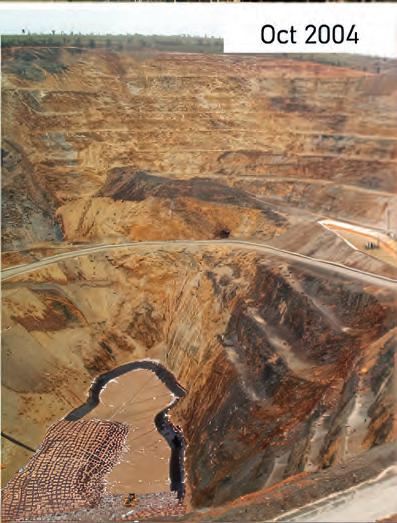
The NSW EPA has predicted that all putrescible landfills (which take wet waste including food) will be full by 2036 and inert landfills (taking dry waste) by 2028 i.e. much sooner.
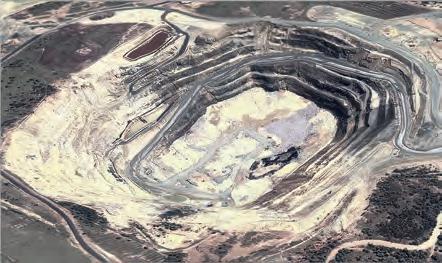
I put together these image collections using MRA’s own photos and images from Google Earth.
Putrescible landfills
Woodlawn and Lucas Heights are the key, large putrescible landfills servicing Sydney. The Woodlawn landfill near Goulburn is operated by Veolia. It takes one million tonnes per year of mainly putrescible (wet) waste. It is pretty obvious that Woodlawn only has 5 or so years left in it. Lucas Heights landfill in Sutherland Sydney is operated by Cleanaway. It takes about 1.2 million tonnes per year. Again, mainly putrescible waste. Industry has been calling for years for action to preserve this valuable landfill space but government(s) of both persuasions, have been very slow to act.
Images on right - Lucas Heights landfill 2013-2017. All images: Google Earth/MRA Consulting Group
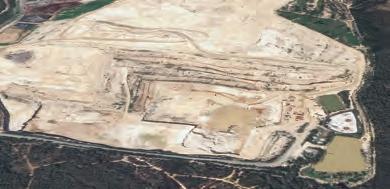
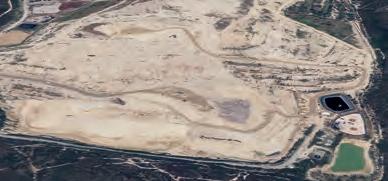
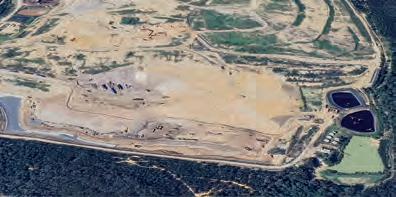

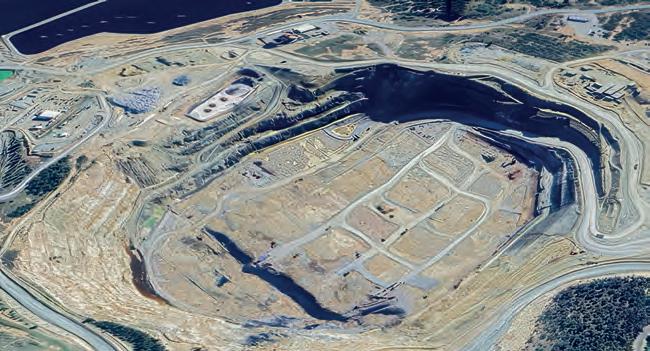
Woodlawn Landfill 2004
Woodlawn Landfill (this image) 2018 and 2024 (below).
Woodlawn Landfill 2011
Inert Landfills
Our inert landfills are filling even faster. The Genesis landfill in Eastern Creek Sydney, operated by Bingo takes about one million tonnes per year of inert waste including contaminated soils and construction waste that cannot be recycled.
There are a handful of other smaller inert landfills, but they are all filling quickly and some will close in the next few years. These include:
• W anless at Clifton Rd Western Sydney.
• B reen at Kurnell.
• V eolia at Kemps Creek.
• K imbriki at the Northern Beaches.
It is astounding that a city as sophisticated as Sydney is so vulnerable to economic disruption as a result of decisions, or lack of decisions, with respect to waste. It is irresponsible.
The government has announced four energy from waste precincts but only two have live planning applications.
Neither are approved and both have significant community opposition.
Even if both were approved tomorrow, they would take about five years to build and w ould account for only 0.8 million tonnes/year between them.
We have a big problem, and government needs to stop dawdling. It has current reviews into the landfill levy, planning approvals for waste, the energy from waste policy, the definitions of waste, the national waste targets and the kerbside recycling system. None have been published or finalised.
The key measures which government must enact tomorrow, include:
1. H igher real landfill levies to drive materials to recycling rather than landfill.
2. H ypothecated (guaranteed and allocated) expenditure of those levy funds to recycling infrastructure.
3. S peedier approvals of recycling facilities.
4. B ans to landfill or mandated recycling. On this point I need to congratulate NSW Minster for the Environment Penny Sharpe on mandating commercial and residential food collection by 2026 and 2030 respectively.
5. S tronger Product Stewardship making manufacturers responsible for the take-back of their products. Again, plaudits for the NSW battery stewardship proposals and Container Deposits. But it is not enough.
These initiatives work but we are running out of time.
We will have a shortfall of at least 1-2 million tonnes/year by about 2030. Note that it takes 4-8 years to get waste infrastructure such as l andfills and energy from waste plants approved in NSW. NSW Premier Chris Minns and Minister Sharpe need our political support to get it done. Urgently.
Mike Ritchie is the managing director of MRA Consulting Group, as well as a former Sessional Commissioner for the New South Wales Land and Environment Court.
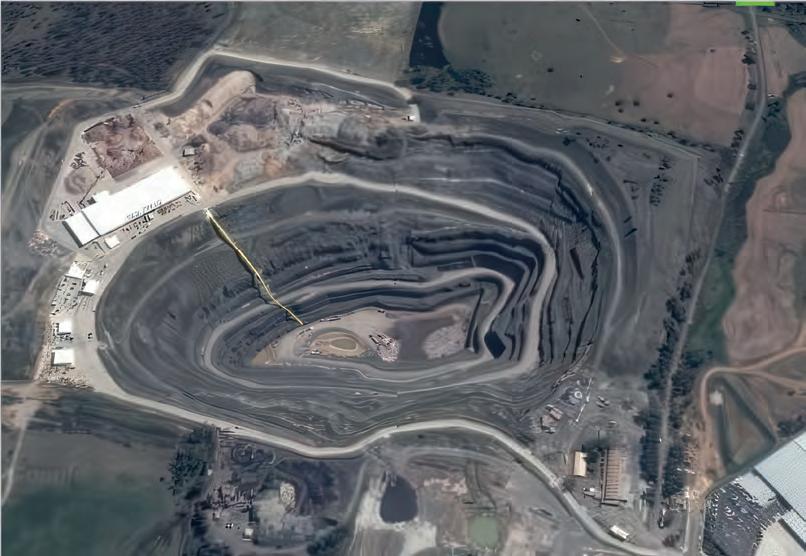
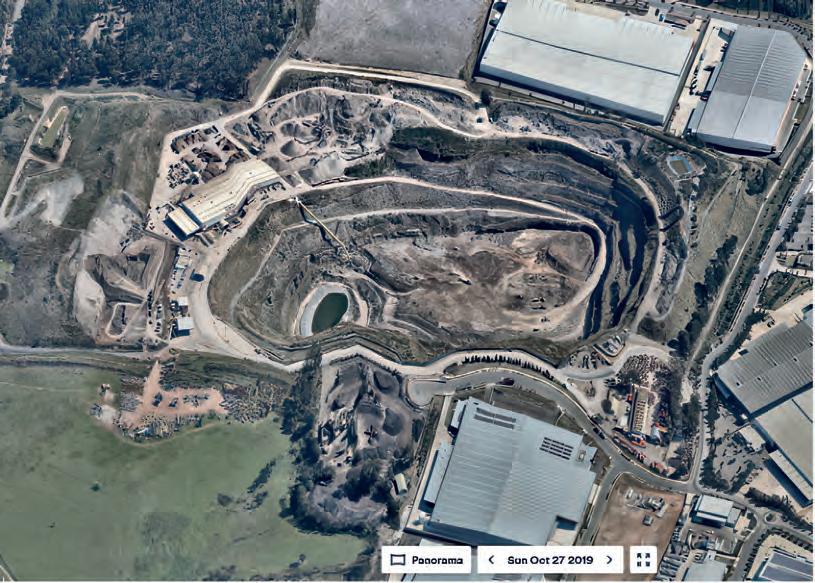
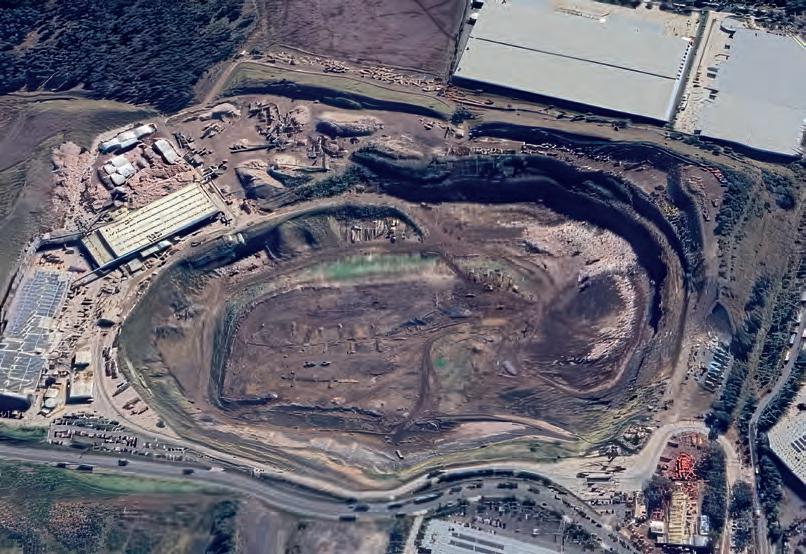
Images right: Genesis Landfill from 2013-2017.
Changing minds while shaping sustainable procurement
AT A TIME WHEN LOCAL GOVERNMENTS are being asked to lead the transition to low-carbon, circular systems, the challenge of behaviour change has become central to how sustainable procurement is carried out. During a panel discussion at a recent resource recovery event, three experts shared their views on what drives – and hinders – progress. The participants were Esther Landells, senior policy officer at Local Government NSW; James McGregor, director of consulting firm Blue Tribe; and Lara Barclay, managing director of Adaptation Environmental Support.
Landells began by acknowledging the depth of the challenge noting that trying to change behaviours is hard work. She said that councils face barriers beyond goodwill such as limited resources, conflicting priorities, and deeply ingrained habits across procurement systems. There are a lot of competing demands.
“It’s not that people don’t want to do the right thing, it’s that they often don’t have the time, the knowledge, or the incentive to change the way they’ve always done things,” she said.
Within local government, Landells explained, procurement is as much about risk management as it is about sustainability. Officers are expected to meet compliance, budget, and political expectations all at once. She believes that risk aversion is a big part of the equation. People are worried about making
That sense of risk can stall progress even when sustainable options exist. Councils may want to buy recycled materials or low-carbon products, but fear of untested suppliers, or the perception of higher costs, can hold them back. Telling someone they must change for the sake of it will carry little or no weight, she said. Councils and other bodies involved in the waste and resource recovery industry need to understand why people behave the way they do and support them through it, or give them levers to want to change.
Understanding the science behind decisions
McGregor picked up on that theme by arguing that behaviour change must be treated as a science, not a slogan. He thinks governments and other agencies tend to believe if they give people information, they’ll make better decisions. That’s not how human beings work, he said. His background in behavioural economics has shown him that people rarely act rationally, even when they know what’s right. Instead, he said, decisions need to be based on social norms, emotional cues, and what we see other people doing. In other words, telling procurement teams to buy recycled content isn’t enough, they need to see evidence that others are already doing it successfully. Social proof is a powerful tool, he said. If you can show that another council is buying those products and
as saying ‘well done’ – these are concrete rewards that reinforce behaviour,” he said. “We can’t assume logic will win. We must make sustainable behaviour the easier, more rewarding, more normal choice.”
In his view, leadership is also crucial. He believes people look to leaders for cues about what matters. When senior managers visibly support sustainable procurement and acknowledge its successes, that signal ripples through the organisation. He said that culture changes when people see what gets praised and what gets funded.
Building engagement through access and trust
Barclay brought the discussion to life with an example from the community level. Her organisation, Adaptation Environmental Support runs the Recycle Mate program, which is designed to reduce contamination in household recycling and improve resource recovery. The program rests on five pillars: awareness, access, knowledge, support, and trust.
“Awareness is about helping people understand why it matters,” Barclay said. “Access is ensuring they can actually do it — that the infrastructure and systems are in place for all household waste streams. Knowledge means providing the right information at the right time, while support and trust come from consistent engagement, feedback and

She emphasised that rebuilding trust is especially important in communities that have seen mixed messages or system failures in the past. If people have been told for years that recycling is going to landfill, it takes time to rebuild their confidence, she stated. Her approach combines education with visible proof of results; showing residents where their recyclables go and how they are used. Her mantra is that transparency builds belief and belief drives behaviour.
The program’s success, Barclay said, comes from meeting people where they are rather than expecting instant change.
“We tailor our communication to different audiences – households, schools, businesses –because each group has different motivations,” she said. “You can’t talk to everyone the same way.”
From intent to action
As the panel reflected on what unites these experiences, a shared message emerged: behaviour change is not a single event but a process. Landells said that while policy frameworks set direction, real progress happens when systems, leadership, and culture align. She believes it’s about embedding sustainability into everyday decisions, something that doesn’t happen overnight. She argued that councils need to be realistic about capacity.
“We’re often asked to do more with less,” she said. “Collaboration becomes essential. Partnerships between councils, suppliers, and state agencies can pool resources and share learning. We don’t all have to reinvent the wheel.”
McGregor agreed, adding that collaboration also amplifies social proof. He believes that when councils work together, it changes the story. It shows this isn’t a fringe idea, it’s mainstream. He encouraged local governments to highlight their successes publicly and make case studies visible. The more examples that are highlights of what works, the faster the shift will spread.
When senior managers visibly support sustainable procurement and acknowledge its successes, that signal ripples through the organisation.”
For Barclay, the key is to stay focused on the human side of systems change.
“Procurement, recycling, resource recovery, they all come down to people,” she said. “If we can design programs that respect how people think and feel, we can make sustainability part of normal behaviour.”
Barclay also warned against seeing behaviour change as purely educational. Information alone doesn’t transform habits, she said. Conditions need to be created for people to act differently. Barriers need to be removed to encourage progress, make it easy, and celebrate progress. Her experience with community engagement showed that small wins often lead to larger ones.
Leadership, learning and lasting impact By the close of the session, the panel’s focus had shifted from theory to leadership. Landells spoke about the political realities of local government. She pointed out that elected officials have different priorities. It is up to industry to bring them along the journey by showing how sustainability aligns with community values and financial responsibility. When councillors see environmental procurement as good governance, not just good ethics, they are more likely to support it.
McGregor returned to the importance of framing.
“We should stop talking about sustainability as a cost,” he said. “Frame it as value; risk reduction, innovation, long-term savings. If we keep saying it’s expensive, people will believe it’s expensive. If we show it’s smart, they’ll believe that instead.”
Barclay added that leadership is not confined to formal titles. She said that everyone has
influence, w hether they’re a procurement officer or a community educator, those in the industry can model the behaviour they want to see. She described leadership as “contagious” – when one person acts with conviction, it encourages others to follow.
The discussion closed on a note of cautious optimism. Landells said she had seen a growing appetite within councils to align procurement with environmental goals.
“There’s a real desire to get this right,” she said. “We just need to support people with the tools, the data, and the permission to try new things.”
McGregor agreed. “Behaviour change isn’t mysterious,” he said. “It’s predictable. If we apply what we know about human psychology, we can design systems that make sustainable choices feel like the default.”
Barclay added the final word: “Change happens when people feel capable, connected and trust the system. If we can build those things, the rest follows.”
Across their different perspectives, Landells, McGregor and Barclay painted a coherent picture of what it takes to shift behaviour in sustainable procurement. The barriers are real with limited resources, risk aversion, and political pressures at the fore, but they are not insurmountable. Behavioural science, tailored engagement, and visible leadership can turn intention into action.
The conversation ended where it began: on the human element. Systems, policies and procurement frameworks matter, but change only takes root when people believe it can. As Barclay put it, “trust drives behaviour”.
Innovations headline awards night
THE WINNERS OF THE 2025 Waste Innovation and Recycling Awards (WIRA) were announced at a gala event held at the Melbourne Arts Centre. Innovators and go-getters came together to celebrate the resource recovery/waste industry’s highachievers. Congratulations to all the finalists and winners.
Winners:
Operational Excellence:
Tomra Cleanaway
TOMRA Cleanaway, led by CEO James Dorney, operates container deposit schemes across NSW, Victoria, and Tasmania. Since 2017, the team has returned over 14.6 billion containers, reducing litter and avoiding an estimated 1.5 million tonnes of CO₂. Recognised as a 2025 AFR Sustainability Leader, TOMRA Cleanaway uses advanced sorting technology, digital innovation, and community partnerships to transform recycling, with more than 1,000 collection points and nearly $86 million raised for charities.
Community Engagement Award
Sponsored by VISY
Surf Coast Council – Be a Good Sort campaign
Be a Good Sort: Know Your Bins initiative featuring a four-part video series that shows the journey of recycling, FOGO, glass, and general waste from home bins to their final destinations. The series highlights advanced sorting technology and the importance of correct bin use at home. By educating the community, the program reduces landfill waste, protects the environment, and keeps resources in use, contributing to Surf Coast Shire’s 71 per cent landfill diversion rate and promoting sustainable waste management practices.

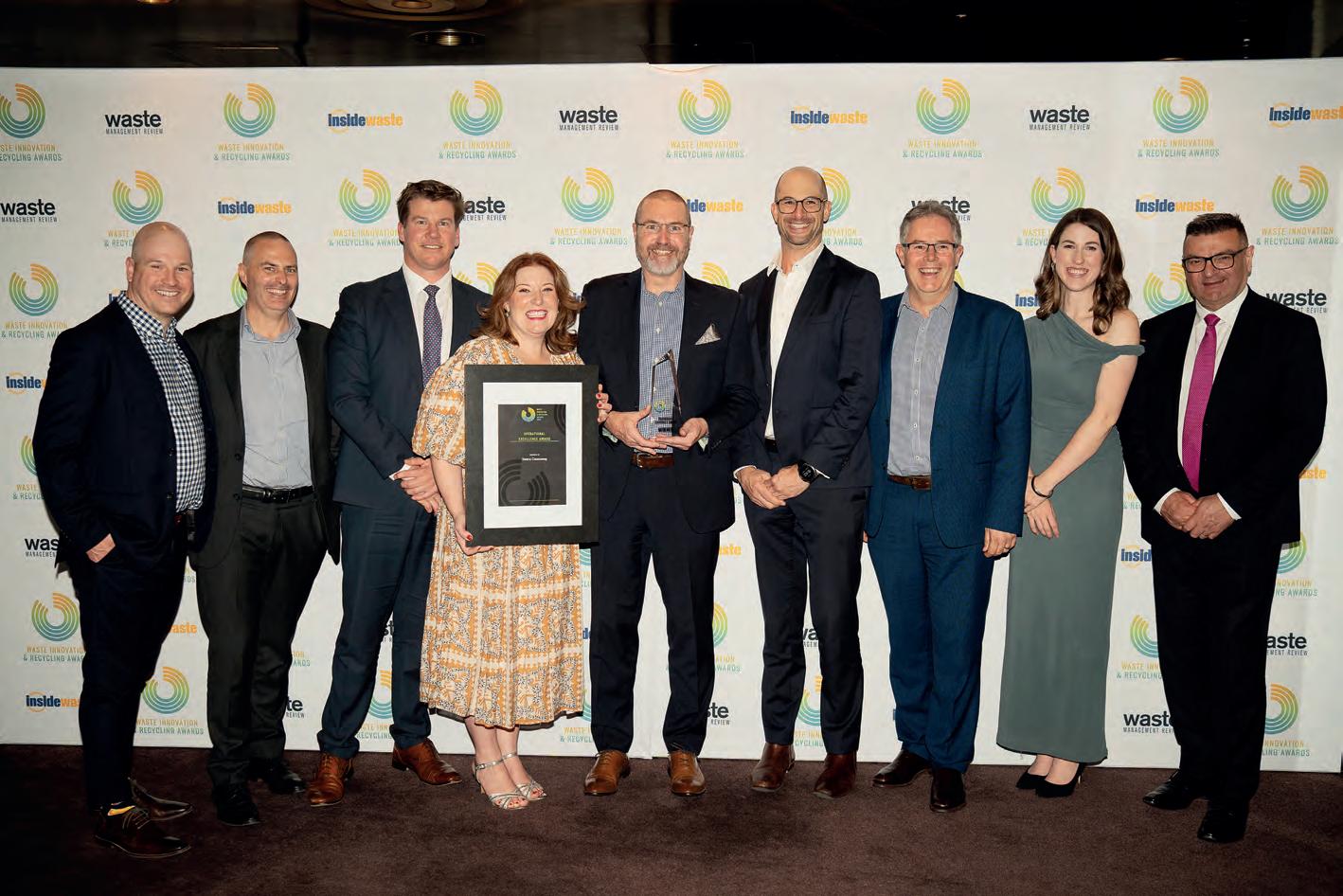
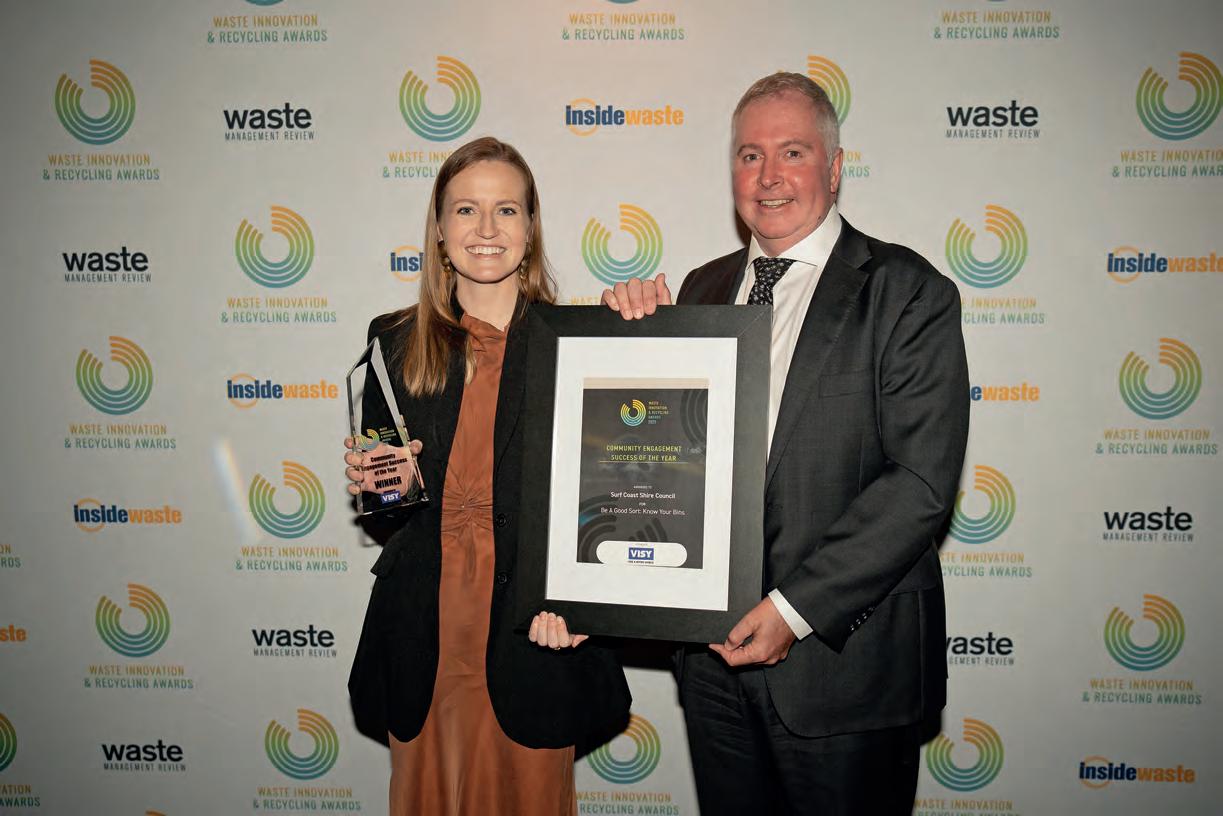

TOMRA Cleanaway won for Operational Excellence.
Surf Coast Council won Best Community Engagement.
Young Professional of the Year
Sponsored by REMONDIS Australia
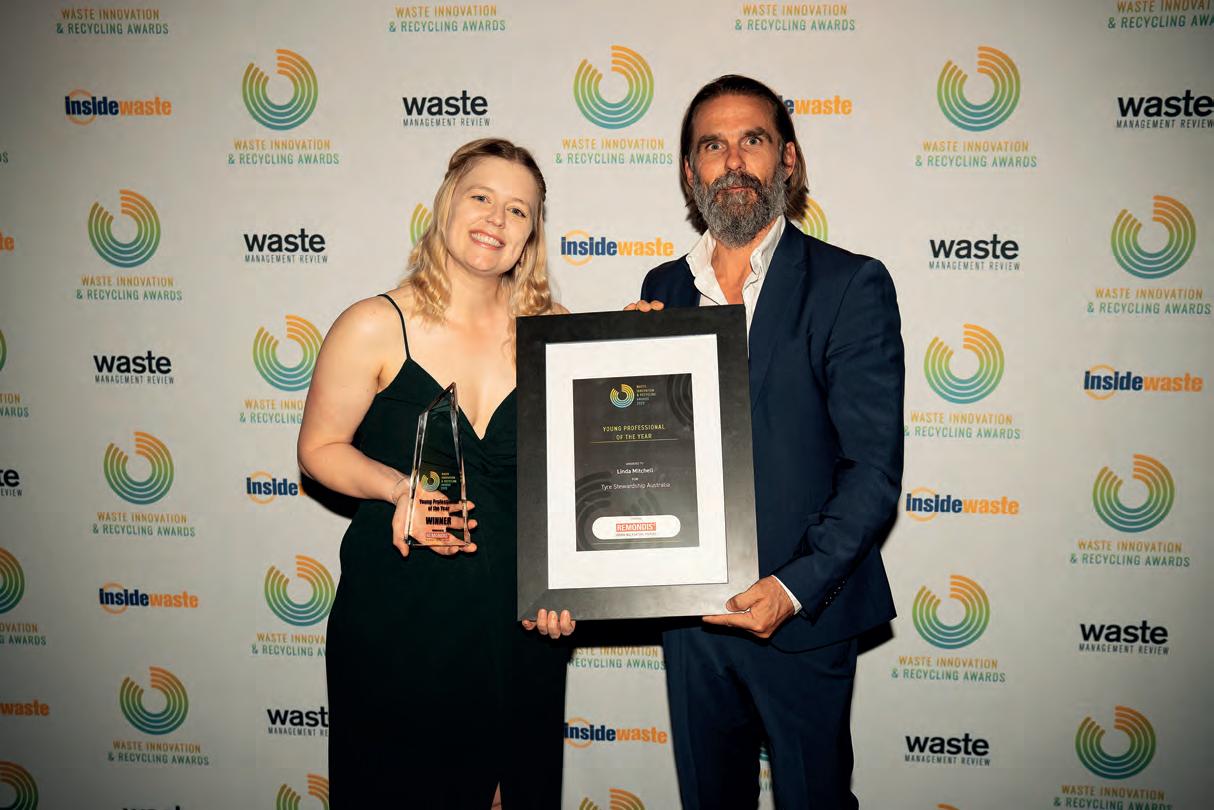
Dr Linda Mitchell – Tyre Stewardship Australia
Dr Linda Mitchell is the Science, Research and Innovation manager at Tyre Stewardship Australia and a nationally respected advocate for circular economy leadership. With a PhD in chemistry and a Westpac Future Leaders Scholarship under her belt, Mitchell is known for her ability to translate complex environmental science into practical, scalable solutions. Her work has reshaped national approaches to carbon accounting, product stewardship, and procurement standards, while amplifying the voice of science in public and policy discourse. She is a passionate communicator, mentor and role model — making technical pathways more accessible to women in STEM and the broader resource recovery sector.
Outstanding WARR Project: Regional Award Contained Waste Solutions and Gunnedah Shire Council
The Gunnedah Waste Management Facility in north-western New South Wales transformed its operations by implementing an LBin Waste Transfer Station. Previously, the public deposited waste directly at the landfill, creating safety and compliance challenges. Traditional waste transfer systems proved costly and underperformed in key areas. The LBin solution addressed these issues effectively, delivering safe, compliant operations.
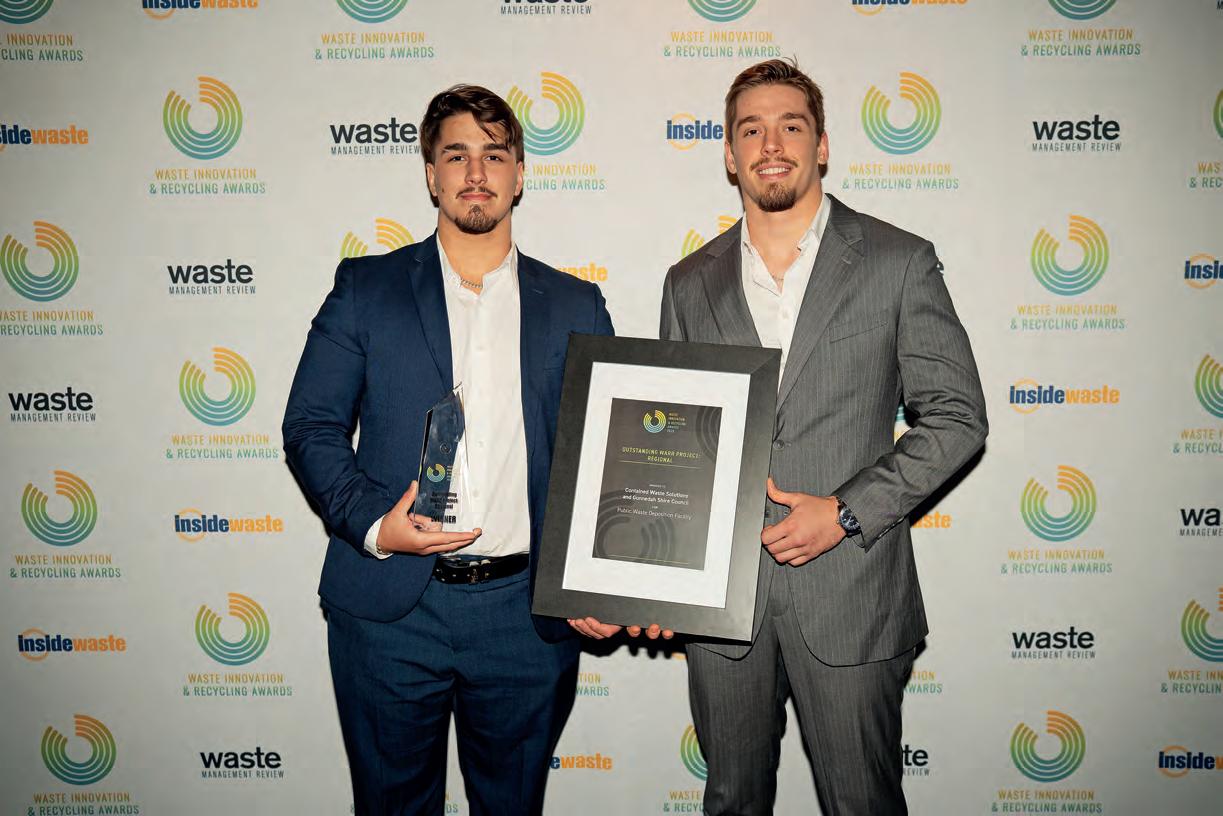
The team from Contained Waste Solutions -Tobias (l) and Elliott Lacey (absent Jason Lacey).
The TSA’s Dr Linda Mitchell (l).
Resource recovery, sorted.
REMONDIS Australia helps 24,000 commercial, industrial and government customers meet their waste reduction, recycling and circular economy ambitions.
Our Integrated and Managed Services division is Australia’s largest environmental managed services provider, partnering with our peers to deliver innovative solutions for large organisations, national product stewardship schemes and major infrastructure projects.
We rise to the challenge of complex waste streams and ambitious resource recovery goals, and we have the scale and expertise to make a difference. Best of all, we love what we do.
End-to-end waste management
_ Commercial waste management
_ Resource recovery logistics and processing
_ Organics logistics and compost production
_ Hazardous, chemical and liquid wastes
_ Remote projects, mining, oil and gas
_ Product stewardship schemes
_ De-packaging and product destruction
T 13 73 73
remondis-australia.com.au
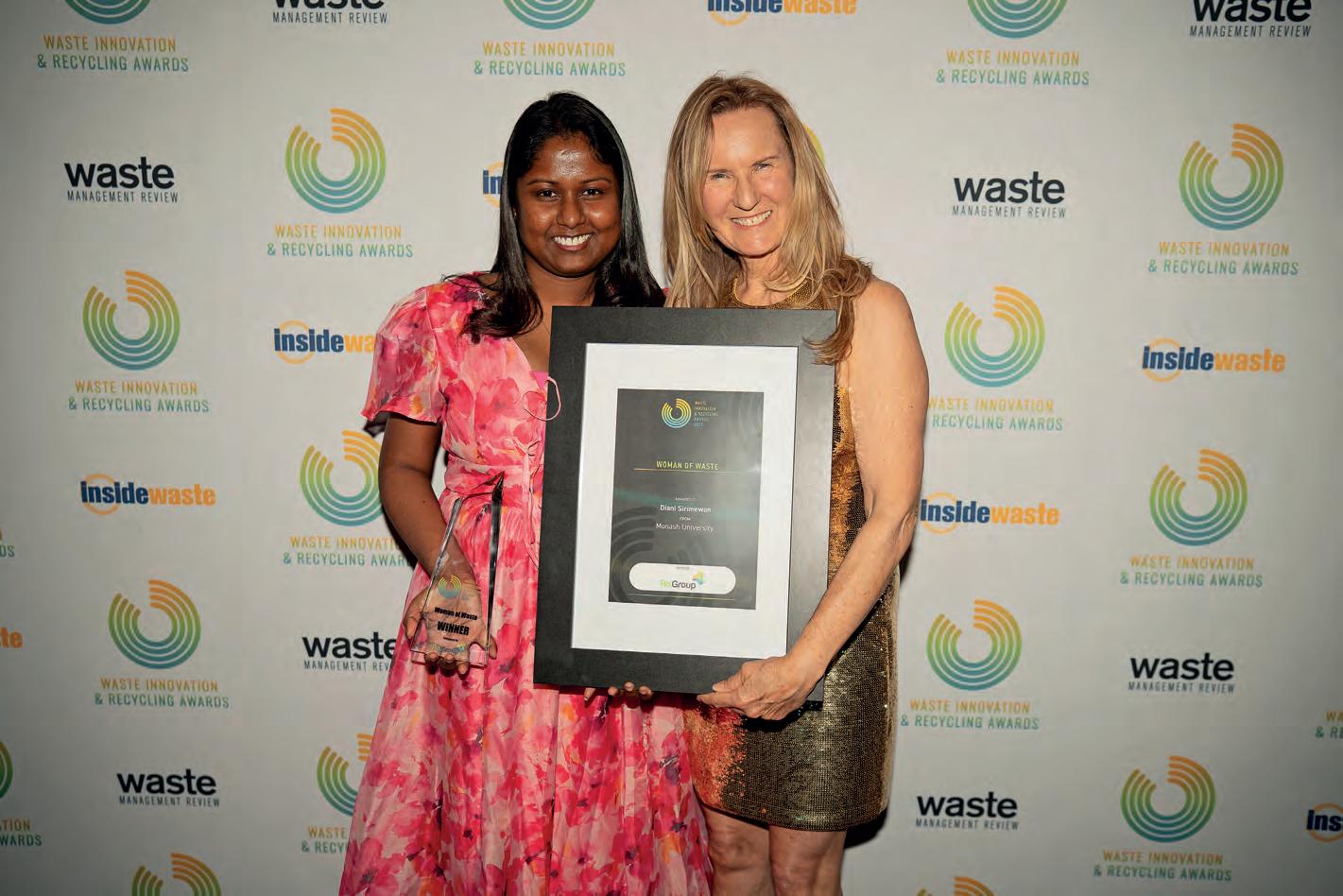

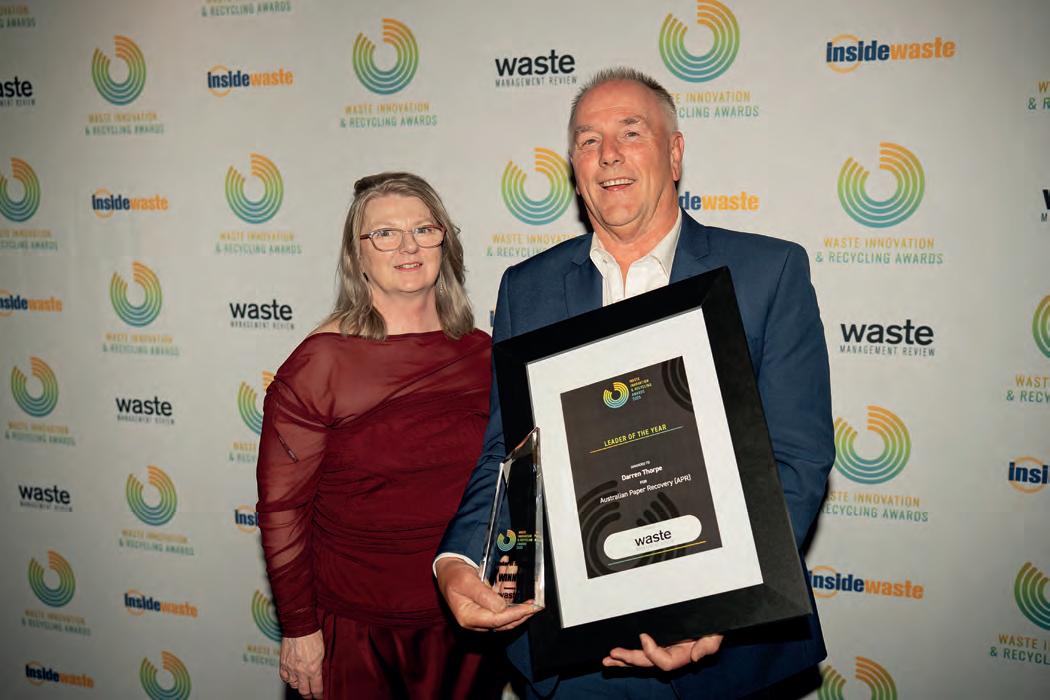
whose work bridges advanced artificial intelligence with sustainable construction and demolition waste management. She completed her PhD at Monash University, where she developed AI-driven computer vision frameworks to optimise waste recognition and handling in material recovery facilities. Her leadership has delivered the first publicly available dataset for C&D in skip bins and novel models such as WasteXtract, featured in industry journals and media. Beyond research, Sirimewan mentors future engineers, collaborates with industry partners, and advocates for circular economy practices, inspiring the next generation of women to lead in waste innovation.
Leader of the Year
Darren Thorpe – Australian Paper Recovery
Darren Thorpe is the founder and managing director of Australian Paper Recovery (APR), a business built through grit, determination, and a drive to innovate the recycling industry. Since starting APR as a one-man operation in 2002, Thorpe has grown it into a leader in resource recovery, employing more than 85 staff and servicing more than 3,000 customers. His forward-thinking approach has helped evolve the industry, most recently through APR ChemCycle, a pioneering soft plastics recycling initiative. Thorpe continues to push for practical, scalable solutions to reduce waste and support Australia’s shift to a circular economy.
Dr Diani Sirimewan (l).
Waste Management Review Editor Lisa Korycki (l) and Darren Thorpe from Australian Paper Recovery.
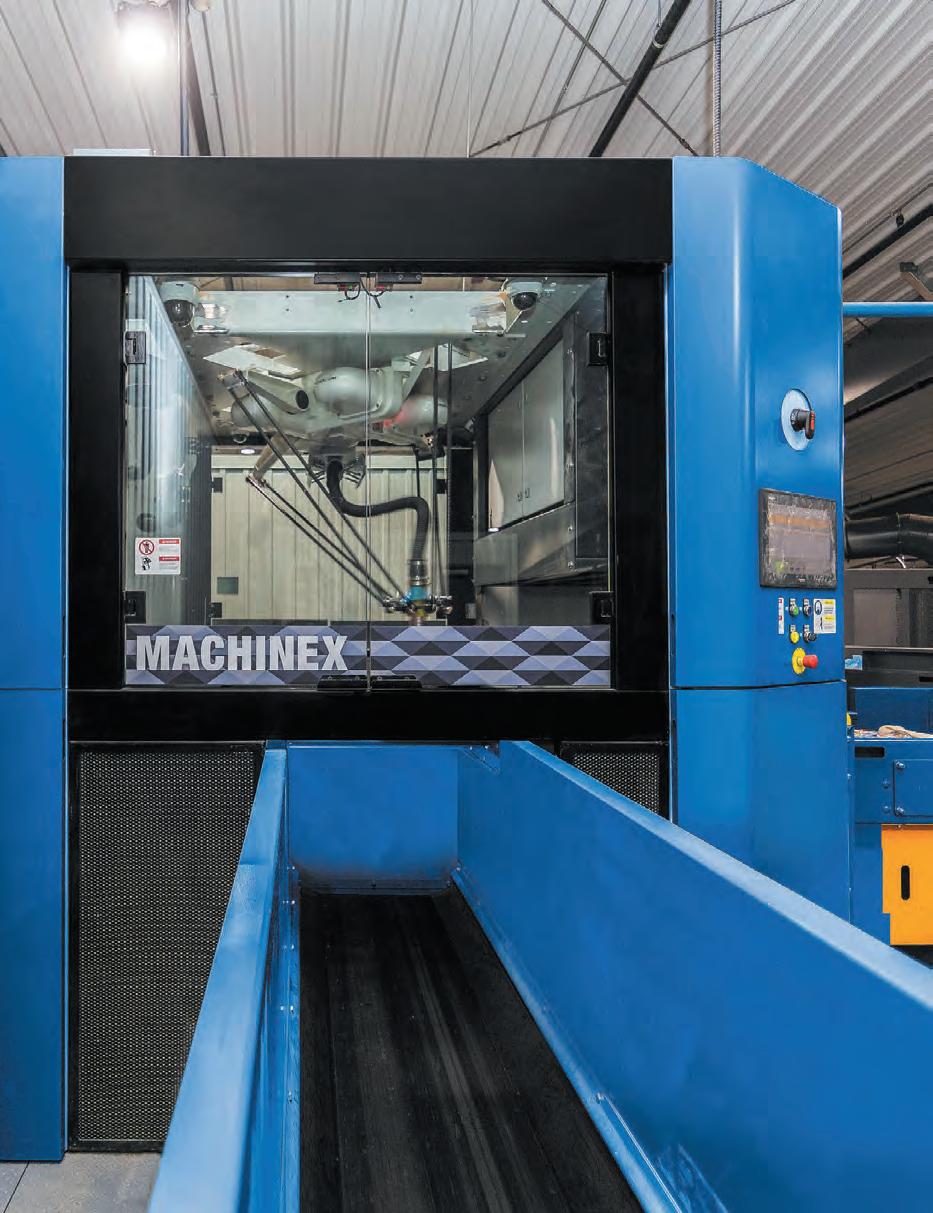
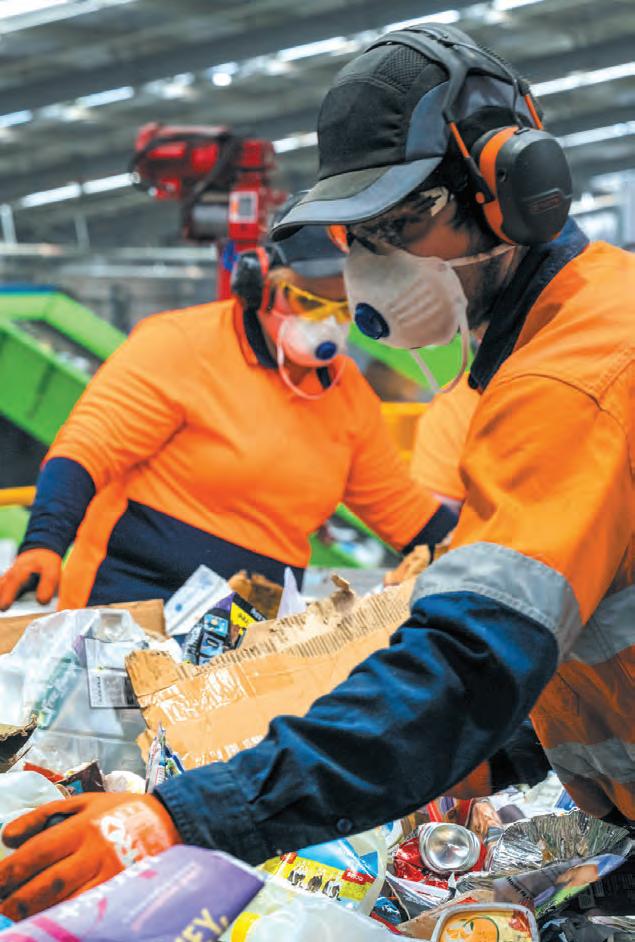
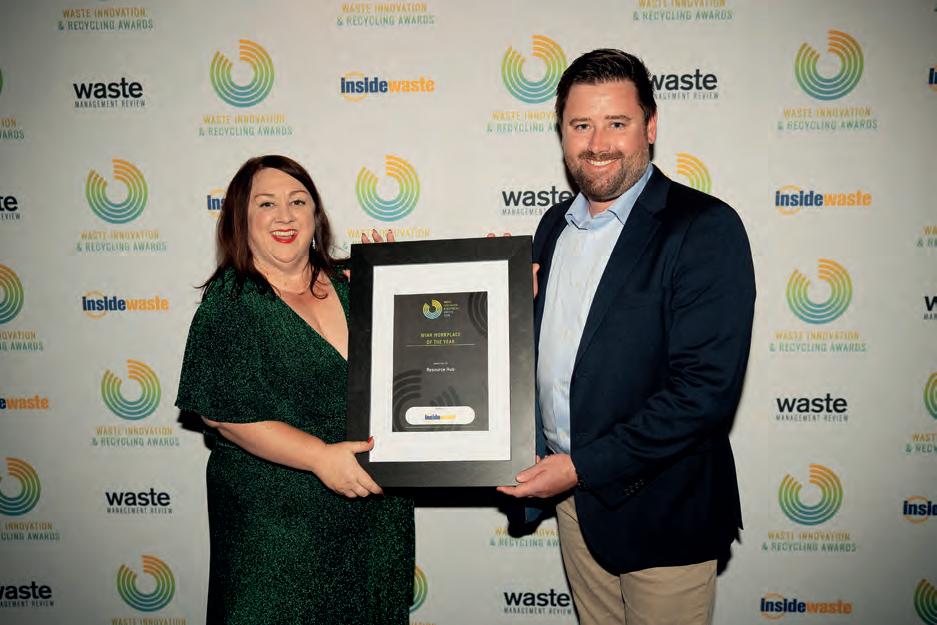
WIAR Workplace of the Year award
ResourceHub
Resource Hub is a team of waste and resource recovery experts with more than 65 years of combined experience, delivering practical solutions across Australia. They help clients turn operational opportunities into measurable results, providing remote administration, gatehouse and best-practice training, and waste levy support. Experienced auditors, Resource Hub improves operations and reduces compliance risks at landfills, transfer stations, and back-office functions for Local Government and commercial facilities nationwide.
Outstanding WARR Project: Metro Veolia – Veolia Earthpower Upgrade
The Earthpower Upgrade Project represents an advancement in Sydney’s sustainable waste management. Led by Veolia, the project modernised anaerobic digestion technology to increase biogas production and eliminate the need for imported electricity. By turning food waste into renewable energy and nutrient-rich soil conditioner, the initiative
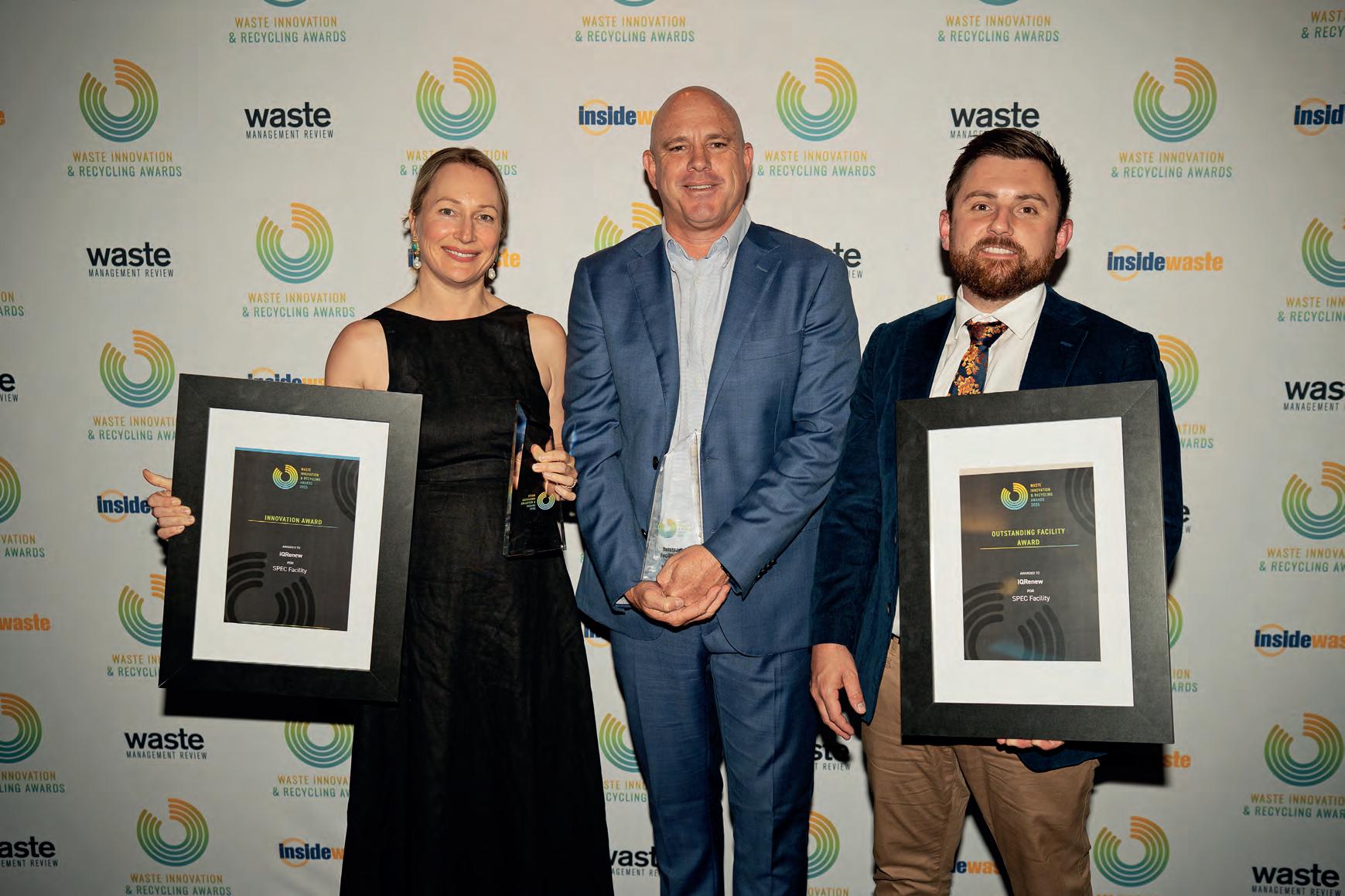
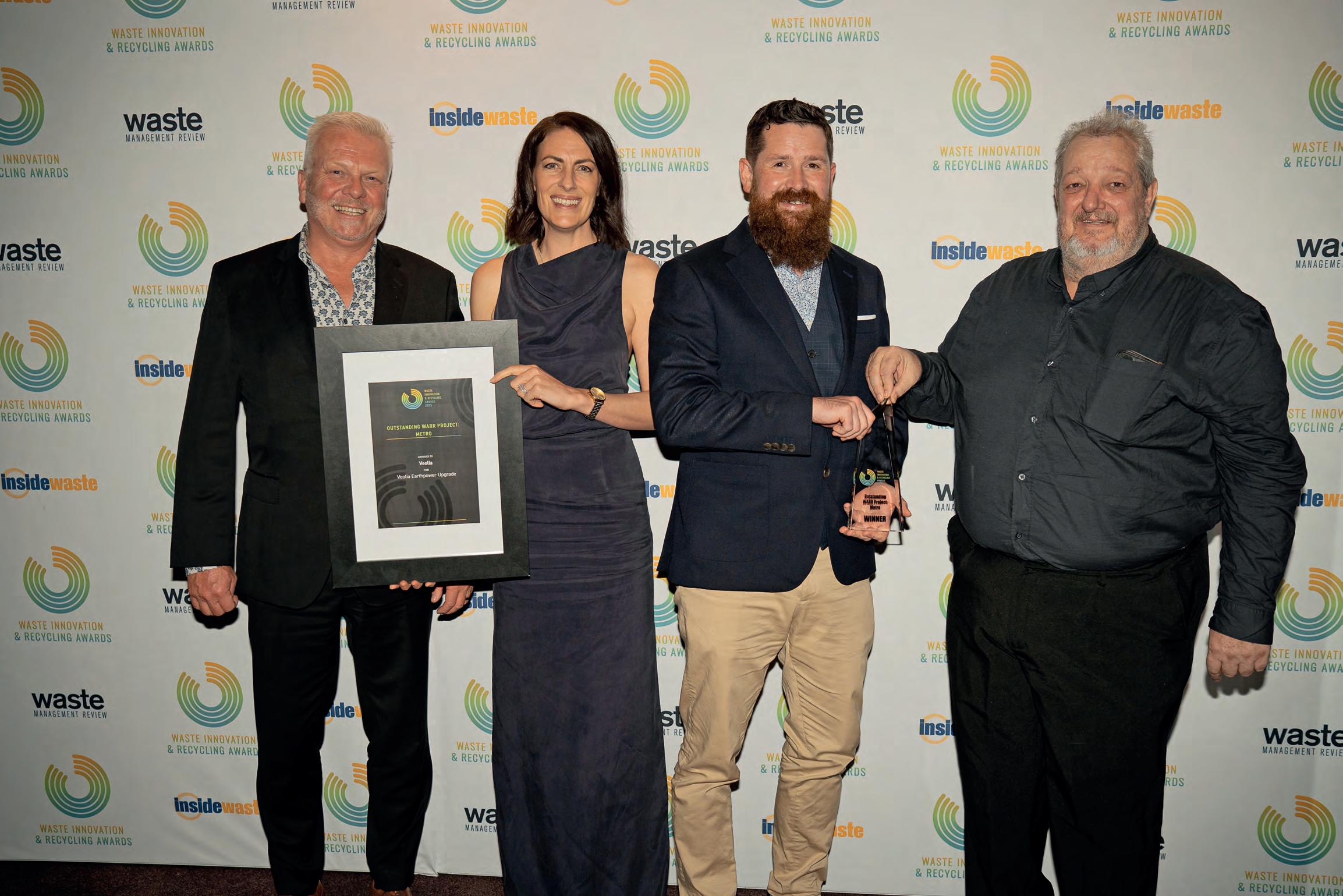
Resource Hub’s Lacey Webb (l).
The team from Veolia celebrate their win.
Outstanding Facility and Innovation of the Year:
iQRenew – SPEC Facility
iQRenew won two gongs for the night – Outstanding Facility of the Year and Innovation of the Year for its SPEC facility.
The facility represents Australia’s first at-scale, purpose-built infrastructure dedicated to processing 100 per cent household soft plastics. SPEC stands for Soft Plastics Engineered Commodity.
Located near Taree, on the NSW mid-coast, this $17 million facility transforms Australia’s challenging waste stream into three main products: spec pellets, spec flake and spec shred.
Commissioned in July 2024 after five years of R&D development, SPEC processes 15,000 tonnes annually (expanding to 24,000 tonnes) with an 80 per cent yield rate.
The facility directly addresses Australia’s soft plastics crisis by processing legacy material stock, return to store and bag-in-a-bin collected soft plastics. This facility has given Soft Plastic Stewardship Australia the confidence to commence establishing an Extended Producer Responsibility Scheme.
It was a double win for iQRenew’s SPEC facility.
Streamlining waste management across Australia
‘FROM GATEHOUSE TO DASHBOARD — waste data done right’ is the catchcry of Cooee Data, a software platform designed to simplify waste facility gatehouse and reporting operations. Initially built for regional and rural facilities, it has steadily expanded its presence across Australia and now operates in New South Wales, Queensland, South Australia, Western Australia and Victoria.
The system’s success stems from its practical approach to customer processing at the gatehouse, daily site management, data collection, interpretation and dashboard reporting at the office, all delivered through a customisable interface that works seamlessly with standard hardware. Giles Perryman, chief executive officer of Cooee, said that customer satisfaction is strong
and annual licenses are continuously renewed without hesitation.
“Our clients from small waste facilities to local shires all think Cooee Data’s ability to generate accurate waste data in mere moments is great.
“It saves them heaps of time and gives them the accurate data they need for mandatory waste reporting,” he said.
Cooee Data runs a streamlined onboarding process
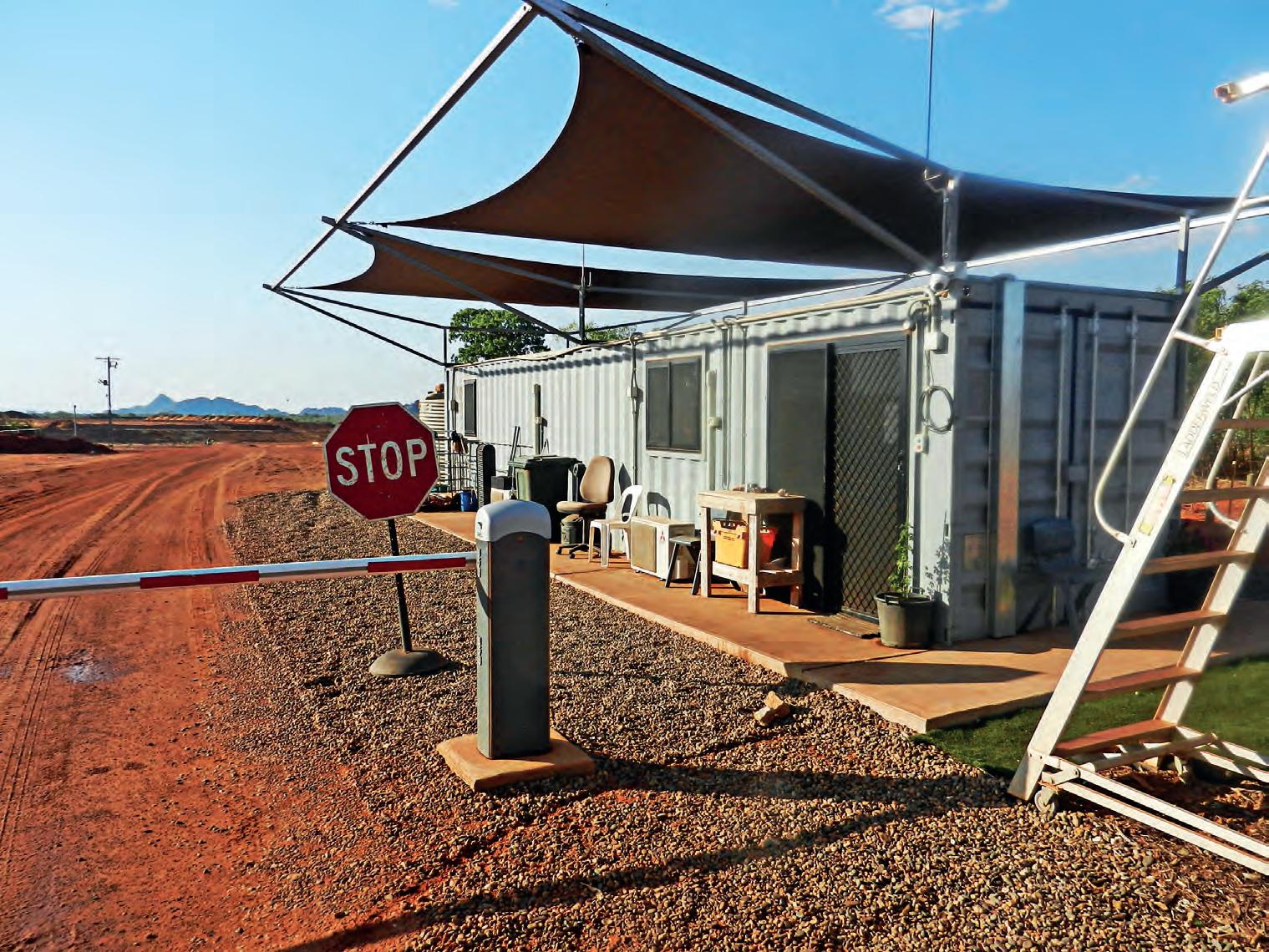
Cooee aims to minimise disruption at the gatehouse. Images: Cooee Data
was to give operators practical tools for real-world challenges.
“It’s automatically logged so if they’re repeat offenders, councils can go back to the data,” he said.
The software’s reporting model is designed for clarity. Built on SharePoint and Power BI, it gives users access to tailored graphs showing key performance indicators. Month-by-month comparisons of waste types, tonnages, revenues and recycling rates can be viewed instantly.
Designed for simplicity
For regional operators, simplicity is essential. Waste facilities are often staffed by people with limited IT experience, and many councils rely on temporary or rotating personnel to keep facilities open. Perryman said that the team was conscious of this from the start and designed Cooee to minimise complexity.
To support new or occasional users, Cooee now includes a suite of short instructional videos built into the system. Each video runs for one or two minutes and demonstrates key processes step by step.
“When you’ve got a council that size, if the person at the gatehouse is off sick, someone from admin can be parachuted in,” Giles said. “They can have a quick look at the videos and they’re off and running within minutes.”
Initial resistance from long-serving staff has often turned into enthusiastic support once they experience the benefits of the new system.
“We sometimes have people saying, ‘What’s wrong with paper?’” Giles said. “When we check in a week later and the overall consensus is, ‘Why wasn’t this introduced five years ago?’ They realise it’s so much better.”
Flexibility is another part of the system’s design. Cooee offers councils a range of optional features so that each installation matches their specific needs. This modular approach means there are no unnecessary tools or confusing options. Giles said that the process is designed to ensure every site gets a system that fits.
Cooee provides a checklist or shopping list at the beginning, according to Giles. There’s the basic Cooee package, and then additional functionalities like drumMUSTER or daily checklists. Cooee can be tailored to what a council needs without adding on irrelevant functions. This tailored model reduces helpdesk requests and ensures each site’s operators can focus on what matters most — accurate data and efficient
Built by waste experts, not software developers
Cooee’s origins distinguish it from many competitors. The team members behind the system came from the waste industry itself as experienced waste consultants. Their first-hand understanding of operational challenges allowed them to build a system that matched real-world needs rather than theoretical ones. Giles said that this perspective shaped everything about Cooee’s development.
“We’re a bunch of wasters who identified that there was a problem at smaller regional facilities because there just wasn’t a cost-effective solution,” he said. “We knew the challenges, and we knew what the solution needed to be.”
This blend of industry expertise and technical skill has given Cooee an advantage. Its competitors are often weighbridge manufacturers or data
Cooee began with waste expertise and learned technology as needed.
“Ours is built from the ground up by people who know the industry,” Giles said. “We learned to develop great tech rather than tech people trying to learn waste.”
Looking ahead
While Cooee’s core users are small- to medium-sized councils and facilities, typically receiving quantities between 1,000-20,000 tpa, the system’s scalability has already been proven at larger operations.
One construction and demolition waste processor manages around 300,000 tonnes of material annually and has chosen to use Cooee to handle its transactions.
However, Cooee does remain focused on the smallto medium-sized facilities that form its foundation. Many of these sites manage only a few thousand tonnes of waste per year and cannot justify expensive software packages.
“The smaller sites don’t want to be paying $20,000 to $25,000 a year for a bit of kit where they only use 20 per cent of the functionality,” Giles said. “They just want good data at a price that makes sense.”
Future plans include exploring opportunities in New Zealand, where similar rural conditions and council structures exist. The system’s modularity, offline capability and user-friendly reporting make it adaptable to almost any regional context. Giles said that the company’s satisfaction comes from creating a product that truly fits the needs of its users.
“We’ve made it slick, straightforward and relevant,” he said. “It’s not just software for the sake of it, it’s a system built by people who understand waste, for people who manage waste every day.”
Cooee data offers a practical approach to customer processing at the gatehouse.
The system can operate even when mobile/internet signals are weak.
Product Stewardship needs stronger national framework
HAVING SPENT THE MAJORITY of his working life in product stewardship and recycling, the EcoCycle Group’s national partnerships manager, Spyro Kalos, is part of a growing push for stronger, nationally consistent frameworks to support responsible endof-life management of batteries, electronics, and other products.
At the forefront of this discussion is the EcoCycle Group, a well-known Australian onshore recycler. Operating company-owned facilities across Australia and New Zealand, the Group manages the lifecycle of materials – from safe collection and transport through to onshore processing and material recovery. Its operations span EcoCycle, EcoBatt, Eco E-Waste, EcoBatt Safety,
Recycal, Castings Tasmania, and ACL Metal Powders, each contributing to a circular economy through advanced recycling technologies and reuse.
Driving product stewardship outcomes
The EcoCycle Group is a participant in Australia’s national stewardship landscape, operating under the National Television and Computer Recycling Scheme (NTCRS) and serving as the largest contributor to the Battery Stewardship Council (BSC) program, B-Cycle. Through its collection and processing capabilities, the Group provides a critical backbone for the recycling of batteries and electronics across both urban and regional Australia.
“Product stewardship has evolved significantly over the past two decades,” Kalos said. “But for these schemes to achieve real, measurable impact, they must be supported by sustainable funding and high participation across the entire supply chain.”
Australia’s current collection rate for household batteries remains below 15 per cent – far behind the 60–70 per cent achieved in other jurisdictions. While industry participation in voluntary schemes such as B-Cycle is strong, funding models often fall short of what is needed to build consumer awareness, expand collection points, and process growing volumes safely onshore.
A challenge lies in the structure of existing voluntary schemes. The current levy rate, or equivalent battery unit (EBU) contribution, sits at 5.3 cents – a figure that struggles to cover both operational costs and the expansion of public collection programs. Kalos notes that online retailers remain a missing piece of the equation.
“E-commerce continues to grow, particularly for batteries and electronics, yet global online platforms aren’t currently contributing to Australian stewardship schemes,” he says. “When products are sold into the market without contributing to collection and recycling, it undermines the commercial viability of these programs and shifts the burden to local recyclers and councils.”
The EcoCycle Group continues to advocate for mandated national frameworks that ensure fairness and accountability. A consistent approach would bring online and imported products into the same regulatory framework as brick-and-mortar retailers –creating a level playing field that supports long-term, sustainable outcomes.
Voluntary vs mandated frameworks
Voluntary schemes have proven their value in setting foundations and uniting industries, but EcoCycle Group believes their success is limited when participation is uneven or funding inadequate. A national regulatory framework would help align objectives across states and industries, eliminating the fragmentation that currently exists.
“Regulation isn’t about punishing industry,” Kalos said. “It’s about creating a system that works –where those who benefit from the sale of products
EcoCycle Group’s national partnerships nanager, Spyro Kalos. Images: EcoCycle Group
also share responsibility for their recovery.”
Without stronger frameworks, under-performing schemes risk leaving the cost of managing end-of-life materials to local governments or the recycling industry itself. A mandated approach, by contrast, would provide the certainty needed for investment, innovation and long-term environmental outcomes.
The EcoCycle Group continues to invest in its onshore infrastructure, ensuring that materials collected in Australia and New Zealand are processed domestically, not exported. The company owns and operates its own transport fleet, providing traceability and control across the recycling chain.
Its national network now includes more than 7,500 public drop-off points, along with UN-rated and fire-proof collection units designed for the safe handling of lithium batteries and devices containing embedded cells.
The Group’s commitment to safety and innovation is also demonstrated through the launch of its Battery-in-Device Shredding (BIDS) Plant – a world-first facility located in Melbourne that processes up to one tonne of mixed devices per hour, recovering up to 90 per cent of materials. Developed with international partners, the BIDS Plant represents a new benchmark in safe, sustainable battery recycling.
“These types of investments show what’s
possible when stewardship systems are well-funded and fairly structured,” Kalos said. “Australia has the capability to lead the world in onshore processing and recovery – but that can only be achieved when every stakeholder contributes to the system.”
Building a Circular Future
As collection volumes rise and product complexity increases, the need for a stronger, nationally consistent framework becomes clear. The EcoCycle
collection, sorting, shredding, and material recovery – shows how Australian industry can lead through technology, safety and accountability.
Ultimately, product stewardship must evolve beyond voluntary participation to a model that is both commercially and environmentally sustainable.
“The future of product stewardship lies in collaboration,” Kalos said. “When industry, government and the recycling sector work together under a unified framework, we can deliver the circular
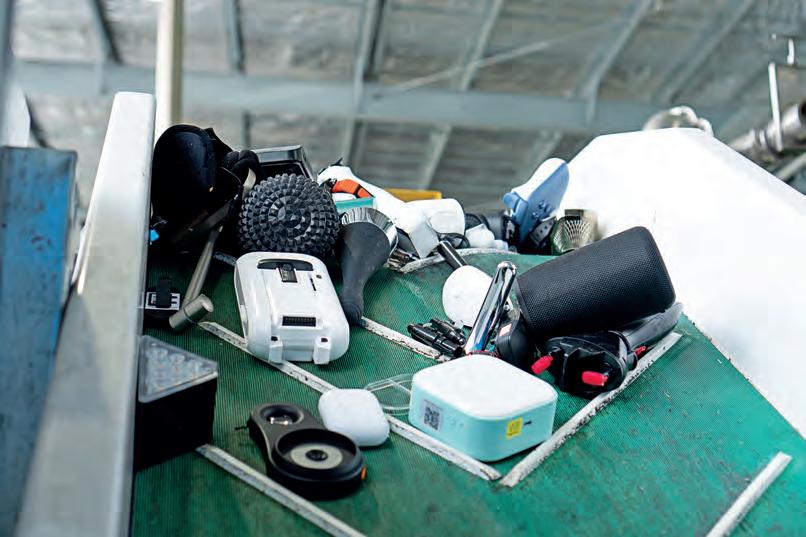
The EcoCycle Group continues to invest heavily in its onshore infrastructure.
EcoCycle Group provides the backbone for a range of recycling waste streams.
AUSTRALIA’S RECYCLING SYSTEM is only as strong as the end-markets and manufacturing capability that sustain it. While recycling rates have improved, too many materials still lack viable local pathways for reprocessing and reuse. Closing the loop requires more than collection, it depends on end markets, investment, innovation, and product design that works with existing collection methods or is facilitated by new ones.
Glass shows what can be achieved when those pieces come together.
Not long ago, glass recovery in Australia was limited. In 2018, the Australian Packaging Covenant Organisation (APCO) reported that less than half of all glass packaging placed on the market – just 46 per cent – was recovered with around half of that going back into packaging.
By 2023, national recovery rates had climbed to 69 per cent, with 73 per cent of this going bottle to bottle; a marked improvement that was no accident. This has been driven by sustained investment in domestic recycling and remanufacturing.
Visy has been a contributor to that shift. In 2020, the company acquired the Australian and New Zealand glass manufacturing business of Owens-Illinois (O-I). That acquisition laid the groundwork for a genuine
closed-loop system focused on keeping more glass at its highest and best use – with Visy also committing to reaching an average of 70 per cent recycled content in all of its glass bottle and jar manufacturing.
Since then, Visy has expanded its glass operations across the country. In Victoria, a new beneficiation plant in Laverton can clean and sort glass down to 3mm – doubling the site’s throughput capacity and increasing the amount of glass from household recycling bins that is recoverable for bottle-to-bottle remanufacturing.
In Penrith in Western Sydney, Visy commissioned Australia’s first oxy-fuelled glass furnace in 2024, delivering energy savings. In Queensland, a new $500 million glass recycling and remanufacturing super-site is under construction at Yatala, further strengthening national capacity.
These projects are delivering measurable results. In 2024 Visy increased the average recycled content in its glass packaging from 58 to 64 per cent across its operations. In the same year, Visy celebrated reaching 70 per cent average recycled content across all its glass packaging in New Zealand, the first jurisdiction to hit Visy’s 70 per cent recycled content commitment. Each step up in recycled content means less landfill, less use of natural resources and, critically, lower
emissions. A glass container made with 70 per cent recycled content can use up to 30 per cent less energy to produce than one made entirely from raw materials. The lesson extends beyond glass.
Recycling infrastructure is essential, but so is design. Glass has a natural advantage as it’s easily recyclable and can be recycled over again. By contrast other materials, like many plastics, are complex composites of different polymers that require multiple reprocessing methods at high cost to become usable again, undermining their value against virgin plastics. These challenges highlight the importance of designing packaging that can be effectively recovered and remade within the systems we already have.
Australia’s move toward a circular economy depends on strengthening those systems by creating domestic end-markets, reducing reliance on exports, and keeping more materials in use for longer. The shift now underway in glass recycling shows what’s possible when industry, technology, end markets and policy align.
As Tierry Lauren, executive general manager of recycling at Visy, puts it: “True circularity isn’t just about collection. Recycling is about ensuring what we recover stays in Australia, is remade here, and goes back into use at its highest value.”
In 2018, just 46 per cent of glass packaging placed on the market was recovered. Image: Visy
To knot or not to knot
By John McKew
THE ROLLOUT OF FOGO (Food Organics Garden Organics) around the country is not without challenges and concern, especially from the perspective of the Australian Organics Recycling Industry (AORA). Key to these concerns from the industry is the potential for greater levels of contamination that comes with the introduction of food organics. Historically, garden organics has been a relatively clean feedstock stream and has posed only relatively minor concern in relation to contamination. There is still contamination concerns from garden organics from plastics (e.g., potting mix bags, plastic plant pots) and other unwanted waste materials. While unwelcome, these have proven relatively easy to manage (but shouldn’t be present nonetheless).
Food organics, however, brings new contamination problems – more plastic such as food packaging, fruit stickers, tea bags, bread tags and a whole host of other unwanted (non-organic) materials. In addition, there is the certified compostable caddy liner that accompanies the household caddy liner as part of the food organics rollout, which is the key receptacle for managing food waste from the kitchen. This will help improve the uptake of the FOGO services across Australia, but can be another source of concern for organics processors. First, it must be
There are some intricate applications that need consideration before disposing of your organics. Image: Hakaroo Project/Shutterstock.com
a certified compostable caddy liner supplied by the local council with the kitchen caddy. Any old green plastic bag is not certified compostable and is just plastic contamination. Certified compostable caddy liners break down in a composting system, which is their purpose. Plastic bags (regardless of colour) do not. Second, what is inside the certified compostable caddy liner from the household cannot easily be examined by the organics processor and therefore what is inside must be organic food waste e.g., fruit and vegetable peelings and leftover/ spoiled food (with no associated packaging). The local council will have clear determinations about what else is acceptable in the certified compostable caddy liner and are the first port of call for this information.
The next potential issue is how the certified compostable caddy liner is treated once it is full. Taking the four corners of the bag and knotting this before the bag is put in the green organics bin can be an issue for the organics processor, depending on their specific organic processing methodology. For example, if the certified compostable caddy liner is being processed in a facility that employs an in-vessel or a containerised composting system, the processing time is approximately 10-14 days. While the composting process will be underway in this short time frame, the compost produced is relatively immature and certain organic items may
not be composted. This may include the knot from a certified compostable caddy liner – after 10-14 days that knot may still be present and look like a small marble of material. Further, other organic materials may also not be fully composted. Further, extended composting of these materials (after the 10-14 days of in-vessel or containerised composting) will see them compost to an indiscernible material of no concern. After 14-plus weeks, there will no longer be an issue with the knot or other materials, as long as they were organic to begin with. In an open windrow composting facility, employing 14-plus weeks of composting with turning and pasteurisation, the certified compostable caddy liner ‘knot’ is sufficiently broken down and there will be no visible evidence of the certified compostable caddy liner remaining.
The question is, how do we best accommodate the certified compostable caddy liner and in particular, closing the bag (i.e., the knot) that will adequately meet the needs of an in-vessel or a containerised composting system? It is a relatively easy fix – don’t knot the certified compostable caddy liner when it is full, simply twist it a few times to close it instead – no knot, no composting issue and the bag will be closed to avoid spillage
John McKew is the national executive officer of the Australian Organics Recycling Association.
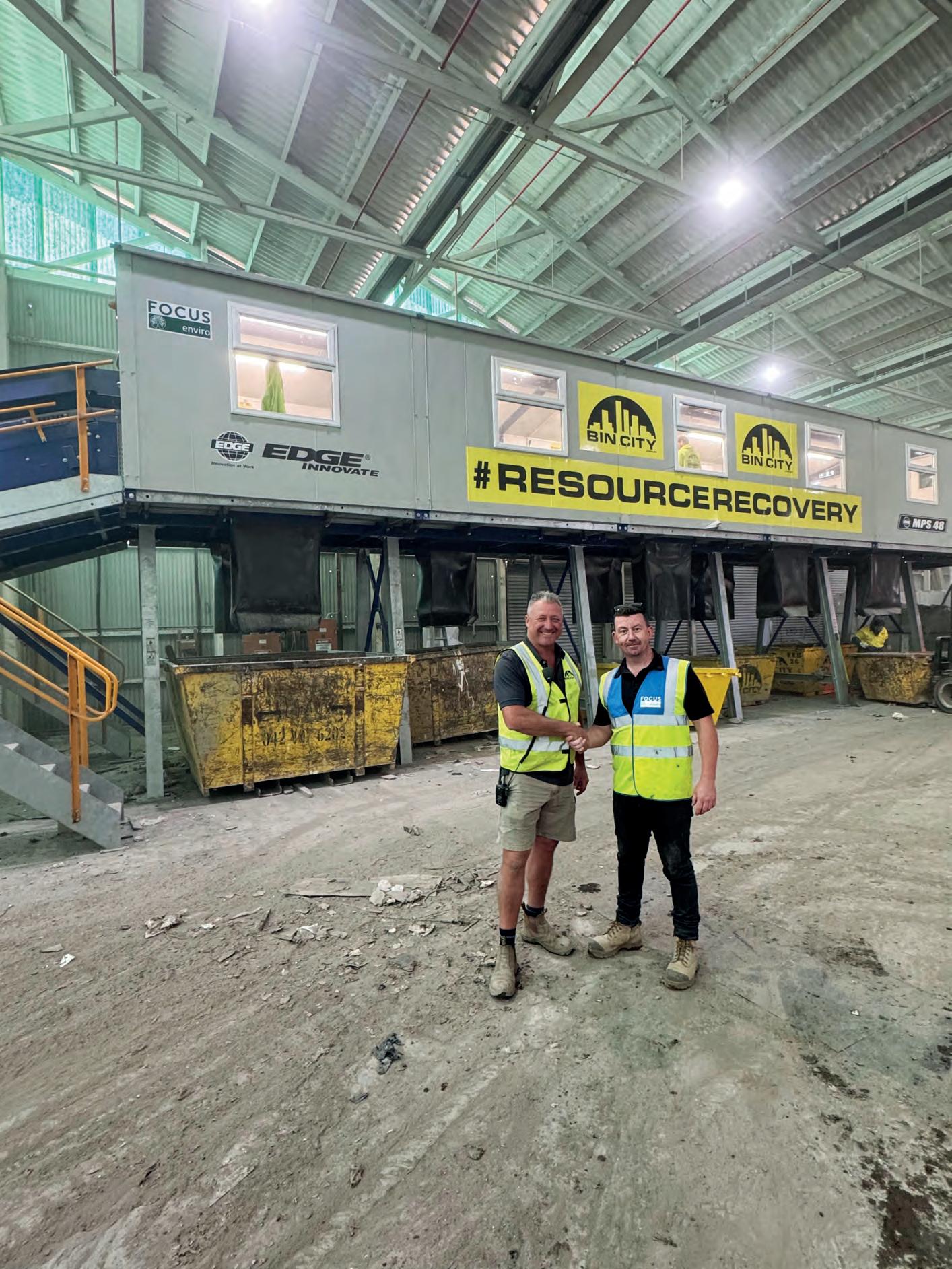
to recover as much value as possible from the waste streams passing through its facility. The company’s recycling centre operates alongside its commercial and residential skip-bin services, reflecting a commitment to circular-economy principles.
“Our motivation is simple,” explains Dave Neall, owner and general manager of Bin City. “We’re always asking ourselves which materials we can process, and which ones we can’t and how we can change that. The expectation from councils, regulators and the community is that waste companies will do more to recover and recycle. Investing in the MPS48 is our way of stepping up to that challenge. It’s about performance, not just volume.”
Choosing the right partner
When Bin City began exploring options to upgrade its facility, the team knew they needed a partner with both technical expertise and a deep understanding of the realities of Australian waste-handling operations. That partner was FOCUS enviro.
According to John McGuinness, sales manager at FOCUS enviro, the collaboration began with a detailed consultation process.
“We carried out a full site consultation and material analysis, accompanied by multiple site visits to see existing current machines in operation” he said. “We looked at Bin City’s current setup, the space constraints, their feed materials, and their recovery goals. The idea was never just to sell a machine; it was to help design a solution that would evolve with their business. The MPS48 was the perfect fit.”
Why the EDGE Innovate MPS48?
At the heart of Bin City’s upgrade sits the picking station, a robust and versatile machine designed to deliver safety, mobility, and efficient separation of recyclable materials. Built for demanding environments, the MPS48 features a 1,200mm (48-inch) conveyor belt that increases material presentation for pickers, enhancing throughput and recovery rates.
The station’s modular construction allows Bin City to add or remove picking bays as their needs change. This flexibility means the facility can adapt to future growth or new waste streams without major reinvestment.
“We wanted equipment that could grow with us,” says Neall. “The modular nature of the MPS48 gives us exactly that. If we want to add more bays or integrate additional recovery options like air separation, we can do that without major downtime.”
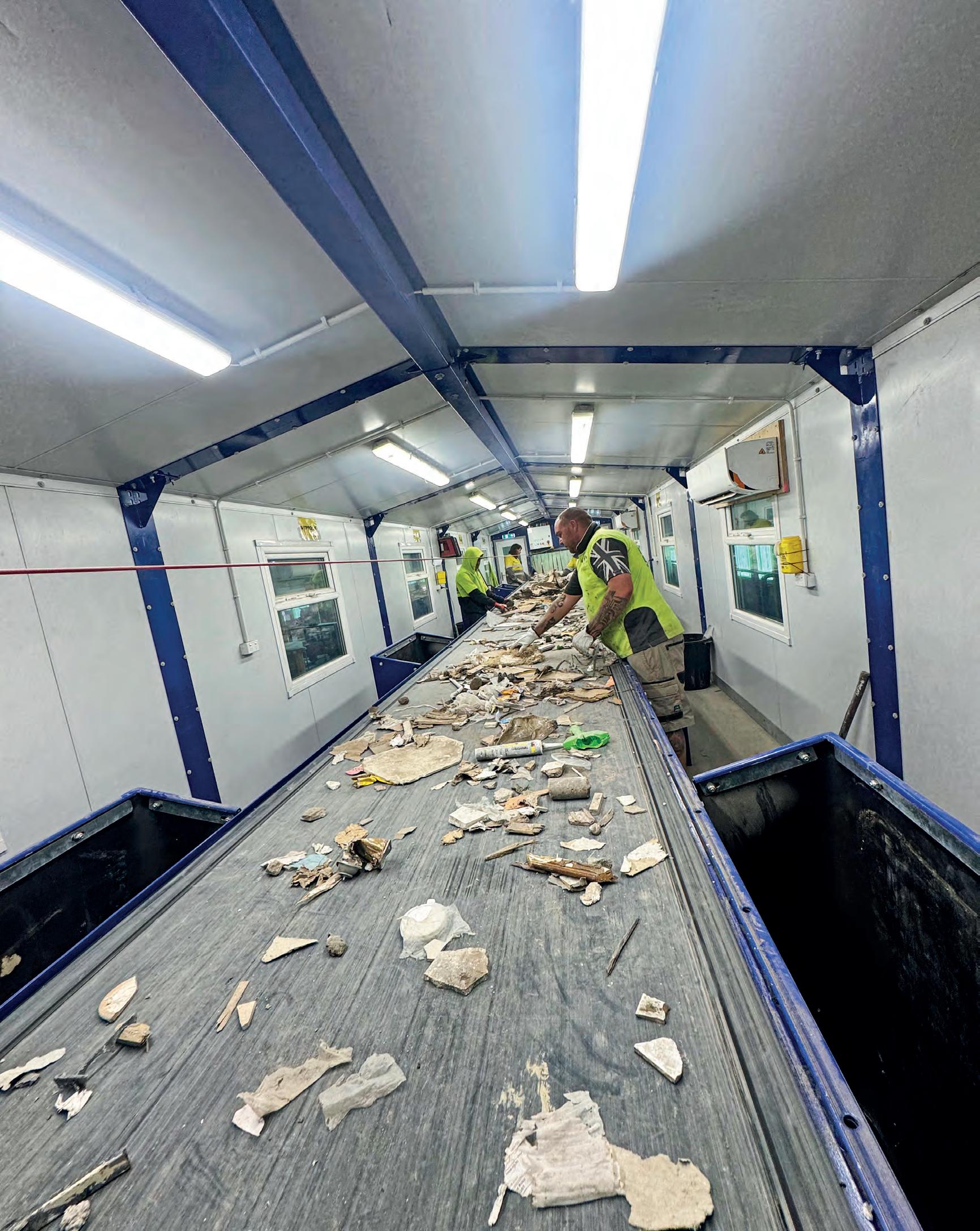
The unit also offers a flexible feed height and a heavy-duty input section with impact beds, enabling it to accept material from various vehicles and sources. The enclosed, air-conditioned cabin provides operators with a comfortable and safe workspace, while integrated lighting and emergency pull cords add further layers of safety and control.
McGuinness highlights the broader benefits of this design.
Bin City’s David Neall (left) and FOCUS enviro’s John McGuinness. Images: FOCUS Enviro
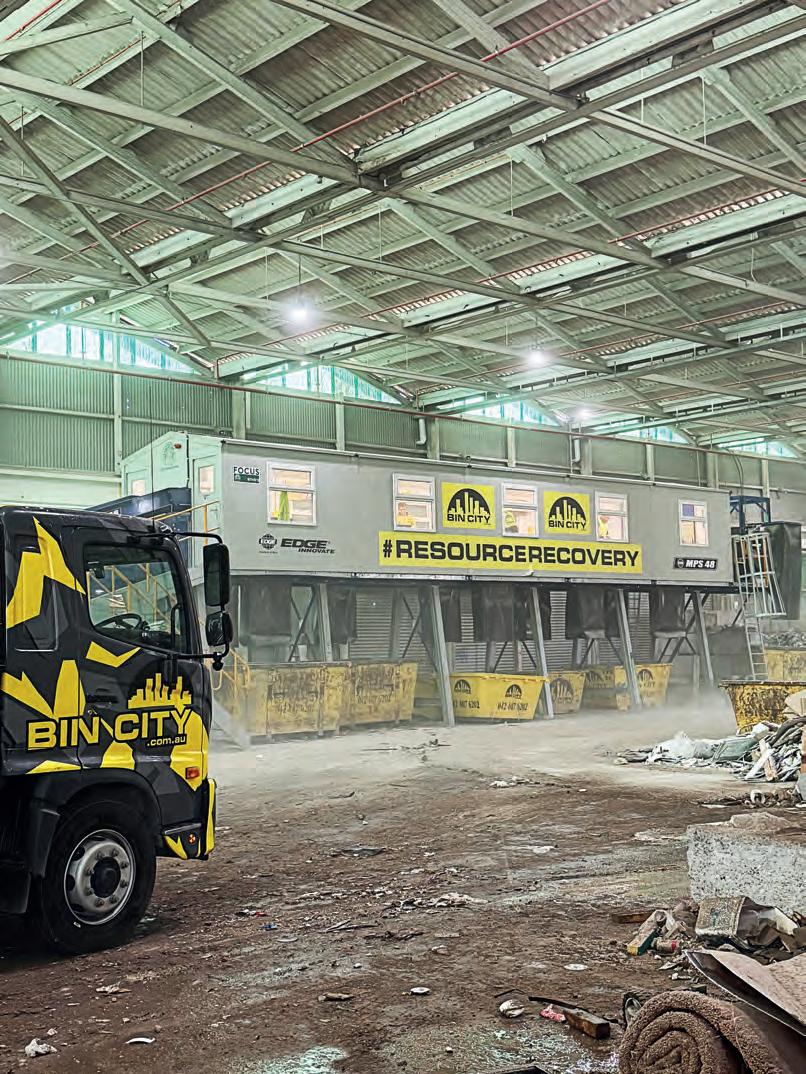
movement posing daily risks. The MPS48 directly addresses these issues. Its enclosed and insulated cabin with air conditioning and electrical sockets, ensures that operators can work comfortably in all weather conditions. The system’s over-band magnet removes ferrous contaminants, protecting downstream equipment from wear and tear, while the robust design complies with strict safety regulations.
“Protecting workers is an essential part of waste management,” says Neall. “With the MPS48 we’ve created a safer, more pleasant place to work. That matters to us and it matters to our team.”
Looking ahead
The installation was completed with minimal disruption to Bin City’s operations. Due to the modular design of the MPS48, commissioning was seamless, integrating smoothly into the facility’s existing workflow.
Looking to the future, Bin City plans to leverage the scalability of the system as it takes on new contracts and larger volumes.
“We’re already talking about what the next phase could look like,” said Neall. “Whether that’s adding more bays, integrating air separation, we know we have a system that can adapt.”
For FOCUS enviro, the project is another example of how collaboration and tailored equipment solutions can drive real impact in the waste sector.
“It’s rewarding to see local operators like Bin City using world-class technology to make a difference,” said McGuinness. “This installation shows what’s possible when you combine innovation with commitment.”
As Bin City continues to grow, the EDGE MPS48 will remain at the centre of its recycling operations, a symbol of progress, partnership, and purpose. By investing in smarter equipment and safer practices, the company isn’t just improving its own performance; it’s setting a new standard for waste recovery in regional Australia.
The new system helps in the reduction of landfill volumes.
The MPS48 features a 1,200mm conveyor belt that increases material presentation for pickers.
Circular future for plastic pipes
THE TRANSITION FROM A LINEAR to a circular economy is a national priority for Australian industry and government. Plastic pipes are used across civil, industrial, agricultural and residential sectors, and providing an example of how essential infrastructure products can align with circular economy principles through durability, repairability and recyclability.
Yet these systems are often overlooked in discussions about circularity because so few have reached the end of their service life. To better understand the sector’s performance, the Plastics Industry Pipe Association of Australia (PIPA), in partnership with Circular Australia and the Institute for Sustainable Futures at the University of Technology Sydney, conducted a study examining how plastic pipe systems fit within the circular economy.
The research assessed material flows, industry practices and stakeholder perspectives, and the findings were published in Plastic Pipes and the Circular Economy – An Australian Perspective in 2025 . It showed that plastic pipes already embody many circular characteristics, even though limited end-of-life material currently enters recycling streams.
Plastic pipes are vital to Australia’s infrastructure,
transporting water, gas and energy that underpin daily life and economic activity. Because they are buried underground and function reliably for decades, their contribution to circularity is often underestimated.
A pipe’s long lifespan, ability to be repaired or reused, and reduced environmental impact across its lifecycle are equally important. Evaluating these broader factors helps inform better policy and procurement decisions, ensuring that infrastructure is genuinely sustainable rather than merely recyclable.
Unlike short-life plastics, pipes are engineered to last for decades, often more than a century, so most remain in active use.
This durability explains the low availability of post-consumer recycled material and reinforces the need to consider circularity over extended timeframes. Reusing existing networks, repairing damaged sections and recovering installation off-cuts for recycling, all strengthen the sector’s circular performance.
Circular practices and stewardship
Australia’s plastic pipe industry has alignment with circular economy principles through established
stewardship programs, national standards and company-led sustainability initiatives.
Key measures include the Industry Material Stewardship Program, which promotes responsible sourcing and recovery; the AS/NZS 5395 Best Environmental Practice standard for PVC pipes and fittings; and widespread adoption of ISO 9001 and 14001 management systems. In 2023, members reported using more than 6,000 tonnes of recycled material from pre- and post-consumer sources.
Industry-led initiatives such as the Construction Plastics Recycling Scheme and the Plumbing Industry Recycling Scheme are also generating valuable data on material recovery and helping design scalable end-of-life systems. A National Product Stewardship Scheme is under development to coordinate best practice nationally and align with broader circular economy goals.
Material flow and lifecycles
A high-level material flow analysis was undertaken to map how plastic pipe materials move through their lifecycle – from manufacture to end-of-life.
The pipe industry uses around 385,000 tonnes of virgin material annually. Images: PIPA
The industry uses around 385,000 tonnes of virgin material annually. Because pipes have long lifespans, the majority remain in service, with minimal end-of-life recovery so far.
Most recycling currently focuses on off-cuts generated during installation rather than in-ground recovery, which is complicated by distributed networks and remote locations. Since large-scale pipe installation began in the 1960s and many products can last more than 100 years, the volume of end-of-life material is expected to remain low for decades.
Interviews with manufacturers, recyclers, installers, asset owners and industry bodies revealed high awareness of circular economy concepts, though many still equate circularity mainly with recycling. Higher-order strategies, such as reducing material use, designing for longevity and enabling reuse, were less frequently discussed despite their prominence in circular economy frameworks.
Manufacturers emphasised quality, fit-for-purpose design and compliance with standards. Recyclers cited logistical difficulties in collecting pipes from remote or buried sites. Installers pointed to the need for consistent materials and simple sorting systems. Despite these challenges, there is clear momentum. Pilot schemes, research partnerships and evolving standards are enabling progress. Stakeholders agreed that circularity must be recognised beyond recycled content, with procurement frameworks rewarding durability and resource efficiency across the entire lifecycle.
Barriers to greater circularity
The main limitation is the restricted supply of post-consumer material due to the longevity of existing systems. This durability is an advantage but makes short-term recycling metrics misleading. Other barriers include limited infrastructure for collecting end-of-life pipes, especially from dispersed or remote projects, and national waste data that fails to distinguish between long-life infrastructure plastics and short-life consumer products.
Addressing these issues requires better recovery logistics, refined standards and improved data collection to reflect the true circular value of long-life infrastructure materials. Realising the circular potential of plastic pipes will depend on coordinated action across government, industry and procurement.
Government policy should differentiate between short-life and long-life plastics, avoiding blanket recycled-content mandates that may not suit engineered products. It should support national stewardship schemes and co-invest in collection and recovery infrastructure. Accurate reporting that distinguishes infrastructure plastics from disposable products is also needed, along with a national database tracking in-use stock and end-of-life flows.
Industry sectors including civil infrastructure, mining and agriculture should collaborate to improve logistics, embed lifecycle thinking into project planning and expand stewardship participation. Standards must evolve to incorporate recycled material safely and appropriately for different applications.
Procurement frameworks, particularly for publicly funded infrastructure, should move beyond recycled content as the sole measure of circularity. Whole-of-life performance, design efficiency and
recovery at end-of-life should be embedded into tendering criteria to encourage innovation and ensure reliability.
The plastic pipe industry must continue advancing stewardship practices, improving reprocessing capacity and investing in material innovation. A coordinated national stewardship scheme will help scale recovery across all sectors, including rural and decentralised systems.
A model for circular infrastructure
Plastic pipes exemplify how infrastructure products can embody circular economy principles. Designed for longevity, they are repairable, reusable and ultimately recyclable. Their durability reduces material turnover and minimises environmental impact over many decades.
“PIPA is proving that a circular economy is commercially viable, creates jobs, builds new skills and solves complex problems - all using less virgin resources,” said Lisa McLean, managing director & CEO of Circular Australia. “While there is always continuous improvement in designing out waste and moving away from virgin consumption by utilising secondary resources - the plastic pipes industry has paved the way for other sectors. They can learn how to value and
repair assets as a core operation to ensure they last as long as plastic pipes do - and for many that’s 100 years or more.”
By documenting the sector’s achievements and mapping pathways for improvement, the study challenges misconceptions that all plastics are inherently unsustainable. It highlights the need to distinguish between short-life consumer plastics and long-life engineered materials when assessing circularity.
With targeted policy recognition, stronger data, and coordinated recovery systems, the plastic pipe sector can stand as a flagship for circular economy success in durable infrastructure.
“This research provides a comprehensive and timely examination of the systemic factors impacting circularity within plastic pipe systems,” said Dr Simran Talwar, program lead and research director at UTS Institute for Sustainable Futures. “The findings point to a variety of circular economy approaches and product stewardship initiatives underway. The report recommendations highlight opportunities for policymakers and industry, to strengthen national stewardship, procurement, material flow data collection, and reporting, as well as cross-sectoral engagement.”
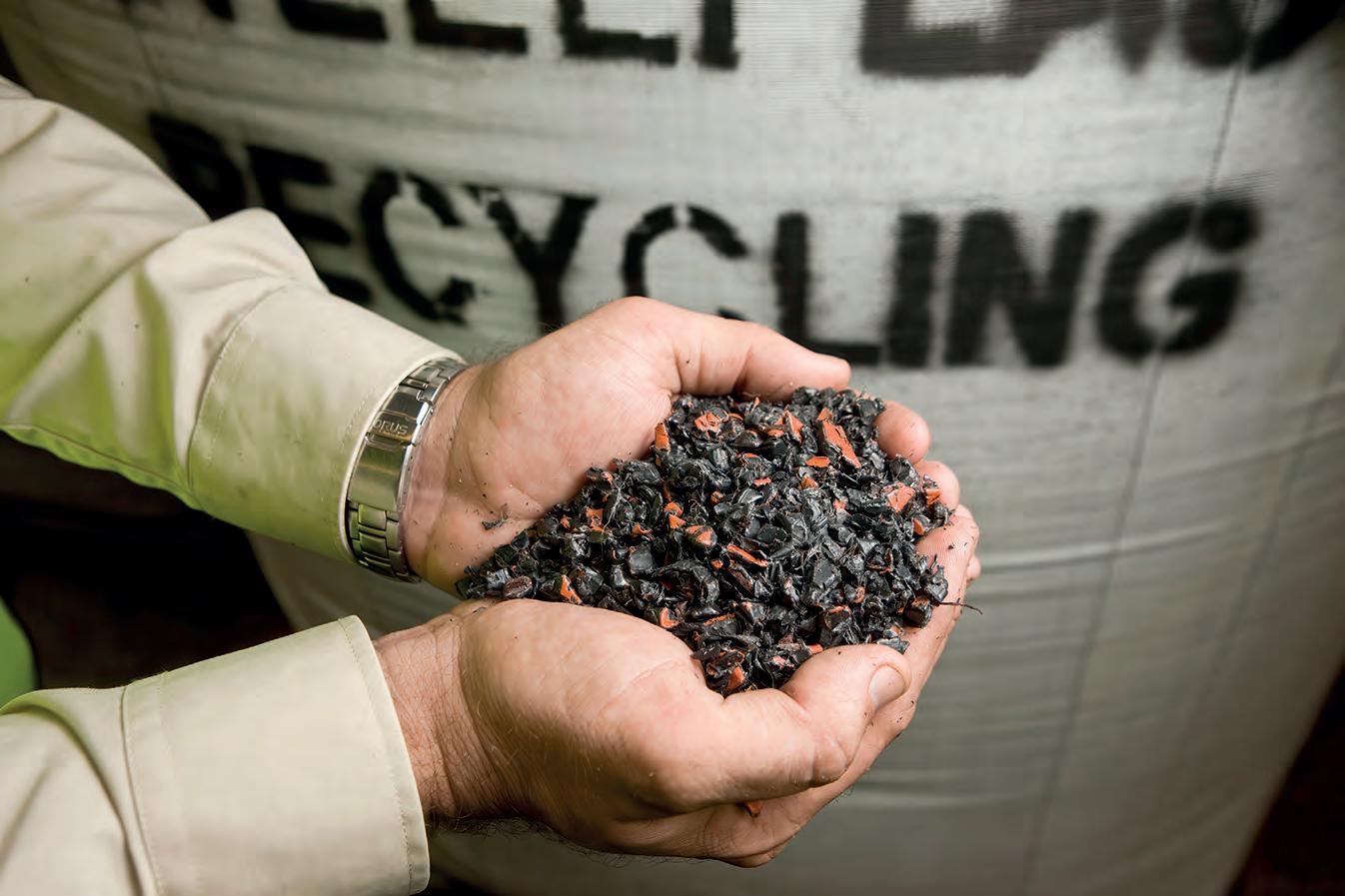
Stakeholders agreed that circularity must be recognised beyond recycled content.
Safety and stewardship in battery recycling
SELL & PARKER HAS BEEN PART of the Australian recycling landscape for six decades. Founded in 1966, the company began as a modest scrap-metal operation before growing into one of the nation’s largest privately owned recyclers. Today, under the direction of Luke and Morgan Parker, the firm continues to expand its capabilities, adding a dedicated battery recycling facility that has quickly become a first for New South Wales.
At the heart of this operation is Craig Ley, a director at Sell & Parker Battery Recyclers, who has overseen the long and often complex process of establishing the site and obtaining regulatory approvals. The facility has taken more than two years to reach full licensing, with final approval granted only weeks ago. Ley said it represents an important step for both the company
and the state. Sell & Parker Battery Recyclers now operates the only EPA-authorised facility in New South Wales licensed to handle and store lithium batteries.
Understanding the risk
Recycling lithium-ion batteries is not like managing any other waste stream. The dangers are constant and unpredictable, something Ley is clear about. For this reason, the site has been designed around the assumption that fires will happen.
“A fire can occur at any time. You can get a battery that looks stable; it sits there for a couple of days, and then it catches fire,” he said. “It’s not a matter of if we have a fire; it’s when.”
The facility’s defences are extensive. It operates with 24-hour monitoring, thermal cameras, and CO₂
detectors that can identify heat or combustion long before flames appear. Every part of the site has been engineered to contain an incident, including a fully bunded containment site designed to hold water and runoff if the fire brigade needs to intervene. Ley explained that New South Wales Fire and Rescue have been learning more about lithium fires, but traditional suppression methods still have limits.
“Water doesn’t put out lithium fires,” he said. “The fire brigade still needs to protect the surrounding area with water, but any water that hits the site in an incident is stored right here.”
Sell & Parker’s decision to install million-litre tanks and containment systems reflects a wider trend in the recycling sector. Lithium batteries have caused a rising number of fires across Australia, with insurers
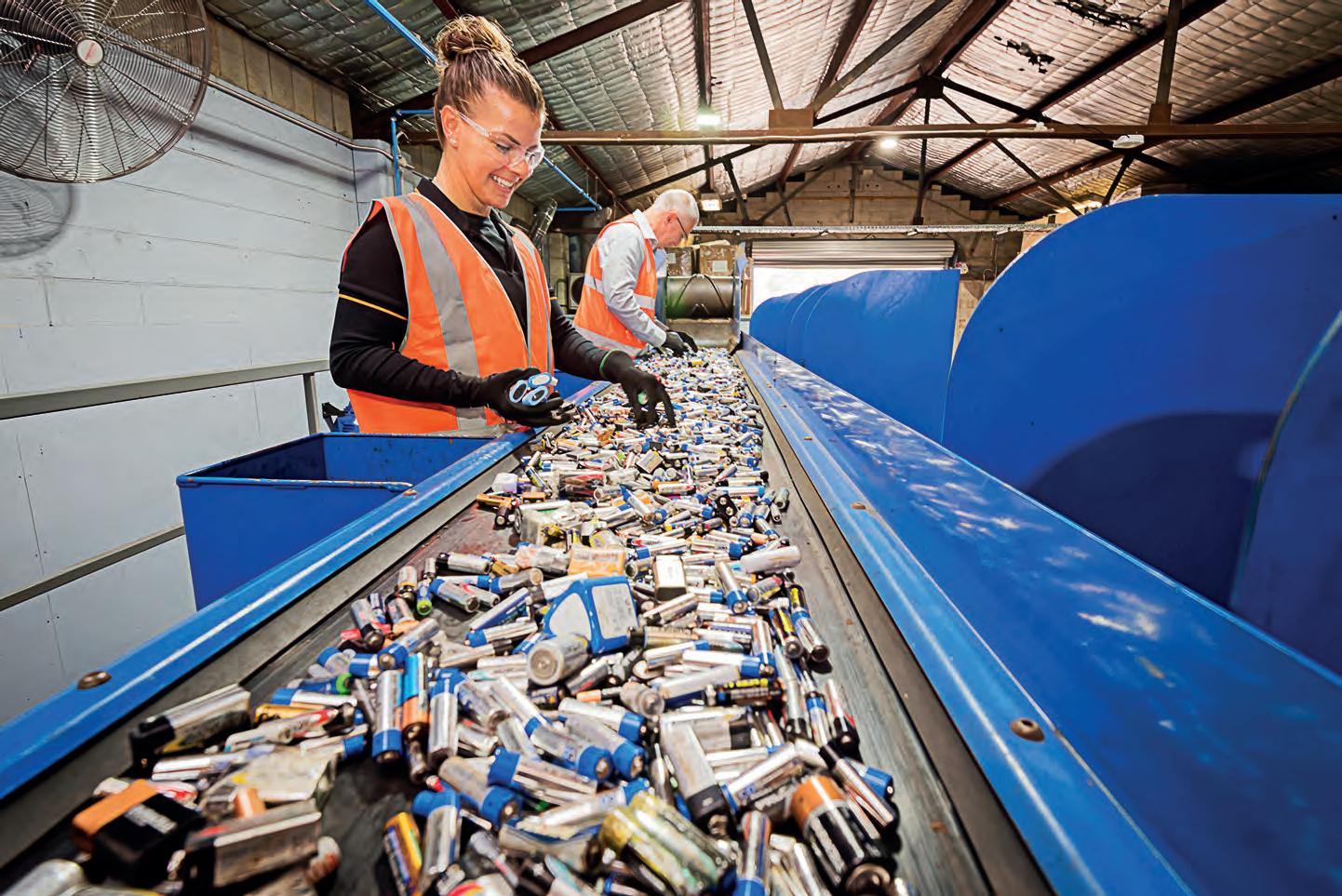
Some manual sorting is required at the company’s new battery recycling facility. Images: Sell & Parker Recyclers
increasingly cautious about underwriting facilities that handle them. For the company, the investment in prevention and monitoring was essential.
Sorting, partnerships and traceability
Beyond safety, the facility’s operations focus on sorting and forwarding batteries to approved recyclers. The company does not process the batteries on-site. Instead, it consolidates and prepares them for specialist recycling companies.
“We collect in bulk form, sort into different chemistries, and send it off to recyclers that break it down and do the recovery work,” said Ley.
Incoming batteries are sorted by workers at a picking station. They separate larger units manually while an x-ray sorting machine identifies different types such as nickel-cadmium, lithium and alkaline. Ley noted that this x-ray sorter is the only one in New South Wales.
Currently, the company ships batteries to Envirostream and Nyrstar, both recognised for safe and compliant processing.
Ley said that the firm only uses companies it’s seen in action. Sell & Parker staff have seen the shredders, the recovery systems and where the black mass goes. They know exactly what happens to the material when it is being processed.
“Our maximum capacity at the facility is 20 tonnes,” Ley said. “We don’t hold more than that. The whole idea is to turn it over as soon as we get it.”
This insistence on traceability and compliance reflects the company’s broader reputation in the recycling industry.
“We have to be sure where it goes,” said Ley. “It can’t go into a warehouse, and it can’t just disappear.”
Licensing, collaboration and public education
Securing environmental approval was one of the company’s biggest challenges. Being the first operator in the state to apply for an EPA licence for lithium-battery storage meant that there was no template to follow. Local government approvals added further complexity.
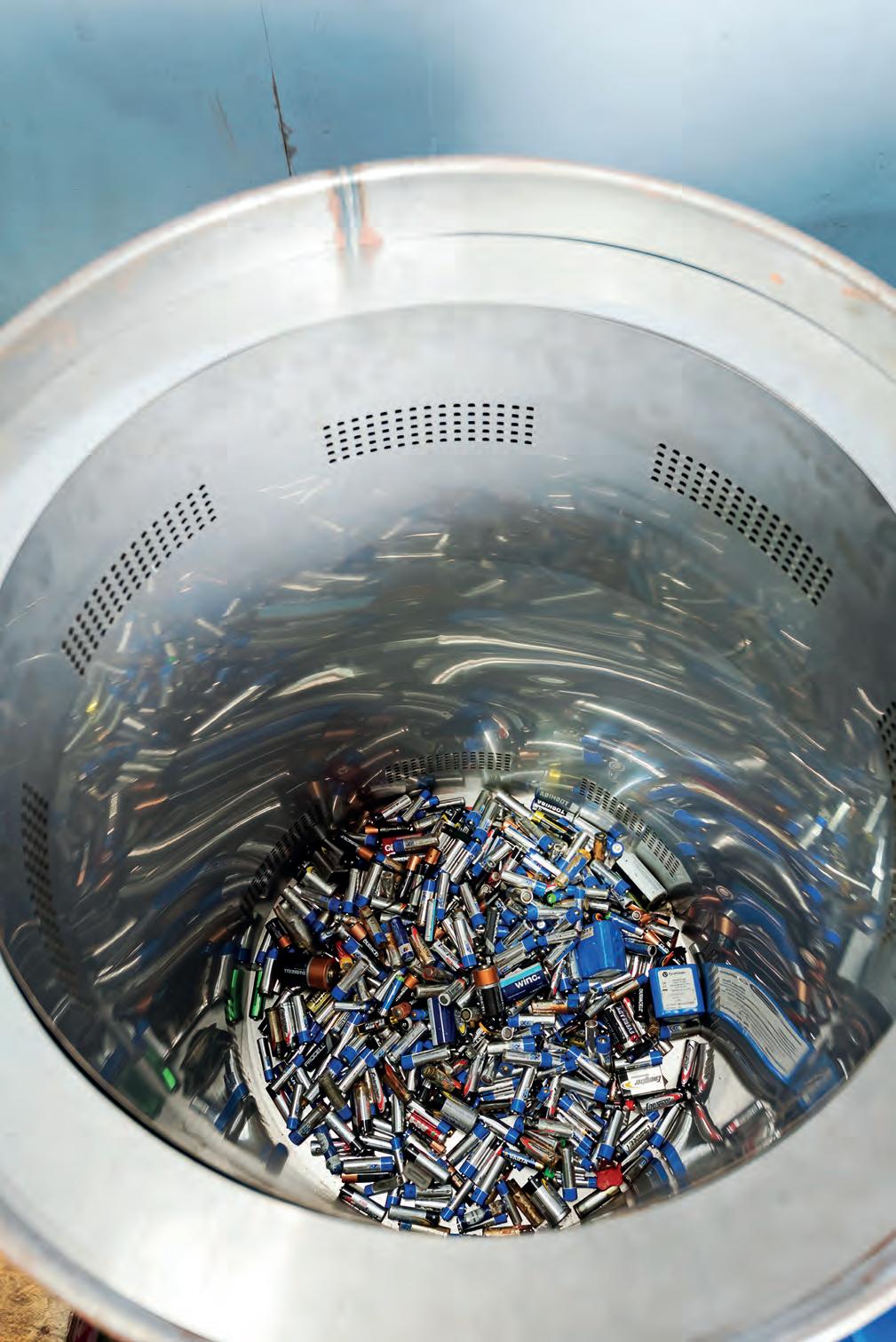
Ley admits that the biggest challenge has been with the local council. As he pointed out, nobody wants lithium in their backyard, which he says is understandable due to the above-mentioned scenario of it’s not a matter of if there’s going to be a fire, but when.
However, he emphasised that the New South Wales EPA had been good to deal with throughout the process. The licensing requires the alreadymentioned safety protocols, thermal cameras, CO₂ detectors, retained water systems and engagement with the fire brigade. The company also provides training and tours for emergency-service personnel to improve industry understanding of lithium-related fire behaviour.
Education is not limited to firefighters. The facility also aims to help the public understand safe battery disposal.
Sell & Parker Battery Recyclers is expanding its network through its container-deposit sites – known to the public as Return and Earn centres – where customers can drop off batteries alongside bottles and cans. These locations have proven effective for small battery collection, especially when combined with
For Sell & Parker, the new battery-recycling facility is both a business venture and a public service. The company has spent heavily to meet environmental requirements, from purpose-built containment systems to around-the-clock surveillance.
“It’s expensive to do what we’ve done,” Ley said. “You can put cameras in, but it’s no good if they’re not monitored. We’ve got someone watching 24 hours a day.”
He admitted that the operation is not yet profitable – yet, but the company is using its visibility as one of the bigger players in the market to set an example to the rest of the industry.
Part of that visibility comes from the company’s broader involvement in the sector. Sell & Parker’s Morgan Parker serves on the Battery Stewardship Council board, helping shape national policy and promoting best practice in battery management. Ley sees this as essential leadership.
Looking ahead, the company plans to replicate its model in other regions, including the Northern Territory, where battery recycling remains limited. Expansion will depend on building demand and customer confidence.
“We just need customers,” Ley said. “We’re happy to work our way through, but it needs to be a level
“We’ve been around for 60 years,” he said. “Next year’s our anniversary. We’ve seen the industry change, and we’ll keep changing with it.”
A legacy of responsibility
Sell & Parker’s evolution from a small family scrap business to a prominent player in regulated recycling shows how experience and innovation can coexist.
Founded by Ross Parker and Max Sell, the company grew from a pair of trucks collecting metal to a national network of facilities processing up to 1,000 tonnes of scrap metal a day.
By embracing the complexities of lithium-battery recycling, it is positioning itself at the forefront of Australia’s circular-economy transition. Ley’s cautious but determined approach reflects the balance required in this new frontier: managing risk, protecting workers, and maintaining transparency from collection to recovery.
Battery fires may be inevitable, as Ley often says, but complacency is not. Through rigorous safety systems, careful partnerships and ab focus on compliance, the company’s new facility demonstrates what responsible battery recycling can look like and why it matters.
Containers
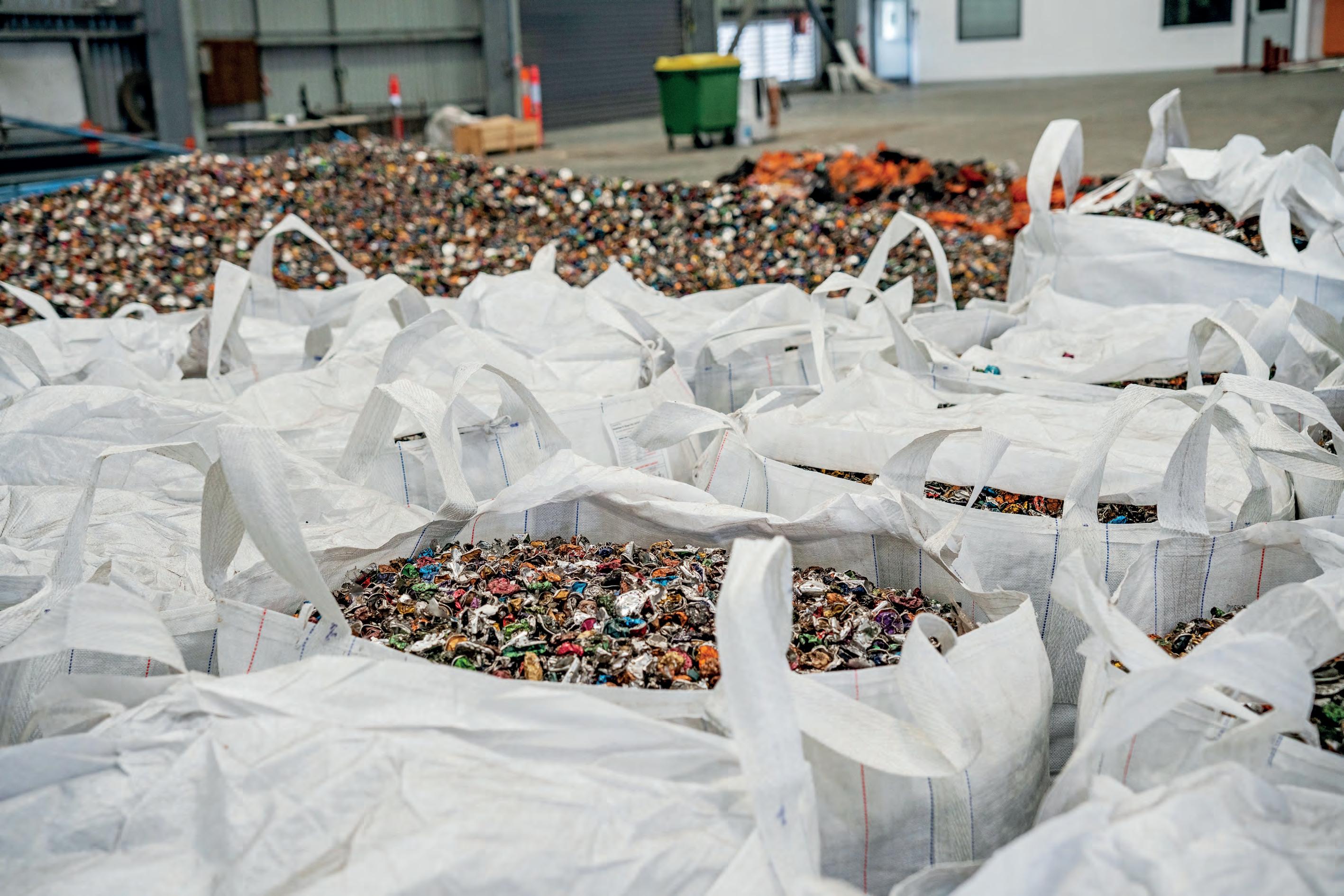
Stewardship solutions for problematic waste streams
FOURTEEN YEARS SINCE the Product Stewardship Act 2011 – when Australia’s product stewardship recycling framework began to take shape – it’s clear that collaboration, innovation and persistence are essential ingredients for success.
From coffee pods and glass windscreens to sheets and shirts, REMONDIS can deliver tailored solutions to give second lives to items that would otherwise end up as landfill.
Each product stewardship challenge is unique, requiring behind-the-scenes expertise, systems, technology and infrastructure. With a global operational history spanning 90 years, REMONDIS can call on international know-how to find ways forward –although many of its Australian product stewardship successes are proudly home grown, due to support from industry participants who are equally driven to see outstanding circular economy results.
The partnership between REMONDIS and Nespresso is a case in point. When the two companies joined forces to address the issue of aluminium coffee pod waste, the challenges were significant. With some three million coffee pods used daily in Australia, only ten per cent were recycled and some 8,500 tonnes were going to landfill annually. How would you go about making a difference, notwithstanding that the size of coffee pods prevents them from being recycled in standard kerbside
facilities? Coffee pods might be small, but the job of recycling them is huge.
Nespresso was up for the challenge, implementing collection programs at stores, workplaces and communities across Australia. An example of industry working with industry was Nespresso engaging with the hospitality sector’s Accor, resulting in waste pods from some 450 hotels across Australia being diverted from landfill and returned to the circular economy.
REMONDIS coordinates the national scheme’s complex logistics function, overseeing more than 27,000 collections from Nespresso customers as well as direct collections from Nespresso boutiques. The process is digitally enabled at the front end by an app for customers to request a collection, and at the back end with detailed environmental and operational reporting from REMONDIS’s Client Portal – with both applications developed in-house by REMONDIS’s digital team.
Each month up to 180 tonnes of caps and coffee waste ends up at REMONDIS’s resource recovery facility at Tomago, New South Wales. A custom-built separation process sees residual coffee removed from pods and given a second life as compost, while the pods are compressed and ultimately used to make other aluminium products. About 2,500 kilos of pods and coffee scraps can be processed per hour at Tomago.
“We’ve tailor-made our de-packing process to meet the specific requirements of the Australian market,” REMONDIS Australia’s chief sales officer Nathan Radley said. “A lot of people would be surprised by the logistics behind recycling humble coffee pods, especially the work that goes into transporting them to one location. But the efforts of all parties along the supply chain are worth it: around 98 percent of all pods and coffee scraps we receive are recycled.”
In September 2025 REMONDIS joined R. M. Williams, Sheridan and BlockTexx to support Australia Post in showcasing a circular solution for textiles.
“At Australia Post’s Circular Proof of Concept Showcase, we outlined REMONDIS’s textile product stewardship initiatives in Europe, and how similar solutions might be implemented in Australia,” Radley said. “The take-away was that big things are possible if industry participants join hands to make a difference. As is the case with many product stewardship initiatives, that can involve changes at the design and production end, through to the delivery and retailing phases. The right recovery processes and logistics backed by clear communication across the players –including consumers – are also needed to ensure environmentally and financially sustainable results.
“With the right processes and a whole-ofindustry approach, textiles from used clothes, for example, can be diverted from landfill and reused, re-purposed to make new clothes, turned into new fabric-based products, polyester, cellulose, stuffing and other materials.”
REMONDIS Australia is also poised to ramp up auto windscreen recycling on behalf of a national supplier, by introducing specialist glass crushing, sizing and recycling capabilities.
“For the past 11 years we’ve sent windscreens to third party disposal sites for recycling but with recent supply disruptions and limited recycling in some areas, we’re establishing our own processing capabilities to complement the collection logistics we already oversee,” said Trent Morton, general manager of REMONDIS Australia’s Integrated and Managed Services division.
“There’s quite a process behind separating the glass and laminate that make up windscreens, but once that’s done the glass can be recycled for industrial applications including the making of concrete, pool filters and sand blasting material. We’re currently diverting about 4,000 tonnes of windscreens from landfill annually and expect that figure to rise as we become more hands-on.”
Björn Becker, REMONDIS CEO Asia-Pacific and West Europe, said REMONDIS’s specialised
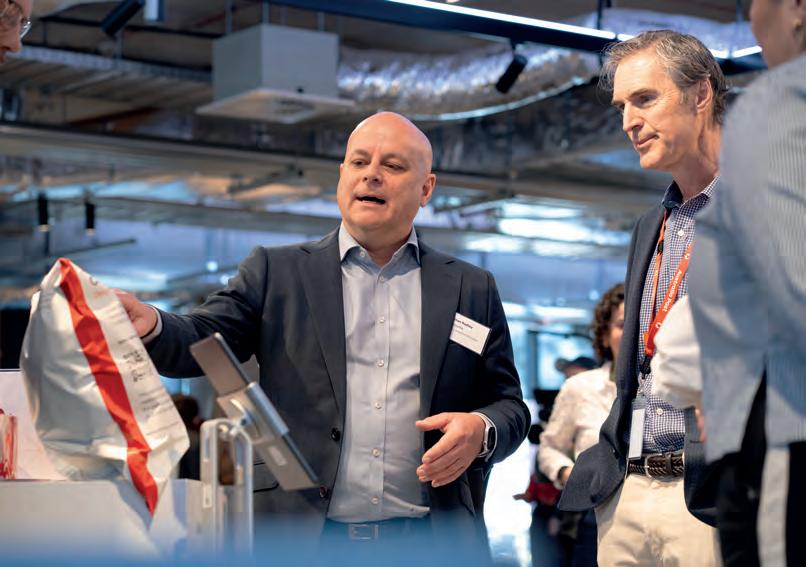
complex product stewardship schemes, spanning multiple sites across Australia,” Becker said. “That includes project management for both logistics and processing, 24/7 customer support and detailed
collaborating with a company operating confidently across the full resource recovery supply chain, supported by both local and global expertise.”
Each month 180 tonnes of used coffee capsules ends up at REMONDIS’s resource recovery facility at Tomago. Images: REMONDIS.
Australia Post is championing a circular solution for textiles.


Driving the circular economy forward
THE 2025 WASTE EXPO AUSTRALIA saw more than 4,000 attendees through the doors over two days at the Melbourne Convention and Exhibition Centre, with an emphasis on circularity and sustainable resource recovery dominating discussions across both the exhibition and conference programs.
More than 150 exhibitors showcased waste management and resource recovery solutions, with professional development opportunities and thought leadership on offer from more than 110 speakers across 45 conference sessions.
Conversations were focused on the urgency and necessity of a circular economy in Victoria and the wider Australian economy. Tony Circelli, CEO of Recycling Victoria, opened discussions with statistics highlighting progress in circular economy initiatives, like a material recovery rate of 70 per cent for the state, along with a doubling of the number of containers seen through the Victorian Container Deposit Scheme in its second year.
Echoing this theme of community engagement in the Summit’s Waste-to-Energy stream, was Scott Reynolds from Kwinana Energy Recovery. Reynolds emphasised that collaboration and engagement has been fundamental to the facility’s success, particularly in demonstrating how energy recovery technology complements recycling and other sustainable waste management practices.
“In a society where we have a greater focus on sustainability, being able to explain how complementary energy recovery is to other parts of the whole waste management process and hierarchy is really important in terms of bringing our communities along on this journey,” he said.
The Circular Economy stream of the Waste Expo Summit highlighted the critical need for mandatory Extended Producer Responsibility (EPR) regulations and national standards to create a level playing field for recyclers and brand owners. Key challenges included ensuring material purity and traceability, addressing safety risks in e-waste handling, and building systems-thinking approaches across supply chains with proper education and infrastructure investment.
EPR regulations also came up in a Day 2 panel discussion on landfill alternatives, emphasising systemic collaboration across the entire value chain, from mandatory EPR schemes and transparent labelling to community education and accessible collection infrastructure with viable end markets.
Successfully diverting waste from landfill depends on financial incentives that change behaviour, designing products for circularity from the start, and recognising that reuse and resource recovery create employment and social benefits beyond environmental impact.
In the Waste Summit Government and Policy stream, an insightful Indigenous Waste Management panel explored the logistical and environmental challenges faced in remote Aboriginal communities, examining how circularity connects to Indigenous concepts of “healthy country, healthy people”.
For the first time in 2025, the ecologiQ Greener Infrastructure Conference co-located with Waste Expo
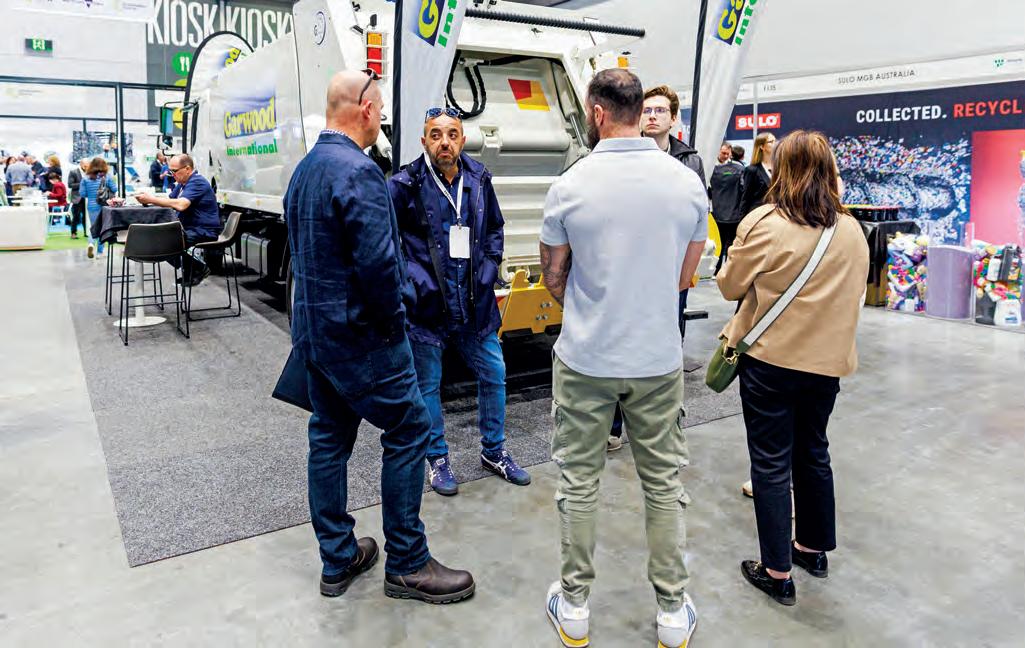
Australia, bringing together the resource recovery and sustainable infrastructure sectors in a strategic partnership that bridges the gap between resource recovery, sustainable infrastructure and large-scale government projects.
ecologiQ is at the forefront of integrating recycled and reused materials into road and rail infrastructure projects across Victoria.
The Start with Sustainability panel on Day 1 of the ecologiQ conference explored how early collaboration across the entire value chain – from architects and engineers to suppliers and contractors – is essential for embedding sustainability into infrastructure and building projects, so that long-term value thinking and standardised approaches to measuring embodied carbon can overcome the traditional barriers of upfront costs and procurement constraints.
Yas Grigaliunas, CXO of Videopro and former founder of Circonomy, led a keynote to start the ecologiQ conference, summarising her startup journey through the circular economy as a full-circle story of believing, building, scaling and failing. She encouraged attendees and other potential founders that events like the Greener Infrastructure conference were what moves the entire circular industry forward.
The conversations continued over Day 2 of the ecologiQ conference, as Professor Veena Sahajwalla demonstrated how Australia can transform waste into high-value manufacturing opportunities through her MICROfactories. She showcased green ceramic tiles made from waste glass and textiles, in partnership with Liverpool City Council, and highlighted breakthrough technologies in green steel
and 3D printing filaments made from 100 per cent recycled plastics.
The exhibition floor was packed across both days, with more than 150 exhibitors showcasing cutting-edge waste management solutions, recycling technologies, and sustainable infrastructure innovations. From large equipment manufacturers to innovative green tech, exhibitors made valuable industry contacts while contributing to the professional development of attendees.
Bridging the conversation between municipal solutions and circularity are Sulo, who were exhibiting their range of durable recycled bins, telling the story of an end-to-end solution that works on Scope 3 emissions.
Exhibition manager, Sherri Pearson, said that Waste Expo Australia has continued to grow thanks to its relevance, strategic industry partnerships, and ongoing adaptation to industry trends.
“The success of Waste Expo Australia is driven by its ability to bring together the most influential players in the sector, and future editions will focus on expanding international reach and providing even more value to attendees and exhibitors,” she said. “Next year’s event will see exciting enhancements focused on the latest technologies and solutions being developed globally. As part of an international portfolio of events, Waste Expo Australia will continue to be the industry’s must-attend event.”
Waste Expo Australia will return to the Melbourne Convention and Exhibition Centre on 28-29 October 2026. Stay up to date at www.wasteexpoaustralia.com.au.
The exhibition floor was packed with exhibitors such as Garwood International. Image: RX Global
Powering ahead with Vermeer HG6800TX horizontal grinder
FIFTEEN YEARS AGO, Queensland arborist Gavin Rowan bought a small vegetation management business that came with a handful of trucks, a few chippers and 10 staff. Today, Heritage Tree Care runs more than 50 trucks and employs around 140 staff across several depots from Brisbane to the Gold Coast and Toowoomba.
What began as a traditional arboriculture service has expanded into a diverse operation that includes vacuum excavation, land clearing, porous paving, and in-house traffic control. The company’s scale and capability mean it can handle projects ranging from routine tree maintenance to clearing and infrastructure work.
“We’ve got a bunch of excavators now and a few depots,” Rowan said. “We’ve branched off into a few new areas, but it’s all still about doing the job properly and safely.”
The next logical step in the company’s growth came with a move into large-scale wood and green waste processing. After years of running an expanding fleet of chippers, around 25 at last count, Rowan decided it was time to invest in a high-capacity horizontal grinder.
“When we bought the business, it came with a couple of chippers, and then we bought a few more,” he said. “The logical next step was obviously to get a grinder, and I’ve got a lot of faith in Vermeer gear.”
Heritage Tree Care’s new Vermeer HG6800TX tracked horizontal grinder has proved itself an asset across multiple applications.
The company uses it to do some of its land-clearing work. Heritage Tree Care has a holding yard for mulch and waste, so the machine is utilised to process stump grindings and palm mulch; the rubbish it brings back from jobs. Rowan said he bought it to recycle waste streams in his own yard, but it’s ended up going out of the yard quite often.
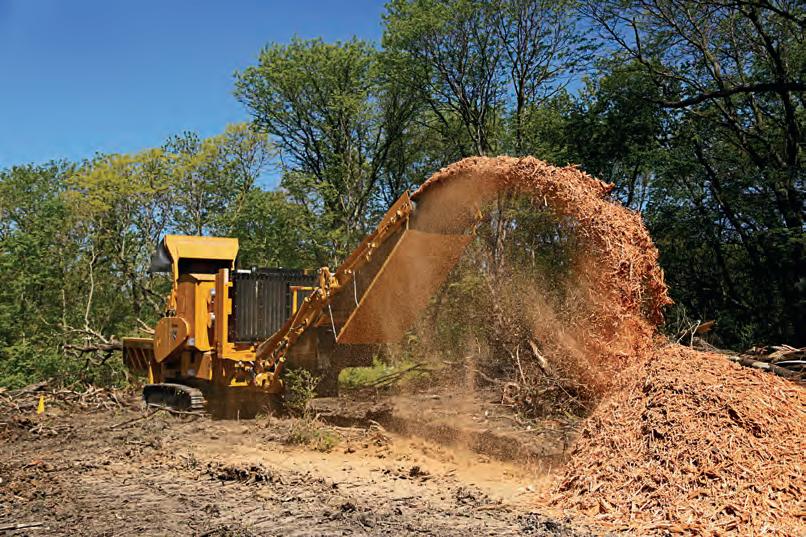
Stocked by local agent Vermeer, the grinder comes with a 950-horsepower (708-kW) CAT C27 Tier 4 Final engine. It is built to handle heavy workloads in tough environments.
The grinder features a 24-inch (60-centimetre) ground clearance and a track-driven undercarriage, giving it the ability to tackle uneven or soft terrain often found on clearing or recycling sites.
Its Series III duplex drum and smart feed system are designed to maintain throughput and minimise blockages, allowing operators to process more material in less time. Rowan has been impressed by the results.
“It’s a good machine, this machine – she’s quick,” Rowan said. “We’ll probably throughput 2,500 cubes of product today. It’s incredible. These kinds of machines get worked hard in dusty, dirty environments, but they go pretty good.”
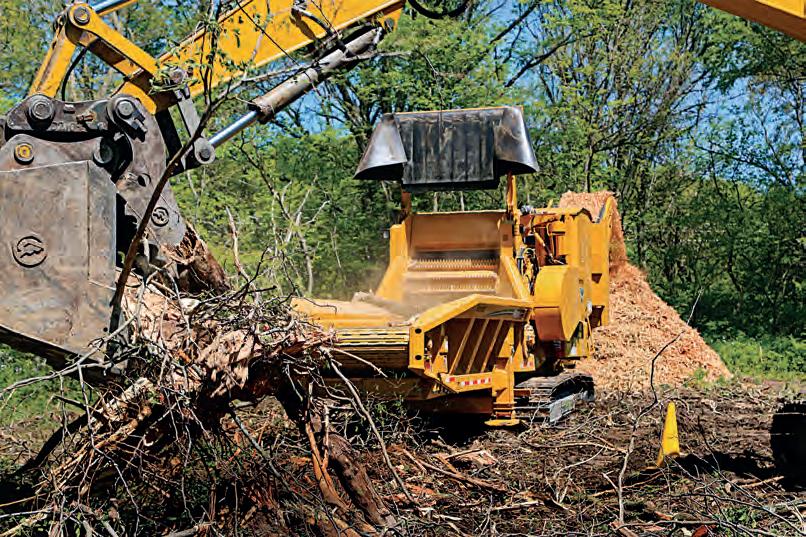
Service, safety and training support
Rowan said Vermeer’s after-sales service has been an important factor in keeping the company’s operations running smoothly.
“With this gear, I can call Vermeer parts department and get parts on a weekend if I need it,” he said. “Someone’s always there to help you, and the boys are all close to our yard. Someone will run the parts out to me and give us a hand to try and keep us on the road as much as possible. I like all that. It’s what they’ve been trying to do to help us.”
This responsive support, coupled with Vermeer’s reputation for durable, easy-to-use equipment, gives Rowan confidence when it comes to safety and training new operators. He said he’s always like the safety in the Vermeer gear. He also said they are also good machines to teach others how to operate equipment because they are easy to use.
The grinder’s intuitive controls and safety systems mean less-experienced staff can quickly gain confidence operating it.
“It definitely gives me faith to send out guys who are relatively new to the industry and train them up in it,” Rowan said. “Obviously they’ve got to get their tickets to use it, but it seems to work well for the guys.
“Nigel Dobier, Vermeer’s general manager up here has been extremely good in helping us. The team behind him are professionals in their field. We’ve been very happy with their products and their service.”
Building for the future
From a small operation with only a few trucks, Heritage Tree Care has grown into a major Queensland business offering a range of vegetation management services. The introduction of the HG6800TX marks another step forward, expanding its recycling and processing capability while maintaining the safety and efficiency the company is known for.
Rowan said the move has already paid off.
“It’s ended up going better than I thought,” he said. “It’s doing a lot of work, and the machine’s handled it all easily.”
The grinder’s controls and safety systems means new staff can quickly gain confidence operating it. Images: RDO/Vermeer
Among its tasks, the HG6800TX is utilised to process stump grindings and palm mulch.
Creating a cleaner future
AIC GROUP, a global specialist in thermal treatment and waste-to-energy technology, is expanding into the Australasian market through a new distribution partnership with local equipment and s ystems integrator SKALA Environmental. The collaboration will introduce AIC’s suite of thermal treatment and Waste-To-Energy technologies to Australia, with the first mobile EcoChar biochar units to arrive in early 2026.
AIC Group has become a specialist in advanced processing systems across agricultural, general, medical and hazardous waste streams, driven by innovation and global growth. Its expansion into Australia marks an important step for both the company and the region’s circular-economy ambitions.
Craig Cosgrove, director at SKALA Environmental, said the partnership reflects a shared desire to tackle one of the industry’s most persistent issues –managing organics residual material after composting.
“FOGO and other organic waste streams continue to grow, and the market is demanding alternatives to traditional mulch and compost outlets,” Cosgrove said. “We’ve spent months examining AIC’s technology firsthand; visiting their production facilities and reviewing operations in North America where operators face similar challenges to our customers in Australia. This partnership enables us to deliver innovative systems that create new revenue opportunities while supporting broader sustainability goals.”
Cosgrove noted that although Australia’s biochar industry is still in its early stages, the technology is poised for rapid growth as markets mature and organics infrastructure expands.
AIC Group’s technical sales director, Conor Donnelly, said the company has long seen Australia as a strategic opportunity.
“We’re extremely pleased to partner with the team at SKALA, a family-owned business that closely aligns with our values and has deep experience and success in the organics sector,” Donnelly said. “We’re excited to bring our range of technology into the Australian market and support SKALA as demand for advanced environmentally friendly processing and carbon-focused solutions increases.”
AIC technologies available through SKALA Environmental
Through the new partnership, SKALA will now supply AIC’s full range of thermal and waste-to-energy systems, including:
• M obile biochar production systems.
• Wa ste-to-energy processing equipment.
• M edical and hazardous waste treatment systems.
• T hermal treatment and pyrolysis systems.
• B iomass energy boilers.
• P ollution control and emissions systems.
• T hermal oxidisers.
• He at exchangers.
up to 90 per cent with no required pre-processing, converting wood waste into high-value biochar suitable for agriculture, compost blends, and carbon markets. With a 28 m³ chamber and throughput rates of 8-12 tph, the system sets a high standard for mobile biochar production.
Features of the machine include:
• Onsite volume reduction.
• High-capacity continuous processing.
• No pre-processing required.
• Eliminates transport and disposal costs.
• R emote-control drive and deployment.
• Track-mounted mobility.
• L ive-stream video for safe and visible loading.
• Diesel–electric hybrid efficiency.
• C arbon sequestration benefits.
• L ow operating cost and operator-friendly design.
decarbonisation is accelerating interest in biochar.
“Biochar isn’t just a by-product – it’s a smart business opportunity,” he said. “Companies are increasingly focused on reducing their carbon footprint, and our technology is ideally positioned to support carbon-reduction targets.” Cosgrove agrees, noting the expanding commercial upside.
“Biochar enhances soil health, boosts yields, and improves water retention, making it a premium input for agriculture and horticulture. Its carbon-rich structure enables long-term carbon sequestration, supporting climate-change mitigation and unlocking new revenue through carbon credits,” he said. “The result is a high-value product for composting, horticulture, and agricultural industries.”
AIC’s Conor Donnelly (left) and SKALA Environmental’s Craig Cosgrove. Image: SKALA International
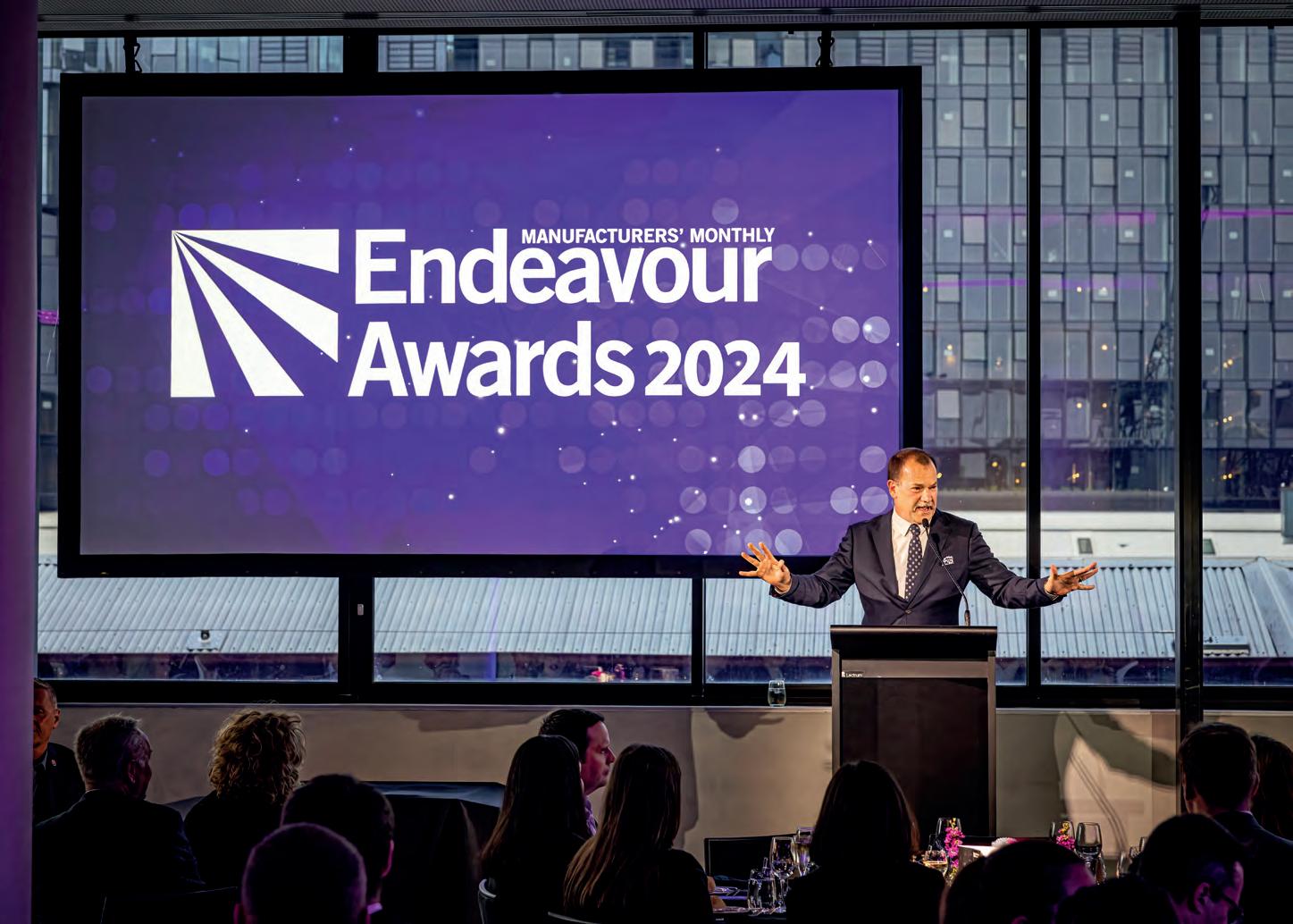
Entries open for the 2026 Endeavour Awards
NOMINATIONS ARE NOW OPEN for the 2026 Endeavour Awards, a celebration of excellence and innovation in manufacturing. Presented annually by Manufacturers’ Monthly and held in collaboration with Australian Manufacturing Week, the Endeavour Awards honour the achievements of individuals and organisations driving Australian manufacturing forward.
The annual gala dinner will take place on 13 May 2026 during Australian Manufacturing Week in Brisbane. Recognised as the manufacturing industry’s night of nights, the Endeavour Awards bring together leaders, innovators, and rising talent to celebrate success, share stories, and connect with peers shaping the future of Australian manufacturing.
Awards will be presented across the following categories:
• A dvanced Manufacturing Excellence Award –Sponsored by AMTIL
Celebrates outstanding achievement in precision engineering, automation, or digital manufacturing technologies.
Innovation in Aerospace
Honours companies driving innovation in aircraft,
space, and defence aircraft manufacturing.
Innovation in Health Technology
Recognises technologies that improve healthcare and medical manufacturing.
Innovation in Food & Beverage Manufacturing
Acknowledges advancements that enhance production, including processing, packaging, automation, or sustainability solutions.
Innovation in Transport
Highlights innovation in vehicle manufacturing, public transport, or sustainable mobility solutions.
Outstanding Start-Up Award
Celebrates Australian manufacturing start-ups that have successfully introduced new products to market, filling a gap in the sector.
L eader of the Year – Sponsored by BDO Australia
Awarded to a senior executive, manager, director, or equivalent in a private, not-for-profit, or government organisation who has effectively shaped business success, delivered financial growth, positively impacted organisational culture, and championed the industry.
R ising Star of the Year
Recognises an emerging leader demonstrating exceptional talent, innovation, and commitment
within Australia’s manufacturing industry.
E xcellence in Sustainability
Celebrates a manufacturing business that has demonstrated leadership and innovation in environmental sustainability.
M anufacturer of the Year – Sponsored by Weld Australia
Chosen from winners of the other award categories, this prestigious honour is not open for nomination.
For the first time in the event’s history, the Endeavour Awards will feature an Innovation in Food Manufacturing Award, recognising businesses driving advancements in food and beverage production through new or improved solutions in processing, packaging, automation, or sustainability introduced within the past two years.
The awards will also feature the new Advanced Manufacturing Excellence Award, celebrating outstanding achievement in precision engineering, automation, or digital manufacturing technologies.
Companies and individuals from across the sector are invited to submit their nominations and showcase the projects, technologies, and people contributing to the industry’s growth and resilience.
The Endeavour Awards bring together leaders, innovators, and rising talent that will shape the future of Australian manufacturing. Image credit: Prime Creative Media
EcoChar Phoenix 8000
Width: 3100 mm
Length: 12430 mm
Height: 3800 mm
Weight: 43,200 kg
Information:
The EcoChar Phoenix 8000 is an advanced cost-effective and environmentally friendly wood debris thermal treatment system with volume reductions of up to 90% dependent on calorific value and moisture content of feedstock. The process results in the production of a high-quality biochar product for commercial sale or use within the composting, horticulture and agricultural industries.
The EcoChar solution from AIC Group:
R educes wood debris volume onsite
H as a high processing capacity
TS-212 Mobile Picking Station
Unit Dimensions:
Operating Length: 16.2m
Operating Height: 5.56m
Width: 3.38m
Feed-in Height: 2.18m (with Blower) 1.73m (without Blower)
Discharge Height: 4.18m
Weight approx.: 19,000kg
Applications:
C&D, C&I, dry mixed recyclables, MSW, green waste, FOGO and more.
Information:
The innovative TS-212 mobile picking station solution from blueMAC allows for precise material sorting directly on-site, reduced downtime and can boost your productivity. Designed with operator safety and environmental impact in mind, the blueMAC TS-212 is perfect for a
CKTR82 Twin-Ram Baler
Applications:
R equires no material pre-processing
R emoves debris transportation and disposal costs
H as remote control drive and deployment system
I s track mounted for maximum manoeuvrability
• L ive streams video for full visibility for feeding
I s a diesel electric hybrid
S equesters carbon for carbon storage and beneficial reuse
H as low operating costs
I s operator friendly
The EcoChar Phoenix 8000 is available via Australian distributor SKALA Environmental.
Name: Craig Cosgrove
Phone: 0423 280 611
Web: skala.com.au
Email: info@skala.com.au
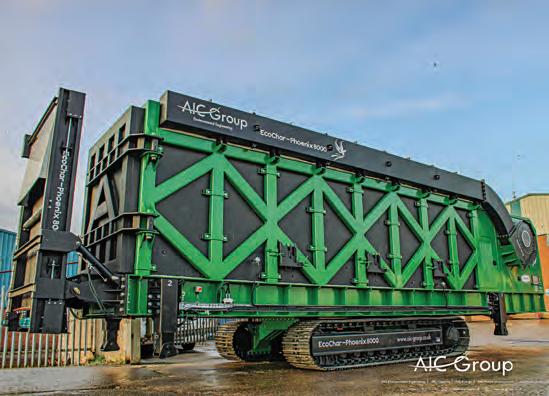
wide range of resource recovery applications and is engineered for maximum efficiency and on-the-go flexibility!
These units are ready for self-contained operation, complete with:
4 5kVA Onboard generator / hybrid.
1 200mm wide belt with variable speed.
4 chutes.
1 1kW Blower.
• 1 .5kW Magnet.
S ite mobile with Kingpin.
Available now in Australia with GK Skala for immediate delivery ex-NSW.
Name: Simon Toal
Phone: 0411 277 730 Web: skala.com.au Email: info@skala.com.au
RDF, SRF, MSW, cardboard, plastics, PET, HDPE, shredded paper, aluminum cans, steel cans and other recovered materials.
Information:
CK International’s CK TR82 Twin Ram Baler continues to be the first choice for busy recycling facilities,processing up to 6 tonnes per hour of mixed materials. Engineered for power, speed, and reliability, the CKTR82 is the perfect solution for high-volume operations demanding maximum efficiency. The CK TR82 is a powerful and versatile twin-ram baler designed to produce high-density bales across multiple materials. Engineered for optimal bale sizing, the TR82 produces standard mill-size bales, maximising space utilisation in shipping containers and optimising payload capacity.
Key Features:
R otatable heavy duty shearing blades made from D2
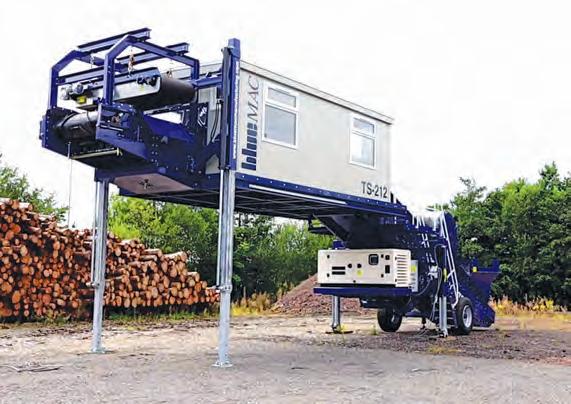
hardened steel
R eplaceable Hardox liners in baling chamber
Tongue and groove castellated floor
P ress plate running on steel rollers
B ale separation door
W ire & plastic tying options available
H MI touch screen controls
• Heavy duty hopper, flared or conveyor fed
P LC with ethernet connection for monitoring and programming
Multiple material programmes to vary compaction force and number of ties
B ale discharge table
C ategory 4 safety system
Name: Craig Cosgrove
Phone: 0423 280 611
Web: skala.com.au
Email: info@skala.com.au
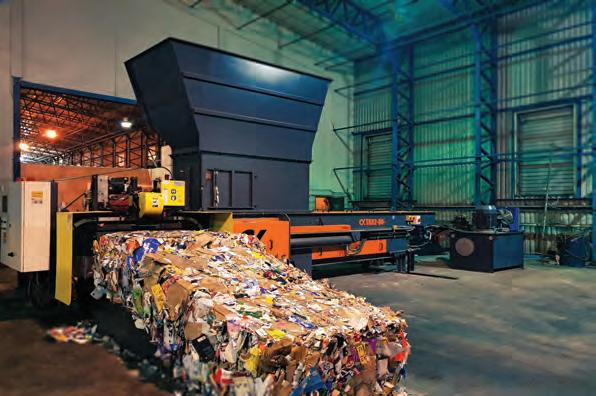
Growing up with a love of nature
FOR LEVIA KWONG, nature was always close at hand. Growing up in Hong Kong, she was surrounded by the kind of landscapes that inspired a lifelong curiosity about the environment. With country parks, marine parks and even a recognised UNESCO Global Geopark all within an hour’s travel, it was impossible not to develop an appreciation for the natural world.
“I’ve always felt connected to nature because I studied and loved geography growing up,” she said. “I’ve always loved being connected with nature.”
That early love of geography shaped Kwong’s academic path. She earned a bachelor’s degree in geography, followed by a master’s in environmental management. These studies built a solid foundation
for understanding how human systems interact with the natural environment, and they gave her the grounding to think critically about sustainability and environmental protection.
She continued to build on that knowledge in Australia. At Griffith University, she completed a master’s in environmental engineering, combining her
Kwong earned a bachelor’s degree in geography, then a master’s in environmental management.
Image: Levia Kwong
passion for sustainability with the technical expertise needed to design practical, real-world solutions to environmental challenges.
“I was really lucky,” Kwong said. “At the time I was about to graduate, I got a job at SMEC as a graduate environmental engineer.”
From student to engineer
Before joining SMEC, Kwong had accumulated a breadth of experience in environmental work back in Hong Kong. While studying, she took on her first internship and part-time role with a green NGO, helping to organise activities for schools and the public. These activities took people behind the scenes to see recycling facilities, waste infrastructure and green buildings, experiences that deepened her understanding of how waste was managed and recycled.
“I got to know more about how waste was being recycled back then,” she said. “After that, I had a couple of jobs in Hong Kong. I worked as an environmental protection inspector, a sustainability consultant, and a corporate social responsibility analyst. At that time, I got in touch with different engineers and learned how things worked.”
Those interactions sparked her interest in the engineering side of environmental management.
Kwong wanted to understand how technical design and innovation could help address pollution and waste issues more effectively. She was also interested to how she could contribute using engineering solutions to make a difference, such as in managing pollution, waste and natural resources.
During the final year of her environmental engineering master’s degree, she began working with SMEC, a consultancy that focuses on sustainability on every project.
“It was the perfect destination for me to grow my knowledge and skills in engineering and to satisfy my passion for geography, sustainability and the environment, she said
Kwong has worked with SMEC for two years. As a graduate engineer in the Waste and Resource Recovery team, she supports a range of projects while continuing to develop her technical expertise. In her team, the work falls into two main streams.
“First, we do engineering and design services for waste and resource recovery clients in Queensland and the Northern Territory,” she said. “That includes landfill design, above-ground waste processing infrastructure design, master planning and construction quality assurance (CQA) work. The second stream focuses on waste strategy and circular economy advisory services.”
Her work varies according to project needs. One day she might be assisting with engineering design processes, and on another, preparing technical documentation or undertaking field work. Her job involves preparing documentation for construction, such as technical specifications, CQA plans and technical memos. Depending on the client’s needs, the team conducts different management plans, water balance, materials balance assessments, etc.
The range of work means no two days are the same. Each project presents a new mix of engineering, environmental and logistical challenges, all requiring careful coordination and technical precision.
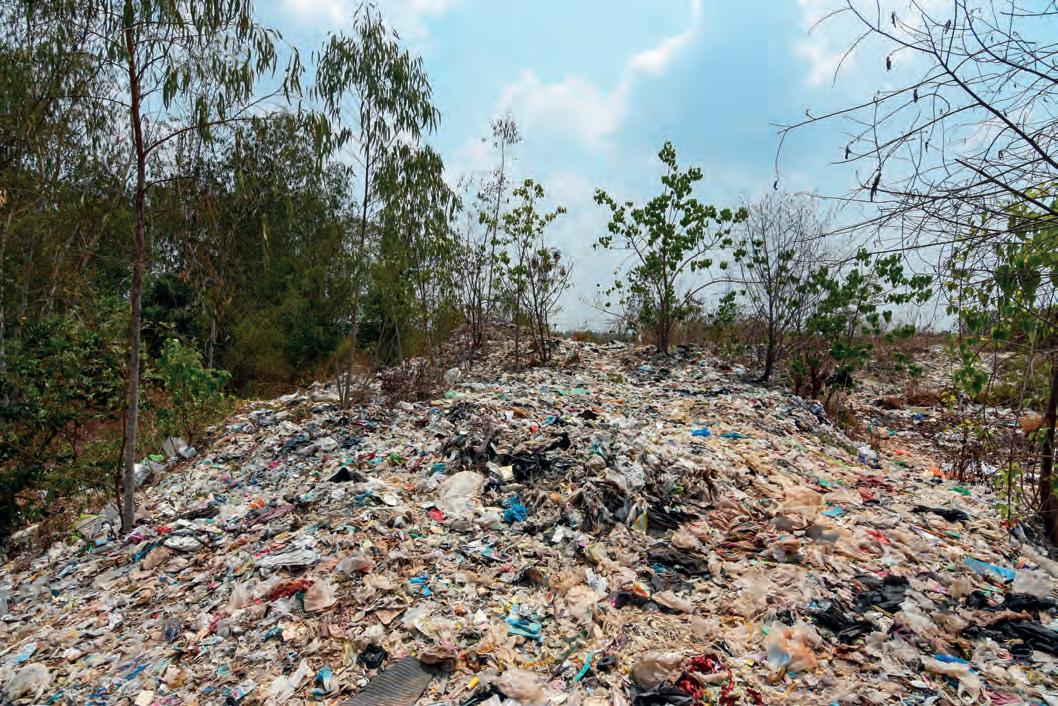
Designing with care
Kwong’s also notes that landfill design is more complex than many people assume. The process requires a balance between engineering requirements, environmental protection, public health,long-term resilience, constructability and cost.
“Sometimes when I talk to my peers or relatives, they don’t know or care what happens to waste after they put it in the bin,” she said. “They think maybe it’s just buried in the ground, but it’s not so straightforward. Through design, it’s a highly engineered process that combines engineering, science, precision and care for the environment.”
Each landfill design requires consideration of geotechnical, hydraulic and environmental principles. The goal is to control emissions, manage leachate and gas, and prevent contamination of soil and groundwater. For Kwong, it’s this combination of technical complexity and environmental purpose that makes the work rewarding.
Every design is unique, influenced by the site’s previous development, client expectations, local geology and hydrology, and even the socio-economic conditions of the surrounding community. Based on those different conditions, the team provides bespoke designs – from the shape of the landfill cells and material selection, landfill staging to leachate and gas management. Kwong credits her colleagues with helping her to deepen her understanding and confidence in this area.
“We have a really close-knit team,” she said. “Everyone is experienced and knowledgeable, and they all have different specialties, including project management, landfill engineering, civil engineering, road designs, stormwater management or waste strategy advisory. They’re all passionate engineers, and that passion is contagious.”
Working alongside senior engineers who are generous with their knowledge has been a defining feature of her early career. It’s allowed her to apply classroom theory to real-world contexts and to appreciate the depth of expertise required in waste and resource recovery.
Challenges and opportunities in waste management
The waste and resource recovery industry is facing challenges and opportunities, according to K wong, as governments and communities look for more sustainable ways to manage waste. One of the biggest issues is the growing pressure on landfill capacity.
“Many councils are actively looking for more landfill space for future needs,” she explained. “A lot of projects involving landfill expansion and master planning to see if there are opportunities to expand existing sites or any alternative options such as waste to energy.”
Beyond capacity issues, the industry is also grappling with the need to divert more organic material from landfill.
Queensland has a target to divert 80 per cent of organic material from landfill by 2030. However, Kwong said there are challenges related to regulation, cost and feedstock quality for this material across different regions within the state.
Other waste streams present their own difficulties, particularly those that are hard to recycle or manage safely. This includes the likes of soft plastics, e-waste and solar panels, with the latter being a big challenge for the future. Kwong believes innovation and balance will be key to meeting those challenges.
“Waste-to-energy is a really hot topic right now, along with the circular economy,” she said. “Landfilling is one option, but we have to find a balance between each option to make society more sustainable and resilient.”
For Kwong, that balance between engineering rigour, environmental care and practical solutions is what makes her work meaningful. From her early fascination with geography to her current role shaping the future of waste management, she has stayed true to the same goal: contributing in solving environmental problems of today and o vercoming the challenges of tomorrow within the environmental industry
Lack of landfill space is becoming a burning issue, according to Kwong. Imaget: neenawat khenyothaa/shutterstock.com
Ashes and ambitions in rubbish flames
Dear Sir,
A fable if I may. In the sleepy hamlet of Blackhurst Vale, where the wind always carried a faint whiff of burnt toast and damp laundry, the council quietly set up a towering facility on the outskirts. They claimed it was a bold solution: turn the town’s unwanted detritus – the soggy pizza boxes, broken toys, expired yoghurts and wayward socks – into electricity. The process would involve extracting residual waste (that which cannot be reused or recycled) and subjecting it to controlled thermal destruction, producing steam, driving turbines, and ultimately lighting homes.
From the moment the facility’s gates opened, though, it felt like a character in a gothic fable. The building loomed like a monolith of ambition. At dusk, its flue stack breathed a ghostly plume of steam and faint acrid scent, visible even from the public footpath. Locals whispered of the “Great Incinerator” and children dared each other to peek at it’s red-hot doors
A dramatic line, and somewhat true: large-scale facilities elsewhere in Australia are designed to divert vast tonnages of waste from landfill and recover energy.
Yet the townsfolk felt uneasy. One of the local Garden Club members muttered that the ash residue was being repurposed for roadmaking, which sounded practical but also vaguely sinister. One night, the town’s poet-in-residence (a kindly gentleman with ink-smudged fingers) dreamed of the facility whispering like a carnival barker: “Feed me, feed me,” it moaned, and trucks lined up like supplicants.
In the children’s playground, the seesaw groaned under weigh-ins of morality: “Is it better to burn or bury, or to refuse in the first place?”
Awkward teenagers proposed an art installation: burnt bin lids suspended in wires, illuminated from below by violet LED lights. They called it “The Phoenix of Plastics”.
Cows in the nearby paddocks stacked themselves in clusters. At the pub, locals toasted the incident: “Our power slept but the trash kept talking,” someone cheered.
The town of Blackhurst Vale evolved. The children no longer called rubbish bins “boring black holes” but “feeders of the flame”. The elderly referred to the plant as “the hearth in the hills”. In truth, the hearth was dark and humming and slightly unsettling, but it did work. Streetlights glowed, homes warmed, and the trucks heading to the old landfill declined.
Yet outside the plant’s polished façade lay a question mark. Was this triumph or a pact with fire? The ash still had to go somewhere; the pile of unrecyclables still grew; the incinerator still required that the town kept producing trash to run. In their more honest moments, the gardeners called the plant “the giant bonfire of everyday objects”.


Turning waste into value – from Dubai to Down Under
From initial planning to long-term operation, Kanadevia Inova delivers complete thermal and biological Waste to Energy plants. As an experienced EPC contractor, we handle every step – develop, design, build, operate, maintain. Our track record of more than 1,600 plants worldwide speaks for itself – including one of the world’s largest WtE facilities in Dubai. Check our references.