
![]()


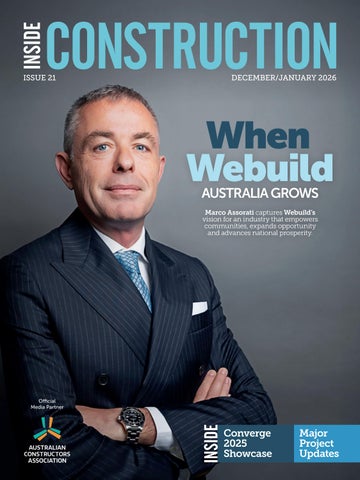
Marco Assorati captures Webuild’s vision for an industry that empowers communities, expands opportunity and advances national prosperity.


10 When Webuild, Australia grows
Webuild shows how collaboration with industry and communities is helping build a stronger, more connected Australia.
Rachel Miu: Counting on connection
Rachel Miu, building estimator at Lipman, shares how she approaches construction as both a craft and a community.
54 Build great leaders
Exploring the final chapter of her book, Dr Gretchen Gagel offers advice for construction leaders seeking to elevate their impact.
44 To the EWIT village
Empowered Women in Trades shares highlights from its 2025 Gala Awards.
procurement to lift productivity
The Australian Constructors Association calls for reform to simplify procurement, cut delays and unlock productivity across the industry.
Next-level quality in precast production
National Precast Concrete Association Australia profiles a concrete sleeper manufacturer piloting a new artificial intelligence inspection system.
Ensuring safer and more inclusive workplaces
In its 30th anniversary year, the National Association of Women in Construction shares its latest achievements and efforts to drive culture change. 52 It is time to change the
NexGen closes the reality gap between what young Australians think construction is and what it can be.
Tested strength in steel
FTI Group reveals how its metal tray formwork for high-rise commercial and residential builds delivers assurance on site.
assets and infrastructure integrity
With the holiday season approaching, Hobson Engineering showcases its range of security fasteners.
Building for discovery
Built Environs demonstrates its expertise in Australia’s life sciences sector, constructing environments where research, production and innovation can flourish.
The next step in industrial access
Kattsafe unveils a new modular aluminium stair tower that brings speed, scale and simplicity to industrial access.
The road to autonomy
From project profitability and forecasting to compliance, MYOB explores how artificial intelligence is driving efficiency in the field.
Class of 2025
With its 2025 class confirmed, the Komatsu-Williams Engineering Academy reinforces its commitment to cultivating global engineering talent.
Big builds and bold ideas
If you missed the Major Projects Stage at Converge Expo 2025, we have you covered.
With skill shortages tightening, CONEXPO-CON/AGG 2026 puts careers and capability in the spotlight.
Reflecting on a year marked by endurance and evolution.
The past year has been a study in contrasts for Australian construction. Progress continued at a remarkable pace, even as the sector navigated economic headwinds, supply constraints and shifting policy priorities. Through these challenges, the industry has again demonstrated the resolve that gets the job done.
This year’s progress has been measured less by what was built than by how it was achieved. Contractors have found new ways to collaborate, clients have rethought procurement, and project teams have drawn on data, digital tools and experience to deliver better outcomes.
At the same time, commercial and labour pressures reshaped the way builders worked. Cost escalation has forced companies to refine forecasting, while skill shortages have intensified competition for talent. Many contractors have turned to integrated delivery models and stronger supplier relationships to stabilise performance and maintain quality. These developments signal a maturing industry that is learning to anticipate volatility.
What was once ambition in sustainability is now expectation. Governments, contractors and suppliers alike have made headway toward lower-carbon outcomes, with embodied carbon tracking, renewable power integration and circular economy principles now commonplace across projects.
Equally significant has been the industry’s continued push to build a more inclusive workforce. Initiatives through groups such as the National Association of Women in Construction, Empowered Women in Trades and NexGen have accelerated momentum, creating pathways for women, young people and under-represented groups to step into technical, leadership and on-site roles. Companies are
learning that capability grows from varied experience, backgrounds and perspectives.
Looking forward, 2026 promises both continuity and renewal. Australia’s pipeline remains strong, anchored by transport, energy and defence programs. The projects ahead will call for deeper alignment between design, delivery and digital systems. Collaboration will continue to set the pace for progress.
For Inside Construction, this year has been one of growth, expanding coverage, forging deeper relationships and continuing to share the stories that show the best of the industry. To all who have contributed, collaborated and led, thank you. This magazine exists because of your work, expertise and commitment. And as the year draws to a close, it’s not quite over yet. This edition looks at how far construction has come, and where it’s heading next.
Inside, you’ll find building systems and materials improving delivery and performance; insights into specialised and emerging markets; thought leadership on technology and digital integration; and practical ideas that inform better practice across every level of the industry. From the Inside Construction team, we wish you a safe and well-earned break. See you in 2026.

Chairman John Murphy
Chief Executive Officer Christine Clancy
Managing Editor
Mike Wheeler mike.wheeler@primecreative.com.au
Editor
Ashley Grogan ashley.grogan@primecreative.com.au
Sales Manager
Danny Hernandez danny.hernandez@primecreative.com.au
Design Caterina Zappia
Head of Design Blake Storey blake.storey@primecreative.com.au
Business Development Manager Michael Ingram-Casha michael.ingram@primecreative.com.au p: +61 0423 266 991
Client Success Manager Louisa Stocks louisa.stocks@primecreative.com.au
Cover image credit Webuild
Head Office
Prime Creative Pty Ltd 379 Docklands Drive, Docklands, Victoria 3008 Australia p: +61 3 9690 8766 info@primecreative.com.au www.insideconstruction.com.au
Subscriptions
+61 3 9690 8766 subscriptions@primecreative.com.au
Inside Construction is available by subscription from the publisher. The rights of refusal are reserved by the publisher
Articles
All articles submitted for publication become the property of the publisher. The Editor reserves the right to adjust any article to conform with the magazine format.
Copyright
Inside Construction is owned by Prime Creative Media and published by John Murphy.
All material in Inside Construction is copyright and no part may be reproduced or copied in any form or by any means (graphic, electronic or mechanical including information and retrieval systems) without written permission of the publisher. The Editor welcomes contributions but reserves the right to accept or reject any material. While every effort has been made to ensure the accuracy of information, Prime Creative Media will not accept responsibility for errors or omissions or for any consequences arising from reliance on information published. The opinions expressed in Inside Construction are not necessarily the opinions of, or endorsed by the publisher unless otherwise stated.

FASTENERS SINCE 1935
Upholding our commitment to quality through our NATA-accredited laboratory and close collaboration with key industry partners.

Quality assurance documentation available online at:
Major projects across Australia and New Zealand reveal a construction sector building capability, resilience and progress.

Contractor: BESIX Watpac
Current value: $780 million
Details: The new Shellharbour Hospital in Dunmore, New South Wales, marks an advancement in delivering world-class healthcare to the Illawarra region. Designed to reduce the need for residents to travel long distances for treatment, the hospital will provide expanded emergency services, elective surgery, rehabilitation, aged care, acute medical care, mental health support and renal dialysis. BESIX Watpac is
constructing three buildings as part of the development: a six-storey Acute Services Building, a three-storey Ambulatory Care Building and a two-storey Mental Health Building. Each facility is designed to support modern models of care and improve patient outcomes. The project incorporates sustainable design principles and advanced technology and includes a rooftop helipad that will enable air transport for critically ill patients to receive timely and specialised care. Improved public transport links and a
new car park will enhance accessibility for patients, staff and visitors. Approximately 2,000 construction jobs are being created, providing a boost to the local economy and offering opportunities for regional businesses to contribute to the delivery of this vital infrastructure.
Status: Construction commenced in late 2024, with top-out scheduled for Q1 2026. Façade and fit-out works are commencing in December 2025. The project remains on track for completion in 2027.

Contractor: Built, in joint venture with Obayashi Corporation
Current value: $1.45 billion (on completion building value)
Details: Built, in joint venture with Obayashi Corporation (BOJV), is delivering Atlassian’s Australian headquarters adjacent to Sydney’s Central Station on behalf of coowners Dexus and Atlassian. The 39-storey structure, set to become one of the world’s tallest hybridtimber commercial buildings upon completion, represents a milestone in sustainable construction. Through innovative design and deliberate material choice – including mass timber, low-embodied-carbon steel and low-cement concrete – the project is targeting a 50 per cent reduction in upfront embodied carbon across the substructure, superstructure and façades compared to a conventionally constructed tower.
Status: Construction is progressing toward base building completion in 2026.
Initiatives: The BOJV project team developed practical, buildable solutions to address complex construction challenges associated with the site’s heritage-listed elements and proximity to Central Station. Taking a digital-first approach, the team used digital modelling to plan and sequence construction tasks, ensuring precision and efficiency before work began on site. A standout engineering achievement is the diagrid structure, which supports the hybrid-timber superstructure by transferring perimeter loads to a concrete core and two north-facing mega columns. This design minimises the structural footprint while accommodating the site’s constraints.

The centre will be the largest combined aquatic and indoor recreation facility in the country. (Image: Crown Infrastructure Delivery)
CPB Contractors
500 million
he Parakiore Recreation and Sport Centre will serve as a hub for community recreation, aquatic sport and elite training in New Zealand. It combines multiple facilities under one roof to support health, wellbeing and high-performance sport. At more than 30,000 square metres, it will be the largest combined aquatic and indoor recreation facility in the country. The complex features a 10-lane, 50-metre competition pool (with a movable bulkhead and floor), a separate diving pool with a 10-metre tower, five hydroslides (including New Zealand’s first trapdoor waterslide) and an aquatic sensory experience for people with disabilities. On the dry side, it offers nine indoor courts, a central show court with 2,500 retractable spectator seats, fitness and movement studios, and a shared sports administration facility. Structurally, it addresses Christchurch’s earthquake-prone and liquefaction-prone ground conditions with 8,000 stone columns driven 12 metres deep – the largest implementation of its kind in New Zealand. Parakiore is designed not just for elite sport but to be accessible to people of all ages, abilities and community needs. ompletion is expected in December 2025.
ealth and safety were central to every stage of the project. Ongoing project and management safety reviews supported continuous improvement and accountability, with the site achieving MATES in Construction accreditation. Unique site challenges required tailored solutions. Working around large aquatic zones introduced drowning and fall hazards, which were mitigated through scaffold edge protection and exclusion zones. For installation of the fabric ceiling and skylights above the pools, the team designed and constructed New Zealand’s largest birdcage scaffold – a 14-metre-high, full-span engineered access platform providing safe, stable elevated work areas over water.
Contractor: Laing O’Rourke
Details: Laing O’Rourke is the Initial and Early Works Managing Contractor for Suburban Rail Loop (SRL) East. The package of works forms the first stage of construction for SRL East and involves establishing sites for the new underground stations at Box Hill, Burwood, Glen Waverley, Monash, Clayton and Cheltenham as well as the train stabling facility in Heatherton. The first phase of early construction has included site establishment, utility relocation and protection (including gas, water, sewer, telecommunications and electricity), demolition, excavation of a tunnel boring machine (TBM) launch site in Burwood and a tunnel entrance in Heatherton, construction of a new tram terminus and temporary bridging structure at Box Hill, and the delivery of new community spaces at Clayton and Burwood. Laing O’Rourke has also built two network support facilities that will power the TBMs during construction, as well as the SRL East network when trains are running in 2035.
Status: After three years, sites at Box Hill, Burwood, Clayton and Cheltenham will be handed over to tunnelling contractors to commence the next stages of the project, bringing SRL East a step closer to completion.


Status: The project is employing innovative construction methods to improve efficiency. This includes offsite fabrication of 982 bathroom pods, installation of 300 precast panels with integrated brick façades, and prefabrication of column boxes with built-in reinforcement. A heritage building dating back to 1840 is being preserved and structurally upgraded using laboratory-tested timber and a rooftop steel truss. In addition, a modular curtain wall façade has been manufactured off-site to streamline the construction process.
Contractor: Integrate Alliance (Clough, Water Corporation and Jacobs)
Current value: $238.5 million
Details: The Integrate Alliance – comprising Clough (part of the Webuild Group), Water Corporation and Jacobs – is delivering the Engineering, Procurement, Construction and Commissioning (EPCC) contract for the Woodman Point Water Resource Recovery Facility upgrade in Munster, Western Australia. As the state’s largest wastewater treatment plant, the facility is being upgraded to increase sludge treatment capacity, enabling the processing of 120 tonnes of dried solids per day. The project will also support the recovery of biosolids for agricultural use and biogas for renewable energy generation. The scope includes the integration of thermal hydrolysis pre-treatment technology, a new dewatered sludge receival facility, a new solids thickening and dewatering system, and new odour treatment infrastructure.
Status: Work on site is progressing, with engineering design nearing completion. Procurement is now 85 per cent complete, and much of the major equipment has been delivered to site. The concrete framework for the new Pre-watering Building has been completed. This facility will pre-treat sludge from Woodman Point, East Rockingham and Alkimos water resource recovery facilities to achieve a consistent mixture. Equipment on site includes gas engines, sludge silos, conveyors and storage tanks. To date, 200,000 cubic metres of material have been moved on site – equal to nearly 25,000 truck movements – along with 1,185 cubic metres of concrete poured and 100 tonnes of structural steel installed. A dissolved air flotation tank is currently being commissioned.


Webuild partners with industry and communities to deliver the infrastructure that underpins Australia’s economy and social fabric.
“Collaboration is key to success. We succeed together, and if there are challenges, we face them together.”
Construction is a powerful economic engine. It builds the roads that carry trade, the railways that link regions, and the water systems that keep cities alive. It delivers the homes, schools and hospitals that sustain daily life, and the energy networks that power industry. Few sectors contribute more directly to national prosperity.
As Marco Assorati, senior executive vice president operations at Webuild and executive president at Clough, says, “Progress demands infrastructure”.
For Webuild, progress is measured not only by what is constructed but by what continues: the communities it supports, the opportunities it opens and the capability it leaves behind.
Legacy runs deep in the company’s Australian story. Through Clough, whose projects have helped shape the nation’s modern landscape, the group’s history spans more than a century. That lineage has become a shared purpose: delivering infrastructure that serves communities and sustains progress.
“Webuild has been part of Australia since the 1970s, delivering projects across Victoria, New South Wales and Queensland. We returned in 2012 and have since been involved in some
of the country’s most iconic and complex infrastructure works,” says Assorati. “With the acquisition of Clough, our combined history in Australia now spans more than 100 years.”
A century of building has given Webuild and Clough both heritage and foresight, with a view to where the next era of investment and innovation will unfold.
That perspective crystallises around three national priorities: transport, water and clean energy.
“ Transport remains the backbone of the nation’s long-term vision,” says Assorati. “Cities must be connected, and as they continue to grow, the road and rail networks must grow with them.”
Connectivity, he believes, is the foundation on which both economic and social opportunity are built. Webuild’s role in this space includes the Suburban Rail Loop and North East Link in Victoria, Sydney Metro in NSW and the Forrestfield–Airport Link in Western Australia. These projects expand mobility, ease congestion and connect regions.
North East Link is a prime example. The project comprises twin three-lane tunnels stretching roughly 6.5 kilometres, together
forming the longest road tunnel in Victoria. Once complete, it will remove 15,000 trucks from local roads each day and cut travel times by up to 35 minutes. It will also improve safety and connectivity across Melbourne’s freeway network.
Water follows transport as the next national imperative. As populations rise and climatic pressures intensify, reliable water infrastructure is critical. From treatment facilities to desalination plants, the systems that sustain supply are central to resilience.

This is illustrated by Clough’s delivery of the Bundeena to Maianbar Water Cycle Management Scheme in NSW, which is providing wastewater services to previously unsewered communities through environmentally sensitive design and construction.
Energy completes the picture, supporting every aspect of daily life, from homes and hospitals to industry and innovation. Webuild’s work on Snowy 2.0 shows its role in advancing clean energy and hydro capability, providing renewable generation that will deliver energy security for decades to come.
“If companies and contractors are to invest with a long-term view, these are the three pillars that will shape the future,” says Assorati.
These priorities reflect Webuild’s strategy, aligning national needs with the company’s global experience. They also encompass social infrastructure, including hospitals and civic assets, as well as sectors such as civil, marine, resources, housing and asset management.
A culture of collaboration
Webuild’s expertise is evident in the scale of its projects, but for Assorati, what matters most is how that knowledge is shared. The company works in concert with clients, contractors and communities. Its reputation rests on trust and cooperation, qualities that turn complex builds into positive outcomes.
“Collaboration is key to success,” he says. “We succeed together, and if there are challenges, we face them together.”
While its projects show capability, its partnerships show character. The group has forged relationships with universities across Victoria, NSW, Queensland and WA to help develop the next generation of engineers and project leaders.
“We do not just create jobs; we create skills,” says Assorati. “We bring knowledge gained from the 50 countries where we currently operate, sharing global expertise and innovation, and adapting it to fit Australia’s environment. This exchange of ideas helps us introduce proven solutions that add real value locally.”
Each project is designed to connect with its community and leave people better equipped for the future. Between July 2024 and June 2025, Webuild spent $4 billion on procurement, of which $3 billion went to local suppliers. Wherever possible, the company prioritises subcontractors located near project sites so that investment stays within the local economy.
The impact of that approach can be seen on Snowy 2.0, where small regional contractors have developed into experienced businesses capable of delivering major works.
“When our partners grow, we grow too,” says Assorati. “It is about creating a cycle of capability.”
Webuild also works with Indigenous enterprises and social procurement programs that open doors for underrepresented groups. Its focus on inclusion has seen women comprise up to 30 per cent of project workforces, above the industry average.
That culture of collaboration runs through every layer of the organisation. Transparency and shared values underpin the way teams operate, fostering trust that lifts both performance and outcomes.
“When collaboration is genuine, it raises standards across the industry,” says Assorati. “We aim to make the construction industry better, not just bigger. What matters to us is the lasting benefit infrastructure brings to communities. That benefit is the ultimate goal, and it defines our vision.”


Ceres is a $6.4 billion
“What matters to us is the lasting benefit infrastructure brings to communities.
That benefit is the ultimate goal, and it defines our vision.”
That same mindset carries across borders.
Operating in more than 50 countries, Webuild brings ideas proven on the world stage and adapts them to Australia’s conditions. The ability to transfer innovation from one region to another is part of what distinguishes the group on complex projects.
It’s an approach grounded in local presence, and the acquisition of Clough has deepened the group’s understanding of Australia’s operating landscape.
This blend of international perspective and local delivery has proved valuable in sustainability. Italy, where Webuild is headquartered, leads Europe in recycling and circular-economy practices. Lessons from that experience are being applied to Australian projects to reduce waste and improve environmental performance.
“Every country is different,” says Assorati. “A common foundation of experience is important, but understanding local expectations is what makes the difference.” Global experience matters when it creates local value, and that is where Webuild’s advantage lies.
Behind this scale of delivery is leadership defined by accountability and a clear sense of direction. Webuild is a global organisation of about 95,000 people, including 7,000 in Australia. In a company of this size, direction
must be consistent and communication precise. Purpose must be shared, so that everyone understands not only what they are
“Our vision can be summarised in one word: integrity,” says Assorati. “We value transparency and collaboration, both in our relationships with clients and stakeholders and within our own teams and supply chain.”
A long-term vision is equally important.
When Webuild delivers a project or guides the organisation, it looks beyond immediate achievements to the positive change its work
Consider Webuild’s delivery of the Western Sydney Airport Line for Sydney Metro. The ability for people to travel easily from one side of the city to the other is a lasting contribution to the community. Snowy 2.0 offers another example, providing renewable energy that will support Australia’s transition to net zero.
“Leadership, for me, means looking beyond the immediate delivery and focusing on the enduring benefits that infrastructure brings to people and the nation,” says Assorati.
His belief in long-term value covers both the infrastructure and the culture that sustains it. Assorati recently took home the Industry Ally Award at the 2025 NAWIC Victoria Awards for Excellence, highlighting that influence.
The award recognises men who champion gender equality and inclusion across construction, reflected in Assorati’s leadership of the Spark North East Link Design and Construct Joint Venture. He and the leadership team set inclusion as a core part of delivery.
The project achieved results across social procurement and female participation. From the outset, the team focused on inclusion, health, safety and overall culture.
“At the start, we did not ask how many positions we needed to fill with women. Instead, we asked what we could do to make this a place where women could succeed. Flexibility was one important factor, but it went further than that,” he says. “We created clear pathways for career growth and ensured that women were represented in senior leadership.”
That environment has produced results, with women now holding key leadership roles across multiple projects.
“When a young woman joins a site and sees women in leadership, she understands she can achieve the same. If we can recreate that environment everywhere, we have achieved something meaningful,” says Assorati.
“What matters is having the best people in the team, regardless of gender. Our responsibility is to ensure that women can enter this industry without fear or hesitation. No one should ever feel that construction is not a place for them or that it is reserved for men. Everyone should feel comfortable and supported.”
The decade ahead
Assorati sees the coming decade shaped by both continuity and change. Transport will stay a national focus, while momentum is building in water, energy and digital infrastructure. Regional development is gaining prominence, with projects such as Snowy 2.0 showing how big projects can renew local economies and lift communities.
Through Clough, Webuild is also extending its reach into maritime and defence, delivering
the Darwin Ship Lift Facility in the Northern Territory and Pilbara Ports’ new Dampier Bulk Handling Facility in WA. Each reflects expertise refined through decades of global delivery.
“We are applying global experience to Australian needs,” says Assorati. “For example, the Women and Babies Hospital in Perth is our first hospital project in Australia, but it builds on experience from more than 200 hospitals across Europe and the Americas.”
As the country’s infrastructure needs evolve, Webuild keeps its focus on people, creating opportunity and progress nationwide.
Together, Webuild and Clough have delivered more than 40 projects across Australia in the past decade. With 13 projects now underway, their work is shaping productivity, connectivity and community outcomes.
“We are ready for what comes next,” says Assorati. “We are confident in our ability to meet the challenges and opportunities of the decade ahead.”
As Australia advances, Webuild advances with it.
“We aim to make the construction industry better, not just bigger.”

From full-scale verification to project-specific support, BlueDeck shows how rigour and responsiveness combine to deliver assurance that carries weight on site.
Construction has little tolerance for untested claims. Steel decks either hold under fire or buckle; composite slabs either act as one or fail. FTI Group’s BlueDeck system, a metal tray formwork for high-rise commercial and residential builds, delivers assurance of structural integrity. It has earned its place on projects because it was subjected to scrutiny that left no room for doubt: structural testing, fire exposure trials, and independent verification by universities and national authorities.
That established compliance. What has sustained trust since is an ecosystem that shapes how BlueDeck is applied in the field. Where many stop at accreditation, FTI built an in-house design team, software tools and project-specific support that make compliance a living practice.
For FTI, establishing an in-house design team stemmed from a commitment to best serving clients. Made up of structural, civil and mechanical engineers, and supported by technical professionals, the team works with project consultants to deliver efficient, assured outcomes.
“Anyone can sell a product, but we wanted to be more than that,” says Tim Nightingale, group design manager at FTI.
“To create a true partnership, you need to have skin in the game. That meant employing professionals in-house who could provide genuine added value.”
Each specialist takes ownership of their projects, ensuring no detail slips through the cracks before steel meets concrete. Rather than applying broad guidance, they generate

project-specific shop drawings and collaborate with architects, engineers and certifiers to resolve issues before they reach site.
“We collaborate with the project team to address any issues upfront, ensuring the project can move smoothly into construction,” says Nightingale. “By capturing potential problems early, we remove delays that would otherwise occur on site. It means our team knows each client’s project as well as the consultants they have engaged to deliver it.”
The design team’s role is to simplify complexity. As architects and engineers push creative boundaries, FTI focuses on providing clear, practical solutions. That commitment extends to product manuals, which have been designed as user-friendly tools to support compliance, clarify details and improve efficiency.
Independent verification
FTI’s in-house expertise has been central to BlueDeck’s evolution. Working closely with consultants and contractors, the team feeds project insights back into development, ensuring the system reflects real-world conditions. Accreditation was the first and most important milestone.
Engineering consultancy Jones Nicholson has been integral to that journey. The firm’s association with FTI began in 2019 on FastTread stairs.
“That project required significant engineering input,” says Alan Hamilton, structural engineer at Jones Nicholson. “It had to be creative, fast, economical and practical for construction. From there, the progression into metal tray formwork for concrete slabs felt natural, given FTI’s capabilities with steel profiles and rolling equipment.”
Initially, BlueDeck was developed as a formwork-only system. It required propping, but it delivered efficiencies by accelerating formwork and construction. The next step was more ambitious: to evolve into a permanent steel deck that could act compositely with concrete, contributing to slab strength.
That shift demanded extensive development, rigorous testing and thorough accreditation. Desktop analysis and engineering codes provided the starting point.
But, as Hamilton notes, “Analysis alone was not enough.”
“We needed to physically test the decking and demonstrate that it performed exactly as designed.”
FTI engaged the University of Technology Sydney (UTS) Tech Lab to conduct largescale structural testing. The key was proving that the steel decking and concrete acted as a single composite slab. Under load, the steel had to behave as reinforcement, taking tension and working integrally with the concrete. Testing confirmed full composite action, validating BlueDeck’s performance and giving it the credibility required for engineers, consultants and builders to adopt it with confidence.
“In many ways, that independent verification was the ‘full stop’ to the compliance journey – proof that BlueDeck works and works effectively,” says Hamilton. Fire performance was the other critical hurdle. With steel decking positioned on the underside of slabs and directly exposed to flame, fire testing was essential. FTI partnered with the CSIRO to carry out trials across a range of slab thicknesses and load conditions. Exposing slabs to flame at the CSIRO’s North Ryde facility was the ultimate trial by fire, and one BlueDeck withstood.
“Just as with the structural testing conducted by UTS, the involvement of such a respected independent body gives BlueDeck credibility,” says Hamilton.
“To create a true partnership, you need to have skin in the game. That meant employing professionals inhouse who could provide genuine added value.”

With easy interconnection, BlueDeck saves time and money on site.

Practical tools for engineers
Proving BlueDeck under fire and load was one milestone; equipping engineers with a digital toolkit to carry that assurance into daily practice was the next.
In collaboration with Jones Nicholson, FTI developed the BlueDeck design app with proprietary Designer Software and supporting resources such as a span calculator and designer manuals.
“The software, calculators and manuals are built from engineering insight, making BlueDeck easier to design, easier to build, and consistently aligned with code requirements,” says Cameron Arkcoll, CEO of FTI.
external partnerships ensuring updates can be developed, tested and deployed without delay.
“FTI’s approach has always been proactive rather than reactive,” says Hamilton.
“From what I have seen, they are already considering how future shifts in the industry will affect their systems and are preparing for those changes.”
“Analysis alone was not enough. We needed to physically test the decking and demonstrate that it performed exactly as designed.”
Hamilton agrees: “We are in a digital age, and engineers naturally gravitate towards software. Manuals are still useful, but having to pull out tabulated documents is far less efficient than being able to access information immediately on a computer. The app makes that possible.”
Engineers can input project-specific data, adjust parameters and see results calculated instantly. Its strength is simplicity: intuitive prompts turn compliance from paperwork into precision on screen, ensuring every requirement is met before construction begins.
“The app has proven to be just as valuable internally,” says Hamilton.
“Our support team picked it up quickly during training sessions and now use it to guide and assist clients.”
Innovation remains a priority. FTI is expanding its engineering capabilities by recruiting product-specific specialists for BlueDeck. For industrial projects requiring higher load capacities, the company’s development and technical teams are already working on product adaptations.
For FTI, everything comes back to tested assurance. Its systems, support and tools are not only meeting today’s standards but are ready for tomorrow’s.
As Hamilton notes, it signals a bright future for the company.
“Their ability to anticipate and respond to change will ensure their products remain reliable and aligned with the expectations of clients and regulators,” he says.
Standards will continue to shift and expectations on materials will rise. Tested under load, proven under fire, and backed by in-house expertise, FTI has shown that reliability is never claimed – only demonstrated.
MYOB Acumatica Construction is a cloud-based Enterprise Resource Planning system that connects your project management, job costing, contracts, payroll, and financials.

“The most valuable thing MYOB Acumatica has given us is confidence. Confidence in our numbers, in our processes, and in our ability to scale.”
Julia Blackman Finance Manager – Camex Civil


Discover why more Australian businesses choose MYOB Acumatica. Watch a product demo.
business across Australia and New Zealand rely on MYOB Acumatica Construction
integrations with third-party applications, including Procore, Autodesk and Hammertech
updates to the platform across 2024
myob.com/au/erp-software


When crews down tools and sites fall quiet over summer, the threat to materials and public assets rises.
With nearly a century of history, Hobson Engineering’s fastening solutions feature in some of the nation’s most critical structures. Among the most specialised of these are security fasteners, designed to deter tampering and safeguard the built environment.
With the end of the year approaching, idle equipment and exposed assets heighten the need for vigilance. For Hobson Engineering, this is when security fasteners demonstrate their worth.
Alan Washburn, national product and market development manager at Hobson Engineering, says this time of year is a reminder of why protection should be considered from the earliest stages of project design.
“While security fasteners have been part of the construction vocabulary for decades, awareness remains uneven,” says Washburn. “Many projects still overlook their value until a theft, failure or safety incident occurs. Education is key.
“We want to ensure contractors, asset owners and councils understand that these solutions are available and can be incorporated easily into design and procurement processes. Then, they can enjoy these holiday periods with peace of mind.”
A security fastener is a screw, bolt or nut engineered to resist unauthorised removal. Unlike conventional fixings that use common Phillips or hex drives, these fasteners feature unique head designs that can only be engaged with matching driver bits. Some allow controlled removal with the correct tool, while others are permanent, creating a secure connection that cannot be undone without damage.
Among the permanent types are shear nuts and secure rings. A shear nut tightens like a standard hex nut until it reaches a specific torque, at which point the outer section snaps off, leaving a smooth, rounded surface that cannot be gripped with standard tools. A secure ring takes a different approach, fitting over a bolt or nut to lock it in place and prevent removal without destruction. These deceptively simple mechanisms provide
durable, tamper-resistant protection suited to everything from public amenities to highsecurity installations.
Washburn says adoption of these fixings has risen across Australia’s construction sector in recent years. The growth of complex and sensitive assets has driven demand for higher levels of protection.
In Defence environments, security fasteners are a mainstay in perimeters, access points and equipment enclosures. They secure fencing, gates, lighting systems and communications infrastructure, reducing the risk of tampering or forced entry. Within facilities, they protect control panels, armouries and restricted storage areas where reliability and controlled access are required.
“They are essential in reducing the risks of vandalism and trespass that can cause service disruptions or safety incidents.”

Security fasteners require specialised tools, ensuring that critical machinery, safety barriers and protective enclosures remain intact. (Image: Andrew Berezovsky/shutterstock.com)
“More contractors are recognising that while these fasteners might cost a little more initially, the investment pays off through extended asset lifespan and reduced replacement costs.”
“The appeal lies in permanence and accountability,” says Washburn. “Once installed, a fastener’s integrity cannot be compromised without clear evidence of interference. For Defence contractors, this provides assurance that every physical barrier performs as intended.”
Inside data centres, where digital security often dominates attention, physical protection remains equally critical. Security fasteners are used to lock fencing and perimeter barriers, as well as internal racks, equipment mounts and enclosures housing sensitive hardware. These facilities operate under strict access protocols, and tamper-resistant connections prevent unauthorised entry or component removal. Washburn explains that while alarms and surveillance are the primary deterrents, physical barriers reinforced with secure fixings provide an additional safeguard.
Along rail networks, these fasteners play a role in protecting both people and infrastructure. They are used to secure fencing, barriers and trackside equipment, preventing unauthorised access to live rail environments.
“They are essential in reducing the risks of vandalism and trespass that can cause service disruptions or safety incidents. For asset owners and contractors, their value lies in longevity,” says Washburn.
“Once installed, these fasteners retain their performance through vibration, weather and constant operational pressure, ensuring rail infrastructure remains protected over time.”
They are similarly vital across public infrastructure – from playgrounds, lighting columns and transport shelters to utilities, treatment plants and community facilities – supporting safety, reliability and longterm asset performance. In settings like playgrounds, safety is paramount. A missing fastener can lead to serious injuries, making secure connections critical.
“The cost of a playground may not compare to that of a transformer or rail corridor, but the potential human cost from an accident makes these fixings just as important,” says Washburn.
The construction market is shifting focus from the upfront price of a project to its long-term cost of ownership. Asset protection has become a key consideration, with maintenance, vandalism and theft now influencing design decisions. Security fasteners play a decisive role in minimising those risks.
“More contractors are recognising that while these fasteners might cost a little more initially, the investment pays off through extended asset lifespan and reduced replacement costs,” says Washburn.

In public spaces such as transit stations, parks and retail displays, security fasteners help prevent casual vandalism. (Image: Blue Corner Studio/ shutterstock.com)

Hobson Engineering continues to refine and expand its range, guided by collaboration with customers who present specific challenges for the engineering team to solve. The goal is always to achieve the right balance between strength, durability, practicality and security.
“Every project brings its own challenges, whether it is environmental conditions, accessibility or security classification,” says Washburn. “Our role is to match the right fastener to the right application so performance is never compromised.”
Innovation continues to drive development. The challenge, he says, is that the technology must evolve as quickly as those attempting to defeat it. This ongoing contest of engineering progress has produced a growing variety in driver bit designs and sophisticated approaches to restricting tool access.
“In the future, it could become similar to locksmithing, where only qualified professionals with verified credentials are authorised to purchase or use certain driver types,” says Washburn. “That would further guarantee these products are handled responsibly and kept out of the wrong hands.”
To ensure quality, the company oversees its products’ journey from warehouse to worksite.
As a national distributor, each stockist must meet standards covering product handling, technical knowledge and customer service.
This framework sustains both consistency and accountability. It also reinforces the company’s philosophy that technical products require technical support. Stockists form the connection between Hobson Engineering’s expertise and the market’s practical
requirements, ensuring products are applied correctly and maintained to specification.
“We do not sell directly to the public, so our distribution network represents our brand in the market,” says Washburn.
“It is important that our stockists uphold Hobson Engineering’s reputation for reliability and safety.”
As construction pauses over the holiday season and the nation’s assets stand still, protection depends on preparation.
Security fasteners help keep Australia’s built environment secure, functional and safe, and Hobson Engineering continues to champion their quality and availability throughout the industry.

In playgrounds, security fasteners cannot be removed by curious children or vandals with a standard wrench or screwdriver. (Image: Jhovan Ngapak/shutterstock.com)

Built Environs brings expertise and insight to Australia’s life sciences sector, constructing environments where research, production and innovation can flourish.
Australia’s capacity to produce vaccines and medicines at home depends on the buildings where science takes place. Such facilities are intricate, highly regulated and fundamental to the nation’s health resilience. As investment in life sciences accelerates, so does the need for builders who understand how to create environments that protect both people and research.
Built Environs has decades of experience and technical command of this specialised field. The company’s expertise spans design, construction and, most critically, the testing, commissioning and qualification/verification of two distinct facility types.
The first supports scientific research into pathogens such as bacteria, viruses and other microorganisms that cause disease.
The second enables the development of therapeutic medications, including vaccines, drugs and clinical trials.
science of construction
Goce Causevski, general manager for Victoria at Built Environs, says projects in the life sciences sector demand a different way of thinking about construction, beginning with the end.
“The complexity comes from the fact that you are effectively creating a machine that people work within to produce vaccines or conduct research,” explains Causevski.
“Every element, from the airlocks and pressure regimes to how each part interacts with the science or manufacturing process, is critical.
“Construction must link closely to commissioning and qualification/verification. With traditional projects, the process tends to move sequentially towards practical completion. In life sciences, we begin with the end in mind.”
Built Environs starts with regulatory certification and compliance, then works backwards through the program, defining each stage with intent. The approach mirrors the complexity of these projects and the discipline required to deliver them.
It also speaks to their importance. These facilities form Australia’s first line of defence against pathogens and play a crucial role in research, public health and scientific progress.
With increasing investment from government and pharmaceutical companies, the sector is entering a period of expansion that aligns with Built Environs’ strengths.
“Much of our capability comes down to the experience of our people,” says Causevski. “We have senior team members who have spent more than 30 years working in this space, both in Australia and overseas in locations such as China, Puerto Rico and the United States, where many of the large pharmaceutical companies have a strong presence.”
This in-house expertise is centred on understanding Therapeutic Goods Administration requirements and Good Manufacturing Practice (GMP) standards. Together, these frameworks govern Australia’s regulatory environment for life sciences construction, an area in which Built Environs operates with fluency and confidence. That same attention to detail applies to physical containment. In Australia, these environments are classified as Physical Containment Level 2, 3 and 4, setting strict parameters for the control of security, access, airflow, pressure and materials handling (sterilisation and decontamination processes).
“When dealing with live viruses, there can be no risk of escape into the atmosphere or the surrounding workspace,” says Causevski. “Managing that containment barrier is vital, and our people have extensive experience designing, constructing and validating those systems.”
With an established life sciences portfolio, Built Environs has delivered many projects that demonstrate its reliability and professionalism. Its clients include some of the largest pharmaceutical manufacturers in Australia and globally, with one recently completed build standing out for the challenges overcome.
Located in Victoria, the project involved expanding a production facility and a therapeutic production line within a live environment. As the team retrofitted the existing building, pharmaceutical production continued next door.
“That meant we had to manage not only the normal construction process but also create containment within containment to ensure the facility remained compliant and could maintain production targets while we worked alongside their operations,” says Causevski.
The complexity lay in prefabricating certain elements while minimising dust, noise and vibration. Those are standard considerations in construction, but in such tightly regulated environments, tolerance for disruption is effectively zero.
“The regulations exist for good reason, as these products are ultimately used in humans and play a role in protecting the community. We cannot jeopardise that,” says Causevski.
“Our processes, systems, quality assurance (QA) and subcontractor selection are critical in this space. Everything must be managed with absolute precision to avoid exposing the client or their facility to contamination risks.”
Another development under construction focuses on mRNA vaccine production. Previously, Built Environs worked on facilities using cell culture technologies with live viruses, but mRNA production involves a different process and operational setting.
“We are seeing differences in how these facilities are designed, commissioned and brought to life, and that is creating new opportunities for learning and innovation within our teams,” says Causevski.
Built Environs’ methodology of working backwards centres on one principle: commissioning and verification define everything that comes before.
“The complexity comes from the fact that you are effectively creating a machine that people work within to produce vaccines or conduct research.”

A new pharmaceutical heating, cooling and clean-in-place process services system.

From there, everything hinges on robust quality controls. That includes inspection and test plans more stringent than those used on a standard commercial project. The team maps the design into those plans, communicates them to subcontractors, and traces and validates every step, from shop drawings to the procurement of materials and plant.
A hallmark of these projects is clean building practice, involving checks well above standard, such as confirming all wall cavities are clean before closure to ensure no live organisms or construction debris remain.

“We inspect everything thoroughly to ensure nothing could compromise the integrity of the facility months or even years down the track,” says Causevski.
He attributes that consistency to meticulous commissioning, assurance measures and a clear understanding of the full sequence from design through to verification. Built Environs applies those principles through its trade selections and on-site management, ensuring quality is embedded long before handover.
Pre-commissioning checks are equally important, with prototyping used to test and refine systems ahead of installation. The team prototypes connection details, joints and seals to confirm airtight performance and compliance with required standards.
“These checks allow us to work through the QA process so that when the building or clean room is finished and we begin the final verification through enhanced commissioning, we already know it will perform as intended,” says Causevski. “These are not the types of facilities where you reach the end and uncover an issue. Testing must reveal potential flaws early, because problems are not easily fixed later.”
Digital engineering has made that possible. Within Built Environs, and across the wider McConnell Dowell Group, modelling tools now underpin every stage from design to delivery.
Where drawings were once two-dimensional and manually transferred between stages, the process is now entirely digital. This in-house capability allows the team to coordinate complex services from the outset, track every component and assign unique identifiers to equipment that can then be installed and verified at completion.
On the Victoria build, that digital integration proved essential. Working within an existing live plant would otherwise have been challenging.
“We were able to model the existing facility, verify that model and adapt it to the refurbishment requirements,” says Causevski.
“That allowed us to prefabricate many of the services off site, which reduced the amount of work required during the shutdown period and shortened the overall timeframe compared to undertaking all works in situ.”
The future of life sciences construction, Causevski says, will be defined by the convergence of technology and research. Artificial intelligence (AI) is emerging as a powerful tool, with potential to accelerate clinical trials and shape how vaccine technologies such as mRNA evolve. Australia, he believes, is well positioned to lead that intersection.
The country’s universities already have the skills and appetite to integrate AI into specialised research, from developing firstline defences against pathogens to advancing vaccine production. With continued investment and support from government, Causevski says Australia could become a global centre for this type of innovation rather than watching it migrate offshore.
For Built Environs, opportunity lies in building both capability and capacity as the sector expands. Attracting and developing the specialist skills needed to deliver tightly controlled environments remains a strategic focus.
“Like most other builders, we have graduate programs and structured onboarding processes, but we also rotate people across different projects, so they gain exposure to a variety of sectors such as life sciences, education and sport and recreation,” says Causevski.
“We plan that intentionally so they can build a broad foundation of experience.”
This depth is strengthened through partnerships with industry bodies at the trade level, enabling teams to learn the technical aspects of the systems they are helping to deliver, whether that be mechanical engineering or plumbing.
“That type of engagement is not something most builders are doing, but we believe it is essential because the services and commissioning components of these facilities are so critical,” says Causevski.
Knowledge sharing is embedded across teams. Regular training sessions led by
in-house experts ensure lessons are carried between projects and regions, including Victoria, South Australia and New Zealand.
Built Environs also maintains a global view of the life sciences sector, with team members participating in study tours of highcontainment facilities overseas. Observing international best practice and bringing those insights home helps the business stay connected to the latest thinking in both design and delivery.
As interest in life sciences continues to grow internally, Causevski sees that curiosity as a sign of strength. Many of the company’s engineers and project managers actively seek assignments in the sector, drawn by the complexity and challenge.
“But for me, it is also personal. Some of the products made in the facilities we build are used by family and friends,” he says. “When you see someone close to you relying on a product that exists because of a facility you helped construct, it has real meaning. It reinforces that what we do has a genuine community impact.”
For Causevski and the Built Environs team, the reward lies in knowing their work advances both science and society, building the foundations for discoveries that protect and improve lives.
“Every element, from the airlocks and pressure regimes to how each part interacts with the science or manufacturing process, is critical.”

A purpose-built, state-of-the-art admissions area.
A modular rethink of industrial access, Kattsafe’s new aluminium stair tower unites speed, scale and simplicity.
Steel gave industrial access its form and, for a time, its authority, symbolising stability even as its weight and rigidity slowed those who built with it. Kattsafe recognised that endurance need not come at the expense of efficiency.
For more than 20 years, this Australian heightsafety specialist has sought to make access simpler. With the introduction of its modular range 10 years ago, the company showed how systems could be lighter, faster and more adaptable by design. Its latest development, the Industrial Modular Access Stair Tower, brings those qualities to an industrial scale, demonstrating how modularity delivers both structural integrity and operational agility.
Launched in November 2025 as the first product in Kattsafe’s industrial range, it marks a shift in how large facilities design, assemble and maintain access requirements.
Keeta Voss, marketing coordinator at Kattsafe, says traditional steel stair towers remain prevalent less through merit than through convention.
“Traditional steel systems are still used because it is what people are familiar with. It is seen as the default choice, but there are downsides,” says Voss. “Steel is heavy and difficult to install, particularly when you are dealing with large stair towers that require heavy-duty cranes. The lead times can also be quite long because the systems are not modular. Every part must be pre-fabricated and pre-engineered in a factory before it leaves the floor, which can extend the timeline by weeks or even months.”
The company’s new stair tower is fabricated from high-strength aluminium. It arrives on site as a flat-packed system that assembles through Kattsafe’s proprietary T-bolt and T-slot connection method, converting what was once a labour-intensive process into fast installation.
“Components can be stacked module by module, similar to Lego,” says Voss. “It is lightweight, clean and far easier to handle.”
Efficiency is built in and visible before the first component is assembled on site. Because the structure is proprietary and engineered, design cycles shrink from weeks to days, compressing lead times while maintaining compliance and quality. For project managers negotiating schedules and crane allocations, those gains translate into cost and time savings.

Aluminium also removes one of steel’s age-old problems: rust. It resists corrosion, extending lifespan and sustaining performance in demanding environments. It remains recyclable while eliminating the maintenance burden and weight that can complicate largescale installations.
In practice, the stair tower recognises that projects seldom unfold exactly as drawn.
Even minor variations in site dimensions or tolerances can impose delays and redesigns, yet Kattsafe’s modular composition accommodates deviation with ease.
“Modularity is the key,” explains Voss. “Our designs can be configured in countless ways. If a wall ends up higher than planned or a structure is out by a few millimetres, contractors can make on-site adjustments without returning for redesign. With steel, major changes would essentially mean starting over.”
Each module contains a single flight and platform, pre-fitted with adjustable brackets that allow calibration during installation. Subsequent modules interlock to form a continuous structure, balancing stability and flexibility.
“Contractors crane each section into place and secure it,” says Voss. “If the system needs to be reconfigured, it can easily be pulled apart and adjusted, much like Lego.”
Those practical benefits have already drawn interest from the industry, with Kattsafe trialling the stair tower with select clients and showcasing it at recent events to positive response. Long-time customers who had been seeking taller access solutions can now deliver those projects without the complexity associated with steel. Installers, too, have welcomed the change, finding aluminium easier to handle than fabricated steel. The result is a system that streamlines work for contractors and installers alike.
The design reflects the scale and complexity of today’s industrial builds. Kattsafe’s assemblies have been installed in distribution centres approaching 30 metres where roof access is required, and they are equally suited to data centres and water infrastructure. The modular architecture adapts to irregular geometries, enabling stair runs to follow forms that would challenge traditional steel fabrication.

it in the field and understands how it works, adoption will grow quickly.”
Digital integration further strengthens this efficiency. The company’s online configurator, Kattsafe Builda, enables engineers and clients to model designs, refine configurations in real time and generate instant compliant drawings and pricing.
“Traditionally, a steel fabricator would need engineers and drafters working for days or weeks to create the same design,” says Voss. “Builda handles much of that automatically, with built-in compliance constraints to ensure accuracy. It saves considerable time and streamlines the process.”
Builda captures Kattsafe’s focus on simplification, aligning designs with Australian Standards and reducing friction between concept and construction.
For Kattsafe, the launch of the Industrial Modular Access Stair Tower signifies a turning point in industrial access design.
“It shows that steel is no longer the only option and that access systems can be faster, cleaner and more adaptable,” says Voss.
“If we can encourage more architects, specifiers and builders to see what modular aluminium systems can do, it will change the industry completely. Education is the biggest part of it. Once the industry has seen
To accelerate that adoption, Kattsafe provides engineering support, installation manuals, digital resources and forthcoming case studies detailing performance in varied conditions.
The system also lends itself to future adaptation, ready to address emerging challenges across infrastructure and industry.
“Right now, our focus is on the stair tower, which is a straight vertical system. But because it is modular, we can do much more with it –for example, linking stairs with platforms or extending access horizontally. The flexibility is almost limitless,” says Voss.
“Many of our products evolve because a project pushes us to create something new that proves to be valuable for the wider market. That is how our current modular system gained so many configurations. Innovation for us always starts with listening to the customer.”
From its early access systems to the industrialscale assemblies that now define its range, Kattsafe’s trajectory is one of continuous refinement. What began as an idea to make access safer and more flexible has matured into an ecosystem of configurable, engineered products elevating efficiency to new heights.
“It really changes the height access space and remains one of the only systems with this level of modularity and flexibility,” says Voss. “It’s going to make some waves.”
Assembly is streamlined using Kattsafe’s proprietary T-bolt and T-slot connection method.
“Components can be stacked module by module, similar to Lego.”
From project profitability and forecasting to compliance, MYOB explores how artificial intelligence is driving efficiency in the field.
Few topics spark as much debate on construction sites and in boardrooms as artificial intelligence (AI). Across the globe, progressive teams are already utilising AIdriven tools to analyse site data, predict cost overruns, detect safety risks and streamline scheduling. But is now the time for mid-sized construction firms to act?
That question is front of mind for Valantis Vais, head of product and product marketing at MYOB, who says the answer lies in practicality: focusing on what AI can deliver for construction businesses today and how leaders can prepare their teams to use it wisely.
Through MYOB Acumatica, the company is helping construction businesses connect field operations with financials, turning real-time data into faster, smarter decisions.
“There are wide interpretations and applications when it comes to AI,” says Vais. “It can range from a simple chatbot that saves a firm five minutes on basic day-to-day tasks to something as complex as predictive analytics that identify a bottleneck in a project schedule and save millions of dollars.”
AI, he adds, already ranges from simple assistance tools to intelligent systems that make decisions and handle complex objectives.
The term now covers a broad spectrum, from traditional machine learning to generative models and the emerging field of agentic AI.

marketing at MYOB.
Imagine an AI procurement agent that tracks material usage, predicts shortages and automatically places orders at the best price, or a workforce allocation agent that monitors worker availability, certifications and productivity before reassigning crews or booking subcontractors. These are not far-off possibilities, says Vais, but early glimpses of what is already taking shape.
“This shows how far-reaching the implications of AI can be,” he says. “At the moment, the only real limit is our imagination.”
The journey
Vais compares the journey of AI in construction to the automotive industry’s path to self-driving vehicles, from level zero with no automation to level five with full autonomy where a car drives itself completely.
In the construction industry, he sees the journey progressing from basic digitisation to autonomous back-office systems.
At level one, AI automates simple tasks such as invoicing and record-keeping, while people still make key decisions. Level two introduces automated workflows and order-to-cash processes, streamlining routine approvals and preventing delays. Low-code or no-code technology has helped businesses reach this stage, although it still depends on rule-based instructions such as “if this, then that”.
Large language models then push businesses toward level three, enabling conditional autonomy where AI can complete end-to-end processes such as accounts receivable with minimal human input. It recognises when an invoice is late, determines how to follow up, and manages the communication – much like a car that can detect lanes and correct its course but still needs a driver.
Level four emerges when multiple AI agents begin working together, sharing information across functions such as accounts and sales to manage risk and cash flow – akin to a vehicle that can navigate and overtake autonomously. Level five, though still aspirational, represents an autonomous enterprise that runs its operations while people focus on strategy, vision and value creation. In the car analogy, the driver steps inside, sets the destination and the vehicle takes them there.
“This is a useful framework for understanding where your organisation sits on the autonomy spectrum and what is needed to progress,” says Vais. “The question is not just what AI is capable of, but where each business stands on that journey and how far it wants to go.”
For now, technology is capable of supporting most organisations up to level two, he explains. Yet many construction firms remain at level zero or one, still relying on manual processes and disconnected spreadsheets.
Those ahead of the curve are increasingly using AI to enhance how work is planned, delivered and managed across the construction lifecycle, from pre-construction through to delivery and maintenance.
“Right now, the most visible benefits are in cost reduction, safer job sites, quality control and extending the lifespan of equipment,” says Vais.
“One of the most promising areas is in improving the connection between the office and the field in real time.

“Traditionally, project managers prepare a weekly report that summarises site activities and then email it to the team. With AI, that process can become almost instantaneous.
“The system can analyse site activity data and automatically generate a written summary of what occurred each day or week. The project manager simply reviews it, confirms the details are correct and shares it.
“This gives the back office an immediate understanding of what is happening on site, closing the communication gap that often exists between the field and the office.”
Another use case involves estimators and project managers who receive constant scope changes, client requests and email updates.
“Managing that information manually can be overwhelming,” says Vais. “AI can process those emails, compare new information against the existing project scope, and identify what has changed. This helps teams manage variations more efficiently and reduces the risk of something being overlooked.”
A further example of AI in practice, already built into MYOB Acumatica, is anomaly detection. Vais explains that the technology analyses data sets such as materials purchased from specific vendors, comparing prices and flagging possible overcharging.
“Pricing discrepancies can occur due to errors or outdated rates and identifying them manually would take hours of review. With anomaly detection, managers no longer need to sift through hundreds or thousands of records. AI highlights just the few that need attention,” he says.
“This kind of functionality makes activities that were once impractical due to time constraints now entirely achievable. It helps construction firms manage costs, increase transparency, and improve decision-making. That is the kind of value AI can deliver today.”
Across Australia, mid-sized construction businesses are starting to see measurable gains.
In MYOB’s recent study, the top benefit reported from AI use was improved decision-making (46 per cent), followed by increased productivity (39 per cent).
“What I find most interesting about the improved decision-making result is that, even though we are not yet operating at levels three or four of autonomy, AI is already helping teams make better calls,” says Vais.
By interpreting schedules, analysing data and synthesising large volumes of information, AI is enabling project managers and business leaders to understand and act faster.
“AI can collate huge amounts of information and present it in a way that aligns with how people think and work,” says Vais. “That accessibility is what makes it powerful.”
He often hears construction described as “data-rich” – an industry with vast stores of historical information but little clarity on how to use it. MYOB calls this data overload, and AI can help close that gap. By turning data into actionable insight, it simplifies complex decision-making and puts information to work. Predictive analytics, for instance, can deliver faster and more accurate cost estimates while helping control labour, material and compliance expenses.
“At the moment, the only real limit is our imagination.”
“Right now, the most visible benefits are in cost reduction, safer job sites, quality control and extending the lifespan of equipment.”
Turning data into value
On the value front, MYOB frames AI across three experiences: assist, automate and advise.
The “assist” layer acts as a digital helper, allowing users to query their systems conversationally. For instance, a manager could ask which projects are most profitable or which suppliers rank highest by spend. It makes it easier to access and interpret information without manual effort.
The “automate” layer streamlines repetitive processes such as invoice handling and approvals, saving time while maintaining oversight. For example, when an email with an invoice arrives, AI can read it, extract the information, and generate the bill directly in the system, linking it to the correct project. By the time the user opens it, the work is done and ready for review.
The “advise” layer provides deeper insights that guide better decision-making. Through anomaly detection and predictive analytics, AI highlights cost variations or irregularities before they escalate, without requiring someone to manually analyse lines of data. The system surfaces what matters most, enabling managers to act faster and more confidently.
“Through these three lenses, AI transforms how construction firms use the data they already have,” says Vais. “It takes them from being data-rich but insight-poor to being insight-driven and more agile in every aspect of their operations.”
Technology alone will not carry a business up the autonomy curve. Many construction businesses still need to get their foundations in place before they can benefit from AI. Large language models and AI systems rely on information being accurate and, to some extent, structured in a way that allows them to interact with it and make informed decisions. That data readiness is one of the biggest barriers to adoption.
Data security, privacy and compliance are another concern. Sensitive project and financial information must be protected, yet AI systems need context to generate meaningful insights. This tension often slows adoption.
“At MYOB, we tackle this challenge head-on,” says Vais. “Privacy and security are built into the core of how we integrate AI into our platform.”
The platform, MYOB Acumatica, is a cloudbased enterprise resource planning (ERP) system that brings financial, customer, project and reporting management together in one environment. In the way it assists businesses, automates workflows and delivers insights, privacy remains fundamental. At its core is a secure gateway that anonymises business data before prompts are sent to large language models. This ensures context is retained for accuracy, while sensitive information never leaves the protected system.
“This gateway delivers both power and control,” says Vais. “It allows businesses to access the full capability of AI while maintaining confidence that their data remains secure and compliant.”
But the biggest barrier, Vais argues, is change management, and it starts at the top. While technology is exciting to talk about, what really determines success is how leaders use it.
At MYOB, leaders embrace large language models openly, showing teams that experimentation is not just acceptable but essential. By modelling curiosity and new approaches, they have turned experimentation into a core part of how the company works.
“What changed for us, and what I believe needs to happen in construction, is that leaders must actively use and normalise these technologies,” says Vais. “They need to demonstrate that AI tools are legitimate and valuable, creating an environment where their teams feel comfortable experimenting.”
This shift, Vais adds, highlights a broader truth for every industry: adoption starts at the top. If leaders are not modelling the behaviour, their teams are unlikely to follow.
He describes MYOB’s approach to AI as deliberate and grounded in practicality. Rather than adding AI features for the sake of it, the focus is on where the technology can genuinely improve workflows and deliver value. Privacy remains central to that philosophy, as evidenced by MYOB Acumatica’s secure gateway. Equally important is trust and local relevance. MYOB designs its platform to meet the regulatory and compliance standards of Australia and New Zealand.
Looking ahead, the goal is to ensure customers can adapt without disruption.
“We are designing MYOB Acumatica to be open and flexible, with the gateway connecting
to multiple AI models rather than locking users into a single provider. Businesses can choose the model that best suits their needs in terms of cost, efficiency and speed,” says Vais.
“That openness ensures longevity. When you commit to our platform, you are not confined to today’s technology. You are positioned to benefit from the next generation of advancements as they emerge in the months and years ahead.”
Vais emphasises that MYOB’s approach to AI is practical first. He says success depends on how people use it in their day-to-day work rather than on simply acquiring new technology.
For mid-sized firms ready to explore AI, Vais recommends starting with small pilot projects that prove the use case and build confidence.
“Allow teams to test the technology within a specific workflow and see how it can support their day-to-day operations,” he says.
“For example, take an upcoming request for proposal (RFP) and feed it into a large language model to extract key information, such as opportunities for the business to participate. Observe how the AI interprets the data and what insights it provides.”
Vais cautions against rushing into technology purchases without a clear plan. Too often, he says, organisations treat new systems as “all-in” investments, handing them to their teams and expecting results. That approach rarely works. The key is to create an environment where teams can test, learn and refine while ensuring data quality and accessibility are in place.
He recalls a business that used a large language model to help complete an RFP when a vendor was slow to provide technical input. The team was able to finalise its proposal faster and with greater accuracy.
“These small pilots help spark creativity and imagination within the organisation,” he says. “They show people what is possible.”
The no-regret move
Asked what message he would give to construction leaders still waiting for AI to mature, Vais is unequivocal.
“Now is the time to prepare your business and set the foundation for innovation,” he says. “The one move every leader can make without regret is to lead by example.”
His advice: use AI personally, encourage teams to test it, and be transparent about experimenting.
“When leaders demonstrate curiosity and a willingness to learn, it creates a culture where teams can test, learn and build confidence,” he says. “Leading by example through experimentation is the no-regret move every business leader should be making right now.”
He notes that leaders do not need to become technologists but do need to stay informed.
Understanding when a technology is mature enough to apply within the business is part of effective leadership, he says, and awareness helps “distinguish what is genuinely useful from what is technology for technology’s sake”.
Momentum and possibility
Vais believes the next 12 months will see AI influence almost every aspect of construction. The immediate opportunity lies in improving how work is managed, enabling faster, more precise decision-making and ensuring everyone has access to reliable information.
“Imagine a site manager using AI to flag scheduling conflicts before they happen, a foreperson quickly checking material availability across locations, or a team member reviewing safety reports in seconds,” he says. “When each decision is informed by better data, the impact on efficiency and outcomes is huge.”
Yet Vais is also realistic about the unpredictability of what comes next.
“No one, not even the most experienced AI specialists, can predict with certainty what the next 12 months will bring,” he says. “Agentic AI, which was theoretical a year ago, is now appearing in real-world use cases. The pace of change will only accelerate.”
Major providers are already experimenting with autonomous models and humanoid applications, hinting at AI’s next phase.
“I expect we will see AI not only improve decision-making and efficiency for mid-sized construction businesses but also open entirely new possibilities that extend beyond what we can currently imagine,” says Vais.
AI’s evolution is continuous. Its maturity curve will never flatten in the way traditional software does. For construction, that means the race has already begun, and those who act today will be best placed to keep pace with a future defined by intelligence and data.
“When you commit to our platform, you are not confined to today’s technology. You are positioned to benefit from the next generation of advancements as they emerge in the months and years ahead.”

With its 2025 class confirmed, the Komatsu‑Williams Engineering Academy reinforces its commitment to cultivating global engineering talent.
“The competition was fierce and those selected demonstrated exceptional potential.”
Few partnerships capture the spirit of engineering collaboration like Komatsu and Atlassian Williams Racing. Through the Komatsu-Williams Engineering Academy, the two organisations are investing in young talent with the technical capability and vision to define the next era of global industry.
Unveiled at the STEM Racing Global Final in Singapore, the academy’s Class of 2025 brings together 10 students from Australia, the United Kingdom, Greece, Cyprus, Singapore and Canada. Each earned their place through the STEM Racing program, previously known as F1 in Schools, which attracts 1.8 million participants from more than 60 countries each year.
For Komatsu, a company with a centurylong heritage in engineering excellence, the academy represents a long-term investment in people, underpinning technological progress.
Takuya Imayoshi, president and CEO of Komatsu, describes the initiative as an opportunity to cultivate global talent while strengthening the values that have defined the company since its founding.
“As we continue our partnership with Atlassian Williams Racing, we are delighted to support the next generation of talent and our second cohort of the Komatsu-Williams Engineering Academy. It’s an honour to be able to welcome the 10 new members into a truly global program,” says Imayoshi.
“The competition was fierce and those selected demonstrated exceptional potential. We are proud of this shared initiative, collaboratively guiding young people on their career journeys into engineering and STEM.”
Komatsu’s success has been built on its ability to apply engineering insight to the world’s toughest industrial tasks. From building the machines that construct cities to developing digital systems that optimise them, the company’s contribution to the global economy depends on skilled, creative thinkers who understand both the mechanics and the meaning of their work.
Connecting two engineering powerhouses –one in heavy industry, the other in motorsport – the Komatsu-Williams Engineering Academy equips students with the mindset to tackle complex challenges. Participants gain access to a Formula 1-focused online learning platform, mentorship from Williams Racing engineers and experiences across both organisations, tailored to their level of study from secondary school through to university and into earlycareer pathways.
Williams Racing team principal James Vowles sees this continuity as essential to building a sustainable talent pipeline.
“Here at Atlassian Williams Racing, we are committed to finding and supporting the talent of tomorrow, wherever they come from and whatever stage they are in their
academic career,” says Vowles. “This academy will help both Williams and Komatsu find the future talent that will form the bedrock of our organisations, and is another demonstration of the beliefs we both share.”
While the academy is newly relaunched, its roots trace back to earlier Williams initiatives that opened the doors of Formula 1 to aspiring engineers. Previous academies produced graduates who went on to secure industrial placements at Williams and full-time roles within its Vehicle Design department.
The revived program builds on that legacy, combining Williams’ mentorship structure with Komatsu’s global network. Seven members from the previous academy have been honoured and brought into the new Komatsu-Williams structure, creating a bridge between past and present cohorts.
Andrew Denford, founder and chairman of STEM Racing, describes the partnership as a natural evolution of the educational movement that began two decades ago.
“Opening pathways into engineering is at the heart of STEM Racing’s mission. From our World Finals in Singapore, we’re proud to provide the selection pool for the KomatsuWilliams Engineering Academy, turning potential into opportunity,” says Denford.
His emphasis on real-world readiness reflects a growing recognition that the future of engineering depends on exposure, mentorship and the removal of barriers. Each member is paired with a Williams mentor for quarterly sessions and can participate in cross-company initiatives, internships and graduate pathways across both organisations.
A shared vision of progress
Komatsu’s collaboration with Williams Racing is an exchange of expertise between two organisations that understand the importance of human ingenuity in achieving technical mastery. The partnership began when Komatsu became a Principal Partner of Williams Racing in early 2024.
Williams Racing continues to invest in developing new talent as part of its long-term strategy to return to the front of the Formula 1 grid. Komatsu’s workforce of 64,000 reflects the same ethos across its global network, with thousands of engineers dedicated to developing equipment and systems that drive construction,
mining, forestry and industrial productivity.
Hiroyuki Ogawa, president and CEO of Komatsu at the time of the academy’s launch, says the company’s commitment to developing future generations dates back more than 100 years.
“As a global company of 64,000, with thousands of employees in engineering and technical roles, we believe it is our duty to foster new generations of talent to support the continued advancement of our industries,” says Ogawa.
The academy formalises that commitment, integrating mentorship, digital learning and industry exposure to create a continuum from education to employment. Students gain practical insight into how engineering principles are applied in both highperformance motorsport and heavyequipment environments.
The next generation
As construction, manufacturing and resources industries compete for technical talent, programs like this academy represent a strategic response. They cultivate the mindset required for modern engineering – analytical, collaborative, adaptive and ethically grounded – and build a sustainable pathway for the talent the sector needs.
The experience begins with immersion. The newly selected students started their journey at the Singapore Grand Prix in October, visiting the Williams Racing paddock and engaging with engineers behind the scenes. The blend of classroom learning, hands-on exposure and mentorship mirrors the approach taken in modern construction and engineering workplaces. Komatsu, for instance, operates apprenticeship programs across its global subsidiaries, combining academic study with structured on-the-job training. Similarly, the academy connects young talent to projects and mentors who can help them navigate the transition from study to practice.
Each student’s experience will differ, but all will develop the technical discipline and problem-solving approach valued by Komatsu and Williams. The companies’ shared investment reminds the wider industry that developing human potential is as vital as advancing technology.
“With thousands of employees in engineering and technical roles, we believe it is our duty to foster new generations of talent.”
• Arnav Shukla (UK) –Tori Voloci Racing
• Alexandros Pantazidis (Greece) – Orama Racing
• George Kyriazopoulos (Greece) – Velkoi Racing
• Joseph Moon (UK) –Vega Racing
• Jack Metcalfe (UK) –SBA Unity Racing
• Kornilia Vasiliou (Cyprus) – Atalanta Racing
• Liam Jones (Australia) – Lunar
• Maxwell Zylberman (Australia) – Lunar
• Sen de Montigny (Canada) – ASAP Racing
• Shreyansh Dora (Singapore) – MACH10
If you missed the Major Projects Stage at Converge Expo 2025, Inside Construction has you covered.

director of Wellness in Infrastructure: “Employee mental health and wellbeing are directly linked to productivity, influencing absenteeism, presenteeism, decisionmaking and errors.”
Excitement filled the Melbourne Convention and Exhibition Centre in September as the inaugural Converge Expo 2025 brought together construction innovators and professionals from across Australia. While the event delivered inspiration at every turn, it was the Major Projects Stage that stole the spotlight.
Showcasing the people and projects shaping the built environment, the stage provided a platform for industry trailblazers and project leaders to share lessons from the nation’s most ambitious builds and the key themes influencing the sector.
After witnessing the energy and engagement of attendees across both days, we knew we had to bring the Major Projects Stage to life in Inside Construction for those who couldn’t be there.
The case for wellness in infrastructure
The infrastructure construction industry is the backbone of Australia’s growth, yet behind the cranes and concrete lies a crisis that cannot be ignored: poor mental health and wellbeing.
Grant Fuller of Wellness in Infrastructure (WII) prepared a presentation for the Major Projects Stage addressing this issue directly.
The session drew on research led by Professor Luke Downey of Swinburne University, revealing alarming statistics: 85 per cent of industry professionals report moderate to high stress, nearly half meet burnout criteria, and rates of depression and anxiety exceed population norms by more than 60 per cent. Each year, 190 Australians in construction take their own lives – a worker lost every second day to suicide. Workers are eight times more likely to die from suicide than from a workplace accident. These figures are not just numbers; they represent lives cut short, families overwhelmed and an industry under strain.
WII was founded in 2018 to confront this crisis head-on. What began as a volunteer-led initiative has grown into a registered not-forprofit and Health Promotion Charity, governed by an independent board of industry leaders. Its mission is to unite the infrastructure industry in creating healthier, safer and more sustainable workplaces where employees can thrive.
The organisation’s approach is evidencebased and industry-driven. By measuring and acting on validated mental health data, advocating for structural change, and embedding psychological safety into workplace culture, WII is reshaping the way the industry thinks about wellbeing. The organisation recognises that improving mental health is not only a moral imperative but also a driver of productivity, organisational citizenship and talent retention – critical factors for the industry’s long-term viability.
Since its inception, WII has achieved major milestones. Early industry surveys and engagement workshops exposed the root causes of poor mental health and laid the groundwork for change. The Integrated Approach to Wellness Program, piloted on the Mordialloc Freeway project, demonstrated the power of preventative strategies and has since been adopted across multiple projects. The Mentoring Program, launched in 2022, has connected passionate mentors and mentees to foster resilience and leadership. In 2023, WII conducted a landmark followup survey with over 1,400 responses, confirming that while some progress has been made, the industry remains at high risk. Recent years have seen WII expand its reach and impact. The organisation has hired staff, launched a national volunteer network, built a strong digital presence and hosted major events, including the inaugural Wellness in Infrastructure Awards in 2025. Looking ahead, WII is developing a Psychosocial Audit Tool (PAT) to help construction organisations identify and manage risks, while continuing to grow programs, partnerships and national influence.
The presentation underscored the urgent need for wellness in infrastructure. The industry cannot afford to accept the status quo when lives are at stake. By working collaboratively with companies, government and associations, WII is challenging harmful behaviours and offering a blueprint for healthier, more resilient workplaces. With continued support, this movement can transform the culture of construction, ensuring that the people building the future can do so in environments that protect their health and wellbeing.

A new era for Tasmania Tasmania’s largest transport infrastructure project, the New Bridgewater Bridge, is more than a marvel of engineering. Stretching 1.28 kilometres across the River Derwent, the fourlane highway is transforming how Brighton, Derwent Valley and Glenorchy connect, uniting communities and landscapes.
The project claimed the Australian Construction Achievement Award 2025 and featured on the Major Projects Stage, where McConnell Dowell project leaders Peter Fraser, Toby Cuthbert-Ashmore and Francis Ally shared the inside story.
Their presentation explored the project’s delivery strategy, piling innovation in complex geology and the challenges of precasting and erection operations. It also offered rare insights into a culture of innovation, collaboration and commitment to community benefit.
The bridge has been designed to improve freight and commuter flow, provide safe pedestrian and cyclist access, support Tasmania’s heavy-vehicle network and enhance local connectivity, while preserving the sensitive marine and cultural environment of the Derwent. Its design and delivery demonstrate a balance of advanced engineering, environmental stewardship and social responsibility.
Delivering a project of this scale required world-class solutions. The site’s shallow mudflats, marine reserves, and Aboriginal and European heritage presented challenges. As constructor, McConnell Dowell responded with offsite precast fabrication, concurrent construction fronts and twin Special Segment

Lifting Devices (SSLDs) to minimise sitebased risks and weather exposure. The bridge is founded on 2.5-metre-diameter monopiles, among the largest bored piles in the Southern Hemisphere, extending up to 90 metres through complex geotechnical conditions.
A precast facility purpose-built two kilometres from the site produced 1,082 segments, supporting a just-in-time workflow and upskilling more than 150 local workers. This approach ensured quality and efficiency while strengthening team culture.
Environmental leadership was integral to the project. Real-time monitoring, adaptive management and innovative waste treatment, including a pioneering polymer disposal process and Tasmania’s first Acid Sulfate Soil treatment facility, reflected a commitment to sustainable construction.
Ballasted barge causeways and modular temporary bridges were used to minimise ecological impact, protect threatened habitats and support the region’s circular economy goals.
The project created more than 2,000 jobs, with 77 per cent Tasmanian employment and more than 380 local suppliers engaged. Training and development delivered 160,000 hours of upskilling, a 78 per cent apprenticeship completion rate and targeted programs for women, Indigenous Australians and disadvantaged groups.
Officially opened on 1 June 2025, the New Bridgewater Bridge reflects what can be achieved through collaboration, innovation and a shared commitment to Tasmania’s future.

will be repurposed for modular housing.”

challenges, but with the right team and methodology, we have turned constraints into opportunities.”

“The term ‘monopile’ resonated with the team; everyone knew they had one shot to get it right.”

Shaping modern infrastructure
Sustainability and social procurement specialists from BMD and VIDA Roads took part in a Major Projects Stage panel discussion, sharing how their collaborative approach to Stage 1 of the Mickleham Road Upgrade delivered sustainability innovation and social value.
BMD was represented by Nicholas Newby, Martin Holliday and Saphy Hau, and VIDA Roads’ Mira Herath and Tracy Carey joined the panel on behalf of Victoria’s dedicated major roads delivery agency.
Aboriginal-owned businesses including BA Roads and Indigenous Civil Group, and social enterprises Brite Nursery and Veterans in Construction.
Underpinned by government policy, Stage 1 of the Mickleham Road Upgrade exceeded expectations in workforce participation, Aboriginal engagement and supplier diversity, while also delivering sustainability outcomes.

Martin Holliday, sustainability lead at BMD: “Modern infrastructure projects aren’t just about delivering a functional asset. At BMD, how we plan, collaborate and implement is just as important as what we deliver.”

Nicholas Newby, social procurement and inclusion manager at BMD: “Partnerships went beyond meeting contractual targets. They created jobs, built capability and opened long-term opportunities for people with disabilities, Aboriginal workers and young people rebuilding their futures.”
The session explored how the Victorian construction industry is evolving, with social value and sustainability embedded as core delivery disciplines. In line with the Victorian Government’s Social Procurement Framework, VIDA Roads translates policy into practical requirements and provides support to contractors. Guided by these requirements, BMD partnered with

Mira Herath, social value, inclusion and capability project manager at VIDA Roads: “As the delivery agency, VIDA Roads translates government policy into practical requirements and supports contractors to succeed.”
The project also introduced the Patriot Zero Waste System, the first mobile unit of its kind in Australia for infrastructure projects, which recycles slurry waste and reuses water on site, reducing landfill.
The panel reinforced that collaboration between agencies, contractors and communities is key to achieving lasting impact. Through projects like Mickleham Road Upgrade – Stage 1, BMD and VIDA Roads are demonstrating how infrastructure can shape a more sustainable and inclusive future for Victoria.

Tracy Carey, sustainable infrastructure senior manager at VIDA Roads: “The Victorian Transport Infrastructure Decarbonisation Strategy and Recycled First Policy are driving genuine change, shaping how projects reduce emissions and embed circular economy principles.”

Saphy Hau, sustainability coordinator at BMD: “Our project delivered a range of environmental initiatives, including a renewable diesel trial in partnership with Viva Energy, solar-powered site compounds and a Makinex hybrid generator that powered traffic signals, cutting 240 tonnes of CO2 emissions while reducing fuel costs.”

Inland Rail will form a 1,600-kilometre freight rail network connecting Melbourne and Brisbane via regional Victoria, New South Wales and Queensland once completed.
Inland Rail’s Ed Walker told delegates on the Major Projects Stage that it would allow freight to move between the two major cities in under 24 hours, making rail a faster, more reliable and competitive option.
By 2050, the Australian Bureau of Statistics projects the nation’s population will grow to between 32 and 37 million people, while the Department of Infrastructure forecasts the total domestic freight task will increase from around 765 billion tonnes in 2019–20 to around 964 billion tonnes in 2049–50.
Inland Rail is designed to meet that challenge. It will strengthen the national freight network, better connect businesses, manufacturers and producers to domestic and global markets, and unlock new opportunities for industries and regions both during construction and long after the last track is laid.
Shifting more freight onto Inland Rail means safer roads, fewer emissions and a more resilient supply chain.
Every 1.8km double-stacked freight train removes the equivalent of 110 B-double trucks from Australia’s highways, reducing congestion and minimising wear and tear on roads. This will mean mangoes from Queensland can reach Victoria,

and strawberries from Victoria can reach Queensland, in less than a day.
To achieve the clearances required to safely accommodate double-stacked freight trains, Inland Rail is building 600km of new railway and upgrading 1,000km of existing line.
Works include replacing bridges with elevated overpasses, lowering tracks, upgrading rail infrastructure and modifying railway stations.
Walker says construction of the first phase between Melbourne and Narromine is progressing strongly. In Victoria, the Glenrowan, Barnawartha, Wangaratta and Seymour-Avenel Road projects are complete, with works at Benalla, Euroa, Hume Freeway – Seymour and Tallarook, Broadford and Wandong well underway.
In NSW, the Parkes to Narromine and Narrabri to North Star (Phase 1) projects are complete, with the Stockinbingal to Parkes section nearing completion and works underway on Albury to Illabo and Illabo to Stockinbingal.
Walker says the program has a strong focus on community engagement, environmental sustainability and Indigenous participation.
“Hundreds of local businesses are benefiting from the procurement opportunities, including 54 First Nations businesses that have won work on the project,” says Walker.
Overall, his presentation highlighted how Inland Rail is connecting regions, creating jobs, building regional capability and strengthening the national economy.

Ed Walker, acting chief
officer
Rail: “Thousands of jobs have been created and almost $590 million has been spent with 1,110 local businesses since the project began in December 2018. Inland Rail has created 8,200 jobs, with more than half secured by local workers, and many more to come.”

Kevin Miller, TMT director, APAC at HDR: “Data centres are missioncritical infrastructure supporting our rapidly growing digital economy. The flow of data is key and requires a digital build program on a scale the country has never seen before. This sector is about to transform the construction landscape.”


Tim Trimble, critical infrastructure lead at Kapitol: “Australia has a multi-gigawatt pipeline of projects set to unfold over the next decade and beyond. This brings opportunity across the construction sector, and lessons learned from operators like NEXTDC need to be captured and incorporated into future projects.”
On the Major Projects Stage, HDR’s Kevin Miller and Kapitol’s Tim Trimble imparted insights from their combined 50 years in design, engineering and construction. They shared lessons from six years working with Australian data centre developer NEXTDC, outlining how collaboration, flexible design and advanced construction methods can deliver data centres that meet today’s digital demand while remaining adaptable for the new era.
Their core message: data centres are not just buildings – these are the DNA of the digitally connected world and the artificial intelligence (AI) revolution.
The rise of generative AI is driving exponential growth in data centre capacity. Workloads that once ran on CPUs are shifting to GPUs, with rack loads projected to reach 1,000kW within a few years due to increasing chip density and emerging technologies such as agentic AI.
Meeting this demand means building at pace. Projects benefit from early planning, prefabrication, and concurrent design and construction. Every facility designed today must be ready to scale tomorrow, making flexibility and agility critical design principles. Future-ready data centres need to cater for high-density loads and liquid cooling, already being deployed at scale for accelerated compute. Power constraints present the
biggest risk, as traditional grids cannot support large-scale facilities without extensive upgrades. Developers are exploring alternatives, including on-site generation, battery energy storage systems, behind-themeter natural-gas turbines and demandresponse models.
Data centres are becoming one of the largest energy users, driving a shift in thinking about how energy and digital infrastructure intersect. Sustainability is a critical factor increasingly prioritised by clients, regulators and communities.

Another challenge – and opportunity – is the workforce. The data centre industry faces potential labour shortages, prompting questions about how to best retain and upskill the existing workforce and attract new talent. The sector can create thousands of long-term, highly skilled, well-paid jobs in Australia.
“How do we, as industry leaders, create the training pathways, the partnerships with academic institutions and the career stories that bring people in?” asks Miller. “Architects, civil engineers and digital specialists now need to speak the same ‘data language’ so that information can transfer between custodians and allow development at speed.”
The session’s key takeaway: outstanding projects cannot be delivered in silos, and the best results come from strong partnerships and collaboration across disciplines, companies and the industry.


As it delivers Suburban Rail Loop (SRL) East’s Tunnels South package, Suburban Connect will achieve a world first – bringing together an all-women tunnel boring machine (TBM) crew to help dig the tunnels between Cheltenham and Glen Waverley.
On the Major Projects Stage, project leaders Raphael Touzel, Olga Mikhaylova and Isolde Piet discussed the leadership and culture that brought the initiative to life.
The twin tunnels will be Victoria’s longest at 16km. Suburban Connect is also building two station boxes at Clayton and Monash, a tunnel entrance in Heatherton, a TBM launch site in Clarinda and 54 cross passages.
But it is with the all-women TBM crew that Suburban Connect, a global consortium of CPB Contractors, Acciona and Ghella, is breaking new ground.
The idea emerged during the consortium’s 2022 bid for SRL East Tunnels South. Committed to going beyond ‘business as usual’, it proposed a TBM crew made up exclusively of women, including support staff.
The proposal aimed to proactively support diversity and inclusion and to break down barriers that have traditionally prevented women from pursuing construction careers. Central to the concept was a commitment to include women without prior tunnelling experience. After winning the contract, Suburban Connect formed an internal
working group to turn the idea into reality. One of its first actions was to convene tunnelling and construction experts to advise on how to successfully form an all-women crew. Over two roundtables, insight was gathered on crew composition, support roles, and training, recruitment and development programs.
In August 2024, Suburban Connect launched an expression of interest that drew almost 900 applications, including more than 100 from women with no construction experience.
Following a recruitment process, the crew is coming together, with all recruits set to complete a tailored onboarding program providing the training and support required. When tunnelling begins in 2026, the allwomen crew members will be deployed across Suburban Connect’s other TBM crews to gain on-the-job experience. Once competency and experience have been demonstrated, the women will come together to begin tunnelling as the world’s first allwomen TBM crew.
Suburban Connect will also identify other roles for women not selected for the crew, including opportunities within the project, its parent companies and subcontractors. The presentation brought these efforts together, reinforcing Suburban Connect’s commitment to leaving a legacy of diversity and inclusion.

Isolde Piet, construction manager of tunnels at Suburban Connect: “We’re working hard to ensure the all-women crew succeeds on our tunnelling team and goes on to forge successful construction careers well beyond the end of the project.”

Raphael Touzel, construction director at Suburban Connect: “We are committed to delivering the project in a way that supports diversity and inclusion, and creates opportunities for more women to break into the construction industry.”

Olga Mikhaylova, engineering and design director at Suburban Connect: “We are proud to be bringing more women into the industry and building an internal culture that fosters an inclusive environment where women are supported to succeed.”

The Australia-Singapore Military Training Initiative (ASMTI) is a cornerstone of the Comprehensive Strategic Partnership between Australia and Singapore. On the Major Projects Stage, Laing O’Rourke’s James Foreman presented a case study on works delivered at Shoalwater Bay Training Area in Queensland, completed in 2024. As managing contractor, Laing O’Rourke constructed new facilities and upgraded existing infrastructure to support training for up to 14,000 Singapore Armed Forces personnel each year over 25 years.

Throughout delivery, Laing O’Rourke demonstrated how strategic partnerships, regional engagement and modern methods of construction can enhance Defence capability, deliver community benefits and drive regional economic growth.
Scope included 17 staged handovers across three precincts, covering hundreds of kilometres. Facilities included live-fire and non-live-fire training environments, a 2,000-person camp with accommodation, medical and administrative buildings, secure ammunition storage, vehicle wash bays and fibre networks for advanced simulation. Transport infrastructure comprised 40km of new roads, 250km of fire trails and 30km of tactical tracks. Materials were sourced locally, supporting regional suppliers.
“Early interface with stakeholders and end users was essential – it allowed us to shape delivery around operational priorities and build trust across every phase,” says Foreman.
Construction methodologies focused on early contractor involvement and construction-led design, enabling
efficient staging and mobilisation. Off-site manufacturing improved safety and program certainty, with ballistic panels and insulated modules produced in Rockhampton. Digital engineering tools, including Synchro and CFD modelling, enabled 4D planning and compliance in live-fire systems.
Environmental protection was critical given the site’s location within the Great Barrier Reef Marine Park. Redesigns preserved 17 hectares of habitat and upgraded 280 water crossings.
Laing O’Rourke developed a modular accommodation solution that could be erected and dismantled without environmental impact – now adopted at other training areas across North Queensland.
Work packages were sized to suit the cash flow of smaller businesses, supporting the local market. More than 80 per cent of packages were awarded to regional Queensland contractors, supporting more than 550 full-time equivalent jobs.
Workforce development included $350,000 in Construction Skills Queensland funding, delivering 707 training courses to 325 workers.
Early engagement with the Darumbal Traditional Owners ensured the project’s Indigenous participation plan aligned with a negotiated Indigenous Land Use Agreement and fostered a collaborative relationship. Achieved engagement targets included 11 per cent Indigenous workforce participation and $55.5 million spent with Indigenous businesses.
Through the presentation, Laing O’Rourke showed how the project has become a model for future Defence infrastructure programs across Australia.

Delivering Australia’s largest urea plant Project Ceres is set to redefine Australia’s fertiliser industry and transform the Pilbara region. The $6.4 billion development on the Burrup Peninsula is being delivered by the Saipem and Clough joint venture (SCJV), combining world-class engineering, innovative construction techniques and a focus on safety and sustainability. Clough, a member of the Webuild Group, brings local delivery expertise backed by global capability.
Project leaders Peter Cook and Danny Van Niekerk outlined what it takes to deliver the country’s largest urea plant on the Major Projects Stage.
The plant will produce 2.14 million tonnes of urea annually – more than half of the nation’s current consumption – while generating over 110 megawatts of power, enough to supply a city the size of Darwin. This scale has the potential to reduce reliance on imports and position Australia as a net exporter to highdemand regions such as Southeast Asia and India.
The project’s complexity is matched by its innovative approach. SCJV employs a globally integrated team, coordinating engineering from Chennai, module fabrication at Larsen & Toubro and on-site construction in Karratha. At peak, 600 engineers and 7,000 fabrication personnel are working across locations to deliver 110 prefabricated modules weighing a total of 62,000 tonnes.
“This modular approach is a first for Australia, enabling us to manage schedule, quality and

safety more effectively while delivering one of the most complex industrial projects in the country,” says Van Niekerk.
Safety remains a top priority, with 24.5 million work hours recorded without a losttime injury. Project Ceres also demonstrates construction innovation. A self-supporting ammonia storage tank roof was lifted into place using a controlled air-pressure system, reducing risk and improving efficiency.
Managing logistics on the remote Burrup Peninsula, including transporting oversized modules from Chennai, requires realtime tracking, modular sequencing and coordination with local authorities.
The plant’s integrated design combines Haldor Topsoe’s SynCOR technology for ammonia production with Saipem’s Snamprogetti urea process, producing a highquality product while minimising emissions. Supporting systems, including power generation and water treatment, are integrated to ensure continuous operation.
“From engineering to fabrication to on-site construction, Project Ceres is a true example of global collaboration,” says Van Niekerk.
“It sets a new benchmark for industrial innovation, workforce development and sustainable engineering in Australia.”
As the SCJV team advances toward completion in mid-2027, the presentation showcased the lasting economic, environmental and social benefits that Project Ceres will deliver to the Pilbara and the nation.

Danny Van Niekerk, construction director at Clough: “Project Ceres is not just a plant; it’s a landmark development that will create thousands of jobs, support local businesses and position Karratha as a global hub for efficient, low-emission fertiliser production.”

Peter Cook, QHSE manager at Clough: “Strong safety leadership, robust systems of work, a proactive reporting culture and early intervention in injury management have been key. Safety sits at the table as an equal at every level of the project.”
CONEXPO-CON/AGG
With skill shortages tightening, CONEXPO-CON/AGG 2026 is putting careers and capability at the centre of its program.
When:
3 to 7 March 2026
Where:
Las Vegas, Nevada

Every skyline, bridge and roadway begins with people. Construction’s greatest resource has never been machinery or material, but the skill, resilience and ingenuity of those who build. Yet with infrastructure demand climbing, the conversation has shifted from project pipelines to the workforce required to deliver them.
That theme is at the core of CONEXPOCON/AGG 2026. The triennial gathering in Las Vegas is a city within a city, drawing 150,000 construction professionals to explore the technology, equipment and ideas shaping the industry.
But the event is as much about people as it is about machines. Its organisers are calling on industry leaders to build, train and inspire the workforce.
“The future of construction is bright, but it’s also being built right now in classrooms, in apprenticeships and on job sites,” says show director Dana Wuesthoff. “We’re celebrating not just the equipment and innovation that define CONEXPO-CON/AGG, but the skilled individuals and employers who bring it all to life. We’re inviting the industry to invest in people as much as in machines.”
CONEXPO-CON/AGG is as much about people as it is about equipment. (Images: Association of Equipment Manufacturers)
Worldwide, contractors are grappling with how to meet infrastructure needs without enough skilled hands. Master Builders Australia estimates the sector will require about 130,000 additional workers on top of normal attrition to meet national demand.
In a survey of members of the Master Builders network in April 2024, 85 per cent said it is a struggle to find suitably qualified workers, while 66 per cent identified sourcing labour as the biggest issue facing construction.
The shortfall is not limited to trades. Project management, engineering, safety and logistics all face competition for talent. Firms are responding with hiring and retention strategies that give culture equal weight to capability.
Dr Larry Kokkelenberg, a veteran of organisational development who addressed attendees at CONEXPO-CON/AGG 2023, argues that the best recruitment programs begin within.
“When employees talk to their friends and family about good pay, strong leadership and growth opportunities, they become your best recruiters,” says Kokkelenberg.
“It’s not just about filling roles; it’s about building commitment.”
In his free e-book Hiring and Retaining Good Employees, he shares a roadmap for developing referral programs, leveraging internships, engaging veteran pipelines and offering training that shows employees they matter.
For companies navigating tight labour, investing in people is a top priority. Training, mentorship and leadership visibility are among the most effective ways to strengthen loyalty and capability.
CONEXPO-CON/AGG 2026 places that focus at the heart of its education program. Alongside one of the world’s largest displays of construction machinery and technology, the show will host more than 150 expert-led sessions tailored to contractors, business owners, fleet managers and tradespeople.
The content spans safety, business strategy, equipment management and technology integration, among other key topics, with an emphasis on applied outcomes.
One of the event’s new features, the Ground Breakers Stage, showcases industry voices on workforce development, mental health, sustainability, policy and technology.
The EmpowerHER Workshop connects women in construction through panels, networking and leadership forums that foster inclusion and advancement in the field.
The Small Business Workshop equips small contractors with tools for growth, while the Shop Talks & Walks series focuses on handson solutions for operational efficiency and equipment maintenance.
These additions signal a deliberate effort to position education as the event’s cornerstone, helping to prepare people at every level of construction for the years ahead.
The challenge now is to link opportunity with aspiration. Governments and education providers are strengthening vocational programs, while industry is recognising that retention often hinges on culture. Initiatives addressing wellbeing, diversity and recognition are changing how people experience their work.
At events such as CONEXPO-CON/AGG, that momentum becomes visible. Amid the cranes, simulators and live demonstrations, discussions turn to leadership, purpose and belonging. The show serves as both a marketplace and a meeting ground to connect experience with enthusiasm.
Equipment may define capacity, but people determine capability. The investment that builds a bridge or a rail corridor starts in training rooms, TAFE workshops and community outreach programs where the next generation learns what construction makes possible.
In the lead-up to next year’s event, CONEXPO-CON/AGG organisers are encouraging construction professionals, employers and educators to engage with their communities. That can mean mentoring young people considering a career in the sector, hosting site tours, speaking at schools and expos, reinforcing safety and development on the job site, or supporting training initiatives through apprenticeships, internships and local outreach.
When the event opens in March, CONEXPOCON/AGG 2026 will continue driving the conversation, celebrating the people who build, the careers that sustain them and the shared commitment to a stronger construction sector.
Register now and enter code PRIME20 to receive 20 per cent off the full show cycle at conexpoconagg.com
“We’re inviting the industry to invest in people as much as in machines.”

More than 150,000 construction professionals will gather for CONEXPOCON/AGG 2026 in Las Vegas.
Energy, connection and purpose filled Marvel Stadium in October as the Empowered Women in Trades 2025 Gala Awards celebrated a community driving change.


Walking into Marvel Stadium on 3 October for the Empowered Women in Trades (EWIT) 2025 Gala Awards and seeing our logo and the words “it takes a village” appear on all the screens was a pinch-me moment for the team. We don’t just talk about the village; it isn’t a made-up concept – it is very much real. The village is at the heart of all we do, and to see them show up with passion and purpose ready to celebrate the everyday heroes we had come to acknowledge was incredible.
Stepping on stage as MC of the EWIT Gala wasn’t just about opening an awards night; it was about welcoming everyone to the village – a community built by good humans, courageous organisations and everyday trailblazers who believe this industry can and will look different. Because at EWIT, we don’t settle for “this is how it’s always been.” We ask instead, “how good could this be?”
Our mission to reach 30 per cent representation of women and non-binary humans in skilled trades by 2030 is ambitious. Some might say it’s audacious. But we know this: representation matters. Visibility matters. When women walk past a worksite and see someone who looks like them on the tools, it shifts what’s possible.
The energy in the room was electric – the chatter, the networking and the incredible feeling of being around like-minded people
were fabulous. We celebrated together, we laughed together, and we met new people and formed friendships and connections that will last well beyond that one night at Marvel Stadium.
The highlights for me personally included seeing the strong representation of tradie ladies in the audience supporting one another, watching people live in the moment and enjoy the celebrations, and connecting on a level outside the daily grind to remind ourselves that together, we’ve got this.
To the nominees, finalists and winners: you are the heartbeat of change. You’ve shown that inclusion means more than a policy statement. Inclusion means everyday decisions, mentorship, visibility and forging your own pathway while lifting others along the way.
To our gala sponsors, alliance members, volunteers and supporters: thank you. Your partnership, your belief and your work are what create momentum. The EWIT Gala will always belong to the village – it is yours too.
And to our industry: let the gala inspire more than applause. Let it spark action, inclusion and real change. Because when we say we’re building a village, we mean it.
Here’s to what’s ahead, to rewriting the story, and to seeing every human – no matter gender, background or identity – standing proud in trades.
As we draw to the end of 2026, I want to thank you for being part of this journey; we couldn’t
Keen to join us? Consider joining the alliance and being part of the village for 2026 and

“Let
the gala inspire more than applause. Let it spark action, inclusion and real change.”


By Jon Davies, CEO of the Australian Constructors Association.

The Australian Constructors Association is driving reform to simplify procurement, cut delays and unlock productivity across the industry.
It’s no secret that Australia’s construction industry is under pressure to deliver more with less. But one of the biggest drains on productivity isn’t happening on site; it’s happening before construction begins. Procurement for large projects has become increasingly slow, complex and costly. The process can now take many months, sometimes years, and require significant resources from both clients and contractors. This creates unnecessary delays and diverts time and money that could be better invested in delivering quality outcomes.
Several factors contribute to these inefficiencies. Inconsistent prequalification and expression-of-interest (EOI) processes create duplication and additional work before tendering begins. Expanding documentation
requirements, coupled with poor-quality client briefs and bespoke contracts, add further complexity and cost. Extended evaluation periods then keep project teams on standby, tying up skills and capability that could be used more productively elsewhere. These challenges represent an opportunity to improve how projects are brought to market. Streamlining procurement can save time, reduce costs and unlock innovation, resulting in benefits that flow to both clients and contractors.
The Australian Constructors Association (ACA) is leading work to find a better way forward. The focus is not on creating more process, but on simplifying and improving what already exists – making procurement faster, fairer and more transparent.
tender evaluations keep project teams on standby, tying up skills and capability that could be put to better use elsewhere. (Image: romul014/ stock.adobe.com)

Over the coming months, the ACA will:
1. Identify drivers of inefficiency
The ACA will draw on data and experiences from its member companies to pinpoint where inefficiencies occur. Case studies and evidence will be compiled to highlight common pain points and quantify the cost of poor procurement practices.
2. Define best practice principles
Using this evidence, the ACA will identify what good procurement looks like in practice. Through member input and a review of both local and international research, the ACA will develop a clear, evidence-based set of best practice principles. These principles will address both horizontal and vertical construction sectors, recognising that different approaches may be needed to improve design review and procurement efficiency across project types.
3. Promote adoption through engagement
The final step is to turn principles into action.
The ACA will work closely with government and client bodies to promote adoption of these best practice standards. A targeted advocacy approach will be developed to encourage implementation across jurisdictions.
This work complements national initiatives such as the National Construction Industry Forum’s Future of Construction Blueprint and the National Construction Strategy, both of which aim to lift productivity by improving procurement efficiency.
Procurement reform is one of the most effective ways to strengthen Australia’s construction industry. By focusing on what works and removing unnecessary barriers, we can deliver projects more efficiently, freeing up time, talent and investment to build the infrastructure Australia needs.
“Procurement reform is one of the most effective ways to strengthen Australia’s construction industry.”
In precast, every millimetre counts. Sunset Sleepers has moved beyond the limits of manual checks, bringing new precision to quality control.
National Precast member Sunset Sleepers is piloting an artificial intelligence (AI) inspection system in partnership with Swinburne University of Technology and supported by grant funding from the Australian Government through the SmartCrete Cooperative Research Centre. The project has the potential to redefine how the precast sector approaches quality assurance.
Like many precast businesses, Sunset Sleepers once relied on manual inspection of every unit, and while thorough, the process was both time-consuming and vulnerable to human error. As demand for high-quality sleepers grew, the company recognised that its inspection regime needed a digital overhaul.
The answer lay in the Industrial Internet of Things (IIoT) and machine learning. The new system autonomously scans each sleeper as it comes off the line, detecting cracks, chips or inconsistencies in real time. Instead of subjective human judgment, the AI model applies the same standard to every product, every time.


“Automating inspection doesn’t just save time; it creates a feedback loop that helps improve production at its source,” explains Miguel Donnenfeld, director at Sunset Sleepers. “Every defect becomes a data point we can learn from.”
Unlike traditional quality checks, the system doesn’t stop at red-flagging faulty units. It also logs defect data continuously, giving operators insight into recurring issues and enabling proactive fixes.
That information feeds back into process optimisation, helping reduce waste, address root causes and strengthen compliance with Australian and International Organization for Standardization (ISO) standards.
The four-week pilot is evaluating accuracy, speed, robustness and scalability. Early results are promising: the AI system is proving faster than manual inspection, while also providing better information about where defects originate.

Sunset Sleepers and Swinburne University of Technology are developing an AI inspection system to improve precast quality control. (Image: Swinburne University of Technology)
“We’re leveraging state-of-the-art AI methods to develop a fit-for-purpose automated machine vision and defect detection technology that supports precision, efficiency and continuous improvement in precast manufacturing,” says Dr Felip Marti, project lead and chief investigator on the Swinburne – Sunset Sleepers collaboration.
Industry implications
If successful, the project could provide a roadmap for broader adoption of AI-enabled quality control across the precast sector. For an industry facing skills shortages and rising cost pressures, the ability to automate inspections while simultaneously gathering intelligence for improvement is a game-changer. It marks a shift from quality control as a back-end task to quality intelligence as an integral part of manufacturing.
A glimpse of the future factory
This collaboration between industry and academia shows what’s possible when precast embraces manufacturing technologies. AIpowered inspection expands the operational toolkit, offering efficiency, consistency and insight that were previously out of reach.

a competitive edge built on innovation. For the wider industry, it is proof that AI is not a distant prospect but a practical tool already reshaping how precast gets made.

“Every defect becomes a data point we can learn from.”
Thirty years strong, the National Association of Women in Construction is still challenging convention and changing culture.


Association of Women in Construction.

In our 30th anniversary year, the National Association of Women in Construction (NAWIC) remains committed to supporting women in the sector and tackling sticky issues head-on to drive culture change.
During National Safe Work Month in October, we launched our Ending Gender Harassment and Building Safer Workplaces campaign with a panel event in Melbourne. We also released the findings from a study commissioned by our NSW Chapter into parental leave in the construction industry.
Figures from the Australian Human Rights Commission show that more than 40 per cent of women and 26 per cent of men experienced workplace sexual harassment in the past five years, with the construction industry ranking among those recording the highest rates and lowest levels of formal reporting.
The NSW Government’s 2025 Women in Construction survey found that 70 per cent of women experienced gender-based discrimination and 35 per cent experienced
sexual harassment in the past year, with many experiencing this conduct weekly. Creating safe and inclusive construction workplaces sits at the core of our Organisational Strategy 2025–2028. We know unsafe or intimidating conduct is never acceptable, and while progress has been made, too many women still face barriers, exclusion and aggression.
Our ‘Safety in Focus: Building an Industry Free of Sexual Harassment and GenderBased Violence’ panel featured speakers from the Workplace Gender Equality Agency, Safe Work Australia, the Fair Work Ombudsman, the Victorian Gender Equality Commission, and the Victorian Equal Opportunity and Human Rights Commission.
Hosted by our Victorian Chapter at a venue provided by Brickworks, and supported by WorkSafe Victoria as part of its Health and Safety Month program, the panel offered perspectives on legislative reform, prevention and response tools, and the leadership needed to create safer, more
equitable construction workplaces. The video of the event, along with a range of resources, will be available on our website as part of our campaign to inform and empower everyone in the construction sector to create safer workplaces.
With funding from Year 2 of the NSW Government’s Women in Construction Industry Innovation Program (IIP), NAWIC’s NSW Chapter partnered with the University of Sydney Business School to conduct a parental leave study.
The ‘Boosting Retention of Women in Construction: Supporting Women Through Parental Leave’ project explores how to better support women working in frontline construction roles across Australia during pregnancy, parental leave and their return to work.
Research has found that the transition periods into and out of parental leave are pivotal in a woman’s decision to remain in or return to work. This report goes further, delving into lived experiences of women and offering a pathway to better parental leave support.
Released in August, the research includes a toolkit and offers clear recommendations for government and industry, including:
• T he introduction of a parental leave levy to support small businesses and sole traders;
• normalising family-friendly work hours and flexibility on site;
• i nvestment in safe and inclusive site facilities and practices for pregnant and women workers; and
• enhanced paid parental leave and support for both women and men.
We are also preparing to roll out our ‘Allyship in Action: Transforming Culture to Attract and Retain Women’ project, which received $5 million in funding through the Federal Government’s Building Women’s Careers (BWC) Program. The three-year project will engage men as partners and address poor attitudes and behaviours, empower men to sponsor women into leadership, and harness the influence of cultural ambassadors of all genders to embed positive change on the ground.
Each of us can make a difference in our workplace. Culture change begins with understanding and sharing what is

working, what is not and what opportunities we have to explore.
In our 30th anniversary year, we have been reflecting on what has been achieved so far and our vision for the future of women in construction. We have big plans for the years ahead and need your insights and experiences to strengthen our advocacy work.
At the end of the financial year, we had 360 organisational members, more than 16,000 members and about 400 volunteers. New members are always welcome. Membership is open to all – women, men and non-binary people at all career stages, and organisations of all types and sizes – providing access to a range of benefits including discounted event tickets, mentoring programs, professional development, awards, resources and more.
Join us as we work to create a fair, inclusive and respectful construction industry. Learn more about our projects, campaigns and resources, and find out how you can become a member at www.nawic.com.au
The panel shared insights on legislative reform, prevention and response tools, and more.
“Each
of us can make a difference in our workplace.”
NexGen is closing the reality gap between what young Australians think construction is and what it can be, revealing an industry that is creative, inclusive and future driven.
When I go out into schools and ask a group of teenagers what comes to mind when they hear the word construction, the answers are almost always the same: “hard work”, “dirty”, “men”. Not one of them says opportunity.
That’s the problem. Gen Z isn’t disinterested in construction; they’re disillusioned by what they think it is. They’ve been shown the concrete, not the creativity; the hierarchy, not the humanity. When the image doesn’t match their values (purpose, inclusion and progress), they tune out.
Over the past two years, our ambassadors and I at NexGen have spoken to more than 20,000 students and job seekers. When I ask what happens on a construction site, most picture men in high-vis shouting over heavy machinery (which is a reality). Few


By Lauren Fahey, executive director at NexGen.


building things but about building better lives.
and creating a sustainable future. But we need to say it out loud and say it often.

Right now, too much of our language still centres on “skills shortages” and “filling roles”. Young people respond to vision, not desperation.
I see it constantly: students walk out of our NexGen sessions buzzing with enthusiasm, then go home and hear from a parent, teacher or career advisor that construction is tough, unstable or “not for girls”. By the time they reach a job site, some of that spark has gone.
When they do get there, too often the site culture doesn’t reflect the inclusive, forwardthinking image we promised. The gap between what we preach in schools and what we practise on site is where we lose them.
If we’re serious about change, we have to make sure our worksites, leaders and systems live up to the story we’re selling.
Rebrand the industry. We need a new narrative that highlights creativity, innovation and impact. Construction is an ecosystem of thinkers, designers and makers, not just tradies and trucks.
Educate the educators. Teachers, parents and career advisors hold the power of perception. If they don’t understand the opportunities, young people won’t either.
Create sites that reflect our message. Flexible hours, respect, inclusion – these are not
just buzzwords; they’re recruitment and retention strategies.
Invest early, not occasionally. A oneoff school visit doesn’t cut it. We need consistent engagement, mentoring and supported pathways that show students the full journey.
At NexGen, we’ve measured a seven per cent increase in female students who say they would now consider a career in construction after our sessions. That’s not because we sell them a dream; it’s because we show them truth and possibility.
The next generation isn’t rejecting construction. They’re rejecting outdated narratives, exclusion and instability. If we want them in, we have to make room for who they are – curious, creative and ambitious.
When young people can finally see themselves in this industry, that’s when the real building begins.
But we can’t do it alone. We need the industry’s help to continue this mission – to show up in schools, open site gates and build visible pathways that spark pride and purpose. If you believe in creating a construction industry that reflects Australia’s future, not its past, become a NexGen Partner and help us inspire, educate and empower the next generation.
“We’re
shaping cities, improving communities and creating a sustainable future. But we need to say it out loud and say it often.”
Exploring the final chapter of her book, Dr Gretchen Gagel offers advice for construction leaders seeking to elevate their impact.
I have had such fun sharing the highlights of my book, Building Women Leaders: A Blueprint for Women Thriving in Construction, in this year’s Inside Construction editorials. I am thrilled to know that men are also reading my book, an homage to your care for your own leadership and for the women in our industry.
The final portion of my book focuses on how we lead our industry. I believe my peers inducted me into the US National Academy of Construction in 2021 for this very reason: that in addition to my leadership position, I care deeply about our industry and seek out opportunities to contribute. This editorial is a perfect example – three years of taking the time to share my thoughts with you because I care about how we think strategically and make the construction industry better. You will find the following thoughts on leading the construction industry, and more, expanded upon in my book.
Love the industry. We know that this industry can create stress and heartache. We also know that we build and maintain the assets of civilisation. Without us, society would not have clean drinking water, refrigeration for food, beautiful museums or the homes we live in. We need to share our joy and passion for construction with others so that we receive the level of respect and appreciation we deserve. I advocate for our industry at every opportunity.

Take individual action. These can be big or small actions that improve our industry.
After a recent keynote presentation about my book, a young man asked me how he could be an ally. I gave him three critical actions: when you see someone being spoken over in a meeting, point out that we might want to fully listen to their idea; after the meeting, thank that person for having the courage to share their idea; and privately point out to the person who spoke over them that you love their enthusiasm but they might be mindful of others’ voices in the room. Each action we take as leaders to support others improves our industry.
Raise your hand to lead. Leadership can be a thankless job, especially as you take on greater responsibility. It can also be incredibly gratifying to enable the success of others and see teams grow. I applaud those
who take on responsibility and invest in their leadership skills, because this in turn leads to a better construction industry.
Join industry associations. When I moved to Australia I knew one person, Mark Bumpstead, who was then leading Quanta Services in Australia and was a former US client. Mark encouraged me to join the Australian Pipelines and Gas Association, where I delivered a paper on energy company–contractor alliances in the US just two weeks after arriving in Australia. The wonderful people of this association became my first “tribe” in Australia and remain some of my best friends to this day. Associations work hard to improve our industry, and they need your leadership. Join groups working to change the industry. Years ago, I heard about the Construction Industry Culture Taskforce (CICT), a group dedicated to improving the culture of construction in Australia. The wonderful Gabrielle Trainor invited me to join. This group has rolled up its sleeves and made an incredible impact upon the Australian construction industry. It has been such a gift to contribute in a small way by sharing elements of similar efforts i n the US.
Start a group to change the industry. Some may know that I have now started a global institute to help us attract, develop and retain women in construction – a passion I hope to share with you all in greater detail next year. I see an opportunity to support a bold, global conversation about how we accelerate the success of women in our industry. When you see an opportunity that no one is filling, do not be afraid to take it on.
Find like-minded people. Way back when I worked at FMI in the 1990s, I printed a large sign and posted it in my office that read “Wild Duck Congregate Here”. If someone who was a “wild duck” saw it, they immediately knew what it meant. Others were baffled. This sign made a statement about my desire to create change in the industry and helped me find others who shared my passion.
Engage in social media. We do not all need to be loud voices on social media, but finding and following people who care
about the construction industry allows us to add our voices to theirs.
In the conclusion of my book, I speak about the importance of asking for help, an incredible strength of great leaders. Asking for help demonstrates our understanding that none of us has all the answers, and that we value others, their ideas and their great thinking. Our industry can use our help as leaders.
Hopefully, I have provided you with some ideas on how you can make an impact, not only via your individual contributions but also through your leadership of our industry.
Dr Gretchen Gagel, GAICD, founder and CEO of the International Institute for Women in Construction (www. womenthrivinginconstruction. org) is the former chair of Brinkman Construction (US) and a member of the Risk Committee for GHD Engineering, the National Academy of Construction (US), the Construction Industry Culture Taskforce (AUS), and the Associated General Contractors (AGC) of America National Culture of Care Committee. Gretchen is passionate about leading change in the construction industry and developing future leaders. You can hear more from Gretchen on Podcast
Leaders: A Blueprint for Women Thriving in Construction
Find out more at gretchengagel.com


Whether balancing figures or fostering futures, Rachel Miu approaches construction as both a craft and a community.
“The people at Lipman are not just good at what they do; they are also good people.”
The first thing you notice about Rachel Miu is her energy. Thoughtful, quick to laugh and grounded in optimism, she has a presence that draws people in. As a building estimator at Lipman, she channels that energy into precision and purpose, assessing the financial feasibility of projects across a range of sectors. It is easy to picture her on a bustling site or in a meeting room, connecting people and ideas.
Long before cost plans and tender reviews, though, Miu’s world looked very different.
“It’s funny because if you look at my background, nothing really points to construction,” she says. “My parents are migrants from Hong Kong and work in IT, and I went to a performing arts high school, so it was quite a different direction.”
Even then, she was drawn to organising events and bringing people together. Her parents encouraged her to consider project management, and her mother, who had friends in engineering, suggested a construction management and property degree at UNSW Sydney.
“I liked the idea of combining something practical with something logical,” says Miu. “Everyone says this about construction, but it’s true: it’s tangible, it’s real and there is logic behind how it all works. I thought, why not give it a go?”
Building her foundation
Her first step into the industry began with a mix of curiosity and good timing. While studying, she visited a building expo in search of work experience, and when her sister tagged along in her old school uniform, that small coincidence sparked a conversation with someone who recognised the logo.
He happened to own a construction and architecture firm, and soon after Miu was part of his team. The role introduced her to the detail and discipline behind high-end bespoke homes and apartments, revealing the many layers within construction.
From there, a university friend helped her move into quantity surveying, and every opportunity since has followed that same pattern of connection. For Miu, construction has always centred on relationships, working closely with people, building trust and learning through shared experience.
Her journey has been one of discovery, marked by growing confidence and a deeper understanding of the dynamics that drive construction.
“One of the first turning points was deciding to become a quantity surveyor,” she says.
“Someone once told me, ‘If you control the money, you control everything,’ and that really stuck with me. I have always been comfortable with numbers, so the financial side of construction appealed to me.”
Quantity surveying proved to be a natural fit, centred on pricing work and managing the financial framework of each build. It gave Miu insight into how projects take shape from a cost perspective and exposed her to a range of developments in a short time. She thrived on that variety.
“When you are young, you want to try everything and see how it all works, and that experience gave me a broad foundation spanning many types of work,” she says.
“After a while, though, I felt like something was missing. I was curious about what I could learn from the building side of things.”
So Miu joined John Holland, an experience she describes as eye-opening. Working within a multidisciplinary Tier 1 environment exposed her to the full scale of construction, from design and delivery through to subcontractor coordination. She drew knowledge from each part of the process, learning how each decision connected to the next.
Instead of advising clients on what a project might cost, she was now part of the team proving that the numbers were right before a tender went out. The experience taught her the value of teamwork, communication and collective problem-solving in a way consulting never could.
After several years with John Holland, Miu joined Lipman. What drew her in were the projects, distinctive builds such as the URBNSURF surfing facility at Sydney Olympic Park and the Parramatta Aquatic and Leisure Centre, along with the company’s strong presence in school infrastructure. Lipman’s reputation for quality and collaboration made the move feel right, a chance to continue learning within a well-established business.
“During the interview process, I met different people throughout the company, and that
was what really confirmed it for me,” she says. “Everyone was genuine, approachable and easy to talk to. Since joining, that impression has only grown stronger. The people at Lipman are not just good at what they do; they are also good people.”
Miu describes her role in simple terms: she tells people how much it costs to build something. But beneath that lies far more complexity. Her job is to demonstrate that the numbers are right, verifying every detail until she can stand behind the final figure with confidence. That process, she says, is where the real satisfaction lies. Each estimate draws on experience and intuition, especially when information is incomplete.

of responsibility that comes with managing figures of that magnitude.
“That is when it gets interesting,” she says. “You learn to trust your judgement.”
Collaboration underpins every calculation. Miu works closely with design managers to understand the finer points of wind loading and fire requirements, and with delivery teams who assess how methods, sequencing and timeframes influence cost. Subcontractors add their own expertise, offering insights that improve the accuracy of the final price. It is constant dialogue, asking, checking and refining until assumptions hold up. What might sound like a numbers job is, in truth, an exercise in teamwork, communication and confidence.
Over her career, Miu has found that each role has informed how she approaches her work. A few projects stand out, not for their scale but for the moments when she backed her judgement, trusted her instincts and saw that confidence pay off.
“Even better, some of those moments happened while a graduate or cadet was watching and learning from me,” she says.
“Early in my career, I worked on several primary schools, and those projects were memorable because they enabled me to develop strong relationships with designers. Then there were the large-scale jobs that were exciting for their sheer scope.”
One project that remains vivid in Miu’s memory was a suburb redevelopment in Telopea, New South Wales. It involved a redesign of the area, working closely with the developer to shape both the vision and the cost framework. The project, valued at around $1 billion, impressed on her the scale
Another highlight was the Sydney Football Stadium project with John Holland. Being part of the team that secured the contract was a milestone in itself, and visiting the site later to see the structure coming to life was a proud moment.
She also worked on an operating theatre fit-out at the Prince of Wales Hospital Acute Services Building, the first project she led on the builder side, managing the tender process independently. It was a challenge, but one that resulted in both a successful bid and strong financial performance.
At Lipman, Miu is finding her rhythm, but she has already worked on four tenders.
“The company has some really exciting projects in the pipeline, including aquatic centres, schools, independent living and aged care facilities, and both public and private developments,” she says.
“What I really like about Lipman is that the work is not siloed. The range of projects means you get to stretch your mind and keep learning. I feel fortunate that my career has always given me that kind of variety.”
While Miu’s drive for growth has guided her success in construction, her understanding of what success means has evolved. She now recognises why so many in the industry pursue large-scale or technically demanding projects rather than the corporate ladder. Like them, she finds fulfilment in challenge and outcome, in the process of solving problems and seeing results.
Yet she has also come to value another kind of achievement. Sharing knowledge, she says, can be just as meaningful as delivering a major project. That belief led her to establish ACED (Architecture, Engineering, Construction, Development), a group that
“I’ve been fortunate to work closely with strong men and women leaders who have recognised and stretched my potential.”

supports women in the built environment by creating tangible, accessible opportunities to develop their skills and confidence.
The idea for ACED was sparked by a Teams chat in 2022. After a virtual networking event, a handful of women decided to meet for lunch. Those informal catch-ups soon became regular, and Miu, Commonwealth Bank project director Tarini Pathak and WT Partnership associate Nichole Louie began shaping them into a formal network.
“We were inspired by the events run by larger associations, but those events are huge. Some have a thousand people in the room, and it is almost impossible to network meaningfully at that scale. We wanted something smaller and more personal, where people could genuinely connect,” says Miu.
“Our focus is on creating genuine connections and friendships. To encourage that, we keep our events intimate and include interactive activities that make it easier for people to meet and talk. It might feel awkward at first, but when everyone is doing it together, it quickly becomes fun.”
In just three years, ACED has grown entirely through LinkedIn and word of mouth, now reaching more than 800 followers with around 25 people involved across its organising committees. The network runs four main groups, beginning with the Social group that started it all, where members meet for casual lunches, pay their own way and simply enjoy good conversation.
The second group, Constructive Conversations, centres on professional and personal development through workshops, industry-led panel discussions and site walks.
The third, the Professional Parents Network, holds special meaning for many within ACED. With several members starting families or raising children, the group recognises how easily women can feel isolated or step away from the industry when support is lacking.
“We wanted to create a space that offers understanding and community, where women feel supported and know they are not
alone in those challenges,” says Miu. “We are still developing that program, but we have big plans for it next year.”
The fourth group, Building Futures, focuses on mentoring university students. Over the past two years, it has connected students from UNSW Sydney, the University of Technology Sydney and Western Sydney University with professionals from different corners of the construction industry. The aim is to show that a career in construction does not have to follow a straight line, and with each mentoring cycle, students see how collaboration between disciplines can build their own skills.
“ACED has grown far beyond what we imagined,” says Miu.
“The support from the industry has been amazing. We reach out through our networks to ask if companies can host events or sponsor catering, and the response has always been generous. It is not just women supporting women; companies throughout the industry have been eager to get involved and create opportunities for connection.”
Construction has proven to be the right fit for Miu. It is a career that challenges her, fosters connection and allows her to see her work realised in the real world. Her confidence, skills and sense of purpose continue to grow.
The same sense of purpose carries through to ACED, which continues to refine its role within the built environment. The focus now is on strengthening its foundation and expanding its reach, helping more people connect, learn and thrive.
As she reflects on her journey, Miu acknowledges the people who helped shape it.
“My career has been guided by inspirational mentors and colleagues who have taken me under their wing and taught me everything I know,” she says.
“I’ve been fortunate to work closely with strong men and women leaders who have recognised and stretched my potential.
“The support of my family cannot go unnoticed. In an industry with hard deadlines, there have been long weeks and late nights to cater for. It was only natural that I wanted to find an opportunity to give back and inspire others into the industry I’ve come to call my own.”


The people who make water work.
