
Clean energy grows up
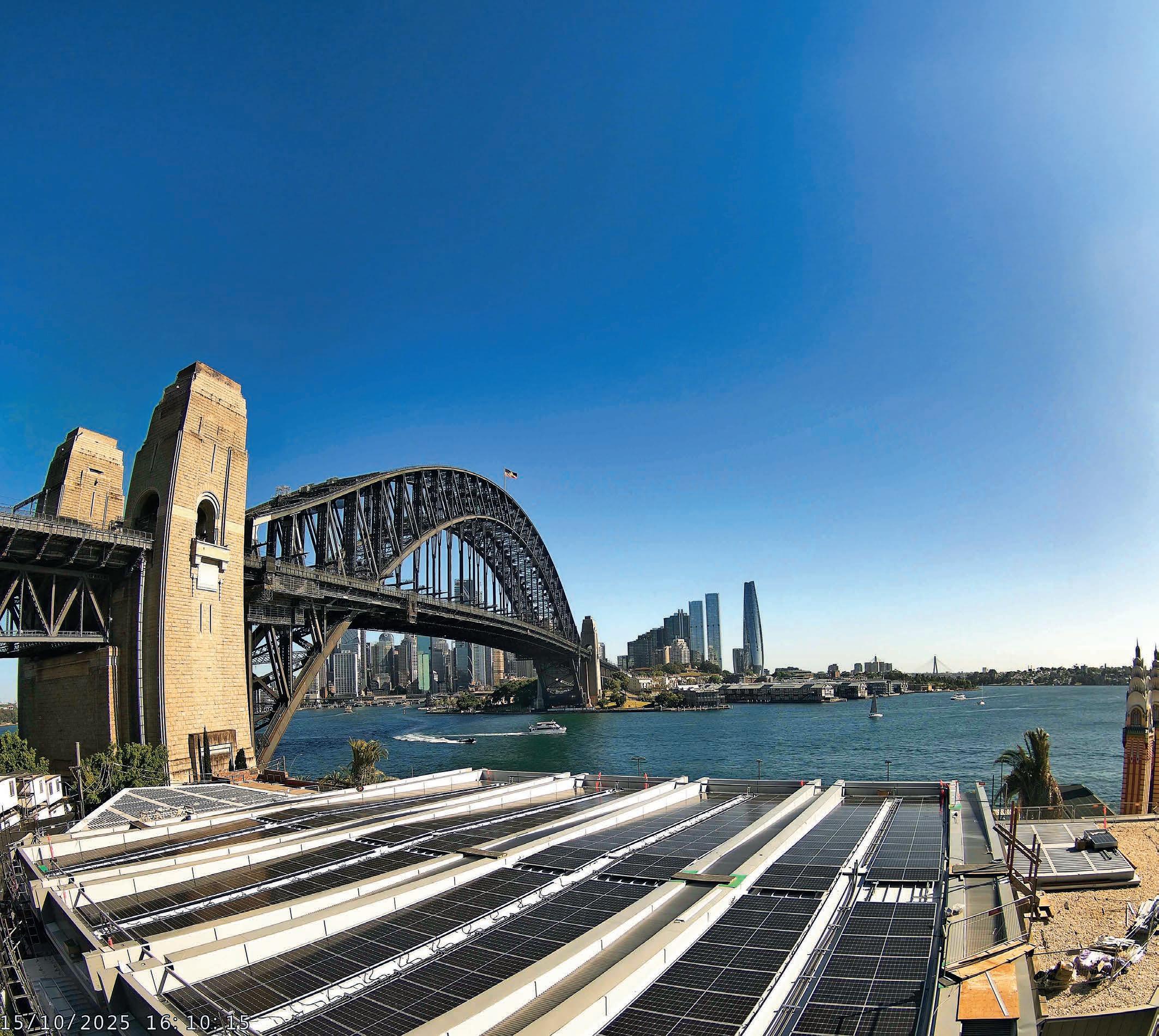


As Australia’s largest supplier and extruder of aluminium, Capral is committed to supporting the nation’s energy transition with high quality, locally produced aluminium extrusions purpose-built for energy and renewable energy projects. Our state-of-the-art manufacturing facilities deliver precision engineered solutions for solar, wind, transmission, storage, and supporting infrastructure, designed to perform in demanding Australian conditions.
Choosing Capral means dependable local supply, reduced lead times and the confidence that comes from working with an Australian manufacturer invested in long term capability, skills, and production.
When you need Australian made aluminium for energy and renewables, Capral can do.
Celebrating 90 years of Australian manufacturing


From the editor

The first phase of Australia’s energy transition was defined by ambition and scale. The next phase is shaping up to be defined by something less visible, but far more decisive: Execution.
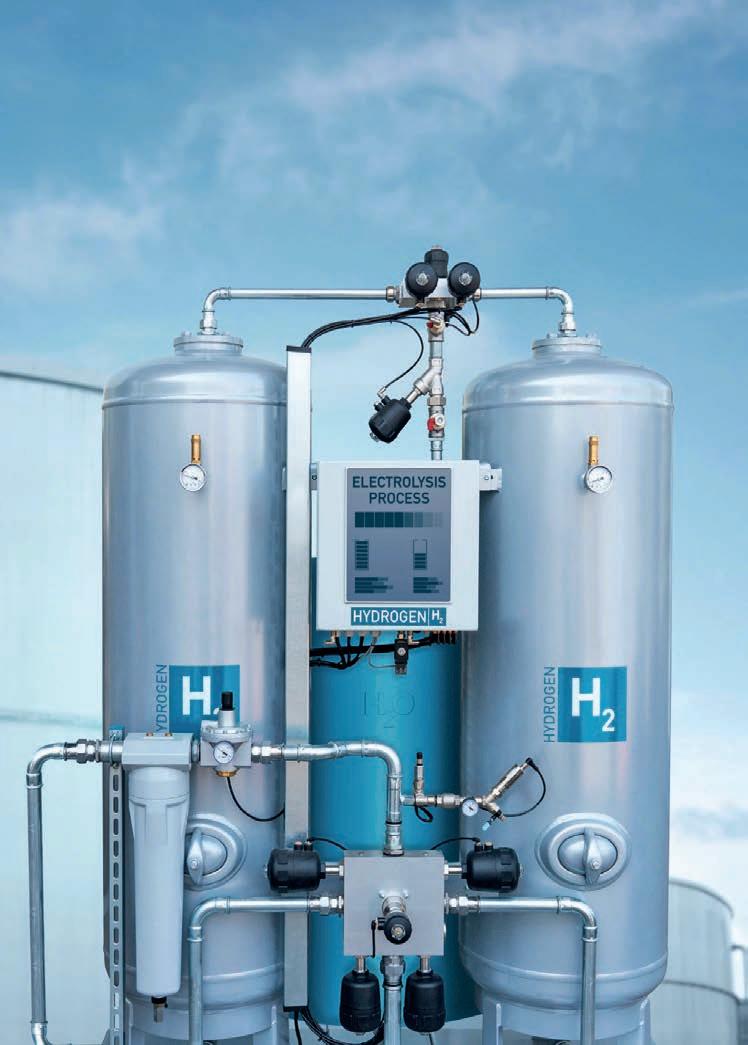
This issue of ecogeneration puts hydrogen at its centre, not as a promise, but as a proving ground. Hydrogen will not become mainstream because the industry wants it to. It will earn its place only if projects can be designed, built and operated with repeatable performance, acceptable safety margins and credible economics. That future will be built by engineering discipline, digital rigour and teams that know how to move fast without gambling capital on avoidable project failure – a reality explored in our feature with LEAP Australia.
South Australia offers a clear view of this next phase in action. New independent analysis shows the state is closing in on a 60 per cent emissions cut by 2030, while the recent financial close for Carmody’s Hill Wind Farm shows how progress is made one hard, practical step at a time.
Across this edition, the theme of ‘invisible work’ keeps surfacing. Specialised Energy Solutions makes the case that training, culture and long-term thinking matter as much as megawatts. MegaWatt Power shows how service capability is becoming the real differentiator in a high-tech solar market. Meanwhile, EcoFlow is quietly building resilient, intelligent power systems at scale, while SOFAR Solar is evolving from inverter supplier to full-stack energy partner.
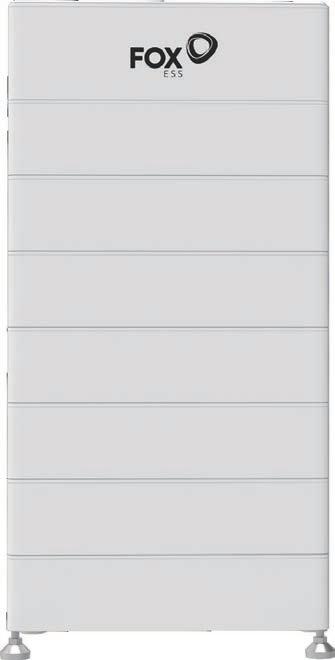
On the ground, JWA Composite Matting reveals how something as prosaic as track-out control is becoming a serious emissions lever. Capral Aluminium shows how local manufacturing is underpinning Australia’s first commercial-scale photovoltaic-thermal project. And as Australia’s battery market matures, FOX ESS and others are helping shift storage from consumer gadgetry to long-life infrastructure, alongside a broader move toward higher-power, whole-of-home systems.
Whether it is hydrogen, battery storage, solar or renewable heat, the next phase will not be won by announcements, but by the people, systems and standards that make clean energy work at scale.
Lavinia Hulley ecogeneration Editor

ecogeneration acknowledges the Cammeraygal people, traditional custodians of the land on which this publication is produced, and we pay our respects to their elders past and present. We extend that respect to all Aboriginal and Torres Strait Islander people today.
Chief Executive Officer: Christine Clancy
Chairman: John Murphy
Editor: Lavinia Hulley lavinia.hulley@primecreative.com.au
Business Development Manager: Nick Lovering , +61 414 217 190 nick.lovering@primecreative.com.au
Client Success Manager: Karyssa Arendt karyssa.arendt@primecreative.com.au
Head of Design: Blake Storey
Designer : Apostolos Topatsis
Subscriptions : T: +61 3 9690 8766 subscriptions@primecreative.com.au
Published by: PRIME CREATIVE MEDIA PTY LTD
ABN: 51 127 239 212 379 Docklands Drive
Melbourne VIC 3008, Australia T: +61 3 9690 8766 www.primecreativemedia.com.au
www.ecogeneration.com.au

Cover image: Capral Aluminium Ltd
ecogeneration is printed on Lumi paper which is PEFC-certified and manufactured in an ISO 14001-certified mill. Lumi paper also contains premium white waste paper, reducing matter going into landfill. This magazine is available to interested parties throughout Australia and overseas. The magazine is also available by subscription. The publisher welcomes editorial contributions from interested parties, however, the publisher and the Editorial Board accept no responsibility for the content of these contributions and the views contained therein are not necessarily those of the publisher or of the Editorial Board. The publisher and the Editorial Board do not accept responsibility for any claims made by advertisers. Unless explicitly stated otherwise in writing, by providing editorial material to Prime Creative Media, including text and images, you are providing permission for that material to be subsequently used by Prime Creative Media, whole or in part, edited or unchanged, alone or in combination with other material in any publication or format in print or online or howsoever distributed, whether produced by Prime Creative Media and its agents and associates or another party to who Prime Creative Media has provided permission.
Average net distribution 6616 Period ending September 2021
South Australia sets the pace on net zero
New independent analysis shows South Australia is closing in on a 60 per cent emissions cut by 2030, as the state doubles down on high-renewables power, climate risk planning and turning decarbonisation into an economic advantage.
South Australia is on track to cut net greenhouse gas emissions by at least 60 per cent by 2030 and reach net zero by 2050, according to new independent analysis that also points to opportunities to strengthen the state’s renewable energy leadership and low-emissions economy.
A report by the Commonwealth Scientific and Industrial Research (CSIRO) confirms the state has reduced net emissions by 55 per cent compared to 2005 levels, based on 202223 data. In the electricity sector, renewables supplied 69.7 per cent of South Australia’s net generation in 2023-24, reinforcing the state’s position as one of the world’s most advanced high-renewables power systems.
The findings come alongside the release of South Australia’s first Statewide Climate Change Risk and Opportunity Assessment, prepared by Deloitte, which provides a longterm view of climate risks and economic opportunities out to 2030, 2050 and 2090.
The assessment draws on input from more than 100 organisations spanning government, industry, research and community sectors, intended to inform future adaptation planning, infrastructure, investment, and economic development.
It identifies 11 priority risk areas that will require increased action over the next five years; including, water security, agriculture,
transport, emergency services, insurance, coastal systems, biodiversity and health.
According to the assessment, average temperatures in South Australia have already risen by around one degree since 1960. If global emissions remain high, the report projects an increase of between 1.3 and 2.2 degrees by 2050, with extreme weather events such as bushfires and heatwaves.
At the same time, the assessment highlights significant opportunities for South Australia to further expand its leadership in renewable energy, accelerate the net zero transition, grow its circular economy, and develop new low-emissions industries, skills and jobs.
The findings arrive as the state moves to strengthen its climate governance framework. Amendments to the Climate Change and Greenhouse Emissions Reduction Act, passed in March 2025, have expanded requirements for government agencies around climate risk assessment, planning and action.
One of the most significant policy commitments is South Australia’s target to achieve 100 per cent net renewable electricity generation by 2027 – brought forward by three years in a move that positions the state at the forefront of global power system decarbonisation.
The climate risk assessment also underlines the importance of South Australia’s new Biodiversity Act. This was implemented after the assessment and is intended to strengthen ecosystem resilience in the face of climate pressures.
Martin Haese, the South Australia Premier’s Climate Change Council Chair, shares that the assessment wil play a central role in guiding future decision-making across government, business and the research sector.
“This first statewide climate change assessment will help catalyse action to tackle the challenges we face under a changing climate,” he says.
“While there is much we are already doing, there is much more we will need to do.”
He said the assessment was not only about managing risks, but also about identifying economic opportunities linked to the energy transition and climate-resilient growth.
Lucy Hood, South Australia’s Minister for Climate, Environment and Water, says the state’s climate and energy agenda will shift into turning decarbonisation into an economic advantage.
“South Australia is a global leader in renewable energy and climate mitigation, and we are determined to meet our ambitious targets,” she says.
The statewide assessment will be reviewed every five years to track progress and emerging risks. To keep up momentum, these findings are shared across industry, research organisations and communities.
For the energy sector, the report reinforces South Australia’s role as a testbed for high-renewables power systems, longduration storage, grid stability technologies, and new low-emissions industries.
Within Australia’s energy transition, South Australia appears to be the clear leader across states for effectively building a climate-resilient, low-carbon economy around its power system.
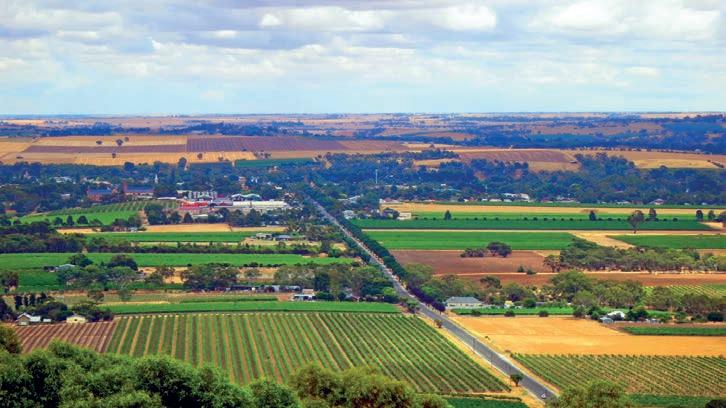
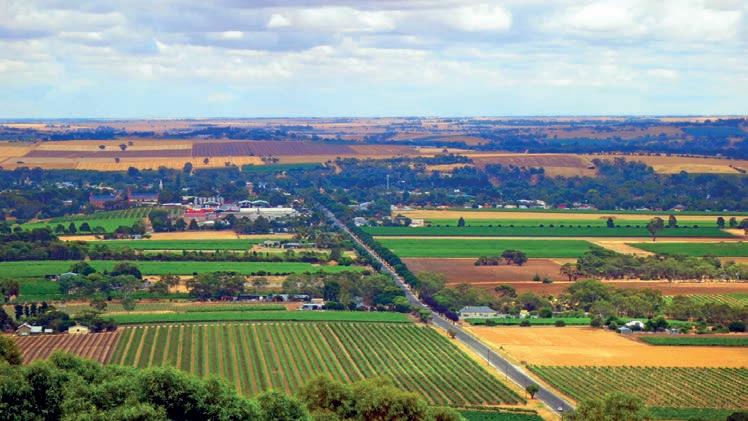
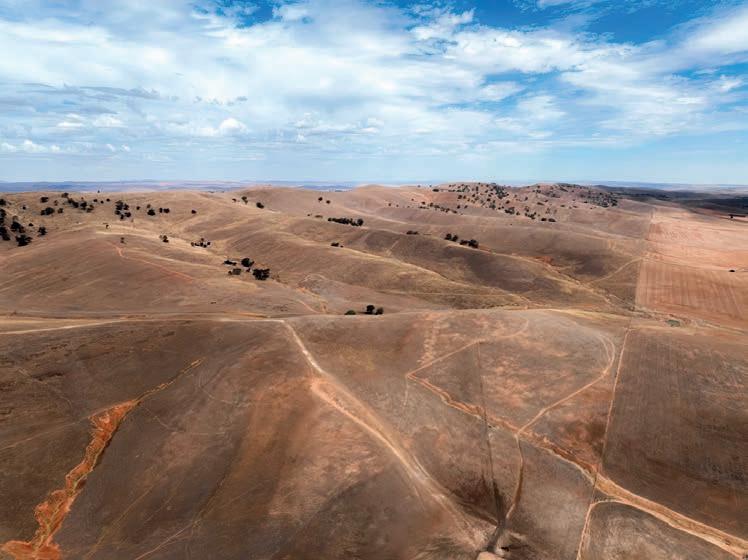
View of South Australia farmlands.
Image: Mariangela/Stock.Adobe.com
Carmody’s Hill Wind Farm reaches financial close
After clearing a series of technical, commercial and regulatory hurdles, a 256-megawatt wind project in South Australia is now in its construction phase.
Aula Energy’s 256 megawatt (MW)
Carmody’s Hill Wind Farm in South Australia’s mid-north has reached financial close, marking a major achievement for the ~$900 million project and clearing the way for construction to begin in early 2026.
The milestone follows Aula Energy’s long-term power purchase agreement (PPA) with Snowy Hydro, under which Snowy will contract 120 MW of the wind farm’s output over 15 years – the equivalent to around 47 per cent of the project’s expected generation.
Located near Georgetown, the Carmody’s Hill Wind Farm will comprise 42 turbines delivering up to 256 MW of capacity, supported by a new 275 kilovolt (kV) transmission line connection. Once operational in 2028, the project is expected to generate enough clean energy to power more than 195,000 homes and support up to 200 jobs during construction.
The project has also secured support through the Australian Government’s Capacity Investment Scheme (CIS) Tender Four and has received approval for its negotiated generator performance standards from ElectraNet and the Australian Energy Market Operator (AEMO).
Chad Hymas, Chief Executive Officer at Aula Energy, shares that the financial close of Carmody’s Hill represents a significant leap forward for both the company and South Australia’s energy transition.
“Closing two major wind projects in consecutive years is a clear demonstration of our team’s dedication to building Australia’s clean energy future,” he says.
“From Boulder Creek to Carmody’s Hill, Aula Energy is proving that even in challenging market conditions, we can deliver and make a difference to the sector. As a new leader in Australia’s clean energy transition, we have built deep expertise and have a long-term commitment to create shared value for all.”
Aula Energy achieved financial close on its flagship Boulder Creek Wind Farm in
Central Queensland (co-owned with CS Energy) in September 2024. Carmody’s Hill recent financial close marks the company’s second major project to reach this milestone since its inception in 2023.
“Securing this PPA with Snowy Hydro is a major step forward for Carmody’s Hill Wind Farm,” Hymas says.
“Snowy Hydro’s leadership in the energy market reflects their position as a key customer driving change as we work towards a more sustainable energy system.”
Hymas adds that Aula Energy, as a long-term owner and operator of renewable energy assets, will continue to work closely with customers as market and demand profiles evolve over time.
Dennis Barnes, Chief Executive Officer at Snowy Hydro, shares that the agreement reinforces the strategic importance of South Australia in the national energy transition.
“This agreement with Aula Energy reflects our confidence in the quality and strategic importance of Carmody’s Hill Wind Farm and the South Australian market,” he says.
“Our unmatched mix of on demand power and pumped hydro energy storage is what makes renewables work, enabling three times the clean wind and solar to come online.”
Barnes says the new contract also supports Snowy Hydro’s growing retail business, which now serves more than 1.6 million customers.
“This new contract enhances our role as an integrated generator and retailer,
supporting the continued growth of Snowy’s
Renewable Project Services before Aula Energy assumed sole ownership at financial close. With financing now secured, the company has confirmed support from delivery partners GE Vernova, DT Infrastructure, GHD, Aurecon and ElectraNet.
“With finance secured and the support of our delivery partners, we’re ready to deliver a project that creates long-term value for the local communities, the traditional owners, the Nukunu People, shareholders, and the sector,” Hymas says.
The project has been shaped by extensive community consultation and is expected to deliver long-term economic and social benefits to the Georgetown, Gulnare, Caltowie, Bundaleer, Washpool, Gladstone and Nukunu communities.
As part of this commitment, the project will establish a Community Benefit Fund to support local initiatives with environmental, social and net zero objectives throughout construction and operations.
“Aula Energy extends its appreciation to local communities for their valuable input throughout the development phase,” Hymas says.
“Community feedback has helped shape this project, and we’re grateful for the strong engagement. We look forward to continuing this partnership as construction continues now and in the future.”
The site for Carmody’s Hill Wind Farm Project, based in the mid-north region of South Australia on the traditional land of the Nukunu Peoples.
News in brief
NEW TECHNOLOGY, NEW PROJECTS, NEW IDEAS
Renewables still win on cost
The Clean Energy Council welcomed the release of the 2025-26 GenCost report, confirming that renewables (backed by storage and flexible firming) remain the lowest-cost pathway to replace Australia’s ageing coal fleet.
The latest analysis from the Commonwealth Scientific and Industrial Research Organisation found that the average cost of renewable electricity is on track to reach approximately $91 per megawatt-hour (MWh) when new transmission is included, or about $81 per MWh for wholesale generation costs.
Jackie Trad, Chief Executive Officer at the Clean Energy Council, shared that the modelling shows Australia can retire coal while maintaining affordability and reliability for households and businesses.
“By assessing costs at a whole-of-system level, GenCost again finds renewables-led systems consistently outperform alternatives,” she said.
“It confirms new coal would deliver electricity at least double the cost of solar and wind. The cheapest system for Australia is built on renewables backed by storage and firming.”
The report also showed electricity costs in 2050 under the least-cost pathway remain broadly in line with recent historical levels. This is the case even as demand
grows and coal exits the system, with batteries and other flexible technologies playing a central role in reliability.
Importantly, higher-cost options such as
increased overall system costs, compared with a renewables-first approach. Indicative figures showed solar at $52-$88/MWh and onshore wind at $78-$129/MWh, well below
Eraring extension affirms urgency for renewables
Origin Energy’s decision to extend the life of the Eraring coal-fired power station until 2029 underscores the urgency of accelerating investment in renewable energy, storage and transmission, according to the Clean Energy Council.
Jackie Trad, Chief Executive Officer at the Clean Energy Council, publicly shared that the extension reflects the need to manage the transition in an orderly way, but warned that Australia’s ageing coal fleet is becoming unreliable and costly, with unplanned outages driving price volatility across the National Electricity Market.
The average age of coal generators is now 38 years, close to the historical retirement age of 44. Recent failures, including another outage at Queensland’s Callide C power plant, have again highlighted the risks of continued reliance on ageing assets.
In the 12 months to October 2025, an
average 24 per cent of coal-fired generation was unavailable in New South Wales (NSW) and Queensland, contributing to wholesale price spikes.
In one month alone, prices in NSW surged from around $70/megawatthours (MWh) to $220/MWh following a wave of unplanned outages.
The Clean Energy Council shared that every new renewables, storage and transmission project reduces exposure to this volatility. They also welcomed Origin’s continued investment in large-scale batteries at Eraring, making a point that storage is already playing a growing role in supporting system reliability as coal exits the grid.
Momentum in energy storage continues to build, with nearly 1.2 gigawatts of new projects reaching financial close in the most recent quarter.

Jackie Trad, Chief Executive Officer at the Clean Energy Council (CEC).
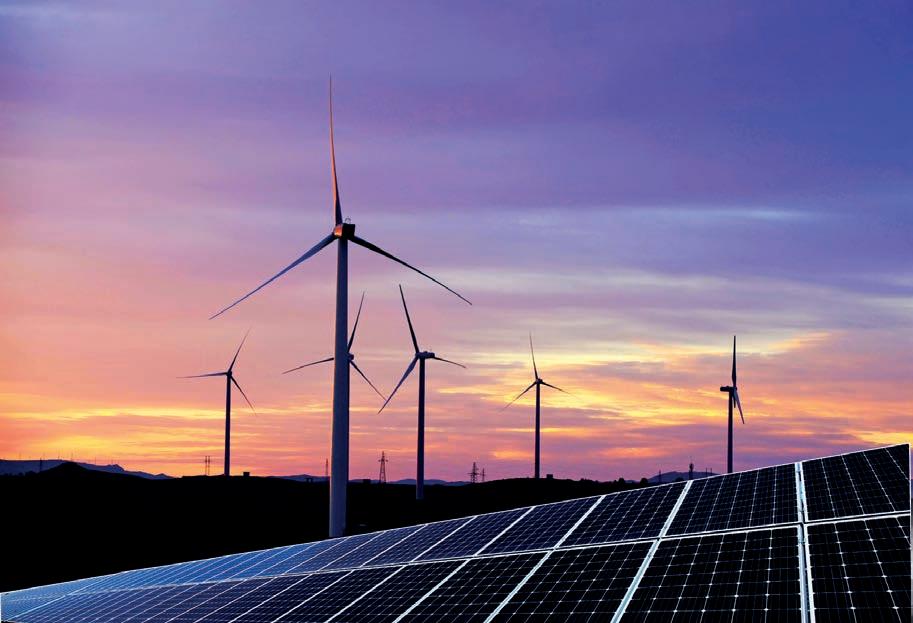
Solar power and onshore wind remain the lowest-cost pathway for replacing Australia’s coal fleet. Image: Zhengzaishanchu/Stock.Adobe.com Image:
Less wind, more solar and storage
being recalibrated, and for solar installers, the direction of travel is becoming clearer.
In its latest draft Integrated System Plan (ISP), the Australian Energy Market Operator (AEMO) has downgraded expectations for new wind farms and transmission, while lifting forecasts for large-scale solar, batteries and household energy technologies. The shift reflects falling solar and battery costs, alongside mounting delivery
distance infrastructure.
AEMO has cut its forecast for new wind capacity by 2030 from 42.6 gigawatts (GW) to 26 GW, following no wind projects in construction for 2025. Planned transmission has also been reduced from around 10,000 kilometres (km) to closer to 6000 km by 2050, but major projects like HumeLink and VNI West remain in development. By contrast, utility-scale solar is now forecasted to reach 32 GW by 2030,
From rooftop to resource
The Federal Government has announced a $24.7 million investment over three years to establish a national pilot scheme for recycling end-of-life solar panels, including up to 100 collection sites across Australia.
The program aims to reduce landfill and recover valuable materials such as copper, silver and aluminium, and ultimately strengthen Australia’s circular economy for clean energy technologies.
The initiative comes as Australia continues to lead the world in rooftop solar uptake, with more than one in three homes now equipped with photovoltaic systems. While this has delivered major emissions and cost benefits, the growing volume of ageing and decommissioned panels is creating a significant waste challenge.
The pilot responds to the Productivity Commission’s latest circular economy
expected to deliver 27 GW of dispatchable capacity.
The biggest shift is at household level. By 2050, AEMO expects 87 GW of rooftop solar and 27 GW of home batteries, with coordinated household systems playing a critical role in reliability.
For installers, this shows the opportunity is no longer just in selling systems, but in building, integrating and managing the foundations of Australia’s future grid.
report, which identified solar panels as a high value but high-risk waste stream and called for a coordinated national recycling scheme. Currently, only around 17 per cent of panels in Australia are recycled, with most stockpiled, sent to landfill or exported.
The Federal Government recently estimateed that lifting recycling rates could unlock up to $7.3 billion in economic and environmental benefits.
Treasurer Jim Chalmers shared that better resource recovery would improve productivity and reduce costs, while Climate Change and Energy Minister Chris Bowen sees the scheme as a way of supporting Australia to maximise the longterm value of its solar rollout.
The Federal Government says it will work with across the country’s states and territories to develop a nationally consistent, long-term recycling framework beyond the pilot phase.
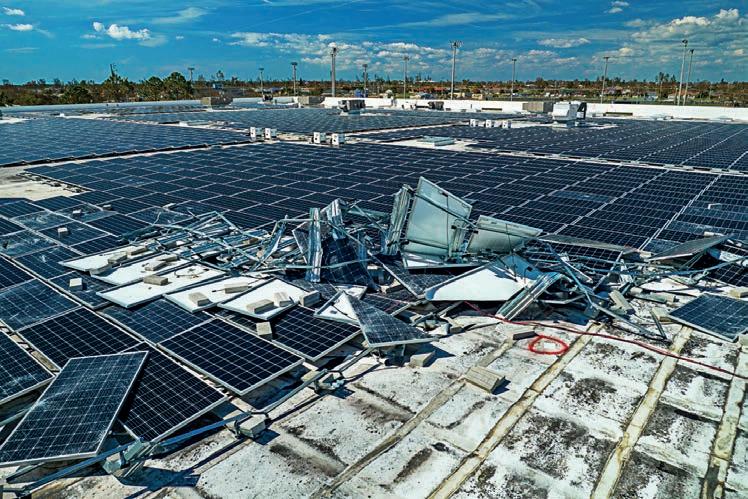
As solar energy uptake surges, so does the need for responsible recycling of panels. Image: Bilanol/Stock.Adobe.com
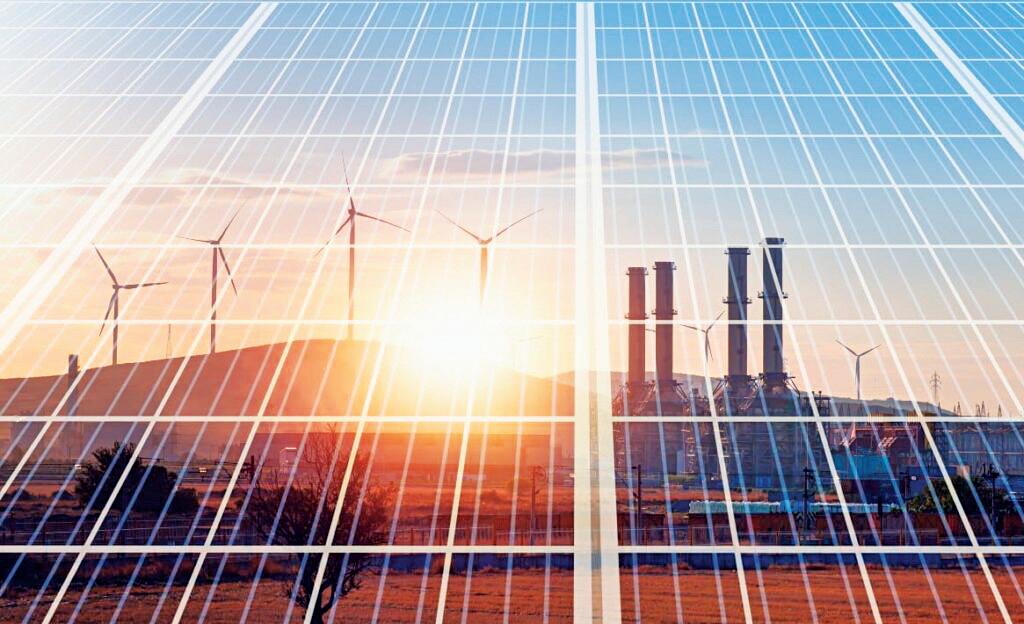
The Australian Energy Market Operator’s latest report lifts its forecasts for large-scale solar, batteries and household energy technologies.
Inside the invisible work that will decide hydrogen’s future
LEAP Australia shares why bankable hydrogen projects require reliable engineering, digital innovation and proven technical pathways.
The hydrogen sector is entering its commercial reality check. The projects that proceed will be those that can clear Front-End Engineering Design reviews, procurement, construction and commissioning – and still deliver on cost, efficiency and risk.
For LEAP Australia, the difference comes down to what its engineers call “engineering certainty.” By that, they mean the ability to make confident decisions using digital engineering and simulation to understand
how complex hydrogen systems will behave, long before anyone pours concrete or orders equipment.
“Hydrogen plants are inherently multidisciplinary; made up of electrochemistry, power electronics, fluids, heat transfer, structures. None of these elements can be treated in isolation of each other,” says Lewis Clark, Engineering Manager at LEAP Australia.
“The way we see our customers succeed is by connecting the physics. You take
outputs from one domain and feed them into another. Electronics losses become thermal loads, thermal loads become mechanical stresses, and from there, you can build a picture you can trust.”
That picture matters because the hydrogen value chain is not a single technology challenge. It is a systems challenge, where small design decisions compound into major cost and safety consequences across production, storage, distribution and utilisation.
“Simulation plays a role across the whole lifecycle, from production, storage, transport and then utilisation of hydrogen by end users. Pick any part of the process and it’s going to involve multiple physics: Fluid mechanics, mechanical, often electromagnetics. It’s all interconnected,” Clark says.
Hydrogen value chain
Hydrogen has promising potential as a clean alternative to fossil fuels, particularly in hard-to-abate sectors. But the pathway to scale is constrained by persistent barriers: Process inefficiencies, scale-up costs, safety risks, and durability issues.
Across the industry, investment has leaned heavily into hydrogen production – and for good reason. Electrolysis can produce hydrogen without carbon emissions, but it is electricity-intensive, and electrolyser components are exposed to punishing operating conditions over long periods. Meanwhile, moving hydrogen safely and cost-effectively introduces a new set of challenges: Compression energy penalties, leakage risks, materials compatibility, and the complexity of pipelines and tanks not originally designed for hydrogen’s small molecules and high-pressure requirements.
That is why LEAP Australia’s proven view is not that engineering simulation is ‘nice to have,’ but that it is foundational
Robust digital engineering, multidisciplinary solutions, and industry collaboration can turn hydrogen’s potential into economically viability in Australia’s energy transition.
Image: Ansys
infrastructure for hydrogen development.
“It’s just not feasible these days to take a build-and-test approach as your primary method. You cannot hit time-to-market and budget if you’re committing to a physical prototype as your best guess and only finding out months later where the design breaks down. The virtual testing we provide clients lets them explore hundreds, even thousands, of configurations before they commit to a final design,” Clark says.
In practice, that can look like modelling electrochemistry and flow behaviour inside an electrolyser, then iterating design parameters to lift efficiency and durability before a single component is manufactured.
“You can configure your electrolyser geometry and inputs, and the simulation will report hydrogen yield, efficiency, power consumption,” Clark says.
“No one gets it right the first time. Simulation lets you parameterise the model, vary flow rates and geometry, and use optimisation tools to iterate until you hit your targets.”
Engineering commercial viability
Hydrogen’s future will ultimately be decided as much by economics as by physics – a point LEAP’s team hears repeatedly from industrial customers weighing early hydrogen pathways against lower-cost incumbent fuels.
Derik Cloete, Territory Manager at LEAP Australia, shares that the industry cannot rely on ambition alone.
“The solution can be physically viable yet commercially irrational if operating costs remain too high. The economics has to make sense,” he says.
Clark agrees and argues simulation is one of the few levers developers can pull immediately to improve both engineering performance and cost confidence.
“A lot of the value is risk mitigation. This means being able to say to your stakeholders: This is the design I’m confident in, because we’ve tested it virtually across the operating envelope,” he says.
“It is not just time and cost – simulations can provide unparalleled technical insights. Physical tests might tell you what goes in and what comes out, but simulation can show you what is happening inside the device, and why something performs well or not.”
That internal visibility becomes critical in hydrogen systems, where temperature gradients, pressure drops, material degradation and transient events can drive unexpected failures.
High-temperature hydrogen complexity
Case Study: Hadean Energy
One Australian company confronting that complexity headon is Hadean Energy, a Commonwealth Scientific and Industrial Research Organisation spin-out commercialising tubular solid oxide electrolysis technology to produce green hydrogen and syngas for industrial users.
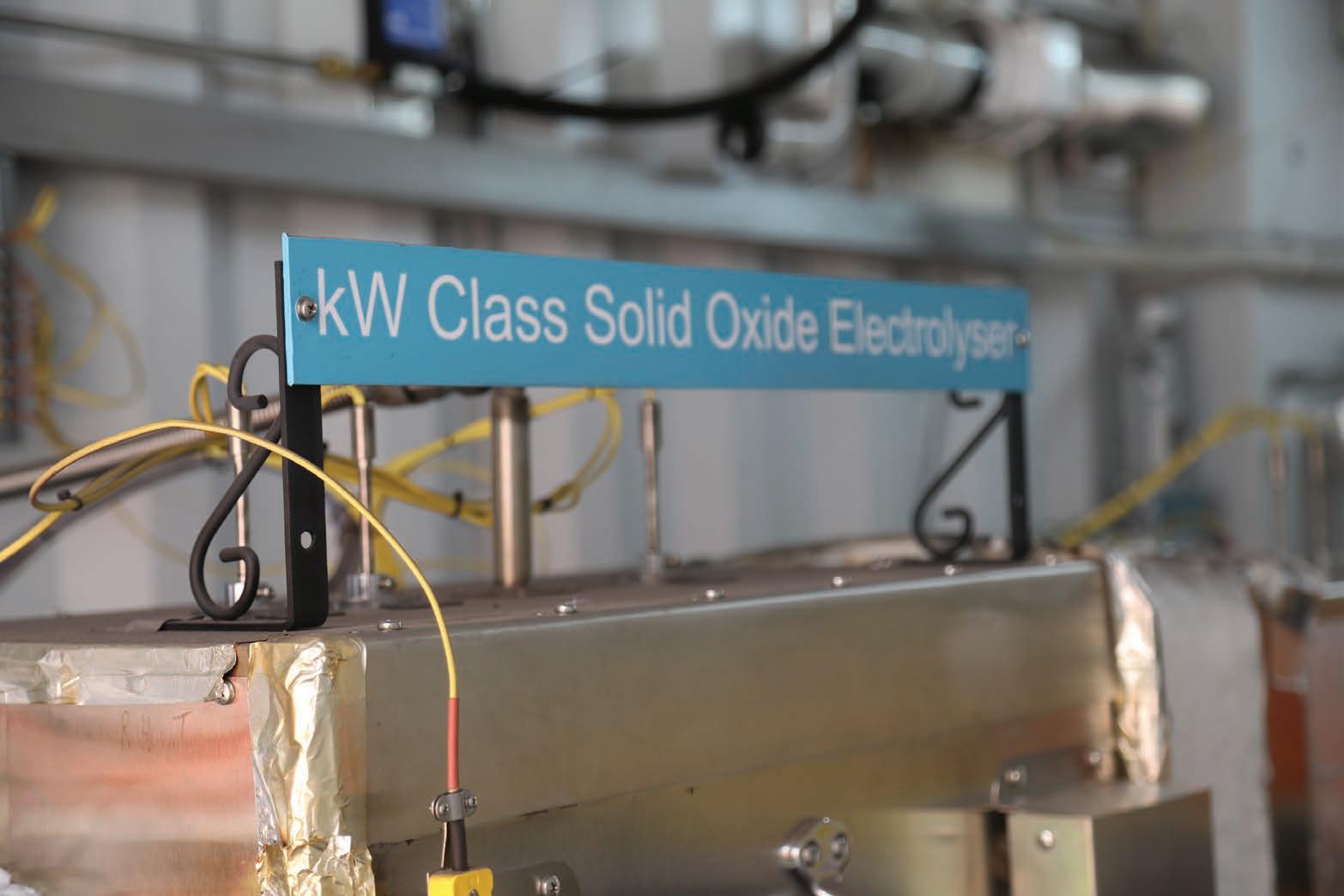
Solid oxide electrolysis operates at higher temperatures, unlocking exceptional electrical efficiency and enabling direct integration with industrial heat and steam sources. But these conditions present technical challenges, from thermal management and mechanical stress to materials behaviour and electrochemistry.
Chris Rowland, Chief Executive Officer at Hadean Energy, explains that: “Simulation allows our team to explore cell, stack, and systemlevel designs virtually before we build hardware, optimising for thermal management, durability, and integrating with industrial heat sources. We have achieved this while reducing our development time, costs and technical risks.”
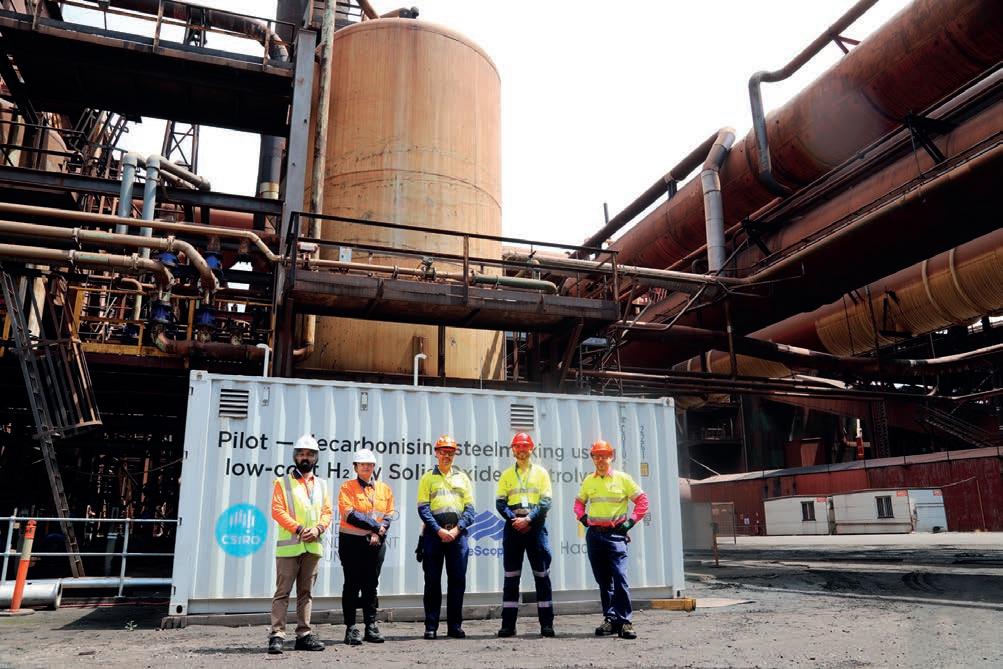
Hadean Energy has already demonstrated its approach in realworld conditions: Its first pilot system completed more than 1000 hours of operation in a trial at BlueScope Steel’s Port Kembla Steelworks, validating the technology in an industrial setting.
Over the next few years, Hadean aims to move from pilot to early commercial deployment, including a 250-kilowatt green hydrogen demonstration project with a tier one industrial partner supplying hydrogen directly into an operating industrial process. This will be a stepping stone toward commercial-scale systems for steel, chemicals, e-fuels and materials processing.
Case Study: FCT Combustion
FCT Combustion in Adelaide has over 40 years’ experience in high-temperature combustion, with a local team spanning engineering, research and development, and modelling/ simulation.
As the hydrogen supply chain matures, FCT has seen increasing interest from industry looking to transition from fossil fuels to hydrogen- ready burners suitable for high-temperature rotary kilns and calciners, along with fuel integration, controls and safety systems.
Renata Favvali, Computational Fluid Dynamics (CFD) Specialist at FCT explains that: “Engineering simulation plays a central role in de - risking these transitions. Our advanced CFD and thermo -fluid simulations accurately predict flame behaviour, heat transfer and system efficiencies. On recent retrofit projects we have significantly reduced our design iterations and the need for physical prototypes, compressing our engineering cycle by weeks and converging on a final configuration (after assessment of mixing, aerodynamics, thermal profile and process integration) with full confidence.”
The simulation advantage LEAP positions itself as a practical bridge between advanced simulation platforms and on-the-ground engineering teams trying to deliver real equipment and projects.
Clark highlighted that LEAP’s differentiator from other companies in the hydrogen sector is that they can support customers locally.
“LEAP has the largest team of local engineers dedicated to helping customers solve such challenging simulation problems. We can be onsite, we’re in the same time zone, and we can work alongside teams as they iterate,” Clark says.
Cloete adds that hydrogen projects rarely require just one type of physics model – and few providers cover the full stack.
“There are companies who specialise in different domains such as fluid dynamics,
that traceability becomes a risk-control mechanism, and increasingly, a prerequisite for investor confidence and project finance.
structural integrity, control systems and electrochemistry. But there are very few companies that cover all the physics required across hydrogen applications,” Cloete says.
For hydrogen innovators, particularly startups, that breadth matters. Hydrogen hardware development is capital intensive, and physical prototyping can quickly consume budget and time.
Hydrogen plants typically involve multiple partners, vendors and engineering disciplines. In that environment, digital engineering is as much about collaboration and governance as it is about modelling.
Filip Kuttner, Group Sales Manager at LEAP Australia, framed digital engineering as maintaining a digital thread.
“This means capturing decisions from requirements through preliminary and detailed design, prototyping and trials, so teams can trace why a change was made and where to go back if optimisation is needed,” he says.
For large, complex hydrogen projects,
The next phase
The next phase of hydrogen will reward the quiet work.
Hydrogen will not become mainstream because the industry wants it to. It will become mainstream if projects can be designed, built and operated with repeatable performance, acceptable safety margins and credible economic, and engineering teams that can move faster without gambling
capital on avoidable failures.
“It’s almost like a living organism. The amount of detail and the interconnections are enormous. But that is exactly why simulation matters. It lets you see the physics, iterate intelligently, and build confidence across production, storage, transport and end use,” Clark says.
As the hydrogen sector continues to search for the most commercially viable pathways, LEAP believes the winners will be the organisations that turn ambition into engineering certainty – and then practically prove it to the world.

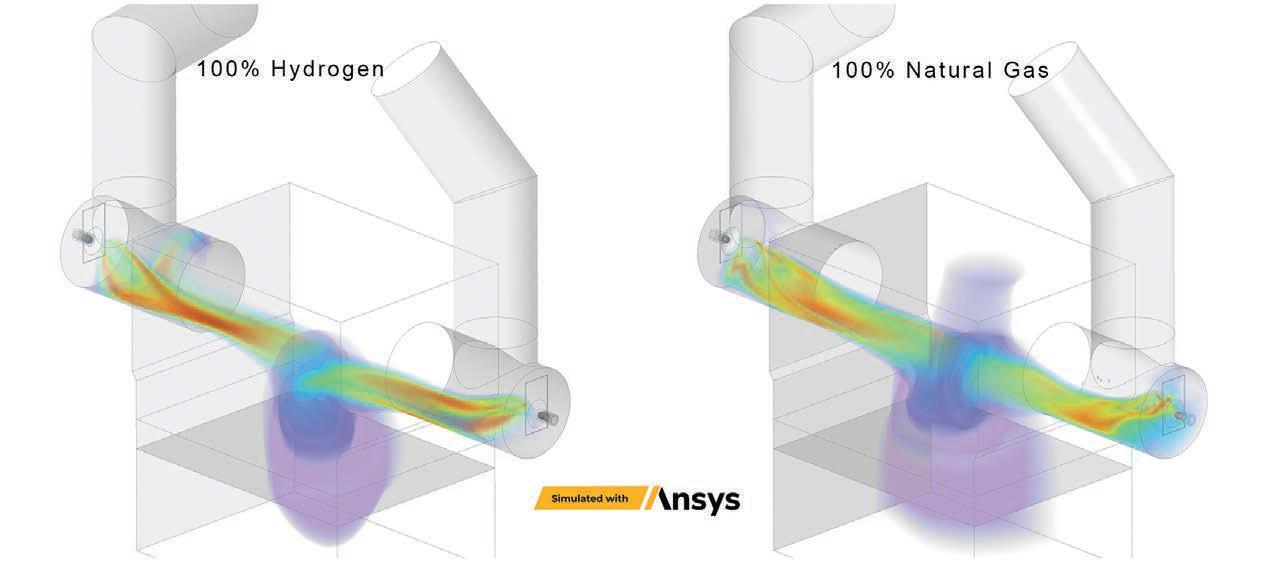
Volume rendering of 3D temperature comparing 100 per cent hydrogen and 100 per cent natural gas.
CSIRO-developed solid oxide electrolysis system.
The Hadean Energy team at their pilot plant at BlueScope Steel’s Port Kembla Steelworks.
Images: Hadean Energy
Global Hydrogen Review: From ambition to implementation
After years of big promises and pilot projects, hydrogen is starting to look less like a future bet and more like an emerging industrial reality.
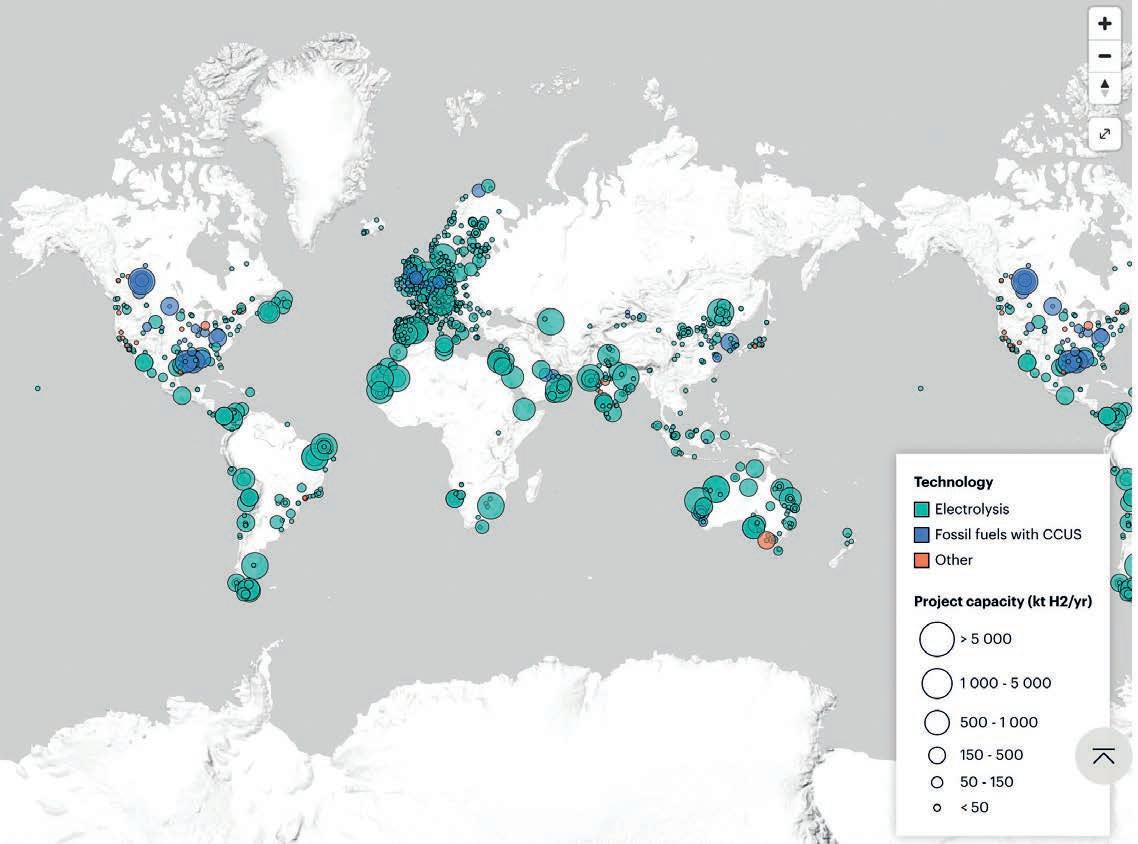
The Global Hydrogen Review 2025 by the International Energy Agency (IEA) shows steady progress across production, policy and technology as the sector moves into a new phase of development.
Published under the Clean Energy Ministerial Hydrogen Initiative, the annual report tracks global hydrogen supply and demand, as well as developments across infrastructure, investment and innovation.
Globally, hydrogen demand reached almost 100 million tonnes in 2024. This growth aligns with broader energy use, while more than 200 low-emissions hydrogen projects have now reached final investment decision globally (up from just a handful of demonstrations in 2021). Innovation across the value chain is also accelerating, with a record number of technologies moving closer to commercial readiness.
Overall, the IEA’s findings point to a
sector shifting from early ambition to largescale implementation, following a familiar pattern seen in other major clean energy sources’ transitions.
Hydrogen’s role in today’s energy system
Hydrogen already plays a critical role in the global energy and industrial system, particularly in refining and chemical production. In 2024, demand growth was
Images: International Energy Agency
The map features projects set to produce low-emissions hydrogen.
driven mainly by these traditional uses, reflecting the essential role hydrogen plays in modern economies.
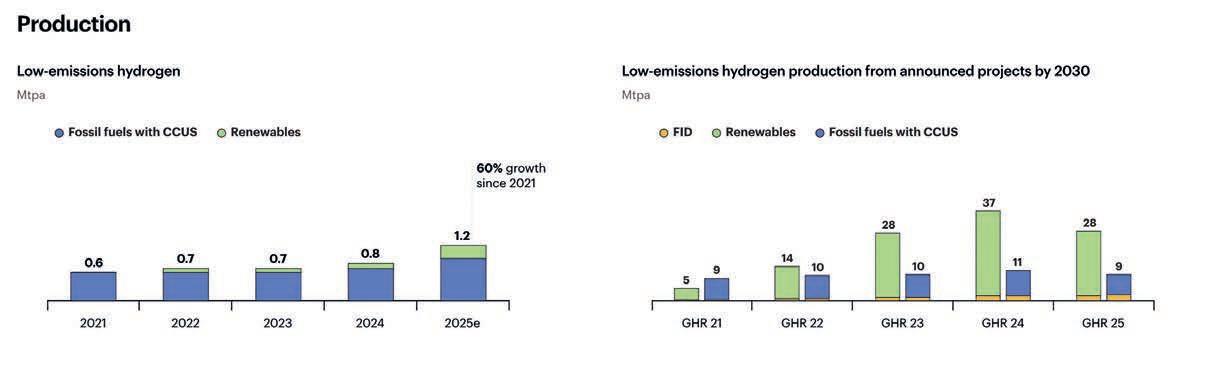
Supply today remains dominated by fossil fuels, with hydrogen production in 2024 consuming around 290 billion cubic metres of natural gas and 90 million tonnes of coal equivalent. Low-emissions hydrogen production grew by around 10 per cent last year and is expected to reach one million tonnes in 2025.
While this still represents a small share of total production, the IEA notes that early growth phases for new energy technologies are typically gradual before accelerating as markets, supply chains and infrastructure develop.
Importantly, the report highlights that the most immediate and scalable opportunity for emissions reductions lies in decarbonising existing hydrogen uses – particularly in refining, ammonia and chemicals – while new applications such as shipping, steel and power generation continue to develop.
Project development gains depth
One of the most encouraging trends identified in this year’s review is the growing maturity of the global project pipeline.
Although some early-stage projects have been delayed or refined as developers reassess timing and market conditions, the number of projects reaching final investment decision continues to rise. Since 2020, more than 200 low-emissions hydrogen production projects have now passed this key milestone, signalling increasing confidence among investors and policymakers.
Based on projects that are already operational, the IEA expects low-emissions hydrogen production to reach 4.2 million tonnes per year by 2030. This equates to around five times today’s level. This would lift low-emissions hydrogen’s share of global
around four per cent by the end of the decade.
In addition, a new assessment in this year’s review finds that a further six million tonnes per year of announced projects could realistically be operating by 2030, provided that supportive policies continue to be implemented and demand creation measures gain traction.
The IEA notes that this type of stepwise progress – combining steady investment decisions with ongoing project refinement –mirrors the early growth trajectories seen in other clean energy technologies such as solar photovoltaic (PV) and battery storage.
Costs are improving, with regional differences
The cost of producing low-emissions hydrogen remains one of the central considerations for the sector’s expansion, and the review finds that progress continues, but at different speeds across regions.
Recent changes in energy and equipment markets includes lower natural gas prices and higher input costs for electrolysers. This has influenced near-term project economics. However, the IEA expects the cost gap between low-emissions hydrogen and conventional production to narrow toward
scale effects and policy frameworks.
In China, renewable hydrogen could become cost-competitive by the end of the decade thanks to low equipment costs and favourable financing conditions. In Europe, higher carbon prices and strong renewable resources are expected to continue improving competitiveness. In regions with lower natural gas prices, such as the United States and the Middle East, hydrogen produced with carbon capture is expected to play an important role in the near term.
These regional variations underline the importance of diverse technology pathways and market-specific strategies as the global hydrogen industry develops.
Electrolyser manufacturing scales up
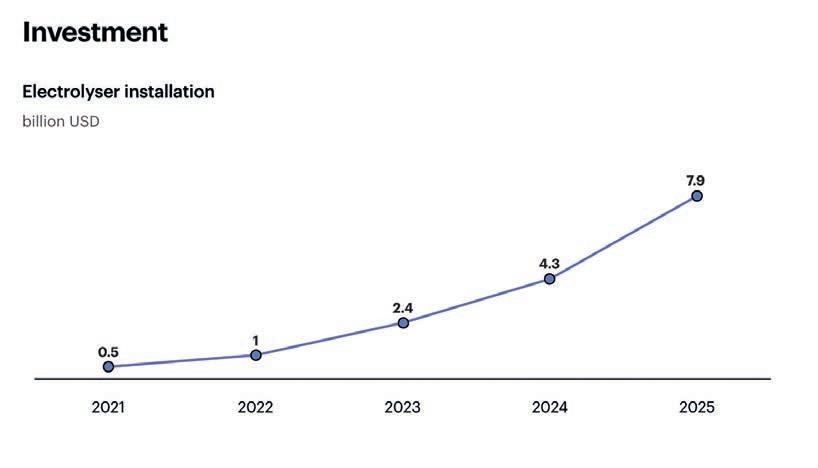
Electrolyser deployment and manufacturing capacity expanded significantly again in 2024. Global installed water electrolysis capacity reached two gigawatts (GW), with more than one GW added in 2025 to date.
China continues to lead this expansion, accounting for around 65 per cent of installed and committed capacity and nearly 60 per cent of global manufacturing capacity. The rapid growth of manufacturing
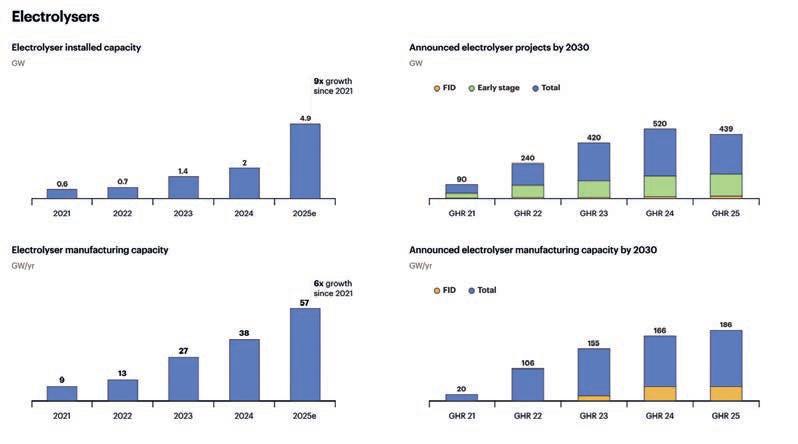
All graphs contain Data from the International Energy Agency (2025).
Graphs: International Energy Agency (2025)
global supply chain and drive learning effects across the industry.
At the same time, the review notes that electrolyser manufacturers outside China are navigating a challenging period as markets adjust and scale develops. Over time, the IEA expects continued innovation, international expansion and industry consolidation to strengthen the global manufacturing base and improve performance and reliability. When total project costs like engineering, construction and local installation are considered, the difference between Chinese and non-Chinese equipment is narrower in overseas markets than headline equipment prices suggest, highlighting the importance of local project development ecosystems.
Building markets for clean hydrogen Alongside supply, the creation of sustainable demand remains a key focus for policymakers and industry.
In 2024, new hydrogen offtake agreements totalled 1.7 million tonnes per year, with activity concentrated in refining, chemicals and shipping. While this was slightly
earlier agreements were finalised, enabling investment decisions on production facilities in several regions.
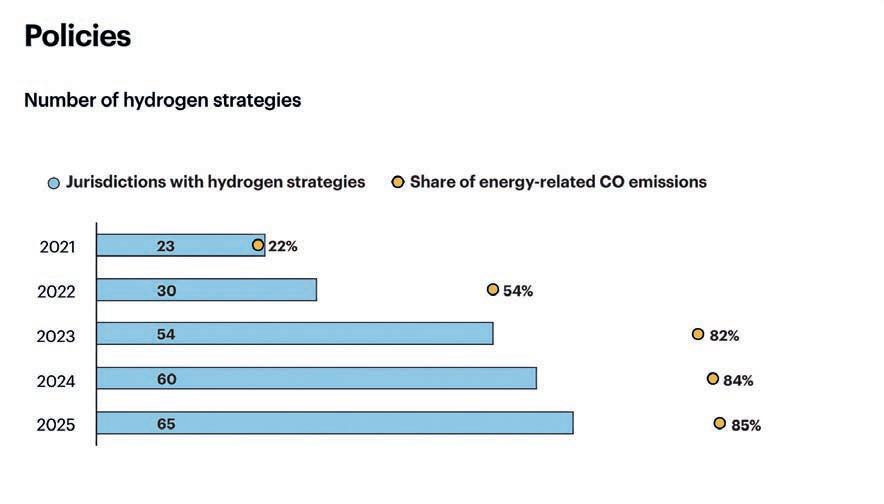
Policy frameworks to support demand are continuing to take shape. Europe is implementing sectoral targets under its Renewable Energy Directive, while India, Japan and Korea have launched major programs focused on priority sectors such as fertilisers, refining and power generation. The new International Maritime Organisation Net Zero Framework is also expected to support the uptake of lowemissions fuels in shipping over time.
The IEA notes that translating these policy frameworks into clear, bankable market signals will be an important next step in supporting the next wave of investment.
Ports and shipping pose opportunities
Shipping is identified as one of the most promising early markets for hydrogen-based fuels, particularly methanol and ammonia.
As of mid-2025, more than 60 methanol-powered vessels are already in
operation, with nearly 300 more on order. Ensuring that fuel supply and bunkering infrastructure develops in parallel is now a
The review finds that around 80 ports worldwide already have strong capabilities in handling chemical fuels, positioning them well to adopt hydrogen-based alternatives. More than 30 major ports could each access at least 100,000 tonnes per year of low-emissions hydrogen supply from announced projects within 400 kilometres, creating clear focal points for early infrastructure investment.
Southeast Asia’s growing role
A special chapter in this year’s Review examines Southeast Asia, where hydrogen demand reached four million tonnes in 2024, led by Indonesia, Malaysia, Vietnam and Singapore.
The region’s pipeline of low-emissions hydrogen projects could reach 480,000 tonnes per year by 2030, with a strong focus on ammonia production and exports. While many projects are still at early stages, several large-scale developments like the 240 megawatt electrolyser project in Vietnam highlight the region’s growing role in the global hydrogen economy.
The IEA identifies fertilisers, steel and maritime bunkering as particularly promising early applications, supported by the region’s strong industrial base and strategic shipping position.
Key recommendations for growth
The IEA concludes that the hydrogen sector is now entering a phase of practical, cumulative growth, supported by improving technologies, expanding policy frameworks and increasing investment certainty.
To build on this momentum, the agency recommends:
Continuing targeted support for nearterm projects in existing markets
Accelerating demand creation in priority sectors
Fast-tracking infrastructure in industrial and port hubs
Strengthening public finance mechanisms to reduce early technology risk
Supporting emerging economies in developing hydrogen-based value chains.
For project-level data on low-emissions hydrogen production worldwide based on the Global Hydrogen Review, visit the IEA Hydrogen Tracker.

Maritime shipping transition shows hydrogen’s promise and limits
The hydrogen sector continues to grow despite barriers, according to award-winning report series ‘Fuel for Thought.’
With maritime shipping responsible for around three per cent of global emissions and new measures from the International Maritime Organization, the European Commission and FuelEU Maritime, the industry is being forced to rethink its most fundamental input – fuel.
Against this backdrop, Lloyd’s Register (LR) has released the latest instalment in its award-winning Fuel for Thought series, turning its attention to hydrogen and its potential role in shipping’s energy transition. Published in January 2025, Fuel for Thought: Hydrogen offers a clear-eyed assessment of both the opportunities and the obstacles facing one of the most talked-about fuels in the decarbonisation debate.
LR’s broader Fuel for Thought program examines alternative fuel pathways; including, methanol, ammonia, biofuels and electrification. The series reflects a growing recognition that no single fuel will provide a universal solution. Instead, shipping’s future is likely to be shaped by a mix of technologies and use cases, constrained by cost, infrastructure and operational realities.
A sector searching for scalable solutions
Alternative fuels have moved rapidly from niche concept to strategic necessity in maritime transport. Environmental regulation is tightening, but so too is scrutiny from investors and customers who are increasingly demanding credible decarbonisation pathways. At the same time, shipowners are urged to balance emissions reduction with operational realities such as vessel range, payload capacity, safety and fuel availability.
Today’s menu of marine fuel options is broad and still evolving. It includes Liquefied Natural Gas and Liquefied Petroleum Gas
emissions.
as transitional fuels, biofuels that can often be blended with existing marine fuels, and emerging zero or near-zero-emissions options, such as hydrogen, ammonia, methanol and battery-electric systems. Even nuclear propulsion occasionally features in long-term discussions for specific vessel classes.
Each comes with trade-offs. Ammonia, for example, offers high energy density and zero carbon at the point of use, but presents significant toxicity and infrastructure challenges. Biofuels can deliver near-term emissions reductions using existing engines, but face constraints around sustainable feedstock supply. Batteries are well suited to
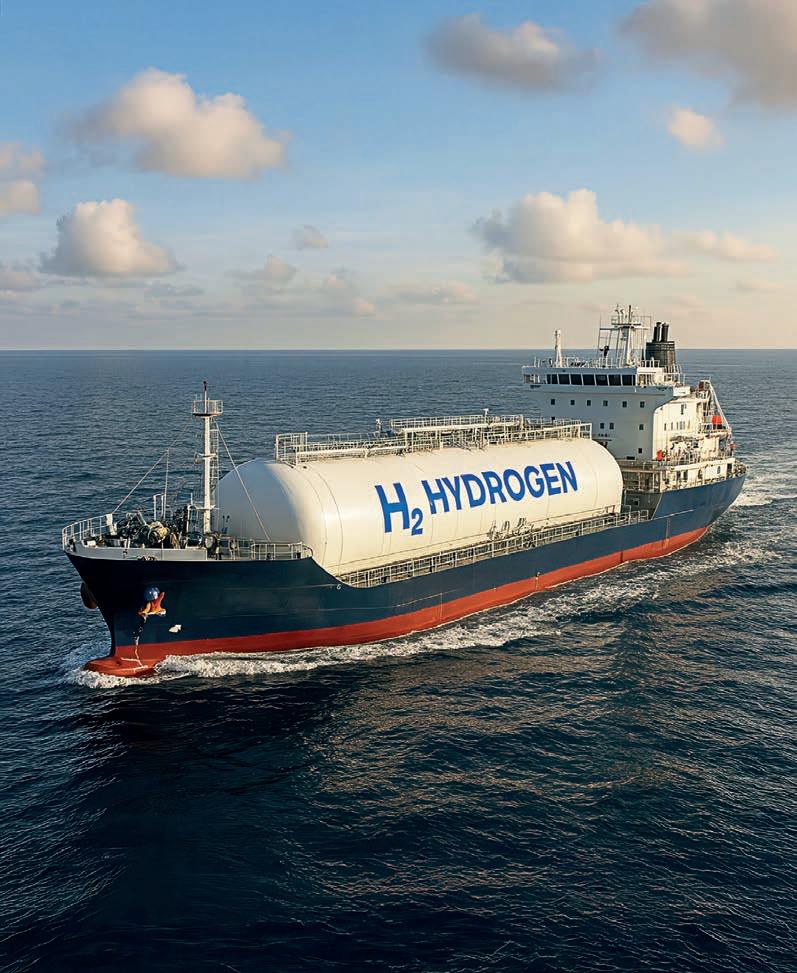
Maritime shipping is responsible for around three per cent of global
Images:
Lloyd’s Register
short-sea shipping but remain impractical for long-distance routes.
Hydrogen occupies a unique position in this mix. When produced using renewable electricity and used in fuel cells, green hydrogen can deliver zero tank-to-wake emissions. It is also a critical building block for e-fuels, such as ammonia and methanol, giving it strategic importance beyond its direct use onboard ships.
Hydrogen under the microscope
LR’s new report examines hydrogen from production and supply through to onboard use, highlighting both its promise and the reasons it remains a challenging option for most vessel types.
On the positive side, hydrogen’s climate credentials are compelling. In fuel cell applications, it produces only water as an exhaust product. It is also highly versatile, with potential to serve as a direct fuel, a feedstock for synthetic fuels, or a form of energy storage linked to renewable power systems.
But the physical realities of hydrogen are hard to ignore. Its low volumetric energy density means far larger storage volumes are required compared with conventional marine fuels. In liquid form, hydrogen must be stored at around –253 degrees Celsius (°C), introducing complexity and energy penalties. These factors translate directly into lost cargo space, higher costs and more complicated vessel designs.
Safety is another critical consideration. Hydrogen has a wide flammability range, low-ignition energy and can cause embrittlement in certain materials. Managing these risks requires rigorous engineering standards, specialised systems and enhanced crew training.
LR’s own rules for ships using lowflashpoint fuels, including its hydrogen requirements set out in Appendix LR3, provide a framework for addressing these issues. The guidance covers fuel cells, composite cylinders, liquid hydrogen systems and bunkering arrangements, reflecting the depth of technical change required to support hydrogen at sea.
The missing pieces: Infrastructure and supply
Perhaps the biggest barrier to hydrogen’s wider adoption is not onboard technology, but what happens onshore. Despite growing interest and a wave of national hydrogen strategies, low-emissions hydrogen still accounts for less than one per cent of global production, according to the International Energy Agency.
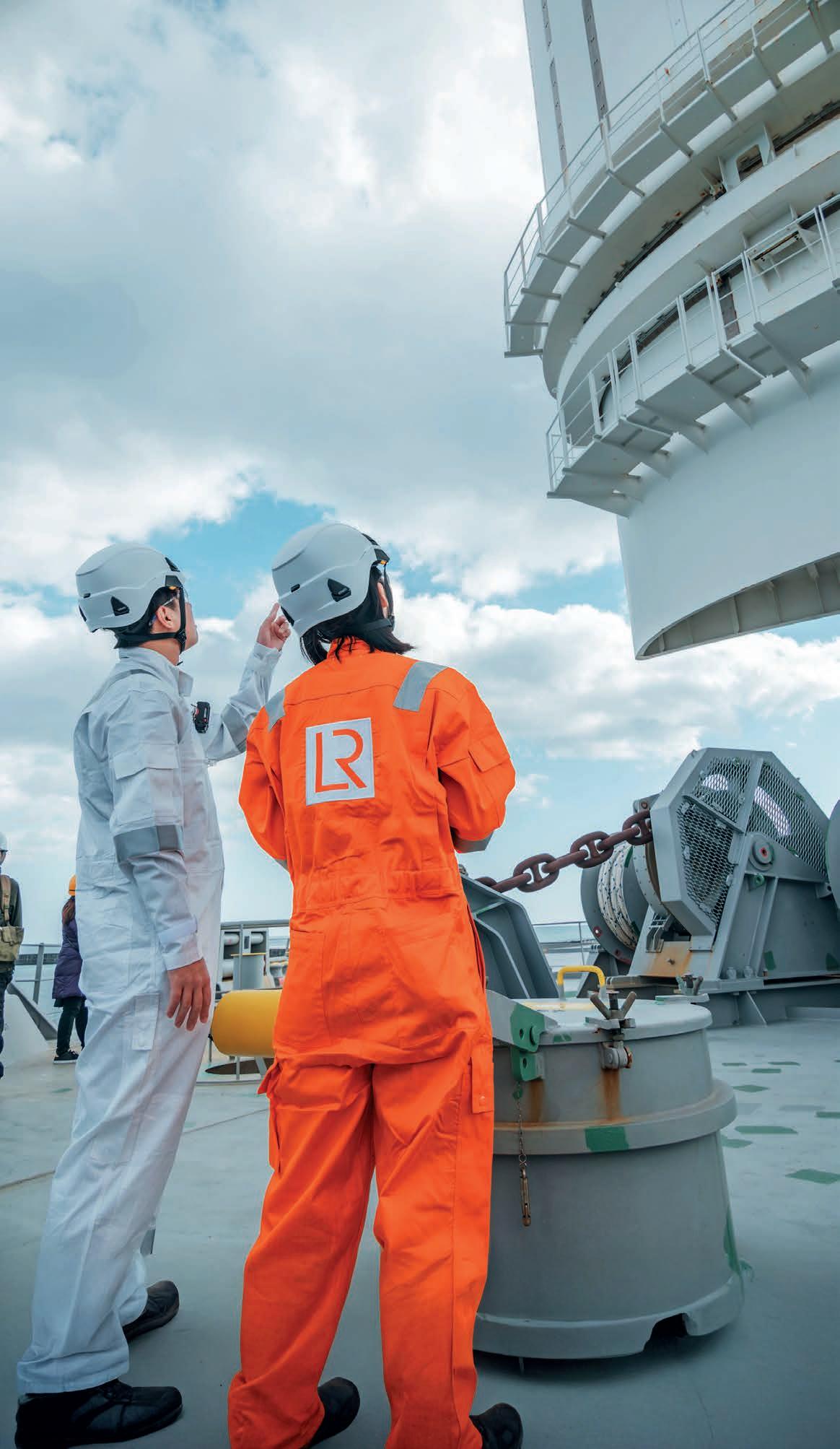
The award-winning ‘Fuel for Thought’ series has turned its attention to hydrogen.
Significant investment is needed across the entire value chain – from production, transport, storage and bunkering. For shipping, the challenge is compounded by the need for reliable, standardised refuelling infrastructure in ports around the world.
Competition for green hydrogen will also be intense. Heavy industry, chemicals, fertilisers, power generation and long-haul transport are all targeting the same limited supply. This makes robust certification schemes and transparent lifecycle assessments essential to ensure that maritime decarbonisation efforts deliver genuine climate benefits.
Under FuelEU Maritime, renewable fuels of non-biological origin (including green hydrogen) benefit from a two-times multiplier until 2033, potentially accelerating early uptake as production scales. But for now, cost remains a major hurdle.
Reflecting this reality, hydrogen-capable vessels still represent less than 0.5 per cent of the global orderbook, despite growing regulatory and industry interest.
Where hydrogen makes sense
While the report is cautious about hydrogen’s near-term role in deep-sea shipping, it identifies clear opportunities in
shorter routes and specialist applications. Ferries, tugs and coastal vessels – where regular bunkering cycles reduce storage constraints – are seen as the most viable early adopters.
Fuel cell technologies particularly show promise in these segments, supported by improving cost trajectories and advances in durability. Hybrid configurations and ‘hydrogen-ready’ designs also offer shipowners a way to future-proof assets without committing fully to a single fuel pathway.
Padmini Mellacheruvu, Lead Technical Specialist in Cryogenic and Compressed Fuel Systems at LR, shared that hydrogen has an important role to play, but warned the pathway to scale will be complex.
“Progress will depend on early investment, careful planning and a clear focus on safety,” she said.
“Our latest Fuel for Thought report brings clarity to both the potential of hydrogen and the substantial work still required to enable its safe, scalable and commercially viable use.”
Wider energy transition
The hydrogen report, as part of LR’s wider
the rapidly evolving alternative fuels landscape. The overarching message is that the shipping transition will not be defined by a single winner, but by a portfolio of solutions tailored to different routes, vessel types and regional conditions.
Dr Maximilian Kuhn, Advisor to Hydrogen Europe and Liaison to the International Maritime Organization, said hydrogen should be seen as a driver of systemic change rather than a standalone answer.
“Its versatility, scalability and compatibility with renewable energy sources put it in a unique position to address the complex challenges of maritime decarbonisation,” he said.
“Yet the path forward is not without obstacles: infrastructure, regulation, safety and cost remain critical hurdles.”
For Australia, with its vast renewable resources and ambitions to become a clean energy and hydrogen export powerhouse, these developments will be closely watched. While the initial focus has been on land-based industry and exports, the maritime sector will
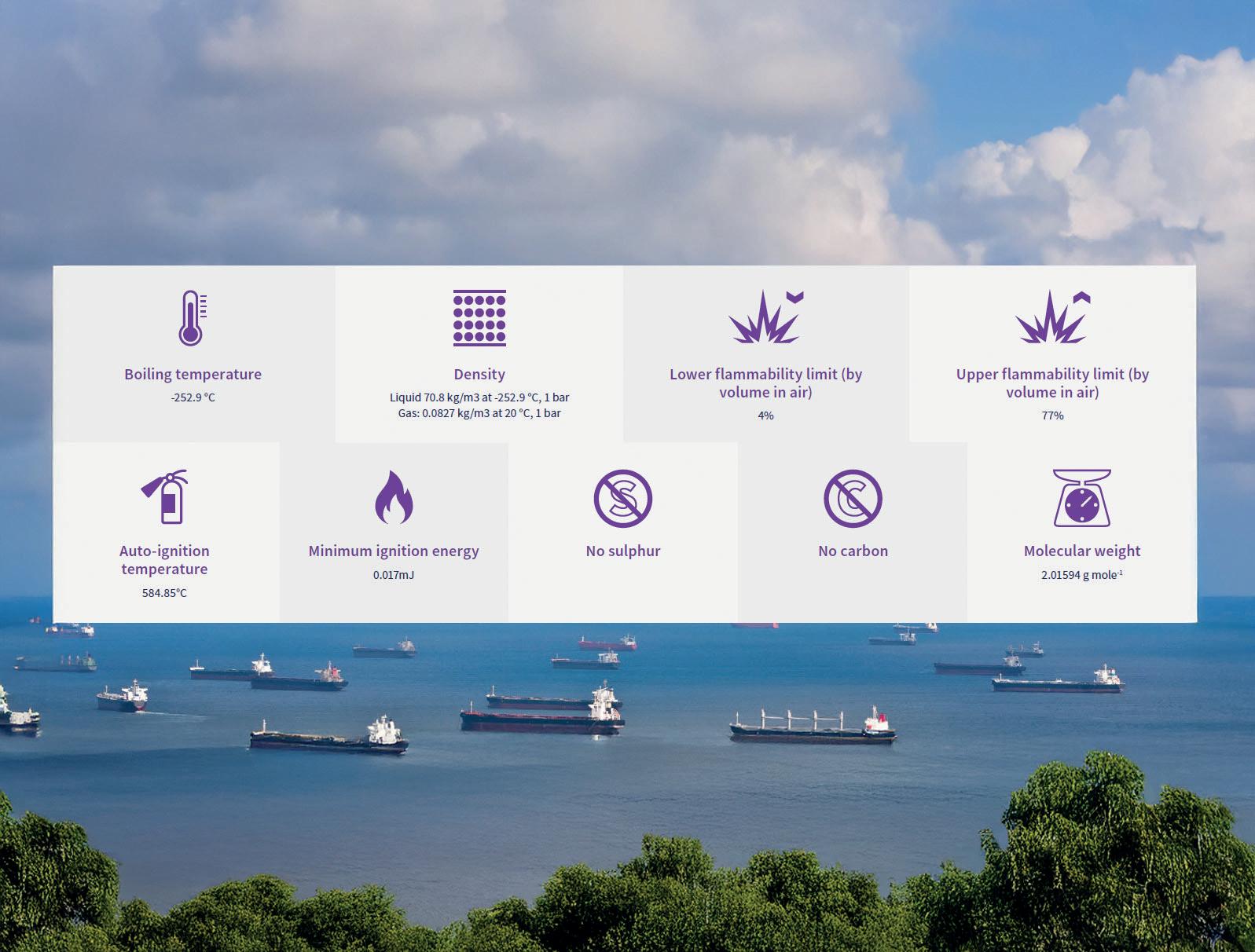

The properties table provides an assessment of hydrogen as a marine fuel.
RAPID DEPLOYMENT Ready in under 30 minutes
DURABLE & SUSTAINABLE Designed for 10+ years in the eld
From mining to megawatts
With skills shortages emerging, Specialised Energy Solutions is betting that technical training, culture and long-term thinking will be as critical as megawatts and megaprojects.
When Australia talks about the energy transition, the focus is usually on megawatts, transmission lines and technology. But on the ground, the success or failure of the transition increasingly comes down to something far more prosaic: Whether there are enough skilled people who actually know how to install, integrate, commission and maintain the equipment.
For Aaron Mulhall, Founder and Chief Executive Officer of Specialised Energy Solutions (SES), that reality is not theoretical. It is the daily operating environment of a business that has quietly grown from a handful of people in 2022 to nearly 100 today, working across almost every state across Australia’s most complex renewable energy projects.
“We’re not a business built around hype. We’re built around delivery, around people, and around being able to support this equipment for the next 20 to 30 years,” Mulhall says.
Coal to renewables
Mulhall’s path into renewables is not a conventional one. He is an electrician by trade, having completed his apprenticeship in the mining industry, working underground in coal.
From there, he moved to operational roles across multiple mine sites before being exposed to the early stages of the energy transition around seven years ago.
“I did some work with a large European company and that was really my first deep look at how far ahead Europe was in terms of technology. That opened my eyes to what was coming to Australia,” Mulhall says.
That experience also exposed him to a different way of thinking about projects – not just construction – but lifecycle management, commissioning and long-term operational performance.
In 2022, Mulhall launched SES, initially with a very narrow and technical focus: Supporting global technology providers as they brought advanced equipment into the Australian market.
“When we started, it was basically just me,” he says.
“By the back end of 2022, we might have had seven or eight people. The original idea wasn’t to build a huge company. It was to sit in a very specific niche around integration and commissioning.”
However, that niche turned out to be much larger, and more critical, than first expected.
Bridging the gap
Australia’s renewable sector is heavily reliant on overseas technology, particularly from Europe and China. But what often gets underestimated is how different Australian regulatory environments are compared to other markets.
“Australia is much more rigorous,” Mulhall says.
“The approval processes, the compliance,
the installation standards – they’re all tighter. That’s a good thing, but it does mean overseas manufacturers can’t just land equipment here and expect it to be installed the same way it is elsewhere.”
SES has positioned itself as the on-theground bridge between global Original Equipment Manufacturers (OEMs) and Australian conditions. This means not just installing equipment, but helping manufacturers understand how their products need to be adapted, integrated and supported locally.
“We sit at the table with corporate and engineering teams, but we can also talk about the physical realities of installing the equipment. The logistics, the site conditions, the workforce – all of that matters if you want these projects to succeed,” Mulhall says.
Today, SES works across solar, wind, battery storage, substations and hybrid projects, supporting multinational clients with installation, commissioning and long-term service agreements. While Mulhall cannot name specific customers for privacy reasons, he shares that most of the company’s major clients are large international firms.
“We see ourselves as an extension of OEMs,” he says.
OEMs are companies that design and build the actual physical parts (turbines, inverters, batteries) or integrated systems (microgrids, solar farms) for renewable energy projects.
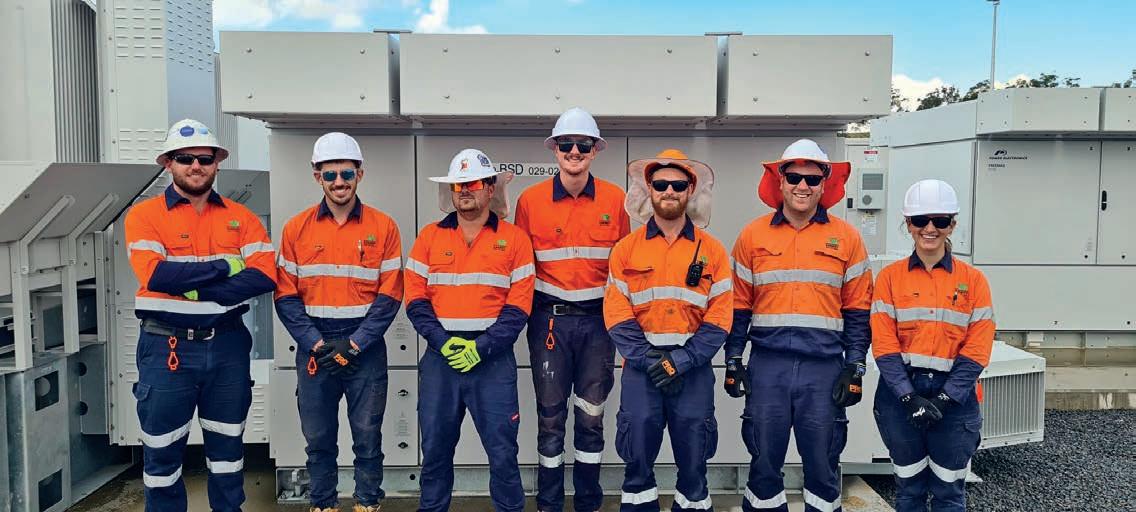
SES team working on a large-scale battery energy storage project, supporting Australia’s energy transition and long-term energy security.
“If their equipment succeeds in Australia, we succeed. That’s how we’ve built our partnerships.”
Systems and culture, not slogans
SES’s workforce growth has been rapid by any standard: From single digits in 2022, to around 25 in 2023, roughly 60 in 2024, to approaching 100 in 2025.
But Mulhall is quick to push back on the idea that growth itself was ever the goal.
“The business was never meant to grow this big, this fast. It happened because the market needed what we were doing,” he says.
What he is far more proud of than headcount is high retention.
“We’re on site, we set expectations early, and we build teams that don’t want to let each other down. That’s the culture we breed,” Mulhall says.
That culture is backed up by a very deliberate financial strategy.
“Every dollar this company has ever made has gone back into the business. Into people, into equipment, into vehicles, into tooling, into systems. I’m playing a long game. I’ve got 30 years to build this properly,” Mulhall says.
Decades-long view
That long-term mindset is central to how SES positions itself in the market. Rather than thinking in terms of projects, Mulhall thinks in terms of asset lifecycles.
“The equipment being installed today should still be supported in 20 or 30 years. That’s how we build continuity of work for our people and real value for clients,” he says.
It’s also why SES has been building long-term service agreements alongside its construction and commissioning work.
“We don’t want to just show up, build something, and disappear. We want to be there for the operations and maintenance phase as well,” Mulhall says.
For Mulhall, that continuity is personal.
“I’ve got a young family. A lot of the people working for us do too. We’re all in the same boat,” he says.
“If we can give our people consistent work and long-term security, that matters.”
Technical capability
Without enough skilled people to commission, operate and maintain complex renewable assets, the risks for the development of the renewable energy sector extends well beyond project delays to underperforming assets, increased fault rates, safety incidents, and long-term reliability challenges.
“You can build capacity quickly. But capability takes time. If we don’t invest in people now, we’ll feel it five to ten years down the track when assets start to age and there aren’t enough technicians who truly understand how they work,” Mulhall says.
When asked what worries him the most about Australia’s 82 per cent renewables target, Mulhall doesn’t talk about approvals or capital. He talks about skills.
“An emerging industry barrier is technical capability,” Mulhall says.
“There are plenty of electricians who can pull cables. But fault-finding, commissioning, high-voltage switching – that’s a different level of skill.”
He believes the real crunch will come once assets are operational, not in construction.
“If we don’t have enough people who really understand the complex systems required to deliver for our growing customers, operations will become the constraint,” Mulhall says.
SES has responded by making training a core part of its operating model. The company currently employs seven apprentices and puts all its tradespeople through OEM-specific training, high-voltage operations and switching courses.
“We give them exposure to equipment they would never see in residential or commercial electrical work. By the time they finish their trade, they’re confident not just
in general electrical work, but in high-end technical systems,” Mulhall says.
Three of SES’s apprentices came from residential and commercial backgrounds and are now being trained on utility-scale infrastructure.
“They’re learning things they just wouldn’t get exposed to anywhere else,” he says.
Mining meets renewables
Mulhall credits much of SES’s operational discipline to his mining background.
“Mining is heavily safety-driven and process-driven,” he says.
“There are decades and decades of hardearned lessons in that industry. Bringing that thinking into renewables gave us a big head start.”
That includes everything from safety systems to documentation, training pathways and quality assurance.
“Renewables is a younger industry. It’s scaling incredibly fast, but it hasn’t had 100 years to build its systems yet. That’s where we’ve tried to bring some structure,” Mulhall says.
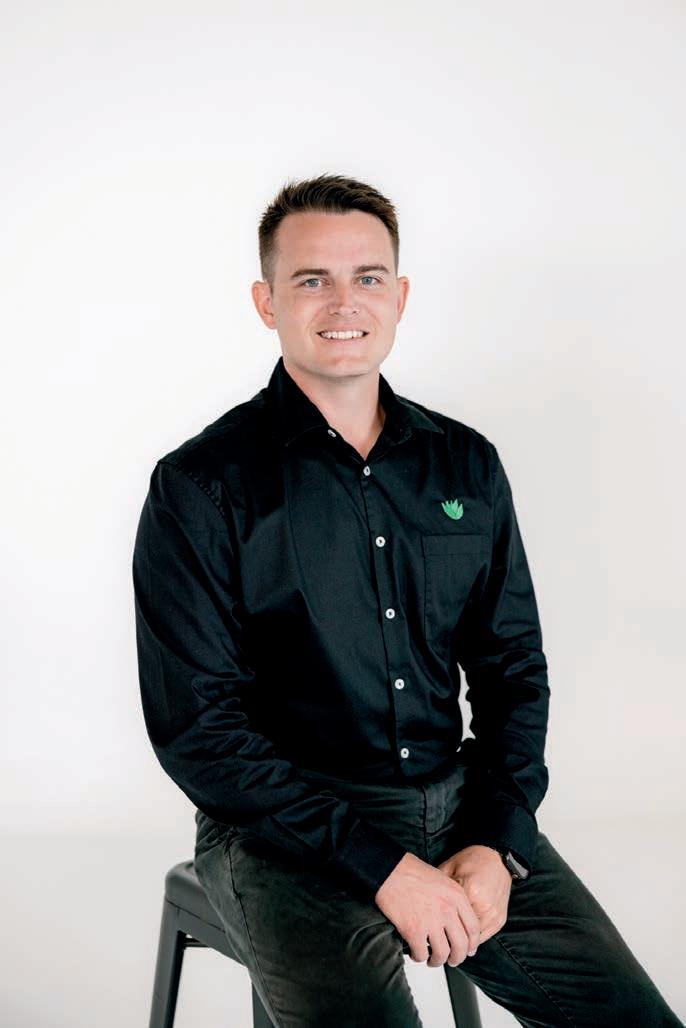
Aaron Mulhall, Founder and Chief Executive Officer, Specialised Energy Solutions.
Not a typical CEO story
Despite founding and leading the business, Mulhall is almost uncomfortable talking about himself.
“I’d rather people know the business and the team first, and find out who I am afterwards. This isn’t about me.”
He still spends time onsite, works directly with teams, and sees himself as a tradesman first and a CEO second.
“I like being able to talk to engineers at a high level, but also to talk about how the equipment actually gets installed,” he says.
His ambition for SES is not to become a corporate giant, but to become a longterm, trusted delivery partner across the sector.
As Mulhall puts it: “You can have all the technology in the world. But if you don’t have the people who know how to install it, run it and fix it, it doesn’t matter.”
“We need to make this a career people can stay in for decades. That means training, progression, exposure to different technologies, and a work environment that’s safe and sustainable.”
For SES, this translates into continued investment in apprenticeships, OEMspecific training, and long-term service agreements. This ensures that as Australia’s renewable fleet expands, the workforce grows alongside it.
The unseen work behind Australia’s most reliable solar assets
In a high-tech solar era, Mega Watt Power shows how technical service is the real differentiator.
For more than a decade, Australia’s solar conversation has been dominated by hardware: Bigger panels, smarter inverters, higher-density batteries, faster deployment.
Yet behind every system that performs reliably year after year is something far less visible and far more critical: The people who service it.
For Mega Watt Power, this reality has shaped the business from its earliest days. Long before ‘solar inverter’ became industry vocabulary, and long before renewable energy became a national success story, the company’s over 30 year track record began with a single off-grid system on a riverbank outside Dorrigo in regional New South Wales.
“Our journey began in 1989 with a single 12-volt battery, a 42-watt solar panel, and a very determined need to keep the lights on,” says Peter Bulanyi, Founder and Managing Director at Mega Watt Power.
It was a modest beginning, but one that set the tone for what would follow.
“Our business was built not just on technology, but on responsibility, technical honesty and long-term service,” Bulanyi says.
Expertise meets accountability
Today’s solar and storage systems are sophisticated parts of infrastructure. Modern renewable energy plants rely on multi-mode inverters, advanced battery platforms, rapid shutdown systems, real-time monitoring and continuously evolving firmware.
Australia now depends on residential, commercial and utility-scale PV and BESS assets operating with tight performance targets and little tolerance for downtime.
Technology has accelerated rapidly, but the importance of technical services has not changed.
Mega Watt Power occupies a unique position in the Australian market because
it combines decades of hands-on field experience with the backing of its longstanding engineering and servicing arm and technical partner founded by Bulanyi and his wife Lee in 1989.
While Mega Watt Power focuses on installation, project delivery and ongoing maintenance, Si Clean Energy works quietly in the background, providing deep technical capability that many site operators never directly see: Electronics repair, calibration, spare parts, engineering support, and advanced diagnostics.
“It’s not one business sitting above the other, it’s two parts working as one,” Bulanyi says.
The electronics laboratory at Si Clean Energy supports calibration services, component-level electronics repairs, sales
and servicing of solar test instruments, and specialist services for pyranometers and weather stations. An experienced engineering team underpins field services, enabling rapid fault identification and resolution when systems don’t behave as expected.
“When something goes wrong, the last thing customers want is to be told to log a ticket overseas,” Bulanyi says.
“They want someone who understands the system, the site, the climate and the conditions – and who can actually be there.”
Technical services as defining difference
Solar has entered a new phase of maturity. Batteries are no longer niche. Hybrid systems are becoming standard.
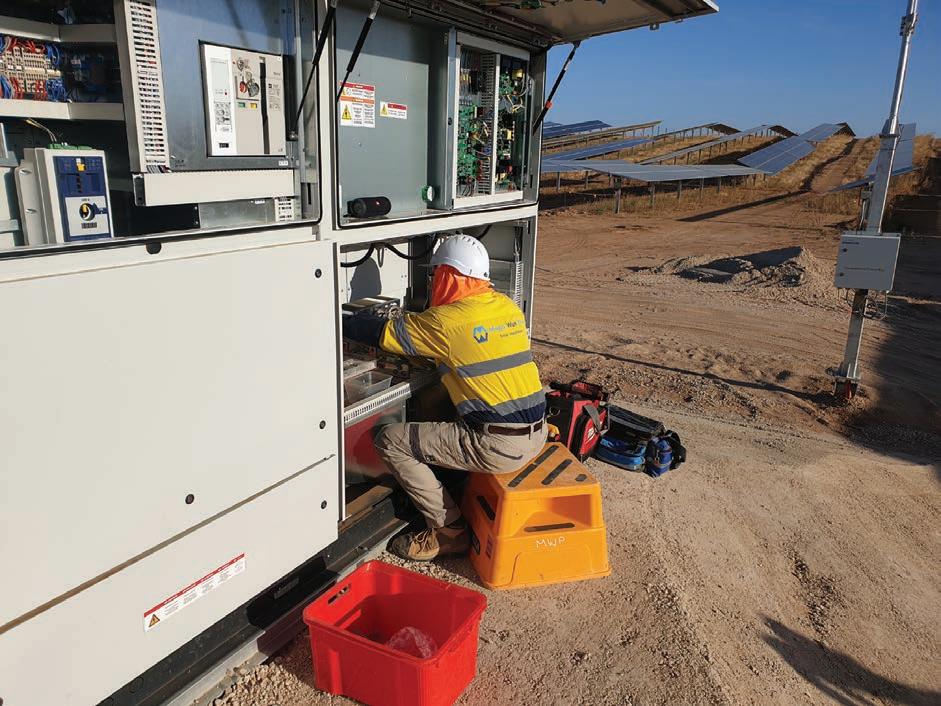
Mega Watt Power inverter integration at Kiamal Solar Farm in Victoria.
Commercial and utility-scale clients expect real-time visibility, rapid response and clear accountability well beyond commissioning day.
This shift is exposing a reality the industry does not always acknowledge.
“Products don’t keep systems running –people do,” Bulanyi says.
For Mega Watt Power, technical service is not an afterthought or a support line. It is the core of how the business operates. The company’s technicians live in the regions where the systems operate. They understand the effects of humidity, heat, coastal corrosion, power quality and the environmental variables that glossy brochures rarely capture.
As a result, problems are often resolved within hours rather than weeks. Firmware updates and diagnostics are handled locally, not offshore. Responsibility is shared rather than passed along supply chains.
Technical services are the daily order of work. Mega Watt Power provides IV (current-voltage) curve testing in the field, while Si Clean Energy as an authorised Fluke distributor supplies testing equipment, technical training and result analysis for plant operators and subcontractors performing their own testing.
Many manufacturers of inverters and power electronics also outsource servicing and maintenance to Mega Watt Power, trusting the team to perform component-
level repairs inside equipment, deliver firmware upgrades and carry out remote diagnostics via plant Supervisory Control and Data Acquisition (SCADA) systems.
This combination of field capability and engineering depth is what gives customers confidence over the long term – and what has earned the company a reputation for reliability across Australia.
A philosophy built over decades
What has sustained the business for more than 30 years is not scale or market share, but a belief that solar companies must remain human at their core.
“Solar is technology, yes. But it’s also people’s homes, their livelihoods, their businesses and their power plants. If we don’t care about the people, the technology doesn’t matter,” Bulanyi says.
That philosophy influences how technicians are trained, how teams are built and why the company has remained proudly regional. Many staff members have stayed with the business for a decade or more, drawn by an environment that values capability, accountability and trust.
Although Mega Watt Power’s roots are firmly planted in Coffs Harbour, New South Wales, its work now spans the country. The team has supported solar farms, commercial installations and long-term maintenance programs across all mainland states, bringing the same consistency and care they
deliver in their home region.
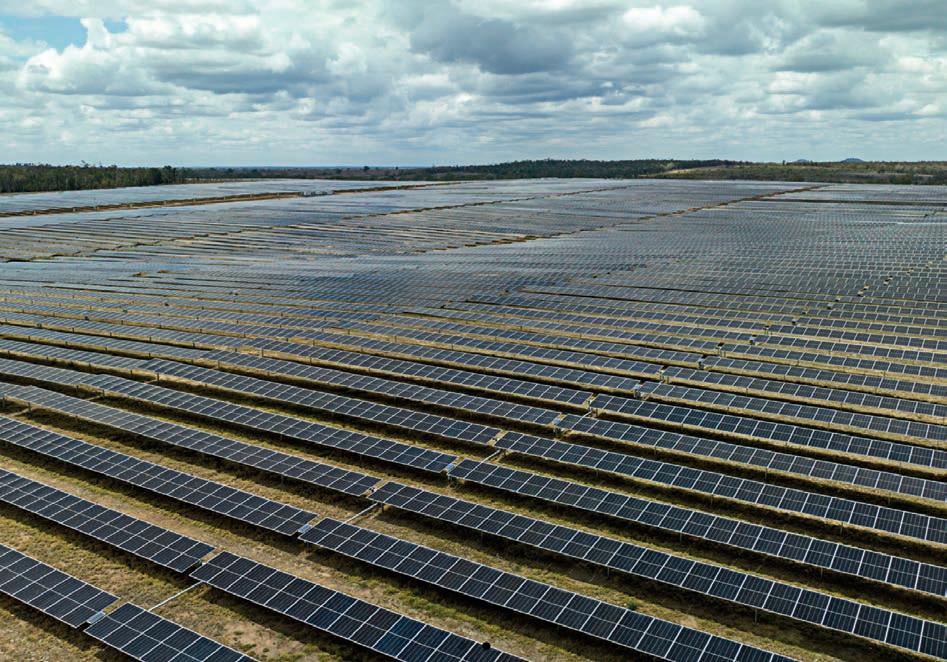
Major project experience includes the electrical construction of the 167-megawatt Stage One Wandoan Solar Farm, integration of more than five gigawatts of central inverters across Australia, utility-scale Battery Energy Storage System (BESS) commissioning and maintenance, power transformer testing and substation services. It is a portfolio built quietly, job by job, rather than through marketing fanfare.
Investing in skills
As Australia moves deeper into electrification – spanning batteries, electric vehicle (EV) charging, home energy management and commercial storage – the demand for skilled technical service will only increase.
Systems are becoming more integrated. Customers are more informed. Expectations around uptime, response times and accountability are rising.
Mega Watt Power is preparing for that future by investing in people. The company currently supports seven apprentices within its technical team and provides ongoing professional development opportunities across the organisation.
“There’s new technology coming that goes beyond anything we’ve previously imagined. Our job is to be ready to deliver it – and to maintain it properly,” Bulanyi says.
That preparation is already evident on the ground. While Bulanyi now spends less time on the tools day-to-day, he remains closely involved in complex and cutting-edge projects, particularly during commissioning phases where experience and judgement matter most.
“When things are truly new, that’s when you want your most experienced people involved. That’s where risk is highest, and where good technical service makes the biggest difference,” he says.
Local hands, national footprint
Mega Watt Power’s vision is straightforward: Continue delivering advanced energy systems without losing sight of the values that shaped the business from its earliest days.
“Local hands, national capability, real responsibility. That’s our service model that doesn’t disappear once the system is switched on,” Bulanyi says.
“It may not be the flashiest story in Australia’s renewable energy sector, but it is one of the most important. As the industry continues to scale, it will be technical service – quiet, skilled and accountable – that ultimately keeps Australia powered.”
Vena Energy is the developer and owner driving the planning, financing and delivery of Wandoan South Solar Stage One.
Large-scale agri-solar project advances
The Blind Creek Solar Farm and Battery Project in New South Wales is set to supply enough electricity to power more than 120,000 homes while supporting agricultural production.
Octopus Australia recently appointed GHD to deliver construction management services for the Blind Creek Solar Farm and Battery near Bungendore, New South Wales.
Under the appointment, GHD will act as construction manager across the delivery phase of the project, providing full-time site supervision alongside project management, contract administration, planning and
scheduling, cost control, reporting and gridconnection support.
The role builds on an established working relationship between GHD and Octopus Australia, following previous engagements at
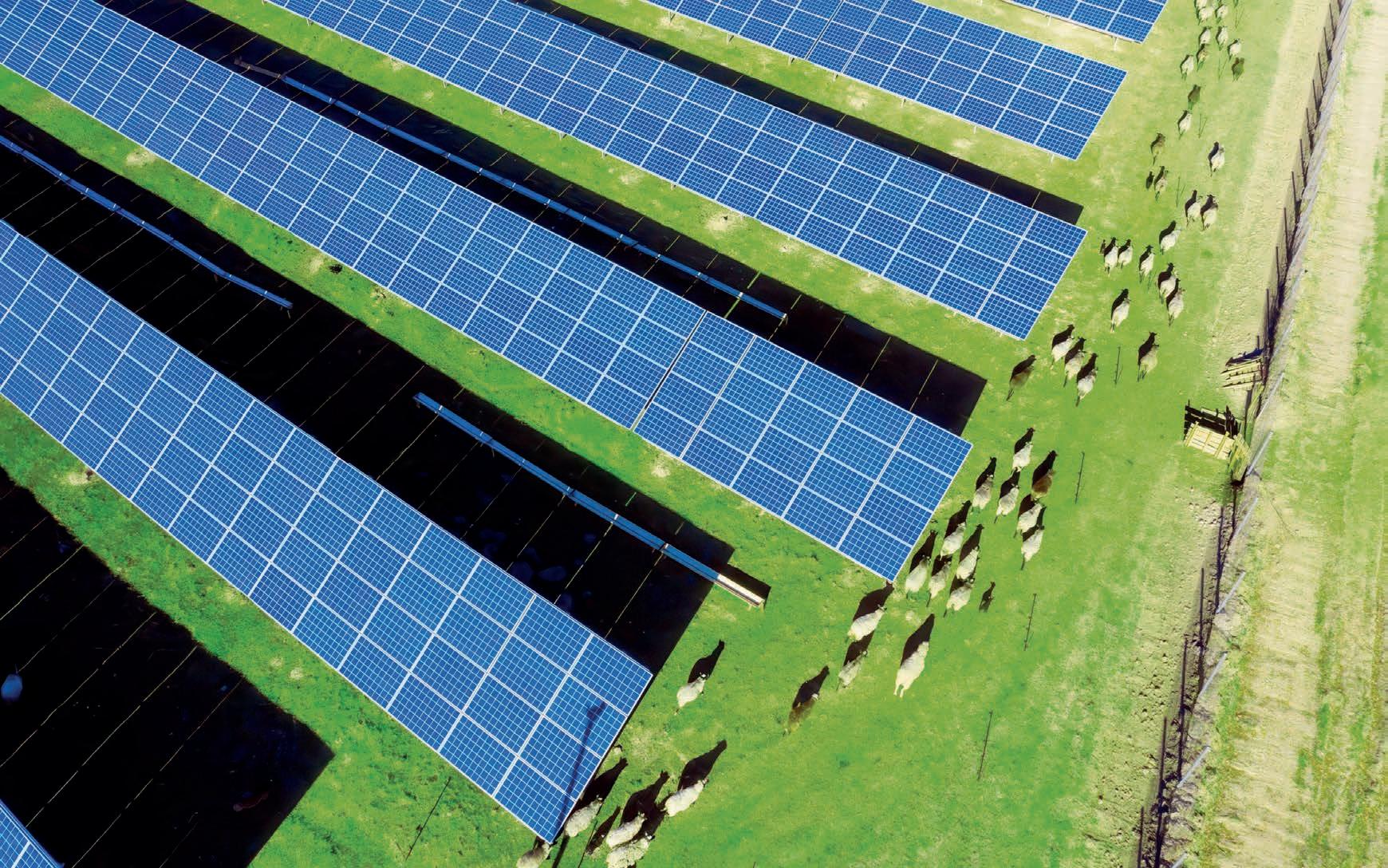
Blind Creek is a farmerled, utility-scale renewable energy project founded by local landholders and energy specialists.
the Fulham Solar Farm and Battery project, where GHD provided both construction management and owner’s engineering services. Octopus Australia is an energy fund manager and developer with a renewable energy portfolio and development pipeline exceeding $15 billion across wind, solar and battery storage.
Blind Creek is a farmer-led, utility-scale renewable energy project founded by local landholders and renewable energy specialists. The development co-locates large-scale solar generation and battery storage with ongoing sheep grazing, positioning the site as a leading example of agri-solar development in Australia. The project was recognised with the Clean Energy Council’s 2022 Community Engagement Award for its benefitsharing approach and integration with agricultural operations.
At roughly three times the size of the Fulham project, Blind Creek represents a significant expansion of Octopus Australia’s operating portfolio. Once complete, the solar farm and battery are expected to deliver 300

megawatts (MW) of renewable generation capacity, with a 243 MW / 486 megawatthour battery system. At full output, the project is expected to be capable of supplying enough electricity to power more than
120,000 homes for 24 hours, with emissions abatement equivalent to removing around 200,000 cars from the road.
GHD’s Delivery Phase Services team will lead the construction management scope, drawing on specialist expertise from across the company’s Australian operations.
Craig Palmer, General Manager of Delivery Phase Services at GHD, said the appointment reflected the strength of the partnership between the two organisations and the value of continuity across major renewable projects.
“Establishing a unified management team across Octopus Australia’s Fulham and Blind Creek projects has enabled effective knowledge transfer and consistency in delivery,” Palmer said.
“By tailoring our organisational structure to prioritise quality, safety and flexible resourcing, we’ve been able to minimise costs and maximise value. We’re looking forward to bringing GHD’s major project delivery experience and technical capability to this landmark renewable energy development.”
Specialised Energy Solutions
National Project Footprint


Craig Palmer, General Manager of Delivery Phase Services at GHD.
The next phase of high-performance energy storage
Australia’s storage market is moving beyond early adoption into a phase of higher power, larger systems and whole-of-home capability, reshaping what installers and households now expect from batteries.
Australia’s first wave of battery uptake was driven by early adopters, rising power bills and demand for backup power. The market is now shifting toward systems that can support fully electrified homes, electric vehicles and higher peak loads, while remaining practical for installers to deploy and support.
Rising electricity prices, accelerating electrification and growing expectations around resilience are changing what is expected from energy storage. Batteries are no longer an add-on to rooftop solar. They are becoming part of how buildings manage supply, reliability and load.
Against this backdrop, Growatt has released its SPM 8000-10000TL-HU hybrid inverter to the Australian market, targeting higher-power residential and light commercial systems.
High-power homes
Australian homes are using more electricity, more often. Air conditioning, induction cooking, pool pumps and electric vehicles (EV) are becoming common, reshaping the load profiles that solar and storage systems must support.
This is where the SPM series 8 kilowatt (kW) to 10 kW output range is relevant. Rather than being designed for partial load coverage, the system is intended to support multiple high-demand appliances operating at the same time.
In practice, this allows households to run more of their home on solar and storage during peak periods and maintain closerto-normal operation during outages, rather than limiting use to essential loads only.
Storage systems expand
Alongside higher inverter power, the Australian market is also moving toward larger battery capacities. Time-of-use
tariffs, evening demand and a desire to reduce grid dependence are pushing many households and small businesses beyond the 5-10 kilowatt-hour (kWh) systems that dominated early installations.
The SPM 8000-10000TL-HU supports battery capacities from 5 kWh to 100 kWh, allowing systems to be sized for current use and expanded later.
This matters for households planning to add an EV, electrified heating or increase
overall electricity use. The ability to expand storage without replacing core equipment reduces long-term cost and disruption.
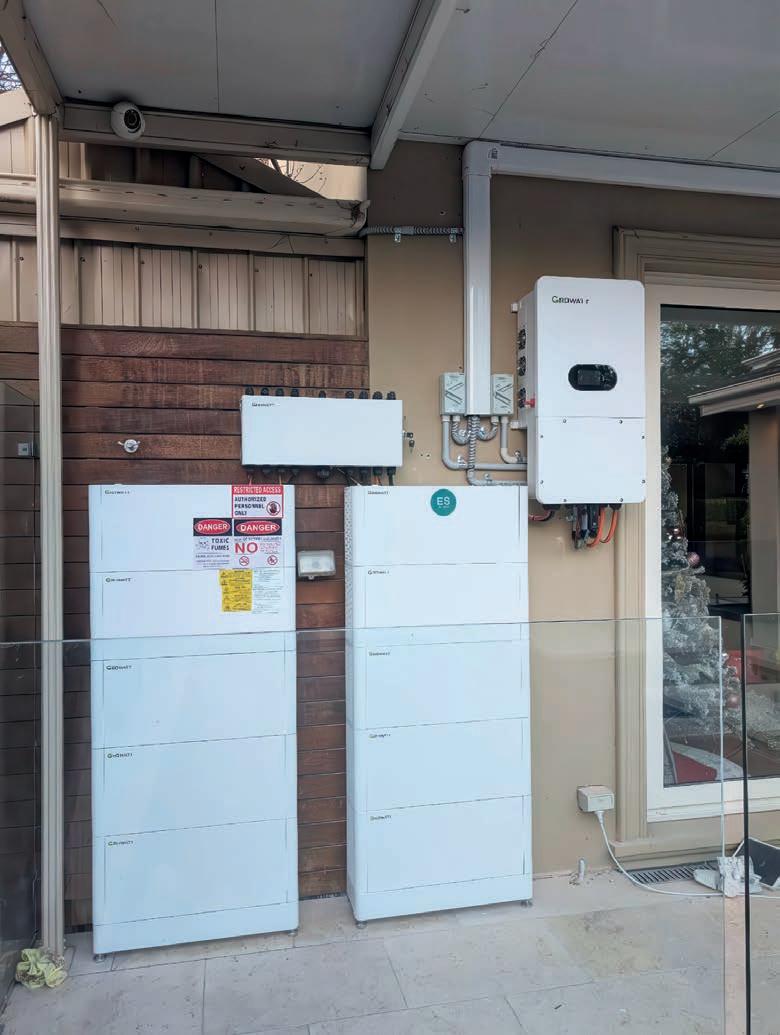
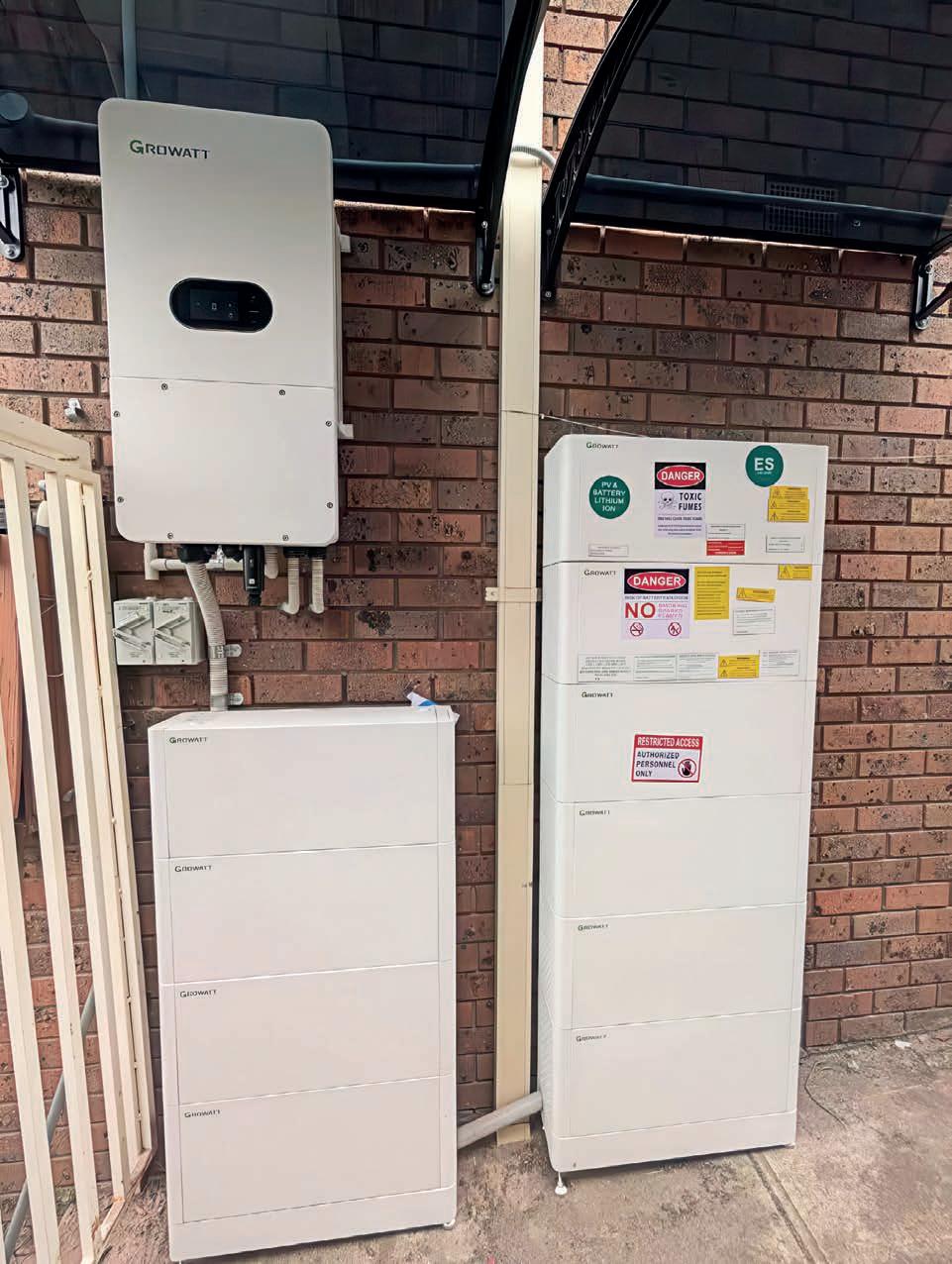
A recent Victorian installation combining a 10 kW single-particle model (SPM) inverter with 50 kWh of battery storage reflects a broader trend: System sizes that once looked commercial are now appearing at the upper end of the residential market.
Backup capability remains a key consideration, particularly in regional and
Growatt’s 10 kilowatt Single-Particle Model + 50 kilowatt-hour Advanced
Power Battery System installed in Victoria.
Images: Growatt
semi-rural areas where grid reliability can be less predictable.
In grid-connected operation, the SPM series supports a 63 Amp (A) bypass load capacity, allowing household loads to be supplied directly by the grid under high current demand. This makes whole-home backup configurations more feasible than partial or selective coverage.
When the grid is unavailable, the system switches to off-grid operation with a
maximum output current of 43.5 A, keeping essential loads operating. This move from minimal backup to continuity of operation is becoming more common as storage systems become more capable.
A more mature storage market
The SPM 8000–10000TL-HU is not just another product release. It reflects a broader shift in what the storage market now demands.
Systems are increasingly being judged on whether they can deliver usable power (not just nominal capacity), scale as household energy use grows, support whole-home backup, integrate into everyday operation, and remain practical for installers to deploy and support.
In this context, storage is increasingly being treated as part of building infrastructure rather than an add-on.
While customers focus on performance and resilience, installers are facing labour shortages, tighter margins and growing system complexity.
To address this, Growatt has paired the SPM series with its ShineTools app, which supports one-click system setup and diagnostics. The aim is to reduce commissioning time, manual configuration and error rates.
Shorter commissioning times also mean systems can be brought online faster and with fewer follow-up visits.
Growatt’s local presence
Growatt has expanded its Australian presence over recent years, supported by local partnerships, technical support and a growing installed base across both solar and storage. As the market moves from early adoption to mainstream deployment, the company is increasingly associated with scalable system designs and established supply chains.
Installer feedback suggests that products that balance functionality with ease of use are gaining traction, while end users are placing more emphasis on reliability, system transparency and clear upgrade pathways.
A central part of Growatt’s approach in Australia has been adapting products to local grid rules, standards and installer practice, rather than relying solely on global specifications. Changes in scalability, backup behaviour and commissioning workflows reflect local use cases and operating conditions.
As Australia’s energy system becomes more distributed and more variable, this kind of localisation is becoming more important. High-performance storage will continue to play a growing role in emissions reduction and how households and businesses manage cost, reliability and exposure to the grid.
The first phase of Australia’s battery market was about adoption, the next phase is about capability, scale and system integration.
Site Installation of Growatt’s SPM-HU Hybrid Inverter.

How EcoFlow is reshaping Australian energy
In the next phase of Australia’s home energy transition, success will be measured not just in installations, but in how well systems adapt to volatility, withstand extreme weather, integrate with the grid and remain usable for everyday households. In that future, a small number of companies will matter far more than most people realise. EcoFlow is positioning itself to be one of them.
Globally, EcoFlow operates in more than 140 countries, employs over 2000 people and devotes around 45 per cent of its workforce to research and development. It is a global force in portable power stations and in residential energy storage, yet in Australia it seemed like ‘the biggest company in the sector you had never heard of.’
That changed rapidly in recent years. Following a strong showing at All Energy Australia 2025 and a deliberate expansion into the local market, EcoFlow is positioning itself not simply as another battery brand, but as a global clean energy technology company spanning intelligent software, virtual power plants, off-grid resilience and fully integrated energy ecosystems.
For Craig Bilboe, Head of Residential (ANZ), that breadth is central to the company’s direction.
“Over the last few years, we’ve entered many markets across Europe and the United Kingdom, becoming leaders there too,” he says.
“Australia is the next frontier for us.”
The Australian market
Australia’s energy market is famously dynamic. Incentives change, tariffs evolve, grid constraints appear and disappear, and extreme weather is becoming a defining feature rather than an occasional disruption. For many manufacturers, that volatility represents risk. For EcoFlow, it is part of the operating environment the company is designed to handle.
“When things need to change – we adapt and fast. Government incentives change, energy providers must change with it, new governments bring new ideas. We’ve already done this in other markets, and Australia will be no different,” Bilboe says.
The organisation’s adaptability is not accidental. With almost half of the
How EcoFlow is quietly building the future of resilient, intelligent power.
company’s workforce focused on research and development, EcoFlow runs on a product cycle that is faster than most of the industry, typically releasing major new generations every two years. Hardware and software are developed in tandem, allowing the company to adjust not just the physical
capabilities of its systems, but also how they interact with tariffs, grid services and customer behaviour.
In Australia, this has translated into a focus on higher-capacity inverters, larger battery systems and equipment designed for harsher operating conditions.
“It’s not just a country, it’s a continent. Different parts of Australia place very different demands on products. Our experience installing systems everywhere from the west coast of Ireland to Norway to southern Spain gives us a good foundation for dealing with that kind of variability,” Bilboe says.
From lifestyle energy to infrastructure
EcoFlow’s global reputation was built first in the portable and off-grid segment, where its power stations and solar generators became synonymous with mobile, reliable electricity. But the company’s strategy has been steadily expanding beyond that origin story.
Today, EcoFlow is actively bridging the gap between lifestyle energy products and fully integrated, grid-connected residential and small commercial systems.
“We already have off-grid functionality with our residential systems,” Bilboe says.
“We have gateways and backup scenarios. And we’re looking at integrating our portable power stations into residential systems in the future, so you have that whole ecosystem.”
In most industries, that kind of integration might be framed as a 5–10-year plan. In renewable energy, the horizon is much closer.
“In this industry, the future is basically the second half of 2026. Six to twelve months is a long time. You’ll see more integration from EcoFlow very soon,” Bilboe says.
That urgency reflects a deeper shift in how batteries are being used in Australia. For a growing number of households, storage is
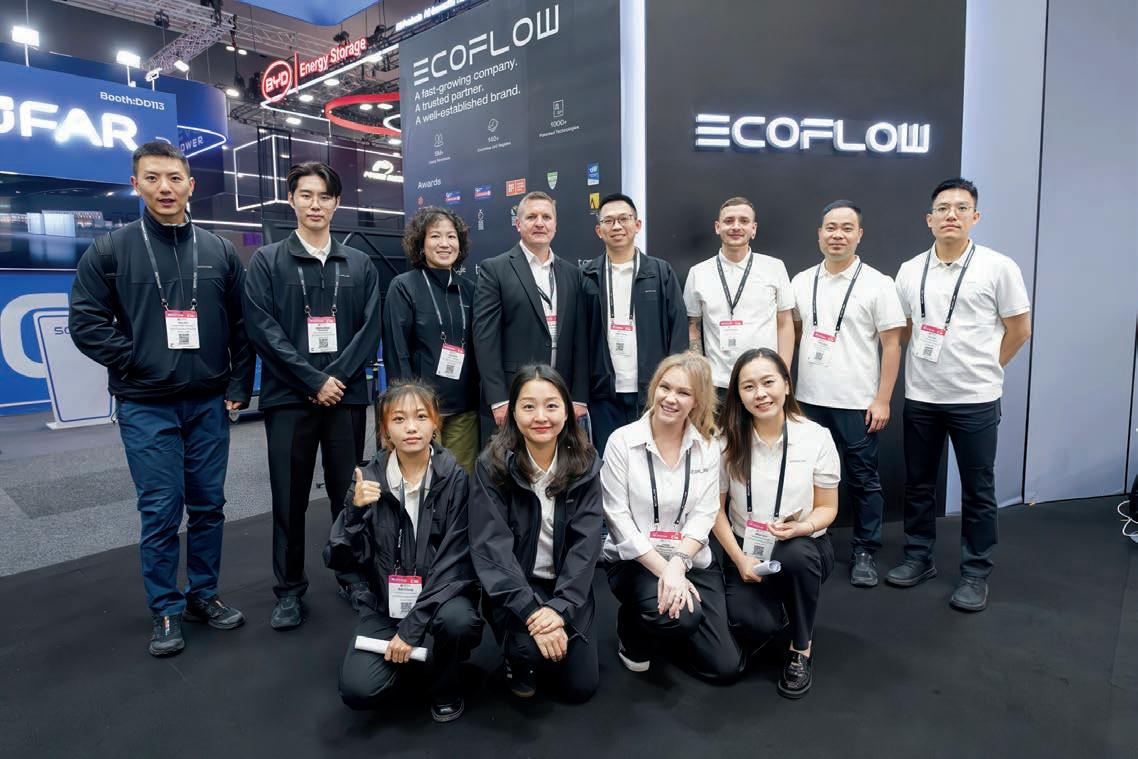
EcoFlow PowerOcean: Home Solar Inverter and Battery System that integrates solar power, battery storage, and intelligent software.
The EcoFlow team at All Energy Australia 2025.

no longer just about self-consumption or bill optimisation. It is about resilience.
Designing for a harsh climate Bushfires, storms, heatwaves and floods are placing new stress on Australian networks, and expectations around backup power are changing accordingly.
“Our products are installed in very stormy environments, very dusty environments, and very cold environments. They have to cope with a lot of different scenarios. That experience benefits us when we design products for Australia,” Bilboe says.
This thinking is evident in the company’s gateway architecture and backup solutions, which are being developed for both singlephase and three-phase systems. The goal is not simply to provide emergency power, but to make backup seamless and reliable enough that it becomes a normal part of how households think about electricity.
Smarter energy
At the same time, EcoFlow is investing heavily in a less visible but potentially more transformative layer of the energy system: Intelligent software. The company is developing proprietary intelligent tools designed to optimise energy usage, forecast consumption patterns, and provide customers with guidance on how to get the most value from their systems.
This is not just about squeezing a few extra percentage points of efficiency out of a battery. It is also about accessibility.
By automating decisions and simplifying complex energy interactions, EcoFlow sees intelligent software as a way to support customers who may not have the time, confidence or expertise to actively manage their energy assets, including in social housing and communities with limited access to reliable power.
In parallel, the company is designing its systems for a market that is rapidly embracing virtual power plants and energy trading. Australia has one of the world’s most advanced virtual power plant markets, a fact that surprised even EcoFlow’s global team.
“One of the unique things about the Australian market is how quickly it has grasped virtual power plants and energy trading,” Bilboe says.
EcoFlow’s view is that the faster batteries can participate in these programs, the faster payback periods will fall, and adoption will accelerate.
People, installers and the long game
With the emphasis on advanced technology, EcoFlow is acutely aware that the success of any energy system still depends on the people who install and use it. That is why the company is investing in training, support and system design that reduces friction for installers and simplifies the customer experience. This is EcoFlow’s key point of differentiation in the sector.
Sustainability, too, is being treated as more than a marketing slogan. Like all battery manufacturers, EcoFlow operates
in a sector facing increasing scrutiny over materials, supply chains and end-of-life management. The company says it is building robust supply chains and developing recycling and end-of-life programs to address the long-term footprint of storage at scale.
Taken together, these strands paint a picture of a company that is not merely selling batteries, but quietly assembling the components of a much broader energy platform: Hardware, intelligent software, grid participation, and off-grid capability converging into a single ecosystem.
EcoFlow’s scale is already considerable. It operates in more than 140 countries, employs over 2000 people, with a workforce spanning more than 40 nationalities. Yet in Australia, it feels like a company on the verge of being truly discovered as a national steward for innovation.
That creates an unusual and potentially powerful dynamic. For installers, partners and customers, EcoFlow offers the stability and resources of a large global organisation combined with the urgency and ambition of a company still in expansion mode.
“We’re a very young, dynamic organisation. In this market, you have to be,” Bilboe says.
As the energy transition grows more uncertain, the companies that matter will be those that build adaptable, enduring systems. And EcoFlow may be among the most important of them flying under the radar in Australia – for now.
EcoFlow is a global force in residential energy storage and portable power stations.

endeavourawards.com.au





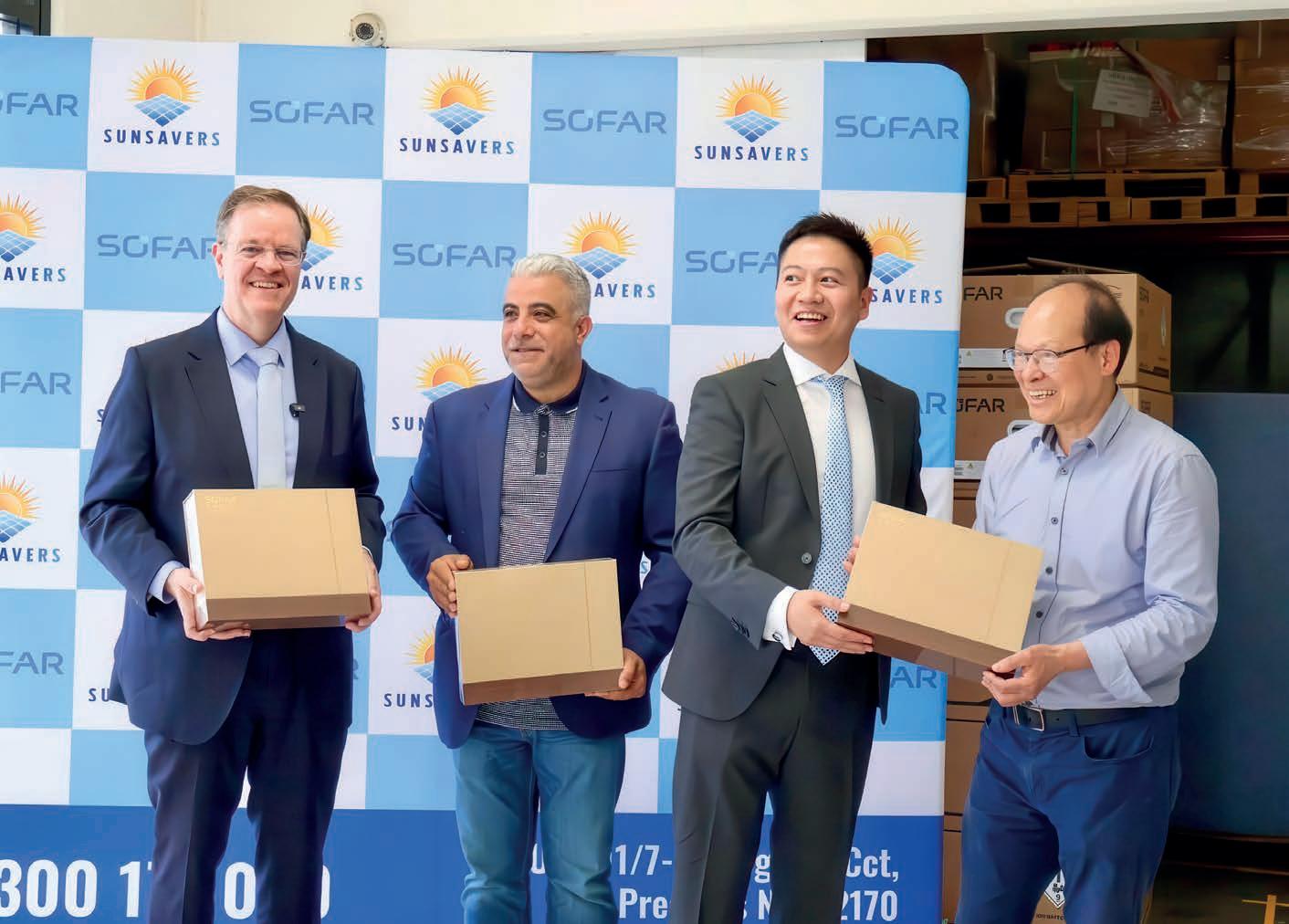
From inverters to integrated energy
In a market where trust, service and system performance matter as much as hardware, SOFAR Solar is repositioning itself from inverter supplier to full-stack energy solutions provider, backed with products, people and local infrastructure.
In Australia’s fast-maturing solar market, brand strength is no longer built on product alone. Installers want certainty of supply, homeowners want confidence in longterm performance, and the grid increasingly demands systems that can do more than simply export surplus electrons at midday.
Within this context, SOFAR Solar is making a deliberate play to reposition itself, not just as an inverter supplier, but also as a full-stack energy solutions provider. It is doing so with a coordinated mix of product launches, market engagement and local infrastructure investment.
Of recent, that strategy has become increasingly visible. The company recently completed a four-city Australian roadshow showcasing its new PowerAll energy storage system, after being named Australia’s Top
Brand Photovoltaic Inverter for 2025 by EUPD Research.
SOFAR Solar also opened a major new warehouse facility in Sydney to strengthen its local logistics and service footprint. This signals a company that sees as a long-term strategic base in one of the world’s most competitive distributed energy landscapes.
PowerAll steps into the spotlight
The most immediate expression of that strategy has been SOFAR’s national roadshow, which took PowerAll, as the company’s flagship residential energy storage solution to Adelaide, Melbourne, Sydney and the Gold Coast.
Rather than a conventional product launch, the roadshow was designed as a hands-on technical engagement with
installers and partners. Across the four cities, the focus was on practical system design, installation workflows and realworld use cases in their recognition that the installer experience is just as critical as the datasheet.
PowerAll itself is clearly positioned as a response to a changing residential market. Storage is no longer being sold simply as backup power or a hedge against blackouts. It is increasingly a core part of how households manage self-consumption, tariff arbitrage and resilience in an increasingly volatile grid environment.
From a technical perspective, the system has been built around flexibility and simplicity. It offers extendable, modular capacity, a streamlined installation process, and a naturally ventilated thermal design
The launch of SOFAR Solar’s new Sydney warehouse.
that avoids the need for noisy active cooling. For installers, that combination translates into faster installs and fewer points of failure over the life of the system.
On the electrical side, PowerAll supports 100 per cent three-phase unbalanced loads and enables seamless switchover between on-grid and off-grid operation within 10 milliseconds. This specification reflects the increasing complexity of Australian homes, where three-phase loads, electric vehicle (EV) chargers and high-powered appliances are becoming standard.
Safety and durability have also been central to the design. The system integrates up to three MPPTs (Maximum Power Point Tracking) with AFCI (Arc Fault Circuit Interruption) and carries an IP66 rating, making it suitable for a wide range of Australian environmental conditions, from coastal installations to hot inland regions.
Feedback from the roadshow suggests the market is receptive. Installers responded positively to the system’s modular expansion, its ease of integration into both new and retrofit systems, and its ability to help households materially increase self-consumption while reducing long-term energy costs.
There was also strong interest in what comes next. SOFAR Solar’s three-phase PowerAll model has entered the market – broadening the system’s applicability in larger homes and light commercial settings.
Recognition from the installer channel
While product launches generate attention, trust is built over much longer cycles. In that respect, SOFAR’s recognition as Australia’s Top Brand Photovoltaic Inverter 2025 by EUPD Research carries reputational weight in the sector.
The award is based on extensive interviews with installation companies and reflects not only market share, but brand recognition, satisfaction and perceived reliability.
“SOFAR’s continued success in Australia reflects a brand that has built a strong presence and a loyal following,” says Daniel Fuchs, CCO of EUPD Research.
“Based on hundreds of interviews with installation companies, it’s clear that SOFAR has a very high level of awareness, recognition, and satisfaction, making it a well-deserved winner of this award.”
In a market that has seen no shortage of inverter brands come and go over the past decade, that kind of endorsement matters.
For installers, reliability is not just about hardware performance; it is about warranty processes, technical support, spare parts availability and the confidence that a supplier will still be there in five or ten years.
SOFAR has been operating in Australia for more than a decade and has steadily expanded its local footprint. Today, it maintains local technology teams across New South Wales, Victoria, Queensland, Western Australia and South Australia, supported by warehouse facilities in five states.
That local presence has become a central part of the company’s value proposition. It allows faster response times, local technical support, and a product roadmap that is increasingly shaped by Australian conditions rather than generic global requirements.
From a market perspective, the award also reflects SOFAR’s steady expansion beyond its original inverter base into hybrid systems and storage. This transition mirrors the broader evolution of the rooftop solar sector itself.
Infrastructure behind the promise
If the roadshow and the EUPD award represent the front-of-house elements of SOFAR’s strategy, the opening of its new Sydney warehouse is the backof-house investment that makes those promises credible.
The new facility, developed in partnership with Sunsavers Group, is designed to significantly increase SOFAR’s logistical capacity and improve delivery times and after-sales support across the country.
In an industry where delayed parts and slow replacements can leave installers and customers in limbo for weeks, logistics is no longer a secondary concern, it is a core competitive differentiator.
David Zhong, Senior Vice President and Co-Founder at SOFAR , shares that the warehouse opening will further the company’s seven-day product replacement guarantee.
“If a product issue cannot be resolved remotely within seven days, we will replace the product,” he said.
Further to back-of-house investment, SOFAR recently hosted ‘SOFAR Night’ at the Eureka Tower in Melbourne. The event brought together prominent leaders in government and industry, within attendance from SOFAR’s Co-founders David Zhong and Eric Yi.
During the event, Zhong reflected on SOFAR’s journey from a startup to a global player, while Yi emphasised the company’s
focus on listening to customers and responding quickly to local market needs.
Built for a long game in Australia
SOFAR now operates in more than 100 countries globally, but Australia occupies a distinctive place in its portfolio.
The current market is made up of some of the world’s highest rooftop solar penetration with a rapidly growing storage sector and a grid undergoing structural change, making it one of the most demanding environments in which energy hardware must perform.
For manufacturers, Australia is where products are tested under real-world pressure: High ambient temperatures, demanding installers and customers who are increasingly sophisticated in how they evaluate performance and long-term value.
Against that backdrop, SOFAR is positioning itself for long-term relevance rather than short-term volume. The company is investing in product capability, brand trust and physical infrastructure in parallel, building a platform designed to scale with the market.
That strategy was cemented in 2025 through a series of corporate milestones. In April, SOFAR listed on the Shenzhen Stock Exchange, strengthening its balance sheet and creating a stronger foundation for continued investment in research and development and global service capability. This was followed by its classification as a ‘Grade A’ inverter manufacturer in Wood Mackenzie’s first half of 2025 assessment, a designation reserved for suppliers that meet strict benchmarks across environmental, social and governance objectives, research and development intensity and manufacturing capacity utilisation.
For developers, engineering, procurement and construction specialists, that ranking signals reduced execution risk and long-term supplier credibility in an increasingly performance-driven market.
On the ground, that corporate strength is being matched with a clear local product and delivery strategy. PowerAll remains the company’s core residential platform, with a three-phase version expanding its applicability.
Meanwhile, a 2026 roadmap will broaden SOFAR’s portfolio into residential, commercial and industrial segments; including, SOFAR’s forthcoming nextgeneration residential energy storage solution, PowerAll.
Australia’s battery boom grows up
The country’s home storage is in its infrastructure phase, where reliability, integration and long-term performance matter most. For FOX ESS, that shift is reshaping product design to local investment.
Australia’s home battery market has finally crossed the line from niche to mass market. Federal incentives, volatile electricity prices and a growing appetite for energy independence are pushing storage from a ‘nice-to-have’ upgrade into core household infrastructure. For manufacturers, that shift brings both opportunity and risk: The challenge is
no longer simply scaling fast, but scaling responsibly without compromising quality, safety or trust.
For global energy storage manufacturer FOX ESS, Australia has become one of the most strategically important markets in that transition. The company, which supplies modular battery systems, inverters and energy management platforms across
residential and commercial segments, is betting the next phase of growth will be defined less by raw sales volumes and more by reliability, integration and long-term performance. “We’re no longer in a phase where batteries are just about early adopters or backup power,” says Brooks Richard, Managing Director of APAC and Middle East at FOX ESS.
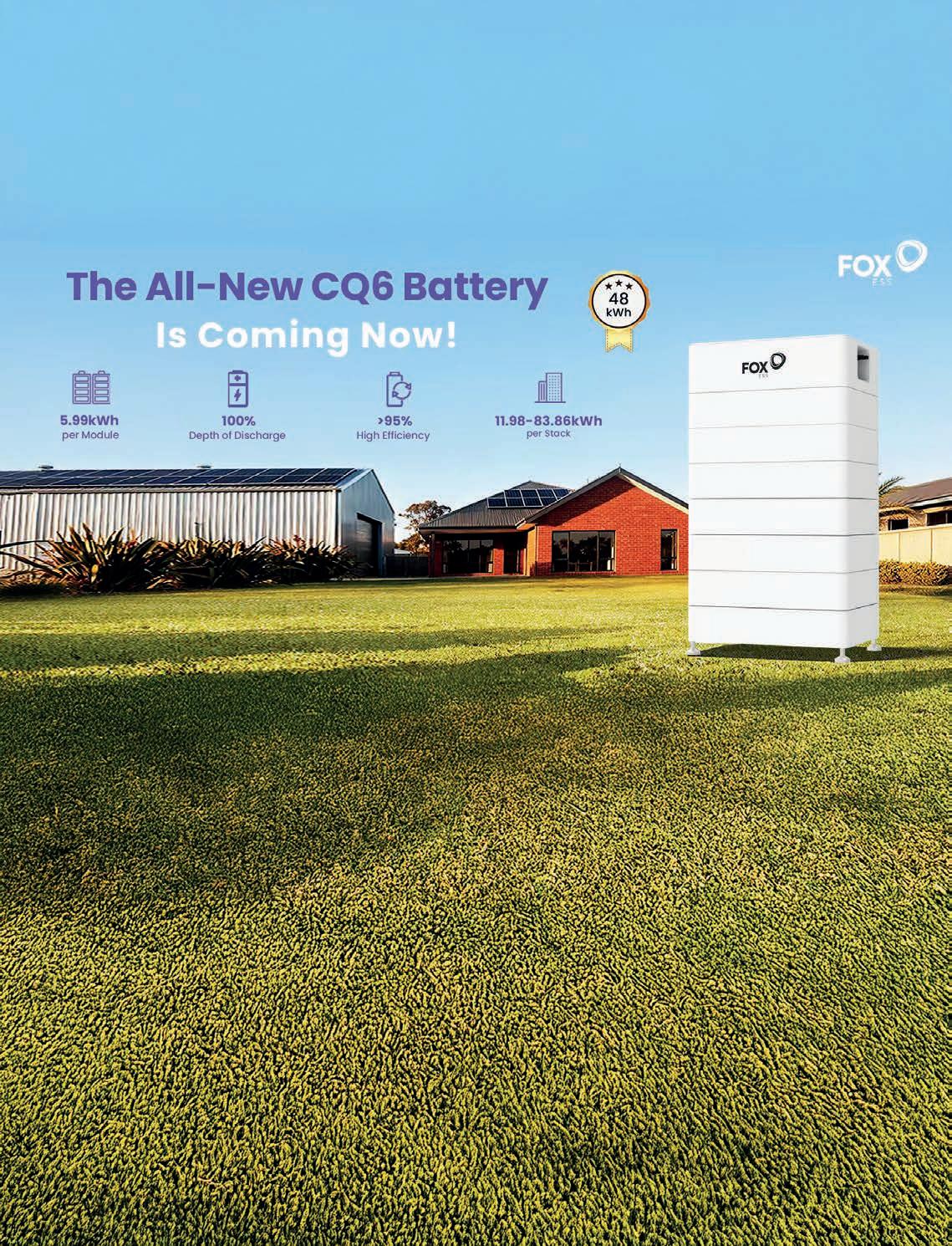
Pictured: The FOX ESS CQ6 High Voltage Storage Battery.
“Storage is becoming part of the core energy system in Australian homes. That means expectations around safety, performance and lifetime value are much higher -and rightly so.”
Scaling without losing control
The first real stress test of the new market reality arrived with the rollout of federal battery incentives, which triggered a surge in demand across multiple states. For suppliers, the risk was obvious: Supply challenges, rushed installations and quality failures could easily follow.
Brooks says the company’s response has been to double down on forecasting, manufacturing discipline and local presence.
“FOX ESS has implemented a much

more accurate market demand forecasting system,” Brooks says.
“We operate our own factories with streamlined processes, strict quality control and advanced equipment, and we plan production schedules several months in advance. That’s how we stay ahead of demand without compromising quality.”
But he says manufacturing control is only half the equation. Just as important is what happens once the product arrives in Australia. FOX ESS now operates local warehousing, sales, marketing and technical support teams, has opened a Melbourne office, and is preparing to open a second office in Sydney.
“This is not a fly-in, fly-out market anymore,” Brooks says.
“We are building a long-term local organisation because installers and customers need real support on the ground.”
Training is a central pillar of that strategy. For example, FOX ESS runs direct training sessions, roadshows, onsite and online training for installers, in partnership with local training centres and industry bodies such as the Smart Energy Council.
“The goal is not just to train people on our products. It’s to lift overall industry capability,” Brooks says.
The product roadmap
If the past few years were about getting batteries into homes, the next phase is about making them work harder, smarter
Animation of FOX ESS as supplier of modular battery systems, inverters and energy management platforms across residential and commercial segments.
and more seamlessly with the rest of the household energy system.
FOX ESS has been steadily broadening its product portfolio, including the EQ4800 battery, H3 Smart inverter and L Series EV (electric vehicle) charger. In early January, the company launched its CQ6 high-voltage battery, which delivers up to 48 kilowatthour in a single stack with a relatively small footprint.
“Energy density and modularity are becoming much more important,” says Leo Ye, Product Director at FOX ESS.
“People want more capacity, but they don’t want their garage filled with equipment.”
Later this year, FOX ESS plans to introduce a new all-in-one energy storage system, along with next-generation inverters designed specifically for evolving Australian grid requirements.
Functionality is also expanding. The company already supports backup power, virtual power plant (VPP) orchestration and electric vehicle (EV) integration, with wholehome electrification support scheduled to roll out later this year.
“This is where the market is heading. Batteries are not standalone devices anymore. They’re becoming the centre of the home energy system.”
Australian conditions
Australian homes are among the harshest test environments for energy hardware. Extreme heat, coastal corrosion and an often unstable grid create a demanding operating context that exposes any weakness in design or manufacturing.
FOX ESS says it has taken those conditions seriously at an engineering level. Its products are rated to C4 corrosion standards for coastal environments, and both hardware and software have been adapted to cope with voltage and frequency fluctuations.
“We’ve seen that the grid in many areas is not always stable. So we made changes in component selection and software control to improve performance under those conditions,” Ye says.
That focus on real-world operating conditions is becoming increasingly important. As storage moves into the mainstream, expectations around reliability are starting to resemble those applied to major appliances, or even cars, rather than experimental energy technology.
Preventing the next backlash
History suggests that subsidy-driven booms
can create their own problems. Rapid growth can lead to rushed installations, mis-selling and, in the worst cases, safety incidents that damage consumer confidence across the entire sector.
Ye says the company has tried to address those risks at the design stage rather than relying solely on downstream controls.
“From the very beginning of product design, we focus on making installation as simple and safe as possible,” Ye says.
“Our systems are pre-wired, pre-tested and pre-commissioned at the factory. On site, they are essentially plug-and-play.”
That approach reduces the number of steps installers need to complete in the field and therefore reduces the chance of errors
FOX ESS also runs comprehensive training programs aimed at minimising installation hassles; including, a dedicated technical support platform and ongoing training for customers and installers.
“The goal is to remove as many failure points as possible before the system even gets to site,” Ye says.
Thinking in decades, not years
As the market matures, questions about long-term performance are becoming more pointed. Ten years ago, few Australian households expected to still be living with the same battery system a decade later. Today, lifetime value and degradation curves are central to purchasing decisions.
Ye says FOX ESS puts significant effort into both laboratory and real-world validation.
“We run long-term cycle life tests under strict standards to ensure consistency across cells and avoid the ‘bucket effect’ where one cell limits the whole system,” he says.
“We also operate outdoor testing projects in different climates around the world.”
In Australia, the company’s local service teams are intended to provide customer support throughout the entire battery lifecycle covered in their warranty.
“This is not a product you install and forget. It’s infrastructure,” Ye says.
The changing role of the installer
One of the biggest shifts now underway is in the role of the installer. As systems become higher-voltage and more integrated, the job is moving from simple equipment installation toward full energy system design and commissioning.
FOX ESS is responding with expanded training programs, improved commissioning tools through its Fox Cloud platform, and
the development of a guided self-checking process for inverter commissioning.
Remote diagnostics and online support are also becoming more important as system complexity grows.
Later this year, the company plans to launch a formal installer program in Australia, including certifications, awards and advanced technical training, based on a similar scheme already running in Europe.
“The success of storage in Australia will depend heavily on installer confidence and capability. We see that very clearly,” says Michelle Li, Director of Global Brand and Marketing at FOX ESS.
Honest economics
Battery economics in 2026 are no longer simple. Payback now depends on a mix of self-consumption, peak shifting, backup value, tariff structures, and increasingly VPP participation.
Brooks says it is important not to oversimplify those calculations.
“The integrity of payback scenarios depends on regulation, market design and technology,” he says.
“We try to stay transparent about both the opportunities and the uncertainties.”
On system sizing, he expects average installations to continue growing as EVs and electrification drive household demand, but not in a straight line.
“It will also depend on policy settings, rebates, electricity prices and how attractive VPP and EV-linked energy plans become. Smarter orchestration may allow smaller systems to work harder, but overall energy demand is still rising,” Brooks says.
Building for the future
For 2026 and beyond, FOX ESS says the focus is not just on new hardware platforms, but on deeper integration into the Australian energy ecosystem.
This includes closer partnerships with distributors, installers and VPP operators, as well as a higher public profile following the appointment of Ian Thorpe as brand ambassador.
“We’re investing for the long term. Not just in products, but in relationships, support structures and the overall experience for Australian energy users,” Brooks says.
For companies like FOX ESS, the real challenge now is building systems that are not just easy to sell, but worthy of becoming permanent parts of Australia’s energy infrastructure.


ecogeneration
Get
To
Australian innovation heats up
Coolsheet leads dual-energy solar pilot at North Sydney Olympic Pool with support from Capral Aluminium.
In a landmark step toward decarbonised infrastructure, Australian climate-tech innovator Coolsheet™ has begun installing its first commercial-scale Photovoltaic-Thermal (PVT) system at the North Sydney Olympic Pool redevelopment, a project that pairs world-class renewable heat technology with Australian aluminium engineering supplied by Capral to demonstrate how dual-output rooftop energy can power essential public facilities.
Perched above Sydney Harbour, the redeveloped complex will soon showcase a system that captures not only the sun’s light but also its heat. Traditional photovoltaic panels convert roughly a quarter of solar energy into electricity, while the balance dissipates as waste heat. Coolsheet’s patented aluminium heat-exchange panels recover that heat through a lightweight water jacket attached to the back of each PV module, storing it in hot-water tanks as
a thermal battery or using it as a pre-heat loop for heat pumps. Cooling the solar cells also lifts electrical performance, improving PV output while reducing thermal stress and helping extend panel life, which makes the solution a two-for-one rooftop energy platform delivering electricity and renewable heat from the same footprint.
The North Sydney Olympic Pool installation mates Coolsheet’s heat-exchange panels to the rear of 206 x 550 wattage
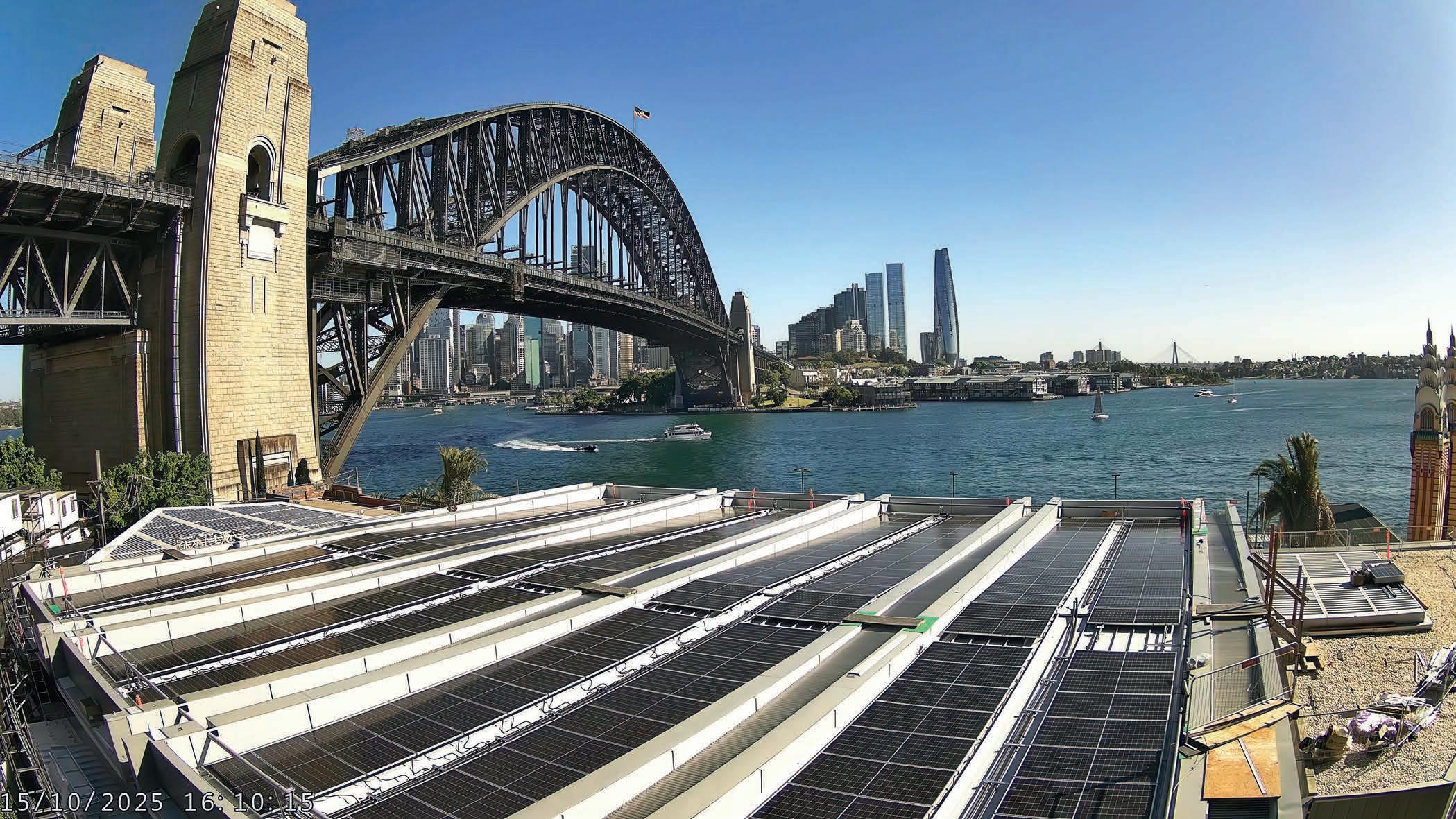
(power rating) of photovoltaic module (solar panel), delivering around 114 kilowatt-electric of electrical capacity and two to three times that figure in thermal output simultaneously.
The array forms a highly efficient component of the site’s all-electric heating system, helping maintain year-round temperatures for more than three million litres of water across five pools. Aligned with North Sydney Council’s goal of achieving carbon neutrality across its operations by 2035, the PVT system is designed so that the extra electricity generated from panel cooling offsets its own circulation pump load.
“Coolsheet is proud to partner with North Sydney Council on this landmark project,” says Tom Hoole, Founder and CTO of Coolsheet.
“It’s been a complex construction program but now, as the site nears completion, it’s clear this will be a world-class facility showcasing how renewable heat can be built into public infrastructure.”
For Coolsheet, local collaboration is core
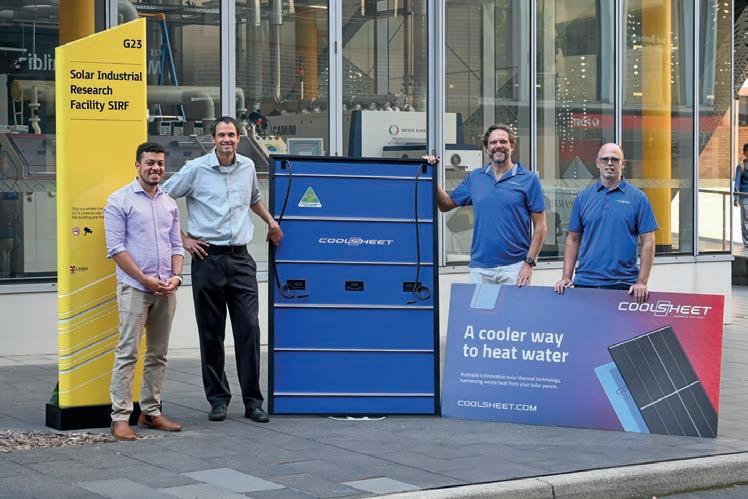
to scaling renewable heat. The Sydneyfounded manufacturer – one of only about fifty PVT makers worldwide and the first in Australia – combines patented design with validation testing completed by the University of New South Walkes in Sydney to bring a robust, locally supported solution to market.
industry is significant,” says Doug Smith, Chairman of Coolsheet.
“By capturing more of the sun’s energy through both electricity and heat, we can help manufacturers improve efficiency, reduce energy costs, and strengthen energy resilience all while supporting local jobs and clean technology manufacturing.”
Behind the thermal innovation sits a backbone of Australian aluminium engineering. Coolsheet’s system at North Sydney Olympic Pool is supported by precision-engineered aluminium extrusions supplied by Capral, designed for durability and corrosion resistance in demanding outdoor environments, and manufactured to tight tolerances for fast and reliable installation.
“As an Australian manufacturer with a national extrusion and distribution footprint, Capral is focused on enabling the country’s rapidly developing renewables sector,” says Leanne Cannarella, Account Manager at Capral.
“Our role is to bring local expertise, consistent quality and responsive supply to projects like this – supporting innovators with the engineered aluminium solutions they need to deliver clean-energy outcomes at scale.”
As the pool nears completion, the partnership between Coolsheet and Capral points to a broader shift: Renewable heat that is manufactured and supported in Australia, delivered through resilient local supply chains, and ready to be deployed across sectors with large low-grade thermal loads, from food and beverage processing to hotels, laundries, greenhouses and aquatic centres. It is a practical pathway to decarbonisation, making better use of every rooftop and every ray of sunlight.
At the North Sydney Olympic Pool redevelopment, Capral is supplying the precision-engineered aluminium extrusions used in Coolsheet’s Photovoltaic-Thermal system.
Coolsheet’s PhotovoltaicThermal system has been independently validated by the University of New South Wales.
Yellow is the new clean
JWA Composite Matting shares why track-out control is becoming a quiet emissions lever on Australia’s renewable sites.
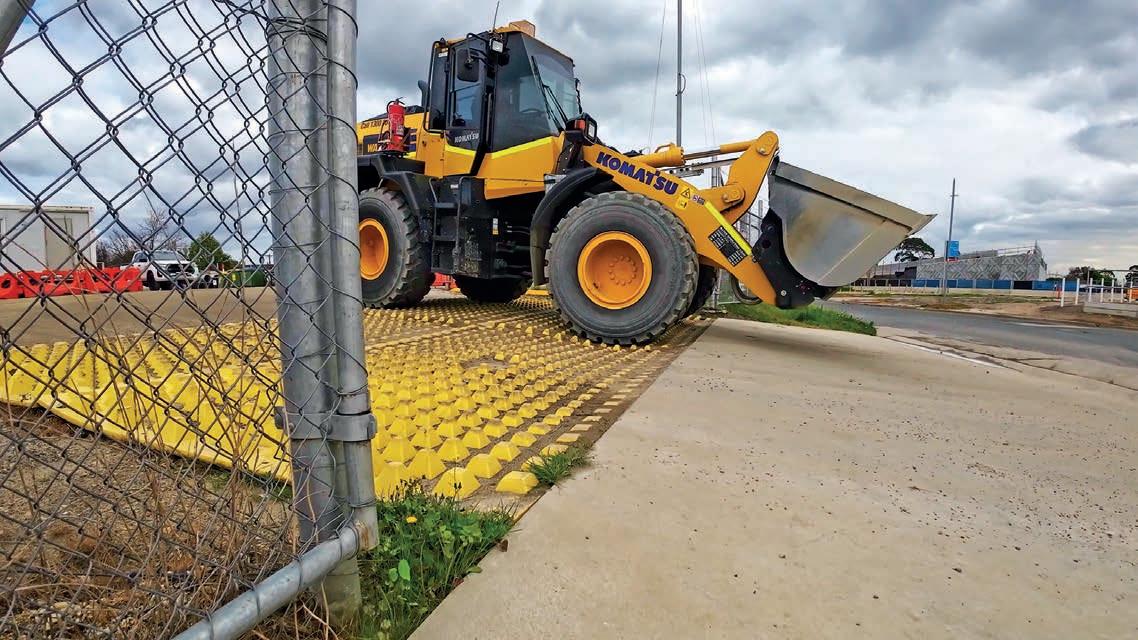
In Australia’s renewable energy boom, success is usually measured in megawatts and connection dates. But some of the most consequential decisions on project performance, emissions and community acceptance are increasingly being made at a far more mundane interface: Where construction vehicles leave site and meet the public road.
Mud, sediment and debris tracked off site are often treated as a housekeeping issue. In reality, poor track-out control quickly multiplies into safety risks, strained relationships with councils and landholders, repeated clean-up works and additional vehicle movements – all carrying a carbon and cost penalty.
As renewable construction pushes deeper into agricultural and regional areas, developers are paying closer attention to how sites manage the boundary between worksites and public roads. This is the problem space Australian constructioninterface specialist JWA operates in, supplying and deploying practical, reusable systems that control debris, sediment and contamination. All while reducing disruption, environmental impact and compliance risk across complex construction programs.
A small interface, outsized consequences Every large construction site has at least one critical transition point between unsealed
ground and sealed public roads. On solar, wind and transmission projects, these access points are used intensively over long periods and in highly variable conditions.
Traditional controls include crushed rock pads, rumble grids and wheel-wash stations. Each can work, but all come with trade-offs.
“Crushed rock must be imported, maintained and eventually removed – and often becomes part of the problem it is meant to solve. Rumble grids lose effectiveness as debris accumulates and can require intrusive maintenance. Wheel-wash stations are effective, but add water, power, infrastructure and operational complexity,” says Min Chua, Development Manager at JWA.
“The issue is not whether these systems work on day one, but whether they can be
kept working consistently over the life of a long construction program.”
Designed for evolving sites
In response, JWA has been supplying Foreign Object Debris Systems (FODS) to Australian infrastructure and renewable projects as a different class of solution.
Rather than relying solely on vibration or water, these modular systems create a controlled surface that gently shakes and spreads tyre treads, loosening and capturing debris before it migrates offsite. The system stays in place and is cleaned when required, rather than being rebuilt or replaced.
“This changes the operating model. Where rock pads wear down and need replacement, and steel grids are hard to move or require
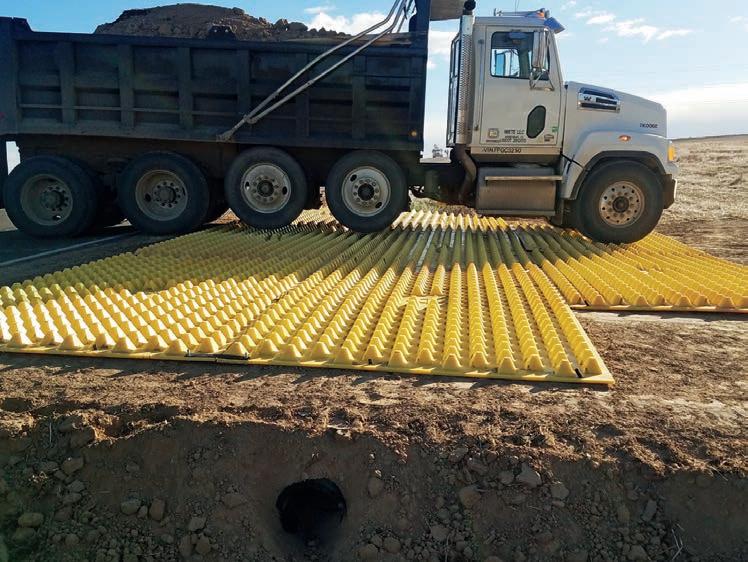

FODS Matting Level Crossing Removal Project.
FODS Matting on a dig zone.
shutdowns, FODS can be cleaned in situ. Over long construction programs, that difference reduces disruption, material use and repeated intervention,” Chua says.
Large renewable projects change shape as they are built. Compounds move, haul roads shift and access points evolve.
“JWA’s systems are surface-installed and relocatable, making them suited to sites where excavation, permanent works or buried services make traditional solutions impractical. Instead of the project adapting to the control measure, the control measure can move with the project,” Chua says.
This also reduces reliance on repeated deliveries and removal of temporary materials, supporting lower-impact construction practices.
At the Goorambat Solar Farm in Victoria, eight JWA-supplied FODS units were used during construction by Bouygues.
While no formal study was undertaken, site teams found the system needed regular cleaning during wet conditions. But crucially, this could be done in place, without closing the access road or removing the system.
“A wheel-wash station had been considered, but would have required additional mobilisation, infrastructure and oversight. In this case, the FODS solution offered a lowerintervention, lower-complexity option at the site boundary,” Chua says.
The hidden emissions cost
From a sustainability perspective, trackout control is rarely discussed in carbon terms. Yet the indirect impacts are real. Poor control leads to:
• Additional vehicle movements for road cleaning
• Repeated deliveries of crushed rock or materials
• Ongoing maintenance using plant and labour
• Remediation of surrounding land and roads
Individually these impacts are small. Across large projects and long construction programs, they accumulate into a meaningful, and largely invisible, emissions and cost burden.
This is where JWA argues the focus should shift from cleaning up failures to reducing the frequency of intervention altogether.
Track-out is typically addressed in a project’s Environmental Management Plan and Erosion and Sediment Control Plan, with access points identified as high-risk areas for sediment migration. Systems such as FODS function as engineered, maintainable controls that support ongoing compliance without repeated rebuilds or shutdowns.
Beyond single-use infrastructure
There is also a materials dimension.
“JWA’s systems are designed for long service lives, incorporate recycled content, and are fully recyclable at end of life. Rather than being consumed by a single project, they can be deployed, recovered and reused across multiple sites over many years,” Chua says.
As the sector increasingly focuses on scope three emissions and construction impacts, this shift away from disposable temporary works is becoming more relevant.
No system eliminates mud entirely. The value lies in predictability and control. Being able to restore performance quickly, without disrupting access or importing new material, reduces risk, cost and operational friction – particularly on sites operating to tight schedules or in sensitive locations.
The renewables sector has made notable progress reducing the operational emissions of generation. The next layer of improvement lies in construction practice – the interface where sites meet roads, farms and communities.
Track-out control sits at the intersection of safety, biosecurity, compliance, emissions and social licence. It is not glamorous, but it is increasingly consequential.
And as companies like JWA are demonstrating, in a maturing renewables market, how projects are built is becoming just as important as what they produce.
Reusable sediment control at exits onsite.
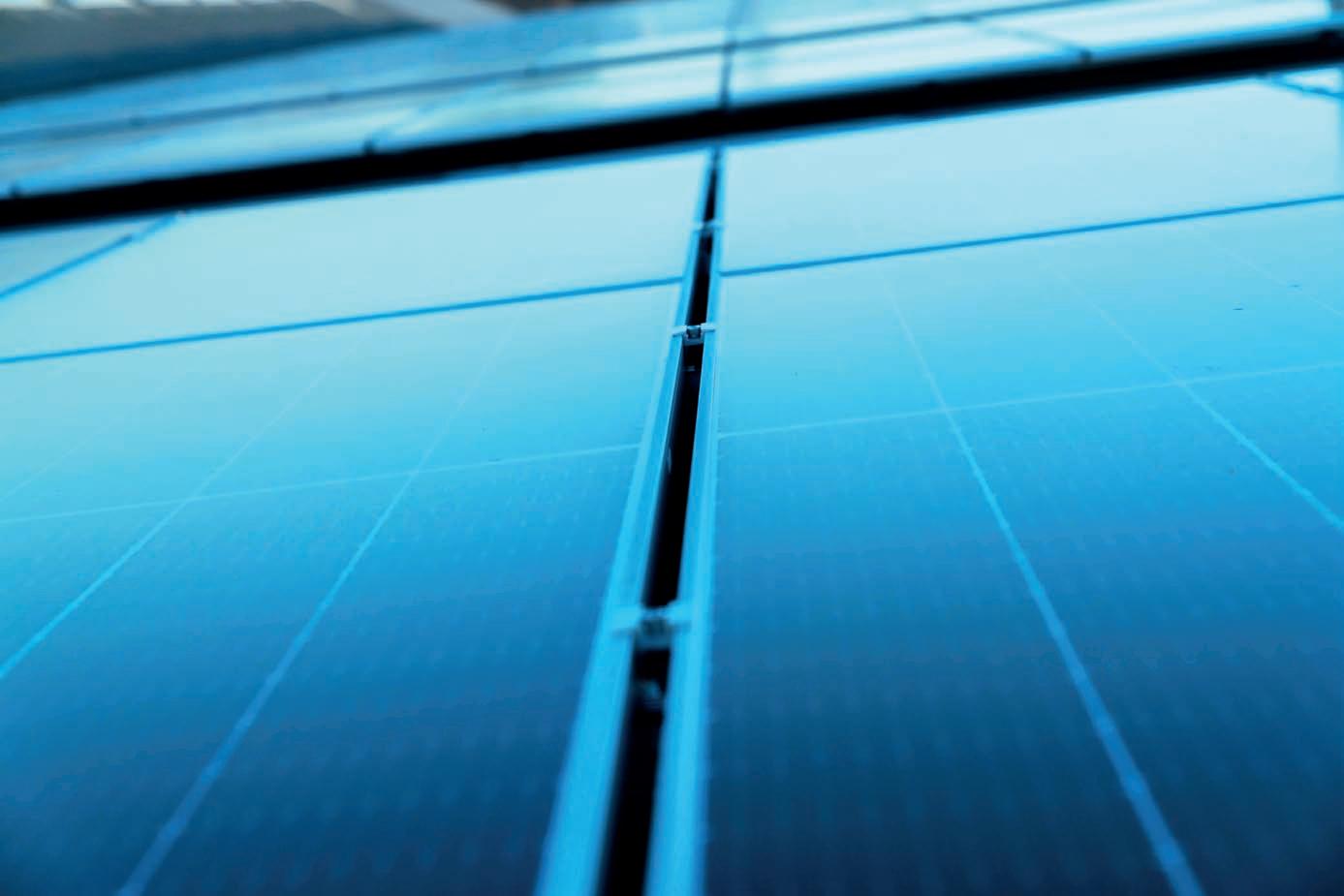
Annealing process delivers durability gains for perovskite solar
Long seen as the future of ultra-low-cost, high-efficiency solar, perovskites have been held back by durability. Researchers have now unveiled a new fabrication technique.
Anew fabrication technique could help bring perovskite solar cells closer to commercial deployment, following research that demonstrates both high efficiency and significantly improved long-term stability.
Perovskite solar cells have long been considered one of the most promising next-generation photovoltaic technologies, combining high efficiency potential with low-cost manufacturing processes. However, despite rapid progress in laboratory performance over the past decade, widespread commercial uptake has been constrained by challenges around long-term stability and defect-related degradation.
A scientific study published in January 2026, Molecular press annealing enables robust perovskite solar cells, reports on a new fabrication approach known as Molecular Press Annealing (MPA). Developed by researchers at Xi’an Jiaotong University in collaboration with Xiamen University, the technique directly targets one of the most problematic steps in perovskite manufacturing: thermal annealing. Thermal annealing is a critical process
used to form high-quality perovskite films. It can also introduce surface defects, lattice disorder and iodine vacancies. These defects can accelerate ion migration and self-doping within the cell, reducing efficiency and operational lifespan (two key barriers to commercial deployment).
The newly reported MPA method takes a solvent-free approach. During annealing, researchers apply a dense molecular template layer to the perovskite surface using a specially designed ligand, 2-pyridylethylamine. This molecule forms stable bonds with undercoordinated lead ions in the perovskite structure, helping to reinforce the lead-iodine framework and suppress the formation and migration of iodine vacancies.
According to the researchers, the result is a perovskite film with higher crystallinity, lower defect density and improved charge transport properties.
Devices produced using the MPA technique achieved certified power conversion efficiencies of 26.5 per cent for small-area cells (0.08 cm² (centimetres squared)) and 24.9 per cent for 1 cm² devices. At the module scale, a 16 cm² device maintained an efficiency of 23.0
per cent, which is considered a strong result for perovskite modules of this size.
Equally significant are the durability results. The cells retained more than 98 per cent of their initial efficiency after 1600 hours of testing at 85°C and 60 per cent relative humidity, under accelerated ageing conditions. The devices also showed minimal degradation after 5000 hours of ambient storage.
The research was supported by China’s National Key Research and Development Program and the National Natural Science Foundation of China, with Xi’an Jiaotong University as the corresponding institution.
While further work will be required to scale the process for mass manufacturing, the results suggest Molecular Press Annealing could offer a practical pathway to addressing one of the key commercialisation challenges facing perovskite solar technology. If successfully transferred to industrial production, the approach could help accelerate the introduction of high-efficiency, low-cost perovskite solar modules into global energy markets.
Perovskites are a family of materials that have shown potential for high performance and low production costs in solar cells.
Cracking the solar recycling challenge
As Australia grapples with a looming wave of end-of-life solar panels, researchers at the University of Newcastle have unveiled a recycling technique that could transform how high-value metals are recovered from retired photovoltaic modules.
Australian researchers have unveiled a breakthrough recycling technique that could dramatically improve how valuable metals are recovered from end-of-life solar panels, addressing one of the solar industry’s most pressing circulareconomy challenges.
Scientists at the University of Newcastle have developed a fast, safe and highly effective method to recover high-grade silver from end-of-life photovoltaic (PV) panels without using acid. The process can recover more than 97 per cent of the silver contained in a panel in just a few minutes – a significant departure from existing methods that are slow, chemical-intensive and difficult to scale.
The research was led by Mahshid Firouzi, Associate Professor at the University of Newcastle’s Centre for Critical Minerals and Urban Mining, and brings together established mineral-processing techniques in a novel application for solar recycling.
Current silver-recovery methods typically rely on aggressive chemical leaching processes that can take hours to complete, generate hazardous waste streams and pose safety risks. These limitations have long hindered large-scale recovery of high-value metals from retired PV panels, despite their growing volumes.
domestic resource-recovery industries.
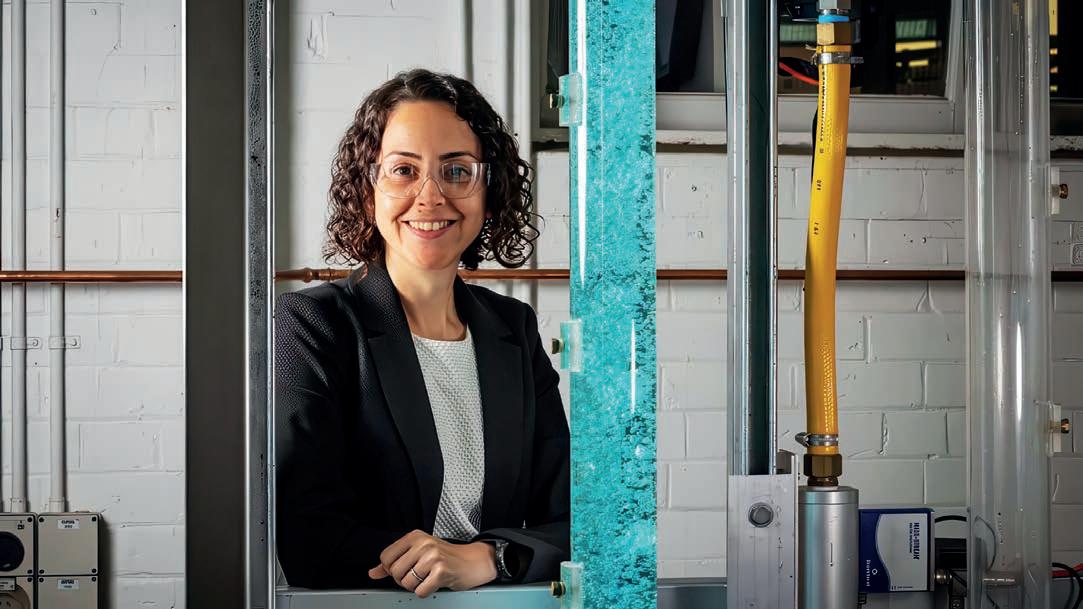
By contrast, the Newcastle team’s approach uses a physical separation process combining comminution and flotation. Panels are first mechanically crushed and ground into fine particles. The material then undergoes froth flotation. This is a technique widely used in mining where water, air bubbles and small amounts of standard flotation reagents selectively lift silver particles to the surface while waste material sinks.
“By using flotation – a fast and wellestablished minerals beneficiation technique – we can recover almost all of the silver in an end-of-life solar panel in just a few minutes, without using any acid,” says Associate Professor Firouzi.
“While froth flotation is widely used in mining to separate valuable minerals from ore, this is, to our knowledge, the first demonstration of froth flotation for recovery of metallic silver from recycled, ground solar panels – something many in the field believed was not feasible.”
The implications are significant. End-of-life PV panels can contain silver concentrations of 300-500 parts per million (ppm), comparable to – and in some cases exceeding – the cut-off grades of primary silver mines. With Australia leading the world in solar uptake on a per-capita basis, the resource potential locked up in ageing panels is substantial.
By 2050, more than one million tonnes of waste solar panels are expected in Australia alone, containing an estimated 300-500 tonnes of silver. Unlocking this value could reduce reliance on primary mining, lower environmental impacts and create new
end-of-life PVs in future. This is a great team and University for innovative-active firms to collaborate with.”
Silver is said to just be the beginning. The research team is now investigating recovery pathways for silicon, which makes up nearly 90 per cent of the weight of a crystalline solar cell and is a critical input for global solar manufacturing.
“Silver was our first test case, but there are likely significant opportunities to apply comminution, flotation science and hydrodynamic techniques to unlock billions of dollars’ worth of other metals and minerals currently trapped in urban and mining waste,” Associate Professor Firouzi says.
“We cannot afford to let these valuable resources go to waste.”
Ultimately, the project aims to commercialise sustainable end-of-life solutions for PV panels, supporting a circular economy while creating new jobs in resource recovery and advanced manufacturing.
Mahshid Firouzi, Associate Professor at the University of Newcastle’s Centre for Critical Minerals and Urban Mining.
Image: The University of Newcastle
From foundations to final towers
Australia’s energy transition is no longer just a plan on paper. From the first towers rising on HumeLink to the final structures completed on EnergyConnect, the nation’s transmission future is being built in real time.
When the first transmission tower rose from farmland southeast of Wagga Wagga in December 2025, it marked the start of Transgrid’s generational rebuild of Australia’s power grid.
Just weeks later, hundreds of kilometres away at Bundure in the Riverina, a very different but equally symbolic moment unfolded. The final tower on EnergyConnect, as part of Australia’s largest transmission project to date, was lifted into place, completing more than 700 kilometres of new high-voltage backbone linking New South Wales (NSW), Victoria and South Australia.
“EnergyConnect is the first major transmission project to accelerate Australia’s renewable energy transition and will help strengthen the national grid and position NSW as a leader in clean energy,” says Gordon Taylor, Executive General Manager of Major Projects at Transgrid.
Together, the two moments tell the story of a sector moving from first foundations to final spans, and of a grid during the most profound transformation in its history.
HumeLink and EnergyConnect are more
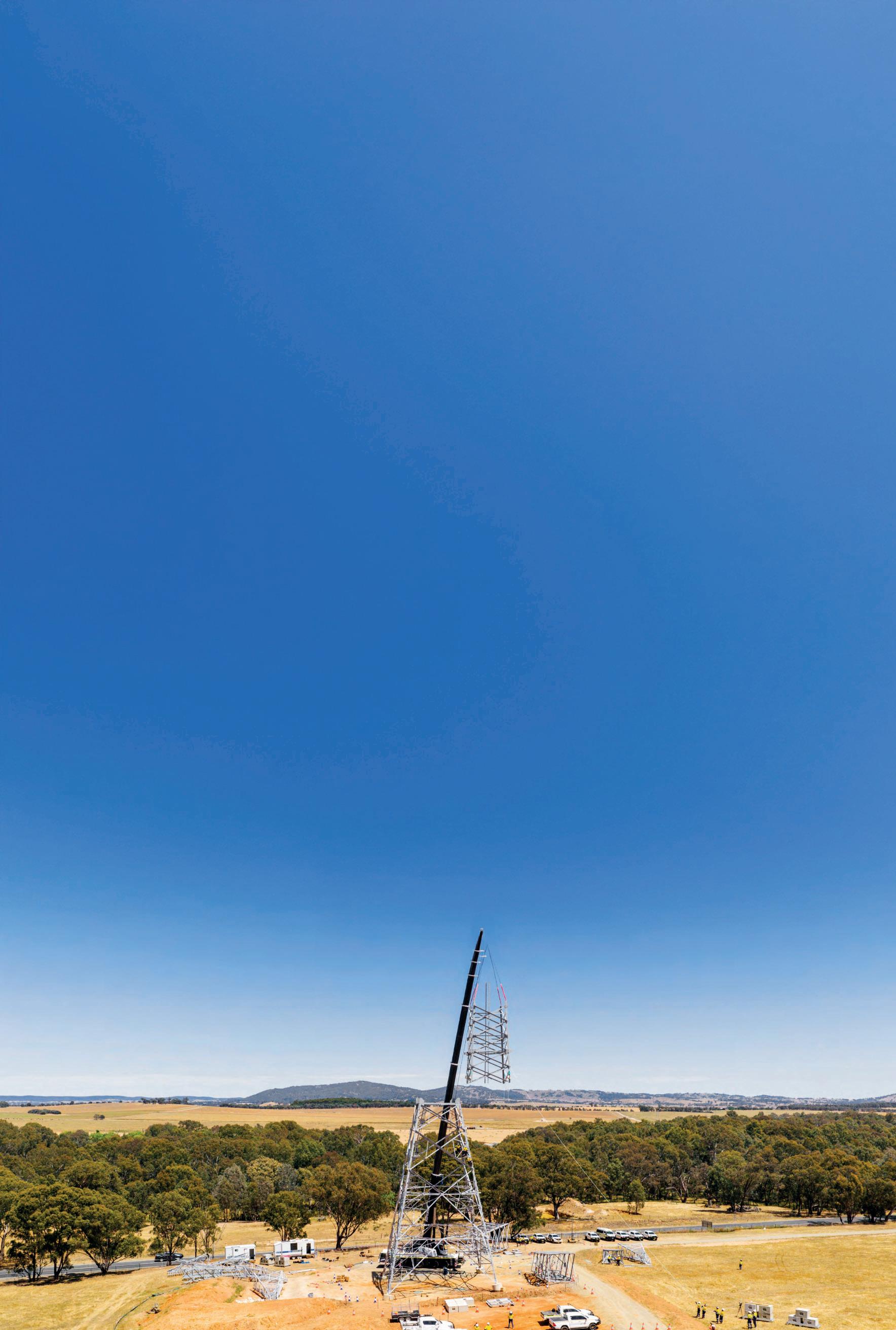
than just big transmission projects, they are the physical enablers of Australia’s future energy system.
HumeLink will span 365 kilometres of new 500 kilovolt (kV) transmission line linking Maragle, Wagga Wagga and Bannaby, alongside two new substations and major upgrades to existing sites. When completed in late 2027, it will unlock the full value of Snowy 2.0 and dramatically increase the amount of renewable energy that can be moved from generation zones to load centres.
Meanwhile, EnergyConnect has already stitched together three states with more than 1500 towers and monopoles, over 10,000 kilometres of conductor and some of the largest and most complex substations ever built in Australia. Once fully commissioned in 2026, it will allow power to flow more freely across borders as coal exits the system and new wind, solar and storage projects come online.
“The project is part of our plan to give industry and consumers peace of mind as coal generation winds down in NSW, stabilising the grid at a time when reliability
and affordability are national priorities,” Taylor says.
Taken together, they represent the new foundation of the National Electricity Market.
Starting below ground
While the towers dominate the skyline, both projects are won and lost in the ground beneath them.
On HumeLink West, construction begins with foundations: Nearly 1500 deep concrete piles will be drilled in the coming years, with four footings required for every tower. Each is designed using detailed geotechnical investigations to suit the local terrain, whether that is flat agricultural land or steep, forested mountain country.
Steel reinforcement cages are lowered into place, foundation leg stubs are positioned to millimetre tolerances, and concrete is poured and left to cure before crews move on to the next site.
Only then does the visible structure begin to take shape, with prefabricated galvanised steel sections assembled on the ground and lifted into place by cranes. The lowest
The first tower segments are lifted and bolted together during tower erection.
section is bolted to the foundations first, followed by successive segments installed by trained crews working at height in full safety harnesses.
Across HumeLink West, nine different tower designs are being used to adapt to the corridor’s varied topography.
EnergyConnect has taken this engineering diversity even further. The project introduced Danubio 500 kV towers to Australia for the first time, with 338 of the 60-tonne structures installed between Bundure and Wagga Wagga.
“EnergyConnect has seen the first Danubio towers erected in Australia, with 338 of the structures specially designed for the 500 kV line between Bundure, near Coleambally, and Wagga Wagga. Each of these towers weighs an average of 60 tonnes and takes 16 days to construct,” Taylor says.
Logistics at scale
If building a single transmission line is complex, building hundreds of kilometres of it at once is an exercise in industrial choreography.
On HumeLink West, more than 330 kilometres of access tracks are required just to reach the tower sites. Around a third are already complete, crossing farmland, forestry and rugged terrain. Local civil contractors are constructing heavy-vehicle access points and haul roads, while bulk materials are being delivered to storage yards at Gregadoo, Ellerslie, Batlow and Maragle to keep construction moving.
EnergyConnect has already shown what this looks like at full scale.
“Installation of the final tower and completion of line stringing works caps off a massive logistical operation and construction effort involving up to 1700 personnel working in parallel across a 700km project alignment,” Taylor says.
In total, more than 46,000 tonnes of structural steel were erected to form 1508 towers and monopoles from the South Australian border to Wagga Wagga and into Victoria. Stringing alone involved installing more than 10,000 kilometres of high-voltage conductor. This is enough cable to stretch from Sydney to Perth three times.
The heart of the grid and community
While the towers trace the visible path of the grid, the substations and the workforce behind it are its beating heart.
On HumeLink West, major works are advancing at both ends of the line. At Gregadoo, bulk earthworks for the new 330/500 kV Gugaa Substation are nearing
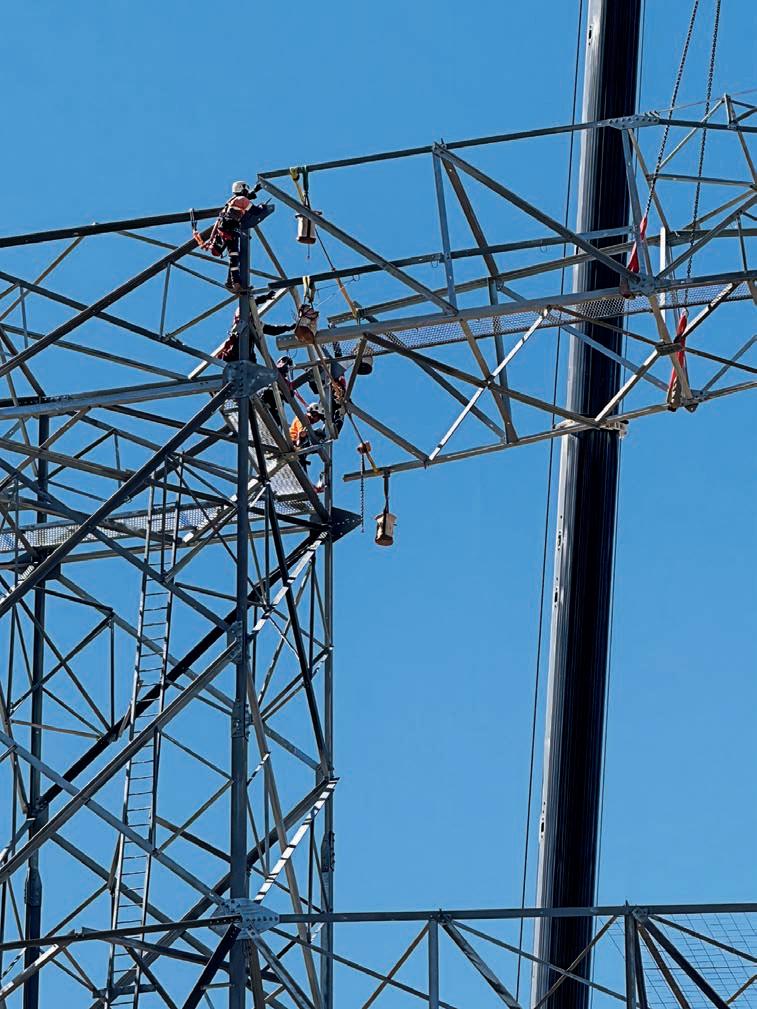
completion, with foundations scheduled to begin in early 2026. At Maragle in the Snowy Mountains, site preparation is also progressing, with concrete pours now complete. The existing Wagga Wagga Substation will also be upgraded as part of the project.
EnergyConnect has already delivered some of the most complex substation infrastructure in the country, including a massive new site on the western section of the project and a major expansion of the Wagga Wagga Substation. The Dinawan Substation at Bundure is now being finalised, tying the entire interconnector together.
These facilities may be less visible than the towers, but without them, none of the new transmission capacity would be usable.
Both projects are also reshaping how major infrastructure is delivered in regional Australia.
On HumeLink West, two purpose-built worker accommodation facilities at Tarcutta and Kunama near Batlow are already operating. These facilities are designed to house around 350 workers with ensuite rooms, dining facilities, gyms and recreation spaces. As construction ramps up through 2026, the workforce will grow significantly, with HumeLink expected to support up to 1600 jobs at peak.
Further, EnergyConnect has demonstrated the regional impact of projects at this scale, with more than $264 million spent across 325 local businesses in the Riverina, Murray and Sunraysia regions. At its peak, the project supported 1700 workers along the corridor.
“Construction of the project has provided an economic boom for regional NSW, including much-needed jobs, skills development, education, training and local business support in communities across the
Workers secure the final section of the EnergyConnect tower.
Images: Transgrid
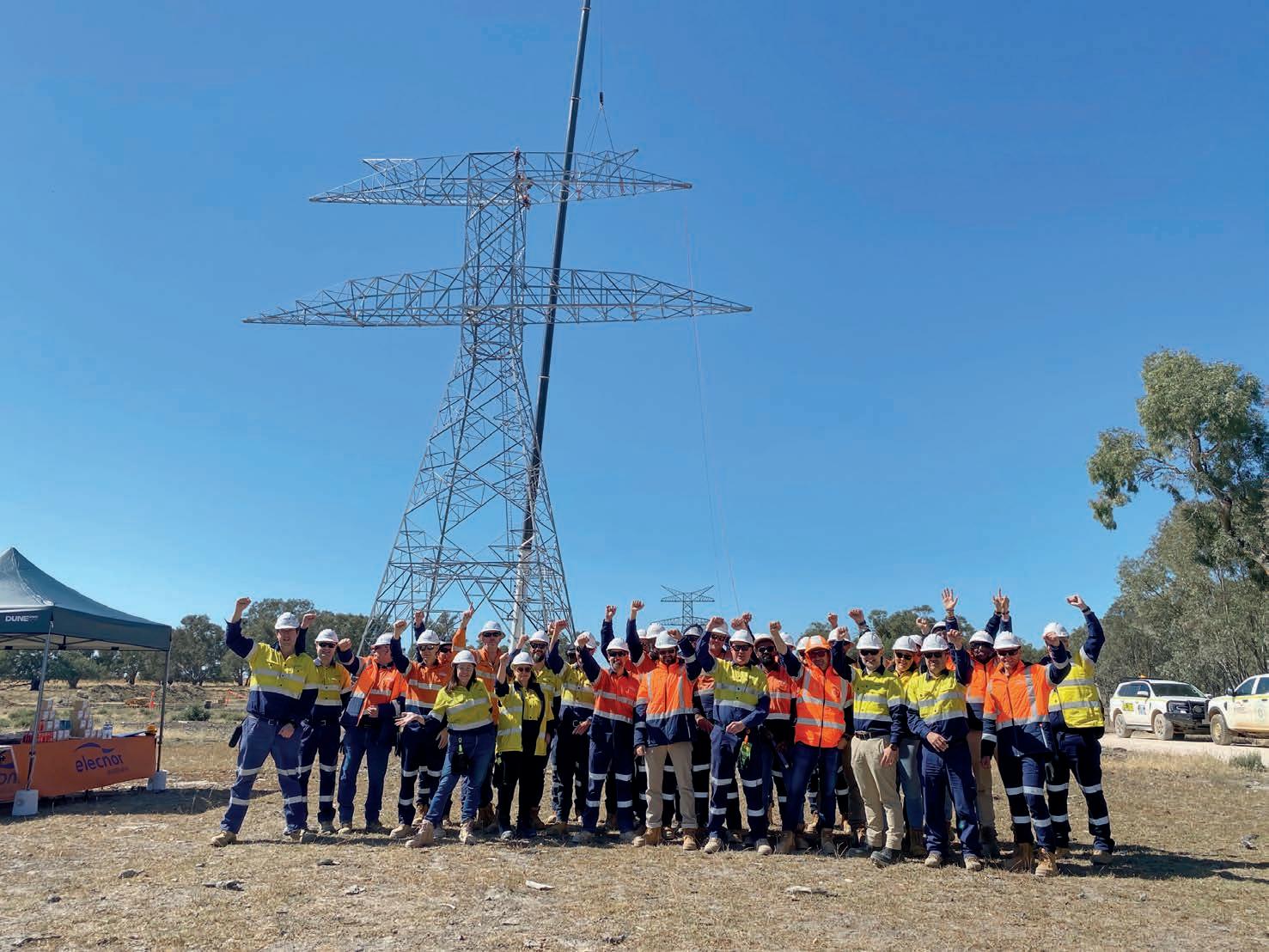
EnergyConnect corridor,” Taylor says.
Beyond direct employment, both projects have placed increasing emphasis on skills development, local procurement and longterm workforce capability.
“EnergyConnect is a project of many firsts – from the introduction of Danubio 500 kV towers to Australia, the use of low carbon construction materials and our Legacy 100 workforce program upskilling the regional construction workforce,” Taylor adds.
Sustainability is no longer an afterthought in transmission construction.
On EnergyConnect, 733 guyed towers were used, requiring around 21 per cent less steel and 15 per cent less concrete than conventional self-supporting structures. Low-carbon concrete was used in all tower foundations, and material efficiency was embedded into the design process.
These developments might seem incremental, but at the scale of thousands of towers and millions of tonnes of material, they add up to a significant reduction in embodied emissions.
For communities along both corridors, the energy transition is not an abstract concept. It is something they experience every day in the form of trucks, crews, traffic management and changed landscapes.
Along HumeLink West, traffic volumes are expected to rise further through 2026 as tower construction accelerates and substation works ramp up. Temporary traffic controls, reduced speed limits and construction vehicles will become a regular part of life in some areas.
Transgrid and its delivery partners have been engaging with more than 120 community groups and organisations through investment and benefits programs, including initiatives like learner driver training for students in regional areas. This shows how major infrastructure can leave lasting social outcomes behind beyond the grid.
First tower to final span
When Transgrid and its partners stood beneath the final EnergyConnect tower
at Bundure in January 2026, the sense of achievement was about more than steel and concrete.
“We have achieved extraordinary progress in construction of the project this year, which is now 90 per cent complete and on schedule to be finished in 2026,” Taylor says.
“This construction and engineering milestone is one that showcases what can be accomplished when the client, delivery partner, industry and community work together towards a shared goal.”
As the EnergyConnect project nears completion, at the same time, the first towers of HumeLink West have risen from their foundations.
Together, these projects arc of Australia’s energy transformation: From first footing to final span, from isolated renewable projects to a truly interconnected, to a high-capacity grid.
As more wind, solar and storage projects surge ahead, these steel lines across the landscape will quietly do the work that makes it all possible.
Transgrid and Elecnor Australia personnel celebrate the EnergyConnect final tower milestone.
Victoria’s southwest plugs in
A new 500 kilovolt transmission connection at Mortlake is now in service, increasing southwest Victoria’s export capacity and enabling up to 1.5 gigawatts of additional renewable generation.
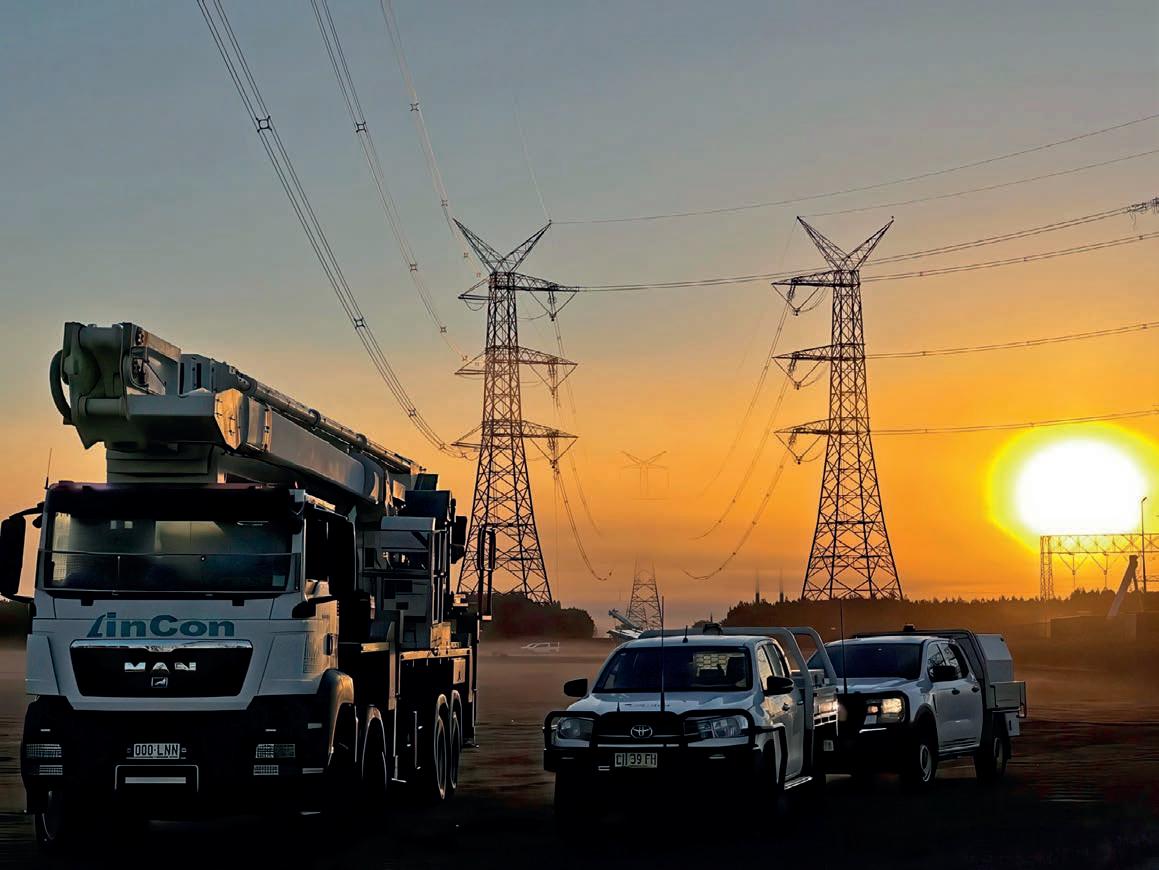
Victoria’s renewable energy transition in the state’s southwest has progressed with the completion of the Mortlake Turn-In project. This significant transmission upgrade is designed to strengthen the grid, unlock new renewable generation, and deliver lasting benefits for regional communities.
Located northeast of Warrnambool, the project connects a second 500 kilovolt transmission line into the Mortlake Terminal Station, improving network stability and increasing the region’s ability to export clean energy.
The upgrade is expected to boost generation capacity by up to 1.5 gigawatts (GW) – enough electricity to power around 800,000 homes. This will create a corridor for renewable energy flowing from Victoria’s southwest to homes and businesses across the state.
Alistair Parker, Chief Executive at VicGrid, sees the Mortlake project as key part of the Victorian Government’s $480 million investment in 12 grid-strengthening projects statewide, which aim to modernise the electricity network and support the rapid growth of renewable energy.
“Mortlake is a great example of how we’re working with industry to deliver the infrastructure we need for renewable energy, while creating jobs and economic benefits for regional communities,” he says.
The project was delivered by AusNet Services in partnership with Consolidated Power Projects Australia, working closely with the Victorian Government and VicGrid. Importantly, it was subject to Victorian Government social procurement requirements, ensuring the project delivered not only value for money,
The VicGrid Mortlake Turn-In Project is a major investment of the Victorian Government.
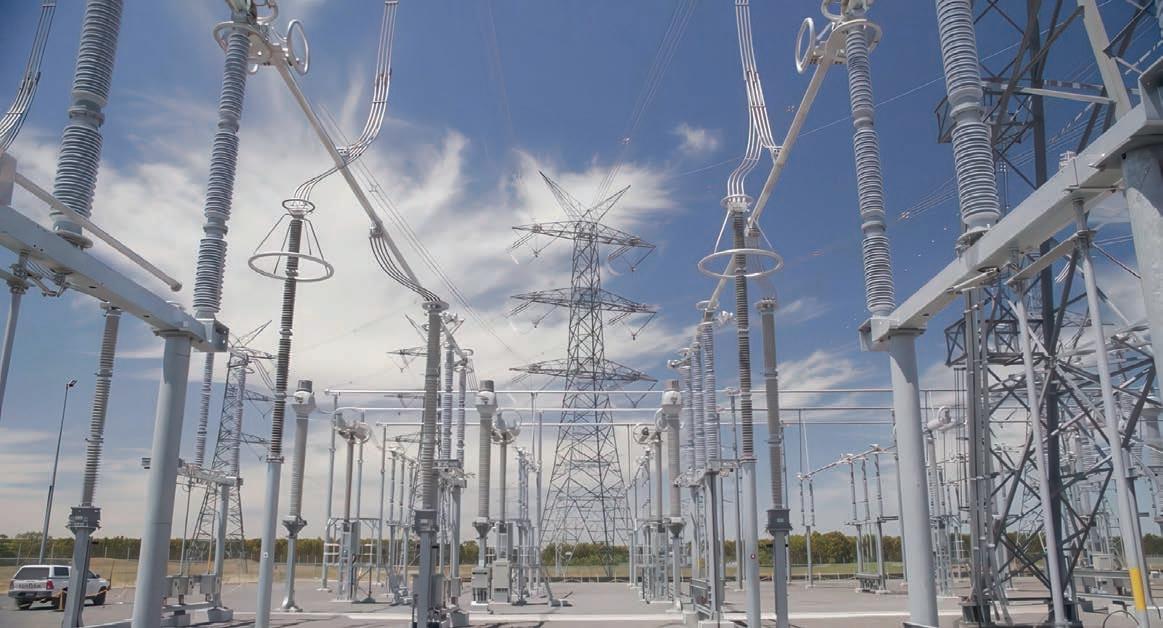
but also meaningful social and economic outcomes for local communities.
Ms Juinn Tao, AusNet Market Development Manager at AusNet, shares that he is proud to have delivered the project in collaboration with local stakeholders and communities.
procurement commitments, creating pathways for women, young people and apprentices to participate in Victoria’s renewable energy transition and supporting First Peoples businesses and social enterprises,” Tao says.
These commitments are set to translate
23 women already employed in key roles across project management, construction and design, while ten apprentices gained hands-on experience building critical energy infrastructure.
AusNet has also partnered with First Peoples businesses to deliver key components of the project, strengthening local capability and long-term economic participation.
The Mortlake upgrade sits alongside a broader suite of Victorian Government investments in transmission line upgrades, utility-scale battery storage, and advanced grid-strength technologies such as synchronous condensers.
Synchronous condensers are large rotating machines that help stabilise the system as more variable renewable energy comes online.
Together, these projects are set to supply 23 GW of clean energy, enough to meet around 16 per cent of Victoria’s annual electricity needs. All while supporting local
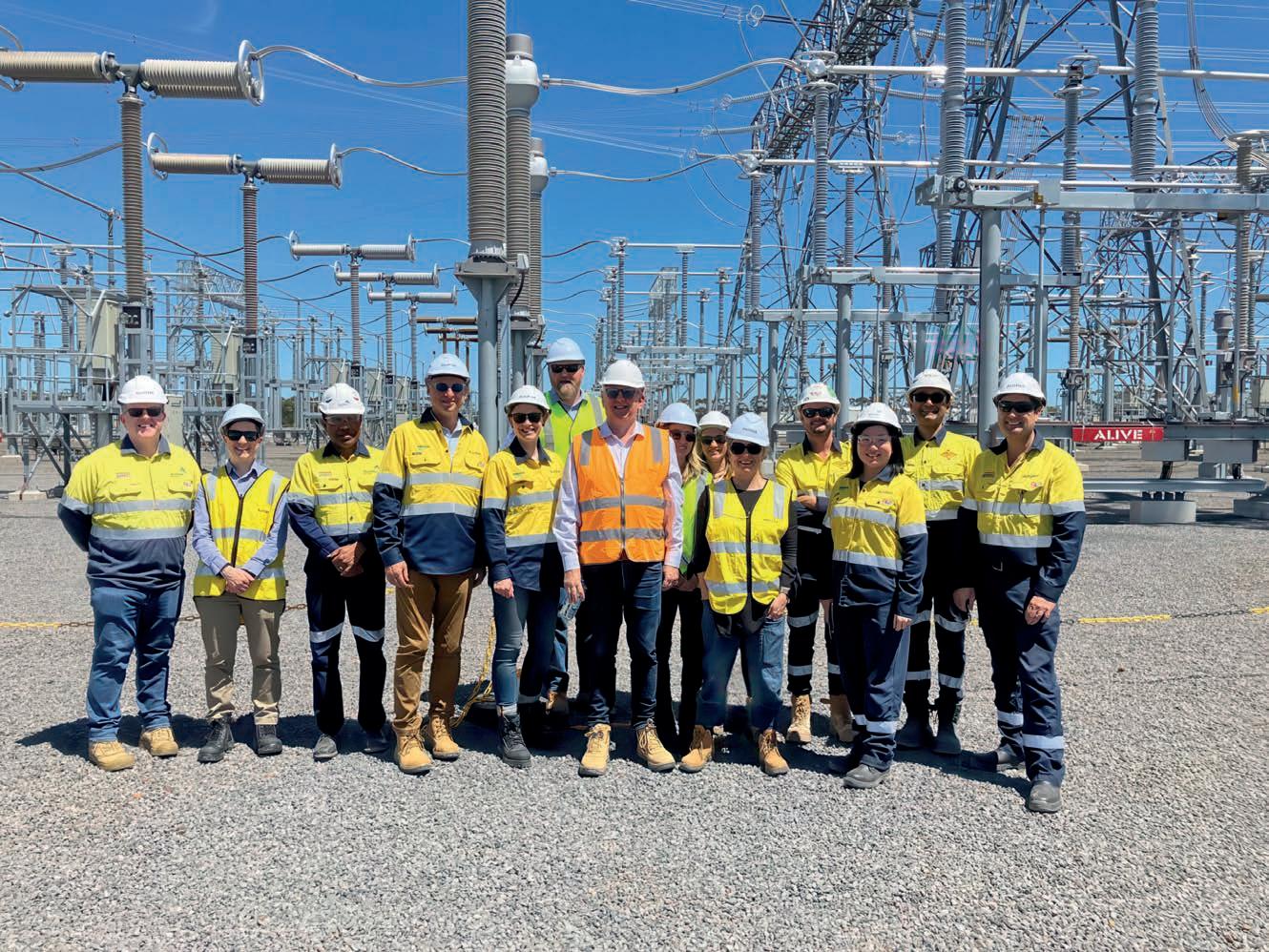

VicGrid Team gather to celebrate completion of Mortlake Turn-In project that will contribute to around 16 per cent of Victoria’s annual electricity needs.
The transmission component of the VicGrid Mortlake Turn-In Project.
GET TICKETS
Australia’s largest regional mining event
THE SOLAR INSTALLER


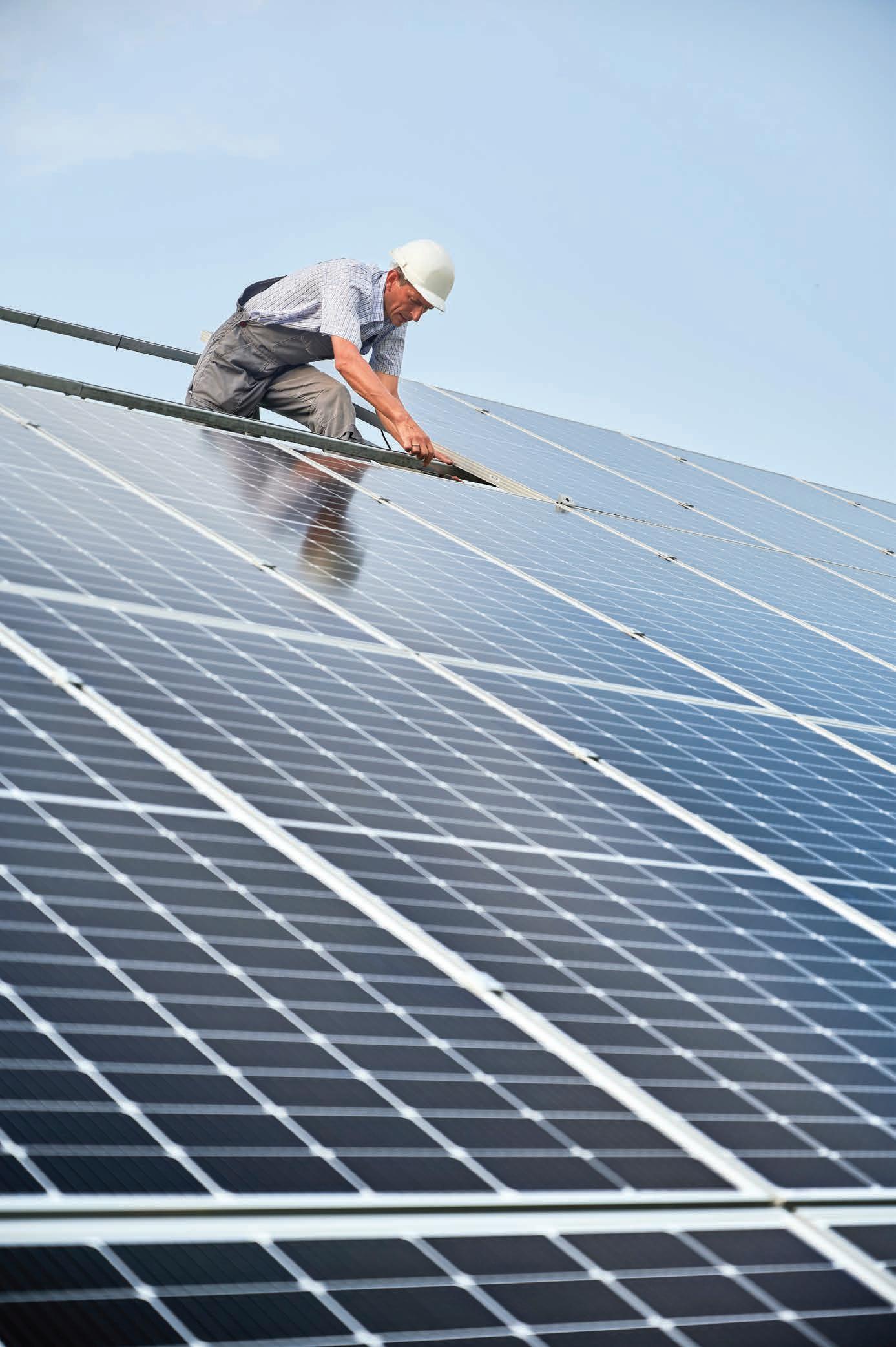
THE SOLAR INSTALLER
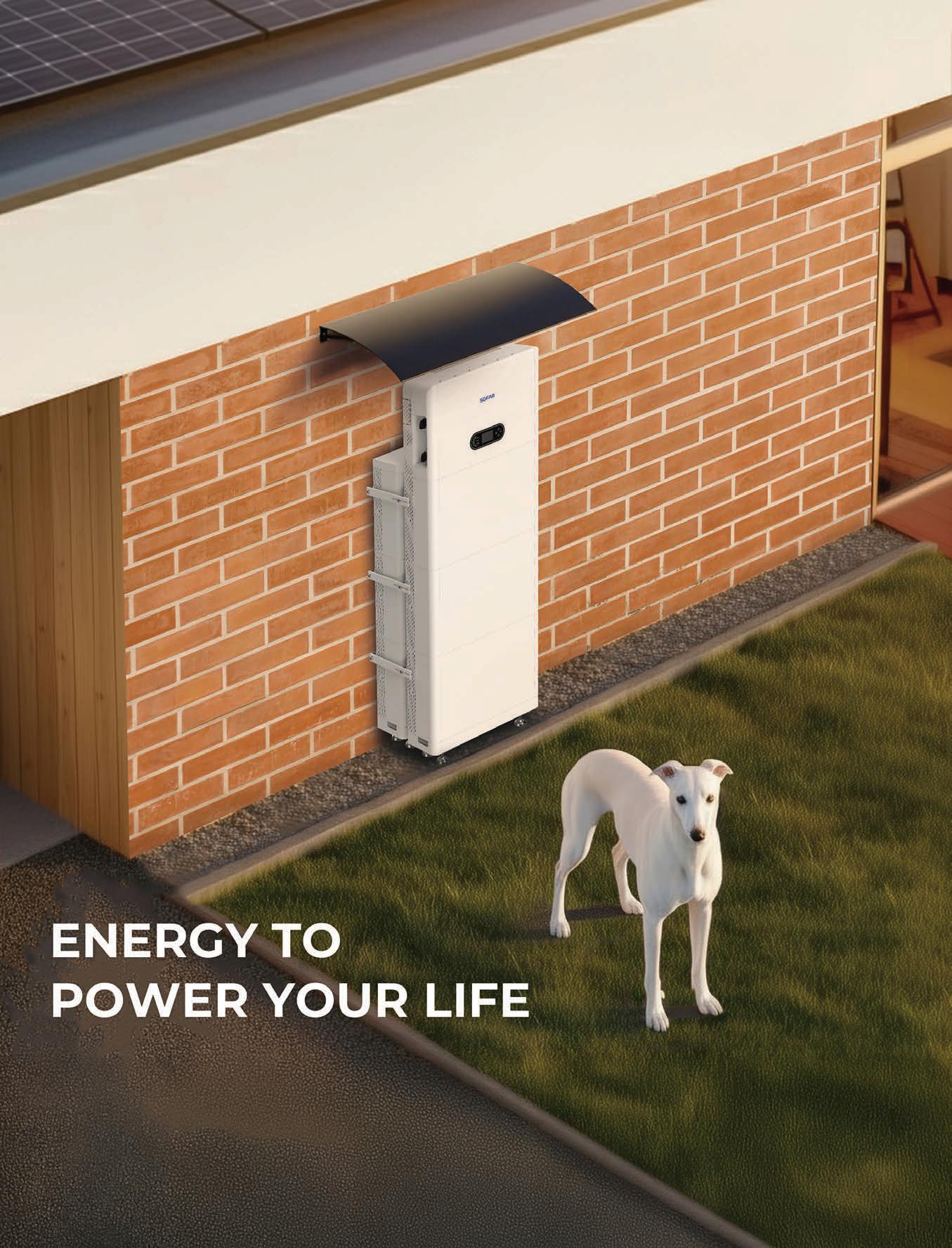

Engineering bushfire risk prevention
As Australia’s clean energy footprint increases, managing bushfire risk is no longer peripheral, it is a core design, planning and operational requirement.
Authorities urge fire risk mitigation in renewables.
Authorities urge the sector, from solar farms, transmission lines, rooftop solar to household batteries, to consider fire risk prevention at every stage of a project.
Solar Homes compliance bar rises
Solar Victoria updated its approved product lists for the Solar Homes Program, reinforcing compliance obligations for installers and retailers participating in Victoria’s flagship rooftop solar, battery and electrification schemes.
The lists determine which solar panels, inverters, batteries and hot water systems are eligible for rebates, with industry reminded they are updated regularly and must be checked before quoting or installation. All systems must also comply with the program’s 2025-26 Notice to Market.
For solar photovoltaic, both modules and inverters must appear on the approved lists. Solar Victoria has confirmed the Sigenergy 8.0, 10.0 and 12.0 kilowatt Sigenergy Single-Phase Australian Energy Controllers have been re-listed following discussions with regulators. All approved inverters must now comply with IEEE 2030.5-2018, be CSIP-AUS ready and align with Clean Energy Council requirements.
The guiding principle across the sector is simple: The most effective way to reduce fire risk is to design it out from the start.
For large-scale projects, this approach is embedded in planning and approvals processes nationwide. Developments are assessed against fire authority guidelines that shape site layout, access roads, vegetation management, water storage, fire breaks and emergency response procedures. Before construction begins, proponents must assess local vegetation, topography and access, with mitigation measures; including, emergency access routes, asset separation distances, controlled vegetation management, and on-site water supplies.
But bushfire resilience also matters at the customer end of the network. During emergencies, households may be told to switch off solar and batteries when evacuating. In other cases, properly configured battery systems can provide critical backup power for pumps, communications and lighting.
For installers, this makes system configuration and customer education as important as what happens beyond the fence line. From rooftops to transmission towers, bushfire risk is now a permanent design consideration for Australia’s energy transition.
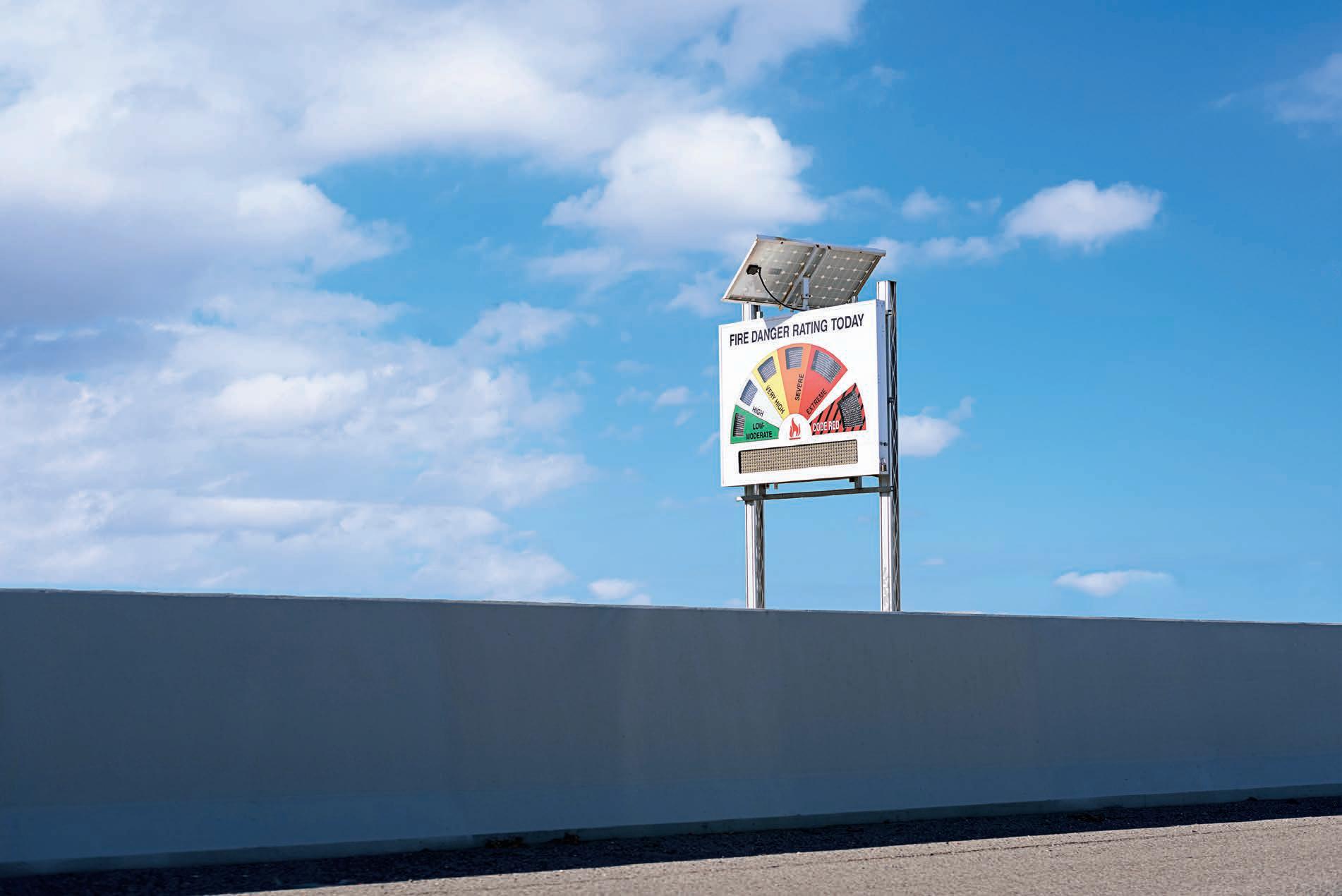
The approved hot water heat pump list has also been updated, including a separate list for products eligible for the locally made incentive. Eligible systems
must meet minimum warranty, performance and refrigerant standards and support daytime solar operation.
While the interest-free battery loan scheme closed in May 2025, the approved battery list remains relevant
for compliance, with more than 20,000 installations already supported.
Solar Victoria has reiterated that only approved products may be installed under rebate programs, with audits and compliance checks ongoing.
The updated product lists and program requirements are available through the industry portal on the Solar Victoria website.

Solar warranties are put to the test
SolarQuotes reported their analysis of decadesold solar warranties.
Researchers from Switzerland, Austria and Germany examined six PV systems
with up to 30 years of operation and more than two decades of high-quality monitoring data. They found the average degradation rate was just -0.24 + 0.16 per cent, per year, which is comfortably within today’s typical warranty assumptions.
Laboratory testing showed most
modules retained more than 80 per cent of their original output after 30 to 35 years, aligning well with modern guarantees that promise around 80-90 per cent after 25 to 30 years.
The study focused on early Aluminum Back Surface Field modules from the ARCO and Siemens families, installed across different Swiss climate zones. Systems at lower, warmer altitudes experienced higher thermal stress and faster degradation, highlighting the role of operating temperature in long-term performance.
Researchers say the results underline the durability of early module designs using thick front glass, Ethylene Vinyl Acetate encapsulants and Tedlar backsheets, while cautioning that today’s newer cell architectures introduce different degradation risks.
The findings reinforce that welldesigned, well-installed PV systems can operate reliably well beyond their warranty period, driving lower levelised cost of electricity and longer asset lifetimes.
- This article is based on analysis published by SolarQuote.
for critical materials across global clean energy supply chains.
The company will begin transitioning to base metals from the second quarter of 2026, targeting one of the most expensive inputs in photovoltaic (PV) manufacturing. Silver is widely used in conductive paste for current collection, but surging prices have to absorb.
LONGi says base metals can deliver comparable performance in its highperformance back-contact (HPBC) architecture, cutting costs without compromising output. While the saving is modest at about 0.43 Australian cents per watt, at scale it is material. Applied to
markets. PV manufacturing already accounts for about 19 per cent of global silver demand, with solar forecast to be the fastest-growing source of consumption this decade.
LONGi is not alone, with AIKO, Tongwei and Risen also pursuing copper-based or hybrid pathways, as manufacturers move to reduce exposure to volatile commodity markets.
A set of solar photovoltaic (PV) systems installed in Switzerland in the late 1980s and early 1990s is offering rare, realworld evidence that modern performance warranties may be conservative rather than optimistic.
Silver prices have doubled since 2025.
Image: Anatoliy_gleb/Stock.Adobe.com
Image:
Supply Partners is named top distributor
Solar distributor, Supply Partners, was been named Fronius Sales Partner of the Year for 2025. This highlights the growing importance of strong distribution networks as Australia’s energy transition matures.
The Australian-owned distributor works with a diversified portfolio of manufacturers and provides local technical support, training and service through its related business, New Energy Training. The award, presented by Fronius Australia, recognises the topperforming distributor nationally across metrics including revenue growth, market share, customer acquisition, installer engagement and product development.
The recognition comes as the solar sector shifts beyond pure installation volumes toward system performance, grid integration, reliability and long-term serviceability. With more than four million homes now equipped with rooftop solar and battery uptake accelerating, distributors are increasingly central to supporting installer capability and system quality.
Fronius Australia said Supply Partners
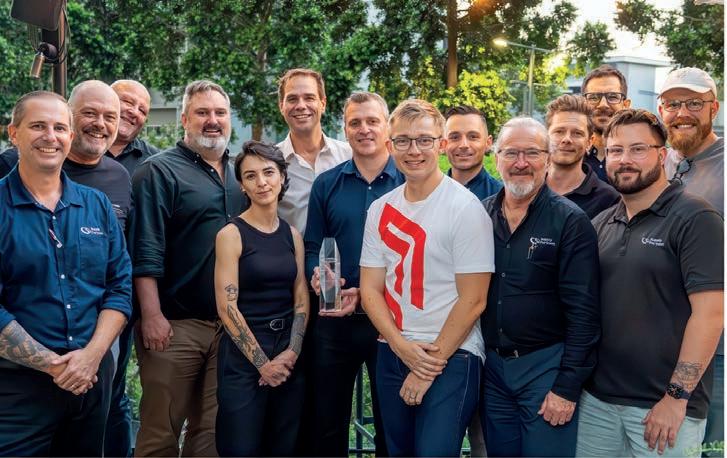
achieved the highest national score in its 2025 partner assessment, driven by strong revenue performance, customer growth and consistent engagement with installers through training and events.
Patrick Morrissey, Chief Executive Officer at Supply, sees the award as a
How hail-proof are today’s solar panels?
Australian rooftop solar panels are designed to withstand a reasonable level of hail impact, with all locally installed modules required to meet mandatory international testing standards. Under International Electrotechnical Commission (IEC) 61215, panels must survive impacts from 25-millimetre (mm) hailstones at 83 kilometres per hour (km/h).
common, some manufacturers are going further, submitting modules to tougher
independent tests and offering enhanced hail ratings. According to SolarQuotes, some residential panels sold in Australia are rated to withstand 35-45 mm hail at speeds of up to 110 km/h, which is around ten times the impact energy of the IEC minimum.
reflection of the company’s long-term commitment to the trade. Dougal Gillman, Distribution Manager at Fronius Australia, sees the award as an indicator that strong distributor partnerships are becoming more critical as the sector grows in scale and complexity.
meaning not all panels perform the same (even within one brand).
Hail testing, however, focuses on glass breakage, not hidden cell damage. Impacts can still cause microcracks that reduce output over time.
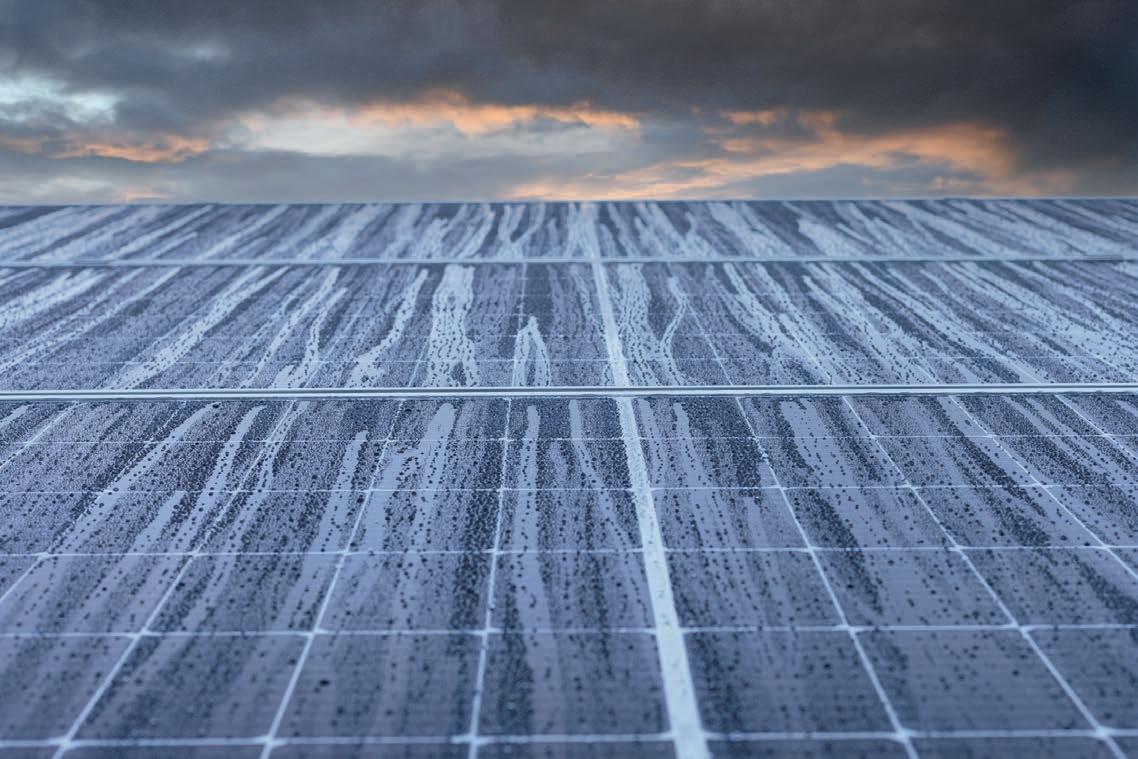
Supply Partners wins the Fronius Sales Partner of the Year 2025 award.
Not all solar panels are built to withstand hailstones impacts.
ADVERTISE IN
EXPERT COVERAGE OF THE PROJECTS AND DEVELOPMENTS THAT ARE RESHAPING THE AUSTRALIAN ENERGY MARKET.
23,000+ COMBINED CIRCULATION
Our magazine, e-newsletters and website are valued at all levels of the industry, from financiers and developers to installers and suppliers. As the energy market transitions to renewables, our readers look to ecogeneration.
ecogeneration is the only title in Australia to cover all aspects of the clean energy industry; delivered across print, online and email. The bi-monthly magazine, officially endorsed by the Clean Energy Council, keeps the industry informed from the boardroom to the work van.
The print and digital magazine, and pass on rate, has a combined circulation of more than 23,0000, as well as receiving extra distribution at important industry events.
For more information, please contact: Nick Lovering Business
Development Manager
nick.lovering@primecreative.com.au 0414 217 190