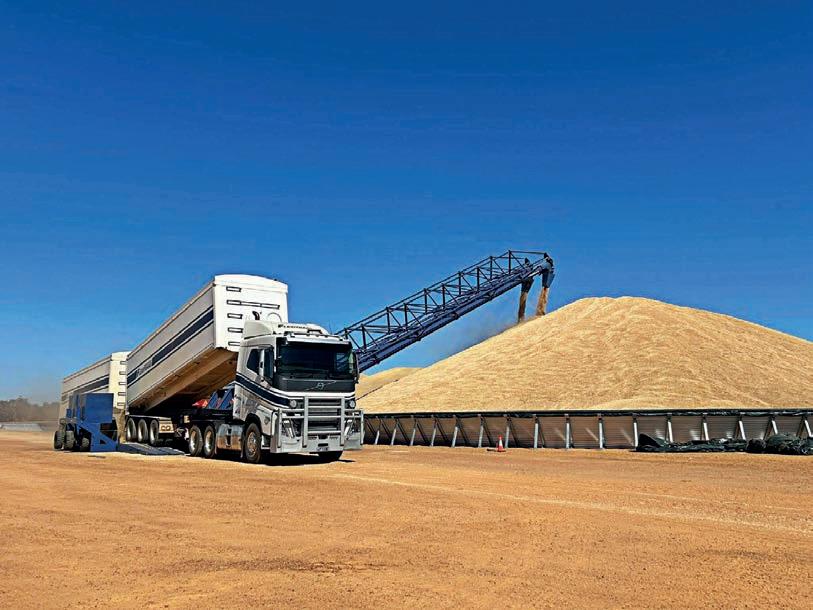
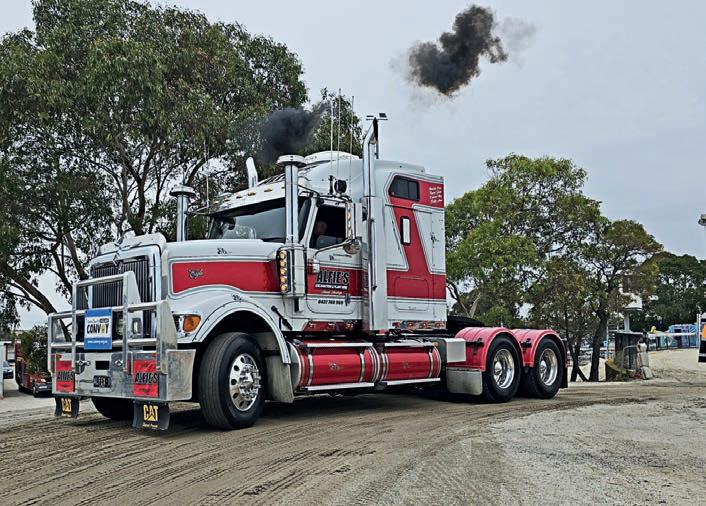
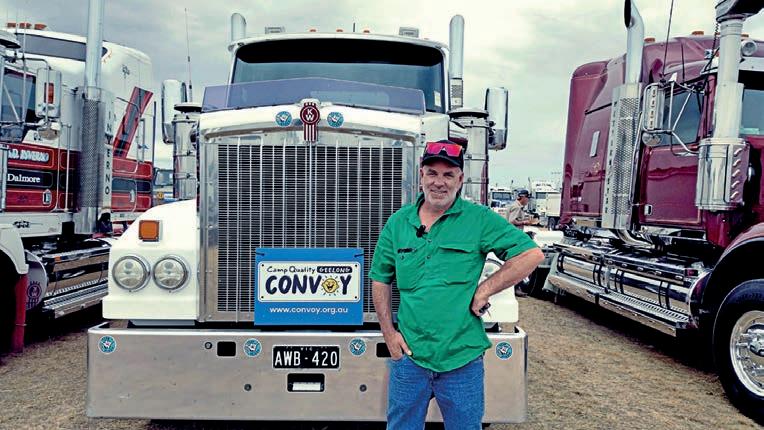
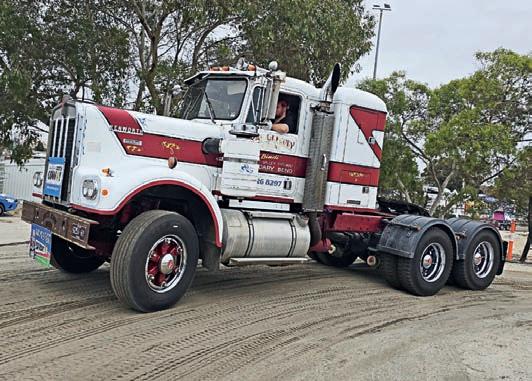
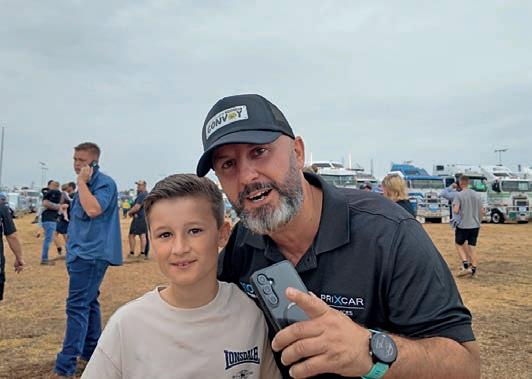
Truckin in the Topics/Spy on the Road: Alf Wilson, 0408 009 301 David Vile, Graham Harsant, Geoff Middleton, Jonathan Wallis, Tim Oakes.
Big Rigs National Road Transport Newspaper is published by Prime Creative Media. It is the largest circulated fortnightly truck publication in Australia with 22,248* copies per fortnight.
*Average circulation per issue in 2025
‘Alarming levels’ of non-compliance sparks blitz
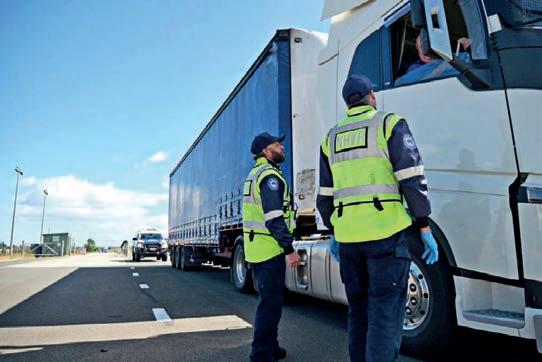
TRUCKIES can expect an increase in intercepts and inspections this month as the National Heavy Vehicle Regulator (NHVR) launches a nationwide operation to tackle fatigue.
The regulator said Operation Ambit, which will see police join forces with the regulator in some jurisdictions, is a result of nearly 5000 fatigue-related breaches detected last year.
During the operation announced earlier this month, the regulator said its Safety and Compliance Officers will conduct vehicle intercepts, including vehicle inspections, work diary checks and licence and registration checks.
NHVR Chief Operations Officer Paul Salvati said a similar operation conducted by the NHVR at the end of 2025 also revealed alarming levels of non-compliance among drivers.
“The number of fatigue-related breaches detected was
the highest we’ve ever recorded during a national operation,” Salvati said.
“Almost 5000 fatigue offences were found by the NHVR in 2025 alone – equivalent to nearly 100 drivers every week taking unsafe risks that endanger themselves and other road users.
“We understand heavy vehicle driving is a challenging task, and some drivers may face pressures to meet tight deadlines, but safety must al-
ways come first.”
Jarrod Wilson, NHVR Operations Manager Queensland, said this month’s operation is part two of the blitz in the lead-up to Christmas last year.
“There is no such thing as a second chance with a serious heavy vehicle accident,” Wilson said.
“People die as a result of these accidents, based on the weight and the momentum of heavy vehicles and these are
tragic events that we are trying to prevent.”
Salvati reiterated that fatigue is one of the biggest risks for heavy vehicle crashes across Australia.
“Australia’s heavy vehicle industry is vital to our nation, but it is also demanding, highstakes work which requires skill, focus and resilience every day.
“That’s why managing fatigue isn’t optional – and staying rested and vigilant is critical. Every alert driver helps keep our roads, industry and communities moving safely.
“That’s why the NHVR also operates a Heavy Vehicle Confidential Reporting Line [1800 931 785], where drivers can report inadequate fatigue management, falsified records, unrealistic schedules, or pressure to drive.”
Even when operating within legal work and rest limits, Sal-
WE UNDERSTAND HEAVY VEHICLE DRIVING IS A CHALLENGING TASK, AND SOME DRIVERS MAY FACE PRESSURES TO MEET TIGHT DEADLINE, BUT SAFETY MUST ALWAYS COME FIRST.”
PAUL SALVATI
In 2025, fatigue was one of the top offences for heavy vehicle operators nationwide, accounting for more than 23 per cent of all detected breaches. The regulator also reminded drivers, and other industry members, that they can report concerns via the NHVR’s Heavy Vehicle Confiden-
Truckie fined $1747, three-month licence loss
A truckie carting grain on the Lower Eyre Peninsula in South Australia has lost his licence after testing positive to drugs earlier this week.
Port Lincoln Police allegedly detected the full-laden road train travelling on Western Approach Road at Duck Ponds at 108km/h about 10.30am on
Police said road trains are limited to 90km/h on this road.
Police said the driver, a 55-year-old Eyre Peninsula man, tested positive to methamphetamine and cannabis.
He was issued with an expiation notice for speeding and heavy vehicle offences,
totalling $1747. He was also issued with a three-month instant loss of licence, and the sample was sent for forensic testing. The prime mover was defected for non-compliant speed limiter and police said further action may be taken against the owner of the truck.
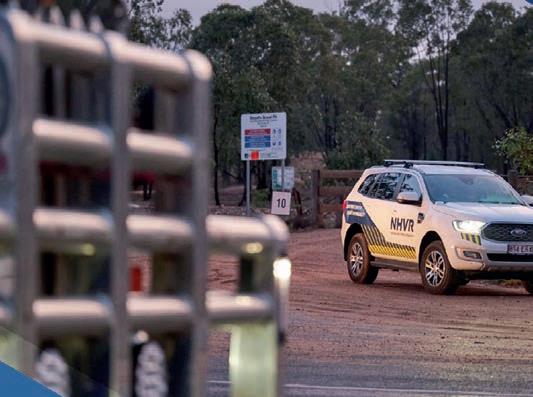
Operation Ambit will also see police join forces with the regulator in some jurisdictions. Image: NHVR
Police allegedly detected the road train travelling on Western Approach Road at Duck Ponds at 108km/h. Image: SAPOL
Push for sustainable Bremer bridge fix
INDUSTRY advocate Gary Mahon said the recent repair funding announcement of $85 million for the Bremer River Bridge is welcome – but ultimately falls short of addressing critical productivity issues.
The CEO of the Queensland Trucking Association said the investment in the essential Warrego Highway freight crossing essentially restores the bridge to its previous peak operational standard in 2014.
“We still have the challenges of not being able to bring the bigger combinations in,” Mahon said,
“For example, you can run a 36.5m B-triple from Chinderah south down through Sydney, Melbourne, into the Port of Melbourne and bring it back up the Inland.
“But come to Gatton, and you’ve got to pull it up and break it down, so we’ve got a problem at Bremer River and at Nerang.”
Mahon said the industry has formally raised concerns with government about the constraints.
While restoring normal traffic across the bridge will improve general access, he said it does not go far enough to enable the full range of modern freight combinations needed for efficient road transport.
“It doesn’t solve the prob-
lem of us needing to run the full range of A-double combinations and the PBS Level 3s.
“We can bring them down the Toowoomba Range and bring them along to Gatton but then we’ve got to pull up and break them down.
“That either doubles, or in some cases trebles the truck trips to be able to bring those trailers into Brisbane.”
Mahon said industry is in an extended period of “high-level” advocacy with the state’s Department of Transport and Main Roads (TMR) to find solutions, which he said Transport Minister Brent Mickelberg is also involved.
“Whether they need to do further remediation work to that bridge or replace it, the point we’re making is it’s not sustainable to be continually breaking these combinations down, or make them up when you’re going the other way,” he said.
“We need an effective and sustainable solution. To be fair to the minister I don’t think he’s seen a map that shows that as we’ve now provided to him and those discussions are ongoing.”
Mahon said those same combinations need to run out to Roma and turn right to go up the Inland Freight Route.
“So, we’re looking for notices on those roads so fleets can invest with confidence in the right gear and get what we’d call the big freight options underway in a sustainable way.
“If they can invest with confidence, we’ll have the most efficient and safest combinations operating around the state.
“We can run them everywhere else, but not here.”
Mahon also warned that freight volumes are continuing to grow rapidly and the transport network needs to keep pace.
“We’ve got significant increases in freight across the board, increasingly fundamentally by the day, and we’ve also got the looming Olympics and all that goes with that.
“Quite aside from how Inland Rail is progressing and how rail might carry some of this load, the bottom line is road freight still carries the majority of freight.”
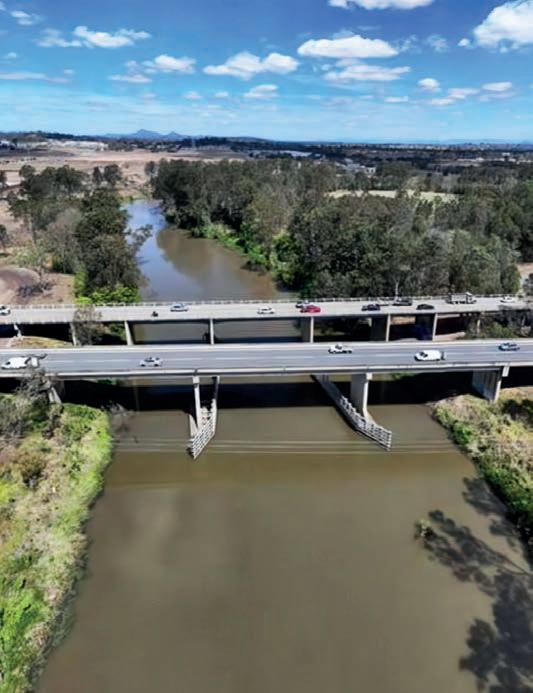
One of southeast Queensland’s busiest road links, the Warrego Highway’s Bremer River Bridge has had speed and load limit restrictions in place since late 2023, when fatigue cracks were identified.
The move was aimed at reducing the risk of cracks growing, or new ones forming, while authorities worked out the next steps.
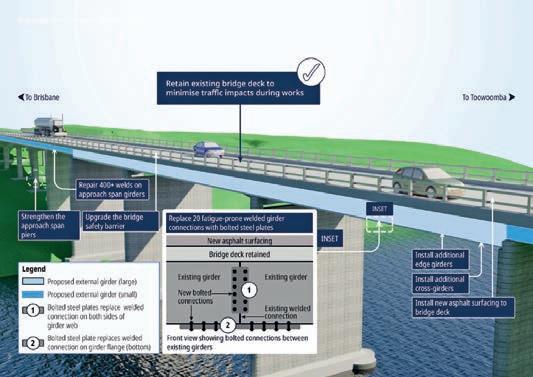
An $85 million rehabilitation plan has now commenced, with major works underway, including strengthening works on the westbound bridge.
TMR said the design will avoid any prolonged traffic disruption of more invasive rebuild options by completing works from underneath the bridge.
“The community has been clear they want traffic flowing again, and this is how we make that happen,” Mickelberg said.
“We have landed the right solution to fix Bremer River Bridge, after speed limits were imposed almost three years ago.
“The plan we are now delivering is sensible and pragmatic. It will fix the problem without causing unnecessary delays for commuters, respects taxpayers’ money, lifts speed restrictions and delivers decades more life from this bridge.”
Once complete, the works will remove current speed restrictions in both directions, extending the life of the bridge by decades, said TMR.
After completion, some larger oversize over-mass vehicles will still be required to use the eastbound bridge for westbound travel, as was the case prior to the bridge defects being identified in 2023.
When you’re a fleet manager, owner operator, or technician, it’s critical you have the right filters for the job.
Check out Ryco’s range of filters using the Ryco app or website to find out why truckies and fleets are moving to Ryco for a genuine alternative, with genuine savings.
So no matter where you are, or what truck you’re servicing, you can always be Ryco Ready.
The graphic shows the Bremer River westbound bridge and details of the rehabilitation works.
Call for summit to solve supply chain issues during floods
WA trucking boss Cam Dumesny is tired of hearing the dismissive line that freight disruptions are due to one-in100-year weather events.
The CEO of the Western Roads Federation said there’s now far too many of these ‘events’ to brush off the ongoing turmoil they cause as something the industry just needs to take in its stride.
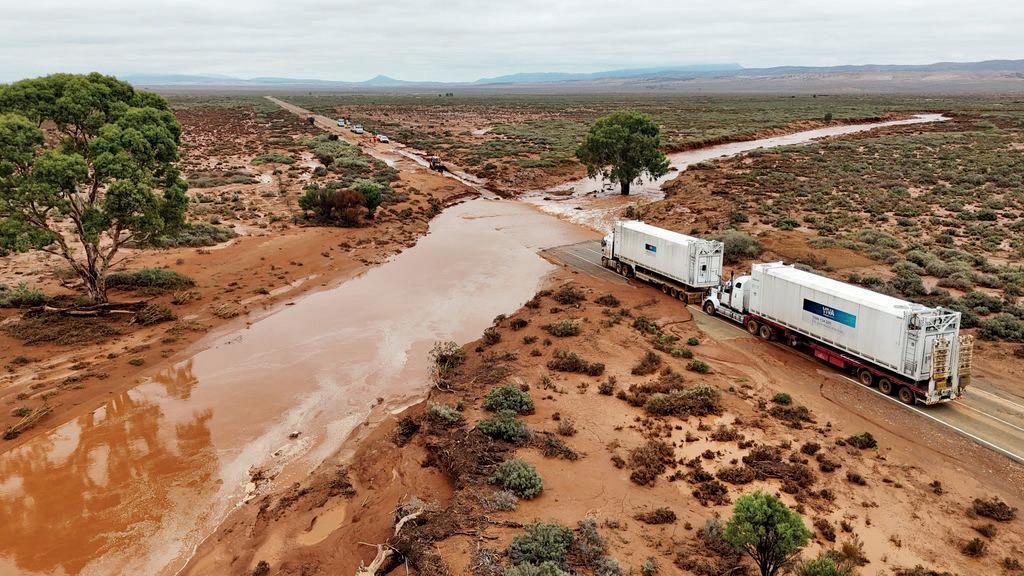
Speaking as South Australia, and parts of western Victoria, were smashed by heavy rainfall, again cutting the East West rail corridor and major road freight routes in and out of Adelaide, Dumesny said it’s time for urgent action.
He said the continuing freight disruptions and conflicting government decisions were driving up costs, undermining manufacturers’ global competitiveness and delaying major projects, among other issues.
Dumesny is now calling for the WA Premier Roger Cook to bring industry and government department heads from
WA, SA and the NT together to lobby the federal government for more infrastructure investment.
“I think it’s time for WA, NT and SA to get together and form a united lobby voice of industry and government and get some chronic investment in both road and rail,”
Dumesny said.
“WA has become exceptionally good at responding to freight outages, through the operational collaboration between industry, regulators and emergency services, in WA, SA and NT.
“Unfortunately, WA’s freight policy action to learn lessons and work with those involved to develop solutions to mitigate ongoing risks has been token at best. Frankly that is being very kind to them.”
Dumesny said the forecasted surge in fuel prices due to the war in the Middle East also highlights the fragile nature of Australia’s global and transna-
SA trucking boss Steve Shearer said he’d be only too happy to be part of a roundtable lobby group after the recent weather events.
The Executive Officer of the SA Road Transport Association said the other frustration to come from the February/March disruptions was the lack of communication around when the roads might reopen.
At present, he said that falls under the jurisdiction of the State Emergency Service (SES) rather than the engineers at the state transport department.
“We had this discussion three or four years ago when we had those huge floods that saw trucks doing an extra 3500km going through the corner of Victoria up through NSW, the bottom Queensland and then back into the Territory to get freight from Adelaide to Darwin,” Shearer said
this and I know from discussions with the Department of Transport people they’re banging their head against the wall saying hang on, the water has receded to the point where we’ve checked the road, the road can handle it, open the road.
“But it’s the SES that’s got authority which is just ridiculous.”
Shearer said the other frustration is that there is still no fast-track process in place to give road trains instant permit access to use an alternative route if flooding cuts the usual highways.
“Then you’ve got the big funding issue. Everybody in governments, at all levels, loves to talk about and use the window dressing words about resilience in the network, well show us the damn money and get on with it.”
Consultation open on new cost model for truck charges
TRUCK owners are now invited to have their say on a proposed new forward-looking cost base (FLCB) model for heavy vehicle charges.
The FLCB system could replace the long-running payas-you-go (PAYGO) model from 2027-28 onwards, if transport ministers sign off later this year.
Public consultation on the Consultation Regulatory Impact Statement (C-RIS) is now open and runs until May 21, 2026. Visit The National Transport Commission (NTC) is calling for feedback on the overall design of the FLCB model, the potential advantages and disadvantages of various implementation options, impacts on government revenue and affordability for industry, and any alternative approaches stakeholders think should be considered.
While straightforward in principle, the NTC said PAYGO has struggled to keep pace with rapidly rising road expenditure, leaving a widening gap between the heavy vehicle cost base and revenue collected through
the road user charge and truck registration charges.
The FLCB is an alternative approach that spreads the cost of road construction and maintenance over the useful life of assets, rather than attempting to recover the full cost in the year the expendi-
ture occurs, the NTC added. It works by calculating a government’s required revenue through three key building blocks: depreciation of infrastructure, a return on capital, and ongoing operational and maintenance costs.
By forecasting future expenditure and smoothing recovery over time, the model is expected to reduce yearto-year volatility and provide industry with greater predictability in charges.
Because FLCB smooths costs over time, it could show a lower year-to-year charge recommendation than a volatile PAYGO estimate would, especially in years with big road spending.
In theory that could reduce year-on-year jumps. But if overall costs are high or governments want to recover more of the road spend from heavy vehicles, the resulting recommended charges could still be higher than what operators pay today
Queensland Trucking Association CEO Gary Mahon hadn’t made a submission when contacted by Big Rigs
but shared his reservations about the merits of changing the system.
“Given the pressures on the industry at the moment, and the ever-increasing freight task, the ever-increasing push to go below cost for freight rates, I think it’s unfortunate that the government thinks this is a sustainable approach.
“It’s not a sustainable approach and government needs to take a more considered view about the sustainability of the industry.”
Mahon said the government also appears to be intent on progressively eliminating the fuel tax credits for operators.
“For the industry that’s an unsustainable circumstance, especially given all of the pressures on the industry from a whole variety of different perspectives.”
Industry’s frustrations again spilled over during the recent floods in SA. Image: SES
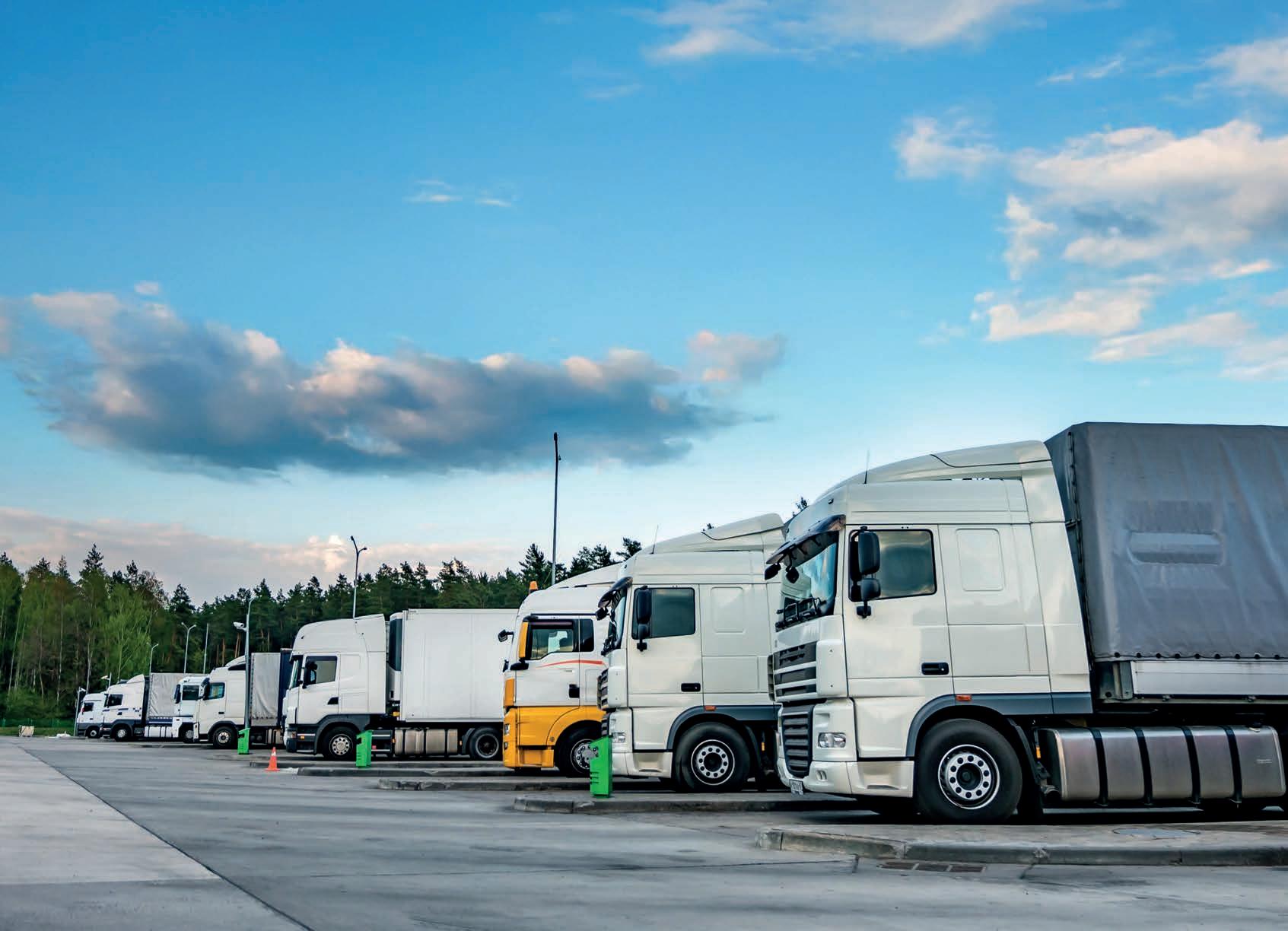
recommendation than PAYGO. Image: Greg Brave/stock.adobe.com
Brakes stay on truck sales after record run
AFTER a few big-spending recent years for truck dealerships around Australia, 2026 is off to a relatively sluggish start in comparison.
The latest numbers just in from the Truck Industry Council (TIC) show overall deliveries for February are noticeably down on the record figures from 2023-25.
According to the sales lodged with TIC, there were 3003 trucks and vans delivered in February across all the segments, a 12.8 per cent drop from the 3446 recorded in the same month in 2025.
Year-to-date (YTD) the overall total now sits at 5467, 12.2 per cent less than the YTD total of 6232 at the end of February last year.
Perennial market leader Isuzu predictably came out on top in the overall numbers for February, but took another notable dip in the monthly tally, notching 674 sales, well shy of the 1029 recorded in the same month in 2025.
Isuzu’s YTD market share is now 22.2 per cent, which represents a 6.6 per cent slide on
units in February, which is 142 trucks, or 12.7 per cent less than in the same month last year.
Kenworth came out on top in February with 183 sales, which is 65 less than the 248 trucks that left Bayswater in the same month last year.
Isuzu took second spot with 157 (down from 193 in February 2025), with Volvo in third with 141 (down from 203).
flected the overall year-onyear sales slide, notching 977
In the overall market share race, Kenworth now sits on 23 per cent YTD, with the race for second as tight as
ever – Volvo clinging to that spot on 16.3 and Isuzu close behind on 15.9, or 288 trucks vs. 281.
Scania and DAF rounded out the top five with 93 and 71 respectively in February, with the latter notching another relatively bumper month.
DAF is the early success story among the heavies so far in 2026, jumping from a 2.5 per cent market share in the first two months of 2025 to an impressive 6.5 per cent slice of the pie 12 months later.
Military strikes a wake-up call for road freight industry
REGARDLESS of how long the military strikes on Iran last, the initial impacts of the attacks were a blunt warning to industry, said Victorian freight boss Peter Anderson.
The Victorian Transport Association CEO Peter Anderson said the tensions highlighted how dependent Australia remains on global energy markets and how quickly international disruptions can translate into higher fuel costs at home.
He pointed to the Strait of Hormuz – a key shipping corridor through which roughly a fifth of the world’s oil supply moves each day – as a major flashpoint. Any conflict affecting the region has immediate consequences for
oil markets, with price rises quickly flowing through to Australian fuel prices.
Australia is effectively a “price taker” when it comes to fuel, Anderson said, with local diesel prices largely determined by movements in global crude markets rather than domestic policy settings.
“Consumers won’t be spared,” Anderson warned.
“Every Australian household depends on goods moved by truck, train or ship.
“When fuel becomes more expensive, freight becomes more expensive and when freight becomes more expensive, consumer prices rise. We saw this during the Red Sea disruption, when economists warned that higher shipping
costs were feeding into global goods inflation.
“If diesel and bunker prices spike again, the cost of living pressures already weighing on families will intensify.”
Anderson said his message to operators is clear.
“You cannot afford to absorb rising fuel costs. Transport operators must implement transparent, indexed fuel levies tied to published benchmarks.
“Passing through fuel costs isn’t about padding margins; it’s about safeguarding the viability of fleets, staff and safety standards.”
At the start of the attacks by the US and Israel, Energy Minister Chris Bowen confirmed that Australia has only
34 days’ worth of diesel fuel reserves, sparking concerns of what this could mean for the transport industry at the bowser.
One Nation MP Barnaby Joyce has warned that while people focus on what’s occurring in the Middle East, Australians should start turning their attention to the subsequent fallout in Australia.
“If the Strait of Hormuz closes, as is very likely, then the reserves we need are stored in the United States,” he said.
Appearing on Channel 7’s Sunrise earlier this month, Joyce argued that Australia’s reliance on imported fuel left us vulnerable.
“It’s a shame in a crisis like
D ISRI SEATS
SYDNEY
510 Victoria Street, Wetherill Park NSW 2164 Ph. 02 9756 6199, email: isri@isri.com.au, www.isri.com.au
BRISBANE
this that we’ve got ourselves down to two oil refineries so that if there’s a crisis in the production of fuel, we’re in a bad spot,” Joyce said.
Western Roads Federation CEO Cam Dumesny also shared his concerns with ABC Radio.
“Whenever we’ve had situations in the Middle East, we’ve had a surge in fuel prices and that ultimately translates to a higher cost for all consumers, particularly in our regional areas.
“If it translates to a sustained war then there’s obviously going to be a rise in the oil prices, which translates for us into higher diesel costs – and that will immediately translate to a higher cost for
shipping and transporting around Australia.
“Roughly a third of your costs for linehaul will be fuel costs, so any cost increase immediately translates to a higher cost for all consumers.”
Dumesny said everybody in regional Australia is largely dependent on road transport for delivery of their consumables.
“We have to pass those costs on. Ours is a very tight margin industry. We do not have the capacity to absorb cost rises.”
The NRMA said a rise in crude oil prices is generally reflected in higher Australian fuel prices within about seven to 10 days.
• Turn to page 56 for more from Anderson on the issue.
Unit 2/13 Hinkler Ave, Rutherford NSW 2320 email: sales@hvss.com.au www.isri.com.au
Driving older truckies out of the industry
BY DANIELLE GULLACI
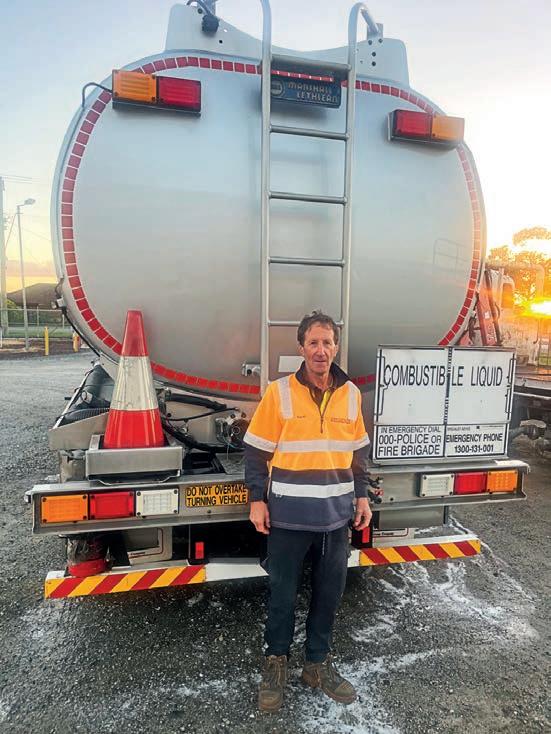
IN the transport game for over 40 years, 66-year-old truckie Neil Hancock believes excessive medical tests forced upon older drivers is causing those who are still fit, healthy and capable of doing the job to rethink their future in the industry.
Based at Koo Wee Rup, Victoria, Hancock has driven fuel tankers for most of his driving career.
Like many from his era, he began honing his skills behind the wheel very early on.
Growing up on a dairy farm, he was already shifting gears from a young age, driving trucks, tractors and dozers on the family’s property.
Hancock remains active and looks after himself.
Since turning 60, he’s been getting medicals annually.
“I get a medical done every year and it looks like they are just trying to find an issue to get us off the road,” he said.
“There’s the medicals, the inductions, the sleep apnoea tests, the blood tests, the regular drug and alcohol tests. It’s like they are just looking for an issue.
“So many of the drivers in this industry are over 60 and if you’re going to start dragging us all in for all these tests, you’re going to scare them out of the industry and then we will have an even bigger driver shortage problem than what we already have now.”
Hancock pointed to a medical test he underwent last year. “I couldn’t go to my GP, I had to go to a specialist, which also means there’s an extra cost,” he said.
“Since Covid, the tests have become stricter and stricter, and also harder. I’m a 63kg man and am fit as a fiddle. The specialist could see I don’t have an ounce of fat on me and yet he’s giving me a pinch test on my waist;
YOU’RE GOING TO SCARE THEM OUT OF THE INDUSTRY AND THEN WE WILL HAVE AN EVEN BIGGER DRIVER SHORTAGE PROBLEM THAN WHAT WE ALREADY HAVE NOW.”
NEIL HANCOCK
Those tests all came back clear.
“The specialist wanted me to have a blood test and they put a monitor on me, and there was absolutely nothing wrong with me, it was all fine,” he said.
“Then about a week after I got back to work, one of the bosses came and saw me and said I now need a medical every six months because the doctor was worried about my blood pressure.”
Austroads – an association of the Australian and New Zealand transport agencies, representing all levels of government – details regulatory requirements for medical testing of heavy vehicle drivers in each state and territory, including what age medicals are required in each jurisdiction. These rules do vary state by state.
For Hancock’s home state of Victoria, it states that heavy vehicle drivers must be medically safe to drive. They are required to notify VicRoads if they have or develop a medical condition or disability that could affect their driving. There is no prescribed period or age for a medical assessment or road test, unless declared or reported.
However that changes if the driver is carrying dangerous goods, in which case a medical assessment is required on initial application, and then again every five
medical examinations are required to be carried out at a minimum of once every three years for drivers aged 49 or under, and then yearly for drivers aged 50 or over. These medicals must also assess sleep disorders.
When speaking with Big Rigs, Hancock pointed out the experiences of some fellow drivers he knows in relation to medicals. “This other bloke who does have high blood pressure is on blood pressure tablets to keep it under control. They made him go and see a heart specialist, which cost him $600, and when he got there the specialist asked why he was even there.
“There was also another bloke I know who’s 70 and fit as a fiddle, who retired recently. He went for a medical and ticked a box saying he snored, so they decided
“The policy makers can make life-changing decisions for truck drivers,” he said.
“They should be fit and clean also, and subjected to the same sort of medicals that we are.”
Though he told Big Rigs that he still enjoys being in the truck, Hancock says he is sick and tired of having to jump through so many unnecessary hurdles just to do his job.
When asked about his retirement plans, he replied, “I don’t think I’ll be doing this much longer.
“My next medical is in May and if I’m going to get dragged through the mill again, I’m thinking of just getting out of the industry all together.
“There are plenty of other jobs out there without the stress.
Reader reaction
Bryan:
I feel your pain matey… I dislocated a shoulder on work duties, hospital said I had a irregular heartbeat before relocating the shoulder… went to local GP to make an appointment to see a cardiologist… cancelled licence on the spot (HC) so couldn’t work or drive kids to school or shops etc. Just like that, upended my life… see cardiologist, all is fine and good. Have to see yearly because of RMS requirements etc. New cardiologist cancelled licence second time and wants more and more tests... I’m only 50 and been driving over 22 years. I’m out of the industry for good now. Although I miss driving trucks.
Allan Stimson:
I had 48 years in the transport industry. 100% accident free. I take pride in this record. At the age of 70 years I was sent by RMS to see a neurologist to see if I was fit to drive a heavy vehicle. This clown started my consultation by saying no person over the age of 70 years should be able to hold a MC licence, and no one under 25 should hold a car licence, so my licence was cancelled.
Barry Giles:
13 yrs ago I got sick of red tape and the hoop jumping of the fuel carting and also explosives, left what was a good permanent job and just started working casual here and there. If it didn’t suit me I just said goodbye. Also found that driving side tippers, water carts, etc, in civil works, I was earning just as much if not better money than the fuel industry, and didn’t have to use the headlights or log book. Still doing a bit now when it suits me at 75 yrs.
Peter Werner: And it’s the job that made them unhealthy. How many people were fit, healthy and strong when they got into the game, but now have multiple health issues caused by stupid rosters, rubbish food, not enough sleep and generally being treated like a robot for decades? It’s hypocritical that the job gives drivers an unhealthy lifestyle, but somehow expects them to maintain a level of fitness.
Michael Barber: RMS medical for me at 74 with unconditional MC licence included 9.5 minutes on incline tread mill at 8kph. I did 8 minutes and went into RMS and handed in all my commercial licences. My cardiologist asked, why’d you stop, I replied I don’t wanna play this game anymore.
Tony Stephens: I’m 71, have MC licence and BDA. I have been doing annual medicals since I turned 59 and now do annual aged driving tests as well. I understand completely why we should do the medicals. Any one of us could be suffering some medical problem we are not aware of until one day we have a medical incident barrelling down the road at 100kph.
Garry Taylor: I got made redundant 4 months ago at 62. Best thing that ever happened to me. I’ve never felt better. I did try for 3 months to get back into the workforce but found it was a waste of time. One labour hire mob said to me most companies won’t employ drivers over 60 even if you have 40 years’ experience as the insurance premiums for older drivers have skyrocketed.
After driving tankers for over 40 years, Neil Hancock is seriously rethinking his future in the industry. Image: Neil Hancock
YOUR NEXT POWERHOUSE IS WAITING
THESE BULLDOGS ARE BUILT AND READY FOR A GOOD HOME.
Stock available! Speak to your local Mack dealer about available units.
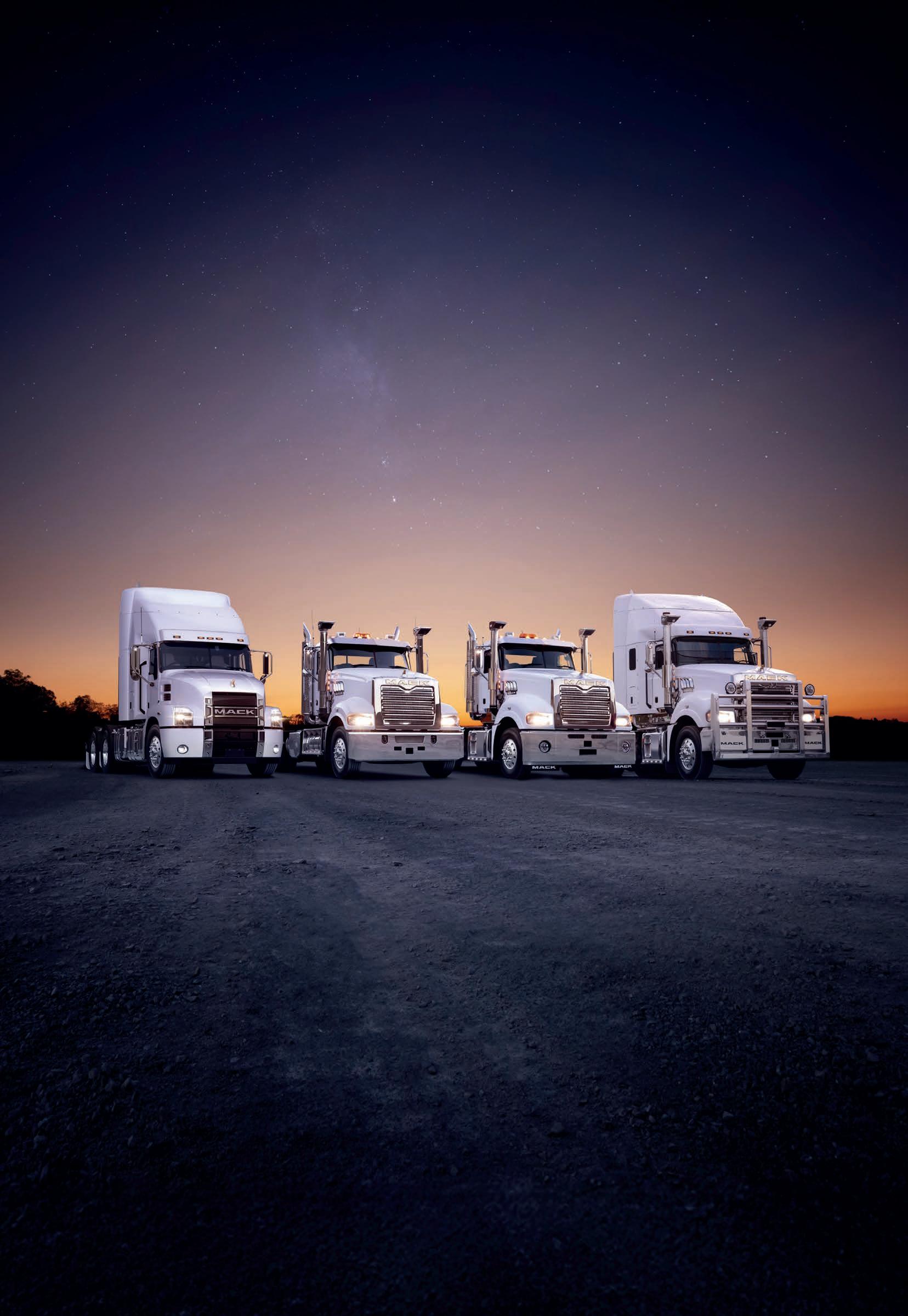
Your fleet deserves trucks that work as hard as you do and these Mack Anthem, Trident, Super-Liner and Titan models are built and ready to work. Whether you need fuel-efficient long haul, maximum payload, 780hp of serious pulling power, or extreme heavy-haul capability, there’s a Mack ready to go today.
Backed by advanced driveline tech, driver-first comfort and Mack’s extensive dealer network, these Bulldogs are built and ready for a good home –take advantage of available units today!
Enough’s
EDITOR
JAMES GRAHAM
als in the cities, Australia clearly wants a more hardline approach. It would also come as no great shock to find a large portion of her newfound followers come from the trucking industry. No one has been doing it tougher. Every week we’re reading about another mid- to largesized fleet closing its doors. Too many truckies also go to work each day fearful of their safety in the most dangerous job in Australia. Something has to give. Trucking bosses have singled out sham contracting as the number one cause of the industry’s ills, but what has been done about it so far? Nothing that we are aware of. Parking bays are still being used as makeshift depots and dump sites, while ABN flouters openly advertise for drivers on job sites. How hard can it be to make an example of the offenders?
Letter to the Editor
Abuse, disrespect and racism is not the answer
WE have become a very toxic and divided industry and that has made it dangerous. We need to turn that around and I believe we can.
The only way we will solve this issue and move forward is to be united, respectful and professional.
Abuse, disrespect and racism is not the answer.
As soon as we lower our standards those that we need to listen will just cut us off and stop listening.
We are dealing with government departments and politicians. These people are largely delusional and have little to no understanding of our industry as they have had no practical experience or have never been employed or engaged in the industry. Most have never run their own business, nor driven a truck.
It’s time the road transport industry got its shit together and started to work together for the common cause. The last time this industry stood up and united then pushed back was Razorback in 1979.
I’ll tell you a story. I spoke to a copper at an accident site some months ago. The highway was closed for six hours at a serious crash.
I asked why we hardly see patrol cars on the highway anymore. His answer was the police budget. Government had cut spending. Surprise, surprise.
I asked if WAPOL were aware of the increase in accidents, incidents and near misses on the highways caused by these immigrant drivers. His response was, yes we are. Righto….what are you doing about it? Our hands are tied mate. My response was, how do you mean? He said they pull the racist or discrimination card. What do you mean the racism and discrimination card? They say we are picking on them or targeting them and in today’s world as soon as someone cries racism we have to back off.
FFS, is this what we have come to in Australia? I found out that if the coppers want to pinch these immigrants, they have to have hard infal lible evidence that cannot be d
out. These migrant drivers will challenge it and because Australia has an extremely woke and left-wing legal system the charges get thrown out.
I shit you not. I was stunned at the response to my questions. Now the kicker. Picture this. The scene of the accident is almost cleaned up the chopper was gone and we had word the highway will open soon.
There was 3-4km of traffic banked up in both directions and a driver tried to pull a U-turn in an AB-triple on Great Eastern Highway and got bogged blocking both lanes. The sergeant in control at the accident site was furious and voiced his opinion. I was 100 per cent with him and felt
Why do they push so hard to the point they almost take the paint off your rear bumper because they tailgate you whilst impatiently trying to get around you? Why do they overtake in dangerous places like corners, hills or double white lines? What is the rush? No job is worth putting lives at risk.
If it can’t be done safely don’t do it. Could these migrant drivers be on a low kilometre rate? Do they get penalised for not meeting deadlines? I’m sorry, but I don’t get it.
I work for a company that encourages its drivers to slow down, take your time and double check your work to eliminate mistakes. How it
ing bays around Kalgoorlie, Geraldton and Hedland is unloved, poorly maintained making it largely unroadworthy and as we have found out mostly unregistered and I would say it’s safe to say most will be uninsured.
One thing I do know is the regulatory authorities and the COR have failed us big time. It’s now beyond a joke and it’s time for some decisive action to restore some faith.
I still have the passion and love my job and what I do but it is getting dangerous and our authorities are not protecting us.
Not only that but the roads are falling apart as the freight task increases.
MY HOPE IS TO CREATE CONSTRUCTIVE DISCUSSION AND HOPEFULLY IF ENOUGH PEOPLE GET ON BOARD THE RELEVANT AUTHORITIES WILL HAVE TO DO SOMETHING.”
The majority of equipment -
The reason I’m putting the time and effort into writing is because not only have I had enough, but I feel the majority of the industry have had enough and the racism and abuse is reaching dangerous levels.
These problems must be addressed before we get outof-control carnage happening. The double standards are glaringly obvious now and I think we have a right to ask questions.
My hope is to create constructive discussion and hopefully if enough people get on board the relevant authorities will have to do something.
Lobbying your local MP, writing emails to the author-
ities is largely being ignored so the only hope we have is to join transport lobby groups and push them to do the work on our behalf or, shame the authorities on social media until they have to do something. They read these posts and trust me if you are not rude or crude and you put your discussions forward with diplomacy and respect, they will read it and it will get them thinking. Keep talking about these issues to hopefully educate people. The more it is discussed and debated with mates, friends, family and relatives the more people will understand and bring it up in discussion. Eventually the weight of numbers will force the change. Remember. People switch off when you go on a vulgar rant, but they listen when you put forward constructive polite criticism.
Russel Walsh, WA
Privacy concerns raised over search powers
BY JAMES GRAHAM
A NSW truckie is calling for changes to Australia’s heavy vehicle laws, arguing that current search powers allow authorised officers to go too far when inspecting trucks.
Adam Craig cited the example of an owner-driver friend who was pulled over for a random inspection last year.
A fter a thorough search of the cab, Craig said the National Heavy Vehicle Regulator (NHVR) discovered non-work diary documents in support of an alleged non-compliance issue from weeks prior and fined the driver.
Craig is now campaigning on behalf of the driver – and others fined in similar circumstances – to have these search laws changed.
He says many in the industry are unaware of just how broad those powers are under the Heavy Vehicle National Law (HVNL).
“Our trucks are our home away from home and our privacy needs to be protected,” Craig told Big Rigs Craig claims that while some drivers and operators may be
aware of the powers, “a lot of truck drivers and transport operators probably don’t”.
He also questioned why the issue did not receive closer attention during the most recent HVNL review.
Under the HVNL, authorised officers are granted a range of compliance and inspection powers.
Craig points specifically to:
• Section 491 – Power to enter a vehicle
• Section 520 – Power to require production of documents
• Sections 498–499 – Power to inspect vehicles and loads
According to the provisions cited, an authorised officer (AO) may stop a heavy vehicle, enter the vehicle and open compartments.
Craig says these powers allow officers to search trucks, go through belongings and inspect documentation without the need for reasonable suspicion when conducting compliance checks under the HVNL.
He notes that these powers apply both roadside and at
designated inspection sites. Separate to the HVNL, police also have powers under the Law Enforcement (Powers and Responsibilities) Act 2002 (LEPRA).
Craig references the following sections under LEPRA:
• Section 36 – Power to stop vehicles
• Section 21 – Power to search vehicle with reasonable suspicion
• Section 27 – Search without warrant in certain circumstances
Under LEPRA, police generally require reasonable suspicion to conduct a vehicle search, unless other specific circumstances apply.
However, Craig argues that when dealing with heavy vehicles for compliance purposes, police often rely on powers available under the HVNL instead.
“Yes, if you’re caught doing the wrong thing then you should be subject to these laws, but for the vast majority of drivers/operators, they should not be treated like they’re always doing the wrong thing,” he said.
Craig stressed that he is not
claiming such searches occur constantly but questioned whether the powers should exist in their current form at all.
“It’s not like they would allow truck drivers to knock on their doors and go through their home to go through their personal belongings to find something to incriminate them would they, so why do they have the right to go through our home away from home?” he said.
Belinda Hughes, Director/ Principal Lawyer at Hughes Law, said police normally have legislative thresholds to search a vehicle.
“For example, section 36 LEPRA requires reasonable suspicion. The HVNL under section 520 allows an AO to enter to ‘inspect’,” Hughes said.
“Section 521 allows a search but requires the officer to have reasonable belief, that can be formed after entering under 520. To enter and inspect under section 520, no suspicion or belief is required. It is only a power of entry for monitoring purposes.
“That is an incredibly broad power, and it would be good to hear if it is being misused.”
Craig is now calling for the law to be amended or removed entirely. As part of the campaign, Craig is encouraging drivers to share their experiences.
“If your truck has ever been searched for no apparent reason, could you please send in the details,” he said.
“We will be collecting information to go to a respected member of parliament to get this law changed.”
The NHVR spokesperson said its Safety and Compliance officers are authorised under the HVNL to enter a heavy vehicle to conduct a search.
“Truck and cab searches are not routine,” the spokesperson said. “They may occur where there is reasonable belief the vehicle is being, or has been used, to commit an offence or may contain evidence of an offence under the H VNL.”
If you have any concerns to share about a cab search, Craig can be reached at ultitrans@outlook.com.
Sydney logistics company closes doors after 20 years
GOLD Tiger Logistics Solutions, which ran a national operation from its Sydneybase, has closed its doors after 20 years in business.
Founder Imad El Masri, who started the fleet with one truck as a 19-year-old in 2006, made the announcement on his company’s social media channels late last month.
“Gold Tiger has been my life’s work for 20 years,” El Masri said.
“I’m incredibly proud of what we’ve built, but it’s time to prioritise my family and my health. That’s the most important investment I can make now.”
The statement said El Masri
will now focus on property development projects, which he has been involved in alongside the business in recent years.
Gold Tiger’s fleet and equipment will be sold through Pickles – a long-standing partner to the business from its earliest days.
“Loyalty matters to me. I bought my first truck through Pickles, so it felt right to finish this journey where it started,” El Masri said.
Gold Tiger also thanked its customers, employees, partners, and industry colleagues who have been part of “the journey” over the past two decades.
What started with one vehicle and a first-year turnover
of $50,000 grew, according to the company’s website, grew into a national logistics business moving more than 250,000 tonnes of freight annually across industries including FMCG, manufacturing, retail, and healthcare.
“Today, turnover is more than $55 million a year and growing,” the website says.
“Gold Tiger’s wholly-owned Volvo transport fleet has grown to more than 120 prime movers, 280 trailers and 40 delivery trucks and the workforce (drivers and administration) has passed 350.
“The growth, while rapid, has been strengthened by Mr El Masri’s decisions to use an all-employee driver workforce
and to own his trucks, equip ment and Sydney warehous ing facilities.”
In December last year, Gold Tiger announced it would also be relocating to a new Brisbane depot in Park Ridge, providing an all weather facil ity with secure capacity for up to 8000 pallets.
“The new site has been de signed to support reliable warehousing, efficient trans port movement, and seamless service during peak and every day operations.
“This investment in the new Brisbane Depot reflects our ongoing commitment to sup port our customers’ growth and delivers consistent, dependable logistics solutions.”
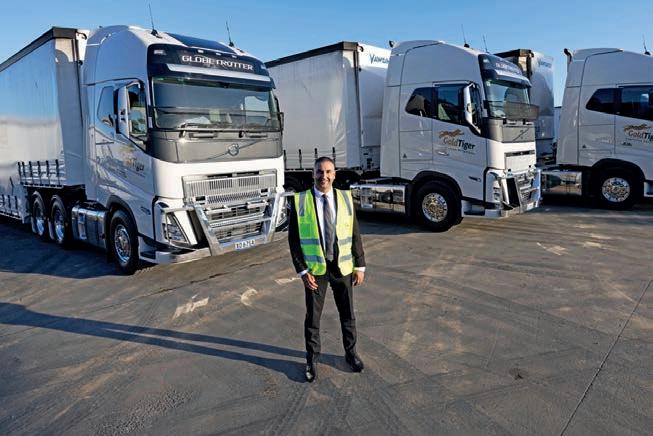
Imad El Masri started the fleet with one truck as a 19-year-old in 2006. Image: Gold Tiger
Truckie Adam Craig believes the powers are too broad when it comes to cab searches. Image: NHVR
Reflecting on where it started
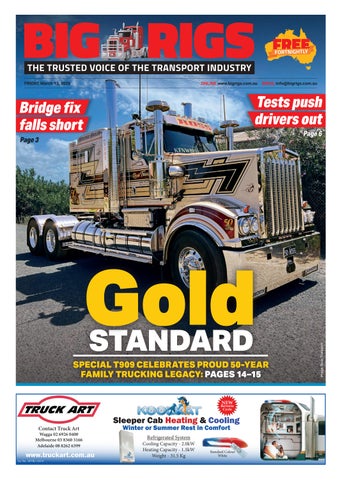
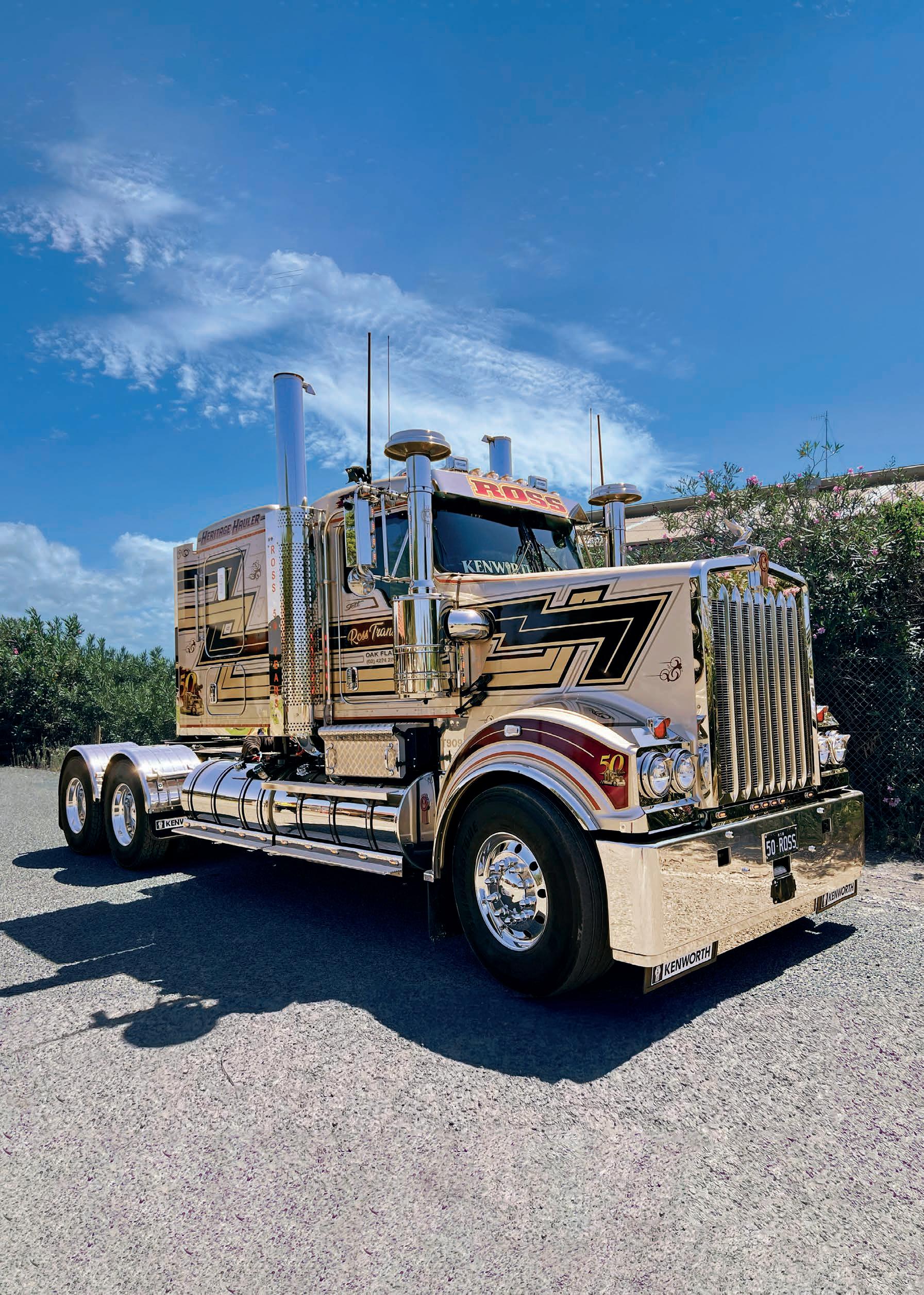
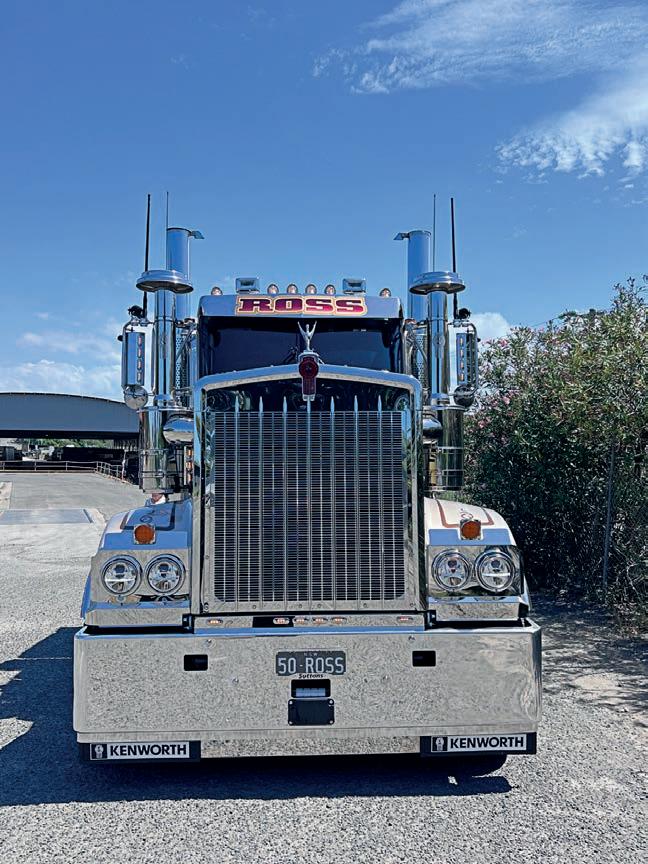
This eye-catching 50th anniversary T909 is more than just another truck, it’s a symbol of five decades of hard work and determination.
BY DANIELLE GULLACI
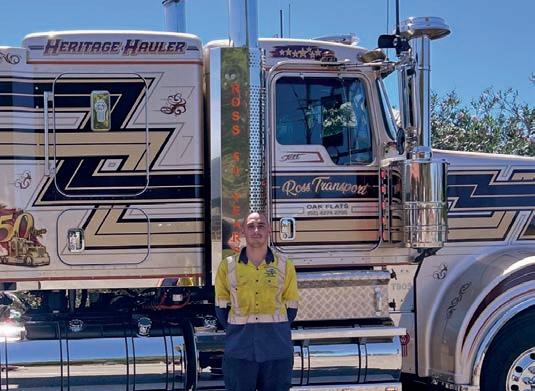
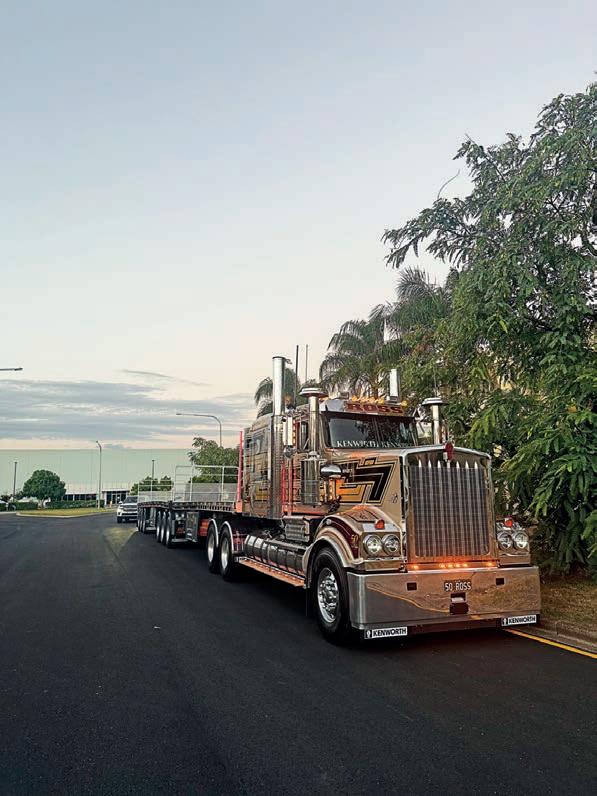
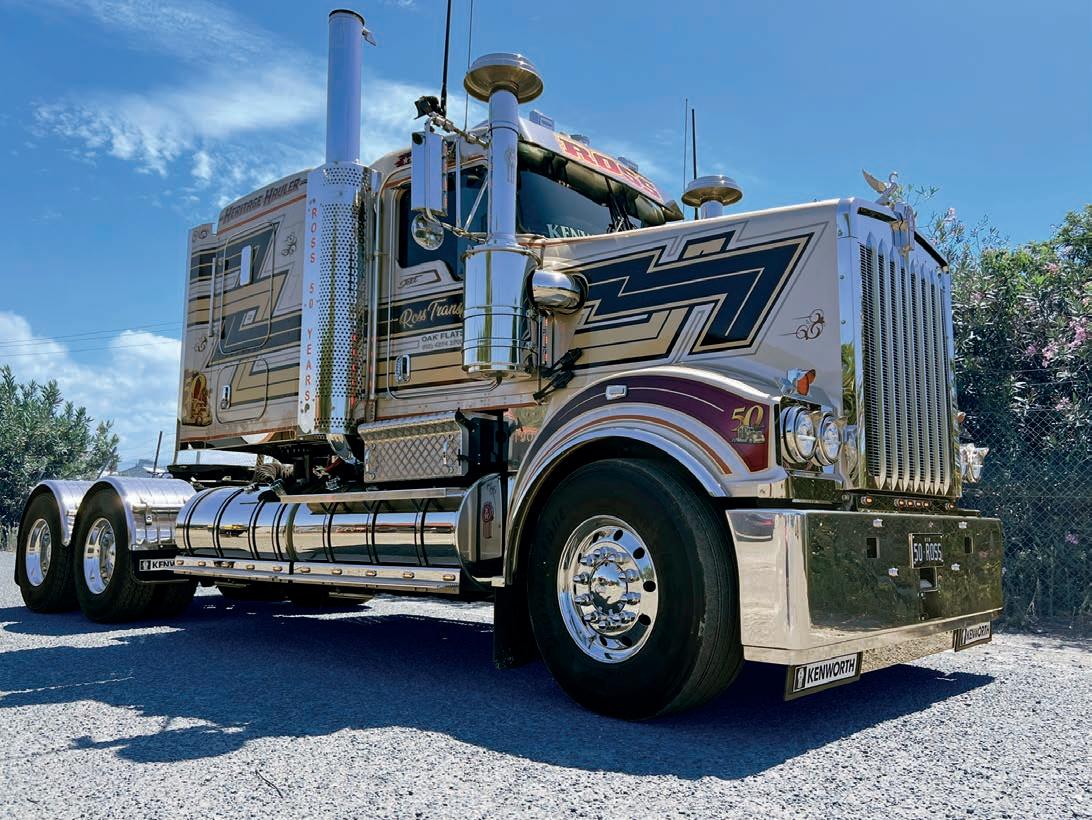
ROSS Transport is well known for having a fleet of trucks that stand out from the crowd – and the new ‘Heritage Hauler’ Kenworth T909 is no exception.
Purchased to mark the company’s 50th anniversary, the truck was delivered in mid-2025 before undergoing its finishing touches and finally hitting the road for its maiden run in January.
Still family owned and operated, across three generations, Ross Transport was established by Reg and Frances Ross in September 1975 with just one truck.
Today it’s run by their son Alan Ross, working alongside his daughter True Ross-Sawrey – who have both grown up in the family business.
Alan took over after his father’s retirement in 1988. Back then, Ross Transport had around 10 trucks.
Fast forward to today and the Port Kembla-based operation in New South Wales operates a fleet of over 75 trucks – predominantly Kenworths, together with some Western Stars and Freightliners – along with about 130 trailers across its general freight and tipper division.
At 84 years of age, Frances is still a friendly and familiar face among the company’s 80 or so staff, still heading into the office about three times a week.
For Alan, being able to celebrate the company’s 50year milestone alongside his mother has made it all the more special. “Mum still
being here and still being so involved really makes a difference – and it makes her happy too. She’s here every week. She brings all the milk and coffee, makes lolly bags up for our key customers for Christmas and organises birthday cakes for all the staff,” he said.
“It’s made even much better again with the fourth generation coming up, with my
grandkids – True’s five-yearold twins Chris and Charlie.”
Ross Transport’s standard fleet livery is white and blue. The business made its first move away from this in 2015, when three dark blue and white trucks were purchased to celebrate the 40th anniversary.
Since then, there’s been quite the eclectic mix of trucks joining the fleet. There
are cartoon themed trucks featuring superheroes, Disney characters and popular k ids’ show Bluey; two Legend SARs dedicated to True’s young twins; a pink truck; a rainbow truck; an autism awareness truck and more.
To mark its 50th anniversary, Ross Transport has again decided to do something special – and very different to any of its other trucks.
Alan said he decided on a T909 “because it’s the best truck and if you have good drivers, you want to give them the best to keep them happy.”
Powered by a 620hp Cummins X15, paired to an 18-speed Eaton Roadranger transmission, the truck features the larger low-line 50inch sleeper with a modular bunk.
Deciding on the truck was the easy part – working out how to jazz it up and make it special proved a little more difficult.
With gold being traditionally associated with a 50th nniversary, Alan decided the truck had to be gold.
Although he admitted, “With the trucks I’ve had –all the colours, the superheroes – I wasn’t looking forward to a gold truck. I had no dea what to do when it came to the paint. I knew it had to be gold and we had to make it look good. That started with getting the base colour right. We chose a champagne gold.”
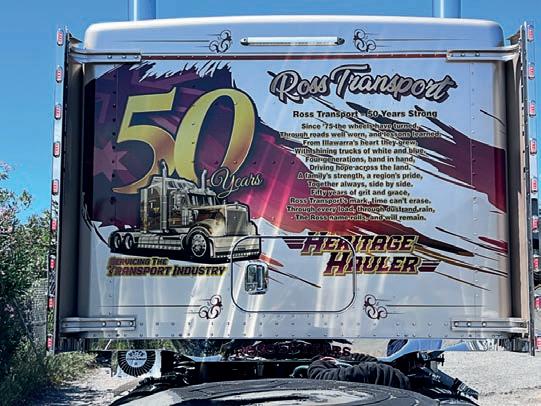
The stripe detailing follows the regular Ross transport stripes, albeit a little jazzed up and in gold and brown hues (rather than the standard blue) to match with the theme. Then a poem on the back of the truck tells the story of where Ross Transport started to where it is now.
“We changed all the steps to old style steps, added 8-inch stacks, coolers, a microwave, fridges and a television,” Alan added.
The truck is being used in a B-double set-up to transport steel across the east coast for BlueScope steel, predominantly to Melbourne, Sydney and Brisbane; with the flat tops both painted to match the truck.
Despite being a little nervous about how the truck would turn out, Alan said he’s thrilled with the end result.
The lucky driver behind the wheel of the head-turning ‘Heritage Hauler’ is a go-getting youngster named Jett Starcic. The 21-year-old started out in the workshop, completing his diesel mechanic apprenticeship with Ross Transport before beginning his transition to driving about two years ago and working his way through the licence classes and up to his MC in November 2024.
For the past few months, Jett has been driving interstate full time.
W hile Jett’s only been driving for Ross Transport for a short while, he’s been taking trips in the company’s trucks ever since he was a little kid –only back then he was sitting alongside his truck driver father Adrian Starcic.
“I actually grew up sitting in the passenger seat with Dad at Ross Transport – I used to go out with him on a Thursday or Friday. He was also a workshop foreman, so I’d get to cruise around the yard. Now Dad’s a tipper allocator. He’s done a number of different roles there,” explained Jett. “I’ve always been around trucks.”
In fact, Jett’s step-mother Hayley Powis also drives for the company, with her truck being the Bluey one, a popular favourite among many k ids.
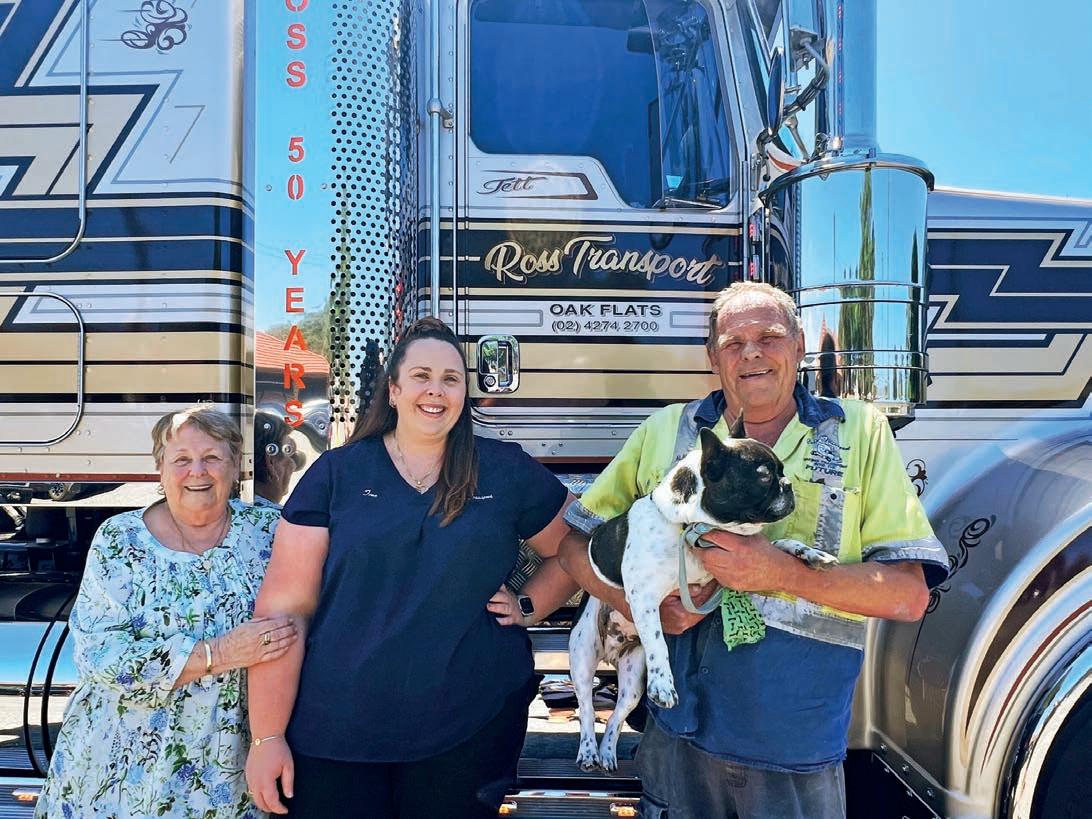
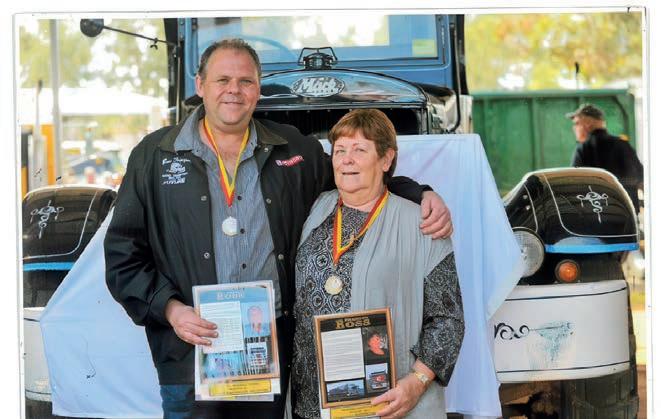
Three generations: Frances Ross, True Ross-Sawrey and Alan Ross with his dog Astro. Images: Ross Transport
Alan and his mother Frances Ross were inducted into the Shell Rimula Wall of Fame in 2010.
Mechanic turned truck driver Jett Starcic, 21, is stoked to be behind the wheel of the impressive rig.
A poem about the company’s story is featured on the back of the milestone truck.
can be seen on many parts of the truck, even the plates.
Speaking of his own journey at Ross Transport, Jett explained, “I did an apprenticeship as a diesel mechanic first. I did the trade so I had something behind me, but I always k new I was going to drive. Dad was the one who used to take me out to learn the ropes.”
When Jett found out about his flashy new ride, he couldn’t wipe the smile off his face. “I never once thought I was
getting that truck. There was an old 908 in the yard, so I thought I’d be driving that one,” he admitted.
“Alan and True pulled me into the office. They sat me down and said we needed to have a chat. I thought, oh no, what have I done wrong!
“When they told me I was getting the new gold T909, I was smiling from ear to ear.”
Since taking the wheel of the
blinged up anniversary truck, Jett says it’s been getting a hell of a lot of attention. “I love it though – you get a lot of people taking photos of it and many of them spin out when they see a 21-year-old getting out of it.”
Alan added that one of the biggest challenges he’s seen over the past 10 years is that it’s become so much harder to find good staff – from drivers
through to the workshop.
That’s why Ross Transport places such a strong emphasis on training up young people like Jett.
The company generally takes on two new apprentices each year. For 2026, three new apprentices have come into the mix. “Mechanics are so scarce, so we like to train up our own. I feel very confident in the new apprentices we have coming
through,” Alan said.
With difficulties in finding staff, rising costs and having to compete in an industry rife with sham contracting, Alan said to ensure the company stays strong, “You’ve got to keep at it and remain focused. You can’t afford to drop the ball at all. There are so many sham contractors who are killing the industry. Our land rates and taxes are so high but
then you’ve got these operators out there parking trucks on the streets because they don’t have any depots.
“You need to play it smart to keep surviving in this industry. I’m lucky that we’ve been around for so long so we have a lot of resources. I’m not planning on buying any equipment this year – as we ensure the business stays strong well into the future.”
The ‘Heritage Hauler’ is now hard at work, travelling the east coast. Image: Jett Starcic
I
I
FROM $65
NON-MEMBERS FROM $70
I Axial Seal Primary Air Filters
I Protects engines from airborne contaminants
AF351KM $65 $70
Suits Kenworth K & T series
AF1968M $87 $97
Suits Kenworth K & T series and Volvo/ Mack Trucks
AF887KM $110 $115
Suits Kenworth K & T series
AF1969M $121 $131
Suits Kenworth K & T series and Volvo/ Mack Trucks
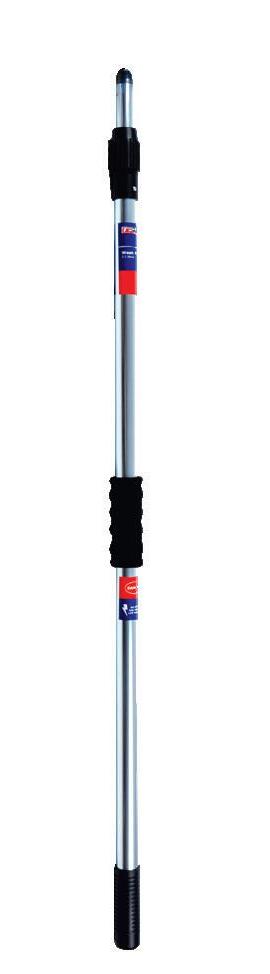
Wash Pole MEMBERS FROM $30.95
NON-MEMBERS FROM $34 .95
I Heavy duty expandable 2-section pole I 32mm and 28mm diameter polished alloy
TRP25WP $30.95 $34.95 2.5m
TRP3WP $39.95 $49.95 3m
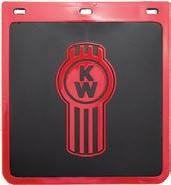
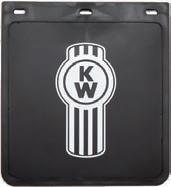
PVC Ute Mudflaps
FROM $12 .95
Y78-KW-1017
Black, red Kenworth Bug
Y78-KW-1017 $12.95 250x230mm
Y77-KW-1016 $19.95 280x300mm
Y80-KW-1019
Black, white Kenworth Bug
Y80-KW-1019 $12.95 250x230mm
Y79-KW-1018 $19.95 280x300mm
TRP25WP
Continuing the family tradition
Inspired by her truckie father and grandfather, this third generation truckie is enjoying life on the road, having recently earned her MC.
BY DANIELLE GULLACI
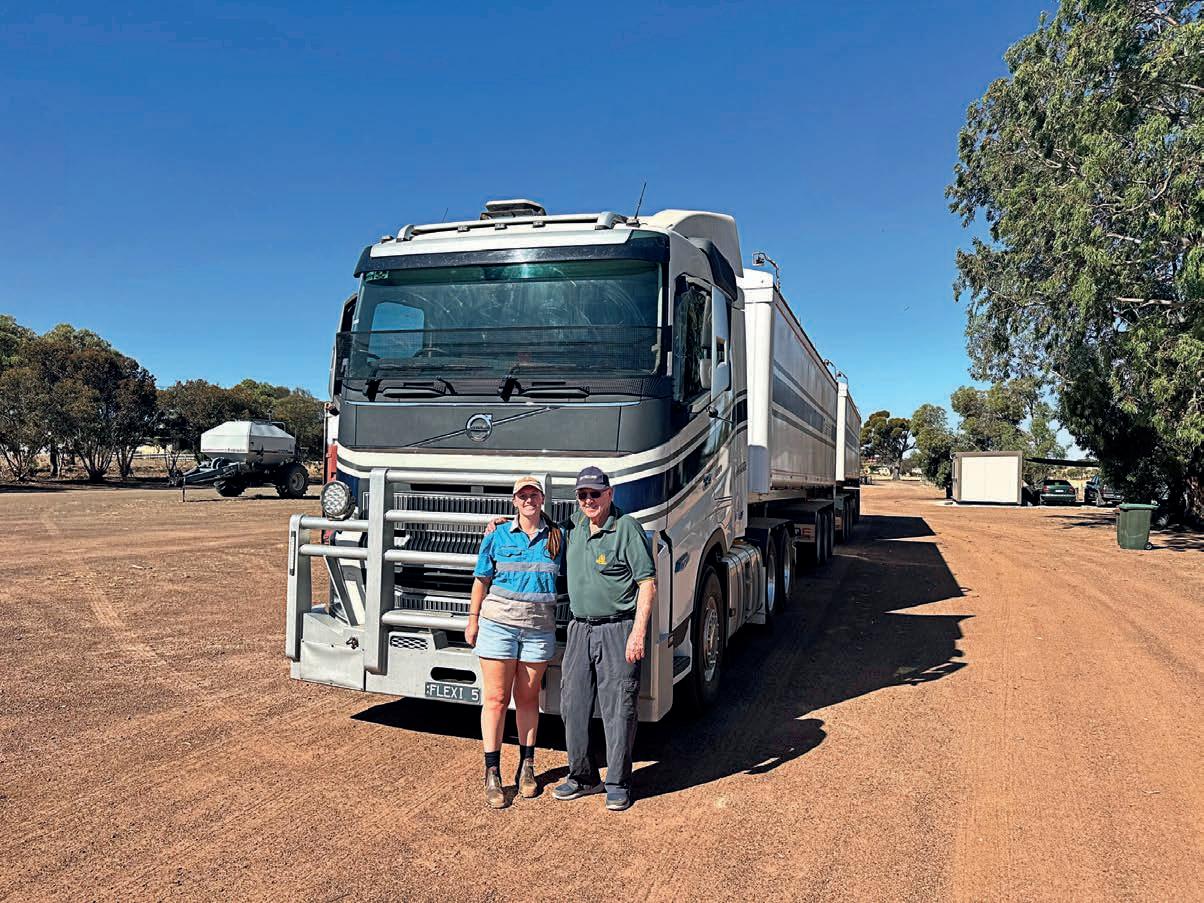
AS 23-year-old Danée Bairstow recalled, her first trip across the Nullarbor was in the passenger seat of her father’s truck when she was only five years old.
Based in Dumbleyung, Western Australia, Danée has grown up in and around trucks all her life. While she admits she wasn’t always sure she’d follow the same path, Danée’s been enjoying the freedom of the road.
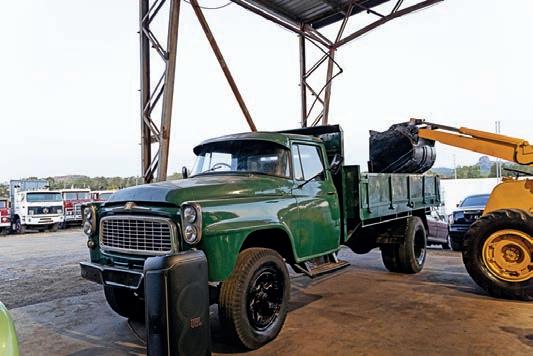
Her grandfather, Terry Bairstow, only recently retired from truck driving at 83 years of age, with over 6 million kilometres under his belt. From learning to drive trucks on the farm from as young as eight years old, his journey into trucking started in 1971, when he purchased his first truck, a brand new red International Acco petrol powered V8.
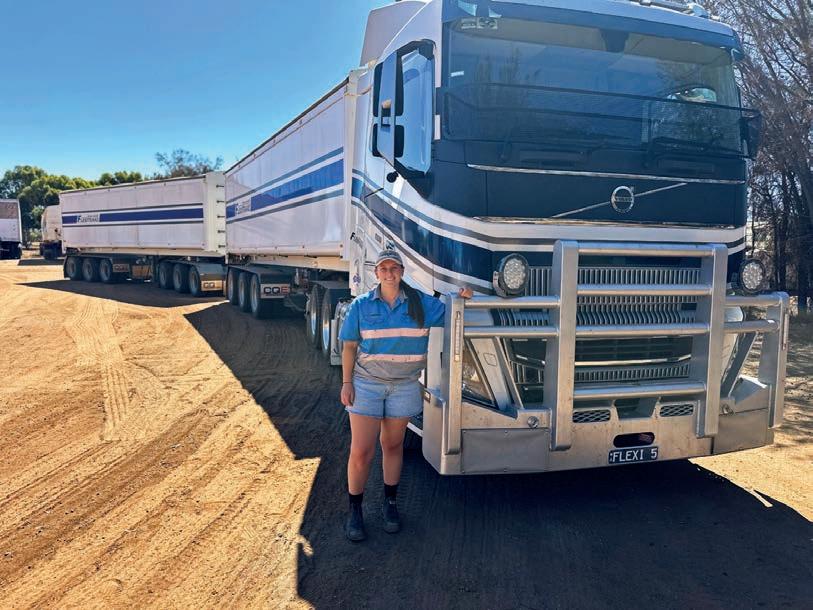
Terry was still driving road trains up until November 2025, carting grain, fertiliser, gypsum and lime around Western Australia. Three of his children followed his footsteps, driving trucks and running transport businesses – including Danée’s father Darran Bairstow. And now, two of Terry’s grandchildren. Darran and his wife Carmen Bairstow both have their MC licences and have run their agricultural transport business, Flexitrans, for a lmost 25 years.
Danée’s aunty and uncle run a separate transport business. While another uncle has continued working a longside his father Terry. And her cousin is a truck driver too.
The Bairstow name has been synonymous with trucking for decades – and Danée is proud to be able to continue the long-held fami
Danée and her brothers Orson and Eden, heading out in the truck with Dad was an opportunity to spend quality time together.
“I got to do a few trips across the Nullarbor, Orson got to go to Port Hedland, and my brothers both went over east with Dad and Pop
well, so she’d drive at harvest. They’d fly my grandmother over from the Gold Coast and she’d stay for about two months during harvest to look after us and send us to school.
“Then as we got a bit older, during harvest we’d go for drives with Dad, and he’d
When trucking is in the blood, the road comes calling. “I think family comes into it too,” said Danée. “To do something that my grandparents and parents have done for so long – there’s that real sense of belonging.”
Danée has been working in the family business for the past two years, initially she was doing bookkeeping and office work. It was only in November 2025, in time for the harvest, that she began driving full time.
“Before that I did a few loads with containers and tankers – with Dad in the passenger seat,” added Danée, who’s
hroughout the harvest.
“This was a long harvest. I’ve been carting from local farms, for a client in Wagin, and going to the port in Albany. My favourite trips so far have been to the Albany port. You come down the hill and get these views of the ocean and then get to drive along the coast which is really cool,” she said.
From February, with harvest finishing up, Danée began doing more of the container work.
“I definitely prefer the tipper work – maybe that’s because I’m more comfortable in the tippers because I’ve done that the most. I’m still
FAMILY COMES INTO IT TOO. TO DO SOMETHING THAT MY GRANDPARENTS AND PARENTS HAVE DONE FOR SO LONG – THERE’S THAT REAL SENSE OF BELONGING.”
DANÉE BAIRSTOW
learning my way around.
“The other thing I enjoy with the tipper work is that there’s more social interaction when loading and unloading, instead of being in the truck on your own all day.”
Danée says the work is really gratifying too. “I enjoy being able to get the load from point A to B. Having done my MC too and being able to drive the big gear feels like a big accomplishment. I wasn’t sure if I could do it, it always seemed like a very hard job. Some things are a bit physically demanding, but being able to prove I can do this is really cool.”
And while the days are often long, Danée added, “They don’t feel that long when you’re out on the open road.”
Danée Bairstow is behind the wheel of a 600hp Volvo FH pocket road train. Images: Danée Bairstow
Danée got her MC licence in August, in time to work the harvest.
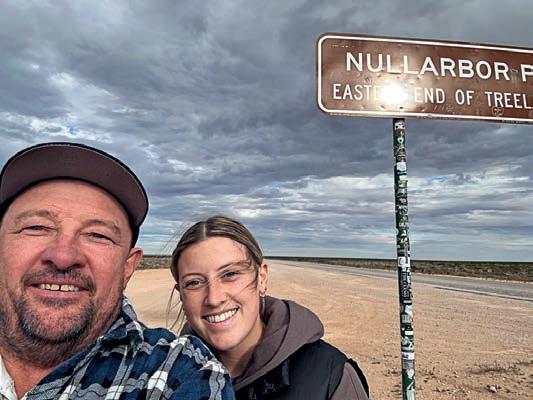
Danée with her father Darran, stopped at the Nullarbor.
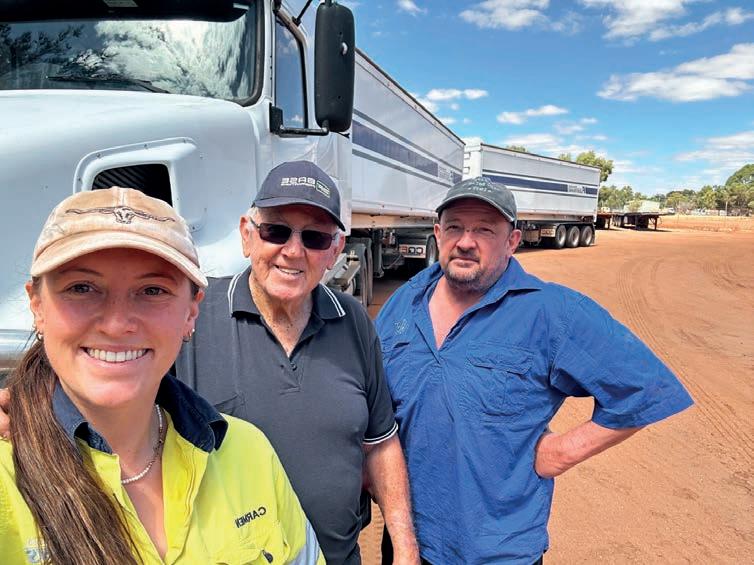
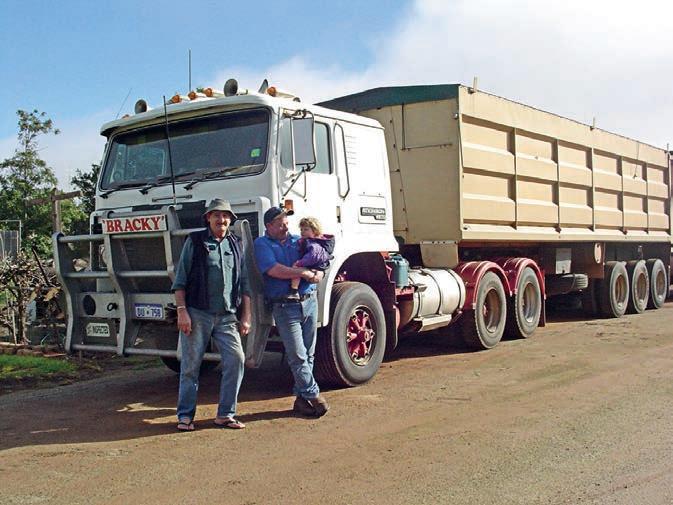
Danée and her father Darran with Brian ‘Bracky’ Bracknell (right) who the family purchased their business and first truck from in 2004.
Keeping a town’s history alive
A retired truck driver giving back to his local community has taken top honours at Isuzu’s 2025 Truck of the Year awards.
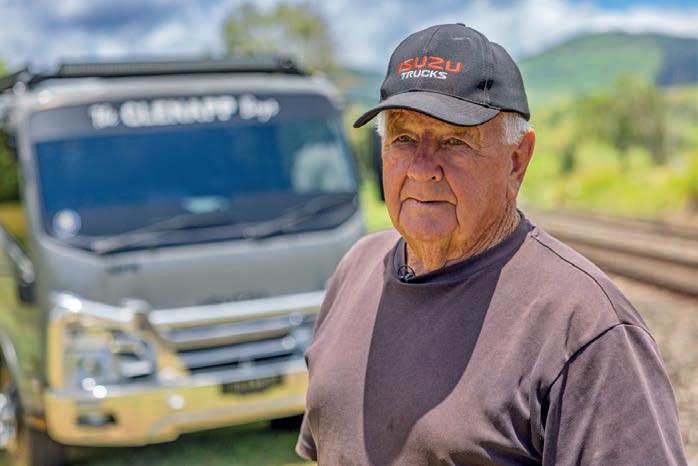
A former owner-driver and furniture carrier, Rob Sibson has driven just about everything over his many years on the road, from Japanese light trucks through to European rigids.
Though he’s now officially retired, Rob has no plans to slow down. Instead he’s doubling down on the things that matter most: time outdoors, hands-on work, and a lifelong passion for a place that helped shape who he is.
Set against the rolling hills of the Scenic Rim, just a few kilometres outside Rathdowney in rural Queensland, Glenapp Railway Station is a quiet reminder of Australia’s rail history.
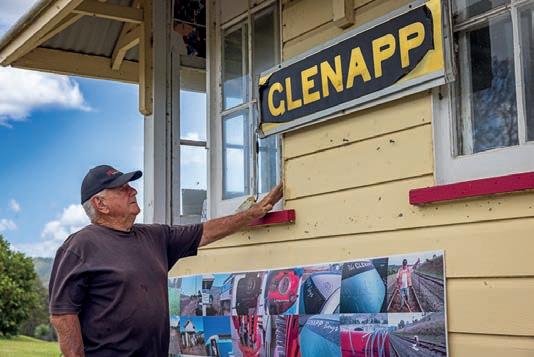
It’s also where Rob can usually be found, tending the grounds, maintaining the heritage signal box, and keeping the story of the place alive.
“I just don’t want the place to die,” Rob said. “It’s paradise. I just have a passion for this place like no other.”
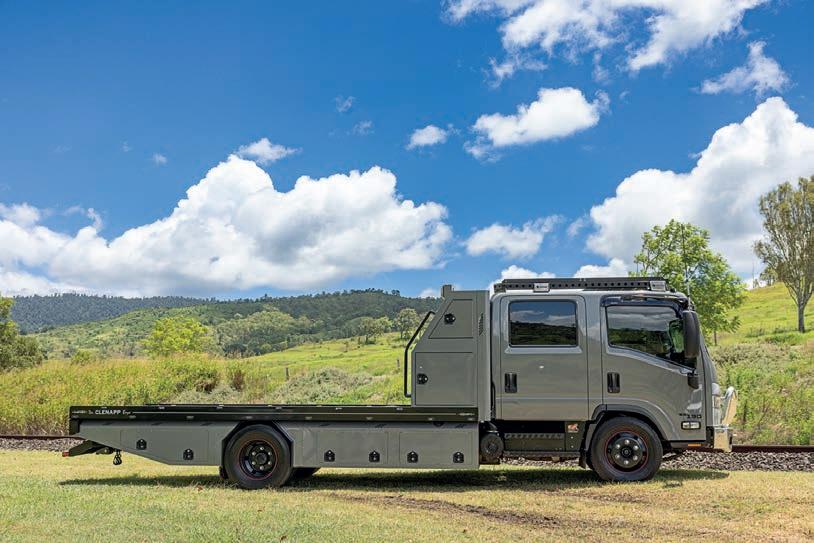
Supporting that passion is Rob’s eye-catching Isuzu NPR 65-190 Crew Cab, a truck that now plays a very different role to the workhorses he drove during his long career behind the wheel, but one that is no less important.
Rob entered his NPR 65190 Crew Cab in Isuzu’s annual Truck of the Year competition last year and it recently received the top prize – impressing the judges with its outstanding presentation, versatility, and the meaningful role it plays supporting his volunteer work for his local community.
“I’ve had a lot of trucks over my life,” Rob said. “Good ones, average ones, and a few that taught me important lessons. But my history with Isuzu has been phenomenal.”
That relationship with the brand started in the 1980s, when Rob returned to Australia after living overseas and opened a furniture business alongside his wife.
One Isuzu became two, then three, each step reflecting a growing operation and a need for dependable transport.
“I used to run to Sydney, pick up our own furniture and deliver up and down the coast,” Rob said.
truck had to do the job, every time.”
Reliability, drivability and support were never abstract concepts, they were the difference between keeping promises to customers or sitting on the side of the road.
Today, Rob is no longer running freight schedules, but his standards haven’t changed.
Rob’s current Isuzu NPR 65-190 Crew Cab is technically his daily driver, but in practice, it’s much more than that. “I drive it everywhere!” he said.
“Shopping centres, airport runs, out here to Glenapp every weekend. If people don’t like riding in a truck, they can take another car, but this is what I drive. I just love it.”
The NPR’s versatility was a big part of the appeal. The truck sits in a sweet spot for owners, able to be specified for either a car licence (4500kg GVM) or light truck licence (6500kg) variant.
gear, tow when I need to, but still be comfortable enough to live with day to day.”
Power comes from Isuzu’s 5.2-litre 4HK1-TCC engine, delivering 140 kW and 513 Nm of torque. Paired with Isuzu’s six-speed Automated Manual Transmission (AMT), it’s a combination Rob rates highly.
“The transmission in this truck is just awesome,” he said.
“I love that I can manually control it properly. Put it in manual mode, it’ll hold a gear on the hills, and it stays there. You don’t lose momentum, and if you know what you’re doing, you’re always in control.”
That control matters on the rolling roads between the Gold Coast and the Scenic Rim, particularly through the ranges where loaded vehicles can quickly feel out of their depth.
“I’ve taken it up Toowoomba Range with a trailer on, gear in the back, and it just holds its own,” Rob said.
“Exhaust brake on, not riding the brakes all the way down. That’s the sort of thing that makes a real difference in a truck.”
Like many experienced operators, Rob knew exactly what he wanted from his truck.
Rather than opting for an off-the-shelf body, he worked closely with trusted trades to design a setup that suited his needs and reflected his personality.
“I didn’t want a wide body,” he explained. “I wanted to see my tyres in the mirrors. I wanted it to look right.”
From custom bodywork and paint right through to powder-coated aluminium wheels, auxiliary fuel capacity and airbag suspension enhancements, the NPR has been carefully tailored.
It’s a reflection of a lifetime spent around trucks and an understanding that small details add up to a better driving experience.
“It took time to get it right, but if you take your time, you get what you want,” Rob added.
“The truck itself is standard, but I’ve added what I wanted. Ride comfort, pulling power, turning circle, it’s all there.”
Despite its size, the NPR’s manoeuvrability continues to surprise him. “It’s got a better turning circle than most vehicles,” he said. “You can get it into places people don’t expect a truck to fit.”
Every Friday, without fail, Rob loads his truck with supplies and heads out to Glenapp, where he spends the weekend maintaining the historic site that he and his late brother, Dennis, began restoring years ago.
The Glenapp signal box, decommissioned in the early 2000s, is now one of the few remaining examples of its kind in Australia. Thanks to Rob’s dedication, it stands in immaculate condition, surrounded by carefully maintained grounds.
“This isn’t about money,” he said. “There’s not one cent involved. It’s passion. You can’t buy that.”
The NPR carries everything Rob needs: tools, fuel, maintenance equipment, and sometimes a place to rest.
“It’s a crew cab, so I sleep in the back of it sometimes,” he said.
“I’ll sit here in the afternoon breeze, look out over the valley, and just take it all in.”
While the truck itself ticks all the boxes, Rob is quick to point out that ownership is about more than the product.
Ongoing support has played a major role in his loyalty to the Isuzu brand.
“I get my truck serviced at Gold Coast Isuzu and I don’t go anywhere else,” he said.
“Even if somewhere else might be a bit cheaper, I want people who know what they’re doing.”
“If you look after the vehicle, it’ll look after you.”
For Rob, his NPR is quietly supporting a project driven entirely by heart. “I’m not getting paid to say this,” he said. “This is just me, from the heart. This truck is the best I’ve ever had. It does everything I ask of it.”
As the sun drops behind the hills at Glenapp, the signal box stands proud, the grounds neatly kept, and Rob’s Isuzu parked nearby, ready for the next trip.
For him, it is not about accolades or recognition. It is about turning up, week after week, with the right tools to do what matters.
“I’ll be here until the day I fall off the perch,” Rob said. “And this truck will be with me the whole way.”
Entries will open this month for Isuzu’s 2026 Truck of the Year competition. Isuzu owners can enter their truck by visiting isuzu.com.au and completing an entry form.
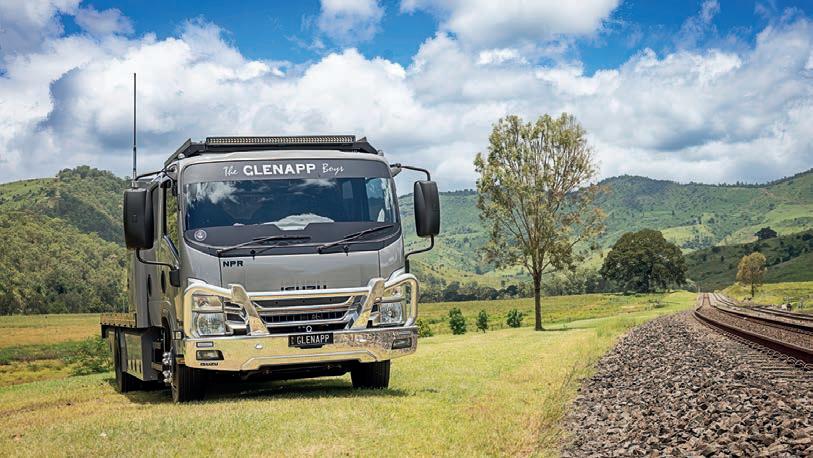
Rob Sibson’s Isuzu NPR 65-190 Crew Cab has been named Isuzu’s 2025 Truck of the Year. Images: Isuzu
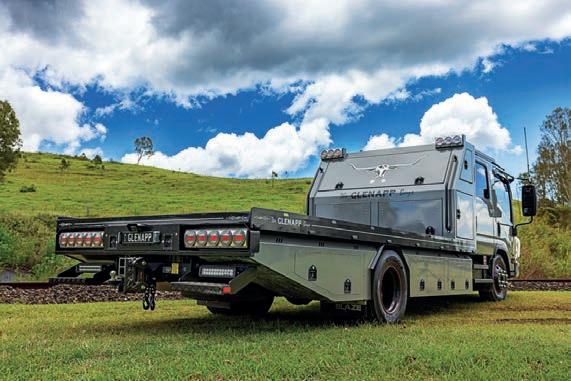
The impressive NPR 65-190 features custom bodywork and paint.
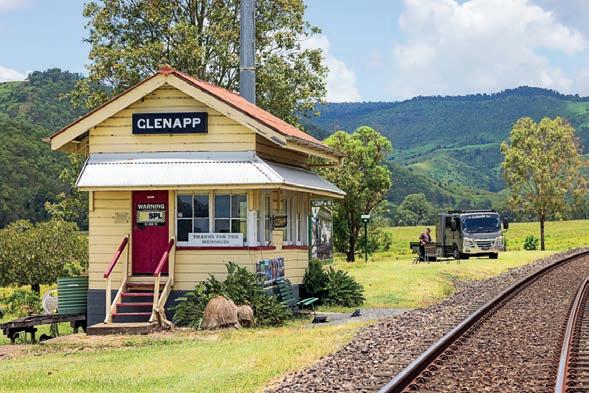
Rob spends his weekends maintaining the historic Glenapp Railway Station site.
Thanks to Rob’s dedication, the Glenapp signal box stands in immaculate condition.
Is your workhorse pulling its weight? If youʼre still driving a ute, nowʼs the perfect time for an upgrade. The all-new Isuzu Ready-to-Work range tows and carries more than your average ute. It also comes with a sleek new cab design, more advanced safety features and car-like comfort. With a wide choice of factory-built bodies designed to our exact specifications, Isuzu Ready-to-Work trucks are ready to get the job done. Are you ready to step up to a redefined workhorse? Head to isuzu.com.au or visit your nearest Isuzu Trucks Dealer today. The all-new Ready-to-Work range.
The workhorse redefined.
For 60 years, and counting
This 85-year-old Queensland transport operator looks back
started over 60 years ago, with just one truck
BY DANIELLE GULLACI
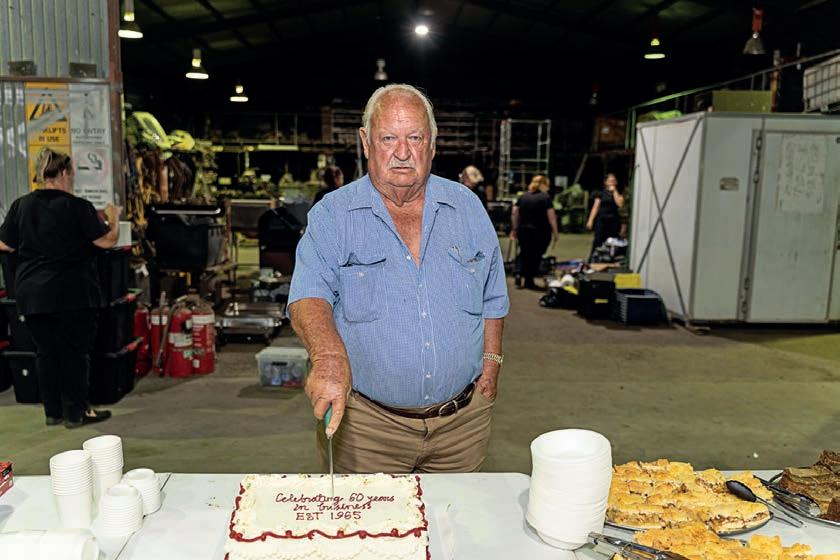
FRANK Klan may have re cently celebrated his 85th birthday, but says his southeast Queensland transport operation, Klan Group, has been such a big part of his life for so long that it would be hard to give it up.
It’s been a while since Frank has been on the road in one of his trucks – at least 15 years to be precise – however you’ll still find Frank at the depot almost every day.
“I couldn’t just walk away from this business. It really grows on you after 60 years –and it’s all the people here as well, who I’ve met along the way.”
Asked how he started out in the transport game, Frank recalled the exact moment he decided he’d give trucking a crack.
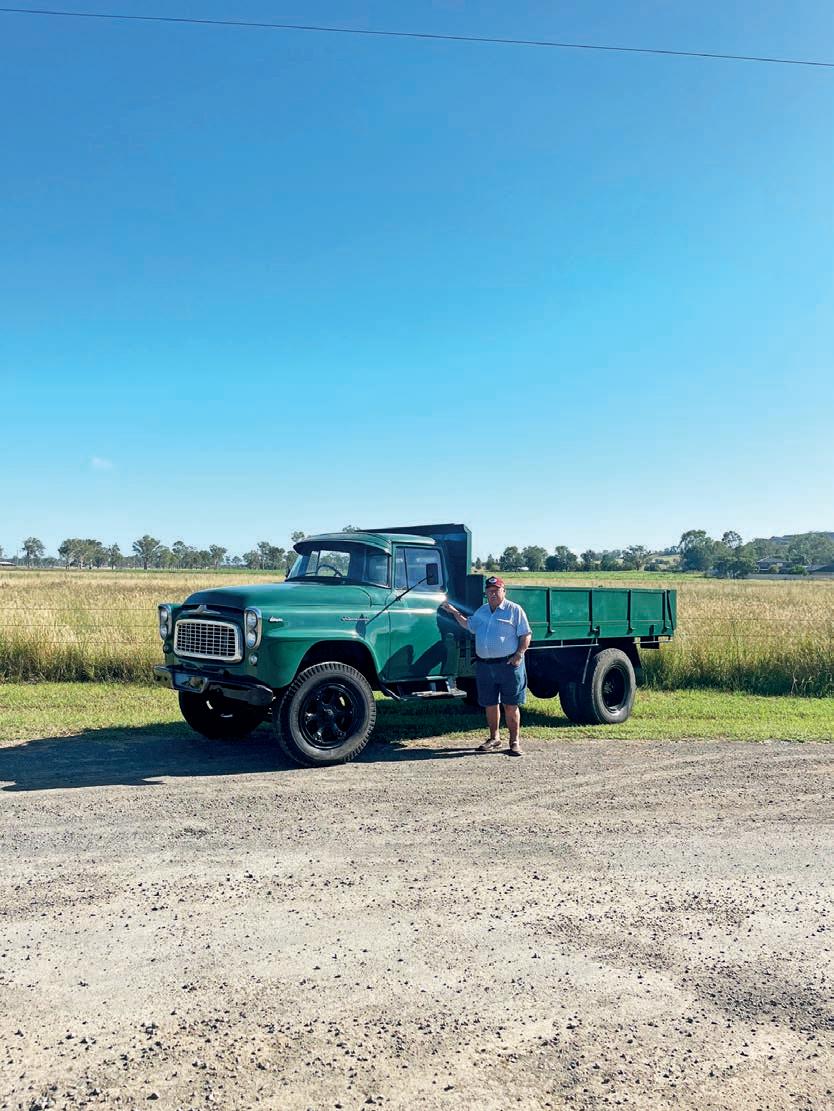
It was 1964 and Frank was working as a bridge carpen ter for Transport and Main Roads. “Us workers were earning 18 pounds a week and then I found out that the owners of the trucks were getting 18 pounds a day. So in January 1965, I bought my first truck, a second hand International AA180, and that’s how I started my business,” he said.
By October that same year, he traded in the old International for a brand new International AACO-180.
Business growth was slow and steady for Klan Group, based at Peak Crossing, not far from Ipswich.
“It was all tipper work from the beginning,” said Frank. “In the 80s and 90s we were running trucks interstate. The longest trip was from Cairns to Perth and we did everything in between.”
Reflecting back on a lifetime in the industry, Frank spoke of how much has changed. “We were still loading with shovels back then,” he laughed. “There was no power steering, no air conditioning, no fancy seats. My old International had a bench seat. Now these new trucks have all the bells and whistles!”
Frank says the company’s biggest period of growth was from the 1980s through to the 2010s. In recent times however, Frank has decided to scale back.
All the trucks now work closer to home, predominantly throughout south-east Queensland.
A lot of the work involves transporting materials out of three main quarries within the region, along with Frank’s own decomposed granite quarry. Located not far from the depot, it’s one of several other businesses Frank operates, along with a hotel, tyre shop and his farming interests. “Plenty to keep me busy,” he said.
Klan Group currently owns a fleet of around 10 truck and dogs – it’s a mixed fleet that
on the business he
and a whole lot of determination.
includes Freightliners, Ivecos, Sterlings and Western Stars.
Though Frank revealed he’s currently only running about six sets. “I’ve put a lot of them up for sale now. I’m winding things back,” he said.
“I’m 85, and it’s getting harder and harder all the time. In the early days it was all so different. It’s become much harder to get drivers –we don’t get as many of the younger ones coming in, and sometimes when they do, they don’t have the right attitude. We would work more trucks if we could get the drivers.”
Asked if the ‘r’ word had crossed his mind, Frank replied, “I’ve not thought about retirement – now I do as much as I can still do. We put a lot of effort into this business over the years, working day and night, to keep the business going. You take the good with the bad.
“We’ve been fortunate that
over the years, we’ve never had any real hard times – I mean it’s always hard managing a transport business, but we’ve been able to manage it properly.”
Frank credits much of Klan Group’s success to its people. “A business is only as good as its staff. I’ve been lucky I’ve had a lot of good operators, good drivers, great allocators and transport managers, and great people in the office.”
There are now three generations of Klan family members working at the business – Frank’s children Tony and Kathy, who have been there for many years. And more recently, Frank’s grandson Cameron who works in the workshop.
One staff member who Frank says deserves a very special mention is Steven Hodgson. He’s worked by Frank’s side for the past 55 years. “Steve started here washing trucks
when he was 16 and now he’s 71. This business has been his whole life too,” said Frank.
“He’s my main mechanic. Without Steve, I’m sure we wouldn’t have had the success we’ve had. He’s worked so hard for all these years and he’s still working here now.”
When Frank spoke with Big Rigs, he was actually in the workshop with his mechanics who were working to restore some pieces for Frank’s personal collection of vintage tractors, trucks and cars. “I’ve got a mix of everything – a lot of old tractors and a few old trucks.”
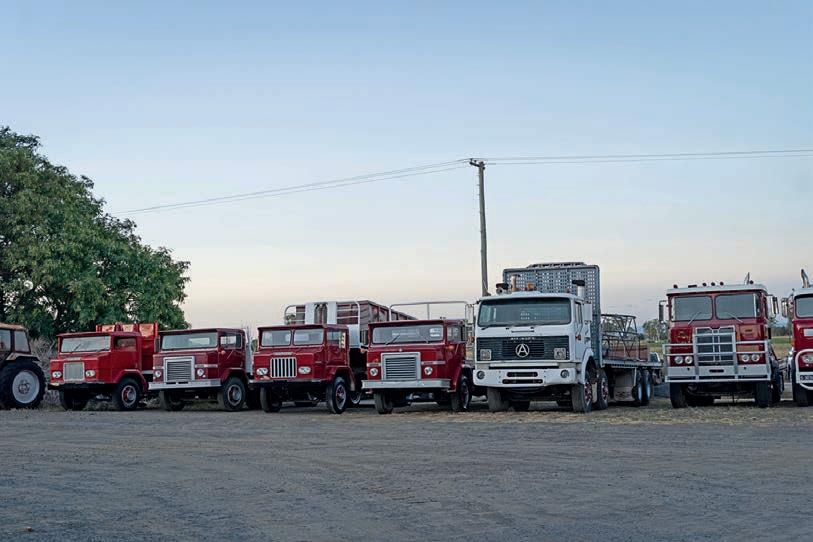
But perhaps the most sentimental of them all is his oldest truck. “It’s not my original International AA180, but it’s identical to the one I started out with. We sourced the same type of truck and redid that one over the last few years.”
That vintage International AA180 was among the trucks
on display during a special 60th anniversary celebration held in the company’s workshop on Saturday February 7.
“We decided to hold that after completing our 60th year, so we’re into our 61st year now,” said Frank.
Asked how it went, Frank said “it was bloody good!”
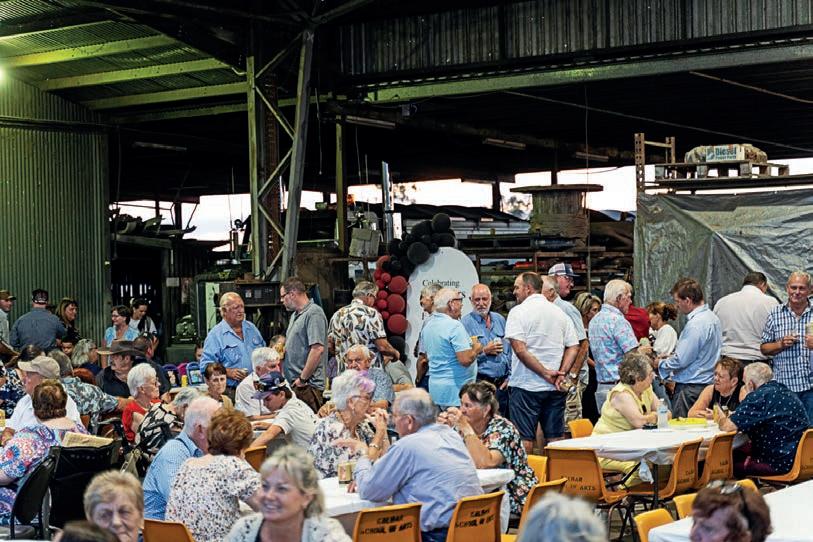
The special evening brought together 200 people – staff past and present, suppliers, family and friends.
“I was fortunate enough to start this business off by myself, with one truck,” Frank said, hopeful that Klan Group continues well into the future.
The anniversary event was well attended by staff past and present, suppliers, family and friends.
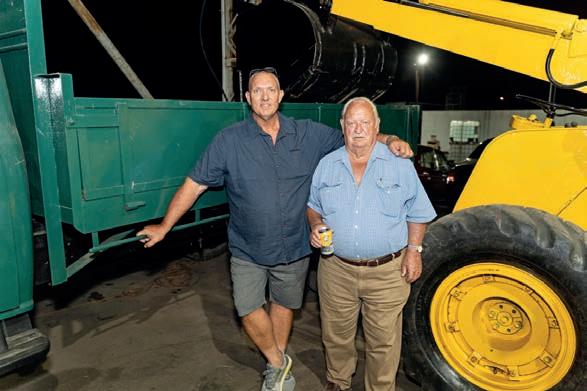
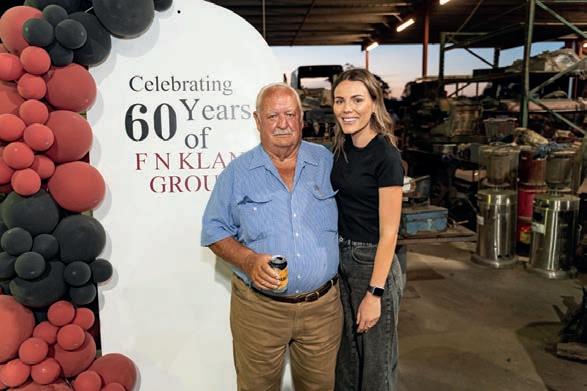
Frank with granddaughter Jessica O’Connell.
Frank with Klan Group Transport Manager Brett Rieck (left).
Frank’s oldest truck is this International AA180, identical to the first truck he ever purchased.
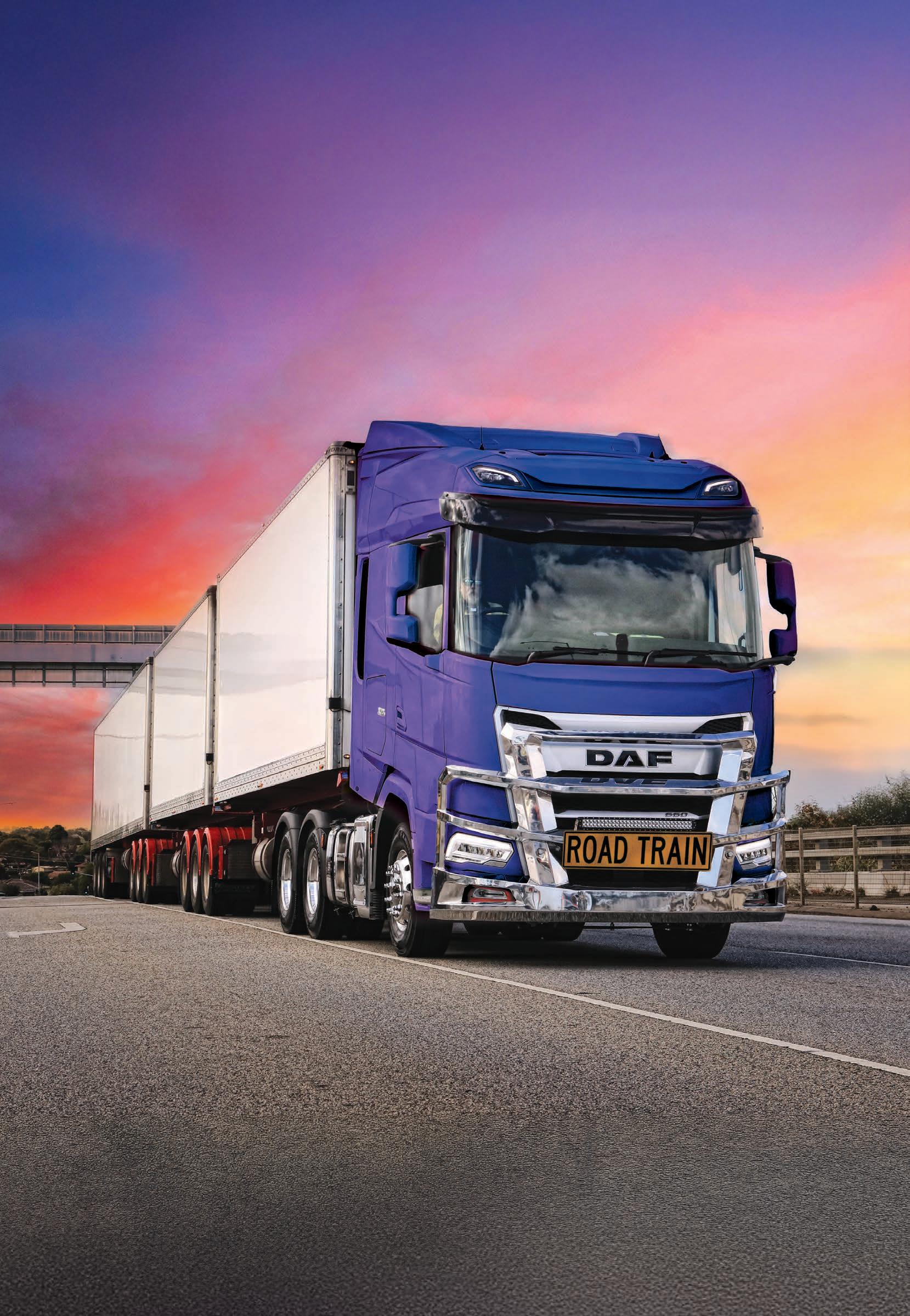
DAF XG. Do more.
Meeting up with old mates and new
Our
roving reporter returns to Lancefield for the 16th straight year to catch up with some familiar faces.
BY GRAHAM HARSANT
MY records show that in 2010
I ventured to Lancefield, Victoria, to cover their truck event for the first time as a mature-aged cub reporter.
Now, after 16 consecutive years of attendance, I worry if there is anyone in the American Truck Historical Society that I haven’t interviewed, photographed or videoed.
But, thanks to the passing of time, there are always new faces to join the long-standing ones I’ve come to know.
It takes a while to realise that when Geoff Brown (no ‘e’ on the end he told me when we first met, because his mother couldn’t afford it) and his mate, Crackers welcome you with a groan and a, “Not you…AGAIN,” that it is actually a warm welcoming of my presence.
I’m writing this story so I can interpret those groans and words any way I like.
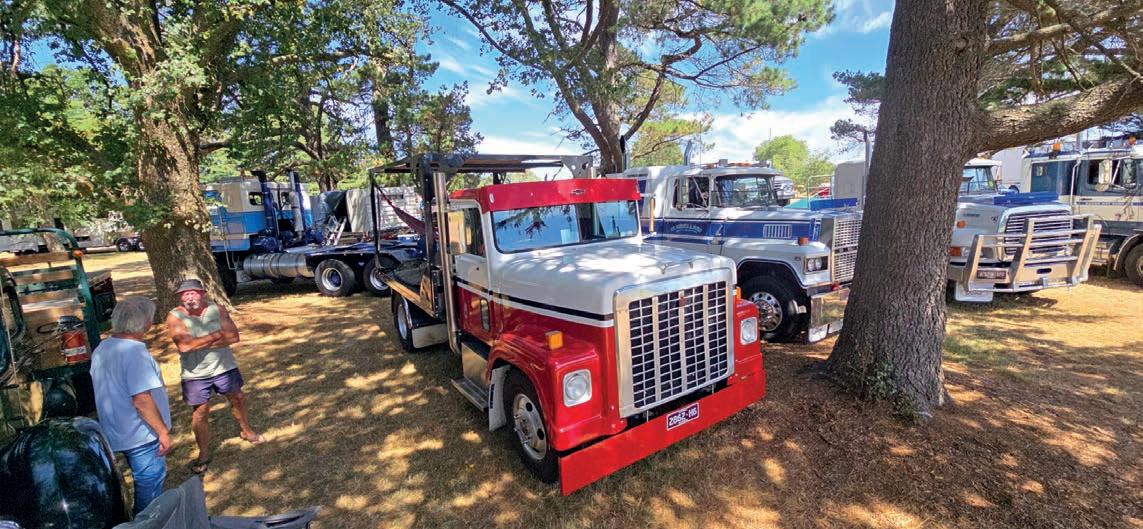
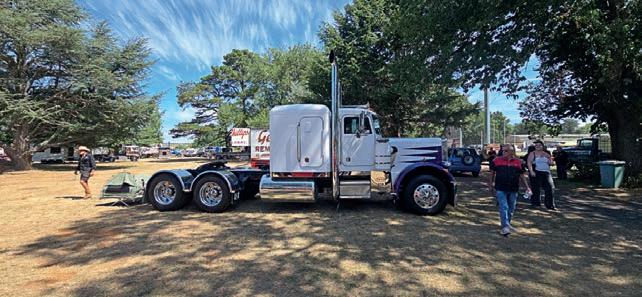
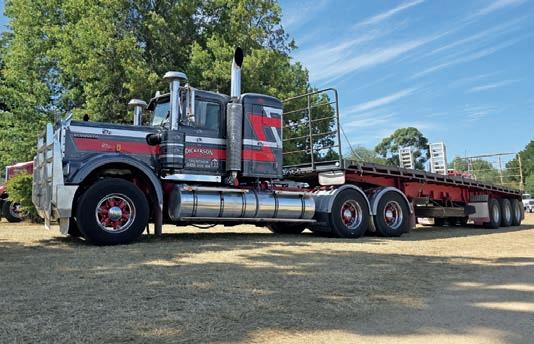
You can count on over 200 trucks of all ages and sizes turning up to the Lancefield weekend and this year was no exception.
The beauty of this event is its surroundings.
Have a look at some of the attached photos and you will see oaks and other large trees adorning the local sports ground area.
It’s the perfect spot to pull up, set up a chair, grab a refresh ment and regale companions with tall tales and true for a couple of days. Of course, with well over 200 trucks – many with trailers attached – you need to arrive early to grab the shady spots.
Joe Wood wasn’t an early ar rival so had to park up next to a black trailer and wait until the sun went over the yardarm. We interviewed Joe (and son, Alec) a few years back at Deniliquin and met his beloved W model Kenworth.
Joe has owned ‘Still Doin’ Time’ for 32 years and has always, and is still, working it. Consequently, the old girl was starting to show some signs of wear and tear. So, time to do a bit to it.
“With Alec’s help we gave it a quick paint. He’s an engineer, not a painter, but is better than me,” says Joe.
“We stripped it down and painted it in two-pack over five days. This was done outside and the weather wasn’t doing us any favours.
“The truck is a ’67 model and was first registered in 1968. I ran interstate on it for six years. Now she does local around Melbourne and works every day. I wouldn’t have it any other way. I’m not making any money if it’s sitting still.
“As I’ve said before what would I buy? I still enjoy this and it’s comfortable enough. I work for Tasman Logistics so everything that comes across from Tassie we deliver around Melbourne, reload and take it
“Then another week or two to put it all back together and this is what it came up like. I had no idea what we were doing so thank God for Alec and his expertise.
back to the boat at Port Mel bourne or Geelong.”
Adorned with Alec and Sister Kayla’s names on the back of the truck, Evie Rose has also been added. “My granddaugh ter,” notes Joe.
On the door is J & S Wood, PLENTY, which hopefully means plenty of work.
“My wife says, “where is my name on the truck?’ I said you’ve got the S on the door, what more do you want? She got a new car for Christmas and I got a paint job.
“The air cleaners in burgundy came up really well, giving the truck a pop of colour. Bob Conway from Benalla did the scrollwork. I put some new door trims on the inside but that’s it so far. One thing at a time I say. Rome wasn’t built in a day. And time off the road is no money.”
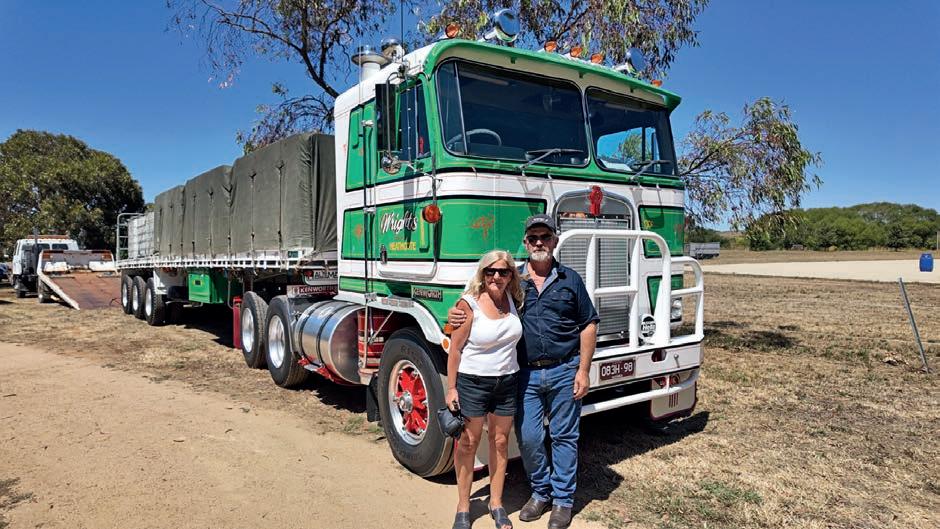
Wayne Wright has owned his 1976 KW for eight years.
“It was going to a scrap metal dealer who was a mate of mine. It had been sitting around for 10 years I believe, parked in a timber yard in Melbourne. It had been a workhorse and
needed a lot of money spent on it, so I said I’ll give you scrap value for it. I did just that and now, probably $150,000 later here she is.”
Looking at the truck, it seems $150K well spent as this cabover is mint.
“I’ve restored it to its original condition, no chrome wheels or anything apart from the small hub covers on the drive. Otherwise, it’s spiders on the steer and the trailer. It has the original bullbar which came out from Kenworth.
“I did have to change the Small Cam motor which was cactus. Andy Walker from Riverina Truck Repairs is a mate
and had a good Cummins 350 Big Cam so that went in, followed by an 18 speed which he a lso sourced for me.
“I just take it to shows like here and Clarendon which was a first time for me and where it got a lot of notice I must say.
I was surprised at the amount of people who came up to have a look at it, and the old blokes who had driven them. Blokes who can’t climb up into them anymore.”
“I just wanted to keep the truck original – no chrome which is good because I couldn’t afford it. I just built it to the period of what was available at the time. It only has one
stack, one air cleaner.
The truck is paired with a 1976 Haulmark trailer which looks just as spectacular.
“I liked the Haulmarks and the year was right. My dad used to run a Haulmark trailer and I painted quite a few of them in the past for other people, doing road train work and stuff.
“My partner, Janet is starting to grow her fingernails back now after sanding and rubbing down. She was more than willing to get stuck in and helped me finish the truck as well. I’m very lucky.”
Lancefield: who will I talk to next year?
Joe Wood took the old girl off the road long enough to give her a lick of paint. You can see the difference that made from the ‘before’ shot in the inset.
Lancefield is always the best place to park a truck on a hot day.
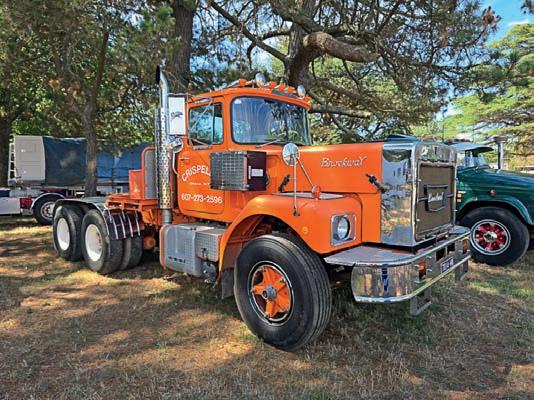
A very rare Brockway. Images: Graham Harsant
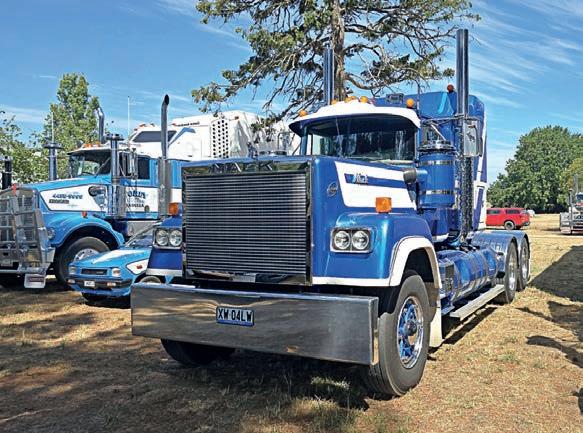
This classic Mack V8 Super-Liner drew plenty of admirers.
Wayne Wright and partner Janet Pratt worked together on Wayne’s superb 1976 KW. Amazing what $150,000 can do to a wreck.
Rick Sauerwald’s LHD Pete makes a welcome return to Lancefield.
RePOWER WITH MERCEDES-BENZ TRUCKS.
Keep your truck on the road with a new lease on life.
Mercedes-Benz Trucks understands that down time is not an option. That’s why we created Mercedes-Benz Trucks RePOWER.
RePOWER gives your truck a new lease on life. By refreshing key components, you have the flexibility to choose what is right for you, saving you money in the long run, and keeping your operations running smoothly - all backed by the quality and reliability of Mercedes-Benz Trucks Genuine Parts.
What is Mercedes-Benz RePOWER?
Available on 13L and 16L Mercedes-Benz Trucks, RePOWER has been developed to extend the operational life of your truck by providing you with five different options to overhaul the truck’s key driving components.
With RePOWER you can have the reassuring certainty of continuing to operate the Mercedes-Benz truck you own today, with a re-powered version. For added peace of mind, our Mercedes-Benz Trucks two-year parts warranty1 is included for any parts fitted under any of the RePOWER packs (provided that the works are carried out at an authorised Daimler Truck dealership).
What are the RePOWER options?
With five RePOWER options to choose from, you’ve got the flexibility to choose a pack that’s right for you.
Timber town turns it on with big parade
BY DAVID VILE
THE proud Victorian Timber Town of Heyfield has turned it on with another successful Timber Festival which was held on February 21.
The day kicked off with a street parade featuring a variety of trucks from the local timber and associated industries making their way through the central-Gippsland town centre to a festival day at the Gordon Street Recreation Reserve.
Felicia Stevenson, from the organising committees was delighted with the roll-up of trucks all of which were presented to a high standard, with the festival re-launched in 2021 during the shutdown of the native timber harvesting industry in Victoria.
“Heyfield is one of 11 timber towns in Victoria affected by the industry shutdown –we used to have heaps of log trucks in Heyfield so these events help us hang on to that history” she said.
For livestock carrier Connor Gilbertson, it was a successful day out with his Kenworth T909, collecting the Truck of the Show award.
Other winners on the day included Sam Dicker who
won Best Log Truck, Les Siddle’s ‘Bopperliner’ 1982 Mack Super-Liner winning Best Modern Vintage and the team from Bedggoods Transport from Maffra taking out
The category winners were:
Truck of Show Connor Gilbertson, 2024 T909 Kenworth
Best Log Truck Sam Dicker, 2024 909 Kenworth
Best Tipper Jarred Witherow, 2018 T909 Kenworth
Best Display Shane Marshalls, 2006 T403 Kenworth Committee’s Choice Terry Mumford, 1974 International C184
Best Modern Vintage Les Siddle, 1982 Mack Super-Liner Best Vintage Nellie Coleman, 1966 Mack B-Model (Red)
Best Fleet with their line-up of Kenworths. Following the success of the event the committee will soon be making plans for the 2026 festival.
The Kenworth of JD & SL Cook Transport from Glenmaggie led the street parade through the Heyfield town centre. Images: David Vile
Young livestock hauler Connor Gilbertson took home the Truck of The Show honours with his Kenworth T909.
Graeme Fenn’s recently restored ex-Telecom Mack FR-786 was a real head-turner.
Gold Fever: The Kenworth T909 of MJM Haulage of Yarram got the seal of approval from cousins Jess and Brooke.
The Bedggoods team [L-R]: Geoff Truin, Katrina Adams, Mat
The Richards Harvesting and Haulage team from Morwell was well-represented.
Les Siddle’s Mack Super-Liner went home a winner taking out Best Modern Vintage.
The line-up of trucks assembled after the parade through the Heyfield town centre. Cat-Powered International.
Western Star was represented with this beauty from A.B, L and D Murray from Drouin.
The industry-leading manufacturer of state-of-the-art engines and transmissions, Detroit sets the bar.
Specifically designed for integrated, optimised performance and efficiency inside Freightliner and Western Star trucks, the Detroit product portfolio has expanded to include advanced safety systems and telematics, delivering a total trucking solution.
Detroit – it’s loved by Aussies and trusted globally. DETROIT, SETS THE BAR. DetroitANZ.com | 1300 688 338
New emissions laws are here!
Rely on the platform that’s been trusted to meet them since 2019.
Truckies raise $296k for Camp Quality
BY GRAHAM HARSANT
EACH year around this time truckies converge on Geelong to take part in the Camp Quality Convoy for Kids.
There are 15,000 children registered with Camp Quality and without the support of events such as this, the organisation could not possibly do what they do, which is to bring some sunshine into the lives of these brave little souls.
But it’s not just turning up to go on the 40km drive around Geelong. It is the money raised that is vitally important to the continuation of Camp Quality. And this year 290 trucks and their trucking families raised $296,050 for this wonderful cause.
To make it even more memorable, 40 Camp Quality families joined in the convoy, creating a memorable experience for those who climbed aboard one of the trucks and waved at the thousands of folks who lined the route to cheer the convoy on.
Leading the parade in her Kenworth T401 was Chantelle Mattei who raised $19,295.
The Colac Crew lead the best Team fundraising effort (again) with an incredible $43,000. This year saw a new award called Fundraising Legends who collectively garnered over $50,000 for the cause.
But big or small, every dollar raised took time and effort by those who participated and all are to be congratulated.
This year also saw a new Platinum Sponsor of The Convoy in Daimler Trucks.
President and CEO, Daniel Whitehead, said it was the staff who pushed for the partnership.
“We went to our staff and asked what is it that you most want us to spend our money on as a company to represent you, that you can engage with,” Daniel said.
“Supporting kids with cancer was a clear winner. It was fantastic that everyone jumped on board and it was a clear preference from our staff to support this event.
“I must say that camp Quality have been awesome to work with. Vera (Entwhistle, founder of Camp Quality) and everyone engaged with it is been fantastic. We don’t want to just hand over money, we want to be engaged and we want to have an influence.
“As Vera said she has gained more out of Camp Quality than anyone else. We couldn’t have chosen a better cause.
“We will be doing it for the next few years. It is not something we do for one year and test the waters. We will do it for a number of years at least and see where we are at and how we can add value. This is just one part of it. We’ve already discussed with them how we can add value with some charitable stuff and auctions.”
This also gives Daimler a chance to showcase their products on a 40km run with thousands of people lined up along the street as well is at the show.
“It’s not the reason that we’re doing it,” responds Daniel. “Camp Quality was the choice and there just happens to be a
for
We have a new dealership here who is doing a great job and to be able to put our products there, yes it is a side benefit, but being reasonably close to head office allows our people get personally involved.
“It’s work and charity at the same time and it overlaps beautifully for us. Camp Quality is ideal for us to spend our time and money from a charitable perspective.”
Continued on page 32
Convoy
Kids in Geelong.
Lead truck in the Convoy, driven by Chantelle Mattei who raised $19,295. Images: Graham Harsant
Daimler Truck’s Daniel Whitehead. The company is the Platinum Sponsor of Camp Quality Convoy for Kids.
Riordan Group’s stunning 2023 T909.
The Colac Crew raised $43,000, and started the week later for 2027.
Fundraising Legends collectively raised over $50,000 for this year’s event.
The Daimler crew giving away merch and having a top time.
Proudly supporting Reader Rigs
Share your truck pics to win with Shell Rimula
SHELL Rimula has partnered with Big Rigs in a big way – so there are even more reasons to send in your best truck shots.
Each month, the Big Rigs team will choose a #PicOfTheMonth, with the lucky winner receiving a $500 Shell Coles Express Gift Card.
Keep an eye out for our regular posts on the Big Rigs Facebook page, calling for your best truck photos and add yours in
the comments, or email them direct to danielle.gullaci@ primecreative.com.au for your chance to win the main prize.
Don’t forget to include a brief note about the truck and where the photo was taken. We’ll feature some of the best photos in each print edition of Big Rigs, with one winner announced each month.
Keep those amazing truck pics coming!
‘The
Congratulations to Pic of The Month winner Bryce ‘Baldy’ McGahey, who snapped this great shot above the Burra range in Queensland, a $500 Shell Coles Express voucher is on its way.
Patrick Knight hits the red dirt to deliver a new de-watering trailer to a remote iron ore mine in the Pilbara.
Reggie Whalan snapped this shot of the Wombarra Mack 1 in Darwin.
Daniel Ferguson gets weighed in at the flour mill in Dubbo, NSW.
Robin Andrews snapped this awesome pic, delivering mill balls to Wodgina Mine, WA.
Scott Shaw shared this shot of
Villain’, washed and ready to go to work.
ago at the Brim Silo in western Victoria when he drove for Lamattina’s.
Keeping you and your business unstoppable
A great shot of the Monaro Fuel Haulage set-up from Morgan Beard, snapped on Kidman Way, on his way home from Griffith.
An incredible shot of this Greenfreight set-up, snapped by Rancell Desker at Coonalpyn, SA.
Tom Charlton captured this great photo at the Port of Brisbane.
Colin Stormonth shared this awesome snap, taken as he unloads water at the Deep Creek bushfire.
Rikki Kwog Missen snapped this awesome shot at Peats Ridge, NSW, on the way to reload.
Jonathan Cakovski snapped this shot at Yamba, South Australia, of his 80-year-old grandfather Bill Cakovski, who’s been trucking on for more than 60 years.
Matt Meyers shared this great shot of his “old girl”, a T408 IT truck and dog combination, that never lets him down.
Kids’ smiles makes big day all
From Page 28
JESSE and Brooke Morris don’t live anywhere near Geelong. One day last year Brooke asked her brother if they could do the convoy.
With cancer in the family, Jesse didn’t need asking twice.
His first thought was to bring the 9Oh he drives for Craig Membrey but Brooke was adamant that it had to be dad, EJ’s Western Star.
“We managed to raise $1700 so were quite proud of our effort,” said Jesse.
“We thank all our sponsors and the people who donated. It’s been a great day.”
Brooke said cancer has affected her family and they also have friends who are or have been in the same position.
“It’s especially heartbreaking when there are kids involved so anything we can do to help out in any way helps,” she said.
“The smiles on kids’ faces as we passed through Geelong was just fantastic,” continued Jesse.
“They were lined up everywhere along the route. They were waving and carrying on - it was grouse!”
Paddy – we didn’t get his last name – also turned up in his T610 SAR tipper and pointed out the ‘Team Henry’ stickers plastered over the truck.
“Henry was one of my best mate’s sons who passed away
“It is a very close one to my heart. It was one of the hardest funerals I have ever been to. He was only seven years old. He is gone but not forgotten. This is why the truck is plastered with Team Henry stickers.
“I believe there are 285 trucks and we raised nearly $300,000 between us all. A big shout out to all these leg ends and trucks.”
Well Paddy, you are one of them!
Once again truckies and their families have worn their big and very gener ous hearts on their sleeves to support the worthiest of causes.
Join them on next year’s run (believed to be February
Jesse and Brooke Morris’s family have been touched by cancer. Images: Graham Harsant
Fans of shiny new T909s had come to the right place.
Paddy is keeping the name of his mate’s son, Henry, who passed from cancer at age 7, very much alive.
Supporting the transition to EVs
IF you’re an individual truck owner or operate a fleet of vehicles, you could access funding for battery electric vehicles.
The year 2050 may seem a while away, but by then the transport sector, and life as a whole, could look completely different. In New South Wales, 2050 is an important milestone, with the state government committing to net zero greenhouse gas emissions by then.
Every electric vehicle (EV) on the road could help your budget and helps NSW reach our net zero emission targets. An average NSW fleet driver is likely to save around $3100 in running costs per vehicle per year by switching to an EV.
The latest round of the NSW Government’s EV fleets kick-
available, so check if you’re eligible before applications close on May 29 this year.
For operators and drivers, the incentive provides various benefits: from financial savings and upfront cost reduction to charging infrastructure support, operational flexibility and a positive community impact. EVs can also save up to 90 per cent of the maintenance and operational costs you would normally spend on an internal combustion engine vehicle, because EVs have fewer parts to maintain. With up to $50,000 per vehicle available, the funding supports a variety of vehicle types.
For the first time, this includes heavy commercial vehicles up to 23 tonnes GVM. Financial incentives are also available for
your EV at your convenience.
In NSW, transport is the second largest source of emissions after electricity. Fleet vehicles, especially heavy trucks (making up just 3 per cent of vehicles but 26 per cent of road emissions), are a major contributor.
How fleet owners and operators can get involved
The kick-start funding targets smaller fleets or organisations looking to pilot BEVs and provides financial incentives for up to 15 BEVs and optional smart chargers.
To be eligible, applicants must hold an ABN, have vehicles registered in NSW and be an eligible organisation.
The applicant’s fleet must comprise of at least three vehicles (petrol, diesel, hybrid,
or EV), or one registered taxi or truck. These vehicles must have been registered to your organisation for at least six months at the time of application.
Applications must be submitted before the round closes on May 29, 2026. Once an application is approved, the applicant will have 100 business days to deliver the required evidence to receive the incentive payment.
Financial incentives are also available for optional charging infrastructure, including AC chargers, DC chargers up to 60 kW, and DC chargers above 60 kW.
This is the first round that has offered an incentive for the electrification of heavy commercial vehicles up to 23 tonnes GVM, recognising their significant contribution to emissions and the higher cost barrier for electrification.
Benefits for operators and drivers
Due to their lower operating costs EVs deliver significant financial savings to operators, with estimated savings of approximately $3100 per vehicle per year for fleets in NSW.
Kick-start funding offers a fixed incentive towards the purchase of a new BEV, with-funding amounts ranging from $5000 for passenger vehicles and up to $50,000 for heavy commercial vehicles. Applicants may also opt in
for financial support for smart charging infrastructure.
By transitioning to EVs, operators can take advantage of superior technical performance and reduced servicing requirements compared to ICE vehicles.
Vehicles purchased under the EV incentive also offer operational flexibility as they can be used for a combination of business and personal use, while remaining registered to the operator’s ABN.
Transitioning to EVs also delivers community impact, boosting awareness and acceptance of EVs, and improving public air quality while reducing noise pollution.
The aim of the EV incentive is to increase the uptake of BEVs in fleets of all sizes while fostering a second-hand EV market to broaden consumer access and expanding smart charging infrastructure to support the grid.
Why this matters for the transport industry
Shifting commercial fleets to EVs is vital to reducing transport emissions, contributing significantly to overall climate goals.
From an economic standpoint, fleet operators benefit from long-term cost savings and reduced maintenance burdens.
The move to electric aligns fleets with global trends towards electrification and
sustainable logistics, while reduced tailpipe emissions contribute to better air quality and fewer health impacts in NSW.
Fleet deployment of EVs also increases their visibility, boosting public confidence and demand further down the supply chain.
To apply for the EV fleets incentive, scan the QR code below.
Install your own fast chargers for maximum convenience for your fleet.
Aussie Pumps water-cart specials
AUSSIE Pumps is well known throughout the transport industry for its range of high-performance, high-pressure water blasters that keep big rigs looking smart.
The Aussie Scud 400, 4000 psi pressure cleaner in stainless steel trolley configuration, uses Big Berty gearbox drive pumps in Honda petrol or Yanmar diesel engines. They are a huge success with big rig operators around the country.
going to change some sectors of transport is the New Wa ter Cart Special range of 316
THAT MIX PROVIDES NOT ONLY EXTREME STRENGTH, BUT ALSO RESISTANCE TO CORROSION AND ABRASION.”
JOHN HALES
stainless steel hydraulic drive pumps. These pumps are
In droughts, water carting is a huge business, and we’ve seen that recently in South Australia, southern New South Wales and Western Victoria. Aussie has been building 3” and 4” tanker pumps with flows of up to 2200 litres per minute for many years. Most of these units have been cast iron and some high-pressure pumps in aluminium construction.
The big breakthrough is the high performance self-prim-
316 stainless steel is, the material is austenitic grade with a mixture of molybdenum. That mix provides not only extreme strength, but also resistance to corrosion and abrasion,” said Aussie Pumps Chief Engineer John Hales.
into the pump bowl.
The effects of cavitation are also alleviated by using the stainless-steel material on the impellers because the material is hard enough to resist those “mini explosions” created by cavitation.
with our new 3” and 4” tanker pumps. They are literally “bulletproof”.
“We’ve been supplying the Department of Defence for the Army with 316 stainless steel pumps for the last 20 years or so,” said Hales.
tured from 316 stainless steel
“The beauty of going with
Water cart operators are familiar with the effects of cavitation on cast iron impellers. Visually they look like corrosion, but the reality is that often the pitting seen on a cast iron impeller is created by the effects of cavitation, i.e. running the pump without sufficient water coming
Now Aussie is able to build the volume up. The prices for this stainless steel material is normally very expensive but now becoming reasonable
The pumps can be driven by Honda petrol engine, Yanmar diesel or hydraulic drive. The whole range is now being released, and the 4” pump can unload a 50,000-litre tanker in less than 22 minutes.
Further information and a complete data sheet on the new stainless steel Aussie Watercart breakthrough is available on aussiepumps. com.au. They’re cheaper than you think!
New TRP Spill Kits are available now
The product range includes two types of Spill Kits:
• A General Purpose Spill Kit for common spills like petrol, oils, and coolants; and
PACCAR Parts has introduced new portable, heavy-duty Spill Kits designed to provide truck drivers with essential emergency spill response preparedness. These kits offer peace of mind by enabling quick and effective cleanup of liquid spills on the road or in workshops.
• A Hazardous Chemical Spill Kit for dealing with all liquids, including those classified as Dangerous Goods under Australian Dangerous Goods (ADG) regulations, such as battery fluid and mercury.
Theresa Weymouth, PACCAR Parts Product Manager, highlights the importance of these kits in meeting safety and legal requirements, and helping operators avoid penalties and reputational damage. “TRP Spill Kits are like a first aid kit for spills –essential for safety and preparedness,” she said.
“The General-Purpose Spill Kits, housed in a yellow bag, are suitable for everything except for Class 6 and Class 8 chemicals, so they can be used for things like oil, diesel and coolant leaks,” Theresa explained.
“For dangerous goods, including Class 6 and Class 8 chemicals, there’s the Hazardous Chemical (Hazchem) Spill Kit.”
The Spill Kits are portable, lightweight, and include everything you need in the event of a spill, so that drivers can get it cleaned up quickly and easily and get back on the road. “There is legislation around workplace health and safety, dangerous goods and the environment. If there is an accidental spill, the driver and their company are responsible for cleaning it up, so these Spill Kits provide a way to mitigate any problems from occurring. If there is a spill, the right thing to do is to clear it up immediately. The Spill Kits make it easier for people to deal with.
“Our Spill Kits are not ex-
pensive and give transport operators and drivers peace of mind on the off chance that you might need it. Just grab the kit and there’s everything you need to contain the spill.”
The kits feature premium biodegradable absorbents –up to six times more effective than kitty litter – plus absorbent mats, booms, gloves, and disposal bags, all housed in sturdy, weather-resistant bags.
Theresa continued, “Every driver should have one in their truck, because if there’s a spill, you’re the one who’s liable and it’s your responsibility to clean it up. From an environmental perspective, you don’t want the spill g anything like that, and from
a health and safety point of view, you don’t want anyone getting injured.”
These kits are available through over 70 PACCAR Parts Dealers and TRP stores across Australia and New Zealand.
TRP is Australia’s fastest growing truck and trailer parts business offering an extensive range of proven, affordable and reliable quality parts.
TRP parts are manufactured under strict quality control and backed by a minimum 12-month warranty, making sure customers can trust TRP to keep their trucks and trailers on the move.
For more information, visit
The General Purpose Spill Kit is for common spills like petrol, oils and coolants. Images: PACCAR Parts
The Hazchem Spill Kit is the perfect solution for dealing with spills
Fast filling stainless steel pumps.
I’d happily drive a new Iveco Daily, daily
Our test driver puts the new Daily cab chassis and van range through their paces at the Adelaide Supercars racetrack.
BY GRAHAM HARSANT
“IF you’re driving daily, then the Iveco Daily is a great daily drive!”
The above line was a comment I made to my Iveco host riding shotgun at the end of a day testing the company’s new Daily range.
I told him he could have that for free but thinking about it later, I thought there could have been buck or two in it for yours truly.
Still, they had wined and dined me and put me up at the Adelaide Oval Hotel which is one of the best of the dozens I’ve stayed at over the years. I digress.
The Iveco Daily is a stalwart of the small to medium rigid truck fraternity. The 50C and 70C models have been around for some time and now the company have added a new model in the 42S as well as updating the entire range.
Iveco now has a fleet of vehicles from the car-licence 42Ss 4250kg GVM capable of a payload of up to 1872kg, through to the 70C’s 7200kg GVM that can carry up to 4742kg (not including the body).
There are short trucks, long trucks, crew cabs, trays, Pantechs, 4X4s and just about anything else you could want to add to the chassis of these reliable servants to local/last mile delivery.
Then there is Iveco’s increasing presence in the RV segment, where the retiree truckie k nows that should anything go wrong there will be a dealer not too far away – something that can’t be said of many other European brands seen fronting your retirement ‘home’.
W heelbases range from 3520mm all the way up to a whopping 4350mm which amongst other things, underpins the top of the van range 20 cube 70C variant that will swallow enough cargo to make intrastate delivery a real option against much bigger and thirstier products out there.
All models are powered by a 3 litre FIC Turbo Diesel Euro VI, putting out either 132kW/430Nm or 155kW/470Nm. These fuel efficient engines are mated across the board to a ZF8hp HI-Matic 8 Speed automatic gearbox –and I challenge to you to find a better auto.
They are simply superb with a reputation (as have the engines)
for reliability and longevity. This is reflected in Iveco’s class leading 6 year/250,000km warranty (3 year/100,000km on the 4WDs).
On the morning of the drive we board a bus and head up to Tailem Bend, an hour and a half out of Adelaide and I involuntarily shiver as we drive by Mount Barker, the scene of our disastrous caravanning holiday a few years ago.
Arriving at the Super Cars track we are greeted with a full range of the Iveco product by the entrance, but are invited to go through to the pit area where nine variants of the Daily – all in resplendent black bar one – are waiting to be put
through their paces.
Featured across the Daily range is the all-new interior. I experienced the new incab design when I drove the eDaily – the first to use this new design language – last year.
Like that truck the interior is a leap forward, from the Ferrari-esque like, flat bottomed steering wheel through to the 10-inch multi-media screen that sits proud on the dashboard.
This screen can do everything including operating the climate control air-con but thankfully Iveco have also adopted the KISS principle and included good old fashioned dials to use this feature, which, as anyone who has waded through a bunch of on-screen menus will know is the only way to go.
The inviting cabins are easily accessed via the proximity key and offer plenty of storage for odds and ends AND have massive door pockets that will take a 1.25 litre bottle of whatever your non-alcoholic poison is, plus other larger odds and sods. Other manufacturers take note!
The adjustable suspended seats have been upgraded with memory foam padding and I know from the eDaily
that you can sit in them comfortably all day.
The gear shift falls easily to hand by the steering wheel and you can change up or down manually if desired, but there’s really no need unless you’re going up or down a mountain track and even then the ZF will just “do its thing”.
The A pillars don’t intrude on your vision and neither do the superbly placed wing mirrors, allowing great eyesight at T and X intersections. Big tick Iveco.
It’s a warm day so I turn the dial and put on the air-con which is almost instantaneous in its effectiveness, and head out onto the track in the fully loaded 70C 20-cube big boy of the range. It’s worth mentioning that this model has the highest payload of any van in the commercial market, hence my earlier comment about intrastate work.
Half way down the straight I decide to boot it and, watching the speedo rather than the bend ahead I get a polite cough from my Iveco companion. At 120km/h (yeah, I know it’s not Supercar territory) I look up and that bend is coming up mighty fast!
Result? I know that the brakes on this thing work very well! And for that I am grate-
ful as I had no desire to be the first journo to roll a brand new truck.
Safety wise the trucks have all the latest gear to get you around town and home safely.
The adaptive cruise control, ABS and all the other acronyms do what they should to keep you alive. There is also improved chassis strengthening across the range.
The rear camera had not been installed on this brand new truck and I’m wondering how close to the concrete wall as I’m backing it up at the end of the drive.
No need to worry as the Rear Cross Traffic Monitoring and Braking did the job for me. There’s also Blind Spot Moni toring, turn assist which light ens the load on the wheel at l
The rest of the day was spent driving other variants of the Daily and they all performed as you would want a truck/van in this segment to. They are quiet, power/torque ratios are spot on, the gearbox is fantastic, comfortable as and also safe as. On a final note it’s worth mentioning that this is the only bonneted truck you’ll find in this market segment which I’m sure will appeal to some.
I’ve been a long-time fan of the Daily and I’ve no reason to change my mind, except that I’m even more so now.
If you’re looking for a vehicle in this market segment to supplement your heavy haulers, or ou specialise in this area I’d urge you to take a Daily for a test drive. I’d happily drive a
Lots of driving choices for us on the testing day in Adelaide.
Could fit a couple more boxes in here, I think.
Three across here. Could have two, or the King Cab with four abreast in the back seat.
builder GLT has further bolstered its partnership with JOST by becoming an authorised dealer for HYVA Hookloaders and Skiploaders.
This will give customers the opportunity to access a complete, Australian engineered truck mounted lifting solution through GLT, including sales, installation and servicing – all under the one roof.
Whether in the waste, construction, civil or heavy industry applications, there are a range of HYVA options available to suit customer needs.
GLT will support HYVA Titan EVO equipment including the Hookloader, Multirail and Skiploader models, backed by a shared commitment to safety, durability and engineering excellence.
Commenting on the new partnership, Leanne Stewart, GLT’s Head of Sales and Marketing, explained, “Becoming an authorised HYVA dealer allows GLT to move beyond supplying individual components and instead deliver fully engineered Hooklift and Skiploader systems as part of a complete vehicle solution.
“For us, it’s about combining HYVA’s proven lifting technology with GLT’s in house design, fabrication and manufacturing capability to create systems that are purpose built for the customer’s operation – not just bolted on.
“It strengthens our role as a true engineering partner, capable of delivering compliant, customised and highly productive solutions from concept through to long
term support – all delivered in house from our Brisbane facility.”
As a globally recognised brand, HYVA is known for its engineering quality, reliability and safety performance, particularly in demanding operating environments like Australia.
According to Leanne, the integration of HYVA into the JOST Group made the decision a natural progression for GLT. “We were already work-
ing closely with both brands, but what really attracted us was the opportunity to build on that platform with our own design and manufacturing expertise,” she said.
“The alignment between HYVA, JOST and GLT allows us to offer customers something more than a standard system – we can customise layouts, integrate additional equipment and design supporting trailers and bodies that work seamlessly with the lifting system and the wider fleet.”
For customers, it provides a more streamlined process. “Instead of dealing with multiple suppliers for bodies, lifting systems, hydraulics and compliance, they can work with one specialist that understands the entire vehicle,” added Leanne.
This capability allows GLT to deliver a genuine whole of system solution. Customers aren’t just buying a Hooklift or Skiploader – they’re getting a setup that’s been engineered around their payloads, containers, operating environment and workflow.
In recent times, GLT has been seeing strong demand for complementary equipment
such as Hooklift trailers, dog trailers and custom bodies designed to work in unison with the lifting system.
By designing and building these components together, GLT can optimise performance, compliance and productivity across the entire combination, while simplifying procurement and support for the customer.
This new partnership builds on GLT’s already long-standing relationship with JOST, built on shared values around quality, safety and engineering integrity. Over time, that relationship has developed into a strong partnership across multiple product categories.
GLT regularly uses various products from JOST including landing legs, turntables, kingpins and coupling components across its trailer builds.
“These products are well proven in Australian conditions and support the payload, durability and safety outcomes our customers expect from GLT equipment,” Leanne said.
“The expansion of JOST to include HYVA globally has only strengthened that alignment, making it easier for us to
integrate trusted components into our builds and support customers with confidence.”
As an authorised HYVA dealer and installer, GLT provides full system design, supply, installation, integration, servicing and parts support. That includes custom engineering of the Hooklift or Skiploader system, hydraulic and electrical integration, fabrication of complementary equipment such as trailers and bodies, and ongoing maintenance and lifecycle support.
“Our focus is on delivering a solution that continues to perform reliably long after it leaves our facility,” said Leanne.
“One of GLT’s key strengths is our ability to customise and innovate around standard equipment. We’re not limited to catalogue configurations –we regularly design bespoke solutions to suit unique customer requirements.
“That flexibility, combined with our in house manufacturing and aftersales support, a llows customers to invest in a system that genuinely fits their business, rather than adapting their operation to suit the equipment.”
Hyva has built its container handling systems and tipping solutions on proven strength, durability, and reliability, helping waste management companies operate safely, efficiently, and with minimal downtime. Our world-class feature set enables equipment to be configured for different waste streams, vehicle types, and operating environments.
As an authorised HYVA dealer, GLT can deliver fully engineered Hooklift and Skiploader systems as part of a complete vehicle solution. Images: GLT
Engineering confidence
MODERN trailer braking systems have evolved significantly over the past two decades. With the widespread adoption of ABS, EBS and advanced pneumatic control systems, the performance of air brake components is now more critical than ever. While major components such as valves, compressors and electronic control units receive most of the attention, smaller connections like air brake fittings are just as important in maintaining the overall integrity of the system.
Air brake fittings form the essential connection points between tubing, reservoirs, valves and control devices throughout the trailer air system. These fittings must withstand constant pressure cycles, vibration, temperature variation and harsh operat ing environments over many years of service. Even minor air leaks can reduce system ef ficiency, increase compressor workload and lead to incon sistent brake performance. For this reason, engineering standards such as DOT FM-
benchmarks for the design and performance of air brake fittings and tubing. These standards define requirements for pressure retention, tube retention strength, vibration resistance and long-term durability. Compliance ensures that fittings can maintain a secure, leak-free connection under real-world heavy vehicle operating conditions.
GP Truck Products has long recognised the importance of supplying fittings that meet these demanding performance expectations. Working closely with manufacturers, trailer builders and workshops across Australia, the company provides air brake fittings and components designed specifi-
cations. Their range includes push to connect fittings engineered to deliver reliable sealing performance while simplifying installation and maintenance.
Push to connect technology has become increasingly widely used in modern trailer air brake systems due to its combination of strength, reliability and installation efficiency. These fittings use an internal collet and sealing system that securely grips the tubing while maintaining a positive seal. This eliminates the need for traditional compression nuts and significantly reduces installation time.
The design also improves reliability by providing con-
sistent tube retention and sealing performance, even under vibration and dynamic loading conditions. For trailer manufacturers and service technicians, this reduces the risk of installation errors and helps ensure consistent system performance throughout the service life of the vehicle.
According to industry experience, properly engineered push to connect fittings can also reduce assembly complexity. In some cases, a single fitting can perform functions that previously required multiple components, improving efficiency while maintaining strength and reliability. This level of engineering refinement contributes to more dependable pneumatic systems overall.
GP Truck Products has built its reputation on supplying fittings that meet recognised international performance standards and perform reliably in demanding operating environments. Their fittings are used across a wide range of heavy vehicle applications, including trailer braking systems, suspension controls and au xiliary circuits. By focusing
on engineering quality and compliance, the company supports manufacturers and fleet operators in maintaining high levels of safety and reliability.
As trailer systems continue to evolve, maintaining air brake systems integrity remains essential. Every connection point represents a critical element in the overall brake system, and the use of standards-compliant fittings helps ensure consistent performance. Correctly specified and tested fittings reduce the risk of air leaks, minimise maintenance requirements and support the safe operation of modern braking systems.
With increasing emphasis on reliability, safety and operational efficiency, the importance of quality air brake fittings and components will continue to grow. Companies such as GP Truck Products play an important role in supporting the Australian transport industry by supplying tested, standards-compliant air brake fittings designed to meet the demands of modern trailer applications.
DOT fittings in service.
Locally built, from the ground up
SINCE turning its attention from trailer repairs to manufacturing nearly 40 years ago, Freightmaster Semi Trailers has built a reputation for quality, durability and top notch customer service.
Still Australian family owned and operated, Freightmaster’s story began in the early 1980s.
Peter Cocks had been working in the heavy vehicle industry, including stints driving trucks.
Originally from rural South Australia, Peter moved to Alice Springs, where he launched a business called P&J Transport Engineers, that specialised in repairing and manufacturing semi trailers and related transport equipment.
In the early 1990s, he made the decision to move back south, establishing a workshop in the Adelaide suburb of Wingfield. He gradually moved away from repairs to focus more heavily on manufacturing trailers and associated equipment – and with that, the Freightmaster name was born.
“That move marked a shift from primarily repair work to full scale manufacturing and custom builds of trailers,” said Freighmaster Sales Manager Brett Stone.
Asked what sets Freightmaster apart from other manufac turers, Brett says it all comes b ers are fully Australian made,
built at the Burton workshop, from the ground up.
Freightmaster specialises in road train equipment, producing grain tippers, quarry tippers, drop decks, flat tops, drop deck wideners and road train dollies.
Its trailer range can be manufactured in a full range of configurations covering single trailers, B-doubles and road trains, often built to customer specifications rather than assembly-line production.
“The company places an emphasis on custom, Australian-made builds using local products, with a focus on durability and keeping running costs low for our customers,” added Brett.
“Freightmaster is a smaller company, not a production line company. It means we can cater to people’s different needs to ensure they get exactly what they are looking for in their trailer build.”
And that’s what keeps customers coming back, time and time again. In fact, Freightmaster has numerous companies who have been buying and relying on their trailers for several decades.
“We cater to a wide range of customers. We have many customers who are farmers
“About 50 per cent of the trailers we build are tippers, which can be found operating right across the country – from the major highways to the rough and unforgiving outback roads.”
As operators look to cart more with less, seeking more efficient modes to transport their goods, the majority of trailers Freightmaster builds are road train and B-double tippers.
“As more road train gazetted roads have opened up over the years, we’ve seen a rise in customers ordering the larger vehicle combinations.”
Adding to that, Freightmaster has also been doing a higher number of Performance Based Standards (PBS) builds in recent years. “There has been a lot more demand for PBS vehicles, mainly in Victoria.”
A long with its manufacturing facility and workshop in Burton, South Australia –where all the trailers and dollies are built – Freightmaster has a network of agents located in Perth, Albury, Toowoomba and Bordertown to support sales and service nationwide.
Peter has his own Kenworth T409 SAR and personally delivers new trailers to Freightmaster’s agents, along with
A walk in the park
AAA Transport’s interstate waste and rubbish carting services have been notably strengthened by KEITH Walking Floor systems.
AAA Transport is as much a family heirloom as it is a company. The operation was established over 30 years ago in Sydney, New South Wales, to specialise in the transport of waste and rubbish products such as glass, paper and scrap metal for recycling companies.
With time, AAA Transport’s influence in the industry grew. As did its scale. The company would eventually spread into surrounding suburbs in Victoria, South Australia and the Australia Capital Territory with efficient services.
can. If a customer wants us to jump, we ask them ‘how high?’ We’re fully in tune with what they need.”
AAA Transport’s commitment to safety can be clearly seen with its five semi-trailers fitted with KEITH Walking Floor systems. The fleet’s use of the moving floor product began just five years ago when it was after a new waste unloading method to replace its tipper trailers. According to Omar, they have since transformed AAA Transport’s operations.
The KEITH Walking Floor systems have also increased safety for AAA Transport’s operators. This is primarily due to the system’s ability to effectively eliminate material hang up and the need for drivers to manually clean out harmful waste materials.
“The scrap metal and glass that we carry can be dangerous for our employees if they’re sharp or unclean,” Omar explained. “Drivers can injure themselves in the process of unloading if they have bad form. But the KEITH Walking Floor systems have eliminated the need for them to even get out of the truck and deal with the waste inside the bins.”
Visit freightmastertrailers.
AAA Transport Director, Omar Kreidie, is the latest holder of the heirloom, and he’s proud of it.
“I’ve been with the company for a long time,” he said. “I grew up around the business in my childhood, and when the time was right, my father passed it onto me.”
Under Omar’s watchful eye, AAA Transport has prioritised key business principles such as honesty, reliability and safety in order to best serve its customers.
“We believe these values are the most important to keeping customers happy,” he explained. “We make sure our employees live by these rules so we give the best service we
“We were previously using standard tipper trailers but they kept falling over when unloading waste,” he said. “It was a major hazard for us, so we needed to make our operations safer.”
A AA Transport did just that through KEITH Walking Floor systems. Rather than having to empty waste materials at elevated heights and at a weight imbalance, these units utilise the moving floor’s hydraulic power to push the floor slats (and whatever freight is on them) out of the trailer’s tailgate.
“The KEITH Walking Floor trailers are very easy to use,” Omar said. “You only have to flick two buttons and the system begins unloading. It’s a much quicker process than what it was with our tippers, because we seem to just finish jobs and get to other ones sooner now.”
The efficiency and safety advantages of the KEITH product are further supported by an aftersales service which has been very beneficial to AAA Transport.
“KEITH Walking Floor Australia’s customer support is top notch,” Omar said. “The whole company is great at helping us when we need them to.”
KEITH Walking Floor systems have greatly assisted the last five years of AAA Transport’s operations. As the family heirloom continues to service Australia’s waste and rubbish carting needs, KEITH will be alongside it.
This story was originally published in Trailer Magazine.
EXCEPTIONAL structural integrity in demanding applications and excellent thermal retention has seen these live bottom trailers really make their mark.
Among the newest ranges in Haulmark Trailers’ extensive trailer offering, its live bottom trailers were developed in conjunction with Canadian company Gincor, to suit the needs of the Australian market.
Started in 1963, Haulmark Trailers has been manfacturing trailers for over 60 years, building a reputation for quality and durability. Its trailers can be found operating in some of the harshest environments Australia can throw their way.
From its network of branches in Brisbane, Darwin, Townsville and Adelaide, Haulmark designs and manufactures a
range of specialised products, including cattle trailers, road train dollies, low loaders, drop deck trailers, skeletals, side tippers, prairie wagons and dangerous goods tankers. When it came time to add a live bottom trailer into its product mix, it had to be one that was built to the same standard.
Haulmark’s partnership with Gincor marks the company’s first move into live bottom trailers, with the product on the market for around 18 months, ahead of making its public debut at the Brisbane Truck Show last year in May.
Like Haulmark, Gincor has spent decades perfecting its craft – producing trailers for over 40 years.
Since hitting the market, these live bottom trailers can be found operating across the country; available in everything from rigid bodies through to road train spec. National Sales and Marketing Manager at Haulmark Trailers, Mark Crossling explained, “The bodies are imported from Canada and then we fit them out with our axles, suspensions and other components, to build them up into an Australian trailer
Moving along with live bottom trailers
that suits our unique needs.”
Due to their excellent heat retention, these live bottom floor trailers are well suited to asphalt/hot mix, however they can also be used for a wide range of other bulk products.
“These trailers are predominantly designed for hot mix and asphalt because of their ability to insulate and retain heat. The ones we currently have out in the field are mainly working in road construction,” Mark continued.
“The feedback we’ve been hearing from our customers has been really positive, both from the operational side of it, as they’re very easy to use, and in terms of their overall per formance.”
ers are fully remote controlled but can be taken back to manual control for those who prefer to use the manual override.
The trailers feature Gincor’s unique anti-binding fork on the roller chain assembly drives, aimed at reducing downtime and costly repairs. The anti-binding fork is strategically positioned in proximity to the roller chain sprocket to prevent the chain from doubling backwards and binding during operation.
What’s more, the live bottom trailers are manufactured in a number of sizes, to suit different applications. They range from 29 to 34 cubic cations and the bigger models can achieve payloads of up to
HAULMARK WELCOMES NEW PRODUCT TO ITS TRAILER RANGE
A safe and efficient option for the cartage of Asphalt / Hotmix and a extensive range of bulk materials
Mark added that the rigid options are a more recent addition to the offering, brought on by demand from local councils.
“We’ve just brought in 15ft rigid live bottom floor bodies to go on single drive trucks. They’re specifically designed around council applications. We’ll be setting one of those up as a demo locally here in Adelaide, to demonstrate to councils,” he said.
Haulmark has various demo models of its live bottom trailer available in Adelaide, Syndey, Brisbane, Darwin and Townsville. Demo models can also be sent to Melbourne for customers wanting to try them there. “It gives customers the opportunity to take these trailers out and see how they work,” said Mark.
“Once people try these live bottom trailers, we’re finding that they quickly see the benefits.”
Together with its reputation for building quality trailers, Haulmark backs it up with exceptional back-up and aftersales service.
For more information about your trailer needs, visit the website at haulmark.com.au.
These live bottom trailers have excellent heat retention, making them well suited to asphalt/hot mix. Images: Haulmark Trailers
Sizes range from 29 to 34 cubic metres.
They are available up to road train spec.
ACROSS Western Australia, mining companies are under growing pressure to reduce their carbon footprint.
These companies run some of the longest vehicle combinations anywhere in the world, operating in some of the toughest environments.
More trailers mean more wheels – and choosing wheels wisely helps add to the bottom line.
With ambitious net-zero commitments now set by major miners, the spotlight is firmly on one critical area: fleet emissions. For many operations, CO₂ reduction is no longer a future goal –it’s a present-day operational challenge.
Mining fleets in WA operate in some of the toughest environments in the world.
Haulage trucks, road trains, service vehicles, and logistics fleets run long distances, heavy payloads, working around-the-clock schedules in remote locations.
This combination makes diesel consumption – and therefore CO₂ emissions –extremely high.
For many mining companies, transport and mobile equipment account for one of the largest portions of operational emissions.
That’s why reducing fleet
TRAILER FEATURE
Lightweight wheels boost bottom line
emissions has become a key priority in sustainability strategies across the sector.
Unlike other industries, mining cannot quickly switch to fully electric fleets.
The reality is that charging infrastructure is limited in remote regions, vehicle weight and range requirements remain extremely high, and reliability and uptime are non-negotiable. Because of this, miners are increasingly focusing on
practical, immediate emis sion-reduction strategies rather than waiting for future technologies. Today, the biggest opportunity lies in improving fleet efficiency – reducing fuel use without compromising performance.
This includes optimising routes and logistics, driver behaviour programs, lightweight vehicle specifications, and advanced materials and components.
By choosing lightweight components, fleets can reduce their overall vehicle mass, improve fuel efficiency, lower rolling resistance, and extend service life.
As fleets look for practical ways to reduce emissions today, weight reduction continues to be one of the most effective and immediate solutions.
This is where lightweight aluminium wheel technology plays a meaningful role.
A lcoa Wheels, for example, are engineered to be significantly lighter than traditional steel wheels while maintaining the strength required for demanding mining applications.
Among these, vehicle weight reduction is one of the fastest ways to cut fuel consumption and CO₂ output. Every kilogram saved translates directly into lower fuel burn, reduced emissions, and increased payload capacity. In heavy haulage applications, even modest weight savings can create significant environmental impact. Small changes can deliver measurable results.
Lighter wheels lead to greater productivity through increased payload, improved fuel efficiency and enhanced sustainability. When in comes to manufacturing wheels, it all starts with the alloy. Alcoa has created its proprietary MagnaForce alloy, the first new a lloy in 45 years. It is 17 per cent stronger than the industry standard. The result is a lighter aluminium wheel that remains tough.
Alcoa Ultra ONE Wheels ULT36 is the lightest and strongest wheel in the industry at 16kg, saving up to 2.1L
The importance of tyre pressure
AUSTRALIAN owned and manufactured, AIR CTI has been producing a Central Tyre Inflation (CTI) system made for Australian conditions since 1998 – from the harshest outback roads to major highways and snow-covered streets.
A IR CTI allows truck drivers to manage their tyre pressures from within the cab. Even if a slow leak is picked up somewhere, it gives drivers confidence they can carry on their day’s work without having to park up.
The A IR CTI system displays live pressures in each t yre zone (group of tyres) against a driver preference. It will automatically track that driver selected pressure within 2-3 psi. If a pressure management repeatedly tops-up t yres over a short time inter-
val, the CTI systems will alert the driver of a slow leak event.
AIR CTI allows tyre pressures to be changed as you drive, safely from the comfort of the cab.
Even if the driver does not react to such an alarm, the CTI systems will endeavour to maintain normal pressures until the vehicle reaches a safe space for an assessment.
The AIR CTI system’s isolation of wheels provides exceptional benefits for safety. You can deal with tyre problems under safe, controlled conditions, keeping you moving.
Unlike simple tyre monitoring systems that only act as a warning system, AIR CTI is an inflation system, that provides stable, adjustable air pressure to the tyres, all from the truck’s cabin.
Ensuring your truck and
trailer have the correct tyre pressure can even help prevent trailers from jack knifing. This occurs when the drive tyres lose traction on one set of tyres, and the trailer pushes the entire truck off-line.
Bad brake balance between tyre groups, poor loading and over-inflated tyres can all contribute to jack-knife events.
An example of poor loading is a tip or dump truck towing a plant trailer with an excavator. A heavy trailer operating on a single tyre pressure, with no weight on the drive tyres is a common sight on most roads – and it can be a recipe for disaster.
Almost all cases of jack-knifing happen on empty trucks, where braking is overpowering, on severely over inflated
of fuel per 1000 km when converting from steel on all positions.
Over the life of a mining fleet, these improvements can translate into thousands of litres of fuel saved and measurable CO₂ reductions – supporting both operational efficiency and sustainability targets.
t yres, that provide minimal grip or traction. Because of the heavy weight and long lengths of semi-trailer rigs,
the potential damage is enormous. Modern electronic braking systems will prevent uncontrolled trailer alignment, but the trade off for his stability is a longer stopping distance. Optimal tyre pressure substantially reduces stopping istances, while retaining trailer alignment.
Transported loads need to be properly spread across the tyre’s footprint on the road. That’s why your tyre pressures should be adjusted every ime the load changes. If you have a heavier load, you need a higher tyre pressure; when you’re running empty, less tyre pressure is needed.
Over inflation increases wear and tear on every truck
component, from wheel bearings and diffs to intercoolers and suspension seats. When pressures are managed, the reduction in vibration to the vehicle, suspension, drive systems and to the drivers themselves, are all tremendously improved.
Running the optimal tyre pressure increases the life of the entire truck. This equates to reduced downtime, extended vehicle longevity and huge cost savings Based in Morwell, Victoria, AIR CTI has agents across the country that can install the CTI kits to high standards and approvals.
Find out everything you need to know at aircti.com.
Alcoa Wheels keep things rolling for MGM Group. Images: Alcoa Wheels
Alcoa Ultra One Wheels.
TRAILER FEATURE
Australia’s trailer industry, confidence isn’t something you can manufacture quickly. It comes from years of technical discipline, consistent performance and a willingness to stand behind every component that leaves the workshop.
Trailer Manufacturing Group (TMG) is building its identity on exactly that foundation, drawing strength from its parent company, Air Brake Services (ABS) Trailquip, a business that has spent decades supplying the transport sector with the systems that keep f leets moving safely.
TMG was launched in 2024 as a dedicated trailer manufacturing arm of ABS Trailquip.
W hile ABS has long been recognised for its air brake systems, suspension solutions and running gear, TMG represents a shift from being a behind the scenes engineering specialist to a full trailer manufacturer.
ABS Trailquip began in 2004 and has grown into a major national supplier of truck and trailer equipment.
For years, ABS components were the quiet achievers under trailers across the country. Now, TMG is taking that embedded engineering knowledge and applying it to complete trailer platforms designed for modern Australian freight.
TMG COO Travis Piek has been central to shaping this direction. With over 20 years of engineering experience across automotive, heavy equipment and trailer manufacturing, he brings a global perspec tive. After immigrating from South Africa, he joined ABS Trailquip and began working closely with its engineering team to develop a new genera tion of trailers.
H with Serco Industries, where he became Technical Director and worked with European in
fluenced refrigerated and dry freight designs.
That blend of European design principles and Australian operating demands now shapes TMG’s product philosophy.
The company’s flagship product is a 22 pallet refrigerated semi trailer engineered for durability and efficiency. It can operate as a standard semi or be paired with ABS Trailquip dollies for A-double work. Lead trailers for full B-double combinations are in development, and dry freight versions are close to release.
ABS Trailquip’s influence is evident throughout the build. Suspension, axles and braking systems come from ABS, supported by digital scales, EBS systems, water tanks, toolboxes and spare wheel carriers. Trailers are designed to integrate seamlessly with road train combinations, reducing the need for modification.
costs down while the company builds local manufacturing scale, but all engineering, chassis design and final assembly remain Australian based to ensure compliance and suitability for local conditions. Considerable effort has gone into improving thermal efficiency through airtight construction, reducing fuel burn and extending refrigeration unit life. Serviceability has also been engineered into the design. Many external components are bolt on rather than welded, so damaged parts can be replaced quickly and cost effectively.
What sets TMG apart is the level of integration between component engineering and trailer manufacturing. Because ABS Trailquip supplies the running gear, suspension and braking systems, TMG offers a genuinely unified package with simplified aftersales support.
TMG’s expansion strategy
Creating industry partnerships
THE TAFE Queensland Acacia Ridge training facility officially opened for training in 2011 and the teaching team have since created valuable industry partnerships to maintain the title of leading vocational training provider in Queensland.
The Acacia Ridge training facility, located less than 20km from Brisbane city, offers heavy automotive pre-apprenticeship and apprenticeship training to local and regional students, in speciality areas such as heavy commercial vehicles (HCV), diesel fitting, mobile plant equipment and air-conditioning.
In the last decade, the Acacia Ridge campus has trained more than 4100 heavy vehicle apprentices, including those studying heavy commercial vehicle mechanical technology and mobile plant technology.
The training facility is equipped with a MAHA Australia chassis dynamometer.
TAFE Queensland regularly engage in industry collaboration, with the most recent collaborative professional development day in August last year.
Several members of the TAFE Queensland teaching team were asked to provide a baseline test of a MAHA Australia heavy commercial vehi-
cle before adding an Interject fuel additive to the fuel tank, using our worldclass facility. The product is designed to optimise engine performance and meet emission standards.
The day led with engaging conversations about the technology developments leading the heavy automotive industry and their impact in training the next generation of heavy automotive technicians. The baseline testing of the MAHA Australia sponsored vehicle was done on the MAHA chassis dyno before and after the Interject fuel additive, with future testing planned for the tank performance results.
David Jenkenson, SkillsTech Heavy Automotive Business Manager, has maintained a long-standing partnership with MAHA since 2011 following the opening of the training facility.
“Continuous industry engagement gives our staff and students connection to a real customer in a real-world situation within the heavy commercial industry, and from M AHA Australia’s perspective, customer connection is their livelihood,” David said.
For a worthy cause
FOR Sydney transport company boss Barry Robertson, investing in this eye-catching new semi-trailer was an easy call to make.
“If putting this truck on the road encourages even one man to have a conversation with his GP about a PSA test [for prostate cancer], then it’s worth it,” said the General Manager of J&J Robertson & Sons.
Barry was speaking at the official unveiling of his new Freighter T-Liner, a custom-designed rolling billboard created to raise awareness and funds for prostate cancer research and support.
The truck features an astronaut and the message: “One small test for man, one giant leap for mankind. Talk to your GP about a PSA blood test.”
The trailer will travel across metropolitan and regional Australia, spreading aware
ness and encouraging men aged 45 and over to speak with their GP about their risk and testing options.
It joins a fleet of over 50 semi-trailers from Freighter Group including six curtainsiders.
“Prostate cancer affects families, workplaces and communities across Australia. We all have a role to play in changing the statistics,” said Barry, who also heaped praise on Fleetmark for designing the trailer artwork and Freighter Group for its long-standing support.
“J & J Robertson & Sons has been buying Freighter trailers for over 40 years now, and all of our trailers have been imaged by Fleetmark.
“We thank Leanne and Rob at Fleetmark for producing yet another masterpiece for our company.”
Robertson’s company is also
“When industry needs a mechanism to be able to test a product or vehicle, we have the facilities to test in a controlled and safe environment.
“In the chassis dyno room, the students are on one side of the protective double glass and teachers will run the vehicle, look at the raw data at once and then we can use that infor mation or that test scenario as part of our training delivery.
“This industry engagement produces learnings from the product and testing that my teaching team can introduce into our teaching delivery which is vital for our training progression through industry changes.
“Within our Heavy Commercial Vehicle training package, we can tie that knowledge into our engine management course, our emissions course, and our dyno course,” he concluded.
TAFE Queensland – SkillsTech General Manager, Stephen Gates said continuous industry collaboration creates industry relevant training for students and the innovative progression of education and training.
“Industry collaboration is an essential pillar to TAFE Queensland training and delivery, and this approach prepares our staff to train students with the current industry skills needed to succeed in a competitive job market while helping employers meet urgent labour demands,” Stephen said.
“The ongoing partnership with MAHA Australia, spanning over 15 years of training operations at Acacia Ridge, is a testament to TAFE
Queensland, the depth of our industry connections, and the ongoing trust in our training.
“This collaboration is a testament to the ongoing partnerships between TAFE Queensland and industry, providing the teaching team a connection into the currency of the trade and showing how sought after our worldclass educators and facilities are within the heavy automotive industry,” he said.
The collaboration provides staff, students and industry professionals the opportunity to showcase TAFE Queensland, as a leading training provider in the heavy automotive industry by using our world-class facilities in collaboration with industry machinery and products to create an engaging, and real-world product baseline testing to be used across industry.
The industry collaboration is an ongoing partnership, with the MAHA team due back to the TAFE Queensland Acacia Ridge campus soon for another dyno test following the pre and fuel additive tank data testing.
passionate supporter of men’s health initiatives.
The Dine & Dance for a Cure fundraiser event is led by Don Bastone, who lost his father to prostate cancer.
Don, who was on hand for the big reveal last month, said the truck carries deep personal meaning.
“My father didn’t get the chance he deserved. If he had been diagnosed earlier, things may have been different,” Don said.
“This truck is about making sure other families don’t go through what we did. Early detection saves lives – but only if men take action.”
Funds raised through Dine & Dance for a Cure will support Australia’s next generation of prostate cancer researchers.
For more information, or to donate, visit pcfa.org.au/
MAHA representative and TAFE Queensland Heavy Commercial Teacher Matt Hopewell, adding the Interject product into the fuel tank, post dyno assessment.
Keeping your drivers longer
STRESS, anxiety and personal safety are three of the major issues impacting driver retention in the heavy vehicle industry. Truck Art has now introduced a new approach to tyre management to aid in managing these issues.
More focus on the road – monitoring tyres at a glance
Pressure on heavy vehicle drivers is enormous and monitoring tyre condition adds further to this stressful environment.
Truck Art Group can now provide a tyre management system designed to significantly reduce the pressure on the driver and downtime due to tyre related issues.
Linking the Vigia Automatic tyre pressure management systems to GPS is a game changer for drivers, workshop and fleet managers. The responsibility for tyre pressure management can now be shared across the office computer, mobile phone or through the vehicle onboard monitoring system.
When combined with the system’s ability to isolate all tyres during a severe blowout, driver stress and fatigue are significantly reduced.
Sharing the load
Beyond automatic inflation, Vigia provides full connectivity and data visibility. Tyre pressure information, system events and vehicle data can be transmitted to fleet management platforms in real time a llowing operators to remotely monitor tyre conditions, receive alerts, analyse events and make data-driven maintenance decisions.
Safer vehicles, fewer unplanned stops
Monitoring vehicle tyres remotely allows office staff, workshop managers and business owners to plan ahead and address tyre issues, avoiding escalation, unplanned stops and downtime. A clear winner in a company’s driver fatigue management strategies.
Lower tyre costs, longer tyre life, fuel efficiency
A s tyres are a major cost for all vehicles, operating with cor-
AUSSIE TRUCKIES COME CLEAN
rect pressures is crucial to extending tyre life, maintaining safety and increasing fuel efficiency. Vigia’s automatic and autonomous tyre management systems have been proven to consistently extend tyre life by 20 per cent and reduce fuel usage by 5-8 per cent, representing significant savings. In addition, many Vigia users report that they no longer have to pay to have tyre pressures checked on weekends and in between trips. Another cost benefit of the Vigia tyre management systems.
Tailored solutions for every application
Vigia caters to the differing transport and recreational needs, eg: primer movers, single to multi combination trail-
ers, buses, off road caravans, horse floats and four-wheel drives.
• NM364 delivers real-time display of air tank and tyre pressures, colour graphics, touch screen interface, event memory and full compatibility with telematics and fleet management systems. Ideal for linking trailers to office/ phone via GPS.
• NM464 inflate/deflate allows operators to select up to four preset pressure modes per circuit (loaded, half load, empty and emergency). Great for rough or muddy conditions and can be linked to the office or phone via GPS.
• NM247, a fully autonomous
solution. Designed exclusively for trailers. Requires no electrical power, provides clear visual alerts to the driver, ensuring 100 per cent automatic and safe tyre pressure control.
A competitive advantage for modern fleets
Vigia offers immediate value with improved safety, reduced tyre and fuel costs, fewer roadside incidents and full telematics integration via GPS.
Operators focused on retaining drivers into the future will no longer consider automatic tyre inflation as an option. It’s a smart business move.
A prime mover with the inflate/deflate system. Images: Truck Art
A trailer showing the constant tyre pressure system.
FAMILY-OWNED freight
operator Palm Trans is strengthening its east coast linehaul capability through strategic trailer design and Performance-Based Standards (PBS) adoption, positioning the business for continued growth across Australia’s busiest freight corridors.
Operating depots in Laverton (VIC), Eastern Creek (NSW) and Heathwood (QLD), Palm Trans delivers general freight, dangerous goods, cold chain logistics and express parcel services
TRAILER FEATURE
Expanding linehaul capacity with PBS
ficiency and fleet utilisation without replacing existing trailers or overinvesting in new assets.
To achieve this, Palm Trans partnered with BTT Engineering, industry leaders in the vehicle, design and certification industry.
Following recommendations from industry peers, Palm Trans engaged BTT Engineering to provide endto-end PBS certification, fleet optimisation support and trailer upgrades in line with VASS (Vehicle Approvals
BTT’s engineering and compliance team worked closely with Palm Trans to:
• Reverse-engineer and design PBS A-trailers that could integrate seamlessly with existing fleet assets
• Upgrade trailers to VASS standards, ensuring they were compliant and suitable for PBS operation
• Develop and certify 27m PBS B-double combinations for conventional Kenworth prime movers
• Design PBS B-triple combinations tailored to
cess,” a Palm Trans represen
sign right from day one and nsured we stayed on track
Trans could retain valuable equipment while achieving significant productivity gains. The PBS-certified fleet now includes 36-pallet high-capacity combinations, standard 34-pallet B-doubles, 27-metre PBS B-doubles, PBS-certified B-triples for interstate linehaul, and single trailers supporting metro and flexible delivery runs.
“The ability to do more with less is something every business is striving for – and PBS definitely helps us get there,” the company noted.
BTT Engineering’s support made the complex process of PBS certification
together for vehicle measurements is a challenge – BTT made that process smooth.”
The project demonstrates the importance of early engineering engagement in trailer specification, structural upgrades and combination design. By aligning trailer upgrades with VASS standards and PBS performance requirements from the outset, Palm Trans avoided costly retrofits, accelerated approval timelines, and developed combinations tailored specifically to its freight task and operating network.
As freight demand grows and driver availability re-
mains a challenge across thetivity vehicle solutions are ncreasingly critical. Palm Trans’ investment in PBS combinations and trailer upgrades highlights how collaboration between operators, trailer manufacturers, and engineering specialists can deliver real productivity gains while maintaining compliance and safety. With a strong focus on customisation, compliance, and operational efficiency, BTT Engineering remains a key partner in supporting Palm Trans’ long-term growth –helping the operator expand capacity, optimise assets, and meet evolving freight demands across Australia’s east coast linehaul network.
80 years of manufacturing excellence
THIS year marks 80 years since the first Freighter trailers claimed their place on Australian roads.
W hat began as a pioneering post-war workshop has evolved into a position of advanced manufacturing leadership, with Freighter Group now leveraging its eight-decade legacy to spearhead a new era of high-tech trailer design in Australia.
The Freighter story is woven into the fabric of the Australian landscape, sparked by the vision of Noel Peel. In 1945, Peel saw untapped potential in McGrath Trailers – the country’s largest but struggling trailer manufacturer at the time. He established Freighters Ltd, a name reportedly inspired by a champion racehorse of the era. With its first order of business, acquiring McGrath Trailer Equipment.
From day one, the company operated with an “anything
is possible” mentality. Before becoming the national benchmark for heavy-duty trailers, Freighter’s versatility saw them producing everything from aircraft buoys to buses. By the 1970s, the brand’s dominance was undisputed, with an estimated nine out of every ten transport trailers on Australian roads bearing the Freighter name.
The brand’s trajectory was further shaped by key industry titans. In 1982, Peter White took the reins, introducing aggressive cost management and the landmark licensing of the Tautliner – a move that redefined Australian logistics.
This momentum carried into the 90s, eventually catching the eye of Jim Curtis, the force behind the ASX-listed MaxiCUBE. Though Freighter was the larger entity, Curtis saw it as the perfect engine for his growth ambitions, acquiring the business in 1998. This
merger birthed MaxiTRANS, yet the Freighter name remained a cornerstone of the brand, anchoring the company’s expansion throughout the 2000s.
In September 2021, the business returned to its roots through an acquisition by a group of local private investors. Their mandate was clear: deliver long-term stability while completely transforming the Australian manufacturing landscape. This triggered a massive overhaul, headlined by a $50 million injection into the Ballarat manufacturing site to pivot the facility toward a high-tech, advanced manufacturing model.
To signal this new era, the company rebranded as Freighter Group. The move was a tribute to the brand’s rich heritage, but more importantly, aligns with the
company’s reimagined Vision of ‘Freight it for Life’ – which is a total commitment to supporting customers for the life of the product.
“Eighty years in operation is a significant milestone, but we aren’t just looking in the rearview mirror,” said Greg L’Estrange, Freighter Group CEO.
“Our success belongs to the support of the multi-generational customers who have trusted us for decades. That loyalty is exactly what fuels our growth, as we want to make sure that the products we design and build today are well equipped for the next generation of transport.”
Greg said that Freighter’s shift toward advanced manufacturing allows the company to meet the evolving needs of the industry with exacting precision. “For our customers, that translates to
higher reliability on the road and greater returns on their equipment. We are taking the pioneering spirit of 1946 and pairing it with the best technology of today.
Greg said this most recent chapter marks a rapid transformation for the business.
Beyond the advanced manufacturing upgrades, Freighter has strategically relocated its company-owned dealerships in Victoria, New South Wales and South Australia to new, purpose-built sites, significantly expanding on sales and service capabilities in these regions.
“In addition to this growth, we have streamlined support by rolling out comprehensive spare parts across our dealer network for all Freighter Group OEM products,”
Greg said.
“As our parts range con-
tinues to diversify, we have positioned our network to provide a level of aftermarket support that is unmatched in our industry. This ensures that support is never too far away for our customers whenever they need it.”
“As Freighter celebrates 80 years as Australia’s longest standing trailer brand, we take this opportunity to thank all our customers, suppliers and staff for their on-going support throughout Freighter’s history.”
Looking ahead to this new era, Greg said Freighter’s focus remains on the operators who keep Australia moving.
“We look forward to the next 80 years of service, ensuring that Freighter Group continues to be the backbone of the industry and a vital partner to our customers nationwide.”
Freighter Group invested $50 million into its Ballarat manufacturing facility to ensure its trailers are built with the precision and reliability that modern operators demand.
Freighter says its 80-year journey is owed to its multi-generational
Freighter Group is a leading supplier of locally manufactured, heavy-duty road transport trailer solutions, including trailer repairs and service in Australia. Images: Freighter
Since 1946, Freighter has been forging strength into every trailer we manufacture. From humble beginnings pioneering trailer design in Australia to a position of advanced manufacturing leadership, our commitment to progress has never wavered. Our 80 year journey has been shaped by dedication to our customers and the Australian transport industry, driven by hard work and an enduring spirit of innovation.
Be part of the new era of trailer design.
freighter.com.au
SCAN QR TO DISCOVER MORE
HENDRICKSON has appointed Luke Callaway as its new General Manager, heading up the brand’s Oceania operations.
Luke has extensive experience with Hendrickson, having worked with the business for over 12 years, in roles covering engineering, sales, and more.
Among the highlights of his time with the company to date has been the celebration of Hendrickson’s milestone 50th year in Australia in 2023.
While the story of Hendrickson began over a century ago, back in 1913, when Magnus Hendrickson started a small Chicago-based manufacturing business that built trucks – Hendrickson Australia was launched in 1973.
Hendrickson Australia’s first Managing Director started out by running the business out of his home in Melbourne. The business eventually leased a warehouse, before outgrowing it and moving to its first purpose built facility in 1982.
Today, the company’s entire Asia Pacific region is managed out of its current
TRAILER FEATURE
Hendrickson appoints new Oceania GM
Dandenong South, which has been home to its headquarters since 2008 and has undergone several expansions and upgrades since.
From its humble beginnings, Hendrickson Oceania has grown into a powerhouse in truck and trailer suspension.
For countless transport operators big and small, from the owner operators to some of the country’s largest fleets, Hendrickson has become the go-to choice for all of their
axle, suspension system, tyre pressure control system, and auxiliary lift axle system needs.
Hendrickson is helping to keep the wheels turning on prime movers, rigid trucks, buses and trailers on and off the highway – from the busiest city streets to the toughest outback roads.
Just as Hendrickson has firmly solidified its reputation in the truck and trailer space, Luke has become well known and respected within the Oceania heavy com-
mercial vehicle industry, appearing for and representing Hendrickson on various panels and committees for more than a decade.
Commenting on his exciting new appointment as General Manager, Luke told Big Rigs, “It’s a real honour and privilege to be entrusted with leading the Hendrickson Oceania team.
“We are building something special here, and I’m excited for the next part of the journey.”
Just as the past 53 years have been marked by advancements, evolution and new product offerings for Hendrickson in Australia, the future looks equally bright with numerous new and exciting technologies currently being developed for the Australian market by the local engineering team.
A mong the recent major announcements from the brand was the arrival of a wellknown and trusted brand.
Adding to its strong product portfolio, Hendrickson revealed the expansion of its suspension and axle offering through the acquisition of the iconic Reyco Granning brand, announced at the Bris-
bane Truck Show last May.
Hendrickson is now distributing its Reyco Granning range throughout Australia and New Zealand.
Known for its rugged and reliable suspensions, Reyco Granning complements
Hendrickson’s market-leading solutions, giving fleets and OEMs even more choice to tailor a solution that best meets the needs of their unique requirements.
For more than 50 years, Hendrickson has been the leading supplier of suspension systems for commercial vehicles in the Asia Pacific region. With Luke now at the helm, he’s excited about what’s in store for the future of the Hendrickson brand in the Oceania region.
To learn more, please visit hendrickson.com.au.
Luke presenting at the 2025 TMC event in Melbourne.
Luke Callaway has been appointed General Manager - Oceania at
THERE’S been a lot of news over the past month about older drivers – fit, capable, experienced, but facing legislation and health issues.
As the industry well knows, many truck drivers are over 60. In fact, 47 per cent of drivers are over the age of 55. And it’s a similar picture in New Zealand. New Zealand’s trucking workforce is predominantly male (94 per cent), with a slightly younger average age of 54 years – and heavily NZ-born (75 per cent).
Previous Big Rigs stories have painted the picture – it’s an expensive industry!
The financial investment of even one rig; plus, massive insurance and licensing costs for younger, less experienced drivers; and increasing
TRAILER FEATURE
Older drivers are in the news
fuel expenses, proves a roadblock for younger drivers. It’s not an easy life either, with long hours on the road away from family, and then there is driver fatigue, and back pain issues.
Why we lose younger drivers
As a youngster, I learnt the business from my dad and uncles, driving alongside them in cabs, I learnt the ropes and to love the life. Today, insurance restrictions prevent young people from riding in the cab, reducing the appeal and understanding of life as a driver. Combined, this has created an imminent retirement rate of 21 per cent in the coming years. Experienced drivers are in short supply.
Like New Zealand, many long-haul and traditional
truckies are locally born, the workforce is evolving to include a diverse, international demographic to keep up with the country’s transport needs. Younger, skilled migrant drivers are helping to bridge the age gap in some areas, though they often leave for higher pay in Australia.
Many of these elements, we can’t change, but there are a few we can help with.
Reducing fatigue
Are we interested in reducing driver fatigue? Yes, a good seat helps, but perhaps more importantly is driving a balanced truck. If you’ve ever sat driving behind a badly balanced double or triple on a less-than-perfect road (and that’s 80 per cent of Australian roads!), the balance dynamics are terrifying. The driver is fighting to keep all the wheels on the road, and it looks exhausting – and frankly not fun.
Let’s break that down. Centrifugal force is created by a rotating tyre and wheel. When the tyre or many tyres, are out of balance; the liquid weight fluid – that is a liquid metal, which is free-moving within an Atlas Balance Ring moves to positions along the ring to exactly offset any light and heavy spots; thereby eliminating the vibration and creating equilibrium within the rotating mass.
When positioned, centrifugal force holds the liquid recycled metal in that position until a different vibrational resonance pattern develops from tyre wear or from stones, mud or ice (in southern states and NZ) sticking to the tyre or wheel with every rotation, which in stantly forces the fluid to its new equilibrium positions. It works faster than anything using oil, weights or buck shot ball bearings; and never wears out.
Probably not rocket science to understand that with all wheels balanced together and running in harmony, no matter how rough or smooth the highway, road or pad dock the rig is travelling on; there is LESS FRICTION in the driveline components, less wear and tear on the chassis, and the driver sit ting up front controlling the action.
Reducing costs
Again, high school science taught us that less friction means less inertia, less fuel to push the unit forward, with less wear and tear in the now balanced wheels and tyres.
Tens of thousands of truck and bus drivers and operators bear testimony to up to 50 per cent less wear in tyres and up to 7 per cent in diesel and added comfort and stability. That’s saving a ton of money every day, in a more pleasurable job. Rather than fighting the wheel, you can be singing along to your favourite station. We know thousands of drivers. Fit, healthy and capable of doing the job, but you deserve to drive a completely balanced truck.
For more information, visit atlasbalance.com.au, call 1300 228 527 (Australia) or +64 27 649 6885 in New Zealand.
New braking standard introduced for PBS vehicles
THE National Heavy Vehicle Regulator (NHVR) has released details about upcoming changes to the Directional Stability Under Braking (DSUB).
The changes, coming into effect on July 1, 2026 will apply to newly built vehicles and existing in-service vehicles entering PBS for the first time.
“The Directional Stability Under Braking (DSUB) standard is being updated
to modernise braking requirements under the Performance Based Standards (PBS) scheme,” said the NHVR.
“Vehicles that were PBS-approved prior to 1 July 2026 are unaffected, except for limited connectivity requirements when operated in combinations with DSUB-compliant vehicles.
“The revised DSUB standard will improve safety outcomes by increasing the use
of advanced braking and stability technologies.
The new braking standard does not apply even if you re-certify or add that vehicle to a new or existing PBS Vehicle Approval (VA) after 1 July 2026.”
The changes mean that first-time PBS trailers and dollies must meet the revised DSUB requirements, including the fitment of Trailer EBS with full roll stability functionality.
Under the revised DSUB standard, load proportioning valves (LPVs) will not be permitted.
The National Bulk Tanker Association (NBTA) has welcomed the updated standard as a win for the transport industry.
“This is a welcome and practical reform that removes Load Proportioning Valves (LPVs) as a means of compliance,” the NBTA said.
“In their place, the standard
will require the fitment of an advanced braking system such as ABS, EBS or TEBS.”
The NBTA filed a submission to the regulator for the standard which was informed by its members’ onroad TEBS experience.
That practical evidence then contributed to the final policy outcome.
“The NBTA supported the broader rollout of EBS,” the NBTA said.
“At the same time, we also
sought greater clarity regarding the purpose of mandatory TEBS status indicators – whether intended for driver awareness, workshop diagnostics or on-road safety – noting that existing incab alerts often provide more effective real-time safety outcomes.
“The NBTA will continue working with the NHVR to ensure implementation supports both safety outcomes and operational practicality.”
Balance the whole rig for the best results - steers, drives & trailer tyres
Cut your running costs including fuel
Less component wear, fatigue & back pain
17,000 trucks & bus drivers cant be wrong
5 Year Warranty
Aaron’s Bulk Haulage in Echuca keeps its trucks fully balanced with Atlas Balance Rings. Images: Atlas Balance Rings
AUSTRALIA’S first commer-
cially available powered trailer system has officially launched.
The VE Motion Powered Trailer System electrifies the trailer rather than prime mover, delivering propulsion assist, regenerative braking and onboard power for trailer-based systems.
VE Motion said the result is significantly lower diesel use, improved vehicle performance and reduced emissions, while continuing to operate with trucks that fleets already own.
“They deliver real fuel savings, of up to 50 per cent on diesel, more power and bet-
TRAILER FEATURE
Trailer-first promises to slash diesel costs
ter efficiency, without forcing operators to replace fleets or change how they work,” said VE Motion co-founder and CEO Dean Panos. “That is why we built VE Motion, to make that solution work for Australian conditions.”
The system has been engineered, integrated and brought to market in South Australia, built and assembled in Murray Bridge.
Dean said the idea for the system came from a simple observation that diesel remains the most expensive and highest-emission fuel in Australia’s
energy mix, yet it still powers almost all heavy transport.
“From our background in power generation, it was clear that electrification makes sense for heavy transport from an operating cost perspective,” Dean said.
“The problem is that full-electric trucks come with very high capital costs, added mass, range limitations and operational disruption. That is why uptake has been almost non-existent.”
Dean said powered trailers are a practical alternative. VE
Motion designs and builds heavy duty trailers as well as
electrified systems. “Our motivation was to rewrite the value equation for the transport industry,” said Dean.
“We did not want hype or theory. We wanted to build something useful – equipment that cuts fuel use, reduces emissions and improves performance, without adding headaches. The industry does not want disruption. It wants gear that works.”
The VE Motion Powered Trailer System is now commercially available and has been demonstrated on South Australian roads as part of a heavy
vehicle combination.
Unlike full-electric vehicles, the system operates as a plugin hybrid. It provides electric propulsion and energy recov-
ery when conditions allow, and can operate in diesel only mode when required, ensuring vehicles are never stranded by range or charging constraints.
Solar-powered trailer completes 1671km trial run
A B-double set with a refrigerated tag trailer, operating entirely on battery-electric power charged by solar energy, has successfully completed a 1671-kilometre round trip between Sydney and Brisbane. The trial was completed by Protran Solutions, together with Sunswap Endurance, demonstrating exceptional performance over 32 hours of continuous operation; transporting temperature-sensitive freight including chilled eggs (+11 degrees) and frozen meat
(-2 degrees) without any exter nal power input from the truck, trailer, or grid infrastructure.
The test run involved 100 per cent solar and battery operation, with zero diesel con-
sumption for refrigeration.
At the trip’s completion, there was 62 per cent battery capacity remaining.
Grant Turner, General Manager of Protran Solutions, was optimistic about the trial outcomes. “These field-testing results have proven what we wanted to validate in terms of cold chain capabilities for solar-powered refrigerated transport for depot-to-depot operations,” he said.
“The Sunswap Endurance
system has proven it can handle the Sydney-Brisbane return route while maintaining precise temperature control for frozen and chilled freight types, all without consuming a single drop of diesel for refrigeration.”
According to Grant, what was particularly impressive was the performance during overnight operations when there’s no solar generation.
“The battery reserves and energy efficiency meant that the trip completed the entire
journey using just 28 per cent which is remarkable,” he said.
“This gives operators genuine confidence in the technology’s reliability and opens up new possibilities for sustainable logistics within the cold chain sector.”
The trial route included a 13-hour loaded journey with chilled eggs during an overnight run, followed by a 19hour frozen meat run that concluded with unloading at 2am – demonstrating the system’s versatility.
Australia in December. Image: VE Motion
Keeping the wheels turning
BASED in the small town of Finley, NSW, family operated McNaughts Transport runs a 50-strong fleet of prime movers, with its Cummins-powered Kenworths being a staple of the operation.
The business runs combinations that include A-doubles, AB-triples, B-triples and B-doubles, with gross weights spanning 68 to 114 tonnes.
It has bases in Finley, Dubbo and Berrigan in NSW, providing general freight services that cover a wide range of bulk products including grain and fertiliser, and providing high-capacity storage facilities for these products.
long-established relationship with one of Australia’s largest rice product producers. McNaughts has grown off the back of a culture of looking after the people that do the work. It operates a highly visible and impeccably presented fleet but has been a quiet achiever.
Achieving cost-effect life from equipment and maintaining this equipment to the highest standards in the high gross weight applications is another strong focus.
Leading the family owned operation today is Daniel McNaught as CEO. He says a key focus is on business resilience, running the business
the costs. If there’s a problem, it’s self-inflicted. It’s also all about optimisation, looking for better solutions and working the trends better.
As a family company McNaughts works hard to attract and retain good staff.
Operations Manager Darryn ‘Scoota’ McDonald had been with the company close to 30 years and seen it evolve from modest beginnings.
When he started with McNaughts, they had just four trucks – two T600 Anteater Kenworths with 435 hp Cummins N14 Red Head engines, a Western Star with a 525 hp Red Head, and a Kenworth cabover with a Big
WE’RE
LOOKING AT TWO LIVES WITH OUR T909S, REFURBISHING THEM AT AROUND 1.2 MILLION KILOMETRES AND FITTING CUMMINS X15E5 CRATE ENGINES.”
BRIAN LAYTON
Cam 400 Cummins.
Today, the Cummins-powered Kenworths are in the hands of a man well-known and respected for his approach to maintenance, Brian Layton. Brian previously worked for Ian Cootes for 24 years as Workshop Manager when the IR Cootes operation had a reputation as one of the country’s most immaculate fleets. He rates Cummins’ support as “exceptional”, citing Cummins’ Newcastle, Wodonga, Laverton and Brisbane branches for special mention.
Discussing engine life, he believes operators are probably “expecting too much” in view of today’s much higher demands on equipment.
“Today’s trucks are running at higher gross weights while utilisation is higher to count-
er tighter margins, so engine load factors are consistently higher,” he said, pointing to the range of multi-trailer combinations McNaughts operates.
The company has settled on a standard X15 rating for its Kenworths – 600 hp with peak torque of 1850 lb ft – to achieve the best balance of performance and driveline durability.
“Engine oil changes are every 40,000km and we also do oil sampling at this point,”
Brian said. “This gives us a very good picture of trends and when engine changeout is likely to occur.”
Drivetrain rebuilds are carried out at the McNaught workshop in Finley where four Filipino mechanics are
based. “They’re doing a brilliant job,” said Brian, adding their recruitment has provided skill sets that are often hard to come by in a small town like Finley.
Brian noted that the Kenworths are far from basic-spec units. In recent times, the favoured models are the T909 and K200/220 and all have a fridge, microwave oven, TV, Icepak sleeper cab air conditioning and other options to ensure the drivers are well looked after.
“We’re looking at two lives with our T909s, refurbishing them at around 1.2 million kilometres and fitting Cummins X15e5 crate engines,” he explained, adding the trucks are still in excellent conditions after 2.4 million kilometres.
Cummins Regional Branch Manager Jackson Meredith (left) with McNaughts Maintenance Manager Brian Layton and Operations Manager Darryn ‘Scoota’ McDonald.
The company runs A-doubles, AB-triples, B-triples and B-doubles, with gross weights spanning 68 to 114 tonnes. Images: Cummins
Young NSW driver upgrades to her MC
BASED at Tamworth in NSW, 27-year-old truckie
Maddy Ames drives a Kenworth K100 for Carey’s Freightliners.
Maddy has been a driver for about three years and with Carey’s for the past nine months.
“I mainly deliver groceries to Coles and Woolworths supermarkets locally and recently gained my MC licence. But I do get to Armidale and
Over 20 years on the road
AARON Osborne had pulled up at the Townsville Port Access Road breakdown pad when Big Rigs saw him last month.
The 48-year-old truckie drives a Kenworth T610 SAR for Darryl Dickerson Transport out of Brisbane.
“I have brought up steel from Brisbane for Townsville and have been a driver
He lives at Yarrabilba which is in the city of Logan, in southern Queensland.
“I get up north here sometimes but also do the southern run to Melbourne.”
A aron, whose nickname is “Ozy” for obvious reasons, doesn’t stop at many roadhouses, but added, “My favourite food is bacon and eggs.”
between Rockhampton and Miles. “It is very bad in places.”
I asked Aaron about his dislikes out on the road. “It is car drivers who won’t merge when they should. I don’t mind most caravans as long as they have a UHF radio,” he said
As for rest areas, Aaron said there seemed to be enough
Gunnedah,” Maddy said.
A colleague of Maddy told me she was a “whiz” at backing into the supermarket unloading docks, some of which are tight.
So I asked Maddy if it required a lot of practice to master it.
“I prefer reversing into the docks with a single trailer as it is much easier,” she said.
Maddy added that she had been accepted very well by
her fellow company drivers, in an occupation which has a low percentage of females.
“I have been treated very well by them all and it is good to have received advice from them,” she said.
A lack of hygiene facilities for women at rest areas is a major problem.
“I think we need more and the ones that are available need more upkeep,” she said.
Before starting at Carey’s,
Maddy had an MR license and carted for Paul’s Milk. Her favourite roadhouses during her travels have been at Goondiwindi and Beresfield.
“My favourite food is lasagna,” she said.
Outside work Maddy likes camping and also has a trusty S1000 BMW RR motorcycle.
“I barrack for the Melbourne Storm in the NRL,” she said.
A great company to work
AGED 30, Jamie Ashford drives a Kenworth K104 and delivers goods around his home town of Ingham and also gets 110km south along the Bruce Highway to Townsville.
Jamie, who works for Ingham Carrying, had stopped at the BP Cluden Roadhouse and was walking from the parking area for a shower when Big Rigs saw him.
“I have been a driver since I was 18 and my company is good to work for and my boss Alan is great,” he said.
When he does get out west Jamie likes stopping at the Lights on the Hill Roadhouse near Hughenden.
“They serve good food and there is plenty of parking,” he said.
Jamie said there were
for
uine chip off the old block and is following in the footsteps of his dad Craig, also a truckie.
Jamie rates the worst road as between Aramac and Torren’s Creek out west. “It is
“I have caught bream there but have to be on the lookout for saltwater crocodiles,” he said.
Fishing is a recreational passion for Jamie like many other drivers and his favour-
BASED in Bayswater, Jayden Perry has been driving trucks for around 13 years, turning what started as a childhood passion into a full-time career.
These days he drives for HI Haul Transport, moving heavy equipment around the country.
Jayden’s introduction to trucking came early. He practically grew up in trucks alongside his dad and admits he used to fake being sick just to get a day off school and go trucking. That early start turned into a genuine passion, and years later he’s still doing what he always wanted to do.
When Jayden caught up with Big Rigs, he was hauling a crane in a Kenworth T909, work that takes him across long distances and
into some of the most remote parts of Australia.
He says one of the best parts of the job is travelling the country and getting paid to do it, along with the challenges that come with moving oversized and specialised loads.
W hile many drivers talk about traffic or road conditions, Jayden believes the toughest part of trucking can be the mental toll of spending long periods alone on the road.
He says it’s something that doesn’t get talked about enough in the industry, even though many drivers experience it, and he’s encouraged to see more awareness and support starting to appear.
Jayden says some of his favourite driving is through Western Australia and
Jamie’s favourite meal is parmigiana with mashed potato and chips.
A passionate NRL supporter, Jamies barracks for the West Tigers and hopes they charge up the ladder in 2026 season.
Childhood passion turns into full-time career for Jayden
Queensland, areas he regularly gets to see through work.
One recent highlight was stopping at Roebuck Roadhouse in WA, which he rates as one of the best in the country, with great facilities and a welcoming atmosphere that stands out to drivers travelling long distances.
What keeps Jayden coming back is simple, trucking is his passion, and the work he does is for his family.
Looking ahead, he hopes to still be behind the wheel, continuing to move mining and earthmoving equipment across Australia and bu ilding on the experience he’s gained over the years. When it comes to industry concerns, Jayden points to inconsistent rules between
states and the lack of proper training pathways for new drivers. He believes many drivers no longer get the chance to “earn their stripes” step by step before moving into bigger equipment.
His advice for new drivers is clear: ask questions, listen to advice, and be willing to learn. He says being open to learning from others and looking out for your mates in the industry goes a long way.
Outside of trucking, Jayden’s biggest focus is his family. He says his main interest is simply being the best dad he can be to his son Hunter and daughters Hazel and Harper, something he’s proud to make time for whenever he’s home from the road.
Maddy Ames began her truck driving career about three years ago. Images: Alf Wilson
Jamie Ashford says he’s enjoying the work at Ingham Carrying.
Truckies fed up over parking misuse
TROUBLE is brewing between some Western Australian truckies over the widespread misuse of roadside parking bays around Kalgoorlie.
These bays are important to manage fatigue for drivers but many complain that some companies are misusing rest bays as depots, conducting roadside repairs and disposing of oil and tyres on the side of the highway.
A long time Perth-based owner-operator told Spy that he fears what is going on could lead to violence.
“Some unhitched trailers of heavy vehicles are being left in the parking bays often for weeks and drivers can’t find a spot for bona fide fatigue breaks. Drivers are angry and it would not surprise me if a punch up occurred,” he told Spy.
The driver said that often the long stay trailers were covered in dirt or mud and when washed left a mess.
The Western Roads Federation (WRF) has joined the Transport Workers’ Union to call for a multi-agency taskforce to address its concerns.
“This is a tight margin industry, in some cases 3 to 5 per cent. What you’re seeing in places like Kalgoorlie and Geraldton, to get their costs down, operators are using the rest areas as depots so they don’t have to lease a facility. They’ve got no legal compliance, disposal of oil and tyres, so all of these things are going on and it’s a complete misuse of the rest areas,” a WRF official told the ABC.
Main Roads WA said it does not have enforcement powers regarding how long a vehicle can remain in bays.
A Main Roads spokesperson said the agency was working with local governments and WA Police to address concerns.
The driver told Spy that truck bays within a 35km radius of Kalgoorlie often cannot be accessed.
“I was there the other day and with all the trailers parked there was room left for only one road train,” the driver said.
Mobile weigh bridge busy
A temporary weigh bridge set
up near Colac in Victoria by inspectors was doing a roaring trade according to one truck ie.
“I went past there a few times and they had trucks pulled up and were checking them out,” he said.
Up the northern part of the country Spy saw Nation al Heavy Vehicle Regulator (NHVR) officers checking out heavy vehicles at the Townsville Port Access Road breakdown pad.
They were set up on the out bound side of the road which is busy with traffic travelling from Townsville Port.
I spoke to a couple of truck ies who were heading in bound and they thanked their lucky stars as no inspectors were there.
Truckies entertain soldiers
Some colleagues reckon that a NSW truckie who fancies his guitar playing ability should apply to appear on a program such as Australian Idol.
That follows his unexpected entertaining of some soldiers who were in a passing convoy.
This lad carries his trusty guitar with him on his travels and during a break had been rehearsing his version of the song “When I was sweet 19”.
“Some of the troops travelling in the convoy stopped and joined in with myself and a couple of other drivers. It was great. The soldiers were heading north for an Army exercise,” he said.
This occurred at the parking area near the BP Goondiwindi Roadhouse.
Lyell low branches danger
Low branches hanging from trees along parts of Tasmania’s Lyell Highway have been causing problems for truckies.
The Lyell runs from Hobart to Strahan and is one of two transport routes which passes through the West Coast Range.
Drivers have told Spy that the sections between Ouse and Strahan are where the dangerous branches are.
“They are under 4.3 metres off the surface and we have to drive up the middle of the road to miss them,” one driver said.
Another driver said he had costly damage due to the branches.
“They are from pine and gum trees and never seem to get lopped. Something needs to be done,” he said.
Bridge defect fixed
Several truckies from the Apple Isle were yarning about the new Bridgewater Bridge on the outskirts of Hobart at Grantham.
This has been Tasmania’s largest-ever infrastructure project and news came to hand recently that a “large
crack” was discovered in one of its supports days before it was due to open in June 2025.
This led to extra work, some of which was required before the bridge formally opened, documents released under Right to Information (RTI) laws show.
The crack in the plinth, or concrete pedestal, at the top of pier 1 of the bridge was described as a “non-minor defect”.
The department said a “non-minor defect” was a “contractual term” and that it
users, stating “the bridge is already safe”.
The plinth connects to the shear key above it, which supports the deck of the bridge and helps keep any movement of the bridge, such as by thermal expansion, under control.
It prompted strengthening work at five locations along the 1.28km bridge ahead of its opening.
Demolition of the old bridge will continue until mid-2026.
Scalies review
It would be a fair comment
SOME UNHITCHED TRAILERS OF HEAVY VEHICLES ARE BEING LEFT IN THE PARKING BAYS OFTEN FOR WEEKS AND DRIVERS CAN’T FIND A SPOT FOR BONA FIDE FATIGUE BREAKS.”
tors are not the favourite people of truckies.
At random interviews, Spy does often yarn to truckies about scalies and they come up in discussions.
Not many drivers have these people on their Christmas card mailing list.
However, there are always exceptions and Spy has spoken to a few drivers in recent weeks who have actually praised scalies.
To qualify that, “most” of them.
“I find about 95 per cent of them are decent. Last week I was pulled over when an inspector found I had not signed a couple of inputs which was a clerical error. He could have beached me but told me where they were and to fix it up which I did,” a NSW driver said.
But he did add that around 5 per cent could be described as “difficult”.
Fruit for thought
Spy hears that a large number of B-doubles have been leaving an orchard at Shepperton carrying stone fruit for Sydney and Brisbane markets.
One of the drivers said that in the refrigerated trailers were plums, nectarines, peaches and other delicious fruit.
He said that the fruit also was headed for Coles and Woolworths supermarkets.
“We set the temperature to about 4 degrees and it reaches the destinations within a day. When it goes on sale the fruit is very fresh,” he said.
Big burger
In a recent column I reported that drivers who stopped
Parking bays all around WA have become a dumping ground. Image: Helen Keese
Demolition of the old Bridgewater Bridge continues until mid-2026. Image: Tasmanian Government
A truck travels along Tassie’s Lyell Highway. Image Alf Wilson
at the Daly Waters Hi-Way Roadhouse in the NT were looked after by staff.
A long-haul driver who popped in there since was delighted with the size of a burger with the works, that he purchased there.
“It was so big I couldn’t eat it all and had to ask for a takeaway container. It cost just $19 which was great value,” he said.
Being stuck there for several days due to closed roads the driver indulged in a cold schooner of his favourite beer
which also was a good price.
“I paid just $7 for the schooner which is cheaper than at my hometown and other places,” he said.
Spy can certainly verify that was indeed a very fair price.
The same night I went out for tea at a watering hole frequented by drivers and paid $8.50 for a schooner of the same beer.
Café on the Warrego
The Charley’s Creek Café is strategically located along
the Warrego Highway at Chinchilla and is frequented by truckies.
In the past month Spy has been told about the Rogers family-owned café by drivers who rate the food and service highly.
So I phoned the café and spoke to worker of two years Hayden Knott.
“We get heaps of truckies stopping here and I would estimate at least 20 a day.
This is the only big truck stop between Roma and Toowoomba. There is plenty
of parking for them across the road,” Hayden said.
Hayden added that it opened early in the morning seven days a week and until at least 8pm and an hour longer on Friday.
“The food the truckies order most are our burgers,” he sa id.
The café has clean toilets but no showers.
Circadian rhythm discussions
When enjoying a meal in a roadhouse eatery I overheard
a group of truckies discussing circadian rhythm and several felt they suffered from it.
So being a nosy type, Spy turned to google to glean an explanation about its meaning.
It is the body’s natural 24-hour internal clock that regulates sleep, wakefulness, and other biological processes.
It regulates the sleep-wake cycle, hormone release, body temperature, digestion, and other vital functions.
One of the drivers said that
Outback tough. Highway ready.
considering his differing sleep times due to fatigue laws he was sure he had it.
This is the second time Spy has heard drivers speaking about the condition.
Wrong account
A trio of road transport workers pooled their money and decided to purchase a racehorse.
It has had moderate success at country race meetings and to meet the costs for the trainer, food and nomination fees they started a bank account for that purpose.
Anyway, one of the lads won $12,000 on the pokies at his local pub when off duty.
The establishment paid him $2000 cash and the other 10 grand went into the bank account number he provided.
However, after a few days that loot had not been deposited into what he thought was his account.
So, he made enquiries and around the same time one of the other syndicate members noticed $10,000 had found its way into the horse account.
It was soon discovered that old mate had given the pub cashier the wrong account number and the money was soon transferred.
The big burger a truckie purchased at the Daly Waters Roadhouse. Image Supplied
A NSW heavy inspection station. Image Alf Wilson
Outback road builder shares adventures
GORDON Wooton was just 16 when he signed on in 1958 to join a small but resolute gang tasked with building hundreds of kilometres of outback roads into the middle of nowhere.
They worked from Blanchwater to Mt Hopeless then the Cobler Sand Hills then following the Strzelecki Creek to Innamincka ending up in the Cooper Basin.
They worked, slept and ate in the toughest and remotest working conditions fathomable to open up the Strzelecki Track and Cooper Basin for oil and gas exploration.
Years later, Barra-based Gordon has released his recollection of those backbreaking times, in a fascinating look back into a bygone era in his new book, Outback Road Builders: Opening up the Strzelecki Track and the Cooper Basin.
Below is an exclusive excerpt from the book which can be purchased by emailing Gordon’s daughter Tasma at tasmahrt@shaw.ca.
Subhead///We start making the road
We brought with us the maps that they had for the recon trip.
Showing where the old stations were and the location of a ll the wells and bores from Mumpy north.
Art had a rough idea where the mail track used to go and a general direction where he thought the new road should go. He would go out ahead in the morning and work out where the road should go.
In the afternoon or evening he would arrive back and he and I would go out and peg a section using large discs on a length of pipe or sometimes he would use 44 gallon drums put on top of sand mounds.
The front dozer would go from one sighter to the next.
The large track dozer TD18 went first knocking the tops
off the sand hills. The rubber tyre dozer LW16 came next dozing it into shape making it like a road and the correct width.
The grader came next making it two blades wide. Sometimes on a calm morning or evening we would set a tyre alight ahead where we had to go then we would peg towards the smoke I had many jobs when we first put the road through.
I helped peg the road, cart fuel from Lyndhurst, cart water, transporting operators and helping fill up their machines, or anything else that required doing.
It was thought we may be able to use the water in some of the wells for drinking if they were cleaned out. The first lot of water that we got for the camp came from a
dam on Mumpy. No one in the camp knew that we had to wait for the cattle to move out of the dam before we could pump the water into a tank on the truck.
While we were camped at Lake Crossing, I went into Lyndhurst to get a truck load of fuel. The creeks had been washed out between Hopeless and Mumpy. Going in empty was OK but coming out with a load was another story. In one of the creeks between Mumpy and Blackwater I was having trouble getting up one of the creek banks. After several tries and some digging, I got through but not without pulling the muffler box off. I could not get the muffler back on so I drove without it. The Commer Knocker without a muffler, the noise was something you could not describe. It was about an hour from the time that the people in the camp first heard me until I arrived. Everybody was outside, they could not believe how loud it was. I done the same trip many times by myself to get fuel and to deliver and pick up mail. We did not bother to look for Lake Crossing well, water no good for drinking, but the water in Box Flat well was ok to drink according to our info.
Box Flat was reported as four metres twenty cms
deep, two metres by one metre twenty centimetres wide, timbered with 20 centimetres by five centimetres Jarrah, and had a depth of a metre of water. It had nine metres of galvanized iron troughing, iron windlass and stand, iron doors, wire rope with a ten gallon bucket.
While the plant kept working I spent some time trying to find Box Flat well, with no success. It wasn’t until the next trip back that we found it.
We stopped at Lyndhurst and asked a local identity Murty Johnny. Murty was the only surviving full blood of the Yantruwanta tribe. His brother, who died in 1944 always claimed he could remember Burke and Wills.
We also stopped at Mumpy and asked Burt Napier. He came out the next day with one of his Aboriginal stockmen to show us where it was.
The well was only thirty metres away from my track I had left, I was on the oppo
site side of the sand hill. The stockman found it by lining up certain land marks in the sand hills. We never used the well after it was found. It was filled up with white sand.
We were soon at Monticollina artesian bore. So we shifted our camp to this spot. Hot water coming from the ground out of an eight cm pipe and then running away. It was drilled in 1903.
We dug a hole with the dozer and let the water run into it.
This we used as a swimming hole and a place to have a hot wash.
At nights we used to lie in the water near the edge waiting for the rabbits to come for a drink, then we would try to grab them.
The Boss came in one night and said that he had found a wooden windmill in the sand hills but the road would not be going near it. The road was going from Monticollina to a spot about thirteen kms downstream from
Tinga Tingana station. We went past Willow well with the road but there wasn’t much left there.
Just past Monticollina to the Strzelecki creek the road was running with the sand hills up the valleys, occasionally crossing over or around them. Most of the time heading up the hollows.
It was strange to see the dingoes following the plant up and down the road in the sand hills. Sometimes they would just stand on top of the sand hills and watch. The hawks would also fly around the plant and also the camp. On the track dozer Lofty Hall used to tie tree branches on the side of his dozer to try to get some shade. That tractor also blew the heat from the motor onto the operator. With water bag hanging on the side, tin of Salvital near the seat, and plastic cup on the air cleaner (pre-cleaner catch), Lofty drank lots of Salvital.
Hartley Beinke shaping the road on the LW16 tyre dozer.
Gordon Wooton with his fascinating new book to honour the tight-knit, six-man team who opened up vital routes into the middle of nowhere. Images: Gordon Wooton
Crystal Brook transporter bogged with Scoopmobile.
Crossing the Cooper on the way to Innaminka campsite.
Reg Matthews leaving Merty with cement and mixer for Innaminka on. One through, now back to help the Blitz.
George Slan with low loader and TD18 track dozer on.
“Australian Truck Radio is my trucking radio station. So many great trucking tunes with loads of industry news. I lock it on and leave it on all day long!”
ASH ANDERSON
TRUCK INSTRUCTOR, DYNAMIC TRUCK SCHOOL
Middle East turmoil wake up call for freight industry
IF the past few months have reminded us of anything, it’s that Australia sits at the mercy of global energy shocks.
The latest flare up in the Middle East should serve as a blunt warning: our fuel security, and therefore our freight security, is far more fragile than we like to admit.
The Strait of Hormuz moves roughly a fifth of the world’s oil every day, and when it becomes a conflict zone, markets react instantly. And when global oil prices rise, Australian fuel prices follow.
We are a pure price taker, and diesel here reflects international movements, not domestic policy. The fuel importers, the ACCC, and the A IP have consistently shown how tightly our wholesale and retail prices track global crude.
For road and rail operators, this all feels uncomfortably familiar. After a brief period
of price relief late last year, diesel is once again under upward pressure.
In our industry, where fuel is one of the single biggest operating costs, even a modest rise can have outsized impacts. Because Australia relies so heavily on imported refined fuels, these shocks flow through faster than many Australians realise.
The ACCC’s monitoring confirms how rapidly global price movements hit our wholesale and pump prices. If tensions escalate further, diesel will get more expensive, and op-
erators who aren’t adjusting their costing models risk being caught in a financial vice. Our maritime sector is already feeling the strain. Now, with Hormuz itself under threat, global carriers are suspending transits, diverting vessels and absorbing longer, costlier routes.
Bunker prices at key Asian hubs such as Singapore and Zhoushan surged over a single weekend as markets priced in the risk of further disruption. The result is inevitable: more expensive shipping, longer
delivery times, and greater uncertainty for Australian importers relying on predictable supply chains.
Consumers won’t be spared. Every Australian household depends on goods moved by truck, train or ship. When fuel becomes more expensive, freight becomes more expensive and when freight becomes more expensive, consumer prices rise.
We saw this during the Red Sea disruption, when economists warned that higher shipping costs were feeding into global goods inflation.
If diesel and bunker prices spike again, the cost of living pressures already weighing on families will intensify.
All of this highlights a deeper vulnerability we cannot keep ignoring: Australia’s inadequate fuel security. We maintain part of our strategic oil reserve offshore in the United States, relying on access to foreign stockpiles during emergencies.
But when global supply chains are disrupted the idea that we could reliably draw on those reserves becomes increasingly unrealistic. A strategic fuel supply sitting on the other side of the world is not a strategic asset if you can’t physically access it.
What makes this even more concerning is that Hormuz isn’t just another chokepoint it is the most critical energy corridor on the planet, carrying around 20 million barrels of oil per day with virtually no alternative route.
When Hormuz is threatened, the shock is immediate and global. With Australia’s near total reliance on imported fuels, we are disproportionately exposed.
This moment demands more than industry vigilance it demands political leadership. Legislators must urgently ex-
pand Australia’s on shore strategic fuel reserves, strengthen domestic storage and refining capacity, and guarantee priority access to emergency supplies for the freight and logistics industries that keep our nation functioning. Without these reforms, we leave our economy vulnerable to events entirely outside our control.
As for operators, the message is equally clear: you cannot afford to absorb rising fuel costs. Transport operators must implement transparent, indexed fuel levies tied to published benchmarks. Passing through fuel costs isn’t about padding margins; it’s about safeguarding the viability of fleets, staff, and safety standards.
The VTA publishes these benchmarks for our members every month. The Fuel Surcharge mechanism works, is transparent and trusted by our customers.
No one knows how long this Middle Eastern turbulence will last. But we do know that global energy markets are more sensitive than ever, and Australia’s freight industry will continue to bear the shock first. Our industry must stay alert, flexible, and commercially disciplined.
CoR reminds everyone that influence equals accountability
tors, and even executives.
The message is clear – no one can shift risk down the line and walk away.
THE Heavy Vehicle National Law (HVNL) Chain of Responsibility (CoR) is not a new law – rather, it is a practical re-emphasis of responsibilities that have always existed under the HVNL.
Its purpose is simple: everyone in the supply chain who has influence over transport activities shares responsibility for safety and compliance. That includes operators, schedulers, loaders, contrac-
For operators and drivers, understanding the CoR is about recognising how daily decisions affect safety and compliance. While a driver is expected to operate within mass, dimension, speed, and fatigue limits, schedulers or transport managers who set unrealistic delivery times or push overloading indirectly contribute to non-compliance. Similarly, loaders who ignore
proper restraint methods create risks that can translate into serious breaches under the HVNL. The CoR reminds everyone that influence equals accountability.
Integration of the CoR into transport operations starts with clear communication and documented procedures. Start by mapping your supply chain: who influences vehicle operations at each step? Identify areas where decisions could affect compliance –loading, scheduling, route planning, maintenance, and fatigue management.
Once these touchpoints are identified, practical measures can be implemented:
1. Policy Alignment: Ensure company policies clearly outline CoR responsibilities. Include expectations for contractors and sub-contractors, and reinforce that compliance is a shared duty.
2. Training and Awareness: All staff, from drivers to office teams, need to understand their roles under CoR. Training should be scenario-based, using real operational examples like missed maintenance, overloaded trailers, or unrealistic delivery schedules.
3. Procedures and Documentation: Written procedures make it easier to monitor compliance. Use checklists for load restraint, pre-start inspections, route risk as-
sessments, and fatigue approvals. Documentation shows due diligence, which is critical in the event of an investigation.
4. Integration with Safety Systems: Safety is not separate from compliance. Telematics, fatigue monitoring, vehicle maintenance alerts, and load sensors can all feed into CoR risk management. For example, integrating telematics alerts with driver rosters can prevent fatigue breaches before they occur.
5. Supply Chain Collaboration: Engage with clients, contractors, and suppliers. Make it clear that compliance is non-negotiable. Include safety requirements in contracts, and regularly review operations to ensure shared responsibilities are being met.
Remember, the HVNL CoR is not about punishing people – it’s about reinforcing safety culture across the chain. When every party understands their role and influence, the risk of incidents, penalties, and reputational damage drops significantly. In practical terms, this means safer roads, reduced downtime, and a stronger, more reliable transport operation. By approaching CoR as a framework for influence management rather than a new law to fear, transport businesses can integrate compliance and safety into everyday operations.
The result is a culture where everyone – driver, scheduler, loader, or executive – acts with responsibility, and where safety is embedded into the very fabric of the supply chain.
If tensions escalate further, diesel will get more expensive. Image: ViskBx/stock.adobe.com VTA COMMENT
GENERAL KNOWLEDGE
15 What are used with a gramophone (7)
16 To be less plentiful, is to be what (7)
17 To affirm or declare, is to do what (6)
18 To have moved with bounding steps, is to have done what (5)
19 What are tests known as (5)
Hino awards dealers
TO recognise its highest performing dealers, Hino Australia hosted its 2025 Hino Dealer of the Year Awards in Sydney on Saturday, February 28.
The Metropolitan Dealer of the Year award was presented to CMI Hino Adelaide (SA) for the sixth time, while Newcastle Hino (NSW) claimed the Regional Dealer of the Year title for the fifth time.
“Each year, the Dealer of the Year Awards provide an opportunity to acknowledge the collective efforts of our dealer network,” said Richard Emery, President and CEO of Hino Australia.
“CMI Hino Adelaide has again demonstrated a consistently high level of perfor
mance, and this recognition reflects the team’s focus on quality, professionalism and customer satisfaction.
“Newcastle Hino’s Regional Dealer of the Year award highlights the strength of its operations, especially in the sales area, and the dedication of its team to delivering strong outcomes for their customers.”
Nathan Chatfield, General Manager of CMI Hino Adelaide accepted the award on behalf of his dealership.
“This award, and the others we have received tonight, are testament to the strength of our CMI Adelaide Hino team – 2025 was one of the most difficult years we have faced,
much we can achieve working together,” he said.
“I’m exceptionally proud of all of the CMI Hino Adelaide team.”
In addition to the Metropolitan Dealer of the Year title, CMI Hino Adelaide took out a clean sweep of the Sales Excellence (Metro), Parts Excellence (Metro) and Service Excellence (Metro) awards, and was a recipient of the President’s Award for the fifth consecutive year.
Other recipients of the President’s Award for 2025 were Sci-Fleet Hino Gold Coast (QLD), Jacob Hino (Wodonga, VIC), Prestige Hino (Melbourne, VIC), and, also for an impressive fifth time, Sci-
Isuzu celebrates its best
ISUZU Australia Limited (IAL) has recognised the achievements of its national dealer network, honouring its top-performing dealerships at its annual Dealer of the Year Awards.
Isuzu has a over 70 dealer sites nationwide and these awards come off the back of the introduction of Isuzu’s allnew model line-up.
Held on the Gold Coast, the awards recognise excellence across all areas of dealership operations, including new vehicle sales, customer care, staff training, inventory management, service performance and parts support.
Each category contributes to the overall Dealer of the Year title, with metro and region-
al dealerships judged equally, ensuring a level playing field across the national network.
Demonstrating strength across all key performance pillars, Melbourne based Westar Truck Centre, part of the Patterson Cheney Group, was named the overall Isuzu Dealer of the Year for 2025.
Speaking of the win, Adrian Harding, Westar’s Dealer Principal said, “This award is a reflection of the dedication of our entire team both Westar Derrimut and Westar Campbellfield. This really is for them.
“Throughout a year of significant change, we stayed focused on supporting our customers and ensuring they had complete confidence in
both our products and our people.”
IAL Director and Chief Operating Officer, Andrew Harbison, said the 2025 awards carried particular significance given the operating environment.
“With the transition to our all-new model range and softer overall market conditions in some weight categories, our dealers have shown tremendous resilience and professionalism.”
Other dealers recognised on the night were Fraser Coast Isuzu, named Isuzu Parts Dealer of the Year and Isuzu Sales Dealer of the Year; and Ballarat Isuzu, taking out the Isuzu Service Dealer of the Year award.
Daimler dealers honoured
DAIMLER Trucks Townsville and Daimler Trucks Perth have been named joint winners of the 2025 Daimler Truck Dealer of the Year at an event in Melbourne.
It’s the first time the award, which honours the best customer service in the Daimler
Truck network across Australia and New Zealand, has been given to two dealerships.
Head of Daimler Truck Overseas, Andreas von Wallfeld, and Daimler Truck Australia Pacific President and CEO, Daniel Whitehead, were on hand to congratulate them.
“We tried to pick one winner, but both of these dealerships have performed so well and provided such amazing service to our customers that it simply was not possible,” Whitehead said.
Daimler Trucks Kempsey was named the Mercedes-Benz Trucks dealer of the year for 2025. Last year, the business led by Dean Mavin, celebrated 50 years of serving its customers, making the award win even more special.
Daimler Trucks Wagga was named the Freightliner Trucks Dealer of the Year for 2025, marking another win for the TriStar Group, which is headed up by David Warren.
The 2025 Fuso Dealer of the Year was won by Fuso
The victorious Perth team celebrates the big win in Melbourne. Image: Daimler Truck
L-R: Takuji Kani (IML), Takeo Shindo (IAL), Cameron Bertolli (Westar), Adrian Harding (Westar), Ben Lasry (IAL), and Nathan Ton (IAL). Image: Isuzu
L-R: Sean Lynch (Newcastle Hino) with Richard Emery (President & CEO of Hino Australia) and
Unsung heroes celebrated for truck parts expertise
THE unsung heroes of the trucking world have been cele brated in the 2026 Parts Inter preter of the Year competition at PACCAR Australia’s Bay swater facility in Melbourne.
Out of the 165 entrants who completed online tests from August to October last year, three finalists were chosen to battle it out over two days, with testing concentrated on four one-hour comprehensive assessments covering Ken worth, DAF, trailer and gener al parts knowledge.
Nathan Single from Gil bert and Roach Newcastle walked away with the $5000 first prize, with Kaycee Mepham of CMV Adelaide in the runner-up spot with a prize of $2500, and Andrew Gyb-
bon-Monypenny from Brown and Hurley Mackay claiming third place and a cheque for $1250.
AUTO Women has opened applications for the 2026 Round 1 Auto Women Scholarships, providing fully funded leadership development opportunities for women working across Queensland’s automotive industry.
Presented by MTA Queensland, in partnership with Women & Leadership Australia, the scholarships aim to strengthen leadership capability, build confidence, and create meaningful career pathways for women at all stages of their professional journey.
The first course, Leading
Edge (valued at over $4000), is tailored to women in early-career positions seeking to transition into confident and capable leaders.
Delivered part-time over four months, this scholarship combines high-impact workshops, peer coaching, and self-paced learning to equip participants with the knowledge and behavioral insights required for successful leadership.
The second course, Executive Ready (valued at over $8000), is designed for women in midlevel roles seeking to accelerate their leadership journey and
“Wow, this win was completely unexpected – I never thought of myself as anything special,” Single said after
prepare for senior and executive positions.
The program significantly emphasises applied learning to rapidly enhance leadership abilities, as well as the capacity and confidence to take on greater responsibility.
Since launching in 2022, the Auto Women Scholarships have supported women representing diverse roles across the automotive sector – from technicians and apprentices to managers, administrators, and business leaders.
“The Auto Women Scholarships are about ensuring
claiming the inaugural event’s first trophy.
Judges said Single stood out for his exceptional expertise and dedication to a sector that helps keep trucks on the road and fleets making money.
“Nathan’s well-deserved win sets a new benchmark for interpreters nationwide,” added ilbert and Roach Parts Manager Joel MacDonald.
His success has inspired the entire team and made us extremely proud to see him recognised as the best in the business.”
Judges also reserved praise for Mepham and Gybbon-Monypenny.
“Huge congratulations to Kaycee Mepham from CMV Truck Centre - Kenworth
women across automotive have access to opportunities that support long-term career growth and leadership development,” said Kellie Dewar, Co-Founder of Auto Women.
“We’ve seen first-hand how professional development can transform confidence, open new pathways, and support the success of women in our industry.”
Previous scholarship recipients from the heavy vehicle industry include Leading Edge winners Jessie Dagg, from Lucas Truck Repairs, and Amy Clissold from Brymad Truck
DAF Adelaide , the outstanding 2nd place winner at our Parts Interpreter of the Year event.
“Kaycee’s impressive performance during testing last week followed three challenging online assessments completed over a three-month period.
“Well done, Kaycee! Your skills and commitment truly shone through in this tough competition.”
Judges said Gybbon-Monypenny showcased exceptional knowledge of Kenworth, DAF trailer, and general parts.
“A true testament to his expertise and dedication. We are so proud of this fantastic achievement, and he should be too.”
Transmissions and Differentials.
Dagg kickstarted her career in automotive after a career in the culinary arts. She threw herself into a fastpaced work environment, undertaking payroll, accounts and staff management, and workplace health and safety for the family business.
She used her 2025 scholarship to help her undertake a Certificate III in Automotive Refinishing Technology and hasn’t looked back.
“I am incredibly honoured to receive the Leading Edge schol-
The National Sales and Marketing Manager for PACCAR Parts Australia, Adrian Smythe, said the awards were created in response to dealer feedback seeking greater recognition, training, and career development for parts departments.
“Alongside the Technician of the Year program, the awards have successfully motivated individuals, raised standards, and supported attraction and retention in this vital role,” Smythe said.
“This inaugural event has not only recognised individual excellence but also reinforced the importance of expert knowledge and commitment within the PACCAR parts interpreter community.”
Supporting industry leadership pathways for women DRIVE
arship, and will use this opportunity to become a changemaker in the automotive industry,” she said at the time.
“I want to encourage and support other women to challenge the stereotypes of male-dominated industries and empower them with the necessary skills to overcome any challenges or obstacles that cross their path.” Applications for the Auto Women Scholarships close on Tuesday, March 31, 2026. To view the full eligibility requirements and submit your application, visit autowomen. com.au/scholarships.
MERITOR® MAS AIR SPRINGS THE RIDE YOU CAN COUNT ON