AUSTRALASIAN BUS & COACH
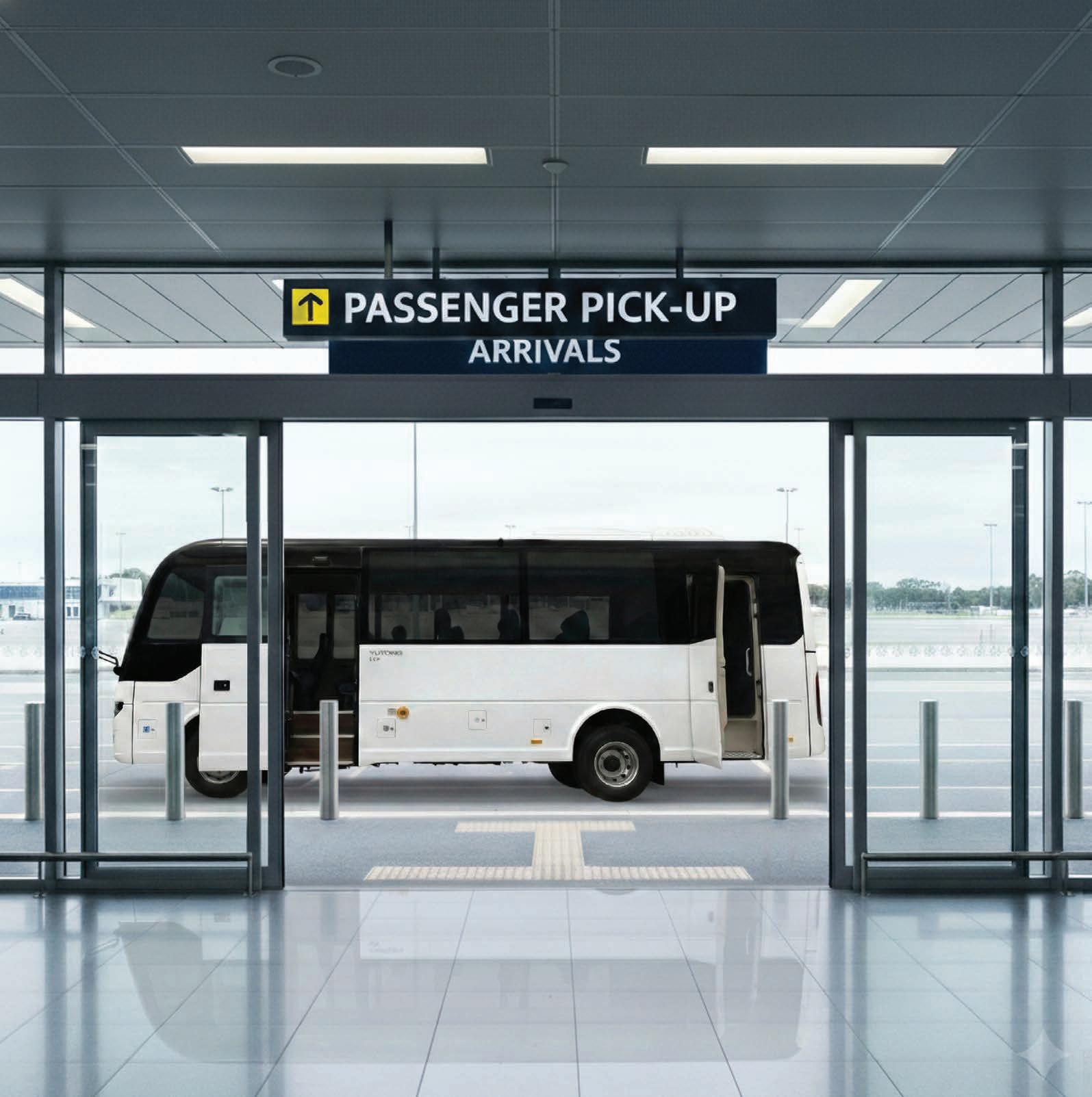
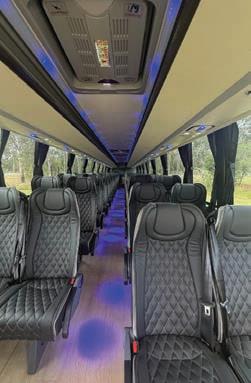
The D7 Luggage is the latest model in the D7 range which keeps the easy footprint while adding real storage for suitcases, sports bags and tour gear. With 20 seats and built-in rear capacity, operators can pull straight into pick-up zones and driveways, the places trailers struggle most.
No trailer. No reversing. No extra registration. Simpler arrivals.




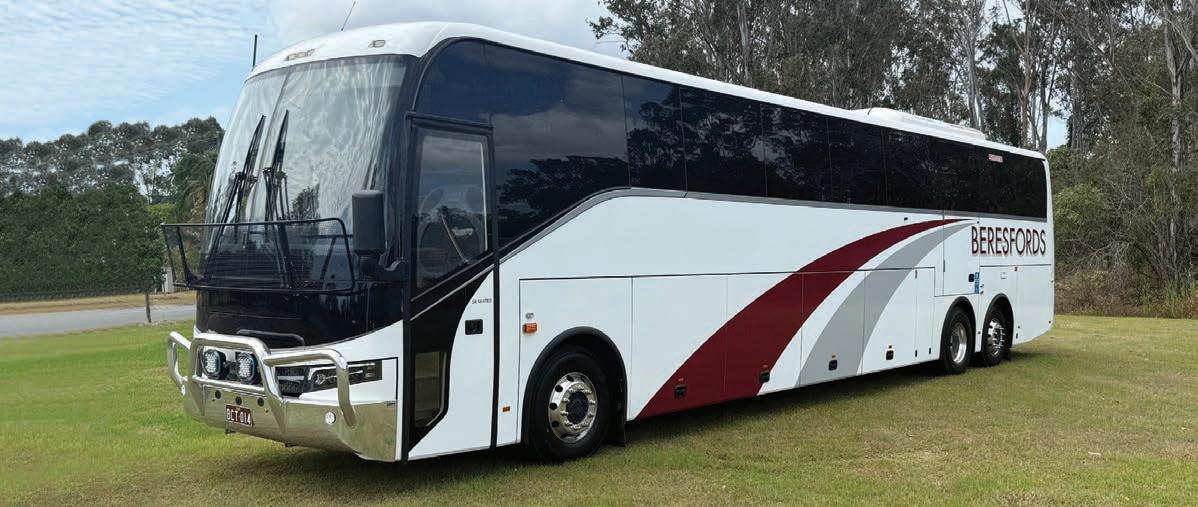
■ Designed & Engineered in Australia for Australia
■ Made with Australian Duragal Steel
■ 5 Year Industry Leading Warranty
■ Diesel or Hybrid Options
■ European Chassis Options
■ Ideal for touring, charter, and rail replacement
Celebrating 20 Years of BLK in Australia 2006–2026
Twenty years of partnerships.
Twenty years of experience. A future driven by quality and confidence

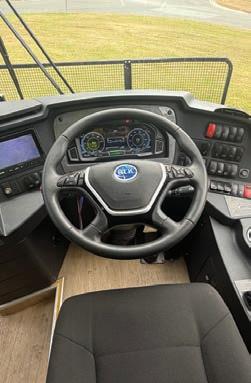
For two decades, BLK has supported Australian operators with quality vehicles, dependable aftersales support, and long-term value.
Secure your new 2026 President 3 today.

The bus and coach industry is currently at a make or break point in the zero-emissions transition, with government direction needed sooner rather than later
What does the future of Australasia’s bus and coach industry look like? Is it automated? Is it all electric, with chargers at every corner and silent buses traversing the country? Or is it filled with hydrogen, making traditional diesel a thing of the past?
As the years go on, this conversation is only intensifying. Unfortunately, a lack of government response or direction means the industry has been left to lead its own way forward, picking the best option at any given time. It’s an admirable move and showcases the ingenuity and independence of the sector, but it’s about time policies are introduced to set guidelines for procuring, charging and maintaining this new technology. For all the bold steps, the trials and the case studies, the industry is owed this for being a trailblazer for so many years.
where Tropic Wings continues to finalise its battery electric bus fleet and adjoining depot. This transition, as can be seen from page 28, started with an electric bus being delivered before COVID descended on the world, and has continued with the operator establishing a Cairns electric charging depot. The lessons learnt from this make for fascinating reading.
Elsewhere in the supplier sphere, Challenger is preparing a wealth of new technology to introduce to the industry at this year’s Expo, as can be seen on page 32, while VDI is building momentum in recent months, with Yutong having topped the deliveries table for January while also delivering its 2,000th bus in Australia late last year (check it out on page 34). The zero-emissions space isn’t just about electric, with Irizar discussing its hybrid-electric project with Scania in recent years on page 38.
The collection of stories in this edition of ABC highlight the mixed messaging currently on display in the sector
As we unveil another edition of ABC Magazine that’s dedicated to zero-emissions bus technology, the transition is at a crossroads. While some operators continue to establish zero-emissions bus networks and charging infrastructure, others have parked the conversation. At a government level, some state governments are pushing forward with mandates, while others are mixing up orders to slow the rate of change.
The collection of stories in this edition of ABC highlight the mixed messaging currently on display in the sector. On one hand, there are suppliers like Bus Stop Sales, who grace our cover for February and continue to unveil exciting innovations in the zero-emissions bus space, as can be seen from page 20. On the other, head to page 24, where the Queensland bus industry is adjusting to the state government’s latest subtle flip in procuring practices to order more diesel units. These movements come under even more scrutiny when the state is only six years away from an Olympic Games. Will bus transport be adequate for the hordes of people expected to descend on Brisbane, and will this technology be sustainable? We’re no closer to an answer as of yet.
Elsewhere in the vast state of Queensland, there are examples of operators taking leaps of faith with zero-emissions bus technology. There’s no better story of this than up in Cairns,
With this new technology comes the need for safe practices, and a yardstick for measuring success. Volvo discusses why electric bus success is all about reliability, with its page 40 article outlining why its national support network is helping more operators make the sustainable switch. Finally, BYD’s Steve Glenny chats about his latest Melbourne to Sydney round trip in a demo bus and what he learnt about the exciting electric model on page 42.
It was wonderful to head to Melbourne’s northern suburbs for the official unveiling of Kinetic’s new electric bus depot. From page 36, check out the details of the gantry charging installed and what it means for the city’s bus network.
All of this summarises a thriving sector that is at a critical juncture on the move towards more sustainable technology. I hope you enjoy the read.
Sean Mortell EDITOR, ABC
04. editorial | ignition CRITICALJUNCTURE
The bus and coach industry is currently at a make or break point in the zero-emissions transition, with government direction needed sooner rather than later
08. news | all aboard
Check out the latest news from around Australia and the world
features
20. cover story | bus stop sales BIGLITTLEBUS
With the development of its first nine-metre low-floor electric urban city bus, Bus Stop Sales, in partnership with King Long, is challenging longheld assumptions about what the mid-size urban bus market in Australia should look like
24. feature | queensland electric buses TAKINGSTOCK
Queensland’s bus industry is currently in a hiatus when it comes to future power sources, with operators and associations calling on the state government to reveal the way forward for the transition to zero-emissions buses
28. feature | tropic wings POWERPIONEERS
In just over five years, Tropic Wings and its partners have delivered a major electric bus project in Far North Queensland. Now, the operator is ready to share its learnings to others around the nation
32. zeb feature | challenger GROWINGIDENTITY
As Challenger continues its evolution into the battery electric bus space, it’s using the highest quality parts and package options to satisfy local operators
34. feature | vdi MILESTONEMOMENT
In the final weeks of 2025, years of hard work saw VDI Australia celebrate an important milestone delivery out west with a special Yutong bus
36. feature | kinetic depot NEWBEGINNINGS
In late January, Kinetic opened its latest electric bus depot in Victoria in a state-first for the operator as it continues to introduce more sustainable bus services
38. zeb feature | irizar STEPPINGSTONE
In recent years, Irizar and Scania have combined to produce a hybrid-electric coach offering that is rethinking the future of sustainable transport around Australia
40. zeb feature | volvo RELIABILITYATSCALE
As the local industry continues its transition to zero-emissions, questions remain about what determines the technology’s success. Volvo Bus Australia’s growth in the space has been all about its total package offering – and delivering reliability for operators
42. zeb feature | byd PUTTOTHETEST
A recent trip up the Hume Highway and back allowed BYD’s Steve Glenny the chance to marvel at the capabilities of BYD’s latest electric bus chassis in Australia
44. feature | styleride CONSISTENCYANDTRUST
Wangaratta Coachlines’ long-running partnership with StyleRide shows how collaboration, durability and shared thinking can shape better outcomes for operators and passengers alike
46. feature | i-bus BUILTFORCOUNTRY
I-Bus and Bus Stop Sales are continuing to strengthen the Isuzu-powered range, particularly for regional and rural Australian operators
51. competition | best bus PICTUREPERFECTPROM
A stunning shot of a Ventura coach travelling through Victoria’s southern-most point has taken home Best Bus honours for February
departments
54. factory facts | bus deliveries JANUARYDELIVERIES
Check out the latest bus and coach supplier sales data collected and recorded for you to review and see how the market fared in January
58. back seat | double-decker bus DOUBLEDUTY
CDC Victoria’s double-decker on Route 190 shows how extra capacity, driver pride and passenger excitement can coexist on a suburban bus service
Regina Fellner
EDITORIAL & DESIGN
Managing Editor: Geoff Crockett
e-mail: geoff.crockett@primecreative.com.au
Editor: Sean Mortell
e-mail: sean.mortell@primecreative.com.au ph: 0468 577 166
Art Director: Daz Woolley
Designer: Apostolos Topatsis
PRINTING
Brougham Press
ADVERTISING
Sales Manager – South: Courtney Burton ph: 0481 736 890
e -mail: courtney.walker@primecreative.com.au
Business Development Manager – Bus: Sylvie Hanlon ph: 0466 545 664
e-mail: sylvie.hanlon@primecreative.com.au
SUBSCRIPTIONS
www.busnews.com.au/subscribe ph: +61 (0)3 9690 8766
Mon-Fri 8am-4.30pm (EST) e -mail: subscriptions@primecreative.com.au mail: 379 Docklands Drive, Docklands VIC 3008 Australia
Annual subscription rates (12 issues): Australia: $99*
Overseas: $A170 (Australian air-mail only) *price includes GST
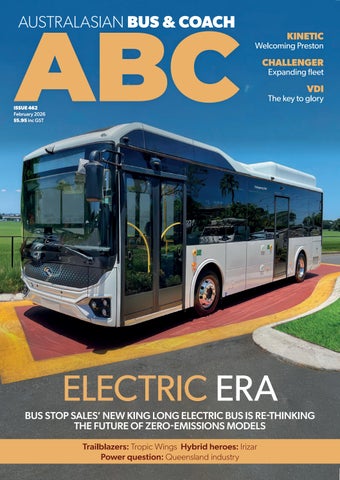
Cover image: Bus Stop
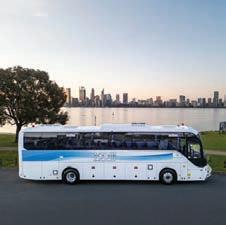
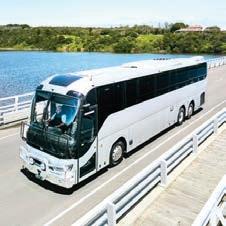
Since 1991, BCI’s journey has been driven by connection, innovation and purpose.
Over 35 years, we have grown into one of Australia’s leading bus manufacturers, delivering vehicles built for the roads, climates and communities of this country. From city streets to regional routes, every BCI bus reflects experience, pride and a commitment to keeping Australia moving— coast to coast, every day.
The handover saw members of Volvo Bus Australia, Volgren, the PTA and WA government head to Kewdale
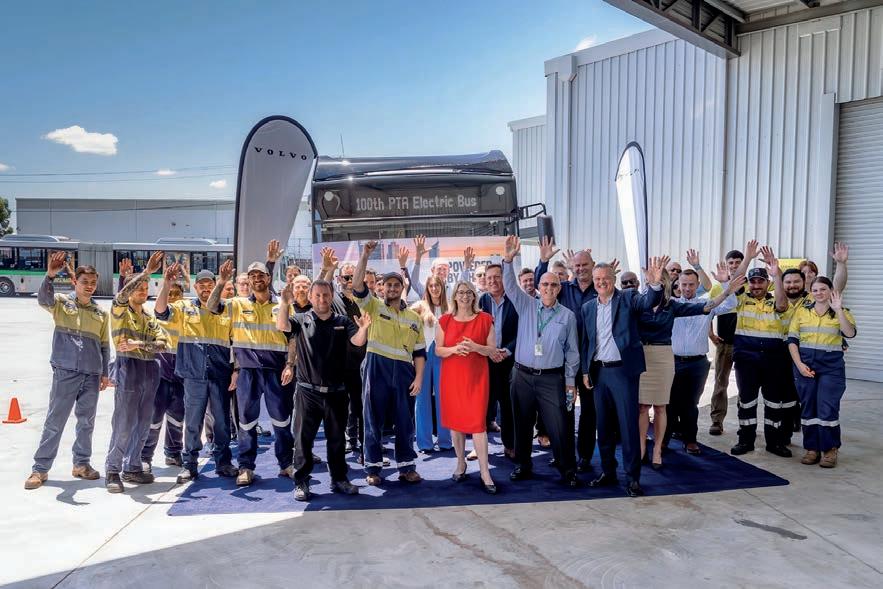
The Western Australian government has celebrated the delivery of its 100th electric bus from Volvo in the state.
The historic handover was held on January 28 at the new bus centre at Truck Centre WA (TCWA) Kewdale, with deputy premier and transport
Above: A range of stakeholders celebrated the milestone
Below: The Volvo/Volgren electric bus fleet is building in WA
minister Rita Saffioti joining with the Public Transport Authority of WA (PTA), Volvo Bus Australia and Volgren leaders at the event.
The milestone 100th electric bus was delivered as part of the PTA’s broader long-term supply
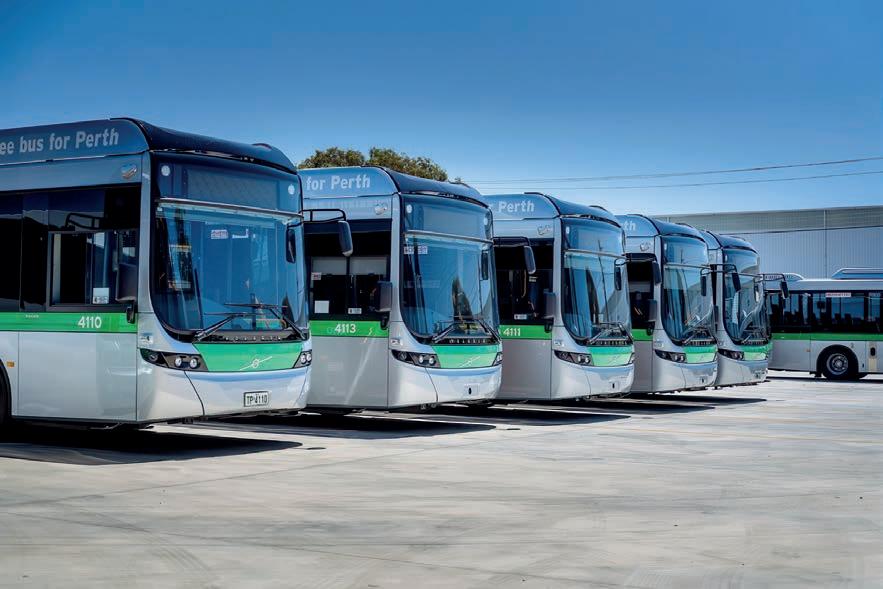
agreement with Volvo, reflecting a strategic and long-term approach to fleet renewal.
Joining Saffioti at the handover was Volvo Group Australia president Martin Merrick, Volvo Bus Australia general manager Mitch Peden and key stakeholders from PTA including executive director of Transperth regional and school bus services Peter Jones, fleet manager Paul Burke and operator partners.
Since introducing its first Volvo electric buses, the PTA has worked closely with Volvo to transition electric vehicle technology from initial trials to large-scale fleet deployment. This collaborative approach has included detailed planning around route suitability, depot charging infrastructure and operational safety, ensuring electric buses are seamlessly integrated into Perth’s network.
“The delivery of the 100th electric bus is an important milestone, but more importantly, it reflects the strength and maturity of our partnership with the WA government,” Peden says.
“Together, we’ve taken a measured, practical approach to electrification –one that prioritises safety, operational performance and long-term value for the community.”
A key component of this success is Volvo’s strong local support network in Western Australia, led by PTA account manager Lee Williams, alongside the team at Truck Centre WA (TCWA).
TCWA’s newly renovated facility in Kewdale plays a critical role in servicing and maintaining the PTA’s Volvo fleet, providing specialist technical expertise, training and lifecycle support close to where the vehicles operate.
The buses are built on Volvo’s advanced electric chassis platform and bodied locally at Volgren Malaga.
The delivery of the 100th electric bus underscores a shared vision between Volvo and the WA government to deliver a locally-made, modern, resilient and sustainable public transport network for Perth.
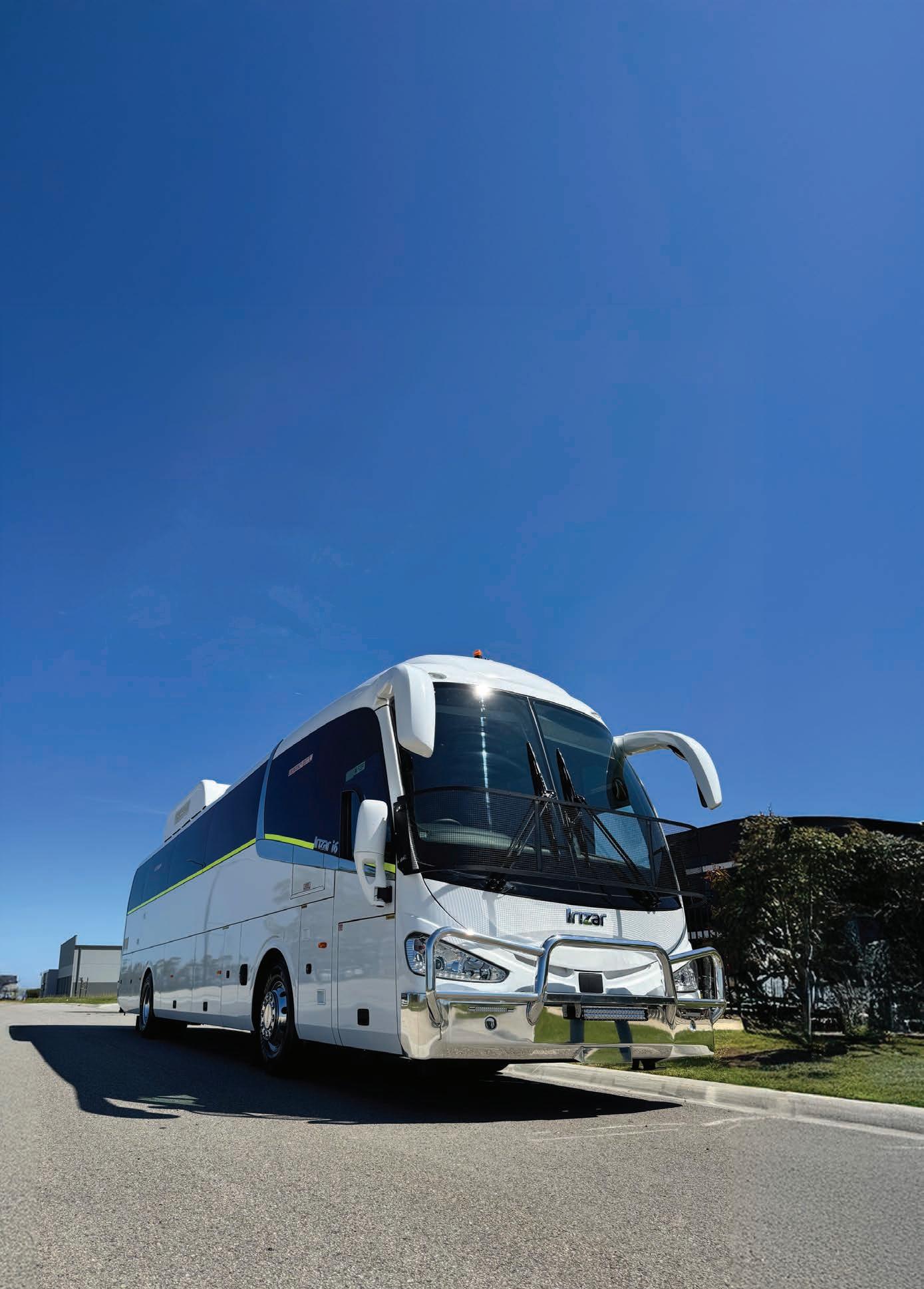
Secure the safest coach chassis, powerful and quiet hybrid-electric drive, and reduce CO2 emissions by up to 92%.
The Scania Irizar i6 Hybrid offers the best of both worlds, providing a low-emission solution that reduces your carbon footprint without requiring costly infrastructure investment or range restrictions.
Switch between battery and diesel
360 hp (265kW) Euro 6 engine
12-speed Scania Opticruise Gearbox
Alcoa Durabrite alloy wheels
Ideal for:
Remote regions with limited grid access
Mining operations requiring robust, low-emission solutions
Long-distance travel where range and refuelling flexibility are critical
The Australian operator has announced a suite of updated leadership titles as part of its next phase of growth
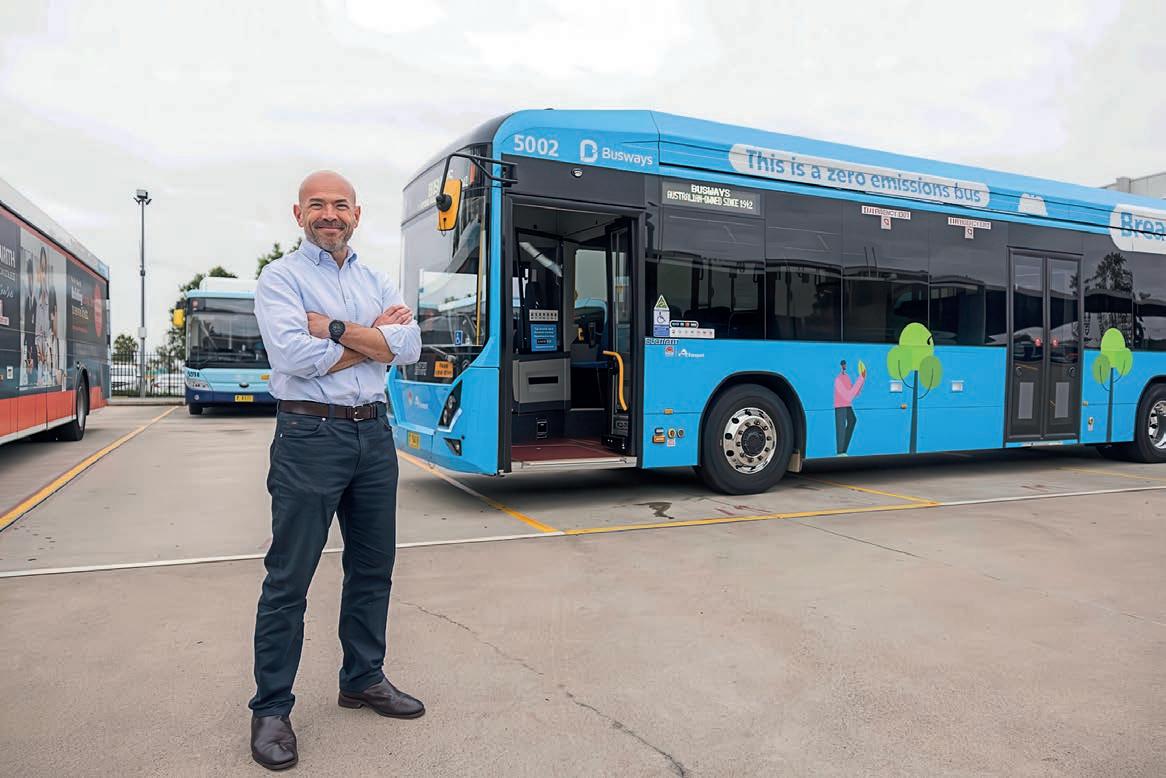
announced a range of leadership team updates as it continues to evolve.
As CEO Will O’Neill completes his first year in the top job at the NSW-based operator, he is strengthening Busways’ leadership structure to support growth plans, governance and future tender opportunities.
This has led to several team members receiving updated titles to better reflect their expanded strategic roles, with Busways reiterating there is no restructure or pivot.
Busways announced the promotion of Ben Hague to the role of new chief commercial officer (CCO).
Hague brings experience across public transport operations, government contracting, commercial strategy and technology-enabled mobility in Australia and New Zealand.
major rail and bus contracts at Transport for NSW, where he also led some of the state’s most significant transport innovation initiatives such as designing and delivering the On Demand program that rolled out the world’s largest on-demand public transport pilot.
He later worked as APAC Regional Manager for global public transport technology company Via, working with governments, transport agencies and operators to launch and scale technology-enabled public transport services including Busways’ Cooee and Gold Coast On Demand programs.
Alanna Ward is the director of people and culture and chief of staff, while Chris Wolf is the director of assets and safety.
Daniel Gibson’s updated title is director of scheduling and operational planning and Donna Frith is the director of corporate affairs and customer experience.
of service delivery metro while Steven Hawkins is both the director of service delivery NSW, regional outer metro and of group service delivery support.
“As Busways continues to grow, it’s important that our leadership structure matches the scale, complexity and operating maturity of the organisation. These title updates better align with the roles our leaders already play in delivering complex public transport operations in a rapidly changing environment,” O’Neill told ABC
“With more than 80 years of experience in public transport in Australia, Busways has a deep understanding of local communities and of what governments need from a long-term operating partner. This leadership structure supports disciplined growth, strong governance and consistent delivery as we prepare for the next phase of our national expansion.”
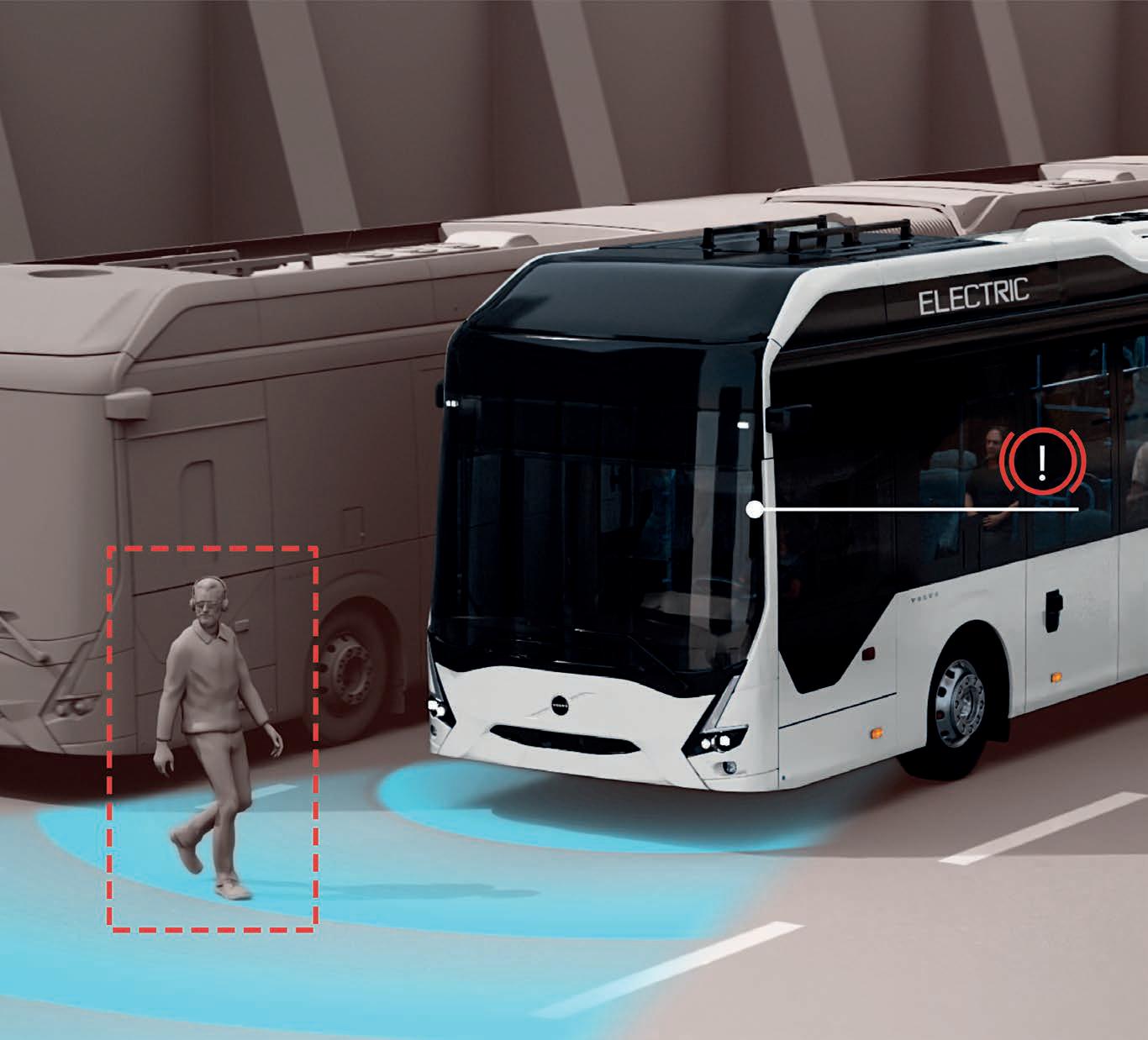
People stepping out in front of a vehicle is a recurring type of accident in city traffic.
That’s why Volvo Buses has developed Collision Warning with City Brake. It’s a new chapter in active safety for city buses, designed in cooperation with research institutes and Transport for London, as a means to reduce bus traffic accidents involving pedestrians and cyclists.
How it works? The system detects a pedestrian in front of the bus and calculates the risk for an accident. Unless the driver brakes, the system instantly warns and applies a balanced brake force, protecting the pedestrian while minimising risk for standing passengers inside. Just another example of how we keep moving towards our vision of Zero Accidents.
Contact your Volvo Buses representative to find out more.
Volvo Buses
The operator has introduced 11 brand new school buses to the community in time for the start of the school year
Australasian operator Kinetic has revealed it has started running 13 school bus and two urban services in Bundaberg to start the school year.
The latest operations, which began on January 27, saw the operator bring 11 brand new school buses to the local Queensland community.
The state’s Department of Transport and Main Roads (TMR) awarded the 12-month contract to Kinetic to operate all urban bus routes in Bundaberg in a move to bring greater operational consistency to the region.
To match this contract, Kinetic has invested in 11 brand new school buses to provide the 13 school services previously run by another operator, with the new buses hitting the road on the first day of operations commencing.
Below: Kinetic has started running more services in
Luke Thompson says Kinetic reached out to all schools impacted by the change with information on how families could plan ahead for their child’s journey ahead of the school term getting underway.
“This is a significant milestone for Kinetic in Bundaberg and for the local community,” he says.
“Having one operator across all urban services means greater consistency for passengers.
“We’re also backing that with an investment into school routes, with 11 brand new school buses and fixed school routes that families can count on.
“Duffy’s City Buses has been a trusted part of the Bundaberg community since 1954, and since Kinetic acquired the business in 2022,
proud local management leading our operations, including myself.
“We look forward to continuing to work with local schools, families and community groups across Bundaberg.”
Kinetic has been part of the Bundaberg community since 2022, with Thompson saying the operator is committed to deepening its local engagement.
Kinetic’s Moving Communities Fund provides grants to grassroots organisations, with Bundaberg Athletic Club among the 2025 recipients, supporting local athletes to compete at state and national level.
In addition, in 2025, Kinetic’s Bundaberg operations were recognised as Bundaberg’s Most Disability Friendly Business by Access
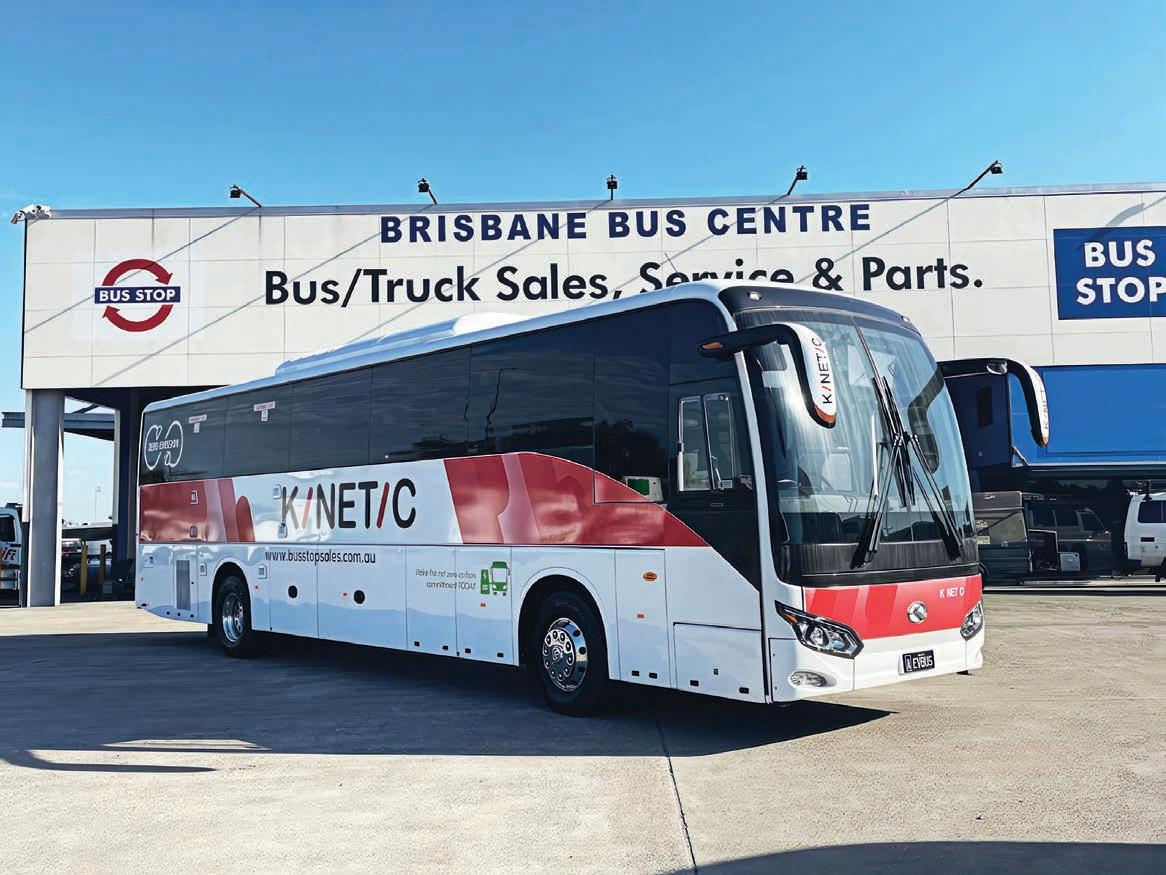

The experienced operations and customer-experience leader vows to preserve the national tourism operator’s ongoing legacy
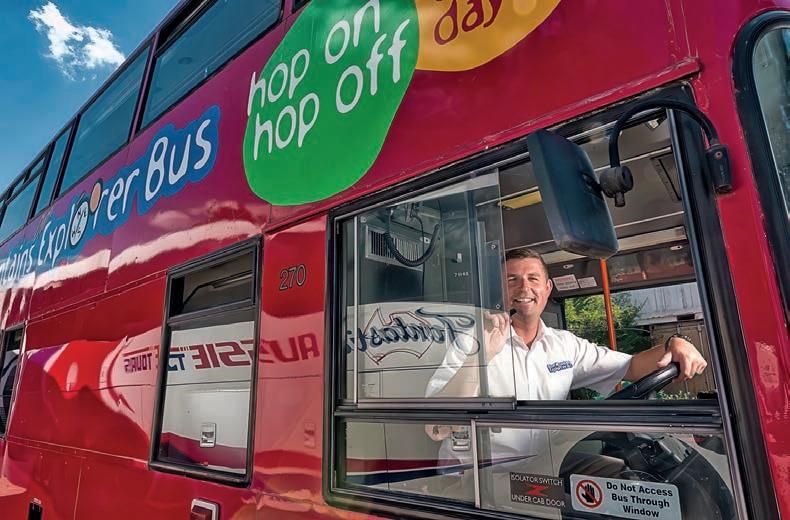
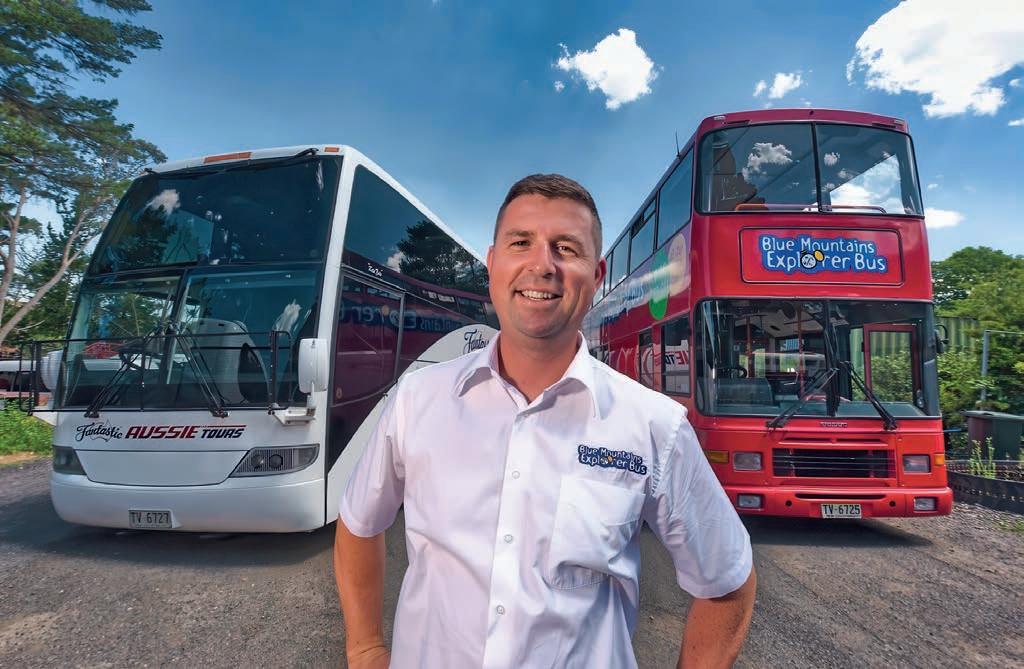
Australian tour operator Fantastic Aussie Tours (FAT) has announced the appointment of a new general manager to the bus operator.
FAT has appointed experienced operations and customer-experience leader Bryan Swadling to the role.
He brings with him a hands-on background that started with cheffing at some of the Blue Mountains’ most prestigious restaurants (Echoes Boutique Hotel & Restaurant and Lilianfels Resort & Spa in Katoomba, and Leura’s Fairmont Resort, Nikita expresso bar and Red Door Café) before spending time in London and Bathers Pavilion Restaurant in Sydney.
For the past seven years, he has been part of the Scenic World team, first as retail and food and beverage manager and then master planner manager.
As a former Blue Mountains Grammar School student, Swadling has known FAT managing director Jason Cronshaw for many years.
“Jason genuinely cares about this
region and the people who work here,” he says.
“That stood out straight away. I’ve always believed great tourism experiences are built from the ground up.
“If your team feel supported and proud of what they do, guests feel it straight away. That matters even more in a close-knit community like the Blue Mountains.”
Cronshaw says Swadling’s appointment reflects a commitment to strong, locally focused leadership.
“Bryan understands regional tourism and the importance of getting the basics right,” Cronshaw says.
“He respects the history of the business, values our team and brings the operational experience we need as tourism continues to rebuild and grow in the Mountains.”
Fantastic Aussie Tours has been part of the Mountains’ tourism fabric since 1974 and operates the iconic Blue Mountains Explorer Bus, which has been helping visitors explore Katoomba and Leura since 1986.
The broader business also includes Christian Fellowship Tours, which will continue to operate separately.
Swadling says preserving that local legacy while adapting to changing visitor expectations will be a key focus of his new role.
“The Explorer Bus is a fantastic part of the Mountains story,” he says. “Locals know it, visitors love it and there’s a real sense of pride attached to it.
“My job is to make sure it continues to serve the community well –supporting local businesses, creating jobs and helping visitors engage more deeply with the region.”
And in a move likely to resonate with the industry, Swadling has committed to getting his bus licence.
“If you’re running a bus company in the Mountains, you should probably know how to drive a bus,” he says.
“It’s about understanding what our drivers deal with every day – the roads, the weather, the visitors, all of it.”
New and revised school bus services across south east Queensland aim to improve reliability, reduce overcrowding and better align services with school start times
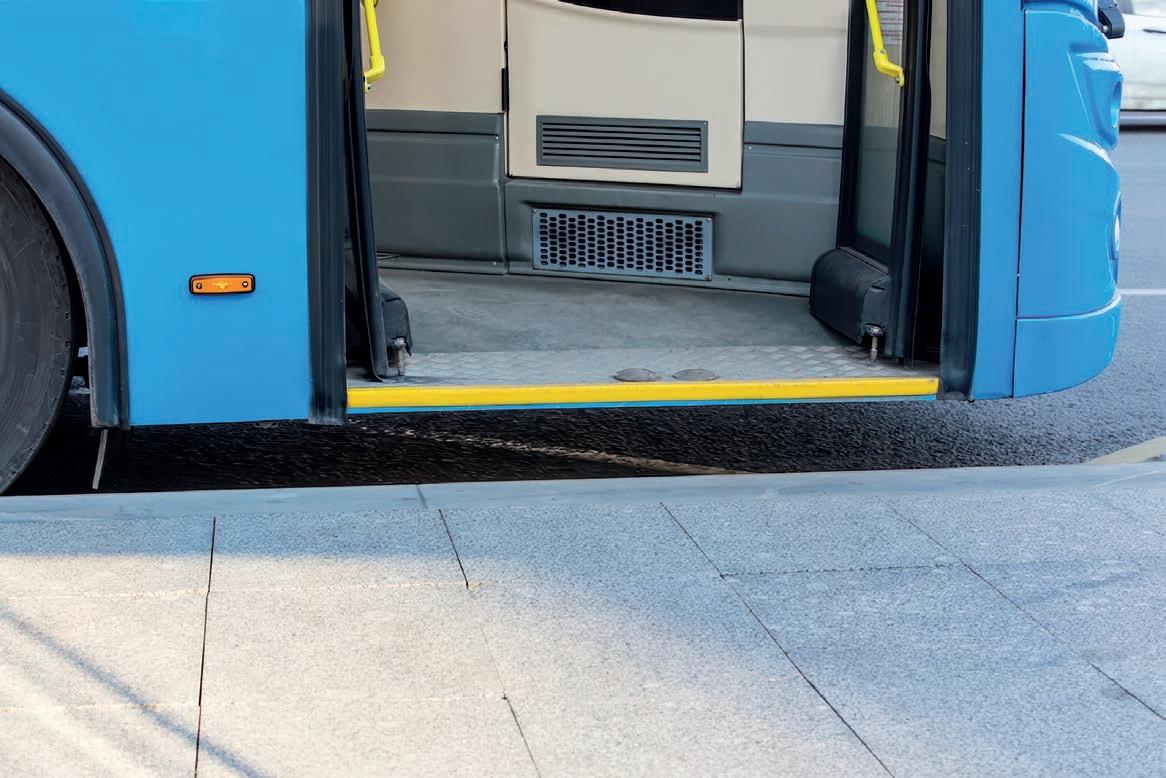
School transport networks across south east Queensland have received significant changes for the new academic year, with new routes and widespread timetable adjustments designed to improve reliability, safety and alignment with school start times.
Ahead of Term 1, public transport authorities confirmed the introduction of 14 new school bus routes and 232 service modifications. The changes were intended to better reflect community needs, manage growing demand and respond to shifting bell times across the region.
The revised school bus services form part of a broader network planning aimed at reducing overcrowding and improving service predictability during peak school travel periods. Transport planners say school services play a critical role in shaping morning and afternoon peak demand, with flow-on effects on fleet allocation, driver availability and overall route performance.
Queensland transport and main roads minister Brent Mickelberg says the changes were designed to improve operational outcomes while easing pressure on families during the return to school.
“These changes are about improving reliability, enhancing safety and addressing overcrowding, while ensuring services align with school start times and population growth in key areas,” he says.
He says clearer travel planning could help reduce household stress as the school year begins.
“As parents, we know a smooth morning routine sets the tone for a positive first day back at school,” he says.
“Understanding from where and when your child needs to travel can help ease stress and anxiety as households settle back into term time.”
From an operational perspective, the update includes a mix of new services, route realignments and timetable refinements rather than wholesale reductions. Transport authorities say this approach allows coverage to be maintained while better matching services to demand.
“That’s why bus routes, timetables and stops have been improved after listening to what schools and communities needed,” Mickelberg says.
“The focus has been on getting students to school ahead of bell times using reliable, well-planned services.”
The scale of the changes reflects the increasing complexity of school transport planning in fast-growing urban and suburban areas. Population growth, new schools and evolving travel patterns continue to place pressure on existing networks, particularly where dedicated school services intersect with general route operations.
Eligible students may also access additional assistance through the School Transport Assistance Scheme, which supports families facing challenges related to distance, income or geographic isolation.
“Those families who need assistance due to distance, income or isolation may be eligible for support through the School Transport Assistance Scheme,” Mickelberg says.
Families are being encouraged to review updated services before the first day of term using TransLink’s School Service Finder or Journey Planner. For schools or routes not listed digitally, local bus operators can provide confirmation of services and applicable fares.
The two brothers were both part of the OAM honours for 2026, recognising decades of service in the Australian bus transport sector
A pair of famous Australian bus industry members have been recognised with Medals of the Order of Australia (OAM) during the Australia Day ceremony.
The Calabro family was front and centre on the day, with Tony Calabro and the late Joe Calabro both receiving medals of the OAM in the general industry for their services in the bus transport industry.
The pair were co-founders of BusTech Group in 1998, as well as co-owning Transit Australia Group and Surfside Buslines. They were both former co-owners of Calabro Brothers in the 1980s, taking over Surfside Buslines from Greyhound with 56 buses in June 1989 following a string of acquisitions that resulted in the take-over of Sunbus from Transit Australia in April 2008.
The restructure meant Calabro’s Queensland business came under the Transit Australia Group.
On top of this, the pair, through Transit Australia Group, were recognised as the 2015 Gold Coast Business of the Year, the 2015 Mayor’s Innovation GC Award and the 2016
Large Employer of the Year at the Queensland Training Awards.
Outside of the Calabro brothers, volunteer driver of the Cancer Bus in Launceston Bruce Edwards received a medal of the OAM too for his service to the community through various organisations.
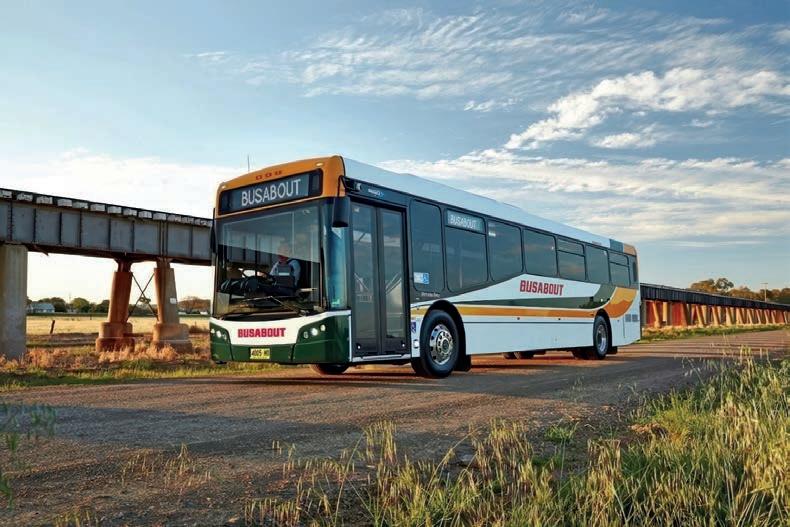
The new bus timetables are now running to better align
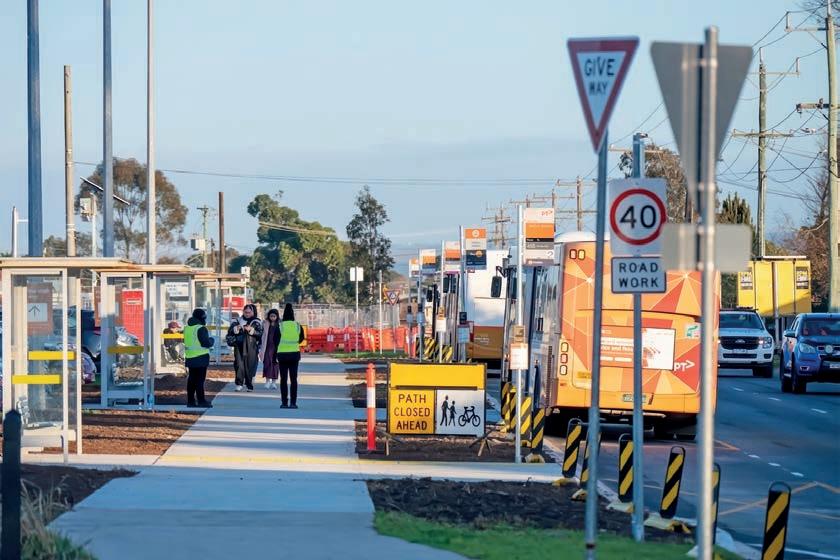
to coincide with the big switch of Metro Tunnel train services.
With more than 1,200 new train services being launched as part of
changes are occurring across Victoria.
This includes the first of 270 new bus timetables that will better connect to Metro Tunnel services,
ranging from new regional services to city runs.
Victorian Premier Jacinta Allan says the new schedule may take time to get used to, but it’ll be “worth it” to deliver a faster and more reliable public transport system.
“For busy families, time and money are tight. That’s why we’re making public transport faster, and that’s why we made it free for kids,” Allan says.
“More services mean a better transport system, less time in traffic and more time at home.”
Victorian public and active transport minister Gabrielle Williams says the switch will deliver more options for passengers.
“The changes will take time for passengers to get used to, but it’s worth it for a bigger, better, faster system,” she says.
A Kinetic subsidiary has announced a new acquisition that will see it seamlessly expand its presence in New Zealand’s South Island
Australasian public transport operator
Kinetic has announced its expansion into New Zealand’s South Island through a new acquisition.
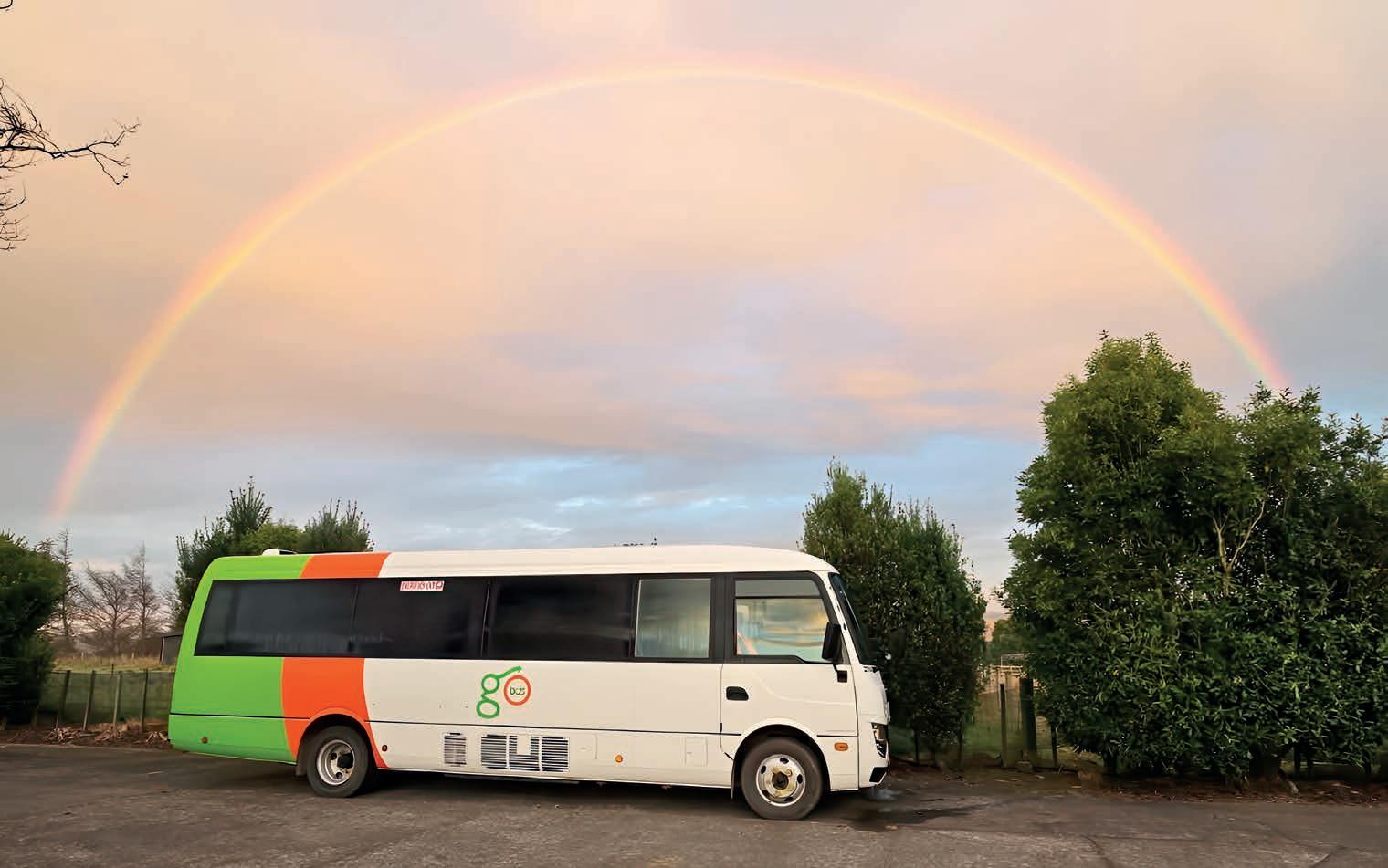
Kinetic, via its subsidiary brand Go Bus, has officially acquired Golden Bay Coachlines.
The long-established and respected passenger transport operator has served communities across the Golden Bay/Mohua and wider Nelson-Tasman region.
Kinetic and Go Bus say services will continue without interruptions, with the same drivers, depots and vehicles now part of Go Bus as the brand retains the local team.
commitment to reliable, locally delivered public transport.
Kinetic New Zealand managing director Calum Haslop says the focus is firmly on supporting people and communities.
“Golden Bay Coachlines has built a trusted operation over decades, and we’re proud to continue that legacy. For the communities we serve, this is about continuity and confidence,” he says.
“The same drivers, the same local knowledge and the same commitment to safe, reliable transport remain in place, supported by the scale, expertise and long-term
our strength comes from local teams who understand their communities.
“That combination allows us to support regions like Nelson–Tasman not just today, but as public transport continues to evolve – whether through improved connectivity, future service opportunities, or sharing knowledge from across our wider network.”
Outgoing owner of Golden Bay Coachlines, Michael Bickley, says joining Kinetic’s Go Bus ensures the business’s values and community focus continue.
“This business has always been about serving our communities well, and that won’t change. Becoming
Dunedin’s bus network is set for a major shift, with new Otago Regional Council contracts driving a large-scale electric bus rollout and expanded services from 2026
Dunedin’s public transport network is preparing for one of its most significant fleet transitions to date, with new operating contracts set to deliver a substantial increase in electric buses and service capacity across the city and surrounding districts.
Otago Regional Council has awarded two new network contracts to Kinetic New Zealand, operating through Go Bus Transport, triggering the introduction of 37 additional electric buses from October 2026. Once deployed, around half of Dunedin’s bus services will operate using zero-emission vehicles, marking a major step change in the city’s approach to public transport delivery. The contracts not only expand the electric fleet but also reshape how services are delivered, with larger vehicles and higher frequencies designed to better meet demand across urban and regional routes. For operators, the move reflects a growing emphasis on aligning fleet investment with long-term emissions targets while improving passenger experience.
on the company’s existing electric operations in the region and signal a deeper partnership with the council.
“These new electric buses represent the next phase of our work with ORC,” he says.
“They build on the zero-emission fleet already operating in Dunedin and continue the shift toward cleaner, more attractive travel for the city.”
Drawing on Kinetic New Zealand’s broader experience delivering electric bus networks nationally, Barlow says the focus was on reliability as well as sustainability.
“We’re proud to support ORC’s transition toward a fully zero-emissions fleet, bringing reliable and environmentally responsible transport to more people,” he says.
A key feature of the new arrangements is the introduction of higher-capacity electric buses on longer-distance routes, including services linking Palmerston and Dunedin. These vehicles are intended to improve passenger comfort and capacity for trips beyond the central city, where trip lengths and loading
Operationally, services will be based at Go Bus’s Portsmouth Drive depot, which opened in 2025 and was designed to support electric bus operations. The facility provides charging infrastructure and maintenance capability to accommodate the growing zero-emission fleet.
ORC transport portfolio lead councillor Alan Somerville says the contracts deliver both environmental and service benefits for passengers.
“One of the biggest changes will be the number of electric buses introduced within the first year,” Somerville says.
“That’s a major step toward our goal of transitioning to a fully zero-emissions fleet in the coming years.”
He says the shift would also reduce harmful transport emissions while supporting a more modern and higher-capacity bus network.
Under the new contracts, 61 of Dunedin’s 79 buses, around 77 per cent of the fleet, will be electric. With the renewal of the city’s final bus contract expected later in the decade, Dunedin remains on track to operate a
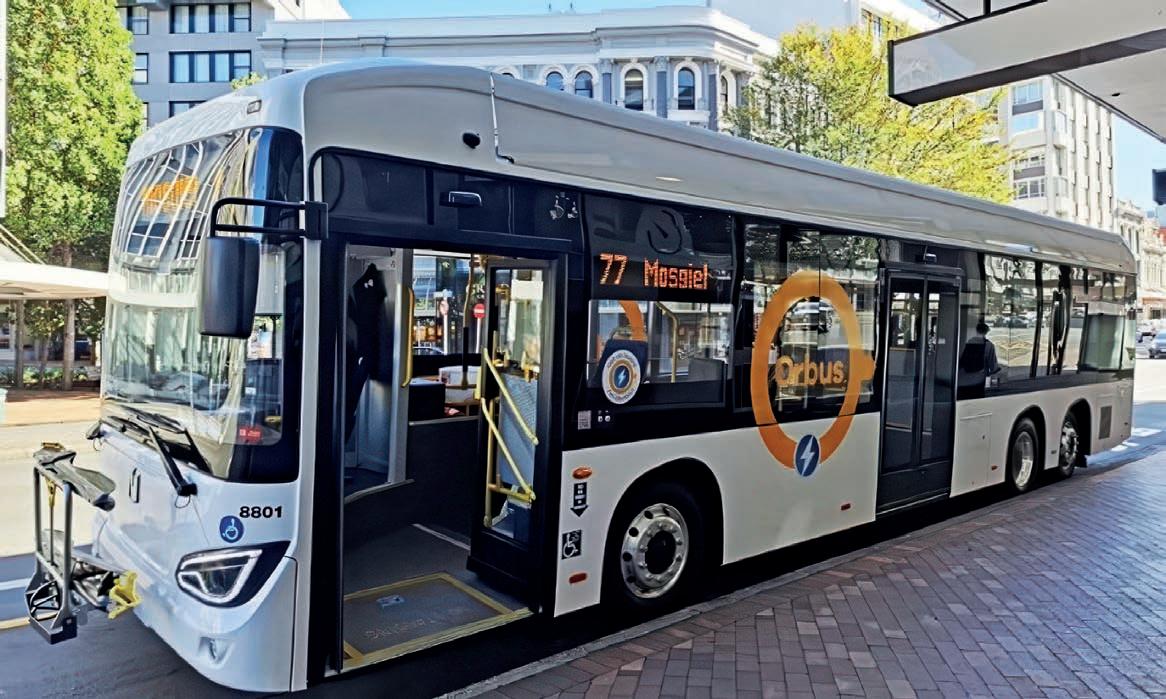
A new global partnership has been announced between a well-known vehicle manufacturer and a technology services provider to create a new bus OEM.
Mitsubishi Fuso has announced plans to create a standalone bus company, based in Japan, with partner Hon Hai Technology Group, also known as Foxconn.
Current director and head of Fuso Bus Katsuto Kora has been revealed as the new company’s CEO.
The creation of a new OEM comes after the two companies previously announced the signing of a memorandum of understanding to explore strategic collaborations in the zero-emissions space.




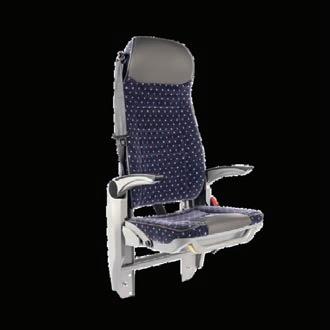
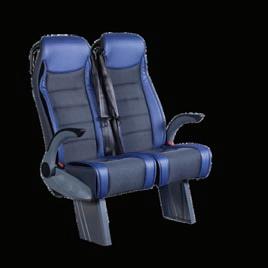
Now, Mitsubishi Fuso Bus Manufacturing and Foxtron Vehicle Technologies will cooperate in the development, production, supply chain management and sales of zero-emissions buses, starting with the Foxtron-developed MODEL T and MODEL U.
The bus-dedicated OEM will focus on “quickly” developing and launching electric buses for domestic and international markets while continuing to develop diesel ICE buses.
The buses will be developed and manufactured at the company’s Toyama plant under the Fuso name, with the company’s headquarters to be in Kawasaki, Japan.
The new brand says it’ll be able to



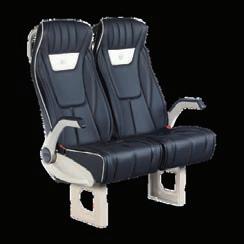
“smoothly comply” with Japanese regulations, standards and customer needs through its local production, sourcing, production and supply channels. This backing is combined with Foxconn’s zero-emissions vehicle expertise to ensure vehicles are successful in Japan and abroad.
“We are excited to join forces with Foxconn. This collaboration will combine the strengths of both parties to accelerate our transformation in the bus sector,” Mitsubishi Fuso Truck and Bus Corporation CEO Karl Deppen says.
With the definitive agreements now signed, the transaction aims to close in the second half of this year.




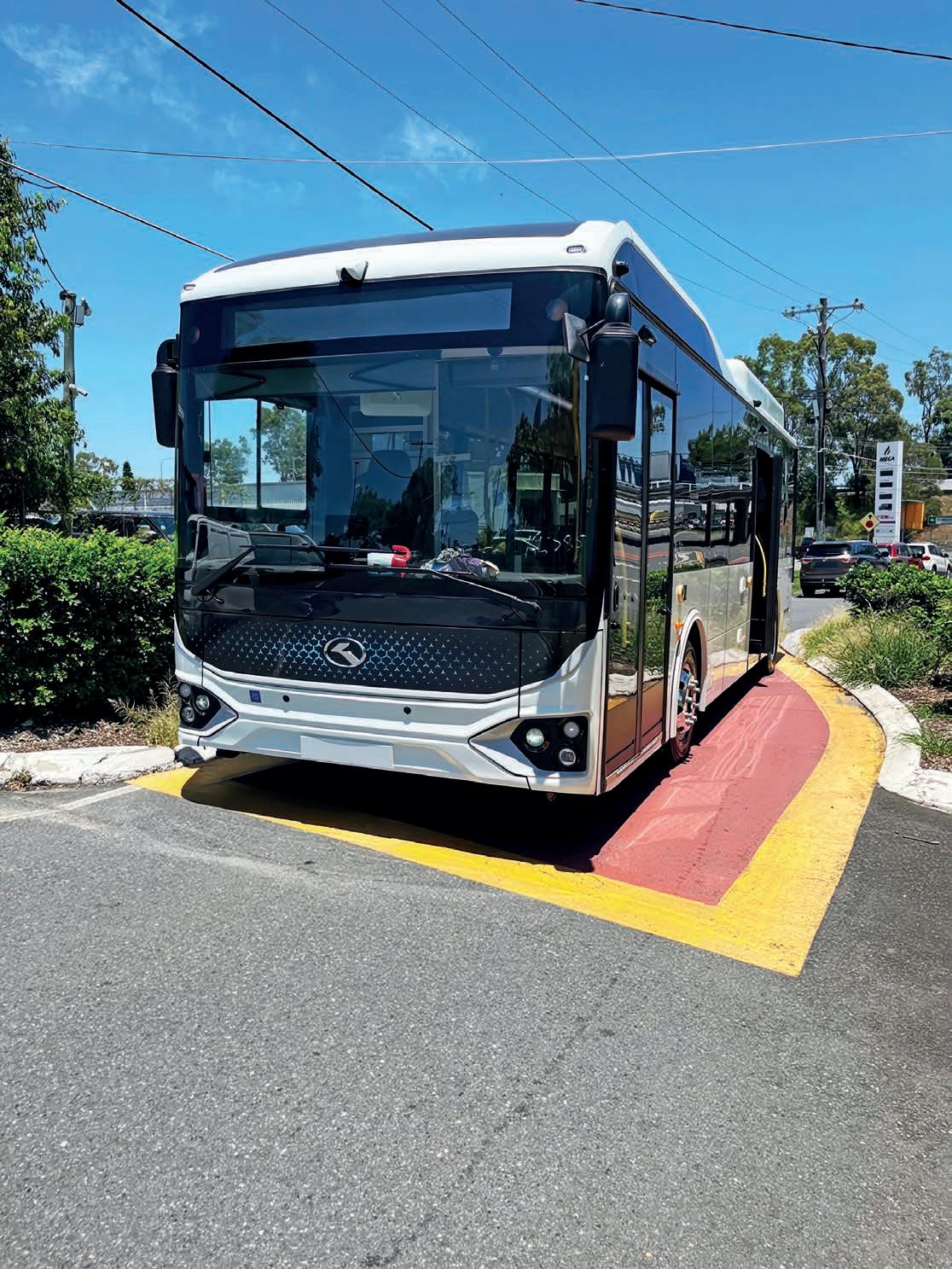
With the development of its first nine-metre low-floor electric urban city bus, Bus Stop Sales, in partnership with King Long, is challenging long-held assumptions about what the mid-size urban bus market in Australia should look like
For decades, the Australasian bus and coach industry has relied on a largely standardised vehicle format. Through changing regulations, operating models and powertrains, the 12-metre bus has remained the backbone of urban fleets. It has shaped procurement frameworks, fleet strategies and depot design, and continues to play a critical role across networks nationwide.
But as the industry transitions toward zero-emission transport, the question is no longer whether the 12-metre bus works—it’s whether it always fits the task.
Australia’s move to cleaner propulsion is accelerating. In 2025, around 350 zero-emission buses and coaches were delivered nationally, up from 208 the year before. While the uptake of new technology has been strong, vehicle size and deployment strategy have received far less scrutiny. For local supplier Bus Stop Sales, that disconnect presented an opportunity.
“Australia’s shift to zero-emission public transport is accelerating, but not all routes are suited to the same vehicles,” Bus Stop Sales director Pete White told ABC
Above: King Long’s new electric bus is re-thinking the mid-size market
“That is where the real fleet challenge sits.”
At the same time, the operating environment for bus services is changing, with urban infill, expanding suburbs and new residential developments producing tighter street layouts, constrained intersections and more variable demand patterns. Yet fleet allocation has often defaulted to familiar choices – either a full-size 12-metre bus or a much smaller vehicle – neither of which consistently addresses these conditions.
“Across cities and growing suburbs,
many services are becoming harder to operate,” White says.
“Street networks are tighter, intersections are more constrained and patronage can vary significantly by time of day or service model. Yet fleet deployment has often defaulted to familiar choices – either a full-size 12-metre bus or a much smaller vehicle – neither of which consistently fits these conditions.”
For suppliers, this reflects a deeper structural issue as 12-metre buses becoming the industry default have been effective on high-capacity trunk routes but are less suited to services where manoeuvrability, flexibility and whole-of-life efficiency matter more.
Identifying the issue was only the first step, as White says delivering a credible solution proved more challenging.
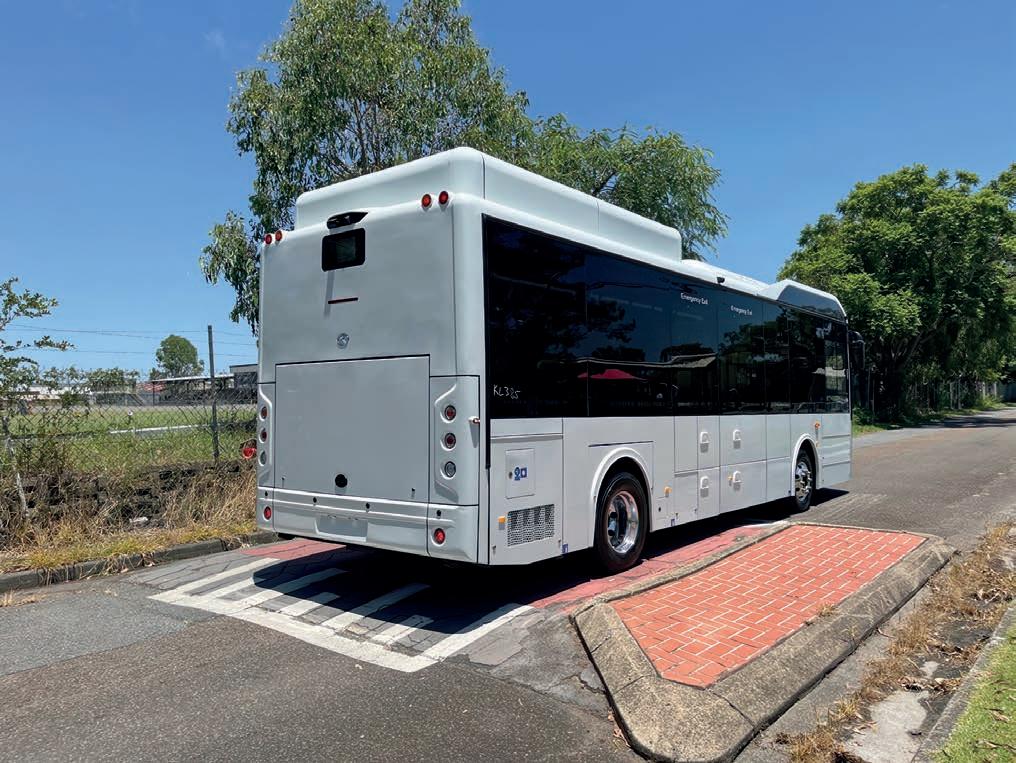
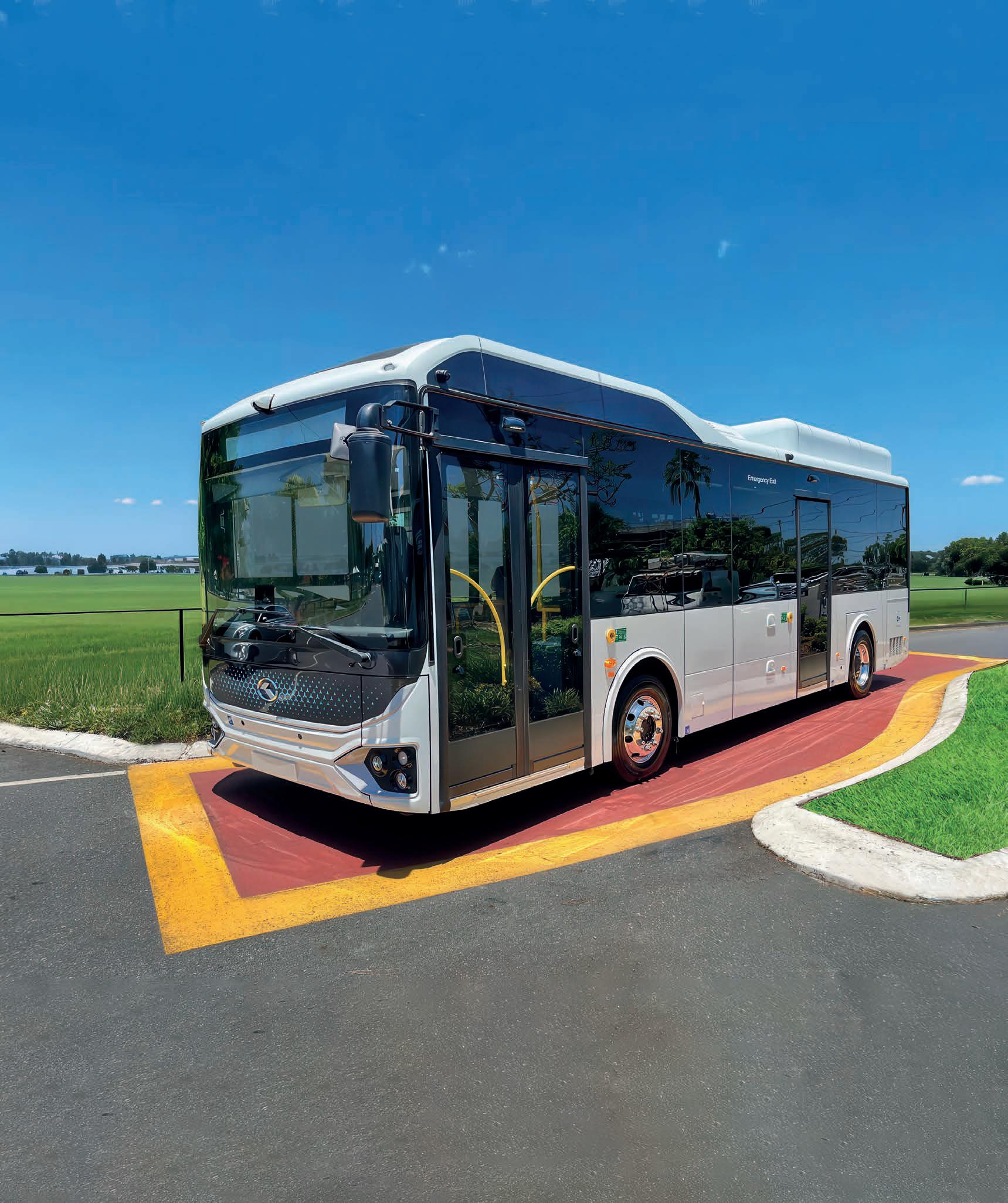
That solution is the EVolution Midi – a brand-new, Australian-designed nine-metre low-floor electric city bus developed by Bus Stop Sales with King Long specifically for local operating conditions. While nine metres can sound substantial on paper, the vehicle has been engineered to operate comfortably through tight inner-city streets and newer residential areas where bus access has not been prioritised in street design.
Compact and agile by design, White says the EVolution Midi is engineered to operate confidently through tight streets and constrained urban environments.
Nine-metre buses themselves are not new to Australia – the format is well established in school bus and charter coach applications. What is new is Bus Stop Sales’ move to apply the platform to a fully accessible, low-floor urban configuration for the first time.
This shift from high-floor layouts to a low-entry city bus allows operators to retain the manoeuvrability and efficiency of the nine-metre format while meeting mainstream urban expectations for accessibility, circulation and passenger experience. To support different route profiles and operating models, the EVolution Midi is available in both one-door and two-door
configurations, giving operators flexibility across feeder services, lower-demand routes and inner-urban applications.
That focus extended to energy storage when it came to specifying the battery system, as Bus Stop Sales made a deliberate whole-of-life decision by selecting CATL’s highest level of manufacturer-backed battery after-sales and warranty support rather than lower-tier or self-supported arrangements. The EVolution Midi is specified with CATL’s Tier-1 286 kWh BC5 battery platform, providing strong assurance around durability, thermal management and long-term support for demanding urban operations.
The nine-metre outcome was not accidental. Early in the program, Bus Stop Sales explored six-, sevenand eight-metre configurations in search of a compact solution for constrained routes. While each offered advantages in manoeuvrability, they also introduced trade-offs in passenger space, accessibility, flexibility and productivity.
“Importantly, the smaller formats did not materially reduce fixed operating costs such as driver wages, compliance or maintenance effort,” White says.
“That limited their effectiveness as long-term fleet solutions.”
Rather than focusing solely on length, the design brief shifted to achieving small-street manoeuvrability while maintaining a consistent, mainstream passenger experience. The result is a nine-metre bus that delivers agility where it is needed while retaining the space, layout and accessibility expected of a proper low-floor city bus.
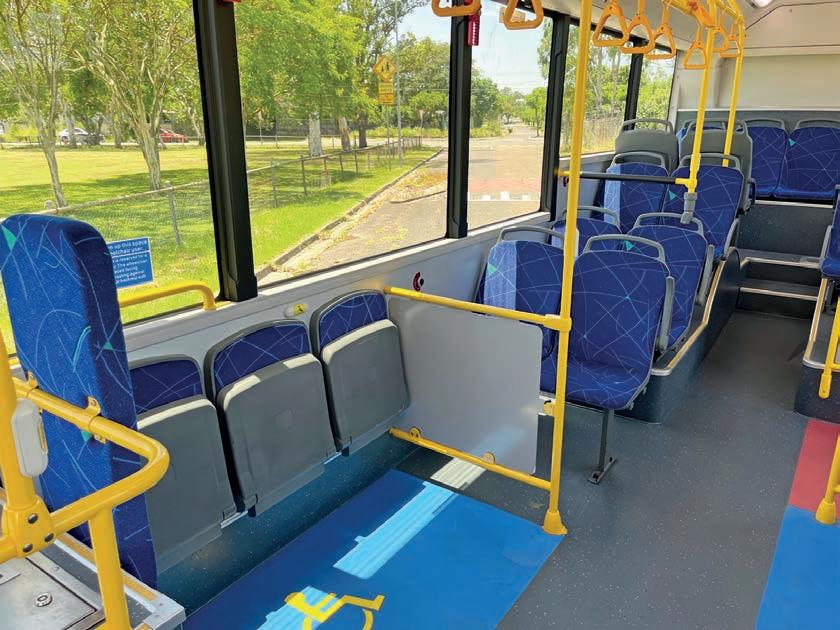
Accessibility has been treated as a baseline requirement on the EVolution Midi – White says it’s a genuine DDA-compliant city bus, featuring front-door wheelchair access and a low-entry layout consistent with larger urban fleets, without alternative boarding procedures or special handling.
Inside, the two-door configuration provides 17 fixed seats, two wheelchair spaces or seven flip-down seats integrated into the wheelchair zones when not in use. Circulation supports efficient boarding and alighting, contributing to reliability on stop-start services and a calmer passenger environment.
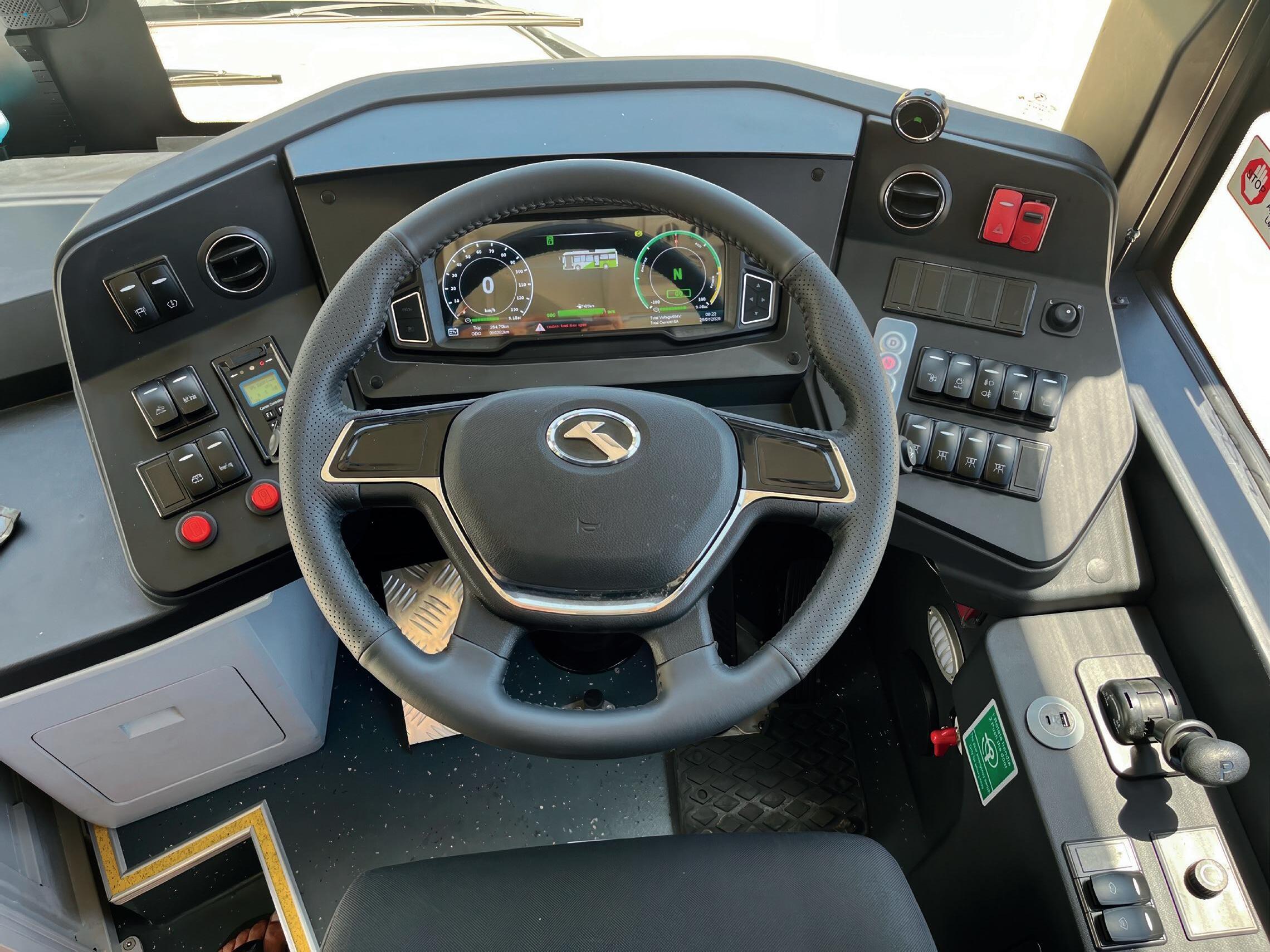
Operationally, driver familiarity and fleet interchangeability were priorities for the Bus Stop team. The driver’s cabin mirrors the layout, sightlines and control logic of larger city buses,
reducing training time and allowing drivers to move between vehicle sizes without adjustment, with eight large air outlets available to the driver.
Ride quality and passenger comfort are supported by a suite of world-class components selected for urban duty cycles. Climate control is provided by Spheros air-conditioning, delivering consistent performance in Australian conditions, while air suspension contributes to a stable ride quality for passengers and drivers alike. From a depot perspective, the bus uses systems and layouts already familiar to workshops, avoiding unnecessary complexity.
“What differentiates Bus Stop Sales is not a single vehicle or brand,” White says.
“But the way we approach meeting industry and customer needs from end to end.”
Bus Stop Sales general manager – national fleets Stephen Long says the project was driven by operational outcomes rather than category definitions.
“The starting point wasn’t size, it
same regardless of bus size, the solution has to deliver accessibility, passenger comfort and operational confidence without compromise.”
That thinking carried through to the manufacturing partnership with King Long. Harvey Zheng, country manager for King Long in Australia, says the brief was shaped squarely around local expectations.
“We worked closely with Bus Stop Sales to meet the operating needs and high service expectations of the Australian market,” Zheng says.
“The goal was to combine small-bus manoeuvrability with the passenger experience, accessibility and service standard people expect from a traditional 12-metre city bus.”
Bus Stop Sales is supporting the EVolution Midi with its national aftersales, parts supply and technical support network, recognising that long-term performance matters as much as initial deployment.
“The EVolution Midi doesn’t set out to redefine a category,” White says.
“It instead addresses a problem that has been evident on many routes
Below:
Queensland’s bus industry is currently in a hiatus when it comes to future power sources, with operators and associations calling on the state government to reveal the way forward for the transition to zero-emissions buses
Zero-emissions. It’s the buzz word of the industry in recent years, an allencompassing term for the future of the global bus and coach industry. Locally, zero-emissions has become increasingly popular, a term used in most conversations within the sector. More buses are arriving each month into Australia, powered by the latest technology, while a rising number of operators are rethinking depots, introducing large-scale infrastructure to match this growing trend.
It doesn’t mean shifting to
zero-emissions is currently in a linear progression. In fact, major jurisdictions in Australia are currently pressing pause on goals to completely electrify bus networks as policymakers and governments stall on the best way to move forward with the transition.
In Queensland, temporarily shifting to procuring diesel buses may initially seem like a sign of regression, but instead it may signal a juncture to re-think the best way forward for the new technology. For industry members like Queensland Bus Industry Council (QBIC) executive
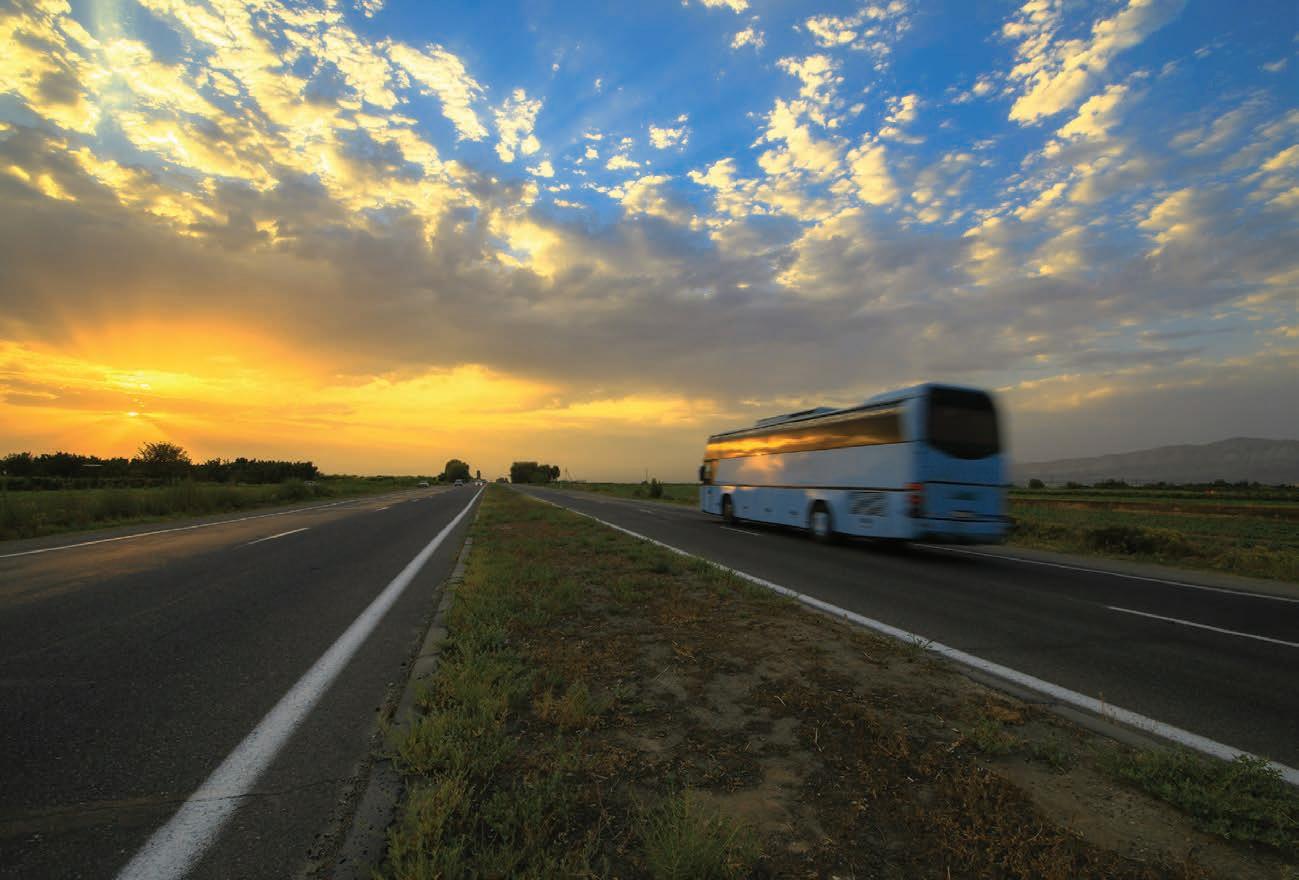
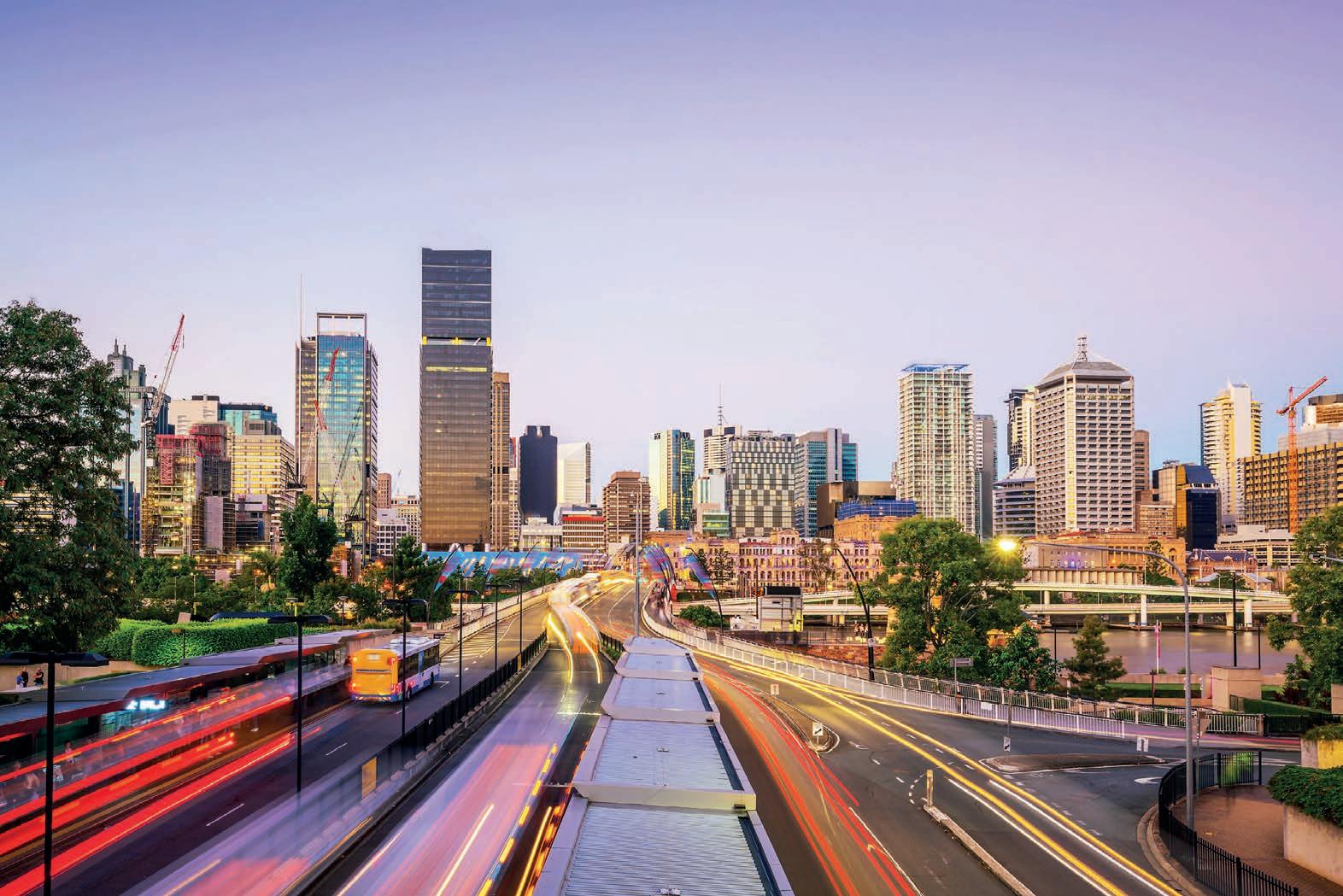
Above: The power source of choice for the state’s bus industry is up in the air. Image: f11photo/ stock.adobe.com
director Jason O’Dwyer, the decision by the state’s Department of Transport and Main Roads (TMR) reflects the government listening to industry concerns.
“We’ve been saying for a long time that industry has no problem manufacturing zero-emissions buses, but what we can’t do right now is charge large numbers of them,” he told ABC
“There’s still no plan for local charging infrastructure, which is made more complex due to the competing demands of the distribution network, the quantum
of the investment needed and the uncertainty regarding contract and lease conditions. This means we don’t have everything in place to provide certainty for governments, operators and customers.”
In response to this industry feedback, and with various bus fleets up for renewal, the Queensland government has quietly veered away from ordering electric buses, instead returning to procuring diesel vehicles for the immediate future.
While there has been no formal position announced, O’Dwyer says the industry is aware of TMR’s move to “return to the drawing board” and welcomes the notion of working on a better plan to introduce zero-emissions vehicles to bus networks.
“It’s a sensible approach to go back and start consulting with the industry manufacturers and other stakeholders on how to transition to zero-emissions buses,” he says.
“The state government has been clear about wanting to achieve emissions targets through its latest energy plan. From what we’ve heard, there’s nothing off the table when it comes to manufacturers discussing with TMR what the future looks like.
“The industry is being asked to discuss alternatives to zero-emissions bus technology, such as diesel, biodiesel, alternative fuels and hybrids, and it’ll depend on the government’s response to this and how quickly they want to implement change.
“My view is that government departments do not have the greatest track record of picking winners when it comes to significant technology change, so it’ll be imperative for industry’s views to be heard, considered and amalgamated into future decisions.”
Underlining this re-think of the state’s bus network future is the unique timing that Queensland finds
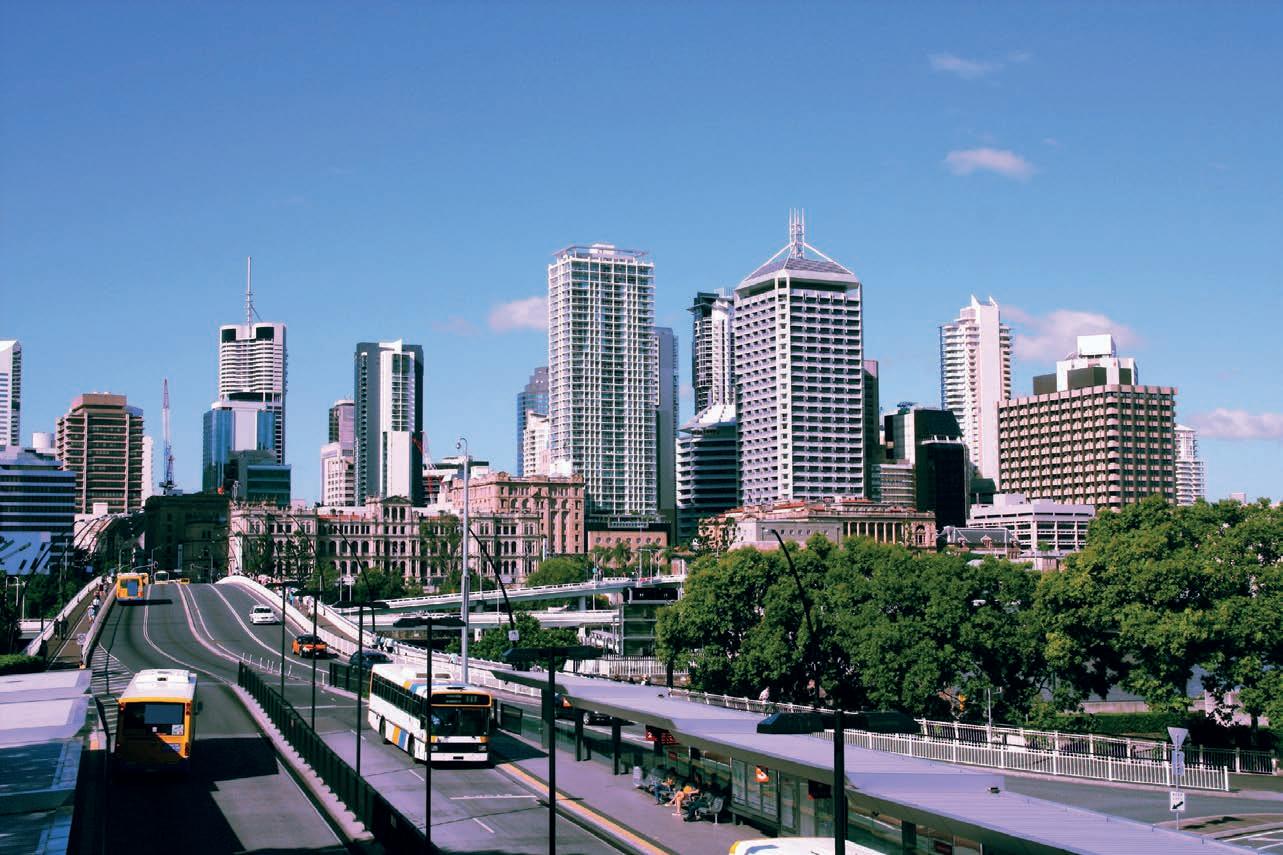
Below: Will electric lead the way in the state or not? Image: Tupungato/stock. adobe.com
itself in. In six years’ time, the Olympic Games will be held in Brisbane, while currently fifth generation, or 5G, contracts are in early stages of consultation among the state’s operators.
O’Dwyer says he has raised issues with TMR around energy transition, asset and depot ownership, manufacturing certainty, workforce development and retention as significant contract topics. His belief is that operators can’t enter 5G contracts with the current uncertainty.
He’s calling on TMR to provide a clear message on what the future looks like, particularly ahead of these contracts being entered into that are likely to include transport provisions for the 2032 Olympics.
“Operators want certainty between now and then, and an energy transition or a change in emissions targets isn’t something the government should be turning on or off like a tap,” he says.
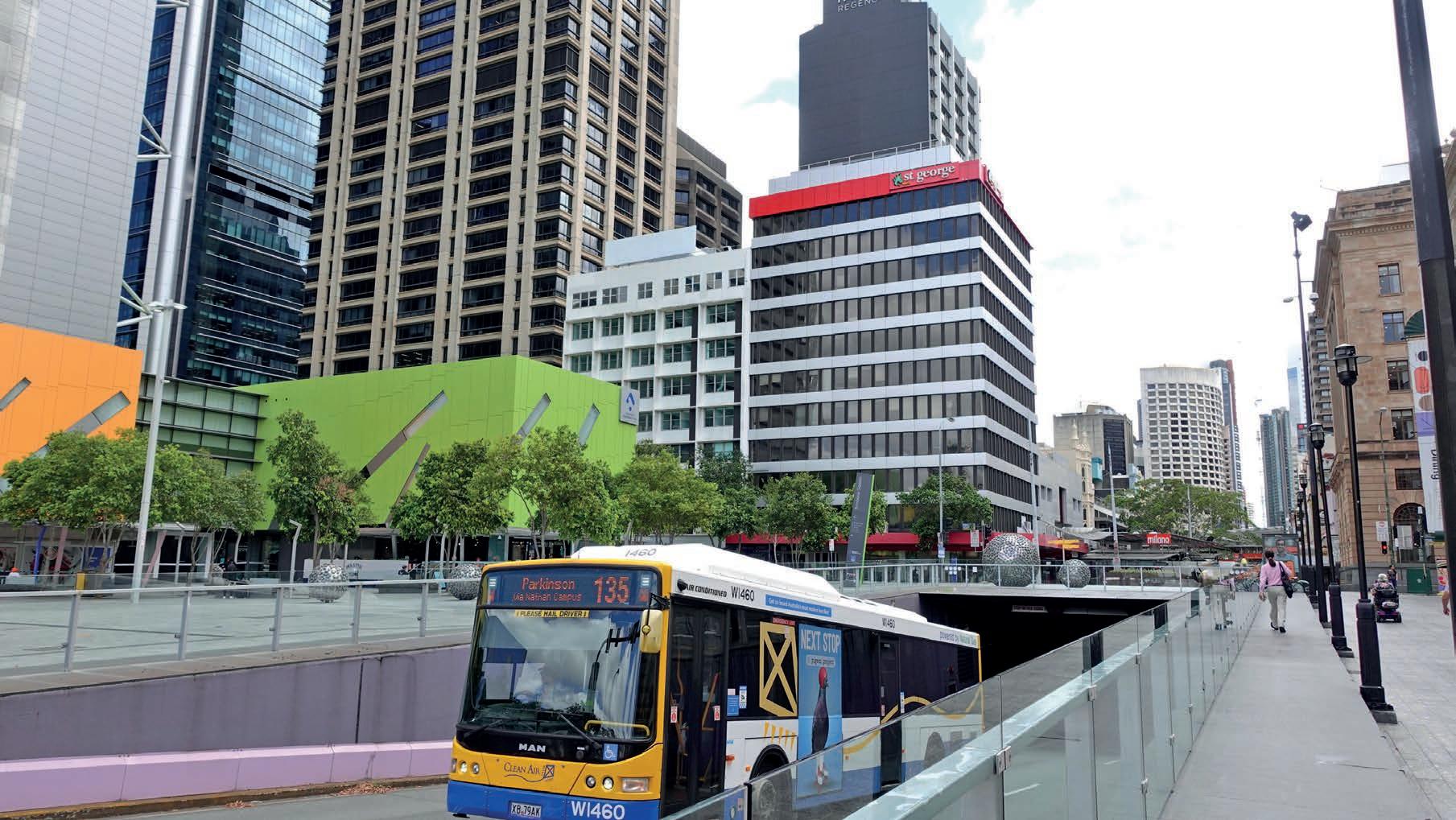
“I’m pressing the state government and TMR to give clarity to operators on what the playing field will look like moving forward across all these areas so that operators can present quality offerings that represent tax payer value, quality customer service and delivering sustainable results for all stakeholders.
“Operators have some wonderful ideas to benefit the network, but without any innovation fund or trial mechanisms in place, there won’t be any problems resolved.”
Despite this informal shift in ordering practices that has veered away from zero-emissions buses, TMR is adamant the future still lies in reducing emissions in the public transport sector. A spokesperson told ABC that the industry will continue to play a role in determining the future of the bus industry in Queensland amid
a defining time for the state.
“The Queensland government is developing a Net Zero Roadmap, which includes a program for reducing emissions across a number of sectors, including transport,” the spokesperson says.
“TMR will continue engaging with industry as planning progresses to guide the future public transport fleet.
“Transport planning for the 2032 Games is underway, with enhanced Translink services and shuttle operations to be refined as venues and travel demand are confirmed.”
Regardless of the decision made, what matters to O’Dwyer is that the bus industry, in partnership with government and department, makes the best decision possible based on the best information possible. This includes transparency and reporting back to industry the outcomes
The state is only years away from hosting an Olympic Games. Image: arliftatoz2205/ stock.adobe.com
from various alternative bus trials, conducted in recent years, with this lack of information hindering the industry’s ability to provide valuable comparisons and practical insights into future zero-emissions technology.
“From the industry’s perspective, we need to have certainty about what needs to happen and then we can deliver these services,” he says.
“Passengers’ expectations of services are that they arrive on time, are for the right fare, get them to where they need to go with the right frequency and are sustainable.
“It’s definitely a bonus to have electric buses running, but at the end of the day our mission is to cater to passengers, so we need clarity and a clear path forward to provide the best possible service to Queenslanders moving forward.”

endeavourawards.com.au




In just over five years, Tropic Wings and its partners have delivered a major electric bus project in Far North Queensland. Now, the operator is ready to share its learnings to others around the nation, Sean Mortell reports
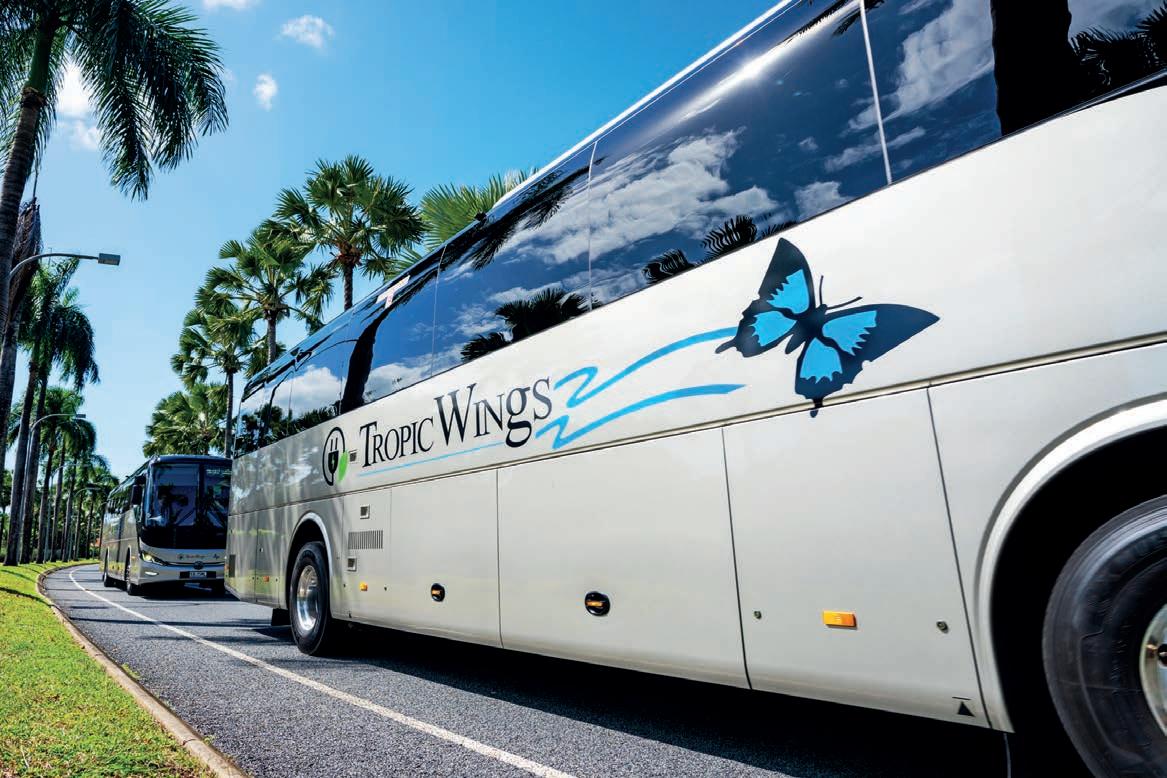
Jake Whitehead is no newcomer to electric vehicle technology, but when he heard the name Tropic Wings, it caught his attention. It was 2018 and, as the former chief scientist at the Electric Vehicle Council (EVC), he first heard of a bus operator in Cairns introducing an electric bus to its operations. It pricked his ears and started a partnership that has helped unlock an Australian first in the electric bus market.
In the years since, Tropic Wings has welcomed 16 battery electric buses, representing 40 per cent of its tourism and charter fleet, and established a Cairns depot to charge them. For Jake, who was engaged
as an independent observer to track performance data and translate the learnings for other private operators, the initial foray into operating electric buses was a clear sign of the Far North Queensland business wanting to lead the pack.
“There weren’t many in the country at that time implementing electric buses, let alone operators in a tropical location like Cairns,” he told ABC
“Tropic Wings was keen to show leadership in the space, and over time I came to know more about the business. When I then joined the EVC, we spoke about Tropic Wings wanting to extend this electric bus delivery into a larger project and it soon snowballed into something extraordinary.”
Shortly after taking delivery of this first electric bus and putting it into service, the operator ordered more and then applied for funding for a milestone project. Tropic Wings received partial funding from the Australian Renewable Energy Agency (ARENA) through its Driving the Nation program to commence a new phase that included buying 12 electric buses and adapting their depot to suit charging requirements. For Tropic Wings general manager Colin Anderson, the idea came from a wish to be more environmentally friendly while running tourism services across some of Australia’s most stunning natural scenery.
“Our motivation back in 2018 came from having diesel buses left idling outside of our restaurant at nature park Rainforestation in Kuranda,” he told ABC
“With it came fumes, and we couldn’t turn off the buses as it’d be too hot with no air-conditioning running, so our motivation was to pivot and provide our guests with a better experience.”
This started with the introduction of Tropic Wings’ very first electric bus in 2018, with the low-floor model running daily and successfully on the operator’s Kuranda day tour. While COVID-19 halted plans to escalate this technology, by 2022 new electric buses were on the local market and Tropic Wings could resume its plans. Once the operator received the crucial funding, it enlisted Jake as an ideal third-party to ensure the project went smoothly while evaluating its progress.
“We knew the electric buses would work because once we ran the first one in 2018, we saw the numbers stacking up and working for us,” Colin says.
“The funding took the risk out of it for us, as there were so many unknowns. We were most nervous about getting enough power in the network to charge the buses, as the buses have been wonderful since day dot and will do whatever we need.”
When Jake was asked to get involved with the project as an independent observer, it was a dream come true. His task was to record what was happening, analyse results and share results in a way that would inform other private bus operators about what the transition involves.
“I can’t take credit for the hard work of getting the buses and infrastructure out and operating, but I’ve been able to observe what’s been happening and collect some great data before analysing it in a real-world setting,” he says.
The project partners were barely out of the starting blocks when they learnt their most important lesson –the largest challenge for operators lay in commissioning and delivering charging infrastructure to power an electric bus fleet. Colin says Tropic
Wings learnt early the operator couldn’t complete the depot on its own due to various complexities arising, so the business brought in Energy Australia to help with electrical engineering work.
“What we learnt very quickly was that reconfiguring the yard for electric buses isn’t easy, but it’s the easier part, as the hardest bit is getting electricity to the site,” he says.
“In North Queensland we only have the choice of Ergon Energy, so we couldn’t compare in the market. Our project was supposed to be completed by mid-2025, but it’s still ongoing as the energy provider continues to put the final pieces in place. It’s been exceptionally slow work and it’s the hardest part of trying to electrify a bus network.”
It’s an opinion that Jake is quick to agree with, labelling the infrastructure the “greatest challenge” for private bus operators wanting to make the transition. He says it boils down to bus operators having to work with electricity grids and distributors in a way they’ve never had to before, while the bus industry isn’t prioritised as a favourable project to complete faster from electricity distributors.
“This leads to challenges if there are lengthy delays in gaining approvals and putting infrastructure into the ground, as there can be unexpected costs that arise to ensure the grid is stable and resilient for everyone in the local community,” he says.
“Costs get pushed back onto bus operators – if we want to see an increased uptake of electric buses in Australia, there has to be greater involvement from governments to work with electricity distributors and prioritise this infrastructure while sharing risk and cost. If this is all put onto the operators, that will delay the transition or, in some cases, prevent it from happening altogether.”
To combat the challenge, Tropic Wings installed a transformer on site belonging to Ergon before installing 12 charging stations on site. Colin and Jake both say operators wanting to run a couple of electric buses don’t necessarily have to invest this deeply in chargers, as they discovered they could use only a couple of chargers
for a small fleet of electric buses, ranging from the smaller 27-seat Yutong D7E to the 57-seat Yutong C12E coach.
Outside of the infrastructure, both agree that the buses themselves are “fantastic”. Although the procurement of more expensive buses that feature different technology isn’t straightforward, positive responses from drivers and passengers has justified this move.
In a fleet of 12 electric buses that varied from 57-seat coaches to smaller buses, Jake says real-world data showed the coaches used around 90 kWh per 100 kilometres, while the smaller models were under 60 kWh per 100 kilometres.
“From our data, they performed very impressively, especially considering they weren’t running in perfect conditions as they used lots of air-conditioning, were loaded with passengers and drove up and down ranges in different terrains,” Jake says.
“However, this data proves they ran very efficiently and were cheaper to operate than other diesel buses. They typically travelled 120 to 140 kilometres per day, which equated to using roughly a third of the available battery capacity on the coaches, and around half on the smaller buses.”
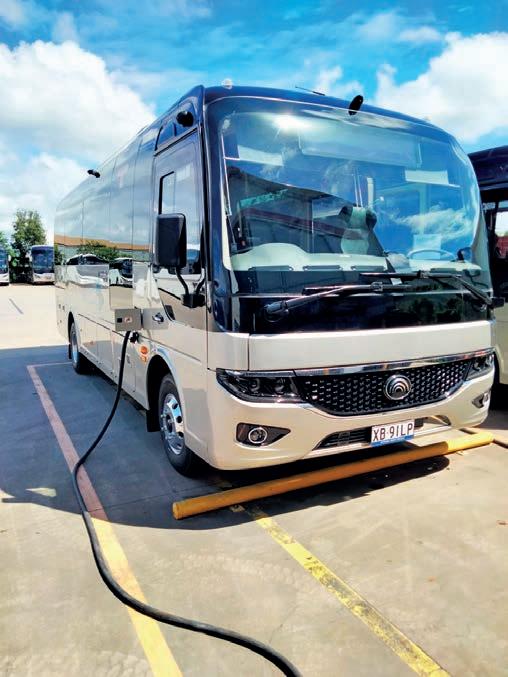
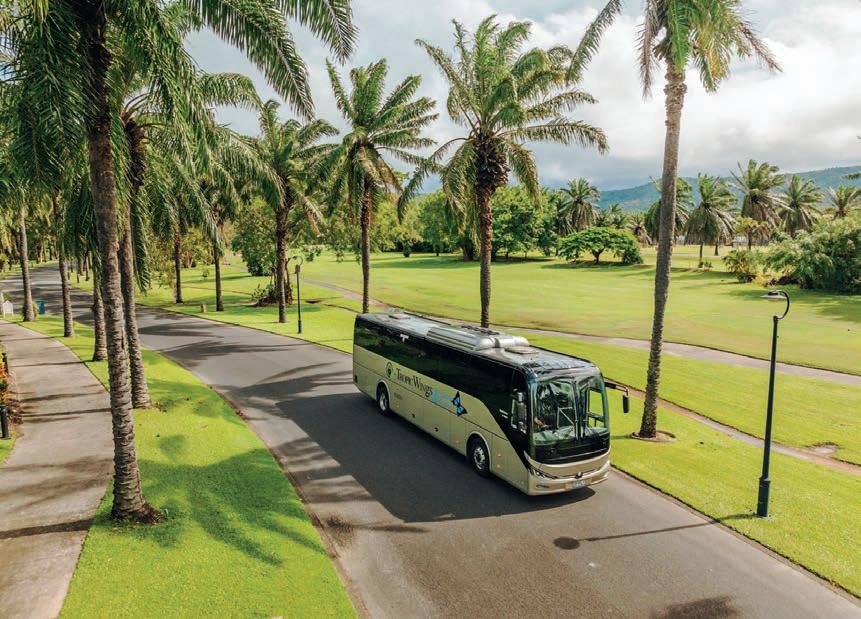
Jake says Tropic Wings chose to top up during the day as a conservative starting strategy, not because the buses were close to their limits. He says this has served as a “really good strategy”, however he sees an opportunity for the operator to further reduce costs by charging less often and during low cost periods. He expects operators all around Australia to follow this cycle of being conservative to start with before gaining confidence in the range of electric buses and pushing them for longer on a single charge.
“It’s important to highlight that these buses came fitted out and approved, so they were available on the road much quicker than the infrastructure could be installed in the ground,” Jake says.
“This meant Tropic Wings had to use slower charging infrastructure for a while to cover the gap, but they found in many cases this was more than enough, and they paid less on power than first thought. It shows you don’t necessarily need a high-power first charger for every electric bus you deploy.”
Jake and his team also conducted surveys among drivers and passengers, with the former being very enthusiastic and supportive of the approach. The main feedback received from Tropic Wings’ drivers was that the electric buses were smooth to drive and they experienced
less fatigue – their main comment was they wanted to learn more about the technology.
“One of the obscure parts we didn’t think about was how good it would be for lowering driver fatigue,” Colin says.
“There’s no vibrations in the bus, and now studies are coming out globally supporting these benefits.”
On the passenger side, plenty of them initially didn’t even notice they were in an electric bus. When they were then told of the technology they were enjoying, many were surprised at the bus’ capabilities in and around Cairns. In a major boost for the trial, some passengers said they would pay more for their fare if the tour was promoted as using these electric buses due to the comfort and environmental benefits they have.
“The feedback from our guests was overwhelmingly positive – in the business event space, we’re now receiving a lot of charter work from businesses wanting to use electric buses,” Colin says.
The Tropic Wings general manager says the main lesson learnt is that converting to electric buses is “doable”. If it’s possible to do so in North Queensland with its cyclones, floods and limited infrastructure, then Colin is confident it can be done elsewhere in Australia. By installing a battery electric storage system, Tropic Wings’ Cairns depot can
harvest excess solar power and charge buses, saving the business up to $12,500 a year on electricity costs. It also means power supply remains if there are any disruptions, particularly caused by weather.
Colin and Jake say operators can start simple, proving the vehicle and charging routine with one or two chargers before scaling infrastructure as confidence and grid capacity improves.
“We’re now advocating for there being more charging stations installed across Australia, including fast chargers,” Colin says.
“With more operators doing this, there’ll be a network around the country that can overcome any limitations. If this happens, everyone will benefit, as we’re already saving money on operating these vehicles, particularly when it comes to servicing.”
Jake’s final report outlined the primary barriers in place for electric bus uptake, including infrastructure limits, delays, higher upfront costs with a lack of government support, an ongoing workforce skills gap and the overall learning curve faced by operators without government intervention.
His key recommendations are to develop a clear action plan for successful electric bus deployment, implement strategies to optimise bus operations and charging to reduce costs and leverage government and industry partnerships to share learnings.
It’s a heavy summary of a major project – Jake still remembers hearing of Tropic Wings’ first electric bus delivery and being surprised. Now there are 16, with four being delivered in the past six months. For Colin, it’s all part of leading the way and meeting a lofty objective.
“Our ultimate goal is to have 80 per cent of our fleet electric by 2030, and we’re not far away,” he says.
“We know we’ll need diesels for our longer charter business until governments sort charging infrastructure, but this has proven we’re capable of leading change in the local industry.”
As Challenger continues its evolution into the battery electric bus space, it’s using the highest quality parts and package options to satisfy local operators
When Challenger Bus & Coach entered the zero-emissions market, it knew it had to offer something fresh and unique. The emerging Australian vehicle supplier is by no means the first to push into the zero-emissions sphere. When the brand decided in recent years to expand its range into battery electric buses, it did so under the premise of maintaining its distinct identity of producing tailored, high quality vehicles suited to the everyday needs of local operators.
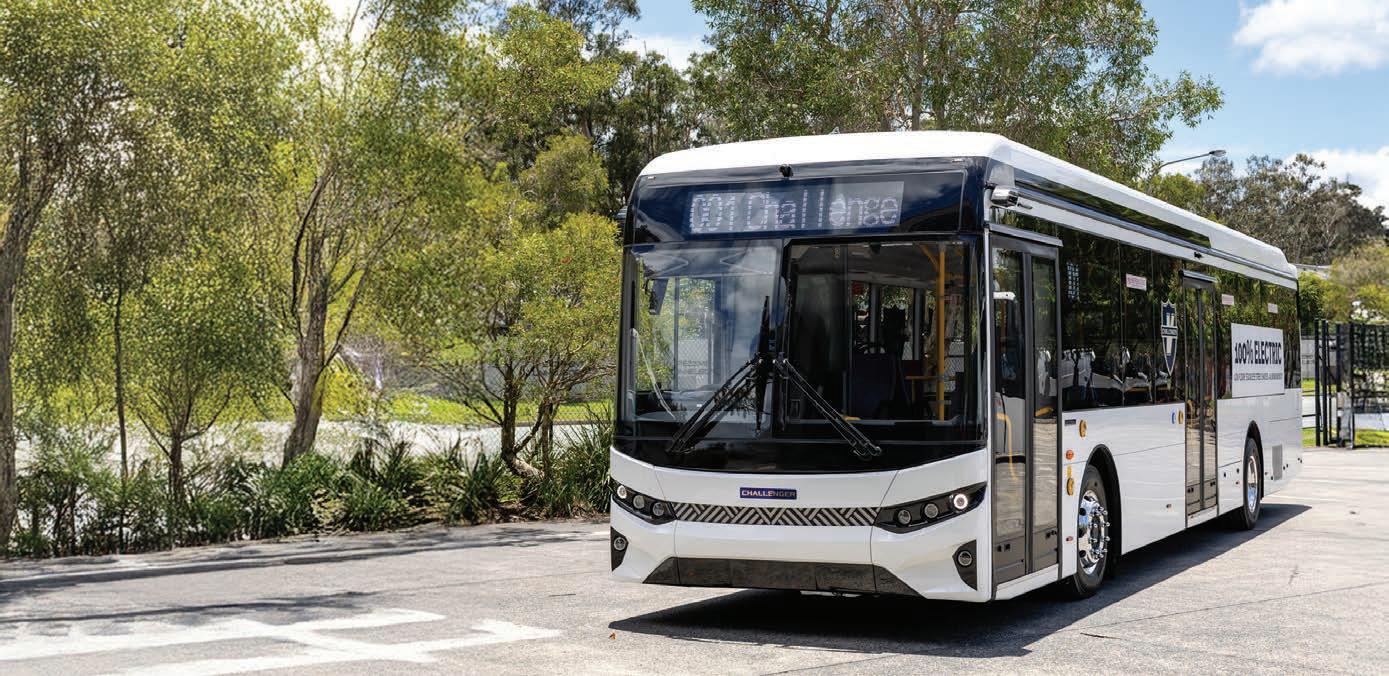
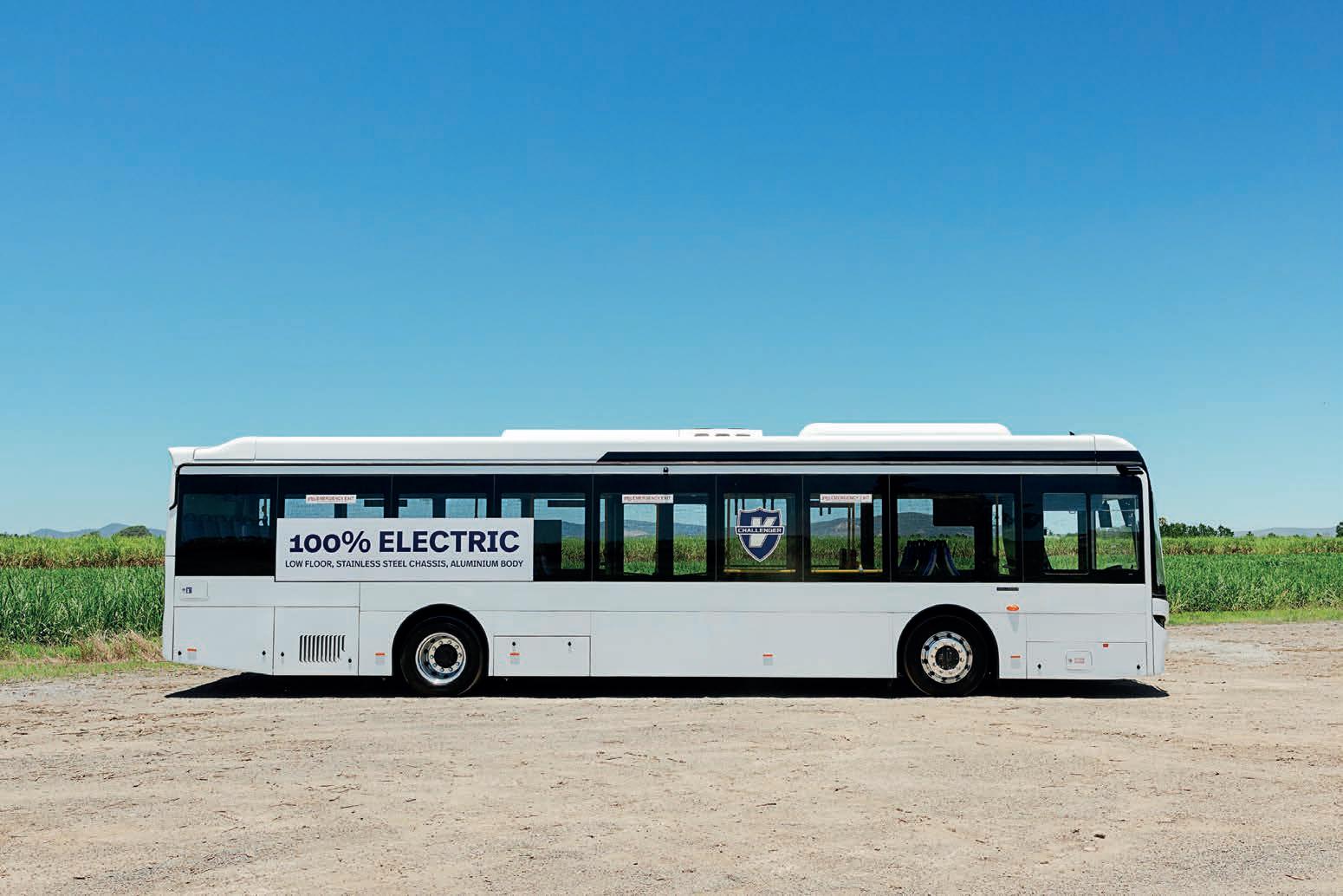
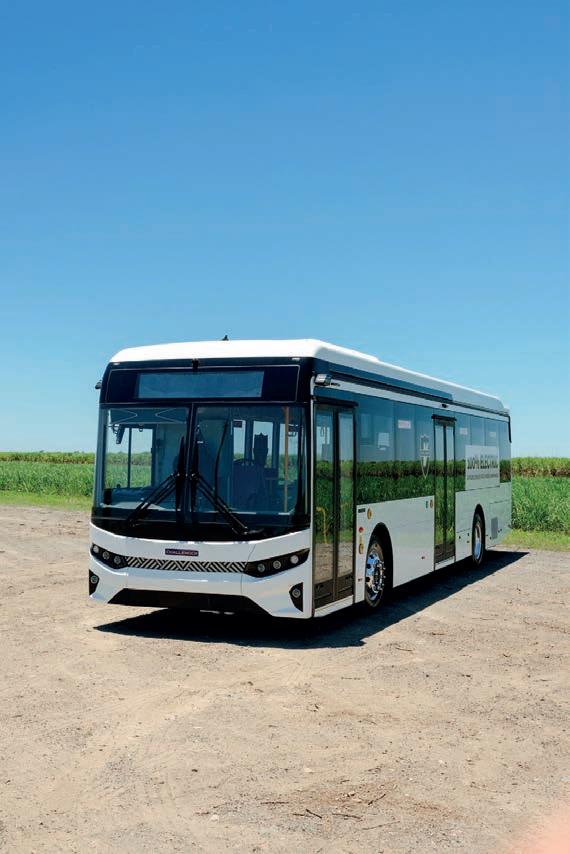
The result is Challenger’s first 12.5m low floor EV bus which sits as the brand’s first low-floor electric bus
model. Unveiled at the 2024 National Bus and Coach Show in Brisbane, the low-floor model drew industry-wide attention and marked a turning point for the brand. The brand’s first local electric model is made ready for a range of applications, including government, schools and operators wanting to tender for zero-emissions services. Having established itself in the market with this new technology, Challenger is already shifting its processes to further enhance its upcoming battery electric buses.
“The shift to battery electric buses involves more than a change in technology,” Challenger general manager Paul Fagg told ABC
Above: Challenger is continuing to grow its products in the zero-emissions space
“Challenger supports that transition with an end-to-end offering that includes tailored finance options, expert guidance and ongoing support to ensure customers can adopt BEVs with confidence.”
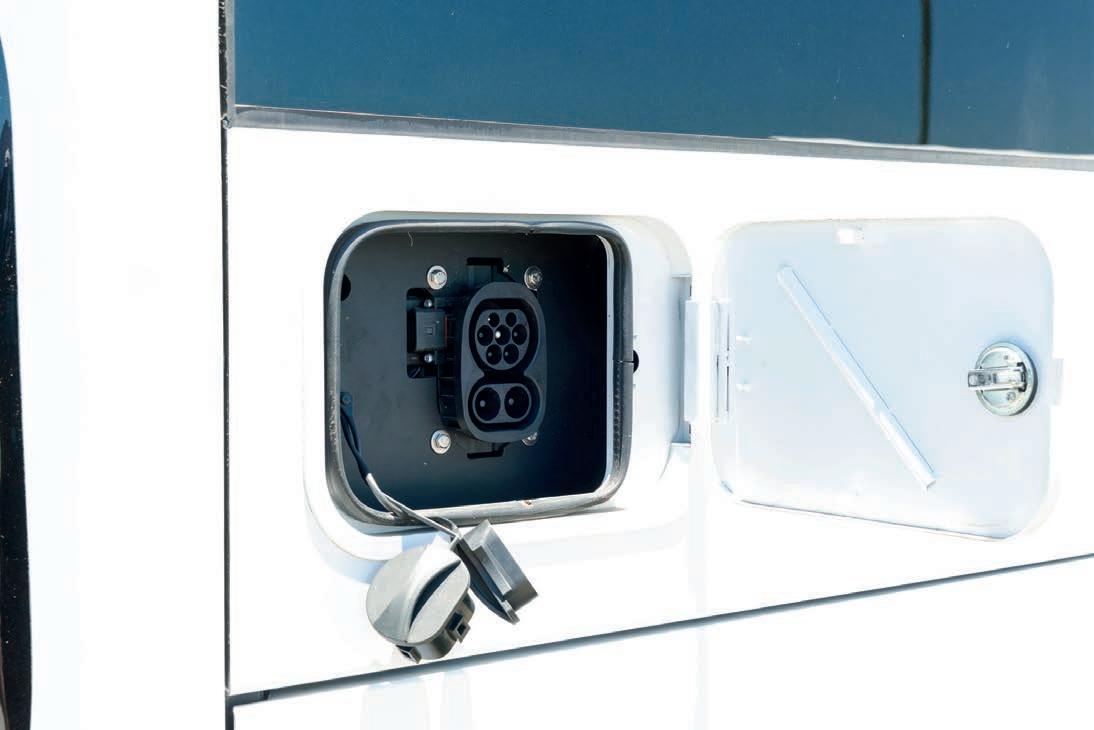
This total package plan has led Challenger to announce its latest decision that all future electric bus builds will include CATL BC5 batteries. This move provides flexibility for both brand and operator, allowing smaller businesses who may only want to run 100 kilometres per day to buy a battery electric model with less batteries.
“Many operators may only complete a 100-kilometre run before
returning to base for several hours ahead of an afternoon pickup,” Paul says.
“In those scenarios, fitting the maximum number of batteries doesn’t always make sense as the bus is back on charge during the day, particularly when batteries are a serviceable item that will require replacement over the life of the vehicle.”
The BC5 battery from CATL has become a popular choice for suppliers and manufacturers all over the world in the past year. From European manufacturers to local Australasian members, the latest CATL batteries have begun to replace existing battery options in the market. Paul says the introduction of these batteries and the scalable nature of power built into Challenger’s electric bus model means operators can also reduce cost by choosing the right amount of batteries to suit their needs.
“Alternatively we can cater to higher kilometres and customers can choose to charge overnight during off-peak times,” he says.
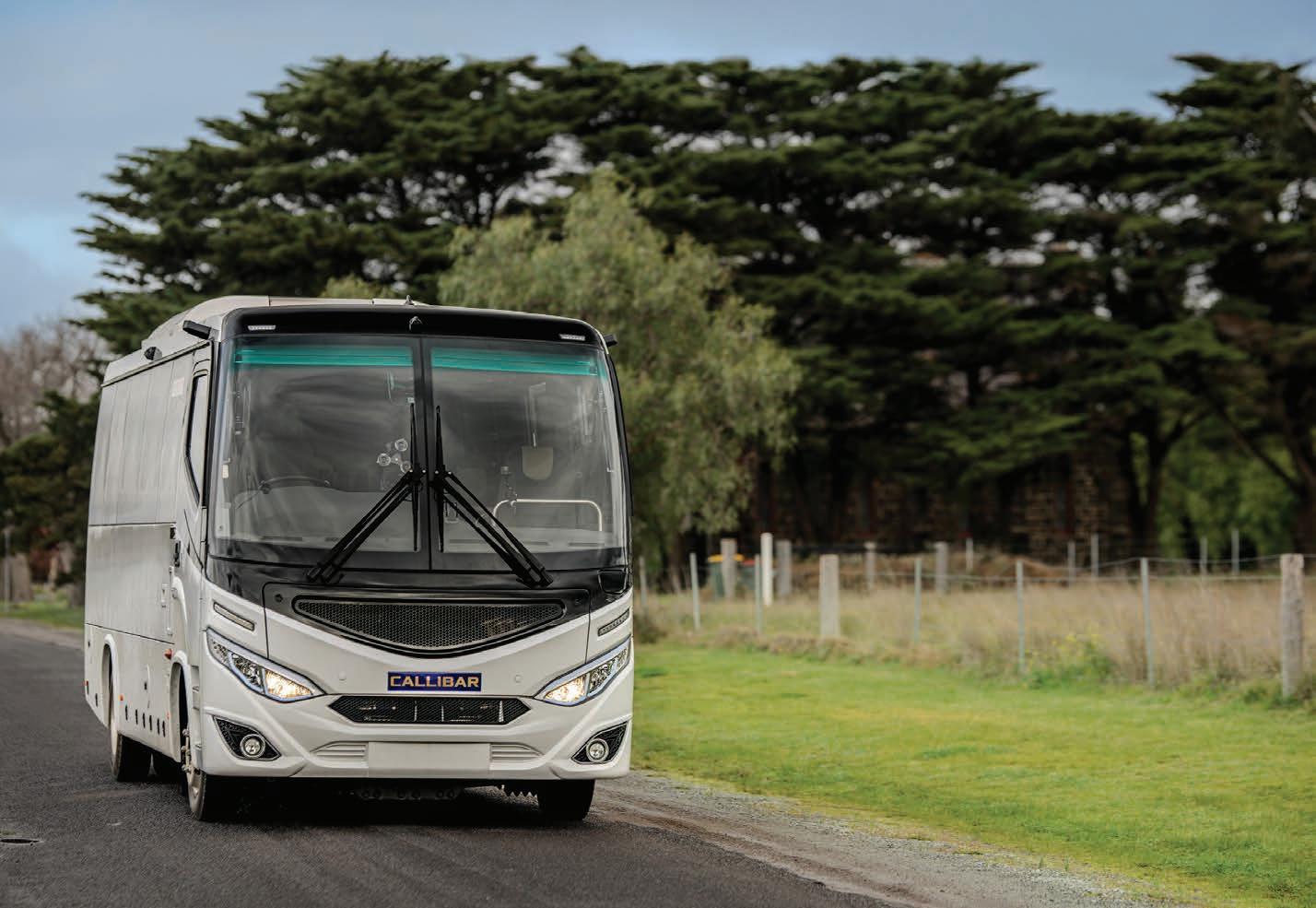
This latest development in Challenger’s range is a sign of what’s to come from the local supplier. By the end of this year, Challenger is aiming to have three fully electric models available in the market for operators to choose from, including the low-floor city bus, an electric version of the Callibar and an electrified V12 coach, each designed and engineered to suit Australian conditions. The move comes as Challenger also exclusively partnered with an Australian electric engine manufacturer last year to ensure these locally owned, designed and patented engines can power the future of Challenger’s electric vehicle range.
“Electrification in buses has advanced rapidly, with new technologies such as solid-state batteries and stronger charging infrastructure on the horizon,” Paul says.
“By offering the Callibar and V12 in electric, we’re giving operators greater choice while helping them transition confidently towards a more sustainable future.”
While electric buses won’t be the only reveals made in 2026 as part of a defining Expo year for Challenger, the brand is leaving no stone unturned to continue evolving in the zero-emissions space. On top of these various developments to its electric product range, Challenger has also partnered with Brett Collins and the
Above: Expect more electric innovation from Challenger in 2026
team at Bus Finance Australia to offer financing options for bus and EV infrastructure as a tailored package.
Below: Challenger’s latest zero-emissions forays include using new CATL batteries
Combining this financing extra with the latest developments in the global electric bus battery space, Challenger is ensuring its expansion into the zero-emissions space maintains the emerging brand’s core identity of offering comprehensive and high quality vehicles for Australian operators.
“CATL’s fifth-generation BC5 lithium iron phosphate battery systems are designed specifically for commercial applications, offering a significantly extended service life of 15 years or more, with warranties supporting up to 1.5 million kilometres,” Paul says.
“By combining this next-generation battery technology with the ability to optimise battery quantity to suit real-world duty cycles, operators can materially reduce lifecycle costs - especially on contracts extending out to 20 years.
“At Challenger, we know operators value reliability, service and choice. That’s why every step of our growth – from expanding into electric to introducing specialised models like the 4WD Callibar – has been about meeting real-world needs.
“We’re focused on delivering vehicles that work as hard as our customers do, backed by service and support they can count on.”
In the final weeks of 2025, years of hard work saw VDI Australia celebrate an important milestone delivery out west with a special Yutong bus
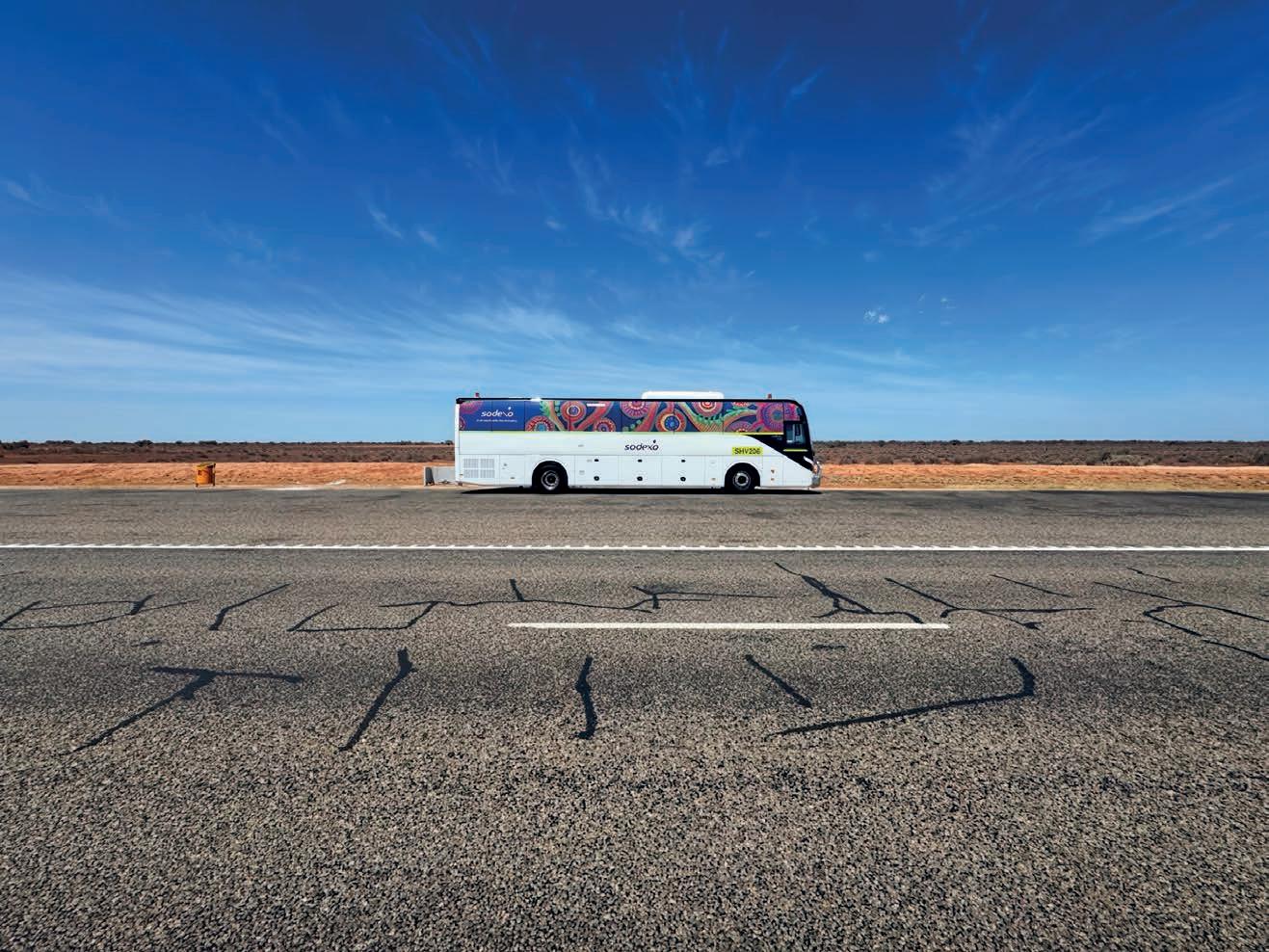
It was just a week before Christmas last year when VDI Australia received an early present. Out in Western Australia’s Pilbara, the VDI team met in Tom Price to deliver its 2,000th Yutong bus in Australia.
“Reaching 2,000 deliveries is a genuine proud moment for all of us at VDI,” VDI managing director Peter Woodward told ABC
“It’s proof of something we’ve worked hard to earn – customer trust, built one delivery at a time.”
This sense of pride was on full display in late 2025 when VDI delivered the milestone Yutong C12 bus to Sodexo, supporting Rio Tinto operations. It will be used for workforce transport including airportto-camp, camp-to-site and return movements in remote operations where these routes are time-critical
and of high consequence. In these areas, reliability isn’t a preference –it’s an operational requirement.
Woodward says moments like this are worth celebrating because they reflect the real work that sits behind every handover, and the cumulative effort that has carried VDI to 2,000 deliveries.
“Two thousand deliveries tells a story about consistency,” Woodward says.
“It’s about getting the specification right, preparing vehicles for Australian conditions and then backing customers through the life of the fleet. That support framework matters just as much as the vehicle itself, especially in demanding environments.”
VDI national sales manager Sara Clark says the achievement has been felt across the business because it is
Above: The milestone Yutong C12 operating near Tom Price as part of Sodexo’s Pilbara workforce transport fleet Image: VDI
shared with customers and because every delivery adds to the experience VDI brings to the next specification, build and handover.
“There’s a real buzz internally,” Clark says. “This is the result of thousands of conversations with operators, drivers and technicians, and a team that’s stayed focused on making handover and support stick in the real world. When a customer is moving people to shifts and site commitments, you’re judged quickly on uptime and responsiveness, and that’s where we stay locked in.”
While 2,000 is a strong headline, VDI’s view is that its meaning sits in what each delivery represents – an operator decision made under real-world constraints, shaped by duty cycle, safety requirements, serviceability, operating cost expectations and the support that
keeps fleets on the road.
Nowadays, a vehicle delivery is rarely a simple transaction. Behind every handover is a chain of planning and preparation, specification decisions, compliance requirements, local readiness, commissioning coordination and the practical steps that help drivers and maintenance teams adopt a vehicle quickly and consistently.
In high utilisation environments like the Pilbara, those factors are magnified, as distance, heat, dust and shift changeover realities mean small issues can become big quickly if readiness and support are not right. An unplanned outage doesn’t just affect one trip, it can disrupt people movement, rostering and the operational rhythm of a site.
Clark says VDI’s mine-spec capability is built around preparing vehicles for high-demand operating environments, with configurations that can be tailored to operator and site requirements. Specifications differ depending on contracts and operator preferences, and not every feature applies universally. The objective remains consistent – align the vehicle to the operating reality, then support it through a disciplined delivery process and a service experience that protects uptime.
Over time, VDI has built a customer base across school transport, charter and touring, community transport, public transport applications and specialist operating environments such as resources. This diversity has mattered as it has allowed VDI to build capability, meaning lessons learned in one segment, whether it be around durability, passenger comfort, maintenance access or scheduling pressure, often translate into better outcomes in another.
VDI’s story began in Far North Queensland and has grown into a national footprint, culminating in 2,000 deliveries that have required discipline, specification rigour and follow-through to ensure the vehicle performs in service.
Its focus has remained pragmatic, helping operators to match vehicles to duty cycles, keep operating costs predictable and deliver support that
works in the real world.
The involvement of Sodexo highlights a deeper link between the two organisations as they accelerate the practical adoption of zero-emissions transport where it can deliver real operational value. Alongside this diesel C12 handover for Pilbara workforce movements, Sodexo has previously taken early steps with battery-electric bus technology through the C12E platform, supported locally through VDI and Yutong. This kind of customer-led trial and rollout is helping move zero-emission pathways from concept to day-to-day operation, proving what is possible when decarbonisation goals are paired with the reliability and uptime that mining transport depends on.
VDI supports customers through a national service footprint, including more than 50 service partner locations across Australia. For fleets operating across large geographies, particularly in regional and remote contexts, the availability of capable support is often a deciding factor. VDI says its priority is to ensure operators have access to consistent aftersales support, from routine servicing through to technical guidance, so vehicles can remain in service and schedules can be maintained.
The company is also strengthening its delivery and onboarding experience through improved training and support resources. This includes expanding handover content that can be reused across fleets, such as walkaround video libraries, technical video resources and simplified driver cue cards. The intent is to reduce friction in the early weeks of operation and support consistent vehicle use across drivers and depots, particularly where turnover, shift work or multi-site operations can make standardisation difficult.
For the Tom Price operation where the milestone delivery was made, that practical focus is central. Workforce transport is judged by consistency over time, the ability to run to schedule, reduce disruption and keep people moving safely between the airport, camp and site. In this context, “good delivery” is not just an on-time
handover – it’s a smooth transition into service, with the training, support pathways and maintenance readiness required for high utilisation operations.
Delivering that outcome consistently requires both a strong product platform and a local organisation that can stand behind it in service.
VDI notes that its role as the national distributor of Yutong buses allows it to combine local accountability with the global manufacturing platform of an international bus brand with market presence. In Australia, VDI focuses on delivery readiness, aftersales support and local capability, including building and assembling in Australia to meet local standards and tender requirements, while maintaining clear governance around warranty and support expectations.
As the Australian bus and coach market continues to evolve, operators face rising expectations across safety, accessibility, cost and sustainability. Some fleets are focused on incremental improvements through lower-emissions internal combustion solutions, while others are progressing down commercially sound zero-emission pathways where infrastructure and application align. VDI’s position is that long-term fleet outcomes depend on disciplined specification, realistic duty cycle matching and support systems designed for everyday operation, not just initial delivery. It’s this belief that has spurred the brand on to greater heights and magical milestones in Australia, with plenty more to come.
“For customers, partners and staff who have contributed to the journey so far, this is a moment to recognise the scale of what has been achieved, and to say thank you,” Woodward says.
For operators planning their next procurement decision, it’s a reminder that vehicle choice is only one piece of fleet performance. The support experience, and the capability behind it, is what sustains outcomes over the life of the fleet.
In late January, Kinetic opened its latest electric bus depot in Victoria in a state-first for the operator as it continues to introduce more sustainable bus services
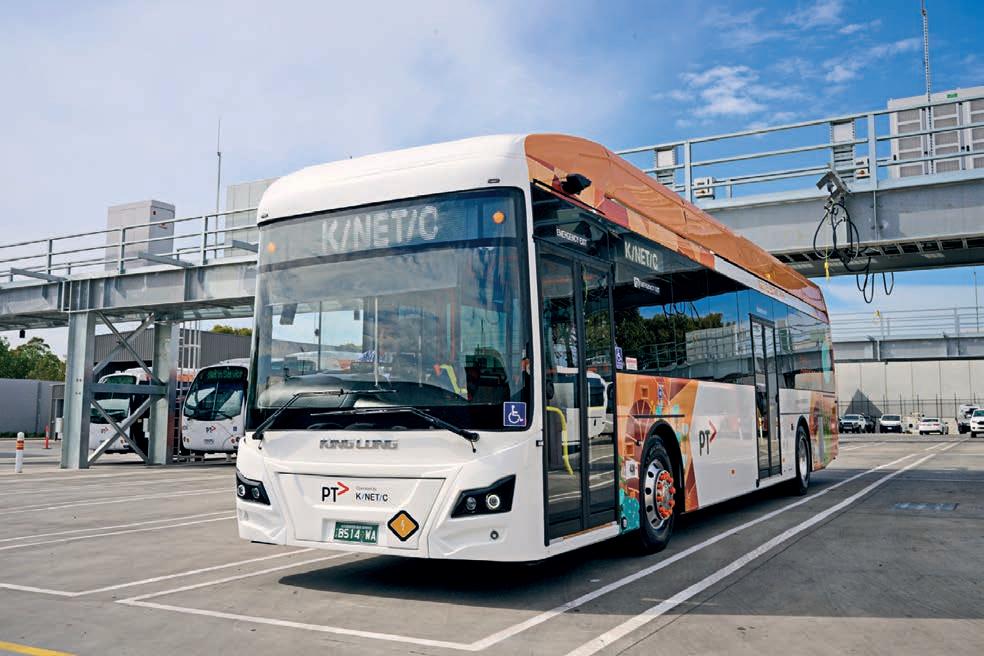
The newest electric bus depot in Victoria has been officially opened as the state accelerates its transition to zero-emissions buses.
The new Kinetic electric bus depot in Preston was opened in late January, with industry members and project partners attending the site to cut the ribbon.
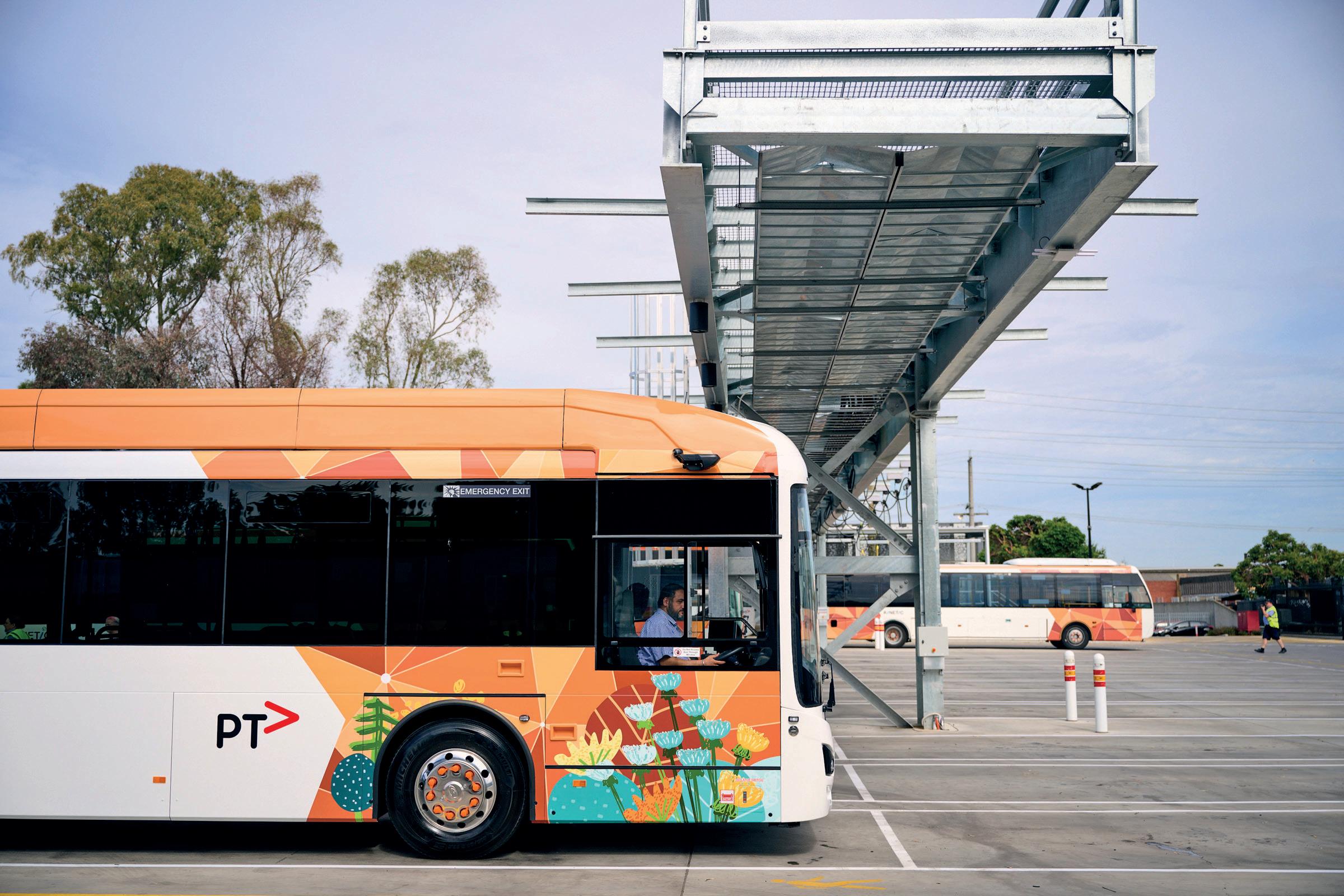
The Preston depot features a first in Victoria with an overhead gantry charging system that increases space and capacity for the new zero-emissions bus fleet that will be operated from the state.
As Victoria continues moving towards net zero emissions by 2045,
the new zero-emissions buses, which are a King Long chassis with a Global Bus Ventures body, will phase out older diesel buses used by Kinetic.
Up to 58 electric buses will operate out of the Preston depot travelling more than 2.8 million kilometres each year across Melbourne’s northern suburbs, including routes to Moonee Ponds, Melbourne University and Reservoir.
These new-modern buses and fully electric bus depot are part of the new Metropolitan ZEB Franchise contracts that have been designed to fully transition a third of the metropolitan bus fleet to ZEBs by 2035, accounting for 600 diesel buses and saving an
estimated 45,000 tonnes of carbon emissions annually.
“ZEBs are cleaner, quieter and better for passengers and community alike, and we are proud of the work our operators and workers are doing to accelerate the transition of our bus fleet,” Victorian public and active transport minister Gabrielle Williams says.
The Preston facility is also supporting the training of five additional workers – helping to transition bus maintainers to more modern and sustainable technology. Kempower chargers are used on the site.
The Preston gantry set-up builds on Kinetic’s track record in electric
bus infrastructure, including the introduction of New Zealand’s first large-scale overhead gantry charging system at its Glenfield depot in Auckland. The Preston opening means Kinetic now operates more than 1,500 zero-emissions buses across 33 ZEB depots worldwide.
Kinetic Group CEO Michael Sewards says the company’s vision is to lead the transition to zero-emissions public transport across every city Kinetic operates in.
“Preston is a prime example of how we’re turning that vision into reality –bringing global expertise and proven technology to deliver cleaner, quieter journeys for local communities,”
“We’re committed to investing in the infrastructure, technology and people needed to accelerate the shift to zero emissions transport across our
For Kinetic Australia managing director Matt Campbell, the official opening marked an “exciting chapter” in Kinetic’s partnership with the Victorian government.
“The Preston depot is a demonstration of our commitment to investing in the infrastructure, technology and people needed to deliver world-class zero-emission bus services for Melbourne,” he says.
The depot’s first zero-emission
bus arrived in December 2025 and entered passenger service last week, with a total of 58 new zero-emission buses to be progressively introduced over the coming years. The entire Preston fleet will transition to zero-emission vehicles over the 10-year term.
Preston is Kinetic’s fourth electric bus depot in Victoria and its 12th in Australia.
Later this year, the Victorian government says it will commence zero-emissions bus trials in regional Victoria, helping small and medium-sized regional bus operators prepare for the transition.
Improving the bus network is a key focus of Victoria’s Bus Plan, which
aims to meet growing demand, boost accessibility and performance for passengers.
Since its launch, the state government says the plan has upgraded more than 126 bus networks and added over 11,000 extra weekly services, giving Victorians more reliable and convenient public transport.
“Through the Metropolitan Zero-Emission Bus contracts, we’re transforming a third of Melbourne’s bus fleet by 2035 – cutting 45,000 tonnes of emissions every year while delivering better services for passengers,” Victorian energy and resources minister Lily D’Ambrosio says.
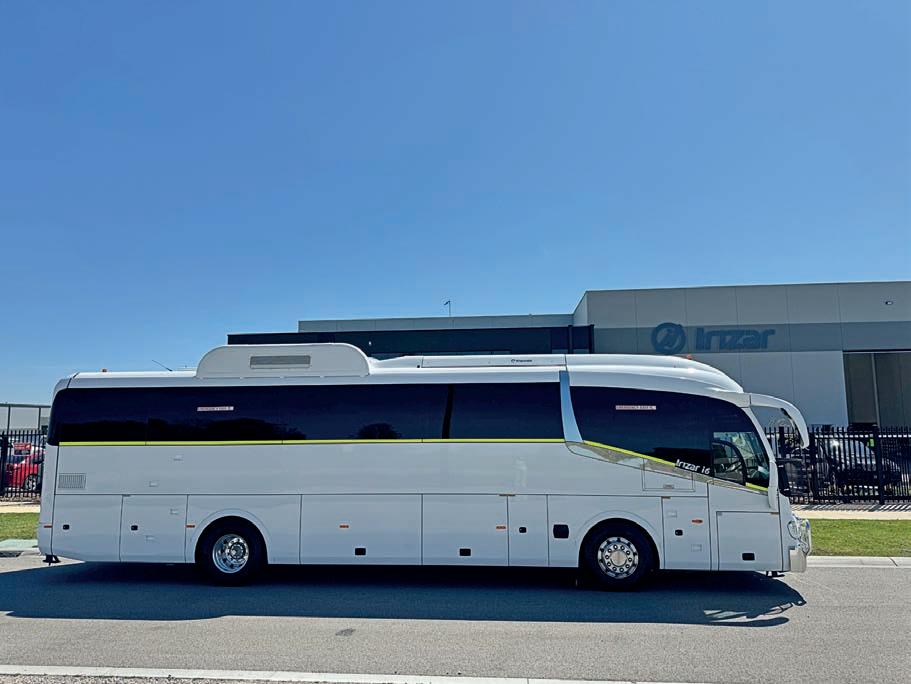
In recent years, Irizar
and Scania
have combined to produce a hybrid-electric coach offering that is rethinking the future of sustainable transport around Australia
The technology also allows short distances to be travelled on battery power alone when in silent mode, while using this technology with fuels such as B100 diesel or HVO can reduce carbon dioxide emissions by up to 92 per cent. After this became popular for operators working in densely populated areas, it was a no-brainer for Scania to join forces with Irizar to expand this technology into the coach market.
n music, a bridge is often considered the most important part of a song, providing the emotional or musical ‘pivot’ that can elevate a song from good to great. In the local bus and coach industry, Irizar and Scania have put their skills together to create the sector’s own important bridge in the transition to zero-emissions vehicles.
In this case, the all-important bridge is a hybrid-electric model that has emerged as a popular option for operators wanting to progressively lower emissions without having to introduce large-scale charging infrastructure.
“Scania first started with a hybrid-electric model in the city bus sector, using it as a stepping stone for operators who had the intention of eventually going fully electric,” Irizar Asia Pacific managing director Steve Heanes told ABC
“We were approached by operators who wanted to use this technology, so we’ve recently worked with Scania to build a vehicle together with an Irizar body.”
For both brands, the decision to venture further into the hybrid-electric space was all about opportunity. Scania has been supplying hy-
brid-electric powertrains to the Australian bus market for almost a decade, starting in the route bus segment. The technology can now reduce fuel burn and emissions by around 25 per cent for operators, depending on the application.
“Scania believes that the hybrid-electric gives the best of both worlds,” Scania Bus & Coach national sales and contract manager in Victoria, South Australia and Western Australia Jamie Atkinson told ABC
“It’s a powerful, clean and frugal diesel engine that can be run on renewable diesel and combined with silent mode for densely populated areas, as well as the ability to recharge the batteries on the move, and
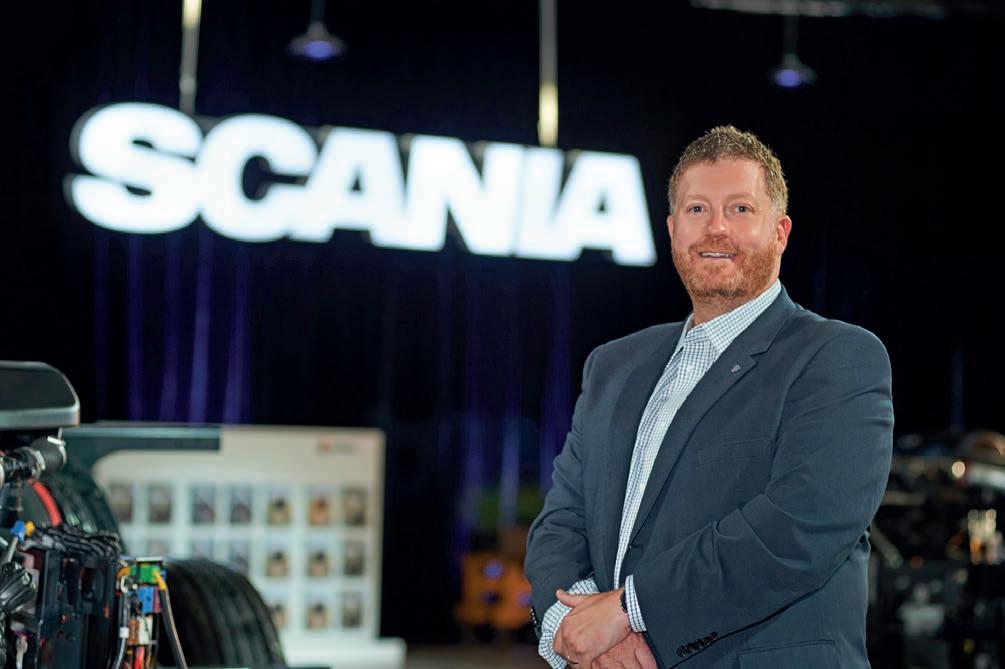
still reduce overall fuel burn and emissions.
“Adding in Scania’s safe chassis technology, this combination provides a win-win for operators, driving down total operating costs while reducing the vehicle’s environmental footprint.”
Heanes says the partnership and hybrid-electric product came to fruition when Irizar heard from operators who wanted to take a smaller step towards running electric buses but either didn’t have access to fully converting their fleet or were too nervous to do so.
“They only wanted to take the initial small step across instead of jumping across to create a zero-emissions path,” he says.
“Scania was the only brand who had a hybrid model available in Australia, so luckily they agreed it was a real opportunity. We had operators from the resources sector in particular who were keen, so we built the vehicle together.”
The Scania and Irizar hybrid-electric combination is currently operating in mining environments in Western Australia. The process for this happening started with Scania and Irizar combining for a project in Brazil to design the model meeting local weight requirements.
Once the model arrived in Australia, the teams drove the models across to Perth, crossing the Nullarbor to record fuel economy data compared to driving a diesel coach.
“The body is our base 3700 model, but already this combination has numerous advantages,” Heanes says.
“For example, it acts as a stepping stone to zero-emissions buses as operators can geofence the coaches to switch to electric mode. This is particularly handy if a driver is going into an enclosed area, like a shed or a pick-up point, or even near a train station, to reduce fumes and emissions for passengers.”
The total package sees Scania’s 360hp (265kW), nine-litre, five-cylinder diesel engine fitted into the chassis to produce 1700 Nm of torque, while a 175hp (130kW) electric machine adding 1,030 Nm of torque. All of this is driven through a 12-speed
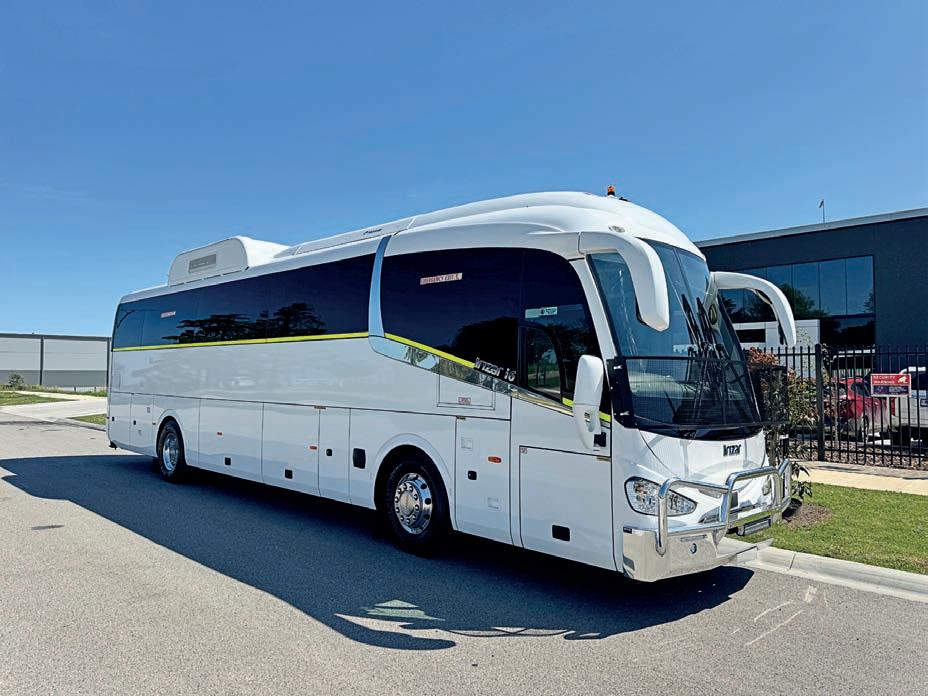
Scania Opticruise automated manual transmission.
“Thanks to a 375-litre diesel fuel tank, the hybrid-electric powertrain has a substantial range, depending on driving conditions and loadings, while it can travel between eight to 12 kilometres in pure electric drive mode,” Atkinson says.
“This results in key benefits like a reduced fuel burn and emissions compared to regular diesel engines, while it can travel in electric silent mode while still offering easy diesel refuelling and no range anxiety.
The Scania hybrid-electric system is essentially a self-charging hydrogen-electric vehicle.”
The platform also uses Scania’s New Bus Generation chassis to include key safety and assistance features like Scania Driver Support, automatic emergency braking, an electro-pneumatic parking brake, adaptive cruise control, vulnerable road user collision warning, blind spot warning, lane departure warning and hill-hold.
The technology may be novel in Australia, but it also emanates from a
growing global partnership between the two international bus OEMs.
According to Atkinson, there are currently “several hundred” Scania Irizar hybrid-electric vehicles in service in Europe, predominantly in Spain, using the same powertrain.
“The program has been in place for several years already and the product is proven in service,” he says.
“So far operator feedback has been positive, given the easy driveability, lack of range anxiety and the seamless transition from ICE to EV driving modes.”
For Heanes, the Irizar team may have joined the hybrid train a touch later than their chassis partners, but it’s been a worthwhile exercise for the global bodybuilder. While there are no clear goals in place for what the future of hybrid electric bus and coach technology looks like in Australia, he’s hoping the pair can continue innovating in the space to provide a critical bridge for local operators wanting to begin the transition to more sustainable operations.
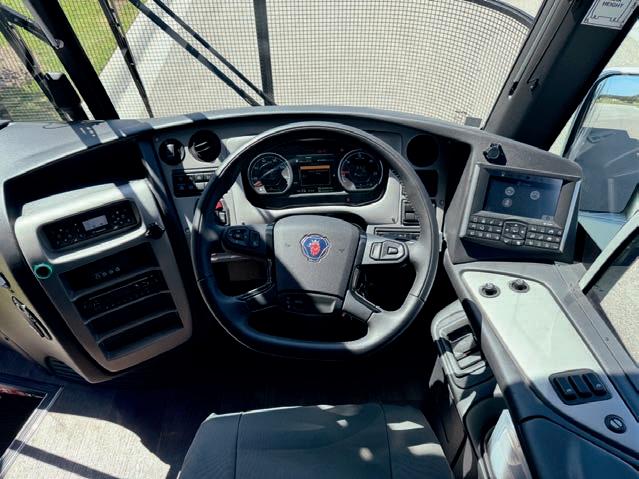
“We’ve found that the technology is an ideal halfway point between using diesel buses and going fully electric – hybrid has a lot of electrical components similar to electric buses that provides the experience for drivers while maintaining the remote reliability of diesel,” he says.
“We think there’s a real opportunity for hybrid in Australia – we know Scania are moving towards more electric models in future, but we’ll be looking at what governments reveal this year about the transition to sustainable buses and provide an important solution for operators around the nation.”
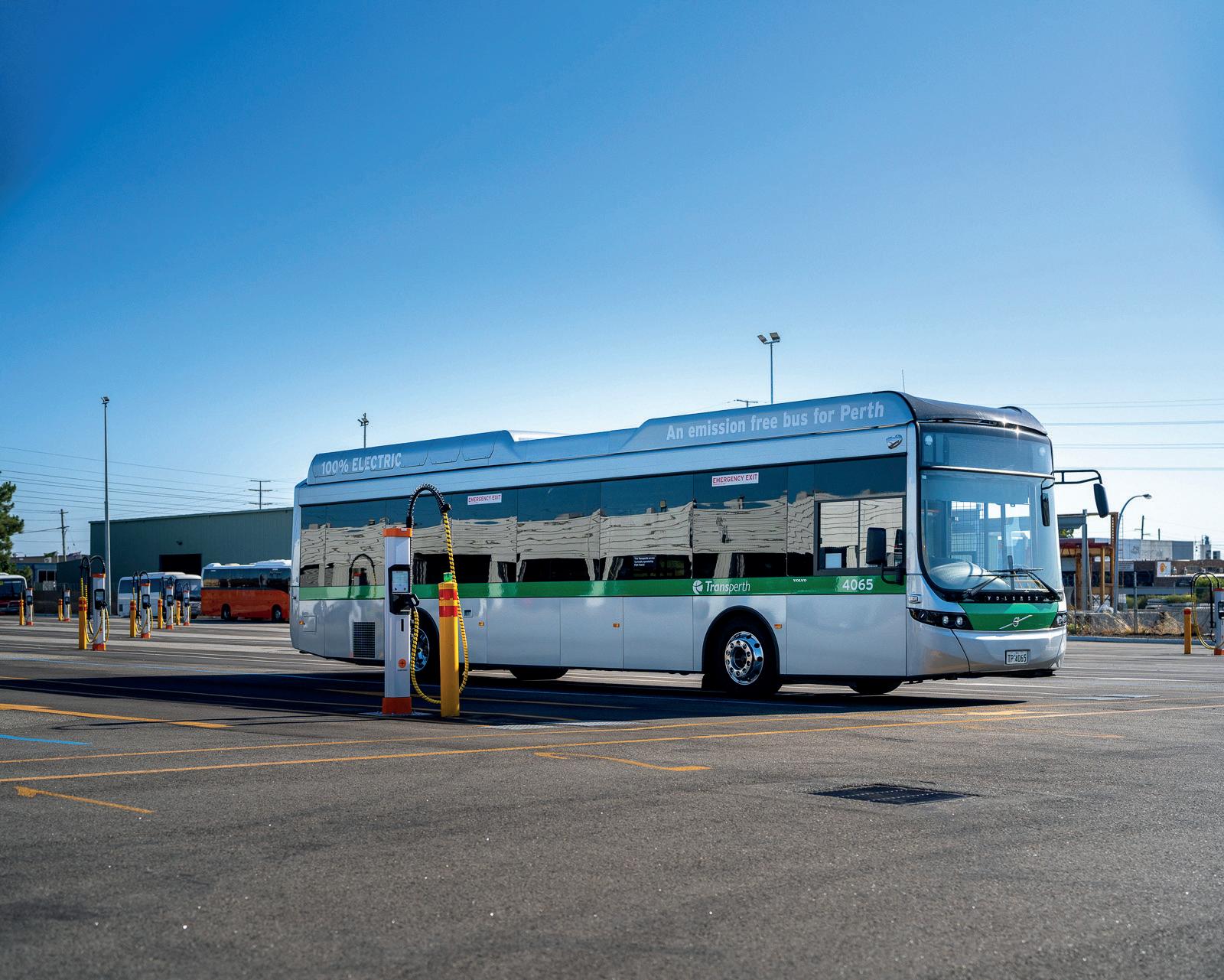
As the local industry continues its transition to zero-emissions, questions remain about what determines the technology’s success. Volvo Bus Australia’s growth in the space has been all about its total package offering – and delivering reliability for operators
In the years since the very first zero-emissions buses were introduced to the Australian industry, there have been plenty of questions about the safety and reliability of electric bus technology. Can they be trusted to complete daily operational tasks in a variety of applications and climates? Is there enough range to satisfy the needs of both operators and government procurement teams? Will they
maintain uptime and provide value over its lifespan?
As the local industry continues to adjust to zero-emissions buses and the various challenges that come with it, Volvo Bus Australia has taken a slightly different approach since it first unveiled its BZL Electric model in 2021. Now, with its Volvo BZR Electric coach also en route to local roads, the OEM giant is applying the lessons from its electric bus deployments to
ensure ongoing success from a total operational perspective.
“Recent public scrutiny across the sector, from supply chain governance to storage and rectification periods, and even cybersecurity questions, shows that the success of zero-emissions programs hinges on whole-of-life capability,” Volvo Bus Australia general manager Mitch Peden told ABC
Since the very first Volvo BZL
Electric went into service in Australia, Volvo Bus Australia has been out to define the measures of success for this new technology. It quickly found that enduring reliability is a true yardstick for measuring the triumph of its zero-emissions models.
Peden says those at the forefront of the Australasian bus industry – the operators – have fast moved past the topic of price when determining the value of zero-emissions buses. Instead, he says they’ve focused on if the technology can deliver the timetable required, every day, at scale. This may sound simple, but it’s since been broken into a complex array of requirements for Australian operations.
Cybersecurity is one example of a challenge that has emerged in the local industry as it shifts to zero-emissions buses. Safety has been another, as has the ability to keep these new-age buses out on the roads and constantly available for operators to use. This has led Peden and his team to determine that legitimately proving reliability is the core principle to determining the success of Volvo’s electric bus offerings in the local market. To do so, the brand has lent on its points of difference – uptime, serviceability and lifecycle support.
“In practice, operators don’t buy a bus anymore – they buy the confidence that the bus will show up and perform on its duty cycle, in local conditions, with local support,” he says.
“There’s a lot of noise in the zero-emissions space, but legitimacy comes from delivery. At Volvo, we’re focused on doing exactly what we say we will: putting buses into service, supporting them properly and making sure they perform in real-world operations, day after day.”
This success in the local zero-emissions sphere to date can be attributed to Volvo Bus Australia’s perspective on the ongoing transition. Peden says Volvo views electrification as a transition that must be supported by specialist electromobility support, such as planning, integration and aftersales – not just the delivery of the bus. To legitimately
prove this reliability, Volvo has focused on remaining consistent and trustworthy in the electric bus sphere since 2021 alongside its major customer and government operator network.
This idea of reliability has extended beyond the initial delivery to now encompass a whole-of-life commitment, including training, service networks, parts and diagnostic support as key offerings to its customers. When it comes to tendering for new electric bus networks, Volvo has sought to keep it simple and allow its operator partners to deliver on promises and secure more contract wins.
Focusing on the vehicle’s design, Peden says it’s all about meeting the Australian context. From duty cycles to climate and compliance, Volvo has concentrated on designing battery electric buses for the “Australian real world” of heat, route variability, depot realities and evolving regulatory requirements. With the latter remaining non-negotiable and complex, especially for new technology categories, Peden says choosing platforms with deep compliance experience reduces the risk for operators. As zero-emissions bus standards continue to evolve, Volvo is positioning itself as a mature engineering and compliance manufacturing partner for operators to value and trust.
The goal is to combine local partnerships with local capabilities to reduce the risk of downtime, particularly on expensive assets like electric buses. Since its first local foray into zero-emissions buses nearly five years ago, Volvo Bus Australia has looked to create a total network of parts and support for electric customers. By publicly documenting local manufacturing and partnership arrangements, such as its connection with Volgren to support local content ambitions, Volvo is looking to enhance its “real-world operations” with local build integration, parts flow, fast response times and technician capabilities.
This has led to Volvo emphasising its national technical training delivery at no cost to the operator, introducing
a practical lever for uptime as fleets continue growing.
“Fleet electrification is an industrial capability story as much as a vehicle story,” Peden says.
“Skills, parts, diagnostics and support determine whether buses stay on the road.”
With this influx of new technology in the bus sector comes a wealth of fresh data for the industry to use.
Peden says Volvo treats modern electric uses as connected assets, meaning operators and governments increasingly care about who can access systems, how updates are managed and how risk is governed.
In the face of recent reporting on cybersecurity around electric buses, Volvo Buses is reinforcing its compliance with European Union data security protocols such as the General Data Protection Regulation (GDPR) and the EU Data Act (Regulation 2023/2854). This ensures that data retrieval, processing and sharing are conducted in a secure, transparent and lawful manner.
“Across the sector, cybersecurity and data governance are becoming part of ‘operational reliability’ because a bus can’t be considered dependable if its digital risk profile is unclear,” Peden says.
In the five years since Volvo Bus Australia first entered the local zero-emissions bus conversation with its BZL Electric, plenty has changed across the industry. While discussions continue about uptime, safety and security, the global manufacturer is focusing on its own total package and the key value that underpins it all – reliability.
“As public transport networks scale up, the industry is seeing that zero-emissions bus procurement is as much about operational readiness, compliance, data governance and lifecycle support as it is about the initial price of the bus,” Peden says.
“Volvo’s point of difference in this time has been our operational approach, with platforms, serviceability, training and local support designed to keep buses in service and not sitting idle.”
A recent trip up the Hume Highway and back allowed BYD’s Steve Glenny the chance to marvel at the capabilities of BYD’s latest electric bus chassis in Australia
It was the first time Steve Glenny was enjoying the typical Australian road trip. Melbourne to Sydney, up the Hume, enjoying the straight roads and surrounds. Music on, sun shining. Except this wasn’t your standard day trip north to the nation’s most populous city. The BYD Australia commercial vehicles sales executive was completing the drive up the Hume in a BYD electric low-floor city bus, completing an important mission.
“I was the first person at BYD who got to complete the drive up in a BYD bus to Sydney,” he told ABC.
“The reason we did this was because we are part of a current order to deliver new electric buses to Transit Systems Australia, and the customer wanted to test the depot charging infrastructure with our new model chassis.”
This meant Glenny was to hop behind the wheel of the BYD BC12B1 with a Volgren Optimus city bus body on top and make the trek north. The model was the very same one that was displayed at the 2024 National Bus & Coach Show in Brisbane, with the 382kWh battery capacity and BYD’s complete in-house driveline powering the model towards the Harbour City.
“There was physically no problems at all driving this bus from Melbourne to Sydney and back,” Glenny says.
“We were able to charge the bus, we just had to get our charging ports close enough to the car chargers. It was an incredibly comfortable cruise up and back, enjoyable even.”
A standout from the trip was the power consumption and overall efficiency of the vehicle, with Glenny enjoying his longest road trip yet in the model in Australia. Considering the BYD chassis is designed to be running around city streets on urban routes, he was impressed with the
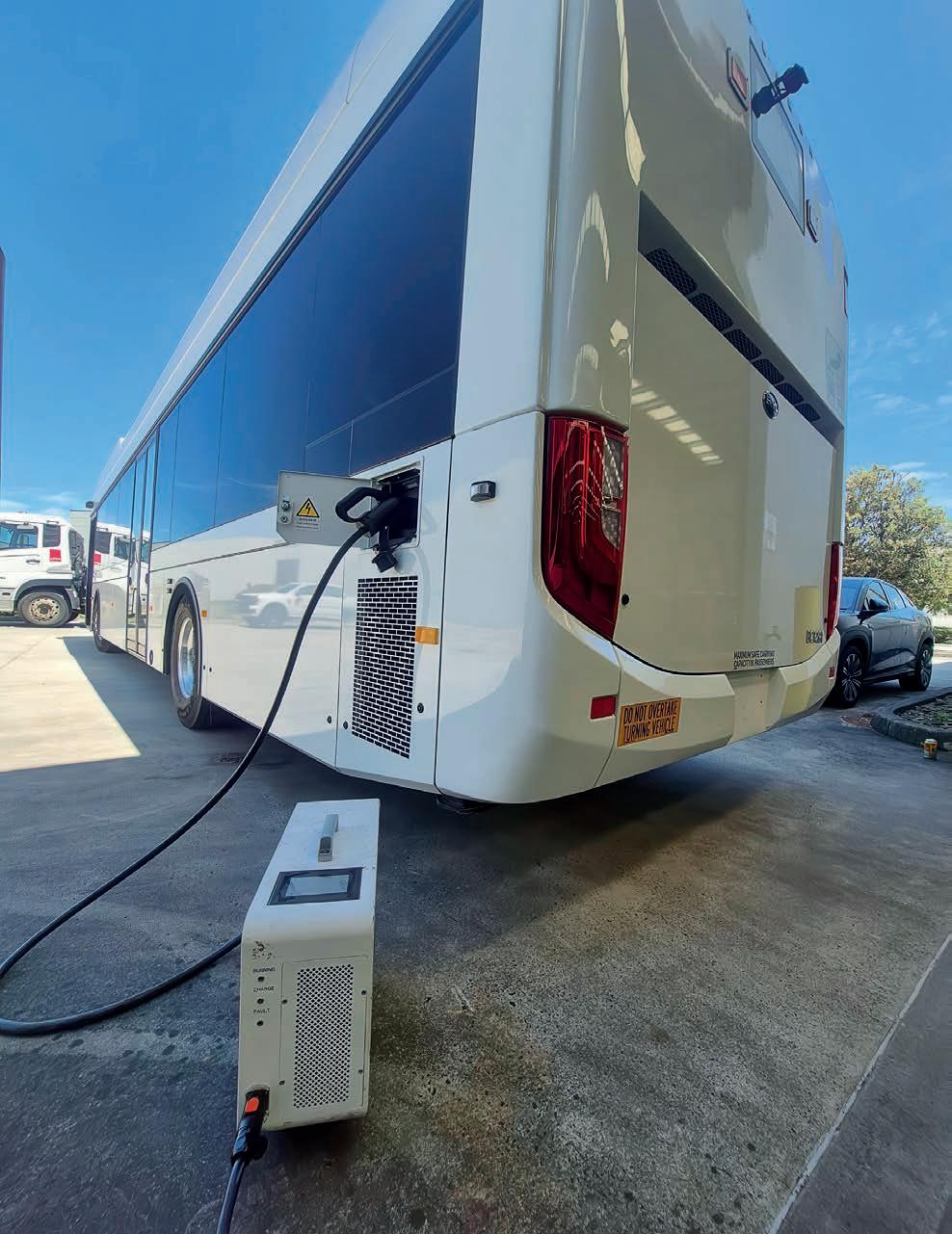
way the bus easily handled nearly 900 kilometres each way on long, straight and often hilly freeways.
Overall, after then taking the vehicle from Leichhardt around to other major operators in the city before returning back to Melbourne, Glenny and his trusty bus travelled nearly 2,200 kilometres. The journey started from
BYD’s Victorian base in Dandenong South before stopping at Volgren’s NSW home in Ingleburn overnight. The drive up and back was done on less than two full charges.
“I made it all the way to Sydney with around a quarter of a charge still remaining after I completely recharged the bus at Tarcutta,” Glenny says.
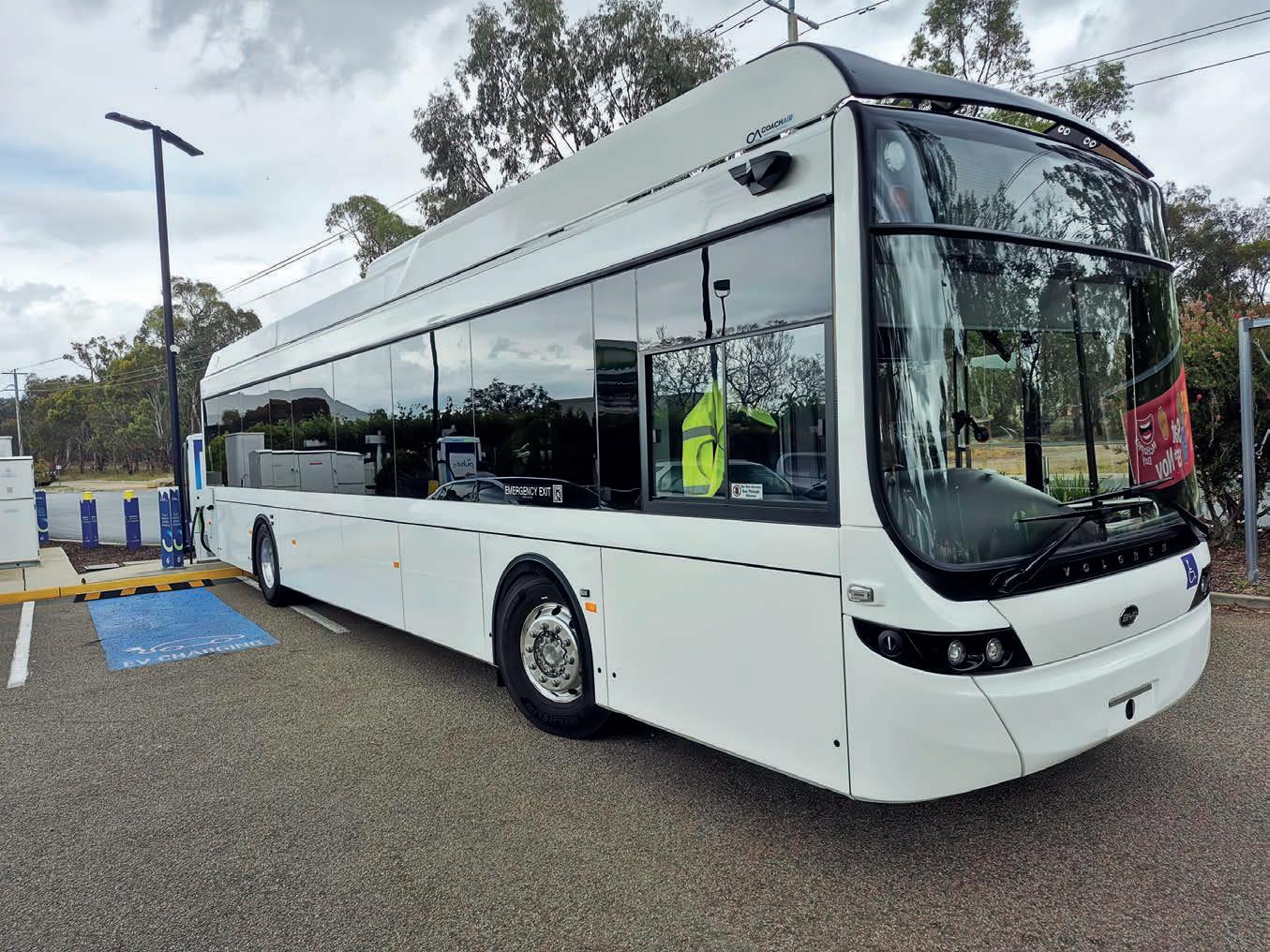
“Considering the nature of the trip meant the bus wasn’t gaining any regenerative power through braking, as they’re designed to be in a stop and start operating environment to recover energy and increase the range, to achieve an average of 0.8kw/km on the trip meant the economy was a lot better than I ever could’ve predicted.
“The range is impressive, using the latest technology to showcase the
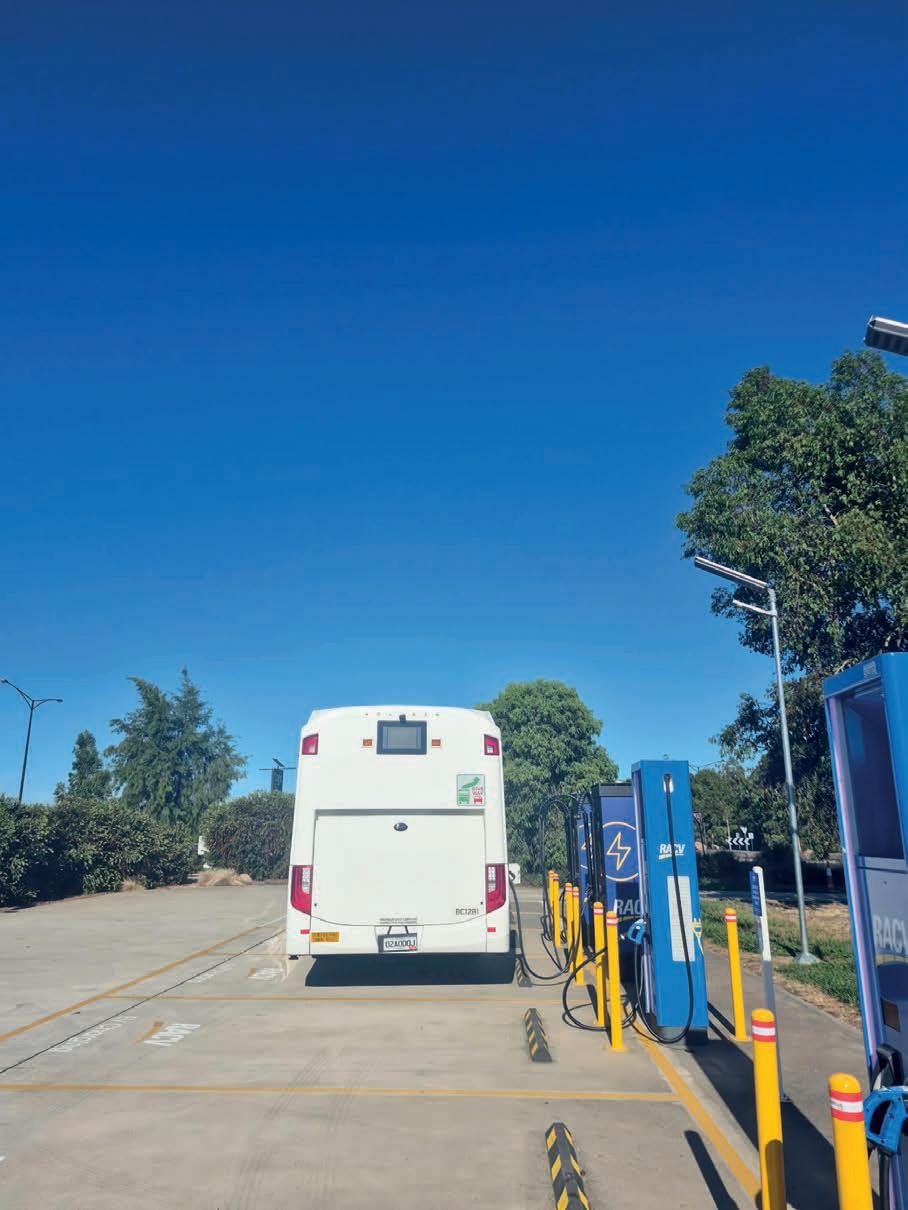
exciting features of a battery electric bus future in Australia.”
On the way back home, Glenny recalls the mercury rising as the southern part of Australia entered into a heatwave. Luckily, the BYD/Volgren combo kept him cool courtesy of Coachair’s EX32 air-conditioning. Despite the HVAC system running the whole way down during the warm temperatures, the bus had no issues with maintaining range and power on
the trip back down the Hume.
“Much like many electric vehicles nowadays, the drive was always smooth, quiet and comfortable,” he says.
“There was instant torque and driveability at all speeds, and no vibrations. The only noises I could hear were the usual wind and road noise you get at highway speeds, and there is of course no diesel drone. It’s a very reliable and comfortable model.”
A key factor of the latest BYD electric chassis in Australia that stood out on the road trip was the efficiency of the brand’s hub motors. As a stand-out feature in the local market, Glenny was able to put the hub motors to the test on a freeway, outside of its comfort zone. Previously, the furthest trip he’d done in the bus had been from Dandenong South to Warrnambool, with the Sydney trek allowing Glenny to realise the power of the new model.
“Outside of having to squeeze the 12.5m bus into charging bays designed for cars, the trip was easy and there were no issues at all,” he says.
“It was a true display of what the future of electric bus transport can look like in Australia, with BYD’s tried and trusted technology being at the forefront of this evolution.”
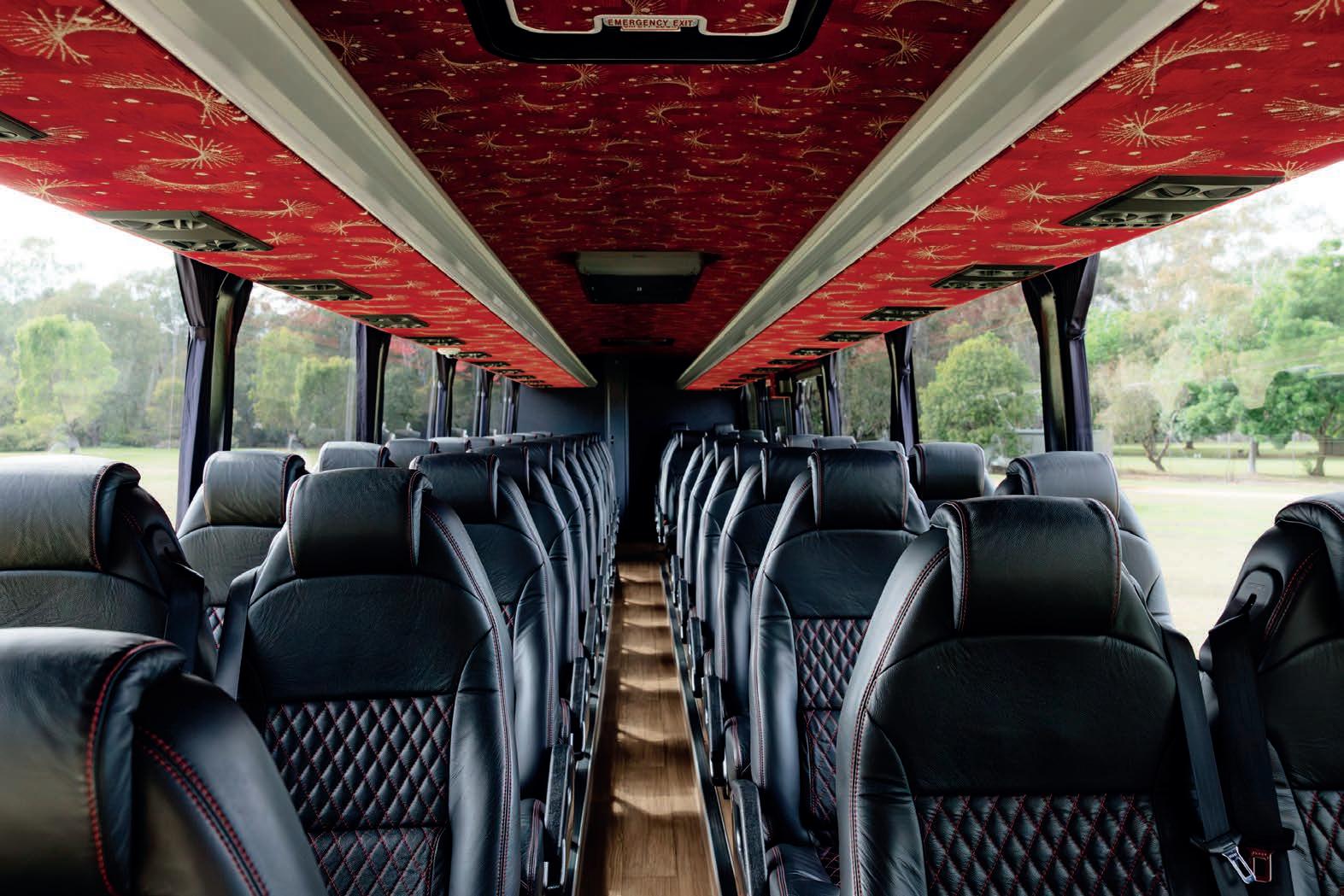
Wangaratta Coachlines’ long-running partnership with StyleRide shows how collaboration, durability and shared thinking can shape better outcomes for operators and passengers alike
Long-term supplier relationships are part of the fabric of Australasia’s bus and coach sector. For decades, long-standing brands have combined to provide the highest quality vehicles, parts and services for passengers. Be it school or charter, route or on demand, combining to thrive has been the theme of the local sector’s enduring success.
While this collaborative nature is often discussed in the bus and coach industry, the reality is few endure across decades, fleet renewals and changing passenger expectations.
For Wangaratta Coachlines, the relationship with seating manufacturer StyleRide spans more than 25 years and remains grounded in mutual understanding rather than transactional supply.
Wangaratta Coachlines general manager Matt Joyce traces the partnership back to 1999, when the business transitioned to StyleRide following the company’s formation by Merrilee Henderson and Barry Bonnitcha.
“We went across to StyleRide in 1999 following Merrilee Henderson,” Joyce told ABC
Above: StyleRide’s commitment to excellence is reflected in the quality of seating
“We’d been using their seats in our Austral Denning vehicles, and when StyleRide popped up and Merrilee recommended going across, we transitioned then and have been with StyleRide ever since.”
For Joyce, the enduring value of the partnership continues to lie in its collaborative nature. By working together, both have been able to grow and mature in the local transport industry
“The key for us is the partnership approach. The success of the industry is based on relationships, and the fact that StyleRide don’t just view
us as a sales pitch is a major factor,” Joyce says.
“It’s not just thank you very much for the seats and you never hear from them again.”
That approach has influenced several major fleet decisions over time. In 2008, Wangaratta Coachlines approached StyleRide, seeking a genuine leather seating solution to lift its coach offering well before leather became commonplace.
“StyleRide went to great lengths to find a product that mirrored the quality we were looking for. They sourced genuine Italian leather, which we still use today,” Joyce says.
“That showed they understood where we were going, rather than just pushing something they already had.”
More recently, the operator converted a 14.5-metre coach into a high-capacity school bus, meeting demanding seating and accessibility requirements.
“We needed 71 seats, wheelchair capacity and wanted to use the Orion model we’d had in school buses for 20-odd years. StyleRide got engineers involved and did the background work,” he says.
“It wasn’t ‘fit your bus to our product’ – it was the other way around.”
Passenger comfort has also driven design evolution, particularly as average passenger size increases.
“We’re all getting bigger. Years ago, everything was designed around a much lower average weight,” Joyce says.
“On a vehicle we’ve got in build now, StyleRide has manufactured an oversized seat, moving from a standard 400 millimetre width to 500, and invested heavily in getting that approved.”
Changing passenger expectations have similarly shaped features such as USB charging. Joyce says StyleRide was one of the first to integrate USB charging properly into the seat before then refining this placement over time to reduce damage and improve durability. Joyce says this continuous improvement has been important to Wangaratta Coachlines over time.
Durability and serviceability remain critical for a regional operator,
particularly where vehicles face rougher road conditions.
“The ability to change a seatbelt quickly without dismantling the seat is huge. What used to take hours can now be done in half an hour,” he says.
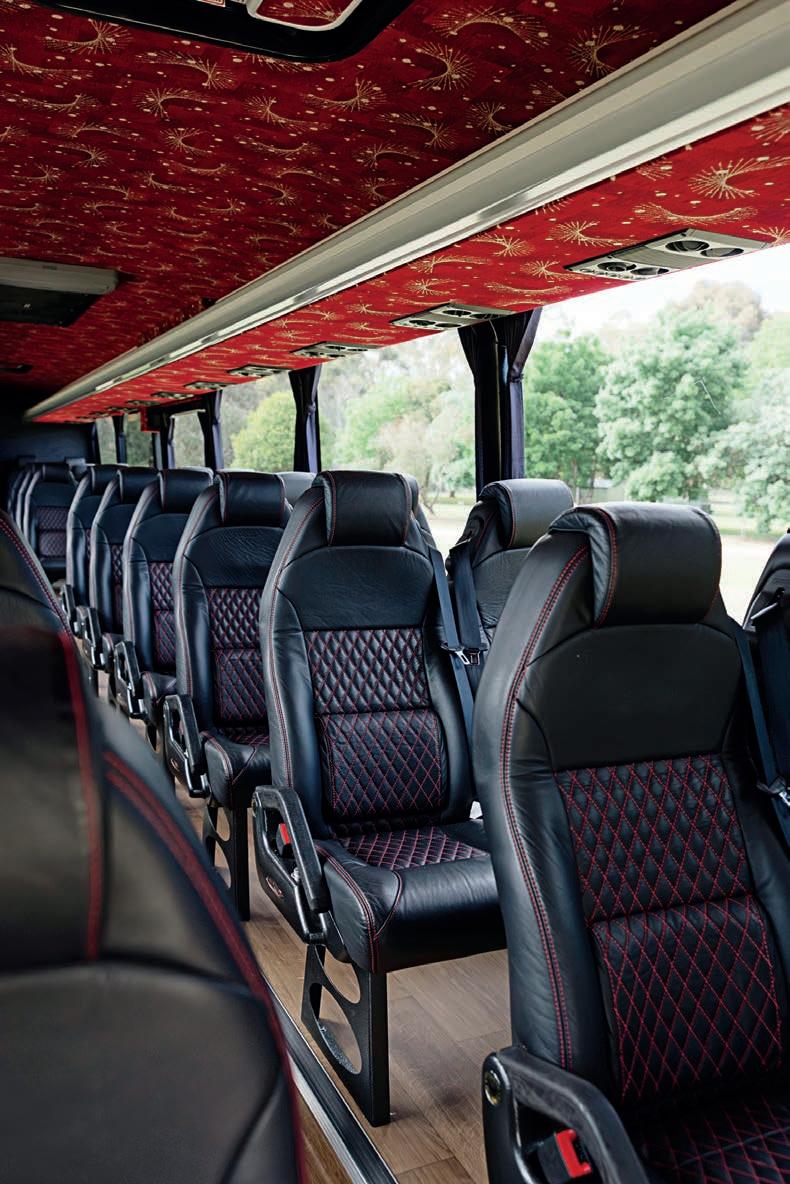
“Small businesses can’t afford vehicles off the road.”
Consistency across fleets is another key benefit, particularly for Wangaratta Coachlines, which supports operations across different regions and contracts.
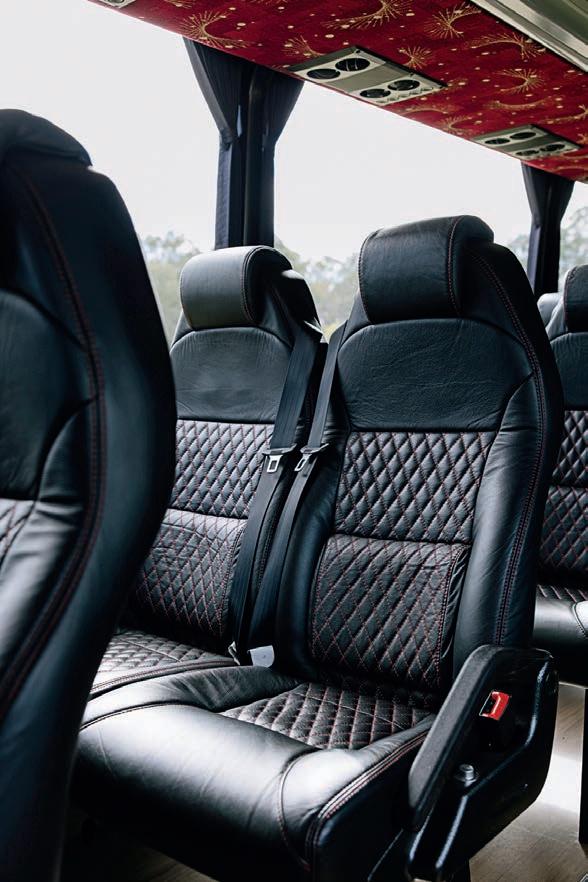
“We’ve standardised around Orion for school buses and Aquarius and Sovereign for coaches. StyleRide isn’t constantly pushing us into something different. That consistency makes specifying and servicing much easier.”
Joyce says StyleRide’s openness to feedback has strengthened the partnership, including during challenges. For example, when there was a defective batch of leather, the seating brand didn’t wait for operators to discover it. Instead, StyleRide called around, owned the issue and worked with the likes of Wangaratta Coachlines to fix it.
“They didn’t hide behind warranties, and that earns respect,” Joyce says.
Looking ahead, Joyce expects ongoing pressure around weight, safety and compliance as the industry evolves. Through all of this, he still believes StyleRide is well-positioned to continue forging an enduring partnership with the Victorian operator.
“They’re investing, listening and adapting,” he says.
“If they keep doing what they’re doing, they’ll still be here in 20 years. For us, that matters.”
I-Bus and Bus Stop Sales are continuing to strengthen the Isuzupowered range, particularly for regional and rural Australian operators
It’s no secret that many buses in Australia operate outside capital cities. Reaching regional towns, spanning school runs and covering highways with service support hours away, not minutes. Travelling over a range of freshly laid asphalt, gritty gravel or other deteriorating road surfaces. In these environments, expectations are clear – a bus must be simple, robust and solid, as well as properly supported over its working life.
That operating reality is what has shaped Bus Stop Sales & Service’s approach to the I-Bus range built on an Isuzu chassis.
“The focus has not been inner-city coach work. It has been in school transport, regional route services, community operations and specialist applications where reliability, service access and longevity matter more than presentation,” Bus Stop Sales director Pete White told ABC
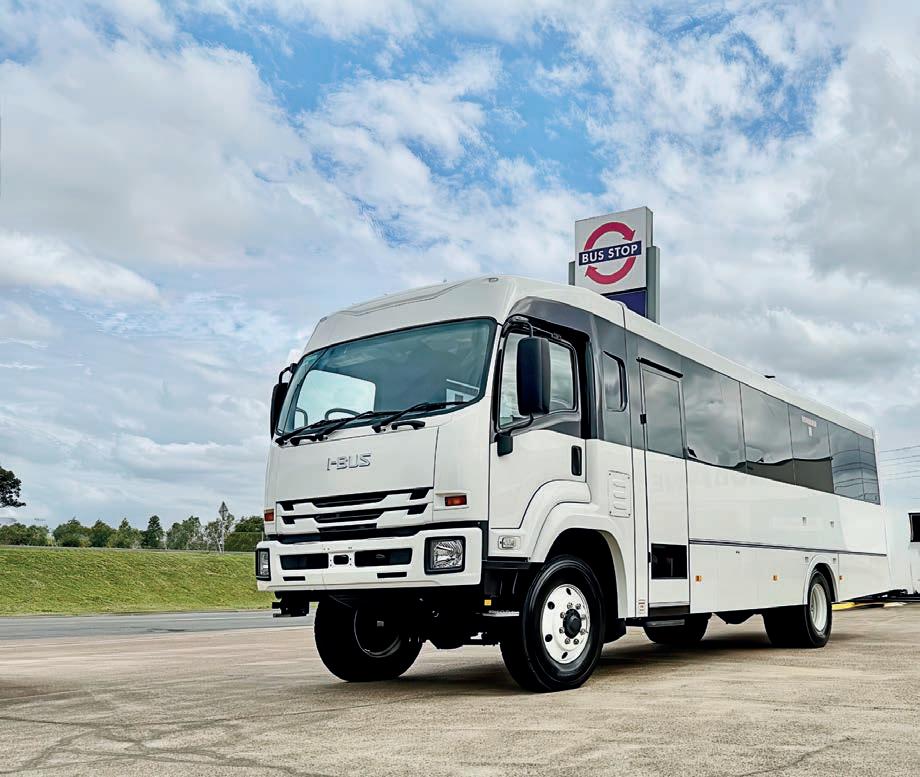
As the sole Australian distributor of I-Bus on Isuzu, Bus Stop Sales has expanded the range in a measured way. Variants are added only where there is a defined operational need and where long-term support can be assured. Across all models, the intent is consistent: a straightforward bus that operators understand, can maintain locally and can rely on day after day.
It’s well known that regional and country routes place different demands on vehicles. Distances are longer, road quality varies and operators often depend on local workshops rather than specialist metropolitan facilities. In many cases, a single bus must cover school services during the week and community or charter work outside school hours. For these reasons, White says the I-Bus range remains anchored to established Isuzu platforms.
“Operators know the chassis, workshops stock the parts and technicians understand the systems –that familiarity reduces downtime and operating risk, particularly in country operations where resilience and flexibility matter,” he says.
“The range is not positioned as an inner-city coach solution. It is designed for sealed and unsealed roads, for regional depots and for operators who need vehicles that can be kept on the road without added complexity.”
A consistent priority on the I-Bus range has been driver cabin ergonomics, with the Isuzu cab layout being regarded as class-leading for visibility, control placement and ease of use. In school and regional applications, where drivers spend long hours behind the wheel, clear sightlines, intuitive switchgear and a practical driving position are designed to reduce fatigue and support safer operation.
Strong manufacturer backing adds another critical layer of safety for regional operators, with warranty
coverage and dealer support designed for when vehicles are required to work long distances from major centres.
Brisbane Isuzu general manager David Windsor says Isuzu’s factory-backed driveline warranty of up to six years continues to lead the Australian market.
“That level of warranty gives operators confidence in the product,” Windsor told ABC
“It’s trusted by country operators and by high-utilisation urban fleets alike because it reflects the durability of the platform and the strength of the support behind it.”
Reinforcing this support are partnerships behind the I-Bus range – White is “proud” of the relationship Bus Stop Sales has built with Australia’s largest Isuzu dealer, as well as the local capability underpinning I-Bus production. This combination of national dealer scale and locally delivered body integration is ensuring vehicles are both supported in service and built with Australian operating conditions in mind.
White’s approach to the I-Bus range is also shaped by family experience with off-road, truck-chassis buses dating back to the 1990s. That background informed a clear objective to maximise passenger capacity within the LR licence category without compromising durability or compliance.
From the outset, Bus Stop Sales set out to build a bus that could deliver the highest practical seat count while remaining under eight tonnes GVM. White says that aim has been realised most clearly in the Isuzu NQR I-Bus, which carries around 15 per cent more passengers than other vehicles in the same LR category, while retaining the robustness and serviceability required for country and school operations.
“For regional operators, the benefit is straightforward – more seats within LR limits improve route efficiency without increasing licence or operating complexity,” he says.
“For government-funded school and route services, the outcome is also material: higher seating capacity introduces built-in seat redundancy, reducing the need for additional vehicles on peak services and improving value for money within fixed funding envelopes.
“That redundancy also provides flexibility over the life of a contract, accommodating enrolment growth,
route changes and compliance requirements without forcing premature fleet expansion or higher licence classifications.”
For many country-based operators, the core task remains school transport. Replacement decisions are closely tied to state funding frameworks, making eligibility as important as specification.
The availability of the Isuzu NQR I-Bus under school bus funding programs in both New South Wales and Queensland offers a clear replacement pathway, allowing fleets to transition to Euro 6 emissions compliance without departing from familiar platforms or operating practices.
With longer regional routes and variable road surfaces placing additional demands on both passengers and vehicles, ride quality expectations among operators and passengers have also evolved. White says the introduction of a 34-seat I-Bus configuration with standard Isuzu factory rear airbag suspension improves comfort while avoiding the support risks associated with aftermarket modifications.
In areas around the country where sealed roads cannot be assumed, White says true 4×4 capability remains essential. The expansion of the I-Bus range onto the Isuzu FTS 4×4 platform increases passenger
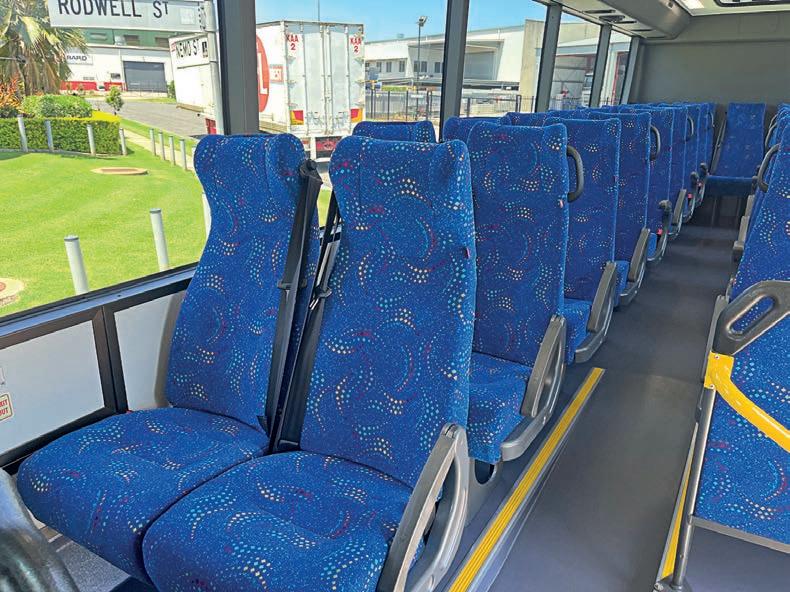
capacity while retaining off-road capability, supporting resource, remote community and regional applications where access conditions and demand both vary.
That capability has also been proven in larger resource-sector applications, with the I-Bus brand having been successfully deployed in a 40-seat off-road 4×4 configuration, operating in demanding resource environments and built on the same proven Isuzu chassis platform used by Australian country fire services. In this case, the customer undertook a global search for a robust and reliable solution before selecting the I-Bus platform, valuing its off-road durability, passenger capacity and established support network.
“The outcome reinforces the suitability of the platform, not only for regional passenger transport, but for high-duty industrial and emergency-adjacent applications where reliability is critical,” White says.
At the lighter end of the market, the I-Bus on the Isuzu NPS chassis continues to serve as a reference point for unsealed and remote route work, particularly in school and specialist operations. It’s in this space where Bus Stop Sales’ approach to product development remains deliberate, with new variants only being introduced when they can solve defined operational challenges. White is rooted in the belief that reliability, service access and whole-of-life cost continue to outweigh novelty.
“The continued expansion of the I-Bus range reflects the role regional operators play in Australia’s transport task,” he says.
“Country fleets support schools, communities, industry and tourism across large distances and varied conditions. Their vehicles must work consistently, be supported nationally and remain viable over long service lives.
“By focusing on Isuzu-based I-Bus solutions suited to regional and unsealed-road use, across both 4×2 and 4×4 platforms, Bus Stop Sales & Service has aligned its product strategy with how and where many buses in Australia actually operate.”
Another operator has adopted the ticketless technology to allow for seamless bus travel across both sides of the border
Contactless ticketing payment has continued to expand in regional Australia as the technology is now being deployed in northern Victoria.
In early January, regional NSW operator Ogdens Coaches deployed transportme’s ticketless solution across Dubbo, Mudgee and Wellington. Now, Echuca-based Newton’s Bus Service is adopting the same solution across the Victoria and NSW border.
The rollout sees the operator introduce tap-and-go contactless payments across its public passenger vehicles in partnership with transportme and a payment delivery partner.
According to transportme, the result is a more connected and innovative experience for both passengers and operators, regardless of which side of the border they travel on.
ready technology, Newton’s Bus Service continues to demonstrate
a strong focus on innovation and future-proofing their operations, while delivering the convenience passengers increasingly expect,” transportme says.
“Proud to support forward-thinking
Victoria’s myki upgrade is entering a critical testing phase, bringing contactless bus ticketing closer to reality
Victoria’s long-anticipated move toward contactless public transport payments has reached a new testing milestone, bringing tap-and-go ticketing closer for bus passengers across the state.
The next phase of the myki upgrade will see controlled trials begin soon following the installation of almost 3,000 new ticket readers across more than 280 myki-enabled train stations. While trains are first in line for live trials, the program is being designed with buses firmly in view, with bus and tram reader installations due for completion early this year.
For bus operators and passengers, the upgrade represents a fundamental change in how fares are paid and processed. Once fully deployed, contactless ticketing will allow passengers to board buses using credit or debit cards, smartphones or smartwatches,
reducing reliance on dedicated transport cards and simplifying the boarding process.
The initial testing phase will involve closed-group technical trials conducted in a laboratory environment with Department of Transport and Planning staff. These tests are designed to ensure the system works consistently across a wide range of bank cards and smart devices before it is exposed to daily passenger use.
Further testing will then move into real-world environments at selected locations. While early trials are focused on stations, the results will inform how the system performs on buses, where faster boarding times and reliability are critical to maintaining schedules and managing peak demand.
Importantly, the testing program is not limited to the act of tapping on – it also covers back-end functions such
as refunds, customer support and contact centre processes. For bus networks, where passenger queries and fare issues are often handled on the move, these systems are essential to ensuring a smooth transition.
Public trials are expected to begin in the coming months, giving passengers at selected locations the opportunity to use contactless payments and provide feedback. The full rollout will initially apply to full-fare-paying passengers, starting on trains before expanding to buses and trams.
Victorian public and active transport minister Gabrielle Williams says the testing phase is designed to ensure the system works reliably before being switched on for passengers.
“This is a critical next step in rolling out tap and go payments, allowing us to test the technology in real-world conditions,” she says.
The Endeavour Awards have announced two new sponsors who will join the events night for 2026
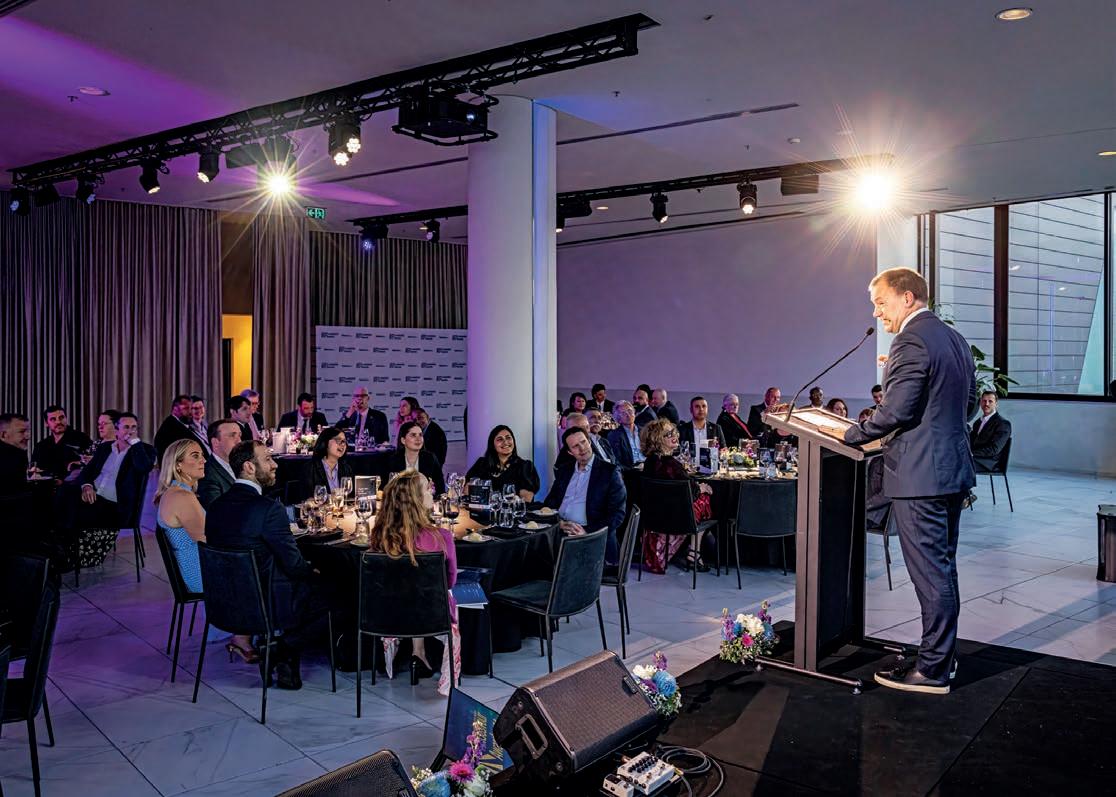
The Endeavour Awards 2026 is proud to announce the addition of two new platinum sponsors: the Manufacturing Industry Skills Alliance and RSM Australia. This partnership shows a shared commitment to celebrating excellence and driving innovation across Australia’s manufacturing industry.
Manufacturing Industry Skills Alliance (MISA) is an industry-owned and industry-led organisation dedicated to equipping Australia’s manufacturing workforce with the skills needed for a modern, innovative and globally competitive future. The organisation plays a pivotal
role in shaping workforce planning, training product development and fostering strong partnerships between industry, employers, unions and training providers across Australia.
Also joining in 2026 as a platinum sponsor is RSM Australia, a leading provider of assurance, tax, consulting and business advisory services. RSM Australia delivers tailored solutions that help organisations manage risk, optimise performance and drive sustainable growth.
RSM Australia’s sponsorship reflects its ongoing commitment to supporting innovation and excellence within the Australian manufacturing industry.
“The addition of these sponsors is the perfect fit for the 2026 Awards. The shared passion for industry growth and success will elevate the Awards program by creating more opportunities for connection, relationship building and support for manufacturing businesses and individuals,” Prime Creative Media head of marketing – events Molly Hancock says.
For more information about the Endeavour Awards 2026 and sponsorship opportunities visit the website: endeavourawards.com.au/ get-involved/
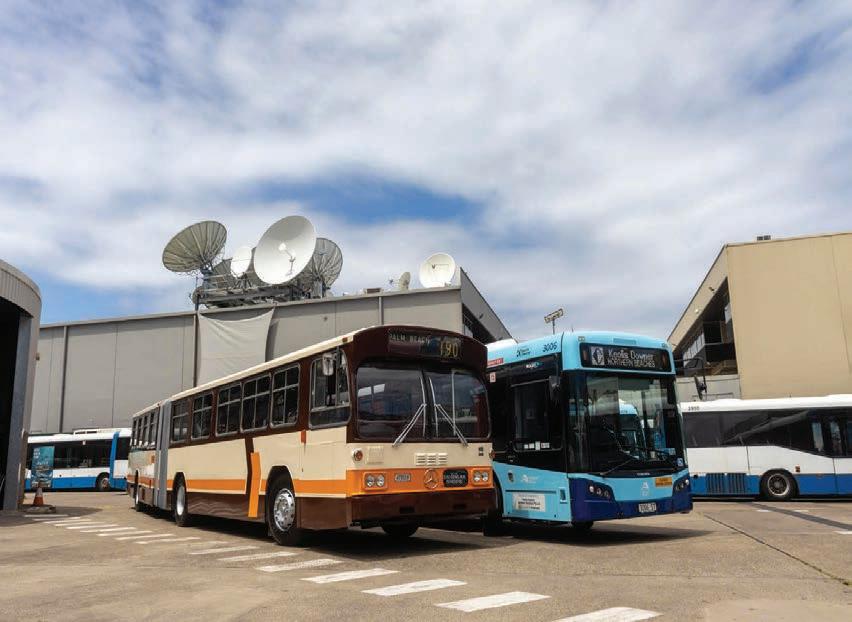
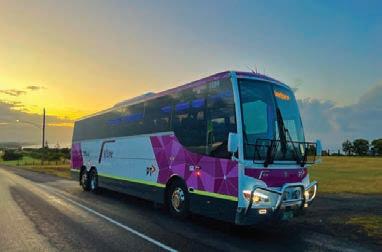
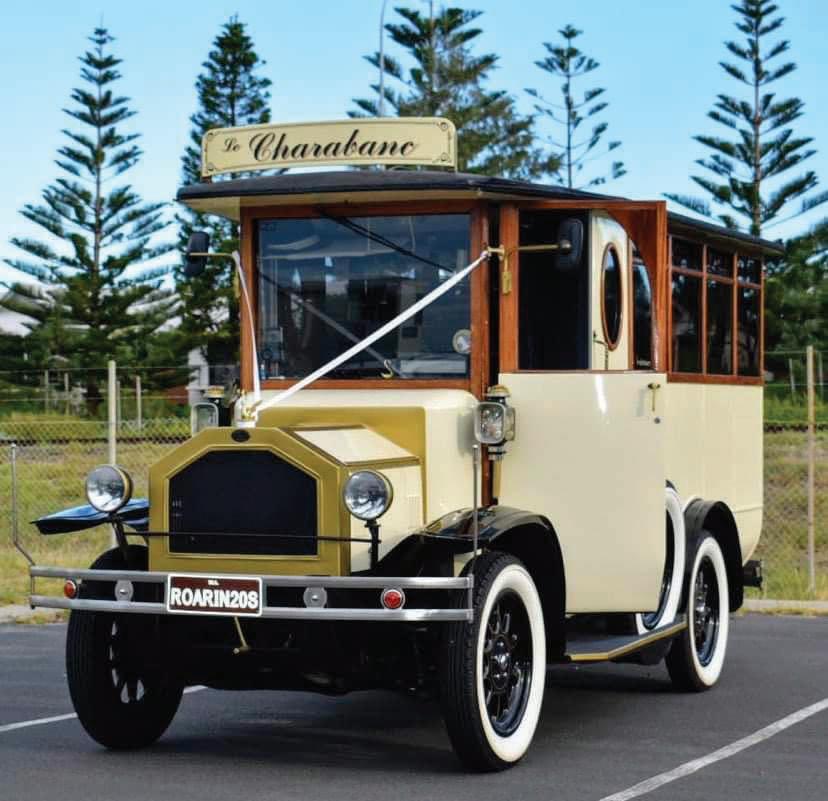
Send in your best bus or coach photos to feature in next month’s magazine.
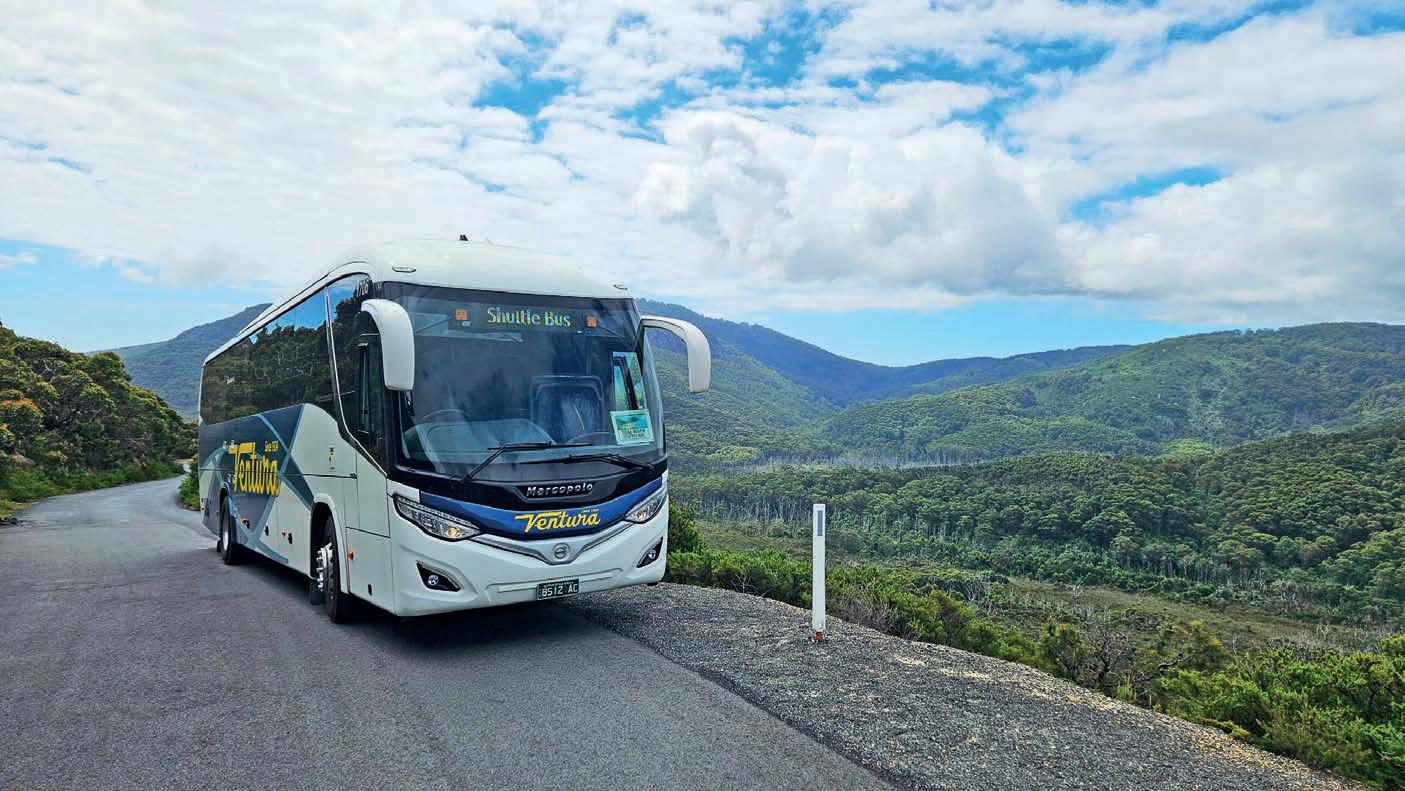
A stunning shot of a Ventura coach travelling through Victoria’s southern-most point has taken home Best Bus honours for February
For many Victorians, it can be easy to forget about the magic of Wilsons Promontory.
Situated at the very southern tip of the state, and south-east from Melbourne, the national park is known for its beautiful ranges and stunning beaches. When a quality looking high floor coach traverses the area, it guarantees a stunning photo.
It was here, on the most southern spot on the Australian mainland, that our winning shot for ABC ’s Best Bus February was taken.
Owen Hedley has won Best Bus for this month with a wonderful photo of a Volvo/Marcopolo coach for Ventura on the road up to Mount Oberon in Wilsons Promontory.
The coach was running a Tidal River camping ground shuttle bus service
when Owen pulled the coach over to take the photo, with an expansive range of trees and mountains providing the perfect backdrop to capture the distinctive blue and yellow Ventura colours.
“The bus was doing the shuttle service from the camp ground up to the start of the Mount Oberon walk,” he told ABC
“I couldn’t go past this view on my way up.”
Owen’s photo beat a terrific field in February, with Alyson Deane from Potter Travel sending through four wonderful entries that all came so close to claiming the top prize for the month.
Two of these shots captured the pristine waters of Weirs Cove on Kangaroo Island, South Australia,
while Alyson also sent through lovely photos of Potter Travel coaches at Lightning Ridge in Black Opal Country and in front of silo art at Lake Boga.
Across the ditch, Grady Weatherly-Connell added to the strong field with a colourful capture of an Auckland Transport Metro bus in the flow of traffic amid New Zealand’s busy North Island city.
As the winner of Best Bus February, Owen has received a free 12-month subscription to ABC Magazine, while the winning photo is also being shown off as ABC ’s Facebook cover photo for the whole of the month.
Don’t forget to send through your Best Bus photos for March and throughout 2026 via email and keep an eye on our Facebook page for more details!
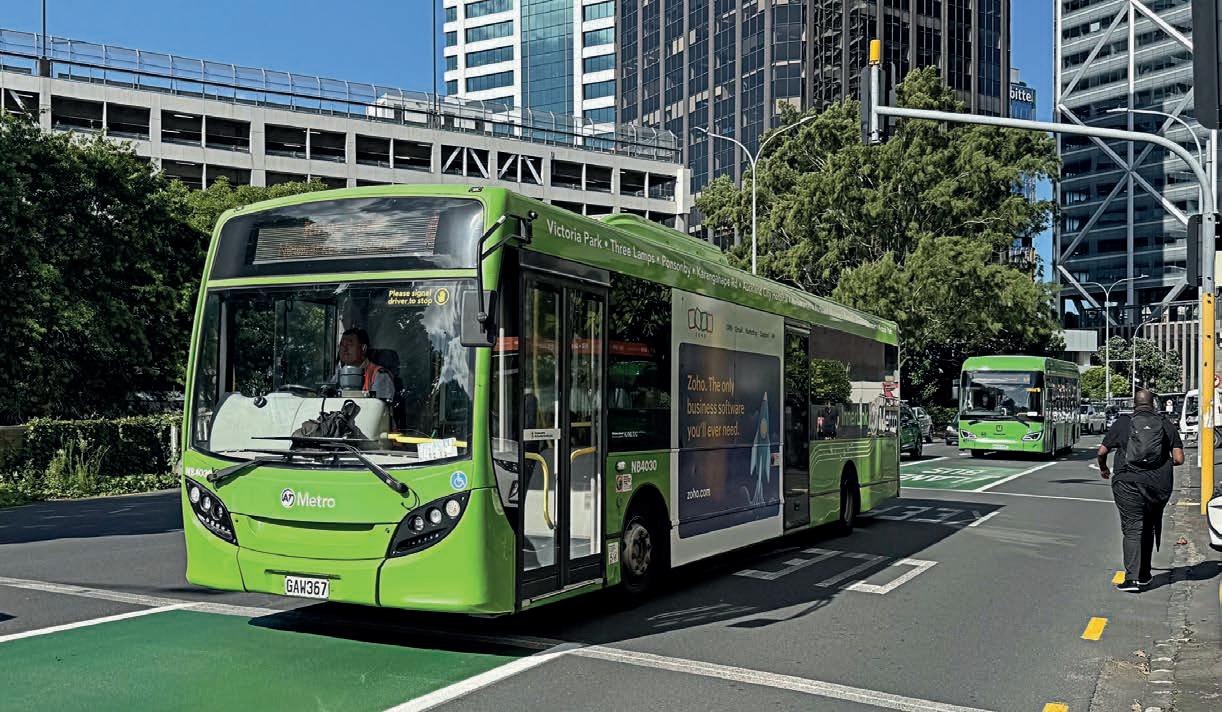
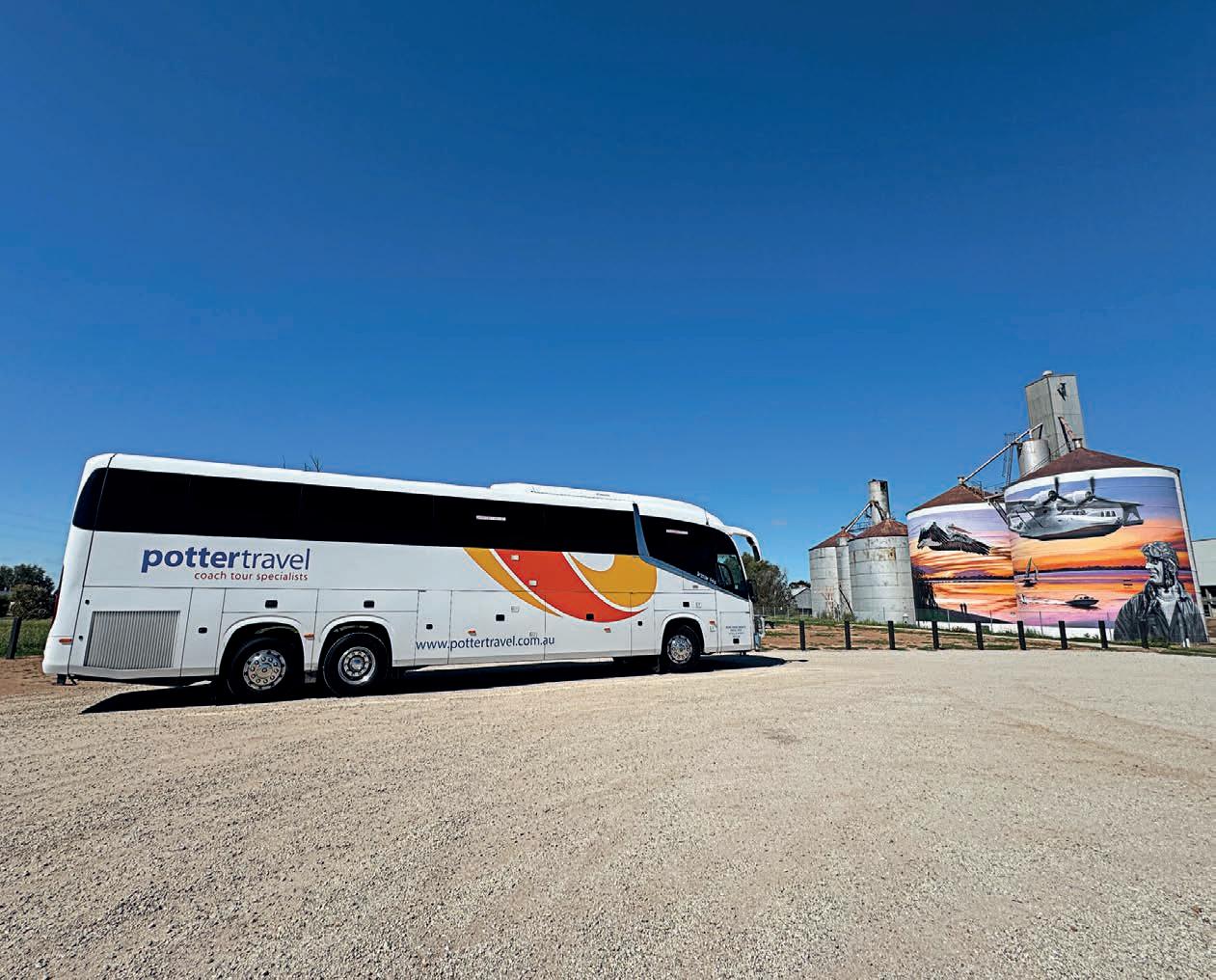
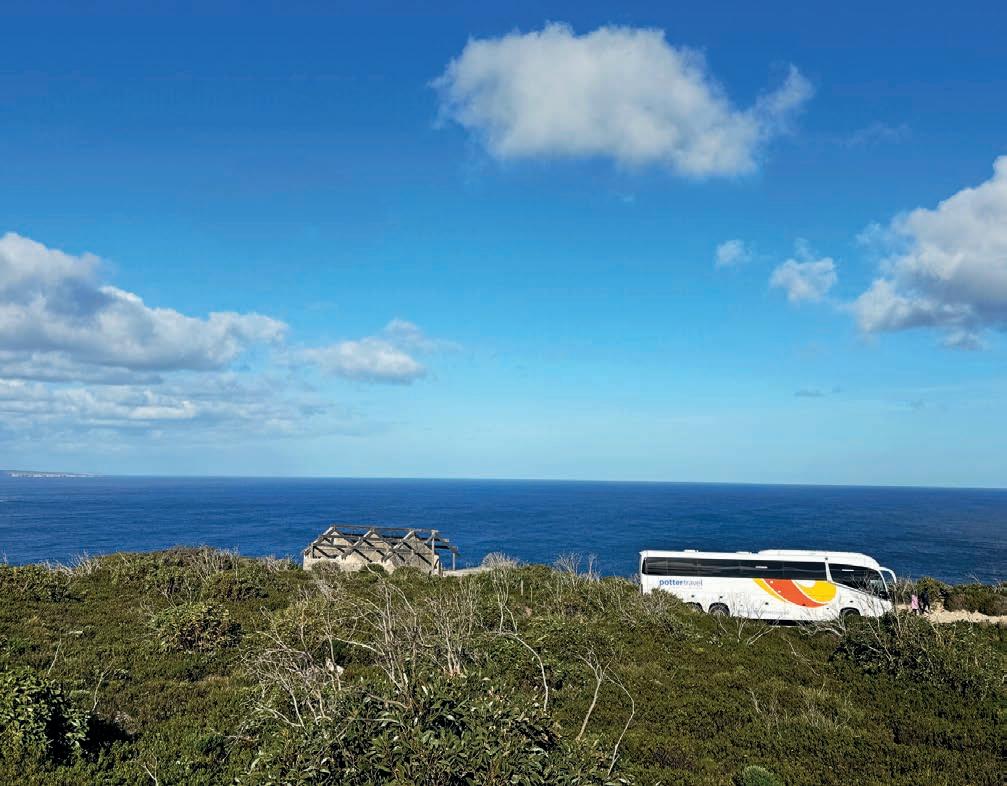
The bus and coach industry has gotten off to a hot start in 2026 with January’s data encapsulating a variety of deliveries
After another milestone year for bus and coach deliveries in Australia, the sector is off to a fast start in 2026 according to ABC ’s deliveries data.
There were 155 deliveries recorded in January 2026, mirroring December 2025’s numbers. However, it is down from the mega start made in 2025 when there were 164 deliveries made in January last year.
Yutong made a bright start to 2026, leading the way in the chassis sector with a total of 57 deliveries made. Out of the 57, 46 of these were heavy bus deliveries, while the other 11 were light bus. This saw Yutong finish ahead of Volvo, with the 2025 chassis leader recording 36 deliveries to start the new year, while Scania came in a tight third with 33 deliveries made. Outside of this, King Long claimed fourth with 10 units delivered, while BCI (eight) finished ahead of BLK (three), Challenger (two light bus deliveries) and BYD (one electric bus delivery).
It was a similar case of Yutong leading the way in the body builder sector, comfortably ahead with its combination of 46 heavy bus and 11 light bus deliveries. Perennial body builder leader Volgren managed to hold off Scania Higer (23) to claim second with 26 deliveries, while BCI (11) claimed fourth ahead of Irizar and King Long, who both couldn’t be separated with 10 deliveries apiece. Marcopolo led the final pack with five deliveries, with the final 13 deliveries being shared across a peloton of six brands that included Express Coaches (four), BLK (three), Coach Design (two), Challenger (two light bus deliveries), Coach Concepts (one) and Global Bus Ventures (one).
There was also a new leader crowned in the seating market, as Yutong’s mega month of 57 deliveries
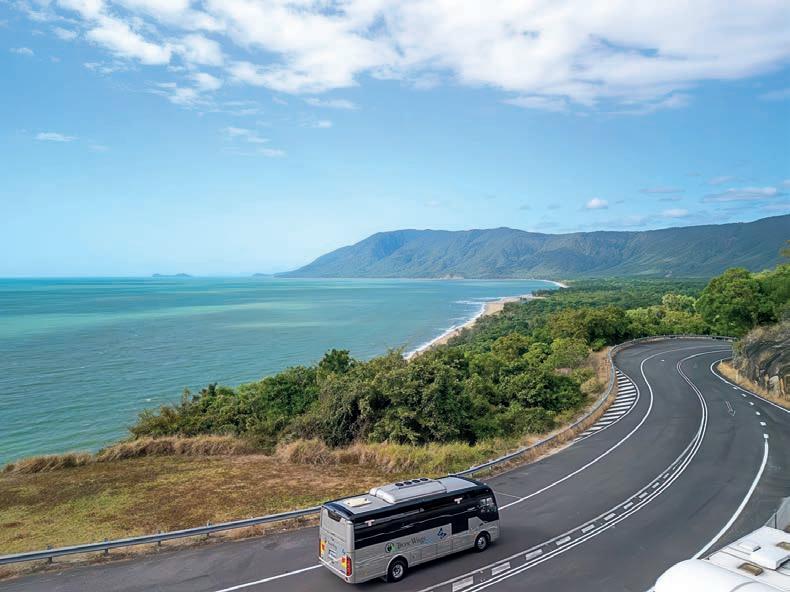
seeing it claim first spot. However, usual winner McConnell couldn’t even claim the silver, as a wonderful start to 2026 by Sege saw it finish with 45 deliveries, ahead of McConnell’s 31. From there, the small market saw King Long claim fourth with 10 deliveries, ahead of StyleRide with eight and Fainsa with the four units.
The ever-tense air-conditioning market continued 2026 in a similar way to how it finished 2025, with some tight finishes captured in January. Cling-Yutong’s 57 deliveries saw it more than double the next best suppliers in a dominant display. After them it got close, with Konvekta rising to second with 23 units delivered. Coachair came in third with the 20 units, while a three-way tie saw Thermo King, Hispacold and King Long all finish with 10 deliveries apiece. Spheros wasn’t far behind with the eight deliveries, while Denso, Valeo and BCC all claimed five deliveries apiece and Songz had the two.
The state-based battle also took
a turn to begin a new year, with Victoria romping to the win with 58 deliveries made in January. New South Wales was demoted to second place with the 35 deliveries, while Queensland claimed bronze with 26. Western Australia was hot on its tail with the 21 deliveries, with South Australia reaching double digits with 10. The Northern Territory recorded four units for the month, with Tasmania finishing with a solitary delivery.
The power source split swung towards diesel units in January, with 146 out of the 155 deliveries featuring diesel technology. In this sector, Yutong led the with 57 deliveries ahead of Scania (33) and Volvo (28). Out of the nine zero-emissions bus deliveries recorded, eight of these belonged to Volvo while BYD also recorded one unit.
Turn overleaf for comprehensive bus and coach delivery information for January. Please note all data is as supplied from manufacturers, at their discretion.
Yutong led the way, comfortably ahead with its combination of 46 heavy bus and 11 light bus deliveries. Volgren managed to hold off Scania Higer (23) to claim second with 26 deliveries
Yutong’s mega month of 57 deliveries saw it claim first spot. However, usual winner McConnell couldn’t even claim the silver, as a wonderful start to 2026 by Sege saw it finish with 45 deliveries, ahead of McConnell’s 31
Yutong made a bright start to 2026, leading the way with a total of 57 deliveries made (46 heavy bus deliveries and 11 light bus). This saw them finish ahead of Volvo, with the 2025 chassis leader recording 36 deliveries to start the new year, while Scania came in a tight third with 33
BCITerritoryTransitNT4BCIClassmasterBCIME18t320REuro6
BCIMelvilleSeniorHighSchoolWA1BCIPromaBCIME11.8t220REuro6 BCIPenrhosCollegeWA1BCIPromaBCIME11.8t220REuro6 BCIHoltHorticulturalVIC1BCIPromaBCIME11.8t220REuro6 BCITSRivettVIC1BCIPromaBCIME11.8t220REuro6 BLKPrivateOperatorNSW1BLKPresident2BLKME18.5t360REuro5 BLKPrivateOperatorQLD1BLKPresident10BLKME15t320REuro6 BLKPrivateOperatorNSW1BLKPresident10BLKME15t320REuro6 BYDDysonGroupVIC1BYDBC12A06VolgrenME19t382kWhRZero ChallengerMillersBusesNSW2ChallengerChallengerME8.5t168FEuro5 KingLongPrivateOperatorQLD1KingLongKingLongME14t320REuro6 KingLongPublicSchoolQLD1KingLongKingLongME14t320REuro6 KingLongPublicSchoolNSW3KingLongKingLongME18t400REuro6 KingLongPublicSchoolVIC3KingLongKingLongME18t400REuro6 KingLongPrivateOperatorVIC2KingLongKingLongME18t400REuro6 MANSurfsideBuslinesQLD1MANLE.19.330.RC2GlobalBusVenturesME19.5t330REuro6 MANFallonsAlexandraVIC2MANIC.19.330.RR8VolgrenME19.5t330REuro6 MANFallonsWangarattaVIC1MANIC.19.330.RR8VolgrenME19.5t330REuro6 MANSettlersTransportWA1MANIC.19.330.RR8IrizarME18t330REuro6 ScaniaAuscoachNSW1ScaniaK370CB4x2NBScaniaHigerME19.5t370REuro6 ScaniaBCISalesNSW1ScaniaK500CB6x2*4NIBCIME26.5t500REuro6 ScaniaBrightonCoachNSW1ScaniaK370CB4x2NBScaniaHigerME19.5t370REuro6 ScaniaCornerstoneCollegeIncSA1ScaniaK320CB4x2NBBCIME19.5t320REuro6 ScaniaDepartmentofTransport&MainRoadsQLD4ScaniaK320CB4x2LBVolgrenME19.5t320REuro6 ScaniaFoxbusNSW1ScaniaK500CB6x2*4NIIrizarME26.5t500REuro6 ScaniaLakesCoachesVIC1ScaniaK320CB4x2NBCoachConceptsME20.5t320REuro6 ScaniaMartinsTravelGroupAlburyVIC1ScaniaK320CB4x2NBExpressCoachesME20.5t320REuro6 ScaniaMtGravattCoach&TravelQLD1ScaniaK320CB4x2NBScaniaHigerME19.5t320REuro6 ScaniaQuestCoachesVIC1ScaniaK370CB4x2NBScaniaHigerME19.5t370REuro6 ScaniaSGFleetAustraliaVIC1ScaniaK410CB6x2NBExpressCoachesME26.5t410REuro6 ScaniaVenturaBusLinesVIC2ScaniaK370CB4x2NBScaniaHigerME19.5t370REuro6 ScaniaWarragulBusLinesVIC17ScaniaK370CB4x2NBScaniaHigerME19.5t370REuro6 VolvoKangarooBusLinesQLD4VolvoB8RLEVolgrenME19.5t320REuro6 VolvoBrisbaneBusLinesQLD2VolvoB8RIrizarME19.1t350REuro6 VolvoTrevorWickhamQLD1VolvoB8RIrizarME19.1t350REuro6 VolvoFassifernCoachesQLD2VolvoB8RIrizarME19.1t350REuro6 VolvoTransNorthBus&CoachQLD1VolvoB8RIrizarME19.1t350REuro6 VolvoVictoryCollegeQLD1VolvoB8RIrizarME19.1t350REuro6 VolvoTfNSW/BuswaysNSW3VolvoBZLElectricVolgrenME19tN/AN/AZero VolvoLyonsBusServiceNSW1VolvoB8RExpressCoachesME19t320REuro6 VolvoOgdensCoachesNSW1VolvoB8RVolgrenME19t320REuro6 VolvoPruggerBusandCoachNSW1VolvoB8RExpressCoachesME19t320REuro6 VolvoSeymourPassengerServiceVIC1VolvoB8RCoachDesignME19t350REuro6 VolvoWinterhalterBuslinesVIC1VolvoB8RCoachDesignME19t350REuro6 VolvoRoyalDiscoveryVIC1VolvoB8RIrizarME19t350REuro6 VolvoNulineCharterVIC1VolvoB8RBCIME19t350REuro6 VolvoDepartmentofEducationSASA5VolvoB8RVolgrenME19t350REuro6 VolvoKangaCoachesSA4VolvoB8RMarcopoloME19t350REuro6 VolvoGensweksWA1VolvoB8RMarcopoloME19.1t350REuro6 VolvoPublicTransportAuthorityWAWA5VolvoBZLElectricVolgrenME19tN/ARZero YutongPrivateOperatorQLD1YutongC10YutongME13.6t310REuro6 YutongPrivateOperatorQLD1YutongD7YutongME8t190FEuro6 YutongPrivateOperatorQLD1YutongD7YutongME8t190FEuro6 YutongPrivateOperatorQLD1YutongC12YutongME18t340FEuro6 YutongPrivateOperatorQLD1YutongD7YutongME8t190FEuro6 YutongPrivateOperatorVIC1YutongC12YutongME18t340FEuro6 YutongPrivateOperatorVIC16YutongC12YutongME18t340FEuro6 YutongPrivateOperatorVIC2YutongD7YutongME8t190FEuro6 YutongPrivateOperatorTAS1YutongD7YutongME8t190FEuro6 YutongPrivateOperatorVIC1YutongC12YutongME18t340FEuro6 YutongPrivateOperatorWA1YutongD7YutongME8t190FEuro6 YutongPrivateOperatorWA2YutongC12YutongME18t340FEuro6 YutongPrivateOperatorWA1YutongD7YutongME8t190FEuro6 YutongPrivateOperatorWA1YutongC12YutongME18t340FEuro6 YutongPrivateOperatorWA3YutongC12YutongME18t340FEuro6 YutongPrivateOperatorWA1YutongD7YutongME8t190FEuro6 YutongPrivateOperatorWA1YutongC10YutongME13.6t310REuro6 YutongPrivateOperatorWA1YutongC10YutongME13.6t310REuro6 YutongPrivateOperatorWA1YutongC10YutongME13.6t310REuro6 YutongPrivateOperatorNSW1YutongD7YutongME8t190FEuro6 YutongPrivateOperatorNSW2YutongC10YutongME13.6t310REuro6 YutongPrivateOperatorNSW1YutongD7YutongME8t190FEuro6 YutongPrivateOperatorNSW14YutongC12YutongME18t340FEuro6 YutongPrivateOperatorQLD1YutongC12YutongME18t340FEuro6
AZF212.3BCC–57––––X–SegeBCIYN AZF28.8Valeo39–––––X–SegeBCIYN AZF28.8Valeo35–––––X–SegeBCIYN AZF28.8Valeo39–––––X–SegeBCIYN AZF28.8Valeo39–––––X–SegeBCIYN AAllison212.36Spheros–53––X–––SegeBLKYN/A AAllison210Spheros–41––X–––FainsaBLKYN/A AAllison210Spheros–41––X–––FainsaBLKYN/A ABYD212.5Coachair43––––X––McConnellVenturaNY AAllison27.75Songz–28––––X–FainsaChallengerYN/A ACummins210KingLong39–––X–––KingLongKingLongYN ACummins210KingLong39–––X–––KingLongKingLongYN ACummins212KingLong57–––––X–KingLongKingLongYN ACummins212KingLong57–––––X–KingLongKingLongYN ACummins212KingLong57–––––X–KingLongKingLongYN AZF212.5Valeo––46––X––McConnellVenturaNN AZF212.5Coachair57–––––X–McConnellSMCYN AZF212.5Coachair57–––––X–McConnellSMCYN AZF212.3Hispacold57–––––X–McConnellMasatsYN AZF212.3Konvekta58–––––X–SegeN/AYN OpticruiseScania313.5BCC–55–X––––SegeN/AYY OpticruiseScania212.3Konvekta–54––––X–SegeN/AYN AZF212.5Coachair57–––––X–SegeN/AYN AZF212.5ThermoKing––46––X––StyleRideN/ANN OpticruiseScania313.5Hispacold–54–X––––SegeN/AYN OpticruiseScania212.5ThermoKing57–––––X–McConnellN/AYN AZF212.5Coachair57–––––X–McConnellN/AYN AZF212.3Konvekta58–––––X–StyleRideN/AYN AZF212.3Konvekta58–––––X–SegeN/AYN OpticruiseScania312.5Coachair–57–X––––McConnellN/AYN AZF212.3Konvekta–54––––X–McConnellN/AYN AZF212.3Konvekta58–––––X–SegeN/AYN AZF210-12.9Coachair––43––X––McConnellVenturaNY AZF210-12.9Hispacold70–––X–––SegeMasatsYN AZF210-12.9Hispacold57–––––X–SegeMasatsYN AZF210-12.9Hispacold57–––––X–SegeMasatsYN AZF210-12.9Hispacold57–––––X–SegeMasatsYN AZF210-12.9Hispacold57–––––X–SegeMasatsYN ASVolvo212.5Coachair––38––X––McConnellVenturaNY AZF212.5ThermoKing57–––––X–McConnellSMCYN AZF212.5ThermoKing57–––––X–StyleRideSMCYN AZF212.5ThermoKing57–––––X–StyleRideSMCYN ASVolvo210-12.9ThermoKing57–––––X–McConnellSMCYN AZF210-12.9ThermoKing57–––––X–StyleRideSMCYN ASVolvo210-12.9Hispacold–21––X–––SegeIrizarYN ASVolvo210-12.9Coachair–48––X–––SegeBCIYY AZF210-12.9Coachair57–––––X–McConnellSMCYN AZF210-12.9Spheros–53––X–––SegeMarcopoloYN AZF212.5Spheros57–––––X–McConnellMarcopoloYN AVolvo210-12.9Denso––32––X––McConnellVenturaNY AZF29.9Cling-Yutong–43––––X–YutongYutongYN/A AAllison27.7Cling-Yutong27–––––X–YutongYutongYN/A AAllison27.7Cling-Yutong2–––––X–YutongYutongYN/A AAllison212.3Cling-Yutong57–––X–––YutongYutongYN/A AAllison27.7Cling-Yutong27–––X–––YutongYutongYN/A AAllison212.3Cling-Yutong–53––X–––YutongYutongYN/A AAllison212.3Cling-Yutong57–––X–––YutongYutongYN/A AAllison27.7Cling-Yutong27–––––X–YutongYutongYN/A AAllison27.7Cling-Yutong27–––––X–YutongYutongYN/A AAllison212.3Cling-Yutong–53––––X–YutongYutongYN/A AAllison27.7Cling-Yutong28–––X–––YutongYutongYN/A AAllison212.3Cling-Yutong57–––X–––YutongYutongYN/A AAllison27.7Cling-Yutong28–––––X–YutongYutongYN/A AAllison212.3Cling-Yutong28–––X–––YutongYutongYN/A AAllison212.3Cling-Yutong57–––X–––YutongYutongYN/A AAllison27.7Cling-Yutong27–––––X–YutongYutongYN/A AZF29.9Cling-Yutong–43––––X–YutongYutongYN/A AZF29.9Cling-Yutong–43––X–––YutongYutongYN/A AZF29.9Cling-Yutong–43––––X–YutongYutongYN/A AAllison27.7Cling-Yutong27–––––X–YutongYutongYN/A AZF29.9Cling-Yutong–43––––X–YutongYutongYN/A AAllison27.7Cling-Yutong27–––––X–YutongYutongYN/A AAllison212.3Cling-Yutong57–––––X–YutongYutongYN/A AAllison212.3Cling-Yutong–53–––––XYutongYutongYN/A
CDC Victoria’s double-decker on Route 190 shows how extra capacity, driver pride and passenger excitement can coexist on a suburban bus service
On Melbourne’s Route 190, there is a very specific moment when a routine bus trip takes an unexpected turn. The bus pulls in, the doors open, and, instead of the familiar low-floor interior stretching out in front of them, passengers are greeted by something rarely seen on Victorian routes. Stairs.
CDC Victoria’s Volvo B9TL double-decker has quietly become one of the most recognisable buses in the western suburbs, transforming an otherwise ordinary service into a vehicle with genuine character. It is a reminder that capacity planning does not always mean more buses, more drivers or more congestion. Sometimes, it simply means going up.
Route 190 is a high-demand corridor, carrying a steady mix of commuters and students every day. For CDC Victoria, the challenge was clear. The route needed additional capacity, particularly for school travel, but without the inefficiencies that come with adding extra vehicles to the road.
The double-decker offered a neat solution, allowing high passenger volumes to be moved in a single journey while maintaining a direct, simple service pattern for students. While double-deckers are a common sight in parts of the UK, New South Wales and Asia, they remain a rarity in Victoria. That makes the B9TL’s performance all the more notable.
From an operational standpoint, CDC Victoria reports strong reliability, sustained high patronage and an unusually enthusiastic public response. Even after almost a decade in service, the bus continues to attract attention from both passengers and those who operate it.
Integrating a vehicle of this size into Melbourne’s bus network might
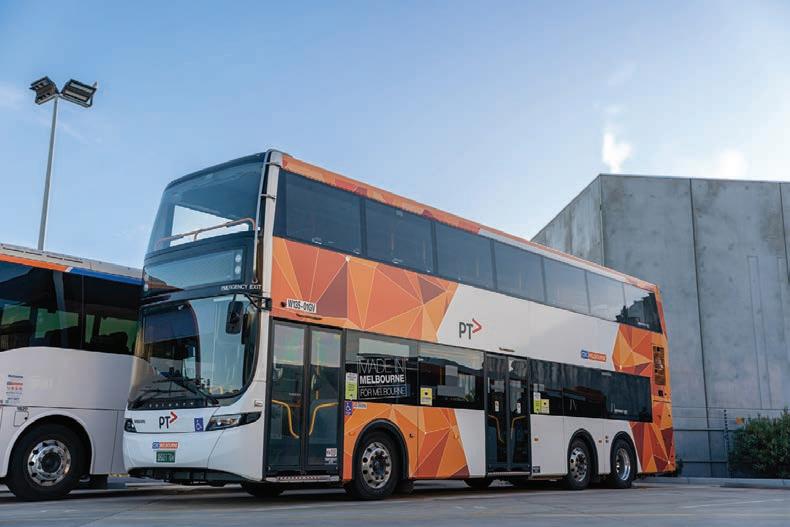
sound challenging, but the reality has been refreshingly straightforward. Due to its height and weight, the bus operates on a designated route, yet it has adapted smoothly to existing infrastructure, both on the road and within the depot. No major modifications were required, reinforcing the idea that double-deckers can work locally when routes are carefully selected and planned.
For drivers, the operator says the experience has been overwhelmingly positive. CDC says there is a genuine sense of pride among the group that operates the double-decker, which has become a defining identity feature of CDC Truganina operations. Familiarity has played a key role here. The Volvo chassis and Volgren body mean the dashboard layout, controls and general ergonomics are already well known, reducing the need for extensive retraining. As a result, driver instruction could focus on the specific handling and operational characteristics of a double-decker rather than relearning the basics.
The bus itself has aged well. Despite its years in service, it remains in excellent condition, a testament to both the durability of the B9TL platform and the benefits of a lightweight aluminium body structure. Strong local support from both the
chassis and body manufacturers has helped ensure ongoing reliability and ease of maintenance, reinforcing confidence in the vehicle over its lifecycle.
For passengers, however, the upstairs experience is what truly sets the bus apart. CDC Victoria reports a high level of enthusiasm among travellers keen to secure a top-deck seat, with some customers actively enquiring about service times so they can plan their trip around the double-decker. For regular users of the route, it adds a sense of novelty to an otherwise standard journey. For students and first-time riders, it is something memorable, a small but meaningful upgrade to the daily commute.
In a network where buses are often judged solely on efficiency and reliability, the Route 190 double-decker has shown there is also room for personality. It delivers capacity where needed, operates reliably within existing infrastructure and generates a level of public goodwill that most buses can only dream of.
On Route 190, the stairs are more than just a design feature. They are proof that, with the right vehicle in the right corridor, public transport can be practical, efficient and a little bit fun.

“Australian Truck Radio is my trucking radio station. So many great trucking tunes with loads of industry news. I lock it on and leave it on all day long!”