As they recognize the 100th anniversary of McGroarty & Bradburn Insurance, agency owners Michael McGroarty Jr., Megan McGroarty, and Justin Safran share how long-held values and an innovative spirit have positioned the business for continued success.
BUILDING A CYBERSECURITY CULTURE
Cybersecurity is everyone’s responsibility. Learn how to build a strong cybersecurity culture that ensures every agency employee understands the risks, follows safe practices, and helps protect the organization’s most valuable data.
AN AGENCY MODEL OF SUCCESS
I’m especially happy to introduce this month’s Primary Agent because it highlights a business that epitomizes what makes independent agencies so special. This month’s magazine celebrates the 100th anniversary of McGroarty & Bradburn Insurance.
McGroarty & Bradburn is a poster-child independent agency, a staple business in Pittsburgh’s west suburbs. Over the last century, McGroarty and Bradburn has insured the community, through personal and commercial insurance, and through smart business decisions has remained relevant in our everchanging industry. Their model of success is seen across our full membership; they’ve just been doing it longer than most.
However, what further distinguishes McGroarty and Bradburn is how they’ve given back to the industry. I met Mike McGroarty Sr. – a second-generation agency owner – when I first started at IA&B in 2005. Mike was a member of the Board and very active in that role. In fact, Mike eventually became Chair of the Board. As Chair, he oversaw the CEO transition at IA&B, when I took over that role in 2018. He gave his time (significant at that) to ensure a smooth process for the benefit of all IA&B members. Mike transitioned off the Board as he began transitioning his agency to his son and daughter.
Having an agency volunteer as a Board Director, and ultimately a Board Chair, is highly commendable. But there’s more: we are pleased to now have Mike’s son, Michael McGroarty Jr., serving on our Pennsylvania Board. Like his father, Michael selflessly gives his time to help guide IA&B’s strategic direction. It’s this spirit of giving back that makes McGroarty & Bradburn’s milestone anniversary all the more special.
Read more about this exceptional agency beginning on page 8. And if it inspires you to get involved and give some of your time, no matter what amount or capacity, reach out to me.
Jason F. Ernest President & CEO
INSURANCE AGENTS & BROKERS
650 Wilson Lane, Suite 200 Mechanicsburg, PA 17055
191 Main Street, Annapolis, MD 21401
800-998-9644 | IABforME.com
IA&B BOARD OF DIRECTORS
OFFICERS
Andrew Enders, Esq. - Chair Enders | Harrisburg, PA
Kate Dawson, CISR, CPIA - Vice Chair Ferri Dawson Insurance | Murrysville, PA
MEMBERS
Greg Bennett Famous & Spang Associates Aberdeen, MD
Tony Cusati, CIC Sitter Insurance LLC Erie, PA
Michael Gaetano The Hartman Group Montoursville, PA
Debra McAfee McAfee Insurance Agency, LLC Wilmington, DE
Michael McGroarty, Jr., CIC McGroarty & Bradburn Insurance Pittsburgh, PA
Hunter McHugh McHugh Insurance Group Wilmington, DE
Shayne McIntosh, CIC JPI Insurance Associates Dillsburg, PA
Chris Miller, CIC Miller Insurance Protection Team Jonestown, PA
Jill Nye, CIC, CISR, CPIA Gunn-Mowery, LLC Lemoyne, PA
Lisa Parry, CPIA Parry Insurance Langhorne, PA
Bill Purdy Purdy Insurance Agency, Inc. Sunbury, PA
Kent Reynolds, CIC Blue Ridge Risk Partners LLC Hagerstown, MD
David Rivell, CIC, CRM Element Risk Management West Chester, PA
Christy Rose Avery Hall Insurance Salisbury, MD
Ashley Stafford, CPIA Williams Insurance Agency, Inc. Rehoboth Beach, DE
Michael Thomas Lighthouse Insurance Svcs Gambrills, MD
Kyle Zehr, CIC FIFS, LLC Telford, PA
NATIONAL DIRECTORS
Diana Hornung, CIC (IIABA) IOA National, Inc. | Wilmington, DE
Mark Monroe (IIABA)
Mark J. Monroe Insurance | Downingtown, PA
QUESTION: ANSWER:
ASKING
Are you a member with a question?
CLAIRE-IFICATION
IA&B Vice President - Advocacy Claire Pantaloni, CIC, CISR
Contact Claire to find the answer at 717-918-9202 or ClaireP@IABforME.com.
Is it a best practice to ask our construction clients if they signed any contracts during the last year at each renewal, or throughout the year? And if a client asks us to review a contract, should we do it?
Let’s address the questions one by one.
YOUR CONSTRUCTION CLIENTS IF THEY SIGNED ANY CONTRACTS
From an E&O prevention standpoint, it is best not to set the precedent of asking your client every year if they signed or modified any contracts. This could create a duty that you do not currently have as the agent.
Instead, you could communicate substantially the same message as part of the renewal solicitation process. This could be done through a reminder that new or modified contracts could require changes to their coverage and that they should contact you if needed.
Proceeding this way puts the onus on the client to act and notify you, rather than requiring you to address this question with each client. Integrating this into the agency’s annual renewal communications would be better than doing a separate letter on a semi-annual basis.
PROVIDING CONTRACT REVIEWS
In general, E&O carriers advise against doing contract reviews for clients. Agents are not attorneys, and E&O carriers prefer that the client have their attorney review the contract and advise the agent of their insurance needs.
That said, E&O carriers also realize that some agents will do this review. When that is the case, using a disclaimer
such as the one IA&B has posted on our website would be good practice to help mitigate the exposure. The sample is available at:
IABforME.com/eo-prevention
This document is not a legal opinion and should not be relied upon as such. The intent of this document is to provide a general background regarding the topic or topics discussed, not to provide legal advice. Producers and agencies should consult an attorney regarding specific situations and specific questions with respect to the topic or topics covered in this document. Neither the Insurance Agents & Brokers nor any of its employees shall be responsible for any errors or omissions regarding any statements made in this document, nor any errors or omissions regarding any statutes, regulations, court rules, and/or any other government documents cited in this document.
Rather listen?
Also available in audio format at IABforME.buzzsprout.com
THE POTENTIALLY CATASTROPHIC INVISIBLE HOMEOWNERS’ EXCLUSION
By Bill Wilson
Your personal lines insureds could lose their homes, not because of a clear and conspicuous exclusion, but because of three words … buried in a definition … casually referenced in an insuring agreement.
To illustrate, my maternal grandmother was a warrior. In her late 80s, she had both knees and both hips replaced at separate times. After surgery and rehab, she returned to her retirement home apartment. Then she learned she had a condition called Paget’s Disease and had to have a leg amputated just below the knee. Surgery, rehab and, again, she
refused moving to a nursing home and returned to her apartment. I told you she was a warrior.
Unfortunately, in an accident shortly after her 90th birthday, she incurred multiple fractures in her other leg. While the surgeon was able to save the leg, it was clear that she would be unable to return to her apartment. I had the task of telling her this at about 8 PM on a Friday night. On the following Monday morning, she passed away. I don’t know how one does this, but I believe that she recognized it was time to move on, just not to a nursing home. Now, for the purpose of this article,
let’s assume that she lived not in an apartment, but in a house insured under an ISO HO 00 03 policy. If her home burned down or was destroyed by a tornado after 8 PM on that Friday night, would there be any homeowners’ coverage? Not according to some insurers and courts. Here’s why….
The dwelling coverage on most homeowners’ policies, and specifically ISO HO forms, says “We cover...The dwelling on the ‘residence premises’ shown in the Declarations....” The term “residence premises” is defined to include “The one-family dwelling where you
reside….” Note the wording “where you reside.” Three words. Buried in a definition. Casually referenced in an insuring agreement. The word “you” refers to “the ‘named insured’ shown in the Declarations and the spouse if a resident of the same household.” The key word requires residency as a condition of coverage for damage to the dwelling.
According to one view, if the named insured no longer resides in the home, coverage on the dwelling ends when the residency ends. In my hypothetical, under this interpretation, if my grandmother owned and insured a dwelling (rather than an apartment), her homeowners’ insurance coverage ended at 8 PM on that Friday night.
Consider the many ways residency might end. In this case, it’s death of the named insured. And, yes, there is a “Death” condition in ISO and other homeowners’ policies that extends coverage to the legal representative of the deceased. But, in this example, at 8 PM there is arguably no legal representative identified and, even if there was, the “Death” condition does not modify the “where YOU reside” language cited as the basis for denying a claim.
The residency situation first came to my attention a little over 25 years ago when an agent contacted me about a claim denial following the rental of an insured’s home. As I recall, the named insured resided there when the policy was issued but was transferred by his employer with very short notice and had just rented the home but failed to understand the importance of notifying his agent or insurer of the change in residency. As a result of the denial, I wrote an article entitled “Rent Your Home, Void Your Insurance Policy?”
Over the next few years, I began to get a fairly regular stream of claim issues involving residency. One was a Maryland vandalism and theft claim where the named insureds had permanently relocated to a secondary residence and their daughter resided in the subject residence. The insurer denied the vandalism damage to the dwelling and, in addition, denied the daughter’s personal property theft claim since she was not a resident of her parents’ household.
In an almost identical occupancy situation, an insurer in Pennsylvania denied a fire claim as the named insureds had moved to a retirement home and the subject residence was occupied by their daughter.
In Rhode Island, named insureds had bought a house, insured it on a homeowners’ policy but had not yet moved in because renovations took several months, a very common “fixer upper” occurrence. The insurer denied a five-figure fire claim, citing the “where you reside” language since actual residency had not yet occurred.
Over the years, I’ve lost track of the number of claim denials in New York where the courts have consistently upheld the “where you reside” language as thwarting coverage when no residency exists.
Does your book of homeowners’ business have non-residency issues? I’ll pretty much guarantee it. Unfortunately, I’m at my space limit for this month’s article, but if you want to dig deeper into this issue, including some remedies that may exist, the Big “I” Virtual University has a resource page at independentagent.com/vu_ resource/Where-You-Reside, or you
are welcome to reach out to me via email at the address below.
Bill Wilson, CPCU, ARM, AIM, AAM is the founder and CEO of InsuranceCommentary.com and the author of six books, including the Amazon 4.8 star “When Words Collide…Resolving Insurance Coverage and Claims Disputes” which BookAuthority ranks as the #1 insurance book of all time. He can be reached at Bill@InsuranceCommentary.com.
Rather listen?
Also available in audio format at IABforME.buzzsprout.com
LIVE CE WEBINAR
Make sense (finally!) of homeowners’ deductibles. This webinar explains how applying deductibles to a loss actually works.
AN HOUR WITH NICOLE: MAKING SENSE OF HOMEOWNERS’ DEDUCTIBLES
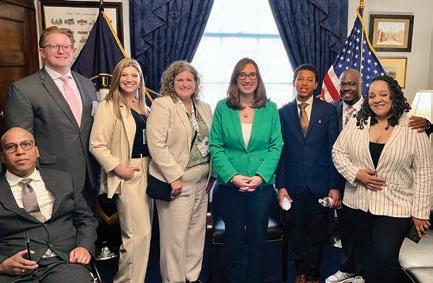
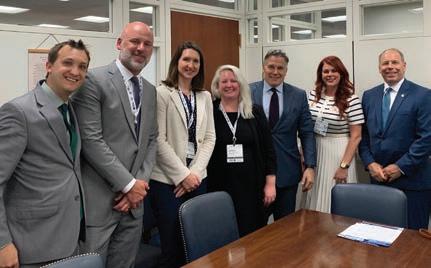
Photos from the 2025 Big "I" National Legislative Conference
Top: IA&B's Delaware contingent met with Rep. Sarah McBride.
Bottom: Several of IA&B's Pennsylvania members met with Sen. Dave McCormick.
ADVOCACY OPPORTUNITY FOR INDEPENDENT AGENTS
Employees of IA&B member agencies in Pennsylvania and Delaware are invited to the Big “I” National Legislative Conference, April 22-23, 2026. The annual event brings together independent agents from across the country to meet with their elected Representatives and Senators on Capitol Hill.
IA&B covers the registration and hotel costs for member agents to attend. More than 30 IA&B members made the trip to the 2025 event,
where they discussed taxes, disaster mitigation, legal reform, and crop insurance with federal lawmakers.
Spots are limited and are filled on a first-come, first-served basis. If you are interested in attending, contact IA&B Government Affairs Director John Savant at JohnS@IABforME.com or 800-998-9644, ext. 607 to learn more.
SPECIAL TOPIC CPIA WEBINAR: DISASTER & CONTINUITY PLANNING
Preparation can make all the difference between recovery and catastrophic loss after a disaster. Through real-world case studies and hands-on exercises, this live webinar will teach you how to build effective continuity plans that protect both businesses and families.
While it satisfies the CPIA designation update requirement, this course is open to anyone, regardless of designation status.
March 25, 8 AM-4 PM
Approved for 7 CE credits, as well as E&O loss control credit for Utica policyholders
Transform the way you engage with clients, coworkers, and partners through the Customer Service Excellence Program – a dynamic online training designed for insurance professionals.
Program highlights:
▲ Limited to 15 par ticipants so everyone can fully engage, collaborate, and learn from one another.
▲ Interactive, online collaboration using realistic scenarios and opportunities to engage with instructors and peers.
▲ Cer tificate of completion recognizing your achievement.
This program includes six 90-minute workshops that run every Tuesday at 10-11:30 AM from April 21 through May 26.
Learn more and register: IABforME.com/customer-service excellence-program
800-998-9644, option 1
IA&B EDUCATION SCHOLARSHIP
RECIPIENTS
Congratulations to the latest round of IA&B education scholarship recipients!
Agency Scholarships for CE Webinars
Rossbacher Insurance Service Corry, PA
Agency Scholarships for CISR Courses
Blue Marsh Insurance Inc. Fleetwood, PA
Edward L Sanders Ins Agency La Plata, MD
Rossbacher Insurance Service Corry, PA
Smyrl Insurance
Hatfield, PA
Trinity Risk Services LLC Pittsburgh, PA
Unruh Insurance Agency Inc. Denver, PA
YMI Agency Inc.
Stroudsburg, PA
Agency Scholarships for CIC Courses
Avery Hall Insurance Salisbury, MD
Bitner Henry Insurance Group Hagerstown, MD
Connie Phillips Insurance Inc Frederick, MD
Liberty Insurance Agency Pittsburgh, PA
Paist and Noe Insurance Inc Richboro, PA
Full CISR Designation Scholarship
Micah Miller
Myers & Lynch Insurance Inc.
Shamokin, PA
Full CIC Designation Scholarship
Kelly Lentz
Keller-Brown Insurance Services
Shrewsbury, PA
Licensing Scholarship
Emmeline Marshala
Hauser Agency Inc.
Mount Pleasant, PA
IA&B introduced the insurance education scholarship program in 2018 to support the future of the
independent agency system. The scholarship program aims to develop new talent and support existing agency staff through insurance education. Each year, IA&B awards about $10,000 in scholarships to individuals and member agencies toward designation, online continuing education, and licensing study courses.
Q& A with MCGROARTY & BRADBURN INSURANCE
This year marks the 100th anniversary of McGroarty & Bradburn Insurance, LLC, a full-service independent insurance agency headquartered in Pittsburgh, PA. Michael McGroarty Jr., CIC; Megan McGroarty, CISR Elite; and Justin Safran co-own the agency.
Q. First and foremost, Michael and Megan, was it always your intention to work in the family business? Either way, what drew you to it?
A. [Michael:] There’s a framed school project hanging in my dad’s office that I made in the first grade. It says, “When I grow up, I want to be an insurance salesman. My dad is one. I will take over his job.” Back then, that’s exactly what I thought I would do. As I got older though, I wanted to explore other things. I did not want to go into my family’s business without experiencing other businesses and proving that I could succeed.
After college, I worked a few different sales jobs and eventually moved to Arizona. I was working for Verizon Wireless when my dad reached out and asked if I wanted to join the agency. I was more than ready to get away from corporate America, so I took the leap – and I’ve never looked back. The insurance industry is an amazing place to build a career, and I genuinely love helping people.
[Megan:] It was never my intention to work in the family business. From a young age, I was certain I wanted to be an elementary school teacher. I earned my undergraduate degree in Early Childhood Education and spent three years teaching first grade in Cape Coral, FL.
After moving back to Pittsburgh to complete my master’s degree, I found myself without a full-time teaching position. Around that same time, my father had a commercial lines account manager vacancy, and he was struggling to find a replacement. I needed a more stable job, so I interviewed for the position and accepted the offer – with a very clear understanding on both sides: If I wasn’t meeting expectations, he could let me go, and if I found a full-time teaching job, I could leave with no hard feelings.
What surprised me was how much I truly enjoyed the work. I had always worried that a desk job would feel repetitive or boring, but insurance is anything but that. There is always something new – changing regulations, unique client situations, unexpected challenges. I also realized I could still use my teaching skills, particularly when training and mentoring new hires. What started as a practical decision turned into a career I genuinely fell in love with.
Q. Justin, tell us about your career path, including what brought you to McGroarty & Bradburn Insurance.
A. [Justin:] At a young age, I watched my family lose a grocery store to an electrical fire and quickly learn the business was not insured properly. I knew that I never wanted to see this devastation happen to other families, and that alone pushed me toward insurance.
Over the years, I have had the opportunity to work in numerous roles and have learned how important trust, communication, and attention to detail are, especially when people are making important decisions for their business. I have been drawn more specifically to insurance because it sits at the intersection of risk management and real-world impact. When it’s done right, it genuinely protects people and businesses when they need it most.
What brought me to McGroarty & Bradburn Insurance was the firm’s reputation for integrity, long-term client relationships, and a more personal approach rather than a transactional one. I was looking for a place where expertise matters, teamwork is valued, and the clients’ needs come first. McGroarty & Bradburn’s commitment to tailored solutions and community involvement aligned closely with how I approach my work, making it a natural next step in my career and a place where we can all continue to grow.
Q. How has the agency evolved under your ownership? And what changes are you most proud of?
A. [Megan:] Before we officially took ownership, Michael had already done an excellent job modernizing the agency’s technology, bringing us in line with – and in many cases ahead of – other agencies. I focused on deeply learning our management system to identify best practices and efficiencies that would make our account managers’ jobs easier and more streamlined.
[Michael:] Our modernization efforts really accelerated in 2020. We were preparing to test a once-a-week workfrom-home setup starting in April, but when COVID hit, everything sped up. We sent everyone home in March and made the remote model work on the fly.
[Megan:] During that period, we hired team members who lived more than an hour from the office, and ultimately, we made the decision to remain fully remote.
[Michael:] Our technology has continued to evolve to support this approach, and it’s opened the door to finding incredible talent far beyond our local area – including two team members who work from the Philippines.
[Megan:] What I’m most proud of is that we’ve made the remote environment work successfully through consistent communication, trust, and accountability. Maintaining a
strong culture in a remote environment takes effort and intention, and I’m proud of how our team continues to collaborate and support one another every day.
Q. Michael and Megan, you purchased the agency from your father, Mike McGroarty Sr. What advice would you give to others who are considering the internal perpetuation of a family agency?
A. [Michael:] Luckily, our transition and purchase went very smoothly. We started the management transition well before the actual sale, so our team knew what was coming. We also brought in a third-party firm to conduct an evaluation of the agency, which helped with the negotiations and is invaluable if the IRS ever comes knocking.
We began the entire process more than a year in advance. We had separate attorneys representing each side and created an agreement that was fair for everyone involved. And finally, we put a thorough operating agreement in place to guide the agency going forward.
[Megan:] My first piece of advice would be not to rush the process. In my opinion, internal perpetuation should be a minimum five-year transition. That time allows future owners to gradually learn the management and ownership side of the business, not just the day-to-day operations.
I also strongly believe that new owners should understand every role in the agency. My experience working as both a commercial lines and personal lines account manager has been invaluable. It allows me to genuinely understand employees’ concerns, workloads, and stress points, which leads to better decision-making as an owner.
Finally, I would caution new owners against making major changes too quickly. Employees’ biggest fear during an ownership transition is uncertainty and change. Giving the team time to adjust – and even implementing changes alongside the previous owners – helps maintain stability and trust. Keeping things consistent early on reassures employees and sets the foundation for long-term success.
Continued on page 16
PICS & POSTS
Facebook.com/IABforME
LinkedIn.com/company/IA and B
Instagram.com/IA.and.B
Thanks to these partners for supporting the independent
PLATINUM PARTNERS
Chesapeake Employers’ Insurance Company
Erie Insurance
Ironpeak (formerly Iroquois)
Keystone
Millers Mutual Insurance
NJM Insurance Group
Penn National Insurance
Plymouth Rock Assurance
Progressive
GOLD PARTNERS
EMC Insurance Companies
The Insurance Alliance Network
Liberty Mutual Insurance
MMG Insurance
Nationwide Insurance Company
Openly
POM Insurance Company
SECURA Insurance
Selective Insurance
Building a Cybersecurity Culture in Your Agency
by Ryan Smith, of RLS Consulting for Catalyit
Cybersecurity is not just an IT issue. It is everyone’s responsibility. Building a strong cybersecurity culture in your business ensures that every employee understands the risks, follows safe practices, and helps protect the organization’s most valuable data.
A healthy culture means awareness, accountability, and everyday actions that prevent costly breaches. When cybersecurity becomes a shared value, your business reduces risk, maintains client trust, and keeps operations running smoothly.
A weak culture, on the other hand, creates openings for attackers. Employees who are unaware of policies or careless with data can inadvertently cause serious harm. The solution is to embed cybersecurity into your daily workflow so it becomes second nature.
Roles and Responsibilities: Leadership, IT, and Staff
A successful cybersecurity culture depends on shared responsibility. Each group plays a unique role in defense.
Leadership: Setting the Tone
Why it matters: Culture starts at the top.
• Lead by example by using strong passwords, MFA, and following all security protocols.
• Fund cybersecurity initiatives and allocate time for staff training.
• Keep cybersecurity visible in meetings, KPIs, and performance goals.
• Ensure company policies are clear, consistent, and enforced.
IT and Security Teams: Building the Backbone
Why it matters: Technology alone does not stop every attack, but it provides the foundation.
• Implement safeguards such as firewalls, encryption, and endpoint protection.
• Monitor systems for unusual activity and respond quickly to alerts.
• Keep all software and hardware updated and patched.
• Train and support staff on secure systems use.
Staff: The Frontline Defense
Why it matters: Employees are the most common entry point for attacks and your best line of defense.
• Recognize phishing emails and report them immediately.
• Use the company’s password manager and never reuse credentials.
• Follow data-handling policies for client files, COIs, and confidential information.
• Ask questions if something feels off. It is better to be safe than breached.
Common Cybersecurity Challenges (and How to Fix Them)
Recognizing risks early helps you close gaps before they become problems.
Phishing Attacks
Why it matters: Phishing emails are the top cause of breaches across small and midsize businesses.
How to act:
• Train staff to inspect sender details and links before clicking.
• Run simulated phishing tests with follow-up coaching.
• Report suspicious emails to IT instead of deleting them silently.
Weak Passwords
Why it matters: Over 80 percent of breaches involve stolen or weak credentials.
IA&B Member Benefit: New Tech Assessment
Are you leveraging technology to grow your agency? Find out now with Catalyit’s new Tech Assessment.
This interactive evaluation is designed specifically for independent agencies. It helps you understand where gaps and inefficiencies exist in your tech stack, how your agency compares to peers nationwide, and what steps will create the most impact for your business.
There is no cost for IA&B members to utilize this tool. IA&B provides all member agencies with fully funded access to Catalyit.
Take the new Tech Assessment today. Visit: catalyit.com/tech-assessment
Questions? Contact hello@catalyit.com.
How to act:
• Require long, unique passwords or passphrases.
• Roll out a business-grade password manager.
• Turn on multi-factor authentication (MFA) everywhere.
Unpatched Software
Why it matters: Hackers exploit outdated software to gain easy access.
How to act:
• Schedule automatic updates for operating systems and key applications.
• Maintain an inventory of all systems and plugins.
• Test and deploy patches within a set timeframe.
Insider Threats
Why it matters: Mistakes or malicious actions from employees can expose sensitive data.
How to act:
• Restrict access to sensitive data on a need-to-know basis.
• Monitor downloads, large file transfers, and unusual logins.
• Immediately disable access when someone leaves the company.
Implementing Effective Cybersecurity Training
Training turns awareness into action. A single session is not enough. Make it ongoing.
Key elements of successful programs:
• Regular sessions: Host quarterly refreshers to address new threats and reinforce habits.
• Interactive learning: Use short videos, phishing simulations, and quick quizzes.
• Role-based modules: Tailor lessons to departments such as sales, operations, or IT.
• Clear communication: Provide quick-reference guides and a central resource hub.
A well-trained team will identify red flags faster and respond more confidently.
Encouraging a Risk-Aware, Not Fearful, Mindset
Cybersecurity thrives in open, blame-free environments.
• Model the behavior: Leaders who follow policies show that security matters.
• Promote transparency: Encourage staff to report suspicious activity early. No penalties for honest mistakes.
• Reward awareness: Celebrate employees who spot phishing or improve processes.
• Stay adaptable: Review feedback and update your program as threats evolve.
When people see cybersecurity as a shared mission rather than a burden, participation increases.
Practical Steps to Strengthen Your Security Posture
Here is how to turn culture into action:
1. Enable Multi-Factor Authentication (MFA) on all logins including email, CRM, AMS, and financial tools.
2. Perform Regular Security Audits to catch vulnerabilities before criminals do.
3. Develop an Incident Response Plan that defines roles, contacts, and recovery steps.
4. Invest Wisely in Technology such as firewalls, encryption tools, and endpoint protection.
5. Keep Awareness Visible with newsletters, reminders, and success stories.
These steps, done consistently, will dramatically reduce your business’s cyber exposure.
Final Thoughts: Culture Is Your Best Defense
Technology cannot protect your business alone. Your people can. A strong cybersecurity culture blends training, leadership, and accountability into everyday habits.
By embedding these practices, you will protect client data, meet compliance expectations, and build trust and resilience that set your business apart.
Start today:
• Schedule your next cybersecurity training.
• Audit MFA adoption.
• Review your policies with staff.
Small, consistent actions make the biggest difference.
Published with permission from Catalyit. Founded by experienced independent agency insiders, Catalyit offers guidance on modern, efficient, and cost-effective insurance technology solutions. Let us guide you so you can focus on your clients, grow your business, keep up with competitors, and add value to your agency. Learn more: Catalyit.com/IAB
SMOOTH OUT YOUR RIDE RIP INTO COVERAGE
Trust Harford Mutual Insurance Group to provide comprehensive property and casualty insurance designed to protect what matters most to policyholders— their business.
COVER
Continued from page 9
Q. No doubt, the agency has weathered many storms over the past 100 years! To what do you attribute its longevity and ongoing success?
A. [Michael:] First, we’ve always believed in one simple principle: Do the right thing. When we follow that, our clients stay with us, and our carriers stay confident in us.
Second, our strength has always been our ability to adapt. If you’re going to last more than 100 years, you must be willing to change, evolve, and constantly look for better ways to do things.
[Megan:] I believe our longevity comes down to a few core principles that have been consistent for generations. First and foremost, we treat our clients like family. I often tell our employees: If you would do it for your family, you should do it for your client. Doing the right thing and treating people the way you want to be treated builds trust, and that trust lasts.
That philosophy was instilled in us by my father, and while I never had the opportunity to meet my grandfather, I believe the same values guided him as well.
Education is another critical factor in our success. We place a strong emphasis on continuing education – learning policy forms, understanding coverage, and knowing how to read a policy thoroughly. When a claim occurs, that knowledge allows us to
advocate effectively and fight for our clients.
Q. Congratulations on your agency’s milestone anniversary. How will you celebrate?
A. [Megan:] We are incredibly excited to celebrate this milestone. At the end of last year, we gave everyone in the office commemorative 100-year anniversary tumblers as a start to the celebration.
In May, we’re planning a larger celebration and will be inviting clients, carrier partners, and other agencies to join us. We also have a few additional surprises planned that we’re looking forward to sharing. It’s important to us that this celebration reflects both our history and the relationships that have helped sustain the agency for 100 years.
SMART. SIMPLE. FAST.
Our new 60-Second Appetite Check is a powerful tool designed to identify available commercial lines coverages in less than one minute. Our independent agents can get to yes/no (or maybe) simply and FAST, eliminating guesswork about our appetite and saving time in your day!
The enhanced digital journey is just beginning . . .
VISION
A thriving independent insurance agent community.
MISSION STATEMENT
To serve as a driving force to champion independent agency success by educating, consulting, advocating, and fostering community in Pennsylvania, Maryland, Delaware, and beyond.
The green speed on tour today is twice as fast as it was 50 years ago.
Luke Donald knows the game has evolved. As a winning Ryder Cup Captain, he chooses his players carefully.
At United Risk, we unite elite capability backed by proven results. A magnet for apex underwriting professionals committed to free enterprise and success.
The Global Choice for Apex Underwriting Professionals.