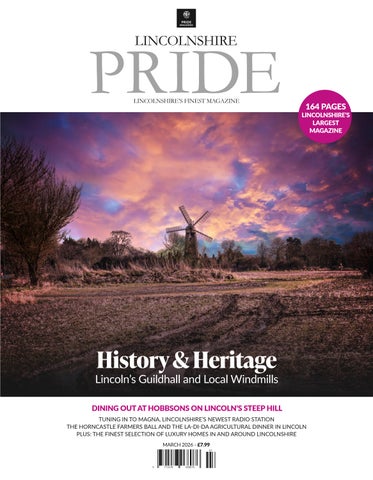
Lincolnshire Pride March 2026

Page 1


PR IDE LINCOLNSHIRE

WELCOME TO PRIDE

Sometimes it’s good to be reminded of the more important things, both in life, and in Lincolnshire. You must have walked under The Stonebow in Lincoln hundreds of times, but when was the last time you enjoyed a tour of The Guildhall?

The building, and its visitor experience recently received recognition in the Tripadvisor Travellers’ Choice Awards, so we felt a return visit was in order — both to reacquaint ourselves with the building and to see the insignia on display, which represents Lincoln’s history, reaching right back to 1237. The charters, in particular, are especially impressive.

In this edition we also provide a reminder of the vital role played by those working as part of the Lincs & Notts Air Ambulance, who help to keep 2.5 million people safe, 24/7, 365 days a year, as part of the area’s pre-eminent team offering

advanced pre-hospital care in emergencies. Their work keeps us all safe, yet their existence relies entirely on the support we give to the charity — which is why we’re proud to shout about the incredible job they do.

Elsewhere this month, you’ll recognise a familiar voice on the radio as John Marshall, formerly of Lincs FM, tells us about the launch of brand-new radio station Magna, which goes on air this month. We meet John, station founder Tom Priestley and the rest of the team in this edition.

It’s British Pie Week too, so we’re on Bailgate at Hobbsons, we have exclusive images from The Horncastle Farmers’ Ball at The Petwood Hotel in Woodhall Spa, and we enjoy a chat with Marcus Fairfax Fountaine, co-founder of luxury lifestyle brand Fairfax & Favor.

Our very best wishes for a wonderful month.

MARCH 2026

LOCAL NEWS & EVENTS

08 LOCAL NEWS Our round-up of ‘good news’ stories from across Lincolnshire.

10 HIGH LIFE Celebrations in Woodhall Spa at the Horncastle Farmers’ Ball and the Lincoln & District Dinner to Agriculture ‘LaDiDa’ event.

34 HISTORY Meet TE Lawrence ‘of Arabia.’

37 THE GUIDE Live events in Lincolnshire this March plus a brand new local radio station, and we’ll meet Jason Donovan.

50 CIVIC PRIDE Take a trip to Lincoln’s Guildhall to enjoy 800 years of history.

90FARMING With Andrew Ward MBE.

FOOD & DRINK

18 DINING OUT March means it’s British Pie Week... where better to enjoy it than Hobbsons on Lincoln’s Bailgate?

24LINCOLNSHIRE RESTAURANTS

Our guide to the county’s best local restaurants, cafés, bistros and our food producers and suppliers.

30 RECIPE A brand new recipe book by Great British Bake Off star Nadiya Hussain promising Quick Comforts. This month we’ve a brace of delicious teatime treats!

33WINE March recommendations.

HOMES & GARDENS

62 WELCOME HOME All things bright and beautiful this month as we present a barn conversion in Tealby with more than a splash of colour.

70 HOMES Neutral tones and natural materials for your home this spring.

72 INTERIORS Design-led tiles for your home with Architile.

78 FAMILY SPACES With Lincolnshire’s Ladybird Homes & Construction.

84GARDENING With Mark Lane.

94 PROPERTY Executive and rural homes.

PORTFOLIO

118 PROFILE Marcus Fairfax Fountaine, co-founder of luxury clothing and lifestyle brand Fairfax & Favor.

122FASHION Rose tinted style for spring.

130MOTORS Omoda’s large SUV.

138TRAVEL The beaches of Barbados.

144 BUSINESS Building new communities.

154 MISSION POSSIBLE Saving lives and providing emergency care in the air with the Lincs & Notts Air Ambulance.

160ALMANAC Trivia and fiction.

READ FREE ONLINE: visit www.pridemagazines.co.uk/lincolnshire TO SUBSCRIBE: visit www.pridemagazines.co.uk/lincolnshire/subscribe

Professionally delivered to the region’s wealthiest households

This month’s cover shows a spring sunrise in Alford, courtesy of Darren Ball. We’re always looking for outstanding images that show off the area in which we live. To submit your photograph for possible use on our cover, email editor@pridemagazines.co.uk.

CEO & Publisher of Pride Magazines: Julian Wilkinson.

Managing Director: Matthew Deere.

Advertising Director: Zoie Wilkinson.

Executive Editor: Rob Davis.

Customer Care Manager: Mandy Bray.

Sales Executives: Aisha Joyce, Miranda Harness, Chelsea Zealand, Eboni Canham, Grace Trotter, Hermione John.

Finance: Margarita Pavlesevica.

Accounts: Mia Garner, Craig Relton.

IT Manager: Ian Bagley.

Web Developer: Joe Proctor.

Pride Magazines

Boston Enterprise Centre, Enterprise Way, Boston, Lincolnshire PE21 7TW. Telephone: 01529 469977. Web: www.pridemagazines.co.uk. Email: sales@pridemagazines.co.uk

By supplying editorial or advertising copy to Pride you accept in full the terms and conditions which can be found online at www.pridemagazines.co.uk.

In the event of an advert or editorial being published incorrectly, where Pride Magazines Ltd admits fault, we will include an advert of equivalent size, or equivalent sized editorial, free of charge to be used in a future edition, at our discretion. This gesture is accepted as full compensation for the error(s) with no refunds available. Selected images in our content may be sourced from www.shutterstock.com.

Pride Magazines engage with over 60,000 readers across print and digital. Each edition is delivered free of charge, via Royal Mail, directly into the wealthiest households –exclusively those in council tax bands F, G and H, typically valued at £500,000+.

We are the only local magazine delivered by Royal Mail directly to letterboxes. We never rely on paperboys or bulk drops. Every copy is placed with precision, ensuring your brand reaches a discerning, affluent audience.

Our circulation is further extended through carefully selected placements in premium venues including luxury dealerships, private hospitals, golf clubs, fine dining restaurants, and boutique hotels – keeping Pride highly visible across the region’s most influential spaces.

Alongside this unrivalled distribution, Pride also leads the way online, with over 36,000 discerning social media followers – more than any other local magazine. Our editions are also available via our website, app, and on Readly and Issuu, allowing readers to enjoy every issue online.

Each issue blends engaging editorial, striking design, and features that celebrate luxury living – the perfect setting to showcase the region’s finest businesses.

To promote your business in Pride, call 01529 469977, email sales@pridemagazines.co.uk, or download our media pack at www.pridemagazines.co.uk.

EnjoyPride Magazines onyourtablet or computer

You can enjoy all of our Pride Magazines free each month on your tablet. Visit www.pridemagazines.co.uk to start reading, or visit Readly, the online newsstand.

Readly is a downloadable app for your phone and tablet enabling you to view all of the pages in over 8,000 magazines, with all back issues of magazines available to view too.

Magazines appears in high resolution, you can zoom in or view in reader mode. You can also receive notifications when a new edition is published so you’ll never miss an edition!

See gb.readly.com to begin your free one month trial.

Local News

Safer roads in Lincolnshire

Road deaths in Lincolnshire fell during 2025, according to the Lincolnshire Road Safety Partnership. Thirty-seven people were killed in 34 collisions over the past year, down from 51 deaths in 45 crashes in 2024. Partnership manager Steve Batchelor welcomed the reduction but stressed that “Any fatality is one too many,” noting the lasting impact on families and friends. Serious injuries also dipped slightly, from 378 to 376, although collisions causing serious injury rose from 310 to 329. The Lincolnshire Road Safety Partnership (LRSP) is a multiagency collaboration founded in June 2000.

New independent film shot in county

A new film exploring family relationships has been shot in Grimsby and Cleethorpes. Good Man, written and directed by Megan Harding and backed by actor Thomas Turgoose, was cast locally and filmed in Cleethorpes. The production team hopes to screen the film on the UK festival circuit later this year.

We’ll Meet Again’s new attraction

An award-winning Second World War homefront museum in Lincolnshire has unveiled a major new attraction. We’ll Meet Again, at Freiston Shore near Boston, has opened its state-of-the-art Royal Air Force Events Building, created over two years. The versatile space houses the museum’s Hawker Hurricane replica and will host events year-round. Founders Paul and Linda Britchford said he was ‘absolutely delighted’, calling the vast interior ‘incredible.’ The building was funded by donations and grants and includes a dance floor.

Open from 10am each Friday, Saturday Sunday, £8/adults, £6/junior, Freiston Shore, PE22 0LY, call 01205 761082, see wma-ww2museum.co.uk.

Lincolnshire Wolds Railway steaming ahead

Plans to extend the Lincolnshire Wolds Railway towards Louth have received a boost following the first use of a new run-round loop at North Thoresby. Operated entirely by volunteers, the heritage steam railway currently runs between Ludborough and North Thoresby and enjoyed festive success with its Santa Specials. The milestone marks a significant step in its long-term ambition to reconnect Louth by rail. lincolnshirewoldsrailway.co.uk.

Sasha takes over as Red Arrows’ new leader

Display flight’s new Officer Commanding of the Red Arrows says she is “incredibly proud and excited” to take charge of the team...

Lincolnshire’s Red Arrows have a new leader (Officer Commanding) as Sasha Nash takes over the position from Adam Collins after three years.

Sasha says she is “incredibly proud and excited” to take charge of the team and is beginning her first full week as the most senior officer in the Royal Air Force Aerobatic Team.

In the role, she commands the entire 150-strong unit, including air and ground crew, with responsibility for overseeing all aspects of the Red Arrows, from safety and displays to engineering and engagement.

Sasha who joined the Royal Air Force in 2005, said: “This is a career opportunity of a lifetime –if someone had told me, 20 years ago, that one day I’d be Officer Commanding of the Red Arrows, I don’t think I would have believed it.”

“This is a team of really dedicated, diligent and enthusiastic people –exemplifying the ethos and values found across the RAF – and I’m excited to work with them to continue to deliver the levels of excellence the Red Arrows are globally renowned for.”

Originally from Surrey, Sasha is an experienced fast-jet pilot and flew the RAF’s Tornado GR4 on

the frontline and in exercises worldwide. Prior to the appointment, Sasha was Chief of Staff in the Display Wing Headquarters, working alongside the Battle of Britain Memorial Flight and the Red Arrows.

“I was a six-year-old little girl when I decided to join the Royal Air Force and to fly fast-jets – inspired by airshows and seeing the

speed and excitement of aircraft displaying at those events.”

“Two decades later, I am still thoroughly enjoying everything I do and seizing all of the opportunities and experiences a career in the Armed Forces provides.”

“I’m incredibly excited to both represent the UK and help inspire future generations of aviators from all backgrounds.”

£24m healthcare investment

Former home of Boston United to become new £24m community diagnostic centre

Plans to demolish Boston’s former York Street football stadium and replace it with a £24.9m NHS community diagnostic centre have been approved.

The single-storey facility will provide CT, MRI and X-ray services, helping to ease pressure on busy hospital sites. Existing stands and lighting towers will be removed

ahead of construction, with the centre expected to open in spring 2027.

The CDC will be run by local NHS teams, use the same digital systems as hospitals, and include free parking. Boston United left its York Street grounds in 2020 before relocating to the Jakemans Stadium.

Send your Lincolnshire news stories or press releases to

The final frontier explored in Lincolnshire

narrated by BAFTA award-winning wildlife presenter Michaela Strachan. Together, sound, light and storytelling combine to create a cinematic adventure that unfolds above your head.

Lincolnshire will host a truly breathtaking spectacle this month as Space Safari arrives at the Lincolnshire Showground.

Taking place on Saturday 28th March, this dazzling event marks the county’s first-ever large-scale drone light show, promising an unforgettable evening for all ages.

As night falls, 600 synchronised drones will take to the sky, choreographed to an epic orchestral soundtrack and

The experience extends beyond the sky, with a full programme of family-friendly entertainment on the ground. Expect fairground rides, face painting, immersive sound and lighting, and a tempting selection of food stalls, all within an accessible and welcoming setting. Importantly, Space Safari is a fully eco-friendly alternative to fireworks, producing no loud bangs, smoke or fallout, making it ideal for children, pets and anyone sensitive to noise comfortably together.

Tickets via the Lincolnshire Showground site, general adult admission £18.63, £14.35/ jr, lincolnshireshowground.co.uk.

THE FARMERS’ BALL

A wonderful evening in great company at the Horncastle Farmers’ Ball, held at The Petwood Hotel in Woodhall Spa and attended by nearly 500 people

Images:Rob Davis.

Nearly 500 farmers and those who live and work in the countryside upheld the tradition of enjoying the annual Horncastle Farmers’ Charity Ball in Woodhall Spa recently. The event included a raffle and ‘heads or tails’ competition, as well as a three course supper and dancing to The Baltic Donkeys. The event was held in a marquee adjacent to The Petwood Hotel and raised money for local charities. Last year’s beneficiaries included the Lincs & Notts Air Ambulance, LIVES, Headway, LRSN, Riding for the Disabled, Sellwood Gardens Memory and The Priory Louth as well as the Getaway Club and Lincs Community Foundation. Sponsors included Welton Aggregates, Warden Agri, Irelands, NFU Mutual, Roworth Ltd., Syngenta, British Sugar, Crossley Thompson, SR Kilby, Edwards, Handelsbanken and Bell & Co, with Lincolnshire Poacher and Cote Hill providing the cheese that guests enjoyed at the end of their meal.

THE LA-DI-DA DINNER

The Lincolnshire and District Dinner to Agriculture ‘LaDiDa’ dinner took place last month at the Lincolnshire Showground’s Epic centre, attended by over 350 people including special guest, Robbie Moore MP

Images:Rob Davis.

The LaDiDa Dinner, short for the Lincoln and District Dinner to Agriculture, took place in January at the Epic Centre at the Lincolnshire Showground. Now in its 56th year, the dinner remains one of the most anticipated dates in the local farming calendar, bringing together more than 350 guests from across agriculture and allied trades. Chaired by President Jane Hiles, the evening celebrated the strength and resilience of the rural community while offering an opportunity for colleagues and friends to reconnect. The main speaker was Robbie Moore MP, Shadow Minister for Environment, Food and Rural Affairs, who addressed guests on issues affecting the future of British farming.

See www.lincolnshireshowground.co.uk

Sales reimagined

No weekends – No late nights

No burnout culture – No pressure selling

£30,000 basic

Uncapped commission (OTE £40k–£50k+)

Up to 69 paid days off per year

Early 3:30pm finish every Friday

We’re hiring Telesales Representatives to join The Whitespace Group — the UK’s largest multi-media wedding network.

You’ll speak to wedding businesses across the UK, introducing them to trusted brands like UKbride and Confetti — helping them choose the right level of exposure for their business. Sales experience helps, but it’s not essential.

We provide full training, support and progression. This is what you’ll be selling: www.wedhub.co.uk/suppliers0226

For the right people, work-from-home or hybrid options may be available once established.

HOBBSONS THE ONLY CHOICE FOR PIES, IT’S

It’s British Pie Week from 2nd to 8th March, and for pies in Lincolnshire, where to dine is Hobson’s choice. This month we’re on Bailgate, dining at a restaurant where a crust is a must

Words: Rob Davis.

It’s one of our most venerable and beloved national dishes, and still today, 75% of the population enjoy a pie at least once a month, spending at least £1.2bn annually on pies and over £145m alone on pork pies.

A pie-like dish was enjoyed by the Egyptians from around 9,500 BCE and something similar arrived in this country in the medieval era from the continent. Back then they were referred to as coffyns (French for basket, case, or a coffer). After the contents were consumed, the thick, hard crust was discarded or fed to the dogs. For hundreds of years King John would be presented with a lamprey-filled pie-like dish, fining the city 40 marks one year when it somehow forgot.

The word ‘pie’ was used to describe such a dish from the early 14th century, and by the 16th century the recipe for a pastry crust is more akin to what we know today.

Surprise pies were popular among royalty and the nobility at this time too, with live birds or animals emerging chaotically from pies as they were presented to the upper classes and cut open.

Sir Jeffrey Hudson became the 17th century court dwarf of King Charles I’s wife, Queen Henrietta Maria, after he surprised her by bursting out of the large pie in which he had been hiding. Apparently the Queen thought that was hilarious(!) and the two became close friends... Hudson became known as ‘Lord Minimus.’

And of course, pie and mash shops were a staple of Londoners’ diets from the Georgian era, from over 100 shops in the 1800s, to around 30 today. Any more pie facts?

Well, the largest one was created in Warwickshire in 1998, and it weighed 10,540kg, but the most expensive pie ever was made in 2005 with wagyu beef and edible gold leaf.

As far as we’re concerned, though, you can forget all of that. We know where to find the best pies in Lincolnshire. And you’ll be reassured to know that, at Hobbsons Restaurant and Pie Shop, no live animals or dwarfs will burst forth from your main course. There are no gimmicks, just brilliant quality classic English dining made with the best ingredients, care and skill, encased in pastry.>>

Above: Two starters, sausage roll with piccalilli and salad, £6.50. Ham hock terrine with piccalilli, £8.40. Pudding of apple & rosemary crumble £7.50.

ON THE MENU

HOBBSONS

STARTERS

Sausage roll with piccalilli and salad, £6.50.

Twice baked three cheese soufflé, £8.90.

Caramelised onion soup, £7.20.

Mushrooms on toast with herb and white wine sauce, £7.20.

Ham hock terrine with piccalilli, £8.40.

Duck liver pate with rich port and onion chutney, £7.90.

SHORTCRUST PIES

Steak & Hobgoblin ruby ale £16.90.

Lamb, mint, redcurrant £18.00

Mrs Miggins' boozy beef £18.70.

Gromit’s Chicken & Wensleydale £18.90.

Steak, port & Stilton £18.80.

Pheasant & damson £19.80.

Aunt Doris's chicken pie £16.50.

Steak & kidney £17.40.

Fuji Hiro (cauliflower, katsu) £16.50.

HOBBSONS CHOICE

Oxtail cottage pie £19.80.

Sausages & mash £16.50.

Fish pot pie £16.90.

Cheese pot pie £16.00

Beef Wellington £36.

PUDDINGS

Apple & rosemary crumble £7.50.

Sticky toffee pudding £7.50.

Plum pudding £7.50.

Crème brûlée cheesecake £7.50.

Chocolate tart £7.50.

Sherry trifle £6.95.

NB: Sample menu and featured dishes, subject to availability and change.

Located at 33 Steep Hill, the building in which Hobbsons is based dates back to the 1500s and is now Grade II listed. The building has served as a place of work for cordwainers, drapers, bakers, grocers and watchmakers before becoming a pub called The Fox & Hounds in the 18th century.

In 1925, TE Laurence (‘of Arabia’) stayed in what is now the restaurant’s kitchen on the first floor, around the time he wrote his Seven Pillars of Wisdom. Later the building became a bookshop, then an antiques dealer, a toy shop and finally in 1987, it was turned into a restaurant, Brown’s Pie Shop.

James Hemingway and Di Fuller took over on 8th March 2023 and a year later, changed the business’s name to prevent confusion with a national chain, renaming it Hobbsons... the logic for the name was that, knowing they wanted to be faithful to their craft, instead of mucking about with deconstructedthis and fancy that, they were going to be true to their

remit, offering pies and very good pies at that... that’s what’s on offer at the place, so it’s Hobson’s choice; love it or shove it.

Of course, people do love it. In fact, the place is so popular that the four chefs in the kitchen create around 700 pies every single week.

The success of Hobbsons is little surprise given the investment of time, skill and really good ingredients used to create spectacular shortcrust pies, served with buttery mash (or horseradish mustard, garlic mash or chunky triple-cooked chips).

The place is open Wednesday to Sunday from 11am to last orders at 8.45pm, and on Sundays until 4.30pm. A single menu serves daytime and evening diners, with six starters, 10 pies, five other dishes (two pot pies, a beef Wellington, oxtail, plus sausage & mash).

A dedicated Sunday lunch menu is available too, and Hobbsons will offer its Afternoon Tea from mid-February with a range of homemade cakes and pastries.

Local suppliers include butcher Mel Wards of Ruskington, Lincolnshire Game, venison from Cold Hanworth, and veg supplier Jonathan Hull. Puddings, sauces, focaccia, crumbles and coulis are all made in-house, coffee is from Illy and... ten out of ten for the fact that when you’re served a pot of tea you’ll be drinking a blend sourced from Fortnum & Mason. Nice!

The restaurant also uses 90kg of bones a week, rendering them down for five days, and the chefs skim off the fat to create golden dripping in which to cook roasties and Yorkies for Sunday lunchtime... this is good old-fashioned skills and patience!

The restaurant itself seats about 48, and customers can take a seat in the ground floor restaurant or down in the vaulted cellar. The building itself is wildly impractical for a busy

restaurant, but it has tonnes of character, arranged around a central spiral staircase and with five storeys, the kitchen on the second and third floors.

To the front of the restaurant there’s a coffee bar too where you can also purchase Hobbsons pies to take away, either hot and fresh to enjoy on Castle Hill, or chilled and wrapped to take home and bake later.

Recommendations? Aunt Doris’s Famous Chicken Pie is a stalwart of the menu, and Gromit’s Chicken & Wensleydale is a winner.

Fuji Hero is an homage to what the team reckon is the best Japanese restaurant in Britain, but the star of the show for us Mrs Miggins’ Gloriously Boozy Beef pie, made with port and red wine, a proper rich, traditional pie.

Hobbsons is a serious recommendation for anyone who wants to revel in brilliant, classic British food, traditional, unpretentious and enjoyable! For a pie in Lincolnshire, there’s really no other choice.

HOBBSONS

Steep Hill, Lincoln

The Pitch: Lincoln’s ‘Best of British’ restaurant specialising in home crafted pies. The restaurant’s produce and food from starter to puddings are created in house by its four chefs. British Afternoon tea brings a sense of occasion with in house patisserie and Fortnum & Mason providing the restaurant’s excellent teas.”

Opening Hours: Wednesday to Sunday 11am­8.45pm (4.30pm Sunday).

Hobbsons 33 Steep Hill, Lincoln, LN2 1LU. Call 01522 527330 or see www.hobbsons.co.uk.

Above:Steak, port & Stilton pie, £18.80.
main restaurant and cellar dining room.

THE GOOD FOOD GUIDE

BOSTON

THE BALL HOUSE

A family­friendly pub with a cosy atmosphere, offering traditional British fare. Known for its Sunday carvery and extensive menu that includes options for vegetarians, vegans, and gluten­free diners. Wainfleet Road, Boston, PE21 9RL. Call 01205 364478 theballhouseboston.co.uk.

MEET &MEAT

A distinctive fusion of Mediterranean­inspired cuisine with a modern touch. West Street, Boston PE21 8QN. Call 07723 237070 or see www.meetandmeat.co.uk.

THE MILL INN

OUR GOOD FOOD AWARDS WINNERS

Each year we ask our readers to vote for their favourite restaurants, coffee shops and food producers, revealing our winners in our January editions. We’ve highlighted our winners in gold to make sure they’re easy to see!

Promote your business in our Good Food Guide for just £15 + VAT per month! Get in touch with our friendly team on 01529 469977 or email us at sales@pridemagazines.co.uk to find out more.

Help us keep Lincolnshire Pride up to date: If you notice a change to any restaurant, pub or café featured, we’d love your help to ensure our listings are comprehensive and up to date... email any updates to editor@pridemagazines.co.uk

YE OLDE RED LION

THE CHEQUERS

A popular pub known for its warm ambiance and classic British pub dishes and Italian too.

Spilsby Rd, Boston, PE21 9QN. Call 01205 352874 or see www.themillboston.co.uk.

MONKEY & I

Conveniently located in Church Street, providing a warm and welcoming atmosphere for visitors to meet up, relax, and enjoy our authentic Thai cuisine. Church Street, Boston PE21 6NW. Call 07808 590203 or see www.monkeyandithai.co.uk.

THE ROPERS ARMS

Italian bistro serving authentic dishes, set in an early C19th public house overlooking the Maud Foster mill and river. Horncastle Road, Boston PE21 9BU. Call 07572 456110.

THE WHITE HART

Part of the Coaching Inn Group, set within a charming 19th century hotel, this restaurant provides a varied menu focused on British cuisine. The riverside views make it an ideal spot for a memorable meal.

High Street, Boston, PE21 8SH. Call 01205 311900 or see www.whitehartboston.com.

An award­winning country pub that prides itself on producing satisfying dishes. Cosy atmosphere in the winter, with Low beams & log burning fires. For great summer dining there’s also a relaxing beer garden. Try the Lincolnshire Tapas, too!

Bicker, Boston, Lincolnshire, PE20 3EF. Call 01775 821200, www.redlionbicker.co.uk.

GRANTHAM

ANGEL & ROYAL

Reputedly England's oldest inn, with the Kings Room Restaurant and Bertie's Bistro and Bar.

High Street, Grantham, NG31 6PN. Call 01476 565 816 or see www.angelandroyal.co.uk.

BELTON WOODS

Bar & Grill with a warm and welcoming atmosphere and offers an inviting selection of flavourful grilled dishes. Spa, golf course and four­star accommodation on site.

Gonerby NG32 2LN. Call 01476 593 200 or see www.beltonwoods.co.uk.

BROWNLOW ARMS

In the heart of a picturesque village in Lincolnshire, the Brownlow Arms is a 17th century country inn formerly owned by Lord Brownlow. Providing good old fashioned country hospitality and modern comforts in a tranquil and relaxing location.

Hough on the Hill, NG32 2AZ. Call 01400 250234 or see www.thebrownlowarms.com.

Seasonal dishes from longstanding favourites to monthly changing dishes, from a team passionate about creating the tastiest and most interesting food they can.

Woolsthorpe By Belvoir, NG32 1LU. Call 01476 870701 or see www.chequersinn.net.

THE GREEN MAN

A traditional British pub offering hearty meals in a friendly setting, specialising in steaks and classic pub fare. High St, Ropsley, NG33 4BE. Call 01476 585897 or see the-green-man-ropsley.com.

HARE & HOUNDS

17th century public house promises good dining, and a friendly atmosphere. Fulbeck, Grantham NG32 3JJ. Call 01400 273322 or see hareandhoundsfulbeck.com.

PLOUGH, WILSFORD

Exceptional pub restaurant home to Paul Reseigh, formerly of the George of Stamford. Fabulous à la carte menu of satisfying dishes prepared with excellent chefcraft and imagination. Wilsford, NG32 3NS. Call 01400 664037 or see theploughinnwilsford.co.uk.

RESTAURANT JERICHO

Fine dining in the Vale of Belvoir courtesy of this fascinating 20­course tasting menu based restaurant, with just 12 covers a night. Orchard Farm, Plungar NG13 0JA. Call 01949 728288 or see www.restaurantjericho.com.

Auction House, Louth.

LINCOLN

RESTAURANT OF THE YEAR 2025 ANTLERS AT THE WHITE HART

Lincolnshire Pride’s Restaurant of the Year for 2024, as voted for by our readers. Antlers serves seasonally inspired à la carte lunch and dinner menu. For those who are looking for a perfect way to celebrate, Antlers also serves a full Afternoon Tea menu and classic cocktails as well as offering a private dining. Bailgate, LN1 3AR. Call 01522 526222 or see whitehart-lincoln.co.uk.

THE BRONZE PIG

A stylish, modern restaurant known for its seasonal menu featuring locally sourced ingredients with an innovative Mediterranean twist.

Burton Road, Lincoln, LN1 3LB Call 01522 524817 or see www.thebronzepig.co.uk.

COFFEE SHOP OF THE YEAR 2025

GRAIN STORE CAFÉ,

RESTAURANT & BAR

Delicious breakfast and lunch served daily, with evening dining Friday and Saturday, showcasing seasonal estate­grown produce, rare breed Lincoln Red beef and the finest local ingredients. Doddington Hall, Lincoln, LN6 4RU. Call 01522 243189 or see www.doddingtonhall.com.

HOBBSONS

Formerly Browns Pie Shop & Restaurant. A ‘Best of British’ restaurant.

Steep Hill, Lincoln, LN2 1LU. Call 01522 527330 or see www.hobbsons.co.uk.

THE JEWS HOUSE RESTAURANT

Our restaurant is housed in one of the oldest building.

Set menu and tasting menu. Artisan produce, seasonal, freshness, excellent service. The Strait, Lincoln, LN2 1JD. Call 01522 524851 or see jewshouserestaurant.co.uk.

NO.38 AT THE TOWER

3 AA star hotel offering exceptional dining for non­residents too, delivering satisfying à la carte dishes.

38 Westgate, Lincoln LN1 3BD. Call 01522 529999 or see www.thetowerlincoln.com.

THE OLD BAKERY

A not­for­profit restaurant offering tasting menus that highlight seasonal ingredients. 26-28 Burton Road, Lincoln, LN1 3LB. Call 01522 244646, www.theold-bakery.co.uk.

OLÉ OLÉ

Family­run authentic Spanish restaurant set in the heart of Lincolnshire’s historic Lawns, great for summer dining outdoor but equally satisfying in the cooler months. The Lawn 3 Ingleman Place, Union Rd, Lincoln, LN1 3BU. Call 01522 534222 or see www.oleolelincoln.co.uk.

THE THOROLD ARMS

Paul Vidic, renowned Lincolnshire chef, took over the running of a community pub, in 2021 to provide excellent food and drink in a relaxed and beautiful setting in Harmston.

High Street, Harmston LN5 9SN. Call 01522 722788 or thoroldarmsharmston.co.uk.

WASHINGBOROUGH HALL HOTEL

Grade II listed, 4­star Georgian Manor House hotel two miles east of Lincoln. Serving two AA­rosette award­winning dishes under Head Chef Mark Cheseldine. Washingborough, Lincoln LN4 1EH. Call 01522 790340, www.washingboroughhall.com

LOUTH &RASEN

ADVOCATE ARMS

Award winning restaurant serves fabulous meals created from local ingredients. The restaurant has been awarded two stars for its dining by the AA. Queen Street, Market Rasen LN8 3EH. Call 01673 842364 or see www.advocatearms.co.uk.

KENWICK PARK

Fantastic food and drink in the family friendly Fairways Restaurant and Keepers Bar. Kenwick Park, Louth LN11 8NR. Call 01507 608806 or see www.kenwick-park.co.uk.

AUCTION HOUSE

Phenomenal dining and rustic quality courtesy of Gareth Bartrum... highly recommended. Cornmarket, Louth, LN11 9PY Call 01507 311805 or see auctionhouserestaurant.co.uk

NEWARK

TAYLOR’S FINE DINING

Family­run, fine­dining restaurant in the heart of Newark. Locally sourced, seasonal produce with tasting menus and set menus. Castle Gate, Newark NG24 1AZ. Call 01636 659986, or see www.taylors-restaurant.co.uk.

NORTH & NORTH EAST LINCOLNSHIRE

FOREST PINES

Spa, hotel and golf estate with restaurant near Brigg offering bistro dining. Brigg, DN20 0AQ. Call 01652 650 770 or see www.forestpineshotel.co.uk.

HOPE & ANCHOR

Fantastic Michelin Bib Gourmand lauded pub restaurant run by Slawomir Mikolajczyk. South Ferriby, DN18 6JQ. Call 01652 635334 or see thehopeandanchorpub.co.uk.

RESTAURANT WITH ROOMS 2025 PIG &WHISTLE

Locally­sourced British dishes with a rustic charm and a relaxed, friendly atmosphere. Healing, Grimsby, DN41 7QF. Call 01472 884544 healingmanorhotel.co.uk.

BEST INTERNATIONAL

DINING RESTAURANT 2025 SAN PIETRO

Two­AA Rosette Award winning fine dining restaurant benefitting from the Sicilian heritage of Pietro Catalano who runs the business with wife Michelle. Scunthorpe, DN15 6UH. Call 01724 277774 or see www.sanpietro.uk.com.

WINTERINGHAM FIELDS

Lincolnshire’s only Michelinstar restaurant offering an immersive dining experience with a focus on seasonal and locally sourced ingredients. Winteringham, DN15 9ND. Call 01724 733096 or see www.winteringhamfields.co.uk.

SKEGNESS

GINGERLILY, THE VINE

Cosy, friendly atmosphere and delicious dishes including traditional English meals. Vine Road, Seacroft, Skegness, PE25 3DB Call 01754 610611 or see www.thevinehotel.co.uk.

SAN RUFO’S

Family­friendly Italian eatery known for its authentic pizzas. Roman Bank, Skegness, PE25 1SD. Call 01754 612242 or see www.sanrufos.co.uk.

The Bronze Pig, Lincoln.

From cosy inns to fine dining, Pride’s Good Food Guide has your Lincolnshire dining plans sorted...

Promote your business in our Good Food Guide for just £15 + VAT per month! Get in touch with our friendly team on 01529 469977 or email us at sales@pridemagazines.co.uk to find out more.

SLEAFORD

THE BARGE AND BOTTLE

A canal­side pub with a relaxed ambiance, and a wide range of satisfying food, including a good provision of Sunday lunch. Outdoor seating area with heaters. Carre St, Sleaford, NG34 7TW. Call 01529 303303 or see www.thebargeandbottle.co.uk.

THE BUSTARD INN

Beautifully­presented Grade II listed quality pub restaurant, whose awards include two AArosettes and a Traveller’s Choice award. Exceptional dining in a beautiful rural setting with private dining room and bar with flagstone floor and open fires. Main Street, South Rauceby Lincolnshire, NG34 8QG. Call 01529 488250 or see www.thebustardinn.co.uk.

THE CARRE ARMS

Charming Edwardian hotel and restaurant renowned for quality service & fabulous food. An eclectic mix of modern English and Mediterranean dishes. Mareham Lane, Sleaford NG34 7JP. Call 01529 303156 or see carrearmshotel.co.uk.

THE MALLARDS RESTAURANT

Classic British cuisine in a cosy setting, known for its Sunday roasts and welcoming service. Eastgate, Sleaford, NG34 7DJ. Call 01529 413758.

THE SOLO BISTRO

Bistro bar and hotel with traditional dishes presented in a contemporary style making the most of local ingredients. Market Street, Sleaford NG34 7SF. Call 01529 303200 or see www.thesolo.bar.

TABLEZ BISTRO

Award­winning cafe bistro. With indoor and outdoor seating as well as a fantastic balcony, a great place to pop in for breakfast or lunch. Southgate, Sleaford NG34 7RZ. Call 01529 300922.

THAI SABAI

Contemporary Thai restaurant specialising in Authentic Asian cuisine. Dishes are expertly prepared on the premises. Thai Chefs using only the finest ingredients along with herbs and spices which are import directly from Thailand. Millstream Square, Sleaford NG34 7RZ. Call 01529 413333 or see thaisabaisleaford.co.uk.

WATERGATE YARD

An all day and late night bar and kitchen in the heart of Sleaford. With world beers and cocktails plus a range of artisan gins.

Water Gate, Sleaford NG34 7PG Call 01529 413489 or see www.watergateyard.co.uk.

SPALDING

THE BLACK BULL

Quality pub restaurant offering a well­curated menu packed with hearty, food. Market Place, Donington, Spalding, PE11 4ST. Call 01775 822228 or see theblackbulldonington.co.uk.

JASHIR INDIAN RESTAURANT & WINE BAR

A culinary destination that offers unforgettable Indian dishes made with the finest ingredients and spices. Market St, Long Sutton, PE12 9DD. Call 01406 821197 or see www.jashir.co.uk.

THE PARLOUR

Authentic, Edwardian­style restaurant for lunch and afternoon tea, overlooking Springfields’ Festival Gardens. Camelgate, Spalding PE12 6EU. Call 01775 760949 or see www.springfieldsoutlet.co.uk.

STAMFORD

THE BULL & SWAN

Everything a traditional English inn should be, with gastro food and real ales, on the magnificent Burghley Estate.

High Street St Martins, Stamford, PE9 2LJ. Call 01780 766412 or see www.thebullandswan.co.uk.

CROWN HOTEL

This historic former coaching inn is now a well­regarded restaurant and hotel. A warm atmosphere and dishes with quality local ingredients. All Saints' Place, Stamford, PE9 2AG. Call 01780 763136 or see www.kneadpubs.co.uk.

MILLY’S BISTRO

Located within the Georgian William Cecil Hotel, Milly’s offers a homely vibrant feel and an inspired menu.

St Martins, Stamford, PE9 2LJ. Call 01780 750070 or see www.millysbistro.co.uk.

THE OAK ROOM AT THE GEORGE OF STAMFORD

An elegant, historic venue offering a fine dining experience with classic British cuisine. Located in The George Hotel, this restaurant features candlelit tables and oak­panelled walls, ideal for special occasions. Choice of two dining rooms; The Garden Restaurant and The Oak Room, the latter has a truly exceptional menu. St. Martins, Stamford, PE9 2LB. Call 01780 750750 or see georgehotelofstamford.com.

The Leagate Inn, Coningsby.

WOODHALL SPA, HORNCASTLE AND CONINGSBY

THE ADMIRAL RODNEY

200 year old coaching inn

offering daytime and evening dining as well as comfortable accommodation. Part of the award­winning Coaching Inn Group which also includes Boston’s White Hart Hotel. North St, Horncastle, LN9 5DX. Call 01507 523131 or see www.admiralrodney.com.

THE DOWER HOUSE

Elegant country house hotel providing a range of freshly cooked dishes in a Victorian country house once home to Col Stafford Vere Hotchkin. Woodhall Spa, LN10 6PY. Call 01526 352588 or see www.dowerhousehotel.co.uk.

KITCHENETTA

Deli and coffee shop providing freshly baked cakes and hampers as well as daytime favourites.

Broadway, Woodhall Spa LN10 6ST. Call 01526 268008 or see www.kitchenetta.co.uk.

THE LEAGATE INN

Quality dining pub, run by the Dennison family since 1983 with Harry & Laura offering delicious seasonal dishes.

Leagate Rd, Coningsby, LN4 4RS. Call 07957 756495 or see www.theleagateinn.co.uk.

MAGPIES

Small family run Restaurant with Rooms set in a row of 200 year old cottages in Horncastle serving a menu of fine dining dishes created by Andrew Gilbert with Caroline Gilbert at front of house. East Street, Horncastle, LN9 6AA. Call 01507 527004, www.magpiesrestaurant.co.uk.

PETWOOD HOTEL

Serving delicious and creative food with an AA rosette award for quality and consistency. Restaurant and terrace bar, popular classic afternoon tea provision, historic links to the Dambusters Squadron which once counted the Petwood at its home, and handsome Peto­landscaped grounds. Also renowned for Sunday lunches, and a popular wedding/events venue. Woodhall Spa, LN10 6QG. Call 01526 352411 or see www.petwood.co.uk.

ZUCCHI BISTRO

Established in 2011 as a Mediterranean bistro with culinary influences. Tapas and sharing dishes as well as stone­baked pizzas, pasta and al forno dishes.

Station Road, Woodhall Spa, LN10 6QL. Call 01526 354466 or see www.zucci.org.

FOOD & DRINK BUTCHERY

Boston Sausage/Mountains, home to the Lincolnshire Sausage, with a dedicated farm shop at Abbey Parks near East Heckington. Call 01205 821 610 or shop online at www.mountainsfarmshop.com

Gary Simpson Butchers, offering traceable and exceptional butchers including dry­aged beef plus Lincolnshire sausages, haslet, stuffed chine and more. Sleaford, Heckington, South Hykeham and Stamford. 01529 460403, shop online at www.gsimpsonbutchers.co.uk.

BAKERY

LINCOLNSHIRE PRIDE’S BEST FOOD PRODUCER 2025 Myers Bakery,home of the Lincolnshire Plum Loaf and artisan bakers founded by Charles Myer in 1901. Call 01507 525871 or shop online at www.myersbakery.co.uk.

Vine’s Bakery, specialise in baking artisan breads and pastries using the highest quality ingredients and time honoured traditions. Call 01522 581353 or shop online at www.vinesartisanbakery.co.uk.

LOCAL CHEESE

The Cheese Society, cheese ambassadors, retailers and cheese café in the heart of Lincoln. Subscriptions and gift boxes available. www.thecheesesociety.co.uk.

Cote Hill Cheese, home to Michael and Mary Davenport who have been creating Cote Hill White, Blue, Red, Yellow and Snowdrop from their farm since 2004, now ably assisted by son Joe, second generation cheesemaker. www.cotehill.com.

Lincolnshire Poacher, F W Read’s Tim and Simon Jones produce Lincolnshire Poacher, with a little help from their 230 Holstein Friesian cows... www.lincolnshirepoachercheese.com.

FISH

Alfred Enderby, traditional smokehouse in Grimsby specialising in dry­smoking haddock, salmon and trout. www.alfredenderby.co.uk.

East Lincs Seafood, established in 1987 and providing the freshest wet fish and shellfish to consumers. Call 01205 364372.

LINCOLNSHIRE DRINKS

Bateman’s, good honest ales since 1874, including flagship XXXB ale, available in bottles or on tap in the best Lincolnshire pubs. See www.batemansbrewery.co.uk.

Belvoir Fruit Farms, the home of delicious elderflower cordials and pressés, more than 40 drinks, all with natural ingredients. See www.belvoirfarm.co.uk.

8 Sail Brewery, multi­award­winning microbrewery based in Heckington Windmill. See www.8sailbrewery.com.

Lincoln Tea & Coffee Company Multi­award winning and passionate about supplying roasted coffee, fine leaf tea, barista training & equipment with excellent customer service. Proud sponsors of The Red Arrows, Battle of Britain Memorial Flight and Typhoon Display Team. Products include the iconic Lincolnshire Tea. A true fresh approach. www.thelincolnteaandcoffeecompany.co.uk.

Mayfield Vineyard, located in the heart of Burton Pedwardine on a 100­year­old family farm, producing still and sparkling wines. See www.mayfieldwine.co.uk.

Stokes of Lincoln, artisan coffee roastery at The Lawn, Lincoln and on the city’s High Street at High Bridge café. www.stokescoffee.com.

LINCOLNSHIRE PRIDE’S BEST DRINKS PRODUCER 2025

Tipplemill London Dry Gin, dry gin with locally­milled wheat, juniper and bittersweet citrus and elderflower. See www.tipplemill.com.

The Dower House, Woodhall Spa.

NADIYA’S BUTTER APPLE CAKE Recipes

SERVES 8

PREPARATION TIME: 16 MINUTES

COOKING TIME: 60 MINUTES

For the Cake:

125g unsalted butter, softened 125g caster sugar

2 medium eggs

125g self­raising flour, sieved 1 tsp ground nutmeg

2 medium green apples, peeled and diced into 1cm cubes

50g caster sugar

For the Butter Topping:

60g unsalted butter, melted 60g caster sugar, a pinch of salt, icing sugar, to dust

To Serve: Clotted cream

n This is one of the first cakes I ever made. I don’t remember where I saw the recipe, an old cookery book perhaps, or a magazine cutting, but I’ve wanted to recreate it for years and so I finally did. I love the apples in this cake, and the buttery, sugary crust that sits on top at the end. Totally moreish.

n Preheat the oven to 180°C fan. Grease the base and sides of a 23cm cake tin and line with baking paper.

n Put the soft butter into a mixing bowl with the caster sugar, eggs, flour and nutmeg. Mix everything on a high speed for 2 minutes, until the mixture is light and fluffy.

n Pour the mixture into the tin and level off the top. Sprinkle on the apple cubes, sprinkle over the sugar, and bake for 25 minutes.

n To make the butter topping, put the melted unsalted butter and caster sugar into a bowl with the salt, and mix really well.

n After the cake has had 25 minutes in the oven, take it out, drizzle over the butter­sugar mixture and bake for a further 10–15 minutes.

n Leave to cool in the tin for 20 minutes, then remove and leave to cool on a rack. Dust with icing sugar and serve with clotted cream.

CROISSANT BERRY PUDDING SLICES

ON SALE NOW

Nadiya’s Quick Comforts is published by Penguin Michael Joseph on 12th February 2026, £28 Hardback.

SERVES 8

PREPARATION TIME: 8 MINUTES

COOKING TIME: 45 MINUTES

4 large croissants

3 medium eggs

300ml double cream

100ml whole milk

1 tsp vanilla extract

3 tbsp caster sugar

100g fresh raspberries

50g white chocolate, chopped icing sugar, to dust

To Serve: Clotted cream

n This is like a bread­and­butter pudding but – simply put –better. It’s made with an easy vanilla custard, which is baked around chunks of buttery croissant, laced with raspberries and white chocolate. It’s comforting, warm and really hits the spot.

n Preheat the oven to 160°C fan. Grease the inside of a 23cm cake tin. Take a sheet of baking paper, large enough to cover the base and sides of the tin, scrunch it into a ball, then un­scrunch the paper, flatten it out, and fit it into the tin. Grease the inside of the paper.

n Rip the croissants into small shreds and put them into the tin.

n Put the eggs into a bowl and whisk until broken up. Add the double cream, whole milk, vanilla and caster sugar, and mix until really well combined.

n Get a sieve, and strain the custard mix through the sieve, straight on to the croissants.

n Put the fresh raspberries on top, sprinkle over the white chocolate, and bake for 35 minutes.

n Remove from the oven and leave to cool, then chill in the fridge. Dust with icing sugar and serve cut into wedges, with clotted cream.

CRISP SPIRIT FOR BRIGHT EVENINGS

Sipsmith London Dry Gin, £25, 70cl, 41.6% ABV www.sipsmith.com

A refined London­dry classic: juniper­forward but balanced with citrus and spice. It’s wonderfully versatile, giving you a clean, confident G&T, yet elegant enough for Martinis. Perfect as evenings lighten in March and you’re ready for something crisp, bright and beautifully made.

Wine & Spirits

A refined selection of spirits, wines and alcohol­free serves for spring dining, longer evenings and smart entertaining, with premium bottles that bring elegance, flavour and indulgence to your March celebrations

Three Wines to Suit Early Spring Meals

Villa Antinori Toscana Rosso has red fruit and a peppery finish, pairs beautifully with slow­roast lamb or game, £15.50, 75cl, 14 % ABV.

South African Chenin Blanc crisp acidity and orchard fruit lovely with fresh fish or creamy vegetarian dishes, £14.95, 75cl, 13% ABV.

Cala Provençal Rosé is a delicate strawberry and citrus notes, perfect for light starters or daytime sipping, £13.50, 75cl, 13% ABV.

WINE OF THE MONTH

Puligny Montrachet 2021, Jacques Carillon £79.95, 75cl, 13.5% ABV

This elegant white Burgundy shows crisp citrus and green­apple notes, layered with subtle almond and fresh pastry hints — a refined, mineraltinged depth that develops beautifully on the palate. It’s a wine to sip slowly, perhaps with Dover sole or a delicate fish dish, bringing understated luxury to your table.

EVENING CLARITY

Crossip Dandy Smoke

£24.50, 50cl, 0% ABV www.crossipdrinks.com

A 0 % spirit with deep smoky lapsang­tea notes, warm spices and dark fruit character. Serve over ice with soda or a splash of cola for a sophisticated, alcoholfree evening drink — a smart way to enjoy flavour without the morning after. Made from natural botanical ingredients, no added sugar.

Our featured wines are available from local independent wine merchants, supermarkets and online, prices are RRP and may vary.

Lincolnshire T E Laurence, of

In this edition we’ve paid a visit to Hobbsons on Steep Hill for our monthly Dining Out feature. We were following in the footsteps of British Army officer, archaeologist and writer TE Lawrence, who was stationed at RAF Cranwell in 100 years ago... he became very fond of Uphill Lincoln and the rest of the county, especially it’s motorcycle-friendly roads!

Words: Rob Davis.

Few figures loom as large in the British imagination as Thomas Edward Lawrence, the soldier scholar immortalised as Lawrence of Arabia. Yet for all the sun scorched heroics of the Middle East, one of the most formative and restorative chapters of his life unfolded far from the desert, among the big skies and long roads of Lincolnshire. It is a connection quietly woven into the county’s landscape, and one that lends a particular resonance to the commemorative plaque displayed on this month’s featured restaurant, Hobbsons.

In the years following World War One, Lawrence was arguably the most famous man in Britain. His role in the Arab Revolt and his uneasy relationship with political power left him celebrated, scrutinised but conflicted.

Rather than embrace celebrity, he sought obscurity and discipline, enlisting in the Royal Air Force under the assumed name of Aircraftman T E Shaw. This search for anonymity brought him to RAF Cranwell, the officer training college set amid the gently rolling countryside of central Lincolnshire. Cranwell offered Lawrence something he desperately needed. After years of strain, imprisonment and disillusionment, the routines of service life and the openness of the county provided a measure of calm. It was here that he immersed himself once more in writing, working on his memoirs and revisiting elements of Seven Pillars of

Wisdom, the monumental account of his wartime experiences. Lincolnshire gave him space to think and to order his memories, away from the glare of public attention.

It also gave him roads. Lawrence was passionately devoted to his Brough Superior motorcycle, affectionately known as the Boa, and the county became his personal circuit. He rode out from Cranwell whenever duty allowed, following straight Roman routes and winding lanes with equal enthusiasm.

The A15 near Lincoln, one then of England’s longest and fastest roads, fired his imagination and his pen. In his later book The Mint, he described racing along it in 1925 against a Bristol fighter aircraft, the roar of his engine and the rush of cold air capturing both his love of speed and his vivid literary style.

Lincoln itself became a regular destination. Lawrence lodged near the top of Steep Hill, relishing the climb, the view and the chance to disappear into the city as an ordinary man. He wrote of washing his head with cold water outside the White Hart and taking simple refreshments in local cafes. From Lincoln he would ride on through Newark, Nottingham and then back towards Sleaford, calling at farms for eggs and bacon, enjoying the freedom of movement and the everyday exchanges that fame elsewhere denied him.

Those months in Lincolnshire were among the happiest of his later life. He valued the camaraderie at Cranwell and the unassuming character of the surrounding villages, which he described with dry affection.

Eventually his true identity was uncovered and he was forced to leave, but the county left a lasting imprint on him. Lawrence retired to Dorset in 1935 and died later that year after a motorcycle accident, still in pursuit of the speed and solitude he loved.

Today, the presence of his plaque is more than a historical footnote. It is a reminder that Lincolnshire was not merely a backdrop, but a refuge, a workshop and a testing ground for one of the twentieth century’s most complex figures.

FINE He’s Doin’

He’s the Aussie hearthrob who’s ageing like fine wine... from a starring role in sunny soaps to a pop career and a list of theatrical performances in some of the world’s most popular musicals, Jason Donovan is doin’ fine, as you can see for yourself this month

Rob Davis

Jason Donovan is a performer whose career has unfolded in chapters, each one distinct yet clearly connected. For many, his name still evokes the pop anthems and television moments that defined a generation.

For others, it brings to mind a long and respected career in musical theatre, built on discipline, adaptability and a genuine love of live performance. As he returns to the stage with the Doin’ Fine Encore tour, Jason is reflective, grounded and very much focused on the present rather than the past.

Now permanently based in Britain, Jason has lived here for more than three decades. “I’ve been based in Britain for many, many years now,” he says. “Probably since around 1990 or 1991. It was mostly work-orientated. I had a wonderful, burgeoning career that was really enticing me to this part of the world.” With an English father and deep professional roots in the UK, the move felt natural. “It’s been a good country to me. The people have been good. My children are educated here, my wife’s from the UK, so it’s home.”

Born in Melbourne in 1968 into a family already immersed in performance, Jason’s path into entertainment began early. He was acting professionally by the age of nine, learning his craft long before fame arrived. That grounding would later prove invaluable when his career accelerated at extraordinary speed following his casting as Scott Robinson in Neighbours. The show’s arrival on British television turned Jason into an international star almost overnight,

with his on-screen partnership with Kylie Minogue becoming one of the most iconic storylines in soap history.

Music followed swiftly. Signed by Stock Aitken Waterman, Jason’s debut album Ten Good Reasons became the biggest-selling album in the UK in 1989, producing a string of hit singles and cementing his place in pop history.

Yet he has always been candid about that period. “I didn’t get into this business to be famous,” he says. “Fame was a by-product of what I did.” It was an intense time, but also one of immense opportunity, leading directly to his first live tour in 1990, the moment that inspired the title of his current show.

“Doin’ Fine was the title of my first ever live tour,” he explains. “At that time I went from being in a TV show to having hits all around the world, and suddenly I was touring big venues. Doin’ Fine felt positive then, and it still does now.” The Doin’ Fine Encore tour marks 35 years since that transition. “This tour is really about celebrating 35 years of live work,” he says, a milestone that reflects both longevity and evolution.

As musical trends shifted in the early 1990s, Jason made a decisive move away from pop stardom and back towards acting and theatre. His casting in the title role of Joseph and the Amazing Technicolor Dreamcoat at the London Palladium became a turning point. The production ran for 18 months, earned him an Olivier Award nomination and redefined his public image.

>> Theatre, rather than chart success, became the foundation of his working life. Over the years, Jason has built an impressive stage career, appearing in productions including Chitty Chitty Bang Bang, Annie Get Your Gun, The Sound of Music, Priscilla, Queen of the Desert and Chicago.

More recently, his portrayal of Dr Frank‘n’Furter in The Rocky Horror Show has allowed him to surprise audiences once again. “Frank is the complete antithesis of what people think I am,” he says.

“That’s acting. I get to reinvent myself, and sometimes people say they didn’t even realise it was me on stage.” The role, he admits, holds a special appeal. “I get to be a rock star every night. It’s a wonderful role to play.”

Despite his success across multiple disciplines, Jason remains refreshingly pragmatic about work. “I’ve kept busy,” he says. “I think I’ve got a good work ethic, and I genuinely like what I do.” That sense of enjoyment is crucial. “It’s a wonderful thing in life to build on something you enjoy and to keep being challenged.”

Now approaching his late fifties, he shows no desire to slow down completely. “You might think I’d be taking things a little slower,” he says, “but it’s all about work-life balance.”

Family life is central to that balance. Jason speaks with pride about his children and their emerging careers, but is careful not to impose expectations.

“We educate our kids to make their own choices,” he says. “As long as they’re passionate, that’s the most important thing.”

Jason Donovan:40 Years of Fame

1968: Born in Malvern, Victoria, Australia, into a theatrical family.

1986: Cast as Scott Robinson in Australian soap Neighbours.

1988: Launches music career; debut album Ten Good Reasons tops UK charts. Becomes one of the biggest­selling albums of the year.

1989: Too Many Broken Hearts and Sealed with a Kiss released.

1991: Steps away from music to focus on acting and stage work.

1998: Stage debut in Joseph & the Amazing Technicolor Dreamcoat.

1999: Marries Angela Malloch; the couple later have three children.

2006: Returns to television, performing in Chitty Chitty Bang Bang.

2010: Appears on I’m a Celebrity… Get Me Out of Here!

2018: Reunites with Kylie for Especially for You (Reimagined).

2021/2022: Even More Good Reasons tour with pop and storytelling.

2023–2025: Performs at theatres and arts centres nationwide with Doin’ Fine Encore, celebrating over four decades in entertainment.

His own experience has shaped that philosophy. “It’s a competitive, up-and-down industry, but if you keep your eye on the craft and you care about what you’re doing, then why not?”

The Doin’ Fine Encore tour reflects that same ethos. The show is music-driven rather than conversational, designed to flow naturally rather than follow a strict chronology. “It’s a biographical celebration of 35 years of live work,” Jason explains. “It just evolves. We work out what songs segue the best, and I might punctuate moments with the odd story or anecdote, but it’s always about the music.”

Audiences can expect a blend of chart hits and musical theatre favourites, from Too Many Broken Hearts and Especially For You to songs from Joseph and Rocky Horror. While nostalgia plays its part, Jason is keen not to dwell solely on the past.

“I respect the foundations,” he says. “Neighbours, Joseph, those things are important. But I like to look forward.” Life, he insists, is not just about work. “I’ve got a family. I enjoy mowing my lawn, painting my house, doing normal things. That matters to me.”

Jason is realistic about his audience, acknowledging that many fans have followed him for decades. “Most of my core audience is probably 40-plus,” he says. “But I don’t really concentrate on that. I just get out there and do it.” What matters most is authenticity. “I enjoy the process, and hopefully people see that.”

Live performance, he admits, remains demanding. “It’s exhausting,” he says. “I still get anxious, which probably means I still care.” Singing, travelling and being away from home takes its toll, but the rewards are undeniable. “Most artists have to get on the road and sell what they do. That’s what I’ve been doing for a long time now. I love it, but I also love being at home.”

As the Doin’ Fine Encore tour reaches venues across the UK, including dates close to home for readers in Lincolnshire, Rutland and Stamford, it offers a chance to see a performer who has navigated fame with honesty and resilience. Jason Donovan’s career is not defined by a single role or era, but by a willingness to adapt and keep moving forward. “I still believe there’s creative fuel left in the tank,” he says. For audiences, that confidence is unmistakable, and it is exactly what makes this latest chapter such a compelling one.

Jason will appear in our area as part of his Doin’ Fine Encore tour: Friday 13th March, New Theatre, Peterborough

Saturday 14th March, Embassy Centre, Skegness

Sunday 15th March, Theatre Royal, Nottingham

Wednesday 18th March, De Montfort Hall, Leicester For ticket availability and prices, VIP ‘meet ‘n’ greet’ opportunities and other details, see www.jasondonovan.com.

March

What’s On

Snowdrop season at Easton Walled Gardens.

11th Feb to mid­March

Snowdrop Season at Easton Walled Gardens

From February into March, Easton Walled Gardens are covered in drifts of this delicate flower, which emerges from a bulb formed the previous March after sitting in wait for almost a year. Visit Easton Walled Gardens as the first new growth of the year emerges and snowdrops open up across the Gardens. The Courtyard Shop will be open and hot drinks, savoury snacks and cake will be available from The Applestore or The Coffee Room. Runs until mid­March. Wednesday to Sunday and Bank Holiday Mondays, 11am to 4pm, £13/adults, see www.visiteaston.co.uk.

10th March Keeping Up Appearances

Step into the world of one of Britain's most beloved sitcoms in this new stage adaptation of Keeping Up Appearances. Featuring the iconic characters from the classic BBC comedy, this fresh and hilarious production brings Hyacinth Bucket (pronounced ‘Bookay,’ of course!) back to the stage in a delightful new story. When Hyacinth sets her sights on the world of amateur dramatics, chaos is sure to follow. As she attempts to bring her unique brand of class and refinement to the local theatre group, tensions rise, tempers flare, and the results are nothing short of spectacularly funny. Tuesday 10th March to Saturday 14th March, from 7.30pm. Call 01507 600350 or see louthriverheadtheatre.com.

14th March

Mother’s Day Vase Workshop

Open to all abilities, this workshop will your tutor will demonstrate how to create a ceramic vase or jug. Your finished vase will be fired and glazed by the team. Ideal mother/daughter activity! 14th/15th, 2-5pm/10am-1pm. £70, Oxcombe Pottery, Horncastle, call 01507 534238 oxcombepottery.co.uk.

14th March

Jason Donovan: Doin’ Fine Encore

After the remarkable success of Jason Donovan’s Doin’ Fine 25 tour which saw him play to 40,000 people across the UK and Ireland, Jason returns to the stage in 2026 with Doin’ Fine Encore. This is a dynamic selection of Jason’s most beloved songs from stage shows such as ‘Joseph’, ‘Priscilla,’ and ‘Rocky Horror’ to nods to his TV work such as Neighbours and of course his biggest pop hits like ‘Especially For You’, ‘Too Many Broken Hearts,’ ‘Any Dream Will Do,’ and ‘Sealed with a Kiss.’ Tickets £25, from 7.30pm, Embassy Theatre, Skegness, see www.embassytheatre.co.uk.

15th March

Primary School Bangers

Heartfelt nostalgia and humour with the unforgettable soundtrack of our school days ­ from He's Got The Whole World In His Hands to Autumn Days and beyond. Communal Singalong. Baths Hall, Scunthorpe, 7.30pm, tickets £30.50 to £37, www.scunthorpetheatres.co.uk.

15th March

Lincoln Symphony Orchestra, Spring Concert 2026

Lincoln Symphony Orchestra’s Spring concert featuring Sibelius’ stirring Karelia Suite and Dvorak’s Symphony no. 8. Sunday 15th March from 3pm, £18, Lincoln Arts Centre, see www.lincolnartscentre.co.uk.

20th March

Acopalypse Now

The Four Horsemen of Rising Crime, Global Warming, AI and Culture Wars are galloping towards us. Are we on the road to hell? And can we avoid the potholes? Star of BBC Radio 4 hit comedy show ‘It’s A Fair Cop’, Alfie has the antidote to the breakdown of law and order, fake news and the price of baked beans. Friday 20th March from 7.30pm, tickets £21, South Holland Centre, Spalding. Call 01775 764777 or see www.southhollandcentre.co.uk.

21st March

Bach’s St John Passion at Lincoln Cathedral

Experience the dramatic and emotional power of JS Bach’s mighty choral retelling of the last hours of Jesus’s life, in the intimate surroundings of St Hugh’s Choir, at the heart of Lincoln Cathedral.

Doors 6.30pm, Saturday March 21st, tickets from £16.08, see www.lincolncathedral.com.

25th March

Arthur Swallow Antiques & Home Show

An unmissable event for those passionate about creating a stylish living space. Everything is here, from fine antiques, art, pretty vintage, salvage, industrial, jewellery, curios, militaria, glassware, china to the unusual, £5 admission. Wednesday 25th March, lincolnshireshowground.co.uk

25th March

An Audience with Aggers: Beyond the Boundary

Get ready for some wicket wisdom with cricket legend and renowned BBC correspondent, Jonathan Agnew. Following the hit success of his Aggers and Tuffers tour, Aggers returns in 2026 with a brand­new evening of stories, laughter and cricketing gold... this time with iconic clips and unseen footage to bring the action to life on screen.

Wednesday 25th March, from 7.30pm, tickets £37, Lincoln’s New Theatre Royal, call 01522 519999 or see newtheatreroyallincoln.co.uk.

Aggers.

31st March

Welland Valley Art Society's 80th Spring Show

The WVAS was formed back in 1945 and today, and the society has grown to over 150 members with two exhibitions a year – creative highlights for local artists and art lovers alike. The spring 2026 show promises to be a wonderful celebration of creativity with paintings, drawings and sculptures all offered for sale. Stamford Arts Centre, Tuesday 31st March to Saturday 25th April, free entry, 10am-5pm, www.stamfordartscentre.com.

St John Passion.
Mothers Day Vase Workshop.
Primary School Bangers.

SOUNDS

FAMILIAR

As Pride goes to press, a new radio station will begin broadcasting to the county, aiming to bring back personality-led radio and some of the area’s best-loved presenters. This month we’re going behind the scenes as Magna Radio prepares to make its first broadcast

‘Stop!’ That might be the first song you hear when John Marshall returns to the radio as Pride goes to press. That may seem discordant as Magna Radio makes its debut, with the team undoubtedly anticipating getting off to a great start, but it’s the title of his favourite song by Erasure, the 1980s synth-pop group of which John is wellknown to be a superfan.

Moreover, the song begins with the line ‘We’ll be together again,’ which is apt for a station intended to reunite some of Lincolnshire’s most popular radio presenters.

Magna Radio will begin broadcasting on Sunday 8th February, and will be on air seven days a week, 24-hours a day. The company’s halo station, Magna, promises a lively mix of music and broadcasting personalities with local news, weather and travel. A second station, will also be on air; the predominantly music-focused Magna Mix.

The station’s creator is Tom Priestley, an electrical engineer who has had some experience as a radio presenter too. He can fill in as a presenter at Magna, but he says he doesn’t aspire to be a regular on air, preferring to remain in the background.

Tom wanted to create a new station to serve Lincolnshire and began assembling his team,

including one of the best-known broadcasters who will put his name to their show on Magna Radio, John Marshall, who will be on air from 10am-2pm on weekdays.

Back in September, Tom invited John for a full English breakfast at Fenland Hideaway and over Lincolnshire sausages, decent bacon and hash browns, convinced him that quality, personality-led radio could return to the county.

There had been talk of creating other radio stations before, but this was the one offer that John believes has the vision, and the financial investment in equipment (which runs to multiples of six figures) to create a home for independent commercial radio in the county.

We joined Tom and John at the station’s studios at the University of Lincoln-owned Think Tank building, which opened in 2009, just off Lincoln’s Ruston Way. And though we knew it was yet to be kitted out, what we didn’t realise was that it was also John’s first time seeing the space that will become Magna Radio’s studios.

“I was born and raised in Lincoln, educated here and I live on the outskirts of the city… I absolutely love the place,” he says. “I didn’t get on especially well at school, but it was a

great time for music and I worked in pubs and clubs around the city, spending three years working at Pinellas on Brant Road.”

“It wasn’t just DJ-ing, playing out music, it was introducing live acts, doing the disco… more importantly perhaps, it was performance, and timing and getting a feel for what people wanted. A career as a club DJ can be intense but short, and it seemed that radio was a natural step, providing a longer career and more variety.”

Today there are a number of universities offering media/broadcast-orientated degrees including the University of Lincoln’s own Sound & Music Production, Journalism and Media Production courses.

There are, unfortunately, also fewer jobs in the industry given the trend of larger media brands buying up local stations and replacing local content with national output and branding… a commercial trend that Magna Radio is keen to abrogate in Lincolnshire.

In John’s day, though, media degrees weren’t the way into a radio career. Hospital radio and volunteering were a more common way to get a foothold in the industry.

“I did hospital radio at Lincoln County, volunteering every week for three years, and sending off demo tapes to radio stations.” >>

“106 years on from Britain’s first radio broadcast, people still listen to the radio, because of the human who talks to you and keeps you company in between songs, and keeps the experience dynamic and personal.”

“BBC Radio Lincolnshire had launched in 1980, with Lincs FM offering a commercial station to listeners from its launch in 1992 and eventually David Lloyd, who was instrumental in establishing Lincs FM, offered me a trial and eventually a slot from 5am-7am on a Sunday morning... that was around 1996.”

At the time, John was working elsewhere and was taking time off from his ‘day job’ to cover Lincs FM shifts in the event of holidays and staff sickness.

He joined the station full time not only working to cover absent presenters but to offer IT support at the station with its rather underutilised computer systems. Lincs FM continued to be a success commercially as well as being popular with listeners, and John was equally successful, taking over the breakfast show from 1997 and broadcasting initially from 5am-9am, and later working on the later slot from 10am-2pm.

Lincs FM also had a number of sister stations (Compass, Trax, and Rutland Radio), and the group was soon eyed-up by Bauer, keen to assimilate those stations into their Greatest Hits Radio brand, making their stations more attractive for lucrative national advertising campaigns.

The inevitable consequence was delayed by an Ofcom rule which required at least three hours of output from a radio station like Lincs FM to be local in nature, but when that protection was removed in October 2024 many local stations which had already lost their individual identity also saw their presenters replaced by national broadcasters like Ken Bruce and Simon Mayo.

“Radio has changed enormously since I was first on air with Lincs FM,” says John. “It’s a bit of a contradiction really.”

“Technically it’s easier than ever to broadcast, with streaming services putting music at your fingertips and computers allowing you to play out directly. But commercially, it’s a very different story. Monetising a radio station is increasingly challenging in an environment where radio is competing with podcasts and on-demand radio.”

“What hasn’t changed though is the unique quality that radio has over just listening to music. When I started at Lincs FM there were huge racks of CDs. You had to physically load them in and cue the music up.”

“There were separate systems for jingles and adverts, and carts (old magnetic tape cartridges) for playing out material. All of the music had different levels so you had to prefade songs and adjust the volume manually… there was even a record player in the corner of the studio!”

“Today you’ve apps like Spotify or Apple Music that can put any song you can think of in easy reach. And yet, people still listen to the radio, because of the human who talks to you and keeps you company in between songs, and keeps the experience dynamic and personal.”

“Anyone can create a playlist and play it out, one song after another. But a good presenter is the point of difference from just streaming music, giving the listener moments that can’t be replicated, from anecdotes to make you laugh and shared references to Lincolnshire, to in-jokes between presenters. That’s what we want to offer with Magna Radio and we’re fortunate that Tom shares an appreciation for the medium too.”

With around 20 people working on the station including 14 presenters, Tom says that during his career he too has enjoyed being behind the microphone but has no real desire to become a presenter.

“It isn’t a hobby or a passion project,” says Tom. “We’ve made a big investment in the station and I don’t want to create a station that just sounds good, I want to ensure it works commercially and serves its community well, delivering local content and supporting local businesses.”

“I also want it to be a place where professional broadcasters can enjoy a proper career, with professional standards and where broadcasting is a craft, not a hobby.”

“John and the rest of the team know that craft and they know their audience, such talent must be trusted and radio mustn’t be reduced to isolated presenters in their spare rooms and to pre-recorded or automated radio. Our motivation is to provide a local service that has been lost and to create proper jobs.”

Meanwhile, John says he’s desperate to be back in the studio, engaging with listeners and keeping Lincolnshire company whether the listener is in the car, in the office or waking up in the morning to the sound of Magna Radio.

“It’s a busy time and I think we’re all keen to see the space change from an empty office to a living, breathing studio. We’re already having great meetings about which features to bring back, ways to engage with the local community and what music we’re keen to play. Between new technology that makes broadcasting easier than ever, and a team that’s dedicated to bringing back personality-led radio, we’re all really excited for the launch!”

Magna Radio and Magna Mix will begin broadcasting from the company’s Lincoln studios on DAB from 8th February. For more information on the station see www.magnaradio.co.uk. John Marshall will be on air weekdays from 10am-2pm.

NEW BOOK RELEASES

British Gardens

Monty Don

The TV gardener journeys from the northern tip of Scotland to the Cornish coast, seeking to understand what our gardens tell us about ourselves as a nation.

Encompassing everything from historical gardens to community plots, from Northumbria’s Alnwick Gardens and Beatrix Potter’s Lake District farmhouse to the story of Britain’s first garden gnome, Monty’s account brings in an astonishing range of British experience. 456 pages, hardback, Penguin/BBC Books, £35.

Clean Magic

Nancy Birtwhistle

Former Great British Bake­Off winner and advocate for sustainability, Nancy Birtwhistle keeps it clean, as she thins out the number of products you have to have in your cupboards, and ensures a sparkling home with fewer chemicals and less expense. “The greatest threat to our planet is the belief that someone else will save it. I can, in my little house, do something,” she says, and we can’t help but applaud that.

End Feb, published by One Boat, 304 pages, £12.99/hardback.

CINEMA RELEASES IN MARCH

March sees the release of a childhood favourite by Enid Blyton, in the form of a big­screen adaptation of The Magic Faraway Tree, with Joe, Beth and a now renamed Fran escaping up the Faraway Tree to acquaint themselves with Moonface, Silky et al. Starring Nicola Coughlan as Silky, Jennifer Saunders, Mark Heap, Lenny Henry and Michael Palin. Also this month, a 30th anniversary re­release of Baz Luhrmann’s Romeo + Juliet starring the ridiculously fanciable Claire Danes and Leo DiCaprio, plus a 25th anniversary re­release of Moulin Rouge, also by Luhrmann,

The Kinema in the Woods, www.thekinemainthewoods.co.uk. Savoy Cinema Boston, 01205 363634, www.savoyboston.co.uk. Odeon Lincoln, 0871 224 4007, www.odeon.co.uk.

ADeath on Location

Revd., Richard Coles

It's spring 1990, and in Champton the whole village is aflutter as a glamorous Hollywood movie has taken over Lord de Floures' Champton House as its set location. As the actors and extras hired from the village don their farthingales, gowns and crowns for a masque set in the 1600s, a murder interrupts filming on set. As murders go, it's an ingenious one... but no match for Canon Daniel Clement, Rev’s crime­fighting ‘altar’ ego (pun intended!). £11, 416 pages, W&N, late Feb.

MUSIC

The Gothic Havergal Brian

Heritage Records releases a sensitively­remastered version of Havergal Brian: Symphony No. 1 'the Gothic.’ The release marks the 150th anniversary of Brian's legendary 'Gothic' symphony, composed over a period of eight years in 1927. A total of some 718 performers including an orchestra of 158 players participated in this performance from the Royal Albert Hall. Danish conductor Ole Schmidt and his forces generated an epic sweep of sound over a period of an hour and three­quarters. First CD release with extensive notes by John Pickard. £21.99/two CD.

CIVIC

PRIDE

You’ve walked under the Stonebow a thousand times, but now it’s time to stop and admire the city’s rich history, courtesy of Lincoln’s award-winning Guildhall, and its fascinating civic insignia

Words: Rob Davis

Back in August, the team at Lincoln’s Guildhall was thrilled to learn that they were to be named one of the top attractions, worldwide, in the Tripadvisor Travellers’ Choice Award. The title places it within the top ten percent of attractions worldwide and it also holds the top spot of the website’s ‘Things to Do in Lincoln’ list.

Unsurprisingly the team are proud not just of the experience they offer to visitors, but of the breadth and quality of history they care for within the building, which also still serves a function as the home of the City of Lincoln Council each month.

Lincoln’s Guildhall

The Guildhall is the ‘official home’ of the Mayor of Lincoln and occupies the entire second floor of the Stonebow.

The Stonebow stands on the site of the Roman south gate of Lincoln, where a defended gateway was first constructed as part of the Roman city. There has been a stone arch on this site since that time. The name Stonebow is derived from the Scandinavian words stenni boghe, meaning stone arch, reflecting later influences on the city during the Viking period.

The first recorded use of the Stonebow as a Guildhall dates from 1237. By this time, the Franciscans, also known as the Greyfriars,

had arrived in Lincoln and were granted a large site to the south of Silver Street for their friary. King Henry III also gave the Greyfriars the existing Guildhall, which stood next to their new site. As a result, the city’s guildsmen and council were required to leave their former premises and moved into the room above the medieval south gate. This space then became known as The Guildhall. Part of the Greyfriars friary still survives near St Swithin’s Church.

In the late fourteenth century, the City Council petitioned King Richard II for funds to repair the south gate, which had fallen into disrepair and was no longer suitable for accommodating foreign merchants who came to Lincoln to trade. The King granted the Mayor the right to tax the citizens in order to pay for improvements, and evidence shows the building has been in use continually from this time. The last recorded work took place in 1520 when the south face was remodeled.

The east wing now houses the Mayor’s Parlour but the city gaol was also housed in this wing until 1809, with dungeons below ground. Nearby Saltergate was formerly known as Prison Lane. In 1842 the wing was rebuilt in Ancaster freestone and briefly opened as a Freemasons’ Hall before later being converted into shops and offices.>>

>> The Clock and Bell

For many years there was a sundial on the exterior of the Stonebow, but during a storm in 1715, it was blown down. It took more than 100 years before the people of Lincoln could tell the time again, but in 1835, MP John Fardell gifted a mechanical clock to the city that would be illuminated by gaslight.

Another MP, Frederick Harold Kerans, presented a new clock to the city in 1888, initially wound by hand, latterly by electric motor. When the clocks go forward and backwards at the beginning or end of British Summer Time, the Stonebow clock is changed manually… although it does necessitate two people communicating via mobile phone, one person outside, confirming that the correct time has been achieved!

The Mote Bell (from the Old English ‘moot,’ meaning meeting) was cast in 1371 during the mayoralty of William Beele and is one of the oldest of its type in England. The bell is still rung to announce the beginning of a council meeting. It was last repaired in 1949 and it bears the inscription which (when translated from Latin) ‘When anyone rings this bell, the good hear the sound and rejoice that the forum will be filled with the citizenry.’

Inside The Guildhall

Inside the East Wing, a broad oak staircase leads to the Council Chamber above the Stonebow, where meetings of the City Council have been held for centuries. The wooden boards along the staircase list the city’s mayors, sheriffs and town clerks. The Council Chamber itself is a long narrow room with a large oak table (2.2 metres wide, which is greater than the length of two short swords which are 71 cm long, in order to prevent any debates turning bloody!) arranged in a horseshoe, a raised chair for the Mayor and seating for councillors.

The Mayor’s Chair

The Mayor’s Chair dates from 1724 and is richly carved, reflecting its ceremonial importance. It is set within a decorative reredos featuring the carved Royal Arms of King George II, whose reign lasted from 1727 to 1760. These arms are placed on a segmental pediment supported by a pair of Corinthian columns. The presence of the Royal Coat of Arms indicates that this room was historically used as a court of law as well as for civic business.

The back of the chair is elaborately decorated and set beneath a shallow baldachin, or canopy of state. At the upper section is the Cap of Maintenance, a traditional symbol of authority. Below this are carvings of the civic mace and the sword associated with King Richard II, who reigned from 1377 to 1399.

These are shown crossed with two shields placed over them. One shield bears the Arms of the City, while the other displays the Mayor’s seal. The entire composition is framed by a carved ribbon design.

On the Mayor’s desk are two purpose made rests, one for the Mayor’s staff and the other for the mace. The mace is carried into the Council Chamber ahead of the Mayor and placed in position to signify that the Council is formally in session and operating under the Mayor’s authority.

It is always laid with the crown to the Mayor’s right, except when he is attending church, in which case it is turned towards the altar. The mace remains in place until the meeting concludes and it is still ceremonially processed from the Chamber.

The Mayor’s Uniform

The Mayor’s red cloth robe, trimmed with sable and black velvet, has formed part of the civic dress for many centuries. The present robe in use is around seventy years old. Elements of the costume reflect fashions from different periods. The white lace cuffs and jabot, or cravat, recall styles of the eighteenth century, while the black bicorne hat with a gold cockade is associated with the late eighteenth century.

When the Mayor is female, the same ceremonial robes are worn, although the hat takes the form of a tricorne with three points. The Mayor’s chain of office is worn over the robe.

These robes are reserved for ceremonial duties and for full meetings of the City Council. When dressed in this way, the Mayor also carries the staff of office, which dates from 1581.

The staff is made from Brazil wood, a red dye wood imported from South America, and is fitted with silver caps.

One end bears the City Arms, while the other displays the Arms of the Diocese, symbolising the historic connection between the City and the Cathedral.

Members of the Council can be distinguished by the colour of their robes. Councillors who have previously served as Mayor wear maroon robes, while those who have not yet held the office wear robes of royal blue.

VIPs and Royal Visits

Lincoln’s Guildhall has a long association with the monarchy. The 20th century saw King George V and Queen Mary visit in late 1918 to thank the city for its efforts during The Great War, recognising Lincoln’s production of tanks and early aircraft.

Queen Elizabeth II visited in 1996 to open the University of Lincoln’s Brayford campus. The Queen visited again in 2000 to present the Maundy Money at Lincoln Cathedral, and was pictured at The County Assembly Rooms with MP Gillian Merron, Bridget Cracroft-Ely, and Mayor Lorraine Woolley.

In the 1990s, The Guildhall also hosted a festive episode of the BBC’s Songs of Praise. Other celebrities include Omar Sharif who visited in the mid-1980s to see the sword of Richard II, and actor Leslie Nielsen who visited to admire Lincoln’s insignia!

Recognition for Snips

Many monarchs, VIPs and civic dignitaries have played a part in the history of Lincoln’s Guildhall, but few are remembered as fondly as Snips.

Back in 1946, Snips, a Sealyham terrier puppy, was offered for sale on Henry Taylor’s market stall on Sincil Street.

The austere post-war years meant that few people would afford to take on a puppy, although passers-by were keen to stroke him. The enterprising market trader was keen to capitalise on this and charged people a penny to stroke Snips, donating the money to charity.

Snips collected over £5,000 for charitable purposes until he died in 1961, not before he was given a silver collar and medals which are now on display as part of Lincoln’s civic insignia.

Lincoln’s Guildhall is open to the public with guided tours available Monday, Wednesday, Friday and Saturday starting at 10:30am and 2pm, see www.lincolnguildhall.com.

Over the following pages, Lincoln’s charters and insignia, on display at the Guildhall.

Lincoln’s Royal CHARTERS

1157 Charter: Henry II

The earliest surviving charter held by the City of Lincoln was granted in 1157 by King Henry II. This foundational document confirmed the liberties, customs and laws from the reigns of Edward the Confessor, William the Conqueror and Henry I. Crucially, it guaranteed that the merchant guild and other traders in the city and county could carry on their business without hindrance. It established the principle that Lincoln’s rights were not simply local custom, but privileges recognised and protected by the Crown.

1200 Charter: King John

Soon after his accession, King John issued a charter in 1200 allowing Lincoln’s citizens to elect two of their own officials to serve as provosts or bailiffs. These officers were responsible for collecting the King’s revenues from the city, a practice known as ‘farming the City’, and the charter enabled civic leaders to raise funds through tolls, fines and rents.

1215: Magna Carta/Charter of the Forest Magna Carta is not a city charter and isn’t held at the Guildhall. Forming part of the Cathedral collection, it was sealed in 1215 and later reissued. As we’re discussing charters, we still felt it worthy of a mention, given that one of just four copies remain and the document, so closely associated with Lincoln, is on display, albeit at Lincoln Castle. The successive Charter of the Forest (1217), sought to limit royal power over woodland and common land, protecting traditional rights such as grazing and gathering fuel.

1301 Charter: Edward I

In February 1301, King Edward I granted a significant charter to Lincoln while holding Parliament in the city. In practical terms, it confirmed Lincoln’s status as a place of lawful commerce, where civic liberties were

recognised by the Crown and recorded in formal terms.

1326 Charter: Edward II

Under King Edward II in 1326, Lincoln was made one of the staple towns for wool, hides and skins. The staple system regulated and taxed trade in key commodities, so designation brought major opportunity. Merchants, financiers and carriers were drawn to staple towns, strengthening Lincoln’s economy. Yet Lincoln later lost this advantage to Boston in 1369, largely due to the silting of the River Witham.

1409 Charter: Henry IV

The 1409 charter of King Henry IV was a landmark for Lincoln’s autonomy. It granted Lincoln the status of a county corporate, making it administratively separate from the wider county, and allowed the city to appoint two sheriffs in place of bailiffs. It also established a yearly fair lasting thirty one days, encouraging trade at a time of decline and helping the city meet its financial obligations to the Crown.

1628 Charter: Charles I

The charter of King Charles I in 1628 became the governing basis of Lincoln’s corporation for centuries. It was a charter of incorporation, establishing a more formal civic structure with a Mayor, Aldermen and Common Council, alongside officers such as coroners and chamberlains.

1685 Charter: Charles II

Issued in 1685, the charter of King Charles II largely confirmed the 1628 arrangements and granted a four day fair and weekly market. It was used only briefly before Lincoln reverted to earlier governance.

1974 Charter: Queen Elizabeth II

The most recent charter was granted by Her Majesty Queen Elizabeth II in 1974, reaffirming Lincoln’s civic standing.

Two Charters of King Edward I, c.1301.

Lincoln’s Civic

INSIGNIA

LINCOLN’S THREE CEREMONIAL SWORDS

Among Lincoln’s civic insignia are four ceremonials swords. The oldest of these is known as the State Sword, which was presented to the city by King Richard II (1377­1399) when he visited the city on his gyration of the Midlands and the North, gathering support for his conflict with the Lords Appellant. The two­handed fighting sword was gifted to John Sutton who was the Mayor of Lincoln at the time, and with it came the formally­granted right to have the sword carried before him on all formal civic occasions.

A double­edged blade around a metre long, the grip is made of wound silver wire and on each side the Royal Arms of King Edward III (1327­1377) is engraved; a shield with the lilies of France and the leopards of England. The Fleur de Lys is engraved on the pommel (the round bit on the handle) along with an inscription added in 1595 which reads Jhesus Est Amor Meus A Deo et Rege (Jesus is my love: from God and the King). The scabbard of the sword dates back to 1902, and was designed by Sir William St John Hope.

Also seen here, The Mourning Sword was presented to the city of Lincoln in 1487 by King Henry VII (1485­1509) when he visited the Cathedral to give thanks for his victory at East Soke near Newark after Royalist forces put down the Earl of Lincoln’s Yorkist rebellion. The sword belonged to King Henry VII and its original scabbard was decorated with lions, dragons and greyhounds of silver and gold, the heraldic emblems of the King. It is carried in reverse for the funeral of a Mayor who dies in office. The current scabbard dates back to 1685.

The Pageant Sword was presented to the city in 1734 by the Mayor John Kent in the hope it would replace the state sword of King Richard II.

Above: The Pageant Sword, 1877.

THE FAMILY SILVER

Following the Municipal Corporation Act of 1835, a motion was debated at the new Corporation’s meeting to sell off much of Lincoln’s Insignia for much less than it was worth; just £240. Anumber of pieces have since been given back to the city including this silver cream jug made by Thomas Wallis and Son (1779) and The Chocolate Pot (1751) presented to the city by Mayor John Wilson in 1751.

HORSE RACING

From 1771 to 1964, horse racing was held on Lincoln’s Carholme and the most prestigious race was the Lincoln Handicap. The city possesses five racing cups, including the Lincoln Races Silver Cup and Cover pictured here, dating back to 1836. The cup is still presented to the winner of the show jumping event at the Lincolnshire Show.

LINCOLN CITY’S CAPS OF MAINTENANCE

ACap of Maintenance is a ceremonial hat traditionally gifted to the monarch by the Pope, typically to European sovereigns... although the last English king to be gifted one by the pope was presented to Henry VIII. Lincoln received its first Cap of Maintenance in 1534, with a replacement in 1814. Athird Cap was commissioned in 1937 for the Coronation of King George VI, and more recently, in 2006, the 800th anniversary of the office of the Mayor of Lincoln was marked with a new Cap, formally presented to the city and dedicated to HM Queen Elizabeth II.

The Cap of Maintenance remains part of the regalia for ceremonial occasions, worn by the sword bearer. All four of Lincoln’s caps remain in the Insignia room of the Guildhall.

CEREMONIAL MACES

The Mayor’s Mace was presented to the May or of Lincoln by King Charles I in 1640 and was probably made by London silversmith William Mainwaring. Made of silver gilt, it comprises a bowl and open arched crown surmounted by an orb and a cross. The large foot knop ensures it’s (slightly) easier to balance the heavy mace when walking.

Also featured here is the Sheriff’s Mace, probably from the Commonwealth period with the arms of Charles II.

The timber Sheriff’s mace pictured here is a more modern iteration, rather easier to carry!

Wind Power to Drain the Fens

Lincolnshire was once home to over 200 windmills, and these were used not only to grind cereals, but to drain vast areas of farmland

TSTORY

he image says it all. A vast, early morning Lincolnshire sky hangs over Alford Windmill, its sails resting above a rutted late-winter field that speaks quietly of work, weather and waiting. It is an image rooted deeply in the county’s character. Few places in England are so closely tied to windmills as Lincolnshire, where wind once powered both industry and survival across an open, demanding landscape.

At their height there were more than 200 windmills across the county, built to grind grain, pump water to drain the fens and help shape one of the most productive agricultural regions in Britain. They stood on ridges, edges of villages and out on the flat fens, turning steadily through centuries of change.

Remaining Windmills

Today only a small number remain, but each tells a powerful story. Heckington Windmill remains the most impressive, as the only eight sailed windmill in the country and still working. Alford Windmill, currently under redevelopment, promises a renewed future at the heart of its market town.

Maud Foster in Boston and Mount Pleasant at Kirton, both recently up for sale, reflect a more uncertain chapter, while Ellis Windmill in Lincoln and Moulton Windmill on the south Lincolnshire edge continue to mark their places with quiet resilience.

This sense of transition feels especially fitting at this time of year. February into March has always been about movement in the fens. The draining of winter water through the February Filldyke is a vital annual rhythm, lowering levels, clearing channels and preparing the land for the growing season ahead. It is the same relationship between land, water and wind that once made these mills essential.

Think your photography has what it takes to be on our cover? Send your high­quality images to our editor and get the chance to enjoy the ultimate bragging rights: your work on our front cover and our Cover Story double page spread!

Send your very best photos to our editor Rob Davis, robin@pridemagazines.co.uk

Bright & Beautiful

Thorpe Farm, Tealby Thorpe

There’s a splash of colour and a lot of character to be found at Thorpe Farm. Located on the edge of Tealby, one of Lincolnshire’s most desirable villages, it’s a stunning family home with lots of usable space

The sales particulars for Thorpe Farm describe the property as ‘one-of-a-kind,’ and we can’t argue with that. Nor can we argue with the claim that the Grade II listed farmhouse has been ‘beautifully restored.’ Its owners, Robert and Julie Addison, ought to be proud.

The property is Grade II listed and dates back to the late 18th century, with later additions in the 19th and 20th centuries. What’s more, the former farm is located in one of Lincolnshire’s best villages, Tealby, with its open countryside and picture-perfect country lanes.

Robert, Julie and the family moved into the house 30 years ago and have raised three children. They have now flown the nest and so the couple is looking to downsize and perhaps relocate. The next owners will enjoy a country property with over 3,700sq ft of versatile accommodation, as well as a lovely courtyard in which to entertain guests this summer. >>

Words: Rob Davis.

>> The oldest part of the property comprises what is now the sitting room and snug, a boot room and library. An adjacent barn converted later now incorporates a very modern living kitchen with a family room, plus a study, accessed by a hidden door. Beyond the original footprint of the house and its barns was a crew yard arranged in a square with a central courtyard.

The family added a dining room to the house, with French doors on each side, flooding the area with plenty of natural light and leading to a cloakroom, utility room and bedroom with en suite. This can function as virtually self-contained ground floor accommodation for those seeking intergenerational living.

Across the courtyard is a 30ft barn, ideal for use as an office, games room, for conversion to a studio, bothy, or for use as storage.

There’s a garden store and a separate double garage too, providing lots of space that can be used according to Thorpe Farm’s next

custodians’ needs, and if even more living space is required, planning permission had also been granted (although it has now lapsed) for the creation of a ‘Class Q’ property of ‘exemplar architecture’ to be created within the woodland area adjacent to the house.

The property’s main sitting room has a bay window and a wood-burner, with a staircase in the room leading to one of three bedrooms on the first floor. The snug also has a contemporary wood-burner, and there are lots of period features from beams to the library’s flagstone floors.

The kitchen, though, is a different story... it’s thoroughly modern with contemporary white handleless cabinetry and a soft grey quartz work surface. Integrated Neff appliances include two ovens, plus an induction hob, fridge/freezer, and dishwasher. There are French doors, too, leading onto the courtyard and a mint green accent colour gives the area a fresh, bright look aided by an abundance of natural light.

At the end of the kitchen, the sitting area is a fun mix of bright colours with violet cabinetry and green and blue sofas. The courtyard, too, enjoys pops of colour with a bar and separate seating area, Corten steel planters and pond. The bar is also equipped with its own sink and ‘Big Green Egg’ barbecue.

Working with Binbrooke architect Lee Holmes, and with local tradespeople, Robert & Julie have modernised the property to create a sociable and vibrant house ideal for family life whilst retaining its character, not least its local stone and pantile exterior.

Set in more than 7.8 acres the house has a range of formal gardens, paddocks and private woodland. As part of the renovation, too, all of Thorpe Farm’s plumbing, wiring and roofing have been checked, ensuring now work is entailed for its new owners.

Tealby Thorpe is a lovely hamlet of around five family homes on the outskirts of Tealby village itself.

A thatched pub, The King’s Head, is less than a mile away, and Tealby itself has a community-run village shop, vintage tea rooms, a school that dates back to 1856, plus a village hall and sports club with bowling green and children’s playground.

“The property ceased to be a working farm decades ago but it’s not lost that rural charm, or the appeal that only a property in the countryside can offer,” says Robert.

“Our children are now grown-up, so downsizing is a large part of why we’re moving on, but we’ve really enjoyed living here and they’ve had a fantastic childhood growing up in the countryside, riding bikes and quads, seeing the seasons change.”

“As they’ve grown up we’ve had some really good parties in the courtyard too, making lots of memories. It’ll hurt to leave and we’ll miss the place enormously, but we’re looking forward to meeting its next owners and we hope they enjoy as many good times here as we have!”

Thorpe Farm

Location: Tealby Thorpe. Tealby 1 mile.

Market Rasen 2.8 miles, Louth 14.3 miles.

Rooms: Three receptions currently arranged as living kitchen with dining room, sitting room, snug. Five bedrooms, one en suite, outbuildings and 7.8 acres of grounds.

Guide Price £1,400,000

Find Out More: Currently on the market with Mundys, Silver Street, Lincoln. Call 01522 510044, or see www.mundys.net.

Tealby Thorpe

Natural Neutral Living

Celebrate the quiet luxury trend with beautifully crafted, high­end pieces in linen, marble, rattan and wool. These calming natural textures bring warmth, elegance and timeless sophistication to any rural home, perfect for refreshing interiors this early spring HOMES &

RELAXED LINEN LUXURY

Cloud­soft modular seating offering sculptural comfort in calming natural tones. £2,349, daals.co.uk.

SCULPTED TRAVERTINE FORM

Solid travertine with organic markings bringing quiet sophistication to the bathroom. £13,697, lussostone.com.

NATURAL WOOL TEXTURES

Undyed wool cushions offering soft, tonal layering for serene interiors. £139, zurihouse.com.

PURE CASHMERE SOFTNESS

Woven from finest cashmere, this throw brings instant warmth and indulgence. £1,095, johnstonsofelgin.com.

STREAMLINED SOLID OAK

A slim console, beautiful natural grain and refined, minimalist craftsmanship. £1,450, layeredlounge.com

ARTISANAL WOOL RUG

Thick, hand­knotted wool adds natural texture and understated timeless luxury. £549, benuta.co.uk

BOTANICAL NEUTRAL ART

Soft botanical studies framed in natural wood for effortless wall styling. £various, desenio.co.uk.

WOVEN RATTAN LIGHT

Tall woven design casting warm, natural light in relaxed spaces. £350, abigailahern.com.

RATTAN OAK SIDEBOARD

Contemporary oak cabinetry paired with woven rattan panels for airy elegance. £1,295, coxandcox.co.uk.

CURVED BOUCLÉ COMFORT

A contemporary curved chair with tactile bouclé offering effortless elegance. £1,299, opaliving.co.uk.

ARTISAN CERAMIC VASE

Matte sand­glazed vessel crafted by hand for simple, sculptural beauty. £204, hommfer.com

SOFT LINEN GLOW

Oversized natural­linen shade diffuses warm, gentle light beautifully overhead. £383, pinglighting.com.

GLOWING ALABASTER WARMTH

Translucent alabaster panels create gentle, organic lighting along any hallway. £229, neutralighting.co.uk.

TEXTURED CERAMIC LIGHTING

Stoneware base with ivory shade offering soft, ambient room illumination. £167, chosenbyjessica.co.uk.

STONE SCULPTURAL FORM

A tall statement vessel adding height, texture, and refined minimalism. £470, sweetpeaandwillow.com.

CALACATTA MARBLE ELEGANCE

Cream­veined marble with subtle brass accents creating refined luxury. £395, sohohome.com.

STYLE TILES WITH

Bespoke, design-led and always unique, Architile treats porcelain and ceramics as a true design medium an expressive, characterful and capable of elevating both traditional and contemporary interiors, as well as exterior spaces

Words: Rob Davis.

“Different. And better,” says Marshall Snook of Architile. “We realised that the depth of product we can access, combined with our industry experience, shouldn’t be limited. There’s room for more creativity in the way tiles are used across all kinds of projects.”

Architile was founded by Darrell Hopkins-Young a Kettering local, whom at the beginning of Covid, a moment when the design world was shifting and new opportunities were emerging and with over 18 years of experience in the tile industry and working with architects and interior designers, Darrell saw space for a showroom-led surfaces business with a more curated, specialist approach.

Architile was never built to mirror a traditional tile retailer instead the showroom is centred around high end, designdriven projects across the UK and internationally, working closely with design houses and developers who seek premium materials and an experienced technical insight.

Though the same expertise that guides large-scale commercial jobs is also something many homeowners now look for. As a result, members of the public are warmly welcomed into the showroom, where they can explore the ranges in a relaxed no pressure environment and benefit from genuinely knowledgeable team members whose enthusiasm for the industry shines through.

Today, Architile is a team of eight, some based in the Corby showroom including part owner Dean Watts of whom has been working within the industry for over 30 years, others working remotely or travelling to build relationships with design houses and architects. The team provides clients with access to exclusive collections from prestigious manufacturers in Italy, Spain and wider Europe. Although compact, Architile’s work reaches far beyond their Corby showroom. The team is involved in projects across the UK and internationally, including current jobs in the United

States and previous projects in Saudi Arabia, a reflection of the company's growing global presence.

Architile works with a carefully selected network of European manufacturers whose ranges extend far beyond mainstream retail. This means access to porcelain and ceramic collections that feel more imaginative and refined, as well as the ability to source bespoke sizes and materials tailored to project needs. Including a strong online presence with over 2,000 products available to sample and thousands more available with the help of their sales team.

“We’ve never tried to create a showroom that stocks everything,” Marshall explains. “Instead, we’ve built an environment that puts the project at the centre. Many projects are bespoke, it’s about understanding how someone wants a space to feel, then shaping the materials around that vision.” Because Architile’s work spans commercial and high-end residential projects, they also offer a wider range of specialist materials and Archi products.

These include brassware in multiple finishes, Concrete Flex, a lightweight, high-performance micro cement wall covering, and Thermotrays a custom thermoformed shower tray for a sleek, grout-free finish, which is currently nominated for bathroom product of the year.

The offering also includes luxury vinyl flooring, engineered oak and a selection of cork, quarry tiles, marble and real terrazzo.

“Every project has its own rhythm,” Marshall says. “Our role is to guide customers toward materials that enhance the space and feel right for the architecture, whether indoors or out.”

With carefully sourced materials chosen for both beauty and performance, Architile ensures that an investment in quality results in spaces that continue to look exceptional year after year, from moisture-prone bathrooms to hardworking family kitchens and outdoor environments.

Architile is your trusted partner for tiles, based at Earlstrees Industrial Estate, Corby NN17 4LS, and in Clerkenwell, London. Call 01536 211545 or see www.archi-tile.co.uk.

SPRING HAS ARRIVED ACROSS THE GARDEN CENTRE, FOOD HALL & RESTAURANT BEDDING PLANTS, DAVID AUSTIN ROSES. GIFTING FOR MOTHERS DAY & EASTER TREATS

Far Ings Road Barton-Upon-Humber, DN18 5RF. Call 01652 637095 or see humberbridgegardencentre.co.uk

CREATING FAMILY SPACES WITH

LADYBIRD HOMES & CONSTRUCTION

This month we’re meeting Woodhall Spa’s Emma Mowbray, who worked with Ladybird Homes & Construction to create a superb new extension for her family’s property, offering a wealth of practical living space. Emma tells us about her journey and her experience working with the company’s Josh and Emily Tilley

Images: Natalie Lauren Photography, 07545 783153, www.natalielaurenphotography.co.uk.

“We knew straight away,” says Woodhall Spa’s Emma Mowbray, recalling when she first met up with Ladybird Homes & Construction to discuss extending their home to provide a new living kitchen space.

“Having lived in Boston for a number of years, we found ourselves spending more and more time in Woodhall Spa, enjoying how friendly and quiet the village is. We moved here in 2023 and though we loved the house we found, we always knew at the time that the kitchen was its biggest compromise.”

Being keen cooks and with three children aged four, eight and 11, the family wanted to create a living kitchen with more worktop space, and a larger area in which to dine, both as a family and more formally when entertaining friends.

“We’d heard about Ladybird and we knew by their reputation that they were the people to trust. We set up a meeting and began working with their recommended architect Rick Smith to design an extension that could incorporate a larger kitchen and give us a better pantry and utility room, as well as a dining area and sitting room.”

The family’s project evolved as discussions continued until a final design was agreed, then Ladybird took over as the main contractor. The company completed the groundworks, and built the 100m2 extension, installing the glazing and liaising with the family’s kitchen contractor.

“Ladybird were fantastic,” says Emma. “They managed the schedule and communicated with other companies. They were punctual, polite and really tidy on site.”

It was a rather different experience from that with the kitchen supplier which Emma had sourced and entrusted to create her kitchen. Communication broke down and Emma lost her faith in the supplier to deliver the service they promised. Happily, Ladybird was able to recommend one of their contacts, Ryan North Bespoke Furniture, who was able to come in halfway through the project and saved the day, working with Ladybird to deliver a

stunning-looking kitchen, with much better communication, better customer service and better interaction with the other trades working on site, ensuring that the project didn’t fall behind schedule.

“It was a big job, with a massive RSJ and bespoke glazing. The skylight was really large and the 10 aluminium bifold doors were the biggest that the glazing contractor had ever supplied. Still, it was all handled really smoothly by Ladybird, who handed over to Ryan to create the kitchen.”

“The whole project was finished on 22nd December 2024, and until then I didn’t want to tempt fate by planning for Christmas. When it was all done, I frantically decorated it and put the tree up. One year on and Christmas was much calmer. For Christmas dinner this year we cooked for 12 people, with plenty of space to prepare food and plenty of space to sit and pull crackers, raise a glass with friends and watch the kids open their presents... we enjoy using the space and we’d definitely use Ladybird in the future!”

Ladybird Homes & Construction was founded in 2019 by Josh and Emily Tilley, who first met when they were studying on the same construction course in 2008. In 2014 the two purchased their first piece of land and built

“Ladybird Homes & Construction were fantastic,” says Emma. “They managed the whole schedule and communicated with other companies. They were punctual, polite and really tidy on site...”

their own home, utilising not only their own skills but all of the contacts they’d gained from a number of years working in the construction industry for specialist services.

Josh now has 20 years working in the industry whilst Ladybird is entering its seventh year providing building work with full project management, offering their clients total peace of mind.

“Building our home brought us so much joy,” says Josh and Emily. “We wanted to create a company that could do the same for our clients too, with an ethos of excellent service and good communication.”

“Our projects include everything from internal layout changes to existing buildings, the creation of commercial or agricultural buildings, right up to extensions and the building of new homes.”

“As the complexity of a project increases, so too does the need for a project manager with

experience and an ability to enfranchise the client in what’s happening, allowing them to get involved in all of the fun bits whilst taking away the stress of coordinating tradespeople and protecting timescales and budgets.”

“We’ve made significant investments in our own heavy machinery and equipment which means no waiting for hire services, and greater availability. We’ve a combined 70 years of experience among team members, who are all friends and family, which ensures reliability, accountability and trustworthiness.”

Ladybird Homes & Construction’s work has been recognised in North Kesteven District Council’s Building Excellence Awards, but the feedback the company values most is the wealth of enthusiastic feedback and testimonials on the company’s website, and their reputation in the area. What’s more, the journey for future clients begins with a free, no obligation chat about your project with the team, who can offer knowledge and experience from the very first conversation.”

Ladybird Homes & Construction provides building services from internal work
renova
commercial clients.

Devereux Way, Horncastle LN9 6AU

Tel: 01507 527113

W: www.peterjacksoncabinets.co.uk E: info@peterjacksoncabinets.co.uk

Peter Jackson Cabinet Makers Ltd

GARDENING with MARK LANE

This month our new gardening writer Mark Lane is thinking ahead to the warmer months, and says that a little planning will go a long way, ensuring your garden looks perfect all summer long

Words & Images: Mark Lane.

We moved to North Lincolnshire four years ago, and we absolutely love it. A new garden always brings surprises, but this is my favourite time of year. With brighter, longer days and temperatures slowly on the rise, spring has finally sprung. March belongs to daffodils, crocuses, wood anemones, primroses and hellebores. For fresh inspiration, visit the Spring Bulb Pageant at Doddington Hall (5th Feb-5th April), Doddington near Lincoln. When I think of this month, I picture yellows, whites, purples and blues, all set against that unmistakable fresh, zesty green of new growth.

As the garden wakes from its winter slumber, it’s a joy to watch the transformation unfold. Bulb noses push through the soil, trees burst into blossom and flowering shrubs begin to show their colours.

Native hedges lining Lincolnshire’s country lanes glow with blackthorn, soon joined by pear and plum. Blossom continues well into April and May, bringing soft pinks and whites from bird cherry, hawthorn, crab apple, Plymouth pear, sour cherry, rowan and domestic apple. For spectacular blossom displays, visit the Belton Estate outside Grantham and the South Ormsby Estate in Louth.

March is an exciting month for gardeners and a perfect time to plan, tidy and improve pots and borders. A little effort now pays dividends later, ensuring months of flowers, fruit and vegetables.

It’s also the ideal moment to clean and organise before the garden becomes wonderfully busy. Gardeners always think ahead, so now is the time to plant summer stars such as begonia, calla lily, lily, gladioli, crocosmia and agapanthus. These are excellent gap-fillers in borders.

If space allows, plant them directly into the soil; alternatively, grow them in pots and drop them into borders when in flower for instant impact.

Check overwintered dahlia tubers now, making sure they’re firm and plump. I adore dahlias, and this year I’m growing ‘Mexican Star,’ ‘Mango Madness,’ ‘Café au Lait,’ ‘Nicholas’ and ‘Totally Tangerine.’ Prepare the soil with manure and homemade compost.

To create free plants, pot up tubers in compost and place them somewhere cool, bright and dry. When shoots reach about 10cm, remove them cleanly, with a clean, sharp knife, just above where they emerge. These basal cuttings root easily and can be planted out once the soil has warmed. The same technique works well for phlox and delphiniums.

Early-flowering bulbs and winter bedding such as bellis, violas and pansies will now need feeding. Start as soon as growth appears and continue until bulbs fade or bedding finishes flowering. Bulbs in pots are easily fed with a high-potash liquid feed, while those in lawns or borders are best given a granular feed, gently forked in and watered. Avoid mowing until foliage has completely died back.

As soil temperatures rise, March is ideal for planting bare-root roses and deciduous trees, and for sowing seeds. Half-hardy annuals like cosmos, calendula and cleome can be started indoors, while sunflowers, poppies and cornflowers can be sown directly outside. Prepare the soil carefully by removing weeds and stones and raking to a fine tilth.

Opposite: Mark Lane is a horticulturalist, garden designer, TV presenter, author of The Thrifty Gardener, Royal Gardens of the World and the Future of Gardens.

Hardy herbaceous perennials can also go in now. Choose open, nectar-rich flowers to support wildlife and aim for a diverse mix to improve biodiversity. Ornamental grasses are invaluable additions, bringing movement and softness. They also act as visual buffers, blending colours and textures where plants might otherwise clash. With lush new growth comes the inevitable return of slugs and snails. Act early. Use pet-friendly, organic pellets based on ferric phosphate or consider biological controls such as nematodes. These microscopic hunters are mixed with water and applied to the soil once temperatures reach at least 5°C. Alternatively, the hands-on approach of torchlight slug patrols remains effective, if not glamorous. Overwintered fuchsias now need pruning back to one or two buds per shoot. Remove fallen leaves to reduce whitefly risk and cut out dead stems. As growth strengthens, increase watering and begin weekly feeding. Pelargoniums will also be showing new shoots and should receive more water as they wake up.

For those keen to grow their own food, March is perfect for sowing sweet peppers, cucumbers and tomatoes indoors or in a greenhouse. Reuse plastic containers as pots, ensuring good drainage, and use peat-free compost. Successional sowing is key, especially for salads— sow every two weeks for a steady supply. You can also start winter vegetables such as Brussels sprouts and cauliflowers indoors, while

March in the Garden

n Plant early potatoes in pots. You’ll need a large pot with a diameter of c. 30cm. Half fill it with compost. Cover the potatoes with soil and then as shoots emerge keep covering with compost until you fill the pot. Keep the soil moist but not overly wet. Place it somewhere away from frosts or cover with horticultural fleece. These will then be ready to harvest early summer.

n Birds will be nesting, so hold off from trimming hedges and trees.

n Feed trees, shrubs and hedges with a slow­release fertiliser, gently forking it into the soil. Feed roses with a special rose feed.

n Clear winter debris from borders to allow spring bulbs and perennials light and space. Take care not to damage emerging shoots.

n Sow hardy annuals such as sweet peas, calendula and cornflowers under cover. Keep tender varieties indoors until late­spring.

n Prune late­flowering shrubs including buddleia and fuchsia to encourage strong new growth. Finish rose pruning this month.

n Direct sow broad beans, spinach and beetroot if soil conditions allow. Avoid working wet or compacted soil, particularly heavy clay.

n Check fruit trees and bushes and apply a balanced fertiliser around the root area. Mulch with compost or well­rotted manure.

beetroot, carrots, spinach, peas and autumn cabbages can be sown outside. For inspiration, visit Hackthorn Hall, five miles from Lincoln, where they grow an abundance of fruit and vegetables in their 400year-old walled garden.

Fruit lovers should get planting now. Strawberries such as ‘Malling Centenary’ and ‘Elegance,’ apple, pear, plum and apricot trees, and rhubarb like ‘Fulton’s Strawberry Surprise,’ which won best in flavour at RHS Wisley Trials, all thrive when planted in March. Blueberries are brilliant ornamental edibles with spring flowers, autumn colour and delicious fruit... just remember they need acidic soil. My favourites are ‘Chandler’ and ‘Duke.’

Check containers on patios and balconies, watering if dry and refreshing the top 5cm layer of compost. Decorative stone helps suppress weeds and retain moisture. Borders benefit from a 5–10cm mulch of organic matter, but wait until frozen soil has thawed.

Finally, secure plant supports against March winds, repair fences and sheds, and clean paths and patios ready for the year ahead. Whether with a jet washer or a stiff broom, it’s worth the effort.

There’s nothing better than marching into March with a positive gardening mindset. The garden is warming up, stretching and getting ready.

Dr Mark Lane, is a multi­award­winning garden designer, horticulturalist and TV gardening presenter (BBC Morning Live, BBC Gardeners’ World, the RHS Flower Shows, Channel 5). Mark is the author of The Thrifty Gardener (Quarto), Royal Gardens of the World (Kyle Books) and the Future of Gardens (Melville), see www.marklanedesigns.com.

ON THE FARM

This month we’re finding out what’s happening in the fields of Lincolnshire with farming correspondent Andrew Ward MBE

Late February and early March are a pivotal moment on farms across Lincolnshire. Winter still has a grip on the land, but the direction of the year ahead is already being set. Fields are inspected almost daily, weather forecasts are studied closely and plans are adjusted according to soil conditions that can change from week to week.

Livestock farmers are deep into the winter routine. Dairy herds are housed, with careful attention paid to feed quality, cow health and milk yields. Beef cattle are similarly settled in yards, with spring turnout only a few weeks away if grass growth allows.

Sheep farmers are preparing for lambing, checking sheds, scanning ewes and monitoring nutrition so that flocks are in the best possible condition when lambs begin to arrive in earnest during March. Broiler chicken units continue their steady seven week production cycle, with little seasonal pause, supplying a consistent flow of birds into the food chain.

Arable farming, however, dominates our landscape and particularly the wide, open fields of eastern Lincolnshire. Across the county, winter wheat and barley crops are emerging from dormancy, assessed for plant counts, disease levels and the impact of wet conditions over the winter. Where ground conditions permit, the first applications of nitrogen fertiliser are being applied to encourage early growth. Spring barley drilling begins on lighter soils, while heavier land often waits until later in March to avoid compaction.

Further east, between Boston and Skegness, specialist growers are preparing for sugar beet, potatoes and a wide range of vegetables.

Sugar beet drilling will begin as soon as soil temperatures rise sufficiently, while potato growers are servicing machinery, chitting seed and planning planting schedules.

Vegetable production, so vital to the economy of the east coast, is already underway in glasshouses and polytunnels, with outdoor planting close behind.

Beyond the farm gate, politics continues to shape decision making. Farmers are still adapting to post Brexit support schemes, environmental land management options and ongoing uncertainty around trade, input costs and labour availability. Confidence remains fragile, but there is also a strong emphasis on resilience, efficiency and long term planning. That theme is reflected in the Lincolnshire Farming Conference at the Lincolnshire Showground, taking place as Pride goes to press on 12th February. With the title of A Roadmap to Resilience, it brings together farmers, policymakers and industry leaders, including MP Victoria Atkins and former NFU president Minette Batters. Earlier in the year, many will also have attended the LAMMA show, founded in Lincolnshire before its move to the NEC, which remains a key showcase for machinery and innovation.

Looking ahead, well known local farming broadcaster Alan Stennett will host a 100 Years of Change in Lincolnshire Farming event for the Lincolnshire Wildlife Trust on Thursday 16th April.

The Lincolnshire Showground will also welcome families to Countryside Lincs on Sunday 19th April, celebrating the county’s farming heritage and its future at a time when spring growth finally gathers pace.

Lincolnshire’s Alan

tt will host 100 Years of Farming for the Lincolnshire Wildlife Trust on Thursday 16th April in Alford, see www.lincstrust.org.uk.

Opposite: LAMMA originated in Lincolnshire in 1982 but moved to Birmingham’s NEC in 2019.

Watch Wardy’s Waffle:Our farming correspondent Andrew Ward MBE is an arable farmer in Leadenham growing wheat, barley, sugar beet, beans and oats. Andrew has his own YouTube channel, Wardy’s Waffle, which is enjoyed by over 22,400 subscribers. Watch his updates Wednesday evenings from 7pm and Sunday mornings at 8am. Search YouTube for @WardysWaffleAndrewWard.

Above:
Stenne

• Located Close to the Conservation Area with Superb Views over the Martinsthorpe Valley of the River Chater

• Grounds Extending to a Total of 0.96 Hectares, 2.4 Acres

• Including Paddocks, Mature Private Gardens and Yard

• Over 8,800sqft of Useful Agricultural Buildings with Separate Access

• Spacious Modern Executive Three Bedroomed Bungalow Situated on a 0.55 Acre Plot

• 2 Reception Rooms Comprising a Large Open Plan Sun Lounge & Kitchen Dining Room with Separate Utility Room

• Large Family Home Set in Extensive Gardens with Private Patio and Double Garage

• Automated Gates and CCTV

• Imposing and Characterful 5 Bedroomed Period Dwelling

• Secluded Mature Gardens, Paddock

• Period Features, Original Staircase, Ornate Coving

• Over 4,700sqft of Workshops and Stables

Surfleet

Riversend is a luxurious detached bungalow set beside Surfleet’s stunning reservoir, offering elegance, space, and modern comfort. Accessed through electric gates and a private driveway, it sits within 1.2 acres of beautifully maintained grounds. The property includes extensive parking, a triple garage, and an external office with scenic views. Inside, four spacious bedrooms, three stylish bathrooms, and a striking open-plan kitchen, dining, and family area create the perfect living environment. The Reservoir

Price £1,200,000

The Fairways

Lincoln

Walnut House is a spectacular mansion offering 8600 sq ft of exceptional accommodation comprising eight bedrooms and bathrooms, along with a private gym, outdoor heated swimming pool and a self-contained private wing, all set within an exclusive gated private community adjacent to Lincoln Golf Club. Externally, the property benefits from garaging and enjoys a tranquil, private, landscaped position extending to approximately 1.3 acres.

Guide price £1,350,000

Hawthorne Grange

Lincoln

A stunning six-bedroom country house in the peaceful hamlet of Sutton-Cum-Beckingham. With over three acres of beautifully landscaped grounds, this remarkable home combines sweeping countryside views with striking architecture and generous living space. From the moment you arrive, the long, sweeping driveway creates a memorable first impression.

Guide price £1,250,000

Fine & Country Central Lincolnshire & Grantham 55 High Street, Navenby, Lincoln LN5 0DZ Call 01522 287008 www.fineandcountry.co.uk

Louth

Without doubt, this is one of the finest Period town houses in North Lincolnshire with a remarkable mature landscaped garden of 1 acre (STS), and within just a few minutes walk of St James' Church and the town centre. Westgate has for many years been a prime location in Louth leading into the town from the west and culminating in the outstanding church spire of St James.

Price £1,150,000

Masons 23 Cornmarket, Louth, LN11 9QD Call 01507 350500 or see www.movewithmasons.co.uk

High on its vantage point, Hill House stands proudly beyond a sweep of lush front lawn in the tranquil village of Corby Glen; a home reimagined, extended and finished with a private pool perfect for hazy summer days. Set against this bucolic backdrop, tucked behind electric gates and lush green lawn, Hill House looks out through striking doubleheight glazing and a Juliet balcony that showcase the modern reinvention of its 1960s origins.

Guide price £1,000,000

Pelham James 3 Saddler’s Court, Oakham LE15 7GH. Call 01572 497070 or see www.pelhamjames.co.uk

Hill House
Corby Glen

Blyborough Hall is a stunning Grade II* listed country house set in 18.35 acres of Lincolnshire countryside. Dating to the early 18th century, it offers over 10,000 sq ft of elegant living space. Features include a gated driveway, garaging, ornamental pond, walled kitchen garden, orchard, greenhouse, two lakes, paddocks, and wild meadows. The grounds provide privacy, scenic views, and attract wildlife creating a serene, practical retreat for modern country living.

Gainsborough Guide price £1,950,000

Savills Olympic House, 995 Doddington Road, Lincoln

or see www.savills.co.uk

Blyborough Hall

The Old Hall

Newark

Stunning Grade II listed detached country residence in the heart of this popular village, the idyllic gated approach with in and out drive and private pond leads to this delightful limestone and red brick spacious home.

Guide price

£1,600,000

Savills Standard Court, Park Row, Nottingham NG1 6GN. Call 0115 934 8000 or see www.savills.co.uk.

Royal Oak Cottage Sleaford

An outstanding, substantial home with luxury accommodation and refined, elegant fittings and décor, plus a three-bedroom cottage, situated in an exclusive Sleaford setting.

Guide price

£1,150,000

Savills Olympic House, 995 Doddington Road, Lincoln LN6 3SE Call 01522 508908 or see www.savills.co.uk.

Louth Road

A truly impressive family residence and detached cottage, lovingly upgraded to create a light-filled, stylish and versatile seven-bedroom family home, complete with separate three-bedroom accommodation.

Offers in excess of £1,150,000

By Design Homes Call 01522 412802 or see www.bydesignhomes.com.

James Street

Lincoln

A property of this calibre is a rare find, set in a most enviable position. Early viewing is strongly advised to appreciate the individuality and quality of the accommodation, together with its outstanding location.

Price £2,000,000

Mundys 29 Silver Street, Lincoln, LN2 1AS. Call 01522 510044 or see www.mundys.net.

Rectory Lane Addlethorpe

A fine detached residence with elegant proportions set within grounds of approximately 1 3/4 acres with private gated access. The property is located on a the edge of the village of Addlethorpe.

Guide price £1,300,000

Mount & Minster 32 Eastgate, Lincoln LN2 1QA. Call 01522 716204 or see www.mountandminster.co.uk.

The Elms Market Rasen

The Elms is a Grade II Listed detached Georgian residence and the Listing describes the house as dating back to the early 19th Century.

Guide price £1,000,000

Masons 23 Cornmarket, Louth, LN11 9QD. Call 01507 350500 or see www.movewithmasons.co.uk.

The Grain Store

Thurlby

Originally converted in 2019 from the farm’s traditional grain store, this striking property combines cutting-edge modern design with rustic character, offering luxurious family living across over 3,500 sq ft.

Fixed price £1,150,000

Kinetic Estate Agents Limited Waddington, Lincoln LN5 9BN Call 01522 888884 or see www.kineticestateagents.co.uk.

Beesby Hall Alford

Beesby Hall is unquestionably one of the most distinguished modern country houses in Lincolnshire. Set in over 11 acres of grounds, perfect for an equestrian buyer.

Price £1,800,000

Fine & Country Northern Lincolnshire 72 Wrawby St, Brigg DN20 8JE Call 01652 237666 www.fineandcountry.co.uk.

Granary Court

Lincoln

Granary House is an exceptional six-bedroom family residence, set within approximately 6 acres (STS) and built to an impressive standard by the current owners.

Guide price £1,500,000

Fine & Country Northern Lincolnshire 72 Wrawby St, Brigg DN20 8JE Call 01652 237666 www.fineandcountry.co.uk

Waddington House

Waddington

A stunning Grade II Listed detached residence, part of which originally dates back to circa. 1650, set within its own extensive, private and walled grounds within the heart of the much sought after Cliff Village of Waddington.

Price £1,250,000

Mundys 29 Silver Street, Lincoln, LN2 1AS. Call 01522 510044 or see www.mundys.net

Hanby Grange

Grantham

Farmstead to include a number of outbuildings, barns which lend themselves for commercial use for workshops, storage/business purposes subject to planning, along side a recently renovated country house.

Guide price £1,350,000

Moores Estate Agents Barleythorpe, Oakham, LE15 7FS Call 01780 484555 or see www.countryequestrianhomes.com

Caygate Farmhouse

Long Sutton

Caygate Farmhouse is perfect for multi-generational families or for those looking to generate additional income, as it includes a three bedroom main house and a two bedroom annexe.

Guide price £1,100,000

Sowerbys Bank Chambers, 23 Tuesday Market Pl, King's Lynn PE30 1JJ. Call 01553 766741 or see www.sowerbys.com

LUXURY HOMES

Juniper Court

Woodhall Spa

Set to the fringe of mature woodland stands this beautifully crafted home of some considerable appeal providing thoughtfully designed accommodation.

Price £1,100,000

Robert Bell & Co 19 Station Rd, Woodhall Spa LN10 6QL Call 01526 353333 or see www.robert-bell.org

Home Farm

Bitchfield

An attractive and substantial stone-built country house, ideally located within easy reach of Grantham Station— with mainline trains to London in under an hour—and the A1.

Offers over £925,000

Crawford House

Crowland

Tucked behind a private wrought iron gate in Crowland’s conservation heart, Crawford House serves as a seamless blend of history and contemporary comfort. A Grade II listed home, dating back to the late 17th century.

Guide Price £1,175,000

Pelham James 3 Saddler’s Court, Oakham LE15 7GH. Call 01780 437 360 or see www.pelhamjames.co.uk

Eastgate Louth

At the heart of the estate stood The Priory, a part Grade II listed Gothic-style property dating back to the early 1800s and originally built as a private residence by Thomas Espin.

Guide price £1,250,000

Moores Estate Agents Barleythorpe, Oakham, LE15 7FS Call 01780 484555 or see www.countryequestrianhomes.com Fine

Brigg DN20 8JE Call 01652 237666 www.fineandcountry.co.uk

2: Gina Crystal Halo, £245, www.victoriapercival.com.

3: Pearls by the Yard Bracelet, £720, www.tiffany.co.uk.

4: Gema hair clip, £280, www.swarovski.com.

5: Lila floral, £350, dianehassall.com.

6: Enchanted Floral Garter, £70, www.debbiecarlisle.com.

7: Floral Diamante Embellished Clutch, £149, www.dunelondon.com. 8: Lido Pearl Earrings, £295, www.lido-collection.co.uk. 9: Matrimonie ­ ivory, £159, www.dunelondon.com. 10: Beth Encrusted Pod Style Clutch, £116, www.revolve.com.

11: Masami Lab Diamond Pear Halo Earrings, £375, www.thediamondstore.co.uk. 12: Rosalynd rose crystal and pearl floral tiara, £135, www.ivoryandcotiaras.co.uk. 13: Angelica ­ pink carved doublet & pearl choker, £250, www.anayahjewellery.com.

14: Harriet oyster pearl sash, £295, www.emmylondon.com.

Non­Invasive Skin Regeneration at

CALVEO

Achieve a fresh and healthy look this spring by empowering your skin to do what it does best... this month we’re investigating non­invasive skin regeneration with Calveo at Oakham’s Rutland Garden Village

Words: Rob Davis.

It’s absolutely remarkable. The human body is working 24/7 keeping your health in balance, and to constantly renewing its 30-40 trillion cells. Health and beauty experts know that working with the body and helping its natural processes to achieve this rejuvenation is wise, which is why Calveo, based at Oakham’s Rutland Garden Village, invests in the latest technology to bring to clients treatments that provide lasting results.

Empowering skin rejuvenation

A great example is the clinic’s non-invasive skin rejuvenation which utilises RF Microneedling technology, provided by Cynosure’s Potenza.

“It’s a best-in-class machine and provides proven results after just three treatments,” says Calveo’s Lorna Hamilton Triggs.

“RF Microneedling works by empowering your skin to do what it does naturally, stimulating the production of collagen in the dermis (the middle layer of the skin). It’s most often employed on the face and neck but is safe to use elsewhere on the body too.”

“This innovative treatment combines the power of radiofrequency energy with microneedling to deliver outstanding results. If you’re looking for a way to improve your skin's texture, reduce fine lines and wrinkles, and minimise the appearance of acne scars, radiofrequency microneedling might be just what you need.”

“The result is minimal discomfort and downtime, whilst achieving a smoother, more youthful complexion with long-lasting results. Three treatments are recommended for the best long-term results, from brighter, tighter and healthier looking skin. The treatment can also help repair sun damage and it can be used on stretch marks.”

“The Potenza microneedling treatment uses focused radiofrequency (RF) technology to heat the skin, triggering the body’s natural process of producing collagen and elastin. In comparison to standard microneedling, this results in enhanced skin rejuvenation.”

“With maintenance sessions every six months to a year, it’s possible for results to last for up to five years.”

“Meanwhile, additional boosters can help to address particular concerns with pigmentation and lift serums. An eye booster serum can also be added for addressing dark circles and superficial wrinkles around the thinner and more delicate area of skin around the eyes.”

Microneedling

“We also offer the treatment without the radiofrequency constituent, using Dermapen to deliver active ingredients such as hyaluronic acid or vitamins into the skin as a less intensive treatment or for areas requiring less intervention.”

Companion treatments

“We pride ourselves on a client-focused approach and only offering treatments that offer results that can be seen and felt. Our HydraFacial cleansing, exfoliating and hydrating treatments are considered the gold standard for achieving soft and radiant skin.”

“We also provide Medik8 cosmeceuticalsgrade facials and peels for the face and neck area, and body contouring utilising Emsculpt Neo to reduce fat and tone muscles.

In addition we provide hair removal and the treatment of vascular concerns via IPL ‘laser.’”

“A great reputation in the area means clients are keen to return regularly, so we also provide a range of massage treatments, manicures, pedicures and injectable treatments such as dermal fillers and Botoxulin.”

Don’t just take our word for it

“We recognise the value of a personal consultation, and as part of that, we have also invested in Visage Skin Pro+, a multi-spectral clinical-grade skin analyser. The device takes a multi-layer scan of the skin which is saved onto the client’s record so they can monitor their results for themselves.”

“It’s enormously helpful in ensuring that we underwrite our advice with facts and demonstrate to the client that the products and treatments in which we put our faith really are the best available range of services in the profession.”

Calveo’s health and beauty clinic is based at Rutland Garden Village, Ashwell Road, Oakham LE15 7QN.

For a free, no obligation initial discussion of the clinic’s range of treatments, call 01572 490950.

Since 1979

FRANCIS KLEIN PARIS a collection in stock now.

43/44 Wrawby Street, Brigg, North Lincolnshire DN20 8BS

Tel: 01652 653595. Web: www.obriensopticians.co.uk Call for an appointment or pop in to view our latest designer eyewear

FELLOW O’Briens’ Sheeraz Janjua is a Jolly Good

Congratulations to O’Briens Opticians’ Sheeraz Janjua, celebrating professional excellence as a new inductee into the Fellowship of the College of Optometrists

Words: Rob Davis.

What an achievement! O’Briens Opticians’ Sheeraz Janjua is celebrating after being inducted into the Fellowship of the College of Optometrists, with a graduation ceremony taking place in November at London’s Westminster Hall.

It is the latest honour in an extensive list of achievements, from Sheeraz’s graduation in 2000, membership of the College in 2001, a doctorate in 2017, a master’s degree in 2024, and a full suite of four higher qualifications in specialisms ranging from glaucoma to low vision.

Sheeraz’s latest professional credentials ensure he continues to be one of the most highly qualified optometrists in the country. He is also one of the few professionals with these credentials who still works in practice as an optometrist, rather than serving as a full time academic.

Independently reviewed

As well as his qualifications, Sheeraz has also had a successful year after joining a number of independently verified review platforms for clinicians. These include Top Doctors, Doctify and IWantGreatCare, as well as Trustpilot.

With more than 850 independent patient reviews, Sheeraz is Britain’s most reviewed optometrist, giving patients access to unbiased and independent feedback.

Optometrist of The Year finalist

Sheeraz was also shortlisted as one of just seven finalists nationally in the Optometrist of the Year awards, held in December. He was recognised for his consultant level care and excellent feedback from patients.

Pioneering treatments for Dry Eyes

Among Sheeraz’s academic interests is the use of photobiomodulation, also known as light therapy. This is a new form of treatment using specialist light sources for patients with dry age related macular degeneration, often referred to as dry AMD, and patients with dry eye disease, often referred to as DED, or meibomian gland dysfunction (MGD).

DED alone is experienced by around 800,000,000 people globally and affects more than 50% of women over 40 years of age, and around 90% of postmenopausal women.

Dry AMD is a common eye condition that causes gradual vision loss, particularly in central vision, due to the breakdown of the macula. It is the early and more prevalent form of AMD. According to the RNIB and Moorfields Eye Hospital, around 75% to 90% of AMD cases are dry AMD. O’Briens has a new Valeda device in practice specifically for the treatment of dry AMD via photobiomodulation. It is a non invasive treatment, with patients reporting very positive results.

DVLA eye examination

In early January, the Department for Transport announced its intention to introduce mandatory annual eyesight testing for older drivers. Although it has not been confirmed that the proposal will definitely be implemented, or when it would come into force, Sheeraz has already adopted the software to offer the test in house.

Patients with concerns, or simply curiosity, can already take the test, which involves reading number plates in daylight and simulated dusk conditions.

Arange of frames and lenses

O’Briens Opticians has a range of 800 frames on display from names including Face à Face, Götti, Lindberg, Salt, Dita, Ørgreen, Francis Klein, and Maui Jim polarised sunglasses.

The practice is also independent in terms of lens manufacturers and provides Hoya, Nikon, Zeiss and Rodenstock lenses. These include advanced anti dazzle driving coatings and “clean coatings” designed to prevent dust adhering to the lens and virtually eliminate fingerprints, watermarks and smears.

With expertise, outstanding products, and the latest diagnostic tests and equipment, O’Briens is well placed to deliver excellent patient care and a great customer experience.

O’Briens Opticians specialises in the treatment of dry eyes, dry­age related macular degeneration, dry­AMD and other sight problems, as well as being a leading independent opticians offering whole­market access to the very best lenses and frames. Based on Wrawby Street, Brigg, call 01652 653595 or see www.obriensopticians.co.uk.

Portfoli o

NO PLACE LIKE HOME

Building the communities of the future

Omoda 9 &Ferrari’s new SUV

TRAVEL

The sunny delights of Barbados

THEBIGINTERVIEW

WELCOME TO PORTFOLIO

This month there’s a bit of a theme to Portfolio, namely ‘building.’ Most literally, we’re speaking to Chloe King and Ashley King, the daughter and father team who have created Ashwood Homes. As one of the area’s most prolific property developers, the company is acutely aware that they’re not just building houses but creating communities.

The country is in desperate need of new homes, remaining woefully behind the government’s desired number of new properties to allow more people to get onto the property ladder, but securing land and creating homes is a slow process, and one that should be conducted in the most sympathetic way.

Happily, Ashwood Homes as a family business understands that fact very well.

Elsewhere we’re also talking about building a brand, and who better to speak with than one of the co­founders of Britain’s best­loved footwear & accessories brands, Fairfax & Favor.

Marcus Fairfax Fountaine talks to us this month on the fifth anniversary of the opening of the company’s bricks­and­mortar shops on Stamford’s High Street about the importance of offering quality products, looking after customers and building a brand.

And finally, we’re meeting the heroes behind the Lincs & Notts Air Ambulance Service which, incidentally, also serves Stamford and Rutland. The service flies over 1,700 missions each year, serves an area of 3,500 square miles and a population of 2.5m people. With no government or NHS funding, the service relies solely on charitable donations to operate.

‘RURAL VOGUE’ INVENTING

MARCUS FAIRFAX FOUNTAINE, CO-FOUNDER, FAIRFAX & FAVOR

From childhood friends to the creators of one of Britain’s most coveted brands. Marcus Fairfax Fountaine and Felix Favor Parker practically invented ‘rural vogue’ when they established Fairfax & Favor in 2013. This month Marcus tells us why the company will never compromise on quality, and considers what the future will bring...

From the outside, Fairfax & Favor looks like one of those rare overnight successes. A brand that feels fully formed, confidently positioned and instantly recognisable. The reality, as Marcus Fairfax Fountaine explains, is that the business is the product of years of thinking, refining and an almost stubborn refusal to compromise. “The principles for us are that we are not the cheapest product,” he says. “However, you will never get better value. We really believe that if you buy a good quality product, made with good construction and good quality materials, it should wear in rather than wearing out.”

That philosophy runs through everything Fairfax & Favor does. Founded in 2012 by Marcus and his lifelong friend Felix Favor Parker, the brand has become synonymous with what Marcus describes as “effortlessly elegant footwear” rooted in equestrian heritage but designed for everyday life. The two founders grew up in Norfolk, their parents living barely twenty minutes apart, and they went on to attend Stowe School in Buckinghamshire together.

After leaving school, both ended up working for a Spanish luxury footwear brand attempting to expand into the UK. “After about six months we said to each other, why don’t we just give this a go ourselves?”

“There are pictures of us around five years old at the birthday table together,” Marcus recalls. “Our parents knew each other, we were the same age, and then when we went to Stowe together that’s when our proper friendship really started.”

Both were keen to start a business long before Fairfax & Favor existed. At fifteen, they even flirted with the idea of manufacturing and selling bouncy castles, “presumably posh ones,” Marcus laughs. “It never really got past the draft stage, but what we did get from it was the name Fairfax & Favor.”

Opposite: Felix Favor Parker and Marcus Fairfax Fountaine founded Fairfax & Favor in 2003, opening their Stamford shop five years ago.

Those six months proved formative. “What we really learned there was what makes a quality boot,” Marcus explains. “The parts of the leather, the construction, the tanneries, the finishing, the difference between a Goodyear welt and a Blake stitch... all the invisible things that make a difference.” The two spent time in Spain with tanneries and manufacturers, absorbing knowledge that would become central to their own brand.

“We realised there was a real gap in the UK market, especially around the country lifestyle. You either had wellies that didn’t look great, or things that looked good but weren’t practical. Nothing ticked all the boxes.” The answer was what Marcus now refers to as rural vogue; footwear that is genuinely fit for purpose but refined enough to wear beyond the field.

>> “We wanted the quality to be as if it was a functional equestrian boot, but still create something you could wear out and about,” he says. That thinking led to the Regina boot, now an icon of the brand. “It’s a distilled interpretation of a more functional Spanish riding boot, brought into everyday life.”

The Regina did not arrive fully formed. “We spent about five years tweaking it,” Marcus admits. “It didn’t always have elastic in the back, it wasn’t always fully lined, the insole wasn’t as comfortable as it is now. We added a composite leather and rubber sole because leather looks beautiful but it’s slippery. It doesn’t take many customers to fall over and tell you about it.” Today, the Regina comes in multiple heel heights, calf widths and leg lengths. “It’s pretty much bespoke to a point now.”

That attention to detail is reflected across the collection. Fairfax & Favor works primarily with European manufacturers in Spain, Portugal, Turkey and the UK. “Wherever we make something, we want to make sure it’s fit for purpose,” Marcus says.

“It allows us to quality control, to get out to the factory, to have close relationships with suppliers. That’s how we uphold standards.” Materials matter just as much. “We try not to compromise. Full grain leather rather than split leather. It’s thicker, stronger and it wears in rather than wearing out.”

Equally important is how the brand listens. Unlike many fashion houses of its scale, Fairfax & Favor remains unusually close to its customers. Marcus and Felix can regularly be found on the stand at country shows, including Burghley Horse Trials. “We spend a lot of time just listening,” Marcus says. “What do customers like, what do they want? That’s probably something we do more than others.”

It was customer feedback that led to petite boot options and refinements to fit. “I had five or six people at one event try the boots on and say they were too tall. So we fixed it.”

That closeness extends to bricks and mortar retail, something the brand continues to champion at a time when many are retreating from the high street. The Stamford store, which opened in December 2021 and has just celebrated its fifth anniversary, is a case in point. Fairfax & Favor now operates several physical shops, reinforcing its belief that luxury is as much about service and connection as product.

Behind the scenes, the business employs around 80 people across its Norfolk creative office, based in 19th century stables at Narford Hall, and its warehouse in Thetford. A ten-strong design and development team works up to eighteen months ahead, recently bolstered by the appointment of a new Chief Creative Officer. “These things take time,” Marcus says. “The tanning of the leather alone can take weeks or even months, so we’re already working on autumn winter 2027.”

The company’s values extend beyond craftsmanship. Fairfax & Favor is a Certified B Corporation, reflecting its commitment to social and environmental responsibility. It has raised £500,000 for Breast Cancer Care and supported Cancer Research UK through a nine-day, 700-mile cycle ride from Bedingfield to Bordeaux in 2021. “Those certifications are really important to us,” Marcus says. “Our factories have to jump through hoops to work with us, but they’re hoops worth jumping through.”

Brand ambassadors such as Zara Tindall reinforce the brand’s authentic ties to the equestrian world. “There’s a great alignment,” Marcus says simply. That alignment is helping fuel international growth, particularly in the United States, where Fairfax & Favor is now investing heavily in events and visibility. “The British heritage and equestrian links really resonate.”

Despite the scale and ambition, the original mindset remains unchanged. “We won’t compromise,” Marcus says. “We could make things cheaper, but we choose not to.”

It is a position that has earned Fairfax & Favor not just commercial success, but something rarer: loyalty. Customers return, replace, upgrade and recommend, confident that the brand will stand by its principles, just as it always has.

Fairfax & Favor was established by Marcus Fairfax Fountaine and Felix Favor Parker in 2013. The company has nine retail studios including one on Stamford’s High Street: www.fairfaxandfavor.com.

ROSE REVIVAL

From blush knits to bold fuchsia tailoring, pink returns this spring with grown­up confidence, irresistible charm, and a touch of playful glamour

Words & Product Selection:Mandy Bray

Pink is having a moment, again, but this season it’s less Barbiecore fantasy, more sophisticated countryside elegance. Across the area boutiques, designers are treating pink not as a novelty shade but as a wardrobe staple, proving its versatility from the palest petal tones to punchy raspberry hues.

The softest blush works beautifully for early-spring layering, especially in cashmere jumpers or fine-knit cardigans. Pair them with cream denim or a crisp white pleated skirt for a look that feels fresh, flattering and wonderfully wearable. If you favour something a little more polished, rose-pink silk blouses offer a gentle pop of colour beneath a tailored blazer, perfect for long lunches or smart days in town.

Hotter shades are equally irresistible. Fuchsia jackets, whether in boucle or structured wool, bring instant confidence to an outfit and look sensational against classic neutrals. Raspberry wrap dresses, meanwhile, flatter every skin tone and transition effortlessly from day to evening with a simple change of accessories.

For those who love pattern, pink checks and florals are everywhere this season. A candy-pink tweed skirt feels timelessly chic, especially when paired with a soft grey knit. Powder-pink trench coats also make a welcome return, offering a modern twist on a classic silhouette while brightening even the dullest March morning.

The key to wearing pink in 2026 is mixing textures and tones. Combine dusty rose with berry, or team bubblegum with blush, for a layered, tonal look that feels both contemporary and elegant. And remember: pink doesn’t have to shout. Worn well, it’s a colour that enhances rather than overwhelms, offering warmth, femininity and a welcome sense of optimism.

This spring, embrace pink in all its glorious shades... you’ll wonder how your wardrobe ever did without it.

Above: Hattie mohair knitted skirt, £145, matching top £89, www.aligne.co.
Right: Jamie linen blend blazer, pale pink, £390, www.cefinn.com.

Above: Micayla dress, £348, www.thereformation.com.

ft: Pip pink cardigan, £139. www.lkbennett.com.

1. Lusia Fil coupe blouse, £250, www.thefoldlondon.com.

2. Honeycomb sleeveless rib knit, pale pink, £109, uk.saintandsofia.com.

3. Rose heavy­gauge roll­neck knit, £149, www.whistles.com.

4. Fern organic cotton collar top, £69. www.baukjen.com.

5. Cropped tropical gabardine trench jacket, £1,460, uk.burberry.com.

6. Premium alpaca wool blend fairisle Knitted Cardigan, £139, www.karenmillen.com

Below: Matilda cardigan in pink, £179. www.hollandcooper.com.

£765 & £550, toryburch.com

£643 & £734, uk.camilla.com

£278, uk.rails.com

£400, swarovski.com

£345, thomassabo.com

CRAFTED DENIM

A curated celebration of spring denim in every form — from crisp shirts to patchwork skirts and embellished jackets. Versatile, flattering and endlessly wearable, these pieces redefine relaxed luxury across the new season.

veronicabe

JEWEL POP

A joyful curation of vivid statement rings in bold jewel tones and playful costume designs. From oversized shapes to shimmering stones, these vibrant pieces instantly uplift every spring look with confident, celebratory charm..

£465, dowerandhall.com

£150, mint velvet.com

£298, people.com

£220 & £445, awake­mode.com

£3,500, pravins.co.uk

fableengland.com

This dazzling selection highlights handbags enriched with embroidery, jewelled accents and playful texture. Designed to stand out softly, each piece brings sophisticated charm to early­spring.

BLUSH STEPS

Our hand­picked collection of pink designer sneakers champions comfort, confidence and couture appeal. Discover the perfect pair to brighten transitional wardrobes while adding a playful, modern flourish to early­spring dressing.

HUGO BOSS brings polished sophistication to the March season, offering sharply tailored suits, refined shirts, smart­casual layers, quality leather belts and footwear, sleek caps, and distinctive fragrances. Perfect for spring events, weekends away, or elevating everyday style, each piece blends contemporary design with timeless elegance. For the modern gentleman seeking confidence and effortless refinement, Hugo Boss delivers impeccable menswear for every moment. www.hugoboss.com 7

1. Tourmaster green dial watch with two­tone bracelet, £329. 2. Water­repellent jacket in peached fabric, £389.

3. Half boots in leather, £349. 4. Slim­fit blazer in wool with cashmere, £645, slim­fit shirt in cotton jersey, £179, micro­patterned trousers in cotton, £229. 5. Paddy polo shirt in cotton piqué, £99.

6. Suede cap with metal logo, £82. 7. Polo­collar sweater with mouliné rib, £319. 8. Leather jacket with fur collar, £1,295. Rollneck sweater in cashmere, £389. 9. Belt in Italian suede, £129.

10. Boss The Scent parfum 50ml, £72.

8

LIVES NINE

Omoda’s largest model is also its most ambitious bid to enter the mid to large SUV sector, stealing sales from established brands... it offers a lot of metal for the money and a premium feel

Too good to be true? Sometimes a bit of scepticism is healthy, but occasionally a bit of faith can prove to be justified. I’ve just spent a weekend with the Omoda 9, the largest offering from either Omoda or its slightly more off-road-focused sister brand, Jaecoo. The verdict? Really rather good!

Both brands are relatively new to the UK, with Omoda offering three crossover SUV models, the 5 and 7, as well as this larger model, with its 1.5 plug-in hybrid powertrain and a generous 90-mile electric range.

Jaecoo offers its 5 and 7 models, and has proven to be a bit more popular with UK motorists. However, despite being less wellknown to UK motorists, both brands are rewarding early adopters with great value vehicles and dealers able to offer extremely competitive finance to ensure more vehicles are seen out and about.

Jaecoo sold 26,048 cars in 2025, whilst Omoda sold 19,855. To put that into perspective, well-established brands like Citroen and Seat only shifted 20,732 and 23,015 respectively in the same period, so British motorists are really warming to the brands. Arguably Omoda’s 9 will have the hardest fight, with a price point of just under £45,000 meaning it’ll have to go head to head with vehicles from popular or premium

Rob Davis.

brands like Tesla (due to release a cheaper, entry-level Model Y later in spring), and brands like Mercedes or BMW.

The Omoda 9, though, counters with very generous standard equipment, and plenty of cabin space, not to mention a feeling of genuine quality in terms of its sturdiness and materials.

First impressions are promising. Pop out door handles and 20” alloy wheels are à la mode, whilst light bars to front and rear provide decent illumination and animations when the car locks and unlocks.

There are deep vertical strakes to the front of the car incorporating LED running lights, and LED headlights too which are very bright and effective. A standard fit rear camera with top-down view and transparent bonnet help to place the car when parking, which is good, given that the Omoda 9 is 4,775mm long and 1,920mm wide (about the same as a Range Rover Velar or a Tesla Model Y).

The centre console and beltline are quite tall, so despite the Omoda 9’s size, as a driver you still feel quite cocooned in the cabin. There’s plenty of space but all controls are within easy reach and all are nicely damped with a solid feel and pleasing ‘thunks.’

Of particular note is the very nice ‘bit-bot, bit-bot’ sound that the indicators make.>>

>> As in most modern vehicles, the Omoda 9’s touchscreen does a lot of the heavy lifting for controlling vehicle settings, navigation and infotainment. Happily it’s responsive and fast with a decent screen, plus the option to use Apple CarPlay and Android Auto.

There are physical volume buttons on the steering wheel, too, and three physical dials in the centre of the console for control of the temperature and fan speed... although the middle dial controls drive mode (eco, sport, off-road, etc...) which seems like a fairly minor function to me. Elsewhere the controls have taken more than a little bit of inspiration from Mercedes, with a steering columnmounted gearchange and controls for electric seat adjustments located on the doors. Material quality is excellent, even down below, beyond the usual touchpoints. The leather seats and steering wheel feel credibly premium and there’s rather thick double glazing which helps to keep the cabin nice and quiet, especially given that the car is quiet anyway by virtue of it being a hybrid.

And then, there’s the boot. At 600 litres, it’s very usable; it’s wide, with no loading lip and folding rear seats. It’s as generous in space as the car is in terms of its standard kit, range and performance.

Body roll is virtually non-existent, and whilst the Omoda 9 is designed to be a comfortable SUV, rather than a sports car, there’s a pleasing tautness to the ride. The car copes with nasty road surfaces very well and on better surfaces it’s composed, with hardly any tyre or wind noise.

Steering is very light at parking speeds, but gets nicely heavier when you press on. No complaints about the throttle or brake response either and adaptive cruise control is standard. From a standing start the Omoda 9 feels really brisk. With a zero to 60 time of less than five seconds, it’s quick off the mark, but never savage.

There are no EV modes to adjust, and the car favours electric power, with the 1.5-litre

turbocharged engine kicking in under hard acceleration or to charge the battery. All-wheel drive is standard too, and the car will achieve a usable 90-miles of electric only power on a full charge. With such a generous EV range, we strongly advocate charging at home.

The Omoda 9 will accept DC charging station infrastructure, if you want to charge up to 80% of battery capacity in 25 minutes, but given the cost of electricity at such places, you’re better off filling the 70-litre petrol and taking advantage of the whopping 700-mile range that the Omoda 9 offers across combined petrol and electric power sources. You’ll be able to drive all day and into the night... and when you do, the car has some excellent headlights, plus puddle lights that project the Omoda logo onto the ground when you get in or out, and nice multi-colour ambient lighting in the cabin.

Night or day though, Omoda 9 offers a posh car feel at a price that should seriously make you question your loyalty to more established brands. It’s a legitimately premium vehicle that’s comfortable, easy to drive and very impressive indeed.

Omoda 9

All Wheel Drive SHS

Price: £44,990 (OTR).

Engine/Motor: Plug­in hybrid powertrain, 1.5­litre turbocharged petrol and 34.5 kWh battery with all­wheel drive, 619ps/915Nm.

Performance: 111mph, 0­60mph 4.9secs.

Range/Charging: 90­mile EV range, 166mpg combined.

Equipment: Adaptive cruise, automatic parking, 360° camera, panoramic roof, heated leather seats, Carplay/Android.

Our Omoda 9 was provided by Duckworth Omoda & Jaecoo.

For a test drive, call 01205 725700 or see www.duckworth.co.uk/omoda.

FERRARI’S FOUR-DOOR Ferrari Purosangue 6.5 V12

First­ever four­door Ferrari, naturally aspirated V12 engine delivering 725 cv, thrilling performance, luxurious interior, precise handling, and exclusivity, making it a superbly desirable high­end SUV

Ferrari’s Purosangue marks a bold step for the Maranello marque: its first-ever four-door, four-seater SUV, combining the exhilaration of a Ferrari with practical everyday usability.

It’s a car that challenges conventional expectations, merging luxury, performance, and a unique design language that screams exclusivity. If you’ve always dreamed of a Ferrari but needed room for passengers, the Purosangue delivers without compromise.

Under the bonnet, the Purosangue houses a mid-front-mounted, naturally aspirated 6.5-litre V12 engine producing 725cv. This engine is derived from Ferrari’s legendary 812 Competizione, meticulously recalibrated for SUV proportions.

It offers a driving experience that’s pure Ferrari: 80% of maximum torque is available from just 2,100 rpm, peaking at 716 Nm at 6,250 rpm. Whether you’re cruising through the countryside or tackling motorway bends, the linear power delivery feels exhilarating yet composed.

Performance figures are extraordinary for a vehicle of its size. The Purosangue rockets from 0-60 mph in a mere 3.3 seconds and reaches a top speed of 193 mph. Despite these head-turning numbers, the car balances usability with refinement.

Its handling has been fine-tuned with precision engineering: the suspension and chassis are designed to deliver feedback and agility typically reserved for sports cars, all while maintaining ride comfort for rear-seat passengers. Driving the Purosangue is thrilling, but it’s never intimidating.

Inside, Ferrari has ensured no detail is overlooked. The cabin is a synthesis of luxury and technology. Premium leather, exquisite stitching, and an ergonomic layout complement a cutting-edge infotainment system with connectivity options for modern life.

Rear-seat comfort is a priority: the Purosangue accommodates adults comfortably, making it suitable for long journeys or airport runs.

Attention to detail extends to materials, trim, and finishes, all reflecting Ferrari’s relentless commitment to quality.

Safety and driver assistance are not forgotten. Advanced features help manage the immense power, ensuring confidence in all driving scenarios.

Adaptive suspension, torque vectoring, and electronically controlled differentials work harmoniously to provide stability, traction, and agility, whether on country roads or the

motorway. It’s a car that respects its occupants’ abilities while maximising enjoyment.

Owning a Purosangue is also about prestige. This isn’t just a car; it’s a statement of taste and achievement. With limited production, it offers a level of exclusivity few vehicles can match. Its aesthetic is unmistakably Ferrari, combining a muscular stance with sleek, aerodynamic lines.

From its bold front grille to its sculpted rear haunches, the design is aggressive yet

elegant, perfectly complementing the car’s performance pedigree.

For those considering alternatives, rivals include the Lamborghini Urus, Aston Martin DBX707, and Bentley Bentayga Speed.

Each offers luxury and performance, but the Purosangue uniquely fuses Ferrari’s legendary engine character with SUV practicality.

It’s a vehicle that invites enjoyment, attention, and a touch of lifestyle prestige wherever it goes.

Ferrari Purosangue

Price: £322,000.

Engine: 6.5­litre V12, (715 hp), 12 cylinders.

Performance: 193mph, 0­60mph 3.3secs.

Fuel Economy: Combined 17.3 l/100 km, CO₂ 393 g/km.

Standard Equipment: Four­wheel drive, 1,420w 21­speaker stereo, adaptive cruise, rear camera, four­zone climate, soft­close doors, power tailgate.

See www.ferrari.com.

Caribbean Elegance: BARBADOS

Sun­drenched beaches, colonial charm and gourmet indulgence await

Picture this: you step off the plane at Grantley Adams International Airport, the warmth of the Caribbean greeting you like a familiar embrace. The air carries the scent of sea salt and frangipani, soft enough to dissolve hours of travel in a single breath. A private chauffeur is waiting, ready to whisk you through winding coastal roads as the island slips into its golden hour.

By the time you reach your villa, the sun is setting in a blaze of rose and amber, the sea shimmering like liquid gold beneath it. With coral-stained buildings, flamboyant bougainvillaea cascading over garden walls and leafy lanes opening into glimpses of turquoise water, Barbados immediately begins to feel like your own secluded, sun-drenched retreat.

Your first instinct will be to slow down. Start gently with a stroll along the powder-white sands of the west coast, where the Caribbean laps at the shore in soft, rhythmic breaths. The sea here is calm, the breeze warm and forgiving, and before dinner time you already know the island has cast its spell — a quiet, irresistible pull towards ease. But Barbados is more than beautiful beaches; it’s a sophisticated blend of British-colonial charm and vibrant Creole culture, all wrapped in an atmosphere of effortless luxury for travellers who appreciate refinement without pretence.

Begin your first full morning in the genteel seaside village of Holetown. Order a leisurely breakfast of salt-fish buljol — light, fresh and full of Creole character — beneath the shade of a palm

tree. Afterwards, wander the pastel-coloured shopfronts and manicured courtyards of the Limegrove Lifestyle Centre, a chic pocket of designer boutiques, art galleries and elegant cafés.

In the afternoon, perhaps indulge in a gentle round of golf on the lush fairways of Sandy Lane. It’s world-class yet wonderfully serene, framed by towering mahogany trees and cooled by a soft sea breeze. When dusk arrives, drift towards one of the island’s charming ‘rum shops;’ part bar, part social hub — where locals gather for stories and laughter. Sip a sugar-sweet rum punch with just enough citrus and ginger to lift your spirits.

Days here unfold with a delightfully unhurried rhythm: mornings on the sand, afternoons discovering island history or sinking into spa treatments, evenings dining beneath constellations you never see at home.

On your second day, venture south to the wild east coast. Here the Atlantic crashes against rugged cliffs in white-tipped fury, sending spray into the air like shards of glass catching the sun. It feels like an entirely different island — windswept, dramatic and thrillingly untamed. Wrap yourself in a light skirt or kaftan and let the sea breezes tangle your hair as you gaze out at the restless horizon.

Mid-week is the perfect time for a private sailing excursion — perhaps a sleek catamaran built for sunset cocktails, snorkelling stops and lazy cruising.

“Barbados slows time, inviting you to breathe, savour, and rediscover the joy of simply being...”

Watch for dolphins dancing through the waves and sea turtles surfacing in the wash. Anchor near a secluded beach where the sand is soft as talc and the only footprints will be your own.

Later, dine at refined island restaurants serving the freshest flying fish, grilled lobster, and coconut-infused curries fragrant with local spices. And don’t leave without tasting Bajan black cake — rich, fruity, deeply spiced and drenched in rum — particularly wonderful paired with a smooth, slow-sipping rum cocktail.

On your penultimate day, head to the chic southern coast around Oistins. Rise early for the fish market, where fishermen haul in their morning catch and the air is filled with the lively chatter of vendors, cooks and locals gathering ingredients for weekend feasts. Pick up spices, tropical fruits and freshly baked sweet bread before

Top: Promenade at marina of Bridgetown, Barbados. Traditional 'Reggae Reggae' bus at Holetown, Barbados. Mango seller in Bridgetown. Farm and windmill in Barbados, Caribbean.

continuing to Bridgetown. Its UNESCO-listed historic quarter offers cobbled lanes, Georgian architecture and an intriguing glimpse into the island’s past.

Art lovers will enjoy the local galleries showcasing vibrant Caribbean expression — bold colours, fluid canvases and pieces inspired by Bajan folklore and seascapes.

Finally, reserve a day for doing absolutely nothing. Let a hammock under the coconut palms cradle you as you read, daydream or simply listen to the soft susurration of waves sliding onto the sand.

The languid pace of Barbados — its natural beauty, gentle hospitality and refined comforts — has a way of slowing time just enough for you to breathe deeper, rest more fully, and remember what it means to truly holiday.

Food &Drink Attractions

Barbados is an island that cooks with its heart, and nowhere is that more evident than in its rich, colourful dishes. Start with the national staple: flying fish with cou­cou.

Light, delicate fish seasoned with herbs and spice sits atop a mound of cornmeal and okra, creating a dish that’s both comforting and unmistakably Bajan.

Follow it with a slice of rum­soaked black cake, dense, fragrant and deliciously boozy — a treat traditionally saved for Christmas but enjoyed all year round by those in the know.

Street­food lovers will find joy in crisp salt­fish cutters, served in soft salt bread with a dash of pepper sauce, and in the island’s famous macaroni pie, baked until golden and bubbling with cheese, sweet peppers and Bajan seasoning.

Breakfast might mean warm coconut bread, subtly sweet with a hint of spice, while lunch by the water could be a steaming bowl of

conch stew, tender and aromatic with fresh herbs. Try the island’s naturally sweet sea grapes in season, or cool down with a refreshing serving of banku, often enjoyed chilled with tropical fruits.

Saturdays bring a true island ritual: pudding and souse, a tangy, savoury dish that brings communities together.

And of course, no Bajan table is complete without a glass of rum punch — the island’s signature toast to sunshine, flavour and unhurried island life.

Sandy Lane Golf Course: World­class greens and exclusive tranquillity, offering immaculate fairways framed by lush tropical gardens.

West Coast Beaches: Paynes Bay or Mullins are sheltered, palm­fringed and serene, with calm turquoise waters ideal for relaxed swimming and sun­soaked afternoons.

East Coast Cliffs & Bathsheba: Crashing Atlantic waves and dramatic vistas, where rugged shorelines meet untamed natural beauty.

Historic Bridgetown & Garrison: UNESCO heritage, Georgian architecture and vibrant streets rich with colonial history and Caribbean culture.

Harrison’s Cave: Dramatic limestone caverns draped in stalactites, revealing an astonishing underground world shaped over millennia.

Carlisle Bay Marine Park: Snorkelling over wrecks in crystal­clear water, discovering colourful marine life and peaceful underwater landscapes.

St Nicholas Abbey: Colonial plantation house and fine rum distillery, steeped in history and surrounded by tranquil gardens.

Cherry­Tree Hill Lookout: Panoramic island views over verdant hills, capturing Barbados’s lush interior at its most breathtaking.

Oistins Fish Market: Early­morning bustle, fresh fish and spices, offering authentic Bajan flavours and lively seaside character.

Holetown & Limegrove: Chic boutiques and elegant coastal charm, blending luxury shopping with relaxed, sophisticated island ambience.

Left: Great House of St. Nicholas Abbey is one of the most beautiful historic sites in Barbados.

Accommodation

Sandy Lane Hotel

Luxury Coastal Escape

Timeless elegance meets Caribbean glamour at Sandy Lane, with lush gardens, world­class golf, spa indulgence, private beach, and refined dining. Perfect for those seeking luxury and privacy.

Guide price c. £1,200–£1,800 per night; Sandy Lane, St James; +1 246 432 4200; www.sandylane.com.

The Crane Resort

Iconic Cliff­Top Charm

Perched dramatically above the sea, The Crane combines historic character with modern comfort, featuring multiple pools, spa treatments and cliffside views.

Guide price c. £400–£650 per night; The Crane, St Philip; +1 246 428 6310; www.thecrane.com

Sea Breeze Beach House

Relaxed Beachside Stay

A colourful, friendly beachfront retreat, Sea Breeze offers bright rooms, lively Caribbean energy, a sparkling pool, casual dining, and a laid­back vibe for families and couples alike.

Guide price c. £250–£400 per night; Maxwell Main Rd, St Michael; +1 246 433 4663; www.seabreezeresort.com.

Coral Reef Club

Classic Caribbean Refinement

An elegant, family­owned hideaway on Barbados’s sought­after west coast, Coral Reef Club blends colonial­style architecture with impeccable service. Expect beautifully manicured gardens, a serene spa, refined dining, and understated luxury.

Guide price c. £700–£1,100 per night; Porters, St James; +1 246 422 2372; www.coralreefbarbados.com.

Travel Arrangements

Flying from London Heathrow or Gatwick to Grantley Adams International Airport (BGI) remains the fastest and most straightforward route. Direct return flights typically cost between £550–£750 per person in economy if booked a few months ahead; upgrading to business class may double that. Transfer by taxi or private chauffeur to your hotel will be around US $50–70 (£40–55) depending on time of day — note that though the official currency is the Barbadian dollar (BBD), the US dollar is widely accepted, with roughly BBD 2 = US $1. Credit cards are universally taken. The primary language is English, but it’s polite to greet people with “Good morning, darling” or “Good day;” a little courteous charm goes a long way.

Dress modestly inside churches or government buildings; beachwear is fine at the shore, but avoid strolling through shops in swimsuits. Use reef­safe sunscreen — coral conservation is taken seriously here. Tipping around 10–15% is customary in restaurants. With these simple courtesies, travel is effortless, and the warmth and friendliness of locals ensure a seamless, welcoming experience.

Don’t forget to pre­book popular excursions or car hires, particularly during peak season, to make the most of your island holiday.

For convenience, many hotels offer airport meet­and­greet services. Domestic SIM cards or international roaming keep you connected, while early bookings for tours, dining, and spa experiences are recommended.

Left: The Crane Resort. Above: Coral Reef Club.

ASHWOOD HOMES

BUILDING COMMUNITIES

CHLOE KING

It’s one of the most important sectors of the UK economy, and one of the greatest drivers of growth. With 340,000 new homes needed across the country, developers like Ashwood Homes are more important than ever. Happily, for the family business’s third generation Chloe King, it’s a matter of pride to build the communities of the future

Words: Rob Davis.

“I couldn’t believe it,” says Chloe. “I went out and it was completely flat.” Happily there was a really good independent garage nearby for her tyre. “As it was being fixed, talk turned to what I did for a living, and the owner of the garage said that they were really busy because of the new houses that had been built just down the road.”

“He said that the whole town was busier and that all of the local businesses surrounding the development are noticing it. It was really nice to hear, the idea that a company like ours can create a community, and everyone around that community benefits.”

Chloe is Sales Director of Ashwood Homes and the third generation in her family business. For over 25 years now, the company has been building not just homes, but whole communities. 10 years ago the company resurrected the Ashwood brand, well-known and wellrespected in the area as a company that really does care about the communities it is creating.

“It’s an enjoyable job generally, but every so often you’re reminded of how important it is to get it right,” she says. “You walk around a development that was completed a few years ago and there are little changes. The gardens are maturing, people are out washing their cars, neighbours are talking to each other, and kids are out playing. You remember it as a construction site, but all of a sudden it’s become a place that people call home.”

“There’s a responsibility to get it right not just because buying a house is the biggest financial commitment in someone’s life, but because it’s where they spend time as a family, it’s the dining room in which they have Sunday lunch and it’s where they spend Christmas, and where they will watch their children grow up. Housebuilding is too often discussed in abstract terms, reduced to the current state of the market

or just numbers and headlines, yet behind every new home is a much more human story.”

Speaking from the perspective of a family business rooted in the county, Chloe is clear that building homes is about far more than bricks and mortar. “You’re not just creating an object that sells,” she says. “Families grow up in the homes we build, and I think that’s humbling.”

Ashwood Homes was founded in 2000 by John King, Chloe’s grandfather, who was already developing properties with another of his sons under the brand King’s Quality Homes. Ashwood Homes as a brand though has recently marked its 25th anniversary. What makes that milestone particularly significant is that Ashwood is not simply a company that has existed continuously in the background. It is a brand that was paused, reshaped and deliberately brought back when the timing and the market were right. “It was a family company originally,” Chloe explains. “It was my grandfather’s business, and my father took over the company after he passed away, so we’ve used that Ashwood brand more recently. We relaunched the brand from around 2016.”

That relaunch was not nostalgia driven. It was a response to a clear need. During the recession following the financial crash of 2008, the business diversified into farming, stepping away from development during a period of profound uncertainty. When confidence began to return, Ashwood found itself in a strong position.

“The market was stronger and there was that need locally for higher quality housing,” Chloe says. “There was a gap in the market. We secured lots of land during that recession that we were then able to develop, and then we’ve not stopped since.”

Since the return of the Ashwood name in 2016, the company’s developments have appeared steadily across Lincolnshire and neighbouring areas, beginning with Crowland, followed by sites in Cowbit, Swineshead, Moulton and several locations around Holbeach.

Each site differs in scale and character, reflecting both the geography of the land and the nature of the community it sits within. “We tailor each development to the needs of the area,” Chloe explains. “The minimum we try and do is around 35 homes, but it depends. For example we’ve had our executive homes at Langtoft where they’re spaced out, double garages, large plots, so there were fewer homes on that development.”

That flexibility is central to Ashwood’s approach. The company builds around two hundred and fifty homes a year, a figure Chloe describes as a deliberate choice rather than a ceiling imposed by circumstance. In the wider industry, where national developers operate at vast scale, Ashwood sees itself firmly as a regional housebuilder. “We would class ourselves as a regional developer,” Chloe says. “We’ve looked at scaling up to three hundred homes a year, but we found that actually, at two hundred and fifty, we are still customer focused. We’re still there with our values and how we want customers to be treated.”

That sense of proportion matters. At this size, Chloe believes Ashwood retains something that is easily lost as businesses grow. “We’ve got enough staff that know what they’re doing. You don’t have layers and layers of management.”

“People come straight to the people they need an answer from. 250 homes a year is that sweet spot for us. It allows accountability, visibility and direct relationships with buyers, rather than a remote structure driven solely by spreadsheets and targets... it means those relationships remain tangible, not theoretical.”

THE UK PROPERTY MARKET

26,400,000

Number of properties in England, as of January 2025.

208,600

The net number of properties in England created in 2025, i.e.: minus demolitions.

190,600

Number of new homes built in England (i.e.: not change of use, conversions etc).

Ashwood sees a significant level of repeat business, something Chloe speaks about with obvious pride. “People might have purchased their first home with us. Then they have children and they need a fourbedroom home.”

“That happens more regularly than you’d think,” she says. Equally moving are the longer stories. “We also have the opposite where people bought an Ashwood home 25 years ago. Now they might be downsizing or they’re recommending us to children or grandchildren that want to get on the property ladder because of the reputation of the brand.”

That reputation is built deliberately through design choices that prioritise liveability. Externally, Ashwood developments are shaped by space. Off-road parking, garages, open green areas and gardens that are genuinely usable are all non-negotiable. “You don’t want to go on an estate where you’ve got rows and rows of cars parked on the road because there’s not enough parking,” Chloe says. “Decent sized gardens and open space for people to use are really important.”

Inside the homes, the philosophy is equally practical. Bedrooms are designed to be used properly rather than merely labelled as such. Storage is considered. Specification is high as standard.

“They all come with flooring throughout, integrated appliances, and buyers can choose the finish of everything. Kitchen, bathroom, flooring, all included in the price,” Chloe explains. “You can literally move straight in.”

That inclusive approach stands in contrast to the experience many buyers report elsewhere, where show homes dazzle but reality comes with a long list of extras. “It just taints it,” Chloe says simply. Buyers can upgrade if they choose, but the base offer is complete, finished and liveable. ASHWOOD HOMES

340,000

Number of new homes needed in England each year (Source: House of Commons).

£292,000

Average price of a house in England as of October 2025, a 1.4% annual increase.

780,000

Number of mortgages that were approved by UKlenders in 2025.

1.1m­1.2m

Number of completed residential property transactions each year (UK).

2,500

Number of housebuilders in UK, from small building contractors to large national builders.

2,100,000

Total number of people employed in the construction sector in the UK.

Community scale varies widely across Ashwood’s portfolio. At one end sits Holbeach Meadows, a major development of around nine hundred homes designed to integrate facilities from the outset.

A care home is already on site, a listed building is being renovated to create a community space and convenience store, and land has been offered to Lincolnshire County Council for a primary school. “We’re trying to create that community within Holbeach,” Chloe says.

At the other end are much smaller schemes such as Riverside Walk in Surfleet, with just 38 homes. “That was a really nice small rural development,” Chloe explains. “People just needed that in the village. It’s a small, sleepy area, and that was the pull. Both approaches are valid. What matters is matching scale to place.”

Ashwood uses a portfolio of house types that are refined over time, designs that buyers come to recognise and trust. “People get used to those designs,” Chloe says. “They think, I’ve seen that one, my friend’s got that one, or I’ve been in that show home. They might have seen it in Holbeach but want to live in Crowland.”

Housebuilding in Lincolnshire & Rutland

Number of Properties Started & Completed from Q4 2024 to Q3 2025 (Source: www.gov.uk, up to 15 January 2026):

Lincolnshire: 3,050

Rutland: 90

Lincoln: 10

North Kesteven: 510

South Kesteven: 550

Boston: 310

South Holland: 630

East Lindsey: 590

West Lindsey: 460

North Lincolnshire: 330

North East Lincolnshire: 280

Peterborough: 910

Newark and Sherwood: 470

Unitary Authorities: 42,030

England: 152,040

Average Property Prices:

Lincolnshire:

Average house price £224,000.

North Lincolnshire: Average house price £179,000.

Stamford Average house price £338,697.

Rutland: Average house price £399,383.

Number of Properties:

England/Wales: 26.4m properties.

Lincolnshire: 300,000 properties.

North Lincolnshire: 76,401 properties.

Stamford: 9,734 properties.

Rutland: 17,900 properties.

Spring traditionally brings momentum, and Ashwood is seeing renewed footfall through its developments...

Over time, these designs evolve through lived experience, improving layouts, flow and function until they work as well as possible for modern family life.

Behind the scenes, the business blends in-house expertise with trusted contractors. Ashwood employs its own site management teams, labourers, forklift drivers and technical staff who handle planning, drawings, archaeology and reports. Most trades are subcontracted, but coordinated carefully. From foundation to completion, the average build time for a home is around 24 weeks, a process that requires consistency and coordination across hundreds of people at any one time.

Politics and economics inevitably ripple through that process. Chloe points to the impact of recent years with frankness. “Absolutely it affects us all the time,” she says. “With the current government, it’s confidence. There’s just lower buyer confidence than there ever has been.”

Events such as the Liz Truss budget may feel distant, but their effects reach directly into sales offices and show homes. “Everybody was waiting, thinking can we afford it, are mortgage rates going to change dramatically.”

As stability has returned, so too has activity. “Coming back after Christmas, it seems quite positive,” Chloe says. “Buyers are looking to reserve quite quickly because they know there isn’t a budget any time soon. Interest rates have been falling, mortgage rates have gone down, and there are lots of products on offer, even up to 95% percent loan to value.”

Spring traditionally brings momentum, and Ashwood is seeing renewed footfall across its developments. For Chloe, this matters beyond the company itself. She is acutely aware of how housebuilding underpins the wider economy. It is a reminder that communities sustain entire ecosystems of local trade, from furniture shops to decorators, gardeners to cafés. Without home ownership and new homes being built, that trade completely grinds to a halt.

Finding suitable land is increasingly difficult, and planning is a significant challenge. “There isn’t readily available land and there’s a lot of red tape,” Chloe explains. “If we were to buy a piece of land today, we probably wouldn’t be on site for at least two and a half years.” As a local family business, Ashwood is conscious of the responsibility that comes with development. “We still want to keep those market towns as market towns,” Chloe says. “We hope we add to the community and the facilities, not be a negative influence.”

That long term view is reinforced by the fact that Ashwood is not going anywhere. “We’re here forever,” Chloe says. “Repeat buyers reiterate that fact.” It is about being able to stand by the quality of what you build, knowing you will see customers again, perhaps in the supermarket, perhaps years later when they return to upsize or downsize.

The scale of that impact is quietly astonishing. Well over a thousand families now live in Ashwood homes. “That’s a really nice way of thinking about it,” Chloe reflects. “Families closing the curtains at night, sitting round the Sunday lunch table.” For Chloe personally, driving past completed developments carries deep satisfaction.

“I absolutely love it. I think, ‘that was Mrs So-and-So, they asked us to help with that.’ The stories behind people moving in are the best bit.”

Returning to developments years later reveals the final stage of the process, when gardens mature, hedges grow and individuality emerges. “You go back and think, they’ve painted this or done that. I wonder who’s living there now.” It is the point at which a development truly becomes a community.

Ashwood currently employs 68 people directly, with hundreds more involved through contractors across multiple sites. Alongside development, the company has strengthened its charitable involvement, forming an events committee and supporting causes that matter locally. From June 2024 to June 2025, Ashwood supported the Lincolnshire Air Ambulance, raising £4,500 for the charity, and this year the focus is on Cancer Research UK, reinforcing the company’s connection to the communities it serves by raising over £5,000 so far. The company also holds charity days, with local beneficiaries including Macmillan, the Fenland Baby Bank, Boston’s Food Bank and Dunelm’s Giving Tree. Looking ahead, Ashwood is exploring opportunities beyond its traditional heartlands, including potential future developments in Rutland, though nothing is yet ready to announce. For now, one of the company’s flagship developments is Yews Farm in Pinchbeck, where the Humber house type serves as the show home.

A four-bedroom detached family house, the Humber exemplifies Ashwood’s design philosophy. “You’ve got a big grand staircase, lots of storage, a separate study, open plan kitchen diner, and upstairs there are en suites to bedrooms one and two,” Chloe says. “It gives so much flexibility for how you live.”

Attention to detail runs through every element, from bespoke kitchens supplied locally to joinery details such as skirting and architraves that many developers overlook. “There are ways we could economise,” Chloe acknowledges, “But we won’t compromise on quality. These are not show homes. They are places where real family life unfolds, cupboard doors are slammed, children grow up and life is lived.”

That understanding perhaps explains why Ashwood Homes continues to resonate. It is not just about delivering houses, but about shaping places where people feel proud to live. Places that support local economies, sustain communities and stand the test of time. For Chloe King and her family, that responsibility is personal. “Your home is the backdrop to everything,” she says. “Every Christmas, every Easter, every ordinary day. That’s what we’re building.”

Ashwood Homes has been established for over 25 years. Yews Farm in Pinchbeck is open seven days a week from 10am to 5pm, with homes priced from £207,000 to £415,000, offering buyers the opportunity to see that philosophy in action, see www.ashwoodhomes.co.

Ashwood Homes founder Ashley King.

Sales reimagined Sales reimagined

69 days off per year

18 sales per monthachievable. Clear targets. Clear rewards.

£30,000 basic + Uncapped Commission (£40k–£50k+)

No weekend work

Monday to Friday (9-5) - 3.30 Fridays

We’re hiring Telesales Representatives to join The Whitespace Group — the UK’s largest multi-media wedding network.

You’ll speak to wedding businesses across the UK, introducing them to trusted brands like UKbride and Confetti — helping them choose the right level of exposure for their business. Sales experience helps, but it’s not essential.

We provide full training, support and progression. This is what you’ll be selling: www.wedhub.co.uk/suppliers0226

For the right people, work-from-home or hybrid options may be available once established.

The Whitespace Group

More Info: www.thewhitespacegroup.co.uk

Apply now: Complete the form – www.thewhitespacegroup.co.uk/apply

THE LINCS & NOTTS AIR AMBULANCE’S

POSSIBLE MISSION

This year, the Lincs & Notts Air Ambulance is on a mission to ensure it can fund and run a second helicopter to provide its advanced pre-hospital care across both Lincolnshire and Nottinghamshire

Words:Rob Davis. Images: Electric Egg (www.electricegg.co.uk).

For a service that has been operational since 1994, it is surprising that a number of misconceptions still persist about one of the most recognisable and important lifesaving organisations operating in Lincolnshire and Nottinghamshire.

This year, as well as continuing to respond to over 1,700 missions, the team will also be working hard to raise the necessary funds to add a second helicopter to the service, enabling them to attend even more incidents.

No NHSor Government funding

The most common of these misconceptions is the idea that the Lincs & Notts Air Ambulance is funded either by the NHS or by central or local government.

In fact, the charity is solely responsible for raising the funds it takes for the service to remain operational, saving lives across a 3,500 square mile area with a population of 2,500,000 people.

Only by virtue of the public’s generosity, through donations, legacies, and fundraising activities, as well as revenue generated by the charity’s shops, and participation in the

LNAA Lottery, can the service continue to save lives.

Another misconception is that the service’s one and only point of difference is its helicopter. In fact, there are a number of unique qualities that make the charity one of Britain’s most pioneering providers of prehospital advanced care.

Critical care by road and air

“In addition to the helicopter itself, we operate two road-based critical care vehicles,” explains Stuart Elms, Chief Operating Officer.

“We work in partnership with our colleagues in the NHS, however our independence allows us to provide a more advanced level of care compared to other ambulance services. This includes carrying additional controlled drugs for sedation and pain relief, not usually available to ambulance paramedics, and the ability to undertake pre-hospital emergency anaesthesia and blood transfusions. These are usually only available once a patient is at hospital, but our medics are consultant-level doctors able to provide these on the road, or from the helicopter.” >>

In Brief:The Lincs & Notts Air Ambulance

30,956: The number of missions that the service has flown since it became operational from 3rd April 1994.

1,724: The number of incidents that the service responded to in 2024.

3,500: Area that the service covers in square miles, serving a population of around 2,500,000. The helicopter flies at up to 180mph and can reach anywhere in its catchment area in less than 20 minutes.

£4,000: The average cost of a missions for the Lincs & Notts Air Ambulance.

Four missions: There is no such thing as a ‘normal’ day, but on average, the team is usually called to four missions.

24/7/365: The service is available all year round, 24 hours a day. Advanced night vision equipment now allows the helicopter to fly beyond daylight hours.

Critical care vehicles: As well as the helicopter, the service operates two rapid response road­based units with consultantlevel medics, plus advanced equipment and medicines on board both cars, and the service’s helicopter.

‘Outstanding’: Care Quality Commission rating for the Lincs & Notts Air Ambulance, putting the service within the top 3% of all CQC­rated services, for example hospitals, GP surgeries, dentists, care homes, and social care units.

>> Essential for rural incidents

“We live in a rural area, and unfortunately many incidents take place in remote locations. A good deal of our work involves attending farming emergencies and those involving horseriders. We also respond to medical incidents such as cardiac arrests, and to falls from height, where a rapid response can mean the difference between a good outcome and a tragic one.”

“The deployment of the helicopter is not the sole means by which we can provide urgent medical care. But it is certainly, and justifiably, the one we are known for, as it can help us to rapidly reach a patient in a remote location.”

“But there are other advantages that a helicopter provides, beyond not getting stuck in traffic and being able to land in the middle of a field.”

“The smooth flight is sometimes better for patients with spinal injuries, and the helicopter is ideal for transferring trauma patients from a local hospital to one providing more specialised care... Lincolnshire does not have a Major Trauma Centre and so access to such facilities elsewhere is crucial for some patients.”

An ‘Outstanding’ service

Working closely with its NHS and East Midlands Ambulance Service (EMAS) partners, the service is alerted to a potential mission via the 999 call-handling centre’s Helicopter Emergency Medical Service (HEMS) desk, which will dispatch the service if it is deemed advantageous.

This operational independence has enabled the service to pioneer its own ways of working, and then pass on that best practice experience to other air ambulance services. There are 21 air ambulance charities working across the UK. This means the Lincs & Notts Air Ambulance also contributes to improving pre-hospital emergency care across the country, improving patient outcomes for the most serious incidents.

A second helicopter

Demand for the service has increased over the past five years by 135%, and now the Lincs & Notts Air Ambulance is called to an average of four missions each day.

The plan for a second helicopter emerged after data gathered by the charity showed there are people in need which the service cannot get to with just one aircraft.

For that reason, the service is keen to run a second helicopter to ensure it can continue to provide its unmatched pre-hospital emergency care to more people requiring pre-hospital critical care in the area.

Back in June, the charity launched its Mission Possible 2 appeal. The anticipated cost of a second helicopter is around £7m, and the charity has already secured a place on the production line for a second helicopter with a bespoke specification, and further outfitting of equipment by specialist outfitters.

Images: Electric Egg.

However, the service remains independent of the NHS and EMAS, and is regulated by the national Care Quality Commission (CQC) inspectorate, which has awarded the service the highest rating, ‘Outstanding.’

Fundraising has reached £4m, thanks to contributions from the public, and generous donations from The Michael Cornish Charitable Trust and the BNA Charitable Organisation, which have each given £1m towards the purchase of the second helicopter. The Jones 1986 Trust and Nottingham-based Experian have also made generous contributions to the project.

>> The second helicopter will be an AW109 GrandNew model and is scheduled to land at the charity in summer 2027, with a view to being fully operational by autumn next year.

How you can help

Keeping the service operational necessitates over £13m of funding each year, and with no NHS funding, and no local or central government funding, over £7.6m of the charity’s revenue comes from donations and legacies, with a further £5.2m from charitable activities.

The service relies on 155 volunteers to support its fundraising, including those who staff its charity shops on Lincoln’s Newark Road, in Wragby, and in Mansfield, where donations of good quality pre-loved items are always welcome. The charity also accepts furniture and large items, with collection available.

The charity also launched its raffle and lottery over 30 years ago with a £1,000 weekly prize draw, and a Prizebuilder jackpot of up to £25,000, with entry from just £1 a week.

You can also make private and corporate donations to the charity, and specifically to the Mission Possible 2 fund, via the charity’s

website, where you can find details on legacies, and regular donations or a set amount per month, as well as grants, trusts, business and corporate partnerships, plus information about volunteering and fundraising.

Amission to save lives

It is easy to hear the Lincs & Notts Air Ambulance operating overhead and take for granted its availability. But as more than 32,000 missions have proven, you never really comprehend the importance of the service until the unthinkable occurs. It is a service that, despite its importance, operates only because of the charitable donations, support, and dedication of its team, including its fundraisers and volunteers.

Offering pioneering pre-hospital emergency care, and the best chance of survival for local casualties, the service really is one of the best in the country, and one of which the whole team is justifiably proud.

“Every life we save is thanks to the people who support LNAA,” says Stuart. “The second helicopter will belong to everyone who has ever donated, fundraised, or supported us in any way. It will save many more lives, and we could not achieve this without them.”

Patient Stories

John’s Story:

Tragedy struck Lincolnshire lorry driver John one summer’s evening in June 2016 when he was hit by a lorry on the busy A1, suffering life­threatening injuries. He says he owes his life to the Lincs & Notts Air Ambulance crew, who were by his side within 20 minutes. Unconscious, John was gently placed in the Lincs & Notts helicopter and airlifted to Sheffield’s Northern General Hospital, the hospital best equipped to treat his injuries.

“Without the intervention of the air ambulance I would have either died, or suffered worse injuries than I did. I have the utmost respect for every member of the crew and am, still to this day, so very grateful.”

James’s Story:

It was August 1998 and James Bannister had gone to work as normal, harvesting potatoes on the farm. Following a machinery accident, James’s arm became caught in the machine’s rollers and he was pulled further into the mechanism. The LNAA and other emergency services soon arrived and gave James pain relief. The doctor remained by his side for over two hours, ready to amputate his arm if necessary, whilst he was being freed. It took just nine minutes to fly him to Sheffield’s Northern General Hospital, a journey that would have taken at least an hour by road. “The air ambulance is an invaluable service. The quick delivery to hospital saved my life. Nothing else compares to what they do,” he says.

Abigail’s Story:

When Abigail Bray woke up on a cold February night, she found herself in established labour with her second child. The baby was on his way, and she would not make it to hospital in time. Abigail’s partner dialled 999 and within minutes paramedics were on the scene, but they noticed that Abigail was losing a significant amount of blood. Her placenta was not budging and her contractions had stopped. The Lincs & Notts Air Ambulance crew, Dr Nick and Paramedic Alex, were deployed by EMAS and on scene within 13 minutes. They gave Abigail medication to reduce the bleeding, and ensured she was in a safe condition to transport to hospital in the waiting road ambulance. Thankfully, the midwife was able to deliver the placenta, and mother and baby were discharged the very same day.

Image: John Aaron.

Almanac

FIND JOY IN THE ART OF LIVING WELL IN MARCH

HELLO MARCH

Poetry & Literature

Inspired by March

Written in

March

William Wordsworth, 1798

The cock is crowing,

The stream is flowing,

The small birds twitter,

The lake doth glitter,

The green field sleeps in the sun;

The oldest and youngest Are at work with the strongest; The cattle are grazing, Their heads never raising; There are forty feeding like one!

Like an army defeated The snow hath retreated, And now doth fare ill

On the top of the bare hill; The Ploughboy is whooping–anon–anon:

There’s joy in the mountains; There’s life in the fountains; Small clouds are sailing, Blue sky prevailing; The rain is over and gone!

Julius Caesar

William Shakespeare, c.1599

“Beware the ides of March.”

In Shakespeare’s play the soothsayer’s line cuts through the March festivities; Caesar shrugs it off, yet the month becomes a shorthand for fate, ambition, and murder.

Going Wild

Mad as a March Hare

March is peak ‘boxing’ season for brown hares on the open fields. The bouts you see at dawn are usually females fending off overly-keen males, part of a frantic breeding race that can last into summer. Look for long black­tipped ears, a russet coat and that low, loping run across stubble or new spring crops. Hares nest above ground in shallow forms, so give wide berth to field margins and dogs on leads, especially near quiet hedgerows.

March Facts

Symbols: Pisces (to 20th) and Aries (from 21st) rule March. The birthstone is aquamarine, and the birth flowers are daffodil and jonquil. March’s full moon is the Worm Moon, peaking on 14th March. UK dates include St David’s Day (1st March), St Patrick’s Day (17th March) and Mothering Sunday (30th March).

In the Garden Waking Up in March

Finish pruning roses, buddleia and summer­ flowering clematis, then mulch beds with compost. Plant bare­root shrubs and hedging while the ground is moist. Direct­sow peas, broad beans, spinach and early carrots under fleece or in a cold frame. Start dahlias, sweet peas and tender annuals indoors.

Give lawns a light rake and the first high cut. In bloom are daffodils, crocus, primrose and hellebore. Chit seed potatoes, pot up lilies, and ventilate greenhouses on mild days; keep an eye out for slugs as early shoots emerge. Divide overcrowded perennials, tidy borders gently, clean ponds, and check hedges for birds before trimming.

Sound & Vision: Pink Floyd’s The Dark Side of the Moon arrived in March 1973. U2’s Joshua Tree was released in March 1987, and Blur’s Parklife was released in 1994. Are You Being Served? began on March 1973. Fawlty Towers debuted in March 1975 and Absolutely Fabulous in March 1992. Finally, The Godfather made us an offer we couldn’t refuse with a cinema release in March 1972.

TRIVIA, FOLKLORE AND HISTORY FOR MARCH

Folklore & Traditions

March Lore: Cleansing & Good Luck

March sits on a hinge between winter and spring, so British tradition treats it as a month of cleansing, luck­seeking and weather­watching.

The Church calendar often places Lent here: Ash Wednesday opens forty days of fasting or ‘giving up,’ and in some years Shrove Tuesday falls in early March, sending families out to ‘shriving’ pancakes before the fast.

Mid­Lent brings Mothering Sunday (15th March 2026), once a day to visit your mother church, now marked with flowers and a rich Simnel cake.

Folk calendars also keep 1st March as St David’s Day, with leeks and daffodils worn in Wales, and 17th March as St Patrick’s Day, long celebrated in Britain’s Irish communities. Around 20th March the spring equinox was, in

older pagan practice, a balance­point called Ostara when people lit small fires, decorated eggs, and welcomed returning light.

Country sayings still colour the month: “If March comes in like a lion, it goes out like a lamb,” and “March winds and April showers bring forth May flowers.”

In many villages the first wild violets or primroses were picked as charms for love and good health.

Lady Day on 25th March was the New Year in England; it was a quarter day for rents and hiring fairs, when contracts were renewed and servants changed places. In Christian faith it alsos commemorate the annunciation of the archangel Gabriel to the Virgin Mary that she would bear Jesus Christ, the Son of God.

March in History

24th March 1603

The Union of the Crowns began when James VI of Scotland inherited the English throne as James I. England and Scotland remained separate kingdoms, but a shared monarch brought closer diplomacy, a single court, and the road toward parliamentary union in 1707.

11th March 1702

The Daily Courant, Britain's first daily newspaper, was first published on March 11, 1702, by Elizabeth Mallet from London. It focused on foreign news, presented facts without opinion, and was revolutionary for its daily frequency, setting a new standard for news publishing.

25th March 1807

Britain outlawed the transatlantic slave trade — a major moral and political turning point, though slavery itself continued for decades.

5th March 1936

The Supermarine Spitfire made its first test flight from Eastleigh. Sleek and powered by a Rolls­Royce Merlin, it became an RAF icon and a decisive fighter in the Battle of Britain, celebrated ever since as a feat of British design.

2nd March 1969

Concorde took off on its maiden flight from Toulouse. From 1976 it carried passengers between London and New York at twice the speed of sound.

29th March 2014

Same­sex marriage became legal in England and Wales via the Marriage (Same Sex Couples) Act 2013. It received Royal Assent in July 2013, with the first weddings taking place the following year.

1st-4th March 2018

The Beast from the East saw bitterly cold air from Siberia, the arrival of Storm Emma and major disruption in early March.

Reflection on love lost, and

quiet strength QUIET COURAGE

finding

The crocuses came up overnight, as they do in March; little cups of purple and gold pushing through soil that still feels half-winter. Clare noticed them from the kitchen doors while the kettle boiled, their quiet stubbornness oddly comforting.

On the oak table sat a brown envelope with her name on it. The handwriting was his. She hadn’t seen it since the day he left. She made tea anyway. That’s what you do when your heart is rattling: you let your hands keep faith with routine. Then she opened the letter.

It wasn’t long. He wrote that he was sorry. That he’d run because stillness frightened him—because a settled, ordinary life had made him feel as though he’d disappeared into it. He admitted he’d been ashamed of that fear, and that leaving her without explanation had been cruel. He said he didn’t expect forgiveness. He only wanted her to know she mattered, deeply, and that what they’d had hadn’t been a late-life convenience. It had been the realest part of him. If she ever wanted to speak, he would be there. If not, he understood. Clare read it three times. Anger came first, bright and tidy. Then grief, heavy and familiar. When he left months before, it hadn’t been a row or a scene. Just a flat sentence in the kitchen while she stirred jam, a kiss too quick to be kind, and tyres on gravel. Afterwards she finished the jam because it was the nearest sensible thing to do. Later she walked the house and found him everywhere—his scarf on the peg, his glasses by the chair, the half-read book left open as if he’d only stepped out. Silence can be louder than shouting. She hadn’t heard from him once. That, more than the leaving, had hollowed her out. Now there were words. Late, imperfect words, but words all the same. She folded the letter and put on her coat. On impulse she lifted a small clump of crocuses, roots and all, and set them in a jam jar. It felt a bit foolish. She did it anyway. Before she went to see him, she stopped somewhere quiet she once loved walking with him, the kind of place that is dignified even in late winter. She found a bench facing water and sat. Years ago, on a March afternoon much like this, he’d looked at her there and said— plainly, bravely—that he didn’t want to go home to emptiness anymore, and that he’d been thinking about her too often to pretend it meant nothing. She’d surprised herself by saying she felt the same. Her life had widened in that moment. She’d assumed love was finished for her. It wasn’t.

Sitting there now, she let herself remember that the courage of that day hadn’t belonged to him alone. It had been hers too.

When she finally knocked at his door, she was steady. He opened it looking thinner, older, as if the months had sanded him down. For a moment they only stared.

“Hello,” she said.

He said her name like it hurt.

She held out the jar. “You said you were eating properly.”

A flicker of a smile on him. Then regret. “I’ve tried.”

“I’m not here because everything’s fine,” she said.

“I know.”

“I’m not here to promise anything.”

“I’m not asking you to.”

And in that small mercy between them, she felt something unclench. They talked—not in grand speeches, but in the ordinary truths that matter more. Pride. Fear. Loneliness.

The sharp damage of silence. He didn’t defend himself. He listened. He said sorry properly.

When she left, dusk was folding itself into the hedgerows. She paused at the door.

“I don’t know what happens next,” she said. “I won’t ask you to.”

She looked at him once more, then at the crocuses on his table.

“The moment that mattered,” she said softly, “wasn’t you leaving. It was me coming back—to myself.”

Outside, the air was cold and clean, the first real edge of spring in it. March didn’t offer certainty. It offered possibility. And for now, that was enough.

Are you a budding writer? Share your work with us and reach thousands of readers! Write a compelling short story—fictional or, even better, non­fiction—up to 650 words, and send it to editor@pridemagazines.co.uk.

Remember, you can enjoy Pride Magazine for free each month on your tablet. Visit www.pridemagazines.co.uk to start reading.

Turn static files into dynamic content formats.

Create a flipbook