Parsons Presbyterian Manor
SEPTEMBER 2021
Parsons Presbyterian Manor emphasizes intellectual health in ‘everything we do’ Society tells two stories about how aging affects the brain. We praise the wisdom of older adults accrued through decades of life experience. At the same time, we accept that cognitive decline is inevitable in our older years.
Four local artists among Art is Ageless® masterpiece level winners
Increasingly, scientific research supports the first story and casts doubt on the latter.
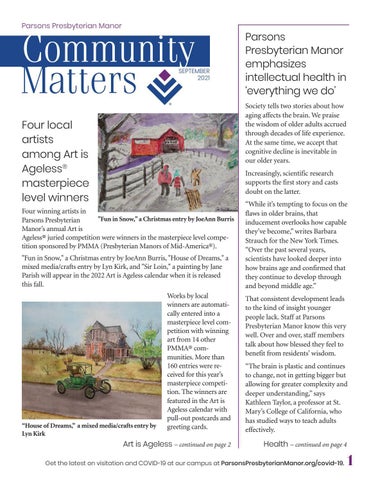
Four winning artists in "Fun in Snow," a Christmas entry by JoeAnn Burris Parsons Presbyterian Manor’s annual Art is Ageless® juried competition were winners in the masterpiece level competition sponsored by PMMA (Presbyterian Manors of Mid-America®). "Fun in Snow," a Christmas entry by JoeAnn Burris, "House of Dreams," a mixed media/crafts entry by Lyn Kirk, and "Sir Loin," a painting by Jane Parish will appear in the 2022 Art is Ageless calendar when it is released this fall.
“While it’s tempting to focus on the flaws in older brains, that inducement overlooks how capable they’ve become,” writes Barbara Strauch for the New York Times. “Over the past several years, scientists have looked deeper into how brains age and confirmed that they continue to develop through and beyond middle age.”
Works by local winners are automatically entered into a masterpiece level competition with winning art from 14 other PMMA® communities. More than 160 entries were received for this year’s masterpiece competition. The winners are featured in the Art is Ageless calendar with pull-out postcards and greeting cards.
That consistent development leads to the kind of insight younger people lack. Staff at Parsons Presbyterian Manor know this very well. Over and over, staff members talk about how blessed they feel to benefit from residents’ wisdom.
Art is Ageless – continued on page 2
Health – continued on page 4
“House of Dreams,” a mixed media/crafts entry by Lyn Kirk
“The brain is plastic and continues to change, not in getting bigger but allowing for greater complexity and deeper understanding,” says Kathleen Taylor, a professor at St. Mary’s College of California, who has studied ways to teach adults effectively.
Get the latest on visitation and COVID-19 at our campus at ParsonsPresbyterianManor.org/covid-19.
1
Art is Ageless – continued
from page 1
“Juicy Fruit,” a drawing by Jane Parish, will be featured on the pull-out postcards included in the 2022 calendar and “Bluebird,” a painting by Lorraine Evert, will be featured on a greeting card. “We enjoyed seeing these works in person, and we’re delighted they will be shared with a wider audience,” said Victoria White, marketing and admissions counselor for Parsons Presbyterian Manor. “Together they demonstrate the artistic talent we enjoy in the Parsons area.” A copyrighted program of PMMA, Art is Ageless is open exclusively to people age 65 and older. For the competition, works must have been completed in the past five years. PMMA’s Art is Ageless program encourages Parsons Presbyterian Manor residents and other area seniors to express their creativity through its annual competition, as well as art classes, educational opportunities and current events discussions throughout the year.
"Sir Loin," a painting by Jane Parish
Started in 1980, Art is Ageless is an extension of PMMA’s wellness programs, which focus on mental, physical, social and spiritual health. u
“Juicy Fruit,” a drawing by Jane Parish
“Bluebird,” a painting by Lorraine Evert Like us on Facebook to stay updated on news and events.
Community Matters 620-421-1450 u Fax: 620-421-1897 3501 Dirr Ave. Parsons, KS 67357-2220 ParsonsPresbyterianManor.org
2
COMMUNITY MATTERS | September 2021
is published monthly for residents and friends of Parsons Presbyterian Manor by Presbyterian Manors of Mid-America, Inc., a not-for-profit 501(c)(3) organization.
To submit or suggest articles: vwhite@pmma.org Maegen Pegues, executive director Victoria White, marketing and admissions counselor
OUR MISSION: To provide quality senior services guided by Christian values.
Why fun Is key to happiness as we age By Travis Tae Oh One of the most intriguing questions in life is to ask ourselves what makes us happy. Sure, it’s a millennia-old question, but it keeps popping up, generation after generation, with many scholars and philosophers spending their lifetime studying it.
Yet, as we start talking about his fun experiences, Greg’s tone changes into one of youthful exuberance. I can feel a sense of pure joy and happiness as he steps toward the center of the room, telling me that he will show me the spirit of “Zorba the Greek.”
In contrast, very few people have seriously inquired (or researched) about what it means to have fun and why fun is important to our wellbeing, even during adulthood and in the second half of life.
Completely spontaneous, Greg starts singing a Greek folksong, in a conversational, medium-pitched vibrato. He takes diamond steps at each beat and jumps up in sort of a scissors kick and claps his hands in between his kicks.
To better understand fun and explore its implications, I have devoted the last five years to interviewing dozens of individuals from all walks of life, collecting over a thousand written narratives, amassing hundreds of images for what’s known as photo ethnography and conducting multiple experiments and analyses to build a theory of fun. What My Research on Fun Reveals The underlying psychology of fun is an experience of liberating engagement — a temporary release from internalized restrictions, such as social obligations or self-imposed disciplines, by actively engaging in an activity for pure enjoyment. Let me illustrate this concept through a particularly memorable interview I had with Greg (not his real name, for privacy reasons), a retired teacher in his early 70s. Greg emigrated from Greece to the U.S. via a transatlantic cruise ship when he was seven and has lived in New York City since then. He worked as a language teacher for 35 years before retiring. His eyes beaming with pride as he explains his teaching experiences, there’s no doubt that his career accomplishments brought him meaning and happiness in life.
It’s a brief moment, but magical. For This Retiree, Dancing Is the Epitome of Fun Returning to his seat, Greg recounts his dancing adventures decades ago when he would go to clubs in Manhattan. “What makes it fun? Well, it’s a total abandon,” he says. “You get inspired by the music and jump up and down. Like, you let go. Your worries, you let go of everything.” While dancing might not be fun for all of us, Greg makes a vital point about the nature of fun. That is, the essence of fun is an experience of liberation. Of letting go and being carefree. It’s not the type of activity that matters, but whether that experience engages you with a sense of liberation. Why is this characteristic of fun important to happiness, especially in adulthood and later in life? Life’s drudgeries can, at times, overwhelm the best of us — and that seems to happen more frequently in midlife. Fun: The Antidote to Midlife Malaise Unfortunately most of us don’t take having fun as “seriously” as we should,
even though, as my research suggests, fun is a major contributor to overall happiness. Further analysis confirmed that fun is an independent driver of happiness, even after controlling for other known contributors such as meaningfulness or sensory pleasure. I believe we are placing too much emphasis on finding meaning and fulfillment in life as the holy grail of happiness, with little regard for fun. For those of us who have been so laserfocused on our careers, parenting or other pursuits, spending significant money and time to really have fun may seem like a distant activity (when was the last time you did that?) or may incite feelings of guilt. My Advice to You: Have Fun! But the art of having fun comes from the realization that fun is a temporary release from internalized restrictions while engaged in a pleasurable activity. This sense of feeling free and liberated, even if transient, can greatly add to your happiness and compensate for the challenges that may lie ahead as you return to your meaningful pursuits in life. According to my research, the best way to achieve this is to set aside a specific time and location to give yourself permission to let loose and engage yourself in something novel and spontaneous with others who also want to join in on your fun experience. I hope you will. Have fun! u
Parsons Presbyterian Manor | A PMMA COMMUNITY
3
3501 Dirr Ave. Parsons, KS 67357-2220 RETURN SERVICE REQUESTED
Health – continued from page 1 That doesn’t mean that cognition remains the same throughout a lifetime. Taylor acknowledges that adult brains may not learn as fast as younger ones — the tradeoff for the wisdom we acquire with age. Fortunately, Parsons Presbyterian Manor attends to the intellectual health of residents as part of our overall focus on wellness. Just as moderate exercise benefits physical health and regular contact with loved ones supports social health, there are
4
many opportunities to benefit cognitive function. These include engaging with new ideas and being involved in community.
give residents opportunities to be in community with each other. These include bingo, singing, Bible study, and crafts.
Taylor says that simply learning new facts isn’t enough. If you really want to stimulate the brain, you need to “bump up against” new ideas. The library at Parsons Presbyterian Manor is the perfect place to challenge your brain. The first-floor library is open to all residents and includes a selection of large print books.
The community’s daily newsletter, the Manor Bee, keeps residents abreast of everything that is going on. The regular schedule provides a routine that gives residents plenty of choices, says Becky Nash, life enrichment director.
The life enrichment staff offers a wide variety of activities, which
COMMUNITY MATTERS | September 2021
“We feel that all our interactions and activities benefit our resident’s intellectual health,” Becky said. “Everything we do stimulates their minds in one way or another.” u