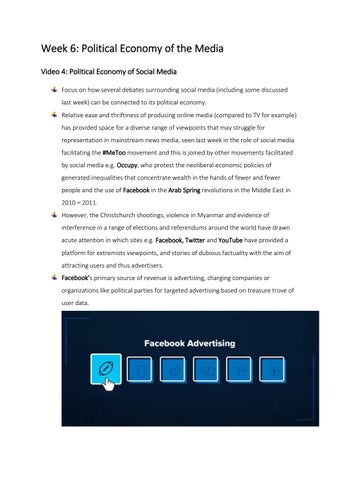
Week 6: Political Economy of the Media Video 4: Political Economy of Social Media Focus on how several debates surrounding social media (including some discussed last week) can be connected to its political economy. Relative ease and thriftiness of producing online media (compared to TV for example) has provided space for a diverse range of viewpoints that may struggle for representation in mainstream news media, seen last week in the role of social media facilitating the #MeToo movement and this is joined by other movements facilitated by social media e.g. Occupy, who protest the neoliberal economic policies of generated inequalities that concentrate wealth in the hands of fewer and fewer people and the use of Facebook in the Arab Spring revolutions in the Middle East in 2010 – 2011. However, the Christchurch shootings, violence in Myanmar and evidence of interference in a range of elections and referendums around the world have drawn acute attention in which sites e.g. Facebook, Twitter and YouTube have provided a platform for extremists viewpoints, and stories of dubious factuality with the aim of attracting users and thus advertisers. Facebook’s primary source of revenue is advertising, charging companies or organizations like political parties for targeted advertising based on treasure trove of user data.
Issuu converts static files into: digital portfolios, online yearbooks, online catalogs, digital photo albums and more. Sign up and create your flipbook.