PQ women in accountancy
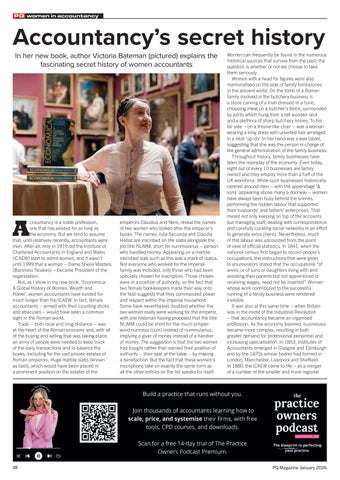
Accountancy’s secret history In her new book, author Victoria Bateman (pictured) explains the fascinating secret history of women accountants
A
ccountancy is a noble profession, one that has existed for as long as the economy. But we tend to assume that, until relatively recently, accountants were men. After all, only in 1919 did the Institute of Chartered Accountants in England and Wales (ICAEW) start to admit women, and it wasn’t until 1999 that a woman – Dame Sheila Masters (Baroness Noakes) – became President of the organisation. But, as I show in my new book, ‘Economica: A Global History of Women, Wealth and Power’, women accountants have existed for much longer than the ICAEW. In fact, female accountants – armed with their counting sticks and abacuses – would have been a common sight in the Roman world. Trade – both local and long-distance – was at the heart of the Roman economy and, with all of the buying and selling that was taking place, an army of people were needed to keep track of the daily transactions and to balance the books, including for the vast private estates of Roman emperors. Huge marble slabs (known as fasti), which would have been placed in a prominent position on the estates of the
20
emperors Claudius and Nero, reveal the names of two women who looked after the emperor’s books. The names Julia Secunda and Claudia Hellas are inscribed on the slabs alongside the job title NUMM, short for nummularius – person who handled money. Appearing on a marbleinscribed slab such as this was a mark of status. Not everyone who worked for the imperial family was included, only those who had been specially chosen for inscription. Those chosen were in a position of authority, so the fact that two female bookkeepers made their way onto the fasti suggests that they commanded power and respect within the imperial household. Some have nevertheless doubted whether the two women really were working for the emperor, with one historian having proposed that the title NUMM could be short for the much simpler word nummus (coin) instead of nummularius, implying a giver of money instead of a handler of money. The suggestion is that the two women had bought rather than earned their position of authority – their seat at the table – by making a benefaction. But the fact that these women’s inscriptions take on exactly the same form as all the other entries on the list speaks for itself.
Women can frequently be found in the numerous historical sources that survive from the past; the question is whether or not we choose to take them seriously. Women with a head for figures were also memorialised on the side of family tombstones in the ancient world. On the tomb of a Roman family involved in the butchery business is a stone carving of a man dressed in a tunic, chopping meat on a butcher’s block, surrounded by joints which hung from a tall wooden rack and a plethora of sharp butchery knives. To his far side – on a throne-like chair – was a woman wearing a long dress with unveiled hair arranged in a neat ‘up-do’. In her hand was a wax tablet, suggesting that she was the person in charge of the general administration of the family business. Throughout history, family businesses have been the mainstay of the economy. Even today, eight out of every 10 businesses are family owned and they employ more than a half of the UK workforce. While such businesses historically centred around men – with the appendage ‘& sons’ appearing above many a doorway – women have always been busy behind the scenes, performing the hidden labour that supported their husbands’ and fathers’ enterprises. That meant not only keeping on top of the accounts but managing staff, dealing with correspondence and carefully curating social networks in an effort to generate extra clients. Nevertheless, much of this labour was uncounted from the point of view of official statistics. In 1841, when the national census first began to record people’s occupations, the instructions that were given to enumerators stated that the occupations “of wives, or of sons or daughters living with and assisting their parents but not apprenticed or receiving wages, need not be inserted”. Women whose work contributed to the successful running of a family business were rendered invisible. It was also at this same time – when Britain was in the midst of the Industrial Revolution – that accountancy became an organised profession. As the economy boomed, businesses became more complex, resulting in both greater demand for professional personnel and increasing specialisation. In 1853, Institutes of Accountants emerged in Glasgow and Edinburgh and by the 1870s similar bodies had formed in London, Manchester, Liverpool and Sheffield. In 1880, the ICAEW came to life – as a merger of a number of the smaller and more regional
PQ Magazine January 2026