Incorporating NQ magazine
January 2026
ANNUAL BUMPER QUIZ
FE EXA E INS DBA M IDE CK www.pqmagazine.com/www.pqjobs.co.uk co.uk
MAKING WOMEN COUNT
NOMINATE FOR OUR 23rd PQ AWARDS
BREAKING THE SILENCE There are still a persistent stigma and silence surrounding women’s health and well-being in the accountancy profession, according to new research from ICAS. The institute’s 3M report highlights how experiences of menstruation, menopause and miscarriage continue to shape women’s career progression. While overall trust in the profession remains high, around three in four female professionals report experiencing discriminatory or exclusionary behaviour in the workplace. Women in accountancy said they feel isolated and fearful of being open about the ‘3Ms’. A lack of privacy, inadequate personal breaks and unsuitable office layouts all increased stress and discomfort. And male-dominated leadership teams reinforce silence and slow progress. The report believes more empathetic, people-focused leadership is now essential. The findings say that cultural, environmental and policy gaps are limiting the progress towards true inclusion. Interestingly, the role of the professional bodies is rarely seen as a source of support, yet ICAS says these bodies are uniquely positioned to lead sector-wide reform – especially for selfemployed professionals and those in SMEs. ICAS’ 3M report calls for immediate and practical action across the profession, including: • Supportive leadership that normalises open conversations, mentorship, awareness-raising and the encouragement of male allies.
• Flexible working arrangements and improved physical workspaces to support well-being and comfort. • Inclusive policies that go beyond gestures to show real organisational commitment. • Proactive leadership from professional bodies to champion wellbeing, integrate 3M awareness into mentoring, CPD, and equality initiatives, and set new standards for inclusion across the
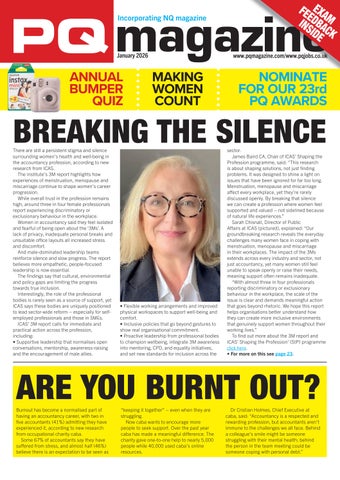
sector. James Baird CA, Chair of ICAS’ Shaping the Profession programme, said: “This research is about shaping solutions, not just finding problems. It was designed to shine a light on issues that have been ignored for far too long. Menstruation, menopause and miscarriage affect every workplace, yet they’re rarely discussed openly. By breaking that silence we can create a profession where women feel supported and valued – not sidelined because of natural life experiences.” Sarah Chisnall, Director of Public Affairs at ICAS (pictured), explained: “Our groundbreaking research reveals the everyday challenges many women face in coping with menstruation, menopause and miscarriage in their workplaces. The impact of the 3Ms extends across every industry and sector, not just accountancy, yet many women still feel unable to speak openly or raise their needs, meaning support often remains inadequate. “With almost three in four professionals reporting discriminatory or exclusionary behaviour in the workplace, the scale of the issue is clear and demands meaningful action that goes beyond rhetoric. We hope this report helps organisations better understand how they can create more inclusive environments that genuinely support women throughout their working lives.” To find out more about the 3M report and ICAS’ Shaping the Profession’ (StP) programme click here. • For more on this see page 23.
ARE YOU BURNT OUT? Burnout has become a normalised part of having an accountancy career, with two in five accountants (41%) admitting they have experienced it, according to new research from occupational charity caba. Some 67% of accountants say they have suffered from stress, and almost half (46%) believe there is an expectation to be seen as
“keeping it together” – even when they are struggling. Now caba wants to encourage more people to seek support. Over the past year caba has made a meaningful difference. The charity gave one-to-one help to nearly 5,000 people while 40,000 used caba’s online resources.
Dr Cristian Holmes, Chief Executive at caba, said: “Accountancy is a respected and rewarding profession, but accountants aren’t immune to the challenges we all face. Behind a colleague’s smile might be someone struggling with their mental health; behind the person in the team meeting could be someone coping with personal debt.”
study LIVE ON DEMAND DISTANCE LEARNING
Empow Empower o ow wer we career your care rre eer Virtually - Virt rt rtually
Flexible study packages tailored to you, your schedule and your aspirations
NEW IMPROVED WEBSITE BUY B UY AND AND STUDY STUDY ONLINE ONLINE
Contact Us : info@htftpartnership.co.uk htftpartnership.co.uk
contents PQ
January 2026
IN THIS ISSUE
Quiz, and you could win a fab Fujifilm instant camera
A note from the Editor We’ve got the latest news and views from the world of accountancy education in this issue, all in one place. There’s plenty going on, be it IT problems at the December ACCA exams or the launch of ICAEW’s new tech hub for students. This month we discuss the stigma that still exists around women’s health, and Dr Victoria Bateman helps rewrite the history of women in accountancy. We didn’t give a proper shout out to our new columnist who started last month, Rachel Harris. She recently met with PM Keir Starmer (and here's a picture to prove it), and she explains that whether or not you follow politics closely the changes being proposed in the skills arena do matter to you. Read her column on page 12. Finally, a big thanks to our friends at AAT, ACCA, CIMA, ICAEW, ICAS and CIPFA for sponsoring our annual quiz – check it out on page 16. It is the season of goodwill, after all! Graham Hambly, Editor and Publisher, PQ magazine News 4
5
6
ICAEW Tech Hub ICAEW launches its Technology Hub, giving PQs access to industry-standard tools ACCA exam glitches Students across the country have exams disrupted by computer gremlins – again AI jobs threat Growth of AI will mean fewer entry-level graduates, says PwC chief
8
9
ACCA exam controversy Students told they had failed PM paper were made to resit – even though they had in fact passed First female CEO for ICAS Gail Boag to become first female CEO in ICAS’s 172-year history
10 New ACCA President Melanie Proffitt, the CFO at Farncombe Estate, elected association’s new President 12 Tech news QuickBooks launches payenabled invoicing solution Features, etc 14 Have your say If ACCA PQs are forced back to the exam hall, then let’s have some decent ones; move to make FCA AML supervisor is a wise one; and why ChatGPT will work for accountants. Plus our social media round-up 15 PQ awards 2026 We’ve a brand new category up for grabs this time around – so who will be our Student Champion of the Year?
p20
16 It’s quiz time! Test your knowledge with our ever-popular Annual Bumper
18 ACCA exam feedback Were the December exams a piece of (Christmas) cake? Not according to those sitting them… 20 Women in accountancy: a history Author Victoria Bateman explains the fascinating secret history of women accountants 23 Women in accountancy: wellbeing ICAS research highlights impact of the ‘3Ms’ for women in an accountancy career 24 AAT spotlight Clare Dye explains how AAT’s upcoming qualifications embrace equity, diversity, inclusion and belonging
37 CIMA spotlight Get ready for 2026: a quick guide to the CGMA professional qualification upgrade; plus IFA Spotlight 38 Study advice Flip blended learning explained 39 Careers Gen Z accountants expect salary transparency, survey finds; our Agony Aunt offers some advice on overcoming impostor syndrome; and our Book Club review 40 Fun The lighter side of life – and accountancy The columnists Lisa Nelson A ‘PQ Playbook’ to improve your studies 4
25 ACCA spotlight ACCA has lots of resources to help you focus on your wellbeing at what can be a difficult time of year
Sunil Bhandari Your New Year resolutions can come true 6
26 ACCA FR exam Disciplined preparation and smart exam-day strategy will help you pass FR
Anna Kate Phelan Will a New Year bring a new you? 10
27 TaxAid initiative Leading UK tax charity scales up services as 1.75 million people face Making Tax Digital
Prem Sikka UK banks and the myth of the free market 8
Rachel Harris Government putting skills front and centre
12
28 A question for Tom Tom Clendon answers a question about using IFRS 2 Share Based Payments 29 BCASS has a ball Birmingham students enjoyed a record-breaking night of celebration and giving back 30 Viewpoint How AI could change the nature of accountancy training 33 CIPFA spotlight Joanne Pitt outlines five takeaways from the frontline of local government reorganisation 34 AAT exams How to approach an overhead absorption exam style question
p30
To subscribe for FREE go to www.pqmagazine.com Develop your finance team with a funded BSc (Hons) degree apprenticeship in Applied Accounting and Finance BOOK A FREE CONSULTATION CALL
PQ the
LISA NELSON Playing it by the book
I eagerly anticipate my ‘Spotify Wrapped’ every December (not published at the time of writing!) – that satisfying summary of the year's trends and my listening habits. It inspired me to compile a similar review for you, the ‘PQ Playbook’, distilling the key strategies we’ve discussed this year into four actionable moves for PQ success. • Embrace desirable difficulty: Success comes from confronting challenges, not avoiding them. We’ve stressed that true mastery comes from active learning. Move beyond passive note-taking and instead force your brain to work harder. When practising, don’t just review solutions – complete every question independently. • Adapt or be left behind: The professional landscape is dynamic, shaped by digitisation and technological advancements like AI. History shows that resisting innovation is often futile. Actively engage with new technologies; view these changes as valuable opportunities to enhance your technical skills and grow as a professional. • Leverage your support system: Becoming a qualified accountant is demanding. Lean on and contribute to your professional network – colleagues, mentors, tutors and peers. This collective strength is vital for navigating challenges. • Own your ethical compass: Your career is fundamentally about building trust. Ethical responsibility is the core of our profession and relevant at all levels. Use your judgment to navigate subjective areas at work. Keep your moral compass strong and let your critical thinking be the foundation for every decision you make. Lisa Nelson is Director of Education at Kaplan
ICAEW Tech Hub up and running ICAEW has now launched its Technology Hub, a dedicated space for ACA students to gain hands-on experience with the key technologies shaping the future of business, finance and accountancy. The hub provides trainees firsthand access to industry-standard tools in real-world simulations, including audit analytics, data automation, cloud accounting and AML compliance. It is available to all ICAEW students irrespective of when they began their studies. So far, software from Dext, Firmcheck, Inflo, Knime, Sage and Xero is available for students, with more platforms to come. Will Holt, ICAEW Managing
Director, Education and Training, said: “Accountancy is evolving faster than ever, with technology now central to how the profession works, makes decisions and delivers value to clients.
“With access to a range of platforms in the hub, students will be able to practise using workplace technology and broaden their skillset. This hands-on exposure will build their confidence and help improve their understanding of how emerging technologies work in practice. “The hub complements the Next Generation ACA, which launched earlier this year with technology at its core, and demonstrates that future ICAEW chartered accountants are comfortable in roles where digital skills are essential.” You can find out more about the new ICAEW’s Technology Hub here.
Making women count Don’t fall for the myth that women only entered accountancy in the 20th century, says Dr Victoria Bateman (pictured). She says women have been looking after the books and managing the financial fortunes of companies for centuries. Bateman believes we must look beyond the fact that it was not until 1999 that the ICAEW elected its first woman President, in the
form of Dame Sheila Masters. She explains that female accountants armed with counting sticks and abacuses would have been a common sight in the Roman world. Women like Mary T. Washington Wyle, Elizabeth Arden and MacKenzie Scott were the mainstays of the businesses they helped to develop. You can read her fascinating
article on page 20, and our review of her new book ‘Economica: A Global History of Wealth and Power’ on page 39.
recognises the most powerful people of African, African Caribbean, and African American heritage in the UK. Other influential names on
the list include former footballer Ian Wright, who’s new to the list, make-up artist Dame Pat McGrath and actor Idris Elba. Kyei, who was recruited by the Canadian Prime Minister Mark Carney in his former role as the governor of the Bank of England, said topping the list was “incredibly humbling”. The annual Powerlist was first published in 2007, with its aim to provide role models for young black people, according to Powerful Media.
Top influencer Afua Kyei (pictured), the Bank of England’s chief financial officer, has been named the UK’s most influential black person. The 43-year-old ICAS-qualified accountant is one of the UK’s most senior finance leaders, in charge of the financial governance of the Bank’s £1 trillion balance sheet and funding reforms. The BoE executive director topped the 2026 Powerlist, which
In brief PQ JOB OF THE MONTH: Assistant accountant An established and growing international business based in Stonehouse, Gloucestershire, is looking to recruit an assistant accountant/finance co-ordinator. The position is best suited to an AAT/CIMA/ACCA studier. You will need knowledge of double-entry bookkeeping, strong numeracy skills and good attention to detail. The role offers a salary of 4
£30,000 – £35,000, dependent on experience. The position will offer a contributed pension scheme, life assurance, study support for a financial qualification if required, and early finish on Fridays! Closing date for applications is 31 December 2025. For more click here Apprenticeship reforms won’t work! The UK government’s latest apprenticeship reforms miss a
critical opportunity to support individuals over the age of 22 and represent a significant setback for social mobility, says CIMA. The government recently announced an expansion of youth apprenticeships to 50,000 places over the next three years, in an effort to tackle youth unemployment. The number of young people starting apprenticeships has fallen 40% in the last 10 years. Andrew Harding, Chief Executive of CIMA, said: “The announcement
to expand government apprenticeships does not go far enough to address the UK’s productivity crisis.” AAT student conference is back The accelerAATe online conference will be again running in January next year. One session you should not miss is Ideal Schools’ ‘Top Study Skills That Actually Work – with AI and smart data insights’ on Thursday 29 January at 3.15pm. PQ Magazine January 2026
news the PQ
Advanced Return of ‘Blue Monday’? ACA results are here Technical issues hit the December ACCA exams at centres from Aberdeen to London, with sitters enduring freezing and crashing screens and invigilators struggling to get students back online. The big worry is the Monday technical gremlins have returned! Exam halls across the UK were affected, with reports of problems at Aberdeen, Chelmsford, Norwich and several London venues. As one AAA sitter explained: “The exam was plagued with technical issues. I had to move computer four times after it crashed. Then two hours in the whole rooms’ PCs crashed, and we sat there unable to do anything for 50 minutes before it restarted again.” There were also issues at the London Irish Hall centre, and exams that were supposed to begin at 1.30pm didn’t get under way until 5pm. Other centres affect were London Camden and
London Strafford. “It was a total nightmare”, explained one student. Sitters at the London Stratford Centre were eventually sent home after the exams ‘failed to launch’. The first thing some students knew about the problems was when they received an email from ACCA telling them their 1.30pm exam was rescheduled to 4.30pm. As one PQ said: “I have childcare issues and they gave me just 40 minutes to rearrange everything!” In an official response, ACCA told PQ magazine: “Unfortunately,
we’ve experienced technical problems at a small number of UK exam sites this week which we’ve been working urgently to resolve. We understand how frustrating this is for those impacted and we sincerely apologise. We will be getting in touch with those who’ve been affected. Exams have gone ahead in the majority of cases, although with some delays. We’re investigating the cause of the issues and will put steps in place to avoid re-occurrence in future.” • Check out how the actual exams went on page 18.
The ICAEW ACA November Advanced results have been published. Some 7,264 students sat the exams and the pass rates were: • Case Study 87.3%. • Corporate Reporting 80.5%. • Strategic Business Management 87%. Women picked up all the top paper prizes – Sofea Johan (Forvis Mazars), Amber Greaves (S&W Partners) and Alison Bell (KPMG). The pass rate for students sitting all three exams at the same was 76.4%. Most sitters opted to sit ALCR and ALSM, with 82.2% passing both. Some 2,290 PQs also sat just the Case Study. The pass rate for them was 90.9%. The stats also show that some 899 students failed all the papers they sat! The ICAEW will also be worried about the discrepancy between the Corporate Reporting exam pass rates. In Europe it was 84.1%, but for the rest of the world it was just 26.4%.
Online education programme Offer a range of accountancy-led services to the general public in the UK when you gain an IFA practising certificate through IFA Direct. The flexible, relevant and accessible study units provide structured learning designed to complement busy lifestyles.
Ofqual Regulated
Find out more at ifa.org.uk/ifadirect or call our Education Team now on +44 (0)20 3567 5999
PQ Magazine January 2026
5
PQ the
SUNIL BHANDARI
‘Resolutionary’ targets
With the turn of the year comes the time once again to set resolutions. Not all, if any, will be achieved. Not all are in our control, as you will see. But it’s good to have them there as aspirations, at least. Let’s start with the key points from 2025, with the main news that the ACCA announced a change in the exams coming in from 2027. These will have implications in 2026. Personally, I commenced my 40th year in this profession, which culminates in 2026. I’m still enjoy every minute of what I am doing and what I have done, for a long time. The passes and prize winners are an inspiration. Sporting wise, England made the FIFA World Cup. My team (Manchester United) progress is slow, and the England cricket team have not won a Test match (at the time of writing) in Australia. So, based upon the above, my targets, aspirations and hopes for 2026 are: • Create the new ACCA SCF online course from March 2026. • Achieve a 100% pass rate for an ACCA AFM cohort. • Tutor the student world ranked #1 for ACCA AFM. • England to win the World Cup. • Man Utd to be what they use to be. • England to win a Test match against the Aussies. Like I said, I will not get them all. But one can dream. Sunil Bhandari is an AFM tutor at FME Learn Online
Graduate jobs threat confirmed The growth of artificial intelligence will mean fewer entry-level graduates will be needed, admitted PwC’s global chair, Mohamed Kande, in an interview with the BBC. He explained that the firm’s recent job cuts were all about finding the right people to take the business forward, and in fact it needed to hire hundreds of new AI engineers but was struggling to find them. The BBC said that every year PwC hires thousands of new graduates in entry-level positions
– including 1,300 in the UK and 3,200 in the US last year – but it recently dropped long-term plans to continue increasing its headcount.
Time to get nominating We want your nominations to the 23rd PQ magazine awards!
Do you know someone who deserves one of our fantastic
Sir Alec Reed
point of business.” Sir Alec opened the first Reed Employment office in Hounslow in 1960 with just £75. For the next 65 years he worked tirelessly for the company he loved, always curious and never satisfied, always seeking new ideas. He was awarded the PQ magazine Lifetime Achievement Award in 2013. His vision lives on through Reed’s mission to improve lives through work and through charities he founded.
Sir Alec Reed, the founder of Reed Employment, has passed away at the age of 91. Sir Alec was a larger-than-life character who left school at 16. However, that did not stop him earning three doctorates and becoming a professor three times over. He was knighted in 2011 for services to business and charity. He famously once said: “Without business there would be no charity, and without charity what’s the
In 2021, PwC said it wanted to hire 100,000 people over the course of five years. Now Kande is saying this will no longer be possible. “When we made the plans to hire that many people, the world looked very, very different,” he told the BBC. “Now we have artificial intelligence. We want to hire, but I don’t know if it’s going to be the same level of people that we hire – it will be a different set of people.” Last year, PwC cut some 5,600 roles across its worldwide operation. PQ trophies? There are 21 categories including PQ of the Year, Accountancy Team of the Year and Student Body of the Year. We have introduced a new category too – Student Champion of the Year. Last year’s Student Body of the Year was the University of Chichester Business School, with the team prize going to Wildstar Films’ Finance department. Our current PQ of the Year is EY’s Sunny Yang. Deadline for entries is Friday 6 March 2026, but please get your entries in early. Download the nomination form at https://tinyurl.com/yauvpw8w
PQ would like to extend our condolences to Sir Alec’s family, friends and colleagues.
In brief Be an ICAS ambassador ICAS is looking for university grads who want to gain valuable experience for their CV and earn extra money to support their studies, in the form of ICAS Brand Ambassadors. This flexible, paid role involves representing ICAS at your university, promoting a career in chartered 6
accountancy, and highlighting the CA qualification to potential students on campus. ICAS is working with Sanctuary Graduates and Apprentices, and you can find a list of the 20 universities taking part here. Deadline for applications is 29 December 2025. Fiscal drag for student loanees Lower earning graduates will need to start student
loan repayments following a freeze on repayment thresholds. The current repayment threshold for plan 2 student loans is £28,470. It will go up in April 2027 to £29,385. However, the threshold will then be frozen for three years until 2030, so the financial drag will mean more graduates will be paying earlier (like the income tax threshold freeze). The Treasury said: “Graduates generally benefit from higher earnings, and ensuring that they repay more of their loan is fair for
those workers who have not gone to university.” ACCA/CA ANZ renew alliance ACCA has renewed its strategic alliance with the Chartered Accountants Australia and New Zealand for another five years. Next April the two will celebrate 10 years of the alliance. Together they have produced 17 joint research papers, shared CPD resources and collaborated on hundreds of events. PQ Magazine January 2026
PQ news the
LORD SIKKA UK banks and the free market myth The Big Four banks (Barclays HSBC, Lloyds and NatWest) control 77% of current accounts, 85% of business accounts and 90% of business loans. They all offer markedly similar interest rates on savings and loans. The state boosts their customer base by requiring that social security payments be paid into bank accounts. It acts as a lender of the last resort. After the 2007-08 crash, the state provided £1,162bn (£133bn cash + £1,029bn of guarantees) to bail out banks. The state promotes confidence in the industry by guaranteeing safety of deposits of up to £120,000 per person, per bank. It guarantees bank profits through the Private Finance Initiative (PFI). On average, each £1 of private investment in public assets results in repayment of £6. Banks are shielded from effective retribution. In 2025, as the Supreme Court considered awarding substantial damages for the car loans scandal, the Chancellor said that she was considering retrospective legislation to help save banks billions of pounds. In 2012 HSBC, supervised by the UK authorities, was fined $1.9bn in the US for facilitating money laundering. The UK regulators didn’t follow-up. It subsequently came to light that the then Chancellor and regulators secretly urged the US authorities to go easy on HSBC as it was too big to fail. Is scant competition and indulgence by the state compatible with claims of free markets? Prem Sikka is Emeritus Professor of Accounting at the University of Essex
How many times to pass PM exam? An error in the December 2024 Performance Management exam has meant some students who were told they had failed have now discovered they actually passed. PQ magazine discovered the error when a student went on social media after an ACCA email explained a review had discovered that he had actually achieved a mark of 50% in the December PM exam. The problem is that the student in question retook the paper and passed it the intervening time, in effect passing the paper twice! Many PQs were shocked when they read his story, and the one-year delay before the calculation error was spotted.
Some trainees were also surprised that ACCA only offered a refund for the extra exam fees paid. But, as one student said: “ACCA would never be able to compensate for the mental pressure gone through by the student.” Other students were impressed that ACCA took the full ownership for the error without trying to bury it: “Integrity at its best! All the more reason to be proud ACCA.” ACCA told PQ: “Our rigorous checking procedures revealed an error in one of our questions on the December 2024 Performance Management exam. We’ve contacted affected students to correct their marks, provide exam
fee refunds where relevant, and offered our sincere apologies. We’re very sorry for this and the frustration it has caused.”
Time to get some pub work? Azets, one of the UK’s largest accountancy firms, is looking to work with the hospitality industry to offer secondments to its trainees. UK CEO Peter Gallanagh recently told the Sunday Times that Azets is looking to develop its accountancy trainees’ ‘soft skills’, so they can develop the front-of-house hospitality-type relationships they will need for the future. That could mean
trainees spend more time working for a local hotel, pub or restaurant rather than on the spreadsheets. Azets recruited 384 trainees in 2025, a 15% increase, at a time many of the big firms are cutting back on numbers. Gallanagh told the Sunday Times that once recruited he wants to fast-track these young people into advisory work as part of his push to futureproof the firm.
Agrim Dhir’s job hunt CIMA qualified Agrim Dhir recently decided to take his search for a new job offline. So he stood outside Canary Wharf and Bank underground station in
London with his white board and QR codes hoping, he said, to “connect with people who value creativity, courage, and passion for finance”.
On his LinkedIn page he asked people who saw him to come and say hi. And Dhir also asked if anyone knew of any finance teams hiring. We haven’t heard if this approach did the job!
Tax briefs Tax adviser regs dropped The UK government announced in the Budget that it will not regulate tax advisers and instead work in partnership with the sector to raise standards in the tax advice market. The Association of Taxation Technicians said tax advisers already faced significant changes over the next few years with the mandatory registration of tax agents and transition of AML supervision from the professional bodies to the FCA. 8
ATT said risks remain for poor quality or misleading guidance being given to taxpayers. It said: “We look forward to HMRC building on the introduction of the agent register and future discussions about a clearer, more coherent approach to raising standards.”
financial year, according to PwC’s 21st annual report on the Total Tax Contribution (TTC) of the 100 Group. The overall TTC of the 100 Group decreased by 0.4% compared with 2023/24, mainly due to profits declining by over 12%, while taxes borne decreased by 2.8%.
Biggest firms pay £93bn tax The UK’s biggest companies generated an estimated £93bn in tax during the 2024/25
Tax whistleblower scheme In her Budget Chancellor Rachel Reeves continued her focus on closing the tax gap, and set out
new measures to raise an additional £2bn in tax revenue by 2029-30. HMRC is to get new compliance powers to chase the fraudulent businesses bent on not paying their fair share of taxes. A US-style whistleblower scheme to combat large-scale tax fraud could also reward informants with up to 30% of the tax collected. HMRC have said informants will get a percentage of the tax collected, if their tips lead to a tax take of at least £1.5m. PQ Magazine January 2026
news PQ
wants ICAS appoints first female CEO ACCA your views! ICAS has announced that from 1 January 2026 its new CEO will be Gail Boag (pictured). She will be the first female CEO in the organisation’s 172-year history. Boag is currently the executive director learning and market development, and was instrumental in bringing in the institute’s groundbreaking new CA qualification. She has a wealth of experience, with previous roles including Dean of Edinburgh Napier’s Business School and as the Regional Director of Scotland for BT. ICAS Council said it believes that Boag’s commercial and
communication skills, combined with her strong leadership abilities, will enable ICAS to continue to pursue its ambitious strategy for growth. Boag said: “I’m deeply honoured
Grant Thornton’s bold plan Grant Thornton UK has said it plans to recruit 160 new partners over the next two years, with an aim to “redefine the competitive landscape and reshape the future of its business”. The announcement comes just over six months since the firm completed its landmark
PQ Magazine January 2026
deal with private equity firm Cinven. Grant Thornton explained its new UK partner model breaks with tradition in the sector, offering a balance of in-year and long-term incentive reward. Typically, this unlocks partner reward with a 50% premium to market rate, which
to take on the role of CEO at ICAS. The organisation has a distinguished history of upholding the highest standards of integrity, professionalism and public trust. My focus will be on ensuring that ICAS continues to act in the public interest while driving sustainable growth for the organisation, value for its members and relevance for our qualification. Together, we will build on ICAS’s proud legacy and strengthen its impact for the future.” She replaces outgoing CEO Bruce Cartwright CA, who has been CEO since May 2018. is then backed up by new, marketleading tailored onboarding and development programmes. Malcolm Gomersall, CEO of Grant Thornton UK (pictured), said: “2025 has been a transformative year for our firm, as we reimagined what the multi-disciplinary professional services partnership of the future should look like – combining equity ownership with external investment from Cinven to unlock unprecedented competitiveness.”
ACCA’s annual Global Talent Trends survey was launched at the start of November. It’s the largest career and work survey across the accountancy profession and they’re inviting accountancy professionals everywhere to share their views about their working life right now – not just ACCA students. The survey results will form the basis of the Global Talent Trends 2026 report. The survey is open until the end of the year and there are 15 vouchers worth $100 (or UK equivalent) to be won in a prize draw for participants. It should take around 10 minutes to complete and when you finish you’ll see instantly see how your views on work compare with many others’ opinions. Share your views at https://acca-gtt.com/main
9
PQ news the
ANNA KATE PHELAN Will a New Year bring a new you?
Anna Kate Phelan is Head of Product at Eintech
Melanie Proffitt, the CFO at Farncombe Estate, has been elected the new President of ACCA. Proffitt is joined in the leadership of ACCA’s global governing Council by fellow officers: deputy president Zaiton Mohd Hassan from Malaysia, CEO of the Malaysia Professional Accountancy Centre (MyPAC), which aims to help students from poorer backgrounds find careers in finance, and vice-president Cristina Gutu, a Director with KPMG Romania & Moldova. This is the second year in a row that women have held all three
ACCA officer posts at the same time. Proffitt said: “Accountancy has not just been my career. It has given me so many incredible
AIA scholarships open AIA has reopened its scholarship programmes to support students who want a career in accountancy to gain the AIA professional qualification. Five awards are available through the AIA Accountancy Scholarships UK, two of which will be given to applicants from lower socioeconomic backgrounds to support AIA’s commitment to Access Accountancy. The award covers all course fees via AIA Achieve Academy,
exemption fees and exam fees for the professional qualification, on either the accountancy or audit routes. In addition, AIA is offering five Commonwealth scholarships, open to students from across the Commonwealth (excluding the UK). Carl Jepson, AIA Director of Sales and Marketing, explained: “Our goal is to make professional accountancy accessible to students from all walks of life. Through these scholarships, we are nurturing
talent, building skills, and shaping the next generation of leaders in the profession.” Deadline for applications is 28 February 2026. Find out more here
Co-ordinator for 2024: Adam Leahy. CIMA Responsible Finance Team of the Year (sponsored by EY): John Sisk & Son Ltd, represented by Ian O’Connor, Aideen Fennell and Tom Donohue.
Top CIMA student in Operational Case Study Exam 2024: Gabriele Aleknaviciute. Top CIMA student in Management Case Study Exam 2024: Emma Meaney.
#CIMA Ireland Awards The Mansion House Dublin was recently rocking as CIMA Ireland unveiled its 2025 award winners. And the winners were (from left to right): CIMA Employer of the Year 2024: Dell Technologies, represented by Ali Gassoumi. Top CIMA Student in Strategic Case Study Exam 2024: Christian Quinlan. CIMA Business Person of the Year 2024: Noella Carroll. The Corporate CIMA Student
Deloitte accused of AI citations New allegations have surfaced about another Deloitte report using AI-made citations, this time
behind the recommendations put forward in our report.” It also revealed that revisions were being made to the report to make a small number of citation corrections, which it said do not impact the report findings.
in Canada. The accusation, from Canadian news outlet the Independent, comes just weeks after a similar misuse of AI by Deloitte was reported in Australia. A major health workforce report prepared for the government of Newfoundland and Labrador seems to rely on inaccurate and even non-existent academic citations. A Deloitte spokesperson told the Independent: “Deloitte Canada firmly stands
Non-Big 4 grow PIE audit share While the Big 4 audit firms continue to dominate the market, non-Big 4 firms continue to eat away at their share of Public Interest Entity (PIE) audit engagements. New research by the Financial Reporting Council (FRC) shows non-Big 4 firms’ share of PIE audit engagements rose to 40% in 2024, up from 22% at the start of the decade. However, the Big 4 firms still dominate
10
opportunities along the way, and I’m excited to be able to give back in a new way now, with my role as ACCA President. I am particularly proud to serve as a female leader of a global body. Being able to stand up and inspire other young women to aim high and not be afraid of achieving success is deeply important to me. “ACCA is redefining what accountancy looks like in the 21st century. From our newly redesigned qualification, to working with underrepresented communities and individuals, we are committed to showing how accountancy is a career that is fulfilling, dynamic and full of exciting opportunities.”
Photo by Jason Clark Photography
Many of us are optimistic at this time of year that New Year will mean ‘new you’ (not holding my breath personally). But for PQs it’s more than that – it’s a strategic opportunity to set yourself up for exam success. There’s no doubt that in 2026 the students who thrive will those who double down on practice and stay ahead of the technology shaping modern assessment. A habit I’d advise prioritising is consistently engaging with practice questions. Too many students treat this as something that can wait until later, usually dangerously close to exam week. The reality is simple: exam technique is a muscle. The more you use it, the stronger it gets. Familiarising yourself with the exam software is just as important as going through your question content. Whether it’s spreadsheets, annotation tools or navigating the on-screen workspace, comfort with the digital environment is now a performance differentiator. I’d advise making mock exams feel like the real thing with the same timing, setup and pressure. The more your brain recognises the environment, the calmer and sharper you’ll be on exam day In 2026, focus less on lofty resolutions and more on practical useful habits like daily questions, regular mocks and exam tech familiarity. I’m not saying it won’t be a big job but with the right tools you’re already halfway there.
ACCA puts Proffitt first
the market in terms of share of audit fees. In 2024 they earned 98% of FTSE 350 audit fees (same as 2023), and 91% of all PIE audit fees (90% in 2023). Partner intakes slashed Big 4 accountancy firm partner promotions have hit five-year low, according to the Financial Times. Slowing demand for consultancy services and a crunch on profits are being blamed. The FT said for 2025 both Deloitte and PwC have promoted the lowest number of partners in five years. Meanwhile, EY have appointed less than half the number of partners it did in 2022. Only KPMG bucked the trend following a promotional pause for a few years. PQ Magazine January 2026
PQ tech the news
RACHEL HARRIS Putting skills front and centre
During a recent conversation with prime minister Keir Starmer I explored what Labour’s focus on skills, productivity and fair opportunities could mean for the next generation of accountants. We spoke about work, skills and the realities facing people trying to build careers and businesses in the UK. While much of the national conversation has centred on tax and public services, what struck me most was his emphasis on skills as the engine of economic growth – and what that means for trainees entering the profession today. The PM spoke repeatedly about creating “fair routes to progression” and making it easier for people to build their careers without unnecessary barriers. He told me that employers “need better skills to underpin the work we’re trying to do”. For accountancy, a sector built on continuous learning, this is a significant signal. For PQ readers the takeaway is simple: skills are moving to the centre of economic policy. That means more focus on technical competence, more scrutiny of how firms develop talent, and more opportunities for those willing to invest in themselves early. It also means trainees should think beyond exam passes. The profession is shifting towards advisory, digital finance and strategic problem-solving. If government policy is prioritising productivity and long-term growth, the accountants who thrive will be those who pair core qualification routes with broader capabilities – data literacy, communication, commercial awareness. Rachel Harris is the founder of striveX and @accountant_she
QuickBook Payments is here A pay-enabled invoicing solution designed to help UK customers get paid up to three times faster has been launched by QuickBooks. QuickBooks Payments has been launched on Intuit’s AI-driven allin-one platform, providing pay by bank and pay by card functionality, with additional payment methods coming soon. QuickBooks Payments allows customers to connect their bank account and add a ‘Pay Now’ button to invoices, so their customers can complete a payment in QuickBooks in just a few clicks, speeding up the payment process. This reduces the risk of errors associated with manual
bank transfers, and simplifies reconciliation and bookkeeping. Real-time tracking of paid, unpaid and outstanding balances, plus automated reminders that politely chase late payments, enables customers to more easily manage
their invoicing and get cash in. Nick Williams, International Product Director at Intuit (pictured), said: “With over £21,000 owed on average in unpaid invoices, more than half of UK SMBs are facing cash flow problems, forcing many to make difficult financial decisions just to keep operations running. From dipping into personal cash reserves to relying heavily on credit cards, these pressures can quickly escalate, especially when payments are overdue by more than 30 days. The launch of QuickBooks Payments helps our customers to significantly improve their payment practices, and will play a key role in strengthening their stability.”
Pen and paper worries Sole traders are just nowhere near ready for digital tax returns, and one in three still use pen and paper to work out their accounts, says new research from Sage. With two-thirds (66%) still using old-fashioned tools to do their financial admin there are growing worries about non-compliance. Making Tax for Income Tax rolls out in April for those earning over £50,000, and Sage found that among those
who are aware of the change four in 10 (39%) admitted they had not done anything to prepare for it. Sage researchers also found that 66% of sole traders use spreadsheets and bank statements (56%), as well as pen and paper (33%), to track sales and expenses. Using these methods instead of adopting cloud-based software means hours of wasted admin time, too.
Beware the clones FARx has launched its nextgeneration fused biometrics to help defeat AI voice cloning threats. Advanced text-to-speech and voice cloning tools can now mimic human speech so convincingly that they are indistinguishable to the human listener, and legacy voice biometrics designed to authenticate human voices are unable to detect the difference. Recent data reveals a sharp
rise in AI-related fraud, with 35% of UK businesses targeted by these attacks, compared with 23%
in 2024. This surge is driven by increasingly sophisticated tactics, including social engineering and identity theft, deepfakes, voice cloning and synthetic identities. FARx’s latest generation of biometrics software fuses speaker, speech and face recognition, introducing expanded capabilities for synthetic and cloned voice detection. Trained on 55,000 synthetic voices from real telephony environments, it can reliably distinguish between real and AI-generated voices.
discovered the attacks on 24 November. Cyber security experts from NCC Group have been drafted in help and the Information Commissioner’s Office has been notified. In a statement, Hammersmith and Fulham said: “We are continuing to take precautionary measures to review, isolate and protect our networks. “We’re working to fix the problem as quickly as possible and we apologise for the inconvenience.”
PwC and Palantir sign deal PwC UK and Palantir Technologies Inc have announced the expansion of their strategic alliance, underpinned by a multi-year, multi-million-pound investment by PwC. The expansion represents a clear commitment by both organisations to work as preferred UK partners, aligning strategy and resources to deliver advanced AI and data solutions for some of the world’s most complex challenges.
Tech briefs Data is king Who doesn’t like a bit of extra data? Well, a new report from Ofcom reveals that the UK used nearly a fifth more mobile data in 2025 than it did in the previous year. The telecoms regulator said people in the UK currently use 1.2 billion gigabytes of data each month. That is equivalent to streaming 400 million football matches in high definition or watching 315 billion TikToks. Overall data usage grew by 18% 12
year-on-year. The research also showed that more than a million households shut down their landlines. That leaves 17 million still connected. London councils targeted Multiple London councils have all been hit by cyber-attacks. The Royal Borough of Kensington & Chelsea, the London Borough of Hammersmith and Fulham, and Westminster City Council, who run some shared IT systems,
PQ Magazine January 2026
Become a CIMA member at your pace. ®
CGMA® Finance Leadership Program (CGMA FLP). — learning that fits your schedule CGMA FLP is your flexible path to CIMA® membership and the globally valued CGMA designation. Fully online, the CGMA FLP can be completed over a shorter or longer period, depending on your existing commitments.
Find out more at aicpa-cima.com/flpuk
Founded by AICPA® and CIMA, the Association of International Certified Professional Accountants® powers leaders in accounting and finance around the globe. © 2025 The Chartered Institute of Management Accountants. All rights reserved. 2507-247958
email graham@pqmagazine.com
Maybe centres are not the answer I see that from March 2026 all ACCA students are being forced back into exam halls (PQ, December ’25). Like many, I was shocked and surprised by what appears to be a backward step. Some students have rightly called for more exam halls in your illustrious magazine, but this misses the point. We want more exam halls yes, but they have to be fit for purpose. You don’t have to look far for evidence to back up my assertion. The first day of the December exams saw huge ‘technical problems’ in what looks like quite a few centres
across the UK. ACCA hasn’t explained what caused this. But if there were breaches in security, it looks like it can’t keep the exams safe no matter where students are sitting – at home or
in an official exam hall. I don’t hear CIMA or ICAEW having the same problems. Why don’t the accountancy bodies (and there are enough of them) come together and establish safe exam centres they can all use? Name and address supplied The Editor says: We contacted the ACCA and you can find their official response on page 5. Basically, they said the technical problems only affected a small number of UK sites, and the exams went ahead in most cases. It is investigating what went wrong and we will be going back to them to ask how they will avoid it happening in future.
Our star letter writer wins a fantastic ‘I love PQ’ mug! FCA move is right! It was great to see what the accounting profession actually thought of the UK government taking back control of anti-money laundering supervision. It seems they aren’t happy – well, that is what they seem to be saying, even though some proport to support the idea! I for one have never been happy with membership bodies trying to police their members, while providing support and paid-for ‘education’ courses at the same time. It felt there were too many conflicts of interest in play. OK, they have some commercial understanding of what is happening, but I was just not sure they were regulating with the vigour required. Having one body to oversee AML is surely the best way to achieve consistent standards across the industry. As Treasury minister Lucy Rigby says, getting on top of AML and counter-terrorism financing really is a job for the state. Name and email address supplied
We all need to be using ChatGPT Is anyone really surprised that two-thirds of businesses are
consulting ChatGPT for financial advice before talking to their accountants (PQ, December ’25, page 9). Surely that figure should be higher. If you want to go into a meeting you need to do your research, and using AI is a good way to get up to speed quickly. Yes, ChatGPT gets things
wrong, and as accountants we will have to step in and correct inaccurate advice, but surely that shows our value. I don’t see my clients adding to my workload. They are simply trying to educate themselves, to enable them to have a conversation they can feel part of. Name and email address supplied
Lucy Cohen (pictured), AAT President and founder and CEO of Mazuma, should be on everyone’s ‘follow’ list. Here’s part of one of her recent LinkedIn posts: “Imagine being a fully grown adult, having money, a career and ambition and not being allowed to buy a home without the signed consent of your father or spouse? That was the case for women in the UK just 50 years ago. “This week marks 50 years since the sex discrimination act was passed. That meant that women in the UK were finally able to get a mortgage without needing the written permission of a man. Just 50 years. “It is staggering to think that many of the freedoms we treat as basic rights today were, in living memory, controlled by someone else’s signature. Home ownership is more than a transaction. It is stability, safety, and the ability to build wealth on your own terms. To know that this autonomy was only granted in 1975 tells us a lot about the pace of progress and the work still to do. “For me, this anniversary lands as a reminder of how recent and fragile equality can be. It also underlines why diversity, equity, and inclusion are not abstract commitments. They directly shape who gets access to opportunity, who builds assets, who feels secure, and who gets to make decisions about their own life. “Today, many of us benefit from rights that others fought hard for. Marking moments like this helps us recognise progress while staying clear eyed about what is left to change. “Equality is not a finished project. It is something we build, reinforce, and defend every day.”
PQ Magazine 4 Dangan Road, London E11 2RF | Phone: 07765 386489 | Email: graham@pqmagazine.com Website: www.pqmagazine.com | Editor/publisher: Graham Hambly graham@pqmagazine.com | Associate editor: Adam Riches | Art editor: Tim Parker Contributors: Sunil Bhandri, Prem Sikka, Lisa Nelson, Anna Kate Phelan, Tony Kelly, Phil Gammon, Edward Netherton, Francesca Cullaney | Subscriptions: subscriptions@pqmagazine.com | Origination services by Classified Central Media If you have any problems with delivery, or if you want to change your delivery address, please email admin@pqmagazine.com
Published by PQ Publishing Ltd © PQ Publishing 2025
PQ awards PQ
BECOUNTED! Who are you nominating for the PQ magazine awards 2026? Time to get writing!
I
f you want to stand out from the crowd then we have a sure-fire way of helping you achieve that – yes, the annual PQ magazine awards are open for your nominations. Now in their 23rd year, we have added a new category to our night of celebration – Student Champion of the Year. That is open to fellow students, lecturers or even an organisation that is making a real difference to the lives of accountancy PQs. In all there are 21 shiny PQs up for grabs, plus a few from the Editor, giving you lots of chances of picking up a coveted trophy. All we need is 500 words explaining why your nominee should win, and remember we are happy for you to nominate yourself! We recognise that sometimes your hard work can go unnoticed, but we can change that. You can download the application form here, but we are equally happy for you to send you entry in a simple Word document, clearly stating the category you are
THE 2026 AWARDS CATEGORIES PQ OF THE YEAR NQ OF THE YEAR DISTANCE LEARNING STUDENT OF THE YEAR ACCOUNTANCY GRADUATE OF THE YEAR ACCOUNTANCY APPRENTICE OF THE YEAR STUDENT BODY OF THE YEAR nominating for. Once you have your entry sorted send it to us at awards2026@pqmagazine.com. Deadline for entries is Friday 6 March 2026.
TOPLEARNERS
Our Distance Learning Student of the Year 2025 was Katy Hickey (left), while our 2024 winner was Katie Robsinson (middle). And ICB student Lilian Okolie (right) won the 2023 trophy.
STUDENT CHAMPION OF THE YEAR* (NEW*) ACCOUNTANCY BODY OF THE YEAR ACCOUNTANCY COLLEGE OF THE YEAR – PUBLIC SECTOR ACCOUNTANCY COLLEGE OF THE YEAR – PRIVATE SECTOR ONLINE COLLEGE OF THE YEAR LECTURER OF THE YEAR – PUBLIC SECTOR LECTURER OF THE YEAR – PRIVATE SECTOR STUDY RESOURCE OF THE YEAR ACCOUNTANCY PODCAST OF THE YEAR INNOVATION IN ACCOUNTANCY BEST USE OF SOCIAL MEDIA TRAINING MANAGER/MENTOR OF THE YEAR GRADUATE/APPRENTICESHIP TRAINING PROGRAMME OF THE YEAR ACCOUNTANCY TEAM OF THE YEAR ACCOUNTANCY PERSONALITY OF THE YEAR
OUR SPONSORS
PQ Magazine January 2026
15
PQ annual bumper quiz
It’s the quiz
of the year! o
17 18 19 20
Which film won Best Picture at the 2025 Oscars? Who won the 2025 Grammy Award for Song of the Year?
Which UK band is rumoured to be planning a hologram reunion, following the success of ABBA’s Voyage show? What is the name of Lily Allen’s new album?
It’s that time of year —for the PQ annual bumper quiz! Big t thanks to our sponsors, AAT, ACCA, CIMA, CIPFA, ICAEW & IICAS. This year we are giving away three Fujifilm Instax Mini 12 Instant Cameras with 20 shot pack film!
9 10
This year, it was agreed that a famous work of art would return to the UK after 900 years to go on public display. What is it? Thieves disguised as construction workers recently stole $100 million in jewels in a daylight heist. From which museum did this theft occur?
SPORT
21 22 23 24
Who did England beat in the 2025 UEFA Women’s Euro final to win their second European title in a row? Which horse won the 2025 Grand National, ridden by Patrick Mullins and trained by his father Willie Mullins.
IN THE NEWS
1 2
Which male footballer scored the last goal at Goodison Park and the first goal at the new Hill Dickinson stadium?
Which Labour politician failed to pay stamp duty on their new home in Hove?
When President Donald Trump took office, he created a new department led by Elon Musk to help cut federal spending. What was the department called?
3 4 5 6 7 8
Who was elected the new leader of the Green Party of England and Wales in September? Name the former leader of Reform UK in Wales who was sentenced to 10.5 years in prison for taking pro-Russian bribes.
After the death of Pope Francis in April 2025, a papal conclave elected Pope Leo XIV. In which country was the new Pope born? Canadian Prime Minister Justin Trudeau was replaced this year by the former head of the Bank of England. What is his name? On unveiling his new tariff policy on 2 April 2025, what did Donald Trump call this special occasion? Name the viral pygmy hippo who turned one this year.
ENTERTAINMENT AND MEDIA
11 12 13 14 15 16
The UK Celebrity Traitors was a huge TV hit, but who was the first celebrity to be banished (not murdered)? Eurovision took place in Basel, Switzerland this year. Which country’s artist won the competition? Who won the 2025 Booker Prize?
Which UK Celebrity Traitors star features in the Waitrose Christmas mini rom com, and who co stars with him? Who won the 2025 Mercury Prize? Who provides the voiceover for the UK version of Love Island?
At the 2025 Ryder Cup at Bethpage Black, in the final-day singles there were five tied matches and just one European won outright. Who was that European golfer?
25
In November the Ashes started down under, and the first Test in Perth lasted just two days. How many wickets fell on the first day?
26 27 28 29 30
Which country won the 2025 ICC Women’s Cricket World Cup for the first
time?
Which Premier League team does Zohran Mamdani, the newly elected mayor of New York City, famously support? Which darts player beat teenage sensation Luke Littler in this year’s World Youth Championship? Who won Super Bowl LIX in 2025? Which team did England beat in the 2025 Women’s Rugby World Cup final?
BIG THANKS TO OUR SPONSORS
16
PQ Magazine January 2026
annual bumper quiz PQ
37 38 39 40
How many years did Prohibition last in the United States? Who was the only British Prime Minister to be assassinated? Which major disaster hit London in 1666?
Which English king lost the Crown Jewels while leading a campaign against rebellious barons?
43 44
Under what pen name did Eric Arthur Blair write?
In which country can the tree with the world’s widest trunk (around 46 feet in diameter) be found?
45 46
Which is the largest city by population in the world? Which football team used ‘Boiler Man’ as their mascot in an advertising stunt
in 2018?
47
Who said: “It does not matter how slowly you go as long as you do not
31 32 33 34 35 36
stop”?
HISTORY
45
Which major Wall Street investment bank filed for bankruptcy on 15 September 2008, sparking a global financial panic?
Which famous sea battle between the British Royal Navy and the combined French and Spanish fleets took place in 1805? Who was the first emperor of the Roman Empire? Who was the first female ruler of England? Which tax on ‘light’ was levied in England from 1696 to 1851?
What was the name of the first permanent English settlement in America, founded in 1607? In which year did the Berlin Wall fall?
PQ Magazine January 2026
49 50
How many stripes are there on the US flag?
GENERAL KNOWLEDGE
41
The lyrics “the taxman’s taken all my dough and left me in my stately home” appears in which song?
42
What does ‘GPT’ stand for in ChatGPT?
In what year did the Bank of England officially begin business (its founding)?
To enter, send your entries to graham@ pqmagazine.com, with the subject line ‘Bumper Quiz’, by Thursday 15 January 2026. All those who get the answers right will go into the draw for the cameras.
17
PQ ACCA exams
DECEMBER FEEDBACK Were the December exams a piece of cake? Not really, according to those sitting them!
AA It appears technical issues disrupted quite a few AA students on the first day of ACCA exam week. Some students were left staring at a blank screen for more than 90 minutes. At one centre AA sitters were even forced to evacuate due to a fire alarm going off for 30 minutes. In the Open Tuition Instant Poll, just under 5% of sitters said the exam was a ‘disaster’, with another 28% finding it ‘hard’. That left 62% saying the December sitting was ‘OK’. AAA A weird exam for some, with sitters not knowing how it went! Also called a ‘challenging’ paper, with not a lot of numbers in it. There were technical issues at a number of centres, too. At one centre students due to begin at 1.30pm finally got going at 5pm. And even then the connection went down again. One sitter explained they moved computer no fewer than four times. Then after two hours the room’s PCs crashed and sitters sat unable to do anything for 50 minutes before they restarted again. In the Open Tuition Instant Poll, 6.25% of sitters said the exam was ‘easy’, and another 44% felt it was ‘OK’. That left 13.5% having a ‘disaster’ and 36% finding the exam ‘hard’. TX This was a ‘hard’ exam for 33% of those who voted in the Open Tuition Instant Poll. Another 9% said the exam was a ‘disaster’. This left 49.5% who felt the December Taxation exam was ‘OK’. SBL Overall, this paper was voted ‘OK’ by many sitters. As one PQ said: “Wasn’t actually too bad an exam.” The examiner asked about franchising, debt financing, equity rights, sale and leaseback, yield management, ethics, and ESG for suppliers. In the Open Tuition Instant Poll, a whopping 62% said the exam was ‘OK’. That left just 19% saying it was ‘hard’ and another 10% who had a ‘disaster’. PM Some sitters complained there were way too many long calculations to do in the allocated time. Other students’ hearts sank when a full 20-mark regression analysis question came up. What was also annoying was the fact there was no limiting factor, relevant costing or variance analysis questions in some papers. In the Open Tuition Instant Poll nearly one in five sitters (19%) said PM was a ‘disaster’ for them. Another 36% said the exam was ‘hard’ and 41% felt it was ‘OK’. APM Students aren’t happy navigating what they think 18
is an awkward exam platform – opening five to seven windows trying to answer questions. The highlighting tool could also use some functionality improvement, said one sitter. Spending too much time on section A was the most common student failure. For section B the balanced scorecard and BSG came up. Another gripe was the fact that the exam didn’t have a good spread of the syllabus. That said, the exam was deemed ‘OK’ by nearly 49% of sitters in the Open Tuition Instant Poll. Another one in three (32%) found the exam ‘hard’, and 16.5% had a ‘disaster’. ATX ‘Hard’ was how 40% of sitters voted in the Open Tuition Instant Poll for this December’s sitting. Some 16% admitted they had a ‘disaster’. For 41.5% the exam was ‘OK’. One sitter said: “Honestly, I can’t decide whether the exam was OK or not.” Another sitter felt it was OK, but they were disappointed “about the areas focused on and the areas ignored”. It did not help that they totally forgot how to treat leased accommodation benefit to employers. A fellow sitter wasn’t sure of passing as a lot of their answers were guesses! FR ‘Bad’ is all one sitter said in their comment; another stressed it was ‘OK’. Overall, 9% voted the exam a ‘disaster’ in the Open Tuition Instant Poll, with another 40% saying it was ‘hard’. Some 47% felt the exam was ‘OK’.
SBR A horrible exam said some, ‘challenging’ for others. There were a lot of crossed fingers going on. You needed to have studied IFRS 18, S1 and S2. There were regrets from some for not taking these topics seriously. In the Open Tuition Instant Poll, a whopping 29% said the exam was a ‘disaster’. Another 40% felt it was ‘hard’, and just 29% said it was ‘OK’. FM ‘OK’ for some, and ‘difficult’ for others. One sitter just called it ‘meh’! The Baumol model question threw some, and the MCQs seemed harder than the mocks. Invest appraisal and WACC calculations came up, pleasing one student at least. However, they struggled on the capital structure question. Most votes in the Open Tuition Instant Poll went to ‘OK’ with 43%. It was ‘hard’ for 38%, and another 12.6% ticked the ‘disaster’ box. AFM A ‘disaster’ of an exam for 34% of sitters, according to the Open Tuition Instant Poll. Another 42% said the exam was ‘hard’, and just 22% felt it was all ‘OK’. Sitters admitted to struggling with Q1 on business valuation. “Just too much data to deal with,” explained one PQ. Another student reminded everyone the aim was just to make it to 50%! PQ Magazine January 2026
Advance your career with an award-winning course or apprenticeship Flexible, inspiring and engaging. Mindful Education courses are expertly designed to bring learning to life and achieve outstanding results.
Discover more mindful-education.co.uk/learners
PQ women in accountancy
Accountancy’s secret history In her new book, author Victoria Bateman (pictured) explains the fascinating secret history of women accountants
A
ccountancy is a noble profession, one that has existed for as long as the economy. But we tend to assume that, until relatively recently, accountants were men. After all, only in 1919 did the Institute of Chartered Accountants in England and Wales (ICAEW) start to admit women, and it wasn’t until 1999 that a woman – Dame Sheila Masters (Baroness Noakes) – became President of the organisation. But, as I show in my new book, ‘Economica: A Global History of Women, Wealth and Power’, women accountants have existed for much longer than the ICAEW. In fact, female accountants – armed with their counting sticks and abacuses – would have been a common sight in the Roman world. Trade – both local and long-distance – was at the heart of the Roman economy and, with all of the buying and selling that was taking place, an army of people were needed to keep track of the daily transactions and to balance the books, including for the vast private estates of Roman emperors. Huge marble slabs (known as fasti), which would have been placed in a prominent position on the estates of the
20
emperors Claudius and Nero, reveal the names of two women who looked after the emperor’s books. The names Julia Secunda and Claudia Hellas are inscribed on the slabs alongside the job title NUMM, short for nummularius – person who handled money. Appearing on a marbleinscribed slab such as this was a mark of status. Not everyone who worked for the imperial family was included, only those who had been specially chosen for inscription. Those chosen were in a position of authority, so the fact that two female bookkeepers made their way onto the fasti suggests that they commanded power and respect within the imperial household. Some have nevertheless doubted whether the two women really were working for the emperor, with one historian having proposed that the title NUMM could be short for the much simpler word nummus (coin) instead of nummularius, implying a giver of money instead of a handler of money. The suggestion is that the two women had bought rather than earned their position of authority – their seat at the table – by making a benefaction. But the fact that these women’s inscriptions take on exactly the same form as all the other entries on the list speaks for itself.
Women can frequently be found in the numerous historical sources that survive from the past; the question is whether or not we choose to take them seriously. Women with a head for figures were also memorialised on the side of family tombstones in the ancient world. On the tomb of a Roman family involved in the butchery business is a stone carving of a man dressed in a tunic, chopping meat on a butcher’s block, surrounded by joints which hung from a tall wooden rack and a plethora of sharp butchery knives. To his far side – on a throne-like chair – was a woman wearing a long dress with unveiled hair arranged in a neat ‘up-do’. In her hand was a wax tablet, suggesting that she was the person in charge of the general administration of the family business. Throughout history, family businesses have been the mainstay of the economy. Even today, eight out of every 10 businesses are family owned and they employ more than a half of the UK workforce. While such businesses historically centred around men – with the appendage ‘& sons’ appearing above many a doorway – women have always been busy behind the scenes, performing the hidden labour that supported their husbands’ and fathers’ enterprises. That meant not only keeping on top of the accounts but managing staff, dealing with correspondence and carefully curating social networks in an effort to generate extra clients. Nevertheless, much of this labour was uncounted from the point of view of official statistics. In 1841, when the national census first began to record people’s occupations, the instructions that were given to enumerators stated that the occupations “of wives, or of sons or daughters living with and assisting their parents but not apprenticed or receiving wages, need not be inserted”. Women whose work contributed to the successful running of a family business were rendered invisible. It was also at this same time – when Britain was in the midst of the Industrial Revolution – that accountancy became an organised profession. As the economy boomed, businesses became more complex, resulting in both greater demand for professional personnel and increasing specialisation. In 1853, Institutes of Accountants emerged in Glasgow and Edinburgh and by the 1870s similar bodies had formed in London, Manchester, Liverpool and Sheffield. In 1880, the ICAEW came to life – as a merger of a number of the smaller and more regional
PQ Magazine January 2026
women in accountancy PQ bodies – after being granted a Royal Charter by Queen Victoria, which gave it the right to set standards within the profession. In 1882, the ICAEW held its first examinations and, by 1885, it faced new competition with the formation of the Society of Accountants and Auditors. Across the professional landscape – and not just in accountancy – more and more organisations formed to act as gatekeepers to the learned professions. And, as they did so, many chose to lock women out of the professions, resulting in the stereotype of the smart suit-wearing male accountant. In Victorian Britain, the male breadwinner was rapidly becoming the idealised form of family life, meaning that women were expected to spend their adult life as wives and mothers, not as paid professionals. As women were marginalised, their employment opportunities were increasingly restricted to lower paid forms of work, without the rewards and recognition that came with membership of a professional organisation. Those aspiring to a career in accountancy turned instead to the Society for Promoting the Employment of Women (SPEW), founded in 1859 by Jessie Boucherett with a mission to support women looking for paid work as bookkeepers, typists and printers. One of the women who attended bookkeeping classes with SPEW was Mary Harris Smith, who went on to work as an accountant for the Royal School of Art Needlework before setting up her own
PQ Magazine January 2026
accountancy firm in London in 1887. In that same year, she applied to become a member of the Society of Incorporated Accountants and Auditors, but was turned away on the basis that she was a woman. Her application to the ICAEW was similarly rejected. Charles Fitch Kemp – the President of the ICAEW in 1895 – noted that he would rather retire than admit women to the Institute. By the early 20th century, parliament was forced to act. In 1919, the Sex Disqualification (Removal) Act made it illegal to disqualify a woman from admission to any incorporated society, or from being appointed to a civil or judicial post or profession on the basis of her sex. Aged 75, Mary Harris Smith renewed her application to the ICAEW. While she had – quite literally – waited a lifetime, her application was at last successful, making her the first official female Chartered Accountant in the UK. Over in the USA, in 1943, Mary T. Washington Wylie – who was born in Mississippi, lost her mother as a child and was later fostered by a teacher – became the first black woman to be granted a licence to practice as a certified public accountant (CPA). But, despite her qualifications, no accountancy firm would hire a black woman, so Washington Wylie decided to open her own accountancy practice in her basement. Many of her clients were themselves black-owned businesses and, through her recruitment processes, she supported the accountancy
careers of fellow African-Americans. When she retired, aged 75, she was gifted a charm bracelet with a charm to represent each of the 30 employees that had earned their CPA licence whilst working for her. She lived to the age of 93. Women have also long been putting their accountancy skills to good use in the world beyond accountancy. Elizabeth Arden – who dropped out of nursing college and became a bookkeeper at a pharmaceutical company – established a make-up business that developed its own products and recruited travelling saleswomen and demonstrators, as well as opening its own worldwide salons. It became the first beauty company to sell eye make-up in the United States. MacKenzie Scott worked alongside Jeff Bezos (her then husband) to build Amazon into one of the biggest and most recognisable companies in the modern day, including by looking after the company accounts. Accountants have always been the mainstay of any business but the notion that women only entered accountancy in the 20th century is a historical myth. Women have been looking after the books and managing the financial fortunes of companies for centuries. See our Book Club review, page 39 • Dr Victoria Bateman is author of Economica: A Global History of Women, Wealth and Power (out now with Headline Press). She teaches macroeconomics and economic history at Oxford and Cambridge universities
21
Get your head around the new question types from AAT. Get Rogo. Easily create accurate practice exams with Rogo’s question types, matching the new formats from AAT assessments.
Visit getrogo.com to learn more
ICAS survey
PQ
Breaking the silence on ‘women’s troubles’ ICAS’ Sarah Chisnall highlights the important findings of research exploring the impact of menstruation, menopause and miscarriage on women’s careers in accountancy
W
hen I began my career in the early 1990s, the workplace looked very different. Women faced challenges from rigid dress codes to overtly male-dominated environments. I recall being asked when I worked for a local council to go home and change out of a trouser suit because it was considered ‘unsuitable’ for work. In most offices back then you would never dream of mentioning your period or how menopause was making you feel in the workplace, and those who suffered the tragedy of miscarriage were expected to soldier on, as if nothing had happened. Thankfully, we’ve come a long way since then. But even now, conversations about women’s health at work often stop at pregnancy and motherhood. The 3M – menstruation, menopause and miscarriage – remain largely invisible in public debate and workplace policy. This collective reluctance to speak openly is damaging because when these realities are ignored, women’s wellbeing and careers ultimately suffer. ICAS takes action To help break the silence, ICAS is proud to have commissioned research and a new report exploring the lived experiences of women in accounting around the 3M in the workplace. This is the first time an accountancy body has investigated these themes, and forms part of our wider Shaping the Profession (StP) programme. The report’s authors, including academics from the Edinburgh, Heriot Watt and Newcastle universities, carried out in-depth interviews with women across accounting roles, analysed existing academic research, and reviewed 3M-related policies and practices from 10 organisations operating in the accounting profession. Key findings Our findings starkly reveal how these issues can shape recruitment, retention, career progression and engagement at work. Culture of stigma and silence: Many women feel isolated and fearful of being open about the 3M, often making career decisions based on their experiences. Leadership and role models matter: Maledominated leadership teams reinforce this silence and can slow progress. More empathetic, peoplefocused leadership is therefore essential to support women facing health-related challenges. Workplace design and environment: Workplaces that fail to provide adequate personal care breaks, privacy or suitable layouts can add to women’s stress. Flexible work patterns: Rigid office-based requirements can make managing the 3M harder, increasing discomfort and anxiety. PQ Magazine January 2026
Existing policy gaps: Few organisations have meaningful 3M-related policies, which leaves women uncertain about disclosure and support. Where policies exist, they are often seen as tokenistic rather than meaningful commitment. Role of professional bodies: Professional bodies are rarely seen as sources of support for women dealing with the 3M, yet they are uniquely positioned to drive sector-wide change – especially for self-employed professionals and women in small firms. Recommendations There is a clear need for organisations to create and implement 3M policies that align with EDI frameworks. Our report calls for immediate and practical action across the profession, including: • Supportive leadership that normalises open conversations, and workplaces that enable mentorship schemes, increase general awareness and encourage male allies. • Normalising flexible working arrangements to accommodate health needs and improving physical workspaces to support wellbeing and comfort. • Inclusive policies that go beyond token gestures and reflect real organisational commitment. • Proactive roles for professional bodies to champion wellbeing, integrate 3M awareness into
mentoring, CPD and equality initiatives, and set new standards for inclusion across the sector. Informed by these recommendations, ICAS is leading by example. We’ve already begun to offer targeted support and to create spaces, like the CA Women’s Network, for open discussion around the 3M themes. This includes webinars and network events focused on women’s health and career experiences, alongside wellbeing initiatives such as access to 24/7 counselling. We also continue to promote the Chartered Accountants Worldwide (CAW) Gender Equality Toolkit, developed to help employers play a significant role in shaping inclusive workplace cultures where all people, regardless of background, can thrive. These ongoing programmes will continue to evolve in response to member feedback and insights from the 3M report. This research is not just about identifying problems – it’s about shaping solutions. By breaking the silence around the 3M we can create workplaces where women feel supported, valued and able to thrive. The findings are far-reaching, with relevance not only to the accountancy profession but every sector and industry that employs women. Join us in driving meaningful change by reading and sharing either the short interactive or full versions of the 3M report. 23
PQ AAT spotlight
Creating a fairer future In the fifth article in a six-part series, AAT’s Clare Dye (pictured) explains how the association’s upcoming qualifications, launching in 2026 and 2027, embrace equity, diversity, inclusion and belonging (EDIB)
T
he accountancy profession is undergoing significant change. Workplaces are more diverse, technology driven and globally connected, and employers now value a blend of technical and ‘power’ skills such as communication and adaptability. For qualifications to stay meaningful they must reflect this reality and ensure that students from every background can see a place for themselves in the profession. Why inclusivity matters The Equality Act 2010 sets an important foundation, but the need for inclusive qualifications goes beyond compliance. When more people can access training it brings fresh ideas, broader perspectives and better solutions. Finance professionals play a vital role across all eight of the UK’s growth sectors, so it’s important that all learners have fair access to qualifications, regardless of their ability,
circumstance, background or age. Diversity isn’t just the right thing to do; it makes clear business sense. Inclusive teams drive stronger, more resilient organisations, which is exactly what’s needed as we move into 2026. A principled approach With our new qualifications, we’re creating a more inclusive and accessible experience for every learner. This means carefully considering every stage of design, from the skills we assess to the overall student experience, to ensure learners can demonstrate their abilities with confidence. By reducing barriers, supporting underrepresented groups and embedding real-world, inclusive design principles, we’re preparing students for a rapidly changing world of work. As part of these efforts, this evolution will make AAT more accessible through assessments designed for all learners, including those studying remotely. We’ll also ensure all online assessment platforms and content
provide meaningful support throughout learners’ studies and assessments, contributing to AAT’s goal of delivering a seamless, studentfocused digital experience. A more inclusive profession Our focus on EDIB and accessibility forms a core pillar of AAT’s responsible business strategy. By embedding these principles throughout our qualifications, we aim to shape an environment where every student feels they truly belong. This reality can only be achieved through a profession that is more representative, more resilient and better prepared for the future. For further information click here. • Clare Dye, Product Manager, AAT
amplify. Make a BSc part of your ACCA journey. Applications are now open. Enhance your global career prospects. Study for a BSc Professional Accountancy from the University of London, designed to work with your ACCA studies.
Find out more. 24
PQ Magazine January 2026
ACCA spotlight PQ
Take time for wellbeing this winter With the December exam session over, don’t forget to focus on your wellbeing this festive season. ACCA has lots of resources to help you rebalance
T
here’s no denying that studying for exams can be stressful. Many of you will also be balancing work and family commitments, too. That’s why taking a break is important; it will actually benefit you – and your exam performance – in the long run. Our online wellbeing toolkit has plenty of ideas for ways to stay strong, so why not take a look at these suggestions? Mental health Data from our 2025 UK Talent Trends survey shows that UK employers perform well when it comes to providing mental health support ,with 57% of respondents saying they think their organisation does consider employee mental health to be a priority – but there is still plenty of room for improvement. Half of those questioned (50%) said their mental health is suffering due to work pressures, compared with 55% in 2024. Almost a third (30%), meanwhile, said they had considered resigning as a result. Although UK respondents are generally comfortable with the level of support from their employer, the data highlights an age-based curve, with younger age groups (Gen Z – 45%) the least likely to agree. Stress and anxiety don’t have to be inevitable, but how they’re perceived and managed can vary hugely between individuals. We have two experts to help you manage the mental load: Ross Anderson is a speaker, consultant and psychologist who specialises in human optimisation and Dr Rob Yeung is an organisational psychologist. Both share excellent advice on how to cope through their regular articles and videos. Prefer a podcast? Our ‘On Your Marks’
series offers practical insights on tacking life’s challenges wherever you are on your ACCA journey. And try the ‘531’ formula – it’s a mental training tool that takes under 10 minutes a day to reduce stress and anxiety, increase positive emotion and improve long term health outcomes. Lifestyle It’s not all in the mind. Exercise, diet and sleep all have a part to play in maintaining positive wellbeing. Our articles and podcasts give advice and support on developing and maintaining a healthy lifestyle, from nutrition for your brain to nourishing your relationships and managing your personal budget. Work-life balance Working life can be demanding but coping strategies can help you stay both well and productive. Check out our tips for multi-tasking at work and ways to survive long hours. You might also be surprised to know that practising mindfulness at work can help you deal with stress, make better decisions and be more productive. And if you’re a regular commuter, take a smart approach to how you use that time every week –
you can prepare for the day ahead, learn or simply recharge. Knowing when to switch off is a great starting point for a better work-life balance, but many of us find it hard to let go of work when leaving the office. Now, more than ever, we’re connected to our work and colleagues due to mobile work phones, the internet and social media, so our ability to check emails from anywhere and the temptation to remotely access the company network from home has never been greater. Taking time away from work is believed to improve wellbeing and lower stress, as well as allowing for more time with family and friends. Time off can also mean you are more productive when you are actually back at work. Finally, remember that you’re not alone. As an ACCA student, you have access to the ACCA Learning Community. Here you can connect with fellow students around the world. It’s a great place to ask questions, share advice and hear from others about their ACCA journey. Find out more at ACCA’s student wellbeing hub at www.accaglobal.com • Thanks to ACCA for this article
Become a CIMA® member at your pace. CGMA ® Finance Leadership Program (CGMA FLP) — learning that fits your schedule
aicpa-cima.com/flpuk PQ Magazine January 2026
25
PQ Financial Reporting exam
Top tips on passing FR Success in the FR exam depends on a disciplined approach to preparation and smart exam-day strategy, says top lecturer Dave O’Donoghue
O
ne of the most important steps to take when preparing for this exam is making full use of the ACCA Practice Platform. Practise as early and as often as possible, especially in the final three weeks before the exam, when you should focus on completing questions under strict time pressure. Becoming comfortable with the computer-based format will significantly improve both speed and accuracy. Another valuable support is enrolling with an ACCA Platinum Approved Learning Provider. Working with an approved college ensures you follow a structured study plan, cover the examinable topics in the right level of detail, complete assigned homework and attempt properly marked mock exams. This level of discipline can make a major difference, particularly for students who struggle to study consistently on their own. If you are self-studying, establishing a clear and realistic study plan is essential. Choose a dedicated study area free from distractions, set a firm start date and end date, and decide
which evenings and weekends you can reliably commit to study. Map out the syllabus areas and questions you will tackle each week, then allocate these tasks into your planned study sessions. In addition to the main study plan, create a separate revision plan for the final phase of preparation, ensuring you revisit all topics and attempt full-length questions. Preparing your own notes and summaries is another highly effective technique. Writing out the core principles of each syllabus area helps reinforce your understanding and provides you with personalised revision material for the final
days before the exam. Pay particular attention to the key examinable areas, especially Section C, which focuses on preparing and interpreting financial statements for single entities and groups. While all standards in the syllabus are examinable, the ones most frequently tested include Financial Instruments, Current and Deferred Tax, Earnings per Share, Property Plant and Equipment, Impairments, Leases, Revenue and Provisions. In the final weeks complete at least two mock exams under full exam conditions. This will help you assess your readiness, improve time management and highlight any areas you need to revisit. Also make sure you explore the ACCA Education Hub, which provides excellent technical articles, practice questions, and examiner insights. On exam day Know exactly where your exam centre is, plan your route, and prepare a checklist of items you need to bring. FR covers a wide syllabus, so expect some questions that feel unfamiliar. Stay calm, avoid getting stuck on difficult parts, and keep moving steadily through the paper. Strong time management and exam discipline are essential. Remember, you only need 50% so stay focused, stay moving, and don’t give up. • Dave O’Donoghue is an Financial Reporting lecturer at AccountancySchool.com
maximise. Get a BSc alongside your ACCA. Applications are now open. Expand your options. Now there’s no need to choose between an academic or a professional qualification. Study for a BSc seamlessly alongside your ACCA.
Find out more. 26
PQ Magazine January 2026
tax PQ
TaxAid to the rescue! The UK’s leading tax charity is scaling up services as 1.75 million people face Making Tax Digital
T
he UK’s largest tax advice charity is launching a major fundraising campaign in the New Year to help vulnerable taxpayers navigate the biggest change to the tax system in a generation. TaxAid helps people with tax problems when they cannot afford to pay for help and have nowhere else to turn. Government statistics show that 780,000 people with business or property income over £50,000 will be required to join Making Tax Digital (MTD) for Income Tax Self-Assessment from April 2026, with a further 970,000 joining from April 2027. TaxAid CEO Valerie Boggs said: “Making Tax Digital represents a major modernisation of the tax system. While beneficial for many, some of the most disadvantaged will not be able to cope with a compulsory digital service or may
PQ Magazine January 2026
need help to do so. “At the same time, the frozen tax thresholds are bringing more people into Self-Assessment for the first time. This combination of MTD and fiscal drag is creating unprecedented pressure on those least able to navigate the system, which is why it’s critical we scale up our services now. “That is why we’re preparing to launch our new fundraising campaign. We need to invest in new technology, tools, resources, training and online services to make sure we can meet increasing need during this historic transition.” TaxAid’s network of 300-plus specialist volunteer tax advisers helps thousands of vulnerable people navigate complex tax problems they cannot afford to resolve professionally. Last year, TaxAid and Tax Help for Older People together supported more than
18,000 people and secured over £1.2 million in debt relief and refunds. Demand has increased by 58% over the past three years, and the recently merged TaxAid expects this to surge further as MTD is rolled out. A successful fundraising campaign will enable TaxAid to use advanced triage technology to direct people to the right help, whether specialist support for complex MTD issues or simple guidance for basic queries. Currently largely reliant on its telephone helpline, the charity will also expand its contact channels to include email, web chat and messaging to ensure disadvantaged taxpayers can access support in ways that work for them. Boggs added: “At TaxAid we want to ensure that disadvantaged people can access the support they need so they can adapt successfully. Some people lack access to suitable technology, others are unfamiliar with digital systems, and many will find it challenging to navigate digital-only reporting. Growing our capacity to help has never been more essential.” TaxAid will also train more than a dozen UK voluntary sector organisations to handle straightforward tax problems locally. This work is already under way, creating a two-tier system where complex cases receive expert attention from TaxAid’s specialist volunteers whilst simple problems get local solutions from trained partners. Tax professionals and organisations interested in supporting the campaign can contact Director of Fundraising, Dr Deborah Graham-Vernon, at deborah@taxaid.org.uk.
Donate your last hour’s pay TaxAid has launched a campaign to support disadvantaged taxpayers facing the transition to Making Tax Digital for Income Tax Self-Assessment by asking you to donate an hour’s pay. Find out more here.
27
PQ IFRS 2
A question for Tom This month Tom Clendon answers a question from a student about using IFRS 2 Share Based Payments
The question Why is it when employees are granted share options in their employer’s company they have to be expensed to profit. There will not be a cash outflow in respect of this transaction so how can it be an expense?
act as an incentive for the staff to work harder so the business is more successful, so the share price goes up and they get a bonus! A failure to recognise part of an employee’s remuneration would mean staff costs being understated and profit overstated.
Tom’s answer While it is correct that the granting of options to employees does not result in a cash outflow for the company, nevertheless they must be expensed to profit. Let me explain. Options to subscribe to the company’s shares at a fixed price are granted to staff as part of their remuneration package. If the share price has risen by the time the options vest and can be exercised, then the employee makes a profit. Options therefore
A transaction of value Whilst there is no cash flow to measure the cost of the option and hence the expense, these types of options will certainly have a value. This value is subjective, so has to be determined by an actuary. But it has a value, and one that can be measured reliably.
URBANSYNERGY.COM
Complete financial statements A failure to record the issue of the options and the expense of wages would mean the financial
statements would be incomplete. If financial statements are incomplete, then they cannot be a faithful representation. If they are not a faithful representation, then the financial statements will not be useful. Not without precedence Charging an expense to profit without any cash outflow underpinning the transaction is not without precedence. Whilst depreciation is a non-cash expense, the purchase consideration used to buy property plant and equipment is normally cash. However, in the majority of cases, business combinations only involve a share for share exchange. This means that the impairment loss on goodwill is another expense charged against profit where the expense is not underpinned by a cash outflow. The accounting Just to reiterate that issue of share options to employees does not involve a cash outflow for the company. During the vesting period there is a charge to profit to represent the expense. It is not the only non-cash expense charged against profit; depreciation and impairment losses on goodwill are other examples. The double entry to charging the expense is to equity. This reflects that the option is an equity instrument. Dr PL exp and Cr Equity (Other Components of Equity). No cash flow there at all. But if at the end of the vesting period the options are exercised by the employee, then the company receives cash from the employee and issues shares to them. Dr Cash and Cr Equity (Share Capital). No cash outflow there – in fact, the company has a cash inflow! • Tom Clendon is an ACCA SBR online lecturer and podcaster and WhatsApp addict (07725 350793). See www.tomclendon.co.uk
Make Us Your Chosen Charity
BUILDING A BRIGHTER BRIGHTE FUTURE FOR BUSINESS
Urban Synergy exists to ensure no one e this.." . says: "I don't belong in a place like this." 28
PQ Magazine January 2026
BCASS Annual Ball PQ
A night to remember! Birmingham students enjoyed a record-breaking night of community, celebration and giving back
T
he Birmingham Chartered Accountant Students’ Society (BCASS) delivered another standout Annual Ball this year at the ICC Birmingham, uniting more than 600 students, trainees, employers and sponsors from across the West Midlands for one of the most anticipated events in the student accountancy calendar. The evening highlighted the strength, inclusivity and community spirit that BCASS has championed since its founding in 1882. As the official body representing ICAEW ACA students across Birmingham, Wolverhampton, Shropshire and North Staffordshire, BCASS continues to serve as a vital platform for early-career professionals to build networks, develop skills and feel supported throughout their training
PQ Magazine January 2026
journey. Guests were treated to a three-course dinner, high-quality entertainment, a live DJ and professional photography, crafted through the exceptional efforts of the BCASS Executive Committee and the Ball Sub-Committee. Their dedication, creativity, and attention to detail ensured the event maintained its longstanding reputation as a highlight of the student accountancy year. A key achievement of the night was the fundraising total of £3,690 for Acorns Children’s Hospice, the society’s chosen charity for 2025. This contribution will help provide essential care and support for children and families across the region, reflecting BCASS’s ongoing commitment to making a meaningful community impact.
BCASS also expressed their gratitude to their sponsors, whose support made the event possible, as well as representatives from CASSL and NCASS who travelled to attend. Their involvement strengthens the collaborative network BCASS continually works to build. Looking to the future, BCASS is inviting students to get involved by joining the committee or becoming firm representatives, key volunteer roles that shape events, support peers, and help foster relationships with employers across the profession. They are also actively seeking sponsors for the 2026 ball, offering organisations a unique opportunity to connect with over 600 aspiring accountants and one of the most engaged early-career communities in the region.
29
PQ viewpoint
Tomorrow’s world Dr. Faisal Sheikh and Mark Ingram can see the future – and here they share their vision of what accountancy training is going to look like
A
ccounting education is experiencing a seismic transformation, driven by the convergence of artificial intelligence (AI), immersive learning technologies and post-digital professional ethics. ‘Tomorrow’s Accounting World Now...’ imagines a radical reconfiguration, if not a paradigm shift, of professional formation through the Global Institute of Professional Accountants (GIPA): a visionary body that rejects traditional hierarchical assessment in favour of a continuous, algorithmically mediated system of examination. In this reimagined ecosystem, GIPA’s role as examiner rather than assessor symbolises a profound philosophical shift: from controlling how learning occurs to validating what is authentically demonstrated through lived, data-driven experience. Evolving standards This fictional model resonates with emerging real-world discourses on competence-based, AI-augmented learning ecosystems, where professional standards evolve dynamically through feedback loops between industry, education and intelligent systems. It also mirrors calls for post-disciplinary thinking in accounting: a recognition that tomorrow’s accounting professionals will function within interconnected ethical, environmental and technological networks rather than isolated financial domains. GIPA’s ‘practice platform’ embodies this synthesis in fact symbiosis, creating an adaptive learning metaverse that privileges creativity, collaboration and ethical reflexivity over rote memorization and memory recall in highstakes and time-pressurized exams. The vision is… “Nova stared at the holographic career pathways swirling in her apartment, each a glowing, twisting ribbon of data. The crimson thread of Medicine was a steep, near-vertical climb, gated by years of standardised exams. The granite-grey ribbon of Law was a rigid ladder of case law and precedent. Then she saw the ‘Global Institute of Professional Accountants’ (GIPA). She hesitated. Nova thought of her grandfather, one of the last ‘old school’ chartered accountants. He spoke of cavernous exam halls, years spent memorising immense volumes of standards, practising past exam papers (on paper!), and pretending rote learned answers were his own. His qualification was a shield and sword forged once for a forty-year career. He was proud, but Nova had always heard the exhaustion in his voice. It sounded archaic, like building a skyscraper with hand tools: more of an
30
endurance test than an education. She had learned a lot about people from her grandfather. He had described the messy problems he’d had to solve in his business – staff disputes, client management and petty conflicts. He had described the importance of trust, his ethics, and above all reputation management – so different from the AI driven ‘social media’ manipulations she had learned existed during the first AI phase in her history lessons. Out of curiosity she swiped. Would it still be the same? The GIPA ribbon was very different. It wasn’t a ladder or a mountain; it was a tree. Its trunk was a solid, glowing white, but it soon began to branch, splitting into a dozen major limbs that flowed outwards, each sprouting smaller, luminous branches. There were no gates, no massive walls labelled ‘Final Exams’. The entry point simply read: ‘Begin Your Mosaic’. Intrigued, she tapped it. A calm, synthesized voice filled the room. “Welcome, Candidate. The GIPA chartership is a ten-year journey of continuous professional evolution. Your career is a mosaic, and you are its architect. There are no entrance exams, only the first tile.” The narrator explained that the Institute focused only on defining cutting-edge competencies and curating the algorithms to assess them. It avoided creating its own teaching and learning structures as it had found these inevitably restricted innovation and challenged their independence: modernity meant you had to be nimble. And besides, the problems the narrator described reminded her of her grandfather’s tales: messy. The narrator continued “Messy problems are complex, interconnected challenges that lack a single, simple solution and are hard to define, requiring a system-thinking approach rather than conventional problemsolving methods. They involve uncertainty, multiple conflicting stakeholder goals, and a need to understand the whole picture, not just individual parts. Unlike ‘tame’ problems, messy problems demand patient exploration, adaptable strategies, and a commitment to understanding context and interactions to find acceptable ways of coping or compromising.” So instead of dictating how to learn, GIPA created the ultimate environment for learning. It challenged teaching providers globally: ‘We provide the arena. You forge the champions.’ This arena was GIPA’s enhanced ‘practice platform’, a dynamic virtual ecosystem. Here students could experiment with a vast library of professional tools, whose authors were keen to showcase them to the next generation. Each case in this arena
assessed specified competences – without proscribing the tools or principles to be used. These cases were assessed by GIPA’s AI algorithms. Secure access was ensured by iris recognition, logging user actions to both monitor learning and ensure ethical action. The development, testing and maintenance of these cases and algorithms was what set GIPA apart from other professional bodies that had long ceased to exist. The GIPA philosophy envisaged professionals as problem solvers with a strong ethical framework. This was a new ‘age of exploration’, and, like an earlier time, reputation, principle, and trust mattered more than case law. So GIPA’s arena was built on the core tenets of the post-data world GIPA had helped to shape: the ‘open books’ corporate transparency movement (privacy as a human right, not corporate or government right); problem solving is often non-linear; tools and humans learn by mistakes; and conflict resolution requires transparency, empathy and trust. Above all, that the ethical human professional still had an essential role to play. Where did these cases come from? The old Professional Experience requirements were gone, and instead employers offered sandboxed access to real (sometimes anonymised) data, allowing a student in Mumbai or Islamabad or San Diego to solve a live supply chain problem for a corporate in Berlin or Brisbane. And how were the assessment algorithms built and tested? CPD saw experienced accountants and academics required to work one new case each year – and so provide key metrics for GIPA’s assessment algorithms. GIPA also paid thought leaders to do the same. Employers obviously benefitted by seeing the work of students who chose their case, together with the feedback on their performance. Students benefitted by experiencing a multitude of different perspectives through the tiles they chose. Over time, learning and assessment fused. GIPA’s algorithms continuously evaluated a student's actions, moving them seamlessly into formal assessment (often without the student realising) once they demonstrated mastery in their chosen tile. This success revolutionized accounting education, in a similar way business case studies had the study of management in a previous generation. The higher education sector quickly recognised the platform’s power. GIPA no longer needed an ‘exemptions system’; universities now used the GIPA environment directly to foster effective learning, reassured by its ‘open PQ Magazine January 2026
viewpoint PQ
book’ philosophy and strong ethical controls, so their students were assessed to the same standard as those taking GIPA qualifications directly. GIPA’s was a level playing field for all, where students could find their own path through each challenge in their own way and at their own pace. Evolution was ongoing: a global assessment metaverse, built with engineering and data science bodies, to foster crossdisciplinary skills. And a commercial version of the GIPA toolset for GIPA qualified members. The narrator continued. The first two years form the Foundational Core, where candidates earned micro-credentials like ‘Ethical Frameworks and conflict resolution in a Post-AI World’, ‘Basic data manipulation tools’ and ‘Environmental value principles’. Success adding a blockchain-verified tile PQ Magazine January 2026
to their GIPA profile. In year three, the path split into specialisations like ‘AI Audit’ and ‘Forensic Data Analytics’. A vibrant, green branch, ‘Sustainable Enterprise Accounting’, caught Nova’s eye. Traditional accounting felt like a betrayal of her environmental passions; this was different. Tapping it, she saw a simulation of a Year 4 assessment: a five-day challenge to model the asset value of regenerated biomaterials for a vertical farming corporation. She watched herself collaborate with engineers, her AI-assisted models influencing a billion-dollar investment in sustainability. The narrator explained her unique, tenyear journey would build a living record of specialised skills, not a static certificate. For Nova, this wasn't just a job; it was how she would create value. She began her first green tile.”
Conclusion The GIPA reimagined future is not as distant as it appears. The vision of GIPA highlights current waves in professional education gravitating towards open, data-driven, transparent and ethically grounded systems. As AI becomes the mediator of performance and blockchain secures authenticity, the distinction between learning and assessment will blur. This shift challenges professional bodies where assessor-led models struggle to keep pace with rapid technological and ethical change. GIPA’s imagined world anticipates a postexamination era, where professional identity is earned through the continuous demonstration of adaptive competence, not periodic testing. It envisions an education system that is democratised, global and humane, restoring trust in professional expertise in a world mediated by algorithms. This future is both aspirational and plausible: a logical evolution if current educational technologies, regulatory reforms, and public expectations of transparency continue to converge. To facilitate this pace of change, the authors recommend the following: • Adopt a competence evolution model: Professional accounting bodies should transition from episodic assessments to continuous, data-informed evaluations, leveraging AI to track progression across ethical, analytical and sustainability domains. • Separate learning provision from assessment oversight: Following GIPA’s philosophy, regulators should maintain independence and flexibility by acting as examiners – validating standards while enabling and facilitating global education providers to innovate freely in pedagogy and delivery. • Integrate ethics and human-centric AI governance: Accounting education must embed AI ethics, transparency and human oversight as core competencies to ensure professionals remain trusted interpreters of machine-generated insight. • Develop immersive ‘practice platforms’: Universities and professional bodies should co-create virtual, sandboxed learning ecosystems that simulate complex real-world scenarios, enhancing experiential learning and cross-disciplinary collaboration. • Promote blockchain-verified microcredentials: Replace static certifications with dynamic, blockchain-secured skill records, ensuring global mobility, transparency, and lifelong professional evolution. In this reimagined future, the profession’s essence remains unaltered: integrity, judgment and accountability in service of the public good and capital markets. As the boundaries between technology, learning and ethics weaken, the enduring challenge will be to preserve the human conscience at the heart of accounting. As Sir David Tweedie once exquisitely observed: “Accounting is not an exact science – it is about portraying economic reality as faithfully as possible.” • Dr. Faisal Sheikh and Mark Ingram, FME Learn Online 31
AAT Distance Learning
Premier Training has been named Online College of the Year at the PQ Magazine Awards 2025.
Get Started Today Start your studies the same day 24 hour online access with instant access to tutor support.
The award recognises Premier Training’s improvement plan, which has boosted AAT pass rates, and the launch of its prac�cal work experience programme, Premier XP.
Learning Resources
Premier Training’s commitment to social mobility, mental health and local communi�es also contributed to the win.
Award winning learning resources including printed books, eBooks & e-learning, videos and quizzes.
With AAT Distance Learning Training Provider of the Year awards in 2024 and 2025, it has been an outstanding year for the team.
Assignments
Start your AAT distance learning course any day and study at a pace that ts around your job and commitments.
Prompt marking turnaround – marked by a tutor (not a computer).
All courses include the op�on to pay across interest-free instalments. Xero Advisor Cerঞcaঞon 01469 515444
info@premiertraining.co.uk
Premier Training has teamed up with Xero and is pleased to offer the Xero Advisor Cer�ca�on Equivalency Course FREE OF CHARGE to anyone who enrols.
CIPFA spotlight
PQ
Changing the smart way L
Joanne Pitt outlines five takeaways from the frontline of local government reorganisation
ocal government reorganisation (LGR) can sometimes be sold as a route to streamlined structures and savings. But a recent CIPFA and Norse Group roundtable revealed a far messier reality. Councils aren’t just merging organisational charts – they’re inheriting service models, supply chains and historic contracts that rarely line up neatly. From capacity pressures to supply chain challenges, the discussion highlighted five key takeaways for councils navigating this complex process. 1. Capacity remains the unspoken constraint One finance lead summed up the pressure: their teams were already stretched before reorganisation began and the extra workload has pushed them further. Transformation projects that were in motion are now paused because business-as-usual, combined with the demands of LGR, absorbs nearly all available capacity. This has direct implications for delivery models. Several officers also questioned the value of detailed planning for individual new transformation projects when potential mergers may soon reshape the landscape. As one put it, there is little sense progressing detailed work if the wider system is already moving ahead of it. 2. Delivery models hinge on people and supply chains A recurring point remains the gap between delivery model design and real-world constraints, particularly around property services. Many authorities already struggle to recruit surveyors, planners and secure contractors for existing workloads. Scaling up to a larger unitary where inheriting estates in very different conditions compounds the issue. Some at the roundtable described housing contracts where local suppliers struggled to keep pace with demand. This left councils reliant on larger national firms because no other option exists. This reality disrupts assumptions that bigger contracts will naturally produce better prices. 3. Aggregation and disaggregation require judgement The roundtable challenged the idea that aggregation is inevitable in LGR. Several
participants noted that some people-focused services, such as aspects of social care, already operate effectively on district footprints and can continue to do so. Others accepted that aggregation is necessary in certain areas but cautioned against treating it as a default position. The simple divide between ‘county logic’ and ‘district logic’ breaks down when each service is examined on its own terms. The shared advice was to avoid deciding too early what must be split or combined; delivery models should align with the way services actually function and focus on outcomes. 4. Decisions depend on up-to-date data Several participants highlighted the risk of building major proposals on outdated or incomplete information. Asset condition data was the clearest example. Where recent surveys are lacking, councils enter merger discussions with limited understanding of future liabilities. Some noted that published business-case assumptions have already drifted due to ageing datasets. In a few places, asset and contract information is more than five years old but still underpins savings forecasts. The message was straightforward: assumptions must be refreshed regularly, because proposals represent a moment in time, not a fixed description of reality.
Sign up online for your free copy of
PQ magazine
5. Supply chains won’t adjust themselves There was candid discussion about the potential impact on local suppliers. Larger procurement exercises may reduce administrative complexity – fewer invoices, simpler oversight – but they can also deter SMEs. Even when councils encourage smaller firms to bid many choose not to, often due to additional compliance requirements. Still, the group saw space for adaptation. Some expected that SMEs may increasingly partner with larger providers rather than bidding independently. It won’t replicate the current market, but it could create a workable route for smaller firms to remain involved. New delivery models must recognise with the realities of each service, shaped by workforce gaps, market conditions and contract obligations. Savings assumptions will also need constant review, as underlying data ages and liabilities shift. It’s worth bearing in mind that the ‘easy’ efficiencies have largely been realised; further gains will take time and careful management. LGR can open doors to improvement, but it is no shortcut. As the roundtable discussion made clear, success will depend on steady leadership, robust data and the capacity to make decisions. • Joanne Pitt, Senior Policy Manager, CIPFA
-
-� ::::..
Go to www.pqmagazine.com - simply click on the 'subscribe' button PQ Magazine January 2026
33
PQ AAT exams
Overhead absorption costing explained Karen Groves explains how to approach an overhead absorption exam style question and tests your knowledge on the subject
O
verhead absorption is assessed at AAT Levels 2, 3 and 4, and is therefore a very important part of the syllabus. Overhead costs are also referred to as indirect costs. These costs need to be spread over the output of the production cost centre to ensure all costs are included. The absorption rate is based on budgeted quantities of the products and will usually be set at the start of a period. For Level 2 Principles of Costing, students are expected to be able to calculate overhead absorption based on: • Unit basis – whereby each unit gets the same amount of overhead absorbed. • Machine hour basis – whereby the overheads are absorbed based on a machine hour. • Labour hour – whereby the overheads are absorbed based on a labour hour. The most suitable method would be selected from the above; for example, a highly mechanised business would select machine hour basis, whereas a highly labour-intensive business would select labour hour basis. We will look at an example question, and the way this should be approached. Example EC Limited are calculating the cost for one product and require calculations for an overhead absorption rate based on rate per unit, rate per machine hour and rate per labour hour as they are considering which method to select. The activity for November 2025 is as follows:
Units
Machine hours
£
£
Labour hours
Material
20.00
20.00
20.00
Labour
6.00
6.00
6.00
Direct cost
26.00
26.00
26.00
Overheads
1.25
2.78
6.25
Total unit cost
27.25
28.78
32.25
Calculations: Material 5 kilos x £4 per kilo = £20.00 Labour hours £12 / 60 minutes x 30 minutes = £6.00 Overheads Units £1.25 calculated earlier Machine hours £8.33 / 60 minutes x 20 minutes = £2.78 Labour hours £12.50 / 60 minutes x 30 minutes = £6.25 Now have a go! ABC Limited are calculating the cost for one of their products and require calculations for an overhead absorption rate based on rate per unit, rate per machine hour and rate per labour hour as they are considering which method to select. The activity for December 2025 is as follows:
Units
200,000
Machine hours
30,000
Units
120,000
Labour hours
20,000
Machine hours
18,000
Overheads
£250,000
Labour hours
22,000
Overheads
£290,000
The absorption rates would be calculated as follows (absorption rate answers to two decimal places): Units
Machine hours
£
£
Labour hours
Overheads
250,000
250,000
250,000
Activity
200,000
30,000
20,000
1.25
8.33
12.50
Absorption rate
Complete the table below (absorption rate answers to two decimal places): Units
Machine hours
£
£
Labour hours
Overheads Calculations: Overheads £250,000 / 200,000 = £1.25 Machine hours £250,000 / 30,000 = £8.33 Labour hours £250,000 / 20,000 = £12.50
Activity
EC Limited have provided you with the following information relating to making one unit:
ABC Limited have provided you with the following information relating to making one of their product units:
Machine hours
20 minutes
Machine hours
20 minutes
Labour hours
30 minutes at £12 per hour
Labour hours
30 minutes at £15 per hour
Material
5 kilos at £4 per kilo Material
4 kilos at £3 per kilo
Using the overhead rates calculated earlier, we can now complete the total unit cost, using the data above:
34
Absorption rate
Using the overhead rates calculated earlier, complete the total unit cost, using the data above: PQ Magazine January 2026
the PQ Units
Machine hours
£
£
Labour hours
Machine hours £290,000 / 18,000 = £16.11 Labour hours £290,000 / 22,000 = £13.18
Material Labour Direct cost
Material
Overheads Total unit cost
Answer Units
Machine hours
£
£ 290,000
290,000
290,000
Activity
120,000
18,000
22,000
2.42
16.11
13.18
Calculations: Overheads £290,000 / 120,000 = £2.42
Machine hours
£
£ 12.00
12.00
Labour hours 12.00
Labour
7.50
7.50
7.50
Direct cost
19.50
19.50
19.50
Overheads
2.42
5.37
6.59
Total unit cost
21.92
24.87
26.09
Labour hours
Overheads
Absorption rate
Units
Calculations: Material 4 kilos x £3 per kilo = £12.00 Labour hours £15 / 60 minutes x 30 minutes = £7.50 Overheads Units £2.42 calculated earlier Machine hours £16.11 / 60 minutes x 20 minutes = £5.37 Labour hours £13.18 / 60 minutes x 30 minutes = £6.59 • Karen Groves is an AAT tutor and AAT Faculty Director at e-Careers
PQ Budget extra
Budget 2025: what it means for you CASSL’s Disha Chhugani explains why Budgets and accountants do mix!
T
he Autumn Budget 2025 arrived with its usual mix of political noise and strong opinions, but beyond the headlines it gives a clear picture of the financial environment new accountants are stepping into. This year’s Budget focused on raising revenue, encouraging investment and accelerating the shift toward digital reporting. That means changes to pensions, higher dividend taxes, frozen income thresholds and a definite push toward mandatory e-invoicing in the coming years. For many people, these updates are confusing and often worrying, which is exactly why accountants matter. As someone entering the profession, you’ll be the person who translates Budget announcements into realworld impact. Clients will look to you to explain why their take-home pay feels different, what rising dividend taxes mean for business owners and how digital reporting can actually make processes quicker and more accurate rather than daunting. The 2025 Budget is a reminder that accountancy goes far beyond producing numbers. It’s about clarity, communication and helping people navigate change with confidence. Whether you end up advising individuals, supporting growing businesses PQ Magazine January 2026
or guiding organisations through compliance, your role will be to make financial shifts understandable and manageable. On a lighter note, the Chartered Accountants Student Society of London Annual Ball tickets
are now on sale. They sell quickly every year, so make sure you grab yours before they’re gone. The ball takes place on Saturday 28 February. To get your tickets (which are just £85 each) click here. 35
CIMA spotlight PQ
Prepare for the upgrade Get ready for 2026: Nasheen Wuisman offers a quick guide to the CGMA professional qualification upgrade
E
arlier this year we unveiled the upgraded CGMA professional qualification syllabus for 2026 – designed to help you become resilient, opportunity-ready professionals in a fast-changing world. This upgrade ensures that what you study reflects the reality of modern business and equips you to navigate the future with confidence. The syllabus continues to focus on the key roles and responsibilities found in today’s modern finance teams, ensuring that what you learn aligns with what employers need. From business partnering to emerging technologies, sustainability and power skills, we’re here to support you in building the knowledge and capabilities to drive strategy, support decision-making and deliver value across your organisations from the outset.
you start reviewing them now to ensure you’re fully prepared. For the Objective Tests, questions on GenAI will be examinable from January 2026. Other emerging topics (e.g. green finance, environmental costing, and disclosures under IFRS S1/S2) have been examined in Objective Tests since January 2025.
Timescale for exam change The February 2026 Case Study exams will remain under the current syllabus and exam blueprints. From May 2026 onwards, the Case Study exams for all pathways will incorporate the enhancements, so I’d strongly recommend that
Has exam formats changed? No, the structure and format of the exams remain the same. However, we’ve introduced enhancements to the verbs used in the syllabus, exam blueprints and exam tasks, and placed greater emphasis on critical thinking skills in
the Case Study exams. Make sure to cover all aspects of the upgrade and to give yourself plenty of time to prepare ahead of May 2026. Will you provide extra guidance? Yes, we’ve detailed the scope of these enhancements in a series of videos created by our examining team. Each video explains the emerging topics and the subjects where they appear, so you can prepare with confidence. You can access all the videos in the information pack below. Find out more We’ve created an information pack to guide you through the changes and help you prepare for the Case Study exams. Whether this is your first exam or the next level up, the pack covers the fundamentals of the exam and includes key resources to support your preparation. If you’d like more information about the upgrade or to arrange some one-to-one support, please reach out to our study support team. We’re here to help every step of the way. • Nasheen Wuisman, Senior Manager of Global Academic Progression at AICPA & CIMA, together as the Association of International Certified Professional Accountants
IFA spotlight PQ
Are you ready for change? The IFA’s Jonathan Barber (pictured) previews the year ahead and looks back on 2025
I
f I were to sum up the past year in two words, they would be transition and preparation. Making Tax Digital (MTD) has been a key focus for many practices which continue to spend considerable time getting clients ready. The new company size threshold introduced in April gave some welcome breathing space to smaller businesses, while AI and technology advances show no signs of slowing down. For PQ accountants, 2025 required a delicate balancing act of traditional technical skills and emerging digital know-how. There has been a growing awareness around increased cybersecurity risks and we are all too familiar with the rise and sophistication of data breaches. One of the most significant discussions to come out of 2025 was around the tightening of standards and quality, echoing the demand that the year ahead will require even greater awareness and knowledge from the industry. So, what can we expect from 2026? MTD goes live One of the most important changes in 2026 will be the roll-out of MTD for Income Tax. This isn’t just a technical change; it’s a fundamental shift in tax compliance. If you are not already familiar PQ Magazine January 2026
with the systems it’s imperative that you get up to speed with how this impacts your clients, ensure you have the compatible software, and identify the most common pain points clients may face. Rise of AI The rise of AI in our profession presents both opportunities and challenges. One growing concern is around critical thinking skills declining as automation increases. It is worth pausing here and asking yourself: can you work through a problem without the AI prompts? Becoming familiar with multiple platforms and using AI to assist your judgement and improve efficiencies should be a delicate balancing act. Future-proofing With an ever-changing financial landscape, it’s important to understand which skills will become essential for 2026 and beyond. Technical knowledge will always be foundational, but those who can combine accounting expertise with data literacy, adaptability and use storytelling to extract insights and narratives from financial reporting effectively will be in demand. Sustainable and carbon accounting are becoming increasingly valuable as more clients
may seek B Corp certification. In summary, 2026 won’t be a year for standing still. PQs will need to stay curious, adaptable and committed to professional standards and continuous learning. The shift from pure compliance work towards advisory services will only increase. Clients require strategic input, sustainability and business transformation advice more than ever. Those who can demonstrate consultative skills alongside technical ones will reap the benefits. • Jonathan Barber, Executive Director – UK at the Institute of Financial Accountants 37
PQ study advice
What is flippedblended learning? The team from Mindful explain how you can develop your study skills with flipped-blended learning
A
n online element is now part and parcel of most learning experiences in UK education, and we often see the term ‘blended learning’ applied to training solutions for accounting qualifications. But what does blended learning really mean and what about its lesser-known cousin, flipped-blended? Blended learning is generally held to be a combination of classroom and online learning. Usually, students will attend lessons to learn key concepts, with videos or other online resources being used as backup, either in the classroom or for follow-up self study. On the other hand, flipped-blended enables students to study key concepts online first – before going to class. This means that rather than spending classroom time delivering theory, tutors can focus sessions to deepen learners’ understanding using activities that can’t be replicated outside the classroom. Mindful Education uses a flipped-blended learning approach which we call the Online and On Campus. This award-winning model delivers outstanding results: on every AAT qualification we deliver, average results for Mindful Education learners were above AAT’s published worldwide averages for every unit (based on 2023-24 results, collated in October 2024 from 48 partners, minimum of 70 sittings per unit). What about distance learning? Another term you may hear when exploring flexible learning is distance or online learning. This is usually not blended learning; with distance learning, students study alone with online or hard-copy materials, often with limited or no tutor support. While this approach provides the ultimate flexibility, the unfortunate reality is that a very high proportion of learners lose motivation, postpone exams and eventually give up without completing their qualification. Benefits of flipped-blended Designed to be even more flexible than more usual classroom-first approaches, flippedblended enables students to learn key concepts
38
online when and where they want, in the way that suits them best. Advances in education technology have made a significant difference in breaking down barriers: digital accessibility tools support all learners, remove geographical distances and allow learners with busy lives, such as parents and caregivers, to control their schedules. And studying as part of a group in an in-person setting is great for embedding learning and boosting motivation. As well as being a highly flexible approach, flipped-blended learning is also a very inclusive way to study, supporting ESOL students and those with additional learning needs with subtitled videos that can be paused, rewound and revisited. More than just a screen Learners who invest time and money into education deserve an engaging and worthwhile
experience. High-quality resources that use active learning techniques to support student engagement, such as videos, check-learning quizzes and other interactive tools will produce way higher achievement rates. While on campus, students are part of a learning community with the opportunity to share ideas, ask questions and receive personalised feedback on progress. This blend of quality time with a tutor and the flexibility of online study promotes autonomy and accountability, meaning learners are more likely to complete their course and achieve higher results. Importance of quality Blended learning can transform the educational experience, but only when it’s designed with intention and care. It’s important to recognise that not all solutions labelled as ‘blended learning’ will be the same. Slick marketing from training providers offering blended or distance learning is often followed by sub-standard online resources, such as links to generic YouTube videos, lengthy PDFs or poor-quality recordings of outdated classroom lectures. Here are our top tips on what to look for when choosing a blended learning provider: Great delivery is the foundation for every hybrid learning model with careful design to ensure that online and in-person elements work in harmony. Look out for well-communicated schedules with clearly planned lessons. Academic expertise is essential for academic success. Our courses are created by academic experts and rigorously quality-checked, meeting course specifications. A high-spec user experience is vital. A smooth, accessible platform makes studying online easier and enjoyable. Our courses can be accessed at any time, on any device and meet a wide range of learner needs. Access to personalised learner support for learning platforms is essential. Look out for providers who provide tutors with detailed analytics, which help them to understand individual and class progress so they can provide timely, personalised support. Ready to start? If flipped-blended learning sounds like it is the right model for you, look for a provider who has invested in expert course design – with academic expertise and online delivery at the forefront of delivery, not an afterthought. Mindful Education works with over 70 colleges and training partners across the UK to deliver AAT levels 2, 3 and 4. • Thanks to Mindful Education for this article
PQ Magazine January 2026
careers PQ
Dear Karen Ask PQ’s very own agony aunt Karen Young when you need advice from a real expert. Email your dilemma to graham@ pqmagazine.com, and he will pass on the best ones to Karen THE DILEMMA I’ve just been promoted, but I can’t shake the feeling I don’t belong. Everyone else seems so confident, and I’m worried they’ll realise I’m not as capable as they think. How do I handle imposter syndrome?
KAREN’S RESPONSE First things first: you’re not alone. Imposter syndrome is common, especially when you’re stepping up in your career. That voice whispering “I’m not good enough”? Don’t listen to it! Here are three ways to tackle it: 1. Recognise and reframe: Imposter syndrome isn’t proof you’re underqualified – it’s a mindset. When you catch yourself thinking “I don’t belong here,” flip it to “I earned my place, and I’m still learning – just like everyone else.” Confidence grows when you challenge negative self-talk. 2. Keep a list of wins: Selfdoubt thrives on forgetting your achievements. Write down and journal successes – on an ongoing basis. Passing exams, delivering projects, positive feedback. When doubt creeps in, revisit the evidence. It’s hard to argue with facts. 3. Talk about it: You’d be surprised how many colleagues feel the same way. Sharing your experience with a mentor or peer normalises the feeling and gives perspective. Bottom line, feeling like an imposter doesn’t mean you are one. It means you care about doing well, and that’s a strength. Every professional journey includes moments of uncertainty, but those moments signal growth, not failure. You’ve earned your seat at the table, and the fact you’re questioning yourself shows you’re committed to improving. • Karen Young is a director at Hays. She is passionate about helping people to find the right job and companies the right person PQ Magazine January 2026
What Gen Z accountants want encourage them to stay, the
Why you won’t attract any Gen Z accountants with a ‘competitive salary’ pitch! A lack of salary transparency is a big red flag when researching an employer for over three-quarters of Gen Z accountants, says a new survey from 20:20 Innovation. The absence of flexible or hybrid working (58%) was another issue, as was a lack of development opportunities (46%). The survey, completed by Gen Z accountants and PQs across the UK, shows that money (salary) and a work-life balance sit firmly at the top of the priority list, with 81%
identifying both as critical when choosing a new employer. Career progression opportunities follow closely behind – proof of the importance of visible, structured development pathways. Retention remains an ongoing challenge for firms. When asked whether they had considered leaving their current employer in the past 12 months, respondents ranked salary and benefits (60.87%) and lack of development (43.48%) as the primary reasons. When exploring what would
responses were equally consistent: • Better pay and benefits (78.26%). • More flexible working options (43.48%). • Clear career progression (39.13%). • Improved mentoring and management (26.09%). 20:20 Innovation Technical Director David Norris (pictured) said: “The message from Gen Z is clear: they want fair pay, flexibility, and genuine opportunities for growth. The firms that will thrive are the ones that are willing to be transparent, invest in development and modernise both their culture and their systems. Gen Z are ambitious, tech-aware and eager to contribute – but they also expect employers to meet them halfway.”
In brief AI to replace 3.4m jobs Artificial intelligence will replace 3.4m jobs in the next decade, according to forecasts from the Office of Budget Responsibility (OBR). The OBR said AI could ‘materially impact’ 40% of the workforce over the next 10 years. In all, 3.38m jobs will be ‘substituted’, including 2.1m in financial and professional services, with another 8.6 million ‘complemented’. Jobs that rely on data entry, appointment scheduling and dealing with basis customer enquiries are most at risk. While the safest jobs are those of cleaners, caretakers and construction workers. OBR believes AI can boost
productivity by 2.3% over the next decade. Price Bailey tops the tree Who is the best large accountancy firm to work for? Well, according to the Best Companies Survey 2025 it is… Price Bailey! The firm has implemented several innovative policies based on employee feedback, including ‘smart working’. This lets people work at times that best suit them, their clients and the firm. It has also introduced Mental Health Ambassadors and a ‘dress for your day’ policy. Martin Clapson, MD at Price Bailey (pictured), said: “We are incredibly proud of the culture we have at Price Bailey, to be listed as the best large accountancy
firm to work for nationally is fantastic. As a firm we work hard to ensure Price Bailey continues to be a good, fair and positive place for all people to work and achieve their career aspirations.” RSM UK revenue up RSM UK announces a 9.5% (£51m) increase in UK annual revenues, to a record £594m for its financial year ending 31 March 2025. The results mark over five years of consistent year-on-year growth, following last year’s near 12% revenue increase, and represent another sizeable step towards the firm’s drive to creating a scalable, multinational platform. Profits per equity partner were £821,000 on average, up from £708,000 in the prior year.
The PQ Book Club: books you should read Economica: A Global History of Women, Wealth and Power, by Victoria Bateman (Headline Press, £25) Historian and author Victoria Bateman is right to say humanity’s journey from poverty to prosperity is filled with men who have become household names. But how many female entrepreneurs, merchants and industrialist can you name? Economica places women at the centre of the story of economic growth, taking them firmly out of the shadows. She is taking on a lot too, as she covers women of the Stone Age, Ancient Greece and Rome,
and Pax Islamica, all the way through to the 21st century. What Bateman discovered in her research is that there are enough women to fill multiple volumes – they have never been missing from economic life, they have simply been hidden from view by those writing the history books! We must not forget that it is still relatively recently that women were even allowed obtain a degree from a UK university – Oxford granted degrees to its female students for the first time in 1920, and Cambridge took until 1948 to do the same, despite having set up
Girton and Newnham colleges for women in 1969 and 1871 respectively. Ultimately, Bateman’s aim is not to write just a history of women, it is a more accurate economic history of us all. And she does this with aplomb. PQ rating 5/5 As Bateman says once you ‘add women and stir’ our understanding of the past changes forever. You simply can’t understand the progress of our economies just by looking at the lives of men.
39
PQ the got a story, funny or serious, you want to share? Email graham@pqmagazine.com
Kristina’s got a head for heights! High-flying Newbury AAT apprentice Kristina Pallaiova has raised lots of cash for a young people’s charity by jumping from an aeroplane. Kristina, an associate at Azets, took part in a charity skydive in aid of Bridge for Young People. She took the plunge in a 15,000 ft tandem skydive with 60 seconds of freefall from Salisbury Skydive Centre at Old Sarum Airfield – and came away with £1,065 for the Berkshire-based charity. She said: “Although I was nervous beforehand, once the dive started it was an exhilarating experience, especially once the ripcord had been pulled and the parachute opened. “The views up there were spectacular as we gently floated back to earth – and it was especially gratifying to know that my generous sponsors would be helping such a worthwhile charity.”
Time for some ‘rage bait’?
Football still rules Football, running, Formula 1 and swimming continue to dominate as the UK’s most popular sports, according to the latest EY-Parthenon Sports Engagement Index. The EY survey, polling over 4,000 adults in the UK, uses comparative data to gauge engagement levels in various sports. The survey’s measure of engagement includes either participation in the sport, followership (on television or digitally) and event attendance. The 2025 index confirmed football as the UK’s number-one sport for overall engagement,
retaining its position from last year, followed by Formula 1, swimming and tennis. Hiking climbed two places to fifth, overtaking running. However, in 2025, there have been some surprise comebacks from more traditional sports – cricket jumped six places (14th to 8th), rugby union is up three (13th to 10th) and golf is up four (15th to 11th). While cricket and rugby have attracted casual fans, golf has also grown in popularity with more avid engagers who are engaging with the sport on a weekly basis. The standout growth story for the latest Index is basketball, which leaped seven places to 13th, driven by younger fans’ engagement with the sport through social content and live events.
This year’s word of the year is ‘rage bait’, according to the Oxford University Press. The word, used as a noun, describes online content that is specifically designed to elicit anger or outrage to help boost traffic and engagement. Rage bait beat the other two shortlisted words this year – aura farming and biohack. All three words were put to the public vote, which ‘helps’ the final decision. Previous words of the year include selfie, goblin mode, and rizz. Rage bait isn’t the only word of the year. Rival Cambridge Dictionary has opted for ‘parasocial’ for its 2025 winner. Parasocial is defined as a relationship felt by someone between themselves and a famous person (they don’t know). But hold on, there is a third one too! Collins Dictionary’s word is ‘vibe coding’, where AI writes an app or website rather than you providing the code manually.
How much on consultants? Wind power delivers £104bn benefit UK investment in wind energy generated a net financial benefit of more than £100bn for energy consumers between 2010 and 2023, challenging misconceptions about the cost of the green energy transition, a new UCL study has shown. The study, published in UCL Open Environment, found that between 2010 to 2023 wind-generated energy lowered electricity bills by £14.2bn and cut the cost of natural gas by £133.3bn. When offset by the £43.2bn in green subsidies consumers paid through their bills, the net result was a reduction of £104.3bn in UK energy bills over the 13-year period. Lead author Colm O’Shea (UCL Geography) said: “Far from being a financial burden, this study demonstrates how wind generation has consistently delivered substantial financial benefits to the UK. To put it into context, this net benefit of £104bn is larger than the additional £90bn the UK has spent on gas since 2021 as a result of rising prices related to the war in Ukraine.” 40
The UK government has no idea how much it spends on consultants, according to a National Audit Office survey. The NAO suggested that, used well, consultants provide specialist expertise in areas of unpredictable demand, but the government has no consistent data on the amount individual departments are spending on external consultants or how the expenditure has changed over time. In July 2024, the government set targets for savings on consultancy spending. This included an immediate stop to all non-essential spending and a halving of overall expenditure on consultants in 2025-26. HM Treasury (HMT) estimated that central government spend on consultants in 2022-23 was about £1.36 billion, but other sources suggest the figure could be significantly higher. HMT aimed to halve government spending on consultants by £550 million in 2024-25, reaching £700 million in savings by 2028-29, but a lack of clear data may present challenges in monitoring progress towards this target.
Will the real Brian McVean please stand up? Ideal Schools Brian McVean was the winner of the Leslie T. Ellis award for Tutor of the Year at the recent ICB Luca awards. And a worthy winner indeed he was! But what no one was expecting is how many lookalikes there would be there! ICB chief Ami Copeland even got in on the act… PQ Magazine January 2026