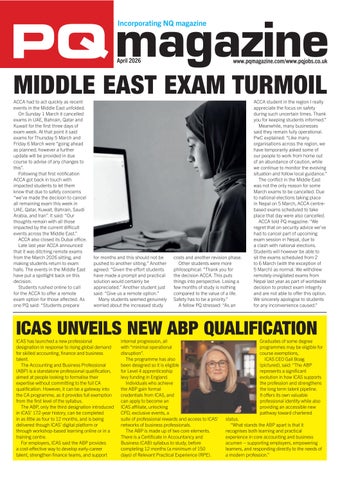
ACCA had to act quickly as recent events in the Middle East unfolded.
On Sunday 1 March it cancelled exams in UAE, Bahrain, Qatar and Kuwait for the first three days of exam week. At that point it said exams for Thursday 5 March and Friday 6 March were “going ahead as planned, however a further update will be provided in due course to advise of any changes to this”.
Following that first notification ACCA got back in touch with impacted students to let them know that due to safety concerns “we’ve made the decision to cancel all remaining exam this week in UAE, Qatar, Kuwait, Bahrain, Saudi Arabia, and Iran”. It said: “Our thoughts remain with all those impacted by the current difficult events across the Middle East.”
ACCA also closed its Dubai office.
Late last year ACCA announced that it was ditching remote exams from the March 2026 sitting, and making students return to exam halls. The events in the Middle East have put a spotlight back on this decision.
Students rushed online to call for the ACCA to offer a remote exam option for those affected. As one PQ said: “Students prepare
for months and this should not be pushed to another sitting.” Another agreed: “Given the effort students have made a prompt and practical solution would certainly be appreciated.” Another student just said: “Give us a remote option.”
Many students seemed genuinely worried about the increased study
costs and another revision phase. Other students were more philosophical: “Thank you for the decision ACCA. This puts things into perspective. Losing a few months of study is nothing compared to the value of a life. Safety has to be a priority.”
A fellow PQ stressed: “As an
ACCA student in the region I really appreciate the focus on safety during such uncertain times. Thank you for keeping students informed.”
Meanwhile, many businesses said they remain fully operational. PwC explained: “Like many organisations across the region, we have temporarily asked some of our people to work from home out of an abundance of caution, while we continue to monitor the evolving situation and follow local guidance.”
The conflict in the Middle East was not the only reason for some March exams to be cancelled. Due to national elections taking place in Nepal on 5 March, ACCA centrebased exams scheduled to take place that day were also cancelled.
ACCA told PQ magazine: “We regret that on security advice we’ve had to cancel part of upcoming exam session in Nepal, due to a clash with national elections. Students will however be able to sit the exams scheduled from 2 to 6 March (with the exception of 5 March) as normal. We withdrew remotely-invigilated exams from Nepal last year as part of worldwide decision to protect exam integrity and are not able to offer this option. We sincerely apologise to students for any inconvenience caused.”
ICAS UNVEILS NEW ABP QUALIFICATION
ICAS has launched a new professional designation in response to rising global demand for skilled accounting, finance and business talent.
The Accounting and Business Professional (ABP) is a standalone professional qualification, aimed at people looking to formalise their expertise without committing to the full CA qualification. However, it can be a gateway into the CA programme, as it provides full exemption from the first level of the syllabus.
The ABP, only the third designation introduced in ICAS’ 172-year history, can be completed in as little as four to 12 months, and is being delivered though ICAS’ digital platform or through workshop-based learning online or in a training centre.
For employers, ICAS said the ABP provides a cost-effective way to develop early-career talent, strengthen finance teams, and support
internal progression, all with “minimal operational disruption”.
The programme has also been designed so it is eligible for Level 4 apprenticeship levy funding in England.
Individuals who achieve the ABP gain formal credentials from ICAS, and can apply to become an ICAS affiliate, unlocking CPD, exclusive events, a suite of professional rewards and access to ICAS’ networks of business professionals.
The ABP is made up of two core elements. There is a Certificate in Accountancy and Business (CAB) syllabus to study, before completing 12 months (a minimum of 150 days) of Relevant Practical Experience (RPE).
Graduates of some degree programmes may be eligible for course exemptions,
ICAS CEO Gail Boag (pictured), said: “The ABP represents a significant evolution in how ICAS supports the profession and strengthens the long term talent pipeline. It offers its own valuable professional identity while also providing an accessible new pathway toward chartered status.
“What stands the ABP apart is that it recognises both learning and practical experience in core accounting and business acumen – supporting employers, empowering learners, and responding directly to the needs of a modern profession.”
IN THIS ISSUE
A note from the Editor
We felt it only right to lead with the turmoil in the Middle East this month; we think ACCA was totally right to put the safety of its students and staff first.
However, remote exams ‘in case of emergencies’ just like this situation might have helped! Although I’m not sure I would want to try to sit an exam under such conditions.
You can’t get away from AI, and you can read what Microsoft’s Mustafa Suleyman thinks will be happening to all white-collar jobs, and just how quickly change will happen (on page 5).
You can also meet the pioneering Ethel Ayres Purdie in this issue, who in 1909 became the first woman accountant in England to be admitted by a professional body. And yes, it was the forerunner of ACCA.
There is still time to sign up to the latest PQ magazine Live event. We are covering money laundering this time around and have lined up some great speakers from AAT, ICAEW and IFA. Join us on 26 March at 4pm –get your ticket here
Finally, don’t forget we need pictures of your favourite places to study for our front cover! HTFT is going to give away three Apple Airpods for the best photos. They also want to know your top study tip. Check out more on page 5
Graham Hambly, Editor and Publisher, PQ magazine
News
4 Phone exam cheat barred CIMA student banned after trying to bribe test administrator
5 Artificial intelligence
AI to take over white-collar jobs within a year, Microsoft warns
6 AI replacing junior auditors
Intelligent tools and automation replacing work of junior audit staff, says NAO
8 PwC raising the bar Big 4 firm sees graduate job applications increase by a third
9 PQ/HTFT picture competition
Send us a photo of your favourite study space and you could be on the cover of PQ!
10 ICAS numbers swell
Scottish institute welcomes new members as it targets greater social mobility
12 Tech news
Early AI adopters reaping rewards, according to research from AICPA/CIMA Features, etc
14 The PQ Digest
The big talking points: should firms use AI to cut costs at the expense of future leaders? And are we fully considering the economic impact of AI?
17 CIPFA skills
We explain how to calculate under or over absorption of overheads
18 ACCA pioneer
We profile Ethel Ayres Purdie, Britain’s first qualified female accountant and the original glass-ceiling breaker
19 ACCA spotlight
New report reveals that more UK women have ambitions to become entrepreneurs
21 Career advice
Rachel Harris outlines the skills students need and employers want – but the examiners don’t test
22 ACCA exam feedback
We asked the students who sat the March exams what they thought of them
24 Education trends
Why accounting education must adapt to the rise and rise of artificial intelligence
25 AAT Level 2
Karen Groves explains the concept of the overtime premium
26 Viewpoint
With rising youth unemployment hurting UK businesses, young people need help now
27 Adult social care
We explain the proposals for a National Care Service and what it would mean in practice
29 CIMA spotlight
How to bounce back from firsttime exam failure
31 AAT exams
Nick Craggs explains how to calculate capital gains and losses when disposing of chattels
32 Qualification update
We run the rule over the new CTA syllabus
33 Apprenticeships
Premier Training moves into apprenticeships
34 Soft skills
How to use the advisory skills hidden within the discipline of bookkeeping
35 Careers
ACCA says EU needs to act over skills shortages; our Agony Aunt tackles another of your workplace issues; and our Book Club review
36 Fun
The lighter side of life – and accountancy
The columnists
Rachel Harrison Why every PQ should have a mentor 4
Sunil Bhandari It’s time to give ‘the kids’ a chance 6
Prem Sikka Political donors are corrupting the UK 8
Anna Kate Phelan Digital assessment strengthens the profession 10
Rachel Harris Evolving from trainee to trusted adviser 12
p17
p18
RACHEL HARRISON
Why every PQ needs a mentor
You can’t use your phone
A CIMA student had his registration cancelled after he asked a test administrator to allow him to use a phone in return for a financial reward.
Navigating your career as a PQ can feel like one more hill to climb when studying and it can be hard to know where to turn for advice. Finding a mentor who can act as a ‘critical friend’ and provide a sounding board for ideas can make all the difference to your personal development.
A mentor can be anyone who can provide impartial advice and objective feedback, such as a senior colleague whose role you aspire to or a peer who has recently qualified.
A good mentor won’t give you all the answers or make the decision for you, but they will enable you to:
• Discuss ideas in a safe space.
Justifying your thoughts to a mentor will help you identify the pros and cons so you can make a decision on how to move forward.
• Develop a robust approach to overcoming challenges – get objective feedback on previous setbacks on how you could have approached these differently.
• Act on feedback with a structured plan. It is easy to view critical feedback as a negative. Reflecting on feedback with a mentor will help you reframe this in an objective way. Challenge yourself to reflect on the power of two. Who is the critical friend that you turn to for advice and who could you be a critical friend to in the future?
PQ awards update
Nominations have now closed for the PQ magazine awards, and the shortlists are being created by our independent judges as we speak.
The full shortlist will be published first on the website, and again in the next issue of the magazine (out on 17 April), which is just 10 days from awards night.
This year’s venue is the wonderful Bloomsbury Ballroom. Overlooking Bloomsbury Square, the ballroom is a stone’s throw
The student used the washroom three times during an exam, and it was during one of these visits that he asked the administrator if he could use his phone – for which they would be ‘handsomely’ rewarded. He then asked the administrator to search for answers on the internet for him, again in return for payment.
At a recent appeal committee hearing CIMA ruled Derrick Ankrah’s conduct was dishonest and his registration should remain cancelled.
In a separate case, student
Prantiti Vijaywargia was found guilty of using her phone during a proctored remote exam. She was seen looking down at the phone repeatedly as though reading its screen and keeping it out of sight. She had told the proctor the phone was on her bed.
CIMA said Vijaywargia’s conduct was so serious it could undermine the confidence in the accountancy profession if she was allowed to remain on the student register. She was found guilty of misconduct and fined £500
PQ magazine Live: money laundering
PQ magazine and Rogo have joined forces again for a free live roundtable, this time to discuss how you can avoid becoming an enabler for criminals and terrorists!
PQ magazine recently ran a series of shocking articles highlighting how accountants can unwittingly facilitate organised crime, including money laundering and even child trafficking.
So, we decided we needed
to address these issues and are putting together a great panel to delve into all the issues. A top speaker on the day will be IFA’s Tim Pinkney.
Join us on 26 March at 4pm (GMT) for ‘Accountancy… a licence to money launder?’, by signing up here
A big thanks to our sponsors: ICAEW, IFA, Reed Assessment and Eintech.
Partner fined for using AI to pass
A partner at KPMG Australia has been fined A$10,000 (£5,340) after they were caught using AI tools to complete an internal training course about using AI.
The unnamed partner was forced to resit the test. They were not alone, as the Big 4 firm admitted another 27 colleagues have also
from Holborn and Russell Square tube stations.
This famous venue has hosted Amy Winehouse, James Blunt and Kylie Minogue – and now the PQ magazine awards!
We hope to see you there.
ACCA results, exam entry changes
ACCA has reminded March sitters that they have just six days (it is normally 14) to enter the June exams, following the release of their results.
been caught in the past year using AI tools for internal exams.
KPMG Australia CEO Andrew Yates told the Australian Financial Review, who broke the story: “Like most organisations we have been grappling with the role and use of AI as it relates to internal training and testing.
A planned systems upgrade means there will be limited access to the Exam Planner.
Sitters have been told that the March 2026 exam results will now be released on Saturday 11 April.
The June 2026 standard entry deadline will be 16 April 2026, and there is no late entry period for June 2026. In effect, it means 16 April is the new late entry date, and ACCA will not be able to accept bookings for June after this date.
ACCA also said that due to
AI test
“It is a very hard thing to get on top of given how quickly society has embraced it. Given the everyday use of these tools some people breach our policy. We take it seriously when they do. We are also looking at ways to strengthen our approach in the current selfreporting regime.”
limited exam centre capacity early booking is essential.
The right course for you
Looking for an AAT, ACCA or CIMA course? Well, look no further – PQ magazine has done the hard work for you.
Check out our Course Finder page and just click on the body you are studying.
We have listed our trusted providers, the ones we think go that extra mile for you.
Rachel Harrison is Head of Academic Support at Kaplan
AI to replace jobs in a year
Most tasks accountants, lawyers and other professionals currently undertake will be fully automated within the next year or so, according to Microsoft CEO Mustafa Suleyman (pictured). He recently told FT editor Roula Khalaf that superintelligent computers will be able to take over most whitecollar jobs. It means significant changes in the workforce are in store, and anyone who works on a computer is ‘at risk’.
Suleyman said: “White-collar jobs – those sitting in front of computers, whether lawyers, accountants, project managers or marketers – most of these tasks will be fully automated by AI within the next 12 to 18
Time to retain talent
Talent and tech are the top priorities for local government finance leaders this year, says a new study from Grant Thornton. Retaining talent was top of the agenda for nearly half of the FDs (42%), with 40% seeing digital transformation their key priority for 2026.
Responders also outlined the biggest challenges they see for the year ahead. Top was dealing with rising demand for services (33%), closely followed by financial sustainability and fair funding (31%), and local government reorganisation (21%).
Grant Thornton’s Simon Christan said: “We know all toowellthe sustained pressures that local government finance
months.”
As AI advances, he said creating new models will be as easy as writing a blog or creating a podcast. “In the future, it will be possible to design AI tailored to the needs of every institution and individual on earth,” Suleyman explained.
And he stressed accountancy bodies and other large institutions will also be able to become more efficient at using AI agents in handling workflows within the next two to three years
hasoperatedunder for almost two decades. The challenge of delivering results against everreducing funding and evolving expectations will sound familiar.
“Councilsare being asked to innovate at speed in an environment designed for assurance and accountability, not rapid experimentation.The reality is that day-to-day pressures areintensifying, whilst capacity is finite.”
Female accountants want to go it alone
Women’s ambitions to run their own business is increasing in the UK, according to the early findings of ACCA’s forthcoming Global Talent Trends 2026 report.
The new survey data shows that 32% of women working in finance and accounting in the UK now aspire to become entrepreneurs, up from 27% last year.
The data shows that entrepreneurial ambition is most pronounced among younger female professionals, particularly Generation Z and Millennials, with half suggesting they want to be entrepreneurs in the future. This points to a generational drive towards autonomy, impact and financial independence.
Helen Brand, ACCA CEO (pictured), said: “Entrepreneurship represents economic empowerment in action. The number of women aspiring to own their own business is an encouraging signal that finance and accountancy skills are equipping women not only to lead within organisations, but to build enterprises of their own.”
LISTEN & LEARN WITH HTFT WIN APPLE AIRPODS!
SEND US YOUR STUDY PHOTOS
We want you to pass your exams while on the move, so we're giving away three pairs of Apple AirPod that are ideal for listening to HTFT lectures wherever you are.
PQ magazine has also promised it will put the best pictures on its cover –so even if you don’t win an Airpod you could become a cover star!
How to enter
Send us a picture of the place where you feel most happy studying (the kitchen table, the train, your favourite cafe) along with your top study tip. What’s made a real difference to your success? We want to hear what actually works. This is open to ALL students, studying any accounting qualification. Just let us know which professional body you are currently with.
To enter
Email your photo and top tip to: info@htftpartnership.co.uk
Please put ‘PQ Competition’ in the subject line. The deadline is 31 March 2026.
The top three entries judged by HTFT as the most inspiring will each win a pair of Apple AirPods,. Good luck – and happy studying!
SUNIL BHANDARI
Give ‘the kids’ their chance
AI replacing junior auditors
Automation and intelligent tools are replacing the work of junior audit staff, and this is going to have a direct effect on recruitment into the industry, according to Gareth Davies (pictured), Comptroller and Audit General of the National Audit Office.
I promise this piece is not about football.
This for context.
“You will never win anything with kids” was a famous statement made by pundit Alan Hansen about Manchester United after they lost their first game of the season in 1995/96. He was criticising United’s manager Sir Alex Ferguson for blooding young players.
How wrong he was – United went on to do the League and FA Cup double that season.
Now I want the ACCA to not fall into the same trap as Alan Hansen did. I would very much like to see the ‘kids’ given a chance. That’s young up and coming tutors.
It would be fantastic to see these young guns presenting the ACCA live quarterly sessions for the students about to sit their exam. They can present the ACCA Mock Exam de-briefs and commentary on the exam reports.
There are so many young, talented and eager tutors based worldwide. Let them have a chance to show what they can do.
Currently, the ACCA gives these ‘gigs’ to the same tutors, the majority of whom are UK based. But the ACCA is the global accountancy qualification with many young students.
Give the kids a chance to see what they can do. Nothing to lose and everything to gain.
He recently told the Public Accounts Committee there is going to be a reduction in the amount of junior-level work in a typical audit because the AI tools the NAO are starting to apply for the first-time this year take out some of those junior-level manual tasks – for example, agreeing a figure from
the accounts to a supporting document. That can all be automated now in a way that had
CIMA women ‘Give to Gain’
CIMA has launched its Women in Finance and Accounting campaign to bring attention to the opportunities within the profession, and highlighting the mentoring support that is available.
The campaign is inspired by this year’s International Women’s Day ‘Give to Gain’ theme, encouraging women to share their experiences, inspire peers and build confidence to pursue a career in the profession.
CIMA has created a dedicated webpage and a series of videos to shine a spotlight on the stories of female CIMA members driving change in diverse markets. Check it out here
• IWD is celebrated annually on 8 March. It is the biggest womenfocused day of the year and sees groups worldwide celebrate and support women’s advancement in their own social, most relevant ways.
FRC wants Chinese listings
The Financial Reporting Council (FRC) is consulting on a temporary amendment to its Third Country Auditor (TCA) policy.
The proposed change would temporarily permit auditors of Chinese-registered entities listing Global Depositary Receipts (GDRs) in London to use Chinese Standards on Auditing (CSAs) for UK listing
purposes, supporting the flow of capital, enabling investment and growth.
This consultation follows a request from the UK government seeking to address a perceived barrier discouraging some Chineseregistered issuers from choosing the UK as a listing venue. Allowing the use of CSAs on a temporary
not be possible before.
Davies said that one tool speeds up that part of the audit by three times, so it is starting to take out appreciable amounts of time at the junior end of the skill mix.
He said that there is general concern in the industry about the attractiveness of an audit career.
Davies explained: “There used to be no shortage of graduates queuing up for jobs in the big firms, but those firms are now finding that more challenging.” However, the NAO’s unique status means they are “doing very well at the moment”.
basis aims to encourage eligible Chinese registered entities to list on the London Stock Exchange through the Shanghai/Shenzhen Stock Connect agreement between the Financial Conduct Authority and the China Securities Regulatory Commission.
The proposed amendment is intended to support a shared wider government objective of boosting UK economic growth and strengthening London’s global market competitiveness, while ensuring that appropriate safeguards remain in place.
ACCA March exam feedback
March ACCA exam sitters seemed to find the two tax papers tough this time around, with one in four of those taking ATX claiming they had a ‘disaster’. In the Open Tuition Instant Poll another 44% said the exam was ‘hard’.
Meanwhile, nearly two-thirds (62%) of those sitting the Taxation paper said they found it ‘hard’, with another 12% saying the exam was a ‘disaster’.
However, the paper which got
the most ‘disaster’ votes in the Open Tuition Polls was AFM – with 29%.
At the other end of the spectrum SBL and FR and AAA were deemed ‘OK’.
Check out our full paper-bypaper feedbackon page 22.
Goldman Sachs looking to automate
Goldman Sach looks set to let AI take over its accounting roles. The bank has spent the past six months working with tech company
Anthropic building autonomous systems for time-intensive, highvolume back-office work.
It says it is expecting to achieve productivity gains rather than job cuts in the short term. But on top of speeding up processes it does acknowledge that it will limit future headcount growth.
What has surprised executives is how well the AI is handling complex, rules-based work like accounting and compliance.
Goldman’s chief information officer, Marco Argenti, said
Anthropic’s Claude model will reduce the amount of time these essential functions take, and he expects the agents to be launched soon.
Seven million start new job in 2025
HMRC has revealed that more than seven million people started a new job in 2025. Jobseekers are being reminded to use the HMRC app for their essential tax and employment details.
Download the HMRC app here
Sunil Bhandari is an AFM tutor at FME Learn Online
LORD SIKKA
Political donors are corrupting the UK
The recent Corruption Perceptions Index from Transparency International shows the UK has dropped to its lowest ever score. It is more corrupt than Estonia, Hong Kong and Uruguay, and is well on the way to emulating the US where no one can run for high office without money from corporations and the super-rich.
A major reason for the slide is political corruption. Political parties and legislators can be bought by corporations and the super-rich through political donations. The grateful politicians oblige by organising threatening issues off the political agenda; providing feather-duster regulatory systems, tax perks to the rich, crony contracts, VIP lanes, honours and peerages.
Normal people can’t grease political palms and know that no matter how they vote corporations and the superrich always win. Some 24 million people live below the minimum living standard. The poorest 20% pay a higher proportion of income in taxes than the richest 20%.
Public confidence in the political system is low. Around eight million eligible people did not register to vote in the last general election. Only 59.9% of the registered voters actually voted.
Abraham Lincoln said democracy was “government of the people, by the people, for the people”. Such ideals can’t be achieved if big money can buy political parties and subvert public choices. Criminalising the receipt and payment of political donations is a necessary step towards cleansing the system.
Prem Sikka is Emeritus Professor of Accounting at the
University of Essex
Tax briefs
Just think fiscal drag
If tax thresholds had risen with inflation since 2021 the personal allowance would now be around £15,550 instead of £12,570. And the higher thresholds would be closer to £62,000 rather than £50,270.
Looking at Chancellor Rachel Reeves’ Spring Statement, ICAS CEO Gail Boag said: “Freezing tax thresholds has become successive governments’ go-to stealth tactic to raise taxes. As wages rise with
Is PwC a haven in a storm?
PwC UK received 60,000 applications for its 2,000 entrylevel places as graduates hunt for white-collar jobs, according to the Financial Times.
Phillippa O’Connor, chief people officer at PwC UK, told the FT that the 35% increase in grad applications has allowed the firm to “raise the bar” and select candidates able to deliver higher value work.
She claimed the Big 4 firm had chosen not to replace or offshore some routine work as it wanted junior staff to learn subjectivity, for example in auditing accounts that
“could look black and white to an AI machine”.
PwC acknowledged it has been “removing lower-value activities” as technology and AI evolve, but O’Connor added: “When we did the
strategic workforce planning there’s a version of that pyramid where you take out a bigger component from the bottom of the pyramid. And then you look forward three to five years and say, ‘What will be the skills that our then managers have that we don’t think are automatable? How will we have trained those?’”
Recent graduate intakes have been a couple of hundred smaller than in the past, she said. But the cuts in jobs across PwC UK over the past year were more about the state of the UK market than the immediate impact of AI.
Sustainability standards don’t go far enough
The UK government’s publication of the finalised version of the highly anticipated UK Sustainability Reporting Standards do not go far enough, says ICAS. It believes more comprehensive and holistic reporting would be achieved by expanding these standards to include reporting on the impact of organisations on people and the planet.
ICAS director of sustainability, Fiona Donnelly (pictured), said: “A ‘double materiality’ approach, long championed by ICAS and
inflation while thresholds remain the same, more people are pushed into higher tax bands, reducing their take-home pay and leaving households with less to spend across the economy.”
New tax adviser registration
All UK tax advisers will need to register with the government from 18 May 2026, although HMRC says some businesses will be given more time.
From May, tax advisers must
embraced in Europe despite the recent simplification measures to reporting, would better serve the needs of multiple stakeholders and support the long-term public interest.”
She went on: “It’s disappointing that the standards no longer specify how long the reliefs for non-climate reporting and Greenhouse Gas Scope 3 reporting will apply. We appreciate that these topics are complex and rely on reporters obtaining third-party data, but these reliefs
may be misused and result in incomplete and less useful disclosures.”
Pilates and headshots!
The Birmingham Chartered Accountant Students’ Society is engaging with its members with a series of ‘different’ events. Already in 2026 it has offered a ‘Pilates experience’, designed to provide a mindful break from study and work. A second pilates session is now planned at the Loop Studios in late March, but when we looked the 6pm class was fully booked. There
register with HMRC through a new digital system and show they meet minimum standards.
Currently, registration requirements for tax advisers varies by service. The new registration system will replace all these with a single digital system.
The first to register will be those who are not currently registered with HMRC. Some adviser groups (such as payroll and overseas advisers) will have later deadlines.
HMRC said: “These changes will help create a fairer market
were still some places available for the ladies-only 7pm session. Another recent event was a ‘headshot’ pop-up with photographer Daisy-mai Crossman, to help students refresh their professional image. Each attendee received a 10-minute photography session, alongside refreshments and an informal networking opportunity with fellow students.
for taxpayers and advisers by ensuring everyone meets the same standards.”
Hands-on approach works
HMRC’s large business directorate has doubled the amount of tax revenue it has collected since 2020/21 by using a hands-on approach, says a new report from the National Audit Office.
It is estimated that this approach yielded £15.8 bn in 2024/25 which would have otherwise been lost.
Picture this…
Creating a personal study space can really aid your accountancy exam success. However, it is not always possible to find the perfect area, as family and even pets encroach wherever you go.
Together with our friends at HTFT Partnership we want to create a picture of how today’s PQs study – and we want to see the place the magic happens!
Send us a picture where you feel most happy studying (the kitchen table, the train, a café or even the bath) and the best will
be used to create a PQ magazine front cover. You can be in the picture, too!
HTFT will also send three lucky winners a set of Apple Airpods, ideal for listening to lectures or podcasts wherever you are.
To be in with a chance of winning the Airpods you also need to tell us your top study tip – what has made the real difference to your exam success.
Deadline for your entries is Tuesday 31 March, and you need to send your picture(s) and study tip to info@htftparrnership.co.uk
This competition is open to all accountancy students.
Contracts exchanged on BDO merger
BDO UK and BDO Ireland have exchanged contracts following a successful partner vote for the merger of the two firms. Completion is expected any day now, subject to regulatory approval.
BDO UK and BDO Ireland announced
they were in discussions in November last year, and the merger will bring together BDO’s Irish offices in Dublin and Limerick with the UK firm’s existing 17 locations.
The new combined firm will have revenues of £1.1bn
and 8,500 employees. There will be around 550 partners.
Mark Shaw, Managing Partner at BDO UK (pictured), said: “Partners in both the UK and Ireland have been clear in their support. They are excited about the next phase of our growth story and are pleased to have reached this important stage in the deal.”
The enlarged group remains part of the BDO international network.
Students celebrate ADIT results
Over 400 international tax professionals in more than 50 countries are celebrating passing the Chartered Institute of Taxation’s ADIT exams.
Some 423 students successfully passed at least one exam, with 84 students passing their third module and so achieving the full Advanced Diploma in International Taxation qualification.
The ADIT qualification is now held by 2,464 tax practitioners, around 500 of whom have chosen to subscribe with the CIOT as International Tax Affiliates since achieving the qualification.
The following candidates will receive awards for their achievements in December’s exams: Padrig Davies of Glasgow, HMRC; Jamie Roberts of Bristol, PwC; Lukasz Kazmierczak of London, Warner Bros. Discovery; Tarun Grover of Dubai, MMJS Consulting; Peter Beckett of Edinburgh, HMRC; and Alison Taylor of Glasgow, HMRC.
ANNA KATE PHELAN
Digital assessment strengthens profession
Accountancy is a profession built on trust, precision and high standards. Assessment plays an essential role in maintaining those standards, ensuring that newly qualified professionals have the knowledge and judgement they need to succeed. But the way we assess future accountants needs to evolve alongside the profession itself. For many years, professional exams relied on traditional paper formats or simple digital versions of them. While these approaches can test technical knowledge effectively they don’t always reflect the complexity of today’s workplace. Modern accountants work in fast-moving, technology-driven environments where problem-solving, data analysis and professional judgement are just as important as technical knowledge.
Digital assessment helps bridge that gap.
Modern e-assessment platforms allow awarding bodies to design more realistic testing experiences. Candidates can work with detailed datasets and navigate scenarios that resemble everyday business situations.
Digital assessment also plays an important role in improving accessibility and efficiency. Remote and on-demand testing can widen access to professional qualifications, allowing talented candidates to progress regardless of location or personal circumstances. At the same time, digital delivery gives awarding bodies deeper insights into candidate performance, helping them refine and improve assessments over time.
The goal isn’t to replace the principles that have always underpinned professional assessment. It’s to strengthen them. By embracing thoughtful digital innovation, the accountancy profession can ensure its assessments remain rigorous, relevant and fit for the accountants of tomorrow.
Anna Kate Phelan is Chief Product Officer at Eintech
Foundation to success
More than 770 newly qualified chartered accountants (CAs) joined the profession at the recent Institute of Chartered Accountants of Scotland (ICAS) admission ceremony in Edinburgh.
The annual event also marked a significant milestone for social mobility, as the ICAS Foundation celebrated helping more than 50 young people from low-income backgrounds to achieve CA status.
Established in 2014, the charity provides financial assistance, mentoring and tailored career development throughout university, aiding participants to progress into employment and
pursue chartered accountancy training through ICAS.
Of the 219 students who have graduated from the Foundation’s Nurturing Talent programme, 110 have begun ICAS training contracts and 52 are now qualified chartered accountants– including the 13 admitted at this year’s ceremony.
Andrea Liddell, ICAS Foundation alumnus and Audit Advisor at AAB (pictured), commented: “My journey to becoming a chartered accountant wouldn’t have been possible without the support of the ICAS Foundation
“The admission ceremony was
an incredibly proud moment, and I’m now passionate about giving back to future Foundation students as an alumni ambassador.”
Student loan system is broken
The UK government needs to look at radical changes to student loan repayments for post-2012 graduates rather than tinkering with interest rates, says the Institute for Public Research (IPPR).
The think-tank’s modelling shows by 2029-30 graduates earning £30,000 will pay £55 a year more, while those earning £40,000 or above will pay £170 more.
The IPPR said reducing repayment rate from 9% to 4.5% would mean a graduate earning
£40,000 would save £519 a year, while someone earning £100,000 would benefit by six times as much in cash terms – a boost of £3,219. This change would put £5.8 billion back into people’s pockets in 2026/27.
FRC amends FRS 102
The Financial Reporting Council (FRC) has issued amendments to FRS 102 to provide companies with an updated framework when adapting the formats of their balance sheets and profit and loss accounts in their annual report and accounts.
These amendments support entities taking advantage of
presentation options within company law and ensure the financial reporting framework remains fit for purpose and will continue to provide relevant information to users of financial statements. The amendments have been developed to maintain alignment with the presentation requirements of International
However, reducing the rate could help target lower earners (and would be more affordable for the government), by halving the repayment rate to 4.5% up to £50,000 but tapering at 9% for earnings above that level.
Financial Reporting Standards (IFRS), following the introduction of IFRS 18 ‘Presentation and Disclosure in Financial Statements’.
Following feedback from stakeholders, the FRC has also made limited clarifications further to the ‘Periodic Review 2024 amendments’, relating to both FRS 102 and FRS105.
Click here to read the ‘Amendments to FRS 102 and FRS 105 – Adapted formats’.
Deloitte creates EMEA firm
Deloitte has announced plans to launch a Europe, Middle East and Africa (EMEA) firm, from 1 June 2026. The Big 4 firm said Deloitte EMEA will strengthen collaboration across borders at a greater pace and scale among 16 participating firms within the EMEA region, each of which remains responsible for the services it provides within its own market.
The participating firms operate in more than 80 countries, have 6,000 partners and employ 132,000 professionals, with reported revenues of €20bn.
Deloitte EMEA will be led by Richard Houston,
the current CEO of Deloitte North and South Europe and Deloitte UK. Volker Kruig, CEO of Deloitte Germany, will serve as deputy CEO.
Houston said: “Deloitte EMEA uniquely strengthens our ability to invest at scale across borders to accelerate innovation in areas that matter most to our clients. It builds on our market-leading local partnerships while supporting collaboration at a regional level.”
UK regains top-ranking
The UK has risen one place to 17th in PwC’s Women in Work Index 2026, regaining its position as the top-ranking G7 country for women’s economic empowerment – although the improvement stems largely from other countries slipping behind.
PwC’s 2026 Index, now in its 15th year, tracks the progress of women in the workplace across 33 OECD countries using five indicators covering pay, participation, unemployment and full-time employment for women. It shows that progress across the OECD has slowed to its weakest level since the pandemic, driven by a historic fall in full-time employment for women and rising unemployment rates. The UK’s performance is held back by rising female unemployment and falling fulltime work.
Although the UK’s overall Index score increased marginally (+0.16 points), if the UK’s improvement had matched Australia’s since 2020 it would have placed fourth in the Index rankings, rather than 17th.
RACHEL HARRIS
From trainee to trusted adviser
Early AI adopters pull away
There is a growing gap between AI early adopter companies and everyone else, according to new research from the AICPA and CIMA.
When you’re studying for your accounting exams the goal feels simple: qualify. Pass the papers, get the letters after your name and finally feel like a ‘proper accountant’. But qualification isn’t the finish line. In many ways it’s the starting point.
In the first couple of years as a trainee your focus is largely technical. You’re learning systems, following checklists and making sure the numbers stack up. Accuracy matters more than anything else, and most of your work is reviewed by someone more senior. Once you qualify, expectations shift.
Suddenly it’s not just about producing correct work. It’s about understanding why the numbers matter and being able to explain them clearly to clients and colleagues. Communication becomes just as important as technical knowledge. By year three or four many accountants begin stepping into a more advisory role. Instead of simply preparing accounts or tax returns, they start spotting patterns. Why is profit dropping? Could the business improve cashflow? Is there a tax planning opportunity? This is where accountants become trusted advisers.
The biggest change in those first five years isn’t technical ability, it’s perspective. You move from focusing purely on compliance to understanding the story behind the numbers. And the sooner you start thinking like that, the faster your career will grow. After all, great accountants don’t just report the past. They help shape the future.
Xero unveils AI-powered tools
All customers on Xero’s business edition plans will soon have the ability to snap photos of their receipts directly through the Xero Accounting App, email documents to a bespoke address, and dragand-drop over the web.
This AI-powered extraction and capture will be at no extra cost.
By embedding advanced large language model technology to extract data, Xero said its users will now be able to read receipts,
Some three-quarters of early adopters say AI is already providing a strategic advantage. Boardroom attention to AI is also higher, with 65% of these early adopters reporting that AI risk is a focus for executive leadership.
The survey found that despite rising enthusiasm around AI, most organisations remain ‘operationally unprepared’. An inadequate talent pool, IT system unreadiness and regulatory worries are all hindering
AI adoption. It seems smaller organisations are the least equipped for the new AI world, with just one in five saying
they have the required talent or systems in place.
Tom Hood, Executive Vice President of Business Growth & Engagement at AICPA and CIMA, said: “The data shows a widening gap and early adopters are gaining competitive advantage while also taking AI risks more seriously. Leaders who invest in readiness today will shape the opportunity curve tomorrow.”
You can read the joint research study conducted by the ERM Initiative at North Carolina State University and AICPA and CIMA here
ICAEW/Microsoft tie-up to boost AI
ICAEW has announced the launch of its GenAI in Professional Practice course, part of the GenAI Accelerator, marking the first phase of a collaboration with Microsoft.
The two have a memorandum of understanding to enhance AI skills for ICAEW members and their small business clients, through innovative learning content and tailored resources.
ICAEW explained it has developed the course in direct response to growing demand from small and mid-sized firms, who said
that the absence of sector-specific support was a key barrier to AI adoption.
Alan Vallance, ICAEW Chief Executive (pictured), explained: “The GenAI Accelerator Programme will be of huge benefit to ICAEW members, and I am delighted that we are working with Microsoft to support members in building practical AI capability.
“Chartered accountancy is changing at pace, and enabling our members to stay at the forefront of technology is a vital part of
Your new suite has ‘arrived’
Intuit has launched its Intuit Accountant Suite, a new AI-native platform, in the UK.
The platform will provide accounting firms with everything they need to scale and manage their clients, firms and teams, all in one place.
Intuit Accountant Suite offers integration of five core capabilities
sales invoices and landlord’s rental statements. Images are captured by the user in under 20 seconds, saving time previously spent manually entering data.
FreeAgent and Active team up
FreeAgent has unveiled a new partnership with Active, the all-inone automation platform.
The integration of FreeAgent’s platform with Active should enable seamless transfer of client data between the two programs, making
powered by Intuit’s platform: client management, client collaboration, service delivery, business planning, and team management.
It will provide consolidated client management; a custom dashboard; role-based access controls; unique client identification; optimised performance; books close at scale (Beta); AI-powered client insights
it quicker and easier to manage workflow and prepare workpapers and final accounts.
Trial balance data and general ledgers will be transferable, while journals will be automatically posted from Active back to FreeAgent.
This means accountants will be able to review and adjust ledgers (including accurals, provisions and final journals), prepare workpapers (supporting schedules, evidence and checklists), and produce final accounts more easily.
futureproofing the profession.”
Click here more information about the ICAEW GenAI Accelerator Programme.
(Beta); and seamless books-to-tax integration.
Leigh Thomas, Vice President of EMEA at Intuit, said: “The relationship between accountants and their clients has transformed in recent years, and so must the technology that supports them.
Intuit Accountant Suite brings artificial intelligence and human intelligence together into a platform of tools that further foster this growth for both parties.”
Embedded payment is here
Leading cloud accounting platform iplicit has launched iplicitPay. Powered by Crezco (which is regulated by the FCA), the partnership will extend iplicit accounts payable capabilities, allowing customers to pay suppliers directly within its platform. Previously, customers managed invoices, approvals and matching in iplicit, but had to export payment files or log into separate banking portals to execute payments.
Rachel Harris is the founder of striveX and @accountant_she
Develop the accounting leaders of tomorrow. Digitally upskill your team through funded degree apprenticeships
Available in:
•Data Scientist
•Digital and Technology
Solutions Professional
•Project Manager
• Delivered primarily online with flexible, asynchronous learning
• Funded through the Growth and Skills Levy, levy transfer, or government co-investment
2026 October intake now open for applications
D Deadline: 28th August
THE PQ DIGEST
RECRUITMENT IN THE AGE OF AI
M
arie Speakman, an AI business analyst:
“KPMG cut graduate intake by 33%. Deloitte by 18%. EY by 11%. The UK accountancy graduate job market is down 44% year-on-year.
“AI can do the reporting, the consolidation, the routine analysis. It feels efficient.
“IBM took a different approach. They automated the routine work but redesigned junior roles around mentorship, decisionmaking and problem-solving instead of removing them entirely.
One strategy cuts costs. The other builds future leaders.
“Junior roles were never just about
QUOTE OF THE MONTH: ‘'Junior roles were never just about output. They were apprenticeships in judgement”
output. They were apprenticeships in judgement. How to know when the numbers are right but the business is wrong. How to spot when the rule doesn’t fit. When to push back on a decision.
“When those junior professionals are gone senior finance leaders will wonder why they can’t find people who actually understand the business. Because judgement can’t be
THINKING ABOUT THE WATER!
Sarah Beale, CEO at AAT: “When to use AI – I want to hear your thoughts PLEASE.
“I am just being a party pooper? Or should we not be thinking about how we use AI ethically, as well as effectively?
“There are, of course the deep and broad social implications around AI – good and bad, but today I am thinking about the environmental impact and wondering if others do too, or any if any of us are considering it enough.
“I see the fun trends on LinkedIn and other platforms, with the creation of avatars and cartoon depictions and I simply can’t join in.
“I read, (unverified!) that to create just one
Free subscription: www.pqmagazine.com/subscribe/
Delivery problems or need a change of email address: admin@pqmagazine.com Website: www.pqmagazine.com
such picture, can use 22 glasses of water and globally we will soon see whole countries going into drought each year, of course driven by multiple factors, but being contributed to by our use of AI.
“Did you know that a request via ChatGPT uses 10 times the electricity of a Google search, according to the International Energy Agency, and that researchers have found AI infrastructure could soon consume more water than Denmark, on an ongoing and growing basis? AI is here to stay and of course there’s huge value in applying AI in many situations but do we all need to take stock and think of when and why, including the ecological impact?
automated.
“AI can follow rules perfectly. Judgement is knowing when to break them. If you automate the tasks and remove the apprenticeship, you don’t just lose jobs. You lose the pipeline of future decision-makers.
“The Big 4 chose efficiency.
“IBM chose to build future leaders. Which approach will your organisation take?”
Particularly in a profession like accountancy, that prides itself on the value and application of ethical action – does anyone else feel we need to call this out? Even make sure we understand it more?”
Filling the gaps
Matthew Davies explains how to calculate under or over absorption of overheads
In the CIPFA Management Accounting exam students may be assessed on under or over absorption of overheads. It is an area of management accounting that requires some understanding. In this article, we will look at what causes this and how to calculate under or over absorption.
To understand under or overabsorption it is necessary to review absorption of overheads. Let us consider an example of an NHS dental practice. How would you determine the cost of a particular type of tooth filling? Whilst the prime costs could readily be calculated by estimating direct materials and direct labour, overheads such as electricity costs cannot be easily attributed to a specific filling. How can the dental practice’s electricity costs and other overheads be absorbed into the cost of a specific filling?
From your studies you will be aware of the need to apportion or allocate estimated overheads into service and production cost centres. Then the service cost centres are apportioned into the production cost centres. In the example of the dental practice, we can now assume that those processes have been completed and £1m of overheads for a year have been apportioned into the production cost centre entitled dental treatment areas.
Now, that the £1m of estimated overheads need to be apportioned into production using an appropriate overhead absorption rate (OAR). An appropriate method could be clinical hours. This is the total amount of hours the dentists in the practice spend on dental treatment. If the practice had four dentists, each working 48 weeks a year, 38 hours a week, with 75% of their paid time being spent on clinical work, that would equate to an estimated 5,472 clinical hours in total.
The next step is to calculate an OAR by dividing the estimated total overheads by the estimated clinical hours. In this case it would be £1m/5,472 which equals to £182.75 per clinical hour. That means any treatment can be costed by adding the estimated clinical time multiplied by the OAR and adding that to the prime cost. So, if a particular type of filling takes an estimated 20 minutes, the amount of overheads absorbed into the cost of that filling would be £182.75/60 x 20 = £60.92.
So far all these things have been estimates and are usually done at the start of a period. However, like all estimates, it is unlikely that they become realities. For example, the total overheads during the year is unlikely to be exactly £1m and the total number of clinical hours will probably not be exactly 5,472. Thus, at the end of a period, it is essential to compare our estimates with the actuals. Consider the following information using two different outcomes: -
Total Overheads
Estimate Outcome 1
£1,000,000
£950,000
Outcome 2
In Outcome 1, some 5,452 clinical hours were worked and £182.75 of overhead costs were absorbed into cost units by a per clinical hour basis, which meant a total of £996,353 (5,452 x £182.75) of overheads were absorbed during the year. However, the actual overheads at the end of
the year were £950,000. This meant that £46,353 more overheads were absorbed during the year. This is over absorption.
In Outcome 2, a total 5,008 hours were worked, which resulted in £915,212 of overheads being absorbed, which was £34,788 less than actual overheads. This is under absorption.
In both outcomes, both the total overheads and total clinical hours were less than had been estimated, Outcome 1 resulted in over absorption of £46,353, whereas in Outcome 2 there was an under absorption of £34,788. This example shows that it is not just a case of comparing total overheads. CIPFA students need to learn how to absorb overheads during a period using an estimated OAR and then compare that to the actual overheads incurred. This almost certainly going to result in either an under or over absorption of overheads. Learning this key area of management accounting will not only help you pass Management Accounting but improve your understanding of the accounting profession.. • Matthew Davies, expert in public sector financial management
Breaking the glass ceiling
Meet Ethel Ayres Purdie, Britain’s first qualified female accountant
ACCA, through the London Association of Accountants (LAA), became the first professional body to open its doors to female accountants on 13 May 1909, when council elected to membership Ethel Ayres Purdie, a woman in public practice in London. It must be said that most of the membership was appalled at the idea of admitting women, particularly someone as radical as Mrs Purdie, but the London Association’s secretary for its first 11 years, Henry Lewis, firmly believed in the principle that entry should not be restricted on the basis of gender.
The LAA’s newsletter – The Journal – noted that the Association has not “waited for Acts of Parliament to compel them to admit their sister professionals; theirs is no tardy, grudging recognition but a far-seeing and wise decision, characterised by a thorough understanding of modern requirements”.
At the annual dinner where her admission
was formally recognised, she sat down with more than 100 of her male colleagues and was accorded “a most gratifying and whole-hearted reception” and gave a speech in response.
Mrs Purdie informed those attending the otherwise all-male annual dinner of 1909 that she had been first attracted to the Association by the inaugural president’s warning that “the established accountancy profession would find in this Association a strong militant force. Of course, the word ‘militant’ attracted me at once. ‘Good,’ I thought, ‘here are some men who evidently mean business. I will get myself into that Society.’ And here I am. I have arrived, with some more militant force.”
The London Association’s policy was praised by the Daily Telegraph, which mentioned that, over the next 12 months, five more women had been admitted. The newspaper encouraged female students to become articled to a
certified accountant. But the ambitious woman “determined to start practice for herself must bear in mind the fact that a capital of £150 at least would be required to finance her during the period she is working up a connection”. A book entitled New Careers for Women (1917) recommended accountancy as a ‘congenial’ occupation for women and encouraged them to seek admission to the London Association, the only body willing and able to meet the needs of the female practitioner
The London Association did not take the lead in appointing women to a position of authority, missing the opportunity in 1913. Mrs Purdie was nominated for election to council but failed to become the first female on the governing body of a UK accountancy body by a single vote.
A fervent campaigner for women’s rights, one of the original members of the Women’s Freedom League, perhaps even more remarkably she was recognised as an authority on income tax in both Europe and America, making her a trail-blazing accountant, who against all the odds had spent years establishing and running a successful business.
Ethel Purdie would be proud of what her accountancy body has become: an accountancy organisation which works hard to promote inclusion, a strong gender balance across future members and members; and, for the second year running, has women holding all three officer posts.
• Thanks to ACCA for this article
Ethel Ayres Purdie
The female founder is on the rise
ACCA’s forthcoming Global Talent Trends 2026 report reveals that UK women’s ambitions to become entrepreneurs are growing
New survey data shows that almost a third (32%) of women working in finance and accountancy in the UK now aspire to become entrepreneurs, up from 27% last year. The findings are drawn from early insights from ACCA’s global survey of over 11,000 finance professionals across 175 countries, with the full report due for publication in May 2026.
The increase signals growing confidence among women in using accountancy and finance training as a springboard for business ownership. While entrepreneurial ambitions remain higher among men overall, the narrowing gap reflects a significant shift in career confidence and longterm aspirations.
The data also indicates that entrepreneurial ambition is most pronounced among younger female professionals, particularly Gen Z and Millennials, with half suggesting they want to be entrepreneurs in the future. This points to a generational drive towards autonomy, impact and financial independence. The findings are released ahead of International Women’s Day 2026 and align with the global theme set by UN Women: ‘Rights. Justice. Action. For ALL women and girls.’
Helen Brand, chief executive of ACCA, said: “Entrepreneurship represents economic empowerment in action. The number of women aspiring to business ownership is an encouraging signal that finance and accountancy skills are equipping women not only to lead within organisations, but to build enterprises of their own.
“Accountancy provides a powerful platform
for entrepreneurial success, combining financial expertise, governance, risk management, technology and strategic insight. Supporting women to translate ambition into enterprise is essential not just for equality, but for economic growth.”
Global Talent Trends 2026 data shows that accountancy remains a natural training ground for future business owners, with over half of respondents overall viewing their finance background as beneficial for entrepreneurial careers. Ambitions are particularly strong in emerging markets, where entrepreneurship is often seen as a pathway to economic mobility
and societal impact.
The research also highlights that women’s entrepreneurial aspirations sit within a broader redefinition of the accountancy profession. Many finance professionals increasingly seek roles aligned to purpose, social impact, environmental sustainability and personal autonomy, underscoring the expanding role of accountancy as a gateway to entrepreneurship and economic empowerment.
Jamie Lyon, global head of skills, sectors and technology at ACCA said: “The drive towards entrepreneurship is especially evident among younger finance professionals. They see accountancy as more than a technical discipline, it is a launchpad for innovation, independence, and impact. While there remains more progress to be made to achieve parity, the direction of travel is clear. The profession is helping to unlock entrepreneurial potential at scale.”
International Women’s Day provides an important moment to reflect on how professions can support equitable access to opportunity. Unlocking women’s entrepreneurial potential has well-documented economic benefits globally, including increased job creation, innovation, and productivity.
ACCA President Melanie Proffitt (pictured) commented: “The accountancy profession needs to modernise its business culture to ensure career paths are equitable for both women and men. Many businesses still operate around traditional nine-to-five expectations and presenteeism, which no longer reflects how people work most effectively. Greater flexibility in hours, hybrid working, and output-focused performance measures would create a fairer system.
“Career paths should recognise that progression is rarely linear, with structured support for career breaks, parental leave and re-entry programmes. Importantly, these changes would benefit everyone – not just women – by improving wellbeing, widening talent retention, and enabling all professionals to balance ambition with life beyond work.”
Some 49% of ACCA members and 57% of ACCA students today are female. It’s a proud legacy of our first female member, Ethel Ayres Purdie, who was elected as an associate to the London Association of Accountants, a founding organisation of ACCA, in 1909 and became the first woman to be admitted to an accountancy body in the UK (see feature opposite).
For more information about ACCA’s International Women’s Day 2026 campaign, including views from members and leadership reflections on equity in the profession click here
FREE WEBINARS
Accountancy… a licence to money launder?
PQ magazine has joined forces with our friends at Rogo again to host a live online roundtable to look at the latest developments in anti money laundering.
We are gathering a panel of experts from the accountancy industry for a frank discussions about laundering illicit funds.
Accountants who don’t get their house in order could unwittingly be facilitating organised crime, terrorism and even child trafficking.
The government has now stepped in and decided to create a Single Professional Services Supervisor (SPSS) for all anti-money laundering and counter-terrorism financing in the UK. The FCA will be in charge.
Join us on Thursday 26 March at 4pm for what we hope will be a lively discussion. All we need is 45 minutes of your time!
To sign up, register your interest here
Proven to boost your exam results
Study Hub is proving to be a great success for ACCA students, increasing exam results by as much as 18%*. With online access to study chapters, practice questions, flashcards and short quizzes, it streamlines revision and enhances your understanding.
Use Study Hub as an essential part of your exam prep and boost your chances of success.
#ACCAStudyHub
*Based on pass rates of Study Hub users vs. non-users for the September 2023 session-based exams.
The skills you really need
Rachel Harris outlines the skills students need, employers want –but the examiners don’t test
Every trainee accountant knows the drill: revise hard, pass exams, move to the next stage. And yes, technical competence matters. But after running a growing firm and working with many trainees and newly qualified accountants I can tell you this: the skills that accelerate your career aren’t always the ones in the syllabus. When I look back on my career it’s not the job title changes or salary increases that have driven my personal growth, it’s the opportunities I’ve pushed for, the development opportunities I’ve sought out and the ownership of my career that has made the biggest difference.
Exam papers test knowledge. Employers notice behaviour. Here are four hidden skills that make the difference early in your career.
1. Professional judgement
In exams, there’s usually a ‘most correct’ answer. In practice, there rarely is. Clients bring messy, incomplete information. Deadlines move. Priorities clash. The numbers might be technically accurate but the real question is: what actually matters here?
Professional judgement is about knowing:
• When something is good enough.
• When something needs escalating.
• When to challenge a client (politely).
• When to stop over-perfecting.
The trainees who progress fastest aren’t the ones who know the most standards off by heart. They’re the ones who understand risk, materiality and context. You build this by asking better questions in reviews like “Is this technically wrong, or commercially irrelevant?” and “What would the client care about most here?”
2. Communication that reduces friction
You can be brilliant technically, but if your emails create confusion you’ll slow the whole team down. Employers quickly notice trainees who:
• Write clear, structured emails.
• Summarise issues rather than forwarding problems.
• Speak up early instead of letting work stall.
• Translate technical points into client-friendly language.
Clear communication reduces review time, improves client trust, and signals readiness for more responsibility. Before you send any message ask “Have I made this easier or harder for the reader?”
3. Prioritisation under pressure
Exams test memory. Busy season tests capacity. The real skill isn’t working longer hours, it’s knowing what actually moves the needle. Strong trainees:
• Clarify deadlines upfront.
• Flag capacity issues early.
• Break large jobs into staged deliverables.
• Avoid ‘busy work’ that doesn’t affect outcomes.
If everything feels urgent, nothing is. Learning to triage your workload calmly is a careerdefining skill, and one no textbook teaches.
4. Ownership
This is the big one. Ownership isn’t about being perfect. It’s about being accountable. If something slips do you:
• Blame unclear instructions?
• Or take responsibility and propose a fix? Employers notice the trainee who says “I missed that, here’s how I’ll prevent it happening again.” That sentence alone builds trust faster than any exam pass.
What this means for you
Passing exams will qualify you. But these hidden skills will differentiate you. If you’re early in your career, start practising them deliberately by:
• Volunteering to present in team meetings.
• Asking for feedback beyond technical corrections.
• Observing how managers handle difficult conversations.
• Reflecting weekly: “Where did I create value beyond the numbers?”
The shift from trainee to trusted adviser doesn’t happen the day you qualify. It happens the day your firm starts seeing you as someone who reduces risk, improves clarity and takes ownership. That’s never on the exam paper, but it’s always being assessed.
• Rachel Harris is the founder of striveX and @ accountant_she
MARCH EXAM FEEDBACK
How were the March exams? There is only one real way to find out: ask the students who sat them! Here is what was said…
Audit & Assurance (AA)
It was all ‘OK’ on the AA front this time around. Some felt section A was the difficult/tricky bit.
In the Open Tuition Instant Poll vote 50% of sitters said the exam was ‘OK’. Another 35% felt the exam was ‘hard’, and 8% said it was a ‘disaster’.
Advanced Audit & Assurance (AAA)
Sitters found Q1 ‘incredibly long’. One student admitted to spending almost an hour and 40 minutes on it, leaving less time for the remaining questions. The problem is they had just 20 minutes to answer Q3, which they found to be the hardest question.
Another sitter felt it was all actually ‘pretty easy’.
In the Open Tuition Instant Poll 18% of sitters voted this exam a ‘disaster’. Another 34% found it ‘hard’, and 45% said it was ‘OK’.
Taxation (TX)
A tough test with lots of tricky questions is how one PQ found the March tax exam.
In the Open Tuition Instant Poll just 24% of sitters said the exam was ‘OK’. Some 62% found the exam ‘hard’, and another 12% had a ‘disaster’.
Strategic Business Leader (SBL)
Sitters struggled with time management, with one saying: “There was not enough time for this exam.”
In the Open Tuition Instant Poll 60% of sitters said the March exam was ‘OK’. Some 27% said it was ‘hard’ and 9% had a ‘disaster’.
Performance Management (PM)
According to some sitters section A had “a lot of difficult questions”.
Section B had lifecycle costing, regression and correlation, then a bit of CVP. Section C was all about relevant costs and the balanced scorecard. It all felt like “quite a tricky exam”, said on sitter.
In the Open Tuition Instant Poll 14% of the votes went to ‘disaster’ and 46% to ‘hard’. The ‘OK’ box was ticked by 40% of voters.
Advanced Performance Management (APM)
A tough or ‘absolutely awful’ section A for some! There were tech issues for some students too, with some morning sitters not getting started until 10.30, only to be faced with an “awful bunch of questions”.
Another student thought it was the worse exam they had ever sat. “Brutal” was another comment.
In the Open Tuition Instant Poll 21% vote the exam a ‘disaster’, and another 38% ticked the ‘hard’ box. Only 37% was it was ‘OK’.
Advanced Taxation (ATX)
A tough test, with many ‘looking forward’ to the resit in June, apparently. As one sitter said:
“There were things that came up that I do not even recall reading about!”
Another PQ thought the examiner had written the questions “in an evil way”.
It all meant that many students were just second-guessing when it came to their answers.
In the Open Tuition Instant Poll one in four sitters (25%) said the exam was a ‘disaster’, and another 44% said they found it ‘hard’. Just 25% said it was ‘OK’.
Financial Reporting (FR)
Everyone seemed happy with this exam, this time around. In the Open Tuition Instant Poll some 62% of sitters said the exam was ‘OK’. Another 20% found the exam ‘hard’ and 14% had a ‘disaster’ sitting.
Strategic Business Reporting (SBR)
This exam was a disaster for many sitters. Some students didn’t know what to think: “It could go either way – just felt I was caught off guard with a few questions.” As one sitter said, the questions were nothing like any mock they had sat.
Technical errors also forced some exams to be cancelled.
The problems with this paper are reflected
in the Open Tuition Instant Poll, where 25% of sitters saying the exam was a ‘disaster’. Some 38% found the exam ‘hard’ and just 35% said it was ‘OK’.
Financial Management (FM)
Some sitters found the section B gearing question a bit of a challenge. Others found section C ‘hard’.
Many were disappointed that WACC didn’t come up.
In the Open Tuition Instant Poll 46% of sitters called this a ‘hard’ exam, with another 17% saying they had a ‘disaster’. That left 33% saying it was ‘OK’.
Advanced Financial Management (AFM)
One student found that this a heavily theorybased exam, with 40% calculations and 60% theory.
Another sitter agreed the exam was challenging because there was a lot of theory related questions. But, they felt it could have been much worse.
A whopping 29% ticked the ‘disaster’ box in the Open Tuition instant Poll. Another 35% said they found it a ‘hard’ exam. That left 34% thinking it was ‘OK’.
Teaching the AI-native generation
Georgina Roberts explains why accounting education must adapt to the rise and rise of artificial intelligence
Today’s schoolchildren (Gen Alpha) are not just digital natives; they’re also firstgeneration AI natives, and that has big implications for how they interact with the world now and throughout the coming years.
For Gen A, education is not the passive, listenand-learn experience of previous generations. They’re learning alongside AI, as it evolves, working with it symbiotically. It’s simply a natural dialogue and interactive relationship, as educational researchers at ResearchGate found: “Generation Alpha exhibits intuitive comfort with AI-powered learning systems and voice-activated educational tools.”
Now take a look at the current landscape of professional online accounting tuition, of which aCOWtancy.com is a part. It’s predominantly linear and passive, mostly using recorded videos, textbook-style notes and end-of-topic quizzes, an approach that is increasingly out of touch with how this generation learns and thinks. Although there are understandable fears that AI will replace good teaching, that’s not yet the issue – what AI does, and will continue to do as it evolves, is expose tendencies towards pedagogical laziness. At aCOWtancy we’ve always believed in the
UX (user experience) first. We are intentionally design-led, not just for enjoyment but more importantly for engagement. “If we expect a student to invest, on average, three years of their working life in training with us, we owe it to them to make that experience as engaging and effective as possible,” said Richard Clarke, aCOWtancy founder. “Working with AI will therefore enable us to extend our creative
capabilities in course design and functionality. In our weekly development meetings, we debate the endless possibilities for pedagogical potential in the AI age.
“For example, how about the aCOWtant-cow that can respond in real-time to a student’s verbal question whilst they’re studying on our site? How about refining AI outputs from LLMs to design our own agentic AI that adapts to each individual student's needs – predicting weaknesses, spotting error patterns and personalising their pathway? It might be a little way off yet, but this is all firmly within our creative and development sights.”
Maintaining standards and working ethically and responsibly still rests with us, human educators. And just like accountants in the workplace, adapting to intelligent systems while remaining fully accountable, we would argue that tuition providers need to do the same to be relevant for this new generation of learners.
This isn’t about making learning easier or being lazy in teaching methods; it’s about making professional accounting education realistic, relatable and rigorous for a generation of future accountants for whom artificial intelligence is simply a part of everyday life.
• Georgina Roberts, Digital Manager, aCOWtancy.com
What is the overtime premium?
Karen Groves explains the concept of the overtime premium, and how to calculate it
During your studies for AAT Level 2 you may be asked to calculate the overtime premium amount as part of a labour costs question. This can sometimes cause some confusion; students do not know how to approach this task and incorrectly split the basic and overtime amounts.
Hourly rate employees
The hourly rate is a set amount an employee is paid for each hour worked. However, what happens if they work more hours than the standard number of hours expected for the week?
Overtime refers to the hours an employee has worked above their standard week.
Overtime premium is the amount paid above the employee’s standard hourly rate. If an employee is paid £14 per hour and received ‘time-and-ahalf’ for overtime, the amount would be calculated as £14 x 1.5 = £21 per hour. The overtime premium amount will be the £7 extra paid, in addition to the standard hourly rate of £14 classed as the ‘basic’ rate. There needs to be an incentive for an employee to work outside their usual working hours, especially if late at night or over the weekend, hence the higher rate. It is important to read the question carefully, as you may be asked for the ‘overtime’ or ‘total overtime’ amount, which in the above example would be £21 per hour. However, if you are asked for the overtime premium amount, then this is the extra bit only, so £7 in this example.
Let’s look at an example
Callie Ltd pays £12 per hour for direct labour, for a standard 40-hour week. If the employees work more than 40 hours each week overtime is paid at time-and-a-quarter.
Calculate the gross pay for the week for the following three workers:
Workings:
The overtime premium is based on £12 x 1.25 = £15
£15 - £12 basic pay = £3 overtime premium
H. Jobbins 40 hours x £12 = £480
K. Kumar 42 hours x £12 = £504 plus 2 hours @ £3 = £6. Gross wage
£504 + £6 = £510
T. Fletcher 48 hours x £12 = £576 plus 8 hours @ £3 = £24. Gross wage
£576 + £24 = £600
Note: gross pay will be the same regardless of which method you are calculating.
Now have a go
Lottie Ltd pays £15 per hour for direct labour, for a standard 38-hour week. If the employees work more than 38 hours each week, the overtime is paid at time and a half.
Calculate the gross pay for the week for the following three workers, and show the overtime premium amount (the hours worked are paid at the basic rate with the overtime premium being the increased pay only):
In the above example, you can see the overtime is based on the hours above the standard 40 hours for the week, so for K. Kumar, two hours x £12 x 1.25 = £30 overtime.
This example is asking for the overtime amount only. We will now look at the same question; however, calculate the overtime premium instead:
Overtime premium = £15 x 0.5 = £7.50 per hour
B. Cooper 38 hours x £15 = £570
S. Martinez 40 hours x £15 = £600 plus 2 hours @ £7.50 = £15
Gross wage £600 + £15 = £615
F. Szur 44 hours x £15 = £660 plus six hours @ £7.50 = £45
Gross wage £660 + £45 = £705
• Karen Groves is an AAT tutor and AAT Faculty Director at e-Careers
Why NEETS need help now
Stephanie Hurst (pictured)
explains what rising youth unemployment means for UK businesses
The recent Spring Statement painted a rather grim picture for the UK labour market – particularly for young people. Unemployment in younger demographics is rising dramatically. Studies show that during times of economic uncertainty businesses are less likely to hire younger people, and are less incentivised to do so due to higher costs.
Unless we act now to get more young people into work many will face being left behind, and in the long term that can be damaging to our economy. The Apprenticeship Levy and the Youth Guarantee work placement scheme are viable ways for young people to enter the workforce and pursue a prosperous career –but they are well overdue for reform.
Accountancy is an industry that relies heavily on apprentices and graduates and, like our own firm, many businesses will be doing their bit. But it’s time for government to do more to encourage employers to offer more opportunities to young career seekers and support those jobs in the long term.
Youth unemployment rising
While the national unemployment rate sits at around 5%, recent figures show that unemployment among 16 to 24-year-olds has climbed to around 16%, significantly higher than for older age groups.
During her statement, Chancellor Rachel Reeves highlighted the large number of young people who are not in employment, education or training (NEET), with estimates of around 957,000 young people in this category.
Young people have always faced higher unemployment rates than the general population, simply because they are more likely to be following other life experiences, such as travel, or taking career breaks to pursue other options, including returning to education. They are also more likely to be starting families and could be taking a break to make time for that.
However, the current gap among youth unemployment and other older age groups suggests something else lies beneath. You don’t have to dig very far to find rising employment costs, like increases in the National Minimum Wage and employer National Insurance contributions. Together with a rise in automation and technological changes, it’s easy to see why hiring across many sectors has slowed down.
The Apprenticeship Levy Government policy can also influence the willingness and ability of employers to hire younger workers. The Spring Statement referred to plans to reform the apprenticeship levy to give employers more flexibility in how they spend their training funds. It also referred to an overhaul of the Youth Guarantee work placement scheme – but as yet we’re unsure exactly what those plans entail.
If the system becomes more complex or less accessible, there is a risk that fewer apprenticeships will be offered. Changes to student loan repayment arrangements are also altering the economics of hiring early-career workers because for graduates, higher repayment burdens can influence career choices and salary expectations. For employers, this can create additional pressure when designing entry-level pay structures or competing for talent.
Taken together, these policy shifts may be unintentionally contributing to the challenges young people face when entering the workforce.
Apprenticeships are vital
For the accountancy profession in particular, apprenticeships are essential for building longterm talent pipelines and developing practical skills alongside professional qualifications.
They also provide opportunities for those who may not choose the university route, allowing young people to earn while they learn, gaining valuable experience while studying for recognised qualifications such as AAT or ACCA. In many cases, today’s senior accountants began their careers as apprentices.
Firms across the country continue to invest heavily in these programmes because they recognise that developing talent internally is one of the best ways to build strong teams and sustainable businesses – but the government need to do more to support them.
That means ensuring policies around training, taxation and employment costs encourage businesses to invest in young talent rather than discourage it.
Not just a social issue
When young people struggle to enter the workforce the consequences can last for years. Early unemployment can lead to lower lifetime earnings, reduced productivity and higher longterm reliance on government support.
What is needed now is clearer direction from government as to how they plan to make it easier, not harder, for employers to invest in the next generation.
• Stephanie Hurst is the Corporate Tax Director at Monahans
Can a National Care Service work?
William Burns explains the proposals for a National Care Service and what it would mean in practice
Adult social care reform is back on the political agenda across the UK.
Proposals for a National Care Service (NCS) have emerged in England, Scotland and Wales as governments search for ways to build a fairer and more sustainable system.
But the term is used in different ways and progress has been uneven. To help make sense of it all, CIPFA and the Local Government Information Unit (LGIU) recently published a series of briefings exploring how NCS proposals have developed across the UK and what lessons can be learned.
So, what exactly is a National Care Service –and what would it mean in practice?
There isn’t a single definition of a National Care Service. Broadly speaking, the idea is to create a more consistent and co-ordinated approach to adult social care across a country. Supporters argue that a national framework could improve access, quality and fairness.
However, each part of the UK has interpreted the concept differently. In some cases, it means structural reform of how services are organised while in others it refers to national standards and greater coordination.
For students entering public finance this distinction matters. The design of the system has major implications for funding arrangements, accountability and financial management.
Why reform is a big issue
Adult social care systems across the UK are under growing strain. Demand is increasing as the population ages and more people live longer with increasingly complex needs. At the same time, councils face rising costs and limited resources. Social care already accounts for a large
proportion of local government spending. Undoubtedly, children and adult social care together represent the majority of service expenditure for all councils.
This means financial sustainability is a constant concern. Without reform, the gap between demand and available funding is likely to keep widening.
Three national approaches
Each country is currently on a different path. In Scotland, the government proposed creating a National Care Service that would move responsibility for social care away from local authorities and into a new national structure. The proposal was controversial and faced strong opposition from councils and parts of the sector. After several years of debate, the policy was dropped in January 2025.
In Wales, reform is moving more gradually. The Welsh Government has established a National Office for Care and Support, which is currently developing its role and responsibilities. One longterm ambition is to deliver care that is free at the point of need, but the final structure of the system is still taking shape.
In England, the government has launched the Casey Commission to develop a 10-year plan for adult social care reform. The commission will examine options for a National Care Service and is expected to report on how a new system could operate.
Slow progress
Social care reform has been debated for decades, but translating proposals into lasting policy has proved challenging.
One reason is that the system is complex. Social care sits alongside healthcare, housing and
local government services, and changes in one area can affect the others.
Another challenge is funding. Any reform needs to answer a difficult question: how will a sustainable system be paid for over the long term?
Political consensus is also important. Major structural reforms require support from central government, local authorities and the wider care sector. Without broad agreement, proposals can struggle to move forward.
What lessons emerged?
The CIPFA and LGIU briefings suggest that successful reform depends less on branding and more on practical design.
First, there needs to be clarity about funding. Governments must show how a new system will be financed and how it will remain sustainable as demand grows.
Second, social care involves many organisations, and cooperation is essential. If we can build and maintain buy-in from across the sector, lasting change is much more likely to succeed.
Third, clear timelines help reduce uncertainty. Large structural changes often take years to implement, so realistic planning is important.
Another lesson is the importance of place. Even if national standards are introduced, social care is delivered locally and must respond to local needs.
The research also highlights the role of prevention. Supporting people earlier can help them stay independent for longer, which improves outcomes and reduces pressure on services.
Finally, reform needs to keep the workforce in focus. Recruitment, training and pay will all shape the future of the sector.
Why should students care?
Adult social care is one of the biggest financial challenges facing the public sector.
For those planning a career in public finance, the decisions made over the next few years will influence how services are funded, managed and delivered across local government and beyond.
Finance professionals will play a key role in assessing the affordability of reforms, managing budgets, and ensuring that resources are used effectively.
Understanding the policy context is therefore essential. Social care reform is not just a political issue – it is a major public finance challenge.
What happens next?
The debate is far from over. The Casey Commission in England will continue its work over the coming years, while Wales develops its National Office for Care and Support.
Although Scotland has stepped back from its earlier plans, the pressures facing the social care system remain.
Across the UK, governments are still searching for ways to build a system that can meet rising demand while remaining financially sustainable. For students entering the profession it’s a reminder that public finance is closely tied to policy decisions. How social care is funded and organised in the future will shape the financial landscape of local government for decades to come.
• William Burns is a Social Care Policy Advisor at CIPFA
Learning from failure
Nasheen Wuisman explains how you can bounce back from first-time exam failure
The Study Support team at CIMA has just run a resit programme for candidates who were unsuccessful in the November 2025 Case Study Exam. During a discussion a candidate made the following comment: “I have never failed an exam before, I am shocked beyond words. I just do not know how to come back from this. I do not normally fail exams.”
Although I have talked in this column about exam failure and how to pick yourself back up again after a setback, I would like to explore this idea in a bit more depth: failing an exam for the first time.
Never failed before
Let’s picture a similar scenario to that of the candidate mentioned above. They aced their exams at school – not necessarily a straight-A student, but their efforts always paid off, and they got the grades they needed. Then they did their college-level qualification – it got much harder, but they made it through. They passed their driving test first time. Then, as some do, they went on to university – another triumph passing every exam they sat.
They aspire to become CGMA qualified and their study journey begins. It turns out to be tougher than they expected, there is so much more to study than they anticipated, but they persevere. They use the exam preparation tools and techniques they have used before, sit the Objective Tests, and pass them. But then they attempt the Case Study Exam, and they fail. It is devastating!
Why so devastating?
When you are used to passing exams, failing can leave you in very unfamiliar territory on results day. It can be extremely difficult to comprehend and accept. Your self-confidence, along with your self-belief, can disintegrate very quickly.
Candidates in this scenario tend to feel more devastated than someone who has previously failed an or a few exams. Why is that?
After some life events we have to pick ourselves up, build our strength, character and resilience. Through this we become better at accepting and handling adverse situations. When we experience them earlier in life, when the stakes are not as high, we adapt more
quickly, accept, and move on more easily. We then get to see how rewarding it is to go on to succeed in another attempt. We have experienced hardship and have been given the opportunity to learn from it and develop.
But when the stakes are higher – when we have far less time to study, greater commitments at work, at home, and financially – it feels different. Inherently, our human nature here creates an expectation to pass. It might be that we take our successes to date for granted – and why not – but if you suddenly find yourself in this situation, you need to know how to move forward.
How to overcome it?
With any failure the emotional response matters. It is important to take some time to let your mind and body digest and overcome the emotions you are feeling. Allowing yourself to do this can be the most vital part in making a comeback.
The key things to remember:
• You are building resilience: This moment will pass, and the day you qualify, you will look back on this period this with pride.
• This does not define who you are: It is not an indication of your intelligence, commitment or ability. It is merely an event, one that you will overcome and reflect on in time.
• It may be time for a change: Failing an exam is an opportunity to learn and adjust. It might be
that certain study techniques, like last-minute cramming, have been successful tools so far – but it is not as impactful in a Case Study Exam. Maybe it is time to rely more on longterm rather than short-term memory, due to the nature of your current studies, to reinforce understanding. Shorter study sessions might work better for you, or vice versa.
I remember when I was studying for my qualification. I found I needed to change from long twilight study time to shorter spread-out sessions. It enabled me to absorb and retain better. I also found the breaks allowed me to better absorb, understand and review what I had learnt in between study sessions.
• You are now a different person: Your life, commitments and challenges are (possibly) far greater. This makes this experience a whole new challenge and the struggle of trying to a find a balance is real.
Be fair and kind to yourself while you go through the healing process, and once you are done, brush yourself off, and try again. The next time you attempt something, be it an exam or another challenge, you will be a new, stronger version of yourself – possibility the best one yet. And when you succeed, because you will succeed, it will feel all the sweeter.
• Nasheen Wuisman, Senior Manager of Global Academic Progression at AICPA & CIMA, together as the Association of International Certified Professional Accountants
Work, study, life: Upskill without sacrificing your commitments.
CGMA® Finance Leadership Program (CGMA FLP) — learning that fits your schedule.
CGMA FLP is your flexible path to CIMA® membership and the CGMA designation. The CGMA FLP equips you with in-demand, market-ready skills through a convenient, fully online platform that you can access anywhere, anytime and at your preferred learning pace.
Plain sailing
Nick Craggs explains how to calculate the capital gain (or loss) on the disposal of chattels
Few AAT students will have heard of the word ‘chattel’ until they reach the level Personal Tax unit. It isn’t a word you would usually find in the lexicon of the average AAT student. Unless, that is, if they live in Bridlington, on the east coast of Yorkshire. Here there is a sign, which I am sure is the only time you will see the word chattel outside of a taxation textbook, which prohibits anyone from “exhibit, place or maintain any chattel” without the Bridlington Harbour Commissioner’s sanction.
I would be interested to see if any PQ readers have seen ‘chattel’ out in the wild, so to speak (well not really).
Anyway, what is a chattel? A chattel is defined as a tangible, moveable item, which isn’t very descriptive. Basically, this is anything you can touch other than land and property.
Any gain on a chattel is usually taxed under capital gains tax, using the normal rules of proceeds from sale less cost of purchase
However, certain chattels are exempt from capital gains tax. These are mainly cars and wasting chattels. Cars are exempt as they are normally sold for less than they cost. It also stops
people, who otherwise would not normally do so, from completing a tax return just because they have changed their car. Or if you are cynical, from creating losses they could use against gains. Note that there is no distinction made between classic cars and any other types of car. Wasting chattels are chattels which are not expected to last 50 years, usual examples are racehorses and greyhounds (and arguably some of the boats in Bridlington harbour!).
The rest are subject to the chattel rules, which are based around the magic number of £6,000. There are four different scenarios, which are dependent on whether the proceeds of the disposal and the original cost of the chattel are above or below £6,000. The first and easiest scenario is where the proceeds of the disposal and the original cost of the chattel are below £6,000. In this case, the disposal is exempt. This saves a lot of people having to submit a tax return for making a small gain, which would probably be covered by the amount of capital gains they can make tax free each year anyway.
The second scenario is if the proceeds of the disposal and the original cost are both above
£6,000. If so, the gain is calculated as normal, which is the proceeds less the original cost.
So, for example, if your Great Aunty Mable sold a sideboard for £20,000 which cost her £7,000, her gain would be £13,000. This is simply the proceeds less the original cost.
If you sell an item for less than it originally cost, you make a capital loss. However, if the chattel was originally purchased for more than £6,000 and the disposal proceeds are less than the £6,000, then this would trigger the third set of rules. Here the proceeds are deemed to be £6,000, no matter what you actually sold the asset for. This will reduce the amount of your loss.
For example, you bought a signed Ant and Dec poster for £9,000. However, since you bought it the value of the poster has fallen, and you sold it for £3,000. The loss for capital gains purposes is not £6,000, it is the deemed proceeds of £6,000 less the original cost of £9,000, resulting in a loss of £3,000
The final and most complicated scenario is where the proceeds are above £6,000 but the original cost is below £6,000. In this scenario, we may need to restrict the gain. The gain cannot exceed 5/3 of the proceeds less £6,000. If, using the normal gains computation, the gain is higher than the restriction, then it is the amount of the restriction which will be taxed.
Saul sold his 1959 Les Paul Standard replica guitar for £10,000. He originally purchased this for £2,000. The gain using the normal computation will be £8,000; however, we need to check to see if the gain is restricted. The restriction will be calculated as 5/3 x (£8,000 - £6,000) which is £3,333. Saul’s gain will therefore be restricted, and the chargeable gain will be £3,333 as this is lower than £8,000.
However, if Saul sold his Gibson Flying V guitar, which originally cost him £2,000 for £15,000, the unrestricted gain will be £13,000. He will still need to check to see if he needs to restrict the gain. The restriction will be 5/3 x (£15,000 - £6,000) which is £15,000. This is greater than the gain, so the chargeable gain will be the £13,000 normal gain.
• Nick Craggs, AAT distance learning director, First Intuition
The new CTA is here
Following consultation in 2025, the new CTA syllabus has been published. Nikki Richmond summarises some of the changes
The new qualification will be available for students enrolling from September 2027, with the first exams sat in May 2028. Transitional provisions will be announced in due course for students who are part way through their studies at the time.
The changes are being made to ensure that the qualification helps students hone the skills necessary for a successful career in tax.
Changes to learning levels
The new qualification takes a staged approach. Rather than jumping straight to Level 7 (Master’s degree equivalent) as is currently the case there will be a ‘Foundation Level’ (Level 5), then ‘Technical knowledge and skills’ (Level 6) before the final ‘Advisory’ stage (Level 7).
How many papers?
The Foundation Level will be assessed by way of ‘objective tested questions’. There will be four papers. One will cover foundational tax knowledge across a number of different taxes. The others will cover each of accounting, law and ethics (consistent with the ATT qualification).
The Technical Knowledge is assessed by way of a written paper consisting of short form questions. The five (of six) required modules can be sat individually or in groups, with the income tax and National Insurance module being compulsory. There will also be a separate ‘Skills’ paper, which is designed to help students apply the technical knowledge to a practical ‘case study’ scenario.
Finally, the Advisory level will consist of one Advanced Technical and one Case Studystyle exam paper in the tax specialism of the candidate’s choosing. For example, indirect taxes or taxation of individuals.
Please note that the Foundation level modules can be sat on-demand, whereas the papers at the Technical Knowledge and Advisory Level will be sat in assessment centres.
Things to note
At the Foundation Level students are not expected to have prior experience of tax. It is, however, recommended that students have at least 12 months’ practical experience before attempting the Technical Knowledge stage. Before attempting the final stage it is recommended that students have at least two years’ practical experience.
Exemptions are available, for example where students have already completed an ATT qualification.
The pass mark for Foundation Level papers is 60%, while it is 50% for the Technical and Advisory level examinations.
Interestingly, at least for me as a VAT fan, the Advanced Technical Indirect Taxes paper will focus on examining VAT (with customs at a lower level).
The updated Handbook can be found here • Nikki Richmond, Nikki Richmond Coaching & Training
A flexible approach
Premier Training has stepped into the apprenticeship space, supported by a new Director of Apprenticeships
Angela Renshaw, Premier Training’s new Director of Apprenticeships, brings nearly 20 years’ experience in managing, designing and delivering high-quality apprenticeship programmes.
With specialist expertise in accountancy and data, she has built a reputation for excellence across every aspect of provision – from delivery, quality and funding to programme design, staff development and employer engagement.
During her early career, Renshaw played a key role in leading her first employer to secure the AAT Small Training Provider of the Year award in 2016. Eager for a new professional challenge, she went on to join another organisation with a modest AAT apprenticeship provision of just eight learners. Under her leadership, the programme was transformed and significantly scaled, growing to 450 apprentices on programme at the time of her departure.
This success culminated in the organisation being awarded AAT Apprenticeship Training Provider of the Year in both 2019 and 2020, alongside the development of innovative in-house digital resources that received commendation from Ofsted during the Covid-19 pandemic.
Alongside her operational leadership, Renshaw is a respected subject expert within the profession. Alongside her leadership roles, she is an author for a leading AAT publisher, producing textbooks, lecturer resources and
assessment materials across all AAT levels.
Renshaw also works as an External Quality Assurer and Independent Assessor, contributing directly to apprenticeship standards, end-point assessment design and quality assurance
across the sector. At the heart of everything she does is a belief in delivering a truly personal service, ensuring apprentices not only succeed, but enjoy their learning journey and reach their full potential.
Now partnering with Premier Training to expand their provision into the apprenticeship space, Renshaw is excited about what lies ahead. As Director of Apprenticeships, she is focused on building flexible, high-quality programmes that are tailored to the needs of both learners and employers. With shared values, strong early feedback and learners firmly at the centre of the delivery model, Renshaw is confident that this next chapter will make a real impact – and she’s looking forward to seeing where 2026 takes the Premier Training team.
What’s new in apprenticeships?
Renshaw said: “One of the biggest shifts is around perception. There’s still a common belief that apprenticeships are only for 16–18-year-olds starting out, but that simply isn’t true. Apprenticeships are accessible to people at any stage of their career, regardless of age or previous experience. If you’re learning new skills in your role or need to achieve a certain level of competence to progress, an apprenticeship can be the perfect route.
“We’re also seeing growing recognition of apprenticeships as a strategic development tool, not just an entry-level pathway. Employers are increasingly using them to upskill existing staff, support progression, and retain talent, which is only going to increase as skills shortages continue across multiple sectors and regions across the country.
“Another key change is around flexibility and accessibility. Apprenticeships are designed to be realistic and sustainable. Earning while learning remains a huge draw, but delivery models have evolved to better reflect the demands of full-time work and busy lives. At Premier Training, our programmes are built with this in mind, ensuring learning fits around the apprentice, not the other way around.
“There’s also still some misunderstanding around off-the-job training. Many people assume this means apprentices must be away from their desk for six hours every week in one block, but that’s not the case. Off-the-job training can be delivered flexibly and broken down into manageable chunks. This approach makes learning feel achievable rather than overwhelming, while still meeting funding and quality requirements.”
She added: “Looking ahead to 2026, I believe apprenticeships will continue to become more inclusive, flexible and widely recognised as a credible alternative (and in many cases, a preferred alternative) to traditional education routes. When delivered well, apprenticeships benefit learners, employers and the wider economy, and that’s exactly where the future is heading.”.
Angela Renshaw
Beyond the ledger
Ben Campbell explains how you can master the advisory skills hidden within the discipline of bookkeeping
For every student on the path to qualification the focus is rightly on mastering the technical syllabus –the debits, credits, standards, and complex calculations.
However, the true difference between a qualified accountant and a successful business partner lies in a surprisingly foundational area: bookkeeping.
Far from being a purely procedural task, modern bookkeeping is the frontline of business health. It requires a set of crucial soft skills that transform a transaction processor into a trusted business confidant. If you are looking to futureproof your career, mastering these advisory skills is essential.
The business confidant
In many small and medium-sized enterprises (SMEs), the financial professional – be it
the bookkeeper, the payroll specialist or the person responsible for processing realtime transactions – is potentially the first professional the business owner contacts when they are planning to grow, facing cash flow worries, or simply need clarification.
The daily ledger entries, bank reconciliations and payroll submissions tell the story of the business’s health long before the yearend financial statements are drafted. The professional who is only focused on the final figures misses this living, breathing narrative.
Your role at this foundational level gives you unique, immediate access to information that matters: trends in spending, efficiency of debt collection and shifts in supplier reliance. Learning to treat this data with a combination of professional scrutiny and empathy is your first step toward becoming a next-level advisor.
Translating the numbers
The primary soft skill in advisory work is the ability to translate data into dialogue. A business owner doesn’t need to know the nominal code for an expense; they need to know if they can afford to hire another member of staff.
This involves moving beyond simple reporting and actively spotting the cues that indicate a need for a conversation:
• Spotting red flags: Notice a sharp increase in credit card spending? A consistent increase in the number of days customers take to pay their invoices? These are the moments you shift from recorder to alert system.
• The empathy factor: When handling figures related to payroll, for example, you are dealing with people’s livelihoods. Ensuring compliance with UK legislation (such as SSP or Pension Auto-Enrolment) and maintaining accuracy builds immense trust with the client. They are trusting you with their most sensitive information – and their staff’s peace of mind.
• Confidentiality: As the business confidant you will invariably encounter personal financial worries or sensitive commercial plans. Maintaining absolute discretion while guiding the client towards relevant support (be it a tax specialist or a business mentor) elevates your status from technician to essential partner.
Mastering the conversation
To turn your technical knowledge into advisory value, focus on changing how you communicate your findings:
1. Ask powerful questions: Instead of just reporting a high figure, ask a probing, futurefocused question. For example: “I see your operational expenses have jumped 15% this quarter; based on this trend, how will that affect your pricing strategy next year?”
This immediately moves the conversation from history to strategy.
2. Use plain language: Avoid technical jargon. Present complex financial insights using clear, simple analogies. The goal is clarity and comprehension, not proving how much you know.
3. Proactive check-ins: Don’t wait for the client to ask for help. A quick, periodic email saying, “Just noticed your key metrics look strong this month, well done,” or “Here are three areas we should discuss before year-end” demonstrates that you are actively managing their compliance and future.
The future of the profession is not in data processing – technology is already automating that. Your true value will be defined by your ability to analyse, communicate and advise.
Mastering the advisory skills hidden in the bookkeeping function is the most reliable way to maximise your career potential and become the trusted champion every business needs.
• Ben Campbell is an AAT tutor at Training Link, specialising in the Level 1, Level 2 and Level 3 qualifications
Dear Karen
Ask PQ’s very own agony aunt Karen Young when you need advice from a real expert. Email your dilemma to graham@ pqmagazine.com, and he will pass on the best ones to Karen
THE DILEMMA
I’m worried AI will make my future role redundant. Should I be concerned?
KAREN’S RESPONSE
It’s understandable to feel uneasy –AI is evolving quickly, and it’s natural to question what that means for your career. But feeling concerned doesn’t mean the future is bleak; in fact, it’s often a sign that you’re paying attention to changes and thinking proactively about your development.
Right now, AI is reshaping roles, not replacing people entirely. In most industries, automation takes on repetitive or administrative tasks, freeing up time for the work that rely on human strengths: judgement, empathy, creativity, relationship building and problem solving. Instead of viewing AI as competition, see it as a tool that can elevate your role rather than diminish it.
A helpful first step is understanding how AI is being used in your field. Talk to colleagues, attend internal training and explore free resources online. The more familiar you are with the tools, the more confident you’ll feel. Then think about which of your skills are uniquely human and continue strengthening them.
If the changes still feel overwhelming, talk to your manager about your development goals. You might identify new areas to upskill, or even opportunities to get involved in AI related projects. This shows initiative while helping future proof your career.
Remember, AI isn’t replacing the value you bring – it’s shifting where that value sits. Staying curious, adaptable and willing to learn is the best possible response. Those qualities will keep you relevant long after the technology itself has changed.
• Karen Young is a director at Hays. She is passionate about helping people to find the right job and companies the right person
EU ‘is creating barriers’
ACCA says European Union needs to act over skills shortages and stop creating barriers
The European Commission should be facilitating greater professional recognition across the EU rather than setting up roadblocks, says ACCA.
The association said as part of its skills portability initiative (SPI) the EU should recognise professional qualifications obtained in one
See you at Accountex London in May?
Registration is now open for the 15th Accountex London, which will run alongside the FD Show for the first time. This year’s twoday event is on 13-14 May.
The 2025 show welcomed 16,000-plus accounting and finance professionals, and as one attendee said: “Accountex is Disneyland for Accountants!”
Vistors to Excel will get the chance to catch up with existing suppliers and compare new services, all under one roof. And the CPD-accredited seminar programme boasts 250-plus seminars across 13 theatres.
Sign up for Accountex London here
PQ magazine is a partner of both the London and Manchester events.
member state across all EU countries. Katrina Smyth, ACCA’s Head of Educational Recognition, said: “ACCA backs the Commission’s Union of Skills strategy. To advance that strategy, professional qualifications from around the world should be able to access appropriate
PQ JOB OF THE WEEK: Accounts & Audit Semi-Senior
A well-established, friendly and professional south-west London accountancy practice is looking for an Accounts & Audit SemiSenior. The firm has an impressive client portfolio and has a reputation for developing staff.
Duties will include preparing financial accounts, preparing VAT returns, management accounts and assisting with audit work.
You will be part qualified (ACCA, ACA or AAT) with at least 18 months’ experience in general practice.
You can expect a salary of between £30,000 and £40,000, study support, 22 days’ holiday plus bank holidays, and a company pension.
The closing date for
levels of recognition across all EU member states. The EC’s intent to advance harmonisation comes at a pivotal juncture, especially with the pipeline of qualified professionals inadequate to meet demand.”
As part of SPI, ACCA made specific recommendations including calling on the EC to harmonise with International Federation of Accountants’ (IFAC) International Education Standards (IESs); ensure qualification recognition processes are simplified and digitalised; and develop a multilingual, centralised EU portal with clear, step-by-step guidance for professionals, students and employers.
applications is 1 April 2026. For more details click here
BDO expands work experience offering
BDO has committed to a new three-year modernised work experience programme with strategic partner Connectr Early Engagement (CEE).
Together they will deliver ‘Bridge to BDO’, a face-to-face work experience programme accessed through a series of workshops and insight experiences for students in years 9, 11, 12 and 13. The two are also launching ‘Discover Finance’, a programme for students in years 12-13 from a low socio-economic background, to help broaden access to careers in the financial services sector.
The PQ Book Club: books you should read
Money Beyond Borders: Global Currencies from Croesus to Crypto by Barry Eichengreen (Princeton press, £25)
Can the dollar maintain its international dominance amid all the worries about tariffs, political dysfunction and fraying international alliances?
Well, one man can put us straight. Barry Eichengreen is one of the leading authorities on international currencies and in his wonderful new book he chronicles the entire history of money, from the first coins in the seventh century BCE to the cryptocurrencies of today. He even looks into the future and at central bank digital currencies –they are coming!
The first truly international currencies came from the Greeks and Roman. He explains how the Florentine gold florin was the “greenback of the Renaissance”, before the arrival of Spanish gold and a Dutch fiat currency. Then the currency of choice came courtesy of the British Empire –the pound – which dominated the 19th century.
The dollar became the top of the pile during World War Two, and despite much talk of its demise its has stayed at number one ever since. But Eichengreen believes the dollar may be on the downward cycle. The dollar’s status allows US banks and firms to undertake cross-border business in dollar, he reminds
us. This eliminates the need to account for exchange rate changes when doing international business.
The author believes no other currency – now or in the foreseeable future – is positioned to fill the dollar’s shoes.
PQ rating: 5/5 Interestingly, Eichengreen says a lack of political will and consensus means the euro is not ready to take the dollar’s place. While backed by a capable central bank it lacks a European Treasury and a supply of safe assets adequate for the needs of an expanding world economy.
In brief
Just William
A taxing World Book Day
It was World Book Day recently, and parents everywhere were scrambling to find suitable costumes and props so their children can be part of the fun.
On LinkedIn, Laurence Field said the day was perfect for tax professionals to ensure their children go to school appropriately attired. What they need is a set of tax handbooks, obviously, and he had a picture to prove it!
Field is certainly living up to his tag line: “Trying to make tax interesting and relevant. Sometimes goes off brand and post about completely unrelated things.”
You should read his post on tax rebellions. We will feature it next month in full.
How to you chose a name for your AI agent? We have GPT-40, Project Astra, and Auto-GPT. Then there is JAX, Intuit Assist, and Sage Intaact Essentials.
But do these agent’s feel like they are team members? Not really, and that’s why calling the agent by a human-like personal name has been a long-standing trend. Think Anthropic’ s Claude or Amazon’s Alexa here.
Well, we discovered this month that Apron is launching its new AI agent, and it is called William. Designed to increase your work efficiency ten-fold, William has been built to proactively search client emails for missing documents, before publishing for review.
Grok told us that using real names helps lower the psychological barrier to using AI regularly – people can talk to ‘William’ or ‘Claude’ more naturally than ‘AI Assistant v4.2V’. The AI explained it’s especially popular in agentic workflows where AI acts autonomously like a virtual employee.
Other notable or historic AI names include Watson, Amelia, Sophia, Erica, Amy, Jibo, Buddy, Cortana, Siri and Ernest.
Over 500,000 miss Self Assessment deadline
HMRC was expecting 12,029,168 Self Assessment returns for the 2024 to 2025 tax year, and some 11,489,825 returns were submitted by the 31 January 2026 deadline.
There were 475,722 taxpayers who waited until the final day to file their return, and another 539,343 who didn’t file at all.
Some 97.25% of returns were filed online, with HMRC receiving 316,000 paper tax returns.
The penalties for filing a tax return late are:
• An initial £100 fixed penalty, which applies even if there is no tax to pay, or if the tax due is paid on time.
’
• After three months, additional daily penalties of £10 per day, up to a maximum of £900.
• After six months, a further penalty of 5% of the tax due or £300, whichever is greater.
• After 12 months, another 5% or £300 charge, whichever is greater.
There are also additional penalties for paying late – 5% of the tax unpaid at 30 days, six months and 12 months. Interest will also be charged on any tax paid late.
Taxpayers can file their Self Assessment tax return for the 2025 to 2026 tax year from 6 April 2026.
Priyesh Bathia – an ideal apprentice?
He has worked for PwC and KMPG, but what it really wants is to work with Lord Sugar.
After years in the corporate grind with the Big 4, Priyesh Bathia decided to swap spreadsheets for mixology to chase his real passion and dream of “crafting unforgettable moments where every drink tells a story”.
Bathia’s business plan is to scale his small, mobile cocktail brand, The Sipologist, into a national brand. He also wants to develop a ready-to-drink cocktail and mocktail product line to be launched on supermarkets shelves.
Bathia says he is a perfect mix of charm and hustle, as well as being confident, quick-thinking and not afraid to get stuck in.
He was still in the show last time we looked, but you would barely know he was there – he has been very low-profile. He finally became team leader on a week that saw three firings; he was not one of them as his team won!
W E V E G O T T H E L O T
Get Connected
Intuit Quickbooks’ ‘Get Connected’ London event took place recently. There were some great sessions and some great giveaways. Delegates received some Fresh ‘n’ Rebel headphones, and we didn’t want you to miss out. So we have three sets of Clam Fuse wireless over-ear headphones up for grabs this month. To be in with a chance of winning these headphones just send an email headed ‘Get Connected’ to giveaways@ pqmagazine.com along with your name and address.
Book Club giveaways
We have three recent review books from the PQ Book Club to give away in our lucky dip draw this month. Up for grabs are ‘The Devil Emails At Midnight’ by Mita Mallick; ‘Ideas Don’t Die, Companies Do’ by Hari Abburi; and ‘Be A Man About It’ by George Bell. Simply email us at giveaways@pqmagazine.com with your name and address and we will put your name in the hat to win this prize. Head up your email ‘PQ book club’.
Terms and conditions: One entry per giveaway please. You must send your name and address to be entered for the draw. All giveaway entries must be received by Friday 10 April 2026. The main draw will take place on Monday 13 April 2026.