FUTURE OF FINANCE 2.0
There is a deep divide among accounting and finance professionals about the future of their profession, according to new research from AICPA & CIMA.
This divide is split between those who work as business partners and those who don’t. Some 60% of accounting and finance professionals surveyed say they identify as finance business partners, and 84% of these are extremely optimistic about the future of the profession. Of the 40% who say they don’t identify as finance business partners, only 15% say they are optimistic about the future of accountancy.
There is also a split in attitudes to automation, with 92% of accounting and finance professionals in nonbusiness partnering roles fearing being automated out of existence, compared with 67% of those in business partnering roles (which still seems quite high).
The AICPAs & CIMA newly released ‘Re-defining finance for a sustainable world’ white paper highlights that accounting and finance is unequivocally changing, moving away from traditional rulesbased approaches and towards a more inclusive, expansive, valuecreation mindset better suited for the challenges of today and tomorrow. Other key findings from the report include:


• Three out of five (61%) accounting and finance professionals say that ESG is becoming increasingly important to their organisation’s business model.
• Since 2018, perceptions of the value finance professionals add to business have risen; including cost efficiency (up 19%), analysis and insights (up 11%), reporting accuracy (up 9%), controllership and risk (up 7%), capital optimisation (up 7%), and partnering and decision support (up 6%).
Through its global Future of Finance programme, which first began before the pandemic, AICPA & CIMA also identified four key
shifts redefining the future of the accounting and finance profession:
• A clear evolution of the scope of finance roles within finance teams to embrace ESG and sustainability.
• An acceleration in the adoption of technology to drive a shift from transactional processing by finance teams through automation.
• A growing focus on value-adding creation to transform business models for long-term success.
• A greater need for business partnering skills and the ability to use data and analytics combined with business acumen to improve strategic decision-making and drive business performance.
GENDER DISPARITY LAID BARE
The accountancy profession needs to ensure they are not inadvertently preventing women from gaining access to their qualifications, say two of the UK’s leading experts. Their call comes as they discover shocking data, which reveals that the profession is systemically holding women back.
Lucy Cohen, CEO of Mazuma Accountants (pictured), and Steve Cox, business intelligence director at IRIS Software Group, have spent the last year analysing gender data from multiple sources, and the results make for sombre reading.

Taking a deep dive into the financial metrics of female-led firms, Cohen and Cox found that a female-led firm is more than 95% less likely to achieve a turnover of over £1 million
compared with ones led by men.
In the UK, it is estimated that only 0.6% of accounting firms in the UK who have at least one female director have achieved over £1 million in turnover and, even more astonishing, just 43 entirely female-founded or femalemanaged firms have reached this milestone across the UK.
This stark discrepancy not only highlights the economic barriers women face in professional services, but also raises serious concerns about the equality of opportunity within the industry. The findings suggest
Lead author of the report, and AICPA & CIMA’s associate technical director, Rebecca McCaffry (pictured), said: “The impact of technology developments and sustainability considerations upon business mean that our profession is evolving in new directions at pace. As trusted advisors, accounting and finance professionals at all levels will need to adapt to these changes, adopt multi-capital perspectives of value, and be prepared to partner beyond organisational boundaries. These are defining times for the profession, and our research will prove an invaluable resource for illuminating the way forward.”
She added: “The broadening of the accounting and finance’s team scope of responsibilities is increasingly driven by ESG, both through new regulations being implemented in this space and growing demand for sustainable business models.
“While 61% of accounting and finance professionals believe that ESG is becoming more important to business models, the alignment between intent and practice remains elusive. AICPA & CIMA’s ‘Re-defining finance for a sustainable world’ white paper found that only 48% of accounting and finance professionals are currently measuring the impact of sustainable initiatives.”
that systemic issues, including restricted access to training, critical business networks and funding opportunities, as well as unconscious bias and gender-based discrimination, are contributing factors that impede the growth of accountancy businesses led by women.
Cohen said: “I’ve spent almost 18 years running a firm in this space, and a lot of time and energy in breaking down barriers. But I can’t do it alone – this is a call to action for all across the profession.
“We must address these disparities head-on by implementing targeted strategies that support women-led firms and by promoting an inclusive culture that values diverse leadership.”
Incorporating NQ magazine July 2024 ww.pqjobs.co.uk FEEDBACKJUNEACCAEXAMINSIDE



















Tuesday 25 June
Royal College of Physicians, London




•Mastering change management: a step-by-step guide for accountancy practices
Shane Lukas, AVN Inspiring Accountants
•Is AI going too fast? What to be mindful of when using this tech trend
Tushir Patel, Capium
•Companies House reform
Henry Vaile, Companies House
•The inner game of self-mastery - exploring mindset, habits, and resilience
Kim Searle, Emotional Mastery Ltd
•Rehumanising your accountancy firm with digital branding
Mike Roberts, Making Digital Real Ltd
BOOK NOW at IFA.ORG.UK/CONFERENCE24 PRICES Member £135 Non-member £160 7.5 CPD HOURS
@INSTITUTEFA INSTITUTE OF FINANCIAL ACCOUNTANTS INSTITUTEOFFINANCIALACCOUNTANTS INSTITUTEFA
IFA Conference 2024
IN THIS ISSUE
A note from the Editor

Here’s another jammed-packed PQ magazine for you! We have feedback from the latest ACCA exams; AAT students call for more free mocks; and CIMA launches a CGMA study hub chatbot. We are also relaunching our joint AAT scholarships with e-Careers. You could be one of the lucky ones studying your next level for free. Check out pages 5 and 9 for more. And we are also giving away free Accountext study texts and questions bank in this issue.
We take a look at how international sustainability standards are starting to take on a global look, and what the 2024 jobs market has in store for you.
We know there are election campaigns going on, and we look at the numbers behind the Tories’ national service idea, and Dr William Burns wonders who can fix the crisis in social care.
We haven’t forgotten about AI! A new PwC report says it will give us the productivity growth we are so desperate for.
Finally, I have also joined the judging panel for this year’s Accounting Excellence Awards, searching for the ‘Breakout Star of the Year’. There are 26 categories up for grabs The deadline has been extended to 28 June, so what are you waiting for? Check out how to enter at https://www.accountingexcellence.co.uk
Happy reading, and don’t forget we update the website daily with top news, just for you – www.pqmagazine.com
Graham Hambly, Editor and Publisher, PQ magazine
News
4 ACCA exam feedback
How did the June sitting go?
We round up your views and thoughts
5 Win an AAT scholarship
We’ve joined forces with e-Careers to offer AATs a free scholarship every month for the next six months
6 Apprenticeship reform
Reform of Apprenticeship Levy will have negative impact on skills gap, leading body warns
8 EU sustainability standards
CIMA and PwC combine to offer training to cover new EU standards
9 Labour carbon election initiative
Labour wants more transparency over big firms’ carbon footprints
10 Bookkeepers, your time is now!
New survey underlines value of bookkeepers to UK businesses
12 Tech news
Intuit Quickbooks has launches Quickbooks Ledger for accounting and bookkeeping professionals
Features, etc
14 Have your say It’s time ACCA ditched

exemption fees; and three cheers for a pioneering woman accountant. Plus our social media round-up
16 ISSB gaining momentum
International sustainability standards start to take on a global reach – although the US isn’t playing ball
17 AAT exams
Our AAT guru Teresa Clarke explains how PESTLE can guide accountants in their strategic decision making
19 ACCA June exam wrap-up
The scandal of the sticky keyboards, and other horror stories from the June exams. And some nice ones, too…
21 Benchmark your salary
What does the 2024 recruitment market have in store for accountants?
22 ACCA spotlight How to develop resilience by focusing on where your qualification could ultimately take you
23 Artificial intelligence AI could help the UK economy – and accountants – develop the productivity growth that’s so badly needed
24 The value of CPD CPD is a vital tool in helping keep you up-to-date with regulatory changes
25 CIPFA spotlight Who can fix the crisis in social care?
26 Tories’ ‘national service’ plan
Abolition of UK Shared Prosperity Fund to fund the scheme would be ‘setback for levelling up’
27 How to pass SBL (part 2) Chris Cain looks at the relevant data you need for strategic marketing decisions
29 CIMA spotlight How the power of positive thinking can help you control your stress levels as exam day looms
30 AAT exams
Accounting for inventory is a topic that all AAT studiers must be familiar with
32 Profile
PQ spoke to ACCA Maria Sigacheva about her career and study journey
33 Careers
Why CEOs are prioritising AI over sustainability; our Agony Aunt has more words of career advice; and our Book Club review
34 Fun
The lighter side of life – and accountancy
The columnists
Lisa Nelson Embrace the setbacks – they will make you stronger 4
Robert Bruce Tax charities fight the heroic fight 6
Prem Sikka The true price of profit maximisation 8
Anna Kate Phelan Why flexibility is key to an inclusive profession 10
Eddie Herbert Help is at hand for the UK’s SME sector 12

To subscribe for FREE go to www.pqmagazine.com
July 2024
contents p19 p26 PQ WIN AN AAT SCHOLARSHIP PQ magazine and e-Careers are offering a scholarship every month for the next six months to a lucky AAT student trying to get qualified! Check out more on page 9
LISA NELSON

Embracing setbacks
As you seek to become qualified, setbacks are inevitable. Harnessed correctly, they are an important part of your development. Hitting a stumbling block – topic you can’t get your head around, a poor score in an assessment or the failure of a professional exam – can feel like a major setback. However, failure isn’t a signal to retreat or give up; rather it is an opportunity to build the kind of resilience that characterises successful professionals.
Ever been tempted to delay your exam(s)? Maybe you don’t feel ready or your last on-course assessment didn’t go well. While it might seem like a safe choice, delaying is counterproductive. Delay can lead to a loss of momentum and a diminished grasp of the subject. The key is to maintain a steady pace in your studies and to face challenges head on.
When things don’t go as planned, take a structured approach to bouncing back. What went well? What didn’t? Identify specific areas for improvement rather than dwelling on the disappointment. And ensure you’re engaging with your support network.
Above all, cultivate a growth mindset. Resilience isn’t about never failing; it’s about learning from each stumble and moving forward with renewed focus. Remember, each challenge conquered is a step closer to qualification, and every lesson learned on the way is a building block for long-term success in your accountancy career.
In brief
New student leaders at ICAEW
Jas Rayat and Kim Kreutle have been elected as the new ICAEW Student Council (ISC) chair and vice-chair for 2024-25.
A former AAT apprentice, Rayat explained that she is passionate about social mobility, and wants to make sure there are no barriers to entry to the accountancy profession.
She also wants to improve the student experience – whether that is exams, societies or the training
June exam feedback
ACCA June exam sitters have complained about the standard of some of the keyboards at exam centres.
One said: “The keys kept sticking down and inputting multiple letters sometimes. The ‘e’ and ‘t’ in particular. I told the invigilator and they swapped it for a worse one. What can you do!”
Another sitter had the same issue and was worried they wasted so much time, and it also added a lot to their stress levels.
Some PQs are still having technical issues, too. We heard of sitters at home struggling, and of an
issue at the Whitechapel centre.
Turning to the papers themselves, the June FM exam was described as ‘savage’, and over one in five sitters (21%) voting in the Open Tuition Instant Poll ticked the ‘disaster’ box.
Sitters also struggled with the APM and ATX papers. APM was described as a difficult paper, and ATX was ‘very tricky’.
Meanwhile, AA and SBR were the OK exams this time around. SBR was even deemed to be a ‘a bit easy’ by some, but this didn’t stop students worrying about the eventual pass mark.

There will be lots of fingers crossed waiting for the results, which are released on 15 July. Check out all the comments on page 19
Quarter of a million ACCA members
ACCA has reached two new milestones – it has reached 100,150 UK members and 252,500 across the globe. It was just seven years ago (2017) that ACCA celebrated its 200,000 global member landmark. The new figures also show ACCA has 69,500 PQs in the UK and 526,000 worldwide.
Founded in 1904 in the UK to widen access to the profession, ACCA will celebrate its 120th birthday in November this year.
ACCA CEO Helen Brand said: “This is an exciting achievement

and we’re proud to have so many talented and committed members around the world undertaking successful careers and making such a positive impact.
“Looking to the future, we look forward to leading an inclusive profession for a changed world,
The CGMA positivity pack
Did you know AICPA & CIMA have created ‘The Positivity Pack’ to provide inspirational tips and tricks to support your well-being during CGMA revision?
Check it out at https://tinyurl. com/ycru4y3r
The pack has created four areas for inspiration:
• Entertainment: This area even provides a playlist that will help
file side.
Rayat joined the Birmingham Chartered Accountants Student Society as an ISC rep. Meanwhile, Kreutle started her involvement as treasurer of the South West England Chartered Accountants Student Society.
CIPFA moves into ICAEW HQ
It’s official: CIPFA staff have now moved into Chartered Accountants’ Hall.
Rob Whiteman, CIPFA’s outgoing
you to keep focused. What you listen to really can affect on your performance.
• Stress-busting: Here you can check out advice that will to help reduce stress and reclaim your life. Have you tried stamping your feet recently?
• Study strategies: So, how do you eat an elephant? The answer is in ‘bite-sized’ chunks!
CEO, said: “This move is a key step in our closer relationship with ICAEW, but at the end of the day this is about achieving the best outcomes for the public sector and our members. CIPFA will continue to benefit from our training and meeting spaces in Mansell Street; however, co-location with ICAEW solidifies the relationship between our two institutes in London –one which I believe will support ever deeper relationships, and collaboration and innovation across our teams.”
with people from all backgrounds, bound by a global code of ethics and committed to continually developing their skills to meet ever-changing needs.”
Watch the ‘Celebrating a Quarter of a Million Members’ video at https://tinyurl.com/3hzmabf6
There lots of great blogs in this area, too.
• Relaxation and peaceful sleep: Check out the 10 tools for your stress-management toolbox and five ways to enhance your emotional wellness.
• If you need more exam support and guidance then it may be time to connect to the CGMA Study Hub Chatbot. It’s your new interactive study companion, says CIMA.
Quicker path to qualification?
The leaders of the US accounting profession have signalled they could cut the education requirements for becoming an accountant, amid growing alarm about a shortage of new recruits, according to the Financial Times. The newspaper said the American Institute of Certified Public Accountants has dropped its opposition to calls to reduce the amount of university education needed to qualify as a CPA.
PQ the PQ Magazine July 2024 4
Lisa Nelson is Director of Learning at Kaplan
Win an AAT scholarship
PQ magazine and e-Careers have joined forces once again to offer AAT students a free scholarship every month for the next six months. Yes, it’s true, you could be studying your next AAT level for free!

The scholarship idea came about after PQ editor Graham Hambly visited e-Careers’ HQ in early 2023. We have already
given away one set of scholarships, and now want to continue helping people struggling to get on the accountancy career ladder.
While no one is talking about the costof-living crisis, it is still out there and affecting lots of people.
To enter all you have to do is say why you think you deserve a scholarship. Once entered you will
be put forward for the scholarship each month. So, if you don’t win it the first time there are still other chances to win.
Send your entry to scholarships@e-careers.com, along with your full name and the level you want to study.
Hannah Walklett and Jack Hancock are just two AAT PQs who have already received their scholarships.
The PQ editor is on the judging panel to help award the scholarships and the winner will be announced in the magazine.
To find out more go to page 9
Still time to enter the AE Awards
There is still time to enter the Accounting Excellence Awards 2024. The deadline for entries has just been extended to Friday 28 June 2024.
PQ magazine’s Graham Hambly has joined the judging panel for this year’s search for the ‘Breakout Star of the Year’. Last year’s winner was Rachel Harris of @ accountant_she fame. Harris was the winner of the PQ magazine Personality of the Year award in
2023, too!
We are a strong believer in the accountancy profession celebrating its achievements, and the AE Awards do this brilliantly. In all there are 26 categories that recognise the achievements of accounting firms, individuals,

teams and projects from across the UK profession. Maybe you work in the Tax Team of the Year or the Bookkeeping Team of the Year. If you do then check out how to enter at https://www. accountingexcellence.co.uk
App speeds up student loans
With many A level students planning their next steps in life, those starting university in September can ‘tap the app’ to get National Insurance and tax information they need to complete their student finance applications, HMRC has said. Anyone applying for a student loan for the 2024/25 academic year is encouraged to start their application now and to get the essential details they need, including their National Insurance (NI) number, quickly and easily via the HMRC app.
HMRC data shows that, in the 12 months to March 2024, more than 112,000 customers called the National Insurance Helpline asking for a lost or forgotten NI number, of which nearly 50% were from customers aged between 16 and 20. It also shows May was the busiest month with more than 6,400 young people calling the helpline for their NI number, coinciding with students applying for their student loans.
With Accountext you get better results

PQ magazine has joined forces with Accountext to offer five lucky AAT PQs the study text and question bank of their choice – sent to them free of charge!
Accountext has developed a cutting-edge range study books and question banks for the AAT assessments.
There are also two paper mocks for students to self-mark (one in the study book and one in the question bank).

All you need to enter this giveaway is send an email headed up Accountext to giveaways@pqmagazine.com. Deadline for entries is Monday 8 July 2024. PQ magazine terms and conditions apply
PQ 5 PQ Magazine July 2024 PQ news
ROBERT BRUCE

Tax charities fight the heroic fight
Statistics released recently by the two charities that help people who are vulnerable and bewildered by their encounters with the tax authorities, TaxAid and Tax Help for Older People, are a huge cause for concern. We all know that the tax system is complex beyond belief and that more people are getting drawn into the net. Not surprisingly, that meant the helplines that the charities operate had over 18,000 individuals contact them in the hope of support, a worrying increase of 20% over the previous year. That was getting on for 16,000 new callers to the helpline. And the result of dealing with them meant that around a smidgen short of £400,000 of tax refunds was generated and well over £800,000 of tax debt cancelled.
The amount of worry, anxiety and stress relieved is incalculable. That is huge. And after all the horror stories of how long people have to wait to get through to the HMRC helpline it is little short of amazing that the helplines of these two charities boast wait times for callers of four minutes and 2.4 minutes respectively. Amazing. It can be done.
Meanwhile, readers of this column need to do two things. First, volunteer and help these brilliant charities. And, second, vow to devote at least part of their upcoming careers to simplifying the gothic horror that our tax system represents.
Robert Bruce is an award-winning writer on
accountancy for The Times
Mentoring ACA students
ICAEW is offering its students the chance to join a six-month virtual mentoring programme. The scheme is open to any UK-based PQs who are in a training agreement and do not have access to a mentoring scheme at their firm. You will also need to have successfully completed your probationary period at the firm.
By signing up students will have the freedom to choose
Warning over apprenticeship reform
Any drastic reform or the abolition of the government’s Apprenticeship Levy scheme will have a hugely detrimental impact on the skills gap across the accountancy profession, says a new report from the University Vocational Awards Council (UVAC).
The report says cuts to funding of higher and degree apprenticeships, that are so critical to training core sectors and occupations such as accountancy to a senior level, will lead to a decline in skilled professionals.
Mandy Crawford-Lee, CEO of UVAC (pictured), said: “One major casualty of radical reform or abolishment of the current

apprenticeship levy scheme will unfortunately be skilled professionals across the financial services sector if funding to higher and degree level apprenticeships is compromised.
“The potential election of a new government this summer, misconceptions around the amount of levy funds retained by the Treasury annually and increasing pressure from big business to scrap it completely has meant its future is uncertain.
“This uncertainty poses a threat to the delivery of level 6 and 7 apprenticeships which are so integral to recruiting and training skilled, senior level people working across both the private and public sector. Putting apprenticeship levy funding at risk to those aiming to work in accountancy or upskill within the profession, would also hinder social mobility.”
IFRS and AfDB join forces on sustainability
The African Development Bank (AfDB) and the IFRS Foundation have joined forces to promote sustainability-related disclosure practices in Africa.
Together they plan to engage with African financial institutions, regulators and policy makers to provide capacity building and technical assistance. The aim is to develop the knowledge and capacities for effective sustainability disclosure.

There is strong support for the introduction of ISSB Standards in Africa; both Kenya and Nigeria have signalled their intent to adopt and use them.
Time to ENGAGE with CIMA
This year’s AICPA & CIMA ENGAGE 24 UK & Ireland conference will take place on 8-9 October 2024 in the heart of London – a stone’s throw from Tower Bridge. One of the keynote speakers will be Steven Barlett. He joined BBC’s Dragon’s Den as the youngestever ‘dragon’ in the show’s history, and is the founder of social media marketing agency Social Chain.
their mentor, with the assistance of the online platform. That said, ICAEW says that places are limited.
ICAEW also explained that the onus will be on you to share your application/participation in the programme with your manager.
To find out more go to https:// tinyurl.com/5n6z29zr
Mazars and Forvis join forces
Mazars has joined forces with top US firm Forvis to create Forvis
There will be a number of tracks for delegates to follow, with the ‘Early Career’ sessions aimed at PQs and NQs. Among the topics covered will be influencing skills, communicating with confidence and how to become a CEO candidate.
There will also be an ENGAGE Finance awards night (see picture of last year’s winners), which will be
Mazars, a new $5bn global network. The two-firm network is the largest new entrant into the global rankings for decades.
Hervé Hélias will serve as the first Chair of the Global Network Board. Hélias will also continue to serve as Chairman of the Group Executive Board of Forvis Mazars Group SC (formerly Mazars Group). Matt Snow, chairman of Forvis Mazars LLP (formerly FORVIS LLP), will serve as Vice Chair of the Global Network Board.
ISSB Chair Emmanuel Faber said: “We have heard from African companies of the perceived benefits in using the ISSB Standards to communicate about transition and physical risks to secure competitive advantage and attract investment. Through our partnership with the African Development Bank we will be better placed to unlock the benefits of sustainability reporting for African companies and economies.”

looking for a Rising Star of the Year and Student of the Year. To find out more go to https://bit.ly/4aVWTBF
PQ magazine has joined forces with Accountext to offer five lucky AAT PQs the chance to win a study text and question bank for the assessment of their choice. There are two paper mocks for students in the books to self-mark – and we know from the recent AAT Student Advisory meetings that having more mocks available is top of most student’s wish list. To find out more go to page 5
6 PQ the PQ Magazine July 2024
Win Accountext books
In brief

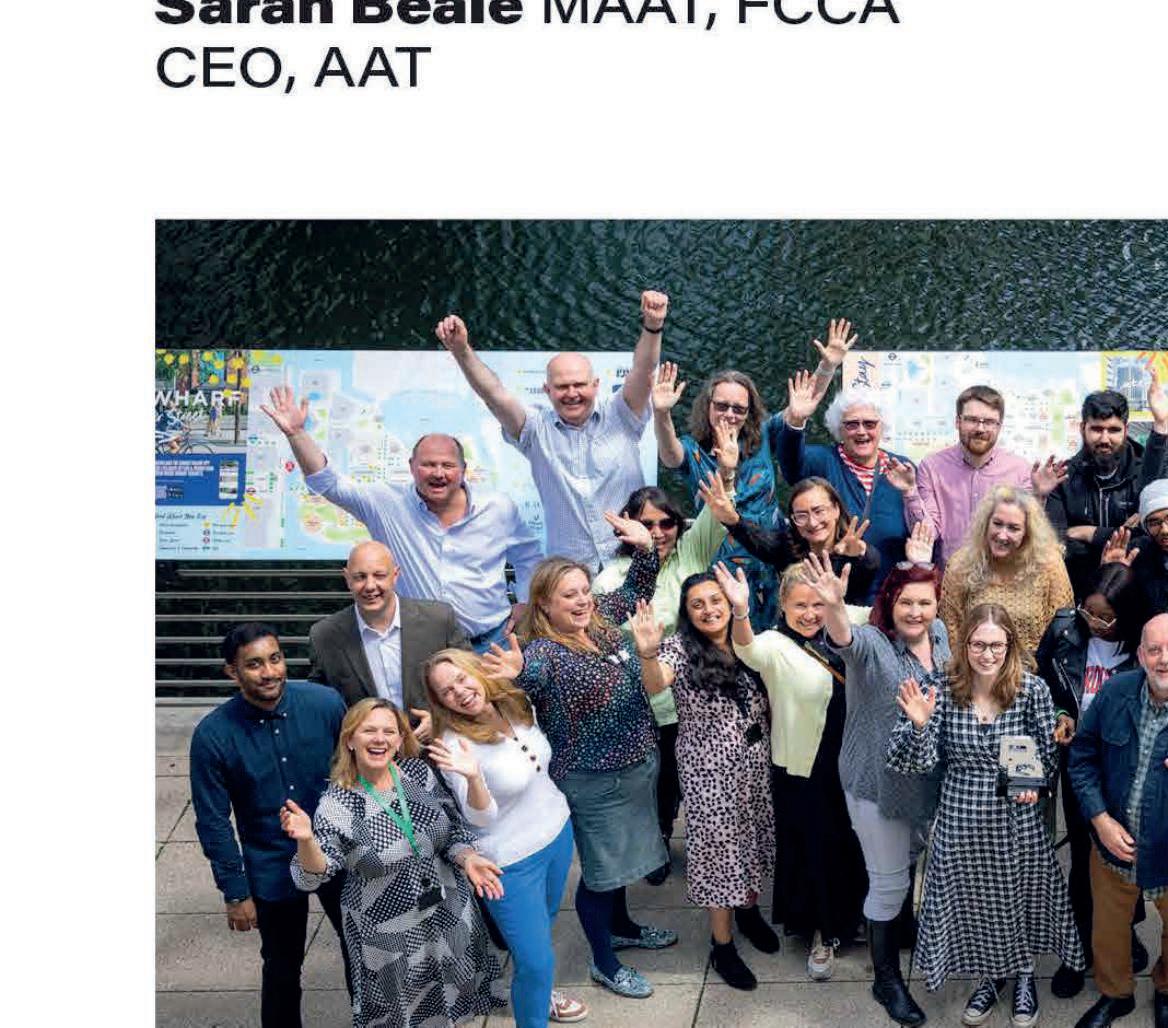



Advisory Forum members’ recent celebration
PREM SIKKA

The true cost of maximising profits
Recent statistics show that 4.3m UK children, 30% of all children, are living in poverty. This is the highest rate of child poverty since records began 20 years ago.
Low wages are a major reason. The median UK pre-tax wage is £28,572, with regional variations, and in real terms is lower than in 2008. Workers have received virtually no benefit from post-crash economic growth.
In 1976, at the height of trade union membership, workers’ share of gross domestic product (GDP) in the form of wages and salaries was 65.1%. Now in the era of zero-hour contracts, fire and rehire of workers at lower wages, that share has shrunk to around 50% of GDP. There has been a huge transfer of income and wealth from workers to corporations, shareholders and executives. The social consequences are insecurity, poverty, food banks and lack of access to good food, housing, education and pensions. Millions of lives are blighted.
There are plenty of accounting books inculcating students on how to squeeze workers to increase profits for absent shareholders. Few have anything to say about the social cost of profit maximisation. Students are encouraged to believe that wages are a cost, or a burden, which must be minimised. Little attention, if any, is paid to equitable distribution of income. How do accountancy bodies reconcile this with their claims of social responsibility and producing ethical accountants?
Prem Sikka is Emeritus Professor of Accounting at the University of Essex
Tax briefs
Tax advice market changes
How would you regulate the tax advice market? It is a question HMRC is asking and there are three options on the table:
Mandatory membership of a recognised professional body (RPB).
A hybrid option of RPB regulation of their members, with HMRC regulating non-member tax advisers.
Regulation by an independent statutory government body.
New course in EU sustainability reporting
AICPA & CIMA has joined forces with PwC to offer training to help accounting and finance professionals embrace EU sustainability reporting standards.
The new e-learning NASBAcompliant course, ‘Introduction to the European Sustainability Reporting Standards’, provides a comprehensive overview of the mandatory EU sustainability reporting standards and their application.
The initial learning path includes three modules:
• Introduction to cross-cutting standards (ESRS 1 and ESRS 2).
• Introduction to environmental standards (ESRS E1–E5).

• Introduction to social and governance standards (ESRS S1–S4 and G1).
Upon completion of the 2.5hour training, participants will be issued with a co-branded certificate
Salaries on the up
Competition for accountancy talent has meant most accountants (62%) received a pay rise in 2024, according to the latest GAAPweb salary survey.
The average salary for accountants was £52,447, with PQ accountants earning £40,000, a jump of 7.6% on 2023 figures.
Tech industries are the place to be if you are following the money. Shortages mean that many recruiters have turned to salary
Sign of the times
In a UK first, the AAT sponsored British Sign Language (BSL) interpretation at Accountex in London.
The interpreters are part of a new collaboration between the qualifications and skills provider and event organisers that sees AAT named Accountex’s first-ever ‘Accessibility Partner’.
AAT’s chief executive, Sarah Beale, said she was delighted with the partnership because it was an
Requiring all tax practitioners to register with HMRC would be a good first step. Not surprisingly, most professional bodies prefer the first option. However, the Chartered Institute of Taxation warned: “Requiring tax practitioners to sign up to a professional body will help tackle the practices of rogue advisers in the market, but is not a ‘silver bullet’.”
When is £51 million not enough?
The government’s (before the
incentives to both retain and attract new staff. Bonuses are very prevalent in the industry, with 78% of accountants receiving a bonus in 2024.
The survey found that flexible set-ups are now the norm for many working in accountancy.
It wasn’t all good news, with the survey finding 2024 bringing increased volatility across the sector, “with restructuring and redundancies infiltrating the

opportunity for the charity to put its values of openness, inclusion, and accessibility into practical action – making sure AAT and the accounting profession is relevant
election) announcement that it will provide £51 million in new funding for HMRC’s customer services was welcomed by many in the accountancy industry.
However, as ICAEW’s Caroline Miskin pointed out, the Revenue will have to find and train up staff, so there will be a lag before any improvements are seen. So any boost to HMRC customer services from this funding is unlikely to be seen until the autumn and services level may actually drop in the meantime.
of completion. For pricing and further details on the Introduction to the European Sustainability Reporting Standards visit the course homepage. For an array of AICPA & CIMA resources on sustainability and ESG visit aicpa-cima.com/esg PwC’s Gabor Balazs said: “We believe that knowledge on sustainability reporting, particularly on the requirements in Europe, will be essential for finance professionals within and outside of the European Union. PwC is proud to provide upskilling on this crucial topic – sharing insights and contributing to the increase of knowledge in this crucial new frontier in corporate reporting.”

headlines”. That in turn means 20% of respondents now see job stability as the most important factor in their job search.
For more on the salary go to page 21
to all.
“This new partnership with Accountex brings the first of what I hope will be many more important accessibility measures to come, all with the aim of opening up this incredible, world-class event to our whole professional community in all its wonderful diversity,” said Beale. Accountex also takes place in Manchester. AAT’s new partnership will cover both events, for both this year and 2025, ensuring BSL interpreters and other accessibility measures are in place.
WHO says extend sugar tax now!
The World Health Organisation has said that the sugar tax now needs to be extended to cakes, biscuits and chocolate. The sugar tax on soft drinks has been such a success in improving people’s diet that the WHO believes the reformulation of food will go some way in addressing the growing crisis in tooth decay, obesity and diabetes.
Researchers found the sugar tax had better outcomes than the UK’s sugar reduction programme.
8 PQ the PQ Magazine July 2024 news
Labour wants carbon footprint published annually
Shadow Climate and Net Zero
Secretary Ed Miliband recently announced plans to introduce new net zero laws that will force big firms and banks to limit their carbon footprint to align with UN climate goals in the event of a Labour election victory.
If and when the new laws come into force, company directors would be legally obliged to publish their company’s carbon footprint every year.
Richard Singleton, ESG and Finance Director at leading
More mocks please!

business advisory firm Menzies LLP, believes that while these laws directly target large businesses, the impact will cascade throughout supply chains.
He said: “This move, if it does come into force, signals the UK's much-needed commitment to catching up with the EU’s leadership on climate action. This also sends a clear message that ESG reporting is transforming from an option into a necessity across all business sectors. While smaller businesses may face challenges adapting to new regulations, they must also act now to establish best practices in collaboration with advisors and get their reporting in order, even on a smaller scale.”

AAT’s Student Advisory Groups have been a massive hit, with both the AAT and the students involved. Important communication channels have been opened, and students on the advisory groups have been given real power to change things. There are three groups, for levels 2, 3 and 4, and the strongest feedback from the last set of meetings was a need for
more mock exams and better feedback on exam results. Currently there are two mocks on the AAT platform – students say four would be better. AAT promised it would be
looking to see if it could make these proposals a reality.
The last meeting in the series took place at AAT HQ, and the first set of volunteers will be retiring soon. AAT will be looking for new members (so watch this space).
• The AAT Student Advisory Groups initiative recently won the PQ magazine Editor’s Award at our 21st ceremony (pictured).
LITRG wins top award
The work of the Low Incomes Tax Reform Group (LITRG) has been recognised with a prestigious tax award.
It won ‘Outstanding Contribution to Taxation in 2023-24 by a Not-forprofit Organisation’ at the recent Tolley’s Taxation Awards.
The award recognises the important role played by non-profits in the tax world, and LITRG received the award for its work providing guidance and campaigning to make the tax system work better for those unable to pay for advice.
The other organisations nominated in the category were the Association of Taxation Technicians (ATT), the ICAS Tax Team and The Crypto UK Tax Working Group.
Victoria Todd, Head of LITRG, said: “We are thrilled to have won this award, which is testament to the hard work of our team and our volunteers. Last year marked the 25th anniversary of the start of LITRG’s work to make the tax system better for those least able to afford tax advice.”

PQ 9 PQ Magazine July 2024 PQ news
ANNA KATE PHELAN

Flexibility is key to inclusion
The chief executive of the Institute of Certified Bookkeepers’ (ICB), Ami Copeland, recently visited Eintech’s offices to discuss all things assessment. The ICB is a remarkable organisation, serving as both an exam board and a professional supervisory body for bookkeepers, consistently going the extra mile for its members and students.
A key point in our discussion was the availability of different test modalities, such as taking exams in a test centre or at home, which helps create a more level playing field for candidates.
With 78% of ICB members being women, the flexibility that a career in bookkeeping offers is a significant factor. Online and on-demand exams attract a diverse pool of students and members, including parents with caring responsibilities and individuals with neurodivergent conditions. This inclusivity is vital in today’s evolving workplace, where balancing professional aspirations with personal commitments is often a challenge.
Copeland highlighted the importance of ensuring assessment methods meet the needs of all members, keeping the bookkeeping profession accessible and appealing to a wide range of individuals. As technology drives every industry forward at an unprecedented rate, it is crucial that equity and inclusion develop in parallel. By embracing these values, the ICB ensures that everyone is brought along for the ride, fostering a diverse and dynamic profession. This forwardthinking approach not only benefits individual bookkeepers but also strengthens the entire industry – and the wider economy.
Anna Kate Phelan is Head of Product at Eintech

Bookkeepers rule!
You can forget about bookkeepers being just an accountant’s administrative underdog – they are innovators, entrepreneurs and change makers, according to the latest state of the nation survey from the Institute of Certified Bookkeepers.
The research also showed the true accessible nature of bookkeeping. It found 76% of bookkeepers do not have a degree, and 43% don’t have an A level.
The money is good, too. Some
20% of bookkeepers earn over £40,000, and the vast majority (60%) earn between £20,000 and £40,000.
ICB CEO Ami Copeland (pictured) explained: “Many of our bookkeeper members start out working part-time to earn extra while juggling other commitments. But the demand for good bookkeepers means their businesses rapidly grow. These bookkeepers are changing their families’ lives and bringing financial
CIOT prize winners are…
CIOT outgoing resident Gary Ashford recently hosted the prize winners from the November 2021, May 2022, November 2022, May 2023 and November 2023 sittings for the Chartered Tax Adviser (CTA) examination, at the CIOT Admissions Ceremony held at Drapers’ Hall, in the City of London. The CIOT prize winners from the May and November 2023 were: May 2023 CTA examinations: Owen Apedaile, Institute Medal; Samantha Townsend, Gilbert Burr Medal; Jessica Heinen, Victor
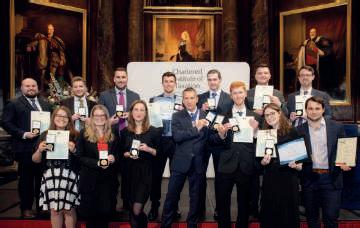
Durkacz Medal; Hollie Parker, Spofforth Medal & Croner-i Prize; Mandar Bhusari, John Beattie Medal; Thomas Andrews-Faulkner, Ronald Ison Medal; Andrew Bywaters, John Tiley Medal; Cameron Murgatroyd, Wreford
ICAEW offers £5,000 prize
ICAEW has invited research proposals into the simplification of the UK’s VAT system to be submitted by 30 June 2024.
The winning entrant will receive a £5,000 prize and the opportunity to present their research at a VAT Conference to be held at Chartered Accountants’ Hall in London in 2025.

prosperity to themselves and their clients. No wonder we’re seeing more and more people lining up to become Certified Bookkeepers.”
You can check out the full results at https://tinyurl.com/36rypwwz
Voge Medal; Zoe Dixon, Ian Walker Medal; Jordan Kelly, Avery Jones Medal; George Apps, Chris Jones Prize.
November 2023 CTA examinations: Nicholas Skidmore, Institute Medal; Jack Saunders, Gilbert Burr Medal; Alex Gear, Victor Durkacz Medal; Isobel Kimber, Spofforth Medal; Zoe Dixon, John Beattie Medal; Paul Moth, Ronald Ison Medal; Shannon Goodwin, John Tiley Medal; Jessica Heinen, Wreford Voge Medal; William House, Ian Walker Medal; Shona Barker, Avery Jones Medal; Matthew Poole, Chris Jones Prize; Jack Saunders, Croner-i Prize.
potential impact of a modernised VAT system on consumer behaviour, economic growth and fiscal stability.

ICAEW is seeking innovative and practical ideas, in no more than
KPMG Switzerland and UK merge
Partners at KPMG Switzerland and KPMG UK have voted overwhelmingly in favour of merging their partnerships and will become a new $4.4bn business, working across audit, tax and legal, and advisory.
This will make the firm the second largest in the KPMG network by some distance. Jon Holt, chief executive and senior partner of KPMG UK, said: “This marks a historic moment for both firms. We will be stronger as one combined firm and together we will have the scale to significantly enhance our ability to deliver great outcomes for our clients both internationally
2,000 words, on how to reform the UK’s VAT system to meet the challenges of the coming decade. The successful proposal will need to identify current challenges within the system and explore the
and within our domestic markets.”
The new partnership will mark its first day on 1 October 2024.
PwC accelerates adoption of AI with ChatGPT deal
PwC has said it is accelerating the adoption of AI with ChatGPT Enterprise in the UK and US and with clients.
PwC said that through ChatGPT Enterprise its workforces gain access to the most powerful version of ChatGPT, along with enterprise-grade security and privacy. They will also benefit from access to the latest tools, which will include OpenAI’s recently announced ChatGPT-4o model and new capabilities focused on voice and image. For example, PwC are already
Ed Saltmarsh, ICAEW technical manager, said: “The UK has one of the most complex systems of VAT in the developed world, hindering businesses and HMRC, and the numerous exemptions and zero rates create uncertainty and can lead to absurd disputes, such as whether poppadoms are crisps or Jaffa cakes are biscuits.”
developing custom GPTs to help its workforce with reviewing tax returns, proposal response generation, software lifecycle assistants, dashboard and report generation and more.
How do you drive?
Younger drivers are more likely than older age groups to favour a subscription service for cars over ownership, according to new research from Deloitte.
Based on responses from over 1,500 UK consumers, Deloitte’s Global Automotive Consumer Study found that while over half of consumers (52%) show no interest in car subscription models, one in five consumers of all ages (18%) were in favour and this interest increases significantly among 18-34-year-olds (to 28%).
10 PQ the PQ Magazine July 2024 news
WŝĐŬ�,d&d ĨŽƌ���d�
�e h�ve � ��n�e o� live cou��e� �o� ��d�>ĞǀĞů�ϯ��nd >ĞǀĞů�ϰ�unde� YϮϬϮϮ, �o co��le�en� ou� on�de��nd o��ion� �� ��� �� �nd ��� ,d&d live� ��e��eco�ded ��ll��u� video� �h�� le�d in�o �cheduled live online in�e��c�ive ����e�cl���e� ��i�h e��e�� �u�o���� �ll de�i�ned �o �u��o�� �ou� ����e�in� o� �no�led�e –�cco���nied �i�h co��u�e� ���ed �e��� �nd �oc� e���� �o� �o�e in�o����ion vi�i� ����h�������ne��hi��co�u��cou��e������



dŚŝŶŬ������ƚŚŝŶŬ�,d&d
�e h�ve � �ull �ui�e o� ������ƉƉůŝĞĚ�^ŬŝůůƐ��nd ^ƚƌĂƚĞŐŝĐ�WƌŽĨĞƐƐŝŽŶĂů�cou��e�.
▪ �e��e��hi� o� ou� vi���n� KŶůŝŶĞ�>ĞĂƌŶŝŶŐ��ŽŵŵƵŶŝƚLJ �nd �cce�� �o � dedic��ed �u�o�
▪ ���� ����ne��hi� ��uden� no�e� �nd ���� �u�ho�i�ed ��ud� �e��� e��� �i� �nd �oc�e� no�e�
▪ �ull ��ll��u�� �o�ic �� �o�ic �eco�din�� �u��o��ed �� �i�e���led ‘live online’ dƵŝƚŝŽŶ ����e�cl��� �e��ion� –�eco�ded� do�nlo�d��le �nd �l����le on �ll device�
▪ Scheduled ‘live online’ ZĞǀŝƐŝŽŶ ����e�cl��� �e��ion� – �eco�ded� do�nlo�d��le �nd �l����le on �ll device�
▪ ���� co��u�e� ���ed �e��� �nd �oc� e����� ����ed� �i�h �n��e�� �nd video de��ie�� �o� �o�e in�o����ion vi�i� ����h�������ne��hi��co�u��cou��e���cc��
^ƚƵĚLJ��/D��ĐŚŽŽƐĞ�,d&d
S�ud�in� ����� �u� ,d&d live� ,d&d on�de��nd �nd ,d&d �l�� �e�ou�ce� ��e �ll he�e �o hel� �ou ��e���e �o�� �nd ����� �ou� e����
,d&d live� �oin ou� e��e�� �u�o�� live online �o� in�e��c�ive ����e�cl���e�� de�i�ned �o �u��o�� �ou� ���lic��ion o� ��ll��u� �no�led�e�
,d&d on�de��nd� d�ive �ou� le��nin�� �i�h �ull �le�i�le �e�ou�ce� �h�� �ou con��ol
,d&d �l��� �o��e�� o� �o�ic �eco�din� �nd ��o�icienc� e�������le ���c�ice ���e���en�� �o� �o�e in�o����ion vi�i�� ����h�������ne��hi��co�u��cou��e��ci��




^ ^ƚƚƵĚLJ ǁŝƚƚŚ , ,dd&d d WĂƌƚƚŶĞƌƌƐŚŝƉ ǁŚLJ ǁŽŽƵůĚ LJŽŽƵ ŐŽ Ž ĂŶLJǁŚĞƌĞ ĞůƐĞ tŚLJ ǁŽƵůĚ LJŽƵ ŐŽ ĂŶLJǁŚĞƌƌĞ ĞůƐĞ &Žƌ ŵŽƌĞ ŝŶĨŽƌŵĂƚŝŽŶ ĞŵĂŝů ŝŶĨŽΛŚƚĨƚƉĂƌƚŶĞƌƐŚŝƉ ĐŽ ƵŬ ǁǁǁ ŚƚĨƚƉĂƌƚŶĞƌƐŚŝƉ ĐŽ ƵŬ KŶůŝŶĞ��ŽůůĞŐĞ�ŽĨ� ƚŚĞ�zĞĂƌ�ϮϬϭϳ WĞƌƐŽŶĂůŝƚLJ�ŽĨ� ƚŚĞ�zĞĂƌϮϬϭ WƌŝǀĂƚĞ�^ĞĐƚŽƌ��ŽůůĞŐĞ� ŽĨ�ƚŚĞ�zĞĂƌ�ϮϬϮϬ
EDDIE HERBERT Help is at hand for SMEs

As global efforts to combat climate change intensify, businesses of all sizes face pressure to reduce their carbon footprint. While large firms often have resources for climate consultants, small and medium enterprises (SMEs) do not. This disparity is not just a handicap; it’s a catalyst for SMEs to embrace innovative approaches to carbon management.
A big hurdle for SMEs is the time and resource crunch, where employees juggling multiple roles struggle to give carbon accounting the attention it requires.
Net Zero Now, the industry-endorsed carbon accounting software for SMEs, is changing this landscape with its ‘Sector Protocols’—sector-specific Net Zero roadmaps developed with industry partners. These protocols provide clarity on how SMEs can achieve Net Zero and a consistent standard for assessing their efforts.
The Net Zero Now platform mirrors these protocols, offering SMEs a dedicated path to calculate, reduce, and disclose their emissions. Upon meeting certain criteria, businesses can receive Net Zero Now Certification Marks, allowing them to communicate their achievements to stakeholders.
By using Net Zero Now, SMEs can gain insights into inefficiencies, leading to cost savings. As sustainability becomes a priority, certified SMEs can gain a competitive edge in tenders and are better positioned for compliance with new regulations.
Net Zero Now's sector-led approach and certification transform a global challenge into an opportunity for SMEs, fostering efficiency, and growth in the low-carbon economy.
Edward Herbert, Sales & Business Development Manager, Net Zero Now
Over 18m GenAI users
Some 18 million people in the UK have now used Generative AI (GenAI), according to Deloitte’s 2024 Digital Consumer Trends research, based on a survey of 4,150 UK adults aged 16-75.
In the UK, three in five (60%) people are now aware of GenAI and over a third (36%) have used a GenAI tool, an increase of 26% (13 million people) from May 2023. However, notable gender and age gaps were apparent in the findings
Quickbooks Ledger launched
Intuit Quickbooks has launched Quickbooks Ledger, a costeffective plan for accounting and bookkeeping professionals to help them service clients with basic accounting needs, including yearend filing.
Accountants and bookkeepers often need to manage clients of varying sizes on different platforms and want to standardise this process. They also need a costeffective way to transfer data from spreadsheets into the cloud. However, for low-transaction clients, it may not always make sense to invest in a full online solution.

New QuickBooks Ledger makes basic accounting more accessible to firms by providing an affordable solution that enables accountants
and bookkeepers to fully bring their practice into the cloud, which in turn increases efficiency, improves team outcomes and accelerates growth.
Intuit QuickBooks’ Nick Williams (pictured), says: “A key challenge we hear from accountants and bookkeepers who service clients across multiple platforms with different needs is that this can be a huge barrier to efficiency, output, and growth. To solve this problem, we developed QuickBooks Ledger to standardise this process –allowing accountants to streamline operations by bringing more clients on to one platform.”
FreeAgent and Client Engager join forces
FreeAgent has agreed a new partnership with practice management and pricing software company Client Engager
The two companies have joined forces to build a new data integration between their software systems. This will mean workflows and checklists in Client Engager will automatically trigger activity in FreeAgent, allowing users to keep track of all deadlines centrally, saving them time and hopefully reducing errors. In addition, users will be able to sync new clients.
FreeAgent’s Stewart Hurd
Time to invest in AI
Over a third of UK employers are bullish about AI investment despite serious workforce uncertainty.
New research shows that 35.3% of employers are actively investing in GenAI while 40.4% plan to increase their use of the technology to support the workplace. That’s
with 43% of men having used GenAI, compared with just 28% of women. The technology is also primarily used by younger groups, with 62% of people aged 16-34 having actively used it, compared with only 14% of 55-75 year olds.
The Dextension extension
Dext has released Dextension, a new browser extension to its automation platform. Available for free to all Dext users via the Chrome extension store, switch it on with one click to

said: “We expect this integration between FreeAgent and Client Engager to become even deeper and more sophisticated in the future, which will benefit
according to new research from SD Worx, the leading European HR solutions provider.
The findings reveal a surprisingly buoyant business outlook for AI adoption at a time when the UK government begins to craft new legislation to regulate AI. The move on regulation comes as the competition watchdog expresses increased concerns about the industry. However, despite businesses betting big on AI
unify their software experience.
The browser extension provides many features that streamline accounting workflows and adds critical context to dashboards and bank reconciliation by allowing users to see attachments and request missing paperwork directly to where they do that work.
Dext’s Stephen Edginton said over 500 users have helped refine the extension, and he promised Dext will continue to enhance it to further automate bookkeeping and save time.
accountants and bookkeepers even further.”
In a separate move, FreeAgent has partnered with Xenon Connect to ‘make bookkeeping errors a thing of the past’. Using twoway integration, Xenon Connect performs daily checks on FreeAgent data, identifying issues such as unreconciled transactions and duplicate invoices. The software then ranks these issues by importance, suggests fixes and syncs corrections with FreeAgent once resolved within Xenon Connect.

investment, similar enthusiasm isn’t shared by employees, with 30% of UK workers fearing their roles will be made redundant as a result of GenAI.
New updates for Sage Intacct
Sage has announced new capabilities and updates for Sage Intacct.
The company’s Dan Miller said: “This latest release helps organisations strengthen their financial controls and simplify operation, while delivering significant time savings.” A key new feature is the introduction of AI-powered timesheets – which has technology intergrationand real potential to significantly impact on productivity and accuracy.
12 PQ the PQ Magazine July 2024
Tech briefs tech news
Easily create accurate practice exams with Rogo’s question types, matching the new formats from AAT assessments.












Get
head around the new question types from AAT.
Rogo.
Visit getrogo.com to learn more
your
Get

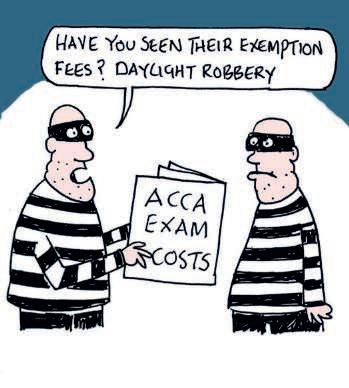
Drop exemption fees please!
So the ACCA have been raising exam fees above inflation yet again. That is two years in a row we have seen 5%-plus rises.
There is one way that ACCA could soften the blow, but it’s never talked about – exemption fees. If we are exempt, why do we still have to pay such high prices for an exam we didn’t sit? It seems counterintuitive to me to charge £123 for my Applied Skills exemption when I don’t cost ACCA anything like that. It just seems a very expensive historical administrative cost.
The problem is that exemption fees have been coming in for years and the
Our
money helps balance the ACCA books, but surely it is something that needs looking at again.
I have just read online that CIMA is still the only international accounting body
in the world that won’t charge you for exemptions. This, they rightly say, will save me money, time and stress. CIMA students save themselves £1,000 in exam fees right away.
Come on, ACCA, don’t leave CIMA to be the only ones: stop charging for exemptions, please!
It’s too late for me, but I think such a move would really engender a positive feeling when people join ACCA, rather than many thinking, “I have just paid for my degree, now I am paying ACCA for things I have already studied and they say are of a high enough quality for me not to sit their exam.”
Name and email address supplied
star letter writer wins a fantastic ‘I love PQ’ mug!
What a woman!
Well done ICAEW and PQ magazine for highlighting the story of Mary Harris Smith, the first female chartered accountant (PQ, June ’24, p4).
She must have been a remarkable woman, and to achieve membership at the tender age of 75 years old – wow! But it took nearly 30 years of persistence to get there.
It is a shame that it was the passing of the Sex Disqualification (Removal) Act in 1919 that allowed it to happen. The ICAEW could not continue to bar women from membership after that.
She had first approached the ICAEW in 1891 to join them, and according to the story it was a lawyer who stopped her joining. The solicitor said women were not eligible as the charter referred to ‘his’, ‘himself’ and ‘he’ and not ‘her’, ‘herself’ or ‘she’!
Some felt women needed to set up their own body, which might have been an interesting development.
I was pleased to see that she also has a blue plaque in the City of London. At the time it was only the third in the area to celebrate an individual women (three out of 182). It stands on the corner of Queen Victoria Street and Bucklersbury,
marking her offices.
A proud female ACA – name and email address supplied
Diversity is important
I was surprised you ran a story that diverse management teams don’t boost profits (PQ magazine, June ’24, p6). Whatever the outcome of this one project, the need for more diversity on boards has never been
Robert Bruce, Prem Sikka, Lisa
If you have any problems





ACCA recently told students that both December exam results dates for 2024 and 2025 will be released five days later than normal.
That means instead of waiting up on a Sunday night for the results to come through on the Monday they will have to wait up on a Thursday night instead.
Interestingly, the ACCA also announced that there will be no late entry period for the March 2025 exams.
Entry for the March 2025 exams will have a standard deadline of 27 January, and no late entry period.
PQ magazine posted the news on Facebook, LinkedIn and X, as we do.
Students were not thrilled with this. As one said: “Ridiculous. With the exam entry fees increasing for the second time in the year, taking more than 5 weeks to get results is just not acceptable…” Another PQ said: “Great, December is when I’ll be (hopefully) sitting my final exam! I’ll have to wait an extra week to find out if this hell if finally over!” ACCA has also published its policy prospectus for the UK and is pushing it on social media.
more apparent. I really don’t know what this research even proves. If diversity management doesn’t boost profits at least they don’t make them go down.
Come on PQ magazine, you can find better stories than this!
Name and email address supplied
The Editor says: Fair point! But we simply reported on the research as presented. Anyone else out there got any thoughts on this?
‘Accounting for a better world: An ACCA policy prospectus for the UK’ sets out clear goals and aims that will help the UK strengthen its position on sustainable business, global trade, AI, and talent retention. It’s a five-point policy plan setting out how the accountancy profession can add value for the nation: Check it out at https://ow.ly/s15C50S86cY
PQ Magazine PO Box 75983, London E11 9GS | Phone: 07765 386489 | Email: graham@pqmagazine.com Website: www.pqmagazine.com | Editor/publisher: Graham Hambly graham@pqmagazine.com | Associate editor: Adam Riches | Art editor: Tim Parker Contributors:
Nelson,
Kate Phelan,
Kelly, Phil Gammon, Edward Netherton,
Subscriptions: subscriptions@pqmagazine.com | Origination services by Classified Central Media
with delivery, or
you want to change your delivery address, please email admin@pqmagazine.com Published by PQ Publishing Ltd © PQ Publishing 2024
Anna
Tony
Francesca Cullaney |
if
email graham@pqmagazine.com

ISSB gaining momentum
International sustainability standards start to take on a global look – apart from in the US of A!
Major economies around the world including Japan, the UK, Nigeria, Brazil and China have all recognised the value of ISSB standards. But not the US!
Jurisdictions representing over half the global economy by gross domestic product (GDP) have announced steps to use the International Sustainability Standards Board’s (ISSB) Standards or to fully align their sustainability disclosure standards with those of the ISSB.
A growing number of jurisdictions are moving ahead with or considering measures to ensure global comparability in companies’ climate and other sustainability-related disclosures by relying on the global baseline established by the ISSB Standards.
More than 20 jurisdictions have already decided to use or are taking steps to introduce ISSB Standards in their legal or regulatory frameworks. Together, these jurisdictions account for:
• Nearly 55% of global GDP.
• More than 40% of global market capitalisation.
• More than half of global greenhouse gas emissions.
European Union goes first
Many jurisdictions are seeking full alignment with or adoption of the ISSB Standards: the European Union was first. The Corporate Sustainability Reporting Directive established in June 2022 that the European Sustainability Reporting Standards would incorporate ISSB Standards to the greatest extent possible. That decision paved the way to a high level of alignment on climate and the interoperability guidance the IFRS Foundation and EFRAG recently jointly issued; the latest is China, where the Ministry of Finance of the People’s Republic of China issued the Exposure Draft of Chinese Sustainability Disclosure Standards for Business Enterprises – Basic Standard and Explanation of the Drafting. The draft formulates the unified China Sustainability Disclosure Standards based
on ISSB Standards, drawing on the beneficial experiences of ISSB Standards, aligning with China's context and showcasing Chinese characteristics.
Where is the USA?
Together, the 20-plus jurisdictions that have taken steps to adopt or otherwise use ISSB Standards account for around 75% of global market capitalisation, excluding the United States. In the US, when the Securities and Exchange Commission (SEC) recently issued a release in respect of their climatedisclosure rule they acknowledged similarities with the ISSB Standards. In acknowledging the role of the ISSB Standards and the range of jurisdictions currently considering requirements using the Standards, the SEC noted that the Standards are not yet integrated in those jurisdictional rules and, accordingly, declined at this time to recognise the ISSB Standards for use as an alternative to the SEC’s climate disclosure rules.
The progress towards the introduction of sustainability disclosure requirements globally reflects a significant response since IOSCO (the International Organization of Securities Commissions) announced its endorsement of ISSB Standards in July 2023. IOSCO called on its members, who regulate companies in more than 95% of the world’s financial markets, to consider ways in which their jurisdictions might adopt, apply or otherwise be informed by ISSB Standards within the context of their jurisdictional arrangements, in a way that promotes companies’ consistent and comparable climate-related and other sustainabilityrelated disclosures for investors.
16 PQ PQ Magazine July 2024 a sustainable world
ISSB launching IFRS S1 and IFRS S2
External analysis and the PESTLE model
Teresa Clarke explains how PESTLE can guide accountants and business managers in their strategic decision making

By analysing the environment that a business works in, we can understand how it works. We can use six areas to help analyse the impact of the business in the macro environment, or external environment. We can use the PESTLE acronym for this.
• Political
• Environmental
• Social
• Technological
• Legal
• Economic Political factors are government policies and goals. If the government changes a policy for the country, this could affect the business. Such changes could be how much to spend on the National Health Service, immigration rules or policies, plans for renewable energy sources, plans for building new train lines or roads, changes in planning rules for housing, and more.
Environmental factors are things affecting the environment. Protecting trees from being taken
down to make way for expansion. Ensuring that sustainability measures are in place to protect the planet, such as sourcing raw materials from sustainable sources.
Social factors are the changes in what society or people want or need. This could be because tastes or fashion are changing, attitudes of people towards sustainability or eco products could be changing, the demographic or the age of the customer market could be changing, or values may be changing towards inclusion of everyone.
Technological factors are the changes in technology. Technology is changing all the time, and a business needs to keep up-to-date with this, so it is not left behind.
Legal factors are laws (not to be confused with policies or goals, which are political). A business needs to keep up-to-date with laws such as health and safety law, employment law, data protection legislation and consumer protection laws.
Economic factors are changes that can
affect the economy as a whole, such as foreign exchange rates, interest rates, inflation and recession.
Example task
Michelle runs a hairdressing business. She is in the process of expanding from just one salon to four salons and a mobile unit. She will be offering services for men and women in the salons or in customers’ homes.
Unlike other similar businesses, Michelle has not built a website and she does not use a smartphone. All bookings are made by her landline telephone at the main salon, so when no one is there the calls are missed.
Explain at least two PESTLE factors affecting the future of the business.
Suggested answer
(Remember that your answers will be different to mine, but make sure you have justified your choices and explanations.)
Social: People are generally keener to make bookings online or via an app than by telephone. They often require an immediate response, so the lack of an easy booking system that is available 24 hours a day will put off many customers. Those customers may choose to book elsewhere as a result.
Technological: For that same reason, Michelle needs to keep up-to-date with technology changes to be able to keep competitive with other similar businesses.
Legal: There could be legal factors as Michelle will need to check any laws around visiting customers’ homes to carry out her services.
Environmental: Michelle will need to consider the impact on the environment by travelling to customers’ homes.
If you like my way of explaining things you might like my workbooks, which are all available from Amazon in both paperback and as eBooks. The links to all my workbooks can be found at https:// www.teresaclarke.co.uk/
• Teresa Clarke FMAAT is a freelance accounting tutor
PQ 17 PQ Magazine July 2024 AAT exams




Advance your career with an award-winning course or apprenticeship Flexible, inspiring and engaging. Mindful Education courses are expertly designed to bring learning to life and achieve outstanding results. Discover more mindful-education.co.uk/learners
ACCA exam feedback
Intro: How were the latest set of exams? We have the feedback from those who know – the sitters!
AA
Some sitters found section A tougher than they expected. As one sitter said: “Harder than previous past papers with a lot of tricky catchyou-out type questions.” The good news for many was the fact that the 30 marker and 2 x 20 markers were very similar to past papers. According to the Open Tuition Instant Poll, one in 10 found the exam a ‘disaster’ and another 23% said it was ‘hard’. That left 60% saying the exam was ‘OK’ and 7% found it ‘easy’.
PM
Overall, it was described as an OK exam – even good for some. However, sitters said they found the regression analysis question in section C ‘brutal’, one even said all they wanted to do was scream! There was someone sitting in front of one of those struggling “dancing in his chair” –he obviously had been revising the right topic. In the Open Tuition Instant Poll, one in four (24%) said the exam was a ‘disaster’, and another 36% said it was a ‘hard’ test this time around. Another third said the exam was ‘OK’.
TX
Sitters struggled with the wording of some of the questions. “It was like Google translate had been used,” one ventured. Others just said they hated TX! In the Open Tuition Poll, 53% ticked the ‘OK’ box, with 29% finding it a ‘hard’ paper, and 11% had a ‘disaster’.
FR
Students really didn’t seem to mind this session, and there were very few comments. Section B was where most students had problems. Some 55% voted the exam ‘OK’ on the Open Tuition Instant Poll. Another 24% ticked the ‘hard’ box, and 15% ‘disaster’.
FM
The June exam was described as “savage, there is no other word for it!” Another sitter said it was “an absolute disaster”. What upset sitters was the fact that the exam looked and felt nothing like the ones in any exam kit. Had anyone heard of the pecking order theory? It is in the syllabus! One in five (21%) voting on the Open Tuition Instant Poll said the exam for them was ‘a disaster’. Another 41% said it was ‘hard’ and just one in three (33.33%) felt the exam was ‘OK’.
SBR
Not a favourite exam this session, according to the poll. That said, many found Q1 ‘fairly easy’, even ‘a bit easy’. That was a worry in itself, as one sitter explained: “I found the paper easy going and this is strange and at the same time very scary, because I think that in this kind of papers you fail more easily because maybe there were a lot of traps.” Others found the question that asked them to apply various IFRS for the treatment of costs related to films tough. Some 41% said they found the exam ‘hard’ on the

Open Tuition Instant Poll. Another 17% felt the exam was ‘a disaster’, and just 38% said the exam was ‘OK’.
SBL
One sitter summed up what many thought, and liked the fact that the paper was “very common sense, rather than models, etc.”. For them that made it a good paper. Another said: “Overall the questions were nice, the 7Ps threw me but managed to remember five of them at least.” This all added up to the fact that June’s paper was ‘a disaster’ for just over 8% of sitters, according to the Open Tuition Instant Poll. Another 27% found it ‘hard’, but for nearly 60% the exam was ‘OK’.
AAA
Time management was a big problem for sitters. Spending too long on the first question just meant many ended up rushing the rest of the paper. As one PQ explained: “There were so many requirements in Q1 that confused me and took up too much of my time. Feeling so disappointed.” Nearly one in three (31%) of voters in the Open Tuition Instant Poll said the exam was ‘hard’, and another 14% had ‘a disaster’. That left 53% saying the exam was OK, and just 2% found it easy.
APM
“A very difficult exam” and “I did not enjoy that exam” were two comments we picked up from APM sitters. Too many students talked about rushing through the exam, knowing they were ‘messing up’. As one PQ said, it just made them feel miserable at the prospect of sitting APM again. The examiner also expects you to know your PM stuff, which can be difficult to recall if you sat the paper some time ago. That said, in the Open Tuition Instant Poll 41% of sitters felt the exam was ‘OK’. Another 36% said the exam was ‘hard’ and 19% had ‘a disaster’.
ATX
This June’s sitting was described as a “very tricky exam”, others just said they found it very difficult. This is backed up by the Open Tuition Instant Poll where a whopping 40% of sitters said they found the exam ‘hard’. Another 19% had ‘a disaster’.
AFM
An OK exam! Sitters liked the foreign NPV (section A, 50 marker). It was a ‘biggie’, but there were no funny adjustments and was just like previous questions. The Open Tuition Instant Poll bears out the comments, with 57% of voters ticking the ‘OK’ box. Some 24% found the exam ‘hard’ and another 16% had ‘a disaster’.
PQ 19 PQ Magazine July 2024 ACCA June exams
AAT Distance Learning AAT Distance





Get Started Today
Identify the right AAT qualication for you with Premier Training’s Skills Checks.
Your free online Skills Check is automatically sent to a Premier Training tutor who will advise you on which AAT level to study rst. Head to our website at www.premiertraining.co.uk for more details.
You can start AAT distance learning courses on any day and t your studies around your job and other commitments.
Interest-free instalment plans are available for all courses as well as FREE Xero training and certication.

Start your studies the same day24 hour online access with instant access to tutor support.
Learning Resources
Award winning learning resources including printed books, eBooks & e-learning, videos and quizzes.
Assignments
Prompt marking turnaround –marked by a tutor (not a computer).
Advisor Certication
Xero
Premier Training has teamed up with Xero and is pleased to offer the Xero Advisor Certication Equivalency Course FREE OF CHARGE to anyone who enrols.
info@premiertraining.co.uk 01469 515444
AAT: What level should I start at?
Training Provider Winner Distance Learning Provider of the Year AWARDS 2024 Study Resource of the Year
Benchmark your salary
What does the 2024 recruitment market have in store for accountants?

At the start of 2024 GAAPweb surveyed over 2,200 finance professionals to get the inside scoop on salaries, bonuses and employee expectations. The landscape of talent acquisition continues to evolve for accountants in 2024; shaped by changing workforce dynamics with return-to-office schemes and the ever-growing demand for skilled professionals. This year, the industry delivers on salary, bonuses and employees’ desire for flexibility, with 63.1% of accountants conducting a hybrid working schedule.
Average earnings
Some 62% of the GAAPweb audience received a pay rise in 2024, with 49% of accountants taking home an ameliorated wage. Despite employers’ budgets being under greater pressure, competition for suitably qualified staff continues. This fluidity is apparent within the

financial recruitment market, with candidates seizing the opportunity to negotiate their salary with potential employers. The average salary for accountants stands at £52,447 per annum, with PQ accountants earning £40,000 (a 7.6% uptick on 2023 stats).
Spotlighting industries
Some 36% of GAAPweb accountants work within an accountancy practice – a sector that delivers a median salary of £59,611, a 13.4% uplift on 2023 figures. The strongest demand, however, lies with those working in technology. In an age of emerging tech, with companies assessing and adopting newfound AI models, workers within the tech industry are in high demand. With candidate shortages prevalent across the sector it’s no surprise that recruiters have turned to salary incentives to attract and retain new talent.
In comparison, those working in banking/ finance and fintech have been bestowed a lower salary than usual. A 35% decline in average earnings, the financial challenges in fintech in particular have affected the sector’s pay.
Bonuses
An impressive 78% of accountants received a bonus in 2024 (a 56% uplift on 2023 figures), with:
• 20% receiving a 0-2% bonus
• 55% earning an additional 3-5%
• 17% taking home 6-9%
• 7% pocketing 10-20% of their salary
• 1% being supplemented 20% or more
The professional demographic
The ICAEW chartered accountant qualification (22%) just pips CIMA (21%) and ACCA (19%) this year as the most popular qualification amongst respondents, for the first time since 2018.
Of those who are qualified, 51% of CIMA candidates and 31% of ACAs work in senior or director roles. This accreditation pays dividends
in terms of earning potential, with CIMA-qualified accountants obtaining an average salary of £71,475.
Home-based or hybrid?
Flexible set-ups are certainly the norm for finance professionals in 2024. It’s worth noting that 63.5% of accountants declared a return-to-office ruling as a deal-breaker in their current role. The question remains whether flexible working is now seen as an expectation rather than a perk. Across the country, Scotland (87%) occupies the highest hybrid rate, followed by the Midlands (82%) and London (73%). With an enhanced employee map making global roles accessible to all, are those based in more rural and remote locations reaping the benefits that hybrid work has to offer?
The gender divide
This year celebrates a step towards equality, with female representation now equal to male across all echelons of accountancy. PQ accountants present a clear 50/50 divide, with chartered accountants falling in slight favour of women, with a 52/48 split.
Across the sectors, the accountancy practice sector is the closest to achieving gender pay parity, with a £1,000 discrepancy. Elsewhere, we see a clear chasm in pay, with those in transport (68% women) earning £26,759 less; construction (59% women, £4,222 less); and pharmaceutical (74% women, £5,982 less).
What’s most important to you in a role?
Some 28% of accountants denote salary as the utmost important factor within their job. Pay equity within a role has evidently surpassed hybrid working this year, with flexibility almost seen as a given rather than a perk.
Over the course of, and following the pandemic, job security was flagged as the top priority. This year, with a shift in attitude across the candidatedriven recruitment market, we see the trend return with a 15%-20% jump. This year brings increased volatility across the professional sector – with news of restructuring and redundancies in the headlines, it’s not surprising to see a return of concern over job stability.
Turn to GAAPweb
Overall, the finance sector has much to celebrate in 2024. Yet in order to boost loyalty, diversity, productivity and profit, firms must explore ways to level the playing field for accountants both in practice and in industry. Turn to GAAPweb for the latest developments and exclusive insights into the finance recruitment market – download the full report
Time to outsource your payroll

PQ 21 PQ Magazine July 2024 salary checker
A fully comprehensive professional payroll service offered for a very low monthly fee. My services will free valuable time to enable you to concentrate on other matters. Call Emma now for full details on 020 8803 6834/07889 885646 or email her at emmaarif@absaccounts-payroll.co.uk
Forward thinking
Ann Lamb discusses how you can build your study resilience through reflection and by envisioning where getting qualified can take you
It won’t be news to our students that embarking on the ACCA qualification is a significant commitment. It takes many hours of dedicated study and succeeding in rigorous exams, not to mention being able to evidence the possession of essential professional skills and having the sufficient practical experience to call yourself an ACCA member. As such, a balancing act between work, life and study is all part of the journey that students must carefully navigate.
During an intensive study period, it can be all too easy to get caught up in the noise and lose sight of why you started that journey in the first place. So, from time to time, it’s important to refocus on the aspirations you had when you first signed up as a future member. And, equally, to look back on how the steps you’ve taken so far in completing the ACCA qualification have taken you closer to fulfilling those ambitions. Doing so will help bring you clarity on how your progress through the qualification is supporting you in your professional development and career planning. Providing you with an important source of motivation to keep going and enhancing your study resilience.
Our latest professional insights reports highlight that those who achieve ACCA membership have endless career opportunities. In a changing world that has made being a professional accountant more exciting than ever before, our future members are equipped with the real-world skillset and ethical values to be the strategic forward thinkers who thrive in this environment of continuous change. Capable of making an immediate impact in all types of

organisations, public and private sectors, in industry and professional practice.
Just one way the ACCA qualification supports future members is by providing them with the digital skillset and ethical values to drive positive business change and build sustainable organisations. Ensuring those organisations act in the public interest and enriching society at large, through strong governance and the sustainable financial development.
Furthermore, the professional skills developed
Our career support
• The SA app contains a specific careers area which focuses on employability skills, job hunting advice and profiles of members, future members and employers to help you with your professional journey. Download the SA app in your app store.
• ACCA Careers – our award-winning global employability site for accountancy and finance professionals. Access jobs from around the world to make your next move. Access ACCA Careers here https://jobs.accaglobal.com/
• Careerwise podcasts – listen to the first couple of episodes of our new podcast series on careers and find out how to get your foot in the door – available in the SA app at https://tinyurl.com/26m6uh4x

through all the elements of the qualification will support future members take a leading role in the biggest challenges facing businesses and governments today. Skills such as effective communication, data analysis and commercial awareness all framed by a sound ethical framework to realise the opportunities presented by artificial intelligence, respond to climate change and champion the natural capital and environmental, social and governance (ESG) agenda.
We have lots of resources to help future members in their career planning. One of these being our Career Navigator (https:// careernavigator.accaglobal.com), which maps the specific aptitudes the ACCA qualification develops against current and emerging job opportunities. I’d encourage all our future members to visit the Career Navigator as part of their own reflections and forward thinking – it might just give you that extra ounce of motivation to make those career dreams a reality.
•Ann Lamb is ACCA’s Director of Professional Qualifications

22 PQ PQ Magazine July 2024 ACCA spotlight
Advance your career with a Mindful Education course or apprenticeship Discover more at mindful-education.co.uk/learners
AI ‘will give us productivity growth’
PwC’s first Global AI Jobs
Barometer makes for interesting reading – so how will it affect your job?
Sectors exposed to AI are seeing a huge increase in productivity, with UK employers willing to pay 14% wage premium for jobs that require AI skills, according to PwC’s inaugural 2024 Global AI Jobs Barometer.
Painting a positive picture of the impact of AI on global labour markets, the Barometer says the sectors more exposed to AI (meaning that AI can readily be used for some tasks) are seeing an almost fivefold increase in the rate of productivity growth globally.
The report, which analysed half-a-billion job adverts from 15 countries and explores AI’s impact on jobs, skills and wages, indicates the potential productivity gains for the UK through AI adoption. In the UK, the uptick in productivity in the sectors that are more exposed to AI (such as financial services, information technology and professional services) is marginally above the global average. With long-term productivity issues a hindrance to UK economic growth, AI could therefore help to bridge the gap with other nations, leading to increased prosperity and better living standards.
Rapid growth in AI jobs
Between 2012 and 2023, postings for jobs that require AI skills (those requiring technical skills such as machine learning) in the UK have grown 3.6 times faster than for all jobs, which is slightly more than the global average, where growth in jobs demanding AI skills has outpaced all jobs since 2016.
While in 2012 three in 1,000 job posts in the UK required AI skills, this jumps to nine in 1,000 jobs just over 10 years later. By comparison, in Singapore jobs that require AI skills have grown 13.5 times faster than all jobs.
While there has been rapid growth in jobs requiring AI skills, the report indicates that in sectors most exposed to AI demand for other skills could lessen. Although jobs in AI-exposed sectors are still growing, job openings in sectors less exposed to AI are growing 46% faster. The analysis highlights the need for workers to adapt and build new skills for the fast-evolving jobs

market. Indeed, 64% of UK CEOs said that AI will require most of their workforce to develop new skills in the next three years, according to PwC’s 2024 CEO Survey
Employers will pay more
As well as an increase in productivity, the report highlights the economic opportunity for workers. Jobs that require AI specialist skills carry a 14% average wage premium in the UK, with job adverts for lawyers with AI skills seeing a 27% wage premium, and database designers and administrators experiencing a 58% premium. Of the five countries analysed, the largest average wage premium is 25% in the US, followed by 14% in the UK, 11% in Canada, 7% in Singapore and 6% in Australia.
Mehdi Sahneh, Senior Economist, PwC UK, said: “Countries and sectors that have a high

demand for AI skills tend to see higher wage premiums, especially if there is a scarcity of skilled professionals, whereas in areas where there is a more abundant supply of AI talent, lower premiums are more likely. Although on the surface lower wage premiums may sound less favourable, all else being equal, they suggest a balance between labour supply and demand, and could potentially foster greater AI adoption and innovation over the long term.
“It’s also positive news that increased use of AI could turn the dial on productivity in the UK. Since the financial crisis, UK productivity has trailed that of all of the G7 nations, bar Japan, growing only 2.2% on average between 2008 and 2021. With the gap widening in recent years, AI could be the missing piece of the UK’s productivity puzzle, bringing a boost to the economy, wages and living standards.”
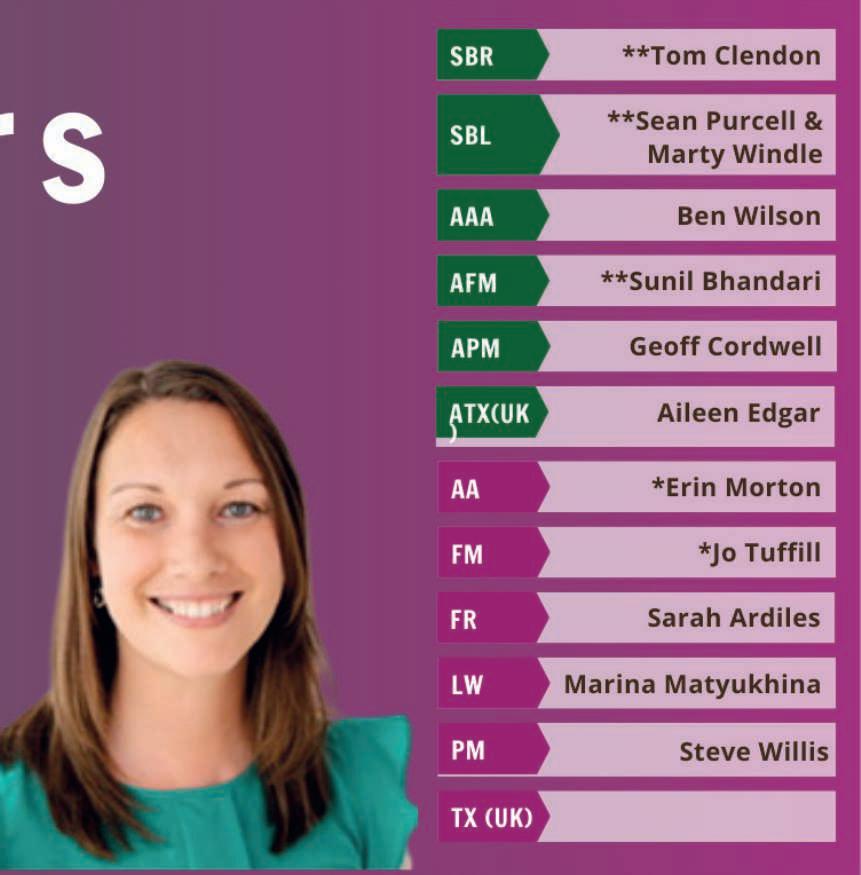
PQ 23 PQ Magazine July 2024 artificial intelligence
CPD: Staying abreast of regulatory changes
The IFA’s Jonathan Barber (pictured) underlines the importance of CPD in helping you keep up-to-date with regulatory changes
In the constantly changing landscape of accounting it’s crucial to stay abreast of the latest financial regulations to remain relevant. This serves as a reminder of the critical importance of CPD for both individual growth and the industry as a whole.
Once qualified, CPD helps accountants stay up-to-date with the latest changes, allowing them to maintain proficiency in the role and develop the skills needed to carry out their responsibilities to stay on the right side of the law. It’s also essential in order to maintain the validity and currency of their qualifications. It’s about reducing risk as much as enhancing trust and promoting competency.

HMRC has rolled out yearlong private Beta testing of its MTD for ITSA pilot, which started on 22 April 2024, involving firms with selfemployed clients or landlords earning an annual income of over £50,000. From April 2026, they will be legally required to maintain digital records and provide quarterly updates of their income and expenses to HMRC. From April 2027, this will include individuals earning over £30,000 a year. The MTD for CT pilot scheme is also now under way (as of 1 April), marking the beginning of mandatory participation from April 2026.
credits, HMRC will take action against fraudulent R&D claims, and some businesses may be required to repay previously claimed funds.
The Economic Crime and Corporate Transparency Act is set to bring about several changes in UK company law in the coming years, as it focuses on improving the accuracy and quality of the data on its registers, to help tackle economic crime and drive confidence in the UK economy. Since 4 March, Companies House has increased authority to investigate information, adopted stricter measures for company names, updated regulations for registered office addresses, and new lawful purpose declarations.
This momentum shows the crucial need for accountants to increase diligence where possible, while emphasising the key role CPD plays.
IFA Direct’s Online Education Programme
Some of the biggest regulatory changes to come into effect are now happening, with more being implemented over the coming years.
Introduced on the same date, the new R&D regime changes for accounting periods combines the previous RDEC and SME R&D relief schemes. Expected to greatly impact how businesses, especially SMEs, utilise R&D tax
More and more, CPD is being viewed as the upside to ongoing and increasingly complex regulation. As an internationally recognised professional accountancy membership body providing dedicated support to SMEs and SMPs, the IFA offers a huge opportunity for members to further their development and skills through IFA Direct, with multiple benefits for themselves, firms, the industry and clients. Ultimately, it builds trust, and surely there is no better outcome than that.
•Jonathan Barber is Executive Director – UK of the Institute of Financial Accountants

24 PQ PQ Magazine July 2024 IFA spotlight
ACCA Careers is dedicated to helping ACCA students develop their careers. With hundreds of entry level global job opportunities and over 400 career advice articles, we’re here to help you every step of the way. Visit jobs.accaglobal.com today
Who cares?
Dr William Burns asks the question about one of today’s political hot potatoes: who can fix the crisis in social care once and for all?


On 4 July 2024, people from across the UK will cast their ballots to elect a new government. While the NHS is commonly one of the most important issues on the doorstep, how an incoming government will address the crises in adult and children’s social care will have a huge impact on the lives of millions of people around the country.
Council costs consumed
To understand the importance of getting adult and children’s social care right, we need to know how much of a council’s resource is spent on these services. CIPFA’s Financial Resilience Index highlighted that, in 2022-23, nearly threequarters (74.4%) of the spend of councils with social services responsibilities related to adult and children’s social care. This is an increase of 60% since 2016-17. What’s more, local authority spending power has fallen dramatically since 2010 by over 10%, according to CIPFA and Institute for Government’s Performance Tracker 2023. Adult and children’s social care therefore comprise an increasing proportion of a reduced local authority funding envelope.
Current challenges
Thrown in to the mix are the adult social care pressures of increasing unmet need, a growing backlog, more complex care needs, a workforce crisis, unstable markets and delayed discharges.
In children’s social care, staggeringly costly residential placements are pushing councils to the brink, and gross total expenditure has ballooned by 26% since 2018-19. While councils are currently protected from huge overspends in special educational needs and disabilities (SEND) through a special financial mechanism, this arrangement is set to expire in March 2026.
A matter of manifestos
The Conservative government made big promises about reforming adult and children’s social care. Who can forget Boris Johnson standing on the steps of Downing Street the day after he had become Prime Minister when he promised to “fix the social care crisis once and for all”?
Yet the government did not fix the crisis in social care once and for all. Instead, 58% of the £1.7 billion earmarked for reform in 2019 was
redirected to current pressures, as observed by the National Audit Office. In addition, when the Independent Review of Children’s Social Care recommended an injection of £2.5 billion over four years to overhaul the children’s care system the government responded with an underwhelming £200 million over two years.
Labour has contemplated the idea of creating a National Care Service since the days of Gordon Brown. The best example we have of what this would look like comes from a detailed and practical report by the Fabian Society, commissioned by the Labour Party but not yet endorsed by them. At their annual conference last year, the Liberal Democrats pledged a £5 billion investment in adult social care reform, including a proposal for free nursing care in England.
Will any of the major parties give hope to councils and millions of people with an achievable vision for making social care fit for the future? We will see what the manifestos say when they are published.
Rising demand
Another challenge in both adult and children’s social care is the rising demand for services. In the past five years, requests for adult social care from new clients increased by almost 9%.
In children’s social care, the number of children in need is rising too, and has increased by 4% in the last five years. One of the major challenges facing an incoming government is how it can support local authorities to better manage rising demand.
CIPFA report
This year, CIPFA interviewed Directors of Adult Social Services, Directors of Children’s Services, and Directors of Finance to understand what councils across England are doing to approach the challenge of rising demand.
CIPFA produced case studies based on these interviews and has drawn out lessons in good practice in demand management. In adult social care, we discuss market management, transitions and transformation, and in children’s social care we discuss market management, early intervention and transformation. Finally, we set out the role of the public finance profession in achieving good practice in demand management. This work will feature in our forthcoming report ‘Managing rising demand for adult and children’s social care: Lessons from English local authorities’, set to be published this summer.
Whoever stands on the steps of Downing Street in July declaring victory must put adult and children’s social care front and centre in an ambitious programme of change. Our current position is unsustainable.
•Dr William Burns, CIPFA Social Care Policy Advisor
PQ 25 PQ Magazine July 2024 CIPFA spotlight
Poorest hit hardest again
Abolition of UK Shared Prosperity Fund to fund the proposed National Service scheme would be another setback for levelling up
The Conservative’s plan to abolish the UK Shared Prosperity Fund (UKSPF) to help fund the new National Service scheme would hit the poorest parts of the UK most, says the Institute for Fiscal Studies (IFS).
The Tories have estimated that, once fully operational, the National Service scheme would cost £2.5bn a year. They have said £1bn of the cash would be paid for from improved tax enforcement, and the remainder from the Shared Propensity Fund. In effect abolishing the fund, said the IFS.
The IFS explains that the UKSPF was set up following the UK’s departure from the EU. It replaces the regional economic development programmes and provides councils and regional mayors with funding to improve local social and economic outcomes – all part of the ‘levelling up’ agenda. The Conservatives have said that this funding is now only guaranteed until 2028 before it shifts to the National Service scheme.
The problem is UKSPF is a core part of levelling up funding and is targeted at the most economically disadvantaged parts of the UK. That means funding is particularly high for West

Funding is also significantly above average (£22 per resident) in East Wales, the Tees Valley, Northern Ireland and the North East mayoral area, and is higher in Scotland, the remainder of the North and the Midlands than in the South of England (excluding Cornwall).
The IFS said that how National Service funding would be allocated between military and community service and across the country is not yet clear. To provide all 18 year olds with access to the scheme, funding would presumably be largely distributed based on the number of
18 year olds living in different areas, rather than based on areas’ levels of socio-economic disadvantage.
This means that even after accounting for the spending on local young people via the National Service scheme, economically disadvantaged areas could collectively lose out on hundreds of millions of pounds.
IFS’s stats show that if the scheme goes ahead Wales would be £275m per year worse off, with Cornwall losing £72m and the North East and Tess Valley £46m.
CIPFA’s David Philips told Public Finance magazine he felt the proposal casts further doubt on the party’s commitment to ‘levelling up’. He said: “Abolishing it and channelling funding instead to a new National Service scheme would therefore represent a significant reduction in funding aimed at tackling geographic inequalities.
“Alongside repeatedly delaying much-needed reforms and updates to the local government finance system, this means a significant disconnect between rhetoric on the importance of ‘levelling up’ and actual funding policy.”

Proven to boost your exam results
Study Hub is proving to be a great success for ACCA students, increasing exam results by as much as 18%*. With online access to study chapters, practice questions, flashcards and short quizzes, it streamlines revision and enhances your understanding.
Use Study Hub as an essential part of your exam prep and boost your chances of success.


*Based on pass rates of Study Hub users vs. non-users for the September 2023 session-based exams.


26 PQ PQ Magazine July 2024 politics counts
Wales and the Valleys and Cornwall.
#ACCAStudyHub







How to pass SBL (part 2)
Top tutor Chris Cain continues his series looking at relevant data and analyses that you need for strategic marketing decisions
As I mentioned in part 1 of this article (PQ magazine, June ’24), the ACCA publish a syllabus and study guide each year that gives all the potential examination Tasks.
In syllabus area E it is Technology and data analytics. The detailed study guide 2 (Big data and data analytics) part (c) states that you should identify and analyse relevant data for strategic decisions on new product developments, marketing, and pricing.
Identifying and analysing relevant data for strategic decisions in marketing involves considering a wide range of factors to ensure effective planning and execution.
Here are key data points and analyses that are crucial for strategic marketing decisions:
Market and customer segmentation
Demographic data: Understand the age, gender, income and other demographic characteristics of the target audience.
Psychographic data: Explore lifestyle choices, values, interests and attitudes of the target market.
Geographic data: Understand regional variations in customer preferences and tailor marketing strategies accordingly.
Behavioural/customer engagement metrics: Assess metrics like click-through rates,
open rates and social media engagement to understand customer interactions.
Competitor analysis
Competitor marketing strategies: Analyse competitors’ advertising channels, messaging, and promotional activities.
Market share and positioning: Evaluate competitors’ market share and positioning to identify areas for differentiation.
Digital
marketing analytics
Website analytics: Review website traffic, user behaviour and conversion rates to optimize online presence.
Social media analytics: Monitor social media performance, including likes, shares and comments, to gauge brand sentiment.
Product performance data
Sales data: Evaluate sales performance by product, region and customer segment.
Customer feedback and reviews: Analyse product reviews and customer feedback to identify strengths and weaknesses.
Brand perception and awareness
Brand awareness metrics: Assess brand awareness through surveys, social media mentions and online visibility.
Brand perception surveys: Conduct surveys to understand how the target audience perceives the brand.
Marketing
campaign performance
Return on investment (ROI): Calculate the ROI of marketing campaigns to determine their effectiveness.
Attribution modelling: Use attribution models to understand the impact of different touchpoints on customer conversions.
Customer surveys and feedback
Customer satisfaction surveys: Assess customer satisfaction scores and feedback to identify areas for improvement.
Net Promoter Score (NPS): Measure customer loyalty and likelihood to recommend the brand.
Market trends and influencers
Industry trends: Stay informed about industry trends and emerging technologies.
Influencer marketing data: Evaluate the performance and impact of influencer marketing campaigns.
NOTE: Last month the author looked at assessing the severity and probability of risk events.
•Chris Cain is an approved trainer with PwC Academy


PQ 27 PQ Magazine July 2024 ACCA SBL
Registered Tuition Provider






Professional
Free
Local
Resources,
Accounting
Discounts

For more information and to receive 15% off your ICB Exemption application, call ICB HQ on 0203 405 4000 and quote ICBPQ Email us at exemptions@bookkeepers.org.uk www.bookkeepers.org.uk/PQ PQ with AAT, ACCA, ICAEW or CIMA? Why wait? Join ICB today!
track your career by using your existing qualifications to join the world’s largest bookkeeping organisation. As a Certified ICB Bookkeeper you’ll benefit from:
Fast
status and recognition
legal and technical advice-line
and national events
webinars, templates and help sheets
news, emails and updates
with 100s of retailers including Sainsbury’s, Tesco, ASOS, and Curry’s And being part of a community that really cares The Institute of Certified Bookkeepers
The Power of positivity
Nasheen Wuisman explains how you can help control the pressure and stress you feel in the run-up to an exam
When you first started picturing the day when you wanted to be CGMA qualified you would have envisaged great career prospects, well-deserved financial returns, the prestige of having the letters after your name and everything else that comes with it – one day all of this will be yours!
It is, however, hard to envisage the part in the middle – the learning journey. The intensity that it can hold, and the emotions involved on that journey. As with everything that is worth it this is inevitable; the hard work of study (while also balancing everything else that life throws at us) can feel overwhelming. This can lead to selfdoubt, especially in the lead up to the exams. You can feel like there is too much to do and question whether it is even possible. It is possible –absolutely possible!
The risk
Experience has shown that CGMA candidates can experience a dip in confidence during the exam preparation period about two to three weeks before exam day. Some candidates feel a general anxiety and they decide to reschedule their exams.
Sound familiar? So what can you do? The chances are you are already studying to the max, so pushing yourself even harder just brings on the risk of burnout. Instead, have a think about how you can introduce some balance to your routine and bring back that positive energy which got you studying CIMA in the first place.
A clear mindset
No effort can completely remove the stress of studying for challenging exams. After all, the reason the CGMA designation is so prestigious is that it requires hard work and dedication to achieve. However, a positive mindset can be the difference between being able to embrace the challenge and being overwhelmed by it. Mental clarity was our thinking when we developed the positivity pack, a light-hearted

resource to give you a little perspective during these intense study periods. It offers stress-busting techniques and effective sleep strategies along with book, music and film recommendations to help you stay centred when you need it most.
Investing some time in mindfulness strategies will enable your study time to be more effective. You will be more open to study and have an increased ability to absorb information and recall it.
Recharge
It sounds frivolous, but it is far from it. You really should be thinking about how you relax and switch off that ‘study mindset’ so you get the chance to recharge. Everyone is different, so how you do it is up to you. Some people like to lose themselves in music, books, shows and films. Some of these are for relaxing, others are invigorating and exciting, like uplifting music, a thrilling movie or an edgy book.
If you find that music is helpful to play while you are studying, resources like the Study with Me pomodoro video can help you improve your concentration and keep you company while you work.
De-stress
If you want to get the most out of your studies, you need to keep yourself healthy and manage your cortisol levels. Regular exercise is great for this – it does not need to be a huge lifestyle change. It is about simple things like taking a brisk walk away from your books and screens, breathing in that fresh air, feeling the sun on your face or maybe going for a swim to clear your head. These little activities can make an enormous difference to your exam preparations and mental well-being generally.
Study smarter not harder!
The key to successful studying is essentially breaking down the one big task (mastering the exam syllabus) into smaller, manageable chunks, like specific topics or concepts. And to do this you need a plan. Work out when you are going to revise each topic, and mark off your progress as you achieve it. Just looking at how far you have come will give you a boost and can allow you to be in better control of your exam preparation.
Decompress
Not allowing for this is actually one of the most common mistakes candidates make. Have you ever stayed up late trying to get your head around a complex topic and then suddenly realised you are still buried in books in the small hours of the morning? This can become a habit, causing you to feel tired, lethargic and unable to concentrate in the days and weeks to follow. Where this is something that you might do in the last few days before the exam it is important to make sure you get adequate rest. Try to do something relaxing to transition from study to sleep. In the long run, you will understand more and remember better.
There is no right or wrong way to balance rest, relaxation and study. You must do what works for you; do try to listen to your body and your mind. And remember, if you want to do the very best that you can in your exams, the power of a positive attitude will help you get there.
Always share your recommendations and strategies with your peers. There is nothing like mutual support to get you through the challenging times.
•Nasheen Wuisman, Senior Manager of Global Academic Progression at AICPA & CIMA, together as the Association of International Certified Professional Accountants




PQ 29 PQ Magazine July 2024 CIMA spotlight
Achieve global recognition with the CGMA® Finance Leadership Program. AFICIONADOS AFICIONADOS FINANCE WANTED
How to account for inventory
Karen Groves explains a subject that all AAT studiers must be familiar with

As part of your AAT studies you will need an understanding about how to account for inventory, which can include both raw materials and goods that are held for resale. Inventory is a current asset and must be included in the financial statements to reflect this.
IAS 2 Inventory states that we should recognise inventory at ‘the lower of cost and net realisable value’. The cost includes the purchase cost, costs to bring the inventory to its present location and any conversion costs. The net realisable value (NRV) is the estimated or actual selling price minus any costs to sell, for example selling and distributing.
At the end of an accounting period, the inventory is counted and valued. Inventory is shown in both the Statement of Profit or Loss (SPL) and Statement of Financial Position (SFP).
Let’s look at the Statement of Profit or Loss:
The cost of sales includes the opening inventory (this would be the previous year’s closing inventory), plus purchases, minus closing inventory. The closing inventory is deducted as this inventory will be carried forwards into the next accounting period.
The closing inventory will also be entered in the Statement of Financial Position, as a current asset.
The double-entry to account for the closing inventory would be:
Debit – Closing Inventory (SFP)
Credit – Closing Inventory (SPL)
Example
EC manufacture shirts. The following information has been provided:
Cost per shirt
£8
Selling price per shirt £2
Selling price £15
The value for each shirt in inventory would be as follows:
Each shirt in inventory would therefore be valued at £8, being the lower of cost and NRV.
Usually, the inventory will sell for a profit, so the NRV will be higher than cost. If inventory was valued at the NRV, this would include a profit element which is not allowed under IAS2. Occasionally, a loss could occur if the NRV was lower than the cost and, in this situation, the NRV amount would be used as the inventory valuation.
IAS2 also states that each inventory line should be valued separately, and not merged.
Example
There are two lines of inventory for company A. The details of the cost and NRV are as follows:
Product C has a lower NRV than cost, so this must be used for the valuation.
Question
There are three lines of inventory for company B. The details of the cost and NRV are as follows. Calculate the inventory valuation:
30 PQ PQ Magazine July 2024 AAT exams
£ £ Revenue X Less: Cost of sales Opening inventory X Purchases X Less Closing inventory (X) (X) Gross profit X
£ Cost 8 Net realisable value (£15 - £2) 13
Cost NRV £ £ Product E 250 325 Product C 120 110 370 435 Solution Cost NRV Inventory Valuation £ £ £ Product E 250 325 250 Product C 120 110 110 370 435 360
Cost NRV £ £ Product E 150 140 Product C 105 160 Product K 350 390 605 690 Solution Cost NRV Inventory Valuation £ £ £ Product E 150 140 140 Product C 105 160 105 Product K 350 390 350 605 690 595 •Karen Groves is an AAT tutor and AAT Faculty Director at e-Careers










Master new skills and uncover opportunities with the CGMA® Finance Leadership Program.

Get future-ready skills the flexibly with the CGMA Finance Leadership Program (CGMA FLP). A digital-first learning and assessment platform, the CGMA FLP lets you progress at your pace, reduces formal exams and helps you qualify for new global job opportunities upon completion.

AFICIONADOS
FINANCE WANTED
AFICIONADOS
Find out more at aicpa-cima.com/flp.
ACCA all the way
PQ magazine talks to Maria Sigacheva (pictured) about her ACCA journey
“My accounting career spans over 20 years in the private and public sectors in both the UK and Switzerland. I held different roles while studying for the ACCA qualification from a bookkeeper, finance officer, internal auditor and accountant. I now work as indirect tax manager for Glencore. ACCA membership has played a vital role in my progression to more senior roles.
What skills I gained from the ACCA
“The ACCA programme has a wellstructured system of studying. Every level provides you with confidence and supports your career choice. Moreover, there are many exemptions for the exams if you have already taken those at the university, which was my case. I have started studying towards the ACCA simultaneously with the MSc in Finance and Accounting at the University of Westminster. I also worked part-time, so I took two exams maximum per sitting. My top advice is to assess your workload and not overstress yourself. You can take up to four exams per sitting, but if you have other commitments, choose to

balance your work-life balance.
“The ACCA is more than getting an outstanding qualification. It is about becoming a part of a large accounting community with a purpose, respect for
the profession, and ethics. Opportunities are there for the ambitious to see and embrace.
“Amongst all subjects, learning about advanced taxation was the most useful for me in all, career
and personal matters!
“Now qualified, I continue to enhance my professional skills through CPD and I am a loyal reader of both PQ magazine and AB magazine. The ACCA website also contains a large number of events, articles, and courses available every year to get you up-to-date with the latest changes in the accounting world.
My future plans
“My next goal is to become a fellow member and continue contributing to the ACCA as an Ambassador for Early Careers. I have been in this role for about two years and enjoy speaking at the universities as a qualified accountant, promoting the accounting profession and sharing my experience. Since last year, I have joined the mentorship programmes at the universities of East London, Westminster and Lincoln. I find mentoring rewarding and it works both ways. A mentor can practice their communication and leadership skills. Mentees, on the other hand, have access to professionals with years of experience who can guide them towards their goals, encourage them to take steps, and generally discuss their career options and aspirations.


Up close & personal
First job: Accounts assistant
What are you currently reading: Good to Great by Jim Collins
Favourite podcast: TED
What music are you listening to right now: Mostly sounds of nature, meditation
Favourite TV show: Monk
When was the last time you laughed out loud? Yesterday, over an iPhone autocorrected message
How do you chill? Meditation, walking and running
What is your claim to fame? Hopefully, my upcoming book on mentoring
Best piece of advice you ever received was? My former manager who quoted Henry Ford: “If you always do what you’ve done, you’ll always get what you’ve always got”
Skills in demand?
“More than ever there is a demand for IT skills, especially a growth of artificial intelligence solutions. Accountants need to keep up with the latest technology and utilise the tools to streamline or automate some processes. This would increase compliance, reduce or eliminate errors, and balance a work-life scale.”
• Maria Sigacheva is a tax manager at Glencore and quailed ACCA.

32 PQ PQ Magazine July 2024 ACCA spotlight
U Fi W Fa W Fa W au H W B H al
Dear Karen
Ask PQ’s very own agony aunt Karen Young when you need advice from a real expert. Email your dilemma to graham@ pqmagazine.com, and he will pass on the best ones to Karen
THE DILEMMA
My manager just told me I won’t be promoted any time soon, even though we’d already discussed my promotion happening in the near future. What’s your advice for dealing with this disappointment?

KAREN’S RESPONSE
Whilst your initial reaction might be to check out of your responsibilities, do the bare minimum or immediately apply for other jobs, losing motivation and being resentful and outwardly frustrated won’t help improve the situation. It’s important to deal with rejection in a reasonable way that won’t negatively impact you, including your professional reputation and career prospects.
First off, have a conversation with your manager so you can fully understand why they’ve said no, as you deserve transparency as to why you’re not being put up for your promotion as expected.
Take the opportunity to ask any questions you might have, such as if they can outline what action you should take to achieve the promotion, or possibly an alternative timeframe, so you don’t all together lose sight of your progression. Utilise any feedback to make sure you understand what is needed from you to secure the promotion next time.
Put things into perspective by considering whether the factors you value about your company currently outweigh the lack of career development, such as the culture, employee benefits or the role itself. If you’re still unhappy without your desired promotion, and if you don’t believe your promotion will happen further down the line, it could be time to look for opportunities elsewhere.
• Karen Young is a director at Hays. She is passionate about helping people to find the right job and companies the right person
CEOs prioritise AI over sustainability
Why are UK bosses choosing to invest in AI over implementing a robust ESG strategy?
UK CEOs are prioritising artificial intelligence (AI) investments over sustainability targets, according to the latest EY CEO Pulse Survey.
Bosses believe investing in AI will help them gain a competitive advantage, and 61% of those surveyed said they felt more optimistic about their company’s profitability compared with 12 months ago.

Over half of respondents (56%) said sustainability was a higher priority compared with a year
In brief
Londoners most concerned about AI
Workers across London are more concerned that AI will impact their job than any other region in the UK. That’s according to the latest Robert Half Jobs Confidence Index (JCI) – an economic confidence tracker produced in partnership with the Centre for Economics and Business Research (Cebr).
The latest iteration of the report revealed that 49% of staff in the capital are worried that AI will have a direct effect on their career in the next 12 months, well above the national average of 31%. The East Midlands recorded the second highest level of concern (35%), well below London’s level.
Black female leaders take more risks
Black female leaders take more
ago. However, CEOs are facing challenges in implementing robust ESG strategies, with 47% agreeing that their management teams struggle to present a strong business case for sustainability investments that clearly outlines their financial benefits. Some 71% agreed that activist shareholders are more concerned with their company meeting quarterly earnings targets than its performance against longterm sustainability metrics.
Respondents also believe there
career-focused risks than any other leaders – including white females – to reach the top leadership positions, according to new research from Durham University Business School. Researchers also found that the challenges and negative experiences faced by black female leaders 200 years ago are still prevalent today, with very little change in the types of challenges they have to overcome to secure a top position. The researchers say that this is because of the challenges that the intersectionality of being black and a woman can bring in comparison with white female leaders or black male leaders.
The ChatGPT effect
The demand for freelancers working in writing and coding-
is an opportunity for AI to support sustainability performance, with 70% agreeing that technology and AI hold the answers to many of the key sustainability challenges society faces.
EY’s Silvia Rindone said: “For UK CEOs, by far the most compelling immediate priorities involve enhancing existing technology to improve growth and productivity, as well as boosting data management and cybersecurity. However, this has come at the expense of achieving sustainability targets which are now considered more long-term priorities. This divergence between short-term financial returns and decarbonisation is short-sighted.”
related jobs has dropped by 21% since the launch of ChatGPT in November 2022.
New research from Imperial College Business School, Harvard Business School and the German Institute for Economic Research looked at almost two million job postings, spread across 61 different countries, for a two-year period between July 2021 – July 2023.
Dr Xinrong Zhu, co-author said: “Although the findings of our research suggest that the jobs market looks gloomy, whenever technology sweeps professions aside, new ones will emerge. For freelancers, this means that those people adapt their skillsets to the changing landscape, will continue to secure work in the future.”
The PQ Book Club: books you should read
High Treason: A Novel (Tom Mackay), by Sam Simpson (SPL 8.99).
This is accountant Sam Simpson’s second tome about Scottish accountant Tom Mackay. His first, The Honest Accountant, was our Book Club review last month. With High Treason we have moved forward to May 2001, and PM Tony Blair looks set to be elected for a second term. Mackay is brought in by the outgoing Labour government (they get back in!) to see if he can save a conglomerate called Carillient. Sound familiar?
The real star of the show, however, is a memoir Mackay receives on the death of a family friend. Death does seem to follow Mackay around and a colleague he has sent ahead to prepare an audit in the Caribbean ends up dead, too! Now, back to that memoir, which Mackay dips into while traveling. Set in World War Two just after Dunkirk, we follow the family friend on a secret assignment to track the Duke of Winsdor (the former King Edward VIII). He follows him to the Bahamas, where the duke was made governor.
The duke’s relationship with Axel WennerGren (another real person) soon causes much concern, and there is a letter, which will cause even more worry for the British government. There is a reason why the book is called High Treason after all. PQ rating: 5/5 We loved High Treason, it is a great read! And Simpson’s Richmond Papers will be our holiday read this year.

PQ 33 PQ Magazine July 2024
PQ
careers

One-upmanship
Last year ACCA decided to have a tuk-tuk on its stand at Accountex.
Intuit QuickBooks had a bus! This year, ACCA built a beautiful house on its stand. So what do you think intuit QuickBooks went for? Did you guess – a castle! Well they did, they really did build a whole castle for Accountex. And while we are on QuickBooks they seem to have a new football love, too. First they sponsored WBA, then it was Aston Villa. The love of claret and blue now seems to have moved to East London and they have a new relationship with West Ham. Who next – Millwall?
One-upmanship definition: the art or practice of outdoing or keeping one jump ahead of a friend or competitor.

’
The world’s fastest accountant
You can’t seem to get away from Eugene Amo-Dadzie at the moment. He is everywhere on social media, and as he’s one of the fastest sprinters on the planet (100m in 9.93 seconds) you can’t outrun him, either!
He recently helped Team GB book their spot in the 4x100m relay at the 2024 Paris Olympics. An ICAEW member, Amo-Dadzie explains he didn’t realise the synergies between elite sport and climbing the corporate ladder. ICAEW are all over him like a rash (and why not!). He was recently the keynote speaker at the New Members’ Ceremony, and he will also be appearing at the ICAEW annual conference.
However, he was late to the world of elite sprinting, and as Amo-Dadzie says: “You don’t need to rush to greatest, greatest takes time.”
Great timing – never!

The Editor of Financial Accountant, the IFA’s bi-monthly magazine, is none other than top accountancy journalist Kevin Reed. He recently made the very timely call to go with an ‘election special’ for the May/June issue. Helena Vallely took a look at all the business and tax policies of the major parties.
As Reed said: “Don’t forget, a week’s a long time in politics, particularly when your mag comes out six times a year…” That’s what happens when you employ a proper journalist – well done to the IFA and Kevin (he’s a mate!).
The Dancing Accountant
Can anyone tell us what happened to the dancing accountant? He burst onto YouTube some 10 years ago as a one-man flash mob.
We aren’t sure why more people didn’t follow this gangly accountant, and maybe he simply had to drag himself back to his calculator.
During his time he has danced on Australia’s Bondi Beach, on the Great Wall of China, in South America and he has even danced at Xerocon.
See his moves in South America: https://www.youtube.com/ watch?v=IuCyuUnUyTc
Or dancing on Sydney’s famous Bondi Beach: https://www.youtube.com/watch?v=_h_21ym-fOs
Come back and dance for us soon!

Number-phobia all too real

One in five UK adults reckon their fear of numbers is holding them back from making their money go further. And 19% said the cost-of-living crisis has highlighted their weakness.
The study of 3,000 people by KPMG revealed that 20% of Brits struggle with everyday maths problems, from calculating discounts and negotiating prices to understanding the terms of a loan.
Nearly a fifth (19%) believe they would be better off financially if they improved their number confidence and were more skilled at setting budgets, understanding interest rates and comparing deals.
However, calculating discounts, understanding the terms of a loan and negotiating prices of things were also the top financial scenarios adults admitted to fearfully dodging due to the numbers involved.
Avoidance tactics extended to financial news, with 29% side-stepping news headlines due to a lack of interest, finding it too complex or simply considering it depressing.
Bina Mehta, Chair at KPMG in the UK, said: “If we want to build a fairer and more inclusive economy, individuals, businesses, policy makers and education leaders all have a crucial role to play in ensuring numeracy skills are prioritised.”
W E V E G O T T H E L O T

Mindfulness
We have three copies of Mindfulness, the adult colouring-in book, to give away this month. As one of the large print and colour frames says ‘Be in the now’, and we know giving yourself time to colour away can help distract you from your current world. Isn’t it time you plunged yourself into a land where you can turn your brain right off?
There are 31 large prints to colour in on this luxuriously printed thick paper. You could even frame them! To be in with a chance of winning one of these books just send an email headed ‘Mindfulness’ to giveaways@pqmagazine.com, along with your name and address.
Big Book
We are giving away The Big Book of Su Doko this month, and have three up for grabs. There are 300 puzzles for you to tackle, one per page. In all there are 100 easy, 100 medium and 100 hard puzzles to complete.
All the solutions are in the back of the book, too.
To enter the draw to win one of these fab books simply email us at giveaways@pqmagazine.com with your name and address and we will put you in the hat to win this prize. Head up your email ‘Big Book’.

Terms and conditions: One entry per giveaway please. You must send your name and address to be entered for the draw. All giveaway entries must be received by Friday 12 July 2024. The main draw will take place on Monday 15 July 2024.
34 PQ Magazine July 2024
TO ENTER THESE GIVEAWAYS EMAIL GIVEAWAYS@PQMAGAZINE.COM PQ the got a story, funny or serious, you want to share? Email graham@pqmagazine.com
