PPI


PPI
EMAIL: PPISyEN@PPI-Int.com
Editor
John Fitch
Editor-in-Chief
Robert Halligan
Managing Editor
René King
Marketing Manager
Benjamin Bryant
Graphic Designer
Matthew Wong
Marketing Coordinator
Rebeca Carneiro
Publishing Assistants
Trudy King
Shalani De Silva
PUBLISHER
Project Performance International

2 Parkgate Drive Ringwood, Vic 3134 Australia
Tel: +61 3 9876 7345
Tel Brazil: +55 12 9 9780 3490
Tel UK: +44 20 3608 6754
Tel USA: +1 888 772 5174
Tel China: +86 188 5117 2867
www.ppi-int.com
© 2012-2022 Project Performance
International (Australia) Pty Ltd, trading as Project Performance International
PPI SyEN (PPI Systems Engineering Newsjournal) is published monthly.
Archived editions and subscriptions to future editions are available for free at: https://www.ppi-int.com/syennewsjournal/
Hello beloved PPI SyEN community. Riding on the high of the INCOSE International Workshop, we have a riveting edition of the Newsjournal for you to enjoy this month. Whether you’re a committed cover-to-cover reader or you pick up PPI SyEN just for Syenna’s intriguing perspectives (or anywhere in between), whatever you’re in for, I guarantee you will gain some new insights.
Our Feature Article for this month is a Reflection on the INCOSE International Workshop 2023, written by our editor John Fitch but capturing insights from each of the PPI team that attended the IW –Robert Halligan, Randall Iliff, John Fitch and myself, this is a fascinating piece. If you attended the IW and are curious about what the PPI team thought of the proceedings or if you didn’t attend but want a multi-perspective summary of the main activities and takeaways, you will really enjoy reading this article.
That’s only just the start for this February edition. In the news items we have an overview of NIST Releases AI Risk Management Framework – very relevant at this moment (you can’t pick up your phone without seeing something about AI in 2023!). There are multiple opportunities to express your unique views on systems-related topics. As we called for in the December 2022 edition, let’s make this year a year of content generation and contribution to the engineering body of knowledge – this is a note to self and please hold me to it!
If you have access to PPI’s Systems Engineering Goldmine (SEG), you know how much valuable content is there already. And the database is growing, everyday! If you don’t already have access to the SEG, you can gain free access as a friend of PPI here Once you have access to the SEG, you can immediately gain access to the PPI-INCOSE Systems Engineering Tools Database (SETDB). In this edition of PPI SyEN, you can also read about the new tools added to the SETDB this past month. With now over 700 tools entered and growing daily, the SETDB is the best resource for finding information on systemsengineering tools. Confirm this for yourself here
The resource section of PPI SyEN is filled with ways to learn about system dynamics, digital engineering and product development.
If you have any valuable resources or in fact, if you have anything you think would be a good fit for PPI SyEN, we encourage you to submit content to ppisyen@ppi-int.com.
It wouldn’t be a PPI SyEN edition without some thoughts from Syenna. In her piece this month, have your bias queried with her reflection on how we categorize things in our external reality.
Regards, René Managing Editor, PPI SyEN
Are you a very experienced practitioner of systems engineering? Have you considered helping to make the world a better place, in a way giving back, by delivering systems engineering training and consulting? If so, PPI would love to hear from you regardless of where you are based – recruiting@ppi-int.com.
We also have openings for SysML 2 courseware development, training delivery and consulting.
Is anything more rewarding than empowering others to improve?
“I learned a lot from the training. It inspired me to propose a complete framework adapted to my organization on not only the "what" but also the “how" to implement the process.” – participant, automotive sector, France.
PPI Systems Engineering Newsjournal (PPI SyEN) seeks:
➢ To advance the practice and perceived value of systems engineering across a broad range of activities, responsibilities, and job-descriptions
➢ To influence the field of systems engineering from an independent perspective
➢ To provide information, tools, techniques, and other value to a wide spectrum of practitioners, from the experienced, to the newcomer, to the curious
➢ To emphasize that systems engineering exists within the context of (and should be contributory toward) larger social/enterprise systems, not just an end within itself
➢ To give back to the Systems Engineering community
PPI defines systems engineering as: an approach to the engineering of systems, based on systems thinking, that aims to transform a need for a solution into an actual solution that meets imperatives and maximizes effectiveness on a whole-of-life basis, in accordance with the values of the stakeholders whom the solution is to serve. Systems engineering embraces both technical and management dimensions of problem definition and problem solving.
Recent events and updates in the field of systems engineering
CONFERENCES, MEETINGS & WEBINARS
On 26 January, 2023, the U.S. National Institute for Standards and Technology (NIST) released version 1.0 of the AI Risk Management Framework (AI RMF 1.0). As the culmination of over a year’s work and the subject of a collaborative, workshop-driven process, AI RMF 1.0 represents a voluntary approach to better manage risks to individuals, organizations, and society associated with artificial intelligence (AI). A goal of the framework is to improve the ability to incorporate trustworthiness considerations into the design, development, use, and evaluation of AI products, services, and systems.

The 48-page framework addresses the following topics:
• Framing Risk: AI risk management offers a path to minimize potential negative impacts of AI systems, such as threats to civil liberties and rights, while also providing opportunities to maximize positive impacts. Addressing, documenting, and managing AI risks and potential negative impacts effectively can lead to more trustworthy AI systems.
• Audience: Identifying and managing AI risks and potential impacts – both positive and negative – requires a broad set of perspectives and actors across the AI lifecycle. Ideally, AI actors will represent a diversity of experience, expertise, and backgrounds and comprise demographically and disciplinarily diverse teams. The AI RMF is intended to be used by AI actors across the AI lifecycle and dimensions.
• AI Risks and Trustworthiness: For AI systems to be trustworthy, they often need to be responsive to a multiplicity of criteria that are of value to interested parties. Approaches which enhance AI trustworthiness can reduce negative AI risks. This Framework articulates the following characteristics of trustworthy AI and offers guidance for addressing them.
• Effectiveness of the AI RMF: Evaluations of AI RMF effectiveness – including ways to measure bottom-line improvements in the trustworthiness of AI systems – will be part of future NIST activities, in conjunction with the AI community.
by John Fitch (PPI Presenter and Principal Consultant)CONFERENCES, MEETINGS & WEBINARS• AI RMF Core: The AI RMF Core provides outcomes and actions that enable dialogue, understanding, and activities to manage AI risks and responsibly develop trustworthy AI systems. The Core is composed of four functions: GOVERN, MAP, MEASURE, and MANAGE.
• AI RMF Profiles: AI RMF use-case profiles are implementations of the AI RMF functions, categories, and subcategories for a specific setting or application based on the requirements, risk tolerance, and resources of the Framework user. Profiles may illustrate and offer insights into how risk can be managed at various stages of the AI lifecycle or in specific sector, technology, or end-use applications.
AI RMF 1.0 is supported by companion resources including:

• NIST AI RMF Playbook: The Playbook suggests ways to navigate and use the AI Risk Management Framework (AI RMF) to incorporate trustworthiness considerations in the design,development, deployment, and use of AI systems.
Recent events and updates in the field of systems engineering
• AI RMF Explainer Video: A six-minute summary of the framework.
CONFERENCES, MEETINGS & WEBINARS
• AI RMF Roadmap: identifies key activities for advancing the AI RMF that could be carried out
by NIST in collaboration with private and public sector organizations – or by those organizations independently. Work described in the Roadmap is intended to help fill gaps in knowledge, practice, or guidance and be useful to a broader audience in pursuit of trustworthy and responsible AI.
• AI RMF Crosswalks: An evolving set of documents demonstrating traceability and alignment of the AI RMF with international standards and governing authorities.
• Perspectives: Statements concerning the AI RMF by various stakeholders in the AI community.
Learn more about and download AI RMF 1.0 and companion resources at the NIST website Watch the release event video
The IEEE Standards Association has issued Call for Participation in a working group to support the development of IEEE Standard P3332™, Standard for Control-Oriented System Safety Analysis.

This initiative is a joint effort by two teams from the IEEE Computer Society:
• Functional Safety Standards Committee
• Control-Oriented System Safety Analysis Working Group
The scope of IEEE Standard P3332™ is defined as:
• This document describes a set of requirements for a general form of control-oriented system safety analysis. The requirements are presented in the framework of a process, the Control-Oriented System Safety Analysis process ("the analysis process"). The analysis process leads to, and includes, the definition and validation of system safety requirements.
• The systems of interest are software-intensive and safety- critical. The systems of interest are supplied as products. This document does not cover systems supplied as services.
• The analysis process is applied in the course of system development. Process activities and tasks can be applied in a highly iterative way. The process is generic with regard to the type of system, the type of system application and the type of industry in which the system will be used.
• The analysis process is compatible with the functional safety concept and with the life cycle processes described in ISO/IEC/IEEE 15288 and ISO/IEC/IEEE 12207. Same as 15288 and 12207, the process presented in this document does not depend on a particular life cycle model.
The need to be met through IEEE P3332™ is summarized below:
Where traditional hazard analyses such as Failure Modes and Effects Analysis, and Fault Tree Analysis look at accidental harm as caused by failure, control-oriented safety analysis is different in that it looks at accidental harm first as caused by inadequate control. Failure plays a role in the control loops; however, control-oriented analysis makes failure subject to control. Without the primacy of failure, control-oriented safety analysis avoids the probabilistic nature of the traditional analyses. The absence of a probabilistic nature makes control-oriented analysis suitable for software-intensive systems.
IEEE members-only may participate in this initiative. Join the IEEE here. Learn more about the IEEE P3332™ standard and working group here. Use this link indicate your interest in participating on this standard.
A virtual kickoff meeting is schedule for 1 March 2023 at 0900 ET, so act soon.
Learn more about the IEEE Standards Association. View other opportunities to participate in IEEE standards here.
The International Journal on Software and Systems Modeling (SoSyM) has issued a Call for Papers for a special issue of the journal with the theme of “Model Driven Engineering for Digital Twins”. Digital Twins are virtual, digital representations of real-world systems or objects that are kept in sync with data from the real-world system and can be used for advanced analysis, predictive exploration, control, and (semi-) automated transformation of these systems and objects.
This themed edition of SoSyM, published by Springer, aims to provide a platform for Digital Twin researchers and practitioners to report emerging results, evidence of success and good practice, and to outline roadmaps to deliver high-quality Digital Twins using Model Driven Engineering.
Scientifically rigorous papers are sought for topics of interest including:
• Applying proven results from model driven engineering of software systems to Digital Twin development.
• Building industry-scale Digital Twins.
• The integration of modeling with Digital Twin technologies such as simulation, artificial intelligence, machine learning, control theory, human behavior (psychology and sociology), and uncertainty.
• An MDE-based Digital Twin Syllabus.
• Digital Twins for DevOps.
• Case studies, research roadmaps, experience reports, and comparisons. Deadlines for this opportunity are:
• Intent to submit: 30 June 2023
• Paper submission: 4 August 2023
• Notification: 5 January 2024
Download the SoSyM Call for Papers. Learn more about SoSyM.
View previous SoSyM publications (with 200+ open access articles) on Springer.

The INCOSE San Diego (California, USA) chapter reports significant activity as they transitioned from 2022 into 2023. In the fourth quarter of 2022, the chapter hosted multiple events, including:
• A celebration of STEM award winners with presentations by five STEM teams.
• A presentation by Dr. Charles Krueger, Founder and CEO of BigLever Software, on “Elevating your Game from Systems Engineering to System Family Engineering”.
• A presentation on “Design for Flexibility: a Human Systems Integration Approach” by Dr. Guy Boy of INCOSE’s Human Machine Interface (HSI) Working Group.
• An in-person Annual Mini-Conference with a keynote by Dr. Paul Bevilaqua on “Inventing
the Joint Strike Fighter”, followed by 13 additional presentations
Additional chapter news included:
• Adding 13 new chapter members in 2022.
• Announcing that Mr. John Quigley has received the Jeff Grady Award for service to chapter.
• Awarding STEM funding to 7 San Diego County schools.
The San Diego chapter is led by a Board of Directors that includes:
• President: Mr. Vincent Poteat, ASEP
• President-Elect: Ms. Julia Taylor, PhD
• Past President: Mr. John (JT) Thomas, CSEP
• Treasurer: Mr. Frank Lacson
• Second Year Director: Mr. Cyndi Reyes
• First Year Director: Mr. Mitchell Seime
• Vice President of Technical Development: Mr. James Wasser
• Secretary: Mr. Troy Smith
• Director of Ambassador Program: Mr. Ted Mulder, CSEP
• Vice President of Communications: Mr. Greg Bulla, CSEP
See additional news details here.
View the chapter website
Access the San Diego chapter resources including presentation videos and documents
Connect with the San Diego chapter LinkedIn group.
The expansion of PPI’s Systems Engineering Goldmine (SEG) continues into 2023. Documents recently added to the SEG include:
This paper thus considers transferring and adapting the good practices in systems engineering measurement such as described in systems engineering guides as well as the set of systems engineering leading indicators to the well-defined project management processes in PMBoK. (Source: International Council on Systems Engineering (INCOSE).
This paper reports on the work carried out to define an integrated view of software interface requirements based on international standards, and on the use of a generic model of interface software-FUR to measure their functional size using the COSMIC measurement standard, independently of software development and implementation methodologies and technologies. (Source: IEEE Computer Society Organisation)
This tutorial reviews definitions and distinguishing characteristics, views and categories of Models and Simulations. Fidelity Overview of the Model/Simulation Development Process Important M&S-Related Processes. (Source: Department of Defense Modeling and Simulation)
Maintaining Families of Rigorous Requirements for Embedded Software Systems
This book is structured into two parts, first part introduces families of rigorous software
requirements, and how to organize them into requirements modules. The second part looks at one of the requirements modules in more detail, which is the user interface requirements module. (Source: University of Bremen)
Meeting market challenges and managing complexities with MBSE™
This white paper underpins the processes of meeting market challenges and managing complexities with model-based systems engineering (MBSE), digital engineering transportation, defines SYSML and MBSE, bridging the languages gap between digital language humans and digital MBSE as well as the benefits of using JAMA Connect for MBSE. (Source: Jama Connect™)
MOD Acronyms and Abbreviations
This document lists ministry of defence related acronyms and abbreviations. (Source: Ministry of Defence)
Product Requirements Review Procedure (for Low Control)
This document defines the process to review Product Requirements (e.g., System Requirements, Software Requirements) and changes to product requirements and establishes a standard set of product requirements quality criteria (documented in the Product Requirements and Ensures product requirements have undergone a thorough review and update using the Product Requirements Checklist. (Source: National Aeronautics and Space Administration, NASA)
Reliability and Maintainability Role in Designing for Safety and Affordability
This conference paper covers topics:
• The Paradigm Shift
• Why Reliability Engineering
• The Reliability Engineering Case
• Why Maintainability Engineering
• The Maintainability Engineering Case
• R&M Relationship to Safety and Affordability
• Cost of Reliability
(Source: NASA Safety Center: NSC)
Return on Investment got complex projects utilizing Model Based Systems Engineering
This paper describes initial research results of a statistical analysis between Model Based System Engineering (MBSE) activities and their impact on complex project cost and schedule. These activities include Mission /Purpose Definition (MD), Requirements Engineering (RE), System Architecting (SA), System Integration (SI), Verification and Validation (VV), Technical Analysis (TA), Scope Management (SM), and Technical Leadership/Management (TM) which combine to an overall Model Based System Engineering Effort (MBSEE). (Source: The George Washington University, DC)
Study of software tools to support systems engineering management
This thesis provides a detailed exploration of four categories of available system engineering management tools: Model-Based Systems Engineering (MBSE), Product Life Cycle Management (PLM), Systems Engineering Environment (SEE), and Project Management software. Each tool has numerous features that support successful systems engineering. (Source: Calhoun: The NPS Institutional Archive)
Systems Modeling Language (SysML®) v2 Request For Proposal (RFP)
This RFP specifies the requirements for the next generation of the OMG Systems Modeling Language that are intended to address many of the limitations of the current version of OMG SysML to enable the more effective application of model-based systems engineering (MBSE). In particular, the emphasis for SysML v2 is to improve the precision, expressiveness, interoperability, and the
consistency and integration of the language concepts relative to SysML v1. (Source: Object Management Group)
Systems Modeling Language (SysML®) v2 API and Services Request For Proposal (RFP) This RFP complements the SysML v2 RFP, and specifies the requirements for an Application Programming Interface (API) that includes services to operate on SysML v2 models, and connect SysML v2 models with models in other disciplines. The API shall be implemented by SysML v2 modeling environments and shall support a wide range of operations related to model query, model construction, model view/viewpoint management, model analysis, model management, and model transformation for SysML v2 models. (Source: Object Management Group)
The SEG is a free resource, intended for use by clients, alumni and friends of Project Performance International (PPI) as well as clients, alumni and friends of subsidiary company Certification Training International (CTI). If you do not already have access to the Systems Engineering Goldmine, you may apply for free access here.
The Systems Engineering Tools Database (SETDB), developed by PPI and INCOSE in partnership under a MOU, is seeing continued growth. Recent SETDB updates include:

Vendor: Aras
• aras: An open PLM Platform intended for use by companies to manage their critical information across the product lifecycle – from concept through service using a seamless ecosystem. Distributed teams can collaborate across the entire product lifecycle without being locked into a single tool
Vendor: Ansys Inc.
• Ansys Discovery: The first 3D simulation-driven design tool combining instant physics simulation, high-fidelity simulation and interactive geometry modeling in a single easy-touse experience. Provides structural, and thermal fluid analysis, geometry modeling and modal analysis.
Vendor: Atlassian
• Jira Software: A systems and software project management toolset used by Agile Teams in implementing Scrum or Kanban boards, release management, product roadmaps, agile reporting, validation and verification, software releases and issue tracking. Free for up to 10 users.
Vendor: CMstat
• PDMPlus: CMstat’s original and most widely-known configuration management software for performing hardware configuration management of manufactured products, fielded equipment, networked systems, and in-service assets throughout their extended lifecycle of use.
• EPOCH CM: A rapidly deployable, affordable, instantly usable, and easily extensible application for performing “live” Hardware Configuration Management and Asset Lifecycle Configuration Management of high-tech products, fielded equipment, in-service assets, and deployed systems over their product lifecycle.
• EPOCH DM: The first commercial-off-the-shelf CDRL software solution developed specifically for the aviation, aerospace, and defense industries. EPOCH DM is equally applicable to other high-tech industries that have data deliverables across the contract supply chain.
Vendor: Cognition Corporation
• Cockpit®️ Enterprise: Engine intended for medical device and pharmaceutical industry solutions, Compass and Lighthouse. It provides a scalable operating environment to structure product data and automate business processes for accurate product development and regulatory submissions.
• Cognition Compass: Part of Cockpit®️ Enterprise. A pre-configured, out-of-the-box, SaaS solution purpose-built to connect data across all functional areas of medical device product development, leveraging regulations such as 21 CFR 820.30 as well as standards ISO 13485, IEC 62366, and ISO 14971 as the foundation of the software design.
• Cognition Lighthouse: Part of Cockpit®️ Enterprise. SaaS platform intended for use by the pharmaceutical industry to automate the creation of R&D and manufacturing report deliverables in CMC, CPDP, and LCM processes.
Vendor: Computer Systems Odessa LLC
• ConceptDraw OFFICE: A powerful software suite especially tailored for business managers of all types, but also designed to be comprehensive for whatever business task you are working on. It includes three software products integrated by the unique data exchange technology.
• ConceptDraw MINDMAP: Part of ConceptDraw OFFICE. A leading mind mapping software tool includes a comprehensive set of solutions for designing and building timesaving mind maps that intuitively illustrate your thought process. Organize your ideas and data with a productivity tool that is flexible and easy-to-use.
• ConceptDraw Project: Part of ConceptDraw OFFICE. A full-featured project management tool that delivers a full complement of features needed to successfully plan and execute projects. Features supported include task and resource management, reporting, and change control.
• ConceptDraw DIAGRAM - SySML: Part of ConceptDraw OFFICE. Charting and drawing software with various templates, including SYSML, intended to aid system engineers by offering a comprehensive selection of graphic icons, samples and templates based upon the Systems Modeling Language.
Vendor: IncQuery Labs
• IncQuery Suite: If you want to improve your digital environment, Quality Gates Automation, Handover Automation, Traceability Management, Change Management, and a Holistic overview of the digital thread.
• IncQuery Desktop: An add-on to CATIA No Magic MagicDraw / Cameo Systems Modeler and lets you execute model queries locally.
Vendor: Jama Software Inc
• Jama Connect: Creates Living Requirements™ that form the digital thread through development, test and risk to provide end-to-end compliance, risk management, and process improvement. Our customer base spans automotive, medical, semiconductor, A&D, industrial manufacturing, finance and insurance.
• Jama Connect Interchange: An integration platform that integrates Jama Connect with other
best-of-breed tools, like Jira and Excel. JCI is deeply integrated with Jama Connect configurations and workflows, providing seamless sync.
Vendor: Obeo
• Cloud for Capella: With Cloud for Capella, benefit from a pre-installed Capella environment that is already integrated with useful add-ons.
• Team for Capella: Enables simultaneous authoring of Eclipse Capella models by your team members.
• Publication for Capella: Connect Eclipse Capella with Requirements Management Systems
• Eclipse Sirius - Web Edition: Easily create and deploy modeling tools to the web Principles you like in Sirius Desktop, available on a modern cloud-based stack
• Eclipse Sirius - Desktop Edition: Sirius - A graphic model is worth a thousand words
Vendor: Phoenix Integration an Ansys Company
• ModelCenter® MBSE: An integrated modeling and analysis capability that bridges the gap between systems engineering and domain/disciplinary engineering. This integration enables collaboration while defining, designing, optimizing, and validating complex engineering systems.
Vendor: SigmaZone
• Pro-Test: With Pro-Test, you don't need to rely on scripting languages or code files. The graphical user interface lets you generate test cases using a familiar spreadsheet interface. Using the constraint editor, easily identify factors and levels which are not feasible and will cover all possible pairs.
• SimWare Pro: Simulation package that helps clarify Design of Experiments and other statistical concepts. Using SimWare Pro, you can launch a virtual process for analysis and/or optimization. Various simulations demonstrate DoE, DFSS, Measurement System Analysis, and Basic Statistics.
• SnapSheets XL: Create Quality Function Deployment houses of quality, create Failure Mode and Effects Analysis (FMEA) templates and create Pugh Concept Generation templates in Excel.
• Quantum XL: Includes Statistical Tools, Design of Experiments (DoE), and Monte Carlo Simulation in one easy-to-use Excel Add-In.
• SPC Xl: Integrates into Excel, streamlining your workflow and saving you time. Control Charts XbarR, XbarS, Individuals, n, p, u, and np Charts. Update charts after they've been created. Identify outliers and have them displayed without affecting the control limiits.
• Design of Experiments Pro XL: Includes 2 Level Full and Fractional Factorial designs, 3 Level Full Factorial, Taguchi, Plackett-Burman, Central Composite, Box - Behnken, and Custom Designs. If you need help, use the Computer Aided design selection feature to pick the best design for your problem
Vendor: The REUSE Company
• Systems Engineering Suite (SES): Managing safety critical projects is difficult and you have to ensure an adequate level of quality, configuration, certification and management of the lifecycle. The Systems Engineering Suite leverages systems engineering methods to properly tackle the daily issues of complex systems.
• SES Engineering Studio: Part of SES. Orchestrate the development of all kinds of systems (hardware, hybrid, software). It allows interoperability between an unlimited number of existing Systems Engineering Tools (RM), MBSE tools, Simulation Tools, Risks Management,
RAMS Management, MS Office, etc.).
• RQA - QUALITY Studio®: Part of SES. Automate the routine quality inspection and analysis of different types of engineering items minimizes the cost of quality appraisals while increasing the consistency and overall quality of the projects.
• V&V Studio: Part of SES. Merges the three concepts of verification, validation and quality assurance & management and offers V&V by managing the corresponding verification and validation actions through quality measures and other measures.
• RAT - Authoring Tools: Part of SES. Help authors composing requirement statements or other documentation, hence improving the overall quality of the projects. RAT is available for multiple engineering tools, like PTC Integrity, IBM DOORS and DNG, Microsoft Excel and Word, Capella and IBM Rhapsody.

• Traceability Studio: Part of SES. Users can trace links between key processes to be efficient and effective, such as V&V, requirements definition, architecture definition, design definition or risk management, among others, as defined in the ISO/IEEE 15288/12207 standard.
• KM Knowledge Manager: Part of SES. Manage knowledge from the systems engineering point of view and to store valuable information from requirements, models, system
• architectures and other documents in a common System Knowledge Base.
• SE Suite Connectors: Part of SES. Provides for plugging-in connections to a set of common technical management processes: QM, CM and version control, Decision management, V&V Management, Traceability management, as well as common “horizontal” services like retrieval, reuse, PLE, etc.
SyEN readers are encouraged to check out these new and updated systems engineering tool offerings.
Access the SETDB website.
Registration Opens for International Conference on Software Architecture (ICSA 2023)

Registration has opened for the 20th IEEE International Conference on Software Architecture (ICSA 2023) that will take place on 13-17 March 2023 in L’Aquila, Italy. ICSA brings together practitioners and researchers interested in software architecture, in component-based software engineering and in quality aspects of software and how these relate to the design of software architectures.
Keynotes for ICSA 2023 include:
• How to Make Good Decisions and Manage your Debt – From Software Architecture Theory to Practice (Paris Avgeriou, Professor, University of Groningen, the Netherlands)
• The impact of AI and Edge Computing on Enterprise Architecture: a perspective from the field (Tatiana Rizzante, Chief Executive Officer, Reply)
• Why Software Architecture is of Critical Significance Now More Than Ever (Bran Selic, President, Malina Software Corp)
Complementing the keynotes, the full ICSA 2023 program will include over 55 presentations arranged in the following tracks:
• Security and Architectural Patterns
• Architecting For Microservices
by John Fitch• Architecture Change Management
• Architecting with Emerging Technologies
• Domain-specific Architectures
• Microservices: Experiences and Lessons Learned
• Architecture and Industrial Practice
• Assurance and Architecture
• Architectural Knowledge Management
• Architectural Design
• Evolvability
A variety of workshops (4), tutorials (3), working sessions and industry panels complete the program. Learn more about ICSA 2023. Register for ICSA 2023.
Registration has opened for the 17th Annual IEEE International Systems Conference (SYSCON2023) that will take place on 17-20 April 2023 in Vancouver, British Columbia, Canada.
SYSCON2023 is sponsored by the IEEE Systems Council whose efforts:
• Recognize that system-level thinking is essential in the world today, not only for technical systems, but also for society at large.
• Facilitate interactions among communities of interest on system-level problems and applications.
• Address the discipline of systems engineering, including theory, technology, methodology, and applications of complex systems, system-of-systems, and integrated systems of national and global significance.
The keynote speaker for SYSCON2023 will be Dr. Dinesh Verma of the Systems Engineering Research Center (SERC), Acquisition Innovation Research Center (AIRC) & Stevens Institute of Technology
Learn more about SYSCON2023 and check for program updates here Check out the history of this symposium. Register for SYSCON2023.
The mission of the Human Factors and Ergonomics Society (HFES) is “Advancing the science and practice of designing for people in systems through knowledge exchange, collaboration, and advocacy”. In support of this mission, HFES will host its 12th International Symposium on Human Factors and Ergonomics in Healthcare in Orlando, Florida, USA on 26-29 March 2023.
The conference keynote speaker will be Peter Weinstock MD, PhD, the Executive Director, Immersive Design Systems (IDS) and Senior Associate, Critical Care Medicine, Chair in Paediatric Simulation and Associate Professor at Harvard Medical School. Dr. Weinstock will speak on “Immersive Technologies to Transform Training, Safety, and Experience in Healthcare”.
Conference presentations and discussion panels will be organized into five tracks:
• Digital Health: Focuses on a range of health software and digital technology used by clinicians, patients, caregivers, and the general public. Areas include artificial intelligence and machine learning, consumer (OTC) mobile and wearable health apps and prescribed software as a medical device (SaMD), telehealth platforms, clinical decision supports, electronic and personal health records and management portals, home health technologies, and other digital health software applications and interfaces.
• Education and Simulation: Focuses on the intersection between HF/E and modern simulation capabilities within the healthcare context. This includes human-systems integration of simulation into modern medical education, use of simulation for skills training, testing of new technologies for in-hospital or at-home health systems design. Also addressed in this track are the use of AR/VR technologies in the development and application of education and training in the pursuit of patient, provider, and organizational outcomes.
• Hospital Environments: Focuses on the social-technical challenges, the human machine partnerships, and the unique complexity that is healthcare delivery today. This track's content strives to present practical examples of how to apply clinically informed HF/E principles and best practices to design processes, procedures, tools and technology in the healthcare setting in order to facilitate better clinical outcomes. We aim for a mix of traditional projects and cases studies, as well as wider experiences and perspectives from both HF/E practitioners and clinicians in implementing human factors and ergonomics principles at the clinical front line. Topics include, but are not limited to: (1) Physical
considerations, such as environmental design and layout, postural ergonomics, equipment design, information displays, alarms and safe patient handling equipment. (2) Cognitive considerations, including learning, memory, judgment, decision making, and cognitive workload. (3) Emotional/motivational factors, such as burnout and stress. (4) Sociocultural factors such as teamwork, communication, production pressures, and the interaction between health care providers and their environment.
• Medical and Drug Delivery Devices: Focuses on the application of HF and UX principles and methods to design, evaluate, and validate medical devices (hardware and software) and combination drug products. Devices covered include those intended for use in highly specialized clinical environments, as well as home use and over-the-counter (OTC) devices. This year's track will strive to include content geared towards advanced practitioners that pushes the boundaries of current practice and conventional thinking, as well as bestpractice and topics geared towards developing practitioners and companies new to the discipline.
• Patient Safety Research and Initiatives: Focuses on the multidisciplinary collaboration between researchers, patients and healthcare providers to improve the quality and safety of health care. Relevant topics include health equity and healthcare disparities, teamwork and team performance, healthcare-associated infections (HAIs; including in-hospital transmission of COVID-19), healthcare resilience, novel patient safety analysis and investigation methods, innovative and sustainable solutions for patient safety, and other systems approaches to addressing hazards to patients
Five workshops will be available on 26 March:
• Tips and Tricks for Addressing the Physical Ergonomics of Medical Devices
• Meeting the HFE Expectations, Regulations, and Standards of a Global Marketplace
• A Crash Course on Cognitive Ergonomics Applied to Healthcare
• Show Me, Don’t Tell Me: A Contextual Inquiry Workshop
• Drug Delivery and Medical Device Human Factors: A Primer for Students
Learn more about the HFES conference here. See and search the full program. Register for the HFES conference.
Investigate the Human Factors and Ergonomics Society.
The IEEE is hosting its European Technology & Engineering Management Summit (ETEMS 2023) in Kaunas, Lithuania on 20-22 April 2023. The conference theme is “Digital Transformation for Smart Cities and Beyond: Projects are Shaping Society”. Its focus is the challenge of achieving quality of life in smart cities through the projects and digital ecosystems.
Conference topics include:
Achieving Quality of Life in Smart Cities through Projects
Projects are instruments that must deliver strategic value. What types of projects will they be and how will they be managed in cities where the continuous improvement of quality of life is the goal?
Moving from here to there, - what does that look like in a smart city for people, information and city services? How do eMobility and Automated Driving change our mobility? Will we share transportation
more often with others? How will mobility patterns change?
It is important to highlight what we need to learn from digital transformation and how we should learn it to have a resilient society. It is crucial to understand how we could implement lifelong learning for all citizens, help develop their digital competencies, deal with educational challenges in our educational institutions, and reflect other important training and educational issues.
Systems engineering merges the perspectives of technologies, processes and people. Smart cities are an example for complex socio-technical systems. So how will we engineer complex systems in future? How will we manage the complexity? What does this mean for our projects?
This topic focuses on the impact of digital transformation on diversity issues important to our society. Take this opportunity to share your research, projects, and insights on how will the resilient society reflect our different ethnicities, religions, and cultural interests? How could we decrease the gap between locals and immigrants? Why do women and men not experience living, working, and playing in the same way? How does digital transformation affect aging society and how could society benefit from it?
Viewing complexity with the concept of an ecosystem gives us a holistic perspective. Not only for nature and environment, but also for social ecosystems or economy. The integration of multi-level perspective analysis, and the complex adaptive urban ecosystems, using systemic methodologies like System dynamics, Life cycle analysis for products and PSS regarding eco-design alternatives of digital solutions. Digital solutions are not isolated in the future. To be sustainable, we need to think in terms of digital ecosystems.
The pandemics, geopolitical shifts, climate emergency and other challenges pose constant threat to our way of life. The research on resilience and antifragility is now important more than ever. We invite to discuss how companies, supply chains, and cities become more resilient and able to cope with economic, environmental and social hazards.
Individual freedom is requiring privacy. In the digital world, privacy needs to be established, too. A smart city is vulnerable in this respect. How will we guarantee the privacy and freedom of the individual in the digital age? How will we keep ownership of our digital twins?
What impact does digitally-driven city transformations have on its citizens? We want to hear about your specific examples of the digital-citizen interface.
Sustainability is more than protecting nature. It is working with the end in mind. How can we steer such an enormous trend like urbanization into the right direction? Which tools and perspectives do we need? And how do we incorporate sustainability into the management of our smart city projects?
E-TEMS 2023 will also include a Doctoral Workshop during which doctoral students will present their work to the conference audience and receive feedback.
Learn more about the E-TEMS 2023. Register for E-TEMS 2023.
The vision of the NAFEMS ASSESS Initiative is to lead every aspect of engineering simulation toward a more valuable and accessible future in the medium to long term, leveraging the expertise and knowledge of top-level figures in industry, government, and academia.
To support this vision, NAFEMS will host the ASSESS Congress 2023 in Atlanta, Georgia, USA from 2628 March 2023.
Keynote talks for the ASSESS Congress 2023 include:
• Effective Based Design: An Air Force Perspective by Dr. Ray Kolonay, Director, Multidisciplinary Science and Technology Center, US Air Force Research Laboratories (AFRL).
• An Update on the Unified Model Characteristics for Engineering Simulation UMC4ES by Joe Walsh, co-founder of the ASSESS Initiative.
• Accelerating Innovation with Generative Design and Lattice Structures tools by Dr. Andreas Vlahinos, CTO, Advanced Engineering Solutions.
The conference highlights experience-driven presentations from thought leaders and practitioners, aka Notes from the Front, including, but not limited to:
• A Vision for Engineering (Richard Arthur, Senior Principal Engineer, Advanced Computational Methods Research and Senior Director, Digital Engineering / HPC Exponential Program, GE Research)
• Making the Business Case for Simulation (Mark Meili, Owner/Founder, Modeling Enabled Innovation, Leadership, & Insight)
• Unstructured Mesh Technologies to Meet the Fusion Energy Industry’s Multiphysics Simulation Needs (Dr. Mark Shephard, Johnson Professor of Engineering and Director of the Scientific Computation Research Center, Rensselaer Polytechnic Institute)
• How to move from simulation to reduce physical testing to simulation to replace physical testing? (Gavin Streather, Director Engineering Processes and Services, GKN Automotive)
• Implementation of UMC4ES efforts at ASDL (Dr. Olivia Pinon-Fischer, Senior Research Engineer at Aerospace Systems Design Laboratory (ASDL)’s Digital Engineering Division)
• Design for Multifunctionality: we know a lot and we know very little (Dr. Carmen TorresSanchez, Multifunctional Materials Manufacturing Lab, Loughborough University)
The conference will be highly interactive, splitting into several theme workshops where participants will meet, discuss, and report to the main plenary.
Learn more and register here. Learn more about NAFEMS.
The Object Management Group (OMG) is offering a diverse slate of companion events to be held in conjunction with the OMG’s First Quarter 2023 Technical Committee Meeting planned for Reston, Virginia, USA on 20-24 March. The following learning, networking and engagement opportunities may be of relevance to SyEN readers and systems engineering practitioners.
Employees of Digital Twin Consortium member organizations may attend the Q1 Member Meeting to be held in Reston. This face-to-face event will run from 21-23 March. Beyond the Industry Working Group, sessions include:
• Digital Transformation - Ecosystems and Infrastructure
• Digital Twins for Digital Transformation in Manufacturing
• Reef to Ridge: Using Digital Twins to Maintain and Sustain Vital Rainforest
• Urban Digital Twins in Planning and Design for Modernization
• Digital Twins for Business Intelligence
• Technology Spotlight: AI-Based Predictive Maintenance
Register here
2023 UAF® Summit
The Unified Architecture Framework (UAF®) Summit will be a hybrid event on 22 March with the theme of Actionable Architecture in the 21st Century. The Summit will share the latest thinking around enterprise and system of systems architecture with examples of how UAF can be developed and used to provide timely and accurate information to decision makers. Presentations topics include:
• Application of UAF in Support Mission Engineering of Early-Stage Concept Development
• Applying UAF and The Airbus MBSE Framework within Future Combat Air System Development
• Keeping People First in the Smart Cities Enterprise
• Aligning to Industry Best Practices; UAF @ OSD
• OMG UAF Model Based Acquisition (MBAcq) Overview and Update
• Lessons Learned While Applying Mission Engineering to The Military Acquisition Process Using the Unified Architecture Framework
• Using the Unified Architecture Framework in Support of Mission Engineering Activities
• How I Stumbled Across A Domain Overlay and Why It’s Actually Useful
See the full UAF® Summit agenda. Register for this free event.
11th Annual Business Architecture Innovation Summit™
A joint effort by the Business Architecture Guild® and OMG®, the Business Architecture Innovation Summit™ will be a hybrid event conducted on 21-23 March. The Summit will deliver success stories, industry advancements and key learnings associated with business architecture. A sample of presentation topics includes:
• Fast Tracking a Business Architecture Practice using Value-Driven Approach
• Business Architecture for Start-ups
• Letter to My Younger Self: Ten Things I Know Now I Wish I Knew When Onboarding Business Architecture
• The Heart and Brain of Your Business: The Role of Architecture in Business Operations
• Risk Management and Business Architecture
• Business Architecture, A Journey of Acceptance
• Capability Matchmaker: Introducing Capabilities to Organizations Using Practical Examples
• Defining Strategic Objectives: Business Architecture Creates Laser Focus
• Leveraging “One-View” Capability-Based Planning Approach to Global Business Transformation
• Leveraging Business Architecture to Transform Critical Data Model Business Architecture Ensures Business Outcome in Scaled Agile Framework® (SAFe®)
Attendees will have the option to attend a pre-Summit, Business Architecture Primer™ free of charge.
See the full Business Architecture Innovation Summit™ agenda. Register here.
Learn more about OMG here.
The System Dynamics Society (SDS) will host its annual International System Dynamics Conference (ISDC 2023) on 23-27 July 2023. The inperson portion of this hybrid event will take place in Chicago, Illinois, USA. ISDC 2023 invites work related to System Dynamics and Systems Thinking from all people active in the field.
The theme of ISDC 2023 is “Adapting in the Face of Change”. In support of this theme, ISDC 2023 is seeking examples of rigorous quantitative and qualitative modeling that demonstrates the use of System Dynamics and new approaches within the practice to address challenges such as:
• What are the drivers of current sociological behaviors and how do we achieve the new equilibriums we are seeking?
• How do models help us build both hindsight about past behaviors and dynamic hypotheses about our future?
• How do applications of System Dynamics models help shape policies that seek to build an equitable, sustainable future that includes health and well-being for both people and ecosystems?
To diversify the conference program, applications are sought for System Dynamics and Systems Thinking focused on processes, skills development, software, and more. Types of submissions include:
• Research Papers
• Practitioner Applications
• Work in Progress
• Workshops
• Roundtables Proposals
Investigate the International System Dynamics Conference (ISDC 2023) Review the Call for Papers.
See submission instructions for details. Register for ISDC 2023 here
In conjunction with ISDC 2023, the Student Chapter of the SDS will host a two-day free event. The theme of this Student-Organized Colloquium (SOC) is “Think, Transform, Thrive”. The SOC will take place in two parts:
• Day 1: A virtual session on 19 July 2023, the week before ISDC.
• Day 2: An in-person session on 23 July in Chicago, Illinois, USA, the first day of ISDC.
The SOC provides an opportunity for less experienced modelers (e.g. doctoral, master, and undergraduate students, as well as practitioners, professionals, and academics who are new to system dynamics) to discuss System Dynamics related ideas and concerns, share their work with others, and receive feedback from more experienced modelers.
others, and receive feedback from more experienced modelers.
SOC submissions share mechanisms and deadlines with ISDC 2023.
Learn more about SOC 2023. Register for SOC 2023.
Learn more about SDS
The Swiss Society of Systems Engineering (SSSE), an INCOSE chapter chartered in 2011, will host the annual Swiss Systems Engineering Day 2023 (SWISSED23) in Zurich, Switzerland on 18 September 2023. The conference theme is “Team of Teams. System of Systems.”

The Call for Presentations, issued on 15 January, seeks 20-minute talks that highlight the classical aspects of Systems Engineering and investigate their impact on engineering projects. Examples topics include, but are not limited to:
• Architecture
• Modeling
• System optimization
• RAMS
• Decision-making
• Managing complexity
• Verification and validation
Topics should answer the question, “What is the essential aspect of Systems Engineering for YOU?”
Submission deadlines are:
• 18 June 2023: Draft presentation submission
• 16 July 2023: Decision about presentation submission
• 03 September 2023: Final presentation submission
Submit your draft presentation on the SWISSED EasyChair site. See additional conference details here.
The International Institute of Business Analysis™ (IIBA®) is a professional association with over 30,000 members that is leading the global business analysis community to achieve better outcomes through better analysis. IIBA® is hosting the Building Business Capability (bbc 2023) conference in Las Vegas, Nevada, USA from 8-12 May 2023. The theme of this inperson conference is “Competing on Capability”. The goal of the bbc 2023 conference is to enhance participants’ ability to advance People, Product, Data, and Knowledge, to build core leadership skills, to create a customer centric organization, and to deliver digital transformation.
The five-day conference will feature 12 content tracks, 27 tutorials, 108 sessions and 86 speakers to serve the anticipated 1000+ delegates. Key features include a focus on Digital Transformation and
Women in Tech (WiT).
Keynote and spotlight talks include:
• Business Analysis Global Update 2023 by Keith Ellis, Chief Engagement and Growth Officer, IIBA
• Leadership – More to Come by Delvin Fletcher, President & CEO, IIBA
• From Data to Knowledge to Insights by Gladys S.W. Lam and Ronald G. Ross, Co-Founders & Principals, Business Rule Solutions
• The Journey to AI Powered Transformation: Practical Steps for Achieving Real Business Value by Seth Earley, CEO, Earley & Associates
• Executive Chat – What Really Matters by Derrick Cheung, President & CEO, Defence Construction Canada and Tim Evans, Director of Trades, Reference Data and Reporting Services, BMO Financial Group
• A Question of Balance: Is product-centric enough? by Roger Burlton, Founder, Lecturer at University of Toronto, Process Renewal Group
• Bringing Back the Human by Lynn Almoro, Chief Architect, UnitedHealth Group
• Crossing the Chasm: Digital Business Analysis by Jared Gorai, CBAP, Director, Chapters & Membership Engagement, IIBA®
Presentations and panels will be organized into capability focused tracks:
• Building People Capability
• Building Product Capability
• Building Data Capability
• Building Knowledge Capability
• Foundational
• High-Impact Techniques
• Practitioner’s Chat
These capabilities will cut across various elements of the business analysis process model aka “trails”, including Business Analysis, Business Architecture, Business Design and Business Leadership.
A small sampling of the tutorials, to be delivered on 8-9 May, finds topics such as:
• The Core Concepts of Business Architecture
• Concept Modeling: Smarter Data Design and More
• Design Thinking: Putting the Heart Back Into Business Analysis
• Competing on Knowledge Capability
• Competing on Decision Capability
• Engineering the Business Experience: How Processes, Rules and Requirements Can All Work Together
• Demystify Data Strategy
View the full program here
Learn more and register.
Browse the BBC video library for prior-year presentations. Learn more about IIBA.
Capella Online Training for Beginner Users
Obeo is offering online Capella training courses in March and April, each consisting of 6 sessions of 3.5 hours. Each course will be delivered in

English by a Thales MBSE expert, teaching Capella beginners how to effectively use the open-source tool Capella and the Arcadia MBSE method. Course dates are 6-13 March and 17-24 April.
Learn more and register here. Contact sales@obeosoft.ca for more details.
On 15 March, the System Dynamics Society (SDS) will host the above-named webinar by Dennis Sherwood, founder of the UK-based consultancy, Silver Bullet Machine Manufacturing Company Limited, to explore the concept of creativity in System Dynamics and Systems Thinking.
Topics and questions to be addressed include:
• The differences between creativity and related concepts such as discovery, invention, innovation, entrepreneurship, and design thinking
• Whether creativity can be developed and enriched as a skill
• The concept of “goodness” in ideas and how it relates to creativity
• The potential impact of AI on human creativity
Learn more about this webinar and register here.
Explore the System Dynamics Webinar Series
Join the System Dynamics Society to gain free access to this webinar.
The INCOSE webinar series, which began in 2008, has produced over 160 webinars (nine in 2022), each sharing insights on the practice and application of systems engineering by experts in the field. On 21 December 2022, Randall Iliff, founder of Eclectic Intellect, LLC and a PPI Course Presenter & Principal Consultant, focused on the application of systems engineering principles to life with his talk on Systems Engineering for You - Applying Systems Engineering to the Pursuit of Happiness.
INCOSE members may view the video and download the slides from INCOSE Connect library. For SyEN readers who are not INCOSE members, Iliff has summarized his talk, noting “It was my pleasure to share ideas with the INCOSE community in December, and the session was very well attended in spite of the holiday period!”
Key takeaways include:
• “You” are an enormously complex and complicated social / biological system, consisting of various elements and interactions that make up your life.
• One emergent property of that system is your sense of happiness, an underappreciated metric capturing many important life-factors.
• Everything you know about Systems Engineering can be usefully applied to improving the quality of your own existence.
• Validation and Verification are powerful concepts, especially when applied to the models by
which we live our lives.
• If the models we create for our expectations and perception of reality are valid, then the resulting decisions will be sound.
• On the other hand, any bias or error in the establishment of the models by which we judge reality will compromise our ability to make sound decisions and lead to erroneous control responses.
• Happiness arises as a result of the overall match between expectations and perceived reality – both of which are internal models rather than reality itself.
• The surprising conclusion is that happiness is therefore largely disconnected from reality and instead arises internally.
The presentation also includes a discussion of the challenges that being a passionate systems engineer in a non-systems world creates, along with numerous tips on how to successfully and helpfully interact with “normal people” outside the SE world. Perhaps the most important take-away, however, is simply that everything you know about systems can be usefully applied to the system of our own existence.
In conclusion, Iliff issues a challenge, “After all, if for some reason we choose not to apply SE to the benefit of our own lives, what does that say about our confidence in the tool set we seek to apply professionally on behalf of others?”
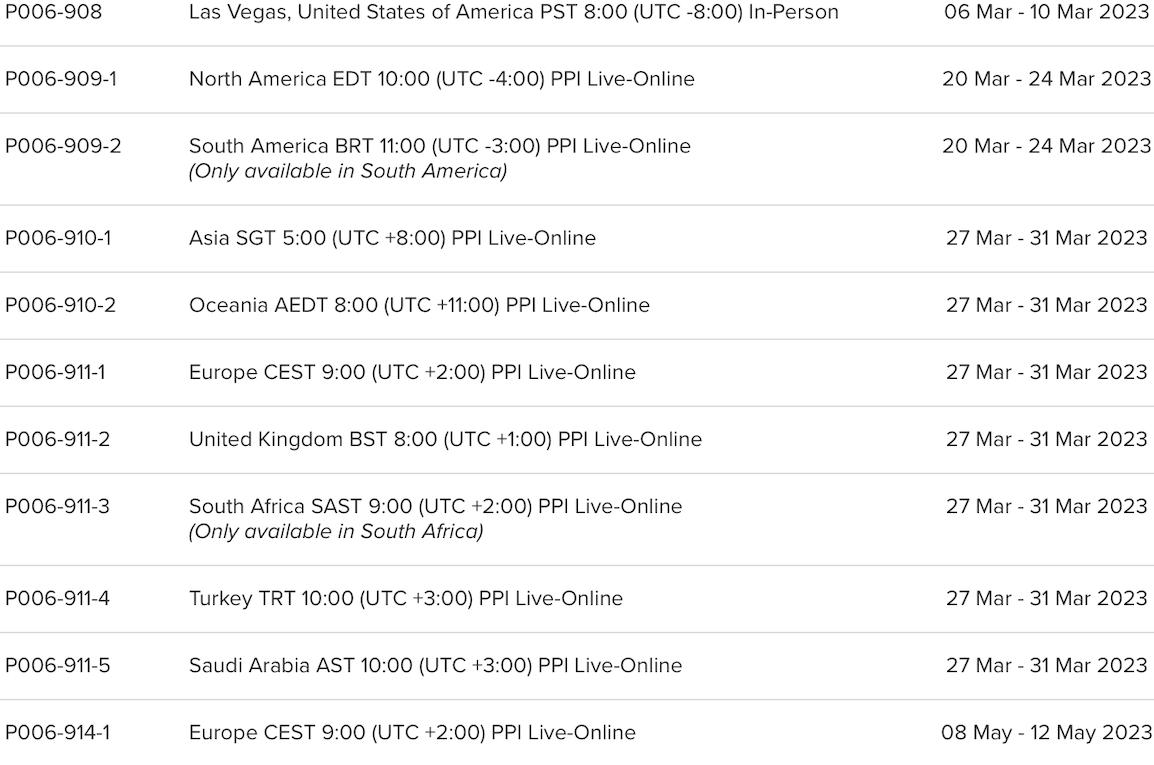
Click here to view the full schedule or register for an upcoming course.
and Principal Consultant)
Email: jfitch@ppi-int.com
Copyright © 2022 by John Fitch. Authored for PPI SyEN.
The INCOSE International Workshop 2023 (IW2023) was held in Torrance, California, USA on 28-31 January 2023. This hybrid event was attended in-person by 411 participants; another 291 registrants engaged with their peers through the INCOSE virtual conference platform. Participants hailed from 27 countries and 63 different INCOSE chapters, emphasizing INCOSE’s global reach and diversity. Participants spread their time across 416 hours of meetings (197 discrete sessions) hosted by 87 INCOSE working groups or other organizations or initiatives.
PPI was represented in-person by Robert Halligan and René King and virtually by Randall Iliff and John Fitch. The PPI team dove deeply into a few topics of interest, while continuing to broadly survey the overall landscape of IW2023 to glean the insights that form the basis for our reflections documented herein. We were delighted to catch up with so many old friends and colleagues, and to begin new friendships with the people we met for the first time this year.
The conference began with two keynote addresses that set a tone that PPI’s René King characterized as “forward moving – forward looking”.
by John Fitch(PPI Presenter and Principal Consultant)
Email: jfitch@ppi-int.com
Copyright © 2022 by John Fitch. Authored for PPI SyEN.
Dr. Olivier de Weck, MIT’s Apollo Program Professor of Astronautics, Professor of Engineering Systems, and Faculty Director of the Engineering Systems Laboratory (ESL), delivered the first keynote. Dr. de Weck probed the foundations of systems engineering both from the scientific literature and industrial practice. He compared the state of systems engineering today with the 300-year evolution of chemical engineering from its roots in alchemy through the maturation of its scientific foundations (e.g., the Periodic Table of the Elements and chemical reactions between these elements) to the state of the practice today. If this pattern holds, system engineering, still searching for its scientific foundations, is very early in its development as a mature engineering discipline.
As one of INCOSE’s earliest members, Randall Iliff from PPI observed that “Oli’s comments on the relative immaturity of SE are a great reminder that we are just starting the journey of helping the world to more efficiently engineer systems. It’s also important to take away his point that most of the world still operates at a level of ‘functional alchemy’ rather than established science. Alchemy is adequate for many routine tasks – we’ll do better by absorbing rather than fighting such use.”
Dr. de Weck also made the case for developing a new overall equation governing systems science, an equation that preserves the amount of complexity before and after system development. Because the technical complexity of all types of systems is steadily increasing, there is a need to reduce the organizational complexity of our engineering system, i.e., to find the “sweet spot” between technical
organizational complexity of our engineering system, i.e., to find the “sweet spot” between technical and organizational complexity.
Dr. Nancy Leveson, MIT Professor of Aeronautics and Astronautics and a specialist in system and software safety, shared the second keynote address titled “MBSE-System Safety Integration Workshop: Bringing safety into MBSE”. Dr. Leveson developed the STPA (System Theoretic Process Analysis) and STAMP (System Theoretic Accident Model and Process) methodologies for accident analysis in the interest of integrating System Safety at the earliest stages of system development. Stating that system safety and security are emergent properties, Dr. Leveson proposed treating safety as a dynamic control problem rather than as a reliability (failure) problem and elaborated how Hazard and Accident Analysis based on STPA focuses on avoiding unsafe control actions. Because many system failures are the result of human commands or actions, this approach brings the human actors within the system boundary where their actions may be explicitly modeled as part of the system control structure.
Although IW2023 provided the environment for making progress within numerous working groups and initiatives, a primary focus was INCOSE’s efforts to make tangible progress toward the Systems Engineering Vision 20351 that was published a year earlier. The vehicle for this progress is the INCOSE Future of Systems Engineering (FuSE) Initiative. In practice, FuSE also supports the realization of the capabilities described in the SE Competency Framework and the Framework’s recently published SE Competency Assessment Guide (SECAG).
Given the breadth and level of ambition implied by Vision 2035, INCOSE has broken up the Vision 2035 roadmap into four complementary streams:
• Vision & Roadmaps
• Foundations
• Methodologies
• SE Application Extensions
During IW2023, each stream conducted four working sessions, that taken together involved over 500 active participants.
The working sessions of the SE Vision & Roadmaps Stream took on the following topics/tasks:
• Get familiar with SE Vision 2035, roadmaps, and actions to be done.
• Generate first insights on what is needed to realize the SE Vision 2035.
• Identify missing elements of the SE Vision 2035.
• Collect means to keep the SE Vision a living document.
At the end of the IW, this Stream summarized their outputs and insights as:
• The goals stated in the SE Vision 2035 needs to be made measurable.
• It is crucial to involve a young and diverse community (within and outside) of INCOSE to realize the SE Vision 2035.
• Specific measures to do the above were conceptualized at IW.
Randall Iliff commented that as any organization matures, there is a natural tendency for more and more of its energy to be focused on sustaining what it has already created. Inside the organization there is growing certainty of value, opportunity to reflect learning, and to advance practices. There is a ready (and easy) audience of believers to court, and a temptation to declare that success. Fortunately,
INCOSE leadership and members have chosen the more difficult but far more rewarding path of continuously re-imagining and re-creating the organization. It’s easy to forget about the millions of people who work every day in development effort without the benefit of SE, and for whom even a taste of our medicine would be transformative.
The SE Foundations Stream addressed the following topics during their working sessions:
• Introduced a proposed 1st law" Conservation of Complexity", elaborating on Dr. de Weck’s keynote.
• Ran an experiment on complexity by designing a transport system to test our hypotheses, i.e., that effort increases with complexity, etc.
• Shared a case study on "technical complexity" using Jet Engine evolution; conducted a group breakout to understand complexity drivers.
• Shared a case study on "organizational complexity" using NASA’s Space Launch System (SLS) and Space X Falcon 9. Conducted a group breakout to understand complexity drivers.
• Heard from the System Science WG (SSWG) concerning the current state of their work and its implications on SE’s scientific foundations.
Outcomes and insights from the Foundations Stream included:
• We generated data via the complexity experiment, but we need to post-process data and verify or falsify our initial assumptions.
• The complexity experiment was fun and mimics SE reality but needs refinement to be even more realistic.
• The group breakout on technical complexity confirmed our basic direction, but also revealed additional drivers that we need to consider.
• The group breakout on organizational complexity illustrated need for more discussion and alignment on how to model organizational complexity.
• The involvement of SSWG highlighted what is already existing and the benefits of collaboration with them.
Randall Iliff notes that the conversations about complexity reveal an interesting and growing gap – the true complexity of the work people tackle is growing exponentially, but their awareness of that complexity is growing linearly at best. In other words, not only is work getting more complex and complicated, but our ability to anticipate and respond properly to that challenge is also increasingly compromised. SE holds the potential to both increase awareness of system challenges and also to confidently address them, further confirmation of the value our profession offers the world.
The SE Methodologies Stream efforts included:
• Introduced the stream’s purpose, content, and goals.
• Captured major disrupters and obstacles for advancing systems engineering methodologies.
• Clarified selected disrupters and generated solution proposals.
• Shared a needs gathering form for solution proposals at www.incose.org/needs.
Insights and outputs from the Methodologies Stream included:
• Disrupters were multi-dimensional and included:
1. Lack of training
2. Past failures leading to low trust of new items.
3. Limited resources
4. Impeded development of practical SE methods
5. Lack of support for change (stagnated culture)
• Solution proposals were generated and initially screened. Work remains to form and select and focus on the highest potential solutions.
The SE Application Extensions Stream took on two primary activities:
• Validating the stream’s purpose, content, and goals.
• Validating four proposed SE application extensions as fit for purpose:
1. Smart Cities
2. Innovation
3. SE and Asset Management
4. Grand Challenges
Resulting insights were reported as:
• The SE Application Extensions stream purpose and topics have been validated. Measures of Effectiveness (MoEs), risks and activities have been proposed by the participants.
• Smart Cities: A good foundation exists for reaching out to internal & external groups. The next step is the validation by application together with mayors or alike.
• Innovation: An innovation framework based on systems thinking was identified to be a useful means to engage with new target groups. There is good potential for collaboration between working groups.
• Asset Management: There is value and interest in cooperating with the Institute of Asset Management to align the forces. A next step is to identify the respective working groups within INCOSE.
• Grand Challenges: Multiple value propositions were identified that INCOSE could provide. The proposed next step is to set up a cross-WG initiative and to seek collaboration with complementary organizations with a joint message to target groups.
Given the scale of their initiative, the FuSE team is seeking wider participation in their efforts by the community of systems engineering practitioners. Suggestions on how to get involved include:
• Participate in recurring FuSE stream activities.
• Join FuSE Yammer Community.
• Visit the FuSE website.
Interested parties are encouraged to contact the FuSE Initiative leadership and support team that includes:
Bill Miller FuSE Program Lead
Paul Schreinemakers Stream Lead “SE Vision & Roadmaps”
Oli de Weck Stream Lead “SE Foundations”
Chris Hoffman Stream Lead “SE Methodologies”
Tom Strandberg Stream Lead “SE Application Extensions” tom.strandberg@incose.net
Multiple connective initiatives within and outside of INCOSE that will shape the progress toward Vision 2035. INCOSE doesn’t and can’t “own” the entire field of systems engineering, so it must cooperate with other external parties to realize significant parts of its stated Vision 2035.
Commenting on the tie between Dr. de Weck’s comparison between the state of systems engineering and the evolution of chemical engineering, Randall Iliff notes that:
“The problem is that everyone in SE thinks that SE is the most fundamental view of work elements – as does everyone else meeting in conferences just like this in every other field all over the world. In one camp we have believers in Earth, Wind, Fire, and Water, in another we have Agile, Waterfall, Lean, and Kanban, and so on. Nothing will change until a unifying theory emerges beneath them that links them to reality and thus provides common ground for progress / translation between viewpoints.
Stated differently, my read is that what we call systems engineering is actually a subsystem (along with many others) within an as yet poorly defined meta-model for the totality of all work. I’m afraid that unless something changes, our efforts to sub-optimize the system of SE (in relative isolation from other systems of engineering and thought) will inevitably have mixed results.”
This author extends Randall Iliff’s insights with a metaphor:
PPI SyEN visualizes our global capability to successfully do SE as an expanding sphere of knowledge and practices, but which expands irregularly as innovation is distributed across many parties and certainly not centrally controlled. As the surface area of the sphere expands, the conceptual “distance” between each new idea/capability grows, so there is also a need for “connect knowledge”, “align/deconflict knowledge, “consolidate knowledge” and “conserve knowledge” functions. Organizations such as INCOSE, SERC, IEEE, PMI, SAE, OMG, ISO, etc. tend to do the connect, align/deconflict, consolidate and conserve functions well, but such formal consensus-driven efforts rarely innovate (create knowledge to expand the sphere) and sometimes stifle innovation in the desire to consolidate, standardize and control know-how.
On the other side of the equation, the commercial and educational entities (organizations and/or thought leaders) that often spur innovation in science and engineering methods, tools and services, have their own interests in optimization and monetization of their unique intellectual property by making their capabilities central to the business processes of their customers. This competitive focus inevitably leads to sub-optimization or at least delayed optimization of the overall system of work if or until the marketplace sorts out winners from losers.
The evolving system of autonomously managed systems (SOAMS)2 of science/engineering/work demands the best rigor required of any such complex entity, including special emphasis on:
• Stakeholder identification, initially and ongoing
• Minimization of conflicts of interest between stakeholders
• Negotiation, initially and ongoing
• Early definition and subsequent management of interfaces
• Long term, participatory planning
• Adaptability of architectures, to accommodate unpredicted behavior, and/or loss of any constituent system.
It’s not clear that focusing on connecting and aligning leading edge methods and tools on the “surface of the sphere” will suffice; it is likely that the systems engineering community will have to roll back
some methods, information models, patterns, tools, etc., i.e., unlearn some widely-accepted practices before incorporation of new and improved approaches is possible. Each such opportunity will stress the community’s ability to minimize conflicts of interest, negotiate stakeholder tradeoffs and update capability interfaces. One example of such a challenge might be displacing the prevailing, but imprecise requirement-torequirement (R-R) traceability model with a more thorough requirement-to-decision-to-requirement (RDR) traceability thread. See the Decision Patterns – So What? article in PPI SyEN Edition 111 (April 2022) for more on this topic.
Also unclear at present is how the INCOSE FuSE Initiative and Streams will be able to realize the level of emphasis, resourcing and global collaboration needed to address these challenges. Practical questions emerge:
• How does INCOSE merge the best of Axiomatic Design, Design Thinking, TRIZ, Lean Startup, Agile Software, etc. into its practices when each of these “movements” has a life of its own that creates unique value that its proponents want to extend and preserve?
• Who gets to decide the “best” information meta-model with which to capture engineering knowledge, when such models are derived from and intimately aligned with competing methodologies?
• How do we avoid losing the emergent properties (i.e., secret sauce) that create the value in evolving/competing methodologies if we seek a least-common-denominator consensus that represents a standard approach?
• What if it takes another century to discover and codify the unifying theory that governs all systems and systems of work? Are we guaranteed that such a unifying theory exists and is capable of human understanding and mastery?
• Most of our insight is coded into terms and language that is unique to SE. How do we translate that insight so that it is recognizable to others, and do so in a way that doesn’t lose the unique value of SE as a system of actions that support development?
The INCOSE MBSE Initiative built off Dr. Leveson’s keynote by conducting a multi-session MBSE Workshop System Safety Breakout to experience how to create a safe-by-design product by integrating system safety with MBSE, followed by a panel discussion addressing different MBSEenabled approaches to system safety.
In addition to the out-of-the-box thinking associated with system safety, the MBSE Initiative hosted an AI/Machine Learning Lightning Round that included brief talks on 14 topics such as:
• Three Wakeup Calls for AI and SE
• Roadmap for AI and SE
• Digital Assistance for Systems requirements Discovery and Analysis Using Machine Learning Natural Language Processing Algorithms
• Use NLP to Create Behavior Models from Natural Language Text
• Test and Evaluation of AI Systems with Explainable AI and Counterfactuals
• Agent-Based Modeling from a Systems Engineering Approach
In total, IW2023 included over 50 sessions that were part of the MBSE Workshop portion of the program. A small sampling of these sessions includes:
• Architecture Working Group Meetings
• SysML v2 Update and Demo
• Modeling Nature
• SE Tools Lab Update
• MBSE Patterns Working Group
• NAFEMS-INCOSE SMS WG
• Product Line Engineering Working Group
• DEIX Standards
• Discovering MoSSEC - the Meta Language for SE Collaboration
• Digital Engineering Measurement Framework
• OpenMBEE Workshop
It’s obvious to PPI that MBSE is becoming increasingly embedded into nearly every aspect of systems engineering to the point that one might ask, “What parts of SE are not model-based?” An obvious concern with this trend is that models of systems (that result from thinking/design processes) are not equivalent with models of the thinking (whether human or AI) that transforms a problem into a full lifecycle solution. Most of MBSE has focused on the former, with many gaps in current standards and toolsets in the capture of the latter.
The Decision Analysis Data Model (DADM) initiative within INCOSE’s Decision Analysis Working Group (DAWG) is addressing the gaps mentioned above. Prior to IW2023, the DADM team had analyzed Vision 2035 and generated a vision for Decision Analysis capabilities that are aligned with overall SE capabilities:
Trusted collaboration and interactions through a digital ecosystem
Analytical frameworks for managing the lifecycle of complex systems
Widely adopted reuse practices
Decision Analyses can touch multiple disciplines and stakeholders and should leverage a digital ecosystem to enhance collaboration
Decision Management methodologies provide an analytical structure for approaching multi-factor decision making throughout the system lifecycle
By creating a reusable Decision Analysis Data Model, practitioners are aided in quickly deploying decision management strategy for traditional or model-based projects
The DADM team met for six hours at IW2023 to make progress on its goal of developing a reusable, model-based, data model to:
• Aid practitioners in making multi-factored decisions.
• Digitally define decision management analytical framework.
• Establish reuse practices for off-the-shelf job aids for practitioners.
• Leverage digital ecosystem to more collaboratively manage risks and decision making.
The DAWG/DADM sessions included:
• A panel discussion “to explore the art of the possible for model-based decision analysis, discuss a future portfolio of INCOSE-provided digital process models, and inform development of the DADM” with panel members Frank Salvatore (Moderator), Dr. Greg Parnell, Devon Clark, Dr. Bob Kenley, and Dan Hettema.
• A presentation on Bridging MBSE Models and Analytical Models for Decision Analysis by Steve Cash (Vitech) and Alexandre Luc (Ansys) that demonstrated the use of parametric models
with a simulation execution platform to inform trade studies.
• A 4-team brainstorming session to identify the types of decisions made during four system lifecycle phases: Concept, Development, Production and Utilization.
• A 4-team brainstorming session to identify the inputs and outputs of the decisions made during four system lifecycle phases: Concept, Development, Production and Utilization.
• A presentation by Bill Schindel of the MBSE Patterns Working Group on “Discussion and References - Decision Analysis Patterns” that highlighted where the DADM might fit within the Innovation Ecosystem pattern originally developed in 2016 by the Patterns Working Group.
Through the work at IW2023, the DADM Initiative seems poised to make progress on its roadmap to:
• Complete an initial model, ready for user testing and feedback at the 2023 International Symposium (IS2023)
• Deliver DADM v1.0 for INCOSE review in Q42023.
• Conduct DADM v1.0 review at 2024 International Workshop (IW2024)
• Approve and release DADM v1.0 at 2024 International Symposium (IS2024)
An interesting question arose during the brainstorming of decisions and their inputs/outputs across the lifecycle phases:
How sensitive should the DADM be to various types of decisions in various lifecycle phases?
The author proposed that the DADM should be architected to be insensitive to lifecycle, i.e., that every decision can and should use the same information meta-model (and related visualizations/viewpoints) regardless of decision scope, complexity, or lifecycle focus. See the Decision Patterns – So What? article in PPI SyEN Edition 111 (April 2022) for more background on this perspective.
The Natural Systems Working Group (NSWG) was active at IW2023, with a clear focus on the benefits of using bio-inspired design. Working sessions included:
• Intro to bio-inspired design: Review of the scope of the Primer on Natural Systems for SE and the major tools of bio-inspired design.
• Exploration of Natural Systems and opportunities to leverage for use in MBSE and Digital Engineering processes.
• Overview of system dynamics modeling.
• Overview of circular design challenges and opportunities.
• Tradeoffs Workshop - Exploring opportunity space using trade-offs: Gamify a set of universal trade-offs and parameters, finding the overlap of biology and engineering instances.
• Laws of nature and systems science: How can we make the natural system models available to systems engineers?
The author found the content of the Tradeoffs Workshop to be intriguing. By applying Altshuller’s TRIZ3 methodology with its parameter tradeoffs (e.g., speed vs accuracy) and inventive principles (e.g., feedback, dynamic response, adaptation and consolidation) to bio-inspired design, the workshop facilitators demonstrated the power of reframing problems using a generalized pattern and then attacking those problems with generalized solution patterns.
The Social Systems Working Group (SocWG) kicked off its IW2023 program with a review of the outline and development plans for a Social Systems Primer. Efforts continued with presentations and
workshops on:
• INCOSE roundtable with International Society for the Systems Sciences (ISSS): Theories about modeling social domains for science and practice
• Human Agency in Large Social Systems: A Systems Science Transdisciplinary Journey
• Introduction to the Social Systems WG
• Social Systems WG Charter Review and Update
In addition to SocWG activities, working group members supported other sessions such as:
• Telling Systems Stories Workshop: Making Technical Solutions Compelling
• Smart Cities Initiative - Modeling Homelessness Use Case
• Smart Cities Initiative - Implementing the human-centered framework and mapping to UN Sustainability Goals
• Emerging Trends in Systems Engineering Leadership
PPI’s René King noted that IW2023 was itself a social system that demonstrated the power of human collaboration.
“The energy at the workshop was fresh, exciting and for the first time in a while I am quite excited about the potential of international SE conferences to really accelerate the timeline towards developing some of the real solutions most needed by the world and the engineers that are part of the system working on addressing these needs.”
Randall Iliff noted that the IW and IS work very effectively together as a system for interacting with INCOSE members. IW is the place to meet the most active contributors and to make a personal difference in just a few long days; IS is a great venue for welcoming others into the community.
Like focused breathing, this annual cycle of welcoming new members and then integrating them into ongoing effort keeps the organization vibrant and healthy!
Professional Development Portal (PDP)
IW2023 highlighted to initial deployment of INCOSE’s Product Development Portal (PDP). Three workshops were conducted to share PDP’s purpose, status, operation and to encourage the migration of content to this educational resource:
• PDP Workshop #1 - Getting to Know the PDP: The Professional Development Portal and You, a “Hands-On” Demonstration" for users.
• PDP Workshop #2 - Future Capability Needs for the PDP: What capabilities would users like to see after the Full Operational Capability (FOC)?
• PDP Workshop #3 - Providing Content for the PDP: Getting involved with the PDP by providing content
INCOSE President Marilee Wheaton wrapped up IW2023 with her own expression of thanks to the INCOSE team and all IW2023 participants for their contributions to the success of this high-energy positive event. Wheaton took note of several INCOSE 2022 accomplishments including:
• Publication of the SE Competency Assessment Guide, extended from UK chapter competency framework.
• IW2023 participation of the University of Nairobi representative from the INCOSE Foundation global outreach project that supports new members from underserved countries. Also included the representative from the University of Lagos who attended virtually.
• Accelerating utilization of the SEBoK (BKCASE) with page accesses approaching 10M.
Donna Long, INCOSE Associate Director for Events, closed out IW2023 with an invitation to the International Symposium (IS2023) to be held in Honolulu, Hawaii, USA on 15-20 July 2023.
PPI’s Robert Halligan summarizes his reflections on IW2023 below: Reflecting on the INCOSE IW 2023, my dominant impression is one of Progress. Huge Progress. Progress in the form of the release of MoSSEC, a metalanguage for SE collaboration. Progress in the Smart Cities initiative, close to the point of commencing implementation in Ulaanbaatar, in Mongolia. Progress with the future of systems engineering (FuSE) initiative, towards realization of the INCOSE Vision 2025. Progress in the application of AI/machine learning to SE. Progress in MBSE languages, specifically the impending submission of SysML v2 to the Object Management Group (OMG) Finalization Task Force (FTF). The FTF will finalize the specifications, manage monthly releases of pilot implementations and training material, and liaise with industrialization partners (tool developers, both COTS and opensource). The official SysML v2.0 release is expected early 2024. SysML v2 is intended to greatly improve the precision, expressiveness, and usability over SysML v1 - an inflection point I predict in the evolution of MBSE practice. Progress in the release by INCOSE of its Professional Development Portal, providing access by SE practitioners to SE resources including a tools lab. Progress in the integration of Product Line Engineering (PLE) into SE practice. Progress in the application of SE to socio-technical systems. And progress, huge progress, of INCOSE as a professionally administered, dynamic society, brimming with energy and purpose.
[1] INCOSE 2021. Systems Engineering Vision 2035. https://www.incose.org/about-systemsengineering/se-vision-2035
[2] Robert Halligan, PPI 2023. Systems Engineering Training Manual – 5-Day Course. Chapter 1.
[3] Altshuller, Henry. 1994. The Art of Inventing (And Suddenly the Inventor Appeared). Translated by Lev Shulyak. Worcester, MA: Technical Innovation Center. ISBN 0-9640740-1-X
John Fitch is a Principal Consultant and Course Presenter for Project Performance International. John brings over four decades of systems engineering, engineering management, consulting, and training experience to the PPI team. In 2012, John was certified by INCOSE as an Expert Systems Engineering Professional (ESEP). Within the field of systems engineering, John’s career has focused on decision management, requirements management, risk management, systems design & architecture, product/technology road-mapping and innovation. In addition to defense/aerospace, John has guided initiatives in domains such as communications systems, software, energy, nanotechnology, medical devices, manufacturing systems, knowledge management and business process improvement.

Useful artifacts to improve your SE effectiveness
The System Dynamics Society (SDS) is offering two members-only opportunities to learn system dynamics concepts and skills and gain application experience in the form of the System Dynamics Summer School. Live Summer School sessions will be held online in the two weeks (10-13 July) prior to the International System Dynamics Conference that will be held in Chicago, Illinois, USA on 23-27 July 2023.
Useful artifacts to improve your SE effectiveness
The Introductory Track is for individuals with no or very limited System Dynamics knowledge. To qualify for the Intermediate track, registrants must pass a placement test over the basics of system dynamics. Both courses are self-managed, i.e., students watch recorded lectures and complete assignments on their own time with the support of interactive discussions with instructors and peers through a dedicated e-learning platform.
The Introductory Track is software neutral. The purpose is to teach the System Dynamics methodology and not specific software syntax. There will be models available in Vensim, Studio, and Stella. Free versions of modeling software that are limited in capability or limited in duration of use will be available.
Instructors:
Useful artifacts to improve your SE effectiveness
• David Ford, Virginia Tech
• Birgit Kopainsky, University of Bergen
• Rod MacDonald, James Madison University
• Oleg Pavlov, Worcester Polytechnic Institute
Introductory Track Daily Schedule
Useful artifacts to improve your SE effectiveness
Modeling Steps & Problem
Definition
Modeling Feedback
Mechanisms
Conceptual Modeling with Stocks and Flows
Workshop: Introduction to System Dynamics Modeling Software
Intermediate Track
Formal Modeling of Stocks and Flows

Information Delays
Workshop: Accumulation, Feedback, and Information
Delays
Applications Lecture
Nonlinear Relationships
Policy Modeling
Model
Validation
Applications
Lecture
Model Analysis
Model Use
Workshop: Common Pitfalls and Best Practices
Applications Lecture
The Intermediate track focuses on software (Studio, Vensim, and Stella). It presents more advanced modeling techniques. Free versions of System Dynamics modeling software that are limited in
capability or limited in duration of use will be made available. Instructors:
• Bob Eberlein, isee systems
• Jake Jacobson, MindsEye Computing, LLC
• Len Malczynski, MindsEye Computing, LLC
Intermediate Track Daily Schedule
Day One Day Two Day Three Day Four Steps of Modeling: Problem Description
Model Building: Stocks and Flows
Checking Results with Equilibrium Diagrams
Diagrams to Show Feedback Loops
Simulating Nonlinear Relationships
Simulating the Flow of Information
Checking Results with Delays in the Flow of Information
Applications Lecture
Recognizing and Avoiding Common Pitfalls
Validation Testing: For Us & Our Client
Applications Lecture
As of 10 June 2023, registrants for both tracks will have access to:
• Software Video Tutorials
• Learning Platform (Canvas)

• Recorded Lectures
• Online Class Sessions
• Simulation Software
• Reachable Instructors
Model Improvement Applications Lecture
Both courses require significant pre-work in the form of watching videos and tutorials prior to the week of synchronous class sessions.
See more details on the System Dynamics Summer School.
Learn more about and join the SDS to participate in the Summer School.
A limited number of scholarships are available for SDS members. Apply here prior to 15 April 2023.
Take the placement test and complete registration based on your results.
NAFEMS continues to offer a diverse range of code-independent, indepth online training courses on engineering analysis & simulation. Upcoming courses beginning in March and April 2023 include:
Fatigue & Fracture Mechanics in FEA (5 sessions; 2 March – 13 April)
The prediction of fatigue is a requirement for most products. However, the application of fatigue analysis is not easy and a good background is essential to be able to use the powerful FEA method as a basis for fatigue analysis. Much of the terminology used in setting up a fatigue problem through a modern GUI is confusing and the choice of options is not always clear. The objective of this course is
to break down the fatigue analysis process into clearly defined steps, give an overview of the physics involved and show how to successfully implement practical solutions using Finite Element Analysis.
Elements of Turbulence Modeling (2 sessions; 3 – 13 March)
This 2-session, live online course will cover a range of topics including:
• Understanding turbulence, energy cascade & vortex stretching
• Turbulence scales, time averaging and closure problems
• Boussinesq hypothesis
• Various RANS-based models
• Wall treatment
• y+, Detached Eddy and hybrid models
Students can either attend the live sessions or take the course on-demand at their leisure.
Metals Material Modelling: Welding Simulation and Residual Stresses (3 sessions; 22 March – 5 April)
This e-learning course is aimed at engineers and designers who want to become familiar with how the Finite Element method can be used to simulate the welding process in metals and the residual stresses arising from welding. The course will cover the finite element modelling of the welding of metallic structures using filler material where the high temperatures experienced by the materials during welding generate thermo-mechanical stresses and microstructural changes. Finite element solutions for the post-weld residual stresses will be discussed and compared to experimental measurements.
Practical Understanding of Systems Modelling and Simulation (4 sessions; 23 March – 13 April)
The course is an excellent opportunity to learn the fundamentals and practicalities of the critical aspects of systems modelling:
• Complex systems and the method for their development
• Simulation-based process and numerical simulation
• Organization and process for modelling
• Model management and models architecture
• Industry applications
Basic Electromagnetic FEA (4 sessions; 12 April – 3 May)
This course will help you to understand basic electromagnetic equations, to master their solution using the Finite Element Method, and to properly interpret and use the results.
The course starts with fundamental topics such as electric field, magnetic field, electric scalar potential, and magnetic vector potential. It then guides you through Partial Differential Equations (PDEs) of the introduced scalar and vector fields describing different electromagnetic problems of practical relevance, namely, electrostatics, magnetostatics, eddy current, displacement current, and wave propagation. Finally, the course demonstrates the best modelling and simulation FEM practice through numerous practical examples.
CFD for Structural Designers & Analysts (3 sessions; 14 April – 5 May)
This 3-session, live online course will cover a range of topics, all aimed at the structural designer and analyst who needs to get to grips with CFD, including:
• Principles of fluid dynamics
• Important flow phenomena
• Basics of the CFD process
• Turbulence modelling
• Fluid-structure interaction
Students can either attend the live sessions or take the course on-demand at their leisure.
Practical Modelling of Joints and Connections (3 sessions; 18 April – 2 May)
Most structures involve some form of jointing or connection. Traditional fabricated structures have used many thousands of bolts and rivets to connect components together in a continuous manner, in the case of ships and aircraft the total can run into millions. The objective of this course is to review the various connection and joint technologies in use, give an overview of the physics involved and show how to successfully implement practical solutions using Finite Element Analysis.
Basic Finite Element Analysis (6 sessions; 27 April – 1 June)
The course offers excellent guidance on how to assess and plan the task of carrying out structural analysis using FEA. Content includes:
• Background to FEA
• Defining your objectives and planning your analysis
• Making healthy models
• Real-world constraints and loading
• Engineering assessment – is your model realistic
• Integrating with CAD and geometry
• Checking the answers – guilty until proven innocent!
View the current course listing
Join the NAFEMS E-Learning Wait List to be notified when a future course of interest will be offered.

The December 2022 edition (Volume 25, Issue 4) of INSIGHT, INCOSE’s Practitioner Magazine published by Wiley, has been released. Electronic subscriptions to INSIGHT are available as a member benefit to INCOSE members. Hard-copy subscriptions to INSIGHT are available for purchase by INCOSE members for one membership year, and to the public.
Join INCOSE here to access this rich systems engineering resource.
The focus of this issue is the Archimedes Initiative, a collaboration among the Systems Engineering Research Center (SERC), Embedded Systems Innovation (ESI) in the Netherlands, German Aerospace Center (DLR) Institute of Systems Engineering for Future Mobility, and the Center for Trustworthy Edge Computing Systems and Applications (TECoSA) in Sweden. The initiative is a global partnership that operates in diverse ecosystems across industry, government agencies, and academia.
Content of this 108-page document includes:
Nurturing a Global Systems Engineering Research Network – The Archimedes Initiative
by Wouter Leibbrandt and Dinesh VermaThis article introduces the theme of the INSIGHT edition and threads together a summary of the individual articles and how they build on the theme. INSIGHT then transitions to a section that highlights the research center roadmaps for the four Archimedes Initiative participants.
DLR Institute of Systems Engineering for Future Mobility – Technical Trustworthiness as a Basis for Highly Automated and Autonomous Systems
by André Bolles, Willem Hagemann, Axel Hahn, and Martin FränzleAbstract: The newly established Institute of Systems Engineering for Future Mobility within the German Aerospace Center opened its doors at the beginning of 2022. Emerging from the former OFFIS Division Transportation after a two-year transition phase, the new institute can draw on more than thirty years of experience in the research field of safety-critical systems. With the transition to the DLR, the institute’s new research roadmap focuses on technical trustworthiness for highly automated and autonomous systems. Within this field, the institute will develop new concepts, methods, and tools to support the integration and assurance of technical trustworthiness for automated and autonomous systems during their whole lifecycle – from the early development through verification, validation, and operation to updates of the systems in the field.
Abstract: The high-tech equipment industry brings complex industrial products to the market with high speed, enhanced functionality, a better cost-performance ratio, and greater integration into customer workflows. Driven by digitalization, the complexity of these systems continues to grow steeply. To manage this complexity, continuous innovation in systems engineering methodologies is needed. TNO-ESI targets to 1) create impactful and industrially applicable systems engineering methodologies and 2) provide innovation support to the industry to get these applied in an industrial context. The ESI research program is defined through a roadmapping process that follows two tracks: a roadmap that maps industry needs and related research and development requirements and a roadmap that describes the developments in the expertise areas necessary for addressing these industry needs. In this paper, we describe the ESI mission, our way of working and activities, and explain the roadmapping process and the roadmaps.
Abstract: In 2019, the research council of the Systems Engineering Research Center (SERC), a US Defense Department sponsored university affiliated research center (UARC), developed a set of roadmaps (SERC 2019) structuring and guiding four areas of systems engineering research: digital engineering, velocity, security, and artificial intelligence (AI) and autonomy. This paper presents the development of these roadmaps and the key underlying transformation aspects.
David Broman, Erik Herzog, Iolanda Leite, Raksha Ramakrishna, Rebecca Stower, and Haydn Thompson
Abstract: TECoSA – a university-based research center in collaboration with industry – was established early in 2020, focusing on Trustworthy Edge Computing Systems and Applications. This article summarizes and assesses the current trends and drivers regarding edge computing. In our analysis, edge computing provided by mobile network operators will be the initial dominating form of this new computing paradigm for the coming decade. These insights form the basis for the research agenda of the TECoSA center, highlighting more advanced use cases, including AR/VR/Cognitive Assistance, cyber-physical systems, and distributed machine learning. The article further elaborates on the identified strategic directions given these trends, emphasizing testbeds and collaborative multidisciplinary research.
Five papers then address the related topic of Digital Engineering and Model-Based Systems Engineering.
Abstract: The Netherlands has a strong presence in the high-tech equipment industry sector with world-wide renowned organizations. Systems engineering is a key capability that is well-established in this sector. The industry now sees model-based systems engineering (MBSE) as indispensable to bringing systems engineering capabilities to the next level. Despite this, MBSE is not a fully established practice in this sector as in other industries. ESI has initiated a study to understand the background of the sector’s interest in MBSE, the challenges to address with MBSE, experiences with, and fit of current MBSE methodologies versus the characteristics of this sector. This article reports on the results of this study. It highlights innovation in MBSE to address the needs and characteristics of the high-tech equipment industry.
Abstract: This paper discusses how digital signoffs can enable new operational paradigms for business operations, digital engineering reviews, and contracts. The paper explains what digital signoffs are in the context of their use with model-based systems engineering methods, which is how this concept and construct has evolved. The paper discusses how they are created in the current toolset. This paper explains the benefits of why digital signoffs are valuable, in addition to where they can be placed within models, and when they might be used. Finally, we discuss how digital signoffs might evolve as add-on capabilities for digital engineering more broadly.
Abstract: The research and development activities performed by the DLR Institute of Systems Engineering for Future Mobility (DLR-SE) are organized via so-called assets. We present a scenariobased verification and validation process and relate selected research activities. Verification and validation approaches of automated transportation systems based on driving a certain number of kilometers are infeasible. Therefore, the DLR-SE asset “Scenario-based Verification and Validation of Automated Transportation Systems” investigates methods and prototyping tools for verifying and validating automated transportation systems employing scenarios as the main structuring element to capture complex traffic evolutions. While there are many different approaches, our focus is formally specifying relevant abstract scenarios that are readable by humans while also being machinereadable. This allows us to automatize the verification and validation process, which increases confidence in, for example, the safety of the systems due to a dramatically increased number of executed tests while reducing the manual effort from humans.
Abstract: Ever-increasing system complexity is challenging for development engineers and service personnel troubleshooting system failures in the field. This paper presents a systematic, scalable approach to attain a diagnostic model. Automatic transformation into computational models is used 1) at design time to improve the diagnosability of the system, and 2) during operation for guided root cause analysis by calculating the most probable failures and suggesting diagnostic procedures based on available data and observations. The approach combines nicely with model-based systems engineering, showing the added value of using diagnostic models both during the design of a system and during operation when the system needs to be diagnosed.
Abstract: Companies in the high-tech equipment industry are continuously looking for ways to optimize their business. A notoriously difficult part of optimizing is the R&D activities, as risks and uncertainties are inherent. In our experience, creating and using a reference architecture for a product or portfolio to guide future developments is a good way to improve R&D effectiveness and efficiency. But developing a reference architecture by capturing the relevant information and establishing the structure, the models and their interrelations, the tools, and secondly, getting clarity on how to use such reference is not easy. In this article, we describe a method to ‘distill’ a reference architecture using the knowledge built-up in years of developing products and using the customer and business values to capture the key architectural decisions for future products. We explain the purpose and usage of a reference architecture and how to organize it. The experiences obtained in Thermo Fisher Scientific have proven the importance and practicality of this approach.
A section on Artificial Intelligence and Machine Learning addresses leading edge enablers of digital transformation. Papers include:
Abstract: Modern engineered systems, and learning-based systems, in particular, provide unprecedented complexity that requires advancement in our methods to achieve confidence in mission success through test and evaluation (T&E). We define learning-based systems as engineered systems that incorporate a learning algorithm (artificial intelligence) component of the overall system. A part of the unparalleled complexity is the rate at which learning-based systems change over traditional engineered systems. Where traditional systems are expected to steadily decline (change) in performance due to time (aging), learning-based systems undergo a constant change which must be better understood to achieve high confidence in mission success. To this end, we propose pairing Bayesian methods with systems theory to quantify changes in operational conditions, changes in adversarial actions, resultant changes in the learning-based system structure, and resultant confidence measures in mission success. We provide insights, in this article, into our overall goal and progress toward developing a framework for evaluation through an understanding of equivalence of testing.
Abstract: The new DLR Institute of Systems Engineering for Future Mobility (DLR SE) opened its doors at the beginning of 2022. As the new DLR institute emerged from the former OFFIS Division Transportation, it can draw on more than 30 years of experience in the research field on safety critical systems. With the transition to the German Aerospace Center (DLR), the institute has developed a new research roadmap focusing on technical trustworthiness for highly automated and autonomous systems, as described in the article “DLR Institute of Systems Engineering for Future Mobility –Technical Trustworthiness as a Basis for Highly Automated and Autonomous Systems” in this journal. In this paper, we describe how the Group Human Centered Engineering (HCE) contributes to this roadmap with our methods of “virtual test drivers” and “virtual co-drivers.”
NeuroRAN Rethinking Virtualization for AI-native Radio Access Networks in 6G
by Paris Carbone, György Dán, James Gross, Bo Göransson, and Marina PetrovaAbstract: Network softwarization has revolutionized the architecture of cellular wireless networks. State-of-the-art container based virtual radio access networks (vRAN) provide enormous flexibility and reduced life-cycle management costs, but they also come with prohibitive energy consumption. We argue that for future AI-native wireless networks to be flexible and energy efficient, there is a need for a new abstraction in network softwarization that caters for neural network type of workloads and allows a large degree of service composability. In this paper we present the NeuroRAN architecture, which leverages stateful function as a user facing execution model and is complemented with virtualized resources and decentralized resource management. We show that neural network-based implementations of common transceiver functional blocks fit the proposed architecture, and we discuss key research challenges related to compilation and code generation, resource management, reliability and security.
AI4SE and SE4AI: Setting the Roadmap toward Human-Machine Co-Learning
by Kara PepeAbstract: Artificial intelligence (AI) and machine learning (ML) technology are becoming increasingly critical in systems: both to provide new capabilities and in the practice of systems engineering itself, especially as digital transformation improves the automation of many routine engineering tasks. The application of AI, ML, and autonomy to complex and critical systems encourage the development of new systems engineering methods, processes, and tools. This article highlights a series of workshops conducted jointly by the US Army Combat Capabilities Development Command Armaments Center (CCDC AC) Systems Engineering Directorate and the Systems Engineering Research Center (SERC). These workshops focus on the relationships between AI and systems engineering and elicit input from hundreds of stakeholders across government, industry, and academia. They also provide critical direction to the SERC’s research roadmap on AI/autonomy as it looks towards the long-term outcome of “human-machine co-learning.” Though the workshops are US-centric, the lessons and insights gained are applicable globally.
The INSIGHT edition finishes with five papers addressing Systems Engineering and Agile Development and Systems Security and Resilience.
Modular Over-the-air Software Updates for Safety-critical Real-time Systems
by Domenik Helms, Patrick Uven, and Kim GrüttnerAbstract: Automotive software is undergoing a rapid change toward artificial intelligence and towards more and more connectedness with other systems. For both, an incremental design paradigm is desired, where the car’s software is frequently updated after production but still can guarantee the highest automotive safety standards. We present a design flow and tool framework enabling a DevOps paradigm for automotive software development. DevOps means that software is developed in a continuous loop of development, deployment, usage in the field, collection of runtime data and feedback to the developers for the next design iteration. The software developers get support in defining, developing, and verifying new software functions based on the data gathered in the field by the previous software generation. The software developers can define contracts describing the time and resource assumptions on the integration environment and guarantees for other dependent software components in the system. These contracts allow a composition of software components and proof obligations to be discharged at design time through virtual integration testing and runtime through continuous monitoring of assumptions and guarantees on the software component’s interfaces. An update package, consisting of the software component and its contracts, is then automatically created, transferred over the air, and deployed in the car. Monitors derived from the contracts allow for supervising the system’s behavior, detecting failures at runtime, and annotating the situation to be included in a data collection, fueling the next design iteration.
Abstract: As industrial cyber-physical systems grow ever more complex, their software grows naturally and changes continuously. In order to make risk-free changes to their software, it is crucial to understand how the system behaves, and how software changes have an impact on system behavior. We propose a generic two-fold approach to infer state machine models capturing system behavior, and to compare these models to determine and visualize the impact of software changes on system behavior, in a way to make them easily understandable for engineers. Our approach has been applied in the industry at ASML to help prevent software regression problems during critical software redesigns. In that, our approach has been shown to reduce risk and to be valuable.
Abstract: Over the past five years, with funding from the US Air Force and the US Space Force, SERC researchers at the University of Southern California’s Information Sciences Institute have undertaken a series of case studies that have focused on the introduction of agile and DevSecOps practices into a space-based software-only acquisition environment. These studies have identified best practices and revealed useful lessons learned. While the initial baseline DoDI 5000.02 project was entirely waterfallbased, subsequent projects have introduced agile/DevSecOps methods in progressively increasing levels, with the second project consisting of a roughly a 50/50 hybrid agile/waterfall mix and with the current project consisting of an approximately 70/30 hybrid agile/waterfall mix effort. All projects exhibit similar code complexity and size.
Abstract: The introduction of automation into technical systems promises many benefits, including performance increase, improved resource economy, and fewer harmful accidents. In particular, in the automotive sector, automated driving is seen as one key element in Vision Zero by eliminating common accident causes such as driving under the influence, reckless behavior, or distracted drivers. However, this is contrasted by new failure modes and hazards from the latest technologies. In this article, we address the problems of finding common sources of criticality for specific application classes and identifying and quantitatively assessing new sources of harm within particular automated driving systems.
View the entire issue of INSIGHT Volume 25, No. 4 in the INCOSE Connect Library INSIGHT Practitioners Magazine.
The Knowledge Hub (kHUB) of the Product Development Management Association (PDMA) is a diverse repository of resources to assist the product development and innovation community.

PDMA periodically highlights the most popular articles and podcasts based on kHUB user preferences. New or newly recommended hHUB content includes:
• A Sherpa’s Guide to Innovation (Podcast)
• Product Voices (Podcast)
• The Back End of Innovation: The Neglected Stepchild of NPD (Webcast)
• Product Innovation – The Next Generation (Webcast)
• Design Thinking as Sensemaking: Developing a Pragmatist Theory of Practice to (Re)Introduce Sensibility (Wiley Journal of Product Innovation Management - JPIM article)
• Organizational Antecedents to Bootlegging and Consequences for the Newness of the Innovation Portfolio (JPIM article)
• Spinning Straw Into Gold: Innovation Recycling, Innovation Sourcing Modes, and Innovation Ability in Sub-Saharan Africa (JPIM article)
• “Real” Agile Product Management
• A Framework for Understanding Emerging Consumer Needs
• Strategy – Tedtalks with Practitioner Insights
• Usability Testing in Services: Delivering the Right Experience
• Why We Disagree on SCRUM
Access to JPIM content may be obtained by a PDMA membership or through a Wiley subscription.
Access to kHUB is free and open to the public. Create a guest account or join PDMA here.
The System Dynamics Society (SDS) continues to create and recommend a diverse set of resources to assist current and prospective practitioners of the system dynamics discipline. Recent recommendations include:
• PwC's Tech While You Trek: Systems Thinking (Podcast)
• Field Work in Sustainability (WPI Journal article)
• Teaching Biology and Scientific Practices through System Dynamics Modeling and Simulations (Recording)
• A System Dynamics Model of the Value Chain (Recording)
• Modeling in Ventity - what is different? (Recording)
• Documenting the Modeling Process (Recording*)
• Dynamic supply chains with endogenous dispositions (SD Review open access)
• Observations from a system dynamics modeling field school in Mali (SD Review open access)
• Now What? A Call to Action Blog
* PDMA membership required to access this resource. Join the System Dynamics Society here.
SyEN readers with an interest in system modeling are encouraged to check out these resources.
Key features:
• The Manager (always a man) protected himself from the workers (all men) within a
office.
• Engineers wrote and drew everything in pencil on paper and then handed it into the typing pool (exclusively staffed by women).

• More senior engineers had a rotary-dial phone on their desk with actual analogue wires coming out of it; minions had to time-share such phones (at that time called ‘phones) on a ratio of about 6 people to a phone.
• Twice a day a lady (obviously) wheeled the tea trolley round the office. At that time, tea was far more fashionable than coffee.

• In the corner of the office was a mail basket that was filled and emptied twice daily.

• Internal mail was placed inside re-usable envelopes and ferried around the site on electric “milk floats”. The envelopes had spaces marked out for the code-names of about 30 addressees, so you had to cross out the previous name and insert the new one.

The list of things we didn’t have is very long but includes:

• PCs
• The internet
• Mobile phones
• Unsocial Media
• Spreadsheets
• The Cloud
• Music at our desks
• Digits
I remember being amazed when I was asked to attend a phone call after work. I couldn’t see how all of us were going to get a chance to talk and listen on the single phone in the room. Suddenly I was introduced to the innovation of a conference phone.
The nice thing was that, if you wanted to communicate with someone, you mostly had to go and find them and talk to them. I contrast that with a modern office where dozens of people sit in rows staring all day long at multiple monitors, wearing headphones. The headphones shout “do not approach me; I’m too busy exchanging digits with other people”.
And now for the “senior staff” syndrome. Such Gods had a company car and an on-site parking space, each designated by a metal sign inscribed with the car’s number plate. An army of maintenance staff was always available to move plates around if somebody changed buildings or got a new car. Every member of this elite was provided daily with an erudite newspaper that happened to be pink in color. Most of them walked around site with the paper accidentally tucked under their arm so that underlings could recognize their invincible status.
And now what really counts: the toilet arrangements. As depicted in Figure 2, every corridor had a row of three doors. Clearly, the probability of a woman being promoted to senior staff was incalculable.