Number of Electric Vehicle Chargers in San Francisco Exceeds Number of Gasoline Pumps
BY ROHIT PRASANNA
There are about 30,000 plug-in electric vehicles (EVs) registered in San Francisco, roughly seven percent of the automobile population. The switch from gasoline- to electricity-powered cars has increased demand for EV chargers. Meanwhile, statewide gasoline sales are roughly 15 percent lower than a 2004 peak, with transactions in the City likely declining even more.
There are about 1,481 publicly accessible Level 2 electric chargers – which can take four to 10 hours to charge an EV – in San Francisco and 249 fast direct current (DC) chargers, according to California Energy Commission data. In addition to public chargers there are nearly 2,000 shared Level 2 mounts that’re available to multiple vehicles, such as those located in apartment complexes.
San Francisco’s EV charging infrastructure has been buoyed by a cascade of state and local legislation and funds. The City’s Green Building Code requires five to 20 percent of spaces at parking facilities to offer EV charging. Tesla has four superchargers in San Francisco, including one at Potrero Center that was installed in 2023.
Last summer a set of six fast EVgo DC chargers were connected at Bayview Plaza. A smattering of reviews on PlugShare, which aggregates EV charger information and locations, indicates generally positive experiences at the facility, with some appraisers highlighting the convenience of being able to visit a nearby
Starbucks or Panda Express while their car gets charged.
According to Henna Trewn and Joseph Piasecki, who work with the San Francisco Department of the Environment, the City wants to expand EV charger access by incentivizing and facilitating private entities to build and operate chargers to meet rising demand. However, a $15 million U.S. Department of Transportation grant to build another 270 Level 2 and 30 fast DC charging stations was suspended by the Trump Administration.
With diminished petrol demand and amongst the most expensive real estate in the coun

try, gas stations have been steadily replaced by condominiums, apartment complexes, and mixed-use developments. Fifteen years ago, there were more than 100 gas stations in the City; today there are less than 90, which
may collectively offer somewhat more than 1,000 pumps.
The Shell gas station at 16th and
Magazines Served Alongside Coffee, Ceramics
BY S ANNE STEINBERG
Once ubiquitous, particularly Downtown, the number of newsstands in San Francisco has decreased precipitously with the onset of the internet age. But a handful of magazine sellers have refused to die. Instead, they’ve adopted mutualistic strategies and live on, tucked inside other businesses.
In Potrero Hill, a periodical display fills a corner of Farley’s. Roger Hillyard, who opened the coffeehouse in 1989, saw newspapers and magazines as an integral part of the business, his son Chris told the View. To properly display the reading material, Roger built custom bookshelves before opening the café. In the early years, the newsstand featured roughly 500 titles, sourced from as many as six distributors.
Today, under Chris and his wife Amy’s ownership, Farley’s carries about 200 titles from a single distributor as well as a smattering of smaller journals, such
as Photographing Potrero Hill , obtained directly from their publishers. Although magazine sales aren’t a profit center, sales are steady, primarily titles related to design or fashion such as Wallpaper. The distributor takes back unsold stock for a credit.
Profit isn’t the point. The availability of the written word is intended to enhance the Farley’s experience. While enjoying a tea or coffee, customers may read magazines without buying them. According to Chris, the no-purchase-required policy is inspired by his father’s memories of reading periodicals in shops as a kid only to be yelled at – “this ain’t no library” – and shooed away.
An afternoon visit to Farley’s revealed a distinctive atmosphere. Most customers were chatting with their companions. No one was staring at their phone. A few people had laptops out but they didn’t linger, perhaps because the coffeehouse doesn’t offer a wireless connection. One woman was reading a book as she sipped her coffee.
The custom magazine racks looked a bit empty, planned for a larger number of journals. Still, there was a wide variety of heritage and newly established titles. Publications were arranged by subject matter. The general interest section included the New Yorker and Monocle. A music and film module featured titles such as Rolling Stone, Cineaste, and Maggot Brain. The Panafold and Elle Décor were available as part of style and design offerings. An outdoors component contained a thumbed-through copy of Hemmings, a periodical focused on classic car sales listings. A variety of handmade zines were stocked. The View was next to the debut issue of another free newspaper, the San Francisco Gazetteer
In Mission Creek, a newsstand established in 2017 complements Heath Ceramics’ dinnerware and other offerings. Housed in an alcove at the entrance of a former warehouse, the shop stocks more than 500
Crowded Starting Line in Race for District 10 Supervisor
BY MARK STEENSLAND
The San Francisco Board of Supervisors is comprised of 11 seats, each representing a geographical slice of the City. Supervisors serve four-year terms. Elections are staggered. This year voters will choose representatives in even-numbered districts: two, four, six, eight and 10.
During the 2022 re-districting process, District 10 yielded territory to Districts Nine and Six. Still, the District remains one of the largest by area – along with District Seven – encompassing Potrero Hill, Dogpatch, Bayview-Hunters Point, and Outer Mission. According to the San Francisco Redistricting Task Force, the demographic mix was largely unaffected by boundary changes, with Asian residents comprising 42 percent, Whites and Blacks 21 percent and 20 percent respectively, and Hispanics, 15 percent.
District 10 Supervisor Shamann Walton, first elected in 2018 and again in 2022, is ineligible for another term. Supervisors are prohibited from serving more than two consecutive terms. They can run again after sitting out at least one election cycle, a loophole used by Aaron Peskin to become the City’s longest serving supervisor, from 2001 to 2009 and again from 2015 to 2025. District Five Supervisor Bilal Mahmood has proposed a charter amendment to cap service at two terms total, consecutive or not.
Potential candidates who want a spot on the ballot must file a Declaration of Intention to Solicit and Accept Contributions and a Declaration of Candidacy with the Department of Elections. Both documents have to be submitted on the same day. After this initial tender, from May 15 and June 9 candidates must provide a petition signed by between 20 and 40 San Francisco voters nominating them to run. A Candidate Qualification Statement may also be filed but isn’t required. The final deadline to qualify for the ballot is at 5 p.m. June 9. Once this deadline has passed, the public has 12 days – from June 10 to June 22 – to review and legally challenge candidates’ legal names, qualification statements, ballot designations, and translated
GAS STATIONS continues on page 10
EVgo electric vehicle charging stations located in the parking lot of Whole Foods Market at Rhode Island and 17th streets. PHOTO: Potrero View Staff
PUBLISHER’S VIEW
BY STEVEN J. MOSS
Short Cuts News
I’ve subscribed to Harper’s , the oldest continuously published monthly magazine in the United States, since I was in college. I’ve been charmed and intellectually challenged by its short anthologies of notable writings, polemical treatment of complex issues, and, before he retired from the publication in 2006, Lewis Henry Lapham II’s “Easy Chair” columns.
Lapham’s editorials were replete with historical and literary references that could only be fully understood by someone who’d been classically educated at Cambridge, Yale, or some similar place. I graduated from a perfectly respectable university – the University of California, Berkeley – but often would need to do additional research to understand his references. At a lecture Lapham gave in San Francisco many years ago I asked him whether he expected readers to understand the web of empirical and scholarly allusions he made in each essay.
“I don’t care whether they do or don’t,” he responded, implying that he was writing for people with sufficient knowledge to capably participate in sophisticated
public dialogues; those were his preferred readers.
Harper’s has drifted from Lapham’s erudite era, into something that occasionally resembles the type of media mush that emanates from Breitbart News or Daily Kos. Over the past dozen years, Andrew Cockburn, a Harper’s regular whose writing is often on the edge of alarmist, has morphed into the opposite of Lapham, touting unreliable sources to shout his point. In “Turning Point,” the featured cover article in the January issue, Cockburn cites Candace Owens,
…a voice so influential in the world of right-wing social media that, according to a poll commissioned by the Washington Free Beacon, one in five young conservatives gets their news about Israel from her.
Washington Free Beacon, a conservative news outlet, has a mixed reputation related to fact-based reporting. Cockburn goes on to note that Owens promotes,
PUBLISHER’S VIEW continues on page 10
Last Song
After more than three decades of hosting music, Bottom of the Hill will close at the end of 2026.
The 350-capacity 17th and Missouri streets venue announced the decision in a Facebook post last month, saying its final night will be New Year’s Eve 2026. Opened in 1991, Bottom of the Hill has been an early stage for artists who would go on to headline arenas, including Green Day, Oasis, Alanis Morissette, the Strokes and the White Stripes. “As the owners of Bottom of the Hill, we (Ramona Downey, Kathleen Owen, and Lynn Schwarz), are three women in different phases of our lives (and a sad RIP to Tim Benetti, our beloved fourth, whom we recently lost),”
they shared in a joint Facebook statement. “Several of our team have been with us for well over a decade and some the whole time, making this decision to shutter extra difficult.” Over the years, the venue’s intimate room has had notable moments. In 1996, a near riot broke out when the Beastie Boys attempted to perform a secret show under the pseudonym Quasar. Two years later, Green Day broadcast a set from the club for MTV’s “Live at the 10 Spot.” One of San Francisco’s last small venues not booked exclusively by a major promoter, Bottom of the Hill built its reputation on giving emerging artists a place to play — and be treated well — in an increasingly corporatized live music landscape. Over the years,







PUBLISHER Steven J. Moss
ACCOUNTING MANAGER Catie Magee
MANAGER Helena Chiu
MONTH’S CONTRIBUTORS Steven J. Moss, Ja Poet, Rohit Prasanna, Mark Steensland, S Anne Steinberg, Tom Wells, Jessica Zimmer




SHORT CUTS continues on page 11
An Artist Whose Medium Is Meat
BY MARK STEENSLAND
According to Niku Butcher Shop’s website, “Guy the Butcher,” AKA Guy Crims, is a legend in the world of Japanese Wagyu. In 2017, he was responsible for bringing 4.3 metric tons of the beef into the United States. As the shop’s lead butcher, he provides Niku Steakhouse, next door, with a steady supply of premium meat.
His interest in butchery started 41 years ago, when 14-year-old Crims read The Jungle, Upton Sinclair’s novel about the Chicago meat-packing industry, for a school project. His curiosity piqued, Crims landed his first job soon after, at the Adobe Butcher Shop in Pacifica. Five years later, in 1989, Crims was hired by the Pape Meat Company in Millbrae, where he worked for the next two-and-a-half decades, stepping away long enough to get a degree in architecture.
In 2015, he considered leaving the meat industry altogether. When a friend suggested they spend three weeks visiting the area around Mount Everest, Crims jumped at the chance. One of the trip’s stops was the Tengboche Monastery in Nepal, where Crims found inspiration.
“They have these huge prayer wheels which are six or eight feet high,” Crims said. “Because they’re across the entrance, you have to squeeze around them to get in and out, so you’re confronted with your spirituality no matter what you believe. And as I was passing through, I had this lightning bolt moment where I knew I was
going to continue with the industry and I was going to do it at a level that I didn’t even know I was capable of.”
After he returned to the United States, Crims began to focus on Wagyu beef, which is created through a rigorous production process that originated in Japan in the early-1900s. Japanese feedlots are occupied by between ten and 100 cattle, creating an environment with much less stress than those inhabited by thousands of animals. In contrast, Harris Ranch, off Interstate 5 near Coalinga, contains 120,000 cattle on 800 acres. Japanese cows are fed a special high-energy diet for up to 700 days, far longer than domestic beef, which is only nourished for 120 days. The procedure makes the meat more flavorful and more expensive.
During a trip to Japan in 2019, Crims met with representatives of the Omakase Restaurant Group and was invited on the path that resulted in his current position.
Although the entire restaurant industry suffered when the pandemic hit in 2020, Crims and his team rolled with the restrictions, creating a take-out service featuring burgers and fries which continues as one of the Division Street butcher shop’s signature offerings.
“Guy the Hunter” now travels the world, visiting ranchers in a never-ending search for the best of the best, some of whom raise beef exclusively for Niku. Behind the counter, “Guy the Artist” trims his finds like a sculptor to create unique cuts, offering tips on how best to prepare purchases.
Make Your Tax-Deductible Donation to Potrero View through SF Community Power; consider including your favorite newspaper in your trust. Correspondence to: 296 Liberty Street, San Francisco 94114
Ad Sales Person Wanted
Lead support provided; the View needs someone who likes to finalize ad sales. Part-time, not high pay, mostly commission based, but an effective communicator could do okay. Have we sold you? Interested parties: editor@potreroview.net

The Potrero Dogpatch Merchants Association | potrerodogpatch.com
Wishing you all good health, happiness and prosperity in 2026. Our next meeting will be February 10, 9:45 to 11 a.m. at Goat Hill Pizza.
Dogpatch Art & Business Association (DABA) | dabasf.org
DABA hosts regular events and meetings, providing valuable resources and strong neighborhood connections
Business owners, artists, art institutions, and community members are invited to get involved! Here are a few ideas:
Join DABA (dabasf.org) and become an annual supporting member
Join our leadership team to help drive impact in the community
Sign up for our newsletter to find out about member meetings, opportunities, and local news
Follow us on Instagram @destinationdogpatch to learn more about Dogpatch businesses, events, and activities
Explore Dogpatch through a curated wayfinding map of local businesses, available online at https://linktr.ee/exploredogpatch
Dogpatch Neighborhood Association (DNA) | dogpatchna.org
We nurture civic participation & community building while fostering the unique character of Dogpatch. Our meetings are open to all, but membership is the lifeblood of the organization. You do not have to live within the Dogpatch boundaries to be a member or come to meetings, you just need to care about what happens in Dogpatch. Monthly Meetings are held the second Tuesday of every month — 7 p.m. at The Dogpatch Hub.
Come to our February 10th monthly meeting where representatives from the SFMTA will be presenting on Muni budget and fiscal challenges; T-Third Street updates; traffic calming measures in our neighborhood, and other transportation issues impacting our community. And don’t forget about our Community Meet ‘n’ Clean on February 8th at Progress Park from 12 to 1:30 p.m.
JOIN DNA TODAY!
Friends of Jackson Park (FoJP) | friendsofjacksonpark.org
It’s LOVE your Park Month so get out and enjoy some fun in the sun at Jackson Park! And be sure to patronize Christopher’s Books and other merchants who are donating a % of their sales on Valentine’s Day to FoJP. Swing by Farley’s who is promoting FoJP as their community partner — buy some beans! FoJP gets $5 from every bag sold. It truly is Community in a Cup!
2026 is the year of Jackson Park so let’s bust a move and raise some $. Donate today at https://www.friendsofjacksonpark.org/donate
Green Benefit District | GreenBenefit.org
Get involved with the Dogpatch and NW Potrero Hill Green Benefit District! Our Monthly Board Meeting is on Wednesday, February 18, from 6:30 to 8:30 p.m. at the Dogpatch Hub (1278 Minnesota St.), where we discuss all the great things we are doing in the neighborhood, as well as our upcoming Board Elections. Interested in running? Contact us at info@greenbenefit.org.
Help make the Green Benefit District greener. Join us for the next D10 Beautification Day on February 14, and our next Vermont Greenway & Eco-Patch on Saturday, February 21. Sign up for a GBD volunteer event at greenbenefit.org/volunteer or report an issue at greenbenefit.org/report-a-problem.
The Potrero Boosters Neighborhood Association |
potreroboosters.org
The The Potrero Boosters Neighborhood Association informs, empowers and represents the residents of the Potrero District on issues impacting our community in order to develop and maintain complete, vibrant neighborhoods. Our monthly meetings are held on the last Tuesday of the month in person at either the Potrero Hill Neighborhood House or the Dogpatch Hub, and we continue to offer a Zoom option for those who cannot attend in person. All community members are welcome!
Starr King Open Space | StarrKingOpenSpace.org
Join our monthly volunteer days on the second Saturday of the month. This month it is February 14th at 10 a.m. Donate to help keep Starr King Open Space open, accessible, and well-maintained for our neighborhood.
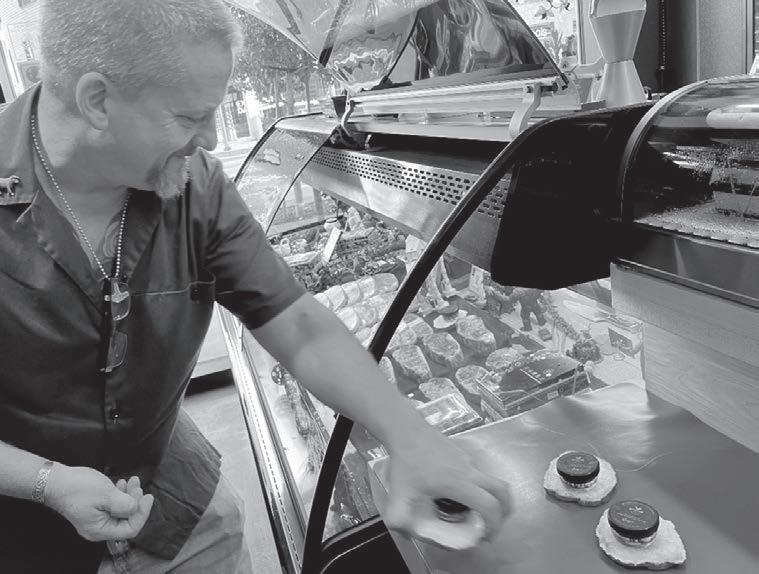
Guy Crims prepares jars of caviar for the counter case at Niku Butcher Shop. PHOTO: Mark Steensland
Municipal Transportation Agency to Pause Towed RV Storage at Pier 68
BY JESSICA ZIMMER
Last month, the San Francisco Municipal Transportation Agency (SFMTA) suspended use of Pier 68 to store towed large vehicles. The Agency hopes to find another storage location by March 1. The pause followed civic advocates’ call for community engagement before the pier is used for such purposes.
The City wants to remove large vehicles, such as recreational vehicles (RVs), in part by purchasing them through its Large Vehicle Refuge Permit Program. The program allows for a temporary parking extension for people who live in large vehicles as they search for housing and support. SFMTA had leased a portion of Pier 68 from the Port of San Francisco to store towed vehicles.
“I appreciate SFMTA’s willingness to pause the use of Pier 68 and to work collaboratively to find a more appropriate location outside of District 10. Our communities deserve transparency and
meaningful engagement, especially when decisions impact neighborhood resources,” said District 10 Supervisor Shamann Walton
Julie Kirschbaum, SFMTA director of transportation, said the agency will communicate with nearby communities before deciding on a location.
“ I appreciate Supervisor Walton’s advocacy for the District…hope that, regardless of where the RVs are ultimately stored, the SFMTA takes the opportunity to work with neighboring communities to ensure that concerns are addressed,” said J.R. Eppler, who is running for the District 10 Supervisor seat.
“We welcome this pause as a crucial acknowledgment that community voices must be heard before policies are implemented. We look forward to a renewed partnership with the City, grounded in transparency and genuine collaboration,” said Michael Berkowitz, Dogpatch Neighborhood Association president.
This Potrero Life
BY JA POET
Look at this crazy world
So wild, it makes the face turn sour
You could cut the telly, and shut the blinds
But you’ll still be privy to the feeling that something’s not right
Something is hiding, not providing
It’s dimming the light, not rising
Is there anywhere out here that’s shining?
Our city by the bay could show some promise
And the Hill that’s within is probably what you’re longing
To gain some peace, in time and space
It’s Potrero that can put a smile on your face
Pop a squat at Jackson Park or indulge in a Pete’s frappé
Drive along the real crookedest street, then get Street Taco on the way
Walking to the rec center is the greatest workout of my day
And the views are worth it
Something you can’t fathom, it’s unheard of
But you deserve it
To be living and waking, to the parrots parading
To school children waving, their parents are praying
That every neighborhood could soothe the aches and graveness
Like Potrero Hill does to the residents that want a safe space
To learn and grow, get ice cream at Milkbomb and breakfast at Plow
Just take a look around, now something feels right doesn’t it seem so?
I don’t know what the future may hold
And all I can do is seriously hope
That the donuts and trees, the soft sunny breeze
Continues to bless our lives with inspiration, happiness, and the highly sought after sense of ease.
Get Out of Meeting Free Card
BY TOM WELLS
When not gainfully employed as a quantitative researcher, I use the euphemism “in between jobs.” Conversely, when actively employed, I’m “in between layoffs.”
In 2024, while in between layoffs, my employer organized quarterly in-person meetings at company headquarters, in Chicago. One assembly didn’t require inperson attendance, so I opted to attend virtually, as did many other coworkers.
At the designated time, I closed the door to our home office and joined the two-hour meeting via Zoom. I was a passive attendee; I had my audio muted and camera turned off.
Meanwhile, my wife Lisa was flitting around Potrero Hill and environs, running errands in preparation for an upcoming family trip to Santa Cruz. She informed me of the three stores at which she’d be shopping. I only remembered one of them – because male – which was Le Marché Cezanne.
At some point during my meeting, our senior chihuahua, Russet, who can’t see well, woke up in the bedroom and walked down the hallway, bonking his head against the walls for navigation. He paced toward the office, not due to being excited about joining a two-hour Zoom conference, but because he was looking for his dear, beloved Mommy. He soon figured out that she wasn’t in the house and was willing to settle for second-best. I picked him up and put him in my lap. He rapidly fell asleep again.
A short while later, Lisa returned
after a successful first trip. In order not to disturb anyone, she considerately and quickly placed her filled shopping bags in the hallway, not far from the closed office door. She turned around and left; home 20 seconds, tops.
That was more than enough for Russet, who has an amazing sense of smell. Detecting her scent, he woke up and, in his excitement, got uncontrollably squirmy. Mommy’s home! Yay! Take me to Mommy!
Except she wasn’t home anymore. But his body language was insistent. There was no way to contain his squirming in my lap, putting him in danger of falling off.
I ducked out of the meeting, took him into the hallway, set him down, and tried to placate him with the reassuring scent of Mommy’s bags. Huge mistake. Her trace was there. Both human logic and canine instinct would suggest she must be present or close by. Except she wasn’t. Quite the paradox I’d created.
In his confused state, Russet started howling. Loudly and dramatically. Nonstop. We needed to find Mommy in-person, Stat, to get him settled. But all I can remember is her shopping at Le Marché. What’re the chances she happened to be there at this precise moment? Not good, but I’ve got nothing else.
I scooped him up and we headed outside, making a sudden, unexpected public appearance. He’s off leash. I’m under-dressed in my shabby work-fromhome clothes; track pants, basically Jamy bottoms. I had my Zoom camera turned off for a reason. I hoped we didn’t have to
FARLEY'S FOREVER

Nothing says "I love you!" like a bag of Farley's coffee (and a nice card). Come by the shop and grab a gift for your valentine.
EVERYDAY 7:00AM - 6:00PM

Ja Poet is a Carolina Street resident

Community Calendar
2/3 Tuesday
Politics: Willie Brown at Commonwealth Club
Former San Francisco Mayor Willie Brown discusses national, state and local politics with KQED political reporter Scott Shafer. Brown was the first African American speaker of the California State Assembly, serving a record 14 years in that role, followed by two terms as San Francisco mayor. Brown will talk about the state of American democracy, the Democratic Party’s future, and Mayor Daniel Lurie’s track record, among other things. 12 to 1 p.m. Tickets: $32.45. The Commonwealth Club, 110 The Embarcadero. For more information: https:// tinyurl.com/2jtu4fsf
2/5 Thursday
Art: Museum of Craft and Design
The Museum of Craft and Design is free on the first Thursday of every month. 12 to 5 p.m. 2569 Third Street, between 22nd and 23rd streets. For more information: https://sfmcd.org/visit/
Fashion: Introduction to Sewing Workshop
Learn the basics of machine sewing: threading a machine; how to change a bobbin; altering the tension and stitch length; and more. Bring in clothing with torn seams or that need patching and instructor Tria Connell will show you how to use your new skills. Students are welcome to bring a sewing machine; otherwise, one will be provided. 5 to 8 p.m. Tickets: from $49.87. SCRAP, 2150 Newcomb Avenue. For more information: https://bit.ly/4bhy3z0
2/5 Thursday
through 2/15
Sunday
Film: Mostly British Film Festival
The festival returns for its 18th season with award-winning films from the United Kingdom, Ireland, Australia, New Zealand, South Africa, and India. The Mostly British Film Festival is presented by and raises funds for the San Francisco Neighborhood Theater Foundation. It’s programmed by Ruthe Stein, who covered movies for 50 years at the San Francisco Chronicle. Tickets: General admission - $20 / seniors 65 and over - $15. Opening night reception - $75 / $65; film only, excluding party - $35. / $25. Closing night with a Valentine-themed dessert after party at the theater - $35 / $25. Series pass to all 26 films, with priority seating and access to opening and closing night parties is $350. Vogue Theater, 3290 Sacramento Street. For more information: mostlybritish.org
2/6 Friday
Art: Baukunst First Fridays
Baukunst First Fridays is an art showcase in which no commissions or profits are made from the artwork. 5 to 8 p.m. Free. Baukunst, 433 Cortland Avenue. For more information: https:// bit.ly/4t2tqzs
2/13 Friday and 2/14 Saturday
Valentine’s Day: Prints Sale
Celebrate Valentine’s Day at Graphic Arts Workshop, with original artwork by Bay Area printmakers. 11 a.m. to 5 p.m. Free admission. Graphic Arts
Workshop, 2565 Third Street, Suite #305.
2/14 Saturday
Botany: Magnificent Magnolias
The annual bloom of more than 200 rare and historic magnolias, with trees reaching 80 feet, typically peaks from January through March. Velvety silver buds on the often-bare branches of these elegant trees, many rare and historic, open into dazzling pink, magenta, and white flowers, filling the garden with dramatic splashes of color and sweet fragrance. 7:30 a.m. to 5 p.m.; last entry at 4 p.m. Tickets: $7 to $35; free admission for San Francisco residents; must be redeemed by 9 a.m. San Francisco Botanical Garden, 1199 Ninth Avenue. For more information: https://bit.ly/4pYmUH5
2/14 Saturday and 2/15 Sunday
Lunar New Year: Flower Market Fair
Purchase fresh flowers, fruits, candies and supplies to begin the new lunar year. Performances by traditional Chinese magicians, acrobats, folk dancers and opera. More than 120 booths and concessions. Saturday: 10 a.m. to 6 p.m. Sunday: 9 a.m. to 6 p.m. Free. Grant Avenue between Broadway and Clay streets. For more information: https:// bit.ly/4rbhDgn
Art: The Box SF’s Artistic Creators Fest
Support local artists and makers at The Box SF’s Artistica Creators Fest. Originally the William Randolph Hearst
printing plant built in the 1920’s, The Box SF is home to two floors of event space, as well as an antique printing and vintage advertising mercantile modeled after an 1850’s country store. Saturday: 11 a.m. to 5 p.m. Sunday: 11 a.m. to 4 p.m. Vendor spaces are available for local creators looking to sell their work at this historic Southof-Market venue. Free admission. The Box SF, 1069 Howard Street. For more information: https://bit.ly/3NNSsC1
2/19 Thursday through 3/15 Sunday
Theater: Left Field
Delson Stammer is a small-time AIDS activist with a big-time chip on his shoulder. When he moves to San Francisco in 2000, he turns his rage into a bid to become a San Francisco Supervisor and, surprise surprise, he ends up in City Hall. A series of miracles sends this totally “out of left field” candidate to the White House. What’s he going to do? Find out in this outrageous and topical comedy from John Fisher, author of the action-adventure epics Bi lly, Fallin, and Pirates! Left Field is written and directed by John Fisher, produced by Theatre Rhinoceros, founded in 1977, the nation’s longest running LGBTQ+ theatre. Tickets: $12.50 to $35. Theatre Rhinoceros, 4229 18th Street. For more information: https:// bit.ly/4bhBTbA
2/21 Saturday
Music: An Afternoon of Chamber Music
An intimate concert featuring chamber music from Bay Area musicians,

Dental Health Fair
hosted by the San Francisco Civic Music Association. 3 to 5 p.m. Free. Noe Valley Ministry, 1021 Sanchez Street. For more information: https:// bit.ly/4bmDiO5
2/21 Saturday
Beverage: San Francisco Beer Week Fest
Join the Bay Area Brewers Guild and Barebottle Brewing for SF Beer Week Fest. Sample limited-edition collaboration brews and special releases. Enjoy unlimited tastings, live entertainment, and a reusable commemorative tasting glass. Must have ticket and be 21+ to drink. 12 to 5 p.m. Tickets: from $95.51. Salesforce Park, 425 Mission Street. For more information: https:// bit.ly/4qDgwWN
2/27 Friday
Design: Design Crawl at San Francisco Design Center
Design students are invited to an exclusive behind-the-scenes showroom tour. Spend the day exploring top design showrooms with expert guidance, gaining real-world industry insight, and connecting with leading vendors. The experience includes lunch and wraps up with coffee and desserts. 9:30 a.m. to 3 p.m. From $12.51. San Francisco Design Center, 101 Henry Adams Street. For more information: https://bit.ly/4pZFrTk
2/27
Friday through 3/1 Sunday
Books: California International Antiquarian Book Fair
A three-day event featuring booksellers’ collections and rare treasures from around the globe, including manuscripts, modern first editions, children’s books, ephemera, maps, and autographs. Friday, 4 to 8 p.m., Saturday, 11 a.m. to 7 p.m., Sunday 11 a.m. to 4 p.m. $10 - $25. Pier 27, The Embarcadero. For more information: https://bit.ly/4k14ggn
Dear Readers
2/28 Saturday
Health: Free Dental Health Fair for Kids
A community event hosted by volunteer dental students, faculty, and staff from the University of the Pacific, Arthur A. Dugoni School of Dentistry’s Hutto Patterson Pediatric Dentistry Clinic. Free dental services worth more than $250 provided to each child up to age 17: dental and orthodontic screenings; cleanings; fluoride treatment; educational games; face painting; balloon art; petting zoo; and more. Children must be accompanied by a parent. 9 a.m. to 1 p.m. Free. University of the Pacific School of Dentistry, 155 Fifth Street. For more information: https://bit. ly/3YSFe9w
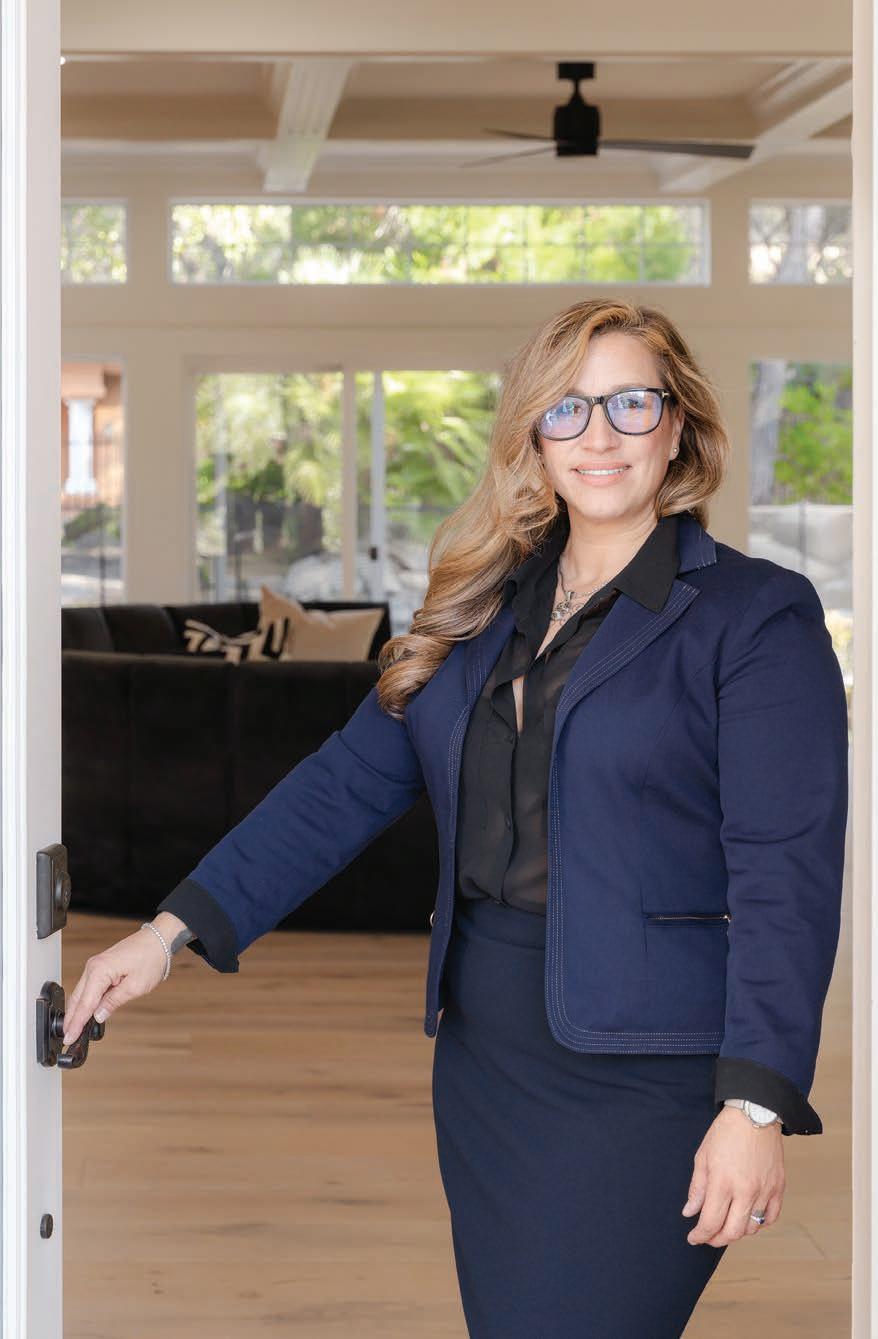
Jennifer LaRocca Realtor
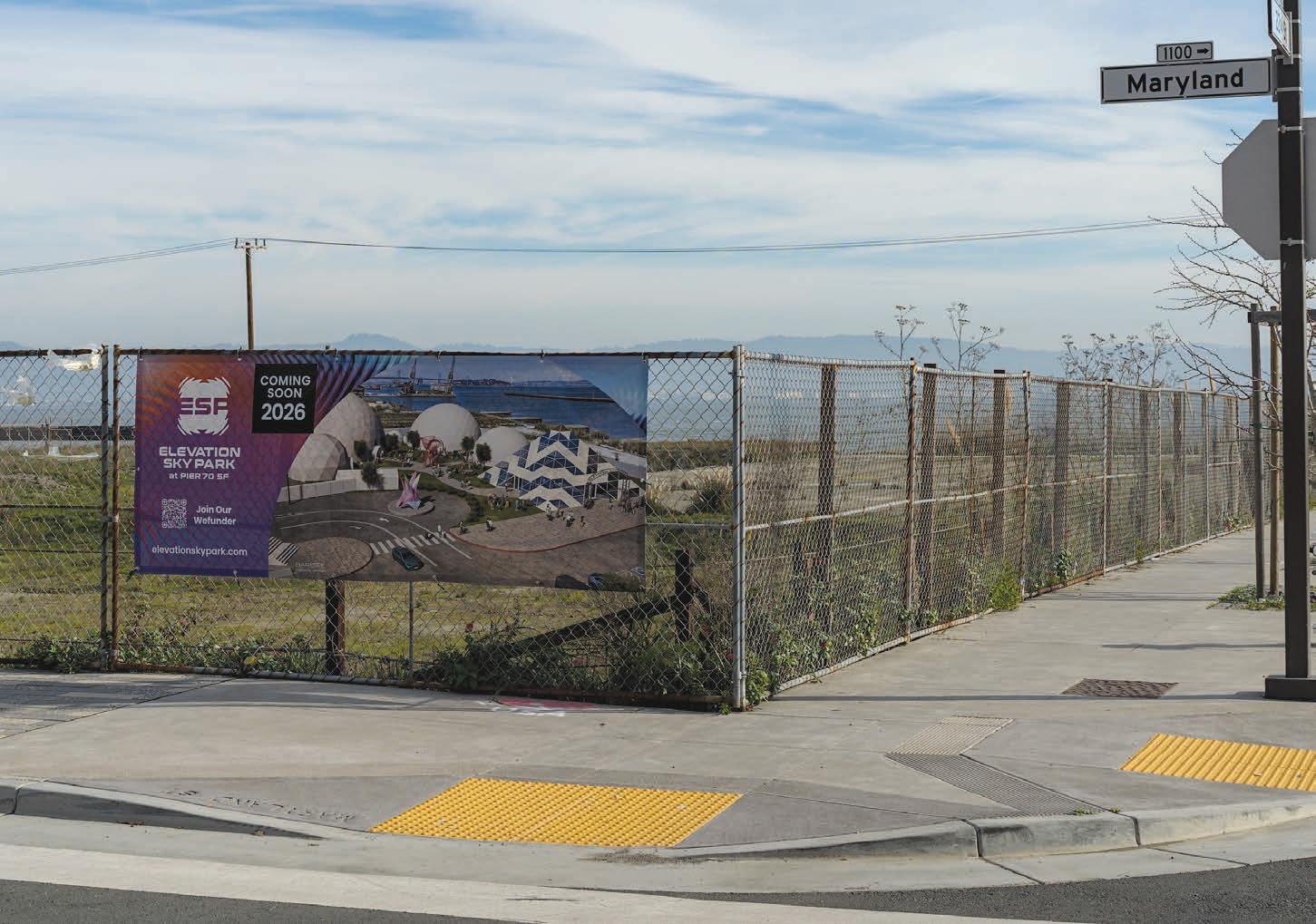

Elevation Sky Park, coming soon to Maryland and 22nd, across the street from Standard Deviant.
PHOTO: Thomas Hunter II
FICTION: Girth Worms
BY STEVEN J. MOSS
This is the third of a three-part series, the first of which appeared in the December issue (tinyurl.com/yscuv2d9)
Home Again
About a week after I got home I called my buddy Fred to tell him about the trip. I had already described the little motorized jitneys that buzzed all over the place, the dead bodies, and meeting the worm guy.
“Things were going really well. I was having a great time. But I must have eaten something bad. First, I got really sick, and then I started losing weight.”
“You know, Philly-boy, that guy slipped you a mickey.” Fred had a cold, so he sounded all nasally.
“Waddayamean, a mickey?”
“Alright not a mickey, cheese steak man, a worm, he slipped you one of those worms.” He coughed at the other end of the line. It was always like that with him, making fun of my name; Philly, Mr. Cream Cheese Head, or Feely, the horny guy who’s always trying to cop something on crowded Muni lines. I didn’t like it much.
“Okay, Friiieed , how’d he do that? I was with him the entire time,” I countered. But I knew he was right.
“Simple, hill-boy, he put a worm in your drink while you weren’t looking.” It sounded like he was rubbing his very congested nose. It made a wet, smacking sound. “You weren’t always looking right at him, Feel-face, were you?”
The water had seemed clear, but the worms were pretty small.
“I guess he could have done it when I was picking up that bottle cap.” A cap that’d turned out to be from a bottle of Kingfisher, completely worthless.
“Right-e-o. Anyway, I’ve got to go drain my nose in the sink. See ya around.”
“Not if I see you first,” I mumbled, but he was already gone.
As soon as I hung up the phone I started getting that creepy feeling, like hairballs, the insides of dog cages, and the worm guy’s room. He must have slipped me a worm. That’s why I was queasy so much, and my pants were so loose. I sat there, thinking it over, idly playing with a small pile of paper clips – I collect them too; you’d be surprised at the variety of paper clips available – and an idea took hold of me.
I got up and rummaged through my travel bag, still packed from the trip, and found the peanut can, plastic cap tightly clamped on. I peeled off the top, and there, inside, were maybe a couple dozen little black blobs. They must have multiplied, or divided, or something. I unwound a paper clip and poked at one of them. His wormy flesh shrank back, and he kind of curled up, though he was pretty curled already. I was in business.
The rest was easy. I went to Walgreens and bought an off-brand box of cold remedy, the plastic caplet type that has tiny medical jimmies inside. I set a few of the pills aside for Fred, and emptied the insides of the rest into a plastic baggy, in case I needed the medicine sometime. Then, I put the worms into the caplets. In addition to the one I’d poked, only one or two of them showed much signs of life. Still, I figured they’d do the trick.
The End of the Story
I’d been back from India almost three months. But no matter how much I ate, I kept losing weight. I’d eat huge stacks of pancakes, saturated with syrup and butter;
Pop Tarts three times a day; surgery cereals. I wasn’t even that hungry, I was just disappearing.
I went to a doctor. I told him about my trip to India, and my weight loss, and how I thought I might’ve eaten a worm. I described the worms; black, blobby, small. He went over to his shelf and pulled out a fat book filled with slick paper and photographs and leafed through it.
“Did it look like this?” he asked.
He showed me a black and white snapshot of a worm lying next to a dime. The dime was bigger. The page opposite had a color photograph of someone’s arm with what looked like red worm tracks gouged from the wrist to the elbow.
“Yeah, that’s it. That’s the worm.” I said.
He gave me a bunch of pills and told me to take them twice a day with food for ten days. In not too long, he said, I should see the worm coming out in my ‘fecal matter.’ He told me it was a good thing I came when I did, because the worm probably wasn’t getting any smaller, and, given enough time, would eventually wrap around my insides and kill me.
I took the pills and began to gain weight. In fact, since I still ate piles of prepackaged waffles, boxes of Kraft macaroni and cheese, and large scoops of ice cream, I fattened up way past my pre-India poundage. I must’ve eaten so much to compensate for my worries. I was thinking about my customers: the fat lady with the baby; the teenagers; the guy who swallowed a bean bag chair. Even though I’d told each one of them to call, I’d only heard from the businessman, who’d come by with a smile on his face about a month after buying the remedy. He looked about the same to me but insisted he’d lost ten pounds. I gave him some of the pills I’d picked up from the doctor and told him they were even more effective than the last batch.
I couldn’t sleep at night, and when I did, I’d dream about the burning bones and floating bodies I’d seen in India, and wake up sweaty and scared. Maybe my worms were sitting in my customers’ stomachs getting bigger and bigger, until finally they’d fill everything inside, and come bursting out of their stomachs, like Alien, or oozing out of their ears and noses, like that episode of Fringe.
I posted another set of signs around the neighborhood. I didn’t want to admit liability or anything, so I wrote, “Fresh from the Orient – even better weight loss remedy. If you liked the last batch, you’ll love this one. Free to all previous customers.” I figured once I got them in the door, I’d give them some of the anti-worm pills the doctor gave me, and, viola, good-bye worms.
Over the next few weeks all but two of my customers reappeared. The skinny teenagers complained that they hadn’t lost any weight and wanted their money back. I gave it to them. The middle-aged woman told me her weight hadn’t changed, but thought it was because she’d been eating more, and didn’t ask for a refund.
Neither the fat woman with the baby or the woman who looked like my sister showed. I didn’t leave the house, in case one of them dropped by. I watched a lot of The Office, Friends, and Two and a Half Men re-runs, ate, and got fatter and fatter. Maybe the worms had already killed my remaining two customers. I scanned the Internet for notices of news about premature, worm-induced, deaths, but there weren’t any, or at least they weren’t web-worthy.
Fred came over now and again, but he
Crosswords
BY DENA R. VERKUIL
BY DENA WITKES
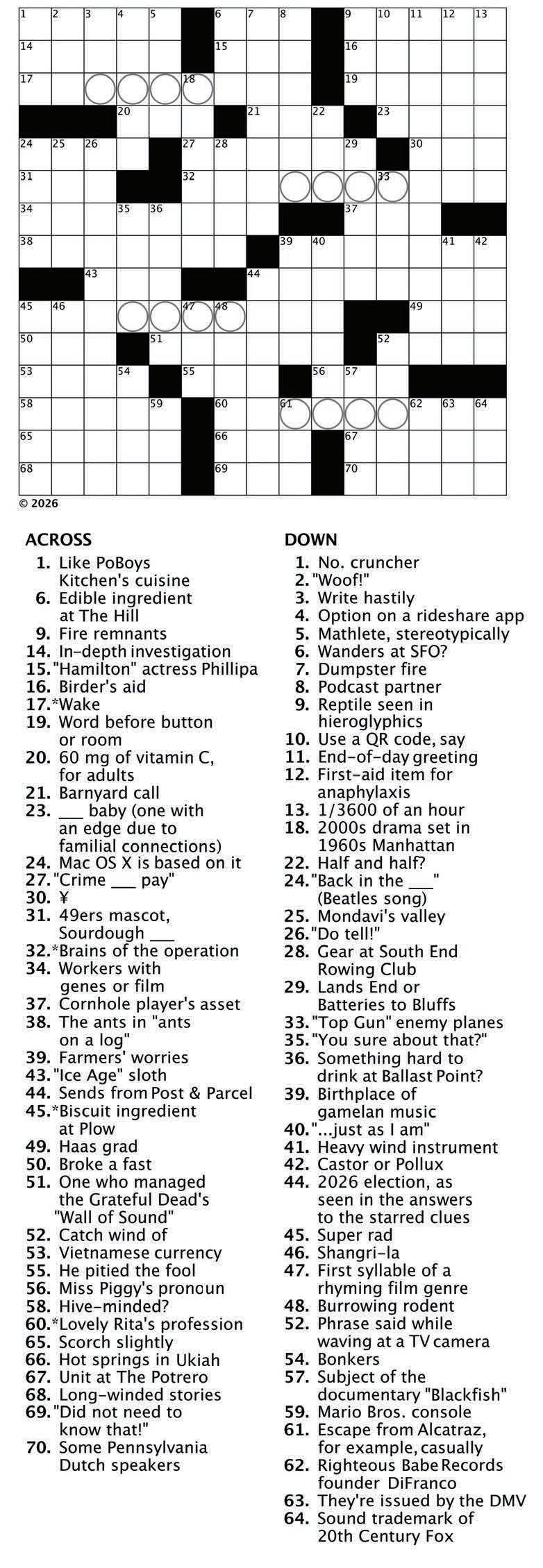
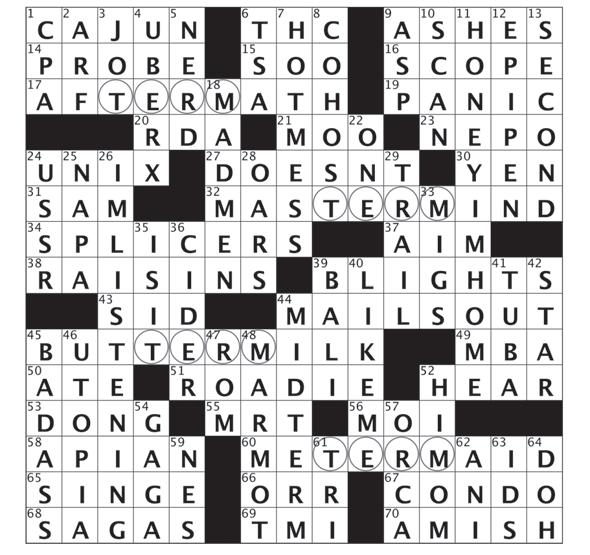
The Potrero View is accepting crossword puzzle submissions. To be considered for publication puzzles should adhere to standard crossword size (15x15) and specs; fill/clues/theme must have local relevance. Happy to take theme inquiries or unclued grids for feedback before construction. Please e-mail: denarobin@me.com
SUPERVISOR from front page or transliterated Chinese names.
Eight people have filed initial paperwork declaring their District 10 candidacy. Districts Eight and Two are the next closest, with three each. District Four has two contenders. No one has yet declared for District Six.
The District 10 candidates in alphabetical order are:
Pearci Bastiany, 30, owner of MAFH Security in Sunnydale and a SF Bay View reporter. Born in San Jose to an African American father and Mexican American mother, both of whom were employed at Silicon Valley defense firms, he attended the University of San Francisco (USF), where he earned a bachelor’s in marketing. He’s presently attending USF’s graduate program in public administration. Bastiany decided to run after working with the NAACP and San Francisco Democrats on collegiate voter mobilization two years ago. He hopes to end homelessness with containerized, modulated shelters and has a plan to remediate and reactivate the Hunters Point Naval Shipyard, which he claims will restore jobs in the manufacturing, logistics, and defense industries. He’s received training from GoodParty.org, and is affiliated with Students Demand Action, which wants to end gun violence.
Dion-Jay “DJ” Brookter, is the executive director at Young Community Developers, Inc., a nonprofit that provides workforce development, education, and housing services to Bayview and Hunters Point residents. In 2023, YCD served more than 2,000 clients and secured job placements for upwards of 30 percent of them. Brookter is a Bachelor of Science in Speech Communication from Utah State University and has a Master of Business Administration from the University of Phoenix. He’s endorsed by District 10 Supervisor Shamann Walton, who calls Brookter “the real deal…He respects all communities and is a true leader with a proven track record and the right ideas to move us forward.”
Theo Ellington , 37, is a third generation San Franciscan with a master’s in urban affairs from USF. He lives in Bayview with his wife and three sons. He’s executive director of the Bayview Opera House and policy director at Brownstein, a legal and policy firm. He finished third in the 2018 race for District 10 Supervisor. Since then, he’s served as The Salvation Army’s director of homelessness initiatives and community development and as the Golden State Warriors’ director of public affairs. His campaign website lists numerous endorsements, including Congressman Kevin Mullin, State Treasurer Fiona Ma, Senator Scott Wiener, former Mayor London Breed, and Supervisors Stephen Sherrill, Matt Dorsey, and Danny Sauter.
J.R. Eppler is an attorney whose clients include small and medium-sized businesses and individuals. A native of Oklahoma City, Eppler moved to California to attend Stanford University, where he earned a Bachelor of Arts in economics and history, followed by degrees in law and management from the University of California, Los Angeles. Since 2010, he’s lived with his wife and son in Potrero Hill, where he serves as Potrero Boosters Neighborhood Association president. He was appointed to the Board of Appeals in 2022 by Walton.
“I’m running because I believe I have a deep understanding of how City government works and a deep commitment to delivering what this District needs,” Eppler said. “As a community advocate, I’ve been closely involved in pushing forward the priorities of our residents, bringing the 55 and 15 Muni routes to our communities, negotiating on behalf of the renovation of
Jackson Park, securing funding for a new box-step trail on 22nd Street and working to make the Dogpatch Hub a reality.”
Mike Trouble Lin , 53, is a selfemployed divorced father of two adult children who has lived in District 10 for 25 years. He’s a registered independent with Andrew Yang’s Forward Party who wants to highlight mental health issues in Asian American communities and promote small businesses.
“I’m well aware that as an outsider and independent candidate, my chances of winning the D10 supervisor race are minimal,” Lin said, but hopes that his ideas will resonate with the front runners and San Franciscans.
Jameel Patterson previously served as associate director of the New Community Leadership Foundation, a Black-led organization that works to combat displacement and disenfranchisement among San Francisco’s African American communities. He helped secure $1 million in municipal funding to preserve the Fillmore Mini Park and activate the long-dormant Fillmore Heritage Center. He was recognized as an Everyday Hero by the San Francisco Housing Development Corporation in 2021.
Jessica Pessecow, 33, is a psychiatric nurse and health policy professional who has lived in Potrero Hill since 2022.
“The intersection of being unhoused and having untreated mental psychosocial and behavioral health conditions is the most urgent crisis we face,” she said, and plans to advocate for a coordinated behavioral health services system.
She hasn’t raised any money and doesn’t plan to.
“Public service should be about accountability, independence, and advocating for the community,” she said. “Not about donor influence or special interests.”
The eighth candidate, Deandra Bryant, couldn’t be reached for comment.
The San Francisco Standard identified several additional potential candidates, including community organizer Cedric Akbar, and nonprofit housing director Bill Barnes.
“Make sure that you listen to your communities and remember that you represent them,” Walton advised the candidates.
magazine and newspaper titles. Alongside the periodicals it sells a diverse set of small goods, including candles, umbrellas, clothing, travel guides and incense.
Charlotte, a Heath newsstand salesperson, told the View that the shop serves a varied group of customers. Neighborhood design professionals peruse the magazines for inspiration. One patron picks up a copy of the San Francisco Chronicle daily. Passerby and ceramics store customers browse everything.
Titles include those focusing on writing, the performing and visual arts, fashion – including international editions of Vogue – architecture and interior design, kids, food and travel. The most prominently displayed magazines are of a type one visitor called “upscale.” Printed on extra-heavy paper and boasting a high photograph-to-text ratio, these publications are as much art object as reading material. The newsstand also features a large selection of literary and book review titles, such as Grand , Granta , and the European Review of Books. Handmade zines aren’t stocked.
Quick online access to information and images has driven print magazines and newspapers to the edge of extinction. But these materials remain available, even abundant, in Potrero Hill and Mission Creek. And print may yet make a comeback. Perhaps surprisingly, the
Classified
Ad Sales Person Wanted
Lead support provided; the View needs someone who likes to finalize ad sales. Part-time, not high pay, mostly commission based, but an effective communicator could do okay. Have we sold you? Interested parties: editor@ potreroview.net
Freelance Writers Wanted
Modest pay, interesting assignments. Contact: editor@potreroview.net
Seeking Tennis Partner
Sixty-something male intermediate tennis player looking for (semi) regular rally or game partner. Email editor@ potreroview.net
Legal Notices
The View accepts legal notices. Please contact: production@potreroview.net; 415.643.9578.
Write Your Own Obituary
We're all going to die; why leave the writing of your obit to someone else? Whether you believe the end is imminent or just something you contemplate idly whilst taking a shower, you can control your own destiny, or at least how it's reported. Or, after examining your life story and finding it lacking, add to it! Up to six people in three two-hour sessions, $150. Interested parties should contact editor@potreroview.net
Got something to sell? Have a service to provide? Each classified ad is $25 for up to 200 characters. www.potreroview.net/advertise
…anti-Semitic conspiracy theories— one controversy in a career marked by many, including claims that French president Emmanuel Macron obtained his office through the CIA’s MK-Ultra mind-control program and that his wife, Brigitte, was born a man (the Macrons have filed a defamation suit against Owens).
techies founding startups and renting apartments in the area may help: according to Charlotte, the Heath Newsstand employee, with their greater wealth tech types buy more.
Guerrero streets caught fire during construction activity late last year and remains closed. Around half the pumps at the Speedway station at Cesar Chavez and South Van Ness are non-functional. The Alianza station at the triangular section bordered by Cesar Chavez and Bryant streets and Precita Avenue was recently demolished. As Bernal Heights neighbourhood social media posts noted, in a previous incarnation as a Phillips 66 station, it appeared in a car chase scene from the 1968 movie, Bullitt Mississippi Street resident Tejas Rao, observed that gas stations periodically change hands, including the Cesar Chavez Shell station that was replaced by National Petroleum. Utah street resident Caleb Boyd mentioned that the Gas and Shop at 17th and South Van Ness consistently offers the lowest priced petrol in the area.
While the number of EV chargers has grown, EV owner Zunaira Malik noted that many fast chargers are only accessible within paid parking lots, with compatibility issues between hardware and payment methods at different networks’ chargers. In her experience roughly a quarter of chargers don’t function properly.
“I do think coverage has gotten better in last few years and the chargers are being better maintained so they’re less frequently broken; however, it’s still not sufficient,” she said.
Owens asserted that the French and Israeli governments were involved in Charlie Kirk’s murder, with Turning Point USA members part of the plot. There’s no evidence to support those claims.
Though Cockburn acknowledges Owens’ suspect grasp on reality, he relies on her to prove his point that conservative American attitudes are changing towards Middle East politics. This opinion may be accurate. But how is a reader supposed to assess it when its formed, in part, based on a source who in the past might have been called “a crazy lady.” Further, by citing such an informant Cockburn is advancing and solidifying them as a reliable interpreter of what’s real.
Stephen Colbert coined “truthiness” in 2005, during the first episode of The Colbert Report, perhaps not coincidently roughly coinciding with Lapham’s retirement. The word describes “truth that comes from the gut, not books,” preferring what one wishes to be true over actual facts. Twenty years later the truth part of the term has eroded, leaving a kind of “thinness” to public discourse. The irony is that in this respect the political left and right have joined hands, with lefties like
GAS STATIONS from front page
PUBLISHER’S VIEW from page 2
MAGAZINES from front page
PUBLISHER’S VIEW continues on page 11
Potrero View Local Business Directory

| production @ potreroview.net | potreroview.net/advertise/



PUBLISHER’S VIEW from previous page
Cockburn undermining civic literacy in a similar, if less powerful, fashion as the Trump Administration’s attacks on the aforementioned Yale and similar institutions, and fabrications related to federal attacks on civilians in Minnesota.
In a turbulent sea of disinformation, life rafts of reality are essential, places to visit that can be depended on to be as true as possible. It’s always been the case that news, whether generated by The New York Times, San Francisco Chronicle , or The Potrero View needs to be consumed thoughtfully, sifted through an educated mind that strips propaganda fat from bone, misinterpreted sinew from muscle. When a venerable publication like Harper’s – whose largest financial backer is The J. Roderick MacArthur Foundation, which supports freedom of expression, human rights, civil liberties and social justice –starts to evidence thinness, civil society is in the deepest of trouble.
Lapham, who died into 2024, may have thought each individual accountable for educating themselves to properly undertake intellectual thought and public discourse. Not everyone comes from his kind of privilege, with a father who was president of the Grace Line and Bankers Trust and a grandfather who served as mayor of San Francisco in the 1940s. Still, it’s hard to argue with the need for personal responsibility and political dialogue based on some knowledge of history and a generally accurate understanding of what’s actually going on.
full-time academic campus there beginning in the fall of 2027. The campus, subject to regulatory approvals, is expected to serve about 1,000 undergraduate and graduate students. CCA, Northern California’s last remaining nonprofit art and design college, which has long struggled financially, will continue instruction through the 2026-27 academic year. Vanderbilt officials said CCA students can apply to the university but won’t be automatically transferred. Vanderbilt intends to operate a CCA Institute at Vanderbilt which will include, among other things, the Wattis Institute of Contemporary Arts, maintain CCA archival materials, and serve as a vehicle for CCA alumni engagement. CCA’s announced a $45 million donation from the founders of tech giant Nvidia nearly a year ago, which university officials hoped would help stave off financial ruin.
More Bagels
Bagel Daddy opened in Showplace Square in December, offering five varieties of bagels — plain, everything, sesame, poppy, and salt — and nine flavors of house-made cream cheese, including plain, scallion, blackberry mint and garlic chili crisp. Also available are bacon, egg, and cheeses, and a classic open-face lox sandwich featuring sushi-grade smoked salmon. Owner Benjamin Simon is a software engineer and founder of yoga app Down Dog. After moving to San Francisco more than a decade ago, he couldn’t find what he considered to be a good bagel, so he started making his own. There’s hardly a hole in San Francisco’s bagel scene today, with Wise Sons, Schlok’s, and Boichik, among others, competing to be the perfect vehicle for butter or cream cheese.
Humans have been here before, as evidenced by such quotes as “Open your mind before your mouth,” by the ancient Greek comic playwright Aristophanes. The first step to reclaim empirical, educated, thinking is to recognize how far away we’ve drifted from it. Time to swim back. GET OUT from page 4
SHORT CUTS from page 2
it’s held benefits, weddings, school recitals and memorials.
College Replaced
Vanderbilt University has acquired the California College of the Arts’ Potrero Hill property and plans to establish a
pass by too big a crowd waiting at Plow or Farley’s.
I carried him to Le Marché and to everyone’s relief we found Mommy in the store, basket in hand, pleasantly conversing with another customer. I placed him in Mommy’s arms. He’s happy, quiet, and calm again. Crisis resolved. Whew!
I gave my wife a quick explanation about his reaction to the presence of her bags in combination with her physical
absence. I also explained to one or two intrigued neighbors – including Dominic from Christopher’s Books – what the impromptu doggy drop-off was about.
I returned home to my meeting. I was jealous of the dog. He was enjoying the affection of his Mommy/my wife and I was stuck in this meeting. Good boy! Well done!
Our old dog flipped the script and taught me a new trick: if you’re caught in a meeting and want to get out, start howling. It’s a Get Out of Meeting Free card. I’ve seen it work first-hand. It’s effective. However, it might be too effective. I suspect that after one play of the card, one may be excused from all upcoming meetings due to being in between jobs, again.
Tom Wells lives on Texas Street
GIRTH WORMS from page 9
bugged me with his “Phil, the size of Philadelphia” jokes. I tried calling my sister, but her work told me that she was on assignment somewhere, and she’d changed her home telephone to an unlisted number. I guess she must have been getting a lot of crank calls. I didn’t talk to anybody for days, and weeks passed during which the only human contact I had was with the guy at the corner grocery store.
The rainy season came. I’d sit by the window, and bet on which raindrop would slide down to the bottom of the glass first, a game my sister and I played when we were little.
I was re-sorting my miniature liquor bottle collection, trying to match the color of the labels to the color of my bottle caps, when there was a knock on the door, and in came the lady with the baby. She was wearing a huge raincoat, shining with tiny drops, that seemed to be made out of the same Glad bag-bubble wrap material she wore the first time I met her, but with a slightly different shade of blue. I couldn’t believe it was her. I jumped up, grabbed her, and gave her a hug.
“You’re still fat! You’re still fat!” I yelped.
“So are you.”
She pushed me away and looked me up and down, like she couldn’t believe what she was seeing, and what she was seeing wasn’t good. I’d gotten wet when I hugged her, so I wiped off my shirt, unfolded the metal chair, and indicated she should sit down.
“It’s great to see you,” I said. I bent over her baby carriage, which
was damp. “And here’s the little one.”
I pulled back the blanket. Still, beady eyes stared up at me. I jolted away, still clutching the blanket.
“That’s not a baby. That’s, that’s one of those baby-wet-her-pants dolls, from the 1980s.”
She grunted. “Yeah, well those weren’t weight loss pills you gave me, neither were they?”
She shook her head sideways. I did the same.
“But, why do you push around a doll in a carriage, and tell people it’s your baby?”
“Why do you sell ‘Oriental medicines’ that don’t do a damn bit of good?” She sighed, heavily.
“You try being fat, single, and in your forties.” She eyed me over. “On second thought, maybe you already have. Now give me my money back.”
She snatched the blanket out of my hands and tucked it back over her baby.
I went to the desk and pulled out the same crumpled notes she’d originally given me; I’d kept them because they were the first dollars I’d made during my shortlived weight loss business.
“Here.” She took the money and heaved herself out of the chair.
“Hmmuph.” she said and gave me one last look. Then she turned around, and pushed the baby carriage out of my apartment.
I sat at the edge of the desk. Almost all of my clients were now accounted for, and none of them had experienced the kind of weight loss I imagined a “killer worm” would cause. But I hadn’t heard from the woman who looked like my sister. Maybe she was sick, or even dead, which would mean I killed her. I fished the rest of the worm caplets from the desk drawer and opened them up. Inside each one was a dried-out black thing resembling a tiny raisin. Except the last one. It contained a curled-up blob that, when I poked it with a paper clip, curled up even tighter. I poured myself a glass of water and drank it down.
I walked over to the window. It’d started to rain again, and I watched two drops as they raced to the bottom. If my drop won, I bet to myself, my sister would call. Keeping my eyes on each bead of water, I leaned against the windowsill and silently urged my drop to go faster.
This story was first published in the View’s February 2019 issue.
The City. Our City.
Rickshaw Presents Blockheads by Dave Warnke 10 Year Anniversary