Go East, Young Person!

BY JENNA DUNCAN
At a recent happy hour a HaightAshbury bar was crowded with middleaged folks sporting close cut haircuts illustrated with silver and grey strands. The men were largely attired in San Francisco 49ers jerseys. The women mostly wore blue jeans, practical shoes, and Kate Spade handbags. BMWs and Tesla’s were parked outside.
Where have all the young people gone? Many to New York City.
During the COVID-19 quarantine, people streamed out of the San Francisco
Bay Area to Las Vegas, Houston, Miami, and Phoenix. Retail spaces were vacated; many remain empty. Residential rental rates and home prices stabilized or declined. Traffic subsided, as did demand for public transportation, especially Bay Area Rapid Transit.
The pandemic-induced exodus was led by mid-career couples and families in search of quiet suburbs and comfortable, lower cost, homes. More recently it’s people just starting their careers or pursuing college who are exiting San Francisco.
From April 2020 to June 2022, the
population of San Franciscans aged 25 to 29 fell by 21 percent, according to U.S. Census data, a loss of 20,000 individuals, the steepest decline across all age groups. Over the two-year period about 130,000 people left San Francisco, roughly 3,350 of whom moved to Manhattan, the most popular municipal destination.
Shelby Liles grew up in Potrero Hill. She moved to New York City almost two years ago to study politics and sociology at New York University after spending a
SF TO NY continues on page 8
Potrero Hill Bridge Being Rehabilitated
BY DANNY PHAM
Earlier this year, the California Department of Transportation (Caltrans) announced plans to upgrade bridge barrier rails in San Francisco to bring them to current standards. One of the projects is taking place on the 23rd Street overcrossing where it intersects above the U.S.-101 Highway between Vermont and Kansas streets.
Caltrans manages more than 50,000 miles of highway and freeway lanes. It facilitates intercity rail services and works with local agencies to provide a safe and reliable transportation network statewide.
According to Caltrans Public Information Officer Lori Shepherd, existing bridge railings are in poor condition and need to be replaced to improve safety for vehicles and pedestrians.
“There are also architectural features to the railing and fencing which will improve the aesthetics of the bridge by matching the surrounding architec-
ture,” she said.
Construction began in January and is expected to be completed in July. While work is being done between 7 a.m. and 3 p.m. the bridge remains open to traffic with little to no delay, according to Shepherd.
Similar rehabilitation work is being performed on the Third Street ramp overcrossing in Bayview, with the Paul Avenue northbound offramp closed. As a detour route, commuters should either exit early onto Third Street or proceed to the next exit, Silver Avenue, and backtrack on Bayshore Boulevard. On both the Bayview and Potrero Hill bridges the work takes place on one side of the bridge at a time.
“This ramp is closed to
BRIDGE continues on page 8
Dogpatch Business Reaches for the Stars
BY MARK STEENSLAND
Science fiction stories have frequently inspired real-life inventions. Martin Cooper, for example, the Motorola employee considered the father of the modern cell-phone, was stirred to innovate by the communicators used in the television series Star Trek, a fact made especially clear with the 1996 release of the StarTAC flip phone.
Years earlier, in 1945, Arthur C. Clarke, who would later write 2001: A Space Odyssey, published an article in Wireless World titled “Extra-Terrestrial Relays,” in which he posited that just three satellites in geostationary orbit could provide communication capabilities for the entire planet. That idea became a reality with the launch of Syncom 3 in 1964. To honor his contribution, this path—22,000 miles above the earth—is referred to as the Clarke Orbit. The satellites there are called the Clarke Belt.
As technology has advanced in the six decades since that first satellite launch, so has demand for more advanced technology. As of May 4, 2024, more than 9,900 satellites orbit Earth, a third of which’re dedicated to communication. Thirty percent of the total were launched by the United States. The next closest share belongs to China, with just five percent of the current fleet.
Five satellites were put into orbit by Astranis, a company co-founded in 2015 by John Gedmark and Ryan McLinko. According to Christian Keil, Vice President of External Relations, the name rhymes with Tron and signifies “we are of the stars.”
Gedmark holds an master's degree in aerospace engineering from Stanford University and co-founded the Commercial Spaceflight Federation, an industry association for companies such as SpaceX, Blue Origin, and Virgin Galactic. In that position Gedmark helped privatize transport of NASA astronauts to low Earth orbit, a change worth more than $10 billion to the commercial space industry.
McLinko also has a master’s degree in aerospace engineering, from the Massachusetts Institute of Technology, and interned at SpaceX before heading the mechanical and electrical design teams at Planet Labs, assisting with construction of its first imaging spacecraft.
In 2021, Astranis became the sole
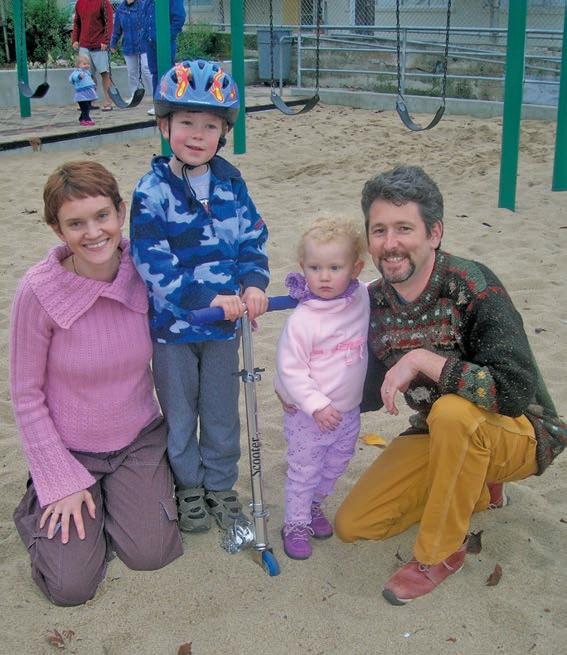
Left: Shelby and Jasper Liles. Right: Julie, Jasper, Shelby, and Brian at Jackson Park not so long ago.
PHOTO: Jenna Duncan
ASTRANIS continues on page 8
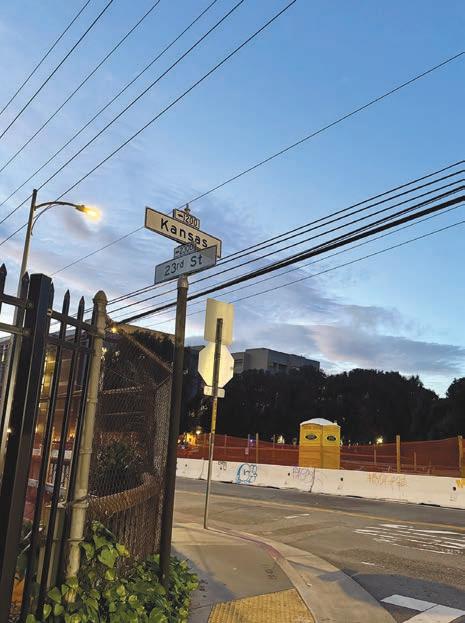
23rd Street overcrossing.
PHOTO: Danny Pham
FREE Serving the Potrero Hill, Dogpatch, Mission Bay and SOMA Neighborhoods Since 1970
APRIL 2025
PUBLISHER’S VIEW
SHORT CUTS Government
BY STEVEN J. MOSS
I became a federal employee in 1985, skirting a government-wide hiring freeze by vaunt of being a Presidential Management Intern (PMI), a program intended to recruit the “best and the brightest” into public service. My boss, a branch chief at the U.S. Office of Management and Budget, was relieved to be able to exploit the loophole created by my two-year internship to fill a vacant position examining the Medicare budget.
Not too long after my arrival at the New Executive Office Building, the senior managers in my branch gathered the team together. Most of us were in our 20s, graduates from the University of Michigan, University of Chicago, Harvard or Princeton. They wanted to talk about the Impoundment Control Act of 1974, which asserted Congressional power over Presidential withholding of approved budget outlays. OMB has (limited) authority to block quarterly releases of Congressionally sanctioned funds, which it used as a kind of whip to get departments and agencies to bend to its wishes. In the case of Medicare, “recessions” and “deferrals” largely revolved around properly policing spending on hospital and physician services.
Impounding funds was okay, we were told, as long as there was a solid rationale – a poorly performing program; signs of corruption – and a clear schedule as to when and how monies would ultimately be released. Holding Congressionally approved budgets forever, or for purely political reasons, wasn’t allowed.
Within his first month in office President Trump had eliminated the PMI program, and circumvented or perverted OMB’s institutional integrity related to impoundments, among other profound disruptions.
Those distressed about the Administration’s actions are grappling with a host of unpleasant emotions. Former or present federal employees, or those engaged in federally-funded programs, are shell-shocked – and in some cases financially devastated – by the wiping out of their past or present legacies. The U.S. Agency for International Development no longer exists in a recognizable form. The U.S. Environmental Protection Agency and Energy Department have taken sharp policy turns towards the
PUBLISHER'S VIEW continues on page 10
View Dimmed
A steady decline in contributions, coupled with a precipitous drop in advertising, has placed The Potrero View on the list of media outlets in danger of folding. Months away from celebrating its 55th anniversary, San Francisco’s longest-running neighborhood newspaper, and one of the only print news publications left, may not make it to its 56th. “It costs about $8,000 a month to write, produce, print, and distribute the View,” said publisher Steven Moss, “and that’s with a considerable amount of support from volunteer writers, photographers and editors. If we can’t get our revenues up by our anniversary in August, the occasion might also become our wake.” Those who want to keep the View alive are invited throughout the publication to advertise, subscribe or donate, with limited edition anniversary T-shirts and hats available in gratitude. The View is also open to new ownership as a means to energize the paper, which Moss has shepherded for almost two decades: editor@potreroview.net.
Art Donation

PUBLISHER Steven J. Moss
ACCOUNTING MANAGER Catie Magee MARKETING MANAGER Richard Romero
MANAGER Helena Chiu
MONTH’S CONTRIBUTORS
2007, matched that amount. Huang’s contribution, his first to CCA, is the largest donation in the school’s history, by $5 million. The funds arrived at a crucial time; since the pandemic CCA has experienced declining enrollment and financial setbacks, even as a $123 million campus expansion, funded entirely by donors, opened last fall. CCA President David Howse announced a year ago that the school was facing a $20 million budget gap, following the laying off of 23 staff, 10 percent of its workforce. There were 1,848 students in 2019, 1,295 this school year, with applications for next year continuing a slightly downward trend.
Tax-Free
With almost 40 percent of Downtown San Francisco’s office buildings still vacant, perhaps the City should adopt a policy that helps unleash consumer demand at airports and destination places like Dubai: eliminate all sales tax. A tax-free zone for retailers could be created from Market to Bush streets, Hayes Street to the Bay, to induce traffic into the area. The gambit would reduce municipal revenues in the short term but could jumpstart Downtown’s beating heart. Such a strategy is likely to achieve more than the narrowly targeted Twitter tax break adopted in 2011, now expired, which had mixed success. Sales tax could be phased back in after three to five years, once the area, as measured by falling vacancy

Christensen, Jenna Duncan, Steven J. Moss, Danny Pham, Robyn Smith, Mark Steensland, Jessica Zimmer
“When I think of the process I had to go through to sell my house, it reminds me of the red "EASY" button. It was an easy process, but all due to the fact I had a FANTASTIC agent. Claudia Siegel is the top of her class in this profession in my opinion. From start to finish, she conducted the entire process with professionalism, tact, courtesy and style, as well as speed. The house sold fast. So appreciate all she did and would definitely recommend if anyone is looking for an agent. Well done, Claudia.”
- Jules C.

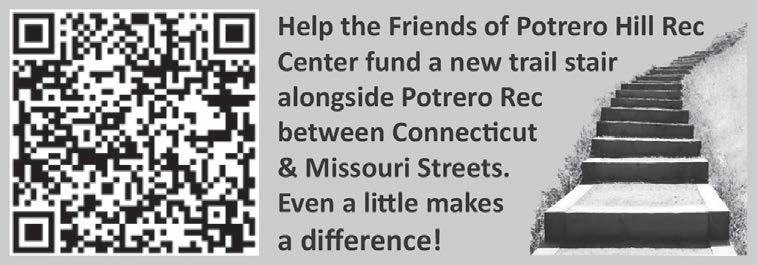
Twenty-Second Street Trail Stair Needs Additional Funds
BY JULIE CHRISTENSEN
After a decade of effort, Potrero Hill resident Jennifer Serwer’s quest to build a trail stair on a rocky hillside on the Potrero Hill Recreation Center’s north edge has gained serious momentum. If an additional $5,000 can be raised to fully fund the project, construction of the needed pathway could begin before the end of this year.
For years locals have braved the gravely 26 percent grade path to access an adjacent community garden and Starr King Elementary School. The trail is the only way to get from Dogpatch to the Recreation Center and the Potrero Annex-Terrace housing complex, which’ll eventually include 1,700 apartments. The track is also a potentially important pedestrian link connecting Hill residents to the Caltrain station, the T-Line, and waterfront.
The project site, a steep, rocky strip between Connecticut and Missouri streets, has long been perceived, and used, as part of the Recreation Center. When neighbors first approached the Recreation and Park Department about formalizing stairs, they were told that the parcel was an “unaccepted right of way,” a “paper street”, planned but
never built. Public Works maps showed the tract as having been transferred to Rec Park, like the community gardens on the right of way just west between Connecticut and Arkansas streets. But no documentation verified the transfer. The unresolved ownership standoff stymied progress for years.
Project advocates eventually discovered a “gotcha”: Public Works code specifies that the adjacent property owner is responsible for their half of an unaccepted right of way. Whether the parcel was transferred formally to Rec Park or not, the department is responsible for it. Rec Park eventually agreed to maintain the stairs once built. The long process of planning and securing necessary agreements could begin.
The Mayor’s Office of Housing and Community Development kicked off the project with a grant that paid for surveys, geotechnical reports, and planning. In 2017 the University of California, San Francisco provided a half million-dollar gift, part of “cushioning grants” awarded for neighborhood improvements as UCSF expanded into Dogpatch. Recently, The Power Station and Hill residents Keith Goldstein and Donna Warrington contributed essential funding.
RHAA designed the stairs, plans that’ve been approved by Rec Park. The

Rec Park Commission is being asked to accept the gift of the constructed stairs from Friends of Potrero Hill Recreation Center. San Francisco Board of Supervisors’ approval, environmental clearance, and municipal permitting processes lie ahead. The project team has set a goal

Editor,
of raising several thousand dollars from the community to ensure the trail steps are built as envisioned. The San Francisco Parks Alliance is the group’s fiscal sponsor; community members are encouraged to help build the stairs.
Letters to the Editor
T he article on Tommy Egan (March) neglected to mention that he was a U.S. Merchant Mariner and a proud and well-respected member of the Sailors’ Union of the Pacific for 50 years.
Gunnar Lundberg 18th Street

Dogpatch Business Association | dbasf.com
Dogpatch Business Association (DBA) promotes and supports Dogpatch businesses. Business owners and community members are invited to get involved!
• Join the DBA! (dbasf.com)
• S ign up for our newsletter to find out about member meetings, opportunities, and local news
• F ollow us on Instagram @destinationdogpatch to learn more about Dogpatch businesses, events, and activities
• E xplore Dogpatch through a curated wayfinding map of local businesses, available online at https://linktr.ee/exploredogpatch
Friends of Jackson Park (FoJP) | friendsofjacksonpark.org
2025 is the Year of Jackson Park! Our beloved community park needs your time, talent, and generous contributions to make this project a reality. Our renovation project has been approved, and over 75% of the money has been raised. We need YOU to invest in your park and help fund the gap. Be a Friend of Jackson Park and join us today! Learn more about how to get involved at friendsofjacksonpark.org.
Green Benefit District | GreenBenefit.org
We cleared the first phase of our renewal process, the petition phase. Thank you for your support! Please stay tuned for the Ballot phase later this Spring, when the SF Election Commission will mail ballots to all property owners in the District! greenbenefit.org/renewal
Our Monthly Board Meeting is Wednesday, April 16th from 6:30 to 8:30 p.m. at the Dogpatch Hub (1278 Minnesota St.) where we discuss all of the great things that we are doing in the neighborhood as well as announce the results of our Annual Board Elections and seat five new Board Members.
Help make the Green Benefit District greener. Our next GBD volunteer event is at the Vermont Greenway & Eco-Patch on Saturday, April 19 at 10 a.m. Sign up for a GBD volunteer event at greenbenefit.org/volunteer or report an issue at greenbenefit.org/report-a-problem
The Potrero Boosters Neighborhood Association | potreroboosters.org
The Potrero Boosters Neighborhood Association informs, empowers and represents the residents of the Potrero on issues impacting our community in order to develop and maintain complete, vibrant neighborhoods. We’re continuing to meet via Zoom on the last Tuesday of each month. Go to www. potreroboosters.org to learn more about how to join us!
The Potrero Dogpatch Merchants Association | potrerodogpatch.com
The Potrero Dogpatch Merchants Association promotes and advocates for independent, locally owned businesses while actively supporting our neighborhood and our wonderful communities.
Starr King Open Space | StarrKingOpenSpace.org
Join our monthly volunteer days on the second Saturday of the month. This month it is April 12th at 10 a.m. Donate to help keep Starr King Open Space open, accessible, and well-maintained for our neighborhood.
U.S. Supreme Court Rules for San Francisco in Water Quality Case
BY JESSICA ZIMMER
Last month, the U.S. Supreme Court ruled five to four in favor of the City in San Francisco v. EPA, holding that when the U.S. Environmental Protection Agency (EPA) issues permits under the Clean Water Act it must specify the actions permit holders need to take to avoid violating the Act’s standards.
In response to the outcome San Francisco City Attorney David Chiu and San Francisco Public Utilities Commission (SFPUC) General Manager Dennis Herrera issued a joint statement, “The ruling makes clear that permit holders like San Francisco are
HANDY NUMBERS
responsible for what they discharge, and the EPA has the tools at its disposal to ensure water quality. But it’s not lawful to punish permit holders for things outside of their control, such as the end-result water quality of a shared body of water, where many other factors affect water quality.”
“It seems as though the Supreme Court did little to ensure clean water going into our Bay waters, which have increasing recreational use,” said Ginny Stearns, a houseboat resident who believes Mission Creek is negatively affected when SFPUC’s opens its floodgates during heavy rains. “It is regrettable that San Francisco has
chosen legal fights over increasing steps to cleaning up the wastewater.”
Stearns hopes that environmentalists and SFPUC can reduce pollutants through proper maintenance and changes to the wastewater management system, including slowing wastewater releases before, during and after storms, allowing sediments to settle. Stearns also recommended treatments to reduce fecal bacteria contamination, and increasing the number of outflows.
Mission resident and Sierra Club San Francisco Group member Kieran Farr wants the City to separate its presently combined stormwater and wastewater systems. In the wake of the Supreme Court decision, he called for federal legislation to explicitly expand EPA’s regulatory authority.
“We know this is unlikely given the current balance of power in the U.S. House and the U.S. Senate,” said Farr. “If we think about the actions we would want the City to take if it were still held to the EPA’s previous rules, it would be reducing combined sewer outflows, improving steady state wastewater treatment infrastructure, and diverting stormwater runoff from entering the combined sewer system. All of these things are still possible for us to pursue at the local level. Myself and other members of the Sierra Club are organizing a local campaign, “Green SF Now,” to create a plan to do this,” said Farr.
“Because the EPA is not allowed to include health-based standards when regulating water pollution, it’ll need
to know everything about what might be discharged before a clean-water permit can be issued, making the permitting process delayed and incredibly expensive,” said Sanjay Narayan, chief appellate counsel of Sierra Club’s environmental law program. “The result is likely to be a new system where the public is regularly subjected to unsafe water quality.”
Peter Drekmeier, Tuolumne River Trust policy director, termed the Court’s ruling a “debacle” that taints the City’s already strained environmental reputation.
“SFPUC has starved the Tuolumne River, where we get our Hetch Hetchy water, of instream flows, leading to a crash in the salmon population and the entire ecosystem it supports,” said Drekmeier.
“Thanks to San Francisco and the Supreme Court, this work just became more challenging,” said Sejal ChoksiChugh, San Francisco Baykeeper executive director. “We will continue to use whatever means we have to repel efforts in Washington D.C. and elsewhere; as well as local industries and municipalities that would pollute the Bay, threaten the health of Bay Area residents, and the survival of our wildlife.”
EPA and the State of California are pursuing a separate lawsuit, presently in confidential mediation, against the City and County of San Francisco, alleging that stormwater discharges into the Bay during major storms violates the Clean Water Act.





GOOD

HOLY SATURDAY, APRIL 19
EASTER VIGIL: 8:00pm
EASTER SUNDAY, APRIL 20 8:30 & 10:00am
EASTER EGG


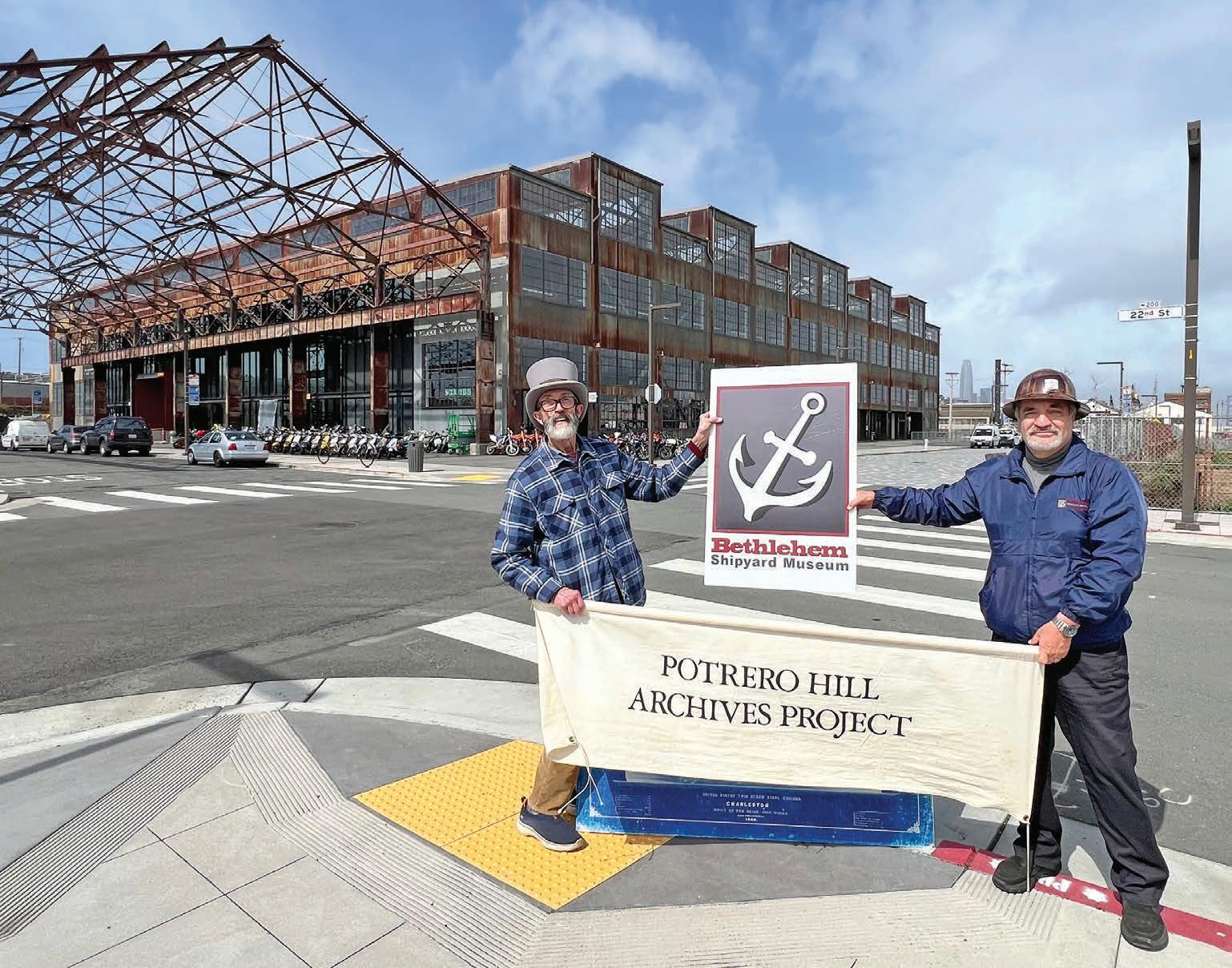
Pictured:
Linenthal (left)
Perez of the Shipyard Museum. PHOTO: Courtesy of Peter Linenthal
Reuse: “Secondhand Saturday”
COMMUNITY |APRIL
Art: San Francisco Museum of Modern Art Free Admission Day
Residents of the nine Bay Area counties can enjoy complimentary art-filled galleries and related events. 12 to 8 p.m. Buy one illy coffee drink; get one at no charge. Free, but tickets required. SF Modern Art Museum, 151 Third Street. For more information: https://bit.ly/3RuvKPh
Community: Social Mixer at Bay Club Evoque, a new relationship wellness app centered around communities, experiences, and love, hosts a pickleball event at Bay Club San Francisco Gateway in partnership with the Harvard Alumni Association. 2 to 4 p.m. $65.87 covers refreshments, and a full day pass to Bay Club. Bay Club Gateway, 370 Drumm Street. For more information: https://bit.ly/3XEkVw3
Music: “Tribute to the Past”
Take a step back in time with this show featuring Burning Down the House, Talking Heads and Radio Radio, Elvis Costello cover bands. 12 to 4 p.m. Free. Golden Gate Bandshell, 75 Hagiwara Tea Garden Drive. For more information: https://bit.ly/4bLFaxJ
Food: San Francisco Chocolate Salon Chocolate festival for aficionados, fanatics, buyers, and journalists to experience artisan, gourmet, and premium chocolate. Salon participants include master chocolatiers, confectioners, and other curated culinary artisans, with chocolate tastings, demonstrations,
chef and author talks, and interviews by TasteTV’s Chocolate Television program. Tickets: $23. San Francisco County Fair Building / Hall of Flowers, 1199 Ninth Avenue at Lincoln Way. For more information: https://bit. ly/3DywzC1
Environment: San Francisco Botanical Garden Free Admission Day
One of the world’s most diverse gardens, the San Francisco Botanical Garden is a unique urban oasis and living museum, offering 55 acres of landscaped gardens and open spaces, showcasing more than 9,000 different kinds of plants. The garden is always free for San Franciscans, with proof of residency. Other visitors can enjoy this treasure for free on the second Tuesday of every month. Open daily at 7:30 a.m. Free. 1199 Ninth Avenue. For more information: https:// bit.ly/3ZSRNTD
Wine: Noe Valley Spring Wine Walk
Pick up your glass at the Noe Valley Town Square and set off for a winefilled evening. Look for the banners along 24th and surrounding streets to sample a variety of wines. Stop at participating restaurants for snacks. 4 to 7 p.m. $44.52. Meet at Noe Valley Town Square, 3861 24th Street. For more information: https://bit. ly/3DA5Xk0
Theater: Free Juggling Lessons with Circus Bella
Meet Circus Bella’s talented jugglers and stay for a quick lesson, or watch others put their skills to



the test. All skill levels welcome; beginner equipment, scarves and balls, provided. 12 to 2 p.m. Free. Union Square Park, Geary at Powell streets. For more information: https://bit. ly/4hreEuI
Horticulture: Gardeneur Plant Market Gardeneur Plant Market offers a diverse selection of plants, ecofriendly products, and plant-related accessories. 10 a.m. to 4 p.m. Free to attend. All ages welcome. San Francisco Ferry Building, 1 The Embarcadero. For more information: https://bit.ly/41XWvAf
Art: Acrylic Pop Art Owl Painting Learn to paint a colorful and eyecatching owl using bold acrylic colors. This class is for beginners and those looking to explore a new creative activity. Participants will be guided through the process, forming the owl design by applying acrylic paints in a pop art-inspired technique. 11 a.m. to 1:30 p.m. $75.47. TBArt Studio, 911 Bryant Street. For more information: https://bit.ly/4iD1ZpE
Environment: Earth Day Festival
Earth Month and San Francisco Climate Week kick-off at Yerba Buena Gardens 2025 Earth Day Festival. Activities include a tree planting demonstration, nature walk celebrating Yerba Buena Gardens’ biodiversity, climate advocates, vendors, giveaways, and the band Swami 3. 10 a.m. to 3 p.m. Free admission. Yerba Buena Gardens, 750 Howard Street. For more information: https://bit.ly/3DLtvm1
Art: Lino Printing with Ray Gonzalez
The class will begin with an understanding of linoleum relief printing and how to frame positive and negative space into carving plans. After an introduction to carving tools, move on to create a new block print with the techniques learned in class. Explore monochromatic and rainbow roll techniques, a quick way to add color to a block print. Attendees will print the cover of their own notebook to take home. 12 to 4 p.m. $135.23. ARCH Art Supplies, 1490 17th Street. For more information: https://bit.ly/4iFaj8h
Open-Air Vintage Market Search for vintage treasures every third Saturday, April through November at Second Hand Saturday, an open-air vintage market. The market will feature more than 50 vintage goods and clothing vendors, artists and makers. Local food, family friendly activities, kids zones, live music. 10 a.m. to 4 p.m. Free admission. Outer Sunset on 37th Avenue between Ortega and Pacheco streets. For more information: https:// bit.ly/3DAWqsW
Music: Crucial Reggae Sundays at Golden Gate Park
Featuring hosts Irie Dole, DJ Guidance, DJ Sep, and special guest, DJ Mr. E. 4:20 to 7:30 p.m. Free. Golden Gate Bandshell, 75 Hagiwara Tea Garden Drive. For more information: https://bit. ly/4bLFaxJ
Art: Youth Arts Summit
Celebrating 15 years of showcasing young artists and their visions. 1 to 4 p.m. Free. Youth Art Exchange Studios at La Fénix, 1950 Mission Street. For more information: https://bit. ly/3DDdQVV
4/26 Saturday to 4/27 Sunday
Art: Shipyard Spring Open Studios
Step inside the studios of more than 100 artists at one of the country’s largest and most historic artist communities. Explore this vibrant creative hub and meet the artists. New this year: a silent art auction, featuring works from Open Studios artists. Preview a cross-section of the participating artists and plan which studios to visit. Silent art auction opening reception April 10, 6 to 8 p.m. at the Shipyard Gallery. Other highlights include live music, food and drinks, kid-friendly art activities by Art Rocks Clubhouse and free art making kits by the Museum of Craft and Design. 11 a.m. to 6 p.m. Free admission. Main Shipyard site: 451 Galvez Avenue. For more information: https://bit.ly/4bGRAHa



American Industrial Center Celebrates Half-Century Hosting Small Businesses
BY ROBYN SMITH
On a typical day at the American Industrial Center, Greg and Diane Markoulis can be found in the build ing’s management office alongside

their dogs, distributing produce, grown in the backyard of their South Bay home and handling paperwork and maintenance issues for their predominately small business tenants. Greg – who met Diane while both were




or Tables by

Become a Sponsor. Contact Briana Foster at events@larkinstreetyouth.org or (415) 673-0911 x 306
Scan the QR Code or visit larkinstreetyouth.org/pavingtheway
Since 1984, Larkin Street Youth Services has helped over 80,000 young people experiencing homelessness, ages 12 to 24, through a range of services including housing, education, employment, and outreach. The Paving the Way Gala has raised over $15 million, directly supporting youth to move beyond homelessness to lead confident, independent lives.



working at the Center – is the second generation of a family that for 50 years has been offering flexible commercial space to a myriad of enterprises.
AIC’s buildings span two blocks of Third Street; some liken the complex to a horizontal skyscraper. It housed The American Can Company from 1915 to1969, which employed upwards of 800 individuals at its peak, creating cans for food and beverages distributed throughout the United States.
Angelo Markoulis, an immigrant from Crete who arrived in America as a young man, purchased the complex in 1975. He converted the mostly vacant former factory into roughly 40 warehousing and manufacturing spaces. According to Diane Markoulis, the tenant mix has evolved with political and technological shifts. In the 1980’s the buildings housed almost 60 photographers, who cycled out with the invention of the digital camera. In the 1990’s the structure was replete with garment businesses, until the North American Free Trade Agreement incentivized a shift to Mexican production in 1994.
Jacky Recchiuti of Recchiuti Chocolates, who has been in AIC since 1997, believes the way the Markoulis family operates its buildings is a testament to their belief in small businesses. She said AIC declined an opportunity to sell the entire 800,000 square foot space to Google because they didn’t want to displace the 200-plus enterprises housed there.
According to Charles Bililies, founder of the Greek restaurant chain
Souvla, Greg was the first person to walk through the door on the eatery’s opening day. He handed the cashier a $100 bill, which has hung in the office of the establishment since it opened in 2022.
Hang Nguyen, of Olivier’s Butcher, said the AIC building is an incubator for startups, with tenants often outgrowing their spaces and the Markoulis family helping to expand their footprint. Olivier’s evolved from a small private butchery in 2011 to a facility with a retail storefront in 2019.
The Center hosts an annual holiday party, usually catered by a tenant, with the entry fee consisting of donating an item to the San Francisco Toy Drive. When the City tried to put parking meters on Third Street the family protested the idea to protect parking for the thousands of employees in the buildings, many of whom are blue-collar workers, said Spain Salinas, owner of Global Gourmet Catering.
As longtime tenant Tommy Halvorson of Foxtail Catering put it, it’s important to be a part of a community where “a handshake still means something."

CLASSIFIED ADS
Landscape Designer
Landscape Designer. Fletcher Studio Inc., San Francisco. BLA. Knowledge of ecological analysis. Email: careers@ fletcherstudio.com Job #2
Seeking Tennis Partner
Sixty-something male intermediate tennis player looking for (semi) regular rally or game partner. Email editor@ potreroview.net
Legal Notices
The View accepts legal notices. Please contact: production@potreroview.net; 415.643.9578.
Freelance Writers Wanted
Modest pay, interesting assignments. Contact: editor@potreroview.net
Write Your Own Obituary
We're all going to die; why leave the writing of your obit to someone else? Whether you believe the end is imminent or just something you contemplate idly whilst taking a shower, you can control your own destiny, or at least how it's reported. Or, after examining your life story and finding it lacking, add to it! Up to six people in three two-hour sessions, $150. Interested parties should contact editor@potreroview.net
Got something to sell? Have a service to provide? Each classified ad is $25 for up to 200 characters. www. potreroview.net/advertise
control traffic coming into the Third Street bridge to make the space safe for merging cars from other adjacent streets. The one-way roadway at the bridge is reduced to one lane to provide a safe work area for the construction workers,” said Shepherd.
Project funding is provided by the State Highway Operation and Protection Program (SHOPP), a four-year plan to improve the condition, operation, and sustainability of the State Highway System and associated transportation infrastructure. SHOPP pays for safety improvements, repairs, and highway operational and modal enhancements to the State Highway System.
Shepherd said that while little to no traffic delays have been caused by the 23rd Street bridge work during commute hours, there’ll be intermittent closures during non-commute hours and in the evening to allow for work activities that impact circulation.
The project is one of several planned this year which may affect Bayview and Potrero Hill.
“San Francisco’s central and Bayshore freeways will undergo major viaduct rehabilitation tentatively beginning late summer 2025, which may have an impact on residents, businesses, and motorists in the Potrero Hill vicinity.” said Shepherd. “Of these, most proximate to Potrero Hill, is the U.S.-101 which will undergo a massive effort to rehabilitate freeway drainage systems, replace concrete pavement, repave freeway on- and off-ramps, and replace the median barrier along the route from Candlestick Point through Hospital Curve.”
A worker at Kansas Food Market,
POTRERO VIEW LOCAL BUSINESSES DIRECTORY

Dear Readers
located at the corner of Kansas and 23rd streets, directly across from the construction site, who prefers to remain unnamed, has noticed several drivers moving through the intersection without heeding the stop signs.
“I think the construction is causing a distraction for people driving down the hill. They’re not fully stopping,” he said. “Hopefully the work gets completed soon.”
occupant of 153,000 square feet of manufacturing and office space in the historic Union Iron Works at Pier 70. At full capacity, the facility will produce up to two satellites a month, a feat requiring an array of specialized processes that can only be performed by experts.
“There are bigger homes for traditional aerospace,” said Keil, but for what Astranis does, San Francisco “is where the world’s best engineers are based.”
Four hundred and twenty people are employed to produce the company’s specialty: a new class of satellite called the MicroGEO that achieves high-orbit capabilities at lower costs thanks to its much smaller size. This combination is important because with loftier placement fewer satellites are required to provide constant service, reducing expenses, creating savings that can be passed on to customers. Together, these factors make the Clarke Orbit – also called GEO, an acronym for Geostationary Equatorial Orbit – the most valuable real estate in the solar system, with more than $15 billion worth of satellites joining the Clarke Belt every year.
Since its first launch in 2018, Astranis has set the record for scaling faster than any other GEO operator in history, launching more satellites than the three next-biggest companies combined. Its most recent mission, in December of 2024, sent four satellites to the Clarke Belt, where they’ll connect millions of people in the Philippines, Mexico, and the United States to affordable broadband internet; many for the first time.
With plans to launch another five
satellites in 2025, Astranis looks like it’ll continue setting records at home with the stars.
year abroad in Florence, Italy.
“We had family friends who were out here, and we visited many times at various ages,” she explained. “At first, we didn’t like it. It was cold and overwhelming for how little we were.”
As she matured Manhattan became more alluring. Restaurants, music, theater, art are all within walking distance,
| potreroview.net/advertise/
with the extra allure of being able to readily wander to different, culturally distinct, neighborhoods.
“I applied to a lot of colleges and my decisions came down to Berkeley or NYC. I felt like I would get a lot more personal growth and a better experience in New York rather than being close to home,” she said. “I definitely want to stay post-grad or even go to grad school out here. Or get a job a couple years before considering moving away.”
A Smart Asset analysis revealed that of all states California experienced
SF TO NY continues on next page
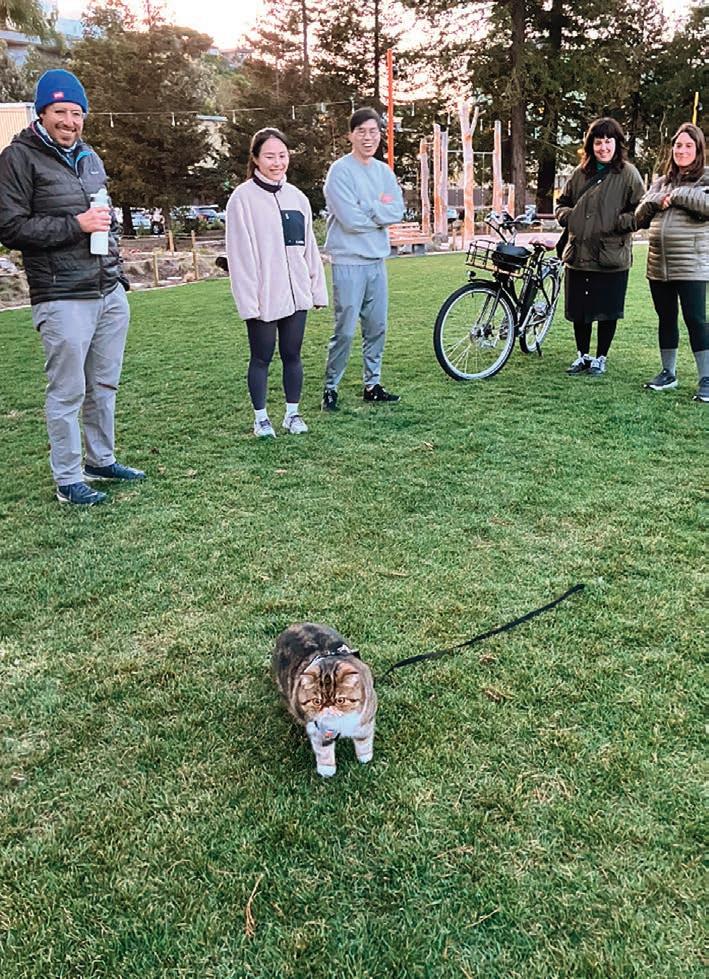
With the canines gone, Shouho the cat feels safe in Esprit Park’s south meadow. From left to right, park goer Gonzalo, cat owners Yiwen and Shulin, an unidentified park visitor, and park goer Megan. PHOTO: Daniel Idziak
ASTRANIS from front page
SF TO NY from front page
BRIDGE from front page
the biggest exodus of high-income Millennials – those born between 1981 and 1996 – and Gen Zers – 1997 and 2012 – losing a net total of 9,181 households. The study by the financial planning and investing consulting firm, based on 2021and 2022 tax return data, found that while California attracted 14,139 Millennials during the period, the state had a net loss of 23,320 of that demographic group.
Last year, the San Francisco Chronicle reported a spike in the outflow of Millennial and Gen-Zers from the San Francisco Bay Area, particularly from the tech industry. The reasons cited for the move included better career opportunities and a healthier dating pool.
“I grew up in San Francisco and I went to Berkeley for undergrad. I have always lived in the Bay Area. I wanted to experience something different, that’s one thing,” said 24-year-old Nick Dolce, a consultant who plans to move from North Beach to New York this month and work remotely.
San Francisco and New York have similar challenges, including expensive rents and encounters with open-air drug dealing, and individuals without permanent shelter. But New York is presently winning the cool-place-to-live factor.
“A majority of my friends from growing up are living in New York. I’d say about 80 percent,” Dolce said, who spent his early years on De Haro Street. “Some are in grad school, some are working, some were from the East Coast and just wanted to go back. There is definitely a mass migration, I would say.”
Jasper Liles has been living in New York City for about a year and a half. He migrated after visiting his sister, Shelby.
“It just sort of feels like the central
place, like the center of so many different components of the world and the country. There are so many different cultures, places to go, things to do,” he said. “If you are interested in living in cities, you should live here at some point.”
Jasper, who lives with a college friend in the Brooklyn neighborhood of Bedford-Stuyvesant, pointed at ample opportunities for young people early in their careers to find jobs.
“Cost of living-wise… both [are] quite steep. NYC, there’s a bunch of additional concerns you have to worry about in the winter heating bill, in the summer electric bill for cooling,” Liles said. “When I moved it was still in the last wave of inflation; buying groceries was certainly as difficult [in San Francisco] as it was [in New York].”
“I feel that it’s a very artistic city, whether it’s music or visual arts, plays and theatre. I always feel like there’s more going on there when I go visit; more than what I find in San Francisco,” Dolce said.
Canada-born Nuri Amari, 25, arrived to the Mission District in 2022, drawn by a sophomore engineer job at Meta, but moved to New York City earlier this year. Originally from Eastern Kingston, near Toronto, he attended the University of Waterloo. While Amari enjoyed the Bay Area’s natural beauty and outdoor activities like skiing in Tahoe, he found the City a bit too quiet.
“SF can be a bit sleepy sometimes, things close a little earlier,” he noted. Amari convinced his employer to let him transfer to Meta’s New York office. Now living alone in the Financial District, Amari is settling into his new life.
“I wasn’t sure exactly what office I’d be in when I came to apartment hunt,

OBITUARY
Katrina Krimsky Siegmann 1938- 2025
Katrina Krimsky, born March 5, 1938 on St. Simons Island, Georgia, passed away on March 16, 2025 in San Francisco. A long-time Texas Street resident, Krimsky was a pianist who engaged in the City’s classical, jazz, and experimental music scenes for decades. Krimsky initially moved to Potrero Hill in 1974. Her first house, on Rhode Island Street, was a fixer-upper Queen Anne Cottage. In 1984, Krimsky sold that property and moved to Texas Street. With the Hill as her home base, Krimsky relocated to Switzerland in the early-1980s, often returning to San Francisco to visit. Her husband, Swiss physicist and violinist Hans Siegmann,
but it’s kind of easy to get around from here,” he said.
He’s enjoying New York’s vibrant restaurant scene and looking to form a soccer team. A fan of fashion, he wants to take sewing classes to learn how to tailor his own clothes. Though he acknowledged that living in Manhattan is expensive, he’s committed to “doing NY properly” for at least a year before reevaluating.
“I don’t know if it’s sustainable forever, but we’ll see. I may end up moving back to California eventually,” he said Amari takes the subway everywhere and appreciates that it runs all night, unlike BART. He’s noticed cultural differences, too; New Yorkers tend to work later, while San Franciscans are inclined to leave the office before sunset. Despite the colder winters, he’s embraced Manhattan’s energy and diversity.
“It feels like NY is somewhere you have to move while you are relatively young,” he said. “So, you have to get it in while you can.”
New York City isn’t the only East Coast landing point for young working people migrating from San Francisco. Ryan Findling, 24, spent the past year navigating career moves and coastto-coast transitions. Originally from Michigan, he relocated to San Francisco after graduating from Babson College, drawn by a long-standing connection to the City through family and a high school internship.
“I had been there a few times… I always dreamed of living in San Francisco, and at some time I would like to move back there,” he said.
However, working remotely on East Coast hours—starting his days at 6 a.m.—left him craving more structure and social interaction. Now, he’s in Boston, where his job in medical device manufacturing is fully in-person. He feels more in sync with his professional and personal life.
“I wanted to see [Boston] through for a few more years.”
Life in Boston proved to be a natural fit, Findling said. Having attended college in Wellesley, many of his friends were nearby.
“A lot of my friends moved to Boston or were from Boston; most of my friends haven’t left,” he said. “The social scene is great. East Coast people are very different from West Coast people. I do kind of miss the Cali spirit and energy, but I grew up in the Midwest, so that’s also a different breed of people. Everyone said Boston winters are bad, but I still think in Michigan
was on the faculty of ETH Zurich. The two spent the next 20 years abroad. Krimsky, who held dual American and Swiss citizenship, was a composer and pianist of Russian descent. She grew up in Virginia and West Virginia. A child prodigy, with a mother who was a classically trained pianist, Krimsky received her Bachelor of Music from the Eastman School of Music in Rochester, New York. Soon after, she joined the faculty of American University in Washington, D.C. A few years later she moved to Cologne, Germany and associated with prominent European composers, such as electroacoustic pioneer Luc Ferrari. In 1967, Krimsky became a performer with the Center of the Creative and Performing Arts Ensemble in Buffalo, New York.
they are worse. There’s a comedy club I go to. Trivia night sometimes. There’s a place I go called Improv Asylum. It’s fun, depending on who you are with. One of my good friends got everyone into Mahjong, so we have Mahjong Mondays now.”
While the scale may presently be tipped eastward for college students and graduates, San Francisco Standard recently reported an influx of entrepreneurial high school and college dropouts into San Francisco to help launch Artificial Intelligence companies. Incubators, like the startup accelerator company, Y Combinator, are reportedly hiring younger participants, some not even of legal drinking age. Many have settled into recently built apartments in Dogpatch. According to Apartments.com, average rents for a one-bedroom apartment in New York City are from $3,888 and $4,990. The same site lists one-bedroom units in San Francisco as between $2,980 and $4,000, compared to a national average of $1,555.
“Right now, I have a beautiful apartment in a Victorian in North Beach. I love [the space and neighborhood]. It’s not a place I really explored as a kid,” said Dolce.
“I lived in the dorms last year and I didn’t know how to navigate finding an apartment. It was essentially a onebedroom apartment with four girls. I was fortunate enough to be in the bedroom, so we had a door. It’s crazy how much you pay for living in the kitchen,” said Shelby Liles.
She recently moved to a more spacious three-bedroom apartment in the East Village, living with friends she met in her first-year cohort.
“Once I got it in my head that I liked New York, then I never really questioned it,” Shelby said. “I feel like there is always something to do. There are so many things happening. I love just walking around; going to explore different things.”
PUBLISHER'S VIEW from page 2
fossil fuel and chemical industries. The Department of Education is being dismantled. It’s as if the children you raised to be respectful, compassionate, and socially responsible suddenly started dealing fentanyl, or selling automatic weapons to school kids.
Others are feeling stripped of agency. Community advocates, Democrats, civil, environmental, and immigrant activists who have intermittently enjoyed decades of political successes are firmly no longer in the room where it happens. They aren’t even in the building. The notion that well-meaning, persistent, individuals with a righteous idea can
positively change the world has been deeply disturbed. It’s an emotion that Trump supporters have likely felt for decades, until now. A bottomless sense of powerlessness, in which the only hope is a winning lottery ticket or heavenly intervention.
Although those opposed to the Trump agenda have little room to maneuver, this is a temporary condition. Advocates have enlisted courts to block or alter illegal executive orders, admittedly with mixed results. Congressional elections are a year and a half away. Trump’s stutter-step ascension to a second term itself demonstrates that a dedicated set of clever individuals can reshape politics.
And yes, the Trumpists are clever. The similarities between Elon Musk and Austin Power’s Dr. Evil are uncanny.
Perhaps most disturbingly, we’re in a period of profound historical change. The “arc of justice” that ushered in programs to right past wrongs principally visited on non-European-American populations; an international order that relied on a multinational web of cooperation to address public health, environmental, and security challenges; the rule of law and institutional integrity, among other compacts, have been shattered. Not all the disruptions are unalterably bad; elements of U.S. international aid need to be reformed; diversity and inclusion initiatives merit finetuning; the federal budget deficit is insanely high. But the Trump Administration’s sledgehammer demolition of the houses that Washington, Jefferson, Roosevelt, Johnson, Nixon, and even
Reagan built marks an epic change in who and what America is and will be.
The combination of elements – particularly the seeming elimination of political agency in a period of historical change – is intensely disorienting. It’s reminiscent of what prior generations experienced; a stream of events – the Great Depression, World War II – over which ordinary people had absolutely no control. Perhaps worse, no outside dictator can be blamed. We created the situation we now live in. In response, one can sink into despair or swim with the current, looking for a place to safely get out of the water.
Ultimately, the resistance will need to build new boats to withstand volatile weather and navigate different Tradewinds. After all, while Trump fiddles with tariffs and diddles with
PUBLISHER'S VIEW continues on next page

Celebrate Your Loved Ones
Your community wants to know about and celebrate the life of loved ones who've passed on, as well as other lifecycle events. Consider placing notices in the View, at half the price of regular advertising rates. We can also write what needs to be said for a modest fee.
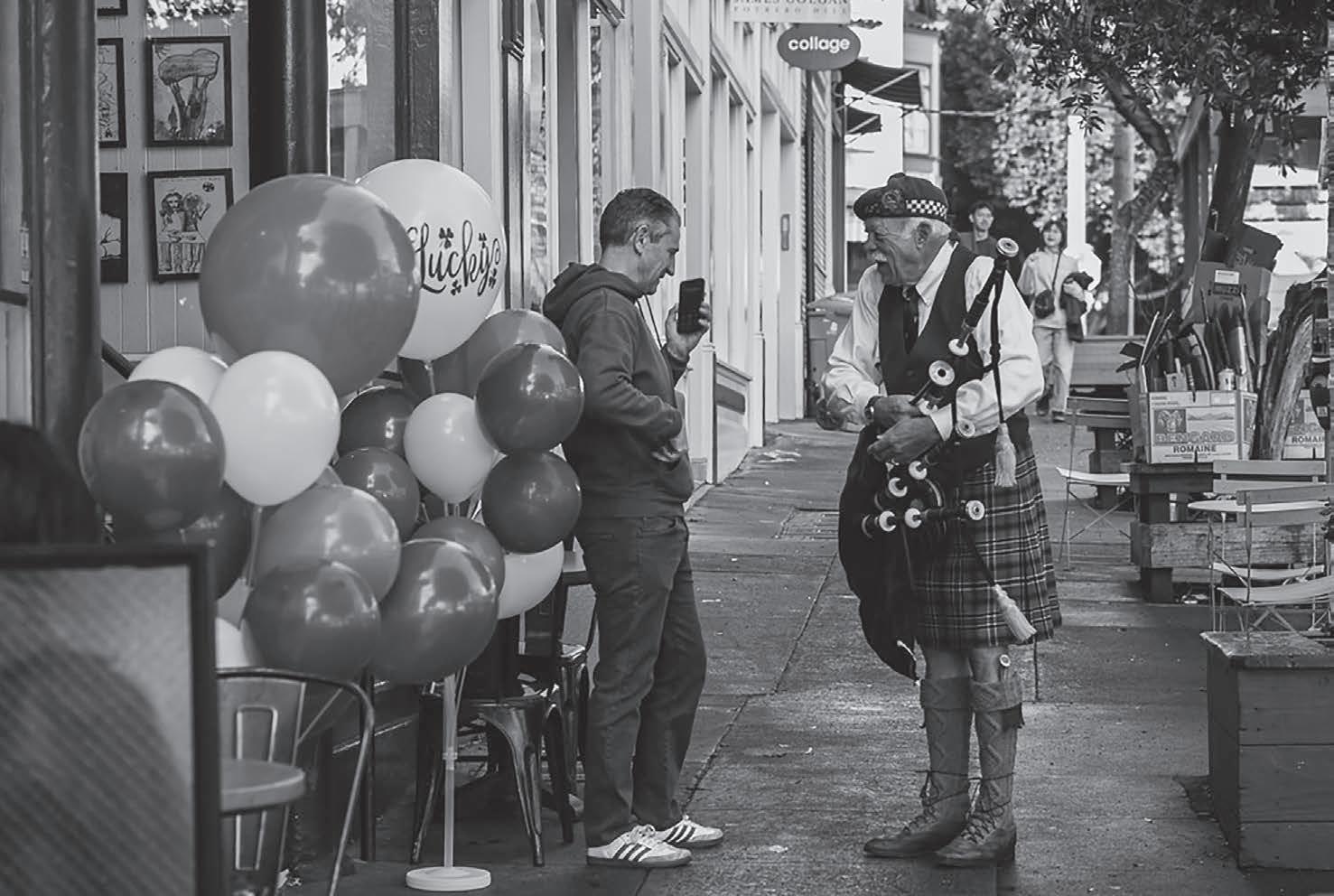
Farley’s has celebrated St. Patrick’s day with bagpipes since the cafe opened in 1989.
PHOTO: Ed Rudolph

PUBLISHER'S VIEW from previous page
Russia, actual problems – climate change, microplastics, income inequality – are only getting worse. Our most existential fear – that Trump is intentionally crashing the economy to usher in a second coming, in which the gender genie is stuffed back into the bottle and might makes right – will only come true if we let it.
Annual subscription: $68 potreroview.net/ product/subscribe/

CHOOSE A SHIRT OR CAP SUPPORT YOUR VIEW
To celebrate our 55th anniversary, The View is gifting one limited-edition t-shirt or cap for donations of $60 or more (while supplies last)!
55th ANNIVERSARY TEES
Unisex cotton t-shirts available in two designs printed in brown on natural tone fabric. Super comfy 100% preshrunk cotton jersey.
55th ANNIVERSARY CAPS
Mesh back truckers cap with an adjustable snapback closure available in two designs. Stone colored cap has brown imprint. One size fits all.
YES! I would like to support the View with my contribution of: $ Choose your gift: Limited Edition T-shirt: Newsboy
Please send my gift




Keith Goldstein, a community pillar of Potrero Hill, celebrated his 75th birthday at the Great American Music Hall last month. PHOTO: Potrero View Staff
With the removal of self-checkout counters, shoppers at the Potrero Center Safeway often confront long lines and lengthy waits to buy groceries.. PHOTO: Potrero View Staff
“Activist” Tee on Cream
“Newsboy” Hat on Stone
“Newsboy” Tee on Cream
“Activist” Hat on Stone