


Cover by Anna Nichamoff

5.
6.
7.
8.
“I went to office hours, and I didn’t realize how much I don’t know.”
“Did you bring a White Claw to class?”

Illustrated byIsabelle Wang (@isabelledoesarts)

5.
6.
7.
8.
“I went to office hours, and I didn’t realize how much I don’t know.”
“Did you bring a White Claw to class?”
Illustrated byIsabelle Wang (@isabelledoesarts)
Dear Readers,
I am, personally, one of the most gullible people you will meet. Fool me once, twice, thrice, it doesn’t matter—if you tell me something earnestly enough, I will earnestly believe what you tell me. For a certain period of time, I genuinely believed Josiah Carberry was a real professor from Brown’s history.
So best believe, I was perfectly primed to introduce our inaugural April Fools’ issue. But I have news for you, reader. What you thought was a campus life magazine has actually been an academic journal all along, at the cutting edge of scientific and religious thought. Imagine my surprise when I discovered
the true meaning behind our name: postactually stands for post-doctoral, as all our contributors clearly have advanced degrees in their respective fields.
For Feature, in a seminal research paper, Dr. Sasha Gordon expertly elucidates the aesthetic psyop out of Bennington College’s literary machine. Meanwhile, A&C publishes new findings on some of the most pressing matters of our time: Dr. Grace Ma presents the astrological data that determines which classical composer you should date, and Dr. AJ Wu posits critical connections between Scorsese movies and MCU films. In post-pourri, consult Dr. April Wang’s flowchart of student dining habits to optimize your choices. On the theological side of things, preeminent scholars in both Narrative and Lifestyle are back to unravel the workings of God in the Wawa (Dr. Christina Li), “some uncapital g-d” in matters of loss and love (Dr. Ina Ma), and the ways to partake in the sacred rituals of April Fools’ Day itself (Dr. Acadia Phillips). Before you go, put your knowledge-hungry mind to the test with Dr. Lily Coffman’s peer-reviewed “drowssorc”—and catch me celebrating 1-Down.
Fool me once, I’ll fool you back, and let’s all laugh together.
Shamelessly,
Chloe Costa Baker
Feature Managing Editor
Abstract
by Sasha Gordon Illustrated by Lila
When I think about my lofty, teenaged dreams of attending Brown University, they’re richly crafted in dark cherry wood panels, anachronistically smoky classrooms, and at times, adorned with literal tapestries. This isn’t my experience of Brown today, and while that’s probably for the better, I can’t help but wonder if I’m missing out. I picked up this picture, this psychic glimpse inside the ivory (mahogany) halls from a large mass of popular media: The Mysterious Benedict Society, Brideshead Revisited, Heathers (re: Veronica’s aspirations), and even shows like the Sabrina Netflix reboot. I would be remiss not to mention the center of gravity of this agglomeration, the alpha of this Glen plaid-wearing pack: Donna Tartt’s 1992 novel, The Secret History. Second only to dear Brideshead, fictional Hampden College’s Classics department is the total prototype of every subsequent moody-but-still-educational environment. And ohhhh did I want it. I read The Secret History towards the end of my high school career, sitting in the one (1) single carrel plopped into the school’s otherwise airy, exclusively primary-colored, tech-infused library. On the third floor of a three-story building (how grand), it stood alone by the staircase, waiting for a bright pupil to angst within it for a bit. I loved this carrel. I’d let its narrow walls wrap me up and transport me somewhere more romantic, firelit, as I waited for the acceptance letters that would hopefully truly take me there. But now I’m here. I mean the school’s literally called BROWN University—you’d expect wood paneling and thick burgundy draperies, right? So I’m dissatisfied and, furthermore, dissatisfied with my dissatisfaction. This won’t do.
Literature Review
I embarked on this journey with the idea of breaking down The Secret History and maybe The Goldfinch, another of Tartt’s novels I read far too young to resist its oddly powerful residues. I joked around—Bennington, the real college Tartt attended, is obviously the true engine of my dissatisfaction. Maybe Tartt’s running some twisted PR campaign, a psyop, honestly, to raise the school’s status. Reader, I don’t think this is a joke at all. I’m onto something. I’m finding
Pepe Silvia as we speak. I’ve done the research, and it’ll change the world. The literature review alone revealed some major pieces of evidence.
1. Bret Easton Ellis, author of American Psycho, also went to Bennington College. This clued me into how Bennington is likely engineering products with massive popular media appeal, as they’d have no other reason to produce such seemingly different works as The Secret History and American Psycho. If it’s a coordinated campaign, it makes sense for them to cover everybody, both those from Brown and Wharton alike.
2. Not only did he matriculate, he actually dated Donna Tartt while there. I know. The plot immediately thickened when I learned this. I was newly unsure of if this was a Bennington conspiracy or a Tartt-Ellis project, but I’ve decided it’s Bennington and I’ll convince you of this later. Maybe this wouldn’t have been a surprise if I’d bothered to notice that The Secret History is dedicated to Ellis, but alas, in my California home I was Richard Papen chomping at the bit for some cashmere sweaters and avaricious New Englandy co-eds. It’s shocking that this twosome is so confident in the secrecy of their operation that Tartt didn’t even try to hide the dedication. I can see the smug smiles on their faces. Little did they know I’d sleuth it out on my careful reread.
3. Both Tartt and Ellis write frequently about Bennington, although they attempt to deceive us by renaming the featured schools “Hampden” and “Camden” colleges, respectively.
It’s not slick. Changing the name could never throw me off the scent.
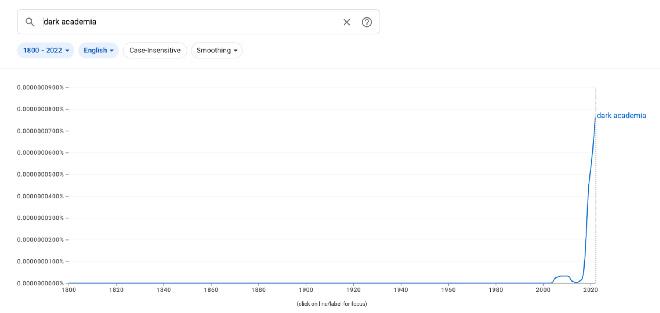
4. See graph
More rigorous review of the existing data via Google Ngrams reveals the extreme overlap of the rise in the prevalence of “dark academia” with Trump’s political power. This is the key piece of evidence that made everything begin to click. “Dark academia” is the most concise way to describe the setting of The Secret History. Mooding and brooding, rarely in class, contemporary fans of “dark academia” might spend more time curating Pinterest boards and shopping for tweeds than reading. Richard Papen is entirely obsessed with dark academia, much like how Patrick Bateman is entirely obsessed with Donald Trump. The clear majority of celebrity allusions in American Psycho are directly about Trump, and it’s almost implied that Bateman is making them up because he’s so enthralled with the man. As we began to approach a real world more similar to Bateman’s via Trump’s rise, dark academia rose in tandem, creating a world more similar to Papen’s. As if those two worlds are one and the same. As if there is no aesthetic difference at all. They are not two distinct worlds inspired by one series of real-world events, as they predate the reality of 2016 by almost twenty-five years. Rather, they are predictive, two volumes projecting the same future. Causal, even.
Lila vianna
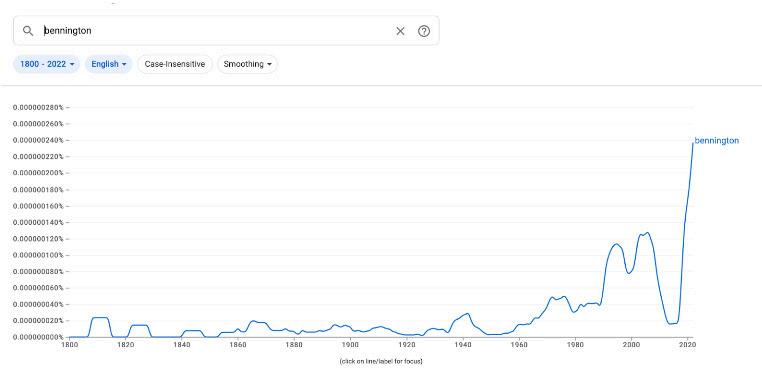
The most damning piece of all: Bennington’s cachet soared when a) American Psycho and The Secret History were published in 1991 and 1992, and b) when Trump was elected. Thus, we’ve ascertained that the two novels are linked to each other, linked to real world events, and that both the novels and their subsequent events spur Bennington’s fame. Not looking so far-fetched now, right?
I was convinced that these novels were responsible for almost 100 percent of the dissatisfaction in my life. Eradicate them and I’d be cured. I sat down last week to really get going with this investigation. Laptop: charged. Water: gone. Super dehydrated. Armed with my query, “american psycho free pdf download please,” I was off to the races. Immediately after opening my hopefully virus-free prize, I was slapped in the face by a different kind of fright and had to close the laptop for a few moments, mouth agape.
Chapter One is entitled April Fools.
Methods
When my pulse finally dropped back down to my standard 106 bpm, I could resume reading and begin research in earnest. A brief introduction to American Psycho: Patrick Bateman, our charming first-person narrator, works in Mergers and Acquisitions at Pierce & Pierce, an investment banking firm in Manhattan. He dwells amongst a horde of near-identical men with the slicked-back hair, horn-rimmed glasses (only from Oliver Peoples), and neat suits of 1987, and blends
into this crowd so well that he’s frequently mistaken for a whole other cast of peers. He’s a total robot. I read endless descriptions of menswear trends, brands, and outfits; pored over menus of ritzy restaurants with scarce reservations; encountered a new, identical, doppelgangerish colleague of Patrick Bateman every sentence; and, somehow, began to take the story seriously. The monotone inanity of the scenes is off-putting, and Bateman’s devolution into murderous rampages almost begins to feel like the lighter, more palatable element of the novel compared to the endless slog of “Armani, Missoni, Bill Blass.” Each chapter contains, get this, a full paragraph about what Bateman and his scenemates are wearing.
The point is, the novel itself is Camazotzian. Cyclical, rigid, endlessly interminable, the siege of names and brand names slowly grinds down any resistance you may have and begins to slough off your opinions and experiences in favor of just outlasting this deluge. Why fight? Experientially, the reader feels a bit of what Bateman does towards the start—the path of least resistance is to acquiesce, learn some brands, read a book on style, and accept that this is your life now. You have 350 more pages to read about menswear tailoring, tie clips, and “cold corn chowder lemon bisque with peanuts,” so you might as well enjoy the ride. The text washed over me, I became seaglass.
In seeming contrast, Donna Tartt’s The Secret History appears rich and edenic to the self-important teen feasting on academic
validation. Our everyman protagonist, Richard Papen, arrives from a humdrum California town to Hampden College, a land of secret societies, classics departments with six total concentrators, and professors who engage with their students like it’s their sacred duty. Richard is swept up and tumbled into adventure after adventure, in trips to countryside manors and midnight trysts. He’s taken seriously amid a crowd of other Serious Intellectuals, and for a while, it’s everything he’s ever wanted. Tartt wants to sweep you away too. Viewing the novel through Richard’s eyes, you learn to long as he longs, to harbor a yen for the upper echelons. Slowly, the reader acclimates to a world of preposterous claims and obscene wealth, situating themself first far away from it, then on the periphery, and then, in that oh so horrible place where they’re not quite of the nature but still deeply embedded within it. It’s rather like American Psycho, interestingly. And this is what Tartt wants, I posit. The hapless reader begins to believe that The Secret History is normal, and beyond normal, aspirational. It’s what college should be, if you sift out the murders. And, actually, it’s probably just the people at the college causing the problems, right? Henry Winter and Charles Macaulay are fundamentally sick, but your school won’t be like that.
This is a masterstroke of misdirection. Unfortunately for you and I, the corrosive beast is the place, not the people. You’ll never escape. It doesn’t matter that your school doesn't have Henry Winter, because the environment of the institution itself is the corrupting, putrid force. It’s inhospitable to you, actively invested in the project of changing you. And you, oh you, you think you want this. Instead, you begin to experience a creeping dissatisfaction from longing for this change. And I’m sorry for that. You want passive transformation as Richard experiences it, you want ease and languor and glamour. We all do. You might even be mad because Brown hasn’t changed you enough, and Bennington would.
Richard Papen’s education is purely an aesthetic experience. When I compare his collegiate years to my own, I am matching aesthetics to aesthetics and coming up short. I have no option to reflect on my educational
experience efeojfoeijfgporjfgpo experience because it’s never modeled back to me. Thus, my perhaps legitimate aesthetic dissatisfaction turns into more overwhelming experiential dissatisfaction. It’s impressive, and effective. Ask what Papen learned, and I have little to say. Somehow, when you ask me what I’ve learned, I too come up blank.
Results (?)
Discussion
I wholeheartedly believe that these two works are to be read in conversation with each other. Tartt’s Hampden and Ellis’s Camden both stand in for Bennington. Messily entangled as the two authors once were, the Bennington stand-ins do much of the sinister work of both novels. Hampden is the explicit, tangible setting of Richard Papen’s criminal development, and it bleeds into the plot of the novel. The architecture of the dorms, the pressure of the tiny environment, the guilt etched onto one’s face in front of a small-town TV news crew, all of it actively spurs the plot on. Camden is far more peculiar. Compared to the physicality of Hampden, Camden is a mere wisp in American Psycho, a glancing blow to Bateman’s constructed reality. His brother floats around the school, but it’s not so relevant for Sean, other than that it’s not the place for him. The Batemans stand in opposition to the liberal arts. Camden is brought into the text just six times, and really only in relation to four people. Vanden, greenhaired and cigarette-smoking; Sean, as before; and Scott and Anne Smiley, a couple who Bateman attends dinner with, escorted by his coworker’s girlfriend Courtney. Bateman hates all the Camdenites, and for a moment, it appears to be because they’re different from him, disrupting the smooth smooth flow of his same-y world. Vanden is reading a magazine about a downtown doom spiral and reflecting on how it affects her, only to be shot down both by Bateman and his whataboutisms, and her own punk boyfriend, who begins to disparage her for confusing Sri Lanka
with a club she’d been to downtown. She is cowed by this, and perhaps, I realize, not so different from the crew of Pierce & Pierce. Anne Smiley brings a slightly stronger cerebral touch at first—discussions of a book Bateman hasn’t read, the merits of different writing approaches (albeit in gossip columns)—but it quickly devolves into posturing, then fawning.
“‘It's called California classic cuisine,’ Anne tells me, leaning in close, after we ordered.
‘You mean compared to, say, California cuisine?’ I ask carefully, measuring each word, then lamely add, ‘Or post-California cuisine?’
‘I mean I know it sounds so trendy, but there is a world of difference. It’s subtle,’ she says, ‘but it’s there. Oh Courtney, where did you find Patrick? He’s so knowledgeable about things. I mean Luis’s idea of California cuisine is half an orange and some gelati,’ she gushes.”
This exchange is utter nonsense. I do find myself enamored by Bateman’s usage of “post-,” but it’s total drivel. It’s even more embarrassing for the Camden crowd that Anne would fawn over Bateman, clearly an unsophisticated, mass-market clone. I came to school wanting to find The Secret History, murders and evildoing laid aside in sake of the blissful aesthetics and idea that someone might see me in the way I want to be seen, and instead I found American Psycho, save for the murders, and evildoing, but full of an unlovable aesthetic and people who see each other perhaps in the way they want to be seen. By now, reader, I hope you realize these two things are not so different, and both somewhat horrible. Anne could theoretically have inhabited The Secret History just as Henry Winter may have moved onwards and upwards to Pierce & Pierce, each crossing out of their realm. And this bursts the illusions of grandeur, revealing them as nothing more than
marketing gimmicks.
There’s one unresolved question: Why would the Bennington shills paint their fictional alums as silly, vapid, and endowed with poor decision-making capacity? If this is a plot to get the reader to both hunger for Bennington and become dissatisfied with their own lives, shouldn’t the Camden and Hampden grads be otherworldly superior? Coldly, unfortunately, the answer is simply that it’s because the system can work like this. In The Secret History, Hampden is never held responsible—the problems are cast aside as personal failures of insufficiently competent students. The fundamental, strongest tool
of elite institutions is that they hold the mirror you are reflected in. You are part of a strong community only when it suits them, coerced into perceiving yourself as a lone sheep when you fail. And you
can’t do anything about it. This may even cause dissatisfaction about one’s dissatisfaction, a truly unresolvable problem. Our perceptions are malleable to the point that I’d considered abandoning Brown, my dream school since Heathers, for a potential transfer. Just based on a book, a mere facsimile of the institution. When confronted with the full institution, what are we to do?
References
In the spring of my senior year of high
school, as decisions flew through the air into the inboxes of my friends and foes alike, a new phrase entered all of our lexicons. Yield protection. It’s the idea that some colleges reject students that are “too qualified” compared to their average admit because they assume the student won’t take the offer, thus reducing the school’s yield ratio of offers to enrollees. A low yield makes the school seem undesirable, so the theory goes. It wasn’t uncommon for me to hear the phrase “I got yield protected out of UCSB,” and it was a way of thinking that I hadn’t really encountered before. It was news to me when writing this article, however, that it’s also called “Tufts Syndrome.” I found it kind of silly, but as I received my own share of rejections, I started to rationalize them, using the phrase first as a joke, and then a little more seriously. The process of college, from start to finish, is littered with unrealistic expectations.
Believing every die will roll in your favor, as so many do, isn’t feasible, but instead of confronting that we frequently sow blame across vast landscapes. You don’t need to blame yourself, you need to blame no one. The idea that there is a fault here is rotten from the start. You can’t “have it all” unless the “all” is massively narrow, and so, you must abandon it. Check and mate, Bennington.
Further Reading
1.https://www.armani.com/en-us/giorgioarmani/man/clothing/jackets/ 2. https://www.gutenberg.org/ebooks/26 3.https://en.wikipedia.org/wiki/Tunnel_(New_ York_nightclub)
a. Interestingly, this is described as a gay club by Wikipedia. Don’t tell Patrick Bateman. 4.https://en.wikipedia.org/wiki/PostCalifornia_cuisine
a. Shockingly real 5. https://joandidion.org
by christina li

Wed, Aug 20 at 9:17 PM wawa has matcha
[image description: inside a dimly lit car, a hand is stretched out holding a large cup of glorious iced green liquid whipped cream perfection]
Somewhere between Virginia and New York (right outside Delaware, in this case), take a nondescript exit off I-95 (109, for instance) and merge onto the local roads that branch off from this artery of America’s pinnacle. Find yourself on multilane streets lined with the typical fast food chains and gas stations: Wendy’s and Family Fare, Sonic and Sunoco. The chains don’t matter; their functions are all the same. Find yourself in a land of parking lots and overnight LED lights because, eons ago, God looked upon this Earth and thought: Man, a Walmart Supercenter would look so good right here. Find yourself turning right in ninety-eight feet. Find yourself readjusting your eyes and taking out your earbuds, the bass still pulsing beneath your fingertips. Find yourself rebuttoning the top of your jeans before opening the door. Find yourself hit by wafts of fresh air that cleanse you from the near perpetual, distinctly car smell of the past few hours. Find yourself, then, looking up and seeing…it. The holy ground. The land of scripture. The lights suddenly sparkle. The constant whoosh of cars rushing by becomes a chorus. Find yourself in the presence of all things divine because—correction from earlier—there is an exception to the interchangeability of regional gas station chains, believe it or not. Find yourself in that timeless space between Virginia and New York, standing beneath four red letters and the silhouette of Jesus Christ himself (a flying goose). Find yourself. Find yourself. Find yourself.
I don’t clearly remember my first trip to Wawa. I imagine it was sometime during elementary school, when my parents still planned summer family road trips—usually to locations within a reasonable distance. Out of my siblings, I always got carsick the easiest. Philadelphia and the Chesapeake Bay occupy a particularly hazy spot in my brain, but what I recall is sitting in the backseat
next to my brother, a plastic bag by my side at all times in case of emergency. Each passing state meant another rest stop, a saving grace, a brief intermission from the constant, literal transition between places.
I imagine Wawa entered my life the same way—as a stop for gas and bathroom purposes. I groggily step out of the car, a small sickly feeling in the pit of my stomach. I walk inside and there, right in front of me, framed by aisles of convenience store snacks, is the one and only Wawa food service counter. At the touch of a self-order kiosk is everything a barely-cognizant ten-year-old could dream of: built-to-order custom hoagies, specialty sandwiches, bowls, sides, and dozens of every kind of beverage. The air conditioner blows in the ambience, and my stomach lightens. This is it, I (probably) thought. I’ve ascended. My brother orders a mashed potato bowl with all sorts of cheeses. My sister orders a mac and cheese bowl in parallel, chicken strips included. I come up with my own dream concoction of an Italian panini: salami and ham and tomatoes and honey mustard and pepper jack cheese—a combination that’s probably (definitely) sacrilegious in all other contexts—because why not. We all file into our self-designated car seats and munch on our goods as we drive into the night.
Since then, Wawa has become somewhat of a staple in my family—every time we find ourselves crossing the border into Virginia, once Cook Out and Bojangles disappear from the Food Exit signs along the highway, all talk shifts to the ideal location to stop by later for lunch. I’ve developed a carefully curated routine from my sporadic encounters with this paradise over the years. A Wawa is a thing of awe for those condemned to the tragic fate of living in a Wawa-less region. A Wawa panini is a delicacy, a once-a-year (at best) occasion, a rite of passage. A Wawa stop is a thing ephemeral,
a thing liminal. For me, a Wawa only exists off an exit on I-95, on a drive up to New England for college, on a drive home to the South, for a meal shared with two other hungry mouths, for a meal by myself.
I stare up at my own private cathedral, wondering what temporary, future version of myself will do the same the next time I enter.
Step 1: Enter through the glass doors and relish in the novelty for a moment (the sanctity of the hour, the completion of another pilgrimage).
Step 2: Search through the chip aisle for Original Bugles (because nowhere back home seems to embrace whimsy enough to ever stock them).
Step 3: Order the usual at the kiosk—you know the drill (with honey mustard and pepper jack, because apparently some people never grow out of their pickiness).
Step 4: Peruse through the beverage menu. There’s always something new. (This time, it’s a whole debut matcha menu.)
Step 5: Sit in the car while the GPS calculates the new coordinates. Place a Bugle on each of your five fingers, then eat them off one by one. Sip from and bask in the glory of twentyfour beautiful ounces of ice-cold matcha (mintflavored, because of course that was an option).
Step 6: Watch the gas station lights disappear from view through the passenger window, box still hot on your lap. Leave another version of yourself behind, preserved in fluorescent lights and concrete surfaces.
Step 7: Wonder if you romanticize things too easily, to the extent of glorifying a random regional gas station chain to which you have no grounded connection. Then bite down into your combination of bread and cheese and tomato, and decide: No, this is something holy.

by Grace Ma Illustrated by selena zhu

Aries - Hector Berlioz. Like Hector, you’re a little (a lot) impulsive. If he invited you to participate in his plan to dress up in a maid outfit and murder his ex-fiancée as revenge for cheating on him, you’d probably go along with it. You’re probably the only one who can match his intense, obsessive way of loving, though beware that he may cheat on you even after pursuing you relentlessly for six years. Hector’s most famous and important work is his Symphonie fantastique, which is as crazy as you both clearly are.
Taurus - Johann Sebastian Bach. Johann is a devout Christian and devoted family man, though he also has a bit of a rebellious streak. As a composer, he’s the undisputed master of his craft and will rise to any challenge to prove his worth, including those by the King of Prussia. It’s good that you are dependable, because you may have to raise as many as twenty children while he writes thousands of pieces of music and redefines the Western Canon. Johann’s most famous works include Mass in B Minor, The Well-Tempered Clavier, and the Chaconne from his Sonatas and Partitas for Solo Violin.
Gemini - Joseph Haydn. Joseph is funny, smart, and sociable, just like you. He’s like if the dad joke were to take the corporeal form of a seventeenth-century Austrian composer. He would make an excellent father, owing to his nicknames as the father of both the symphony and the string quartet, though he only actually had one child (with a married woman). His most famous works include the Surprise Symphony (Symphony No. 94 in G Major) and the Emperor Quartet Op. 76, No. 3, whose second movement became the national anthem of Germany.
an obsessive, egocentric micromanager, but your commitment to fairness and harmony may make you two a good match. While he is having delusions of grandeur or emotionally intense breakdowns, you might be the only one who can bring him back to reality and set him back on track. Gustav’s most famous works are his ten symphonies, all of which—like the man himself— are a significant undertaking to get to know but worth the effort.

Scorpio - Ludwig van Beethoven. Ludwig is quick to anger, but also passionate and fiercely loyal. As long as you stay on his good side and don’t give him any reason to think suspiciously of you, he will be an intensely devoted boyfriend. Once you lose his trust, however, you’ll probably never earn it back again. He will take out his anger by ripping up manuscripts and pettily writing music for you that you’re not good enough to play. Ludwig’s music needs no introduction, but his most famous works include the Fifth Symphony and Ninth Symphony. Some of his lesser-known works, like the musically progressive late piano sonatas and string quartets, are also worth a listen.
Sagittarius - Robert Schumann. Robert has his head in the clouds and is constantly in and out of mental institutions, which will give you plenty of time to thrive on your own terms. While you’re together, he can be either dreamy and sweet or aggressive, which will keep you guessing. If you wanted to have an affair with one of his protégés and students, such as a certain Johannes Brahms, he would probably be none the wiser. Robert’s notable works include his symphonies, Carnaval, and his Piano Concerto.

Cancer - Maurice Ravel. Maurice is nonchalant and mysterious. He will never really open up to other people about how he’s really feeling, preferring to gloss over everything with cool detachment and humor. His music is also eclectic and emotionally distant, but you, with your high level of emotional intuition, are perhaps the only one who will truly get to know him. Maurice’s most famous works include Pavane pour une infante défunte, Le Tombeau de Couperin, and Gaspard de la nuit.
Leo - Franz Liszt. You are okay with being in the spotlight, which is excellent, because dating Franz will definitely put a spotlight on you. You will have to fend off hordes of jealous women, from noble ladies to normal concertgoers, who will stop at nothing to take your place as the partner of the world’s first mega popstar. As for Franz himself, he’s adventurous and showy, and it’s clear you two will get along. Franz’s most famous works include his Hungarian Rhapsodies, his devilishly difficult Transcendental Études, and his one-movement, brooding Piano Sonata
Virgo - Frédéric Chopin. Like you, Frédéric is shy, hardworking, and cares deeply about his art; however, he is also melancholy and prone to long illnesses. You may need to take care of him for months at a time while he wastes away from tuberculosis. Your time together may not be long, but he will write you beautiful music to commemorate the sensitive nature of your love. Frederick’s most notable works include his Nocturnes, Preludes, and Mazurkas.
Libra - Gustav Mahler. Gustav is a bit of
Capricorn - Clara Wieck. Clara is an ambitious, driven trailblazer who juggles being a concert pianist, composer, and mother in an age when women are expected to stay home, though she would probably appreciate it if you helped her with her eight children. Together, you would push each other to new and dizzying heights and become the music power couple of nineteenthcentury Germany. Clara’s notable works include her Piano Trio and Piano Concerto.
Aquarius - Wolfgang Amadeus Mozart. Freewheeling, childish, and silly, he will always keep you on your toes. Wolfgang is a child prodigy who didn’t progress past thinking poop jokes are funny. He will probably write you love letters with equal parts declarations of romantic intent and references to farting and toilets. Wolfgang’s most famous works include his Symphony No. 41, his Requiem, and The Magic Flute, but his unpublished canon Leck mich im Arsch (which, yes, means exactly what you think it means) might give you a better glimpse into his personality.
Pisces - Sergei Rachmaninoff. Sergei is shy, awkward, and romantic in all senses of the word—wistful for the past, emotionally sensitive, and loving, but easily upset by criticism and tending to be depressive. Treat him gently and he will write you the most beautiful love songs, and you will live a long and happy life together. Sergei’s most famous works include his Piano Concertos Nos. 2 and 3 and his Symphonic Dances, but for a taste of his wistful sensibilities, give his Prelude Op. 32, No. 10 and Etudes-tableaux Op. 33, No. 2 a listen.
IF YOU LIKED THIS MARTIN SCORSESE MOVIE, YOU’LL LOVE THIS MCU
by AJ Wu
Illustrated by Yoonseo Lee
For years, Martin Scorsese has argued that Marvel movies are not “cinema.” Marvel fans, meanwhile, have steadfastly defended their position that they are movies “you can certainly watch, if you want.” In the spirit of peace, love, and opening up channels for good-faith discourse, here are some Marvel Cinematic Universe recommendations you will definitely enjoy based on your favorite Scorsese movies. ***
1. Goodfellas / The Avengers
You know who else were (actually) good fellas? For fans of Scorsese’s ’90s classic seeking another sleek, action-packed story about a colorful crew terrorizing the streets of New York, look no further than The Avengers (2012). The surface-level differences are pretty tangential. Whether it’s defending Manhattan or robbing it, much of the narrative tension in these heady character-driven dramas is driven by the inner workings of groups built on foundations of mutual dependence and combating external threats, despite being split along lines of ideology and ego. Also, if you were amused by Joe Pesci’s “Funny how? Funny like I’m a clown?” you’ll be enthralled by quips like “I have an army…We have a Hulk!”
2. Alice Doesn’t Live Here Anymore / Thor: Love and Thunder
In Alice Doesn’t Live Here Anymore, Scorsese shifts gears from the violent, predominantly masculine worlds that would later define much of his career to instead focus on an intimate depiction of the struggle between motherhood and selfhood. Ellen Burstyn is magnificent in her role as Alice Harris, a single mother who, although far from perfect, tries her best to raise her son while navigating the quiet joys and tragedies of beginning to make her life her own in middle age. An eleven-year-old Jodie Foster delivers a remarkably sensitive early performance as well. The soundtrack is hopeful and buoyant, with appearances from Mott the Hoople, T. Rex, and Dolly Parton; the only thing it’s missing, really, is four songs by Guns N’ Roses.
For another equal-parts charming and heartbreaking treatise on single parenthood, consider the fourth and most emotionally selfaware installment of the Thor series, wherein the God of Thunder tackles familial drama,
burnout, and the spontaneous adoption of his nemesis’s daughter. Both films are colored by grief over the death of a loved one, and despite their differences, they explore similar central questions: How does one rebuild a sense of self after loss while caring for another life? And what coexists with grief besides love in its many forms—romantic, platonic, and parental?
Critics may debate these movies’ relative merits, but they agree on one thing: At least one of them is probably a better viewing experience than Thor: The Dark World
3. The Last Temptation of Christ / Avengers: Age of Ultron
The philosopher Ludwig Feuerbach wrote that God was made in man’s image. Joss Whedon agrees. Avengers: Age of Ultron is a dazzling neo-Christian allegory that plays it fast and loose. Ultron, the AI hell-bent on destroying humanity, is an obvious stand-in for original sin—unleashed, in fact, by mankind’s hubris and thirst for advancement (a Stark Enterprises experiment gone wrong). The only one who can plausibly oppose Ultron is Vision— untouched by sin, proven worthy via magic hammer—yet another creation by Stark et al. And (spoiler alert for Avengers: Infinity War) it’s Vision’s ultimate Christ-like sacrifice that contributes to saving the human race.
Ultron is highly reminiscent of Scorsese’s adaptation of Nikos Kazantzakis’s 1955 novel, an examination of the tension between divine mission and human vulnerability as shown through a deeply introspective portrayal of Christ. Not infallibly holy, but rather a man who can be tempted by lust and fear of death and can be lured by Satan off the cross—to Scorsese and Whedon, Christ is what we make of Him. After all, what is God but a yearning for godliness? And what is the devil but a recognition of all the ways we fall short of that lofty ambition? Ultimately, what both films reiterate is that damnation and salvation are inventions of man. It’s somewhat comforting to think about.
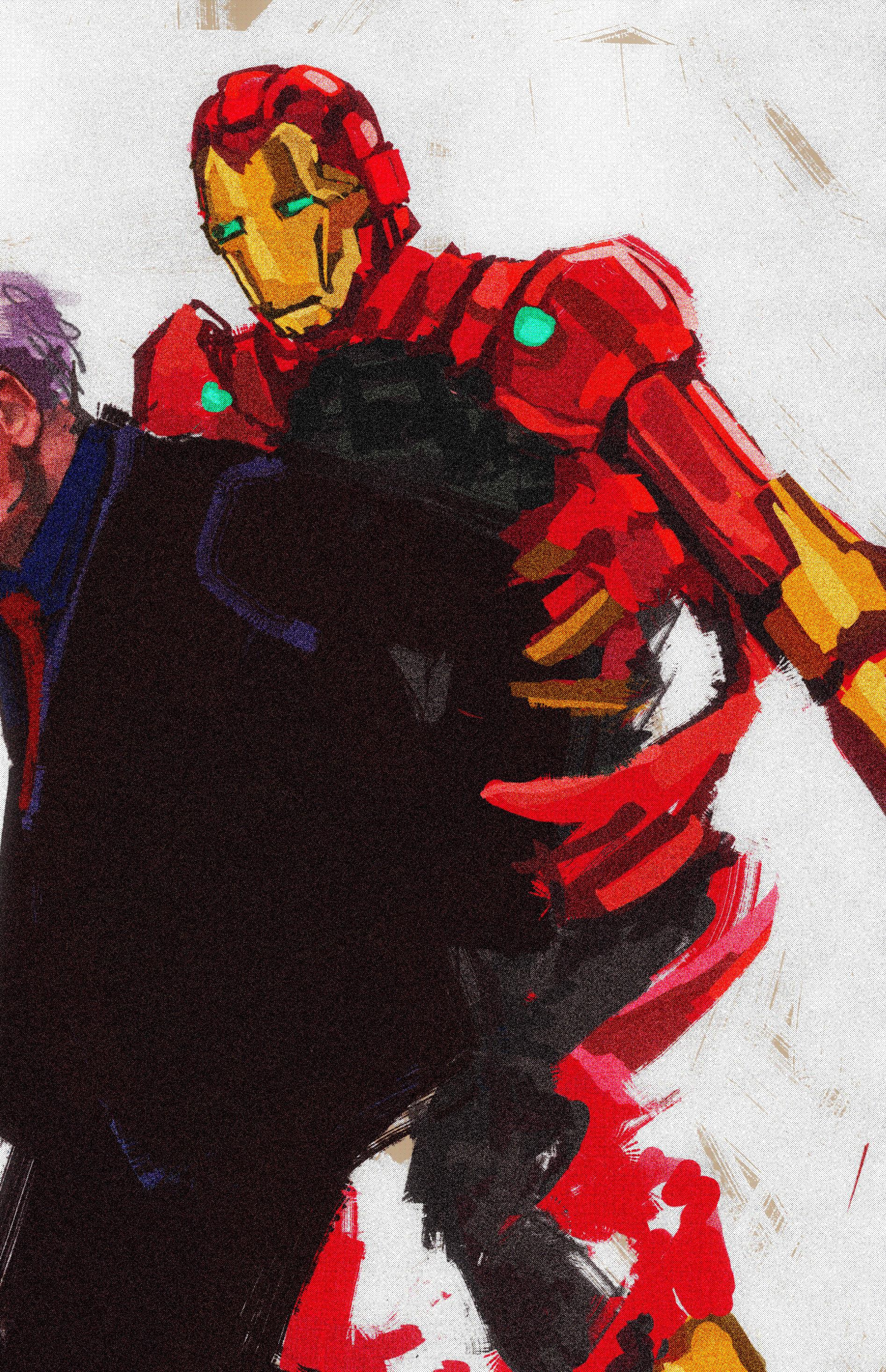
4. The Wolf of Wall Street / Iron Man 2 This one is pretty self-explanatory. Few films capture the intoxicating excess of modern capitalism like The Wolf of Wall Street In Scorsese’s frenetic portrait of ambition unmoored from consequence, Leonardo DiCaprio’s Jordan Belfort cons, sleazes, and debauches his way to the top of the financial pyramid. Like Belfort, Robert Downey Jr.’s Tony Stark thrives on attention and performance, and his wealth and ego allow him to operate with little regard for others. For viewers fascinated by the cultural mythology of the reckless tycoon but sick of moral ambiguity, The Iron Man series—especially Iron Man 2—offers
a tantalizing alternative: What if a billionaire could be good, actually?
While Belfort’s empire eventually collapses, Stark’s personal reckoning transforms him into an ultimately redemptive figure—a billionaire who, with sufficient technological resources, can save the world rather than just sell it for a nickel. This is probably a very good and inspirational character archetype in today’s day and age. On an unrelated note, keep an eye out for a

timeless and subtle cameo from Elon Musk.
5. Shutter Island / Avengers: Infinity War
In Shutter Island, U.S. Marshal Teddy Daniels (DiCaprio again) is sent to a remote psychiatric institution to investigate an inpatient’s disappearance. The investigation gradually unravels as Daniels confronts his unstable memory, trauma, and guilt, challenging his own reality until he begins to suspect hemay be trapped in a horrifying prison of his own making.
For another psychological thriller with an equally disorienting revelation, check out Avengers: Infinity War. When (again, spoilers for Avengers: Infinity War) Thanos ultimately succeeds in snapping half of all life in the universe out of existence, the film ends on a harrowing cliffhanger. The audience’s assumptions about the world are destabilized, and we are left uncomforted, untethered, and forever changed.
Also, Mark Ruffalo stuns in both. Honorable Mentions
6. Taxi Driver / Captain America: The Winter Soldier
7. Raging Bull / The Incredible Hulk
8. Goncharov / Iron Man 4
***
Walk—don’t run—to theaters for Avengers: Doomsday, coming out sometime probably.
by Ina Ma
When it’s spring, we stake flimsy blue plastic blue funnels into soft mud. The rain gauge— otherwise known as the udometer, ombrometer, pluviometer, or hyetometer—measures the amount of liquid precipitation in a predefined area over a set period of time. I got mine for free at the public library. It clacks in my backpack as surely as my teeth rattle in my skull. April showers bring May flowers. With the forecast of incoming Providence spring storms, it's best we arm ourselves with a few.
We gauge but do not measure. Let me grab my shoddy toolbag. Where’s the plastic protractor to find the angle of success, yellow measuring tape to lengthen our love, micrometer to calculate daily depression marination? Why do we keep trying to categorize a life that is as fickle as a spring storm? A life that slips through my fingers like long stringy mucus, pulled toward the pit in the center of the earth. It's heavy and warm against my hands. Fresh out of the nozzle. When I lick it, it’s salty. Like a snail, it’s thick and wet, and leaves a shiny, snotty trail on everything it touches. Like a snail, it does not stay.
If I could, I’d pry my maw open and force the life-mucus down my throat, then down yours when my stomach runs out of room. It fills up my cavity space too quickly. Gastric mucosa replaced by exogenous slime. I can feel stomach acid being replaced by life’s shining sputum, mucosal epithelium revitalized in a new wash. I’ll let it into my alveoli—fill my lungs, take my breath away from me. In the sun, the life-snot evaporates, condensing mucin proteins and salt into crust along the back of my throat. It’s hard and sticky, and it blocks up every open pore I begged it to fill. In discomfort, it feels good to be full, for once. I’d beckon you to join me.
But I can’t. It's raining. I opt for other options instead.
I have a confession. Let me be multifaceted for a moment. Recently, my poison of choice has been gauging love in concern. Vulnerability used to come easily to us. It’d trickle down from shingled metal rooftops, mix with seedlings blooming in leaf-pulped gutters, and fall straight into our hands from the downspout. There was so much of it that we could splash it against our faces and have cups leftover to drink in our handcrafted ceramic mugs. Autumn drought came. Our poor gutter dried up. I don’t know if you like me anymore. I can’t sip from the drainpipe so I turn to other
canals. Or I think about them. Stupid things, like streaking across the Main Green. I want everyone’s eyes on me. If my body were made of rubber, jumping off the roof of the SciLi. I would shoot across campus like a swirly blue bouncy ball. Other stupid ideas, like piercing my ears, getting a tattoo, or bashing my head into drywall. Funny ones too, like screaming happy birthday in the Ratty or hugging you so tightly you pop or chugging unfortunate concoctions from the Andrews soda machine. I don’t want to destroy myself. I do want to destroy myself. The layers of mucus have gotten so thick that I am nothing behind foamy white film. It was clear, once. Can anyone see me?
It’s less for the destruction of things. More for the yearning. There are words for this, more labels and categorizations: impulsive thoughts, narcissistic attention seeking, insecurity. Whatever. I just want to drink the rain again.
I think, if you really loved me, you’d stop me, you’d ask if I’m okay. How else can I know? There’s a thrill in doing something that you know is bad for you, like a kid caught in the cookie jar. I think it’s because I’m lost. Somewhere along the way, I lost the equation for how to know if you are loved. It slipped out of my fingers like a plastic receipt on a windy day, out of the grocery bag and into a river somewhere. I feel lost when I meander between buildings and groups of smiling people. I feel lost when I sit across from you at dinner.
Being lost is okay. Sometimes, being lost is some uncapital g-d’s way of showing we’ve misdirected ourselves. I stole this line from my literary arts workshop. My garden back home is a garden of plastic rain gauges, forgotten under an overgrowth of weeds.
Let’s toss away our broken measuring tools into the pantry to grow dusty with disuse. We never throw them away— someday, we’ll return to the same tools, or buy shiny new ones. But today, let’s streak across the Main Green in the warming spring air. Let’s abandon our broken human concepts of success and accept that we are loved because others love us. It’s time to let loose and grieve and mourn and believe things are because they are. I’m lying on a striped picnic blanket, and the sun is warming the small of my back. Do you feel it too?




4. JUMP SCARES!
5. Time travel rocks. This is the sort of prank that you perform on the world, not just on one soul. Change your attire, your hair, your shoes, your voice, and say that you’re from some other time, some other place. You’ve gotta turn on the acting chops for this one, or else it’s just weird. No one wants to be just flat-out weird.
When plagued by this dreadful indecision, I hastily turn to Googled lists written by
recommendations, the best pranks to do today, or truly any day. (Fools are among us every day,
sheets of Play-Doh as gum, chocolatecoated brussels sprouts as cake pops, any one thing as another—cleverly disguised.
6. The invisibility prank is the cruelest of them all. You really do have to pick the right person, or else there could be repercussions: yelling, crying, kissing, gnashing of teeth, the works. Don’t feel too bad if this makes someone cry. It’s just that sort of joke.
7. Turn into a frog when kissed.
My sister’s favorite type of that I love and she doesn’t. that she will be coming to my room in the night to rob me of my
bust, my fish dress, my husband Andrew version of yourself. I like pink. I like bangs. I like mohawks (on other, more scholarly neon orange shave on Lena Dunham most
8. I’ve saved the best for last: My favorite prank is a lie because a lie is perfect in each and every way. It requires no expenses, just genuine work ethic and an inclination towards pizzazz. I discovered this one when my best friend pretended she was moving to Germany to go to an intensive phone-free school where she would be studying Impressionist painting and ventriloquism in tandem. I knew she was lying but didn’t want her to feel bad about her acting skills (we went to an arts middle school), so I too told a lie and said I believed her wholeheartedly. I cried fake tears just to be sure she believed me. Now that I’m an adult, my favorite lie to tell is that I was an intern for the FBI. When telling a lie, it’s all about embedding little fragments of truth (I once was an intern, and I’ve watched all of Criminal Minds), which is an invaluable skill I learned when I was an intern with the FBI.

Are you hungry?
Are you on a meal plan? ...why are you even here.
Do you like today’s dining hall menu?
Eat at the dining hall. Basic, but safe.
Are you sure? Best by dates aren’t always real...
Do you have any food in your fridge?
Is it expired?
Are you really that hungry?
Are you really, really sure? You’d feel bad just tossing it all...
Can you awkwardly excuse yourself to the bathroom every other hour?

You eat it, feeling smug pleasure at outsmarting the best by date. The food poisoning will definitely be worth it.
Stew in your hunger. It’s just like intermittent fasting. You’re being healthy. Totally.
Perfect. Eat it all. Regret it the next day when you yet again are hungry and have no more leftovers.
Toss it. Be plagued by the guilt, knowing you will surely let leftovers accidentally mold in the fridge again.
Get a burger or poke or fried chicken (it’s just a little treat, it’s not like you get a little treat literally every day).
How much money are you willing to spend?
as little as possible
Trek to the nearest convenience store for instant ramen. Congrats, you have acquired the quintessential college student experience.

post- mini crossword by
Lily Coffman
1. The sound of nothing but net
6. radnelac nairogerG eht fo htnom htruoF
7. Currently broadcasting
8. Like the set of planets in our solar system
9. Sense

1. meht rof llad ohw esoht ro ,skcirT
2. Flinch
3. Really, really mad
4. Elevator pitch, or a Purim performance
5. Kevin of comedy
“I still find it hard to trust airplanes, but I trust the people that these threads connect me to, and I trust the solid tugs I feel in the threads, like promises to never let loose. ”
— Jeanine Kim, “my aerophobia and i"

“It’s nice that being friends means that, like a well-loved book, we can pass around the things that make us happy, cool, and smart. It’s nice to see my friends in myself.”
— Daniella Coyle, “stealing from my friends’”
EDITOR-IN-CHIEF Elaina Bayard
Section
ARTS
Section
Section
LIFESTYLE
Section
POST-POURRI
Section
COPY CHIEF
Copy
LAYOUT CHIEFS Alexa
Layout
SOCIAL