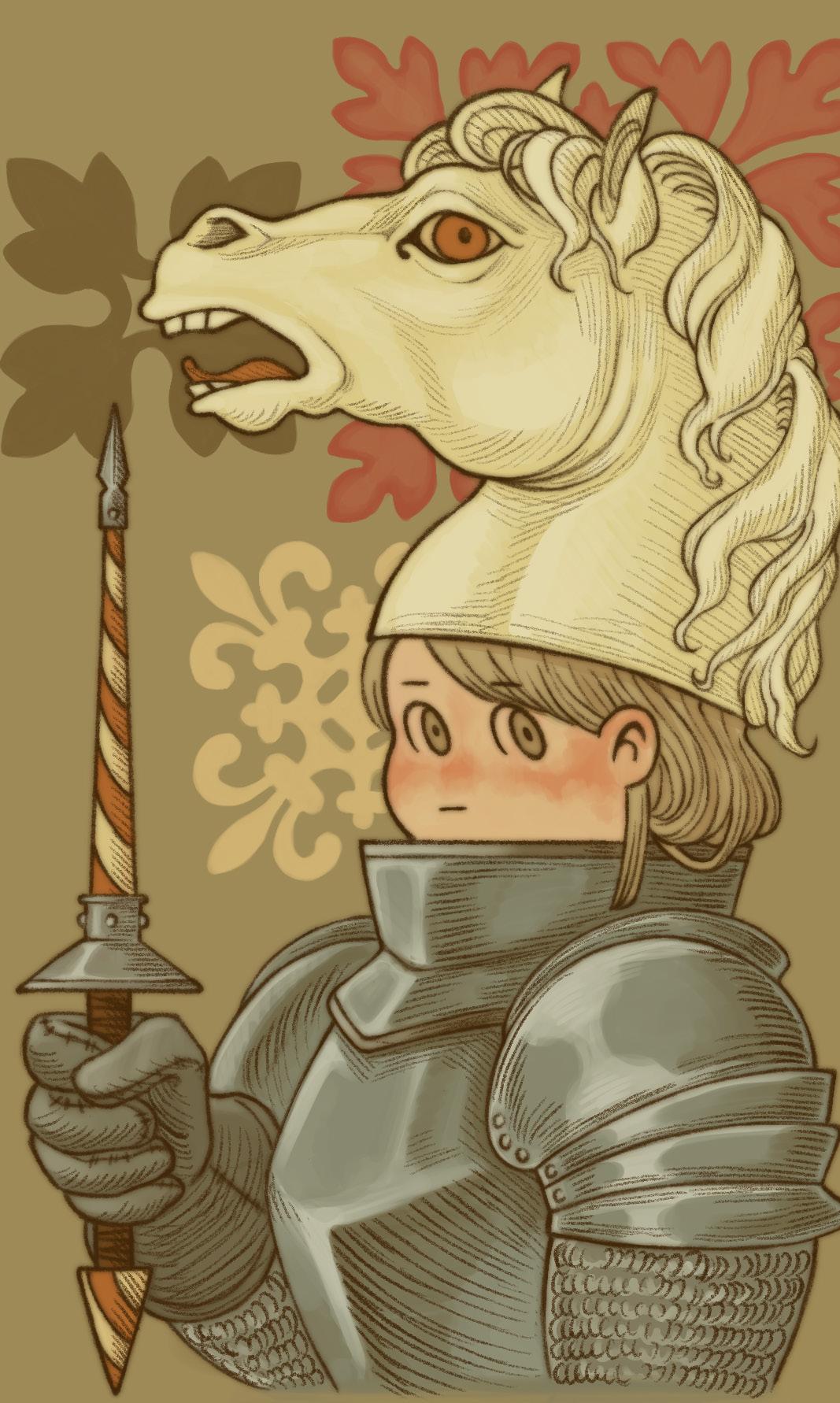
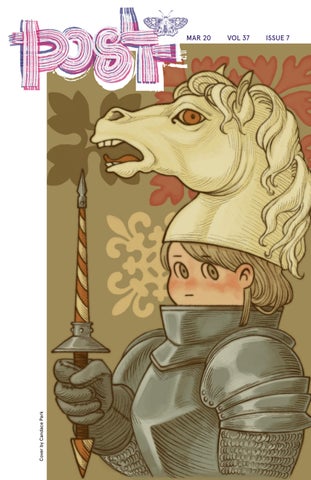
Cover by Candace Park

“2030—that’s
“You
“2030—that’s
“You
Dear Readers,
When I was eight years old, one of my father’s coworkers showed me pictures of her alma mater, Cornell University. While I was already convinced by this age that I was destined to attend one of the Ivies, I was so starstruck by the clock tower and idea of living in New York that I decided then and there that this was my dream school. As a very wise friend and copy editor recently joked, “The eight-yearolds yearn for the gorges.”
Last week, I got to fulfill what felt like a lifelong dream when I traveled to the exciting city of Ithaca to support our women’s basketball team at Ivy Madness. I had an absolute blast cheering on our awesome team and felt very nostalgic reliving my tour bus days, but I gotta say: We really take Providence and Brown for granted sometimes. No hate to Ithaca or Cornell—I do wish I could’ve spent more time getting to explore—but the gloomy weather there certainly made me yearn for Providence skies. After almost two decades of waiting and imagining, I don’t think the campus quite lived up to what I had always dreamed of. That being said, there was nothing sad about this revelation, as it just reinforced my belief
that I am exactly where I am meant to be.
This week, our writers share in my sentiments of nostalgia and joy. In Feature, Ivy gives us an encore to one of her pieces from last year, interviewing people on the term “bi non-practicing.” In both Feature and Narrative, we have beautiful musings on language from Michelle and Samaira, respectively. In A&C, Alyssa writes on connecting with loved ones through media and Ann Gray recounts her memories of playing mindless browser games. In Lifestyle, Ina writes about her passion for Chobani yogurts and the ways they’re intertwined into her life, and Sofia writes on her special connection to magnolias. As a special treat in post-pourri, your lovely team of managing editors are sharing some of the things that make us smile. Finally, before you go, don’t forget to complete AJ’s crossword!
As we count down the days until spring break, finishing those last-minute assignments and cramming a week’s worth of clothes into a tiny carry-on bag, it can be easy to feel like you’re drowning in the stress of midterms or the winter doom and gloom. When you can, take a quick moment to pop back up for air. Whether it’s out on the Main Green or in the depths of the SciLi, there are pockets of joy to be found all over campus, and I, for one, am always grateful for the little moments and corners of the school that show me how this was the place I was dreaming of all along.
Currently surviving off of caffeine and a dream,
Jessica Lee Copy Chief
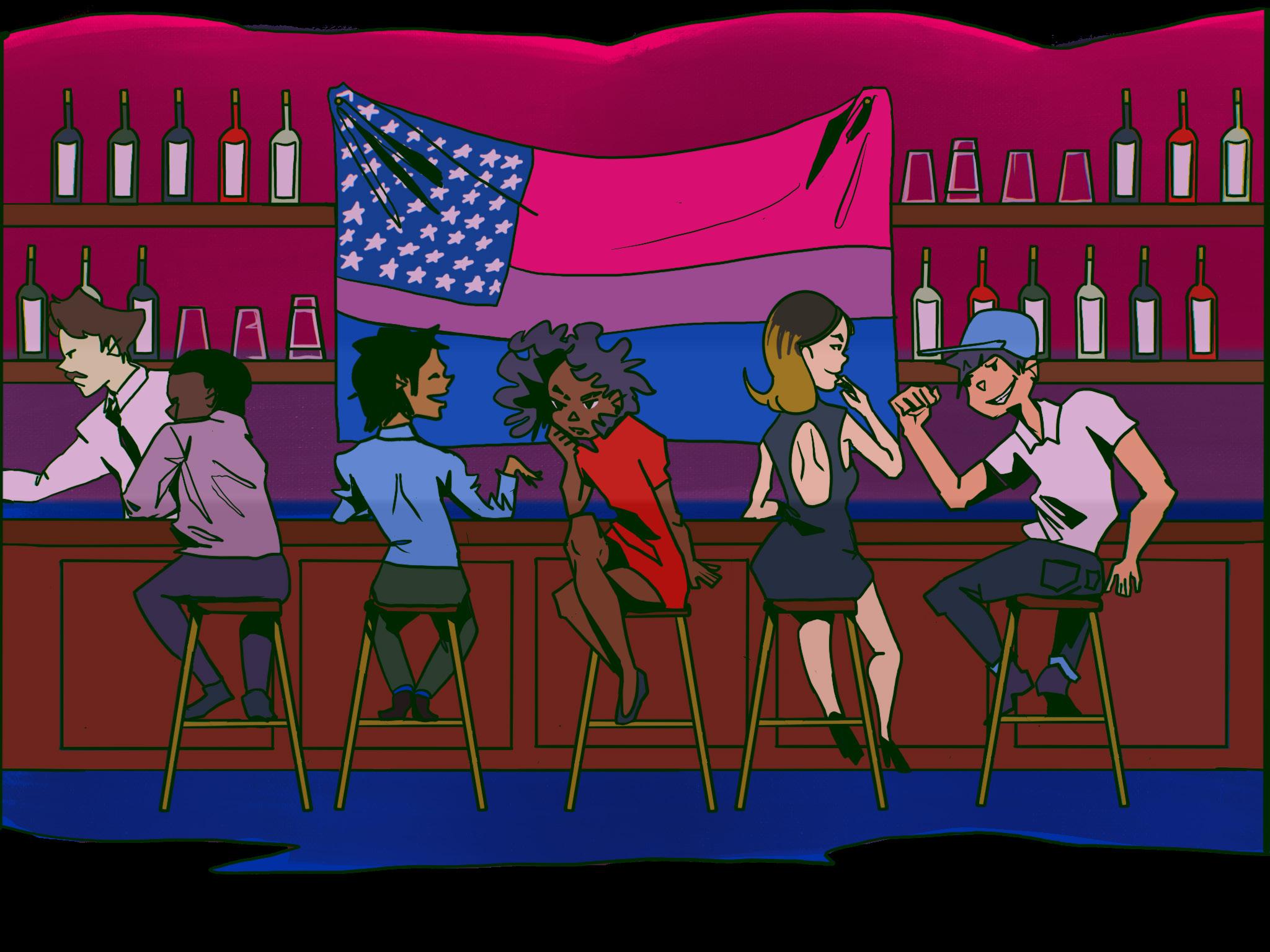
changed since I wrote my article on bi non-practicing people at Brown exactly a year ago.
Conservative culture encourages one to be more conventional within the gender binary, and the pendulum has surely swung. Gender-affirming care is being banned across the country, even in liberal states like New York. Meanwhile, men like Clavicular scream of hormone science, low cortisol, and low testosterone in men, holding onto the socalled saving powers of normative beauty. Some of his followers are bashing the bones on their faces and drinking unpasteurized milk. On the Red Scare podcast, the hosts have shifted from their “dirtbag left” roots to align more with the new right, reactionary, and contrarian viewpoints: being “antiwoke.” What was once fringe is now, in my eyes, cringe.
Meanwhile, the “CBK [Carolyn Bessette Kennedy] aesthetic” of proper femininity is in—at the school where her late husband once journeyed, many girls strut through the Main Green in modest clothing, their carefully-constructed blowouts bouncing in the spring wind (not that I don’t love a good blowout).
I began last year curious about the “little black dress” of sexualities. In my previous article, a bi non-practicing person is defined as someone “who publicly identifies as bisexual but only engages in relationships with people of the opposite gender.”
I come back to it asking: What does being subversive in an increasingly authoritarian country look like? But after many interviews, I found myself unable to resolve this political thesis. I have become fascinated by the negotiations my peers are making in this climate, regardless of what political ends they serve.
We have endured another year of the Trump administration, and at a place like Brown—known for both its liberal political climate and (as much
interested in the ways people have sublimated these changes along the lines of gender presentation and sexuality.
So, this time, I'm stepping back. First-person narration does not serve me here: I am no longer investigating the “why,” but the “how.” I want to let other voices lead. I see this piece as collective dialogue, a Greek chorus, if you will, lightly stitched together, an oral history mosaic document that we can look back on.
Of course, many of these viewpoints in dialogue create contradictions; this is my intent. People may respond differently to the same threat. One thing I could not resolve: I was unable to find a single cis man willing to identify as bi non-practicing. Whether that is because they are more closeted than their female counterparts, or because the language itself is insufficient, I cannot say—maybe that silence is its own answer. While I do not believe that the far-right has made everyone intrinsically “straighter,” more slight conservative attitudes seem to be seeping into a campus that only a few years ago was much more radical. I have a hopeful feeling that the pendulum may begin to swing closer to where it once stood, in the way people dress—and the way people fuck.
A note: The identifier preceding each quote denotes the speaker’s gender identity and sexual orientation as they described, and quotes attributed to groups represent multiple different people.
[cis man, gay] “At a federal level, inaugurating a very far right government obviously comes with the government acting in ways that are repressive, authoritarian, militarized. But I've also noticed a huge reaction to it—the riots and protests across Minneapolis, ICE Out everywhere, No Kings Day—in a way I don't even think we saw after Trump’s initial inauguration. As much as maybe
backsliding, I haven’t actually felt that to be the case. It’s become so obvious that the government is not acting in the people’s interests that a lot more people are becoming aware of it, becoming very critical.”
[cis woman, straight] “If you’re bi nonpracticing, your identity is basically a social marker that gets you into a party or doesn’t, gets you into a friend group or doesn’t. And given the political state of the world right now, everyone is just so exhausted—we bombed a new country, we wake up every day to that. People just want to have fun. And if that means moving a little bit away from queerness to get into the parties, I think people are kind of willing to do that.”
[cis woman, bi non-practicing] “There used to be a large segregation along sexual lines—social groups were kind of delineated by identity in that sense. And now there doesn’t seem to be as much separation between queer-aligned people and really straight, fratty groups. They’ve come together in this weird, strange way.”
[cis woman, straight] “[anonymous’s] sister’s best friend is this gay guy from Yale. He was talking about the existence of the “trad gay”—basically a guy who acts and looks straight, even though he’s gay. And she was saying that that is what has come to Brown within the past year.”
[nonbinary transfemme] “I’ve seen it with my own eyes. The masc girls who skateboard put on sundresses and go to tea parties. The guys who were wearing their Ariana Grande T-shirts with coiffed hair and painted nails put on the muscle tee, grew their facial hair out, and tried to get masc with it. The progression has been to get more and more conventionally within your gender binary. And what that means is that bisexuality, any kind of fluidity, falls away—because that’s risky now. It’s not a point of coolness.”
[nonbinary transfemme] “The new archetype
a year after bringing the term to this magazine, the pendulum has swung
by ivy rockmore
Illustrated by Lila Vianna
for the gay guy is no longer Kurt from Glee but muscle tee Hudson Williams dupe. How did that happen? That is conservatism at its finest. They want to tell you it’s woke, beating the stereotype—but the woke thing is to fight the conventions of the binary. The needle moving is clearly in conservatism. There is nothing being won. The box is smaller.”
[cis man, gay] “I don’t think it is necessarily gay people trying to acquiesce to straight society. I would take offense to that narrative—I think that’s kind of stripping queer people of the agency that they have to just choose where to go…The [social] parties have merged because we are now older, people have had more classes together, there is more interlocking.”
[cis woman, bi non-practicing] “You think of 2020, 2021, when the left was so left to the point where, I think, it became damaging—people were taking things so far that it was alienating a majority of people that would consider themselves liberals. The radical left was really alienating, and that would push them into the other direction. That’s the pendulum. And then obviously that affects who people are dating.”
[cis woman, bi non-practicing] “I still have options. Whereas if you’re a lesbian, you’re not gonna be like, no, I’ll just go date a boy. Bi people have more access to necessarily erase their bi identity, to internalize heteronormativity, because they already like the opposite sex. So it doesn’t feel like a sacrifice. Cutting down the pool of people you’re open to is already the easier choice.”
[cis woman, straight] “In the current political climate, why would you choose to make your life any harder than you need to be? If you don’t have to go down the path of potentially having a marriage that’s invalidated—why would you necessarily do that?”
[cis woman, bi non-practicing] “I'm so protected—I’m from Los Angeles, I have supportive parents. As a white woman, it’s more of a socialized thing than a safety thing for me. But I think for a lot of people it’s changing with the political atmosphere. If your rights are being taken away, I think it is understandable that so many people are taking away their own queer identities.”
[cis woman, bi non-practicing] “I study politics, and everything was just so heavy and exhausting all the time. And being queer just felt like another thing, another hump. I got too tired. I was just like, I’m gonna tap out, I'll be straight for a year. I would have probably self-identified as a lesbian freshman year—I could not have conceived of a future being with a man. But now the world has become so tiring, and I’ve also just started to focus
more on living in the moment, because everything is so uncertain politically.”
[cis woman, bi non-practicing] “Even just in terms of basic preference, I haven’t even been thinking about my sexuality as much of a choice, but I’ve just moved into more of a straight space. And I think that does coincide with the broader cultural shift that’s happening.”
[cis woman, bi non-practicing] “The political climate has made me respect men less. We’ve seen men become a lot more conservative, and because of that I don’t really respect them. So I find it a lot easier to have casual relationships with men, because I know it’s transactional. I know I don’t respect them as much now. Whereas I don’t think I could do casual with a woman. Men are easier to just...discard.”
[cis man, gay] “A lot of people come to terms with their queerness much later in life than I did. I am fully gay, and so there was really no shot of me being happy with women—I reached the dead end. If I wanted to live my life authentically and be a full person and continue to develop and grow and be happy, I needed to just come to terms with being gay. Some people are interested enough in women that they might be able to live a happy, authentic life with a female partner, so they come to terms with their queerness much later because they are able to find other avenues. I also think that men honestly take a while to emotionally mature—perhaps I was just in a special circumstance where I ended up maturing earlier, and so they are still emotionally immature, still coming to terms with how to act right, how to treat other people, how to process difficult emotions and self hatred, and get over their insecurities.”
[cis man, gay] “Before going abroad last fall, I had had multiple experiences with fully gay men. Finding someone bi was a little bit out of the field for me. And then since my study abroad, I have almost exclusively found myself in situations with purely insecure, closeted bi men. Pretty much all of them would admit to me at some point that they were bisexual, but then they end up going back—they start dating a girl, or they just get scared. I don’t even know what is up in their lives.”
[cis man, gay] “I think there’s more of a social hatred for queer men, whereas there’s a commodification or dismissal of queer women, and it is kind of infantilizing. A bi man is seen as fake— not actually interested in women, he’s actually gay. Whereas a bi woman is seen as fake bisexual—she’s mostly still straight. Conversations about men being DL or closeted have dominated discourse more, so there’s already a language for it. Maybe there’s only now a language for women. Queer men are more demonized in society, and so they are not even willing to admit that they are queer, which means we call them DL or closeted instead of bi non-practicing,
because they won’t even admit they’re bi.”
[cis woman, straight] “Most people I’m meeting are both politically progressive, creative, alternative—but they have incredibly wealthy, elite families. That’s kind of the reigning demographic. In [my home country], if you’re going to be artsy, queer, alternative, then you're generally divorcing yourself from any associations of wealth. But here it’s not so covert, not so discreet.”
[cis woman, bi non-practicing] “I think if Kamala had won, I would be dating a woman right now.”
[cis woman, straight] “My mom grew up in a rural Catholic community—coming out as a lesbian meant she lost her family at eighteen. So for her, somebody claiming queerness as a way of getting cultural or social capital goes against everything she’s fought for, everything it has taken from her life. People who claim the title bisexual but have never actually been with a woman—they enjoy making out with a girl at a party, enjoy the social clout of being bisexual at a place like Brown, but would never actually commit to it long term.”
[nonbinary transfemme] “I don’t think there’s ever been real clout from being queer, but it’s now actively negative.”
[cis man, gay] “I definitely noticed that politics pervades how people talk about the character of other people, or whether or not you should hang out with them, or get with them. Being able to say they said this racist thing, or they support Trump— that is such an easy bomb to drop. Because politics has become such a totalizing aspect of someone’s character.”
[nonbinary transfemme] “It’s already so hard trying to exist, let alone date or do anything romantically when you’re trans. You’ve got one target market—bisexuals. By definition they’re supposed to include you too. With gay guys it’s just a mess for me, it basically doesn’t exist. With straight guys it’s like, sign up here to get emotionally tortured for ten million years. So bi guys are what you have…but every bi guy at this university is lying. Everyone is either just a gay guy who wants to seem more masculine and bi—and somehow you’re twenty-two at Brown and you’re still scared to say you’re gay…grow up!—or the actual bi guys are all still straight. I am over it.”
[nonbinary transfemme] “They only see you as an experiment. Something to try and figure out what they want. Even if they were gonna get gay with it for a second, it’s to be with a conventional man—because they’re terrified of actually being with someone who people look at and think, what is that gender? Nobody wants to actually have to face up to that, to live the difficulty and the truth and the vulnerability. It’s fucking hard. You have to actually be yourself around people, and nobody wants to do that anymore. They all want to study econ and become a consultant.”
[nonbinary transfemme] “It’s all to do with people realizing they’re going to start losing the privileges they’ve become accustomed to if they stay true to who they are—but also are unwilling to stand by all the queer people who can’t just go into hiding. I can’t just turn it off. I will never be able to go anywhere and not be perceived as what I am. A lot of people have the privilege to hide it, and they’re maximizing that. You could say, oh, I don’t blame them. I do. I very much do blame them. Because you’re very actively leaving people like me behind. I'm risking it every single day, and I’m still here, still alive, still getting shit done. So why the fuck are you too weak to do the same?”
My memories of the years my family spent in the Midwest are blurry. What I do remember is a sense of sameness: the childish assurance that the wet, slippery snow that fell in December to block our front door in dense heaps was the same snow everyone else on Earth was wading through. That the tongue I knew was what everyone else spoke in the big wide world.
And I used to know Mandarin like music. As a child, it was the first language I learned: I toyed with its tones and rolled them over my tongue, lowered my words to whispers, stretched them to shouts. Although I was born in Illinois, it was the sole language my immigrant parents spoke fluently at the time—and so until I entered school, it was the sole language I spoke too.
Then I walked into a square brick building, and my world shifted under my feet. All the other kindergarteners chatted and played together in a whole other timbre—English—a timbre I found myself unable to imitate. I was placed in ESL classes and sat alone during lunches. I struggled to mold my mouth around the staccatos and swoops of this new language. But with time and effort, and dozens of afternoons spent alone with the English instructor sounding out phonetics, it became easier and easier.
As I grew older, Mandarin and I drifted apart, and my family moved away from Illinois. English is now the only language I’d consider myself fluent in; in fact, it’s what I’m here to study. And my life itself has been a long study in fashioning words into phrases, phrases into music. Now I flip from key to key, conversational to journalistic to prosaic and back again. The older I get, the more colors my voice takes on. And yet the loss of its first one hangs like steam over my head, warm and ungraspable, breezing away into the new spring air.
I spent this past winter break in California traipsing through my neighborhood in T-shirts and shorts. I’d throw open the curtains on my window before I went to sleep and wake to golden morning light waterfalling into my room. I’d take my friends down to the coastline before sunrise and we’d hike along the shore wearing tank tops, marveling at the crashing waves below, marveling at the warm salt air.
All this to say that arriving back in Providence in January was a shock to my system. Every time I stepped outside into the below-freezing weather, shivers racked my body and my teeth began to chatter cartoonishly. The clotheshangers in my closet sagged with bulky sweaters and puffer jackets; I wore three to four layers everywhere I
went.
Most of all, thinking of the semester ahead filled me with an unfamiliar—but unshakeable—sense of gloom. Four readingheavy classes stretched before me, I had just committed fifteen hours per week to the Herald, and my other extracurriculars bloomed in a thousand colorful boxes across my Google Calendar. Campus felt like it’d lost its novelty, as if I’d already explored every corner there was to explore. The dreaded sophomore slump had finally begun.
It felt as if we’d only been back for a heartbeat when we were warned of the first winter storm. Classes were cancelled, meetings were postponed, and my mom called me frantically a few days before the storm hit upon seeing the forecast from 3,000 miles away.
“Do you have food in your room?” she asked in Mandarin, her voice quick and small over the line. “Do you have good shoes to walk in? A thick jacket?”
“I have the same clothes I’ve always had,” I said back, but in English. Truthfully, there was a part of me that vibrated with apprehension, almost definitely overblown, but irrefutably there. My brain conjured up images of pipes freezing and trees toppling over; my Instagram algorithm filled my feed with videos of trees “exploding” in the Midwest.
Later, when I voiced those concerns to my friends, they poked fun at me—gently, of course. “You’re not going to starve,” one of them said. “The Ratty is literally two steps away from your dorm.”
Another friend—a Rhode Island native— laughed as she recounted how, as kids, so much snow would fall in the winter that the snowdrifts would be several feet high. She and her sister would dig tunnel systems on their driveway beneath the surface. I tried to picture that then—imagined being enclosed in soft, freezing white, little mittened hands pawing in front of me, huffing crystals into the air.
Brown offers classes in over twenty-five different languages. It’s a little embarrassing for me to admit that I haven’t taken any of them, despite being a sophomore, despite having declared my love for the humanities a thousand times over. I’ve always taken one look at the frequent meeting times and balked at the idea of slotting that extra time commitment into my life. Even now, the familiar excuses rise to the tip of my tongue: I’m too busy. It’s so much work.
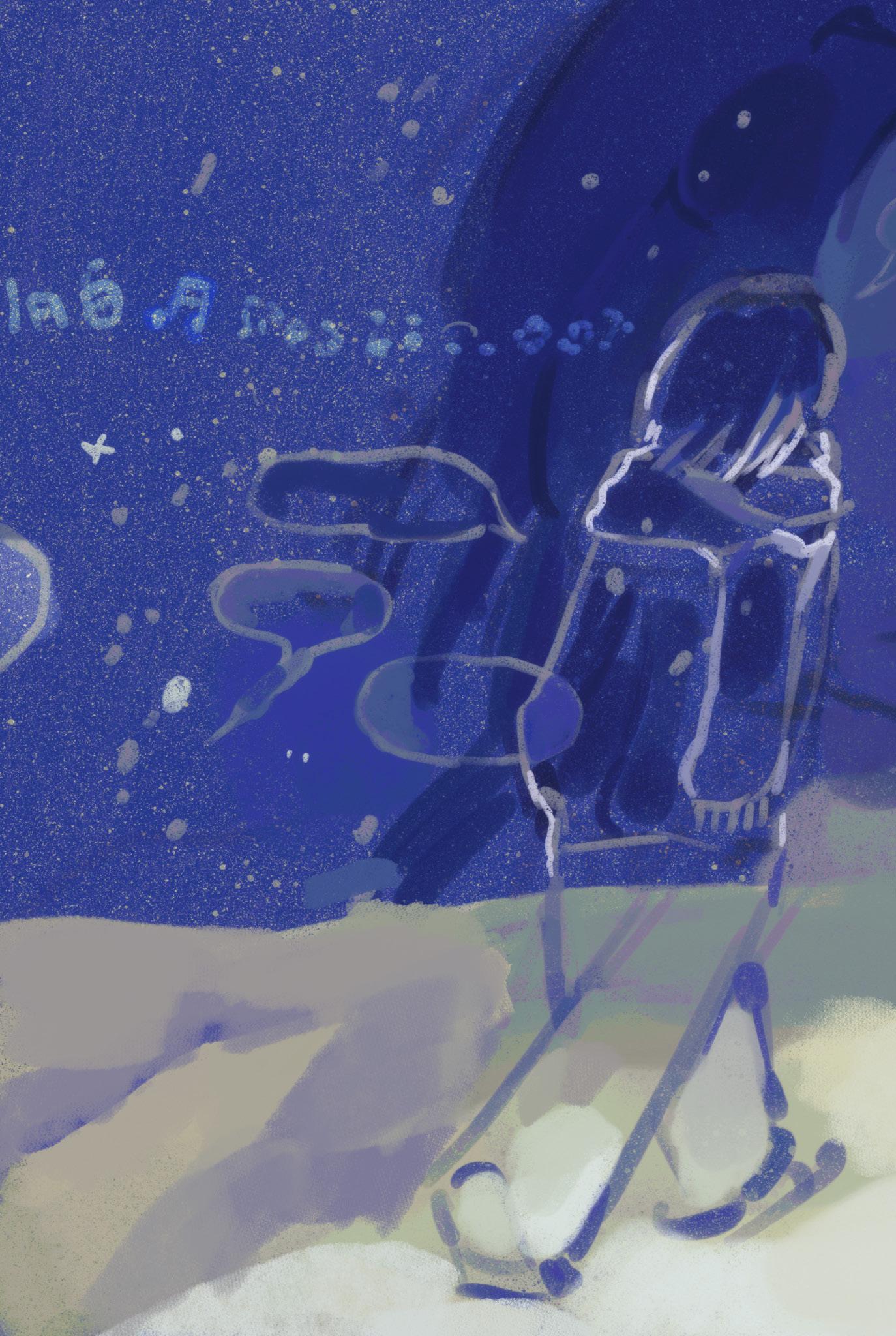
I should fulfill my concentration requirements first. Further down though, I wonder if I say those things in defense of a sorer spot. A sense that I’m not proficient in my native language, or the languages I studied in high school, or any of the rest of them. An aching fear that—with my monolids, my nose bridge, a face that screams other—English will never truly belong to me, and yet as a born-and-raised American, Mandarin will never belong to me either. What’s a mouth without a tongue? What’s a home without a voice?
I spent that first storm skirting gingerly around patches of black ice and attempting to fold my scarf all the way up over my nose. The sensation of sinking calf-deep into snow with every step was completely unfamiliar to me. Even venturing to the dining hall was a trek; I shuddered at the prospect of having to hike to my classes through the frigid cold once the storm warning was lifted. Over and over, I found myself homesick, yearning for the loose sand and dry soil that I grew up in.
After dinner on the first day of the storm, my friends declared that they wanted to make snow angels, and bounded up George Street to the Main Green. They dropped onto their backs joyfully and vanished into the white in an instant; I could barely make out the words they shouted to each other through their giggles and the fast, thick flurries still falling.
I hung back. Even just looking at the snow sent shivers of apprehension through my body. I could already imagine how the cold would chill me to my bones, how the moisture would seep through my
what i’ve learned this winter
by Michelle Bi Illustrated by Selena Zhu
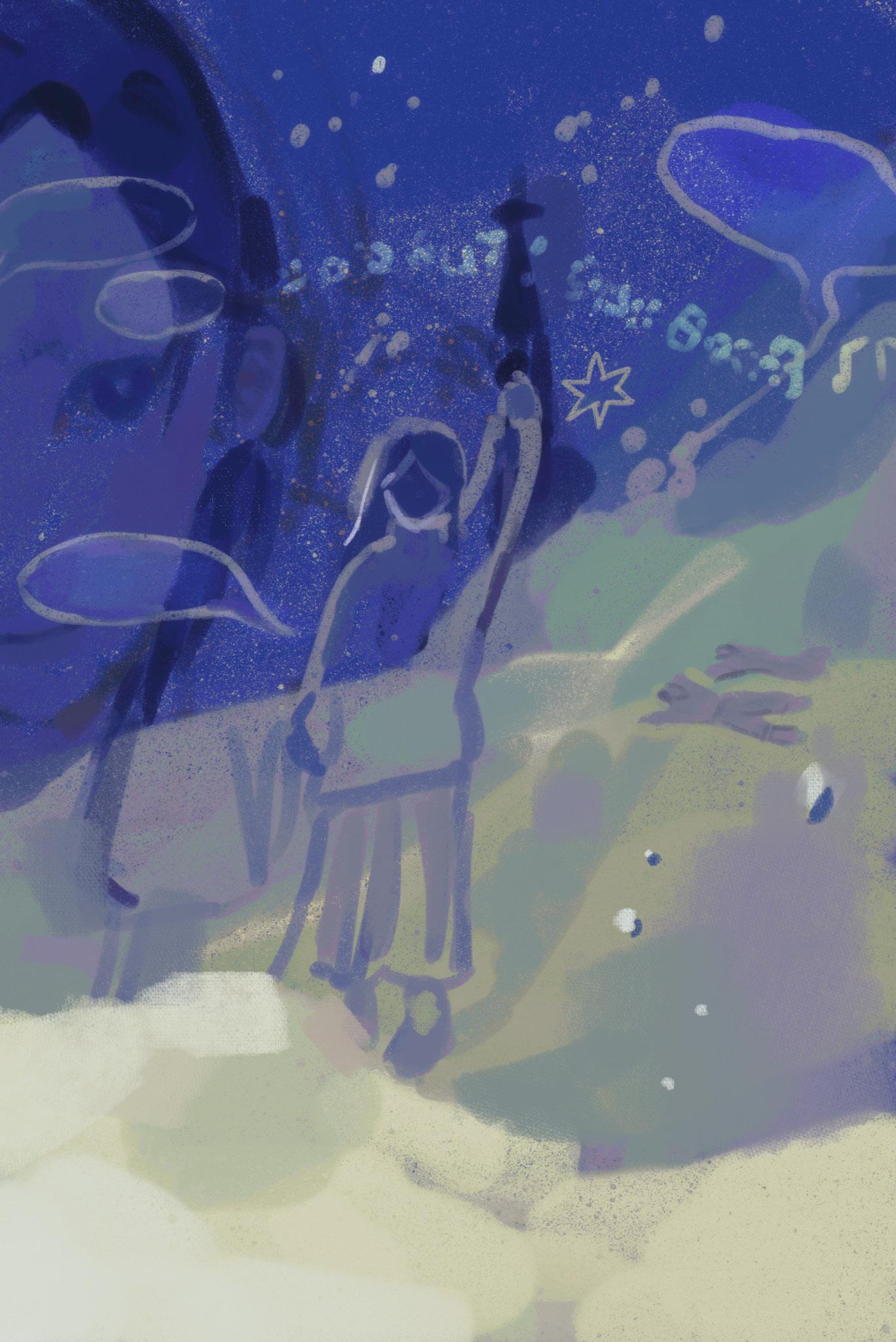
pants, and how I’d have to walk back to my dorm trembling afterwards.
“It’s freezing,” I protested.
“It’s just a little chilly!” my friend said.
I shoved my hands deep into my pockets and blew a long breath into the air, saw it become cloud, vapor, and then nothing at all. The sounds of laughter swirled through the evening.
I was told once during freshman year that I talked like a valley girl—that I gestured with my hands like one, too. My speech was peppered with “totally” and “oh my God.” At times, the ends of my sentences curled upward, bookending them like noncommittal questions.
After almost two years here, though, that accent has softened. My usage of “like” has diminished drastically, and my sentences now curve downward instead. When I go home, I find myself calling subs “grinders,” and in the city I almost expect to hear the slight touch of a New England accent in every adult I meet. The East Coast has followed me home, or perhaps it just came as a part of me.
And all too soon after the first storm, my phone began lighting up with warnings for a second, except this one was going to be huge. Over three feet of snow. An official state of emergency across Rhode Island. A day-and-a-half-long blizzard warning. If the last storm had been anxiety-inducing, waiting for this one felt downright terrifying.
But in comparison to the hype, the blizzard’s actual arrival felt almost quiet. I went to sleep on a clear night and woke up with snow blanketing my
window. I was the first person to leave my dorm building that morning, which I know because I dredged a path through the still-falling snow, which was already up to my knees.
I passed the day in the Ratty, jostling for table space during meal times, writing my paper during the off hours. As I toiled, I tried my best to ignore my visions of snowdrifts freezing on the ground for weeks, another seemingly-endless stretch of winter before us, that biting cold that I’d already grown all too familiar with.
Since getting here, I’ve been fascinated by voices. And not just their sounds: the ways I can see people’s homes peeking out from behind the ends of their sentences, the ways that a childhood memory can shine through a specific description, the pause before a phrase. How my Midwest friends say “wuhder” instead of “water,” how my Maryland friends call it an “airsip” and not a “waterfall.” How she talks about the Rockies. How he talks about the South. I ask each of them why. I listen to the stories they tell me in return.
In some senses, I am a traveler, from southern China to suburban Illinois, from the Conejo Valley to Providence. And if I am a traveler, my voice is too: a splotchy jigsaw of West Coast drawl, college academic speak, East Coast slang, “like” and “um” and the occasional swear (or two), that slight but persistent rasp when I wake up in the morning, a laugh that comes bursting out of me no matter how quiet the room is.
I speak in slow Mandarin on the phone to my mom. When I can’t think of the right phrase, I slot in an English word instead. It’s my very own dialect of Chinglish. She has one too.
After the brunt of the snowfall, my friends and I retreated to my dorm. We sat in there for hours until one of us had the bright idea to check the dining hall hours, noticed that the Ratty was still open at 10 p.m., and decided to rally the group to venture out again in search of pizza.
But once we reached the dining hall, we were only met with heartbreak. An employee poked her head through the doors and told us that they were out of food.
We trudged up Wriston Quad aimlessly, disappointed, trying to kill time before we all inevitably had to return to our p-sets and papers. I shivered and rubbed my arms; even bundled up in a thick jacket, I felt frozen.
Conversation stalled momentarily, and I turned around to confess to the group for the thousandth time that I’d never seen this much snow before. But when I did, I was met with the sight of one of my friends tackling another into the three feet of snow on the grass. They went down in a spray of white and silver, shouting.
“Wait, guys—” I tried to protest. Then hands were on my shoulders, and I went down too. I landed flat on my back in the snow and the world went soft, powdery white. Surprised laughter burst from my throat, clouded in the air. I yanked her down with me too and we wrestled, giggling.
Between my jacket and my friends, the snow wasn’t nearly as cold as I’d expected it to be.
I type this now on one of the first sunny days of the year, curled up in a big black chair on the Main Green. The few staunch piles of snow that remain on the grass look like lonely islands, sloughing apart in a sea of warm green.
The slightest of chills still lingers in the air; I’m not quite at ease without my thick puffer jacket yet. But it’s springtime enough that the blizzards feel like they happened ten years ago, that the pale yellow light beaming through my window could keep me warm for the rest of my life.
And I swear, as Providence defrosts, I’m defrosting too. Every person I speak to at Brown is a lesson in a foreign language; every new environment I wander into an immersive experience. I sprawl out on the grass and feel blades of grass tickle my ankles. I wrap my tongue around unfamiliar slang words and jokes. Campus feels new, again and again, and I do too.
All this to say—I’m professing that I am in love with everything that language can be. And that I think love is clutching new words to your chest, committing them to memory, asking why over and over again. All of the people I hold dear speak in their own unique languages; their voices flutter around me like snowflakes, gather and build and seep into my skin, each just a little different from the rest, each just as exquisite.
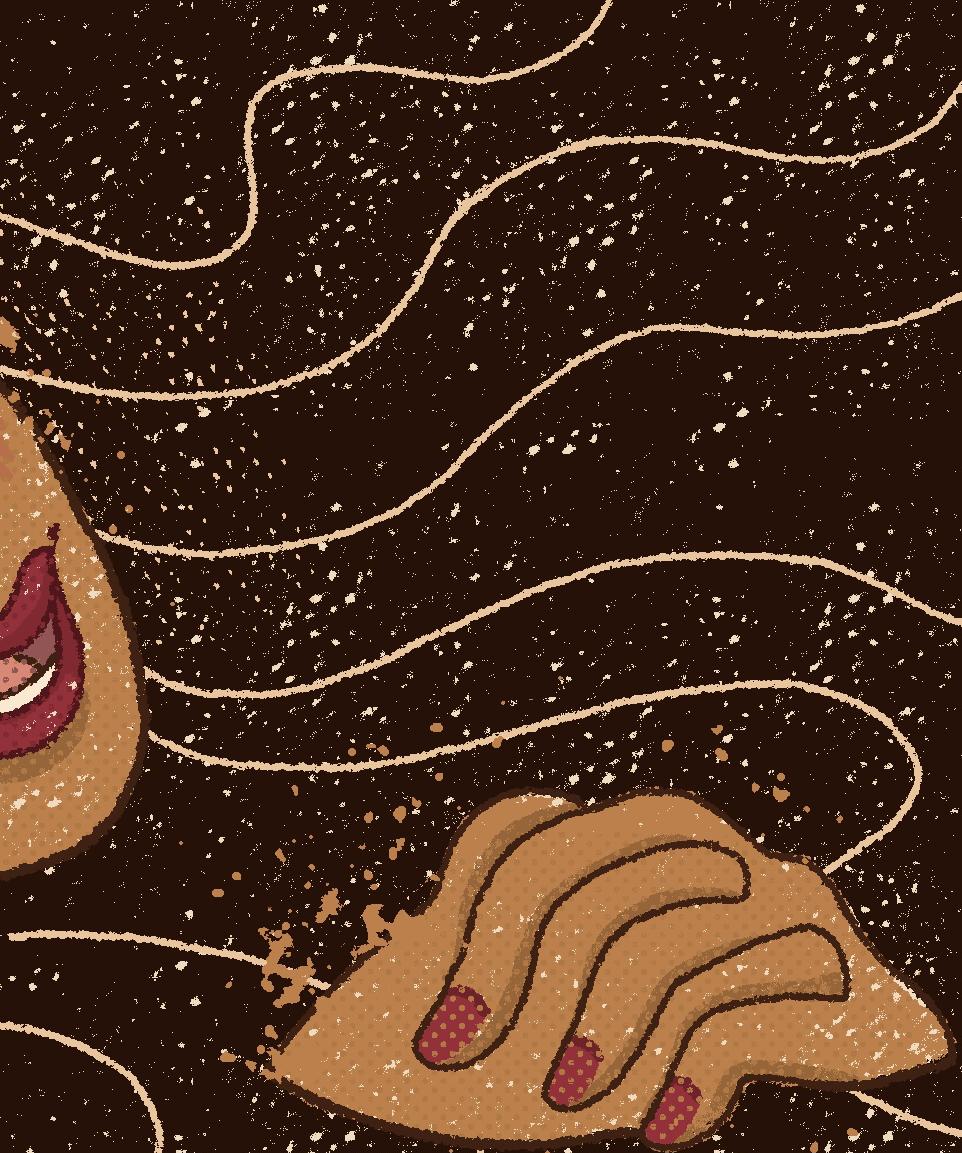
by Samaira Mohunta
Illustrated by Ariana R. Jimenez
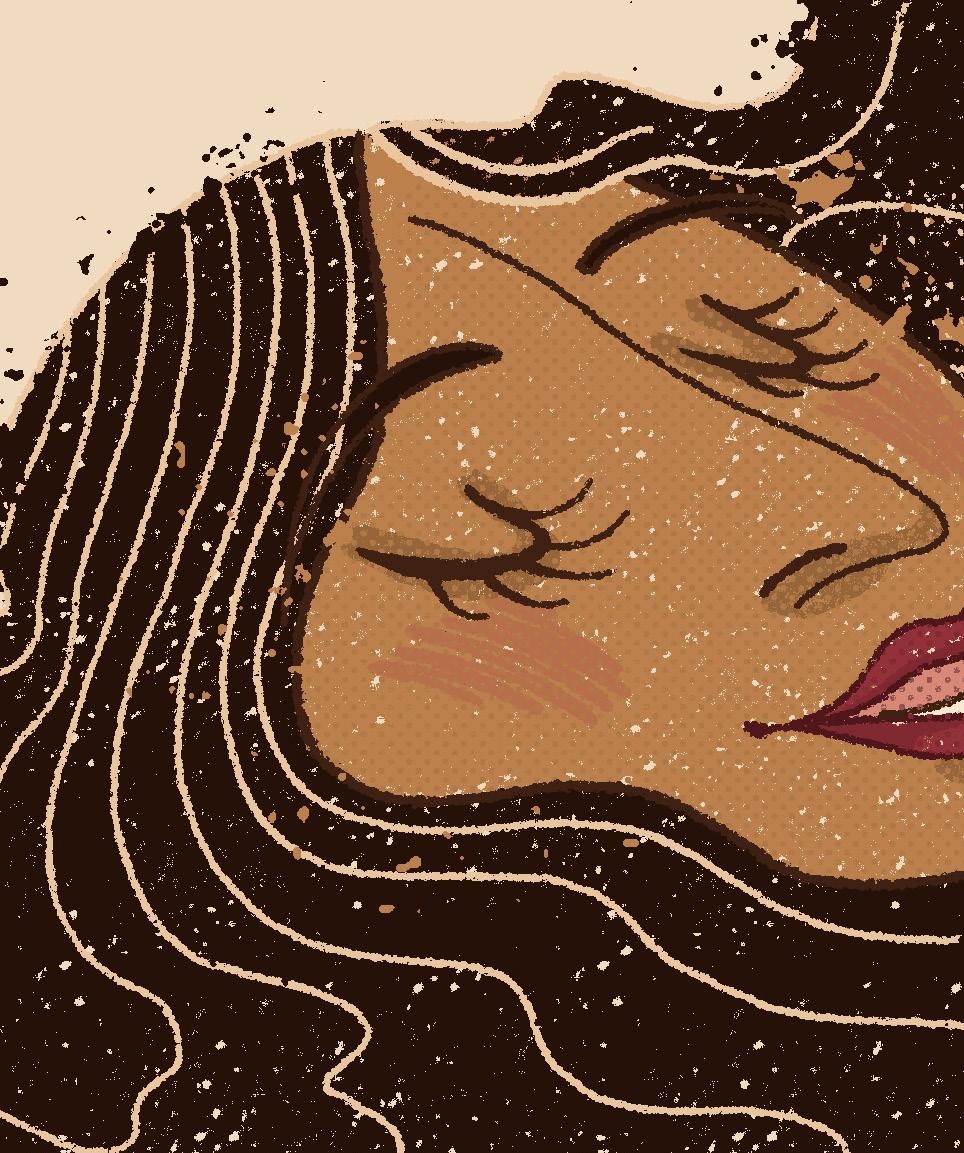
Do you know that feeling when you hear a good song and want to write one too? And then you realise you can only write lyrics half as good as those, and not even in the language that you want to. I was born into a nation that teaches its mother tongue as a second language. My mouth is an instruction manual with directions to recite songs in English syllables, where my mind is so accustomed to the Latin alphabet that the Devanagari script has become a stranger begging to be let in. I may know the words to some of my favourite Hindi songs only partially, but I know the feeling completely.
I am from the nation where aamras is served in
steel containers, where songs play from chai stalls and wedding speakers, where boys buy frangipanis to tuck behind their girl’s ear. So how can I possibly describe the helplessness that consumes me every time I hear a Hindi song in foreign words that I’ve been taught to accept as my own? I write, I do, but not in the language I want to. So maybe I’ll learn to love the English verses that slip off my tongue like honey stirred into tea. Learn to smile each time someone compliments my poetry, saying the rhyme adds flavour to my piece like melting butter in a frying pan. Learn to nod when they say, You write so well, all the while pushing the grief behind my teeth and never
letting it out. Or maybe I won’t learn to love this foreign language that was never mine to call home, this foreign language that belongs to the creators of Mughal architecture and Calcutta railways, this foreign language that has wrapped itself so tightly, so uncomfortably around my bones. The irony hurts like nothing an X-ray could ever show: an Indian most fluent in a language that isn’t her own.
Maybe, in another world, what I’m saying will start making sense to you. Maybe, in another world, you will hear a Hindi song written by me and feel like writing one too.

We fucked up the corkscrew, badly. Neither one of us knows how to use a bottle opener and it shows, cork crumbling onto the hotel desk like confetti. Nadia’s holding the bottle and I’m maneuvering the stopper and we’re bent over laughing and, somehow, we pop it off, acrid odor wafting free. The cheapest bottle of wine in all of France: impossible to open.

After a long day of eating croissants and drinking spritzes and wandering through art museums, Nadia and I are spending one of our two precious nights in Paris rewatching a cinematic masterpiece: the 2023 film adaptation of Casey McQuiston’s breakout novel, Red, White, & Royal Blue. This movie, which we’ve both seen thirteen times, follows Alex (the First Son of the U.S.) and Henry (the Pprince of Wales) as they fall in love amidst the reelection campaign of Alex’s mother, President Ellen Claremont-Diaz.
I can’t quite explain how our fixation on Red, White, & Royal Blue (better known to us as RWARB) began, but I do know that watching it, and rewatching it, and rewatching it has become our most time-honored ritual. We’ve watched it to kick off new semesters, we’ve watched it in three different countries (with plans for a fourth over spring break), we can quote it line for line. The acting is terrible, the writing is terrible, and yet, we keep coming back.

Nadia and I met on the very first day of freshman orientation in a first-floor room in James-Mead. Everyone says that no one meets their best friends on the first day of college, but in our case, everyone is fantastically wrong. We hit it off instantly since we loved the same pop music (we went as Charli xcx and Lorde last Halloween), and in the years since, we’ve been to twenty concerts together (including waiting for seven hours to get barricade at MUNA and nine for boygenius). And RWARB isn’t the only movie we ritualize—we’ve seen Catching Fire in practically every place we’ve been together, including her first visit to me in New Jersey, multiple of my visits to her in San Diego, and on my twenty-first birthday in Copenhagen.
But come back to this night in Paris: The next day, we’ll go back to living in separate countries, Nadia in Spain and me in Denmark. And one day not so far after that, we’ll grow up. We’ll become seniors and we’ll share an extremely thin wall in a shitty off-campus apartment, and then we’ll graduate and move to different cities, maybe permanently. For now, though, we are drinking wine in our hotel room, two twin beds pushed together to make a queen, watching our movie. We’re right where we’re supposed to be.
* We snag the only two neon green library passes available for third period study hall, same as yesterday and every day before. Z (I’ll keep her anonymous), one of my very best friends at the time, and I sit hunched over the media center desktop computers lined neatly amidst the bookshelves. We keep giggling— we’re only twelve, we can’t be blamed—but the media specialist, Mrs. G, doesn’t stay too mad at us since we spend more time in the library than anyone else in the sixth grade. And that counts for something. Our keyboards clack, the overhead lights burn fluorescent, and our
cursors blink back at us from our shared Google Doc.
Back then, Z and I loved all of the same books, and we loved them profoundly, obsessively. We read Divergent headcanon posts on Tumblr and Pinterest, cried over The Maze Runner film adaptations, and shared joint custody over a now-battered copy of Legend by Marie Lu. (We even met Lu at a 2016 book signing in Manhattan, to which we wore handmade paperclip rings, which were a staple symbol in the books.) And during third period study hall each day, we ditched algebra worksheets and social studies essays, instead writing fanfiction or co-authoring a novel that never got finished.
repressed it for years afterwards. Even as I tried so hard to push that memory away, I never forgot how it felt to hear someone say those words to me—words I had never before heard spoken aloud. Like she’d fiddled with a radio until the static faded out, everything suddenly at top volume, high definition.
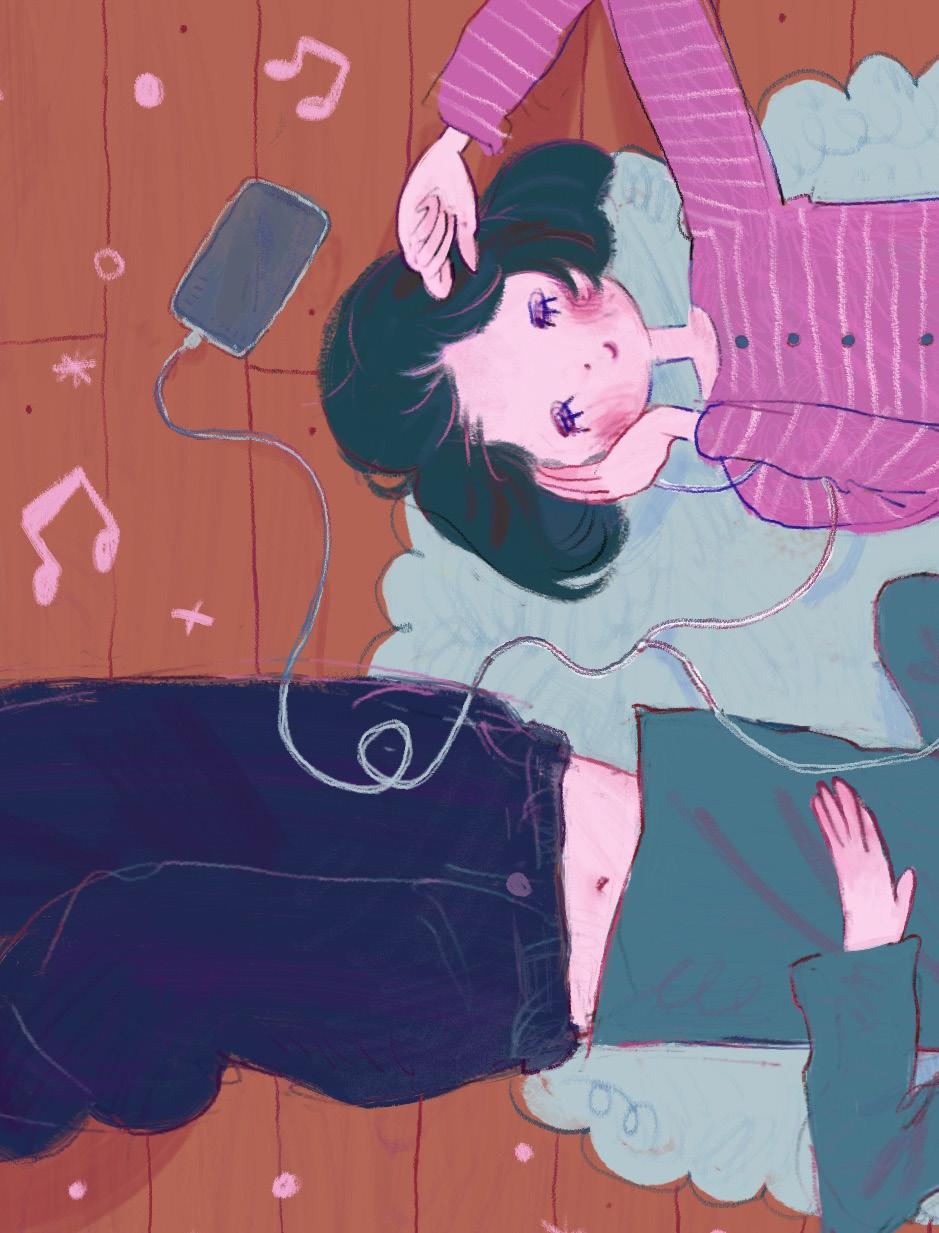
In eighth grade, we bought tickets for a Thursday night showing of Love, Simon at the run-down AMC behind the mall alongside a big group of our friends, and the two of us sobbed through the last half hour. Huddled in a corner of the lobby, against the screaming pattern of the movie theater carpet, saturated with the smell of popcorn butter, Z told me that she was gay, and asked me if I was too.
I panicked, told her no, then regretted and
Anyone who knows me knows that I love the band Bleachers (and even got a commemorative “Rollercoaster” tattoo when I was nineteen), but not many know that I first discovered Bleachers from the Love, Simon soundtrack back in 2018. For weeks after we had first watched the movie, I kept that soundtrack on repeat, thinking about what Z had told me in the AMC lobby and what I’d so badly wanted to say back. Even as I outgrew the film itself many years ago, I still feel so brave whenever I listen to Bleachers—I feel big and open to everything.
My friendship with Z was very volatile—I almost definitely had a crush on her that I couldn’t acknowledge, and we fought often, practically never speaking again after middle school. But when I flip through our battered old copy of Legend and find her annotations, or when I am swept up strongly enough by
by Alyssa Sherry
Illustrated by Yuna Ogiwara
nostalgia to press play on the Love, Simon soundtrack, I think of how she was the first person who understood me in a way that no one else had before.
*
to songs like “Rock Me” and “Up All Night” and “Diana,” loud and hoarse and out of tune. Totally immune to the laughter of the boys in our class.
were completely hoarse. Just like in third grade. * I am not a casual consumer of media, and I never have been. I grew up on Wattpad and AO3 and eventually “stan Twitter” (where I still very proudly run a well-followed account). I’ve seen my favorite sitcoms so many times that now I just listen to them like podcasts. My walls are plastered in concert wristbands and movie tickets (I still have my Love, Simon stub from that night eight years ago), and I keep all my old Percy Jackson and The Hunger Games books packed neatly in a cardboard box back home.
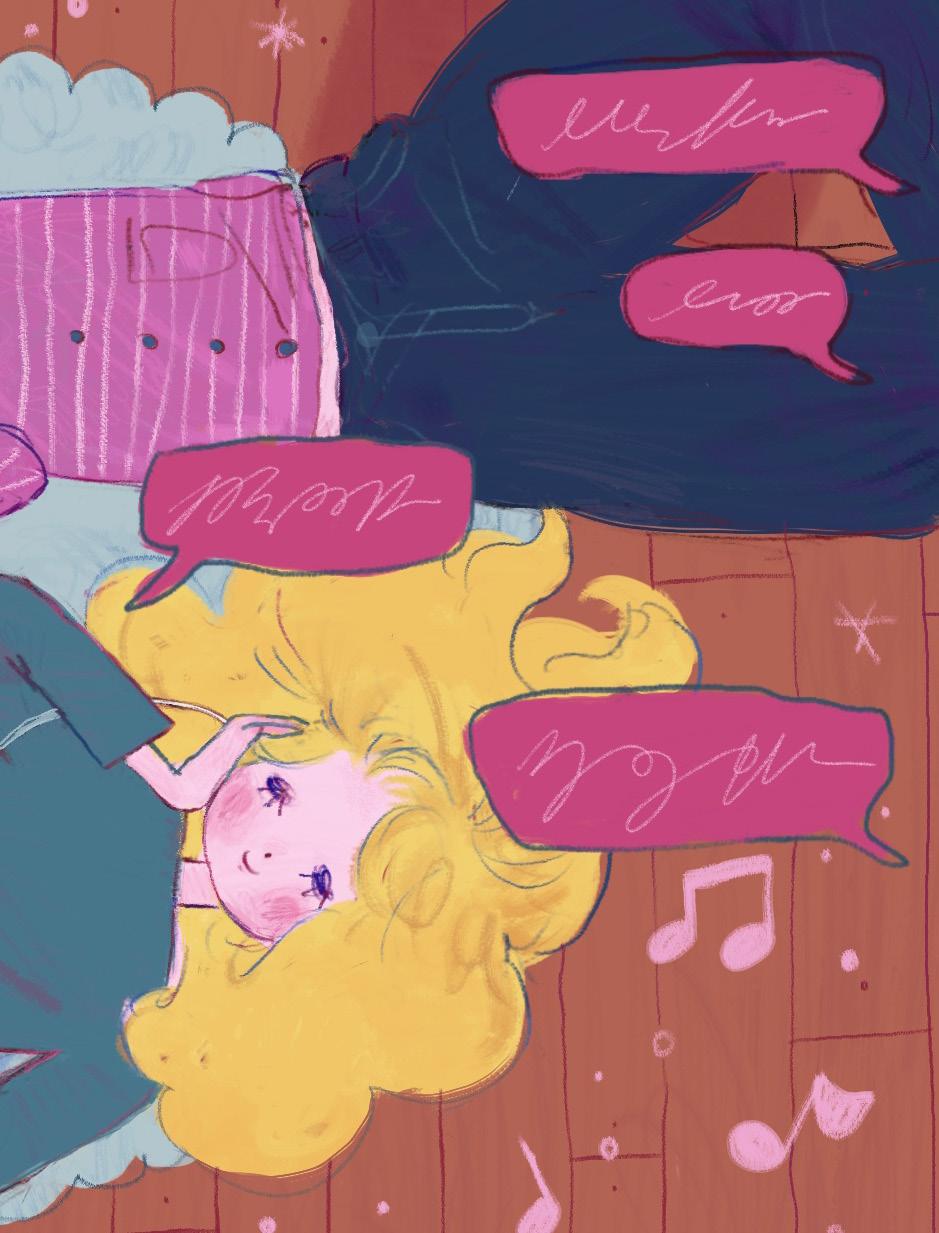
For me, though, the joy of being hopelessly obsessive about my favorite books, music, TV, and movies lies not only in each piece itself. When I share media with my friends, we form bonds that transcend distance and time. An endless exchange of This made me think of you <3 and Did you see that they’re making a sequel?! and Oh my God, I just finished listening, let’s please discuss. It doesn’t matter how many months have passed since we’ve last seen each other or how many miles are between us—it only matters that I love this band, you love this band, and we will forever associate this band with our love for each other.
We’re holding up the end of gym class because we’ve got a dance routine to showcase, and everyone is exasperated. Yesterday after school, Anjali and I had painstakingly choreographed an elaborate performance to “Back for You” by One Direction, filmed by my mom on her not-yet-ancient camcorder. Late afternoon sun filtered through the blinds and we moved as shadows against the walls. Today, we begged our gym teacher until he let us allocate the final minutes of the period to perform for our whole third grade class.
Anjali and I never cared about what everyone else thought of us, and everyone else knew that we came as a pair. And no one at Randall Carter Elementary School loved One Direction as much as we did. During lunch, we’d stand in the all-purpose room, transformed temporarily into a cafeteria—long benches pushed out onto the gym floor, steeped in the sour smell of school lunch—and belt the lyrics
When we were in fifth grade, Zayn left One Direction, and we sobbed (of course). And after fifth grade, Anjali moved away, and we didn’t see each other for six years. When we finally reunited during junior year of high school, we bought matching keychains—when scanned, they’d link straight to “History” by One Direction on Spotify. You and me got a whole lot of history: That was us, our friendship already spanning a decade.
A few semesters ago, I visited Anjali in Dublin, where she now attends medical school. It was mid-November and Grafton Street had just been decked in Christmas lights, fake snow drifting onto the cobblestone roads from someone’s apartment window, wreaths and ornaments dripping from awnings and eaves. We wandered between bars for a while before Anjali pulled me into a packed pub, and we spent the rest of the night dancing and jumping and spinning around without an ounce of grace, singing loudly and out of tune until our voices
That joy is there when my mom and I drive back up the Garden State Parkway from the Jersey Shore, sun slanting golden on the dashboard, blasting our favorite songs by Harry Styles, Joe P, and yes, even The Chainsmokers (who, I’ll admit, we saw in concert together when I was thirteen—the same year I got a dog named “Paris”). That joy is there when I find the bright blue Post-Its that my hometown friend Emily left behind in my copy of RWARB a few summers ago, when we spent humid days driving aimlessly around the suburbs and coaching each other through breakups. When Lana, my unofficial fifth roommate, turns to me at dinner and asks, “Hey, you love Challengers but I’ve only seen it once, wanna watch it again with me?” When Anjali and I send One Direction TikToks back and forth across the Atlantic in the spare minutes between my thesis research and her med school exams.
That joy is there because sharing media allows me to recognize pieces of the people I love everywhere—to stay connected with them, to learn from them, to find scraps of home all over.
*
My twenty-first birthday falls at the end of my semester abroad in Copenhagen, the first birthday I’ve ever spent away from home. It feels strange to be on the other side of the ocean, away from almost everyone I’ve ever known, as I move into a new year of life. The sun sets so early here, the days gray and fleeting and unfamiliar.
But Nadia’s here for the weekend, days spent catching snowflakes in our hair at Christmas markets and eating pastries beside the near-frozen canals. And nothing new and unfamiliar feels all that impossible when Nadia and I are together, sitting on my bed with my laptop balanced on my knees, watching Catching Fire (our movie!) once again, giggling and commentating over Tupperwares of pad thai. I am right where I’m supposed to be.
While other first-years were preoccupied with the Providence nightlife, accumulating DoorDash debt, and the freedom of early adulthood independence, my own freshman year obsession consisted of something much more exhilarating— the Google Snake game. Whether I was in class or merely getting ready for bed, the game would enter my mind quicker than McKenna Grace’s name in a casting studio.
It all started during my first-year seminar (apologies to my professor if she ever finds herself lost on the Internet reading this)—my first-ever class that exceeded an hour and a half (clocking in at 2.5). During lulls in conversation or administrative tasks, I eventually got tired of rampantly refreshing my email as a source of entertainment. Finally, instead of scrolling through the latest Today@Brown post while we reread the class syllabus, I started searching for browser games to fill the time.
I wanted something I could grow at, something that was mindless yet also laced with a hint of skill. I honestly can’t remember exactly how I came across the Snake game in the first place—I only remember it suddenly appearing in my life as if summoned with a purpose.
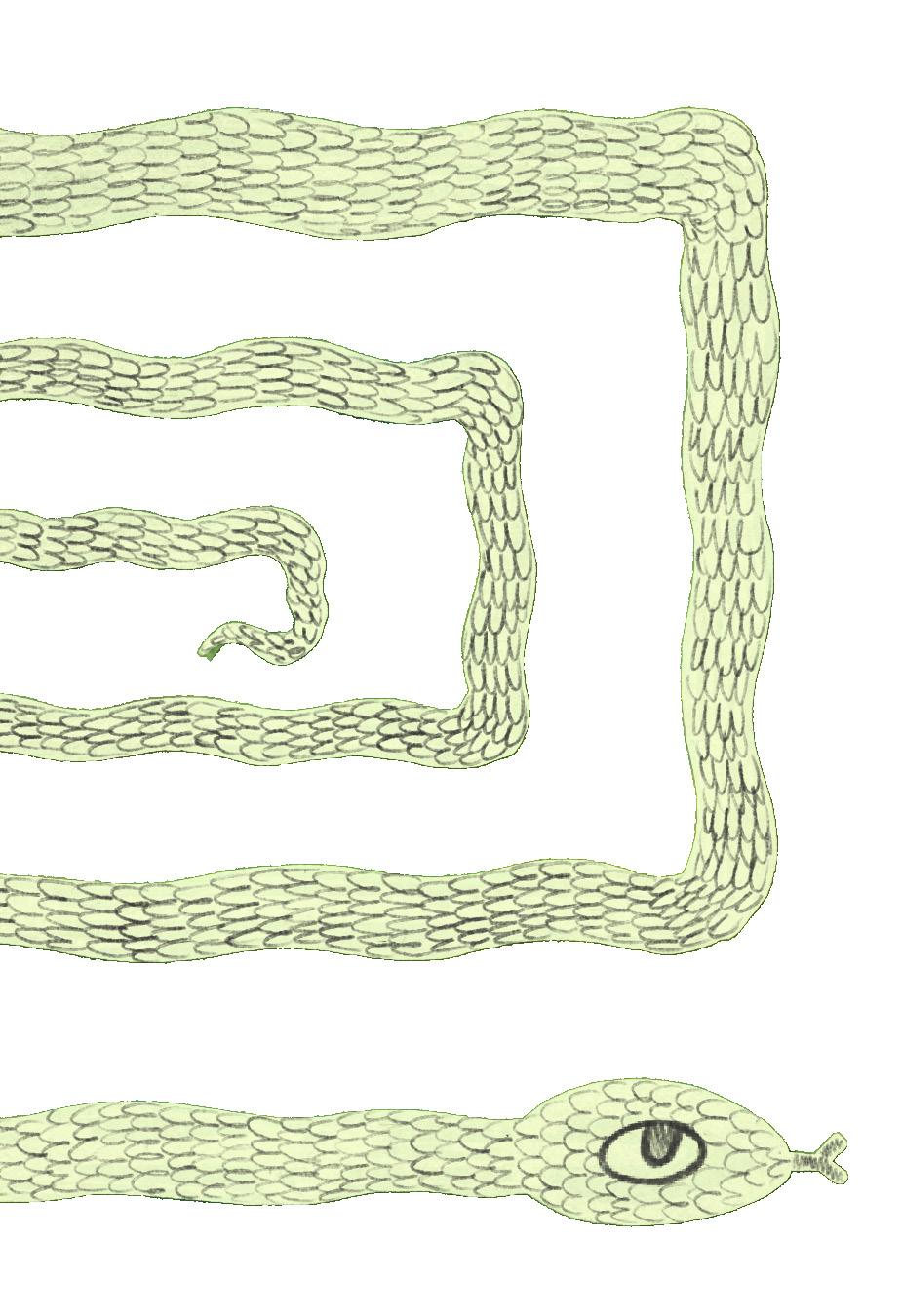
While I started off with measly singledigit scores—my snake repeatedly twisting itself into knots on my screen—I slowly gained a sixth sense of the up, down, right, and left arrow keys. My scores began to skyrocket, reaching numbers the Wuthering Heights box office could only dream of amassing. It got to the point where I was sending out my scores to friends and challenging them to beat me. When one of them ultimately did, I inevitably took it quite personally.
So, I went back to the drawing board. I honed my reflexes, developed fresh strategies, and set aside periods of time solely for the purpose of playing Snake (I found that having to simultaneously pay attention to both lecture and the game in class had been limiting my serpentine potential). After months of practice, I had become one with the game—I could immerse myself within its lime green grid and completely disregard all of my other surroundings. Towards the end of the year, I reached a high score of 176…which still seems unsatisfactory considering a score of 252 is required to fully beat the game.
Over the summer, my short attention span shifted towards Hulu shows and PopMart collectibles, and it felt as though Snake had merely become a distant mention in my spring browser history. But once I returned to campus (and long in-person lectures), it all came flooding back to me: the tension, the pride, the raging determination that the bright blue
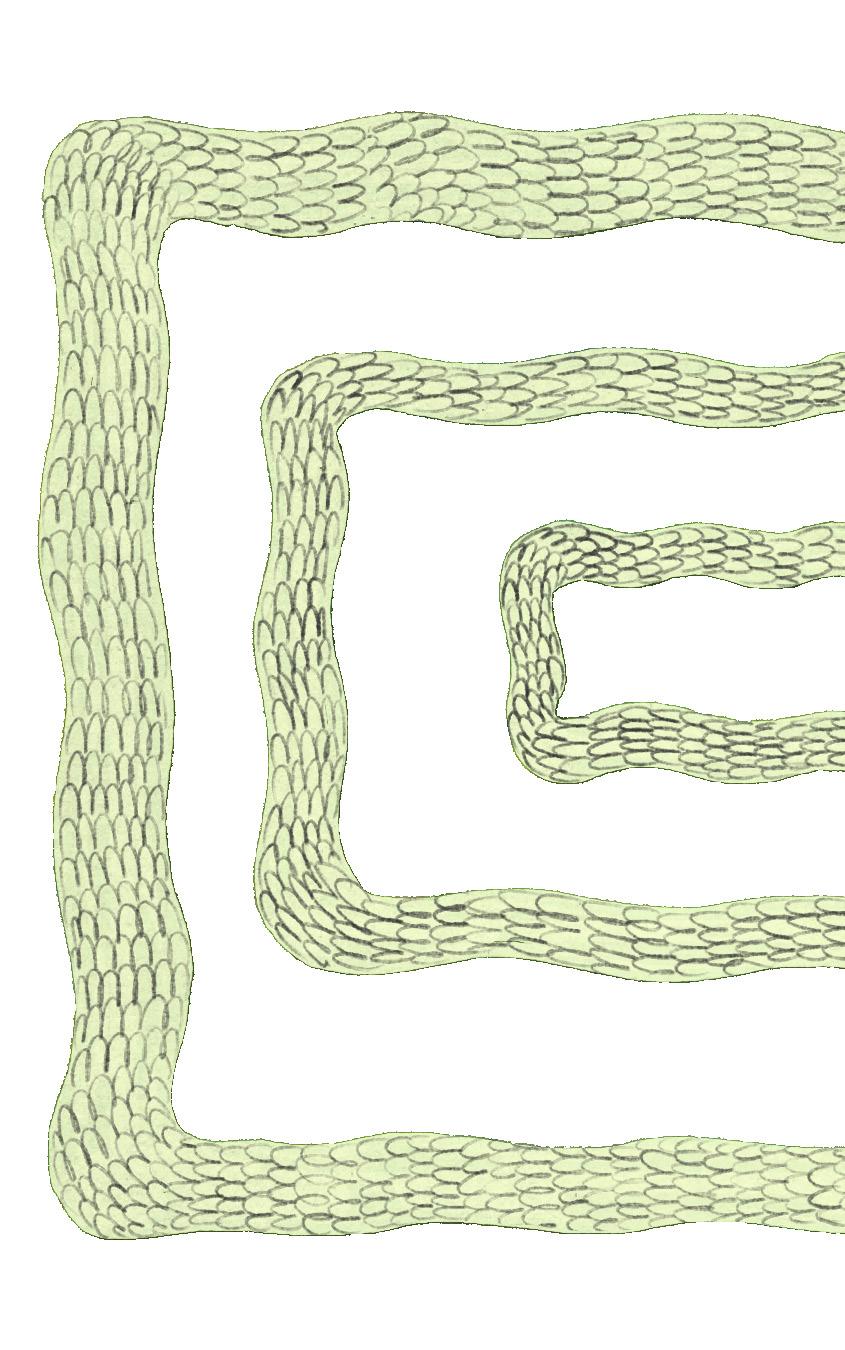
animated serpent could invoke. During the first couple weeks of the fall semester, I would return to the game every now and then for a brief respite in the middle of a particularly monotonous class. To those who have ever found themselves sitting behind me in a lecture hall while the game was full-screen on my computer, I hope you found it at least somewhat entertaining (or, at the very least, worthy of a Sidechat post).
My consistent run-ins with Snake
ultimately got me thinking about the other mindless computer games that had caught my attention throughout the years. I thought back to my elementary school computer class and the days of rushing to open seats in the hopes of playing Fireboy and Watergirl with one of your classmates. While we would often go over various online safety modules or Google Drive tutorials during the first half of class, the latter half was taken up by our imaginations alone (that, and the confines of the computer’s content
my credentials: a high score of 176 in the google snake game
by Ann Gray Golpira Illustrated by Orla Maxwell
filters).
A standout memory from this iconic digital era includes the expansive digital playground that was PrimaryGames. There was truly something there for everyone, and the site hosted enough Papa's Games games to be considered a food court. Kids would flock to games like Papa’s Pizzeria, Papa’s Sushiria, Papa’s Burgeria, Papa’s Cupcakeria, etc. (you get the pattern at this point), all for the exhilarating chance to role-play as a fast food chain employee. After making the meals in an
assembly-line style process, players could witness an even more genuine glimpse into the industry—unsatisfied customers and their subsequently scathing reviews. It was an introductory course to latestage capitalism for prepubescents, and the long working hours, understaffed environment, and often dilapidated restaurant setting were ironically the perfect online haven for me and my single-digit-aged peers. Other games, like MonkeyGoHappy and slither.io, also dominated
the computer lab—and rightfully so. In middle school, a new mindless game made its infamous debut. In Among Us, players try to survive on a spaceship with a killer on the loose (a role randomly assigned to one of the players), making guesses at the murderer’s identity during the brief intermissions between rounds. While some would make educated guesses based on facts and data, others (much in the fashion of many U.S. politicians) would simply make claims to fuel their own agendas.
The deception was infuriating, and the back-and-forth accusations were baffling. Yet for some reason, after a particularly frustrating in-school PSAT, I mistakenly decided to redownload the game as a means of de-stressing on the bus ride home. I don’t exactly remember the specifics, but I do remember crying after a strangely heated debate in the game’s chat room. As if the day couldn’t get any better, I also ended up missing the bus.
Yet besides this one-off experience with Among Us, my exploration of various browser games has been overall enjoyable. I think back on my time in the elementary school computer lab as a completely stress-free period of my life, one where my only worry was securing a seat next to one of my friends.
Even now, I don’t see these games as a “waste of time” (even though a large amount of people do). In a world where our minds are constantly ravaged by anxieties and internal debates, sometimes doing something mindless isn't all that bad—sometimes a game with bright colors and zero stakes is all it takes to meet your daily serotonin quota. There’s often this pressure (especially at school) to always be doing something “worthwhile” or “productive,” and as a result, we tend to view any activity outside of these guidelines as somehow lesser. Typically, when we view something as mindless, we automatically view it as worthless.
But that’s far from the truth. Mindless isn’t synonymous with pointless, and after years of packing my schedule to the brim with the hope of making my time “worthwhile,” I forgot that you don’t have to be productive all the time to be a productive person. The world has a weird way of hierarchically categorizing different leisure activities as better or worse, and mindless activities—like the aforementioned browser games—are typically placed at the bottom of that list. But in a world of nonstop activity, it’s important to allow ourselves the pleasure of mindless activities. Our brains and bodies need breaks and, whether that’s taking a walk or climbing to a new high score in Google’s Snake, that’s certainly a worthwhile use of time to me.
thisisapieceaboutyogurt byInaMaIllustratedbyEllieKang
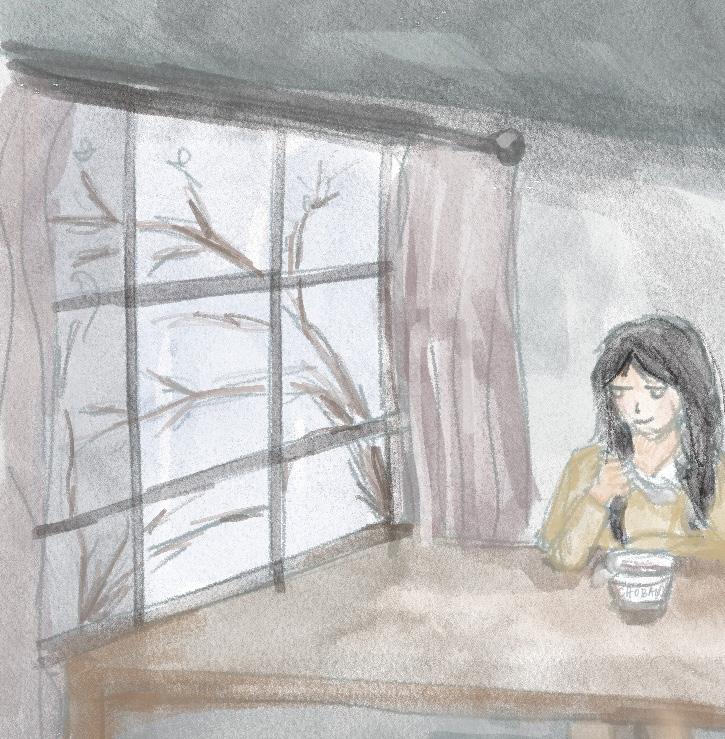
You’re nine Jo’s Chobani yogurts tall. When you draw your lips back in a toothy exhale, you can taste yogurt tang as hot air leaves your throat. There is milk film covering your teeth, and when you run your tongue over the back of your molars, it comes away chalky. You know what pairs well with yogurt? V-Dub chocolate chip
pancakes. You step out of your dorm en pointe and your toes dip through soft, creamy curd. You wade through the fatty sea to get across campus. Some parts of the sidewalk are chunkier than others.
It’s warm out. Places stay, but people change. Is it the other way around? You haven’t seen the sun since December. There are people sitting on the stairs to the campus center, just like the spring before this one, like nothing happened. The sunshine makes you purr. Your throat is unused to it—weary from disuse. The purr catches at the ridges of your larynx, but another spoonful of yogurt soothes the battered flesh.
The sunshine is curdling your yogurt. You’ve been told to think about grief as a ball in a box. There’s a grief button on one of the four walls. At first, the ball rattles around in the box, hitting the grief button again and again. Each press fills you with sharp pain or dull sadness, or a mix of both. Over time, as the box grows, presses become few and far between, but just as intense.
Open the box. Take the ball out. Slip in a few Jo’s Chobani yogurts. Close the box. The box jostles with each step, jostles like the yogurts stuck in your backpack. Each jostle is a new collision— laptop case digging into yogurt tops, yogurts rubbing against your water bottle. You
imagine dampness at the small of your back and open your backpack. Your Lactobacillus delbrueckii subsp bulgaricus and Streptococcus thermophilus splatter all over your backpack walls.
Your heart is not as hard as a box. The walls to your heart are as soft as the aluminium lid of the yogurt cup. Sealed with thin glue, your metal heart walls crumple easily. Lick the yogurt off the lid before you dig in.
Does anyone see you here, standing on the green? You lick a yogurt-covered eraser. The rubber is gummy against your tongue. Stick your yogurt-soaked fingers in your mouth. Nibbling at your fingers with your thousands of needlesharp kitten teeth, when you bite through, your bone crunches like a pretzel stick.
You slip yogurts into your jacket pocket at Jo’s. You like the blue ones. They’re plain, unflavored. They become whatever you want them to be. They weigh your puffer down.
Your gait home is lopsided. The yogurts shift your center of gravity: you, alone at night, and the swing of your heavy pockets. When you get home, you can take the yogurts out and put them in your fridge. You can’t shed other things as easily.
The house is quiet for once. You remember a story your mom told you: A neighbor wanted to make their own yogurt, so they set whole milk out in the sun, and it spoiled. They ate their yogurt anyway and got food poisoning. You carefully stack your Jo’s Chobani yogurts in your black mini fridge so they don’t sour. Under fluorescent bathroom lighting, you squirt watery curd and wash your face in whey. Fall asleep to the smell of your milk breath under the glowing milk moon.
by Sofia Kelleher
Illustrated by Emily Chao
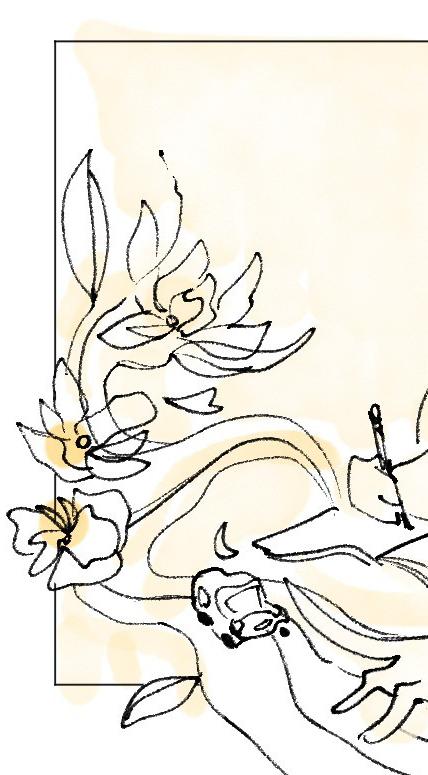
According to my mother, the magnolia tree outside our house blossomed the night I was born. When she left for the hospital, the tree’s branches only had buds. As if by magic, when she returned thirty-six hours later with me in her arms, the flowers had opened their pink and white petals to welcome me home.
For the fifteen years before my family moved, I marked the passage of time and the progression of my life with the blooming of the magnolias. Every March and April, I would marvel at the way they emerged delicately adorned with dew droplets in the mornings, and at their sun-struck ombré theatrics in the afternoons. My relationship with the tree and its flowers felt reciprocal and perennial. We were intertwined always—me and my tree, me and the first signs of spring.
Also important to my mythology is Bodi, the chocolate lab my mom had since graduate school, who died a few months before I was born. Once a creature of boundless energy and mischief, by the time my mom was pregnant with me, Bodi was sick and lethargic with old age. He had cancerous tumors in his mouth and his brain, and though my mom took him to chemotherapy in the hope he could be healed, it was clear he wouldn’t be able to survive much longer. The way my mom tells the story, Bodi accompanied her through the most dangerous part of her pregnancy, waiting to die until the three-month mark, when the pregnancy was considered viable. She knows it took him a lot of effort to stay until then, and she knows he stayed on purpose. He was like a little angel watching over you, she tells me, smiling, over the phone. She loves Bodi still, and despite never having met him in the flesh, so do I.
When I think of the beings and figures that mark and precede my life—the magnolia tree, Bodi—I feel held in a profound way. It is other entities and forces that brought me into existence, cared for me, and continue to sustain me; and though forgetting this is easy, remembering it is a great relief.
I am also coming to realize, as I attempt to detail these stories for the first time in writing, that they are in large part about my mom and the way she oriented me toward the world. She taught me, in small ways, to see living things as innately loving and as actively demonstrating their love for me through their beauty and constant ability to inspire and surprise. While interpersonal interactions did not come naturally to me as a child, probably by virtue of this ethos my mom instilled in me, I was
able to make non-human friends wherever I went. My parents remember how, in the backseat of the car at night, I would look up at the sky and shout out in glee, Otra luna! (Another moon!), every time we turned a corner and the moon came into view again. Per the tales my mom grew up with in Latin America, she would look up at the night sky with me and point out the bunny in the moon. Magic was real. Not only was there a moon, but there were many moons, and better yet, there was a bunny in each one.
I cannot recall, in those days, ever feeling lonely. There was always a moon, who, I had no doubt, was looking down at me, just as I was looking up at it. There was a magnolia tree who remembered my birthday each year. There was a dog who prolonged his last breath to be sure I
would take my first. Donna Haraway, whose scholarship spans the fields of multispecies studies, feminist studies, and the history of consciousness, writes that “beings do not preexist their relatings.” I did not question this; I had no reason to.
As I’ve gotten older, however, and especially very recently, I’ve found it difficult to trust in the inherent goodness of things. Every day, I learn of terrible new occurrences from the news. In my classes, I learn about disturbing events from the past, too. In the last few months, enormous tragedies have struck both my home and school
communities. As much as I might like to for my own peace of mind, I cannot convince myself that there is any sort of justification for these horrors, or any others, for that matter.
In light of this, it’s easy to dismiss the connection I felt to my “relatings” growing up as simply a symptom of naïveté. But the magic was never a misunderstanding. The magic was the truth of the matter that there is no such thing as being alone. The magic was a simple connection—fortified by stories and tangible interactions—to all that is living and all that is. In Braiding Sweetgrass, Robin Kimmerer
writes, “Even a wounded world is feeding us. Even a wounded world holds us, giving us moments of wonder and joy.” The world, as I see it now, is a place of immense suffering and extensive wrongdoing. But even so, nothing can negate our belonging to it and everything that exists within it. Spring arrived a few days ago—not by any technical metrics, but that’s how people are talking about it. The sun made its gracious return, and everyone piled onto the Main Green for the sheer pleasure of letting the soft warmth envelop them. It was my twenty-first birthday, and I thought of my magnolias. I wondered if they still knew when to open their petals, if they had grown shyer or somehow more eager still.
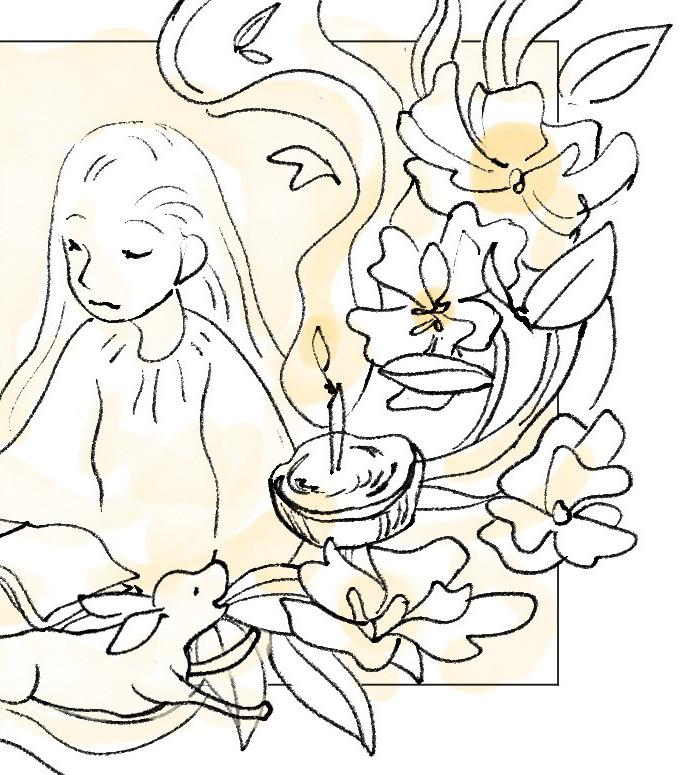
My dad took me out to dinner that night, and I thought with such certainty, as I most often do in his company, that there was nowhere I would rather be. There is a precarity in perfect moments. They threaten ending, and in the end, they always do. They do not undo what has been broken. Still, they are perfect precisely because the ephemerality they promise does not detract from their beauty. At 9:30, I blew out the candle on my crème brûlée and wished for true and lasting friendship. Really, I think it was a prayer for the sense of interwovenness I carried so effortlessly when I was younger. I’ve never dared share my wishes. But twentyone has made me sincere. I used to be sure that everything was listening. Why not be sure of it once more?
by managing editors | Illustrated by Tarini Malhotra
some observations by Elaina Bayard
A little tilt upward of the lip: sun showers, foggy mornings, warm tea and cookies, birds singing, a text from a hometown friend, Albert the aloe sitting on my desk.
A grin, closed-lips: all eight of my cardigans, shitty children’s theater, dancing with my mother, writing a particularly clever line, borzois, card games on Friday nights, weaving in the last end of a knitting project, swimming laps, art museums, my lucky necklace.
A smile, all teeth: concerts, roadtrips, a bed piled with blankets on a snowy night, sand between my toes, parking lots after midnight, sanderlings, emails from my grandmother, a five-star book, my friends on stage, concerts (but not getting home from them), giving a good book recommendation, weekend animated movies, a long quiet walk where I hold all these things and more in my palms, cradled.
subtitles of a smile half-written by Tarini Malhotra
Do you ever wonder if the willows that whisper breathlessly in the wind, like us, are scared of change? I knew you in another life; you had that same twinkle in your eyes. But sometimes the world defies continuity: Giggling stars and shy moons can find their home in bubbles spilling glitter and my oxidized silver jhumkas that refuse to relinquish their shine. Today, the purple sky and gold sneaking through leaves caught me off-guard, but nothing felt more true than the realization that to be known is to be loved. Perhaps sunshine and rainbows don’t only come from clouds and the mystical heavens. They seep through my dog wagging his tail when I call out to him on FaceTime, and my family sending me selfies from nights out, and sitting in comfortable silence with friends. What brings you joy? People, and sunsets, and books that are little treats for me.
So do you, perchance, want to get coffee with me, as a metaphor for love? And maybe you’ll tell me that I can’t just use the word “perchance,” and I’ll remember the friend whose vocabulary I stole it from in high school. Maybe we’ll listen to Urdu poetry in music that we only half-understand, and maybe we’ll go to India Point Park, and the way the water catches the light will fill me with warmth. And maybe flitting smiles will make hope permeate through the crunchy leaves on the ground and light up the gravel in this strange, beautiful place we call home.
tell me about it by Gabrielle Yuan
My happiest days are the ones where I’m running from one end of campus to another, having numerous conversations at once with friends, only begrudgingly interrupted by segments of class and mandatory meetings. Some of the brightest parts of my day come from sitting in the dim alcove of the dining halls, chairs hastily pulled from a variety of different tables just to create a mismatched, half-circle of loved ones detailing the busyness of our days. I’m beaming now at the thought of resting my head on my tallest friend’s shoulder (my only friend at Brown who towers over me), listening to his breathing and the way his body slightly rocks forward with each joke passed around. Then, suddenly, I’m lying on the floor of my best friend’s dorm room, the mattress topper she lugged all the way from Virginia rolled out for me, where just months ago I was sleeping on the floor of her childhood bedroom with the very same mattress topper, listlessly talking about the tidbits of our days just remembered. Time then passes painstakingly, preciously away when I’m waking up in the morning to walk eleven minutes down to Coffee Exchange, reserved exclusively for weekday mornings, and usually catching up with new friends. Imagine me convincing them that a large French vanilla
latte with skim milk is a small everywhere else. The most tender moments are the ones I can barely remember when I try my hardest to recollect, and the ones I dream about most when I’m finally alone.
pockets of joy by Jessica Lee
As I find myself trudging along through these dreary days and patiently awaiting spring’s sunny return, here are some of the little joys that have brought a smile to my face on the rainiest and gloomiest of days: Making the most of the blizzard and frolicking through the snow without a care in the world. Walking around the Main Green and spotting Murphy (the presidential pup) or friends across the way. Participating in some intense (and nostalgic) rounds of Among Us, where friendships were tested, and trust was broken. Attending a birthday party with a room full of strangers, and leaving with new friends and future lunch plans. And, finally, dreaming of the cherry blossoms that will be blooming oh-so-soon!
the glimpses by Hallel Abrams Gerber
I love a little message: goofy acrostics for friends’ birthdays, small excerpts and poems I find when I’m bored, rambling voicemails to my grandmother as I wait for the RIPTA.
I love the small adventures: searching Providence for the cheapest cold brew, organizing random excursions to Paper Nautilus or down past the bridge with friends.
I love being fifteen minutes (maximum) from so many people I care about.
Since I started college, I’ve kept a “one-line a day” journal. Writing small reflections on the things I’ve done, people I’ve seen, and my general state of being. The book fits five years. Every day, I see what I did this time last year and get to watch as my friends’ names become more frequent, as my days grow more full. I love how it all adds up.
pork floss by AJ Wu
There are many foods I miss from home, but at the top of the list is my mom’s pork floss buns. Light and airy, a satisfying but not overwhelming amount of pork floss, folds of green onion, and butter—they clear those sold at just about any Chinese bakery. I got COVID fall of my junior year and suddenly had a lot of time to spend quarantined in my Barbour double. I decided to get into baking. (What better activity for someone who had very recently lost their sense of taste?) After a semi-edible batch of mochi donuts, I tried my hand at pork floss buns. It may have been the autumn chill, hostile ghosts, or the aforementioned loss of taste—who knows—but my dough stubbornly refused to rise, the predominant flavor was yeast, and I sadly picked at my rock-hard bread rolls for days. Deterred, I set down the chef’s hat and gave up my pork floss bun dreams.
Until the other week. Enough time had passed, perhaps, for me and bread dough to bury the hatchet. It could have been a variety of factors— benevolent ghosts, Mercury in retrograde, K telling me about something called “blooming your yeast beforehand”—but whatever it was, my apartment was soon filled with an aroma that had accompanied some of my coziest childhood memories. I sent my mom a selfie beaming by the batch of fresh buns. It’s nice to get a chance to try again, to level up.
post- mini crossword
1. Catch red-handed
4. It's rarely found among thieves
6. Skip over
7. E.g., baptisms, mitzvahs, rumspringa
8. Wild creature, e.g., the Arthurian Questing _____
1. "That's the truth!"
2. Soul singer Baker
3. _____ well (is a good sign)
4. Potion staple
5. Take five
“Words, once familiar friends but now complete strangers, taunted me as they swam in a whirlpool of lines and characters, confusing sound for sound until they all lost meaning. My native language, the first words I ever spoke—omma—my mother tongue, now a foreign entity, an unwelcome invader.”
— Jeanine Kim, “making words out of nothing”
“I notice some other folks basking in the snow, passing around a cigarette. Their attire: either little-shirt-big-pants or big-shirtlittle-pants—slightly androgynous vibes but not enough to bring their gender identity into question. I begin to converse with them.”
— Ivy Rockmore, “on ‘bi non-practicing’”
EDITOR-IN-CHIEF
Elaina Bayard
FEATURE
Section Editors
Anika Kotapally
Gabriella Miranda
ARTS & CULTURE
Section
Section
LIFESTYLE
Section Editors Alayna Chen
POST-POURRI
Managing Editor
Section
HEAD ILLUSTRATORS
Junyue
COPY
Copy Editors
LAYOUT CHIEFS
Layout
SOCIAL