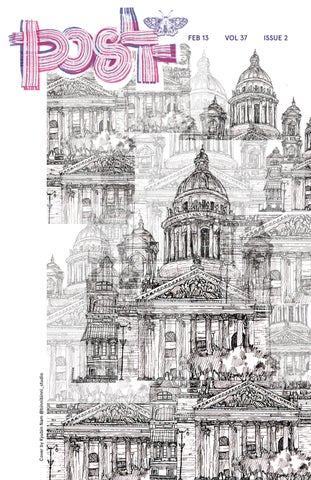
Cover by Kyubin Nam @binnibinni_studio
Dear Readers,
I met Snow for the first time only a year ago. I watched as my people here embraced her like a childhood friend, and I introduced myself, giddy and awkward. I pretended, for a while, that nothing had changed. My odd resistance to snow boots and scarves proved it. But ice is slippery, and sometimes it’s a mirror, so perhaps it isn’t surprising that something has changed this winter. I have new gloves now, and my reluctance to wear boots is fading, but there’s also this shift in the atmosphere here at Brown. With every huddled walk in the cold, every coffee run, and every shared hope and grief, it feels like we’re slowly trusting that the most beautiful joys lie in staying warm together.
The snow hasn’t left our campus yet. It nestles in the corners of Thayer, and curls around the bouquets near the Van Wickle Gates, and basks in the light of the Main Green’s lampposts
every evening. It smoothens the rubble and missteps and hurt that shook our community, and we continue to love and live over it anyway. Our issue this week shimmers with these themes of renewal and connection. In Feature, Coco unpacks the transcendent magic of snow and its vivid sensory experience. In Narrative, Ana writes a love letter to Providence and the memories she’s made here, and Coco returns with a piece on the freedom and vulnerability in play. A&C also brims with change and hope, with Sara’s piece on patriotism and finding grace at Brown and Indigo’s sensitive exploration of personal transformation when capturing love in art. Yana’s Lifestyle piece sparkles with introspection as she reflects on snow and connection, while Alayna’s whimsical double features in post-pourri and Crossword break the ice with Valentine’s Day pickup lines and Winter Olympics trivia.
Lovely readers, can I let you in on a secret? I didn’t learn the cold all at once. In fact, I’m not sure I’ve learnt it at all. But this community and its bustle and its gentle strength are a more beautiful lesson than I could have hoped for. And speaking of hope, may this week’s pieces be little nuggets of joy you can tuck into your coat pockets to keep your spirits warm.
Yours,
Tarini Malhotra post-pourri Managing Editor
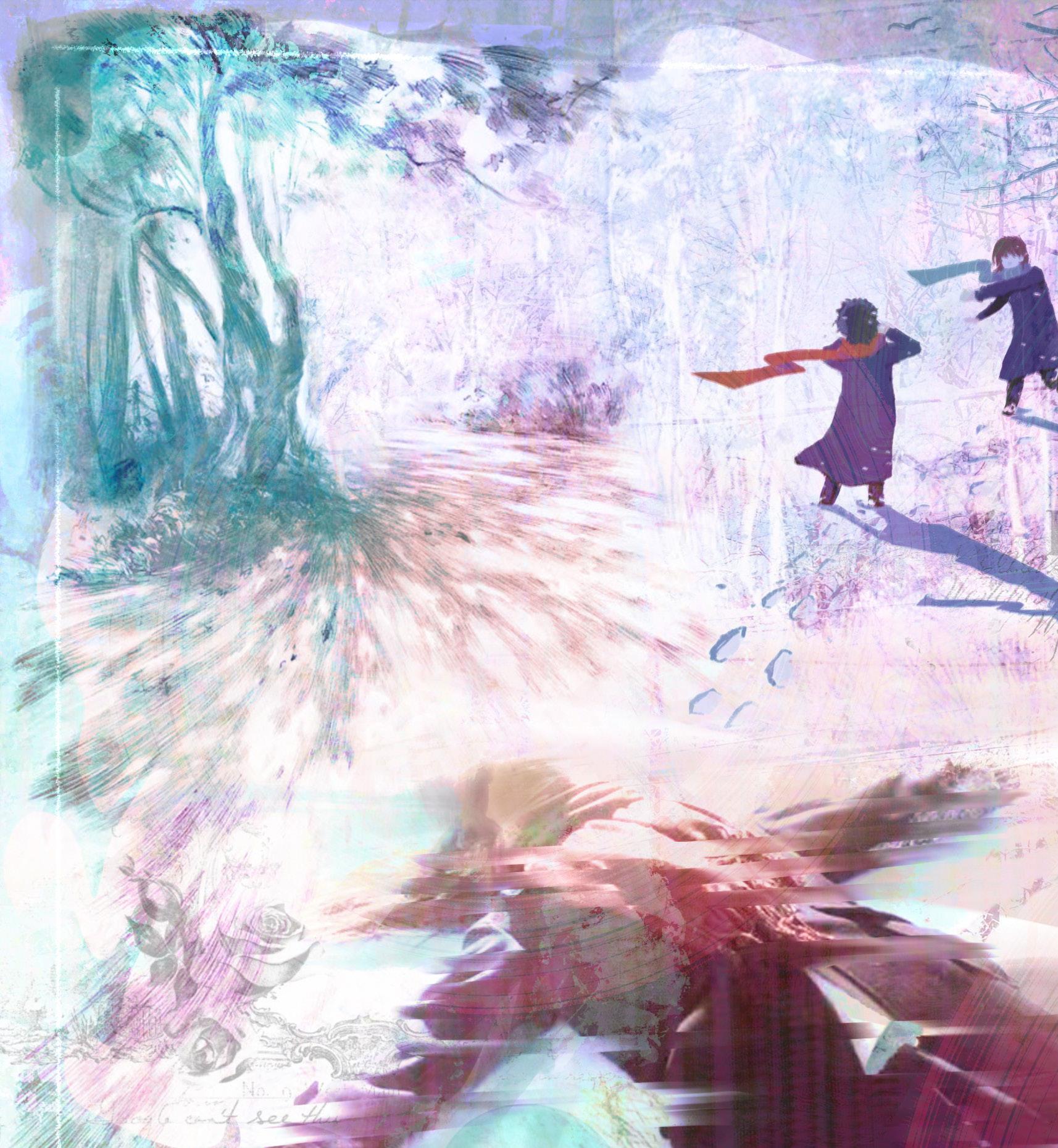

After a deep snowfall, the streets, the cars, the neighborhoods, the trees—really everything— is completely buried. Schools are closed. Time itself is forced into a pause, and by the simple fact of the fall, we are forced into stasis. Snow plows groan awake, narrowing our world to our homes, our legs, and our sleds. Or, there is the other kind of snow: the gradual accumulation. The amalgamation of winter still untouched, maybe unnoticed—the kind of snow that arrives without spectacle—that is the rhythm of the background of our days, until it is all you see, everywhere, completely unavoidable. It asks belatedly to be acknowledged: yesterday's snow, the kind we don’t bother to hold as we continue to go about our life routines. We walk right by it, protecting our shoes, the bells of our jeans, too distracted by the cold to care for the majesty of winter itself. Both of these falls, although different in approach, embed us, unmistakably,
It's silly how much the first snow commands us. We abandon everything to celebrate it. Kissing, hugging, playing, pressing our bodies together for warmth, holding our palms and tongues out to try and catch flakes in the frosted air. We want proof that we were there when it began. Believing, maybe naively, that sheer presence itself can preserve the feeling, that by being there fully we might keep it forever.
When I was little, I learned that in these conditions, magic could occur. I should say that I often played outside alone—not because no one would play with me or because I was a recluse, but because I preferred it. I liked talking to myself out loud, waddling at my own pace,
steering the pirate ship at my leisure without the watchful eye of another waiting their turn and cramping my daydreams of driving a car around the suburbs. And when it snowed, well, that was my favorite because the world felt hushed. A muted blanket laid gently over everything we thought we knew. The familiar outline of my backyard, the muddy spots I knew to avoid, the patches where grass refused to grow were all disguised. Vanished. Everything is new when it snows. I knew nothing.
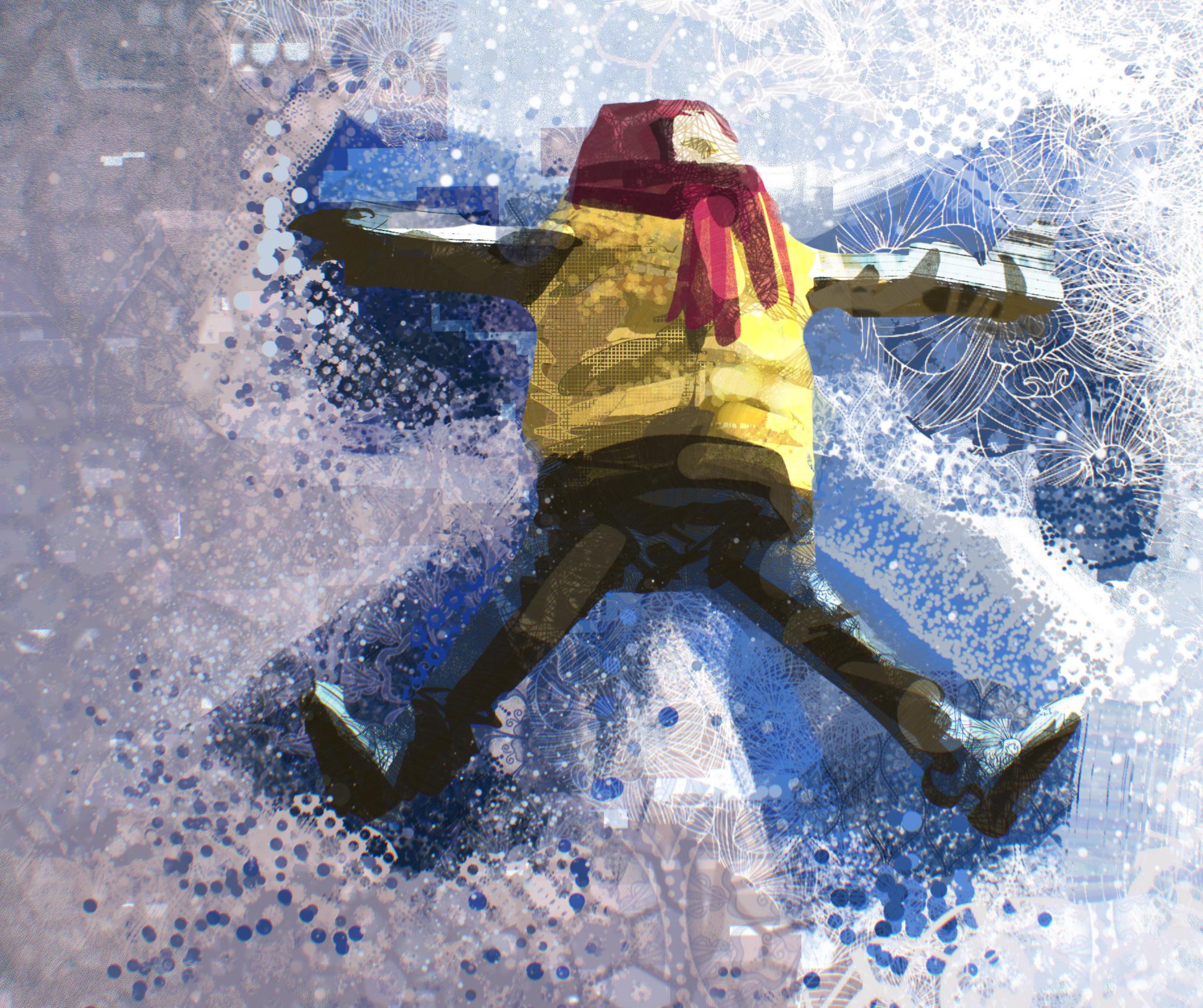
And in that nothing, I discovered something. Held inside the weight of my weatherproof suit, if I let my body meet the snow in an untouched place on this white down and closed my eyes, the world would loosen its grip. The ground no longer felt like the ground but like soft erasure. The snow opened itself to me, receiving my weight, shaping itself simply around my being there. As my body lost its borders, I was no longer pressing into the earth but being held inside it.
My breath would grow quiet, feeling like it belonged to the snow as much as to me. My shape sank away, not disappearing but becoming less necessary, as if I no longer needed to be solid. And this is when I would feel an almost imperceptible lift. Not a movement exactly, but permission. A gentle rising, the way thoughts float before words string together and become a sentence. I always believed that this must be what ascending feels like. Not arrival or escape, just the soft forgetting of gravity.
I didn't know where I was going. I'm not particularly religious, but if I were, I’d say it would be to that place they talk about, where all the good people go. Behind my eyelids, the dark
would glow, not with light, but with the memory of seeing, the flecks, the shimmers. The world circled there faintly, dissolving as if even sight was learning how to let go.
The cold moved through me, cramming itself into the crevices where fabric failed skin. Inside my gloves and in the small of my back, the sting would linger, but this always added to the ceremony. The aliveness of the whole affair, I supposed. The feeling of truly being engulfed by nature, but still knowing you are safe.
When snow is falling, it's even better. Looking up, the sky releasing endless pale flecks, each one drifting towards arbitrary new homes. My cheeks swelled with warmth, a blooming heat protecting me from the quiet cold pressing in. The air feels thicker then, padded, as if the world is wrapped in cotton.
I've always thought of it as angel tears falling infinitely and soundlessly, not needing to be noticed, because there are enough of them already laid bare on the earth's floor. The sky sheds something it can no longer hold, and lying beneath it, I felt briefly forgiven, allowed to be small and still without explanation.
Then something would always call me back—a branch cracking, a gust of wind lifting its voice. I would open my eyes and the sky would still be there, vast and indifferent. A bird might pass through it, and I would understand that the world had continued while I was gone, and that I had been allowed, briefly, to step outside of time. And in that return, everything was enough.
by ana vissicchio
Illustrated by Tarini Malhotra
I have always lived in the same place—the same suburban town, the same quiet house, the same small bedroom.
Moving to Providence, going to college, for me, was the greatest adventure. The change of scenery, the colder winters, the charming autumns—I quickly fell in love. Providence could have been nothing—drab, dreary, dry— and I think I still would have loved it. I always say that Providence is my favorite city in the world. How could it not be?
I once told an old friend at college that I liked Providence more than I liked New York City, the city I’ve grown up outside my whole life. They were baffled, giving argument after argument for why NYC was clearly better.
What they didn’t understand was that it wasn’t the energy, or the stores and shops, or the food, or the scenery, though I love those things, too, of course. But it was the memories, my memories, that fill Providence to the brim in a way that’s so overwhelmingly bittersweet. I can walk down Brook and get to the intersection of Power and remember every single time my junior year roommates and I would leave our dorm together to go to Coffee Exchange early in the morning. If I find myself on a run, going up Hope and passing Bowen, I’m taken back to the evenings of freshman year, the street sounds and car radios blasting, accompanying us on our mischievous late-night excursions. All the way down Williams, right by the river, is where my sophomore year memories live, long walks leading to adventures that took the whole afternoon, the confidence finally instilled in me to spend more time by myself and explore as much as the city had to offer.
Now in my senior year, I live off campus, and while this makes my connection to the city stronger than ever, it feels much sadder, like stepping through a door you’ve been waiting to open while hearing another close quietly behind you. I’m on campus less and less, finding myself instead exploring Ives at night with friends or spending my mornings up on Wickenden. It feels a lot less like being a student in Brown’s bubble and more like testing out what life is like beyond it.
There are some streets, some parts of the city, that I walk through less and less, or feel like I actively avoid. The garden outside Bolt Coffee, where I called my mom and cried my eyes out freshman year, the dorm of an old ex-boyfriend across from the Ratty, the ghost buildings of beloved diners, and coffee shops that no longer exist. Shiny new apartment buildings tower over the quainter parts of the city, sticking out like sore thumbs. Houses of old friends who have now graduated.
When I get sad about my upcoming departure, I try to remember what made me so happy and excited to be here in the first place. A sweet recollection: the thrill of a new city, the warm rush of meeting friends, the quiet murmur of all the people of Providence walking around, the buzz of music from all the cars, and my favorite smell—fresh hot coffee, wafting from every cafe.
I think, maybe, that Providence is my favorite place, not because it is the most beautiful or the most exciting, but because it is the most familiar. It’s a familiarity shaped by time, memory, and shared experience. The
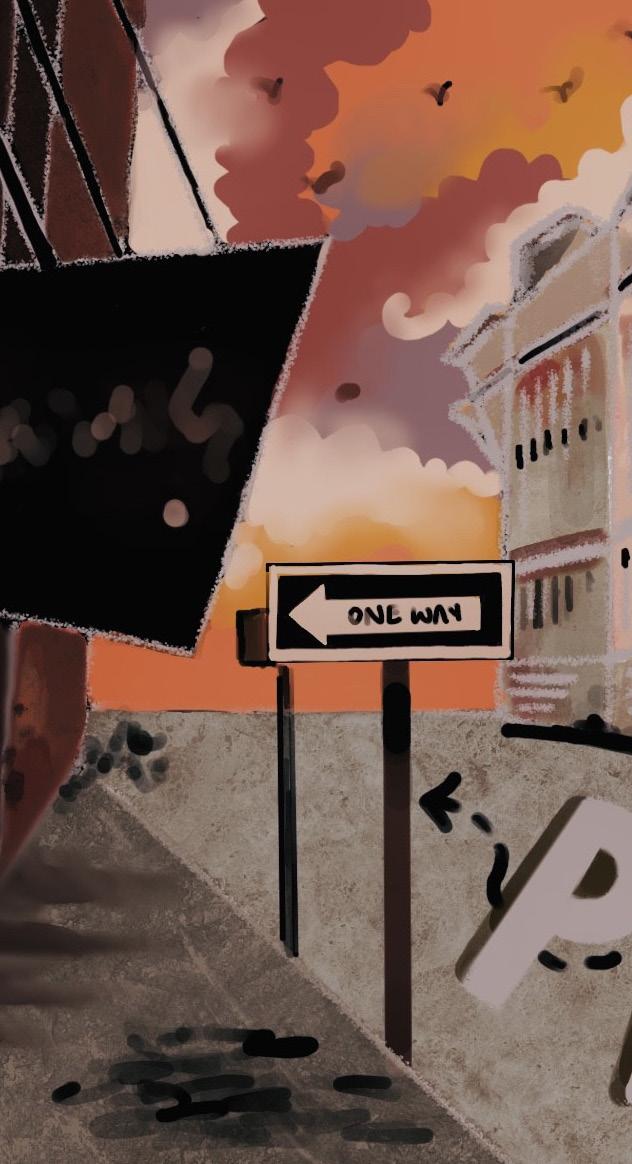
streets are alive, living, and breathing with all the people who have traversed them before me. The houses can speak, telling the tales of each student who lived, changed, and became themselves within their walls. I look around my room, in our little home on Power, and the scattered trinkets on the bookcases and the photos on my walls remind me of the chaotic messiness of my freshman year dorm. How much I’ve changed with this city—this home. Providence has seen me at my best, and Providence has seen me at my worst. In Providence, I have been told I summarize too much, and I have been told my writing is
beautiful. I have run along the river, and I have stopped to sit by it for hours. I have bought groceries. I have failed tests. I have fallen in love. I have grown distant from friends. I have kept secrets. I have said too much. I have wished I said more. I have built a life, alongside friends who have made this city feel like home.
I don’t think I am ready to leave. I don’t think I will ever be ready. And even worse, I don’t think I’ll be ready to come back. But every time I become distraught over the thought of the changes that are to come, I focus on this city, and the ways in which I have grown and changed within it, slowly, slowly, slowly. How
nervous I was to come here, someplace so new, but I did it, and I can do it again. I let Providence stay alive inside me, stitched together by memories made on her busy streets. And I’ll carry Providence with me, letting her presence guide me wherever I go next.
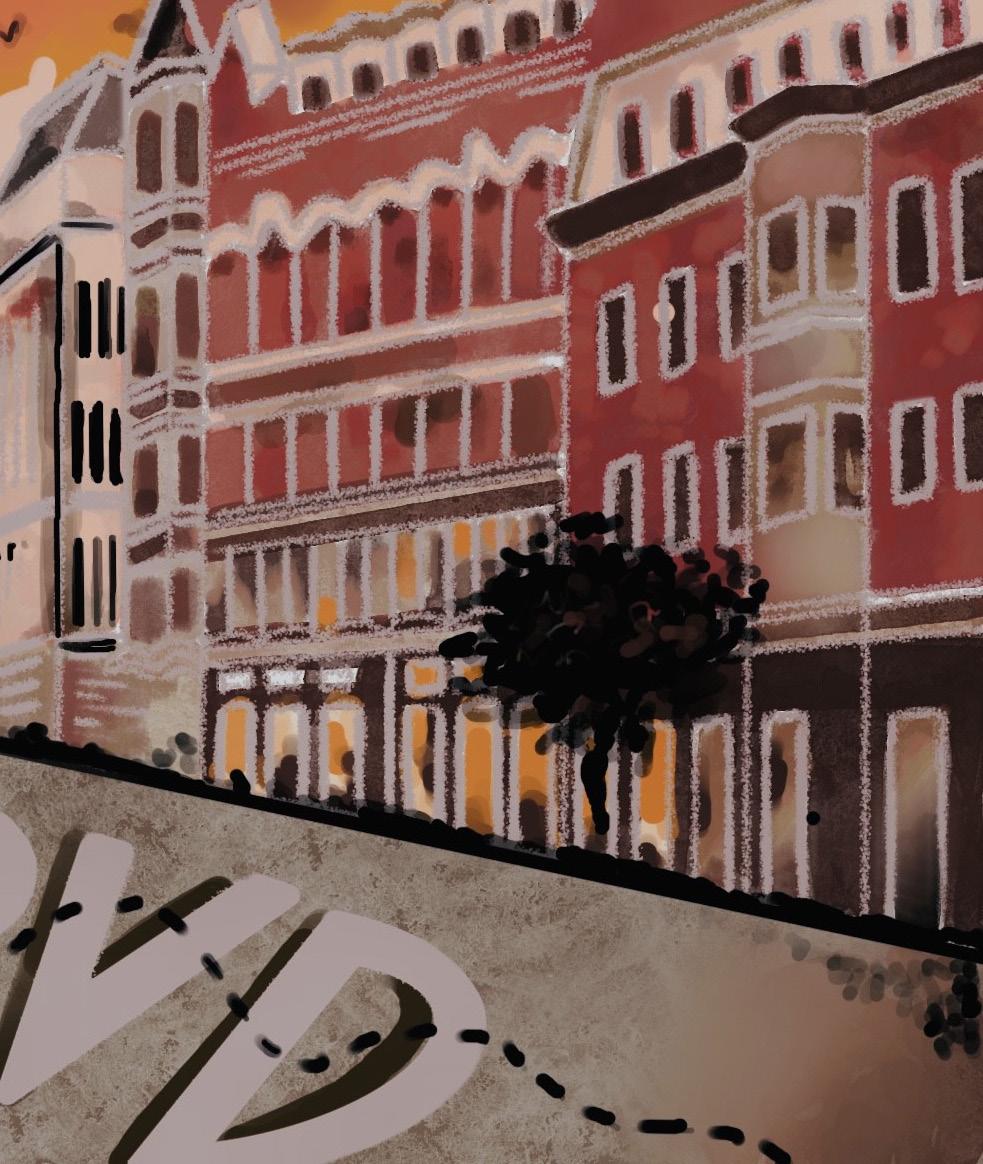
noodles, attempting to stand or joust. My face was frozen in one of those really unattractive happiness expressions—the kind where my
rest unraveled. The air became thick enough that you could swat through it and feel it, just like after a storm. Everything in the room was
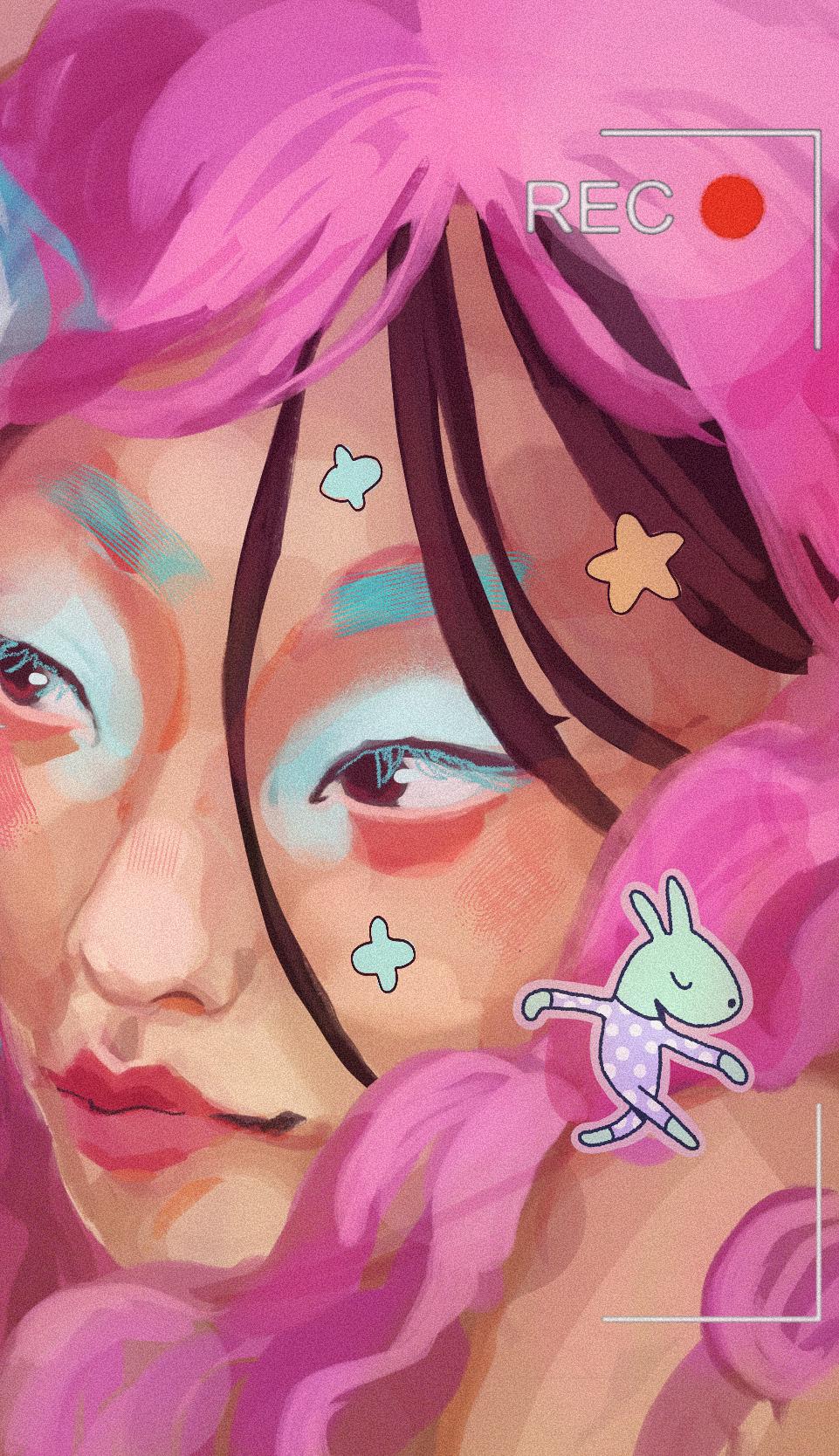

and appreciate my play, consequently allowing me to play in front of them. I am no jester or selfobsessed performer; that is not the sentiment. I just love to play.
We are taught that play expires. That it belongs to childhood, to recess bells and brightly colored plastic, to a time when movement didn’t need an alibi. As we age, play becomes suspect, too soft, too unserious, faintly embarrassing. But play does not disappear—we just shove it back into ourselves, but it's potential energy. Play is everywhere, waiting for us, always readily available. It awaits in basements, in conversations that detour, in moments that refuse efficiency. It is not an action so much as a temperature. A way of staying with something without trying to harvest it—no climax, just release.
As I've gotten older, and shamefully embarrassed by my propensity for play, I've begun to wonder why it feels so essential to me. Why it was never indulgence or avoidance or laziness, but something closer to alignment. Then I read Kant, thank goodness! And it clicked, and, classically, my brain went, Eureka! Excuse this incredibly loose attempt to paraphrase Kant. He writes about beauty not as pleasure or desire, but as what emerges in “free play”: a moment when imagination and understanding move together without one subduing the other. A mind alert but unforced, engaged without hunger.
This is what I recognize in play: playing is just playing. When you stop playing, play is over. Attention without extraction. A seriousness that does not harden. What happens in play is less important than the fact that anything at all is allowed to happen. In play, the self loosens, and awareness turns outward. There is no monitoring of how we are seen or how much space we take up; no arranging ourselves for another. Play is not carelessness, but vulnerability. It asks for the courage to set down one's ego for a moment and, in that letting go, something alchemical begins to form as words arrive without intention, touch without agenda, and presence without performance.
In that basement, under the tyranny of blonde plastic hair, in the ridiculous gravity of our fictional betrayal, nothing needed to be resolved. No lesson learned. No improvement logged. And yet, everything was calibrated. Our minds and bodies moved together without hierarchy, without destination. We were not trying to arrive anywhere, but were simply in motion, and the motion held.
This is why I play. Not because it is frivolous, but because it is one of the few states in which I feel unmistakably alive: awake with no supervision and ridiculous without apology, and briefly, miraculously, free.
When my kindergarten class gathered on the rainbow rug each morning to recite the Pledge of Allegiance, I hid between the legs of my peewee classmates. Picking at the rhinestones on my friend’s Twinkle Toes sneakers, I watched the neon-green skinny kid squirm until our teacher gave him a red card. But when we were told to stand, everyone stood. As my five-yearold friends placed their hands on their hearts and pledged their devotion to the American flag like a nursery rhyme, my gut ached. The ritual felt mandatory. Nobody knew what it meant to pledge allegiance; we still had naptime.
Enforcing blind ideological conformity in children feels like a bait-and-switch. In a nation more concerned with upholding civil liberties than protecting its people, the gun violence epidemic persists because America can’t see beyond the rose color: The Bill of Rights has become an alibi written for the perpetrator, not the victim. As a young person promised freedom and justice for all, I ask myself these days if patriotism is conditional.
My nationality has always felt especially important to me because I lack family roots. I didn’t grow up with either of my biological parents (a long and complicated story for another time). The promise that I could belong to a people—the American people—offered me a branch of shared history to grab onto. During elementary school in Woke-ville, California, I was excited to reenact Thanksgiving, to dress up as a Wampanoag Native American or a pilgrim, because I felt like part of a lineage. I didn’t learn until later how wrong I was.
But even before Columbus Day became Indigenous Peoples’ Day, if you had asked me what I thought a patriot was, I don’t think I would have considered myself one. Despite my love for my country, I believed patriotism was synonymous with nationalism: America first. I imagined hateful bumper stickers, booming election rallies, ostentatious campaign flags, the Second Amendment, and bigotry. When I finally learned the uncensored version of American history—as a genocide-perpetrating, slavery-enforced nation that overpowered anyone who wasn’t a pasty Protestant—my understanding of the context grew to obstruct my longing to feel connected to my American heritage. Holding two opposing narratives— of profound belonging and profound exclusion—in the same hand felt like putting a
Band-Aid on a gash. And so, my love of country became exclusively reserved for national parks, July 4, chocolate chip cookies, the Olympics, and the occasional interstate highway rest stop.
Since the shooting at Brown and the immigration crisis, my social media and news reels have been filled with a cacophony of voices struggling to grapple with tragedy. Videos of Brown students, headlines, hashtags, protests, and promises to never forget. I knew I shouldn’t watch, but my cognitive dissonance felt as if it was boiling over. Until finally, sense came breaking through. In January, I came across a video of former President Barack Obama speaking in 2015: During the funeral service for former state senator and Honorable Reverend Clementa C. Pinckney, Obama ended his eulogy by singing the hymn “Amazing Grace.”
Pinckney and eight others were killed in a shooting that took place at Emanuel African Methodist Episcopal Church in Charleston, South Carolina—one of the oldest Black churches in the southern United States. The full service lasted nearly five hours. Speaker after speaker took the stage in front of the ginormous congregation, giving speeches and sermons about the legacy of Black churches in America as spaces of refuge during slavery, and the redemptive power of love during terrible periods of loss. By the time Obama reached the podium, the room was remarkably joyful— greeting the first Black president, history galloped into the present.
Before he sang, Obama recounted Pinckney’s life as “a pastor and a public servant.” His remarks touched on faith, prayer, emancipation, racial justice, gun violence, and finally, grace. At the end of his speech, he said:
“It would be a betrayal of everything Reverend Pinckney stood for, I believe, if we allowed ourselves to slip into a comfortable silence again. Once the eulogies have been delivered, once the TV cameras move on, to go
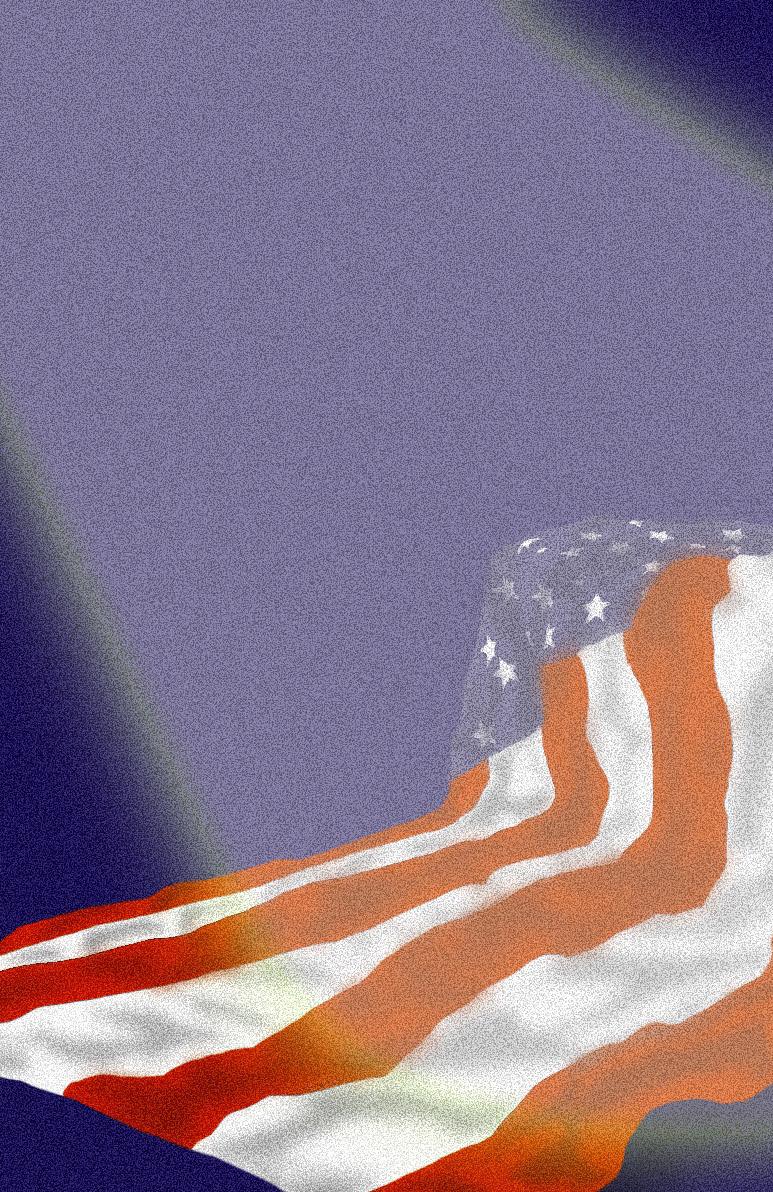
back to business as usual—that’s what we so often do to avoid uncomfortable truths about the prejudice that still infects our society. To settle for symbolic gestures without following up with the hard work of more lasting change— that’s how we lose our way again.”
These words inspired me, but I still felt angry. America failed. We failed. And we continue to fail to protect our schools, children, and pledged values. I realized that the tumult and the outrage racketing in my mind was the best sign, perhaps even the only sign, that I loved my country desperately.
Instead of accepting pain as part of the American experience, my anger felt authentic. Or even the appropriate reaction to the unabridged version of American history and contemporary politics. Through the cloudy dissolution, I wondered why I consented to politics as they were, excluding myself from the room because I didn’t like how others expressed their patriotism. After years of chiseling away at American idealism, I realized it never existed in the first place.
At the end of his 35-minute remarks, the moment when Obama finally begins to sing is, to me, one of the most powerful moments in 21stcentury American politics. To his immediate left, a pastor
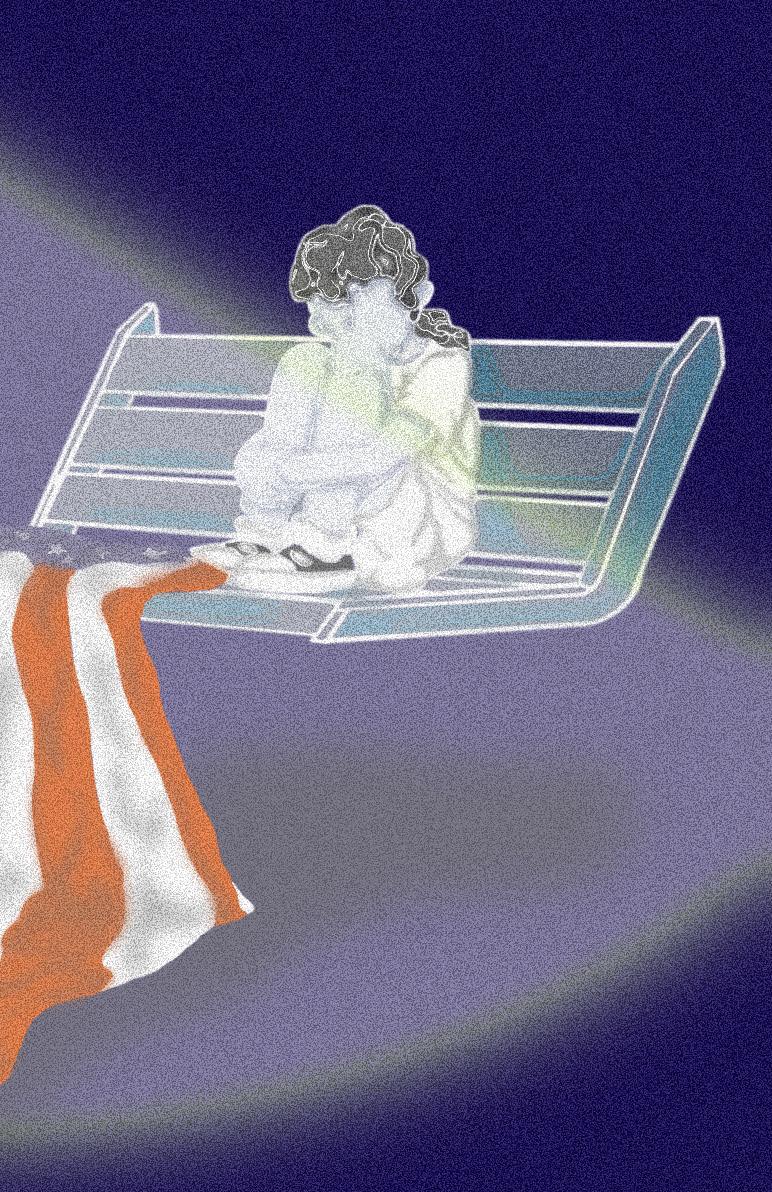
reacts first by saying aha!—an epiphany of the solution: In the face of the reflex for fear, there is also a reflex for unity. Spontaneous joy salves even the deepest wounds. Within moments, the entire congregation breaks into song.
When I returned to Brown last month to assist with spring orientation for a new batch of transfer students, we filled the heaviness with the only way we knew how: each other. The final day before classes began, Convocation was relocated to Faunce Arch, instead of the Van Wickle Gates. It was so cold that our fingertips burned; I expected the ceremony to lack luster because of the somber mood and location on campus, but as soon as somebody lifted a speaker, like a boombox trumpeting ‘70s disco, I teared up. Staff flooded out of University Hall to dance and cheer while the students ran with signs. Brown, too, found grace.
It feels wrong to tie stories of tragedy, particularly recent tragedies, up in a neat bow. I can’t write a conclusion to stories that will never be finished. But what I do know is to be a true patriot is to be a critic. On the eve of the American Semiquincentennial, my Americanness is defined by anger. United by a sense of urgency, the states of today and tomorrow ought to refuse to be blind. Broken pieces must be memorialized by something stronger than flowers and forgotten promises.
by SARA HARLEY
Mudbhary
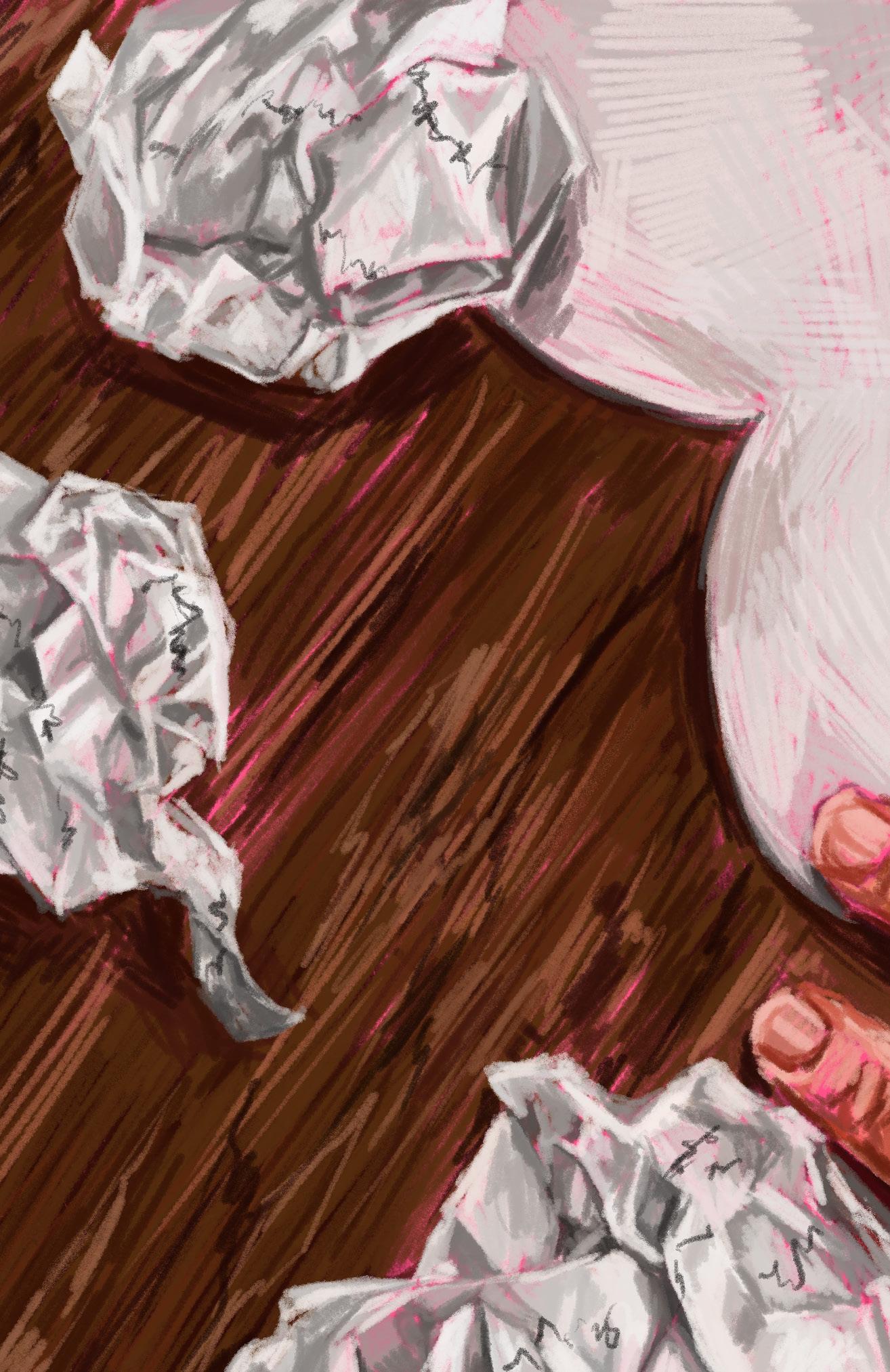
Over winter break, I began writing poems. This was unusual behavior for me. As I wrote in one such poem, “When I first met the poem / I remember hating it more than the illness that was in my body at that time / That made all the adults around me act so / Weird.” Specifically, I resent how “Poems are so stubborn / They never tell you when to / Begin the next line or / When to compare a smile to the trees in autumn or when / To end the whole thing.”
Slowly but surely, my poems got better over the break. I began to hit the return key with more confidence and started to develop an instinct for when the poem had reached its end. The poem and I are still not friends, but we returned to Brown this spring as begrudging acquaintances.
Unlike my writing for post-, however, these poems are going nowhere. They won’t ever live on the internet or within the neatly bound pages of VISIONS
magazine. They won’t ever feel the weight of hundreds of eyes upon them or win me money in any writing contest. Instead, they will live as Pages documents on my desktop for perpetuity. The only person who has and will ever see them in their entirety is the person they were written for and about. I refer, of course, to L.
L and I met in the summer of 2023. On our first date, I had no idea he would be responsible for so much of my best writing. At the time, he was just a beautiful stranger who also happened to be in Providence for the summer. “In every universe, / There are two people sitting on a rooftop, / Watching the sunset, / Ignorant of the beauty and vastness that awaits them. / How could they know? / They’re not us yet.”
The first piece I ever wrote for L was a Valentine’s Day letter. I remember the day I wrote it vividly—it was a snow day and all my classes had been cancelled. L was abroad, and I missed him so much it physically hurt. I had three items on my Notes app to-do list for the day: 1) build a snowman, 2) study for my history exam, and 3) write a Valentine’s Day letter to L. The third was easily the hardest task—writing something that was only for the eyes of one other person was a foreign concept to me then.
The letter ended up taking hours longer to write than studying for the exam did. “I’m struck by the inadequacy of language when it comes to describing how it feels to love you and be loved by you,” I complain in the letter. But that’s one of the things I have come to love most about L—the way he shows me where language fails.
I’ve always been someone for whom words come easily. Constructing arguments out of complicated words and footnotes is enjoyable to me. When I did debate in high school, I had a knack for finding harsh, biting words that would win me Best Speaker awards to put on my bookshelf. Confrontation doesn’t scare me, because I often
know what to say. Putting the most difficult details of my life on the internet via my creative nonfiction doesn’t frighten me because the words are mine.
L, of course, changed all this. He came into my house and turned the chairs and tables upside down (metaphorically, of course). Suddenly, the previously unused erasers at the ends of my pencils became grey. How do you describe a face that, to you, is more beautiful than a perfect summer sunset? How do you describe any part of the only other body you’ve ever known as well as your own? How do you describe the feeling of an angel entering the room and sitting down next to you while everyone else in the Ratty acts as if it’s business as usual?
The answer, of course, is that you never really can, but there is
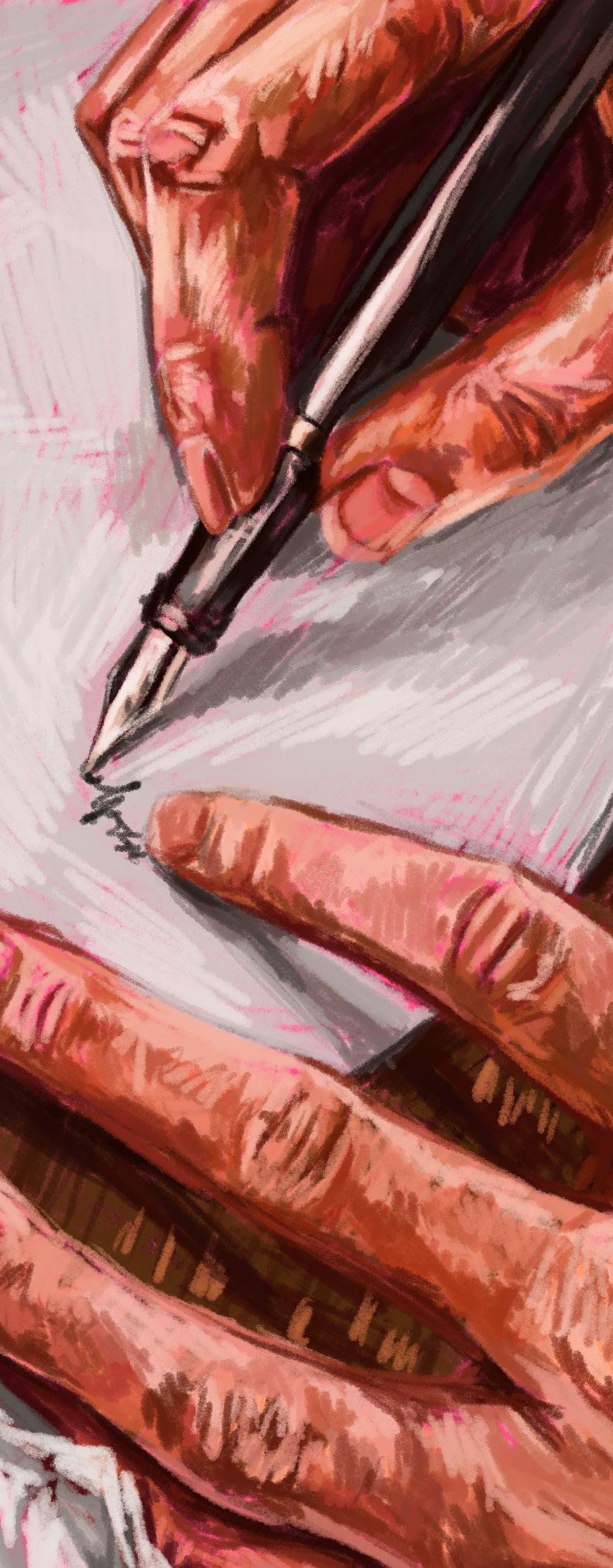
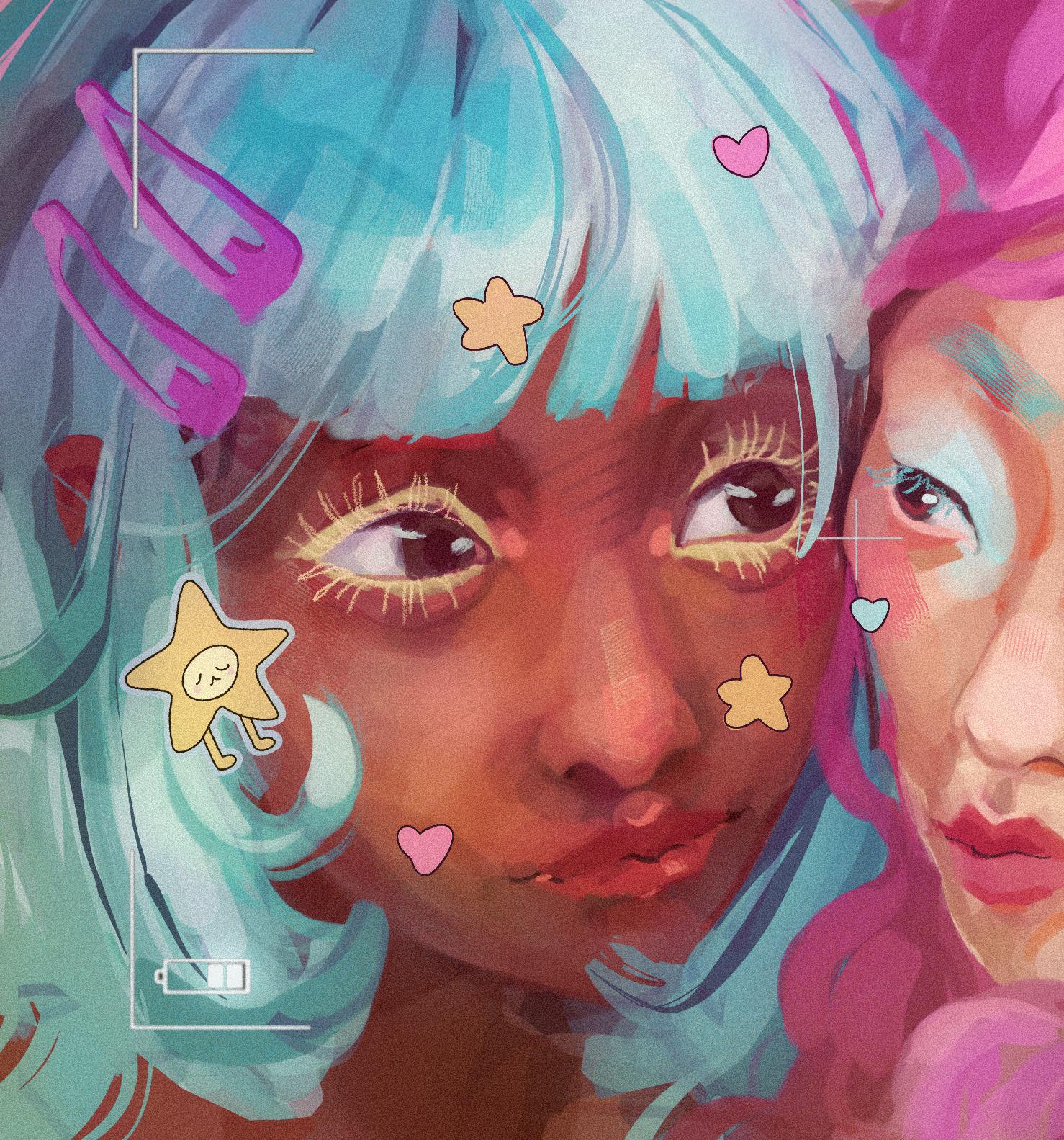
much beauty and pleasure to be found in the attempt. Over the course of our relationship, I’ve written enough about L to fill multiple notebooks, and even then, I swear I haven’t captured a fraction of what I feel. But I’ll keep pushing the boulder up the hill regardless, trying to combine the two great loves of my life thus far: the written word and L. The former will always fail to capture the latter, but every time I pick up my pen, I write with the hope that one day I’ll write a sentence so perfect, so precise, that I’ll look at the page and I’ll see L staring back at me, beard and all. I don’t know what the sentence will be, but I know how it will feel to write: like a forehead kiss, like a key fitting into a lock, like leaves falling into a perfect pile.
There is also much joy to be found in searching for L in the writing of others. I found him once in Maggie Millner’s “Five Poems,” when she writes, “In poetry then, let me say that love / has been, above all things, the engine of / self-knowledge in my life—and even after everything / is still what makes the rest worth suffering.” Another time, I found him in an old favorite: Sally Rooney’s Normal People. Connell, a writer,
“...has tried writing his thoughts about Marianne down on paper in an effort to make sense of them. He’s moved by a desire to describe exactly how she looks and speaks … He writes these things down, long run-on sentences with too many dependent clauses, sometimes connected with breathless semicolons, as if he can preserve her completely for future review.”
Oh, Connell, you know as well as I do that the task is impossible, but great fun. Futile, but fantastic. You and I will never make precise copies of Marianne or L, but we can certainly try and make our hands cramp and our fingertips grey from graphite in the attempt.
I used to wonder why most artists produced so much about their lovers, why the subject of most paintings and poems and novels is romantic love. Now I understand. It’s because love is impossible to capture, and that impossibility just makes you try harder, and more often, and with more spite.
The closest anyone has ever come to reading my writing about L was when my friend P helped me print out a poetry booklet I’d made for L. I was having trouble formatting it on InDesign, and P is a graphic designer of professional caliber.
“Don’t read it,” I insisted as they helped me via FaceTime. “It’s far too intimate.”
“You know I won't,” they said, smiling.
Recently, J—a friend who reads each of my post- pieces with care—commended how much art I’ve been able to produce about my assault, how so much writing has come from something so horrible. While her comments are true and kind, let this piece be an overdue corrective to the post- archives. For the future historians using the Brown Daily Herald archives to research what life was like for students during the 2020s, allow me to amend the record. Much art has come from that, yes, but far more has come from my time with L, most of which you will never see. These poems and letters and ramblings are not on the internet because, after two and a half years, I still have a crush. I’m still shy. I’m still blushing like I did on that first date.
Every day, L shows me where language fails— when he smiles at me from across a room, when he says I love you in Nepali, when he exists, when he exists, when he exists.
My ice powers have lain dormant for years. Yet, when news of last week’s blizzard hit Providence, I could feel them stirring. Knowing that these college years will be among my last unburdened by driveway shoveling, I promised myself I’d make the most of the storm. And so, I laid out my heavy-duty North Face gloves, played the Weather Channel in the background, and laced up an obnoxiously furry pair of boots. No amount of snow could keep me trapped in Perkins.
Caught in the sort of frenzy only a northeasterner could understand, I was met with skepticism from my Miami-born roommate, who asked if preparing for the blizzard was anything like bracing for a hurricane. We traded stories about the weather emergencies we’d each normalized in our opposite childhoods. Despite my constant reassurances, she insisted on Instacarting enough food to last us the entire weekend, lest the snow block us in. Just in the nick of time, we had all we needed: a bowl of Parmesan cheese, a box of rigatoni, and a stick of butter.
Long before makeshift meals in the Perkins kitchen and Providence blizzards, I was convinced I had a special relationship with the cold. On Halloween in 2013, I pinned my hair into a long French braid, slid on flimsy, gemstudded party-store gloves, and hummed "Let It Go" as I prepared to make my appearance as the Snow Queen herself. Four other girls dressed in identical outfits, but fully committed to the bit, I swore to my parents that not only did I have a supernatural resistance to the cold, but also that, if I stepped on a patch of fresh snow, it would crystallize beneath my feet, just like it did with Elsa. I used to trace this power back to my birth on a mid-December day, when the roads were hardly driveable and the city was already frozen over. The ice, I reasoned, must’ve known I was coming.
Where I grew up, no one flinched at the sound of news reporters frantically announcing unprecedented wintery mixes barreling toward the Tri-State Area. Instead, people got their shovels out, excessively salted the roads, and gave the school buses ten extra minutes to warm up. Snowy school days unfolded like any other, save for stolen glances out the windows
when teachers weren’t looking and salt-stained carpets marked with residue carried in by Sorel snow boots.
The football players shook snowflakes from their mullets, the popular girls traded Brandy Melville crop tops for thermal sweaters, the strictest teachers’ noses flushed red as they distributed quizzes they wouldn’t dream of canceling–even in the middle of a nor’easter. Entire classrooms bonded over the power losses that swept across town the night before, comparing our respective adventures during the night devoid of electricity. Then, in quiet solidarity, we’d open two tabs on our computers: the day’s assignment on one, a snow day calculator on the other. Together, we silently prayed for an early dismissal.
There’s something non-threatening about snow—the way it conceals rocky terrain and smooths everything over.
When Frozen 2 came out, I rolled my eyes the entire way to the theater. Adolescence had washed away the fantasies that fueled my childhood confidence. I covered my face with my hood as we took our seats, keeping a careful distance from my younger sister, who was now wearing my old Halloween costume. I tried to feign nonchalance—to convince myself as much as the rest of the audience that I was indifferent to this childish phenomenon, and that I’d rather be watching a PG-13 movie. But all the eye rolls, “ugh”s, and crossed arms couldn’t keep me from remembering “Water has memory.” Olaf says these words as he uncovers a forgotten memory, revealing the origin of Elsa’s powers. At the time, I brushed off the cringeworthy line as another Disney cliché.
Still, estrangement never meant absence. Something in me stayed attuned to water in all its forms, like it was waiting for me. Tenthgrade chemistry taught me that the freezing and melting points of water were both 0 degrees Celsius. But my all-time favorite feature of the temperature/pressure graph was the “Triple Point”: the precise temperature and pressure conditions—0.01 degrees Celsius and 611 pascals—at which solid, liquid, and gas can coexist in equilibrium. Because the conditions required to achieve this state occur far below atmospheric pressure, the triple point almost
never exists on Earth’s surface. Something about that perfect mystery of it all made me itch to feel magic again. To remember…
I awoke to a new sort of snow day last week. This time, I hadn’t done a sequence of pre-bedtime incantations to summon the rough weather conditions. I didn’t sleep with a spoon under my pillow (or partake in any other superstitions, for that matter). And I certainly didn’t stalk the snow day calculator the entire previous day in hopes that my watchful eyes would force the percentage of school cancellations to rise. A real storm hadn’t hit since my early childhood. Thanks to global warming, my recent attempts at snow summoning were met with disappointment. In fact, I had developed a personal vendetta against the meteorologists who always seemed to overestimate the extent of the damage. I longed for the earth to be swallowed by snow, for the world to hold its breath.
I had taught myself to throw all expectations of winter wonderlands to the wayside. But this time was different. White flurries were all I could see looking out of my third-story window. I had been proven wrong. The northeast snow wasn’t gone—just dormant. It was time to seize it.
Without sparing a minute of leisure, our motley crew of three (my roommate and I picked up our Californian friend on the way) ventured out. The Bay Area, she said, doesn’t see blizzards—only droughts. She braved her first snow, resembling a fish out of water in the best way possible—exactly how I would appear if I were to wash up on the Pacific shore. It was then, standing in the center of the dirt-stained snowbank, that I remembered how much I

by Yana Giannoutsos
Illustrated by Yoonseo Lee
wanted to learn to surf. I imagined myself visiting her home city: a former Ice Queen turned water-bender.
The three of us hurried back inside Perkins, starving, like my sisters and I used to be after a day of playing in the snow meticulously supervised from the kitchen window by our paranoid mom, who’d be preparing hot chocolate for us. Only this time, we were left to fend for ourselves in a ransacked kitchen with three ingredients, a second-hand pot retrieved from dorm storage, and the same amount of delusion that convinced nine-year-old me that I could control the snow.
Steam began escaping from the pot of heating water, and we gathered around it, our faces welcoming the warmth of the evaporating water.
“How do I know when it’s time to put the pasta into the water? Is it boiling?”
snow chunks clinging to my sleeves, hanging like tiny icicles.
And there it was—our own triple point. Water as steam, liquid, and solid occupying the same room. We stood there, uniquely situated on what felt like the precipice of the rest of our lives. For a split second, peering down at those little icicles surrounded by steam, I felt like I could make the ground freeze beneath my feet if I wanted to.
“Well, that depends,” answered our friend. “Are you looking for a rolling boil?” I exchanged glances with my roommate, and we burst into laughter at the assumption that we had basic culinary knowledge. We stood there for a moment, baffled at our lack of productivity. In fact, the only thing I would have to show for the day’s work would be this very meal.
Soon, the water in the pot began to slosh and escape from the small pot we’d obviously overfilled. Bubbles churned and rose to the top, and steam rocketed upwards. I lowered the heat amidst our hysterical fit, which only grew more boisterous when we realized that I still had
College, I’ve realized, is a kind of limbo. People insist that these are the best years life has to offer, and that letting them pass you by is a mistake you’ll regret. They say that we’re at this pinnacle—a peak we ought to savor lest it slip away. Perhaps this stage is something even rarer: a triple point where the careless delusion of childhood, the confused angst of adolescence, and the assertive impatience of adulthood intersect. A moment where we are allowed to entertain the possibility of being everything all at once. The calm before the blizzard of commitment.
And so the three of us walked into the Perkins kitchen during the most severe blizzard of 2026 thus far. We ate a forgettable meal under unforgettable circumstances. That night, we dreamed of the lives waiting for us: where we’d land, the pressures we’d inevitably endure, the temperatures we’d eventually grow accustomed to wherever we’d end up.
But, in that moment, just as in 2013, the only thing to do was to momentarily surrender to the mysterious ways of the ice and snow.
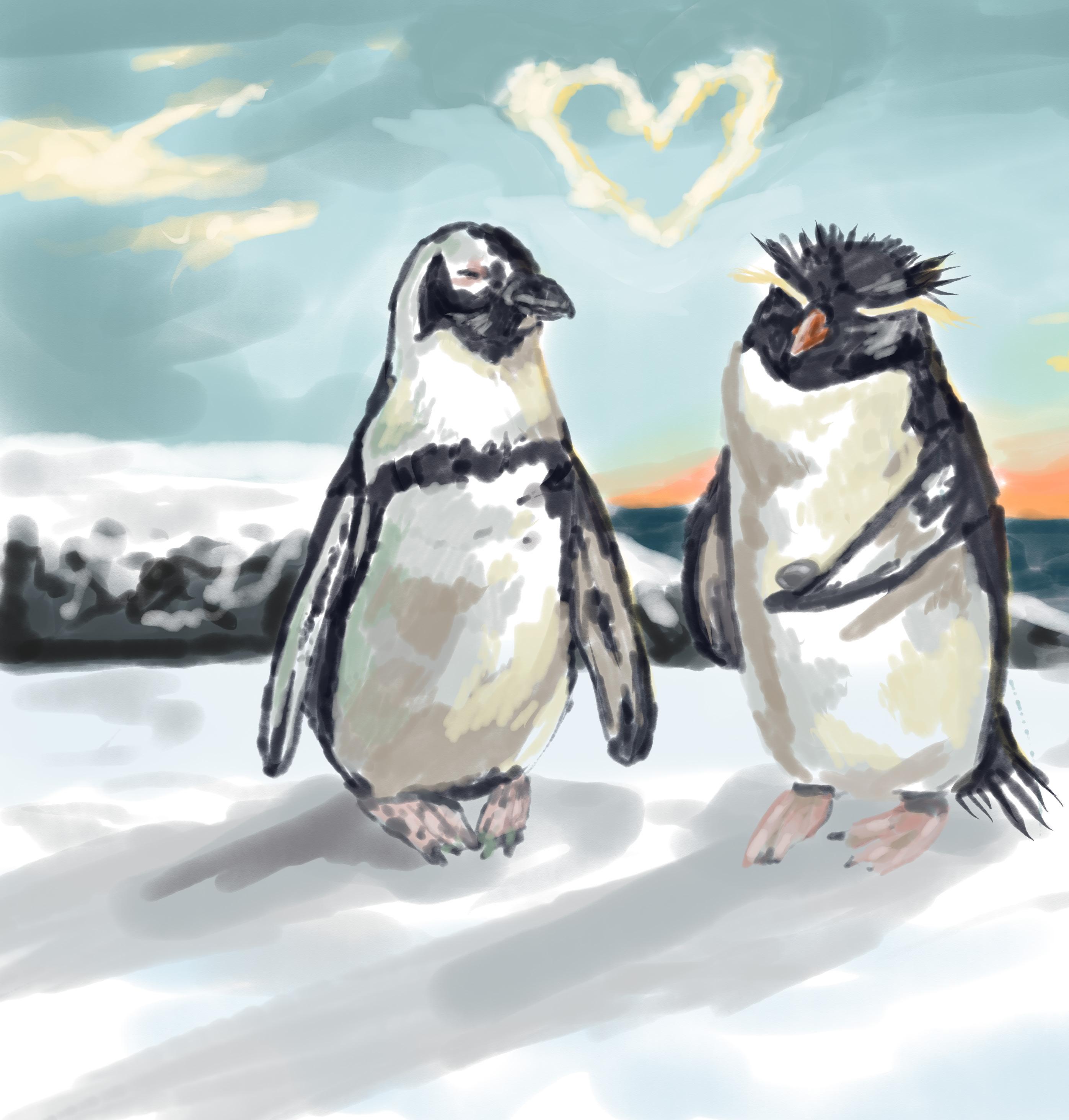
ask the question the worst they can do is say no
by Alayna Chen | Illustrated by Hannah Gapp
Another year, another lonely Valentine’s Day. I’ll be in my room, watching YouTube and scrolling on Instagram, while all the couples around me reenact the Lady and the Tramp spaghetti scene on Federal Hill. Marriage Pact may not be your style, but that doesn’t mean you have to be alone on the day of love. Plan a Galentine’s party, buy some heart-shaped chocolates, find a couple’s deal for you and a friend, and maybe, just maybe, if you’re brave enough, ask out that person you couldn’t take your eyes off of last semester. It might be hard (and a tad bit frightening), but don’t worry! Here are some silly concentration-themed pick-up lines to help lighten the mood.
American Studies - It’s America’s 250th anniversary; why don’t we make it our first?
Anthropology - The Anthropology concentration might have six different tracks, but I would only follow the track that leads to you.
Applied Mathematics (or Mathematics) - You’ve heard about three + two, but what about me + you?
Astronomy - Even if you searched the whole universe, you could never find a couple as meant to be as you and me.
Behavioral Decision Sciences - You’ve got a lot of choices, but have you ever considered me?
Biology - I’ve been trying to understand the secret of life, but looking at you, I think I’ve found it.
Chemistry - I don’t care how much energy there is. No one could break our bond.
Classics - Forget the Roman Empire; you’re the only one on my mind.
Comparative Literature - No matter where you look, you’ll never find a greater love story than ours.
Computer Science - Are you League of Legends? Because I’m addicted to you.
Earth and Planetary Science - Are you carbon dioxide? Because you set the world on fire.
Economics - Are you McKinsey? Because I would devote my life to you.
Engineering - Are you CAD? Because I could build a life with you.
English - Are you Jane Austen? Because I could write the perfect love story with you.
History of Art and Architecture (or Visual Art) - Did Michelangelo make you?
Because you’re a masterpiece.
Independent Concentration - I might be working alone, but you could be my partner at home.
Environmental Sciences and StudiesAre you the sun? Because my world would be a cold, dark place without you.
French and Francophone Studies - You’ve heard of Paris, but what about the pair of us?
International and Public AffairsInternational relations might be my specialty, but I’d love a domestic relationship with you.
Modern Culture and Media - Are you a camera? Because every time I see you, I smile.
Music - The best songs are written after a breakup, but I’d give up my career for a lifetime with you.
Neuroscience - Did you damage my frontal lobe? Because I can’t think when I’m around you.
Philosophy - When Plato came up with the Form of Beauty, he must’ve been looking at you.
Physics - Are you gravity? Because you have a pull I can’t ignore.
Psychology - Are you the cloth mother? Because I just want to run to you.
Public Health - Do you have a fever? Because every time I get close, my skin gets all flushed.
Statistics - I ran the numbers, and it looks like the statistical probability of you and me is 100 percent.
Theater Arts and Performance Studies - To be with me, or not to be, that is the question.
Urban Studies - Are you a borough? Because I can recognize Queens from a mile away.

post- mini crossword
Alayna Chen
1. Questioning sounds from a Canadian
4. Figure skating jump
5. 2026 Winter Olympics location
7. Brown alum and ice hockey player at the 2022 Beijing Winter Olympics
8. Course code for most classes taught in Barus and Holley
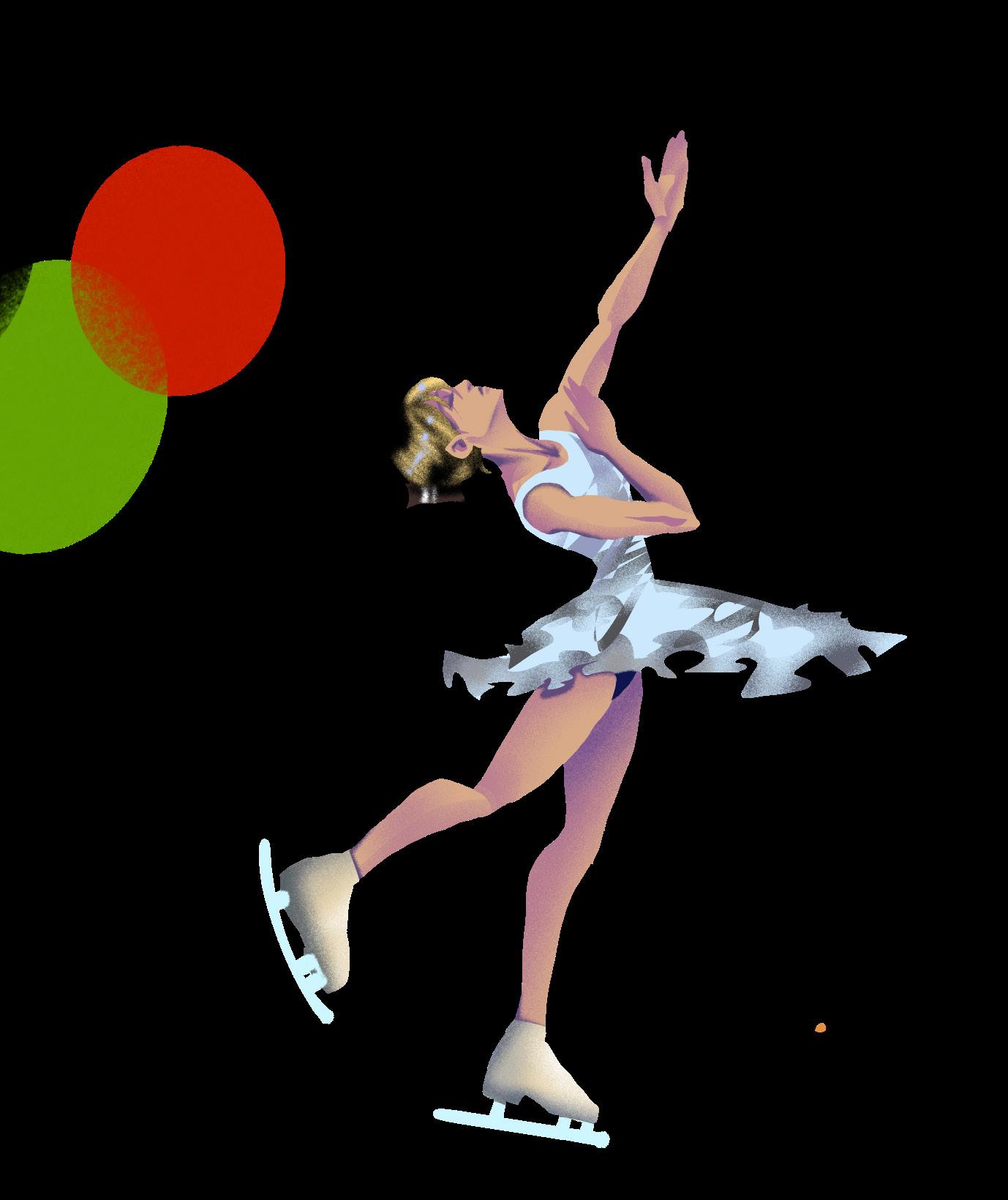
1. A lonely place
2. Canadian bobsledder Upperton
3. What the kids say
4. U.S. org. for physicians
6. Grandma, for some
“When I imagine the experience of caring, I imagine it as a keyhole to two universes: to one’s external world and to one’s interiority. Similarly, reading a text can act as an opening to learn both about the universal and the deeply personal.”
— Alaire Kanes, “a new nervous system”
“Nowadays, I still stop to watch the geese soar across the blue every time I see them, navigating on the basis of nothing but a feeling, and that feeling is everything. The migrations we choose, the people we cross the skies for. We love with abandon. We leave our houses to come home.”
— Michelle Bi, “what guides the geese”
EDITOR-IN-CHIEF
FEATURE
ARTS & CULTURE Managing
Section
COPY
Copy
LIFESTYLE
Section
POST-POURRI
Section
LAYOUT CHIEFS Alexa
Layout
SOCIAL