
Cover by Sheryl Lee
Dear Readers,
I just turned 21, an event that has brought with it much existential dread. When I get asked my age, I still default to 18, or even 16 some days. Slow, creeping Father Time keeps breathing down my neck, so I search for ways to distract myself. The best method so far has involved a little pain, been a little permanent. I’m now on my second year of gifting myself a tattoo.
It’s fascinating, the things we choose to permanently put on our body, the ways we mark ourselves and our lives. At the moment, I only have two tattoos: a black iris (in honor of Hozier’s “Jackie and Wilson”) and a pair of sanderlings (a bird I saw all the time growing up in Florida). Now when I walk around, I’m making a visible statement about me, in ink and blood. It’s simple right now, but I imagine it will only get more complicated as I plaster more artwork on my skin, as I broadcast more ways to interpret my life.
In this issue of post-, our writers also think about the ways we frame not
only our own stories, but the stories of others. In Feature, Ivy looks at her and her grandmother’s relationship to art, told through the lens of a migrating warbler. Also in Feature, Katya wonders about why we are so drawn to tales of revenge. AnnaLise examines the velocity of her relationships (and longboards!) for Narrative. Meanwhile Coco slows down and people-watches in Paris. In A&C, Chelsea thinks about the power of the simile, and Ann fights back against the Labubu hate. Lifestyle writer Merissa tells us about attending college in her 30s, and April reflects on the meaning held within our names. Finally, Alayna gamifies our Brown experience with a bingo board for post-pourri and takes us to a new galaxy with an out-of-this-world crossword! There’s something so sweet about our desire to tell stories in everything we do, to curate our aesthetics and our media towards some coherent persona. We want to be seen and understood. Or maybe we want to be deliberately confusing. I hope this issue of post- inspires you to start crafting your own story—I’ll be listening!
Making it up as I go,
Elaina Bayard Feature Managing Editor
an eye for an eye are we wired for revenge?
by Katya Michkovskaia
Illustration by Anna Nichamoff
Recently, there has been a curious, serendipitous pattern in my media space. In a week, I encountered three works united by a common idea—the Law of Talion, which may be more familiar to you as the principle: “an eye for an eye, a tooth for a tooth.” These pieces included the Spanish story “Ley del Talión” by Max Aub, the movie The Killing of a Sacred Deer by Yorgos Lanthimos, and the song “Equivalently” by the alternative Russian rock group Papin Olympos. Pretty eclectic, don’t you think?
Revenge has been around for quite some time—Hamlet, Odysseus, Oedipus Rex. The original phrasing of the law dates back to the Bible: Fracture for fracture, eye for eye, tooth for tooth; whatever injury he has given a person shall be given to him (Leviticus 24:20). In the New Testament, Christ reorients this principle for personal actions: Ye have heard that it was said, An eye for an eye, and a tooth for a tooth. But I say unto you, Resist not evil. But whoever slaps
you on the right cheek, turn to the other cheek also (Matthew 5:38-39).
Everything works as a fair trade until we get to harm; in that case, the rules change. Instead of multiplying evil, we need to put an end to it through the power of mercy and nonretaliation.
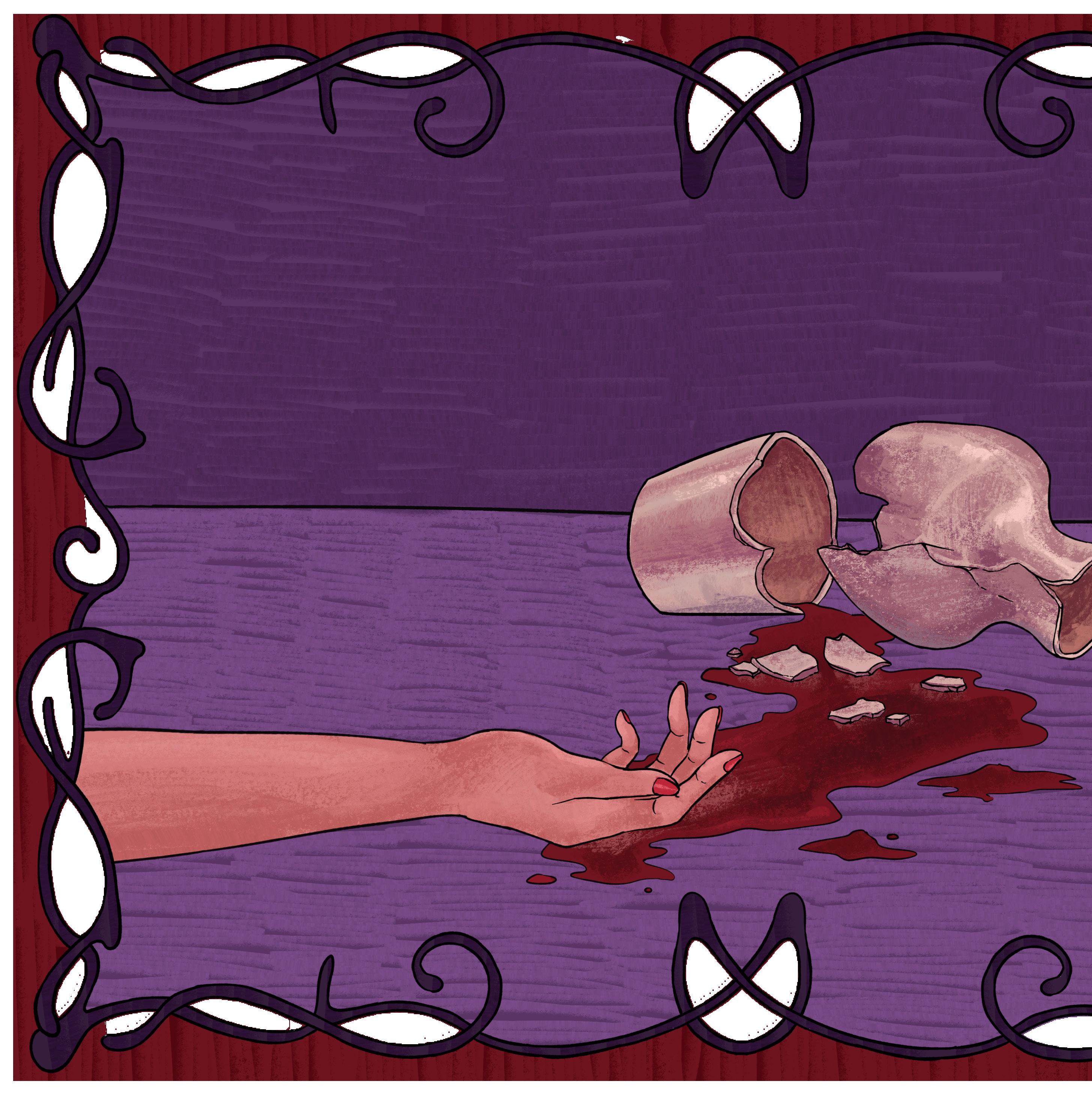
The version of the idiom that lingers in the pieces I’ve listed is the Old Testament one, or the “retributive principle.” For the authors of the works in question, the principle provides solace—a promise of justice, relief, redemption. To start, look at Aub’s story “Ley del Talión,” which I have translated from Spanish into English: —I didn't do it on purpose. That's all that occurred to that imbecile to repeat in front of the shattered jar. And it was my saintly mother's, may she be glorified! I smashed her to pieces. I swear I didn't think, not even for a moment, of the law of Talion. She was stronger than me. I didn't do it on purpose either.
The narrator explains how he cuts a woman into pieces because she broke his mom’s favorite jar, suggesting this punishment was only fair. The mirroring language to break a jug into pieces/a man to pieces is chilling, as it innocently plays with the idea of a life being exchanged for a life. The striking brevity of the story accentuates the draconian calculations in the mathematics of revenge. The naïveté of I didn’t do it on purpose being equal for both scenarios—breaking a jar and violently murdering a person—suggests an eerie moral trade-off, where justice is regarded through a curious lens…Why should we forgive people, if they truly hurt us?
As for The Killing of a Sacred Deer, it’s an absurdist psychological thriller directed by Yorgos Lanthimos that explores the idea of a universal equilibrium, where no mistakes go
unnoticed. A cardiac surgeon introduces his family to a teenage boy, Martin, who inflicts a curse on them because they deserve it (watch the movie to find out the reason). But why is there comfort in the thought of retribution? Why does restoring balance by multiplying evil seem fair to us? When talking about the “eye for an eye” principle, Martin says this: I don't know how fair what's happening is. But you know, in my opinion, it's the only thing that comes close to justice. He thinks that only by responding good to good and evil to evil can the fragile balance be restored—if not pure justice, then at least some functional model of it.
Finally, in “Equivalently,” we hear such phrases as Someday everyone will pay their bills / Mercury, that flowed down those cheeks, will return as gold / Wait just a little bit—time will put everything in its place / Someday—that's how the boomerang returns. The melody also mirrors the motive of an upcoming Judgement Day: the refrain of “Equivalently” circles back to the note C, and the bridge (quoted above) is recited a cappella, almost like a manifesto. The lead singer’s voice is youthful, even boyish, which amplifies the uncanny maturity of the lyrics.
Funny how a seemingly unconnected 20th century Mexican-Spanish novelist, a modern arthouse Greek filmmaker, and an alt-rock Russian teenage band keep circling around the same bloody rulebook. Why do we gravitate to this primitive, rigid, even barbaric idea that takes us back to the birth of legal regulation, back to the Twelve Tables in ancient Rome and the Laws of Hammurabi? Or perhaps it is not a craving for violence and retribution at all, but a natural thirst for justice. What if Talion’s law is real justice, where the scales are equal and the punishment perfectly fits the crime?
Actually, Talion's Law inspired a whole philosophical and legal movement, retributivism. Modern systems of justice blend the law with utilitarian goals, such as simultaneously establishing stricter sentencing guidelines for serious crimes and implementing parole for rehabilitation. The practical part of this mix echoes one of the laws in Hobbes’s Leviathan: In revenges, men look not at the greatness of the evil past, but at the greatness of the good to follow. In other words, revenge is used not for vengeance, but to establish a social order. However, a certain C.S. Lewis would disagree with this overly forward-looking viewpoint. He was a loyal fan of retributivism— in his Humanitarian Theory Of Punishment, he claimed that “the concept of Desert is the only connecting link between punishment and justice.” Lewis critiqued the rehabilitative system of punishment, stating that prioritizing the future serves the purposes of deterrence more than it does the purposes of justice. The debate around retributivism today is #notdead (Lewis would be glad).
It seems just about time to address another relevant and vastly popular idea: karma. Mired in its pop-cultural definition, we forget karma is not just a petty human payback; in Buddhism, it is regarded as an autonomous law, which operates merely on human actions and their effects. There isn’t an omniscient ruling agency that assigns punishments and rewards; karma is simply a fair game, where every action creates
a corresponding reaction, which manifests across lifetimes. Karma is an objective responsibility, even sometimes referred to as a “causal mechanism.” Thus, both karma and our beloved Talion's law can be seen not only as a selfish attempt to make another “pay the price,” but also as a cosmic longing for justice and order, or a universal principle—something bigger than animalistic drive for revenge.
However, there is indeed a biological reason that makes retribution tempting. From a neuroscientific point of view, revenge is sweet. In a study where the participants had a chance to punish the impostor in a game, there was significant arousal in the activity of the dorsal striatum, which is associated with processing rewards (yes, cocaine and nicotine included). Revenge does, however, have you wrapped around its finger: the sense of satisfaction is often short-lived. “Punishers” didn’t release their aggression. On the contrary, they felt more resentment and anger than those who opted for forgiveness. In other words, the temporary relief after vengeance is similar to the one associated with addiction. It feels ecstatic at first, until the high wears off.
Despite this neurochemical trap, the ancient Talion's law remains relevant—perhaps because our attraction to pure mathematical equality and retributive justice has not disappeared. I believe that there is something in human nature that simply does not allow us to put up with injustice, something more unfathomable than the striatum activity or the lyrics of a Russian teenage rock song. And the belief that someone out there is keeping score, that it’s just a matter of time before the scales will swing back into place, is our consolation prize. To be honest, this placebo pill works for me—I would certainly love to see the universe put everything in its place and give my enemies their just deserts.
But let’s face the brutal truth: revenge, no matter how meticulously calculated, can never ease the underlying pain. Revenge is an illusion of closure, of reclaiming power, of punishment. I don’t believe violence is a driving force for retaliation—it is rather a consequence. Revenge would need a deeper-rooted motif.
Revenge is driven by grief.
Grief is blinding and maddening, be it caused by a lenient punishment for the murderer of your child or the absence of repercussions for surgical misconduct. Vengeance is a way to mobilize the destructive passivity of grief, reverse the pain, and throw the boomerang back. The barbarism of vengeance comes from desperation and helplessness, but it’s just a cover-up for a wound: deep down, we know nothing can fix the past, not cruelty, nor equal suffering.
So next time you decide between turning your other cheek and punching back, pause and ask yourself—if revenge is grief, will fighting back even make a difference?
by ivy rockmore
Illustration JJ Li @by_jjleee.png
I have never seen a yellow-rumped warbler in real life, though I feel like I have because of the hundreds of photos I’ve looked at. They are small, stout creatures with a pronounced beak. The black feathers surrounding their eyes make them appear more like deer than birds. They carry daisy-yellow patches on their crown, breast, and occasionally throat. The brightness of the patch eclipses the rest of its body, and sometimes, when I spend a while looking at its meek frame, it is as if the essence of the animal itself lies in its simplicity. I would like to think if I were a bird, I would be a yellow-rumped warbler, if only because it migrates straightshot through New England up north to Canada, where I am from.
On my mother’s side, I come from a lineage of artists. My mother has been a designer since before I was born, and her mother has been teaching painting lessons for over 40 years to thousands of students. I refer to my grandmother as Bubby.
My Bubby is my closest confidant. She has been an artist all her life. She works primarily with oil, painting, and assemblage. Though I have always known my Bubby as a painter, only recently have I come to understand her as a literary artist; she writes poems, fragments, clips, short stories. When the pandemic first hit, and she could not access her painting studio, she joined writing groups with other people her age in her hometown of Montreal.
People tend to hate email: the idea of having to sort through dozens and dozens of spam, emails you don’t want to receive, bills, appointment confirmations, messages dubbed URGENT when they are anything but. But it provides a lifeline between me and my Bubby.
I, too, only began my journey as a writer in the last decade. (Of course, this is because I am 21.) But even as I pursue a so-called traditional, formal writing education here at Brown, on the so-called ‘usual’ path, what I find I learn from and gain the most support through is my Bubby, in ways that I did not initially expect, and, in my understanding, can only come down to the symbiosis in our relationships, disrupting all expected timelines of us.
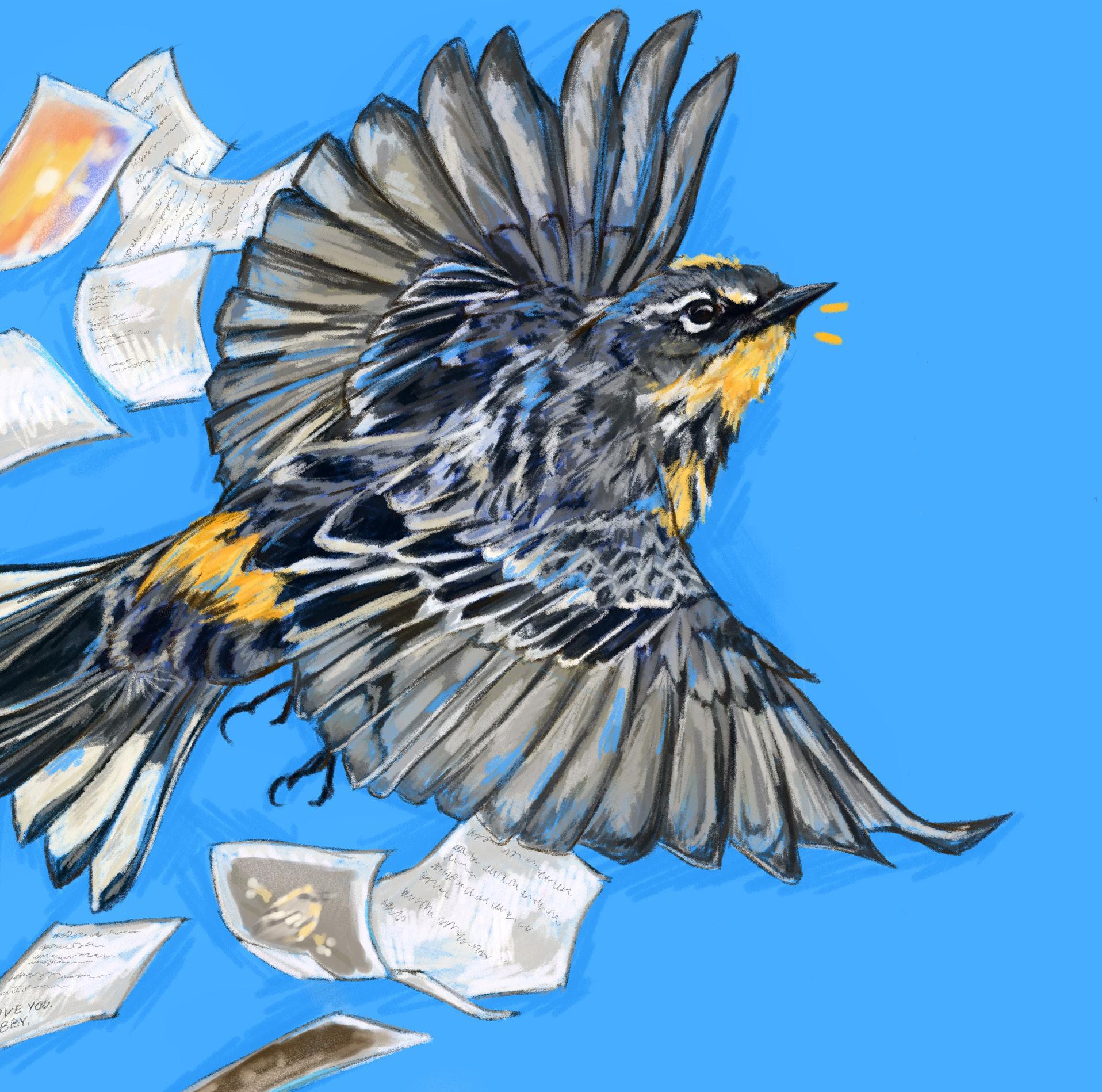
The yellow-rumped warbler enjoys the snow. It relies on family to sustain itself by working as a group to collect seeds and fruits, find hibernating trees to spend time in as the winter grows darker and the days grow shorter. In groups, they migrate during the winter, surviving on bayberries as they slog up north, farther away from me, closer to Montreal, French-speaking territory, where my Bubby resides, writing, painting, continuing her Künstlerroman at 86.
Though I’m only a few hundred miles away from my Bubby now that I live in Rhode Island,
I project a vision of migratory patterns in our relationship.
Whenever I have a new piece, the first person it goes to is my Bubby. I often wake up in the mornings afterwards to messages sent by her at 2 or 3 a.m. Some facts: She is the most vivid and attentive reader I know. She has the stamina to recall excerpts in narratives that I could only dream of. She grasps my aesthetic in a way no one else does.
In my vision, I see her placing bird feed in my beak, the taste of food and support so delicious I can’t help but squeak.
I can recall FaceTime and phone calls with her throughout these past five years, as she debriefs her workshop with me. They didn’t understand this point, I recall her saying over the static line. But do you?
Her intention is rarely explicit but scattered, imagined, constructed over time—in the way artists’ brains often work. Since there is an established amount of trust between us, we subvert the typical older-mentor–youngermentee relationship. Instead, I see us as having a symbiotic, necessary relationship that allows us to flourish in spite of it all. I am interested in exploring older artists who are still in the process of ‘coming-of-age,’ a group that is often disregarded.
9/20/25
HI COOKIE, WILL TRY TO REACH YOU TONIGHT. SOMEHOW I DIDN’T GET THE LAST PIECE YOU
WROTE . SEND IT , I THINK MUMMY SENT IT BUT MAYBE I ERASED IT BY ACCIDENT.
YOU SOUND GOOD ON THE PHONE, I AM SENDING YOU THE LAST VERSION OF MY STORY, ‘DOLL,’ GOING TO PUKE ON IT ALREADY !!
LET ME KNOW WHAT YOU THINK !! CALL ME WHEN YOU CAN, LOVE YOU SOOO MUCH, BUBBY.
8/25/25
LOVING STORY it keeps going, rambling , i love the style, while getting to know ava, lucas and clem, a pool of feathers, where do you get your phrases , always original and fascinating. the style kind of puts me in another state of mind,i know this sounds crazy, like Proust , like there is no end to the moodiness. emotions. i’m enjoying. Don’t read Doll yet, obviously , i’m not normal, have to make changes again. i must be sick love you so much, your bubby.
8/12/25
SO HAPPY TO SEE THAT WONDERFUL PICTURE OF YOU IN MY PHONE LAST NIGHT.
A LITTLE AFRAID TO SEND MY PIECE FOR FEAR IT WILL COME OUT IN THE COMPUTER IN ONE LONG SENTENCE, AS IT ALREADY DID SENT TO A FRIEND.
BUT I AM GOING TO DO IT COPY AND PASTE.
SCARED TO SEND IT TO YOU THE BRILLIANT ONE. CALL ME BACK AFTER YOU READ IT, YOU CAN READ IT TO MUM.
LOVE YOU SOOOO MUCH. SO PROUD OF YOU
BUBBY IF IT COMES OUT WRONG IN THE WRONG FORMAT DON’T READ IT I WILL FIGURE OUT A WAY
5/3/25
I READ YOUR PIECE QUICKLY, AND THEN MUM CALLED AND I WILL READ IT AGAIN.
AGAIN THE IMAGERY , EMOTIONS, ARE SO WELL DEPICTED. AMAZING, DEPICTED A STUPID WORD.I MEAN SHOWN, FELT. INCREDIBLE!!
half lids, ribs, ect. ect. excuse the tYping.
YOU HAVE SUCH AN UNUSUAL, VISCERAL DEEP, WAY OF DESCRIBING ANYTHING. it’s FANTASTIC!!!!
YES VISCERAL , THAT’S WHAT I MEAN TO SAY.
I think that’s WHAT MAKES YOUR STYLE. I THINK I NEVER READ ANYTHING LIKE IT.!!
I WANT TO READ IT AGAIN , SLOWLY, KIND OF DEVOUR IT, SO I CAN COMMENT. VERY PROUD, YOUR BUBBY
And sometimes, as the world appears to be crumbling beneath us, we share honesty:
3/18/25
HI GORGEOUS,

HOW ARE YOU , THINKING OF YOU. IT’S BUBBY. WONDERING WHY I AM BOTHERING DOING THIS TODAY. FEELING DISCOURAGED. AN ANT KEEPING ME COMPANY ON THE SILL. HAVE TO GO MY WRITING GROUP , DON’T FEEL LIKE LISTENING.
I’M IN A BAD MOOD!!! SENDING A SHORTENED
VERSION OF PAOLO TO MUMMY, AND SHE WILL SEND IT TO YOU. GIVE ME YOUR HONEST OPINION. THEN I DID ANOTHER LONGER VERSION, I WILL SEND IT ANOTHER TIME SO YOU DON’T GET CONFUSED. LOL. I’M IN THE MIDDLE OF THE TWINS STORY, MORE EXCITED ABOUT THAT ONE. CAN’T STAND MYSELF ANYMORE . SEND ME SOMETHING GENIUS OF YOUR OWN LOVE YOU SO MUCH BUBBY
Then, there is the inevitable reverse. Don’t read my story yet! I proclaim to her over the phone. I made edits and changed it since I last sent you… I know… I know, yes, we are crazy about this stuff… it’s okay, okay yes I’ll call you later once you’ve read it. You’re changing yours too? Ok! Love you. Bye.
When the yellow-rumped warblers eventually reach Canada, they find suitable coniferous and mixed forests. They nest and raise their young. They forage: caterpillars, insects, fruits they digest like wax myrtles in the process. Uniquely, they thrive in northern habitats precisely because of how attuned they are to adaptation.
I have had many conversations with friends about how the publishing industry seems to have a fetish for young talent. There is a pervasive cultural notion—that I am working to unlearn—that publishing young is a win for society and the literary public consciousness. But what about those whose paths are not so standard?
Older women in particular are burdened with the notion of archiving their work, even as the world has not always taken them seriously, especially when they were first “coming of age.” The traditional art world has been “failing them” for decades, and the state of the literary art world, too, illustrates the experience of ageism. My Bubby, working at the crossroads of these mediums, demonstrates a topology of being that comes with age, wisdom, practice, and most of all, grit.
There are timelines. They are socially prescribed, constructed, not not to be followed, but subverted.
My Bubby is one of the most prolific writers I know. She writes nearly every day. She is stylistically and formally inventive. The highlight of my writing career thus far has not been my own growth but
being able to apply some of the techniques I have learned in workshop with her work. We speak about trusting your gut, your reader. She tells me about her interest in world-building. We work together to read pieces aloud, cheer, scream, cry. She utilizes experimental narrative structure. She links images through repetition and revision over time. She leans toward modernist prose. Have you read Swann’s Way? she constantly asks. She is a fan of slow character building, setting up traps for the reader. Most of all, she sticks up for herself.
To my ear, I need my poetic wildness, she recently declared to me, referring to a recent story, against the wishes of a workshop-mate.
In my literary arts training, I am often discussing the perks and perils of the workshop format. It can leave you drained, confused, and threatened. It can improve your work in ways you couldn’t have expected. It is tiresome and reliant on the people and peers around you. In a fiction workshop last semester, I read excerpts of Susan Sontag’s Against Interpretation (1966), which helped me think through the ways content and form are related not just in visual art but literary works, too. My class concluded that often, in literary works, logic is a feeling rather than a ‘truth’ that can be deconstructed.
My Bubby is no fan of her traditional workshop, even as it keeps her writing. They just don’t get it, I can still hear her say over the phone, frustrated at what her peers with different tastes did not grasp in her story or poems. In a sense, her work, too, resists interpretation, positing itself as an inheritance of feeling.
Recently, she has gone back to her painting studio, granted access to it again post-pandemic. My sense of what to do next is still there, she explained to me over the phone. It’s like the work tells you what to do.
The yellow-rumped warbler completes its migration when it accumulates enough fat to make it through the winter. They can digest wax in berries, which allows them to winter farther north. As fall approaches, I’d like to imagine the warbler carries messages between me and my Bubby. Above the trees and clouds separating us, I envision the berries holding messages between us, sustaining our practice, providing the material conditions for her to become an ‘artist’ even as she always has been, and always will be.
by AnnaLise Sandrich Illustrated by Mot Tuman Instagram: @mttuman
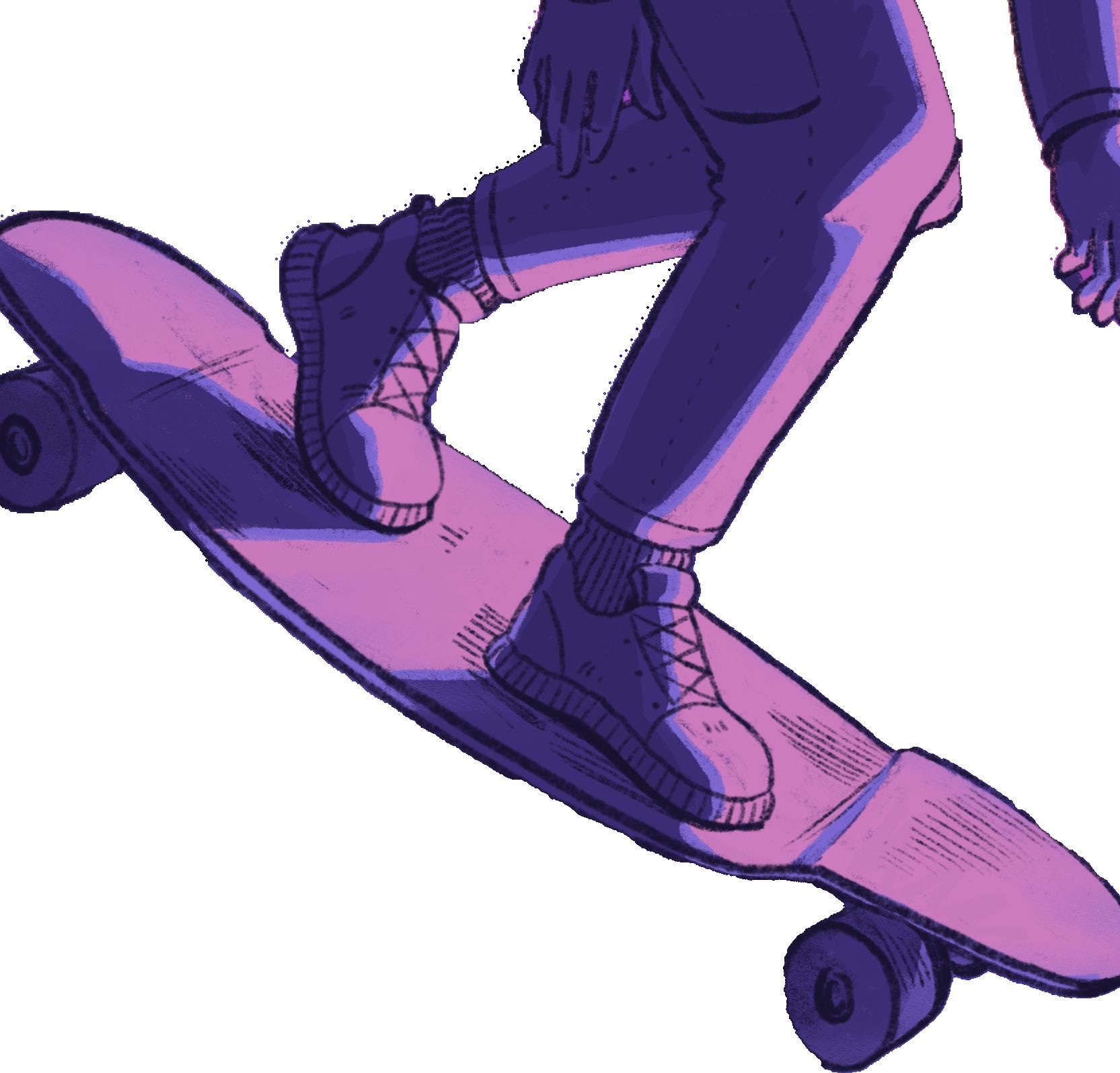
When we were kids, my cousin Lucas liked to build stuff. A computer, once, I think, and definitely a 3D printer. His house was filled with all these gadgets that seemed like they had been beamed straight out of a sci-fi movie. He was three years older than me and the coolest person I knew. My younger brothers and I idolized him—to us, he embodied a technological sophistication we could only aspire to. We were all vying to see the owl he 3D-printed, to try out his acoustic guitar, to hear the antique record player he was fixing up. He introduced us to the concept of tiny houses and the software used to design them, the “I Like To Make Stuff” YouTube channel, GarageBand. He built skateboards.
The first Christmas after we moved to the Bay Area, he gifted the three of us longboardbuilding kits. Lucas brought his own board all the way from L.A., too. That afternoon, he helped us put together the wheels and the axles and finally the decorative stickers. We all headed outside to test them out.
We had just changed school districts on account of the move. Situated at the bottom of a large hill, Reed Elementary, servicing grades K-2, was just across the street from our new house. Jackson and I were both too old to attend, but we caught the bus from there each morning, and enjoyed the rest of what Reed had to offer— the playground after hours, the baseball fields, the long sloping driveway where parents would drop their kids off in the morning. It was steep enough to make for a great skateboarding ramp, so the four of us donned gloves and kneepads, climbed to the top, and sailed down.
Maybe I shouldn’t say the four of us. Lucas rode fearlessly, but that’s a given. He was familiar with the board by that point. Not a fair comparison. But both Jackson and Cole, two and five years younger than me, respectively, also mustered the courage to make it all the way down. I managed to hike to the top just fine, stood up on my longboard okay, and then bailed seconds into the ride every time—put my protected hands onto the asphalt to slow the board to a crawl or a complete stop before reaching the bottom.
It wasn’t falling that frightened me. I knew I was geared up enough to be able to walk off any tumble. It was something about the inertia. I have always been scared of going too fast.
The summer between graduating high school and taking a gap year, I entered a quintessentially brief and yet soul-crushing relationship at that precipice before adulthood—that fateful interlude of a summer.
I used to say all of my firsts belonged to Sophia, as well as several of my lasts. She’d been my best friend senior year (though I
wasn’t hers), and our short-lived relationship ended, perhaps predictably, in disaster. Your classic anxious-avoidant duo, her coldness and seeming indifference to my feelings, met with my self-centered anxious spirals, my almost psychotic need for attention.
My heart has never been patient, has always had that thrill-seeking attitude that afflicts theme park aficionados, bungee-jumpers, and adrenaline junkies. I fall fast and hard, arms flailing like a skydiver without a parachute, hurtling towards an end on hard cement.
The faster you fall in love, the faster you get your heart broken.
Every one of my exes would attest to the fact that I get attached too quickly. I would like to say that in the end, she fell out of love with me, and I followed her lead. But this is nonfiction; instead, I must admit that at the end of that summer, she took her “I love you” back and replaced it with, “I never meant it in the first place.”
Apparently, I met her when I was ten, my first fall in the Bay Area. We were on the same rec soccer team. Her dad was the assistant coach. I still have the team photo. We kneel on the patchy grass field of our elementary school, matching red uniforms, smiling. Her on the end of the front row, me closer to the middle. I still had those narrow purple glasses and bangs. Sophia’s hair was lighter and longer. That must have been the year her parents divorced. She later told me her mom took her to therapy to look better in front of the family court and then took her out of it when the therapist said her diagnoses were largely her mother’s fault.
I don’t remember meeting her until a year later, in middle school. Actually, I don’t remember meeting her at all. She sort of just appeared one day, became a background fixture, and then a very prominent character in my life for eight years. And then she disappeared from it completely.
But before that, she was my first kiss, my first date, my first heartbreak. My last homecoming, my last prom, my last day of high school. The morning after graduation, our senior class gathered at Battery Spencer to watch the sun rise over the Golden Gate Bridge. The two of us stood there together, surrounded by everyone we’d spent the last four years with, Mike’s Hard Lemonades in the night and bagels in the morning, first-ever drunken confessions, first-ever drunken anythings, the beginning of something that would hurt more than I realized. And I remember thinking about that night that stretched into morning, that my life was finally starting. I still think I was right.
At some point later that summer, my dad decided it was necessary that I take a “driving
safety” course. This, I recognized despite my protests, was not an unreasonable ask given how nice my parents had been to me when I’d crashed their new blue Subaru into a parking garage in Berkeley.
He made me wake up at five in the morning two days in a row to drive two hours south, all the way down to Salinas. “Driving safety,” my ass. I spent the whole time learning how to do donuts, how to drift, how to drive stick in a Mustang racecar, and the basics of autocross on a professional racetrack. Every time my stomach flipped, I pictured the car doing the same thing. I hated it—hated being yelled at to go faster around those small orange cones, tight turns.
I never drove when I was with Sophia. She took us around in her black Honda Civic. We went back to that sunrise spot in the Headlands a lot, though usually for the sunset, and then stayed until the stars followed.
Once, driving back across the bridge, she mentioned that her father didn’t have a license. Or, rather, he’d had one, and it had been taken away. Which hadn’t stopped him from driving to work every morning with a mug of red wine in the cupholder. When we were both in middle school, he crashed the car and was arrested in front of her. He was let off because the cops who did it messed up the procedure. A technicality and a good lawyer.
I don’t talk to Sophia anymore. Last I did, she was heading off to UCLA to become a chemical engineer. She was a perfect student in high school. Effortless 4.0. Bragged about how little she had to work for her grades, how much she did work in the real world. She logged about 40 hours a week as a barista at Starbucks. The 4 a.m. shifts were her favorite.
I tried and failed to reconnect with her later that fall. A girl I knew at the time told me that maybe it was meant to be a gradual thing. But I wanted all of her back all at once. “Maybe it’ll happen on a slower timeline. Maybe you’ll get coffee one day, two years from now.” I couldn’t imagine it. Two years was an impossible length of time.
I think that conversation happened three years ago.
I claim to enjoy running, but I hate it. This is every runner’s open secret. You simply have to love it too, an overpowering love that drowns out the constant injuries, the days when everything is difficult and slower than it should be, the hill training, the heat training, the sweat dripping down your forehead and stinging your eyes, the pounding of your heart that tells you you’re so tired.
I claim to be afraid of going too fast, and yet I dedicate a substantial amount of my time to a
hobby in which the primary objective is to move as fast as possible.
Is that the primary objective?
Or is it, maybe, health: the idea that by investing some time in the present, you could prolong your time in the future? Is it chatting with your mother, learning more details about what she was like when she was your age, what you were like when you were a different age, how much the world has changed in the last three or four years?
When you’re running a marathon, you tend to look forward to its end, regardless of how pleasant or unpleasant you find the whole experience in hindsight. Most scientists agree that negative splits—running the second half faster than the first—is the best way to do it. It is a nice feeling, picking up the pace, that final kick when you can see the finish line, knowing each mile has been an improvement from the last. It’s a freefall in those rare moments when the stars align and everything feels right. The delightful sensation of going faster and faster and faster until suddenly you've crossed the finish line. You stare at your medal and marvel at the fact that months of training have somehow concluded in a matter of hours that suddenly don’t feel so strenuous when you look back on them. A sense of satisfaction knowing that it’s over, the slightest gut punch to the stomach at the same realization, and then the itch to sign up for something new.
Who was it that first taught me about acceleration?
Maybe Lucas. After all, he was the one to teach me about prime numbers, private schools, Python, the film Double Indemnity, the broad nexus between entertainment and technology. Brown, the right classes to take, how to email professors, how to read a text message, how to read a textbook. At some point in the last 21 years, he might have mentioned Newton’s laws. Or maybe it was some summer camp long ago, hardly remembered, the physics program my parents forced me into, or the one I voluntarily signed up for. I recall building hoverboards out of wood and lawn blowers in between lessons about the governing rules of the universe. We rode them down one of the teachers’ friend’s very long and steep driveway. I saw a dead bird on the walk over. I was terrified.
Really, though, I think I learned Newton’s second law during the February of my gap year in Queenstown, New Zealand. I’d decided, on a whim the night before, that I would go skydiving. I learned the way a change in velocity feels across a series of moments. One moment, crying over a girl, signing up, the next, riding the shuttle to the airfield, and then, faster and faster, boarding the plane, ascending, heartbeat accelerating in tandem with the roar of the engines, the roar in my ears, the roar of time warped. One by one, I watched people tumble out of the plane’s open door.
Another step and I could see just how far I would fall—just how empty the space below was. The knowledge that I can’t do this matched simultaneously with the knowledge that it’s not up to me
I’d like to say that the moment I jumped was when I realized: Skydiving is the closest you can get to flying. But this is nonfiction, and so instead I must be honest. I was strapped to an instructor who jumped for me.
Here’s the funny part: The fear falls away as
past this set of assignments, past this race, let me just get to the end of this life first, and then I’ll enjoy it.
What would I even say to her if we still spoke?
Sophia, did you know that since the last time I saw you, I learned to fence and got really into running and ended up at Brown? Sophia, did you know that I listened to the Arctic Monkeys and Glass Animals songs you introduced me to so many times that they don’t remind me of you anymore? Sophia, did you know that I have had my heart broken three more times since we broke up? Once by the girl who told me I could be friends with you in two years, once by another girl with your name, and once by an editor, a boy who could delete me in suggestion mode, blue strikethrough erasing a proposed friendship, a summary comment at the top of a Google Doc that reads: “I don’t care about you anymore. Also, you should work on those run-on sentences.”
Sophia, you knew me when I had just finished my stint as a depressed high schooler, in October 2021, when we went to that homecoming football game together, still masked, if I’m remembering right. Did you know that in October 2022, I was living in Spain? Did you know that in October 2023, I was a D3 athlete at a small liberal arts college? Did you know that in October 2024, I switched to Brown and joined a sorority? Did you know that October 2025 will be the first October in three years that I’ve spent in the same place? And yet, everyone we graduated high school with is now graduating college. How can this be your last year when we were once the same age? Matter of fact, you were two weeks younger. We were seventeen together. How did you spend your last three Octobers? The me of October 2021 was not the me of October 2022, was not the me of October 2023, was not the me of October 2024, was probably not even the me that October 2025 will bring. But I know nothing of the Octobers that have changed you. Three years ago, you weren’t a stranger. I have no idea how three years have already gone by.
It’s been 11 years since I moved to the Bay Area, 11 since meeting Sophia, three since I last saw her. Three since the situationship with the girl who suggested I wait two years, two since I went skydiving to forget her.
(By the way, it’s only fast for the first minute or so. The parachute yanks you back in a matter of seconds, so fast you wonder if you blinked and missed the experience altogether, so fast that you remember sitting in the plane almost nauseous before jumping, better than the actual freefall.)
It’s been two years since my gap year ended, two years since running my first marathon and then starting college at Haverford. I’ve been at Brown for over a year. How has it already been over a year? A few months since I realized there were so many firsts after her after all.
How can college be slipping out of my fingers already? Exes gone, classes taken and completed, countless runs, six marathons, even though I swear I just started running. I know I'm supposed to live in the moment, but the moments keep coming and going, all at once, too fast to record, too fast to even remember.
The fitness-social media app Strava has a feature that will occasionally show you “Your activity from 2 years ago.” Today, I ran five miles down the East Bay Bike path. Two years ago, I did a two-mile loop around Haverford’s Nature Trail. I don’t remember the run, but I do remember the trail. I’d like to go back sometime, visit, run it again.
If I had to leave a comment at the top of a Google Doc about me and Sophia, it would say, “I don’t care about you anymore. And I have no idea if you use too many run-on sentences or not.”
But I know for a fact that 17-year-old her would’ve gotten the grammar right.
Lucas still builds stuff. He’s a software engineer at A24 now. He moved to Brooklyn. He put together another 3D printer last year.
I sat in a café alone, once. by
Coco Kanders
Illustrated by Awele Chukwumah
Seemingly, Paris is quiet at 1 p.m. on a Monday—at least in the Marais. I am sitting outside of a café, hoping for a mysterious, protagonistic moment with my journal and my whole milk latte (something only acceptable in France). The wind sends shivers down my spine, ripples through the pages of my notebook, and causes my coffee to run cold. Nothing happens, so instead I imagine witnessing myself as a passerby. The thought is bleak, so I move inside.
I sit down in a booth across from two older ladies, the only other patrons in the café. As I slide into my seat, both stare. I've caught their attention. One of the women, with thick, blown-out silver hair pulled back by her redframed spectacles, regards me in an assessing manner; the other, clad in a red striped shirt, meets me with a smile and kind eyes. I settle in; both women continue to look at me with their respective demeanors. I shoot them a quick smile, hoping to end the uncomfortable interaction and return to my state of invisible solitude.
Once I am settled, they turn back toward each other. Stripes’s smile makes me feel warm; she looks like a mother. She wears a wedding ring, now permanently fixed on her aged finger. I think I want to cry. I've been alone in Paris for a month now. I miss my mother. They look like old friends; they look like they love each other. Somewhere along the way, I decide Silver Hair is more self-conscious, while Stripes has been weathered by the toils of her life. Stripes uninterestedly drinks a beer, taking only two sips. Silver Hair delicately nibbles at a slice of baguette. She will not stop talking. Or eating, for that matter. Now she has her phone out, showing Stripes something gossipy online. Stripes glances at me, forlorn. Her frayed, fried strawberry-blonde hair is unkempt. Silver Hair, on her hundredth miniscule bite, finishes the bread bowl, her red lipstick faded to deep pink.
Stripes cups her face and stares off into the distance. The many rings stacked on her left hand, previously hidden under the table, come into frame. Silver Hair is still talking. I want to invite Stripes to sit with me. Their main course arrives, two plates of tuna encrusted in sesame seeds.
Paris at 1 p.m. on a Monday is quiet.
by Chelsea Long Illustrated by Minglu du @duminglu_art
You probably already know what a simile is. I have this distinct memory of sitting in a classroom, age nine or ten, tipping from side to side in one of those blue plastic chairs and listening to my teacher explain literary devices. Metaphor. Hyperbole. Onomatopoeia. I do wonder if there’s a better way for the American education system to introduce children to the study of literature, but that’s outside of the scope of this article. What’s inside the scope of this article is the simile, which is, as I’m sure you could tell me, a comparison using like or as. Given that we know this—given that we have passed through classrooms and hallways and quizzes where we name and identify 20 rhetorical devices, given that we were raised in the institution of dreaming and also of flashcards—let’s not think about it too much. We understand what a simile is. I want to talk about what it does.
I recently encountered interesting similes in a poem accessed through a
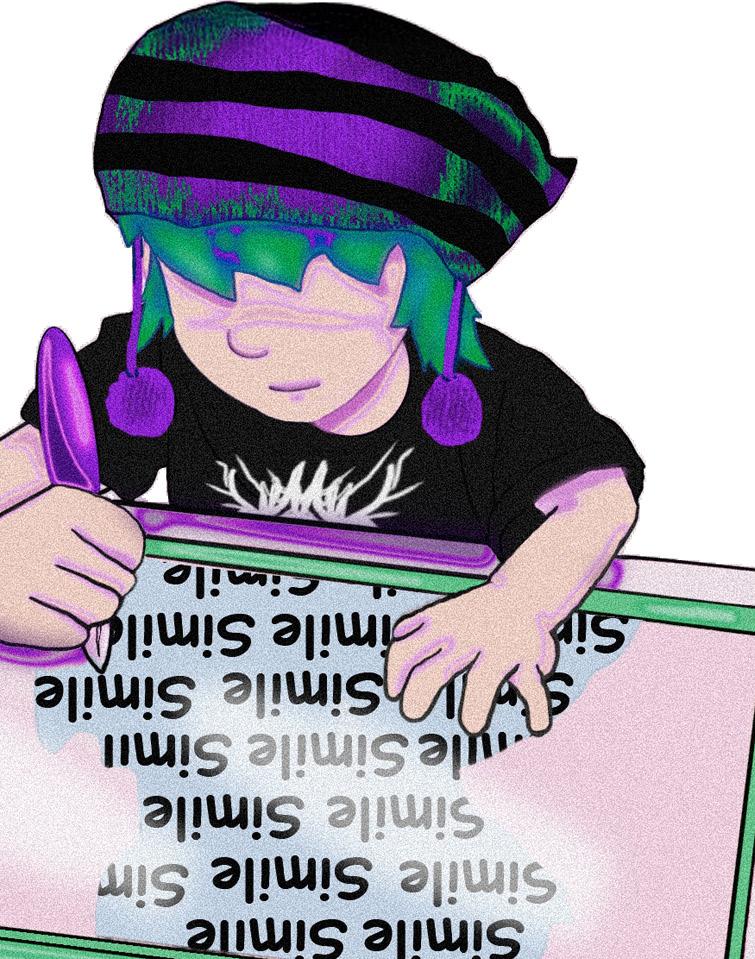
Google Sites URL with a title in flaming text—“I Knew I Loved You When You Showed Me Your Minecraft World.” In the poem, author Hera Lindsay Bird describes the overwhelming sense of adoration and fear that comes with falling in love, “the feeling of knowing / I was beyond what could be recovered from.” The speaker’s voice is conversational, somewhat melancholy, and unwaveringly committed to hitting the reader with some of the most absurd similes ever written. “The sky is firing navy shadows like a T-shirt gun,” the poem reads, “and spring is on the wind like wifi.” There’s a startling, entrancing contrast between the two sets of images: the eternal world of nature—night skies, darkness, spring, and wind—and their manmade, distinctly contemporary complements. The similes are weird and delightful, not afraid to be silly and not afraid to place “unpoetic” images alongside traditional ones. Spring is on the wind like wifi. Isn’t that incredible?
If you’ve ever taken a fiction writing class, you might have heard that figurative language should reflect
the world of the speaker. An aspiring writer says the sky is dark as spilled ink, while a teenage artist says it’s the black of permanent marker. In this way, the simile lets the reader in on something subtle and essential about the speaker—their vocabulary of reference, their sphere of knowledge. We read “...the evening is spread out against the sky / like a patient etherized upon a table,” and we know immediately that this is a sad person’s poem. We read “O my Luve is like a red, red rose,” and we know the shape and shade of this love. Especially in poems, which have so few words to work with, the simile is a powerful vehicle for characterization and development of tone. It tells us what words the speaker has, what images they use to convey meaning. Bird’s speaker, reaching for T-shirt guns and wifi, is recognizably modern and irreverently colloquial. You can compare the sky to anything—the something you pick matters.
labubu dubai chocolate benson boone or whatever
by Ann Golpira
Illustrated by Ina Ma (LABUBU) @1ma1na
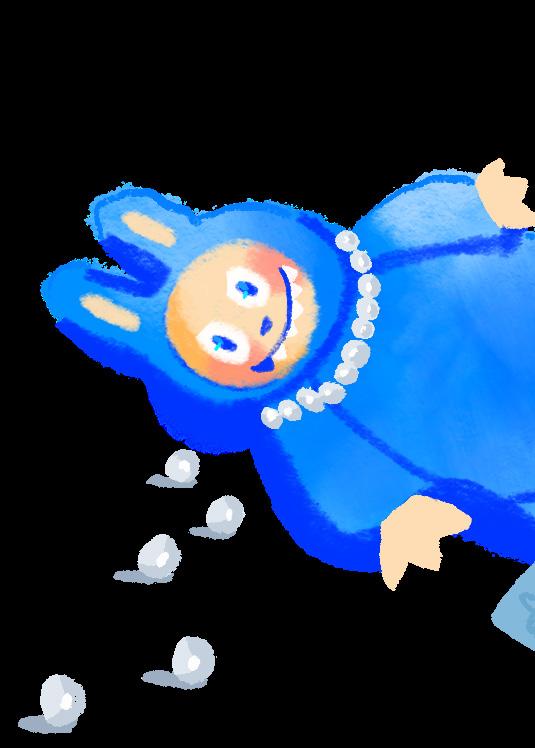
While some stay up late refreshing their internet browsers for just-released concert tickets, merch drops, or even current affairs, the only thing enticing enough to convince me to stay up past my 10 p.m. bedtime was, of all things…a Labubu.
thanking you for it. But ever since demand for the dolls rapidly skyrocketed as they went viral, the company has begun using online raffles to release the boxes to a small subset of quickmoving fans (and bots). So, if you somehow managed to get lucky enough to snag one, your $25 figurine could potentially have a $200 resale value—assuming you were willing to part with it.
It seemed like the ideal business model for a summer cash grab. So, I logged into the Pop Mart website 10 minutes before the official drop and began fervently clicking as if I was trying to secure opening night tickets to The Eras Tour.
After a couple nights of failed attempts, I finally got my hands on one of the grimy little things…and the rush was exhilarating.
After that, I couldn’t stop myself from entering the weekly lotteries (to be fair, in my mind, I had just secured $200 from a 30-minute endeavor conducted from the comfort of my own home). Eventually, I had two Labubus from the “Big Into Energy” series (“Hope” and “Luck” for those of you who went through a similarly questionable phase) set to ship from Beijing to my hometown in Virginia. But despite my sleepless nights and Google Calendar reminders for upcoming drops, I soon came to a jolting realization: The trend had died down, and thus, no one was willing to buy. I resorted to texting club group chats (sadly no one on Mock Trial took the bait), my roommate, and even indirect contacts and friends of friends—but the market was suddenly barren.
The Labubus (who were now in my permanent care and whom I have since accepted as my own) ultimately grew on me, and I even began bedazzling my bags with the new accessories.
I thought I was safe, that the pain of this journey was over—but I was soon proven wrong after a night out in Boston. After sitting down for dinner with one of my best friends, I quickly noticed that the terrifying (yet precious) thing had been ripped directly off my bag. I began to panic, running out of the restaurant to frantically search up and down the Boston streets in hopes of a potential rescue mission. Because rather than steal the bright red wallet out of my open bag, some robber thought it wise to reach for my Labubu instead.
The tragedy persisted throughout the rest of dinner—that is, until some random student texted a Harvard group chat (that my friend
happened to be in) saying he had wandered upon a stray Labubu outside the library—you could tell it was mine by the fake pearl necklace I had adorned it with. It’s moments like these in my life when I wonder whether Pitbull truly has “been there, done that.”
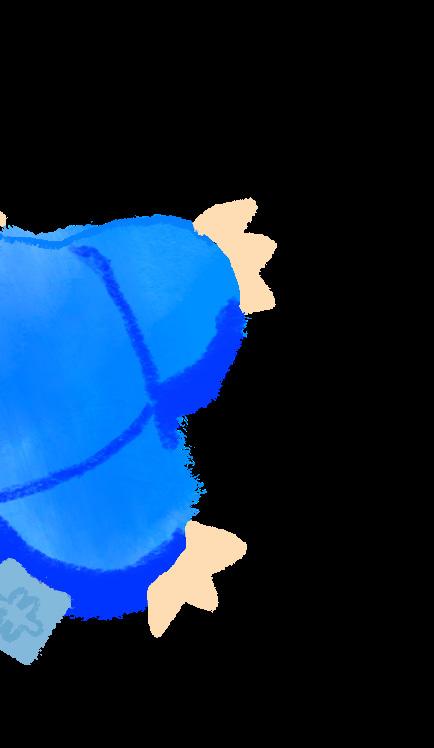
Even though the universe tried to rid me of one of them, I’m still the (proud? confused? neutral?) owner of two authentic Labubus (an admission that makes me wonder whether I should post this article anonymously).
But all in all, there is something quite alluring about the blind box experience. Like Pop Mart, a variety of toy companies will sell their products in mystery packaging, ensuring customers get one of a series of different characters, but leaving the specific one to chance. While many are often taken aback by the high prices—also a feature of other sets like Hirono, Smiski, and Peach Riot—the format offers fans an experience along with the final product.
The mere process of shaking the box in an attempt to guess what’s inside, ripping open the cardboard, and crossing your fingers in the hopes that you secure the limited edition character gives blind boxes an additional layer of allure. When I first tore open one of the boxes, I felt like a gambler discovering a deck of cards for the first time in their life.
But you’re not just buying the experience, you’re also buying pieces of handheld artwork from contemporary artists (debatable for some brands, but I’ll elaborate). One design that immediately comes to mind is the aforementioned “Hirono.” Each figurine is meticulously and thoughtfully designed, with vibrant colors, interesting shapes, endearing accessories, and underlying themes of human emotion. Some explore themes of childhood (i.e. the “Alien” or “Growing Up” figures), feelings of being trapped (“Birdcage” and “Manacle”), boredom (“Drifter” and “Guardian”), inauthenticity (“Costume” and “Puppet”), or even a sense of uncertainty regarding the future (“Unknown Journey” and “Patience”). Each one is a miniature art piece, and given both the experience of opening them coupled with the artistry of the final product, it’s no wonder people have accumulated extensive collections of them.
On the other hand, certain blind box series—like “Twinkle Twinkle” or Pop Mart’s various Disney collaborations—lack this same depth and artistry. While the “Twinkle Twinkle” design looks like I poorly tried to draw a Cartoon Network character from memory, the Disney collaborations, although cute, lack the originality of other boxes. Rather than profiting off of the same, overused Toy Story aliens again and again, other boxes feature consistent updates and original designs, setting them apart as a distinct entity of their own—one with a single artist, rather than a multi-million dollar corporation, at the center of the design.
And while some may argue over the merits of Labubus’ signature design (and whether their “ugly-cute” aesthetic actually deserves the latter half of that compound adjective), part of their appeal lies in that same exciting, anticipatory feeling that so many blind box companies have expertly cultivated.
All in all, the lion doesn’t concern himself with Labubu hate, and neither do I.
by Merissa Underwood
Illustrated by Ellie lin
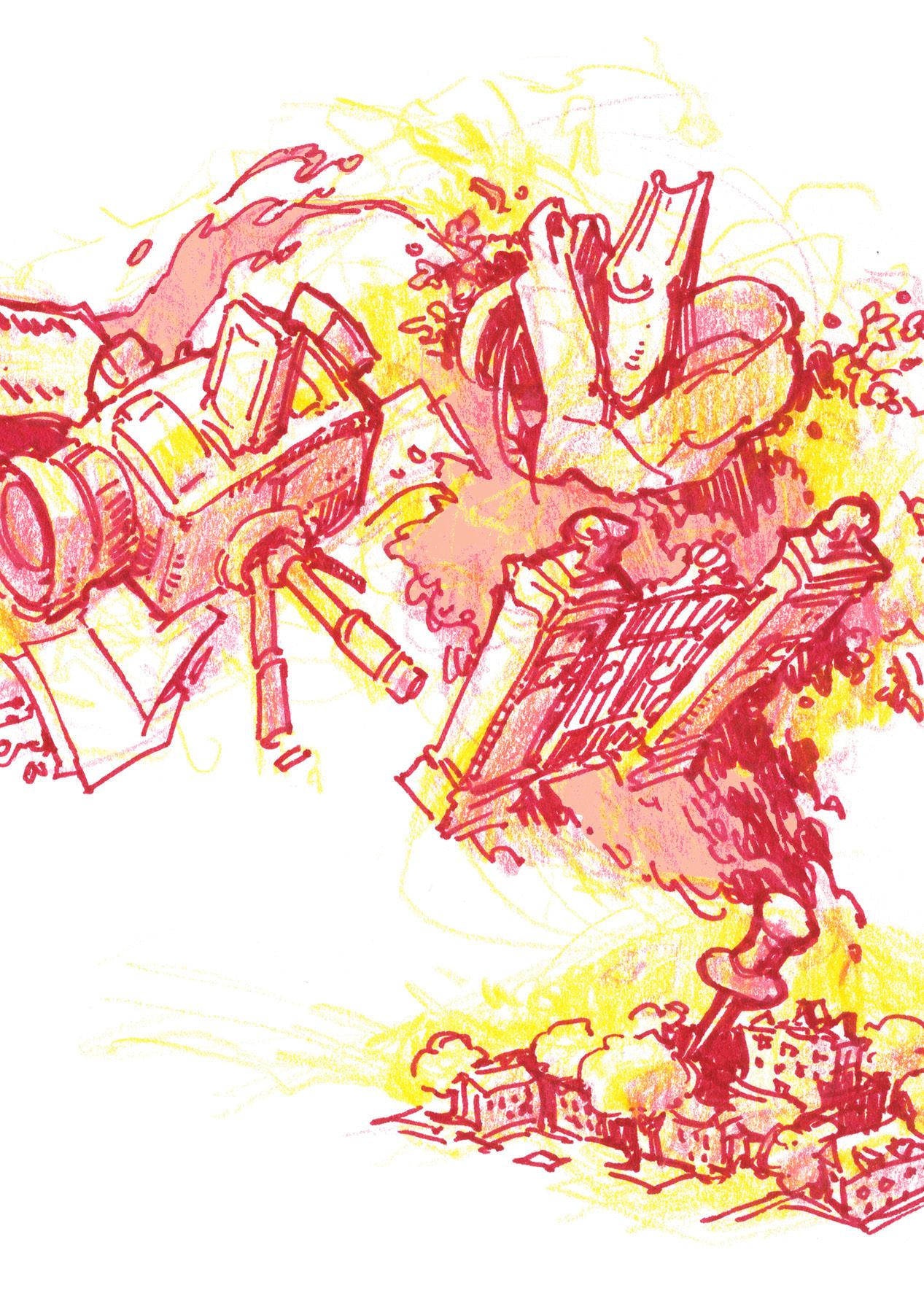
Walking through the Van Wickle gates on Convocation Day held a similar sensation to competing in Miss USA. A crowd of people cheering, flags waving proudly, and the glimmer of hope that my life was about to change— though this time, I was walking into classrooms rather than across a stage in 6” heels and a bikini while preaching about world peace. At Miss USA, I was surrounded by women who had been conditioned for the stage since they were toddlers, born to ambitious mothers who signed them up for baby pageants like “Miss Captivating Infant” in hopes of raising a future Miss USA. At Brown, my peers seemed to have been nurtured for the classroom, fluent in an academic language I was only just beginning to learn.
My path to Brown wasn’t straightforward. When I graduated high school in 2010, uncertainty was the only thing I was sure of. My parents were too preoccupied with their own lives to care about my whereabouts once my feet walked out of our front door. There was no Tami Taylor to chase me down at school and push me to attend college and aim high. (This is a millennial callback; if you haven’t seen Friday Night Lights, please, please watch it.)
In fact, the only person who offered any words of encouragement in my life was a substitute English teacher in 10th grade who wrote “You should be a writer” on one of my essays. I was a middle-of-the-pack introverted horse girl no one expected would end up at an Ivy League.
While my friends and classmates were heading off to various colleges, I made my way to the land of make-believe, a city where no one cared about SATs or GPAs. Los Angeles was a runway of opportunity that flew beyond structured expectations and allowed anyone to shape themselves into whatever they desired. For many years, the city and I were best friends, embarking on new, glamorous adventures daily—storming couture runways, filming MVP Nneka Ogwumike at the WNBA All-Star game, or protesting climate change in DTLA—the city provided everything.
But as with any friendship, challenges arose, and I questioned whether or not our goals remained aligned.
Employed in the entertainment industry, I watched as strikes began to overwhelm studio sidewalks, media company mergers imploded crews, and CEOs were caught in a

flurry of lawsuits while their employees signed up for unemployment benefits for the very first time, leaving much of LA brokenhearted. I began to question my own place in the city when the director of a feature film I worked on proudly declared to our office of underpaid and exhausted crew members that he would quit if our world-famous studio merged with another—this would have placed us under the rule of a morally corrupt leader who faced a bevy of sexual assault allegations. Just another day in Hollywood.
That merger was completed a few weeks ago. I wonder if the director quit.
The chaos of my industry pushed me to want something more. That’s when I discovered the Resumed Undergraduate Education program at Brown: a unique opportunity for non-traditional students to receive an exemplary education, with the perks of specialized mentorship.
When I told my friends I was planning to attend college in my 30s, the response was usually some version of “Good for you!” tinged with curiosity and confusion. Then came the inevitable, “To get your PhD?” to which I would fumble out, “No, no…for undergrad.” Their brows would furrow for just a millisecond before they managed to hide the mental math, seeking to piece together what exactly I had been doing with my life for the past decade.
Others were more blunt. “Why? Employers don’t care about a college degree anymore. The only thing that matters is who you know.”
When my partner shared with an old friend that we were moving across the country so I could attend Brown, the reaction was one of
terror:
“Uh, are you dating a high schooler?”
To some, the idea that someone in their 30s would seek an undergraduate degree was inconceivable.
Spending over a decade engulfed by an environment where youth was the ultimate goal, I was unsure how the student body at Brown would react to a presence that was distinctly different from theirs. While on a mission to pick up my shiny new student ID, I was confronted with my differences immediately.
“You’re a graduate student?” The worker inquired with a kind smile.
“Undergrad,” I imposed.
“Oh, it’s at your dorm, then.”
“Ah…I…I live off campus.”
She’s confused. I’m confused. Everyone’s confused!
With my student ID in hand, TRUE Orientation provided a comforting space of similar backgrounds. The group of eight multifarious Resumed Undergraduate Education (RUE) students shared fragments of our backstories as we navigated moments of excitement and pre-Convocation jitters. Hailing from every corner of the country, our group welcomed artists, dancers, and international travelers—all of us just on the brink of a transformative experience.
As classes began, I knew I stuck out, and my six-foot stature didn’t extend any camouflaging techniques. In my former world of entertainment and pageantry, turning heads
was a sign you were doing something right. Now, I was longing to blend in. “What year are you?” Classmates would ask with a tone of wonder. I’d respond with a jumble of words about how all RUE students begin at first-year standing, but I had transfer credits to bring in, though I was unsure where they would land me. I’d quickly realize they weren’t curious if I was a sophomore or junior.
“You just don’t…speak like an undergraduate.” Ah yes, they want to know my age.
“Let’s just say, I remember 9/11.”
It’s in moments like these that I found peace. My breadth of experience allows me to sink my fingers deeply into the soil of knowledge found across the Brown University greens. Truth be told, the degree isn’t even what matters to me. Of course, it’s nice, in the way a glittering crown and sash are, but it’s the pursuit of knowledge that is propelling me forward. To think in new ways, read literature I would’ve never considered, and hear the perspectives of classmates half my age from halfway across the globe. To sit with professors filled with care and consideration,
who are committed to encouraging success in every student. To be in a space where imperfections and mistakes aren’t edited out in Photoshop or deleted on the cutting room floor—they’re embraced.
why I correct people about my last name
by April wang

For my high school graduation, the presenter read every single person’s name out loud. During rehearsals, they invited people to correct any pronunciation of names in preparation for the actual ceremony. I ignored their announcements, spacing out in boredom and wishing they would finish faster so I could stop sweating in the sun-bleached rows of chairs. As we were packing up to leave, my AP Economics teacher, who was supervising graduation practice, asked me, “You’re not going to correct them about your name?”
I was confused. What correction was there to make? April Wang: a month of the year and one of the most common Chinese last names. There was no way for them to mess it up. It only hit me then that he was referring to the pronunciation of my last name. Everyone always pronounced it as W-AY-ng. I knew it wasn’t the right pronunciation; it should be pronounced W-AH-ng. However, it was always confusing when I corrected them, and people would give a second glance to whatever attendance sheet or nametag they had started with. So, at some point in my life, I decided it was easier to say and respond to W-AY-ng then have to spell out my name awkwardly and explain that “actually, it is spelled correctly, it’s just pronounced the same way as Wong with an o, that one’s the Cantonese spelling, and I barely speak Mandarin, let alone Cantonese.” And it had become so ingrained that I didn’t even notice the mispronunciation in front of hundreds of people.
It was then that I was hit with a strange sort of grief. I should be proud of my culture. I am proud. But it’s genuinely not a big deal. I’m not in denial, because if I were, I would be trying to hide more than just my name. I would feel a difference between hearing ‘W-AY-ng’ and hearing ‘W-AHng.’ I couldn’t even care enough to correct it at my graduation. When did that happen? A name is a home––a memory of the sticky-sweet tangyuan my parents would make for me, the silly Chinese children’s shows about sheep and wolves I used to watch, and the uncles and aunties cooing at my sister and me, xiao-bao and da-bao, as they invited us in for a party. My name reminds me of where I came from and what shaped me as a child.
And yet I cannot count the number of people I know who changed the pronunciation of their name because it was just easier—Zheng to ‘Z-AY-ng,’ Liu to ‘L-OO,’ and countless others. When you grow up American, speaking English at school and stuttering through words at home, the Americanized version just seems to fit better. Not necessarily because the pronunciation makes it easier to fit in to a white culture––in fact, the area I lived in was majority Asian and filled to the brim with Asian culture, from restaurants to Cherry Blossom and Diwali festivals run by the city––but because it suits who I am: Chinese American, not Chinese.
A name is a label: an impression to live up to. When your name belongs to an identity that you’ve left behind, on purpose or not, conforming is more comfortable than trying to clarify what you don’t even understand
about yourself. I might have grown up speaking Mandarin with a Chinese family, but as I entered high school and college, I stopped speaking it as much. I stopped celebrating some of the festivals. My classes were in English, as were my extracurriculars, as well as the books I read and the shows I watched. I couldn’t really bring myself to call myself Chinese when I didn’t even know how to describe myself in Chinese. So ‘W-AY-ng’ just made sense: ethnic but not quite, warped into something quintessentially American from a Chinese foundation.
After that graduation ceremony, I started wondering what I was really grieving. I felt like I had lost a part of my identity, but that loss had been ingrained for years by then. I hated that I was drifting from my culture, but I only hated it when I remembered the gap existed. I built myself around it. Especially going into college, I was coming to terms with a lot of changes in who I was. I was exploring new hobbies, trying to figure out my sexuality, and experimenting with different fashion styles. I’d changed in other ways; my culture just happened to have the clearest boundary between past and present—the change that was easiest to notice. I didn’t bother with correcting my name, not just because I wasn’t sure what suited me culturally, but what suited my identity.
It hit me then that I had focused so much on definitions that I didn’t think about potential. It’s a strange form of perfectionism; I feel like I have to know who I am before I can let other people perceive me. But in many ways, that approach is incompatible with growth. There’s someone I want to be: someone more in touch with my culture, someone who is braver, someone who is more creative, someone who is more responsible––a million other descriptors that change every day. I will always be grieving something, as leaving parts of myself behind is an inherent part of that change. If I tried to prevent that grief, to anchor my self-perception and name to a concrete point within that change, I would be constantly out of date with the new changes in my identity.
I never corrected anyone at my high school graduation. But the college school year has started again. Another round of introductions, of teachers calling out and stumbling over names. I’ve taken to correcting people about my last name. Just a quick word: when they call out, “April W-AY-ng?” I’ll interject, “Wang, yep!”
Right now, I feel like a name is a wish. An experiment. I may not know who I am, but I know who I want to be. I want to connect more to my Chinese culture, so I say ‘W-AHng’ instead of ‘W-AY-ng.’ I want to be more social, to be more confident in my identity, so I correct people even when it makes my heart pound and my mind cringe. Maybe in the future that’ll change. Maybe I’ll go by my middle name because April is so common that I’d like something more unique. Maybe I’ll change my name because it won’t suit me anymore. Who knows? A name may be a label, but there’s a reason names aren’t in the dictionary.

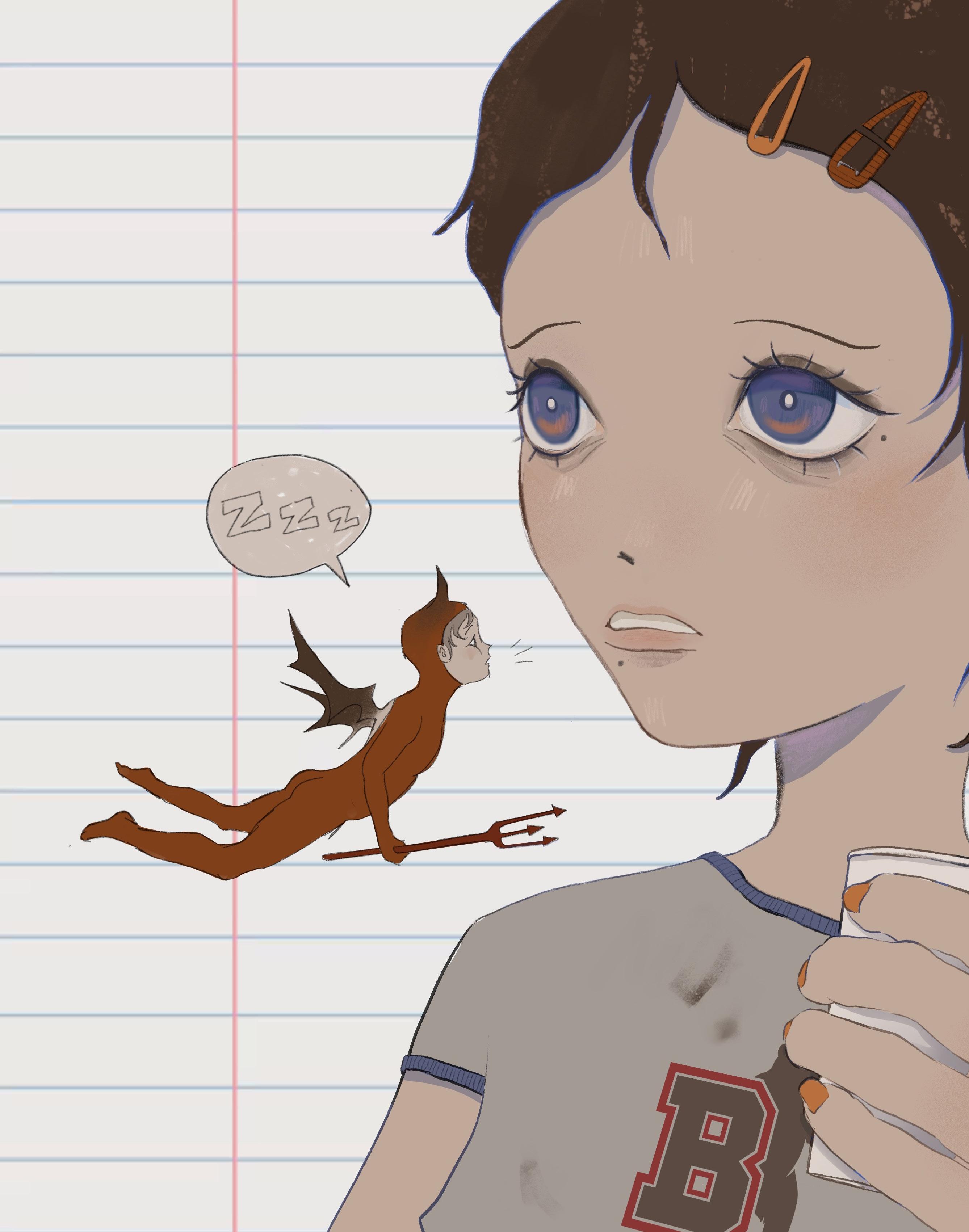

we’re all in this together
by Alayna Chen | Illustrated by Christina Xu
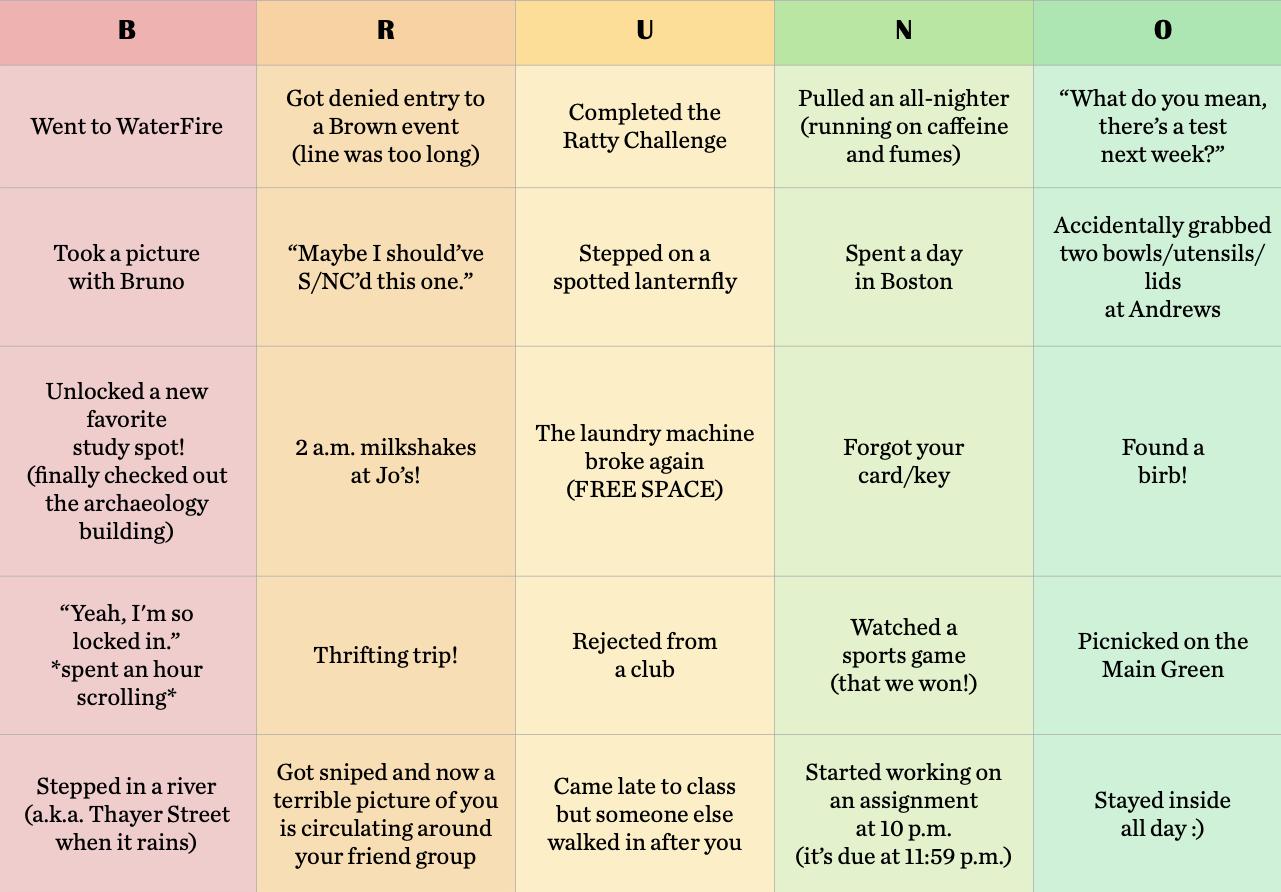
“That wasn't on my 2025 Bingo card.” But it was on Bruno’s! We're a little over a month into the semester—can you get a Bingo?


post- mini crossword by
Alayna Chen
1. Sun's partner
5. Jupiter's moon and Britomartis's mother
6. Liquid sample
7. BB-8 or R2-D2
8. Thesaurus words
1. Say "I do"
2. Hunter known for his belt
3. Old Dodges
4. Requirement
5. Cow's leftovers

Thank you for reading magazine. New issues every week.
“I don’t know what they’ll look like when I return in December. Perhaps this winter will be rainy, and they’ll be emerald green, trees and bushes bursting to life. But it’s more likely I’ll find myself remapping a dozen new ashen scars, unfurled across the slopes, the constancy of change once again making itself known. The next fire season will come, and the one after, and after. The mountains will erupt again and again. Nothing will ever be the same as it is today.”
— Michelle Bi, “leave no trace” 10.9.24
“And I know: to love is beautiful, beautiful, beautiful. I hum along with the music that swells from the speaker. It’s simple, isn’t it? Love isn’t just a flash, a bolt you feel leaping across your veins. Love is what I feel when I look at you.”
— Daphne Cao, “the shape of love” 10.18.23
EDITOR-IN-CHIEF
Emilie Guan
FEATURE
Managing Editor
Elaina Bayard
Section Editors
Anika Kotapally
Chloe Costa Baker
ARTS & CULTURE
Managing Editor
AJ Wu
Section Editors
Lizzy Bazldjoo
Sasha Gordon
NARRATIVE
Managing Editor
Gabi Yuan
Section Editors
Chelsea Long
Maxwell Zhang
LIFESTYLE
Managing Editor
Daniella Coyle
Section Editors
Hallel Abrams
Gerber
Nahye Lee
POST-POURRI
Managing Editor
Michelle Bi
Section Editor
Malhotra
Tarini
HEAD ILLUSTRATORS
Junyue Ma
Lesa Jae
COPY CHIEF
Jessica Lee
Copy Editors
Indigo Mudbhary
Lindsey Nguyen
Rebecca Sanchez
Tatiana von Bothmer
LAYOUT CHIEF
Amber Zhao
Layout Designers
Emma Scneider
Emma Vachal
James Farrington
Tiffany Tsan
SOCIAL MEDIA
Rebecca Sanchez
Yana Giannoutsos
Yeonjai Song